Lifetime of Learning

adult learning, art, Cezanne, cognitive decline, Habits, John Ruskin, Transfer of Learning

Art and Math

“Transfer of Learning” is a concept in which anything learned in one situation or environment can be applied in another. When I taught art, I would have my students use mathematics and fractions when they cut mats to present their work for exhibition. “Why do we have to use math in art?” they whined, “We’re never going to use it in our lives again.”

“Are you going to buy a house, a car, or shop for clothes or groceries? How will you know you’re getting a good deal?” They got out their pencils and rulers, even though they hated fractions.

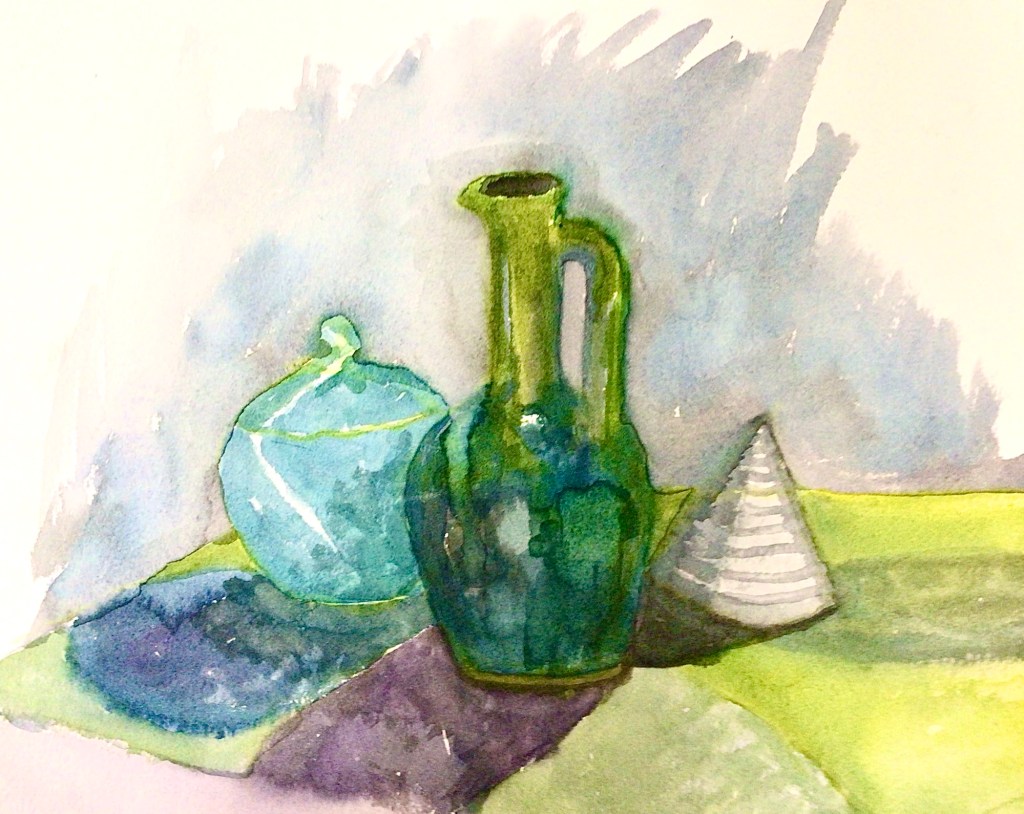
Step 1: draw a light under painting

This was decades ago, before “Train for Today’s Workplaces” became a mantra among some politicians. The only problem with training for today is the ever-changing nature of the modern workplace, which can make skills obsolete in a mere two years. Executives believe nearly half of the skills that exist in today’s workforce won’t be relevant just two years from now, thanks to artificial intelligence. However, human creativity will always be needed to guide AI. Folks who want white collar jobs today will need to buy into continuous learning, since the current job market will require ever changing skills.

Step 2: add some thin washes to build up the solid surfaces

We’ve all heard the saying, “Jack of All Trades vs Master of None,” but this might be the best possible scenario for our modern world. In our highly professionalized society, we all want the best physician and the top-notch lawyer on our case. Not everyone has the goods to acquire their services. We get the best we can afford. This is the capitalist society in which we live. In a utopian society, the poorest among us would get the same high quality medical care as the President of the United States.

Step 3: add details once surface is dry enough the paint won’t bleed. Doing background while waiting for objects to dry allows you to tighten up the edges of the objects.

“Those who can’t, teach” is a misconception, similar to the Jack of All Trades. Art Teachers can’t stick only to their specialty, but also must offer the gamut of skills from drawing to painting, paper cutting to plaster sculpture, clay pottery to cloth dyeing, and even more multimedia experiences. They have to be able to reach students with a wide range of talents, interests, and expertise, as well as encourage those who are ashamed of their work. Plus, they need to convince the talented to work and improve so they fulfill their promise.

This background discussion brings me to our class’s second experience in watercolor. I noted some instances of Transfer of Learning I can point out when we meet again.

Gail’s Still Life

When we paint a house, we dip our brush in a bucket of paint, apply it to the wall in one stroke, and then go back to the bucket for another dip. We don’t keep wiping the same spot on the wall over and over trying to make this one spot look better. In fact, the damp brush is just picking up the paint off the wall! Move along and cover the wall.

Tim’s Still Life

Don’t take your eye off the ball. If you want to catch a ball in any sport, you have to track it into your hands or the mitt. I noticed the ones who looked up, drew, looked, drew, checked, drew again, adjusted, and drew some more, had closer proportions in their drawings.

Measure twice, cut once. This is similar to the above sports metaphor. I learned it in the art school wood shop when I was cutting wood for my stretcher strips. Using the thumb or a brush to note the proportions of the still life objects and comparing them to the proportions of your own work helps get an accurate drawing. Check once, measure, check again, measure, and then cut. Air drawing or visualization helps to imagine the proportions before drawing the lines. Drawing lightly so you can draw over the less appropriate shape is an example of measuring twice, and cutting once.

Gail W’s Still Life

Sheep will eat the grass down to the roots, but goats will move on. Actually, I have zero experience with sheep and goats. My shepherd experience is limited to leading a congregation, none of whom could be accused of being either sheep or goats. I only know this fact from Bible Study lessons, and no one rents out sheep to clear a pasture of weeds, but they use goats because goats are smart enough to move on. In art, we need to take a lesson from the goats and move on to another section of our painting to let our colors dry, so we can avoid our colors running into each other.

Cornelia’s Still Life

Our group isn’t training for a new occupation, but keeping a challenge on our plates is a good idea for anyone of any age. Whether you’re trying new recipes or learning to play an instrument or taking up an exercise routine, whatever change you make in your life is important. Doing creative writing or crafts or arts is especially crucial for keeping our brains healthy, for these activities build new pathways in our brains. As we age, having redundant brain pathways is important to keep our minds healthy.

Participation in arts interventions have been linked with improving cognitive function and memory, general self-esteem and well-being, as well as reducing stress and other common symptoms of dementia, such as aggression, agitation, and apathy. According to the National Endowment for the Arts, the interventions which promote social interaction, have multiple psychosocial benefits. While none of our group are experiencing these effects, participation also staves off the same symptoms. Researchers found visual arts programs reduced depression, improved socializing, and increased self-esteem among participants.

Expressive arts activities also help individuals relax, provide a sense of control, reduce depression and anxiety, encourage playfulness and a sense of humor, as well as improve cognition and self-esteem. Making art also nurtures spirituality and reduces boredom. Art also can reflect the emotional and cognitive condition of the artist.

Watercolor with Prang Oval 8 Student Palettes

In the classes I teach, I encourage each person finding their own voice, rather than copying my style. In the art education classes I took in college, the goals of teaching were for students to recreate the closest replica of the teacher’s model, as they followed the instructional steps to the letter.

I’m thankful I never had those teachers growing up, but by the 1980’s, regimented lesson plans were all the vogue. When I began to teach, I gave certain boundaries or requirements for each lesson, such as the use of certain color schemes or coiling verses slab built in clay sculpture, but the rest was left up to each student’s creative interpretation.

My principals were always surprised by the lack of discipline problems in my class, but when young people are given an opportunity to develop their imagination in a positive direction, rather than use it in negative behaviors, life is good. They especially liked the “hand-mouth pop quizzes” I would occasionally make them take, especially when they discovered cookies or chewing gum were involved.

Years later when I went to seminary, I constantly heard the refrain, “Will I be able to put this in my toolbox and use it in the local church?”

As a person who was preparing to be a fifth career pastor, I could only roll my eyes in silence. Every job I’d ever had prepared me for the ministry: renovating old apartments, teaching, preparing lesson plans, selling insurance, studying art history and painting, and learning how to renew and retrain my old skills for a new career. The idea of having a single toolbox that would never need new tools never crossed my mind. Seminary was where my skills to be a lifelong learner were reinforced.

I was writing this on My Daddy’s birthday. He would have been 105 if he’d lived so long. He always maintained an interest in archaeology until Parkinson’s and dementia robbed him in his late 70’s of his memories and his brilliance. He would take us on arrowhead hunting field trips on Saturdays when we were children. Armed with a cooler of lemonade and sandwiches from home, we’d go out to the countryside to walk in a farmer’s newly plowed field, with his permission of course.

In his early retirement, he enjoyed giving tours to school children at the LSUS campus Pioneer Heritage Center and driving the church bus to the food pantry to pick up the monthly food rations for distribution to the neighborhood. Staying active, engaged, and eating a healthy diet are other ways we can keep our minds building new neurons.

One of the interesting research opportunities in art and the brain is the question of whether neurodegenerative brain disorders will show up in an artist’s body of work. The progressive loss of neurons causes changes in the brain, which leads to a number of symptoms, from altered multi-sensory processing to difficulty moving and using one’s body, to subtle changes in mood, emotions, personality, social interactions; to major, disabling cognitive and behavioral impairments. Although we currently only offer art therapy for the elderly, perhaps we ought to be emphasizing the arts from earlier ages and integrate it into all of our studies to help everyone develop limber learning skills to last for our lifetimes.

Joy and peace,

Cornelia


Half Of All Skills Will Be Outdated Within Two Years, Study Suggests

https://www.forbes.com/sites/joemckendrick/2023/10/14/half-of-all-skills-will-be-outdated-within-two-years-study-suggests/

National Endowment for the Arts Study: “Research Gaps and Opportunities for Exploring the relationship of the Arts to Health and Well-Being in Older Adults,” Published by the national endowment for the Arts Office of Research & Analysis

Pioneer Heritage Center

https://www.lsus.edu/community/pioneer-heritage-center

Can we really ‘read’ art to see the changing brain? A review and empirical assessment of clinical case reports and published artworks for systematic evidence of quality and style changes linked to damage or neurodegenerative disease

Physics of Life Reviews 43 (2022) 32–95