Four Pears Still Life

art, Cezanne, Creativity, failure, nature, Painting, Pompeii, Transfiguration

We painted a still life of four pears and a handmade blue bowl in our recent Friday art class. After looking at some art prompts and reminding the class, “Pears are just variations on spheres piled on top of each other,” we got down to business. In art class this means spending some time looking. Unless we’re designing an abstract creation, we usually have a desire to make our images reflect what we see. Yet each of us sees from a unique perspective and we each have a special creative use of color and line. This is our creative genius which lives within each of us. My goal as a teacher is to lead this genius out of each person and set it free to feel confident to exercise its own voice.

Pompeii Genius mural, House of Lares

The genius is a Greco Roman idea like our guardian angel, in that each person has a guardian spirit. The Romans put the father at the head of the family, so the genius was the spirit of the male head of the household. In the family altar areas lares, (guardians of the family, who protect the household from external threats) stand on either side of the genius, who wears a toga and makes a sacrifice. Beneath them all is a serpent. The murals often depict snakes in the lararia because the Romans believed they were also guardian spirits of the family and as well as messengers to the underworld.

The poet Horace half-seriously said only the genius knows what makes one person so different from another, adding the genius is a god who is born and dies with each one of us. Individuals worshipped their own individual genii, especially on their own birthdays. Today we use the term genius to mean “gifted or special,” but each of us has special abilities of our own genius, just by the grace of God at birth. As Romans 12:6 reminds us,

“We have gifts that differ according to the grace given to us: prophecy, in proportion to faith; ministry, in ministering; the teacher, in teaching; the exhorter, in exhortation; the giver, in generosity; the leader, in diligence; the compassionate, in cheerfulness.”

Some of us may be rich in gifts, and some of us may be letting our gifts lie fallow, but we can all work at increasing the gift we have. Some of us may discover a hitherto unknown gift! None of us would ever want to be like the third servant who received the one talent and promptly buried it out in the back yard in a coffee can, only to return it to the master without even added interest. He was so afraid of failure and loss, and worried about future punishment, that he did not even loan the money out at interest. (Matthew 25:24ff)

Samuel Beckett in in Westward Ho (1983), said:

“Ever tried. Ever failed. No matter. Try Again.

Fail again. Fail better.”

This quote was written on the back of a envelope in my grandmother’s art studio up on the second floor of the big wooden Victorian home my granddaddy built for them when he was promoted to conductor on the railroad. He had an eighth grade education, but made sure his boys had more. My grandmother was not going to let anything stop them.

Failure is how we learn what we don’t know. Then we learn some more things and discover we still don’t know everything! We become lifetime learners because the world is always changing, whether we want it to or not. We too will transform, because this is the truth of the Christian life.

Test of Vanguard launch vehicle for U.S. International Geophysical Year (IGY) program

Most of life in the art studio is a process of failing upward. Most people think failing is always a negative activity, but children always fall before they can consistently walk. We give them joy, cookies, and hugs. I am old enough to remember rocket ships blowing up on the launchpad more often than streaking into the great beyond. NASA had a few kinks to work out before we sent chimpanzees or humans into space. Even then, space has claimed its heroes. We don’t call NASA a failed organization. These sacrifices taught us much. We are infinitely more careful and do not want to move so fast that we break humanity. Break the technology but care for the humanity.

In my own work, I can learn so much on one painting, I will look at it a month later and want to “fix it.” I realized long ago I needed to let that feeling go. If I were to work with new insights on the old work, I would have to totally repaint it. I would be better off beginning all over. I’m now in a new place and have new skills. My individual genius is ready for a new challenge. I will learn so much on the new work, I will be eager to start on the next one.

Transfiguration Icon

Art is like life. We get a new day to do better and another opportunity to do better. There are cynics among us who believe people cannot do better, or they will never change. Those of us, who afflicted with incurable optimism, believe change is possible and a better life awaits. We would have no teachers, healers, or community leaders, much less no clergy of any faith, if we didn’t believe in transformation or think we have no part in bringing it to fruition. I am not one to settle for chaos and despair. I keep saying this world has enough negativity, and I will not contribute to that excess.

Henri Rousseau: Pears, Apples, and Teapot, c.1910, oil on canvas, private collection

Simplifying what we see before us is a first step in drawing from life. The KISS Principle works in art class too: “Keep It Simple Silly.” Most of us try to eat the elephant all at once. We look at a houseful of boxes and collapse: where to start? After years of itinerating, I can say with certainty, “The one nearest to you at the moment.” If it took three weeks to pack, expect the same amount of time to unpack. Hooray, you get to eat out until you find the kitchen gear. Likewise with a painting, we make a mark with a light-colored wash. If it is in the wrong place or the wrong size, we can overpaint it. No one will ever know.

Our Four Pears: One View

Mike kept his pear painting simple. He made a study of the one pear which called his name. Just because I brought four pears and a blue bowl didn’t mean he felt the need to paint the whole still life. This is his unique genius. In his work life he can find the primary truths and key facts to support his clients’ cases. Those same attributes will show up in his artwork. At the end of the class, he was unhappy, however.

“Use your words,” I always say, “or at least point to where you are unhappy with your work.”

Pointing to the waistline of the pear, he said, “This section here looks wrong.”

“That’s where you quit looking at the pear and were just putting paint on the canvas.”

“OK, I thought that was what was bothering me about this, but I didn’t know why.”

Mike: Four Pears are The One Pear

“We have to keep looking at the objects while painting. Our memories aren’t that good to keep the image in mind for long.” We can train our memories by the technique of blind drawing, which is the technique of only looking at the objects, but never at our drawing. This trains our hand to connect to our eye. Our first drawings are very lopsided because the right side usually won’t match up to the left side. Yet with practice, these blind drawings will look somewhat realistic.

Gail S: Four Pears

Gail S has a more reflective and introspective approach, so she will dissect the major elements of the still life before she makes a mark on the canvas. Some people can imagine three dimensional objects as two dimensional patterns without making marks visible. I consider this a particular form of genius, for they also can usually access their thoughts without having to write them down, which is what extroverted thinkers need to do. This is another example of how different people approach art from their own specific genius: if we all were all alike, we would produce indistinguishable results as if from a factory. Art class isn’t a factory production line, but an experience and opportunity to get in touch with our creative selves.

Cornelia: Four Pears

I managed to catch the personality of the different pear species. I was painting on a raw, unprimed canvas, so my first layers of paint soaked into the weave. The successive layers built up the colors. I ignored the drapery and the busy background of the actual setting, but I added the rainbow clouds of my own. The violet grey of the tablecloth might read to some eyes as a mountain. Then the size context of the pears and the bowl becomes questionable. Are they normal sized pears on a table or giant-sized pears on a mountain? The tension is part of the painting.

Rembrandt: The Night Watch, 1642

Once the artist makes their work, they give it a title for what it is meant to say to others. That is its “birth name.” Much like a sermon, once the word or image gets out into the public, people interpret it according to their own lived experiences and prejudices. As an example, historians have misinterpreted Rembrandt’s Night Watch, which wasn’t its original title.

Contrary to popular myth, the commissioners did not reject painting, but it has suffered many indignities in its almost 400 year history. In 1715, the townspeople pared it down to fit between two doors in Amsterdam’s Town Hall, and its current name arrived at the end of the 18th century on account of varnish and dirt that had darkened it into a nighttime scene. The action takes place at dawn’s first light, a fact revealed after a recent 2013 cleaning.

Paul Cézanne: Still Life with Apples and Pears, ca. 1891–92, Oil on canvas, 17 5/8 x 23 1/8 in. (44.8 x 58.7 cm), Metropolitan Museum of Art, New York, NY.

The same goes with any spoken word or sermon. If we wonder how so many people can get so many different meanings from a preacher’s sermon, or how people can read the same Bible, but produce wildly different interpretations of the claim Christ has on their lives from the same holy word, it might be because we all come from differing perspectives, environments, cultures, and therefore have unique “geniuses.”

In the seminary we try our best to strip all our preconceived notions away from our hearts and minds and hear the texts as the authors originally spoke to those who wrote them down. Then we ask, “What meaning do they have for us today? What is Christ calling us to be? What are we to do to bring God’s kingdom one step closer?” If the scripture cannot touch us, transform us, and call us to action, we will be as John Wesley once feared, only “almost Christians.” To be fully Christian we need to have not only the outward appearance of the Christian life but also have “the love of God and neighbor shed abroad in our hearts.” That is the mark of the “altogether Christian,” rather than the one who is only just as good as the “honest heathen.”

Wesley never minced his words, as you can read in his sermon, “The Almost Christian.” When our toes tingle, we might want to give some thought to our strongly held beliefs. If scripture contradicts them, then we might want to look deeper into the background of that text and see if the rest of the Bible speaks with the same voice. We also might want to consider if this word has meaning for today (for instance, we no longer make animal sacrifices to God, since Christ made that need irrelevant by his gift on the cross).

Cezanne: Still life with three pears, Pencil and watercolor on paper, 1880-82, 12.6 x 20.8 cm, Museum Boijmans Van Beuningen, Rotterdam, Koenigs Collection

When we struggle in learning a new art technique, we are also undergoing a transformation. We sometimes must unlearn an old comfortable habit to learn a better one. Anyone who has played a sport knows the difficulty of making a swing change or adjusting their throwing motion. We are creatures of habit and want to take the well traveled path. We fear any disruption from the ordinary. Yet it’s in the challenge of the new where we learn. Iron sharpens iron. We never hear the metaphor, “Wool sharpens steel.”

We will do Day of the Dead T shirts next and turban pumpkins after that. It is always an interesting time in Friday Art Class. You can join us and begin at your level. Bring your own acrylic paints, brushes, and a small canvas or canvas panel.

Joy and peace,

Cornelia


Genius | Ancient Beliefs & Practices

https://www.britannica.com/topic/genius-Roman-religion

Revealing the Secret History of Rembrandt’s ‘The Night Watch’

https://news.artnet.com/art-world/secrets-of-rembrandt-the-night-watch-2627404

BBC – History – Ancient History in depth: Pompeii Art and Architecture Gallery

https://www.bbc.co.uk/history/ancient/romans/pompeii_art_gallery_08.shtml

Wesley’s Sermon Reprints: The Almost Christian | Christian History Magazine

https://christianhistoryinstitute.org/magazine/article/wesleys-sermon-reprints-almost-christian

Test of Vanguard launch vehicle for U.S. International Geophysical Year (IGY) program to place satellite in Earth orbit to determine atmospheric density and conduct geodetic measurements. Malfunction in first stage caused vehicle to lose thrust after two seconds and Mission Control destroyed the vehicle.


It’s Not Under Control!

adult learning, art, Attitudes, bottles, brain plasticity, Cezanne, Creativity, failure, Family, Fear, Healing, Lent, Marcus Aurelius, Painting, perspective, Ralph Waldo Emerson, renewal, risk, samuel Beckett, shadows, Stress, Super Bowl

All things will renew themselves in good season, yet we have only the present moment before us. We can’t live in the past, nor can we control the future. We have to recognize even our present moments aren’t always in our control, as we witnessed in the big Super Bowl game last Sunday.

Random Actions Often Determine the Outcomes of Sporting Events

Who would ever believe a punt would hit a receiving teammate’s foot, and suddenly become a live ball? Then get recovered by the Chiefs for a quick touchdown? If you think you can control your circumstances or the actions of others, just watch the NASCAR races at Daytona this weekend. The wonder is they don’t wreck in every turn, but only occasionally during the 500 mile race on Sunday.

Cezanne Watercolor “Mont Sainte-Victoire (La Montagne Sainte-Victoire vue des Lauves)”( 1902–06) by Paul Cézanne. (The Museum of Modern Art, New York/Photo © 2021 MoMA, NY)

Watercolor is more difficult medium to manage than acrylic paints because it’s wetter and refuses to dry as quickly as we want to paint in that same area. It’s not being obnoxious; it’s just being its own true self. Cezanne used watercolors to think out his ideas beforehand, and then worked in oils. Often, he tossed aside the watercolor work, sometimes even leaving it out in the landscape which he’d just painted. He’d learned all he could from it and now was ready to paint his new image, but not a copy of the original painting. This mountain shows up in sixty of Cezanne’s artworks.

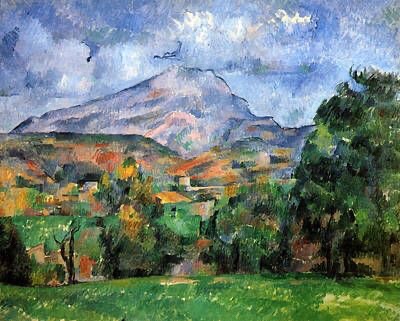
Paul Cézanne: La Montagne Sainte-Victoire, 1888, oil, The Stedelijk Museum, Amsterdam.

The stoic philosopher and Roman Emperor Marcus Aurelius wrote a series of meditations on life. In one he speaks of all life experiences as being the same. This attitude keeps him from getting too high or too low about what happens in his life. He takes it as it comes. Even death, which some fear as a loss, doesn’t bother him, for if he isn’t bothered about the present, he can’t be bothered about losing that too. Marcus Aurelius wasn’t a Christian, but his quest for equanimity is admirable. Take life as it comes and worry not:

“First, that all things in the world from all eternity, by a perpetual revolution of the same times and things ever continued and renewed, are of one kind and nature; so that whether for a hundred or two hundred years only, or for an infinite space of time, a man see those things which are still the same, it can be no matter of great moment. And secondly, that that life which any the longest liver, or the shortest liver parts with, is for length and duration the very same, for that only which is present, is that, which either of them can lose, as being that only which they have; for that which he hath not, no man can truly be said to lose.”

The Still Life in Our Classroom

When we work in watercolor, we have to take what the watercolor gives us. While we can plan, design, and control the outcomes to a certain extent, watercolor often goes its own way. If we work over the whole surface, rather than noodling around in one little space like a puppy sniffing a single spot while out on its morning constitutional walk, we get more done, just as the puppy is more likely to get its “business” done.

One of the reasons we work in a new medium is for the challenge. In school, when I was bored, I’d take notes in class by writing upside down. When that got too easy, I began using my left hand to write upside down. This was a true challenge! I didn’t have any ingrained pathways in my brain for left-handedness, much less the upside-down images. I was truly bored, however, so I struggled on until I got serviceable images. This was the year in which I went to art school as a midyear junior and was taking a freshman level history course.

Tim’s Painting

Tim has voluntarily switched to his left hand because he will have surgery on his right side, which will knock out his ability to use that arm for several months as he recovers. This is a good effort for his non dominant hand. You can tell he focused on the scoop, for it has the most detail. Training our alternate hand to do the work of our dominant hand requires resetting the brain to prefer the new hand. If you try brushing your teeth with your other hand, you’ll see exactly how strange it feels to use a different hand. This is because you have no well-worn pathways in your brain circuitry that makes this routine effort possible.

The fancy pants word for this is neuroplasticicy. We meet this concept with stroke survivors who do physical therapy to rewire their brain connections to make new pathways so they can speak, write, or walk. Everyone who tries a new game, learns a new language, or tries a new hobby also builds new pathways in their brains. Be learners for life, if you want to keep your mind healthy.

Gail’s Painting

Our still life was challenging today. It had solid shapes, a clear bottle, and a metal scoop. Not only were there multiple colors, but textures and transparency also. Gail has had several years of drawing under her belt, so she was able to render the perspective of the still life well. Note the clear blue bottle, which has a wonderful oval bottom. The lemons and limes are distinct also. The grey shape is an antique scoop, sans the handle.

In 2008, J.K. Rowling spoke at the Harvard commencement exercises, telling the graduates, “Talent and intelligence never yet inoculated anyone against the caprice of the Fates.” Because we don’t know what tomorrow will bring, taking care for today is the best preparation for the future. Rowling studied the Classics at Harvard, a subject most people would consider useless for this modern era. Yet after a divorce, as a single parent working for Amnesty International, she began writing her wizard novels. Harry Potter is now part of our cultural heritage.

As Jesus said in Luke 12:25-26–

“And can any of you by worrying add a single hour to your span of life? If then you are not able to do so small a thing as that, why do you worry about the rest?”

Worry is stressful, for sure, and it’s an example of “bad stress,” along with traumatic events, such as adverse childhood experiences (ACE), disease, divorce, and death of a loved one. We also endure “good stress,” as when we challenge ourselves to lift heavier weights, cook a new recipe, or learn a new language. As Ralph Waldo Emerson wrote in his 1841 essay Heroics, paragraph 14:

“The characteristic of a genuine heroism is its persistency. All men have wandering impulses, fits and starts of generosity. But when you have chosen your part, abide by it, and do not weakly try to reconcile yourself with the world. The heroic cannot be the common, nor the common the heroic. Yet we have the weakness to expect the sympathy of people in those actions whose excellence is that they outrun sympathy, and appeal to a tardy justice. If you would serve your brother, because it is fit for you to serve him, do not take back your words when you find that prudent people do not commend you.

“Adhere to your own act and congratulate yourself if you have done something strange and extravagant, and broken the monotony of a decorous age. It was a high counsel that I once heard given to a young person, —”Always do what you are afraid to do.”

When I was in high school, the ancient Latin teacher, who had taught my daddy when he went to school, tossed out the challenge, “No one has ever made 100% on my final Latin exam.”

I bit on that challenge like a starving dog bites on a bone, even if it has no scrap of flesh remaining on it. I made flash cards and studied for an hour every night before bed, I was so determined to be the exception to the rule. On the test, I got all the Latin correct, but lost ½ point for misspelling an English word. I never followed up on her retirement, but I fully expect her record remained unblemished. Also, I’m still spelling challenged. I’m thankful for SpellCheck in our writing apps.

Gail W.’s Painting

Gail W. paid attention to the still life and took care to lay down a close image in a pale wash before she began to add darker washes of color. Her left lime is most successful, with at least six shades of green and yellow in the shape. I also like the highlight on the central lemon. These two images capture the essence of the watercolor medium. Her perspective on the bottle bottom indicates it sits well on the cloth.

Failure teaches us what we don’t know, so we can improve the next time. This is what we call resilience. When I taught art, my students had to find three things they did well in their work before they named anything they needed help on. This was to build up their confidence. For some of them, just making a mark on the page was a start. If we fear making a mistake, we can sketch in a pale-yellow wash. This is very forgiving, like a whisper in the wind. If it’s not quite right, the next few marks may be nearer our desired outcome.

This Is Fine—Leave Me Alone, I’m Having a Crisis

Our mindset is what controls how we react to events in our lives. As one of my friends would remind me, “Not everything is a hair on fire moment.” Of course, when I was a young teen, the least slight or distress caused me to fling myself over my bed in a paroxysm of sobs, wailing loudly, “I’m going to die!” My parents would look at each other and shrug, “What boy is it now?” Fifteen minutes later I’d be in the kitchen looking for a snack, having cried my eyes out, and now I was on to the next thing. As I had more experiences, I learned to roll with the moment. Sometimes you need to wait for the next wave to rise before you take your ride. God’s timing is always right, for our experiences, both the failures and successes, prepare us for what comes next in our lives.

Cornelia’s Watercolor

I had some of the same perspective problems as everyone else, especially with the base of the bottle. Actually, it’s a challenge to get a “transparent three-dimensional object on a flat surface” to appear as if it’s actually sitting on a flat surface in two dimensions. Learning some shading techniques and remembering a round bottle bottom becomes an ellipse helps to bring off this sleight of hand. I got my paint too dark on the front of the bottle base and had to let it dry so I could come back in with some clear water and an almost dry brush to pick up the color. This gave me the highlight I needed.

Cornelia’s Drawing over the Watercolor

When I got home, I noticed my eyesight seems to be going amiss with my increased age. Lately I’ve not been careful to paint my verticals straight. Either I’m being lazy, or I’m tilting my head as I look at the subject. Maybe my neck injury has something to do with it. I duplicated the photo and used the Apple Pencil to straighten up the bottle and even up its symmetry. I also touched up a few of the lemons and limes. Maybe I’m still the puppy that likes to noodle around and sniff about until I can wrest all I can get from a work. This way I learn all I can from it. Like a kindergartner, if my work ends up a huge grey blob, I can say, “That was a great learning experience!”

My grandmother, who painted portraits and still lifes, kept a saying written on the back of an envelope, near her easel:  “Ever tried. Ever failed. No matter. Try again.” She passed in 1970. Years later, Samuel Beckett, in his 1983 story, Worstword, Ho wrote:

“Ever tried. Ever failed. No matter. Try again. Fail again. Fail better.”

We need to be like great artists and athletes, or the Michelin chefs who just keep trying, falling short, until they get close enough to qualify for their stars. Persistence makes all things possible, and if we “fail,” we’re only getting closer to perfection.

I hope for you a blessed Lent,

Joy and peace,

Cornelia


Emperor of Rome Marcus Aurelius: Meditations, XII   https://books.apple.com/us/book/meditations/id396136148

Neuroplasticity: re-wiring the brain | Stroke Association

https://www.stroke.org.uk/effects-of-stroke/neuroplasticity-rewiring-the-brain

10 Brain Exercises to Help Boost Memory

https://www.everydayhealth.com/longevity/mental-fitness/brain-exercises-for-memory.aspx

Neurobiological and Systemic Effects of Chronic Stress – PMC

https://www.ncbi.nlm.nih.gov/pmc/articles/PMC5573220/

​“Try Again. Fail Again. Fail Better”: Beckett’s unlikely Mantra – Goethe-Institut Los Angeles – USA

https://www.goethe.de/ins/us/en/sta/los/bib/feh/21891928.html


The Project Gutenberg eBook of Essays, by Ralph Waldo Emerson

https://www.gutenberg.org/files/16643/16643-h/16643-h.htm#HEROISM


Keep It Simple

adult learning, art, Attitudes, beauty, Creativity, failure, Forgiveness, Holy Spirit, Imagination, Love, nature, Painting, Philosophy, photography, renewal, Spirituality, Strength, trees, Uncategorized, vision

I awoke Sunday morning to a fog enveloped world. My brain was much the same until I made my morning cup of coffee. Unfortunately, this took longer than I expected, for I had only one tablespoon of grounds and a full bag of beans. I’m glad the electric coffee grinder was standing silent beside the coffee pot, waiting only for its moment to be of service. On any ordinary day, I ignore it completely, just as many of us fail to observe the subtle changing of colors from day to day or how the sunlight of the seasons has a different temperature and feel.

Seeing is a learned skill, but like the ancient, secret, gnostic wisdom known only to a few and passed by word of mouth, seeing is best learned in an art class with one who is an eye already. Cézanne characterized Monet as “only an eye—yet what an eye.” Monet taught students not to think of the tree, the building, or the flowers they painted, but of the colors and shapes they were putting on their canvases. This is a conceptual leap, as if we were translating English into Spanish or Martian (we may need this when we go to Mars).

Mike’s Trees

When faced with all the many impressions daily flooding into our consciousness, most of us have learned to block all these distractions out. We do this to “get our chores done in record time” and “come home to escape from this rat race.” “Out of sight and out of mind” is a phrase I often heard growing up. We are often “unconscious people,” walking about in a fog. My dad grew a mustache and my mother kissed him every night before bed without realizing he’d changed his facial appearance. I came home for a visit and said, “When did you grow the Col. Saunders’s look?” My mother was shocked she hadn’t noticed it.

Our first lessons in art class are drawing the geometric figures, since we can simplify or translate most things in nature to these forms. Bushes are balls, houses are cubes, trees are cones, and so on. Some are multiplications of the forms, such as some tree’s foliage is made up of several ball shapes. You get the idea. This way of looking helps to simplify the details so people don’t get stuck on every single leaf.

Another way to simplify is to leave out some of what you see and focus only on what you think is important. If you were a camera in front of a landscape, your eye would take in everything in front of it. We aren’t cameras, however. We can paint as much or as little of what we see before us as we want. I remember in seminary study groups, we prepared for final exams together. The exam would be 3 hours long and cover a semester’s work, which included all the class notes and 15,000 pages of reading. Some of my pals would write a book length answer to one study question. “Fine, but there’s going to be a dozen other questions, so can you hone this down to an essay?” Keeping it simple is a good motto in art class.

Gail’s Trees

Friday in art class I brought in angel hair spaghetti. If the kids eat it, I’m not worried. Fortunately, my “kids” are grownups, but we like to get our inner child out to play every once in a while. We put paint on the sticks and tossed them down on our canvases wherever luck would have them land. In biblical terms, this is “casting lots.” I had given them some ideas for landscape images or they could do some squares in the style of Paul Klee. They went with trees. Mr. Energy and Exuberance, aka Mike, finished his up with jewel tones. Gail, Thoughtful and Precise, did a hard edge tree with a lightning bolt in the background. I worked on a Klee square piece, but I only got the first layer down. It needs more subtle overpainting.

Paul Klee Color Study
(Not my work)

Learning how to see is a lifetime process. The aim of art is to represent not the outward appearance of things, but their inward significance, and this, and not the external manner and detail, is true reality, said Aristotle. Art opens us up not only to the outer world, but also to our inner world. As we see more in the world about us, we find more compassion for its brokenness as well as more love for its beauty. Likewise, we realize we too are both broken and beautiful, so we find we can be more compassionate and loving towards our own selves. As forgiven and reconciled people, we can pour God’s love out into the world and into our art as well.

We discover art isn’t just about decorating a surface with pretty colors and shapes, but art is more about the spiritual process of growing in grace, accepting our lack of strength, and learning to depend on the power of the Spirit moving our hands and hearts. The more we try to impose our power upon the work, the less life it has, but the more we “get out of ourselves,” and let our inner witness work, the more life our creation embodies.

So the artist within each of us is always creating a new thing, just as God is creating:        

For I am about to create new heavens and a new earth;

the former things shall not be remembered or come to mind.

~~ Isaiah 65:17

adult learning, art, beauty, Creativity, failure, Faith, garden, Holy Spirit, Icons, Imagination, incarnation, Meditation, ministry, mystery, Painting, poverty, purpose, Reflection, salvation, Spirituality, Stations of the Cross, Strength, Work

PRAYER: Listening to an Icon

Most of us separate our lives into doing and being: we are creatures of comfort at times, and then we expend energy doing chores or work at different times. We live bifurcated lives, even if we’ve heard the admonition to “pray without ceasing” (1 Thessalonians 5:16), we work without prayer and pray without working. Then again, some of us have little connection with the spiritual at all, so we miss the mystery and the awe of the dimensions beyond this mundane world. We’re unable to see even the glory and beauty of the creation, since we aren’t connected spirituality to a life beyond this world.

Christ Overcomes the World

The iconographer is more than a painter or a writer: he or she is one who connects this material world with the spiritual world beyond. The icon is a window through which the heavenly and the earthly worlds communicate. It’s like a wormhole, of sorts, in sci-fi language, or a portal passage for direct communication. Of course, we can directly communicate with the Holy Spirit, but not being able to see the Spirit, we can see the icon’s representation of the image of Christ or a saint, and this helps us to focus our thoughts and prayers.

Golden Christ

Some say a candle would suffice, or a text from Scripture, and I agree. Yet not everyone is able to live such a spare life, reduced of images, color, and beauty. Minimalism isn’t for everyone! This is why we have zen gardens as well as romantic English gardens. Some of us need architectural modernism and others like quaint country clutter. The icon tradition comes from the ancient church, for Luke was traditionally ascribed to be the first iconographer, as well as one of the first gospel writers. He painted Mary “the God-bearer” and Jesus.

Mary Macaroni

Our art class is moving out of its comfort zone in the painting of icons. We can learn about the spiritual life in the art class every time we meet. In fact, every time we try something new or challenging, we learn about ourselves and the spiritual life. A close inspection of the gospels shows a Jesus who was always challenging the status quo. The only time he was comforting people was when they were dispossessed, marginalized, or disrespected. “Blessed are the poor…” was his first choice, not blessed are the rich or powerful!

When we are weak and powerless, when we struggle and fall short of success, and that will be. Every. Single. Day. In. Art—We are then most able to lean on the one who for our sakes became weak so we can become strong. Then we’ll come back and fail again and remember the times Christ stumbled on the rocky road to the crucifixion. What seemed like a failure to everyone gathered about, and didn’t make logical sense to wisdom seeking people, nevertheless served a higher purpose. By uniting all of our human failures and faults in one person, God could experience all of them in God’s own image, the icon we know as Jesus Christ.

Crucifixion

If there’s any reason to attempt a Holy Icon in this modern world, we paint and pray to unite our work and spiritual into one. Usually only the clergy have this privilege, and they can too easily burn out if they do too much and pray too little. Lay people underestimate the amount of prayers necessary for effective work. The older I get, the more prayer time I need. Of course, work takes more out of me now, but I’m a refugee from the dinosaur age. I used to be an energizer bunny back in my fifties, but working thirty hours a week painting and writing is enough for me today.

Any art work, whether a landscape, portrait, or an icon, can be alive or dead, depending on how the artist approaches the work. If we draw the lines, fill in the colors, and never pay attention to the energy of the art itself, we’re just filling up time. If we’re thinking about our grocery list, what to make for dinner, or the errands we have to run, we aren’t on speaking terms with our artwork. On the other hand, if we’re paying attention, sharing in the conversation, listening to what our work is telling us, we can respond to the push and pull of the conversation. Our work will tell us what it needs if we’ll only listen to it. If we trust and listen to the Holy Spirit, we’ll paint a true icon, and the window into heaven will open for all who want to listen.

Christ Blessing the World

PLANNING TO FAIL MISERABLY

art, Attitudes, Creativity, failure, Faith, Family, Holy Spirit, Painting, Philosophy, purpose, purpose, Spirituality, Stress, Work

How to do it as an artist or any other professional.

Or lollygagger in the workplace.

I personally like #8—Why don’t you ever paint landscapes in normal colors?

I get this question all the time. How do we know our greens and blues of today are “normal?” We live in creation after the fall, not in God’s original creation, as God’s hand first formed it and God’s mind first imagined it. What if all the rainbow of colors was God’s Plan A for the earth?

Of course, I get a blank stare from almost everyone, since most aren’t used to thinking about the created order and our relationship to it. Even fewer think of the fall, or what that means, for this world is all they know.

If they press me on it, I tell them, “I like colors and the emotional joy they express. And I’m not fond of wide swaths of green.”

They nod. I nod. They walk away. They probably haven’t quit talking about me. A voice comes into my head, “These are not the patrons you seek. Move along now. The Force will be with you.”

We hear that same word from the Apostle Paul, spoken long ago to the people in Galatia:

“Am I now seeking human approval, or God’s approval? Or am I trying to please people? If I were still pleasing people, I would not be a servant of Christ.” (Galatians 1:10)

At some point in time, we each have to hear the inner voice and make the choice to take the well trod path or the path less travelled. Each one has its own consequences, both for ill and for good. If we make fame or prosperity into a god, we might start churning out well pleasing pieces for our market, but our creative inspiration might begin to suffer, to the detriment of our souls. This can lead to various self medicating behaviors, none of which are good. It also leads to depression or anxiety, as 1, 3, 7, and 10 incite these conditions.

We can develop the good qualities needed for our futures. Independence is a character trait of leaders. An artist spends a good amount of solitary work inside the studio, and faces rejection for many years. Cold calling for Insurance might be the only worse occupation for rejection. I’ve done both.

My old teachers used to egg me on when I was studying in art school. “Who are you working for, me or the other class?” I’d be bothered, but I’d answer, “I’m working in my sketchbook.”

About the third time he passed by to interrupt my work, I’d had enough of his gruff. “I’m working for myself–go away and leave me alone!”

“That’s what I was waiting to hear you say,” he smiled and stuck his pipe back in his mouth as he strode off. I didn’t see him anymore except when I was in class with him.

Doing art in solitude is preferable to cold calling because the rejection is at the end of the process and you have beautiful work to appreciate, whereas with cold calling, all you get is a list of numbers crossed out and the hope 3% of the people will give you a reason to call back. In all this we remember,

“Peace I leave with you; my peace I give to you. I do not give to you as the world gives. Do not let your hearts be troubled, and do not let them be afraid.” (John 14:27)