Four Pears Still Life

art, Cezanne, Creativity, failure, nature, Painting, Pompeii, Transfiguration

We painted a still life of four pears and a handmade blue bowl in our recent Friday art class. After looking at some art prompts and reminding the class, “Pears are just variations on spheres piled on top of each other,” we got down to business. In art class this means spending some time looking. Unless we’re designing an abstract creation, we usually have a desire to make our images reflect what we see. Yet each of us sees from a unique perspective and we each have a special creative use of color and line. This is our creative genius which lives within each of us. My goal as a teacher is to lead this genius out of each person and set it free to feel confident to exercise its own voice.

Pompeii Genius mural, House of Lares

The genius is a Greco Roman idea like our guardian angel, in that each person has a guardian spirit. The Romans put the father at the head of the family, so the genius was the spirit of the male head of the household. In the family altar areas lares, (guardians of the family, who protect the household from external threats) stand on either side of the genius, who wears a toga and makes a sacrifice. Beneath them all is a serpent. The murals often depict snakes in the lararia because the Romans believed they were also guardian spirits of the family and as well as messengers to the underworld.

The poet Horace half-seriously said only the genius knows what makes one person so different from another, adding the genius is a god who is born and dies with each one of us. Individuals worshipped their own individual genii, especially on their own birthdays. Today we use the term genius to mean “gifted or special,” but each of us has special abilities of our own genius, just by the grace of God at birth. As Romans 12:6 reminds us,

“We have gifts that differ according to the grace given to us: prophecy, in proportion to faith; ministry, in ministering; the teacher, in teaching; the exhorter, in exhortation; the giver, in generosity; the leader, in diligence; the compassionate, in cheerfulness.”

Some of us may be rich in gifts, and some of us may be letting our gifts lie fallow, but we can all work at increasing the gift we have. Some of us may discover a hitherto unknown gift! None of us would ever want to be like the third servant who received the one talent and promptly buried it out in the back yard in a coffee can, only to return it to the master without even added interest. He was so afraid of failure and loss, and worried about future punishment, that he did not even loan the money out at interest. (Matthew 25:24ff)

Samuel Beckett in in Westward Ho (1983), said:

“Ever tried. Ever failed. No matter. Try Again.

Fail again. Fail better.”

This quote was written on the back of a envelope in my grandmother’s art studio up on the second floor of the big wooden Victorian home my granddaddy built for them when he was promoted to conductor on the railroad. He had an eighth grade education, but made sure his boys had more. My grandmother was not going to let anything stop them.

Failure is how we learn what we don’t know. Then we learn some more things and discover we still don’t know everything! We become lifetime learners because the world is always changing, whether we want it to or not. We too will transform, because this is the truth of the Christian life.

Test of Vanguard launch vehicle for U.S. International Geophysical Year (IGY) program

Most of life in the art studio is a process of failing upward. Most people think failing is always a negative activity, but children always fall before they can consistently walk. We give them joy, cookies, and hugs. I am old enough to remember rocket ships blowing up on the launchpad more often than streaking into the great beyond. NASA had a few kinks to work out before we sent chimpanzees or humans into space. Even then, space has claimed its heroes. We don’t call NASA a failed organization. These sacrifices taught us much. We are infinitely more careful and do not want to move so fast that we break humanity. Break the technology but care for the humanity.

In my own work, I can learn so much on one painting, I will look at it a month later and want to “fix it.” I realized long ago I needed to let that feeling go. If I were to work with new insights on the old work, I would have to totally repaint it. I would be better off beginning all over. I’m now in a new place and have new skills. My individual genius is ready for a new challenge. I will learn so much on the new work, I will be eager to start on the next one.

Transfiguration Icon

Art is like life. We get a new day to do better and another opportunity to do better. There are cynics among us who believe people cannot do better, or they will never change. Those of us, who afflicted with incurable optimism, believe change is possible and a better life awaits. We would have no teachers, healers, or community leaders, much less no clergy of any faith, if we didn’t believe in transformation or think we have no part in bringing it to fruition. I am not one to settle for chaos and despair. I keep saying this world has enough negativity, and I will not contribute to that excess.

Henri Rousseau: Pears, Apples, and Teapot, c.1910, oil on canvas, private collection

Simplifying what we see before us is a first step in drawing from life. The KISS Principle works in art class too: “Keep It Simple Silly.” Most of us try to eat the elephant all at once. We look at a houseful of boxes and collapse: where to start? After years of itinerating, I can say with certainty, “The one nearest to you at the moment.” If it took three weeks to pack, expect the same amount of time to unpack. Hooray, you get to eat out until you find the kitchen gear. Likewise with a painting, we make a mark with a light-colored wash. If it is in the wrong place or the wrong size, we can overpaint it. No one will ever know.

Our Four Pears: One View

Mike kept his pear painting simple. He made a study of the one pear which called his name. Just because I brought four pears and a blue bowl didn’t mean he felt the need to paint the whole still life. This is his unique genius. In his work life he can find the primary truths and key facts to support his clients’ cases. Those same attributes will show up in his artwork. At the end of the class, he was unhappy, however.

“Use your words,” I always say, “or at least point to where you are unhappy with your work.”

Pointing to the waistline of the pear, he said, “This section here looks wrong.”

“That’s where you quit looking at the pear and were just putting paint on the canvas.”

“OK, I thought that was what was bothering me about this, but I didn’t know why.”

Mike: Four Pears are The One Pear

“We have to keep looking at the objects while painting. Our memories aren’t that good to keep the image in mind for long.” We can train our memories by the technique of blind drawing, which is the technique of only looking at the objects, but never at our drawing. This trains our hand to connect to our eye. Our first drawings are very lopsided because the right side usually won’t match up to the left side. Yet with practice, these blind drawings will look somewhat realistic.

Gail S: Four Pears

Gail S has a more reflective and introspective approach, so she will dissect the major elements of the still life before she makes a mark on the canvas. Some people can imagine three dimensional objects as two dimensional patterns without making marks visible. I consider this a particular form of genius, for they also can usually access their thoughts without having to write them down, which is what extroverted thinkers need to do. This is another example of how different people approach art from their own specific genius: if we all were all alike, we would produce indistinguishable results as if from a factory. Art class isn’t a factory production line, but an experience and opportunity to get in touch with our creative selves.

Cornelia: Four Pears

I managed to catch the personality of the different pear species. I was painting on a raw, unprimed canvas, so my first layers of paint soaked into the weave. The successive layers built up the colors. I ignored the drapery and the busy background of the actual setting, but I added the rainbow clouds of my own. The violet grey of the tablecloth might read to some eyes as a mountain. Then the size context of the pears and the bowl becomes questionable. Are they normal sized pears on a table or giant-sized pears on a mountain? The tension is part of the painting.

Rembrandt: The Night Watch, 1642

Once the artist makes their work, they give it a title for what it is meant to say to others. That is its “birth name.” Much like a sermon, once the word or image gets out into the public, people interpret it according to their own lived experiences and prejudices. As an example, historians have misinterpreted Rembrandt’s Night Watch, which wasn’t its original title.

Contrary to popular myth, the commissioners did not reject painting, but it has suffered many indignities in its almost 400 year history. In 1715, the townspeople pared it down to fit between two doors in Amsterdam’s Town Hall, and its current name arrived at the end of the 18th century on account of varnish and dirt that had darkened it into a nighttime scene. The action takes place at dawn’s first light, a fact revealed after a recent 2013 cleaning.

Paul Cézanne: Still Life with Apples and Pears, ca. 1891–92, Oil on canvas, 17 5/8 x 23 1/8 in. (44.8 x 58.7 cm), Metropolitan Museum of Art, New York, NY.

The same goes with any spoken word or sermon. If we wonder how so many people can get so many different meanings from a preacher’s sermon, or how people can read the same Bible, but produce wildly different interpretations of the claim Christ has on their lives from the same holy word, it might be because we all come from differing perspectives, environments, cultures, and therefore have unique “geniuses.”

In the seminary we try our best to strip all our preconceived notions away from our hearts and minds and hear the texts as the authors originally spoke to those who wrote them down. Then we ask, “What meaning do they have for us today? What is Christ calling us to be? What are we to do to bring God’s kingdom one step closer?” If the scripture cannot touch us, transform us, and call us to action, we will be as John Wesley once feared, only “almost Christians.” To be fully Christian we need to have not only the outward appearance of the Christian life but also have “the love of God and neighbor shed abroad in our hearts.” That is the mark of the “altogether Christian,” rather than the one who is only just as good as the “honest heathen.”

Wesley never minced his words, as you can read in his sermon, “The Almost Christian.” When our toes tingle, we might want to give some thought to our strongly held beliefs. If scripture contradicts them, then we might want to look deeper into the background of that text and see if the rest of the Bible speaks with the same voice. We also might want to consider if this word has meaning for today (for instance, we no longer make animal sacrifices to God, since Christ made that need irrelevant by his gift on the cross).

Cezanne: Still life with three pears, Pencil and watercolor on paper, 1880-82, 12.6 x 20.8 cm, Museum Boijmans Van Beuningen, Rotterdam, Koenigs Collection

When we struggle in learning a new art technique, we are also undergoing a transformation. We sometimes must unlearn an old comfortable habit to learn a better one. Anyone who has played a sport knows the difficulty of making a swing change or adjusting their throwing motion. We are creatures of habit and want to take the well traveled path. We fear any disruption from the ordinary. Yet it’s in the challenge of the new where we learn. Iron sharpens iron. We never hear the metaphor, “Wool sharpens steel.”

We will do Day of the Dead T shirts next and turban pumpkins after that. It is always an interesting time in Friday Art Class. You can join us and begin at your level. Bring your own acrylic paints, brushes, and a small canvas or canvas panel.

Joy and peace,

Cornelia


Genius | Ancient Beliefs & Practices

https://www.britannica.com/topic/genius-Roman-religion

Revealing the Secret History of Rembrandt’s ‘The Night Watch’

https://news.artnet.com/art-world/secrets-of-rembrandt-the-night-watch-2627404

BBC – History – Ancient History in depth: Pompeii Art and Architecture Gallery

https://www.bbc.co.uk/history/ancient/romans/pompeii_art_gallery_08.shtml

Wesley’s Sermon Reprints: The Almost Christian | Christian History Magazine

https://christianhistoryinstitute.org/magazine/article/wesleys-sermon-reprints-almost-christian

Test of Vanguard launch vehicle for U.S. International Geophysical Year (IGY) program to place satellite in Earth orbit to determine atmospheric density and conduct geodetic measurements. Malfunction in first stage caused vehicle to lose thrust after two seconds and Mission Control destroyed the vehicle.


The Creating God

art, Attitudes, change, Creativity, Evangelism, Faith, garden, Healing, Holy Spirit, hope, Imagination, incarnation, inspiration, john wesley, Light of the World, Ministry, Painting, purpose, Reflection, renewal, shadows, Spirituality, vision, Work

In the dead heat of summer, our gardens aren’t putting forth the fruit of our planting. Maybe the animals of our neighborhood have made their too frequent nightly visitations, so our harvest is skimpy. We can forget God is a both a creating god and a recreating god as well. The first words of the alternate NRSV translation of the Bible’s first book Genesis (a word meaning “origin”) are—

First stage: string, fabric scraps, and under painting

 “When God began to create…”

In the old KJV, Genesis 1:1 readsIn the beginning, God created the heaven and the earth.”

I appreciate even more the next verse from Genesis 1:2—

“The earth was a formless void and darkness covered the face of the deep, while a wind from God swept over the face of the waters.”

Alternate translations read— “while the spirit of God or while a mighty wind” swept over the face of the waters. This reminds us nothingness and darkness aren’t problems for God, who is able to bring glorious light to any situation.

Psalms 139:12 speaks of the nature of God:

“Even the darkness is not dark to you; the night is as bright as the day, for darkness is as light to you.”

I’ve lived for over half a century with chronic depression, so I can recognize darkness, not only in my own life, but also in the lives of others. Most of my ministry and even my secular work was done with a calling to bring others to the light of hope and confidence that anything was possible.

In art classes, I asked my students to trust in ABC—Attitude, Behavior, and Consequences. If they had a Positive Attitude, they would have Positive Behavior and work on their assignments. If they worked, they would see Positive Consequences or Improvement over time. Asking people who’ve been told they can’t do art to believe they can learn even if they aren’t “talented” is a big ask, but if they have faith in this promise, they discover it’s true.

When I sold insurance, I asked people to trust in the idea of making a small sacrifice now to prevent a greater loss later. Also, if they had no loss, they shared in a community to underwrite the group losses and keep the cost of protecting their own property low. Not everyone has the light to see this benefit of community, but for those who do, I could help keep their consequences from being a disaster.

Second stage: overpainting, printed circles, and added ruler lines

When I entered the ministry, I discovered congregations who had lost their faith in the God who could make something out of nothing This began with the creation story, the choosing of the nation of Israel to be God’s people (even though they were once no one’s people), and feeding them in the extended wilderness wandering before they arrived at the promised land. The Bible is full of examples of God’s providing more when people have too little to sustain them: Elijah and the widow of Zarephath, the feeding of the crowds with a few fish and loaves, and the water turned into wine. These modern people didn’t have a “recreating faith” that God could work in their lives today, just as God had once worked in the lives of others in the days of Christ.

That is what we call a “dead faith,” or as John Wesley put it in his notes on the New Testament at 2 Timothy 3:5— “An appearance of godliness, but not regarding, nay, even denying and blaspheming, the inward power and reality of it.”

It’s dead, because the Spirit isn’t at work in it. I used to tell my beloved evangelism professor, the late Dr. Billy Abraham, the first place we needed to do evangelism was in the local church, because folks hadn’t heard the good news. If they weren’t excited enough to have a living faith, they wouldn’t go out and spread the good news to others.

I’ve never been a cheerleader, although I did have some time in my high school pep squad. I was more often involved in making the football banners and pep posters for the other sports activities. Also debate team took up much of my time. One of the best practices I learned in debate was positive points sell better than negative ones. Also, it’s better to make the same point over and over with different facts and examples.

When I say our God is a creating and recreating God, I can point to the beautiful verses of John 1:1-5—

“In the beginning was the Word, and the Word was with God, and the Word was God. He was in the beginning with God. All things came into being through him, and without him not one thing came into being. What has come into being in him was life, and the life was the light of all people. The light shines in the darkness, and the darkness did not overcome it.”

In the beginning was the Word

 As believers in the Holy Trinity, the Word made flesh is Christ, so he was co-creating with God the Father and God the Holy Spirit from the beginning. By virtue of the incarnation, Christ takes on our flesh to redeem us and make us whole again. This comes to completion through the cross. When we place our faith in Christ’s act of love for all creation, we are made one with Christ, and one with God. The Holy Spirit brings us ever closer to the true nature of Christ, until we’re perfected in love of God and neighbor.

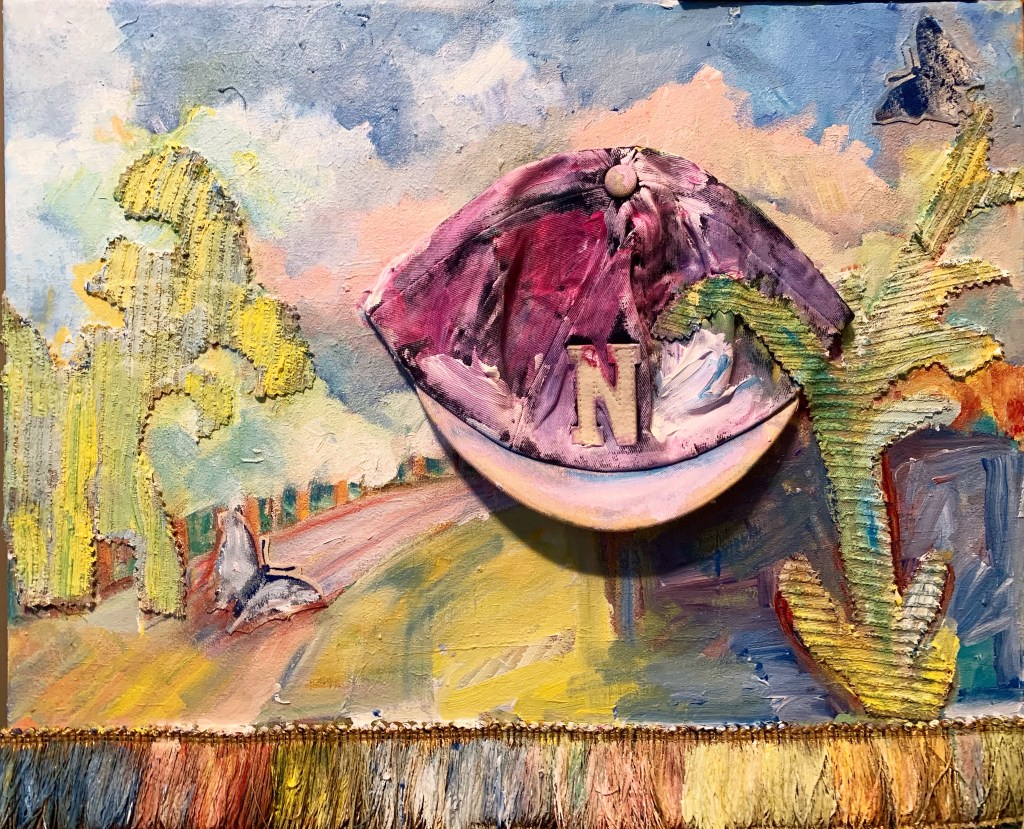
I painted on unprimed canvas, just to see what would happen. Also, because I knew the paint surface would be different than the usual texture on the primed canvas. After I painted several different colors in blocks with the scrap pieces of cut canvas used as “masking tape,” I decided to use a mix of iridescent gold and silver acrylic paints to glaze over the under painting. I also added some circles and straight lines. I’ve collected a few jar tops recently, I used some string elements, and I had a school ruler left from my last teaching job back in the 1980’s. (Yes, I keep things. They are tools of the trade. My Sears Craftsman staple gun from art school finally died after half a century of use.)

I’ll be working some more of these experiments for a while. Creating and recreating our lives is what keeps us new every morning. As someone who has been renewed and recreated more than one time can attest, along with the prophet Jeremiah,

“For surely I know the plans I have for you, says the LORD, plans for your welfare and not for harm, to give you a future with hope.” (29:11)

Joy and peace,

Cornelia


John Wesley’s Notes on The New Testament, 1755:

2 Timothy 3:5—“holding to the outward form of godliness but denying its power. Avoid them!”

It’s Not Under Control!

adult learning, art, Attitudes, bottles, brain plasticity, Cezanne, Creativity, failure, Family, Fear, Healing, Lent, Marcus Aurelius, Painting, perspective, Ralph Waldo Emerson, renewal, risk, samuel Beckett, shadows, Stress, Super Bowl

All things will renew themselves in good season, yet we have only the present moment before us. We can’t live in the past, nor can we control the future. We have to recognize even our present moments aren’t always in our control, as we witnessed in the big Super Bowl game last Sunday.

Random Actions Often Determine the Outcomes of Sporting Events

Who would ever believe a punt would hit a receiving teammate’s foot, and suddenly become a live ball? Then get recovered by the Chiefs for a quick touchdown? If you think you can control your circumstances or the actions of others, just watch the NASCAR races at Daytona this weekend. The wonder is they don’t wreck in every turn, but only occasionally during the 500 mile race on Sunday.

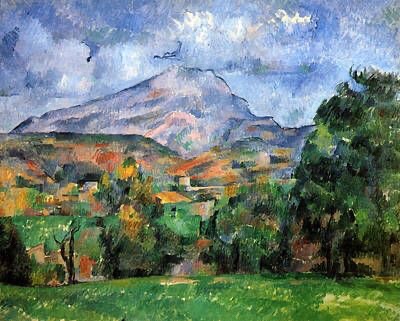
Cezanne Watercolor “Mont Sainte-Victoire (La Montagne Sainte-Victoire vue des Lauves)”( 1902–06) by Paul Cézanne. (The Museum of Modern Art, New York/Photo © 2021 MoMA, NY)

Watercolor is more difficult medium to manage than acrylic paints because it’s wetter and refuses to dry as quickly as we want to paint in that same area. It’s not being obnoxious; it’s just being its own true self. Cezanne used watercolors to think out his ideas beforehand, and then worked in oils. Often, he tossed aside the watercolor work, sometimes even leaving it out in the landscape which he’d just painted. He’d learned all he could from it and now was ready to paint his new image, but not a copy of the original painting. This mountain shows up in sixty of Cezanne’s artworks.

Paul Cézanne: La Montagne Sainte-Victoire, 1888, oil, The Stedelijk Museum, Amsterdam.

The stoic philosopher and Roman Emperor Marcus Aurelius wrote a series of meditations on life. In one he speaks of all life experiences as being the same. This attitude keeps him from getting too high or too low about what happens in his life. He takes it as it comes. Even death, which some fear as a loss, doesn’t bother him, for if he isn’t bothered about the present, he can’t be bothered about losing that too. Marcus Aurelius wasn’t a Christian, but his quest for equanimity is admirable. Take life as it comes and worry not:

“First, that all things in the world from all eternity, by a perpetual revolution of the same times and things ever continued and renewed, are of one kind and nature; so that whether for a hundred or two hundred years only, or for an infinite space of time, a man see those things which are still the same, it can be no matter of great moment. And secondly, that that life which any the longest liver, or the shortest liver parts with, is for length and duration the very same, for that only which is present, is that, which either of them can lose, as being that only which they have; for that which he hath not, no man can truly be said to lose.”

The Still Life in Our Classroom

When we work in watercolor, we have to take what the watercolor gives us. While we can plan, design, and control the outcomes to a certain extent, watercolor often goes its own way. If we work over the whole surface, rather than noodling around in one little space like a puppy sniffing a single spot while out on its morning constitutional walk, we get more done, just as the puppy is more likely to get its “business” done.

One of the reasons we work in a new medium is for the challenge. In school, when I was bored, I’d take notes in class by writing upside down. When that got too easy, I began using my left hand to write upside down. This was a true challenge! I didn’t have any ingrained pathways in my brain for left-handedness, much less the upside-down images. I was truly bored, however, so I struggled on until I got serviceable images. This was the year in which I went to art school as a midyear junior and was taking a freshman level history course.

Tim’s Painting

Tim has voluntarily switched to his left hand because he will have surgery on his right side, which will knock out his ability to use that arm for several months as he recovers. This is a good effort for his non dominant hand. You can tell he focused on the scoop, for it has the most detail. Training our alternate hand to do the work of our dominant hand requires resetting the brain to prefer the new hand. If you try brushing your teeth with your other hand, you’ll see exactly how strange it feels to use a different hand. This is because you have no well-worn pathways in your brain circuitry that makes this routine effort possible.

The fancy pants word for this is neuroplasticicy. We meet this concept with stroke survivors who do physical therapy to rewire their brain connections to make new pathways so they can speak, write, or walk. Everyone who tries a new game, learns a new language, or tries a new hobby also builds new pathways in their brains. Be learners for life, if you want to keep your mind healthy.

Gail’s Painting

Our still life was challenging today. It had solid shapes, a clear bottle, and a metal scoop. Not only were there multiple colors, but textures and transparency also. Gail has had several years of drawing under her belt, so she was able to render the perspective of the still life well. Note the clear blue bottle, which has a wonderful oval bottom. The lemons and limes are distinct also. The grey shape is an antique scoop, sans the handle.

In 2008, J.K. Rowling spoke at the Harvard commencement exercises, telling the graduates, “Talent and intelligence never yet inoculated anyone against the caprice of the Fates.” Because we don’t know what tomorrow will bring, taking care for today is the best preparation for the future. Rowling studied the Classics at Harvard, a subject most people would consider useless for this modern era. Yet after a divorce, as a single parent working for Amnesty International, she began writing her wizard novels. Harry Potter is now part of our cultural heritage.

As Jesus said in Luke 12:25-26–

“And can any of you by worrying add a single hour to your span of life? If then you are not able to do so small a thing as that, why do you worry about the rest?”

Worry is stressful, for sure, and it’s an example of “bad stress,” along with traumatic events, such as adverse childhood experiences (ACE), disease, divorce, and death of a loved one. We also endure “good stress,” as when we challenge ourselves to lift heavier weights, cook a new recipe, or learn a new language. As Ralph Waldo Emerson wrote in his 1841 essay Heroics, paragraph 14:

“The characteristic of a genuine heroism is its persistency. All men have wandering impulses, fits and starts of generosity. But when you have chosen your part, abide by it, and do not weakly try to reconcile yourself with the world. The heroic cannot be the common, nor the common the heroic. Yet we have the weakness to expect the sympathy of people in those actions whose excellence is that they outrun sympathy, and appeal to a tardy justice. If you would serve your brother, because it is fit for you to serve him, do not take back your words when you find that prudent people do not commend you.

“Adhere to your own act and congratulate yourself if you have done something strange and extravagant, and broken the monotony of a decorous age. It was a high counsel that I once heard given to a young person, —”Always do what you are afraid to do.”

When I was in high school, the ancient Latin teacher, who had taught my daddy when he went to school, tossed out the challenge, “No one has ever made 100% on my final Latin exam.”

I bit on that challenge like a starving dog bites on a bone, even if it has no scrap of flesh remaining on it. I made flash cards and studied for an hour every night before bed, I was so determined to be the exception to the rule. On the test, I got all the Latin correct, but lost ½ point for misspelling an English word. I never followed up on her retirement, but I fully expect her record remained unblemished. Also, I’m still spelling challenged. I’m thankful for SpellCheck in our writing apps.

Gail W.’s Painting

Gail W. paid attention to the still life and took care to lay down a close image in a pale wash before she began to add darker washes of color. Her left lime is most successful, with at least six shades of green and yellow in the shape. I also like the highlight on the central lemon. These two images capture the essence of the watercolor medium. Her perspective on the bottle bottom indicates it sits well on the cloth.

Failure teaches us what we don’t know, so we can improve the next time. This is what we call resilience. When I taught art, my students had to find three things they did well in their work before they named anything they needed help on. This was to build up their confidence. For some of them, just making a mark on the page was a start. If we fear making a mistake, we can sketch in a pale-yellow wash. This is very forgiving, like a whisper in the wind. If it’s not quite right, the next few marks may be nearer our desired outcome.

This Is Fine—Leave Me Alone, I’m Having a Crisis

Our mindset is what controls how we react to events in our lives. As one of my friends would remind me, “Not everything is a hair on fire moment.” Of course, when I was a young teen, the least slight or distress caused me to fling myself over my bed in a paroxysm of sobs, wailing loudly, “I’m going to die!” My parents would look at each other and shrug, “What boy is it now?” Fifteen minutes later I’d be in the kitchen looking for a snack, having cried my eyes out, and now I was on to the next thing. As I had more experiences, I learned to roll with the moment. Sometimes you need to wait for the next wave to rise before you take your ride. God’s timing is always right, for our experiences, both the failures and successes, prepare us for what comes next in our lives.

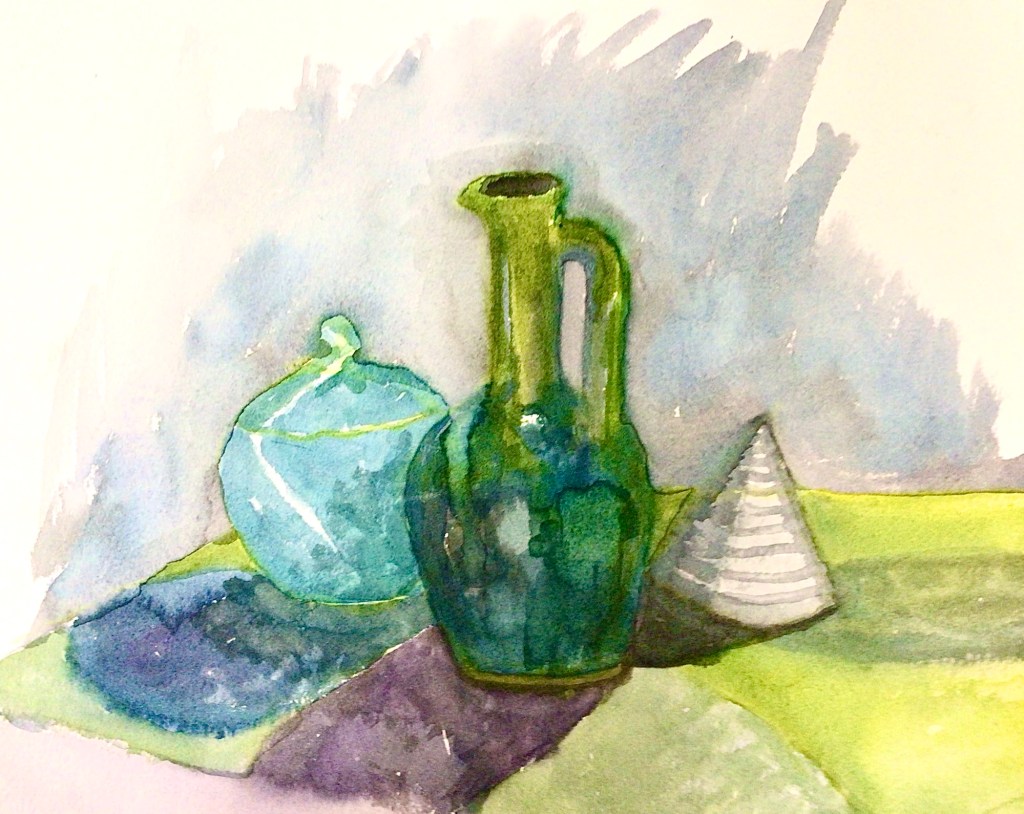
Cornelia’s Watercolor

I had some of the same perspective problems as everyone else, especially with the base of the bottle. Actually, it’s a challenge to get a “transparent three-dimensional object on a flat surface” to appear as if it’s actually sitting on a flat surface in two dimensions. Learning some shading techniques and remembering a round bottle bottom becomes an ellipse helps to bring off this sleight of hand. I got my paint too dark on the front of the bottle base and had to let it dry so I could come back in with some clear water and an almost dry brush to pick up the color. This gave me the highlight I needed.

Cornelia’s Drawing over the Watercolor

When I got home, I noticed my eyesight seems to be going amiss with my increased age. Lately I’ve not been careful to paint my verticals straight. Either I’m being lazy, or I’m tilting my head as I look at the subject. Maybe my neck injury has something to do with it. I duplicated the photo and used the Apple Pencil to straighten up the bottle and even up its symmetry. I also touched up a few of the lemons and limes. Maybe I’m still the puppy that likes to noodle around and sniff about until I can wrest all I can get from a work. This way I learn all I can from it. Like a kindergartner, if my work ends up a huge grey blob, I can say, “That was a great learning experience!”

My grandmother, who painted portraits and still lifes, kept a saying written on the back of an envelope, near her easel:  “Ever tried. Ever failed. No matter. Try again.” She passed in 1970. Years later, Samuel Beckett, in his 1983 story, Worstword, Ho wrote:

“Ever tried. Ever failed. No matter. Try again. Fail again. Fail better.”

We need to be like great artists and athletes, or the Michelin chefs who just keep trying, falling short, until they get close enough to qualify for their stars. Persistence makes all things possible, and if we “fail,” we’re only getting closer to perfection.

I hope for you a blessed Lent,

Joy and peace,

Cornelia


Emperor of Rome Marcus Aurelius: Meditations, XII   https://books.apple.com/us/book/meditations/id396136148

Neuroplasticity: re-wiring the brain | Stroke Association

https://www.stroke.org.uk/effects-of-stroke/neuroplasticity-rewiring-the-brain

10 Brain Exercises to Help Boost Memory

https://www.everydayhealth.com/longevity/mental-fitness/brain-exercises-for-memory.aspx

Neurobiological and Systemic Effects of Chronic Stress – PMC

https://www.ncbi.nlm.nih.gov/pmc/articles/PMC5573220/

​“Try Again. Fail Again. Fail Better”: Beckett’s unlikely Mantra – Goethe-Institut Los Angeles – USA

https://www.goethe.de/ins/us/en/sta/los/bib/feh/21891928.html


The Project Gutenberg eBook of Essays, by Ralph Waldo Emerson

https://www.gutenberg.org/files/16643/16643-h/16643-h.htm#HEROISM


Lifetime of Learning

adult learning, art, Cezanne, cognitive decline, Habits, John Ruskin, Transfer of Learning

Art and Math

“Transfer of Learning” is a concept in which anything learned in one situation or environment can be applied in another. When I taught art, I would have my students use mathematics and fractions when they cut mats to present their work for exhibition. “Why do we have to use math in art?” they whined, “We’re never going to use it in our lives again.”

“Are you going to buy a house, a car, or shop for clothes or groceries? How will you know you’re getting a good deal?” They got out their pencils and rulers, even though they hated fractions.

Step 1: draw a light under painting

This was decades ago, before “Train for Today’s Workplaces” became a mantra among some politicians. The only problem with training for today is the ever-changing nature of the modern workplace, which can make skills obsolete in a mere two years. Executives believe nearly half of the skills that exist in today’s workforce won’t be relevant just two years from now, thanks to artificial intelligence. However, human creativity will always be needed to guide AI. Folks who want white collar jobs today will need to buy into continuous learning, since the current job market will require ever changing skills.

Step 2: add some thin washes to build up the solid surfaces

We’ve all heard the saying, “Jack of All Trades vs Master of None,” but this might be the best possible scenario for our modern world. In our highly professionalized society, we all want the best physician and the top-notch lawyer on our case. Not everyone has the goods to acquire their services. We get the best we can afford. This is the capitalist society in which we live. In a utopian society, the poorest among us would get the same high quality medical care as the President of the United States.

Step 3: add details once surface is dry enough the paint won’t bleed. Doing background while waiting for objects to dry allows you to tighten up the edges of the objects.

“Those who can’t, teach” is a misconception, similar to the Jack of All Trades. Art Teachers can’t stick only to their specialty, but also must offer the gamut of skills from drawing to painting, paper cutting to plaster sculpture, clay pottery to cloth dyeing, and even more multimedia experiences. They have to be able to reach students with a wide range of talents, interests, and expertise, as well as encourage those who are ashamed of their work. Plus, they need to convince the talented to work and improve so they fulfill their promise.

This background discussion brings me to our class’s second experience in watercolor. I noted some instances of Transfer of Learning I can point out when we meet again.

Gail’s Still Life

When we paint a house, we dip our brush in a bucket of paint, apply it to the wall in one stroke, and then go back to the bucket for another dip. We don’t keep wiping the same spot on the wall over and over trying to make this one spot look better. In fact, the damp brush is just picking up the paint off the wall! Move along and cover the wall.

Tim’s Still Life

Don’t take your eye off the ball. If you want to catch a ball in any sport, you have to track it into your hands or the mitt. I noticed the ones who looked up, drew, looked, drew, checked, drew again, adjusted, and drew some more, had closer proportions in their drawings.

Measure twice, cut once. This is similar to the above sports metaphor. I learned it in the art school wood shop when I was cutting wood for my stretcher strips. Using the thumb or a brush to note the proportions of the still life objects and comparing them to the proportions of your own work helps get an accurate drawing. Check once, measure, check again, measure, and then cut. Air drawing or visualization helps to imagine the proportions before drawing the lines. Drawing lightly so you can draw over the less appropriate shape is an example of measuring twice, and cutting once.

Gail W’s Still Life

Sheep will eat the grass down to the roots, but goats will move on. Actually, I have zero experience with sheep and goats. My shepherd experience is limited to leading a congregation, none of whom could be accused of being either sheep or goats. I only know this fact from Bible Study lessons, and no one rents out sheep to clear a pasture of weeds, but they use goats because goats are smart enough to move on. In art, we need to take a lesson from the goats and move on to another section of our painting to let our colors dry, so we can avoid our colors running into each other.

Cornelia’s Still Life

Our group isn’t training for a new occupation, but keeping a challenge on our plates is a good idea for anyone of any age. Whether you’re trying new recipes or learning to play an instrument or taking up an exercise routine, whatever change you make in your life is important. Doing creative writing or crafts or arts is especially crucial for keeping our brains healthy, for these activities build new pathways in our brains. As we age, having redundant brain pathways is important to keep our minds healthy.

Participation in arts interventions have been linked with improving cognitive function and memory, general self-esteem and well-being, as well as reducing stress and other common symptoms of dementia, such as aggression, agitation, and apathy. According to the National Endowment for the Arts, the interventions which promote social interaction, have multiple psychosocial benefits. While none of our group are experiencing these effects, participation also staves off the same symptoms. Researchers found visual arts programs reduced depression, improved socializing, and increased self-esteem among participants.

Expressive arts activities also help individuals relax, provide a sense of control, reduce depression and anxiety, encourage playfulness and a sense of humor, as well as improve cognition and self-esteem. Making art also nurtures spirituality and reduces boredom. Art also can reflect the emotional and cognitive condition of the artist.

Watercolor with Prang Oval 8 Student Palettes

In the classes I teach, I encourage each person finding their own voice, rather than copying my style. In the art education classes I took in college, the goals of teaching were for students to recreate the closest replica of the teacher’s model, as they followed the instructional steps to the letter.

I’m thankful I never had those teachers growing up, but by the 1980’s, regimented lesson plans were all the vogue. When I began to teach, I gave certain boundaries or requirements for each lesson, such as the use of certain color schemes or coiling verses slab built in clay sculpture, but the rest was left up to each student’s creative interpretation.

My principals were always surprised by the lack of discipline problems in my class, but when young people are given an opportunity to develop their imagination in a positive direction, rather than use it in negative behaviors, life is good. They especially liked the “hand-mouth pop quizzes” I would occasionally make them take, especially when they discovered cookies or chewing gum were involved.

Years later when I went to seminary, I constantly heard the refrain, “Will I be able to put this in my toolbox and use it in the local church?”

As a person who was preparing to be a fifth career pastor, I could only roll my eyes in silence. Every job I’d ever had prepared me for the ministry: renovating old apartments, teaching, preparing lesson plans, selling insurance, studying art history and painting, and learning how to renew and retrain my old skills for a new career. The idea of having a single toolbox that would never need new tools never crossed my mind. Seminary was where my skills to be a lifelong learner were reinforced.

I was writing this on My Daddy’s birthday. He would have been 105 if he’d lived so long. He always maintained an interest in archaeology until Parkinson’s and dementia robbed him in his late 70’s of his memories and his brilliance. He would take us on arrowhead hunting field trips on Saturdays when we were children. Armed with a cooler of lemonade and sandwiches from home, we’d go out to the countryside to walk in a farmer’s newly plowed field, with his permission of course.

In his early retirement, he enjoyed giving tours to school children at the LSUS campus Pioneer Heritage Center and driving the church bus to the food pantry to pick up the monthly food rations for distribution to the neighborhood. Staying active, engaged, and eating a healthy diet are other ways we can keep our minds building new neurons.

One of the interesting research opportunities in art and the brain is the question of whether neurodegenerative brain disorders will show up in an artist’s body of work. The progressive loss of neurons causes changes in the brain, which leads to a number of symptoms, from altered multi-sensory processing to difficulty moving and using one’s body, to subtle changes in mood, emotions, personality, social interactions; to major, disabling cognitive and behavioral impairments. Although we currently only offer art therapy for the elderly, perhaps we ought to be emphasizing the arts from earlier ages and integrate it into all of our studies to help everyone develop limber learning skills to last for our lifetimes.

Joy and peace,

Cornelia


Half Of All Skills Will Be Outdated Within Two Years, Study Suggests

https://www.forbes.com/sites/joemckendrick/2023/10/14/half-of-all-skills-will-be-outdated-within-two-years-study-suggests/

National Endowment for the Arts Study: “Research Gaps and Opportunities for Exploring the relationship of the Arts to Health and Well-Being in Older Adults,” Published by the national endowment for the Arts Office of Research & Analysis

Pioneer Heritage Center

https://www.lsus.edu/community/pioneer-heritage-center

Can we really ‘read’ art to see the changing brain? A review and empirical assessment of clinical case reports and published artworks for systematic evidence of quality and style changes linked to damage or neurodegenerative disease

Physics of Life Reviews 43 (2022) 32–95


Rabbit! Rabbit! Welcome to July!

art, cognitive decline, Creativity, Faith, holidays, Holy Spirit, Independence Day, john wesley, Love, Ministry, Painting, poverty, purpose, rabbits, Racism, Spirituality, trees, vision, Work

Here in this Common Era of 2021, we Americans are now 245 years into this project we call democracy, having declared our independence from the British crown on July 4, 1776. We didn’t effectively become an organized, constitutional nation until June 21, 1788, when nine out of the thirteen existing states ratified the United States Constitution, thus officially establishing the country’s independence and a new form of government. Based on the date of our constitution, which is still in place, the United States is the oldest continuous democracy in the world.

I realize some of y’all rabbits might disagree with my description of the USA as “organized,” but I may have a higher tolerance for disorder than some of you. Then again, I taught art in kindergarten, so that probably explains a lot. When we make a mess in art class, we always clean it up. That’s just part of the lesson plan. Art, as in life, isn’t always neat, but the end product is worthwhile. In art we learn from our failures as often as from our successes. This takes courage and resilience, two life skills any rabbit can use in this fast changing world.

Antique German Rabbit Candy Container with Uncle Sam Rider, c. 1910

The preamble of the Declaration boldly states:

“We hold these truths to be self-evident, that all men are created equal,
that they are endowed by their Creator with certain unalienable rights,
that among these are Life, Liberty and the Pursuit of happiness.”

In our modern era, this is the section of the Declaration of Independence which we rabbits so dearly cherish, for it suits our individualism to a T. The next statement which follows complicates life, as King George discovered in 1776:

“That to secure these rights, Governments are instituted among Men, deriving their just powers from the consent of the governed,
—That whenever any Form of Government becomes destructive of these ends, it is the Right of the People to alter or to abolish it,
and to institute new Government, laying its foundation
on such principles and organizing its powers in such form,
as to them shall seem most likely to effect their Safety and Happiness.”

Way back in the 18th century, the practice of slavery still allowed others to profit off the the lives of human beings as if they were livestock, women couldn’t vote or own property, and states often excluded from the voting rolls certain classes of men for religious reasons or lack of property. The American Revolution changed the landscape of voting rights to some degree. Once the constitution was enacted on September 17, 1787, it created a new, federal layer of government, in which there was absolute freedom of religion—and no religious test that might prevent a Jew from serving in Congress or even as president—without removing the religious tests that existed in many individual states.

Rabbit Power of the Vote recognized by Uncle Sam

The Freedom to Vote came by Stages

Most of the states wrote new state constitutions in the 1770s, and some softened or removed their existing religious tests, but some did not. The real work of abolishing religious tests for suffrage was done at the state level, largely in the half-century after the American Revolution. Not until 1870, when Congress passed the the 15th and last of the three of the so-called Reconstruction Amendments, which stated that voting rights could not be “denied or abridged by the United States or by any state on account of race, color, or previous condition of servitude,” did African Americans get the right to vote, if their local communities did not make it impossible due to Jim Crow laws.

John Lewis: Civil Rights Icon

Doctrine of Original Meaning

Today, voting rights are under attack once again, not against religious minorities, but against racial and economic minorities. It makes this old rabbit wonder why the “doctrine of original meaning” by the founders has any worth when our 21st century world of today is so drastically different from the 18th century times of yore. Also, if “original meaning” is seen only through the eyes of our white founders, how can we be a nation for all people “created equal(ly)… endowed by their Creator with certain unalienable rights, that among these are Life, Liberty and the Pursuit of happiness?”

Scholars agree the original framers actually were more intent on the Declaration’s first paragraph, for only the Declaration of Independence officially proclaims the new American nation’s assumption of a “separate and equal station “among the “powers of the earth:”

“The unanimous Declaration of the thirteen united States of America, When in the Course of human events, it becomes necessary
for one people to dissolve the political bands which have connected them with another, and to assume among the powers of the earth,
the separate and equal station to which the Laws of Nature
and of Nature’s God entitle them, a decent respect
to the opinions of mankind requires that they should declare
the causes which impel them to the separation.”

Medieval Manuscript: Rabbits Rebelling Against Humanity

As we rabbits know, if we plan to start a tussle, good manners suggest we tell why we’re fixing to throw the first punch. If there’s no honor among thieves, at least we rebellious rabbits have the good form to stand up in the pure light of day and list our grievances before we overthrow a bad king. Only the uncouth sucker punch the unwitting. The reason this American Democratic experiment has persisted for nearly two and a half centuries is the vast majority of us have freely chosen to change our leaders through the ballot box, rather than revolution.

Only the past unpleasantness of the Civil War in the 1860’s has marked this unbroken transfer of power by the vote, until the assault on the US Capitol and the Houses of Congress on January 6, 2021, by a motley crew of domestic terrorists, QAnon supporters, and admirers of the former President. Because they violently assaulted the police guarding the building and public servants inside, and interfered with the duties of duly elected government officials attempting to exercise their public duty to certify the electoral college vote, the Department of Justice has charged them and they’ll have their day in court. You can read all their names and cases at the link below. Maybe you’ll find a friend or neighbor there. As Mother rabbit always warned Peter Rabbit, “Don’t go into the garden; Farmer McGregor will get you!”

Farmer McGregor Chases Peter Rabbit

What exactly did the signers of the Declaration of Independence mean when when they wrote “all men are free and equal?” Abraham Lincoln said, “The men who signed the Declaration did not mean to say that men were “equal in all respects. They did not mean to say,” he said, that “all were equal in color, size, intellect, moral developments, or social capacity. They defined with tolerable distinctness, in what respects they did consider all men created equal.”‘ Men were equal in having “‘certain inalienable rights, among which are life, liberty and the pursuit of happiness.’ This they said, and this [they] meant.”

Lincoln Monument, Washington D. C.

This quote comes from Lincoln’s 1857 argument on the Dred Scott case before the Supreme Court, which decided against him, with Head Justice Roger Taney, who became best known for writing the final majority opinion in Dred Scott v. Sandford, which said “all people of African descent, free or enslaved, were not United States citizens” and therefore “had no right to sue in federal court.” In addition he wrote, “the Fifth Amendment protected slave owner rights because enslaved workers were their legal property.” Taney’s reputation was vilified for this decision during his lifetime, for it contributed to the growing divisions between the north and the south. The U. S. House of Representatives voted in 2021, to remove Taney’s statue and replace it with a statue in honor of the first African American Supreme Court justice, Thurgood Marshall.

Dred Scott Newspaper Announcement

The big holiday in July is Independence Day. While we rabbits lounge about the waterside or in our backyards, eating our favored picnic and cookout foods at the nation’s birthday party, not many of us will be thinking on a biblical text. Instead, we’ll be eyeing our paper plates and hoping they’re substantial enough to make it to the table before they collapse from the excess helpings of foods we’ve piled on them. A special bunny secret: you can go back for seconds, and laugh at everyone when you say, “I just want to make sure all you little piggies get your fill—oink, oink!” Don’t let them bother you, since you made sure everyone who came late would have something to eat by not taking it all at once.

In 2 Corinthians 3:17-18, Paul writes:
Now the Lord is the Spirit, and where the Spirit of the Lord is, there is freedom. And all of us, with unveiled faces,
seeing the glory of the Lord as though reflected in a mirror,
are being transformed into the same image
from one degree of glory to another;
for this comes from the Lord, the Spirit.

In Essentials, Unity; In Non-Essentials, Liberty; In All Things, Love

Have you ever wondered why some groups are so strictly homogeneous, while others are a kaleidoscope of differences? Some rabbits feel safer when everyone is more like them and differences are kept to a minimum. Other rabbits seem to thrive in the creative intermixing of unusual and unique personalities. I know when I entered the ministry, my parents’ friends were amazed I went into the faith I’d been birthed into, rather than some new age, air fluff religion. Oddly enough, I related more to the historic beliefs of Wesleyan Methodism better than my contemporary generation. In that sense, I had faith in a “different religion” than my friends. Yet we all saw ourselves as “being transformed into the same image from one degree of glory to another; for this comes from the Lord, the Spirit.”

This marked a freedom of thought, but it required an understanding we were all on the same journey and were progressing toward the same end. I admit I have the type of mind that wants the idea to lead to the behavior and then the consequences. In art class I called it Attitude, Behavior, and Consequences. If the first attitude was positive, the rest followed suit, but if a student had a bad attitude, they weren’t going to work, and then they had the negative outcomes of poor efforts, sad projects, and little improvement. While in life we’re saved by faith, in art we’re saved by works, for work will bring rewards.

It’s as Easy as ABC

One way for all good rabbits to be free is to have no regrets, or worries about what might have been. As my mother often said, “That’s water under the bridge.” The River of life has moved on and the choices we’ve made have gone downstream also. She believed in living in the now. The third Saturday in July recognizes Toss Away the “Could Haves” and “Should Haves” Day. In short, don’t go through life with regrets.

Created by author and motivational speaker Martha J. Ross-Rodgers, this day is intended for us rabbits to let go of our past and live for the present. The first step to participating in this day is to find a pen and paper. Then write down our “could haves” and “should haves” on the paper.

Finally, throw away the list and make the following resolution:
“From this day forward, I choose not to live in the past. The past is history that I can not change. I can do something about the present; therefore, I choose to live in the present.”

As I’m going through boxes in my storage unit, I’m coming across souvenirs from my high school and college years. Some of us are sentimentally attached to the memories imbued within these objects, but they’re merely memories, not the actual people. My parents and grandparents saved things, for they experienced hard times. I make new art every week, so if a painting doesn’t hold up to my critique after six months, it goes into a pile to get destroyed and remade.

DeLee: The Springtimes of My Life: Memories of Yesterday and Today

Now, take care of yourself and your health by living for now. Do your best and make the best of each and every day! Strike a power pose and smile when you do this. You’d be surprised how much energy flows through your body, I kid you not.

A final word for all rabbits who want to live in truth and freedom: we have only one God given life, so let’s live with joy and peace. We aren’t promised tomorrow, but only today. Now is the time to care for the broken, to right the wrongs of the world, and to make a difference, no matter how small.

Charles Derber, in Welcome to the Revolution: Universalizing Resistance for Social Justice and Democracy in Perilous Time, says: “Resistance can be symbolic, but at its core it must also be empowering and even shocking, in the sense of awakening the people to the evils of the system and the terrifying end-result if we allow business as usual to continue. Resistance is rage at injustice and at the insanity of institutions that kill and exploit for money and power. Melding that rage with love is the art of activism.”

Now that I walk more slowly in this world, this old rabbit has found I notice people whom everyone else hurries past, even if these folks are standing in the middle of a store entryway and are obviously lost. I stopped today at Sam’s to ask if this older woman needed help. Right away I realized she had trouble processing words, so she might have memory problems. I asked where her people were, but she didn’t know. We went over to customer service, since I knew they could use the announcement system to call for them to come get her. At least she knew her name. I was sad they had hurried off without her, especially in her condition, but I prayed with her before I left. The service staff got her a chair and made sure she was safely seated.

Lady Liberty

I hope as the holiday approaches, you don’t find yourselves so busy getting your celebration together that you overlook the ones in need who are right in front of you. Once we cared for one another in communities, but now we look after only ourselves. We wouldn’t have become a nation 245 years ago if every man had tried to take on the king’s men alone.

Be the spark that starts the fire of love and joy,

Cornie

10 Oldest Democracies in The World (Updated 2021) | Oldest.org
https://www.oldest.org/politics/democracies/

Could Jews Vote in Early America?
https://momentmag.com/could-jews-vote-in-early-america/

French Declaration of the Rights of Man—1789
http://www.columbia.edu/~iw6/docs/decright.html

Capitol Breach Cases | USAO-DC | Department of Justice
https://www.justice.gov/usao-dc/capitol-breach-cases

Pauline Maier, The Strange History of “All Men Are Created Equal”, 56 Wash. & Lee L. Rev. 873 (1999), https://scholarlycommons.law.wlu.edu/wlulr/vol56/iss3/8

https://scholarlycommons.law.wlu.edu/cgi/viewcontent.cgi?article=1547&context=wlulr

Maier quotes The Dred Scott Decision: Speech at Springfield, Illinois (June 26, 1857), in ABRAHAM Lincoln: His SPEECHES AND writings 352,360 (Roy P. Basler ed., 1946). 68. Id. at360-61.

Dred Scott Case – Decision, Definition & Impact – HISTORY
https://www.history.com/topics/black-history/dred-scott-case

Greenscapes from Downtown

arkansas, art, coronavirus, Creativity, Faith, Fear, Healing, Historic neighborhood, Meditation, nature, Painting, poverty, purpose, Reflection, renewal, Spirituality, trees, Work

Some say, “Art is never finished, but only abandoned.” I left my latest acrylic painting for a day, knowing I’d need to adjust some of the sky values, but I was beyond Monday’s melancholy mood. I remembered the sunset of my original experience, and wondered, “Is the end of one day merely the beginning of another? If so, sunrises and sunsets are just markers for us until we participate in eternity with god.” In age of coronavirus, I now think more about time and how we experience it. For me, the now and the present moment take on more importance than either the future or the past. As J. R. R. Tolkien, in The Fellowship of the Ring said:

“I wish it need not have happened in my time,” said Frodo.

“So do I,” said Gandalf, “and so do all who live to see such times. But that is not for them to decide. All we have to decide is what to do with the time that is given us.”

Not that my cloistered coronavirus days are slowly melting together like Easter Peeps in a microwave, or becoming desperate Survivor Island fare, as the young parents thought who once called me during the pink eye school closures.  These always seemed to follow directly on the heels of spring break, and parents would cry into the telephone, “How do you stand this All. Year. Long?” 

I’d laugh and remind them, “I always have a plan for the day, and a back up plan too.” Art classes depend on teaching basic skills at the start, so you can teach more difficult skills later. Hand and eye coordination is one skill, but the other more important achievement is the ability to trust one’s self. As an artist pushes forward, he or she can get comfortable and begin to repeat only what they know and what is safe. Of course, this is common to all of life, for we frequently eat the same foods at the same restaurants, take the same routes to work, and drink our favored brews. 

Finding a way to break through the wall of the routine is challenging. If we’re always progressing, we may move more quickly than our audience can appreciate us. Then we need to ask ourselves, what is the purpose of art and by extension, what is the purpose of our life? This is why having a pattern of work balanced with reflection is helpful, not only in the art life, but also in the spiritual life. When I speak of the art life, I mean any life engaged in production, industry, sales, or the economy. All could benefit from spending time in reflection, instead of hitting the ground running and always hustling. If we asked ourselves WHY more, and WHAT WILL THE CONSEQUENCES BE, we might be more socially responsible with our practices and care more for the earth which we’ll leave to our descendants.  It’s their inheritance and we shouldn’t exhaust it as if we were prodigal sons. 

These two paintings are the latest off my easel. The first is an empty lot across from the Transportation Depot in Hot Springs. From the depot side, all you can see is the line of trees on the horizon, but if you drive up Olive Street, you find the vacant lot parallel to the side of the historic 1914 Hot Springs High School. This building was renovated into lofts and apartments, both for government subsidized and market paying rentals. President Clinton attended this school and the property is currently for sale. The vacant lot once had a building of some sort on it, perhaps an elementary school, for I found concrete steps and the remnant of a flagpole. Today it’s gone to seed, and the wild grasses grow as they choose, until the city or some private party mows them down. 

Pandemic Landscape

I was there on a cool afternoon with a breeze blowing fair. The sun was over my back and I couldn’t see the depot for the tree barrier. Although I was “smack dab in the middle of the city,” I might as well have been out in the countryside. It may be a field of weeds to you or an eyesore awaiting development, but this city block serves a purpose in its ragged glory. These green places act as sinks to cleanse the air and regulate the water runoff. In more developed areas, neighborhood parks and people’s yards store very high amounts of carbon, which help reduce carbon emission levels in cities. This is a benefit of living in a smaller city, for the largest ones have sucked up all the green spaces and filled them in with concrete and steel.

Not only is keeping our yards green important, but instead of paving over an area, keeping green space and plants in a yard makes a difference because a property is part of a much bigger ecosystem and is part of that proven fabric of the city. By keeping your yard green, you provide your city with the ecosystem services that urban green spaces provide. Here are four little known ecosystem services that urban green spaces provide to cities:

  1. Urban Heat Island—the urban heat island effect has negative impacts on the health and efficiency of cities, including increased energy consumption, increased air pollutants and greenhouse gases, impaired water quality and compromised human health and comfort.
  2. Carbon Storage— backyard soils can capture even more harmful carbon emissions than soils in native forests or grasslands. Urban backyards and green spaces contribute to reducing carbon emission levels in cities, which makes air cleaner and healthier for its residents.
  3. Water Regulation—green spaces keep untreated water out of lakes and rivers, and let sewers work without backing up
  4. Economic Savings—green areas increase property values

The cluster of trees isolated in the ocean of grass are much like a family in the pandemic: tense, taught, tightly tucked together, and removed from all others to survive. We might all have days like this in our quarantine, and then we’ll have days when we want to reach out to others, in real life or virtually. Social distancing can quickly devolve into isolation and then into fear of going out of our homes. This has a name: agoraphobia or fear of open places. It’s a type of anxiety disorder in which you fear and avoid places or situations that might cause you to panic and make you feel trapped, helpless or embarrassed. You fear an actual or anticipated situation, such as using public transportation, being in open or enclosed spaces, standing in line, or being in a crowd. Just going on a Kroger run today can feel like a mission behind enemy lines. If our days take more energy from us than they used to, we need to adjust our expectations of how much we can get done, just as we slow down when it’s a 110 F in the shade during the summer. 

Sunrise or Sunset

This is possibly the reason after all these years, I’m still in the beginner class of the Pacer Clinics, but walking isn’t the skill I’m actually trying to improve. Becoming more aware of the present moment is an achievement level worth unlocking, so I’m practicing “opening myself to the holy.” We can find the holy in any moment of time, not just in those times set aside or designated as sacred. We all have different goals, and getting from one place to another in record time might not be the most important end result or best use of our time. 

Perhaps this pandemic has caused us to reassess our arbitrary borders between work, home, and worship, since many of us have been doing all three from one place. Can we say that only one time or one place or one day is more sacred than any other? Or should we look again and see all of our days and all of our ways are a sacred endeavor? If this is so, we have to check if our faith undergirds and empowers our daily acts, and not just once a week. Another way to express this is, “Do we live our Bible, or does it gather dust on the coffee table?”

And what of those essential workers who daily face the contagion? Can they still find any holy moments in these dread times?  Or are they so busy throwing themselves into the breach, they have no time to notice the still, small voice of god? When life is overwhelming, we often can’t hear God’s voice because the press of our problems pushes out all other inputs, even the hopeful spirit of god. We then have to trust if we take care of business, then god will take care of the outcomes. As the ancient voice of wisdom in Proverbs 21:31 says, “The horse is made ready for the day of battle, but the victory belongs to the LORD.” When our day is done, we can rest in god and restore our souls and health.

This pandemic has ripped the curtain off the hidden division in our culture. Those workers considered “essential” may be high or low wage earners, but the difference in resources they have to meet the difficulties of their new lives is eye opening. Nearly 60% of adult Americans live paycheck to paycheck, and what’s even more amazing is about 1 in 5 people earning over $100,000 annually also live paycheck to paycheck! If you owe your soul to Visa or MasterCard, you have an existential need to earn a living, and not just a calling to fulfill. It’s not because folks are squandering their resources, but the cost of living is high in many places, plus many have student debt, mortgages and car loans. In truth, some of us owe our soul to a plastic god because we have chosen to live too high, rather than to live a simple life. 

Now the pandemic has caused the greatest job dislocation since the Great Depression when 25% of the workforce lost their jobs. The latest unemployment rate is almost 15%, which is roughly double what the nation experienced during the entire financial crisis from 2007 to 2009. The most telling tale is 40% of the workers making less than $40,000 per year lost their jobs during this pandemic, according to the Federal Reserve. The lowest paid workers in the leisure and hospitality industry suffered the most. If we are looking at our lives and grumbling at our inconveniencies or loss of “freedoms to come and go at will,” perhaps we need to recover the simple joys of life: reverence in the silent moments when we’re in a cool and shady spot, joy for the sunlight dappling on autumn leaves, or the ever-changing reflections in a running brook. 

I was in a better frame of mind when I painted the sunset beyond the trees. The colors are lighter, and the spaces are more open. I can always tell when I’ve been sick, for even a sinus infection turns my energy and vision inward. In this work the trees bend toward one another and their leaf crowns unite in a yellow communal mass. They may be separate life forms, but they all are rooted in the same earth and nourished by the same water. As the prophet Jeremiah says in 17:8—

“He is like a tree planted by water, that sends out its roots by the stream,

and does not fear when heat comes, for its leaves remain green,

and is not anxious in the year of drought,

for it does not cease to bear fruit.”

May we all be like the trees planted by the refreshing streams of water, even during these drought times. 

Joy and Peace, 

Cornelia

A Happy Bird for a Cloudy Day

arkansas, art, coronavirus, cosmology, Creativity, Faith, Fear, gambling, Holy Spirit, Meditation, Ministry, poverty, purpose, Spirituality, Stress, Uncategorized, Work

Happy Bird

“Do not curse the king, even in your thoughts,
or curse the rich, even in your bedroom;
for a bird of the air may carry your voice,
or some winged creature tell the matter.” ~~ Ecclesiastes 10:20

“A little bird told me,” my nanny often said, when I asked her how she knew about my doings. “The walls have eyes, honey, and the wind has ears. Nothing done in secret stays hidden very long. You’d best mind your P’s and Q’s.”

If I had been a more fearful child, I might have been afraid to sleep in a dark bedroom. As it was, I was only afraid of what was under the bed and what might come out of the closet, both of which are normal childhood “monster” fears. I kept these imaginary monsters from harming me by closing the closet door at night and by approaching my bed at a dead run, and launching my small body a full six feet through the air until I landed in the middle of my bed. My parents were thankful I forgot about these monsters by the time I was big enough to have done damage to the furniture.

How do we handle fears as adults? Some of us put our heads down into the sands, as if we were ostriches rolling our eggs in our nests. What we don’t see won’t bother us. Some of us self medicate with substances to the point of abuse. We can even use goods in a bad way: overeating, over exercising, overwork, and orthorexia (concern for a good diet) are a few we could mention. A better way is to seek a balanced life, and not to go off the deep end in any one direction.

When everyone else is losing their heads around you, someone has to remain calm. For a long time my motto was “Leave me alone, I’m having a crisis.” Then I went into ministry and I became the caregiver to people in crisis. Folks need a non-anxious presence to be with them, for even if we can’t change or fix their present circumstances, we can be a reassuring companion. While the present moment may be distressing, often the underlying reason is because our applecart has been upset. When our plans and schemes get upended, we have to monitor the new situation, and adjust accordingly. We may not like what we have to take care of, but this is our now, and not some hypothetical game plan.

As one of my clergy pals used to say, “I keep my calendar in pencil because I have to change it so often.” I just use that tape whiteout and write mine in ink anyway. I like the pretty colors, but I know life happens and when it does, i make the changes and write in a new plan in ink. Life is often messier than I’d like it to be.

I just found out all our public spaces in our county will close for April due to the coronavirus mitigation protocols. We have an establishment called The Ohio Club, which has been serving food and drink since 1905. It’s made it through the Great Flu Pandemic of 1918, the Great Depression, the two Great World Wars, and many smaller ups and downs in between. If we have an eye to the better future, and not just to the problems of the present moment, we can plan and work to get through this part of the cycle.

While closing down is a good choice for our community to contain the coronavirus, it means the exhibition I planned won’t go up. I’ll be checking to see if it’s rescheduled or if it will be a virtual display. With everyone on home confinement, we’ll make the best of the situation. There has to be a silver lining in the clouds somewhere. At least we should be looking for the bluebird of happiness to visit us in the coming days.

Bluebird of Happiness

Here is the poem by the American 20th Century writer, George J. Carroll, that first used the phrase “bluebird of happiness:”

“And in the valley beneath the mountains of my youth, lies the river of my tears. As it wends its way to the ocean of my dreams, so long ago they have gone. And yet, if I were but to think anew, would these dreams evaporate in my mind and become the morning dew upon a supple rose whose beauty is enhanced with these glistening drops, as the sun of life peeks o’er the mountains when youth was full. Then I must not supply this endless fountain that creates the river of my tears but look beyond those mountains where the bluebird of happiness flies.”

Folks tells us to stay in the present moment and to honor our feelings. If we’re in a state of anxiety, however, we need to ask if feeding our fears is the best choice we can make. “What if’s” and “How are we going to’s” are useful fuel for the flames of our imaginations. If we feed that flame, we’ll either take to day drinking or need to be heavily medicated for the public safety. Neither are our best choice. Sometimes we make lists, and then add lists to the lists, as if we could organize the chaos unfolding about us.

In truth, Chaos is confused, unordered, unorganized, and has no distinct form. It’s what existed before Creation. As such, unpredictability is its inherent nature. If we were in one of the closed casinos, the metaphor would be “shooting craps with loaded dice,” since the odds would be stacked against the player in favor of the House.

The best way to keep our wits about us when everyone else is going crazy is to breathe deeply in and out. If we focus on the breath, and remember the source of this life giving breath, we can connect our selves to a greater power.

“Then the LORD God formed man from the dust of the ground, and breathed into his nostrils the breath of life; and the man became a living being.” ~~ Genesis 2:7

If we remember whose we are, and who we are, we’ll get through this together. Take care of the poor, the hungry, the marginalized, and the sick. We are stronger together than we are alone.

Joy and a Peace, Cornelia

The Joy of Peter Max

SPRING CLEANING

adult learning, arkansas, art, Attitudes, beauty, Creativity, Faith, greek myths, Holy Spirit, Painting, poverty, purpose, Secrets, vision, Work

Lately I’ve had an extra burst of energy around the house, but this always happens as the light begins to change and the sap rises in the trees. I see the first feathers of blooming green on the tips of trees and realize the grays of winter are no more. The ornamental pears lining our drive are bursting into white and the joy of the pink Japanese magnolias have my spirits and energies both exulting. I was in Kroger looking for the daffodils to bring to art class, but they weren’t in the store yet. I live in a condo, so those jaunty jonquils on our property aren’t mine to cut, since they’re considered community property.

When I arrived at church Friday, it was a fine spring day, the sort most folks would want to be outside digging up a garden. I certainly would, but I have a few pots inside for herbs and call that my “condo garden” instead. Mike and Gail asked, “What? No flowers? We hoped there’d be flowers!”

Yeah, me too. I’m ready for flowers. Just as spring flowers remind us of new life, they also remind us of the fragility of life. In the bulb, there is the promise of the life yet to come, even if it’s hidden underground all winter, just as there’s the promise of our new life to come after our death and burial. When we have a worldwide pandemic of a novel Coronavirus, which has no vaccine as yet to protect us, we depend on common sense behaviors and our faith in times of trial.

Kettle and Frying Pan

For our still life, I appropriated a tea kettle and a frying pan from the church kitchen. Since I returned it, I didn’t use the five finger discount, but merely borrowed it for a bit. As we looked at the still life, I talked about the objects as simplified forms, which we’ve done time and time again. The basic forms may get boring, but they’re the foundational exercises for artists, just as practicing the scales are for musicians.

I pointed out how the tea kettle is more like a big sphere, which has had its bottom sliced off so it can sit on the table. If we can see the ball inside it, then we can capture its fullness. The spout is a cylinder, with a triangular form attached to it. The pan is another sphere, but this one has had its top and bottom cut off. It’s like a globe with only the equatorial latitudes remaining because the top and bottom 45% have been removed. Also, we can see the inside, for it’s been scooped out.

Happy Pan by Gail

Last week I’d shown Gail the trick of using the brush handle to measure the still life and get similar proportions on her canvas. I showed this to Mike today. This is part of the “secret, gnostic, knowledge, known only to a few, and passed on by word of mouth,” which artists teach to students when they they’re ready to receive it. I usually leave the group alone for awhile, and then get up and make a quick check of their work. Gail and Mike are second year students, so they work more independently. We all paint some more, but on the second check is where we’re more likely to get into trouble.

Sturdy kitchenware by Mike

This second checkpoint is about ninety minutes into a two hour session. Our internal clocks tell us to hurry up and finish, so we begin to paint without thinking or looking at our subject anymore. We’re just doing, but not paying attention. If we were slicing onions with a sharp knife for a restaurant, we might lose a fingertip here. Thankfully we’re only painting shapes, which can get covered over with more paint. Art is much more forgiving than chopping onions. Keeping our focus is a skill just as much as learning perspective, color theory, or value. Learning how to step away and check our work is also important.

What of the subject matter, though? What inspires us to paint? We may be asking the question, “What is beautiful?” A corollary to this is “Does the subject need to be beautiful to be art?” The ancient proverb, “Beauty is in the eye of the beholder,” has been around in one form or another since the 3rd century BCE in Greece. I remember standing in front of J.M.W. Turner’s “Ulysses Deriding Polyphemus” (1829) in the Tate Gallery in London when I spent a winter term there during my grad school days.

Turner: Ulysses Deriding Polyphemus

I was making a small drawing of the scene, which I remembered well from my days in Latin class, and was paying attention to the details of the one eyed cyclops and the tiny figure shaking his fist in the boat below, when an older gentleman came close, inspected the art work, stepped back, and then looked hard at the painting once more. A brief moment of silence passed as he continued to study the work before him, then he leaned forward once more and read the painting’s title out loud. “Ulysses Deriding Polyphemus—no, I don’t see it. I don’t see it at all.”

I almost dropped my sketchbook in amazement. It was as plain as the nose on this man’s face, but he couldn’t see it. This painting currently isn’t on exhibition, so perhaps many people had the same reaction as the gentleman viewer, and not enough had my joyous response to Turner’s painting. If beauty is in the eye of the beholder, an untrained eye won’t recognize esoteric beauty even if it’s labeled “work of beautiful art.” If we don’t have fine arts education in our schools, then children grow up without an appreciation for their creative spirits and their own unique voices. Art is a field of exploration which allows for many types of expression and interpretations of “beauty.”

Cornelia’s Orange and Blue Kitchen

In our world today, we’ve turned so many activities over to professionals. While I wouldn’t want someone who stayed in a Holiday Inn last night doing brain surgery on me, I’m not ready to let fast food cooks prepare all my meals. This attitude of outsourcing ministry to the professionals is a dated concept, for now the most prevalent understanding is all Christians are called to ministry by virtue of their baptism, and some are set aside for special service to the church and the world through ordination. In art terms, we all are part of the arts and crafts movement, although some of us have special training to elucidate our greater gifts.

Paul explains this in his letter to Timothy:

“In a large house there are utensils not only of gold and silver but also of wood and clay, some for special use, some for ordinary. All who cleanse themselves of the things I have mentioned will become special utensils, dedicated and useful to the owner of the house, ready for every good work.” ~~ 2 Timothy 2:20-21

Still Life with Copper Cauldron (c. 1734–35), Jean-Siméon Chardin.

Lest we get a swelled head, thinking we’re special utensils, or get depressed believing we’re only ordinary utensils, we all need to remember we’re both useful in our Father’s household. In our everyday lives, we need to care for those in our community who exist on the margins of life, many of whom are hourly workers who stitch together several part time jobs to make ends meet, but don’t get health insurance anywhere.

Our elderly are another marginal and vulnerable group, who often have multiple health conditions and declining incomes, fewer social contacts, and less mobility. Once they were the special vessels, made of gold and silver, but now they get treated like ordinary wood and clay, too easily broken in their fragile days. Our elderly carry the dreams and memories of our history together, so they can tell the stories of perseverance when the times get tough.

The wonderful promise is all of us can be “special utensils,” dedicated to God, ready and useful for every good work. We merely have to show up. We don’t have to hire professionals to do all our work, but we can enjoy the experience of our own creative efforts. Learning new skills builds confidence as well as competency, so we get a double benefit. God will give the promised Holy Spirit to the entire priesthood, for we’re are all called to do God’s good works for the sake of the kingdom.

Still Life with Copper Cauldron (c. 1734–35), Jean-Siméon Chardin. Photo: © Roger-Viollet/Musée Cognacq-Jay, Paris

https://www.phrases.org.uk/meanings/beauty-is-in-the-eye-of-the-beholder.html

Strawberry Mindfulness

art, garden, Healing, Medical care, Meditation, Mental Illness, Ministry, Painting, Prayer, renewal, Stress, Work

I read a wonderful journal, Psychiatric Times, which has a free subscription online. I began reading it because it helped me to understand the diseases of the mind, which cause people to be at dis-ease in their lives and to cause dis-ease in whatever community in which they belonged. In today’s modern world, our first choice to treat dis-ease is medication. However, the ancient practice of meditation is another choice, either as an adjunct treatment or as a stand alone, depending on the person’s need.

I recently read of some tech entrepreneurs who decided to shut off their phones, computers, and all other electronic devices for one day in every seven because they were over stimulated and never rested. Their creativity and original thinking were diminishing, and this was “hurting their brand.” Those of us in the spiritual world would say they needed to practice sabbath rest, and also to take time away on a daily basis also. If you feel “always on, 24/7/365,” you’ll wear down or burn down sooner or later. Even the Lord Jesus was given to finding secluded places to withdraw and restore his physical body and his spiritual energy. We often overlook these texts, in our rush to read the miracles and action of the salvation story.

Dr. John J. Miller, editor in chief of Psychiatric Times and founder of Brain Health, wrote this wonderful piece, which follows:

In our western culture, which values intellectual knowledge and material rewards, the concept of mindfulness is often initially difficult to grasp. Busy schedules, lengthy “to do” lists, commuting, work, family time, and group activities leave little time for self-reflection and inquiry into the nature of our minds.

In fact, all of these activities serve to keep us running on automatic pilot, and strengthen behavioral patterns previously learned that create efficiency when automatically enacted. An analogy I often use to explore the question of the potential benefits of practicing mindfulness is to ask which of the following two individuals is truly an expert on the experience of what a strawberry tastes like:

An individual who has studied the science of strawberries to the degree that he or she is considered to be the world’s expert—agriculture, botany, genetics, human taste receptors that send gustatory information that is decoded in the brain, digestion, visual responses to seeing a strawberry, and the author of over 100 books on all aspects of strawberries—but, has NEVER eaten a strawberry?

OR

An individual who is uneducated but has just paid close attention to all of the sensations and experiences of taking a fresh strawberry, looking at it, smelling it, placing it in his or her mouth, observing the taste and texture as he or she bites into it, and mindful of the plethora of the “here and now” strawberry experiences?

Bosch: The Garden of Earthly Delights

The answer is usually self-evident and conjures an image or feeling of the warm juice of a strawberry sloshing around in your mouth. Mindfulness is the practice of experiencing each moment like the strawberry.

Common mindfulness adventure
Broadly speaking, there are two subtypes of meditation: concentration and mindfulness. As a general principle, it is important to become proficient in concentration meditation before expanding into mindfulness. Concentration practice involves choosing an object, like the breath, a phrase, or a word that becomes an anchor for the mind’s attention.

The instructions are simple: watch the breath as it moves in and out of the body, choosing a spot to watch it that feels natural (the nose, mouth, lungs or movement of the abdomen). Inevitably, the mind’s attention will be distracted by some thought, feeling, sound, or emotion, and the mind starts to drift down an endless path of mind content. As soon as you are aware of having left the breath, without judging yourself, the task is simply to return to the breath. The same basic steps are followed if you are using a phrase or a word.

Here’s a common example:
awareness of the inbreath and the outbreath . . . inbreath and outbreath . . . inbreath and outbreath . . . you hear a car driving down your street, and your mind drifts to the thought of the car . . . my car . . . my car payment . . . bills to pay . . . do I have enough money saved to buy that new iPhone . . . images of the cool new camera on the iPhone 11 pro . . . wait a minute, I left my breath . . . inbreath and outbreath . . . inbreath and outbreath . . . inbreath and outbreath . . . the muscle in my left calf is starting to cramp up . . . I need to start stretching my muscles again . . . why did I stop stretching regularly . . . I should rejoin the gym . . . the last time I was at the gym I saw Tom . . . Tom was a great college roommate . . . college was such a great experience . . . maybe I’ll drive out there and take a walk on campus . . . college is so expensive these days . . . how will I pay for my child’s college tuition in a few years? . . . oh yeah, my breath . . . inbreath and outbreath . . . inbreath and outbreath . . . inbreath and outbreath . . . .

This is how much of the time practicing meditation is initially spent, and usually is so frustrating that most people stop meditating long before their attention is strengthened. With perseverance and practice the mind slowly develops the capacity to stay with the breath for extended periods of time. This commonly results in calmness, relaxation, mental clarity as well as an anti-fight or flight physiology.

Once the mind’s concentration has stability, that focused awareness can be intentionally refocused on the mind’s activity itself, and this is the beginning of mindfulness. A holding environment of sorts is created whereby impersonal and non-judgmental attention is watching the many mind states that come and go, the only task being to stay present and learn from what is observed with open acceptance. As mindfulness strengthens, the underlying themes and patterns that fill our mind automatically are seen clearer, and it becomes easier to disengage from them, remaining in the present moment with pure mindfulness. Like exercise, continued practice sustains the ability to be mindful, while lack of practice allows a regression to automatic patterns.

The practice of mindfulness
In our roles as clergy and clinicians, we recognize we always have more to learn, and more experience to be gained. Such is the case with mindfulness—it’s always patiently waiting for us to resume that selfless non-judgmental awareness of the present moment—with more to learn about the patterns and themes of our own mind, and continued opportunity to choose a different thought or behavior. As 2019 draws to an end, the practice of mindfulness is but a breath away, and is a worthy companion.

The Light of the Body: meditate on this verse

First century oil lamp

“No one after lighting a lamp puts it in a cellar, but on the lampstand so that those who enter may see the light. Your eye is the lamp of your body. If your eye is healthy, your whole body is full of light; but if it is not healthy, your body is full of darkness. Therefore consider whether the light in you is not darkness. If then your whole body is full of light, with no part of it in darkness, it will be as full of light as when a lamp gives you light with its rays.” ~~ Luke 11:33-36

https://www.psychiatrictimes.com/depression/mindfulness/page/0/1?rememberme=1&elq_mid=10101&elq_cid=1656322&GUID=95C4A97A-F3DF-48E9-82F6-955AEEB9B62B

ICONS OF THE NATIVITY

adult learning, art, Christmas, Creativity, Faith, grief, Health, holidays, Icons, Meditation, Ministry, mystery, Reflection, Spirituality, vision, Work

Icon of the Nativity

What is the most important image of the birthplace of Christ? For some of us, it’s a stable filled with hay and animals, in which the Holy Family fill with divine light. For others, the essence is the Holy Family alone. For others, those who brought various gifts take prominence. The early icons describe a dark cave, similar to the tomb in which Christ was laid after his crucifixion. This shouldn’t surprise us, for his birth made him at-one-with-us, just as his death and resurrection made at-one-ment for us. If a picture is worth a thousand words, the icons are worth a million words, or a whole theological thesis.

The cave, manger, and swaddling clothes are indications of the kenosis (emptying) of the Godhead, His abasement, and the utter humility of Him who, invisible in His nature, became visible in the flesh for humanity’s sake, was born in a cave, wrapped in swaddling clothes, and thus foreshadowed His death and burial, in the sepulcher and the burial clothes.

Icon of the Burial of Christ

The icons are a window into the holy spaces, into the heavenly realm, or the spiritual world, whereas western paintings from the renaissance onward are representations of our three dimensional world on a flat surface. Icons have their own vocabulary and forms, so a wonder working icon from the 4th century would be copied over and over again into the present age. Modern icon painters would reinterpret the themes of the ancient icons, but until these images prove themselves to be “spiritual windows,” they’ll be mere paintings, but they won’t be true icons.

In the western world, we’re more likely to consider the narrative in traditional art, so the story details are as important as the design and color elements. Over the centuries the style changes with the artists,, but the main elements tend to stay the same.

Durer, Perspective Nativity

With the Renaissance, artists and their patrons were more interested in the humanity of Christ, as well as the human figure itself. The landscape gets rendered in all its glory, and the architecture of the towns calls us to take a walking tour through it. By the baroque period, artists create a full scale Broadway production scene on their canvases. A “cast of thousands” seem to heighten the importance of the event portrayed.

Rogier van der Weyden, Nativity with the Donor Pieter Bladelin

Our class worked these past two weeks on The Nativity. Gail’s memory of her family incubating a premature baby in a dresser drawer became her Jesus in the Manger. While this may sound strange to some folks, my great grandparents also nursed a premie in this same manner in rural Louisiana. Adding layers of color to her ground, as Rothko did in his color field paintings, was her goal. I failed to get another photo. She’s still working on it.

And they laid him in a dresser drawer, for he was too small for a crib

Mike was working on a shed and the sky. This was more exciting to him than anything else. The figures came later. I also failed to photo them.

First stage of the Nativity shed

He had a coworker pass away during this time. If his mind wasn’t in this work completely, I could understand. His vacation painting of the beach chair at sunset was more of what he can do when his mind is free and his heart is at peace.

Vacation is really great

When I’m sick, I have limited artistic ability. By this, I mean I have no spiritual sensitivity to the world. I can’t feel connected to the shapes, colors, or forms. I’m “dead to this world” as well to the world beyond this one. My hand feels like lead, and my one brain cell which hasn’t gone to Pluto is only working at 20% power. I don’t do sick well, for I take it as a great inconvenience, if not an insult to my nature. I have people to see and paintings to make. I may destroy this little work, but it does have the traditional icon themes of the cave and the swaddling clothes of the birth and death of Christ.

Nativity in a Nimbus

When we go back and sit before an icon, we’re struck by the silent voice of the image. We have a choice: we can dismiss this still, small voice, or we can pause and listen to the voice of God speaking to our heart. I hope we don’t race off to do yet one more of the many “got to do lists” of the Christmas season, but sit for a moment, with a hot cup of our favorite beverage and a little cookie, and mingle with the mystical voices from heaven. We will be choosing the better part, just as Jesus said to Martha, “You are worried and distracted by many things; there is need of only one thing. Mary has chosen the better part, which will not be taken away from her.” (Luke 10:38-42)

NOTES:

Best source for Icons: Ouspensky & Lossky, The Meaning of Icons

Rogier van der Weyden, Nativity with the Donor Pieter Bladelin, center panel of the Middleburg (Bladelin) Altarpiece, ca. 1445, oil on panel, 91 x 89 cm. Gemäldegalerie, Staatliche Museen zu Berlin, Berlin, inv. no. Nr. 535 (artwork in the public domain)