The Bible has many creation narratives. We’re familiar with Genesis 1 and 2, but our scriptures also include creation stories in Job 38-41, Psalm 104, Proverbs 8:22-31, Ecclesiastes 1:2-11 and 12:1-7, and excerpts from Isaiah 40-55. Some believe God created the world and all of creation in seven 24-hour periods. Others believe God had nothing to do with creation, but nature alone birthed itself in a great explosion. Some believe God created the world and left it to its own purposes. For these deists, God isn’t involved in human affairs in this current world.
We don’t have to pick a side in this argument, or throw in our lot with “God alone” or “no god at all.” We can read the scriptures with modern science in our minds and faith in our hearts. In this, I’d say “we’re better off together” than we are separated into different groups. The love of God shed abroad into our hearts can bind us in this unity. Our human, fallen condition is the anvil on which we break apart into our separate sections and groups.
God is the creator of original unity and the recreator of the coming unity of the new heaven and the new earth, which will restore the unity of our fallen and broken world. In Psalms 104:5-9, the writer speaks of God’s process of creation:
They rose up to the mountains, ran down to the valleys
to the place that you appointed for them.
You set a boundary that they may not pass,
so that they might not again cover the earth.”
Later, the same author notes God is always at work in the world: “When you send forth your spirit, they are created; and you renew the face of the ground.” (Psalms 104:30)
This renewing Spirit, which proceeds from the heart of God, allows us to live in hope, even when we see brutal wars decimating innocent civilians. When nations deprive their marginalized populations of equal rights, we trust that God’s spirit will move to bring a renewing justice for those who are denied their legal rights. When famine and destruction strike, the ones who suffer have hope that those who hear God’s voice will have compassion for them and will come to relieve them.
Of course, if we believe “the voice of God is rarely heard in our land anymore,” or “God helps those who helps themselves,” we are admitting our disbelief in a living and involved deity who is willing to interfere in the affairs of human life.
HERCULES AND THE WAGGONER. A Waggoner was once driving a heavy load along a very muddy way. At last he came to a part of the road where the wheels sank half-way into the mire, and the more the horses pulled, the deeper sank the wheels. So the Waggoner threw down his whip, and knelt down and prayed to Hercules the Strong. “O Hercules, help me in this my hour of distress,” quoth he. But Hercules appeared to him, and said: “Tut, man, don’t sprawl there. Get up and put your shoulder to the wheel.” The gods help them that help themselves
The God we see revealed in the Old and New Testament helps those who can’t help themselves. This God has done this very thing throughout all of human history! Otherwise, God would have chosen the strongest instead of the least to carry out God’s mighty purposes. Instead, God always chooses the least, the last, the lost, the lonely, and the “losers” of our world to lift up. This is why you will not find anything like “God helps those who help themselves” in the Bible. It is found in Aesop’s fable, “Hercules and the Waggoner,” where the moral of the story is “the gods help them that help themselves.” The modern variant, “God helps those who help themselves,” was purportedly coined by the English political theorist Algernon Sidney (17th CE) and later popularized by Benjamin Franklin (18th CE) in Poor Richard’s Almanac.
Pillars of Creation, strings and under painting
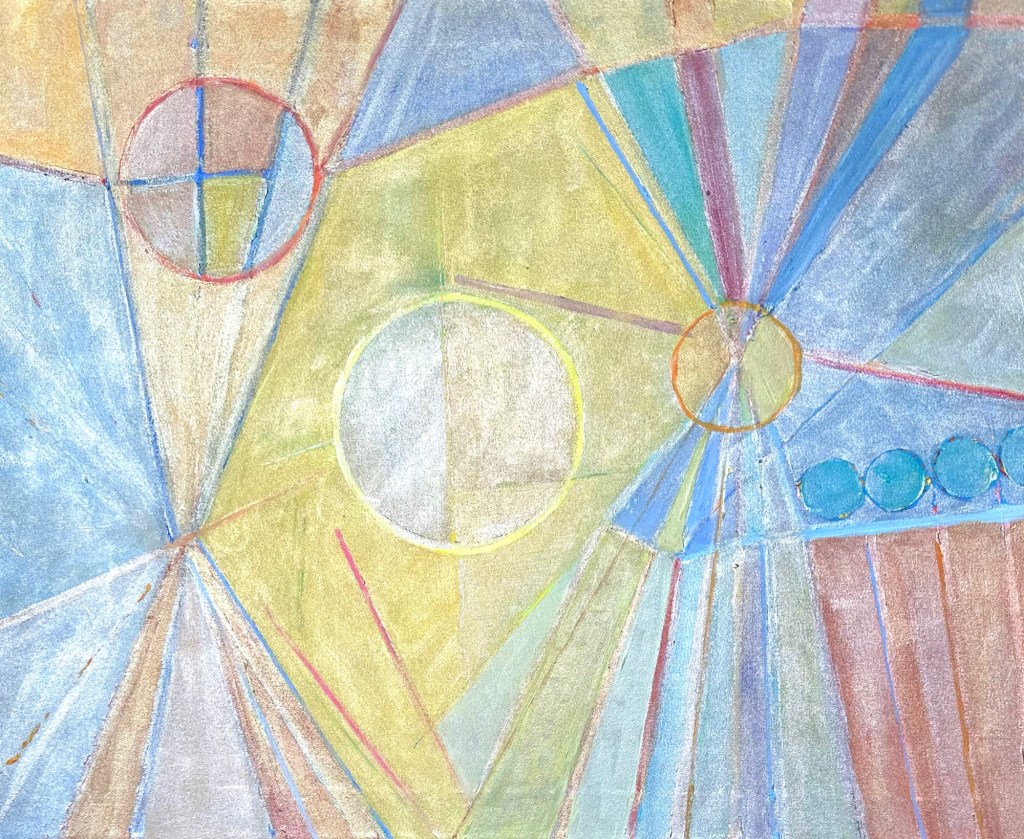
In the studio, the artist is always listening for the creative spirit to speak. If I’m sitting before a blank canvas and have no idea whatsoever what to do, I make a mark. I make another mark in relation to the first, for now the two need to speak and relate to one another. As I pick up some more paint to make the third mark, this one must relate to the other two, and so on I go, adding marks and colors.
Once I get some shapes defined, I begin blocking in some colors. Here too, these must speak to one another. One mark can’t shout or be overbearing, while the others fade into the background. I think of warm and cool, opaque and transparent, as well as flat and shaded. Once I get a base layer on the canvas, I remove the strings which I tied to make the shapes. I give it a rest and let my mind rest also. I can come back with fresh eyes tomorrow.
The “Pillars of Creation,” an area of intense star formation, was photographed by the Near-Infrared Camera of NASA’s James Webb Space Telescope.
Inspiration, or listening for the spirit of creation, is especially important to move a work past “coloring in the lines” into a work of art. The “Pillars of Creation,” an area of intense star formation, was photographed by the Near-Infrared Camera of NASA’s James Webb Space Telescope. In the Old Testament, the pillars of creation held up the earth itself, while the dome of the firmament (the sky) was above. The ancient, unscientific age was a limited world, with an unlimited divine being. Today we live in an unlimited universe, but too many people have a god too small to do mighty things beyond our poor capabilities.
DeLee: Pillars of Creation
When I add the silver and gold paints, the number of layers and the directions of my brush strokes determine how much of the under painting will show through. I don’t do this haphazardly, but once again I listen to that still, sheer sound of silence that once called Elijah from his cave. Elijah knew God wasn’t in the wind, earthquake, or fire, but in the sound of sheer silence (1 Kings 19). I may have music playing in the background, but I don’t hear it at all. I’m in another realm entirely. I only hear the silence.
I’m enjoying this current theme and exploration. It combines my love of space and nature. I’m a firm believer in the providence of God: if God cared enough to create all there is, God will not forsake God’s creation. God will provide, and as God’s faithful people, we’ve been entrusted with the care for God’s world. Therefore, we must join God to keep the foundations of creation stable and the resources of our world available for future generations.
Joy and Peace,
Cornelia
William P. Brown: The Seven Pillars of Creation: The Bible, Science, and the Ecology of Wonder, 1st Edition, Oxford University Press, 2010.
The first bright light of creation must have been an awesome sight. Of course, only God was there to see it or hear it. The earth was a formless void, and darkness covered the face of the deep. Genesis 1:3 tells us, “Then God said, “Let there be light;” and there was light.”
John Martin: The Creation of Light, Mezzotint, 1825, Royal Collection of the Arts, London.
I have often wondered if God’s creation of light was accomplished with sound. If at one time only darkness existed, then suddenly light appeared, would this sudden change happen like an atomic bomb flash? Not with the bomb’s destructive evil and force, but with the creative and life-giving energy of God’s power and love. While scripture tells us we hear God’s voice in the sheer silence (1 Kings 19:11-12), this is after God has created everything which we humans might worship instead of God. When God first created light, what was the power behind God’s words?
George Richmond: The Creation of Light, Tempera, gold, and silver on mahogany, 1826, support: 480 × 417 mm, frame: 602 × 539 × 66 mm, Tate Gallery, London.
Maybe no one cares, for if no one is in a forest to hear a mighty oak fall, can we say it ever made a sound? Just because human beings weren’t created yet does not mean the light did not come into existence or make a noise. We might as well say bombs are not leveling towns in Ukraine and Gaza merely because we are not running from the falling bricks and dust. Yet, we can see the pictures on television and know these facts as true.
We are in a trickier situation when we try to find information to prove the existence of the creation of the first light and the facts of its origin. We are certain light was created, for light now exists. Tracking light’s history to its birth story is the challenge!
The Creation of Day and Night, by Francisco de Holanda, De Aetatibus Mundi Imagines, 1543.
When the Old Testament says God created light, the ancient readers understood this word to mean a special light, not the light of the sun, moon, or the stars. God created these lesser lights on a later day, so they possess a different form of light from the first light. The early Hebrew philosophers distinguished between chomer, matter, and tzurah, the form or function of an object. A raw material has chomer, matter, but once it’s made into an object, it acquires the form or tzurah.
Michelangelo’s The Separation of Light from Darkness, (c. 1512), the first of nine central panels that run along the centre of the Sistine Chapel ceiling.
At the beginning of creation, nothing had form. It was all matter. Then God created the Ohr Ha-Ganuz, or the Hidden Light. This special light played a critical role in Creation. Just as regular light allows us to see and relate to our surroundings, the Hidden Light enabled the different elements of creation to interact with one another. It dispelled the initial state of darkness when all objects were isolated and disconnected from one another. Through this special light, the universe’s myriad objects acquired purpose and function and were able to work together towards a common goal.
About 13.8 billion years ago, our universe ballooned outward at an incredible speed. Everything we see today, which was once packed tightly together, expanded in a roiling mass of light and particles. It took 380,000 years for this hot, dense soup to thin and cool enough to allow light to travel through it. This first light, dating back to the formation of early atoms, we call the cosmic microwave background and we can still detect it today.
Creation: Bright Beam, stage 1
The Advanced Simons Observatory in the Atacama Desert in Chile is on the forefront of research for detecting cosmic microwave background radiation to give us a better picture of the early universe, its evolution, and the many phenomena within it. Beyond the cosmic microwave background, they will hunt for and study the birthplaces of distant stars, the contents of interstellar dust, exo-Oort clouds—spherical shells of ice and dust at the edges of solar systems—and several other phenomena. But, given the unique capabilities of this observatory, they are also open to finding some unexpected and unexplained puzzle pieces in the universe that we did not know we were missing.
Creation: Bright Beam, stage 2
Before there were any stars or galaxies, 13.8 billion years ago, our universe was just a ball of hot plasma—a mixture of electrons, protons, and light. Sound waves shook this infant universe, triggered by minute, or “quantum,” fluctuations happening just moments after the big bang that created our universe. The question we first asked, “Did the creation of light make an audible sound?” is related to the “cosmic wave background radiation” that the observatory in the Chilean desert is seeking.
Although scientists call this moment the Big Bang, it was not a loud explosion. Instead, it was more like an imperceptible humming because this first moment happened when the universe was denser than the air on Earth and sound waves could travel through it. This covered the first 100,000 to 700,000 years. As the universe cooled and expanded, the sound waves grew longer and and the sounds lower. As the universe continued to expand, the wavelengths became so long the sounds became inaudible to the human ear.
NASA Sound File Magnified of Big Bang Microwave Radiation
For this sound file, the patterns in the sky the Planck Observatory observed were translated to audible frequencies. This sound mapping represents a 50-octave compression, going from the actual wavelengths of the primordial sound waves (around 450,000 light-years, or around 47 octaves below the lowest note on the piano), to wavelengths we can hear.
Creation: Bright Beam, stage 3 in the studio
Maybe as you read this, you wonder, why do artists have an interest in science? This is an attribute of artists from Leonardo in the Renaissance down through the Impressionists who studied the play of light and atmospheres on surfaces in the 19th century. Today we know the speed of light means we are always seeing a “late arriving sunbeam.” The speed of light gives us an amazing tool for studying the universe. Because light only travels a mere 300,000 kilometers per second, when we see distant objects, we’re always looking back in time. If we the universe clock backwards, right to the beginning, and you get to a place that was hotter and denser than it is today. So dense that the entire universe shortly after the Big Bang was just a soup of protons, neutrons, and electrons, with nothing holding them together.
Lentil and ancient grains pasta soup, held together by melted cheese—metaphor for the early universe
The moment of first light in the universe, between 240,000 and 300,000 years after the Big Bang, is known as the Era of Recombination. The first time that photons could rest for a second, attached as electrons to atoms. It was at this point that the universe went from being opaque, to transparent. The earliest possible light astronomers can see is the cosmic microwave background radiation. Because the universe has been expanding over the 13.8 billion years from then until now, those earliest photons were stretched out, or red-shifted, from ultraviolet and visible light into the microwave end of the spectrum.
Today we have tools unavailable to the 15th or 19th centuries, but what we have in common is the human mind. Because we are created in the image of God, we have the same desire to create and shape our world and to understand our place in it. For some people, they find placing their trust in God’s absolute power over all creation and events as a way of understanding the problem of good and evil in the world. This justifies suffering and allows them to ignore the plight of the poor. Prosperity religion, which preaches the good prosper and the bad suffer, is a classic example of this theological belief. We United Methodists believe in doing good to all people, as often as possible, with all the means we can. As the gospel says in Matthew 25:37-40—
Then the righteous will answer him, ‘Lord, when was it that we saw you hungry and gave you food, or thirsty and gave you something to drink? And when was it that we saw you a stranger and welcomed you, or naked and gave you clothing? And when was it that we saw you sick or in prison and visited you?’ And the king will answer them, ‘Truly I tell you, just as you did it to one of the least of these who are members of my family, you did it to me.’
We know Jesus as the Light of the World (John 8:12)—
Jesus spoke to them, saying, “I am the light of the world. Whoever follows me will never walk in darkness but will have the light of life.”
Perhaps this ancient light of creation has not yet reached everyone who reads these words. I can only guess they ignore even the voice of the Old Testament prophet Isaiah (58:10):
“If you offer your food to the hungry and satisfy the needs of the afflicted, then your light shall rise in the darkness and your gloom be like the noonday.”
The sun will always shine when we help others. The light of Christ will burn bright in us to burn away our gloom and despair when we give a hand to others who are in need. Their lives will be brighter in turn. We often turn away from people in hard circumstances because we do not want to face the prospect that we one day might need a hand up. This strikes at our self image of invincibility and self sufficiency. We keep remembering “God loves a cheerful giver.” If we think only of this part of the verse outside of its context, we might think God only loves the giver. God also must love the one in need to provide the blessing for the giver. As we read in 2 Corinthians 9:7-8—
Cornelia DeLee: Creation: Bright Beam, acrylic on canvas, 16” x 20”, 2024.
“Each of you must give as you have made up your mind, not reluctantly or under compulsion, for God loves a cheerful giver. And God is able to provide you with every blessing in abundance, so that by always having enough of everything, you may share abundantly in every good work.”
As an old mentor of mine taught me, “Don’t do all the work for your people. You’ll rob them of the blessing of serving the Lord.” None of us can replace the eternal light of Christ, which has been traveling to us since the dawn of time, although the Light has been with God since before time began. This Light is even now permeating the universe, in a prevenient journey to the furthest distances of creation. There is no place the Light will not go before us. Even as we attempt a return to the moon and hope to go to Mars in the future, the light of Christ has already gone before us.
If this does not give you hope in what many think is a dark and despairing world, refocusing on the Light with us instead of the darkness that always seems so near might help to change your attitude.
I’ve visited the Holy Land twice, and I’m always surprised how small this country is. So much history and events of our faith happened here, yet the land isn’t much bigger than Vermont. This land is a place of great suffering, marked by the historic sites of Masada, Megiddo, and Golgotha. It’s also the place of great joy, as evidenced in the Church of the Nativity in Bethlehem, the Church of the Holy Sepulcher in Jerusalem, and the Western Wall of the Temple in Jerusalem.
Map Painting: Temple Mount of Jerusalem
When we speak of the Holy Land, we include the ancient kingdoms of Judea and Israel, as well as modern day Palestine. The modern state of Israel was formed in 1948, as a homeland for diaspora Jews, who are the ones whom conquering foreign nations had exiled from their homeland over the centuries.
The history of the Hebrew people has been marked by suffering. As Deuteronomy relates, they are a “people holy to the LORD your God; the LORD your God has chosen you out of all the peoples on earth to be his people, his treasured possession.It was not because you were more numerous than any other people that the LORD set his heart on you and chose you—for you were the fewest of all peoples” (7:6-7).
They endured slavery in Egypt, wandering in the wilderness until they entered the promised land, and then were at the mercy of stronger nations who wanted to control the trade routes, which intersected inside the borders of Israel.
The earliest diaspora was the Babylonian exile in 586 BCE, plus a later exile to Alexandria, Egypt, in the 1st century BCE. That first exile was marked by the trauma of the Jews’ loss of Solomon’s Temple and their residency in the holy city. They’d always depended on these two as permanent and a source of God’s special protection. However, their failure to honor God completely negated this protection. In the exile, the people learned how to live as God’s chosen people by studying God’s word, keeping the law, and separating themselves from the Gentiles.
About five million Jews lived outside of Palestine during the Roman era, but most of them lived within the confines of the Roman Empire. Even before the destruction of the Jerusalem Temple in 70 CE, diaspora Jews outnumbered those who lived within the bounds of the territory of the Holy Land.
Western Wall of Temple, Men’s prayer area nearby and Women’s area in distance, 2019
After World War II, with the Nazi massacre of over 6,000,000 Jewish individuals of all ages and sexes, this Holocaust ignited the desire within those others who shared with Jews the same values they represented in the world. Social justice and compassionate assistance to the weak stood in the way of Hitler’s regime, for he believed Jews opposed the Nazi natural order, which was the powerful exercise unrestrained power on behalf of the superior white race. In Hitler’s view, any restraint on the exercise of white power would inevitably lead to the weakening, even the defeat, of this master race. (We hear echoes of this heretical view in the current replacement conspiracy, which claims migrants are poisoning the blood of our nation.)
Harvard Center for Geographic Analysis: Comparative Size of Israel and Occupied Territories to State of Vermont (11,200 square miles to 9,200 square miles)
An entire book in the Old Testament is dedicated to the question of suffering, especially the question of do the righteous suffer. Under the retribution theory of justice, a good person should not suffer, and a sinful person deserves suffering. However, all of us know infants born with dread physical conditions, who obviously haven’t had a chance to sin. In the Old Testament view, his parents’ sin would have caused his suffering, but Jesus reminds us in John 9:3–
“Neither this man nor his parents sinned; he was born blind so that God’s works might be revealed in him.”
Ossip Zadkine’s The Destroyed City (1951) is a man without a heart and is dedicated to the city of Rotterdam, destroyed by the Nazi Luftwaffe.
The book of Job reminds us suffering happens to all of us, and how we react to it is evidence of our transformation into the image of God. Do we seek mere retribution, or will we let suffering transform us? This is a moral question for us today, especially in our suffering adverse society. Yet, we’ll let those on the margins suffer, while we avoid suffering ourselves. The 31st chapter of Job lists the acts of a righteous man who cares for the widows, orphans, and strangers in his land, yet he suffers. But Job is no quitter, even if he is a complainer. He asks God, “Why do the righteous suffer?”
The Gaza Strip, where all the fighting between the Israeli army and the Hamas militants is currently ongoing, is slightly more than twice the size of Washington, DC., our nation’s Capitol. The Capitol is 68.35 square miles, while the Gaza Strip is just shy of 139 square miles. As a comparison, Little Rock, Arkansas, is 123 square miles in area. Little Rock has a 2024 population of 200,546. Compare this with the two million people live in the Gaza Strip. After living in rural Arkansas most of my ministry, I find Little Rock crowded. The Gaza Strip is 10 times more crowded than our state capital.
September Megiddo Painting 2023
Why do I mention this? When a tornado rips through a town or a city in Arkansas, it causes damage on a large scale to those people in that area. Because we don’t have densely populated areas, our suffering is limited to a few. This doesn’t discount their particular suffering, but it does mean suffering is limited, for which we can be thankful. When 2,000 pound bombs drop on high rise dwellings, numerous people are made homeless, and the possibility of injuries is high. Perhaps we don’t see this suffering because it’s in a distant land, or because some of the injured call god by another name. If we can’t recognize human suffering as the suffering of another child of God, we’re losing our ability to see the world as God sees God’s world.
The famous Banksy’s Armored Dove of Peace, the painting of a peace dove wearing a flak jacket. The dove is painted on a wall near the separation wall between Bethlehem (Palestinian Territories) and Israel. Nov. 18, 2023
Rebuilding Gaza will be a massive undertaking because Israel’s bombardment has caused mass destruction. Current estimates are at least a half million Palestinians in the enclave won’t have a home to return to when the war ends, according to the UN aid office. By the end of 2023, about 1.9 million people had been displaced, or nearly the entire population, some more than once, as people moved in search of safety. Because of bombing, by the end of 2023, about 65,000 housing units across Gaza Strip have been destroyed or rendered uninhabitable. In addition, over 290,000 housing units had been damaged, according to the Government Media Office in Gaza. Officials estimate many more will be unable to return immediately due to the level of damage to surrounding infrastructure, as well as the risk posed by of Explosive Remnants of War.
The Greek Orthodox Church of Saint Porphyrius in Gaza, believed to be the third oldest church in the world, was hit by missiles as hundreds of Palestinians sought shelter there during a Israeli missile strike in its war against Hamas.
Currently residents in Gaza are facing famine, for the existing World Food Program ready-to-eat food options are falling short of meeting people’s crucial caloric needs. Bread, made from fortified flour, holds the potential to address some of the unmet requirements for essential vitamins and minerals, which the current ready-to-eat baskets fail to provide. Moreover, providing bread as a no-cook food option is crucial when households lack the means to cook meals. Thus, incorporating bread into aid provisions is not only as a practical solution, but also is a key strategy to fulfill immediate nutritional needs.
Children try to get food relief in the southern Gaza Strip city of Rafah, on December 31, 2023.
I first visited the Holy Land in 2000, just before the intifada of 2001. At the time, the Gaza Strip was under Israeli control. Following the 1948 Arab-Israeli War, Egypt administered the newly formed Gaza Strip; Israel captured it in the Six-Day War in 1967. Under a series of agreements known as the Oslo Accords signed between 1993 and 1999, Israel transferred to the newly created Palestinian Authority (PA) security and civilian responsibility for many Palestinian-populated areas of the Gaza Strip as well as the West Bank.
After June 2007, when HAMAS took over the Gaza Strip, Israel and Egypt have enforced tight restrictions on movement and access of goods and individuals into and out of Gaza. Fatah, another political movement, and HAMAS have since reached a series of agreements aimed at restoring political unity between the Gaza Strip and the West Bank but have struggled to enact them. Therefore, Egypt and Israel have maintained border control over the Gaza Strip, determining who and what enters or leaves.
Since Hamas’ surprise attack on the music festival and the settlement nearby, not only have the Jewish people suffered harm due to 1,200 immediate deaths but also the continued terror of those held captive by the Hamas terrorists. Some say Christ suffers only for those who go on to have faith in his saving work on the cross. I was asked once on an Emmaus walk, “Are we saved when we profess our faith in Christ, or when Christ died on the cross for us?”
Byzantine Mosaic apsidal, San Clemente, Rome
They were surprised when I answered, “Yes.” It’s not an either-or question. After all, Christ died once, for all, as an act of saving grace. God raised him from the dead to make him the first of many to cast off the chains of sin and death. When we, centuries later, profess our faith in Christ, we accept his suffering on our behalf and his resurrection as our promise of a life to come. As Christians, we often base our world view on our claim to the promises of God, but we forget Christ’s death and resurrection is a promise to all people, even to those who haven’t professed faith in Christ. As the writer of Hebrews (1:8-9) once said:
“Now in subjecting all things to them, God left nothing outside their control. As it is, we do not yet see everything in subjection to them, but we do see Jesus, who for a little while was made lower than the angels, now crowned with glory and honor because of the suffering of death, so that by the grace of God he might taste death for everyone.”
Red Megiddo Cross
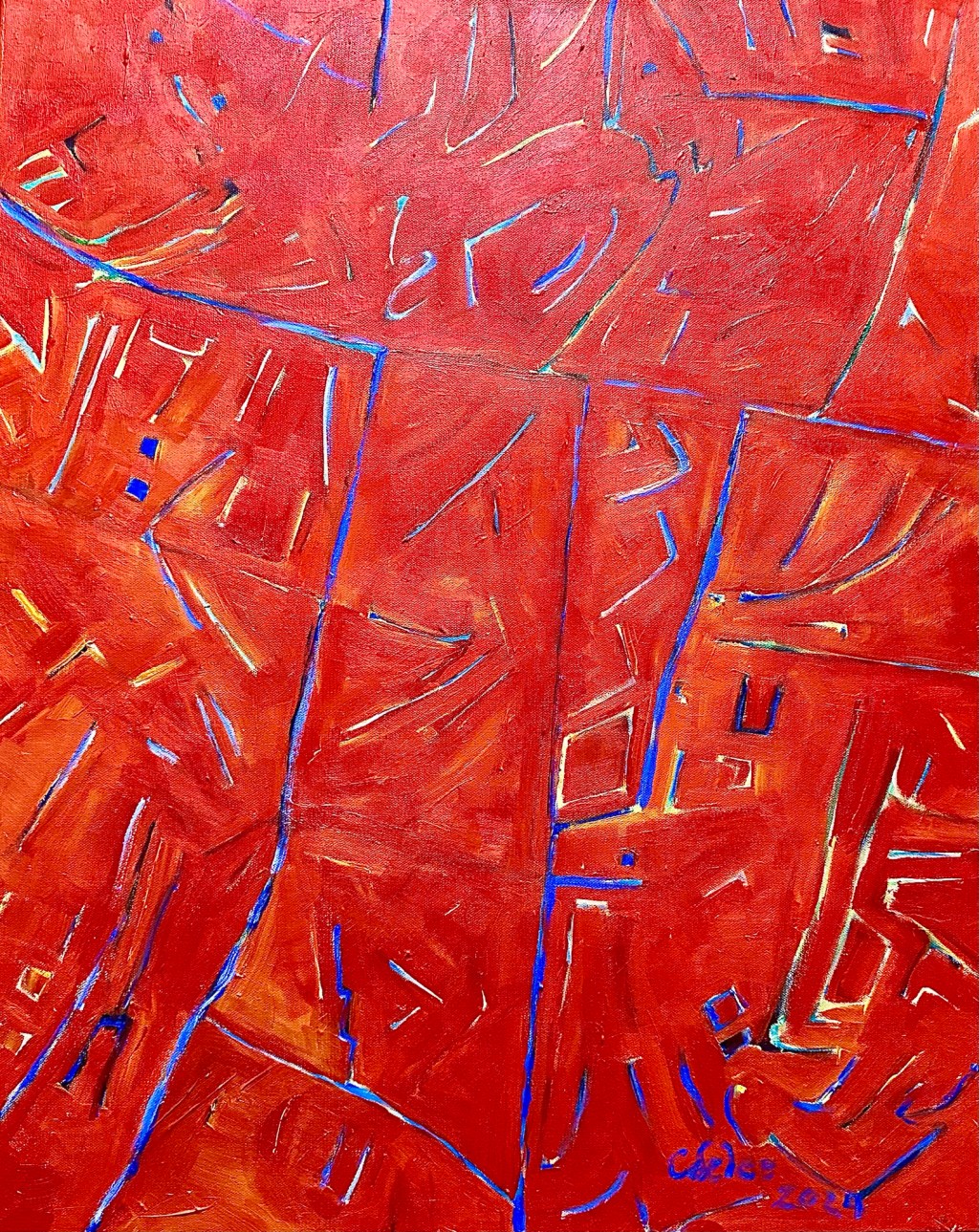
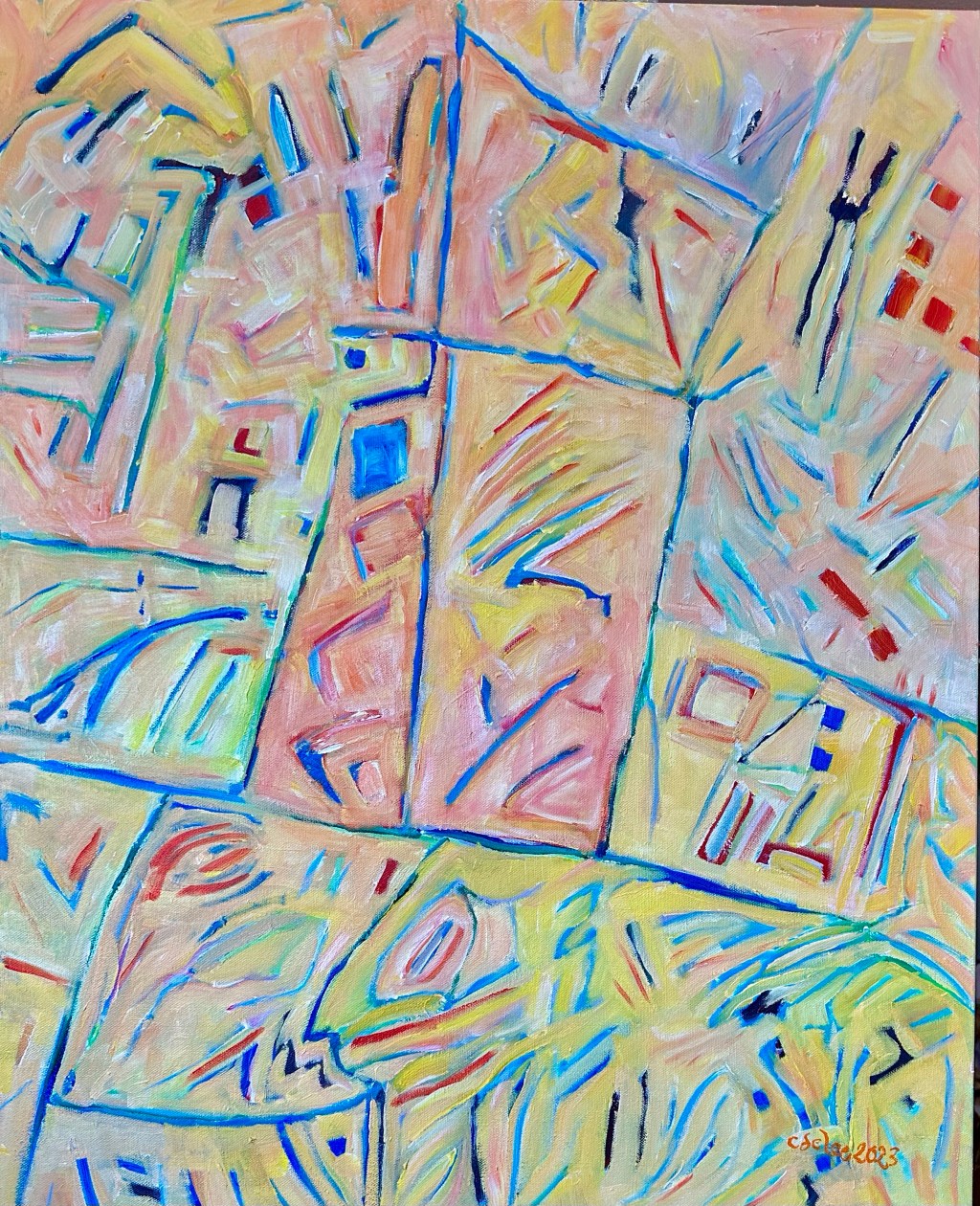
As I worked on my painting, it went through several iterations. First it stayed close to the map of the ruins of Megiddo, which I painted in yellows. Megiddo is the site of the battle to end all battles, and the place where the forces of good meet the forces of evil. Because Israel is on the crossroads of many trade routes, nations have always met there to contest for dominance. I left many scar scribbles on the canvas to represent the destroyed walls of the ancient city. As is my usual practice, I hung up my canvas to live with it awhile, but the longer my painting hung on my wall, the more unsatisfied I was. I can always tell when my inner vision isn’t meshing with finished work. When I took the work down, I flipped it 180 degrees and repainted it in red, for the bloodshed of this most recent war. As I painted out most of the scribbles, I saw the cross appear out of the image. By destroying the remnants of destruction, I had simplified the image down to its essence.
In all things, the cross is crucial. We moderns don’t understand suffering or pain. We deny it, reject it or medicate it with something that keeps us from feeling it. My personal medicinal choices are ice cream and chocolate. If I can combine them in one substance, so much the better! A recent bout with the shingles this past December had me consuming both foods for medicinal relief. Other people use wine, TikTok, or another medication of choice to escape from emotional or physical pain.
The winter of my discontent, brought by Mayhem
Revenge is is a dish best served cold because if we take revenge in the heat of the moment, we’ll over do our response and won’t know when to stop. If we wait, cooler heads will prevail, and a more limited response will likely be our action. Less damage, and less mayhem, but we humans don’t seem to be built this way. Those who have suffered will often return suffering in kind as a “hair of the dog cure.” This is why abuse and family violence is generational. The ancient Hebrews practiced the BAN, or a primitive religious practice of dedicating for destruction an entire group of people and their possessions to the LORD. This was done to cleanse the land and keep the Hebrew people pure from idolatry. Paul had Deuteronomy in mind when he wrote in Romans 12:19—
“Beloved, never avenge yourselves, but leave room for the wrath of God; for it is written, “Vengeance is mine, I will repay, says the Lord.”
While the western world has the crusade mentality, which is similar to the extreme ban, we also have the just war theory. Modern wars are fought by democracies mostly with this mindset, for the international community is in agreement the ends should justify the means. Unfortunately, terrorists don’t agree and fight according to their own extremist beliefs. We have to ask ourselves what happens to us when we adopt their policies and inflict extreme suffering on civilians to the point of causing starvation and homelessness by destroying their homeland. If we act the same as those whom as we despise, have we become them instead? We lose the moral high ground when this happens. It’s time to draw back and reconsider our motives and our methods: how can we be just, compassionate, and holy, as God is holy? Otherwise, we’re suffering for nothing or causing others to suffer meaninglessly.
When we read scripture, God’s Holy Spirit should work in our hearts and minds to make a change in us to confront and conform us into God’s holy nature. If no change happens, we need to ask God to open our hearts and minds to be conformed to God’s Holy Spirit. If it’s painful to read scripture, remember Christ suffered for us. Many of us can’t read the scriptures to be transformed, for change is difficult and painful. However, staying the same is also difficult and painful. (Maybe this is why only 10% of Americans read their Bible daily.) I find God has compassion on those who suffer, especially those who do so while “working out their own salvation in fear and trembling.”
Remember God has compassion and is near to the broken hearted,
NOTE: This extraordinary story comes from Arguable by Jeff Jacoby, an opinion writer for the Boston Globe, on December 12, 2023. I’m sharing it with all of you because even in the worst of times, even with the least of resources, if we have faith in God, we can be a light unto the world.
In his transcendent prison memoir, “Fear No Evil,” Natan Sharansky tells the story of his nine years in the Soviet gulag, a fate to which he was sentenced for the crime of wanting to emigrate to Israel. Even now, 35 years after it was published, it is an amazing read, a great narrative by a great man who refused to be intimidated by his captors. The more the KGB tried to berate or punish him for his Jewish pride and Zionist yearning, the more joyfully and fearlessly Sharansky embraced them.
To mark this week of Hanukkah, consider this extraordinary incident recounted in “Fear No Evil.”
Davis Stark Design, Architectural Digest 2017
Sharansky was in the Siberian prison camp of Perm 35 and Hanukkah was drawing near. Intent on observing the holiday as best he could, Sharansky had a menorah constructed from some wooden scraps. A few candles were found, and each evening Sharansky lit his menorah, reciting the blessing, and describing to his fellow prisoners — none of them Jewish — the story of the Maccabee rebellion long ago. On the sixth night of Hanukkah, the authorities confiscated his menorah and candles. When he demanded to know why, a prison guard claimed that the menorah was made from “state materials” and therefore illegal.
Sharansky declared a hunger strike. “In a statement to the procurator general,” he recounts, “I protested against the violation of my national and religious rights, and against KGB interference in my personal life.”
Two days later, Sharansky was summoned by Major Osin, the prison camp warden. Osin wanted the refusenik to call off his protest before the expected arrival of an inspection committee. In that case, Sharansky said, “Give me back the menorah, as tonight is the last evening of Hanukkah.” He promised to end his hunger strike if he was allowed to light the candles.
Davis Stark Design, Architectural Digest 2017
But a protocol for its confiscation had already been drawn up, and Osin couldn’t back down in front of the entire camp. . . . I was seized by an amusing idea.
“Listen,” I said, “I’m sure you have the menorah somewhere. It’s very important to me to celebrate the last night of Hanukkah. Why not let me do it here and now, together with you. You’ll give me the menorah, I’ll light the candles and say the prayer, and if all goes well I’ll end the hunger strike.”
Osin thought it over and promptly the confiscated menorah appeared from his desk.
When Sharansky said he needed eight candles, Osin took a knife and cut the candle into eight stubs. Then, with amazing audacity, Sharansky said that the ceremony required everyone present to stand with head covered, listen to the blessing, and answer “Amen.”
Osin complied. He stood behind his desk, donned his major’s cap, watched as Sharansky kindled his eight candle stubs, and then waited for his prisoner to recite the blessing. Speaking in Hebrew — which Osin, of course, did not understand — Sharansky recited a blessing he had composed himself: “Blessed are you, O God, for allowing me to light these candles. May you allow me to light the Hanukkah candles many times in your city, Jerusalem, with my wife, Avital, and my family and friends.”
Then he had a brainstorm.
Inspired by the sight of Osin standing meekly at attention, I added: “And may the day come when all our enemies, who today are planning our destruction, will stand before us and hear our prayers and say ‘Amen.’ ”
“Amen,” Osin echoed back. He sighed with relief, sat down, and removed his hat.
Sharansky writes that he returned to his barracks “in a state of elation.” Who can doubt it? What magnificent chutzpah! What a triumph of the spirit! And what an uplifting reminder that even in the depths of the gulag — even in a time and place filled with the enemies of Jewish faith and freedom — those who refuse to fear can turn the table on their oppressors and dispel the darkness with a candle’s light.
From Book Blurb: For anyone with an interest in human rights—and anyone with an appreciation for the resilience of the human spirit— he illuminates the weapons with which the powerless can humble the powerful: physical courage, an untiring sense of humor, a bountiful imagination, and the conviction that “Nothing they do can humiliate me. I alone can humiliate myself.”
Hachette Books: Use HOLIDAY23 for 20% off site wide until 12/31. (Order by 12/13 to get your gift under the tree!)
This link also has links to other retailers. Price is set by publisher.
Nativity at Night by Geertgen tot Sint Jans, c. 1490, after a composition by Hugo van der Goes of c. 1470; sources of light are the infant Jesus, the shepherds’ fire on the hill behind, and the angel who appears to them
On a visit to the Holy Land, I walked in the ruins of Tell Megiddo and also climbed the hills above the Jezerell valley. From this vantage point, I could imagine the great battles of nations warring to conquer land and control trading routes. Megiddo lies at the crossroads and therefore in the crosshairs of international politics, both in ancient and current times.
Valley of Megiddo
The plains of Megiddo, the breadbasket of Israel, also were known as a great battleground in ancient times. Egypt came more than once to fight the kings of Israel and Judah. The world’s earliest recorded battle occurred here between Syrian princes and Pharaoh Thutmosis III (ca. 1469 BC). Judah’s king Josiah was fatally wounded when he confronted another pharaoh, Neco II, near Megiddo ca. 609 BC (2 Kings 23:29-30). Although Megiddo is only mentioned in the Old Testament, the New Testament refers to it once in Revelation 16:16 as Harmagedon (mountain of Megiddo), the final site of the battle between the forces of good and evil at the end times of the age. Of course, scholars have different interpretations of when these “end times” are at hand.
Map of First Recorded Battle
The final book of the Greek New Testament is ΑΠΟΚΑΛΥΨΙΣ ΙΩΑΝΝΟΥ, or the Apocalypse of John. The word apocalypse means “disclosure of truth, instruction, or reveal, disclose, uncover.” It especially refers to Jewish and Christian writings of 200 BCE to 150 CE, which are marked by pseudonymity, symbolic imagery, and the expectation of an imminent cosmic cataclysm in which God destroys the ruling powers of evil and raises the righteous to life in a messianic kingdom.
Chariot Sculpture at Megiddo Battlefield
I remember a presenter on an Academy for Spiritual Formation retreat saying she had difficulty saying the prayers in the psalter, for the psalms of lament meant nothing to her, since she had no griefs to bear. Her spiritual adviser reminded her, “We pray these prayers for others, not just for ourselves alone.” As an artist of faith, I sense the needs of the world: it’s longings, fears, hopes, and dreams. I don’t always paint “art for art’s sake.” Certainly the conflict our beloved United Methodist Church has been experiencing lately factored into this “end times vision,” for too many on both sides of this dispute have resorted to calling the other “evil.”
Megiddo: Bronze Version
I felt called to paint the landscape of Megiddo in these recent weeks. Beginning in mid August, I was working on several paintings using Google map views of the landscape around the ancient site, with inspiration from my personal photos from my visit several years ago. I struggled over it, with the colors changing from bright to earthen tones. I left it alone for a time, to look at it and take time to live with it. Doing this allows me to see if I got too interested in noodling about making different colors, rather than considering the whole area as one unit. It didn’t take long before I came to the conclusion I didn’t have unity in my work. I had no overarching focus. My life has been like this for a while, with multiple distractions.
Megiddo: Blue Version
In our broken and fallen world, I find people today are in a rush to run to the extremes. Cooler heads don’t always prevail. The moment disorder rears its ugly head, folks run around like Chicken Little screaming, “The sky is falling! The sky is falling!” They might as well scream, “The end times are here!” I’m reminded of the Y2K hysteria with everyone panicking about filling up their cars for fear the gas pumps wouldn’t work, getting cash in case the credit cards wouldn’t swipe, and buying generators for fear the grid would crash (computers not able to recognize all those zeros). As I recall, my antique VCR kept recording on schedule, and the local Walmart took back loads of panic purchases in January.
The latest outbreak of hostilities in Israel and the Gaza Strip have added to the apocalyptic atmosphere and thinking of those who are given to extremes of thought. America has sent two of its eleven aircraft carriers into the Mediterranean Sea as a deterrent to all the other nations to rethink their plans to join the fighting now going on. For the apocalyptic thinkers, this is a sign of “It’s going down!” For those of us who have calmer heads, we realize the United States is the only one of six countries with more than two of these floating armed cities. Every other country has a single one only.
General Eisenhower (R) confers with French generals French 1st Army Corps Headquarters November 25, 1944 Ranking allied leaders look over a situation map outside of French 1st Army Corps Headquarters.
It’s been the habit of American presidents and their advisers in the gamut of crises since World War II to move aircraft carriers around as a “Geopolitical Chess Piece” to demonstrate American concern, resolve, or outright anger. Because carriers are operate on the high seas where permission to move is not needed from other countries, and because they carry their own fuel, weapons, and maintenance, they’re ready on arrival at the scene of a crisis to deliver power. Moreover, since modern U.S. carriers are large and imposing, and have been unchallenged on the seas, they “show the flag” to great effect. They provide excellent “visuals.” In fact, if one carrier doesn’t do the job, sending a second with several attendant ships along is a sign of “we mean business.”
Since this is a habit, and not a novel occurrence, it’s not the sign of the end times. As the gospel of Mark records in 13:7-8:
“When you hear of wars and rumors of wars, do not be alarmed; this must take place, but the end is still to come. For nation will rise against nation, and kingdom against kingdom; there will be earthquakes in various places; there will be famines. This is but the beginning of the birth pangs.”
Benjamin West: Death on a Pale Horse, oil on canvas, 1817, Pennsylvania Academy of the Fine Arts
Will these carriers be used for their traditional purpose—a floating airfield—and will our military aircraft and service personnel actually join in the actual combat operations in the MidEast? That seems unlikely, given the Just War principle taught in American War Colleges. The moral concept of Just War begins with a good reason to go to war. A reasonable cause is to right a wrong, recover stolen property, or self defense. Not liking someone isn’t a good reason to go to war.
The just war must be fought proportionately to the harm that was done to the aggrieved. Today, if someone were to insult you or cut you off in traffic, honking your horn is acceptable, but shooting a pistol isn’t. That’s a disproportionate reaction to the harm, or an unjustified assault. Responding in anger usually leads to regret, but our emotions often get the best of us.
I remember my first year in the classroom. I was making a grand total of $8,250 a year—the extra $250 was for my master’s degree—and the school wanted to know if I wanted this pittance in 10 or 12 checks. “Oh, make it ten! I’ll figure out summer some how.” The first day of class in 1982, I had well over fifty students in the high school sign up for art because the former teacher had taught elementary lessons to the older students: she had fifty ways to draw turkeys. I brought the principal in: “This isn’t going to work. Let’s get half of them in another class.” He was good with that.
This was a country school. Most of the kids would marry right after graduation. Many of the seniors already had jobs, so young art teachers weren’t high on their respect list. I was fortunate to have taught in an inner city school back in the Northeast where the boys play ice hockey. Like an aircraft carrier sent to the Mediterranean Sea, sometimes I’d have to throw my short body into the middle of two factions who were about to throw punches. These boys were usually over six feet tall, so there was no likelihood I’d ever get hit, but just my presence would cause them to reconsider and pull their punches.
Just because we send war ships to the Mediterranean doesn’t mean we want to wage war. We Americans have a track record of showing up to keep wars from breaking out all over. World leaders know how our military is trained and the rules by which we engage in conflicts. This is why as a person of faith, each of us has to search our hearts to discern how we respond in times of conflict, whether that’s a war or just a disagreement with our neighbors.
In addition to a just cause, we must have the right intentions, the possibility of success, and enter a conflict only as a last resort. Those who follow the Just War Principles aren’t “trigger happy,” but are inclined to gather community support, decide their limits ahead of time, seek to resolve the conflict in other ways first, and if that fails, then enter the fray. The USA didn’t enter WWII until the 1941 surprise attack on Pearl Harbor, even though the war in Europe had been going on since September 1, 1939, when Germany invaded Poland. Up to that time we were supporting Great Britain with armaments.
A plan for after the fighting is done
Theologically speaking, scholars are of two minds: the end times are already here or the end times have yet to come.
1. The end times are already here—Scholars who believe this understand Matthew 24:6-8 as an ongoing event, which began with the ascension of Christ:
“And you will hear of wars and rumors of wars; see that you are not alarmed; for this must take place, but the end is not yet. For nation will rise against nation, and kingdom against kingdom, and there will be famines and earthquakes in various places: all this is but the beginning of the birth pangs.”
For some, the tribulation will happen beforehand (pretribulation), while others believe this suffering will occur after the return of Jesus (post tribulation). I remember as the year 2000 approached, many of the faithful were excited about the camera facing the Mount of Olives in Jerusalem, since this was the place from which he ascended, therefore it would be the place from which he would return. Daystar Ministries setup the camera so “everyone could see it firsthand.”
We humans tend to think our Gods are small, even if we ascribe to them “infinite powers.” We don’t realize the power of an almighty who can interrupt and reveal all of the past to be nothing but dust and introduce a new age with his appearance. No one will need a computer or video screen to view the in-breaking return of the messiah. Everyone around the world will hear the thunderclap at one moment in time, and the flash of lightning accompanying his appearance will brighten even the darkest night. This day will be overwhelmingly bright. Most of us will hide our eyes so we won’t be blinded by the brilliance of a thousand suns.
The Jesus Cam will most likely melt when Christ does return, but his return wasn’t on the first day of 2000. That wasn’t the millennium anyway, but a year early for the math challenged hopeful. It was also the year 1420 for the Muslims and 5760 for the Jews, so who’s counting matters anyway, since numbers aren’t what God depends on, nor the stars (astrology).
Durer: The Four Horsemen
2. The end times are yet to come—While pandemics, stock market crashes, and rumors of war may all sound apocalyptic, the Temple at Jerusalem has yet to be rebuilt. Complicating this task is the Dome of the Rock, a major Islamic holy site built on the same location. A Pew Research Center study in 2010 found most Americans believed war, terrorism and environmental catastrophes were at least probable by the year 2050. Nearly six-in-ten (58%) saw another world war as definite or probable; 53% said the same about the prospect for a major terrorist attack on the United States involving nuclear weapons. An even higher percentage (72%) anticipated the world would face a major energy crisis in the next 40 years. This fits with the theme of “apocalypse as the collapse of environment or society.”
Other characteristics of the apocalypse include:
1. Literal battle between physical armies under supernatural leadership—These are battles of extremists, who are convinced they have a holy calling to fight. The Crusades were fought as “Christ’s army against the infidel.” Their purpose was to restore the Christian holy sites in the Middle East and resanctify them for holy Christian worship. This mentality doesn’t respect the humanity of the enemy. The war may have a just purpose, but not be fought with just means: eradication of the enemy is unjust.
2. Holy wars against non-believers—This is an unjust war, fought with unjust purposes, with excessive force, and seeks to exterminate the enemy, who are reduced to non-persons because they don’t share the same belief system. When opposing sides can’t recognize the common humanity of one another and rage rules decisions, the lust for blood feeds upon itself. Shakespeare said it best when Marc Anthony came upon the body of the just assassinated Julius Caesar in Act 3, scene 1:
And Caesar’s spirit, ranging for revenge,
With Ate by his side come hot from hell,
Shall in these confines with a monarch’s voice
Cry “Havoc!” and let slip the dogs of war,
That this foul deed shall smell above the earth
With carrion men, groaning for burial.
My final reworking of Megiddo includes streaks of rockets in the dark night sky and swirls of chaos which churn the world’s peoples, just as Ate, the Roman personification of recklessness and folly incites the passions of Caesar’s bereaved followers. We don’t know when Christ will return, no matter how many may prophesy or calculate the date. As Jesus said to his disciples in Matthew 24:36,
“But about that day and hour no one knows, neither the angels of heaven, nor the Son, but only the Father.”
This present darkness is only momentary, for if we’re in the end times, we also have a promise we can hold on to in Matthew 28:20—
“Remember, I am with you always, to the end of the age.”
Left to right, French 5-star General De Lattre De Tassigny, commander 1st French Army; U.S. Lieutenant General Omar Bradley, commander, 12th Army Group; French 4-star General Marie Emile Bethouart, commander 1st French Army Corps; U.S. Lieutenant General Jacob L. Devers, commander, 6th Army Group; and General Dwight Eisenhower, Supreme Allied Commander.
My most recent studio work explores my memories of my pilgrimage to the ancient ruins of Tel Megiddo. Why am I interested enough to make an entire series of drawings and paintings of this site, which I visited over two decades ago? First, the city was continuously occupied from the 7th or 6th millennium BCE, with the ancient tel generally left untouched and intact since its decline and subsequent abandonment around the 4th century BCE. The tels at Megiddo, Hazor, and Beer Sheba all have retained their authenticity and each have acquired the characteristic conical shape with a flattish top, protruding above the surrounding countryside. These three tels are now UNESCO Heritage Sites.
Megiddo: Marks and Memories
Excavations at Tel Meggido have uncovered about 26 layers of settlements dating back to the Chalcolithic period, or the early Bronze Age, about 5,000 years ago. Other sources say 30 layers exist at Tel Megiddo. The first four layers have been identified. This site was a Canaanite city, an Egyptian fortress, a Chariot City during Biblical times, and a prominent Assyrian and Persian city. King Solomon ruled the city in its prime in the 10th century BCE.
Megiddo: First Recorded Battle in History
The city has seen more battles than any other location in the world because of its location at the crossroads of the ancient world. The first written reference to Megiddo also happens to be the first recorded battle in history: a detailed account of the 1479 B.C.E. invasion of the Egyptian Pharaoh Thutmose III. When King Thutmose III of Egypt conquered Megiddo 3,500 years ago, the pharaoh left with, among other things: 1,929 head of cattle, 2,000 goats, 20,500 sheep, 204 horses, 200 army uniforms, and 502 bows. Megiddo is also the first recorded use of the composite bow and the first body count. All details of the battle come from Egyptian sources — primarily the hieroglyphic writings on the Hall of Annals in the Temple of Amun-Re at Karnak, Thebes (now Luxor), by the military scribe Tjaneni. Megiddo is also the site of a large chariot stable complex, called Solomon’s Stables, even though we now know they were built by Solomon’s successor King Ahab during the 9th century B.C.E.
Megiddo: Blue Version, Motions and Moods
Fortress cities sit on the 10 acre summit of Megiddo Hill or Tel Megiddo, rising 21.33 meters (about 70 feet) above the valley. Megiddo is located in the Lower Galilee region of northern Israel. Its critical location dominated the Aruna Pass (Wadi Ara or Megiddo Pass), which was the entrance to one of the few passes through the Carmel Mountains. Megiddo controlled the Via Maris, the main route between Egypt and Mesopotamia, also known as the Egyptian Way of the Sea. Christians regard this area as “Armageddon,” where the final Biblical battle between good and evil will occur.
Circular altar-like shrine from the Early Bronze Age at Megiddo. (Credit: Hanay)
The early Bronze Age temple compound at Megiddo is unparalleled for its number of temples, the continuity of cult activity and the record of ritual activity. The late Bronze Age palace is the most elaborate in Israel, and one of the best in the Levant. For the Iron Age remains, the elaborate orthogonal town plan of Megiddo has few parallels in the Levant. All three tels have impressive remains of their underground water catchments systems, which demonstrate sophisticated and geographically responsive engineering solutions to water storage. Megiddo is significant because the entire sequence of the Bronze Age and Iron Age is not only represented and excavated, but radiocarbon dated.
Megiddo: Moonlight Cityscape
Those are the travelogue statements. When on pilgrimage, one place full of stones begins to look like another after many days on the bus. Even though I was keeping notes of my journey in my paper journal, by the second week, I was hitting information overload. Each and every place was of the utmost importance, but my body was feeling the stress of constant traveling on a bus as well as the lack of good sleep from a different bed in a new hotel every single night.
Only strong coffee, lots of water, and eating three good meals a day were keeping me going. I was so excited during my pilgrimage, I was in an altered state of mind for weeks after my return home. Time slowed down and I could see more clearly for a long time. I would swear I could see individual oxygen molecules in the air, even though in my rational mind I knew this wasn’t possible. Pilgrimage is a spiritual journey, not a tourist trip of checking off various sites to say “I’ve been there and done that.” Even when surrounded by a “great cloud of witnesses” both physical and immaterial, I always knew I was walking on holy ground.
Megiddo: Motions and Moods, number 2
What does it mean to walk in the places where people have lived and died? Especially where they have clashed violently in war? The last time Americans fought a war on our home front was the Civil War. That internecine conflict was a horrific wound on our nation, an injury that hasn’t yet healed for some. I know my own daddy still carried the scars of his ancestors who fought on the battlefield to preserve slavery. He never understood why I thought that was a bad choice and why I worked to undo the damage of the war’s legacy on all Americans.
Cannon at Shiloh National Military Park
While traveling back home from viewing the Great American Eclipse, I met a man at Shiloh National Military Park, a Civil War memorial battle field. He visits these historic sites to pray for the deceased. He was from New Orleans, Louisiana, and believed those who died a violent death still wandered about, since their souls weren’t at peace. I don’t know if I believe this, but it gave him comfort to pray for the release of the hate and violence people can store up in their bodies and spirits and cause them to war upon one another.
I can say on that autumn day while I walked those killing fields, I felt the somber mystery of death and life, dignity and indignity as I walked about the silent hills and valleys. No longer do we hear the crack of the rifle or the thunder of the cannons. Rain has washed away the blood from the grassy knolls and pastures. Sunlight has dressed the wildflowers in beauty. If not for the explanatory signage, I’d never know about the extraordinary happenings at Shiloh National Military Park.
Perhaps I’m painting these historic sites of conflict because we are in a time of strife, not only abroad but at home. The actual shooting wars are going on beyond our shores, but conflicts at home are no less serious. I’m heartbroken by the devastation of the Ukrainian homeland by the Russian aggressors, and remember the ongoing tussle over the Temple Mount by the various faiths of the world. If there’s conflict beyond us, likely there’s conflict within our our own groups. The outer world usually reflects our inner world.
The stress of our United Methodist Church becoming the “Untied Methodist Church” has been rough on me. I’m carrying my stress in my neck and shoulders so much I’ve pinched the nerve to my pinky and ring fingers. They are now numb. I’m now in physical therapy for this. Medication and relaxation exercises will certainly help. One of my condo residents prayed for a “miracle cure” for me. My theology typically considers “miracles” to be reserved for situations beyond the usual care of physicians, but I know lay people use “miracles” more loosely than we clergy. Nevertheless, I appreciated their well meaning prayer for my healing. After all, God cares for both small and large problems, as Jesus reminds us in Luke 12:24,
“Consider the ravens: they neither sow nor reap, they have neither storehouse nor barn, and yet God feeds them. Of how much more value are you than the birds!”
Moonlight over Megiddo, number 1
I look at that second painting and compare it to the first painting I completed. While I attempted to keep the surface flat, I got involved in the recreation of the old city in my imagination. I connected the moonlight outside with the lamplight inside. I also added an abstract figure in the foreground. The red marks don’t work for me anymore,so I’m likely to destroy this art work. The second one I may keep, only because I learned some new colors and was brave enough to experiment with colors I don’t normally use.
Megiddo #3
In this final work, I chose only a portion of the satellite image. This allowed me to eliminate the areas which were causing me problems in the earlier works, especially the large, repeating curves. Although I’m back to my favorite yellow—I confess to being a Van Gogh fan—I used a greater variety of tints, rather than painting straight from the tubes.
Pablo Picasso once said, “Painting is just another way of keeping a diary.” If our outer world is in conflict, this drama will wash over into our inner world. It will show up in our dreams, our health, our relationships, and in other parts of our lives. If we think the late pandemic and current politics have broken relationships or distressed families, imagine what this has done to our churches. Most people go to church as an escape from this drama, hoping to find a sacred place where everyone is Imitating Christ’s Humility:
“If then there is any encouragement in Christ, any consolation from love, any sharing in the Spirit, any compassion and sympathy, make my joy complete: be of the same mind, having the same love, being in full accord and of one mind. Do nothing from selfish ambition or conceit, but in humility regard others as better than yourselves”(Philippians 2:1-3).
Unfortunately, all people bring their imperfect selves to Christ. Although Christ forgives our old sins, our sin habits remain. Most of us forget this. As an artist, I understand better than anyone the process of “going on to perfection” is both a gift of the Holy Spirit and our own work. While God could gift perfection completely, most often it’s a cooperative endeavor. This is why the studio product is sometimes a thrill, but other times a disappointment. Yet even in the disappointments, we can learn from our mistakes. We might need to “mistake a bunch of times” until we get focused on a new direction. We have to trust the process. Canvas is cheap. It can be reused or recycled. Plus, our salvation isn’t impaired by our detours in the studio.
Yet too often we’re hung up on the product as a reflection of our personal value or worth. If we are hurt, damaged, ill, broken,or harmed in any way, art is a therapeutic exercise for us. Monet tied the brushes to his hands when his arthritis made holding the brush too difficult. His later paintings also had freer brushwork. He could have quit, but he adjusted his expectations and his style to keep creating. As Monet once said, “I’m never finished with my paintings; the further I get, the more I seek the impossible and the more powerless I feel.” Degas was fond of saying, “Only when he no longer knows what he is doing does the painter do good things.”
If we’re in the safe, but shallow waters of certainty, we’re unlikely to grow to the deeper depths of either the spiritual or artistic realms. Most of us are afraid to cast off the anchors that keep us bound close to well known shores. We want to hear the praise of the crowd, and if we sail off for the unknown horizon, we will leave those familiar voices of the crowd’s approval behind. We can only discover the new world by leaving the old one behind, by risking a journey in faith others are not willing to undertake. Sometimes we may need to get out of the boat and risk walking across the water to meet Jesus who calls us to meet us in the midst of the strong winds and high waves.
I don’t worry about these feelings anymore, for I know they will come up, I’ll meet them, and then I’ll let them go. Our feelings of the moment are not the feelings of forever. Only one is the same yesterday, today and forever—the Lord Jesus Christ. The rest of us are still a work in progress.