The great and wonderful part of art is exercising imagination and discovering new ways to solve problems. One of my favorite memories in art school was the day our professor came to class with a single red clay brick. Our first thought was this is going to be the most boring drawing class ever, but then he asked us, “How many uses can you find for a brick?”
Thick as a Brick
After we quickly named multiple uses for a single brick—doorstop, paperweight, weapon, counterweight, and bookend—we were at a loss to name much more. As we scratched our heads, our teacher prompted us, “Did I restrict you to a single brick?” And we were off to the races! Wall, fireplace, house, road, sidewalk, planter, sculpture, picnic table, bookshelf, and more. I can’t remember if this was an early morning class or we were just dense, but I’ve come to believe we can teach creativity. At the very least, we need to give people permission to accept “multiple art answers can be true” and give them the opportunity to consider “other possibilities.”
Canvas bound in strings
When I taught art years ago, children who were troublemakers in regular classrooms were usually well behaved in art class. I attribute this outcome to their ability to express their own individuality in solving the weekly art assignments. Math always has a right answer; there is no “alternative fact” to 2 + 2 = 4. History is the same: the Confederacy seceded from the Union to keep their economic system of enslavement. There was no “states rights movement,” no matter what the Lost Cause proponents pushed in our state approved textbooks. All we had to do was look at the original source documents from the 1860’s.
Simple Color Wheel
Adults usually conform to socially acceptable norms. Helping adults with creative thinking is important because the creative process is more important than the tangible result. Most adults give up the idea they will ever paint the Sistine Chapel ceiling, while children are humble enough to realize they need many more years of practice before they get that kind of opportunity. Also, what we know about creativity can’t be applied in the same way to all creative endeavors because they involve different subjective decisions and processes.
Gino Severini: Expansion of Light. (Centrifugal and Centripetal), ca. 1913 – 1914, Oil on Canvas. 65 x 43.3 cm Museo Nacional Thyssen-Bornemisza, Madrid
Creative insight depends in part on new combinations of existing ideas, concepts, and perceptions that the brain has stored over time. This is why we begin each class looking at famous art works. We need good art influences and inspiration to “prime our creative pumps” so we can draw up from the pure wellsprings of our own creativity. Just as we need spiritual food for our soul, we need beauty for our creative ideas.
First stage
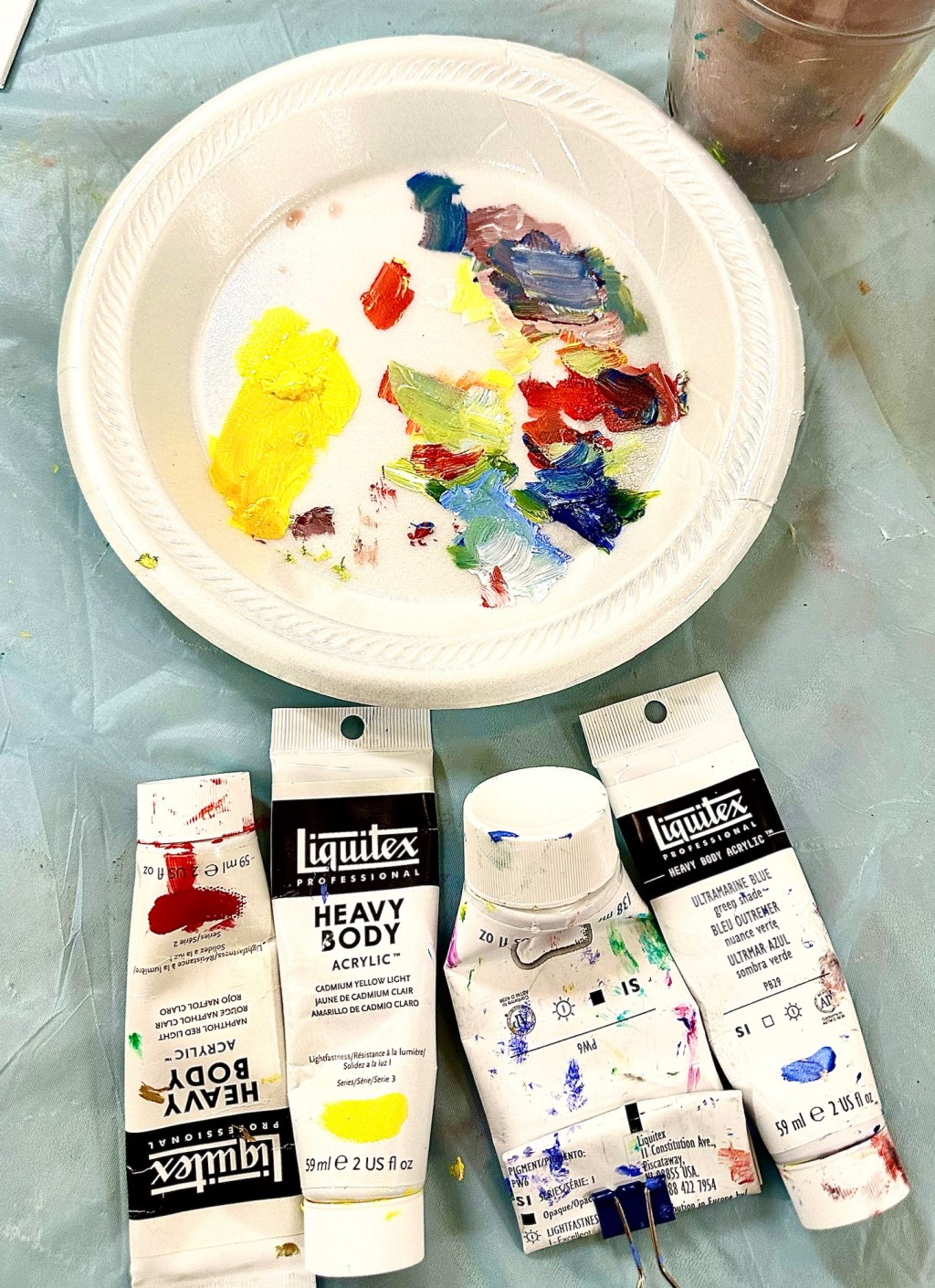
Last year we worked on copying the color wheel and matching it. That is an intellectual skill. To make this into a creative, intuitive activity, we took strings and wrapped our canvases. This made multiple shapes for our colors. Using the primary colors—red, yellow, and blue, plus white—we mixed various combinations and surprised ourselves with the results.
Gail W’s first stage
Our first class was lightly attended, due to doctor appointments and vacations, so we still have room for anyone else who wants to come. All skill levels are welcome, for I’ve taught from K-5 to adults. Everyone progresses from their own level, so the longer you sit and think you wish you were good enough for lessons is merely time wasted when you could be working with a practiced teacher! Anyway, the lessons are free; you bring your materials and discover your unknown abilities and gifts. We journey with fellow travelers. Plus it keeps your brain young.
We will continue to work on this project next Friday at 10 am.
Joy and peace,
Cornelia
National Endowment for the Arts: Creativity and the Brain
The older I get, the faster time flies! When I was a child, summers were long and lazy times. I actually got so bored, by the first of August I’d start to play school. I’d line up my brothers and the neighborhood children and pretend to teach them. It was our way of “playing ourselves into a new reality.”
Art has many right answers!
Children practice life lessons during their play experiences. We can also play our way into learning a new skill in art class. All we need is a “beginner’s mind.” The Japanese Zen term shoshin translates as ‘beginner’s mind’ and refers to a paradox: the more you know about a subject, the more likely you are to close your mind to further learning. As the Zen monk Shunryu Suzuki put it in his book Zen Mind, Beginner’s Mind (1970): “In the beginner’s mind there are many possibilities, but in the expert’s there are few.”
Jerzy Nowosielski: Landscape with a vision of the Sun, oil on canvas, 1965, National Museum of Krakow, Poland.
In a similar vein, Picasso once said, “When I was young, I could paint like Raphael, but it took me my whole life to learn to draw like a child.” Part of our art class experience is to learn to suspend our adult ego’s need to constantly be ranking, besting, and giving into our competitive natures. We learn more when we give up our egos and our needs to protect our false selves, and allow our true selves to learn. This story in Luke 9:46-48 on “True Greatness” speaks to this:
“An argument arose among them as to which one of them was the greatest. But Jesus, aware of their inner thoughts, took a little child and put it by his side, and said to them, “Whoever welcomes this child in my name welcomes me, and whoever welcomes me welcomes the one who sent me; for the least among all of you is the greatest.”
Our first meeting will be Friday, September 6, at 10 am in the old Oaklawn UMC fellowship hall. Bring your own acrylic paints, brushes, and a canvas or canvas panel to paint on. We begin with a short visual inspiration from some great art works, so that we can wonder and be filled with awe at some great artists’ works.
Basic 2 point perspective
I’ll give some direction on the skill we’ll work on in the session, and then everyone is free to bring their own unique expression to their paintings. We don’t copy my work and judge how well a person can match it. Instead, we learn from the masters or from real life. We can learn to stretch our own skills to create something new.
That’s US!
Of course, making great art isn’t our first purpose. As we age, the harsh truth is we will lose our ability to learn new skills until we lose our memory of what we just ate for breakfast or how to work the tv remote. Challenging our brains is one of the best ways to keep our brain cells firing and “chatting with one another.” We can actually grow new neurons as we grow older. Our brains don’t have to shrink like a cotton shirt washed in hot water. Socialization and encouragement also helps to keep our brains young. Teaching this class helps me stay young! We help each other in this matter.
That goes for children of any age!
Of course, making art means we have to give up our desire to be perfect. Children always have a “beginner’s mind,” so they are free to explore and experiment. Artists quickly learn perfection comes from practice, or working at it. Every baby stumbles and falls as they learn to walk, but we dotting adults still encourage every trembling step. This is what art teachers also do. I’ve always had a rule in my classes, especially when I taught in middle school:
“No Negative Talking about People or Art.”
This includes a student’s own art works. My students always had to give at least three positive comments about their work before they spoke about the negative. “My work needs improvement” is better than saying, “My work stinks!” After all, this way of thinking is more positive than negative and helps to build confidence in a person.
God would post your art on Heaven’s Refrigerator
Of course, we’ve all grown up and worked in environments where negativity is the rule. Art class is a place of grace because this is how life should be. If we can transform a blank canvas into a field of color, why can’t we transform our communities and our world into fields of hope, joy, and love?
The Light overcomes the Darkness
Perhaps because we try to make everyone copy/fit into our idea of the proper end product, rather than allow everyone discover their own creative response to the given subject of the day. The museums of our world are richer and more vibrant because artists have listened to the Spirit of the Creating God. We might do well to realize God’s creative energies are varied and vibrant also, just as Isaiah wrote about his vision of God’s Glorious New Creation:
“For I am about to create new heavens and a new earth;
the former things shall not be remembered or come to mind.
But be glad and rejoice forever in what I am creating;
for I am about to create Jerusalem as a joy, and its people as a delight.” (65:17-18)
I hope to see you there. I don’t charge for the class sessions, since this is one of my ministries as a retired elder in the United Methodist Church. As John Wesley once said, “The World is my Parish.” When we grow in confidence in the joys of creating, we find more beauty in the created world. Optimism is one of the side benefits of the creative life, not fame or riches, and sometimes not even accomplishment. Just the act of being a co-creator with the creating God helps us to find more peace in life.
In the dead heat of summer, our gardens aren’t putting forth the fruit of our planting. Maybe the animals of our neighborhood have made their too frequent nightly visitations, so our harvest is skimpy. We can forget God is a both a creating god and a recreating god as well. The first words of the alternate NRSV translation of the Bible’s first book Genesis (a word meaning “origin”) are—
First stage: string, fabric scraps, and under painting
“When God began to create…”
In the old KJV, Genesis 1:1 reads—“In the beginning, God created the heaven and the earth.”
I appreciate even more the next verse from Genesis 1:2—
“The earth was a formless void and darkness covered the face of the deep, while a wind from God swept over the face of the waters.”
Alternate translations read— “while the spirit of God or while a mighty wind” swept over the face of the waters. This reminds us nothingness and darkness aren’t problems for God, who is able to bring glorious light to any situation.
Psalms 139:12 speaks of the nature of God:
“Even the darkness is not dark to you; the night is as bright as the day, for darkness is as light to you.”
I’ve lived for over half a century with chronic depression, so I can recognize darkness, not only in my own life, but also in the lives of others. Most of my ministry and even my secular work was done with a calling to bring others to the light of hope and confidence that anything was possible.
In art classes, I asked my students to trust in ABC—Attitude, Behavior, and Consequences. If they had a Positive Attitude, they would have Positive Behavior and work on their assignments. If they worked, they would see Positive Consequences or Improvement over time. Asking people who’ve been told they can’t do art to believe they can learn even if they aren’t “talented” is a big ask, but if they have faith in this promise, they discover it’s true.
When I sold insurance, I asked people to trust in the idea of making a small sacrifice now to prevent a greater loss later. Also, if they had no loss, they shared in a community to underwrite the group losses and keep the cost of protecting their own property low. Not everyone has the light to see this benefit of community, but for those who do, I could help keep their consequences from being a disaster.
Second stage: overpainting, printed circles, and added ruler lines
When I entered the ministry, I discovered congregations who had lost their faith in the God who could make something out of nothing This began with the creation story, the choosing of the nation of Israel to be God’s people (even though they were once no one’s people), and feeding them in the extended wilderness wandering before they arrived at the promised land. The Bible is full of examples of God’s providing more when people have too little to sustain them: Elijah and the widow of Zarephath, the feeding of the crowds with a few fish and loaves, and the water turned into wine. These modern people didn’t have a “recreating faith” that God could work in their lives today, just as God had once worked in the lives of others in the days of Christ.
That is what we call a “dead faith,” or as John Wesley put it in his notes on the New Testament at 2 Timothy 3:5— “An appearance of godliness, but not regarding, nay, even denying and blaspheming, the inward power and reality of it.”
It’s dead, because the Spirit isn’t at work in it. I used to tell my beloved evangelism professor, the late Dr. Billy Abraham, the first place we needed to do evangelism was in the local church, because folks hadn’t heard the good news. If they weren’t excited enough to have a living faith, they wouldn’t go out and spread the good news to others.
I’ve never been a cheerleader, although I did have some time in my high school pep squad. I was more often involved in making the football banners and pep posters for the other sports activities. Also debate team took up much of my time. One of the best practices I learned in debate was positive points sell better than negative ones. Also, it’s better to make the same point over and over with different facts and examples.
When I say our God is a creating and recreating God, I can point to the beautiful verses of John 1:1-5—
“In the beginning was the Word, and the Word was with God, and the Word was God. He was in the beginning with God. All things came into being through him, and without him not one thing came into being. What has come into being in him was life, and the life was the light of all people. The light shines in the darkness, and the darkness did not overcome it.”
In the beginning was the Word
As believers in the Holy Trinity, the Word made flesh is Christ, so he was co-creating with God the Father and God the Holy Spirit from the beginning. By virtue of the incarnation, Christ takes on our flesh to redeem us and make us whole again. This comes to completion through the cross. When we place our faith in Christ’s act of love for all creation, we are made one with Christ, and one with God. The Holy Spirit brings us ever closer to the true nature of Christ, until we’re perfected in love of God and neighbor.
I painted on unprimed canvas, just to see what would happen. Also, because I knew the paint surface would be different than the usual texture on the primed canvas. After I painted several different colors in blocks with the scrap pieces of cut canvas used as “masking tape,” I decided to use a mix of iridescent gold and silver acrylic paints to glaze over the under painting. I also added some circles and straight lines. I’ve collected a few jar tops recently, I used some string elements, and I had a school ruler left from my last teaching job back in the 1980’s. (Yes, I keep things. They are tools of the trade. My Sears Craftsman staple gun from art school finally died after half a century of use.)
I’ll be working some more of these experiments for a while. Creating and recreating our lives is what keeps us new every morning. As someone who has been renewed and recreated more than one time can attest, along with the prophet Jeremiah,
“For surely I know the plans I have for you, says the LORD, plans for your welfare and not for harm, to give you a future with hope.” (29:11)
Joy and peace,
Cornelia
John Wesley’s Notes on The New Testament, 1755:
2 Timothy 3:5—“holding to the outward form of godliness but denying its power. Avoid them!”
When does an image become a meme? Or an icon, an idol, or a shibboleth? I ask those questions, and then have go about defining them. We all know what an image is—a representation of something which actually exists. An icon is the Greek word for image, but to become a venerable image, it must bring the viewer into the spiritual realm, rather than leave the viewer only in this earthly world.
An idol is an inert representation of a god, but isn’t a god at all, for the god is invisible and spiritual. Praying to a golden calf or a carved wooden statue will get no response since it has no power or animation. The same can be said for shibboleth, which is a word or saying used by adherents of a party, sect, or belief and usually regarded by others as empty of real meaning. If the Ten Commandments are held up as mere words, idolized, but not kept in their hearts and lives, then they are as empty of power as golden calves. They also aren’t to be worshipped, but the God who gave them is.
Are the Ten Commandments now a meme? Memes are an amusing or interesting item (such as a captioned picture or video) or genre of items that are spread widely online especially through social media. Because this version of the Ten Commandments had its origin in the Charlton Heston movie, “The Ten Commandments,” which we see every single Easter and Passover season, it’s definitely in the public sphere. I’m of the opinion it’s fast becoming a meme—devoid of actual meaning and held up to ridicule.
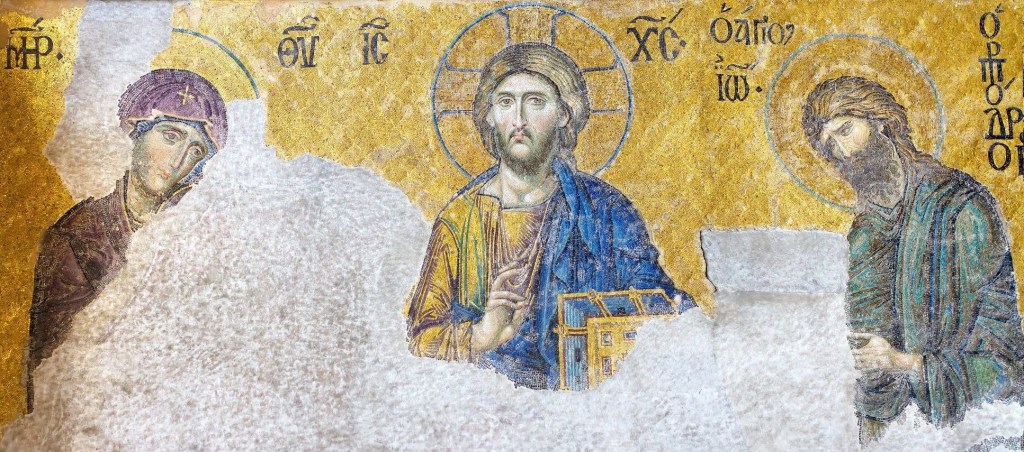
DeLee: Icon of Christ, acrylic on woven canvas , 2022.
The version in the Louisiana law matches the wording on the Ten Commandments monolith that stands outside of the Texas State Capitol in Austin. It was given to the state in 1961 by the Fraternal Order of Eagles, a more than 125-year-old, Ohio-based service organization with thousands of members. In 2005, a divided U.S. Supreme Court ruled it did not violate the constitution and could stay.
The Eagles organization notes on its website that it distributed about 10,000 Ten Commandments plaques in 1954. The organization also partnered with the creators of “The Ten Commandments” to market the film, spreading public displays of the list around the country.
“It’s significant that the Louisiana law uses the same text created for ‘The Ten Commandments’ movie promotions by the Fraternal Order of Eagles and Paramount Pictures because it reminds us that this text isn’t one found in any Bible and isn’t one used by any religious faith,” Kruse said via email. “Instead, it’s a text that was crafted by secular political actors in the 1950s for their own ends.” Kevin M. Kruse is the author of “One Nation Under God: How Corporate America Invented Christian America” and a history professor at Princeton University.
Unknown Flemish Artist: God speaks to Moses while the people worship the golden calf, colored ink and gold leaf on parchment, 1372, National Library of the Netherlands.
The actual biblical Ten Commandments are spiritual and can bring us closer to understanding God’s relationship with God’s chosen people during their wilderness journey. We can learn about boundaries, justice and mercy. Also we learn God wants us to be imitators of God’s nature, something that’s missing in the movie version of the Ten Commandments. The movie commandments are a Reader’s Digest version of the Biblical commandments and miss the grace of God entirely.
For Benjamin Marsh, a North Carolina pastor watching the Louisiana law, his primary concern is people’s spiritual formation, so altering the Ten Commandments is worrisome to him. “The problem with changing the text of the Ten Commandments is you rob the spiritual implications of the actual biblical text. So you’re giving some vague likeness to the Ten Commandments that isn’t the real thing,” said Marsh. He leads First Alliance Church Winston-Salem, which is part of a conservative evangelical denomination.
So I offer these two versions below for you to read. I believe the placing of the Ten Commandments in the schools in these states has less to do with “religion” than with culture wars, which these politicians hope to use to their advantage. If we see these in our communities, we should ask for comparative religions to be taught, or none at all. I find the misuse of scripture abusive. This isn’t what we should be doing to vulnerable children. We should give them a God who loves, cares for, and provides for their needs. The Ten Commandments in the school houses is like having a cop in the classrooms.
FROM THE MOVIE, “The Ten Commandments:”
The Ten Commandments I AM the LORD thy God. Thou shalt have no other gods before me. Thou shalt not make to thyself any graven images. Thou shalt not take the Name of the Lord thy God in vain. Remember the Sabbath day, to keep it holy. Honor thy father and thy mother, that thy days may be long upon the land which the Lord thy God giveth thee. Thou shalt not kill. Thou shalt not commit adultery. Thou shalt not steal. Thou shalt not bear false witness against thy neighbor. Thou shalt not covet thy neighbor’s house. Thou shalt not covet thy neighbor’s wife, nor his manservant, nor his maidservant, nor his cattle, nor anything that is thy neighbor’s.
FROM KJV: Exodus 20:2-17
I am the LORD thy God, which have brought thee out of the land of Egypt, out of the house of bondage. Thou shalt have no other gods before me. Thou shalt not make unto thee any graven image, or any likeness of any thing that is in heaven above, or that is in the earth beneath, or that is in the water under the earth: Thou shalt not bow down thyself to them, nor serve them: for I the LORD thy God am a jealous God, visiting the iniquity of the fathers upon the children unto the third and fourth generation of them that hate me; And shewing mercy unto thousands of them that love me, and keep my commandments. Thou shalt not take the name of the LORD thy God in vain; for the LORD will not hold him guiltless that taketh his name in vain. Remember the sabbath day, to keep it holy. Six days shalt thou labour, and do all thy work: But the seventh day is the sabbath of the LORD thy God: in it thou shalt not do any work, thou, nor thy son, nor thy daughter, thy manservant, nor thy maidservant, nor thy cattle, nor thy stranger that is within thy gates: For in six days the LORD made heaven and earth, the sea, and all that in them is, and rested the seventh day: wherefore the LORD blessed the sabbath day, and hallowed it.
Honour thy father and thy mother: that thy days may be long upon the land which the LORD thy God giveth thee. Thou shalt not kill. Thou shalt not commit adultery. Thou shalt not steal. Thou shalt not bear false witness against thy neighbour. Thou shalt not covet thy neighbour’s house, thou shalt not covet thy neighbour’s wife, nor his manservant, nor his maidservant, nor his ox, nor his ass, nor any thing that is thy neighbour’s.
Joy, peace, and time to read your Bible,
Cornelia
Louisiana Ten Commandments law raises preferential treatment concerns | AP News
Anne Frank’s Last Birthday Cake, acrylic on canvas, mixed media, 18” x 20,” 2024.
We never know when the tides of time will change. Most of us aren’t creatures of change, but prefer instead the well-worn and familiar paths. As a United Methodist pastor, I moved every two or three years during my ministry, so one thing I kept was my telephone company. I know some people like to switch providers almost as often as they switch their underwear, but that’s not me. Having to switch utility companies, banks, and hairdressers was more than enough agony for me. I signed up for this life, however, so I kept my moving boxes and made a spreadsheet for notifying all my address changes.
I talk about this because I only lived in three homes as a child. I never had to leave in the middle of the night to escape bad debts, the law, or a hateful Nazi regime. I have no way to imagine Anne Frank’s life, except when I was also 13 years old, I read her wonderful diary. Anne kept her diary, beginning at the same age, during the two years she spent in hiding while the Germans occupied her homeland during World War II. She had received a red, cream, and beige checkered cloth notebook diary for her 13th birthday on June 12, 1942. The underground Dutch radio station had encouraged people to keep diaries so future generations would know what the conditions were under the German occupation.
Because of the Nazi purity rules, Jews weren’t allowed to mix with non-Jewish persons. According to the Nazis, Jews were not Aryans or the Master Race. They thought Jews belonged to a separate race that was inferior to all other races. The Nazis believed that the presence of Jews in Germany threatened the German people. They believed they had to separate Jews from other Germans to protect and strengthen Germany. Their Nuremberg Laws were an important step towards achieving this goal.
We hear this same sentiment today from the neo-Nazi movement groups who say, “Jews shall not replace us,” and “Immigrants are poisoning the blood of our nation.” As a result, only Anne’s Jewish friends could come to her birthday party. Her father set up a movie projector to show “Rin Tin Tin,” the famous Hollywood dog film star. The chairs were set up in rows like a movie theater. The family went all out for their Anne. Her mom had baked cookies for her classroom to share, since they couldn’t come to the party, but she baked a strawberry cream cake for this party attended by her Jewish friends. This was early June and the strawberries would be juicy, fresh, and in season.
Anne and Hanna playing before the Frank family fled into hiding.
Two weeks after her 13th birthday, Anne and the Frank family had disappeared from the neighborhood. They left no forwarding address. Her best friend of eight years, Hannah Pick-Goslar, didn’t see her again until they were both in the same concentration camp. Hannah survived. Anne did not, but the enduring story of her life in hiding continues through her diary.
When I was painting this, I used a large doily as the “cake.” I’d been saving it for a halo for a saint painting, but it works great for a cake top too. My viewpoint is from above, and I omitted the 95 candles. No need to burn the house down! The cream color was a bit pink, but if I were a young teen girl, I’d want it more pink than just white. I painted the background as a blue sky, because young people almost always have hope and optimism. The left side of the canvas has the storm clouds approaching, as well as the grey soot soiling the sky from the overworked crematoriums at the concentration camps where so many Jewish people lost their lives in the Holocaust.
If we can learn anything from one small girl who ate strawberries on an early summer day, I hope it will be to appreciate the beauty of this brief moment and to love one another deeply. Also, life is too short to hate anyone just because they are in someway different from you. Celebrate their differences as part of God’s creative generosity to this world. Also as Mary Oliver reminds us about the importance of keeping a journal:
“Instructions for living a life. Pay attention. Be astonished. Tell about it.”
Aristotle once said, “The hand is the tool of tools.” Our hands with their opposable thumbs are an evolutionary miracle. Our opposable thumbs evolved around two million years ago, even before humans began to make tools. Our hands helped us to develop language and procure nourishment, as well as create mysterious images on cave walls which united the physical and spiritual worlds of our distant ancestors.
Hands at the Cuevas de las Manos (Cave of Hands) upon Río Pinturas, near the town of Perito Moreno in Santa Cruz Province, Argentina (2005) (image by Mariano via Wikimedia Commons)
Richard Rohr, the Catholic priest and spiritual writer, notes “only the contemplative mind can help bring forward the new consciousness needed to awaken a more loving, just, and sustainable world. We need a practice that touches our unconscious conditioning where all our wounds and defense mechanisms lie. That’s the only way we can be changed at any significant or lasting level.”
We have many spiritual practices to change our hearts and minds, such as prayer, meditation, contemplation, reading Scripture, and hearing the word preached. Attending holy communion and practicing the presence of God are other ways to be transformed. In art or faith, we don’t take anything at face value, but we seek the deeper meanings in the experiences we have with life.
Image I took while walking downtown. I paid attention to the composition when I took the photograph.
As one who slacked off my weight training over the pandemic, the gym rat saying holds true: “Use it or lose it.” We can lose muscle tone and aerobic capacity in just a few days if we’re older or recovering from injuries. Even if we’re young and healthy, we may lose capacity in a week or so. Likewise, some of us get our diplomas and never read a book again. For instance, 42% of college graduates never read another book after college and only 32% of the US population over the age of 16 reads books for pleasure.
One of the problems even in the USA is 52% of adults read at a 7th grade level or below, and 48% read at an 8th grade level and above. Yet reading has many benefits for keeping the brain healthy:
Reading for just six minutes daily can reduce stress levels by 68%.
Reading can increase empathy and emotional intelligence.
Reading can improve sleep quality.
Reading can increase vocabulary and improve writing skills.
Reading can improve mental focus and concentration.
Reading can reduce the risk of developing Alzheimer’s disease.
When we connect the brain and the hand, this results in increased activation of the nerve cells in the sensory and motor hand representational areas. As a consequence, the hand expands its representational area in the cortical hand map because it requires more brain resources, more ‘brain space’. Thus, the hand can ‘shape’ the brain; in other words, the brain is functionally shaped based on the hand’s experiences.
If the hand, in contrast, is passive and immobile for a long time, its representation in the brain decreases and may totally disappear. Quite simply, the hand has to be active to maintain its representation in the brain: “use it or lose it.” On the other hand, we know the hand representation in the brain can be re-established by training and manual activities.
What sort of activity rebuilds the brain? The brain cortex contains more than 100 billion nerve cells and innumerable synaptic connections. The cortical body map is not fixed or hardwired, but can rapidly become reorganized as a result of a strengthening or weakening of the synaptic connections. Moreover, repetitive movements can overwhelm the hand and cause trauma, such as writer’s cramp. We need to find ways to exercise our hand, so we cause no harm, but build the brain pathways.
The hand has been called the “outer brain.”
In aging samples, for instance, there’s evidence to indicate that age‐related cognitive decline may be partly driven by a process of atrophy. Some studies have shown that adopting a less engaging lifestyle across the lifespan may accelerate loss of cognitive function11, due to lower “cognitive reserve” (the ability of the brain to withstand insult from age and/or pathology)12. Some emerging evidence indicates that disengaging from the “real world” in favor of virtual settings may similarly induce adverse neurocognitive changes.
Extensive media multi‐tasking during childhood and adolescence could also negatively impact cognitive development through indirect means, by reducing engagement with academic and social activities, as well as by interfering with sleep35, or reducing the opportunity to engage in creative thinking36, 37. I remember telling my schoolteacher mother, “Listening to the radio helps me concentrate on my homework.” She wasn’t buying that argument at all, and radio silence prevailed.
An important aspect of instant access to the internet is our ability to get information online, which has caused us to become more likely to remember where these facts could be retrieved, rather than to remember the facts themselves. This results in our becoming reliant on the Internet for information retrieval. For instance, most people no longer memorize telephone numbers anymore, but depend upon their phones to maintain their contact lists through the cloud, just as we once stored them on the internal SIM card. I personally don’t know anyone’s phone number anymore because I depend on my phone’s contact list. If it ever died on me, I’d be out of luck! The cloud better recognize me if I ever need to replace my phone.
Asklepion, Pergamum, Turkey: site of healing waters, temples, and cultural events, for pilgrims who would often stay for weeks. The ancients believed healing was a sacred art and people’s souls needed to be mended as well as their bodies.
Art and healing are intimately connected. The new Alice Walton School of Medicine in Bentonville, Arkansas, will integrate the arts in an intentional way. The students will be classically trained medical doctors who also will be equipped with knowledge to address all areas of wellness, whether it’s spiritual, emotional or social.
The science of neuroaesthetics is detailed in Susan Magsamen’s book, Your Brain on Art. She said the field can be described as the study of how art measurably influences the brain, body and behavior. The study of neuroaesthetics is “neuroarts.” Magsamen said the pursuit of creative expression is as important to humans as nutrition, sleep and exercise.
There are four parts of neuroaesthetics and “the aesthetic mindset:”
■ Being open to curiosity.
■ Playful exploration.
■ Sensory experiences.
■ Becoming a maker and beholder.
We discover this in art class when we want to draw or paint a picture beyond our skill level or the time limits of the work period. In seminary, we’d have three-hour final exams. Some of our fellow students would prepare six-hour answers to the advance sample questions our professors gave us to study. I always practiced the “triage method” of reducing everything we learned to the essentials. If we pick out the most important facts, we can best make our points in the time limits given. In the emergency room, doctors treat the most important issues first to save the patient’s life and tend to the details once the patient is out of the woods. No one can give a 6 hour answer in a 3 hour time limit. Ask yourself, “What’s the most important question here?”
Mike’s Mushroom
The same idea works in drawing or painting. We need to find the main forms and sketch them in before we get carried away with the tiny details. Mike showed me a great photo he took of the corvettes in Memphis. I suggested if he wanted to do this painting in a single class meeting, he needed to simplify it by enlarging it, so it had much less detail or plan on taking two classes to finish it. He chose to paint a mushroom in the wild instead. Even then he noticed his mushroom cap lacked the perspective to look realistic on a two-dimensional surface. We’ll have to pick up some perspective lessons in the fall again.
Cornelia’s Corvettes
This is a drawing from memory I made on my iPad. I stripped Mike’s photo down to the barest essentials. The vehicles may not even be recognized as sports cars, but they are convertibles. I do remember the great steel triangles of a bridge or other structure where the cars were parked. I did this in about 15 minutes, but I have over half a century of experience of seeing and drawing practice.
Internet image of corvettes on Beale Street
I sometimes forget my hand and brain have been trained to see the basic shapes “instantly.” Not because of some DNA of pure sight, but because I’ve practiced looking, dissecting, and memorizing what I see. Some of my experiences are blind drawing, which means I only look at the object, but never the drawing itself. This trains the hand to only go as far as the eye can “see.”
Gail S’s Landscape
Gail had the class over to her home and we were glad to see her in recovery mode. Since she’s still homebound, we took advantage of the good weather and her front porch to exercise our brains and hands.
Ansel Adams: Old Faithful Geyser, Yellowstone National Park, 1933-1942
Gail had a mountain landscape image from a screenshot she wanted to work with. The focus of our class was taking our camera photographs and using the editing software to heighten our images. Once we’d done that, we would see more clearly what was important in our image. The current theme in social media is “no filter,” but the great photographers of history always gone to the dark room to develop their photos and dodge the whites lighter or burn more black. Ansel Adams was a master at this.
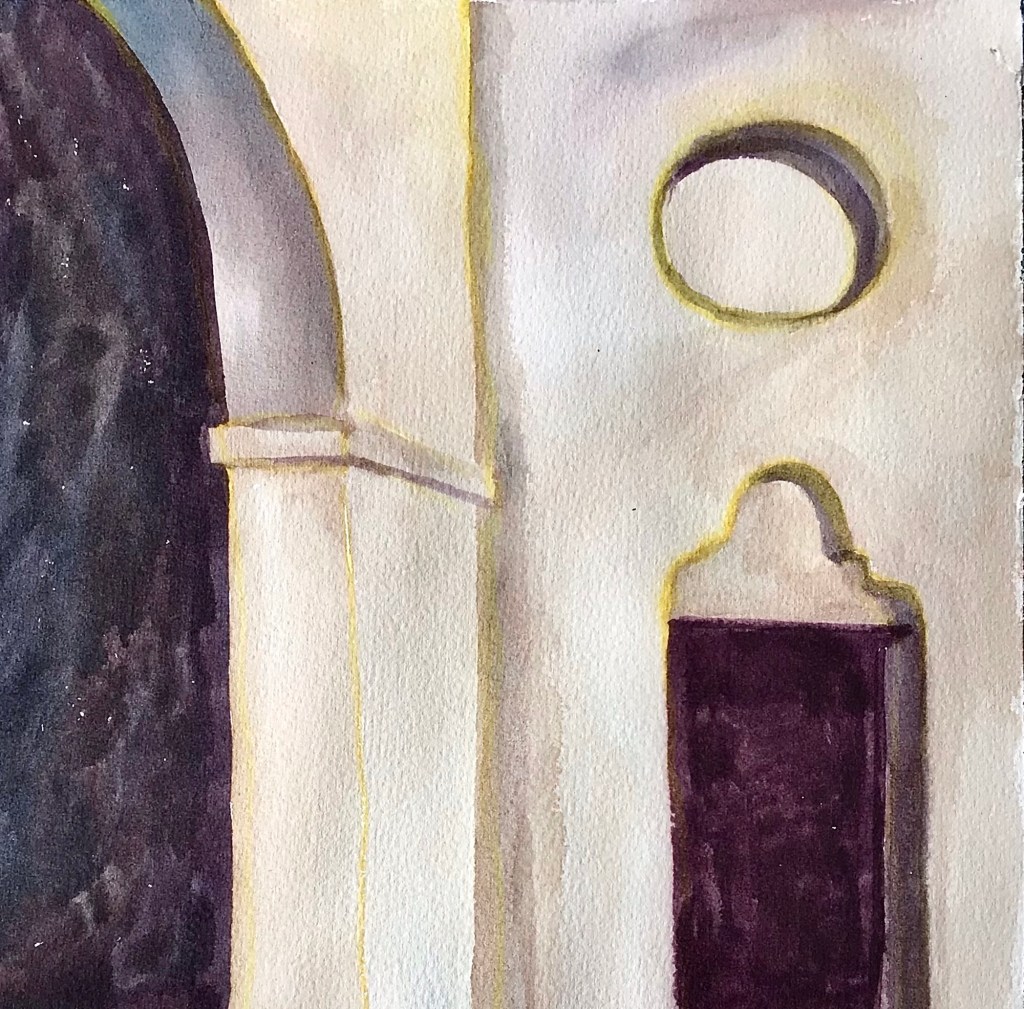
Cornelia: Prang 8 color box on Arches paper, from original photograph
Notice on my short watercolor study, I didn’t bother to include the whole photograph image. I “triaged” the details I couldn’t complete in our short class time. I mixed my own blacks, rather than using the pan color available. This gave me much richer colors and more variation in my shadows. I had outlined my basic shapes in yellow, but got to talking about the others’ directions and let the paint dry too much, or I would have picked it up better. It would have been less noticeable. I see now some of my lights could have been lighter. I can go back with a clean brush full of water and pick up some of that front face of the archway.
Of course, my eye sees more than most people can see, and it’s both a curse and a blessing. I’m always graceful with my students and try to give at least half as much grace to myself. We mustn’t get discouraged, but keep pressing upward! We don’t have to be a master at something to be a maker; we just have to do it. Having no fixed expectations of an outcome is the best way to exhibit creative expression. Following the less traveled path can lead to new destinations and new discoveries.
Art has the capacity to heal, to cross-fertilize, and to challenge fixed ideas. Art can’t be confined to gallery spaces or the walls of our homes. Art can not only renew our brains, but also the practice of art can renew how we see the world because we learn to see it afresh. Sometimes for the first time, we see it as we’ve never seen it before, and then we bring our own experience and expression to what we have seen. That’s when we become artists, creators, and cocreators guided by the hand of God. As we are made in the image of the creating God, God heals us as he cares for the creation:
“I have seen their ways, but I will heal them; I will lead them and repay them with comfort, creating for their mourners the fruit of the lips. Peace, peace, to the far and the near, says the LORD; and I will heal them.” ~~ Isaiah 57:18-19
Joy and peace,
Cornelia
The Tool of Tools and the Form of Forms – 3 Wisdoms | Scott Randall Paine
11. Hultsch DF, Hertzog C, Small BJ et al. Use it or lose it: engaged lifestyle as a buffer of cognitive decline in aging? Psychol Aging 1999;14:245‐63. [PubMed] [Google Scholar]
12. Small BJ, Dixon RA, McArdle JJ et al. Do changes in lifestyle engagement moderate cognitive decline in normal aging? Evidence from the Victoria Longitudinal Study. Neuropsychology 2012;26:144‐55. [PMC free article] [PubMed] [Google Scholar]
25–Uncapher MR, Wagner AD. Minds and brains of media multitaskers: current findings and future directions. Proc Natl Acad Sci 2018;115:9889‐96. [PMC free article] [PubMed] [Google Scholar]
35. van Der Schuur WA, Baumgartner SE, Sumter SR et al. The consequences of media multitasking for youth: a review. Comput Human Behav 2015;53:204‐15. [Google Scholar]
36. Altmann EM, Trafton JG, Hambrick DZ. Momentary interruptions can derail the train of thought. J Exp Psychol Gen 2014;143:215‐26. [PubMed] [Google Scholar]
37. Baird B, Smallwood J, Mrazek MD et al. Inspired by distraction: mind wandering facilitates creative incubation. Psychol Sci 2012;23:1117‐22. [PubMed] [Google Scholar]
One of my favorite hymns growing up in the church was “This Is My Father’s World,” by Maltbie D. Babcock, a Presbyterian minister. Written in 1901, to the tune Terra Beata, or Blessed Earth, the song was originally a traditional English folk tune, but composer Franklin L. Sheppard arranged a variation specifically for this text. This hymn and “The Church in the Valley in the Wildwood” were my mother’s and my grandmother’s two favorites to sing. I loved them both also because of their location in nature.
This is my Father’s world, And to my listening ears All nature sings, and round me rings The music of the spheres. This is my Father’s world: I rest me in the thought Of rocks and trees, of skies and seas– His hand the wonders wrought.
As Paul wrote in Romans 1:20—
“Ever since the creation of the world (God’s) eternal power and divine nature, invisible though they are, have been understood and seen through the things (God) has made.”
Tracing history backwards from the 1st CE, the Pythagoreans (active from the late 6th to the mid 5th century BCE) thought the music of the spheres was an ethereal harmony produced by the vibration of the celestial spheres.
Aristotle said the Pythagoreans believed things are numbers or they are made out of numbers by noticing more similarities between things and numbers than between things and the elements, such as fire and water, as adopted by earlier thinkers. The Pythagoreans thus concluded things were numbers or were made of numbers. Therefore, the principles of numbers, the odd and the even, are the principles of all things. The odd was limited and the even was unlimited.
Aristotle criticized the Pythagoreans for being so enamored of numerical order that they imposed it on the world even where it wasn’t suggested by the phenomena. Thus, appearances suggested there were nine heavenly bodies orbiting in the heavens but, since they regarded ten as the perfect number, they supposed there must be a tenth heavenly body, the counter-earth, which we cannot see.
Pythagoreans presented the principles of reality as consisting of ten pairs of opposites:
1. limited—unlimited
2. odd—even
3. unity—plurality
4. right—left
5. male—female
6. rest—motion
7. straight—crooked
8. light—darkness
9. good—bad
10. square—oblong
In art we have similar categories which we use to create dynamic images. If our painting is all of one value—all white, all black, or all middle value—it lacks visual interest. We are drawn to images which have contrasting values covering multiple values. As with everything, too much of a good thing can become a bad thing! In medicine, a small dose of Botox can make wrinkles disappear, but a large dose could poison a person. As I tell folks, some things require experts, not DIY practitioners.
The Middle Path is safest and best— Unknown Artist: The fall of Icarus., Fresco of the Third style from Pompeii, 50—75 CE. (H. 35.5, W. 34.5 cm.), London, British Museum.
I’ve probably mentioned before my encounter with the Hostess chocolate cupcakes. When I realized I could buy a whole box for slightly more money than a package of two tiny cakes, of course my starving art school student budget sprung for the box. That’s when I ate chocolate cupcakes for breakfast, lunch and dinner. By the end of that box, I was cured of my chocolate cupcake desire for a very long time. This is a classic case of “too much of a good thing,” or “knowing when to stop.” The Greeks recognized the need to curb human behavior of our “all or nothing” thinking by prescribing the idea of the Golden Mean, or “nothing to excess.” I definitely went to excess on my cupcake journey.
Mies van der Rohe’s Tugendhat Armchair was designed for the Tugendhat House in Brno, the Czech Republic in 1929 and is one of several different furniture pieces designed for the home of Greta Weiss and Fritz Tugendhat. In the design of the home, Mies designed nearly every detail down to the furniture used. He also prescribed the placement of each furniture piece in the home to maintain spatial composition.
Mies van der Rohe, whose architecture and furniture design exemplified his style, “less is more,” never reduced his work to nothing. His work was faithful to the new industrial materials of steel and glass being used in skyscrapers. Our excess in art is never to nothingness, but we don’t over elaborate or over decorate, just for the sake of filling the space.
So, what do we do and how we proceed? When faced with the challenge of all we see before us, what do we select to make our images? I believe this is where the creating Spirit comes into play, for we can walk past a tree all day long, but on a certain day, the tree comes alive for us. When Moses was herding his father-in-law’s sheep out in the wilderness, his mind was on the sheep, his current family, and his past life and deeds. Scripture doesn’t tell us how long the bush burned on that mountain before Moses noticed it and said, “I must turn aside and look at this great sight, and see why the bush is not burned up.” (Exodus 3:3)
Likewise, we walk past inspiring images daily when we’re preoccupied with our day-to-day concerns. We also have difficulty finding time to create because others want our attention first. One of my seminary professors lectured us in class about taking time to keep our spiritual lives front and center as we moved through school and our church appointments. She said our spouses and children would want to be first, plus our congregations also would want to be first. We’d most likely want to put our careers first to get a bigger steeple or to please our supervisors. However, if we put anything or anyone before God, our spiritual lives would suffer, and like dominos, everything else would fall also. “Many are called, but few are chosen,” as Jesus says in Matthew 22:14.
In art as in life, we need to be deeply rooted in the life of the Spirit. I can tell when I’m going through the motions, but I keep on painting, for I figure I’ll at least learn something from my adequate work, so I’ll be found ready when the creative Spirit strikes. Sometimes I’m more present to the cares and concerns of this world and my work suffers for it. Other times, I’m under the creating power of a Greater Power and my work is altogether more inspired because of that energy. We’d all be more vigorous and creative in our everyday lives if we spent more time in prayer, contemplation, and searching the scriptures to hear God’s voice speak in the silent corners of our hearts and minds.
Mike: Sun and Moon, quick painting
Last week, only Mike and I showed up for art class. Everyone else was either tied up with doctor appointments or at home with rehab or otherwise occupied. Mike and I explored making different colors with the 8 Color Prang Watercolor Set. We can make interesting colors by combining the complementary colors or the tertiary colors. Mike’s first landscape painting got the energies of his competing needs out of the way.
Mike’s Second start—just beginning
As in journaling, we often need to make a habit of writing our thoughts so our deepest feelings can get expressed. He began a second painting with more focus on the goal of mixing new colors.
Music of the Spheres: watercolor
I started my painting with the circles by using yellow watercolor to outline intersecting circles of the same size on my paper. Then I mixed some primary colors together, some secondary colors together and some tertiary colors together. I painted different sections of the overlapping circles. Some of the paint I thinned to a wash, and others I laid on fully. When I got home, I painted in the background, allowing some areas to be a wash and other parts to be thicker.
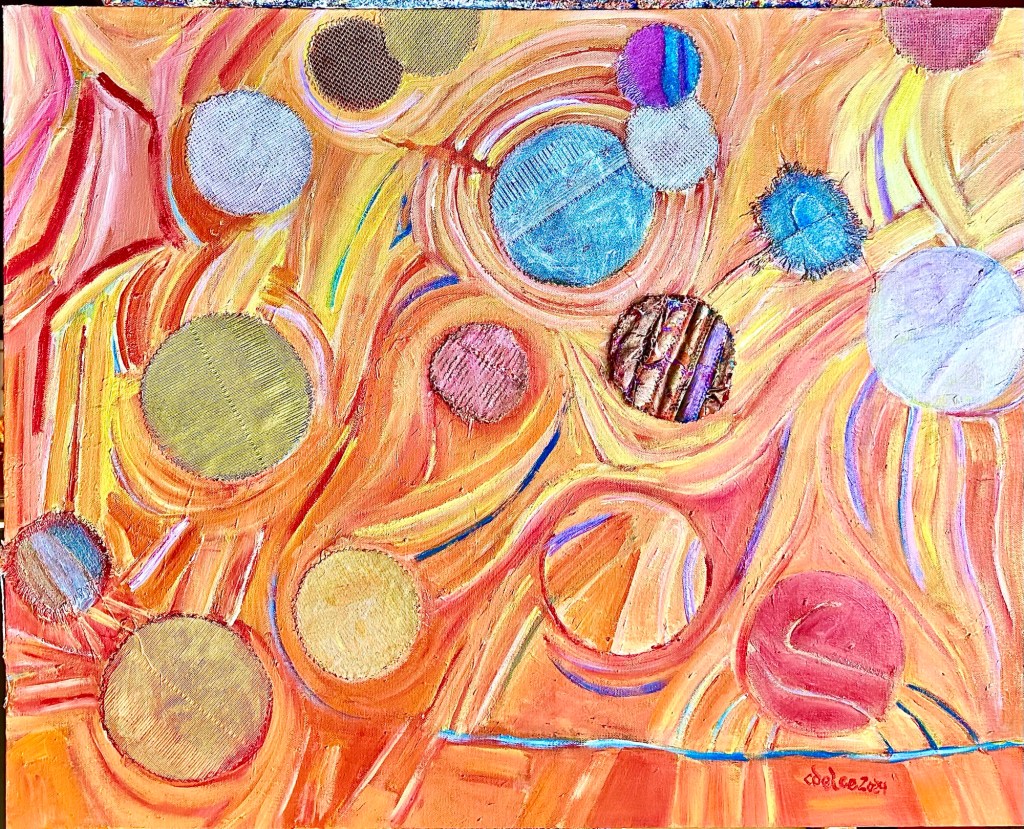
Music of the Spheres: Creation Energy, acrylic
I finished at home an acrylic painting, which explores some of the same themes as the watercolors we’ve worked on in class. In this I used various material with different textures for my spheres. One of the circles is more three dimensional because it’s from a handmade cloth mask left over from the pandemic. I painted parts of it, also. The background has lines of “energy” all about.
While the Pythagoreans attempted to see unity and harmony in the creation in numbers, our Judeo-Christian faith recognizes God as creator of nature and nature revealing the Creator. One of the best texts to understand this distinction is 1 Kings 19: 11-13, in which Elijah meets the LORD on the mountain at Horeb:
(God) said, “Go out and stand on the mountain before the LORD, for the LORD is about to pass by.” Now there was a great wind, so strong that it was splitting mountains and breaking rocks in pieces before the LORD, but the LORD was not in the wind; and after the wind an earthquake, but the LORD was not in the earthquake; and after the earthquake a fire, but the LORD was not in the fire; and after the fire a sound of sheer silence.
When Elijah heard it, he wrapped his face in his mantle and went out and stood at the entrance of the cave. Then there came a voice to him that said, “What are you doing here, Elijah?”
No one has ever heard the music of the spheres, and the voice of God arrives in the sound of sheer silence. Perhaps that “polar opposite” of the Pythagorean’s world view was on to something after all. If we’re very quiet and still, we may hear both the music of the spheres and the voice of God in the great silence.
In the Bonnie Tyler song, “Total Eclipse of the Heart,” her rock and roll soul pines for a young man as she sings:
“Every now and then
I know there’s no one in the universe
As magical and wondrous as you.”
Love struck teen heart ballads tend to elevate the beloved to a high pedestal, while hymns lift the praises of God to the highest heavens. If we look at John Wesley’s Notes on the New Testament, one of the doctrinal standards of the United Methodist Church, his commentary on 2 Corinthians 4:6 (KJV) is instructive:
“For God, who commanded the light to shine out of darkness, hath shined in our hearts, to give the light of the knowledge of the glory of God in the face of Jesus Christ.”
We might be more familiar with this verse in the NRSV, a more modern translation, which wasn’t available in the middle of the 18th century:
For it is the God who said, “Let light shine out of darkness,” who has shone in our hearts to give the light of the knowledge of the glory of God in the face of Jesus Christ.
Bailey’s Ring, from an earlier total eclipse over the South Pacific Ocean
Wesley’s commentary in his Notes on this text is succinct:
For God hath shined in our hearts—The hearts of all those whom the God of this world no longer blinds.
God who is himself our light; not only the author of light, but also the fountain of it.
To enlighten us with the knowledge of the glory of God—Of his glorious love, and of his glorious image.
In the face of Jesus Christ—Which reflects his glory in another manner than the face of Moses did.
What do the Total Eclipse of the Heart and Paul’s words to the Corinthian community have to do with art and faith? We’ve just experienced, what was for most of us, was a once in a lifetime experience. The last time a total solar eclipse was visible across the entire continent was in June 1918, when a total solar eclipse was visible from Washington to Florida, according to the US parks service. Nearly 100 years passed until this present Great American Eclipse.
At the 1878 total eclipse, Maria Mitchell led the Vassar College eclipse party, an all-female expedition from that pioneering women’s institution, which came to Denver in an era when science was a male bastion. Even higher education was deemed risky for the “fairer sex.” In 1873, the prominent Boston physician Edward H. Clarke had warned in an incendiary book titled “Sex in Education,” that the recent push for female colleges and coeducation could undermine women’s health by taxing their brains and causing their reproductive organs to atrophy — leading to “a dropping out of maternal instincts, and an appearance of Amazonian coarseness and force.” Nearly 150 years later some men still concern themselves with outmoded and 19th century views on women’s health concerns.
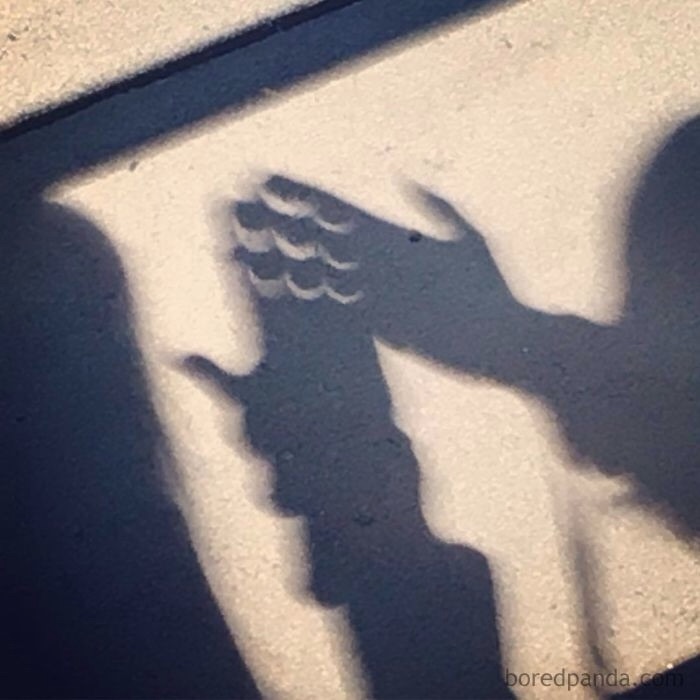
Eclipse as seen through the hands
I drove over four hundred miles to Kentucky in 2017 for the prior Great American Eclipse and got to stay home to see this second Great American Eclipse in my own front yard. Some folks couldn’t have been bothered about this current grand event, while others were convinced God was informing America of her impending doom. Moreover, multiple conspiracy theories abounded, none of which came true, of course. For instance, the world didn’t come to an end and our cell phones still work. Even the electric grid held up, even though the sun didn’t shine for all of a few minutes as the shadow traveled at over 1,600 miles per hour as it raced along the path of totality. This wasn’t even Y2K, which we all remember was a nonstarter at least and a dud at best.
Eclipse over Niagara Falls, 2024
In art class Friday Tim and I talked about the experience of this celestial event. We humans often elevate our own importance when we measure ourselves against one another and the works of our hands. When we go out into nature, we’re faced with the grandeur of God’s creation, especially when we visit the Grand Canyon or Niagara Falls. In Psalms 19:1, we read:
“The heavens are telling the glory of God; and the firmament proclaims his handiwork.”
We see the beauty of nature and feel a warmth in our hearts. Our spirits soar. This intimacy with nature is one of the reasons we send our children to our United Methodist Church Camps, not just because they’ll have a great Christian experience, but because they’ll have that faith experience in nature with trusted leaders. I still remember my adventures and experiences in nature at those camps as part of my spiritual journey.
Towering Cumulus Clouds
Even in seminary, when I was having difficulty with some of my courses, I could go for a walk on the campus under the tree lined walks and search the skies for hopeful signs. Sometimes I saw the towering cumulus clouds in the Texas sky as a sign God was with me “in the cloud by day.” In those times of difficulty, even the cloistered realm of preparation seemed like a wilderness journey, but I was glad for a guide.
Bill Maxey, from Nebraska, taken at Hot Springs, AR.
When I was actively serving as a pastor, sometimes I just had to get away. I’d drive until I found some nature, a national park, national forest, or some fields outside of town. If it was a hot summer, I looked for some deep woods and cool shade to shelter me. In the cool spring, I drove until I found flowers. Maybe this is why I retired to a lake in a national park. I don’t need a big house, since I’d rather go out into nature instead.
Totality on Lake Hamilton, with sunset in the west, outside the path of totality
It was the heat of summer in 2017, so you’d think I’d remember the temperature drop right before the eclipse was halfway through. This year I was on Lake Hamilton, and the breeze off the lake combined with the cooler air was decidedly noticeable. When we entered totality, the lights on the Highway 70 bridge and at Bubba Brews automatically came on. The distant sky in the southwest, outside the path of totality, looked like a summer sunset. My neighbors and our visitors from afar were cheering.
Bill Maxey: multiple exposure of the Great American Eclipse, 2024
Not everyone can make an artwork that expresses their emotions as well as the shapes of the image. We can learn the rules of perspective and color, but then we have to learn to let our heart rule our head. This is what I call an “artistic leap of faith.” When we were young, we accepted the basic ideas of Christianity. As we got older, life happened, and we might have begun to struggle with our childhood beliefs not being equal to our adult needs. If we keep our childlike faith, we risk losing our faith. If we are able to wrestle with our faith and find a new and more mature faith, we can handle the major challenges of later life. As Paul says in 1 Corinthians 13:11-12—
“When I was a child, I spoke like a child, I thought like a child, I reasoned like a child; when I became an adult, I put an end to childish ways. For now we see in a mirror, dimly, but then we will see face to face. Now I know only in part; then I will know fully, even as I have been fully known.”
Tim’s Partial Eclipse painting using red, blue and brown to build the sky
Tim experimented with mixing colors to get richer depth. Using the Prang watercolor palette, he mixed the red, blue, and brown to get the black sky of the eclipse event. The red orange of the sun has some brown in it too. He layered the colors with multiple strokes, with a nod to Van Gogh. He worked from a photograph I brought. I pulled many of them off the internet, and many of my friends sent me some too.
Cornelia: Total Eclipse of the Sun
I worked on an image I’d taken from my iPhone. I had placed one of my eclipse glasses over the lens and was wearing another pair. It wasn’t that easy to get the sun lined up with all that blocking! My image looked a lot like a fried egg or an eyeball. I used several jar lids to get the circles painted cleanly. My dark sky is red, blue, and violet. The shape of the corona was not distinct, due to the quality of my camera. NASA has a very high-resolution image, which breath taking. Our tax dollars at work are bringing great scientific research and development to benefit us in everyday life, such as solar panels and heart implants.
NASA: High Resolution Image of the Total Eclipse
Thomas Merton, in No Man is an Island, in a chapter called “Being and Doing,” wrote—
“We cannot be happy if we expect to live all the time at the highest peak of intensity. Happiness is not a matter of intensity but of balance and order and rhythm and harmony. Music is pleasing not only because of the sound but because of the silence that is in it: without the alternation of sound and silence there would be no rhythm.”
I was a bit exhausted after all the excitement of this big event. I’d met new people from three different states, visited around our patio, and been gifted crystals that had been dug from Mt. Ida and “energized by the eclipse.” I’m not a crystal person, but I understand from those that are these crystals are “special.” I was feeling every bit of my new age as the calendar flipped over for another year.
But today is another day, I had a night to sleep, and we had fun in art class. As long as we find joy in life, we know we’re alive. Our joys aren’t just collections of peak experiences, but some are the joy of the assurance of God’s enduring presence in our later lives when our youthful vigor has left us. We need to remember just as the moon eclipses the sun, once it passes, it also reveals the sun’s glory. One day this Bible verse from Philippians 3:21 will be true for each one of us, who has a heart full of love for God and neighbor:
“He will transform our humble bodies that they may be conformed to his glorious body, by the power that also enables him to make all things subject to himself.”
Joy and peace,
Cornelia
Bonnie Tyler – Total Eclipse Of The Heart Lyrics | AZLyrics.com
Friday in art class we painted our own unique designs on t-shirts for Monday’s Total Eclipse of the Sun. Anticipation of an event is characteristic of young children, while adults often feel over saturated with the early build up of attention given to an important event. By the time it gets here, we go, “Wow, what a letdown.” Children, who have fewer years of experience and anticipation comparison, can still marvel at the alternate reality of the total eclipse.
In the sixth century BCE, Anaximandros believed “the moon has a false light and is illuminated by the sun, and the sun isn’t smaller than the earth and it is pure fire.” The Greeks in 290 BCE knew the moon was unlike the sun. Anaximenes wrote it “didn’t shine with its own light, but with the reflected light of the sun,” as Eudimos wrote in his book History of Astronomy. The Chinese also studied the skies and stars. They used bones heated in fires to divine messages from their deceased ancestors as early as the 12th century BCE.
Chinese oracle bone depicting lunar eclipse of 12/27-28/1192 BCS.
The Death of Jesus in the Synoptic Gospels has the record of an eclipse occurring during the time of the crucifixion. John’s Gospel, which comes from a different source, doesn’t mention this time of darkness.
Egon Schiele, Crucifixion with Darkened Sun, Oil on Canvas, 1907.
When it was noon, darkness came over the whole land until three in the afternoon. ~~ Mark 15:33
From noon on, darkness came over the whole land until three in the afternoon. ~~ Matthew 27:45
It was now about noon, and darkness came over the whole land until three in the afternoon, while the sun’s light failed; and the curtain of the temple was torn in two. ~~ Luke 23:44-45
When Jesus had received the wine, he said, “It is finished.” Then he bowed his head and gave up his spirit. ~~ John 19:30
Yet the Gospel of John tells us more about the miracles of Christ and his dual nature (both human and divine), so that we might believe and have everlasting life through him. New Testament scholar Ernst Käsemann is correct when he says of the Fourth Gospel: “Judged by the modern concept of reality, our Gospel is more fantastic than any other writing of the New Testament.”
Bruce Metzger, noted New Testament scholar and lead translator of the NRSV said, “The more often you have copies (of biblical texts) that agree with each other, especially if they emerge from different geographical areas, the more you can cross-check them to figure out what the original document was like. The only way they’d agree would be where they went back genealogically in a family tree that represents the descent of the manuscripts.[104]
Tim’s Eclipse T-shirt: very simple due to his rehab from arm surgery. He uses his arm until it hurts and then he rests. We do what we can, not what we can’t.
We modern folks are used to looking at the world through the eyes of science and education. We look for repeatable patterns and consistent evidence. We have “grown up minds” with calendars, schedules, to do lists, and multiple people who make demands on our time. Often, we are thinking about our next meeting or chore before we even finish the one we’re currently working on at the moment.
We aren’t practicing Brother Lawrence’s admonition to “Practice the present moment.” Our constantly chiming cell phones don’t help us be present, even though we could set our notifications to silent. Indeed, we’re never present or still enough to know the peace of the God whose name means “I AM.”
Lauralei’s Eclipse T-shirt: experimenting with fabric paint
What is “reality?” How can we know the present moment and come closer to God? With the advent of photography people began to think super realism in painting was preferred to some degree of emotional expression. Today, with the introduction of Artificial Intelligence, we can make computer generated photos and paintings that go beyond our wildest dreams! This means our new generations may likely begin using tactile materials and hand-built techniques to create future art works. Instead of fantastic other worlds, they might find their inspiration in the environment or in social justice concerns.
Gail W’s Eclipse T-shirt: first stage in class. She came with a design in mind and brought her sewing chalk also.Gail W’s Eclipse T-shirt: the finished product. Some of our inspirations are too grand to be completed in a few hours. We need to have the desire to carry the effort forward to meet our goal.
As with the icon, the artwork is only a reflection of the image which is painted. The icon isn’t holy, but the person depicted is holy. As the writer of Hebrews 1:3-4 says:
“He is the reflection of God’s glory and the exact imprint of God’s very being, and he sustains all things by his powerful word. When he had made purification for sins, he sat down at the right hand of the Majesty on high, having become as much superior to angels as the name he has inherited is more excellent than theirs.”
I didn’t get a photo of Mike’s “Crawford Law Eclipse T-shirt.” Work called and he had cats to herd. He was generous as usual to bring fabric paints for the group to share. We used old newspapers inside our T-shirts to keep the paint from bleeding through to the backside. We had an opportunity to share stories and eat my birthday doughnuts which Tim blessed me with.
Cornelia’s Eclipse T-shirt: I collapsed all the moments of occlusion into three, so I could finish in one sitting.
If we take time to practice our art, we may realize our own works may be only a reflection of the glory of what we saw, but we we can continue to practice our skills in prayer, for God will bring us ever closer to perfection if we commit our work to God’s glory.
Leonardo da Vinci: Study of the technique for observing solar eclipse, Codex Trivulzianus, 1487–1490
Also, Marilyn, who was working with some other ladies of the church on the potato bar posters, had brought the warm-gooecrescent roll-cream cheese-vanilla-cinnamon-sugar dessert. If you ever have a chance to put this into your mouth, you will be transported into an alternate reality. This is the stuff from which dreams and visions arise! If you eat it, and you merely remark, “Good,” my thought is you’re dead to this world or you’ve lost your sense of taste. The child in me screamed for MORE!! The adult in me will see if I can reduce the calories with no depreciation in taste.
Paul Nash: Eclipse of the Sunflower, 1945
I hope we get a break from the clouds on the Great American Eclipse Day. The last one I traveled to in 2017 was very impressive and worth the journey. Watch it on television if you can’t be outside. Only look at the sun with certified eclipse glasses. Some experiences are such that we can only say “Awe!” And we may want to stop time forever, but time will march on, for we can’t move the sun either forward or backwards. No matter how important we are, we aren’t gods, and we aren’t even Time Lords. If we manage to grasp only a portion of the holiness and beauty of God’s creation in this one event, we will better experience the joy of the passing glory of our God:
“When I look at your heavens, the work of your fingers, the moon and the stars, that you have established, what are human beings that you are mindful of them, mortals that you care for them?” ~~ Psalm 8:3,4 (NRSV)
View of the Great American Eclipse 2017 at Lake Barkley through a pinhole
Bruce Metzger was the master of several ancient and modern languages and ended up teaching at Princeton for 46 years after he received his PhD there. As one of the editors of the standard Greek New Testament used today and the senior editor of the NRSV, his scholarship has proved to be almost impeccable. His specialty was New Testament textual criticism, the field whose primary goal is to ascertain the wording of the original text. Many considered him the finest NT textual critic of the 20th century. His death in 2007 left giant footprints for the next generation to come.
Paul Nash, British Military artist, died in 1946 of complications from asthma. He didn’t see the total eclipse, but knew of it and was very connected to nature.
All things will renew themselves in good season, yet we have only the present moment before us. We can’t live in the past, nor can we control the future. We have to recognize even our present moments aren’t always in our control, as we witnessed in the big Super Bowl game last Sunday.
Random Actions Often Determine the Outcomes of Sporting Events
Who would ever believe a punt would hit a receiving teammate’s foot, and suddenly become a live ball? Then get recovered by the Chiefs for a quick touchdown? If you think you can control your circumstances or the actions of others, just watch the NASCAR races at Daytona this weekend. The wonder is they don’t wreck in every turn, but only occasionally during the 500 mile race on Sunday.
Watercolor is more difficult medium to manage than acrylic paints because it’s wetter and refuses to dry as quickly as we want to paint in that same area. It’s not being obnoxious; it’s just being its own true self. Cezanne used watercolors to think out his ideas beforehand, and then worked in oils. Often, he tossed aside the watercolor work, sometimes even leaving it out in the landscape which he’d just painted. He’d learned all he could from it and now was ready to paint his new image, but not a copy of the original painting. This mountain shows up in sixty of Cezanne’s artworks.
Paul Cézanne: La Montagne Sainte-Victoire, 1888, oil, The Stedelijk Museum, Amsterdam.
The stoic philosopher and Roman Emperor Marcus Aurelius wrote a series of meditations on life. In one he speaks of all life experiences as being the same. This attitude keeps him from getting too high or too low about what happens in his life. He takes it as it comes. Even death, which some fear as a loss, doesn’t bother him, for if he isn’t bothered about the present, he can’t be bothered about losing that too. Marcus Aurelius wasn’t a Christian, but his quest for equanimity is admirable. Take life as it comes and worry not:
“First, that all things in the world from all eternity, by a perpetual revolution of the same times and things ever continued and renewed, are of one kind and nature; so that whether for a hundred or two hundred years only, or for an infinite space of time, a man see those things which are still the same, it can be no matter of great moment. And secondly, that that life which any the longest liver, or the shortest liver parts with, is for length and duration the very same, for that only which is present, is that, which either of them can lose, as being that only which they have; for that which he hath not, no man can truly be said to lose.”
The Still Life in Our Classroom
When we work in watercolor, we have to take what the watercolor gives us. While we can plan, design, and control the outcomes to a certain extent, watercolor often goes its own way. If we work over the whole surface, rather than noodling around in one little space like a puppy sniffing a single spot while out on its morning constitutional walk, we get more done, just as the puppy is more likely to get its “business” done.
One of the reasons we work in a new medium is for the challenge. In school, when I was bored, I’d take notes in class by writing upside down. When that got too easy, I began using my left hand to write upside down. This was a true challenge! I didn’t have any ingrained pathways in my brain for left-handedness, much less the upside-down images. I was truly bored, however, so I struggled on until I got serviceable images. This was the year in which I went to art school as a midyear junior and was taking a freshman level history course.
Tim’s Painting
Tim has voluntarily switched to his left hand because he will have surgery on his right side, which will knock out his ability to use that arm for several months as he recovers. This is a good effort for his non dominant hand. You can tell he focused on the scoop, for it has the most detail. Training our alternate hand to do the work of our dominant hand requires resetting the brain to prefer the new hand. If you try brushing your teeth with your other hand, you’ll see exactly how strange it feels to use a different hand. This is because you have no well-worn pathways in your brain circuitry that makes this routine effort possible.
The fancy pants word for this is neuroplasticicy. We meet this concept with stroke survivors who do physical therapy to rewire their brain connections to make new pathways so they can speak, write, or walk. Everyone who tries a new game, learns a new language, or tries a new hobby also builds new pathways in their brains. Be learners for life, if you want to keep your mind healthy.
Gail’s Painting
Our still life was challenging today. It had solid shapes, a clear bottle, and a metal scoop. Not only were there multiple colors, but textures and transparency also. Gail has had several years of drawing under her belt, so she was able to render the perspective of the still life well. Note the clear blue bottle, which has a wonderful oval bottom. The lemons and limes are distinct also. The grey shape is an antique scoop, sans the handle.
In 2008, J.K. Rowling spoke at the Harvard commencement exercises, telling the graduates, “Talent and intelligence never yet inoculated anyone against the caprice of the Fates.” Because we don’t know what tomorrow will bring, taking care for today is the best preparation for the future. Rowling studied the Classics at Harvard, a subject most people would consider useless for this modern era. Yet after a divorce, as a single parent working for Amnesty International, she began writing her wizard novels. Harry Potter is now part of our cultural heritage.
As Jesus said in Luke 12:25-26–
“And can any of you by worrying add a single hour to your span of life? If then you are not able to do so small a thing as that, why do you worry about the rest?”
Worry is stressful, for sure, and it’s an example of “bad stress,” along with traumatic events, such as adverse childhood experiences (ACE), disease, divorce, and death of a loved one. We also endure “good stress,” as when we challenge ourselves to lift heavier weights, cook a new recipe, or learn a new language. As Ralph Waldo Emerson wrote in his 1841 essay Heroics, paragraph 14:
“The characteristic of a genuine heroism is its persistency. All men have wandering impulses, fits and starts of generosity. But when you have chosen your part, abide by it, and do not weakly try to reconcile yourself with the world. The heroic cannot be the common, nor the common the heroic. Yet we have the weakness to expect the sympathy of people in those actions whose excellence is that they outrun sympathy, and appeal to a tardy justice. If you would serve your brother, because it is fit for you to serve him, do not take back your words when you find that prudent people do not commend you.
“Adhere to your own act and congratulate yourself if you have done something strange and extravagant, and broken the monotony of a decorous age. It was a high counsel that I once heard given to a young person, —”Always do what you are afraid to do.”
When I was in high school, the ancient Latin teacher, who had taught my daddy when he went to school, tossed out the challenge, “No one has ever made 100% on my final Latin exam.”
I bit on that challenge like a starving dog bites on a bone, even if it has no scrap of flesh remaining on it. I made flash cards and studied for an hour every night before bed, I was so determined to be the exception to the rule. On the test, I got all the Latin correct, but lost ½ point for misspelling an English word. I never followed up on her retirement, but I fully expect her record remained unblemished. Also, I’m still spelling challenged. I’m thankful for SpellCheck in our writing apps.
Gail W.’s Painting
Gail W. paid attention to the still life and took care to lay down a close image in a pale wash before she began to add darker washes of color. Her left lime is most successful, with at least six shades of green and yellow in the shape. I also like the highlight on the central lemon. These two images capture the essence of the watercolor medium. Her perspective on the bottle bottom indicates it sits well on the cloth.
Failure teaches us what we don’t know, so we can improve the next time. This is what we call resilience. When I taught art, my students had to find three things they did well in their work before they named anything they needed help on. This was to build up their confidence. For some of them, just making a mark on the page was a start. If we fear making a mistake, we can sketch in a pale-yellow wash. This is very forgiving, like a whisper in the wind. If it’s not quite right, the next few marks may be nearer our desired outcome.
This Is Fine—Leave Me Alone, I’m Having a Crisis
Our mindset is what controls how we react to events in our lives. As one of my friends would remind me, “Not everything is a hair on fire moment.” Of course, when I was a young teen, the least slight or distress caused me to fling myself over my bed in a paroxysm of sobs, wailing loudly, “I’m going to die!” My parents would look at each other and shrug, “What boy is it now?” Fifteen minutes later I’d be in the kitchen looking for a snack, having cried my eyes out, and now I was on to the next thing. As I had more experiences, I learned to roll with the moment. Sometimes you need to wait for the next wave to rise before you take your ride. God’s timing is always right, for our experiences, both the failures and successes, prepare us for what comes next in our lives.
Cornelia’s Watercolor
I had some of the same perspective problems as everyone else, especially with the base of the bottle. Actually, it’s a challenge to get a “transparent three-dimensional object on a flat surface” to appear as if it’s actually sitting on a flat surface in two dimensions. Learning some shading techniques and remembering a round bottle bottom becomes an ellipse helps to bring off this sleight of hand. I got my paint too dark on the front of the bottle base and had to let it dry so I could come back in with some clear water and an almost dry brush to pick up the color. This gave me the highlight I needed.
Cornelia’s Drawing over the Watercolor
When I got home, I noticed my eyesight seems to be going amiss with my increased age. Lately I’ve not been careful to paint my verticals straight. Either I’m being lazy, or I’m tilting my head as I look at the subject. Maybe my neck injury has something to do with it. I duplicated the photo and used the Apple Pencil to straighten up the bottle and even up its symmetry. I also touched up a few of the lemons and limes. Maybe I’m still the puppy that likes to noodle around and sniff about until I can wrest all I can get from a work. This way I learn all I can from it. Like a kindergartner, if my work ends up a huge grey blob, I can say, “That was a great learning experience!”
My grandmother, who painted portraits and still lifes, kept a saying written on the back of an envelope, near her easel: “Ever tried. Ever failed. No matter. Try again.” She passed in 1970. Years later, Samuel Beckett, in his 1983 story, Worstword, Ho wrote:
We need to be like great artists and athletes, or the Michelin chefs who just keep trying, falling short, until they get close enough to qualify for their stars. Persistence makes all things possible, and if we “fail,” we’re only getting closer to perfection.