OAKLAWN FRIDAY ART CLASS

adult learning, art, Attitudes, brain plasticity, cognitive decline, Creativity, Faith, Imagination, inspiration, john wesley, Ministry, Painting, perfection, purpose, Retirement, United Methodist Church, vision

WE’RE BACK!!!

Ready or not, the creative juices must be stirred. If the brain has lain fallow all summer, or it’s been overworked keeping the youngsters occupied, now you can find your own groove again. Yes, it’s time for Adult Art Class at Oaklawn UMC.

Our first meeting will be Friday, September 9, at 10 am in the old fellowship hall. Bring your own acrylic paints, brushes, and a canvas or canvas panel to paint on. We begin with a short visual inspiration from some great art works, I’ll give some direction on the skill we’ll work on in the session, and then everyone is free to bring their own unique expression to their paintings. We don’t copy my work and judge how well a person can match it. We learn from the great masters and stretch our own skills to create something new.

Walter Nowatka: Abstract Ferris Wheel

Of course, making great art isn’t our first purpose. As we age, we will lose our ability to learn new skills until we lose our memory of what we just ate for breakfast. Challenging our brains is one of the best ways to keep our brain cells firing and “chatting with one another.” Our brains have the immensely powerful ability to remodel themselves because each of us have 1,000 trillion synapses, which are constantly being modified every second of every day. Socialization and encouragement also helps to keep our brains young.

Frank Lloyd Wright: March of Balloons

Of course, we have to give up our desire to be perfect. Perfection comes from practice, or working at it. Every baby stumbles and falls when they learn to walk, but dotting adults encourage every trembling step. This is what art teachers also do. I’ve always had a rule in my classes, especially when I taught in middle school: No Negative Talking about People or Art. This included a student’s own art works. They always had to give at least three positive comments about their work before they spoke about the negative. “My work needs improvement” became the replacement phrase for “My work stinks!”

De Fem. Titel saknas, 1908. HAK 1274. Kat. 12. 52,5 x 62,8 cm

Of course, we’ve all grown up and worked in environments where negativity is the rule. Art class is a place of grace because this is how life should be. If we can transform a blank canvas into a field of color, why can’t we transform our communities and our world into fields of hope, joy, and love? Perhaps because we try to make everyone copy/fit into our idea of the proper end product, rather than allow everyone discover their own creative response to the given subject of the day. The museums of our world are richer and more vibrant because artists have listened to the Spirit of the Creating God. We might do well to realize God’s creative energies are varied and vibrant also, just as Isaiah wrote about his vision of God’s Glorious New Creation:

“For I am about to create new heavens and a new earth;
the former things shall not be remembered or come to mind.
But be glad and rejoice forever in what I am creating;
for I am about to create Jerusalem as a joy, and its people as a delight.” (65:17-18)

James Wyper: City of Dreams

I hope to see you there. I don’t charge for the class sessions, since this is one of my ministries as a retired elder in the United Methodist Church. As John Wesley once said, “The World is my Parish.”

Joy and Peace,

Pastor Cornelia

Wes Ely: How long covid reshapes the brain — and how we might treat it

https://www.washingtonpost.com/outlook/2022/08/25/long-covid-brain-science-fog-recovery/

Rabbit! Rabbit! Welcome to July

adult learning, art, Children, Declaration of Independence, Family, Foundational Documents, Habits, holidays, Independence Day, inspiration, instagram, Painting, purpose, rabbits, risk, sleep, summer vacation, Virginia Bill of Rights, vision

It s time to celebrate!

Are we the United States of America or the Un-Tied States of America? One of the apocryphal sayings misattributed to the great Benjamin Franklin is “We must all hang together, or assuredly we shall all hang separately.” Many are the words of wisdom from those who can’t speak up for themselves anymore, but especially numerous are the aphorisms of those we hold in high esteem, the founders of our nation.

As a young rabbit, my summers were often spent in the game of “School,” as the days lengthened beyond the end of actual school. My mother rabbit, a school teacher in real life, would find me underneath the shade tree in our backyard where I’d be instructing my younger neighbor rabbits sitting in neat rows. Since old school teachers never lose their calling to teach, the upcoming anniversary of the birth of our nation is an opportunity for all of us to remember our national struggle for independence and liberty was a cause both difficult and hard won.

I’ll take one of each flavor, thank you!

As we rabbits pull out our flags, bunting, firecrackers, and ice cream churns, we might want to take a moment to remember the danger and risk our ancestors took to become an independent nation, rather than colonies subservient to the English crown. For many great reasons we can thank our ancestors for their refusal to endure the insults of taxation without representation and the indignities of having all their judicial decisions subject to revision by a foreign party. Indeed, the colonists lived as second class citizens, a fact which grated upon their very souls. Many were their entreaties to the King of England for redress of these wrongs, but to no avail.

Redress is the righting of a wrong. Some wrongs are more wrong than others, to be sure. As a young rabbit in the first year of junior high school, I discovered all my classmates had later bedtimes than I did. In fact, I was still turning in at 7 pm along with my baby brother, who was a mere 8 years old. I made an extensive survey of my different class groups and discovered the average bedtime was 8 pm. I knew my old fashioned rabbit parents would never let me stay up until 10 pm at my tender age.

Every Bunny Needs a Good Night’s Sleep

My daddy was always saying, “Young rabbits need their sleep to grow up big, strong, healthy, smart, and good looking.” I never had a good argument against these reasons, so I’d go to bed, even if I might sneak a flashlight and read a book under the covers. I did get permission to stay up to the late hour of 8 pm, however. Perhaps rebellion is part of the American DNA.

Birthing the American Union wasn’t easy. The collection of individual colonies operated separately and had their own interests. Joining them together into one whole wasn’t an easy task, for each would have to put the common good ahead of their own individual needs and desires. Benjamin Franklin proposed The Albany Plan In July 21, 1754, for a union of the American provinces, which he proposed to a conference of provincial delegates at Albany, New York, to better battle the French and their Indian allies. We remember this era as the French and Indian Wars.

Benjamin Franklin. Plan of Proposed Union (Albany Plan), 1754. Manuscript. Hazard Papers in the Peter Force Collection, Manuscript Division, Library of Congress (2.00.02)

The Albany Plan called for proportional representation in a national legislature and a president general appointed by the King of Great Britain. It served as a model for Franklin’s revolutionary Plan of Confederation in 1775. His original idea germinated in people’s minds, along with other writings which Franklin “lay upon the table.” Not everyone was ready to approve these proposals, but his proposed Draft Articles of Confederation helped the committee when they finally began to focus their action in July, 1775 to write what became our constitution.

In November, 1755, Governor Morris of Pennsylvania pressed for a Militia Act in order to recruit persons for defense of the area from Indian and French attacks. The military units contemplated were purely voluntary and the officers, though commissioned by the governor, were to be elected from below, not appointed from above. The most important difference was that in 1747 the Association was a completely extra-legal body created by the volunteers themselves, while in 1755 the military units were, for the first time in Pennsylvania history, to be established by formal legislative act. And during the eleven months before news of its disallowance by the King reached the colony, the act did serve, in spite of its limitations, as a basis for raising reserve forces for provincial defense.

The Virginia delegates to the Philadelphia convention of 1774 went with this charge in hand:

“It cannot admit of a Doubt but that British Subjects in America are entitled to the same Rights and Privileges as their Fellow Subjects possess in Britain; and therefore, that the Power assumed by the British Parliament to bind America by their Statutes, in all Cases whatsoever, is unconstitutional, and the Source of these unhappy Differences.”

The crown had placed an embargo on the colonists and had forbidden them to import any manufactured goods, books, and while they might trade with other parts of the realm, those countries didn’t have to reciprocate. Economic sanctions were used for political purposes even in the 18th century.

Richard Henry Lee of Virginia introduced a Resolution of Independence on June 7, 1776.

Thomas Paine’s pamphlet Common Sense, published in January 1776, was sold by the thousands. By the middle of May 1776, eight colonies had decided that they would support independence. When the Continental Congress met in Philadelphia Hall on June 7, 1776, Richard Henry Lee of Virginia read his resolution beginning: “Resolved: That these United Colonies are, and of right ought to be, free and independent States, that they are absolved from all allegiance to the British Crown, and that all political connection between them and the State of Great Britain is, and ought to be, totally dissolved.”

After 21 years of planning, priming, and planting of the seeds for the fragile fruit of a New Democratic nation, it would finally come to life in the July 1776 Declaration of Independence and the 1789 Constitution of the United States of America. Yet not everyone was on board, not everyone wanted to leave the established relationship, even if it wasn’t the best situation.

Thomas Jefferson: Rough Draft of Declaration of Independence

Jefferson modeled the Declaration of Independence on the Virginia Bill of Rights, which became the basis for the Bill of Rights of the new Constitution of the United States of America. Notice the sections on 3: Governance by the Majority, 5: Separation of Governmental Powers, with Executive and Legislative members returned to private service, 12: Freedom of the Press, and 13: Armed State Militias.

“That a well-regulated militia, composed of the body of the people, trained to arms, is the proper, natural, and safe defense of a free state; that standing armies, in time of peace, should be avoided as dangerous to liberty; and that in all cases the military should be under strict subordination to, and governed by, the civil power.”

Virginia Declaration of Rights, one of several pages

Section 13 of the Virginia Bill of Rights is one of the founding documents of our nation. Many today talk about “what the founders wanted.” One way we can know in part is to look at the historic records, although they are few and far between. We can find these in the National Archives, the Library of Congress, and at the Smithsonian Museum, among others. We don’t have to be mind readers or seek some medium to channel the spirits of their ancestral vision. We’re fortunate they and their descendants recognized their importance to history. Today we throw away records at a fast pace, not knowing what will be important for the future.

Rabbit Picnic in the Present Moment

While today nearly every young rabbit instagrams their lunch or their night out with a comment, which lasts in perpetuity on the internet, sometimes to a more mature rabbit’s shame and embarrassment, people nearly 250 years ago had to sit down, collect their thoughts, sharpen a quill pen, dip it frequently into the ink well, and write on precious sheets of paper.

Scholars think the Declaration of Independence was not signed by any of the delegates of the Continental Congress on July 4. The huge canvas painting by John Trumbull hanging in the grand Rotunda of the U.S. Capitol depicting the signing of the Declaration is a work of imagination. In his biography of John Adams, historian David McCullough wrote: “No such scene, with all the delegates present, ever occurred at Philadelphia.” We do have Jefferson’s draft copy as well as several printed copies that are “originals,” plus the clean, handwritten copy we treasure as a founding document.

John Trumbull, American, 1756–1843
The Declaration of Independence, July 4, 1776
1786–1820, Oil on canvas,
Yale University Art Gallery,
New Haven, Connecticut

If we had been members of the Second Continental Congress in 1776, we would have been rebels and considered traitors by the King. He would have posted a reward for the capture of each of us, since we were the most prominent rebel leaders. Soon enough the largest British armada ever assembled would anchor just outside New York harbor. By affixing our names to the document,we pledged our life,our fortune, and our sacred honor to the cause of freedom. Perhaps this would causes us today to pause. Then again, we might dip the quill into the ink well and take our first breath as a free American. We’d sign our name with pride. We would be part of history now.

As we prepare our menus for our backyard barbecues and make our plans for block parties, let’s remember in most urban areas firecrackers and explosive devices are banned, except for professional light and sound experiences. Be safe in large crowds, especially at night and in entertainment districts. Be safe, be smart, keep hot food hot and cold food cold.

Jello Pudding Icebox Cake with Graham Cracker Layers and Fresh Fruit Flag Design

Joy, peace, and history,

Cornelia

Choose your preferred font and “sign the Declaration of Independence”
https://www.archives.gov/founding-docs/join-the-signers

Jefferson’s Rough Draft of Declaration of Independence. [Digital ID# us0002_2]//www.loc.gov/exhibits/creating-the-united-states/DeclarationofIndependence/RevolutionoftheMind/Assets/us0002_2_725.Jpeg

Is July 2 America’s true Independence Day? John Adams thought so. – The Washington Post. https://www.washingtonpost.com/news/answer-sheet/wp/2016/07/01/is-july-2-the-true-independence-day-john-adams-thought-so/

Silk Declaration of Independence Scarf, Full size, supports the US National Archive
https://www.nationalarchivesstore.org/products/declaration-of-independence-silk-scarf

Militia Act, [25 November 1755]
https://founders.archives.gov/documents/Franklin/01-06-02-0116

Simplify, Simplify, Simplify

adult learning, art, bottles, butterflies, Creativity, Faith, flowers, Icons, Imagination, nature, Painting, pre-diabetes, purpose, risk, Stress

When faced with a complicated task, what’s the first thing we need to do? I usually vote to have a cup of coffee and sit down to think about it. Some may call this procrastination, but I call it contemplation. I need to settle my mind, focus my senses, and discern the most important parts of my task. This is necessary, for if I were cutting off a limb from a tree, I’d sure want to get my body placed on the part of the tree that wasn’t going to fall. Keep the most important thing the first thing in mind is always the best practice.

Manet: Chrysanthemums and Clematis

Once our youth group from church went to the Appalachian Mountains for a mission work project. Most of our kids came from poor homes and we arrived in a single church bus, which for some reason the license plate hadn’t got renewed. The group even let me be the navigator. Only by the grace of God did we arrive, for I’m known to be directionally challenged among all my friends.

The other group who attended this session with us came with another truck, complete with all their own tools. Our children were despondent at first, for they felt they couldn’t “compete.” Our adult team leaders reminded them, “We’re here to do the work God has called us to do. This isn’t a contest. Everyone has value and all our work counts toward the greater good.”

Cross Stitch Motto from my Mother

That big, well provisioned group got the job of replacing a front porch and a roof. They divided up into a porch and roof team. The porch team finished first, but then they got mad when the roof team had to destroy their work to put the roof on right. They had failed to talk out an overall plan first. If the roofers had started on the porch end, then the porch team could come behind them and work would progress along properly.

This is called team work in groups. Our small group was experienced in talking out the process before we began working, so we knew the consequences of our actions. “If…then” is always an important consideration, especially in our artistic endeavors.

If we’re familiar with the work of Dr. Stephen R. Covey, he talks about putting first things first by organizing and executing around our most important priorities. We live and are driven by the principles we value most, not by the agendas and forces which surround us. Pleasing others isn’t God’s purpose for us, but to do God’s work of loving all and serving the least of God’s people.

Spider Plants in the Classroom

When we look at a landscape, we have to select the primary image to emphasize, and relate the other forms around this important image. In the still life, we might drive ourselves crazy trying to paint every single petal, pistil, and leaf of some flowers in a vase, or we could find the most important shapes, which give us enough visual cues to let the viewer say, “Yes, this is a flower painting.” Not every leaf needs to be given the same attention, since our goal is to make a painting, not a rendering of the subject before us.

Cornelia’s Spider Plant Painting, 2020

Some might ask, “Why do we return to this well worn theme from time to time?” The best answer is we continue to learn from our repeated exposure to this theme. For another, our drawing skills improve over time, so we can see our progress. Also, our ability to handle the paint gets better, so we are more comfortable with mixing our colors and planning our composition. Besides, the great artists over the centuries have found this discipline fruitful, so if it benefited them, most likely we’ll get some good from it also. My nanny’s wisdom comes clear here: “What’s sauce for the goose is sauce for the gander.”

Beauty Berry Plant

When faced with so many shapes of leaves, a central stem, and a glass vase with ridges and reflections, our untrained brain wants to explode. We have to catch our breath, inhale, and exhale to cleanse our nerves. This is the point we begin our first simplification. If we note the proportions, the leaves are about the same height as the vase, and we can set the vase on a plane (the table) so it has depth. We can mark these off on the bare canvas with light pencil or a light wash of yellow paint. We’ll paint over it later.

Cornelia’s Beauty Berry Painting, 2020

The next step of simplification is to get the basic lines and shapes down. These don’t have to be perfect, but give you an idea of where you’re going to paint. If you do this in a pale wash, you can paint over it with the heavier colors in the more exact form. In sculpture, Michelangelo was known for chipping away from the stone everything that didn’t look like his subject. In painting, we add color, tint, and shade until it looks like our subject.

Cornelia’s False Wild Indigo

The final stage of simplification is to get the background in. Here you can paint up close to the individual shapes and “clean up the edges.” You can add highlights in places to bring out the foreground shapes, and add a shadow in the background for variety. By this time, the vase ought to be dry enough to put highlights on it also. Notice the leaves aren’t all the same color and they don’t bend the exact same way. Nothing in nature is perfect, for each part grows according to the amount of sun, shade, and nutrients it receives. As one of my old teachers reminded me, “Nature has no straight lines, so you never have to worry about that.”

Daffodils from 2019

To show you how sustained effort and intentional looking over time can helps student’s work improve, I offer the following examples from February, 2019, and September, 2020. One was the spider plants and the other the daffodils. I’m not sure who did these, so I won’t identify them.

Daffodils from 2019

I merely throw these in here because Gail and Mike have been working with me for several years. If practice hasn’t yet made perfect, it certainly has made improvements, and that’s all anyone can ask for. After all, we’re not asked to be perfect, but to go on to perfection (in love of God and neighbor).

Spider Plants from 2020

For history buffs a side note. Wild indigo is in the genus Baptisia, which derives from the Greek word, βάπτω, which means “to dip” or “immerse,” just as our baptism (βαπτίζω) does. North American indigenous peoples and early settlers would extract yellow, brown, and green dyes from the leaves and stems of wild indigo, notably blue false indigo (Baptisia australis) and other species. Indigo dye was extracted from yellow wild indigo (Baptisia tinctoria), but it proved to be an inferior source compared to the treasured true indigo (Indigofera species).

For years, wild indigo remained an obscure historical relic, its ornamental and ecological contributions undiscovered and under appreciated. Yet, in the springtime, wild indigo produces tall spikes of pea-like flowers that rise above the gray- to blue-green three-lobed leaves to provide nearly a month long display of color. The flowers sustain bumblebees and other winged pollinators, while the leaves feed the larvae of a variety of butterflies that include the wild indigo duskywing, frosted elfin, eastern tailed-blue, silver-spotted skipper, and various sulphurs. If you want to encourage butterflies in your garden, this is a hardy, drought tolerant, and deer resistant plant.

Gail’s Wild Indigo

Gail found the plants with their unique seed heads on a hike last week. This subject matter was received with more joy than my suggestion of apples. Evidently, what was good enough for the great master Cezanne is an acquired taste for my students. I might need to bring apple pie to soften them up. I’m not above bribery for a good cause. Besides, pie would be a great still life. Gail got a very detailed drawing of the leaves, the vase, and the grouping’s placement on the table. She sketched in the counterbalanced stick with its mossy growth. This was the quickest I’ve seen her work, for she’s usually very deliberate in her choices.

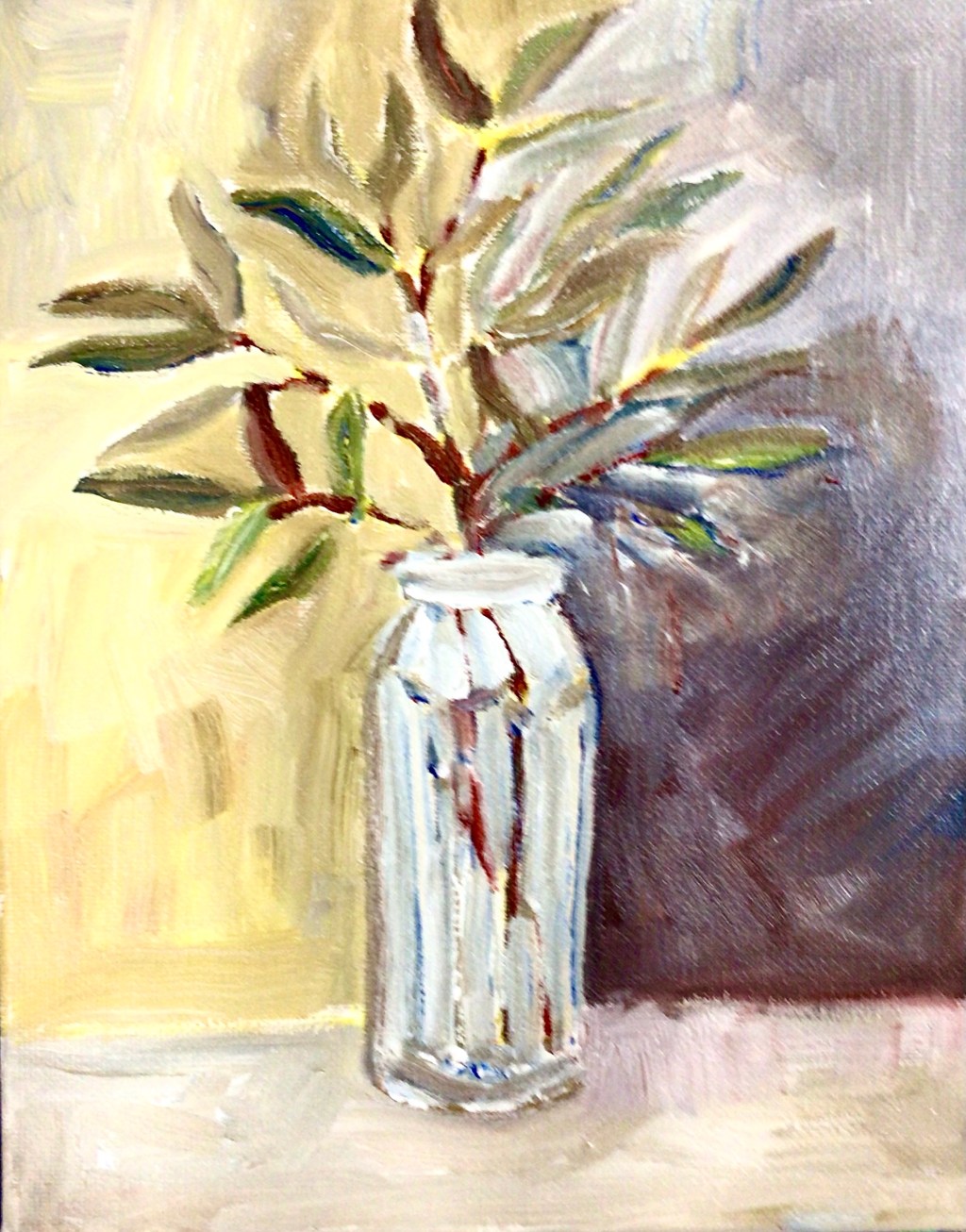
Mike’s Vase of Leaves

We had a full house last Friday, so Mike sat at a different table. He had to paint with the added burden of looking over his shoulder periodically to check his work. He began to paint more from emotions than from sight, which isn’t a bad choice. As long as his work carries enough of the vocabulary of the image to speak its message, he’s good with it. It’s the energy, the experience of painting, and using his mind to solve a problem in his own creative way that engages his interest. So if his painting looks “less real” than Gail’s, it doesn’t mean it’s less successful. He began from a different place, so his destination is also different.

Sally’s Vase of Leaves

A new member of our group, Sally is experimenting with techniques and tools, as well as the paint itself. This week she came with heavy body Liquitex paints, the professional quality paint, which has more pigment than binder. She was so used to the thin bodied paints, however, she watered down these excellent colors. When she asked why they weren’t working like she thought, I pointed out, “You’re supposed to use them straight out of the tube, thick.” This is why we have a group session, so we can learn together. Sally also had a new fan brush, which she used to make brown decorative marks all over her canvas. “I just wanted to try it!” Now that she knows, maybe she’ll plan ahead. I really like the swaying energies of her leaves. They’re happy and full of life. If this were in bright colors, Matisse would be proud.

Lauralei’s Vase

Lauralei brought an interesting solution to our subject this past week. The clear vase was a little intimidating, so she, like several others, colored it solid. When we first learn to swim, we want the security of water wings or the proximity of the edge of the pool. We all take small steps before we take bigger steps. She got the stick and fringed moss down and the many leaves of the plant.

Making all these decisions takes a lot of energy. Our brains use about 20% of our calories, so if we’re engaged in a new challenge, our blood sugar can dip if we’re not careful. If we aren’t aware of this, we can run out of energy or make careless choices. As someone who has prediabetes, I get low blood sugar easily. Stress and excitement can cause my blood sugar to dip. I always bring a small snack as well as eat a good breakfast with whole grain complex carbohydrates, like old fashioned oats. That snack is important, since I test my blood sugar before I drive home.

I’ve learned the hard way if my blood glucose reading is under 80, it’s falling and my driving skills will be going south too. I usually know I’m having trouble, for I can’t string two thoughts together and I begin to overwork my painting. I can’t make the good decision to stop while I’m ahead. Not everyone has this problem, but learning to recognize when you’re tired or just painting with no purpose in mind, is also an acquired skill. Taking care of our bodies so we can fully enjoy exploring a new adventure is a gift we can give ourselves. We only have one body in which to live out God’s purpose for our lives.

Dusty’s Icon of Vase and Leaves

Dusty concentrates well and gets a good shape on his canvas before he sets out to paint. I can’t read his mind, but it seems as he draws, the steps he needs to paint his image come into his mind. This is contemplating at a deep level. It’s not surface thinking, but an inner, deep knowledge that percolates up from within. I mention it’s an icon, for the tablecloth is tipped upward as if it were a background, not a flat plane on which the vase sits. This isn’t something he did by choice, since we haven’t done a lesson on perspective together. In the language of icons, the four cornered shape represents the world and its cardinal directions, or all creation. So we have one plant and all creation, as Paul said to the Romans (8:19-21):

“For the creation waits with eager longing for the revealing of the children of God; for the creation was subjected to futility, not of its own will but by the will of the one who subjected it, in hope that the creation itself will be set free from its bondage to decay and will obtain the freedom of the glory of the children of God.”

We’ll take Friday, February 4, off due to the frozen roads. On February 11, we’ll do paper Valentine collages. Y’all stay warm and safe. Eat hearty soups and enjoy the beauty of the snow.

Joy and peace,

Cornelia

Manet: Chrysanthemums and Clematis in a Crystal Vase, 1882, oil on canvas, Musée d’Orsay, Paris, France.

The 7 Habits of Highly Effective People®: Habit 3 – FranklinCovey
https://www.franklincovey.com/habit-3/

Wild or False Indigo | Home & Garden Information Center
https://hgic.clemson.edu/wild-or-false-indigo/

Rabbit! Rabbit! Welcome to February!

art, Civil War, epilepsy, Evangelism, exercise, Faith, Food, Forgiveness, generosity, Healing, Health, holidays, Love, Ministry, rabbits, Reflection, Spirituality, Valentine’s Day

Mother Theresa

February is a cold month here in the northern hemisphere. Maybe that’s why we rabbits yearn for the warmth of love, since those emotions kindle a fire in our hearts. It’s a cold, dead heart of a bunny that can’t quicken with love. I find those who have difficulty loving others often are struggling with an inner pain or grief, which often expresses itself in depression. Depression closes a person off from others. As we used to say when we were young, “Been down so long, it looks like up to me.” That phrase was originally used by bluesman Furry Lewis in his 1928 song “I Will Turn Your Money Green.” Both Jim Morrison of the Doors in 1966 and Bob Dylan in 1978 incorporated a lyric from the old bluesman’s song.

Reliquary Arm of St. Valentine, now in the Metropolitan Museum of Fine Art, New York City

Yet February is also known as a month for love. In the middle of the month, for this one has only 28 days, we celebrate Valentine’s Day. Of course, history gives us not one, but three men by the name of Valentinus, Latin for strong or powerful. It was a common name in the Roman Empire back in the early years of the Christian church. One Valentinus was a general stationed in North Africa, who died on February 14th with his men in battle. The other two, who also died on the same date, have a better claim to the sainthood. One was the bishop of Terni, who healed a crippled boy and converted his whole family to Christianity.

The Roman senate heard of this heresy, arrested Valentinus, and decapitated him. The boy’s family arranged to take his body back to Terni, but all of the funeral procession was killed by the Romans. Chopping up bodies doesn’t just belong to Zombie movies. This is how pieces of the saints’ bones were distributed to various churches. Of course, sometimes this results in multiple skulls, but the saints didn’t have double heads.

Roman emperors didn’t like contending with other gods

The third Valentinus had a similar story about healing and conversion. He came to the attention of the emperor because he was preaching Christianity.  Then he was sent to house arrest, where the owner was promised a bounty if he could dissuade Valentinus from his faith. Instead, the faithful man healed his jailer’s daughter. Then he baptized the householder and all who lived there, more than forty in all. Of course, everyone went to jail and did not pass go. No one collected $200. There was no get out of jail free card. This is how one becomes a red martyr, which is why our Valentine hearts are red, not white or blue.

Vintage Valentine

What’s interesting is none of the historic Valentines were ever connected to love and affection. They were known instead for healing and faith, especially epilepsy. There are almost 40 saints associated with epilepsy, a number only surpassed by those related to the black plague. In France they were called “saints convulsionnaires” (convulsion saints). During the middle ages the difference between epilepsy and chorea (neurodegenerative diseases affecting movements) wasn’t well known yet. This is how St. Vitus became one of the saints to which patients with epilepsy prayed more often for help. Epileptic people also sought the help of St. Willibrord, St. John the Baptist and St. Matthew.

19th CE German card: St. Valentine Healing an Epileptic Youth

Undoubtedly, the most renowned was Valentine. The cult began in several European countries, up to the point that this condition became linked with the saint’s name. In France epilepsy was called “maladie de Saint Valentin,” in Germany the “plague of Saint Valentine” and in Dutch the word sintvelten was a synonym of the type of epilepsy with falling seizures. In German, Valentine is pronounced “fallentin” and is connected with one of the symptoms of epilepsy, the falling sickness or the falling-down disease.

Every birdie needs some birdie to love

How did we get to cute cupids with tiny bows and heart shaped arrows aimed at our sweetie pie’s love center? We can thank Chaucer, who wrote The Parliament of Fowls in 1380, and mentioned “seynt Volantynys day/ Whan euery bryd comyth there to chese his make. [Saint Valentine’s day, when every bird comes there to choose his mate.]” Bird love apparently occurred on Valentine’s feast day at the start of the English spring. If birds can do it, maybe we rabbits and humans should take the hint. After all, it’s been a long cold winter.

Bad bun puns abound

February 2nd is Ground Hog Day, and if Punxsutawney Phil sees his shadow on Groundhog Day, then that means there are six more weeks of winter. If not, then we’ll have an early spring. Or so the legend goes. Of course, any time Phil’s prediction has turned out to be wrong, it’s always been a result of a “mistranslation” by his handlers. Of course, we’ll have what we have. We rabbits take the good with the bad. An early spring means fresh greens in Mr. McGregor’s garden, while more winter means more warm soup and cuddling by the fireplace.

Music score illustration in heart shaped book

Everybody needs somebody to love. We can love another person, we can love our country, we can love our neighbors, we can love god, and we can’t forget to love ourselves. Love is one of the most popular themes in music, as the lion’s share of pop music lyrics in every decade contained references to relationships and love (67.3%) and/or sex and sexual desire (29.9%). In my own music library, I found 117 songs for 8 hours and 43 minutes worth of “love” playlist.

When I think of love, I remember the many texts I’ve preached to various congregations over my time in ministry. The most important is 1 John 4:19-20—

“We love because he first loved us. Those who say, “I love God,” and hate their brothers or sisters, are liars; for those who do not love a brother or sister whom they have seen, cannot love God whom they have not seen.”

With Love

Gods love for God’s creation is the source of all other love, for if we’ve known God’s unconditional love for us, then we can share that same love for others. Our lack of forgiveness for others and our need to control them “so they deserve our love,” only shows how little most of the rabbit population understands the steadfast love of God, which persists, even when our love fails and turns away.

Popular music reminds us over and over, “Everybody needs somebody to love.” Jerry Wexler signed Solomon Burke to Atlantic Records in the early ’60s. Together, with producer Bert Berns, they turned that song for the offering into Burke’s most famous 1964 song: “Everybody Needs Somebody to Love.” You can hear him preach and sing it here:

The original Everybody Needs Somebody to Love

We probably know this same song better from The Blues Brothers movie. The Blues Brothers’ version of “Everybody Needs Somebody to Love” not only included Burke’s introductory spoken words, it modified those words to adapt to the plot. It was the climactic performance of the movie, and as such, it became one of the more memorable renditions of the song. In 1989, The Blues Brothers’ “Everybody Needs Somebody to Love” was released as a single in the UK, peaking at Number 12. Here’s the movie clip:

The Blues Brothers at their Best

“Everybody Needs Somebody to Love” has been covered by groups as famous as The Rolling Stones, the Grateful Dead, as well as Wilson Pickett, not to mention psychedelic garage rock bands. Those rabbits are still having flashbacks, and there’s no accounting for taste if they’re still listening to that in garages today.

If bunnies could talk…

February 20th is Love your Pet day. I know you want to give your pet the love and attention it deserves as one of God’s creatures, for it didn’t ask to be born into this world and it depends on us, just as a child does. Pets give us unconditional love and appreciation, something we can learn from them. Too often we love only if someone reciprocates tit for tat for us. This is called conditional love. It’s transactional, a give and get, or a mutual backscratching. This is the lowest form of rabbit love: “I’ll give you a carrot if you don’t interrupt me for fifteen minutes.” I confess I’ve stooped to this in my life with my own small daughter bun.

The third Monday is always Presidents’ Day, which is a three day holiday for many people. This is a day to love your country. It celebrates George Washington, our first President, who led our ragtag armies, but was a man of deep thought: “The foundations of our national policy will be laid in the pure and immutable principles of private morality, and the preeminence of free government be exemplified by all the attributes which can win the affections of its citizens, and command the respect of the world.”

The other President we honor is Abraham Lincoln, who steered our nation through its most divisive period, the Civil War. In his first Inaugural Address to Congress on March 4, 1861, he closed with these fateful words, only to have the Confederate States fire on Fort Sumpter in the early morning hours of April 12, 1861.

“In your hands, my dissatisfied fellow countrymen, and not in mine, is the momentous issue of civil war. The government will not assail you. You can have no conflict, without being yourselves the aggressors. You have no oath registered in Heaven to destroy the government, while I shall have the most solemn one to “preserve, protect and defend” it.

I am loth to close. We are not enemies, but friends. We must not be enemies. Though passion may have strained, it must not break our bonds of affection. The mystic chords of memory, stretching from every battle-field, and patriot grave, to every living heart and hearthstone, all over this broad land, will yet swell the chorus of the Union, when again touched, as surely they will be, by the better angels of our nature.”

In 1862, Confederate soldier Robert King made this basket weave folded card for his wife from scrounged paper. Opened up, it showed two crying lovers, a particularly sad foretelling of his death.

So much for the “war of northern aggression,” for some rabbits have been dispensing “alternative facts” for over a century and a half. But, we yearn always to make the broken whole, for like the Saints Valentinus of old, love is a healing balm. The love of God flows through these miracle workers and it’s God’s power, not the human beings, that heals the afflicted. Indeed, even today, when we have modern medicine, we faithful rabbits say, God called people into healing ministries, God provided the resources of intelligence and inspiration, and also the generosity of funding.

Visiting the Rabbit Doctor

Some rabbits want to restrict God’s miracles to those which happen without medical assistance (extraordinary means), but some of us recognize God most often works in and through ordinary means. This isn’t an alternative fact, but healing miracles happen all the time. At the time of the Civil War, life expectancy in the USA was only 40 years. Today, it’s almost twice that! We have 40 more years to live, love, and laugh. We now have 40 years to be “over the hill,” so I think for every rabbit’s sake, we need to banish this ridiculous rite of passage, or at least move it to age 50.

If today’s rabbits would take better care of their bodies than my generation, they might extend the life expectancy and enjoyment by some years. Love your body and care for it with nutritious food, adequate sleep each night, and appropriate exercise at least three to five days a week. Also think of activity minutes, and move about a bit every hour, rather than just sitting all day.

Love is a divine energy

There’s many a holiday in February, but Fat Tuesday will be March 1 with Ash Wednesday on the following day. So let’s practice LOVE all month long to prepare our hearts for the greatest gift of love of all (John 3:16-17):

“For God so loved the world that he gave his only Son, so that everyone who believes in him may not perish but may have eternal life. Indeed, God did not send the Son into the world to condemn the world, but in order that the world might be saved through him.”

Remember, Every bunny needs some bunny to love!

Joy, peace, and love,

Cornelia

Percentage of top-40 songs referring to 19 content categories by decade. | Download Table

https://www.researchgate.net/figure/Percentage-of-top-40-songs-referring-to-19-content-categories-by-decade_tbl1_322664390

Been Down So Long by The Doors – Songfacts

https://www.songfacts.com/facts/the-doors/been-down-so-long

Who Was Saint Valentine? A History of The Figure’s Origins – HistoryExtra

https://www.historyextra.com/period/roman/valentine-day-history-saint-who-real-story-cured/

Saint Valentine: Patron of lovers and epilepsy – ScienceDirect

https://www.sciencedirect.com/science/article/pii/S0121737217300833

George Washington, The First Inaugural Address

Cover Songs Uncovered: “Everybody Needs Somebody to Love” – The Pop Culture Experiment

Abraham Lincoln, First Inaugural Address (March 4, 1861)

United States: life expectancy 1860-2020 | Statista

https://www.statista.com/statistics/1040079/life-expectancy-united-states-all-time/

Pomegranates and New Life

adult learning, Altars, art, change, Creativity, Faith, greek myths, Habits, incarnation, inspiration, Israel, mystery, New Year, Painting, Persephone, pomegranate, renewal, shame, vision

Pomegranates are one of those seasonal fruits which show up at my grocery store along with tangerines and other Florida citrus fruits. When I was young, these were rare and extraordinary foods, unlike today, when we have fresh fruits from all corners of the world all year long. The only difference is the cost: if they come from nearby, they cost less than if they come from afar. When my daddy was a boy, fresh citrus at Christmas were a treat indeed.

Those that want to go back to the “good old days” often forget food was sometimes hard to get, for earlier generations also had supply chain disruptions as well as economic collapses. In the Depression Era, food became a gift, for it was often hard to come by. Oranges had a secondary meaning, for since they had segments, they could be shared. The lesson was all gifts were meant to be shared with others.

Dante Gabriel Rossetti: Proserpina, 1874

In art, the paintings of the saints follow a certain iconography, or visual images and symbols used in a work of art. Once we learn this language, we can “read the icon” and understand its meaning. The pomegranate typically stands for the Christian church, for it has many seeds within one fruit. In earlier Greek and Roman mythology, the fruit stands for Persephone/Proserpina, the daughter of Demeter/Ceres, the goddess of harvest and agriculture. Pluto, the god of the underworld, abducted Persephone for his wife. Ceres became despondent and nothing above ground would grow. The Olympian gods arranged Persephone’s   release, but she eaten a few seeds of a pomegranate. Therefore, she could spend only part of the year above ground. This is how the ancients explained the seasons.

Pomegranate from Torlonia Catacomb

This story illustrates how Persephone became connected to the idea of dying and rebirth, so her symbol, the pomegranate,  also transferred over into Christian art as a symbol of immortality and resurrection. The term for appropriation of another culture’s symbol is syncretism. In a similar manner, in mythology, the dove was an attribute of Aphrodite/Venus; but in the Old Testament, Noah’s dove signified God’s covenant with mankind; and in the New testament, John the Baptist likened the dove to the Holy Spirit, which descended upon Jesus at his baptism. Painted pomegranates can be found on the frescoes of the Roman catacombs of Torlonia.

5th century CE church mosaic with pomegranates and fish, Israel

The imagery continued into the 5th century in a floor mosaic with a cross, stylized fish, pomegranates, and three chevrons representing Golgotha. Death on the cross is connected with the resurrection appearance of Christ and the disciples’ meal on the beach at Galilee.

Fra Angelico: Virgin and Child with Pomegranate, c. 1426

Fra Angelico’s Virgin and Child with Pomegranate is a beautiful example of a late icon. The Virgin of the Pomegranate takes its name from the pomegranate held by the Virgin and which attracts the attention of the Christ Child, who touches it. In this context the fruit has a double meaning: in the Virgin’s hands it refers to her chastity, while by touching it the Christ Child prefigures his own death and resurrection. It reminds us of Ephesians 5:25-26–

“Husbands, love your wives, just as Christ loved the church and gave himself up for her, in order to make her holy by cleansing her with the washing of water by the word.”

This iconography of chastity, cleanliness, and sacrifice was widely used in 15th-century Florence, where it interested artists such as Sandro Botticelli and Leonardo da Vinci.

Unknown Artists: Unicorn In Captivity, 1495–1505

The unicorn, a mythical animal to all but eight year old girls (and those of us who retain our eight year old hearts inside our full grown bodies), is a creature of fantasy, both then and now. From the same era as the Virgin of the Pomegranate is the beautiful tapestry of “The Unicorn in Captivity,” now at the Metropolitan, which may have been created as a single image rather than part of a series. In this instance, the unicorn probably represents the beloved tamed. Tethered to a tree and constrained by a fence, we see he could escape, for the chain isn’t secure and the fence is low enough to step over.

Clearly, however, his confinement is a happy one, to which the ripe, seed-laden pomegranates in the tree—a medieval symbol of fertility and marriage—testify. The red stains on his flank don’t appear to be blood, for we see no visible wounds. Instead, they represent juice dripping from bursting pomegranates in the tree above. Many of the other plants represented here, such as wild orchid, bistort, and thistle, echo this theme of marriage and procreation; they were acclaimed in the Middle Ages as fertility aids for both men and women. Even the little frog, nestled among the violets at the lower right, was cited by medieval writers for its noisy mating.

Botticelli: Madonna and the Pomegranate, c. 1487, Uffizi, Florence.

Botticelli also painted his version of the Madonna and the Pomegranate about 1487. This painting now hangs in the Uffizi, in Florence, Italy. The Virgin seems aloof, reserved, or far away, as does the Christ child. The angels in attendance also seem not connected to one another or engaged with the viewer. They carry roses and lilies, flowers connected with purity. One angel has the Latin words of the beginning of the rosary on his clothing, which is notable since this prayer became popular in devotions in the 15th century. The baby holds a pomegranate, cut open to reveal the multiple seeds of suffering.

Botticelli was influenced by the loss of his patrons, the Medici family, and the rise of Savonarola, a Dominican monk, who wanted to not only reform a corrupt church, but also redeem a materialistic and humanistic society. He was the very opposite of the trade oriented and culturally progressive Medici family. Moreover, as the year 1500 approached, Savonarola preached an apocalyptic message of the end of the world. Botticelli’s delightful Birth of Venus would give way to the 1497 Mystical Crucifixion. Things didn’t end well for Savonarola, who was tried, convicted of heresy, hanged, and burned in 1498. Florence then returned to the city’s prior communal ideals, led by the next generation of the Medici family.

Lorenzo di Credi: Madonna and Child with Pomegranate

Often attributed to Da Vinci or Verrocchio, this Madonna and Child with a Pomegranate by Lorenzo di Credi, now in the National Gallery of Art, was painted in 1475-1480. He and da Vinci apprenticed under the same master, so their styles show some similarities. He’s better known for his portraits.

Lucy’s Italian Movie, 1951

I brought the pomegranates to art class because the new year deserves a new start and a new way of thinking about our lives. In the sacrament of holy communion, we recognize “many are made one,” for how many individual grains are ground for the bread and how many grapes must be crushed to fill a cup? I keep thinking of that Lucy and Ethel skit from I Love Lucy—you just knew walking in a circle in a grape vat would not end well, but you held your breath waiting to burst out laughing. Lucy’s comedic genius never failed us.

Mike’s Pomegranate

The joy of abundance jumps out in the bold brush strokes and colors of Mike’s painting. He loves coming to class, for it’s a time when he’s free. No one’s life depends on him in this time. He can give expression to this sense of freedom.

When we elevate the elements over the altar, we remind ourselves, “the one loaf is broken for all, just as the one cup is offered for all.” The pomegranates have many seeds, but they’re one fruit. The pomegranate reminds us of the mystical body of Christ, which we call the church. When we take communion, we receive the symbolic body of Christ, but we also receive the mystical body. We often limit ourselves to thinking the body of Christ is his actual body or perhaps only our church fellowship. We often forget there’s a greater body of Christ beyond our doors, and it’s not just formed of all the believers. The greater body of Christ is all of humanity, for we all share the same incarnation of his  spirit.

In several ways we can open our eyes to the “many within the one.” We can trace the history of the symbols we use to communicate our hopes and dreams with one another. Some of these are positive and worth keeping, but others might need retirement, under the “it’s good not to eat meat or drink wine or do anything that makes your brother or sister stumble” (Romans 14:21). We get attached to the visible symbol, failing to realize others see the same symbol as harmful. For instance, some are so attached to their “authorized version” of a scripture translation, they idolize it above all other translations. In doing so, they make the vehicle more important than the content. No one would ever make an Amazon Prime delivery truck more important than its content, but we sure get distressed when our package gets mangled in shipping. I personally use an ebook for my Bible now, since it has more recent and multiple translations plus a Greek New Testament. Nevertheless, the God revealed is more important than the object itself, as we’re reminded twice in Exodus 20:2-3 and Deuteronomy 5:6-7:

“I am the LORD your God, who brought you out of the land of Egypt, out of the house of slavery; you shall have no other gods before me.”

Gail’s Pomegranate

Gail is always careful to look closely for the details in everything she paints. Naturalism is her calling. In our brief time together, she might not finish her work, but finishing isn’t the goal. Learning to see is our goal and the secondary goal is making a likeness. The detail on the crown of the pomegranate is superb.

Sally’s Pomegranate

Sally has a good rendering of the pomegranate, yet she was unhappy with the background. We solved part of that together by identifying how the horizontal line dipped down at the intersection with the outer edges of the fruit. It’s a straight line now, because she fixed the places where the Hulk had hit the table behind the pomegranate. (If only we could do this in real life, disaster recovery would be a piece of cake). She has a circular pattern working, since she’s working on another piece with this same idea. It’s another example of how art is a continuity, not an isolated moment in time.

Cornelia’s Pomegranate

I went home to finish my painting. I took a photo to have a reference, rather than just painting from memory. As soon as I was in my quiet place, I realized my perspective was off—I could tell because the plate on which the fruit was resting didn’t break at the right height of the fruit. White overpainting fixed that problem. Our blue table cover, which has paint stains on it, became my background. As I told the class, my painting is brighter because it’s a primary color scheme: red, yellow, and blue. I also painted the juices, the secondary shadows, and the highlights of the nibs. Adding earth colors or black to a painting darkens its tone considerably.

Can we break old habits right away? If those who start a diet in the New Year have anything to teach us, restricting our eating lasts for about 10 days at best before we begin to cheat on it. Strava, a fitness brand, named  January 19th “Quitter’s Day,” since most people ditch their fitness resolutions then. Our question then becomes, how do we learn something new? How do we make progress? Perhaps, are we teachable, or willing to grow beyond what we know? The last question calls us to step out of our safe places, as Peter did when he stepped out of the boat onto the storming waves. When he was frightened, he called out, “Lord, save me!”

The good news about art class is no one will drown if we struggle to make what’s in our mind come out on our canvas. Sometimes our ideas are ahead of our technical abilities. Some days we’re tired or distracted. If I’m coming down sick, but not “sick sick” enough to be home, my work looks dead. It’s a sure sign I need to visit the doctor soon!

Next week we’re going to do color theory. We need to revisit the color wheel and make some of the interesting colors that don’t come straight from the tube. We’ll paint in squares, so this is a “entry level” class. Actually, all classes are entry level. Like a one room schoolhouse, you enter at your own level and progress from there. Your only competition is you. There’s no grades, no pass or fail. We come to give our best self a chance to grow and shine.

We’ll also be wearing masks again, due to that pesky omicron variant.

Joy and peace,

Cornelia

Signs & Symbols in Christian Art – George Ferguson, George Wells Ferguson – Google Books

https://books.google.com/books/about/Signs_Symbols_in_Christian_Art.html?id=GF4XDp-eSTwC

Jewish Catacombs: The Jews of Rome: funeral rites and customs – Elsa Laurenzi – Google Books

https://books.google.com/books/about/Jewish_Catacombs.html?id=PmKBBj_qRbwC

Vaults of Memory—Roman Catacombs

http://archives.catacombsociety.org/vom/vomframes.html

Why We Put Oranges in Christmas Stockings

https://www.thekitchn.com/heres-why-we-put-oranges-in-stockings-at-christmas-holiday-traditions-from-the-kitchn-213985

Sandro Botticelli | Biography, Paintings, Birth of Venus, Primavera, & Facts | Britannica

https://www.britannica.com/biography/Sandro-Botticelli

The Museo del Prado acquires The Virgin of the Pomegranate by Fra Angelico for €18m 


A Study of 800 Million Activities Predicts Most New Year’s Resolutions Will Be Abandoned on January 19: How to Create New Habits That Actually Stick | Inc.com

https://www.inc.com/jeff-haden/a-study-of-800-million-activities-predicts-most-new-years-resolutions-will-be-abandoned-on-january-19-how-you-cancreate-new-habits-that-actually-stick.html

Guido di Pietro, known as Fra Angelico: Virgin and Child with Pomegranate,  or The Virgin and Child with two Angels, or The Virgin of the Pomegranate, c.1426. Tempera on panel, 83 x 59 cm, Prado, Madrid.

Unknown Artists: The Unicorn Rests in a Garden (from the Unicorn Tapestries), weaving, Made in Paris, France (cartoon); Made in Southern Netherlands (woven), Wool warp with wool, silk, silver, and gilt wefts, 1495–1505, Metropolitan Museum of Art, Gift of John D. Rockefeller Jr., 1937, Accession Number: 37.80.6.


STARS AND THE WINTER SOLSTICE

adult learning, art, Astrology, chocolate, Christmas, cosmology, Creativity, Faith, Family, greek myths, grief, holidays, hope, Icons, Imagination, incarnation, Marcus Aurelius, Ministry, nature, Painting, Philosophy, poverty, Spirituality, Stonehenge, trees, winter solstice

Stonehenge at Winter Solstice

This is a time of year when we look to the night sky for a sign. It’s not for nothing the depths of darkness are the beginnings of hope and our desire for the return of the healing light. People around the world and over the generations of time have celebrations of feasting, family reunions, and honoring their culture’s gods on the darkest day, or the Winter Solstice. The term solstice derives from the Latin word “sōlstitium”, meaning “the Sun stands still”. On the Winter Solstice, the sun reaches its southern-most position, shines directly on the Tropic of Capricorn, and seems to stand still there.

We’re all familiar with Stonehenge, a Neolithic stone monument in England built about 4,500 years ago to track important moments in the solar year. A later custom is the blazing Yule Log, a Norse tradition. The family would drag a huge piece of wood into their house, set it into the main fireplace, and let it burn for several days. It was a type of sympathetic magic to encourage the distant and faint sun to return, reinvigorated. The family often wrote down their desires for the new year as an offering to the gods. These were then burned in the fire. Afterwards, the family scattered ashes from the fire in the corners of every room in the house for good luck.

Hiroshige: The Sixty-nine Stations of the Kiso Kaidō

The Chinese also have a Winter Solstice festival, which once was a new year’s festival. The family gathers to eat traditional foods, and they honor their ancestors, as well as the old ones still living among them. This poem by Ruan Yue, in the late Northern Song Dynasty speaks of this:

罗袜新成,更有何人继后尘。
The socks for elders are newly woven;
the custom should be handed down.

A later poet of the Song Dynasty, Fan Chengda, had a more optimistic outlook on the dreary and dark days before the Winter Solstice, or perhaps he was using “positive pep talk to reframe his grumpy mind.”

休把心情关药裹,但逢节序添诗轴。
Don’t be thinking about medicines all the time;
write a new poem at the solar term.

I can relate to Fan Chengda, for I find I have difficulty waking up without the sun streaming into my bedroom windows. I’m also more irritable and mopey on these dark days. It’s probably Seasonal Affective Disorder, which is a form of depression related to the lack of light in this season. I tend to think dark thoughts, feel more pain, and lose my appetite, except for medicinal chocolate, which I consume under the Tim Allen mantra, “If some is good, more should be better!”

For Medicinal Purposes Only

When I get this type of mood on, the commercial Christmas we see on television and in the movies strikes a discordant note in my soul. I think about the ancient text, which reminds us when the parents of Jesus went to Bethlehem to be counted in the census: “And she gave birth to her firstborn son and wrapped him in bands of cloth, and laid him in a manger, because there was no place for them in the inn.” (Luke 2:7)

What most of us glide right over is Joseph had kinfolks galore in this town, but none of them opened their home to Mary, for she was pregnant before he married her. The innkeepers in town weren’t going to risk their reputations for these two either. Only one innkeeper took pity on them and let them stay with the animals in the stable. This marks the birth of the Christ child as an outsider to his whole extended family, the House of David.

Botticelli: Nativity, 1475

The Magi, or Wise Men, came from the East to visit King Herod, asking, “Where is the child who has been born king of the Jews? For we observed his star at its rising, and have come to pay him homage.”( Matthew 2:2)

Herod was worried he would be deposed, so he sent the Magi to find this child, then return and report to him. The Magi followed the star until it stopped over the place where the family was staying. They offered their gifts and returned home, without telling Herod where the baby was. Jesus was an outsider to the Roman occupation which propped up the local kings. He was a threat to the way governments rule the world.

Shepherds are the epitome of outsiders in the Bible, for they live outdoors among sheep and goats, neither of which are clean. In fact, anyone who’s gone camping knows how hard staying clean is. Glamping isn’t camping, and neither is RVing. My youthful experiences in Girl Scout camps of pitching tents and digging rain gutters is the closest I’ve ever been to living on the land. Even then, we had outhouses and cold water showers. The biblical city folk who could keep the ritual rules of cleanliness looked down on the shepherds as a lower class group, or outside of society.

Imagine a group of shepherds sitting around a nighttime fire, eating a simple meal, and chatting about their day or their families at home. Then an angel of the Lord stood before them, and the glory of the Lord shone around them, and they were terrified (Luke 2:9). I’d be terrified also, as I imagine you would be too! There’s a good reason the first words out of angels’ mouths are “Do not be afraid!”

But the angel said to them, “Do not be afraid; for see—I am bringing you good news of great joy for all the people: to you is born this day in the city of David a Savior, who is the Messiah, the Lord. This will be a sign for you: you will find a child wrapped in bands of cloth and lying in a manger.” (Luke 2:10-12)

Giotto: Nativity at Padua

If ever the outcasts of the world needed good news, if ever the hopeless needed a savior, if ever the least of all needed one just like them, it was these lowly shepherds, who went to find a newborn child lying in an animal’s feeding stall. No fancy crib for the newborn king, no royal robes or golden crown, just ordinary swaddling clothes. He looked just like any other child, except his birth was proclaimed by angels, honored by Magi from afar, and given a place through the grace of a kind innkeeper.

Those of us who will celebrate Christmas with our families, our extended friends, and our relations in a wild, chaotic buzz of coming and going, feasting and drinking, and perhaps exchanging of gifts, don’t know the quiet and holy night when the light of the world entered “to give light to those who sit in darkness and in the shadow of death, to guide our feet into the way of peace.” (Luke 1:79)

We keep our homes lit inside and out with megawatts of electric lights, both colored and white. Some of us even cue our lights to blink to seasonal music. Those of us who live beyond the great urban areas, can better see the stars at night, since there’s no light pollution. This is one reason we need to keep our national parks as close to nature as possible, for one day, these may be the only places people can marvel at the bright stars against the dark canopy of the sky above.

Gail: Stars across the Sky

Gail brings her love of the outdoors and her experience as a park ranger to her work. Over the trees, a floating band of stars become a pathway across the night sky.

Mike: Sun, Moon, and Stars

Even if our assignment was stars, that never means “only stars.” After all, the sun is a star, which is very close to us, astronomically speaking. If you’re going to have the sun and stars, you might as well have the moon also. I always say, “Why not?” The Tim Allen rule sometimes applies in art class: “More power!” When you go too far on the Tim Allen scale, that’s when his sidekick Al reminds him, “Sometimes less is more.” Mike certainly captures the energy and joy of the celestial bodies in this painting through the bold colors and strong brush strokes.

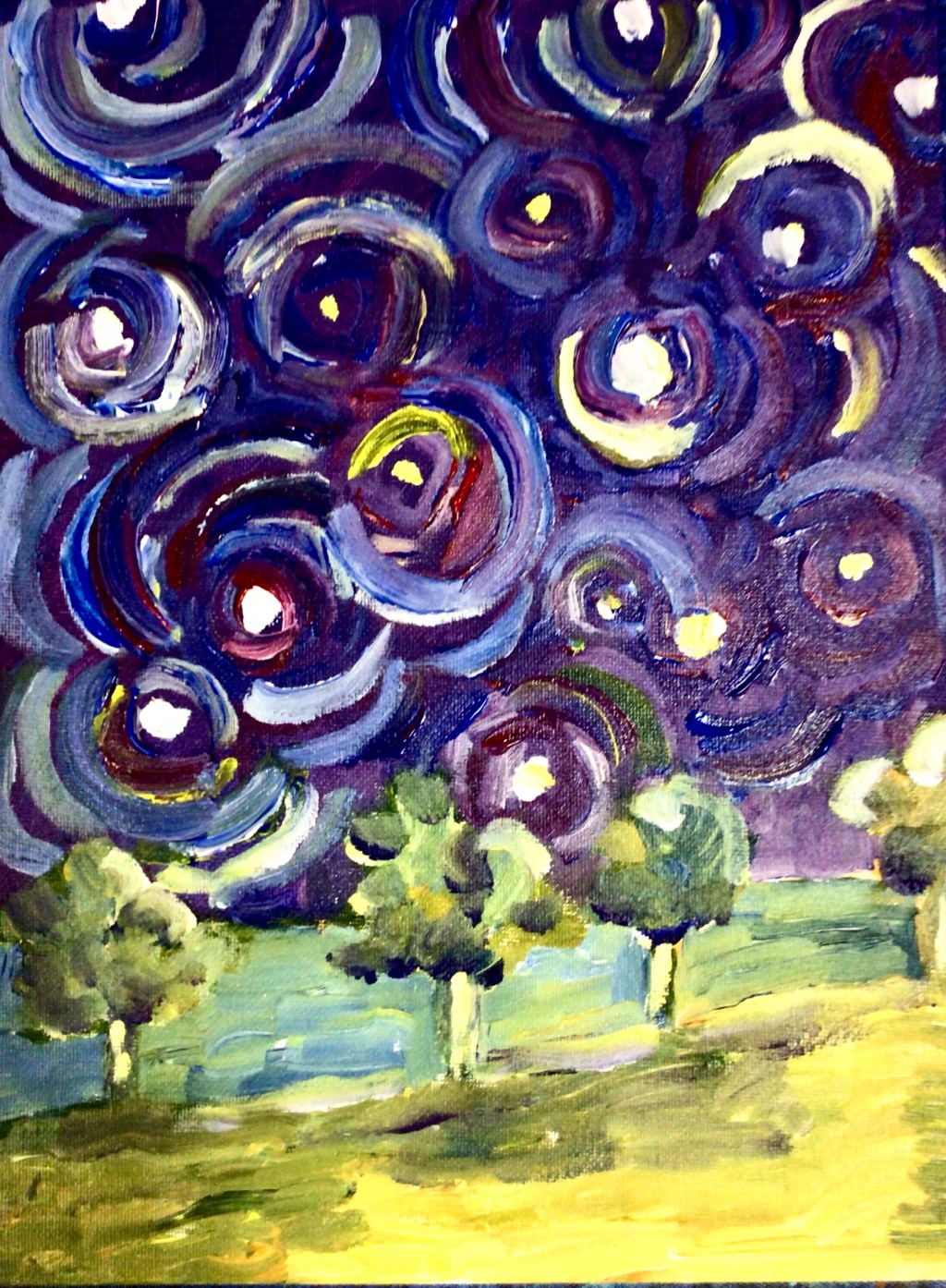
Sally: The Cosmos

Sally had an idea in her mind, but no image to look at. She wanted to show the cosmos in motion, as if God were looking down upon it. In her mind’s eye, she imagined this from memory. As she worked on the small canvas, she’d add more paint into the areas which weren’t quite dry and got somewhat frustrated at the paint not bending to her will. As a matter of technique, painting into a dry area is better than continuing to add color to a wet area, since the wet brush picks up the wet layers below that. Mike and Gail, having many sessions under their belts, have already crossed this particular bridge. She also learned something significant. It’s easier to paint something when you can look at it. I think it’s a good start and it holds promise: “There is one glory of the sun, and another glory of the moon, and another glory of the stars; indeed, star differs from star in glory” (1 Corinthians 15:41).

Cornelia: Starry Night

I’m not a fast walker, nor do I get down the road quickly. I’m too busy noting the color of the sky, thinking what colors to mix to get the grey trees of a late December day, or how to paint the towering cumulus clouds of summer. I file these thoughts away in the treasure house of my mind, for one day I’ll need them. I look at the shadows of the leaf clumps on trees, but not at each leaf alone. The tree leaves are communities, not individuals. They exist as groups, so the artist treats them as such.

I’m not sure about others, but many walkers are fixed on their personal best speed, or going a half mile longer. Some people drive to the grocery store and make their list in their head as they go. In the store, they make a new to do list for the home, and once that’s done, they make another list for the next day. The cycle starts all over again. They never once raise their eyes to greet the stars, to note the cycles of the moon, to enjoy the sunset colors, or the sunrise either. They’re probably more productive than I am, but I take time to reflect deeply on the “why of things” rather than repeating the same rhythms over and over. Most people like the familiar rhythms, however, while I question if they still have meaning in today’s world.

Today I saw the Winter Solstice Dawn

In ancient times, the Greeks and Romans thought the stars had a power and energy to determine the fates of human beings. Marcus Aurelius, a Roman emperor and stoic philosopher of the 2nd century, wrote in his Meditations: “Dwell on the beauty of life. Watch the stars, and see yourself running with them.” From his privileged location, he could identify with the heroic persons in the astrological figures of mythology.

Some people are “born under a bad sign,” or are unlucky in life. Of course, some say we make our own luck, but people born into harsh circumstances lack the same resources to make choices for good. The deck is stacked against them, from living in trauma filled neighborhoods to a lack of quality foods due to a paucity of grocery stores. As Albert King, the great blues artist once sang, “If it weren’t for bad luck, I wouldn’t have no luck at all.”

The good news is the bright light of the Christmas star points to the new light, which has come into the world. We hear, amidst the cacophony of commercials and piped in musical carols, the words of the prophet Isaiah: “Arise, shine; for your light has come, and the glory of the LORD has risen upon you” (60:1).

As a gift, you can listen to the great Albert King sing “Born Under a Bad Sign,” by copying the link below to your browser.
https://music.youtube.com/watch?v=F2IqJtBL6yk&list=OLAK5uy_kRTT9VaZ7Ht_pjIoBhtqhS_99sMi_D5a4

Our art class returns Friday, January 4, 2022, at 10 am. I hope to bring pomegranates, if I can still find them in the store. We’ll make a fresh start in the New Year, so if you want to join, you’ll start where you are. We are a “one room schoolhouse,” so there’s no grade levels with us. We’re all learning and improving from where we are at the moment.

Joy and peace,

Cornelia

How to Make a Yule Log
https://www.learnreligions.com/make-a-yule-log-2563006

5 Most Beautiful Chinese Winter Solstice Poems to Appreciate
https://www.travelchinaguide.com/essential/holidays/winter-solstice-poems.htm

The New World Atlas of Artificial Sky Brightness | CIRES
https://cires.colorado.edu/Artificial-light

Rabbit! Rabbit! Welcome to December!

art, Christmas, coronavirus, Faith, Family, Food, grief, Hanukkah, holidays, Imagination, Ministry, nature, pandemic, purpose, vaccinations, winter solstice

“The more things change, the more they stay the same,” my daddy was fond of saying. We often long for the “way things used to be,” as if the Golden Age of the past was the best of all times. Yet, that past often exists only in our memories, but not in the lived reality of all persons. This is the classic story of the young prince, who while sheltered within the confines of his sumptuous palace never knew want, but once he walked among his people, he saw suffering and need everywhere. Today we know him as the Buddha, or Siddhartha Gautama. Many over the centuries have wondered why suffering exists in the world, or why they themselves must suffer. The Buddha saw all life as suffering, or rather our inability to accept the impermanence, change, and dissatisfaction with the present moment.

Rabbit Buddha

The Golden Age is a myth and poetic concept, as well as a political and philosophical construct. It began in Greece and was fixed in people’s minds by the time of the Roman Emperor Augustus. The Golden Age is a dream of an “earlier time when people lived peaceful, untroubled lives, and the earth supplied all their wants.” Those who read the Bible can easily find a parallel story in the first humans, who lived in the Garden of Eden. Of all the high and holy days in our cultural calendar, Christmas rates number one for nostalgia, both the personal kind and the universal type.

Nostalgia is the state of being homesick, or a wistful or excessively sentimental yearning, either for the return to or of some past period or irrecoverable condition. It can be a salve for those who suffer, or it can be more salt poured into an open wound. It just depends on how one frames the experience. We feel “homesick “ in the worst possible way, for we yearn for the security of the familiar and the safe. Mostly we yearn for the people we love and are kin to us.

Happy Rabbit Family

I remember the year I divorced my husband. It was necessary, for I couldn’t trust him to care for our daughter due to his alcoholism. The first Christmas was hard, for his family chose him and shut me out, as did all his friends. Decorating the Christmas tree was always a family affair in the Golden Age of my memories of Christmas. If this year I had no family, I would bring friends to decorate my tree. Just because I’d always celebrated one way before, I wouldn’t let my circumstances keep me from finding joy this Christmas. I called my young mother friends, invited their families to my home, and we decorated my tree within an inch of its life. It was my best tree ever! And then we ate and drank a toast to our creation. My friends were salve for my suffering, and helped me create a good memory, which still gives me pleasure to this day, four decades later.

Big Holiday Family Dinners

Christmas brings families together, but this is a double edged sword. While we all want to be with our families, we also know oil and water don’t mix. After both my parents died, I often ate with some of my clergy pals’ families. I was glad to know they had relatives who also wore their crazy pants to dinner. If I ate with congregation members, they were often on their best behavior, as if I were some sort of god on earth. You’d think after six months at a charge, I’d already have disabused them of that notion, but some people never see your true nature, but only the image of every pastor they’ve ever known before. More often, I’d get pastoral calls of family crises during holiday seasons, so after years of this recurrence, I finally learned to plan for it. I eventually realized we all have a Golden Age of Christmas in our minds, but in real life, we live in the Age of Iron. When reality hits our delusions, the disconnect is palpable. We feel it in our very bones.

1896 Thomas Nast illustration in Clement Clark Moore’s ‘Twas the Night Before Christmas

For many Americans, images of Victorian Christmases include memories of “children all snug in their beds with their visions of sugar plums dancing in their heads,” which we recognize as one of the opening lines of Clement Clark Moore’s “A Visit from St. Nicholas,” a.k.a. “Twas the Night Before Christmas.” These sugar plums aren’t sugared fruits, but are more like candy covered peanuts or almonds. Jelly beans also are made by this same process. Whatever these treats were, the children dreamed of a world of happiness, sweetness, and delight.

As my Depression Era mother would say, “If wishes were horses, beggars would be kings.” That outlook never stopped me or my brothers from wanting everything in the Sears Christmas catalog, even though we knew these were just suggestions for Santa. Yet we never felt deprived, for whatever we received was a gift, plus it was more than we had before. On Thanksgiving day this year, consumers spent at a pace of at least $3.5 million per minute on line due to stores being closed for the holiday. This year, the average household is pegged to spend $924 for online shopping, more than double the $440 expected for in-store.

December 15 is Wear Your Pearls Day

The National Retail Federation (NRF) projects November/December retail sales of $843.4 billion to $859 billion, up 8.5% to 10.5% from 2020 results. NRF said its forecast — excluding automobile dealers, gas stations, and restaurants, and covering Nov. 1 to Dec. 31— tops the previous high of $777.3 billion. This total is up 8.2% over 2020, as well as the average gain of 4.4% over the past five years. This increase is in spite of supply chain hiccups, rising gas prices, and the pockets of as yet unvaccinated individuals, who continue to be the greatest number of COVID admissions to our hospitals. It’s as if we’re trying to replace the suffering of our present with presents for those we love. This also accounts for our desire to donate to charities at this season.

Scrooge of Christmas

Yet the Scrooge of Christmas continues to be COVID, for as an Augusta University Medical analysis released in May of 2021 revealed, which looked at COVID-19 related deaths in vaccinated versus unvaccinated individuals—only .8% (150) of vaccinated people accounted for the 18,000 COVID-19 deaths in May. If you want to give someone the gift of life this Christmas, take them to the local pharmacy and get them started on their vaccinations.

The Centers for Disease Control and Prevention has found both infection-induced and vaccine-induced immunity are durable for at least six months — but vaccines are more consistent in their protection and offer a huge boost in antibodies for people previously infected. Unfortunately, unvaccinated persons are also the prime hosts in which the virus can mutate, so the Grinch has already brought us the latest variant of concern, Omicron.

This variant was first identified in the South African peninsula, due to their excellent testing facilities. Of course, now the nations of the world have isolated the countries there, so they now feel punished by these bans. Travelers arriving in major world airports already have tested positive for for this variant, so we can expect disruptions and quarantines worldwide to follow. During this holiday season of restoring relationships, COVID keeps breaking our ties instead of rebuilding them.

DeLee: Found Objects find a home in the No Room Inn

We can long for the Golden Age of light from our younger days, when our parents took on the big worries so we could have the pleasant memories of an untroubled childhood, or we can fix our sight on the lights of our faith. The great star of the east which announced the birth of Jesus was a pale light compared to “The true light, which enlightens everyone, (which) was coming into the world.” (John 1:9) His was “The light (which) shines in the darkness, and the darkness did not overcome it.” (John 1:5).

Colorful Menorah

Our Jewish friends meet the darkness of this Hanukkah season with prayers and menorahs, nightly lighting candles to disperse the darkness of hopelessness against great foes. They remember doing battle against spiritual powers, with God empowering their weakness. God never comes for the strong, but has a special kindness for the poor and weak. This is why we should feel blessed, no matter our personal experience, but especially during the holidays. The ceremony begins on November 28 and ends December 6, since it’s set by the lunar calendar.

So also are these December celebrations light filled: Burning the Yule Log on the 4th, St. Lucia on the 13th, the Winter Solstice on the 21st, Kwanzaa on the 26th, and finally, New Year’s Eve. Our good earth will bring its tilt back towards the sun gradually in the days following the winter solstice. This darkness too shall pass, whether it’s our personal grief or our universal suffering.

Winter Solstice brings back the Light

We’ll keep walking until we meet the better land beyond the horizon. If this isn’t yet the Golden Age of our memories or the Golden Age of our sugar plumb dreams, let’s work together as we walk to build a better world for all people, “for we are what he has made us, created in Christ Jesus for good works, which God prepared beforehand to be our way of life.” (Ephesians 2:10)

Merry Christmas and Happy Holidays to all my Bunny Friends!

May you have a mindful holiday, full of joy and peace,

Cornelia

Dukkha: What the Buddha Meant by ‘Life Is Suffering’
https://www.learnreligions.com/life-is-suffering-what-does-that-mean-450094

Reckford, Kenneth J. “Some Appearances of the Golden Age.” The Classical Journal, vol. 54, no. 2, The Classical Association of the Middle West and South, 1958, pp. 79–87, http://www.jstor.org/stable/3294223.

Wynne Parry: Why We Feel Nostalgic During the Holidays
https://www.livescience.com/17571-nostalgia-holidays-memories.html

Sugar Plums: They’re Not What You Think They Are – The Atlantic
https://www.theatlantic.com/health/archive/2010/12/sugar-plums-theyre-not-what-you-think-they-are/68385/

U.S. Thanksgiving Online Shopping Spending to Set Record
https://www.bloomberg.com/news/articles/2021-11-26/u-s-thanksgiving-spending-to-set-record-as-shoppers-move-online

U.S. holiday retail sales outlook brings good tidings
https://www.supermarketnews.com/consumer-trends/us-holiday-retail-sales-outlook-brings-good-tidings

The Washington Post: CDC finds immunity from vaccines is more consistent than from infection, but both last at least six months
https://www.washingtonpost.com/health/2021/11/01/what-works-better-vaccines-or-natural-immunity/

Staggering COVID-19 Statistic: 98% to 99% of Americans Dying are Unvaccinated – AU/UGA Medical Partnership
https://medicalpartnership.usg.edu/covid-19-staggering-statistic-98-to-99-of-americans-dying-are-unvaccinated/

Night before Christmas, Creator: Moore, Clement Clarke, 1779-1863 ( Author, Primary ), date: c1896, The University of Florida, George A. Smathers Libraries, Donor: Egolf, Robert
McLoughlin Bros., inc ( Publisher )
Nast, Thomas 1840-1902 ( Illustrator ) https://ufdc.ufl.edu/UF00085407/00001

All of the versions of Clements’ work can be found at the UF Library site. The illustrations are telling of the age in which they drawn.

Maps of My World

arkansas, art, at risk kids, brain plasticity, Children, cognitive maps, coronavirus, cosmology, Creativity, Faith, Healing, Health, Historic neighborhood, Icons, Imagination, Israel, Painting, pandemic, renewal, Spirituality, Travel, vision

A cognitive map is a representative expression of an individual’s knowledge about the spatial and environmental relations of geographic space. Everyone has a unique relationship to his or her own environment, so each person’s cognitive map is different. I learned this the hard way back before the advent of GPS. Folks would give me directions to their homes in the days when I would make sales calls or later on when I’d make a pastoral visit. It didn’t help that some gave me landmarks like “go past the barn that used to be green,” or “turn left where the old trailer used to be.” I’d clear my throat and reply, “What color is that barn now and what took the place of the old trailer?” Often they couldn’t say, for their internal map was based on old programming and not the latest update. Some people still use their old flip phones, like Mark Harmon on NCIS, but that’s his quirk. They can get around, but it’s hard to get others to come on board with these old ideas.

DeLee: Hot Springs Downtown Historic District

Everyone’s map is different, for sure, but for some of us, the landmarks can change, but our memories aren’t replaced. Some people are like me, who get lost in a tea cup, so I’m unsure of where I am at any given time. This may be why I give some the impression I’m a tad “spacey.” Others can steer a sure and certain course at any time of the day or night to make their way home, like a carrier pigeon with an important message for those who await their arrival. Once I was riding with the men from the West Helena Church to the Methodist Camp for a meeting. I always liked the Methodist Men’s meetings, for they had steaks and other real food, not dainty salads like the women’s groups. Night was coming on and rural roads in the Arkansas Delta look much like one another in the gloom. Our driver could tell I was uncomfortable.

“What’s the matter, preacher?”
“I’ve only been to the camp in the daytime. This doesn’t feel right to me, somehow.”

“You know we all grew up hunting in these woods and rice fields. We know these places like the back of our hands.”
“I know. I also know I always get lost every time I go somewhere by myself.”

“Well, you don’t have to worry about getting lost tonight! We’ll get you there and back.”
“It’s probably better you’re driving, since we don’t want to miss supper.”

They laughed. They all had a much better cognitive map of their home county than I did, since they had spent their whole lives there and I’d only spent three years. Of course I grew up in my home town and even there I still managed to get confused about places, so I’m not sure my living anywhere longer would have filled out my cognitive map with more details.

Characteristics of Cognitive Maps:

  1. Diverse in nature and purpose. Cognitive mapping is used in a broad range of disciplines for a variety of purposes. Cognitive maps are the most general type of mental-model visualization.
  2. No restrictions on structure or form. Cognitive maps don’t have to adhere to a specific format. Thus, they’re often abstract and have no consistent hierarchy. They’re flexible and can accommodate a wide set of concepts or situations that need to be represented.

I usually get lost in a teacup, and my typical travel technique is to drive in the general direction of my goal and then circle it until I have it surrounded. I once drove to Springfield, Missouri to find the hospital there. Once I saw the blue H sign, I took the highway exit, and drove until I began to see a multitude of fast food shops along with drug stores and medical uniform shops. Once I saw physicians’ offices, I knew I was close. Then the height of the hospital building was unmistakable. I knew it would be located in this area, for my cognitive map of every city told me “this is how a hospital district is arranged.”

Google Satellite Map of Springfield, Missouri

I’m not a direct point to point person, a fact which drives most of my friends crazy. They also insist on driving when we go places, so I guess they don’t like my usual scenic route. I’m well aware most people’s minds aren’t like mine, so I design my sermons so they can be understood by the greatest number, most of whom are logical or literal thinkers, who like one point to build upon another. This has always been a growth area for me, much like navigating directly to a destination. Yet I’ve always arrived (to everyone’s amazement) and somehow I’ve also found a sermon that didn’t put everyone to sleep. (Those who stayed out all night at the drag races sometimes gave me a challenge to preach in between their intermittent snores, but I digress.)

Clippy’s Sermon Prep Service never made it past Beta

For instance, when I used to prepare my sermons, I often put notes on a legal pad throughout the week. Other ideas would percolate up to my consciousness and I would jot those down too. I would write some clarifying remarks out to the side and connect them to an idea already on the page. Sometimes I’d draw a circle around an idea, or enclose it in a box to make sure I’d emphasize it. Later in the week I’d number those ideas as to their prominence or order of presentation. This would go on throughout the week as I blindly drew the cognitive map of my sermon for Sunday from the depths of my heart and mind.

I couldn’t bring it in this form for my congregation, however, so I’d have to sit down to make sense of it. In other words, I needed to produce a map or outline of such clarity, a blind person could find their way to the main point of the sermon with ease. Once I got it in this form, it was a strong enough armament to hang a sermon upon. I could elaborate these points with Bible verses and illustrations from life. Then I’d sometimes chop a few limbs off, just to keep from driving in circles, but this is how I mapped out my sermons every week to get people from point A to point B without getting lost along the way. I never learned this direct method to travel in a car, however.

T and O World Map

One of the earliest extant maps is the T and O map, first created by Isidore of Seville in 600 AD. It was an early attempt to envision the world on paper. The T in the circle represents the Mediterranean Sea, which partitioned the 3 continents Asia, Africa and Europe.

Most of us are more familiar with maps of city streets, state highways and byways, as well as world maps. If we visit the museums, or do a Google search, we can find interesting antique maps of how our ancestors viewed the world. The British Library has some of the oldest maps in its collection These images are surrounded by water, since people hadn’t sailed across the ocean yet. This world map comes from a beautifully illuminated copy of Beatus of Liébana’s ‘Commentary on the Apocalypse of St John’, a religious text from the 8th century held in high esteem by medieval Christians. This copy was made at the Spanish Monastery of San Domingo de Silos in 1106, a time when the monastery’s scriptorium was producing some of its finest work.

Copy of Beatus of Liébana’s ‘Commentary on the Apocalypse of St John’ (1106)

In this old map, Adam and Eve are shown with the serpent against a dark green background representing the verdant Garden of Eden. It’s a picture of a world centered round the Mediterranean Sea virtually unchanged since the 8th century and reflects an even older world-view inherited from Roman times. Beyond the Red Sea is a hint of an undiscovered fourth continent that some ancient thinkers, such as Pliny, the 1st-century Roman author, had suggested must exist in order to balance the known land masses of Europe, Asia and Africa.

DeLee: Sunrise Over Lake Hamilton

In my mixed media cognitive maps, I’ve kept the primary city streets, but selected only the geographic and architectural details which had meaning for me. I’ve used left over fabrics from the Covid masks I’ve made, old needlepoint seat covers from my parent’s garage, and antique crochet my grandmother made that she never sewed onto a pillowcase. I’ve often said, I’m going to “get around to it” and do something with these souvenirs from my ancestors, but this pandemic might not last that long. Also, I have other more pressing and exciting projects to pursue.

Kathryn Clark: Foreclosure Quilt, Washington DC

The pandemic has tossed my well conceived notions of how I live my life right out the window. Confined to my home, I longed to travel and to wander the city streets as I did in the days before Covid. While I had the grounds of my condominium property to explore, it wasn’t enough. When I began to look at the Google maps of the sites I’d painted before, I noticed I liked the patterns of the satellite views. Sketching out colors and shapes on the images saved from my iPad, I started making some preliminary works. Then I found some old paintings that no longer pleased me and began to rework them with maps of places which have meaning for me.

DeLee: Condominium and Boat Docks at Lake Hamilton

Now we’re a year and a half into the Covid emergency, but for some of us, our cognitive maps haven’t yet changed. Goldman Sacs estimates the United States would save $1 trillion in healthcare costs with a nationwide mask mandate, whereas hospitalizations nationwide cost $24 billion. We could save many lives, especially those of our vulnerable, youngest children. We also will need to vaccinate the whole world, for this plague knows no boundaries. Until all are safe, no one is safe.

DeLee: Hot Springs Airport

I don’t have the type of mind that can conceive of a worldview in which I abdicate my responsibilities toward my neighbor. I’m too steeped in the biblical worldview, in which God calls Cain to account for killing his brother Abel, but Cain answers, “Am I my brother’s keeper?” God’s answer is “Absolutely!” The Hebrew ancestors once trusted in their Temple to protect them, rather than God. When the Babylonians took them into exile, they had to get a new vision, or a new cognitive map, of who they were as God’s people, for they had once tied God to the land of Israel only.

Ezekiel had a vision in which God spoke to him in a desert valley of dried bones:

“Prophesy to these bones, and say to them: O dry bones, hear the word of the LORD. Thus says the Lord GOD to these bones: I will cause breath to enter you, and you shall live. I will lay sinews on you, and will cause flesh to come upon you, and cover you with skin, and put breath in you, and you shall live; and you shall know that I am the LORD.” (37:4-6)

DeLee: Old Fairgrounds, Now a Shopping Center

When our world changes, we either have to live in exile and despair or we can live in the power and presence of God. If we have a hope to return to our ancestral home, in our case, “the precovid era,” we have to survive this uncertain time. When this crisis passes, we’ll discover on our return the Temple needs rebuilding, the infrastructure of the city needs repairs, and the houses need care to become homes again. We’ll need communities to care for one another, especially for the weakest and the least of our brothers and sisters who live on the margins of society. Perhaps we shouldn’t go back to how “things used to be,” but use this crisis as an opportunity to create new visions for new maps, the maps which represent a better world for all humanity.

DeLee: Medieval Icon of Christ Blessing the World

Joy and peace,

Cornelia

The New BauHaus
https://youtu.be/Efz67zwDU6k

The Hidden Costs of Covid Hospitalizations
https://www.forbes.com/sites/leahrosenbaum/2020/10/30/the-hidden-costs-of-coronavirus-hospitalizations/

Steven M. Weisberg, Nora S. Newcombe: Cognitive Maps: Some People Make Them, Some People Struggle, 2018
https://journals.sagepub.com/doi/10.1177/0963721417744521

Memories and Forgiveness

arkansas, art, brain plasticity, butterflies, Carl Jung, change, cognitive decline, Creativity, Faith, Family, Fear, Forgiveness, garden, Healing, Holy Spirit, hope, Imagination, Love, Ministry, Painting, Philosophy, Reflection, renewal, salvation, shame, Spirituality, trees, vision

Does God, who knows all things, also have a memory, or can God choose to forget?

I often wonder about such ideas, for when we ordinary folk experience horrific traumas, we often say, “This is going to be with me for the rest of my life. I’ll never get over it.” In some cases this may be true, especially if the person doesn’t seek long term counseling and faith support to deal with the soul damaging harm. With assistance, one can heal from the pain, even while remembering the injury, just as a broken bone can be mended over time.

Those who’ve been wounded and healed can go on to help others heal from their pain and brokenness. The memories of the wound remain, just like a scar on the skin, but they don’t interfere with living a positive and productive life. For those whom Henri Nouwen called “wounded healers,” and who find meaning in their suffering, their lives are a model for others to emulate, for their memories don’t destroy them.

If we look at the nature of God—the one who is, the one who will be, and the one always becoming—we can understand better the discussion between Jesus and the Temple authorities in John 8:56-59–

“Your ancestor Abraham rejoiced that he would see my day; he saw it and was glad.”

Then the Jews said to him, “You are not yet fifty years old, and have you seen Abraham?”

Jesus said to them, “Very truly, I tell you, before Abraham was, I am.”

So they picked up stones to throw at him, but Jesus hid himself and went out of the temple.

Moses and the Burning Bush

Jesus made the claim to the I AM name and being of God, an act of blasphemy, which the devout Jews found outrageous, since it made him equal to God. Their memories of Moses meeting God in the burning bush are to this day a seminal recollection of their liberation story from their Egyptian captivity:

But Moses said to God, “If I come to the Israelites and say to them, ‘The God of your ancestors has sent me to you,’ and they ask me, ‘What is his name?’ what shall I say to them?”

God said to Moses, “I AM WHO I AM.” He said further, “Thus you shall say to the Israelites, ‘I AM has sent me to you.’ ” (Exodus 3:13-14)

Can one who always lives in the present have a memory of the past, or envision the future? I met a lady at Sam’s Club in the days before the July 4th weekend. She was standing in the center of the entrance while folks were pushing baskets quickly past on either side of her. I thought she looked like the choose cone at a NASCAR restart. Bewildered and worried, she was looking for someone who wasn’t to be found. I asked her if she needed help, and she was even uncertain about this request. I suggested we walk over to customer service. On the way, I discovered her name and that her people had walked off to shop without waiting for her. She didn’t know their names, but she did know hers.

I thought about my own daddy, who had Parkinson’s and Alzheimer’s diseases. He progressively lost the memory of our family members: first my younger brothers, then me, and finally my mother became “the lady who came to kiss him every afternoon at 4 o’clock.” However, he could remember every bit of his medical training, even when he slipped and fell. On entry to the ER, he began ordering the medical staff about as if he were in charge. They tried to shush him up, until they realized he was running the accustomed intake drill.

Map Landscape of Hot Springs

Memories are like this, for we keep some which we find necessary and yet lose some very important ones we’d really like to hold onto. We also keep painful memories longer than happy memories, perhaps as a survival instinct. We won’t touch that hot stove again! This doesn’t bode well for our overall optimism, however, if we end up seeing the world as a fraught and dangerous place. How we imprint the emotions on our memories is still debated, for we tend to assign positive or negative emotions to events of our past. Then these affect our future experiences. This is why some of us fear dogs, while others of us approach them with respect, allowing the animal to sniff us out and accept us before we interact with them. We can change our future reactions to old memories, but this is a work in process.

God never gets old, even though God is eternal. If God is always I AM, or I AM WHAT I AM or I WILL BE WHAT I WILL BE, then God is a very present god and as well as a God of the future. If the past is also the present for God, then perhaps the past may be also as the future. In fact, for all we humans know time, as we understand it, may have no meaning for God, and what we think of as past, present, and future, God may experience as the eternal NOW. This may be how we understand Hebrews 13:8— “Jesus Christ is the same yesterday and today and forever.”

Recently I’ve been finding old mementos, souvenirs of my youth. Some are faded newspaper clippings, others are letters from old boyfriends, and then there’s the strange and esoteric memorabilia that somehow survived over half a century in storage along the various stages of my journey. My people are genetically predisposed to collecting. Did I ever mention my grandmother’s ball of tinfoil she kept on the kitchen window sill next to the sweet potato plant she was growing in the old mason jar? I come by this habit through my maternal line.

As I’ve been going through these, I had no difficulty throwing away utility bills from the early 2000’s, but then I found the college freshman beanie from my childhood boyfriend. He lived thirteen houses down the street from me. We had a thing for each other all through junior high and high school. For some reason, he gifted it to me. That motive is lost to the fog of memory now. Perhaps as Isaiah 43:18 says:

“Do not remember the former things,
or consider the things of old.
I am about to do a new thing;
now it springs forth, do you not perceive it?”

Memories of a Landscape

When I picked up this ancient cap of shame, for that’s exactly what it is, since it marks its wearer out as the low man on the totem pole, I marveled at how small the hat was. I don’t remember my beloved having a pinhead! In fact, I mooned and pined over his handsome and athletic form. Then again, I was young. As I held it in my hands, I felt the need to recreate something new from it. I had a landscape painting which had gone poorly because I was ill. I decided to paint over it, using the hat as the central tree structure, and adding some cut fabric trees to balance it. I also found some printed butterflies I cut out for embellishment. Once I glued those shapes on the canvas, I could repaint the canvas.

As I destroyed the old canvas and remade it into a new creation, the words from the prophet Isaiah (43:25) came to mind:

“I, I am He, who blots out your transgressions for my own sake, and I will not remember your sins.”

God is a forgiving god, but more importantly, God is a forgetting god. How many times do we say, “I’ll forgive, but I won’t forget?” We might as well say, “I’m not forgiving or forgetting, because I’m going to carry this wound or harm or slight FOREVER.” So much for our going onto perfection in love, or learning to love as God loves.

The cornerstone of all forgiveness is self-forgiveness. Too many of us believe the verse from John 3:16 only applies to the world, but not to themselves individually—

“For God so loved the world that he gave his only Son, so that everyone who believes in him may not perish but may have eternal life.”

If we can’t forgive the darkness within us, or the mistakes we’ve made, or allow God to forgive us, how are we to forgive others? In fact, if we tell God our sins are too great for God to forgive, we’ve set ourselves above God’s authority to forgive sins. This is pride, authority, and idolatry all wrapped into one. We’ve made ourselves into a god, rejecting God. The Pharisees of old rejected Jesus for this very reason.

Who was the most forgiving person in all of scripture? Jesus, of course, for he claimed authority to forgive sins just as God did, as when Jesus healed the paralytic whose friends let him down through the roof (Luke 5:20-24). Those who were nearby wondered at his boldness, but he asked, “What’s easier, forgiving sins or saying stand up and walk?” If we’re going to claim the name of Christ, we too are going to be forgiving people. Forgiving is an act that heals not only the other, but also ourselves. If we can’t forgive, we’ll never be able to forget, or transform our painful memory into one which God can use for the healing of others.

Map of Hot Springs: Airport

In a sense, we make a new map in our minds and hearts of our old landscapes of pain and sorrow. What once were places of despair can become fertile fields, if not gardens of delight. Our wounds become the tender points which open us up to the suffering of others, and allow us to minister to their needs. Our healing is part of God’s steadfast love. As Jeremiah reminds us:

“No longer shall they teach one another, or say to each other, “Know the LORD,” for they shall all know me, from the least of them to the greatest, says the LORD; for I will forgive their iniquity, and remember their sin no more.” (31:34)

When I think of the faithfulness of God, I also believe in the timelessness of God. When Jesus meets his disciples in Galilee to give them the Great Commission in Matthew 28:20, he says, “And remember, I am with you always, to the end of the age.” When this present age ends and God renews the heavens and the earth, how will we experience time in the new creation? Surely, if God is making all things new, we won’t be in this same world anymore and the rules it follows won’t be the same. We aren’t thinking boldly enough or big enough if we limit God to only recreating only the current fallen and broken world we have now.

Maybe if more of us began to think on the world a forgiving and loving God could create, we could begin to remake this present world into the new creation. If we were to make acts of love and forgiveness more prominent in our daily lives, we might restore our neighbor to fellowship and community. We can forgive even those who don’t seek it, for they’re the ones who’re most in need of forgiveness. With a forgiving and loving God’s help, we can do this.

Joy and Peace,

Cornelia

How memories form and fade: Strong memories are encoded by teams of neurons working together in synchrony – ScienceDaily
https://www.sciencedaily.com/releases/2019/08/190823140729.htm

Rabbit! Rabbit! Welcome to July!

art, cognitive decline, Creativity, Faith, holidays, Holy Spirit, Independence Day, john wesley, Love, Ministry, Painting, poverty, purpose, rabbits, Racism, Spirituality, trees, vision, Work

Here in this Common Era of 2021, we Americans are now 245 years into this project we call democracy, having declared our independence from the British crown on July 4, 1776. We didn’t effectively become an organized, constitutional nation until June 21, 1788, when nine out of the thirteen existing states ratified the United States Constitution, thus officially establishing the country’s independence and a new form of government. Based on the date of our constitution, which is still in place, the United States is the oldest continuous democracy in the world.

I realize some of y’all rabbits might disagree with my description of the USA as “organized,” but I may have a higher tolerance for disorder than some of you. Then again, I taught art in kindergarten, so that probably explains a lot. When we make a mess in art class, we always clean it up. That’s just part of the lesson plan. Art, as in life, isn’t always neat, but the end product is worthwhile. In art we learn from our failures as often as from our successes. This takes courage and resilience, two life skills any rabbit can use in this fast changing world.

Antique German Rabbit Candy Container with Uncle Sam Rider, c. 1910

The preamble of the Declaration boldly states:

“We hold these truths to be self-evident, that all men are created equal,
that they are endowed by their Creator with certain unalienable rights,
that among these are Life, Liberty and the Pursuit of happiness.”

In our modern era, this is the section of the Declaration of Independence which we rabbits so dearly cherish, for it suits our individualism to a T. The next statement which follows complicates life, as King George discovered in 1776:

“That to secure these rights, Governments are instituted among Men, deriving their just powers from the consent of the governed,
—That whenever any Form of Government becomes destructive of these ends, it is the Right of the People to alter or to abolish it,
and to institute new Government, laying its foundation
on such principles and organizing its powers in such form,
as to them shall seem most likely to effect their Safety and Happiness.”

Way back in the 18th century, the practice of slavery still allowed others to profit off the the lives of human beings as if they were livestock, women couldn’t vote or own property, and states often excluded from the voting rolls certain classes of men for religious reasons or lack of property. The American Revolution changed the landscape of voting rights to some degree. Once the constitution was enacted on September 17, 1787, it created a new, federal layer of government, in which there was absolute freedom of religion—and no religious test that might prevent a Jew from serving in Congress or even as president—without removing the religious tests that existed in many individual states.

Rabbit Power of the Vote recognized by Uncle Sam

The Freedom to Vote came by Stages

Most of the states wrote new state constitutions in the 1770s, and some softened or removed their existing religious tests, but some did not. The real work of abolishing religious tests for suffrage was done at the state level, largely in the half-century after the American Revolution. Not until 1870, when Congress passed the the 15th and last of the three of the so-called Reconstruction Amendments, which stated that voting rights could not be “denied or abridged by the United States or by any state on account of race, color, or previous condition of servitude,” did African Americans get the right to vote, if their local communities did not make it impossible due to Jim Crow laws.

John Lewis: Civil Rights Icon

Doctrine of Original Meaning

Today, voting rights are under attack once again, not against religious minorities, but against racial and economic minorities. It makes this old rabbit wonder why the “doctrine of original meaning” by the founders has any worth when our 21st century world of today is so drastically different from the 18th century times of yore. Also, if “original meaning” is seen only through the eyes of our white founders, how can we be a nation for all people “created equal(ly)… endowed by their Creator with certain unalienable rights, that among these are Life, Liberty and the Pursuit of happiness?”

Scholars agree the original framers actually were more intent on the Declaration’s first paragraph, for only the Declaration of Independence officially proclaims the new American nation’s assumption of a “separate and equal station “among the “powers of the earth:”

“The unanimous Declaration of the thirteen united States of America, When in the Course of human events, it becomes necessary
for one people to dissolve the political bands which have connected them with another, and to assume among the powers of the earth,
the separate and equal station to which the Laws of Nature
and of Nature’s God entitle them, a decent respect
to the opinions of mankind requires that they should declare
the causes which impel them to the separation.”

Medieval Manuscript: Rabbits Rebelling Against Humanity

As we rabbits know, if we plan to start a tussle, good manners suggest we tell why we’re fixing to throw the first punch. If there’s no honor among thieves, at least we rebellious rabbits have the good form to stand up in the pure light of day and list our grievances before we overthrow a bad king. Only the uncouth sucker punch the unwitting. The reason this American Democratic experiment has persisted for nearly two and a half centuries is the vast majority of us have freely chosen to change our leaders through the ballot box, rather than revolution.

Only the past unpleasantness of the Civil War in the 1860’s has marked this unbroken transfer of power by the vote, until the assault on the US Capitol and the Houses of Congress on January 6, 2021, by a motley crew of domestic terrorists, QAnon supporters, and admirers of the former President. Because they violently assaulted the police guarding the building and public servants inside, and interfered with the duties of duly elected government officials attempting to exercise their public duty to certify the electoral college vote, the Department of Justice has charged them and they’ll have their day in court. You can read all their names and cases at the link below. Maybe you’ll find a friend or neighbor there. As Mother rabbit always warned Peter Rabbit, “Don’t go into the garden; Farmer McGregor will get you!”

Farmer McGregor Chases Peter Rabbit

What exactly did the signers of the Declaration of Independence mean when when they wrote “all men are free and equal?” Abraham Lincoln said, “The men who signed the Declaration did not mean to say that men were “equal in all respects. They did not mean to say,” he said, that “all were equal in color, size, intellect, moral developments, or social capacity. They defined with tolerable distinctness, in what respects they did consider all men created equal.”‘ Men were equal in having “‘certain inalienable rights, among which are life, liberty and the pursuit of happiness.’ This they said, and this [they] meant.”

Lincoln Monument, Washington D. C.

This quote comes from Lincoln’s 1857 argument on the Dred Scott case before the Supreme Court, which decided against him, with Head Justice Roger Taney, who became best known for writing the final majority opinion in Dred Scott v. Sandford, which said “all people of African descent, free or enslaved, were not United States citizens” and therefore “had no right to sue in federal court.” In addition he wrote, “the Fifth Amendment protected slave owner rights because enslaved workers were their legal property.” Taney’s reputation was vilified for this decision during his lifetime, for it contributed to the growing divisions between the north and the south. The U. S. House of Representatives voted in 2021, to remove Taney’s statue and replace it with a statue in honor of the first African American Supreme Court justice, Thurgood Marshall.

Dred Scott Newspaper Announcement

The big holiday in July is Independence Day. While we rabbits lounge about the waterside or in our backyards, eating our favored picnic and cookout foods at the nation’s birthday party, not many of us will be thinking on a biblical text. Instead, we’ll be eyeing our paper plates and hoping they’re substantial enough to make it to the table before they collapse from the excess helpings of foods we’ve piled on them. A special bunny secret: you can go back for seconds, and laugh at everyone when you say, “I just want to make sure all you little piggies get your fill—oink, oink!” Don’t let them bother you, since you made sure everyone who came late would have something to eat by not taking it all at once.

In 2 Corinthians 3:17-18, Paul writes:
Now the Lord is the Spirit, and where the Spirit of the Lord is, there is freedom. And all of us, with unveiled faces,
seeing the glory of the Lord as though reflected in a mirror,
are being transformed into the same image
from one degree of glory to another;
for this comes from the Lord, the Spirit.

In Essentials, Unity; In Non-Essentials, Liberty; In All Things, Love

Have you ever wondered why some groups are so strictly homogeneous, while others are a kaleidoscope of differences? Some rabbits feel safer when everyone is more like them and differences are kept to a minimum. Other rabbits seem to thrive in the creative intermixing of unusual and unique personalities. I know when I entered the ministry, my parents’ friends were amazed I went into the faith I’d been birthed into, rather than some new age, air fluff religion. Oddly enough, I related more to the historic beliefs of Wesleyan Methodism better than my contemporary generation. In that sense, I had faith in a “different religion” than my friends. Yet we all saw ourselves as “being transformed into the same image from one degree of glory to another; for this comes from the Lord, the Spirit.”

This marked a freedom of thought, but it required an understanding we were all on the same journey and were progressing toward the same end. I admit I have the type of mind that wants the idea to lead to the behavior and then the consequences. In art class I called it Attitude, Behavior, and Consequences. If the first attitude was positive, the rest followed suit, but if a student had a bad attitude, they weren’t going to work, and then they had the negative outcomes of poor efforts, sad projects, and little improvement. While in life we’re saved by faith, in art we’re saved by works, for work will bring rewards.

It’s as Easy as ABC

One way for all good rabbits to be free is to have no regrets, or worries about what might have been. As my mother often said, “That’s water under the bridge.” The River of life has moved on and the choices we’ve made have gone downstream also. She believed in living in the now. The third Saturday in July recognizes Toss Away the “Could Haves” and “Should Haves” Day. In short, don’t go through life with regrets.

Created by author and motivational speaker Martha J. Ross-Rodgers, this day is intended for us rabbits to let go of our past and live for the present. The first step to participating in this day is to find a pen and paper. Then write down our “could haves” and “should haves” on the paper.

Finally, throw away the list and make the following resolution:
“From this day forward, I choose not to live in the past. The past is history that I can not change. I can do something about the present; therefore, I choose to live in the present.”

As I’m going through boxes in my storage unit, I’m coming across souvenirs from my high school and college years. Some of us are sentimentally attached to the memories imbued within these objects, but they’re merely memories, not the actual people. My parents and grandparents saved things, for they experienced hard times. I make new art every week, so if a painting doesn’t hold up to my critique after six months, it goes into a pile to get destroyed and remade.

DeLee: The Springtimes of My Life: Memories of Yesterday and Today

Now, take care of yourself and your health by living for now. Do your best and make the best of each and every day! Strike a power pose and smile when you do this. You’d be surprised how much energy flows through your body, I kid you not.

A final word for all rabbits who want to live in truth and freedom: we have only one God given life, so let’s live with joy and peace. We aren’t promised tomorrow, but only today. Now is the time to care for the broken, to right the wrongs of the world, and to make a difference, no matter how small.

Charles Derber, in Welcome to the Revolution: Universalizing Resistance for Social Justice and Democracy in Perilous Time, says: “Resistance can be symbolic, but at its core it must also be empowering and even shocking, in the sense of awakening the people to the evils of the system and the terrifying end-result if we allow business as usual to continue. Resistance is rage at injustice and at the insanity of institutions that kill and exploit for money and power. Melding that rage with love is the art of activism.”

Now that I walk more slowly in this world, this old rabbit has found I notice people whom everyone else hurries past, even if these folks are standing in the middle of a store entryway and are obviously lost. I stopped today at Sam’s to ask if this older woman needed help. Right away I realized she had trouble processing words, so she might have memory problems. I asked where her people were, but she didn’t know. We went over to customer service, since I knew they could use the announcement system to call for them to come get her. At least she knew her name. I was sad they had hurried off without her, especially in her condition, but I prayed with her before I left. The service staff got her a chair and made sure she was safely seated.

Lady Liberty

I hope as the holiday approaches, you don’t find yourselves so busy getting your celebration together that you overlook the ones in need who are right in front of you. Once we cared for one another in communities, but now we look after only ourselves. We wouldn’t have become a nation 245 years ago if every man had tried to take on the king’s men alone.

Be the spark that starts the fire of love and joy,

Cornie

10 Oldest Democracies in The World (Updated 2021) | Oldest.org
https://www.oldest.org/politics/democracies/

Could Jews Vote in Early America?
https://momentmag.com/could-jews-vote-in-early-america/

French Declaration of the Rights of Man—1789
http://www.columbia.edu/~iw6/docs/decright.html

Capitol Breach Cases | USAO-DC | Department of Justice
https://www.justice.gov/usao-dc/capitol-breach-cases

Pauline Maier, The Strange History of “All Men Are Created Equal”, 56 Wash. & Lee L. Rev. 873 (1999), https://scholarlycommons.law.wlu.edu/wlulr/vol56/iss3/8

https://scholarlycommons.law.wlu.edu/cgi/viewcontent.cgi?article=1547&context=wlulr

Maier quotes The Dred Scott Decision: Speech at Springfield, Illinois (June 26, 1857), in ABRAHAM Lincoln: His SPEECHES AND writings 352,360 (Roy P. Basler ed., 1946). 68. Id. at360-61.

Dred Scott Case – Decision, Definition & Impact – HISTORY
https://www.history.com/topics/black-history/dred-scott-case