More Power: Thoughts on the Spiritually of A Found Object Icon

Creativity, Fear, generosity, Healing, Health, Holy Spirit, home, Icons, Imagination, Love, Mental Illness, Ministry, ministry, mystery, poverty, Prayer, purpose, renewal, salvation, Spirituality, Strength, Travel, Uncategorized, vision, Work

I should never begin working with power tools without caffeine. Having said this, I’m glad to report that I still have all the fingers on each hand and no body parts remain glued to a flat surface, unlike Tim “The Tool Man” Allen. My only error was to put my battery pack backwards into the charging unit. This meant I needed an extra hand to help me pull it loose. God provides, for my young neighbor was handy to pull the charger away while I held the battery’s release mechanism. Two minds are better than one, and two efforts double the power.

My friends at the Canvas Community Church in downtown Little Rock, Arkansas, work with the homeless folks there. Street people are made in the image of God, just as you and I are. They have broken lives, just as you and I do. Their brokenness is out on view for all to see, whereas ours is often hidden behind elegant facades or ordinary tract homes. Canvas will host a Good Friday Stations of the Cross worship service for their community. Their art outreach program with the homeless produces some of the art, but other artists offer their works for exhibition and sale also. A portion of the proceeds befits the church’s outreach ministry.

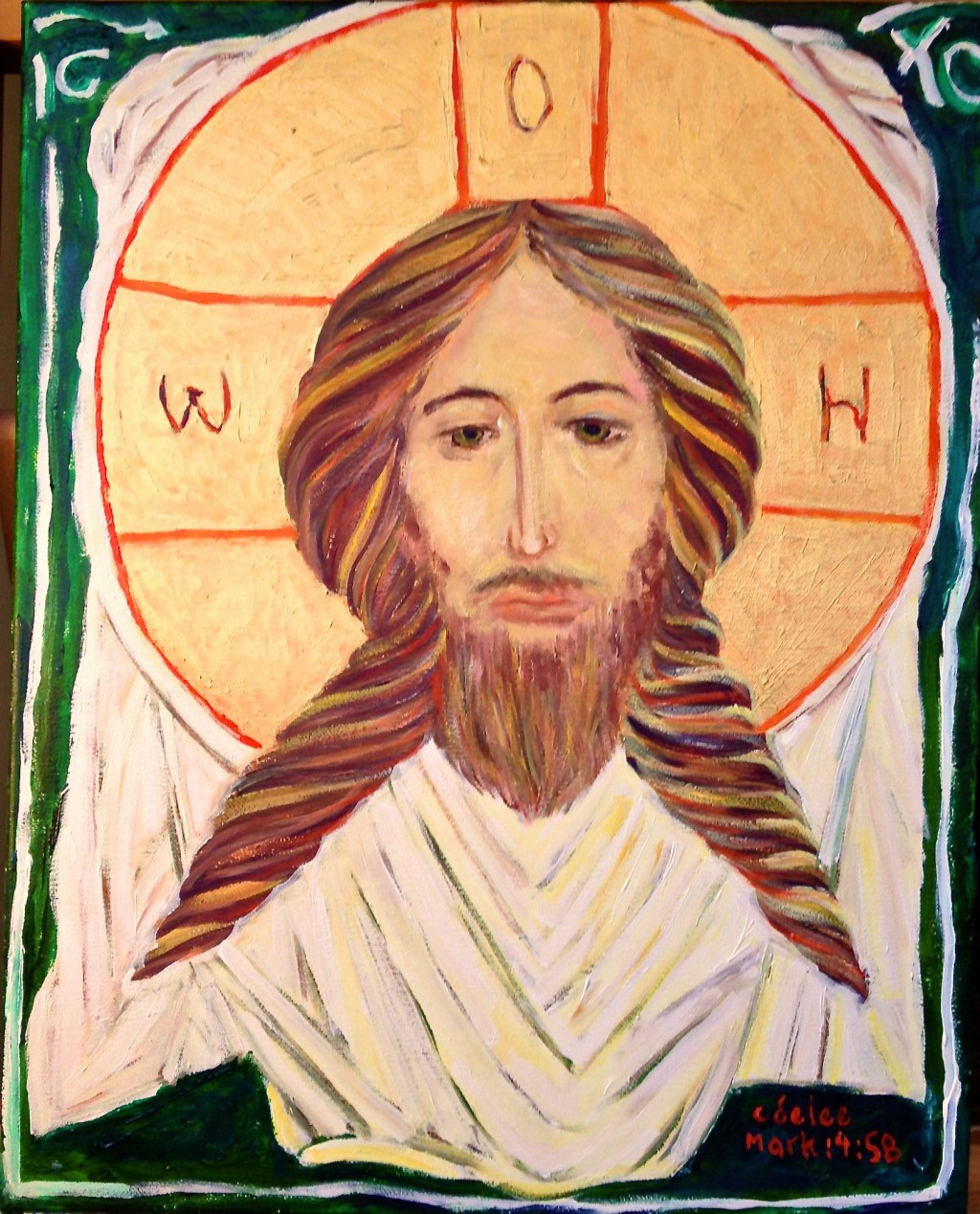
Icons are such sacred objects that they have acquired a sense of holiness all their own. This attribution of holiness to the icon itself, rather than to the person or subject represented, led to the Iconoclast Controversy. Some destroyed many precious works of art because they thought the image was being worshiped, rather than God or Jesus. We do this today, of course, when we worship our “litmus test issues,” such as which Bible translation is the only sacred cow, what age the earth is (a cover for the Creation science or evidential science debate), or picking a Christian candidate to support (by virtue of the proof texting quotes with which we agree, of course).

My thought is that we still worship the image, but fail to worship God or Jesus. If we were to go beyond the icon/image, we might see more of us meeting the Christ who lives on the streets, in the prisons, and in the sickbeds of our nation:

Then the king will say to those at his right hand, ‘Come, you that are blessed by my Father, inherit the kingdom prepared for you from the foundation of the world; for I was hungry and you gave me food, I was thirsty and you gave me something to drink, I was a stranger and you welcomed me, I was naked and you gave me clothing, I was sick and you took care of me, I was in prison and you visited me.’ (Matthew 25:34-36)

In the ten hours I was in my studio assembling this icon, I had time to remember where I found all these items that make up this altarpiece. The two red supporting decorative brackets are from a home decorating project that never got off the ground because I decided to tear out the old counter space rather than to make a mosaic there. I hauled the wood shelf back from a walk. It was once a scrap piece of a fence that kept someone out or in. I pick up sticks that feel right, and scraps of wood or crushed soda cans that call out my name. The debris of this world has a beauty of its own kind, just as the acknowledged fine materials of our convention have value. If one day we found a way to manufacture gold, the metal would become base in a heartbeat.

That Chrysler hubcap was a real find! I may have found that on vacation when I stopped along a quiet roadside to snap a photo. The old crosses are from my days of living in large homes, rather than a small condo. The green glass cross broke in a move, but I couldn’t give it up. Most of us can’t give up our brokenness to the Christ who said, “This is my body, broken for you.” This is why we share our broken lives with all who are broken by sorrow, illness, pain, or hurts. We may wind up rusted on the side of the road, like the windshield wiper or we may end up painted over and stashed away in a garage like the board on which this icon exists. I also used beads and old pieces of jewelry that needed to be recycled and repurposed, in the great icon making tradition.

The power of the icon isn’t in the materials. I’ve made icons of macaroni and plastic jewels that read “holiness” as much as any ancient icon. I’ve had people make icons from their grandmother’s jewelry boxes. These too read as holy icons, even if they are nonrepresentational. The power comes through the Holy Spirit into the artist and then into the work. When I make a work such as this, my hands are steady, my pace is slow, and I lose all track of time. I enter into another realm, so to speak, that of the icon itself. The ancients believed that the icons were a window into heaven. I believe this is true, for the power of such an object is to take us out of our ordinary experiences and into a world where there is no more hunger, pain, or grief.

The icon’s great mystery and power is to remind us that ordinary materials can open us up to the truth and beauty of the holy. When our eyes are jaded by the ugliness of the world about us: wars, beheadings, poverty, injustice, economic destabilization, and human insensitivity, look upon the icons and enter into the power of the one who makes all things holy:

“He will transform the body of our humiliation that it may be conformed to the body of his glory, by the power that also enables him to make all things subject to himself.” (Philippians 3:21)

2015/01/img_8837.jpg

THE HUNGER GAMES: Thank You for your consideration.

Family, Food, garden, home, Imagination, instagram, Mental Illness, Ministry, purpose, renewal, Secrets, shame, Spirituality, Strength, Travel, Uncategorized, vision, Work

For some reason facebook decided that my 7 pages of art, cooking & spiritual formation seemed unconnected. They thought that my Page Manager App perhaps wasn’t really run by one person. How indeed, could one person have so many varied interests? How could they find all the ordinary aspects of this life relating to faith? Oh, I guess, only those who grew up reading that one good book and hearing the stories of everyday life spoken in the ancient parables and metaphors of a distant age and land would understand how to translate this way of speaking into a modern language.

I guess our world today is too one dimensional and too targeted, or perhaps facebook has fallen victim to its own splicing & dicing. We too often only share that part of ourselves that we think others want to see, or we hide that part that we think is not approved by others.

We forget that our weakness is often the key to opening the pain of others so that can begin to heal, or that our struggles are what help others to have the courage to try one more time when the going gets tough. Our world is so sold on the outward appearance of success that the inner self can be falling apart at the seams.

This is why we go through the motions of life, but the fire no longer burns inside. This is why we acquire many things, but have no satisfaction in their holding. This is why we yearn sometimes to have only a small garden, or just a backpack, or to be in a deer stand alone to see the sun come up through the pines. We may make a living, but we may not be making a life.

Once we lived under one umbrella and sought to find one large tent or tree to shelter as many as we could, but now we each seek a tiny pup tent for each person’s own comfort and solace. How many of us have progressively cleaned our facebook friends until we find just those who vote like us, eat like us, think like us, and are like us?

Soon we will no longer feel the fire, no longer want to burn up in the flames of power, and we will be content to watch the Hunger Games on our TV sets. The young will burn and catch on fire and we will be content to pass commentary upon it.

I hope I never get that old. I plan to always be hungry at CORNIE’S KITCHEN, making art at ARTANDICON & CORNELIA DELEE & celebrating faith at ART AND SOUL FUMC HS, ARKANSAS SPIRITUAL FORMATION ACADEMY, & TRIBE OF DAN.

IMG_1681.JPG

OPEN WOUNDS AND LOOSE BINDINGS

Creativity, generosity, Health, Mental Illness, Ministry, mystery, photography, poverty, purpose, renewal, shame, Spirituality, Strength, Uncategorized, vision

IMG_4672.JPG

Sometimes we bind our wounds with bandages that don’t quite cover the scars. Then these scrapes and cuts don’t heal properly, but stay open and never mend. The doctors among us may be concerned that these wounds are sites for a new infection, but the healers know that suchwounds are given to us for the healing of others. Our visible scars make us accessible to the woundedness of others. If we hide our woundedness and weakness under the bandages of strength, then they may be afraid to seek us out for comfort or support.

if we hide ourselves behind our well placed bandages, then we have missed the opportunity to pour out our experience of God’s love and hope in our lives into their lives. Perhaps that is why the wounds of Christ’s crucifixion were visible on his resurrection body. Most people think after they die, they will have a perfect body, but if we get a body like our Lord’s, surely we will have the evidence of the scars of this world, even if we no longer feel the pain.

Those of us who are bearing the pains of the world in our hearts, minds, and bodies will show those scars on our outer selves. We can’t wrap ourselves up like an Egyptian mummy! Even if we did, these bandages would fall away and expose our woundedness. Only then can we be best used by God.

Psalms 147:3–He heals the brokenhearted, and binds up their wounds.

THE HOLY NODE AND THE FOUND BUTTERFLY

butterflies, Creativity, Health, Icons, Imagination, Meditation, Mental Illness, mystery, Physical Training, purpose, renewal, Strength, Travel, Uncategorized, vision

20140316-083445.jpg

I’m not a fast walker, for my first goal in walking isn’t to break any record for my usual 1.5 mile jaunt around Mercy Hospital here in Hot Springs, Arkansas. Neither do I stroll, for Bon Jovi and the Boss sing a strong striding cadence in my ear. I can manage the hills better in one direction than another, for at least one is nearly 45 degrees. I go up this hill once a week. It never gets less steep. The rest of the week I go down that hill. At my age, there’s no sense taking any more years off my life than necessary!

My goals as I walk are to be more conscious of my body, to care for it better, to build my body for endurance and health, to be outside in the sunlight (natural vitamin D), and to develop a better attitude (exercise releases endorphins that lift one’s mood). Walking also seems to clear my mind of worry and anxiety about others.

In that large hospital, I know that healing is going on. While some may be “losing the battle” against whatever dread disease has attacked them, they have “won the war” and received their final healing from God. We think our life is over when we close our eyes and breathe no more, but our life is just beginning in a newer and more wonderful way!

As I make my rounds about the hospital grounds, the wind blows through my hair, the sun falls on my face, and I see the sun shaped shadows of the pines and the pear trees. Even the ornamental lake reflects the colors of the sky and clouds. Heaven and earth are more connected here even though my path is just beside the eternally busy bypass of Highway 270.

There are nodes in space and time at which the intersection of heaven and earth seem to open up to one another. The Celtic tradition calls these “thin places.” All across the world we can find sites that were considered holy by one successive people & faith after another. When you walk into such a place, you can feel the years of prayers within the space.

This route I take, while short, has become a holy node for me. It was the reason for two found object works: The No Room Inn and The Healing Christ. I also did a landscape of that decorative pond. Now I am painting the various butterflies I have collected on my journeys. These are symbols of the new life to come because they wrap themselves in a cocoon (grave cloths). I think of them as an icon of the new life we live when we see the light of what is possible in Jesus Christ himself:

“I have come as light into the world, so that everyone who believes in me should not remain in the darkness.” — John 12:46

Time and Eternity: Standing Still While the World Rushes By

Dreamscape, epilepsy, Family, Food, Health, Imagination, Love, Mental Illness, Ministry, mystery, New Year, purpose, Secrets, Spirituality, Strength, Travel, Uncategorized, vision, Work

20131221-120631.jpg

Greetings at the transition of the old year and the beginning of the new year. I took a long break from my weekly journal to participate in the National Novel Writing Month, or NaNoWriMo as it’s so fondly called. The goal is 50,000 words in 30 days. I didn’t make it, but I didn’t join until 10/12 and I took off four days for Thanksgiving. Still, I managed 27,000+ words and got 47,000 in by the second deadline of November 8th. I felt pretty good about my first shot at a novel.

So, if you bear with me, you will get a chapter a week in this place I call ARTANDICON. The title is “The Wandering Soul”: a priestess of the god of care and compassion discovers that her epileptic seizures are unique, for they dislocate her in both time and space. She travels to a distant planet, which is earth, and there observes and interacts with the cultures and religions of that world. She comes back in our time, but also in other more ancient times. A very strange dis-ease, but it gives me the opportunity to reflect on life, love, mystery, purpose, meaning, and all the other great themes we wrestle with as we journey through our days.

The One Who Shows Weakness Is The One Who Is Healed

Creativity, Family, Food, Health, Holy Spirit, Mental Illness, Ministry, poverty, purpose, renewal, salvation, shame, Strength, Uncategorized, Work

20131018-084217.jpg

Again he entered the synagogue, and a man was there who had a withered hand. They watched him to see whether he would cure him on the sabbath, so that they might accuse him. And he said to the man who had the withered hand, “Come forward.” Then he said to them, “Is it lawful to do good or to do harm on the sabbath, to save life or to kill?” But they were silent. He looked around at them with anger; he was grieved at their hardness of heart and said to the man, “Stretch out your hand.” He stretched it out, and his hand was restored. (Mark 3:1-5)

Jesus is all about the change or the cure. Jesus makes the difference in a person’s life from being on the margins to being brought back into community. This is the original good news of the Gospel, but we in the modern church seem to have relegated this message to “scripture alone.” We are more about showing only our “fixed up faces” rather than our “withered hands” that need The Lord’s touch to make us whole again. The former we can fix with make up and masks, but the latter needs true spiritual power.

No wonder that when our paintbox is exhausted and our good hand is weary of holding up the disguise of competence before our faces, our carefully constructed facades of “managing” begin to crumble. One more tilt in our tectonic plate will cause the whole to crumble like a Haitian slum dwelling. Yet we persist in thinking that “If I only try harder to hold onto my strengths, I will make my way through these hard times.” We don’t understand the gospel message of surrendering to our weakness in order to receive healing and wholeness.

We tend to think of healing as the absence of disease, but often healing is acceptance of our condition and making the changes in our life necessary to live in “wellness.” When my doctor said I was insulin resistant and on the way to becoming diabetic, I began to exercise more and count calories and carbohydrates. I lost 50 pounds, am stuck there now, but have my blood sugars in the range of normal. I still have the low blood sugars, so I’m not out of the woods yet, but my lifestyle change is a form of “healing.” It’s not a miracle of course, but my faith and the Holy Spirit empowered me. Likewise, for one who is depressive or bipolar, taking medicine regularly and participating in therapy sessions is a part of their wellness plan.

We move so quickly each day, throwing on the mask or the makeup, that we don’t engage our selves in the mirror except to think, “my upper lip needs waxing again!” Or “how did my eyebrows get so brushy?” Then we are on our busy way, filling up our hours and minutes with activity both meaningful and mind numbing. The searching of our heart of hearts, or introspection, isn’t our long suit, anymore than long term planning. We tend to do what is immediate and before us. Because we have constructed our masks so well and worn them for so long, our heart of hearts is buried under many layers.

If Jesus came to our place of worship, would he be able to see these withered hearts? Are any of us as brave as the man in the synagogue, that we would offered our withered heart out for all to see? The one who shows weakness is the one who is healed.

Leaving The Garden of Guilt and Shame

Creativity, Family, Food, Forgiveness, Health, home, Imagination, Mental Illness, Physical Training, salvation, Secrets, shame, Spirituality, Strength, Uncategorized, Work

Adam & Eve Hiding in the Garden of Eden

Adam & Eve Hiding in the Garden of Eden

“They heard the sound of the Lord God walking in the garden at the time of the evening breeze, and the man and his wife hid themselves from the presence of the Lord God among the trees of the garden.”  ~~ Genesis 3:8

 None of us have ever grown up in the Garden of Eden: we grew up in our families of origin. Our parents are generations away from Adam and Eve, but the shame and guilt of these primal ancestors still operate in our family histories today. My own family operated on a shame culture: the honor of the family’s name and our place in society was very important. Often we children were punished in a group: as the oldest, I should have known better and prevented my two brothers from being trouble makers; the boys were punished because one started the fight and the other finished it, or he came back to tattle.

“Wait till your Father gets home!” was a promise of a second round of punishments, which was always meted out from oldest to youngest. I was glad to be the oldest at this time, for I wouldn’t have enjoyed anticipating my turn: I was relieved to get it over with. I was trained early not to get into trouble, or to hide my duplicity well. My brothers were slower to learn.

In our family, guilt didn’t operate as in the criminal justice system, in that the individual was held accountable for his own actions. My parents figured all of us had a hand in the pie of corporate corruption and our behavior, either inside or outside the home, brought dishonor to the family name. “No child of ours is going outside dressed like that! Go change your clothes!” This meant, “what will others think of us if you go out looking like a tramp, or in rags, or mismatched, or like a hippy, or without makeup, or (heaven forbid) wearing white after Labor Day?” Boys brought honor to the family by working after school because they had to learn how to earn a living, but girls who worked an afternoon job brought shame: “people will think your father can’t earn enough money to take care of this family.”

Some of us learn from classes, others from experience. and still others of us learn from stories.  Our ancestors were great storytellers. The sum of human nature they could wrap up in just a few sentences: “Once upon a time, the Lord God walked with Adam and Eve in the Garden of Eden each evening when the cool breezes broke the day’s heat.” We don’t know the form or aspect of the Lord, but we know he was present daily and intimate with his whole creation. This must have been a time of joy and wonder, and a privilege to look forward to at the end of the day.

Yet the man and the woman wanted more, “to be like God knowing good and evil” (Gen 3:5). Deciding to become wise, they ate of the tree and their eyes were opened: “they knew that they were naked and they sewed fig leaves together and made loin cloths for themselves” (Gen 3:7). Biblical writers do have a sense of humor, for if these first people were truly “wise” they wouldn’t have chosen fig leaves for their garments, since figs give off an itchy sap.  They may have “hid their nakedness,” but they were also “scratching their nakedness” at the same time.

When the Lord God came for his evening walk, they hid themselves. Do they feel guilt or shame? Our modern, individualist point of view says they feel guilt, but the Bible is written from an ancient Middle Eastern Shame & Honor Culture. They feel shame for breaking ties with the Lord God and not listening to his words, but to the words of his creation (the snake, Gen 3:1-5). Their nakedness is a symbol of their new vulnerability before God: before they were free to be themselves, but now they hide behind inadequate clothing and behind the trees of the garden. They are afraid to reveal their wrongdoing out of the shame they feel.  They have dishonored the one who gave them life.  Their consequence is to lose their former intimacy with God and be banished from the garden, but God puts protective clothing on them.

Even today, God asks his people, “Where are you?”  and we think we can hide behind our false fronts: our happy faces, our spiritual posts on Facebook, our meticulously groomed bodies, our 100% attendance ribbon at religious events, and our other outward evidence of our faith lives.  Or we might be hiding in our “caves/homes” hoping that God won’t see that our once well-constructed lives are falling apart like some Bangladeshi garment factory. God is all knowing, however (Psm 147:5), so there is no place we can hide. We can try to coverup our shameful past or our guilty present from God, but to no avail. These things are not important to the God who knows all that we are and all that we can be.  Accepting responsibility and returning to a relationship is what God wants from us.

One thing Adam and Eve failed to do was take personal responsibility for their deeds. Adam blamed it on God: “you gave me the Woman & she gave me the fruit,” while Eve blamed it on the Snake: “he talked me into it” (Gen 3:12-13). There must be some terrible and overwhelming experience in the discovery of our true selves, for we have had it hidden under our parents’ expectations, our society’s expectations, our religions’ expectations, and our community’s expectations. When we begin to strip these extraneous layers off to reveal the true self and the child of God, we find the individual who used to walk freely with the Lord God in the garden when the evening winds were blowing.

For some of us, our secret pasts bring us shame and dishonor. We need to remember that guilt is for something that we have done wrong, and we can atone for. We can pay a penalty for it, make amends, and make it right where it was once wrong, or we can do a right act in replacement for a past wrong. Time we heal the pain of guilt. We can confess the guilt and receive release from its stain.  This is the hope of justice, or righteousness in Christ.

For shame and dishonor, we need to understand that these are deeper issues: feeling that we will not measure up no matter how hard we try, that we will never be good enough, and our suffering will not ever end.  We who hide behind our frozen smiles and our itchy fig leaves need to stand under the flooding shower of pure grace and hear the words from the Lord God:  “You are my Son, You are my Daughter! With you I am well-pleased!” (Mark 1:11)

There are many great artists’ works of Adam and Eve in the Garden of Eden. Google these images.  Notice how the artists handle the nudity over the years and how the body image changes. Think about your own body image.

Do you have shame thoughts when you observe your own body? Listen to the words you hear in your mind.

Ladies—Are you trying to be a size 0 runway model when your body frame is really a 16—and is that a healthy goal? Is this a goal of society or your own goal?

Men—does your trainer want you to look like a magazine photo or do you just want to be healthier? Do you want to workout 8 hours a day or 1 hour daily? Is focusing on an ideal body image healthy, or is focusing on your whole life a better choice?

I recommend you “like a Facebook page” I host:

Cornie’s Kitchen: Whole Foods for Whole People. http://www.facebook.com/pages/Cornies-Kitchen/411859538836606

Read more: Shame-Culture and Guilt-Culture

Atherton J S (2011) Doceo; Shame-Culture and Guilt-Culture [On-line: UK] retrieved 22 April 2013 from http://www.doceo.co.uk/background/shame_guilt.html

Under Creative Commons License: Attribution Non-Commercial No Derivatives

Making Sense of Grief

Creativity, Family, home, Imagination, Mental Illness, mystery, purpose, purpose, renewal, salvation, Secrets, Spirituality, Strength, Travel, Uncategorized

“A voice is heard in Ramah, lamentation and bitter weeping. Rachel is weeping for her children; she refuses to be comforted for her children, because they are no more.”~~ Jeremiah 31:15 

Reflections of sky and sun in  a pool of water.

Reflections of sky and sun in a pool of water.

We crossed the Isthmus of Corinth to the Old City to hike among the ruins of Acro-Corinth. Two famous and sacred springs flow there beneath the renowned Doric Temple of Apollo.  Its spare monolithic columns rise above the old city center’s area of commerce and religion. One spring is the Peirene Fountain, the city’s major source of water. It was named for the woman who wept so hard when Artemis accidentally killed her son in a hunting accident that the goddess took pity upon her and turned her into a spring of water. Nearby is a hidden spring of water, sacred to Artemis herself and located underground beneath the ancient Temple of Apollo. Because Artemis was both a protector of youths and the bringer of harm to them, devotion to her cult of “protection” became interwoven with that of the “fates,” mythological beings who controlled the lives and destinies of humankind.

Into this underground shrine and spring, devotes of Artemis would come for protection during childbirth, bring their young children for blessings of protection, and families would come to celebrate the great transitions of life just as we do in our faith communities today: hatching, matching, and dispatching. After invoking the goddess’ blessing, they would sacrifice a living animal. Having appeased the god’s power, the people went off to live their daily lives. A sign in the underground sanctuary said “Do not enter: forbidden—Eight coin fine.” Even today this warning holds true, for we can’t access this tunnel.  It has yet to be excavated. It may have led to the hidden chambers for the priests and priestesses of the Artemis cult, it could have been a passage between the spring and the Temple of Apollo, or it could have been the passageway into the rooms for the initiates into the mystery cult of Artemis.

Artemis as “protector” brought prosperity to fields and crops, herds and wild beasts, as well as long life, peace and health to her human devotes (Callimachus, Hymn 3 to Artemis, 3rd C BC, www.theoi.com/olympios/Artemis.hmtl). However, just as she could protect, so also she could bring down, for she was a hunter and her arrows were swift and true. One never knew if today’s blessings would continue on the morrow. Over the years, the Greeks developed a mythological concept of Fate or Moira to further explain their understanding and meaning of life.

The Fates were illustrated as ancient women: one spun the fiber of our lives, one measured the length of the thread, and the last cut the thread with shears to determine the end of our lives. “Moria/Fate brings good and ill to mortals and the gifts of the immortal gods are inseparable” (Solon, Frag. 13, 6th C BC). They didn’t believe in a person’s freedom of will to choose, for they believed a person’s destiny was set at birth (people who believe in astrology and horoscopes are examples of this type of thinking).  “But mortals are not free to choose prosperity nor stubborn war, nor all destroying civil strife: Aisa (Destiny), giver of all things, moves a cloud over this land, now over that” (Bacchylides, Frag. 24, www.theoi.com.Daimon.moirai.html).

We all deal with death in our lives.  Our own bodies are dying every month: at least our outer layers of skin are, which we shed every thirty-five days. In a sense, we are “new people” about eleven times a year! This loss happens so often that we ignore it until the house needs dusting. However, when we are struck with a great loss, a huge grief, or an inconsolable sorrow, we can become like Peirene weeping and wasting, or Rachel refusing to be comforted.  It doesn’t matter what our loss is: death of a child, loss of a breast, demotion at work, disability, terminal diagnosis, loss of limb, death of a beloved pet, divorce or breakup of a relationship—we are blindsided by this event.  “It isn’t supposed to happen this way! What kind of God lets these kinds of bad things happen to good people?”

At times like these, we forget that God has experienced first hand the suffering of his Son’s agony on the cross. God isn’t unfamiliar or unaware of the cost of pain and the experience of death. Anything that the Son experienced here on earth was also experienced within the Holy Trinity, which never ceased to be Holy or Three in One. Even when we forget this subtle piece of reasoning in our own pain, and all we want to do is kick the shins of the Almighty or put our boot into his hind parts, God knows that we are consumed with our own suffering and agony. Our anger against God is just a reflection against the circumstances in which we find ourselves: bereft, abandoned, hurting, despairing, and worn out by sorrows.

I think of my cousin Tommy Mac: brilliant, good boy, golden child. Not like his older brother Earl Jr., who would barely get through high school due to his good old boy party ways. Tommy had a full scholarship to a big East college and was going to law school and make his parents proud. The summer before law school, he drowned in a tubing accident on a swift running stream.  His parents were in the bedroom to receive visitors, but all they could say was, “Why would God take this one?” I don’t know if Earl Jr. was there also, but if he were, I hope he heard only the grief of his parents speaking. More likely he would have thought, “Have you not reserved a blessing for me?” (Gen 27:36).

I walk into the home of the one who took his own life and left his family devastated.  They didn’t know how troubled he was, for they would have helped, or they may have been reaching out, but nothing they could have done would have been enough.  Wracked with guilt, they ask, “How could he leave us? Will we see him again?” All I know is that sometimes our “real self” is lost to our “dark self.” This darkness convinces us that no hope exists, no one cares, no help is available, and no life is worth living.  The dark self can’t see God, but God can see all things: “Everything exposed by the light becomes visible, for everything that becomes visible is light” (Ephesians 5:13-14). Many believe that suicide puts one’s self outside of the love of God, but scripture affirms that “not anything else in all creation will be able to separate us from the love of God in Christ Jesus our Lord” (Rom 8:39).

How do we get beyond the grief that binds us to it or causes us to waste away until we are mere fountains of tears? Some parents make their child’s room into a shrine. This “guest bedroom” is like visiting Graceland or Neverland Valley Ranch. It pays homage to a “star” but it isn’t meant to host visitors overnight, for it is prepared for the return of the King.  Others grieve inwardly, and move on, but live within a shroud. They expend their energy of grief in giving back to others in their community, just as Peirene did. Her tears became a fountain of life giving water for the city.  Children gathered to play there, women met to share their lives, men gathered to make business deals, and the city thrived. If Peirene couldn’t answer, “Why was my child taken by the goddess?” then the only peace that Artemis could give her was to let her share the gift of life for others in exchange for the stolen death of her son.

Perhaps this is how the ancients came to tell this story to understand how one recovers from a great grief.  To give one’s self for others is the greatest gift:  “No one has greater love than this, to lay down one’s life for one’s friends” (John 15:13). Peirene’s Fountain kept the valley watered, lush and beautiful the year round. Her outpouring of grief gave a blessing of life and beauty to the town. In the hidden and sacred spring, Artemis was worshiped as a protector and savior for the family.

Today we recognize that these waters of life come from one Savior: “Let anyone who is thirsty come to me, and let the one who believes in me drink” (John 7:37-38). Find a mug, cup, glass, or your favorite drink container.  Fill it with your favorite beverage.  Sit down with it and begin a page of memories about the person(s) or situation(s) that fill you with grief. If at first all you can do is write their name or the word identifying them on the page, that is fine.  Sit with this and drink for a while. As the words come up, write them down. Now is not the time for pretty paragraphs, outlines, or perfect punctuation. Organization isn’t necessary. In fact, if you just write in jotted notes all over the page or in boxes, you can “organize it later.” We are looking for FOUNTAIN FLOWING THOUGHTS—automatic writing, if you will.  Let the words flow out of you like the tears of Peirene or Rachel.  Later you can put this catharsis to good use.  This is your spiritual cleansing experience for the week.

Doing Battle With The Dragon

Children, Creativity, Fear, Health, Holy Spirit, Icons, Imagination, Mental Illness, mystery, purpose, purpose, renewal, Stress, Travel, Uncategorized, vision, Work

“The horse is made ready for the day of battle, 
but the victory belongs to the Lord.”  ~~ Proverbs 21:31

Mount Erciyes, Cappadocia, Turkey As I journeyed with my group along the Silk Road on the fourth day of our pilgrimage, we saw the twin peaked volcano Mount Erciyes, on which St. George of Cappadocia was said to have slain the dragon. As we made our 400 miles across the sunlit fields with poplar trees into the tufted fairy mountain volcanic formations, I had several conversations about art and artists with my fellow travelers. We had visited the Firca Ceramic Factory in the morning. The artisans there explained their apprentice program and the process of training to become a master potter. Not everyone makes the cut, of course, but they can still be employed at the level of tradesman or tourist ware producer.

For people who have no concept of the time, effort, sensibility or spirit that is necessary to produce a great work of art, this “educational session” went right over their heads. Others had their “consciousness raised,” as we used to say back in the old days. This latter group happily gave a fair price for the extraordinary works of these artists’ hands.  I myself brought home a small plate of colorful fish to remind me that I am always called to “fish and to catch the hearts, souls, minds, and bodies of others for the sake of Christ and his church” (Matt 4:19).

At lunch I visited with one of my new friends. She asked, “Why did it take Michelangelo so long to paint the Sistine Chapel?” Because it was fresco—fresh plaster. He could only work while the plaster was wet. Bodies with clothes and landscapes went quickly, but nudes and faces were painted more slowly. If we could get up close we could tell by the edges and lines how much he did in a sitting. “Oh. Everyone who saw the chapel on our tour was kind of bored with it all. Now I understand why it was so important.”

I realized it’s because not many of us make art anymore, just as most of us don’t can jams or jellies. We also don’t quilt, knit, crochet or embroider. We buy our clothes premade and our foods prepackaged. Cooking from “scratch” is a lost art. We don’t seem to want to dirty our hands any more with the creative process. Instead, we have lost the spirit that calls us to enter into battle with the raw materials. We are a people without faith that God is with us in these fights. It is as if we are afraid to risk losing the battle, so we do not enter the fray.

I have recently been teaching art to prekindergarten children. The first thing I had to teach their classroom teacher was that “failure in art is part of the process of learning how to succeed.” In other words, it’s not the finished product of polished perfection that we seek, but the child’s growth in using the tools correctly and their creative response to the imagination challenge of the day.

The second teaching principle was allowing the child to do his/her own work.  Many of our parents have “taken over” doing for our children so they can have a good outcome. These children will have poor motor skills and will not be self-sufficient when they grow older. They will be less independent and less confident.  However, they can master skills in art class that can give them a sense of self-esteem that comes from accomplishing a task, taking charge of their own work, and creating their own designs from their own fertile imaginations.

The third principle about art is joy, and I usually don’t have to teach this to the children.  They love to play and the colors, materials, textures, and tools are great ways to explore the world in play. For adults, however, art is about the finished product from the get-go, so we worry that our idea will not come across on the canvas or paper.  For the work to come alive, the artist must let go of that original idea and go with the image that begins to come to life on the canvas. Sticking with the old idea is like staying with the old battle plan when the lines of engagement begin to shift. We all know what happened to General Custer at Little Big Horn.  The same death will happen to our creative product if we don’t pay attention to the new information coming t us from the front lines.

Likewise, in our lives, we don’t listen to the battles going on in our hearts, minds and bodies. Some might call this our conscience, or that voice that whispers “this isn’t right for you.” That other voice that whispers so sweetly, “but everyone else is doing it…” is like St. George’s dragon, or the personification of evil. Flip Wilson’s character Geraldine used to say, “The Devil made me do it!”

We can go along with the “demon voice” of “everyone else is doing it” and discover that our moral standards are at the lowest common denominator, and we make decisions not on any ultimate truths or standards, but on conditional and relative criteria. The ground is always shifting under us, like a mountain about to erupt. If we refuse to fight this particular dragon and “go along to get along,” then either our mental health or our physical health will begin to fail us. We may intellectually marshal the arguments of reason for our refusal to do battle against this insidious dragon, but like the fiery beasts of the old tales, they will surely begin to ravish the countryside.  In this case, the country isn’t Cappadocia, but the heart and mind of the one who needs to gird the horse for battle.

Many of our modern illnesses are related to stress, which comes from having to reconcile two discordant tunes in one’s head. Only when we can fine that one tune to hear will we be both well and at peace.  Another image is trying to “spot paint a wall that was painted too many years ago.” Putting fresh paint over dull color will make this one spot stick out like a sore thumb.  One must paint the whole wall, and of course, the other three walls and the ceiling, for the rest will look too sad next to that freshly painted wall. The truth is we can’t just put a new piece of cloth on to an old garment; we must change out the whole thing. This is called a “make over” or a life style change, or the “new life in Christ.”

I myself have had a lifestyle change from the hectic, caring for the lives of others that is the life of a pastor to the new life of caring for myself in these years of being on incapacity leave.  These past four years others from my old life have pushed me to be “more involved and to do more ministry with and for others” in the hope that I will be able to return one day to full or part-time ministerial service.

As I listen to my body, I realize that the stresses of these activities aren’t for me anymore. I can do them on an occasional basis, but not on a weekly basis, and definitely not on a daily basis. I am healthier when I am in the solitude of my studio writing and painting. I need the quiet to stay well and avoid the stress that brings on the seizures. Here I can reflect on the battles between good and evil, the struggles we all have to live the full Christian life.

We all do battle against the dragon.  Some of us want to be at the heart of the action, to receive the affirmations of the people to be there for them and to touch their lives. We think if we can make a difference here, it will atone for our failures to make a difference somewhere else or in some one else. We will be at peace when we understand that while we may gird the horse and swing the sword, “the battle belongs to the LORD.”

As an artwork for spiritual reflection, find an icon of St. George and the Dragon. As you meditate upon it, write out the words of your particular “dragons.” These are the powers and principalities that you struggle against: pride, fear, self-doubt, worry, hopelessness, arrogance, anger, weakness, hate, etc.  You can make the words of any size or shape. Embellish them with wings, give them an elongated tail, scales and an open gaping mouth. Now draw a large sword, gleaming brightly in the light of day. Upon this sword write the words of power that come from scripture: “The battle belongs to the LORD!”

Keep this image near you this week and draw strength from it: God is at your right hand!

For photo & info on the volcano at Mt. Erciyes:  http://volcanocafe.wordpress.com/2012/03/29/cappadocia-upright-volcano-of-turkey/

For Illnesses related to Stress:  http://www.webmd.com/balance/stress-management/features/10-fixable-stress-related-health-problems

People, Politics, and Mute Buttons

Creativity, Family, Health, home, Imagination, Meditation, Mental Illness, ministry, poverty, purpose, salvation, Spirituality, Stress, Uncategorized, vision, Work

“Indeed, there have to be factions among you,  for only so will it become clear who among you are genuine.” ~~ 1 Cor 11:19

 Red State, Blue State. Latest polling numbers. Romney chooses Ryan—Breaking news! Pick Bump, Attack Dog, Spin Doctors, and Campaign Ads.

I’m already warming up my remote and I long ago quit watching cable news of any type or stripe. If there are factions in the American public concerning our politics, why are we surprised when we discover that divisions prevail inside the hallowed walls of our places of worship?

First, we have a misguided idea that the church is a warehouse for saints. This metaphor is the farthest from reality, for the church is more like a factory that takes raw materials (sinners) and re-processes them over a period of time into a more useful product, “the saints.” Even though we are “saved by our faith in Christ,” our old sin habits remain, and that is the long term work of the factory as the imperfect saints who carry the image of the holy God within them yearn and work to be conformed to the truth of God’s holiness in the entirety of their lives: heart, soul, mind and body. In as sense, we remain in the finishing room of this factory/church until we die. Then God takes us for our final “touch up” into his heaven and we are put into his eternal service there.

The earthly factory that is the church is an odd enterprise, for it’s the body of Christ. It serves the body that lives within the walls of its meeting place, but it also serves the body that hungers, thirsts, is naked, imprisoned, lonely, and oppressed outside of its walls. These saints in process sometimes fall out into factions over the best way to do these things, who should lead them, or what teaching to follow. Sometimes they don’t want to do the work at all. This bloc is the most difficult, for they want to let others work, cast blame on why it isn’t being done better, or done as it was in their day (when things were glorious in the factory and everyone prospered). Of course, they aren’t going to come off Mount Critical to advise or mentor a new generation because that would take time and energy out of their well-earned retirements.

I think of this last crowd as the “surplus saints” who are last year’s model. It’s best if we just ignore their carping, pet them on the head and tell them how wonderful they are and send them off on yet another trip to the local gardens or the museum. Keep them active and busy, but keep them off the working floor if possible, unless they share the vision that God means for us to work for good in his world as long as we live just as he is working for good in all things (Rom 8:28, Eph 2:10).

Paul says that factions show up in a church so that the “genuine will be sorted out.” The ancient farmer separated wheat from the chaff by throwing all of it up into the air. The wind blew away the lighter chaff and the heavier seeds fell to the ground. So also the storms of life come to us as individuals and as a church. If we think of these times of sifting wheat from chaff, separating the true from the false, then we will endure with equanimity the struggle before us. The factions without and within our sacred walls won’t disturb our inner peace.

I have a friend who is stressed over the Muslims attacking the Christians in Africa. She believes that will happen in America and attaches this belief to our current president’s work in opening a dialogue with Muslim countries. I think she is projecting outward her stress that she deals with at home with her bipolar adult son and his wife who are awaiting a long delayed Social Security disability claim. This is her way of diffusing the stress she has to deal with by worrying about something that she can’t do anything about.  If she were to step back from her situation, she would realize that she can’t cure his illness, she can’t make the claim come quicker, and if it does come through with a lump sum back payment, her son will not be able to manage the money and will be just as homeless in a year as he was when she and her husband brought them home to live here in Arkansas. He is forty something years old and needs professional help. They can’t see it yet, and so she blames Obama for her lack of inner peace.  I don’t think he is the “great Satan” she thinks he is, nor is he the savior of the universe or even a lesser angel. Man or woman alone will not solve the unsolvable problems of this world, whether they be political, religious or social.

In theses storms, we seek a quiet place. Every four years, I have a mute button that works very well. My general rule is the first campaign that throws the first mudball is the one I vote against. It’s already happened, so when the early voting opens, I can get my ballot down and counted. There is a spiritual quiet place that is better than any mute button: it is the place of “being” and “resting in God.” We are such active people; we have goals, to do lists, five-year plans, bucket lists, and planners to organize our lives. We often forget to plan “rest” and “downtime” as if it were a negative quality in our lives. Sometimes we even come to work sick because we are saving our sick days for our kids or because corporate frowns on “illness as weakness.”

If we were to take our calendars and day timers and post regular times for “quiet time with God,” then when someone wanted to schedule that time with us, we could say, “I have a prior commitment. Would the hour before or after be better for you?” The same would hold for exercise, or time with our spouse or loved one or child.  What? You don’t keep a calendar? You don’t have a schedule, a routine to your life? No wonder you feel fragmented, “factioned” and fractioned! This is our spiritual practice this week, to set a disciplined schedule for waking and bedtime, for meals, for daily quiet time with God (20 minutes) and for exercise (30 minutes daily). Journal about your experience.  Was it difficult to begin, or did you benefit by the end of the week?

As an art project, use the three primary colors, plus black and white. I chose scrapbook paper because I had it handy. I used a large ruler to cut the rectangles and squares with a matt knife. Once I laid out my design, I used scrapbook sticky tape to attach the papers, but you could use glue.  Keeping the design in rectangles and squares makes us focus and pay attention to the lines, colors, lights and darks. An hour or two will pass and you will not think of much else but the work in front of you. This is how resting in God feels. Your breathing will be steadier, your blood pressure will be lower as you will feel calmer. (Unless you are that Type A personality that just had to make this a race to the finish in RECORD TIME!! HIGH FIVE!!)  The good news is that “God is at work in all of us, both to will and to work for his good purpose” (Romans 8:28).