Solid Geometric Perspective

adult learning, art, Attitudes, Creativity, Faith, Holy Spirit, Leonardo da Vinci, Love, Ministry, Painting, perfection, perspective, picasso, shadows

Steps in drawing a Geometric Still Life: sketch, refined sketch, shadows, intense shadows and cast shadows

We are back in art class again on Friday mornings at Oakland United Methodist Church. Our first lesson is in solid geometry, but it’s not a math class. Art is more like learning a visual two-dimensional language to be able to render three dimensional objects on a flat plane. This isn’t as easy as you might think, but once you learn to see in perspective, you never can unsee it again. Art class is like an old fashioned one room schoolhouse, in which a teacher has students of varying ages and experience levels to instruct. I provide one lesson and modify it for each student according to their needs.

Gail S.—Pencil Drawing of Solid Geometry

The first day of class, I had three brand new students and one who has done this exercise at least three times before. Two others were out doing family obligations, just as I was missing in action last week due to attending my niece’s graduation ceremony for her MBA in Business Administration. Life and family watershed events are always important to make our presence known. The life of the artist is as important as the art itself. We aren’t just people who make beautiful objects for others, but people who make life beautiful by being present at their most important moments.

Vermeer: The Art of Painting, 1666-1668.

When we look at the painted floor in the Vermeer painting above, we know in our minds these stand for black and white square tiles. If we take a moment to closely observe them, we realize these are more like diamond shapes. This optical illusion is the result of perspective. Perspective comes in multiple forms. Linear perspective has one-point, two-point, three-point, and multi-point vanishing points. Aerial or atmospheric perspective uses color, clarity, and value as objects overlap each other and recede into the background. There’s also reverse perspective in which objects are larger as they grow more distant and foreshortening, in which nearby objects are emphasized.

Pop Tarts from the Pop Tarts Bowl Toaster Trophy in 2024

 Can we teach all of this knowledge in a single two-hour lesson? Absolutely not. Michangelos aren’t turned out like pop tarts from a toaster. In the Renaissance era, a family would place a youth between the age of 7 to 14 with a master artist to learn the trade. This child would do the chores of the studio and learn to grind the pigments and mix paint. Then they would progress to drawing and composition. After a training time, they might get to do the backgrounds of the paintings or the landscape. After eight years, if they were any good, they would be entrusted with an entire commission. Then they would venture out on their own or take over from their master’s studio.

Cornelia—Purple Geometric Forms

I started taking art lessons when I was eight years old from the city parks and recreation art teacher on Saturday mornings, and then after school from a former art teacher in town. My grandmother was a portrait and still life painter. I have been taking or teaching classes for over seven decades. Art is not a skill or a product a person can ever perfect. It is more like a journey of faith, one in which we are always going on to perfection, but by the grace of God, will only be completed at our last day. Even at my age, I have more than a few “needs improvement works” left to create.

Tonya—Black and white Geometric Forms

The more you know, the more room for improvement you can find. I always ask students to first find three positive critiques of their work to praise before they begin to talk about their “improvement areas.” In this lesson, if they drew all three shapes, used two distinct colors for light and dark, and used up the space on the canvas, rather than drawing an inch tall image, those are positive points. Then they can point out their troubles.There’s enough negativity in this world. We need to overcome that in our own lives. What we learn on this canvas will carry over to the next one. Then we will find new opportunities for improvement yet again!

Marilyn—Geometric Forms in Aqua

No one who gets a significant health condition finds making a wholesale change overnight easy or achievable. This is why people who try extreme diets like Whole 30 that restrict too many foods discover they can’t stick with it or must continually start over. People looking to make lasting, healthy changes must start small and focus on progress over perfection, according to nutrition coach Brady von Niessen. “You start feeling so good about them that you can’t even imagine not doing them.” The same principle applies in art. Over time, a student’s skills will improve if they trust the process. Rome wasn’t built in a day!

Jeanne—Geometric Forms

Another important aspect of art class is relationships. Pierre Teilhard de Chardin said, “The most empowering relationships are those in which each partner lifts the other to a higher possession of their own being.” As a teacher, I try to help each person find their own creative voice, rather than trying to copy an idea of what “good art should look like.” Beginners in tennis don’t get to play on the same courts as Wimbledon or the US Open, or at least not at the same time as those who claimed the trophies! As Picasso once said, “It took me my whole life to learn to draw like a child.”

I consider this first class a success for each student. First, I got to hear some of their stories, which helps to build relationships. I got to hear their fears about not being perfect—none of us are perfect, but as United Methodists we are all going on to perfection in love by God’s grace and that’s the only perfection we concern ourselves with in art class. Can we love ourselves and give ourselves the grace to come up short? As the great Leonardo da Vinci said, “Art is never finished, only abandoned.”

I look forward to next week when we mix colors for the color wheel for the first time students. The returning students will get a lesson that uses geometry and mixed colors also. The more seasoned students project is a step up because they have more experience, so they have a greater challenge.

The one room art schoolhouse meets at 10 am on Friday mornings. It’s never to late to join.

Joy and peace,

Cornelia


art, Attitudes, Creativity, Faith, Fear, generosity, hope, Icons, Imagination, inspiration, Israel, Light of the World, Ministry, Painting, poverty, renewal, Spirituality, suffering, Sun, United Methodist Church, vision

The first bright light of creation must have been an awesome sight. Of course, only God was there to see it or hear it. The earth was a formless void, and darkness covered the face of the deep. Genesis 1:3 tells us, “Then God said, “Let there be light;” and there was light.”

John Martin: The Creation of Light, Mezzotint, 1825, Royal Collection of the Arts, London.

I have often wondered if God’s creation of light was accomplished with sound. If at one time only darkness existed, then suddenly light appeared, would this sudden change happen like an atomic bomb flash? Not with the bomb’s destructive evil and force, but with the creative and life-giving energy of God’s power and love. While scripture tells us we hear God’s voice in the sheer silence (1 Kings 19:11-12), this is after God has created everything which we humans might worship instead of God. When God first created light, what was the power behind God’s words?

George Richmond: The Creation of Light, Tempera, gold, and silver on mahogany, 1826, support: 480 × 417 mm, frame: 602 × 539 × 66 mm, Tate Gallery, London.

Maybe no one cares, for if no one is in a forest to hear a mighty oak fall, can we say it ever made a sound? Just because human beings weren’t created yet does not mean the light did not come into existence or make a noise. We might as well say bombs are not leveling towns in Ukraine and Gaza merely because we are not running from the falling bricks and dust. Yet, we can see the pictures on television and know these facts as true.

We are in a trickier situation when we try to find information to prove the existence of the creation of the first light and the facts of its origin. We are certain light was created, for light now exists. Tracking light’s history to its birth story is the challenge!

The Creation of Day and Night, by Francisco de Holanda, De Aetatibus Mundi Imagines, 1543.

When the Old Testament says God created light, the ancient readers understood this word to mean a special light, not the light of the sun, moon, or the stars. God created these lesser lights on a later day, so they possess a different form of light from the first light. The early Hebrew philosophers distinguished between chomer, matter, and tzurah, the form or function of an object. A raw material has chomer, matter, but once it’s made into an object, it acquires the form or tzurah.

Michelangelo’s The Separation of Light from Darkness, (c. 1512), the first of nine central panels that run along the centre of the Sistine Chapel ceiling.

At the beginning of creation, nothing had form. It was all matter. Then God created the Ohr Ha-Ganuz, or the Hidden Light. This special light played a critical role in Creation. Just as regular light allows us to see and relate to our surroundings, the Hidden Light enabled the different elements of creation to interact with one another. It dispelled the initial state of darkness when all objects were isolated and disconnected from one another. Through this special light, the universe’s myriad objects acquired purpose and function and were able to work together towards a common goal.

About 13.8 billion years ago, our universe ballooned outward at an incredible speed. Everything we see today, which was once packed tightly together, expanded in a roiling mass of light and particles. It took 380,000 years for this hot, dense soup to thin and cool enough to allow light to travel through it. This first light, dating back to the formation of early atoms, we call the cosmic microwave background and we can still detect it today.

Creation: Bright Beam, stage 1

The Advanced Simons Observatory in the Atacama Desert in Chile is on the forefront of research for detecting cosmic microwave background radiation to give us a better picture of the early universe, its evolution, and the many phenomena within it. Beyond the cosmic microwave background, they will hunt for and study the birthplaces of distant stars, the contents of interstellar dust, exo-Oort clouds—spherical shells of ice and dust at the edges of solar systems—and several other phenomena. But, given the unique capabilities of this observatory, they are also open to finding some unexpected and unexplained puzzle pieces in the universe that we did not know we were missing.

Creation: Bright Beam, stage 2

Before there were any stars or galaxies, 13.8 billion years ago, our universe was just a ball of hot plasma—a mixture of electrons, protons, and light. Sound waves shook this infant universe, triggered by minute, or “quantum,” fluctuations happening just moments after the big bang that created our universe. The question we first asked, “Did the creation of light make an audible sound?” is related to the “cosmic wave background radiation” that the observatory in the Chilean desert is seeking.

Although scientists call this moment the Big Bang, it was not a loud explosion. Instead, it was more like an imperceptible humming because this first moment happened when the universe was denser than the air on Earth and sound waves could travel through it. This covered the first 100,000 to 700,000 years. As the universe cooled and expanded, the sound waves grew longer and and the sounds lower. As the universe continued to expand, the wavelengths became so long the sounds became inaudible to the human ear.

NASA Sound File Magnified of Big Bang Microwave Radiation

For this sound file, the patterns in the sky the Planck Observatory observed were translated to audible frequencies. This sound mapping represents a 50-octave compression, going from the actual wavelengths of the primordial sound waves (around 450,000 light-years, or around 47 octaves below the lowest note on the piano), to wavelengths we can hear.

Creation: Bright Beam, stage 3 in the studio

Maybe as you read this, you wonder, why do artists have an interest in science? This is an attribute of artists from Leonardo in the Renaissance down through the Impressionists who studied the play of light and atmospheres on surfaces in the 19th century. Today we know the speed of light means we are always seeing a “late arriving sunbeam.” The speed of light gives us an amazing tool for studying the universe. Because light only travels a mere 300,000 kilometers per second, when we see distant objects, we’re always looking back in time. If we the universe clock backwards, right to the beginning, and you get to a place that was hotter and denser than it is today. So dense that the entire universe shortly after the Big Bang was just a soup of protons, neutrons, and electrons, with nothing holding them together.

Lentil and ancient grains pasta soup, held together by melted cheese—metaphor for the early universe

The moment of first light in the universe, between 240,000 and 300,000 years after the Big Bang, is known as the Era of Recombination. The first time that photons could rest for a second, attached as electrons to atoms. It was at this point that the universe went from being opaque, to transparent. The earliest possible light astronomers can see is the cosmic microwave background radiation. Because the universe has been expanding over the 13.8 billion years from then until now, those earliest photons were stretched out, or red-shifted, from ultraviolet and visible light into the microwave end of the spectrum.

Today we have tools unavailable to the 15th or 19th centuries, but what we have in common is the human mind. Because we are created in the image of God, we have the same desire to create and shape our world and to understand our place in it. For some people, they find placing their trust in God’s absolute power over all creation and events as a way of understanding the problem of good and evil in the world. This justifies suffering and allows them to ignore the plight of the poor. Prosperity religion, which preaches the good prosper and the bad suffer, is a classic example of this theological belief. We United Methodists believe in doing good to all people, as often as possible, with all the means we can. As the gospel says in Matthew 25:37-40—

Then the righteous will answer him, ‘Lord, when was it that we saw you hungry and gave you food, or thirsty and gave you something to drink? And when was it that we saw you a stranger and welcomed you, or naked and gave you clothing? And when was it that we saw you sick or in prison and visited you?’ And the king will answer them, ‘Truly I tell you, just as you did it to one of the least of these who are members of my family, you did it to me.’

We know Jesus as the Light of the World (John 8:12)—

Jesus spoke to them, saying, “I am the light of the world. Whoever follows me will never walk in darkness but will have the light of life.”

Perhaps this ancient light of creation has not yet reached everyone who reads these words. I can only guess they ignore even the voice of the Old Testament prophet Isaiah (58:10):

“If you offer your food to the hungry and satisfy the needs of the afflicted, then your light shall rise in the darkness and your gloom be like the noonday.”

The sun will always shine when we help others. The light of Christ will burn bright in us to burn away our gloom and despair when we give a hand to others who are in need. Their lives will be brighter in turn. We often turn away from people in hard circumstances because we do not want to face the prospect that we one day might need a hand up. This strikes at our self image of invincibility and self sufficiency. We keep remembering “God loves a cheerful giver.” If we think only of this part of the verse outside of its context, we might think God only loves the giver. God also must love the one in need to provide the blessing for the giver. As we read in 2 Corinthians 9:7-8—

Cornelia DeLee: Creation: Bright Beam, acrylic on canvas, 16” x 20”, 2024.

“Each of you must give as you have made up your mind, not reluctantly or under compulsion, for God loves a cheerful giver. And God is able to provide you with every blessing in abundance, so that by always having enough of everything, you may share abundantly in every good work.”

As an old mentor of mine taught me, “Don’t do all the work for your people. You’ll rob them of the blessing of serving the Lord.” None of us can replace the eternal light of Christ, which has been traveling to us since the dawn of time, although the Light has been with God since before time began. This Light is even now permeating the universe, in a prevenient journey to the furthest distances of creation. There is no place the Light will not go before us. Even as we attempt a return to the moon and hope to go to Mars in the future, the light of Christ has already gone before us.

If this does not give you hope in what many think is a dark and despairing world, refocusing on the Light with us instead of the darkness that always seems so near might help to change your attitude.

Joy, peace, and light,

Cornelia


What Did the Big Bang Sound Like? | HowStuffWorks

https://science.howstuffworks.com/what-did-big-bang-sound-like.htm

Breishit: The Hidden Light of Creation

https://www.ravkooktorah.org/BREISHIT_67.htm

The science illuminated by the first light in the universe | Stanford Report

https://news.stanford.edu/stories/2023/07/science-illuminated-first-light-universe

When was the first light in the universe?

https://phys.org/news/2016-11-universe.html

The Creation of Light: William Blake and Francisco de Holanda/thehumandivinedotorg

https://thehumandivine.org/2022/02/27/the-creation-of-light-william-blake-and- francisco-de-holanda/


OAKLAWN FRIDAY ART CLASS

adult learning, art, Attitudes, brain plasticity, change, cognitive decline, Creativity, hope, renewal, summer vacation, Uncategorized, United Methodist Church

WE’RE BACK!!!

The older I get, the faster time flies! When I was a child, summers were long and lazy times. I actually got so bored, by the first of August I’d start to play school. I’d line up my brothers and the neighborhood children and pretend to teach them.  It was our way of “playing ourselves into a new reality.”

Art has many right answers!

Children practice life lessons during their play experiences. We can also play our way into learning a new skill in art class. All we need is a “beginner’s mind.” The Japanese Zen term shoshin translates as ‘beginner’s mind’ and refers to a paradox: the more you know about a subject, the more likely you are to close your mind to further learning. As the Zen monk Shunryu Suzuki put it in his book Zen Mind, Beginner’s Mind (1970): “In the beginner’s mind there are many possibilities, but in the expert’s there are few.” 

Jerzy Nowosielski: Landscape with a vision of the Sun, oil on canvas, 1965, National Museum of Krakow, Poland. 

In a similar vein, Picasso once said, “When I was young, I could paint like Raphael, but it took me my whole life to learn to draw like a child.” Part of our art class experience is to learn to suspend our adult ego’s need to constantly be ranking, besting, and giving into our competitive natures. We learn more when we give up our egos and our needs to protect our false selves, and allow our true selves to learn. This story in Luke 9:46-48 on “True Greatness” speaks to this:

“An argument arose among them as to which one of them was the greatest. But Jesus, aware of their inner thoughts, took a little child and put it by his side, and said to them, “Whoever welcomes this child in my name welcomes me, and whoever welcomes me welcomes the one who sent me; for the least among all of you is the greatest.”

Mary Delaney, Xanthium Spinosum, from an album (Vol.IX, 98). 1778. Collage of coloured papers, with bodycolour and watercolour, on black ink background
© The Trustees of the British Museum

Our first meeting will be Friday, September 6, at 10 am in the old Oaklawn UMC fellowship hall. Bring your own acrylic paints, brushes, and a canvas or canvas panel to paint on. We begin with a short visual inspiration from some great art works, so that we can wonder and be filled with awe at some great artists’ works. 

Basic 2 point perspective

I’ll give some direction on the skill we’ll work on in the session, and then everyone is free to bring their own unique expression to their paintings. We don’t copy my work and judge how well a person can match it. Instead, we learn from the masters or from real life. We can learn to stretch our own skills to create something new. 

That’s US!

Of course, making great art isn’t our first purpose. As we age, the harsh truth is we will lose our ability to learn new skills until we lose our memory of what we just ate for breakfast or how to work the tv remote. Challenging our brains is one of the best ways to keep our brain cells firing and “chatting with one another.” We can actually grow new neurons as we grow older. Our brains don’t have to shrink like a cotton shirt washed in hot water. Socialization and encouragement also helps to keep our brains young. Teaching this class helps me stay young! We help each other in this matter. 

That goes for children of any age!

Of course, making art means we have to give up our desire to be perfect. Children always have a “beginner’s mind,” so they are free to explore and experiment. Artists quickly learn perfection comes from practice, or working at it. Every baby stumbles and falls as they learn to walk, but we dotting adults still encourage every trembling step. This is what art teachers also do. I’ve always had a rule in my classes, especially when I taught in middle school: 

“No Negative Talking about People or Art.”

This includes a student’s own art works. My students always had to give at least three positive comments about their work before they spoke about the negative. “My work needs improvement” is better than saying, “My work stinks!” After all, this way of thinking is more positive than negative and helps to build confidence in a person. 

God would post your art on Heaven’s Refrigerator

Of course, we’ve all grown up and worked in environments where negativity is the rule. Art class is a place of grace because this is how life should be. If we can transform a blank canvas into a field of color, why can’t we transform our communities and our world into fields of hope, joy, and love? 

The Light overcomes the Darkness

Perhaps because we try to make everyone copy/fit into our idea of the proper end product, rather than allow everyone discover their own creative response to the given subject of the day. The museums of our world are richer and more vibrant because artists have listened to the Spirit of the Creating God. We might do well to realize God’s creative energies are varied and vibrant also, just as Isaiah wrote about his vision of God’s Glorious New Creation: 

“For I am about to create new heavens and a new earth; 

the former things shall not be remembered or come to mind.

But be glad and rejoice forever in what I am creating;

for I am about to create Jerusalem as a joy, and its people as a delight.”  (65:17-18)


I hope to see you there. I don’t charge for the class sessions, since this is one of my ministries as a retired elder in the United Methodist Church. As John Wesley once said, “The World is my Parish.” When we grow in confidence in the joys of creating, we find more beauty in the created world. Optimism is one of the side benefits of the creative life, not fame or riches, and sometimes not even accomplishment. Just the act of being a co-creator with the creating God helps us to find more peace in life.

Joy and Peace,

Pastor Cornelia 

How to foster ‘shoshin’ | Psyche Guides

https://psyche.co/guides/how-to-cultivate-shoshin-or-a-beginners-mind

The Creating God

art, Attitudes, change, Creativity, Evangelism, Faith, garden, Healing, Holy Spirit, hope, Imagination, incarnation, inspiration, john wesley, Light of the World, Ministry, Painting, purpose, Reflection, renewal, shadows, Spirituality, vision, Work

In the dead heat of summer, our gardens aren’t putting forth the fruit of our planting. Maybe the animals of our neighborhood have made their too frequent nightly visitations, so our harvest is skimpy. We can forget God is a both a creating god and a recreating god as well. The first words of the alternate NRSV translation of the Bible’s first book Genesis (a word meaning “origin”) are—

First stage: string, fabric scraps, and under painting

 “When God began to create…”

In the old KJV, Genesis 1:1 readsIn the beginning, God created the heaven and the earth.”

I appreciate even more the next verse from Genesis 1:2—

“The earth was a formless void and darkness covered the face of the deep, while a wind from God swept over the face of the waters.”

Alternate translations read— “while the spirit of God or while a mighty wind” swept over the face of the waters. This reminds us nothingness and darkness aren’t problems for God, who is able to bring glorious light to any situation.

Psalms 139:12 speaks of the nature of God:

“Even the darkness is not dark to you; the night is as bright as the day, for darkness is as light to you.”

I’ve lived for over half a century with chronic depression, so I can recognize darkness, not only in my own life, but also in the lives of others. Most of my ministry and even my secular work was done with a calling to bring others to the light of hope and confidence that anything was possible.

In art classes, I asked my students to trust in ABC—Attitude, Behavior, and Consequences. If they had a Positive Attitude, they would have Positive Behavior and work on their assignments. If they worked, they would see Positive Consequences or Improvement over time. Asking people who’ve been told they can’t do art to believe they can learn even if they aren’t “talented” is a big ask, but if they have faith in this promise, they discover it’s true.

When I sold insurance, I asked people to trust in the idea of making a small sacrifice now to prevent a greater loss later. Also, if they had no loss, they shared in a community to underwrite the group losses and keep the cost of protecting their own property low. Not everyone has the light to see this benefit of community, but for those who do, I could help keep their consequences from being a disaster.

Second stage: overpainting, printed circles, and added ruler lines

When I entered the ministry, I discovered congregations who had lost their faith in the God who could make something out of nothing This began with the creation story, the choosing of the nation of Israel to be God’s people (even though they were once no one’s people), and feeding them in the extended wilderness wandering before they arrived at the promised land. The Bible is full of examples of God’s providing more when people have too little to sustain them: Elijah and the widow of Zarephath, the feeding of the crowds with a few fish and loaves, and the water turned into wine. These modern people didn’t have a “recreating faith” that God could work in their lives today, just as God had once worked in the lives of others in the days of Christ.

That is what we call a “dead faith,” or as John Wesley put it in his notes on the New Testament at 2 Timothy 3:5— “An appearance of godliness, but not regarding, nay, even denying and blaspheming, the inward power and reality of it.”

It’s dead, because the Spirit isn’t at work in it. I used to tell my beloved evangelism professor, the late Dr. Billy Abraham, the first place we needed to do evangelism was in the local church, because folks hadn’t heard the good news. If they weren’t excited enough to have a living faith, they wouldn’t go out and spread the good news to others.

I’ve never been a cheerleader, although I did have some time in my high school pep squad. I was more often involved in making the football banners and pep posters for the other sports activities. Also debate team took up much of my time. One of the best practices I learned in debate was positive points sell better than negative ones. Also, it’s better to make the same point over and over with different facts and examples.

When I say our God is a creating and recreating God, I can point to the beautiful verses of John 1:1-5—

“In the beginning was the Word, and the Word was with God, and the Word was God. He was in the beginning with God. All things came into being through him, and without him not one thing came into being. What has come into being in him was life, and the life was the light of all people. The light shines in the darkness, and the darkness did not overcome it.”

In the beginning was the Word

 As believers in the Holy Trinity, the Word made flesh is Christ, so he was co-creating with God the Father and God the Holy Spirit from the beginning. By virtue of the incarnation, Christ takes on our flesh to redeem us and make us whole again. This comes to completion through the cross. When we place our faith in Christ’s act of love for all creation, we are made one with Christ, and one with God. The Holy Spirit brings us ever closer to the true nature of Christ, until we’re perfected in love of God and neighbor.

I painted on unprimed canvas, just to see what would happen. Also, because I knew the paint surface would be different than the usual texture on the primed canvas. After I painted several different colors in blocks with the scrap pieces of cut canvas used as “masking tape,” I decided to use a mix of iridescent gold and silver acrylic paints to glaze over the under painting. I also added some circles and straight lines. I’ve collected a few jar tops recently, I used some string elements, and I had a school ruler left from my last teaching job back in the 1980’s. (Yes, I keep things. They are tools of the trade. My Sears Craftsman staple gun from art school finally died after half a century of use.)

I’ll be working some more of these experiments for a while. Creating and recreating our lives is what keeps us new every morning. As someone who has been renewed and recreated more than one time can attest, along with the prophet Jeremiah,

“For surely I know the plans I have for you, says the LORD, plans for your welfare and not for harm, to give you a future with hope.” (29:11)

Joy and peace,

Cornelia


John Wesley’s Notes on The New Testament, 1755:

2 Timothy 3:5—“holding to the outward form of godliness but denying its power. Avoid them!”

It’s Not Under Control!

adult learning, art, Attitudes, bottles, brain plasticity, Cezanne, Creativity, failure, Family, Fear, Healing, Lent, Marcus Aurelius, Painting, perspective, Ralph Waldo Emerson, renewal, risk, samuel Beckett, shadows, Stress, Super Bowl

All things will renew themselves in good season, yet we have only the present moment before us. We can’t live in the past, nor can we control the future. We have to recognize even our present moments aren’t always in our control, as we witnessed in the big Super Bowl game last Sunday.

Random Actions Often Determine the Outcomes of Sporting Events

Who would ever believe a punt would hit a receiving teammate’s foot, and suddenly become a live ball? Then get recovered by the Chiefs for a quick touchdown? If you think you can control your circumstances or the actions of others, just watch the NASCAR races at Daytona this weekend. The wonder is they don’t wreck in every turn, but only occasionally during the 500 mile race on Sunday.

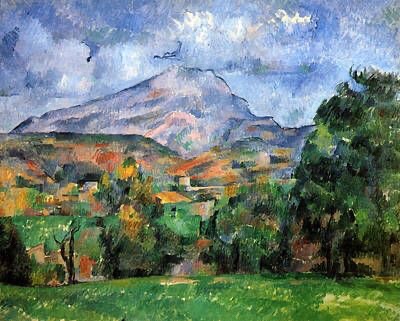
Cezanne Watercolor “Mont Sainte-Victoire (La Montagne Sainte-Victoire vue des Lauves)”( 1902–06) by Paul Cézanne. (The Museum of Modern Art, New York/Photo © 2021 MoMA, NY)

Watercolor is more difficult medium to manage than acrylic paints because it’s wetter and refuses to dry as quickly as we want to paint in that same area. It’s not being obnoxious; it’s just being its own true self. Cezanne used watercolors to think out his ideas beforehand, and then worked in oils. Often, he tossed aside the watercolor work, sometimes even leaving it out in the landscape which he’d just painted. He’d learned all he could from it and now was ready to paint his new image, but not a copy of the original painting. This mountain shows up in sixty of Cezanne’s artworks.

Paul Cézanne: La Montagne Sainte-Victoire, 1888, oil, The Stedelijk Museum, Amsterdam.

The stoic philosopher and Roman Emperor Marcus Aurelius wrote a series of meditations on life. In one he speaks of all life experiences as being the same. This attitude keeps him from getting too high or too low about what happens in his life. He takes it as it comes. Even death, which some fear as a loss, doesn’t bother him, for if he isn’t bothered about the present, he can’t be bothered about losing that too. Marcus Aurelius wasn’t a Christian, but his quest for equanimity is admirable. Take life as it comes and worry not:

“First, that all things in the world from all eternity, by a perpetual revolution of the same times and things ever continued and renewed, are of one kind and nature; so that whether for a hundred or two hundred years only, or for an infinite space of time, a man see those things which are still the same, it can be no matter of great moment. And secondly, that that life which any the longest liver, or the shortest liver parts with, is for length and duration the very same, for that only which is present, is that, which either of them can lose, as being that only which they have; for that which he hath not, no man can truly be said to lose.”

The Still Life in Our Classroom

When we work in watercolor, we have to take what the watercolor gives us. While we can plan, design, and control the outcomes to a certain extent, watercolor often goes its own way. If we work over the whole surface, rather than noodling around in one little space like a puppy sniffing a single spot while out on its morning constitutional walk, we get more done, just as the puppy is more likely to get its “business” done.

One of the reasons we work in a new medium is for the challenge. In school, when I was bored, I’d take notes in class by writing upside down. When that got too easy, I began using my left hand to write upside down. This was a true challenge! I didn’t have any ingrained pathways in my brain for left-handedness, much less the upside-down images. I was truly bored, however, so I struggled on until I got serviceable images. This was the year in which I went to art school as a midyear junior and was taking a freshman level history course.

Tim’s Painting

Tim has voluntarily switched to his left hand because he will have surgery on his right side, which will knock out his ability to use that arm for several months as he recovers. This is a good effort for his non dominant hand. You can tell he focused on the scoop, for it has the most detail. Training our alternate hand to do the work of our dominant hand requires resetting the brain to prefer the new hand. If you try brushing your teeth with your other hand, you’ll see exactly how strange it feels to use a different hand. This is because you have no well-worn pathways in your brain circuitry that makes this routine effort possible.

The fancy pants word for this is neuroplasticicy. We meet this concept with stroke survivors who do physical therapy to rewire their brain connections to make new pathways so they can speak, write, or walk. Everyone who tries a new game, learns a new language, or tries a new hobby also builds new pathways in their brains. Be learners for life, if you want to keep your mind healthy.

Gail’s Painting

Our still life was challenging today. It had solid shapes, a clear bottle, and a metal scoop. Not only were there multiple colors, but textures and transparency also. Gail has had several years of drawing under her belt, so she was able to render the perspective of the still life well. Note the clear blue bottle, which has a wonderful oval bottom. The lemons and limes are distinct also. The grey shape is an antique scoop, sans the handle.

In 2008, J.K. Rowling spoke at the Harvard commencement exercises, telling the graduates, “Talent and intelligence never yet inoculated anyone against the caprice of the Fates.” Because we don’t know what tomorrow will bring, taking care for today is the best preparation for the future. Rowling studied the Classics at Harvard, a subject most people would consider useless for this modern era. Yet after a divorce, as a single parent working for Amnesty International, she began writing her wizard novels. Harry Potter is now part of our cultural heritage.

As Jesus said in Luke 12:25-26–

“And can any of you by worrying add a single hour to your span of life? If then you are not able to do so small a thing as that, why do you worry about the rest?”

Worry is stressful, for sure, and it’s an example of “bad stress,” along with traumatic events, such as adverse childhood experiences (ACE), disease, divorce, and death of a loved one. We also endure “good stress,” as when we challenge ourselves to lift heavier weights, cook a new recipe, or learn a new language. As Ralph Waldo Emerson wrote in his 1841 essay Heroics, paragraph 14:

“The characteristic of a genuine heroism is its persistency. All men have wandering impulses, fits and starts of generosity. But when you have chosen your part, abide by it, and do not weakly try to reconcile yourself with the world. The heroic cannot be the common, nor the common the heroic. Yet we have the weakness to expect the sympathy of people in those actions whose excellence is that they outrun sympathy, and appeal to a tardy justice. If you would serve your brother, because it is fit for you to serve him, do not take back your words when you find that prudent people do not commend you.

“Adhere to your own act and congratulate yourself if you have done something strange and extravagant, and broken the monotony of a decorous age. It was a high counsel that I once heard given to a young person, —”Always do what you are afraid to do.”

When I was in high school, the ancient Latin teacher, who had taught my daddy when he went to school, tossed out the challenge, “No one has ever made 100% on my final Latin exam.”

I bit on that challenge like a starving dog bites on a bone, even if it has no scrap of flesh remaining on it. I made flash cards and studied for an hour every night before bed, I was so determined to be the exception to the rule. On the test, I got all the Latin correct, but lost ½ point for misspelling an English word. I never followed up on her retirement, but I fully expect her record remained unblemished. Also, I’m still spelling challenged. I’m thankful for SpellCheck in our writing apps.

Gail W.’s Painting

Gail W. paid attention to the still life and took care to lay down a close image in a pale wash before she began to add darker washes of color. Her left lime is most successful, with at least six shades of green and yellow in the shape. I also like the highlight on the central lemon. These two images capture the essence of the watercolor medium. Her perspective on the bottle bottom indicates it sits well on the cloth.

Failure teaches us what we don’t know, so we can improve the next time. This is what we call resilience. When I taught art, my students had to find three things they did well in their work before they named anything they needed help on. This was to build up their confidence. For some of them, just making a mark on the page was a start. If we fear making a mistake, we can sketch in a pale-yellow wash. This is very forgiving, like a whisper in the wind. If it’s not quite right, the next few marks may be nearer our desired outcome.

This Is Fine—Leave Me Alone, I’m Having a Crisis

Our mindset is what controls how we react to events in our lives. As one of my friends would remind me, “Not everything is a hair on fire moment.” Of course, when I was a young teen, the least slight or distress caused me to fling myself over my bed in a paroxysm of sobs, wailing loudly, “I’m going to die!” My parents would look at each other and shrug, “What boy is it now?” Fifteen minutes later I’d be in the kitchen looking for a snack, having cried my eyes out, and now I was on to the next thing. As I had more experiences, I learned to roll with the moment. Sometimes you need to wait for the next wave to rise before you take your ride. God’s timing is always right, for our experiences, both the failures and successes, prepare us for what comes next in our lives.

Cornelia’s Watercolor

I had some of the same perspective problems as everyone else, especially with the base of the bottle. Actually, it’s a challenge to get a “transparent three-dimensional object on a flat surface” to appear as if it’s actually sitting on a flat surface in two dimensions. Learning some shading techniques and remembering a round bottle bottom becomes an ellipse helps to bring off this sleight of hand. I got my paint too dark on the front of the bottle base and had to let it dry so I could come back in with some clear water and an almost dry brush to pick up the color. This gave me the highlight I needed.

Cornelia’s Drawing over the Watercolor

When I got home, I noticed my eyesight seems to be going amiss with my increased age. Lately I’ve not been careful to paint my verticals straight. Either I’m being lazy, or I’m tilting my head as I look at the subject. Maybe my neck injury has something to do with it. I duplicated the photo and used the Apple Pencil to straighten up the bottle and even up its symmetry. I also touched up a few of the lemons and limes. Maybe I’m still the puppy that likes to noodle around and sniff about until I can wrest all I can get from a work. This way I learn all I can from it. Like a kindergartner, if my work ends up a huge grey blob, I can say, “That was a great learning experience!”

My grandmother, who painted portraits and still lifes, kept a saying written on the back of an envelope, near her easel:  “Ever tried. Ever failed. No matter. Try again.” She passed in 1970. Years later, Samuel Beckett, in his 1983 story, Worstword, Ho wrote:

“Ever tried. Ever failed. No matter. Try again. Fail again. Fail better.”

We need to be like great artists and athletes, or the Michelin chefs who just keep trying, falling short, until they get close enough to qualify for their stars. Persistence makes all things possible, and if we “fail,” we’re only getting closer to perfection.

I hope for you a blessed Lent,

Joy and peace,

Cornelia


Emperor of Rome Marcus Aurelius: Meditations, XII   https://books.apple.com/us/book/meditations/id396136148

Neuroplasticity: re-wiring the brain | Stroke Association

https://www.stroke.org.uk/effects-of-stroke/neuroplasticity-rewiring-the-brain

10 Brain Exercises to Help Boost Memory

https://www.everydayhealth.com/longevity/mental-fitness/brain-exercises-for-memory.aspx

Neurobiological and Systemic Effects of Chronic Stress – PMC

https://www.ncbi.nlm.nih.gov/pmc/articles/PMC5573220/

​“Try Again. Fail Again. Fail Better”: Beckett’s unlikely Mantra – Goethe-Institut Los Angeles – USA

https://www.goethe.de/ins/us/en/sta/los/bib/feh/21891928.html


The Project Gutenberg eBook of Essays, by Ralph Waldo Emerson

https://www.gutenberg.org/files/16643/16643-h/16643-h.htm#HEROISM


Prints, Pumpkins, and Possibilities

adult learning, art, Attitudes, beauty, Creativity, Faith, Family, Food, holidays, Imagination, Ministry, Painting, purpose, Spirituality, Stress, Thanksgiving

Go Fish: Recycled Print and Collage

Here we are shortly before Thanksgiving, at the time I call the “high holy days of family gatherings.” We’ll be in this space-time continuum until the last whistle of the last Bowl Game—the grandaddy of them all: Sunday, February 11, 2024. That would be Super Bowl LVIII, or three days before Valentine’s Day, as a reminder to those who forget these things. As far as big games go, this tradition is almost old enough to take an early retirement. Thanksgiving is a much older tradition, however, for folks have been celebrating harvests as long as autumn has been a season. It’s always good to get a few pounds on before the winter gets here for good.

Leftover Blueberry Donut Bread Pudding

Our final class for November had a celebratory snack. Both Tim and Gail brought gifts of food: a delicious pumpkin spiced cream cheese roll and yummy blueberry and cake doughnuts. Tim let me bring the remaining doughnuts home, so I made a leftover blueberry doughnut bread pudding from them. Very good!! The recipe is on my Cornie’s Kitchen blog now (link below).

Gail’s Turban Pumpkins

Gail painted a still life of turban pumpkins and Tim finished up his leaf drawing. I worked to complete my print project. I added some bible verses cut from an almost century old Bible. The pages fall apart when I try to read it, but fixing it to the canvas will keep keep it from decaying further. As Isaiah 40:8 says—


“The grass withers, the flower fades; but the word of our God will stand forever.”

Tim’s Textured Leaf Study

Sometimes the best part of art class isn’t learning how to create a more beautiful painting, but discerning how to live a more beautiful life. We’re constantly surrounded by the woes and suffering of our world, and this experience can cause us to cast a jaundiced eye on life. We can end up with negative attitudes and emotions that affect our own equanimity and wellbeing.

This is a time when my life experiences in ministry and personal suffering help others see God’s transformational grace at work in human suffering. God doesn’t cause suffering, but God can use this time for good. As Paul reminds us in Romans 8:28—“We know that all things work together for good for those who love God, who are called according to his purpose.”

Even Jesus suffered and those of us who bear his name and image aren’t spared this fate. How we handle suffering is the mark of a redeemed person. No one is called to submit to abuse, but we’ll all suffer from illness, indignity, lack of respect, or the ravages of old age. Some of us suffer needlessly because we don’t measure up to an unrealistic ideal image, so we tear ourselves down and say, “we’re no good.” We’re just fine; our expectations are excessive.

Greetings from a Distant Time: It was a hope even then, not a reality.

The high holy days, which we enter into now, are fraught with expectations for many people. Families, who have estranged relationships, may feel a sense of loss if someone doesn’t appear at the family table. Likewise, those who’ve experienced a death will feel the pain of the empty chair. We can’t bring back what was, but we can honor their memories and tell their stories. We can live in the present and build new joys for the family we have now.

In the Bible, inviting someone to eat with you is equivalent to making them part of your family. Therefore, family is the people you choose, not just your blood relatives. We can have many families, but we are to love, care, and protect them all. I consider my art students as part of my chosen family.

In the new year we plan to experiment with watercolors, so if that’s an interest, a Prang 8 color watercolor box, brush, and watercolor paper should be on your Christmas list. Our December schedule is light:


• December 1–class—
• December 8–no class—I’m going to Raney Lectures at PHUMC
• December 15–class—
• December 22 to January 3—vacation—no classes
• January 5—Watercolor class

Joy and peace,

Cornelia

Post Prandial Poses

Recipe for Leftover Blueberry Donut Bread Pudding:
https://cornieskitchen.wordpress.com/2023/11/22/leftover-blueberry-donut-bread-pudding/

Inspired by Autumn Leaves

adult learning, art, Attitudes, autumn leaves, cognitive decline, Creativity, Enneagram, Imagination, inspiration, Matisse, Ministry, Painting, Spirituality, trees, Van Gogh

I returned from a spiritual retreat at Mount Eagle, at which we studied the Enneagram. This is our United Methodist camp site dedicated to holy listening. Of the nine spiritual personality types, I happen to be a Four: The Creative. I’m “The Sensitive, Introspective Type: Expressive, Dramatic, Self-Absorbed, and Temperamental.” Fours are self-aware, sensitive, and reserved. They’re emotionally honest, creative, and personal, but also can be moody and self-conscious. Fours sometimes feel vulnerable and defective, so they’ll withdraw from others, and they can also feel disdainful and exempt from ordinary ways of living. A Four typically has problems with melancholy, self-indulgence, and self-pity; but at their best, they’re inspired and highly creative, and they’re able to renew themselves and transform their experiences.

One of the things I’ve learned over my years of teaching art is every student is unique. They all aren’t Creative Fours, even if they have an interest in art. When I taught in schools, some of the students didn’t even have an interest in art at all. It was a requirement, and they were unwilling prisoners, who were set on rebellion because they knew they wouldn’t succeed. In most education classes, this would be true. Art education classes teach young teachers how to make lesson plans with distinct outcomes and a list of steps. This makes grading easy: did the student follow the steps and how close did their product match the model?

I don’t teach art this way. Children learn to walk by crawling, but they have to roll over and pull up first. Each step is an improvement over the first one. As long as a student keeps working and learning, their work will improve. We adults have to silence the judgmental voices in our heads that tells us, “You aren’t any good.” Instead, let’s listen to that inner voice of joy which says, “Wow, we’re having fun playing with the colors and making shapes appear—it’s like magic!”

We first looked at a few images of leaf paintings to get some ideas. Often by Friday morning, my brain needs some extra caffeine as well as extra jolts of creative input to get an inspired thought to percolate through the fog. We don’t all learn just by listening, but by seeing also. Sometimes students need a demonstration or hands-on experience to figure out the best way to use the materials. I always try to let them manipulate the materials themselves, since the best way to learn is by doing. This isn’t brain surgery, so we won’t harm anyone. We also won’t lose our salvation if the paint gets out of hand. We can always save our old works and say, “Look where I started from!”

Yayoi Kusama: Leaf painting (1990)

Tim was entranced by the Yayoi Kusama Leaf painting (1990), so he began to work on drawing a leaf in this manner. He’s recovering from carpal tunnel surgery, so smaller movements are better therapy for his hand.

Tim: Leaf drawing in progress

Not everyone is focused on details. Milton Avery is a modern colorist who simplifies the landscape into its essential elements. His trees often look like large leaves.

Milton Avery: Landscape with Trees

The bright colors of the autumn leaves in the landscape provided Mike’s color scheme for his one brilliant tree. Mike has exuberance in all he does.

Mike: Tree Aflame

Henri Rousseau was famed for his jungle scenes. These were green in every shade possible. He visited the botanical gardens in Paris for his inspiration.

Van Gogh favored yellow and orange, especially in his later years. The Mulberry Tree from 1889 is a lovely example.

Norton Simon Art Foundation, Pasadena, CA

Gail went outside to grab an actual leaf, rather than work from her imagination. She has a direct connection with nature, maybe because of her years with the national parks.

A leaf against our painting cloth

Repeating this leaf shape, she covered the canvas with it, allowing it to overlap in some areas and run off the edges in others. Using a monochromatic color scheme, she gave the illusion of shadows and light.

Gail’s Golden Leaves

Matisse sought to reunify humans with each other and with nature. As the great painter said, “What I dream of is a balanced, pure and quiet art which can avoid the trouble of frustrating subjects. This kind of art gives everyone’s mind peace and comfort, like a comfortable chair where they can have a rest when tired.”

Matisse: The Dance, 1909-1910

Viewers in Matisse’s day thought his brightly colored painting of dancers was quite daring, but today we can appreciate his work as an ode to life, joy and nature.

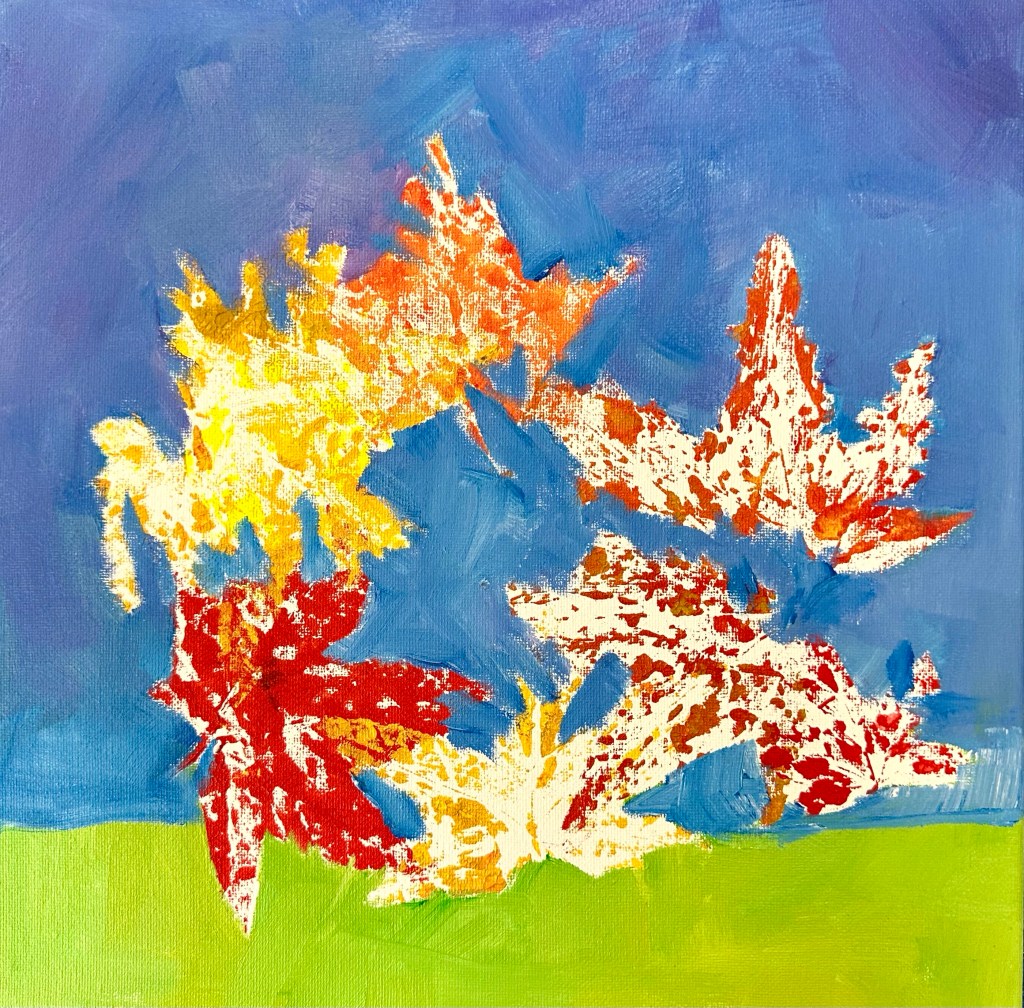
Cornelia: Dancing Leaves

As I’ve been watching the brisk winds blow the gold and red leaves from the trees this fall, I’ve also watched them dance against the bright cerulean sky. When the sun shines on these dancers, they glow even brighter than before. They don’t have a care for tomorrow, much less for today. Now and this moment is enough for them. They remind me of the Lord’s advice to us on the Sermon on the Mount in Matthew 6:34—

“So do not worry about tomorrow, for tomorrow will bring worries of its own. Today’s trouble is enough for today.”

I painted the back side of the leaves with a thin coat of acrylic paint and laid them one by one down on the white surface of the canvas. Then I gently hand rubbed the top of each leaf until I thought I’d transferred the paint. The hansa yellow was least successful as a print color, so I over printed it at the end. I mixed the green ground with the cerulean blue and two yellows. The sky has cerulean, violet, Ultramarine, and white. These I mixed as I painted, so the sky wasn’t an even color. (All skies change color due to atmosphere and distance: they get lighter toward the horizon).

Next Friday we’re going to make stamp prints. You may have cut your own design in a potato once upon a time in scouts or used vegetables to make prints. We can also use leaves, natural materials, metal objects, or found objects to create prints. Art is a time to explore and experiment. We’ll find out what works and what doesn’t!! Curiosity and the willingness to experiment and explore are all aspects of creativity. We can all learn to stretch our boundaries and learn resilience, which are experiences that help us address the stresses and challenges of daily life.

I learn something new every day. Today I learned a starfish has a brain that covers its entire body. Its whole body is made up of brain nodes! There are days I wish I were a starfish: I would have loads of brain cells!

Joy, peace, and happiness to everyone!

Cornelia


Type Four: The Individualist — The Enneagram Institute

https://www.enneagraminstitute.com/type-4

The 9 Enneagram Types — The Enneagram Institute

https://www.enneagraminstitute.com/type-descriptions

Art Analysis: Dance by Henri Matisse – Artsper Magazine

The Persistence of Effort

adult learning, Altars, art, Attitudes, beauty, brain plasticity, Children, cognitive decline, Creativity, exercise, Food, Habits, Health, Holy Spirit, inspiration, knitting, Love, Ministry, mystery, nature, Painting, Prayer, pumpkins, purpose, rabbits, renewal, Right Brain, sleep, Van Gogh, vision

These shoes are made for walking

I was reading an article in the New York Times the other day. In “How I Learned to Love Finishing Last,” the author wrote about her slow pace as a runner. As one who regularly finishes last in my age group in the annual Spa 5K Walk each November, I’m optimistic one day I might get old enough to be in a nonagenarian age group all on my own. Perhaps if I’m 90 and still doing a 5K, they’ll give me a ribbon just for participating! “The last will be first and the first will be last,” especially if there’s only one of us in the race!

“When we compare ourselves to others,” said Dr. Justin Ross, a clinical psychologist in Denver who specializes in athlete mental health and performance, “we set ourselves up to suffer. Instead, the real psychological benefits come from enjoying what your body can do.”

Portrait of Yayoi Kusama in costume in front of pumpkin painting, photo: Noriko Takasugi

Suffering physically isn’t what art class is about, although we may suffer indignities to our egos, but this shouldn’t hold us back from doing our art works. The case of the Japanese artist Yayoi Kusama is evidence even hallucinations of voices and images can’t keep an artist from creating. If our daily efforts don’t measure up to what we imagined in our mind, it’s merely because our inner eye sees better than our hands can execute our vision. Sometimes our eye forgets what it once learned, for we haven’t used our skill of looking in a while. A runner doesn’t leap off the couch and immediately run a marathon or even a 5K. The smart athlete takes the time to train progressively for the distance beforehand. Also, they get new shoes.

Kroger Run: Two ghost pumpkins and a small pie pumpkin

Sometimes the coach has slept over the summer also. Just as students in school need a time to relearn last year’s lessons, as a coach in art class I sometimes forget the lessons, which are second nature to me because they’ve been inculcated by multiple teachers since I was eight years old, aren’t as ingrained to my own students. I also forget I’m always observing everything around me: cloud patterns, changing colors on trees, sunlight dappling on tree branches, shadows on the ground, and reflections in windows. I think about these patterns rather than about what I need to do next or next week. My calendar will remind me of these things in due time. I’ll be wrapping this up soon so I can work on my monthly Rabbit blog.

Rabbit playing “Hide the Pumpkin.”

A National Institute on Aging study found five healthy lifestyle factors — physical activity, not smoking, not drinking heavily, following the Mediterranean-style diet, and engaging in mentally stimulating activities — can have important benefits. People who engaged in four or five of these behaviors had a 60% lower risk of developing Alzheimer’s compared to those who only followed one or none. People who followed two or three of the activities had a 37% lower risk. This is your free wellness plan from Dr. Cornie, who has no medical degree, but did stay in a Holiday Inn once.

Debunking the Myth of the Split Brain Theory

Although we commonly think art is a “right brained” activity, in 2013 a group of researchers at the University of Utah discovered people actually use both sides of their brains equally. Back in the 1970’s when I was seeking employment after graduate school, the “Art is a right brain myth” ruled the creative work world. I once suggested I’d be a good candidate for a museum position because I understood both the artistic and the logical mind. I was not hired. Intuitive understanding of the brain a half century ahead of time doesn’t exactly open the doors to a fancy job.

As I recall, I got a checker’s job in a grocery store and ended up counting the teller trays and preparing the bank deposits for that store. The good news is creating works of art is a multi-process activity, one that depends on several brain regions and on redundancy of art-related functional representation rather than on a single cerebral hemisphere, region or pathway. This means even when we lose our ability to form words (typically a left hemisphere activity) our ability to create art still exists. We can still express our inner feelings and thoughts. This is good news for the aging and those who love them.

Yayoi Kusama – Pumpkin, 2014, installation view, Donum Estate, California, photo: Robert Berg

One one the great sadnesses in my ministry is being with young people who desperately want to have their old one’s memories recorded, but waited too late to ask them or were too busy with their own lives to sit and listen to these stories of the olden days. Once their old person has a stroke and loses the ability to form words, the opportunity has passed. Those stories will be locked in their minds due to aphasia, and no one or no amount of time will pull them out. We always tell young parents their babies need to be enjoyed while they’re still young, but we should also tell families to get the stories of their elders while they still can. “Strike while the iron is still hot” will take on a new meaning one day.

We needed bigger pumpkins

Gail and I were the only ones in class today. Lauralei showed up to gift us chocolate cake and keep us company. Tim and Mike were out of town. Gail and I both repainted old canvases. I showed some of the unusual ways pumpkins have been decorated by various artists, but none of them sparked any interest. We got down to work by covering our old canvas with a base of titanium white paint. Then I located all three of the pumpkins with circles and drew a baseline for the object on which they sat. I didn’t look over at Gail’s work for a while, but then I noticed she’d almost completely finished one pumpkin without roughing in the shapes of the others.

Gail had a big canvas today.

“Did you plan on finishing that one pumpkin before drawing the other two?” I asked.

Gail gave me a “needs more caffeine” stare.

“That’s what I thought. Maybe next time draw in the rough shapes so you get everything located in space relevant to each other.”

Pumpkin Spice Latte Time

We kept on painting until clean up time. I often say “I’ve slept since then.” It’s my all purpose excuse for forgetfulness or just plain airheadedness. Sometimes I have my mind on other things and I’m not focused on what’s in front of me. I forget about the wisdom of Brother Lawrence, who said “many do not advance in the Christian progress because they stick in penances and particular exercises while they neglect the love of God which is the end. This appeared plainly by their works and was the reason why we see so little solid virtue.” He also said, “there needed neither art nor science for going to God, but only a heart resolutely determined to apply itself to nothing but Him and to love Him only.”

Cornelia’s small painting of pumpkins

We know Brother Lawrence from the classic text, The Practice of the Presence of God. Although it dates from the late 17th century, his lessons on living life in joy in the present moment, all for the love of God are invaluable for us modern folks who tend to live for our 15 minutes of personal fame, social media clicks, or self interest. We aren’t used to the monastic life today, or to the discipline of that lifestyle. We live in a Burger King world, in which each individual gets his or her own way to every extent possible. Unfortunately, the Christian lifestyle is one of discipline, but not harsh punishment:

“Now, discipline always seems painful rather than pleasant at the time, but later it yields the peaceful fruit of righteousness to those who have been trained by it.” ~~ Hebrews 12:11

In art class we focus on the disciplines, just as the guild artists taught the apprentices back in the day. These disciplines are not only for safety, for some of our art tools are dangerous, but also some of our techniques are proven to yield better results than others. This is why carpenters measure twice and cut once. They also cut on the outside of the line, rather than the inside. They can shave down a piece easier than adding to it. Murphy’s Law recognizes this: “A wire cut to length will be too short.”

Zen Tangle drawing of pumpkins: exercise in texture

Art class has no mysteries, but we can forget the “secret gnostic knowledge passed down by word of mouth” from our previous classes. I often use the excuse “I’ve slept since then.” Another good excuse is “My mind has gone to Pluto.” I share these with you all, for they’ve always worked for me. Of course it helps to be a natural blonde. Then again, I’m very organized, but I’m also very active, so sometimes my calendar gets overwhelmed, and I pull out the “OOPS! Card.” Even in retirement I’m still creating and sharing my faith through art and writing. It’s my way of exercising those brain cells to keep them from dying off. We old folks can still learn new things, even if it takes longer. This is what we call the persistence of effort. Those who keep using their skills won’t be losing those skills.

The same goes for learning a new skill. It’s all a matter of repetition. We can’t get frustrated if we don’t get it on the first try. We won’t be a good role model for the young if we have that attitude. We need to lower our expectations. I used to think I couldn’t knit, but only crochet. After my mom, who was a stellar knitter passed on, a friend taught me to knit in an afternoon! Where this sudden bilateral coordination came from I have no idea, but it was so welcome. Perhaps I needed to be in the right frame of mind, or I wanted to be able to carry on my mom’s memory, but I was definitely receptive to her teaching.

Letter to Theo Van Gogh, September 18, 1888

It’s never too late to learn and we’re never too old to start learning. Art isn’t just good for the brain, but it’s good for the soul. Art is our attempt to represent truth, beauty, and nature in media that can be accessible to others. By doing this, we bear witness to the creation and the Creator. We only need give our best efforts, and let God’s Spirit guide our growth.

Joy, peace, and perseverance,

Cornelia

We have pumpkins galore on the autumn altar.

How I Learned to Love Finishing Last


How the Aging Brain Affects Thinking | National Institute on Aging

https://www.nia.nih.gov/health/how-aging-brain-affects-thinking

The creative-right vs analytical-left brain myth: debunked! – Dr Sarah McKay https://drsarahmckay.com/left-brain-right-brain-myth/

Art and brain: insights from neuropsychology, biology and evolution – PMC

https://www.ncbi.nlm.nih.gov/pmc/articles/PMC2815940/

The Project Gutenberg eBook of The Practice of the Presence of God, by Brother of the Resurrection Lawrence (free ebook)

https://www.gutenberg.org/cache/epub/5657/pg5657.html

Perspective: How We See

adult learning, art, Attitudes, Creativity, inspiration, Leonardo da Vinci, Ministry, mystery, Painting, perfection, perspective, Philosophy, risk, salvation

Perspective is both a mental outlook on life and our ability to view things in their true relations or relative importance. In art class, we use the tools of perspective to make a two dimensional surface appear three dimensional. One of the techniques is drawing parallel lines as converging in order to give the illusion of depth and distance. An untrained eye doesn’t see this at first, but once the illusion is pointed out to them, they never can unsee it. We worked last year with one vanishing point—railway tracks—and two vanishing points—buildings seen on the corners.

Two Point Perspective

There are mysteries in this world which we don’t understand, but those of us who have been taught by others with this “secret hidden wisdom” can share it with others. The Ancient Greek mystery religions kept their knowledge for only the select few, who learned it by word of mouth in secret ceremonies. The early Gospel, however, was proclaimed openly to all who would receive it. Yet even in Corinth, some believers wanted to be more special or spiritual than others. Paul wrote them, saying they needed  to know “Nothing beyond what is written,” for the scriptures contained within enough for their salvation (1 Corinthians 4:6). As an apostle, he was a steward of the “Mysteries of God,” and even if he were to understand “all mysteries and all knowledge, and…have all faith, so as to remove mountains, but… not have love…(he’d be) nothing.” (1 Cor 13:2)

Cornelia: Art Room Door

As a teacher, I can provide students with learning opportunities for every skill in art. Thanks to  Oaklawn UMC, and the generosity of my clergy pals over the years, I have a space in which to teach. I don’t charge for the lessons, since I consider this my ministry in retirement. I’ve taught every age from kindergarten through adulthood. There’s no age I don’t relate to. As Dale Chihuly says about art: “Most of art is the work. Not every piece is a success. We learn from our mistakes more than from our successes. If we don’t show up to work, we never have a chance to do well.” (It’s not an exact quote—I watched the film last night).

Gail: stage 1

As I tell folks, we may be saved by grace, but progress in art is by works. We can’t have our egos invested in the product. Right now Tim is in recovery from carpal tunnel surgery. Doing light exercises with pencil is good for his wrist muscles. Art class is a form of physical therapy. He wanted to draw a pumpkin because it had some shapes he’s struggled with over time. He noticed if he moved forward or backward by mere inches, the image he saw was different. This too is a matter of perspective. What is our view point: is it fixed or variable?

Gail: stage 2

Gail and I worked on painting an interior scene. I freehanded my painting, while Gail used her ruler and pencil to draw in the door shapes. I still wasn’t totally recovered from my colonoscopy—my age is catching up on me. My brain felt foggy, but I was trying. We came back for a second week to work on this project.

Gail: stage 3—extended floors

When we leave our work, we have an opportunity to clear our minds and reflect on other things. On returning to our canvas, we then look at our image with fresh eyes. My engineer friends call this the “saturation principle.” Just as the land can only absorb so much water before it runs off, our minds will get clogged up and we just can’t seem to make progress. Getting up for a drink or a walk about is a good thing. Sometimes the paint won’t dry fast enough for us either! That’s an indication to work in another area, even if we don’t want to. We must listen to what our work is telling us.

I often let my paintings rest overnight while I get a good night’s sleep also. In the morning, I’ll see if it still holds up, or if I need to keep painting. Sometimes I’ll take a “finished” painting down after a few months and repaint it. If it won’t last three months under my eye, it doesn’t leave the house. But I’ve learned from the experience. If we ever quit learning, we are dead. I don’t plan on being dead any time soon.

ABC—Positive and Negative Choices

Learning how to see in art is the most important lesson in art. Most of us won’t be Michaelangelo or Leonardo, but we can be the best of who we are. Our outlook on life in art means accepting our imperfections and our weaknesses. Some people can’t accept the learning curve necessary to make acceptable looking products. The point of art class isn’t the product. It’s the process of doing. With the doing, the “product” will come around eventually. We just need to have a positive attitude. Besides, our salvation isn’t dependent upon our accomplishments in art, but our faith in Christ and our love for Christ spread abroad into God’s world.

A Gift from my Mom

Perspective is also our attitude towards life. As Bob Ross, the great philosopher of happy trees and the joy of painting once said,

“If you have light on light, you have nothing. If you have dark on dark, you have nothing. It’s like in life. You gotta have a little sadness once in a while, so you know when the good times are coming. I’m waiting on the good times now.”

He said this in a PBS episode filmed shortly after his wife had passed away. Art class is also therapy for the soul, for we paint our emotions on the canvas, whether we realize it or not. We don’t have to talk about our feelings, but art helps us express them.

When I taught art back in the dark ages, I told my students if they learned only one thing from me, they would never forget it. A positive attitude leads to positive behavior and positive behavior leads to positive consequences. A negative attitude leads to negative behavior and negative behavior leads to negative consequences. That’s the simple ABC’s of life in the art room. Try it. You’ll like it. This is how we teach “Perspective.”


Joy and peace,


Cornelia

Master of Glass: The Art of Dale Chihuly

https://www.imdb.com/title/tt24862190/?ref_=ext_shr_lnk


Feeling Down? Here Are the Best Bob Ross Pep Talks


REMEMBERING SEPTEMBER 11th

9/1/11, 911, Altars, art, Attitudes, Christmas, Easter, Faith, Forgiveness, grief, Healing, hope, Icons, inspiration, Ministry, Painting, renewal, Spirituality

Looking up at the night sky, I think of the Eskimo Proverb which says, “ Perhaps they are not stars, but rather openings in Heaven where the love of our lost ones pours through and shines down upon us to let us know they are happy.” The fatal September 2001 event at 7:14 am CDT impressed its significance on the nation to such a great extent that 93% of American adults 30 years old or greater can tell you exactly where they were when they first heard about the attacks. Only 42% of those 25 and younger can do the same.

NGC 3603: From Beginning To End
Credit: Wolfgang Brandner (JPL/IPAC), Eva K. Grebel (U. Wash.), You-Hua Chu (UIUC), NASA

I remember my church was fuller than for Easter or Christmas on the Sunday after the devastation of the Twin Towers, the collapse of the Pentagon, and the crash of the airplane in which the terrorists had hoped to hit the White House. Only those brave passengers of Flight 93 stood between the terrorists achieving a psychological victory and their ultimate ignoble demise. As I recall, people were eager to hear “What is the Christian Response to Violence?” If they hoped to hear the one and only response, as the THE implies in the sermon title, the air was let out of their balloons.

A photo taken on September 11, 2001 by the New York City Police Department as the North Tower collapses, engulfing lower Manhattan in smoke and ash.

Of course, Christians across the centuries have had three major responses to violence. The first is “turning the other cheek” or nonviolence. We see this in the Biblical witness, for Jesus admonishes his followers in Matthew 5:38-42—

“You have heard that it was said, ‘An eye for an eye and a tooth for a tooth.’ But I say to you, Do not resist an evildoer. But if anyone strikes you on the right cheek, turn the other also; and if anyone wants to sue you and take your coat, give your cloak as well; and if anyone forces you to go one mile, go also the second mile. Give to everyone who begs from you, and do not refuse anyone who wants to borrow from you.”

Il Tintoretto: Christ before Pilate, Museum Scuola di San Rocco, Venice

Jesus himself practiced a non-violence response to violence when he appeared before Pilate after his arrest. Pilate questioned Jesus in Matthew 27:11-14—

Now Jesus stood before the governor; and the governor asked him, “Are you the King of the Jews?” Jesus said, “You say so.” But when he was accused by the chief priests and elders, he did not answer. Then Pilate said to him, “Do you not hear how many accusations they make against you?” But he gave him no answer, not even to a single charge, so that the governor was greatly amazed.

Unknown German artist: Aquamanile in the Form of a Mounted Knight, Copper alloy, ca. 1250, used to pour water over hands at the altar or at dinner table, Metropolitan Museum of Art, New York City.

The opposite of non-violence is the Crusade mindset. In this response, the infidel is “othered” to the point of inhumanity. Because the unbelievers don’t share the same god, purging them from the living is a good deed, worthy of merit for salvation or for forgiveness of past sins. As you can imagine, this makes people who believe in other gods “less than human,” so what we modern people would consider war crimes would be easy to commit for a person in Crusade mentality. We still hear vestiges of this dualist mindset in the vocabulary of people who talk about “weaponizing government” or those who feel the need to “hit the ground running.” If we’re always in “attack mode” at work, we need to question how we think about others if we believe we’re in a hostile environment or in enemy territory.

If the Christian has both a head and a heart, both of which are being conformed to the love, mercy, and justice of God, then we must have a middle way between passive nonviolence and crusade extremism. This golden mean is the Just War Theory. It’s taught in all our military academies and has its beginnings in Christian theology. The saints Augustine of Hippo and Thomas Aquinas developed the primary ideas:

  • Make war only for a just cause
  • Be sure your intentions are right
  • Only legitimate authority can make war
  • Use just proportionally in the war, nothing to excess
  • Go to war as a last resort 
  • During war only attack military targets, not civilians 
  • Following unjust orders isn’t a legal defense for unjust actions 
  • Punish war crimes, compensate victims
  • Peace treaties must be fair and just to all, even the warmongers
Psalter Saint Louis et Blanche de Castile, MS 1186, BnF, folio 11b

Those of us who struggle with conflict—if we have a family, we have conflict or if we live in a community, we have conflict—yes, I’m starting to meddle now. You knew I’d get around to it. After all, God the Father had Adam and Eve, and God tossed those two kids out of the House. They had everything, and still wouldn’t follow the one rule (Don’t eat from that one tree). Just one rule. How hard could that be? It was downhill from there.

I always take comfort, knowing God had troublesome children. It means perfect parents can still have conflict at home. This gives hope to us less than perfect folks. The Bible reminds us always how God still loves the human race and hasn’t give up on us, so we don’t give up on those we have fusses with. We don’t roll over and play dead, yet we don’t set out on a crusade against unruly kids or others with whom we have conflicts. As Micah 7:18 reminds us about God’s Compassion and Steadfast Love:

Who is a God like you, pardoning iniquity and passing over the transgression of the remnant of your possession? He does not retain his anger forever, because he delights in showing clemency.

Remnant of the Twin Towers

Maybe we should look at the just war thoughts and modify our attitudes and behaviors. We can come to a peace, even if others cannot. As Jesus says in Matthew 5:9—

“Blessed are the peacemakers,

for they will be called children of God.”


Joy and Peace,

Cornelia


Two Decades Later, the Enduring Legacy of 9/11 | Pew Research Center


Just War Theory – The Ethics Centre Ethics Explainer
https://ethics.org.au/ethics-explainer-just-war/