Steps in drawing a Geometric Still Life: sketch, refined sketch, shadows, intense shadows and cast shadows
We are back in art class again on Friday mornings at Oakland United Methodist Church. Our first lesson is in solid geometry, but it’s not a math class. Art is more like learning a visual two-dimensional language to be able to render three dimensional objects on a flat plane. This isn’t as easy as you might think, but once you learn to see in perspective, you never can unsee it again. Art class is like an old fashioned one room schoolhouse, in which a teacher has students of varying ages and experience levels to instruct. I provide one lesson and modify it for each student according to their needs.
Gail S.—Pencil Drawing of Solid Geometry
The first day of class, I had three brand new students and one who has done this exercise at least three times before. Two others were out doing family obligations, just as I was missing in action last week due to attending my niece’s graduation ceremony for her MBA in Business Administration. Life and family watershed events are always important to make our presence known. The life of the artist is as important as the art itself. We aren’t just people who make beautiful objects for others, but people who make life beautiful by being present at their most important moments.
Vermeer: The Art of Painting, 1666-1668.
When we look at the painted floor in the Vermeer painting above, we know in our minds these stand for black and white square tiles. If we take a moment to closely observe them, we realize these are more like diamond shapes. This optical illusion is the result of perspective. Perspective comes in multiple forms. Linear perspective has one-point, two-point, three-point, and multi-point vanishing points. Aerial or atmospheric perspective uses color, clarity, and value as objects overlap each other and recede into the background. There’s also reverse perspective in which objects are larger as they grow more distant and foreshortening, in which nearby objects are emphasized.
Pop Tarts from the Pop Tarts Bowl Toaster Trophy in 2024
Can we teach all of this knowledge in a single two-hour lesson? Absolutely not. Michangelos aren’t turned out like pop tarts from a toaster. In the Renaissance era, a family would place a youth between the age of 7 to 14 with a master artist to learn the trade. This child would do the chores of the studio and learn to grind the pigments and mix paint. Then they would progress to drawing and composition. After a training time, they might get to do the backgrounds of the paintings or the landscape. After eight years, if they were any good, they would be entrusted with an entire commission. Then they would venture out on their own or take over from their master’s studio.
Cornelia—Purple Geometric Forms
I started taking art lessons when I was eight years old from the city parks and recreation art teacher on Saturday mornings, and then after school from a former art teacher in town. My grandmother was a portrait and still life painter. I have been taking or teaching classes for over seven decades. Art is not a skill or a product a person can ever perfect. It is more like a journey of faith, one in which we are always going on to perfection, but by the grace of God, will only be completed at our last day. Even at my age, I have more than a few “needs improvement works” left to create.
Tonya—Black and white Geometric Forms
The more you know, the more room for improvement you can find. I always ask students to first find three positive critiques of their work to praise before they begin to talk about their “improvement areas.” In this lesson, if they drew all three shapes, used two distinct colors for light and dark, and used up the space on the canvas, rather than drawing an inch tall image, those are positive points. Then they can point out their troubles.There’s enough negativity in this world. We need to overcome that in our own lives. What we learn on this canvas will carry over to the next one. Then we will find new opportunities for improvement yet again!
Marilyn—Geometric Forms in Aqua
No one who gets a significant health condition finds making a wholesale change overnight easy or achievable. This is why people who try extreme diets like Whole 30 that restrict too many foods discover they can’t stick with it or must continually start over. People looking to make lasting, healthy changes must start small and focus on progress over perfection, according to nutrition coach Brady von Niessen. “You start feeling so good about them that you can’t even imagine not doing them.” The same principle applies in art. Over time, a student’s skills will improve if they trust the process. Rome wasn’t built in a day!
Jeanne—Geometric Forms
Another important aspect of art class is relationships. Pierre Teilhard de Chardin said, “The most empowering relationships are those in which each partner lifts the other to a higher possession of their own being.” As a teacher, I try to help each person find their own creative voice, rather than trying to copy an idea of what “good art should look like.” Beginners in tennis don’t get to play on the same courts as Wimbledon or the US Open, or at least not at the same time as those who claimed the trophies! As Picasso once said, “It took me my whole life to learn to draw like a child.”
I consider this first class a success for each student. First, I got to hear some of their stories, which helps to build relationships. I got to hear their fears about not being perfect—none of us are perfect, but as United Methodists we are all going on to perfection in love by God’s grace and that’s the only perfection we concern ourselves with in art class. Can we love ourselves and give ourselves the grace to come up short? As the great Leonardo da Vinci said, “Art is never finished, only abandoned.”
I look forward to next week when we mix colors for the color wheel for the first time students. The returning students will get a lesson that uses geometry and mixed colors also. The more seasoned students project is a step up because they have more experience, so they have a greater challenge.
The one room art schoolhouse meets at 10 am on Friday mornings. It’s never to late to join.
Einstein never said, “If we do the same thing every time, but expect a different result, this is the definition of insanity.” So why do artists return over and over to the still life? For that matter, why do preachers repeatedly use the same scripture texts for their sermons? Some of my former congregation members might have said I was overly fond of certain verses. The scalawags among them might have thought I did not get my point across the first five times I preached a version of the sermon text. As Jesus was wont to say in Luke 14:34-35 about Salt:
Picasso: Self Portrait, 1907, oil on canvas, National Gallery of Prague
“Salt is good; but if salt has lost its taste,
how can its saltiness be restored?
It is fit neither for the soil nor for the manure pile;
they throw it away.
Let anyone with ears to hear listen!”
Three Sacramental Vessels
I always kept my sermon notes just in case I had a difficult week and might need a backup sermon, but I never used these notes. I wrote each of those sermons for a time and a place, but they were never useful for the current time or the present location. Likewise, an artist brings their emotions and experiences of the present time to each working session in the studio. Sometimes an artist is chock full of energy and power, full of joy and life. Their paintings or works exude these same emotions. At other times, the cares and chaos of the world intrude into the otherwise peaceful precincts of the artist’s workplace. These emotions and troubles will also be visible in their work, for artists are in tune with their times.
Picasso: Still Life with Dead Pigeon, oil on canvas, 1941, Nagasaki Prefectural Art Museum
This year in the adult art class I’m teaching at Oaklawn UMC, the students are getting lessons not only on how to paint, but on awakening their individual creative voice. These lessons are part art history and part “thinking like an artist” by painting in another artist’s style. The week before, we worked on a typical still life painting. For this session, we worked on what we saw in front of us, but tried to make an emotional connection with the objects. When most of our energy is going to getting proportions in proper order, shadows cast in the right direction, following the shape of the objects, and the colors correct, putting our emotions into the work comes in a distant fifth or last.
Morandi still life: he painted the same vessels so often, they became as friends who shared their innermost secret thoughts with him.
To be sure, our class is still analyzing the containers as physical objects more than feeling or experiencing the vessels as objects with personality. We have not yet become friends with the objects, or really gotten to know them on a deep and intimate level. This is also a problem in our society today. We are not willing to know others too deeply, and we aren’t likely to let many others know us too deeply either.
Gail S in the first week: realism
This isn’t a problem confined to older people. For my own demographic, meeting new people seems a mite risky these days in the online world because we never know who is behind that chatbot or Facebook account who seems so charming. For younger people, who sometimes never seem to come up for air from the online world, this online reality can seem more real than the three-dimensional world in which we live. (I was today old years when I learned the latest online AI fad is personalizing your own chatbot companion. I wonder if these chatbots have Asimov’s 3 Laws of Robotics ingrained in their program guardrails.)
Gail W in the first week: realism
Having empathy with inanimate objects is difficult. Artists bring into their own studio the objects which interest them. A teacher brings in objects her students can approach, given their skill level. I will blow that concept out of the water this Friday with some crazy Halloween pumpkins but, if the subject matter is consistently too difficult, many students will give up if the challenge is too far out of reach.
Picasso Still Life, oil on canvas, 1937, private collection.
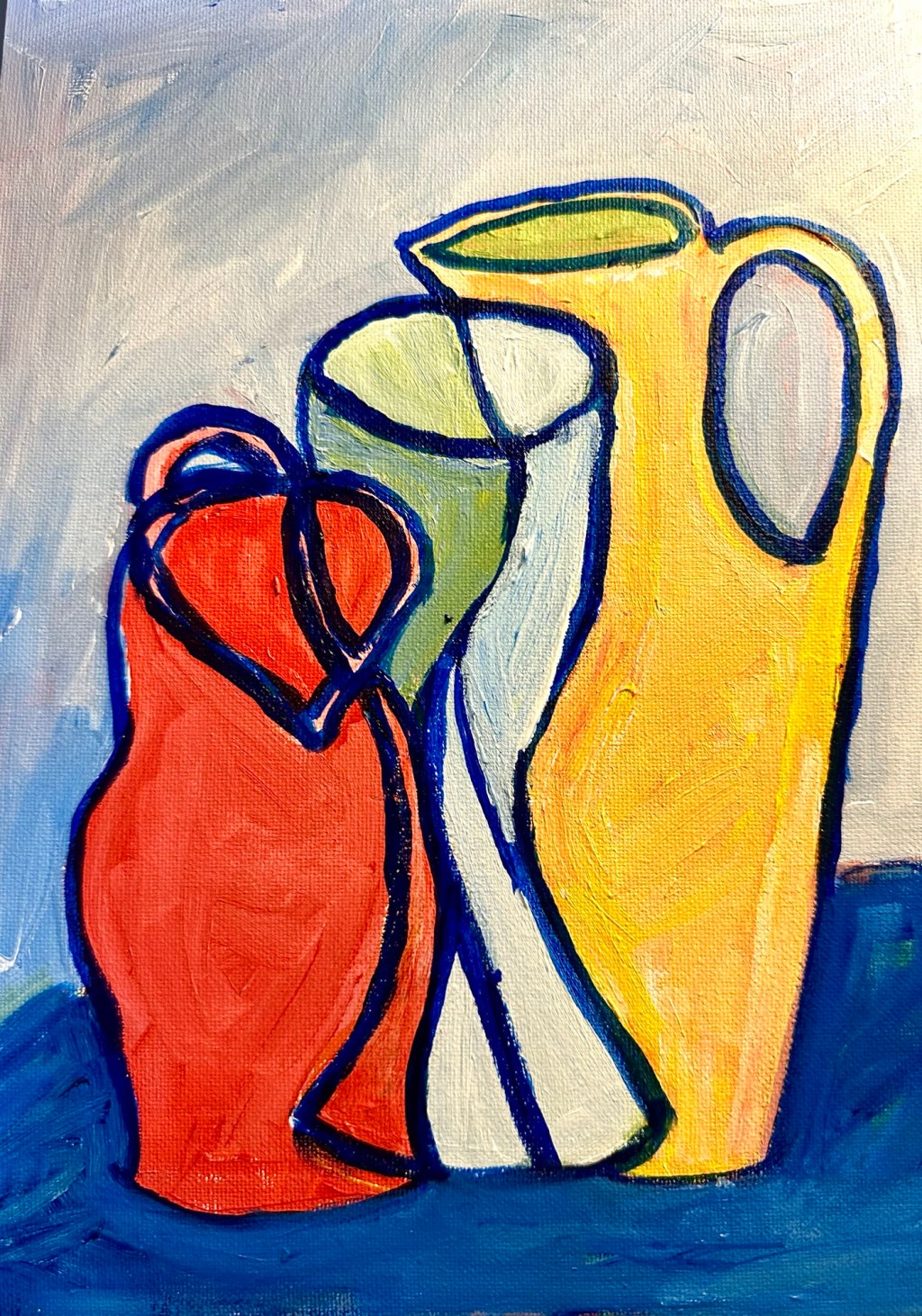
In the second session when our class saw these same liturgical vessels, we chatted about Picasso and cubism. Cubism had several different forms of expression, but we focused on synthetic cubism, a later phase of the cubist style dating from about 1912 to 1914. It had simpler shapes and brighter colors. Synthetic cubist works also often include collaged real elements such as newspapers and cardboard. These works have interesting designs, such as multiple points of view (perspective), overlapping shapes which make their own patterns, and linear outlines. This style is an outgrowth of the work of Cézanne, who said: “A work of art which did not begin in emotion is not art.”
Gail S. took a cubist vision to our same three pots
If you’ve ever tried to put on your socks in the morning beginning with a different foot than normal, you can begin to appreciate how difficult it is to imagine how to create an artwork in a fresh style. If we were to ever have a stroke or a traumatic brain injury, relearning how to do simple tasks is much the same.
Tim’s first effort. He was one week out from surgery. His body was devoted to recovery, not to thinking about cubism.
Our brains can handle the rebuilding project, but we will feel strange doing it! This is because we are building new neural circuits and pathways in our brains. Going to work or the grocery store by taking a different route also feels strange, as does a golfer trying to reconstruct their swing pattern.
Tim took a second week to elaborate on his still life. It’s a better solution! Amazing what happens when our bodies have extra energy to give to creative projects.
As a comparison, we can look at the great hurricane which came through North Carolina recently and took out the big interstate highway that runs through the mountains and valleys. The sooner the highway construction engineers can come inspect the ground, the better. They must decide if the land is safe for rebuilding and then check the infrastructure also. They may need to redesign the road to current standards and also the underlying roadbed. When the great 1900 hurricane hit Galveston, rebuilding the city took twelve years. People were still living there, and life was going on, but the city began a process of raising the land levels and building a sea wall that took that extensive time.
Cornelia’s overlapping shapes and shifting perspectives
Change doesn’t happen overnight. Every sales or leadership training session I’ve been in has emphasized the idea “Three weeks are necessary to build a habit.” The origin of this myth has nothing to do with habit formation. Instead it comes from a 1960 self-help book Psycho-Cybernetics, in which plastic surgeon Maxwell Maltz wrote how his patients took about 21 days to become used to their new appearance after surgery.
He did no double blind, peer reviewed study to verify this, but his book applied this 21-day timeline to many other wide-ranging aspects of self-transformation in life. He also believed three weeks was the time people needed to adapt to a new house or change their mind about their beliefs. (He also didn’t live with a preteen girl child who enjoyed rearranging the living room every night just to see how her mom negotiated a new obstacle pattern in the dark when she came home from a sales call.)
If artists want to make paintings which are technically proficient and resemble the objects they see, they are only halfway to creating a good painting. They must also bring who they are and allow the voice of God to speak through their hand to make a masterpiece. In this way we separate artists into the good and the great, the ordinary and the masters. Not all of us will be prophets who listen to God’s word, but all of us can and should silence our hearts and minds of the world’s chatter and claims so the word of God can pierce our hearts.
Picasso: Guernica, 1937, 11’ x 25.5’, Museo Nacional Centro de Arte Reina Sofía (MNCARS), Madrid, Spain
Rabbi Nahum Ward-Lev describes how the ancient prophets listened for God’s liberating word:
“At its heart, the prophetic witness was a way of listening, listening beyond the social norms of the day, listening to the word of the liberating God. The prophets urged the people to listen to God’s word because the discourse of the king, princes, and wealthy landowners was too narrow and was limited to the interests of these elites. This conversation did not include the voices of suffering people. The prophets, in God’s name, offered a much broader discourse, a conversation that listened to and addressed the needs of the poor and the disadvantaged….
The prophetic listening tradition is alive today to inspire people to listen beyond the established conversation. The prophetic tradition challenges us to listen especially to the cries of those who suffer and to listen to the voice of alternative possibility, to the voice of God.”
Picasso: Still Life—fruits and pitcher, oil and enamel on canvas, 10 3/4 x 16 1/8 inches, Guggenheim Art Museum, NYC.
Making a painting is quite different from making a work of art. This is why house painters aren’t called artists. They may cover a surface with color and not make a mess, but their heart and soul isn’t in their work. Learning to risk our vulnerability and emotional expression is also part of art class, just as much as learning what colors to mix to make orange or green. Picasso, quoted in Alfred H. Barr Jr.’s Picasso: Fifty Years of his Art (1946), understood this:
“The artist is a receptacle for emotions that come from all over the place: from the sky, from the earth, from a scrap of paper, from a passing shape, from a spider’s web.”
We have these same experiences also, but we don’t realize these are part of the artist’s toolbox. These ordinary moments of life are also the extraordinary means of God speaking to us, if only we have ears to hear and a heart and hands ready to be used by God for God’s good purposes.
Joy, peace, and prophecy,
Cornelia
Quote Origin: Insanity Is Doing the Same Thing Over and Over Again and Expecting Different Results—Quote Investigator®. The origin of the quote is misattributed to Albert Einstein, but it originated in the 12-Step Anonymous groups in the 1980’s.
The first bright light of creation must have been an awesome sight. Of course, only God was there to see it or hear it. The earth was a formless void, and darkness covered the face of the deep. Genesis 1:3 tells us, “Then God said, “Let there be light;” and there was light.”
John Martin: The Creation of Light, Mezzotint, 1825, Royal Collection of the Arts, London.
I have often wondered if God’s creation of light was accomplished with sound. If at one time only darkness existed, then suddenly light appeared, would this sudden change happen like an atomic bomb flash? Not with the bomb’s destructive evil and force, but with the creative and life-giving energy of God’s power and love. While scripture tells us we hear God’s voice in the sheer silence (1 Kings 19:11-12), this is after God has created everything which we humans might worship instead of God. When God first created light, what was the power behind God’s words?
George Richmond: The Creation of Light, Tempera, gold, and silver on mahogany, 1826, support: 480 × 417 mm, frame: 602 × 539 × 66 mm, Tate Gallery, London.
Maybe no one cares, for if no one is in a forest to hear a mighty oak fall, can we say it ever made a sound? Just because human beings weren’t created yet does not mean the light did not come into existence or make a noise. We might as well say bombs are not leveling towns in Ukraine and Gaza merely because we are not running from the falling bricks and dust. Yet, we can see the pictures on television and know these facts as true.
We are in a trickier situation when we try to find information to prove the existence of the creation of the first light and the facts of its origin. We are certain light was created, for light now exists. Tracking light’s history to its birth story is the challenge!
The Creation of Day and Night, by Francisco de Holanda, De Aetatibus Mundi Imagines, 1543.
When the Old Testament says God created light, the ancient readers understood this word to mean a special light, not the light of the sun, moon, or the stars. God created these lesser lights on a later day, so they possess a different form of light from the first light. The early Hebrew philosophers distinguished between chomer, matter, and tzurah, the form or function of an object. A raw material has chomer, matter, but once it’s made into an object, it acquires the form or tzurah.
Michelangelo’s The Separation of Light from Darkness, (c. 1512), the first of nine central panels that run along the centre of the Sistine Chapel ceiling.
At the beginning of creation, nothing had form. It was all matter. Then God created the Ohr Ha-Ganuz, or the Hidden Light. This special light played a critical role in Creation. Just as regular light allows us to see and relate to our surroundings, the Hidden Light enabled the different elements of creation to interact with one another. It dispelled the initial state of darkness when all objects were isolated and disconnected from one another. Through this special light, the universe’s myriad objects acquired purpose and function and were able to work together towards a common goal.
About 13.8 billion years ago, our universe ballooned outward at an incredible speed. Everything we see today, which was once packed tightly together, expanded in a roiling mass of light and particles. It took 380,000 years for this hot, dense soup to thin and cool enough to allow light to travel through it. This first light, dating back to the formation of early atoms, we call the cosmic microwave background and we can still detect it today.
Creation: Bright Beam, stage 1
The Advanced Simons Observatory in the Atacama Desert in Chile is on the forefront of research for detecting cosmic microwave background radiation to give us a better picture of the early universe, its evolution, and the many phenomena within it. Beyond the cosmic microwave background, they will hunt for and study the birthplaces of distant stars, the contents of interstellar dust, exo-Oort clouds—spherical shells of ice and dust at the edges of solar systems—and several other phenomena. But, given the unique capabilities of this observatory, they are also open to finding some unexpected and unexplained puzzle pieces in the universe that we did not know we were missing.
Creation: Bright Beam, stage 2
Before there were any stars or galaxies, 13.8 billion years ago, our universe was just a ball of hot plasma—a mixture of electrons, protons, and light. Sound waves shook this infant universe, triggered by minute, or “quantum,” fluctuations happening just moments after the big bang that created our universe. The question we first asked, “Did the creation of light make an audible sound?” is related to the “cosmic wave background radiation” that the observatory in the Chilean desert is seeking.
Although scientists call this moment the Big Bang, it was not a loud explosion. Instead, it was more like an imperceptible humming because this first moment happened when the universe was denser than the air on Earth and sound waves could travel through it. This covered the first 100,000 to 700,000 years. As the universe cooled and expanded, the sound waves grew longer and and the sounds lower. As the universe continued to expand, the wavelengths became so long the sounds became inaudible to the human ear.
NASA Sound File Magnified of Big Bang Microwave Radiation
For this sound file, the patterns in the sky the Planck Observatory observed were translated to audible frequencies. This sound mapping represents a 50-octave compression, going from the actual wavelengths of the primordial sound waves (around 450,000 light-years, or around 47 octaves below the lowest note on the piano), to wavelengths we can hear.
Creation: Bright Beam, stage 3 in the studio
Maybe as you read this, you wonder, why do artists have an interest in science? This is an attribute of artists from Leonardo in the Renaissance down through the Impressionists who studied the play of light and atmospheres on surfaces in the 19th century. Today we know the speed of light means we are always seeing a “late arriving sunbeam.” The speed of light gives us an amazing tool for studying the universe. Because light only travels a mere 300,000 kilometers per second, when we see distant objects, we’re always looking back in time. If we the universe clock backwards, right to the beginning, and you get to a place that was hotter and denser than it is today. So dense that the entire universe shortly after the Big Bang was just a soup of protons, neutrons, and electrons, with nothing holding them together.
Lentil and ancient grains pasta soup, held together by melted cheese—metaphor for the early universe
The moment of first light in the universe, between 240,000 and 300,000 years after the Big Bang, is known as the Era of Recombination. The first time that photons could rest for a second, attached as electrons to atoms. It was at this point that the universe went from being opaque, to transparent. The earliest possible light astronomers can see is the cosmic microwave background radiation. Because the universe has been expanding over the 13.8 billion years from then until now, those earliest photons were stretched out, or red-shifted, from ultraviolet and visible light into the microwave end of the spectrum.
Today we have tools unavailable to the 15th or 19th centuries, but what we have in common is the human mind. Because we are created in the image of God, we have the same desire to create and shape our world and to understand our place in it. For some people, they find placing their trust in God’s absolute power over all creation and events as a way of understanding the problem of good and evil in the world. This justifies suffering and allows them to ignore the plight of the poor. Prosperity religion, which preaches the good prosper and the bad suffer, is a classic example of this theological belief. We United Methodists believe in doing good to all people, as often as possible, with all the means we can. As the gospel says in Matthew 25:37-40—
Then the righteous will answer him, ‘Lord, when was it that we saw you hungry and gave you food, or thirsty and gave you something to drink? And when was it that we saw you a stranger and welcomed you, or naked and gave you clothing? And when was it that we saw you sick or in prison and visited you?’ And the king will answer them, ‘Truly I tell you, just as you did it to one of the least of these who are members of my family, you did it to me.’
We know Jesus as the Light of the World (John 8:12)—
Jesus spoke to them, saying, “I am the light of the world. Whoever follows me will never walk in darkness but will have the light of life.”
Perhaps this ancient light of creation has not yet reached everyone who reads these words. I can only guess they ignore even the voice of the Old Testament prophet Isaiah (58:10):
“If you offer your food to the hungry and satisfy the needs of the afflicted, then your light shall rise in the darkness and your gloom be like the noonday.”
The sun will always shine when we help others. The light of Christ will burn bright in us to burn away our gloom and despair when we give a hand to others who are in need. Their lives will be brighter in turn. We often turn away from people in hard circumstances because we do not want to face the prospect that we one day might need a hand up. This strikes at our self image of invincibility and self sufficiency. We keep remembering “God loves a cheerful giver.” If we think only of this part of the verse outside of its context, we might think God only loves the giver. God also must love the one in need to provide the blessing for the giver. As we read in 2 Corinthians 9:7-8—
Cornelia DeLee: Creation: Bright Beam, acrylic on canvas, 16” x 20”, 2024.
“Each of you must give as you have made up your mind, not reluctantly or under compulsion, for God loves a cheerful giver. And God is able to provide you with every blessing in abundance, so that by always having enough of everything, you may share abundantly in every good work.”
As an old mentor of mine taught me, “Don’t do all the work for your people. You’ll rob them of the blessing of serving the Lord.” None of us can replace the eternal light of Christ, which has been traveling to us since the dawn of time, although the Light has been with God since before time began. This Light is even now permeating the universe, in a prevenient journey to the furthest distances of creation. There is no place the Light will not go before us. Even as we attempt a return to the moon and hope to go to Mars in the future, the light of Christ has already gone before us.
If this does not give you hope in what many think is a dark and despairing world, refocusing on the Light with us instead of the darkness that always seems so near might help to change your attitude.
The older I get, the faster time flies! When I was a child, summers were long and lazy times. I actually got so bored, by the first of August I’d start to play school. I’d line up my brothers and the neighborhood children and pretend to teach them. It was our way of “playing ourselves into a new reality.”
Art has many right answers!
Children practice life lessons during their play experiences. We can also play our way into learning a new skill in art class. All we need is a “beginner’s mind.” The Japanese Zen term shoshin translates as ‘beginner’s mind’ and refers to a paradox: the more you know about a subject, the more likely you are to close your mind to further learning. As the Zen monk Shunryu Suzuki put it in his book Zen Mind, Beginner’s Mind (1970): “In the beginner’s mind there are many possibilities, but in the expert’s there are few.”
Jerzy Nowosielski: Landscape with a vision of the Sun, oil on canvas, 1965, National Museum of Krakow, Poland.
In a similar vein, Picasso once said, “When I was young, I could paint like Raphael, but it took me my whole life to learn to draw like a child.” Part of our art class experience is to learn to suspend our adult ego’s need to constantly be ranking, besting, and giving into our competitive natures. We learn more when we give up our egos and our needs to protect our false selves, and allow our true selves to learn. This story in Luke 9:46-48 on “True Greatness” speaks to this:
“An argument arose among them as to which one of them was the greatest. But Jesus, aware of their inner thoughts, took a little child and put it by his side, and said to them, “Whoever welcomes this child in my name welcomes me, and whoever welcomes me welcomes the one who sent me; for the least among all of you is the greatest.”
Our first meeting will be Friday, September 6, at 10 am in the old Oaklawn UMC fellowship hall. Bring your own acrylic paints, brushes, and a canvas or canvas panel to paint on. We begin with a short visual inspiration from some great art works, so that we can wonder and be filled with awe at some great artists’ works.
Basic 2 point perspective
I’ll give some direction on the skill we’ll work on in the session, and then everyone is free to bring their own unique expression to their paintings. We don’t copy my work and judge how well a person can match it. Instead, we learn from the masters or from real life. We can learn to stretch our own skills to create something new.
That’s US!
Of course, making great art isn’t our first purpose. As we age, the harsh truth is we will lose our ability to learn new skills until we lose our memory of what we just ate for breakfast or how to work the tv remote. Challenging our brains is one of the best ways to keep our brain cells firing and “chatting with one another.” We can actually grow new neurons as we grow older. Our brains don’t have to shrink like a cotton shirt washed in hot water. Socialization and encouragement also helps to keep our brains young. Teaching this class helps me stay young! We help each other in this matter.
That goes for children of any age!
Of course, making art means we have to give up our desire to be perfect. Children always have a “beginner’s mind,” so they are free to explore and experiment. Artists quickly learn perfection comes from practice, or working at it. Every baby stumbles and falls as they learn to walk, but we dotting adults still encourage every trembling step. This is what art teachers also do. I’ve always had a rule in my classes, especially when I taught in middle school:
“No Negative Talking about People or Art.”
This includes a student’s own art works. My students always had to give at least three positive comments about their work before they spoke about the negative. “My work needs improvement” is better than saying, “My work stinks!” After all, this way of thinking is more positive than negative and helps to build confidence in a person.
God would post your art on Heaven’s Refrigerator
Of course, we’ve all grown up and worked in environments where negativity is the rule. Art class is a place of grace because this is how life should be. If we can transform a blank canvas into a field of color, why can’t we transform our communities and our world into fields of hope, joy, and love?
The Light overcomes the Darkness
Perhaps because we try to make everyone copy/fit into our idea of the proper end product, rather than allow everyone discover their own creative response to the given subject of the day. The museums of our world are richer and more vibrant because artists have listened to the Spirit of the Creating God. We might do well to realize God’s creative energies are varied and vibrant also, just as Isaiah wrote about his vision of God’s Glorious New Creation:
“For I am about to create new heavens and a new earth;
the former things shall not be remembered or come to mind.
But be glad and rejoice forever in what I am creating;
for I am about to create Jerusalem as a joy, and its people as a delight.” (65:17-18)
I hope to see you there. I don’t charge for the class sessions, since this is one of my ministries as a retired elder in the United Methodist Church. As John Wesley once said, “The World is my Parish.” When we grow in confidence in the joys of creating, we find more beauty in the created world. Optimism is one of the side benefits of the creative life, not fame or riches, and sometimes not even accomplishment. Just the act of being a co-creator with the creating God helps us to find more peace in life.
In the dead heat of summer, our gardens aren’t putting forth the fruit of our planting. Maybe the animals of our neighborhood have made their too frequent nightly visitations, so our harvest is skimpy. We can forget God is a both a creating god and a recreating god as well. The first words of the alternate NRSV translation of the Bible’s first book Genesis (a word meaning “origin”) are—
First stage: string, fabric scraps, and under painting
“When God began to create…”
In the old KJV, Genesis 1:1 reads—“In the beginning, God created the heaven and the earth.”
I appreciate even more the next verse from Genesis 1:2—
“The earth was a formless void and darkness covered the face of the deep, while a wind from God swept over the face of the waters.”
Alternate translations read— “while the spirit of God or while a mighty wind” swept over the face of the waters. This reminds us nothingness and darkness aren’t problems for God, who is able to bring glorious light to any situation.
Psalms 139:12 speaks of the nature of God:
“Even the darkness is not dark to you; the night is as bright as the day, for darkness is as light to you.”
I’ve lived for over half a century with chronic depression, so I can recognize darkness, not only in my own life, but also in the lives of others. Most of my ministry and even my secular work was done with a calling to bring others to the light of hope and confidence that anything was possible.
In art classes, I asked my students to trust in ABC—Attitude, Behavior, and Consequences. If they had a Positive Attitude, they would have Positive Behavior and work on their assignments. If they worked, they would see Positive Consequences or Improvement over time. Asking people who’ve been told they can’t do art to believe they can learn even if they aren’t “talented” is a big ask, but if they have faith in this promise, they discover it’s true.
When I sold insurance, I asked people to trust in the idea of making a small sacrifice now to prevent a greater loss later. Also, if they had no loss, they shared in a community to underwrite the group losses and keep the cost of protecting their own property low. Not everyone has the light to see this benefit of community, but for those who do, I could help keep their consequences from being a disaster.
Second stage: overpainting, printed circles, and added ruler lines
When I entered the ministry, I discovered congregations who had lost their faith in the God who could make something out of nothing This began with the creation story, the choosing of the nation of Israel to be God’s people (even though they were once no one’s people), and feeding them in the extended wilderness wandering before they arrived at the promised land. The Bible is full of examples of God’s providing more when people have too little to sustain them: Elijah and the widow of Zarephath, the feeding of the crowds with a few fish and loaves, and the water turned into wine. These modern people didn’t have a “recreating faith” that God could work in their lives today, just as God had once worked in the lives of others in the days of Christ.
That is what we call a “dead faith,” or as John Wesley put it in his notes on the New Testament at 2 Timothy 3:5— “An appearance of godliness, but not regarding, nay, even denying and blaspheming, the inward power and reality of it.”
It’s dead, because the Spirit isn’t at work in it. I used to tell my beloved evangelism professor, the late Dr. Billy Abraham, the first place we needed to do evangelism was in the local church, because folks hadn’t heard the good news. If they weren’t excited enough to have a living faith, they wouldn’t go out and spread the good news to others.
I’ve never been a cheerleader, although I did have some time in my high school pep squad. I was more often involved in making the football banners and pep posters for the other sports activities. Also debate team took up much of my time. One of the best practices I learned in debate was positive points sell better than negative ones. Also, it’s better to make the same point over and over with different facts and examples.
When I say our God is a creating and recreating God, I can point to the beautiful verses of John 1:1-5—
“In the beginning was the Word, and the Word was with God, and the Word was God. He was in the beginning with God. All things came into being through him, and without him not one thing came into being. What has come into being in him was life, and the life was the light of all people. The light shines in the darkness, and the darkness did not overcome it.”
In the beginning was the Word
As believers in the Holy Trinity, the Word made flesh is Christ, so he was co-creating with God the Father and God the Holy Spirit from the beginning. By virtue of the incarnation, Christ takes on our flesh to redeem us and make us whole again. This comes to completion through the cross. When we place our faith in Christ’s act of love for all creation, we are made one with Christ, and one with God. The Holy Spirit brings us ever closer to the true nature of Christ, until we’re perfected in love of God and neighbor.
I painted on unprimed canvas, just to see what would happen. Also, because I knew the paint surface would be different than the usual texture on the primed canvas. After I painted several different colors in blocks with the scrap pieces of cut canvas used as “masking tape,” I decided to use a mix of iridescent gold and silver acrylic paints to glaze over the under painting. I also added some circles and straight lines. I’ve collected a few jar tops recently, I used some string elements, and I had a school ruler left from my last teaching job back in the 1980’s. (Yes, I keep things. They are tools of the trade. My Sears Craftsman staple gun from art school finally died after half a century of use.)
I’ll be working some more of these experiments for a while. Creating and recreating our lives is what keeps us new every morning. As someone who has been renewed and recreated more than one time can attest, along with the prophet Jeremiah,
“For surely I know the plans I have for you, says the LORD, plans for your welfare and not for harm, to give you a future with hope.” (29:11)
Joy and peace,
Cornelia
John Wesley’s Notes on The New Testament, 1755:
2 Timothy 3:5—“holding to the outward form of godliness but denying its power. Avoid them!”
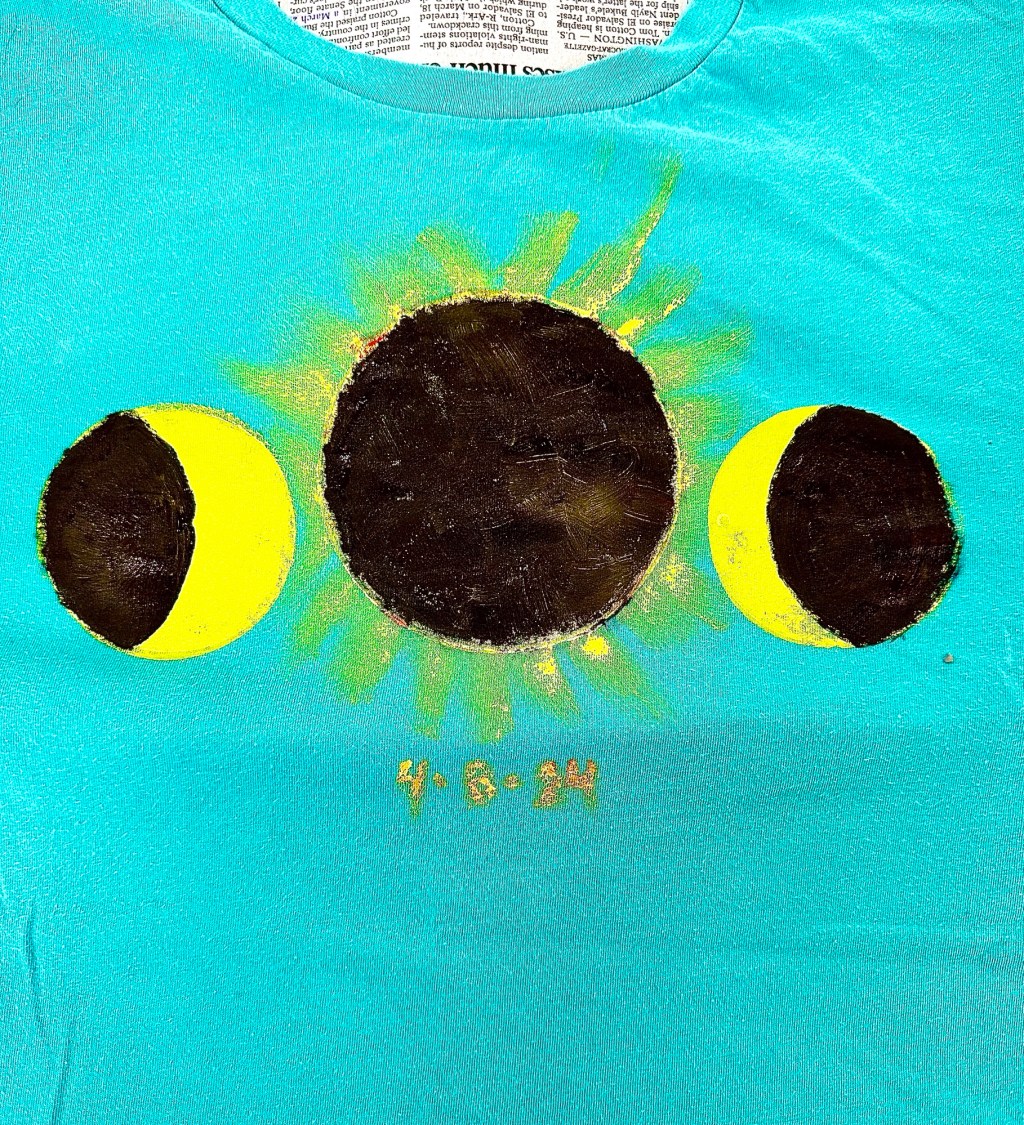
Friday in art class we painted our own unique designs on t-shirts for Monday’s Total Eclipse of the Sun. Anticipation of an event is characteristic of young children, while adults often feel over saturated with the early build up of attention given to an important event. By the time it gets here, we go, “Wow, what a letdown.” Children, who have fewer years of experience and anticipation comparison, can still marvel at the alternate reality of the total eclipse.
In the sixth century BCE, Anaximandros believed “the moon has a false light and is illuminated by the sun, and the sun isn’t smaller than the earth and it is pure fire.” The Greeks in 290 BCE knew the moon was unlike the sun. Anaximenes wrote it “didn’t shine with its own light, but with the reflected light of the sun,” as Eudimos wrote in his book History of Astronomy. The Chinese also studied the skies and stars. They used bones heated in fires to divine messages from their deceased ancestors as early as the 12th century BCE.
Chinese oracle bone depicting lunar eclipse of 12/27-28/1192 BCS.
The Death of Jesus in the Synoptic Gospels has the record of an eclipse occurring during the time of the crucifixion. John’s Gospel, which comes from a different source, doesn’t mention this time of darkness.
Egon Schiele, Crucifixion with Darkened Sun, Oil on Canvas, 1907.
When it was noon, darkness came over the whole land until three in the afternoon. ~~ Mark 15:33
From noon on, darkness came over the whole land until three in the afternoon. ~~ Matthew 27:45
It was now about noon, and darkness came over the whole land until three in the afternoon, while the sun’s light failed; and the curtain of the temple was torn in two. ~~ Luke 23:44-45
When Jesus had received the wine, he said, “It is finished.” Then he bowed his head and gave up his spirit. ~~ John 19:30
Yet the Gospel of John tells us more about the miracles of Christ and his dual nature (both human and divine), so that we might believe and have everlasting life through him. New Testament scholar Ernst Käsemann is correct when he says of the Fourth Gospel: “Judged by the modern concept of reality, our Gospel is more fantastic than any other writing of the New Testament.”
Bruce Metzger, noted New Testament scholar and lead translator of the NRSV said, “The more often you have copies (of biblical texts) that agree with each other, especially if they emerge from different geographical areas, the more you can cross-check them to figure out what the original document was like. The only way they’d agree would be where they went back genealogically in a family tree that represents the descent of the manuscripts.[104]
Tim’s Eclipse T-shirt: very simple due to his rehab from arm surgery. He uses his arm until it hurts and then he rests. We do what we can, not what we can’t.
We modern folks are used to looking at the world through the eyes of science and education. We look for repeatable patterns and consistent evidence. We have “grown up minds” with calendars, schedules, to do lists, and multiple people who make demands on our time. Often, we are thinking about our next meeting or chore before we even finish the one we’re currently working on at the moment.
We aren’t practicing Brother Lawrence’s admonition to “Practice the present moment.” Our constantly chiming cell phones don’t help us be present, even though we could set our notifications to silent. Indeed, we’re never present or still enough to know the peace of the God whose name means “I AM.”
Lauralei’s Eclipse T-shirt: experimenting with fabric paint
What is “reality?” How can we know the present moment and come closer to God? With the advent of photography people began to think super realism in painting was preferred to some degree of emotional expression. Today, with the introduction of Artificial Intelligence, we can make computer generated photos and paintings that go beyond our wildest dreams! This means our new generations may likely begin using tactile materials and hand-built techniques to create future art works. Instead of fantastic other worlds, they might find their inspiration in the environment or in social justice concerns.
Gail W’s Eclipse T-shirt: first stage in class. She came with a design in mind and brought her sewing chalk also.Gail W’s Eclipse T-shirt: the finished product. Some of our inspirations are too grand to be completed in a few hours. We need to have the desire to carry the effort forward to meet our goal.
As with the icon, the artwork is only a reflection of the image which is painted. The icon isn’t holy, but the person depicted is holy. As the writer of Hebrews 1:3-4 says:
“He is the reflection of God’s glory and the exact imprint of God’s very being, and he sustains all things by his powerful word. When he had made purification for sins, he sat down at the right hand of the Majesty on high, having become as much superior to angels as the name he has inherited is more excellent than theirs.”
I didn’t get a photo of Mike’s “Crawford Law Eclipse T-shirt.” Work called and he had cats to herd. He was generous as usual to bring fabric paints for the group to share. We used old newspapers inside our T-shirts to keep the paint from bleeding through to the backside. We had an opportunity to share stories and eat my birthday doughnuts which Tim blessed me with.
Cornelia’s Eclipse T-shirt: I collapsed all the moments of occlusion into three, so I could finish in one sitting.
If we take time to practice our art, we may realize our own works may be only a reflection of the glory of what we saw, but we we can continue to practice our skills in prayer, for God will bring us ever closer to perfection if we commit our work to God’s glory.
Leonardo da Vinci: Study of the technique for observing solar eclipse, Codex Trivulzianus, 1487–1490
Also, Marilyn, who was working with some other ladies of the church on the potato bar posters, had brought the warm-gooecrescent roll-cream cheese-vanilla-cinnamon-sugar dessert. If you ever have a chance to put this into your mouth, you will be transported into an alternate reality. This is the stuff from which dreams and visions arise! If you eat it, and you merely remark, “Good,” my thought is you’re dead to this world or you’ve lost your sense of taste. The child in me screamed for MORE!! The adult in me will see if I can reduce the calories with no depreciation in taste.
Paul Nash: Eclipse of the Sunflower, 1945
I hope we get a break from the clouds on the Great American Eclipse Day. The last one I traveled to in 2017 was very impressive and worth the journey. Watch it on television if you can’t be outside. Only look at the sun with certified eclipse glasses. Some experiences are such that we can only say “Awe!” And we may want to stop time forever, but time will march on, for we can’t move the sun either forward or backwards. No matter how important we are, we aren’t gods, and we aren’t even Time Lords. If we manage to grasp only a portion of the holiness and beauty of God’s creation in this one event, we will better experience the joy of the passing glory of our God:
“When I look at your heavens, the work of your fingers, the moon and the stars, that you have established, what are human beings that you are mindful of them, mortals that you care for them?” ~~ Psalm 8:3,4 (NRSV)
View of the Great American Eclipse 2017 at Lake Barkley through a pinhole
Bruce Metzger was the master of several ancient and modern languages and ended up teaching at Princeton for 46 years after he received his PhD there. As one of the editors of the standard Greek New Testament used today and the senior editor of the NRSV, his scholarship has proved to be almost impeccable. His specialty was New Testament textual criticism, the field whose primary goal is to ascertain the wording of the original text. Many considered him the finest NT textual critic of the 20th century. His death in 2007 left giant footprints for the next generation to come.
Paul Nash, British Military artist, died in 1946 of complications from asthma. He didn’t see the total eclipse, but knew of it and was very connected to nature.
All things will renew themselves in good season, yet we have only the present moment before us. We can’t live in the past, nor can we control the future. We have to recognize even our present moments aren’t always in our control, as we witnessed in the big Super Bowl game last Sunday.
Random Actions Often Determine the Outcomes of Sporting Events
Who would ever believe a punt would hit a receiving teammate’s foot, and suddenly become a live ball? Then get recovered by the Chiefs for a quick touchdown? If you think you can control your circumstances or the actions of others, just watch the NASCAR races at Daytona this weekend. The wonder is they don’t wreck in every turn, but only occasionally during the 500 mile race on Sunday.
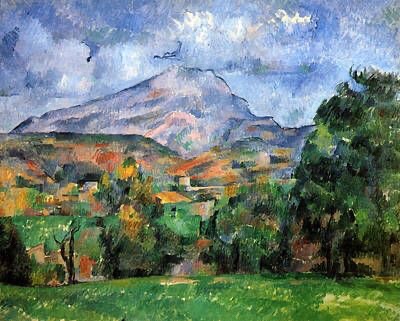
Watercolor is more difficult medium to manage than acrylic paints because it’s wetter and refuses to dry as quickly as we want to paint in that same area. It’s not being obnoxious; it’s just being its own true self. Cezanne used watercolors to think out his ideas beforehand, and then worked in oils. Often, he tossed aside the watercolor work, sometimes even leaving it out in the landscape which he’d just painted. He’d learned all he could from it and now was ready to paint his new image, but not a copy of the original painting. This mountain shows up in sixty of Cezanne’s artworks.
Paul Cézanne: La Montagne Sainte-Victoire, 1888, oil, The Stedelijk Museum, Amsterdam.
The stoic philosopher and Roman Emperor Marcus Aurelius wrote a series of meditations on life. In one he speaks of all life experiences as being the same. This attitude keeps him from getting too high or too low about what happens in his life. He takes it as it comes. Even death, which some fear as a loss, doesn’t bother him, for if he isn’t bothered about the present, he can’t be bothered about losing that too. Marcus Aurelius wasn’t a Christian, but his quest for equanimity is admirable. Take life as it comes and worry not:
“First, that all things in the world from all eternity, by a perpetual revolution of the same times and things ever continued and renewed, are of one kind and nature; so that whether for a hundred or two hundred years only, or for an infinite space of time, a man see those things which are still the same, it can be no matter of great moment. And secondly, that that life which any the longest liver, or the shortest liver parts with, is for length and duration the very same, for that only which is present, is that, which either of them can lose, as being that only which they have; for that which he hath not, no man can truly be said to lose.”
The Still Life in Our Classroom
When we work in watercolor, we have to take what the watercolor gives us. While we can plan, design, and control the outcomes to a certain extent, watercolor often goes its own way. If we work over the whole surface, rather than noodling around in one little space like a puppy sniffing a single spot while out on its morning constitutional walk, we get more done, just as the puppy is more likely to get its “business” done.
One of the reasons we work in a new medium is for the challenge. In school, when I was bored, I’d take notes in class by writing upside down. When that got too easy, I began using my left hand to write upside down. This was a true challenge! I didn’t have any ingrained pathways in my brain for left-handedness, much less the upside-down images. I was truly bored, however, so I struggled on until I got serviceable images. This was the year in which I went to art school as a midyear junior and was taking a freshman level history course.
Tim’s Painting
Tim has voluntarily switched to his left hand because he will have surgery on his right side, which will knock out his ability to use that arm for several months as he recovers. This is a good effort for his non dominant hand. You can tell he focused on the scoop, for it has the most detail. Training our alternate hand to do the work of our dominant hand requires resetting the brain to prefer the new hand. If you try brushing your teeth with your other hand, you’ll see exactly how strange it feels to use a different hand. This is because you have no well-worn pathways in your brain circuitry that makes this routine effort possible.
The fancy pants word for this is neuroplasticicy. We meet this concept with stroke survivors who do physical therapy to rewire their brain connections to make new pathways so they can speak, write, or walk. Everyone who tries a new game, learns a new language, or tries a new hobby also builds new pathways in their brains. Be learners for life, if you want to keep your mind healthy.
Gail’s Painting
Our still life was challenging today. It had solid shapes, a clear bottle, and a metal scoop. Not only were there multiple colors, but textures and transparency also. Gail has had several years of drawing under her belt, so she was able to render the perspective of the still life well. Note the clear blue bottle, which has a wonderful oval bottom. The lemons and limes are distinct also. The grey shape is an antique scoop, sans the handle.
In 2008, J.K. Rowling spoke at the Harvard commencement exercises, telling the graduates, “Talent and intelligence never yet inoculated anyone against the caprice of the Fates.” Because we don’t know what tomorrow will bring, taking care for today is the best preparation for the future. Rowling studied the Classics at Harvard, a subject most people would consider useless for this modern era. Yet after a divorce, as a single parent working for Amnesty International, she began writing her wizard novels. Harry Potter is now part of our cultural heritage.
As Jesus said in Luke 12:25-26–
“And can any of you by worrying add a single hour to your span of life? If then you are not able to do so small a thing as that, why do you worry about the rest?”
Worry is stressful, for sure, and it’s an example of “bad stress,” along with traumatic events, such as adverse childhood experiences (ACE), disease, divorce, and death of a loved one. We also endure “good stress,” as when we challenge ourselves to lift heavier weights, cook a new recipe, or learn a new language. As Ralph Waldo Emerson wrote in his 1841 essay Heroics, paragraph 14:
“The characteristic of a genuine heroism is its persistency. All men have wandering impulses, fits and starts of generosity. But when you have chosen your part, abide by it, and do not weakly try to reconcile yourself with the world. The heroic cannot be the common, nor the common the heroic. Yet we have the weakness to expect the sympathy of people in those actions whose excellence is that they outrun sympathy, and appeal to a tardy justice. If you would serve your brother, because it is fit for you to serve him, do not take back your words when you find that prudent people do not commend you.
“Adhere to your own act and congratulate yourself if you have done something strange and extravagant, and broken the monotony of a decorous age. It was a high counsel that I once heard given to a young person, —”Always do what you are afraid to do.”
When I was in high school, the ancient Latin teacher, who had taught my daddy when he went to school, tossed out the challenge, “No one has ever made 100% on my final Latin exam.”
I bit on that challenge like a starving dog bites on a bone, even if it has no scrap of flesh remaining on it. I made flash cards and studied for an hour every night before bed, I was so determined to be the exception to the rule. On the test, I got all the Latin correct, but lost ½ point for misspelling an English word. I never followed up on her retirement, but I fully expect her record remained unblemished. Also, I’m still spelling challenged. I’m thankful for SpellCheck in our writing apps.
Gail W.’s Painting
Gail W. paid attention to the still life and took care to lay down a close image in a pale wash before she began to add darker washes of color. Her left lime is most successful, with at least six shades of green and yellow in the shape. I also like the highlight on the central lemon. These two images capture the essence of the watercolor medium. Her perspective on the bottle bottom indicates it sits well on the cloth.
Failure teaches us what we don’t know, so we can improve the next time. This is what we call resilience. When I taught art, my students had to find three things they did well in their work before they named anything they needed help on. This was to build up their confidence. For some of them, just making a mark on the page was a start. If we fear making a mistake, we can sketch in a pale-yellow wash. This is very forgiving, like a whisper in the wind. If it’s not quite right, the next few marks may be nearer our desired outcome.
This Is Fine—Leave Me Alone, I’m Having a Crisis
Our mindset is what controls how we react to events in our lives. As one of my friends would remind me, “Not everything is a hair on fire moment.” Of course, when I was a young teen, the least slight or distress caused me to fling myself over my bed in a paroxysm of sobs, wailing loudly, “I’m going to die!” My parents would look at each other and shrug, “What boy is it now?” Fifteen minutes later I’d be in the kitchen looking for a snack, having cried my eyes out, and now I was on to the next thing. As I had more experiences, I learned to roll with the moment. Sometimes you need to wait for the next wave to rise before you take your ride. God’s timing is always right, for our experiences, both the failures and successes, prepare us for what comes next in our lives.
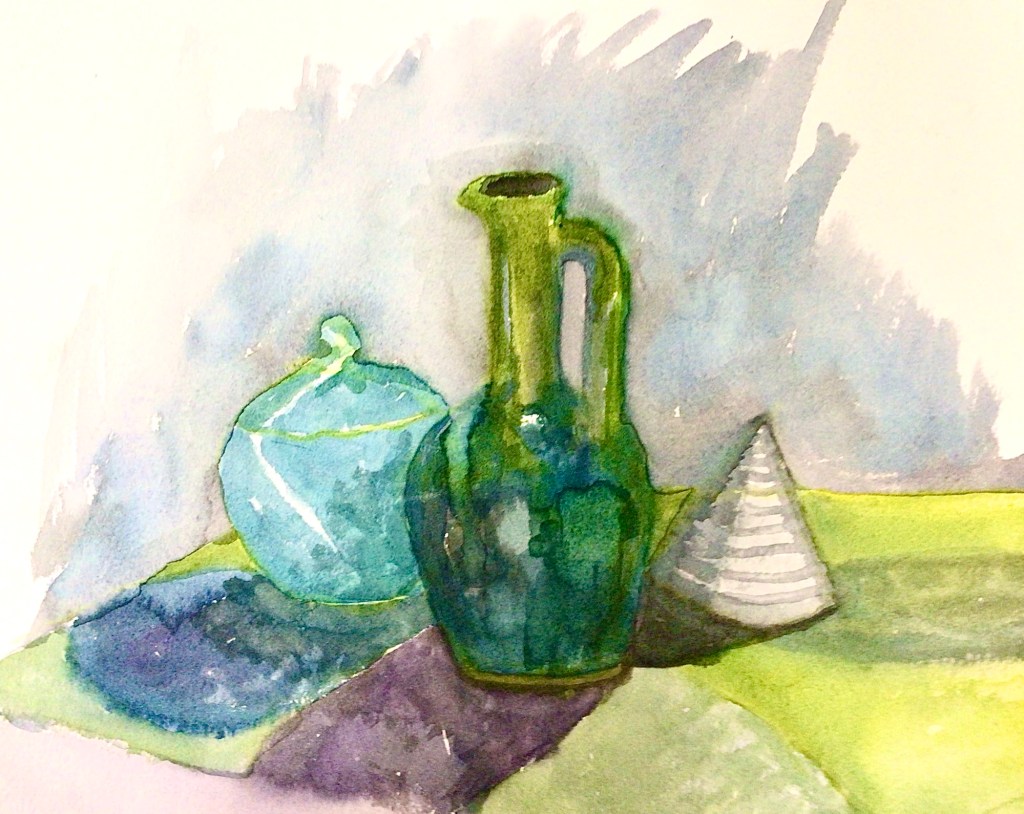
Cornelia’s Watercolor
I had some of the same perspective problems as everyone else, especially with the base of the bottle. Actually, it’s a challenge to get a “transparent three-dimensional object on a flat surface” to appear as if it’s actually sitting on a flat surface in two dimensions. Learning some shading techniques and remembering a round bottle bottom becomes an ellipse helps to bring off this sleight of hand. I got my paint too dark on the front of the bottle base and had to let it dry so I could come back in with some clear water and an almost dry brush to pick up the color. This gave me the highlight I needed.
Cornelia’s Drawing over the Watercolor
When I got home, I noticed my eyesight seems to be going amiss with my increased age. Lately I’ve not been careful to paint my verticals straight. Either I’m being lazy, or I’m tilting my head as I look at the subject. Maybe my neck injury has something to do with it. I duplicated the photo and used the Apple Pencil to straighten up the bottle and even up its symmetry. I also touched up a few of the lemons and limes. Maybe I’m still the puppy that likes to noodle around and sniff about until I can wrest all I can get from a work. This way I learn all I can from it. Like a kindergartner, if my work ends up a huge grey blob, I can say, “That was a great learning experience!”
My grandmother, who painted portraits and still lifes, kept a saying written on the back of an envelope, near her easel: “Ever tried. Ever failed. No matter. Try again.” She passed in 1970. Years later, Samuel Beckett, in his 1983 story, Worstword, Ho wrote:
We need to be like great artists and athletes, or the Michelin chefs who just keep trying, falling short, until they get close enough to qualify for their stars. Persistence makes all things possible, and if we “fail,” we’re only getting closer to perfection.
“Transfer of Learning” is a concept in which anything learned in one situation or environment can be applied in another. When I taught art, I would have my students use mathematics and fractions when they cut mats to present their work for exhibition. “Why do we have to use math in art?” they whined, “We’re never going to use it in our lives again.”
“Are you going to buy a house, a car, or shop for clothes or groceries? How will you know you’re getting a good deal?” They got out their pencils and rulers, even though they hated fractions.
Step 1: draw a light under painting
This was decades ago, before “Train for Today’s Workplaces” became a mantra among some politicians. The only problem with training for today is the ever-changing nature of the modern workplace, which can make skills obsolete in a mere two years. Executives believe nearly half of the skills that exist in today’s workforce won’t be relevant just two years from now, thanks to artificial intelligence. However, human creativity will always be needed to guide AI. Folks who want white collar jobs today will need to buy into continuous learning, since the current job market will require ever changing skills.
Step 2: add some thin washes to build up the solid surfaces
We’ve all heard the saying, “Jack of All Trades vs Master of None,” but this might be the best possible scenario for our modern world. In our highly professionalized society, we all want the best physician and the top-notch lawyer on our case. Not everyone has the goods to acquire their services. We get the best we can afford. This is the capitalist society in which we live. In a utopian society, the poorest among us would get the same high quality medical care as the President of the United States.
Step 3: add details once surface is dry enough the paint won’t bleed. Doing background while waiting for objects to dry allows you to tighten up the edges of the objects.
“Those who can’t, teach” is a misconception, similar to the Jack of All Trades. Art Teachers can’t stick only totheirspecialty, but also must offer the gamut of skills from drawing to painting, paper cutting to plaster sculpture, clay pottery to cloth dyeing, and even more multimedia experiences. They have to be able to reach students with a wide range of talents, interests, and expertise, as well as encourage those who are ashamed of their work. Plus, they need to convince the talented to work and improve so they fulfill their promise.
This background discussion brings me to our class’s second experience in watercolor. I noted some instances of Transfer of Learning I can point out when we meet again.
Gail’s Still Life
When we paint a house, we dip our brush in a bucket of paint, apply it to the wall in one stroke, and then go back to the bucket for another dip. We don’t keep wiping the same spot on the wall over and over trying to make this one spot look better. In fact, the damp brush is just picking up the paint off the wall! Move along and cover the wall.
Tim’s Still Life
Don’t take your eye off the ball. If you want to catch a ball in any sport, you have to track it into your hands or the mitt. I noticed the ones who looked up, drew, looked, drew, checked, drew again, adjusted, and drew some more, had closer proportions in their drawings.
Measure twice, cut once. This is similar to the above sports metaphor. I learned it in the art school wood shop when I was cutting wood for my stretcher strips. Using the thumb or a brush to note the proportions of the still life objects and comparing them to the proportions of your own work helps get an accurate drawing. Check once, measure, check again, measure, and then cut. Air drawing or visualization helps to imagine the proportions before drawing the lines. Drawing lightly so you can draw over the less appropriate shape is an example of measuring twice, and cutting once.
Gail W’s Still Life
Sheep will eat the grass down to the roots, but goats will move on. Actually, I have zero experience with sheep and goats. My shepherd experience is limited to leading a congregation, none of whom could be accused of being either sheep or goats. I only know this fact from Bible Study lessons, and no one rents out sheep to clear a pasture of weeds, but they use goats because goats are smart enough to move on. In art, we need to take a lesson from the goats and move on to another section of our painting to let our colors dry, so we can avoid our colors running into each other.
Cornelia’s Still Life
Our group isn’t training for a new occupation, but keeping a challenge on our plates is a good idea for anyone of any age. Whether you’re trying new recipes or learning to play an instrument or taking up an exercise routine, whatever change you make in your life is important. Doing creative writing or crafts or arts is especially crucial for keeping our brains healthy, for these activities build new pathways in our brains. As we age, having redundant brain pathways is important to keep our minds healthy.
Participation in arts interventions have been linked with improving cognitive function and memory, general self-esteem and well-being, as well as reducing stress and other common symptoms of dementia, such as aggression, agitation, and apathy. According to the National Endowment for the Arts, the interventions which promote social interaction, have multiple psychosocial benefits. While none of our group are experiencing these effects, participation also staves off the same symptoms. Researchers found visual arts programs reduced depression, improved socializing, and increased self-esteem among participants.
Expressive arts activities also help individuals relax, provide a sense of control, reduce depression and anxiety, encourage playfulness and a sense of humor, as well as improve cognition and self-esteem. Making art also nurtures spirituality and reduces boredom. Art also can reflect the emotional and cognitive condition of the artist.
Watercolor with Prang Oval 8 Student Palettes
In the classes I teach, I encourage each person finding their own voice, rather than copying my style. In the art education classes I took in college, the goals of teaching were for students to recreate the closest replica of the teacher’s model, as they followed the instructional steps to the letter.
I’m thankful I never had those teachers growing up, but by the 1980’s, regimented lesson plans were all the vogue. When I began to teach, I gave certain boundaries or requirements for each lesson, such as the use of certain color schemes or coiling verses slab built in clay sculpture, but the rest was left up to each student’s creative interpretation.
My principals were always surprised by the lack of discipline problems in my class, but when young people are given an opportunity to develop their imagination in a positive direction, rather than use it in negative behaviors, life is good. They especially liked the “hand-mouth pop quizzes” I would occasionally make them take, especially when they discovered cookies or chewing gum were involved.
Years later when I went to seminary, I constantly heard the refrain, “Will I be able to put this in my toolbox and use it in the local church?”
As a person who was preparing to be a fifth career pastor, I could only roll my eyes in silence. Every job I’d ever had prepared me for the ministry: renovating old apartments, teaching, preparing lesson plans, selling insurance, studying art history and painting, and learning how to renew and retrain my old skills for a new career. The idea of having a single toolbox that would never need new tools never crossed my mind. Seminary was where my skills to be a lifelong learner were reinforced.
I was writing this on My Daddy’s birthday. He would have been 105 if he’d lived so long. He always maintained an interest in archaeology until Parkinson’s and dementia robbed him in his late 70’s of his memories and his brilliance. He would take us on arrowhead hunting field trips on Saturdays when we were children. Armed with a cooler of lemonade and sandwiches from home, we’d go out to the countryside to walk in a farmer’s newly plowed field, with his permission of course.
In his early retirement, he enjoyed giving tours to school children at the LSUS campus Pioneer Heritage Center and driving the church bus to the food pantry to pick up the monthly food rations for distribution to the neighborhood. Staying active, engaged, and eating a healthy diet are other ways we can keep our minds building new neurons.
One of the interesting research opportunities in art and the brain is the question of whether neurodegenerative brain disorders will show up in an artist’s body of work. The progressive loss of neurons causes changes in the brain, which leads to a number of symptoms, from altered multi-sensory processing to difficulty moving and using one’s body, to subtle changes in mood, emotions, personality, social interactions; to major, disabling cognitive and behavioral impairments. Although we currently only offer art therapy for the elderly, perhaps we ought to be emphasizing the arts from earlier ages and integrate it into all of our studies to help everyone develop limber learning skills to last for our lifetimes.
Joy and peace,
Cornelia
Half Of All Skills Will Be Outdated Within Two Years, Study Suggests
National Endowment for the Arts Study: “Research Gaps and Opportunities for Exploring the relationship of the Arts to Health and Well-Being in Older Adults,” Published by the national endowment for the Arts Office of Research & Analysis
Can we really ‘read’ art to see the changing brain? A review and empirical assessment of clinical case reports and published artworks for systematic evidence of quality and style changes linked to damage or neurodegenerative disease
Here we are shortly before Thanksgiving, at the time I call the “high holy days of family gatherings.” We’ll be in this space-time continuum until the last whistle of the last Bowl Game—the grandaddy of them all: Sunday, February 11, 2024. That would be Super Bowl LVIII, or three days before Valentine’s Day, as a reminder to those who forget these things. As far as big games go, this tradition is almost old enough to take an early retirement. Thanksgiving is a much older tradition, however, for folks have been celebrating harvests as long as autumn has been a season. It’s always good to get a few pounds on before the winter gets here for good.
Leftover Blueberry Donut Bread Pudding
Our final class for November had a celebratory snack. Both Tim and Gail brought gifts of food: a delicious pumpkin spiced cream cheese roll and yummy blueberry and cake doughnuts. Tim let me bring the remaining doughnuts home, so I made a leftover blueberry doughnut bread pudding from them. Very good!! The recipe is on my Cornie’s Kitchen blog now (link below).
Gail’s Turban Pumpkins
Gail painted a still life of turban pumpkins and Tim finished up his leaf drawing. I worked to complete my print project. I added some bible verses cut from an almost century old Bible. The pages fall apart when I try to read it, but fixing it to the canvas will keep keep it from decaying further. As Isaiah 40:8 says—
“The grass withers, the flower fades; but the word of our God will stand forever.”
Tim’s Textured Leaf Study
Sometimes the best part of art class isn’t learning how to create a more beautiful painting, but discerning how to live a more beautiful life. We’re constantly surrounded by the woes and suffering of our world, and this experience can cause us to cast a jaundiced eye on life. We can end up with negative attitudes and emotions that affect our own equanimity and wellbeing.
This is a time when my life experiences in ministry and personal suffering help others see God’s transformational grace at work in human suffering. God doesn’t cause suffering, but God can use this time for good. As Paul reminds us in Romans 8:28—“We know that all things work together for good for those who love God, who are called according to his purpose.”
Even Jesus suffered and those of us who bear his name and image aren’t spared this fate. How we handle suffering is the mark of a redeemed person. No one is called to submit to abuse, but we’ll all suffer from illness, indignity, lack of respect, or the ravages of old age. Some of us suffer needlessly because we don’t measure up to an unrealistic ideal image, so we tear ourselves down and say, “we’re no good.” We’re just fine; our expectations are excessive.
Greetings from a Distant Time: It was a hope even then, not a reality.
The high holy days, which we enter into now, are fraught with expectations for many people. Families, who have estranged relationships, may feel a sense of loss if someone doesn’t appear at the family table. Likewise, those who’ve experienced a death will feel the pain of the empty chair. We can’t bring back what was, but we can honor their memories and tell their stories. We can live in the present and build new joys for the family we have now.
In the Bible, inviting someone to eat with you is equivalent to making them part of your family. Therefore, family is the people you choose, not just your blood relatives. We can have many families, but we are to love, care, and protect them all. I consider my art students as part of my chosen family.
In the new year we plan to experiment with watercolors, so if that’s an interest, a Prang 8 color watercolor box, brush, and watercolor paper should be on your Christmas list. Our December schedule is light:
• December 1–class— • December 8–no class—I’m going to Raney Lectures at PHUMC • December 15–class— • December 22 to January 3—vacation—no classes • January 5—Watercolor class
I returned from a spiritual retreat at Mount Eagle, at which we studied the Enneagram. This is our United Methodist camp site dedicated to holy listening. Of the nine spiritual personality types, I happen to be a Four: The Creative. I’m “The Sensitive, Introspective Type: Expressive, Dramatic, Self-Absorbed, and Temperamental.” Fours are self-aware, sensitive, and reserved. They’re emotionally honest, creative, and personal, but also can be moody and self-conscious. Fours sometimes feel vulnerable and defective, so they’ll withdraw from others, and they can also feel disdainful and exempt from ordinary ways of living. A Four typically has problems with melancholy, self-indulgence, and self-pity; but at their best, they’re inspired and highly creative, and they’re able to renew themselves and transform their experiences.
One of the things I’ve learned over my years of teaching art is every student is unique. They all aren’t Creative Fours, even if they have an interest in art. When I taught in schools, some of the students didn’t even have an interest in art at all. It was a requirement, and they were unwilling prisoners, who were set on rebellion because they knew they wouldn’t succeed. In most education classes, this would be true. Art education classes teach young teachers how to make lesson plans with distinct outcomes and a list of steps. This makes grading easy: did the student follow the steps and how close did their product match the model?
I don’t teach art this way. Children learn to walk by crawling, but they have to roll over and pull up first. Each step is an improvement over the first one. As long as a student keeps working and learning, their work will improve. We adults have to silence the judgmental voices in our heads that tells us, “You aren’t any good.” Instead, let’s listen to that inner voice of joy which says, “Wow, we’re having fun playing with the colors and making shapes appear—it’s like magic!”
We first looked at a few images of leaf paintings to get some ideas. Often by Friday morning, my brain needs some extra caffeine as well as extra jolts of creative input to get an inspired thought to percolate through the fog. We don’t all learn just by listening, but by seeing also. Sometimes students need a demonstration or hands-on experience to figure out the best way to use the materials. I always try to let them manipulate the materials themselves, since the best way to learn is by doing. This isn’t brain surgery, so we won’t harm anyone. We also won’t lose our salvation if the paint gets out of hand. We can always save our old works and say, “Look where I started from!”
Yayoi Kusama: Leaf painting (1990)
Tim was entranced by the Yayoi Kusama Leaf painting (1990), so he began to work on drawing a leaf in this manner. He’s recovering from carpal tunnel surgery, so smaller movements are better therapy for his hand.
Tim: Leaf drawing in progress
Not everyone is focused on details. Milton Avery is a modern colorist who simplifies the landscape into its essential elements. His trees often look like large leaves.
Milton Avery: Landscape with Trees
The bright colors of the autumn leaves in the landscape provided Mike’s color scheme for his one brilliant tree. Mike has exuberance in all he does.
Mike: Tree Aflame
Henri Rousseau was famed for his jungle scenes. These were green in every shade possible. He visited the botanical gardens in Paris for his inspiration.
Van Gogh favored yellow and orange, especially in his later years. The Mulberry Tree from 1889 is a lovely example.
Norton Simon Art Foundation, Pasadena, CA
Gail went outside to grab an actual leaf, rather than work from her imagination. She has a direct connection with nature, maybe because of her years with the national parks.
A leaf against our painting cloth
Repeating this leaf shape, she covered the canvas with it, allowing it to overlap in some areas and run off the edges in others. Using a monochromatic color scheme, she gave the illusion of shadows and light.
Gail’s Golden Leaves
Matisse sought to reunify humans with each other and with nature. As the great painter said, “What I dream of is a balanced, pure and quiet art which can avoid the trouble of frustrating subjects. This kind of art gives everyone’s mind peace and comfort, like a comfortable chair where they can have a rest when tired.”
Matisse: The Dance, 1909-1910
Viewers in Matisse’s day thought his brightly colored painting of dancers was quite daring, but today we can appreciate his work as an ode to life, joy and nature.
Cornelia: Dancing Leaves
As I’ve been watching the brisk winds blow the gold and red leaves from the trees this fall, I’ve also watched them dance against the bright cerulean sky. When the sun shines on these dancers, they glow even brighter than before. They don’t have a care for tomorrow, much less for today. Now and this moment is enough for them. They remind me of the Lord’s advice to us on the Sermon on the Mount in Matthew 6:34—
“So do not worry about tomorrow, for tomorrow will bring worries of its own. Today’s trouble is enough for today.”
I painted the back side of the leaves with a thin coat of acrylic paint and laid them one by one down on the white surface of the canvas. Then I gently hand rubbed the top of each leaf until I thought I’d transferred the paint. The hansa yellow was least successful as a print color, so I over printed it at the end. I mixed the green ground with the cerulean blue and two yellows. The sky has cerulean, violet, Ultramarine, and white. These I mixed as I painted, so the sky wasn’t an even color. (All skies change color due to atmosphere and distance: they get lighter toward the horizon).
Next Friday we’re going to make stamp prints. You may have cut your own design in a potato once upon a time in scouts or used vegetables to make prints. We can also use leaves, natural materials, metal objects, or found objects to create prints. Art is a time to explore and experiment. We’ll find out what works and what doesn’t!! Curiosity and the willingness to experiment and explore are all aspects of creativity. We can all learn to stretch our boundaries and learn resilience, which are experiences that help us address the stresses and challenges of daily life.
I learn something new every day. Today I learned a starfish has a brain that covers its entire body. Its whole body is made up of brain nodes! There are days I wish I were a starfish: I would have loads of brain cells!
Joy, peace, and happiness to everyone!
Cornelia
Type Four: The Individualist — The Enneagram Institute