Learning, Growing and Thriving

adult learning, art, Athanasius, brain plasticity, Christmas, Civil War, cognitive decline, Creativity, crucifixion, Faith, Imagination, incarnation, john wesley, Love, mystery, nature, renewal, Spirituality, St. Athanasius, United Methodist Church, Valentine’s Day, Valentine’s Day

In most adults, learning and thinking plateaus and then begins to decline after age 30 or 40. The old adage, “Don’t trust anyone over thirty” takes on new meaning in regards  to creativity. People after this age start to perform worse in tests of cognitive abilities such as processing speed, the rate at which someone does a mental task. The slide becomes even steeper after 60 years of age. We also notice a similar learning decline in children after summer vacation, which results in the fall semester becoming a “reteaching opportunity.”

As one who is also “growing long in tooth,” I have passed this yardstick by a mile. I notice I have a “slower processing speed” in my creative writing. I don’t consider it a reason to quit, but a reason to better organize my other time-wasting behaviors (social media, newsletters, newspapers, etc.). I can always ignore cleaning the condominium! Creativity before housework, is my motto.

Housecleaning Meme

We often think older adults are on a downward slope with unrecoverable loss. “Use it or lose it,” the saying goes. Recent research suggests we need to apply a more hopeful mindset and vocabulary when discussing older people—much like that used for childhood or early adulthood. Decline, as we so often see it, may not be inevitable. In fact, learning a new skill and practicing it for three months has shown benefits beyond the the practice time.

Adults often have limited time or resources, so if we encourage learning a new skill, this may help them step out of their comfort zones. In people’s later years, many personal and societal changes—such as moving out of state to be closer to family members, switching jobs or coping with physical distance from loved ones—make learning new skills necessary to adapt and succeed.

For example, taking a class to improve technological skills could aid seniors’ success in an increasingly digital world, such as helping them use Telehealth or online banking platforms. Learning new skills in an art class allows a person to express their feelings and solve problems in creative ways. Each person can find their own path to success in artistic practice.

Potholder Loom, just like the one I had back in the day.

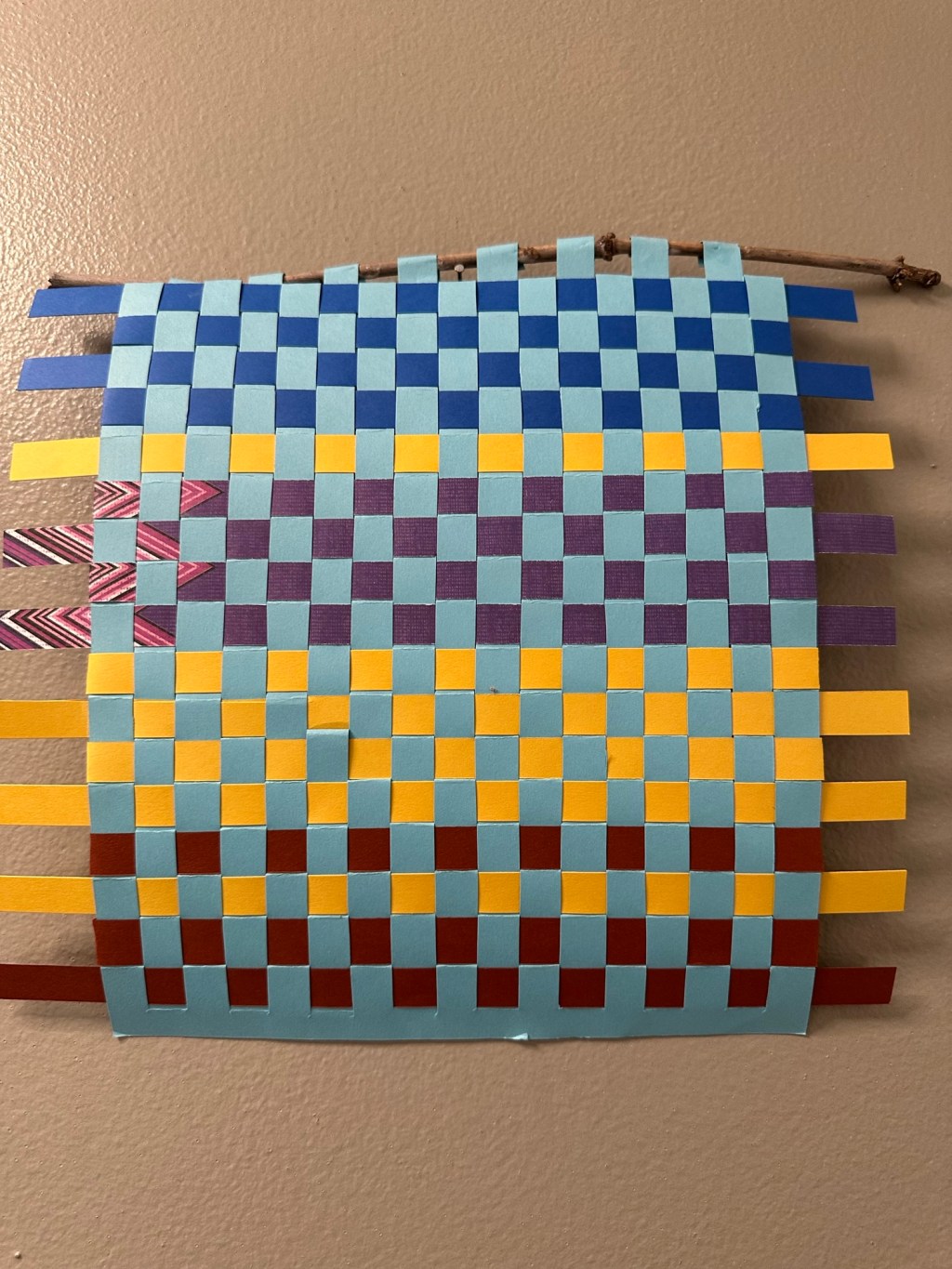
Our art class is trying a new thing: weaving. We have been painting for quite a while, so this is really a hands-on project. Some of us had the benefit of making woven potholders as children, or weaving newspaper “sit-upons” at summer camp. The technique isn’t unknown, but making a creative design interpretation is how we take our basic skill forward into a stimulating and creative brain challenge.

DeLee: Woven Paper on a Stick (Earth and Sky)

We could just repeat what we already know, but this doesn’t build us new neurons in our brains. If we keep the same old paths and don’t create new ones, we aren’t flexible when we meet new situations. Since we live in a rapidly changing world, building a brain capable of rapidly adapting is important to live independently and vibrantly for as long as possible.

I remember how my Daddy could only use the old tv remote to change the channel for the original non cable stations. When “Murder, She Wrote” came on the cable channel, my Mother had to use the cable remote to change the station for him. His Alzheimer’s disease prevented him from learning new skills, but he remembered all of his previous medical training and could diagnose his condition and boss the emergency room doctors when he was admitted to the hospital for a fall. Our brains are a mystery indeed.

Mike jumped the gun on Valentine’s Day and created a woven heart. These were big in the Danish and German communities and very popular in the 19th century in America. During the Civil War, soldiers made many of these in elaborate forms to send to their loved ones back home.

Unknown Artist: Affirmation Weaving

The brain is a fantastic and mysterious organ. If we make a habit of learning something new every day, of whatever interests us, we have the opportunity to keep our lucidity for a longer time. We also we meet the quickening changes of modern life with a steadfast heart and mind. We stress less when we know we can adapt and change in our own lives. We don’t have to be the people who say, “You can’t teach an old dog new tricks.” We can teach and we can learn, but we might need to be more patient with the old dog. In some corners, we call that “grace.”

I watched my Granddaughter’s Daddy Daughter Dance

Our group was in and out during the several weeks devoted to this project. One of us was sick, one was grieving the death of a beloved pet, another had pressing work issues, and the teacher went to Florida to see her granddaughter get married. Amazingly, life goes on. People dropped in for spiritual support, which is a side benefit of the community of art class. I managed to get mine mostly done, and Gail S. finished hers completely. Sometimes life interrupts our best intentions and we move on. We will learn new lessons on the next project.

Gail S’s “Eye of God” weaving

 Gail S’s “Eye of God” weaving incorporates yarns from two different mop heads, some sticks, and a bird feather. Gail almost always keeps a realist focus in her works, so her eye of God has a bird feather to mark the pupil. The upper field of grey and white mop yarns represent the cloudy sky, while the blue yarn stands for the water and the brown for the land. God watches over all of God’s creation. Gail S’s love of the outdoors and all of nature is evident in all her work.

Cornelia’s Cross on a Hill (unfinished)

I also recycled some old paintings and cords which I’d used in the preparatory work of other paintings. In addition, I used some recycled strips of Amazon shipping parcels as well as a wire shape which once belonged to a butterfly wing. In repurposing these items into the weaving along with two old brushes bound together with a God’s eye, I invoke the renewal of life after death.

We people of faith have two opportunities for a renewal of life after death. The first is by our profession of faith in Christ and his life, death, and resurrection on our behalf for our salvation. This gives us a living faith in this world. The second renewal is for the resurrection from death itself. This gives us a life beyond this world. Our faith is worthless if it doesn’t change us for our walk upon this world. If we don’t have the heart and mind of Christ within us, and if we aren’t earnestly seeking to be made perfect in the love of Christ daily, our United Methodist heritage tells us we’ve not yet been converted.

Yet Christ desires to save all, as John records in 12:32,  Jesus tells the crowd,

“And I, when I am lifted up from the earth, will draw all people to myself.”

Not just some people, or only the best, or even just us United Methodists, but ALL people. Most of us aren’t able to understand such a wide ranging love, for we live in a world of tribal loyalties. If we look at creation, which is God’s first work, God loves that which God created. God loves everything God created. We humans are the ones who choose sides and introduce boundaries and hate into God’s singular creation. The world or Kosmos is the creation first and then the people in it.

Today we tend to ascribe “world” to the “culture,” or secular society in general, but its plain meaning is creation and the human presence, for good or ill. The ancient Greeks and Romans divided the world into the material (bad) and the spiritual or mind (good), but the Jewish theology conceived the unity of both as part of God’s gift to humankind.

In the fifty-fourth chapter of On the Incarnation, St. Athanasius of Alexandria wrote a sentence that has echoed down through the centuries even into our own time as a brilliant summary of the Gospel. He wrote this: “God became man so that man might become god” (54:3).

This doctrine is called theosis or acquiring the whole nature of God. We United Methodists call this state Christian Perfection, or “a heart so full of love of God and neighbor that nothing else exists.” Our Wesleyan heritage was influenced by the Wesley brothers’ deep love for the Greek Orthodox fathers of the early church. To focus only on fallen nature is to deny the power of God to redeem us and all creation and to make all things new. We humans and nature aren’t more powerful than God!

If we cut off part of our God given self, we deny the incarnation of Christ, who became human for us that we might become divine. We need to remember what John 3:16 so succinctly states:

“For God so loved the world that he gave his only Son, so that everyone who believes in him may not perish but may have eternal life.”

Art is a way to open our eyes and hearts to a new way of seeing spiritual truths. Art is also reflective of the artist’s soul and spirit. A sensitive viewer can read the tale of trauma or the struggle for survival in an artist’s body of work. More than this, we can listen for their voices straining to be heard. Most people have been silenced and conformed to the “cause no trouble, don’t get out of step” mantra of the public school system training our youth for the workplace.

In art class, we can lose our fear of being different because being different gets rewarded! Being original gets an attaboy or attagirl.  I find such joy helping people find new courage and creativity they didn’t know existed within themselves. My students keep me young too. I feel blessed beyond measure.

Joy and peace,

Cornelia


To Stay Sharp as You Age, Learn New Skills | Scientific American

https://www.scientificamerican.com/article/to-stay-sharp-as-you-age-learn-new-skills/

That Man Might Become God — Fr. Andrew Stephen Damick
https://blogs.ancientfaith.com/asd/2015/01/22/man-might-become-god/

Intuitive Color Wheels

adult learning, art, at risk kids, cognitive decline, color Wheel, Creativity, Imagination, inspiration, Lost Cause, Ministry, Painting, renewal, vision

The great and wonderful part of art is exercising imagination and discovering new ways to solve problems. One of my favorite memories in art school was the day our professor came to class with a single red clay brick. Our first thought was this is going to be the most boring drawing class ever, but then he asked us, “How many uses can you find for a brick?”

Thick as a Brick

After we quickly named multiple uses for a single brick—doorstop, paperweight, weapon, counterweight, and bookend—we were at a loss to name much more. As we scratched our heads, our teacher prompted us, “Did I restrict you to a single brick?” And we were off to the races! Wall, fireplace, house, road, sidewalk, planter, sculpture, picnic table, bookshelf, and more. I can’t remember if this was an early morning class or we were just dense, but I’ve come to believe we can teach creativity. At the very least, we need to give people permission to accept “multiple art answers can be true” and give them the opportunity to consider “other possibilities.”

Canvas bound in strings

When I taught art years ago, children who were troublemakers in regular classrooms were usually well behaved in art class. I attribute this outcome to their ability to express their own individuality in solving the weekly art assignments. Math always has a right answer; there is no “alternative fact” to 2 + 2 = 4. History is the same: the Confederacy seceded from the Union to keep their economic system of enslavement. There was no “states rights movement,” no matter what the Lost Cause proponents pushed in our state approved textbooks. All we had to do was look at the original source documents from the 1860’s.

Simple Color Wheel

Adults usually conform to socially acceptable norms. Helping adults with creative thinking is important because the creative process is more important than the tangible result. Most adults give up the idea they will ever paint the Sistine Chapel ceiling, while children are humble enough to realize they need many more years of practice before they get that kind of opportunity. Also, what we know about creativity can’t be applied in the same way to all creative endeavors because they involve different subjective decisions and processes.


Gino Severini: Expansion of Light. (Centrifugal and Centripetal), ca. 1913 – 1914, Oil on Canvas. 65 x 43.3 cm
Museo Nacional Thyssen-Bornemisza, Madrid

Creative insight depends in part on new combinations of existing ideas, concepts, and perceptions that the brain has stored over time. This is why we begin each class looking at famous art works. We need good art influences and inspiration to “prime our creative pumps” so we can draw up from the pure wellsprings of our own creativity. Just as we need spiritual food for our soul, we need beauty for our creative ideas.

First stage

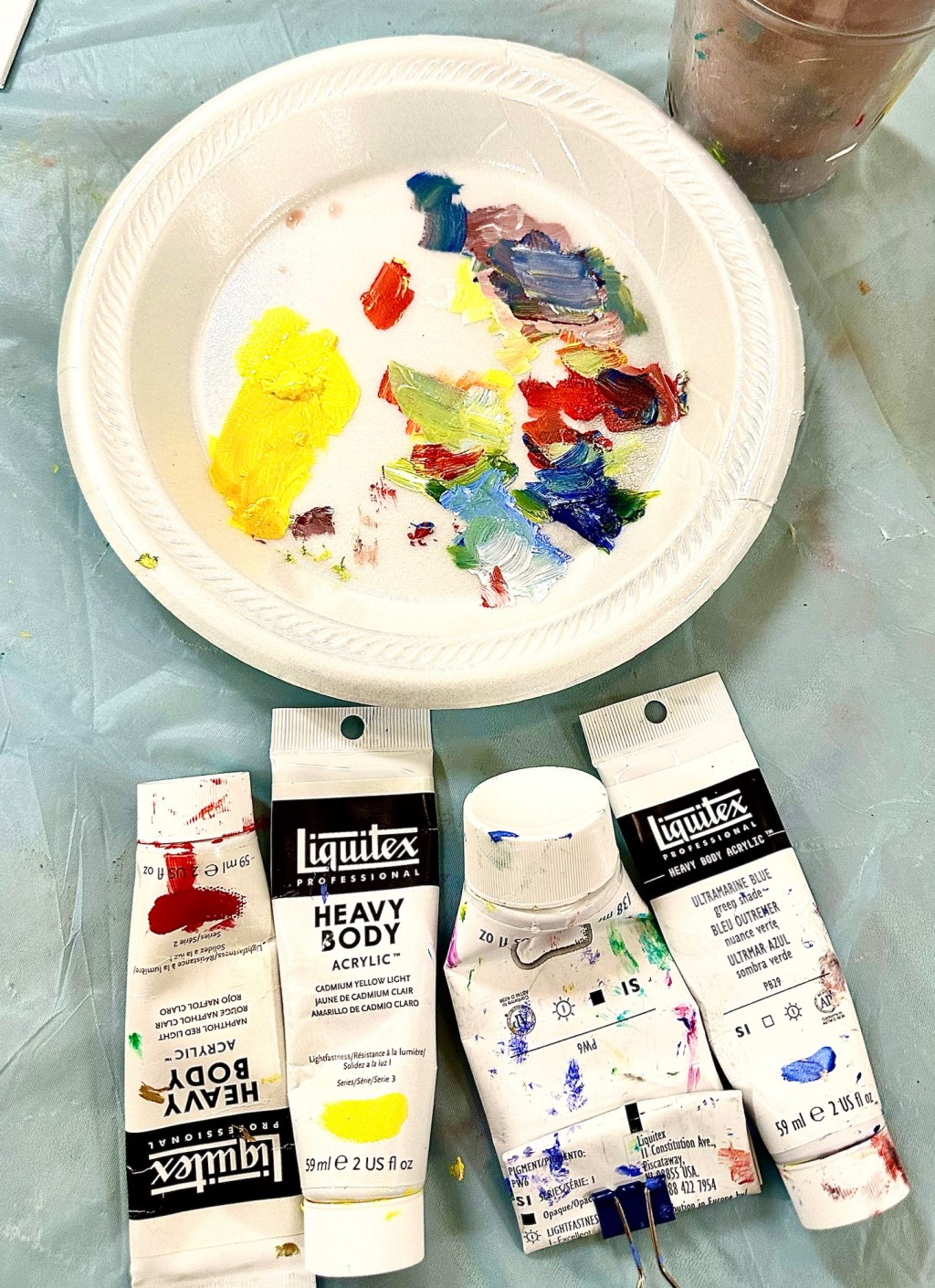
Last year we worked on copying the color wheel and matching it. That is an intellectual skill. To make this into a creative, intuitive activity, we took strings and wrapped our canvases. This made multiple shapes for our colors. Using the primary colors—red, yellow, and blue, plus white—we mixed various combinations and surprised ourselves with the results.

Gail W’s first stage

Our first class was lightly attended, due to doctor appointments and vacations, so we still have room for anyone else who wants to come. All skill levels are welcome, for I’ve taught from K-5 to adults. Everyone progresses from their own level, so the longer you sit and think you wish you were good enough for lessons is merely time wasted when you could be working with a practiced teacher! Anyway, the lessons are free; you bring your materials and discover your unknown abilities and gifts. We journey with fellow travelers. Plus it keeps your brain young.

We will continue to work on this project next Friday at 10 am.

 Joy and peace,

Cornelia

National Endowment for the Arts: Creativity and the Brain

https://www.arts.gov/sites/default/files/how-creativity-works-in-the-brain-report.pdf

OAKLAWN FRIDAY ART CLASS

adult learning, art, Attitudes, brain plasticity, change, cognitive decline, Creativity, hope, renewal, summer vacation, Uncategorized, United Methodist Church

WE’RE BACK!!!

The older I get, the faster time flies! When I was a child, summers were long and lazy times. I actually got so bored, by the first of August I’d start to play school. I’d line up my brothers and the neighborhood children and pretend to teach them.  It was our way of “playing ourselves into a new reality.”

Art has many right answers!

Children practice life lessons during their play experiences. We can also play our way into learning a new skill in art class. All we need is a “beginner’s mind.” The Japanese Zen term shoshin translates as ‘beginner’s mind’ and refers to a paradox: the more you know about a subject, the more likely you are to close your mind to further learning. As the Zen monk Shunryu Suzuki put it in his book Zen Mind, Beginner’s Mind (1970): “In the beginner’s mind there are many possibilities, but in the expert’s there are few.” 

Jerzy Nowosielski: Landscape with a vision of the Sun, oil on canvas, 1965, National Museum of Krakow, Poland. 

In a similar vein, Picasso once said, “When I was young, I could paint like Raphael, but it took me my whole life to learn to draw like a child.” Part of our art class experience is to learn to suspend our adult ego’s need to constantly be ranking, besting, and giving into our competitive natures. We learn more when we give up our egos and our needs to protect our false selves, and allow our true selves to learn. This story in Luke 9:46-48 on “True Greatness” speaks to this:

“An argument arose among them as to which one of them was the greatest. But Jesus, aware of their inner thoughts, took a little child and put it by his side, and said to them, “Whoever welcomes this child in my name welcomes me, and whoever welcomes me welcomes the one who sent me; for the least among all of you is the greatest.”

Mary Delaney, Xanthium Spinosum, from an album (Vol.IX, 98). 1778. Collage of coloured papers, with bodycolour and watercolour, on black ink background
© The Trustees of the British Museum

Our first meeting will be Friday, September 6, at 10 am in the old Oaklawn UMC fellowship hall. Bring your own acrylic paints, brushes, and a canvas or canvas panel to paint on. We begin with a short visual inspiration from some great art works, so that we can wonder and be filled with awe at some great artists’ works. 

Basic 2 point perspective

I’ll give some direction on the skill we’ll work on in the session, and then everyone is free to bring their own unique expression to their paintings. We don’t copy my work and judge how well a person can match it. Instead, we learn from the masters or from real life. We can learn to stretch our own skills to create something new. 

That’s US!

Of course, making great art isn’t our first purpose. As we age, the harsh truth is we will lose our ability to learn new skills until we lose our memory of what we just ate for breakfast or how to work the tv remote. Challenging our brains is one of the best ways to keep our brain cells firing and “chatting with one another.” We can actually grow new neurons as we grow older. Our brains don’t have to shrink like a cotton shirt washed in hot water. Socialization and encouragement also helps to keep our brains young. Teaching this class helps me stay young! We help each other in this matter. 

That goes for children of any age!

Of course, making art means we have to give up our desire to be perfect. Children always have a “beginner’s mind,” so they are free to explore and experiment. Artists quickly learn perfection comes from practice, or working at it. Every baby stumbles and falls as they learn to walk, but we dotting adults still encourage every trembling step. This is what art teachers also do. I’ve always had a rule in my classes, especially when I taught in middle school: 

“No Negative Talking about People or Art.”

This includes a student’s own art works. My students always had to give at least three positive comments about their work before they spoke about the negative. “My work needs improvement” is better than saying, “My work stinks!” After all, this way of thinking is more positive than negative and helps to build confidence in a person. 

God would post your art on Heaven’s Refrigerator

Of course, we’ve all grown up and worked in environments where negativity is the rule. Art class is a place of grace because this is how life should be. If we can transform a blank canvas into a field of color, why can’t we transform our communities and our world into fields of hope, joy, and love? 

The Light overcomes the Darkness

Perhaps because we try to make everyone copy/fit into our idea of the proper end product, rather than allow everyone discover their own creative response to the given subject of the day. The museums of our world are richer and more vibrant because artists have listened to the Spirit of the Creating God. We might do well to realize God’s creative energies are varied and vibrant also, just as Isaiah wrote about his vision of God’s Glorious New Creation: 

“For I am about to create new heavens and a new earth; 

the former things shall not be remembered or come to mind.

But be glad and rejoice forever in what I am creating;

for I am about to create Jerusalem as a joy, and its people as a delight.”  (65:17-18)


I hope to see you there. I don’t charge for the class sessions, since this is one of my ministries as a retired elder in the United Methodist Church. As John Wesley once said, “The World is my Parish.” When we grow in confidence in the joys of creating, we find more beauty in the created world. Optimism is one of the side benefits of the creative life, not fame or riches, and sometimes not even accomplishment. Just the act of being a co-creator with the creating God helps us to find more peace in life.

Joy and Peace,

Pastor Cornelia 

How to foster ‘shoshin’ | Psyche Guides

https://psyche.co/guides/how-to-cultivate-shoshin-or-a-beginners-mind

The Hand Rewrites the Brain

adult learning, art, brain plasticity, cognitive decline, Creativity, Faith, Health, inspiration, Lassen Volcanic National Park, Ministry, Painting, Pergamum, perspective, Turkey, vision

Aristotle once said, “The hand is the tool of tools.” Our hands with their opposable thumbs are an evolutionary miracle. Our opposable thumbs evolved around two million years ago, even before humans began to make tools. Our hands helped us to develop language and procure nourishment, as well as create mysterious images on cave walls which united the physical and spiritual worlds of our distant ancestors.

Hands at the Cuevas de las Manos (Cave of Hands) upon Río Pinturas, near the town of Perito Moreno in Santa Cruz Province, Argentina (2005) (image by Mariano via Wikimedia Commons)

Richard Rohr, the Catholic priest and spiritual writer, notes “only the contemplative mind can help bring forward the new consciousness needed to awaken a more loving, just, and sustainable world. We need a practice that touches our unconscious conditioning where all our wounds and defense mechanisms lie. That’s the only way we can be changed at any significant or lasting level.”

We have many spiritual practices to change our hearts and minds, such as prayer, meditation, contemplation, reading Scripture, and hearing the word preached. Attending holy communion and practicing the presence of God are other ways to be transformed. In art or faith, we don’t take anything at face value, but we seek the deeper meanings in the experiences we have with life.

Image I took while walking downtown. I paid attention to the composition when I took the photograph.

As one who slacked off my weight training over the pandemic, the gym rat saying holds true: “Use it or lose it.” We can lose muscle tone and aerobic capacity in just a few days if we’re older or recovering from injuries. Even if we’re young and healthy, we may lose capacity in a week or so. Likewise, some of us get our diplomas and never read a book again. For instance, 42% of college graduates never read another book after college and only 32% of the US population over the age of 16 reads books for pleasure.

One of the problems even in the USA is 52% of adults read at a 7th grade level or below, and 48% read at an 8th grade level and above. Yet reading has many benefits for keeping the brain healthy:

  1. Reading for just six minutes daily can reduce stress levels by 68%.
  2. Reading can increase empathy and emotional intelligence.
  3. Reading can improve sleep quality.
  4. Reading can increase vocabulary and improve writing skills.
  5. Reading can improve mental focus and concentration.
  6. Reading can reduce the risk of developing Alzheimer’s disease.

When we connect the brain and the hand, this results in increased activation of the nerve cells in the sensory and motor hand representational areas. As a consequence, the hand expands its representational area in the cortical hand map because it requires more brain resources, more ‘brain space’. Thus, the hand can ‘shape’ the brain; in other words, the brain is functionally shaped based on the hand’s experiences.

“Crop Doctor, Agronomist or Crop Doctor for Yardup. Checking on crops for disease, insects and nutrition.” © Phoebe Milne

If the hand, in contrast, is passive and immobile for a long time, its representation in the brain decreases and may totally disappear. Quite simply, the hand has to be active to maintain its representation in the brain: “use it or lose it.” On the other hand, we know the hand representation in the brain can be re-established by training and manual activities.

What sort of activity rebuilds the brain? The brain cortex contains more than 100 billion nerve cells and innumerable synaptic connections. The cortical body map is not fixed or hardwired, but can rapidly become reorganized as a result of a strengthening or weakening of the synaptic connections. Moreover, repetitive movements can overwhelm the hand and cause trauma, such as writer’s cramp. We need to find ways to exercise our hand, so we cause no harm, but build the brain pathways.

The hand has been called the “outer brain.”

In aging samples, for instance, there’s evidence to indicate that age‐related cognitive decline may be partly driven by a process of atrophy. Some studies have shown that adopting a less engaging lifestyle across the lifespan may accelerate loss of cognitive function11, due to lower “cognitive reserve” (the ability of the brain to withstand insult from age and/or pathology)12. Some emerging evidence indicates that disengaging from the “real world” in favor of virtual settings may similarly induce adverse neurocognitive changes.

Extensive media multi‐tasking during childhood and adolescence could also negatively impact cognitive development through indirect means, by reducing engagement with academic and social activities, as well as by interfering with sleep35, or reducing the opportunity to engage in creative thinking36, 37. I remember telling my schoolteacher mother, “Listening to the radio helps me concentrate on my homework.” She wasn’t buying that argument at all, and radio silence prevailed.

An important aspect of instant access to the internet is our ability to get information online, which has caused us to become more likely to remember where these facts could be retrieved, rather than to remember the facts themselves. This results in our becoming reliant on the Internet for information retrieval. For instance, most people no longer memorize telephone numbers anymore, but depend upon their phones to maintain their contact lists through the cloud, just as we once stored them on the internal SIM card. I personally don’t know anyone’s phone number anymore because I depend on my phone’s contact list. If it ever died on me, I’d be out of luck! The cloud better recognize me if I ever need to replace my phone.

Asklepion, Pergamum, Turkey: site of healing waters, temples, and cultural events, for pilgrims who would often stay for weeks. The ancients believed healing was a sacred art and people’s souls needed to be mended as well as their bodies.

Art and healing are intimately connected. The new Alice Walton School of Medicine in Bentonville, Arkansas, will integrate the arts in an intentional way. The students will be classically trained medical doctors who also will be equipped with knowledge to address all areas of wellness, whether it’s spiritual, emotional or social.

The science of neuroaesthetics is detailed in Susan Magsamen’s book, Your Brain on Art. She said the field can be described as the study of how art measurably influences the brain, body and behavior. The study of neuroaesthetics is “neuroarts.” Magsamen said the pursuit of creative expression is as important to humans as nutrition, sleep and exercise.

There are four parts of neuroaesthetics and “the aesthetic mindset:”

■ Being open to curiosity.

■ Playful exploration.

■ Sensory experiences.

■ Becoming a maker and beholder.

We discover this in art class when we want to draw or paint a picture beyond our skill level or the time limits of the work period. In seminary, we’d have three-hour final exams. Some of our fellow students would prepare six-hour answers to the advance sample questions our professors gave us to study. I always practiced the “triage method” of reducing everything we learned to the essentials. If we pick out the most important facts, we can best make our points in the time limits given. In the emergency room, doctors treat the most important issues first to save the patient’s life and tend to the details once the patient is out of the woods. No one can give a 6 hour answer in a 3 hour time limit. Ask yourself, “What’s the most important question here?”

Mike’s Mushroom

The same idea works in drawing or painting. We need to find the main forms and sketch them in before we get carried away with the tiny details. Mike showed me a great photo he took of the corvettes in Memphis. I suggested if he wanted to do this painting in a single class meeting, he needed to simplify it by enlarging it, so it had much less detail or plan on taking two classes to finish it. He chose to paint a mushroom in the wild instead. Even then he noticed his mushroom cap lacked the perspective to look realistic on a two-dimensional surface. We’ll have to pick up some perspective lessons in the fall again.

Cornelia’s Corvettes

This is a drawing from memory I made on my iPad. I stripped Mike’s photo down to the barest essentials. The vehicles may not even be recognized as sports cars, but they are convertibles. I do remember the great steel triangles of a bridge or other structure where the cars were parked. I did this in about 15 minutes, but I have over half a century of experience of seeing and drawing practice.

Internet image of corvettes on Beale Street

I sometimes forget my hand and brain have been trained to see the basic shapes “instantly.” Not because of some DNA of pure sight, but because I’ve practiced looking, dissecting, and memorizing what I see. Some of my experiences are blind drawing, which means I only look at the object, but never the drawing itself. This trains the hand to only go as far as the eye can “see.”

Gail S’s Landscape

Gail had the class over to her home and we were glad to see her in recovery mode. Since she’s still homebound, we took advantage of the good weather and her front porch to exercise our brains and hands.

Ansel Adams: Old Faithful Geyser, Yellowstone National Park, 1933-1942

Gail had a mountain landscape image from a screenshot she wanted to work with. The focus of our class was taking our camera photographs and using the editing software to heighten our images. Once we’d done that, we would see more clearly what was important in our image. The current theme in social media is “no filter,” but the great photographers of history always gone to the dark room to develop their photos and dodge the whites lighter or burn more black. Ansel Adams was a master at this.

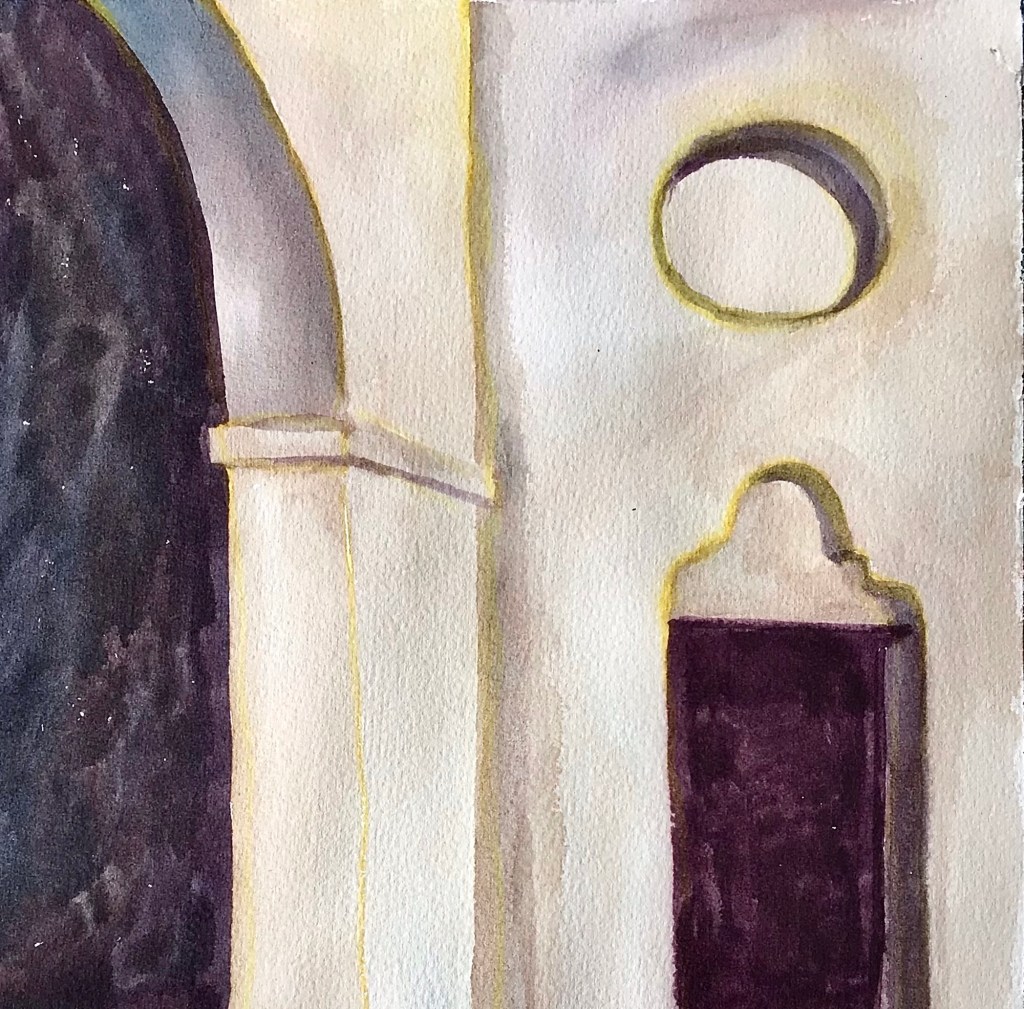
Cornelia: Prang 8 color box on Arches paper, from original photograph

Notice on my short watercolor study, I didn’t bother to include the whole photograph image. I “triaged” the details I couldn’t complete in our short class time. I mixed my own blacks, rather than using the pan color available. This gave me much richer colors and more variation in my shadows. I had outlined my basic shapes in yellow, but got to talking about the others’ directions and let the paint dry too much, or I would have picked it up better. It would have been less noticeable. I see now some of my lights could have been lighter. I can go back with a clean brush full of water and pick up some of that front face of the archway.

Of course, my eye sees more than most people can see, and it’s both a curse and a blessing. I’m always graceful with my students and try to give at least half as much grace to myself. We mustn’t get discouraged, but keep pressing upward! We don’t have to be a master at something to be a maker; we just have to do it. Having no fixed expectations of an outcome is the best way to exhibit creative expression. Following the less traveled path can lead to new destinations and new discoveries.

Art has the capacity to heal, to cross-fertilize, and to challenge fixed ideas. Art can’t be confined to gallery spaces or the walls of our homes. Art can not only renew our brains, but also the practice of art can renew how we see the world because we learn to see it afresh. Sometimes for the first time, we see it as we’ve never seen it before, and then we bring our own experience and expression to what we have seen. That’s when we become artists, creators, and cocreators guided by the hand of God.  As we are made in the image of the creating God, God heals us as he cares for the creation:


“I have seen their ways, but I will heal them;
I will lead them and repay them with comfort,
creating for their mourners the fruit of the lips.
Peace, peace, to the far and the near, says the LORD;
and I will heal them.”
~~ Isaiah 57:18-19

Joy and peace,

Cornelia


The Tool of Tools and the Form of Forms – 3 Wisdoms | Scott Randall Paine


59 Reading Statistics and Facts You Should Know

https://www.abtaba.com/blog/59-reading-statistics

What’s the latest U.S. literacy rate?

How the Hand Shapes the Brain, Hand Surgery Department of Clinical Sciences, Malmö Lund University Skäne University Hospital, Malmö, Sweden

NOTES FROM—The “online brain”: how the Internet may be changing our cognition –https://www.ncbi.nlm.nih.gov/pmc/articles/PMC6502424/

11. Hultsch DF, Hertzog C, Small BJ et al. Use it or lose it: engaged lifestyle as a buffer of cognitive decline in aging? Psychol Aging 1999;14:245‐63. [PubMed] [Google Scholar]

12. Small BJ, Dixon RA, McArdle JJ et al. Do changes in lifestyle engagement moderate cognitive decline in normal aging? Evidence from the Victoria Longitudinal Study. Neuropsychology 2012;26:144‐55. [PMC free article] [PubMed] [Google Scholar]

25–Uncapher MR, Wagner AD. Minds and brains of media multitaskers: current findings and future directions. Proc Natl Acad Sci 2018;115:9889‐96. [PMC free article] [PubMed] [Google Scholar]

35. van Der Schuur WA, Baumgartner SE, Sumter SR et al. The consequences of media multitasking for youth: a review. Comput Human Behav 2015;53:204‐15. [Google Scholar]

36. Altmann EM, Trafton JG, Hambrick DZ. Momentary interruptions can derail the train of thought. J Exp Psychol Gen 2014;143:215‐26. [PubMed] [Google Scholar]

37. Baird B, Smallwood J, Mrazek MD et al. Inspired by distraction: mind wandering facilitates creative incubation. Psychol Sci 2012;23:1117‐22. [PubMed] [Google Scholar]

Researcher Talks of Arts Benefits

https://ao.pressreader.com/article/281908778227901

The Hand: How Its Use Shapes the Brain, Language, and Human Culture,

By Frank R. Wilson

https://www.washingtonpost.com/wp-srv/style/books/reviews/hand.htm


Lifetime of Learning

adult learning, art, Cezanne, cognitive decline, Habits, John Ruskin, Transfer of Learning

Art and Math

“Transfer of Learning” is a concept in which anything learned in one situation or environment can be applied in another. When I taught art, I would have my students use mathematics and fractions when they cut mats to present their work for exhibition. “Why do we have to use math in art?” they whined, “We’re never going to use it in our lives again.”

“Are you going to buy a house, a car, or shop for clothes or groceries? How will you know you’re getting a good deal?” They got out their pencils and rulers, even though they hated fractions.

Step 1: draw a light under painting

This was decades ago, before “Train for Today’s Workplaces” became a mantra among some politicians. The only problem with training for today is the ever-changing nature of the modern workplace, which can make skills obsolete in a mere two years. Executives believe nearly half of the skills that exist in today’s workforce won’t be relevant just two years from now, thanks to artificial intelligence. However, human creativity will always be needed to guide AI. Folks who want white collar jobs today will need to buy into continuous learning, since the current job market will require ever changing skills.

Step 2: add some thin washes to build up the solid surfaces

We’ve all heard the saying, “Jack of All Trades vs Master of None,” but this might be the best possible scenario for our modern world. In our highly professionalized society, we all want the best physician and the top-notch lawyer on our case. Not everyone has the goods to acquire their services. We get the best we can afford. This is the capitalist society in which we live. In a utopian society, the poorest among us would get the same high quality medical care as the President of the United States.

Step 3: add details once surface is dry enough the paint won’t bleed. Doing background while waiting for objects to dry allows you to tighten up the edges of the objects.

“Those who can’t, teach” is a misconception, similar to the Jack of All Trades. Art Teachers can’t stick only to their specialty, but also must offer the gamut of skills from drawing to painting, paper cutting to plaster sculpture, clay pottery to cloth dyeing, and even more multimedia experiences. They have to be able to reach students with a wide range of talents, interests, and expertise, as well as encourage those who are ashamed of their work. Plus, they need to convince the talented to work and improve so they fulfill their promise.

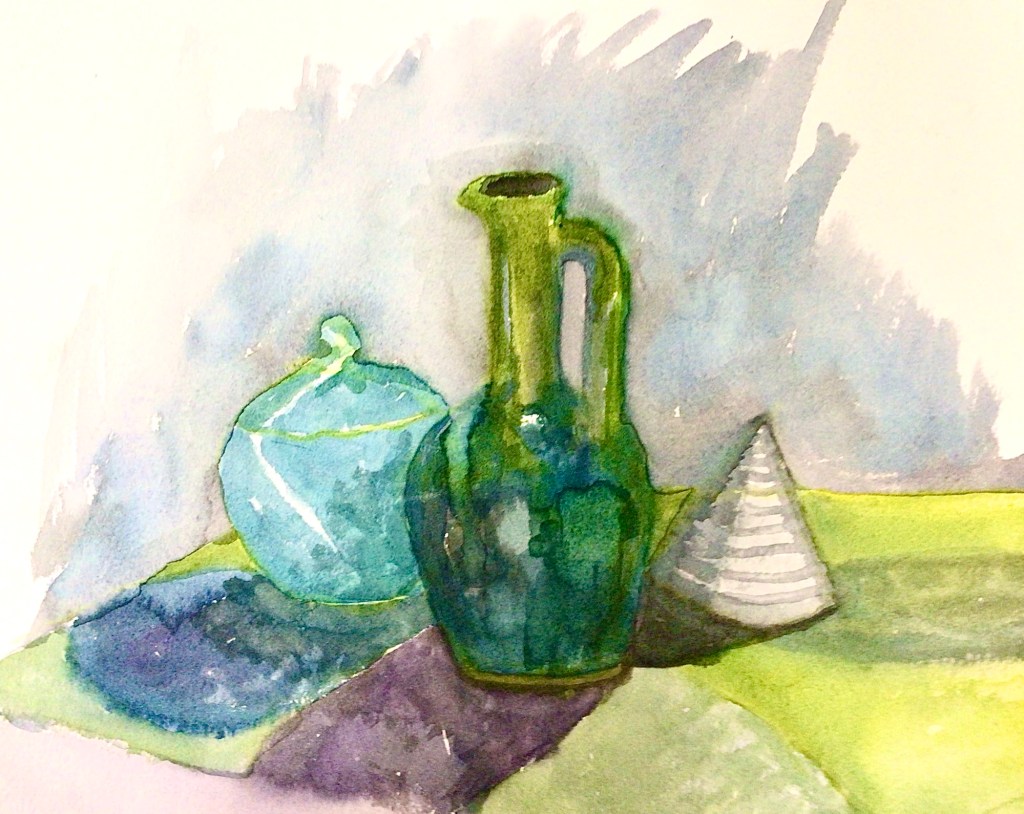
This background discussion brings me to our class’s second experience in watercolor. I noted some instances of Transfer of Learning I can point out when we meet again.

Gail’s Still Life

When we paint a house, we dip our brush in a bucket of paint, apply it to the wall in one stroke, and then go back to the bucket for another dip. We don’t keep wiping the same spot on the wall over and over trying to make this one spot look better. In fact, the damp brush is just picking up the paint off the wall! Move along and cover the wall.

Tim’s Still Life

Don’t take your eye off the ball. If you want to catch a ball in any sport, you have to track it into your hands or the mitt. I noticed the ones who looked up, drew, looked, drew, checked, drew again, adjusted, and drew some more, had closer proportions in their drawings.

Measure twice, cut once. This is similar to the above sports metaphor. I learned it in the art school wood shop when I was cutting wood for my stretcher strips. Using the thumb or a brush to note the proportions of the still life objects and comparing them to the proportions of your own work helps get an accurate drawing. Check once, measure, check again, measure, and then cut. Air drawing or visualization helps to imagine the proportions before drawing the lines. Drawing lightly so you can draw over the less appropriate shape is an example of measuring twice, and cutting once.

Gail W’s Still Life

Sheep will eat the grass down to the roots, but goats will move on. Actually, I have zero experience with sheep and goats. My shepherd experience is limited to leading a congregation, none of whom could be accused of being either sheep or goats. I only know this fact from Bible Study lessons, and no one rents out sheep to clear a pasture of weeds, but they use goats because goats are smart enough to move on. In art, we need to take a lesson from the goats and move on to another section of our painting to let our colors dry, so we can avoid our colors running into each other.

Cornelia’s Still Life

Our group isn’t training for a new occupation, but keeping a challenge on our plates is a good idea for anyone of any age. Whether you’re trying new recipes or learning to play an instrument or taking up an exercise routine, whatever change you make in your life is important. Doing creative writing or crafts or arts is especially crucial for keeping our brains healthy, for these activities build new pathways in our brains. As we age, having redundant brain pathways is important to keep our minds healthy.

Participation in arts interventions have been linked with improving cognitive function and memory, general self-esteem and well-being, as well as reducing stress and other common symptoms of dementia, such as aggression, agitation, and apathy. According to the National Endowment for the Arts, the interventions which promote social interaction, have multiple psychosocial benefits. While none of our group are experiencing these effects, participation also staves off the same symptoms. Researchers found visual arts programs reduced depression, improved socializing, and increased self-esteem among participants.

Expressive arts activities also help individuals relax, provide a sense of control, reduce depression and anxiety, encourage playfulness and a sense of humor, as well as improve cognition and self-esteem. Making art also nurtures spirituality and reduces boredom. Art also can reflect the emotional and cognitive condition of the artist.

Watercolor with Prang Oval 8 Student Palettes

In the classes I teach, I encourage each person finding their own voice, rather than copying my style. In the art education classes I took in college, the goals of teaching were for students to recreate the closest replica of the teacher’s model, as they followed the instructional steps to the letter.

I’m thankful I never had those teachers growing up, but by the 1980’s, regimented lesson plans were all the vogue. When I began to teach, I gave certain boundaries or requirements for each lesson, such as the use of certain color schemes or coiling verses slab built in clay sculpture, but the rest was left up to each student’s creative interpretation.

My principals were always surprised by the lack of discipline problems in my class, but when young people are given an opportunity to develop their imagination in a positive direction, rather than use it in negative behaviors, life is good. They especially liked the “hand-mouth pop quizzes” I would occasionally make them take, especially when they discovered cookies or chewing gum were involved.

Years later when I went to seminary, I constantly heard the refrain, “Will I be able to put this in my toolbox and use it in the local church?”

As a person who was preparing to be a fifth career pastor, I could only roll my eyes in silence. Every job I’d ever had prepared me for the ministry: renovating old apartments, teaching, preparing lesson plans, selling insurance, studying art history and painting, and learning how to renew and retrain my old skills for a new career. The idea of having a single toolbox that would never need new tools never crossed my mind. Seminary was where my skills to be a lifelong learner were reinforced.

I was writing this on My Daddy’s birthday. He would have been 105 if he’d lived so long. He always maintained an interest in archaeology until Parkinson’s and dementia robbed him in his late 70’s of his memories and his brilliance. He would take us on arrowhead hunting field trips on Saturdays when we were children. Armed with a cooler of lemonade and sandwiches from home, we’d go out to the countryside to walk in a farmer’s newly plowed field, with his permission of course.

In his early retirement, he enjoyed giving tours to school children at the LSUS campus Pioneer Heritage Center and driving the church bus to the food pantry to pick up the monthly food rations for distribution to the neighborhood. Staying active, engaged, and eating a healthy diet are other ways we can keep our minds building new neurons.

One of the interesting research opportunities in art and the brain is the question of whether neurodegenerative brain disorders will show up in an artist’s body of work. The progressive loss of neurons causes changes in the brain, which leads to a number of symptoms, from altered multi-sensory processing to difficulty moving and using one’s body, to subtle changes in mood, emotions, personality, social interactions; to major, disabling cognitive and behavioral impairments. Although we currently only offer art therapy for the elderly, perhaps we ought to be emphasizing the arts from earlier ages and integrate it into all of our studies to help everyone develop limber learning skills to last for our lifetimes.

Joy and peace,

Cornelia


Half Of All Skills Will Be Outdated Within Two Years, Study Suggests

https://www.forbes.com/sites/joemckendrick/2023/10/14/half-of-all-skills-will-be-outdated-within-two-years-study-suggests/

National Endowment for the Arts Study: “Research Gaps and Opportunities for Exploring the relationship of the Arts to Health and Well-Being in Older Adults,” Published by the national endowment for the Arts Office of Research & Analysis

Pioneer Heritage Center

https://www.lsus.edu/community/pioneer-heritage-center

Can we really ‘read’ art to see the changing brain? A review and empirical assessment of clinical case reports and published artworks for systematic evidence of quality and style changes linked to damage or neurodegenerative disease

Physics of Life Reviews 43 (2022) 32–95


Introducing Watercolor Painting

adult learning, art, brain plasticity, Cesanne, Children, cognitive decline, color Wheel, Faith, Imagination, John Ruskin, Painting, perfection, quilting, renewal, United Methodist Church

Our art class has worked in acrylic paint for several years, but toward the end of last year, they expressed an interest in learning about watercolors. I said, “Sure, we’ll do that. It’ll build on the color theory you already know, but you’re going to have to learn to plan ahead and learn not to rush to overwork one area. Transparencies are the mark of watercolor, so leaving your painting underworked is better than overdoing it.”

Transparent Watercolor Model

I was met with silence. Then laughter. “What the heck! We’re up for it! Bring it on!”

I love this group. They’re always up for a challenge. I think they’ve bought into my philosophy we aren’t going to be perfect, but we’re always going to learn from everything we do. As a teacher, I reminded parents their children wanted to engage with the medium to learn how far they can mix the colors before the image becomes a dark gray smudge. Then they might even push it even further until it’s solidly black. If you ask a child about their story, they might say, “The family took shelter in the house, but the storm came and blew it all away.” The story would evolve as they pushed the medium to the maximum. They learned the limitations on that day and wouldn’t go as far the next day. The process, not the product, is important.

Young children aren’t ready to draw subject matter from life but prefer illustrating stories from their imagination. They use symbols, rather than attempt to construct two dimensional designs to represent three dimensional objects. Somewhere around age 11 to 14, children begin to try to construct a realistic world in their art. While their drawings at this stage display the use of value, perspective, and light, children are extremely critical of their own success. They consider their drawing only as good as the level of realism they achieve, and they’re easily frustrated. Most people quit making art works about this age, so even as adults, their “functional artistic age” is somewhere between 11 and 14.

When my mother was teaching ceramic classes at her church, she once complained to me how her students, all senior citizens, were like “spoiled children, who each needed to have their own fresh jar of glaze to paint from.”

I asked if she was putting all the new paint jars out in the workroom, or if she kept them hidden in the supply closet. You might have thought I’d just pulled the clouds back from the sun from the way her face lit up.

“Of course! I should have thought of that! I’ll just pour out the colors they need and tell them that’s how it’s going to be. They can share.”

Paul Cézanne: The Park of the Chateau Noir with Well, 1904, graphite and watercolour, Private Collection

The old masters didn’t teach their students light, dark, shading, values, perspective, color mixing, temperature, or any other aspect of the art trade until the apprentice reached around age 10 or so. The rule when I was growing up was a child had to be able to write in cursive. That rule won’t work today, but another hand-eye coordination achievement will take its place.

It takes a while for me to know a new student’s nature, so I can give them the appropriate nurture. Some of my students will go ahead and do exactly what they want to do anyway because they have to see for themselves. They have a high tolerance for “learning,” and “experimentation.” Other students need to be kept from these excesses, because they can’t stand “failures.” Some students need to creep up to the edges of failure in order to progress, since they are so fond of being in control. Gaining the confidence to let go and let the medium have its way will be a growth opportunity which watercolor offers. Other students I can leave well enough alone, and come over when I sense they’re at a struggle point. I can recognize this when they quit working or begin to sigh loudly as they push back from their work area.

Cutting on the Fold

I’ve actually had some grownups in art classes cry because they couldn’t master a technique on the first go around. I always expected at least one child in my kindergarten class to shed a few tears when they were first learning to cut on the fold, but didn’t “hold the fold” when it was time to cut. I can repeat this rhyme, ask them to check, and then cut, but at least one will hold the open edges, which leads to two half pieces. I always have to remind them I’ve been practicing this skill longer than they’ve been alive. One day they’ll get good at it also. Effort will pay off. The same encouragement goes for adults, though most of them are too proud to shed tears.

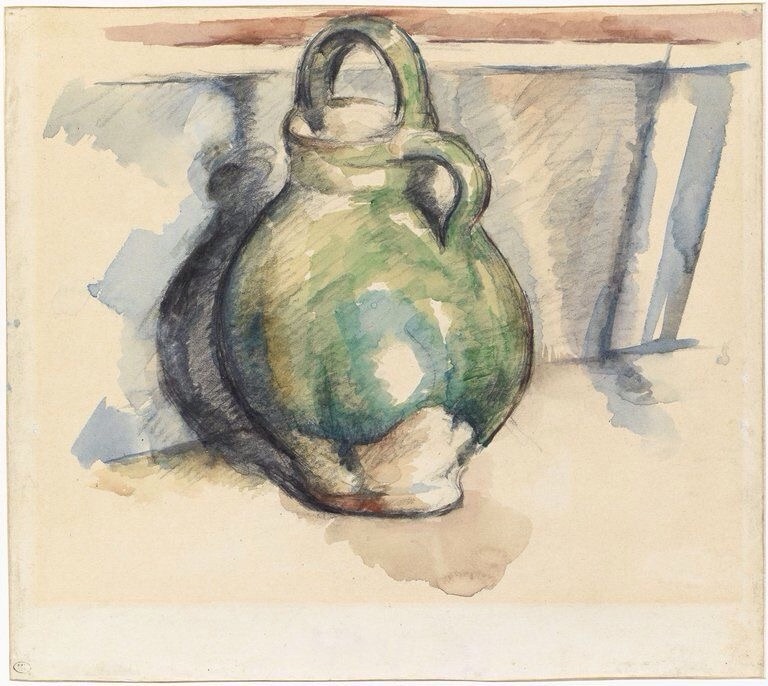
For our first class, belated as it was due to the recent weather and my brief hospitalization for a small blood clot at the turn of the year, we chatted about the difference between acrylic and watercolor painting. Acrylic painting is more forgiving, since we can paint over our less precise marks. We saw some Cezanne watercolor landscapes to see how a real master draws and paints.

Paul Cezanne: Le cruchon vert, watercolor, 1885/1887, Louvre, Paris.

Watercolor’s luminosity depends on the sheet on which it is painted, for its brilliance is a balance between transparent washes of pigment and the light bouncing off the bright paper back to the viewer’s eyes.  At first, Cézanne worked much as he did in his oil painting, applying the watercolor densely, filling in underlying pencil outlines, covering the paper completely, and highlighting with white gouache. Later he thinned his watercolor and laid down veils of color, incorporating blank paper for highlights. He often applied watercolor to dry, semi-absorbent paper, creating layers of crisply defined brushstrokes with ridges of pigment at their edges.

Our class, because they are used to the dense pigments of the acrylic paints, painted much like the early Cezanne gouache works. It takes a while to learn a new medium, especially one so radically different from their prior experiences. But just as it takes time to learn, it also takes time to unlearn! Ask my golf coach about changing my swing sometime. We’ll get the hang of it eventually.

After checking out the master, we then worked on mixing the secondary and tertiary colors from the primary colors from our Prang 8 Color palettes on our 140-pound watercolor paper (not sketchbook paper, which is thinner and will buckle under the slightest bit of water).

Cornelia’s psychedelic mushroom rainbow

I was still on painkillers for my shingles, so my painted circle never quite closed itself. Instead, it was more of a rainbow, an image of hope after all this rain and my health troubles. My secondary colors looked like rainbow mushrooms popping up from the rainbow. The wetness of some areas bled into some of the colors, giving me the tertiary colors. I had a bit more success working the wet in wet in the blue grey cloudy sky.

Gail W’s Flower

One of our new students, Gail W., imagined her color wheel as a flower in a field. Tim W. focused on the colors as patterns. I had the sense I was looking at a portion of a quilt in progress. While we had the color wheel as an image, we weren’t bound to recreate a wheel.

Tim W’s quilt patterns

Tim B. Always has a unique viewpoint, so his color wheel is moving through space. Mike used some pastel colors in addition to the Prang colors to experiment with the difference between them. He’s used to thick paint with his acrylics, so allowing more water to flood the surface and allow the light to bounce back through the paint will allow his painting to glow more brightly.

Tim B’s flying color wheel

Gail S. finished out her wheel in good form. She has good transparency of paint and mixing of colors of the three sets of colors on the wheel. Gail typically paints with thinner washes in acrylics, so her technique in that medium passes over easily to watercolors.

Gail S’s transparent color wheel

As a first start, we’re on the way. Next week we’ll try a small still life. I hope to be in less pain, so I’ll have more of my brain cells available, or at least they’ll be within hailing distance. I have some great Cezanne still life watercolors to share. A still life will test our drawing skills and our painting skills both. The Victorian art critic John Ruskin said, “No good work whatever can be perfect; and the demand for perfection is always a sign of a misunderstanding of the ends of art.”

Mike’s color wheel with Prang and opaque watercolors

We aren’t being graded, so when I say “test,” no one ever fails. We only find out what we’ve learned and what we need to improve upon. Trust me, “we’re all going on to perfection, by the grace of God.” After all, this is a United Methodist art class. If I may quote Ruskin again, “The highest reward for a person’s toil is not what they get for it, but what they become by it.” By this he means, art changes us. Art also opens new horizons, allows us to overcome challenges, imagine new solutions, eases our stress, finds companionship, learn resilience, appreciate culture, and develop new skills. At every age, art builds confidence, teaches us compassion for ourselves and others who try new things, and helps us keep an optimistic attitude. I personally believe art keeps our inner child alive and well. May God renew you daily in joy.

Joy and Peace,

Cornelia


Drawing Development in Children: The Stages from 0 to 17 Years https://www.littlebigartists.com/articles/drawing-development-in-children-the-stages-from-0-to-17-years/

John Ruskin—The Stones of Venice

A Guide to Cézanne’s Mark-Making and Materials | Magazine https://www.moma.org/magazine/articles/589

Cezanne’s Watercolor Pigments.   https://cool.culturalheritage.org/coolaic/sg/bpg/annual/v14/bp14-09.html#:~:text=C%C3%A9zanne%27s%20watercolor%20technique%20allowed%20the,before%20application%20to%20the%20paper.


Inspired by Autumn Leaves

adult learning, art, Attitudes, autumn leaves, cognitive decline, Creativity, Enneagram, Imagination, inspiration, Matisse, Ministry, Painting, Spirituality, trees, Van Gogh

I returned from a spiritual retreat at Mount Eagle, at which we studied the Enneagram. This is our United Methodist camp site dedicated to holy listening. Of the nine spiritual personality types, I happen to be a Four: The Creative. I’m “The Sensitive, Introspective Type: Expressive, Dramatic, Self-Absorbed, and Temperamental.” Fours are self-aware, sensitive, and reserved. They’re emotionally honest, creative, and personal, but also can be moody and self-conscious. Fours sometimes feel vulnerable and defective, so they’ll withdraw from others, and they can also feel disdainful and exempt from ordinary ways of living. A Four typically has problems with melancholy, self-indulgence, and self-pity; but at their best, they’re inspired and highly creative, and they’re able to renew themselves and transform their experiences.

One of the things I’ve learned over my years of teaching art is every student is unique. They all aren’t Creative Fours, even if they have an interest in art. When I taught in schools, some of the students didn’t even have an interest in art at all. It was a requirement, and they were unwilling prisoners, who were set on rebellion because they knew they wouldn’t succeed. In most education classes, this would be true. Art education classes teach young teachers how to make lesson plans with distinct outcomes and a list of steps. This makes grading easy: did the student follow the steps and how close did their product match the model?

I don’t teach art this way. Children learn to walk by crawling, but they have to roll over and pull up first. Each step is an improvement over the first one. As long as a student keeps working and learning, their work will improve. We adults have to silence the judgmental voices in our heads that tells us, “You aren’t any good.” Instead, let’s listen to that inner voice of joy which says, “Wow, we’re having fun playing with the colors and making shapes appear—it’s like magic!”

We first looked at a few images of leaf paintings to get some ideas. Often by Friday morning, my brain needs some extra caffeine as well as extra jolts of creative input to get an inspired thought to percolate through the fog. We don’t all learn just by listening, but by seeing also. Sometimes students need a demonstration or hands-on experience to figure out the best way to use the materials. I always try to let them manipulate the materials themselves, since the best way to learn is by doing. This isn’t brain surgery, so we won’t harm anyone. We also won’t lose our salvation if the paint gets out of hand. We can always save our old works and say, “Look where I started from!”

Yayoi Kusama: Leaf painting (1990)

Tim was entranced by the Yayoi Kusama Leaf painting (1990), so he began to work on drawing a leaf in this manner. He’s recovering from carpal tunnel surgery, so smaller movements are better therapy for his hand.

Tim: Leaf drawing in progress

Not everyone is focused on details. Milton Avery is a modern colorist who simplifies the landscape into its essential elements. His trees often look like large leaves.

Milton Avery: Landscape with Trees

The bright colors of the autumn leaves in the landscape provided Mike’s color scheme for his one brilliant tree. Mike has exuberance in all he does.

Mike: Tree Aflame

Henri Rousseau was famed for his jungle scenes. These were green in every shade possible. He visited the botanical gardens in Paris for his inspiration.

Van Gogh favored yellow and orange, especially in his later years. The Mulberry Tree from 1889 is a lovely example.

Norton Simon Art Foundation, Pasadena, CA

Gail went outside to grab an actual leaf, rather than work from her imagination. She has a direct connection with nature, maybe because of her years with the national parks.

A leaf against our painting cloth

Repeating this leaf shape, she covered the canvas with it, allowing it to overlap in some areas and run off the edges in others. Using a monochromatic color scheme, she gave the illusion of shadows and light.

Gail’s Golden Leaves

Matisse sought to reunify humans with each other and with nature. As the great painter said, “What I dream of is a balanced, pure and quiet art which can avoid the trouble of frustrating subjects. This kind of art gives everyone’s mind peace and comfort, like a comfortable chair where they can have a rest when tired.”

Matisse: The Dance, 1909-1910

Viewers in Matisse’s day thought his brightly colored painting of dancers was quite daring, but today we can appreciate his work as an ode to life, joy and nature.

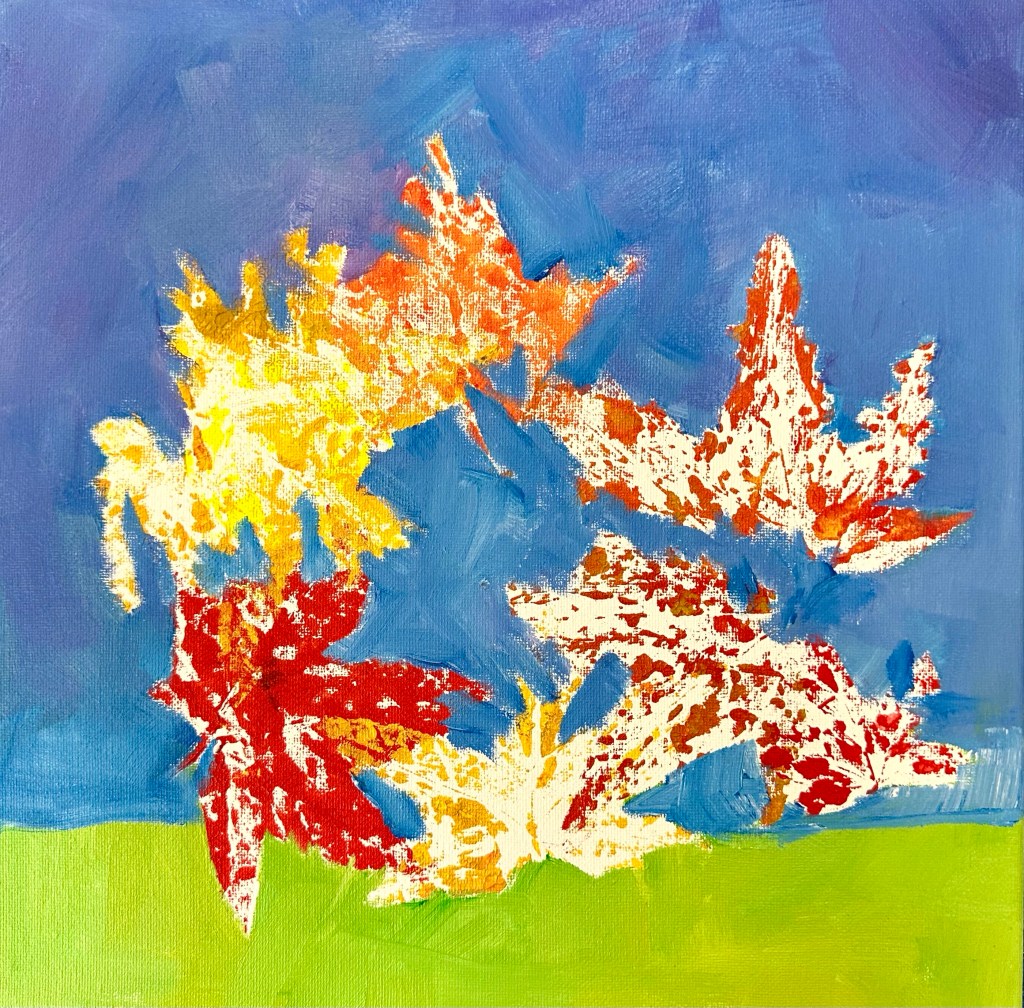
Cornelia: Dancing Leaves

As I’ve been watching the brisk winds blow the gold and red leaves from the trees this fall, I’ve also watched them dance against the bright cerulean sky. When the sun shines on these dancers, they glow even brighter than before. They don’t have a care for tomorrow, much less for today. Now and this moment is enough for them. They remind me of the Lord’s advice to us on the Sermon on the Mount in Matthew 6:34—

“So do not worry about tomorrow, for tomorrow will bring worries of its own. Today’s trouble is enough for today.”

I painted the back side of the leaves with a thin coat of acrylic paint and laid them one by one down on the white surface of the canvas. Then I gently hand rubbed the top of each leaf until I thought I’d transferred the paint. The hansa yellow was least successful as a print color, so I over printed it at the end. I mixed the green ground with the cerulean blue and two yellows. The sky has cerulean, violet, Ultramarine, and white. These I mixed as I painted, so the sky wasn’t an even color. (All skies change color due to atmosphere and distance: they get lighter toward the horizon).

Next Friday we’re going to make stamp prints. You may have cut your own design in a potato once upon a time in scouts or used vegetables to make prints. We can also use leaves, natural materials, metal objects, or found objects to create prints. Art is a time to explore and experiment. We’ll find out what works and what doesn’t!! Curiosity and the willingness to experiment and explore are all aspects of creativity. We can all learn to stretch our boundaries and learn resilience, which are experiences that help us address the stresses and challenges of daily life.

I learn something new every day. Today I learned a starfish has a brain that covers its entire body. Its whole body is made up of brain nodes! There are days I wish I were a starfish: I would have loads of brain cells!

Joy, peace, and happiness to everyone!

Cornelia


Type Four: The Individualist — The Enneagram Institute

https://www.enneagraminstitute.com/type-4

The 9 Enneagram Types — The Enneagram Institute

https://www.enneagraminstitute.com/type-descriptions

Art Analysis: Dance by Henri Matisse – Artsper Magazine

Texture Paintings

adult learning, Aristotle, art, autumn leaves, beauty, brain plasticity, cognitive decline, Creativity, flowers, Holy Spirit, Imagination, Leonardo da Vinci, Painting, renewal, Uncategorized, vision

Leaf Textures

I don’t do wine painting classes. Since I teach in a United Methodist Church, our Wesleyan temperance tradition holds sway: we serve no alcohol. However, out in the world beyond there are classes where everyone drinks wine and paints the same image. They’re out for fellowship purposes more than for art, but these classes serve to get people started in the basic techniques of the media. Students copy the teacher’s model painting, often working along as the teacher instructs the class. This is the “show and tell” style of teaching, which usually results in most students’ works approximating the teacher’s example.

Wine painting classes: One Lion to Rule Them All

College art education classes often are taught this way, but art classes in art schools are never taught like this. Why you might ask? Because art schools exist to help students find their own voice, for they know copying another’s style only diminishes a student’s true voice. The creative spirit within each of us is unique,
breathed into us by a holy God. Ecclesiastes 12:7 reminds us at our end, “the breath (Spirit) returns to God who gave it.” If art students are copying any art works, their teachers are humble enough to send their students to the masters first, or to life itself.

Laguna College of Art and Design art class

Art, like golf, is a humbling experience. In both we’re always playing against our handicap: we want to be “Perfect,” but we weren’t given the means to accomplish this goal without God’s grace. We go on to perfection by degrees, with the help of God, if we don’t get lazy and take the shortcuts, as the Adam and Eve, Prodigal Son, and many other great stories tell. As Jesus reminds his followers in Matthew 23:11-12—

“The greatest among you will be your servant. All who exalt themselves will be humbled, and all who humble themselves will be exalted.”

Why is it difficult to draw from life? Or for that matter, to really look hard at a painting to copy it? From an early age, most of us are taught it’s impolite to stare. In some cultures, even looking directly into the eyes of another person as you speak is unacceptable behavior. I know my parents taught me to look at them when I was in trouble, even when I wanted to look down in shame. I had to face their anger. While I didn’t enjoy it as a child, it prepared me as a teen for hateful comments from my peers, and as an adult for discrimination in the workplace. I could look people in the eye and call them out. This is likely why our early teenage children roll and flutter their eyes at us when we call them to account. They “look at us” without “looking.” And why we say, “Look me in the eye!”

19th century humorous postcard: The Artist’s Studio

We also have thoughts running through our heads: our to do lists, our concerns about our friends and loved ones, as well as the woes of the world stage. The more we learn to focus on the present moment in which we find ourselves, the better off we are. I find when I can pay attention to my colors, patterns, and how they come together on the canvas, I forget everything else.

I have some artist friends who always have a glass of wine in the studio, since it helps them relax. I think they just like wine. I’m a coffee lover, but too much caffeine makes my hand jittery, and too much wine would make my hand sloppy. I personally believe in moderation in all things, but then I’m sold on Aristotle’s “golden mean,” or the “Goldilocks zone,” where

“at the right times, about the right things, towards the right people, for the right end, and in the right way, is the intermediate and best condition, and this is proper to virtue.”

We barely avoided the 15th government shutdown since 1981, but we now have a House majority without a Leader due to a few extremist members. These Republican Party members who are “pirates who take no prisoners and make no compromises” might want to catch up on their ancient philosophical reading before chaos ensues. Sometimes life imitates art: if you have MAX, you can watch Michael Cain in “Our Flag Means Death.”

Little Vase of Flowers

All creativity improves with either time or wine. Both allow you to loosen up and not control what happens but go with the flow of what happens on the canvas, instead of forcing the paint to go where you want it to be. I have canvases which began in one direction and ended up in quite another. I can only say my original idea was rejected by the painting in progress, for I had to “listen to what the painting wanted to become.” As Psalms 104:30 says:

“When you send forth your spirit, they are created;
and you renew the face of the ground.”

In case you’re wondering, the “ground” of a canvas is the white primer, so it’s not a stretch to say, God’s Spirit works through us to renew the face of the “ground.” Some texts translate this as the “earth,” and God’s Spirit also works through us to restore and renew our planet to health after all the damage from industrial pollution and man made climate changes.

Leonardo da Vinci, the Renaissance genius, claimed, “There are three classes of people: Those who see. Those who see when they are shown. Those who do not see.” We can all learn to see. How we learn to see takes time and effort. This is why I always talk about some examples of good art before we begin our work. I know most people haven’t seen the masters, so getting images in mind is important. A little art history lesson never hurt anyone. Then I explain the project and we get to work. Stephen King, the noted author, says this about the creative experience: “Amateurs sit and wait for inspiration, the rest of us just get up and go to work.”

Tim’s Flower

In class we were using the flower arrangement which had been residing in the kitchen fridge for the past several weeks. I don’t know who to thank for it, but we put it back where we found it. Our group was given the key to use patterns and textures in the work.
Tim wants to learn to draw from life better, but he was struggling to get his proportions to scale. I showed him the trade skill of using a pencil or part of his hand to measure part of the object and compare its size to another part.

We give away our secret sauce recipe all the time! Everyone knows how to multiply with a ruler for a scale drawing, but that idea often doesn’t occur to them if they aren’t using it on a flat plane. If they have no real ruler, the idea of using an ordinary object as a measuring device also doesn’t enter our brains. This is normal, but once upon a time, we used our bodies to measure the work in progress: a cubit was the distance from the elbow to the middle fingertip and a hand-width was just that: the width of the four fingers. Over the years these were standardized to 18 inches and 4 inches. Horses are still measured in hands today, but we moderns measure in feet and meters rather than cubits.

Gail’s Texture Painting

Gail lined out some lovely patterns on her canvas and made good progress on her painting. She always gets a good plan and executes it.

Mike was glad to be back after doing renewal work/manual labor. This creative exercise of moving bold colors and strong patterns around his canvas was a welcome respite after all that physical activity. A mental challenge seemed welcome to him.

Mike’s Flowers

I had done a pattern piece in the week before, so I enjoyed painting the still life, and may use it as a study for something larger later.

Late 1800’s Levi Strauss advertisement

We finished up our works on the second session. Tim reworked the pumpkin drawing from an earlier time and Gail finished up her texture painting of the flowers. Mike dropped in with Van Gogh books before going out on an errand of mercy to rescue a young client. He was impressed with the amount of blue clothing the people wore in Van Gogh’s paintings. I reminded him the very denim jeans we wear first came from Nimes, France. We call these “jeans,” because the weavers in France were trying to imitate the techniques of Genoa, Italy, but failed, and made instead the sturdy fabric that’s blue outside and white inside. Hence, “jeane de Nimes.”

“I did not know that!” He exclaimed.

Art is for wondering, for seeing new things, for opening up our minds to new realities and new possibilities. Whenever we go beyond what we already know, we open a new brain pathway and create new connections between the neurons. This keeps our minds agile and staves off the worst aspect of aging: the pessimistic belief that nothing is new under the sun. If we keep the optimism of a child, for whom everything is the newest and best, we’ll keep a youthful heart and spread joy wherever we go.

Joy and Peace,

Cornelia

The ‘Golden Mean’: Aristotle’s Guide to Living Excellently —Philosophy Break
https://philosophybreak.com/articles/the-golden-mean-aristotle-guide-to-living-excellently/

Weights & Measures
https://www.jewishvirtuallibrary.org/weights-measures

History of Denim & the Origin of Jeans
https://www.hawthornintl.com/history-of-denim

The Persistence of Effort

adult learning, Altars, art, Attitudes, beauty, brain plasticity, Children, cognitive decline, Creativity, exercise, Food, Habits, Health, Holy Spirit, inspiration, knitting, Love, Ministry, mystery, nature, Painting, Prayer, pumpkins, purpose, rabbits, renewal, Right Brain, sleep, Van Gogh, vision

These shoes are made for walking

I was reading an article in the New York Times the other day. In “How I Learned to Love Finishing Last,” the author wrote about her slow pace as a runner. As one who regularly finishes last in my age group in the annual Spa 5K Walk each November, I’m optimistic one day I might get old enough to be in a nonagenarian age group all on my own. Perhaps if I’m 90 and still doing a 5K, they’ll give me a ribbon just for participating! “The last will be first and the first will be last,” especially if there’s only one of us in the race!

“When we compare ourselves to others,” said Dr. Justin Ross, a clinical psychologist in Denver who specializes in athlete mental health and performance, “we set ourselves up to suffer. Instead, the real psychological benefits come from enjoying what your body can do.”

Portrait of Yayoi Kusama in costume in front of pumpkin painting, photo: Noriko Takasugi

Suffering physically isn’t what art class is about, although we may suffer indignities to our egos, but this shouldn’t hold us back from doing our art works. The case of the Japanese artist Yayoi Kusama is evidence even hallucinations of voices and images can’t keep an artist from creating. If our daily efforts don’t measure up to what we imagined in our mind, it’s merely because our inner eye sees better than our hands can execute our vision. Sometimes our eye forgets what it once learned, for we haven’t used our skill of looking in a while. A runner doesn’t leap off the couch and immediately run a marathon or even a 5K. The smart athlete takes the time to train progressively for the distance beforehand. Also, they get new shoes.

Kroger Run: Two ghost pumpkins and a small pie pumpkin

Sometimes the coach has slept over the summer also. Just as students in school need a time to relearn last year’s lessons, as a coach in art class I sometimes forget the lessons, which are second nature to me because they’ve been inculcated by multiple teachers since I was eight years old, aren’t as ingrained to my own students. I also forget I’m always observing everything around me: cloud patterns, changing colors on trees, sunlight dappling on tree branches, shadows on the ground, and reflections in windows. I think about these patterns rather than about what I need to do next or next week. My calendar will remind me of these things in due time. I’ll be wrapping this up soon so I can work on my monthly Rabbit blog.

Rabbit playing “Hide the Pumpkin.”

A National Institute on Aging study found five healthy lifestyle factors — physical activity, not smoking, not drinking heavily, following the Mediterranean-style diet, and engaging in mentally stimulating activities — can have important benefits. People who engaged in four or five of these behaviors had a 60% lower risk of developing Alzheimer’s compared to those who only followed one or none. People who followed two or three of the activities had a 37% lower risk. This is your free wellness plan from Dr. Cornie, who has no medical degree, but did stay in a Holiday Inn once.

Debunking the Myth of the Split Brain Theory

Although we commonly think art is a “right brained” activity, in 2013 a group of researchers at the University of Utah discovered people actually use both sides of their brains equally. Back in the 1970’s when I was seeking employment after graduate school, the “Art is a right brain myth” ruled the creative work world. I once suggested I’d be a good candidate for a museum position because I understood both the artistic and the logical mind. I was not hired. Intuitive understanding of the brain a half century ahead of time doesn’t exactly open the doors to a fancy job.

As I recall, I got a checker’s job in a grocery store and ended up counting the teller trays and preparing the bank deposits for that store. The good news is creating works of art is a multi-process activity, one that depends on several brain regions and on redundancy of art-related functional representation rather than on a single cerebral hemisphere, region or pathway. This means even when we lose our ability to form words (typically a left hemisphere activity) our ability to create art still exists. We can still express our inner feelings and thoughts. This is good news for the aging and those who love them.

Yayoi Kusama – Pumpkin, 2014, installation view, Donum Estate, California, photo: Robert Berg

One one the great sadnesses in my ministry is being with young people who desperately want to have their old one’s memories recorded, but waited too late to ask them or were too busy with their own lives to sit and listen to these stories of the olden days. Once their old person has a stroke and loses the ability to form words, the opportunity has passed. Those stories will be locked in their minds due to aphasia, and no one or no amount of time will pull them out. We always tell young parents their babies need to be enjoyed while they’re still young, but we should also tell families to get the stories of their elders while they still can. “Strike while the iron is still hot” will take on a new meaning one day.

We needed bigger pumpkins

Gail and I were the only ones in class today. Lauralei showed up to gift us chocolate cake and keep us company. Tim and Mike were out of town. Gail and I both repainted old canvases. I showed some of the unusual ways pumpkins have been decorated by various artists, but none of them sparked any interest. We got down to work by covering our old canvas with a base of titanium white paint. Then I located all three of the pumpkins with circles and drew a baseline for the object on which they sat. I didn’t look over at Gail’s work for a while, but then I noticed she’d almost completely finished one pumpkin without roughing in the shapes of the others.

Gail had a big canvas today.

“Did you plan on finishing that one pumpkin before drawing the other two?” I asked.

Gail gave me a “needs more caffeine” stare.

“That’s what I thought. Maybe next time draw in the rough shapes so you get everything located in space relevant to each other.”

Pumpkin Spice Latte Time

We kept on painting until clean up time. I often say “I’ve slept since then.” It’s my all purpose excuse for forgetfulness or just plain airheadedness. Sometimes I have my mind on other things and I’m not focused on what’s in front of me. I forget about the wisdom of Brother Lawrence, who said “many do not advance in the Christian progress because they stick in penances and particular exercises while they neglect the love of God which is the end. This appeared plainly by their works and was the reason why we see so little solid virtue.” He also said, “there needed neither art nor science for going to God, but only a heart resolutely determined to apply itself to nothing but Him and to love Him only.”

Cornelia’s small painting of pumpkins

We know Brother Lawrence from the classic text, The Practice of the Presence of God. Although it dates from the late 17th century, his lessons on living life in joy in the present moment, all for the love of God are invaluable for us modern folks who tend to live for our 15 minutes of personal fame, social media clicks, or self interest. We aren’t used to the monastic life today, or to the discipline of that lifestyle. We live in a Burger King world, in which each individual gets his or her own way to every extent possible. Unfortunately, the Christian lifestyle is one of discipline, but not harsh punishment:

“Now, discipline always seems painful rather than pleasant at the time, but later it yields the peaceful fruit of righteousness to those who have been trained by it.” ~~ Hebrews 12:11

In art class we focus on the disciplines, just as the guild artists taught the apprentices back in the day. These disciplines are not only for safety, for some of our art tools are dangerous, but also some of our techniques are proven to yield better results than others. This is why carpenters measure twice and cut once. They also cut on the outside of the line, rather than the inside. They can shave down a piece easier than adding to it. Murphy’s Law recognizes this: “A wire cut to length will be too short.”

Zen Tangle drawing of pumpkins: exercise in texture

Art class has no mysteries, but we can forget the “secret gnostic knowledge passed down by word of mouth” from our previous classes. I often use the excuse “I’ve slept since then.” Another good excuse is “My mind has gone to Pluto.” I share these with you all, for they’ve always worked for me. Of course it helps to be a natural blonde. Then again, I’m very organized, but I’m also very active, so sometimes my calendar gets overwhelmed, and I pull out the “OOPS! Card.” Even in retirement I’m still creating and sharing my faith through art and writing. It’s my way of exercising those brain cells to keep them from dying off. We old folks can still learn new things, even if it takes longer. This is what we call the persistence of effort. Those who keep using their skills won’t be losing those skills.

The same goes for learning a new skill. It’s all a matter of repetition. We can’t get frustrated if we don’t get it on the first try. We won’t be a good role model for the young if we have that attitude. We need to lower our expectations. I used to think I couldn’t knit, but only crochet. After my mom, who was a stellar knitter passed on, a friend taught me to knit in an afternoon! Where this sudden bilateral coordination came from I have no idea, but it was so welcome. Perhaps I needed to be in the right frame of mind, or I wanted to be able to carry on my mom’s memory, but I was definitely receptive to her teaching.

Letter to Theo Van Gogh, September 18, 1888

It’s never too late to learn and we’re never too old to start learning. Art isn’t just good for the brain, but it’s good for the soul. Art is our attempt to represent truth, beauty, and nature in media that can be accessible to others. By doing this, we bear witness to the creation and the Creator. We only need give our best efforts, and let God’s Spirit guide our growth.

Joy, peace, and perseverance,

Cornelia

We have pumpkins galore on the autumn altar.

How I Learned to Love Finishing Last


How the Aging Brain Affects Thinking | National Institute on Aging

https://www.nia.nih.gov/health/how-aging-brain-affects-thinking

The creative-right vs analytical-left brain myth: debunked! – Dr Sarah McKay https://drsarahmckay.com/left-brain-right-brain-myth/

Art and brain: insights from neuropsychology, biology and evolution – PMC

https://www.ncbi.nlm.nih.gov/pmc/articles/PMC2815940/

The Project Gutenberg eBook of The Practice of the Presence of God, by Brother of the Resurrection Lawrence (free ebook)

https://www.gutenberg.org/cache/epub/5657/pg5657.html

Rabbit! Rabbit!

art, Astrology, autumnal equinox, brain plasticity, change, cognitive decline, coronavirus, cosmology, Creativity, Family, Great American Eclipse, greek myths, Helios, nature, Painting, pandemic, photography, rabbits, Reflection, The Lord of The Rings, trees, vision

Welcome to August!

In the long summer evenings, after an extended car trip, and way beyond the too many times I’d asked my mother and daddy rabbits, “Are we there yet?” I would get their firm reminders I wasn’t to bother them any more, for they too were hot, tired, and daddy had to pay attention to the road. In the gathering darkness, I’d rest my blonde curls on the door near the open window. We had God air conditioning back then. We rolled down the window glass of our old Pontiac and drove as fast as the road would allow.

Go Faster!

I’d watch the darkening shadows as the landscape passed by this opening, noticing how the kudzu vines changed the trees into strange and monstrous shapes in the growing gloom, but I couldn’t take my eyes off of these apparitions. I was certain if I did, they’d begin to make their way toward our family car. I think I was at the age of magical thinking, for I believed I could keep these haints at bay by my will alone.

The soft flup flup of rubber tires half melting on the overheated concrete road, combined with my brother rabbits’ body heat in the seat beside me, and the enforced silence of our parents who’d had a long day with their hyperactive bunny brood finally had an effect on my eyelids. Try as I might, I would fall asleep at my watch, only to be awakened by my daddy’s sing song voice as he tickled my toes:

“This little piggy went to market, this little piggy stayed home.
This little piggy ate roast beef, and this little piggy had none!
And this little piggy cried wee-wee-wee all the way home!”

I’d rub my eyes as he picked me up to carry me into the house and into my bedroom. On the way, I’d always say,

“I see the moon, and the moon sees me,
God bless the moon, and God bless me!”

Perhaps this is a generational gift in my family, for when my own dear bunny child was small, we repeated these same scenes until she was too heavy for me to carry. The moon blessing dates from 1784 and the little piggy rhyme is even older: 1728.

That latter date is when horses and carriages were banned from Boston Common. Since I went to school in Boston, I can attest no horses, carriages, or cows are now on the grounds of the Common, which is now a 50 acre public park. The Common dates from 1634, when William Blaxton sold the remainder of his land to the Puritans, receiving six shillings or more from each shareholder to purchase the land for this public land. This was the site of the Boston Massacre, in which five people died. One good thing about going to school in an historic community, everywhere you went, you weren’t far from history.

When I think of history, I think not only of the stories we pass down to the next generation, but also of the stories we weave for ourselves. How do we remember our childhood or our families of origin? This is a generational gift of privilege, for those who lost their families when they were young may not have memories to weave together. Refugees from wars and violence might not want to recall traumatic experiences. Yet Abraham, the father of the Jewish nation, is remembered as “My ancestor was a wandering Arameam” (Deut 26:5).

Some of us choose to write about our better days, for they outnumber our bad days. Everyone has imperfections, but each of us rabbits are still going on to perfection with the help of the good God above. Perhaps when we see the beauty of the full bright moon against a dark, clear night, our heart leaps inside and says,

“I see the moon, and the moon sees me,
God bless the moon, and God bless me!”

For some of us rabbits, nature brings us closer to God than anything else. The majesty of the summer thunderclouds rising in the heated air, and giving way to either refreshing rain or flashing floods, reminds us once again of the powers of God unleashed in God’s creation. The rainbow after the storm is the promise once again of that covenant made so long ago: the earth will never be destroyed by floods again. In the rainbow, in the light of all the colors, we hear God’s promise of love and care for God’s creation and God’s creatures.

DeLee: Blue Moon

I’m looking at a full super moon tonight, July 3, but August will have TWO super moons. Looking ahead to September 29, we’ll have our FOURTH super moon in a row. The moon on the 31st of August will be a blue moon. This is the second full moon in the same month. We won’t have another blue moon until May, 2026. This is why things that don’t happen often are called “once in a blue moon” events.

Once upon a time, we were agrarian people who eked out a subsistence living on the land. The persistence of The Old Farmer’s Almanac and other ancient weather wisdom lore is proof you can take the bunny out of the country, but you can’t take the country out of the bunny. Yet as our alphabetical generations accumulate beyond the boomers, like Lucy on the Honeymooners, we often “got some explaining to do” to make ourselves understood.

Sirius in the Night Sky

We can count the “Dog Days of Summer” among the sayings folks don’t understand today. The term has nothing to do with the four legged creatures known as our best friends, but instead, it’s an astronomical term. The name comes from Sirius, the Dog Star, which rises before dawn. We find it on a vertical line below the three stars of Orion’s Belt. Sirius was named from the Greek Seirios, which means ‘glowing’ or ‘scorcher.’ This is an apt description of the warmest days from mid July to mid August.

Crepe Myrtle Bark Peeling in the Heat

Aratus, a Greek 3rd BCE poet wrote in his astronomical poem Phaenomena, (p. 328 ff, trans. Mair):

“A star that keenest of all blazes with a searing flame and him men call Seirios (Sirius). When he rises with Helios (the Sun), no longer do the trees deceive him by the feeble freshness of their leaves. For easily with his keen glance he pierces their ranks, and to some he gives strength but of others he blights the bark utterly. Of him too at his setting are we aware.”

These Dog Days of Summer in the ancient Mediterranean were marked not only by heat, but also by drought and pistelence. This year, with an El Niño weather pattern, wild fires, floods, and extreme heat have settled on the area due to a heat dome, which the European meteorologists have named Cerebus, after the three-headed dog guardian to Hades. The ruins on the Acropolis now close from noon to late afternoon to prevent heat illness.

Porch of the Maidens, Acropolis, Athens

Although the ancient Greeks and Romans believed Sirius was the reason for summer’s intense heat, we know now that star is too far away to affect our weather. What does affect our weather today is the result of human activities. Back in the Eemian period, around 116,000 to 129,000 years ago, the earth’s axis was tilted more towards the sun than now. This caused our northern polar region to be warmer and grow trees, which kept snow from accumulating. As a result, the earth’s temperature was 2 degrees C hotter than preindustrial levels, while today’s temperatures average 1 degree C warmer.

Today, we have evidence of geographic drift caused by climate change in our crops. Areas once known for coffee or wheat are shrinking, moving further north or to higher altitudes. We also see shrinking polar ice sheets, which cause ocean levels to rise. More water, combined with more heat leads to more intense storms. We also have rivers of wind, aka the jet stream, which lock in the heat domes. These can persist for days, while the rest of the earth gets flooding and storms.

Not a Watermelon Chart: Similar to the National Weather Service’s heat index chart, this chart translates combinations of air temperature and relative humidity into critical environmental limits, above which core body temperature rises. The border between the yellow and red areas represents the average critical environmental limit for young men and women at minimal activity.

Extreme heat is the number-one weather-related cause of death in the U.S., and it kills more people most years than hurricanes, floods and tornadoes combined. Despite the fact that extreme heat has been the number one cause of weather-related deaths in the United States over the last three decades, the federal government has repeatedly declined to declare extreme heat a federal disaster. The US government has never issued a federal disaster declaration for an extreme heat event in the three times it’s been requested, even as heat domes and long, uninterrupted stretches of 100-plus degree days have claimed lives in cities and states across the country in recent years.

The 10 hottest years on record have occurred since 2010 and the month of June alone in the USA has broken over 1,000 high temperature records. The combination of El Niño, a warming ocean current, and climate change is the cause. The excessive heat in the oceans are causing coral diebacks, which have negative implications for future hurricane shore losses, since coral reefs break the incoming waves.

We bunnies can blame the Stafford Act for this. Natural disasters in the USA are handled by FEMA—Federal Emergency Management Agency. The Robert T. Stafford Disaster Relief and Emergency Assistance Act, PL 100-707, was signed into law November 23, 1988 when Congress amended the Disaster Relief Act of 1974, PL 93-288. Named for the Vermont senator who was instrumental in its passage, this is one of the 100 laws a President can use to declare a national emergency or disaster. Former President Trump used it to declare the COVID pandemic an emergency. It’s this Stafford Act that defines “Emergency.”

According to Congressional laws, a disaster emergency is “any occasion or instance for which, in the determination of the President, Federal assistance is needed to supplement state and local efforts and capabilities to save lives and to protect property and public health and safety, or to lessen or avert the threat of a catastrophe in any part of the United States in a Major Disaster.

The act defines “major disaster” as any natural catastrophe (including any hurricane, tornado, storm, high water, winddriven water, tidal wave, tsunami, earthquake, volcanic eruption, landslide, mudslide, snowstorm, or drought), or, regardless of cause, any fire, flood, or explosion, in any part of the USA, which in the determination of the President, causes damage of sufficient severity and magnitude to warrant major disaster assistance under this chapter to supplement the efforts and available resources of states, local governments, and disaster relief organizations in alleviating the damage, loss, hardship, or suffering caused thereby.

Fires of Mordor have nothing on Phoenix Heat

To get heat relief, it will require an Act of Congress. In plain speak, we’ll see snowfall before heat relief legislation becomes law in today’s divided and polarized congressional body. In the last century, we bunnies weren’t thinking about climate change, extreme weather events, or even naming our winter storms. Perhaps next summer we’ll begin naming our extended heat waves and treat them with the same seriousness as we give to hurricanes and blizzards.

In the meantime, this bunny has set her AC to cool and is keeping the ice bin filled and the tea jar full. I’m feeling the siren call of the school supply aisle, so I’ll find a cool morning in mid August to go buy ink pens, notebooks, and some postynotes. A bunny who keeps learning will always stay young. Building new pathways for the neurons is like cleaning out the clutter in our brain box.

Write now, Edit later. The stories are more important than the form.

I always recommend picking up a new skill or renewing an old one, for not only do creative activities give us an opportunity to focus on something other than how hot it is, but also we can enjoy our progress as we continue to work. If you’ve ever wanted to write about your family history, begin now, for the day will come for all of us when we won’t remember the ones we love. This bunny hopes you have bunnies who love you and honor you for who you’ve always been, even if you become the “one who comes to kiss me every afternoon at 4 o’clock.”

Pluto: Now a Dwarf Planet

I’ll probably go buy my journal supplies on August 24th, and sit in my favorite coffee shop for a bit to drink in memory of Pluto, who was worthy enough to be a planet for my generation,but has been demoted to a dwarf planet because it hasn’t cleared its neighborhood of other objects.

I look forward to cooler breezes, falling leaves, and Pumpkin Spice lattes. See you in September!

Joy, peace, and iced tea,

Cornelia

The Project Gutenberg eBook of Gammer Gurton’s Garland, or, The Nursery Parnassus, by Joseph Ritson.
https://www.gutenberg.org/files/34601/34601-h/34601-h.htm

Teaching Early Math to Children—This Little Piggy
https://www-tc.pbs.org/parents/earlymath/pdf/LittlePiggy.pdf

Origin of This Little Piggy
https://www.rhymes.org.uk/this_little_piggy.htm

Boston Common Master Plan
https://www.bostoncommonmasterplan.com/history

Super Moons, Blue Moons
https://www.fullmoonphase.com/

What is a blue moon and when will the next one occur? | Royal Observatory Greenwich https://www.rmg.co.uk/stories/topics/what-blue-moon-how-often-does-it-occur

SIRIUS (Seirios) – Greek God of Dog-Star https://www.theoi.com/Titan/AsterSeirios.html

THE DOG DAYS OF SUMMER: European heat wave takes toll on tourists – Travel Industry Today
https://travelindustrytoday.com/the-dog-days-of-summer-european-heat-wave-takes-toll-on-tourists/

42 U.S. Code § 5122 – Definitions | U.S. Code | US Law | LII / Legal Information Institute FEMA STAFFORD ACT
https://www.law.cornell.edu/uscode/text/42/5122
https://www.fema.gov/disaster/stafford-act

Extreme Heat Is Deadlier Than Hurricanes, Floods and Tornadoes Combined – Scientific American
https://www.scientificamerican.com/article/extreme-heat-is-deadlier-than-hurricanes-floods-and-tornadoes-combined/

From Japan to Louisiana to Rome, Here Are Ten Heat Records Earth Has Broken Since June | Smart News| Smithsonian Magazine https://www.smithsonianmag.com/smart-news/ten-heat-records-earth-has-broken-since-june-180982562/