Music of the Spheres

adult learning, Aristotle, art, color Wheel, Creativity, Faith, Holy Spirit, Horeb, Icarus, Imagination, nature, Painting, Prayer, Pythagorean Cosmology, Silence, Spirituality, vision

One of my favorite hymns growing up in the church was “This Is My Father’s World,” by Maltbie D. Babcock, a Presbyterian minister. Written in 1901, to the tune Terra Beata, or Blessed Earth, the song was originally a traditional English folk tune, but composer Franklin L. Sheppard arranged a variation specifically for this text. This hymn and “The Church in the Valley in the Wildwood” were my mother’s and my grandmother’s two favorites to sing. I loved them both also because of their location in nature.

This is my Father’s world,
And to my listening ears
All nature sings, and round me rings
The music of the spheres.
This is my Father’s world:
I rest me in the thought
Of rocks and trees, of skies and seas–
His hand the wonders wrought.

As Paul wrote in Romans 1:20—

“Ever since the creation of the world (God’s) eternal power and divine nature, invisible though they are, have been understood and seen through the things (God) has made.”

Tracing history backwards from the 1st CE, the Pythagoreans (active from the late 6th to the mid 5th century BCE) thought the music of the spheres was an ethereal harmony produced by the vibration of the celestial spheres.

Aristotle said the Pythagoreans believed things are numbers or they are made out of numbers by noticing more similarities between things and numbers than between things and the elements, such as fire and water, as adopted by earlier thinkers. The Pythagoreans thus concluded things were numbers or were made of numbers. Therefore, the principles of numbers, the odd and the even, are the principles of all things. The odd was limited and the even was unlimited.

Aristotle criticized the Pythagoreans for being so enamored of numerical order that they imposed it on the world even where it wasn’t suggested by the phenomena. Thus, appearances suggested there were nine heavenly bodies orbiting in the heavens but, since they regarded ten as the perfect number, they supposed there must be a tenth heavenly body, the counter-earth, which we cannot see.

Pythagoreans presented the principles of reality as consisting of ten pairs of opposites:

1. limited—unlimited

2. odd—even

3. unity—plurality

4. right—left

5. male—female

6. rest—motion

7. straight—crooked

8. light—darkness

9. good—bad

10. square—oblong

In art we have similar categories which we use to create dynamic images. If our painting is all of one value—all white, all black, or all middle value—it lacks visual interest. We are drawn to images which have contrasting values covering multiple values. As with everything, too much of a good thing can become a bad thing! In medicine, a small dose of Botox can make wrinkles disappear, but a large dose could poison a person. As I tell folks, some things require experts, not DIY practitioners.

The Middle Path is safest and best—
Unknown Artist: The fall of Icarus., Fresco of the Third style from Pompeii, 50—75 CE. (H. 35.5, W. 34.5 cm.),
London, British Museum.

I’ve probably mentioned before my encounter with the Hostess chocolate cupcakes. When I realized I could buy a whole box for slightly more money than a package of two tiny cakes, of course my starving art school student budget sprung for the box. That’s when I ate chocolate cupcakes for breakfast, lunch and dinner. By the end of that box, I was cured of my chocolate cupcake desire for a very long time. This is a classic case of “too much of a good thing,” or “knowing when to stop.” The Greeks recognized the need to curb human behavior of our “all or nothing” thinking by prescribing the idea of the Golden Mean, or “nothing to excess.” I definitely went to excess on my cupcake journey.


Mies van der Rohe’s Tugendhat Armchair was designed for the Tugendhat House in Brno, the Czech Republic in 1929 and is one of several different furniture pieces designed for the home of Greta Weiss and Fritz Tugendhat.   In the design of the home, Mies designed nearly every detail down to the furniture used.  He also prescribed the placement of each furniture piece in the home to maintain spatial composition.

Mies van der Rohe, whose architecture and furniture design exemplified his style, “less is more,” never reduced his work to nothing. His work was faithful to the new industrial materials of steel and glass being used in skyscrapers. Our excess in art is never to nothingness, but we don’t over elaborate or over decorate, just for the sake of filling the space.

So, what do we do and how we proceed? When faced with the challenge of all we see before us, what do we select to make our images? I believe this is where the creating Spirit comes into play, for we can walk past a tree all day long, but on a certain day, the tree comes alive for us. When Moses was herding his father-in-law’s sheep out in the wilderness, his mind was on the sheep, his current family, and his past life and deeds. Scripture doesn’t tell us how long the bush burned on that mountain before Moses noticed it and said, “I must turn aside and look at this great sight, and see why the bush is not burned up.” (Exodus 3:3)

Likewise, we walk past inspiring images daily when we’re preoccupied with our day-to-day concerns. We also have difficulty finding time to create because others want our attention first. One of my seminary professors lectured us in class about taking time to keep our spiritual lives front and center as we moved through school and our church appointments. She said our spouses and children would want to be first, plus our congregations also would want to be first. We’d most likely want to put our careers first to get a bigger steeple or to please our supervisors. However, if we put anything or anyone before God, our spiritual lives would suffer, and like dominos, everything else would fall also. “Many are called, but few are chosen,” as Jesus says in Matthew 22:14.

In art as in life, we need to be deeply rooted in the life of the Spirit. I can tell when I’m going through the motions, but I keep on painting, for I figure I’ll at least learn something from my adequate work, so I’ll be found ready when the creative Spirit strikes. Sometimes I’m more present to the cares and concerns of this world and my work suffers for it. Other times, I’m under the creating power of a Greater Power and my work is altogether more inspired because of that energy. We’d all be more vigorous and creative in our everyday lives if we spent more time in prayer, contemplation, and searching the scriptures to hear God’s voice speak in the silent corners of our hearts and minds.

Mike: Sun and Moon, quick painting

Last week, only Mike and I showed up for art class. Everyone else was either tied up with doctor appointments or at home with rehab or otherwise occupied. Mike and I explored making different colors with the 8 Color Prang Watercolor Set. We can make interesting colors by combining the complementary colors or the tertiary colors. Mike’s first landscape painting got the energies of his competing needs out of the way.

Mike’s Second start—just beginning

As in journaling, we often need to make a habit of writing our thoughts so our deepest feelings can get expressed. He began a second painting with more focus on the goal of mixing new colors.

Music of the Spheres: watercolor

I started my painting with the circles by using yellow watercolor to outline intersecting circles of the same size on my paper. Then I mixed some primary colors together, some secondary colors together and some tertiary colors together. I painted different sections of the overlapping circles. Some of the paint I thinned to a wash, and others I laid on fully. When I got home, I painted in the background, allowing some areas to be a wash and other parts to be thicker.

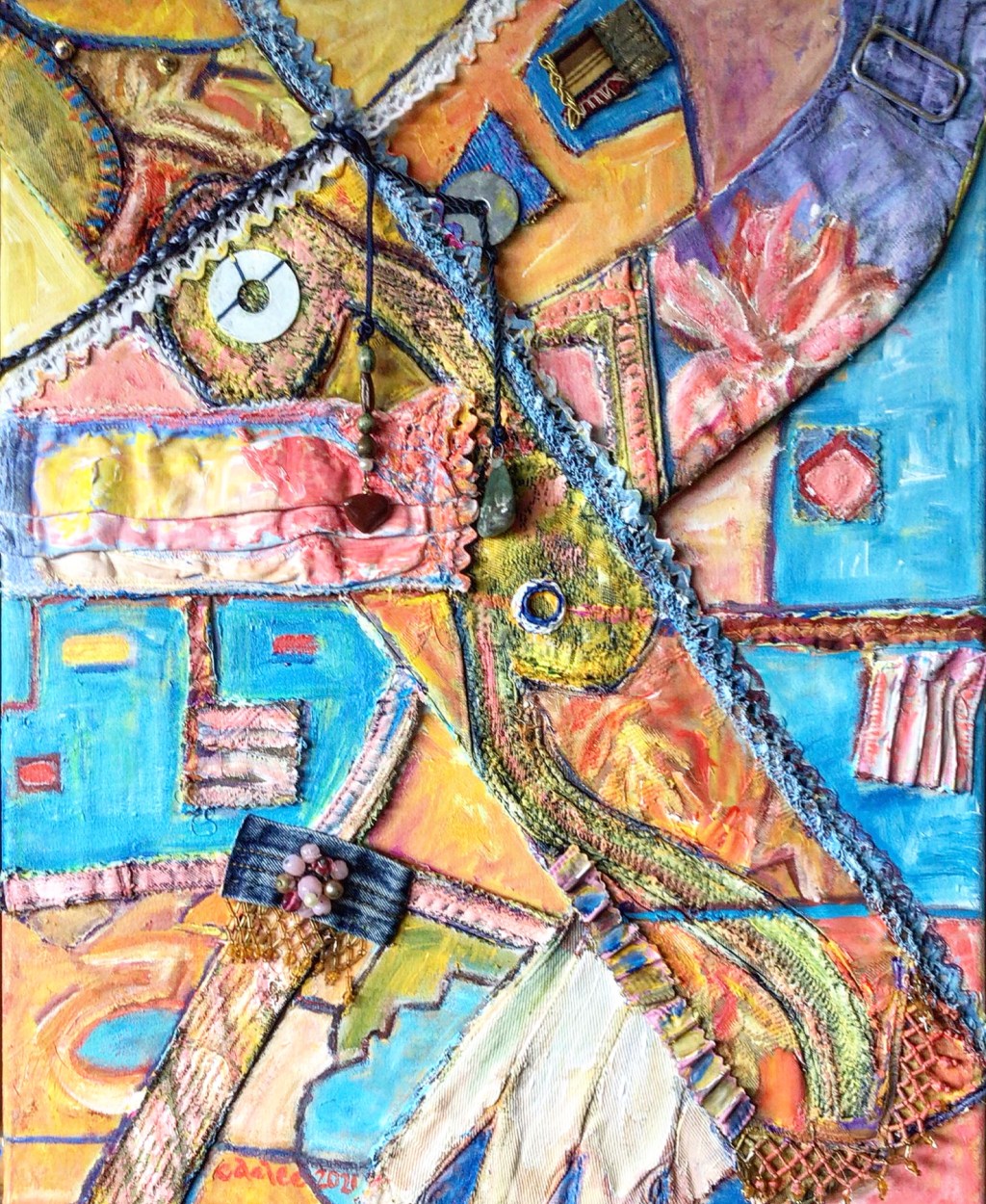
Music of the Spheres: Creation Energy, acrylic

I finished at home an acrylic painting, which explores some of the same themes as the watercolors we’ve worked on in class. In this I used various material with different textures for my spheres. One of the circles is more three dimensional because it’s from a handmade cloth mask left over from the pandemic. I painted parts of it, also. The background has lines of “energy” all about.

While the Pythagoreans attempted to see unity and harmony in the creation in numbers, our Judeo-Christian faith recognizes God as creator of nature and nature revealing the Creator. One of the best texts to understand this distinction is 1 Kings 19: 11-13, in which Elijah meets the LORD on the mountain at Horeb:

(God) said, “Go out and stand on the mountain before the LORD, for the LORD is about to pass by.” Now there was a great wind, so strong that it was splitting mountains and breaking rocks in pieces before the LORD, but the LORD was not in the wind; and after the wind an earthquake, but the LORD was not in the earthquake; and after the earthquake a fire, but the LORD was not in the fire; and after the fire a sound of sheer silence.

When Elijah heard it, he wrapped his face in his mantle and went out and stood at the entrance of the cave. Then there came a voice to him that said, “What are you doing here, Elijah?”

No one has ever heard the music of the spheres, and the voice of God arrives in the sound of sheer silence. Perhaps that “polar opposite” of the Pythagorean’s world view was on to something after all. If we’re very quiet and still, we may hear both the music of the spheres and the voice of God in the great silence.

Joy and peace,

Cornelia


This Is My Father’s World | Hymnary.org

https://hymnary.org/text/this_is_my_fathers_world_and_to_my

Counterfeit Version of Botox Found in Multiple States | FDA

https://www.fda.gov/drugs/drug-safety-and-availability/counterfeit-version-botox-found-multiple-states

Pythagoreanism (Stanford Encyclopedia of Philosophy)

https://plato.stanford.edu/entries/pythagoreanism/

Rabbit! Rabbit!

art, Astrology, autumnal equinox, brain plasticity, change, cognitive decline, coronavirus, cosmology, Creativity, Family, Great American Eclipse, greek myths, Helios, nature, Painting, pandemic, photography, rabbits, Reflection, The Lord of The Rings, trees, vision

Welcome to August!

In the long summer evenings, after an extended car trip, and way beyond the too many times I’d asked my mother and daddy rabbits, “Are we there yet?” I would get their firm reminders I wasn’t to bother them any more, for they too were hot, tired, and daddy had to pay attention to the road. In the gathering darkness, I’d rest my blonde curls on the door near the open window. We had God air conditioning back then. We rolled down the window glass of our old Pontiac and drove as fast as the road would allow.

Go Faster!

I’d watch the darkening shadows as the landscape passed by this opening, noticing how the kudzu vines changed the trees into strange and monstrous shapes in the growing gloom, but I couldn’t take my eyes off of these apparitions. I was certain if I did, they’d begin to make their way toward our family car. I think I was at the age of magical thinking, for I believed I could keep these haints at bay by my will alone.

The soft flup flup of rubber tires half melting on the overheated concrete road, combined with my brother rabbits’ body heat in the seat beside me, and the enforced silence of our parents who’d had a long day with their hyperactive bunny brood finally had an effect on my eyelids. Try as I might, I would fall asleep at my watch, only to be awakened by my daddy’s sing song voice as he tickled my toes:

“This little piggy went to market, this little piggy stayed home.
This little piggy ate roast beef, and this little piggy had none!
And this little piggy cried wee-wee-wee all the way home!”

I’d rub my eyes as he picked me up to carry me into the house and into my bedroom. On the way, I’d always say,

“I see the moon, and the moon sees me,
God bless the moon, and God bless me!”

Perhaps this is a generational gift in my family, for when my own dear bunny child was small, we repeated these same scenes until she was too heavy for me to carry. The moon blessing dates from 1784 and the little piggy rhyme is even older: 1728.

That latter date is when horses and carriages were banned from Boston Common. Since I went to school in Boston, I can attest no horses, carriages, or cows are now on the grounds of the Common, which is now a 50 acre public park. The Common dates from 1634, when William Blaxton sold the remainder of his land to the Puritans, receiving six shillings or more from each shareholder to purchase the land for this public land. This was the site of the Boston Massacre, in which five people died. One good thing about going to school in an historic community, everywhere you went, you weren’t far from history.

When I think of history, I think not only of the stories we pass down to the next generation, but also of the stories we weave for ourselves. How do we remember our childhood or our families of origin? This is a generational gift of privilege, for those who lost their families when they were young may not have memories to weave together. Refugees from wars and violence might not want to recall traumatic experiences. Yet Abraham, the father of the Jewish nation, is remembered as “My ancestor was a wandering Arameam” (Deut 26:5).

Some of us choose to write about our better days, for they outnumber our bad days. Everyone has imperfections, but each of us rabbits are still going on to perfection with the help of the good God above. Perhaps when we see the beauty of the full bright moon against a dark, clear night, our heart leaps inside and says,

“I see the moon, and the moon sees me,
God bless the moon, and God bless me!”

For some of us rabbits, nature brings us closer to God than anything else. The majesty of the summer thunderclouds rising in the heated air, and giving way to either refreshing rain or flashing floods, reminds us once again of the powers of God unleashed in God’s creation. The rainbow after the storm is the promise once again of that covenant made so long ago: the earth will never be destroyed by floods again. In the rainbow, in the light of all the colors, we hear God’s promise of love and care for God’s creation and God’s creatures.

DeLee: Blue Moon

I’m looking at a full super moon tonight, July 3, but August will have TWO super moons. Looking ahead to September 29, we’ll have our FOURTH super moon in a row. The moon on the 31st of August will be a blue moon. This is the second full moon in the same month. We won’t have another blue moon until May, 2026. This is why things that don’t happen often are called “once in a blue moon” events.

Once upon a time, we were agrarian people who eked out a subsistence living on the land. The persistence of The Old Farmer’s Almanac and other ancient weather wisdom lore is proof you can take the bunny out of the country, but you can’t take the country out of the bunny. Yet as our alphabetical generations accumulate beyond the boomers, like Lucy on the Honeymooners, we often “got some explaining to do” to make ourselves understood.

Sirius in the Night Sky

We can count the “Dog Days of Summer” among the sayings folks don’t understand today. The term has nothing to do with the four legged creatures known as our best friends, but instead, it’s an astronomical term. The name comes from Sirius, the Dog Star, which rises before dawn. We find it on a vertical line below the three stars of Orion’s Belt. Sirius was named from the Greek Seirios, which means ‘glowing’ or ‘scorcher.’ This is an apt description of the warmest days from mid July to mid August.

Crepe Myrtle Bark Peeling in the Heat

Aratus, a Greek 3rd BCE poet wrote in his astronomical poem Phaenomena, (p. 328 ff, trans. Mair):

“A star that keenest of all blazes with a searing flame and him men call Seirios (Sirius). When he rises with Helios (the Sun), no longer do the trees deceive him by the feeble freshness of their leaves. For easily with his keen glance he pierces their ranks, and to some he gives strength but of others he blights the bark utterly. Of him too at his setting are we aware.”

These Dog Days of Summer in the ancient Mediterranean were marked not only by heat, but also by drought and pistelence. This year, with an El Niño weather pattern, wild fires, floods, and extreme heat have settled on the area due to a heat dome, which the European meteorologists have named Cerebus, after the three-headed dog guardian to Hades. The ruins on the Acropolis now close from noon to late afternoon to prevent heat illness.

Porch of the Maidens, Acropolis, Athens

Although the ancient Greeks and Romans believed Sirius was the reason for summer’s intense heat, we know now that star is too far away to affect our weather. What does affect our weather today is the result of human activities. Back in the Eemian period, around 116,000 to 129,000 years ago, the earth’s axis was tilted more towards the sun than now. This caused our northern polar region to be warmer and grow trees, which kept snow from accumulating. As a result, the earth’s temperature was 2 degrees C hotter than preindustrial levels, while today’s temperatures average 1 degree C warmer.

Today, we have evidence of geographic drift caused by climate change in our crops. Areas once known for coffee or wheat are shrinking, moving further north or to higher altitudes. We also see shrinking polar ice sheets, which cause ocean levels to rise. More water, combined with more heat leads to more intense storms. We also have rivers of wind, aka the jet stream, which lock in the heat domes. These can persist for days, while the rest of the earth gets flooding and storms.

Not a Watermelon Chart: Similar to the National Weather Service’s heat index chart, this chart translates combinations of air temperature and relative humidity into critical environmental limits, above which core body temperature rises. The border between the yellow and red areas represents the average critical environmental limit for young men and women at minimal activity.

Extreme heat is the number-one weather-related cause of death in the U.S., and it kills more people most years than hurricanes, floods and tornadoes combined. Despite the fact that extreme heat has been the number one cause of weather-related deaths in the United States over the last three decades, the federal government has repeatedly declined to declare extreme heat a federal disaster. The US government has never issued a federal disaster declaration for an extreme heat event in the three times it’s been requested, even as heat domes and long, uninterrupted stretches of 100-plus degree days have claimed lives in cities and states across the country in recent years.

The 10 hottest years on record have occurred since 2010 and the month of June alone in the USA has broken over 1,000 high temperature records. The combination of El Niño, a warming ocean current, and climate change is the cause. The excessive heat in the oceans are causing coral diebacks, which have negative implications for future hurricane shore losses, since coral reefs break the incoming waves.

We bunnies can blame the Stafford Act for this. Natural disasters in the USA are handled by FEMA—Federal Emergency Management Agency. The Robert T. Stafford Disaster Relief and Emergency Assistance Act, PL 100-707, was signed into law November 23, 1988 when Congress amended the Disaster Relief Act of 1974, PL 93-288. Named for the Vermont senator who was instrumental in its passage, this is one of the 100 laws a President can use to declare a national emergency or disaster. Former President Trump used it to declare the COVID pandemic an emergency. It’s this Stafford Act that defines “Emergency.”

According to Congressional laws, a disaster emergency is “any occasion or instance for which, in the determination of the President, Federal assistance is needed to supplement state and local efforts and capabilities to save lives and to protect property and public health and safety, or to lessen or avert the threat of a catastrophe in any part of the United States in a Major Disaster.

The act defines “major disaster” as any natural catastrophe (including any hurricane, tornado, storm, high water, winddriven water, tidal wave, tsunami, earthquake, volcanic eruption, landslide, mudslide, snowstorm, or drought), or, regardless of cause, any fire, flood, or explosion, in any part of the USA, which in the determination of the President, causes damage of sufficient severity and magnitude to warrant major disaster assistance under this chapter to supplement the efforts and available resources of states, local governments, and disaster relief organizations in alleviating the damage, loss, hardship, or suffering caused thereby.

Fires of Mordor have nothing on Phoenix Heat

To get heat relief, it will require an Act of Congress. In plain speak, we’ll see snowfall before heat relief legislation becomes law in today’s divided and polarized congressional body. In the last century, we bunnies weren’t thinking about climate change, extreme weather events, or even naming our winter storms. Perhaps next summer we’ll begin naming our extended heat waves and treat them with the same seriousness as we give to hurricanes and blizzards.

In the meantime, this bunny has set her AC to cool and is keeping the ice bin filled and the tea jar full. I’m feeling the siren call of the school supply aisle, so I’ll find a cool morning in mid August to go buy ink pens, notebooks, and some postynotes. A bunny who keeps learning will always stay young. Building new pathways for the neurons is like cleaning out the clutter in our brain box.

Write now, Edit later. The stories are more important than the form.

I always recommend picking up a new skill or renewing an old one, for not only do creative activities give us an opportunity to focus on something other than how hot it is, but also we can enjoy our progress as we continue to work. If you’ve ever wanted to write about your family history, begin now, for the day will come for all of us when we won’t remember the ones we love. This bunny hopes you have bunnies who love you and honor you for who you’ve always been, even if you become the “one who comes to kiss me every afternoon at 4 o’clock.”

Pluto: Now a Dwarf Planet

I’ll probably go buy my journal supplies on August 24th, and sit in my favorite coffee shop for a bit to drink in memory of Pluto, who was worthy enough to be a planet for my generation,but has been demoted to a dwarf planet because it hasn’t cleared its neighborhood of other objects.

I look forward to cooler breezes, falling leaves, and Pumpkin Spice lattes. See you in September!

Joy, peace, and iced tea,

Cornelia

The Project Gutenberg eBook of Gammer Gurton’s Garland, or, The Nursery Parnassus, by Joseph Ritson.
https://www.gutenberg.org/files/34601/34601-h/34601-h.htm

Teaching Early Math to Children—This Little Piggy
https://www-tc.pbs.org/parents/earlymath/pdf/LittlePiggy.pdf

Origin of This Little Piggy
https://www.rhymes.org.uk/this_little_piggy.htm

Boston Common Master Plan
https://www.bostoncommonmasterplan.com/history

Super Moons, Blue Moons
https://www.fullmoonphase.com/

What is a blue moon and when will the next one occur? | Royal Observatory Greenwich https://www.rmg.co.uk/stories/topics/what-blue-moon-how-often-does-it-occur

SIRIUS (Seirios) – Greek God of Dog-Star https://www.theoi.com/Titan/AsterSeirios.html

THE DOG DAYS OF SUMMER: European heat wave takes toll on tourists – Travel Industry Today
https://travelindustrytoday.com/the-dog-days-of-summer-european-heat-wave-takes-toll-on-tourists/

42 U.S. Code § 5122 – Definitions | U.S. Code | US Law | LII / Legal Information Institute FEMA STAFFORD ACT
https://www.law.cornell.edu/uscode/text/42/5122
https://www.fema.gov/disaster/stafford-act

Extreme Heat Is Deadlier Than Hurricanes, Floods and Tornadoes Combined – Scientific American
https://www.scientificamerican.com/article/extreme-heat-is-deadlier-than-hurricanes-floods-and-tornadoes-combined/

From Japan to Louisiana to Rome, Here Are Ten Heat Records Earth Has Broken Since June | Smart News| Smithsonian Magazine https://www.smithsonianmag.com/smart-news/ten-heat-records-earth-has-broken-since-june-180982562/

Rabbit! Rabbit!

art, butterflies, Family, Fathers Day, greek myths, Helios, holidays, inspiration, Memorial Day, Ovid, Phaeton, rabbits, renewal, summer solstice, summer vacation

Welcome to June 2023

Since we’re now past Memorial Day, the unofficial beginning of summer has arrived. Yet the summer solstice, which is astronomical summer won’t be here until Wednesday, June 21, 2023 at 9:57 AM CDT. Weathercasters use this alternative meteorological definition: “seasons begin on the first day of the months that include the equinoxes and solstice.” Since June 1 is National Go Barefoot Day, we rabbits, who never wear shoes on either our lucky foot or our three other feet, can rejoice and celebrate with our human friends as we share the delights of bare-footing across the park lawn.

Barefoot Weather

Summer is the season of picnics, patios, porches, and other alfresco dining activities. I remember mayonnaise sandwiches, butter and sugar sandwiches, plus the always delicious peanut butter and jelly sandwiches. Mama stirred the jelly into the peanut butter so it didn’t dribble out as it melted in our hot Southern summers.

June is Picnic Weather

June has International Picnic Day on June 18, but we rabbits don’t need a special day to have a feast in a field. In fact, we eat outside every single day. We are picnic aficionados. I’m not sure if June has an exceptional amount of national food days, for I haven’t paid attention lately due to my loss of vision from cataracts. Now that I’ve had surgery on both eyes, I’m just amazed at what all I’ve been missing!

June has 46—boy howdy—special days celebrating foods. We rabbits would have to eat at least 1.5+ of the following daily, all the while remembering the admonition of Eat Flexitarian Day: eat more fruit, whole grains, and vegetables, but eat less meat and fish. The Flexitarian Diet is second only to the Mediterranean Diet for overall ranking because it’s simple, healthy, and a straight forward way of eating. Some foods to incorporate and celebrate are Fresh Fruit and Vegetables, Cucumber, Lemon, and Mango.

Okazaki Shrine, Kyoto dedicated to Rabbits

I like to organize, a trait that used to drive my dear old rabbit mother crazy. I’d put all the drinking glasses of the same size together on the same shelf, while she’d put them up willy nilly, even though they wouldn’t all fit on one shelf if all of them were clean. This is just another example of mother rabbits being realistic, since they know their thirsty rabbit kits will dirty up another glass before the dishwashing is done. I also like to arrange my paint palette in rainbow order, but don’t talk to me about my desk. It’s a mess. At least my spices are in alphabetical order.

Milk and Doughnuts

June’s menu celebrates World Milk Day. An ice cold glass of milk will go well with any of these National Day Foods: Donuts, Hazelnut Cake, Chocolate Macaroons, Applesauce Cake, German Chocolate Cake, Peanut Butter Cookies, Apple Strudel, Chocolate Eclairs, Fudge, and Cherry Tarts.

Or maybe you’d rather have your sweet treat with some form of ice cream. June celebrates the National Days of Rocky Road and Chocolate Ice Cream, not to mention Ice Cream Cake Day. You can swill your ice cream in a soft drink on Ice Cream Soda Day or enjoy a Black Cow Day: root beer and vanilla ice cream float. Of course if you’re a rabbit who wants your ice cream straight up, but sipped, National Vanilla Milkshake Day was meant for you.

National Iced Tea Day is June 10, but down south, every day is Iced Tea Day. June also covers the menu with national days for eggs, cheese, and veggie burgers. You can make a whole meal out of the national days of corn on the cob, catfish, and onion rings. Please make sure to observe Eat Your Vegetables Day, with Herbs and Spices, and try a Meal Prep Day while you’re at it.

The Original Night Food Truck

Since America is a great melting pot of many peoples, we have many food cultures. June celebrates several culinary traditions:
Egg Roll Day, Falafel Day, Tapas Day, Sushi Day, Smoothie Day, and Food Truck Day. Get your passport stamped as you leave the cafeteria and please don’t remove your shoes on the way to the dessert counter.

For dessert there’s nothing like seasonal foods. Enjoy National Strawberry Shortcake and Strawberry Parfait Days, or my all time, any time, National Chocolate Pudding Day, or try a new Candy during June or Frozen Yogurt. For a milder taste, go with National Tapioca Day. You also can try the famous Japanese Bubble Tea drink, which has sweet tapioca bubbles as an ingredient. This isn’t like regular iced tea, for the resistant starch of the tapioca bubbles needs time to digest. You don’t want to be famous for “X-ray of stomach shows mass of 100 undigested boba balls.” (Google it!)

How To Make Tapioca Pearls At Home – Experiences

Listen to this rabbit so you don’t have to double up on National Prune Day for a reason, but enjoy then for their sweetness, fiber, antioxidants and minerals. Mostly they keep you “regular as clockwork,” with no straining or efforts. This is a good thing if you’ve overindulged on Detroit-Style Pizza Day or under hydrated on National Martini and Olive Days.

But enough of foods! This rabbit hasn’t eaten this much since well, Memorial Day weekend! My family always took any and every gathering as an excuse to feast. I don’t know if it was because my rabbit mom and dad survived the Great Depression or because the generations of my extended family were all Methodists, but if food was available, we were there. And we brought a covered dish if we were traveling to somewhere else. Folks brought food to us when we hosted, but that was how life was when I was a young rabbit. Sharing was our caring.

The Master Chef

My dad was a master chef, as long as he stood over the back yard grill. He had charcoal briquettes and lighter fluid down to a science. Never ever did he squirt fluid onto the hot coals—that was asking for his own burnt flesh. Mr. Safety was his other name. He wielded the fork in his right hand and an empty ketchup bottle filled with water in his left hand. If the grease drippings flared up, the repurposed water bottle went into action with a well focused stream to knock it down. He never hit it so hard the fire went out.

Dad even cooked on Father’s Day, because he was The Grill Master. Even when the family bought a gas grill for my birthday, I kid you not, daddy was thrilled because he’d be able to cook for his favorite girl rabbit when I came home from college. Fathers show their love in many different ways. We children can’t design how our fathers show love or order their behaviors. Dads aren’t Burger King hamburgers with cheese, no salt, and no tomatoes. We can’t have them our way.

My dad certainly had a way of cheering me up when I was sure my world was falling apart when I was young. “Cheer up, it could be worse,” he’d say.

“Yeah? How much worse?” I was given to catastrophic thinking as a young rabbit. Everything was a “hair on fire” moment. (In hindsight, most of these weren’t even singed eyebrow moments.)

“Put a bit of this in your mouth,” he said, handing me a bite of his chewing tobacco.

I put it in my mouth and began to chew. As my saliva mixed with the cut tobacco, a bitter taste flooded my mouth. My face twisted every which way possible without leaving my skull.

“Oh, whatever you do, don’t swallow the juice!” He admonished.
“You do this for fun?” I asked.
He laughed, “There are always worse things in life you’ve yet to experience. You can spit it out in the cup now if you want.”

Oh, and spit now I did want. I’m certain nothing is worse than a mouthful of acrid tobacco juice. If I can take that, I can take anything. But I don’t have to endure punishment willingly. I can choose not to suffer. I share this gnostic wisdom, known only to a few, and passed down by word and mouth, literally. I don’t recommend you try it for yourself.

The school of hard knocks is an expensive degree. My daddy had many words of wisdom, not all of which I heeded. “Always have a job before you leave the job you’re in,” is the one I never paid attention to until I became an itinerant minister. Then sometimes I was sent away before I was ready to leave, and sometimes I stayed when people were ready to see me go. Such is life in the Methodist appointment system.

One of my “fathers in the faith” reminded me and others, “You will meet the same people on your way up in ministry as you will on your way down. Consider this as you take your leave of one place and go to another. Don’t forget from where you came. You’ll go back there one day.”

I thought about this one day when one of my church members told me the two largest attendance days were the first and last Sundays of every pastor their church had. When I asked why, he replied, “Because folks first come to see if the preaching is any good and then come to hear how terrible they’ve been.”

Perhaps others continued that pattern after me, but I saw no reason to continue it. Every rabbit, even the most wayward or recalcitrant, will grow gradually in three years. If I couldn’t see evidence of spiritual growth and changes of heart in their lives, I wasn’t worth my salt. I left them in tears, reminding them of who they were and what they had become. I also spoke of the power that would be with them always as they continued their upward path to greater things yet to come.

Attic Black Figure Ware Attributed to the Phrynos Painter:
Kylix, Little Master Lip, Early Archaic Period, ca. 555 – 550 B.C., British Museum, London.

Since ancient times, fathers have always given their children sage advice. Even the Greek gods of myth and time, before the age of philosophers and kings, believed in fathers as the source of wisdom. Athena, the goddess of wisdom, sprang full grown from the head of Zeus, the King of all the gods on Mount Olympus. Perhaps the Greeks were onto something, for wisdom is acquired by those who survive their rash youthful learning experiences.

Some father figures would keep their children from all harm by never allowing a child take appropriate, age level risks and not preparing them gradually for these rites of passage. We don’t throw a new born child into the deep end of a pool and expect them to swim. Instead, we bathe them, wade them, let them kick as we pull them around the shallow end of the pool, and finally we get their faces underwater to blow bubbles so they can learn to breathe correctly. Finally we’ll teach them how to use their arms in coordination with their feet and breathing so they can travel across the pool.

If we let them on a motorized vehicle, a child is safer on a sanctioned go cart track than on a neighborhood street. This is because he or she would be racing in smaller horse powered carts, with age similar racers. As a wise parent, you’d have to decide if your child has the maturity, focus, and discipline to handle not only her own car, but to be aware of his position relative to other carts on the track. Also, does your child have his emotions under control and is she willing to learn from her mistakes?

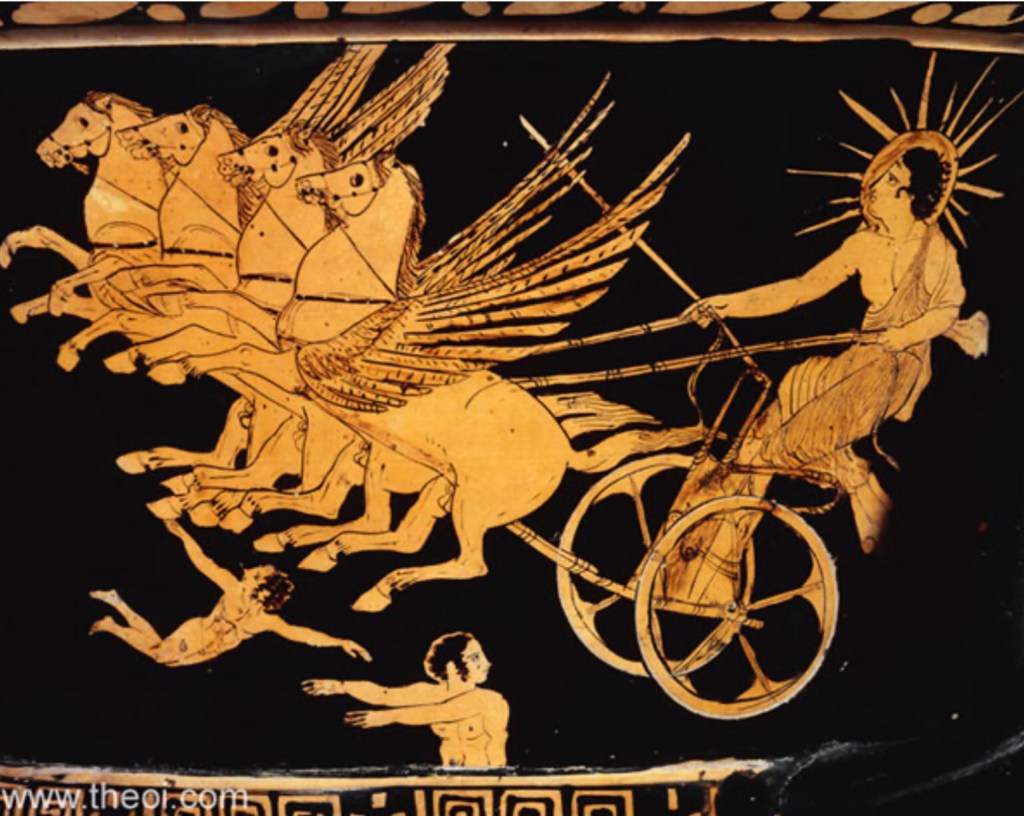
Greek mythology has an instructive story of Helios, the sun god, who couldn’t say no to his son Phaeton’s request to drive the sun carriage drawn by the fiery steeds. In Ovid, Metamorphoses 1. 750 ff, Helios instructs his son:

Chariot of Helios, the Sun God

“Keep to this route; my wheeltracks there show plain. Press not too low nor strain your course to high; too high, you’ll burn heaven’s palaces; too low, the earth; the safest course lies in between. And neither rightwards towards the twisting Anguis (Snake) nor leftwards swerve to where the Ara (Altar) lies. Hold in the midst! To fortune I resign the rest to guide with wiser wit than yours. See, dewy Nox (Night) [Nyx] upon the Hesperian shore even while I speak has reached her goal. No more may we delay; our duty calls; the day dawns bright, all shadows fled. Come take the reins!

Or take, if yet your stubborn heart will change, my counsel, not my chariot, while you may, while still on firm foundations here you stand before you mount between my chariot wheels, so ignorant, so foolish!–and let me give the world light that you may safely see.”

Fall of Phaeton Sarcophagus

As in all Greek myths, this didn’t end well for Phaeton, for he couldn’t control the high spirited steeds. As the chariot ricocheted too near the earth, scorching it, and too high in the sky, burning the stars, Zeus blasted the boy with a thunderbolt to save the earth from harm and placed him among the stars in the constellation The Charioteer. His body fell to earth into the river Po. Once again it’s a reminder the middle path is safest and best.

Canadian soldiers on D-Day read message on their plane

As we polish off the last of the leftovers from Memorial Day, we celebrate D-Day, which commemorates June 6, 1944, the day the Allies invaded Normandy from England during World War II. Every military order has had a day and hour designation since 1918, but this battle on the five French beaches was so large and so difficult to organize, it’s the one we know as “D-Day.” Not only was there a need for a long day, a day near a full moon to guide ships/airborne troops, and strong tides for an amphibious assault, but the Allies had to coordinate politically and militarily to get everyone on board. Eisenhower’s personal notes give us an inkling of the troubles of this endeavor (link below). To date it remains the largest amphibious invasion in history and marked the beginning of the end of World War II. It also marked the end of the Nazi regime led by Hitler, which was responsible for the death of over 6 million Jews.

Two roses and two U.S. flags on Omaha Beach in Saint-Laurent-sur-Mer, Normandy, on June 5, 2019.

As a small rabbit, who’s startled at any sharp noise and frightened by even the shadows of passing clouds, since it might be a hungry predator, the thoughts of wars set me to trembling, trembling, trembling, like the lyrics of the old slave spiritual, “Steal Away:”

“Green trees are bending, poor sinners stand trembling; The trumpet sounds it in my soul, I ain’t got long to stay here.”

Yet appeasing tyrants never ends well, as Winston Churchill noted: “Each one hopes that if he feeds the crocodile enough, the crocodile will eat him last. All of them hope that the storm will pass before their turn comes to be devoured. But I fear greatly that the storm will not pass. It will rage and it will roar ever more loudly, ever more widely.”

Speaking of storms, the Atlantic hurricane season runs from June 1 to November 30, and we can expect the first named storm to form in mid to late June. We rabbits who enjoy a beach vacation always need to keep a weather eye out. Not only do we need to be aware of the intense sun, especially for our baby rabbits, but if the city officials issue evacuation orders for extreme weather, we ought to leave, even if we give up vacation days. While we’re at the beach, or the lake or poolside this summer, we can read or listen to books. June is audiobook appreciation month, but books with pages are more likely better suited to beaches, since high heat and small grains of sands can adversely affect expensive cellphones, tablets, and readers.

Alzheimer’s disease is the most common form of dementia

Another way we can pass our summer and stretch our minds is to try new experiences. June is Alzheimer’s and Brain Awareness Month. If we only exercise the same brain paths, but fail to build new ones, our brains become “clogged up.” This is rabbit speak for what doctors call Tau protein tangles. Dementia seldom only causes Alzheimer’s-related changes in the brain. Any number of vascular issues—problems that affect blood vessels, such as beta-amyloid deposits in brain arteries, atherosclerosis (hardening of the arteries), and mini-strokes—may also be at play. Vascular problems may lead to reduced blood flow and oxygen to the brain, as well as a breakdown of the blood-brain barrier, which usually protects the brain from harmful agents while allowing in glucose and other necessary factors.

My dad, a brilliant doctor, had Alzheimer’s disease in his later life. While he remembered all of his medical training, he knew none of his family in his later years. He also confused my large poster of Captain Picard I had taped on the parsonage back door with an actual person. I kept “Picard” there as a reminder to MAKE IT SO, but daddy thought I had a strange balding man standing in my laundry room.

Make it so—said the strange man in my laundry room

In someone with Alzheimer’s, a faulty blood-brain barrier prevents glucose (energy) from reaching the brain and prevents the clearing away of toxic beta-amyloid and tau proteins. This results in inflammation, which adds to vascular problems in the brain. Because it appears that Alzheimer’s is both a cause and consequence of vascular problems in the brain, researchers are seeking interventions to disrupt this complicated and destructive cycle. All the more reason for us to eat more plants, less fried foods, more complex carbohydrates, and fewer animal fats.

Baked chicken, roasted veggies and corn on the cob

June is also Professional Wellness Month and National Men’s Health Month. America workers tend to get about 11 days of paid vacation and 6 paid holidays per year, but more than half of these reported not using all their days off. Even those energizer bunnies who have unlimited paid time off tend to take only 10 days of vacation, and nearly half of them work at some point in time during their vacation.

When I went on vacation, I told my church secretary to call me if the church burned down or someone died. They should be able to handle most anything else. Most of what I was going to do from some distant location was encourage them and help arrange a substitute if I couldn’t get back in time. God may be available all the time, but small rabbits and vulnerable humans must rest and restore their energies to be ready for the next excitement that’s sure to come.

Rabbit and Butterfly

If you haven’t yet planned your summer vacation, you’re in luck. June is Great Outdoors Month and National Camping Month. You can take your rabbit family to the Oceans or to the Rivers, or you can visit a Zoo and an Aquarium. It’s also Women’s Golf Month, but you can take the rest of the rabbit family with you and have a good time on the links. If you want to stick closer to home, remember June is a fine time to enjoy the exercise in the dirt. It’s Perennial Gardening Month and National Rose Month. Do a service for your garden during National Pollinators Month. Plant basil and dill alongside your tomato plants to discourage hornworms. The scents also attract pollinators like butterflies and other beneficial insects.

On a personal note, I’m looking forward to a summer full of crisp lettuce and tomato sandwiches on toasted whole wheat bread with avocado slices. In fact, that sounds so good, I may have to have one now, since I don’t have time to make a hazelnut cake. Here’s to books, beaches, and the bronzed bodies of summer.

Joy and peace,

CORNELIA

June Holidays and Observances 2023: Full Calender
https://www.today.com/life/holidays/june-holidays-and-observances-rcna76138

2023 NCAHM Official Book List – CaribbeanReads
https://www.caribbeanreads.com/2023-ncahm-book-list/

When is the first day of summer? Summer solstice dates explained.
https://www.usatoday.com/story/news/2023/04/07/when-is-first-day-summer/11556538002/

Season Definition: When Do They Start?
https://www.timeanddate.com/calendar/aboutseasons.html

What Is the Flexitarian Diet? – Cleveland Clinic
https://health.clevelandclinic.org/what-is-the-flexitarian-diet/

NATIONAL BLACK COW DAY – June 10, 2023 – National Today
https://nationaltoday.com/national-black-cow-day/

How To Make Tapioca Pearls At Home – Experiences
https://experiences.japancrate.com/blogs/news/how-to-make-tapioca-pearls-at-home

Creamy Coleslaw with Prunes (Ready in 5 Minutes!) – Ignite Nutrition
https://ignitenutrition.ca/blog/unlock-the-power-of-prunes/

Should I Let My Kid Drive a Go-Kart? – Our Definitive Guide | Utah Motorsports Campus
https://www.utahmotorsportscampus.com/should-i-let-my-kid-drive-a-go-kart-our-definitive-guide/

PHAETHON – Son of the Sun-God of Greek Mythology
https://www.theoi.com/Titan/Phaethon.html

Unknown Artist: Fall of Phaeton, Greek marble Roman sarcophagus, Ca. 150-170 AD., Height: 62 cm; length 220 cm.,
Florence, Galleria degli Uffizi.

Eisenhower Library: Conditions in Normandy
https://www.eisenhowerlibrary.gov/sites/default/files/research/online-documents/d-day/1944-06-03-conditions-in-normandy.pdf

Steal Away Lyrics
https://www.cusd80.com/cms/lib6/AZ01001175/Centricity/Domain/1509/Steal%20Away%20Steal%20Away%20song%20lyrics.pdf

An Appeaser Is One Who Feeds a Crocodile, Hoping It Will Eat Him Last – Quote Investigator®
https://quoteinvestigator.com/2016/04/18/crocodile/

Tropical Cyclone Climatology
https://www.nhc.noaa.gov/climo/

What Happens to the Brain in Alzheimer’s Disease? | National Institute on Aging
https://www.nia.nih.gov/health/what-happens-brain-alzheimers-disease

Average PTO In USA & Other PTO Statistics (2023) – Forbes Advisor
https://www.forbes.com/advisor/business/pto-statistics/

10 Tips for Building a Pollinator Garden | The Old Farmer’s Almanac
https://www.almanac.com/building-pollinator-garden

From the Shadows to the Light

architecture, art, Carl Jung, change, Faith, Family, Fear, Food, greek myths, hope, inspiration, mystery, nature, New Year, purpose, rabbits, renewal, Roman Forum, shadows, Spirituality, Temple of Janus, Zeitgeist

Rabbit! Rabbit! Welcome to 2023! This old bunny may not see the clock strike midnight, but I’m recovering from a bad cold. Rest is more important than ringing in the New Year. Every year has its own character.

Live with Optimism, even when the nights are long.

Zeitgeist is a word that comes straight from German — zeit means “time” and geist means spirit, so the “spirit of the time” is what’s going on culturally, religiously, or intellectually during a certain period. When it comes to the turn of the New Year, we bunnies wonder if our new broom will sweep clean or if the old broom will leave the same mess as always in our cozy rabbit dens.

Always use a New Broom on the New Year for Good Luck.

Are we filled with hope or with foreboding? Do these dark days and deep nights of winter fill us with a gloomy spirit? Or do the imperceptibly lengthening minutes of daytime give hope to the shadows the cold of winter has left in the depths of our souls? Or have the coastal grandmother bunnies among us learned to ignore all this stum and drang by blending their afternoon tea time into early evening wine tasting?

Everything a culture considers taboo, evil, or immoral typically ends up being proscribed or “consigned to the outer darkness.” From there it ends up inside us in what Carl Jung called “the Shadow,” or our inner “Satan,” as it were. Repressed and inhibited, it festers and rages in the darkness of our “unconscious.” Even in extreme cases, it takes on a quasi-autonomous existence of its own, occasionally intruding as the famous “voices in the head” or even as a multiple personality.

Dr. Jeckyll and Mr. Hyde is a famous light and dark shadow character from fiction, but too often in real life we rabbits point out our own dark shadows in the lives of those we so easily demonize. As my wise old granddaddy rabbit would reprimand me, “When you point out the faults of others, you have three fingers pointing back at you.”

Luke 6:41
“Why do you see the speck in your neighbor’s eye, but do not notice the log in your own eye?”

I always find life more refreshing on the first day of the year, perhaps because I don’t over indulge in strong drink as I once did in my wayward bunny youth. We bunnies all have a wayward youth, for how else would we know what the immature among us are getting into? My old daddy rabbit believed, “Experience was the greatest teacher of all time, as well as its most costly tutor.” Indeed, we remember the costliest lessons best of all. The young ones today say, “Go big or go home.” My grannie would say, “If you’re in for a penny, you might as well be in for a pound.” After all, everyone who participated, either in a small or large way, would be held accountable.

Janus: Bloodstone intaglio of Roman god of transition, passages, and new beginnings.

As I look back on old 2022, grizzled and worn out by conflicts both at home and abroad, I can understand why the ancients thought of Janus, for whom January’s named, as a two faced god. One face, which looked backwards, was lined, bearded, and craggy featured, while the forward looking face of the new year was youthful, smooth, and clean shaven. Every new year is fresh and clean as a beardless youth’s face, as well as untroubled by any recollection of pains or past memories. Most of us bunnies also have short memories, for we tend to repeat the same mistakes over and over. Rabbits have short term memories of around 4 minutes, but can remember bad experiences for longer periods, just as humans can.

Unknown Roman Artisan: Soldier’s Brooch in the Form of a Rabbit, 100–300 CE, Copper alloy with champlevé enamel, found in Britain, Metropolitan Museum of Art, NYC.

In Ancient Rome, as the poets Ovid and Horace recount, Janus was the god of war and peace. They differ as to whether the Temple of Janus was a prison for peace or war, but they both agree the prison was meant to maintain PAX ROMANA, or the great Roman Peace. If peace were impounded, peace would be guaranteed to the nation. If war were imprisoned, it wouldn’t rampage about to destroy the countryside. Just as Janus had two faces, Roman religion was open to multiple interpretations and meanings. Perhaps today, they’d be known as “freethinkers,” as opposed to “literalists” or “strict constructionists” in their interpretation of their ancient stories.

Seeing the Night Skies through Bunny Eyes

Maybe in 2023 we bunnies might want to look at different ways of thinking, instead of one fixed way. There’s a difference between a straight and narrow path and a rut. On the path we can still see other twists and turns, which might change the outcome of our experience and existence. In a rut we’re stuck for life, with no where out, until it becomes our grave. If the world is changing more quickly than is comfortable for us, I give the example of my old granddaddy again. He pushed a button to turn on one of the first electric lights in his home town and lived to see men walk on the moon. Be resilient, be adaptable, and embrace change. After all, we’re always changing, so the option of never changing is death.

Ancient Greek Black Figure Vase, Wasps Attacking Men Robbing Zeus’ Bee Hives for Honey, c. 540 BCE, British Museum, London.

Romans would celebrate January 1 by giving offerings to Janus in the hope of gaining good fortune for the new year. They believed their acts set the stage for the coming year, so it was a common practice to make a positive start to the year. Not only did they exchange well wishes and sweet gifts of figs and honey with one another, but according to the poet Ovid, most Romans also chose to work for at least part of New Year’s Day because they saw idleness as a bad omen for the rest of the year. If 1st century Romans were to drop into some of our 21st century celebrations by means of Dr. Who’s traveling blue Police Box, they would wonder how the barbarians, who sacked Rome in 455 CE, had managed to take over our modern New Year.

Some days I need to be in two places at once.

We toga wearing bunnies, who are long of tooth, know from experience the barbarians are always at the gate of our safe little gardens. Sometimes they’re even inside the gardens of delight, as Peter Rabbit and his Cottontail friends perpetually discover when Mr. McGregror chases them with a rake. If we cast a look back on 2022 with our rheumy eyes, we saw Russia attack Ukraine, an outrageous act which sent millions of people to emigrate from their the destroyed cities and ravaged countryside, with the hope of finding safe haven in another European country.

Mr. McGregor thinks Peter is a Barbarian, who has slipped through his impenetrable garden gate.

Across the pond, on our southern border, thousands of migrants have fled disaster and violence in their homelands, but even though the US economy is hurting for workers in our entry level jobs, they have difficulty getting in. Are these people actually “barbarians at the gate?” Or have we projected our Shadow Fears upon them because they are foreigners? We did this with the Japanese, who m we placed into Internment Camps in World War II, much to our disgrace. This bunny asks us to search our hearts in 2023 to see if our three fingers are pointing back at our own selves.

Think about how Woodstock symbolized the 1960s: Woodstock was part of the Zeitgeist of the 1960s. Whatever seems particular to or symbolic of a certain time is likely part of its Zeitgeist. I came home from college one Christmas wearing a necklace of tiny black and white seed beads, only to be greeted by my old fashioned daddy, “Are you a hippy now?” For him, any one thing represented the whole, for he grew up with the ancient bunny wisdom, “One bad apple spoils the bushel.” We were only reconciled when he realized I hadn’t lost my fondness for his beloved Cowboys football team.

If we can find one common interest in this strange and fraught world with those with whom we would be at war, then we might be able to come to peace with them. If we insist on all or nothing, no bunny will get anything. We all want to have endless days of peace and joy, but the life of a bunny also has days of struggle and sorrow.

Earth as seen from Space

Carl Jung, the great psychologist once said, “There are as many nights as days, and the one is just as long as the other in the year’s course. Even a happy life cannot be without a measure of darkness, and the word ‘happy’ would lose its meaning if it were not balanced by sadness.”

We also have this promise from 1 Corinthians 10:13—

“No testing has overtaken you that is not common to everyone. God is faithful, and he will not let you be tested beyond your strength, but with the testing he will also provide the way out so that you may be able to endure it.”

Many of my southern bunny kinfolks will eat a variety of this New Year’s Day meal: black eyed peas, ham, greens, and cornbread. We think every pea consumed equals another day of good luck. Of course, we’re not the only superstitious clan.

Our cousins in Japan, celebrating Ōmisoka, or New Year’s Eve, gather together to eat long noodles to cross over from one year to the next. At midnight, many visit shrines or temples for Hatsumōde. Shinto shrines prepare amazake, a sweet low alcohol drink, to pass out to crowds and most Buddhist temples have large cast bells that are struck once for each of the 108 earthly desires believed to cause human suffering.

Year of the Rabbit

I found some interesting New Year’s good luck traditions, which are practiced around the world. In Greece, folks hang onions outside on their front doors to ward off evil. On New Year’s Eve, Colombian households have a tradition, called agüero, of placing three potatoes under each family member’s bed—one peeled, one not, and the last one only partially. At midnight each person, with eyes closed, grabs for one. Depending on the potato they select, they can either expect a year of good fortune, financial struggle, or a mix of both.

Ruined House (suspected fruitcake damage)

In Ireland, people bang Christmas bread against the walls of their house for good luck. If any of you bunnies have a Christmas fruitcake still lying around, please choose another loaf to prevent damage to your walls. Good contractors are backed up and hard to find, especially around the holidays.

The Danes chunk plates at their friends’ doorsteps for good luck on New Year’s Eve. Perhaps all that darkness from the winter solstice makes my northern relatives harebrained, but we love them just the same. I suppose every bunny has some weird relatives.

New Year’s Eve Weather Predictions

Old bunny weather lore says, “The first 12 days of January foretell the weather for each month of the year.” Another way to forecast the weather for the coming year depends on the wind. The old bunnies are at odds as to when this poem should be recited, with some advocating for sunset on New Year’s Eve and others at the break of dawn on New Year’s Day. This bunny notes the poem mentions New Year’s Eve, and since none of our ancient bunnies had time traveling abilities, I’d think we are safe to practice this on the Eve at sunset, then go out to do our responsible reveling.

If New Year’s Eve the wind blows south
It betokens warmth and growth.
If west, much milk and fish in the sea.
If north, cold and storms there will be.
If east, the trees will bear much fruit.
If north east, then flee it, man and brute. Then throw your new year wishes to the wind!

GOOD HEALTH AND JOY FOR EVERY BUNNY

My New Year’s wish for 2023 is for each and every one of my bunny friends to have a better year than last year. And especially to know deep in your hearts, each of you are God’s own beloved children. Remember this good word from Romans 8:28—

“We know that all things work together for good for those who love God, who are called according to his purpose.”

Joy, peace, and love each and every day in 2023,

CORNELIA

Multiple Interpretation of the Opening and Closing of the Temple of Janus:
A Misunderstanding of Ovid “Fasti” by S.J. Green, 1.281 on JSTOR
https://www.jstor.org/stable/4433099

5 Ancient New Year’s Celebrations – HISTORY
https://www.history.com/news/5-ancient-new-years-celebrations

15 New Year’s Traditions From Around the World | Glamour
https://www.glamour.com/story/new-years-eve-day-traditions

New Year’s Weather Folklore: Predicting Weather in the New Year | The Old Farmer’s Almanac
https://www.almanac.com/new-years-day-weather-folklore

The Zeitgeist and the Shadow | The Chrysalis https://longsworde.wordpress.com/2018/07/20/the-zeitgeist-and-the-shadow/

Seeds of Dissent and a Harvest of Distrust

Ancestry, arkansas, art, Faith, Family, Forgiveness, greek myths, Holy Spirit, hope, incarnation, inspiration, john wesley, Love, Ministry, Painting, perfection, poverty, purpose, Ravenna Italy, renewal, Retirement, stewardship, Stress, United Methodist Church, vision

Christ Enthroned with the Angels
6th century Mosaic
Church of Sant’Apollinare Nuovo, Ravenna, Italy

Nothing springs full grown to life in an instant. Everything begins in a seed, which is planted, watered, and nourished into full growth. Only in myths or fantasies can an idea come into being instantly. Zeus had a very bad headache, a “splitting headache,” that birthed his daughter Athena, the goddess of wisdom. She leapt out in fully grown from his brow. We don’t take this myth to be scientifically true, but as a metaphor for the difficulty and struggles we undergo to obtain wisdom. As my daddy used to tell me after I’d learned some hard life lesson, “The school of experience is a rough master, and we all earn a costly degree in gaining its wisdom.”

Little Master Lip Painter Attributed to the Phrynos Painter: Birth of Athena, Attic Black Figure Ware, Kylix, Date ca. 555 – 550 B.C., Early Archaic Period,

Some of us will repeat the same lessons over and over, as if we expect to get a different result. The purpose of an education isn’t to regurgitate a right answer to pass a test, but to understand why the answer is right. That’s why math classes require showing the steps to the solution, rather than the “full blown adult answer” only. In matters of faith or ethics, many of us haven’t had the training to “set out the proof” for our final answer or deed. In fact, in one situation we may think or act one way, and quite differently in another.

The name for this behavior is “situational ethics.” Less kindly, it’s also known as spinelessness, shiftiness, being two faced, or dishonesty. Mostly it means people don’t have a true center or a plumb line by which they measure themselves. If we’re measuring our lives against other people, we’re measuring against other fallible human beings. Even our heroes have feet of clay, for none of us are gods. When I used to call my parents out on this character trait, they always told me, “Do as I say, not as I do.” This sets up a moral conflict for most people, even those raised in the church or in religious homes.

We need to have a moral center based on a higher authority than our individual or cultural conventions, one that includes or exceeds the ethics of the group to which we belong, and not just our individual beliefs and actions. Professional groups—physicians, lawyers, clergy, educators, and others—all have ethical standards for caring for those they serve, even if they morally disagree with the behaviors that bring them into their care. Who decides the ethics of the group? At the risk of making my favorite seminary professor, Billy Abraham, roll about in his still fresh grave, we United Methodists do have the so-called Wesleyan Quadrilateral of Scripture, Tradition, Reason, and Experience to guide us. Often we assign our personal life experience to this latter quadrilateral edge, but Wesley meant our Experience of the Assurance of God’s All Embracing and Adopting Love. As Wesley once said, “God is able to save all to the uttermost.”

The Good Samaritan by English School, (19th century)

Ethics and morals are often used as synonyms, but ethics refer to rules provided by an external source, e.g., codes of conduct in workplaces or principles in religions. Morals refer to an individual’s own principles regarding right and wrong. Ethics is a a late 17th century word derived from the Greek ēthos (disposition, character), in contrast to pathos (suffering). In Latin it means ‘character, depiction of character’, or (plural) ‘customs’.

Then we have the words moral and morals. The first is concerned with the principles of right and wrong behavior. The goodness or badness of human character is another concern. From these, people decide what behavior is considered right or acceptable in a particular society. We often say a person has morals if they conform to standards of behavior or beliefs concerning what is and is not acceptable for them to do. We can speak of “the corruption of public morals, “ or you can hear people talking as if “they believe addicts have no morals and can’t be trusted,” rather than understanding the disease and abuse bases which often underlie addictions.

These distinctions don’t change the negative consequences of the addict’s behaviors, yet the addicted person still has the same image of God and the same potential for wholeness each of us have, but perhaps with more suffering, or pathos. If we judge the morality of a person’s choices, and then refer that moral state to the individual’s worthiness, we can end up losing compassion for the person as well as losing the will to help them better their lives. This leads to hard heartedness and a lack of love. We reject our neighbors and make them strangers, unwelcome to our world. We forget our spiritual ancestors were once strangers in a strange land, wanderers without a home. How easily we forget our savior, who had no place to be born even in his ancestral home, and whose family fled religious persecution and certain death to live in Egypt, far from home. Strange how some Christians have no sympathy for others in the same fix today.

Moral is a word from the late Middle English by way of the Latin moralis, from mos, mor- ‘custom’, with the plural mores or ‘morals’. It refers to one having the property of being right or wrong, good or evil, or voluntary or deliberate, and therefore open to ethical appraisal. When we apply moral attributes to a person, it means “capable of moral action; able to choose between right and wrong, or good and evil.” Not until 1803 did moral come to mean “virtuous with regard to sexual conduct,” according to the Oxford English Dictionary.

As a noun, we meet the word in the Latin Moralia, the title of St Gregory the Great’s moral exposition of the Book of Job. Later it was applied to the works of various classical writers. All Methodists and the holiness denominations birthed from the seed of the great Methodist revival recognize the genius of John Wesley. We all quote him, but we also apply his wisdom through our own individual preconceived notions of what is “good, true, and noble.”

When John Wesley was asked, “What is that faith whereby we are sanctified?” he answered:

“First believe that God has promised to save you from all sin, and to fill you with all holiness; secondly, believe that He is able thus to save to the uttermost all that come unto God through him; thirdly, believe that He is willing, as well as able, to save you to the uttermost; to purify you from all sin, and fill up all your heart with love. Believe fourthly, that He is not only able, but willing to do it now! Not when you come to die; not at any distant time; not tomorrow, but today. He will then enable you to believe, it is done, according to His Word.”

In the old days, we said we were “going on to perfection,” not that we were so bold as to claim that we’d already arrived there or been perfected. Oh no, we allowed God could complete this for us and had the power to do it, as well as the will, but our human nature was still fallible. If a word comes up more than once in a text, writers go to the thesaurus for an alternative, but in reading scripture, we learned repetition was a sign of importance, a marker especially meant for those of us who are slow learners in the school of life.

Oliver O’Donovan in “Scripture and Christian Ethics” writes, “Moral theologians have a secret knowledge, apparently concealed from other kinds of theologians, especially those devoted to hermeneutics. They know that the most mysterious and most difficult question we ever have to answer is not, what does Scripture mean?, but, what does the situation we are facing mean?, where do we find ourselves existentially?”

We tend to speak as if our selves and our situations were known quantities, so that it only remains to choose out of Scripture whatever seems to fit our circumstances as we conceive them. Scripture has an uncanny way of shedding light on our self and our situation, to overcome our preconceptions about them. We don’t read about our situation directly in the Scriptures, yet it’s from the Scriptures we gain categories of understanding, which re-frame our view of our situation and ourselves. We can’t look for individual texts to guide our actions, but need to consider the whole of the revealed Scripture and God’s nature as we discern our path forward.

Carl Bloch: Monk Looking in a Mirror, 1875, oil on canvas, Nivaagaard Museum, Denmark.

In this sense, the Bible is a mirror which reflects our inner nature to us, convicting us of our failings and giving us grace and comfort in our times of need. We can learn much about ourselves from the verses we lean on, just as much as we can by the verses we ignore. There’s a reason we interpret texts by the whole of scripture, and not piecemeal. This is one way we understand the authority of scripture.

As an interesting aside, SWTX, my original conference, which approved my candidacy for the ministry, didn’t think I should attend seminary because I scored so low on the abstract reasoning tests I took. They didn’t think I would make 65, seminary’s passing grade, in my class work. It’s true I learn and process differently, but knowing this, I crammed a three year program into four years. If I’m slow to grasp the whole until I first understand the parts, this doesn’t reflect on my fitness for ministry or my intellectual ability. It merely reflects a different way of processing information. There’s more way to skin a cat, and many ways people learn.

When I taught art classes, I had to make sure I covered all the learning methods for all my students to have success. I talked about the project, I demonstrated the techniques, I had the steps written out, and for some few children, I had to place their hands in the optimum position to get them started. This covered ear and eye learning, visual reminders, and haptic or touch learning. Some students needed multiple types of learning throughout their working time on a project. Some needed reteaching every class period. Some just needed encouragement when they got stuck at a rough patch. Most all had to learn to talk in positive terms about themselves and their work, as well as about others and their creative process also.

I talk about this teaching method, for this is how we consciously or unconsciously teach those around us ethics and morals. As one youth asked me at a church I once served, “Why are you wearing your cross today? It’s not Sunday.”

“Because Jesus is important to me every day, not just on the day I lead church services.”

I realized even though her family was very active and faithful in our congregation, when they were out in the world of day to day folks, they didn’t stand out from the crowd. Maybe one day day this child will come to a time when wearing a cross becomes bearing a cross. Then again, how many people willingly choose suffering for the sake of the body of Christ? This suffering is often difficult for those of us who’ve committed our lives to Christ’s call, but we realize most laity won’t voluntarily submit to that kind of stress. Yet experience is a great teacher. We learn from others, even those who have differing opinions and choose different actions.

Wesley’s Sermon, “The Nature of Enthusiasm,” has some advice for us: “Beware you are not a fiery, persecuting enthusiast. Do not imagine that God has called you (just contrary to the spirit of Him you style your Master) to destroy men’s lives, and not to save them. Never dream of forcing men into the ways of God. Think yourself, and let think. Use no constraint in matters of religion. Even those who are farthest out of the way never compel to come in by any other means than reason, truth, and love.”

Jean Bondel: The fall of man—Adam and Eve eat from the Tree of Knowledge of Good and Evil, 1372, illustrated manuscript, National Library of the Netherlands.

As a further reminder from his all time classic Sermon, On Working Out Our Own Salvation, 1785: “By justification we are saved from the guilt of sin…by sanctification we are saved from the power and root of sin…”In modern terms, when we profess our faith, Christ saves us from the guilt of that first sin. Some say Adam and Eve were disobedient. They then emphasize rule keeping as their moral choice. There’s always a reason behind every behavior, however. Why were they disobedient? We hear the answer in the parable of the Tree of Wisdom:

“But the serpent said to the woman, “You will not die; for God knows that when you eat of it your eyes will be opened, and you will be like God, knowing good and evil.” (Genesis 3:4-5)

The man and the woman both heard the half truth, saw the shiny fruit, believed the promises of a creature rather than their creator, and ate the fruit they hoped would make them like gods. Instead they only gained knowledge of their nakedness and vulnerability. This first lesson of the school of life came with cost: fig leaves ooze irritating sap. They won’t choose this solution again. God’s providence replaced their poor choice with animal skin clothing even as God sent them out into the world. We might say the attitude of pride or greed drove their bad behavior and was the cause of their negative consequences.

As we grow in holiness and love of God and neighbor, the Holy Spirit destroys any remaining root of sin. One of the important sins, Wesley noted, was pride. Pride is that feeling of deep pleasure or satisfaction we get from our own achievements, or those of our family, tribe, nation, or other associated group. In matters of faith, we always have to remember Paul’s admonition to the Romans (10:9-13):

“because if you confess with your lips that Jesus is Lord and believe in your heart that God raised him from the dead, you will be saved. For one believes with the heart and so is justified, and one confesses with the mouth and so is saved. The scripture says, “No one who believes in him will be put to shame.” For there is no distinction between Jew and Greek; the same Lord is Lord of all and is generous to all who call on him. For, “Everyone who calls on the name of the Lord shall be saved.”

Paul reminds us of the unity of the Jews and the Gentiles, the clean and the unclean, the former masters and slaves, with the gulf now bridged between the former God worshippers and the idol worshiping strangers. Now there’s “no Jew nor Greek, no slave or free, no male or female, but all are one in Christ Jesus” (Galatians 3:28).

When we joined together into one annual conference in 2003, almost twenty years ago, we had good reasons to make one combined administrative body for our faith community. We had underfunded pension obligations, we were over heavy with administrators, and clergy didn’t have equity in retirement accumulation. Likewise, the conferences weren’t equally treated, since one didn’t fully fund pension needs, an act which caused clergy to seek appointments in the other conference, thus robbing the first of talents and gifts. These were the logical consequences of attitudes and behaviors, however.

Historic Souvenir—Can you drink this cup?

The logical person thought, “Let’s make Arkansas One Faith, One Focus, One Fellowship,” and this will solve all our problems. It may have looked good on paper, but our congregations had been used to a personal touch to remind them at least once a year they belonged to a greater whole. Their pride in showing off their home church and being a good host for the Superintendent was taken from them if they were just attendees at another group meeting. The moral choice of what’s better for me, a relaxing Sunday afternoon with my family or a meeting elsewhere, gets weighed and measured.

So now here we are, nearly twenty years into this optimistic marriage of the two annual conferences. The seeds for dissent and discontent were planted long ago, even before this joining. When I inventoried the historic memorabilia of the dead bishops at the SMU Bridwell Library, I saw how the chaos of the Vietnam War era and the sea changes our society were experiencing then affected our church in many ways. Some wanted to hold onto tradition more tightly, while others were ready to experiment with new wine in fresh wine skins. These were just “outer trappings,” however, for the message of “saved by faith, sanctified by faith, and made perfect in love by faith” never changes. This is Christ’s work, enabled by the Holy Spirit.

The past sixty years, as the last two decades, haven’t always been smooth sailing. We often have had trials, storms, and tribulations on our shared journeys. Sometimes we’re so far out to sea, we don’t see the land, and the skies are occluded, so we can’t take a bearing off the stars. Yet God’s spirit will blow us along, for even detours are within God’s providence. As James reminds us:

“Consider it pure joy, my brothers and sisters, whenever you face trials of many kinds, because you know that the testing of your faith produces perseverance. Let perseverance finish its work so that you may be mature and complete, not lacking anything.” (1:2-4)

Van Gogh: The Good Samaritan, after Delaquoix, 1890, oil on canvas, Kroller-Muller Museum, Netherlands

Today we also have powerful economic and political forces that are like wolves in sheep’s clothing. They purport to work for religion and democracy, but actually work against the stewardship of our earth ‘s resources and environment, fail to care for the poor and dispossessed, and support military interventions around the world. Moreover, some of them actively work to destabilize religious denominations with social justice callings, such as the UMC, the Presbyterian Church USA, and others. Some today think “things fall apart; the center will not hold.”

Two final words in summary: one is from the ancient wisdom tradition and the other from Paul’s paean of joy in the midst of suffering. Proverbs 22:1 reminds us, “A good name is to be chosen rather than great riches, and favor is better than silver or gold.” My dying grandfather spoke these words to me in his last hours. Ive always considered them a plumb line for my life.

Byzantine Mosaic, Ravenna, Italy

“Finally, brothers and sisters, whatever is true, whatever is noble, whatever is right, whatever is pure, whatever is lovely, whatever is admirable—if anything is excellent or praiseworthy—think about such things. Whatever you have learned or received or heard from me, or seen in me—put it into practice. And the God of peace will be with you.” — Philippians 4:8-9

Joy and Peace,

Cornelia

Oliver O’Donovan: Scripture and Christian Ethics
(This is a great read!)
https://biblicalstudies.org.uk/pdf/anvil/24-1_021.pdf

John Wesley: Repentance in Believers (Sermon 14), “Repent ye, and believe the gospel.” Mark 1:15. The Complete Works of John Wesley, vol. 1 of 3, Kindle ereader. Read on line here:
http://www.godonthe.net/wesley/jws_014.html

John Wesley’s Quotes – Seedbed
https://seedbed.com/on-john-wesley-quotes/

InterChurch Holiness Convention: a community project of various Wesleyan holiness denominations, with all male leadership
https://ihconvention.com/devotional/may-9-2/

On Patience: James 1:4–But let patience have her perfect work, that you may be perfect and entire, wanting nothing.
https://biblehub.com/sermons/auth/collyer/patience.htm

The Grammarphobia Blog: Ethics vs. morals
https://www.grammarphobia.com/blog/2012/02/ethics-vs-morals.html

The Second Coming by William Butler Yeats | Poetry Foundation https://www.poetryfoundation.org/poems/43290/the-second-coming

Rabbit! Rabbit! Welcome to May 2022

art, coronavirus, Faith, flowers, generosity, greek myths, Holy Spirit, inspiration, Love, nature, Painting, poverty, purpose, rabbits, Spirituality, Turkey, Ukraine, vision

May your garden grow.

This rabbit isn’t ready for May. Even as I say “Rabbit, Rabbit,” on this prime morning, I realize time already is too quickly flying past. I knew this day would eventually come, but surely I thought, not yet. When my rabbit parents were long of tooth—I think they were over forty—they said they had a longer “to do list” than their day was long. I think this was the time they were sending me the golden “round tuit” so I would get my own to do list done. Parental units in every generation have always projected their problems onto their offspring, or perhaps their offspring inherit or imitate the adults’ tendencies.

A Round Tuit

May is a good time for spring cleaning. Every rabbit hutch or den can use a bit of freshening up after a long winter and a cold spring. May 17th is Pack Rat Day, an opportunity to touch those items once and for all as you decide whether they belong in a Distribute, Donate, or Dump Box. If you just touch and can’t decide, you may be one of the 15 million hoarders in the United States. The days are getting warmer with more daylight and global warming adding to the elevated temperatures. We can’t do anything about the length of days, as these are determined by our planet’s oribit and inclination toward the sun. As we move toward summer, the Northern Hemisphere tilts toward the sun and gets warmer. In the Southern Hemisphere, the opposite happens and their Christmas is warmer than their springtime.

Eid Mu Barak

May marks the end of Ramadan, the month long Islamic fast recognizing the gift of the Quran to the prophet Mohammed. In most communities in the United States, Eid begins at sundown on Monday, May 2, and lasts one to three days, depending on cultural tradition. Eid al-Fitr, which means “festival of breaking the fast,” comes after a month of abstaining from food and drink from sunrise to sunset in observance of Ramadan. This is a time of renewal, wearing a new outfit, giving charity to the poor, and resuming the everyday rhythms of life.

Some of us finally get our gardens planted, in honor of the Ancient Greek and Roman goddesses of May. The word May entered the English language in the 1050’s, developing from the Old English Maius, which was borrowed directly from the Latin Maius, short for Maius mēnsis, “Maia’s month.” The Greek goddess Maia was one of the Pleiades, who were the companions of Artemis, the goddess of the hunt. This Maia was the mother of Hermes, the messenger of the Gods. But the Romans had yet another goddess named Maia, who just happened to share her name with the Greek goddess. When later generations conflated the Greek Maia with the Roman Maia, a goddess of fertility and spring, we now celebrate May for growth and increase in the natural world.

Victory Gardens were in vogue during wartime due to shortages at home caused by food supplies diverted to soldiers fighting on the front. Original “supply chain problems.”

If we want to “go green,” in our gardens, we can practice composting our lawn clippings along with any brand of manure. This will enrich our earth with earthworms and organic materials. We can also practice “crop rotation.” This means we plant our tomatoes ina different plot every year so we don’t deplete the soil of certain nutrients or invite nematodes to eat the roots. As a spiritual practice, gardening calms the mind, for it connects us to the earth and the source of our food. Our forebears supplemented their menus in the hard times in days of old with fresh food from home gardens. Community gardens serve the public in urban areas.

An April Bunny’s Bad Hair, Don’t Care Day

Spring reminds us the seasons of the year are balanced, for we have a cold winter and a hot summer, just as we have a middling spring and autumn. I say “middling,” but I might have said “muddling,” for these two seasons in my corner of Rabbitville are marked by rain and mud. Torrents of rain, drenches of rain, and sometimes mere drizzles of rain. Some of us rabbits may have bad hair days, but I hear all this moisture is good for the face and the skin.

In our world, the great powers also attempt to maintain balance and influence. Two world wars will push nations into this choice, but nations rise and fall. Once Great Britain was the world’s great super power, but after these great wars, it was greatly diminished, while the United States, which was the source of Britain’s war materials, prospered. Germany, was cut off from international trade due to its war mongering, became dependent on itself. American industries prospered, so that by the end of the first world war, America became the creditor nation to these former belligerents.

America Feeds the World: after the World Wars, hunger was rife in Europe and Russia. American farmers sent our surplus to feed the continent’s populations.

Moreover, we began to feed the world. This rabbit would like to think our government is more generous than Mr. McGregregor, who is always chasing us hungry bunnies out of his precious garden, but poverty and hunger lead to unrest among the world’s people, and that destabilizes governments. Stable governments, which don’t oppress their people, are more welcome on the world stage than dictatorships that exist to serve only a small group of privileged individuals.

As the United States and the Soviet Union struggled to reach a balance of power during the Cold War that followed World War II, President Harry S. Truman outlined what became known as the Truman Doctrine in a speech to a joint session of Congress on March 12, 1947. He emphasized the broader consequences of a failure to protect the democracies in Greece and Turkey by saying:

“The United Nations is designed to make possible lasting freedom and independence for all its members. We shall not realize our objectives, however, unless we are willing to help free peoples to maintain their free institutions and their national integrity against aggressive movements that seek to impose upon them totalitarian regimes. This is no more than a frank recognition that totalitarian regimes imposed on free peoples, by direct or indirect aggression, undermine the foundations of international peace and hence the security of the United States.”

Seventy-five years later, some of us rabbits have abandoned our national vision of democratic ideals, and have turned our back on our historic uniqueness among the nations of the world. While we may have aspired to grand ideals, but haven’t yet achieved them, this shouldn’t stop us from helping others continue their own difficult journey toward perfection. Once again, we have a bellicose dictatorship attempting to overthrow the will of Ukraine, a democratic nation, with the potential to continue such destabilizing activities in neighboring countries. What’s worse, Ukrainian agricultural products feed the world’s poorest countries, so without their harvests being replaced by American grain, people might go hungry. Hungry people are at risk for strong men with bad intentions.

Journeys aren’t ever easy. Any rabbit who tells you the road is easy, wide, and well marked on the way to their destination, has never heard the call of God saying, “Go to a land I will show you.” Those who think their path is sure, certain, and easy might want to remember this word from Matthew 7:13—

“Enter through the narrow gate; for the gate is wide and the road is easy that leads to destruction, and there are many who take it.”

This is why we admire heroes, for their journeys aren’t ever easy, but usually require some difficult and demanding task, which transforms them into a new person. They become more than they ever were before. Yet, perhaps, they were always a hero, and they only needed the auspicious moment to bring forth their true character.

The Guardian of Stuff

I remember the young man I met at a NASCAR event at Texas Motor Speedway. I asked him what he did under the stands while the race was going on.

He shrugged, “I just stand here and make sure nobody takes the other worker’s things.”

“Oh, like you’re the guardian of stuff!”
“I never thought of it like that.”

“Strike a hero pose. I’m going to take your picture .”

Everyone has a hero within, but not everyone has someone who affirms that hero. We all need to discover the hero within us, just as Jesus heard at his own baptism (Luke 3:22)—

“and the Holy Spirit descended upon him in bodily form like a dove. And a voice came from heaven, “You are my Son, the Beloved; with you I am well pleased.”

My dear rabbit mother gifted this to me years ago

We rabbits can’t fail to recognize the heroes who gave us life and brought us into this world. I speak of our mothers, of course. My own dear mother was ready to move mountains and call in every personal favor to come be by my side when I was in an Italian hospital while I was on a summer student art program. My dear daddy had to calm her jets and remind her, “Honey, it’s just a bit of food poisoning. It’s not like major surgery.” Our mothers will do anything to protect their offspring, and that makes them heroes in my eyes. I was released in three days, so it would have been a futile trip for my sweet mother. Make sure you recognize your hero mom on May 8, for without her, you wouldn’t be here.

Speaking of hospitals, May 12th is the birthday of Florence Nightingale, whose service as a volunteer nurse during the 1854 British war against Russia in Crimera. Because of her service, dedication to her call, and the innovations she brought to her vocation, we now celebrate the women and men who follow her in the nursing profession. Back in Victorian times, nursing wasn’t a respectable job, and women of the upper classes were expected to remain at home to care for the family’s affairs. Those who hear God’s call don’t worry about cultural expectations, but follow the solitary path of the heroes who went before them. Remember the nurses of today who’ve had to put themselves into harm’s way to care for people with a disease that now can be prevented from the worst complications and death in most people with immunizations and ordinary remedies like masks, hand washing, and avoiding crowds.

All us rabbits can celebrate Sally Ride Day on May 26, which was the birthday of the first American woman in space. While our national space program seems to have lost its energy and will as we’ve outsourced its efforts to the private sector, we have to ask if giving millionaires the ride of their lifetimes benefits a democratic society more than when we funded the space program by a community of citizens who sent the most highly trained and vetted astronauts into space. But then, I’m only one rabbit and I can remember the thrill, excitement, and joy when I saw our first astronauts exiting from their bobbing capsules. I saw these events on a small screen, black and white television in my school room. Afterwards, all we could talk about in our classrooms was the heroic journey of these brave individuals and the team that helped them circumnavigate our planet at such heights.

Finally, all rabbits of every stripe can celebrate Memorial Day Weekend. For some of us, this holiday has been reduced to a three day picnic at the lake or the racetrack. Others will decorate the graves of fallen soldiers from one of our many wars, participate in a patriotic parade, or watch a plethora of auto racing events around the world. Memorial Day weekend is the busiest weekend in motorsports, with Formula 1 racing in Monoco, NASCAR at Charlotte, the 100th running of the Indianapolis 500, and Lucus Oil Pro Motocross Championship from California. This rabbit will be in heaven. You could spend your tax refund on a new Television, many of which will go on sale over the weekend, or you could open a savings account for emergencies. A wise rabbit always has a little something extra stashed away for lean times. One never knows when Mr. McGregor will lock down his garden, since he doesn’t practice the ethics of Isaiah 58:10—

“if you offer your food to the hungry
and satisfy the needs of the afflicted,
then your light shall rise in the darkness
and your gloom be like the noonday.”

Self Portrait of the Artist as Wonder Woman

My old mother rabbit always reminded me if I was feeling down, all I needed to do was help someone less fortunate than me. It would get me out of my funk by focusing on helping another, as well as reminding me my problems were shared by others. Her message was a key to unlock the hero within me, without which I wouldn’t have done half the good I visited upon this world. My hope for each of you rabbits is to find the hero within you. If you allow God to accomplish deeds of courage through you, whether they be great or small, you’ll be transformed.

Joy, Peace, and May Flowers,

Cornelia

Truman Doctrine | Definition & Facts | Britannica
https://www.britannica.com/event/Cold-War

May 17 Is National Pack Rat Day! Here’s How to Celebrate.
https://ourcommunitynow.com/lifestyle/may-17-is-national-pack-rat-day-heres-how-to-celebrate

The Real Story of How America Became an Economic Superpower – The Atlantic
https://www.theatlantic.com/international/archive/2014/12/the-real-story-of-how-america-became-an-economic-superpower/384034/

Origin Of The Month of May’s Name | Dictionary.com
https://www.dictionary.com/e/may/

Pomegranates and New Life

adult learning, Altars, art, change, Creativity, Faith, greek myths, Habits, incarnation, inspiration, Israel, mystery, New Year, Painting, Persephone, pomegranate, renewal, shame, vision

Pomegranates are one of those seasonal fruits which show up at my grocery store along with tangerines and other Florida citrus fruits. When I was young, these were rare and extraordinary foods, unlike today, when we have fresh fruits from all corners of the world all year long. The only difference is the cost: if they come from nearby, they cost less than if they come from afar. When my daddy was a boy, fresh citrus at Christmas were a treat indeed.

Those that want to go back to the “good old days” often forget food was sometimes hard to get, for earlier generations also had supply chain disruptions as well as economic collapses. In the Depression Era, food became a gift, for it was often hard to come by. Oranges had a secondary meaning, for since they had segments, they could be shared. The lesson was all gifts were meant to be shared with others.

Dante Gabriel Rossetti: Proserpina, 1874

In art, the paintings of the saints follow a certain iconography, or visual images and symbols used in a work of art. Once we learn this language, we can “read the icon” and understand its meaning. The pomegranate typically stands for the Christian church, for it has many seeds within one fruit. In earlier Greek and Roman mythology, the fruit stands for Persephone/Proserpina, the daughter of Demeter/Ceres, the goddess of harvest and agriculture. Pluto, the god of the underworld, abducted Persephone for his wife. Ceres became despondent and nothing above ground would grow. The Olympian gods arranged Persephone’s   release, but she eaten a few seeds of a pomegranate. Therefore, she could spend only part of the year above ground. This is how the ancients explained the seasons.

Pomegranate from Torlonia Catacomb

This story illustrates how Persephone became connected to the idea of dying and rebirth, so her symbol, the pomegranate,  also transferred over into Christian art as a symbol of immortality and resurrection. The term for appropriation of another culture’s symbol is syncretism. In a similar manner, in mythology, the dove was an attribute of Aphrodite/Venus; but in the Old Testament, Noah’s dove signified God’s covenant with mankind; and in the New testament, John the Baptist likened the dove to the Holy Spirit, which descended upon Jesus at his baptism. Painted pomegranates can be found on the frescoes of the Roman catacombs of Torlonia.

5th century CE church mosaic with pomegranates and fish, Israel

The imagery continued into the 5th century in a floor mosaic with a cross, stylized fish, pomegranates, and three chevrons representing Golgotha. Death on the cross is connected with the resurrection appearance of Christ and the disciples’ meal on the beach at Galilee.

Fra Angelico: Virgin and Child with Pomegranate, c. 1426

Fra Angelico’s Virgin and Child with Pomegranate is a beautiful example of a late icon. The Virgin of the Pomegranate takes its name from the pomegranate held by the Virgin and which attracts the attention of the Christ Child, who touches it. In this context the fruit has a double meaning: in the Virgin’s hands it refers to her chastity, while by touching it the Christ Child prefigures his own death and resurrection. It reminds us of Ephesians 5:25-26–

“Husbands, love your wives, just as Christ loved the church and gave himself up for her, in order to make her holy by cleansing her with the washing of water by the word.”

This iconography of chastity, cleanliness, and sacrifice was widely used in 15th-century Florence, where it interested artists such as Sandro Botticelli and Leonardo da Vinci.

Unknown Artists: Unicorn In Captivity, 1495–1505

The unicorn, a mythical animal to all but eight year old girls (and those of us who retain our eight year old hearts inside our full grown bodies), is a creature of fantasy, both then and now. From the same era as the Virgin of the Pomegranate is the beautiful tapestry of “The Unicorn in Captivity,” now at the Metropolitan, which may have been created as a single image rather than part of a series. In this instance, the unicorn probably represents the beloved tamed. Tethered to a tree and constrained by a fence, we see he could escape, for the chain isn’t secure and the fence is low enough to step over.

Clearly, however, his confinement is a happy one, to which the ripe, seed-laden pomegranates in the tree—a medieval symbol of fertility and marriage—testify. The red stains on his flank don’t appear to be blood, for we see no visible wounds. Instead, they represent juice dripping from bursting pomegranates in the tree above. Many of the other plants represented here, such as wild orchid, bistort, and thistle, echo this theme of marriage and procreation; they were acclaimed in the Middle Ages as fertility aids for both men and women. Even the little frog, nestled among the violets at the lower right, was cited by medieval writers for its noisy mating.

Botticelli: Madonna and the Pomegranate, c. 1487, Uffizi, Florence.

Botticelli also painted his version of the Madonna and the Pomegranate about 1487. This painting now hangs in the Uffizi, in Florence, Italy. The Virgin seems aloof, reserved, or far away, as does the Christ child. The angels in attendance also seem not connected to one another or engaged with the viewer. They carry roses and lilies, flowers connected with purity. One angel has the Latin words of the beginning of the rosary on his clothing, which is notable since this prayer became popular in devotions in the 15th century. The baby holds a pomegranate, cut open to reveal the multiple seeds of suffering.

Botticelli was influenced by the loss of his patrons, the Medici family, and the rise of Savonarola, a Dominican monk, who wanted to not only reform a corrupt church, but also redeem a materialistic and humanistic society. He was the very opposite of the trade oriented and culturally progressive Medici family. Moreover, as the year 1500 approached, Savonarola preached an apocalyptic message of the end of the world. Botticelli’s delightful Birth of Venus would give way to the 1497 Mystical Crucifixion. Things didn’t end well for Savonarola, who was tried, convicted of heresy, hanged, and burned in 1498. Florence then returned to the city’s prior communal ideals, led by the next generation of the Medici family.

Lorenzo di Credi: Madonna and Child with Pomegranate

Often attributed to Da Vinci or Verrocchio, this Madonna and Child with a Pomegranate by Lorenzo di Credi, now in the National Gallery of Art, was painted in 1475-1480. He and da Vinci apprenticed under the same master, so their styles show some similarities. He’s better known for his portraits.

Lucy’s Italian Movie, 1951

I brought the pomegranates to art class because the new year deserves a new start and a new way of thinking about our lives. In the sacrament of holy communion, we recognize “many are made one,” for how many individual grains are ground for the bread and how many grapes must be crushed to fill a cup? I keep thinking of that Lucy and Ethel skit from I Love Lucy—you just knew walking in a circle in a grape vat would not end well, but you held your breath waiting to burst out laughing. Lucy’s comedic genius never failed us.

Mike’s Pomegranate

The joy of abundance jumps out in the bold brush strokes and colors of Mike’s painting. He loves coming to class, for it’s a time when he’s free. No one’s life depends on him in this time. He can give expression to this sense of freedom.

When we elevate the elements over the altar, we remind ourselves, “the one loaf is broken for all, just as the one cup is offered for all.” The pomegranates have many seeds, but they’re one fruit. The pomegranate reminds us of the mystical body of Christ, which we call the church. When we take communion, we receive the symbolic body of Christ, but we also receive the mystical body. We often limit ourselves to thinking the body of Christ is his actual body or perhaps only our church fellowship. We often forget there’s a greater body of Christ beyond our doors, and it’s not just formed of all the believers. The greater body of Christ is all of humanity, for we all share the same incarnation of his  spirit.

In several ways we can open our eyes to the “many within the one.” We can trace the history of the symbols we use to communicate our hopes and dreams with one another. Some of these are positive and worth keeping, but others might need retirement, under the “it’s good not to eat meat or drink wine or do anything that makes your brother or sister stumble” (Romans 14:21). We get attached to the visible symbol, failing to realize others see the same symbol as harmful. For instance, some are so attached to their “authorized version” of a scripture translation, they idolize it above all other translations. In doing so, they make the vehicle more important than the content. No one would ever make an Amazon Prime delivery truck more important than its content, but we sure get distressed when our package gets mangled in shipping. I personally use an ebook for my Bible now, since it has more recent and multiple translations plus a Greek New Testament. Nevertheless, the God revealed is more important than the object itself, as we’re reminded twice in Exodus 20:2-3 and Deuteronomy 5:6-7:

“I am the LORD your God, who brought you out of the land of Egypt, out of the house of slavery; you shall have no other gods before me.”

Gail’s Pomegranate

Gail is always careful to look closely for the details in everything she paints. Naturalism is her calling. In our brief time together, she might not finish her work, but finishing isn’t the goal. Learning to see is our goal and the secondary goal is making a likeness. The detail on the crown of the pomegranate is superb.

Sally’s Pomegranate

Sally has a good rendering of the pomegranate, yet she was unhappy with the background. We solved part of that together by identifying how the horizontal line dipped down at the intersection with the outer edges of the fruit. It’s a straight line now, because she fixed the places where the Hulk had hit the table behind the pomegranate. (If only we could do this in real life, disaster recovery would be a piece of cake). She has a circular pattern working, since she’s working on another piece with this same idea. It’s another example of how art is a continuity, not an isolated moment in time.

Cornelia’s Pomegranate

I went home to finish my painting. I took a photo to have a reference, rather than just painting from memory. As soon as I was in my quiet place, I realized my perspective was off—I could tell because the plate on which the fruit was resting didn’t break at the right height of the fruit. White overpainting fixed that problem. Our blue table cover, which has paint stains on it, became my background. As I told the class, my painting is brighter because it’s a primary color scheme: red, yellow, and blue. I also painted the juices, the secondary shadows, and the highlights of the nibs. Adding earth colors or black to a painting darkens its tone considerably.

Can we break old habits right away? If those who start a diet in the New Year have anything to teach us, restricting our eating lasts for about 10 days at best before we begin to cheat on it. Strava, a fitness brand, named  January 19th “Quitter’s Day,” since most people ditch their fitness resolutions then. Our question then becomes, how do we learn something new? How do we make progress? Perhaps, are we teachable, or willing to grow beyond what we know? The last question calls us to step out of our safe places, as Peter did when he stepped out of the boat onto the storming waves. When he was frightened, he called out, “Lord, save me!”

The good news about art class is no one will drown if we struggle to make what’s in our mind come out on our canvas. Sometimes our ideas are ahead of our technical abilities. Some days we’re tired or distracted. If I’m coming down sick, but not “sick sick” enough to be home, my work looks dead. It’s a sure sign I need to visit the doctor soon!

Next week we’re going to do color theory. We need to revisit the color wheel and make some of the interesting colors that don’t come straight from the tube. We’ll paint in squares, so this is a “entry level” class. Actually, all classes are entry level. Like a one room schoolhouse, you enter at your own level and progress from there. Your only competition is you. There’s no grades, no pass or fail. We come to give our best self a chance to grow and shine.

We’ll also be wearing masks again, due to that pesky omicron variant.

Joy and peace,

Cornelia

Signs & Symbols in Christian Art – George Ferguson, George Wells Ferguson – Google Books

https://books.google.com/books/about/Signs_Symbols_in_Christian_Art.html?id=GF4XDp-eSTwC

Jewish Catacombs: The Jews of Rome: funeral rites and customs – Elsa Laurenzi – Google Books

https://books.google.com/books/about/Jewish_Catacombs.html?id=PmKBBj_qRbwC

Vaults of Memory—Roman Catacombs

http://archives.catacombsociety.org/vom/vomframes.html

Why We Put Oranges in Christmas Stockings

https://www.thekitchn.com/heres-why-we-put-oranges-in-stockings-at-christmas-holiday-traditions-from-the-kitchn-213985

Sandro Botticelli | Biography, Paintings, Birth of Venus, Primavera, & Facts | Britannica

https://www.britannica.com/biography/Sandro-Botticelli

The Museo del Prado acquires The Virgin of the Pomegranate by Fra Angelico for €18m 


A Study of 800 Million Activities Predicts Most New Year’s Resolutions Will Be Abandoned on January 19: How to Create New Habits That Actually Stick | Inc.com

https://www.inc.com/jeff-haden/a-study-of-800-million-activities-predicts-most-new-years-resolutions-will-be-abandoned-on-january-19-how-you-cancreate-new-habits-that-actually-stick.html

Guido di Pietro, known as Fra Angelico: Virgin and Child with Pomegranate,  or The Virgin and Child with two Angels, or The Virgin of the Pomegranate, c.1426. Tempera on panel, 83 x 59 cm, Prado, Madrid.

Unknown Artists: The Unicorn Rests in a Garden (from the Unicorn Tapestries), weaving, Made in Paris, France (cartoon); Made in Southern Netherlands (woven), Wool warp with wool, silk, silver, and gilt wefts, 1495–1505, Metropolitan Museum of Art, Gift of John D. Rockefeller Jr., 1937, Accession Number: 37.80.6.


STARS AND THE WINTER SOLSTICE

adult learning, art, Astrology, chocolate, Christmas, cosmology, Creativity, Faith, Family, greek myths, grief, holidays, hope, Icons, Imagination, incarnation, Marcus Aurelius, Ministry, nature, Painting, Philosophy, poverty, Spirituality, Stonehenge, trees, winter solstice

Stonehenge at Winter Solstice

This is a time of year when we look to the night sky for a sign. It’s not for nothing the depths of darkness are the beginnings of hope and our desire for the return of the healing light. People around the world and over the generations of time have celebrations of feasting, family reunions, and honoring their culture’s gods on the darkest day, or the Winter Solstice. The term solstice derives from the Latin word “sōlstitium”, meaning “the Sun stands still”. On the Winter Solstice, the sun reaches its southern-most position, shines directly on the Tropic of Capricorn, and seems to stand still there.

We’re all familiar with Stonehenge, a Neolithic stone monument in England built about 4,500 years ago to track important moments in the solar year. A later custom is the blazing Yule Log, a Norse tradition. The family would drag a huge piece of wood into their house, set it into the main fireplace, and let it burn for several days. It was a type of sympathetic magic to encourage the distant and faint sun to return, reinvigorated. The family often wrote down their desires for the new year as an offering to the gods. These were then burned in the fire. Afterwards, the family scattered ashes from the fire in the corners of every room in the house for good luck.

Hiroshige: The Sixty-nine Stations of the Kiso Kaidō

The Chinese also have a Winter Solstice festival, which once was a new year’s festival. The family gathers to eat traditional foods, and they honor their ancestors, as well as the old ones still living among them. This poem by Ruan Yue, in the late Northern Song Dynasty speaks of this:

罗袜新成,更有何人继后尘。
The socks for elders are newly woven;
the custom should be handed down.

A later poet of the Song Dynasty, Fan Chengda, had a more optimistic outlook on the dreary and dark days before the Winter Solstice, or perhaps he was using “positive pep talk to reframe his grumpy mind.”

休把心情关药裹,但逢节序添诗轴。
Don’t be thinking about medicines all the time;
write a new poem at the solar term.

I can relate to Fan Chengda, for I find I have difficulty waking up without the sun streaming into my bedroom windows. I’m also more irritable and mopey on these dark days. It’s probably Seasonal Affective Disorder, which is a form of depression related to the lack of light in this season. I tend to think dark thoughts, feel more pain, and lose my appetite, except for medicinal chocolate, which I consume under the Tim Allen mantra, “If some is good, more should be better!”

For Medicinal Purposes Only

When I get this type of mood on, the commercial Christmas we see on television and in the movies strikes a discordant note in my soul. I think about the ancient text, which reminds us when the parents of Jesus went to Bethlehem to be counted in the census: “And she gave birth to her firstborn son and wrapped him in bands of cloth, and laid him in a manger, because there was no place for them in the inn.” (Luke 2:7)

What most of us glide right over is Joseph had kinfolks galore in this town, but none of them opened their home to Mary, for she was pregnant before he married her. The innkeepers in town weren’t going to risk their reputations for these two either. Only one innkeeper took pity on them and let them stay with the animals in the stable. This marks the birth of the Christ child as an outsider to his whole extended family, the House of David.

Botticelli: Nativity, 1475

The Magi, or Wise Men, came from the East to visit King Herod, asking, “Where is the child who has been born king of the Jews? For we observed his star at its rising, and have come to pay him homage.”( Matthew 2:2)

Herod was worried he would be deposed, so he sent the Magi to find this child, then return and report to him. The Magi followed the star until it stopped over the place where the family was staying. They offered their gifts and returned home, without telling Herod where the baby was. Jesus was an outsider to the Roman occupation which propped up the local kings. He was a threat to the way governments rule the world.

Shepherds are the epitome of outsiders in the Bible, for they live outdoors among sheep and goats, neither of which are clean. In fact, anyone who’s gone camping knows how hard staying clean is. Glamping isn’t camping, and neither is RVing. My youthful experiences in Girl Scout camps of pitching tents and digging rain gutters is the closest I’ve ever been to living on the land. Even then, we had outhouses and cold water showers. The biblical city folk who could keep the ritual rules of cleanliness looked down on the shepherds as a lower class group, or outside of society.

Imagine a group of shepherds sitting around a nighttime fire, eating a simple meal, and chatting about their day or their families at home. Then an angel of the Lord stood before them, and the glory of the Lord shone around them, and they were terrified (Luke 2:9). I’d be terrified also, as I imagine you would be too! There’s a good reason the first words out of angels’ mouths are “Do not be afraid!”

But the angel said to them, “Do not be afraid; for see—I am bringing you good news of great joy for all the people: to you is born this day in the city of David a Savior, who is the Messiah, the Lord. This will be a sign for you: you will find a child wrapped in bands of cloth and lying in a manger.” (Luke 2:10-12)

Giotto: Nativity at Padua

If ever the outcasts of the world needed good news, if ever the hopeless needed a savior, if ever the least of all needed one just like them, it was these lowly shepherds, who went to find a newborn child lying in an animal’s feeding stall. No fancy crib for the newborn king, no royal robes or golden crown, just ordinary swaddling clothes. He looked just like any other child, except his birth was proclaimed by angels, honored by Magi from afar, and given a place through the grace of a kind innkeeper.

Those of us who will celebrate Christmas with our families, our extended friends, and our relations in a wild, chaotic buzz of coming and going, feasting and drinking, and perhaps exchanging of gifts, don’t know the quiet and holy night when the light of the world entered “to give light to those who sit in darkness and in the shadow of death, to guide our feet into the way of peace.” (Luke 1:79)

We keep our homes lit inside and out with megawatts of electric lights, both colored and white. Some of us even cue our lights to blink to seasonal music. Those of us who live beyond the great urban areas, can better see the stars at night, since there’s no light pollution. This is one reason we need to keep our national parks as close to nature as possible, for one day, these may be the only places people can marvel at the bright stars against the dark canopy of the sky above.

Gail: Stars across the Sky

Gail brings her love of the outdoors and her experience as a park ranger to her work. Over the trees, a floating band of stars become a pathway across the night sky.

Mike: Sun, Moon, and Stars

Even if our assignment was stars, that never means “only stars.” After all, the sun is a star, which is very close to us, astronomically speaking. If you’re going to have the sun and stars, you might as well have the moon also. I always say, “Why not?” The Tim Allen rule sometimes applies in art class: “More power!” When you go too far on the Tim Allen scale, that’s when his sidekick Al reminds him, “Sometimes less is more.” Mike certainly captures the energy and joy of the celestial bodies in this painting through the bold colors and strong brush strokes.

Sally: The Cosmos

Sally had an idea in her mind, but no image to look at. She wanted to show the cosmos in motion, as if God were looking down upon it. In her mind’s eye, she imagined this from memory. As she worked on the small canvas, she’d add more paint into the areas which weren’t quite dry and got somewhat frustrated at the paint not bending to her will. As a matter of technique, painting into a dry area is better than continuing to add color to a wet area, since the wet brush picks up the wet layers below that. Mike and Gail, having many sessions under their belts, have already crossed this particular bridge. She also learned something significant. It’s easier to paint something when you can look at it. I think it’s a good start and it holds promise: “There is one glory of the sun, and another glory of the moon, and another glory of the stars; indeed, star differs from star in glory” (1 Corinthians 15:41).

Cornelia: Starry Night

I’m not a fast walker, nor do I get down the road quickly. I’m too busy noting the color of the sky, thinking what colors to mix to get the grey trees of a late December day, or how to paint the towering cumulus clouds of summer. I file these thoughts away in the treasure house of my mind, for one day I’ll need them. I look at the shadows of the leaf clumps on trees, but not at each leaf alone. The tree leaves are communities, not individuals. They exist as groups, so the artist treats them as such.

I’m not sure about others, but many walkers are fixed on their personal best speed, or going a half mile longer. Some people drive to the grocery store and make their list in their head as they go. In the store, they make a new to do list for the home, and once that’s done, they make another list for the next day. The cycle starts all over again. They never once raise their eyes to greet the stars, to note the cycles of the moon, to enjoy the sunset colors, or the sunrise either. They’re probably more productive than I am, but I take time to reflect deeply on the “why of things” rather than repeating the same rhythms over and over. Most people like the familiar rhythms, however, while I question if they still have meaning in today’s world.

Today I saw the Winter Solstice Dawn

In ancient times, the Greeks and Romans thought the stars had a power and energy to determine the fates of human beings. Marcus Aurelius, a Roman emperor and stoic philosopher of the 2nd century, wrote in his Meditations: “Dwell on the beauty of life. Watch the stars, and see yourself running with them.” From his privileged location, he could identify with the heroic persons in the astrological figures of mythology.

Some people are “born under a bad sign,” or are unlucky in life. Of course, some say we make our own luck, but people born into harsh circumstances lack the same resources to make choices for good. The deck is stacked against them, from living in trauma filled neighborhoods to a lack of quality foods due to a paucity of grocery stores. As Albert King, the great blues artist once sang, “If it weren’t for bad luck, I wouldn’t have no luck at all.”

The good news is the bright light of the Christmas star points to the new light, which has come into the world. We hear, amidst the cacophony of commercials and piped in musical carols, the words of the prophet Isaiah: “Arise, shine; for your light has come, and the glory of the LORD has risen upon you” (60:1).

As a gift, you can listen to the great Albert King sing “Born Under a Bad Sign,” by copying the link below to your browser.
https://music.youtube.com/watch?v=F2IqJtBL6yk&list=OLAK5uy_kRTT9VaZ7Ht_pjIoBhtqhS_99sMi_D5a4

Our art class returns Friday, January 4, 2022, at 10 am. I hope to bring pomegranates, if I can still find them in the store. We’ll make a fresh start in the New Year, so if you want to join, you’ll start where you are. We are a “one room schoolhouse,” so there’s no grade levels with us. We’re all learning and improving from where we are at the moment.

Joy and peace,

Cornelia

How to Make a Yule Log
https://www.learnreligions.com/make-a-yule-log-2563006

5 Most Beautiful Chinese Winter Solstice Poems to Appreciate
https://www.travelchinaguide.com/essential/holidays/winter-solstice-poems.htm

The New World Atlas of Artificial Sky Brightness | CIRES
https://cires.colorado.edu/Artificial-light

Art Inspired by the Covid Blues

art, at risk kids, beauty, cognitive maps, coronavirus, Creativity, Faith, Family, generosity, greek myths, Healing, Holy Spirit, Imagination, Painting, pandemic, picasso, renewal, The Odyssey, vision

After the initial burst of summer excitement, my community is not only sweltering in a heat wave, but we’re also smack dab in the midst of the third wave of this Covid-19 pandemic. We might be more than halfway through 2021, but at the rate my home state of Arkansas is pursuing vaccinations, it’ll be years before we reach the holy grail of herd immunity, estimated to be at 80% immunity. Only 37% of our people are fully immunized, with Alabama and Mississippi pulling up the rear nationally with 35% and the states of Louisiana and Wyoming tied with us at 37%.

@rdaily—Arkansas hospital bed availability. Getting nearly impossible to find an ICU bed again. Many really sick patients being held in ER beds all over the state.

Like the old gal who’s always worn a certain size shoe or dress, my state now tries to fit an increasing number of Covid patients into a fixed set of ICU beds in our state. My days of a size seven shoe or skirt are a dim memory, as are the days of empty medical facilities.

“We have nowhere to send COVID-19 patients within the State of Arkansas. There is limited bed capacity at trauma centers increasing pressure on the time-sensitive healthcare system,” said Jeff Tabor, program director for the COVIDComm system, which helps match covid-19 patients with hospitals.

Tabor said the one COVID ICU bed which is available is located in southern Arkansas. There are five hospitals, also in southern Arkansas, showing limited COVID bed space. Tabor said some COVID-19 patients are so critical at rural Arkansas hospitals that they cannot be transferred to other hospitals because the patient is too critical and because of bed space.

Recently our state legislature adjourned a special session without amending their misguided law mandating no masks ever in public schools or government agencies. Act 1002, by Sen. Trent Garner, R-El Dorado, prohibits state and local governments, including public schools, from requiring people to wear masks. Act 1002 became effective on July 28.

The state’s largest school district, joined by a small district already suffering from Covid quarantine attendance problems in its early opening days, filed suit in court to stop this law from going into effect. The judge issued a temporary restraining order. The reasons for this aren’t political, but are found in the Arkansas constitution.

LRSD and MSD are likely to succeed on the merits. Act 1002 violates the Education Article of the Arkansas Constitution, Article 14, § 1, which requires that “the State shall ever maintain a general, suitable and efficient system of free public schools and shall adopt all suitable means to secure to the people the advantages and opportunities of education.” A suitable and efficient system of public education would not require students to risk their health and their lives to get the education promised to them in the Arkansas Constitution, especially when the State is required to “adopt all suitable means” to provide them “the advantages and opportunities of education”.

An affidavit provided by Dr. Glen Fenter, the superintendent of the Marion School District, said that incentives, including gift certificates, groceries, and even big-screen televisions, didn’t entice many local citizens to take the vaccine. Only one out of every three students in the district has acceptable home internet service, making remote learning difficult; even then, “very few” students who did “participate in the virtual education option last year achieved an acceptable level of academic progress,” the affidavit said.

The Marion superintendent said that his district was forced to “quarantine over 500 students and employees” based on CDC and state health department guidance after the second week of school. The school year in Marion began July 27, 2021. This rural system has only 3,325 students enrolled for the 2021-22 school year. Their math proficiency score averages 22% and reading averages 31%, compared to the statewide averages of 47% and 45%.

The broader lawsuit argues that the Act violates an education clause of the state constitution, the equal protection clause of the state constitution, and that certain federal laws preempt the state from enforcing the Act. It also argues that the Act violates separation of powers principles, conflicts with a subsequent state law, and violates the premise of Jacobson v. Commonwealth of Mass., the 1905 U.S. Supreme court case during the smallpox scourge, which allowed mandatory vaccination policies — and penalties for those who refused to comply — to stand.

On another front, the mayor of Little Rock, Frank Scott, Jr., said the capitol city’s covid-19 task force had recommended to him that “masks be worn again in public spaces for which the city is responsible.” He strongly exhorted businesses to follow suit. Scott made note of the many children who visit city parks and community centers and who will be returning to school later this month, adding that “right now, they don’t have the ability to mask up.”

“The Lotus Eaters” by James Dromgole Linton

In the middle of all this stress, I ponder these questions: “What inspires a work of art? In our search for beauty in this world, do we have to forget our pain and become as the lotus eaters of the ancient myths?”

Edward Marle: The Lotus Eaters, 1970, Glasgow Museum

Worn out from the years of the Trojan war fought in a foreign land and tired from an unending journey full of trials and tribulations on the way home, Odysseus found his men succumbing to the hypnotic lure of the magic flower. When eaten, it caused people to forget both their troubles and also their future plans. In the words of the hippies of yore, they were content to “get high and get by.”

Alfred Lord Tennyson’s poem, The Lotus Eaters, inspired Robert S. Duncanson, an African American landscape painter, prior to the Civil War:

Hateful is the dark-blue sky,

Vaulted o’er the dark-blue sea.

Death is the end of life; ah, why

Should life all labour be?

Let us alone. Time driveth onward fast,

And in a little while our lips are dumb.

Let us alone. What is it that will last?

All things are taken from us, and become

Portions and parcels of the dreadful past.

Let us alone. What pleasure can we have

To war with evil? Is there any peace

In ever climbing up the climbing wave?

All things have rest, and ripen toward the grave

In silence; ripen, fall and cease:

Give us long rest or death, dark death, or dreamful ease.

Robert S. Duncanson, Land of The Lotus Eaters, 1861

Odysseus had to bodily carry his men back to the ship and tie them to their seats to keep them rowing on a straight course for home. Today we’re treated to videos of airline passengers taped to their seats because of their unruly behaviors. Rage flying has taken the place of rage driving. Neither the roads, the post offices, nor the skies are friendly anymore. “Going postal” has almost lost its meaning when no workplace is safe these days.

In the midst of the record deaths of despair, come now the increasing deaths of our most precious inheritance—our children. The number of children contracting Covid-19 has increased fivefold since the end of June, with a “substantial” 84% jump in the last week alone, according to a new report from the American Academy of Pediatrics. This number comes as numerous states report upticks in child hospitalizations amid the ongoing delta surge. In Arkansas, we’ve had three children die from Covid.

Picasso: The Weeping Woman, 1937 (Portrait of Dora Maar)

Some would say this is an “acceptable loss or trade off to allow others to have freedom.” I find this line of reasoning heartless at best and cruel in reality. I wonder what these folks would say if their child had lost their life instead. It seems not too long ago some of these same persons were advocating for the elderly to accept a shortened lifespan, since their productive lifetimes were expended. They seem to value people only for their economic ability, rather than for their humanness or for their lived experience. Allowing the “weak” to die in this part of the pandemic also devalues those who aren’t yet ready to produce economic gain for the big machine. (Yet, they fail to recognize the loss of future gain of these young “production units.”)

I would rage blog at the inhumanity of our legislators, who couldn’t find an giant acorn in the midst of an empty football field, even if they had the scales removed from their eyes, but then there’s always the hope they might learn the lesson of Job, for whom suffering brought new understanding of God. Then they’d call themselves back into session and amend their own misbegotten law so it’s flexible enough to meet our current, extreme circumstances. Who knows, they might even rescind this unconscionable law, for persons who truly have the capacity to lead with courage also have the ability to change their minds. Some say it’ll never happen, but I’ve always been afflicted with incurable optimism.

Google Map of National Park Medical Centet

In the meantime, I paint and pray. Even this dire event can inspire a work of art. One of our local hospitals has already canceled elective surgeries in order to concentrate on Covid care. The other hospital has very limited intensive care unit availability. Right now, no one in our tourist town needs to get sick and we certainly don’t need a mass casualty incident. Of course, I could live in a rural county and my nearest medical facility with a trauma unit could be hours away. I remember my early years of ministry when I reminded people, “If I’m ever unconscious, please just have them stabilize me and send me off to the big hospital in Little Rock or Memphis.”

Photo Sketch on Google Map

Today I blog about another painting based on a Google map of my adopted city, so it’s another “cognitive map.” I used scraps of an old preaching stole. I made the stole from odd pieces of fabric, plus an old pair of overalls, and a garden glove. I deconstructed the stole, since I’m no longer preaching in my retirement years, and added a few worn out face masks, in which I sewed small pleats. I took some of my grandmother’s old crochet and rickrack trim to mark some of the roads, but let the three dimensional shapes mark the other directional lines. My mother made Belgian lace collars for my young daughter’s dresses, so I’d used these for masks.

Layout on Raw Canvas of Primary Fabric Elements

I too wore these masks until I was tired of them. I was hopeful when those who know more than I do believed the virus had subsided and we were safe to shed our face coverings. One day in early July at Kroger I had an hour long conversation with a young man who was also glad to be shed of the mask, just to see people’s smiles. We talked for a while and I learned he was just a few weeks past a suicide attempt. This pandemic has been hard on him. We talked some more, for I’ve been in the dark place before too.

Cognitive Map: Search for Healing

I don’t need a preaching stole anymore, for preaching isn’t what I do best in this season of my life. God sets people in my path who need an encouraging or healing word. The world, in its beauty or its sadness, inspires me to paint a new vision of the world as it could be, for I don’t think I’ve ever painted what was ever “real.”

People ask, “Why don’t you make a painting that looks like real life?”

I answer, “We have cameras today for this. In any event, how do we know this ordinary world we see today is what God intended? This could be the fallen world, and not the original world of colors and joy, which God originally created.”

Perhaps we need to rethink our cognitive maps or how we view our world. If we consider all persons to be made in the image of God, then caring for them becomes important also. We can’t separate the Spirit of God from the body in which it resides. We also have to recognize God works through extraordinary events as well as through ordinary events. If we are to reject the inspiration and special providence of God in the matter of scientific discovery, then we’re going to go back to living in caves for a long time.

Posted on Homes to Warm of Highly Transmissible Disease

I remember when my daddy came home from his medical office with a small vial and a special double pronged needle. The windows were open, so it wasn’t yet the heat of summer. He stood next to the light, as he always did in his office when he worked, and gave us children the smallpox vaccine.

“Let’s put a little light on the subject, shall we?” I laughed as I proffered my left arm. He washed it with a cotton swab and alcohol, in his usual calm way. I went first because I was the oldest. Also, I was a role model for my brothers, but I was used to this because of my birth order. I knew to trust my daddy and to show my brothers the way forward. A few tiny pin pricks later, a bandaid, and I was good to go. My brothers followed suit, and we were all told, “Hands off.” We were restricted from playing with our friends because of our parents’ fear we’d end up with a limp or in an iron lung. Polio was eradicated in the USA in 1979, but it still occurs in war torn and poverty areas worldwide.

Finally, while some will write off as heartless idiots the ones using the tired canard of freedom of choice (the ones who fail to protect our vulnerable children), I remind them we require measles, mumps and rubella vaccines to enter schools because medical professionals deem it important for the children’s health and welfare. Of course this same group throws back to us the name “liberal whackdoodles” in return. Maybe we’d all be better off if we thought less of our own egos and territory, and cared more about the welfare of our future generations.

We could then fulfill the promise of God in Isaiah 57:19—

“Peace, peace, to the far and the near, says the LORD;

and I will heal them.”

God is full of grace and love, given to offering gifts of healing to those who are both close to us—our neighbors—and those who are far from us—the strangers. If only we humans could love one another as God loves us all.

Changing the way we see our world, one map at a time, brings

Joy and Peace,

Cornelia

More Poetry By W. H. Auden: Funeral Blues

https://allpoetry.com/funeral-blues

Stop all the clocks, cut off the telephone,
Prevent the dog from barking with a juicy bone,
Silence the pianos and with muffled drum
Bring out the coffin, let the mourners come.

Let aeroplanes circle moaning overhead
Scribbling on the sky the message ‘He is Dead’.
Put crepe bows round the white necks of the public doves,
Let the traffic policemen wear black cotton gloves.

He was my North, my South, my East and West,
My working week and my Sunday rest,
My noon, my midnight, my talk, my song;
I thought that love would last forever: I was wrong.

The stars are not wanted now; put out every one,
Pack up the moon and dismantle the sun,
Pour away the ocean and sweep up the wood;
For nothing now can ever come to any good.

What Percentage of Arkansas is Vaccinated? | Arkansas Vaccine Tracker | USAFacts

https://usafacts.org/visualizations/covid-vaccine-tracker-states/state/arkansas

UPDATE: ADH announces additional COVID ICU beds after hospitals reached limited availability | KARK
https://www.kark.com/news/health/coronavirus/the-perfect-storm-rural-hospitals-facing-critical-situation-as-covid-icu-beds-fall-to-only-one-available-in-arkansas/

Legislators Who Voted for Act 1002 — Arkansas Citizens First Congress

http://www.citizensfirst.org/act-1002

Little Rock mayor reinstates city mask mandate in defiance of state law

https://www.arkansasonline.com/news/2021/aug/06/little-rock-mayor-reinstates-city-mask-mandate-in/

LINK TO COURT DOCUMENTS HERE:

Arkansas Judge Blocks Statewide Ban on Mask Mandates

https://lawandcrime.com/covid-19-pandemic/arkansas-judge-blocks-statewide-ban-on-mask-mandates-the-law-cannot-be-enforced-in-any-shape-fashion-or-form/

Jacobson v. Massachusetts :: 197 U.S. 11 (1905) :: Justia US Supreme Court Center

https://supreme.justia.com/cases/federal/us/197/11/

Are Vaccine Mandates Constitutional? | The National Constitution Center

https://constitutioncenter.org/interactive-constitution/podcast/are-vaccine-mandates-constitutional

Covid Cases Among Children Jumped 84% Last Week—Here Are The States Where Kid Hospitalizations Are Increasing

https://www.forbes.com/sites/jemimamcevoy/2021/08/04/covid-cases-among-children-jumped-84-last-week-here-are-the-states-where-hospitalizations-are-increasing/

Marion School District 2021 Review

https://www.publicschoolreview.com/arkansas/marion-school-district/509390-school-district


Rabbit! Rabbit! Welcome to May!

Altars, apples, art, Civil War, coronavirus, exercise, Family, flowers, Food, greek myths, grief, Healing, Health, holidays, Holy Spirit, Love, Memorial Day, Ministry, ministry, pandemic, purpose, rabbits, renewal, Retirement, righteousness, shadows, sleep, Strength, Stress

We’ve made it to May, the official door to summer, picnics, swimming pools, backyard cookouts, and slower paced lives. Or so we hope, as the temperatures warm and the pandemic wanes. Of course, this last is dependent not just on our individual responses, or even on our citizens’ cooperative actions, but it also depends on the developed nations of our world sharing our expertise and resources with the larger world’s need. If we ever thought we could build a wall and isolate our people and economy from the outside, our need for imported goods and our desire to travel on cruise ships seems to trump our need for isolation. India’s ongoing coronavirus catastrophe results from an inadequate health care system and a lack of vaccines, oxygen, and PPE. Less than 10 percent of Indians have gotten even one dose, despite India being the world’s leading vaccine manufacturer.

Matisse: Swimming Pool, paper cutouts, 1952, MOMA

As we come out of our enforced hibernation, like bears we shed our winter coats and start foraging for foods in an ever widening territory. We’re looking for reasons to celebrate and tantalizing foods to taste. The yum factor and new environments suddenly become sirens singing irresistible songs, which have the opportunity to dash our small bark against the rocks if we’re not careful. Like Ulysses, the ancient Greek hero, we travel between Scylla and Charybdis, hoping not to wreck.

J. M. W. Turner: Ulysses Deriding Polyphemus, 1829, Tate Gallery, London.

Fictional heroes make a big splash in May. On May 1, 1939, Batman, the caped crusader, made his first appearance in Detective Comics Issue #27. Star Wars Day is “May the 4th be with you.” On May 5, 1895, Richard F. Outcault published the first ever cartoon, The Yellow Kid. Since all those years ago, cartoons have seeped into our lives through every media outlet possible. If it weren’t for The Yellow Kid all those years ago, we probably wouldn’t be watching Iron Man and Captain America slugging it out on the big-screen. May 25 is a tribute to author Douglas Adams, who wrote the famed novel, The Hitchhiker’s Guide to the Galaxy.

Quote from The Hitchhiker’s Guide to the Galaxy

It’s a rather easy day to celebrate and it’s done by taking a towel with you wherever you go: to work, school, or just to the shops. This way you can celebrate such gems of wisdom as, “Nothing travels faster than the speed of light with the possible exception of bad news, which obeys its own special laws.” The only thing that’s truly important on this day is you don’t forget to bring a towel!

Don’t Panic: Carry a Towel

Oh, and the answer to the “Great Question of Life, the Universe and Everything” is “forty-two.” In the 1979 novel, the supercomputer Deep Thought takes 7.5 million years to calculate the answer to this ultimate question. The characters tasked with getting that answer are disappointed because it isn’t very useful. Yet, as the computer points out, the question itself was vaguely formulated. To find the correct statement of the query whose answer is 42, the computer will have to build a new version of itself. That, too, will take time. The new version of the computer is Earth. To find out what happens next, you’ll just have to read Adams’s books. For a math geek discussion of the significance of 42, read the link “For Math Fans” below.

Salad of spring greens and edible flowers

Having dispensed with heroes, we can move onto the significant May Days that truly appeal to me. “April showers bring May flowers” is a saying I’ve heard since my childhood ever so long ago. Historians believe this phrase may date back to a 1610 poem, which contained the lines, “Sweet April showers, do spring May flowers.” A longer phrase, “March winds and April showers bring forth May flowers,” has also been traced back to 1886. Of course, this tidbit of wisdom depends upon your geographic location, for folks inland and north may wait until what we southern folks call “early summer” before they get their “springtime.”

Rabbit and animals dancing around a Maypole

“The month of May was come, when every lust heart beginneth to blossom, and to bring forth fruit,” wrote Sir Thomas Malory in Le Morte d’Arthur. The early Greeks called this month Maia, after the goddess of fertility, many of the early May festivals relate to agriculture and renewal. May Day, celebrated on the first with the Maypole, is one such festive event that was more debauched in earlier times, but now survives as a chaste minuet of colorful ribbons woven around a tall pole by children dancing in an interweaving circle below it.

Maypole dance patterns

Other modern May festivities include No Pants Day on 5/1, originally an end of the college year prank at the University of Texas, Austin, which spread to other realms needing release, and World Laughter Day, celebrated on the first Sunday of May. This holiday helps raise awareness about the benefits of laughing and promotes world peace through laughter. Laughing can instantly help reduce stress and brings us closer to other people, as we share our happiness with them. Those who take part in World Laughter Day can help spread positivity and cheerfulness to help change the world for the better. As Ralph Waldo Emerson said, “What potent blood hath modest May.”

No Diet Day is May 6, a good day to remember our good health isn’t based on a scale number or a pant size. Instead, our health is dependent on nutritious foods, adequate exercise, and sufficient sleep. Extreme weight loss, except under a doctor’s supervision, usually leads to yo-yo weight gain, with the body gaining back the lost weight and more after severe deprivation. Slow, long term, weight loss is more likely to be permanent loss, since we aren’t “dieting,” but changing our habits. May 11th is Eat What You Want Day. I suggest we don’t follow Oscar Wilde’s habit: “My doctor told me to stop having intimate dinners for four, unless there are three other people.”

Speaking of breaking a fast, May 12th ends the month of Ramadan, the holy month of observance for Muslims. It was during Ramadan Muhammad, the prophet of Islam, received the revelations from angel Gabriel that allowed him to compile the holy book of Quran. Upon arriving in Medina, Muhammad announced Allah had established two days of celebrations for Muslims, Eid Al Fitr and Eid Al Adha. The purpose of Eid Al Fitr was to commemorate the end of the fasting of Ramadan, and mark the start of the Shawwal month, as well as to thank Allah for giving Muslims the perseverance to fast during Ramadan. The customary feast day greeting is “Eid Mubarak,” which translates to “blessed celebration” or “Happy Eid.”

Wayne Thiebaud: Bakery Counter, Oil on canvas, 1962, Private Collection,
© 2019 Wayne Thiebaud / Licensed by VAGA at Artists Rights Society (ARS), NY

The dessert of May is apple pie. Originally invented in England, the earliest apple pie recipe dates all the way back to 1381. The original recipe is very similar to the one we currently know, but it also included figs, raisins, pears, and saffron. The Dutch also created their own version of the apple pie, and the first recipe was published in a 1514 cookbook. This recipe is very similar to the apple pie we know and love today. Apple Pie Day is May 13th.

English and Dutch settlers brought the apple pie recipes into the colonies of what would become the United States, during the 17th and 18th centuries. They had to wait until the apple trees they planted grew and bore fruit, so at first apples were mainly used to make cider. It was only in the 18th century, when the first apple pie recipes were printed in America, that the dessert quickly grew in popularity. Following this came the 19th century Legend of Johnny Appleseed, whose real name was John Chapman. He crisscrossed the expanding American frontier to bring seeds for apple orchards for homesteaders. He also brought news and the gospel for fifty years.

Apple Pie 5 cents a slice and Homemade

Chapman, or Appleseed, lives on as a barometer of the ever-shifting American ideal. Some see him as a pacifist, others as an example of the White Noble Savage (so remembered long after the settlers drove indigenous peoples from the land), and others see a mere children’s book simpleton. Some see him as a frontier bootlegger, since he helped expand the hard cider industry. Others see Johnny Appleseed as the patron saint of everything from cannabis to evangelical environmentalism and creation care—everything, that is, but the flesh-and-blood man he really was.

Our heroes are too often cardboard cutouts, and we don’t spend much time reflecting on their shadow sides. Of course, much like a Flat Stanley, a two dimensional character doesn’t have enough density to cast much of a shadow, unless the light is just right. This is why continuing Bible study is so important: most of us stop in grammar school and never get an adult insight into the scriptures. When we meet grownup problems, we have to wrestle the questions of faith that we once easily accepted trustingly. Or we walk out the door and never come back.

A Single Rose in Memory

One of the most difficult sermons I ever preached was on the first Mother’s Day after my mother died. One of my best clergy pals, who was a mentor in my ministry, had arranged for a single rose to be on the pulpit beside me on that morning. It was a gift of grace and an empowering symbol, for roses were my mom’s favorite flower. Every time I thought I might cry, I held on tight to the polished oak wood and inhaled the fragrance of the rose. Even now, nearly two decades later, I can clearly see this rose and pulpit, and while I remember where I was, I recall the congregation’s faces were a blur on that day. It’s always the second Sunday in May.

I talk about my fresh grief from years ago, for during this current Pandemic too many of us have had present grief and stress, but either have no words for it, or perhaps have no safe place to express it. Then again, we may be “managing the grief of others,” and don’t have time for caring for our own needs. I call this Deferred Maintenance Grief. If you have an old, leaky faucet, you can keep turning the handle tighter for only so long. You can keep the leak stopped for a while, but soon you’ll strip out the insides of the faucet. Once it’s stripped down, it both streams steadily and needs a completely new fixture to replace it, instead of a minor repair.

I experienced this DMG once after a spate of ten deaths in a week, or maybe it was seven in ten days, followed by the death of one of the old, beloved black clergymen in my community. As I lay on the parsonage couch watching a rerun of Babylon 5, I was crying as if old E.D. were my own daddy. I then realized I’d been too busy caring for others and doing the “work I was called for,” to do the grief work I needed to do for myself. I needed to honor my loss and give myself dedicated spaces to deal with my feelings, so I could be present for others. That’s Deferred Maintenance Grief in a nutshell. If I were eating Cheetos by the bucketful, I’d be in a deep hole of DMG and digging it deeper!

Most of the churches I served had a “Don’t fix it unless it’s broke” policy. I grew up in a Depression Era family, so I was familiar with this attitude. However, these same people didn’t live this way in their own homes. We usually had a long list of deferred maintenance projects in the church property to finish in my time there. Then I’d go to the next place and do it all over again. “Always leave a place better than you found it, both structurally and theologically. Teach people the law of love. As we learn in Romans 13:8, “Owe no one anything, except to love one another; for the one who loves another has fulfilled the law.”

Most of us human beings have “deferred maintenance projects” also: days off, doctor visits, exercise, healthy meals, quiet times, and family times. Taking time for ourselves means we’re refreshed and eager to serve from the quickening power of the Spirit. Without this resting or love for our own embodied image of God, we end up working from the dying embers of our body’s frail resources—burnout calls our name.

When we get this broken, our families and our ministries both suffer along with us. We know better than to drive our vehicles with the gas gauge on empty past every filling station on the road of life. We aren’t called to die on the cross to prove our worth to Christ or to anyone else. He’s our savior and we claim his work on the cross. Anything else is workaholism or salvation by works. We need to name and claim this.

For clergy moving to a new appointment, this is an opportunity for a reset. For those who remain in place, I suggest a planning book. Mark off in advance quiet times, office hours, and visitation times. Take educational events, even if zoom is the only offering. Read for pleasure. Take a day off out of town. Don’t answer the phone after 9 pm unless it’s an emergency. Boundaries are blessings. I always told people up front, “I take my brain out of my head and put it inside a brain box at 9 pm. I put it back in at 9 am. If you call me between those hours, somebody better have died, be on the way to the ER, or the church is burning down.” They laugh, but I’ve had friends who wanted their pastor to be their bedtime Bible expositor. Boundaries keep us from burning out.

Speaking of burning, the official door to summer begins with Memorial Day Weekend. This holiday celebrates those who gave their lives in the great wars of our nation. It began after the Civil War in 1865 as a way to deal with the shared grief of a nation, which lost 750,000 people, or 2.5% of the population, in the struggle. If we were to translate this to today’s world, the number would equal 7,000,000 deaths. War is a pandemic all its own.

An engraving of The Dying Soldier – The last letter from home during the US civil war, circa 1864. (Photo by Kean Collection/Archive Photos/Getty Images)

As a parting commentary on Memorial Day, the Pandemic, and Extreme Care Giving, I leave you with a portion of the 1865 Walt Whitman poem, “The Wound Dresser,” which he wrote after serving as a hospital volunteer in the Civil War.

But in silence, in dreams’ projections,
While the world of gain and appearance and mirth goes on,
So soon what is over forgotten, and waves wash the imprints off the sand,
With hinged knees returning I enter the doors, (while for you up there,
Whoever you are, follow without noise and be of strong heart.)

Bearing the bandages, water and sponge,
Straight and swift to my wounded I go,
Where they lie on the ground after the battle brought in,
Where their priceless blood reddens the grass the ground,
Or to the rows of the hospital tent, or under the roof’d hospital,
To the long rows of cots up and down each side I return,
To each and all one after another I draw near, not one do I miss,
An attendant follows holding a tray, he carries a refuse pail,
Soon to be fill’d with clotted rags and blood, emptied, and fill’d again.

I onward go, I stop,
With hinged knees and steady hand to dress wounds,
I am firm with each, the pangs are sharp yet unavoidable,
One turns to me his appealing eyes—poor boy! I never knew you,
Yet I think I could not refuse this moment to die for you, if that would save you.

Remember to wear sunscreen to protect your skin if you plan outdoor activities on the first three day weekend of the summer and watch the temperature of the grill. We don’t want anything to burn if we can help it. Charred meat and burned skin are both indicated for cancer risks. Be safe and continue to mask up in public. Get vaccinated as an act of love for your family, your neighbors, and the world community. Since we’re all wound dressers, as well as the wounded also, we want to give as much care to healing our own wounds as we do to the wounds of others.

Joy and Peace,

Cornie

The Project Gutenberg eBook of The Wound Dresser, by Walt Whitman.
https://www.gutenberg.org/files/35725/35725-h/35725-h.htm
This contains first source material from Whitman’s era as well as his works from the Civil War period.

Do April Showers Really Bring May Flowers? | Wonderopolis
https://wonderopolis.org/wonder/do-april-showers-really-bring-may-flowers

As Covid-19 Devastates India, Deaths Go Undercounted
https://www.nytimes.com/2021/04/24/world/asia/india-coronavirus-deaths.html?referringSource=articleShare

For Math Fans: A Hitchhiker’s Guide to the Number 42 – Scientific American
https://www.scientificamerican.com/article/for-math-fans-a-hitchhikers-guide-to-the-number-42/

42 Of The Best Hitchhiker’s Guide to the Galaxy Quotes | Book Riot
https://bookriot.com/the-42-best-lines-from-douglas-adams-the-hitchhikers-guide-to-the-galaxy-series/

No Diet Day (6th May) | Days Of The Year
https://www.daysoftheyear.com/days/no-diet-day/

World Laughter Day | May 2
https://www.calendarr.com/united-states/world-laughter-day/

National Apple Pie Day | May 13 – Calendarr
https://www.calendarr.com/united-states/national-apple-pie-day/

Johnny Appleseed Planted Stories Of Myth, Adventure : NPR
https://www.npr.org/2011/04/17/135409598/johnny-appleseed-planted-stories-of-myth-adventure

Statistics From the Civil War | Facing History and Ourselves
https://www.facinghistory.org/resource-library/statistics-civil-war

Chemicals in Meat Cooked at High Temperatures and Cancer Risk – National Cancer Institute
https://www.cancer.gov/about-cancer/causes-prevention/risk/diet/cooked-meats-fact-sheet