The Hand Rewrites the Brain

adult learning, art, brain plasticity, cognitive decline, Creativity, Faith, Health, inspiration, Lassen Volcanic National Park, Ministry, Painting, Pergamum, perspective, Turkey, vision

Aristotle once said, “The hand is the tool of tools.” Our hands with their opposable thumbs are an evolutionary miracle. Our opposable thumbs evolved around two million years ago, even before humans began to make tools. Our hands helped us to develop language and procure nourishment, as well as create mysterious images on cave walls which united the physical and spiritual worlds of our distant ancestors.

Hands at the Cuevas de las Manos (Cave of Hands) upon Río Pinturas, near the town of Perito Moreno in Santa Cruz Province, Argentina (2005) (image by Mariano via Wikimedia Commons)

Richard Rohr, the Catholic priest and spiritual writer, notes “only the contemplative mind can help bring forward the new consciousness needed to awaken a more loving, just, and sustainable world. We need a practice that touches our unconscious conditioning where all our wounds and defense mechanisms lie. That’s the only way we can be changed at any significant or lasting level.”

We have many spiritual practices to change our hearts and minds, such as prayer, meditation, contemplation, reading Scripture, and hearing the word preached. Attending holy communion and practicing the presence of God are other ways to be transformed. In art or faith, we don’t take anything at face value, but we seek the deeper meanings in the experiences we have with life.

Image I took while walking downtown. I paid attention to the composition when I took the photograph.

As one who slacked off my weight training over the pandemic, the gym rat saying holds true: “Use it or lose it.” We can lose muscle tone and aerobic capacity in just a few days if we’re older or recovering from injuries. Even if we’re young and healthy, we may lose capacity in a week or so. Likewise, some of us get our diplomas and never read a book again. For instance, 42% of college graduates never read another book after college and only 32% of the US population over the age of 16 reads books for pleasure.

One of the problems even in the USA is 52% of adults read at a 7th grade level or below, and 48% read at an 8th grade level and above. Yet reading has many benefits for keeping the brain healthy:

  1. Reading for just six minutes daily can reduce stress levels by 68%.
  2. Reading can increase empathy and emotional intelligence.
  3. Reading can improve sleep quality.
  4. Reading can increase vocabulary and improve writing skills.
  5. Reading can improve mental focus and concentration.
  6. Reading can reduce the risk of developing Alzheimer’s disease.

When we connect the brain and the hand, this results in increased activation of the nerve cells in the sensory and motor hand representational areas. As a consequence, the hand expands its representational area in the cortical hand map because it requires more brain resources, more ‘brain space’. Thus, the hand can ‘shape’ the brain; in other words, the brain is functionally shaped based on the hand’s experiences.

“Crop Doctor, Agronomist or Crop Doctor for Yardup. Checking on crops for disease, insects and nutrition.” © Phoebe Milne

If the hand, in contrast, is passive and immobile for a long time, its representation in the brain decreases and may totally disappear. Quite simply, the hand has to be active to maintain its representation in the brain: “use it or lose it.” On the other hand, we know the hand representation in the brain can be re-established by training and manual activities.

What sort of activity rebuilds the brain? The brain cortex contains more than 100 billion nerve cells and innumerable synaptic connections. The cortical body map is not fixed or hardwired, but can rapidly become reorganized as a result of a strengthening or weakening of the synaptic connections. Moreover, repetitive movements can overwhelm the hand and cause trauma, such as writer’s cramp. We need to find ways to exercise our hand, so we cause no harm, but build the brain pathways.

The hand has been called the “outer brain.”

In aging samples, for instance, there’s evidence to indicate that age‐related cognitive decline may be partly driven by a process of atrophy. Some studies have shown that adopting a less engaging lifestyle across the lifespan may accelerate loss of cognitive function11, due to lower “cognitive reserve” (the ability of the brain to withstand insult from age and/or pathology)12. Some emerging evidence indicates that disengaging from the “real world” in favor of virtual settings may similarly induce adverse neurocognitive changes.

Extensive media multi‐tasking during childhood and adolescence could also negatively impact cognitive development through indirect means, by reducing engagement with academic and social activities, as well as by interfering with sleep35, or reducing the opportunity to engage in creative thinking36, 37. I remember telling my schoolteacher mother, “Listening to the radio helps me concentrate on my homework.” She wasn’t buying that argument at all, and radio silence prevailed.

An important aspect of instant access to the internet is our ability to get information online, which has caused us to become more likely to remember where these facts could be retrieved, rather than to remember the facts themselves. This results in our becoming reliant on the Internet for information retrieval. For instance, most people no longer memorize telephone numbers anymore, but depend upon their phones to maintain their contact lists through the cloud, just as we once stored them on the internal SIM card. I personally don’t know anyone’s phone number anymore because I depend on my phone’s contact list. If it ever died on me, I’d be out of luck! The cloud better recognize me if I ever need to replace my phone.

Asklepion, Pergamum, Turkey: site of healing waters, temples, and cultural events, for pilgrims who would often stay for weeks. The ancients believed healing was a sacred art and people’s souls needed to be mended as well as their bodies.

Art and healing are intimately connected. The new Alice Walton School of Medicine in Bentonville, Arkansas, will integrate the arts in an intentional way. The students will be classically trained medical doctors who also will be equipped with knowledge to address all areas of wellness, whether it’s spiritual, emotional or social.

The science of neuroaesthetics is detailed in Susan Magsamen’s book, Your Brain on Art. She said the field can be described as the study of how art measurably influences the brain, body and behavior. The study of neuroaesthetics is “neuroarts.” Magsamen said the pursuit of creative expression is as important to humans as nutrition, sleep and exercise.

There are four parts of neuroaesthetics and “the aesthetic mindset:”

■ Being open to curiosity.

■ Playful exploration.

■ Sensory experiences.

■ Becoming a maker and beholder.

We discover this in art class when we want to draw or paint a picture beyond our skill level or the time limits of the work period. In seminary, we’d have three-hour final exams. Some of our fellow students would prepare six-hour answers to the advance sample questions our professors gave us to study. I always practiced the “triage method” of reducing everything we learned to the essentials. If we pick out the most important facts, we can best make our points in the time limits given. In the emergency room, doctors treat the most important issues first to save the patient’s life and tend to the details once the patient is out of the woods. No one can give a 6 hour answer in a 3 hour time limit. Ask yourself, “What’s the most important question here?”

Mike’s Mushroom

The same idea works in drawing or painting. We need to find the main forms and sketch them in before we get carried away with the tiny details. Mike showed me a great photo he took of the corvettes in Memphis. I suggested if he wanted to do this painting in a single class meeting, he needed to simplify it by enlarging it, so it had much less detail or plan on taking two classes to finish it. He chose to paint a mushroom in the wild instead. Even then he noticed his mushroom cap lacked the perspective to look realistic on a two-dimensional surface. We’ll have to pick up some perspective lessons in the fall again.

Cornelia’s Corvettes

This is a drawing from memory I made on my iPad. I stripped Mike’s photo down to the barest essentials. The vehicles may not even be recognized as sports cars, but they are convertibles. I do remember the great steel triangles of a bridge or other structure where the cars were parked. I did this in about 15 minutes, but I have over half a century of experience of seeing and drawing practice.

Internet image of corvettes on Beale Street

I sometimes forget my hand and brain have been trained to see the basic shapes “instantly.” Not because of some DNA of pure sight, but because I’ve practiced looking, dissecting, and memorizing what I see. Some of my experiences are blind drawing, which means I only look at the object, but never the drawing itself. This trains the hand to only go as far as the eye can “see.”

Gail S’s Landscape

Gail had the class over to her home and we were glad to see her in recovery mode. Since she’s still homebound, we took advantage of the good weather and her front porch to exercise our brains and hands.

Ansel Adams: Old Faithful Geyser, Yellowstone National Park, 1933-1942

Gail had a mountain landscape image from a screenshot she wanted to work with. The focus of our class was taking our camera photographs and using the editing software to heighten our images. Once we’d done that, we would see more clearly what was important in our image. The current theme in social media is “no filter,” but the great photographers of history always gone to the dark room to develop their photos and dodge the whites lighter or burn more black. Ansel Adams was a master at this.

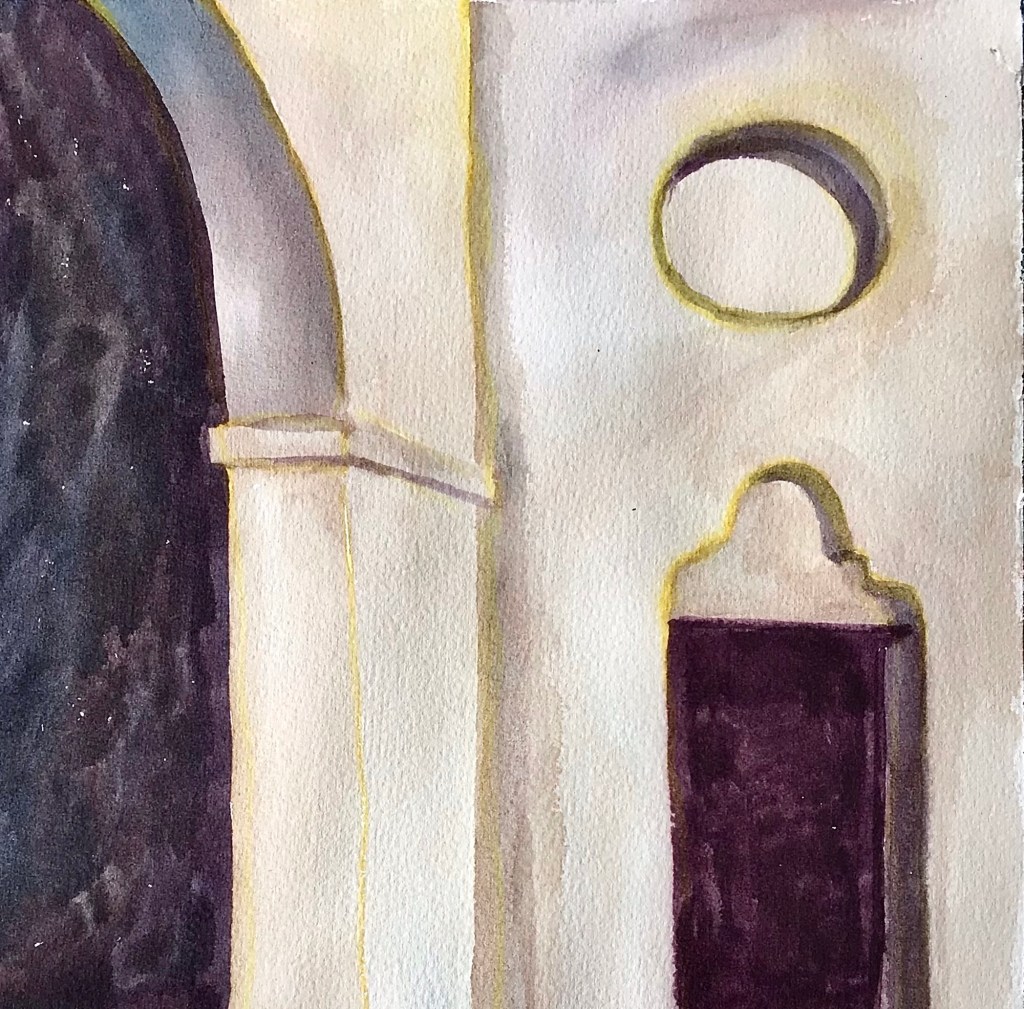
Cornelia: Prang 8 color box on Arches paper, from original photograph

Notice on my short watercolor study, I didn’t bother to include the whole photograph image. I “triaged” the details I couldn’t complete in our short class time. I mixed my own blacks, rather than using the pan color available. This gave me much richer colors and more variation in my shadows. I had outlined my basic shapes in yellow, but got to talking about the others’ directions and let the paint dry too much, or I would have picked it up better. It would have been less noticeable. I see now some of my lights could have been lighter. I can go back with a clean brush full of water and pick up some of that front face of the archway.

Of course, my eye sees more than most people can see, and it’s both a curse and a blessing. I’m always graceful with my students and try to give at least half as much grace to myself. We mustn’t get discouraged, but keep pressing upward! We don’t have to be a master at something to be a maker; we just have to do it. Having no fixed expectations of an outcome is the best way to exhibit creative expression. Following the less traveled path can lead to new destinations and new discoveries.

Art has the capacity to heal, to cross-fertilize, and to challenge fixed ideas. Art can’t be confined to gallery spaces or the walls of our homes. Art can not only renew our brains, but also the practice of art can renew how we see the world because we learn to see it afresh. Sometimes for the first time, we see it as we’ve never seen it before, and then we bring our own experience and expression to what we have seen. That’s when we become artists, creators, and cocreators guided by the hand of God.  As we are made in the image of the creating God, God heals us as he cares for the creation:


“I have seen their ways, but I will heal them;
I will lead them and repay them with comfort,
creating for their mourners the fruit of the lips.
Peace, peace, to the far and the near, says the LORD;
and I will heal them.”
~~ Isaiah 57:18-19

Joy and peace,

Cornelia


The Tool of Tools and the Form of Forms – 3 Wisdoms | Scott Randall Paine


59 Reading Statistics and Facts You Should Know

https://www.abtaba.com/blog/59-reading-statistics

What’s the latest U.S. literacy rate?

How the Hand Shapes the Brain, Hand Surgery Department of Clinical Sciences, Malmö Lund University Skäne University Hospital, Malmö, Sweden

NOTES FROM—The “online brain”: how the Internet may be changing our cognition –https://www.ncbi.nlm.nih.gov/pmc/articles/PMC6502424/

11. Hultsch DF, Hertzog C, Small BJ et al. Use it or lose it: engaged lifestyle as a buffer of cognitive decline in aging? Psychol Aging 1999;14:245‐63. [PubMed] [Google Scholar]

12. Small BJ, Dixon RA, McArdle JJ et al. Do changes in lifestyle engagement moderate cognitive decline in normal aging? Evidence from the Victoria Longitudinal Study. Neuropsychology 2012;26:144‐55. [PMC free article] [PubMed] [Google Scholar]

25–Uncapher MR, Wagner AD. Minds and brains of media multitaskers: current findings and future directions. Proc Natl Acad Sci 2018;115:9889‐96. [PMC free article] [PubMed] [Google Scholar]

35. van Der Schuur WA, Baumgartner SE, Sumter SR et al. The consequences of media multitasking for youth: a review. Comput Human Behav 2015;53:204‐15. [Google Scholar]

36. Altmann EM, Trafton JG, Hambrick DZ. Momentary interruptions can derail the train of thought. J Exp Psychol Gen 2014;143:215‐26. [PubMed] [Google Scholar]

37. Baird B, Smallwood J, Mrazek MD et al. Inspired by distraction: mind wandering facilitates creative incubation. Psychol Sci 2012;23:1117‐22. [PubMed] [Google Scholar]

Researcher Talks of Arts Benefits

https://ao.pressreader.com/article/281908778227901

The Hand: How Its Use Shapes the Brain, Language, and Human Culture,

By Frank R. Wilson

https://www.washingtonpost.com/wp-srv/style/books/reviews/hand.htm


Time Travel and Iconography Experiments

adult learning, art, Creativity, Faith, Hagia Sophia, Holy Spirit, hope, Icons, Imagination, inspiration, Leonardo da Vinci, Medical care, Painting, Pantocrator, renewal, Spirituality, Turkey, vision

Every once in a while, I like to go on journeys. Sometimes they’re actual trips, such as my recent vacation over spring break to visit family down in Texas, but other times I like to “time travel.” The best way to time travel today, since I don’t have access to a DeLorean, is to study history. Buckle your seatbelts, we’re in for a ride through Christian and art history.

Right before spring break, our art class tried some experimental techniques with chalk, watercolor pencils, and pan watercolor with brushes. I also brought some images from the beautiful church of Hagia Sophia of the ancient capital of Constantinople, which I brought home from a pilgrimage I made several years ago.

The church was sponsored by the first Christian emperor Constantine, so it has exceptional mosaics and frescoes decorating all its surfaces. We each chose an image to use as a starting off place and went from there. Inspiration comes not only from what we see, but from the materials we use. Combining new images with new materials can bring new directions.

Desis Icon, Hagia Sophia, Constantinople, Turkey

Our primary images were the archangel Michael, the enthroned Christ, the decorative jewel designs, and the cross. All of these designs figure in prominence in Hagia Sophia or the Basilica of Holy Wisdom, the primary seat of Christianity in the Eastern Church during the Byzantine era.

Unknown Artist: Moschophoros, The Calf Bearer, 165 cm high, Limestone, 570-560 BCE, Acropolis Museum, Athens, Greece.

Early Christian art took its themes from contemporary Greco-Roman subject matter, but repurposed it for its own religious significance.


The Good Shepherd, the Catacomb of Priscilla, Rome, Italy, 250–300 CE, adopts the standard form of Apollo statues.

The archangel Michael was connected in the 4th CE with Constantine as a divine messenger and intermediary between heaven and earth. Michael was not only the guardian angel of the nation of Israel, but other nations have adopted his protection also. In this same century one of the doctors of the early church, St. Basil of Caesarea, known as “the Great,” said:

“Beside each believer stands an angel as protector and shepherd, leading him to life.”

Constantine felt the presence of the mediating angelic hand in his vision of the cross in the sky at the Milvian Bridge, at his baptism, and in his role as Emperor of the Eastern Christian Empire. Constantine was actually baptized twice: once to cure him from leprosy and again on his death bed. In the early days of Christianity, various sects prevailed and the doctrine of one baptism as sufficient for all times hadn’t yet taken hold. After all, it’s not the water, the place, the church, the location, or the priest that makes a baptism effective, but the work of God through the Holy Spirit. As Ephesians 4:4-6 says,

“There is one body and one Spirit, just as you were called to the one hope of your calling, one Lord, one faith, one baptism, one God and Father of all, who is above all and through all and in all.”

Constantine’s Vision of the Cross: Bibliothèque nationale de France, Illustrated painted parchment Greek manuscript (879-883 AD) of the homilies of Gregory of Nazianzus in the Bibliothèque nationale de France.
(BnF MS grec 510) folio 440r.
https://gallica.bnf.fr/ark:/12148/btv1b84522082/f891

Constantine’s first cross apparition took place at the beginning of his military campaign in Italy. The young emperor realized that the tyrant Maxentius, who controlled Rome at that time, had set a trap at the Milvian Bridge over the Tiber. Fearing his rival’s machinations, Constantine had sought the aid of the God worshiped by his father, Constantius Chlorus (r. 305–6). While he marched on to a field together with his troops, he saw the sign of the cross revealed in the afternoon sky, shinning brighter that the sun, alongside an exhortation inscribed “by means of a starry form: By this you shall conquer, Constantine!”

Mike’s Cross Painting

Note the use of common materials in Mike’s work. The circle is the same size as a foam plate, the cross from the table decorations fits just inside it, and he embellished the outer and inner spaces with a bilateral and balanced design. He’s getting more skilled to “eyeball those proportions” from across the room. Plus, he enjoys making these designs.

The ancient writers Eusebius and Euthymios both mention the emperor’s troops also witnessed this miracle. The significance of the vision was subsequently clarified by Christ, who appeared to Constantine in a dream advising him to carry a cross-shaped banner before his armies in order to defeat Maxentius.

Byzantine hagiographical works, or the writings about the lives of saints, name this apparition of the cross as a decisive step toward Constantine’s conversion to Christianity. This first episode is part of a faith narrative, which runs through the tale of Constantine’s leprosy and his miraculous healing through his first baptism, which was officiated by Pope Silvester.

The depiction of Pope Sylvester in the church decoration, a leading figure in the iconography of Roman popes in Byzantine art, deserves special comment. Sylvester was born in Rome and was pope between 314 and 335, succeeding pope Miltiades. Both the Latin and Orthodox rites honor Silvester as a saint and the patriarchate of Constantinople commemorates him on 2 January. The fictional account of his life, Actus Silvestri, written in the 4th-5th century, records the story of his curing Constantine of leprosy and then baptizing him.

Baptism of Constantine

It was during this first baptism Constantine had another vision which converted him to Christ. Constantine’s baptism is narrated in the Greek Life of Silvester in a verbatim translation of the story by Zonaras. Having recovered his health by means of the sacramental bath, the now Christian basileus (king) donned a bright garment and “said to the bystanders that he had felt a hand: It had stretched out from above and touched me while I was descending into the font.”

Baptism of Constantine

The visualization of St. Michael’s involvement in Constantine’s baptism has no direct precedent in Byzantine and Balkan iconography. Similar descriptions appear in the shorter ninth-century vita of the hierarch and in the lives of Constantine. In the “Guidi” legend, the emperor’s confession is specifically addressed to the pope: “Servant of God, as I was standing in [the water] of the holy baptism, I felt a hand touching me and cleaning the sickness of the flesh.”

Unlike the hagiographical account by Zonaras, this fragment from the “Guidi” vita is not attested in the manuscript culture of the East-Carpathian environment. Even if it doesn’t include this passage in the section on Constantine’s baptism, the encomium (eulogy) by Patriarch Euthymios contains an allusion to the motif of God’s hand:

Upon waking up from the dream in which SS Peter and Paul offered him the cure of baptism, the emperor dismissed the pagan healer ( ) who attended him and said that: “(…) from now on, I need no human help, for the hand of God Almighty ( ) helped me.” Although it anticipates the king’s baptism, this statement is merely a symbolic reference to the divine power which came to Constantine’s aid, not a description of a miracle occurring during the ceremony.

The Slavonic translation of the Life of Silvester by Zonaras remains the only account that constitutes a plausible narrative background for St. Michael’s involvement in the scenes at the Romanian churches of Rădăuți and Bălinești. We don’t know if these fresco designers used a specific copy somehow related to the manuscript at the Neamț monastery. Yet once it had been integrated into the liturgy, the legend of Pope Silvester might have developed an independent circulation through storytelling. Perhaps the local audience interpreted Constantine’s confession about the divine hand that touched him in the water as a sign of the ethereal presence of the Archangel as pictured in the compositions of Constantine’s baptism.

Creation: The Nuremberg Chronicles (1493), written by Hartmann Schedel and illustrated with woodcuts by Michael Wolgemut

Perhaps these tales seem strange to our modern scientific minds, colored as we are by notions of “pictures, or it didn’t happen!” We want proof, repeatable and documented evidence, not just some such nonsensical woo-woo about visions and dreams. After all, we are more likely to think these voices could be drug induced or anxiety provoked, but we aren’t so familiar with God speaking to mortals, as it was back in the days when the boy Samuel was ministering to the LORD under Eli:

“The word of the LORD was rare in those days;
visions were not widespread.” (1 Samuel 3:1)

We aren’t big on either voices or angels, but God does still work in supernatural ways. While some may see prayer as supernatural healing, others may see God’s healing hand at work in guiding doctors, nurses, and caregivers to bring people to get the medical attention that brings them to better health. God gives us the heart for healing and compassion for the suffering, which then sets us out to discover new medicines and treatments for dread diseases. These wonderful advances would appear as magic to those from a century ago, or even a few decades before.

Take the miracle of cystic fibrosis advances. In the 1980’s, the life expectancy for a CF patient in the United States was only 12 years and 20 years in Canada. By 2017, with new medications and therapies, the median life expectancy for CF patients was 47. Because new medications and improved treatment of respiratory infections and other complications have extended the predicted life expectancy of CF patients to almost 50 years, some are now living well into their sixth and seventh decades. I call this a miracle, even if others call it mere “science.” It means I have a grand nephew who likely will have a full lifetime and even enjoy his own children.

Humanists will give all the glory to the human creature. They are self-made men and women in love with their own creation. People of faith will give all the glory to God for the gifts of their hearts, minds, bodies, and spirits. We have been given much, so we give much to others.

Nike of Samothrace

Just as the earliest Christian art works repurposed secular and mythological Roman themes, so later Christian art used Greco-Roman mythological imagery. The angels are based on the female winged victories, such as the famous Nike of Samothrace. In the early fourth century, angels suddenly appeared as figures in Christian iconography, usually without feet and dressed in garments of a white pallium over a tunic. This was a large rectangular cloak worn over a tunic, as worn by Greek philosophers and religious teachers. In the earliest Christian art works, angels were depicted as wingless, but wings became normative by the fifth century. By the High Middle Ages, angels were more elegantly garbed (depending on their station in the hierarchies) and appeared to be androgynous.

The first known Christian depiction of winged angels does not appear until this splendid 4th century marble ‘Prince’s Sarcophagus’. It was discovered after a fire in Sariguzel, near Istanbul in the 1930s

The word for Angel, mal’akh in Hebrew and angelos in Greek, simply means messenger, which is the job description of the Angel, who acts as an intermediary between humans and God. The Bible never says angels have wings, but we all imagine angels with wings. Perhaps we assign them wings because angels can travel from the “heavens above to the earth below.”

Egypt’s Red Monastery, The church of Anba Bishay and Anba Bigol

The church of Anba Bishai and Anba Bigol, known as the Red Monastery, is the most important extant early Christian monument in Egypt’s Nile Valley. It’s one of the most significant historical sites of the period in the Mediterranean region. Created in the 4th and 5th CE, this fine painted Coptic Christian image of Christ surrounded by angels has survived multiple restorations of the church building.

Leonardo da Vinci: Annunciation, 1472, oil on canvas, Uffizi Gallery, Florence, Italy.

Although the principle of angels being sexless continued, later renaissance artists presented them as male figures with fashionably delicate facial features and long hair, dressed in contemporary garments (making them more approachable to the common era). As the lines between the angelic spheres became blurred, along with the renaissance adaptation of classical Greco-Roman art, plump little children with wings began showing up in Christian art. We know these as cherubs.

Cornelia’s Watercolor Angel from Hagia Sophia

I used a mix of pastels and watercolor on this painting, working from a 1.5-inch square image of the Archangel Michael. The contrast of light and dark shows up in the naturalist wings and hair, with the glowing and reflective gold mosaic pieces.

Angel from Hagia Sophia

Regarding his rank in the celestial hierarchy, opinions vary. St. Basil in his homily Angels, as well as other fathers, place St. Michael over all the angels. They say he is called “Archangel” because he is the prince of the other angels. Christian tradition gives St. Michael four offices:

  1. To fight against Satan.
  2. To rescue the souls of the faithful, from the power of the enemy, especially at the hour of death.
  3. To be the champion of God’s people, the Jews in the Old Law, the Christians in the New Testament.
  4. Therefore, he was the patron Saint of the Church; he is considered to be the protector of Christians against the devil.
Christ between St. Peter and St. Paul, Catacomb of Sts. Marcellinus and Peter on the Via Labicana, Rome, 4th CE.

This image of Christ on the Throne, dating to the 4th century, shows Michael between St. Peter and St. Paul. It was painted in the Catacomb of Sts. Marcellinus and Peter on the Via Labicana in Rome, located near a villa that used to belong to Emperor Constantine. Below the main figures of the painting—Jesus, Peter and Paul—we find Gorgonius, Peter, Marcellinus, and Tiburtius, four martyrs who had been buried in that catacomb, and are depicted as they point to the Lamb of God on his heavenly altar.

Zeus: Archaeological Park of Campi Flegrei at the Castle of Baiae on the Gulf of Naples, Italy


The enthroned Christ follows the thematic form of Zeus, king of the gods, seated on his throne. A good example is statue from the Archaeological Park of Campi Flegrei at the Castle of Baiae on the Gulf of Naples. This statue of Zeus Enthroned is a 29-inch-high marble statue dating to the 1st century B.C. and is likely of Greek manufacture.

It was inspired by the colossal gold and ivory statue of the god at the temple of Zeus at Olympia made by sculptor Pheidias in 430 B.C. It was one of the Seven Wonders of the ancient world. Just as the angels were repurposed from the Nike victory statues, so the Christ Enthroned statues were re-envisioned from the ruler of the gods and humans statues. Art and artists can be put to work for whoever is in power at the moment. We need to eat and pay bills in every age.

Zeus: fresco, 62-79 CE, Casa dei Dioscuri, Pompeii (VI, 9, 6-7, atrio corinzio 37), Museo Archeologico Nationial, Italy.

A lovely fresco from Pompeii, found in the House of the twins, has a glowing red background and shows Jupiter or Zeus, the king of the gods, seated on his throne. A sphere lies beside him, an eagle at his feet, and a rectangular base is at his feet. In the same manner, the icon of the enthroned Christ places his feet on a rectangular base, representing his lordship over the four corners of the world.Gail W used the pastels in the clothing and background.

Gail W’s Enthroned Christ watercolor


From one of the royal figures, Gail S chose one of the jeweled embellishments for her focus. Gail enjoys ordered designs, so finding an image with a regular pattern was right up her alley. The outer circle with an inner square is divided along the diagonals by red lines, as if the cross were tilted on its side. The circle and square give unity to the design, as does the monochrome cross. The triangles are balanced by colors. The outer blue rim holds it all together. Gail tried the watercolor pencils out along with the pan watercolor washes.

Gail S inspiration and creation

While nothing is ever new in art, we artists keep reimagining the old patterns in new ways. After all, the basic elements of design never change, but we see the world with fresh eyes in every generation. Using our hands to create restores us and recreates us by reducing our anxieties and giving us a sense of accomplishment. We each serve the God of beauty and joy as God reveals God’s self to each of us. Doing any creative work with our hands is good for the mind, spirit and soul.

As our hand grows in competency with the media and our eye is better able to discern shape and patterns, we come under the Holy Spirit’s inspiration of creating power and we make art! We may start from the ancient wisdom, but then we go onto find the wisdom for today. After all, God is always in a rebuilding mode, for that which God created, God will preserve:


“When you send forth your spirit, they are created;
and you renew the face of the ground.” ~~ Psalms 104:30

Joy and Peace,

Cornelia

Diane Apostolos-Cappadocia : Why Ukraine Calls Upon Michael the Archangel, Christianity Today, April 12, 2022, https://www.christianitytoday.com/ct/2022/april-web-only/michael-archangel-ukraine-kyiv-patron-saint.html

Saint Mamas at Exeles: An Unusual Case of Ritual Piety on Karpathos
Katsioti, Angeliki; Mastrochristos, Nikolaos.  Arts; Basel Vol. 12, Iss. 4, (2023): 176. DOI:10.3390/arts12040176
Saint Mamas at Exeles: An Unusual Case of Ritual – ProQuest https://www.proquest.com/docview/2856776246?sourcetype=Scholarly%20Journals

The Historical Evolution of CF Treatments and Understanding
https://cysticfibrosisnewstoday.com/news/cf-treatments/

Life Expectancy with Cystic Fibrosis (CF)
https://www.nationaljewish.org/conditions/cystic-fibrosis-cf/life-expectancy

ARCHANGELS MICHAEL AND GABRIEL
https://www.stjohnarmenianchurch.org/archangels-michael-and-gabriel/

Archangel Michael
https://www.etd.ceu.edu/2023/dumitrescu_andrei.pdf

Rabbit! Rabbit! Welcome to May 2022

art, coronavirus, Faith, flowers, generosity, greek myths, Holy Spirit, inspiration, Love, nature, Painting, poverty, purpose, rabbits, Spirituality, Turkey, Ukraine, vision

May your garden grow.

This rabbit isn’t ready for May. Even as I say “Rabbit, Rabbit,” on this prime morning, I realize time already is too quickly flying past. I knew this day would eventually come, but surely I thought, not yet. When my rabbit parents were long of tooth—I think they were over forty—they said they had a longer “to do list” than their day was long. I think this was the time they were sending me the golden “round tuit” so I would get my own to do list done. Parental units in every generation have always projected their problems onto their offspring, or perhaps their offspring inherit or imitate the adults’ tendencies.

A Round Tuit

May is a good time for spring cleaning. Every rabbit hutch or den can use a bit of freshening up after a long winter and a cold spring. May 17th is Pack Rat Day, an opportunity to touch those items once and for all as you decide whether they belong in a Distribute, Donate, or Dump Box. If you just touch and can’t decide, you may be one of the 15 million hoarders in the United States. The days are getting warmer with more daylight and global warming adding to the elevated temperatures. We can’t do anything about the length of days, as these are determined by our planet’s oribit and inclination toward the sun. As we move toward summer, the Northern Hemisphere tilts toward the sun and gets warmer. In the Southern Hemisphere, the opposite happens and their Christmas is warmer than their springtime.

Eid Mu Barak

May marks the end of Ramadan, the month long Islamic fast recognizing the gift of the Quran to the prophet Mohammed. In most communities in the United States, Eid begins at sundown on Monday, May 2, and lasts one to three days, depending on cultural tradition. Eid al-Fitr, which means “festival of breaking the fast,” comes after a month of abstaining from food and drink from sunrise to sunset in observance of Ramadan. This is a time of renewal, wearing a new outfit, giving charity to the poor, and resuming the everyday rhythms of life.

Some of us finally get our gardens planted, in honor of the Ancient Greek and Roman goddesses of May. The word May entered the English language in the 1050’s, developing from the Old English Maius, which was borrowed directly from the Latin Maius, short for Maius mēnsis, “Maia’s month.” The Greek goddess Maia was one of the Pleiades, who were the companions of Artemis, the goddess of the hunt. This Maia was the mother of Hermes, the messenger of the Gods. But the Romans had yet another goddess named Maia, who just happened to share her name with the Greek goddess. When later generations conflated the Greek Maia with the Roman Maia, a goddess of fertility and spring, we now celebrate May for growth and increase in the natural world.

Victory Gardens were in vogue during wartime due to shortages at home caused by food supplies diverted to soldiers fighting on the front. Original “supply chain problems.”

If we want to “go green,” in our gardens, we can practice composting our lawn clippings along with any brand of manure. This will enrich our earth with earthworms and organic materials. We can also practice “crop rotation.” This means we plant our tomatoes ina different plot every year so we don’t deplete the soil of certain nutrients or invite nematodes to eat the roots. As a spiritual practice, gardening calms the mind, for it connects us to the earth and the source of our food. Our forebears supplemented their menus in the hard times in days of old with fresh food from home gardens. Community gardens serve the public in urban areas.

An April Bunny’s Bad Hair, Don’t Care Day

Spring reminds us the seasons of the year are balanced, for we have a cold winter and a hot summer, just as we have a middling spring and autumn. I say “middling,” but I might have said “muddling,” for these two seasons in my corner of Rabbitville are marked by rain and mud. Torrents of rain, drenches of rain, and sometimes mere drizzles of rain. Some of us rabbits may have bad hair days, but I hear all this moisture is good for the face and the skin.

In our world, the great powers also attempt to maintain balance and influence. Two world wars will push nations into this choice, but nations rise and fall. Once Great Britain was the world’s great super power, but after these great wars, it was greatly diminished, while the United States, which was the source of Britain’s war materials, prospered. Germany, was cut off from international trade due to its war mongering, became dependent on itself. American industries prospered, so that by the end of the first world war, America became the creditor nation to these former belligerents.

America Feeds the World: after the World Wars, hunger was rife in Europe and Russia. American farmers sent our surplus to feed the continent’s populations.

Moreover, we began to feed the world. This rabbit would like to think our government is more generous than Mr. McGregregor, who is always chasing us hungry bunnies out of his precious garden, but poverty and hunger lead to unrest among the world’s people, and that destabilizes governments. Stable governments, which don’t oppress their people, are more welcome on the world stage than dictatorships that exist to serve only a small group of privileged individuals.

As the United States and the Soviet Union struggled to reach a balance of power during the Cold War that followed World War II, President Harry S. Truman outlined what became known as the Truman Doctrine in a speech to a joint session of Congress on March 12, 1947. He emphasized the broader consequences of a failure to protect the democracies in Greece and Turkey by saying:

“The United Nations is designed to make possible lasting freedom and independence for all its members. We shall not realize our objectives, however, unless we are willing to help free peoples to maintain their free institutions and their national integrity against aggressive movements that seek to impose upon them totalitarian regimes. This is no more than a frank recognition that totalitarian regimes imposed on free peoples, by direct or indirect aggression, undermine the foundations of international peace and hence the security of the United States.”

Seventy-five years later, some of us rabbits have abandoned our national vision of democratic ideals, and have turned our back on our historic uniqueness among the nations of the world. While we may have aspired to grand ideals, but haven’t yet achieved them, this shouldn’t stop us from helping others continue their own difficult journey toward perfection. Once again, we have a bellicose dictatorship attempting to overthrow the will of Ukraine, a democratic nation, with the potential to continue such destabilizing activities in neighboring countries. What’s worse, Ukrainian agricultural products feed the world’s poorest countries, so without their harvests being replaced by American grain, people might go hungry. Hungry people are at risk for strong men with bad intentions.

Journeys aren’t ever easy. Any rabbit who tells you the road is easy, wide, and well marked on the way to their destination, has never heard the call of God saying, “Go to a land I will show you.” Those who think their path is sure, certain, and easy might want to remember this word from Matthew 7:13—

“Enter through the narrow gate; for the gate is wide and the road is easy that leads to destruction, and there are many who take it.”

This is why we admire heroes, for their journeys aren’t ever easy, but usually require some difficult and demanding task, which transforms them into a new person. They become more than they ever were before. Yet, perhaps, they were always a hero, and they only needed the auspicious moment to bring forth their true character.

The Guardian of Stuff

I remember the young man I met at a NASCAR event at Texas Motor Speedway. I asked him what he did under the stands while the race was going on.

He shrugged, “I just stand here and make sure nobody takes the other worker’s things.”

“Oh, like you’re the guardian of stuff!”
“I never thought of it like that.”

“Strike a hero pose. I’m going to take your picture .”

Everyone has a hero within, but not everyone has someone who affirms that hero. We all need to discover the hero within us, just as Jesus heard at his own baptism (Luke 3:22)—

“and the Holy Spirit descended upon him in bodily form like a dove. And a voice came from heaven, “You are my Son, the Beloved; with you I am well pleased.”

My dear rabbit mother gifted this to me years ago

We rabbits can’t fail to recognize the heroes who gave us life and brought us into this world. I speak of our mothers, of course. My own dear mother was ready to move mountains and call in every personal favor to come be by my side when I was in an Italian hospital while I was on a summer student art program. My dear daddy had to calm her jets and remind her, “Honey, it’s just a bit of food poisoning. It’s not like major surgery.” Our mothers will do anything to protect their offspring, and that makes them heroes in my eyes. I was released in three days, so it would have been a futile trip for my sweet mother. Make sure you recognize your hero mom on May 8, for without her, you wouldn’t be here.

Speaking of hospitals, May 12th is the birthday of Florence Nightingale, whose service as a volunteer nurse during the 1854 British war against Russia in Crimera. Because of her service, dedication to her call, and the innovations she brought to her vocation, we now celebrate the women and men who follow her in the nursing profession. Back in Victorian times, nursing wasn’t a respectable job, and women of the upper classes were expected to remain at home to care for the family’s affairs. Those who hear God’s call don’t worry about cultural expectations, but follow the solitary path of the heroes who went before them. Remember the nurses of today who’ve had to put themselves into harm’s way to care for people with a disease that now can be prevented from the worst complications and death in most people with immunizations and ordinary remedies like masks, hand washing, and avoiding crowds.

All us rabbits can celebrate Sally Ride Day on May 26, which was the birthday of the first American woman in space. While our national space program seems to have lost its energy and will as we’ve outsourced its efforts to the private sector, we have to ask if giving millionaires the ride of their lifetimes benefits a democratic society more than when we funded the space program by a community of citizens who sent the most highly trained and vetted astronauts into space. But then, I’m only one rabbit and I can remember the thrill, excitement, and joy when I saw our first astronauts exiting from their bobbing capsules. I saw these events on a small screen, black and white television in my school room. Afterwards, all we could talk about in our classrooms was the heroic journey of these brave individuals and the team that helped them circumnavigate our planet at such heights.

Finally, all rabbits of every stripe can celebrate Memorial Day Weekend. For some of us, this holiday has been reduced to a three day picnic at the lake or the racetrack. Others will decorate the graves of fallen soldiers from one of our many wars, participate in a patriotic parade, or watch a plethora of auto racing events around the world. Memorial Day weekend is the busiest weekend in motorsports, with Formula 1 racing in Monoco, NASCAR at Charlotte, the 100th running of the Indianapolis 500, and Lucus Oil Pro Motocross Championship from California. This rabbit will be in heaven. You could spend your tax refund on a new Television, many of which will go on sale over the weekend, or you could open a savings account for emergencies. A wise rabbit always has a little something extra stashed away for lean times. One never knows when Mr. McGregor will lock down his garden, since he doesn’t practice the ethics of Isaiah 58:10—

“if you offer your food to the hungry
and satisfy the needs of the afflicted,
then your light shall rise in the darkness
and your gloom be like the noonday.”

Self Portrait of the Artist as Wonder Woman

My old mother rabbit always reminded me if I was feeling down, all I needed to do was help someone less fortunate than me. It would get me out of my funk by focusing on helping another, as well as reminding me my problems were shared by others. Her message was a key to unlock the hero within me, without which I wouldn’t have done half the good I visited upon this world. My hope for each of you rabbits is to find the hero within you. If you allow God to accomplish deeds of courage through you, whether they be great or small, you’ll be transformed.

Joy, Peace, and May Flowers,

Cornelia

Truman Doctrine | Definition & Facts | Britannica
https://www.britannica.com/event/Cold-War

May 17 Is National Pack Rat Day! Here’s How to Celebrate.
https://ourcommunitynow.com/lifestyle/may-17-is-national-pack-rat-day-heres-how-to-celebrate

The Real Story of How America Became an Economic Superpower – The Atlantic
https://www.theatlantic.com/international/archive/2014/12/the-real-story-of-how-america-became-an-economic-superpower/384034/

Origin Of The Month of May’s Name | Dictionary.com
https://www.dictionary.com/e/may/

The Journey Never Ends

Creativity, Family, home, Imagination, Love, Meditation, photography, Prayer, purpose, renewal, Spirituality, Travel, Turkey, Uncategorized, Work

Hot Air Balloons in Turkey

Hot Air Balloons in Turkey

“A highway shall be there and it shall be called the Holy Way; the unclean shall not travel on it, but it shall be for God’s people; no traveller, not even fools, shall go astray.”~~ Isaiah 35:8

All good things come to an end, but the ending is just the beginning of something new. This week a fifty year old jockey came out of retirement and rode Oxbow, a 15/1 long shot, into the winner’s circle at the Preakness: they beat the favorite and his mud covered jockey who finished fourth, out of the money. I have a dear friend who just turned 66 and is contemplating retirement after forty years in medicine: he wonders what he could have done if he had more time in his career or if he had more time in retirement. Thousands of graduates from all educational levels are celebrating with their families this end of their journey with a mixture of joy and sadness. Whether they are “kiddie kollege” grads or college graduates, there is a mixture of sadness in knowing that this shared journey with friends is over, and in a few days the classrooms will be empty as others come to take your place.

This is the way of all journeys, whether we are going for a weekend at the lake or for two weeks in the Footsteps of Paul on a pilgrimage. When I came home after being in two countries, seven hotels, multiple airports, a taxi ride by myself in Istanbul, and finally slept in my own bed within my own four walls, I woke up feeling sad that there wasn’t some new and compelling place to be that day. Already I wanted to see more of Greece, for I only tasted of her beauty and delights. I didn’t get to see the ancient sites of mythology or the northernmost cities that Paul visited.  When I said goodbye to some of my travel companions that I enjoyed touring with, I knew that they were just seasonal friends, but one friend I have kept in touch with through Facebook. Sometimes this is the way life is, for we can’t manufacture friendships over a short period of time.

My first Sunday at home I was still on Istanbul time, so I woke at 2 AM (10 AM Istanbul time). This was “sleeping late” by their clock, but my eyes were wide open. Coffee in the kitchen, writing in my journal, a very early breakfast, meeting my newspaper man, and getting to church early for a change were on tap for today.

I did notice that I had a difficult time clapping in rhythm with the band, however, as if I were straddling different time zones or time travelling between the two places I had been and the place where I was now. My driving was also a tad impaired, for while I was able to navigate the highway, the glowing scenery distracted me. The landscape had an effervescent glow that I remember only one other time in my life, a radiance that it gave off as if God was touching all his creation and sanctifying it.  I remember the land, the trees, the grass, and all living things giving off this glow for weeks after I visited the Holy Land. This didn’t transfer to the streets or to bridges or houses, but only to growing things.  It is a holy moment, when one realizes that the journey that was once thought to be over is now just beginning.

When we get our diplomas, our gold watches, or our plaques for our faithful years of service, we think we have finished our course. When we cross the finish line or win first place, we think we have succeeded and can rest on our laurels.  The journey isn’t over yet! We are not called to be a settled people. We are a nation that was called to move west, to improve the widget, to build a new land, and to send humanity to the moon.  Now we have greater problems: within two generations, our great seacoast cities around the world may be inundated if the global warming folks are correct, over 7 ½ million people die of hunger every year around the world (http://www.statisticbrain.com/world-hunger-statistics/), and as our world becomes more urbanized, more will lack access to fresh water (w.globalresearch.ca/un-800-million-people-without-drinking-water/23843).

The ideas we are taught today won’t solve the problems of tomorrow, and we can’t wait until tomorrow to begin solving them! We have to become travelers and not settlers. Our education is just the passport to the next leg of our journey, and our first retirement annuity payment is merely the visa to the next country of destination on this great lifetime adventure we are about.

So how can we bring the Traveler’s experience to our daily lives? Travelers believe they are going someplace, that they have a destination in mind. If we don’t physically leave home, where are we going? I think it is the sense of a life well lived, or a life full of reasons to get up in the morning. We United Methodists have a saying from our founder, John Wesley: “Do all the good you can, by all the means you can, in all the ways you can, in all the places you can, at all the times you can, to all the people you can, as long as ever you can.” If this were your goal in life, each and every day can be an exciting day! We don’t know whom God will place into our path, but if we pass some helpless one by so that we can take care of our own important business, we will miss the opportunity to be a Neighbor like the Good Samaritan and detour from our daily routine to help someone in need (Luke 10”28-38).

Travelers expect the journey to be exciting and renewing. Daily life in the same old routine can get so predictable and humdrum. Our alarm goes off at the same hour and minute, we take the same rut to work, see the same old crowd at work, fight the same traffic snarl on the way home, and maybe even our home fires are barely flickering.  We miss the old excitement and passion we once had in life! Where has our energy gone—sucked down a black hole into oblivion, washed down by one too many drinks or spoonfuls of ice ream?

How can we keep faith and fidelity while reigniting that spark of excitement we used to feel when we were first sharing our passion for one another?  Sometimes we are just trading information with one another, rather than really sharing our lives and our hearts with the one we really care about.  Taking a new course in an experiential class, learning a new skill or sport together, or reading a book together and sharing our lives/thoughts/hopes/dreams/mistakes/achievements/joys means that we are suddenly vulnerable to one another again, for we are both travelers in an “unknown country.” Now we have to depend on each other just as travellers do; we strengthen our bonds.

As travelers, we expect to return home changed by our experiences. Once you’ve been to Turkey, you’ve always been to Turkey. Even if you break your camera or lose the filmcard, you have your memories and your postcards and souvenirs. The experiences have transformed you. If they didn’t, then all you did was pay a lot of money to wander around a wonderful place to complain about how “it wasn’t like home.” Of course not! It’s Turkey!

We do this in our daily life when we fail to engage the promise and potential of the gift God offers to us with each new day.  We say that each sunrise brings a new gift, “the present.” It may be a silly pun, but it’s also a truism. Some of us spend our daily gifts grieving about our yesterdays or yearning for them to come again. Yesterday is water under the bridge: we can’t bring it back and neither can we hold it here with us now.

Others of us miss the gift of the present because we are dreaming about our futures: things will be different when the kids leave the house, I will find someone to love me when I lose 40 pounds, or when the highway comes through this city will thrive again.  The future we dream about may not come to fruition. Moreover we set ourselves up for unhappiness and failure to act in the present while we wait for this future chimera to appear.

The best way to live as a traveler in our daily lives is to realize that we are all on a journey to God, for we are all on a “Holy Way.” We think some folks are fools and won’t make it to the goal, but God is gracious and cares for fools even when the rest of us aren’t suffering them gladly. We aren’t assigned to be the tour guide for this journey, and we don’t assign seats according to status.

As a spiritual exercise, take a respite from your journey to make self-examination. Where are you on this journey, physically and spiritually? You may want to make a time line or a time circle. Another way is to journal your experience to date or journal about a particular special event on this journey.  As on a real journey, your experience is your own and no one else’s. You feelings can’t be right or wrong: they just are. Give them to God.

Dream, Explore, Go

Creativity, Food, home, Imagination, mystery, photography, purpose, renewal, Travel, Turkey, Uncategorized, vision

Sunlight in the Pines

Sunlight in the Pines

“You shall take possession of the land and settle in it,  for I have given you the land to possess.”  ~~ Numbers 33:53

I overslept this morning, a behavior that seems more common lately. I did make to church yesterday. It was a grand day at Bristol-Baby! Even watching on TV, it had the makings of being there. Wrecks that took out the leaders, who would have expected that? Kyle winning, again. Joey Logano getting into a fight: the older he gets, the more his testosterone kicks in. Everyone will be glad to go to next week!

I am reading an ancient book THE ODD WOMAN, set in the early days of the women’s movement. In early industrial England, women of certain classes had limited choices: marriage, teaching, clerking, governess, or unwholesome occupations. The primary characters either ply these trades or have the economic means to live off the income of their estates. Two are out to change the world by teaching the shop girls how to type so they may move up a class and gain better working conditions.

Then last night I woke up several times with a very dry mouth. In between, I had several dreams, only one of which I even recall a fragment. As I slept, dogs and I spoke together as if we understood each other perfectly. Perhaps I need to write a book, DREAMING WITH DOGS!

As I made my morning ablutions, this verse popped into my mind, “You shall take possession of the land and settle in it, for I have given you the land to possess.” I had been thinking of exploring beyond my memoirs of Turkey and Greece, and what it means to be an explorer who never leaves home. How can one be both a settler and an explorer at the same time?

Settlers and explorers don’t share the same skill sets.  Nor do they share the same callings. If they were sailors, settlers would hug the known shores, while explorers would follow a star until they discovered an unknown land. Explorers want to try the new restaurant in town, while settlers feel secure ordering from a known menu and eating a familiar repast. I suppose this is why when church people move, they look for a place that feels like home and a church that feels their home church. These are settlers. Explorers, however, lead them, for the clergy are always moving into a land “God has given us” by virtue of our appointments. I grew up in a big church, thought I was getting a small church experience in seminary, and learned that there are still even smaller churches out in the world!  Culture shock is the sure sign of being out of your comfort zone, and a pointer that you travel not in the shallow waters anymore. John Wesley identified the explorer DNA of the Methodist clergy when he told them to be ready at a moment’s notice to “pray, preach, move or die.”

Agoraphobia–the fear of open spaces–affects nearly 1.8 million American adults (.8% of the population). Xenophobia–the fear of strangers– affects more of us, sometimes in subtle and unrecognized ways. The “other” is the one we fear because they aren’t like us. The tension this sets up between their settlement and our settlement constructs a “no man’s land” across which neither of us can transit. So we both lob bombs of hate, suspicion and denigration across into each other’s territory. US vs. THEM is our tribal rivalry, our devotions to our pack, and our adherences to our specific creeds.

The other race, immigrants, the poor, the rich, the educated, the ignorant, the churched, the unbelievers, and all other contrasts of our world, such as those that shop at Wal-Mart and those that wouldn’t be caught dead in the parking lot.  All of these are “strangers who live in strange lands.”

Sometimes we artists, creative people, and persons of faith think we must leave home to find the new experience that will open the eye of our imagination and set our creative juices flowing. We believe that only by traveling can we find the novelty that will awaken our senses that have been jaded by the constant bombardment of repetition. What we fail to do is to be explorers at all times, even when we return to the same address and the same bed each night. I have a set of coffee mugs for DST and for CST. I get bored drinking from the same set all year round and begin to miss the spring colored ones. These then are too bright in the fall and winter, so I bring out the deep colors and snow scenes. Monet painted his backyard many times: think Water Lilies!

Sometimes I feel the need to rearrange my 768 square foot condominium: then again, I decide to rehang the artwork to give myself a fresh look on the walls. Buying a new rug in Turkey was my big redecorating project for a while. I will change the cover on my bed according to the season, just to keep the room fresh. I am thinking of redoing the valence in the bedroom. I could still add crown molding and baseboards to the rooms, but I won’t do that until I change the floor covering. These projects are all worthy, but they take away from true creative pursuits. They are just signs that I want to strike out in a new direction, but I am afraid to leave the shore.

“You shall take possession of the land and settle in it, for I have given you the land to possess.” This word is for the explorers who yearn to be settlers also, for the Hebrews had been wandering for a long time in the wilderness when they heard this promise from God. For them, the land would be new, wonderful, exciting, full of surprises, and an explorer’s delight. Only later would they be a settled people, forgetting how God fed them daily in the wilderness, and instead trusting their own labor to wrest a crop from that land. They would forget as they sat at their looms patiently weaving that for 40 years in the wilderness, their clothes never wore out and their saddle leather never failed. As they became settled, they trusted themselves more and depended on God less.

The explorer, however, is always going into the unknown, so trusting God in all things is a highly developed characteristic.  “It is the Lord who goes before you. He will be with you; he will not fail you or forsake you. Do not fear or be dismayed” (Deuteronomy 31:8).  This is what the Hebrews were told crossing into the Promised Land, but within a generation they began to trust themselves and other gods. The explorers still trusted the same God who had been with them in the cloud by day and the pillar of fire by night.

“Where is my next meal coming from” is the same question as “from what source is my next creative idea or expression?”  How can I make ends meet is a question both settlers and explorers ask. Settlers will tie themselves to a plot, whereas explorers will find a way to live off the land. The same God provides for them all. “Look at the birds of the air; they neither sow nor reap nor gather into barns, and yet your heavenly Father feeds them. Are you not of more value than they?” (Matthew 6.26:). I think we would all be improved by trusting God a little more, by risking entry into the unknown land where God resides, and opening our hearts and minds to the other.

Perhaps that is why we travel, to discover amidst the uniqueness in others an essential humanity. I would be sad to think that some folks traveled hoping to discover the unusual, but yearned for only the familiarity of home, but then they would be settlers. People who travel looking for home, who spend time comparing their experience to home, and talk about how glad they will be when they get home have missed the joy of traveling! Why did they spend $4000 on a grand tour of the holy places when they could have stayed home and complained!? They may have just needed a change of scenery or the weather was poor at that time of year. I too can find a growl bear mood, but when this happens, I like to take my iPhone out and wander about to photograph the common scenes of my everyday life.

Taking photos that are interesting and might be useful for a painting requires me to pre-compose or imagine the image through the lens. Then I brighten and/or use one of the Instagram filters before I share it on Facebook or twitter. I will put the camera inside the flowering bush, lie down on the sidewalk to shoot upwards (just because I’m a granny doesn’t mean I can’t get up again!), or bend down to get eye to eye with a low subject. People’s photos often fail because they aren’t close enough, the light is from the wrong direction, the viewpoint is ordinary, and the subject or photo itself lacks contrast. In other words, they are safe, shore hugging pictures. Explore what your camera can do. Take it for a ride out on a big wave out beyond the breakers.  Feel the exhilarating breeze upon your face as your bark rushes over the tops of waves that have yet to break! You are flying! This is art! This is fun! You can bring your ship home anytime you want, but you’ll never be the same again. You are now an EXPLORER.

This quote is often attributed to Mark Twain, but it hasn’t been found in any of his writings. It still speaks the truth to all of us:

“Twenty years from now you will be more disappointed by the things you didn’t do than by the ones you did.  So throw off the bowlines, Sail away from the safe harbor. Catch the trade winds in your sails. Explore. Dream. Discover.”(—attributed in error to Mark Twain, first found in H. Jackson Brown Jr.’s P. S. I Love You (Rutledge Hill Press, 1990). Brown’s book is a collection of quotes and maxims attributed to his mother.)

Money Can’t Buy Art

Creativity, generosity, Grand Bazaar, Holy Spirit, Imagination, Meditation, photography, purpose, Spirituality, stewardship, Turkey, Uncategorized, vision, Work

“But where shall wisdom be found? …It cannot be bought for gold, and silver cannot be weighed out as its price.” ~~ Job 28:12, 15

The recent national elections for President, Senate and House seats cost around $6 billion dollars. At the end of all this storm and fury, the Republicans still hold the House, the Democrats still dominate the Senate, and Mr. Obama is still the President of these United States of America. One candidate, Linda McMahon, the former CEO of World Wrestling Entertainment, spent nearly $100 million of her personal fortune on her two failed bids for the US Senate seat from Connecticut. This is proof that money itself doesn’t buy elections.

Some of my younger friends are prepared to leave the country: anywhere but here is looking good to them. Then there are the secession petitions on the government’s own web site (https://petitions.whitehouse.gov) filed from all fifty states since this election, including one from Vermont (a “safely Democratic state”), from disaffected citizens who are unhappy with the outcome and don’t want to live under this elected government. (We live in America, not Burger King; we all don’t get to have it “our way.”) We seem to think that the grass is greener on the other side of the fence, or things would be better if other leadership were in charge.

Having just returned from a recent journey to Greece and Turkey, I can say with certainty that every person in every place is in some way unhappy with their own government, but they all continue to muddle along. Our own founders designed a famous “system of checks and balances,” so that no part of our government can get the upper hand. Sometimes nothing gets done for a while, as the politicians wait to see if new leadership will take the reins when an election year comes around. When that fails to happen, they get down to brass tacks and do their deal making, especially if they can see the proverbial “fiscal cliff” looming ahead. We don’t act until the last minute either, for we’ll wait until push comes to shove, and then make the hard decisions that have to be made.

The ordinary deals that we make every day pale in comparison, however, to these big number compacts and agreements that our leaders make that affect not only Americans’ pocketbooks but also the whole world’s economy. For us, we make the small decisions: Should I shop at this employee owned grocery store, where the prices are a little higher, or should I shop at a big box grocer who buys in bulk and passes on the low price savings to me? Both are providing jobs for people, but one pays its dividends to its employee-owners and the other pays its dividends/profits to stockholders. We probably aren’t thinking of this secondary consequence of our use of money, for most of us want only the “biggest bang for our buck.” We don’t often consider the moral or ethical consequences of our money’s impact.

What guides our economy today is the “low price.” We outsource jobs overseas to take advantage of lower wage labor that will lower the costs of products to entice Americans to purchase them. It doesn’t matter that the quality of the goods aren’t as high, for unskilled persons are replacing skilled American crafts people who earned a higher wage. We have become adjusted to paying less and expecting less, and we say, “You just don’t get good stuff anymore.” We are so used to mass-produced, manufactured goods that our senses are dulled and we are unable to appreciate the truly good things of life.

On my recent trip to Turkey I shopped with some of my touring companions in the Grand Bazaar of Istanbul, a city of more than 13 million people. Here we saw spices, pipes, leather, gold, silk, cashmere, art, souvenirs, clothing, silver and baked goods. This Byzantine Bazaar has 61 covered streets, but we covered only a few on our short tour. It’s one of the oldest covered markets still in existence, with nearly 500,000 people visiting daily. This was our first day in a foreign country, so everyone was worried about safety: personal and financial. This is a big pickpocket area, but then anywhere folks are spending money is a pickpocket area, even in the USA. Folks “lose their wallets in Wal-Mart” when they don’t pay attention to their surroundings. As the holidays approach, I expect the stories of loses will go up also.

We window-shopped and I stopped to finger the scarves. The merchant began to educate me: “Very fine: 50% cashmere & 50% silk. All cashmere, this one. These rayon and wool. This group just rayon.” Oh yes, very beautiful. My group says to me, “You’ll pay too much for a scarf here, Cornelia. There’re some pretty ones for 12 Lira ($6) back there.” This is when I realized that my group was not trained in art, but was trained by the Bottom Line. They bought into the idea of the Low Price, but my Mother taught me that “you get what you pay for.” At this one merchant, I purchased the silk and cashmere shawl in a beautiful green pattern. It was a “value” buy, but not a “cheap or inexpensive” purchase. Later on in Turkey, I purchased several of the lesser quality and lower priced colorful shawls to have a variety of fun throws for everyday wearing.

We get what we pay for. We artists sometimes wonder why our work doesn’t come out the way we imagined it. We may be using inferior materials, “cheap” paints unworthy of good ideas. If you are a hobbyist or a student and you aren’t progressing in your work, try moving up to professional grade pigments & brushes. Great ideas deserve great materials! You will get more intense colors, more rich interactions with the paint, and more intimate involvement with your work. Don’t worry that you are “spending more money,” for these paints will last longer than your “cheap” paints, for you will use less paint to cover more space. Why throw good money after bad paint? Buy the best! Use the best! Become the best!

Wisdom isn’t bought for silver or gold, it is found in the heart and mind of God. Perhaps you need to reassess your calling: do you seek only the mass produced and the low priced? Where does your money go? Are you supporting great corporations only, or does part of your money also support small farmers or fair trade growers? Do you purchase any handmade crafts or is everything manufactured? Consider what that does to your soul.

This week make something hand made to add to your home. An easy project is a pillow cover. It is two squares of cloth sewed together on three sides and a pillow form for the insert. Once it’s stuffed, turn the 4th open edges inside, pin together and whip the opening closed by hand stitching. You can add embellishments on the corners if you like.

This link from the Huffington Post identifies the true costs of secession from the USA. http://www.huffingtonpost.com/mobileweb/2012/11/20/cost-of-seceding-from-united-states_n_2165696.html