Pillars of Creation

art, cosmology, Creativity, Holy Spirit, Israel, Israel, Painting, Silence, Spirituality

The Bible has many creation narratives. We’re familiar with Genesis 1 and 2, but our scriptures also include creation stories in Job 38-41, Psalm 104, Proverbs 8:22-31, Ecclesiastes 1:2-11 and 12:1-7, and excerpts from Isaiah 40-55. Some believe God created the world and all of creation in seven 24-hour periods. Others believe God had nothing to do with creation, but nature alone birthed itself in a great explosion. Some believe God created the world and left it to its own purposes. For these deists, God isn’t involved in human affairs in this current world.

 We don’t have to pick a side in this argument, or throw in our lot with “God alone” or “no god at all.” We can read the scriptures with modern science in our minds and faith in our hearts. In this, I’d say “we’re better off together” than we are separated into different groups. The love of God shed abroad into our hearts can bind us in this unity. Our human, fallen condition is the anvil on which we break apart into our separate sections and groups.

God is the creator of original unity and the recreator of the coming unity of the new heaven and the new earth, which will restore the unity of our fallen and broken world. In Psalms 104:5-9, the writer speaks of God’s process of creation:

“You set the earth on its foundations,

so that it shall never be shaken.

You cover it with the deep as with a garment;

the waters stood above the mountains.

At your rebuke they flee;

at the sound of your thunder they take to flight.

They rose up to the mountains, ran down to the valleys

to the place that you appointed for them.

You set a boundary that they may not pass,

so that they might not again cover the earth.”

Later, the same author notes God is always at work in the world: “When you send forth your spirit, they are created; and you renew the face of the ground.” (Psalms 104:30)

This renewing Spirit, which proceeds from the heart of God, allows us to live in hope, even when we see brutal wars decimating innocent civilians. When nations deprive their marginalized populations of equal rights, we trust that God’s spirit will move to bring a renewing justice for those who are denied their legal rights. When famine and destruction strike, the ones who suffer have hope that those who hear God’s voice will have compassion for them and will come to relieve them.

Of course, if we believe “the voice of God is rarely heard in our land anymore,” or “God helps those who helps themselves,” we are admitting our disbelief in a living and involved deity who is willing to interfere in the affairs of human life.


HERCULES AND THE WAGGONER. A Waggoner was once driving a heavy load along a very muddy way. At last he came to a part of the road where the wheels sank half-way into the mire, and the more the horses pulled, the deeper sank the wheels. So the Waggoner threw down his whip, and knelt down and prayed to Hercules the Strong. “O Hercules, help me in this my hour of distress,” quoth he. But Hercules appeared to him, and said: “Tut, man, don’t sprawl there. Get up and put your shoulder to the wheel.”
The gods help them that help themselves

The God we see revealed in the Old and New Testament helps those who can’t help themselves. This God has done this very thing throughout all of human history! Otherwise, God would have chosen the strongest instead of the least to carry out God’s mighty purposes. Instead, God always chooses the least, the last, the lost, the lonely, and the “losers” of our world to lift up. This is why you will not find anything like “God helps those who help themselves” in the Bible. It is found in Aesop’s fable, “Hercules and the Waggoner,” where the moral of the story is “the gods help them that help themselves.” The modern variant, “God helps those who help themselves,” was purportedly coined by the English political theorist Algernon Sidney (17th CE) and later popularized by Benjamin Franklin (18th CE) in Poor Richard’s Almanac.

Pillars of Creation, strings and under painting

In the studio, the artist is always listening for the creative spirit to speak. If I’m sitting before a blank canvas and have no idea whatsoever what to do, I make a mark. I make another mark in relation to the first, for now the two need to speak and relate to one another. As I pick up some more paint to make the third mark, this one must relate to the other two, and so on I go, adding marks and colors.

Once I get some shapes defined, I begin blocking in some colors. Here too, these must speak to one another. One mark can’t shout or be overbearing, while the others fade into the background. I think of warm and cool, opaque and transparent, as well as flat and shaded. Once I get a base layer on the canvas, I remove the strings which I tied to make the shapes. I give it a rest and let my mind rest also. I can come back with fresh eyes tomorrow.

The “Pillars of Creation,” an area of intense star formation, was photographed by the Near-Infrared Camera of NASA’s James Webb Space Telescope.

Inspiration, or listening for the spirit of creation, is especially important to move a work past “coloring in the lines” into a work of art. The “Pillars of Creation,” an area of intense star formation, was photographed by the Near-Infrared Camera of NASA’s James Webb Space Telescope. In the Old Testament, the pillars of creation held up the earth itself, while the dome of the firmament (the sky) was above. The ancient, unscientific age was a limited world, with an unlimited divine being. Today we live in an unlimited universe, but too many people have a god too small to do mighty things beyond our poor capabilities.

DeLee: Pillars of Creation

When I add the silver and gold paints, the number of layers and the directions of my brush strokes determine how much of the under painting will show through. I don’t do this haphazardly, but once again I listen to that still, sheer sound of silence that once called Elijah from his cave. Elijah knew God wasn’t in the wind, earthquake, or fire, but in the sound of sheer silence (1 Kings 19). I may have music playing in the background, but I don’t hear it at all. I’m in another realm entirely. I only hear the silence.

I’m enjoying this current theme and exploration. It combines my love of space and nature. I’m a firm believer in the providence of God: if God cared enough to create all there is, God will not forsake God’s creation. God will provide, and as God’s faithful people, we’ve been entrusted with the care for God’s world. Therefore, we must join God to keep the foundations of creation stable and the resources of our world available for future generations.

Joy and Peace,

Cornelia


William P. Brown: The Seven Pillars of Creation: The Bible, Science, and the Ecology of Wonder, 1st Edition, Oxford University Press, 2010.

Does the Bible say, “God helps those who help themselves?”
https://aaronarmstrong.co/everyday-theology-god-helps-those-who-help-themselves/

The “Pillars of Creation,” an area of intense star formation, has been captured by the Near-Infrared Camera of NASA’s James Webb Space Telescope.

NASA/ESA/CSA/STScI


Weaving a Life Story

Academy for Spiritual Formation, adult learning, art, Creativity, Faith, Holy Spirit, Icons, inspiration, Ministry, Nativity, renewal, righteousness, Silence, suffering, vision

Weaving is a metaphor for our life’s story and journey. We envision the weaver in charge of the colors, designs, and textures of the finished fabric. The weaver’s goal is to produce a beautiful product. We often think we are in charge of our own destiny, as “The Weaving Song” by Carolyn Hester, in which an old 1960’s era folk singer would sing:

Choose the right color And push the right tread

Throw through the shuttle And peg down the thread

Work is all laid Before your start

To make your own pallet Of bright hue or dark

The loom of life is moving The weaving is all your own

Choose the right color And push the right tread

Throw through the shuttle And peg down the thread

Rainbow of colors Is at your command

Choose all the right shades Offered in the stand

The loom of life is moving The weaving is all your own

Life’s but a grey And heavy with care

May blooms scarlet With couragе rare

The loom of life is moving Thе weaving is all your own.

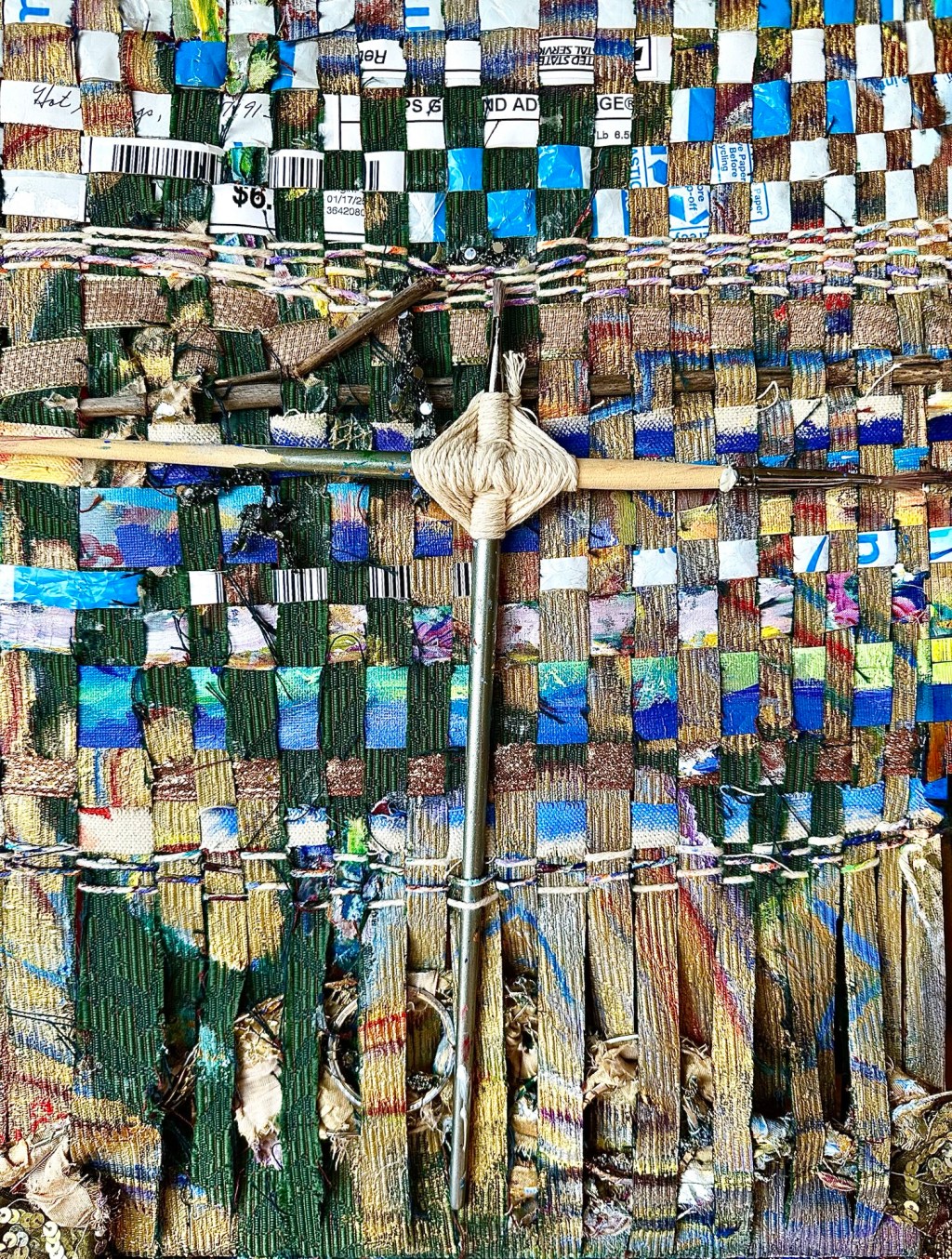
DeLee: God’s Eye and Cross, woven canvas, branch, string, paint brushes, fabric scraps, wire, packing materials, 16” x 20”, 2025.

Yet life doesn’t always work out the way we thought it would. The Bible says Job was the most righteous person of his era, and Job complains after losing everything and everyone:

  “My days are swifter than a weaver’s shuttle and come to their end without hope.” (7:6)

This wisdom text reminds us sometimes the righteous suffer, even while the wicked prosper, but God is still God, and we will understand this mystery of God when we see God face to face. We call this “theodicy,” (from Greek theos, “god”; dikē, “justice”), or our explanation of why a perfectly good, almighty, and all-knowing God still permits evil to exist.

God gives human beings free will. We make our own choices in life, just as everyone else does. Since we don’t live in a universe of one, other people’s choices impact our choices. Imagine a pingpong ball tossed into a room filled with mousetraps all loaded with other pingpong balls. If one ball hits a loaded trap, it sets that ball off into motion and those balls set more balls into motion until chaos ensues! If more than one person is involved, some sort of disagreement is sure to follow. Some of us are even at odds with our own selves!

As the old joke goes, a solitary man was rescued from a desert island. On this island were several structures. When asked, he said, “That one was my house and that one was my church.” And the other building? “That was the church I used to go to!”

Louise Bourgeois: Spider, metal, National Gallery of Canada, in Ottawa, Ontario. Her mother mended tapestries, like a spider spins a web.

When life is chaotic, creative people find solace in the quiet of their chosen deserts: the studio, the workshop, or their favorite writing chair. While we artists have the illusion we can control the images we produce or the songs which bubble up from our hearts, in truth, what we create is a shared product with our heart, mind, and the creating spirit. If we begin to lose our humility about this shared process, we lose the creative energy underwriting our works.

Louise Bourgeois: Metal Spider wrapped in yarn, Japan

We know this emotion as “pride,” and the ancient cultures warned against it. Throughout history, legendary and mythological figures have been used as examples of either virtue or a moral failing. The story of Arachne and Minerva is no different.

Attributed to Amasis Painter, 6th BCE, Greece, clay, Metropolitan Museum of Art, New York.

A 6th BCE Attic Black Figure Lekythos storage vessel attributed to the Amasis Painter shows the type of standing loom and the various shuttles of different threads a weaver would use for a fabric. Today we think of weavers sitting at their looms, but the ancients stood at their work.

Arachne was a mortal who excelled in the weaving arts: spinning her own yarn and selecting the correct colors to produce the beautiful images for the finished fabric. Minerva, the goddess of handicrafts and the Roman correlate to the Greek goddess Athena, had heard of Arachne’s prowess and her pride. Disguised as an old woman, Minerva visited Arachne to warn her not to disparage the gift of the gods. Arachne rebuffed her, and held her ground, even when Minerva revealed her true identity.

Minerva (Athena) and Arachne by René-Antoine Houasse (1706), Versailles

When the weaving contest began, both were even in technique and design. Minerva’s image was of the pantheon of the gods, but Arachne told the stories of the god’s mishaps with humanity. This angered Minerva, who struck Arachne with a weaver’s shuttle. Embarrassed, Arachne took a rope to hang herself, but Minerva had pity on her and changed her into a spider instead. We call spiders, ever weaving their gossamer webs, “arachnids” in her memory.

Spider Web

In Christian art, the theme of listening beside a well or spring is connected both to the angel’s annunciation to the Virgin Mary and to her weaving curtains for the Temple. The third-century Dura-Europos church baptistery has a fresco of a woman drawing water from a well, which Yale theologian Michael Peppard believes represents the Annunciation to Mary at a well, from a scene from the gnostic writing, Protevangelium-18.

Woman drawing water at the well. Possibly the Virgin hearing the Angel’s voice. Dura Europa.

Others think it represents the Samaritan woman at the well or Rebecca from the Old Testament. Because the fresco doesn’t include Jesus, the empty space instead represents “the bodiless voice” that Mary hears in the Protevangelium. Also, a five-pointed star appears on the woman’s torso, which could symbolize the new child in her womb. The star in later iconography was repositioned to the shoulder of her mantle, and the water vessel survives all the way into the Renaissance art as a vase with flowers.

Icon of Virgin at Well with Angel

From The Protoevangelium of James, section 11: And she took the pitcher, and went out to fill it with water. And, behold, a voice saying:

“Hail, you who hast received grace; the Lord is with you; blessed are you among women!” (Luke 1:28) And she looked round, on the right hand and on the left, to see whence this voice came. And she went away, trembling, to her house, and put down the pitcher; and taking the purple, she sat down on her seat, and drew it out. And, behold, an angel of the Lord stood before her, saying: “Fear not, Mary; for you have found grace before the Lord of all, and you shall conceive, according to His word.” And she hearing, reasoned with herself, saying: “Shall I conceive by the Lord, the living God? And shall I bring forth as every woman brings forth?” And the angel of the Lord said: “Not so, Mary; for the power of the Lord shall overshadow you: wherefore also that holy thing which shall be born of you shall be called the Son of the Most High. And you shall call His name Jesus, for He shall save His people from their sins.” And Mary said: “Behold, the servant of the Lord before His face: let it be unto me according to your word.”

This apocryphal Greek text, which was first written in the 2nd CE, with Syrian revisions into the 5th CE, is important because it increases our insights into women’s history, the childhood history of Jesus, Jewish-Christian relations, and the impact of Christian apocrypha on Islamic origins. This text, which contains the infancy narratives of the Virgin Mary, John (the Baptist), and Jesus is the source many of the Western Catholic and Eastern Orthodox religious feast days. Moreover, it’s also the origin for the icons representing the birth of Jesus in a cave.

Duccio: The Nativity with the Prophets Isaiah and Ezekiel, tempera and gold on panel, 1308-1311, National Gallery of Art, Washington D. C. Part of a series of the Life of Christ, the rest of which are in Sienna, Italy. 

A similar Marian birth narrative, The Gospel of Pseudo-Matthew, gives more details on the life of the Virgin, the miracles surrounding her marriage and the birth of Christ. It also tells the story of the Annunciation in two visits rather than one. The angel’s first greeting is beside a fountain and the second is inside while Mary is weaving the curtains for the Temple.

DeLee: Freeform Weaving while Listening

When I was on a recent Five-Day Academy for Spiritual Formation retreat, one of our hands on projects was a small weaving. Our package had a small loom, some yarn to weave with, and beads to attach. Of course I had to use a second packet to finish out my weaving because I tightened the horizontal rows more tightly than the organizers thought the regular attendees would do with their yarns and ribbons.

I also had my eye on a nice lichen covered branch to use as a hanging support. When I picked it up, it had red ants on it. I had to do some mad shaking to get them off! Anything for art! During one of our quiet reflection sessions, I sat beside a small lake under a pavilion to let my hands work. I’ve always needed a quiet space to process the flood of ideas and the rush of emotions when meeting new people and hearing new ideas. I operate as an extrovert, but when I get full to overflowing, I need quiet to recreate and recharge. I find new power in the admonition of Psalm 46:1-6—

God is our refuge and strength,
a very present help in trouble.
Therefore we will not fear, though the earth should change,
though the mountains shake in the heart of the sea;
though its waters roar and foam,
though the mountains tremble with its tumult.
Selah
There is a river whose streams make glad the city of God,
the holy habitation of the Most High.
God is in the midst of the city; it shall not be moved;
God will help it when the morning dawns.
The nations are in an uproar, the kingdoms totter;
he utters his voice, the earth melts.
The LORD of hosts is with us;
the God of Jacob is our refuge.

Diedrick Brackens, “prodigal” (2023), cotton and acrylic yarn

When my hands touch the different textures of the threads, and I let my spirit work with the creating Spirit of the word and world, I can shed all the strain and stress of being on a different schedule from traveling, having nerve pain in my neck from a bulging disk, and more interaction than I’m used to since I no longer work.

I always fought to carve out quiet times when I was in active ministry, for listening to God is the first calling of any leader worth their salt. I knew I wouldn’t hear God’s voice in the pell mell rush and cacophony of our world. The disembodied voice is more likely to come to us when we’re alone or in a receptive moment. It’s important to note Mary was one of the virgins of the House of David chosen to weave the curtains for the Temple in Jerusalem, according to The Protoevangelium of James, section 10. She was busy, but working for her God. It was when she took a break to draw water from a life giving well that she heard the messenger from God.

Bruce Conner, Arachne, 1959, mixed media: nylon stockings, collage, cardboard, 65 3⁄4 x 48 3⁄4 x 4 1⁄4 in. (167.0 x 123.8 x 10.7 cm), Smithsonian American Art Museum, Bequest of Edith S. and Arthur J. Levin, 2005.5.12

When I was appointed to a church, I always had a list of tasks to do, but I often never completed them because God would send “interruptions” to my well laid plans for the day. After several years, I began to understand these interruptions were my real tasks of ministry for the day. We have plans, but God has a better plan.

The prayer in my weaving supplies was appropriate for me on this retreat:

Teach us to listen, O Lord. 

Quiet the noise of our lives

so we can hear your voice. Amen.

After several weeks, I’ve come back to finish this blog. In the meantime I’ve had anterior cervical discectomy and fusion for my neck pain and numb fingers. It’s for the bulging neck disk that causes pressure on the spinal cord. If this happens in the lower back, a person gets sciatica and numbness in the legs. In the neck,the same condition affects the arm and hands. I feel better than I did before, so I’m thankful for all healing mercies. I have to be careful not to overdo my activities. The instructions “Don’t do housework!” were gladly received.

I hope you seek out your quiet spaces and quiet moments to hear the sheer, still sounds of silence, the inaudible voice of our God.

Joy and peace,

Cornelia


 NOTES:

Carolyn Hester: The Weaving Song, Track 10 on At Town Hall, One, Produced by Norman Petty, 1965.

Troubadour: Weaving Song: similar words to Hester coffee house ballad above. https://music.apple.com/us/album/weaving-song/400303687?i=400303767

Myth of Arachne https://www.worldhistory.org/Arachne/

Ally Kateusz: Mary and Early Christian Women: Hidden Leadership,1st ed., 2019, Kindle Edition 


Annunciation or Samaritan Woman, Dura-Europos Baptistery
https://www.christianiconography.info/Wikimedia%20Commons/annunciationDura.html

Charles Bertram Lewis:”The Origin of the Weaving Songs and the Theme of the Girl at the Fountain,” PMLA, Jun., 1922, Vol. 37, No. 2 (Jun., 1922), pp. 141-18, Modern Language Association. http://www.jstor.com/stable/457

Susan B. Matthews: Dura Europos—The Ancient City and The Yale Collection, Yale University Art Gallery, 1982, Yale University Printing Service. https://artgallery.yale.edu/sites/default/files/publication/pdfs/ag-doc-2378-0002-doc.pdf

Camille Leon Angelo and Joshua Silver: “Debating the domus ecclesiae at Dura-Europos: the Christian Building in context,” Journal of Roman Archaeology 37 (2024), 264–303, doi:10.1017/S1047759424000126. https://www.cambridge.org/core/services/aop-cambridge-core/content/view/E76ED3AD86D09A74893368840DEDFA6A/S1047759424000126a.pdf/debating-the-domus-ecclesiae-at-dura-europos-the-christian-building-in-context.pdf

The Protoevangelium of James, section 11. https://www.newadvent.org/fathers/0847.htm

The Gospel of Pseudo-Matthew, section 9.  https://www.newadvent.org/fathers/0848.htm

Horn, C. (2018). The Protoevangelium of James and Its Reception in the Caucasus: Status Quaestionis. Scrinium, 14(1), 223-238. https://doi.org/10.1163/18177565-00141P15

Music of the Spheres

adult learning, Aristotle, art, color Wheel, Creativity, Faith, Holy Spirit, Horeb, Icarus, Imagination, nature, Painting, Prayer, Pythagorean Cosmology, Silence, Spirituality, vision

One of my favorite hymns growing up in the church was “This Is My Father’s World,” by Maltbie D. Babcock, a Presbyterian minister. Written in 1901, to the tune Terra Beata, or Blessed Earth, the song was originally a traditional English folk tune, but composer Franklin L. Sheppard arranged a variation specifically for this text. This hymn and “The Church in the Valley in the Wildwood” were my mother’s and my grandmother’s two favorites to sing. I loved them both also because of their location in nature.

This is my Father’s world,
And to my listening ears
All nature sings, and round me rings
The music of the spheres.
This is my Father’s world:
I rest me in the thought
Of rocks and trees, of skies and seas–
His hand the wonders wrought.

As Paul wrote in Romans 1:20—

“Ever since the creation of the world (God’s) eternal power and divine nature, invisible though they are, have been understood and seen through the things (God) has made.”

Tracing history backwards from the 1st CE, the Pythagoreans (active from the late 6th to the mid 5th century BCE) thought the music of the spheres was an ethereal harmony produced by the vibration of the celestial spheres.

Aristotle said the Pythagoreans believed things are numbers or they are made out of numbers by noticing more similarities between things and numbers than between things and the elements, such as fire and water, as adopted by earlier thinkers. The Pythagoreans thus concluded things were numbers or were made of numbers. Therefore, the principles of numbers, the odd and the even, are the principles of all things. The odd was limited and the even was unlimited.

Aristotle criticized the Pythagoreans for being so enamored of numerical order that they imposed it on the world even where it wasn’t suggested by the phenomena. Thus, appearances suggested there were nine heavenly bodies orbiting in the heavens but, since they regarded ten as the perfect number, they supposed there must be a tenth heavenly body, the counter-earth, which we cannot see.

Pythagoreans presented the principles of reality as consisting of ten pairs of opposites:

1. limited—unlimited

2. odd—even

3. unity—plurality

4. right—left

5. male—female

6. rest—motion

7. straight—crooked

8. light—darkness

9. good—bad

10. square—oblong

In art we have similar categories which we use to create dynamic images. If our painting is all of one value—all white, all black, or all middle value—it lacks visual interest. We are drawn to images which have contrasting values covering multiple values. As with everything, too much of a good thing can become a bad thing! In medicine, a small dose of Botox can make wrinkles disappear, but a large dose could poison a person. As I tell folks, some things require experts, not DIY practitioners.

The Middle Path is safest and best—
Unknown Artist: The fall of Icarus., Fresco of the Third style from Pompeii, 50—75 CE. (H. 35.5, W. 34.5 cm.),
London, British Museum.

I’ve probably mentioned before my encounter with the Hostess chocolate cupcakes. When I realized I could buy a whole box for slightly more money than a package of two tiny cakes, of course my starving art school student budget sprung for the box. That’s when I ate chocolate cupcakes for breakfast, lunch and dinner. By the end of that box, I was cured of my chocolate cupcake desire for a very long time. This is a classic case of “too much of a good thing,” or “knowing when to stop.” The Greeks recognized the need to curb human behavior of our “all or nothing” thinking by prescribing the idea of the Golden Mean, or “nothing to excess.” I definitely went to excess on my cupcake journey.


Mies van der Rohe’s Tugendhat Armchair was designed for the Tugendhat House in Brno, the Czech Republic in 1929 and is one of several different furniture pieces designed for the home of Greta Weiss and Fritz Tugendhat.   In the design of the home, Mies designed nearly every detail down to the furniture used.  He also prescribed the placement of each furniture piece in the home to maintain spatial composition.

Mies van der Rohe, whose architecture and furniture design exemplified his style, “less is more,” never reduced his work to nothing. His work was faithful to the new industrial materials of steel and glass being used in skyscrapers. Our excess in art is never to nothingness, but we don’t over elaborate or over decorate, just for the sake of filling the space.

So, what do we do and how we proceed? When faced with the challenge of all we see before us, what do we select to make our images? I believe this is where the creating Spirit comes into play, for we can walk past a tree all day long, but on a certain day, the tree comes alive for us. When Moses was herding his father-in-law’s sheep out in the wilderness, his mind was on the sheep, his current family, and his past life and deeds. Scripture doesn’t tell us how long the bush burned on that mountain before Moses noticed it and said, “I must turn aside and look at this great sight, and see why the bush is not burned up.” (Exodus 3:3)

Likewise, we walk past inspiring images daily when we’re preoccupied with our day-to-day concerns. We also have difficulty finding time to create because others want our attention first. One of my seminary professors lectured us in class about taking time to keep our spiritual lives front and center as we moved through school and our church appointments. She said our spouses and children would want to be first, plus our congregations also would want to be first. We’d most likely want to put our careers first to get a bigger steeple or to please our supervisors. However, if we put anything or anyone before God, our spiritual lives would suffer, and like dominos, everything else would fall also. “Many are called, but few are chosen,” as Jesus says in Matthew 22:14.

In art as in life, we need to be deeply rooted in the life of the Spirit. I can tell when I’m going through the motions, but I keep on painting, for I figure I’ll at least learn something from my adequate work, so I’ll be found ready when the creative Spirit strikes. Sometimes I’m more present to the cares and concerns of this world and my work suffers for it. Other times, I’m under the creating power of a Greater Power and my work is altogether more inspired because of that energy. We’d all be more vigorous and creative in our everyday lives if we spent more time in prayer, contemplation, and searching the scriptures to hear God’s voice speak in the silent corners of our hearts and minds.

Mike: Sun and Moon, quick painting

Last week, only Mike and I showed up for art class. Everyone else was either tied up with doctor appointments or at home with rehab or otherwise occupied. Mike and I explored making different colors with the 8 Color Prang Watercolor Set. We can make interesting colors by combining the complementary colors or the tertiary colors. Mike’s first landscape painting got the energies of his competing needs out of the way.

Mike’s Second start—just beginning

As in journaling, we often need to make a habit of writing our thoughts so our deepest feelings can get expressed. He began a second painting with more focus on the goal of mixing new colors.

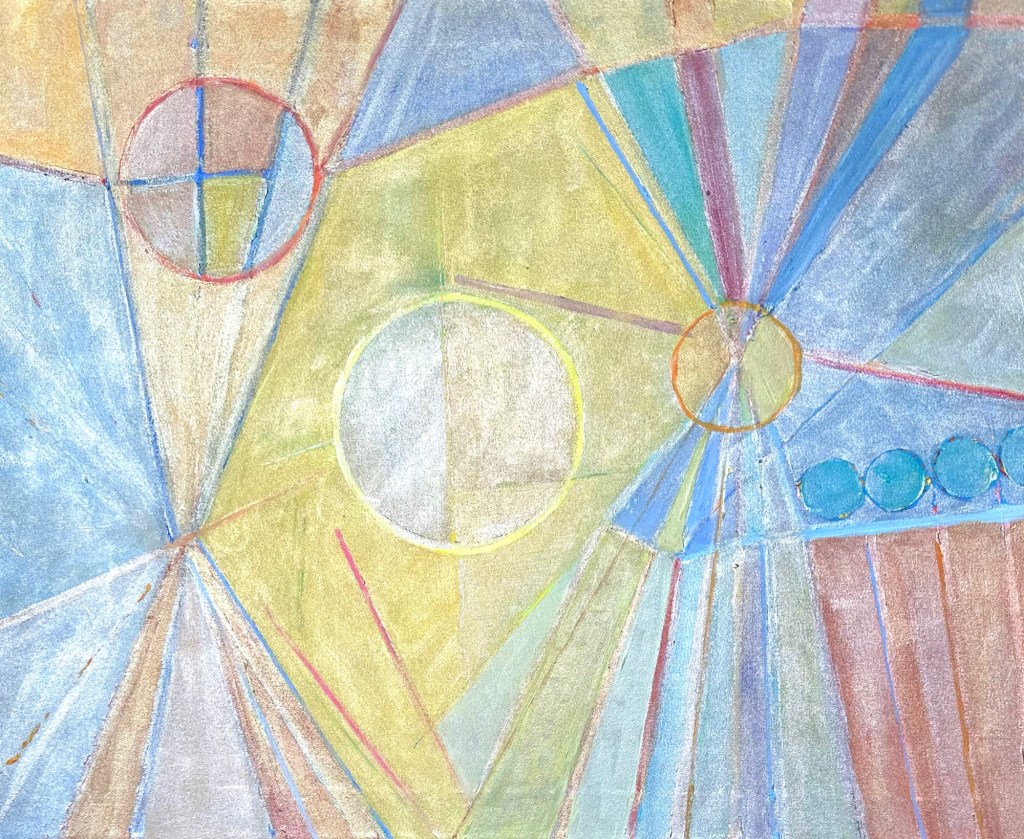
Music of the Spheres: watercolor

I started my painting with the circles by using yellow watercolor to outline intersecting circles of the same size on my paper. Then I mixed some primary colors together, some secondary colors together and some tertiary colors together. I painted different sections of the overlapping circles. Some of the paint I thinned to a wash, and others I laid on fully. When I got home, I painted in the background, allowing some areas to be a wash and other parts to be thicker.

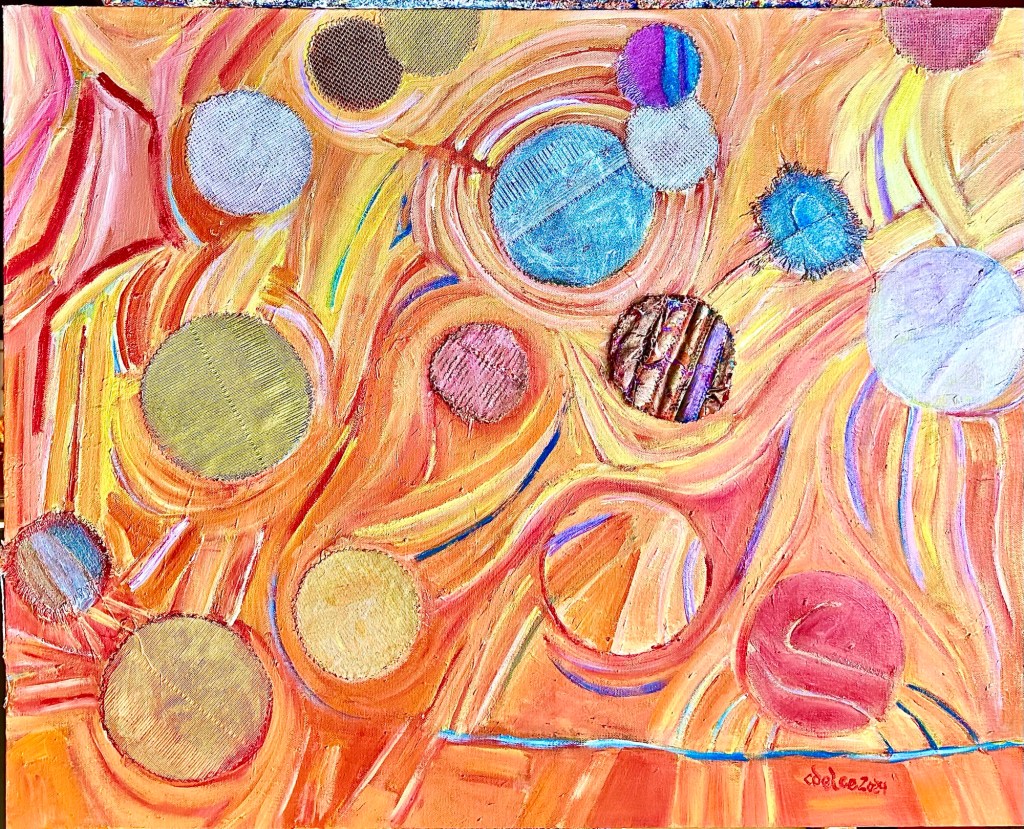
Music of the Spheres: Creation Energy, acrylic

I finished at home an acrylic painting, which explores some of the same themes as the watercolors we’ve worked on in class. In this I used various material with different textures for my spheres. One of the circles is more three dimensional because it’s from a handmade cloth mask left over from the pandemic. I painted parts of it, also. The background has lines of “energy” all about.

While the Pythagoreans attempted to see unity and harmony in the creation in numbers, our Judeo-Christian faith recognizes God as creator of nature and nature revealing the Creator. One of the best texts to understand this distinction is 1 Kings 19: 11-13, in which Elijah meets the LORD on the mountain at Horeb:

(God) said, “Go out and stand on the mountain before the LORD, for the LORD is about to pass by.” Now there was a great wind, so strong that it was splitting mountains and breaking rocks in pieces before the LORD, but the LORD was not in the wind; and after the wind an earthquake, but the LORD was not in the earthquake; and after the earthquake a fire, but the LORD was not in the fire; and after the fire a sound of sheer silence.

When Elijah heard it, he wrapped his face in his mantle and went out and stood at the entrance of the cave. Then there came a voice to him that said, “What are you doing here, Elijah?”

No one has ever heard the music of the spheres, and the voice of God arrives in the sound of sheer silence. Perhaps that “polar opposite” of the Pythagorean’s world view was on to something after all. If we’re very quiet and still, we may hear both the music of the spheres and the voice of God in the great silence.

Joy and peace,

Cornelia


This Is My Father’s World | Hymnary.org

https://hymnary.org/text/this_is_my_fathers_world_and_to_my

Counterfeit Version of Botox Found in Multiple States | FDA

https://www.fda.gov/drugs/drug-safety-and-availability/counterfeit-version-botox-found-multiple-states

Pythagoreanism (Stanford Encyclopedia of Philosophy)

https://plato.stanford.edu/entries/pythagoreanism/