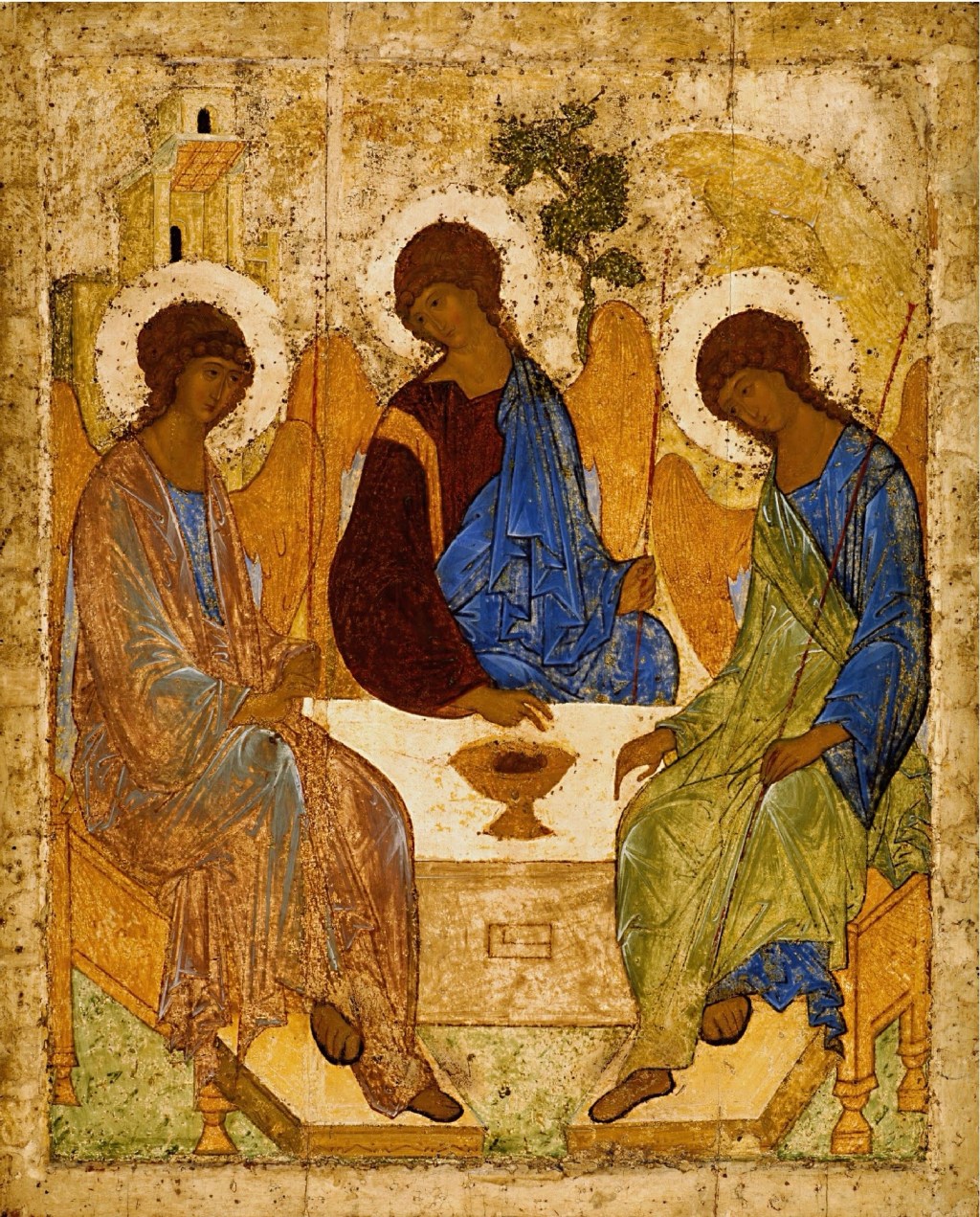
Rublev’s Holy Trinity

art, epilepsy, Faith, generosity, Holy Spirit, Holy Trinity, Icons, inspiration, Painting, Rublev, salvation, vision

Rublev: The Holy Trinity, 1411 or 1425-27, Russia

One of my favorite icons is Andrei Rublev’s Holy Trinity because it not only has the theological theme of the Trinity, but also the message of hospitality to strangers. As Hebrews 13:2 reminds us,

“Do not neglect to show hospitality to strangers, for by doing that some have entertained angels without knowing it.”

This subject of this icon is the three angels for whom Abraham spread a feast in the wilderness where he and his barren wife Sarah lived while they tended their flocks. The angels appear with their walking staffs and sit at Abraham’s table set with a dish of food. In the background is a mountain, representing the wilderness and a tree, locating the scene at the oaks of Mamre.

Koulouris Iconography House: Saint George Greek Orthodox Church, West Bank Territory, Holy Land

Rublev’s palette is full of light with a predominance of gold, shining ochre, delicate shades of green, pink, and violet, and his inimitable sky-blue, too, in combination with the fine rhythm of lines and perfect composition. Altogether this produces an image of unearthly beauty and a heavenly harmony. This isn’t just a banquet in the desert wilderness, but a meal in the inbreaking moment in which we experience the timeless realm of heaven.

On earth, we count the minutes, days, and years, but in the company of God, we enter into the eternal and timeless experience in which God lives. Yesterday, today, and tomorrow are the same for the God who is known as I AM, for I AM lives always in the present and I AM is always becoming. There never was a time when the I AM was not. God always IS, even if we think God is not.

We may forget God, and our love may fail, but the steadfast love of the great I AM never fails because God’s love is, as the prophet Isaiah describes it (43:25):

“I, I am He who blots out your transgressions for my own sake, and I will not remember your sins.”

Copy of Rublev’s Holy Trinity, iconostasis at the monastery, 16th CE, St. Sergio’s Lavra, Russia.

Andrei Rublev painted the original icon in the Trinity-St. Sergius Monastery in either 1411 or 1425-1427. An artist made a copy of the Holy Trinity icon in the 16th CE. The Orthodox Church certified the Rublev Trinity as miraculous in 1626 and gave it a place of honor in the church, as well as metallic and jeweled embellishments. Over the next 500 years, artists restored the original Rublev icon several times. The early 1900’s saw two professional restorations: each one removed more layers of paint and lacquer until they revealed the original. The restorers decided hiding with a frame what was an “exclusive, in its worldwide importance, work of art” from the palette of Andrei Rublev was unacceptable.

Dating this important icon is more difficult than deciding its painter. Some think the icon was originally meant for the wooden Trinity Cathedral erected in 1411 and believe after the stone church was built, the congregation moved the icon there. Other art historians believe Rublev painted the “Holy Trinity” at the same time as his workshop painted the iconostasis in the new cathedral in 1425-27.

Rublev received a commission to paint this icon for the image of the Holy Trinity from St. Nikon of Radonezh: “an image for the Holy Trinity to be painted in his time, to venerate His Holy Father, St. Sergius the Wonderworker,” the monk who founded the monastery at Radonezh.

Since a cathedral dedicated to the Holy Trinity should have an icon of the Holy Trinity in it as its primary icon, the obvious choice was to select the best image that would convey the spiritual essence of the cathedral. This icon would embody the name of the Holy Trinity in color.

Icons have a purpose in worship, beyond mere mere beauty or illustration or teaching of doctrine. St. John of Damascus spoke in his “Apologies against Those who Decry Holy Images”, with which he addressed the Seventh Ecumenical Council calling on renowned painters for brave deeds, to set forth in their art the images of the Old and New Testaments, so that those who were not learned and could not read the Holy Scripture, would be able—by examining those stories—to enjoy the lives of holy men and their good deeds, for

“What the book does for those who understand letters, the image does for the illiterate; the word appeals to hearing, the image appeals to sight; it conveys understanding.” (Treatise 1.17)”’

Betsy Porter: Holy Trinity icon with Holy Communion

In other arguments against those iconoclastic believers, those who advocated instead for the use of images in worship reminded people the icon represents the truth of a spiritual reality. Some have compared the icon to a “window into heaven.” No one then or now worships the icon itself, but they do venerate the holiness of the person represented in the image. They hope to recognize the presence of God with them when they come to the quiet and stillness before the icon at their home altar and when they share in the presence of God in public worship in the sanctuary among the holy icons.

Abraham and the Three Angels, Mosaics in Santa Maria Maggiore, Rome (432-40 CE)

Theologically, the Western church has treated all three members of the Holy Trinity as coequal members, as seen in the mosaics of the 5th CE basilica of Santa Maria Maggiore. By placing all the heads on one level, or the use of isocephaly, the artist tells us the figures are equal in stature. Abraham is therefore lower than the heavenly visitors. Isocephaly is the art term which originates from the Greek words “isos” meaning “equal” and “kephalos” meaning “head”. We already know this word from our common knowledge: isosceles triangles have two equal sides and encephalitis is an inflammation of the brain, which is within our heads. (Sorry, old schoolteachers never die, but keep on explaining our 50 cent words; it must be that “back to school” time of year!)

Commercial Paper icon appliqué on wood panel “after Rublev,” but lacks the background architecture and has a substantial table without a cloth covering.

The Rublev icon has the heads of the three angels arranged in a triangle. They represent the Triune God. The center figure is slightly higher than the other two figures’ heads. This is because the Eastern Orthodox Church holds a slightly different view of the Holy Trinity. The incomprehensible God has indeed revealed God’s self in a manner that is incomprehensible.

All errors in trying to explain the Trinity come down to the following issue: we try to explain the living God, using a method of human thought—rational, natural, or philosophical—instead of witnessing to the reality and the truth of an encounter with the living God. To ask what God is, is the wrong question. Rather, who God is, is the primary question.

Prepratory stage

The answer is—God is Triune. We know God by God’s activity in the world, or energies, which we can see and can understand. In fact, all our understanding of God or what we say about God, comes from what God has done in the world, from God’s energies. The essence of God is still beyond our understanding, inaccessible to our understanding. If we could understand it, it would not be God, for God is beyond our understanding, as Isaiah 55:8-9 reminds us:

“For my thoughts are not your thoughts,

nor are your ways my ways, says the LORD.

For as the heavens are higher than the earth,

so are my ways higher than your ways

and my thoughts than your thoughts.”

Second day, making some corrections

Both the Western and the Orthodox Churches are in agreement as regards the unity of the Trinity as to the persons and their shared being. They also agree the Trinity isn’t three separate gods or three different revelations of one singular god. The Eastern Church and the Western Church did split over whether the Holy Spirit proceeded from the Son alone (East) or from the Father AND the Son (West).

Gaining on it, another studio day

The earliest creeds from the 4th CE didn’t even mention the Holy Spirit, mostly because the early church was combatting heresies about the nature of the Son (such as he was actually human, only appeared to be human, only parts were human, and other variations other than he was a full member of the Trinity and in Christ being fully human and fully divine).

By 381 CE in Constantinople, the creed included the words:

“And in the Spirit, the holy, the lordly and life-giving one, proceeding forth from the Father, co-worshipped and co-glorified with Father and Son, the one who spoke through the prophets; in one, holy, catholic and apostolic church.”

The first Latin council to add the phrase “and the Son” (filioque) to its creed was the 447 CE Synod of Toledo, Spain. The filioque formula was also used in a letter from the Catholic Pope Leo I to the members of that synod regarding opposition to a form of the fifth century manifestations of the Arian heresy which was prevalent among the Germanic tribes of Europe.

Stage 4, the draperies are taking the shape of the bodies

As football season heats up in the USA, we fight our culture wars on social media, not in the streets. The latest heresy for some is professional football teams now have male cheerleaders on the sidelines. The conservative rabble rousers destroyed their coffeemakers and burned their team jerseys in the past. Wearing paper sacks to maintain anonymity at the games is too yesterday. The recent announcement of the heroic and rugged Minnesota Vikings football team’s addition of two talented and athletic young male dancers is more than they can take. The keys of their favorite social media platform have been clicking and clacking. Radio waves are sizzling and heating up our already too sweaty summer.

Trinity, stage 5: two steps forward and one step back

The bishops at Toledo affirmed the Holy Spirit’s procession from both the Father and the Son to exclude the Arian notion of the Son being something less than a co-eternal and equal partner with the Father from the very beginning of existence. Street protests were common during this time over theological beliefs: the Catholics chanted, “There never was a time the Father was not a Father, the Son not a Son, and the Spirit didn’t proceed from both!” Against them, the Arians marched, “The Son was born, not begotten!” Exciting times, the late 5th CE.

Stage 6, details showing up

Several of our past GOP presidents were college cheerleaders, including Ronald Regan and George Bush. On a personal note, six decades ago, my big city high school in the Deep South had a tradition of boy and girl cheerleaders on a team of equal numbers to do exciting and complicated stunts. We were not aware of being “woke.” We were, however, always seeking to bring out the best of each person to reflect well upon our school and our city, which we represented.

Unfortunately, accusing the present NFL teams of being “woke” ignores American history, since the USA FEDERATION FOR SPORT CHEERING recognizes the first cheer in America as occurring on November 2, 1898 at the University of Minnesota, when student Johnny Campbell got up from the seats and took the field to lead the student body in a chant. If 127 years is too far back for people’s minds, we can turn to more recent history.

DeLee: Holy Trinity after Rublev, acrylic on canvas, 16” x 20”

Cheerleading is a metaphor for hospitality, which is one of the great attributes of the Holy Trinity. Hospitality is only possible where love resides and where community is experienced and practiced. Los Angeles led the way in 2018 by including two male dancers on their NFL Ram’s team. They were part of the Super Bowl LIII in 2019. Tryouts have always been “open,” but only women had shown up before. Like the strangers who showed up at Abraham’s tent, the cheer squad welcomed the men into the family and brought them under the protection of their group. When we practice hospitality, the “other” is no longer a “them.” The “stranger” becomes one of “us” because we reflect God’s loving nature to the vulnerable and we offer the bounty of our table to nourish their body and spirit.

I began working on this icon during social and personal distress. The social distress is obvious to anyone who reads a newspaper or watches a television newscast. Never have I seen so many professing Christians refuse to “love their neighbor as themselves,” or “do unto others as you would have others do unto you.” I don’t know how they sleep at night, for my own heart hurts for the pain inflicted upon the strangers who walk among us, who very well may be the Holy Trinity in earthly disguise. If we treat them like their next stop on their journey, only a few of us will walk away unscathed.

My personal distress comes from the blessing of living long enough, thanks to excellent medical care and the ability to live a structured, carefree life. As we age, medication affects us differently. My neurologist dropped the amount of my seizure medication, and my cardiologist upped my blood pressure medication. I was taking too much magnesium, so that was making me lethargic as well as lowering my blood pressure. Now that I’ve gotten stabilized, I feel a lot peppier.

Unfortunately, I began painting and drawing this icon while all this unwellness was going on. I can see “room for improvement,” as I always remind folks to say when critiquing their own art works. I have learned much from this time and have seen the icon in a new and closer light. I will come back to it again when I feel I’m more competent to give it my best.

A masterpiece always deserves the best we can offer, yet I rest secure knowing God has grace for those of us who are wounded, weak, or broken in any way. Whatever we bring in this time and place right now is the best we can offer upon God’s altar. God refuses no honest gift. If we spread peanut butter sandwiches on the table for the visitors as the offered feast because this is what we have, God will bless this gift.

The Holy Trinity of God lives in a loving community of self-giving hospitality and generosity within its unity of being. All three persons love, support, and care for one another in equal measure. As we humans would understand this: no one in the Trinity carries a heavier burden than another. In like manner, each person shares all the energies and work of the others.

The work of salvation may be through our faith in Christ’s work on the cross, yet it was the Father who sent the Son to redeem all creation and the Holy Spirit who brings us to the understanding of this saving grace. The whole work of God in Three Persons saves us if we have Trinitarian faith. And it is by the power of all the Holy Three we can stand against the hatreds and evils of this age.

Indeed, if we can offer any service well-pleasing to God, following the admonitions of Hebrews 13:1-2 would help all:

“Let mutual love continue. Do not neglect to show hospitality to strangers, for by doing that some have entertained angels without knowing it.”

Rublev: The Holy Trinity icon

Abraham’s angelic visitors blessed him and his wife Sarah with the promise of a longed-for son. We might learn to love our neighbors more if we shared our hospitality and opened our hearts to the people we meet. May you meet angels in your daily life and share whatever feast is in your pantry.

Joy and peace,

Cornelia

Andrei Rublev: Image of the “Holy Trinity,” The Tretyakov Gallery Magazine. Andrei Rublev painted the Holy Trinity icon, which is the central image in the cathedral’s iconostasis. One of the most famous Russian icons, he created it “in praise of St. Sergius.” The original is in the hall of Old Russian painting of the Tretyakov Gallery, in a special glass case with controlled humidity and temperature. In Trinity Cathedral you can see a copy of the icon to the right of the royal doors in the first (lowest) tier of the iconostasis.

https://www.tretyakovgallerymagazine.com/node/7196

Excerpts from Three Treatises on the Divine Images by St John of Damascus, translation and introduction by Fr. Andrew Louth, St Vladimir’s Seminary Press, 2003.

https://www.svots.edu/blog/st-john-damascus-divine-images

 A Miracle of Knowledge: St. Sergius of Radonezh / OrthoChristian.Com

https://orthochristian.com/41950.html

Venerable Nikon, Abbot of Radonezh, disciple of Venerable Sergius – Orthodox Church in America

https://www.oca.org/saints/lives/2016/11/17/103316-venerable-nikon-abbot-of-radonezh-disciple-of-venerable-sergius

Daily readings from the lives of the Orthodox Saints:

https://www.oca.org/saints/lives

Home – Icons: Windows Into Heaven – LibGuides at Duquesne University: This is a reputable source for orthodox icon information via the Duquesne Library. Links to outside sources are broken. Reference books are available elsewhere.

https://guides.library.duq.edu/icons

Mosaics in Santa Maria Maggiore, Rome (432-40): if you’ve never been to Italy, you can see the entire beautiful interior of this 5th CE basilica here.

https://www.wga.hu/html_m/zearly/1/4mosaics/1rome/3maggior/index.html

Introduction to Orthodoxy 4: The Holy Trinity – Orthodox Catechism Project

https://www.orthodoxcatechismproject.org/introduction-to-orthodoxy/-/asset_publisher/IXn2ObwXr9vq/content/introduction-to-orthodoxy-4-the-holy-trinity

First Council of Constantinople 381 – Papal Encyclicals

First Known Cheerleader was a Male Student

Vikings Respond to Male Cheerleader Backlash – Newsweek—12 NFL teams are reportedly set to have male cheerleaders on their squads this season. The teams as the Vikings, Ravens, Rams, Saints, Eagles, 49ers, Patriots, Titans, Colts, Chiefs, Buccaneers and Panthers.

https://www.newsweek.com/minnesota-vikings-respond-backlash-male-cheerleaders-2113864


Great American Eclipse Paintings

adult learning, art, Creativity, Faith, Great American Eclipse, Imagination, inspiration, Love, Ministry, nature, Painting, photography, salvation, Spirituality, vision

After the Great American Eclipse, I’m reminded once again how great and wide is the love of our God. We say, “Our God,” as if we could own or possess the one who holds us, since God is beyond our knowing or possession. We can own a boat, a house, or a work of art. In the bad old days before the Civil War in America, people once owned other human beings. We fought a mighty conflict so our nation could be made up of free people, all of whom have equal rights. Unfortunately, not all have equal opportunity.

Patriotic Sunglasses

In America, we are so privileged, we often look at most everything through red, white, and blue lenses. We don’t take off our “American eyes” to see as God sees. To make this point, the Great American Eclipse actually began over the Pacific Ocean, so perhaps whales and sea birds would have been the first to experience it. When the eclipse reached land in Mexico, those in Mazatlán saw it before anyone in Texas did. I have lived in Texas, so I know they like to be the “first, best, and biggest” in everything, so they’ll ignore the fact this eclipse actually was seen by others first.

Eclipse Path: you are here

We don’t need to be first or best to deserve God’s love and providence. God proves God’s love for us every day the sun rises and sets. God gives us the rain in its season and grass for the herds to feed upon. We don’t have to exclude others to get God’s love, for God’s love is wide enough to include all. A God, who can call an entire universe into being with just a word, has the infinite resources to love all fully and completely. We are the finite ones, having limited resources and understanding, who find the need to limit God’s love to a few.

We tend to think in human terms of competition, in which one person gets a blue ribbon or a trophy and everyone else is a “loser.” That’s the Rickey Bobby of Talladega Nights school of theology. God made the entire universe, even tiny Pluto, which our astronomers demoted from planet status to a dwarf planet in the Kuiper Belt. Just because we relegated Pluto to a minor status doesn’t mean God diminishes God’s love, care, and concern for God’s creation.

Bill Maxey: Total Eclipse at Hot Springs AR

When we have the opportunity to view an awesome event of creation, such as a total eclipse of the sun, we have to consider ourselves privileged to be alive and part of God’s care. When the moon fully covers the sun and darkness falls upon the face of the earth where you stand, the cool air touches your skin, and your heart burns within. The excitement and rush of energy is so great I had to shout! I’ve heard some people cry. I guess I’m an exuberant sort.

Nana’s Poem: typed from memory

On 20 August 1892, “The Times” published an article by Kipling, “Half-a-Dozen Pictures”: it was one of a series of travel articles called From Tideway to Tideway. The article described a visit to an art gallery and Kipling’s reflections on the failure of most painters to match the beauty and vitality of the world around them. He offered some attractive verbal sketches of his own, though it wasn’t part of his purpose to contrast the approaches to nature of writers and painters. His main concern was to urge artists of all kinds to get out and see the world for themselves: (Letters of Travel 1892-1913 p. 40):

Now, disregarding these things and others – wonders and miracles all – men are content to sit in studios and, by light that is not light, to fake subjects from pots and pans and rags and bricks that are called “pieces of color”. Their collection of rubbish costs in the end quite as much as a ticket, a first-class one, to new worlds where the “props” are given away with the sunshine. (Letters of Travel 1892-1913 p.77).

Eight days later, the same article was published in the New York Sun. This time it closed with the untitled poem ‘When Earth’s Last Picture is Painted…’ which changed the article’s emphasis from an exhortation to artists to become travelers and pioneers, to what sounds very much like a manifesto for realism in art:

“And only Rembrandt shall teach us, and only Van Dyck shall blame:

And no one shall work for money, and no one shall work for fame,

But each for the joy of working, and each, in his separate star,

Shall draw the Thing as he sees It for the God of Things as They are!

Four years later, Kipling changed the first line of that stanza to:

“And only the Master shall praise us, and only the Master shall blame,”

Kipling, the son of an artist, knew the true joy in life comes from one’s dedication to whatever work is in hand, and the task of the Artist is to convey to others the excitement and wonder of an expanding world. By changing the last line from artists’ names to the Master, Kipling heightened the spirituality of his poem. The artist’s task isn’t merely to render a faithful image of the landscape or person before them, but to bring forth all the inner energies and personality they see and feel.

Cornelia DeLee: Memory of the Last Great Eclipse, acrylic on canvas, 12” x 24”

This is why we don’t copy nature, since it’s three dimensional and we have a two-dimensional surface on which we make our marks to represent what we see. Perspective is our visual language to fool the eye into believing our flat surface has depth. Often we paint abstract shapes and colors because these are the best means to convey our emotions about an experience. Photography captures one way of seeing, but painting can render emotions with brush strokes and colors.

Cornelia DeLee: Door to Another Reality in the Eclipse, acrylic on canvas, 18” x 24”

I subscribe to a wonderful poetry series by Steve Garnaas-Holmes, which I receive daily. This poem’s theme of universal love spoke to me as I felt the in-flooding joy of God’s creating power during the Great American Eclipse:

I have other sheep that do not belong to this fold.   I must bring them also, and they will listen to my voice. —John 10.16


We think we’re being open-minded
when we include “all of us,” Protestant and Catholic,
Orthodox and Coptic, as if we see the whole landscape.
But the pasture and the Shepherd are far greater than that.
Believer, unbeliever and other-believer alike
are all shepherded, each in their own language.
And still there are more, and more other, sheep. 
Like, well, sheep.
Do not the deer and otter, whale and fungus
follow the Shepherd faithfully?
Is not the bird migrating its continents shepherded as well?
Christ is not the partisan figurehead of a religion,
Christ is the infinite embodied grace of God,
the Shepherd of all Creation,
who leads rivers to the sea and winter into spring
and each of us into life.
So there are still other, and more “other,” sheep.
For Copernicus isn’t done with us yet:
we admit the sun doesn’t revolve around the earth,
but we still think God does.
No, little one: we are in a small corner.
Yet even the far galaxies,
the trillion trillions of stars and their planets,
and yes, their doubtless forms of life,
are also under the calm eye of the Shepherd,
and follow the Shepherd’s voice.
All of us, Baptist and Sufi, fish, bug and bird,
earthling and alien, village and nebula, all are one flock. One.
And, behold, even on the remotest planet
in the farthest flung galaxy—like ours—
or the most desolate spot in a life like yours,
under the loving gaze of the Shepherd who seeks out the one,
there is no one who is not at the center.


May you each find joy in your working, each in your separate stars, and draw the Thing as you see It, for the God of Things as They are!

Not only can God watch the sparrow, but also all the many suns and planets of creation.

Joy and peace,

Cornelia


When Earth’s last picture is painted – The Kipling Society

Steve Garnaas-Holmes: Unfolding Light 
www.unfoldinglight.net


Art for the Inner Child

adult learning, Apocalypse, art, Christmas, Creativity, Enneagram, Faith, Holy Spirit, hope, Imagination, inspiration, Light of the World, Ministry, Painting, perfection, purpose, salvation, Spirituality, vision

Discovery is exciting

What is the purpose of an art class? Why does anyone learn to speak a foreign language or take up a craft or sport they’ve never attempted before? We must want to explore some unknown universe or get out of our comfort zone, or as my old favorite television series would announce weekly, “to boldly go where no one has gone before.”

Light of the World Icon: Stencil effect

There are art classes and then there are Art Classes. Just as we shouldn’t make up our minds about a subject or a food until we experience it directly, we can have an open mind about a novel event, rather than rejecting it out of hand. Many of us have lived our lives under judgmental circumstances, dealing with rejection and disappointment at not being the best. “Talladega Nights: The Ballad of Ricky Bobby,” the NASCAR themed film of redemption and finding one’s purpose in life, stars Will Ferrell, whose father crippled him with this tragic life message:

“If you ain’t first, you’re last. You know, you know what I’m talking about?”

Near the end of the movie, Ricky Bobby learns this all was just crazy talk:

Ricky Bobby: Wait, Dad. Don’t you remember the time you told me “If you ain’t first, you’re last”?
Reese Bobby: Huh? What are you talking about, Son?
Ricky Bobby: That day at school.
Reese Bobby: Oh hell, Son, I was high that day. That doesn’t make any sense at all, you can be second, third, fourth… hell you can even be fifth.
Ricky Bobby: What? I’ve lived my whole life by that!

According to Baseball Reference, Ruth’s 183.1 career WAR — combining his value as a hitter and pitcher — is the highest all time, well ahead of Walter Johnson’s 164.8. For reference, the highest mark among active players is Albert Pujols’ 99.6 WAR.

We call this living out a “bad script” our ancestors have written for us. We see it all the time in the movies and on television. We read about it in novels and in comic books. For the most part, people don’t change their wicked ways, but get the consequences they’re due. The bad suffer and the good prosper. Or we read fairy tales in which the good little children get rewarded, or the unjustly treated ones are raised up, like Cinderella. These are the popular stories, but not the biblical tales. The book of Job calls this “retribution theology” into question, as does Jesus in the New Testament.

Annie French (1872 – 1965) Scottish: Cinderella and the Ugly Sisters, About 1900 – 1910, Pen and ink, watercolour and gold paint on vellum paper, 23.50 x 21.50 cm, Scottish National Gallery of Art.

In the Bible, God sends prophets, not only to call the people to account (critique their actions or behavior), but to offer the hope of a better future if they return to God and God’s ways (positive changes in behavior). In this way, a good art teacher is like a biblical prophet, who offers both positive and negative critique on the artwork. The teacher also offers “hope” or suggestions on how to improve the work. Teachers aren’t telling the person they don’t measure up, only that they need more time invested in making art to be able to bring their own artistic vision into reality.

Mike on Being the Light in the World

If we expected babies to chew steak from the moment of birth, the world would be a lonely place. If we expected these same babies to get up right away and “bring home the bacon” to buy their own steak and potatoes, they’d starve. Babies aren’t meant to walk before they crawl, nor or they chewing meat before they drink milk or pablum for a year or two.

Bacon Cake: Oh, Baby! I hope that’s REAL BACON!!

Someone who comes to art class should always come to learn something more, no matter how much they already know. I’m always learning new ideas and techniques. The act of making art is always an act of exploring new territories. We also grow by sharpening one another. Folks in the class are always excited to see how each other approaches the subject each week.

Mike’s May 2022 class work shows he’s been learning some things.

Only the apocalyptic writers in Scripture had a fixed view of the future. For them, God had given up on humanity. We humans were too far gone, too broken, and had destroyed God’s world beyond our weak means to repair it. Their only hope was for God to create “a new heaven and a new earth, for the first heaven and the first earth had passed away, and the sea was no more.” (Revelation 21:1)

Gail went the extra mile with Cri-Cut lettering

Of course, this isn’t a prediction of a certain time, but it’s a future hope for all times. It’s the hope all we creative people have every time we face a blank canvas, a pile of found objects, or a bag of scrap cloths. We also do this when we pull together a dinner before we go to the grocery store, and we take some of this and that which we have in our cupboards and refrigerators. We’re going to make something new! We do hope the Spirit of God descends to make this an inspired concoction! And if it doesn’t work out, we always know our salvation isn’t at stake over a single random supper creation. If I’m hungry enough, I’ll eat anything. Or there’s always peanut butter and jelly sandwiches.

Leftover Doughnuts and Sausage Bread Pudding Bunt Cakes

I was reading Richard Rohr’s Enneagram commentary on the American people. He says America is a nation of Threes: competitive, striving, always looking for success and improvement. When we hit a down cycle, and economics tells us we always have ups and downs in our economy, Americans act like we’ve been insulted. This doesn’t happen to us—to others maybe—but not to us! We’ll look both for a scapegoat and a savior, but never realize these conditions are a natural part of life.

Always be the best YOU. There’s never going to be another one just like YOU.

Likewise in groups, we’re always judging who got more, who has the most status, who’s preferred, and who’s on the out. We’re even liable to self-select to be on the outer group if we believe we won’t measure up, just to spare ourselves the shame of being found wanting. Joyce Rupp has a great poem about this very topic:

WE CAN LOVE THE IMPERFECT SELF
If I wait to be perfect
before I love myself
I will always be
unsatisfied
and ungrateful.

if I wait until
all the flaws, chips,
and cracks disappear
I will be the cup
that stands on the shelf
and is never used.

Magic Teacup Cake from Alice in Wonderland

If we’re faithful scripture readers, we know God never chooses the best persons to do God’s work. When we were children, we saw these characters as heroic figures, just as we saw our parents as great and invincible. The Old Testament records how Moses was a murderer, Joshua was afraid, Amos was a lowly shepherd, and David was an adulterer. Not exactly Perfect Role Models, but transformed people can do God’s mighty deeds if they let God work God’s purpose through their lives.

This word doesn’t mean what the headline writer thinks it does.

In Art Class, we don’t reject “poor work.” We aren’t a factory producing widgets. We have other goals: art appreciation, learning about colors, learning to see more clearly, developing a creative mind, and developing drawing skills. Art is a unique visual language, so learning how to render a three-dimensional form onto a two-dimensional surface takes some time and practice. Developing our own voice is the step beyond mastering the basics of artistic vocabulary. As I used to tell my parents at back-to-school night, just enjoy whatever your child brings to you! If you leave your “critical parent” at home, and bring your “inner child” to Art Class, life is way more fun!

Mike’s Christmas Card Collage

We’re currently on holiday sabbatical at Oaklawn UMC, but classes will return in the new year. We meet in the old Fellowship Hall at 10 am to noon. We always have coffee, and on occasional days, a tasty treat. Our class will begin working in watercolor beginning on January 5, 2024. I don’t charge for the class instruction, but each person should bring their own supplies. Supplies needed are:

Prang Oval 8 watercolor paint set with brush
  1. Prang Oval 8 watercolor paint set (containing brush)—on line at Walmart and Amazon. This has best color and pigments. I found a prime deal on Amazon for $3 each if you buy 3, free shipping.
  2. Watercolor paper pad 9” x 12” or larger (90 lb or heavier)
  3. Tall plastic container for water (iced tea glass size plus)
  4. Your inner child

Joy and peace,

Cornelia

MERRY CHRISTMAS, PEACE ON EARTH, GOOD WILL TO ALL

Talladega Nights: The Ballad of Ricky Bobby https://www.imdb.com/title/tt0415306/quotes/?item=qt0425224

Babe Ruth’s Top 10 career statistics— Shohei Ohtani produced 9.1 total WAR during his spectacular two-way campaign in 2021. Even he maintained that level of performance for 20 consecutive seasons, he would still be 1.1 WAR short of matching Ruth. https://www.mlb.com/news/babe-ruth-s-top-10-career-statistics-c163792958

Perspective: How We See

adult learning, art, Attitudes, Creativity, inspiration, Leonardo da Vinci, Ministry, mystery, Painting, perfection, perspective, Philosophy, risk, salvation

Perspective is both a mental outlook on life and our ability to view things in their true relations or relative importance. In art class, we use the tools of perspective to make a two dimensional surface appear three dimensional. One of the techniques is drawing parallel lines as converging in order to give the illusion of depth and distance. An untrained eye doesn’t see this at first, but once the illusion is pointed out to them, they never can unsee it. We worked last year with one vanishing point—railway tracks—and two vanishing points—buildings seen on the corners.

Two Point Perspective

There are mysteries in this world which we don’t understand, but those of us who have been taught by others with this “secret hidden wisdom” can share it with others. The Ancient Greek mystery religions kept their knowledge for only the select few, who learned it by word of mouth in secret ceremonies. The early Gospel, however, was proclaimed openly to all who would receive it. Yet even in Corinth, some believers wanted to be more special or spiritual than others. Paul wrote them, saying they needed  to know “Nothing beyond what is written,” for the scriptures contained within enough for their salvation (1 Corinthians 4:6). As an apostle, he was a steward of the “Mysteries of God,” and even if he were to understand “all mysteries and all knowledge, and…have all faith, so as to remove mountains, but… not have love…(he’d be) nothing.” (1 Cor 13:2)

Cornelia: Art Room Door

As a teacher, I can provide students with learning opportunities for every skill in art. Thanks to  Oaklawn UMC, and the generosity of my clergy pals over the years, I have a space in which to teach. I don’t charge for the lessons, since I consider this my ministry in retirement. I’ve taught every age from kindergarten through adulthood. There’s no age I don’t relate to. As Dale Chihuly says about art: “Most of art is the work. Not every piece is a success. We learn from our mistakes more than from our successes. If we don’t show up to work, we never have a chance to do well.” (It’s not an exact quote—I watched the film last night).

Gail: stage 1

As I tell folks, we may be saved by grace, but progress in art is by works. We can’t have our egos invested in the product. Right now Tim is in recovery from carpal tunnel surgery. Doing light exercises with pencil is good for his wrist muscles. Art class is a form of physical therapy. He wanted to draw a pumpkin because it had some shapes he’s struggled with over time. He noticed if he moved forward or backward by mere inches, the image he saw was different. This too is a matter of perspective. What is our view point: is it fixed or variable?

Gail: stage 2

Gail and I worked on painting an interior scene. I freehanded my painting, while Gail used her ruler and pencil to draw in the door shapes. I still wasn’t totally recovered from my colonoscopy—my age is catching up on me. My brain felt foggy, but I was trying. We came back for a second week to work on this project.

Gail: stage 3—extended floors

When we leave our work, we have an opportunity to clear our minds and reflect on other things. On returning to our canvas, we then look at our image with fresh eyes. My engineer friends call this the “saturation principle.” Just as the land can only absorb so much water before it runs off, our minds will get clogged up and we just can’t seem to make progress. Getting up for a drink or a walk about is a good thing. Sometimes the paint won’t dry fast enough for us either! That’s an indication to work in another area, even if we don’t want to. We must listen to what our work is telling us.

I often let my paintings rest overnight while I get a good night’s sleep also. In the morning, I’ll see if it still holds up, or if I need to keep painting. Sometimes I’ll take a “finished” painting down after a few months and repaint it. If it won’t last three months under my eye, it doesn’t leave the house. But I’ve learned from the experience. If we ever quit learning, we are dead. I don’t plan on being dead any time soon.

ABC—Positive and Negative Choices

Learning how to see in art is the most important lesson in art. Most of us won’t be Michaelangelo or Leonardo, but we can be the best of who we are. Our outlook on life in art means accepting our imperfections and our weaknesses. Some people can’t accept the learning curve necessary to make acceptable looking products. The point of art class isn’t the product. It’s the process of doing. With the doing, the “product” will come around eventually. We just need to have a positive attitude. Besides, our salvation isn’t dependent upon our accomplishments in art, but our faith in Christ and our love for Christ spread abroad into God’s world.

A Gift from my Mom

Perspective is also our attitude towards life. As Bob Ross, the great philosopher of happy trees and the joy of painting once said,

“If you have light on light, you have nothing. If you have dark on dark, you have nothing. It’s like in life. You gotta have a little sadness once in a while, so you know when the good times are coming. I’m waiting on the good times now.”

He said this in a PBS episode filmed shortly after his wife had passed away. Art class is also therapy for the soul, for we paint our emotions on the canvas, whether we realize it or not. We don’t have to talk about our feelings, but art helps us express them.

When I taught art back in the dark ages, I told my students if they learned only one thing from me, they would never forget it. A positive attitude leads to positive behavior and positive behavior leads to positive consequences. A negative attitude leads to negative behavior and negative behavior leads to negative consequences. That’s the simple ABC’s of life in the art room. Try it. You’ll like it. This is how we teach “Perspective.”


Joy and peace,


Cornelia

Master of Glass: The Art of Dale Chihuly

https://www.imdb.com/title/tt24862190/?ref_=ext_shr_lnk


Feeling Down? Here Are the Best Bob Ross Pep Talks


Megiddo: Marks and Memories

Altars, art, city, Creativity, Degas, Faith, Forgiveness, Healing, Holy Spirit, Israel, Megiddo, Monet, Painting, perfection, Prayer, risk, salvation, Spirituality, Travel, United Methodist Church, vision

Study for Megiddo Memories

My most recent studio work explores my memories of my pilgrimage to the ancient ruins of Tel Megiddo. Why am I interested enough to make an entire series of drawings and paintings of this site, which I visited over two decades ago? First, the city was continuously occupied from the 7th or 6th millennium BCE, with the ancient tel generally left untouched and intact since its decline and subsequent abandonment around the 4th century BCE. The tels at Megiddo, Hazor, and Beer Sheba all have retained their authenticity and each have acquired the characteristic conical shape with a flattish top, protruding above the surrounding countryside. These three tels are now UNESCO Heritage Sites.

Megiddo: Marks and Memories

Excavations at Tel Meggido have uncovered about 26 layers of settlements dating back to the Chalcolithic period, or the early Bronze Age, about 5,000 years ago. Other sources say 30 layers exist at Tel Megiddo. The first four layers have been identified. This site was a Canaanite city, an Egyptian fortress, a Chariot City during Biblical times, and a prominent Assyrian and Persian city. King Solomon ruled the city in its prime in the 10th century BCE.

Megiddo: First Recorded Battle in History

The city has seen more battles than any other location in the world because of its location at the crossroads of the ancient world. The first written reference to Megiddo also happens to be the first recorded battle in history: a detailed account of the 1479 B.C.E. invasion of the Egyptian Pharaoh Thutmose III. When King Thutmose III of Egypt conquered Megiddo 3,500 years ago, the pharaoh left with, among other things: 1,929 head of cattle, 2,000 goats, 20,500 sheep, 204 horses, 200 army uniforms, and 502 bows. Megiddo is also the first recorded use of the composite bow and the first body count. All details of the battle come from Egyptian sources — primarily the hieroglyphic writings on the Hall of Annals in the Temple of Amun-Re at Karnak, Thebes (now Luxor), by the military scribe Tjaneni. Megiddo is also the site of a large chariot stable complex, called Solomon’s Stables, even though we now know they were built by Solomon’s successor King Ahab during the 9th century B.C.E.

Megiddo: Blue Version, Motions and Moods

Fortress cities sit on the 10 acre summit of Megiddo Hill or Tel Megiddo, rising 21.33 meters (about 70 feet) above the valley. Megiddo is located in the Lower Galilee region of northern Israel. Its critical location dominated the Aruna Pass (Wadi Ara or Megiddo Pass), which was the entrance to one of the few passes through the Carmel Mountains. Megiddo controlled the Via Maris, the main route between Egypt and Mesopotamia, also known as the Egyptian Way of the Sea. Christians regard this area as “Armageddon,” where the final Biblical battle between good and evil will occur.

Circular altar-like shrine from the Early Bronze Age at Megiddo. (Credit: Hanay)

The early Bronze Age temple compound at Megiddo is unparalleled for its number of temples, the continuity of cult activity and the record of ritual activity. The late Bronze Age palace is the most elaborate in Israel, and one of the best in the Levant. For the Iron Age remains, the elaborate orthogonal town plan of Megiddo has few parallels in the Levant. All three tels have impressive remains of their underground water catchments systems, which demonstrate sophisticated and geographically responsive engineering solutions to water storage. Megiddo is significant because the entire sequence of the Bronze Age and Iron Age is not only represented and excavated, but radiocarbon dated.

Megiddo: Moonlight Cityscape

Those are the travelogue statements. When on pilgrimage, one place full of stones begins to look like another after many days on the bus. Even though I was keeping notes of my journey in my paper journal, by the second week, I was hitting information overload. Each and every place was of the utmost importance, but my body was feeling the stress of constant traveling on a bus as well as the lack of good sleep from a different bed in a new hotel every single night.

Only strong coffee, lots of water, and eating three good meals a day were keeping me going. I was so excited during my pilgrimage, I was in an altered state of mind for weeks after my return home. Time slowed down and I could see more clearly for a long time. I would swear I could see individual oxygen molecules in the air, even though in my rational mind I knew this wasn’t possible. Pilgrimage is a spiritual journey, not a tourist trip of checking off various sites to say “I’ve been there and done that.” Even when surrounded by a “great cloud of witnesses” both physical and immaterial, I always knew I was walking on holy ground.

Megiddo: Motions and Moods, number 2

What does it mean to walk in the places where people have lived and died? Especially where they have clashed violently in war? The last time Americans fought a war on our home front was the Civil War. That internecine conflict was a horrific wound on our nation, an injury that hasn’t yet healed for some. I know my own daddy still carried the scars of his ancestors who fought on the battlefield to preserve slavery. He never understood why I thought that was a bad choice and why I worked to undo the damage of the war’s legacy on all Americans.

Cannon at Shiloh National Military Park

While traveling back home from viewing the Great American Eclipse, I met a man at Shiloh National Military Park, a Civil War memorial battle field. He visits these historic sites to pray for the deceased. He was from New Orleans, Louisiana, and believed those who died a violent death still wandered about, since their souls weren’t at peace. I don’t know if I believe this, but it gave him comfort to pray for the release of the hate and violence people can store up in their bodies and spirits and cause them to war upon one another.

I can say on that autumn day while I walked those killing fields, I felt the somber mystery of death and life, dignity and indignity as I walked about the silent hills and valleys. No longer do we hear the crack of the rifle or the thunder of the cannons. Rain has washed away the blood from the grassy knolls and pastures. Sunlight has dressed the wildflowers in beauty. If not for the explanatory signage, I’d never know about the extraordinary happenings at Shiloh National Military Park.

Perhaps I’m painting these historic sites of conflict because we are in a time of strife, not only abroad but at home. The actual shooting wars are going on beyond our shores, but conflicts at home are no less serious. I’m heartbroken by the devastation of the Ukrainian homeland by the Russian aggressors, and remember the ongoing tussle over the Temple Mount by the various faiths of the world. If there’s conflict beyond us, likely there’s conflict within our our own groups. The outer world usually reflects our inner world.

The stress of our United Methodist Church becoming the “Untied Methodist Church” has been rough on me. I’m carrying my stress in my neck and shoulders so much I’ve pinched the nerve to my pinky and ring fingers. They are now numb. I’m now in physical therapy for this. Medication and relaxation exercises will certainly help. One of my condo residents prayed for a “miracle cure” for me. My theology typically considers “miracles” to be reserved for situations beyond the usual care of physicians, but I know lay people use “miracles” more loosely than we clergy. Nevertheless, I appreciated their well meaning prayer for my healing. After all, God cares for both small and large problems, as Jesus reminds us in Luke 12:24,

“Consider the ravens: they neither sow nor reap, they have neither storehouse nor barn, and yet God feeds them. Of how much more value are you than the birds!”

Moonlight over Megiddo, number 1

I look at that second painting and compare it to the first painting I completed. While I attempted to keep the surface flat, I got involved in the recreation of the old city in my imagination. I connected the moonlight outside with the lamplight inside. I also added an abstract figure in the foreground. The red marks don’t work for me anymore,so I’m likely to destroy this art work. The second one I may keep, only because I learned some new colors and was brave enough to experiment with colors I don’t normally use.

Megiddo #3

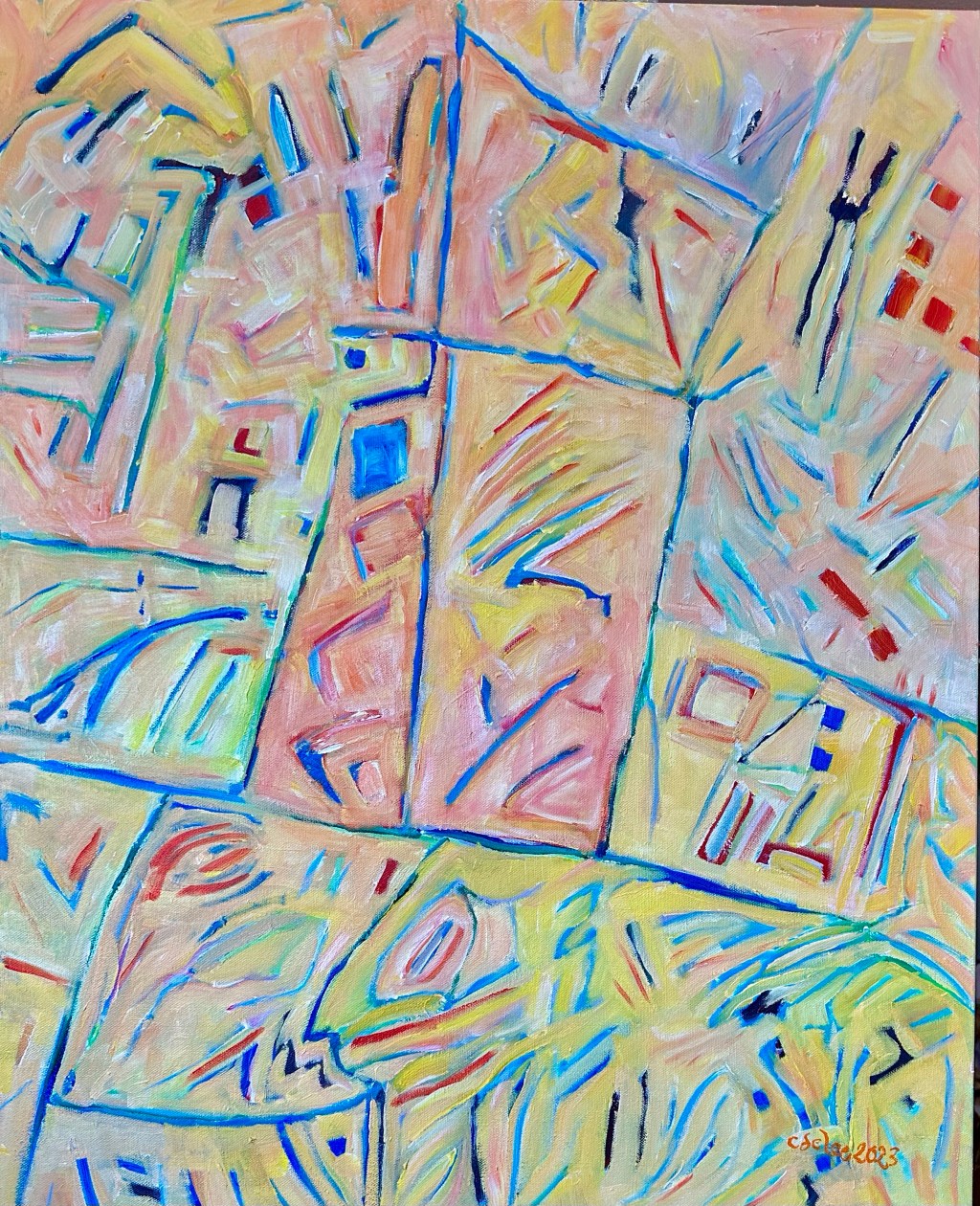
In this final work, I chose only a portion of the satellite image. This allowed me to eliminate the areas which were causing me problems in the earlier works, especially the large, repeating curves. Although I’m back to my favorite yellow—I confess to being a Van Gogh fan—I used a greater variety of tints, rather than painting straight from the tubes.

Pablo Picasso once said, “Painting is just another way of keeping a diary.” If our outer world is in conflict, this drama will wash over into our inner world. It will show up in our dreams, our health, our relationships, and in other parts of our lives. If we think the late pandemic and current politics have broken relationships or distressed families, imagine what this has done to our churches. Most people go to church as an escape from this drama, hoping to find a sacred place where everyone is Imitating Christ’s Humility:

“If then there is any encouragement in Christ, any consolation from love, any sharing in the Spirit, any compassion and sympathy, make my joy complete: be of the same mind, having the same love, being in full accord and of one mind. Do nothing from selfish ambition or conceit, but in humility regard others as better than yourselves” (Philippians 2:1-3).

Unfortunately, all people bring their imperfect selves to Christ. Although Christ forgives our old sins, our sin habits remain. Most of us forget this. As an artist, I understand better than anyone the process of “going on to perfection” is both a gift of the Holy Spirit and our own work. While God could gift perfection completely, most often it’s a cooperative endeavor. This is why the studio product is sometimes a thrill, but other times a disappointment. Yet even in the disappointments, we can learn from our mistakes. We might need to “mistake a bunch of times” until we get focused on a new direction. We have to trust the process. Canvas is cheap. It can be reused or recycled. Plus, our salvation isn’t impaired by our detours in the studio.

Yet too often we’re hung up on the product as a reflection of our personal value or worth. If we are hurt, damaged, ill, broken,or harmed in any way, art is a therapeutic exercise for us. Monet tied the brushes to his hands when his arthritis made holding the brush too difficult. His later paintings also had freer brushwork. He could have quit, but he adjusted his expectations and his style to keep creating. As Monet once said, “I’m never finished with my paintings; the further I get, the more I seek the impossible and the more powerless I feel.” Degas was fond of saying, “Only when he no longer knows what he is doing does the painter do good things.”

If we’re in the safe, but shallow waters of certainty, we’re unlikely to grow to the deeper depths of either the spiritual or artistic realms. Most of us are afraid to cast off the anchors that keep us bound close to well known shores. We want to hear the praise of the crowd, and if we sail off for the unknown horizon, we will leave those familiar voices of the crowd’s approval behind. We can only discover the new world by leaving the old one behind, by risking a journey in faith others are not willing to undertake. Sometimes we may need to get out of the boat and risk walking across the water to meet Jesus who calls us to meet us in the midst of the strong winds and high waves.

I don’t worry about these feelings anymore, for I know they will come up, I’ll meet them, and then I’ll let them go. Our feelings of the moment are not the feelings of forever. Only one is the same yesterday, today and forever—the Lord Jesus Christ. The rest of us are still a work in progress.

Joy and peace,

Cornelia

Chalcolithic Period – an overview | ScienceDirect Topics. https://www.sciencedirect.com/topics/social-sciences/chalcolithic-period

The Battle of Megiddo – Ancient Egyptian culture https://www.donsmaps.com/egypt2cb.html

Megiddo https://www.jewishvirtuallibrary.org/vie-megiddo

Armageddon Time: How Discoveries at Megiddo Retell the Story of Ancient Israel – Archaeology – Haaretz.com https://www.haaretz.com/archaeology/2023-01-22/ty-article-magazine/armageddon-time-how-discoveries-at-megiddo-retell-the-story-of-ancient-israel/00000185-d960-d2d9-ab95-ffe0729e0000

Kingdoms of the Levant—Megiddo (Canaan)—date contested. https://www.historyfiles.co.uk/KingListsMiddEast/CanaanMegiddo.htm

Megiddo – Tourist Israel https://www.touristisrael.com/megiddo/9448/

Biblical Tels – Megiddo, Hazor, Beer Sheba – UNESCO World Heritage Centre https://whc.unesco.org/en/list/1108/

20 Quotes from Claude Monet | Denver Art Museum

20 Quotes from Edgar Degas | Denver Art Museum

I See the Icon—The Icon Sees Me

art, beauty, Faith, Holy Spirit, Icons, Imagination, incarnation, inspiration, Love, Mandylion, mystery, Painting, Pantocrator, Plato, renewal, salvation, St. Athanasius, vision

The icons of Christ radiate a sense of calm, a spiritual experience created countless times by various artists over the ages. Each one channels the spiritual force which lies outside of language, mystery, and mysticism. Over the years, we’ve come to understand the icon serves as a window into the world beyond our own. In this world we think of dualities: good and evil, winning and losing, ours and theirs. In the world beyond ours, everything belongs to God, we are all one, and no one lacks for anything. The heavenly banquet table is a never ending feast for everyone and no one is reduced to begging for the crumbs that fall from it. No one hungers or thirsts in this land of the unclouded sky.

Jesus is the Bread of Life

The icon represents to us the world we yearn to be. In this respect, it’s a “wormhole” from the fully perfected world to this world, which is still going onto perfection. The New Heaven and the New Earth promised in Revelation 21:1-4 speaks to this very event:

Then I saw a new heaven and a new earth; for the first heaven and the first earth had passed away, and the sea was no more. And I saw the holy city, the new Jerusalem, coming down out of heaven from God, prepared as a bride adorned for her husband. And I heard a loud voice from the throne saying, “See, the home of God is among mortals. He will dwell with them; they will be his peoples, and God himself will be with them; he will wipe every tear from their eyes. Death will be no more; mourning and crying and pain will be no more, for the first things have passed away.”

The Good Shepherd

Until that time comes, we have the icons gazing upon us to remind us of this promise, as well as of our calling to be coworkers with God in bringing this world into fruition. If we see with spiritual eyes, we’ll be able to look beyond the paint and canvas, beyond the image and likeness, and beyond material truth to see the spiritual truth of the icon before us.

To understand the icon better,we ought to take a trip in the WayBack machine to Ancient Greece to visit Plato and study up on his philosophy. This is important because whether they know it or not, artists of every stripe and measure participate in this “not yet, but yearning for a better world” as they make their art. In the 4th C BCE, Plato believed the true reality was in the ideal forms which existed in a world outside of this one which we daily experience. Every form we see on earth is merely a copy of the ideal form, but not the “truth.” Plato’s truth existed in this realm of ideas, rather than in the senses. This is the opposite of how most modern people look for “truth,” especially scientific or observational evidence based truths.

Christ Enthroned

For Plato, the ideals of good and truth had to exist as a form in the eternal world so we could recognize them in our transitory world. All things, even virtue, justice, love, and beauty, must have an ideal form in this realm beyond our sensibilities. Where we get into trouble is believing this world’s representations of the ideal forms must follow the pattern exactly. The examples we consider beautiful can change over the centuries, but the idea of beauty as the highest ideal of loveliness never changes. This is why we don’t keep repeating Greek and Roman Classical themes for our public buildings in the modern era.

James 1:17 says of God: “Every generous act of giving, with every perfect gift, is from above, coming down from the Father of lights, with whom there is no variation or shadow due to change.”

The Golden Christ

When we say “God doesn’t change,” we mean God never quits loving us, always wants to save us, and always wants to work for good for those who love the Lord and are called according to God’s purposes. God does change God’s mind when we give up our wayward ways and return to godly ways. The Old Testament is full of times God had a change of heart. Maybe some of these events were the people having a heart change and coming back to God. God does seem absent when we turn away, while God seems near when we turn towards God.

Coptic Jewel Icon

But I digress, and I plead the hot weather. Plato’s perfect forms are the subject, especially the form of the Good. For Plato, only the soul or the mind can know the true forms, while the sensible body is suspect. Plato’s philosophy is a form of dualism, which elevates the spiritual over the physical. This is an important concept for early Christianity, since they had to hash out an understanding of the incarnation of Christ. For some, Jesus was purely divine, while for others he was purely human.

Variation on the Christ Not Made by Hands Icon

The traditional interpretation of Jesus Christ is he is both fully human and fully divine, as Athanasius so succinctly said in his treatise On the Incarnation: “for God became man so that man might become god” (54:3). This theology of theosis, or perfection in love, always boggles the mind of those of us who are used to 1 + 1 = 2, or the sensible and mathematic physical reality of this world. One of the rallying cries back in those days was “There never was a time when the Son wasn’t the Son.” People marched in the streets to proclaim this belief: the Son of God never gave up his divinity even when he became human for the sake of our salvation. It was necessary for him to become human to save all of us and only if he were completely God would he be able to save us entirely.

Christ Pantocrator

For the icon painters, Athanasius also is informative when he writes about the Incarnation: “and He manifested Himself by a body that we might receive the idea of the unseen Father; and He endured the insolence of men that we might inherit immortality.”

As Jesus says in John 14:7, “If you know me, you will know my Father also. From now on you do know him and have seen him.” Like Phillip, we can only believe in what we’ve seen. Many of us are doubting Thomases, who need to touch and hold onto physical proof before we can be convinced. The icons remind us that Jesus is

“the image of the invisible God, the firstborn of all creation; for in him all things in heaven and on earth were created, things visible and invisible, whether thrones or dominions or rulers or powers—all things have been created through him and for him” (Colossians 1:15-16).

What image is the Christ icon? That depends on the time and place where the icon was created, but all images share certain qualities. The eyes are prominent, the mouth is small, the forehead is broad, and the lower jaw is small. Most of the icons of Christ look like a philosopher, rather than a warrior king, which was the original meaning of the Jewish messiah. All icons have at least one ear visible to hear the prayers of the faithful.

These letters form the present participle, ὤν, of the Greek verb to be, with a masculine singular definite article, ὁ. A literal translation of Ὁ ὬΝ would be “the being one,” which does not mean much. “He who is” is a better translation

The backgrounds are gold and represent a timeless, eternal spiritual space. Today, yesterday, and tomorrow are all the same for God, who is known by the name I AM. In John 8:58, Jesus got into an argument with some of the Pharisees over who were the true children of Abraham. When he told them, “Very truly, I tell you, before Abraham was, I am,” they were ready to stone him  for claiming to be god. Moreover, as the author of Hebrews reminds us, “Jesus Christ is the same yesterday and today and forever” (13:8).

Roman Icon, 12th CE, oil on wood panel, Vatican Museum

The icon itself isn’t holy, but the image it represents is holy. This is why icons are venerated , while Christ is worshipped. The image isn’t holy, but the person represented is holy. In this sense, every icon points to the ideal form of Christ in the spiritual world beyond us and the icon acts as a window or a wormhole opening so that spiritual world can enter into our sensible and material world here. The more we live with an icon, the more our hearts and minds are tuned to the silent harmonics of the hymns of joy, peace, love, beauty, generosity, and compassion. This is because we become open to the truth of Christ in a mystical way which supersedes our own personal beliefs and experiences. We lose our attachment to the world of dualisms and enter into the world of union with the divine. We are undergoing theosis. Theosis is more than just salvation and divine pardon, but is  rather the process of spiritual transformation that culminates in mystical union with God. It is a cooperative work of the Holy Spirit and the believer that results in this union.

After 12th Century Vatican Icon

Art has a way of affecting the energies of a human being. It’s well known how certain colors affect mood, so designers use these techniques to create appropriate spaces in buildings. Public art adds to the charm of a city and likewise, destroying green spaces can render a city to grimness. Having art in one’s home or office elevates it above the ordinary.

Even artists who aren’t painting icons, but are making landscapes or abstractions can be said to be seeking a platonic form, one which only they may see in their own mind’s eye. We keep looking for the next challenge, the creation which comes closest to our imagination. We artists keep on going, however, for each new work not only refines our imagination, but it also moves us closer to our desired goal. We’re like long distance runners who always seek a new personal best!

Resurrection Christ

The icon makes a claim on our lives as we return its gaze. In the silence, Christ asks, “Are you going onto perfection in the love of God and neighbor?” We take a silent stock of our lives and our interactions in prayer. Most days we agree with the apostle Paul in his letter to the Philippians (3:12):

“Not that I have already attained this—that is, I have not already been perfected— but I strive to lay hold of that for which Christ Jesus also laid hold of me (NET).”

Joy and peace,

Cornelia

Plato
https://www.webpages.uidaho.edu/engl257/classical/platonic%20idealism.htm

Early Christian Heresies
http://webspace.ship.edu/cgboer/heresies.html

CHURCH FATHERS: On the Incarnation of the Word (Athanasius) 54:3. https://www.newadvent.org/fathers/2802.htm


Writing a Holy Icon

adult learning, Altars, art, crucifixion, Faith, Holy Spirit, Icons, inspiration, john wesley, Love, Mandylion, mystery, Painting, Pantocrator, salvation, Spirituality, St. Athanasius, Stations of the Cross, United Methodist Church

Cartoon for an Icon of the Resurrection

In art class, I taught our group the time honored technique of using a cartoon to transfer an image to another surface. Of course, their first reaction was, “Are we watching Saturday morning cartoons today?”

“No, it’s Friday. We’re going to make our own carbon paper,” I said, as I showed them how artists of old would rub graphite on the back of their drawings and then outline the major lines onto the wall or the canvas to transfer the image. The J. Paul Getty Museum has a great video on YouTube explaining this process.

“You mean we’re going to paint by number?”
“Not a chance. You still have to make your own color decisions and shading choices.” Really, by now you’d think they know my opinion on the easy way. As Jesus says in Matthew 7:13—

“Enter through the narrow gate; for the gate is wide and the road is easy that leads to destruction, and there are many who take it.”

Reverse of Crucifixion Icon with Graphite over Outlines

I didn’t bring any complicated images of the holy icons. I brought only ones with simple outlines. I knew this project wasn’t going to be as easy as people first thought. It’s not as simple as coloring within the lines.

An icon is an image of a holy person, but it isn’t a mere representation of the individual. When we make photographs or even painted portraits, we seek to make “likenesses” of the individual, and capture their outward details and idiosyncrasies. If we can also capture their inner spirit, we take the image to a master level. Icons, however, are more concerned with representing the inner, spiritual nature of the person, rather than their outward nature. After all, we don’t have any images of how the holy ones from the earliest days of faith actually looked. We only have their acts and the symbols connected with them, so in the iconography we can identify them by these qualities. The word iconography comes from the Greek: eikōn ‘likeness’ and -graphia ‘writing’, so when we paint, we’re actually “writing a likeness” of the holy image.

Dusty spent his day off on the Pantocrator Icon

In the iconographic tradition, all of the faces are broad across the brow, to represent the holy wisdom of God residing in the saints, just as their elongated figures and extremities accent this holiness. The eyes, windows into the soul, are large compared to a natural face, while the mouth is small. The small mouth indicates the saint has conquered bodily passions. There’s always an ear open on an icon, for the icon needs to “hear our prayers.” Not that the icon is alive, but it’s more like an open window into heaven. Therefore, the saint’s ear is the open window through which our prayers flow into the golden light of the mysterious world beyond this material one in which we dwell both in shadows and light.

Freehand drawing of Mandylion Icon

The color in icons also plays an important role. Red belongs to martyrs. Blue stands for wisdom. White symbolizes paradise and chastity. Green is the color of the Venerable Fathers. Gold symbolizes sanctity.

The icon painter and teacher of St. Tikhon’s Orthodox University, Svetlana Vasyutina once described an experience before the iconostasis or screen of images of the saints in the church. “A while ago, I was tortured by the question why it is golden. Once I was standing at a church, looking at the iconostasis. Suddenly, they turned off the electric lights, and only candles before the icons were burning. The golden traces were shining, giving back the light. It was as if, not the candles, but the halos, were radiating light. I was amazed; the light seemed not material, not as comes from a candle or a lamp. The golden color shows the person painted in the icon was granted a different kind of light.”

According to St. Paul, glory (doxa) appears where the form and the idea of God, which inhabits it, become one. This is especially true where form becomes a place of theophany (a visible manifestation to humankind of God or a god), where the body becomes the temple of the Holy Spirit. This glory is represented by the nimbus or halo of the saints. We hear Paul speak of this power in Philippians 3:21—

“He will transform our humble bodies that they may be conformed to the body of his glory, by the power that also enables him to make all things subject to himself.”

The disciples first saw this glory descending upon Christ on the Mount of the Transfiguration, as recorded in Matthew 17:2—

Icon of the Transfiguration

“And he was transfigured before them, and his face shone like the sun, and his clothes became dazzling white.”

To become completely transformed by the Holy Spirit wasn’t only a special gift given only to the saints alone, but it was meant for all believers. As Paul mentions in 2 Corinthians 4:7 (American Standard Version)—

“But we have this treasure in earthen vessels, that the exceeding greatness of the power may be of God, and not from ourselves.”

A famous story in the Eastern Orthodox Monastic tradition follows:

Abba Lot went to see Abba Joseph and said to him, “Abba, as far as I can I say my little office, I fast a little, I pray and meditate, I live in peace and as far as I can, I purify my thoughts. What else can I do?” Then the old man stood up and stretched his hands towards heaven. His fingers became like ten lamps of fire and he said to him, “If you will, you can become all flame.”

Mike’s Icon of the Via Dolorosa

Many of us are barely alight with the fire of Christ, and we wonder why the glory of God doesn’t shine through us. Others of us hide our light under a bushel so we don’t stand out from the crowd. If we wonder why we aren’t going onto Christian Perfection in love of God and neighbor, or being a witness to Jesus Christ for others to follow, then we might need to read Abba Joseph’s recommendation once again:
“If you will, you can become all flame.”

When we paint an icon, we participate in a spiritual endeavor in which we are coworkers with the Holy Spirit. We enter into a kairos time, or God’s creating time, and are no longer only working only in human, chronological time. This is a mystery, not to be understood in ordinary terms, even if we begin at 10:15 in the morning and stop to cleanup at 11:45. Like the golden background, time has no meaning while we paint the icon. Our cares and concerns of this world can be given to the icon, and thus to God.

Gail’s Icon of the Crucifixion

We make our prayer gifts in two ways: we hope to become more conformed to the image of God and we hope our images conform better to the icon before us. We’re going on to perfection, one bit at a time. In faith, we expect to be made perfect in love in this life, by the power of the Holy Spirit, or at the moment of our death, as the classic Wesleyan teaching states. The Orthodox doctrine of theosis, union with God, from which our Methodist teaching of sanctification derives, teaches we can have real union with God, just as Jesus had, being fully human and fully divine. We don’t become gods, but we participate in the full image of God, in which we were first created.

Sally’s Crucifixion Icon

We can contemplate these beautiful words of St. Athanasius of Alexandria (+373), in his treatise On The Incarnation, against the Arian heresy:

‘God became “sacrophore”—bearer of our flesh—so that mankind might become “pneumatophore—bearer of the Holy Spirit.’” (Michael Quenot, THE ICON, p 55)

When we keep our heart set on the image of Christ, we remember his undying love for all creation. Then we learn the meaning of the faith of a loving son or daughter, in comparison to that of an unwilling servant. This is how John Wesley saw his own conversion at Aldersgate:

“I felt my heart strangely warmed. I felt I did trust in Christ, Christ alone for salvation; and an assurance was given me that He had taken away my sins, even mine, and saved me from the law of sin and death.”

Mandylion Icon—Towel with Image of Christ

Once we realize the law of sin and death no longer holds us in chains, we can freely live in life and love, now and always, if we conform our image to Christ.

Joy, peace, and divine light,

Cornelia

Paul Evdokimon, translation by Fr. Steven Bigman, The Art of the Icon: A Theology of Beauty, Oakwood Publications, Pasadena, CA.
https://kyl.neocities.org/books/%5BSPI%20EVD%5D%20the%20art%20of%20the%20icon.pdf

Sharing in the tabor light | New Camaldoli Hermitage
https://www.contemplation.com/sharing-in-the-tabor-light/

The Icon: Window on the Kingdom Hardcover – Import, March 19, 1992
by Michael Quenot (Author), A Carthusian monk

John Wesley Quotes, Oxford Reference
https://www.oxfordreference.com/view/10.1093/acref/9780191843730.001.0001/q-oro-ed5-00011419

John Wesley’s Quotes – Seedbed
https://seedbed.com/on-john-wesley-quotes/

John Wesley: Journal of John Wesley – Christian Classics Ethereal Library
May 24, 1738– I Felt My Heart Strangely Warmed
https://ccel.org/ccel/wesley/journal/journal.vi.ii.xvi.html

Memories and Forgiveness

arkansas, art, brain plasticity, butterflies, Carl Jung, change, cognitive decline, Creativity, Faith, Family, Fear, Forgiveness, garden, Healing, Holy Spirit, hope, Imagination, Love, Ministry, Painting, Philosophy, Reflection, renewal, salvation, shame, Spirituality, trees, vision

Does God, who knows all things, also have a memory, or can God choose to forget?

I often wonder about such ideas, for when we ordinary folk experience horrific traumas, we often say, “This is going to be with me for the rest of my life. I’ll never get over it.” In some cases this may be true, especially if the person doesn’t seek long term counseling and faith support to deal with the soul damaging harm. With assistance, one can heal from the pain, even while remembering the injury, just as a broken bone can be mended over time.

Those who’ve been wounded and healed can go on to help others heal from their pain and brokenness. The memories of the wound remain, just like a scar on the skin, but they don’t interfere with living a positive and productive life. For those whom Henri Nouwen called “wounded healers,” and who find meaning in their suffering, their lives are a model for others to emulate, for their memories don’t destroy them.

If we look at the nature of God—the one who is, the one who will be, and the one always becoming—we can understand better the discussion between Jesus and the Temple authorities in John 8:56-59–

“Your ancestor Abraham rejoiced that he would see my day; he saw it and was glad.”

Then the Jews said to him, “You are not yet fifty years old, and have you seen Abraham?”

Jesus said to them, “Very truly, I tell you, before Abraham was, I am.”

So they picked up stones to throw at him, but Jesus hid himself and went out of the temple.

Moses and the Burning Bush

Jesus made the claim to the I AM name and being of God, an act of blasphemy, which the devout Jews found outrageous, since it made him equal to God. Their memories of Moses meeting God in the burning bush are to this day a seminal recollection of their liberation story from their Egyptian captivity:

But Moses said to God, “If I come to the Israelites and say to them, ‘The God of your ancestors has sent me to you,’ and they ask me, ‘What is his name?’ what shall I say to them?”

God said to Moses, “I AM WHO I AM.” He said further, “Thus you shall say to the Israelites, ‘I AM has sent me to you.’ ” (Exodus 3:13-14)

Can one who always lives in the present have a memory of the past, or envision the future? I met a lady at Sam’s Club in the days before the July 4th weekend. She was standing in the center of the entrance while folks were pushing baskets quickly past on either side of her. I thought she looked like the choose cone at a NASCAR restart. Bewildered and worried, she was looking for someone who wasn’t to be found. I asked her if she needed help, and she was even uncertain about this request. I suggested we walk over to customer service. On the way, I discovered her name and that her people had walked off to shop without waiting for her. She didn’t know their names, but she did know hers.

I thought about my own daddy, who had Parkinson’s and Alzheimer’s diseases. He progressively lost the memory of our family members: first my younger brothers, then me, and finally my mother became “the lady who came to kiss him every afternoon at 4 o’clock.” However, he could remember every bit of his medical training, even when he slipped and fell. On entry to the ER, he began ordering the medical staff about as if he were in charge. They tried to shush him up, until they realized he was running the accustomed intake drill.

Map Landscape of Hot Springs

Memories are like this, for we keep some which we find necessary and yet lose some very important ones we’d really like to hold onto. We also keep painful memories longer than happy memories, perhaps as a survival instinct. We won’t touch that hot stove again! This doesn’t bode well for our overall optimism, however, if we end up seeing the world as a fraught and dangerous place. How we imprint the emotions on our memories is still debated, for we tend to assign positive or negative emotions to events of our past. Then these affect our future experiences. This is why some of us fear dogs, while others of us approach them with respect, allowing the animal to sniff us out and accept us before we interact with them. We can change our future reactions to old memories, but this is a work in process.

God never gets old, even though God is eternal. If God is always I AM, or I AM WHAT I AM or I WILL BE WHAT I WILL BE, then God is a very present god and as well as a God of the future. If the past is also the present for God, then perhaps the past may be also as the future. In fact, for all we humans know time, as we understand it, may have no meaning for God, and what we think of as past, present, and future, God may experience as the eternal NOW. This may be how we understand Hebrews 13:8— “Jesus Christ is the same yesterday and today and forever.”

Recently I’ve been finding old mementos, souvenirs of my youth. Some are faded newspaper clippings, others are letters from old boyfriends, and then there’s the strange and esoteric memorabilia that somehow survived over half a century in storage along the various stages of my journey. My people are genetically predisposed to collecting. Did I ever mention my grandmother’s ball of tinfoil she kept on the kitchen window sill next to the sweet potato plant she was growing in the old mason jar? I come by this habit through my maternal line.

As I’ve been going through these, I had no difficulty throwing away utility bills from the early 2000’s, but then I found the college freshman beanie from my childhood boyfriend. He lived thirteen houses down the street from me. We had a thing for each other all through junior high and high school. For some reason, he gifted it to me. That motive is lost to the fog of memory now. Perhaps as Isaiah 43:18 says:

“Do not remember the former things,
or consider the things of old.
I am about to do a new thing;
now it springs forth, do you not perceive it?”

Memories of a Landscape

When I picked up this ancient cap of shame, for that’s exactly what it is, since it marks its wearer out as the low man on the totem pole, I marveled at how small the hat was. I don’t remember my beloved having a pinhead! In fact, I mooned and pined over his handsome and athletic form. Then again, I was young. As I held it in my hands, I felt the need to recreate something new from it. I had a landscape painting which had gone poorly because I was ill. I decided to paint over it, using the hat as the central tree structure, and adding some cut fabric trees to balance it. I also found some printed butterflies I cut out for embellishment. Once I glued those shapes on the canvas, I could repaint the canvas.

As I destroyed the old canvas and remade it into a new creation, the words from the prophet Isaiah (43:25) came to mind:

“I, I am He, who blots out your transgressions for my own sake, and I will not remember your sins.”

God is a forgiving god, but more importantly, God is a forgetting god. How many times do we say, “I’ll forgive, but I won’t forget?” We might as well say, “I’m not forgiving or forgetting, because I’m going to carry this wound or harm or slight FOREVER.” So much for our going onto perfection in love, or learning to love as God loves.

The cornerstone of all forgiveness is self-forgiveness. Too many of us believe the verse from John 3:16 only applies to the world, but not to themselves individually—

“For God so loved the world that he gave his only Son, so that everyone who believes in him may not perish but may have eternal life.”

If we can’t forgive the darkness within us, or the mistakes we’ve made, or allow God to forgive us, how are we to forgive others? In fact, if we tell God our sins are too great for God to forgive, we’ve set ourselves above God’s authority to forgive sins. This is pride, authority, and idolatry all wrapped into one. We’ve made ourselves into a god, rejecting God. The Pharisees of old rejected Jesus for this very reason.

Who was the most forgiving person in all of scripture? Jesus, of course, for he claimed authority to forgive sins just as God did, as when Jesus healed the paralytic whose friends let him down through the roof (Luke 5:20-24). Those who were nearby wondered at his boldness, but he asked, “What’s easier, forgiving sins or saying stand up and walk?” If we’re going to claim the name of Christ, we too are going to be forgiving people. Forgiving is an act that heals not only the other, but also ourselves. If we can’t forgive, we’ll never be able to forget, or transform our painful memory into one which God can use for the healing of others.

Map of Hot Springs: Airport

In a sense, we make a new map in our minds and hearts of our old landscapes of pain and sorrow. What once were places of despair can become fertile fields, if not gardens of delight. Our wounds become the tender points which open us up to the suffering of others, and allow us to minister to their needs. Our healing is part of God’s steadfast love. As Jeremiah reminds us:

“No longer shall they teach one another, or say to each other, “Know the LORD,” for they shall all know me, from the least of them to the greatest, says the LORD; for I will forgive their iniquity, and remember their sin no more.” (31:34)

When I think of the faithfulness of God, I also believe in the timelessness of God. When Jesus meets his disciples in Galilee to give them the Great Commission in Matthew 28:20, he says, “And remember, I am with you always, to the end of the age.” When this present age ends and God renews the heavens and the earth, how will we experience time in the new creation? Surely, if God is making all things new, we won’t be in this same world anymore and the rules it follows won’t be the same. We aren’t thinking boldly enough or big enough if we limit God to only recreating only the current fallen and broken world we have now.

Maybe if more of us began to think on the world a forgiving and loving God could create, we could begin to remake this present world into the new creation. If we were to make acts of love and forgiveness more prominent in our daily lives, we might restore our neighbor to fellowship and community. We can forgive even those who don’t seek it, for they’re the ones who’re most in need of forgiveness. With a forgiving and loving God’s help, we can do this.

Joy and Peace,

Cornelia

How memories form and fade: Strong memories are encoded by teams of neurons working together in synchrony – ScienceDaily
https://www.sciencedaily.com/releases/2019/08/190823140729.htm

Rabbit! Rabbit!

brain plasticity, change, Children, chocolate, Civil War, coronavirus, Easter, Faith, Fear, Food, generosity, grief, Holy Spirit, Lent, Love, nature, pandemic, purpose, rabbits, Racism, renewal, salvation, sleep, Spirituality, Spring Equinox, Stress, Uncategorized, Valentine’s Day, Valentine’s Day, vision

Welcome to a Pandemic February—

1908 Vintage Nature Print

“Heraclitus, I believe, says that all things pass and nothing stays, and comparing existing things to the flow of a river, he says you could not step twice into the same river.” Plato quoted an older Greek thinker about life’s being constantly in a state of flux or change. We can’t dive into our rabbit holes at every quivering leaf or shadow of every cloud passing over the sun. We rabbits know the world is changing all the time, even if we don’t like it, but we still have to venture outside of our den and hutches to find tasty carrots and spinach leaves.

Fear of Change—

Yet some rabbits have a fear of change or fear of changing the order of things. This goes by another Greek word, Metathesiophobia. This is a new word for this old rabbit, so I guess I’ve modified a few brain cells in learning this. In fact, when we learn new words, we actually get happier! There’s even science behind this. In a study, “increased subjective pleasantness ratings were also related to new-words remembered after seven days. These results suggest that intrinsic—potentially reward-related—signals, triggered by self-monitoring of correct performance, can promote the storage of new information into long-term memory through the activation of the SN/VTA-Hippocampal loop, possibly via dopaminergic modulation of the midbrain.”

Even if we don’t understand the scientific jargon of that sentence, we know learning new things gives us a feeling of pride and accomplishment. We feel good about ourselves when we accomplish a new trick or master a new skill. Repeating the same experiences over and over leads to dullness,even if we find safety in the predictably.

If we were small bunnies, we’d never find the refrigerators in our homes, since they’d be covered up in our latest glorious art project. Every rabbit parent raves about their genius offspring, if they’re raising them right. We always want to catch our small ones doing something right and praise them for it. We’ll get more cooperation than if we’re always telling them NO, and GO TO YOUR ROOM.

I ask you, which rabbit among us doesn’t want to be happier in this world? Currently we’re in the midst of the worst crisis most of us have ever experienced. We rabbits need to name it and face it, rather than deny it, for this pandemic isn’t not going away anytime soon. This causes some of our bunny friends to find a “boogeyman lurking in every dark corner.” When I was young, my parents scared me, or scarred my memories, over my messy closet.

Fancy Dress Up Clothes

“You’d better clean up that pile of clothes in there, young lady! If you don’t, a rat might come crawling out of those clothes piled up on the floor!”

EEEK! I was so frightened, I untwisted an old metal coat hanger and stood outside my closet while I fished out my dress up play clothes, one article at a time. If a rat were to come out with them, I wanted a running head start. I was on my own in art school over a decade later before I could sleep with the bedroom closet open. This was a long standing fear to shake. Not everyone can put aside their fears and coping mechanisms, however.

I’ve had rabbit friends who get up in the middle of the night to make sure their closets are neatly arranged, with all the shoes in the right boxes and all the clothes facing the same direction on the hangers. I have no such anxiety, for I hang my clothes up and don’t worry once I’ve done it. I have other tasks to tackle. Uninterrupted sleep is a worthy goal for rabbit health. Plus I have other creative tasks to engage me, and I’m learning new things every day. In any event, I know my salvation won’t be impaired by this failure to act on my part, just as it won’t be earned if I keep a perfect closet.

Change is moving swifter than the atmospheric river that’s currently dumping rain and mudslides on the Pacific coast and ice and snow on the Atlantic coast. Atmospheric rivers are long, narrow regions in the atmosphere—like rivers in the sky—that transport water vapor, according to the National Oceanic and Atmospheric Administration. Drastic swings from extremely wet to extremely dry and vice versa will be nearly twice as likely, occuring on average once every 25 years, by 2100. Dramatic swings are becoming more common and will continue to do so in the coming decades thanks to man-made climate change.

Presidents’ Day—

Of course climate change isn’t the only change we’re dealing with in February.

Today we have one holiday to celebrate Abraham Lincoln and George Washington. Back in this rabbit’s kitten days, we had two holidays for these two presidents, but the times change and the holiday became popularly known as Presidents’ Day after it was moved as part of 1971’s Uniform Monday Holiday Act, which was an attempt to create more three-day weekends for the nation’s workers.

At the time, Congress thought setting three day weekends would end employee absenteeism. Today the coronavirus pandemic has put most white collar workers out of the office and many blue collar workers out of a job. Until we get this pandemic behind us by vaccinating as many of our people as possible and continuing safe practices, we won’t get back to any semblance of normal any time soon. This virus hunts a host, and it’s sure to find a rabbit to use as its own personal Petri dish.

Super Bowl LV—Next Super Spreader Event?

On the first Sunday in February, the big game goes down. While the 7,500 health care workers who’ll be the stadium attendees will be following COVID protocols, the fans at home remain susceptible to infection. A recent Seton Hall Sports Poll collected answers from 1,522 adults spread all over the country from Jan. 22-25. That data shows 25% of respondents said they would gather with people outside of their home (defined as those who aren’t roommates or cohabitants) to watch the game. Sixty-four percent of respondents said they would not attend a gathering and 11% said they weren’t sure.

Among avid fans however, 40% of that group said they would indeed gather with members outside of their household. The CDC doesn’t recommend holding these types of gatherings, especially if they are inside and last for the duration of the game. The Super Bowl will be played in Raymond James Stadium in Tampa and is scheduled for Sunday, February 7, with a 6:30 p.m. ET kickoff, with an estimated game length of four hours, not counting the additional four hours of preliminary extravaganza programming.

Chocolate Strawberry Footballs

I’ve always gathered the various rabbits who live in my condo building for the game festivities. It’s a good opportunity for us to socialize and since everyone always waits for “someone to take charge,” I just step up. We won’t do it in person this year, however, for we rabbits can best observe safely the whole shebang from the comfort of our couches and Zoom or find other other media connections with our loved ones and friends so we can have a real party next year.

Super Bowl LV Firsts—

There are new changes to the Super Bowl this year. Amanda Gorman, the inaugural poet, will recite an original poem before Super Bowl LV, as part of both the in-stadium pregame ceremony and the TV broadcast. The poem will honor three everyday heroes who have been chosen as honorary game captains by the NFL. These people include Trimaine Davis, a Los Angeles teacher who fought to secure internet access and laptops for his students amid the pandemic; Suzie Dorner, a Tampa nurse who managed the COVID ICU at Tampa General Hospital; and James Martin, a Marine veteran who has helped veterans and their families connect virtually through the Wounded Warrior Project.

Gorman isn’t the only pregame excitement. Miley Cyrus will perform as part of the TikTok Tailgate event for the Health Care Heroes. This will also be televised. Then there’s the The Pepsi Super Bowl Halftime Show, which is the most-watched musical performance of the year, with more than 104 million viewers tuning in to last year’s show. The rhythm and blues artist known as The Weekend (Abel Makkonen Tesfaye) will be the featured performer.

The Weekend

 “The Weeknd has introduced a sound all his own. His soulful uniqueness has defined a new generation of greatness in music and artistry,” said Shawn JAY-Z Carter. “This is an extraordinary moment in time and the Pepsi Super Bowl LV Halftime Show is going to be an extraordinary experience with an extraordinary performer.” This rabbit has been listening to his oeuvre on Apple Music, and I’m quite excited to hear the show. It ought to be a bang up program with no wardrobe malfunctions.

JAY-Z and his company, Roc Nation, have worked over the past year on the selection of artists playing the Super Bowl Halftime Show as the league’s official Live Music Entertainment Strategists. The partnership aims to “nurture and strengthen community” through music and support the NFL’s Inspire Change social justice initiative, and also has Roc Nation serving as a co-producer of the Super Bowl Halftime Show. 

GRAMMY-nominated artists Eric Church and Jazmine Sullivan are set to pair up for the first time to sing the National Anthem as part of Super Bowl LV pregame festivities. Grammy-award winning artist, H.E.R., will join the pregame lineup with her rendition of America the Beautiful. In addition, on behalf of the National Association of the Deaf (NAD), Warren “Wawa” Snipe, acclaimed Deaf rapper and recording artist, will perform the National Anthem and America the Beautiful in American Sign Language. For Super Bowl LV, the National Anthem will be arranged and produced by Adam Blackstone.

Sarah Thomas

“Sarah Thomas will made history again as the first female Super Bowl official,” NFL EVP of football operations Troy Vincent said. “Her elite performance and commitment to excellence has earned her the right to officiate the Super Bowl. Congratulations to Sarah on this well-deserved honor.” She will be a down judge on a seven-person crew of distinguished game officials. You go girl!

This is just one more change for a world that spins 360 degrees daily and moves around the sun on its invisible circular river which it completes every 365 1/4 days. Our planet never stays in in one place as it courses through the unseen river of time in the heavens, but we see ourselves think we have a fixed place in the universe. If we observe nature, the rising and setting of the sun moves along the horizon line as the seasons change and it rises higher into the sky during the summer than the winter. These changes are part of our ordinary life, and give a structure and rhythm to our days and time upon this world.

Champions in a Championship Game

Speaking of firsts, the Chiefs are trying to become the first team in 16 years to win back-to-back Super Bowls. The last team to do it was Tom Brady’s 2003-04 New England Patriots. Tom Brady is set to become one of four quarterbacks to start a Super Bowl for multiple teams and he could join Peyton Manning, who is currently the only quarterback in NFL history to win a Super Bowl start with multiple teams. So while the seasoned champion with a brand new team goes against a young champion trying to make the magic happen two years in a row, we should have a good game, rather than watching it for the commercials.

In other firsts, the Super Bowl is almost always the top rated TV show for audience numbers. Only the final episodes of M.A.S.H. and Cheers have ever pushed it to number two. The commercials are first class also. CBS’s asking price of $5.5 million per 30-second spot is merely the cost of reserving the requisite airtime; after production expenses, ancillary social-media investments and agency fees are accounted for, the actual outlay for a single Super Bowl ad can swell to $20 million. That’s a lot of rabbit feed.

We won’t see the Budweiser Clydesdales for the first time in 37 years, for the company will be focusing on supporting Covid vaccine awareness education spots instead. Other companies related to restaurants may be missing due to lower sales and profits, but this gives other companies an opportunity to take their place. The pandemic has changed our economy in many ways. Avocados are in demand because we rabbits eat our salads at home, not in a restaurant. This is good for grocers, but bad for cooks, wait staff, and restaurant owners.

While parts of our economy are currently staggering along, the middle class and poor are lagging behind, as if they had chains and a huge millstone binding their bodies. Nearly 12 million renters will owe an average of $5,850 in back rent and utilities by January, Moody’s Analytics warns. People would go to work, but the businesses are either closed or the parent needs to stay home to school the child. Unpaid rents affect landlords, and roll on to the bankers who hold those notes.

The Census Bureau’s Household Pulse Survey, launched in April 2020, has provided nearly real-time weekly data on how the unprecedented health and economic crisis is affecting the nation. Nearly 24 million adults—11 percent of all adults in the country— reported that their household sometimes or often didn’t have enough to eat in the last seven days. Adults in households with children were likelier to report that the household didn’t get enough to eat: 15 percent, compared to 9 percent for households without children. Hunger in America or food insecurity is linked to a greater chance of cardiovascular mortality in counties throughout the U.S. Researchers believe if the pandemic goes on long enough, more people will begin to die of hunger or famine related circumstances than the disease itself.

Some want to spend a little and let it “trickle down,” but my grandmother rabbit always said that was “penny wise and pound foolish.” After WWII, American generosity rebuilt Germany, the home of the Nazi enemies. If we rebuilt the country of our enemies, I wonder what keeps us from rebuilding our own land? We need a Marshal Plan for America.

St. Valentine’s Day—

Be my valentine! XXOOXX

As a small bunny, I fondly remember classroom Valentines Day Parties, mostly because I got to decorate a shoebox as my “Valentine Mailbox” and enjoyed all the dime store paper valentines from my bunny friends. Mostly I really enjoyed the pink icing on the chocolate cupcakes and those Necco candy hearts with their pithy, saucy, love quotes. In this pandemic world of Zoom classrooms, gone are class parties, valentines for everyone, and a special gift for the teacher. As a former teacher, my hope is we can get our school teams vaccinated and get our little bunnykins back in a communal setting, so they can learn socialization skills as well as educational materials.

Ash Wednesday—

Some grieve about this year as if it’s lost year, and it’ll never be gotten back. This is true, however, there’re other great crises our little bunnies went through in our history, through no fault of their own. The Civil War was one, for it disrupted some youth we wouldn’t let have keys to a car today. One of my grandfather bunnies dropped out of school in the eighth grade to work on the railroad when his own father left home. He made sure his own little bunnies got their education, even if he didn’t get his.

Just because we have a twelve year program for public school doesn’t mean we have to finish it in that length of time. If we have a large monkey wrench thrown into our best laid plans, we might need to cram those twelve years into thirteen years. If we live to seventy-nine years, the average life span in America, this extra year is only 1/79 or 1% of our lives. We spend more time than this sleeping, since we spend about 33% of our lives asleep. No one seems to grieve about this broad swath of time in bed in fact, more of us rabbits are trying their best to get either more or better sleep! Perhaps we need to reframe then way we look at some of these problems to reduce our anxiety about them. Then we’d have more strength to cope with the day to day struggles, which are real and difficult.

Ash Wednesday is moveable feast day, so its date varies. It depends on when Easter is celebrated, and that too is dependent on the lunar calendar. My old daddy rabbit had this ancient piece of lore memorized: “Easter is always the first Sunday after the first full moon after the spring equinox.” While we may be able to move certain holidays around the calendar, Easter and its connected rituals of faith, Ash Wednesday and the forty days of Lent, move every year.

Because of coronavirus protocols, the hands on imposition of ashes by pastors, priests, or worship leaders will change in this pandemic year. Some churches will sprinkle ashes upon people’s heads, while others will give out packets of ashes for self imposition. The ashes are a traditional sign of humility. We may ask, if the ritual changes, is it as effective as it once was? The better question to ask is, “Does the ritual save us or does the power of God’s Holy Spirit flowing through the moment change us for the better?” Sometimes we put too much emphasis on the outward and visible elements, rather than the inward and invisible experience of God at work in us.

The Constant in the Midst of Change—

In the midst of a world intent on stoking our fears to a fever pitch, some of us rabbits find ourselves pulled down the proverbial rabbit hole into vast conspiracy theories, which purport to connect unlikely coincidences, but actually push anti-Semitic, far-right or white-supremacist ideology. Some of these ideas are as old as the Middle Ages, while others came from Russia and got passed into the American milieu during the first Red Scare in the 1920’s.

One of the worst examples is “The Protocols of the Learned Elders of Zion,” a classic of paranoid, racist literature. Taken by the gullible as the confidential minutes of a Jewish conclave convened in the last years of the nineteenth century, it has been heralded by anti-Semites as proof that Jews are plotting to take over the world. Since its contrivance around the turn of the century by the Russian Okhrana, or Czarist secret police, “The Protocols of the Learned Elders of Zion” has taken root in bigoted, frightened minds around the world.

When the world is in chaos, fearful rabbits look for a demonic figure to blame, when they should look instead to a positive source of power and strength. Fear paralyzes us, but the power of God sets us free to change our world for the better.

Bierstadt: Merced River, Yellowstone Valley

God is our refuge and strength,

a very present help in trouble.

Therefore we will not fear, though the earth should change,

though the mountains shake in the heart of the sea;

though its waters roar and foam,

though the mountains tremble with its tumult.

~~ Psalms 46:1-3

May you make enough small changes every day to get new wrinkles in your brain, rather than on your brow.

Joy and Peace,

Cornie

Intrinsic monitoring of learning success facilitates memory encoding via the activation of the SN/VTA-Hippocampal loop | eLife

https://elifesciences.org/articles/17441

HISTORY: Presidents’ Day—History, Date & Holiday

https://www.history.com/topics/holidays/presidents-day

Poll: Despite pandemic, 25% will attend gatherings to watch Super Bowl 55 between Chiefs, Buccaneers

https://www.usatoday.com/story/sports/nfl/super-bowl/2021/01/27/super-bowl-55-poll-attend-gatherings-coronavirus-pandemic/4281143001/

2021 Super Bowl Halftime Show: The Weeknd to Perform | Entertainment Tonight

https://www.etonline.com/the-weeknd-to-perform-2021-super-bowl-halftime-show-156259

Eric Church, Jazmine Sullivan to sing national anthem at Super Bowl LV; H.E.R. to sing America the Beautiful

https://www.nfl.com/news/eric-church-jazmine-sullivan-to-sing-national-anthem-at-super-bowl-lv-h-e-r-to-s

Increasing precipitation volatility in twenty-first-century California | Nature Climate Change

https://www.nature.com/articles/s41558-018-0140-y

A Hoax of Hate: The Protocols of the Learned Elders of Zion

https://www.adl.org/resources/backgrounders/a-hoax-of-hate-the-protocols-of-the-learned-elders-of-zion

Super Bowl 2021 numbers to know: Patrick Mahomes and Tom Brady both have NFL records on the line – CBSSports.com
https://www.cbssports.com/nfl/news/super-bowl-2021-numbers-to-know-patrick-mahomes-and-tom-brady-both-have-nfl-records-on-the-line/

Millions of Americans are heading into the holidays unemployed and over $5,000 behind on rent. Hefty bills will come due in early 2021 for rent and utilities. Economists warn many unemployed families won’t be able to pay without more stimulus aid from Congress. By Heather Long

https://www.washingtonpost.com/business/2020/12/07/unemployed-debt-rent-utilities/

Tracking the COVID-19 Recession’s Effects on Food, Housing, and Employment Hardships

https://www.cbpp.org/research/poverty-and-inequality/tracking-the-covid-19-recessions-effects-on-food-housing-and

Link between food insecurity and cardiovascular death found

https://www.medicalnewstoday.com/articles/link-between-food-insecurity-and-cardiovascular-death-found

The Character of a Methodist

art, Attitudes, change, Creativity, Faith, Fear, Forgiveness, gambling, Holy Spirit, Homosexuality, Icons, Imagination, incarnation, john wesley, Love, Meditation, Ministry, Painting, purpose, Reflection, renewal, righteousness, salvation, Spirituality, United Methodist Church, vision

Love Knows No Fear

Wesley’s Historic Teaching on Holiness

John Wesley wrote extensively to teach the Methodists of his day the tenets of the faith. We teach seminarians the historic doctrines, but many think these are “dead ideas of a long ago world.” Wesley gave us 52 Standard Sermons and the Notes on the New Testament, both of which are part of our doctrinal standards. Today many believe as long as they can justify an idea by scripture, reason, tradition, and experience, they can believe anything they want regardless of our standards. Of course, Wesley himself believed scripture, reason, and tradition led to the experience of being a child of God, but that’s another story for another day.

  1. The first tract I ever wrote expressly on this subject was published in the latter end of this year. That none might be prejudiced before they read it, I gave it the indifferent title of “The Character of a Methodist.” In this I described a perfect Christian, placing in the front, “Not as though I had already attained.” Part of it I subjoin without any alteration: —

Loves the Lord with All the Heart
“A Methodist is one who loves the Lord his God with all his heart, with all his soul, with all his mind, and with all his strength. God is the joy of his heart, and the desire of his soul, which is continually crying, ‘Whom have I in heaven but thee? and there is none upon earth whom I desire besides thee.’ My God and my all! ‘Thou art the strength of my heart, and my portion for ever.’ He is therefore happy in God; yea, always happy, as having in him a well of water springing up unto everlasting life, and over-flowing his soul with peace and joy. Perfect love living now cast out fear, he rejoices evermore. Yea, his joy is full, and all his bones cry out, ‘Blessed be the God and Father of our Lord Jesus Christ, who, according to his abundant mercy, hath begotten me again unto a living hope of an inheritance incorruptible and undefiled, reserved in heaven for me.’

Good is the Will of the Lord
“And he, who hath this hope, thus full of immortality, in everything giveth thanks, as knowing this (whatsoever it is) is the will of God in Christ Jesus concerning him. From him therefore he cheerfully receives all, saying, ‘Good is the will of the Lord;’ and whether he giveth or taketh away, equally blessing the name of the Lord. Whether in ease or pain, whether in sickness or health, whether in life or death, he giveth thanks from the ground of the heart to Him who orders it for good; into whose hands he hath wholly committed his body and soul, ‘as into the hands of a faithful Creator.’ He is therefore anxiously ‘careful for nothing,’ as having ‘cast all his care on Him that careth for him;’ and ‘in all things’ resting on him, after ‘making’ his ‘request known to him with thanksgiving.’

Prays Without Ceasing
“For indeed he ‘prays without ceasing;’ at all times the language of his heart is this, ‘Unto thee is my mouth, though without a voice; and my silence speaketh unto thee.’ His heart is lifted up to God at all times, and in all places. In this he is never hindered, much less interrupted, by any person or thing. In retirement or company, in leisure, business, or conversation, his heart is ever with the Lord. Whether he lie down, or rise up, ‘God is in all his thoughts:’ He walks with God continually; having the loving eye of his soul fixed on him, and everywhere ‘seeing Him that is invisible.’

Loves the Neighbor as the Self
“And loving God, he ‘loves his neighbour as himself;’ he loves every man as his own soul. He loves his enemies, yea, and the enemies of God. And if it be not in his power to ‘do good to them that hate’ him, yet he ceases not to ‘pray for them,’ though they spurn his love, and still ‘despite. fully use him, and persecute him.’

Pure in Heart
“For he is ‘pure in heart.’ Love has purified his heart from envy, malice, wrath, and every unkind temper. It has cleansed him from pride, whereof ‘only cometh contention;’ and he hath now ‘put on bowels of mercies, kindness, humbleness of mind, meekness, long-suffering.’ And indeed all possible ground for contention, on his part, is cut off. For none can take from him what he desires, seeing he ‘loves not the world, nor any of the things of the world;’ but ‘all his desire is unto God, and to the remembrance of his name.’

Does the Will of God
“Agreeable to this his one desire, is this one design of his life; namely, ‘to do, not his own will, but the will of Him that sent him.’ His one intention at all times and in all places is, not to please himself, but Him whom his soul loveth. He hath a single eye; and because his ‘eye is single, his whole body is full of light. The whole is light, as when the bright shining of a candle doth enlighten the house.’ God reigns alone; all that is in the soul is ‘holiness to the Lord.’ There is not a motion in his heart but is according to his will. Every thought that arises points to him, and is in ‘obedience to the law of Christ.’

Tree Known by Fruits
“And the tree is known by its fruits. For, as he loves God, so he ‘keeps his commandments;’ not only some, or most of them, but all, from the least to the greatest. He is not content to ‘keep the whole law and offend in one point,’ but has in all points ‘a conscience void of offence towards God, and towards man.’ Whatever God has forbidden, he avoids; whatever God has enjoined, he does. ‘He runs the way of God’s commandments,’ now He bath set his heart at liberty. It is his glory and joy so to do; it is his daily crown of rejoicing, to ‘do the will of God on earth, as it is done in heaven.’

Keeping the Commandments
“All the commandments of God he accordingly keeps, and that with all his might; for his obedience is in proportion to his love, the source from whence it flows. And therefore, loving God with all his heart, he serves him with all his strength; he continually presents his soul and ‘body a living sacrifice, holy, acceptable to God;’ entirely and without reserve devoting himself, all he has, all he is, to his glory. All the talents he has, he constantly employs according to his Master’s will; every power and faculty of his soul, every member of his body.

Doing All to the Glory of God
“By consequence, ‘whatsoever he doeth, it is all to the glory of God.’ In all his employments of every kind, he not only aims at this, which is implied in having a single eye, but actually attains it; his business and his refreshments, as well as his prayers, all serve to this great end. Whether he ‘sit in the house, or walk by the way,’ whether he lie down, or rise up, he is promoting, in all he speaks or does, the one business of his life. Whether he put on his apparel, or labour, or eat and drink, or divert himself from too wasting labour, it all tends to advance the glory of God, by peace and good-will among men. His one invariable rule is this: ‘Whatsoever ye do, in word or deed, do it all in the name of the Lord Jesus, giving thanks to God, even the Father, through him.’

Running the Race, Not as the World Runs
“Nor do the customs of the world at all hinder his ‘ running the race which is set before him.’ He cannot therefore ‘lay up treasures upon earth,’ no more than he can take fire into his bosom. He cannot speak evil of his neighbour, any more than he can lie either for God or man. He cannot utter an unkind word of any one; for love keeps the door of his lips. He cannot ‘speak idle words; no corrupt conversation’ ever ‘comes out of his mouth;’ as is all that is not ‘good to the use of edifying,’ not fit to ‘minister grace to the hearers.’ But ‘whatsoever things are pure, whatsoever things are lovely, whatsoever things are’ justly ‘of good report,’ he thinks, speaks, and acts, ‘adorning the doctrine of God our Saviour in all things.'”

Lovely, Pure, Clean

Christian Perfection is Wesley’s Theme
These are the very words wherein I largely declared, for the first time, my sentiments of Christian perfection. And is it not easy to see, (1.) That this is the very point at which I aimed all along from the year 1725; and more determinately from the year 1730, when I began to be +homo unius libri,+ “a man of one book,” regarding none, comparatively, but the Bible? Is it not easy to see, (2.) That this is the very same doctrine which I believe and teach at this day; not adding one point, either to that inward or outward holiness which I maintained eight-and- thirty years ago? And it is the same which, by the grace of God, I have continued to teach from that time till now; as will appear to every impartial person from the extracts subjoined below.

Wesley goes on for some length, in his 18th century fondness for expositions. He’s not a modern blogger, but wrote for people who had time and leisure to read extensively. What I find most important for us Methodists today is his teaching about sin in believers, which is one of the points he makes strongly in the following sections.

Christian Perfection Explained
1.) In what sense Christians are not, (2.) In what sense they are, perfect.

“(1.) In what sense they are not. They are not perfect in knowledge. They are not free from ignorance, no, nor from mistake. We are no more to expect any living man to be infallible, than to be omniscient. They are not free from infirmities, such as weakness or slowness of understanding, irregular quickness or heaviness of imagination. Such in another kind are impropriety of language, ungracefulness of pronunciation; to which one- might add a thousand nameless defects, either in conversation or behaviour. From such infirmities as these none are perfectly freed till their spirits return to God; neither can we expect till then to be wholly freed from temptation; for ‘the servant is not above his master.’ But neither in this sense is there any absolute perfection on earth. There is no perfection of degrees, none which does not admit of a continual increase.

Christian Perfection means Sins Are Not Committed
“(2.) In what sense then are they perfect? Observe, we are not now speaking of babes in Christ, but adult Christians But even babes in Christ are so far perfect as not to commit sin. This St. John affirms expressly; and it cannot be disproved by the examples of the Old Testament. For what, if the holiest of the ancient Jews did sometimes commit sin? We cannot infer from hence, that ‘all Christians do and must commit sin as long as they live.’

Christians have the Holy Spirit
“The privileges of Christians are in nowise to be measured by what the Old Testament records concerning those who were under the Jewish dispensation; seeing the fulness of time is now come, the Holy Ghost is now given, the great salvation of God is now brought to men by the revelation of Jesus Christ. The kingdom of heaven is now set up on earth, concerning which the Spirit of God declared of old time, (so far is David from being the pattern or standard of Christian perfection,) ‘He that is feeble among them, at that day, shall be as David, and the house of David shall be as the angel of the Lord before them.’ (Zech. 12:8.)

Christ Cleanses Us from Unrighteousness
But St. John himself says, ‘If we say that we have no sin, we deceive ourselves;’ and, ‘If we say we have not sinned, we make him a liar, and his word is not in us.’

“I answer,
1.) The tenth verse fixes the sense of the eighth: ‘If we say we have no sin,’ in the former, being explained by, ‘If we say we have not sinned,’ in the latter, verse.

2.) The point under consideration is not, whether we have or have not sinned heretofore; and neither of these verses asserts that we do sin, or commit sin now.

3.) The ninth verse explains both the eighth and tenth: ‘If we confess our sins, he is faithful and just to forgive us our sins, and to cleanse us from all unrighteousness.’ As if he had said, ‘I have before affirmed, The blood of Christ cleanseth from all sin.’ And no man can say, ‘I need it not; I have 110 sin to be cleansed, from.’ ‘If we say, we have no sin, that ‘we have not sinned, we deceive ourselves,’ and make God a liar: But ‘if we confess our sins, he is faithful and just,’ not only ‘to forgive us our sins,’ but also ‘to cleanse us from all unrighteousness,’ that we may ‘go and sin no more.’ In conformity, therefore, both to the doctrine of St. John, and the whole tenor of the New Testament, we fix this conclusion: A Christian is so far perfect, as not to commit sin.

Good Trees don’t Produce Evil Fruits
“This is the glorious privilege of every Christian, yea, though he be but a babe in Christ. But it is only of grown Christians it can be affirmed, they are in such a sense perfect, as, Secondly, to be freed from evil thoughts and evil tempers. First, from evil or sinful thoughts. Indeed, whence should they spring? ‘Out of the heart of man,’ if at all, ‘proceed evil thoughts.’ If, therefore, the heart be no longer evil, then evil thoughts no longer proceed out of it: For ‘a good tree cannot bring forth evil fruit.’

Christ Lives in the Heart
“And as they are freed from evil thoughts, so likewise from evil tempers. Every one of these can say, with St. Paul, ‘I am crucified with Christ; nevertheless I live; yet not I, but Christ liveth in me;’ – – words that manifestly describe a deliverance from inward as well as from outward sin. This is expressed both negatively, ‘I live not,’ my evil nature, the body of sin, is destroyed; and positively, ‘Christ liveth in me,’ and therefore all that is holy, and just, and good. Indeed, both these, ‘Christ liveth in me,’ and, ‘I live not,’ are inseparably connected. For what communion hath light with darkness, or Christ with Belial?

Wesley was fond of quoting his brother Charles’ hymns in his writings:
“He walks in glorious liberty, To sin entirely dead:

The Truth, the Son hath made him free, And he is free indeed.”

Lessons for Methodists Today
Do we Methodists today understand this classic teaching on Christian Perfection overriding the ancient concept of justification over and over again? That idea implied we’re always in a state of corruption, so we constantly needed a sacrifice to make us right with God. Wesley taught justification by Christ, followed by the Spirit helping to refine us until we were entirely sanctified to be as Christ. This could happen in this life if we expected it and cooperated with the Spirit, but more likely the state came at the moment of death.

If we Methodists actually agreed on living out the “heart so full of love of God and neighbor that nothing else exists” motto, we’d not be listing the sins of others we find distasteful, but looking instead to shed God’s love abroad in the world.

Instead, we still attempt to keep the old laws, rather than the law of Christ’s faith, which proceeds from God’s love for the world. As Wesley writes,

Christ is the End of the Old Laws
“For Christ is the end of the Adamic, as well as the Mosaic, law. By his death, he hath put an end to both; he hath abolished both the one and the other, with regard to man; and the obligation to observe either the one or the other is vanished away. Nor is any man living bound to observe the Adamic more than the Mosaic law. [I mean, it is not the condition either of present or future salvation.]

“In the room of this, Christ hath established another, namely, the law of faith. Not every one that doeth, but every one that believeth, now receiveth righteousness, in the full sense of the word; that is, he is justified, sanctified, and glorified.”

Love is the Fulfillment of the Law
Q. 4. Is love the fulfilling of this law?

“A. Unquestionably it is. The whole law under which we now are, is fulfilled by love. (Rom. 13:9, 10.) Faith working or animated by love is all that God now requires of man. He has substituted (not sincerity, but) love, in the room of angelic perfection.

“Q. 5. How is ‘love the end of the commandment?’ (1 Tim. 1:5.)

“A. It is the end of every commandment of God. It is the point aimed at by the whole and every part of the Christian institution. The foundation is faith, purifying the heart; the end love, preserving a good conscience.

“Q. 6. What love is this?

“A. The loving the Lord our God with all our heart, mind, soul, and strength; and the loving our neighbour, every man, as ourselves, as our own souls.

DeLee: Resurrection Icon

Thoughts on the Future
The question for me is, how do we as Methodists retain our classical teachings and interpret them for our modern world? While some in fear want to move toward the exclusionary teachings of other faiths, Methodists have never lived in fear, for “perfect love drives out fear.” Yet some persist in excluding some for the sake of “the law,” as if the breaking of one law were more heinous than all the others.

Today in our congregations we have persons who’ve had serial divorces or cohabitate, plus those who gamble, drink excessively, mismanage personal funds, have babies out of wedlock, and are a public nuisance. You know who I’m talking about, but we love these folks and pray for them just the same. This isn’t right to include folks whose infirmities are in the straight world, but to exclude those who have the same problems just because they have a different sexual orientation. It’s not a choice for anyone who they love. It’s not a disease to be straight or gay. It is a problem if our hearts are closed and the love of God for all our neighbors isn’t filling our hearts to overflowing.

Wesley once said, “if your heart be as my heart, then give me your hand.” In a manner of speaking, we’re saying, if your experience is the same as my experience, let’s be partners. We think too much separates us, or there’s a rat between or among us, so no one extends their hand in fellowship. We distrust what we fear, for we don’t live in perfect love, but live instead according to the ways of the world.

The Quadrilateral Doesn’t Exist

But Scripture and tradition would not suffice without the good offices (positive and negative) of critical reason. Thus, he insisted on logical coherence and as an authorized referee in any contest between contrary positions or arguments. And yet, this was never enough. It was, as he knew for himself, the vital Christian experience of the assurance of one’s sins forgiven that clinched the matter. (24)

Scripture Alone is Not Enough

When challenged for his authority, on any question, his first appeal was to the Holy Bible… Even so, he was well aware that Scripture alone had rarely settled any controverted point of doctrine… Thus, though never as a substitute or corrective, he would also appeal to ‘the primitive church’ and to the Christian tradition at large as competent, complementary witnesses to ‘the meaning’ of this Scripture or that…

Doctrine of Assurance
This is Methodism’s gift to the world and the reason we can live in perfect love, which casts out all fear. We have the assurance of the forgiveness of sins and our adoption as sons and daughters of God, so that we are the joint heirs with Christ to all the innumerable riches of God’s inheritance. This isn’t just for a few, but for all who give themselves to Christ.

We humans aren’t allowed to say whom God forgives or who is worthy to be forgiven. That would put us smack onto the throne of god and make us a god. Then we would be worshipping our own selves, an act which would be the highest form of idolatry and worshipping the creature. God forbid we Methodists fall into this trap!

Notes:

24—https://www.amazon.com/Wesleyan-Theological-Heritage-Essays-Albert/dp/0310754712

Notes on the 1992 Report to General Conference: Scripture, Science, and Sexuality | Beyond General Conference | Asbury United Methodist Church—

https://www.visitasbury.org/beyond-general-conference/scripture-science-and-sexuality/

A PLAIN ACCOUNT OF CHRISTIAN PERFECTION by John Wesley—

https://www.whatsaiththescripture.com/Fellowship/Wesley.Christian.Perfectio.html

The Works of John Wesley, J and J Harper, 1827, free ebook.—

https://books.google.com/books/about/The_Works.html?id=PcWyAAAAMAAJ