The Two Domes of Creation

art, Creativity, Faith, Holy Spirit, Holy Trinity, Icons, Imagination, Love, nature, Painting, Prayer, purpose, Spirituality

I had Anterior Cervical Discectomy and Fusion (ACDF) neck surgery at the end of March to correct a damaged disk. A very fine surgeon removed it, replaced it with a new one, and fused it for strength. Two days in the hospital and I went home to recover. I was tired for several weeks, but I soon felt well enough to start painting again. Each week thereafter I could see improvements in my hand steadiness and mental focus as the pain left my body and my healing progressed. I had been through physical therapy and shots in the neck for a year since my original injury.

The old saying about boiling a frog by raising the temperature of the water gradually also applies to pain: if it rises incrementally, you don’t realize how much you’re tolerating. I feel like a new creation, for I have a new lease on life. Most importantly, I have my sense of humor back. I know this is true, for one morning a friend sent me a funny meme. I laughed so loudly, my Apple Watch gave me a High Decibel Warning alert! Silly watch, you’ve never heard my joy.

As part of my ongoing creation series in the studio, I’ve been working with the imagery from the beginning of Genesis (1:6-8)—

And God said, “Let there be a dome in the midst of the waters, and let it separate the waters from the waters.” So God made the dome and separated the waters that were under the dome from the waters that were above the dome. And it was so. God called the dome Sky. And there was evening and there was morning, the second day.

I also had in mind the creation imagery of The Gospel According to John (1:1-5)—

“In the beginning was the Word, and the Word was with God, and the Word was God. He was in the beginning with God. All things came into being through him, and without him not one thing came into being. What has come into being in him was life, and the life was the light of all people. The light shines in the darkness, and the darkness did not overcome it.”

Hildegard of Bingen: Scivias III.1;
The One upon the throne, Rupertsberg MS,
fol. 122v, manuscript
illumination,
12th CE.

These two texts, one from the Old and one from the New Testament, remind us the Triune God has always been creating our universe and our earth. From this we understand what the Trinity has created, it will be by the same love, desire, and compassion the Trinity will sustain creation and renew creation in the proper time. Humanity is a cocreator of beauty alongside the Holy Trinity. While our works aren’t infinite or perfect, we humans hold the desire to create and surpass our best works, even as the Creator of all things saw all the work before the creation of the first human beings as “good,” but the creation of humans in God’s image as “very good.”

Too often our Christian theology hinges on some form of “sinners in the hands of an angry God,” rather than the doctrine of “God so loved the world.” This dualist contrast of sin/redemption versus love/renewal is a difference of viewpoint between those who focus on judgment and those who focus on grace. The old story of “God loves me in spite of my fallen and wicked ways” doesn’t make sense to a new generation who has gotten affirmations for all their efforts. As part of the old generation, that traditional story barely made sense even to me and my generation. Between 2000 and 2020, Gallup reported church attendance for people born before 1946 declined 11%, attendance for Baby Boomers declined 9%, attendance for Gen X declined 12%, and the facts aren’t in yet for the Millennials or Gen Z. Moreover, speaking only to “personal salvation” is not on most younger people’s minds. They are more interested in the great causes of justice for the weak and the oppressed, and in liberation for the unjustly imprisoned, just as Jesus read from the scroll of Isaiah (4:8-9):

“The Spirit of the Lord is upon me,

because he has anointed me

to bring good news to the poor.

He has sent me to proclaim release to the captives

and recovery of sight to the blind,

to let the oppressed go free,

to proclaim the year of the Lord’s favor.”

Hildegard of Bingen is a good person to help straddle this dilemma. After all, Hildegard is one of the only four women whom the Catholic Church has recognized as a Doctor of the Church. Only thirty-six other figures in the history of the church have earned his great honor, which Hildegard belatedly received rom Pope Benedict XVI in 2012. This title recognizes the outstanding contribution a person has made to the understanding and interpretation of the sacred Scriptures and the development of Christian doctrine. Only four on the list are women (Catherine of Siena, Teresa of Avila, Therese of Lisieux, and Hildegard of Bingen). The definition of the term “Doctor of the Church” is based on the three requirements a person must fulfill to merit inclusion in the ranks of the “Doctors of the Catholic Church”:

1) holiness that is truly outstanding, even among saints;

2) depth of doctrinal insight; and

3) an extensive body of writings which the church can recommend as an expression of the authentic and life-giving Catholic Tradition.

Born the tenth child in an era where a family practiced tithing or giving a tenth of everything to God in every aspect of their life, Hildegard was ‘given to God’ and taken to live in an abbey, as a nun. There she learned faith and healing, and studied medicine, natural science, music, and writing. She wrote ten books, two volumes of which are well known: Physica, a book on natural science, and Causae et Curae, a book of medicine and remedies. These two works hold most of Hildegard’s musings on the relationship between science and faith, along with her scientific observations and medicinal remedies. Scivias, Hildegard’s main theological work, stands for “Scito vias Domini,” meaning “know the ways of the Lord.”

Her knowledge came from visions of light, what today some have called debilitating migraines, which confined her to her bed for days. Hildegard spoke of her visions of light, just as migraine sufferers often report an extreme sensitivity to light, or seeing strange light patterns, in the middle of an episode. Her science was advanced for the 12th CE, but we don’t study Hildegard for her scientific truths. She is more important for her theology and spirituality about creation and God’s love for all life.

When God created the world, God pronounced God’s creation “good.” The world in which we now live is obviously corrupt and fallen, so many people have given up on it. The same was also true back in Hildegard’s time. The secular and religious empires of the West were at war. The Crusades tried to wrest the Holy Land from the Arabs in great battles resulting in mass carnage. The growth of cities’ merchant classes also threatened the established order of the powerful.

It was an uneasy time for all the people, just as it is today when the cultures of the east and the west are wrestling for dominance, great powers still try to expand their territories, and technocrats challenge governments worldwide for power. Once again it is “the times, they (were) are a changing,” as Bob Dylan, the prophet of our age sings for every age.

Hildegard speaks of God not only creating, but also being in the world. This is what we call Panentheism, which comes from the Greek words pan/all + en/in +theos/God. Panentheism considers God and the world to be inter-related with the world being in God and God being in the world. Panentheism affirms both divine transcendence and immanence. We can both experience God through the natural world, while God is also beyond our normal experience. Hildegard experienced God in both the world around her, even though she lived a secluded life, and she also experienced God through her visions. (This is not pantheism, which makes creation into the god or accepts the equality of many gods.)

Hildegard von Bingen: The universe (or the Cosmic Egg), from Scivias, an illustrated work by Hildegard von Bingen, completed in 1151 or 1152, describing 26 religious visions she experienced. Liber Scivias (Sci vias Domini = Know the ways of the Lord). The book, Codex Rupertsberg, disappeared during WW II. Transparencies are from a faksimile, copied by hand by some nuns from 1927 to 1933.
(Plate 4 fol-14r—The universe (or the Cosmic Egg)

“I, the fiery life of divine wisdom,

I ignite the beauty of the plains, I sparkle the waters,

I burn in the sun and the moon, and the stars.

With wisdom I order all rightly.

Above all I determine truth.

I am the one whose praise echoes on high.

I adorn all the earth.

I am the breeze that nurtures all things green.

I encourage blossoms to flourish with ripening fruits.

I am led by the Spirit to feed the purest streams.

I am the rain coming from the dew

that causes the grasses to laugh with the joy of life.

I call forth tears, the aroma of holy work.

I am the yearning for good.

Invisible life that sustains all,

I awaken to life everything In every waft of air.

The air is life, greening and blossoming.

The waters flow with life. The sun is lit with life.

All creation is gifted with the ecstasy of God’s light.

In doing good, the illumination of a good conscience

is like the light of the earthly sun.

If they do not see me in that light,

how can they see me in the dark of their hearts?

I am for all eternity the vigor of the Godhead.

I do not have my source in time.

I am the divine power

through which God decided and sanctioned

the creation of all things.

With my mouth I kiss my own chosen creation.

I uniquely, lovingly, embrace every image

I have made out of the earth’s clay.”

I resonate with Hildegard not only because her theology speaks of God’s love for everything God created, but also because God desires for all creation and humanity alike to come to a state of perfection. Even when I was a nonbeliever, creation always called my name. I’ve always felt a peace and wholeness when I looked upon nature. The beauty of the sky, the changing colors of the seasons, and cloud patterns fascinate me to this day. Now I can read Psalm 19:1 with a heart of faith:

 “The heavens are telling the glory of God; and the firmament (dome) proclaims his handiwork.”

Hildegard of Bingen’s final and greatest visionary work was the Liber Divinorum Operum, the “Book of Divine Works.” Each of her recorded visions elaborates the dynamic Word of God, present before and within Creation. The Word first became a human being to bring the Work of God—humanity and by extension all creation—to perfection. This grand vision is the culmination of Hildegard’s entire theological project and represents her most mature formulation of the themes central to her thought.

Hildegard believed the fundamental human vocation was to understand both ourselves and all creation as the work of God, and our place as cooperative agents of that work. Also in this  “Book of Divine Works,” Hildegard considers rational understanding as the means to know our Creator and properly fulfill the work for which we were created; the relationship between humanity and the rest of creation as microcosm and macrocosm; and the eternal predestination of the incarnate Word of God irrupting into and unfolding through time, as revealed in both Scripture and the life of the Church. Our Library of Congress has a fully digitized copy of Hildegard’s final tome of 353 magnificently illustrated pages, which is accessible at the link at the bottom of this post.

DeLee: Christ Offers the Word, acrylic on canvas,
8” x 10”, 2025

Nature has always revealed the presence of God to me, not just the in the act of creation and the beauty of nature, which I see presented daily from sunrise to sunset, but also in the transits of the stars in the night skies. From the myths of our ancestors trying to make sense of their world to our current search for the mysterious ninth planet (sorry, Pluto, I still love you, even if you’ve been demoted to a dwarf planet), and to the great nebulas and galaxies beyond our Milky Way, we humans have experienced God among these other mysteries.

While we believe one day we can know all the unknowns, we nevertheless awake to discover we stand on the precipice of yet more mysteries and the need to refine our former truths. The more we know, the more we discover we’ve barely scratched the surface of the depths of what can be known. This search for knowledge is what keeps the curious alive and ever on the quest for the outer boundaries.

Hildegard: Scivias III.1: The One upon the throne.
Rupertsberg MS, fol. 122v.

The creative mind believes a heart touched by God’s creative spirit has unique insights to give to the world, which needs beauty to confront the mess we can see outside our doorsteps and on our nightly newscasts. Creating an icon is one way to pray and enter a holy space. The circle stands for the halo, but also to identify the image portrayed as a holy or important figure. When I need to recenter myself, I always paint an icon. I pray twice—once in the act of painting and again in observing and meditating upon the image of the icon. This icon has not only the halo of Christ, but the cruciform halo, which serves to differentiate the Trinity from the non-divine saints, dignitaries, and angels. It appears on images of God the Father and the Hand of God, Christ and the Lamb of God, and the Dove of the Holy Spirit.

Rebecca Boyle describes the science of creation in “The Universe’s First Light Could Reveal Secrets of the Cosmic Dawn:”

Everything started in the tremendous burst of energy known as the big bang. Within a few seconds the universe cooled enough for the first protons, neutrons, electrons, and photons to spark into existence, and within a few minutes those building blocks came together to form the first nuclei of hydrogen and helium. After about 380,000 years, the universe was sufficiently cool for those protons and neutrons to grab free-flying electrons and form the first electrically neutral atoms. For the first time, photons stopped colliding with free electrons and were able to flow through the universe. This process, confusingly called recombination—it was actually the first true combination of atomic components—released the cosmic microwave background (CMB) light that pervades all of space. The most detailed map of this background is from the Planck satellite, a European space observatory that launched in 2009 to study this light.

DeLee: “All things came into being through him, and without him not one thing came into being.” —John 1:3

I made this second creation painting during this healing time by intuitively wrapping strings around the stretched canvas. Then I took assorted sizes of plastic lids which I couldn’t recycle, but I was “needing to find a use for them” before I relocated them to the trash heap. I belong to the generation of “waste not, want not.” (Yes, my nannie had the famed ball of string and one of tinfoil also.)

As I placed the various sized circles around the canvas, I thought of the many hours my childhood friends and I would pass the leisure of our hot summertime days with scribble challenges. One of us would make random marks on a paper for the other to decorate or to discover a magical creature of our imagination. As we grew older, these became more developed into different textures and patterns. As I painted the circles and straight lines, I saw the bright cross amid the heat of the great power of creation, with all the elements created in that first burst of light.

Hildegard: Liber Divinorum Operum II.1: The Parts of the Earth: Living, Dying, and Purgatory. Biblioteca Statale di Lucca, MS 1942, fol. 88v (early 13th CE.).

As Hildegard reminds us, “Humankind, full of all creative possibilities, is God’s work. God calls humankind alone to assist God. Humankind are co-creators. With nature’s help, humankind can set into creation all that is necessary and life-sustaining.”

One of our last days in the art class I teach at a local church to adults who are willing to pursue the challenge of treading beyond their comfort zones, I was fooling around with a compass and a straight edge. It wasn’t a ruler, but I found the center of the canvas with the compass intersections instead. I used a piece of cardboard as my straight edge. I ended up with multiple intersecting lines, all of which I left on the surface.

When I got home, I found them interesting. These I pursued, but not all of them. The art is in deciding which ones to ignore! While painting, I reflected on God’s creation. The Holy Trinity has always existed and has always shared the work of creation. Also, there is no such entity as a “Holy Binity” or just the Father and Spirit only. The Son has always existed and has always shared the work of the entire Godhead, which we often refer in a shorthand as “God.”

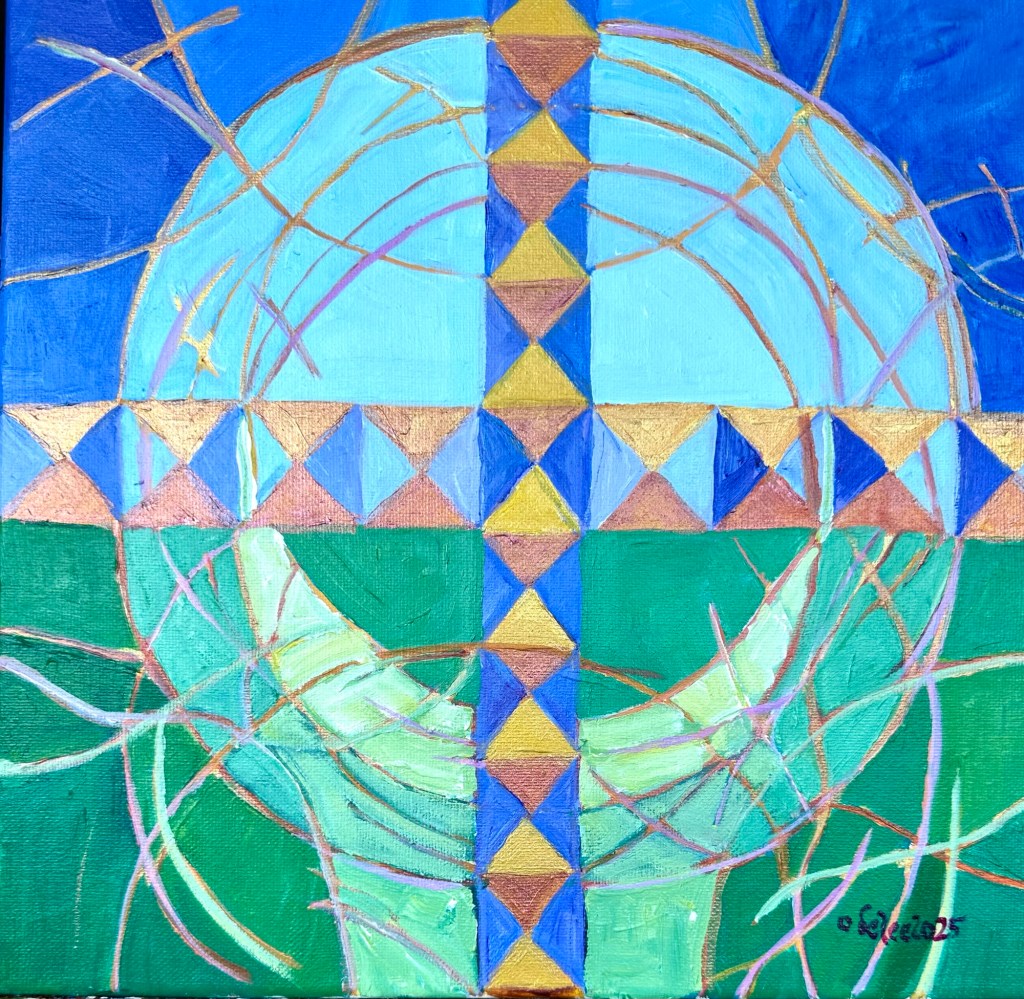
DeLee: The Dome of the Waters, acrylic on canvas, 10” x 10”, 2025

And God said, “Let there be a dome in the midst of the waters, and let it separate the waters from the waters.” So God made the dome and separated the waters that were under the dome from the waters that were above the dome. And it was so. God called the dome Sky. And there was evening and there was morning, the second day.  —Genesis 1:6-8

As I painted more, the dark blues above the light blue represented the waters above the “firmament” of the pale cerulean sky. When it rains, the holes in the dome of the sky let the water leak out, or so I’ve heard the old folks say. I never heard their explanation for why it doesn’t rain all the time, but perhaps “angels are involved.” They might be busy plugging the holes in the dome with their fingers, but God must have many angels working hard on our behalf.

The area below is in greens for all the growing and thriving things. There is an upside-down dome, or a Cheshire Cat smile pale green eighth moon shape for the underground water sources. All the intersecting compass marks are the energy signatures, which God’s power unleashes when God makes a new thing or renews an old thing. If we are sensitive to God’s creative spirit, we cannot help but be in awe of the magic and mystery of not only the minutiae of nature, but also the grandeur of the cosmos.

Ansel Adams: Wilderness, California. Afternoon Thunderstorm, Garnet Lake.

The great landscape photographer Ansel Adams was one of the voices of those who found inspiration in nature, especially our national parks. He spoke the same sensible words for our age: “As the fisherman depends upon the rivers, lakes and seas, and the farmer upon the land for his existence, so does mankind in general depend upon the beauty of the world about him for his spiritual and emotional existence.” (From a speech to the Wilderness Society, May 9, 1980).

The natural world is meant for humankind to care for, tend, and enjoy with respect, just as we would care for a beloved partner. Not everyone sees the world with the eyes of God, who so loved the world—both the humans, the creatures, and the earth itself—God gave God’s only Begotten son to save the world, “For God did not send his Son into the world (kosmon|κόσμον) to condemn the world (kosmon|κόσμον), but so that the world (kosmos|κόσμος) might be saved through him.” (John 3:17) What God created, God loves and will sustain. Can we do anything less and still be faithful to God’s calling on our hearts?

Joy and peace,

Cornelia


U.S. Church Membership Falls Below Majority for First Time

https://news.gallup.com/poll/341963/church-membership-falls-below-majority-first-time.aspx

Trans. by Nathaniel Campbell, from the Latin text of Hildegard of Bingen, Liber Divinorum Operum, ed. A. Derolez and P. Dronke, in CCCM 92 (Turnhout: Brepols, 1996), pp. 47-9. (Musical Score)

International Society of Hildegard von Bingen Studies: Karitas habundat

http://www.hildegard-society.org/2014/11/karitas-habundat-antiphon.html

Panentheism (Stanford Encyclopedia of Philosophy)

https://plato.stanford.edu/entries/panentheism/

The Universe’s First Light Could Reveal Secrets of the Cosmic Dawn | Scientific American by Rebecca Boyle

https://www.scientificamerican.com/article/the-universes-first-light-could-reveal-secrets-of-the-cosmic-dawn/

Neumes | Music Appreciation 1

International Society of Hildegard von Bingen Studies: February 2015

http://www.hildegard-society.org/2015/02/

The Book of Divine Works. | Library of Congress: Fully digitized copy of Hildegard’s final tome of 353 magnificently illustrated pages, late 12th century CE.

https://www.loc.gov/resource/gdcwdl.wdl_21658/?st=gallery

Neil DeGrasse Tyson and Star Talk: Could One Electron Explain the Universe?

https://www.facebook.com/reel/1859416304571349?fs=e&fs=e

Is a River Alive? By Macfarlane, Robert. Available as audiobook, kindle, and paperback


Music of the Spheres

adult learning, Aristotle, art, color Wheel, Creativity, Faith, Holy Spirit, Horeb, Icarus, Imagination, nature, Painting, Prayer, Pythagorean Cosmology, Silence, Spirituality, vision

One of my favorite hymns growing up in the church was “This Is My Father’s World,” by Maltbie D. Babcock, a Presbyterian minister. Written in 1901, to the tune Terra Beata, or Blessed Earth, the song was originally a traditional English folk tune, but composer Franklin L. Sheppard arranged a variation specifically for this text. This hymn and “The Church in the Valley in the Wildwood” were my mother’s and my grandmother’s two favorites to sing. I loved them both also because of their location in nature.

This is my Father’s world,
And to my listening ears
All nature sings, and round me rings
The music of the spheres.
This is my Father’s world:
I rest me in the thought
Of rocks and trees, of skies and seas–
His hand the wonders wrought.

As Paul wrote in Romans 1:20—

“Ever since the creation of the world (God’s) eternal power and divine nature, invisible though they are, have been understood and seen through the things (God) has made.”

Tracing history backwards from the 1st CE, the Pythagoreans (active from the late 6th to the mid 5th century BCE) thought the music of the spheres was an ethereal harmony produced by the vibration of the celestial spheres.

Aristotle said the Pythagoreans believed things are numbers or they are made out of numbers by noticing more similarities between things and numbers than between things and the elements, such as fire and water, as adopted by earlier thinkers. The Pythagoreans thus concluded things were numbers or were made of numbers. Therefore, the principles of numbers, the odd and the even, are the principles of all things. The odd was limited and the even was unlimited.

Aristotle criticized the Pythagoreans for being so enamored of numerical order that they imposed it on the world even where it wasn’t suggested by the phenomena. Thus, appearances suggested there were nine heavenly bodies orbiting in the heavens but, since they regarded ten as the perfect number, they supposed there must be a tenth heavenly body, the counter-earth, which we cannot see.

Pythagoreans presented the principles of reality as consisting of ten pairs of opposites:

1. limited—unlimited

2. odd—even

3. unity—plurality

4. right—left

5. male—female

6. rest—motion

7. straight—crooked

8. light—darkness

9. good—bad

10. square—oblong

In art we have similar categories which we use to create dynamic images. If our painting is all of one value—all white, all black, or all middle value—it lacks visual interest. We are drawn to images which have contrasting values covering multiple values. As with everything, too much of a good thing can become a bad thing! In medicine, a small dose of Botox can make wrinkles disappear, but a large dose could poison a person. As I tell folks, some things require experts, not DIY practitioners.

The Middle Path is safest and best—
Unknown Artist: The fall of Icarus., Fresco of the Third style from Pompeii, 50—75 CE. (H. 35.5, W. 34.5 cm.),
London, British Museum.

I’ve probably mentioned before my encounter with the Hostess chocolate cupcakes. When I realized I could buy a whole box for slightly more money than a package of two tiny cakes, of course my starving art school student budget sprung for the box. That’s when I ate chocolate cupcakes for breakfast, lunch and dinner. By the end of that box, I was cured of my chocolate cupcake desire for a very long time. This is a classic case of “too much of a good thing,” or “knowing when to stop.” The Greeks recognized the need to curb human behavior of our “all or nothing” thinking by prescribing the idea of the Golden Mean, or “nothing to excess.” I definitely went to excess on my cupcake journey.


Mies van der Rohe’s Tugendhat Armchair was designed for the Tugendhat House in Brno, the Czech Republic in 1929 and is one of several different furniture pieces designed for the home of Greta Weiss and Fritz Tugendhat.   In the design of the home, Mies designed nearly every detail down to the furniture used.  He also prescribed the placement of each furniture piece in the home to maintain spatial composition.

Mies van der Rohe, whose architecture and furniture design exemplified his style, “less is more,” never reduced his work to nothing. His work was faithful to the new industrial materials of steel and glass being used in skyscrapers. Our excess in art is never to nothingness, but we don’t over elaborate or over decorate, just for the sake of filling the space.

So, what do we do and how we proceed? When faced with the challenge of all we see before us, what do we select to make our images? I believe this is where the creating Spirit comes into play, for we can walk past a tree all day long, but on a certain day, the tree comes alive for us. When Moses was herding his father-in-law’s sheep out in the wilderness, his mind was on the sheep, his current family, and his past life and deeds. Scripture doesn’t tell us how long the bush burned on that mountain before Moses noticed it and said, “I must turn aside and look at this great sight, and see why the bush is not burned up.” (Exodus 3:3)

Likewise, we walk past inspiring images daily when we’re preoccupied with our day-to-day concerns. We also have difficulty finding time to create because others want our attention first. One of my seminary professors lectured us in class about taking time to keep our spiritual lives front and center as we moved through school and our church appointments. She said our spouses and children would want to be first, plus our congregations also would want to be first. We’d most likely want to put our careers first to get a bigger steeple or to please our supervisors. However, if we put anything or anyone before God, our spiritual lives would suffer, and like dominos, everything else would fall also. “Many are called, but few are chosen,” as Jesus says in Matthew 22:14.

In art as in life, we need to be deeply rooted in the life of the Spirit. I can tell when I’m going through the motions, but I keep on painting, for I figure I’ll at least learn something from my adequate work, so I’ll be found ready when the creative Spirit strikes. Sometimes I’m more present to the cares and concerns of this world and my work suffers for it. Other times, I’m under the creating power of a Greater Power and my work is altogether more inspired because of that energy. We’d all be more vigorous and creative in our everyday lives if we spent more time in prayer, contemplation, and searching the scriptures to hear God’s voice speak in the silent corners of our hearts and minds.

Mike: Sun and Moon, quick painting

Last week, only Mike and I showed up for art class. Everyone else was either tied up with doctor appointments or at home with rehab or otherwise occupied. Mike and I explored making different colors with the 8 Color Prang Watercolor Set. We can make interesting colors by combining the complementary colors or the tertiary colors. Mike’s first landscape painting got the energies of his competing needs out of the way.

Mike’s Second start—just beginning

As in journaling, we often need to make a habit of writing our thoughts so our deepest feelings can get expressed. He began a second painting with more focus on the goal of mixing new colors.

Music of the Spheres: watercolor

I started my painting with the circles by using yellow watercolor to outline intersecting circles of the same size on my paper. Then I mixed some primary colors together, some secondary colors together and some tertiary colors together. I painted different sections of the overlapping circles. Some of the paint I thinned to a wash, and others I laid on fully. When I got home, I painted in the background, allowing some areas to be a wash and other parts to be thicker.

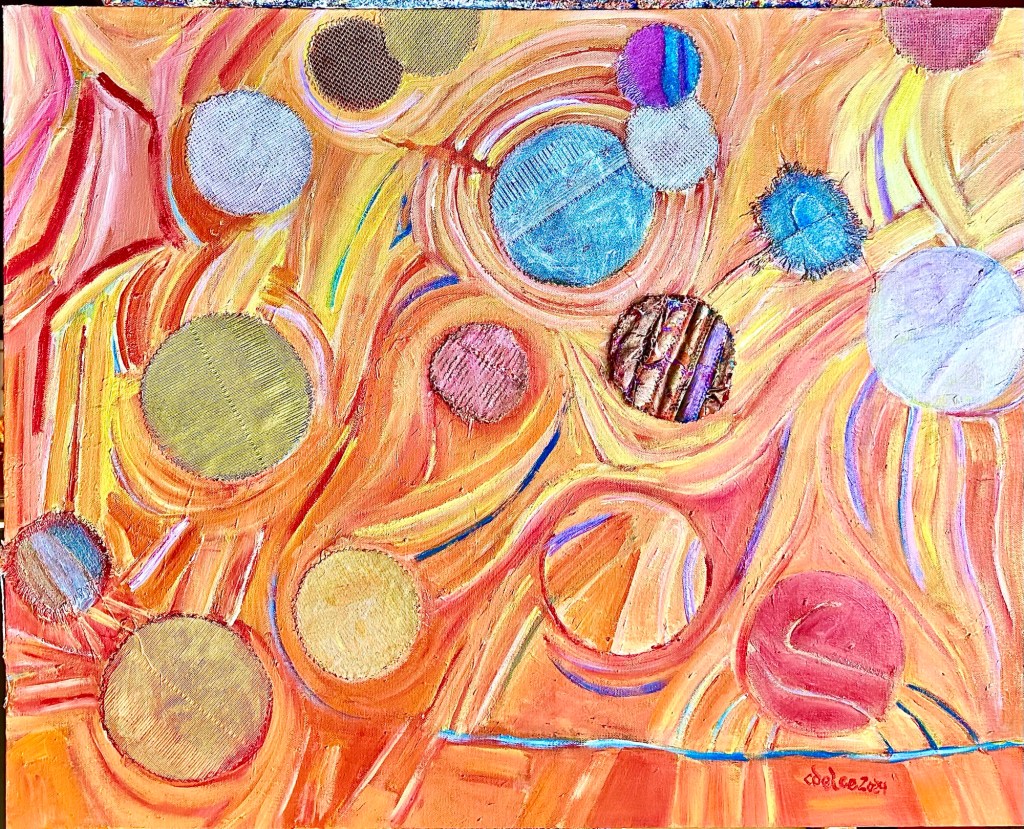
Music of the Spheres: Creation Energy, acrylic

I finished at home an acrylic painting, which explores some of the same themes as the watercolors we’ve worked on in class. In this I used various material with different textures for my spheres. One of the circles is more three dimensional because it’s from a handmade cloth mask left over from the pandemic. I painted parts of it, also. The background has lines of “energy” all about.

While the Pythagoreans attempted to see unity and harmony in the creation in numbers, our Judeo-Christian faith recognizes God as creator of nature and nature revealing the Creator. One of the best texts to understand this distinction is 1 Kings 19: 11-13, in which Elijah meets the LORD on the mountain at Horeb:

(God) said, “Go out and stand on the mountain before the LORD, for the LORD is about to pass by.” Now there was a great wind, so strong that it was splitting mountains and breaking rocks in pieces before the LORD, but the LORD was not in the wind; and after the wind an earthquake, but the LORD was not in the earthquake; and after the earthquake a fire, but the LORD was not in the fire; and after the fire a sound of sheer silence.

When Elijah heard it, he wrapped his face in his mantle and went out and stood at the entrance of the cave. Then there came a voice to him that said, “What are you doing here, Elijah?”

No one has ever heard the music of the spheres, and the voice of God arrives in the sound of sheer silence. Perhaps that “polar opposite” of the Pythagorean’s world view was on to something after all. If we’re very quiet and still, we may hear both the music of the spheres and the voice of God in the great silence.

Joy and peace,

Cornelia


This Is My Father’s World | Hymnary.org

https://hymnary.org/text/this_is_my_fathers_world_and_to_my

Counterfeit Version of Botox Found in Multiple States | FDA

https://www.fda.gov/drugs/drug-safety-and-availability/counterfeit-version-botox-found-multiple-states

Pythagoreanism (Stanford Encyclopedia of Philosophy)

https://plato.stanford.edu/entries/pythagoreanism/

A Prayer to End All Suffering

art, crucifixion, Deesis Icon, Easter, Faith, Good Friday, grief, Healing, hope, Icons, incarnation, inspiration, Lent, Painting, Prayer, renewal, Spirituality, Strength, suffering, vision


I don’t don’t know about you, but I don’t willingly sign up for pain or suffering. Pollen season isn’t my friend. I could do without all this yellow and green stuff clogging my brain cells and my lungs. As I cough and die, swill decongestant tonics, and huff my asthma inhaler, I wonder if this particular cross bearing has to be on my things to do list every Lenten season.

Mid 10th CE ivory Deesis Icon, Metropolitan Museum of Art, NYC

As Jesus turned his face towards Jerusalem, he knew his fate was certain. His message began to change, as he told his followers in Luke 14:27, “Whoever does not carry the cross and follow me cannot be my disciple.” Of course, not all were ready to hear or to follow, for some had obligations at home, and others weren’t yet ready to live the itinerant life. Many today don’t answer the call to ministry because they can’t see the long unknown road ahead. Only those willing to walk by faith and not by sight will journey off, trusting in God’s providence, mercy and grace.

Earliest sculpture panel of the Crucifixion, Maskell Passion Ivories, 420-430 CE, one of four carved panels of a sarcophagus, British Museum, London.

I used to say, “Give me a few months and I can whittle any group down to size. I can prune with the best of gardeners—all I have to do is read actual scripture!” I figure if folks want to get mad, they should take it out on the original writers. Blaming the messenger is useless. As the apostle Paul says:

“For the message about the cross is foolishness to those who are perishing, but to us who are being saved it is the power of God.” (1 Corinthians 1:18)

The oldest icon of the Crucifixion of Christ, Greek Orthodox Holy Monastery of St. Catherine, Mount Sinai, 8th CE

The ancient crucifixion icons glorify the triumph of the Incarnate God and his victory over death, which is the consequence of our fall; that fatal moment in the garden of Eden when Adam and Eve chose to desire to be like God, even though they had only the image, but not the ability to be gods themselves. Icons of the crucifixion represent Christ who, fully human and fully divine, takes on death so humanity no longer has to die. Christ conquers death by being a suffering servant, he becomes a victorious king.

Mary from the Hagia Sophia Deesis mosaic

Most of us would rather jump to the Bible’s Victory story and skip its Victim sections because we live in an age which validates the strong and successful, while denying the worth of the weak and wounded. Easter and Palm Sunday are more triumphant celebrations than the sonorous and somber Foot-washing Maundy Thursday and Good Friday Vigils. Yet without suffering, would we have cause for rejoicing? Would we even know the meaning of joy without some pain in our lives? Everyone has some pain in their life, whether it’s the pain of an unrequited love, the loss of a child stillborn, a divorce, a war wound, a frenemy wound, or some other brokenness.

Stage one

Mary knew early on her child of destiny would bring her both joy and pain, as all mothers discover soon enough. Luke records in 2:34-35,

“Then Simeon blessed them and said to his mother Mary, “This child is destined for the falling and the rising of many in Israel, and to be a sign that will be opposed so that the inner thoughts of many will be revealed—and a sword will pierce your own soul too.”

Deesis. Top center front panel of the Harbaville Triptych. Ivory. Ca. 940-960 CE. Musée du Louvre, Paris.

Many today only want to show the happy times in their hyper-curated lives on social media. As a result, “Keeping up with the Joneses” gets harder all the time. With Facebook’s constant encouragement of “you may know algorithms,” we’re encouraged to add more friends to our circle. We’re exposed to too many families of that surname, when once we only knew a few who lived in our own neighborhoods. If all these Jones folks are always smiling widely for the camera, we might be tempted to ask, “Why don’t I feel like smiling also?”

I know people who don’t read newspapers, watch the news on television, or even listen to the snippets on the radio. “Too much bad news!” They too don’t want to hear of the suffering, the plight of the weak, or face their seeming impotence to do anything about it. We are weak people. We are not strong, no matter how often we quote passages like Philippians 4:13—

I can do all things through him who strengthens me.”

Richard Rohr, in The Enneagram, A Christian Perspective, says, “It is the things that you cannot do anything about and the things that you cannot do anything with that do something with you.” Suffering and prayer are what truly transform us, if only we don’t waste time looking for someone to blame.

13th CE Hagia Sophia Mosaic, Istanbul, Turkey

So far, no one person has been able to stop the Russian invasion of the democratic nation of Ukraine, but plenty of people are holding up an aid package that would help this small country fight this battle at great cost to life and limb. The Ukrainians suffer and America dithers. We seem to think our leaders have infinite powers, as if they were gods, but we forget all people are only human and have only the image of god, but no huma has either the power or the glory of the true God.

Unknown Ukrainian Artist: The Deesis, Icon, Tempera, silvering on gesso-grounded two-piece fir-wood panel, engraving, carving; 1735, h 114, w 84, d 9, National Art Museum of Ukraine.

So far, no one person has been able to keep either Hamas or Israel from wreaking havoc on each other. My daddy used to say, “you can’t make a silk purse out of a sow’s ear.” After years of teaching and pastoring, I’d throw my two cents in: “we can lead a horse to water, but we can’t make it drink.” As long as people are invested in retribution, they will return suffering for suffering. The sad truth is people who have never processed their own suffering will cause suffering for others as well as for themselves. The children will cry. And the women will cry. But now the men are crying too.

Late Roman Magical gem; intaglio; green-brown jasper; oval; bevelled edge on side B, 2nd-3rd CE, British Museum, London.

No one has a magic wand to eliminate suffering or harm. In ancient times, the image of the crucified Christ was used as a magic charm to keep the wearer from harm. Some people today wear a cross for the same reason; it’s a fashion statement, a good luck charm, and a symbol of their faith. Instead of a charm, we offer acts of prayer and mercy.

Hagia Sophia Deesis Mary icon 2024, finished

We don’t just cry for the fact of the sufferings we endure, or for the sufferings of others, but we cry out in our suffering to the only one who can hear us, heal us and make whole our broken hearts and homes. We cry out to the God, who created all of us in God’s own image out of the dust of an obliterated and bombed out land. We cry out to the God who brings rains in their seasons to a land parched by climate change and ruined by reckless use of natural resources. We cry out to the God who raised God’s son from the dead, even as people everywhere bury their own dead sons and daughters from the wars fought by nations and non-state actors who wrestle for power in tiny slivers of contested territories.

Christ and the Apostles in the Heavenly Jerusalem, apse mosaic, early fifth century, Rome, Santa Pudenziana.

We can see in this image a dramatic transformation in the conception of Christ from the pre-Constantinian period. In the Santa Pudenziana mosaic, Christ is shown in the center seated on a jewel encrusted throne. He is surrounded by apostles, biblical women, and symbolic images of the four gospel writers. The ideal landscape is the New Jerusalem, or the Heavenly Kingdom. This image was created after Constantine’s victory and conversion to Christianity. Prior to this, Christian art repurposed Greco-Roman themes of the Good Shepherd and the Apollo Sun god.

Unknown Artist: Plaque with Christ flanked by the Virgin and Saint John, late 19th–early 20th century (Byzantine style), Cloisonné enamel, gold; 6 9/16 x 5 9/16 x 1/16 in. (16.6 x 14.1 x 0.1 cm); Metropolitan Museum of Art, NYC, Gift of the Estate of Mrs. Otto H. Kahn, 1952, Accession Number: 52.54.1

The Byzantine Empire was fond of the Deesis Icon, which has Christ in the center bounded by the Virgin Mary and the Precursor, John the Baptist, on either side. They both entreat the Lord in prayer. This was one of the most widespread middle Byzantine icon types. The name comes from the Greek δέησις or “supplication,” which in Byzantine art, describes a representation of Christ enthroned and flanked by supplicants, such as the Virgin Mary, St. John the Baptist, or other saints and/or angels. Images of the deesis often appear on an iconostasis, or the screen separating the altar from the people. The subject matter traditionally represents the first witnesses to Christ’s divinity, the Virgin and Saint John, who came to be seen as holy figures who would act as intercessors with him on behalf of humanity.

The Deesis. End of the 17th century. Northern Russia. Wood, gesso, tempera. Found from the village Nizhnyaya (Dolgovitsi), Tarnoga Raion, Vologda Oblast. Collection of Nikolai Kormashov.

Nikolai Kormashov, an Estonian artist and collector, who collected and restored a great collection of 15th-20th century Russian icons during his lifetime said, “That which is not destined to perish, announces itself again and again, to attest to elusive spiritual beauty and the light of truth.”

The truth is all people of every country and culture in every age will suffer, but God isn’t removed and distant from our pain. God, through the incarnation of the Son, has experienced our human suffering from the birth pangs of Christ’s birth to the hunger, thirst, and weariness of his itinerant earthly preaching. Not only this, but God through God’s Son knows the heartbreak of betrayal and insult, the sting of the whip, and the pain of death on a cross.

The light of truth for the Easter season is this: in the midst of darkness and death, God raised his Son to light and life, so we too might lose the chains of sin and death and live to light and love. As the people of prayer, we ask for the gift of hope to give light to those in darkness and a helping hand to those in need.

Joy and peace,

Cornelia

Relief plaque icon, depicting the Deesis Crucifixion with full-length figures of the Virgin on the left and St John on the right, Late Byzantine (13 thc). Materials: Steatite – Gold

Greek déēsis entreaty, equivalent to deē-, variant stem of déesthai to beg + -sis-sis

Leonid Ouspensky: The Meaning of Icons, revised edition, St. Vladimir’s Seminary Press, Crestwood, NY, 1999, p. 180.

DEESIS Definition & Usage Examples | Dictionary.com
https://www.dictionary.com/browse/deesis

Saved Sanctity: Icons from the Collection of Nikolai Kormashov – Art Museums
https://www.lnmm.lv/en/art-museum-riga-bourse/exhibitions/saved-sanctity-icons-from-the-collection-of-nikolai-kormashov-437

Image— The oldest icon of the Crucifixion of Christ at the Greek Orthodox Holy Monastery of St. Catherine on Mount Sinai is an extraordinary testament to the intricate relationship between the Greco-Roman art heritage and early Christian iconography. This invaluable artifact offers a unique glimpse into the artistic and cultural milieu of the time, highlighting the exchange of ideas and the shared history that shaped the development of Christian art in 8th CE. See following link for comparison of early Roman and Christian art.

http://employees.oneonta.edu/farberas/arth/arth212/post_constant_conc_christ.html

Nick Haslam: The Body Keeps the Score: how a bestselling book helps us understand trauma – but inflates the definition of it

https://theconversation.com/the-body-keeps-the-score-how-a-bestselling-book-helps-us-understand-trauma-but-inflates-the-definition-of-it-184735

The Persistence of Effort

adult learning, Altars, art, Attitudes, beauty, brain plasticity, Children, cognitive decline, Creativity, exercise, Food, Habits, Health, Holy Spirit, inspiration, knitting, Love, Ministry, mystery, nature, Painting, Prayer, pumpkins, purpose, rabbits, renewal, Right Brain, sleep, Van Gogh, vision

These shoes are made for walking

I was reading an article in the New York Times the other day. In “How I Learned to Love Finishing Last,” the author wrote about her slow pace as a runner. As one who regularly finishes last in my age group in the annual Spa 5K Walk each November, I’m optimistic one day I might get old enough to be in a nonagenarian age group all on my own. Perhaps if I’m 90 and still doing a 5K, they’ll give me a ribbon just for participating! “The last will be first and the first will be last,” especially if there’s only one of us in the race!

“When we compare ourselves to others,” said Dr. Justin Ross, a clinical psychologist in Denver who specializes in athlete mental health and performance, “we set ourselves up to suffer. Instead, the real psychological benefits come from enjoying what your body can do.”

Portrait of Yayoi Kusama in costume in front of pumpkin painting, photo: Noriko Takasugi

Suffering physically isn’t what art class is about, although we may suffer indignities to our egos, but this shouldn’t hold us back from doing our art works. The case of the Japanese artist Yayoi Kusama is evidence even hallucinations of voices and images can’t keep an artist from creating. If our daily efforts don’t measure up to what we imagined in our mind, it’s merely because our inner eye sees better than our hands can execute our vision. Sometimes our eye forgets what it once learned, for we haven’t used our skill of looking in a while. A runner doesn’t leap off the couch and immediately run a marathon or even a 5K. The smart athlete takes the time to train progressively for the distance beforehand. Also, they get new shoes.

Kroger Run: Two ghost pumpkins and a small pie pumpkin

Sometimes the coach has slept over the summer also. Just as students in school need a time to relearn last year’s lessons, as a coach in art class I sometimes forget the lessons, which are second nature to me because they’ve been inculcated by multiple teachers since I was eight years old, aren’t as ingrained to my own students. I also forget I’m always observing everything around me: cloud patterns, changing colors on trees, sunlight dappling on tree branches, shadows on the ground, and reflections in windows. I think about these patterns rather than about what I need to do next or next week. My calendar will remind me of these things in due time. I’ll be wrapping this up soon so I can work on my monthly Rabbit blog.

Rabbit playing “Hide the Pumpkin.”

A National Institute on Aging study found five healthy lifestyle factors — physical activity, not smoking, not drinking heavily, following the Mediterranean-style diet, and engaging in mentally stimulating activities — can have important benefits. People who engaged in four or five of these behaviors had a 60% lower risk of developing Alzheimer’s compared to those who only followed one or none. People who followed two or three of the activities had a 37% lower risk. This is your free wellness plan from Dr. Cornie, who has no medical degree, but did stay in a Holiday Inn once.

Debunking the Myth of the Split Brain Theory

Although we commonly think art is a “right brained” activity, in 2013 a group of researchers at the University of Utah discovered people actually use both sides of their brains equally. Back in the 1970’s when I was seeking employment after graduate school, the “Art is a right brain myth” ruled the creative work world. I once suggested I’d be a good candidate for a museum position because I understood both the artistic and the logical mind. I was not hired. Intuitive understanding of the brain a half century ahead of time doesn’t exactly open the doors to a fancy job.

As I recall, I got a checker’s job in a grocery store and ended up counting the teller trays and preparing the bank deposits for that store. The good news is creating works of art is a multi-process activity, one that depends on several brain regions and on redundancy of art-related functional representation rather than on a single cerebral hemisphere, region or pathway. This means even when we lose our ability to form words (typically a left hemisphere activity) our ability to create art still exists. We can still express our inner feelings and thoughts. This is good news for the aging and those who love them.

Yayoi Kusama – Pumpkin, 2014, installation view, Donum Estate, California, photo: Robert Berg

One one the great sadnesses in my ministry is being with young people who desperately want to have their old one’s memories recorded, but waited too late to ask them or were too busy with their own lives to sit and listen to these stories of the olden days. Once their old person has a stroke and loses the ability to form words, the opportunity has passed. Those stories will be locked in their minds due to aphasia, and no one or no amount of time will pull them out. We always tell young parents their babies need to be enjoyed while they’re still young, but we should also tell families to get the stories of their elders while they still can. “Strike while the iron is still hot” will take on a new meaning one day.

We needed bigger pumpkins

Gail and I were the only ones in class today. Lauralei showed up to gift us chocolate cake and keep us company. Tim and Mike were out of town. Gail and I both repainted old canvases. I showed some of the unusual ways pumpkins have been decorated by various artists, but none of them sparked any interest. We got down to work by covering our old canvas with a base of titanium white paint. Then I located all three of the pumpkins with circles and drew a baseline for the object on which they sat. I didn’t look over at Gail’s work for a while, but then I noticed she’d almost completely finished one pumpkin without roughing in the shapes of the others.

Gail had a big canvas today.

“Did you plan on finishing that one pumpkin before drawing the other two?” I asked.

Gail gave me a “needs more caffeine” stare.

“That’s what I thought. Maybe next time draw in the rough shapes so you get everything located in space relevant to each other.”

Pumpkin Spice Latte Time

We kept on painting until clean up time. I often say “I’ve slept since then.” It’s my all purpose excuse for forgetfulness or just plain airheadedness. Sometimes I have my mind on other things and I’m not focused on what’s in front of me. I forget about the wisdom of Brother Lawrence, who said “many do not advance in the Christian progress because they stick in penances and particular exercises while they neglect the love of God which is the end. This appeared plainly by their works and was the reason why we see so little solid virtue.” He also said, “there needed neither art nor science for going to God, but only a heart resolutely determined to apply itself to nothing but Him and to love Him only.”

Cornelia’s small painting of pumpkins

We know Brother Lawrence from the classic text, The Practice of the Presence of God. Although it dates from the late 17th century, his lessons on living life in joy in the present moment, all for the love of God are invaluable for us modern folks who tend to live for our 15 minutes of personal fame, social media clicks, or self interest. We aren’t used to the monastic life today, or to the discipline of that lifestyle. We live in a Burger King world, in which each individual gets his or her own way to every extent possible. Unfortunately, the Christian lifestyle is one of discipline, but not harsh punishment:

“Now, discipline always seems painful rather than pleasant at the time, but later it yields the peaceful fruit of righteousness to those who have been trained by it.” ~~ Hebrews 12:11

In art class we focus on the disciplines, just as the guild artists taught the apprentices back in the day. These disciplines are not only for safety, for some of our art tools are dangerous, but also some of our techniques are proven to yield better results than others. This is why carpenters measure twice and cut once. They also cut on the outside of the line, rather than the inside. They can shave down a piece easier than adding to it. Murphy’s Law recognizes this: “A wire cut to length will be too short.”

Zen Tangle drawing of pumpkins: exercise in texture

Art class has no mysteries, but we can forget the “secret gnostic knowledge passed down by word of mouth” from our previous classes. I often use the excuse “I’ve slept since then.” Another good excuse is “My mind has gone to Pluto.” I share these with you all, for they’ve always worked for me. Of course it helps to be a natural blonde. Then again, I’m very organized, but I’m also very active, so sometimes my calendar gets overwhelmed, and I pull out the “OOPS! Card.” Even in retirement I’m still creating and sharing my faith through art and writing. It’s my way of exercising those brain cells to keep them from dying off. We old folks can still learn new things, even if it takes longer. This is what we call the persistence of effort. Those who keep using their skills won’t be losing those skills.

The same goes for learning a new skill. It’s all a matter of repetition. We can’t get frustrated if we don’t get it on the first try. We won’t be a good role model for the young if we have that attitude. We need to lower our expectations. I used to think I couldn’t knit, but only crochet. After my mom, who was a stellar knitter passed on, a friend taught me to knit in an afternoon! Where this sudden bilateral coordination came from I have no idea, but it was so welcome. Perhaps I needed to be in the right frame of mind, or I wanted to be able to carry on my mom’s memory, but I was definitely receptive to her teaching.

Letter to Theo Van Gogh, September 18, 1888

It’s never too late to learn and we’re never too old to start learning. Art isn’t just good for the brain, but it’s good for the soul. Art is our attempt to represent truth, beauty, and nature in media that can be accessible to others. By doing this, we bear witness to the creation and the Creator. We only need give our best efforts, and let God’s Spirit guide our growth.

Joy, peace, and perseverance,

Cornelia

We have pumpkins galore on the autumn altar.

How I Learned to Love Finishing Last


How the Aging Brain Affects Thinking | National Institute on Aging

https://www.nia.nih.gov/health/how-aging-brain-affects-thinking

The creative-right vs analytical-left brain myth: debunked! – Dr Sarah McKay https://drsarahmckay.com/left-brain-right-brain-myth/

Art and brain: insights from neuropsychology, biology and evolution – PMC

https://www.ncbi.nlm.nih.gov/pmc/articles/PMC2815940/

The Project Gutenberg eBook of The Practice of the Presence of God, by Brother of the Resurrection Lawrence (free ebook)

https://www.gutenberg.org/cache/epub/5657/pg5657.html

Megiddo: Marks and Memories

Altars, art, city, Creativity, Degas, Faith, Forgiveness, Healing, Holy Spirit, Israel, Megiddo, Monet, Painting, perfection, Prayer, risk, salvation, Spirituality, Travel, United Methodist Church, vision

Study for Megiddo Memories

My most recent studio work explores my memories of my pilgrimage to the ancient ruins of Tel Megiddo. Why am I interested enough to make an entire series of drawings and paintings of this site, which I visited over two decades ago? First, the city was continuously occupied from the 7th or 6th millennium BCE, with the ancient tel generally left untouched and intact since its decline and subsequent abandonment around the 4th century BCE. The tels at Megiddo, Hazor, and Beer Sheba all have retained their authenticity and each have acquired the characteristic conical shape with a flattish top, protruding above the surrounding countryside. These three tels are now UNESCO Heritage Sites.

Megiddo: Marks and Memories

Excavations at Tel Meggido have uncovered about 26 layers of settlements dating back to the Chalcolithic period, or the early Bronze Age, about 5,000 years ago. Other sources say 30 layers exist at Tel Megiddo. The first four layers have been identified. This site was a Canaanite city, an Egyptian fortress, a Chariot City during Biblical times, and a prominent Assyrian and Persian city. King Solomon ruled the city in its prime in the 10th century BCE.

Megiddo: First Recorded Battle in History

The city has seen more battles than any other location in the world because of its location at the crossroads of the ancient world. The first written reference to Megiddo also happens to be the first recorded battle in history: a detailed account of the 1479 B.C.E. invasion of the Egyptian Pharaoh Thutmose III. When King Thutmose III of Egypt conquered Megiddo 3,500 years ago, the pharaoh left with, among other things: 1,929 head of cattle, 2,000 goats, 20,500 sheep, 204 horses, 200 army uniforms, and 502 bows. Megiddo is also the first recorded use of the composite bow and the first body count. All details of the battle come from Egyptian sources — primarily the hieroglyphic writings on the Hall of Annals in the Temple of Amun-Re at Karnak, Thebes (now Luxor), by the military scribe Tjaneni. Megiddo is also the site of a large chariot stable complex, called Solomon’s Stables, even though we now know they were built by Solomon’s successor King Ahab during the 9th century B.C.E.

Megiddo: Blue Version, Motions and Moods

Fortress cities sit on the 10 acre summit of Megiddo Hill or Tel Megiddo, rising 21.33 meters (about 70 feet) above the valley. Megiddo is located in the Lower Galilee region of northern Israel. Its critical location dominated the Aruna Pass (Wadi Ara or Megiddo Pass), which was the entrance to one of the few passes through the Carmel Mountains. Megiddo controlled the Via Maris, the main route between Egypt and Mesopotamia, also known as the Egyptian Way of the Sea. Christians regard this area as “Armageddon,” where the final Biblical battle between good and evil will occur.

Circular altar-like shrine from the Early Bronze Age at Megiddo. (Credit: Hanay)

The early Bronze Age temple compound at Megiddo is unparalleled for its number of temples, the continuity of cult activity and the record of ritual activity. The late Bronze Age palace is the most elaborate in Israel, and one of the best in the Levant. For the Iron Age remains, the elaborate orthogonal town plan of Megiddo has few parallels in the Levant. All three tels have impressive remains of their underground water catchments systems, which demonstrate sophisticated and geographically responsive engineering solutions to water storage. Megiddo is significant because the entire sequence of the Bronze Age and Iron Age is not only represented and excavated, but radiocarbon dated.

Megiddo: Moonlight Cityscape

Those are the travelogue statements. When on pilgrimage, one place full of stones begins to look like another after many days on the bus. Even though I was keeping notes of my journey in my paper journal, by the second week, I was hitting information overload. Each and every place was of the utmost importance, but my body was feeling the stress of constant traveling on a bus as well as the lack of good sleep from a different bed in a new hotel every single night.

Only strong coffee, lots of water, and eating three good meals a day were keeping me going. I was so excited during my pilgrimage, I was in an altered state of mind for weeks after my return home. Time slowed down and I could see more clearly for a long time. I would swear I could see individual oxygen molecules in the air, even though in my rational mind I knew this wasn’t possible. Pilgrimage is a spiritual journey, not a tourist trip of checking off various sites to say “I’ve been there and done that.” Even when surrounded by a “great cloud of witnesses” both physical and immaterial, I always knew I was walking on holy ground.

Megiddo: Motions and Moods, number 2

What does it mean to walk in the places where people have lived and died? Especially where they have clashed violently in war? The last time Americans fought a war on our home front was the Civil War. That internecine conflict was a horrific wound on our nation, an injury that hasn’t yet healed for some. I know my own daddy still carried the scars of his ancestors who fought on the battlefield to preserve slavery. He never understood why I thought that was a bad choice and why I worked to undo the damage of the war’s legacy on all Americans.

Cannon at Shiloh National Military Park

While traveling back home from viewing the Great American Eclipse, I met a man at Shiloh National Military Park, a Civil War memorial battle field. He visits these historic sites to pray for the deceased. He was from New Orleans, Louisiana, and believed those who died a violent death still wandered about, since their souls weren’t at peace. I don’t know if I believe this, but it gave him comfort to pray for the release of the hate and violence people can store up in their bodies and spirits and cause them to war upon one another.

I can say on that autumn day while I walked those killing fields, I felt the somber mystery of death and life, dignity and indignity as I walked about the silent hills and valleys. No longer do we hear the crack of the rifle or the thunder of the cannons. Rain has washed away the blood from the grassy knolls and pastures. Sunlight has dressed the wildflowers in beauty. If not for the explanatory signage, I’d never know about the extraordinary happenings at Shiloh National Military Park.

Perhaps I’m painting these historic sites of conflict because we are in a time of strife, not only abroad but at home. The actual shooting wars are going on beyond our shores, but conflicts at home are no less serious. I’m heartbroken by the devastation of the Ukrainian homeland by the Russian aggressors, and remember the ongoing tussle over the Temple Mount by the various faiths of the world. If there’s conflict beyond us, likely there’s conflict within our our own groups. The outer world usually reflects our inner world.

The stress of our United Methodist Church becoming the “Untied Methodist Church” has been rough on me. I’m carrying my stress in my neck and shoulders so much I’ve pinched the nerve to my pinky and ring fingers. They are now numb. I’m now in physical therapy for this. Medication and relaxation exercises will certainly help. One of my condo residents prayed for a “miracle cure” for me. My theology typically considers “miracles” to be reserved for situations beyond the usual care of physicians, but I know lay people use “miracles” more loosely than we clergy. Nevertheless, I appreciated their well meaning prayer for my healing. After all, God cares for both small and large problems, as Jesus reminds us in Luke 12:24,

“Consider the ravens: they neither sow nor reap, they have neither storehouse nor barn, and yet God feeds them. Of how much more value are you than the birds!”

Moonlight over Megiddo, number 1

I look at that second painting and compare it to the first painting I completed. While I attempted to keep the surface flat, I got involved in the recreation of the old city in my imagination. I connected the moonlight outside with the lamplight inside. I also added an abstract figure in the foreground. The red marks don’t work for me anymore,so I’m likely to destroy this art work. The second one I may keep, only because I learned some new colors and was brave enough to experiment with colors I don’t normally use.

Megiddo #3

In this final work, I chose only a portion of the satellite image. This allowed me to eliminate the areas which were causing me problems in the earlier works, especially the large, repeating curves. Although I’m back to my favorite yellow—I confess to being a Van Gogh fan—I used a greater variety of tints, rather than painting straight from the tubes.

Pablo Picasso once said, “Painting is just another way of keeping a diary.” If our outer world is in conflict, this drama will wash over into our inner world. It will show up in our dreams, our health, our relationships, and in other parts of our lives. If we think the late pandemic and current politics have broken relationships or distressed families, imagine what this has done to our churches. Most people go to church as an escape from this drama, hoping to find a sacred place where everyone is Imitating Christ’s Humility:

“If then there is any encouragement in Christ, any consolation from love, any sharing in the Spirit, any compassion and sympathy, make my joy complete: be of the same mind, having the same love, being in full accord and of one mind. Do nothing from selfish ambition or conceit, but in humility regard others as better than yourselves” (Philippians 2:1-3).

Unfortunately, all people bring their imperfect selves to Christ. Although Christ forgives our old sins, our sin habits remain. Most of us forget this. As an artist, I understand better than anyone the process of “going on to perfection” is both a gift of the Holy Spirit and our own work. While God could gift perfection completely, most often it’s a cooperative endeavor. This is why the studio product is sometimes a thrill, but other times a disappointment. Yet even in the disappointments, we can learn from our mistakes. We might need to “mistake a bunch of times” until we get focused on a new direction. We have to trust the process. Canvas is cheap. It can be reused or recycled. Plus, our salvation isn’t impaired by our detours in the studio.

Yet too often we’re hung up on the product as a reflection of our personal value or worth. If we are hurt, damaged, ill, broken,or harmed in any way, art is a therapeutic exercise for us. Monet tied the brushes to his hands when his arthritis made holding the brush too difficult. His later paintings also had freer brushwork. He could have quit, but he adjusted his expectations and his style to keep creating. As Monet once said, “I’m never finished with my paintings; the further I get, the more I seek the impossible and the more powerless I feel.” Degas was fond of saying, “Only when he no longer knows what he is doing does the painter do good things.”

If we’re in the safe, but shallow waters of certainty, we’re unlikely to grow to the deeper depths of either the spiritual or artistic realms. Most of us are afraid to cast off the anchors that keep us bound close to well known shores. We want to hear the praise of the crowd, and if we sail off for the unknown horizon, we will leave those familiar voices of the crowd’s approval behind. We can only discover the new world by leaving the old one behind, by risking a journey in faith others are not willing to undertake. Sometimes we may need to get out of the boat and risk walking across the water to meet Jesus who calls us to meet us in the midst of the strong winds and high waves.

I don’t worry about these feelings anymore, for I know they will come up, I’ll meet them, and then I’ll let them go. Our feelings of the moment are not the feelings of forever. Only one is the same yesterday, today and forever—the Lord Jesus Christ. The rest of us are still a work in progress.

Joy and peace,

Cornelia

Chalcolithic Period – an overview | ScienceDirect Topics. https://www.sciencedirect.com/topics/social-sciences/chalcolithic-period

The Battle of Megiddo – Ancient Egyptian culture https://www.donsmaps.com/egypt2cb.html

Megiddo https://www.jewishvirtuallibrary.org/vie-megiddo

Armageddon Time: How Discoveries at Megiddo Retell the Story of Ancient Israel – Archaeology – Haaretz.com https://www.haaretz.com/archaeology/2023-01-22/ty-article-magazine/armageddon-time-how-discoveries-at-megiddo-retell-the-story-of-ancient-israel/00000185-d960-d2d9-ab95-ffe0729e0000

Kingdoms of the Levant—Megiddo (Canaan)—date contested. https://www.historyfiles.co.uk/KingListsMiddEast/CanaanMegiddo.htm

Megiddo – Tourist Israel https://www.touristisrael.com/megiddo/9448/

Biblical Tels – Megiddo, Hazor, Beer Sheba – UNESCO World Heritage Centre https://whc.unesco.org/en/list/1108/

20 Quotes from Claude Monet | Denver Art Museum

20 Quotes from Edgar Degas | Denver Art Museum

Change and Tradition

arkansas, art, at risk kids, butterflies, change, disaffiliation, Faith, holidays, Holy Spirit, Homosexuality, inspiration, john wesley, Love, Ministry, Prayer, renewal, Spirituality, United Methodist Church, vision

WABAC Machine

One of my favorite Saturday morning cartoons was Rocky and Bullwinkle. I loved Mr. Peabody and Sherman, who would climb into the WABAC machine after setting the controls to a time and place of historical importance. That a bow tie wearing dog had adopted a human boy never crossed my mind as being strange. It was a cartoon, after all. In the 1960’s we didn’t take cartoons as real life. We knew they were fantasy.

Votive relief. Pentelic marble. Found in the sanctuary of Eleusis.

In times of change we always want to hold on to traditions: our rituals, our places of worship, our routines. I think the newly minted Christians in the first century, who had friendships and business relationships tied up in the pagan temple sacrificial banquets, most likely had this problem too. The temples were where they ate food sacrificed to the pagan gods, drank to celebrate new deals or cement old relationships, and soon one thing would lead to another. It was the “another” that Paul had words about, for In sharing these meals, Christians were also indulging in the sexual activities that resulted from the feast. (1 Corinthians 8)

Monarch Metamorphosis

If Christians were to live a new life and their lifestyles were to reflect this newness, they needed to make an outward change to reflect the inward transformation of their hearts. We don’t keep the old but take on a newness of heart that transforms our outer life. Consider the caterpillar. It only knows how to be a caterpillar, but it has an inner drive to spin a cocoon. Once inside, it rests, reflects, and directs its energy to becoming a new creation. Then it breaks free to become what its new and true self is meant to be. If it remains bound in a cocoon, it won’t fulfill the wonderful design of God’s best hopes and dreams for its life.

We too have to reimagine and revision our spiritual lives. I’ve always based my vision for ministry on John Wesley’s doctrine of Christian Perfection: “A heart so full of love for God and neighbor that nothing else can exist.” Like the lawyer in the parable, many of us ask, “Who is my neighbor?” Jesus and Wesley say “Everybody is our neighbor.” I’d add, even those we’re most upset with, even if they’ve part of our family and we have disagreements with them.

Most of us have a Bible, but we don’t all read the same translation and we also have major disagreements on how to interpret this holy book. A particularly fraught scripture is 1 Corinthians 6:9-11:

“Do you not know that wrongdoers will not inherit the kingdom of God? Do not be deceived! Fornicators, idolaters, adulterers, male prostitutes, sodomites, thieves, the greedy, drunkards, revilers, robbers—none of these will inherit the kingdom of God. And this is what some of you used to be. But you were washed, you were sanctified, you were justified in the name of the Lord Jesus Christ and in the Spirit of our God.” (NRSV)

Wesley wrote in his Notes on the New Testament on 1 Corinthians 6:9—

“Idolatry is here placed between fornication and adultery, because they generally accompanied it. Nor the effeminate—Who live in an easy, indolent way; taking up no cross, enduring no hardship. But how is this? These good-natured, harmless people are ranked with idolaters and sodomites! We may learn hence, that we are never secure from the greatest sins, till we guard against those which are thought the least; nor, indeed, till we think no sin is little, since every one is a step toward hell.”

In Wesley’s Notes on The Entire Bible, of which his Notes on the New Testament is part of our United Methodist Doctrinal standards, he also reminds us, “ Fornication—The original word implies criminal conversation of any kind whatever.” (1 Corinthians 6:9)

That was Wesley in 1754, or the mid 18th century, but most modern Wesleyans today would be shocked at that interpretation of this text. Interestingly, Wesley departed from the KJV in over 12,000 instances in his Notes on the NT. Wesley valued the Authorised Version of the Bible (KJV), but he always preferred to study the Scriptures in their original languages over any and all translations. If we’re traditionalists, we need to remember Wesley was a radical in his time. As Albert Outler was always keen to remind Methodists, Wesley looked better without his halo.

A later day hero was my dear friend and mentor, Dr. Billy Abraham. As his research assistant at Perkins, I had the wonderful opportunity to learn from his thought and appreciate the early church fathers and mothers. Through him I was privileged to meet and learn from Dr. Roberta Bondi, a noted expert on early church history. I learned from Billy about differing views of scriptural authority and from Roberta how a heart of love and mercy helps us live in community.

I decided I’d go with Wesley’s view: “The Bible contains everything necessary for salvation.” This meant I didn’t have to get into creationist arguments because that’s not going to interfere with anyone’s salvation. Of course, that was the big issue a quarter century ago. Even our disagreements change over time. I learned to pray from Dr. Bondi, “Help us to love one another as God loves us.”

When we read scripture in translation, we read from the vantage point of our times and our context. We don’t have a 1960’s Rocky and Bullwinkle WABAC machine to visit the historical people who wrote the Bible. (If only we could time travel!) Only by studying the life and times of that era can we read with a clearer mind what the original authors meant. Even then, we’re caught up in the translation, for we don’t have many full copies of the holy books from the earliest times. Our earliest complete New Testament dates from the 4th century, long after Christ and the first apostles walked these rocks and clods we call earth.

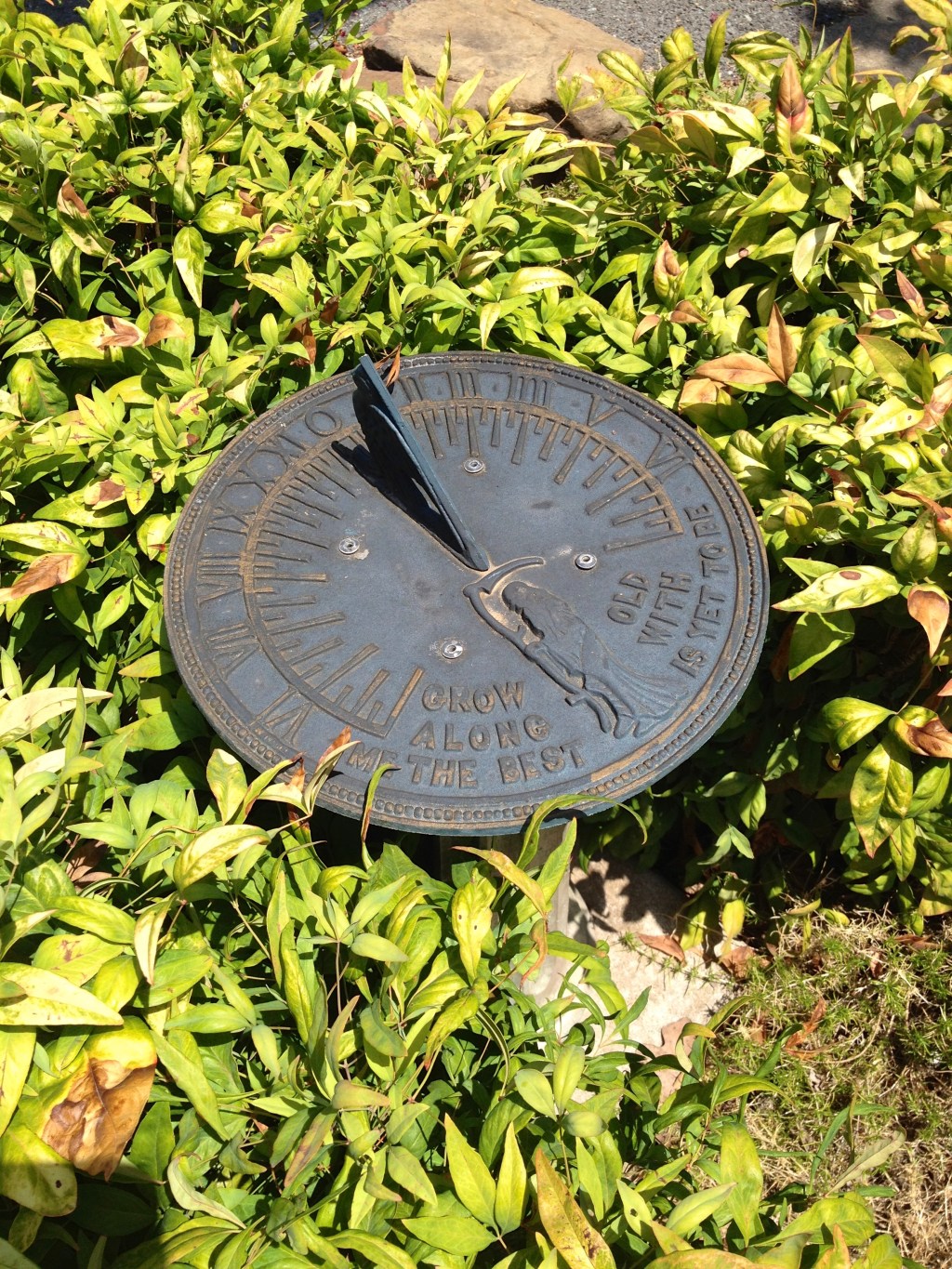
Sundial at Mt. Sequoyah

Then too, we have concepts today which ancient people hadn’t yet conceived. In Roman times, which is the time of the earliest New Testament writings, the day was divided into watches or hours. We think of those hours as having 60 minutes each, but they had no mechanical clocks for precision time keeping. The sundial kept the hour count, so a summer day had long watch hours, while a winter day had shorter ones. Since everyone was on the same system, everyone was on time, or they were late if they were my ancestors.

We all read the same Bible, but we have different translations in our hands. I choose the NRSV because it’s a modern translation that’s as literal as possible and as free as necessary, unlike the NIV, which is a dynamic translation or one that seeks to make the best readable sense of the text. Those translators have to make decisions on how to render rare words in the text. For instance, the word “arsenokoitai,” which shows up in two different verses in the bible, wasn’t translated to mean “homosexual” until 1946. It appears in the RSV, whereas in the KJV, the word gets translated as “nor abusers of themselves with mankind” (or to put it less delicately—trigger warning—masturbation).

Douris: Drinking cup (kylix) depicting an erotic scene of Eros and a youth

How was the word translated previously? It referred to the common Greek practice of pederasty: adult male love for younger boys, which everyone today would be opposed to and disgusted by this cultural practice once common in Greek society. Abuse of youths by adults is something all of us can dislike because that experience isn’t a relationship of equals. One has too much power, authority, and dominance over the other. For the same reason we object to other unequal sexual relationships: clergy and laity, counselors and campers, teachers and students, bosses and employees, and so on.

Circle of Euthymides: Two-handled storage jar (pelike) depicting young athletes jumping

This particular word shows up exactly two times in the whole Bible. It’s now translated as “sodomites.” This too is an unfortunate translation, since the sin of Sodom wasn’t homosexuality, but the townspeople’s failure to respect the laws of hospitality. When the visitors came under Lot’s protection in his home, the townies gathered outside his door and begged to have their sport with his guests. We’re horrified Lot would offer up his own daughters, but in that day and time, protecting the honor of the patriarch’s offer of hospitality to strangers was more important than anything that happened to the women of the household. We don’t have to like the culture as it was back then to get the lesson of “entertaining angels unawares.” This is an instance we’re glad fathers today have respect both for their guests and their daughters. Cultures change and we’re very glad for that.

The word “μαλακός” or Malakos refers to something soft and effeminate. It could refer to silk clothing or to an adult man who shaved his beard or grew long hair. In the Ancient Greek society, once a boy grew a beard, he was no longer subjected to pederastic abuse. Instead, he passed “the gift on” to the next generation. We’re well aware today how child abuse is generational. This is what Paul railed about in this text.

When the holidays crank up, the greedy, drunkards, and maybe a few adulterers and fornicators will go to town. The angry criticizers will probably be driving the bus and the swindlers (robbers: ἅρπαγες) will be grifting the unsuspecting flock as they barrel along. We don’t have any temples with male prostitutes as the ancient Greek cities once had. There were also women prostitutes serving at these temples, so everyone had their pick when visiting with a celebrant for an intercession with the gods. I’m really glad our current clergy orders don’t include this ritual as part of “pastoral care.” Culture changes. Maybe today’s clergy body is glad this duty isn’t added to their holiday activities.

It’s good the culture has changed from that of Rome and Athens of the first century. In fact, culture keeps on changing all the time. This is why Jesus spoke of “new wine in new wine skins.” We’re no longer a first century church, but some principles still apply. We can’t pour the new wine into an old skin, or the fermentation will burst open the weak old skin. This is why we are a new and changing church, for just as butterflies break out of their cocoons, we too have to break free from what has bound us in a past time. The Holy Spirit keeps refreshing and invigorating a living community, whether it worships in a tent, a rented room, or in a set place.

Now we look forward, to a new land, a new existence, and new possibilities. If we hear the voice of God, we hear the calling: “Go to the land I will show you.” God has always led God’s people in every place and in every time. God has brought God’s people through good times and bad, through war and peace, and in exile to the promised land. We can trust God to be faithful once again.

Joy, peace, and hope,

Cornelia

Drinking cup (kylix) depicting an erotic scene of Eros and a youth
Signed by: Douris: clay, Greek, made in Attica, Athens, Late Archaic Period, about 490–485 B.C., Museum of Fine Arts, Boston, MA.

Two-handled storage jar (pelike) depicting young athletes jumping
Circle of Euthymides (Greek), Archaic Period, about 520–515 B.C., Museum of Fine Arts, Boston, MA.

Drinking cup (kylix) depicting pentathletes
Onesimos: Greek, Late Archaic Period, about 500–490 B.C., Museum of Fine Arts, Boston, MA.

NOTES:
(PDF) Canon, criterion and circularity: An analysis of the epistemology of canonical theism of Billy Abraham
https://www.researchgate.net/publication/328641188_Canon_criterion_and_circularity_An_analysis_of_the_epistemology_of_canonical_theism

Crossing the Threshold of Divine Revelation: Abraham, William J.
Here Abraham argues for divine revelation as another leg of understanding and interpretation of church traditions and scripture.

Canon and Criterion in Christian Theology: From the Fathers to Feminism
by William J. Abraham
This is a seminary textbook and historical overview.

“John Wesley’s Notes On The Entire Bible” by John Wesley (1754)
Start reading it for free: https://a.co/3UKifSG

Has ‘Homosexual’ Always Been in the Bible? – United Methodist Insight
https://um-insight.net/perspectives/has-“homosexual”-always-been-in-the-bible/

The Use and Misuse of John Wesley on the Authority of Scripture |
Glen O’Brien – Academia.edu
https://www.academia.edu/5946863/The_Use_and_Misuse_of_John_Wesley_on_the_Authority_of_Scripture

Michael Roberts: Connected in Christ—great discussion on this topic
https://connectedinchrist.net/2022/07/14/wesley-on-human-sexuality-and-his-commentary-on-often-cited-verses/

Strong’s NT 3120: https://biblehub.com/greek/3120.htm

Strong’s 733: https://biblehub.com/greek/733.htm

Strong’s 727: https://biblehub.com/greek/727.htm

NOTES ON μοιχοὶ οὔτε μαλακοὶ οὔτε ἀρσενοκοῖται—

STRONGS NT 3120: μαλακός
μαλακός, μαλακή, μαλακον, soft; soft to the touch: ἱμάτια, Matthew 11:8 R G L brackets; Luke 7:25 (ἱματίων πολυτελῶν καί μαλακων, Artemidorus Daldianus, oneir. 1, 78; ἐσθής, Homer, Odyssey 23, 290; Artemidorus Daldianus, oneir. 2, 3; χιτών, Homer, Iliad 2, 42); and simply τά μαλακά, soft raiment (see λευκός, 1): Matthew 11:8 T Tr WH.

Like the Latin mollis, metaphorically, and in a bad sense: effeminate, of a catamite, a male who submits his body to unnatural lewdness, 1 Corinthians 6:9 (Dionysius Halicarnassus, Antiquities 7, 2 under the end; ((Diogenes Laërtius 7, 173 at the end)).

Strong’s Exhaustive Concordance: effeminate, soft. Of uncertain affinity; soft, i.e. Fine (clothing); figuratively, a catamite — effeminate, soft.

Thayer’s Greek Lexicon, STRONGS NT 733: ἀρσενοκοίτης
733 arsenokoítēs (from 730 /árrhēn, “a male” and 2845 /koítē, “a mat, bed”) – properly, a man in bed with another man; a homosexual.
ἀρσενοκοίτης, ἀρσενοκοιτου, ὁ (ἄρσην a male; κοίτη a bed), one who lies with a male as with a female, a sodomite: 1 Corinthians 6:9; 1 Timothy 1:10. (Anthol. 9, 686, 5; ecclesiastical writings.)

Rabbit! Rabbit!

adult learning, at risk kids, brain plasticity, Children, city, Dreamscape, Faith, Family, flowers, Healing, holidays, Icons, Love, mandala, Mandylion, Ministry, ministry, nature, Prayer, purpose, rabbits, Reflection, renewal, risk, school shootings, shame, Spirituality, Stonehenge, summer solstice, texas, Uncategorized

Welcome to June! I’ve found my sunshades and my flip flops, so this rabbit is ready for a summer vacation. Old school teachers never die, they just take the summer off. And teachers, as well as students, will need a summer off, along with some intensive counseling, to get them ready to return in a healthy frame of mind next fall.

Summer Solstice Mandala

In my early years in ministry, I served in a certain county where many people were caught up in despair. I often complained to my district superintendent of my desire to pour mood elevators into the public water supply.

“You do know drugging the water supply isn’t exactly an acceptable activity for a Methodist minister?”

“Oh, yeah, but it sure would make my job easier.”

Rabbits Love One Another

Remember, June 3 is Love Conquerors All Day. I need to remind myself of this on occasion when I want to take the easy road. As Jesus reminds us in Matthew 7:13—

“Enter through the narrow gate; for the gate is wide
and the road is easy that leads to destruction,
and there are many who take it.”

Taking the easy way out isn’t always the best choice, but it’s the one we rabbits most often choose. We rabbits don’t like to rock the boat, and we like to make all the other rabbits happy if at all possible. The only problem is if we please A, B gets upset. If we please B, A gets upset. We don’t even try to please C, since C is so cranky, even the good Lord Jesus couldn’t fry an egg to please them. We set our hearts and minds on pleasing God, as best we can, and hope to hear the words, “Well done, good and faithful servant, enter into the joy of your master.”

Make Mine Chocolate Ice Cream Day

Chocolate ice cream brings me joy any day of the year, but June 7 is a day dedicated to this frozen delight. Don’t worry about frying eggs, but keep it frozen. I like mine plain, but fresh strawberries or peaches are a nice addition, plus some chopped nuts. Always go for complex, unless you just can’t wait. Then grab a spoon and eat it straight from the pint. (Mark it with your name, since you ate from it.)

Often we cut the Gordian Knot and go for the shortcut to our complex problems. Sometimes this is a good solution, for the shortest distance between two points is a straight line. My daughter used to call my vacation navigation shortcuts “the long cuts,” since I’m directionally challenged. Most of the time, that straight line went through swamp land and alligators. I can hear her voice now, “NOOOOO!!!” I’m known for taking the scenic route, so I often see America’s less known sights, which are off the beaten path.

In the gospel of Luke (14:34), Jesus quotes a proverbial saying:

“Salt is good; but if salt has lost its taste, how can its saltiness be restored?”

Another translation of the latter portion of this verse is “how can it be used for seasoning?”

When I think of loss, I think of a life snuffed out. Some people are burned out, so we can say they’ve lost their seasoning ability. There’s no vim or vigor in them. Other lives are cut short and aren’t able to fulfill their purpose to season the great soup of our community. Our past month was marked by 47 mass shooting incidents in May alone. A mass shooting incident is defined as one in which at least four people are injured or killed, not including the shooter. Suicides aren’t included.

Suicides are also a public health problem. They are the “deaths of despair” that leave ripples of grief and hopelessness in the survivors. They’re the ultimate shortcut solution to a problem, the placing of a period where life has placed a comma or a semicolon. My daughter once attempted suicide by downing half a bottle of aspirin. I noticed the open bottle and pills scattered across the floor. She said the “dog ate it.”

“That’s too bad, I’m going to miss that dog. She won’t be long for this world. We’ll need to make burial plans for her.”

“Well, actually, I’m the one who ate the aspirin.”

“Then we’re going to the hospital. You aren’t going to like getting your stomach pumped, but it’s better than being dead. You want to have a chance to grow up and have a good life. A dog we can replace. You—not so much.”

It was a rough time in her life, and mine too. But God was with us. And we had support from counselors, friends, family, and our church family. My work family and my clients supported me too. I must be the most extroverted rabbit in the patch, because I asked everyone for help. It turned out my problem was shared by everyone else. I discovered I wasn’t alone, but was the most ordinary of rabbits around.

This is a humbling experience, especially when you’re a first child and the only girl. I admit to being spoiled, but don’t let my brother rabbits hear me say this. I’ll deny it to my last breath: I’m like every other rabbit I know. I want to think I’m someone special, even when I’m just as fluffy as every other bunny out there on Gods green earth.

June 21—Summer Solstice

Unfortunately, half the suicides today are committed with a gun, not aspirins. When looking at overall gun deaths, roughly two-thirds are attributed to suicides—a proportion that is consistent across most states. Gun suicides are on the rise and data also indicates men, white Americans, older people, and individuals living in rural areas present higher rates of gun suicides. Another group presenting a unique risk for suicide is current and former members of the armed forces, especially those with PTSD.

Compared with the general population, current and former military members have significantly higher rates of gun ownership. According to a 2015 study, nearly 50% of U.S. veterans own a gun. In contrast, studies suggest that only about 22% of the general U.S. population owns firearms. Similarly, the age groups of 50 to 64 years old and 65 and older have the highest rates of gun ownership, according to a 2017 Pew Research Center study. This can further explain the high rates of suicide among older veterans.

According to data from the U.S. Department of Veterans Affairs (VA), in 2019, close to 4,332 veterans died by gun suicide in the United States, representing close to 18 percent of the total number of gun suicides reported by the Centers for Disease Control and Prevention (CDC) during that year. Perhaps more alarming is the fact this figure shows a veteran is killed by gun suicide every two hours. In 2019, active duty military members committed suicide by gun 64% of the 498 total (318), almost one gun suicide per day.

Why isn’t anyone speaking about this? For all the lip service our politicians give to the flag and to the armed service members, they seem to forget them once they’re no longer useful to fight their wars or march in their parades. Perhaps because Congress won’t devote any money to study the effects of gun violence on the citizens of our Beautiful America, so we have to fund private studies here and there to piece together a patchwork of facts of this scourge on the peace of our people.

My young neighbor, only 8 years old, was in a panic as he knocked on my door the other day. His parents hadn’t come straight up the elevator, as they’d said they would. He was crying to beat the band and was sure something bad had happened to them. I invited him inside and left the door open so we could see them come past. He was so worked up, he couldn’t sit down. I suggested a call to his daddy, but they came walking past just at that moment.

June 19—Father’s Day

We don’t realize what terror these school shootings put our children through. There’s no safe place for them any more, no matter how “hardened” we make the buildings. Some person always breaks the shell at the most inopportune moment.

Some rabbits will have empty seats at their family reunion tables because someone decided to act impulsively. Father’s Day (June 19) won’t be a celebration without the son or daughter to give Dad the tie, the golf balls, or breakfast in bed.

I think back to my own childhood. We worried in the 1950’s more about the urban legends of Halloween candy poisoning, when we were more likely to get killed crossing Highway 1, a four lane highway running through our town. My mother rabbit would wait for me to ride the trolley home from school. She would wait until the near lane of traffic cleared before she walked out to the center median and time this so the far lane’s cars would finish passing so she could walk across the newly empty lanes to meet me on the other side. We held hands and crossed in the same manner on the way back to our home.

This was our routine from the start of school until sometime in the autumn. Mother was delayed one day, so I sat down to wait for her and opened my book to read. I was wearing a brown jacket against the early cool spell, and my dirty blonde hair blended in with the pile of dry leaves on the ground. Intent on my book, I failed to see her come outside. She overlooked me and went inside thinking I’d missed my ride.

A bit later, I decided if she wasn’t coming for me, I’d come to her. Gathering up my possessions, I stood on the curbside. I watched the comings and goings of the quickly moving traffic. Once I saw the break in the pattern, I walked out into the clearing, waited at the median, and crossed behind the trailing traffic of the second lane. When I walked inside, my mother had a conniption fit. After this, I began riding my bicycle to school, and my brother got to come with me.

Brain Functions

Not everyone is mature enough to cross a four lane busy highway by themselves when they’re in the fourth grade, which is the same age as the children who lost their lives at Robb Elementary in Uvalde, Texas. . Some people still need to be supervised at work even in their 20’s. The brain keeps maturing past age 21, as the frontal lobes, which are home to key components of the neural circuitry underlying “executive functions” (such as planning, working memory, and impulse control) are among the last areas of the brain to mature; they may not be fully developed until halfway through the third decade of life. Although neuroscience has been called upon to determine adulthood, there is little empirical evidence to support age 18, the current legal age of majority, as an accurate marker of adult capacities.

Since May 24, the date of this tragedy in Uvalde, Texas, the gunviolencearchive.org has recorded 16 mass shootings in six days, with 79 killed or wounded. Some of these are high school graduation parties where uninvited guests arrived and gunfire broke out, others are the result of young people wandering about in the late hours and getting into trouble with guns. During my time of ministry, youth, alcohol, and firearms were usually a recipe for trouble. Maybe parental rabbits’ brains are still developing too, if they aren’t able to put their rabbit foot down and tell the junior rabbits to leave their weapons at home. Visiting Jack Rabbit in jail for accidental death or intentional use of a firearm will throw a curve into your best laid plans for your progeny.

Rabbits in Cars Going for a Joyride

Instead, cities may have to reinstitute curfews after dark to curtail the opportunities for gun violence. Or they could raise the age to buy a weapon and require a longer waiting time and a more thorough background check. I wouldn’t be opposed to a training class and a test to see if the owner knows how to use the weapon safely. After all, we do this for the 2 ton weapon of mass destruction known as the family automobile. So what if the founding fathers never had autos; they also never had automatic pistols or large magazine weapons, modeled on the ones used in combat.

Did I mention June is National Safety Month? Its emphasis is workplace safety, but as a former teacher, this old rabbit reminds you, between 2009 and 2020, teachers’ workplaces are in schools, which is where 30% of mass shootings occurred in public places (schools, malls, or bars), while 61% of mass shootings occurred entirely in the home and another 9% occurred partially in a home and partially in a public location. The common factor in these is the gun and the presence of domestic violence. In at least 53 percent of mass shootings between 2009 and 2020, the perpetrator shot a current or former intimate partner or family member during the rampage.

Richard Small seen posing with his rifle before turning it over to police.
(Joshua Lott/The Washington Post)

I know y’all usually expect a bright and cheery note from me at the beginning of the month, but my heart is broken. Thoughts and prayers are nice, but they don’t stop the carnage. We need to make some changes. At least one man has turned in his assault weapon to his local police station, so it doesn’t fall into the wrong hands. He couldn’t bear the thought of it being used to perpetrate a similar crime if he were to sell it. If we parents don’t say no to our children, if we keep voting for politicians who are doing nothing, then we get to keep the distinction of having the highest rate of violent gun deaths for any of the developed countries.

That’s not the American Exceptionalism I believe in. We can do better. These are crimes against the common good and against the innocent. The shooter shares the primary blame, but everyone who does nothing to change our society for the better also shares the blame and shame for the next group of victims. At the rate we’re going, we’re having about one mass shooting per day. Eventually this scourge will come to YourTown, USA, and your small town police force will be just as flabbergasted as poor Uvalde’s. How could this happen in our little corner of the world?

I cry along with Jeremiah ( 8:21-22):

For the hurt of my poor people I am hurt,
I mourn, and dismay has taken hold of me.
Is there no balm in Gilead?
Is there no physician there?
Why then has the health of my poor people
not been restored?

Time Magazine Cover from 2019 with all the Mass Shooting Locations Named

Sometimes we go along with the attributes of cultural Christianity, rather than practicing the Christianity of Jesus Christ. Romans 12:2 reminds us

“Do not be conformed to this world, but be transformed
by the renewing of your minds, so that you may discern
what is the will of God—what is good and acceptable and perfect.”

Joy, peace, and balm for hurting souls,

Rev. Cornelia

Deadly Dreams: What Motivates School Shootings? – Scientific American
https://www.scientificamerican.com/article/deadly-dreams/

You can view a report of any 2022 mass shooting incident by visiting the list on the Gun Violence Archive’s website:
https://www.gunviolencearchive.org/reports/mass-shooting

Poisoned Halloween Candy | Snopes.com
https://www.scientificamerican.com/article/deadly-dreams/

Mass Shootings in America | Everytown Research & Policy | Everytown Research & Policy
https://everytownresearch.org/maps/mass-shootings-in-america/

Adolescent Maturity and the Brain: The Promise and Pitfalls of Neuroscience Research in Adolescent Health Policy – PMC
https://www.ncbi.nlm.nih.gov/pmc/articles/PMC2892678/

Guns and Mass Shootings: Data Show Why US Is Outlier on Deaths From Firearms
https://www.bloomberg.com/graphics/2022-us-gun-violence-world-comparison/

Texas romance with guns tested by Uvalde school shooting – The Washington Post
https://www.washingtonpost.com/nation/2022/05/30/uvalde-shooting-guns/

Sunflowers and Shadows

adult learning, Alexander the Great, art, Carl Jung, Creativity, Faith, grief, Holy Spirit, Imagination, inspiration, Ministry, Painting, perfection, Plato, Prayer, Socrates, Stress, Ukraine

DeLee 2019, Drying Sunflowers

A sunflower follows the sun. Actually, only young sunflowers track the sun across the sky, while mature sunflowers face east. Why is this? Why do we care? As sunflowers fill our Facebook feeds and social media posts, most of us are looking at flowers so we can ignore the awful consequences of this unprovoked war. Right now, many of us are heartbroken because of the humanitarian crisis unfolding in Ukraine. I had only a passing knowledge of this country because of its well known naïve artist, Maria Primachenko and her paintings of fantastic imaginative animals in gardens. They have always been a delight to my soul and a joy to my spirit. Many of her works include the sunflower, Ukraine’s national flower. Sunflowers have been grown in Ukraine since the mid 1800’s, and are not only an important export crop, but also a symbol of peace. When Ukraine gave up its nuclear weapons in 1994, people planted sunflowers as a symbol of the peace they hoped would follow.

Maria Primachenko
A Dove Has Spread Her Wings And Asks For Peace (1982)

Sunflowers, when young, follow the sun on a 24 hour circadian cycle, just as our bodies have a similar cycle keyed to the light and dark. When the flowers are growing, they maximize their time facing the sun, but once they’re mature, they set their face toward the east, since this gives the head maximum warmth. Bees love warmth, so keeping the buzzing crowds near is in the sunflowers’ best interest for pollination and reproduction.

Heat map of sunflowers at different times of the day

Most of us prefer the sunny days. Clouds, storms, and distress aren’t our first choices. After the last few years of pandemic stresses, we’re unprepared for yet another crisis, even if it seems to be on a distant continent. Our own supply chain for reserves of caring and concern have been stretched thin by the nearly million deaths from COVID in our nation alone, not to mention the worldwide death toll of over 6 million. On Friday in Sam’s Club, I met a lady who complimented me on my flowered pants, which I was wearing in honor of the Ukrainian folk painter, whose museum had been bombed by the Russian army.

“I can’t bear to even listen to the news any more. It’s all so awful,” she said.

I should wear this shirt on Friday at Sam’s Club.

“I know. It reminds me too much of domestic violence cases, where the man decides he’ll punish the ex by killing all the children and taking himself out also.”

My blood sugar usually drops low on Friday after art class, before I eat lunch, so I don’t have my usual, civilized filter on my mouth. The look of awareness on her face was the sudden recognition of a truth she had refused to see before. Sometimes we need to face our fears and deal with them. This is the hero journey. None of us can travel it alone, but far too many fail to ever set out on it at all, even with a spiritual companion or guide. My failure to snack at art class upset her comfortable apple cart and caused her distress. She ran out of Sam’s in a heartbeat. I was able to chat with a baby and her mom later on, who was amazed her child wasn’t at all afraid of this stranger. Food is a medicine for my mood and a bridle for my mouth.

Morandi: Still Life of Bottles with Strange Shadow

On a sunny day, we can see our shadow. Most of us are afraid of our own flickering shadows. We don’t want to see the darkness within us, even though we’re ever ready to see the sinister images of others. Like a sunflower, we’ll turn instead to the light and only see the good, the beautiful, and the true.

A story I remember from my classical art studies regards Alexander the Great and the shadows. His father Phillip II, the ancient king of Macedon, had a difficult, high strung horse, which no one had been able to ride. In fact, it was downright vicious and unmanageable, which made it less of a “gift” to the ruler. Alexander, even though a youth, noticed the handsome horse was disturbed by his own shadow, so he turned the animal’s head into the sun, attached the bridle, and was able to mount him. Alexander rode Bucephalus until the horse’s death at the Battle of the Hydaspes in 326 B.C.E. In his honor, Alexander named a local city, Bucephala (sometimes identified with the modern Jhelum, in the Punjab province of Pakistan), after him.

Mosaic of Alexander the Great and Darius in Battle from the House of The Faun, Pompeii, 3rd century BCE

“Who looks outside, dreams; who looks inside, awakes,” Carl Jung wrote to one Fanny Bowditch, on the eve of his entry into military service during the First World War. Jung believed as long as you looked at other people and projected your own psychology into them, you could never reach harmony with yourself. Jung taught all persons had a shadow side to their personality, or those aspects of ourselves which we’ve repressed. These may be both bad or good aspects, for some of us have yet to realize our own brutal natures, as well as the heroic figures which we’ve also buried inside.

DeLee: Endless Nights of Pain, Ireland, 1973

My old granddaddy was fond of saying, “When you point out another’s failings, you have three fingers pointing back at yourself.” I came to learn I couldn’t recognize the fault in others unless I could claim it also in my own self. This keeps one humble for sure, but it also keeps a person from thinking he or she has any godlike or dictator qualities.

This brings me to another famous shadow story involving Alexander the Great. After his father’s death, he visited Corinth, where Diogenes the Cynic lived in 326 BCE. Diogenes was famous for carrying a lamp in the middle of the day in his “search for an honest man.” In the most famous exchange of this meeting, Alexander asked Diogenes whether there was anything he could do for him. Diogenes, who was enjoying the warmth of the autumn sun, answered, “Stand aside to stop blocking the sun.”

Statue of Diogenes and Alexander

This abrupt response, showing Diogenes’ utter contempt for the power and prestige craved by Alexander, inspired many artists over the years. Although Alexander’s attendants took offense at Diogenes’ rudeness to their king, Alexander himself wasn’t displeased. Leaving, Alexander was said to reply, “If I were not Alexander, I would want to be Diogenes.”

When I brought these delightful images from Maria Primachenko to class, Gail and Mike were amazed at how bright, flat, and clean her designs were. Partly this is due to her use of gouache, an opaque water based color paint. She also uses repeated motifs, symmetry, and clean lines with sharp color contrasts to make her images “pop,” as the decorators say. Mike, who favors textures, was thrilled to see another artist who paints like he does. Gail was glad to process the distressing news through flowers and the yellow and blue of the national flag of Ukraine.

Gail’s Unfinished Painting

Often we don’t feel “safe” speaking about dark or upsetting experiences, preferring instead to bury them deep inside. This is maybe the worst decision we can make, for like a poison or an infection, what we refuse to bring to the light will fester and grow. Then it further sickens the body or the mind until it becomes unrecognizable and unhealthy. Perhaps this is when we move from being rational to irrational. As I always tell folks, “Just because you think the world operates on reason and order, doesn’t make it so.” By this I mean, we live in a world with accidents, change, disease, sociopaths, and greed. In biblical terms, we live in a broken and fallen world, one in which even those of us who are “saved by the blood of Christ” from the wages of sin are “not yet perfected in the love of God and neighbor.”

This is what it means as a Christian to carry the Jungian shadow within us. If we believe keeping a law is the best evidence of our faithfulness, we can overlook the moral quality of the law itself and find ourselves carrying out harm, rather than doing good. As the writer of Hebrews explains in the platonic argument of Christ’s Sacrifice Once for All:

“Since the law has only a shadow of the good things to come and not the true form of these realities, it can never, by the same sacrifices that are continually offered year after year, make perfect those who approach.” (10:1)

Mike’s unfinished painting

If we want to be law keepers, we can’t be picking and choosing which laws we want to keep, as if the law were a cafeteria or buffet table. Jesus certainly knew what potholes lay ahead of him after his baptism in the Jordan River. A forty day fast in the wilderness is great for getting your head together and dealing with our human nature’s dark side of desire for security, power, and equality with god.

Maria Primachenko
Don’t Feast Your Eye’s On Other People’s Bread (1983)

I post my Artandicon blog on LinkedIn as well as on my various spiritual formation Facebook pages which I manage. I sometimes get a message from folks there. One was from a friend, who mentioned she really wanted to get back into her art, “for it brings her peace.” I tell people, “the process of making art brings satisfaction, but we’re not ever satisfied with the work itself.” If we were ever to be satisfied with the work, if we thought we could reach no higher, or if we thought so highly of ourselves that we’d made the last best artwork for all times, then we’d have to quit and make pancakes, until we’d perfected those. And then we’d find a new obsession.

Cornelia’s Painting with Nuclear Monster Destroying a Church

My favorite monsters are those from the Japanese nuclear monster movies of the 1950’s. They are both kitschy and scary. The sunflowers destroyed by these monsters of war will fall to earth and be reborn once again in ever increasing numbers. If hope is the last to die, it’s also the first to rise again. As long as one has breath, one can hope. As Paul wrote to the believers in Rome long ago,

“May the God of hope fill you with all joy and peace in believing, so that you may abound in hope by the power of the Holy Spirit.” (15:13)

Making art is a metaphor for the hero’s journey. Jung believed art was important because often the hands will solve a mystery that the intellect has struggled with in vain. We don’t know what battle or monster awaits, but we also don’t know what divine spirit will come to our aid. Along the fantastic inward journey, we’ll meet the very same creatures who are outside of us. They arise in our dreams, but they were planted in our awakening moments. We may have been turning our faces towards the sun, like the baby sunflowers or the horse Bucephalus, but soon enough we’ll trust the one who guides us and we’ll go wherever it’s necessary.

The journey toward Christian perfection in love is a heroic journey, one which we can only undertake with the help of the Holy Spirit. Along the way, we also travel with others on same road: mystics, saints, and holy persons from yesterday and today. As the old camp song refrain goes,

“And they’ll know we’re Christians by our love, by our love,
They’ll know we’re Christians by our love.”

Maria Primachenko:
May I Give This Ukrainian Bread To All People In This Big Wide World (1982)

The following prayer, Psalm 23, has comforted people for thousands of years in times of trouble and grief. Here in the English Standard Version, if you have fears, trepidations, or trembles, it might help you to calm your spirit. As you speak it aloud to the rhythm of your inhalation and exhalation of breath, remember those who have given up their lives rather than reject their faith: Christian martyrs in the Roman coliseum, Jewish martyrs in the holocaust, and democratic freedom fighters around the world. Let your voice be heard, even as their voice is being silenced:

The LORD is my shepherd; I shall not want.
He makes me lie down in green pastures.
He leads me beside still waters.
He restores my soul.
He leads me in paths of righteousness
for his name’s sake.
Even though I walk through the valley of the shadow of death,
I will fear no evil,
for you are with me;
your rod and your staff,
they comfort me.
You prepare a table before me
in the presence of my enemies;
you anoint my head with oil;
my cup overflows.
Surely goodness and mercy shall follow me
all the days of my life,
and I shall dwell in the house of the LORD
forever.

Joy, peace, and sunflowers,

Cornelia

The Mystery Of Why Sunflowers Turn To Follow The Sun — Solved : The Two-Way : NPR
https://www.npr.org/sections/thetwo-way/2016/08/05/488891151/the-mystery-of-why-sunflowers-turn-to-follow-the-sun-solved

Alexander and Bucephalus | Department of Classics | University of Colorado Boulder
https://www.colorado.edu/classics/2018/06/19/alexander-and-bucephalus

Putin’s Invasion of Ukraine Is a Sin All Russians Will Bear
https://www.bloomberg.com/opinion/articles/2022-02-24/putin-s-invasion-of-ukraine-is-a-terrible-sin-that-all-russians-will-bear

Carl Jung: “Who looks outside dreams; who looks inside awakes.” – Carl Jung Depth Psychology
https://carljungdepthpsychologysite.blog/2020/02/08/carl-jung-i-am-afraid-that-the-mere-fact-of-my-presence-takes-you-away-from-yourself/

Carl Jung – Archetypes – Shadow
https://www.carl-jung.net/shadow.html

Carl Jung: “Often the hands will solve a mystery that the intellect has struggled with in vain.” – Jung Currents
https://jungcurrents.com/jung-hands-intellect-mystery

They’ll Know Are Christians by Our Love
https://www.hymnlyrics.org/newlyrics_t/theyll_know_we_are_christians_by_our_love.php

Changing Seasons

adult learning, Altars, art, Creativity, Faith, Israel, nature, Painting, pandemic, Prayer, pumpkins, Spirituality, sukkot, vision

When the seasons change, I have days when I drag. My get up and go has done got up and went. Perhaps my increasing age has something to do with this feeling, or the pandemic’s lack of social interaction has dulled my senses. Some days I think I’m moving through molasses, and then the next I wake up on a brighter side of the bed.

Occasionally, I wonder where my mind is. I recently had to get the attendant at the Kroger gas station to help me pump the gas. When I used my loyalty card, the pump didn’t reduce my price. I forgot this pump had a screen prompt, which I’d ignored. Once I was retrained, I got the good discount and filled my car up. I really need to get out more. I’m not driving as much as I once did because of this pandemic. I used to say, “My brain has gone to Pluto,” but now it seems to have gone to the pandemic instead. I could always count on the old grey matter making the circuit back to earth, eve if it took 248 years, but until this Pandemic passes, I may be slightly silly. Some of you will say, “No one can tell the difference,” but I know better.

Enforced Solitude

One of the benefits of this enforced solitude, which we’ve all endured, is we’ve had the opportunity to consider everything tried and true, and decide if we need to keep it or do something different instead. Some of us have redecorated our homes, take up a new hobby or occupation, or even become teachers or caregivers. Many of us cleaned out our closets and clutter because looking at it daily was too much. We’ve done what we had to do. Others of us have held on to the old traditions, as if they were security blankets. We won’t change them until our world feels safe again.

To make progress in art or any creative endeavor, sometimes we have to “burn the security blanket” before we can go forward. This is hard to do, for we get comfortable with whatever small success we first make. Basketball great Kobe Bryant would practice by himself for hours before his teammates showed up and would make four hundred shots every single practice. Notice that’s MAKE, not TAKE. Work ethic is a hallmark of greatness. Kobe was never satisfied with only the good, but sought to be his best.

Building a Community of Encouragement

Yet we are also people who need encouragement, and this means we need community. In community we can build each other up by “catching the good each one does.” We can reward and praise this, even though we usually find ourselves pointing out the spot a person missed, or how they could do it better next time. There’s a difference between criticism and critiquing someone’s work. Criticism usually only has negative statements, but a good critique begins with at least three positive comments before it notes what needs improvement and how to accomplish that task.

Artists and creative persons learn over the years to separate their identities from their work. Who we are as God’s beloved children never changes, no matter how badly our work gets panned. Most of us artists think we’re misunderstood anyway, so we go back to our studios and work some more. Words won’t kill us, and plenty of artists were never commercially successful. Most artists or creative people work at their craft because they have an inner need to express their experiences or ideas about the world in which they live.

Finding Our Own Voice

We work to discover who we are and what our voice would say to the world. In most art classes, the teacher makes a model and the students attempt to copy it as faithfully as possible. This process may use the elements of art, the media of art, and the end product may look like art, but the students are imitating someone else’s creative process. Thinking through the problems of shape, shadow, color, composition, and texture are part of the creative process. I’m very proud of our group, for each person is finding an individual voice. You would be able to identify their work, even if it were unsigned.

Season of Harvest

Hoshana Raba (Heb. הוֹשַׁעְנָא רַבָּא; “the great hoshana”) is a name for the seventh and last day of the Sukkot festival, or the Festival of Booths or Tabernacles. Sukkot has a dual significance: historical and agricultural. The holiday commemorates the forty-year period during which the children of Israel were wandering in the desert, living in temporary shelters. Sukkot is also a harvest festival, and is sometimes referred to as Chag Ha-Asif, the Festival of Ingathering.

In the medieval poem “Om ani homah” attributed to Eleazar Kalir, the Israel nation declares ‘I am a wall’. The poem is recited during Hoshana Raba (Great Supplication) which begins this evening.

The image is from the British Library Manuscripts collection.

Ingathering or Harvest Festivals are part of the seasonal experiences of our lives. Last week I brought a bunch of gourds and pumpkins in for class. I gave each person the opportunity to choose the ones that spoke to them to use for their still life. We had quite the variety of solutions.

Gail’s pumpkins were bold and bright, filling the canvas.

Gail’s Pumpkins

Mike’s were exuberant and about to come alive with energy.

Mike’s Gourds

Margaret was new in class, and made a highly textured still life, complete with cast shadows.

Margaret’s Textured Gourds

Mine were socially distant, a commentary on this pandemic life.

Socially Distant Gourds

I brought the pumpkins and gourds home to grace my altar. It changes with the seasons, so come advent, it takes a more exuberant and celebratory vibe. For autumn, it’s full of natural bounty. When Nehemiah was celebrating the festival of booths and purifying the temple, this was the prayer of the people:

“O Lord, Lord God, Creator of all things, you are awe-inspiring and strong and just and merciful, you alone are king and are kind, you alone are bountiful, you alone are just and almighty and eternal. You rescue Israel from every evil; you chose the ancestors and consecrated them. Accept this sacrifice on behalf of all your people Israel and preserve your portion and make it holy. Gather together our scattered people, set free those who are slaves among the Gentiles, look on those who are rejected and despised, and let the Gentiles know that you are our God. Punish those who oppress and are insolent with pride. Plant your people in your holy place, as Moses promised.” (2 Maccabees 1:24-29)

October Harvest Altar

All good things come from God, and we owe our lives and our living to the Holy God. Help us to care for the least among us, especially those who hunger and thirst at this time of harvest and during this season of change.

Upcoming events:

Friday classes—through October

October 23—Autumn Wreathes

October 30—Day of the Dead Skull Cookies

November 6—Painting

November 13—No Class

TBA—holiday season and school vacation calendar

Pluto’s Unusual Orbit: https://airandspace.si.edu/exhibitions/exploring-the-planets/online/solar-system/pluto/orbit.cfm

adult learning, arkansas, art, beauty, coronavirus, Creativity, Faith, Habits, Healing, Meditation, Ministry, nature, Painting, pandemic, poverty, Prayer, renewal, Spirituality, stewardship, trees, vision

Who had hurricanes named with the Greek alphabet on their 2020 Bingo card? In a season when catastrophic west coast fires cause Pumpkin Spice skies, we shouldn’t be surprised. Heat lightning striking drought parched national forests and a gender reveal party blunder set off the blazes. Over the years, all of the top 10 costliest wild land fires in the country have been in California. The costliest of all was Camp Fire in 2018, which set insurers back over $8.5 billion, according to numbers tallied by the Insurance Information Institute. But the Camp Fire was just one fire. Reinsurer Munich Re estimates the costs for all the wildfires that year to be over $20 billion. So far this year’s fires should bring in a similar calculation.

Hurricane Sally knocked out power to 320,000 people along the Gulf Coast and caused initial damages of over $29 million just to roads and public buildings. Homes and personal property damages have yet to be counted. Folks are waiting for flood waters to recede for that estimate to accrue. Over thirty inches of rain fell at the coast, with lesser amounts inland. A major section of a three mile long bridge collapsed, with no date for repair.

None of the dollar costs account for the loss of precious lives, the impact on businesses, or the quality of live in these hard hit areas. Is New Orleans the same post Katrina? Are Miami and Puerto Rico thriving yet? Most of Houston has recovered from the $127 billion loss due to the 2017 hurricane and flooding of the lowlands in the city, and now a large portion of its residents believe climate change is a clear and present threat to future flooding.

The climatological peak of the Atlantic hurricane season is around the second weak of September, which means that August is normally when we start to see a major ramp up of tropical cyclone activity. The year 2020 being, well, a crazy pants year, 2020 is writing a new script. Records are dropping like flies this season as we’ve come to realize those 21 names aren’t going to be enough. Already Tropical Storm Beta, the second letter in the Greek alphabet, is threatening the Bahamas

According to the National Hurricane Center website, “In the event that more than twenty-one named tropical cyclones occur in the Atlantic basin in a season, additional storms will take names from the Greek alphabet.” In 2005, six storms were named with the Greek letter alphabet. During the Great Depression in 1933, hurricane season was also great, with twenty-seven named storms, which beat the former record of 21 storms, according to NASA. Zeta formed December 30, 1933, after the official end to the season.

The number and cost of disasters are increasing over time due to several causes. These include increased exposure or values at risk of possible loss, and vulnerability or how much damage does the intensity of wind speed or flood depth at a location cause. We also consider how climate change is increasing the frequency of some types of weather extremes that lead to billion-dollar disasters. There were four billion-dollar weather disasters in the United States in August 2020, according to scientists from the National Oceanic and Atmospheric Administration: the derecho storm that hit the Midwest, Hurricanes Isaias and Laura, and California’s wildfires.

Curry: The Line Storm

A wonderful 1934 oil painting, “The Line Storm,” by John Steuart Curry, 1897-1946, possibly inspired by the approach of a derecho-producing storm in Curry’s home state of Kansas, shows the dramatic approach of the shelf cloud driven by the straight line winds.

These storms and their costs weren’t a record, but warming temperatures do account for more frequent and intense weather events. This is important because a report commissioned by President Trump’s Commodity Futures Trading Commission issued dire warnings about climate change’s impact on financial markets, as the costs of wildfires, storms, droughts, and floods spread through insurance and mortgage markets, pension funds and other financial institutions. In calling for climate-driven policy changes, the report’s authors likened the financial risk of global warming to the threat posed by the coronavirus today and by mortgage-backed securities that precipitated the financial crash in 2008. The wildfires in California this year alone have burned 5 million acres of forested lands. To grasp the size, compare Arkansas’s forests, which cover 19 million acres or 56 percent of the State and contain 11.9 billion trees.

Sometimes we’re like Egyptians who live along De-Nile. If we can ignore the problem today, someone else can take care of it tomorrow. Unfortunately, this isn’t the order of God’s world. In the beginning, “God made the two great lights—the greater light to rule the day and the lesser light to rule the night—and the stars.”
(Genesis 1:16)

Moreover, “…God created humankind in his image, in the image of God he created them; male and female he created them. God blessed them, and God said to them, “Be fruitful and multiply, and fill the earth and subdue it; and have dominion over the fish of the sea and over the birds of the air and over every living thing that moves upon the earth.” (Genesis 1:27-28)

To rule and to have dominion are both terms related to sovereignty, just as Christ is Lord. We don’t talk much about kings in a Democratic society, but we humans have authority over nature. Unfortunately, we don’t always use our power well. We waste resources, fill oceans with plastic, or buy single use items destined for landfills that won’t decompose. As we approach autumn stewardship season, we might want to reconsider our attitudes and relationships towards nature.

Bisecting America along the Meridian

In the central Great Plains, the 100th meridian roughly marks the western boundary of the normal reach of moist air from the Gulf of Mexico, and the approximate boundary between the semi-arid climate to the west and the humid continental (north of about 37°N) and humid subtropical (south of about 37°N) climates to the east. The type of agriculture west of the meridian typically relies heavily on irrigation. Historically the meridian has often been taken as a rough boundary between the eastern and western United States. This area around the 100th meridian, was settled after the American Civil War, beginning in the 1870s .

In the United States the meridian 100° west of Greenwich forms the eastern border of the Texas panhandle with Oklahoma, which traces its origin to the Adams-Onís Treaty in 1819 which settled the border between New Spain and the United States between the Red River and Arkansas River. Dodge City, Kansas lies exactly at the intersection of the Arkansas River and the 100th meridian. The latitude of Hot Springs, AR, USA is 34.496212, and the longitude is -93.057220. This means we’re east of the 100th meridian and in the “humid, subtropical south” section of the USA. Of course, spending a single summer here in the Spa City would convince any skeptic of the truth of this. We should have no “weather deniers,” even if we have “climate change deniers.”

Yet we here in Arkansas are far removed from the coastlines of our nation. We have our tornadoes and occasional floods, but we think of these as facts of life. If these disasters don’t impact us, or someone we know, too often we can shrug them off as just another sad occasion. We might collect flood buckets or give a few dollars to disaster relief, but the emotional impact of the life and death circumstances of other human beings doesn’t often register in our households. I’ve often wondered about this, but perhaps we grew numb during the Vietnam war to the nightly body counts and the images of war gore on television. About 62,000 service people died in the Vietnam War, a number which pales in comparison to the number of deaths during this pandemic, which now number 204,202 souls.

Goya: Executions on the Third of May

Since art carries with it the notion it should be “beautiful,” subjects about social commentary or politics often run against this grain. “Executions on the Third of May,” by Francisco Goya is an example. On 3 May 1808, Marshal-Prince Joachim Murat wrote to the Infante Don Antonio Pascual that he had executed about one hundred Spaniards, ‘Peasants . . . our common enemy’. Later police reports recorded that the French executed mainly artisans, laborers, one or two policemen and beggars during the street protests in Madrid.

J. L. David: The Death of Marat

The Death of Marat, by Jacques Louis David, is another social commentary painting. Marat was a popular radical French politician, political theorist and journalist, who advocated for basic human rights for the poor during the French Revolution. Marie Anne Charlotte Corday, a royalist from Caen, purchased a knife in a nearby store, walked into his home, and stabbed him dead while he was soaking in his bathtub. David, his friend, painted this memorial to the man who was working up to the last moment of his life for the common good of all the people.

In our faith life, we first learn to pray for our families, then for our friends. With spiritual growth, we can pray for strangers who are like us, and finally we learn to pray for our enemies. When we grow ever closer to God’s presence, we discover we also grow closer to our neighbors. The lawyer who tested Jesus with the question, “But who is my neighbor?” went on to discover the neighbor is the one who shows mercy to the stranger. If we want to be true neighbors, we must be the first to show mercy to the strangers in our midst, and not wait for them to “deserve it” or “give mercy to us first.”

How can we make emotional connections so we can do this? In art, as in other endeavors, we can stick with analysis and order. This is our problem solving brain. “What’s the quickest route from point A to B?” We look for one and done. That’s how we operate in most of our lives. Creative solutions, however, seek multiple options: “How many uses can I find for a brick? How many ways can I use a stick?” When we paint a still life, often we stick with the problem solving skills of our brains, and under use our emotional skills. Sometimes this has to do with our timidity regarding our technical skills, so eventually we’ll gain more confidence in our handling of the media. The expression will come through once we are comfortable with the media. It’s a matter of practice and time.

Putting emotions into our art work is also difficult because we’ve been trained since childhood to repress our feelings. Many of us can’t own our feelings. Perhaps we grew up in families with substance abuse and saw our parents out of control. If the other parent told us, “You don’t really see this,” or “We’re just fine, so go to your room,” we might be confused about how we actually feel. Learning to sort the truth from the lie is hard, but we can learn it at any age. Others of us have been taught to “get along with others by smiling a lot.” Another way of saying this is “don’t speak about anything that will upset anyone.” It’s also known as Peace at Any Price, or Prilosec for Everyone.

Marsden Hartley: Ghosts in the Forest

Marsden Hartley painted Ghosts of the Forest in 1938, in the woods of his home state of Maine. He saw the giant logs, felled by the forest industry, as if they were bones leeched white on a desert. He had returned from New York to find his own individual voice in the landscape he knew best, in the place in which he was born. (Hartley also wrote Adventures in the Arts, which you can read as a free ebook through the Gutenberg ebook project).

In art class, we talked about how 2020 has been a snowball rolling down from an avalanche high up in the mountains. It’s been one catastrophe after another. I know some young folks who’ve quit watching the news altogether, since they can’t handle one more piece of fuel thrown onto the conflagration of the chaos of their lives. Older people, who’ve survived other chaotic times, tend to breathe in, exhale, and say to themselves, “Be still, and know that I am God.” We know once this pandemic passes, some other excitement will take its place. We’ve learned to focus our energy on things that matter to us, rather than on the chaos which the world throws at us. Practicing spiritual disciplines helps us to meet the world calmly.

In art, we call this principle imposing order on disorder. Every work of art, no matter how abstract, has an internal order. Sometimes the order is a limited color scheme, such as a cool or warm palette. The balance may be evenly distributed on both sides, as opposed to a large central shape. Each of us has our own personality, of course, so we show our creative streaks differently.

Gail: Forest on Fire

Gail’s energetic painting of the flames eating the trees came from her heart. With her long experience in the park service, nature is a close companion. The fires in California have made a big impact on her, for she can imagine such a fire in the Ozark’s of Arkansas. This is empathy, which is a characteristic of a good neighbor.

Mike: First stage, Plan for a City

Mike’s painting recognizes the need for city planning. Out west, people want to live next to nature, just as we do, but having homes near drought stricken forests is a prescription for calamity and combustion. The beginning of his design reminds me of his last year’s Day of the Dead altarpiece, which was quite the elaborate project. When we learn from other people’s mistakes, folks call us intelligent. If we repeat the same mistakes others have made before us, folks don’t have kind words for us. That’s when we wish they would practice smiling more, and speaking less.

DeLee: Oaklawn Racetrack

I often do traditional landscapes, with a foreground, middle ground, and background. I’ve always wanted to do some paintings based on maps, or aerial views, so I looked up Oaklawn UMC and the racetrack. I brought some scraps of clothing, canvas, glue, and scissors to add some dimension to my work. While it doesn’t have my usual palette colors of yellows and reds, maybe the grays are like the smoke filled skies overhead. This California smoke has traveled on the jet stream as far as Northern Europe, or about 5,000 miles.

The whole purpose of art is to stretch our minds and push our boundaries. The more we encounter the world around us, the more likely we come close to the edge. That’s scary for some folks, but it’s just paint, canvas, or other materials. We aren’t jumping off a tall building. That would be an irreversible harm to life. If our end product looks sad at the end of the class, we can work it over later on. We get second chances, and another opportunity to improve. We learn from our mistakes. As my grandmother, a portrait painter, used to say, “Fail again, but fail better each time.”

We can also redeem our world, for we still have time. This is how we can live out our image of God, co-creating and recreating a better world.

“When you send forth your spirit, they are created;
and you renew the face of the ground.”
~~ Psalms 104:30

Hurricane Sally updates: Damage in Pensacola, Escambia; More deaths
https://www.usatoday.com/story/news/nation/2020/09/18/hurricane-sally-updates-damage-pensacola-escambia-power-outages/3491206001/

What Happens If The Atlantic Hurricane Season Runs Out Of Names?
https://www.forbes.com/sites/marshallshepherd/2020/08/01/what-happens-if-the-atlantic-hurricane-season-runs-out-of-names/

Billion-Dollar Weather and Climate Disasters: Time Series | National Centers for Environmental Information (NCEI)
https://www.ncdc.noaa.gov/billions/time-series

Federal Report Warns of Financial Havoc From Climate Change
https://www.nytimes.com/2020/09/08/climate/climate-change-financial-markets.html?referringSource=articleShare

West Coast fires will cost US economy dearly | Business| Economy and finance news from a German perspective | DW | 17.09.2020
https://www.dw.com/en/economic-impact-california-wildfires-us-west-coast/a-54956210

Forest Facts of Arkansas
https://www.agriculture.arkansas.gov/wp-content/uploads/2020/05/2017_Forest_Facts_of_Arkansas.pdf

The 100th Meridian West
https://en.wikipedia.org/wiki/100th_meridian_west

The Project Gutenberg eBook of Adventures in the Arts, by Marsden Hartley
https://www.gutenberg.org/files/20921/20921-h/20921-h.htm