The Iconography of the Nativity

Alexander the Great, Apocalypse, art, Bethlehem, Faith, Icons, Imagination, incarnation, inspiration, Nativity, Painting, Ravenna Italy, Savonarola, vision

What Makes a Nativity Scene?

The gospels remind us the story of Christ’s birth isn’t necessary for our salvation. Only our faith in Christ’s saving work for us on the cross is necessary “to transform our humble body that it may be conformed to the body of his glory, by the power that also enables him to make all things subject to himself.” (Philippians 3:21, alternate translation). Mark has no infancy narrative at all, while John’s gospel speaks of the Greek Logos (Word), who is present with God at creation and as co-creator.

Luke and Matthew both have birth stories. Matthew gives us the ancestry of Jesus, the Wise Men or Magi from the East, and the massacre of the innocents. John the Baptist also figures large in Matthew’s text. Luke brings in the shepherds, the host of angels, and the angel’s annunciation to Mary of her impending birth of a savior.

Luke 2:6-7 notes this point about the birth of the Christ child: “While they were there, the time came for her to deliver her child. And she gave birth to her firstborn son and wrapped him in bands of cloth, and laid him in a manger, because there was no place for them in the inn.”

Gail W. painted a simple nativity in one class session.

This bit of text sets the scene for all the artists of every era to exercise their imagination. What does a first century CE manger look like? What animals would be there? Would the visitors come by day or night? Who would visit a woman who got pregnant while she was still “betrothed?” In every age, gossip travels fast, even without the internet. Traveling traders and business people carried news from town to town.

After all, word had spread how Joseph, “being a righteous man and unwilling to expose her to public disgrace, planned to dismiss her quietly.” (Matthew 1:19). No wonder there was no room for them at the inn. No respectable place would have them. Or we could be generous to the local folk and say Mary and Joseph travelled slowly because her imminent due date was the cause of frequent stops. A donkey ride might not be the most comfortable ride in one’s late trimester. Either way, if they were late arriving, the rooms may have been booked full already.

The Church of the Nativity, which dates to the 4th CE, was built over the cave in Bethlehem where early Christians believed Christ was born. From Apocryphal sources we learn the traditions of the cave and the stable. The Infancy Gospel of James (chapter 18) also places the Nativity in a cave, but the Gospel of Pseudo-Matthew combines the two locations, explaining that on the third day after the birth “Mary went out of the cave and, entering a stable, placed the child in the manger” (chapter 14).

Roman Sarcophagus of Stilicho. It’s found today beneath the pulpit of Sant’Ambrogio basilica in Milan, Italy.

The earliest images of the nativity which currently exist are from 3rd CE sarcophagus panels. The earliest Nativity scene in art was carved into a sarcophagus lid once thought to be for a Roman general, Stilicho, who died in 408 CE. The ox and the ass and two birds are the only figures that appear in addition to Jesus, swaddled in his manger. Our typical cast of characters, including Mary and Joseph, do not appear may be because this sculpture illustrates a prophecy from the Old Testament. Isaiah 1:3 reads, “The ox knows its master, the donkey its owner’s manger…” This Nativity also has relevance to the Eucharist because believers are nourished by the “fodder” of Christ’s flesh, just as the animals receive their sustenance from the manger’s hay. The animals aren’t mentioned in the New Testament, but from the Apocryphal sources mentioned above.

Tim’s Nativity: simplicity rules here—only the lights of the great star, the light of the Christ child, and the minor lights of the heavens.

Nativity with Flight to Egypt in the upper part—from the 4th and 5th centuries, Athens, from before the Middle Ages, and technically “Roman” art. (often referred to as “Early Christian”).

Next added were the shepherds, during the 4th and 5th CE, such as this example from the Palazzo Massimo. We find it on the sarcophagus Marcus Claudianus, on the upper tier, on the left. This dates from around 350 CE, found today in the Museo Nazionale Romano, Palazzo Massimo alle Terme, Rome.

Sarcophagus of Marcus Claudianus (Rome, Italy), Palazzo Massimo: Early Christian art is interesting because it can be hard to spot the stories as you know them. Except it seems, the Nativity, in the upper left corner, 330-335CE.

The sculptor carved the sarcophagus in the style called “continuous frieze” because all the figures line up and their heads are of equal height. The appearance of grape harvest imagery on the lid is ambiguous; it appears on both pagan/secular and Christian sarcophagi with identical elements. From left to right on the lid: nativity scene of Jesus, sacrifice of Isaac, an inscription naming the deceased, an image of the deceased as scholar, and a grape harvest scene.

Carvings on the front of the Marcus Claudianus sarcophagus include: Arrest of Peter, miracle of water and wine (with a possible baptism reference), an orant or praying figure, miracle of loaves, healing a man born blind, prediction of Peter’s denial, resurrection of Lazarus and supplication of Lazarus’ sister.

This stone relief carving depicts the detail of the Nativity from the 4th and 5th centuries from the Palazzo Massimo, on the Sarcophagus of Marcus Claudianus (Rome, Italy).

A Carolingian Era (751-887) Nativity scene from the British Museum

Eastern Orthodox icons retain the cave imagery while the Western art traditions use a stable or ruins of a classical structure in the nativity scenes. The first is according to tradition and the western imagery reminds the viewer the ancient past with its many gods is no longer ascendant.

The one change we see in the 6th century is the inclusion of Mary lying on a mattress type bed. It may have appeared earlier in art, but we have no surviving example to date an earlier occurrence. Later, we see more actors in the drama appearing, but often they don’t arrive all at once. The wise men visit, or the shepherds visit, but not in the same artwork.

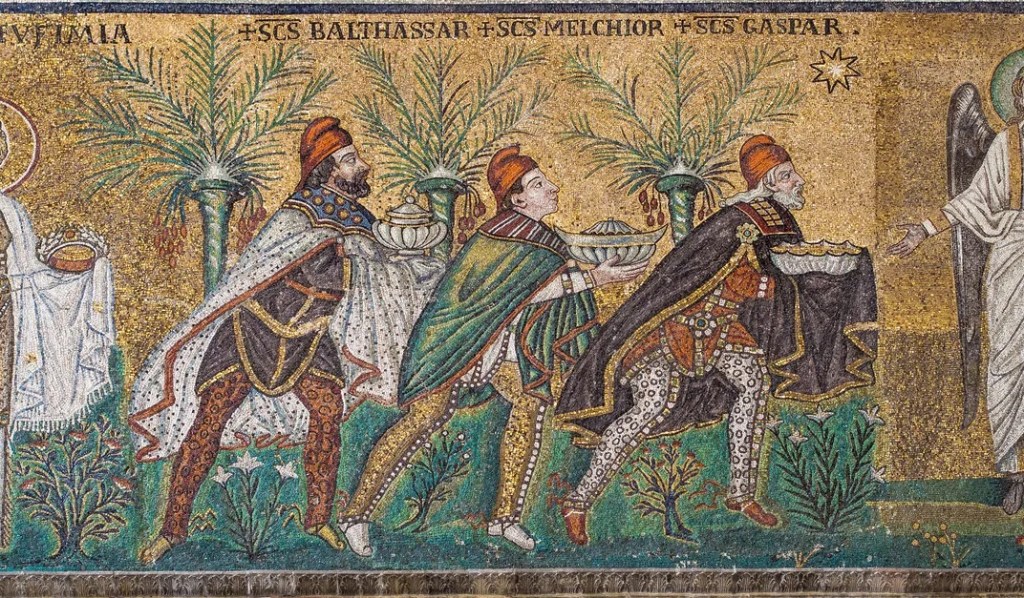
Wise Men Visiting the Birth of Christ, 6th CE
A 10th century ivory panel from Trier, still very much following the now 700+ year old Roman models;
things changed much more slowly in the Middle Ages than they do now.

By the time of the 11th CE, the nativity scene was becoming more elaborate , but was not yet in full flower. By the 13th CE, the magnificent portal of the St. Lawrence cathedral, in Trogir, Croatia, by the Master Radovan and his associates has a strong narrative of the many parts of the nativity story. The city of Trogir, a World Heritage Site since 1997, is known as one of the best-preserved Romanesque-Gothic cities, the core of which consists of forts, religious and secular buildings, with the Rector’s Palace and the City Loggia standing out. Its Romanesque churches are supplemented with Renaissance and Baroque edifices.

Romanesque style portal of the St. Lawrence cathedral, in Trogir, Croatia, by the Master Radovan and his associates

The detail of the portal is worth a closer look. In the center, in between the curtained “bunkbeds,” the Virgin and Child rest on the upper tier. The animals also look on in this section. Below the manger scene is a ritual bath. In my Christian world view, I called this the “baptism of Jesus.” In his Hebrew life, he would have undergone a ritual cleansing immersion bath before going to the temple for his circumcision. This ritual would mark him as a covenant member of the nation and people of God. The two elderly people on the left of this scene are most likely Simeon and Anna, prophets who speak to the child’s fulfillment of scripture.

Details of Romanesque style Portal of St Lawrence cathedral in Trogir, Croatia.

Above all this at the center top are the star, with the angels on the left and on the right. Filling the space on the left side of the portal are the shepherds and their herds, while the Magi and their steeds occupy the right side. The Magi ride horses, unlike our modern nativities which have camels.

Sixth-century CE mosaic at the Basilica of Sant’Apollinare Nuovo in Ravenna, Italy

In England, the Venerable Bede (d. 735) wrote the Magi were symbols of the three parts of the world—Asia, Africa, and Europe. They signified the three sons of Noah, who fathered the races of these three continents (Genesis, chapter 10). By the late Middle Ages, this idea found expression in art, and artists began to depict one of the kings as a black African. The kings sometimes have their retinues, which include animals from their presumed places of origin: camels, horses, and elephants are the most common. As with the shepherds, the artists often represented the three kings in the various stages of life: young, middle aged, and old age.

Gentile da Fabriano’s Adoration of the Magi, 1423

Artists added more exotic animals to the nativity scenes in the 15th CE when trade and travel were expanding beyond the continent. Gentile da Fabriano’s Adoration of the Magi (painted in 1423) presents a remarkable range of animals. Alongside the traditional ox, donkey, sheep (and a couple of dogs thrown in for good measure), the chaotic scene includes a camel, cheetah (or leopard), hawks and monkeys.

“Cabinet of Curiosities”
Engraving from Ferrante Imperato, Dell’Historia Naturale (Naples 1599)

The inclusion of animals which were not native to Europe helped Gentile da Fabriano to emphasize the three wise men’s journey from the Far East, but also to impress viewers with its exoticism and visual richness. This would have reflected very well on the painting’s patron, the rich Florentine banker Palla Strozzi, as it reinforced his connections to foreign lands. In this era, many rich citizens had a collection of exotic animals and imported wares, just as wealthy people today have collections of art, yachts, or sports cars to showcase their riches.

Sandro Botticelli, “Mystic Nativity” (1500), oil on canvas, 42.7 × 29.5 inches (108.5 × 74.9 cm) (image via Wikimedia Commons), now in National Gallery of London.

An even more elaborate nativity comes from the hand of Botticelli, who worked in the wealthy merchant city of Florence, Italy, in 1500. Savonarola was a fanatical preacher who aimed to morally reform the city of Florence, which had a global reputation for artistic output and lavish lifestyles. Savonarola condemned secular art and literature, decried the city as a corrupt and vice-ridden place bloated with material wealth, and, after warning of a great scourge approaching, saved the Florentines by convincing the French king and military to deoccupy and recede during the Italian War of 1494–98.

The people thought of him as a prophet and came from miles around just to hear him preach his apocalyptic message. He preached a sermon telling the people of Florence they could become the new Jerusalem “if only its civilians would part with and burn their luxuries, opulent fineries, and give up their pagan or secular iconographies.”

Botticelli fell under Savonarola’s influence during this time, for his art changed from decorative to religious. The 12 angels at the base of the composition each hold a ribbon that the artist inscribed with the 12 privileges or virtues of the Virgin Mary, which came from a sermon Savonarola delivered about a vision he once experienced. Another unusual aspect is that the three kings welcome Jesus empty-handed, rather than with gold, frankincense, and myrrh — influenced by Savonarola’s sermon, though it could be their ultimate gifts are their prayers and devotion.

Mike brought his good humor to class with a Grinch portrait

Sometimes it’s impossible to know whether the artist was inspired by a non-biblical element or by an apocryphal text in a Nativity scene or if the artistic depiction came first. In their book, Art and the Christian Apocrypha, David R. Cartlidge and J. Keith Elliott contend in the making of early Christian art, written and visual sources are interdependent. “The developing consensus is that oral traditions, texts (rhetorical arts) and the pictorial arts all interact so that all the arts demonstrate the church’s ‘thinking out loud’ in both rhetorical and pictorial images” (2001, xv).

Gail W.’s open perspective nativity inspired by the renaissance artists

When we artists imagine the nativity today, we add to the basic scripture text all of the Hollywood movies we’ve seen, the stories we’ve heard around the fireplaces and altars of our instruction, and every Christmas card and artwork we’ve ever seen. Our memories of Christmas are often more important than Christmas itself. This is because we have an idea of how Christmas is supposed to BE, but the birth of Christ wasn’t what either Mary or Joseph thought it was going to be. Just as most of us, they hoped to be at home and near family, not “away in a manger, no crib for a bed.”

Cornelia worked in the geometry of the scene. I might rework the sky.

God brought the Savior of all into our world into a humble setting, not to a royal palace. God brought to the birthplace of Christ strangers from distant lands and marginalized people from their homeland to have the first opportunity to worship the newborn king. God excluded the political rulers because they were out to destroy this unusual king.

We are part of the Christian community now, so we sometimes miss the disruptive nature of Christ’s birth. As part of the in/dominant group today, we might have a tough time reading the Bible’s challenges to self-satisfaction and complacency.

Birth of Alexander the Great, mosaic, Roman villa near Baalbek, Lebanon, 4th CE

We often forget while these depictions of the Nativity were evolving, the segment of the Roman Empire that was still pagan were also representing famous births, that predate the standard depictions of the Nativity of Christ. For example, in a Roman villa near Baalbek, Lebanon a fourth century mosaic of the Birth of Alexander the Great at first sight almost exactly resembles what later became a standard depiction of the Nativity of Christ. This mosaic, today in the National Museum of Beirut, shows the newborn Alexander the Great being bathed in a circular fluted basin by a female figure labelled ‘Nymphe’, while his mother Olympias reclines on a bed watched by an attendant.

Compare this with the icon of the Wise Men Visiting the Birth of Christ, from the 6th CE pictured above. In the lower right corner of this nativity scene, we see a small depiction of the Christ child being bathed, with water being poured over his head. (Obviously a United Methodist, but a precursor since John Wesley wasn’t born yet!) Our Christian iconography is derived from pagan sources. By this I mean we reimagined the pagan iconography and repurposed it for our own spiritual practices and purposes.

One of our other challenges is the calendar. We in the West use the Gregorian calendar, from the 16th CE, while the Orthodox Church still follows the Julian calendar, which was in use during the time of Christ. This is why the Orthodox community still celebrates Christmas and Easter on different dates than the Western churches. In the Orthodox Church, they celebrate Epiphany as the baptism of Jesus rather than the arrival of the Magi (Three wise men), which the Western Church celebrates on 6 January. On the Gregorian calendar, this Orthodox Epiphany celebration is January 19th. They celebrate this date as the Baptism of Jesus, rather than the arrival of the wise men. Their Epiphany is located in the baptism rather than the nativity. That’s a whole other theological discussion beyond the iconography of the nativity!

DeLee: The No Room Inn, mixed media, private collection

I mention this fact of the two calendars because I’m always “calendar challenged.” It’s not a senior citizen thing, because this was my problem even when I was in my twenties also. Sometimes I put too many commitments on my calendar, and other times I underestimate the time to complete my tasks. Then again, there’s always the unexpected interruptions. Always the interruptions. I came to understand in my ministry my list of tasks to do were not my actual work, but instead these interruptions were the opportunities which God would bring to me to do God’s chosen ministry.

So, I’m a few days late on the Western calendar for the visit of the Three Kings, having missed January 6th, and I’m a few days early for the Orthodox calendar. As Goldilocks said, “Not too hot, not too cold, but just right!”

Mike’s impression of the Nativity

The last art pieces our class made in 2024 before the holidays and the snowstorms were our nativity paintings. I asked each person to use their imagination and to bring the essence of the nativity to their creative process. Some of us quickly realized our images and used our second meeting to do a personal project or another version of the nativity scene. Others of us took both sessions to perfect our one image. I blame the Christmas cookies and our lack of hand and mouth coordination. Sometimes it’s hard to chew and paint at the same time!

Our first class of 2025 was an instance of “calendar challenge”—I thought we were having it, but the group didn’t. The next week, a major snow storm canceled class every where for everyone. Friday, January 17, should be a good day to begin a new project! We’re going to do some mixed media, along with weaving projects in the days and weeks to come. You don’t need skills, but a willingness to try.

Joy, peace, and a hope for better weather!

Cornelia


The Magi and the Manger: Imaging Christmas in Ancient Art and Ritual – The Yale ISM Review

The Nativity Tympanum on the Sarcophagus of Stilicho

https://www.christianiconography.info/Wikimedia%20Commons/nativitySarcophagusStilicho.html

UNESCO monuments in the Croatian Academy of Sciences and Arts Glyptotheque

https://gliptoteka.hazu.hr/unesco/en/trogir.html

The Apocryphal Gospels—PseudoMatthew—has Latin text and translation
https://www.google.com/books/edition/The_Apocryphal_Gospels/Cmbtm4ZZXF0C?hl=en&gbpv=1&dq=M.+Berthold+has+argued+that+Pseudo-Matthew&pg=PA75&printsec=frontcover

The Infancy Gospel of James (2nd century) |http://www.ccel.org/ccel/schaff/anf08.vii.iv.html

The Arabic Infancy Gospel (5th-6th century) http://www.ccel.org/ccel/schaff/anf08.vii.xi.html

The Gospel of Pseudo-Matthew (8th or 9th century) http://www.ccel.org/ccel/schaff/anf08.vii.v.i.html

Web Gallery of Art, searchable fine arts image database

https://www.wga.hu/frames-e.html?/support/zearly/1/1sculptu/sarcopha/1/9claudi2.html

Nativity – Visual Elements in the Nativity — Glencairn Museum

https://www.glencairnmuseum.org/nativity-visualelements

Johann International: Search results for Nativity  http://johanninternational.blogspot.com/search?q=Nativity

Revisiting Botticelli’s Evocative “Mystic Nativity”  https://hyperallergic.com/978201/revisiting-botticelli-evocative-mystic-nativity/

ORTHODOX CHRISTIANITY THEN AND NOW: Origins of the Icon of the Nativity of Christ
https://www.johnsanidopoulos.com/2018/12/origins-of-icon-of-nativity-of-christ.html


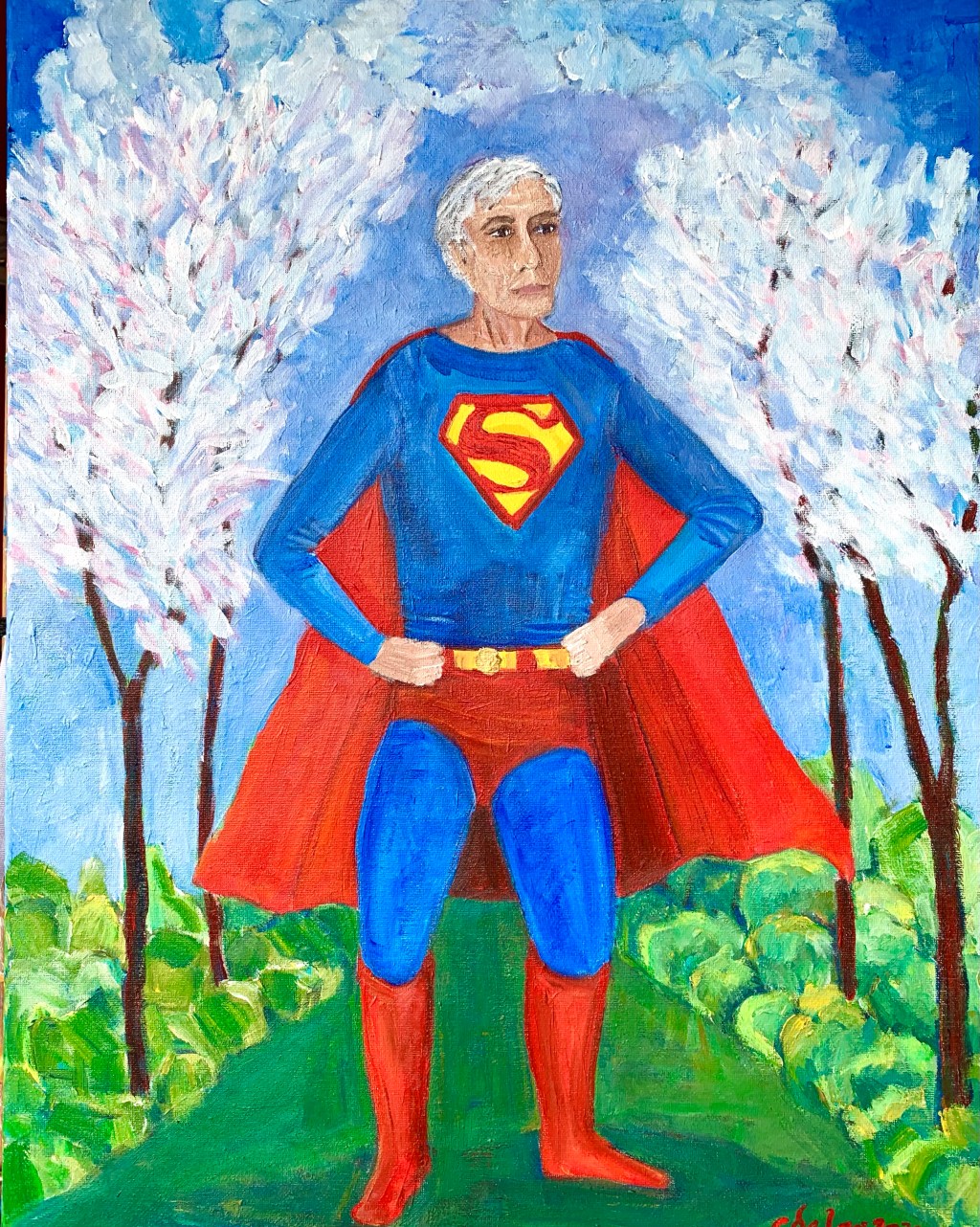
Eternal Youth and the Aged Superman

Alexander the Great, arkansas, art, change, Faith, Family, Healing, Health, inspiration, Meditation, Ministry, purpose, renewal, Retirement, Spirituality, Strength, Superman

DeLee, Memories of a Certain Springtime, mixed Media, 2021

Springtime is the season of youth, growth, and promise. It’s full of hope and anticipation for the future. It’s the season of our youth, for we identify with the vigor of nature’s growing and fertile surroundings. Winter isn’t the season for most of us, for it’s cold, dark, and the world is buried under ice, snow, or an interminable rain. It reminds us of our own mortality, our own aging and weakness, and our lack of power over our circumstances. No wonder people have searched for the fountain of eternal youth in many cultures across the ages.

As a pastor, I know people die in every season of the year, but somehow the deaths in winter seemed to strike me as more difficult to deal with than those of summer. In recent years, U.S. death rates in winter months have been 8 to 12 percent higher than in non-winter months. Much of this increase relates to seasonal changes in behavior and the human body, as well as our increased exposure to seasonal respiratory diseases. Cold temperatures exacerbate preexisting diseases, plus this weather brings on strenuous activities we don’t do at any other time of the year. Some people work outside all year round, so they’re always subjected to extreme weather conditions. I’m not sure which is worse: extreme heat or extreme cold. I’ve always used the premise, “We can always put on more clothes; taking them off is risky business.”

Drinking from the Water Hose

Of course, summer heat now is more extreme than it used to be. The dinosaurs among us keep saying, “When I was a kid, we played outside all day long and drank from the garden hose. We came inside for lunch, rested during the hottest part of the afternoon, and went back outside to play until it was almost sunset. Then we had a late, light supper, took our baths, and we were in bed by the time the stars came out.”

Weather records back from 1954 tell a different story. It was actually so hot, the extreme heat caused a Kansas City weather beacon to malfunction and forecast snow (St. Louis Post Dispatch, 12 July 1954). The Dinosaurs’ memories of their childhoods aren’t fossilized in stone. They remember what they want to remember. Most of us forget the difficult times and remember the times of joy instead. I remember this era as so hot and humid, my daddy would stand in the back yard with the water hose on full blast as he cooled down the west facing brick wall of our house. The overflow water nurtured the orange day lilies in the flowerbeds below.

I think some of our Dinosaur generation’s memories might have moderated over the years, just as the extremes of any pain—childbirth, war, or cultural changes—have been moderated by the joys of survival and bringing a new generation to adulthood. Also, we tend to remember the better parts of our lives if we have an optimistic outlook.

I wasn’t around for the “The Great Heat Wave of 1936,” which affected around 15 states during its three-week run that brought temperatures above 100 degrees. During the summer of 1936, The United States endured its worst heat wave on record. Ozark, Arkansas exceeded 100F every day from August 3 – 23 and reached a chart topping record 120 degrees Fahrenheit.

Also known as the “1936 North American Heat Wave,” it exacerbated the levels of human suffering during the ongoing Great Depression. During this time, the all-time highest temperature in Arkansas was 120° F (Ozark on Aug.10, 1936). For comparison, in 2010 Little Rock, Arkansas had to endure its hottest summer between June and August when the temperature went above 90 degrees for two months. The Western states, currently under a mega drought that’s the worst the area has seen since 800 AD, hope to see rain and cooler temperatures soon.

Once upon a springtime

It’s not just the weather I connect with the cycles of life, but also the changes in my body. Gone are the days when I could stay up all night talking or frolicking and then go to work without missing a beat. Of course, I was once an energizer bunny, or maybe I didn’t get all that much done when I was “working.” It was a mark of hubris for me that I could still work, no matter how foolish I was the night before. My friends and I thought of ourselves as heroic.

Arthur C. Clarke speaks of youthful infatuation with heroes, who in their minds should benefit from the eternal bloom of everlasting youth. Age and decrepitude shouldn’t affect heroes, for they’re either blessed by god or nature has given them have supernatural bodies. As Clarke describes the movie star walking on the low gravity space dock in his science fiction novel Islands in the Sky,

“Tex Duncan followed close behind. He was trying to manage without an escort and not succeeding very well. He was a good deal older than I’d guessed from his films, probably at least thirty-five. And you could see through his hair in any direction you cared to look. I glanced at Norman, wondering how he’d reacted to the appearance of his hero. He looked just a shade disappointed.”

George Blanda, the oldest football player and record holder

Young folks think 35 is ancient. They never met George Blanda, the oldest NFL quarterback. Blanda played for 26 NFL seasons, the most seasons played by a single player in NFL history. During that time, he broke numerous other records as well. He held the record of most pass attempts in a single game, 68, until Drew Bledsoe broke his record in 1994 with 70 attempts. Blanda also was the first player to score more than 2,000 points, and he’s one of only two players to play in four different decades before he retired at age 48, one month shy of his 49th birthday.

Tom Brady, age 45, is the oldest quarterback to ever start an NFL game, but to break George Blanda’s age record for playing, Brady would have to play for four more seasons to break the age record and play until age 50 to break Blanda’s record of 26 seasons. Brady also has yet to throw seven touchdown passes in one game, a record Blanda and seven other NFL quarterbacks hold.

My old daddy often watched in agony while many young quarterback desperately tried to move a team downfield until the coach sent in Blanda, who somehow snatched victory from the jaws of defeat.

“Finally!” he’d shout at the tv. “How ‘bout that old man?” he’d exclaim to the rest of us. Agonizing over a football game was a family affair.

Tired Superman

We humored my daddy, who was just past his mid century mark. As young and vigorous twenty something’s, we kids knew mortality’s chill breath was on his neck, while we were still able to outrun any shade creeping up on us in the night. As young people, we were still at the age when we began to see our parents less as heroes, and more as the flesh and blood realities of their true selves.

Not everyone survives this transition gracefully. Some need to see their parents as “forever heroes,” and are disappointed when the folks don’t measure up to this lofty standard. Likewise, we can transfer these same “forever hero” desires to God, and want God to be our superhero to rescue us from dangers and keep us from harm. We don’t take responsibility for our own lives, but wait for the external power to fix our lives in a dramatic way. We’re forever dependent on the superpower for every thing good.

Johann Baptist Hagenauer: Christ at the Column, ca. 1754–56 , Alabaster, polychromed and gilded

There came a time in my daddy’s life when Parkinson’s disease and dementia weakened both his body and his mind. This wasn’t all at once, but a slow progression. He once had a strong handwriting, firm and legible. As his fine motor skill diminished, this beautiful signature became cramped and small, but it had the same stroke pattern as his original. My mom would fuss when he could no longer open jar lids for her, but I reminded her, “He wants to do this for you, but his hands can’t manage it. It’s a case of the spirit is willing and the flesh is weak.”

She wasn’t used to hearing this verse quoted in this context. I did get her piercing look, like I’d stabbed her to the heart, but she stopped fussing at him for what he couldn’t do and began to enjoy what he could still do. She too had always thought of him as a Superman type because he’d always been there for her. She now understood she would have to be there for him as he began to lose his powers.

“Kryptonite“

We all have our own personal kryptonite, the mineral from our home planet that can drain our super powers the way it does for Superman. For some of us, it’s toxic substances, toxic environments, or toxic people. Some of us make poor choices about the people or places we hang about in, some of us think we need to please everyone, and some of us work too much to avoid emotional involvement.

The heart of Superman is forever young

At an advanced age, after multiple attacks from criminal types, and the burden of saving the planet over the years, even Superman gets tired. We Christians take the verse, “I can do all things through Christ who strengthens me” as a Superman quote, forgetting all the other verses which reflect the humanity of Jesus: he was tired and hungry, so he rested at a well in Samaria; he was moved by the death of a friend, and wept at the news. We might need to recover the superhuman courage of the disabled and the aged instead. These find their strength in their weakness, as Paul reminds us in 1 Corinthians 1:25—

“For the foolishness of God is wiser than human wisdom, and the weakness of God is stronger than human strength.”

The older people I know all believe, “If I get out of bed, I’m going to have a good day. It’s my choice and I’m going to make it a good one. At my age, I don’t have time to waste on bad days!”

If I roll out of bed singing and wondering where my coffee cup is, I know it’s a good day. Then again, I always have a daily plan to do something creative: paint, write, quilt, cook, and if I must, make the condo more beautiful by cleaning it. I share my spiritual thoughts over several media platforms. It’s good to do ministry this way, since I have to keep a low profile due to my seizure disorder.

When we get to a certain age, people begin to ask, “Can he or she still do the job?” We make several assumptions when we ask this question:

  1. The way we imagine the work of ministry requires lots of energy.
  2. We prefer a young person to do this work because of our preconceived ideas about the nature of the work.
  3. We want a fresh face to represent us in the community because a young person reflects well on us.
  4. We think like attracts like, so a young pastor will attract young families.
Alexander the Great, a model of the ever youthful hero

However, we sometimes get more than we bargained for when our Wonder Woman or Superman “young hero” pastor prayers are answered:

  1. We don’t want to move as fast as the energetic young leader.
  2. Young leaders have novel ideas, but we’ve never done it that way.
  3. Young leaders often believe everyone should be in ministry.
  4. Young leaders remind us the congregation is the best representative in the community because they continue, while clergy come and go.
  5. The leader doesn’t change us, for we can only change ourselves.
  6. While a leader may attract new people, those who are part of the ongoing system will keep them by integrating them into the faith community.
Michelangelo: David, the youth as hero

One of the interesting aspects of working with the differently abled is an employer’s willingness to restructure the workplace setting or requirements to mesh with the employee’s abilities. We still have a notion of ministry that hasn’t been seriously reimagined since the 1950’s, when married clergy men were the norm and non working clergy wives were taking care of the children, house, and volunteering in the church and community.

One thing never changes, however: clergy bear the existential burdens of ministry—they carry the weight of others’ emotional and spiritual burdens, they’re overwhelmed by others’ needs and the importance of ministerial issues, and they’re expected to solve unsolvable mysteries of life in relationships.

Wonder Woman, still a hero

This would age any Superman or Wonder Woman, but they persist in their callings to love and serve others. As Paul would say of his own people, “the gifts and calling of God are irrevocable” (Romans 11:29). We are all called to serve by virtue of our baptism into the life, death, resurrection, and ministry of Jesus Chris. Therefore we each have gifts, and these we must use for God’s glory as long as we have breath and strength.

Maybe we won’t be the starting quarterback anymore, but we’ll wait our turn on the bench to take on the last ditch two minute drill, or comfort the grieving when they come off the field in whatever loss they suffer. God will use us as long as we have breath, and God will put us in the right place, at the right time, to be the hands and heart of Christ for those who need us at that opportune moment.

Henri Nouwen, the great spiritual writer, wrote about aging in this way, basing his commentary on Job 12:12 (NIV), “Is not wisdom found among the aged? Does not long life bring understanding?“ He said,

“Much violence in our society is based on the illusion of immortality, which is the illusion that life is a property to be defended and not a gift to be shared. When the elderly no longer can bring us in contact with our own aging, we quickly start playing dangerous power games to uphold the illusion of being ageless and immortal. Then, not only will the wisdom of the elderly remain hidden from us, but the elderly themselves will lose their own deepest understanding of life. For who can remain a teacher when there are no students willing to learn?”

Joy, peace, and May you find your inner superhero,

Cornelia

Unknown Artist: Alexander the Great, from Alexandria, Egypt, 3rd cent. BCE, Ny Carlsberg Glyptotek, Copenhagen (5), CC BY 2.0,

Michelangelo: David, 1501-1504, marble, Academia Galleries, Florence, Italy.

Climate Change Indicators: Cold-Related Deaths | US EPA
https://www.epa.gov/climate-indicators/climate-change-indicators-cold-related-deaths

The Prolonged 1954 Midwestern U.S. Heat Wave: Impacts and Responses in: Weather, Climate, and Society Volume 3 Issue 3 (2011)
https://journals.ametsoc.org/view/journals/wcas/3/3/wcas-d-10-05002_1.xml

See the most extreme temperatures in Louisiana history
https://www.ksla.com/2022/04/11/see-most-extreme-temperatures-louisiana-history/

Arkansas annual temperatures and records
https://coolweather.net/statetemperature/arkansas_temperature.htm

Arthur C. Clarke: Islands in the Sky, 1952. An early novel of space travel, as seen through the eyes of a young contest winner.

Is George Blanda the Oldest NFL Player of All Time? | Stadium Talk
https://www.stadiumtalk.com/s/george-blanda-oldest-nfl-player-789d32390d914687

Nouwen Meditation: The Illusion of Immortality
September 7, 2022 at 4:02:09 AM CDT
Henri Nouwen Society email_lists@henrinouwen.org

Tom Brady Continues Chasing George Blanda’s Records – The Virginian Review
https://wvdn.mynews360.com/news/17796/tom-brady-continues-chasing-george-blandas-records/

To Be or Not To Be

Alexander the Great, art, city, Civil War, cognitive maps, Creativity, Faith, Forgiveness, Healing, Holy Spirit, hope, inspiration, Painting, picasso, Reflection, renewal, Spirituality, vision

Hamlet’s famous soliloquy begins with these very words,”To be, or not to be: that is the question.” In seminary I learned one of those big fifty cent words I often had to check my dictionary for its meaning. Ontological is a word we don’t throw around in ordinary conversations. I never used it in a sermon, for its strangeness would have been a stumbling block to folks without similar training. Who am I kidding? It was often a stumbling block when I tripped over it in my reading. I finally understood it after my first year of Greek. I needed to know its meaning fully and completely to comprehend it.

Current events, however, make an auspicious teaching moment for this weird word. Ontology is a branch of metaphysics concerned with the nature and relations of being. Ontology is the the branch of philosophy which deals with abstract entities. It’s concerned with the nature of being or the kinds of things that have existence, but are outside objective experience. It deals with the first principles of things, including abstract concepts such as being, knowing, substance, cause, identity, time, and space. Our word essence carries the meaning well, for it means “the permanent as contrasted with the accidental elements of being.”

An example of an ontological statement in scripture is the discussion Jesus has in John 8:56-58 with some of the Jews who opposed him:

“Your ancestor Abraham rejoiced that he would see my day; he saw it and was glad.”

Then the Jews said to him, “You are not yet fifty years old, and have you seen Abraham?”

Jesus said to them, “Very truly, I tell you, before Abraham was, I am.”

In Shakespeare’s play of the same name, Hamlet’s whole soliloquy is about his existence, and whether he should live or die:

Whether ’tis nobler in the mind to suffer
The slings and arrows of outrageous fortune,
Or to take arms against a sea of troubles,
And by opposing end them? To die: to sleep;
No more; and by a sleep to say we end
The heart-ache and the thousand natural shocks
That flesh is heir to, ’tis a consummation
Devoutly to be wish’d. To die, to sleep;

Ontology comes from the Greek root ontos, ōn, which is the present participle of einai, of the verb to be. As I’ve watched the unfolding horror of this “Russian special exercise” on Ukrainian soil, I’m struck by the sense of Hamlet’s description of the struggles of life:

To sleep: perchance to dream: ay, there’s the rub;
For in that sleep of death what dreams may come
When we have shuffled off this mortal coil,
Must give us pause: there’s the respect
That makes calamity of so long life;
For who would bear the whips and scorns of time,
The oppressor’s wrong, the proud man’s contumely,
The pangs of despised love, the law’s delay,
The insolence of office and the spurns
That patient merit of the unworthy takes,
When he himself might his quietus make
With a bare bodkin?

“To be” is the ontological insistence for the Ukrainians, for they desire to exist as a free people in a free nation. They resist occupation and occupiers. Dictatorship isn’t in their five year plan, or in their distant future, if they can help it. The surrounding nations have suddenly come alive in their recognition of Russia’s unfortunate foray into this breadbasket of Europe.

Yet even as the Ukrainian people are being killed in their streets, for no reason other than their citizenship; and their homes, hospitals, museums, and public buildings are reduced to smithereens by cluster bombs and artillery fire; they fight for their land and their freedom. I watch for one hour on the evening news, for I believe our world must stand witness to this horror.

Yes, some will turn away, for they have too much trauma in their own lives to bear the pain of others. Others will watch and say this isn’t our problem. If we remember our scripture, the chosen disciples abandoned Jesus in his hour of pain and need, but the women stayed by his side until his last breath. Then they came to dress his dead body’s wounds, but found an empty grave, while the men were holed up in a locked room for fear of the Jews (John 20:19).

Humanity is always our concern and when inhumane acts or conditions prevail, the human responsibility is to bear witness and to share the burden. As Paul writes in Galatians 6:2—

“Bear one another’s burdens, and in this way you will fulfill the law of Christ.”

Hamlet muses on, dithering as contemplates taking his own life, but he takes no action for fear of what awaits him in the world beyond.

who would fardels (burdens) bear,
To grunt and sweat under a weary life,
But that the dread of something after death,
The undiscover’d country from whose bourn (boundary)
No traveller returns, puzzles the will
And makes us rather bear those ills we have
Than fly to others that we know not of?
Thus conscience does make cowards of us all;
And thus the native hue of resolution
Is sicklied o’er with the pale cast of thought,
And enterprises of great pith and moment
With this regard their currents turn awry,
And lose the name of action.

While none of us know with certainty what lies beyond this world, for no one has ever returned with souvenirs, people of faith have trusted God to be always with them, even in the worst of times. As Paul writes in Romans 8:35, 37-39—

“Who will separate us from the love of Christ? Will hardship, or distress, or persecution, or famine, or nakedness, or peril, or sword?…No, in all these things we are more than conquerors through him who loved us. For I am convinced that neither death, nor life, nor angels, nor rulers, nor things present, nor things to come, nor powers, nor height, nor depth, nor anything else in all creation, will be able to separate us from the love of God in Christ Jesus our Lord.”

Battle of Issus Mosaic, Detail: Portrait of Alexander the Great

Artists across the centuries have responded to the horrors of war, if they aren’t held in thrall to the purveyors of such deeds. Those who exist to magnify the glories of battle are there as servants of powerful leaders, not as representatives of the fragility of the human condition. Think of Alexander the Great and his route to deification, first as a glorious leader, then as a god.

The Alexander Mosaic depicts a moment of victory in Battle of Issus in which Alexander has broken through to Darius of Persia, whom he defeated and shocked, before Darius was at the verge of fleeing. The mosaic is as great as Alexander himself, for it’s about 9 feet by 17 feet in size and contains over 1.5 million individual blocks of color, or tesserae. This Roman copy of an original Greek fourth century BCE painting dates from the second century BCE and is in the Museo Nazionale, Naples, Italy.

Goya: The 3rd of May 1808 in Madrid, or “The Executions”, oil on canvas, 1814, Prado Museum, Spain.

Here we see Goya painting the horrors of war and its impact on humanity. His inspiration comes from the French army’s assassination of a group of Spanish patriots during the 1808 rebellion. The Spanish heroes are illuminated by the intense light, but their faceless enemies aren’t easily visible in the darkness from which they operate. Not only does the design make plain Goya’s feelings, but his psychological understanding of the scene as well.

As Matthew writes in Jesus’ teaching kernel known as “The Sound Eye,”

“The eye is the lamp of the body. So, if your eye is healthy, your whole body will be full of light; but if your eye is unhealthy, your whole body will be full of darkness. If then the light in you is darkness, how great is the darkness!” (6:22-23)

Picasso: Guernica

Probably the best known war painting of our modern era is Picasso’s Guernica. He painted it in response to the Nazi bombing of Guernica, a Spanish town in the Basque region during the Spanish Civil War. At about 16:30 on Monday, 26 April 1937, warplanes of the German Condor Legion, commanded by Colonel Wolfram von Richthofen, bombed Guernica for about two hours. Germany, at this time led by Hitler, had lent material support to the Nationalists and were using the war as an opportunity to test out new weapons and tactics. Later, intense aerial bombardment became a crucial preliminary step in the Blitzkrieg tactic.

Guernica, Picasso’s most important political painting, has remained relevant as a work of art and as a symbol of protest. It has kept the memory of the Basque town’s nightmare alive. While Picasso was living in Nazi-occupied Paris during World War II, one German officer allegedly asked him, upon seeing a photo of Guernica in his apartment, “Did you do that?” Picasso responded, “No, you did.”

Käthe Kollwitz, Woman with Dead Child, 1903, etching on paper. Courtesy: © Getty Research Institute, Los Angeles and Artists Rights Society (ARS), New York

Lest we forget, while wars are often started by those in power, it’s the mothers who suffer when young soldiers are killed in action. Some are fortunate enough to have the body of their loved one to hold, but it’s a sad consolation prize. How heart rending it must be for the families whose children were left behind as casualties of war. As the old Cold War era 1985 Sting song about nuclear war reminds us—

There’s no such thing as a winnable war
It’s a lie we don’t believe anymore…
We share the same biology, regardless of ideology
But what might save us, me and you
Is if the Russians love their children too.

The great sadness of this brutal war foisted on the Ukrainian people is while we’re free to see and own the pain inflicted on others, too many of us will turn away. Then again, we often have difficulty acknowledging our own pain and weakness, for we prefer to see ourselves as whole, strong, and unconquerable. All of us have a weak place and we all have an emptiness that needs to be filled. Some of us fill this emptiness by seeking power and control, while others choose various substances or activities to overuse. A few will let God’s Spirit fill us, as Paul writes in 2 Corinthians 4:7—

“But we have this treasure in clay jars, so that it may be made clear that this extraordinary power belongs to God and does not come from us.”

Cornelia DeLee: Obliterated Ukrainian Landscape, Maxar Satellite Image, Apple Pencil, 2022.

When I see the satellite imagery of the obliterated Ukrainian towns, I recall my childhood memories of the old ones in my family repeating their ancestors’ stories of the troubled times during the Civil War. I can easily imagine in Ukraine, for several generations to come, all the stories of pain, survival, and resilience that will be told as they rebuild their nation from the ground up. In the midst of this ongoing disaster, they’re already thinking “How can we build back better?”

This is a great lesson for all of us. If our life hits a major roadblock, we can either give up, scale the wall, or find a way around the wall. Another option is to make peace with the wall and find a way to be happy there. Since Putin is tearing down all the walls for the Ukrainian people, they’ve decided to double down on being Ukrainian. “To be me” is “to be free” and that means “to be Ukrainian.” As their land lies in ashes about them, those who once also spoke Russian, a similar language to Ukrainian, now find that language dead as ashes in their mouths.

Cornelia DeLee: Ukrainian Town Reduced to Ashes, acrylic on canvas, 2022.

To win friends and influence people requires a gentle hand, not the ham-fist of a dictator. I only wonder if the Russian people will ever understand this. But they may have been slaves of their state for so long, they don’t know the sweet taste of freedom. Perhaps only those who believe in a forgiving God, who allows God’s people the freedom to make mistakes and gives them through the reconciling grace of renewed fellowship, are able to come through such disasters. Those who are “sinners in the hands of an angry god” must think their fate is destiny and accept it.

So the questions remain:

  1. What IS the nature of YOUR God?
  2. How does God’s nature affect your understanding of human nature?
  3. Does your view of humanity reflect your image of God or do you see humanity through “God’s eyes?”
  4. Read the Prodigal Son in Luke 15:11-30 and answer the questions again

Some days I AM Joy and Peace,
Cornelia

Hamlet, Act III, Scene I [To be, or not to be] by William Shakespeare
https://poets.org/poem/hamlet-act-iii-scene-i-be-or-not-be

Why is the Alexander mosaic significant?
https://www.rampfesthudson.com/why-is-the-alexander-mosaic-significant/

The 3rd of May 1808 in Madrid, or “The Executions” – The Collection – Museo Nacional del Prado
https://www.museodelprado.es/en/the-collection/art-work/the-3rd-of-may-1808-in-madrid-or-the-executions/5e177409-2993-4240-97fb-847a02c6496c

Pablo Picasso: Guernica
https://www.pablopicasso.org/guernica.jsp

Sunflowers and Shadows

adult learning, Alexander the Great, art, Carl Jung, Creativity, Faith, grief, Holy Spirit, Imagination, inspiration, Ministry, Painting, perfection, Plato, Prayer, Socrates, Stress, Ukraine

DeLee 2019, Drying Sunflowers

A sunflower follows the sun. Actually, only young sunflowers track the sun across the sky, while mature sunflowers face east. Why is this? Why do we care? As sunflowers fill our Facebook feeds and social media posts, most of us are looking at flowers so we can ignore the awful consequences of this unprovoked war. Right now, many of us are heartbroken because of the humanitarian crisis unfolding in Ukraine. I had only a passing knowledge of this country because of its well known naïve artist, Maria Primachenko and her paintings of fantastic imaginative animals in gardens. They have always been a delight to my soul and a joy to my spirit. Many of her works include the sunflower, Ukraine’s national flower. Sunflowers have been grown in Ukraine since the mid 1800’s, and are not only an important export crop, but also a symbol of peace. When Ukraine gave up its nuclear weapons in 1994, people planted sunflowers as a symbol of the peace they hoped would follow.

Maria Primachenko
A Dove Has Spread Her Wings And Asks For Peace (1982)

Sunflowers, when young, follow the sun on a 24 hour circadian cycle, just as our bodies have a similar cycle keyed to the light and dark. When the flowers are growing, they maximize their time facing the sun, but once they’re mature, they set their face toward the east, since this gives the head maximum warmth. Bees love warmth, so keeping the buzzing crowds near is in the sunflowers’ best interest for pollination and reproduction.

Heat map of sunflowers at different times of the day

Most of us prefer the sunny days. Clouds, storms, and distress aren’t our first choices. After the last few years of pandemic stresses, we’re unprepared for yet another crisis, even if it seems to be on a distant continent. Our own supply chain for reserves of caring and concern have been stretched thin by the nearly million deaths from COVID in our nation alone, not to mention the worldwide death toll of over 6 million. On Friday in Sam’s Club, I met a lady who complimented me on my flowered pants, which I was wearing in honor of the Ukrainian folk painter, whose museum had been bombed by the Russian army.

“I can’t bear to even listen to the news any more. It’s all so awful,” she said.

I should wear this shirt on Friday at Sam’s Club.

“I know. It reminds me too much of domestic violence cases, where the man decides he’ll punish the ex by killing all the children and taking himself out also.”

My blood sugar usually drops low on Friday after art class, before I eat lunch, so I don’t have my usual, civilized filter on my mouth. The look of awareness on her face was the sudden recognition of a truth she had refused to see before. Sometimes we need to face our fears and deal with them. This is the hero journey. None of us can travel it alone, but far too many fail to ever set out on it at all, even with a spiritual companion or guide. My failure to snack at art class upset her comfortable apple cart and caused her distress. She ran out of Sam’s in a heartbeat. I was able to chat with a baby and her mom later on, who was amazed her child wasn’t at all afraid of this stranger. Food is a medicine for my mood and a bridle for my mouth.

Morandi: Still Life of Bottles with Strange Shadow

On a sunny day, we can see our shadow. Most of us are afraid of our own flickering shadows. We don’t want to see the darkness within us, even though we’re ever ready to see the sinister images of others. Like a sunflower, we’ll turn instead to the light and only see the good, the beautiful, and the true.

A story I remember from my classical art studies regards Alexander the Great and the shadows. His father Phillip II, the ancient king of Macedon, had a difficult, high strung horse, which no one had been able to ride. In fact, it was downright vicious and unmanageable, which made it less of a “gift” to the ruler. Alexander, even though a youth, noticed the handsome horse was disturbed by his own shadow, so he turned the animal’s head into the sun, attached the bridle, and was able to mount him. Alexander rode Bucephalus until the horse’s death at the Battle of the Hydaspes in 326 B.C.E. In his honor, Alexander named a local city, Bucephala (sometimes identified with the modern Jhelum, in the Punjab province of Pakistan), after him.

Mosaic of Alexander the Great and Darius in Battle from the House of The Faun, Pompeii, 3rd century BCE

“Who looks outside, dreams; who looks inside, awakes,” Carl Jung wrote to one Fanny Bowditch, on the eve of his entry into military service during the First World War. Jung believed as long as you looked at other people and projected your own psychology into them, you could never reach harmony with yourself. Jung taught all persons had a shadow side to their personality, or those aspects of ourselves which we’ve repressed. These may be both bad or good aspects, for some of us have yet to realize our own brutal natures, as well as the heroic figures which we’ve also buried inside.

DeLee: Endless Nights of Pain, Ireland, 1973

My old granddaddy was fond of saying, “When you point out another’s failings, you have three fingers pointing back at yourself.” I came to learn I couldn’t recognize the fault in others unless I could claim it also in my own self. This keeps one humble for sure, but it also keeps a person from thinking he or she has any godlike or dictator qualities.

This brings me to another famous shadow story involving Alexander the Great. After his father’s death, he visited Corinth, where Diogenes the Cynic lived in 326 BCE. Diogenes was famous for carrying a lamp in the middle of the day in his “search for an honest man.” In the most famous exchange of this meeting, Alexander asked Diogenes whether there was anything he could do for him. Diogenes, who was enjoying the warmth of the autumn sun, answered, “Stand aside to stop blocking the sun.”

Statue of Diogenes and Alexander

This abrupt response, showing Diogenes’ utter contempt for the power and prestige craved by Alexander, inspired many artists over the years. Although Alexander’s attendants took offense at Diogenes’ rudeness to their king, Alexander himself wasn’t displeased. Leaving, Alexander was said to reply, “If I were not Alexander, I would want to be Diogenes.”

When I brought these delightful images from Maria Primachenko to class, Gail and Mike were amazed at how bright, flat, and clean her designs were. Partly this is due to her use of gouache, an opaque water based color paint. She also uses repeated motifs, symmetry, and clean lines with sharp color contrasts to make her images “pop,” as the decorators say. Mike, who favors textures, was thrilled to see another artist who paints like he does. Gail was glad to process the distressing news through flowers and the yellow and blue of the national flag of Ukraine.

Gail’s Unfinished Painting

Often we don’t feel “safe” speaking about dark or upsetting experiences, preferring instead to bury them deep inside. This is maybe the worst decision we can make, for like a poison or an infection, what we refuse to bring to the light will fester and grow. Then it further sickens the body or the mind until it becomes unrecognizable and unhealthy. Perhaps this is when we move from being rational to irrational. As I always tell folks, “Just because you think the world operates on reason and order, doesn’t make it so.” By this I mean, we live in a world with accidents, change, disease, sociopaths, and greed. In biblical terms, we live in a broken and fallen world, one in which even those of us who are “saved by the blood of Christ” from the wages of sin are “not yet perfected in the love of God and neighbor.”

This is what it means as a Christian to carry the Jungian shadow within us. If we believe keeping a law is the best evidence of our faithfulness, we can overlook the moral quality of the law itself and find ourselves carrying out harm, rather than doing good. As the writer of Hebrews explains in the platonic argument of Christ’s Sacrifice Once for All:

“Since the law has only a shadow of the good things to come and not the true form of these realities, it can never, by the same sacrifices that are continually offered year after year, make perfect those who approach.” (10:1)

Mike’s unfinished painting

If we want to be law keepers, we can’t be picking and choosing which laws we want to keep, as if the law were a cafeteria or buffet table. Jesus certainly knew what potholes lay ahead of him after his baptism in the Jordan River. A forty day fast in the wilderness is great for getting your head together and dealing with our human nature’s dark side of desire for security, power, and equality with god.

Maria Primachenko
Don’t Feast Your Eye’s On Other People’s Bread (1983)

I post my Artandicon blog on LinkedIn as well as on my various spiritual formation Facebook pages which I manage. I sometimes get a message from folks there. One was from a friend, who mentioned she really wanted to get back into her art, “for it brings her peace.” I tell people, “the process of making art brings satisfaction, but we’re not ever satisfied with the work itself.” If we were ever to be satisfied with the work, if we thought we could reach no higher, or if we thought so highly of ourselves that we’d made the last best artwork for all times, then we’d have to quit and make pancakes, until we’d perfected those. And then we’d find a new obsession.

Cornelia’s Painting with Nuclear Monster Destroying a Church

My favorite monsters are those from the Japanese nuclear monster movies of the 1950’s. They are both kitschy and scary. The sunflowers destroyed by these monsters of war will fall to earth and be reborn once again in ever increasing numbers. If hope is the last to die, it’s also the first to rise again. As long as one has breath, one can hope. As Paul wrote to the believers in Rome long ago,

“May the God of hope fill you with all joy and peace in believing, so that you may abound in hope by the power of the Holy Spirit.” (15:13)

Making art is a metaphor for the hero’s journey. Jung believed art was important because often the hands will solve a mystery that the intellect has struggled with in vain. We don’t know what battle or monster awaits, but we also don’t know what divine spirit will come to our aid. Along the fantastic inward journey, we’ll meet the very same creatures who are outside of us. They arise in our dreams, but they were planted in our awakening moments. We may have been turning our faces towards the sun, like the baby sunflowers or the horse Bucephalus, but soon enough we’ll trust the one who guides us and we’ll go wherever it’s necessary.

The journey toward Christian perfection in love is a heroic journey, one which we can only undertake with the help of the Holy Spirit. Along the way, we also travel with others on same road: mystics, saints, and holy persons from yesterday and today. As the old camp song refrain goes,

“And they’ll know we’re Christians by our love, by our love,
They’ll know we’re Christians by our love.”

Maria Primachenko:
May I Give This Ukrainian Bread To All People In This Big Wide World (1982)

The following prayer, Psalm 23, has comforted people for thousands of years in times of trouble and grief. Here in the English Standard Version, if you have fears, trepidations, or trembles, it might help you to calm your spirit. As you speak it aloud to the rhythm of your inhalation and exhalation of breath, remember those who have given up their lives rather than reject their faith: Christian martyrs in the Roman coliseum, Jewish martyrs in the holocaust, and democratic freedom fighters around the world. Let your voice be heard, even as their voice is being silenced:

The LORD is my shepherd; I shall not want.
He makes me lie down in green pastures.
He leads me beside still waters.
He restores my soul.
He leads me in paths of righteousness
for his name’s sake.
Even though I walk through the valley of the shadow of death,
I will fear no evil,
for you are with me;
your rod and your staff,
they comfort me.
You prepare a table before me
in the presence of my enemies;
you anoint my head with oil;
my cup overflows.
Surely goodness and mercy shall follow me
all the days of my life,
and I shall dwell in the house of the LORD
forever.

Joy, peace, and sunflowers,

Cornelia

The Mystery Of Why Sunflowers Turn To Follow The Sun — Solved : The Two-Way : NPR
https://www.npr.org/sections/thetwo-way/2016/08/05/488891151/the-mystery-of-why-sunflowers-turn-to-follow-the-sun-solved

Alexander and Bucephalus | Department of Classics | University of Colorado Boulder
https://www.colorado.edu/classics/2018/06/19/alexander-and-bucephalus

Putin’s Invasion of Ukraine Is a Sin All Russians Will Bear
https://www.bloomberg.com/opinion/articles/2022-02-24/putin-s-invasion-of-ukraine-is-a-terrible-sin-that-all-russians-will-bear

Carl Jung: “Who looks outside dreams; who looks inside awakes.” – Carl Jung Depth Psychology
https://carljungdepthpsychologysite.blog/2020/02/08/carl-jung-i-am-afraid-that-the-mere-fact-of-my-presence-takes-you-away-from-yourself/

Carl Jung – Archetypes – Shadow
https://www.carl-jung.net/shadow.html

Carl Jung: “Often the hands will solve a mystery that the intellect has struggled with in vain.” – Jung Currents
https://jungcurrents.com/jung-hands-intellect-mystery

They’ll Know Are Christians by Our Love
https://www.hymnlyrics.org/newlyrics_t/theyll_know_we_are_christians_by_our_love.php