Learning, Growing and Thriving

adult learning, art, Athanasius, brain plasticity, Christmas, Civil War, cognitive decline, Creativity, crucifixion, Faith, Imagination, incarnation, john wesley, Love, mystery, nature, renewal, Spirituality, St. Athanasius, United Methodist Church, Valentine’s Day, Valentine’s Day

In most adults, learning and thinking plateaus and then begins to decline after age 30 or 40. The old adage, “Don’t trust anyone over thirty” takes on new meaning in regards  to creativity. People after this age start to perform worse in tests of cognitive abilities such as processing speed, the rate at which someone does a mental task. The slide becomes even steeper after 60 years of age. We also notice a similar learning decline in children after summer vacation, which results in the fall semester becoming a “reteaching opportunity.”

As one who is also “growing long in tooth,” I have passed this yardstick by a mile. I notice I have a “slower processing speed” in my creative writing. I don’t consider it a reason to quit, but a reason to better organize my other time-wasting behaviors (social media, newsletters, newspapers, etc.). I can always ignore cleaning the condominium! Creativity before housework, is my motto.

Housecleaning Meme

We often think older adults are on a downward slope with unrecoverable loss. “Use it or lose it,” the saying goes. Recent research suggests we need to apply a more hopeful mindset and vocabulary when discussing older people—much like that used for childhood or early adulthood. Decline, as we so often see it, may not be inevitable. In fact, learning a new skill and practicing it for three months has shown benefits beyond the the practice time.

Adults often have limited time or resources, so if we encourage learning a new skill, this may help them step out of their comfort zones. In people’s later years, many personal and societal changes—such as moving out of state to be closer to family members, switching jobs or coping with physical distance from loved ones—make learning new skills necessary to adapt and succeed.

For example, taking a class to improve technological skills could aid seniors’ success in an increasingly digital world, such as helping them use Telehealth or online banking platforms. Learning new skills in an art class allows a person to express their feelings and solve problems in creative ways. Each person can find their own path to success in artistic practice.

Potholder Loom, just like the one I had back in the day.

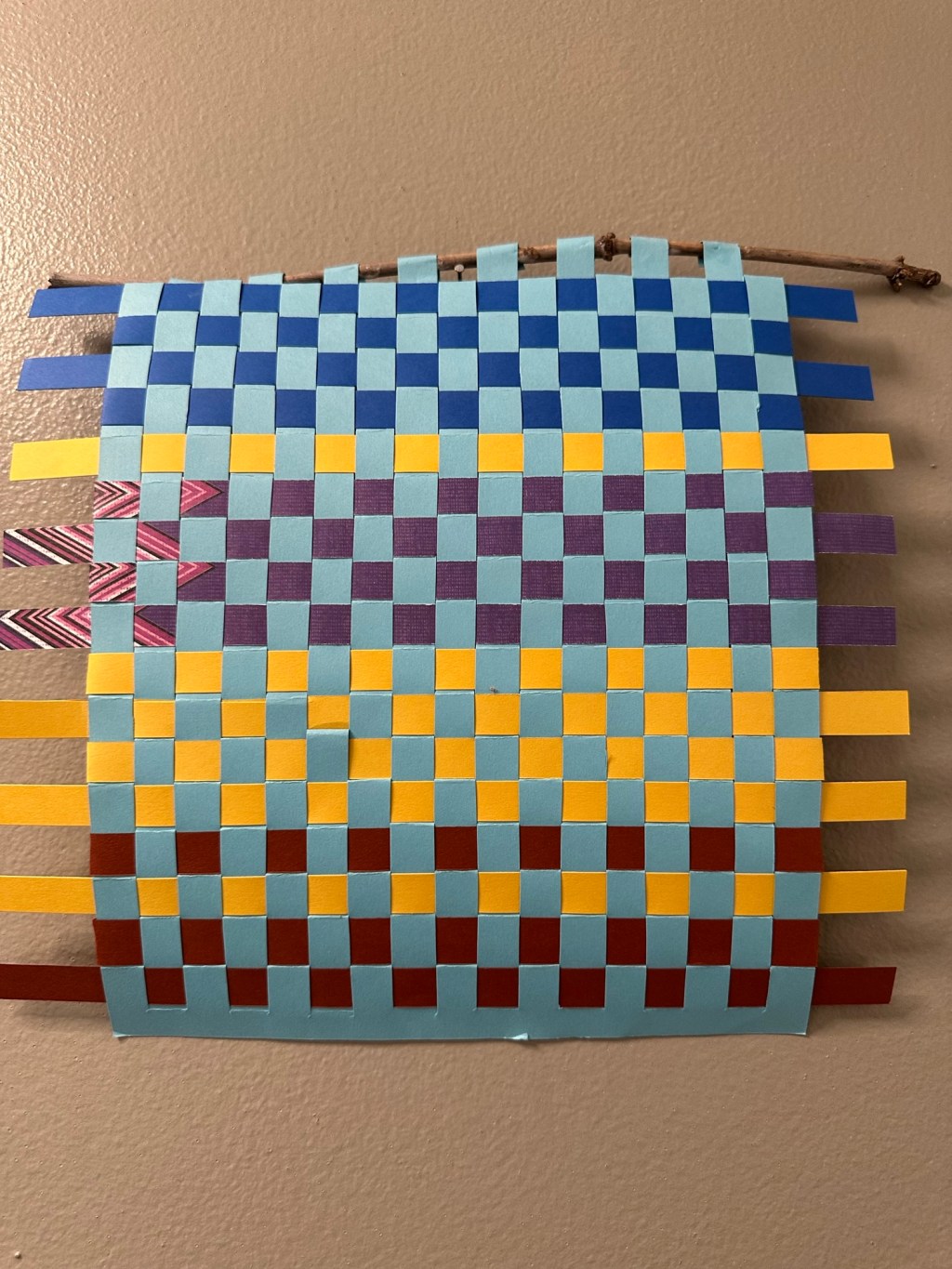
Our art class is trying a new thing: weaving. We have been painting for quite a while, so this is really a hands-on project. Some of us had the benefit of making woven potholders as children, or weaving newspaper “sit-upons” at summer camp. The technique isn’t unknown, but making a creative design interpretation is how we take our basic skill forward into a stimulating and creative brain challenge.

DeLee: Woven Paper on a Stick (Earth and Sky)

We could just repeat what we already know, but this doesn’t build us new neurons in our brains. If we keep the same old paths and don’t create new ones, we aren’t flexible when we meet new situations. Since we live in a rapidly changing world, building a brain capable of rapidly adapting is important to live independently and vibrantly for as long as possible.

I remember how my Daddy could only use the old tv remote to change the channel for the original non cable stations. When “Murder, She Wrote” came on the cable channel, my Mother had to use the cable remote to change the station for him. His Alzheimer’s disease prevented him from learning new skills, but he remembered all of his previous medical training and could diagnose his condition and boss the emergency room doctors when he was admitted to the hospital for a fall. Our brains are a mystery indeed.

Mike jumped the gun on Valentine’s Day and created a woven heart. These were big in the Danish and German communities and very popular in the 19th century in America. During the Civil War, soldiers made many of these in elaborate forms to send to their loved ones back home.

Unknown Artist: Affirmation Weaving

The brain is a fantastic and mysterious organ. If we make a habit of learning something new every day, of whatever interests us, we have the opportunity to keep our lucidity for a longer time. We also we meet the quickening changes of modern life with a steadfast heart and mind. We stress less when we know we can adapt and change in our own lives. We don’t have to be the people who say, “You can’t teach an old dog new tricks.” We can teach and we can learn, but we might need to be more patient with the old dog. In some corners, we call that “grace.”

I watched my Granddaughter’s Daddy Daughter Dance

Our group was in and out during the several weeks devoted to this project. One of us was sick, one was grieving the death of a beloved pet, another had pressing work issues, and the teacher went to Florida to see her granddaughter get married. Amazingly, life goes on. People dropped in for spiritual support, which is a side benefit of the community of art class. I managed to get mine mostly done, and Gail S. finished hers completely. Sometimes life interrupts our best intentions and we move on. We will learn new lessons on the next project.

Gail S’s “Eye of God” weaving

 Gail S’s “Eye of God” weaving incorporates yarns from two different mop heads, some sticks, and a bird feather. Gail almost always keeps a realist focus in her works, so her eye of God has a bird feather to mark the pupil. The upper field of grey and white mop yarns represent the cloudy sky, while the blue yarn stands for the water and the brown for the land. God watches over all of God’s creation. Gail S’s love of the outdoors and all of nature is evident in all her work.

Cornelia’s Cross on a Hill (unfinished)

I also recycled some old paintings and cords which I’d used in the preparatory work of other paintings. In addition, I used some recycled strips of Amazon shipping parcels as well as a wire shape which once belonged to a butterfly wing. In repurposing these items into the weaving along with two old brushes bound together with a God’s eye, I invoke the renewal of life after death.

We people of faith have two opportunities for a renewal of life after death. The first is by our profession of faith in Christ and his life, death, and resurrection on our behalf for our salvation. This gives us a living faith in this world. The second renewal is for the resurrection from death itself. This gives us a life beyond this world. Our faith is worthless if it doesn’t change us for our walk upon this world. If we don’t have the heart and mind of Christ within us, and if we aren’t earnestly seeking to be made perfect in the love of Christ daily, our United Methodist heritage tells us we’ve not yet been converted.

Yet Christ desires to save all, as John records in 12:32,  Jesus tells the crowd,

“And I, when I am lifted up from the earth, will draw all people to myself.”

Not just some people, or only the best, or even just us United Methodists, but ALL people. Most of us aren’t able to understand such a wide ranging love, for we live in a world of tribal loyalties. If we look at creation, which is God’s first work, God loves that which God created. God loves everything God created. We humans are the ones who choose sides and introduce boundaries and hate into God’s singular creation. The world or Kosmos is the creation first and then the people in it.

Today we tend to ascribe “world” to the “culture,” or secular society in general, but its plain meaning is creation and the human presence, for good or ill. The ancient Greeks and Romans divided the world into the material (bad) and the spiritual or mind (good), but the Jewish theology conceived the unity of both as part of God’s gift to humankind.

In the fifty-fourth chapter of On the Incarnation, St. Athanasius of Alexandria wrote a sentence that has echoed down through the centuries even into our own time as a brilliant summary of the Gospel. He wrote this: “God became man so that man might become god” (54:3).

This doctrine is called theosis or acquiring the whole nature of God. We United Methodists call this state Christian Perfection, or “a heart so full of love of God and neighbor that nothing else exists.” Our Wesleyan heritage was influenced by the Wesley brothers’ deep love for the Greek Orthodox fathers of the early church. To focus only on fallen nature is to deny the power of God to redeem us and all creation and to make all things new. We humans and nature aren’t more powerful than God!

If we cut off part of our God given self, we deny the incarnation of Christ, who became human for us that we might become divine. We need to remember what John 3:16 so succinctly states:

“For God so loved the world that he gave his only Son, so that everyone who believes in him may not perish but may have eternal life.”

Art is a way to open our eyes and hearts to a new way of seeing spiritual truths. Art is also reflective of the artist’s soul and spirit. A sensitive viewer can read the tale of trauma or the struggle for survival in an artist’s body of work. More than this, we can listen for their voices straining to be heard. Most people have been silenced and conformed to the “cause no trouble, don’t get out of step” mantra of the public school system training our youth for the workplace.

In art class, we can lose our fear of being different because being different gets rewarded! Being original gets an attaboy or attagirl.  I find such joy helping people find new courage and creativity they didn’t know existed within themselves. My students keep me young too. I feel blessed beyond measure.

Joy and peace,

Cornelia


To Stay Sharp as You Age, Learn New Skills | Scientific American

https://www.scientificamerican.com/article/to-stay-sharp-as-you-age-learn-new-skills/

That Man Might Become God — Fr. Andrew Stephen Damick
https://blogs.ancientfaith.com/asd/2015/01/22/man-might-become-god/