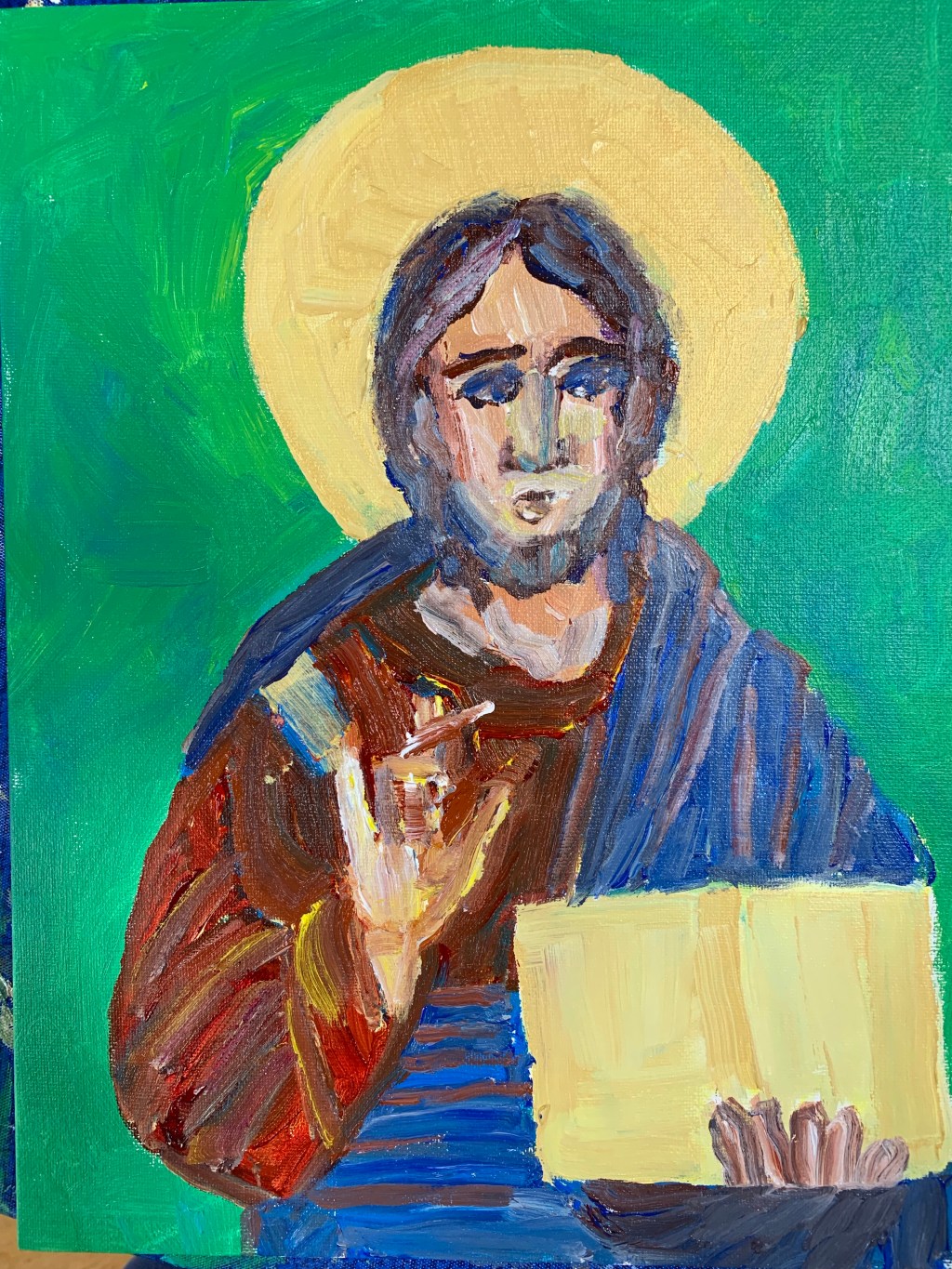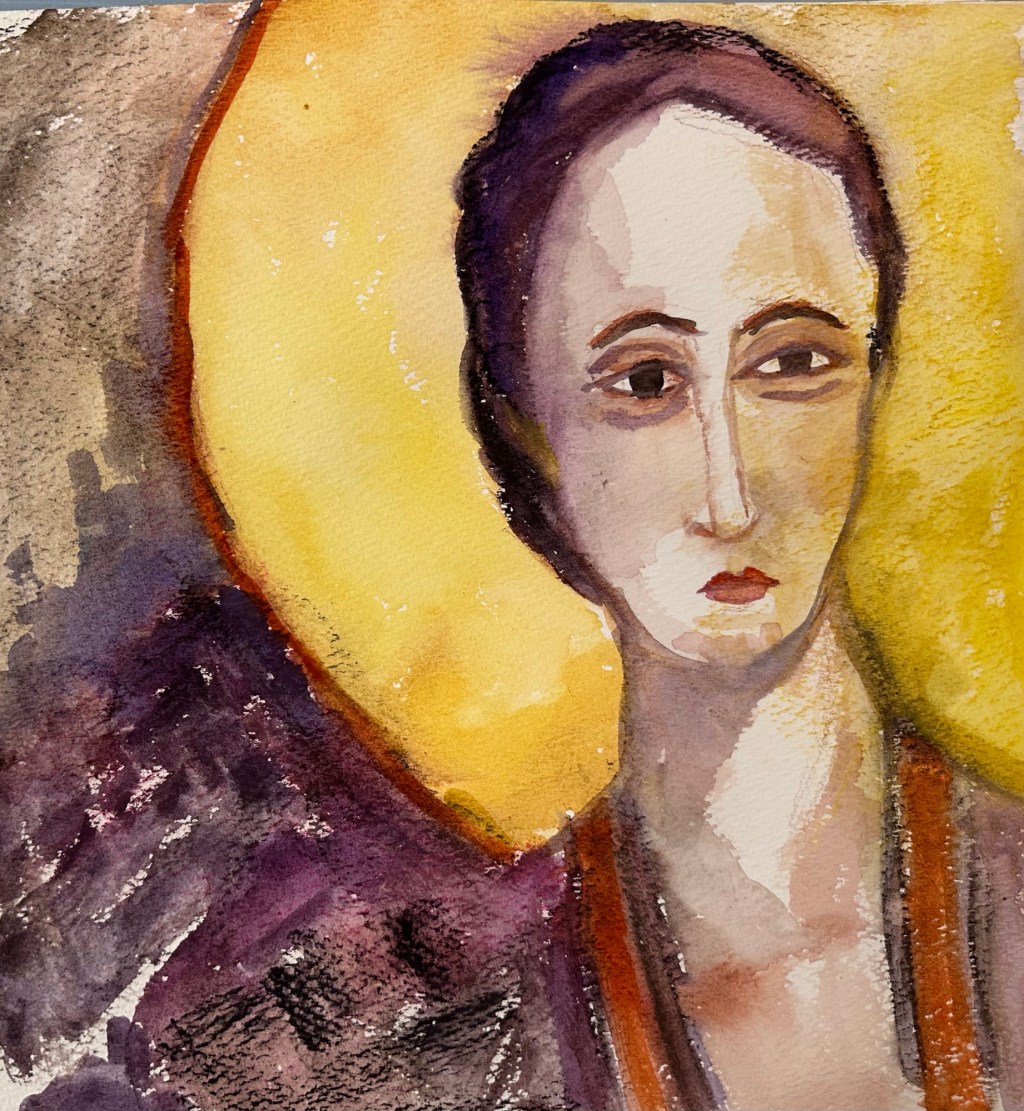
Time Travel and Iconography Experiments

adult learning, art, Creativity, Faith, Hagia Sophia, Holy Spirit, hope, Icons, Imagination, inspiration, Leonardo da Vinci, Medical care, Painting, Pantocrator, renewal, Spirituality, Turkey, vision

Every once in a while, I like to go on journeys. Sometimes they’re actual trips, such as my recent vacation over spring break to visit family down in Texas, but other times I like to “time travel.” The best way to time travel today, since I don’t have access to a DeLorean, is to study history. Buckle your seatbelts, we’re in for a ride through Christian and art history.

Right before spring break, our art class tried some experimental techniques with chalk, watercolor pencils, and pan watercolor with brushes. I also brought some images from the beautiful church of Hagia Sophia of the ancient capital of Constantinople, which I brought home from a pilgrimage I made several years ago.

The church was sponsored by the first Christian emperor Constantine, so it has exceptional mosaics and frescoes decorating all its surfaces. We each chose an image to use as a starting off place and went from there. Inspiration comes not only from what we see, but from the materials we use. Combining new images with new materials can bring new directions.

Desis Icon, Hagia Sophia, Constantinople, Turkey

Our primary images were the archangel Michael, the enthroned Christ, the decorative jewel designs, and the cross. All of these designs figure in prominence in Hagia Sophia or the Basilica of Holy Wisdom, the primary seat of Christianity in the Eastern Church during the Byzantine era.

Unknown Artist: Moschophoros, The Calf Bearer, 165 cm high, Limestone, 570-560 BCE, Acropolis Museum, Athens, Greece.

Early Christian art took its themes from contemporary Greco-Roman subject matter, but repurposed it for its own religious significance.


The Good Shepherd, the Catacomb of Priscilla, Rome, Italy, 250–300 CE, adopts the standard form of Apollo statues.

The archangel Michael was connected in the 4th CE with Constantine as a divine messenger and intermediary between heaven and earth. Michael was not only the guardian angel of the nation of Israel, but other nations have adopted his protection also. In this same century one of the doctors of the early church, St. Basil of Caesarea, known as “the Great,” said:

“Beside each believer stands an angel as protector and shepherd, leading him to life.”

Constantine felt the presence of the mediating angelic hand in his vision of the cross in the sky at the Milvian Bridge, at his baptism, and in his role as Emperor of the Eastern Christian Empire. Constantine was actually baptized twice: once to cure him from leprosy and again on his death bed. In the early days of Christianity, various sects prevailed and the doctrine of one baptism as sufficient for all times hadn’t yet taken hold. After all, it’s not the water, the place, the church, the location, or the priest that makes a baptism effective, but the work of God through the Holy Spirit. As Ephesians 4:4-6 says,

“There is one body and one Spirit, just as you were called to the one hope of your calling, one Lord, one faith, one baptism, one God and Father of all, who is above all and through all and in all.”

Constantine’s Vision of the Cross: Bibliothèque nationale de France, Illustrated painted parchment Greek manuscript (879-883 AD) of the homilies of Gregory of Nazianzus in the Bibliothèque nationale de France.
(BnF MS grec 510) folio 440r.
https://gallica.bnf.fr/ark:/12148/btv1b84522082/f891

Constantine’s first cross apparition took place at the beginning of his military campaign in Italy. The young emperor realized that the tyrant Maxentius, who controlled Rome at that time, had set a trap at the Milvian Bridge over the Tiber. Fearing his rival’s machinations, Constantine had sought the aid of the God worshiped by his father, Constantius Chlorus (r. 305–6). While he marched on to a field together with his troops, he saw the sign of the cross revealed in the afternoon sky, shinning brighter that the sun, alongside an exhortation inscribed “by means of a starry form: By this you shall conquer, Constantine!”

Mike’s Cross Painting

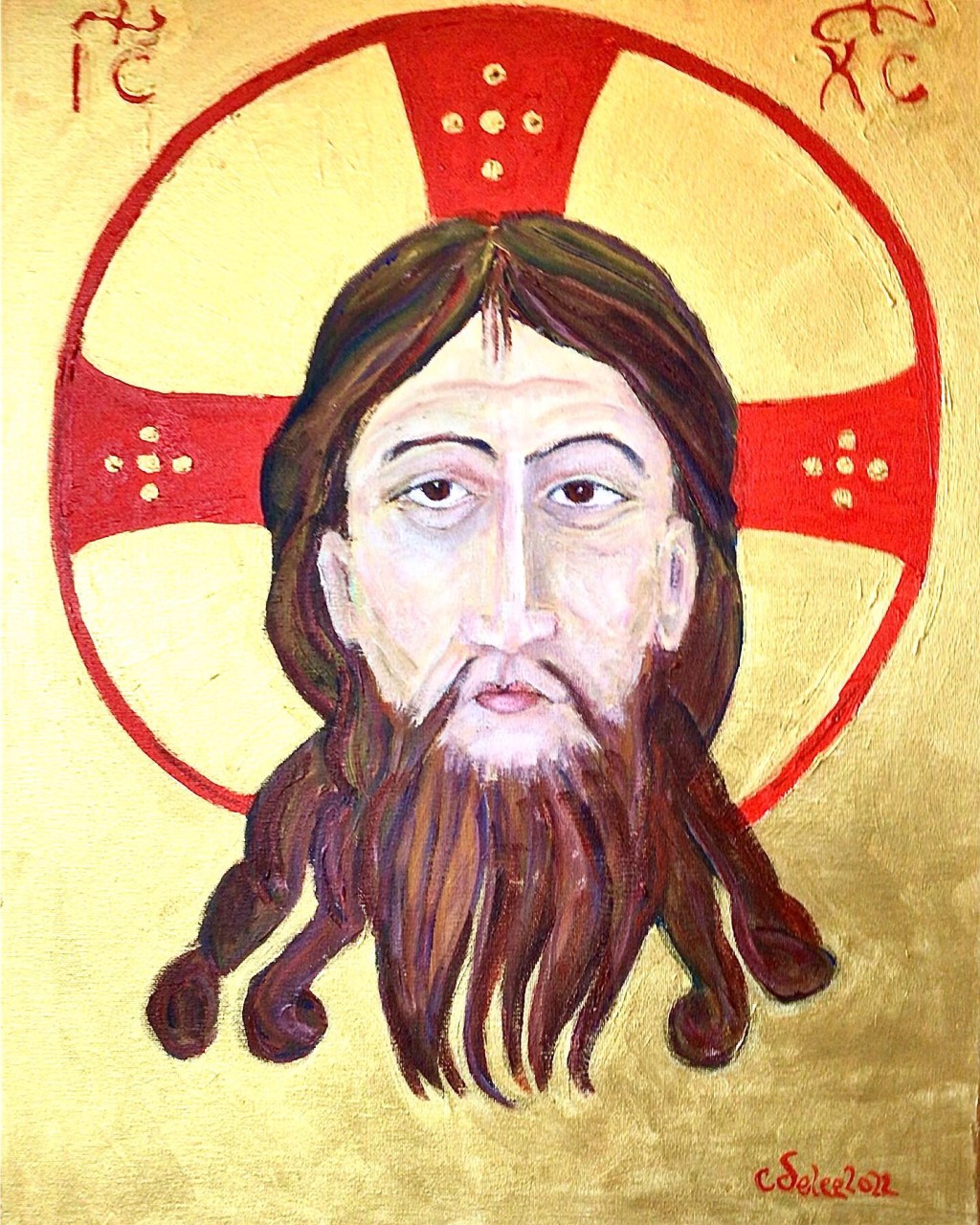
Note the use of common materials in Mike’s work. The circle is the same size as a foam plate, the cross from the table decorations fits just inside it, and he embellished the outer and inner spaces with a bilateral and balanced design. He’s getting more skilled to “eyeball those proportions” from across the room. Plus, he enjoys making these designs.

The ancient writers Eusebius and Euthymios both mention the emperor’s troops also witnessed this miracle. The significance of the vision was subsequently clarified by Christ, who appeared to Constantine in a dream advising him to carry a cross-shaped banner before his armies in order to defeat Maxentius.

Byzantine hagiographical works, or the writings about the lives of saints, name this apparition of the cross as a decisive step toward Constantine’s conversion to Christianity. This first episode is part of a faith narrative, which runs through the tale of Constantine’s leprosy and his miraculous healing through his first baptism, which was officiated by Pope Silvester.

The depiction of Pope Sylvester in the church decoration, a leading figure in the iconography of Roman popes in Byzantine art, deserves special comment. Sylvester was born in Rome and was pope between 314 and 335, succeeding pope Miltiades. Both the Latin and Orthodox rites honor Silvester as a saint and the patriarchate of Constantinople commemorates him on 2 January. The fictional account of his life, Actus Silvestri, written in the 4th-5th century, records the story of his curing Constantine of leprosy and then baptizing him.

Baptism of Constantine

It was during this first baptism Constantine had another vision which converted him to Christ. Constantine’s baptism is narrated in the Greek Life of Silvester in a verbatim translation of the story by Zonaras. Having recovered his health by means of the sacramental bath, the now Christian basileus (king) donned a bright garment and “said to the bystanders that he had felt a hand: It had stretched out from above and touched me while I was descending into the font.”

Baptism of Constantine

The visualization of St. Michael’s involvement in Constantine’s baptism has no direct precedent in Byzantine and Balkan iconography. Similar descriptions appear in the shorter ninth-century vita of the hierarch and in the lives of Constantine. In the “Guidi” legend, the emperor’s confession is specifically addressed to the pope: “Servant of God, as I was standing in [the water] of the holy baptism, I felt a hand touching me and cleaning the sickness of the flesh.”

Unlike the hagiographical account by Zonaras, this fragment from the “Guidi” vita is not attested in the manuscript culture of the East-Carpathian environment. Even if it doesn’t include this passage in the section on Constantine’s baptism, the encomium (eulogy) by Patriarch Euthymios contains an allusion to the motif of God’s hand:

Upon waking up from the dream in which SS Peter and Paul offered him the cure of baptism, the emperor dismissed the pagan healer ( ) who attended him and said that: “(…) from now on, I need no human help, for the hand of God Almighty ( ) helped me.” Although it anticipates the king’s baptism, this statement is merely a symbolic reference to the divine power which came to Constantine’s aid, not a description of a miracle occurring during the ceremony.

The Slavonic translation of the Life of Silvester by Zonaras remains the only account that constitutes a plausible narrative background for St. Michael’s involvement in the scenes at the Romanian churches of Rădăuți and Bălinești. We don’t know if these fresco designers used a specific copy somehow related to the manuscript at the Neamț monastery. Yet once it had been integrated into the liturgy, the legend of Pope Silvester might have developed an independent circulation through storytelling. Perhaps the local audience interpreted Constantine’s confession about the divine hand that touched him in the water as a sign of the ethereal presence of the Archangel as pictured in the compositions of Constantine’s baptism.

Creation: The Nuremberg Chronicles (1493), written by Hartmann Schedel and illustrated with woodcuts by Michael Wolgemut

Perhaps these tales seem strange to our modern scientific minds, colored as we are by notions of “pictures, or it didn’t happen!” We want proof, repeatable and documented evidence, not just some such nonsensical woo-woo about visions and dreams. After all, we are more likely to think these voices could be drug induced or anxiety provoked, but we aren’t so familiar with God speaking to mortals, as it was back in the days when the boy Samuel was ministering to the LORD under Eli:

“The word of the LORD was rare in those days;
visions were not widespread.” (1 Samuel 3:1)

We aren’t big on either voices or angels, but God does still work in supernatural ways. While some may see prayer as supernatural healing, others may see God’s healing hand at work in guiding doctors, nurses, and caregivers to bring people to get the medical attention that brings them to better health. God gives us the heart for healing and compassion for the suffering, which then sets us out to discover new medicines and treatments for dread diseases. These wonderful advances would appear as magic to those from a century ago, or even a few decades before.

Take the miracle of cystic fibrosis advances. In the 1980’s, the life expectancy for a CF patient in the United States was only 12 years and 20 years in Canada. By 2017, with new medications and therapies, the median life expectancy for CF patients was 47. Because new medications and improved treatment of respiratory infections and other complications have extended the predicted life expectancy of CF patients to almost 50 years, some are now living well into their sixth and seventh decades. I call this a miracle, even if others call it mere “science.” It means I have a grand nephew who likely will have a full lifetime and even enjoy his own children.

Humanists will give all the glory to the human creature. They are self-made men and women in love with their own creation. People of faith will give all the glory to God for the gifts of their hearts, minds, bodies, and spirits. We have been given much, so we give much to others.

Nike of Samothrace

Just as the earliest Christian art works repurposed secular and mythological Roman themes, so later Christian art used Greco-Roman mythological imagery. The angels are based on the female winged victories, such as the famous Nike of Samothrace. In the early fourth century, angels suddenly appeared as figures in Christian iconography, usually without feet and dressed in garments of a white pallium over a tunic. This was a large rectangular cloak worn over a tunic, as worn by Greek philosophers and religious teachers. In the earliest Christian art works, angels were depicted as wingless, but wings became normative by the fifth century. By the High Middle Ages, angels were more elegantly garbed (depending on their station in the hierarchies) and appeared to be androgynous.

The first known Christian depiction of winged angels does not appear until this splendid 4th century marble ‘Prince’s Sarcophagus’. It was discovered after a fire in Sariguzel, near Istanbul in the 1930s

The word for Angel, mal’akh in Hebrew and angelos in Greek, simply means messenger, which is the job description of the Angel, who acts as an intermediary between humans and God. The Bible never says angels have wings, but we all imagine angels with wings. Perhaps we assign them wings because angels can travel from the “heavens above to the earth below.”

Egypt’s Red Monastery, The church of Anba Bishay and Anba Bigol

The church of Anba Bishai and Anba Bigol, known as the Red Monastery, is the most important extant early Christian monument in Egypt’s Nile Valley. It’s one of the most significant historical sites of the period in the Mediterranean region. Created in the 4th and 5th CE, this fine painted Coptic Christian image of Christ surrounded by angels has survived multiple restorations of the church building.

Leonardo da Vinci: Annunciation, 1472, oil on canvas, Uffizi Gallery, Florence, Italy.

Although the principle of angels being sexless continued, later renaissance artists presented them as male figures with fashionably delicate facial features and long hair, dressed in contemporary garments (making them more approachable to the common era). As the lines between the angelic spheres became blurred, along with the renaissance adaptation of classical Greco-Roman art, plump little children with wings began showing up in Christian art. We know these as cherubs.

Cornelia’s Watercolor Angel from Hagia Sophia

I used a mix of pastels and watercolor on this painting, working from a 1.5-inch square image of the Archangel Michael. The contrast of light and dark shows up in the naturalist wings and hair, with the glowing and reflective gold mosaic pieces.

Angel from Hagia Sophia

Regarding his rank in the celestial hierarchy, opinions vary. St. Basil in his homily Angels, as well as other fathers, place St. Michael over all the angels. They say he is called “Archangel” because he is the prince of the other angels. Christian tradition gives St. Michael four offices:

  1. To fight against Satan.
  2. To rescue the souls of the faithful, from the power of the enemy, especially at the hour of death.
  3. To be the champion of God’s people, the Jews in the Old Law, the Christians in the New Testament.
  4. Therefore, he was the patron Saint of the Church; he is considered to be the protector of Christians against the devil.
Christ between St. Peter and St. Paul, Catacomb of Sts. Marcellinus and Peter on the Via Labicana, Rome, 4th CE.

This image of Christ on the Throne, dating to the 4th century, shows Michael between St. Peter and St. Paul. It was painted in the Catacomb of Sts. Marcellinus and Peter on the Via Labicana in Rome, located near a villa that used to belong to Emperor Constantine. Below the main figures of the painting—Jesus, Peter and Paul—we find Gorgonius, Peter, Marcellinus, and Tiburtius, four martyrs who had been buried in that catacomb, and are depicted as they point to the Lamb of God on his heavenly altar.

Zeus: Archaeological Park of Campi Flegrei at the Castle of Baiae on the Gulf of Naples, Italy


The enthroned Christ follows the thematic form of Zeus, king of the gods, seated on his throne. A good example is statue from the Archaeological Park of Campi Flegrei at the Castle of Baiae on the Gulf of Naples. This statue of Zeus Enthroned is a 29-inch-high marble statue dating to the 1st century B.C. and is likely of Greek manufacture.

It was inspired by the colossal gold and ivory statue of the god at the temple of Zeus at Olympia made by sculptor Pheidias in 430 B.C. It was one of the Seven Wonders of the ancient world. Just as the angels were repurposed from the Nike victory statues, so the Christ Enthroned statues were re-envisioned from the ruler of the gods and humans statues. Art and artists can be put to work for whoever is in power at the moment. We need to eat and pay bills in every age.

Zeus: fresco, 62-79 CE, Casa dei Dioscuri, Pompeii (VI, 9, 6-7, atrio corinzio 37), Museo Archeologico Nationial, Italy.

A lovely fresco from Pompeii, found in the House of the twins, has a glowing red background and shows Jupiter or Zeus, the king of the gods, seated on his throne. A sphere lies beside him, an eagle at his feet, and a rectangular base is at his feet. In the same manner, the icon of the enthroned Christ places his feet on a rectangular base, representing his lordship over the four corners of the world.Gail W used the pastels in the clothing and background.

Gail W’s Enthroned Christ watercolor


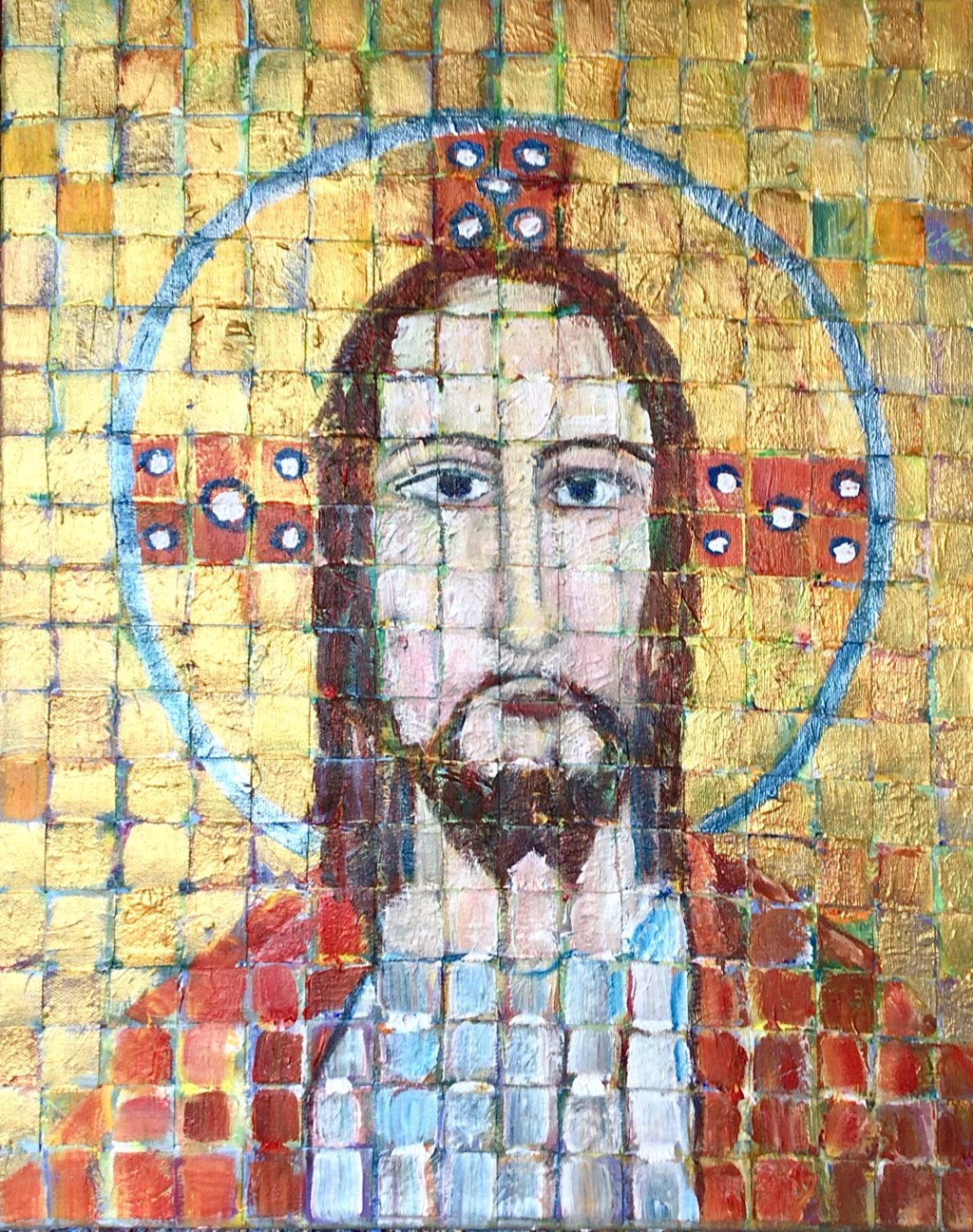
From one of the royal figures, Gail S chose one of the jeweled embellishments for her focus. Gail enjoys ordered designs, so finding an image with a regular pattern was right up her alley. The outer circle with an inner square is divided along the diagonals by red lines, as if the cross were tilted on its side. The circle and square give unity to the design, as does the monochrome cross. The triangles are balanced by colors. The outer blue rim holds it all together. Gail tried the watercolor pencils out along with the pan watercolor washes.

Gail S inspiration and creation

While nothing is ever new in art, we artists keep reimagining the old patterns in new ways. After all, the basic elements of design never change, but we see the world with fresh eyes in every generation. Using our hands to create restores us and recreates us by reducing our anxieties and giving us a sense of accomplishment. We each serve the God of beauty and joy as God reveals God’s self to each of us. Doing any creative work with our hands is good for the mind, spirit and soul.

As our hand grows in competency with the media and our eye is better able to discern shape and patterns, we come under the Holy Spirit’s inspiration of creating power and we make art! We may start from the ancient wisdom, but then we go onto find the wisdom for today. After all, God is always in a rebuilding mode, for that which God created, God will preserve:


“When you send forth your spirit, they are created;
and you renew the face of the ground.” ~~ Psalms 104:30

Joy and Peace,

Cornelia

Diane Apostolos-Cappadocia : Why Ukraine Calls Upon Michael the Archangel, Christianity Today, April 12, 2022, https://www.christianitytoday.com/ct/2022/april-web-only/michael-archangel-ukraine-kyiv-patron-saint.html

Saint Mamas at Exeles: An Unusual Case of Ritual Piety on Karpathos
Katsioti, Angeliki; Mastrochristos, Nikolaos.  Arts; Basel Vol. 12, Iss. 4, (2023): 176. DOI:10.3390/arts12040176
Saint Mamas at Exeles: An Unusual Case of Ritual – ProQuest https://www.proquest.com/docview/2856776246?sourcetype=Scholarly%20Journals

The Historical Evolution of CF Treatments and Understanding
https://cysticfibrosisnewstoday.com/news/cf-treatments/

Life Expectancy with Cystic Fibrosis (CF)
https://www.nationaljewish.org/conditions/cystic-fibrosis-cf/life-expectancy

ARCHANGELS MICHAEL AND GABRIEL
https://www.stjohnarmenianchurch.org/archangels-michael-and-gabriel/

Archangel Michael
https://www.etd.ceu.edu/2023/dumitrescu_andrei.pdf

I See the Icon—The Icon Sees Me

art, beauty, Faith, Holy Spirit, Icons, Imagination, incarnation, inspiration, Love, Mandylion, mystery, Painting, Pantocrator, Plato, renewal, salvation, St. Athanasius, vision

The icons of Christ radiate a sense of calm, a spiritual experience created countless times by various artists over the ages. Each one channels the spiritual force which lies outside of language, mystery, and mysticism. Over the years, we’ve come to understand the icon serves as a window into the world beyond our own. In this world we think of dualities: good and evil, winning and losing, ours and theirs. In the world beyond ours, everything belongs to God, we are all one, and no one lacks for anything. The heavenly banquet table is a never ending feast for everyone and no one is reduced to begging for the crumbs that fall from it. No one hungers or thirsts in this land of the unclouded sky.

Jesus is the Bread of Life

The icon represents to us the world we yearn to be. In this respect, it’s a “wormhole” from the fully perfected world to this world, which is still going onto perfection. The New Heaven and the New Earth promised in Revelation 21:1-4 speaks to this very event:

Then I saw a new heaven and a new earth; for the first heaven and the first earth had passed away, and the sea was no more. And I saw the holy city, the new Jerusalem, coming down out of heaven from God, prepared as a bride adorned for her husband. And I heard a loud voice from the throne saying, “See, the home of God is among mortals. He will dwell with them; they will be his peoples, and God himself will be with them; he will wipe every tear from their eyes. Death will be no more; mourning and crying and pain will be no more, for the first things have passed away.”

The Good Shepherd

Until that time comes, we have the icons gazing upon us to remind us of this promise, as well as of our calling to be coworkers with God in bringing this world into fruition. If we see with spiritual eyes, we’ll be able to look beyond the paint and canvas, beyond the image and likeness, and beyond material truth to see the spiritual truth of the icon before us.

To understand the icon better,we ought to take a trip in the WayBack machine to Ancient Greece to visit Plato and study up on his philosophy. This is important because whether they know it or not, artists of every stripe and measure participate in this “not yet, but yearning for a better world” as they make their art. In the 4th C BCE, Plato believed the true reality was in the ideal forms which existed in a world outside of this one which we daily experience. Every form we see on earth is merely a copy of the ideal form, but not the “truth.” Plato’s truth existed in this realm of ideas, rather than in the senses. This is the opposite of how most modern people look for “truth,” especially scientific or observational evidence based truths.

Christ Enthroned

For Plato, the ideals of good and truth had to exist as a form in the eternal world so we could recognize them in our transitory world. All things, even virtue, justice, love, and beauty, must have an ideal form in this realm beyond our sensibilities. Where we get into trouble is believing this world’s representations of the ideal forms must follow the pattern exactly. The examples we consider beautiful can change over the centuries, but the idea of beauty as the highest ideal of loveliness never changes. This is why we don’t keep repeating Greek and Roman Classical themes for our public buildings in the modern era.

James 1:17 says of God: “Every generous act of giving, with every perfect gift, is from above, coming down from the Father of lights, with whom there is no variation or shadow due to change.”

The Golden Christ

When we say “God doesn’t change,” we mean God never quits loving us, always wants to save us, and always wants to work for good for those who love the Lord and are called according to God’s purposes. God does change God’s mind when we give up our wayward ways and return to godly ways. The Old Testament is full of times God had a change of heart. Maybe some of these events were the people having a heart change and coming back to God. God does seem absent when we turn away, while God seems near when we turn towards God.

Coptic Jewel Icon

But I digress, and I plead the hot weather. Plato’s perfect forms are the subject, especially the form of the Good. For Plato, only the soul or the mind can know the true forms, while the sensible body is suspect. Plato’s philosophy is a form of dualism, which elevates the spiritual over the physical. This is an important concept for early Christianity, since they had to hash out an understanding of the incarnation of Christ. For some, Jesus was purely divine, while for others he was purely human.

Variation on the Christ Not Made by Hands Icon

The traditional interpretation of Jesus Christ is he is both fully human and fully divine, as Athanasius so succinctly said in his treatise On the Incarnation: “for God became man so that man might become god” (54:3). This theology of theosis, or perfection in love, always boggles the mind of those of us who are used to 1 + 1 = 2, or the sensible and mathematic physical reality of this world. One of the rallying cries back in those days was “There never was a time when the Son wasn’t the Son.” People marched in the streets to proclaim this belief: the Son of God never gave up his divinity even when he became human for the sake of our salvation. It was necessary for him to become human to save all of us and only if he were completely God would he be able to save us entirely.

Christ Pantocrator

For the icon painters, Athanasius also is informative when he writes about the Incarnation: “and He manifested Himself by a body that we might receive the idea of the unseen Father; and He endured the insolence of men that we might inherit immortality.”

As Jesus says in John 14:7, “If you know me, you will know my Father also. From now on you do know him and have seen him.” Like Phillip, we can only believe in what we’ve seen. Many of us are doubting Thomases, who need to touch and hold onto physical proof before we can be convinced. The icons remind us that Jesus is

“the image of the invisible God, the firstborn of all creation; for in him all things in heaven and on earth were created, things visible and invisible, whether thrones or dominions or rulers or powers—all things have been created through him and for him” (Colossians 1:15-16).

What image is the Christ icon? That depends on the time and place where the icon was created, but all images share certain qualities. The eyes are prominent, the mouth is small, the forehead is broad, and the lower jaw is small. Most of the icons of Christ look like a philosopher, rather than a warrior king, which was the original meaning of the Jewish messiah. All icons have at least one ear visible to hear the prayers of the faithful.

These letters form the present participle, ὤν, of the Greek verb to be, with a masculine singular definite article, ὁ. A literal translation of Ὁ ὬΝ would be “the being one,” which does not mean much. “He who is” is a better translation

The backgrounds are gold and represent a timeless, eternal spiritual space. Today, yesterday, and tomorrow are all the same for God, who is known by the name I AM. In John 8:58, Jesus got into an argument with some of the Pharisees over who were the true children of Abraham. When he told them, “Very truly, I tell you, before Abraham was, I am,” they were ready to stone him  for claiming to be god. Moreover, as the author of Hebrews reminds us, “Jesus Christ is the same yesterday and today and forever” (13:8).

Roman Icon, 12th CE, oil on wood panel, Vatican Museum

The icon itself isn’t holy, but the image it represents is holy. This is why icons are venerated , while Christ is worshipped. The image isn’t holy, but the person represented is holy. In this sense, every icon points to the ideal form of Christ in the spiritual world beyond us and the icon acts as a window or a wormhole opening so that spiritual world can enter into our sensible and material world here. The more we live with an icon, the more our hearts and minds are tuned to the silent harmonics of the hymns of joy, peace, love, beauty, generosity, and compassion. This is because we become open to the truth of Christ in a mystical way which supersedes our own personal beliefs and experiences. We lose our attachment to the world of dualisms and enter into the world of union with the divine. We are undergoing theosis. Theosis is more than just salvation and divine pardon, but is  rather the process of spiritual transformation that culminates in mystical union with God. It is a cooperative work of the Holy Spirit and the believer that results in this union.

After 12th Century Vatican Icon

Art has a way of affecting the energies of a human being. It’s well known how certain colors affect mood, so designers use these techniques to create appropriate spaces in buildings. Public art adds to the charm of a city and likewise, destroying green spaces can render a city to grimness. Having art in one’s home or office elevates it above the ordinary.

Even artists who aren’t painting icons, but are making landscapes or abstractions can be said to be seeking a platonic form, one which only they may see in their own mind’s eye. We keep looking for the next challenge, the creation which comes closest to our imagination. We artists keep on going, however, for each new work not only refines our imagination, but it also moves us closer to our desired goal. We’re like long distance runners who always seek a new personal best!

Resurrection Christ

The icon makes a claim on our lives as we return its gaze. In the silence, Christ asks, “Are you going onto perfection in the love of God and neighbor?” We take a silent stock of our lives and our interactions in prayer. Most days we agree with the apostle Paul in his letter to the Philippians (3:12):

“Not that I have already attained this—that is, I have not already been perfected— but I strive to lay hold of that for which Christ Jesus also laid hold of me (NET).”

Joy and peace,

Cornelia

Plato
https://www.webpages.uidaho.edu/engl257/classical/platonic%20idealism.htm

Early Christian Heresies
http://webspace.ship.edu/cgboer/heresies.html

CHURCH FATHERS: On the Incarnation of the Word (Athanasius) 54:3. https://www.newadvent.org/fathers/2802.htm


Growth in Faith and Art is a Risky Business

adult learning, arkansas, art, brain plasticity, change, Children, Creativity, Faith, Holy Spirit, hope, Icons, Imagination, inspiration, john wesley, Ministry, New Year, Painting, Pantocrator, perfection, photography, purpose, risk, Spirituality, vision

Oscar Wilde famously said, “Life imitates art far more than art imitates life.” This is because the self-conscious aim of life is to find expression and art offers it certain beautiful forms, through which it may realize that energy. Yet most people who look at artworks judge them for the degree to which they represent “three dimensional reality,” in either two or three dimensions (painting, draw,or sculpture and assemblage).

Often I’ve been asked about my colorful landscapes, “Don’t you ever paint these in normal colors?”

My answer is usually, “How do we know the colors we see today are the original colors of Creation? After all, we now live in a fallen and broken world. Perhaps these bright colors were God’s original palette.” I’m not painting just what I see, but what was and what is yet to come. These are visions of a better world, where the leaves clap their hands for joy.

In art class, we not only struggle to master drawing shapes “as they are,” but also to challenge our minds to break free of our need to exactly reproduce the shapes before us. We always have the tension to make only a “copy of the image before us,” rather than to meet the image on a spiritual plane and portray an intimate portrait of its inner truth.

When we meet a stranger, we can hide behind our masks and keep our distance. Likewise, we can fail to become intimate with our painting’s subject matter. The resulting work is cold and dead, like a limp handshake. It’s a risky business to bare your heart to the canvas and paint. The brush will tell if your heart and soul is in it or not.

We get more comfortable with this risky business by practicing risk taking. It’s not like we’re facing tigers in a circus cage or jumping out of an airplane without a parachute. We can’t lose our salvation in Christ if we make a bad painting. We only have a new level from which to start afresh. All growth requires risk and failure. We discover what works, keep that, and eliminate the unuseful.

Willingness to learn is related to the “growth mind-set.” This is the belief your abilities aren’t fixed but can improve. This willingness is a belief not primarily about the self, but about the world. It’s a belief every class or learning experience offers something worthwhile, even if we don’t know in advance what that something is. Every teacher or parent worth their salt has to believe their students or children can learn and grow, or they need to give up their profession so another can grow. The first lesson even the most recalcitrant student needs to learn is to believe growth and progress is possible.

Christ on Tree of Life, San Clemente Basilica, 12th Century mosaic, Rome, Italy.

The Christian life has a parallel to the growth mindset. The whole of the Christian life is wrapped up in this faith: with God’s help, we can go on to perfection. This is a basic Methodist belief known as sanctification. We also call it going on to perfection in love of God and neighbor. Some of us think because we’re not able to change on our own, we don’t need to grow in our love. God has done all the work for us in Christ. The Holy Spirit was sent to be a truthful guide:

“When the Spirit of truth comes, he will guide you into all the truth;
for he will not speak on his own, but will speak whatever he hears,
and he will declare to you the things that are to come.” (John 16:13)

Christ in Majesty, Book-Cover Plaque, French, Limoges, enamel, ca. 1200 CE, Metropolitan Museum of Art, NYC.

Paul speaks of this truth in Philippians 3:20-21, when he reminds the people of their present state as sojourners in this world, while their citizenship is elsewhere:

“But our citizenship is in heaven, and it is from there that
we are expecting a Savior, the Lord Jesus Christ.
He will transform our humble bodies that they may be conformed
to his glorious body, by the power that also enables him
to make all things subject to himself.”

Mother About to Wash Her Sleepy Child Mary Cassatt, 1880

If life is a journey, the Christian life is even more of a pilgrimage. We all go through stages of faith if we seriously reflect and consider our beliefs when our life experiences intersect with our faith. Our earliest stage of faith begins with our parents or caregivers. Here we learn to trust or distrust, as we experience an embodied faith. The next stage is early childhood (age 3-7). Faith at this stage is experiential and develops through encounters with stories, images, the influence of others, a deeper intuitive sense of what is right and wrong, and innocent perceptions of how God causes the universe to function.

Michaelangelo: Creation of Adam, Sistine Chapel Ceiling

The next stage has been labeled “Mythic-Literal Faith” (Ages 7-12). Children at this stage have a belief in justice and fairness in religious matters, a sense of reciprocity in the workings of the universe (e.g. doing good will result in a good result, doing bad will cause a bad thing to happen) and an anthropomorphic image of God (e.g. a man with a long white beard who lives in the clouds). Religious metaphors are often taken literally, thus leading to misunderstandings. If God’s rewards or punishments don’t apply in proper retribution, in the believer’s mind, their faith in God’s system becomes fragile.

Théodore Géricault, Raft of the Medusa, 1818–19, oil on canvas, Louvre, Paris.

“The Conventional Faith” stage (12-adult) arises when individuals join a religious institution, belief system, or authority, and begin the growth of a personal religious or spiritual identity. Conflicts occur when one’s beliefs are challenged are often ignored because they represent too much of a threat to one’s faith-based identity.

Théodore Géricault’s “Raft of the Medusa,”painted in 1818–19, is nearly 17 by 23 feet large. It commands its space as any proper historic painting of the past ever did. Rather than present a moral lesson from the past, the artist instead chose to paint an event from his present time: the rescue of the abandoned sailors and slaves from a wrecked ship. The French nation had sent the new governor of the Senegal colony, his family, and some other government officials and others on the Medusa. The government officials went to secure French possession of the colony and to assure the continuation of the covert slave trade, even though France had officially abolished the practice. Another group aboard the Medusa was composed of reformers and abolitionists who hoped to eliminate the practice of slavery in Senegal by engaging the local Senegalese and the French colonists in the development of an agricultural cooperative that would make the colony self-sustaining.

On the way, the ship ran aground and broke up. The officials and their families were put in lifeboats, but the 150 others on board got a makeshift raft, which was tied to the lifeboats. When the raft impeded the lifeboats, the officials cut the raft loose and all the lives with it. Only 15 were rescued after days at sea, and only ten lived to tell their tales. It was a scandal of the times. Géricault read all the newspapers, interviewed survivors, and made studies from ancient sculptures to inform his design. When younger artists saw his inspirational work in the Paris Salon, they knew a sea change had happened. Conservative critics and writers were appalled and accused Géricault of creating a disgusting, repulsive mistake. They were not yet ready to leave the past behind.

William Faulkner once said, “You cannot swim for new horizons until you have courage to lose sight of the shore” (The Mansion , 1959). When we meet that initial storm, our first thought is to bring our fragile bark into port. In life, we batten down the hatches and book it for a safe harbor. In art class, we want to fall back on what we’ve always done before, what we know we can do, and what we’ve been successful with in the past. This is our “safe harbor.”

“Individuative-Reflective Faith” (Mid-Twenties to Late Thirties). The individual takes personal responsibility for her beliefs or feelings, often by angst and struggle. Religious or spiritual beliefs can take on greater complexity and shades of nuance, and a greater sense of open-mindedness. These can also open up the individual to potential conflicts as the different beliefs or traditions collide.

To progress and grow in our art skills, or to move through the “dark night of the soul” when we question our formerly held spiritual truths, is a crucial time. Crucial is a word sharing the same root as crucifix. The crux of both of these situations results in a life and death situation. Not that the person quits breathing or their heart stops beating, but will their old life die and their faith be reborn anew? Also, will they trust a power greater than themselves to bring them back from the depths? Many of us aren’t willing to give up control to anyone, and certainly not to a God we can’t see. We’re two year olds in our spiritual lives too often, for “I can do it myself!” Is our answer to everything and everyone. (Test it out—how many of you read the directions after you start putting a project together?)

The Cross that Spoke to St. Francis, San Damiano Chapel, Italy, 1205 CE

“Conjunctive” Faith (Mid-Life Crisis). A person at this stage acknowledges paradoxes and the mysteries attendant on transcendent values. This causes the person to move beyond the conventional religious traditions or beliefs he may have inherited from previous stages of development. A resolution of the conflicts of this stage occurs when the person is able to hold a multi-dimensional perspective that acknowledges ”truth’ as something that cannot be articulated through any particular statement of faith. This is where the Holy Awe begins to fill all the nooks and crannies from which it was once forbidden.

Face of Christ (All People of the World), photo montage

“Universalizing” Faith (or ”Enlightenment”). (Later Adulthood). This stage is only rarely achieved by individuals. A person at this stage is not hemmed in by differences in religious or spiritual beliefs among people in the world, but regards all beings as worthy of compassion and deep understanding. Here, individuals ”walk the talk” of the great religious traditions (e.g. ”the kingdom of God is within you”).

“Jesus of the People” by Janet McKenzie.

In 1999 Janet McKenzie’s painting “Jesus of the People” was selected winner of the National Catholic Reporter’s competition for a new image of Jesus by judge Sister Wendy Beckett, host of the PBS show “Sister Wendy’s Story of Painting.” In the words of Sister Wendy, “This is a haunting image of a peasant Jesus—dark, thick-lipped, looking out on us with ineffable dignity, with sadness but with confidence. Over His white robe He draws the darkness of our lack of love, holding it to Himself, prepared to transform all sorrows if we will let Him.” The model was an African-American woman and the painting includes a yin-yang symbol of Eastern traditions and feather of Native American traditions. (Photo courtesy of Paul Smith)

Next week, we’ll still be working on order and chaos. We got started on this at our first meeting, and the concept is a challenge. I’ll write about our class work then. We’re always open to anyone joining us, for you come as you are and begin where you are. Our art group is a “one room schoolhouse” with all levels of students mixed together. We may all be doing the “same project,” but everyone does it at their own skill level. I give you special attention according to your needs.

Remember, “The only way you can be behind is if you never start.”

Joy and peace,

Cornelia

Life Imitates Life | Lapham’s Quarterly
https://www.laphamsquarterly.org/swindle-fraud/life-imitates-life

The Stages of Faith According to James W. Fowler | Thomas Armstrong, Ph.D.
https://www.institute4learning.com/2020/06/12/the-stages-of-faith-according-to-james-w-fowler/

Théodore Géricault, Raft of the Medusa – Smarthistory
https://smarthistory.org/theodore-gericault-raft-of-the-medusa/

Video and photo slideshow: The many faces of Jesus
https://religionnews.com/2014/01/28/video-photo-slideshow-many-faces-jesus/

Writing a Holy Icon

adult learning, Altars, art, crucifixion, Faith, Holy Spirit, Icons, inspiration, john wesley, Love, Mandylion, mystery, Painting, Pantocrator, salvation, Spirituality, St. Athanasius, Stations of the Cross, United Methodist Church

Cartoon for an Icon of the Resurrection

In art class, I taught our group the time honored technique of using a cartoon to transfer an image to another surface. Of course, their first reaction was, “Are we watching Saturday morning cartoons today?”

“No, it’s Friday. We’re going to make our own carbon paper,” I said, as I showed them how artists of old would rub graphite on the back of their drawings and then outline the major lines onto the wall or the canvas to transfer the image. The J. Paul Getty Museum has a great video on YouTube explaining this process.

“You mean we’re going to paint by number?”
“Not a chance. You still have to make your own color decisions and shading choices.” Really, by now you’d think they know my opinion on the easy way. As Jesus says in Matthew 7:13—

“Enter through the narrow gate; for the gate is wide and the road is easy that leads to destruction, and there are many who take it.”

Reverse of Crucifixion Icon with Graphite over Outlines

I didn’t bring any complicated images of the holy icons. I brought only ones with simple outlines. I knew this project wasn’t going to be as easy as people first thought. It’s not as simple as coloring within the lines.

An icon is an image of a holy person, but it isn’t a mere representation of the individual. When we make photographs or even painted portraits, we seek to make “likenesses” of the individual, and capture their outward details and idiosyncrasies. If we can also capture their inner spirit, we take the image to a master level. Icons, however, are more concerned with representing the inner, spiritual nature of the person, rather than their outward nature. After all, we don’t have any images of how the holy ones from the earliest days of faith actually looked. We only have their acts and the symbols connected with them, so in the iconography we can identify them by these qualities. The word iconography comes from the Greek: eikōn ‘likeness’ and -graphia ‘writing’, so when we paint, we’re actually “writing a likeness” of the holy image.

Dusty spent his day off on the Pantocrator Icon

In the iconographic tradition, all of the faces are broad across the brow, to represent the holy wisdom of God residing in the saints, just as their elongated figures and extremities accent this holiness. The eyes, windows into the soul, are large compared to a natural face, while the mouth is small. The small mouth indicates the saint has conquered bodily passions. There’s always an ear open on an icon, for the icon needs to “hear our prayers.” Not that the icon is alive, but it’s more like an open window into heaven. Therefore, the saint’s ear is the open window through which our prayers flow into the golden light of the mysterious world beyond this material one in which we dwell both in shadows and light.

Freehand drawing of Mandylion Icon

The color in icons also plays an important role. Red belongs to martyrs. Blue stands for wisdom. White symbolizes paradise and chastity. Green is the color of the Venerable Fathers. Gold symbolizes sanctity.

The icon painter and teacher of St. Tikhon’s Orthodox University, Svetlana Vasyutina once described an experience before the iconostasis or screen of images of the saints in the church. “A while ago, I was tortured by the question why it is golden. Once I was standing at a church, looking at the iconostasis. Suddenly, they turned off the electric lights, and only candles before the icons were burning. The golden traces were shining, giving back the light. It was as if, not the candles, but the halos, were radiating light. I was amazed; the light seemed not material, not as comes from a candle or a lamp. The golden color shows the person painted in the icon was granted a different kind of light.”

According to St. Paul, glory (doxa) appears where the form and the idea of God, which inhabits it, become one. This is especially true where form becomes a place of theophany (a visible manifestation to humankind of God or a god), where the body becomes the temple of the Holy Spirit. This glory is represented by the nimbus or halo of the saints. We hear Paul speak of this power in Philippians 3:21—

“He will transform our humble bodies that they may be conformed to the body of his glory, by the power that also enables him to make all things subject to himself.”

The disciples first saw this glory descending upon Christ on the Mount of the Transfiguration, as recorded in Matthew 17:2—

Icon of the Transfiguration

“And he was transfigured before them, and his face shone like the sun, and his clothes became dazzling white.”

To become completely transformed by the Holy Spirit wasn’t only a special gift given only to the saints alone, but it was meant for all believers. As Paul mentions in 2 Corinthians 4:7 (American Standard Version)—

“But we have this treasure in earthen vessels, that the exceeding greatness of the power may be of God, and not from ourselves.”

A famous story in the Eastern Orthodox Monastic tradition follows:

Abba Lot went to see Abba Joseph and said to him, “Abba, as far as I can I say my little office, I fast a little, I pray and meditate, I live in peace and as far as I can, I purify my thoughts. What else can I do?” Then the old man stood up and stretched his hands towards heaven. His fingers became like ten lamps of fire and he said to him, “If you will, you can become all flame.”

Mike’s Icon of the Via Dolorosa

Many of us are barely alight with the fire of Christ, and we wonder why the glory of God doesn’t shine through us. Others of us hide our light under a bushel so we don’t stand out from the crowd. If we wonder why we aren’t going onto Christian Perfection in love of God and neighbor, or being a witness to Jesus Christ for others to follow, then we might need to read Abba Joseph’s recommendation once again:
“If you will, you can become all flame.”

When we paint an icon, we participate in a spiritual endeavor in which we are coworkers with the Holy Spirit. We enter into a kairos time, or God’s creating time, and are no longer only working only in human, chronological time. This is a mystery, not to be understood in ordinary terms, even if we begin at 10:15 in the morning and stop to cleanup at 11:45. Like the golden background, time has no meaning while we paint the icon. Our cares and concerns of this world can be given to the icon, and thus to God.

Gail’s Icon of the Crucifixion

We make our prayer gifts in two ways: we hope to become more conformed to the image of God and we hope our images conform better to the icon before us. We’re going on to perfection, one bit at a time. In faith, we expect to be made perfect in love in this life, by the power of the Holy Spirit, or at the moment of our death, as the classic Wesleyan teaching states. The Orthodox doctrine of theosis, union with God, from which our Methodist teaching of sanctification derives, teaches we can have real union with God, just as Jesus had, being fully human and fully divine. We don’t become gods, but we participate in the full image of God, in which we were first created.

Sally’s Crucifixion Icon

We can contemplate these beautiful words of St. Athanasius of Alexandria (+373), in his treatise On The Incarnation, against the Arian heresy:

‘God became “sacrophore”—bearer of our flesh—so that mankind might become “pneumatophore—bearer of the Holy Spirit.’” (Michael Quenot, THE ICON, p 55)

When we keep our heart set on the image of Christ, we remember his undying love for all creation. Then we learn the meaning of the faith of a loving son or daughter, in comparison to that of an unwilling servant. This is how John Wesley saw his own conversion at Aldersgate:

“I felt my heart strangely warmed. I felt I did trust in Christ, Christ alone for salvation; and an assurance was given me that He had taken away my sins, even mine, and saved me from the law of sin and death.”

Mandylion Icon—Towel with Image of Christ

Once we realize the law of sin and death no longer holds us in chains, we can freely live in life and love, now and always, if we conform our image to Christ.

Joy, peace, and divine light,

Cornelia

Paul Evdokimon, translation by Fr. Steven Bigman, The Art of the Icon: A Theology of Beauty, Oakwood Publications, Pasadena, CA.
https://kyl.neocities.org/books/%5BSPI%20EVD%5D%20the%20art%20of%20the%20icon.pdf

Sharing in the tabor light | New Camaldoli Hermitage
https://www.contemplation.com/sharing-in-the-tabor-light/

The Icon: Window on the Kingdom Hardcover – Import, March 19, 1992
by Michael Quenot (Author), A Carthusian monk

John Wesley Quotes, Oxford Reference
https://www.oxfordreference.com/view/10.1093/acref/9780191843730.001.0001/q-oro-ed5-00011419

John Wesley’s Quotes – Seedbed
https://seedbed.com/on-john-wesley-quotes/

John Wesley: Journal of John Wesley – Christian Classics Ethereal Library
May 24, 1738– I Felt My Heart Strangely Warmed
https://ccel.org/ccel/wesley/journal/journal.vi.ii.xvi.html

A Map of a Changing World View

art, change, cognitive maps, cosmology, Creativity, Faith, Healing, Icons, mappa mundi, nature, Painting, Pantocrator, renewal, Spirituality, vision

Jesus and The Cosmos

When our world is changing “faster than we can say Jack Rabbit,” sometimes life can get overwhelming. My dad often used this quaint phrase when he wanted something in a hot minute, like a bowl of ice cream just before bedtime. Or when he wanted us kids to get a move on and not dilly dally. Usually we were messing around and goofing off when our parents had time constraints, so the tone of his voice sometimes sharpened with the promise of consequences if we weren’t front and center right now. My parents were usually in hurry mode, while we kids never quick unless the destination was the local Dairy Queen. We all screamed for ice cream in my family.

This clock knows which way the wind blows

Grownups have a different sense of time than children do. Adults know from experience how short lived is the human existence, for they’ve lived long enough to have loved and lost. Children, who’re generally protected from such harsh realities, live in worlds in which time both stretches into eternity and seems to stand still. I call this variable sense “rubber band” time, since it can both stretch to the moment of breaking, but also snap back to inertia or non movement. For children, especially at year end, Christmas comes on lumbering feet, but for parents, the season is far too brief. The day blows through on a wind from the north, like a polar front charging into the Deep South on a mission to freeze every fragile magnolia blossom before the new year can make an appearance.

Treasure at the end of the rainbow

Children’s worlds are different from adults, for they still have a sense of wonder and all things are new to them. I remember seeing my first rainbow high up in the sky. I put up such a clamor on the front porch as I called for my mother, she was sure I’d seen a snake or some dangerous animal. She was put out I’d called her away from her household tasks “just to see a rainbow.” To this day, I still think rainbows are wondrous writings in the sky and meant to give us joy for our mundane lives. Seven decades later, the child in me still celebrates rainbows.

Our sense of time changes as we age, for everything a child sees is a first and a best. This is why we can have such deeply imprinted memories from our childhoods. Later on, we’re doing the same things over and over, so unless these events stand out for some different reason, they all tend to blend together. We also tend to think of these as “this is the way life is,” or they become the “model” for our world. This is also known as our cognitive map.

Some people can give good directions to their home, while others wouldn’t be able to get someone to their place even if they lived in a teacup. Those “others” lack good cognitive maps, for they don’t have a good mental image of the landmarks on the way to their home. Today, our cognitive maps are undergoing rapid change. The world we used to know doesn’t exist, mostly because of COVID. Once we had a service economy, but now we don’t do face to face experiences because of the pandemic, so we buy goods. We’re buying so many goods (can we ever buy bads?), we have supply chain problems trying to provide them all. We’re so used to same day or next day delivery from our pre-pandemic lives, we think our world is coming to an end if it’s going to take a week to get our cherished gifts delivered.

That old world existed back in 2005, when Amazon Prime partnered with the US Postal Service for its packages’ last leg of delivery. Today we have on demand groceries ordered through the app for immediate pick up or delivery, as well as restaurant foods for the same. This was unimaginable just a decade ago. It’s still so new, some folks won’t use it, even if they were on their death bed. Their cognitive map won’t let them try a new thing, for these new places and experiences aren’t encoded on their mind maps.

British Library: Mappa Mundi

The ancient world maps, dating from the peak of the Middle Ages, take their cartography from both faith and geography. One of the earliest is the Map Psalter, which takes its name from its full-page illustration of a map of the world. It’s design shares close parallels with the famous Mappa Mundi, now housed at Hereford Cathedral. The manuscript was made in London during the latter half of the 13th century but after 1262, as the Psalter’s calendar commemorates on 3rd April the feast day of St Richard of Chichester (d. 1253) who was canonized in 1262.

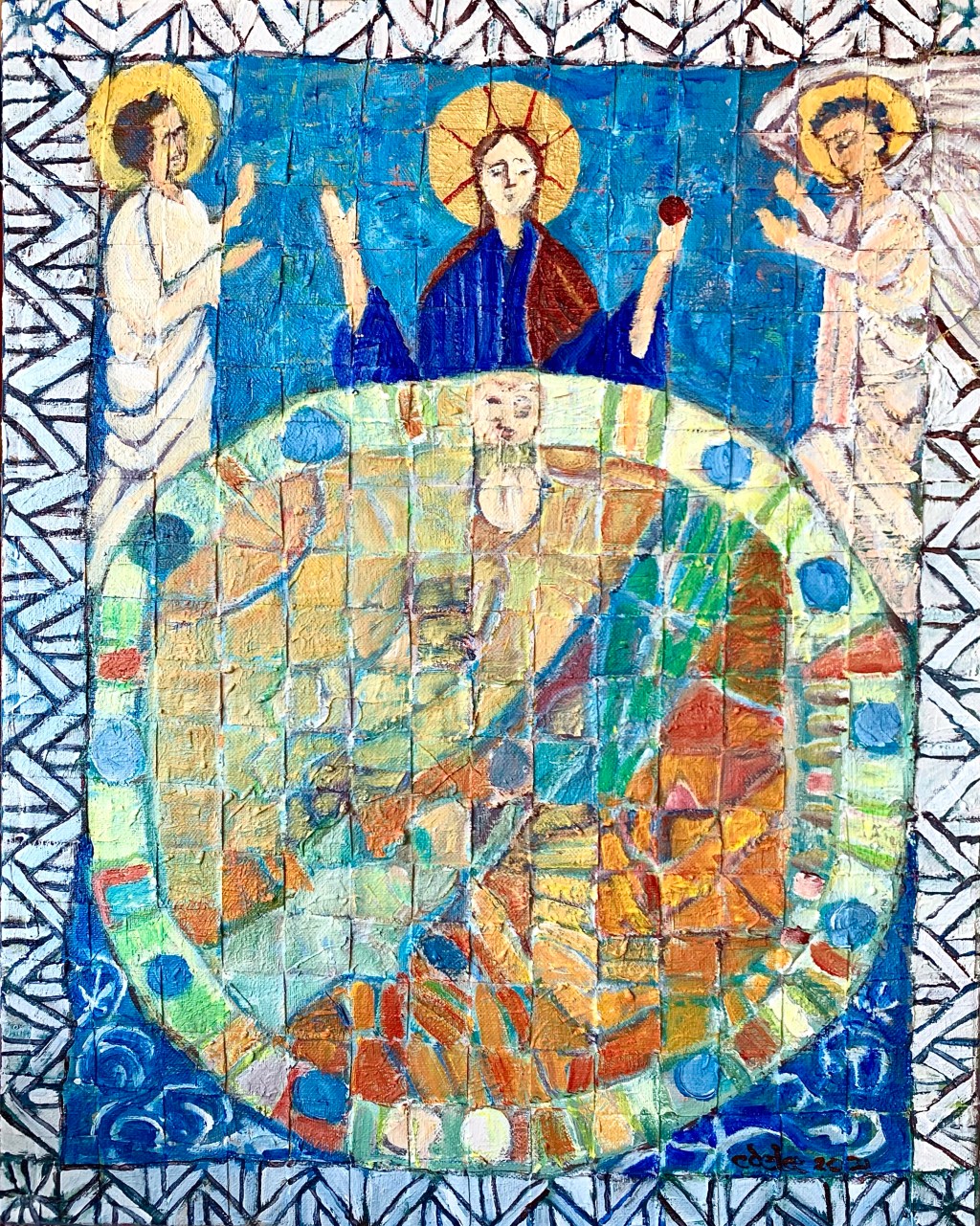
The image shows Christ holding the orb of the world, flanked by two angels. The map itself is highly detailed. Jerusalem is marked in the center, with Rome appearing slightly below it. Major rivers, such as the Ganges and the Danube, are drawn in blue, and the Red Sea is also included. Representations of the so-called ‘Marvels of the East’ line the right-hand side of the painting. The British Isles are found to the lower left.

Hereford Mappa Mundi

The Hereford Mappa Mundi is unique in Britain’s heritage. An outstanding treasure of the medieval world, it records how 13th-century scholars interpreted the world in spiritual as well as geographical terms. The map bears the name of its author, ‘Richard of Haldingham or Lafford’ (Holdingham and Sleaford in Lincolnshire). Recent research suggests a date of about 1300 for the creation of the map. An unknown artist drew the Hereford Mappa Mundi on a single sheet of vellum (calf skin), measuring 64 × 52 inches (1.58 × 1.33 meters), tapering towards the top with a rounded apex.

The geographical material of the map is contained within a circle 52 inches in diameter and reflects the thinking of the medieval Church, which places Jerusalem at the center of the world. Drawings of the history of humankind and the marvels of the natural world are superimposed onto the continents of the world. These 500 or so drawings include around 420 cities and towns; 15 Biblical events; 33 plants, animals, birds, and strange creatures; 32 images of the peoples of the world; and 8 pictures from classical mythology.

We all make maps in our minds, otherwise we’d get lost going from our easy chair to the kitchen to get a snack on a commercial break. This is because our hippocampus is working well. Some of us have a talent for getting lost in a proverbial tea cup, especially when landmarks aren’t visible. When I lived in Colorado, I always knew which way I was headed as long as I could see the mountains. At night, I had no idea, so I could get lost easily.

T shape map, East at top

The ancient western world oriented their maps with east at the top and Jerusalem at the center because the sun rose in the east and faith was primary in their world view. The Chinese, who were the first to invent the compass, often drew maps with South on top because they always thought the compass pointed to South. South was their sacred direction, for in any religious or royal ceremonies the kings faced south. This perception may have come because the northern parts of China were cold and dark.

The Islamic maps of the era also drew the south on top, since the initial Islamic habitations were north of Mecca. Therefore, South-oriented maps would show the followers looking up towards it. Yet, our maps today orient north instead, due to Mercator, the noted mapmaker of the 16th century. By this time, sailors were navigating not only by the North Star, but also with the compass. Their sailing records were complete and detailed. Mercator used these to create the first Mercator Projection map, which was more correct than any map beforehand. After this map, all western maps set North as the top of the map.

Columbus managed to find the Americas in 1492 with the map he had at the time, but he was convinced he’d found islands outlying Japan or Asia because he’d traveled the distance the map had indicated was necessary to find the Asian continent. This is a classic case of cognitive dissonance, for the map Columbus had in his mind and in his hand didn’t correlate with reality. This disconnect can cause us discomfort or cause us to make decisions or conclusions based on a reality that no longer exists or doesn’t fit the facts in hand.

All of us have this problem, to one degree or another. As we grow up, we discover our childhood myths are just stories, and the Tooth Fairy, the Easter Rabbit, and Santa Claus aren’t real, but just our parents acting in secret to bring magic into our childish world. As the oldest child in my family, I recall the Christmas I realized Santa Claus wrote in the same distinctive script for which my father was known. Unlike many doctors, my dad had elegant and legible handwriting. At the tender age of five, I made the choice to keep the secret of Santa Claus safe for my younger brother’s sake. Besides, as long as I believed, I would get presents from both my parents and Santa. Keeping the Santa secret safe had its advantages.

These old maps also remind us how our point of view determines our world view. If we see the world with the eyes of faith, we’ll observe the world through a different lens than the person who looks through a microscope or telescope. A person of faith can look through these tools and see the wonders of God in the smallest or most distant bits of creation, but without faith, these views will be unique, but not inspiring.

In ancient times, while sailors navigated with their eyes fixed on the Northern Star, they also depended on the written records of previous sailors. They depended on the capricious sea gods to protect them and their cargo from harm. Sailing was a dangerous occupation and goods were often lost at sea. The apostle Paul was caught in a storm on the Mediterranean for two weeks, when the crew finally threw the cargo of wheat overboard to lighten the load. Even in the first century, there were supply chain issues in the grocery business (Acts 27). Afterwards, Paul met and healed people on shore and the ship finally got under way with new supplies to replace the old ones.

Today, our settled lives have been upended by a tiny virus that seems to mutate and persist. What we used to know as normal now feels strange. I grew up hand washing dishes at the kitchen sink, but since COVID and the demise of my garbage disposal, I’m back to hand washing them until the plumber can rotorouter my drain and I can put Mr. Dishwasher back to work. I’m not sure my dishes are clean or sanitary. Of course, I obviously made it to a ripe old age without a dishwasher, but the pandemic has changed my worldview. I see germs everywhere now.

“‘Adjusting our expectations to account for unpredictability, uncontrollability, and the fact that our lives may be disrupted on and off, and building that into our expectations, would be good for our mental health,’ said Karestan Koenen, a professor of psychiatric epidemiology at the Harvard T.H. Chan School of Public Health. “As humans, we don’t have as much control as we think we do. The virus has just made it very clear.” Many of us have a world view that puts us in charge of all things, when in truth we aren’t the captains of our fate.

First Stage, Map Icon

The first stage of my icon map followed the original map fairly well, but I let it rest next to my easel for a long time. This was a sure sign I wasn’t happy with it. The old map was a world view which belonged to a different age, but not to me. When I thought of my own world view, Jesus still had priority as Lord and Ruler of creation, but the world over which he reigned wasn’t merely the earth, but all of the known universe.

After a vacation, I decided to repaint it. The central swath of color represents the Milky Way in the night sky, as seen from earth. The warm golds and reds are the energies of all the planets and the stars in our universe, as well as the heat of all the life on earth. If we are all one, and Christ is lord of all, we humans have a particular responsibility to care for life in all its forms. As John 10:10 reminds us, Jesus said:


“I came that they may have life, and have it abundantly.”

Joy and Peace,

Cornelia

Cognitive Map – an overview | ScienceDirect Topics
https://www.sciencedirect.com/topics/neuroscience/cognitive-map

Map Psalter, British Library
https://www.bl.uk/british-library-treasures/articles/maps-and-views

Mappa Mundi | Hereford Cathedral
https://www.herefordcathedral.org/mappa-mundi

No, It’s Not Just You: Why time “speeds up” as we get older – Science in the News
https://sitn.hms.harvard.edu/flash/2019/no-not-just-time-speeds-get-older/

Why maps point North on top? – Geospatial World
https://www.geospatialworld.net/blogs/why-maps-point-north-on-top/

The Washington Post Analysis | This is how America is responding to Omicron
By Olivier Knox and Caroline Anders
https://www.washingtonpost.com/politics/2021/12/03/this-is-how-american-is-responding-omicron/

Creativity Challenge

adult learning, art, beauty, coronavirus, Creativity, Faith, Icons, inspiration, Ministry, Painting, Pantocrator, Philosophy, photography, Plato, purpose, Reflection, Spirituality, vision

I was an art major before I attended seminary at Perkins, where I had the great privilege to take Philosophy from Dr. Billy Abraham. Of course this privilege was extended to me because I failed my one and only philosophy class in undergraduate school. I had taken it pass fail, but hit a terrible depression after my art teacher died. I had no energy to even hand in a paper with my name on it, even though the professor offered this as an act of grace to pass me.

“I’ve not done the work, I’m in over my head, and I haven’t understood any of these concepts in this class,” I said. “I don’t deserve to pass.”

“It’s a pass fail class. It doesn’t count toward a grade average, but it can count against you. Just turn in the paper,” he pleaded.

It didn’t seem appropriate to me, or honorable to take this option, but that could have been my depression coloring my decision making process. Still, I wasn’t raised to take credit for haphazard efforts, and providence ensured my F didn’t count against me when I transferred to art school the next semester, so that F didn’t affect my ultimate grade average after all.

Raphael: School of Athens, Vatican City

I speak about this because in seminary, Billy Abraham daily stretched the brains of every one of us first year students. First we heard one Greek philosopher say this was “true and real.” Then the philosopher who was his student came along and directly contradicted his old master, saying, “No, instead, something else is true and real.”

We all were in hair pulling mode, not to mention Dr. Abraham’s favorite description, “getting our underwear tied into knots.” I’ve always heard there’s a Rosetta Stone, which can unlock the meaning of an unknown language for those who have the eyes to see it. Perhaps only the creative ones, those who can see the patterns and the similarities, or what the mathematicians call the “sets” and the biologists call the “modules,” can suddenly see the key in plain sight.

Rosetta Stone

I admit I too was floundering until I had the eye opening realization I already held the key in my hand. I’d met this same question before in my art studio and history classes: “What is beautiful and what is truly art?” This definition had changed over the centuries, so why should the ideas of what is “reality and truth” remain fixed? This is a great example of “transfer of learning,” a well known educational concept, which resulted in my “lightbulb moment.”

Leonardo: Mona Lisa

As I explained to a fellow student, “Think of these as distinct historical ideas, not as your individual truth. It’s like looking at a fashion show from the ancient times to the present: no one expects those clothes to look like what we wear today. Just memorize what each of these styles look like. You don’t have to wear a toga to know what these Greeks thought. We just have to know how these old ideas influence later trends of thought fashions.” This is teaching by analogy, which is familiar to Bible readers as “parables.”

Coffee Bean Madonna

Most people can get over that intellectual hump. Seminary is designed so persons who aren’t agile thinkers will reconsider their educational choices. Philosophy and theology will winnow those who need to be told what to think, rather that learning how to think and understand deeply. Biblical studies will sort out those who aren’t able to interact with more than one voice of biblical interpretation. Then the internships and clinical pastoral settings will further sort those who don’t play well in groups. Finally the supervisory process we all go through toward our ordination into one of the orders of the annual conference is a long period of discernment, for all concerned.

The good news we can all do ministry, for we’re ordained by our baptism into the priesthood of all believers, not only reflect the Christ who lives in us, but to be the Christ in service to our neighbors. As we read 1 Peter 2:9—

But you are a chosen race, a royal priesthood, a holy nation, God’s own people, in order that you may proclaim the mighty acts of him who called you out of darkness into his marvelous light.

Minion Madonna

This is why it’s important we consider such concepts as truth, beauty, and the good. The Greek adjective kalon only approximates English for “beautiful.” Kalon has more of an ethical tone, but doesn’t mean the same thing as agathon or the “good, ” but rather is a special complement to goodness. At times kalon narrowly means “noble,” or “admirable.”

What was true for Plato were the forms, and everything here on earth were mere reflections or imitations of these ultimate truths. The true beauty and the good existed beyond this world, but everything and everyone could aspire to that ideal. Plato thought art and poetry were the arenas of greatest beauty, as Simonides, the Greek poet, drew an explicit analogy: “Painting is silent poetry and poetry is painting that speaks.”

While some say, “Imitation is the sincerest form of flattery,” for Plato imitation is found in the appearance of things, rather than in reality (the forms, which exist in an ideal world elsewhere), so judged on its own terms, the product of imitation has an ignoble pedigree (Republic 603b). Therefore, the imitative arts direct a soul toward appearances and away from proper objects of inquiry, which are the forms. While a mirror reflection might prompt you to turn around and look at the thing being reflected, an imitation keeps your eyes on the copy alone. Imitation has a base cause and baser effects.

Festival Madonna

Plato also believed poets created their works under irrational conditions, with inspiration arriving sometimes spontaneously, as if it were from the gods, a “divine madness,” as it were. Even today, people think creative types are more likely to be mentally ill, but science doesn’t bear out this romantic notion. Illness isn’t a prerequisite for creativity, even though many artists have suffering in their life histories.

Another Coffee Madonna

Creativity of any kind—making a collage, taking photographs, or publishing in a literary magazine—tends to make individuals more open-minded, curious, persistent, positive, energetic, and intrinsically motivated by their activity. Those who score high in everyday creativity also reported feeling a greater sense of well-being and personal growth compared to those who engage less in everyday creative behaviors. Creating can also be therapeutic for those who are already suffering. For instance, research shows that expressive writing increases our immune system functioning, and the emerging field of post traumatic growth is evidence we can turn adversity into growth.

Realism was the primary purpose of painting until the 19th century, when the invention of photography took over this task. This freed painters to engage in the higher search for what is beautiful and what is true, rather than to limit a painting to reproducing a likenesses or the mere imitation of nature. Yet many people still judge a work of art by how close it resembles the natural world. Of course, we also say the say the same about the embalmer’s art as we view the deceased in the casket: “My, doesn’t so and so look natural! So lifelike, as if they were asleep.”

Source

For our first lesson back in art class, we worked on seeing the familiar in a fresh way. This isn’t as easy as it sounds. We’re so used to recognizing faces in the ordinary way, to see them in a different way is a struggle. Take the Mona Lisa, by Leonardo Da Vinci. It’s an icon or representative image of the renaissance portrait. No matter what an artist does to it, we still recognize it as the Mona Lisa. Our goal was to take a photo of of someone we know, and push the limits of the facial expression and shapes so it wasn’t like the image we worked from originally.

Mike’s Painting

Mike copied the cover of the Bad Girls of The Bible, and made a good likeness. In between calls from work, he focused on replicating an image he could see. After several years of sincere efforts to paint what he sees, it’s hard to break this habit and paint something beyond his vision.

We’ll take a shot at this again. I a similar lesson early in the group’s existence and I remember it was distressing to them to draw without seeing. We were feeling the objects inside bags, and they didn’t like not looking. Bring out of control was disconcerting.

Gail’s grandchild isn’t really a zombie

Gail took her grandchild’s photo and stretched it into another dimension by treating the image as if it were a Night of the Living Dead character or the Scream from the German artist Munch. She had the most success of any of us in terms of breaking the norms of “portrait.”

Sally’s painting

Sally, new to our group, began a lyrical study of a woman’s head. I confess I never saw the image from which she drew her inspiration. It’s her first try, and we’re glad she got paint on the canvas. We’ll keep working on it together. All art, as is life, a work in progress.

Russian Icon of the Pantocrator

I worked from an icon of Jesus, which I knew would test me to break the form I saw before me. As it turned out, I too couldn’t break it on this first day. When the Platonic Ideal Form exerts its pull on the mind and hand, the artist keeps making the reflection of that form as a work, which exists as an imitation or a window into the true reality where the Holy is found.

Low Blood Sugar Painting

After a long summer break with all the Covid isolation a person could stand, I quite forgot how much energy teachers expend in explaining new concepts and in the excitement of the first day back. I noticed about 11 am I was struggling for words and not making good choices with my brush, but I ignored it in the thrill of being back with people. After cleaning up, I always check my blood sugar before I drive home. It was 45. I’d never seen it that low, but I was paying attention to other people, not to my body. I ate the crackers I always carry for just such an emergency.

The Wisdom of Solomon (7:26) speaks about God’s Wisdom personified:
“For she is a reflection of eternal light, a spotless mirror of the working of God, and an image of his goodness.”

In Hebrews (1:3), the writer describes The Christ:
“He is the reflection of God’s glory and the exact imprint of God’s very being, and he sustains all things by his powerful word.”

This long discussion on Plato, the true forms elsewhere and the imitations and reflections here help us to realize how much debt Christian spiritually and art history have to Greek thought. Art isn’t just “I know what I like and that’s all that counts.” We can all experience making art and enjoy it on any level. Having the depth of understanding to see how art connects us across the human community will give us a greater appreciation for our common spirit.

I promise I’ll bring a healthy snack to eat during class next Friday! I’ve learned my lesson on this, if nothing else! We’ll work on faces for two more weeks, then we’ll take a short break and come back in October and decorate cookies one week for Day of the Dead and paint an autumn themed subject for the other week.

Joy and Peace,

Cornelia

Simonides on poetry and painting—Plutarch: The Glory of the Athenians 3.1, 346f-347a.

Plato’s Aesthetics (Stanford Encyclopedia of Philosophy)
https://plato.stanford.edu/entries/plato-aesthetics/

Creativity and Rationality on JSTOR
The Journal of Aesthetics and Art Criticism
Vol. 70, No. 3 (SUMMER 2012), pp. 259-270 (12 pages)
https://www.jstor.org/stable/43496511

Mathematical Biology Modules Based on Modern Molecular Biology and Modern Discrete Mathematics
https://www.ncbi.nlm.nih.gov/pmc/articles/PMC2931670/

The Real Link Between Creativity and Mental Illness – Scientific American Blog Network
https://blogs.scientificamerican.com/beautiful-minds/the-real-link-between-creativity-and-mental-illness/