Never surrender!

Altars, art, Carl Jung, Creativity, crucifixion, Easter, Easter, Faith, Garden of Gethsemane, Good Friday, Healing, Holy Spirit, Holy Thursday, incarnation, inspiration, Ministry, Painting, suffering

“Never give up! Never surrender!”

This is my favorite quote from the 1999 sci-fi parody film Galaxy Quest. As a fan of Star Trek, I love the heroics of the storylines and the movie’s devoted fans. What sets this spoof story apart is how an alien culture has modeled its entire identity on the “historical documents,” or the weekly tv series videos. The aliens arrive on earth and spirit away the crew to fight against their enemies. The actors protest, but discover their true selves through this challenging situation. They not only play heroes, but they become heroes. They have to surrender to their former false selves to become the best and the truest of who others have known them to be.

We are not a people who believe in surrender. If our back is against the wall, our inclination is to fight all the more. Most of us believe in climbing upwards, not in moving downward. Taking a lateral move is just as bad as a demotion for most people’s egos. If you talk to any clergy person during appointment season, many are hoping for a church with a bigger steeple. While if you talk to their congregations, they’re hoping for preachers who wants to stay for a while. Obviously between moving and staying, someone is going to be disappointed. Someone will need to surrender to a greater plan.

I remember in my early days I got my nose bent out of shape because my church asked for a new pastor. My bishop at the time was frank with me: “I don’t have anyone to send here. You need to suck up your feelings and make sure this church is ready for next year!” Elders vow to be ready to pray, preach, move, or die at a moment’s notice in the United Methodist Church. We also vow to stay if necessary. I didn’t want to surrender to my bishop’s authority, but I decided to make sure when appointment season rolled around again, she could send any average pastor in my place.

I also knew other experienced clergy had thought I’d been “over appointed” straight out of seminary. They had told my superintendent they “deserved that appointment” where I was. My answer was often on some days, “I’ll trade you straight across, no question.” Those were the suffering days, but then would come the days of joy and grace, and I’d forget my rash willingness to hand over my charge to another sight unseen. I was truly glad for the nearby presence of an older, more experienced clergy person who would buy me a coffee and doughnut. He helped me keep the perspective of the long view, rather than the immediate moment.

DeLee: The Cross Upsets Earthly Powers

In this Holy Week—the time between joys of Palm Sunday and Easter Sunday—we find the events of Holy Thursday’s foot washing, Good Friday’s Crucifixion, Holy Saturday’s Vigil, and Easter Sunday’s Resurrection. In between Thursday and Friday, we find the stories of Jesus praying in the Garden of Gethsemane, Peter’s denials, and other tales of suffering.

Modern folks don’t usually like suffering. We want to treat a slight cold virus with an antibiotic, even though antibiotics only work against bacterial infections. All we end up doing is causing more suffering by creating antibiotic resistance. In worship services, “to save time,” we omit the third verse of the old hymns, which most often contain the sacrifice and blood of Jesus on the cross. People who visit churches on the Sundays during Holy Week go from the Palms proclamation of Jesus as messiah to the risen Christ on Easter. They avoid all the turmoil, suffering and drama of the week in between.

Tim: three crosses at sunset

In real life, because we avoid dealing with our dark sides and personal brokenness, we often project those same bad qualities onto others, which we then “other and marginalize.” All the “isms” of the world have scapegoats that represent their own dark side. The work of “identifying and accepting one’s shadow” is the process of assimilating “the thing a person has no wish to be” [Collected Works of Carl Jung: CW16, para 470].

Jung saw quite clearly that failure to recognize, acknowledge and deal with shadow elements is often the root of problems between individuals and within groups and organizations. It is also what fuels prejudice between minority groups or countries and can spark off anything between an interpersonal row and a major war. This certainly speaks to the time in which we now live.

Post surgery photo: still groggy

I recently had anterior cervical fusion surgery on my neck due to a herniated disc that was causing numbness in my arm and fingers. It also was causing pain, but I wasn’t aware of how much pain I was experiencing. The story of boiling a frog by gradually turning up the water it’s in is true. If your pain gradually increases by fractions, you think it’s just a 3 on the 10-point scale. However, I was having difficulty doing my ordinary work, exercising, and making decisions. Writing, which was once easy, became a chore. A concrete brain full of pain signals effectively blocked my ability to think creatively. I was trying to think through a sludge of cold molasses.

My scar is healing nicely 25 days post surgery.

The good news is after surgery I have my former brain back, such as it was. I also have a set of plates and screws in my neck, so I hope I don’t set off the TSA scanners in the airport the next time I fly somewhere. I also have a scar on my neck, so I guess I’ll trade in my Wonder Woman costume for a pirate costume for Halloween. At least I’ll have an authentic scar for the day.

Mike: suffering heart pierced by cross

The prophet Isaiah reminds us Jesus is the suffering servant,

“He was despised and rejected by others; a man of suffering and acquainted with infirmity; and as one from whom others hide their faces he was despised, and we held him of no account. Surely he has borne our infirmities and carried our diseases; yet we accounted him stricken, struck down by God, and afflicted. But he was wounded for our transgressions, crushed for our iniquities; upon him was the punishment that made us whole, and by his bruises we are healed.” (53:3-5)

The Jewish people hoped for a messiah king, who would be a warrior hero in the style of King David. They hoped to restore the independence of Israel as a nation faithful to God and free from outside rule. Jesus was an unlikely messiah, as Paul tells us in 1 Corinthians 21:22-24–

“For Jews demand signs and Greeks desire wisdom, but we proclaim Christ crucified, a stumbling block to Jews and foolishness to Gentiles, but to those who are the called, both Jews and Greeks, Christ the power of God and the wisdom of God.”

Even today this apparent weakness in the face of power is a message popular society doesn’t grasp. Even the people closest to Jesus, the early disciples first sought power and status in the coming kingdom, until Jesus disabused them of that notion and said,

“Truly I tell you, unless you change and become like children, you will never enter the kingdom of heaven. Whoever becomes humble like this child is the greatest in the kingdom of heaven.” (Matthew 18:3-4)

Olive Tree from Gethsemane

The best example of suffering in Holy Week is Jesus praying in the Garden of Gethsemane. There under the twisted trunks of olive trees, Jesus wrestled with his will and his mission. Being fully human, he would not choose to die on the cross. Being fully divine, he could only fulfill his Father’s purpose. Perhaps in this struggle he thought back to his wilderness experience before he set off to preach good news to the poor and release to the captives:

“Again, the devil took him to a very high mountain and showed him all the kingdoms of the world and their splendor; and he said to him, “All these I will give you, if you will fall down and worship me.” Jesus said to him, “Away with you, Satan! for it is written, ‘Worship the Lord your God, and serve only him.’” Then the devil left him, and suddenly angels came and waited on him.” (Matthew 4:8-11)

Gail W: watercolor of Palm Sunday

Our temptations come in many forms, but mostly we can sort them into three general categories: money, sex, and power. I personally think power is the overriding category and the others are mere subsets. Anything that knocks us off kilter or disrupts our sense of security is a threat to our feeling of power and control. This is likely why Palm Sunday and Easter Sunday are popular attendance days, while Good Friday doesn’t seem very “good” to the average person’s mind.

Matthias Grünewald, Isenheim Altarpiece (closed), c. 1512–16, oil and tempera on limewood panels, 376 x 668 cm (Unterlinden Museum, Colmar, France; formerly in a monastery hospital treating skin diseases).

As the apostle Paul wrote to the Philippians (2:5-11):

“Let the same mind be in you that was in Christ Jesus, who, though he was in the form of God, did not regard equality with God as something to be exploited, but emptied himself, taking the form of a slave, being born in human likeness. And being found in human form, he humbled himself and became obedient to the point of death—even death on a cross. Therefore God also highly exalted him and gave him the name that is above every name, so that at the name of Jesus every knee should bend, in heaven and on earth and under the earth, and every tongue should confess that Jesus Christ is Lord, to the glory of God the Father.”

Grunewald: Isenheim Altarpiece, 1512-1515, Resurrection of Christ—part of the same altar.

May your Easter season be blessed and you find ways to meet Christ in the poor among us,

Cornelia


Can Antibiotics Treat My Cold

https://www.webmd.com/cold-and-flu/antibiotics-colds

The Jungian Shadow – Society of Analytical Psychology


Learning, Growing and Thriving

adult learning, art, Athanasius, brain plasticity, Christmas, Civil War, cognitive decline, Creativity, crucifixion, Faith, Imagination, incarnation, john wesley, Love, mystery, nature, renewal, Spirituality, St. Athanasius, United Methodist Church, Valentine’s Day, Valentine’s Day

In most adults, learning and thinking plateaus and then begins to decline after age 30 or 40. The old adage, “Don’t trust anyone over thirty” takes on new meaning in regards  to creativity. People after this age start to perform worse in tests of cognitive abilities such as processing speed, the rate at which someone does a mental task. The slide becomes even steeper after 60 years of age. We also notice a similar learning decline in children after summer vacation, which results in the fall semester becoming a “reteaching opportunity.”

As one who is also “growing long in tooth,” I have passed this yardstick by a mile. I notice I have a “slower processing speed” in my creative writing. I don’t consider it a reason to quit, but a reason to better organize my other time-wasting behaviors (social media, newsletters, newspapers, etc.). I can always ignore cleaning the condominium! Creativity before housework, is my motto.

Housecleaning Meme

We often think older adults are on a downward slope with unrecoverable loss. “Use it or lose it,” the saying goes. Recent research suggests we need to apply a more hopeful mindset and vocabulary when discussing older people—much like that used for childhood or early adulthood. Decline, as we so often see it, may not be inevitable. In fact, learning a new skill and practicing it for three months has shown benefits beyond the the practice time.

Adults often have limited time or resources, so if we encourage learning a new skill, this may help them step out of their comfort zones. In people’s later years, many personal and societal changes—such as moving out of state to be closer to family members, switching jobs or coping with physical distance from loved ones—make learning new skills necessary to adapt and succeed.

For example, taking a class to improve technological skills could aid seniors’ success in an increasingly digital world, such as helping them use Telehealth or online banking platforms. Learning new skills in an art class allows a person to express their feelings and solve problems in creative ways. Each person can find their own path to success in artistic practice.

Potholder Loom, just like the one I had back in the day.

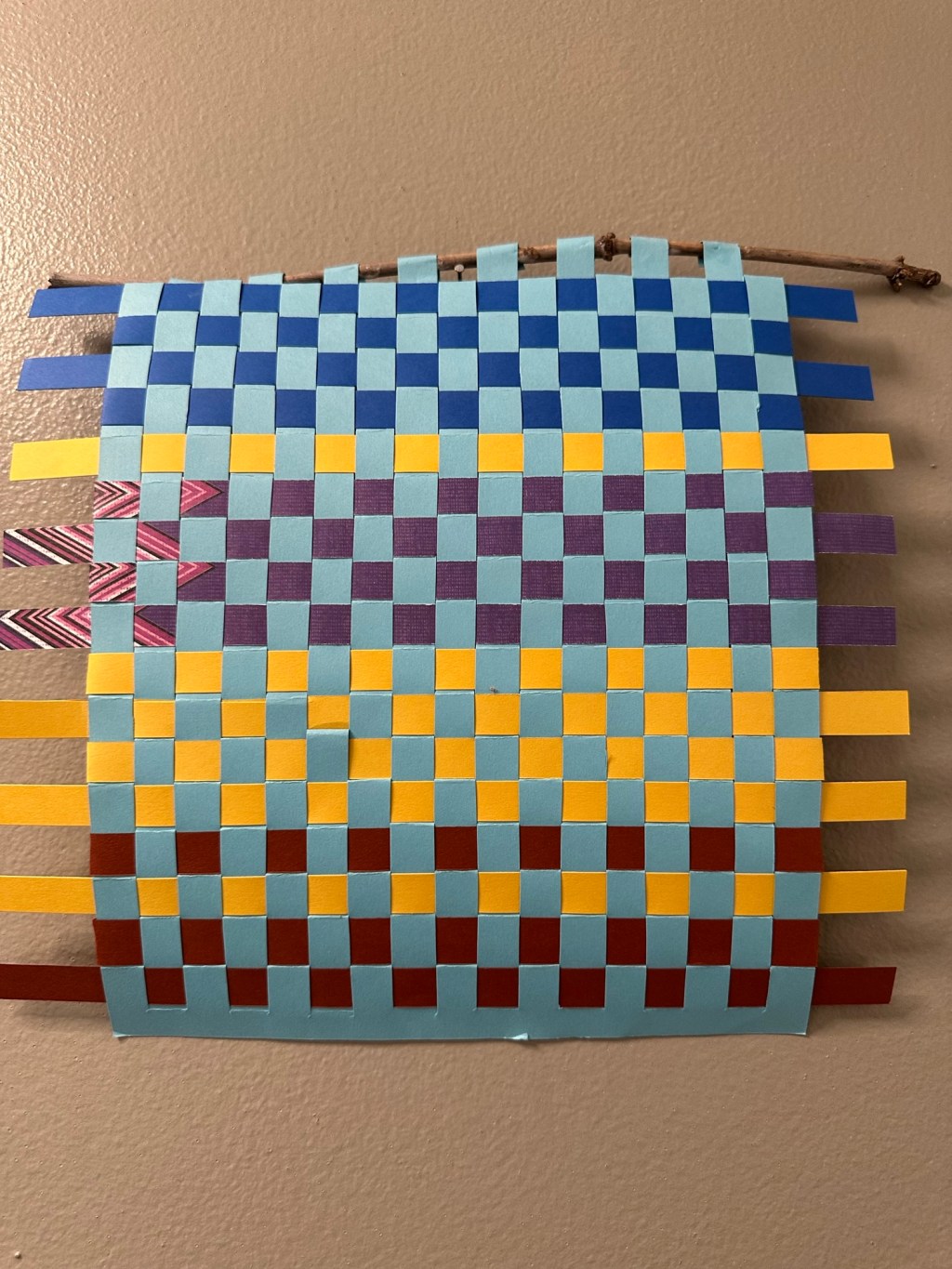
Our art class is trying a new thing: weaving. We have been painting for quite a while, so this is really a hands-on project. Some of us had the benefit of making woven potholders as children, or weaving newspaper “sit-upons” at summer camp. The technique isn’t unknown, but making a creative design interpretation is how we take our basic skill forward into a stimulating and creative brain challenge.

DeLee: Woven Paper on a Stick (Earth and Sky)

We could just repeat what we already know, but this doesn’t build us new neurons in our brains. If we keep the same old paths and don’t create new ones, we aren’t flexible when we meet new situations. Since we live in a rapidly changing world, building a brain capable of rapidly adapting is important to live independently and vibrantly for as long as possible.

I remember how my Daddy could only use the old tv remote to change the channel for the original non cable stations. When “Murder, She Wrote” came on the cable channel, my Mother had to use the cable remote to change the station for him. His Alzheimer’s disease prevented him from learning new skills, but he remembered all of his previous medical training and could diagnose his condition and boss the emergency room doctors when he was admitted to the hospital for a fall. Our brains are a mystery indeed.

Mike jumped the gun on Valentine’s Day and created a woven heart. These were big in the Danish and German communities and very popular in the 19th century in America. During the Civil War, soldiers made many of these in elaborate forms to send to their loved ones back home.

Unknown Artist: Affirmation Weaving

The brain is a fantastic and mysterious organ. If we make a habit of learning something new every day, of whatever interests us, we have the opportunity to keep our lucidity for a longer time. We also we meet the quickening changes of modern life with a steadfast heart and mind. We stress less when we know we can adapt and change in our own lives. We don’t have to be the people who say, “You can’t teach an old dog new tricks.” We can teach and we can learn, but we might need to be more patient with the old dog. In some corners, we call that “grace.”

I watched my Granddaughter’s Daddy Daughter Dance

Our group was in and out during the several weeks devoted to this project. One of us was sick, one was grieving the death of a beloved pet, another had pressing work issues, and the teacher went to Florida to see her granddaughter get married. Amazingly, life goes on. People dropped in for spiritual support, which is a side benefit of the community of art class. I managed to get mine mostly done, and Gail S. finished hers completely. Sometimes life interrupts our best intentions and we move on. We will learn new lessons on the next project.

Gail S’s “Eye of God” weaving

 Gail S’s “Eye of God” weaving incorporates yarns from two different mop heads, some sticks, and a bird feather. Gail almost always keeps a realist focus in her works, so her eye of God has a bird feather to mark the pupil. The upper field of grey and white mop yarns represent the cloudy sky, while the blue yarn stands for the water and the brown for the land. God watches over all of God’s creation. Gail S’s love of the outdoors and all of nature is evident in all her work.

Cornelia’s Cross on a Hill (unfinished)

I also recycled some old paintings and cords which I’d used in the preparatory work of other paintings. In addition, I used some recycled strips of Amazon shipping parcels as well as a wire shape which once belonged to a butterfly wing. In repurposing these items into the weaving along with two old brushes bound together with a God’s eye, I invoke the renewal of life after death.

We people of faith have two opportunities for a renewal of life after death. The first is by our profession of faith in Christ and his life, death, and resurrection on our behalf for our salvation. This gives us a living faith in this world. The second renewal is for the resurrection from death itself. This gives us a life beyond this world. Our faith is worthless if it doesn’t change us for our walk upon this world. If we don’t have the heart and mind of Christ within us, and if we aren’t earnestly seeking to be made perfect in the love of Christ daily, our United Methodist heritage tells us we’ve not yet been converted.

Yet Christ desires to save all, as John records in 12:32,  Jesus tells the crowd,

“And I, when I am lifted up from the earth, will draw all people to myself.”

Not just some people, or only the best, or even just us United Methodists, but ALL people. Most of us aren’t able to understand such a wide ranging love, for we live in a world of tribal loyalties. If we look at creation, which is God’s first work, God loves that which God created. God loves everything God created. We humans are the ones who choose sides and introduce boundaries and hate into God’s singular creation. The world or Kosmos is the creation first and then the people in it.

Today we tend to ascribe “world” to the “culture,” or secular society in general, but its plain meaning is creation and the human presence, for good or ill. The ancient Greeks and Romans divided the world into the material (bad) and the spiritual or mind (good), but the Jewish theology conceived the unity of both as part of God’s gift to humankind.

In the fifty-fourth chapter of On the Incarnation, St. Athanasius of Alexandria wrote a sentence that has echoed down through the centuries even into our own time as a brilliant summary of the Gospel. He wrote this: “God became man so that man might become god” (54:3).

This doctrine is called theosis or acquiring the whole nature of God. We United Methodists call this state Christian Perfection, or “a heart so full of love of God and neighbor that nothing else exists.” Our Wesleyan heritage was influenced by the Wesley brothers’ deep love for the Greek Orthodox fathers of the early church. To focus only on fallen nature is to deny the power of God to redeem us and all creation and to make all things new. We humans and nature aren’t more powerful than God!

If we cut off part of our God given self, we deny the incarnation of Christ, who became human for us that we might become divine. We need to remember what John 3:16 so succinctly states:

“For God so loved the world that he gave his only Son, so that everyone who believes in him may not perish but may have eternal life.”

Art is a way to open our eyes and hearts to a new way of seeing spiritual truths. Art is also reflective of the artist’s soul and spirit. A sensitive viewer can read the tale of trauma or the struggle for survival in an artist’s body of work. More than this, we can listen for their voices straining to be heard. Most people have been silenced and conformed to the “cause no trouble, don’t get out of step” mantra of the public school system training our youth for the workplace.

In art class, we can lose our fear of being different because being different gets rewarded! Being original gets an attaboy or attagirl.  I find such joy helping people find new courage and creativity they didn’t know existed within themselves. My students keep me young too. I feel blessed beyond measure.

Joy and peace,

Cornelia


To Stay Sharp as You Age, Learn New Skills | Scientific American

https://www.scientificamerican.com/article/to-stay-sharp-as-you-age-learn-new-skills/

That Man Might Become God — Fr. Andrew Stephen Damick
https://blogs.ancientfaith.com/asd/2015/01/22/man-might-become-god/

The Witness of the Cross

art, Creativity, crucifixion, Faith, Holy Spirit, Holy Spirit, Imagination, inspiration, john wesley, Love, mandala, nature, Painting, perfection, Rumi, Spirituality, suffering, Sun, United Methodist Church, vision

Mosaic Crucifixion, with Mary and John.

We are a people who follow Jesus, “the pioneer and perfecter of our faith, who for the sake of the joy that was set before him endured the cross, disregarding its shame, and (who) has taken his seat at the right hand of the throne of God,” as the writer of Hebrews 12:2 reminds us. The suffering servant motif of Christ was once a model all early Christians expected to inherit and emulate.  

The Suffering Servant

Paul spoke to this suffering model in his letter to the Romans:

“…How can we who died to sin go on living in it? Do you not know that all of us who have been baptized into Christ Jesus were baptized into his death? Therefore, we have been buried with him by baptism into death, so that, just as Christ was raised from the dead by the glory of the Father, so we too might walk in newness of life. For if we have been united with him in a death like his, we will certainly be united with him in a resurrection like his.” (6:2-5)

Paul’s first sentence is perceptive because he recognizes many who call on the name of Christ nevertheless go on living an unchristlike life. In the early Christian centuries, many didn’t get baptized until they were near death because they weren’t ready to change their wicked ways. The early Christian habit of hyper-delayed baptism is well attested by the later fourth century. Apparently, the reasoning behind waiting until fairly late in life was the belief baptism cleansed sin once and only once. Consequently, any meaningful sin after baptism could leave one in a serious lurch in the economy of salvation. We have the well-known example of the early 4th CE Emperor Constantine who delayed baptism until his deathbed.

Of course, this is a misunderstanding of the Holy Spirit’s work of perfecting our human nature, but it took many centuries to work this out. We can thank John Wesley for our understanding the works of grace in the ongoing process of Christian Perfection. Baptism washes us from the stain of original sin, which is common to all humanity. Baptism also anoints us with the Holy Spirit to be continually with us and bring us to know God’s saving love in Jesus Christ.

As we grow in faith and the Spirit of God calls us to give our lives to Christ, we are justified from past sins. Some faith communities stop here, so they need over and over justification. They have no ongoing theology of sanctifying grace. We United Methodists do have this great gift, which we can give to the world. When we aren’t going on to perfection in love quite as fast as our neighbors wish we were, it’s because we’re being stubborn and resisting God’s grace.

W. H. Auden says it best:

“We would rather be ruined than changed, 

We would rather die in our dread 

Than climb the cross of the moment 

And let our illusions die.” 

The Cross and Self-Denial

The cross is ever a witness to our willingness or unwillingness to bear the cross of Christ. As Jesus told his disciples:

“If any want to become my followers, let them deny themselves and take up their cross and follow me. For those who want to save their life will lose it, and those who lose their life for my sake will find it. For what will it profit them if they gain the whole world but forfeit their life? Or what will they give in return for their life? (Matthew 16:24-26)

Often we interpret this verse in terms of giving up material possessions, but we can never give up outward things unless we’re first willing to give up our false images of ourselves. We might want to be large and in charge, or soft and sweet. Perhaps our self image is invested in being holy and serious. We may even be the class clown. These are only masks behind which we hide our truths and vulnerabilities.

Jesus spoke a parable in John 12:24-25—

“Very truly, I tell you, unless a grain of wheat falls into the earth and dies, it remains just a single grain; but if it dies, it bears much fruit. Those who love their life lose it, and those who hate their life in this world will keep it for eternal life.”

If we want to be changed, we must die to our ordinary selves, and then rise as a new creation. If we remain the same, we won’t be much, but if we’re willing to take on the image of Christ, we can be a new creation of the first order.

How The Witness was made

Ukrainian children’s hospital bombed by Russia

This is how art gets made. I saw an image of a bombed-out children’s hospital in Ukraine. Because the photographer had cropped it in a certain way, I saw an image of a cross on the brickwork. Those rectangular bricks contrasted with the diamond shaped wire work in the darkened areas in the four outer quadrants. I usually weave the whole painting surface, but this time I wove only the cross area. That was a challenge. I had to invent a new way to secure the woven canvas strips on the wooden stretcher strips.

Weaving two paintings together

As I painted the first layer, I made all the contrast of bright colors in the cross and dark blues and reds in the outer quadrants. The next day, I added a gold wash over the cross squares and painted diamond line patterns over the dark quadrants. I came back to add silver into the diamond shapes and to touch up the diagonal lines. I also painted the sides of the canvas to unify it.

Adding blocks of color to the cross of witness

I began with a gritty black and white image, but ended up with bright colors, silver and gold. This too is a metaphor for for the change which we undergo when we die to old selves and begin our transformation into the wholeness of the new creation in Christ. As Paul wrote to the Corinthians:

Gold cross and diamond shapes in the dark quadrants

“So if anyone is in Christ, there is a new creation: everything old has passed away; see, everything has become new! All this is from God, who reconciled us to himself through Christ, and has given us the ministry of reconciliation; that is, in Christ God was reconciling the world to himself, not counting their trespasses against them, and entrusting the message of reconciliation to us.” (2 Corinthians 5:17-19)

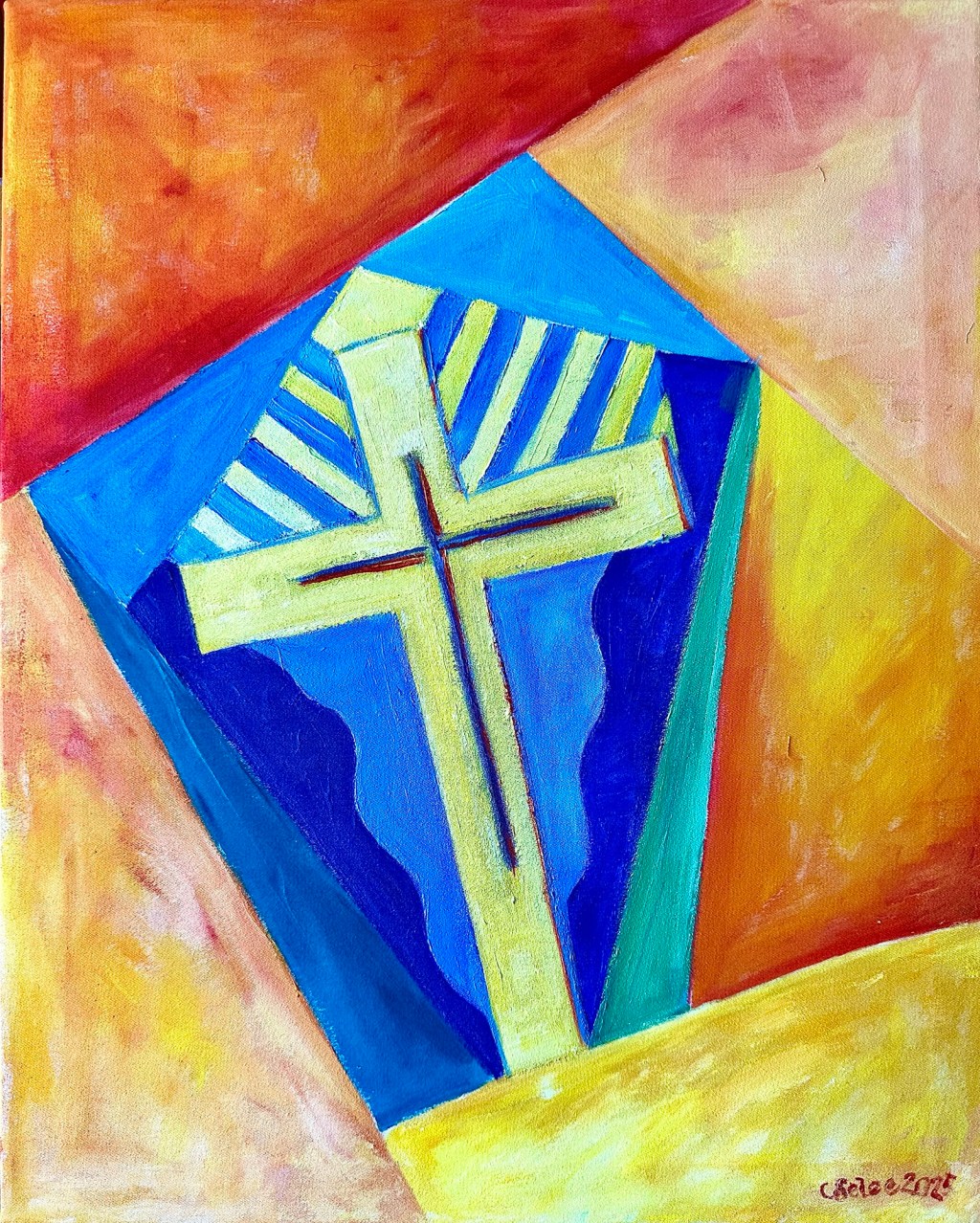
Finished painting: Cross of Witness

The cross isn’t a means to divide us from one another, just because we hold varying views on baptism, holy communion, pastoral authority, and scriptural authority or interpretation. The cross stands as a witness to all who are willing to give up their identities to their old egos and claim the only one uniting all persons every day.

Unity through the Cross

This is the Christ, whose love was so great for all creation, he was willing to be lifted up on the cross to draw all humankind unto himself. As Jesus said in John 12:32-33—

“And I, when I am lifted up from the earth, will draw all people to myself.” (He said this to indicate the kind of death he was to die.)

We want to have our Big Mac and Eat it too.

Delusional Mathematics

As we self interested people today have difficulty with many of the words of Christ, we resort to our cafeteria style of choosing which bites we want to enjoy. If a dish in the line is too expensive or not on our diet plan, we can ignore it. The problem with Christ is how we can ignore one claim upon our faith, reject another, and keep another. As a dieter from way back days, I splurged on many a Big Mac or Whopper and large fries, which I washed down with a giant Diet Coke. Unfortunately, my body didn’t follow the same mathematical logic of my mind. I was practicing delusional math.

“Cheeseburger and fries, with a side of Diet Coke.”

“This is my commandment, that you love one another as I have loved you. No one has greater love than this, to lay down one’s life for one’s friends. You are my friends if you do what I command you” (John 15:12-14). John Wesley, in his sermon, The Almost Christian, talks about those who have the outward form of Christianity, but not the inward being. They can be recognized by their attendance at Sunday services, their good deeds, and their attention to the outward shows of ritual. Inside, however, their hearts aren’t filled with love, but with anger, spite, or mere duty instead. They lack sincerity, which is a classic characteristic of one who wears a false mask.

The Last Presidential Assassination

When Ronald Regan was shot by a would-be assassin, his diary recorded his thoughts on his excruciating experience.

“Getting shot hurts. Still my fear was growing because no matter how hard I tried to breathe it seemed I was getting less & less air. I focused on that tiled ceiling and prayed. But I realized I couldn’t ask for God’s help while at the same time I felt hatred for the mixed-up young man who had shot me. Isn’t that the meaning of the lost sheep? We are all God’s children & therefore equally beloved by him. I began to pray for his soul and that he would find his way back to the fold.”

 The Altogether Christian

To be a Christian in the true sense, Wesley says the “Altogether Christian” requires us both to “love God and neighbor in our hearts until nothing else exists.” This means even our enemies. I personally find this the most difficult part. I can hold a grudge with the best of the nonbelievers. Yet I don’t find myself calling those people evil or deranged, like so many others who seek to find a reason for their scapegoating.

I can still see people, even myself, as part of flawed and fallen humanity. 

Christian Perfection

Wesley defines the pure faith: “Now, whatsoever has this faith, which purifies the heart, (by the power of God, who dwelleth therein,) from pride, anger, desire, from all unrighteousness, from all filthiness of flesh or spirit; which fills it with love stronger than death, both to God and to all mankind; love that doth the works of God, glorying to spend and be spent for all men, and that endureth with joy, not only the reproach of Christ, the being mocked, despised, and hated of all men, but whatsoever the wisdom of God permits the malice of men or devils to inflict: whosoever has this faith, thus working by love is not almost only, but altogether a Christian.”

Under John Wesley’s exacting standards, we may all be “almost Christians,” but the good news is we can always hope in the one who gave his life to begin a new life in us and others. If we pray for our enemies’ faults, which we spot so easily because they are our own, God will help to heal both them and us.

Mending Broken Hearts

The Cross Supplants Division

An ancient wisdom story told among the rabbis says the students were questioned on the difference between night and day. All their answers marked divisions: some prayers are said only at certain hours, or there isn’t enough light to distinguish one field or a house from another. The rabbi grew frustrated and cut them off. “You only know how to divide! Daylight begins when you can look on your neighbor’s face and see a friend, not an enemy.”

In this time of division, the witness of the cross reminds us Christ died for all humanity, so no one is outside the love of Christ. If we’re to love our neighbor as ourselves, caring for the poor and marginalized should be a priority for the people of faith. Our neighbors don’t stop at our borders, for our world is interconnected.

Migrations were a fact back in Abraham’s day, when Egypt was the land of opportunity. We ought to treat immigrants better than the Pharaohs treated the Hebrew people. Moreover, in our current political landscape, we might want to quit name calling and playing to the lowest denominator of our bases. Policy statements won’t get sound bites on television, but that’s a good thing. Sound bites play to our false selves and not to our true selves in Christ Jesus.

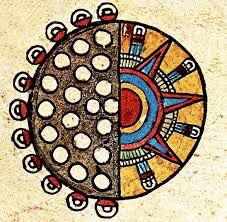
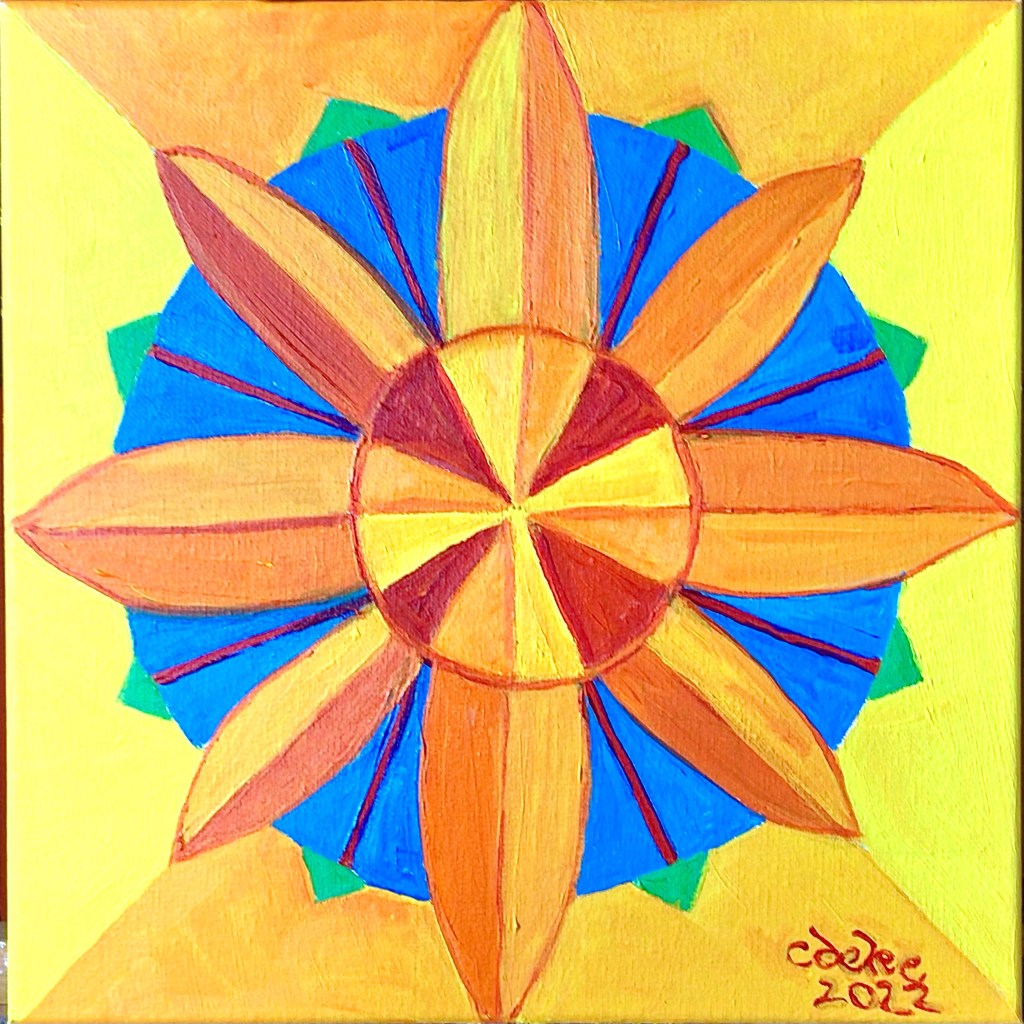
DeLee: Sun Mandala, 2022, private collection

 I can close with a poem from the Persian poet Rumi:

I only speak of the Sun
because the Sun is my Beloved 
I worship even the dust at His feet.

I am not a night-lover and do not praise sleep
I am the messenger of the Sun !
Secretly I will ask Him and pass the answers to you.

Like the Sun I shine on those who are forsaken
I may look drunk and disheveled but I speak the Truth.

Tear off the mask, your face is glorious,
your heart may be cold as stone but
I will warm it with my raging fire.

No longer will I speak of sunsets or rising Moons,
I will bring you love’s wine
for I am born of the Sun
I am a King !

Joy, peace, and sacrificial love,


Cornelia


—W. H. Auden, The Age of Anxiety: A Baroque Eclogue (Princeton, NJ: Princeton University Press, 2011), 105.


Baptismal Trajectories in Early Christianity, Part III: Toward an Explanation – Ad Fontes
https://adfontesjournal.com/church-history/baptismal-trajectories-in-early-christianity-


Wesley’s Sermon Reprints: The Almost Christian | Christian History Magazine
https://christianhistoryinstitute.org/magazine/article/wesleys-sermon-reprints-almost-


The Regan Diaries—

 https://www.amazon.com/Reagan-Diaries-Ronald/dp/006087600X?_encoding=UTF8&qid=&sr=&linkCode=sl1&tag=jeffjaccom-20&linkId=472649155c0e042b8192d46f0dbbfcb8&language=en_US&ref_=as_li_ss_tl

 Rumi: Ghazal (Ode) 1621
Translated by Azima Melita Kolin and Maryam Mafi
Rumi: Hidden Music, HarperCollins Publishers Ltd, 2001

A Prayer to End All Suffering

art, crucifixion, Deesis Icon, Easter, Faith, Good Friday, grief, Healing, hope, Icons, incarnation, inspiration, Lent, Painting, Prayer, renewal, Spirituality, Strength, suffering, vision


I don’t don’t know about you, but I don’t willingly sign up for pain or suffering. Pollen season isn’t my friend. I could do without all this yellow and green stuff clogging my brain cells and my lungs. As I cough and die, swill decongestant tonics, and huff my asthma inhaler, I wonder if this particular cross bearing has to be on my things to do list every Lenten season.

Mid 10th CE ivory Deesis Icon, Metropolitan Museum of Art, NYC

As Jesus turned his face towards Jerusalem, he knew his fate was certain. His message began to change, as he told his followers in Luke 14:27, “Whoever does not carry the cross and follow me cannot be my disciple.” Of course, not all were ready to hear or to follow, for some had obligations at home, and others weren’t yet ready to live the itinerant life. Many today don’t answer the call to ministry because they can’t see the long unknown road ahead. Only those willing to walk by faith and not by sight will journey off, trusting in God’s providence, mercy and grace.

Earliest sculpture panel of the Crucifixion, Maskell Passion Ivories, 420-430 CE, one of four carved panels of a sarcophagus, British Museum, London.

I used to say, “Give me a few months and I can whittle any group down to size. I can prune with the best of gardeners—all I have to do is read actual scripture!” I figure if folks want to get mad, they should take it out on the original writers. Blaming the messenger is useless. As the apostle Paul says:

“For the message about the cross is foolishness to those who are perishing, but to us who are being saved it is the power of God.” (1 Corinthians 1:18)

The oldest icon of the Crucifixion of Christ, Greek Orthodox Holy Monastery of St. Catherine, Mount Sinai, 8th CE

The ancient crucifixion icons glorify the triumph of the Incarnate God and his victory over death, which is the consequence of our fall; that fatal moment in the garden of Eden when Adam and Eve chose to desire to be like God, even though they had only the image, but not the ability to be gods themselves. Icons of the crucifixion represent Christ who, fully human and fully divine, takes on death so humanity no longer has to die. Christ conquers death by being a suffering servant, he becomes a victorious king.

Mary from the Hagia Sophia Deesis mosaic

Most of us would rather jump to the Bible’s Victory story and skip its Victim sections because we live in an age which validates the strong and successful, while denying the worth of the weak and wounded. Easter and Palm Sunday are more triumphant celebrations than the sonorous and somber Foot-washing Maundy Thursday and Good Friday Vigils. Yet without suffering, would we have cause for rejoicing? Would we even know the meaning of joy without some pain in our lives? Everyone has some pain in their life, whether it’s the pain of an unrequited love, the loss of a child stillborn, a divorce, a war wound, a frenemy wound, or some other brokenness.

Stage one

Mary knew early on her child of destiny would bring her both joy and pain, as all mothers discover soon enough. Luke records in 2:34-35,

“Then Simeon blessed them and said to his mother Mary, “This child is destined for the falling and the rising of many in Israel, and to be a sign that will be opposed so that the inner thoughts of many will be revealed—and a sword will pierce your own soul too.”

Deesis. Top center front panel of the Harbaville Triptych. Ivory. Ca. 940-960 CE. Musée du Louvre, Paris.

Many today only want to show the happy times in their hyper-curated lives on social media. As a result, “Keeping up with the Joneses” gets harder all the time. With Facebook’s constant encouragement of “you may know algorithms,” we’re encouraged to add more friends to our circle. We’re exposed to too many families of that surname, when once we only knew a few who lived in our own neighborhoods. If all these Jones folks are always smiling widely for the camera, we might be tempted to ask, “Why don’t I feel like smiling also?”

I know people who don’t read newspapers, watch the news on television, or even listen to the snippets on the radio. “Too much bad news!” They too don’t want to hear of the suffering, the plight of the weak, or face their seeming impotence to do anything about it. We are weak people. We are not strong, no matter how often we quote passages like Philippians 4:13—

I can do all things through him who strengthens me.”

Richard Rohr, in The Enneagram, A Christian Perspective, says, “It is the things that you cannot do anything about and the things that you cannot do anything with that do something with you.” Suffering and prayer are what truly transform us, if only we don’t waste time looking for someone to blame.

13th CE Hagia Sophia Mosaic, Istanbul, Turkey

So far, no one person has been able to stop the Russian invasion of the democratic nation of Ukraine, but plenty of people are holding up an aid package that would help this small country fight this battle at great cost to life and limb. The Ukrainians suffer and America dithers. We seem to think our leaders have infinite powers, as if they were gods, but we forget all people are only human and have only the image of god, but no huma has either the power or the glory of the true God.

Unknown Ukrainian Artist: The Deesis, Icon, Tempera, silvering on gesso-grounded two-piece fir-wood panel, engraving, carving; 1735, h 114, w 84, d 9, National Art Museum of Ukraine.

So far, no one person has been able to keep either Hamas or Israel from wreaking havoc on each other. My daddy used to say, “you can’t make a silk purse out of a sow’s ear.” After years of teaching and pastoring, I’d throw my two cents in: “we can lead a horse to water, but we can’t make it drink.” As long as people are invested in retribution, they will return suffering for suffering. The sad truth is people who have never processed their own suffering will cause suffering for others as well as for themselves. The children will cry. And the women will cry. But now the men are crying too.

Late Roman Magical gem; intaglio; green-brown jasper; oval; bevelled edge on side B, 2nd-3rd CE, British Museum, London.

No one has a magic wand to eliminate suffering or harm. In ancient times, the image of the crucified Christ was used as a magic charm to keep the wearer from harm. Some people today wear a cross for the same reason; it’s a fashion statement, a good luck charm, and a symbol of their faith. Instead of a charm, we offer acts of prayer and mercy.

Hagia Sophia Deesis Mary icon 2024, finished

We don’t just cry for the fact of the sufferings we endure, or for the sufferings of others, but we cry out in our suffering to the only one who can hear us, heal us and make whole our broken hearts and homes. We cry out to the God, who created all of us in God’s own image out of the dust of an obliterated and bombed out land. We cry out to the God who brings rains in their seasons to a land parched by climate change and ruined by reckless use of natural resources. We cry out to the God who raised God’s son from the dead, even as people everywhere bury their own dead sons and daughters from the wars fought by nations and non-state actors who wrestle for power in tiny slivers of contested territories.

Christ and the Apostles in the Heavenly Jerusalem, apse mosaic, early fifth century, Rome, Santa Pudenziana.

We can see in this image a dramatic transformation in the conception of Christ from the pre-Constantinian period. In the Santa Pudenziana mosaic, Christ is shown in the center seated on a jewel encrusted throne. He is surrounded by apostles, biblical women, and symbolic images of the four gospel writers. The ideal landscape is the New Jerusalem, or the Heavenly Kingdom. This image was created after Constantine’s victory and conversion to Christianity. Prior to this, Christian art repurposed Greco-Roman themes of the Good Shepherd and the Apollo Sun god.

Unknown Artist: Plaque with Christ flanked by the Virgin and Saint John, late 19th–early 20th century (Byzantine style), Cloisonné enamel, gold; 6 9/16 x 5 9/16 x 1/16 in. (16.6 x 14.1 x 0.1 cm); Metropolitan Museum of Art, NYC, Gift of the Estate of Mrs. Otto H. Kahn, 1952, Accession Number: 52.54.1

The Byzantine Empire was fond of the Deesis Icon, which has Christ in the center bounded by the Virgin Mary and the Precursor, John the Baptist, on either side. They both entreat the Lord in prayer. This was one of the most widespread middle Byzantine icon types. The name comes from the Greek δέησις or “supplication,” which in Byzantine art, describes a representation of Christ enthroned and flanked by supplicants, such as the Virgin Mary, St. John the Baptist, or other saints and/or angels. Images of the deesis often appear on an iconostasis, or the screen separating the altar from the people. The subject matter traditionally represents the first witnesses to Christ’s divinity, the Virgin and Saint John, who came to be seen as holy figures who would act as intercessors with him on behalf of humanity.

The Deesis. End of the 17th century. Northern Russia. Wood, gesso, tempera. Found from the village Nizhnyaya (Dolgovitsi), Tarnoga Raion, Vologda Oblast. Collection of Nikolai Kormashov.

Nikolai Kormashov, an Estonian artist and collector, who collected and restored a great collection of 15th-20th century Russian icons during his lifetime said, “That which is not destined to perish, announces itself again and again, to attest to elusive spiritual beauty and the light of truth.”

The truth is all people of every country and culture in every age will suffer, but God isn’t removed and distant from our pain. God, through the incarnation of the Son, has experienced our human suffering from the birth pangs of Christ’s birth to the hunger, thirst, and weariness of his itinerant earthly preaching. Not only this, but God through God’s Son knows the heartbreak of betrayal and insult, the sting of the whip, and the pain of death on a cross.

The light of truth for the Easter season is this: in the midst of darkness and death, God raised his Son to light and life, so we too might lose the chains of sin and death and live to light and love. As the people of prayer, we ask for the gift of hope to give light to those in darkness and a helping hand to those in need.

Joy and peace,

Cornelia

Relief plaque icon, depicting the Deesis Crucifixion with full-length figures of the Virgin on the left and St John on the right, Late Byzantine (13 thc). Materials: Steatite – Gold

Greek déēsis entreaty, equivalent to deē-, variant stem of déesthai to beg + -sis-sis

Leonid Ouspensky: The Meaning of Icons, revised edition, St. Vladimir’s Seminary Press, Crestwood, NY, 1999, p. 180.

DEESIS Definition & Usage Examples | Dictionary.com
https://www.dictionary.com/browse/deesis

Saved Sanctity: Icons from the Collection of Nikolai Kormashov – Art Museums
https://www.lnmm.lv/en/art-museum-riga-bourse/exhibitions/saved-sanctity-icons-from-the-collection-of-nikolai-kormashov-437

Image— The oldest icon of the Crucifixion of Christ at the Greek Orthodox Holy Monastery of St. Catherine on Mount Sinai is an extraordinary testament to the intricate relationship between the Greco-Roman art heritage and early Christian iconography. This invaluable artifact offers a unique glimpse into the artistic and cultural milieu of the time, highlighting the exchange of ideas and the shared history that shaped the development of Christian art in 8th CE. See following link for comparison of early Roman and Christian art.

http://employees.oneonta.edu/farberas/arth/arth212/post_constant_conc_christ.html

Nick Haslam: The Body Keeps the Score: how a bestselling book helps us understand trauma – but inflates the definition of it

https://theconversation.com/the-body-keeps-the-score-how-a-bestselling-book-helps-us-understand-trauma-but-inflates-the-definition-of-it-184735

My Summer Vacation

adult learning, art, Creativity, crucifixion, Faith, Family, Forgiveness, holidays, Imagination, inspiration, mandala, Ministry, Painting, purpose, Spirituality, summer vacation

Friday Night Food Fight

The last day of our art class we had a “free for all.” Not exactly a “food fight” or “slug fest” free for all, but a finish up or start a personal project type of day. Our class never disappoints me. Mike brought in his patio parrots, some of which have seen better days. These are papier-mâché sculptures that have been brightly painted and covered with shellac. He hopes to paint over them and repair them so they will look respectable once again in the poolside area. If that’s not possible, I see a vacation south of the border in his future.

A Typical Parrot by the Pool

Gail brought an icon she didn’t quite finish to add gold outlining to the figures. This detail gave her work an extra embellishment to bring it to life. Before, she’d left an edge of white canvas between the background and the figures. This had the same effect, but also gave her work an unfinished appearance.

Gail’s Icon

I’ve been working on a series of Creation Icons from the first chapter of Genesis. Actually, they’re mandalas, but they serve the same purpose as an icon: to focus the viewer’s sight into the window of the world beyond this one and to contemplate the universal mysteries of the universe and the God who created it. The Creation inspired me because I’ve seen old icons with this theme painted both in figurative and abstract styles.

This one represents Day three and is from The Nuremberg Chronicles (1493). Written by Hartmann Schedel and illustrated with woodcuts by Michael Wolgemut, it represents a monumental place in the history of the printed page. One of the most beautifully illustrated texts of all time, the approximately 600 pages, in-folio, contain 1,804 woodcuts intended to communicate to the public a schedule of events predetermined by God, beginning with the Creation, and ending with the end of time.

Creation of Plants by Wolgemut

My icon is a stylized flower against a blue sky with a cross in the center to remind us, as John 1:1-3 says,

“In the beginning was the Word, and the Word was with God,
and the Word was God. He was in the beginning with God.
All things came into being through him,
and without him not one thing came into being.”

Third Day Of Creation Icon

I chose a sunflower as my representative plant, for the young plants constantly track the sun’s transit across the sky each day. The older plants don’t make use of this mechanism of heliotropism, but always face east to wait for the sunrise. The ancient wisdom says when Christ comes in his final glory, he’ll first appear in the east at the Beautiful Gate in Jerusalem. However, the Bible says in Revelation 1:7,

“Look! He is coming with the clouds;
every eye will see him,
even those who pierced him;
and on his account all the tribes of the earth will wail.
So it is to be. Amen.”

I think it best to be ready, day or night, for like the servants whose master has gone off on a trip, we don’t know when he’s coming back. We should be always ready, always eager to serve. We’re never too young or too old to be a servant for Christ. As we grow older, one of our best gifts is mentoring the next generation for leadership. Perhaps they’ll make mistakes, or maybe they’ll do things differently than we did, but mission and ministry will happen.

Most mistakes don’t matter in the great scheme of life, unless they’re breaking a moral or legal law. If they’re just doing a task in a different order, like my arrangement of the dishes in the dishwasher at my mother’s house, we should probably leave that alone. I went and sat in the den and let my mother load the next evening’s dirty dishes because “If you’re going to rearrange everything, you might as well put them in yourself.” She did that one night and sat in the den the next night. Training is everything. My mom spent years training me, so I learned from the best. When it’s time to let go, you step aside and let them do it on their own. Learning from mistakes is part of leadership.

In art class we also learn from our mistakes. Sometimes we find out our palettes are too small to mix up all the different colors we want. This can limit our color schemes, muddy our colors, or tempt us into putting more color over the old color in the same tiny space for mixing. Then we look at our painting and wonder why it’s grey and dull, but fail to notice how dark our glass of brush water is. When the water gets dark, we need to pour it out and get clean water, or we carry that wash water full of pigments into our painting with our brush. In a like manner, if we hold our grudges or anger over time, these soil and blemish our souls. Washing them clean through prayer to God makes a difference in our countenance and joy. We’re brighter people when we rid ourselves of these burdens.

I’m taking the summer off from teaching. I have an art show planned for August to September at the Garland County Library, so I’ll be finishing up some work for that event. I also have a couple of chores around my condo planned, and more of my SOULJOURNIES blog to put into shape. I’m excited about these creative renewal projects. I’ll see y’all on the flip side.

Joy, peace, and sunshine,

Cornelia

The Science Behind Why Sunflowers Move
https://spectrumlocalnews.com/nys/buffalo/weather/2020/08/29/the-science-behind-why-some-sunflowers-move

Writing a Holy Icon

adult learning, Altars, art, crucifixion, Faith, Holy Spirit, Icons, inspiration, john wesley, Love, Mandylion, mystery, Painting, Pantocrator, salvation, Spirituality, St. Athanasius, Stations of the Cross, United Methodist Church

Cartoon for an Icon of the Resurrection

In art class, I taught our group the time honored technique of using a cartoon to transfer an image to another surface. Of course, their first reaction was, “Are we watching Saturday morning cartoons today?”

“No, it’s Friday. We’re going to make our own carbon paper,” I said, as I showed them how artists of old would rub graphite on the back of their drawings and then outline the major lines onto the wall or the canvas to transfer the image. The J. Paul Getty Museum has a great video on YouTube explaining this process.

“You mean we’re going to paint by number?”
“Not a chance. You still have to make your own color decisions and shading choices.” Really, by now you’d think they know my opinion on the easy way. As Jesus says in Matthew 7:13—

“Enter through the narrow gate; for the gate is wide and the road is easy that leads to destruction, and there are many who take it.”

Reverse of Crucifixion Icon with Graphite over Outlines

I didn’t bring any complicated images of the holy icons. I brought only ones with simple outlines. I knew this project wasn’t going to be as easy as people first thought. It’s not as simple as coloring within the lines.

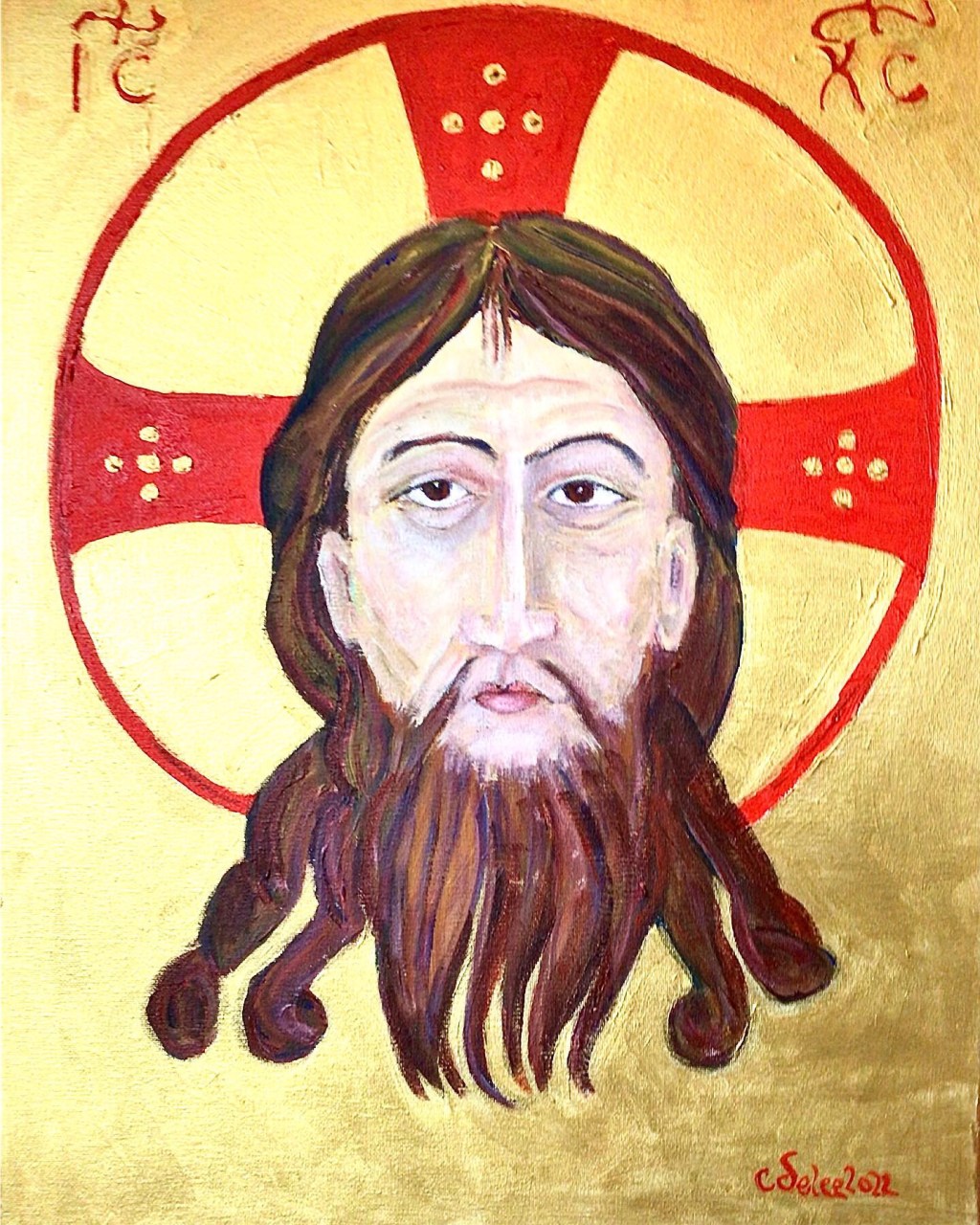
An icon is an image of a holy person, but it isn’t a mere representation of the individual. When we make photographs or even painted portraits, we seek to make “likenesses” of the individual, and capture their outward details and idiosyncrasies. If we can also capture their inner spirit, we take the image to a master level. Icons, however, are more concerned with representing the inner, spiritual nature of the person, rather than their outward nature. After all, we don’t have any images of how the holy ones from the earliest days of faith actually looked. We only have their acts and the symbols connected with them, so in the iconography we can identify them by these qualities. The word iconography comes from the Greek: eikōn ‘likeness’ and -graphia ‘writing’, so when we paint, we’re actually “writing a likeness” of the holy image.

Dusty spent his day off on the Pantocrator Icon

In the iconographic tradition, all of the faces are broad across the brow, to represent the holy wisdom of God residing in the saints, just as their elongated figures and extremities accent this holiness. The eyes, windows into the soul, are large compared to a natural face, while the mouth is small. The small mouth indicates the saint has conquered bodily passions. There’s always an ear open on an icon, for the icon needs to “hear our prayers.” Not that the icon is alive, but it’s more like an open window into heaven. Therefore, the saint’s ear is the open window through which our prayers flow into the golden light of the mysterious world beyond this material one in which we dwell both in shadows and light.

Freehand drawing of Mandylion Icon

The color in icons also plays an important role. Red belongs to martyrs. Blue stands for wisdom. White symbolizes paradise and chastity. Green is the color of the Venerable Fathers. Gold symbolizes sanctity.

The icon painter and teacher of St. Tikhon’s Orthodox University, Svetlana Vasyutina once described an experience before the iconostasis or screen of images of the saints in the church. “A while ago, I was tortured by the question why it is golden. Once I was standing at a church, looking at the iconostasis. Suddenly, they turned off the electric lights, and only candles before the icons were burning. The golden traces were shining, giving back the light. It was as if, not the candles, but the halos, were radiating light. I was amazed; the light seemed not material, not as comes from a candle or a lamp. The golden color shows the person painted in the icon was granted a different kind of light.”

According to St. Paul, glory (doxa) appears where the form and the idea of God, which inhabits it, become one. This is especially true where form becomes a place of theophany (a visible manifestation to humankind of God or a god), where the body becomes the temple of the Holy Spirit. This glory is represented by the nimbus or halo of the saints. We hear Paul speak of this power in Philippians 3:21—

“He will transform our humble bodies that they may be conformed to the body of his glory, by the power that also enables him to make all things subject to himself.”

The disciples first saw this glory descending upon Christ on the Mount of the Transfiguration, as recorded in Matthew 17:2—

Icon of the Transfiguration

“And he was transfigured before them, and his face shone like the sun, and his clothes became dazzling white.”

To become completely transformed by the Holy Spirit wasn’t only a special gift given only to the saints alone, but it was meant for all believers. As Paul mentions in 2 Corinthians 4:7 (American Standard Version)—

“But we have this treasure in earthen vessels, that the exceeding greatness of the power may be of God, and not from ourselves.”

A famous story in the Eastern Orthodox Monastic tradition follows:

Abba Lot went to see Abba Joseph and said to him, “Abba, as far as I can I say my little office, I fast a little, I pray and meditate, I live in peace and as far as I can, I purify my thoughts. What else can I do?” Then the old man stood up and stretched his hands towards heaven. His fingers became like ten lamps of fire and he said to him, “If you will, you can become all flame.”

Mike’s Icon of the Via Dolorosa

Many of us are barely alight with the fire of Christ, and we wonder why the glory of God doesn’t shine through us. Others of us hide our light under a bushel so we don’t stand out from the crowd. If we wonder why we aren’t going onto Christian Perfection in love of God and neighbor, or being a witness to Jesus Christ for others to follow, then we might need to read Abba Joseph’s recommendation once again:
“If you will, you can become all flame.”

When we paint an icon, we participate in a spiritual endeavor in which we are coworkers with the Holy Spirit. We enter into a kairos time, or God’s creating time, and are no longer only working only in human, chronological time. This is a mystery, not to be understood in ordinary terms, even if we begin at 10:15 in the morning and stop to cleanup at 11:45. Like the golden background, time has no meaning while we paint the icon. Our cares and concerns of this world can be given to the icon, and thus to God.

Gail’s Icon of the Crucifixion

We make our prayer gifts in two ways: we hope to become more conformed to the image of God and we hope our images conform better to the icon before us. We’re going on to perfection, one bit at a time. In faith, we expect to be made perfect in love in this life, by the power of the Holy Spirit, or at the moment of our death, as the classic Wesleyan teaching states. The Orthodox doctrine of theosis, union with God, from which our Methodist teaching of sanctification derives, teaches we can have real union with God, just as Jesus had, being fully human and fully divine. We don’t become gods, but we participate in the full image of God, in which we were first created.

Sally’s Crucifixion Icon

We can contemplate these beautiful words of St. Athanasius of Alexandria (+373), in his treatise On The Incarnation, against the Arian heresy:

‘God became “sacrophore”—bearer of our flesh—so that mankind might become “pneumatophore—bearer of the Holy Spirit.’” (Michael Quenot, THE ICON, p 55)

When we keep our heart set on the image of Christ, we remember his undying love for all creation. Then we learn the meaning of the faith of a loving son or daughter, in comparison to that of an unwilling servant. This is how John Wesley saw his own conversion at Aldersgate:

“I felt my heart strangely warmed. I felt I did trust in Christ, Christ alone for salvation; and an assurance was given me that He had taken away my sins, even mine, and saved me from the law of sin and death.”

Mandylion Icon—Towel with Image of Christ

Once we realize the law of sin and death no longer holds us in chains, we can freely live in life and love, now and always, if we conform our image to Christ.

Joy, peace, and divine light,

Cornelia

Paul Evdokimon, translation by Fr. Steven Bigman, The Art of the Icon: A Theology of Beauty, Oakwood Publications, Pasadena, CA.
https://kyl.neocities.org/books/%5BSPI%20EVD%5D%20the%20art%20of%20the%20icon.pdf

Sharing in the tabor light | New Camaldoli Hermitage
https://www.contemplation.com/sharing-in-the-tabor-light/

The Icon: Window on the Kingdom Hardcover – Import, March 19, 1992
by Michael Quenot (Author), A Carthusian monk

John Wesley Quotes, Oxford Reference
https://www.oxfordreference.com/view/10.1093/acref/9780191843730.001.0001/q-oro-ed5-00011419

John Wesley’s Quotes – Seedbed
https://seedbed.com/on-john-wesley-quotes/

John Wesley: Journal of John Wesley – Christian Classics Ethereal Library
May 24, 1738– I Felt My Heart Strangely Warmed
https://ccel.org/ccel/wesley/journal/journal.vi.ii.xvi.html