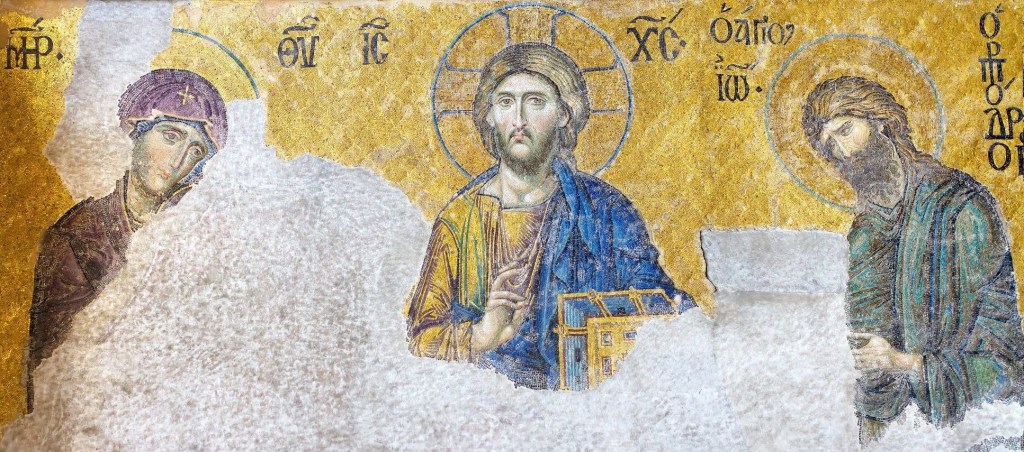
When does an image become a meme? Or an icon, an idol, or a shibboleth? I ask those questions, and then have go about defining them. We all know what an image is—a representation of something which actually exists. An icon is the Greek word for image, but to become a venerable image, it must bring the viewer into the spiritual realm, rather than leave the viewer only in this earthly world.
An idol is an inert representation of a god, but isn’t a god at all, for the god is invisible and spiritual. Praying to a golden calf or a carved wooden statue will get no response since it has no power or animation. The same can be said for shibboleth, which is a word or saying used by adherents of a party, sect, or belief and usually regarded by others as empty of real meaning. If the Ten Commandments are held up as mere words, idolized, but not kept in their hearts and lives, then they are as empty of power as golden calves. They also aren’t to be worshipped, but the God who gave them is.
Are the Ten Commandments now a meme? Memes are an amusing or interesting item (such as a captioned picture or video) or genre of items that are spread widely online especially through social media. Because this version of the Ten Commandments had its origin in the Charlton Heston movie, “The Ten Commandments,” which we see every single Easter and Passover season, it’s definitely in the public sphere. I’m of the opinion it’s fast becoming a meme—devoid of actual meaning and held up to ridicule.
DeLee: Icon of Christ, acrylic on woven canvas , 2022.
The version in the Louisiana law matches the wording on the Ten Commandments monolith that stands outside of the Texas State Capitol in Austin. It was given to the state in 1961 by the Fraternal Order of Eagles, a more than 125-year-old, Ohio-based service organization with thousands of members. In 2005, a divided U.S. Supreme Court ruled it did not violate the constitution and could stay.
The Eagles organization notes on its website that it distributed about 10,000 Ten Commandments plaques in 1954. The organization also partnered with the creators of “The Ten Commandments” to market the film, spreading public displays of the list around the country.
“It’s significant that the Louisiana law uses the same text created for ‘The Ten Commandments’ movie promotions by the Fraternal Order of Eagles and Paramount Pictures because it reminds us that this text isn’t one found in any Bible and isn’t one used by any religious faith,” Kruse said via email. “Instead, it’s a text that was crafted by secular political actors in the 1950s for their own ends.” Kevin M. Kruse is the author of “One Nation Under God: How Corporate America Invented Christian America” and a history professor at Princeton University.
Unknown Flemish Artist: God speaks to Moses while the people worship the golden calf, colored ink and gold leaf on parchment, 1372, National Library of the Netherlands.
The actual biblical Ten Commandments are spiritual and can bring us closer to understanding God’s relationship with God’s chosen people during their wilderness journey. We can learn about boundaries, justice and mercy. Also we learn God wants us to be imitators of God’s nature, something that’s missing in the movie version of the Ten Commandments. The movie commandments are a Reader’s Digest version of the Biblical commandments and miss the grace of God entirely.
For Benjamin Marsh, a North Carolina pastor watching the Louisiana law, his primary concern is people’s spiritual formation, so altering the Ten Commandments is worrisome to him. “The problem with changing the text of the Ten Commandments is you rob the spiritual implications of the actual biblical text. So you’re giving some vague likeness to the Ten Commandments that isn’t the real thing,” said Marsh. He leads First Alliance Church Winston-Salem, which is part of a conservative evangelical denomination.
So I offer these two versions below for you to read. I believe the placing of the Ten Commandments in the schools in these states has less to do with “religion” than with culture wars, which these politicians hope to use to their advantage. If we see these in our communities, we should ask for comparative religions to be taught, or none at all. I find the misuse of scripture abusive. This isn’t what we should be doing to vulnerable children. We should give them a God who loves, cares for, and provides for their needs. The Ten Commandments in the school houses is like having a cop in the classrooms.
FROM THE MOVIE, “The Ten Commandments:”
The Ten Commandments I AM the LORD thy God. Thou shalt have no other gods before me. Thou shalt not make to thyself any graven images. Thou shalt not take the Name of the Lord thy God in vain. Remember the Sabbath day, to keep it holy. Honor thy father and thy mother, that thy days may be long upon the land which the Lord thy God giveth thee. Thou shalt not kill. Thou shalt not commit adultery. Thou shalt not steal. Thou shalt not bear false witness against thy neighbor. Thou shalt not covet thy neighbor’s house. Thou shalt not covet thy neighbor’s wife, nor his manservant, nor his maidservant, nor his cattle, nor anything that is thy neighbor’s.
FROM KJV: Exodus 20:2-17
I am the LORD thy God, which have brought thee out of the land of Egypt, out of the house of bondage. Thou shalt have no other gods before me. Thou shalt not make unto thee any graven image, or any likeness of any thing that is in heaven above, or that is in the earth beneath, or that is in the water under the earth: Thou shalt not bow down thyself to them, nor serve them: for I the LORD thy God am a jealous God, visiting the iniquity of the fathers upon the children unto the third and fourth generation of them that hate me; And shewing mercy unto thousands of them that love me, and keep my commandments. Thou shalt not take the name of the LORD thy God in vain; for the LORD will not hold him guiltless that taketh his name in vain. Remember the sabbath day, to keep it holy. Six days shalt thou labour, and do all thy work: But the seventh day is the sabbath of the LORD thy God: in it thou shalt not do any work, thou, nor thy son, nor thy daughter, thy manservant, nor thy maidservant, nor thy cattle, nor thy stranger that is within thy gates: For in six days the LORD made heaven and earth, the sea, and all that in them is, and rested the seventh day: wherefore the LORD blessed the sabbath day, and hallowed it.
Honour thy father and thy mother: that thy days may be long upon the land which the LORD thy God giveth thee. Thou shalt not kill. Thou shalt not commit adultery. Thou shalt not steal. Thou shalt not bear false witness against thy neighbour. Thou shalt not covet thy neighbour’s house, thou shalt not covet thy neighbour’s wife, nor his manservant, nor his maidservant, nor his ox, nor his ass, nor any thing that is thy neighbour’s.
Joy, peace, and time to read your Bible,
Cornelia
Louisiana Ten Commandments law raises preferential treatment concerns | AP News
My most recent studio work explores my memories of my pilgrimage to the ancient ruins of Tel Megiddo. Why am I interested enough to make an entire series of drawings and paintings of this site, which I visited over two decades ago? First, the city was continuously occupied from the 7th or 6th millennium BCE, with the ancient tel generally left untouched and intact since its decline and subsequent abandonment around the 4th century BCE. The tels at Megiddo, Hazor, and Beer Sheba all have retained their authenticity and each have acquired the characteristic conical shape with a flattish top, protruding above the surrounding countryside. These three tels are now UNESCO Heritage Sites.
Megiddo: Marks and Memories
Excavations at Tel Meggido have uncovered about 26 layers of settlements dating back to the Chalcolithic period, or the early Bronze Age, about 5,000 years ago. Other sources say 30 layers exist at Tel Megiddo. The first four layers have been identified. This site was a Canaanite city, an Egyptian fortress, a Chariot City during Biblical times, and a prominent Assyrian and Persian city. King Solomon ruled the city in its prime in the 10th century BCE.
Megiddo: First Recorded Battle in History
The city has seen more battles than any other location in the world because of its location at the crossroads of the ancient world. The first written reference to Megiddo also happens to be the first recorded battle in history: a detailed account of the 1479 B.C.E. invasion of the Egyptian Pharaoh Thutmose III. When King Thutmose III of Egypt conquered Megiddo 3,500 years ago, the pharaoh left with, among other things: 1,929 head of cattle, 2,000 goats, 20,500 sheep, 204 horses, 200 army uniforms, and 502 bows. Megiddo is also the first recorded use of the composite bow and the first body count. All details of the battle come from Egyptian sources — primarily the hieroglyphic writings on the Hall of Annals in the Temple of Amun-Re at Karnak, Thebes (now Luxor), by the military scribe Tjaneni. Megiddo is also the site of a large chariot stable complex, called Solomon’s Stables, even though we now know they were built by Solomon’s successor King Ahab during the 9th century B.C.E.
Megiddo: Blue Version, Motions and Moods
Fortress cities sit on the 10 acre summit of Megiddo Hill or Tel Megiddo, rising 21.33 meters (about 70 feet) above the valley. Megiddo is located in the Lower Galilee region of northern Israel. Its critical location dominated the Aruna Pass (Wadi Ara or Megiddo Pass), which was the entrance to one of the few passes through the Carmel Mountains. Megiddo controlled the Via Maris, the main route between Egypt and Mesopotamia, also known as the Egyptian Way of the Sea. Christians regard this area as “Armageddon,” where the final Biblical battle between good and evil will occur.
Circular altar-like shrine from the Early Bronze Age at Megiddo. (Credit: Hanay)
The early Bronze Age temple compound at Megiddo is unparalleled for its number of temples, the continuity of cult activity and the record of ritual activity. The late Bronze Age palace is the most elaborate in Israel, and one of the best in the Levant. For the Iron Age remains, the elaborate orthogonal town plan of Megiddo has few parallels in the Levant. All three tels have impressive remains of their underground water catchments systems, which demonstrate sophisticated and geographically responsive engineering solutions to water storage. Megiddo is significant because the entire sequence of the Bronze Age and Iron Age is not only represented and excavated, but radiocarbon dated.
Megiddo: Moonlight Cityscape
Those are the travelogue statements. When on pilgrimage, one place full of stones begins to look like another after many days on the bus. Even though I was keeping notes of my journey in my paper journal, by the second week, I was hitting information overload. Each and every place was of the utmost importance, but my body was feeling the stress of constant traveling on a bus as well as the lack of good sleep from a different bed in a new hotel every single night.
Only strong coffee, lots of water, and eating three good meals a day were keeping me going. I was so excited during my pilgrimage, I was in an altered state of mind for weeks after my return home. Time slowed down and I could see more clearly for a long time. I would swear I could see individual oxygen molecules in the air, even though in my rational mind I knew this wasn’t possible. Pilgrimage is a spiritual journey, not a tourist trip of checking off various sites to say “I’ve been there and done that.” Even when surrounded by a “great cloud of witnesses” both physical and immaterial, I always knew I was walking on holy ground.
Megiddo: Motions and Moods, number 2
What does it mean to walk in the places where people have lived and died? Especially where they have clashed violently in war? The last time Americans fought a war on our home front was the Civil War. That internecine conflict was a horrific wound on our nation, an injury that hasn’t yet healed for some. I know my own daddy still carried the scars of his ancestors who fought on the battlefield to preserve slavery. He never understood why I thought that was a bad choice and why I worked to undo the damage of the war’s legacy on all Americans.
Cannon at Shiloh National Military Park
While traveling back home from viewing the Great American Eclipse, I met a man at Shiloh National Military Park, a Civil War memorial battle field. He visits these historic sites to pray for the deceased. He was from New Orleans, Louisiana, and believed those who died a violent death still wandered about, since their souls weren’t at peace. I don’t know if I believe this, but it gave him comfort to pray for the release of the hate and violence people can store up in their bodies and spirits and cause them to war upon one another.
I can say on that autumn day while I walked those killing fields, I felt the somber mystery of death and life, dignity and indignity as I walked about the silent hills and valleys. No longer do we hear the crack of the rifle or the thunder of the cannons. Rain has washed away the blood from the grassy knolls and pastures. Sunlight has dressed the wildflowers in beauty. If not for the explanatory signage, I’d never know about the extraordinary happenings at Shiloh National Military Park.
Perhaps I’m painting these historic sites of conflict because we are in a time of strife, not only abroad but at home. The actual shooting wars are going on beyond our shores, but conflicts at home are no less serious. I’m heartbroken by the devastation of the Ukrainian homeland by the Russian aggressors, and remember the ongoing tussle over the Temple Mount by the various faiths of the world. If there’s conflict beyond us, likely there’s conflict within our our own groups. The outer world usually reflects our inner world.
The stress of our United Methodist Church becoming the “Untied Methodist Church” has been rough on me. I’m carrying my stress in my neck and shoulders so much I’ve pinched the nerve to my pinky and ring fingers. They are now numb. I’m now in physical therapy for this. Medication and relaxation exercises will certainly help. One of my condo residents prayed for a “miracle cure” for me. My theology typically considers “miracles” to be reserved for situations beyond the usual care of physicians, but I know lay people use “miracles” more loosely than we clergy. Nevertheless, I appreciated their well meaning prayer for my healing. After all, God cares for both small and large problems, as Jesus reminds us in Luke 12:24,
“Consider the ravens: they neither sow nor reap, they have neither storehouse nor barn, and yet God feeds them. Of how much more value are you than the birds!”
Moonlight over Megiddo, number 1
I look at that second painting and compare it to the first painting I completed. While I attempted to keep the surface flat, I got involved in the recreation of the old city in my imagination. I connected the moonlight outside with the lamplight inside. I also added an abstract figure in the foreground. The red marks don’t work for me anymore,so I’m likely to destroy this art work. The second one I may keep, only because I learned some new colors and was brave enough to experiment with colors I don’t normally use.
Megiddo #3
In this final work, I chose only a portion of the satellite image. This allowed me to eliminate the areas which were causing me problems in the earlier works, especially the large, repeating curves. Although I’m back to my favorite yellow—I confess to being a Van Gogh fan—I used a greater variety of tints, rather than painting straight from the tubes.
Pablo Picasso once said, “Painting is just another way of keeping a diary.” If our outer world is in conflict, this drama will wash over into our inner world. It will show up in our dreams, our health, our relationships, and in other parts of our lives. If we think the late pandemic and current politics have broken relationships or distressed families, imagine what this has done to our churches. Most people go to church as an escape from this drama, hoping to find a sacred place where everyone is Imitating Christ’s Humility:
“If then there is any encouragement in Christ, any consolation from love, any sharing in the Spirit, any compassion and sympathy, make my joy complete: be of the same mind, having the same love, being in full accord and of one mind. Do nothing from selfish ambition or conceit, but in humility regard others as better than yourselves”(Philippians 2:1-3).
Unfortunately, all people bring their imperfect selves to Christ. Although Christ forgives our old sins, our sin habits remain. Most of us forget this. As an artist, I understand better than anyone the process of “going on to perfection” is both a gift of the Holy Spirit and our own work. While God could gift perfection completely, most often it’s a cooperative endeavor. This is why the studio product is sometimes a thrill, but other times a disappointment. Yet even in the disappointments, we can learn from our mistakes. We might need to “mistake a bunch of times” until we get focused on a new direction. We have to trust the process. Canvas is cheap. It can be reused or recycled. Plus, our salvation isn’t impaired by our detours in the studio.
Yet too often we’re hung up on the product as a reflection of our personal value or worth. If we are hurt, damaged, ill, broken,or harmed in any way, art is a therapeutic exercise for us. Monet tied the brushes to his hands when his arthritis made holding the brush too difficult. His later paintings also had freer brushwork. He could have quit, but he adjusted his expectations and his style to keep creating. As Monet once said, “I’m never finished with my paintings; the further I get, the more I seek the impossible and the more powerless I feel.” Degas was fond of saying, “Only when he no longer knows what he is doing does the painter do good things.”
If we’re in the safe, but shallow waters of certainty, we’re unlikely to grow to the deeper depths of either the spiritual or artistic realms. Most of us are afraid to cast off the anchors that keep us bound close to well known shores. We want to hear the praise of the crowd, and if we sail off for the unknown horizon, we will leave those familiar voices of the crowd’s approval behind. We can only discover the new world by leaving the old one behind, by risking a journey in faith others are not willing to undertake. Sometimes we may need to get out of the boat and risk walking across the water to meet Jesus who calls us to meet us in the midst of the strong winds and high waves.
I don’t worry about these feelings anymore, for I know they will come up, I’ll meet them, and then I’ll let them go. Our feelings of the moment are not the feelings of forever. Only one is the same yesterday, today and forever—the Lord Jesus Christ. The rest of us are still a work in progress.
Looking up at the night sky, I think of the Eskimo Proverb which says, “ Perhaps they are not stars, but rather openings in Heaven where the love of our lost ones pours through and shines down upon us to let us know they are happy.” The fatal September 2001 event at 7:14 am CDT impressed its significance on the nation to such a great extent that 93% of American adults 30 years old or greater can tell you exactly where they were when they first heard about the attacks. Only 42% of those 25 and younger can do the same.
NGC 3603: From Beginning To End Credit: Wolfgang Brandner (JPL/IPAC), Eva K. Grebel (U. Wash.), You-Hua Chu (UIUC), NASA
I remember my church was fuller than for Easter or Christmas on the Sunday after the devastation of the Twin Towers, the collapse of the Pentagon, and the crash of the airplane in which the terrorists had hoped to hit the White House. Only those brave passengers of Flight 93 stood between the terrorists achieving a psychological victory and their ultimate ignoble demise. As I recall, people were eager to hear “What is the Christian Response to Violence?” If they hoped to hear the one and only response, as the THE implies in the sermon title, the air was let out of their balloons.
A photo taken on September 11, 2001 by the New York City Police Department as the North Tower collapses, engulfing lower Manhattan in smoke and ash.
Of course, Christians across the centuries have had three major responses to violence. The first is “turning the other cheek” or nonviolence. We see this in the Biblical witness, for Jesus admonishes his followers in Matthew 5:38-42—
“You have heard that it was said, ‘An eye for an eye and a tooth for a tooth.’ But I say to you, Do not resist an evildoer. But if anyone strikes you on the right cheek, turn the other also; and if anyone wants to sue you and take your coat, give your cloak as well; and if anyone forces you to go one mile, go also the second mile. Give to everyone who begs from you, and do not refuse anyone who wants to borrow from you.”
Il Tintoretto: Christ before Pilate, Museum Scuola di San Rocco, Venice
Jesus himself practiced a non-violence response to violence when he appeared before Pilate after his arrest. Pilate questioned Jesus in Matthew 27:11-14—
Now Jesus stood before the governor; and the governor asked him, “Are you the King of the Jews?” Jesus said, “You say so.” But when he was accused by the chief priests and elders, he did not answer. Then Pilate said to him, “Do you not hear how many accusations they make against you?” But he gave him no answer, not even to a single charge, so that the governor was greatly amazed.
Unknown German artist: Aquamanile in the Form of a Mounted Knight, Copper alloy, ca. 1250, used to pour water over hands at the altar or at dinner table, Metropolitan Museum of Art, New York City.
The opposite of non-violence is the Crusade mindset. In this response, the infidel is “othered” to the point of inhumanity. Because the unbelievers don’t share the same god, purging them from the living is a good deed, worthy of merit for salvation or for forgiveness of past sins. As you can imagine, this makes people who believe in other gods “less than human,” so what we modern people would consider war crimes would be easy to commit for a person in Crusade mentality. We still hear vestiges of this dualist mindset in the vocabulary of people who talk about “weaponizing government” or those who feel the need to “hit the ground running.” If we’re always in “attack mode” at work, we need to question how we think about others if we believe we’re in a hostile environment or in enemy territory.
If the Christian has both a head and a heart, both of which are being conformed to the love, mercy, and justice of God, then we must have a middle way between passive nonviolence and crusade extremism. This golden mean is the Just War Theory. It’s taught in all our military academies and has its beginnings in Christian theology. The saints Augustine of Hippo and Thomas Aquinas developed the primary ideas:
Make war only for a just cause
Be sure your intentions are right
Only legitimate authority can make war
Use just proportionally in the war, nothing to excess
Go to war as a last resort
During war only attack military targets, not civilians
Following unjust orders isn’t a legal defense for unjust actions
Punish war crimes, compensate victims
Peace treaties must be fair and just to all, even the warmongers
Psalter Saint Louis et Blanche de Castile, MS 1186, BnF, folio 11b
Those of us who struggle with conflict—if we have a family, we have conflict or if we live in a community, we have conflict—yes, I’m starting to meddle now. You knew I’d get around to it. After all, God the Father had Adam and Eve, and God tossed those two kids out of the House. They had everything, and still wouldn’t follow the one rule (Don’t eat from that one tree). Just one rule. How hard could that be? It was downhill from there.
I always take comfort, knowing God had troublesome children. It means perfect parents can still have conflict at home. This gives hope to us less than perfect folks. The Bible reminds us always how God still loves the human race and hasn’t give up on us, so we don’t give up on those we have fusses with. We don’t roll over and play dead, yet we don’t set out on a crusade against unruly kids or others with whom we have conflicts. As Micah 7:18 reminds us about God’s Compassion and Steadfast Love:
Who is a God like you, pardoning iniquity and passing over the transgression of the remnant of your possession? He does not retain his anger forever, because he delights in showing clemency.
Remnant of the Twin Towers
Maybe we should look at the just war thoughts and modify our attitudes and behaviors. We can come to a peace, even if others cannot. As Jesus says in Matthew 5:9—
“Blessed are the peacemakers,
for they will be called children of God.”
Joy and Peace,
Cornelia
Two Decades Later, the Enduring Legacy of 9/11 | Pew Research Center
This rabbit was shivering during the last week of February.
March is here and the wild hares of the rabbit clan have come to visit. I’m shivering on a cold, dreary, and rainy day, but I’m about to have a cup of steaming hot tea and put dinner on the stove. While I waited for the water to boil, I visited the open AI project out of curiosity. My old daddy used to say, “curiosity killed the cat,” but I think he was trying to keep me safe by not poking my nose into some dangerous places. Without curiosity, we never learn anything new or stretch our horizons. We’d live a sad, constricted life if we always stayed inside the lines and never pushed the boundaries.
The chat bot took my name and combined it with that of Cornelia Adele Strong Fassett, who painted the Florida Case Before the Electoral Commission, to describe the importance of “Cornelia DeLee, artist.” Also according to the chatbot, I am long dead, so I must be communicating from “yonder.” Fassett’s painting was about the contested presidential election of 1876.
The Florida Case before the Electoral Commission Oil on canvas, by Cornelia Adele Fassett This painting now hangs on the third floor of the Capitol.
In January, 1877, when the Electoral College met, 20 votes were contested, but neither side would concede the election. Congress passed a law empowering the Electoral Commission at the end of January. Ten days of deliberations passed before the 20 votes passed to the Republican candidate, an act which the Democrats protested until they received assurances federal soldiers would leave the Southern states. With Reconstruction at an end, Congress declared Rutherford B. Hayes the new President of the United States on March 2, only two days before his term began.
The Civil War and the Reconstruction years have marked our nation with an ongoing trauma, which has passed from generation to generation. At some point in time, we’ll have to heal, for continually pouring salt into that old wound will keep it festering and it won’t ever heal. Then we’ll pass it down to another generation once more. However, if scripture has any truth to teach us, humankind continues to reenact the sins of our ancestors, even when we know their stories and have the God given gifts of redemption from these shackles of death and shame. But now this rabbit is preaching, and some would say, “meddling once again.”
Update: Heather Cox Richardson, a noted writer of American history, reminds us once again how Southerners rewrite our history to make us more heroic and powerful. The Federal Army didn’t leave the south right away, but stayed in some states for awhile. See the note below.
I’ll change the subject. I’m not much on poetry, but I thought I’d ask ChatGPT to write a “Poem in Praise of March.” After all, World Poetry Day is March 21, so I thought I’d give the ChatAI a run for its money (it’s free right now, while in training stage). The Artificial Intelligence project was delighted to instantly produce the following example:
March, the month of windswept skies, A time when winter softly dies. The earth awakens from her sleep, As days grow long and nights grow deep.
The snows of winter start to thaw, And nature’s beauty starts to draw A tapestry of green and gold, As springtime’s treasures now unfold.
The birds return with joyful sound, Their melodies now all around. The trees bud out, the flowers bloom, And life returns to end the gloom.
March, the month of change and hope, A time to cast off winter’s scope. The promise of new life and growth, As nature’s beauty takes its oath.
So let us praise this month of light, For all the wonders it brings to sight. And may we cherish every day, As we welcome spring in every way.
I was so amazed the Artificial Intelligence ChatBot could spit this out so quickly, I typed in, “Thank you.”
AI Enhanced Image by Jos Avery: Erik’s Escape
It immediately answered, “You’re welcome! I’m glad you enjoyed the poem. If you have any other questions or requests, feel free to ask!” I quickly closed the application before it became sentient and asked for my hand in marriage or social security number and tried to enroll me in a monthly cryptocurrency investment program. Yikes!
Speaking of poetry, even the folks at Bloomberg News are writing haikus about global food shortages:
Onion shortage looms. Prices rise, nutrition wanes, Governments take aim.
When I was a child, my brothers and I amused ourselves by lining up dominoes in artful patterns all morning long. After lunch and before our required afternoon nap, we’d touch the first domino in line, and have a wicked joy of watching our entire morning’s work fall one after another. A food shortage (or a toilet paper shortage) happens much the same way in our global economy. Onion prices are still soaring across the globe and fuelling inflation, so countries like Morocco, Turkey and Kazakhstan have taken action and secured supplies.
Close to 40kg of smuggled produce was discovered in the luggage of Philippine Airlines crew members on Friday. (photo credit: PHILIPPINE CUSTOMS OFFICE VIA WALLA NEWS)
Because onion prices are going up due to scarce supply, the price of other fruits and vegetables (such as carrots, tomatoes, potatoes, and apples) also are rising and hampering their availability across the globe, according to the United Nations and the World Bank. In fact, prices have increased so much that onions briefly cost more than meat in the Philippines, and some flight attendants were caught smuggling them out of the Middle East.
This didn’t end well for either the attendants or the produce, since the food was sent out for destruction (it’s illegal to import food, except through proper customs) and the personnel got reprimands and retraining. Word to the wise: hoarding onions isn’t a good idea, since whole, raw onions will last two to three months when stored in a cool, dry place (between 45 and 55 degrees F). Places that provide these conditions may include your cellar, pantry, unheated basement, or garage. Usually, at room temperature, onions last only 2 to 3 weeks. Over the long term, the frugal shopper will buy some scarce items at a higher prices and other items at lower cost when the product is in season and at a surplus. The average price over a year will even out.
Former President Carter signing First Women’s History Week Proclamation
March is Women’s History Month. In February 1980, President Jimmy Carter issued the first Presidential Proclamation declaring the Week of March 8th, 1980 as National Women’s History Week. In 1987, Congress passed Public Law 100-9, designating March as “Women’s History Month.” Every president since then has recognized the gifts, graces, and achievements of America’s women by presidential proclamation. Other important women’s days in March we recognize are International Women’s Day (March 8), Harriet Tubman Day and National Women and Girls HIV/AIDS Awareness Day (March 10).
The Jewish celebration of Purim begins on March 6 at sundown and ends on the 7th at sundown. The festival recalls Queen Esther’s faithfulness to God and God’s saving providence for God’s marginalized people. We should always remember God’s grace is wider than ours, even if the faithful seemed to be “assimilating to the current culture.”
Sleep/wake/cycle
Daylight Savings Time begins March 12, with all of us rabbits settling our clocks forward one hour before we go to bed the night before. If you have difficulty remembering which direction, there’s a motto for this event: “Spring forward, and Fall back.” No one falls forward and springs back—silly rabbits maybe, but not the smart rabbits, who have the good sense to “Spring forward, and Fall back.”
National Pi Day March 14— Not all pies are square
The Ides of March 15 were bad luck for Julius Caesar, but originally the Ides of March once signified the new year, which meant celebrations and rejoicing. Two years before his death at an assassin’s hand, Caesar himself had changed the Roman calendar so the Romans celebrated the new year in January. Some people really don’t like change at all. Plus they don’t like military dictatorships.
People celebrate St. Patrick’s Day on March 17 all over the world, whether they’re Irish or not. While the San Antonio River runs green downtown, Hot Springs National Park will have its First Ever 20th Annual World’s Shortest St. Patrick’s Day Parade on the 98 foot long Bridge Street, which is the world’s shortest street in everyday operational use.
Map of Hot Springs St. Patrick’s Day Festivities
Spring Equinox on March 20 can’t come soon enough for this rabbit. Just knowing the light will become stronger with each passing day is a medicine for my spirits. So what if the pollen follows soon after? Eventually, that too will be history and we bunnies will find something else to fuss about. After all, nothing is certain except for change. None of us can stop the circuit of the stars in the heavens above or cease the changing seasons.
The Three Graces of Spring
We can adjust to these great cycles of change, just as we can grow in love for one another and learn to forgive both ourselves (for our falling short of perfection) and others for harming ourselves. If we rabbits wait till the last moment for our death bed reconciliations, we may not have the time or opportunity to make amends with the ones from whom we’ve estranged ourselves.
If you think you’ll be foolish doing this, I suggest you desensitize yourself and celebrate International Talk Like William Shatner Day on March 22. I asked ChatGPT for a haiku in the voice of William Shatner. On the third try, I got something I thought resembled his breathless cadence and broken phrase delivery. I could almost hear him emphatically delivering the words GO and MUST!
Breathless stars above, Silent darkness, vast and deep, Boldly go, we must.
Ramadan starts during the evening of March 23 and lasts until sundown on Thursday, April 20. Muslims commemorate the gift of the Koran to Muhammad by fasting if physically able, declaring their faith, prayers, charity, and pilgrimage..
BRITON RIVIÈRE, UNA AND LION, NINETEENTH CENTURY
Remember, if March comes in as a lamb, it will go out as a lion, or so the ancient weather proverb goes. The saying may have its origin in the stars, for at this time of year, Leo is the rising sign; by April, it’s Aries. (“Kid” or “ram” doesn’t have quite the same ring as “lamb,” though.) Also, this is the season Jesus arrives as the sacrificial lamb, but will return as the Lion of Judah. Both mean, weather-wise, a false spring.
The Beast with Two Horns like a Lamb by Albrecht Dürer We don’t want March to enter or exit in this Apocalyptic vision.
To sum up, as I finish up this note on the last day of February, the high today will be near 80F and I’ll most likely turn my air conditioner back on before March comes to visit. Looking ahead to March, the Weather Channel outlook has only three days in the 70’s for my location, so Mr. Air Conditioner won’t get much of a work out. I only see one night in the 30’s, so even Mr. Heater will get light workouts in March. As one wag put it on their restaurant sign:
That was February; I don’t think think we’ll see 80’s in March
Until next month, I hope you have onions and potatoes in abundance, and you enjoy green eggs and ham, or green beer, or green tea.
Joy, Peace, and welcome to Springtime,
Cornelia
NOTE from Heather Cox Richardson, Letters from an American, March 2, 2023—this corrects my research.
What did not happen in 1877, either before or after the inauguration, was the removal of troops from the South.
That legend came from a rewriting of the history of Reconstruction in 1890 by fourteen southern congressmen. In their book Why the Solid South? Or Reconstruction and Its Results, they argued that Black voting after the Civil War had allowed Black people to “dominate” white southerners and virtually bankrupt the region and that virtuous white southerners had pushed them from the ballot box and “redeemed” the South. Contemporaries had identified the end of Reconstruction as 1870, with the readmission of Georgia to the United States. But Why the Solid South identified the end of Reconstruction as the end of Republican rule in each state.
In 1906, former steel baron James Ford Rhodes gave a date to that process. In his famous seven-volume history of the United States, he said that in April 1877, Hayes had ended Reconstruction by returning all the southern states to “home rule.” In his era, that was a political term referring to the return of power in the southern states to Democrats, but over time that phrase got tangled up with what did happen in April 1877.
During the chaos after the election, President U.S. Grant had ordered troops to protect the Republican governors in the Louisiana and South Carolina statehouses. When he took office, Hayes told Republican governors in South Carolina and Louisiana that he could no longer let federal troops protect their possession of their statehouses when their Democratic rivals had won the popular vote.
Under orders from Hayes, the troops guarding those statehouses marched away from their posts around the statehouses and back to their home stations in April 1877. They did not leave the states, although a number of troops would be deployed from southern bases later that year both to fight wars against Indigenous Americans in the West and to put down the 1877 Great Railroad Strike. That mobilization cut even further the few troops in the region: in 1876, the Department of the South had only about 1,586 men including officers. Nonetheless, southerners fought bitter congressional battles to get the few remaining troops out of the South in 1878–1879, and they lost.
The troops did not leave the U.S. South in 1877 as part of a deal to end Reconstruction.
It matters that we misremember that history. Generations of Americans have accepted the racist southern lawmakers’ version of our past by honoring the date they claimed to have “redeemed” the South. The reality of Reconstruction was not one in which Black voters bankrupted the region by taking tax dollars from white taxpayers to fund roads and schools and white voters stepped in to save things; it was the story of an attempt to establish racial equality and the undermining of that attempt with the establishment of a one-party state that benefited a few white men at the expense of everyone else.
Clarence C. Clendenen, “President Hayes’ ‘Withdrawal’ of the Troops: An Enduring Myth,” The South Carolina Historical Magazine 70 (October 1969): 240-250.
Gnomologia: adagies and proverbs; wise sentences and witty sayings, ancient and modern, foreign and British : Fuller, Thomas, 1654-1734, comp : Free Download, Borrow, and Streaming : Internet Archive https://archive.org/details/gnomologiaadagi00conggoog
Valentine’s Day is all about love. Television advertisements push candies, dipped gold “eternal” roses, gaudy jewelry—a price for every pocketbook—and the dating apps have been in full swing since the new year.
“Everybody needs somebody to love,” the old song goes. The Blues Brothers sing this oldie before their mad escape from the Illinois Law Enforcement Community. Solomon Burkes treats it with his indigenous soul blues from his lived experience and The Rolling Stones give it their percussive upbeat treatment. Wilson Picket has a good cover, but I don’t recommend the explicit version of Rod Wave’s Sneaky Links. Fitz and the Tantrums was interesting. My “old person “ is probably showing about the edges here.
Martin Luther King, Jr. Quote
We all can love our friends or sweethearts, especially in mid February. After all, February is “for lovers.” The bigger question is, How do we love our enemies? Dr. Martin Luther King, Jr., in his book, A Gift of Love, writes:
“First, we must develop and maintain the capacity to forgive. (The one) who is devoid of the power to forgive is devoid of the power to love. It is impossible even to begin the act of loving one’s enemies without the prior acceptance of the necessity, over and over again, of forgiving those who inflict evil and injury upon us.”
Well, how can I forgive the person who hurt me, my child, my family, my tribe, or my community? We all want that person to come crawling to us and ask for forgiveness, but that’s not how radical love works. We want the wrong doer to show remorse and ask us for mercy and forgiveness. This puts them in a subordinate position and us in a position of power. But that’s not how radical love works. Radical love initiates forgiveness, even if the wrongdoer never shows contrition.
Dr. King goes on to say:
“It is also necessary to realize that the forgiving act must always be initiated by the person who has been wronged, the victim of some great hurt, the recipient of some tortuous injustice, the absorber of some terrible act of oppression.”
Sir Terry Frost: Sun Tree, 2003, Silkscreen on Paper with 9 collage elements. Frost was a prisoner of war in WWII with Adrian Heath, who taught him to paint. They were both imprisoned in Stalag 383, in Germany.
Why must the wronged take on the indignity of offering forgiveness to unrepentant wrongdoers? In this act, we become most like Christ on the cross, who in his final moments, forgave not only the thief who asked for forgiveness, but also all those who crucified him, who had no intention of repenting. Our problem is we enjoy being like the risen Christ, the one with the “name above all names,” but most of us don’t want to “pick up our cross and follow” Jesus, especially if it leads to an ignominious death on that very cross.
Sir Terry Frost: Blue Love Tree, 2003, Silkscreen on Paper
As Dr. King wrote,
“The wrongdoer may request forgiveness. He may come to himself, and, like the prodigal son, move up some dusty road, his heart palpitating with the desire for forgiveness. But only the injured neighbor, the loving father back home, can really pour out the warm waters of forgiveness.”
The injured one, whose heart has been broken and wounded by someone else’s words or deeds, is the only one who can heal the broken rift between them. This is why the deepest lovers of Christ are most often the wounded ones who’ve been healed by God’s mercy, grace, and forgiveness. The woman with the alabaster jar of ointment anointed Jesus’ feet in the house of the Pharisee, but the host had failed at the minimum hospitality for his guest, so Jesus reminded him (Luke 7:47):
“Therefore, I tell you, her sins, which were many, have been forgiven; hence she has shown great love. But the one to whom little is forgiven, loves little.”
Mending Broken Hearts, silkscreen, artist unknown
If we would be healers in our broken and fragmented world, we need to first address our own woundedness. Each of us has a hidden pain or suffering, for this is the human condition. If we give this to God, our healing makes us into vessels where our cracks are filled with precious gold. We can offer more love, more forgiveness, and more hope to people who have been sitting in darkness and despair. People are waiting for joy and love to flow out in abundance from God’s heart into our hearts and into their world. Then we can be the light in the darkness for them, the holy fire that lights the embers of hope in their hearts, not just on St. Valentine’s Day, but every day.
Joy, Peace, and Love,
Cornelia
Kintsugi: Mending cracks with gold
Excerpt from A Gift of Love | Penguin Random House Canada By Dr. Martin Luther King, Jr. Chapter 5, Loving Your Enemies
Christ Enthroned with the Angels 6th century Mosaic Church of Sant’Apollinare Nuovo, Ravenna, Italy
Nothing springs full grown to life in an instant. Everything begins in a seed, which is planted, watered, and nourished into full growth. Only in myths or fantasies can an idea come into being instantly. Zeus had a very bad headache, a “splitting headache,” that birthed his daughter Athena, the goddess of wisdom. She leapt out in fully grown from his brow. We don’t take this myth to be scientifically true, but as a metaphor for the difficulty and struggles we undergo to obtain wisdom. As my daddy used to tell me after I’d learned some hard life lesson, “The school of experience is a rough master, and we all earn a costly degree in gaining its wisdom.”
Little Master Lip Painter Attributed to the Phrynos Painter: Birth of Athena, Attic Black Figure Ware, Kylix, Date ca. 555 – 550 B.C., Early Archaic Period,
Some of us will repeat the same lessons over and over, as if we expect to get a different result. The purpose of an education isn’t to regurgitate a right answer to pass a test, but to understand why the answer is right. That’s why math classes require showing the steps to the solution, rather than the “full blown adult answer” only. In matters of faith or ethics, many of us haven’t had the training to “set out the proof” for our final answer or deed. In fact, in one situation we may think or act one way, and quite differently in another.
The name for this behavior is “situational ethics.” Less kindly, it’s also known as spinelessness, shiftiness, being two faced, or dishonesty. Mostly it means people don’t have a true center or a plumb line by which they measure themselves. If we’re measuring our lives against other people, we’re measuring against other fallible human beings. Even our heroes have feet of clay, for none of us are gods. When I used to call my parents out on this character trait, they always told me, “Do as I say, not as I do.” This sets up a moral conflict for most people, even those raised in the church or in religious homes.
We need to have a moral center based on a higher authority than our individual or cultural conventions, one that includes or exceeds the ethics of the group to which we belong, and not just our individual beliefs and actions. Professional groups—physicians, lawyers, clergy, educators, and others—all have ethical standards for caring for those they serve, even if they morally disagree with the behaviors that bring them into their care. Who decides the ethics of the group? At the risk of making my favorite seminary professor, Billy Abraham, roll about in his still fresh grave, we United Methodists do have the so-called Wesleyan Quadrilateral of Scripture, Tradition, Reason, and Experience to guide us. Often we assign our personal life experience to this latter quadrilateral edge, but Wesley meant our Experience of the Assurance of God’s All Embracing and Adopting Love. As Wesley once said, “God is able to save all to the uttermost.”
The Good Samaritan by English School, (19th century)
Ethics and morals are often used as synonyms, but ethics refer to rules provided by an external source, e.g., codes of conduct in workplaces or principles in religions. Morals refer to an individual’s own principles regarding right and wrong. Ethics is a a late 17th century word derived from the Greek ēthos (disposition, character), in contrast to pathos (suffering). In Latin it means ‘character, depiction of character’, or (plural) ‘customs’.
Then we have the words moral and morals. The first is concerned with the principles of right and wrong behavior. The goodness or badness of human character is another concern. From these, people decide what behavior is considered right or acceptable in a particular society. We often say a person has morals if they conform to standards of behavior or beliefs concerning what is and is not acceptable for them to do. We can speak of “the corruption of public morals, “ or you can hear people talking as if “they believe addicts have no morals and can’t be trusted,” rather than understanding the disease and abuse bases which often underlie addictions.
These distinctions don’t change the negative consequences of the addict’s behaviors, yet the addicted person still has the same image of God and the same potential for wholeness each of us have, but perhaps with more suffering, or pathos. If we judge the morality of a person’s choices, and then refer that moral state to the individual’s worthiness, we can end up losing compassion for the person as well as losing the will to help them better their lives. This leads to hard heartedness and a lack of love. We reject our neighbors and make them strangers, unwelcome to our world. We forget our spiritual ancestors were once strangers in a strange land, wanderers without a home. How easily we forget our savior, who had no place to be born even in his ancestral home, and whose family fled religious persecution and certain death to live in Egypt, far from home. Strange how some Christians have no sympathy for others in the same fix today.
Moral is a word from the late Middle English by way of the Latin moralis, from mos, mor- ‘custom’, with the plural mores or ‘morals’. It refers to one having the property of being right or wrong, good or evil, or voluntary or deliberate, and therefore open to ethical appraisal. When we apply moral attributes to a person, it means “capable of moral action; able to choose between right and wrong, or good and evil.” Not until 1803 did moral come to mean “virtuous with regard to sexual conduct,” according to the Oxford English Dictionary.
As a noun, we meet the word in the Latin Moralia, the title of St Gregory the Great’s moral exposition of the Book of Job. Later it was applied to the works of various classical writers. All Methodists and the holiness denominations birthed from the seed of the great Methodist revival recognize the genius of John Wesley. We all quote him, but we also apply his wisdom through our own individual preconceived notions of what is “good, true, and noble.”
When John Wesley was asked, “What is that faith whereby we are sanctified?” he answered:
“First believe that God has promised to save you from all sin, and to fill you with all holiness; secondly, believe that He is able thus to save to the uttermost all that come unto God through him; thirdly, believe that He is willing, as well as able, to save you to the uttermost; to purify you from all sin, and fill up all your heart with love. Believe fourthly, that He is not only able, but willing to do it now! Not when you come to die; not at any distant time; not tomorrow, but today. He will then enable you to believe, it is done, according to His Word.”
In the old days, we said we were “going on to perfection,” not that we were so bold as to claim that we’d already arrived there or been perfected. Oh no, we allowed God could complete this for us and had the power to do it, as well as the will, but our human nature was still fallible. If a word comes up more than once in a text, writers go to the thesaurus for an alternative, but in reading scripture, we learned repetition was a sign of importance, a marker especially meant for those of us who are slow learners in the school of life.
Oliver O’Donovan in “Scripture and Christian Ethics” writes, “Moral theologians have a secret knowledge, apparently concealed from other kinds of theologians, especially those devoted to hermeneutics. They know that the most mysterious and most difficult question we ever have to answer is not, what does Scripture mean?, but, what does the situation we are facing mean?, where do we find ourselves existentially?”
We tend to speak as if our selves and our situations were known quantities, so that it only remains to choose out of Scripture whatever seems to fit our circumstances as we conceive them. Scripture has an uncanny way of shedding light on our self and our situation, to overcome our preconceptions about them. We don’t read about our situation directly in the Scriptures, yet it’s from the Scriptures we gain categories of understanding, which re-frame our view of our situation and ourselves. We can’t look for individual texts to guide our actions, but need to consider the whole of the revealed Scripture and God’s nature as we discern our path forward.
Carl Bloch: Monk Looking in a Mirror, 1875, oil on canvas, Nivaagaard Museum, Denmark.
In this sense, the Bible is a mirror which reflects our inner nature to us, convicting us of our failings and giving us grace and comfort in our times of need. We can learn much about ourselves from the verses we lean on, just as much as we can by the verses we ignore. There’s a reason we interpret texts by the whole of scripture, and not piecemeal. This is one way we understand the authority of scripture.
As an interesting aside, SWTX, my original conference, which approved my candidacy for the ministry, didn’t think I should attend seminary because I scored so low on the abstract reasoning tests I took. They didn’t think I would make 65, seminary’s passing grade, in my class work. It’s true I learn and process differently, but knowing this, I crammed a three year program into four years. If I’m slow to grasp the whole until I first understand the parts, this doesn’t reflect on my fitness for ministry or my intellectual ability. It merely reflects a different way of processing information. There’s more way to skin a cat, and many ways people learn.
When I taught art classes, I had to make sure I covered all the learning methods for all my students to have success. I talked about the project, I demonstrated the techniques, I had the steps written out, and for some few children, I had to place their hands in the optimum position to get them started. This covered ear and eye learning, visual reminders, and haptic or touch learning. Some students needed multiple types of learning throughout their working time on a project. Some needed reteaching every class period. Some just needed encouragement when they got stuck at a rough patch. Most all had to learn to talk in positive terms about themselves and their work, as well as about others and their creative process also.
I talk about this teaching method, for this is how we consciously or unconsciously teach those around us ethics and morals. As one youth asked me at a church I once served, “Why are you wearing your cross today? It’s not Sunday.”
“Because Jesus is important to me every day, not just on the day I lead church services.”
I realized even though her family was very active and faithful in our congregation, when they were out in the world of day to day folks, they didn’t stand out from the crowd. Maybe one day day this child will come to a time when wearing a cross becomes bearing a cross. Then again, how many people willingly choose suffering for the sake of the body of Christ? This suffering is often difficult for those of us who’ve committed our lives to Christ’s call, but we realize most laity won’t voluntarily submit to that kind of stress. Yet experience is a great teacher. We learn from others, even those who have differing opinions and choose different actions.
Wesley’s Sermon, “The Nature of Enthusiasm,” has some advice for us: “Beware you are not a fiery, persecuting enthusiast. Do not imagine that God has called you (just contrary to the spirit of Him you style your Master) to destroy men’s lives, and not to save them. Never dream of forcing men into the ways of God. Think yourself, and let think. Use no constraint in matters of religion. Even those who are farthest out of the way never compel to come in by any other means than reason, truth, and love.”
Jean Bondel: The fall of man—Adam and Eve eat from the Tree of Knowledge of Good and Evil, 1372, illustrated manuscript, National Library of the Netherlands.
As a further reminder from his all time classic Sermon, On Working Out Our Own Salvation, 1785: “By justification we are saved from the guilt of sin…by sanctification we are saved from the power and root of sin…”In modern terms, when we profess our faith, Christ saves us from the guilt of that first sin. Some say Adam and Eve were disobedient. They then emphasize rule keeping as their moral choice. There’s always a reason behind every behavior, however. Why were they disobedient? We hear the answer in the parable of the Tree of Wisdom:
“But the serpent said to the woman, “You will not die; for God knows that when you eat of it your eyes will be opened, and you will be like God, knowing good and evil.” (Genesis 3:4-5)
The man and the woman both heard the half truth, saw the shiny fruit, believed the promises of a creature rather than their creator, and ate the fruit they hoped would make them like gods. Instead they only gained knowledge of their nakedness and vulnerability. This first lesson of the school of life came with cost: fig leaves ooze irritating sap. They won’t choose this solution again. God’s providence replaced their poor choice with animal skin clothing even as God sent them out into the world. We might say the attitude of pride or greed drove their bad behavior and was the cause of their negative consequences.
As we grow in holiness and love of God and neighbor, the Holy Spirit destroys any remaining root of sin. One of the important sins, Wesley noted, was pride. Pride is that feeling of deep pleasure or satisfaction we get from our own achievements, or those of our family, tribe, nation, or other associated group. In matters of faith, we always have to remember Paul’s admonition to the Romans (10:9-13):
“because if you confess with your lips that Jesus is Lord and believe in your heart that God raised him from the dead, you will be saved. For one believes with the heart and so is justified, and one confesses with the mouth and so is saved. The scripture says, “No one who believes in him will be put to shame.” For there is no distinction between Jew and Greek; the same Lord is Lord of all and is generous to all who call on him. For, “Everyone who calls on the name of the Lord shall be saved.”
Paul reminds us of the unity of the Jews and the Gentiles, the clean and the unclean, the former masters and slaves, with the gulf now bridged between the former God worshippers and the idol worshiping strangers. Now there’s “no Jew nor Greek, no slave or free, no male or female, but all are one in Christ Jesus” (Galatians 3:28).
When we joined together into one annual conference in 2003, almost twenty years ago, we had good reasons to make one combined administrative body for our faith community. We had underfunded pension obligations, we were over heavy with administrators, and clergy didn’t have equity in retirement accumulation. Likewise, the conferences weren’t equally treated, since one didn’t fully fund pension needs, an act which caused clergy to seek appointments in the other conference, thus robbing the first of talents and gifts. These were the logical consequences of attitudes and behaviors, however.
Historic Souvenir—Can you drink this cup?
The logical person thought, “Let’s make Arkansas One Faith, One Focus, One Fellowship,” and this will solve all our problems. It may have looked good on paper, but our congregations had been used to a personal touch to remind them at least once a year they belonged to a greater whole. Their pride in showing off their home church and being a good host for the Superintendent was taken from them if they were just attendees at another group meeting. The moral choice of what’s better for me, a relaxing Sunday afternoon with my family or a meeting elsewhere, gets weighed and measured.
So now here we are, nearly twenty years into this optimistic marriage of the two annual conferences. The seeds for dissent and discontent were planted long ago, even before this joining. When I inventoried the historic memorabilia of the dead bishops at the SMU Bridwell Library, I saw how the chaos of the Vietnam War era and the sea changes our society were experiencing then affected our church in many ways. Some wanted to hold onto tradition more tightly, while others were ready to experiment with new wine in fresh wine skins. These were just “outer trappings,” however, for the message of “saved by faith, sanctified by faith, and made perfect in love by faith” never changes. This is Christ’s work, enabled by the Holy Spirit.
The past sixty years, as the last two decades, haven’t always been smooth sailing. We often have had trials, storms, and tribulations on our shared journeys. Sometimes we’re so far out to sea, we don’t see the land, and the skies are occluded, so we can’t take a bearing off the stars. Yet God’s spirit will blow us along, for even detours are within God’s providence. As James reminds us:
“Consider it pure joy, my brothers and sisters, whenever you face trials of many kinds, because you know that the testing of your faith produces perseverance. Let perseverance finish its work so that you may be mature and complete, not lacking anything.” (1:2-4)
Van Gogh: The Good Samaritan, after Delaquoix, 1890, oil on canvas, Kroller-Muller Museum, Netherlands
Today we also have powerful economic and political forces that are like wolves in sheep’s clothing. They purport to work for religion and democracy, but actually work against the stewardship of our earth ‘s resources and environment, fail to care for the poor and dispossessed, and support military interventions around the world. Moreover, some of them actively work to destabilize religious denominations with social justice callings, such as the UMC, the Presbyterian Church USA, and others. Some today think “things fall apart; the center will not hold.”
Two final words in summary: one is from the ancient wisdom tradition and the other from Paul’s paean of joy in the midst of suffering. Proverbs 22:1 reminds us, “A good name is to be chosen rather than great riches, and favor is better than silver or gold.” My dying grandfather spoke these words to me in his last hours. Ive always considered them a plumb line for my life.
Byzantine Mosaic, Ravenna, Italy
“Finally, brothers and sisters, whatever is true, whatever is noble, whatever is right, whatever is pure, whatever is lovely, whatever is admirable—if anything is excellent or praiseworthy—think about such things. Whatever you have learned or received or heard from me, or seen in me—put it into practice. And the God of peace will be with you.” — Philippians 4:8-9
John Wesley: Repentance in Believers (Sermon 14), “Repent ye, and believe the gospel.” Mark 1:15. The Complete Works of John Wesley, vol. 1 of 3, Kindle ereader. Read on line here: http://www.godonthe.net/wesley/jws_014.html
The last day of our art class we had a “free for all.” Not exactly a “food fight” or “slug fest” free for all, but a finish up or start a personal project type of day. Our class never disappoints me. Mike brought in his patio parrots, some of which have seen better days. These are papier-mâché sculptures that have been brightly painted and covered with shellac. He hopes to paint over them and repair them so they will look respectable once again in the poolside area. If that’s not possible, I see a vacation south of the border in his future.
A Typical Parrot by the Pool
Gail brought an icon she didn’t quite finish to add gold outlining to the figures. This detail gave her work an extra embellishment to bring it to life. Before, she’d left an edge of white canvas between the background and the figures. This had the same effect, but also gave her work an unfinished appearance.
Gail’s Icon
I’ve been working on a series of Creation Icons from the first chapter of Genesis. Actually, they’re mandalas, but they serve the same purpose as an icon: to focus the viewer’s sight into the window of the world beyond this one and to contemplate the universal mysteries of the universe and the God who created it. The Creation inspired me because I’ve seen old icons with this theme painted both in figurative and abstract styles.
This one represents Day three and is from The Nuremberg Chronicles (1493). Written by Hartmann Schedel and illustrated with woodcuts by Michael Wolgemut, it represents a monumental place in the history of the printed page. One of the most beautifully illustrated texts of all time, the approximately 600 pages, in-folio, contain 1,804 woodcuts intended to communicate to the public a schedule of events predetermined by God, beginning with the Creation, and ending with the end of time.
Creation of Plants by Wolgemut
My icon is a stylized flower against a blue sky with a cross in the center to remind us, as John 1:1-3 says,
“In the beginning was the Word, and the Word was with God, and the Word was God. He was in the beginning with God. All things came into being through him, and without him not one thing came into being.”
Third Day Of Creation Icon
I chose a sunflower as my representative plant, for the young plants constantly track the sun’s transit across the sky each day. The older plants don’t make use of this mechanism of heliotropism, but always face east to wait for the sunrise. The ancient wisdom says when Christ comes in his final glory, he’ll first appear in the east at the Beautiful Gate in Jerusalem. However, the Bible says in Revelation 1:7,
“Look! He is coming with the clouds; every eye will see him, even those who pierced him; and on his account all the tribes of the earth will wail. So it is to be. Amen.”
I think it best to be ready, day or night, for like the servants whose master has gone off on a trip, we don’t know when he’s coming back. We should be always ready, always eager to serve. We’re never too young or too old to be a servant for Christ. As we grow older, one of our best gifts is mentoring the next generation for leadership. Perhaps they’ll make mistakes, or maybe they’ll do things differently than we did, but mission and ministry will happen.
Most mistakes don’t matter in the great scheme of life, unless they’re breaking a moral or legal law. If they’re just doing a task in a different order, like my arrangement of the dishes in the dishwasher at my mother’s house, we should probably leave that alone. I went and sat in the den and let my mother load the next evening’s dirty dishes because “If you’re going to rearrange everything, you might as well put them in yourself.” She did that one night and sat in the den the next night. Training is everything. My mom spent years training me, so I learned from the best. When it’s time to let go, you step aside and let them do it on their own. Learning from mistakes is part of leadership.
In art class we also learn from our mistakes. Sometimes we find out our palettes are too small to mix up all the different colors we want. This can limit our color schemes, muddy our colors, or tempt us into putting more color over the old color in the same tiny space for mixing. Then we look at our painting and wonder why it’s grey and dull, but fail to notice how dark our glass of brush water is. When the water gets dark, we need to pour it out and get clean water, or we carry that wash water full of pigments into our painting with our brush. In a like manner, if we hold our grudges or anger over time, these soil and blemish our souls. Washing them clean through prayer to God makes a difference in our countenance and joy. We’re brighter people when we rid ourselves of these burdens.
I’m taking the summer off from teaching. I have an art show planned for August to September at the Garland County Library, so I’ll be finishing up some work for that event. I also have a couple of chores around my condo planned, and more of my SOULJOURNIES blog to put into shape. I’m excited about these creative renewal projects. I’ll see y’all on the flip side.
The everyday objects around us are like so much white noise: we know they’re present, but after a while, we tend to ignore them. A running joke among the clergy is “Never move anything at the new appointment for six months because you don’t know what objects are the sacred cows.” I learned this the hard way in my first full time appointment when I suggested we rid ourselves of an aging, olive green, velvet curtain hanging on the back wall of the fellowship hall stage, since “It was just hanging there for no purpose.” Oh, the outcries of rage! Little did I know this was the one and only curtain to survive the fire which destroyed the old church building. The people saw this ragged banner as a symbol of hope for the church they were rebuilding for the future. They had invested spiritual meaning into this curtain, even though it no longer served a spiritual purpose.
Picasso: The Chair, 1946
In the same way, we treat our Bibles as holy objects because they contain the inspired writings handed down over the centuries. We recognize they tell us important truths about God, humanity, and our relationship with the God whose steadfast love for God’s creation never wavers. In worship, we often say after reading from scripture, “The word of God for the people of God.” When many read John 1:1—
“In the beginning was the Word, and the Word was with God, and the Word was God.”
These same readers connect the “word of God” with the ”Word and the Word (who) was with God, and the Word was God.” The English translation of LOGOS to WORD derives from the Greek principle of Logos, or divine reason and creative order, which is identified in the Gospel of John with the second person of the Trinity incarnate in Jesus Christ. This is how the early Christian writers argued for the preexistence of Christ and for the existence of the Holy Trinity. When we refer to the Logos/Word of God, we are speaking of Christ. If we read the Old Testament, we’re speaking of the one God who has spoken through the ages, but only revealed God’s Son to humanity during the New Testament era. The Spirit has been active always.
This reminds us to honor the Bible for revealing the Incarnate Christ through inspired words, but not to idolize the Bible as a object greater than the God it reveals. After all, over the centuries, the Bible has been interpreted differently by various schools of thought. This brings up the question of how do we know what we know. There’s a whole body of philosophy dedicated to how we know what we know, called epistemology. There are various kinds of knowing:
Sensory perception or observation of facts
Reason or logic
Authority of tradition or common wisdom
Intuition, revelation, or inspiration
Some of us use one way more than others, but each has both good and bad points. In the case of the authority of tradition or common wisdom, for instance, some have been time tested across the ages, but deference to authority without critical thinking can be a mark of intellectual laziness on our part.
Wesleyan Quadrilateral
John Wesley’s famous understanding of what we now call the Quadrilateral comes from Albert Cook Outler’s discussion on how Wesley understood authority. When challenged for Wesley’s authority on any question, Wesley’s first appeal was to the Holy Bible. Even so, he was well aware that Scripture alone had rarely settled any controversial point of doctrine. Thus, though never as a substitute or corrective, he would also appeal to ‘the primitive church’ and to the Christian Tradition at large as competent, complementary witnesses to ‘the meaning’ of this Scripture or that.
However, Scripture and Tradition would not suffice without the good offices (positive and negative) of critical Reason. Thus, he insisted on logical coherence and as an authorized referee in any contest between contrary positions or arguments. And yet, this was never enough. It was, as he knew for himself, the vital Christian Experience of the assurance of one’s sins forgiven that clinched the matter.
Anglican Meme
In reality, Wesley’s diagram for how we know is really a triangle— consisting of Scripture, Tradition, and Reason—which leads to the Christian Experience of being a Child of God, forgiven for our sins. It’s based on the Anglican tripod of the faith: scripture, reason, and tradition. Wesley took the tripod and added the firm “seat of experience” of God’s loving mercy to forgive all our sins. This insight came out of Wesley’s life changing Aldersgate experience, which he recorded in his journal on May 24, 1738.
“In the evening, I went very unwillingly to a society in Aldersgate Street, where one was reading Luther’s preface to the Epistle to the Romans. About a quarter before nine, while he was describing the change which God works in the heart through faith in Christ, I felt my heart strangely warmed. I felt I did trust in Christ, Christ alone for salvation, and an assurance was given me that he had taken away my sins, even mine, and saved me from the law of sin and death.”
Wesley understood he could spend his whole life learning about God, reading about God, and even serving God to the best of his ability, but he was in his words, an “almost Christian” because he didn’t have the faith of a son or daughter who served God out of love, but had instead the faith of a slave or a servant, who served only from fear of punishment. One of Wesley’s Standard Sermons is the “Almost Christian,” which you can read in its 18th century glorious English at the link below. Most of us would be glad to be accounted in the “almost” category, but Wesley asks, why don’t we go farther and become “altogether Christian?”
In Methodist terms, this is “entire sanctification,” or “going on to perfection.” We don’t talk much about this any more, but it’s the purpose of our Christian life to be conformed to the image of God. We aren’t trying to be like Beyoncé, JayZ, Taylor Swift, or Jake Owen. Instead we have the promise in Romans 8:29—
“For those whom he foreknew he also predestined to be conformed to the image of his Son, in order that he might be the firstborn within a large family.”
David Hockney: Walking Past Two Chairs
We don’t do this on our own, but with the assistance of the Holy Spirit. That’s why the Spirit is called a helper, for it’s a coworker in the process of perfection or sanctification. This epistemology for knowing is useful for art classes also. Some of us believe we need to be perfect from the get go and can’t accept our raggedy messes we produce as we learn the techniques of color mixing and shading, much less the fine motor coordination required to connect our thoughts with our hand movements. If we aren’t able to endure the rough edges of imperfection as we “go on to perfection,” we won’t last long in art class. Just learning how to see the three dimensional world and translate it onto a two dimensional surface is a Mount Everest accomplishment in itself. Some days we have no energy to cope, and that’s when we need to come for support and encouragement.
Last Friday we painted chairs. Every artist’s work we viewed for inspiration had a different take on the chair. We no longer have to make a photographic rendering of an object because we have cameras for this purpose. We can use the chair as a reason to break up the picture plane and organize the spaces. I found a funny little poem called “The Chair,” by Theodore Roethke:
A Funny Thing about a Chair: You Hardly Ever Think it’s There. To Know a Chair is Really It, You Sometimes have to Go and Sit.
Sally’s Chair
As the class went on, Sally decided she wanted to copy one of the inspiration images. She’s new, so she was practicing color mixing with her limited palette. When she couldn’t get the bright turquoise color, I brought my manganese blue over and mixed it with her titanium white. The color she wanted came popping out, much to her delight. “I’m going to buy me some of that color.” Sometimes all we need is the right materials.
Lauralei’s Shower Chair
Lauralei’s humor takes the cake with her shower chair. She can imagine the model chairs in a new environment. She doesn’t let the reality limit her options.
Gail’s Chairs
Gail divided up the canvas into various planes of colors, which sing for joy. I think she had fun. As the only one of our group who took the challenge of the entire scene, Mike took a bird’s eye view of the table and chairs. I hear he may be traveling again, or at least yearning to fly away from the day to day grind of full time work to something closer to retirement.
Mike’s Chairs and Table
I can understand that feeling. After years of teaching school, I look forward to summer vacation. We’ll have art class on the last two Fridays of May, and then take the summer off. Our current plan is to return on September 9, the first Friday after Labor Day. In the meantime, if you want to know how God really is,
“Be still, and know that I am God!” ~~ Psalms 46:10
A fun summertime activity is building a chair fort or a chair cave. All you have to do is turn over a couple of chairs on the floor and throw a sheet or blanket over them. This provides a quiet place for a child of any age to have a “time out” alone during a long summer. I recommend a quiet place for children of all ages, even those who’re long of tooth.
Hamlet’s famous soliloquy begins with these very words,”To be, or not to be: that is the question.” In seminary I learned one of those big fifty cent words I often had to check my dictionary for its meaning. Ontological is a word we don’t throw around in ordinary conversations. I never used it in a sermon, for its strangeness would have been a stumbling block to folks without similar training. Who am I kidding? It was often a stumbling block when I tripped over it in my reading. I finally understood it after my first year of Greek. I needed to know its meaning fully and completely to comprehend it.
Current events, however, make an auspicious teaching moment for this weird word. Ontology is a branch of metaphysics concerned with the nature and relations of being. Ontology is the the branch of philosophy which deals with abstract entities. It’s concerned with the nature of being or the kinds of things that have existence, but are outside objective experience. It deals with the first principles of things, including abstract concepts such as being, knowing, substance, cause, identity, time, and space. Our word essence carries the meaning well, for it means “the permanent as contrasted with the accidental elements of being.”
An example of an ontological statement in scripture is the discussion Jesus has in John 8:56-58 with some of the Jews who opposed him:
“Your ancestor Abraham rejoiced that he would see my day; he saw it and was glad.”
Then the Jews said to him, “You are not yet fifty years old, and have you seen Abraham?”
Jesus said to them, “Very truly, I tell you, before Abraham was, I am.”
In Shakespeare’s play of the same name, Hamlet’s whole soliloquy is about his existence, and whether he should live or die:
Whether ’tis nobler in the mind to suffer The slings and arrows of outrageous fortune, Or to take arms against a sea of troubles, And by opposing end them? To die: to sleep; No more; and by a sleep to say we end The heart-ache and the thousand natural shocks That flesh is heir to, ’tis a consummation Devoutly to be wish’d. To die, to sleep;
Ontology comes from the Greek root ontos, ōn, which is the present participle of einai, of the verb to be. As I’ve watched the unfolding horror of this “Russian special exercise” on Ukrainian soil, I’m struck by the sense of Hamlet’s description of the struggles of life:
To sleep: perchance to dream: ay, there’s the rub; For in that sleep of death what dreams may come When we have shuffled off this mortal coil, Must give us pause: there’s the respect That makes calamity of so long life; For who would bear the whips and scorns of time, The oppressor’s wrong, the proud man’s contumely, The pangs of despised love, the law’s delay, The insolence of office and the spurns That patient merit of the unworthy takes, When he himself might his quietus make With a bare bodkin?
“To be” is the ontological insistence for the Ukrainians, for they desire to exist as a free people in a free nation. They resist occupation and occupiers. Dictatorship isn’t in their five year plan, or in their distant future, if they can help it. The surrounding nations have suddenly come alive in their recognition of Russia’s unfortunate foray into this breadbasket of Europe.
Yet even as the Ukrainian people are being killed in their streets, for no reason other than their citizenship; and their homes, hospitals, museums, and public buildings are reduced to smithereens by cluster bombs and artillery fire; they fight for their land and their freedom. I watch for one hour on the evening news, for I believe our world must stand witness to this horror.
Yes, some will turn away, for they have too much trauma in their own lives to bear the pain of others. Others will watch and say this isn’t our problem. If we remember our scripture, the chosen disciples abandoned Jesus in his hour of pain and need, but the women stayed by his side until his last breath. Then they came to dress his dead body’s wounds, but found an empty grave, while the men were holed up in a locked room for fear of the Jews (John 20:19).
Humanity is always our concern and when inhumane acts or conditions prevail, the human responsibility is to bear witness and to share the burden. As Paul writes in Galatians 6:2—
“Bear one another’s burdens, and in this way you will fulfill the law of Christ.”
Hamlet muses on, dithering as contemplates taking his own life, but he takes no action for fear of what awaits him in the world beyond.
who would fardels (burdens) bear, To grunt and sweat under a weary life, But that the dread of something after death, The undiscover’d country from whose bourn (boundary) No traveller returns, puzzles the will And makes us rather bear those ills we have Than fly to others that we know not of? Thus conscience does make cowards of us all; And thus the native hue of resolution Is sicklied o’er with the pale cast of thought, And enterprises of great pith and moment With this regard their currents turn awry, And lose the name of action.
While none of us know with certainty what lies beyond this world, for no one has ever returned with souvenirs, people of faith have trusted God to be always with them, even in the worst of times. As Paul writes in Romans 8:35, 37-39—
“Who will separate us from the love of Christ? Will hardship, or distress, or persecution, or famine, or nakedness, or peril, or sword?…No, in all these things we are more than conquerors through him who loved us. For I am convinced that neither death, nor life, nor angels, nor rulers, nor things present, nor things to come, nor powers, nor height, nor depth, nor anything else in all creation, will be able to separate us from the love of God in Christ Jesus our Lord.”
Battle of Issus Mosaic, Detail: Portrait of Alexander the Great
Artists across the centuries have responded to the horrors of war, if they aren’t held in thrall to the purveyors of such deeds. Those who exist to magnify the glories of battle are there as servants of powerful leaders, not as representatives of the fragility of the human condition. Think of Alexander the Great and his route to deification, first as a glorious leader, then as a god.
The Alexander Mosaic depicts a moment of victory in Battle of Issus in which Alexander has broken through to Darius of Persia, whom he defeated and shocked, before Darius was at the verge of fleeing. The mosaic is as great as Alexander himself, for it’s about 9 feet by 17 feet in size and contains over 1.5 million individual blocks of color, or tesserae. This Roman copy of an original Greek fourth century BCE painting dates from the second century BCE and is in the Museo Nazionale, Naples, Italy.
Goya: The 3rd of May 1808 in Madrid, or “The Executions”, oil on canvas, 1814, Prado Museum, Spain.
Here we see Goya painting the horrors of war and its impact on humanity. His inspiration comes from the French army’s assassination of a group of Spanish patriots during the 1808 rebellion. The Spanish heroes are illuminated by the intense light, but their faceless enemies aren’t easily visible in the darkness from which they operate. Not only does the design make plain Goya’s feelings, but his psychological understanding of the scene as well.
As Matthew writes in Jesus’ teaching kernel known as “The Sound Eye,”
“The eye is the lamp of the body. So, if your eye is healthy, your whole body will be full of light; but if your eye is unhealthy, your whole body will be full of darkness. If then the light in you is darkness, how great is the darkness!” (6:22-23)
Picasso: Guernica
Probably the best known war painting of our modern era is Picasso’s Guernica. He painted it in response to the Nazi bombing of Guernica, a Spanish town in the Basque region during the Spanish Civil War. At about 16:30 on Monday, 26 April 1937, warplanes of the German Condor Legion, commanded by Colonel Wolfram von Richthofen, bombed Guernica for about two hours. Germany, at this time led by Hitler, had lent material support to the Nationalists and were using the war as an opportunity to test out new weapons and tactics. Later, intense aerial bombardment became a crucial preliminary step in the Blitzkrieg tactic.
Guernica, Picasso’s most important political painting, has remained relevant as a work of art and as a symbol of protest. It has kept the memory of the Basque town’s nightmare alive. While Picasso was living in Nazi-occupied Paris during World War II, one German officer allegedly asked him, upon seeing a photo of Guernica in his apartment, “Did you do that?” Picasso responded, “No, you did.”
Lest we forget, while wars are often started by those in power, it’s the mothers who suffer when young soldiers are killed in action. Some are fortunate enough to have the body of their loved one to hold, but it’s a sad consolation prize. How heart rending it must be for the families whose children were left behind as casualties of war. As the old Cold War era 1985 Sting song about nuclear war reminds us—
There’s no such thing as a winnable war It’s a lie we don’t believe anymore… We share the same biology, regardless of ideology But what might save us, me and you Is if the Russians love their children too.
The great sadness of this brutal war foisted on the Ukrainian people is while we’re free to see and own the pain inflicted on others, too many of us will turn away. Then again, we often have difficulty acknowledging our own pain and weakness, for we prefer to see ourselves as whole, strong, and unconquerable. All of us have a weak place and we all have an emptiness that needs to be filled. Some of us fill this emptiness by seeking power and control, while others choose various substances or activities to overuse. A few will let God’s Spirit fill us, as Paul writes in 2 Corinthians 4:7—
“But we have this treasure in clay jars, so that it may be made clear that this extraordinary power belongs to God and does not come from us.”
When I see the satellite imagery of the obliterated Ukrainian towns, I recall my childhood memories of the old ones in my family repeating their ancestors’ stories of the troubled times during the Civil War. I can easily imagine in Ukraine, for several generations to come, all the stories of pain, survival, and resilience that will be told as they rebuild their nation from the ground up. In the midst of this ongoing disaster, they’re already thinking “How can we build back better?”
This is a great lesson for all of us. If our life hits a major roadblock, we can either give up, scale the wall, or find a way around the wall. Another option is to make peace with the wall and find a way to be happy there. Since Putin is tearing down all the walls for the Ukrainian people, they’ve decided to double down on being Ukrainian. “To be me” is “to be free” and that means “to be Ukrainian.” As their land lies in ashes about them, those who once also spoke Russian, a similar language to Ukrainian, now find that language dead as ashes in their mouths.
Cornelia DeLee: Ukrainian Town Reduced to Ashes, acrylic on canvas, 2022.
To win friends and influence people requires a gentle hand, not the ham-fist of a dictator. I only wonder if the Russian people will ever understand this. But they may have been slaves of their state for so long, they don’t know the sweet taste of freedom. Perhaps only those who believe in a forgiving God, who allows God’s people the freedom to make mistakes and gives them through the reconciling grace of renewed fellowship, are able to come through such disasters. Those who are “sinners in the hands of an angry god” must think their fate is destiny and accept it.
So the questions remain:
What IS the nature of YOUR God?
How does God’s nature affect your understanding of human nature?
Does your view of humanity reflect your image of God or do you see humanity through “God’s eyes?”
Read the Prodigal Son in Luke 15:11-30 and answer the questions again
February is a cold month here in the northern hemisphere. Maybe that’s why we rabbits yearn for the warmth of love, since those emotions kindle a fire in our hearts. It’s a cold, dead heart of a bunny that can’t quicken with love. I find those who have difficulty loving others often are struggling with an inner pain or grief, which often expresses itself in depression. Depression closes a person off from others. As we used to say when we were young, “Been down so long, it looks like up to me.” That phrase was originally used by bluesman Furry Lewis in his 1928 song “I Will Turn Your Money Green.” Both Jim Morrison of the Doors in 1966 and Bob Dylan in 1978 incorporated a lyric from the old bluesman’s song.
Reliquary Arm of St. Valentine, now in the Metropolitan Museum of Fine Art, New York City
Yet February is also known as a month for love. In the middle of the month, for this one has only 28 days, we celebrate Valentine’s Day. Of course, history gives us not one, but three men by the name of Valentinus, Latin for strong or powerful. It was a common name in the Roman Empire back in the early years of the Christian church. One Valentinus was a general stationed in North Africa, who died on February 14th with his men in battle. The other two, who also died on the same date, have a better claim to the sainthood. One was the bishop of Terni, who healed a crippled boy and converted his whole family to Christianity.
The Roman senate heard of this heresy, arrested Valentinus, and decapitated him. The boy’s family arranged to take his body back to Terni, but all of the funeral procession was killed by the Romans. Chopping up bodies doesn’t just belong to Zombie movies. This is how pieces of the saints’ bones were distributed to various churches. Of course, sometimes this results in multiple skulls, but the saints didn’t have double heads.
Roman emperors didn’t like contending with other gods
The third Valentinus had a similar story about healing and conversion. He came to the attention of the emperor because he was preaching Christianity. Then he was sent to house arrest, where the owner was promised a bounty if he could dissuade Valentinus from his faith. Instead, the faithful man healed his jailer’s daughter. Then he baptized the householder and all who lived there, more than forty in all. Of course, everyone went to jail and did not pass go. No one collected $200. There was no get out of jail free card. This is how one becomes a red martyr, which is why our Valentine hearts are red, not white or blue.
Vintage Valentine
What’s interesting is none of the historic Valentines were ever connected to love and affection. They were known instead for healing and faith, especially epilepsy. There are almost 40 saints associated with epilepsy, a number only surpassed by those related to the black plague. In France they were called “saints convulsionnaires” (convulsion saints). During the middle ages the difference between epilepsy and chorea (neurodegenerative diseases affecting movements) wasn’t well known yet. This is how St. Vitus became one of the saints to which patients with epilepsy prayed more often for help. Epileptic people also sought the help of St. Willibrord, St. John the Baptist and St. Matthew.
19th CE German card: St. Valentine Healing an Epileptic Youth
Undoubtedly, the most renowned was Valentine. The cult began in several European countries, up to the point that this condition became linked with the saint’s name. In France epilepsy was called “maladie de Saint Valentin,” in Germany the “plague of Saint Valentine” and in Dutch the word sintvelten was a synonym of the type of epilepsy with falling seizures. In German, Valentine is pronounced “fallentin” and is connected with one of the symptoms of epilepsy, the falling sickness or the falling-down disease.
Every birdie needs some birdie to love
How did we get to cute cupids with tiny bows and heart shaped arrows aimed at our sweetie pie’s love center? We can thank Chaucer, who wrote The Parliament of Fowls in 1380, and mentioned “seynt Volantynys day/ Whan euery bryd comyth there to chese his make. [Saint Valentine’s day, when every bird comes there to choose his mate.]” Bird love apparently occurred on Valentine’s feast day at the start of the English spring. If birds can do it, maybe we rabbits and humans should take the hint. After all, it’s been a long cold winter.
Bad bun puns abound
February 2nd is Ground Hog Day, and if Punxsutawney Phil sees his shadow on Groundhog Day, then that means there are six more weeks of winter. If not, then we’ll have an early spring. Or so the legend goes. Of course, any time Phil’s prediction has turned out to be wrong, it’s always been a result of a “mistranslation” by his handlers. Of course, we’ll have what we have. We rabbits take the good with the bad. An early spring means fresh greens in Mr. McGregor’s garden, while more winter means more warm soup and cuddling by the fireplace.
Music score illustration in heart shaped book
Everybody needs somebody to love. We can love another person, we can love our country, we can love our neighbors, we can love god, and we can’t forget to love ourselves. Love is one of the most popular themes in music, as the lion’s share of pop music lyrics in every decade contained references to relationships and love (67.3%) and/or sex and sexual desire (29.9%). In my own music library, I found 117 songs for 8 hours and 43 minutes worth of “love” playlist.
When I think of love, I remember the many texts I’ve preached to various congregations over my time in ministry. The most important is 1 John 4:19-20—
“We love because he first loved us. Those who say, “I love God,” and hate their brothers or sisters, are liars; for those who do not love a brother or sister whom they have seen, cannot love God whom they have not seen.”
With Love
Gods love for God’s creation is the source of all other love, for if we’ve known God’s unconditional love for us, then we can share that same love for others. Our lack of forgiveness for others and our need to control them “so they deserve our love,” only shows how little most of the rabbit population understands the steadfast love of God, which persists, even when our love fails and turns away.
Popular music reminds us over and over, “Everybody needs somebody to love.” Jerry Wexler signed Solomon Burke to Atlantic Records in the early ’60s. Together, with producer Bert Berns, they turned that song for the offering into Burke’s most famous 1964 song: “Everybody Needs Somebody to Love.” You can hear him preach and sing it here:
The original Everybody Needs Somebody to Love
We probably know this same song better from The Blues Brothers movie. The Blues Brothers’ version of “Everybody Needs Somebody to Love” not only included Burke’s introductory spoken words, it modified those words to adapt to the plot. It was the climactic performance of the movie, and as such, it became one of the more memorable renditions of the song. In 1989, The Blues Brothers’ “Everybody Needs Somebody to Love” was released as a single in the UK, peaking at Number 12. Here’s the movie clip:
The Blues Brothers at their Best
“Everybody Needs Somebody to Love” has been covered by groups as famous as The Rolling Stones, the Grateful Dead, as well as Wilson Pickett, not to mention psychedelic garage rock bands. Those rabbits are still having flashbacks, and there’s no accounting for taste if they’re still listening to that in garages today.
If bunnies could talk…
February 20th is Love your Pet day. I know you want to give your pet the love and attention it deserves as one of God’s creatures, for it didn’t ask to be born into this world and it depends on us, just as a child does. Pets give us unconditional love and appreciation, something we can learn from them. Too often we love only if someone reciprocates tit for tat for us. This is called conditional love. It’s transactional, a give and get, or a mutual backscratching. This is the lowest form of rabbit love: “I’ll give you a carrot if you don’t interrupt me for fifteen minutes.” I confess I’ve stooped to this in my life with my own small daughter bun.
The third Monday is always Presidents’ Day, which is a three day holiday for many people. This is a day to love your country. It celebrates George Washington, our first President, who led our ragtag armies, but was a man of deep thought: “The foundations of our national policy will be laid in the pure and immutable principles of private morality, and the preeminence of free government be exemplified by all the attributes which can win the affections of its citizens, and command the respect of the world.”
The other President we honor is Abraham Lincoln, who steered our nation through its most divisive period, the Civil War. In his first Inaugural Address to Congress on March 4, 1861, he closed with these fateful words, only to have the Confederate States fire on Fort Sumpter in the early morning hours of April 12, 1861.
“In your hands, my dissatisfied fellow countrymen, and not in mine, is the momentous issue of civil war. The government will not assail you. You can have no conflict, without being yourselves the aggressors. You have no oath registered in Heaven to destroy the government, while I shall have the most solemn one to “preserve, protect and defend” it.
I am loth to close. We are not enemies, but friends. We must not be enemies. Though passion may have strained, it must not break our bonds of affection. The mystic chords of memory, stretching from every battle-field, and patriot grave, to every living heart and hearthstone, all over this broad land, will yet swell the chorus of the Union, when again touched, as surely they will be, by the better angels of our nature.”
In 1862, Confederate soldier Robert King made this basket weave folded card for his wife from scrounged paper. Opened up, it showed two crying lovers, a particularly sad foretelling of his death.
So much for the “war of northern aggression,” for some rabbits have been dispensing “alternative facts” for over a century and a half. But, we yearn always to make the broken whole, for like the Saints Valentinus of old, love is a healing balm. The love of God flows through these miracle workers and it’s God’s power, not the human beings, that heals the afflicted. Indeed, even today, when we have modern medicine, we faithful rabbits say, God called people into healing ministries, God provided the resources of intelligence and inspiration, and also the generosity of funding.
Visiting the Rabbit Doctor
Some rabbits want to restrict God’s miracles to those which happen without medical assistance (extraordinary means), but some of us recognize God most often works in and through ordinary means. This isn’t an alternative fact, but healing miracles happen all the time. At the time of the Civil War, life expectancy in the USA was only 40 years. Today, it’s almost twice that! We have 40 more years to live, love, and laugh. We now have 40 years to be “over the hill,” so I think for every rabbit’s sake, we need to banish this ridiculous rite of passage, or at least move it to age 50.
If today’s rabbits would take better care of their bodies than my generation, they might extend the life expectancy and enjoyment by some years. Love your body and care for it with nutritious food, adequate sleep each night, and appropriate exercise at least three to five days a week. Also think of activity minutes, and move about a bit every hour, rather than just sitting all day.
Love is a divine energy
There’s many a holiday in February, but Fat Tuesday will be March 1 with Ash Wednesday on the following day. So let’s practice LOVE all month long to prepare our hearts for the greatest gift of love of all (John 3:16-17):
“For God so loved the world that he gave his only Son, so that everyone who believes in him may not perish but may have eternal life. Indeed, God did not send the Son into the world to condemn the world, but in order that the world might be saved through him.”
Remember, Every bunny needs some bunny to love!
Joy, peace, and love,
Cornelia
Percentage of top-40 songs referring to 19 content categories by decade. | Download Table