art, Attitudes, Creativity, Faith, Fear, generosity, hope, Icons, Imagination, inspiration, Israel, Light of the World, Ministry, Painting, poverty, renewal, Spirituality, suffering, Sun, United Methodist Church, vision

The first bright light of creation must have been an awesome sight. Of course, only God was there to see it or hear it. The earth was a formless void, and darkness covered the face of the deep. Genesis 1:3 tells us, “Then God said, “Let there be light;” and there was light.”

John Martin: The Creation of Light, Mezzotint, 1825, Royal Collection of the Arts, London.

I have often wondered if God’s creation of light was accomplished with sound. If at one time only darkness existed, then suddenly light appeared, would this sudden change happen like an atomic bomb flash? Not with the bomb’s destructive evil and force, but with the creative and life-giving energy of God’s power and love. While scripture tells us we hear God’s voice in the sheer silence (1 Kings 19:11-12), this is after God has created everything which we humans might worship instead of God. When God first created light, what was the power behind God’s words?

George Richmond: The Creation of Light, Tempera, gold, and silver on mahogany, 1826, support: 480 × 417 mm, frame: 602 × 539 × 66 mm, Tate Gallery, London.

Maybe no one cares, for if no one is in a forest to hear a mighty oak fall, can we say it ever made a sound? Just because human beings weren’t created yet does not mean the light did not come into existence or make a noise. We might as well say bombs are not leveling towns in Ukraine and Gaza merely because we are not running from the falling bricks and dust. Yet, we can see the pictures on television and know these facts as true.

We are in a trickier situation when we try to find information to prove the existence of the creation of the first light and the facts of its origin. We are certain light was created, for light now exists. Tracking light’s history to its birth story is the challenge!

The Creation of Day and Night, by Francisco de Holanda, De Aetatibus Mundi Imagines, 1543.

When the Old Testament says God created light, the ancient readers understood this word to mean a special light, not the light of the sun, moon, or the stars. God created these lesser lights on a later day, so they possess a different form of light from the first light. The early Hebrew philosophers distinguished between chomer, matter, and tzurah, the form or function of an object. A raw material has chomer, matter, but once it’s made into an object, it acquires the form or tzurah.

Michelangelo’s The Separation of Light from Darkness, (c. 1512), the first of nine central panels that run along the centre of the Sistine Chapel ceiling.

At the beginning of creation, nothing had form. It was all matter. Then God created the Ohr Ha-Ganuz, or the Hidden Light. This special light played a critical role in Creation. Just as regular light allows us to see and relate to our surroundings, the Hidden Light enabled the different elements of creation to interact with one another. It dispelled the initial state of darkness when all objects were isolated and disconnected from one another. Through this special light, the universe’s myriad objects acquired purpose and function and were able to work together towards a common goal.

About 13.8 billion years ago, our universe ballooned outward at an incredible speed. Everything we see today, which was once packed tightly together, expanded in a roiling mass of light and particles. It took 380,000 years for this hot, dense soup to thin and cool enough to allow light to travel through it. This first light, dating back to the formation of early atoms, we call the cosmic microwave background and we can still detect it today.

Creation: Bright Beam, stage 1

The Advanced Simons Observatory in the Atacama Desert in Chile is on the forefront of research for detecting cosmic microwave background radiation to give us a better picture of the early universe, its evolution, and the many phenomena within it. Beyond the cosmic microwave background, they will hunt for and study the birthplaces of distant stars, the contents of interstellar dust, exo-Oort clouds—spherical shells of ice and dust at the edges of solar systems—and several other phenomena. But, given the unique capabilities of this observatory, they are also open to finding some unexpected and unexplained puzzle pieces in the universe that we did not know we were missing.

Creation: Bright Beam, stage 2

Before there were any stars or galaxies, 13.8 billion years ago, our universe was just a ball of hot plasma—a mixture of electrons, protons, and light. Sound waves shook this infant universe, triggered by minute, or “quantum,” fluctuations happening just moments after the big bang that created our universe. The question we first asked, “Did the creation of light make an audible sound?” is related to the “cosmic wave background radiation” that the observatory in the Chilean desert is seeking.

Although scientists call this moment the Big Bang, it was not a loud explosion. Instead, it was more like an imperceptible humming because this first moment happened when the universe was denser than the air on Earth and sound waves could travel through it. This covered the first 100,000 to 700,000 years. As the universe cooled and expanded, the sound waves grew longer and and the sounds lower. As the universe continued to expand, the wavelengths became so long the sounds became inaudible to the human ear.

NASA Sound File Magnified of Big Bang Microwave Radiation

For this sound file, the patterns in the sky the Planck Observatory observed were translated to audible frequencies. This sound mapping represents a 50-octave compression, going from the actual wavelengths of the primordial sound waves (around 450,000 light-years, or around 47 octaves below the lowest note on the piano), to wavelengths we can hear.

Creation: Bright Beam, stage 3 in the studio

Maybe as you read this, you wonder, why do artists have an interest in science? This is an attribute of artists from Leonardo in the Renaissance down through the Impressionists who studied the play of light and atmospheres on surfaces in the 19th century. Today we know the speed of light means we are always seeing a “late arriving sunbeam.” The speed of light gives us an amazing tool for studying the universe. Because light only travels a mere 300,000 kilometers per second, when we see distant objects, we’re always looking back in time. If we the universe clock backwards, right to the beginning, and you get to a place that was hotter and denser than it is today. So dense that the entire universe shortly after the Big Bang was just a soup of protons, neutrons, and electrons, with nothing holding them together.

Lentil and ancient grains pasta soup, held together by melted cheese—metaphor for the early universe

The moment of first light in the universe, between 240,000 and 300,000 years after the Big Bang, is known as the Era of Recombination. The first time that photons could rest for a second, attached as electrons to atoms. It was at this point that the universe went from being opaque, to transparent. The earliest possible light astronomers can see is the cosmic microwave background radiation. Because the universe has been expanding over the 13.8 billion years from then until now, those earliest photons were stretched out, or red-shifted, from ultraviolet and visible light into the microwave end of the spectrum.

Today we have tools unavailable to the 15th or 19th centuries, but what we have in common is the human mind. Because we are created in the image of God, we have the same desire to create and shape our world and to understand our place in it. For some people, they find placing their trust in God’s absolute power over all creation and events as a way of understanding the problem of good and evil in the world. This justifies suffering and allows them to ignore the plight of the poor. Prosperity religion, which preaches the good prosper and the bad suffer, is a classic example of this theological belief. We United Methodists believe in doing good to all people, as often as possible, with all the means we can. As the gospel says in Matthew 25:37-40—

Then the righteous will answer him, ‘Lord, when was it that we saw you hungry and gave you food, or thirsty and gave you something to drink? And when was it that we saw you a stranger and welcomed you, or naked and gave you clothing? And when was it that we saw you sick or in prison and visited you?’ And the king will answer them, ‘Truly I tell you, just as you did it to one of the least of these who are members of my family, you did it to me.’

We know Jesus as the Light of the World (John 8:12)—

Jesus spoke to them, saying, “I am the light of the world. Whoever follows me will never walk in darkness but will have the light of life.”

Perhaps this ancient light of creation has not yet reached everyone who reads these words. I can only guess they ignore even the voice of the Old Testament prophet Isaiah (58:10):

“If you offer your food to the hungry and satisfy the needs of the afflicted, then your light shall rise in the darkness and your gloom be like the noonday.”

The sun will always shine when we help others. The light of Christ will burn bright in us to burn away our gloom and despair when we give a hand to others who are in need. Their lives will be brighter in turn. We often turn away from people in hard circumstances because we do not want to face the prospect that we one day might need a hand up. This strikes at our self image of invincibility and self sufficiency. We keep remembering “God loves a cheerful giver.” If we think only of this part of the verse outside of its context, we might think God only loves the giver. God also must love the one in need to provide the blessing for the giver. As we read in 2 Corinthians 9:7-8—

Cornelia DeLee: Creation: Bright Beam, acrylic on canvas, 16” x 20”, 2024.

“Each of you must give as you have made up your mind, not reluctantly or under compulsion, for God loves a cheerful giver. And God is able to provide you with every blessing in abundance, so that by always having enough of everything, you may share abundantly in every good work.”

As an old mentor of mine taught me, “Don’t do all the work for your people. You’ll rob them of the blessing of serving the Lord.” None of us can replace the eternal light of Christ, which has been traveling to us since the dawn of time, although the Light has been with God since before time began. This Light is even now permeating the universe, in a prevenient journey to the furthest distances of creation. There is no place the Light will not go before us. Even as we attempt a return to the moon and hope to go to Mars in the future, the light of Christ has already gone before us.

If this does not give you hope in what many think is a dark and despairing world, refocusing on the Light with us instead of the darkness that always seems so near might help to change your attitude.

Joy, peace, and light,

Cornelia


What Did the Big Bang Sound Like? | HowStuffWorks

https://science.howstuffworks.com/what-did-big-bang-sound-like.htm

Breishit: The Hidden Light of Creation

https://www.ravkooktorah.org/BREISHIT_67.htm

The science illuminated by the first light in the universe | Stanford Report

https://news.stanford.edu/stories/2023/07/science-illuminated-first-light-universe

When was the first light in the universe?

https://phys.org/news/2016-11-universe.html

The Creation of Light: William Blake and Francisco de Holanda/thehumandivinedotorg

https://thehumandivine.org/2022/02/27/the-creation-of-light-william-blake-and- francisco-de-holanda/


It’s Not Under Control!

adult learning, art, Attitudes, bottles, brain plasticity, Cezanne, Creativity, failure, Family, Fear, Healing, Lent, Marcus Aurelius, Painting, perspective, Ralph Waldo Emerson, renewal, risk, samuel Beckett, shadows, Stress, Super Bowl

All things will renew themselves in good season, yet we have only the present moment before us. We can’t live in the past, nor can we control the future. We have to recognize even our present moments aren’t always in our control, as we witnessed in the big Super Bowl game last Sunday.

Random Actions Often Determine the Outcomes of Sporting Events

Who would ever believe a punt would hit a receiving teammate’s foot, and suddenly become a live ball? Then get recovered by the Chiefs for a quick touchdown? If you think you can control your circumstances or the actions of others, just watch the NASCAR races at Daytona this weekend. The wonder is they don’t wreck in every turn, but only occasionally during the 500 mile race on Sunday.

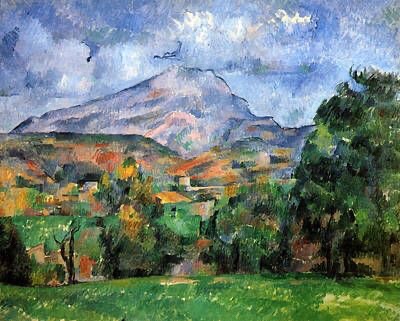
Cezanne Watercolor “Mont Sainte-Victoire (La Montagne Sainte-Victoire vue des Lauves)”( 1902–06) by Paul Cézanne. (The Museum of Modern Art, New York/Photo © 2021 MoMA, NY)

Watercolor is more difficult medium to manage than acrylic paints because it’s wetter and refuses to dry as quickly as we want to paint in that same area. It’s not being obnoxious; it’s just being its own true self. Cezanne used watercolors to think out his ideas beforehand, and then worked in oils. Often, he tossed aside the watercolor work, sometimes even leaving it out in the landscape which he’d just painted. He’d learned all he could from it and now was ready to paint his new image, but not a copy of the original painting. This mountain shows up in sixty of Cezanne’s artworks.

Paul Cézanne: La Montagne Sainte-Victoire, 1888, oil, The Stedelijk Museum, Amsterdam.

The stoic philosopher and Roman Emperor Marcus Aurelius wrote a series of meditations on life. In one he speaks of all life experiences as being the same. This attitude keeps him from getting too high or too low about what happens in his life. He takes it as it comes. Even death, which some fear as a loss, doesn’t bother him, for if he isn’t bothered about the present, he can’t be bothered about losing that too. Marcus Aurelius wasn’t a Christian, but his quest for equanimity is admirable. Take life as it comes and worry not:

“First, that all things in the world from all eternity, by a perpetual revolution of the same times and things ever continued and renewed, are of one kind and nature; so that whether for a hundred or two hundred years only, or for an infinite space of time, a man see those things which are still the same, it can be no matter of great moment. And secondly, that that life which any the longest liver, or the shortest liver parts with, is for length and duration the very same, for that only which is present, is that, which either of them can lose, as being that only which they have; for that which he hath not, no man can truly be said to lose.”

The Still Life in Our Classroom

When we work in watercolor, we have to take what the watercolor gives us. While we can plan, design, and control the outcomes to a certain extent, watercolor often goes its own way. If we work over the whole surface, rather than noodling around in one little space like a puppy sniffing a single spot while out on its morning constitutional walk, we get more done, just as the puppy is more likely to get its “business” done.

One of the reasons we work in a new medium is for the challenge. In school, when I was bored, I’d take notes in class by writing upside down. When that got too easy, I began using my left hand to write upside down. This was a true challenge! I didn’t have any ingrained pathways in my brain for left-handedness, much less the upside-down images. I was truly bored, however, so I struggled on until I got serviceable images. This was the year in which I went to art school as a midyear junior and was taking a freshman level history course.

Tim’s Painting

Tim has voluntarily switched to his left hand because he will have surgery on his right side, which will knock out his ability to use that arm for several months as he recovers. This is a good effort for his non dominant hand. You can tell he focused on the scoop, for it has the most detail. Training our alternate hand to do the work of our dominant hand requires resetting the brain to prefer the new hand. If you try brushing your teeth with your other hand, you’ll see exactly how strange it feels to use a different hand. This is because you have no well-worn pathways in your brain circuitry that makes this routine effort possible.

The fancy pants word for this is neuroplasticicy. We meet this concept with stroke survivors who do physical therapy to rewire their brain connections to make new pathways so they can speak, write, or walk. Everyone who tries a new game, learns a new language, or tries a new hobby also builds new pathways in their brains. Be learners for life, if you want to keep your mind healthy.

Gail’s Painting

Our still life was challenging today. It had solid shapes, a clear bottle, and a metal scoop. Not only were there multiple colors, but textures and transparency also. Gail has had several years of drawing under her belt, so she was able to render the perspective of the still life well. Note the clear blue bottle, which has a wonderful oval bottom. The lemons and limes are distinct also. The grey shape is an antique scoop, sans the handle.

In 2008, J.K. Rowling spoke at the Harvard commencement exercises, telling the graduates, “Talent and intelligence never yet inoculated anyone against the caprice of the Fates.” Because we don’t know what tomorrow will bring, taking care for today is the best preparation for the future. Rowling studied the Classics at Harvard, a subject most people would consider useless for this modern era. Yet after a divorce, as a single parent working for Amnesty International, she began writing her wizard novels. Harry Potter is now part of our cultural heritage.

As Jesus said in Luke 12:25-26–

“And can any of you by worrying add a single hour to your span of life? If then you are not able to do so small a thing as that, why do you worry about the rest?”

Worry is stressful, for sure, and it’s an example of “bad stress,” along with traumatic events, such as adverse childhood experiences (ACE), disease, divorce, and death of a loved one. We also endure “good stress,” as when we challenge ourselves to lift heavier weights, cook a new recipe, or learn a new language. As Ralph Waldo Emerson wrote in his 1841 essay Heroics, paragraph 14:

“The characteristic of a genuine heroism is its persistency. All men have wandering impulses, fits and starts of generosity. But when you have chosen your part, abide by it, and do not weakly try to reconcile yourself with the world. The heroic cannot be the common, nor the common the heroic. Yet we have the weakness to expect the sympathy of people in those actions whose excellence is that they outrun sympathy, and appeal to a tardy justice. If you would serve your brother, because it is fit for you to serve him, do not take back your words when you find that prudent people do not commend you.

“Adhere to your own act and congratulate yourself if you have done something strange and extravagant, and broken the monotony of a decorous age. It was a high counsel that I once heard given to a young person, —”Always do what you are afraid to do.”

When I was in high school, the ancient Latin teacher, who had taught my daddy when he went to school, tossed out the challenge, “No one has ever made 100% on my final Latin exam.”

I bit on that challenge like a starving dog bites on a bone, even if it has no scrap of flesh remaining on it. I made flash cards and studied for an hour every night before bed, I was so determined to be the exception to the rule. On the test, I got all the Latin correct, but lost ½ point for misspelling an English word. I never followed up on her retirement, but I fully expect her record remained unblemished. Also, I’m still spelling challenged. I’m thankful for SpellCheck in our writing apps.

Gail W.’s Painting

Gail W. paid attention to the still life and took care to lay down a close image in a pale wash before she began to add darker washes of color. Her left lime is most successful, with at least six shades of green and yellow in the shape. I also like the highlight on the central lemon. These two images capture the essence of the watercolor medium. Her perspective on the bottle bottom indicates it sits well on the cloth.

Failure teaches us what we don’t know, so we can improve the next time. This is what we call resilience. When I taught art, my students had to find three things they did well in their work before they named anything they needed help on. This was to build up their confidence. For some of them, just making a mark on the page was a start. If we fear making a mistake, we can sketch in a pale-yellow wash. This is very forgiving, like a whisper in the wind. If it’s not quite right, the next few marks may be nearer our desired outcome.

This Is Fine—Leave Me Alone, I’m Having a Crisis

Our mindset is what controls how we react to events in our lives. As one of my friends would remind me, “Not everything is a hair on fire moment.” Of course, when I was a young teen, the least slight or distress caused me to fling myself over my bed in a paroxysm of sobs, wailing loudly, “I’m going to die!” My parents would look at each other and shrug, “What boy is it now?” Fifteen minutes later I’d be in the kitchen looking for a snack, having cried my eyes out, and now I was on to the next thing. As I had more experiences, I learned to roll with the moment. Sometimes you need to wait for the next wave to rise before you take your ride. God’s timing is always right, for our experiences, both the failures and successes, prepare us for what comes next in our lives.

Cornelia’s Watercolor

I had some of the same perspective problems as everyone else, especially with the base of the bottle. Actually, it’s a challenge to get a “transparent three-dimensional object on a flat surface” to appear as if it’s actually sitting on a flat surface in two dimensions. Learning some shading techniques and remembering a round bottle bottom becomes an ellipse helps to bring off this sleight of hand. I got my paint too dark on the front of the bottle base and had to let it dry so I could come back in with some clear water and an almost dry brush to pick up the color. This gave me the highlight I needed.

Cornelia’s Drawing over the Watercolor

When I got home, I noticed my eyesight seems to be going amiss with my increased age. Lately I’ve not been careful to paint my verticals straight. Either I’m being lazy, or I’m tilting my head as I look at the subject. Maybe my neck injury has something to do with it. I duplicated the photo and used the Apple Pencil to straighten up the bottle and even up its symmetry. I also touched up a few of the lemons and limes. Maybe I’m still the puppy that likes to noodle around and sniff about until I can wrest all I can get from a work. This way I learn all I can from it. Like a kindergartner, if my work ends up a huge grey blob, I can say, “That was a great learning experience!”

My grandmother, who painted portraits and still lifes, kept a saying written on the back of an envelope, near her easel:  “Ever tried. Ever failed. No matter. Try again.” She passed in 1970. Years later, Samuel Beckett, in his 1983 story, Worstword, Ho wrote:

“Ever tried. Ever failed. No matter. Try again. Fail again. Fail better.”

We need to be like great artists and athletes, or the Michelin chefs who just keep trying, falling short, until they get close enough to qualify for their stars. Persistence makes all things possible, and if we “fail,” we’re only getting closer to perfection.

I hope for you a blessed Lent,

Joy and peace,

Cornelia


Emperor of Rome Marcus Aurelius: Meditations, XII   https://books.apple.com/us/book/meditations/id396136148

Neuroplasticity: re-wiring the brain | Stroke Association

https://www.stroke.org.uk/effects-of-stroke/neuroplasticity-rewiring-the-brain

10 Brain Exercises to Help Boost Memory

https://www.everydayhealth.com/longevity/mental-fitness/brain-exercises-for-memory.aspx

Neurobiological and Systemic Effects of Chronic Stress – PMC

https://www.ncbi.nlm.nih.gov/pmc/articles/PMC5573220/

​“Try Again. Fail Again. Fail Better”: Beckett’s unlikely Mantra – Goethe-Institut Los Angeles – USA

https://www.goethe.de/ins/us/en/sta/los/bib/feh/21891928.html


The Project Gutenberg eBook of Essays, by Ralph Waldo Emerson

https://www.gutenberg.org/files/16643/16643-h/16643-h.htm#HEROISM


Pears and Apples

adult learning, Altars, apples, Aristotle, art, brain plasticity, change, cognitive decline, color Wheel, Creativity, exercise, Fear, Habits, Holy Spirit, inspiration, Lent, Leonardo da Vinci, Painting, perfection, Physical Training, purpose, risk, Thomas Merton, Van Gogh

Still Life with canvas, pallet, and brushes

Aristotle said in his Poetics, “The aim of art is to represent not the outward appearance of things, but their inward significance, and this, and not the external manner and detail, is true reality.”

He spoke mainly about poetry, which was the highest art of his age, but his words also apply to the fine arts. Today, many people are still mesmerized by artists who practice various styles of realism, but they overlook the artists who show us the realities of emotion and inner vision.

The good news about art.

“Art enables us to find ourselves and lose ourselves at the same time,” said the spiritual writer, Thomas Merton. Some people use art as a cathartic exercise, and pour out their inner emotions on the canvas or their chosen media. Jackson Pollock’s drip paintings and Van Gogh’s late works are good examples of emotional expression. We all know folks who have a project going in their garage. They go work on “that worthless piece of junk” to focus their attention and energy on fixing something on which they can make a difference, instead of getting tied up in knots about things they can’t change and must accept. Gardening and knitting are also good hobbies for focusing this energy.

We know our nervous system grows to the modes in which it has been exercised. This is what we call building a habit over time. Just as a child doesn’t walk straight out of the womb, they have preparatory skills that must be acquired by stages as they grow. Exercising their muscles by rolling over also helps to strengthen their necks to hold their heads up. Crawling leads to pulling up, and that leads to letting go to learn balance.

Each time a child repeats these movements, he or she will simplify the movements required to achieve the needed result, make them more accurate, and diminish fatigue. In this, they’re building habits that bring them closer to walking. Rushing them to achieve “early” walking actually puts them behind cognitively.

Not only are there twenty five body parts in a baby’s body that are used in the crawl movement, but crawling also strengthens the hip sockets, so the baby will have a strong platform on which to stand. Crawling helps the corpus callosum, which is a band of nerve fibers between the hemispheres of the brain. Criss-cross crawling on the knees and hands stimulates the corpus callosum to develop in a balanced way, facilitating the hemispheres of the brain to communicate. These cross lateral movements work both sides of the body evenly and involve coordinated movements of the eyes, ears, hands, feet, and core muscles. This helps support cognitive function, problem solving, and ease of learning. Exploring the floor in a baby proofed home allows your baby to achieve his or her optimal potential.

Gail’s Painting

“Practice makes perfect” is only as true as the practice is directed in a true direction. This is where a teacher, a parent, a coach, or a spiritual guide comes into play. Only one who’s been led well can lead others with grace. We don’t tear down the learner, but ask questions, give guidance, help them see alternative paths, and allow them a safe place to explore their choices.

Art class isn’t brain surgery. No one will die if the painting isn’t successful, and no one’s salvation is at risk if the painting doesn’t come out the way we hoped it might. Art class is a safe place to take risks, unlike jumping from a tall tower without a parachute. Learning to accept failure on our canvases and coming back next time to try again is a mark of resilience and courage. Every time we fail closer to our target, we realize we’re gaining on it! We never say I CAN’T in art class.

Crawl before you Walk or Run

The sad reality is we can teach and expand the horizons of young people up til the age of 25 or 30. After that, they seem to lose energy and desire to learn more or to change. They “habitually” repeat their previous acts, for good or for ill. We’ve all heard the old saying, “You can’t teach an old dog new tricks.” Those of us who are no longer young have sometimes been accused of being set in our ways. Some of us are afraid we won’t excel at a new challenge, for we’ve always been held to a high standard of achievement. Since none of us will be the next Georgia O’Keefe or Leonardo da Vinci, we can set that worry aside. They both had more years to practice than we have left in front of us. Instead, we should give our remaining time our most focused attention, so we can get the most from our experience.

My high school chemistry book had the same information in it which my daddy’s college chemistry book covered. He was amazed I was learning “advanced” ideas at my young age. In 1982 R. Buckminister Fuller introduced the idea of the “knowledge doubling curve.” Up until 1900, knowledge doubled every century. By 1945, knowledge doubled every 25 years and by 1982, it doubled every year. Some say it’s now doubling twice a day! The newest computer we buy off the shelf today is already obsolete.

We can’t train our students for the jobs of today because these jobs likely won’t exist tomorrow. We need to train people to be lifetime learners instead. Luckily, we don’t have to know all things, but we do need the skills to find the knowledge and sort through the best sources for the best possible information.

1930-2006

Today, knowledge we acquire in high school, college, graduate school, and our last job may already be obsolete. (I’m one who still grieves the loss of Pluto as a planet; it exists but is a dwarf planet in the Kuiper Belt). This is especially true in fast moving fields like technology. As futurist Alvin Toffler wrote, “the illiterate of the 21st century will not be those who cannot read and write, but those who cannot learn, unlearn, and relearn.”

This means all of us will need to become lifelong learners or we’ll risk losing touch with an ever evolving world. Maybe we think our brains can’t handle something new, for we’ve heard about the effect of aging. Cognitive process studies with older brains show learning, memory, and problem-solving in humans are often less efficient in these areas.

However, it has recently been established that dogs show many of the same kind of age related changes that humans do. A study in Vienna showed that older dogs learned new tasks just as well as younger dogs, although they took longer to do so and required more repetitive corrections. This aptitude is also known as “resilience training.”

I think it’s also important to know why we want to keep our brains agile as we move into our later years. John Wesley was fond of repeating William Law’s summary from the Practical Treatise on Christian Perfection,

“Do all the good you can, to all you can,
by any means you can, as long as you can.”

Because Wesley was better known than William Law, this quote is now attributed to Wesley alone. We Methodists have made it our own, however, and have carried its banner around the globe in our world wide mission efforts made possible by our Connectional ministries. Wesley thought enough of Law’s writing to reprint 19 editions of his work.

My late mother, at the age of eighty, learned how to use a laptop computer. She was motivated because she wanted to see emailed photos of her grandchildren, but then she realized she also could find recipes. When a child in her hometown needed a Mercy Flight, she used her new skills to get him transportation to an out of state hospital for treatment. I occasionally had to reteach her on how to double click quickly on her icons, rather than slowly, but she finally caught on.

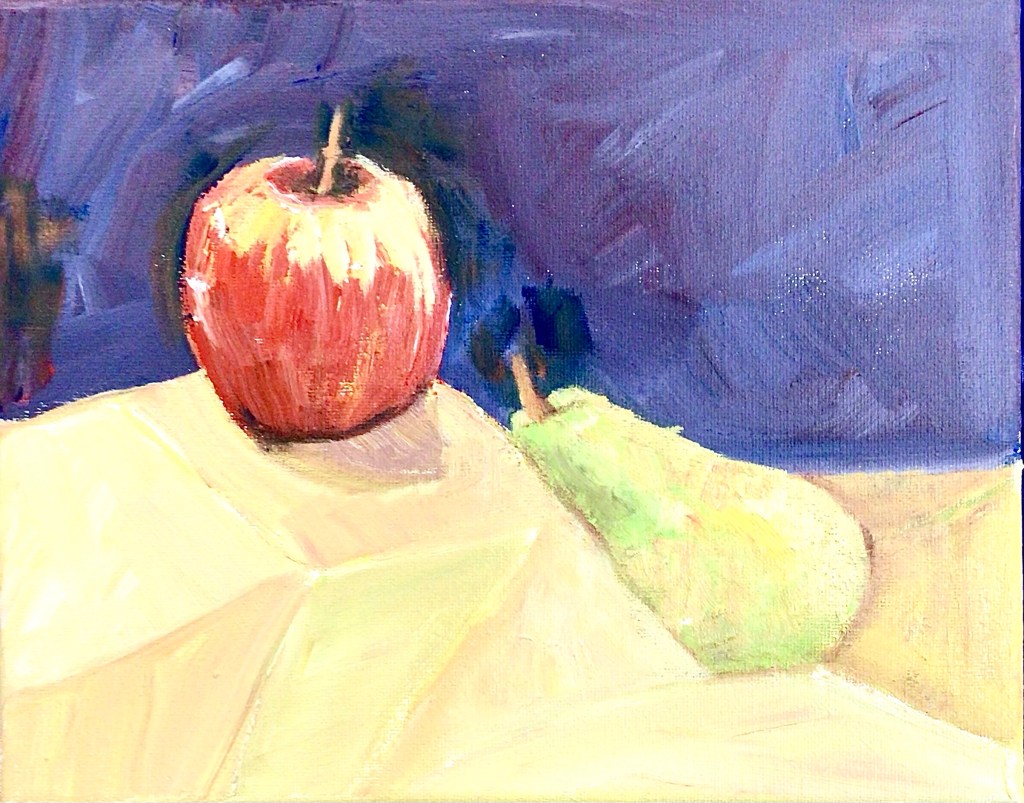
iPad drawing of pear and apple

If we want to keep our brains agile throughout our middle, silver, and golden years, we always need to try new things. Doing art challenges makes our brain build new neural pathways. Every time we look at a still life or a landscape, we have to make multiple decisions: what shapes do I see—circles, squares, triangles, or rectangles; how do these shapes relate to one another on the plane of our canvas; what is most important; what colors will I use; what emotions do I want to express; and where will I begin?

Eventually, we will find our “style.” We don’t find a style by copying another’s work, but we create enough works until our hand becomes one with our spirit. Since God has placed a special spark of God’s own creative Spirit within each of us, eventually we’ll experience the joy of being one with God when we are in our painting moments. As Paul said to the Romans (8:16):

“The Spirit Himself bears witness with our spirit
that we are children of God.”

Last Friday we had a simple still life as our inspiration. Half our class was out sick with spring pollen troubles, but it was good to see those who could come after a two week hiatus. After a brief show and tell to get us inspired by other artists’ takes on the subject for the day, we got started. I reminded everyone not to make the fruit too tiny, so it wouldn’t get lost on the canvas. I believe everyone succeeded with this goal!

Mike’s painting

Mike painted his whole canvas with one brush. This gave the fruit a certain texture with contrasting colors, and the background, which was in a close value, didn’t show much brush strokes or texture. I like the perspective he chose, which brings the viewer in close to these fruit.

Gail tried a larger canvas with bolder colors than she normally uses. It was more dramatic and stronger in contrast than usual, while she kept her smooth strokes of paint as usual. She also took a view from above.

Cornelia’s Fruits

I stuck to a traditional rendering of the still life, since I do many abstract paintings in my own studio. I’d call these two Day and Night, for the Apple is quite awake and the Pear seems to need a little nap. It’s a study in contrasts: red and green, blue violet and yellow orange—a color wheel study masquerading as a still life.

Next week we’re in the season of Lent. As Christ turns his face towards Jerusalem, we’ll begin a study on the icons. This will be accessible and interesting. You’ll end up with your own icon for your personal worship center also.

Joy and Peace,

Cornelia

Classics in the History of Psychology — James (1890) Chapter 4
https://psychclassics.yorku.ca/James/Principles/prin4.htm

Crawling is important for childhood brain development
https://thefnc.com/research/crawling-is-important-for-childhood-brain-development/

You Can Teach an Old Dog New Tricks | Psychology Today
https://www.psychologytoday.com/us/blog/canine-corner/201602/you-can-teach-old-dog-new-tricks

Letters of John Wesley – John Wesley, Augustine Birrell – Google Books, p.423
https://books.google.com/books/about/Letters_of_John_Wesley.html?id=zgYu6NpqWDEC

What It Takes To Change Your Brain’s Patterns After Age 25 https://www.fastcompany.com/3045424/what-it-takes-to-change-your-brains-patterns-after-age-25

From the Shadows to the Light

architecture, art, Carl Jung, change, Faith, Family, Fear, Food, greek myths, hope, inspiration, mystery, nature, New Year, purpose, rabbits, renewal, Roman Forum, shadows, Spirituality, Temple of Janus, Zeitgeist

Rabbit! Rabbit! Welcome to 2023! This old bunny may not see the clock strike midnight, but I’m recovering from a bad cold. Rest is more important than ringing in the New Year. Every year has its own character.

Live with Optimism, even when the nights are long.

Zeitgeist is a word that comes straight from German — zeit means “time” and geist means spirit, so the “spirit of the time” is what’s going on culturally, religiously, or intellectually during a certain period. When it comes to the turn of the New Year, we bunnies wonder if our new broom will sweep clean or if the old broom will leave the same mess as always in our cozy rabbit dens.

Always use a New Broom on the New Year for Good Luck.

Are we filled with hope or with foreboding? Do these dark days and deep nights of winter fill us with a gloomy spirit? Or do the imperceptibly lengthening minutes of daytime give hope to the shadows the cold of winter has left in the depths of our souls? Or have the coastal grandmother bunnies among us learned to ignore all this stum and drang by blending their afternoon tea time into early evening wine tasting?

Everything a culture considers taboo, evil, or immoral typically ends up being proscribed or “consigned to the outer darkness.” From there it ends up inside us in what Carl Jung called “the Shadow,” or our inner “Satan,” as it were. Repressed and inhibited, it festers and rages in the darkness of our “unconscious.” Even in extreme cases, it takes on a quasi-autonomous existence of its own, occasionally intruding as the famous “voices in the head” or even as a multiple personality.

Dr. Jeckyll and Mr. Hyde is a famous light and dark shadow character from fiction, but too often in real life we rabbits point out our own dark shadows in the lives of those we so easily demonize. As my wise old granddaddy rabbit would reprimand me, “When you point out the faults of others, you have three fingers pointing back at you.”

Luke 6:41
“Why do you see the speck in your neighbor’s eye, but do not notice the log in your own eye?”

I always find life more refreshing on the first day of the year, perhaps because I don’t over indulge in strong drink as I once did in my wayward bunny youth. We bunnies all have a wayward youth, for how else would we know what the immature among us are getting into? My old daddy rabbit believed, “Experience was the greatest teacher of all time, as well as its most costly tutor.” Indeed, we remember the costliest lessons best of all. The young ones today say, “Go big or go home.” My grannie would say, “If you’re in for a penny, you might as well be in for a pound.” After all, everyone who participated, either in a small or large way, would be held accountable.

Janus: Bloodstone intaglio of Roman god of transition, passages, and new beginnings.

As I look back on old 2022, grizzled and worn out by conflicts both at home and abroad, I can understand why the ancients thought of Janus, for whom January’s named, as a two faced god. One face, which looked backwards, was lined, bearded, and craggy featured, while the forward looking face of the new year was youthful, smooth, and clean shaven. Every new year is fresh and clean as a beardless youth’s face, as well as untroubled by any recollection of pains or past memories. Most of us bunnies also have short memories, for we tend to repeat the same mistakes over and over. Rabbits have short term memories of around 4 minutes, but can remember bad experiences for longer periods, just as humans can.

Unknown Roman Artisan: Soldier’s Brooch in the Form of a Rabbit, 100–300 CE, Copper alloy with champlevé enamel, found in Britain, Metropolitan Museum of Art, NYC.

In Ancient Rome, as the poets Ovid and Horace recount, Janus was the god of war and peace. They differ as to whether the Temple of Janus was a prison for peace or war, but they both agree the prison was meant to maintain PAX ROMANA, or the great Roman Peace. If peace were impounded, peace would be guaranteed to the nation. If war were imprisoned, it wouldn’t rampage about to destroy the countryside. Just as Janus had two faces, Roman religion was open to multiple interpretations and meanings. Perhaps today, they’d be known as “freethinkers,” as opposed to “literalists” or “strict constructionists” in their interpretation of their ancient stories.

Seeing the Night Skies through Bunny Eyes

Maybe in 2023 we bunnies might want to look at different ways of thinking, instead of one fixed way. There’s a difference between a straight and narrow path and a rut. On the path we can still see other twists and turns, which might change the outcome of our experience and existence. In a rut we’re stuck for life, with no where out, until it becomes our grave. If the world is changing more quickly than is comfortable for us, I give the example of my old granddaddy again. He pushed a button to turn on one of the first electric lights in his home town and lived to see men walk on the moon. Be resilient, be adaptable, and embrace change. After all, we’re always changing, so the option of never changing is death.

Ancient Greek Black Figure Vase, Wasps Attacking Men Robbing Zeus’ Bee Hives for Honey, c. 540 BCE, British Museum, London.

Romans would celebrate January 1 by giving offerings to Janus in the hope of gaining good fortune for the new year. They believed their acts set the stage for the coming year, so it was a common practice to make a positive start to the year. Not only did they exchange well wishes and sweet gifts of figs and honey with one another, but according to the poet Ovid, most Romans also chose to work for at least part of New Year’s Day because they saw idleness as a bad omen for the rest of the year. If 1st century Romans were to drop into some of our 21st century celebrations by means of Dr. Who’s traveling blue Police Box, they would wonder how the barbarians, who sacked Rome in 455 CE, had managed to take over our modern New Year.

Some days I need to be in two places at once.

We toga wearing bunnies, who are long of tooth, know from experience the barbarians are always at the gate of our safe little gardens. Sometimes they’re even inside the gardens of delight, as Peter Rabbit and his Cottontail friends perpetually discover when Mr. McGregror chases them with a rake. If we cast a look back on 2022 with our rheumy eyes, we saw Russia attack Ukraine, an outrageous act which sent millions of people to emigrate from their the destroyed cities and ravaged countryside, with the hope of finding safe haven in another European country.

Mr. McGregor thinks Peter is a Barbarian, who has slipped through his impenetrable garden gate.

Across the pond, on our southern border, thousands of migrants have fled disaster and violence in their homelands, but even though the US economy is hurting for workers in our entry level jobs, they have difficulty getting in. Are these people actually “barbarians at the gate?” Or have we projected our Shadow Fears upon them because they are foreigners? We did this with the Japanese, who m we placed into Internment Camps in World War II, much to our disgrace. This bunny asks us to search our hearts in 2023 to see if our three fingers are pointing back at our own selves.

Think about how Woodstock symbolized the 1960s: Woodstock was part of the Zeitgeist of the 1960s. Whatever seems particular to or symbolic of a certain time is likely part of its Zeitgeist. I came home from college one Christmas wearing a necklace of tiny black and white seed beads, only to be greeted by my old fashioned daddy, “Are you a hippy now?” For him, any one thing represented the whole, for he grew up with the ancient bunny wisdom, “One bad apple spoils the bushel.” We were only reconciled when he realized I hadn’t lost my fondness for his beloved Cowboys football team.

If we can find one common interest in this strange and fraught world with those with whom we would be at war, then we might be able to come to peace with them. If we insist on all or nothing, no bunny will get anything. We all want to have endless days of peace and joy, but the life of a bunny also has days of struggle and sorrow.

Earth as seen from Space

Carl Jung, the great psychologist once said, “There are as many nights as days, and the one is just as long as the other in the year’s course. Even a happy life cannot be without a measure of darkness, and the word ‘happy’ would lose its meaning if it were not balanced by sadness.”

We also have this promise from 1 Corinthians 10:13—

“No testing has overtaken you that is not common to everyone. God is faithful, and he will not let you be tested beyond your strength, but with the testing he will also provide the way out so that you may be able to endure it.”

Many of my southern bunny kinfolks will eat a variety of this New Year’s Day meal: black eyed peas, ham, greens, and cornbread. We think every pea consumed equals another day of good luck. Of course, we’re not the only superstitious clan.

Our cousins in Japan, celebrating Ōmisoka, or New Year’s Eve, gather together to eat long noodles to cross over from one year to the next. At midnight, many visit shrines or temples for Hatsumōde. Shinto shrines prepare amazake, a sweet low alcohol drink, to pass out to crowds and most Buddhist temples have large cast bells that are struck once for each of the 108 earthly desires believed to cause human suffering.

Year of the Rabbit

I found some interesting New Year’s good luck traditions, which are practiced around the world. In Greece, folks hang onions outside on their front doors to ward off evil. On New Year’s Eve, Colombian households have a tradition, called agüero, of placing three potatoes under each family member’s bed—one peeled, one not, and the last one only partially. At midnight each person, with eyes closed, grabs for one. Depending on the potato they select, they can either expect a year of good fortune, financial struggle, or a mix of both.

Ruined House (suspected fruitcake damage)

In Ireland, people bang Christmas bread against the walls of their house for good luck. If any of you bunnies have a Christmas fruitcake still lying around, please choose another loaf to prevent damage to your walls. Good contractors are backed up and hard to find, especially around the holidays.

The Danes chunk plates at their friends’ doorsteps for good luck on New Year’s Eve. Perhaps all that darkness from the winter solstice makes my northern relatives harebrained, but we love them just the same. I suppose every bunny has some weird relatives.

New Year’s Eve Weather Predictions

Old bunny weather lore says, “The first 12 days of January foretell the weather for each month of the year.” Another way to forecast the weather for the coming year depends on the wind. The old bunnies are at odds as to when this poem should be recited, with some advocating for sunset on New Year’s Eve and others at the break of dawn on New Year’s Day. This bunny notes the poem mentions New Year’s Eve, and since none of our ancient bunnies had time traveling abilities, I’d think we are safe to practice this on the Eve at sunset, then go out to do our responsible reveling.

If New Year’s Eve the wind blows south
It betokens warmth and growth.
If west, much milk and fish in the sea.
If north, cold and storms there will be.
If east, the trees will bear much fruit.
If north east, then flee it, man and brute. Then throw your new year wishes to the wind!

GOOD HEALTH AND JOY FOR EVERY BUNNY

My New Year’s wish for 2023 is for each and every one of my bunny friends to have a better year than last year. And especially to know deep in your hearts, each of you are God’s own beloved children. Remember this good word from Romans 8:28—

“We know that all things work together for good for those who love God, who are called according to his purpose.”

Joy, peace, and love each and every day in 2023,

CORNELIA

Multiple Interpretation of the Opening and Closing of the Temple of Janus:
A Misunderstanding of Ovid “Fasti” by S.J. Green, 1.281 on JSTOR
https://www.jstor.org/stable/4433099

5 Ancient New Year’s Celebrations – HISTORY
https://www.history.com/news/5-ancient-new-years-celebrations

15 New Year’s Traditions From Around the World | Glamour
https://www.glamour.com/story/new-years-eve-day-traditions

New Year’s Weather Folklore: Predicting Weather in the New Year | The Old Farmer’s Almanac
https://www.almanac.com/new-years-day-weather-folklore

The Zeitgeist and the Shadow | The Chrysalis https://longsworde.wordpress.com/2018/07/20/the-zeitgeist-and-the-shadow/

Faith is a Gift from God

arkansas, art, beauty, change, Evangelism, Faith, Fear, generosity, Healing, Holy Spirit, hope, Icons, inspiration, john wesley, Love, Mandylion, Ministry, Painting, perfection, purpose, renewal, Spirituality, United Methodist Church, Van Gogh, vision

In the “late unpleasantness” which has some of our Methodist congregations in turmoil, many have their reasons for going or staying. As one born into the Methodist Church, who spent a portion of my life looking for a “better god” before God called me back home, I have some experience with faith. I’ve had it, lost it, and received it once again. My privilege in seminary to work along side the Wesley librarian allowed me to touch authentic Wesley letters. I also had the blessing of being the late Dr. Billy Abraham’s assistant for the Evangelism Chair. When I think of faith, Romans 12:3 comes to mind:

“For by the grace given to me I say to everyone among you not to think of yourself more highly than you ought to think, but to think with sober judgment, each according to the measure of faith that God has assigned.”

Here Paul’s word for faith is the Greek word pistis, which is always a gift from God, never something that can be produced by people. In short, faith for the believer is always “God’s divine persuasion” and therefore distinct from confidence or human belief. The Spirit continuously births faith in the yielded believer so they can know God’s will (1 Jn 5:4).

The former UMC Bishop Mike Lowery wrote in his notice of withdrawal from the Council of Bishops as he surrendered his elder’s orders: “I believe “We are in a fight for the faith delivered once for all.” (Jude 3, CEB).

Resurrection Christ

I’m not picking on the former bishop. I knew him from my Emmaus community days in Southwest Texas. But his posted letter, which can be read at the link below, charges the United Methodist Church has lost her Wesleyan understanding of Christianity. This piqued my interest, so I decided to focus my own thoughts, as well as to inform others, on this matter of faith.

Faith as Doctrine of Assent vs Doctrine of Assurance:

Today we often think of faith as a set of beliefs, or the Doctrine of Assent. In Wesley’s time, he understood faith as the Doctrine of Assurance, a unique gift to the Christian church, whereby believers can know with certainty they are truly beloved of God with a steadfast love which endures forever.

This love is unconditional and saves us from the tragic consequences of the law of sin and death by bringing us into the law of life and love through Jesus Christ’s life, death, and resurrection. That descriptive mouthful is John Wesley’s heartwarming experience he had at Aldersgate in 1738 on the fateful evening when he attended a meeting very unwillingly, yet had the heart changing event that set his life on a different path.

Christ Surrounded by Angels

Historic Wesleyan Faith is a Gift of Grace

We need to ask, “What is the historic Wesleyan understanding of the Christian faith, anchored in the Holy Trinity and welded to Christ as Lord and Savior?” Is it located in regeneration, aka the new birth, or is it located in human morality as proof of righteousness in Jesus Christ? This probably means nothing to people in the pews, but if we’re going to claim the mantle of John Wesley, or the argument from tradition, we must get Wesley’s understanding of faith down pat. We find Wesley’s thoughts in his Notes on the New Testament and in his Standard Sermons, both of which are part of our Methodist teaching.

In the sermon OF EVIL ANGELS, Wesley reminds us faith is “our evidence of things unseen.”

“Faith is the life of the soul; and if ye have this life abiding in you, ye want no marks to evidence it to yourself: but [elencos pneumatos/Spirit control] that divine consciousness, that witness of God, which is more and greater than ten thousand human witnesses,” is Wesley’s explanation of faith in AWAKE, O SLEEPER.

Faith as the Spirit of Adoption

Another way of saying this is Romans 8:15-17,

“When we cry Abba! Father! It is that very Spirit bearing witness with our spirit that we are children of God, and if children, then heirs, heirs of God and joint heirs with Christ.”

For Wesley, faith is a gift of salvation, our trust in the saving work of Christ. As he says in the sermon AWAKE OH SLEEPER:

“Awake, and cry out with the trembling jailer, ‘What must I do to be saved?’ And never rest till thou believest on the Lord Jesus, with a faith which is His gift, by the operation of His Spirit.”

Then Wesley gives his altar call:
“In what state is thy soul? Was God, while I am yet speaking to require it of thee, art thou ready to meet death and judgement? Canst thou stand in His sight, who is of ‘purer eyes than to behold iniquity’? Art thou ‘meet to be partaker of the inheritance of the saints in light’? Hast thou ‘fought a good fight, and kept the faith’? Hast thou secured the one thing needful? Hast thou recovered the image of God, even righteousness and true holiness? Hast thou put off the old man, and put on the new? Art thou clothed upon with Christ?”

“Hast thou oil in thy lamp? grace in thy heart? Dost thou ‘love the Lord thy God with all thy heart, and with all thy mind and with all thy soul, and with all thy strength’? Is that mind in thee, which was also in Christ Jesus? Art thou a Christian indeed that is, a new creature? Are old things passed away, and all things become new?”

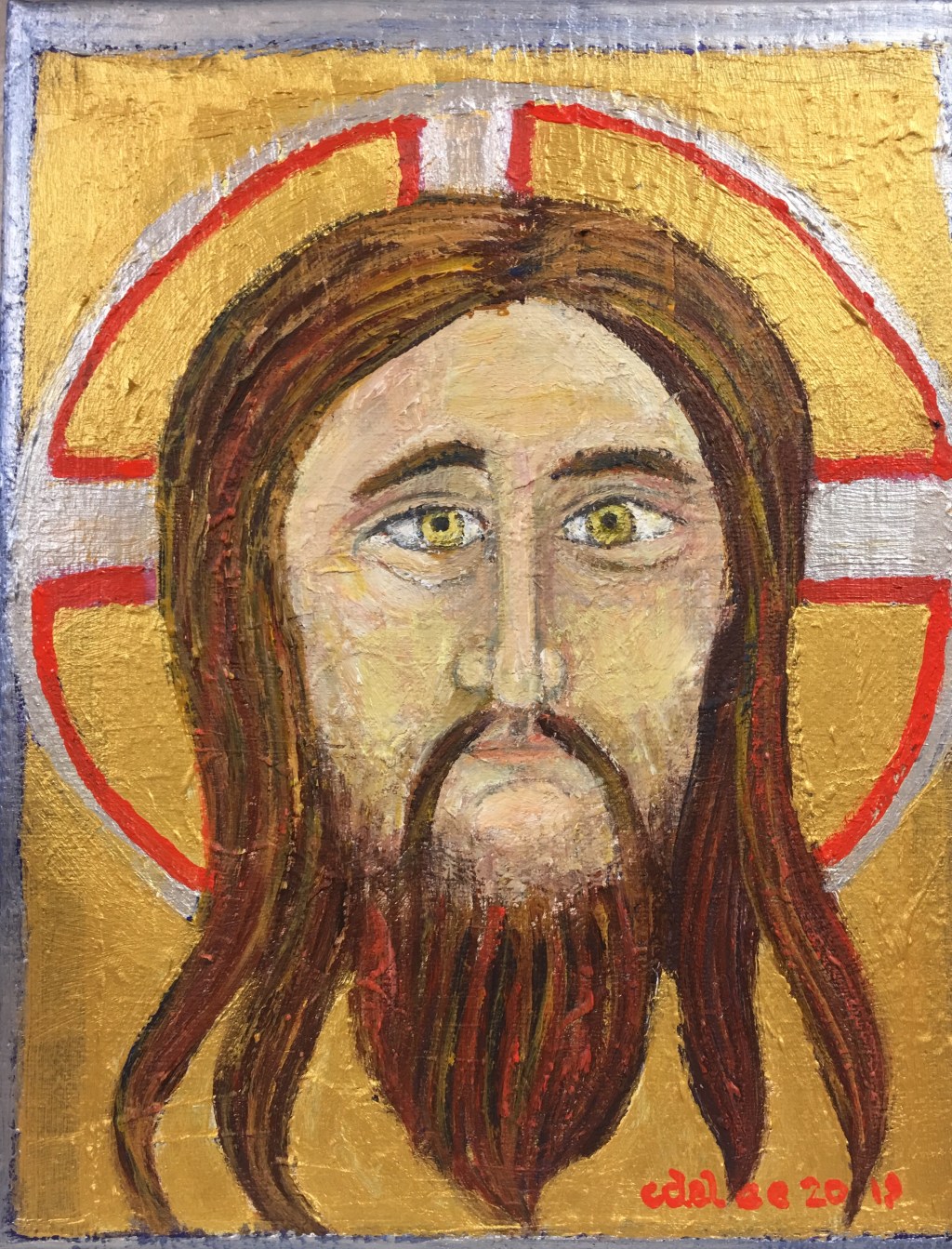
Mandylion: Image Not Made by Human Hands

Faith comes as a Gift. Our good works respond to Christ’s work.

Most of us are in agreement Wesley’s initial understanding of FAITH having to do with accepting Christ’s work for us as the only precondition for our salvation. There is no good deed or accumulation of good deeds needed to earn our salvation from God. What many of us have difficulty is accepting we also don’t earn our perfection in holiness by our own power.

Our Christian perfection is always a cooperative work of the Holy Spirit and our own spirit. As the Spirit works in us, we respond to work toward the complete renewal into the original image of God in which we were created. While it’s possible we might attain this perfect state in this lifetime, most Christians will attain completion in the purity of love of God and neighbor at the moment of death by God’s work, not by our own accomplishments.

Do the Born Again Christians Sin?

In Wesley’s sermon, “The Great Privilege of Those That Are Born of God,” he quotes 1 John 3:9—

“Whosoever is born of God doth not commit sin.”

The Golden Bridge—Ba Na Hills, Vietnam

Wesley admits people who are born again can err or make mistakes, but they don’t sin. That’s a bridge too far for many to accept today, for many of us are prone to judging others. We have a dysfunctional understanding of “perfection.” We think it’s like a Martha Stewart design, forgetting she has a whole staff of helpers to carry out her ideas. As one of my professors once explained it, “Once you’ve been to Waxahachie, you’ve always been to Waxahachie.”

If you don’t know Waxahachie, it’s a midsized Texas town about the size of Hot Springs, Arkansas. It was known for cotton in its hey day, and now hosts a crepe myrtle festival. Once you’ve been there, you can’t lose that experience. In the same way, you can’t lose your status of new birth. It’s a gift of the Holy Spirit, given by faith through Christ.

But some of us will try to throw it away anyhow. Wesley wrote in that same sermon, The Great Privilege, “Some sin of omission, at least, must necessarily precede the loss of faith; some inward sin: But the loss of faith must precede the committing outward sin.”

The Outward Appearance vs. The Inward Attributes

So, one who has faith doesn’t sin, since we have to lose faith in God to sin. In other words, we have to reject the gift freely given to us without price. As he also says in his great sermon on Christian Perfection, “Every one of these can say, with St. Paul, “I am crucified with Christ: Nevertheless I live; yet not I, but Christ liveth in me:” [Gal 2:20]— Words that manifestly describe a deliverance from inward as well as from outward sin.”

Van Gogh: The Good Samaritan

Christian Perfection

For Wesley, the goal of Christian perfection, or the recovery of the image of God, was to love God and neighbor with one’s whole heart until nothing else could exist inside. No favoritism for a group, no exclusion for a group, no yearning to be better than others, no desiring a better place at the table, no hoarding of resources for selfish purposes, no fear of tomorrow, nor any other anxiety that strikes the human heart.

We give our resources away so we can have room for new blessings. God always provides for those who give with generous hearts. We open our doors to the least, the last, the lost, and the unloved, because Jesus and Wesley went out into the fields and met the people where they were. Those are our people out there, and they aren’t “living moral lives,” any more than the imperfect people within our churches are. But we all can and do live lives of faith. We all can learn to trust a savior who loves every sinew of our wounded and broken bodies. We can love a God who never gives up on us even if we’ve given up on ourselves.

Homeless Jesus Statue, Timothy Schmaltz

We United Methodists might be messy, but we surely can love God and neighbor. Moreover, we’re all going on to perfection, even if some of us are moving more slowly than others. We’re still a community of faith, a people who trust God’s grace and one another to get through this thing called life together. We’ll bring each other along, for we’re not leaving anyone behind. We include in the great worldwide Body of Christ the body of Christ whom we meet outside our doors. After all, the race isn’t to the swift, but to the ones who help their brothers and sisters to the finish line, where we have a finishing medal for everyone, along with a big potluck dinner with enough food for folks to take home leftovers. That’s the never ending banquet table to which we invite all who hunger and thirst for community—both spiritual and personal.

The Word of God holds the Scripture of Salvation

Trusting Faith for a Risky Love in Unsettled Times

All we have to do is ask ourselves in this unsettled time: “Do I have Wesley’s trusting faith to live this risky love? Are these the people with whom I want to experience God’s steadfast love and share the grace of Christ? This is our heritage in the United Methodist Church, for we’re a people of faithfulness, who believe the “Bible has everything sufficient for salvation.”

I can only hope for those who leave, whether they become global Methodists, independents, or community congregations, that they will provide a large enough tent for our big God and big Christ, for the Spirit always is seeking people and places to fill completely with the gift of God’s extraordinary love and power.

Why not become all aflame with the fire of God’s redeeming love?

My prayer is our United Methodist churches will receive a fresh rush of the Spirit to become even more of what we are today, for

“Who will separate us from the love of Christ?“

Joy, peace, and faith,

Cornelia

Strong’s Greek: 4102. πίστις (pistis) — faith, faithfulness
https://biblehub.com/greek/4102.htm

Crossing the Rubicon: A Bishop Says Goodbye to the United Methodist Church
https://firebrandmag.com/articles/crossing-the-rubicon-a-bishop-says-goodbye-to-the-united-methodist-church

Of Evil Angels, sermon by John Wesley
http://wesley.nnu.edu/john-wesley/the-sermons-of-john-wesley-1872-edition/sermon-72-of-evil-angels/

Awake, Thou that Sleepest, sermon by John Wesley
http://wesley.nnu.edu/john-wesley/the-sermons-of-john-wesley-1872-edition/sermon-3-awake-thou-that-sleepest/

The Great Privilege of those that are Born of God, sermon by John Wesley
http://wesley.nnu.edu/john-wesley/the-sermons-of-john-wesley-1872-edition/sermon-19-the-great-privilege-of-those-that-are-born-of-god/

“Our standards affirm the Bible as the source of all that is “necessary” and “sufficient” unto salvation (Articles of Religion) and “is to be received through the Holy Spirit as the true rule and guide for faith and practice” (Confession of Faith).”
Theological Guidelines: Scripture
https://www.umc.org/en/content/theological-guidelines-scripture

On Christian Perfection, sermon by John Wesley
http://wesley.nnu.edu/john-wesley/the-sermons-of-john-wesley-1872-edition/sermon-40-christian-perfection/

NOTE: For a longer discussion on “Love thy neighbor,” see—
Kierkegaard, D. Anthony Storm’s Commentary on—Works Of Love
http://sorenkierkegaard.org/works-of-love.html

John Wesley’s Notes on the Old and New Testaments. http://bible.christiansunite.com/wesindex.shtml

Sermons of John Wesley, 1872 edition
http://wesley.nnu.edu/john-wesley/the-sermons-of-john-wesley-1872-edition/

Memories and Forgiveness

arkansas, art, brain plasticity, butterflies, Carl Jung, change, cognitive decline, Creativity, Faith, Family, Fear, Forgiveness, garden, Healing, Holy Spirit, hope, Imagination, Love, Ministry, Painting, Philosophy, Reflection, renewal, salvation, shame, Spirituality, trees, vision

Does God, who knows all things, also have a memory, or can God choose to forget?

I often wonder about such ideas, for when we ordinary folk experience horrific traumas, we often say, “This is going to be with me for the rest of my life. I’ll never get over it.” In some cases this may be true, especially if the person doesn’t seek long term counseling and faith support to deal with the soul damaging harm. With assistance, one can heal from the pain, even while remembering the injury, just as a broken bone can be mended over time.

Those who’ve been wounded and healed can go on to help others heal from their pain and brokenness. The memories of the wound remain, just like a scar on the skin, but they don’t interfere with living a positive and productive life. For those whom Henri Nouwen called “wounded healers,” and who find meaning in their suffering, their lives are a model for others to emulate, for their memories don’t destroy them.

If we look at the nature of God—the one who is, the one who will be, and the one always becoming—we can understand better the discussion between Jesus and the Temple authorities in John 8:56-59–

“Your ancestor Abraham rejoiced that he would see my day; he saw it and was glad.”

Then the Jews said to him, “You are not yet fifty years old, and have you seen Abraham?”

Jesus said to them, “Very truly, I tell you, before Abraham was, I am.”

So they picked up stones to throw at him, but Jesus hid himself and went out of the temple.

Moses and the Burning Bush

Jesus made the claim to the I AM name and being of God, an act of blasphemy, which the devout Jews found outrageous, since it made him equal to God. Their memories of Moses meeting God in the burning bush are to this day a seminal recollection of their liberation story from their Egyptian captivity:

But Moses said to God, “If I come to the Israelites and say to them, ‘The God of your ancestors has sent me to you,’ and they ask me, ‘What is his name?’ what shall I say to them?”

God said to Moses, “I AM WHO I AM.” He said further, “Thus you shall say to the Israelites, ‘I AM has sent me to you.’ ” (Exodus 3:13-14)

Can one who always lives in the present have a memory of the past, or envision the future? I met a lady at Sam’s Club in the days before the July 4th weekend. She was standing in the center of the entrance while folks were pushing baskets quickly past on either side of her. I thought she looked like the choose cone at a NASCAR restart. Bewildered and worried, she was looking for someone who wasn’t to be found. I asked her if she needed help, and she was even uncertain about this request. I suggested we walk over to customer service. On the way, I discovered her name and that her people had walked off to shop without waiting for her. She didn’t know their names, but she did know hers.

I thought about my own daddy, who had Parkinson’s and Alzheimer’s diseases. He progressively lost the memory of our family members: first my younger brothers, then me, and finally my mother became “the lady who came to kiss him every afternoon at 4 o’clock.” However, he could remember every bit of his medical training, even when he slipped and fell. On entry to the ER, he began ordering the medical staff about as if he were in charge. They tried to shush him up, until they realized he was running the accustomed intake drill.

Map Landscape of Hot Springs

Memories are like this, for we keep some which we find necessary and yet lose some very important ones we’d really like to hold onto. We also keep painful memories longer than happy memories, perhaps as a survival instinct. We won’t touch that hot stove again! This doesn’t bode well for our overall optimism, however, if we end up seeing the world as a fraught and dangerous place. How we imprint the emotions on our memories is still debated, for we tend to assign positive or negative emotions to events of our past. Then these affect our future experiences. This is why some of us fear dogs, while others of us approach them with respect, allowing the animal to sniff us out and accept us before we interact with them. We can change our future reactions to old memories, but this is a work in process.

God never gets old, even though God is eternal. If God is always I AM, or I AM WHAT I AM or I WILL BE WHAT I WILL BE, then God is a very present god and as well as a God of the future. If the past is also the present for God, then perhaps the past may be also as the future. In fact, for all we humans know time, as we understand it, may have no meaning for God, and what we think of as past, present, and future, God may experience as the eternal NOW. This may be how we understand Hebrews 13:8— “Jesus Christ is the same yesterday and today and forever.”

Recently I’ve been finding old mementos, souvenirs of my youth. Some are faded newspaper clippings, others are letters from old boyfriends, and then there’s the strange and esoteric memorabilia that somehow survived over half a century in storage along the various stages of my journey. My people are genetically predisposed to collecting. Did I ever mention my grandmother’s ball of tinfoil she kept on the kitchen window sill next to the sweet potato plant she was growing in the old mason jar? I come by this habit through my maternal line.

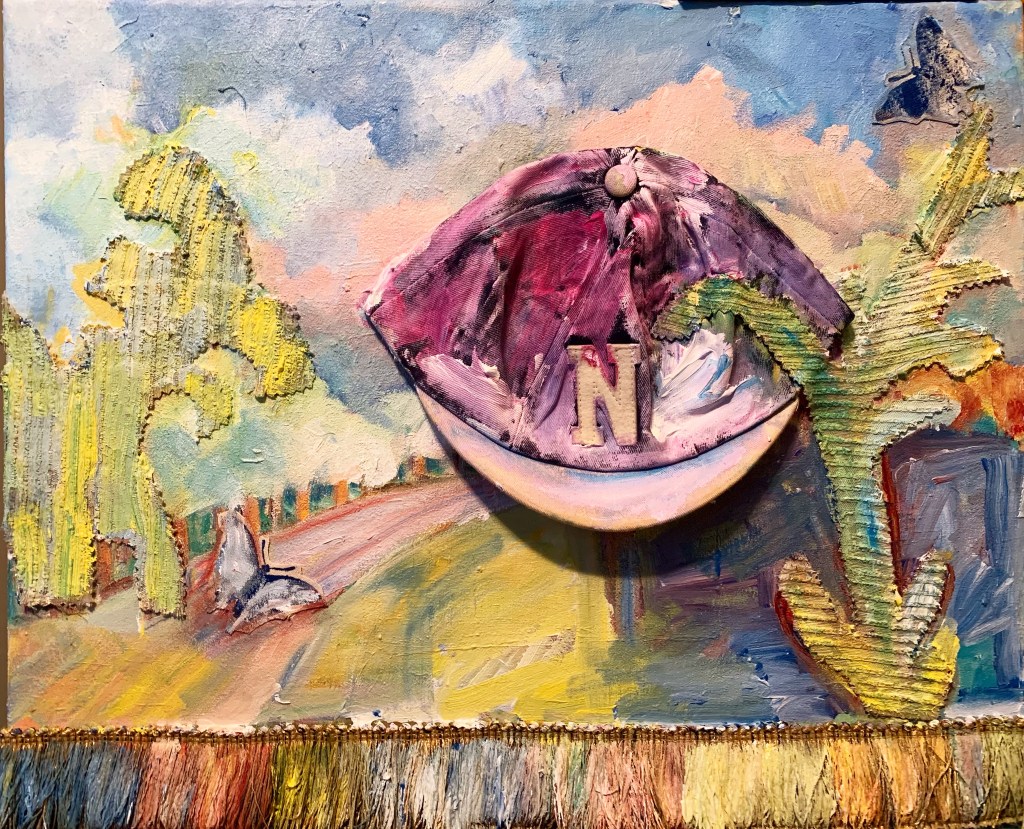
As I’ve been going through these, I had no difficulty throwing away utility bills from the early 2000’s, but then I found the college freshman beanie from my childhood boyfriend. He lived thirteen houses down the street from me. We had a thing for each other all through junior high and high school. For some reason, he gifted it to me. That motive is lost to the fog of memory now. Perhaps as Isaiah 43:18 says:

“Do not remember the former things,
or consider the things of old.
I am about to do a new thing;
now it springs forth, do you not perceive it?”

Memories of a Landscape

When I picked up this ancient cap of shame, for that’s exactly what it is, since it marks its wearer out as the low man on the totem pole, I marveled at how small the hat was. I don’t remember my beloved having a pinhead! In fact, I mooned and pined over his handsome and athletic form. Then again, I was young. As I held it in my hands, I felt the need to recreate something new from it. I had a landscape painting which had gone poorly because I was ill. I decided to paint over it, using the hat as the central tree structure, and adding some cut fabric trees to balance it. I also found some printed butterflies I cut out for embellishment. Once I glued those shapes on the canvas, I could repaint the canvas.

As I destroyed the old canvas and remade it into a new creation, the words from the prophet Isaiah (43:25) came to mind:

“I, I am He, who blots out your transgressions for my own sake, and I will not remember your sins.”

God is a forgiving god, but more importantly, God is a forgetting god. How many times do we say, “I’ll forgive, but I won’t forget?” We might as well say, “I’m not forgiving or forgetting, because I’m going to carry this wound or harm or slight FOREVER.” So much for our going onto perfection in love, or learning to love as God loves.

The cornerstone of all forgiveness is self-forgiveness. Too many of us believe the verse from John 3:16 only applies to the world, but not to themselves individually—

“For God so loved the world that he gave his only Son, so that everyone who believes in him may not perish but may have eternal life.”

If we can’t forgive the darkness within us, or the mistakes we’ve made, or allow God to forgive us, how are we to forgive others? In fact, if we tell God our sins are too great for God to forgive, we’ve set ourselves above God’s authority to forgive sins. This is pride, authority, and idolatry all wrapped into one. We’ve made ourselves into a god, rejecting God. The Pharisees of old rejected Jesus for this very reason.

Who was the most forgiving person in all of scripture? Jesus, of course, for he claimed authority to forgive sins just as God did, as when Jesus healed the paralytic whose friends let him down through the roof (Luke 5:20-24). Those who were nearby wondered at his boldness, but he asked, “What’s easier, forgiving sins or saying stand up and walk?” If we’re going to claim the name of Christ, we too are going to be forgiving people. Forgiving is an act that heals not only the other, but also ourselves. If we can’t forgive, we’ll never be able to forget, or transform our painful memory into one which God can use for the healing of others.

Map of Hot Springs: Airport

In a sense, we make a new map in our minds and hearts of our old landscapes of pain and sorrow. What once were places of despair can become fertile fields, if not gardens of delight. Our wounds become the tender points which open us up to the suffering of others, and allow us to minister to their needs. Our healing is part of God’s steadfast love. As Jeremiah reminds us:

“No longer shall they teach one another, or say to each other, “Know the LORD,” for they shall all know me, from the least of them to the greatest, says the LORD; for I will forgive their iniquity, and remember their sin no more.” (31:34)

When I think of the faithfulness of God, I also believe in the timelessness of God. When Jesus meets his disciples in Galilee to give them the Great Commission in Matthew 28:20, he says, “And remember, I am with you always, to the end of the age.” When this present age ends and God renews the heavens and the earth, how will we experience time in the new creation? Surely, if God is making all things new, we won’t be in this same world anymore and the rules it follows won’t be the same. We aren’t thinking boldly enough or big enough if we limit God to only recreating only the current fallen and broken world we have now.

Maybe if more of us began to think on the world a forgiving and loving God could create, we could begin to remake this present world into the new creation. If we were to make acts of love and forgiveness more prominent in our daily lives, we might restore our neighbor to fellowship and community. We can forgive even those who don’t seek it, for they’re the ones who’re most in need of forgiveness. With a forgiving and loving God’s help, we can do this.

Joy and Peace,

Cornelia

How memories form and fade: Strong memories are encoded by teams of neurons working together in synchrony – ScienceDaily
https://www.sciencedaily.com/releases/2019/08/190823140729.htm

Rabbit! Rabbit!

brain plasticity, change, Children, chocolate, Civil War, coronavirus, Easter, Faith, Fear, Food, generosity, grief, Holy Spirit, Lent, Love, nature, pandemic, purpose, rabbits, Racism, renewal, salvation, sleep, Spirituality, Spring Equinox, Stress, Uncategorized, Valentine’s Day, Valentine’s Day, vision

Welcome to a Pandemic February—

1908 Vintage Nature Print

“Heraclitus, I believe, says that all things pass and nothing stays, and comparing existing things to the flow of a river, he says you could not step twice into the same river.” Plato quoted an older Greek thinker about life’s being constantly in a state of flux or change. We can’t dive into our rabbit holes at every quivering leaf or shadow of every cloud passing over the sun. We rabbits know the world is changing all the time, even if we don’t like it, but we still have to venture outside of our den and hutches to find tasty carrots and spinach leaves.

Fear of Change—

Yet some rabbits have a fear of change or fear of changing the order of things. This goes by another Greek word, Metathesiophobia. This is a new word for this old rabbit, so I guess I’ve modified a few brain cells in learning this. In fact, when we learn new words, we actually get happier! There’s even science behind this. In a study, “increased subjective pleasantness ratings were also related to new-words remembered after seven days. These results suggest that intrinsic—potentially reward-related—signals, triggered by self-monitoring of correct performance, can promote the storage of new information into long-term memory through the activation of the SN/VTA-Hippocampal loop, possibly via dopaminergic modulation of the midbrain.”

Even if we don’t understand the scientific jargon of that sentence, we know learning new things gives us a feeling of pride and accomplishment. We feel good about ourselves when we accomplish a new trick or master a new skill. Repeating the same experiences over and over leads to dullness,even if we find safety in the predictably.

If we were small bunnies, we’d never find the refrigerators in our homes, since they’d be covered up in our latest glorious art project. Every rabbit parent raves about their genius offspring, if they’re raising them right. We always want to catch our small ones doing something right and praise them for it. We’ll get more cooperation than if we’re always telling them NO, and GO TO YOUR ROOM.

I ask you, which rabbit among us doesn’t want to be happier in this world? Currently we’re in the midst of the worst crisis most of us have ever experienced. We rabbits need to name it and face it, rather than deny it, for this pandemic isn’t not going away anytime soon. This causes some of our bunny friends to find a “boogeyman lurking in every dark corner.” When I was young, my parents scared me, or scarred my memories, over my messy closet.

Fancy Dress Up Clothes

“You’d better clean up that pile of clothes in there, young lady! If you don’t, a rat might come crawling out of those clothes piled up on the floor!”

EEEK! I was so frightened, I untwisted an old metal coat hanger and stood outside my closet while I fished out my dress up play clothes, one article at a time. If a rat were to come out with them, I wanted a running head start. I was on my own in art school over a decade later before I could sleep with the bedroom closet open. This was a long standing fear to shake. Not everyone can put aside their fears and coping mechanisms, however.

I’ve had rabbit friends who get up in the middle of the night to make sure their closets are neatly arranged, with all the shoes in the right boxes and all the clothes facing the same direction on the hangers. I have no such anxiety, for I hang my clothes up and don’t worry once I’ve done it. I have other tasks to tackle. Uninterrupted sleep is a worthy goal for rabbit health. Plus I have other creative tasks to engage me, and I’m learning new things every day. In any event, I know my salvation won’t be impaired by this failure to act on my part, just as it won’t be earned if I keep a perfect closet.

Change is moving swifter than the atmospheric river that’s currently dumping rain and mudslides on the Pacific coast and ice and snow on the Atlantic coast. Atmospheric rivers are long, narrow regions in the atmosphere—like rivers in the sky—that transport water vapor, according to the National Oceanic and Atmospheric Administration. Drastic swings from extremely wet to extremely dry and vice versa will be nearly twice as likely, occuring on average once every 25 years, by 2100. Dramatic swings are becoming more common and will continue to do so in the coming decades thanks to man-made climate change.

Presidents’ Day—

Of course climate change isn’t the only change we’re dealing with in February.

Today we have one holiday to celebrate Abraham Lincoln and George Washington. Back in this rabbit’s kitten days, we had two holidays for these two presidents, but the times change and the holiday became popularly known as Presidents’ Day after it was moved as part of 1971’s Uniform Monday Holiday Act, which was an attempt to create more three-day weekends for the nation’s workers.

At the time, Congress thought setting three day weekends would end employee absenteeism. Today the coronavirus pandemic has put most white collar workers out of the office and many blue collar workers out of a job. Until we get this pandemic behind us by vaccinating as many of our people as possible and continuing safe practices, we won’t get back to any semblance of normal any time soon. This virus hunts a host, and it’s sure to find a rabbit to use as its own personal Petri dish.

Super Bowl LV—Next Super Spreader Event?

On the first Sunday in February, the big game goes down. While the 7,500 health care workers who’ll be the stadium attendees will be following COVID protocols, the fans at home remain susceptible to infection. A recent Seton Hall Sports Poll collected answers from 1,522 adults spread all over the country from Jan. 22-25. That data shows 25% of respondents said they would gather with people outside of their home (defined as those who aren’t roommates or cohabitants) to watch the game. Sixty-four percent of respondents said they would not attend a gathering and 11% said they weren’t sure.

Among avid fans however, 40% of that group said they would indeed gather with members outside of their household. The CDC doesn’t recommend holding these types of gatherings, especially if they are inside and last for the duration of the game. The Super Bowl will be played in Raymond James Stadium in Tampa and is scheduled for Sunday, February 7, with a 6:30 p.m. ET kickoff, with an estimated game length of four hours, not counting the additional four hours of preliminary extravaganza programming.

Chocolate Strawberry Footballs

I’ve always gathered the various rabbits who live in my condo building for the game festivities. It’s a good opportunity for us to socialize and since everyone always waits for “someone to take charge,” I just step up. We won’t do it in person this year, however, for we rabbits can best observe safely the whole shebang from the comfort of our couches and Zoom or find other other media connections with our loved ones and friends so we can have a real party next year.

Super Bowl LV Firsts—

There are new changes to the Super Bowl this year. Amanda Gorman, the inaugural poet, will recite an original poem before Super Bowl LV, as part of both the in-stadium pregame ceremony and the TV broadcast. The poem will honor three everyday heroes who have been chosen as honorary game captains by the NFL. These people include Trimaine Davis, a Los Angeles teacher who fought to secure internet access and laptops for his students amid the pandemic; Suzie Dorner, a Tampa nurse who managed the COVID ICU at Tampa General Hospital; and James Martin, a Marine veteran who has helped veterans and their families connect virtually through the Wounded Warrior Project.

Gorman isn’t the only pregame excitement. Miley Cyrus will perform as part of the TikTok Tailgate event for the Health Care Heroes. This will also be televised. Then there’s the The Pepsi Super Bowl Halftime Show, which is the most-watched musical performance of the year, with more than 104 million viewers tuning in to last year’s show. The rhythm and blues artist known as The Weekend (Abel Makkonen Tesfaye) will be the featured performer.

The Weekend

 “The Weeknd has introduced a sound all his own. His soulful uniqueness has defined a new generation of greatness in music and artistry,” said Shawn JAY-Z Carter. “This is an extraordinary moment in time and the Pepsi Super Bowl LV Halftime Show is going to be an extraordinary experience with an extraordinary performer.” This rabbit has been listening to his oeuvre on Apple Music, and I’m quite excited to hear the show. It ought to be a bang up program with no wardrobe malfunctions.

JAY-Z and his company, Roc Nation, have worked over the past year on the selection of artists playing the Super Bowl Halftime Show as the league’s official Live Music Entertainment Strategists. The partnership aims to “nurture and strengthen community” through music and support the NFL’s Inspire Change social justice initiative, and also has Roc Nation serving as a co-producer of the Super Bowl Halftime Show. 

GRAMMY-nominated artists Eric Church and Jazmine Sullivan are set to pair up for the first time to sing the National Anthem as part of Super Bowl LV pregame festivities. Grammy-award winning artist, H.E.R., will join the pregame lineup with her rendition of America the Beautiful. In addition, on behalf of the National Association of the Deaf (NAD), Warren “Wawa” Snipe, acclaimed Deaf rapper and recording artist, will perform the National Anthem and America the Beautiful in American Sign Language. For Super Bowl LV, the National Anthem will be arranged and produced by Adam Blackstone.

Sarah Thomas

“Sarah Thomas will made history again as the first female Super Bowl official,” NFL EVP of football operations Troy Vincent said. “Her elite performance and commitment to excellence has earned her the right to officiate the Super Bowl. Congratulations to Sarah on this well-deserved honor.” She will be a down judge on a seven-person crew of distinguished game officials. You go girl!

This is just one more change for a world that spins 360 degrees daily and moves around the sun on its invisible circular river which it completes every 365 1/4 days. Our planet never stays in in one place as it courses through the unseen river of time in the heavens, but we see ourselves think we have a fixed place in the universe. If we observe nature, the rising and setting of the sun moves along the horizon line as the seasons change and it rises higher into the sky during the summer than the winter. These changes are part of our ordinary life, and give a structure and rhythm to our days and time upon this world.

Champions in a Championship Game

Speaking of firsts, the Chiefs are trying to become the first team in 16 years to win back-to-back Super Bowls. The last team to do it was Tom Brady’s 2003-04 New England Patriots. Tom Brady is set to become one of four quarterbacks to start a Super Bowl for multiple teams and he could join Peyton Manning, who is currently the only quarterback in NFL history to win a Super Bowl start with multiple teams. So while the seasoned champion with a brand new team goes against a young champion trying to make the magic happen two years in a row, we should have a good game, rather than watching it for the commercials.

In other firsts, the Super Bowl is almost always the top rated TV show for audience numbers. Only the final episodes of M.A.S.H. and Cheers have ever pushed it to number two. The commercials are first class also. CBS’s asking price of $5.5 million per 30-second spot is merely the cost of reserving the requisite airtime; after production expenses, ancillary social-media investments and agency fees are accounted for, the actual outlay for a single Super Bowl ad can swell to $20 million. That’s a lot of rabbit feed.

We won’t see the Budweiser Clydesdales for the first time in 37 years, for the company will be focusing on supporting Covid vaccine awareness education spots instead. Other companies related to restaurants may be missing due to lower sales and profits, but this gives other companies an opportunity to take their place. The pandemic has changed our economy in many ways. Avocados are in demand because we rabbits eat our salads at home, not in a restaurant. This is good for grocers, but bad for cooks, wait staff, and restaurant owners.

While parts of our economy are currently staggering along, the middle class and poor are lagging behind, as if they had chains and a huge millstone binding their bodies. Nearly 12 million renters will owe an average of $5,850 in back rent and utilities by January, Moody’s Analytics warns. People would go to work, but the businesses are either closed or the parent needs to stay home to school the child. Unpaid rents affect landlords, and roll on to the bankers who hold those notes.

The Census Bureau’s Household Pulse Survey, launched in April 2020, has provided nearly real-time weekly data on how the unprecedented health and economic crisis is affecting the nation. Nearly 24 million adults—11 percent of all adults in the country— reported that their household sometimes or often didn’t have enough to eat in the last seven days. Adults in households with children were likelier to report that the household didn’t get enough to eat: 15 percent, compared to 9 percent for households without children. Hunger in America or food insecurity is linked to a greater chance of cardiovascular mortality in counties throughout the U.S. Researchers believe if the pandemic goes on long enough, more people will begin to die of hunger or famine related circumstances than the disease itself.

Some want to spend a little and let it “trickle down,” but my grandmother rabbit always said that was “penny wise and pound foolish.” After WWII, American generosity rebuilt Germany, the home of the Nazi enemies. If we rebuilt the country of our enemies, I wonder what keeps us from rebuilding our own land? We need a Marshal Plan for America.

St. Valentine’s Day—

Be my valentine! XXOOXX

As a small bunny, I fondly remember classroom Valentines Day Parties, mostly because I got to decorate a shoebox as my “Valentine Mailbox” and enjoyed all the dime store paper valentines from my bunny friends. Mostly I really enjoyed the pink icing on the chocolate cupcakes and those Necco candy hearts with their pithy, saucy, love quotes. In this pandemic world of Zoom classrooms, gone are class parties, valentines for everyone, and a special gift for the teacher. As a former teacher, my hope is we can get our school teams vaccinated and get our little bunnykins back in a communal setting, so they can learn socialization skills as well as educational materials.

Ash Wednesday—

Some grieve about this year as if it’s lost year, and it’ll never be gotten back. This is true, however, there’re other great crises our little bunnies went through in our history, through no fault of their own. The Civil War was one, for it disrupted some youth we wouldn’t let have keys to a car today. One of my grandfather bunnies dropped out of school in the eighth grade to work on the railroad when his own father left home. He made sure his own little bunnies got their education, even if he didn’t get his.

Just because we have a twelve year program for public school doesn’t mean we have to finish it in that length of time. If we have a large monkey wrench thrown into our best laid plans, we might need to cram those twelve years into thirteen years. If we live to seventy-nine years, the average life span in America, this extra year is only 1/79 or 1% of our lives. We spend more time than this sleeping, since we spend about 33% of our lives asleep. No one seems to grieve about this broad swath of time in bed in fact, more of us rabbits are trying their best to get either more or better sleep! Perhaps we need to reframe then way we look at some of these problems to reduce our anxiety about them. Then we’d have more strength to cope with the day to day struggles, which are real and difficult.

Ash Wednesday is moveable feast day, so its date varies. It depends on when Easter is celebrated, and that too is dependent on the lunar calendar. My old daddy rabbit had this ancient piece of lore memorized: “Easter is always the first Sunday after the first full moon after the spring equinox.” While we may be able to move certain holidays around the calendar, Easter and its connected rituals of faith, Ash Wednesday and the forty days of Lent, move every year.

Because of coronavirus protocols, the hands on imposition of ashes by pastors, priests, or worship leaders will change in this pandemic year. Some churches will sprinkle ashes upon people’s heads, while others will give out packets of ashes for self imposition. The ashes are a traditional sign of humility. We may ask, if the ritual changes, is it as effective as it once was? The better question to ask is, “Does the ritual save us or does the power of God’s Holy Spirit flowing through the moment change us for the better?” Sometimes we put too much emphasis on the outward and visible elements, rather than the inward and invisible experience of God at work in us.

The Constant in the Midst of Change—

In the midst of a world intent on stoking our fears to a fever pitch, some of us rabbits find ourselves pulled down the proverbial rabbit hole into vast conspiracy theories, which purport to connect unlikely coincidences, but actually push anti-Semitic, far-right or white-supremacist ideology. Some of these ideas are as old as the Middle Ages, while others came from Russia and got passed into the American milieu during the first Red Scare in the 1920’s.

One of the worst examples is “The Protocols of the Learned Elders of Zion,” a classic of paranoid, racist literature. Taken by the gullible as the confidential minutes of a Jewish conclave convened in the last years of the nineteenth century, it has been heralded by anti-Semites as proof that Jews are plotting to take over the world. Since its contrivance around the turn of the century by the Russian Okhrana, or Czarist secret police, “The Protocols of the Learned Elders of Zion” has taken root in bigoted, frightened minds around the world.

When the world is in chaos, fearful rabbits look for a demonic figure to blame, when they should look instead to a positive source of power and strength. Fear paralyzes us, but the power of God sets us free to change our world for the better.

Bierstadt: Merced River, Yellowstone Valley

God is our refuge and strength,

a very present help in trouble.

Therefore we will not fear, though the earth should change,

though the mountains shake in the heart of the sea;

though its waters roar and foam,

though the mountains tremble with its tumult.

~~ Psalms 46:1-3

May you make enough small changes every day to get new wrinkles in your brain, rather than on your brow.

Joy and Peace,

Cornie

Intrinsic monitoring of learning success facilitates memory encoding via the activation of the SN/VTA-Hippocampal loop | eLife

https://elifesciences.org/articles/17441

HISTORY: Presidents’ Day—History, Date & Holiday

https://www.history.com/topics/holidays/presidents-day

Poll: Despite pandemic, 25% will attend gatherings to watch Super Bowl 55 between Chiefs, Buccaneers

https://www.usatoday.com/story/sports/nfl/super-bowl/2021/01/27/super-bowl-55-poll-attend-gatherings-coronavirus-pandemic/4281143001/

2021 Super Bowl Halftime Show: The Weeknd to Perform | Entertainment Tonight

https://www.etonline.com/the-weeknd-to-perform-2021-super-bowl-halftime-show-156259

Eric Church, Jazmine Sullivan to sing national anthem at Super Bowl LV; H.E.R. to sing America the Beautiful

https://www.nfl.com/news/eric-church-jazmine-sullivan-to-sing-national-anthem-at-super-bowl-lv-h-e-r-to-s

Increasing precipitation volatility in twenty-first-century California | Nature Climate Change

https://www.nature.com/articles/s41558-018-0140-y

A Hoax of Hate: The Protocols of the Learned Elders of Zion

https://www.adl.org/resources/backgrounders/a-hoax-of-hate-the-protocols-of-the-learned-elders-of-zion

Super Bowl 2021 numbers to know: Patrick Mahomes and Tom Brady both have NFL records on the line – CBSSports.com
https://www.cbssports.com/nfl/news/super-bowl-2021-numbers-to-know-patrick-mahomes-and-tom-brady-both-have-nfl-records-on-the-line/

Millions of Americans are heading into the holidays unemployed and over $5,000 behind on rent. Hefty bills will come due in early 2021 for rent and utilities. Economists warn many unemployed families won’t be able to pay without more stimulus aid from Congress. By Heather Long

https://www.washingtonpost.com/business/2020/12/07/unemployed-debt-rent-utilities/

Tracking the COVID-19 Recession’s Effects on Food, Housing, and Employment Hardships

https://www.cbpp.org/research/poverty-and-inequality/tracking-the-covid-19-recessions-effects-on-food-housing-and

Link between food insecurity and cardiovascular death found

https://www.medicalnewstoday.com/articles/link-between-food-insecurity-and-cardiovascular-death-found

Rabbit! Rabbit! Welcome to October

All Saints Day, art, Children, coronavirus, Creativity, Faith, Family, Fear, grief, Halloween, Healing, holidays, Imagination, Israel, pandemic, rabbits

The Pandemic killed Halloween Then and Now

Nearly a century ago, no one had “Pandemic Shuts Down Halloween “ on their bingo card. The Great Influenza Pandemic griped the nation back in 1918, so most Halloween celebrations were cancelled due to quarantines. At least 195,000 people had died of this novel disease in America by October, 1918. The CDC estimates about 500 million people—or a third of the world’s population—had come down with this killer virus. By the1920’s, at the end of the Pandemic, at least 50 million people died, with 675,000 victims in the United States alone.

USA Red Cross volunteers in 1918 flu epidemic
APIC / Getty Images

At the time, we had no vaccines to protect against influenza and no antibiotics to treat secondary bacterial infections. Many doctors and nurses were serving in World War I, so the civilian medical professionals around the world tried to control infections with nonpharmaceutical interventions such as isolation, quarantine, good personal hygiene, masks, use of disinfectants and limitations of public gatherings. An interesting side note is all the flu pandemics which have happened since — 1957, 1968, 2009 — are derivatives of the 1918 flu, according to scientists at the National Institutes of Health.

The world back then was falling apart on two fronts from the first world war and disease. People at home were dropping like flies. Bodies were stacking up like cordwood and were placed in mass graves. Then, as now, we rabbits, like people, can only take so much stress before we need to release it. Many of us are pots with tight fitting lids: as soon as we reach the boiling point, our lid begins to rattle and clatter. If the cook doesn’t remove the lid and stir down the goo inside, we’ll be an over flowing volcanic mess, much like my morning oatmeal I’ve neglected when I’ve had too little coffee. Then Halloween, with its ghouls, goblins, witches, and other demons of the dark, arrives like Washington Irving’s ghost of the Headless Horseman, which we meet in The Legend of Sleepy Hollow, written in 1820.

The Headless Horseman Pursuing Ichabod Crane (1858) by John Quidor

Flu Pandemic Inspired Fiction

H. P. Lovecraft was one of the great horror writers, famous for his zombies, which may have been inspired by the grisly experiences of the influenza pandemic. Providence, Rhode Island, Lovecraft’s hometown, wasn’t spared the pandemic’s ghastly atmosphere.

As one local witness remembered, “all around me people were dying… [and] funeral directors worked with fear… . Many graves were fashioned by long trenches, bodies were placed side by side.” The pandemic, the witness laments, was “leaving in its wake countless dead, and the living stunned at their loss” (letter by Russell Booth; Collier Archives, Imperial War Museum, London).

White Zombie: First Zombie Movie, 1932

Lovecraft channeled this existential horror into his stories of the period, producing corpse-filled tales with infectious atmospheres from which sprang lurching, flesh-eating invaders who left bloody corpses in their wake.

In his 1922 story “Herbert West: Reanimator,” Lovecraft created a ghoulish doctor intent on reanimating newly dead corpses. A pandemic arrives that offers him fresh specimens. This echoes the flu scenes of mass graves, overworked doctors and piles of bodies. When the head doctor of the hospital dies in the outbreak, Dr. West reanimates him, producing a proto-zombie figure that escapes to wreak havoc on the town. The living dead doctor lurches from house to house, ravaging bodies and spreading destruction, a monstrous, visible version of what the flu virus had done worldwide. Lovecraft wrote about a zombie super-spreader even before we knew such a thing existed. Who says “life sometimes doesn’t imitate art?”

Thriller: Zombie Dancers backing up Michael Jackson, 1983

Infection, Prejudice and the Viral Zombies

In other episodes and stories, Lovecraft’s proto-zombies suggest an additional thread of prejudice that runs through the zombie tradition, one fueled by widespread fears of contagion during the pandemic. Even before the outbreak, Lovecraft believed that foreign hordes were infecting the Aryan race generally, weakening the bloodlines. These xenophobic anxieties weave their way into his stories, as contagion and pandemic-soaked atmospheres blend into racist fears of immigrants and nonwhite invaders. We hear these same themes repeated today in our pandemic times by white supremacists and far right groups who want a sovereign nation within the land of the free.

Indeed, many of Lovecraft’s stories are unwitting templates for how prejudicial fears may be problematically amplified at moments of crisis. Such fears are evoked and often critiqued in later depictions of viral zombie hordes, such as the infectious monsters of Romero’s 1968 movie, “Night of the Living Dead” and the film’s subtle commentary on race, as when the white police force mistakes the main African American character for a viral zombie. Amazing how systemic racism persists in making “walking while black equate to viral zombie” even today.

Small Rabbits Fear Large Monsters

Lovecraft’s proto-zombies also provided a strange compensation for some of the pandemic’s worst memories. Like the covid-19 virus of today and the flu of the last century, these monsters consumed the flesh of the living, spread blood and violence, and acted without cause or explanation. Lovecraft assures his readers that these monsters are far worse than anything they saw in World War I or in the pandemic, the twin defining tragedies of his era. Unlike the virus, though, these literary monsters could be seen, stopped, killed, and reburied. Every decade seems to need its own monster or zombie, and Lovecraft offered his readers a version that spoke deeply to the anxieties of his moment.

Modern Fears Birth Modern Monsters

Our modern monsters are more in tune with the unimaginable horrors of our present world. In the 1950’s we had nuclear terrors, so our monsters were Godzilla and the Creature From The Black Lagoon. In the 1990’s, cloning was a scientific advance we knew could go amiss, so we had dinosaurs run amuck in Jurassic Park. Aliens have always been the most foreign of foreigners, so whether it’s the Thing from Outer Space or Invasion of the Body Snatchers, we can scream into our popcorn all afternoon long. If we don’t scream, everyone will know we’re one of the “pod people.” Even before cinema took over entertainment, Orson Welles’s radio broadcast of the H.G. Wells novel War of the Worlds caused mass panic among listeners who believed Earth really had been invaded by Martians on October 30, 1938.

Image Invasion of the Body Snatchers, 1956

Dangers of Dualistic Thinking

Maybe this is why we rabbits need structured experiences which bring us up to the edge of fear, but in a safe environment. We need to learn to deal with our feelings and emotions as they threaten to overwhelm us. We need reassurance we can handle the frightening experience. We don’t need to be thrown off a cliff, but tested appropriately. If we don’t deal with our inner fears, we’ll see a ghoul in every dark shadow. This is why movies today have ratings for age groups.

When I was young, I was certain monsters lived under my bed and in my closet. I couldn’t sleep unless my closet door was shut. I was in art school before I could leave that door open. Something clicked in my mind, or I realized I was now at the age of responsibility. If this were so, I needed to give up this childish fear of invisible monsters. It was time for me to be the monster slayer in real life.

My daddy had a fear of monsters all his life—he called them communists. As a member of the now discredited John Birch Society, he claimed there was a “commie in every breadbox.” We’re no different today, for we rabbits seem to need our own monsters in the world beyond us. If we can’t deal with the brokenness or fears within us, we’ll project it outward onto an outside “other” group. Just as we too often put certain rabbits on a pedestal and are shocked when they fall, we also put some rabbits in a pit and wonder why they can’t get out of it. We tell ourselves “they don’t try hard enough” or “they aren’t worthy enough,” but neither of these statements are true. People are individuals, so we can’t make conclusions about them as a group.

Mischief Abounds All Night

By the 1920s, Halloween in America had become synonymous with mischief, which young people used as an excuse to break windows or damage property. Mischief comes from the Middle English word meschief, or “misfortune,” which itself derives from the Old French meschever, “to end up badly.” In the U.S., mischief has a legal definition: “Criminal mischief” includes true vandalism, such as the defacement or destruction of property, but also includes fully reversible pranks, like toilet-papering a house. In some states, it covers even vanishingly minor annoyances, like ding-dong-ditch, or ringing the doorbell and running off before the homeowner can answer the door. In 1923, the police chief commissioner in Omaha, Nebraska, went so far as to designate the “city’s worst boys” as junior police officers on October 31 and relied on them to report criminal behavior in an attempt to curb vandalism.

The first known printed reference to “trick-or-treat” appeared in the Alberta Canada Herald on Nov. 4, 1927, according to the Smithsonian.

Modern Mischief Makers

I met two of my young students dressed in black garbage bags as my daughter and I returned from trick or treating one Halloween night. Their too guilty grins as they said hello and hid their hands underneath their costumes was a dead giveaway they were the likely culprits for the artistically draped toilet paper on my giant live oak tree. I let them pass on by and got my car keys to go visit their home, which was just up the street. After a drink and a chat with the parents, we agreed the boys would clean up my tree. My parents also were visited with this “sign of endearment” more than they liked when I was young. I imagine it’s still going on today.

Image of Other Outstanding Mischievous Vandals and Toilet Paper Trees

Reflections on a Non Traditional Halloween

While we grownup rabbits think our little bunnies are going to miss Halloween traditions, the smallest ones don’t know what is tradition yet and the older ones can understand why this year will be different. Trick or treating began in the USA after WWII, as a way to discourage mischief, for if the kids get candy, they’ll be less likely to wreck havoc. As far as long term memories go, I’ve stretched mine, and can remember only one neighborhood walk about. I was slowed by my Carmine Miranda costume, while my brothers ran two houses ahead. I was delayed by holding my fruited headdress on my head.

Another Halloween we had a party at home with apple bobbing, snack making, and games. This was probably due to a fear of poison or pins in candy bars. This fear comes around every year, but it seems to be an urban legend. I also remember attending a school haunted house and walking through the dark and spooky cloakroom. There I touched all sorts of icky, gooey substances purporting to be “brains, eyeballs, and assorted body parts.” I do remember I did everything I could to not be banished to that same cloakroom for bad behavior the rest of year. No sense tempting fate, for sure, my eight year old mind reasoned.

If this holiday is for four year olds to twelve year olds, I can only remember one third of the years. In the short run it seems important, but in the long life of a person, only a few extraordinary moments will rise to peak memory. If this isn’t a year for house to house galavanting, or trunk to trunk acquisitions of treasure, then we’ll use our creativity to make it special, for that’s what we do.

Carmen Miranda Fruit Hat

This Is Not the Apocalypse

We rabbits live in a world of apocalyptic scenarios, yet we have safer, healthier, and longer lives than people in any other point in history. Still we constantly imagine our whole world could all fall apart in a heartbeat. We take our worries and translate a lot of our anxiety into fears about our children. If we listen to the new or hang out on social media, we might get caught up in “doom scrolling.” This is the internet version of rubbernecking at a gory traffic accident. Halloween began as the dark and terrifying compliment to the following bright and glorious All Saints Day celebration of November 1st, when the faithful remembered the saints, martyrs, and ordinary believers who have touched the lives of all the living.

The World of the Living and the Dead Meet

In both these festivals, the world of the living and the dead is permeable and fluid. These two days help us meet our fears about death, the uncertainty of our world, and our inability to control the seeming chaos of a world spinning out of control. We look to fallible individuals today for the change we seek, forgetting that we ourselves need to become the change we want to happen. Moreover, we forget the power of faith and the purpose of our combined faith communities called to work for a just and better world, which reflects the heavenly world to come.

The prophet Isaiah (65:17-18) speaks of God’s glorious new creation:

For I am about to create new heavens
and a new earth;
the former things shall not be remembered
or come to mind.
But be glad and rejoice forever
in what I am creating;
for I am about to create Jerusalem as a joy,
and its people as a delight.

The promises for the Hebrew people in exile belong also to us today, for we find ourselves living in “exile from the life we once knew.” If we live in the past, we’ll always live in exile from the present. Perhaps we should choose to live in hope for a better future and spend our time in this now making that promise come true.

Carve a Bunny Pumpkin for Halloween

Pumpkin Dance
https://www.youtube.com/watch?v=v4IC7qaNr7I&app=desktop

Herbert West: Reanimator
https://www.hplovecraft.com/writings/texts/fiction/hwr.aspx

Vintage Halloween – What Halloween Was Like the Year You Were Born
https://www.countryliving.com/entertaining/g460/vintage-halloween/

The Sinister History of Halloween Pranks
https://www.theatlantic.com/national/archive/2012/10/a-sinister-history-of-halloween-pranks/264127/

American College of Emergency Physicians// 1918 Influenza Pandemic: A United States Timeline
https://www.acep.org/how-we-serve/sections/disaster-medicine/news/april-2018/1918-influenza-pandemic-a-united-states-timeline/

The Myth of Poisoned Halloween Candy
https://www.vox.com/science-and-health/2018/10/31/18047794/halloween-candy-poisoned-needles-pins-razors

‘The 1918 flu is still with us’: The deadliest pandemic ever is still causing problems today
The pandemic ended in the early 1920s, but the virus left its mark for the next 100 years.
By Teddy Amenabar
https://www.washingtonpost.com/history/2020/09/01/1918-flu-pandemic-end/

Your Halloween zombie costume may have its roots in the 1918 flu that killed 20,000 Philadelphians
https://www.inquirer.com/health/zombies-1918-flu-pandemic-philadelphia-20191030.html

The American Influenza Epidemic of 1918: A Digital Encyclopedia – Browse newspaper clippings
https://quod.lib.umich.edu/f/flu/browse/titles/h.html

Open Air Police Court, San Francisco, California, 1918 Flu Pandemic
https://www.cdc.gov/flu/pandemic-resources/1918-commemoration/historical-images.htm

In the Darkness, I can still see America the Beautiful

9/1/11, art, coronavirus, Faith, Fear, Forgiveness, grief, Healing, Holy Spirit, instagram, Ministry, nature, pandemic, photography, purpose, Racism, renewal, Spirituality, vision

On a long ago Monday morning, I had no other pressing issues on my mind other than “More coffee and swing by the local garage for a new battery for the church van.” That’s what happens when a simple van doesn’t come with automatic headlights. When I arrived inside the church, I was greeted by the shocked looks of folks gathered around the radio. “Preacher, the Pentagon has fallen and the Twin Towers in New York have collapsed.”

I was aghast and speechless. I went to the garage, where I knew the TV and the coffee would be on, plus the old boys gathered there would be in the know. I’d kill two birds with one stone. “I’ll be back soon. If folks want to pray, tell them I’ll be here by noon.”

Some Mondays require more coffee than others.

Some churches are family centered, so they want to gather at home and hug their loved ones tight at times of crisis. Other groups don’t have family nearby, so they gather together to offer one another comfort in times of grief. I stayed at the church that afternoon and was there for the strangers who noticed our light and stoped on their sojourn along the highway of life. God meets us where we are.

Right Wing Violence Growing in America
Timothy McVeigh’s Oklahoma City Federal Center Bombing in 1995, which killed 165 people and injured 500 others, and was first blamed on Middle Eastern terrorists, was the second-most deadly terrorist attack in U.S. history, except for September 11, 2001.

I mention it because although Americans have always found the “bad guys/others/scapegoats” as worthy of our nationalistic scorn, but homegrown far-right terrorism has significantly outpaced terrorism from other types of perpetrators, including from far-left networks and individuals inspired by the Islamic State and al-Qaeda. Still, right-wing attacks and plots have accounted for the majority of all terrorist incidents in the United States since 1994, and the total number of right-wing attacks and plots has grown significantly during the past six years.

When we remember our friends and fellow citizens who lost their lives in the 2001 attacks, we also must take a moment of silence for the citizens of our world who also lost their lives. 9/11 was by far the worst terrorist attack in American history with 2,977 victims (excluding the 19 perpetrators). While the attacks were aimed at the United States, 372 foreign nationals from 61 countries were also victims. Why is this important? Nearly two decades ago, America saw herself as a leader among nations, rather than as a nation behind a wall, alone. We went to war, not only to avenge our “honor” and take “retribution for our loss,” but also to “make the world a safer place in which to live.”

Citizens Lost at 911 from Nations in Blue

War Against Terror and the Axis of Evil
Before a joint session of Congress on September 20, 2001, President George W. Bush declared a new approach to foreign policy in response to 9/11: “Our war on terror begins with al Qaeda, but it does not end there. It will not end until every terrorist group of global reach has been found, stopped, and defeated.” Bush declared that the United States considered any nation that supported terrorist groups a hostile regime. In his State of the Union speech in January 2002, President Bush called out an “Axis of Evil” consisting of North Korea, Iran, and Iraq, and he declared all a threat to American security.

I remember how full our church was the Sunday after September 11, 2001. Each person there wanted to know what their pastor would say about the one, true, Christian response to the attack, and where a person of faith should stand on war that was surely coming. I’m sure my people were surprised I didn’t tell them there was only one true way, but several paths Christians across the centuries have faithfully chosen. Thinking for yourself by using the Scripture, the traditions of the church, and the guidance of the Holy Spirit is the struggle we people of faith are called to make.

Why are we building walls?
Since that fateful day, we’ve thrown up a wall of sorts on our southern border. While it was supposed to be a “big beautiful wall, like you’ve never seen before, from coast to coast,” the truth of it is Trump has promised to build at least 500 miles of new fencing by early next year, but his administration has completed only about 110 miles so far.

Cactus felled to make way for the wall

Nearly all of the new fencing the Trump administration has built so far is considered “replacement” fencing, swapping out smaller, older vehicle barriers for a more elaborate — and costly — “border wall system.” The administration has been slowed because building new barriers where none currently exist requires the acquisition of private land, and many owners don’t want to sell. They would lose access to all of their land by selling a portion. Even with the slated construction goals, most of the southern border will not have a man-made barrier, since the terrain is considered too tough to traverse.

Big Walls Make Bad Neighbors
Where building has occurred, the neighbors haven’t been happy. Bulldozers and other heavy machinery were brought up to the edge of the Oregon Pipe National Monument outside Tucson. There the crews also detonated bedrock to lay the barrier’s foundation. Crews removed cactus and other plant life near the international wildlife preserve to make way for access roads, which Border Patrol say are needed to enhance security. The Army Corps of Engineers in February conducted a series of controlled blasts along a sacred Native American heritage site known as Monument Hill.

These are just a few of the indignities to our natural resources, our environment, and our Native American peoples in the mad dash to protect the country from “marauding caravans.” Remember the caravans? So 2019—they were last year’s scapegoats. The people to fear this year are “people of color who are coming for your suburbs, led by Corey Gardner and the Democrats!”

Good Walls Make Good Neighbors
Of course, if artists and architects from both Mexico and America had collaborated to design the wall it might have been more welcoming as cultural destination. In fact it might have been a money maker for tourism on both sides of the border, but who cares about money in these days?

Architects’ rendering of Border Cultural Destination

Truth and Lies
I grew up in the Deep South back in the awful days when governors stood in school house doors to prevent black children from attending classes with white kids. I thought America today was better than this. While Black Lives Matter protests have been peaceful and the vast majority of demonstration events associated with the BLM movement are non-violent, unfortunately disinformation campaigns have convinced some that the opposite is true.

However, in more than 93% of all demonstrations connected to the BLM movement, demonstrators have not engaged in violence or destructive activity. Peaceful protests have been reported in over 2,400 distinct locations around the country. Violent demonstrations, meanwhile, have been limited to fewer than 220 locations — under 10% of the areas that experienced peaceful protests.

Right-wing Extremism
Right-wing extremists perpetrated two thirds of the attacks and plots in the United States in 2019. In addition, right-wing extremism accounted for over 90 percent between January 1 and May 8, 2020. Second, terrorism in the United States will likely increase over the next year in response to several factors. One of the most concerning is the 2020 U.S. presidential election, before and after which extremists may resort to violence, depending on the outcome of the election. Far-right and far-left networks have used violence against each other at protests, raising the possibility of escalating violence during the election period.

Between 1994 and 2020, there were 893 terrorist attacks and plots in the United States. Overall, right-wing terrorists perpetrated the majority—57 percent—of all attacks and plots during this period, compared to 25 percent committed by left-wing terrorists, 15 percent by religious terrorists, 3 percent by ethnonationalists, and 0.7 percent by terrorists with other motives.

The Truth Will Set You Free
All terrorism feeds off lies, conspiracies, disinformation, and hatred. Indian leader Mahatma Gandhi urged individuals to practice what he called “satyagraha,” or truth force. “Satyagraha is a weapon of the strong; it admits of no violence under any circumstance whatever; and it always insists upon truth,” he explained. That advice is just as important as it has ever been in the United States.

Mahatma Gandhi practiced Satyagraha or “holding onto truth, ” to designate an attitude of determined but nonviolent resistance to evil. Gandhi’s satyagraha became a major tool in the Indian struggle against British imperialism and has since been adopted by protest groups in other countries. Jesus was fond of saying, “The truth will set you free.”

Tribute to the Victims of Foreign Terrorism
In this 19th anniversary of the Tribute to the Victims of Foreign Terrorism, I wonder if it’s not time to rethink this memorial. The loved ones deserve to be remembered, the brave responders need to be honored, but we need to come to grips with the pain and agonies within our own greater community. The Pandemic has revealed structural inequalities that have been built over generations. Just as our interstate highway system was a great infrastructure project of the 1950’s, but we’ve driven on orange barrel roadways ever since because no one in congress has the will to spend the money on the concrete the people use. Instead they give giant tax breaks to corporations with the thought the money will “trickle down” to those below. When it doesn’t, they try again, thinking “It’ll work THIS TIME.” Now we need to address the cracks in our country and mend our brokenness.

One image depicts a magnificent wall of musical organ pipes, 30 feet tall, punctuated with openings every 20 feet allowing people to pass through. Photo: JM Design Studio

Revisioning and Reimagining Due to the Pandemic
For the first time since 2002, the annual Tribute in Light—the dual beams of light that commemorates the victims of the September 11th terror attacks—will go dark. The organizers, the National September 11 Memorial & Museum, which manages the installation at the Battery Parking Garage in Lower Manhattan, made the difficult decision, citing the health risks of the pandemic. After consultations, the museum concluded, “the health risks during the pandemic were far too great for the large crew—30 technicians, electricians, and stagehands—required over ten days to produce the annual Tribute in Light.” The twin pillars of light, which can be seen up to 60 miles away, became a fixture following the second anniversary of the attacks.

Birds and Moths caught in the 911 lights

The lights, featuring eight-eight 7,000-watt xenon light bulbs are placed in two 48-foot squares, but they are directly in the path of migrating birds. The convergence creates a spectacle that is eerily beautiful, yet according to one study, endangers some 160,000 birds a year, starkly illustrating the perils of humans and animals sharing an urban ecosystem. The tiring detour through the beams of light can put birds at risk of starvation or injury to populations already threatened by light pollution, collisions with buildings, habitat destruction and climate change. To solve the problem, the lights are switched on and off at twenty minute intervals. This allows the birds to reorient themselves and safely travel on. Otherwise, the light lures them in, and the glass windows of the buildings finish them off.

The pandemic and social distancing has also forced the museum to scale back the commemorative ceremony on September 11th, including a live reading of all 9/11 and 1993 bombing victims that has traditionally been conducted by victims’ family members. A recording from the museum’s “In Memoriam” exhibition will be used instead to minimize the risk of exposure to families visiting that day.

September 11 Victim Compensation Fund
From 2001 to 2004, over $7 billion dollars in compensation was given to families of the 9/11 victims and the 2,680 people injured in the attacks. Funding was renewed on January 2, 2011, when President Barack Obama signed The James Zadroga 9/11 Health and Compensation Act into law, which was named for James Zadroga, a New York City Police officer who died rescuing survivors. In 2015, funding for the treatment of 9/11-related illness, was renewed for five more years at a total of $7.4 billion.

The Victim Compensation Fund was set to stop accepting claims in December 2020. On July 29, 2019, President Trump signed a law authorizing support for the September 11 Victim Compensation Fund through 2092. Previously, administrators had cut benefits by up to 70 percent as the $7.4 billion fund depleted. Vocal lobbyists for the fund included Jon Stewart, 9/11 first responder John Feal and retired New York Police Department detective and 9/11 responder Luis Alvarez, who died of cancer 18 days after testifying before Congress.

Out of Sight, Out of Mind
Americans have a notoriously short attention span. We’re given to the latest fads. Once upon a time goldfish swallowing was all the rage, as was stuffing telephone booths (we don’t even have those anymore), and planking. Oh my. I remember piling into VW bugs in the early 60’s with the school chum who had a convertible. She got bonus points because we could stack the most petite of our friends on our shoulders in a tower. Photo op for yearbook. With social media and 24 hour news channels, a story can be here today and gone tomorrow. If we were upset at the Tide challenge one day, the cinnamon challenge follow hot on its heels. The next challenge will be how tidy your sock drawer is, and you’ll experience excruciating pandemic pain that you’ve lost the last six months of your life with an untidy dresser.

Final Thoughts
If we are to fight wars, let them be for just causes, with proportional responses against armed aggressors, but not against civilians. Let’s not stand alone against the world, but link arms with allies who share our values of democracy, self-government, and freedom. Let’s also care for the most vulnerable among us and unite with the nations of the world to protect the environment, for all of us are endangered by climate change and pollution.

If the “lights are out” on 9/11, perhaps we can use the darkness to look inside our hearts for the future path forward. If we take a healing path, we can dedicate it to everyone who has lost their life in the America that was before, and then we can build for their descendants the America they have always dreamed of and hoped for: America the Beautiful.

ANSEL ADAMS: Ruins of Old Church, ca 1929, printed 1977

September 11 Tribute Light Goes Dark in 2020
https://gothamist.com/news/911-tribute-in-light-wont-shine-in-2020-a-first-in-18-years

Oklahoma City Bombing
https://www.publicradiotulsa.org/post/ap-was-there-oklahoma-city-bombing-story

George W. Bush: Foreign Affairs | Miller Center
https://millercenter.org/president/gwbush/foreign-affairs

The Escalating Terrorism Problem in the United States | Center for Strategic and International Studies
https://www.csis.org/analysis/escalating-terrorism-problem-united-states

Timeline of September 11 events
https://www.govtech.com/em/safety/Timeline-of-How-the-Tragic-Events-Unfolded-on-Sept-11-2001.html

Brilliant Maps
https://brilliantmaps.com/9-11-victims/

Border wall construction plows through southwestern US undeterred by COVID-19 – ABC News
https://abcnews.go.com/Politics/border-wall-construction-plows-southwestern-us-undeterred-covid/story?id=70649546

Washington Post Deep Dive on Government Wall Documents
https://www.washingtonpost.com/graphics/2020/national/immigration/border-wall-progress/

The Armed Conflict Location & Event Data Project
https://acleddata.com/special-projects/us-crisis-monitor/

ACLED collects real-time data on the locations, dates, actors, fatalities, and types of all reported political violence and protest events across Africa, East Asia, South Asia, Southeast Asia, the Middle East, Central Asia & the Caucasus, Latin America & the Caribbean, and Southeastern & Eastern Europe & the Balkans.

The US Crisis Monitor is a joint project of ACLED and BDI, the Bridging Divides Initiative of Princeton University. Through this project, ACLED is able to extend its global methodology to conduct data collection for the US, making real-time data available for public use, while BDI is able to use these data to identify emerging risks and to inform and motivate policy and programming discussions within its civil society network.

Designs for Trump’s Border Wall. https://www.scmp.com/news/world/united-states-canada/article/2086420/designs-trumps-powerful-mexico-border-wall-include

The 9/11 Tribute Lights Are Endangering 160,000 Birds a Year
https://www.nytimes.com/2019/09/09/nyregion/911-tribute-birds.html?referringSource=articleShare

September 11 Victim Compensation Fund
https://www.vcf.gov/

Coronavirus Quilt

Ancestry, art, Children, Christmas, coronavirus, Creativity, Faith, Family, Fear, grief, Healing, Holy Spirit, Imagination, Ministry, purpose, quilting, renewal, Spirituality, vision

My family has a tradition of handcrafts and needle working skills, passed down from generation to generation, as do many Southern families. I admit I didn’t care much for the sitting still part when I was young, but I really liked the bright sequins and beads of the tree skirts we embellished with the symbols of the Twelve Days of Christmas. The first six days were overloaded, while the last few had only a sprinkle of sparkle stitched to the colored felt, but then we were coming in under the wire by Christmas eve and Santa wouldn’t visit our house if we didn’t get into bed as soon as possible. We just barely made it.

Antique Child’s Sewing Machine

Most of our projects didn’t have such a time limit, however. I remember learning to make doll clothes on a toy sewing machine before my mother trusted me on the electric machine. I made tiny tucks across the bodice of these outfits from the scraps of the materials my mother used to make my school clothes. My Nannie had an old foot powered sewing machine on her back porch. It was often hidden under piles of newspapers or canning jars resting on their journey to the garage out back. From her I learned to sew straight seams, unbeknownst to my mom. My small foot wasn’t able to power the treadle of the old machine very fast and I’d been warned within an inch of my life to keep my fingers a good distance from the needle. I was doing this sub rosa, and that added to my excitement, but my mother probably knew. I only thought I was doing something forbidden.

First Lesson

Soon after this, my mother decided I needed to learn to make simple clothes from a pattern. Not that I would do it unsupervised, but she did have a degree in home economics and a lifetime teaching certificate. I made one of those easy patterns with only a front, a back and a neck binding. Of course, I was too young to need to worry about darts yet, so this wasn’t the most difficult project in the sewing room. I did learn how to pin, cut, and sew with the right sides together so the seam would be on the inside.

Later I’d learn to hem my clothes. My mom always thought I sewed backwards. I suppose since she sewed in the opposite direction, I was backwards. I’ll blame this on my being a breech birth, for if I came into the world backwards, I can do things in an opposite manner if I want to. Sometimes it takes a person who sees the world from a different viewpoint than everyone else to help others make sense of the world, especially when the world isn’t in the order we’ve come to expect it to be.

July is the season of the year when active Methodist clergy move to new churches. I’d hear my friends say, “I’m going to hit the ground running and show them I’m ready!”

I’d nod my head, and reply, “I’m going to take my time, get to know folks, find out where they are, and what they need. Then we’ll figure out where we need to go together.” I was past the age of running anywhere, since ministry was my fifth career.

This pandemic has changed many of our rituals and routines. Gone are our potlucks and coffees, our get togethers and small group sessions. We now meet from afar and we’ve learned to like it, or else we live in isolation, and we’ve learned to endure it. I told a friend, “I’m blessed to be single, because if I get on my nerves, I’ve got no one to blame but me! If I get that upset with myself, I go down to the exercise room for a walk.”

As this pandemic has stretched out, I’ve come to realize treating it like a new appointment might be the best practice. Ministry is more of a marathon than a sprint, for we need to keep a steady pace for a long distance, rather than run fast for a short initial spurt. Throwing all our energies at it in the first few months, especially now when everyone is socially distanced, isn’t going to be the most effective use of our potency.

Antique Wedding Ring Quilt
Made by My Grandmother

This is where quilt making comes into play. Quilts can have a structured pattern or they can be various strips of cloth sewn together until they make a square or an entire top. Right now, we’re in crazy quilt land, while we wish we were in structured pattern quilt land. We have to make do with the materials we have at hand and make the most beautiful work with what we have. This is the creative work of the Holy Spirit, which binds the people together, no mater how separated and isolated the community is.

I pulled out some fabric from one of my boxes to make a patchwork pillow. I had no plan, for mostly I was distressed at the brokenness and sickness of our world. I thought if I stitched some strips of fabric together, I would find some order, and perhaps some beauty. Of course, I kept stitching and realized I had more than enough for a pillow, but not enough for another project. I looked at my plain jean jacket and thought it could be improved. I kept stitching, so soon I had enough for the jacket and yet another pillow! This is enough. I’m going to put up my machine and go back to my easel for a while.

Patchwork Pillow with Hand Stitching

I know I miss my friends and family, for they’re like the strips of cloth I’ve sewn together. I try to connect with them by writing my blogs and sharing my spiritual pages, so I can give a voice to the emotions others perhaps are feeling. I write because I’ve never been accused of saying too little, but more often of not knowing when to quit. That’s ok, for someone needs to put into words the feelings this pandemic is putting many of us through.

I hope you’re finding some creative project to do during this pandemic time. I suggest a journal, to write out your memories of your life before this strange time. We don’t know what our future will bring us, and the generations who follow us will wonder what an ordinary life was like back in the day. If we write about the pandemic itself, we may fail to touch the grief of what we’ve lost, and only write about our grievances of today. If we can find an opportunity to note the small blessings of each day, perhaps we can access our memories of our past lives also.

My granddaddy hung his dress jacket in the old wood chifforobe on that back porch where the antique sewing machine resided. The cabinet retained the aroma of his favorite chewing gum, even when he was gone from the house. I can still smell today the juicy fruit chewing gum my granddaddy always carried in his coat pocket.

I hope you’re finding moments of joy and peace amidst this time of pandemic and uncertainty. I’ve attached a poem at the end I think you might enjoy.

Cornelia

Patchwork Jean Jacket with Button and Antique Crochet Embezzlements

Memories are worthy treasures, as this poem reminds us. This is a true story, for the author finished the quilt in 2017. Her husband’s mother had started it and was about a third done with the quilting when she passed away in 1986.

Thirty Years
By Ruth Poteet

My closet’s free of a strange parolee,
coldly imprisoned for thirty long years;
gone with the rest of my walk-in’s debris,
I’d marked it “Goodwill” with cynical cheers.

Rescuing the box, my mind shifted gears.
And ready to face fair verdict instead,
a quilt, yet unquilted, moved me to tears.
At seventy-three I finished this spread.

It took just three weeks, while my fingers bled,
now “thirty years” rests proudly on my bed.

Ruth Poteet: Thirty Years

https://allpoetry.com/poem/12799690-Thirty-Years-by-Reason