Two Types of Color Wheels

adult learning, art, color Wheel, Creativity, flowers, Painting, picasso, Rumi

Rumi, the 13th CE Persian poet and theologian, once said, “Inside you there’s an artist you don’t know about…say yes quickly, if you know, if you’ve known it from before the beginning of the universe.” Most of us live unawakened to this talent. When we were children, we had no thoughts of “trying to be an artist.” We picked up colors or clay and made our shapes and designs without a care in the world. Our loved ones praised our projects, and we felt good.

Johannes Itten: In the beginning

Somewhere along the 4th or 5th grade, many of us lost touch with that artist within. As Picasso said, “It took me my whole life to learn to draw like a child.” What Picasso meant is he learned all the adult rules for a good painting first and then unlearned them so he could create something completely new. When children are between 9 to 13 years old, they try to draw more naturalistic figures and landscapes by using shadows and perspective. They also start comparing their work with others, but this discourages those who are not discovering the new visual language of realism.

Picasso: Great Still Life on Pedestal, 1931, oil on canvas

As a result, by the time many children reach middle school, they are no longer in touch with their inner artist. Young children do not worry about whether they are wrong. They will forge bravely into unfamiliar territory, even knowing they may make a wrong decision. However, as we mature, we quickly learn that being wrong often has negative consequences. We learn quickly in school that making mistakes brings negative consequences. Not studying for the test brings a bad grade. Talking too much might get a time out in the dark cloak room (traumatic 3rd grade experiences).

Jeannie: Color Wheel Flower

Teaching art to middle school students who say, “I can’t draw a straight line without a ruler” always got my retort, “We don’t have straight lines in nature, so you won’t have that problem in this class!” They learned working would bring improvement. This is a lesson learned well by the folks who have been with me for the last five years since Pastor Russ Brashears invited me to teach classes here. While we are saved by faith, not by works, in art class we need to have faith that our work will bring us closer to perfection. (Of course, there’s always an exception …)

Frank Stella: Harran II, 1967, Polymer and fluorescent polymer paint on canvas

At work, the boss penalizes us for being wrong. According to Sir Ken Robinson, an expert in creativity, “If you are not prepared to be wrong, you will never produce anything original. Since creativity inherently requires a willingness to be wrong, we begin to avoid it. For many of us, we become so good at avoiding it that we convince ourselves we are “not creative.” Another destroyer of creativity is current need to teach to the test standards. The one right answer for this important test leads children to think many questions have one answer, when in truth, multiple answers might be worthy.

Gail: Color Wheel Designs

In addition, many factors that seem related to the self-controlled aspect of ourselves—like research, facts, or being grounded in reality—feel like they are helping us mitigate the risk of being wrong. Therefore, we rely more on our executive function skills and behaviors, and less on our imaginative behaviors. Psychologists at Cornell University conducted a study that showed that we have an implicit bias against less conventional, practical-seeming ideas. We tend to like what everyone else likes, rather than original or creative ideas.

Johannes Itten: Bau Haus Color Star with Shades, 1921

This tendency runs deep since studies going back to the 1950’s have shown people are prone to conforming to popular opinions and perspectives. Research suggests that the rote learning and direct instruction used in schools often drives out whatever nonconformist tendencies we may have as children. This type of instruction may counteract our more exploratory and creative modes of thinking and learning. The Fauves, or “wild beasts,” were a group of French artists who scandalized the Academic standards by painting in wild and unnatural colors to evoke emotion, rather than observable reality. Of course, we love their works today.

Mike: Age of Aquarius: moon in 7th house

Half our class has been doing the color wheel multiple times, while the other half is getting their first exposure to it. Gail and Mike have made enough color wheels that I would not ask them to make another unless we changed our medium. Then it is always worthwhile to see how a new set of colors behaves when mixed. I gave them the guide, “Choose any design you want, and mix up the colors to make an interesting design.” Of course, they are two different personalities, so they produced two different paintings.

Basic Color Wheel

The basic premise for the beginner’s color wheel exercise is to take the 3 primary colors of red, yellow, and blue, and mix them to form the 3 secondary colors of orange, green, and violet. The tertiary colors are the “in between color” of each primary and secondary color. I was pleased that both Jeannie and Tonya mixed the colors well and kept their brushes clean in between the varied colors. This showed concentration and care, which are attributes of good craftsmanship. This will pay off in the future when we paint more complicated three-dimensional objects.

They also took time to add backgrounds. Jeannie made her color wheel into a giant flower on a green stem, with a softly sun kissed leaf. Tonya set hers against a night sky, as if it were a cosmic wheel of time. I enjoyed the burst of enthusiasm from their hearts when they added these parts of their own imaginations.

DeLee: Doves returning with green leaves after the flood

One of my goals as a teacher is to release the artist within each person. Some people keep a tight rein on that creative genius living within them. Society has acculturated us adults to conform to the common denominator, so most of us have lost our spark of creativity. This is not an individual problem, but a societal fact. Creativity scores among adults have been declining since the 1990’s, even though intelligence scores are rising worldwide due to better health care and nutrition.

If I can have a second opportunity to help create minds which are more flexible, more imaginative, and more productive over the long term, I will have fulfilled my call to teach another generation the joys of the creative life. My own example is from the Genesis story (8:10-11):

“He waited another seven days, and again he sent out the dove from the ark; and the dove came back to him in the evening, and there in its beak was a freshly plucked olive leaf; so Noah knew that the waters had subsided from the earth.”

The square is a symbol from the language of the icons for the earth, so I painted it primarily in earth colors. The surrounding is in various shades of blue or blue blacks. The abstract doves hold an edge of green in their beaks. Is it too abstract to understand? This is a creative solution to “color wheel,” not a travel book. It is a painting, not a map. If you need to find Mount Ararat, ask your GPS for directions. Not everything has to be functional. Some things can be “art for art’s sake.”

Leaving you with thoughts and the hope you dream more,

Joy and peace,

Cornelia


Why Art — Give Kids Art

https://www.givekidsart.org/why-art

 7 Surprising Facts About Creativity, According to Science – Fast Company

https://www.fastcompany.com/3063626/7-surprising-facts-about-creativity-according-to-science

Kyung Hee Kim (2011): The Creativity Crisis: The Decrease in Creative Thinking Scores on the Torrance

Tests of Creative Thinking, Creativity Research Journal, 23:4, 285-295

http://dx.doi.org/10.1080/10400419.2011.627805

Frank Stella, Harran II, 1967. Polymer and fluorescent polymer paint on canvas, 10 x 20 feet (304.8 x 609.6 cm), Solomon R. Guggenheim Museum, New York Gift, Mr. Irving Blum, 1982. © 2023 Frank Stella / Artists Rights Society (ARS), New York

Picasso: Great Still Life on Pedestal, 1931, oil on canvas, Picasso Museum, Paris France. 195 x 135 cm


Texture Paintings

adult learning, Aristotle, art, autumn leaves, beauty, brain plasticity, cognitive decline, Creativity, flowers, Holy Spirit, Imagination, Leonardo da Vinci, Painting, renewal, Uncategorized, vision

Leaf Textures

I don’t do wine painting classes. Since I teach in a United Methodist Church, our Wesleyan temperance tradition holds sway: we serve no alcohol. However, out in the world beyond there are classes where everyone drinks wine and paints the same image. They’re out for fellowship purposes more than for art, but these classes serve to get people started in the basic techniques of the media. Students copy the teacher’s model painting, often working along as the teacher instructs the class. This is the “show and tell” style of teaching, which usually results in most students’ works approximating the teacher’s example.

Wine painting classes: One Lion to Rule Them All

College art education classes often are taught this way, but art classes in art schools are never taught like this. Why you might ask? Because art schools exist to help students find their own voice, for they know copying another’s style only diminishes a student’s true voice. The creative spirit within each of us is unique,
breathed into us by a holy God. Ecclesiastes 12:7 reminds us at our end, “the breath (Spirit) returns to God who gave it.” If art students are copying any art works, their teachers are humble enough to send their students to the masters first, or to life itself.

Laguna College of Art and Design art class

Art, like golf, is a humbling experience. In both we’re always playing against our handicap: we want to be “Perfect,” but we weren’t given the means to accomplish this goal without God’s grace. We go on to perfection by degrees, with the help of God, if we don’t get lazy and take the shortcuts, as the Adam and Eve, Prodigal Son, and many other great stories tell. As Jesus reminds his followers in Matthew 23:11-12—

“The greatest among you will be your servant. All who exalt themselves will be humbled, and all who humble themselves will be exalted.”

Why is it difficult to draw from life? Or for that matter, to really look hard at a painting to copy it? From an early age, most of us are taught it’s impolite to stare. In some cultures, even looking directly into the eyes of another person as you speak is unacceptable behavior. I know my parents taught me to look at them when I was in trouble, even when I wanted to look down in shame. I had to face their anger. While I didn’t enjoy it as a child, it prepared me as a teen for hateful comments from my peers, and as an adult for discrimination in the workplace. I could look people in the eye and call them out. This is likely why our early teenage children roll and flutter their eyes at us when we call them to account. They “look at us” without “looking.” And why we say, “Look me in the eye!”

19th century humorous postcard: The Artist’s Studio

We also have thoughts running through our heads: our to do lists, our concerns about our friends and loved ones, as well as the woes of the world stage. The more we learn to focus on the present moment in which we find ourselves, the better off we are. I find when I can pay attention to my colors, patterns, and how they come together on the canvas, I forget everything else.

I have some artist friends who always have a glass of wine in the studio, since it helps them relax. I think they just like wine. I’m a coffee lover, but too much caffeine makes my hand jittery, and too much wine would make my hand sloppy. I personally believe in moderation in all things, but then I’m sold on Aristotle’s “golden mean,” or the “Goldilocks zone,” where

“at the right times, about the right things, towards the right people, for the right end, and in the right way, is the intermediate and best condition, and this is proper to virtue.”

We barely avoided the 15th government shutdown since 1981, but we now have a House majority without a Leader due to a few extremist members. These Republican Party members who are “pirates who take no prisoners and make no compromises” might want to catch up on their ancient philosophical reading before chaos ensues. Sometimes life imitates art: if you have MAX, you can watch Michael Cain in “Our Flag Means Death.”

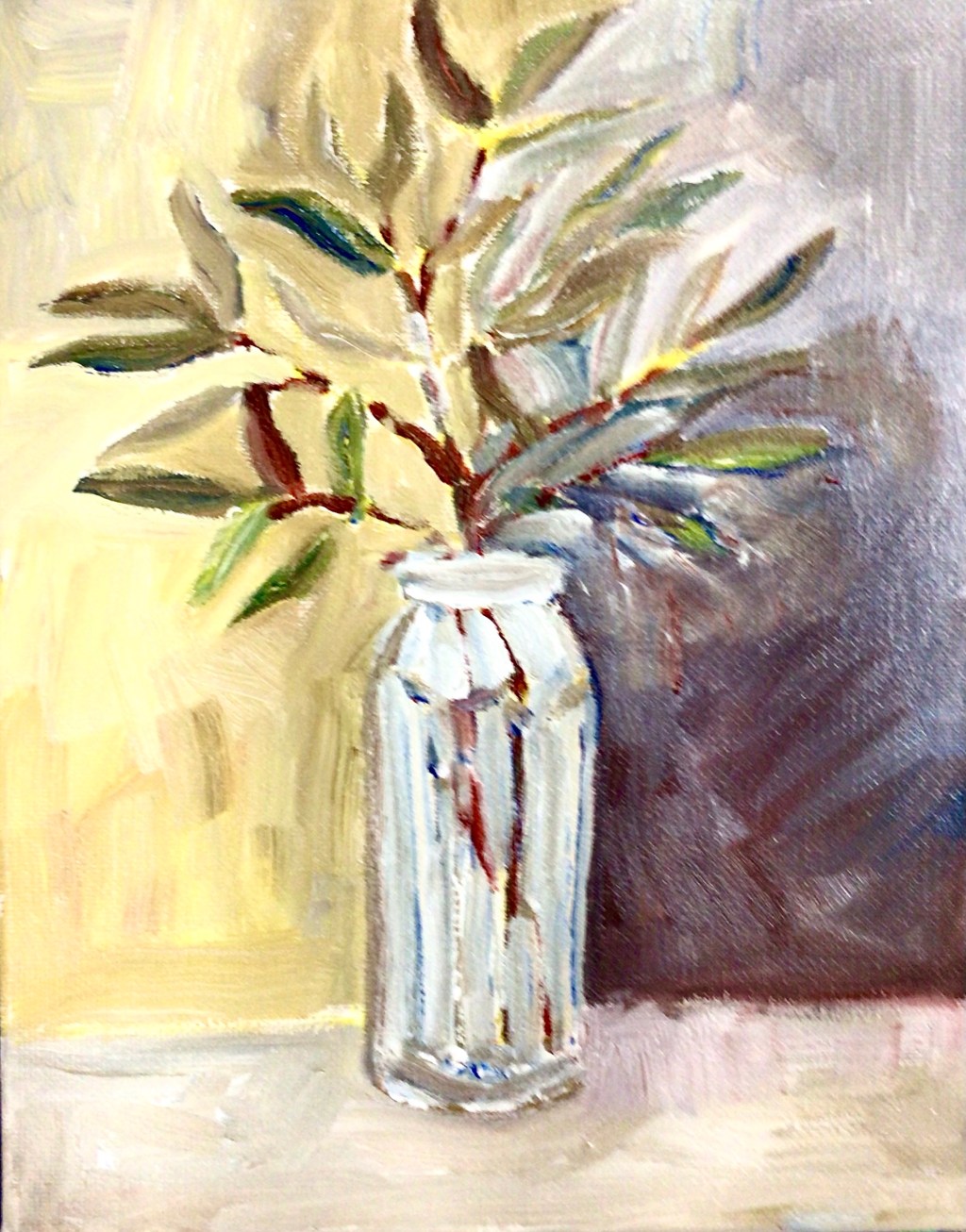
Little Vase of Flowers

All creativity improves with either time or wine. Both allow you to loosen up and not control what happens but go with the flow of what happens on the canvas, instead of forcing the paint to go where you want it to be. I have canvases which began in one direction and ended up in quite another. I can only say my original idea was rejected by the painting in progress, for I had to “listen to what the painting wanted to become.” As Psalms 104:30 says:

“When you send forth your spirit, they are created;
and you renew the face of the ground.”

In case you’re wondering, the “ground” of a canvas is the white primer, so it’s not a stretch to say, God’s Spirit works through us to renew the face of the “ground.” Some texts translate this as the “earth,” and God’s Spirit also works through us to restore and renew our planet to health after all the damage from industrial pollution and man made climate changes.

Leonardo da Vinci, the Renaissance genius, claimed, “There are three classes of people: Those who see. Those who see when they are shown. Those who do not see.” We can all learn to see. How we learn to see takes time and effort. This is why I always talk about some examples of good art before we begin our work. I know most people haven’t seen the masters, so getting images in mind is important. A little art history lesson never hurt anyone. Then I explain the project and we get to work. Stephen King, the noted author, says this about the creative experience: “Amateurs sit and wait for inspiration, the rest of us just get up and go to work.”

Tim’s Flower

In class we were using the flower arrangement which had been residing in the kitchen fridge for the past several weeks. I don’t know who to thank for it, but we put it back where we found it. Our group was given the key to use patterns and textures in the work.
Tim wants to learn to draw from life better, but he was struggling to get his proportions to scale. I showed him the trade skill of using a pencil or part of his hand to measure part of the object and compare its size to another part.

We give away our secret sauce recipe all the time! Everyone knows how to multiply with a ruler for a scale drawing, but that idea often doesn’t occur to them if they aren’t using it on a flat plane. If they have no real ruler, the idea of using an ordinary object as a measuring device also doesn’t enter our brains. This is normal, but once upon a time, we used our bodies to measure the work in progress: a cubit was the distance from the elbow to the middle fingertip and a hand-width was just that: the width of the four fingers. Over the years these were standardized to 18 inches and 4 inches. Horses are still measured in hands today, but we moderns measure in feet and meters rather than cubits.

Gail’s Texture Painting

Gail lined out some lovely patterns on her canvas and made good progress on her painting. She always gets a good plan and executes it.

Mike was glad to be back after doing renewal work/manual labor. This creative exercise of moving bold colors and strong patterns around his canvas was a welcome respite after all that physical activity. A mental challenge seemed welcome to him.

Mike’s Flowers

I had done a pattern piece in the week before, so I enjoyed painting the still life, and may use it as a study for something larger later.

Late 1800’s Levi Strauss advertisement

We finished up our works on the second session. Tim reworked the pumpkin drawing from an earlier time and Gail finished up her texture painting of the flowers. Mike dropped in with Van Gogh books before going out on an errand of mercy to rescue a young client. He was impressed with the amount of blue clothing the people wore in Van Gogh’s paintings. I reminded him the very denim jeans we wear first came from Nimes, France. We call these “jeans,” because the weavers in France were trying to imitate the techniques of Genoa, Italy, but failed, and made instead the sturdy fabric that’s blue outside and white inside. Hence, “jeane de Nimes.”

“I did not know that!” He exclaimed.

Art is for wondering, for seeing new things, for opening up our minds to new realities and new possibilities. Whenever we go beyond what we already know, we open a new brain pathway and create new connections between the neurons. This keeps our minds agile and staves off the worst aspect of aging: the pessimistic belief that nothing is new under the sun. If we keep the optimism of a child, for whom everything is the newest and best, we’ll keep a youthful heart and spread joy wherever we go.

Joy and Peace,

Cornelia

The ‘Golden Mean’: Aristotle’s Guide to Living Excellently —Philosophy Break
https://philosophybreak.com/articles/the-golden-mean-aristotle-guide-to-living-excellently/

Weights & Measures
https://www.jewishvirtuallibrary.org/weights-measures

History of Denim & the Origin of Jeans
https://www.hawthornintl.com/history-of-denim

Rabbit! Rabbit!

adult learning, at risk kids, brain plasticity, Children, city, Dreamscape, Faith, Family, flowers, Healing, holidays, Icons, Love, mandala, Mandylion, Ministry, ministry, nature, Prayer, purpose, rabbits, Reflection, renewal, risk, school shootings, shame, Spirituality, Stonehenge, summer solstice, texas, Uncategorized

Welcome to June! I’ve found my sunshades and my flip flops, so this rabbit is ready for a summer vacation. Old school teachers never die, they just take the summer off. And teachers, as well as students, will need a summer off, along with some intensive counseling, to get them ready to return in a healthy frame of mind next fall.

Summer Solstice Mandala

In my early years in ministry, I served in a certain county where many people were caught up in despair. I often complained to my district superintendent of my desire to pour mood elevators into the public water supply.

“You do know drugging the water supply isn’t exactly an acceptable activity for a Methodist minister?”

“Oh, yeah, but it sure would make my job easier.”

Rabbits Love One Another

Remember, June 3 is Love Conquerors All Day. I need to remind myself of this on occasion when I want to take the easy road. As Jesus reminds us in Matthew 7:13—

“Enter through the narrow gate; for the gate is wide
and the road is easy that leads to destruction,
and there are many who take it.”

Taking the easy way out isn’t always the best choice, but it’s the one we rabbits most often choose. We rabbits don’t like to rock the boat, and we like to make all the other rabbits happy if at all possible. The only problem is if we please A, B gets upset. If we please B, A gets upset. We don’t even try to please C, since C is so cranky, even the good Lord Jesus couldn’t fry an egg to please them. We set our hearts and minds on pleasing God, as best we can, and hope to hear the words, “Well done, good and faithful servant, enter into the joy of your master.”

Make Mine Chocolate Ice Cream Day

Chocolate ice cream brings me joy any day of the year, but June 7 is a day dedicated to this frozen delight. Don’t worry about frying eggs, but keep it frozen. I like mine plain, but fresh strawberries or peaches are a nice addition, plus some chopped nuts. Always go for complex, unless you just can’t wait. Then grab a spoon and eat it straight from the pint. (Mark it with your name, since you ate from it.)

Often we cut the Gordian Knot and go for the shortcut to our complex problems. Sometimes this is a good solution, for the shortest distance between two points is a straight line. My daughter used to call my vacation navigation shortcuts “the long cuts,” since I’m directionally challenged. Most of the time, that straight line went through swamp land and alligators. I can hear her voice now, “NOOOOO!!!” I’m known for taking the scenic route, so I often see America’s less known sights, which are off the beaten path.

In the gospel of Luke (14:34), Jesus quotes a proverbial saying:

“Salt is good; but if salt has lost its taste, how can its saltiness be restored?”

Another translation of the latter portion of this verse is “how can it be used for seasoning?”

When I think of loss, I think of a life snuffed out. Some people are burned out, so we can say they’ve lost their seasoning ability. There’s no vim or vigor in them. Other lives are cut short and aren’t able to fulfill their purpose to season the great soup of our community. Our past month was marked by 47 mass shooting incidents in May alone. A mass shooting incident is defined as one in which at least four people are injured or killed, not including the shooter. Suicides aren’t included.

Suicides are also a public health problem. They are the “deaths of despair” that leave ripples of grief and hopelessness in the survivors. They’re the ultimate shortcut solution to a problem, the placing of a period where life has placed a comma or a semicolon. My daughter once attempted suicide by downing half a bottle of aspirin. I noticed the open bottle and pills scattered across the floor. She said the “dog ate it.”

“That’s too bad, I’m going to miss that dog. She won’t be long for this world. We’ll need to make burial plans for her.”

“Well, actually, I’m the one who ate the aspirin.”

“Then we’re going to the hospital. You aren’t going to like getting your stomach pumped, but it’s better than being dead. You want to have a chance to grow up and have a good life. A dog we can replace. You—not so much.”

It was a rough time in her life, and mine too. But God was with us. And we had support from counselors, friends, family, and our church family. My work family and my clients supported me too. I must be the most extroverted rabbit in the patch, because I asked everyone for help. It turned out my problem was shared by everyone else. I discovered I wasn’t alone, but was the most ordinary of rabbits around.

This is a humbling experience, especially when you’re a first child and the only girl. I admit to being spoiled, but don’t let my brother rabbits hear me say this. I’ll deny it to my last breath: I’m like every other rabbit I know. I want to think I’m someone special, even when I’m just as fluffy as every other bunny out there on Gods green earth.

June 21—Summer Solstice

Unfortunately, half the suicides today are committed with a gun, not aspirins. When looking at overall gun deaths, roughly two-thirds are attributed to suicides—a proportion that is consistent across most states. Gun suicides are on the rise and data also indicates men, white Americans, older people, and individuals living in rural areas present higher rates of gun suicides. Another group presenting a unique risk for suicide is current and former members of the armed forces, especially those with PTSD.

Compared with the general population, current and former military members have significantly higher rates of gun ownership. According to a 2015 study, nearly 50% of U.S. veterans own a gun. In contrast, studies suggest that only about 22% of the general U.S. population owns firearms. Similarly, the age groups of 50 to 64 years old and 65 and older have the highest rates of gun ownership, according to a 2017 Pew Research Center study. This can further explain the high rates of suicide among older veterans.

According to data from the U.S. Department of Veterans Affairs (VA), in 2019, close to 4,332 veterans died by gun suicide in the United States, representing close to 18 percent of the total number of gun suicides reported by the Centers for Disease Control and Prevention (CDC) during that year. Perhaps more alarming is the fact this figure shows a veteran is killed by gun suicide every two hours. In 2019, active duty military members committed suicide by gun 64% of the 498 total (318), almost one gun suicide per day.

Why isn’t anyone speaking about this? For all the lip service our politicians give to the flag and to the armed service members, they seem to forget them once they’re no longer useful to fight their wars or march in their parades. Perhaps because Congress won’t devote any money to study the effects of gun violence on the citizens of our Beautiful America, so we have to fund private studies here and there to piece together a patchwork of facts of this scourge on the peace of our people.

My young neighbor, only 8 years old, was in a panic as he knocked on my door the other day. His parents hadn’t come straight up the elevator, as they’d said they would. He was crying to beat the band and was sure something bad had happened to them. I invited him inside and left the door open so we could see them come past. He was so worked up, he couldn’t sit down. I suggested a call to his daddy, but they came walking past just at that moment.

June 19—Father’s Day

We don’t realize what terror these school shootings put our children through. There’s no safe place for them any more, no matter how “hardened” we make the buildings. Some person always breaks the shell at the most inopportune moment.

Some rabbits will have empty seats at their family reunion tables because someone decided to act impulsively. Father’s Day (June 19) won’t be a celebration without the son or daughter to give Dad the tie, the golf balls, or breakfast in bed.

I think back to my own childhood. We worried in the 1950’s more about the urban legends of Halloween candy poisoning, when we were more likely to get killed crossing Highway 1, a four lane highway running through our town. My mother rabbit would wait for me to ride the trolley home from school. She would wait until the near lane of traffic cleared before she walked out to the center median and time this so the far lane’s cars would finish passing so she could walk across the newly empty lanes to meet me on the other side. We held hands and crossed in the same manner on the way back to our home.

This was our routine from the start of school until sometime in the autumn. Mother was delayed one day, so I sat down to wait for her and opened my book to read. I was wearing a brown jacket against the early cool spell, and my dirty blonde hair blended in with the pile of dry leaves on the ground. Intent on my book, I failed to see her come outside. She overlooked me and went inside thinking I’d missed my ride.

A bit later, I decided if she wasn’t coming for me, I’d come to her. Gathering up my possessions, I stood on the curbside. I watched the comings and goings of the quickly moving traffic. Once I saw the break in the pattern, I walked out into the clearing, waited at the median, and crossed behind the trailing traffic of the second lane. When I walked inside, my mother had a conniption fit. After this, I began riding my bicycle to school, and my brother got to come with me.

Brain Functions

Not everyone is mature enough to cross a four lane busy highway by themselves when they’re in the fourth grade, which is the same age as the children who lost their lives at Robb Elementary in Uvalde, Texas. . Some people still need to be supervised at work even in their 20’s. The brain keeps maturing past age 21, as the frontal lobes, which are home to key components of the neural circuitry underlying “executive functions” (such as planning, working memory, and impulse control) are among the last areas of the brain to mature; they may not be fully developed until halfway through the third decade of life. Although neuroscience has been called upon to determine adulthood, there is little empirical evidence to support age 18, the current legal age of majority, as an accurate marker of adult capacities.

Since May 24, the date of this tragedy in Uvalde, Texas, the gunviolencearchive.org has recorded 16 mass shootings in six days, with 79 killed or wounded. Some of these are high school graduation parties where uninvited guests arrived and gunfire broke out, others are the result of young people wandering about in the late hours and getting into trouble with guns. During my time of ministry, youth, alcohol, and firearms were usually a recipe for trouble. Maybe parental rabbits’ brains are still developing too, if they aren’t able to put their rabbit foot down and tell the junior rabbits to leave their weapons at home. Visiting Jack Rabbit in jail for accidental death or intentional use of a firearm will throw a curve into your best laid plans for your progeny.

Rabbits in Cars Going for a Joyride

Instead, cities may have to reinstitute curfews after dark to curtail the opportunities for gun violence. Or they could raise the age to buy a weapon and require a longer waiting time and a more thorough background check. I wouldn’t be opposed to a training class and a test to see if the owner knows how to use the weapon safely. After all, we do this for the 2 ton weapon of mass destruction known as the family automobile. So what if the founding fathers never had autos; they also never had automatic pistols or large magazine weapons, modeled on the ones used in combat.

Did I mention June is National Safety Month? Its emphasis is workplace safety, but as a former teacher, this old rabbit reminds you, between 2009 and 2020, teachers’ workplaces are in schools, which is where 30% of mass shootings occurred in public places (schools, malls, or bars), while 61% of mass shootings occurred entirely in the home and another 9% occurred partially in a home and partially in a public location. The common factor in these is the gun and the presence of domestic violence. In at least 53 percent of mass shootings between 2009 and 2020, the perpetrator shot a current or former intimate partner or family member during the rampage.

Richard Small seen posing with his rifle before turning it over to police.
(Joshua Lott/The Washington Post)

I know y’all usually expect a bright and cheery note from me at the beginning of the month, but my heart is broken. Thoughts and prayers are nice, but they don’t stop the carnage. We need to make some changes. At least one man has turned in his assault weapon to his local police station, so it doesn’t fall into the wrong hands. He couldn’t bear the thought of it being used to perpetrate a similar crime if he were to sell it. If we parents don’t say no to our children, if we keep voting for politicians who are doing nothing, then we get to keep the distinction of having the highest rate of violent gun deaths for any of the developed countries.

That’s not the American Exceptionalism I believe in. We can do better. These are crimes against the common good and against the innocent. The shooter shares the primary blame, but everyone who does nothing to change our society for the better also shares the blame and shame for the next group of victims. At the rate we’re going, we’re having about one mass shooting per day. Eventually this scourge will come to YourTown, USA, and your small town police force will be just as flabbergasted as poor Uvalde’s. How could this happen in our little corner of the world?

I cry along with Jeremiah ( 8:21-22):

For the hurt of my poor people I am hurt,
I mourn, and dismay has taken hold of me.
Is there no balm in Gilead?
Is there no physician there?
Why then has the health of my poor people
not been restored?

Time Magazine Cover from 2019 with all the Mass Shooting Locations Named

Sometimes we go along with the attributes of cultural Christianity, rather than practicing the Christianity of Jesus Christ. Romans 12:2 reminds us

“Do not be conformed to this world, but be transformed
by the renewing of your minds, so that you may discern
what is the will of God—what is good and acceptable and perfect.”

Joy, peace, and balm for hurting souls,

Rev. Cornelia

Deadly Dreams: What Motivates School Shootings? – Scientific American
https://www.scientificamerican.com/article/deadly-dreams/

You can view a report of any 2022 mass shooting incident by visiting the list on the Gun Violence Archive’s website:
https://www.gunviolencearchive.org/reports/mass-shooting

Poisoned Halloween Candy | Snopes.com
https://www.scientificamerican.com/article/deadly-dreams/

Mass Shootings in America | Everytown Research & Policy | Everytown Research & Policy
https://everytownresearch.org/maps/mass-shootings-in-america/

Adolescent Maturity and the Brain: The Promise and Pitfalls of Neuroscience Research in Adolescent Health Policy – PMC
https://www.ncbi.nlm.nih.gov/pmc/articles/PMC2892678/

Guns and Mass Shootings: Data Show Why US Is Outlier on Deaths From Firearms
https://www.bloomberg.com/graphics/2022-us-gun-violence-world-comparison/

Texas romance with guns tested by Uvalde school shooting – The Washington Post
https://www.washingtonpost.com/nation/2022/05/30/uvalde-shooting-guns/

Rabbit! Rabbit! Welcome to May 2022

art, coronavirus, Faith, flowers, generosity, greek myths, Holy Spirit, inspiration, Love, nature, Painting, poverty, purpose, rabbits, Spirituality, Turkey, Ukraine, vision

May your garden grow.

This rabbit isn’t ready for May. Even as I say “Rabbit, Rabbit,” on this prime morning, I realize time already is too quickly flying past. I knew this day would eventually come, but surely I thought, not yet. When my rabbit parents were long of tooth—I think they were over forty—they said they had a longer “to do list” than their day was long. I think this was the time they were sending me the golden “round tuit” so I would get my own to do list done. Parental units in every generation have always projected their problems onto their offspring, or perhaps their offspring inherit or imitate the adults’ tendencies.

A Round Tuit

May is a good time for spring cleaning. Every rabbit hutch or den can use a bit of freshening up after a long winter and a cold spring. May 17th is Pack Rat Day, an opportunity to touch those items once and for all as you decide whether they belong in a Distribute, Donate, or Dump Box. If you just touch and can’t decide, you may be one of the 15 million hoarders in the United States. The days are getting warmer with more daylight and global warming adding to the elevated temperatures. We can’t do anything about the length of days, as these are determined by our planet’s oribit and inclination toward the sun. As we move toward summer, the Northern Hemisphere tilts toward the sun and gets warmer. In the Southern Hemisphere, the opposite happens and their Christmas is warmer than their springtime.

Eid Mu Barak

May marks the end of Ramadan, the month long Islamic fast recognizing the gift of the Quran to the prophet Mohammed. In most communities in the United States, Eid begins at sundown on Monday, May 2, and lasts one to three days, depending on cultural tradition. Eid al-Fitr, which means “festival of breaking the fast,” comes after a month of abstaining from food and drink from sunrise to sunset in observance of Ramadan. This is a time of renewal, wearing a new outfit, giving charity to the poor, and resuming the everyday rhythms of life.

Some of us finally get our gardens planted, in honor of the Ancient Greek and Roman goddesses of May. The word May entered the English language in the 1050’s, developing from the Old English Maius, which was borrowed directly from the Latin Maius, short for Maius mēnsis, “Maia’s month.” The Greek goddess Maia was one of the Pleiades, who were the companions of Artemis, the goddess of the hunt. This Maia was the mother of Hermes, the messenger of the Gods. But the Romans had yet another goddess named Maia, who just happened to share her name with the Greek goddess. When later generations conflated the Greek Maia with the Roman Maia, a goddess of fertility and spring, we now celebrate May for growth and increase in the natural world.

Victory Gardens were in vogue during wartime due to shortages at home caused by food supplies diverted to soldiers fighting on the front. Original “supply chain problems.”

If we want to “go green,” in our gardens, we can practice composting our lawn clippings along with any brand of manure. This will enrich our earth with earthworms and organic materials. We can also practice “crop rotation.” This means we plant our tomatoes ina different plot every year so we don’t deplete the soil of certain nutrients or invite nematodes to eat the roots. As a spiritual practice, gardening calms the mind, for it connects us to the earth and the source of our food. Our forebears supplemented their menus in the hard times in days of old with fresh food from home gardens. Community gardens serve the public in urban areas.

An April Bunny’s Bad Hair, Don’t Care Day

Spring reminds us the seasons of the year are balanced, for we have a cold winter and a hot summer, just as we have a middling spring and autumn. I say “middling,” but I might have said “muddling,” for these two seasons in my corner of Rabbitville are marked by rain and mud. Torrents of rain, drenches of rain, and sometimes mere drizzles of rain. Some of us rabbits may have bad hair days, but I hear all this moisture is good for the face and the skin.

In our world, the great powers also attempt to maintain balance and influence. Two world wars will push nations into this choice, but nations rise and fall. Once Great Britain was the world’s great super power, but after these great wars, it was greatly diminished, while the United States, which was the source of Britain’s war materials, prospered. Germany, was cut off from international trade due to its war mongering, became dependent on itself. American industries prospered, so that by the end of the first world war, America became the creditor nation to these former belligerents.

America Feeds the World: after the World Wars, hunger was rife in Europe and Russia. American farmers sent our surplus to feed the continent’s populations.

Moreover, we began to feed the world. This rabbit would like to think our government is more generous than Mr. McGregregor, who is always chasing us hungry bunnies out of his precious garden, but poverty and hunger lead to unrest among the world’s people, and that destabilizes governments. Stable governments, which don’t oppress their people, are more welcome on the world stage than dictatorships that exist to serve only a small group of privileged individuals.

As the United States and the Soviet Union struggled to reach a balance of power during the Cold War that followed World War II, President Harry S. Truman outlined what became known as the Truman Doctrine in a speech to a joint session of Congress on March 12, 1947. He emphasized the broader consequences of a failure to protect the democracies in Greece and Turkey by saying:

“The United Nations is designed to make possible lasting freedom and independence for all its members. We shall not realize our objectives, however, unless we are willing to help free peoples to maintain their free institutions and their national integrity against aggressive movements that seek to impose upon them totalitarian regimes. This is no more than a frank recognition that totalitarian regimes imposed on free peoples, by direct or indirect aggression, undermine the foundations of international peace and hence the security of the United States.”

Seventy-five years later, some of us rabbits have abandoned our national vision of democratic ideals, and have turned our back on our historic uniqueness among the nations of the world. While we may have aspired to grand ideals, but haven’t yet achieved them, this shouldn’t stop us from helping others continue their own difficult journey toward perfection. Once again, we have a bellicose dictatorship attempting to overthrow the will of Ukraine, a democratic nation, with the potential to continue such destabilizing activities in neighboring countries. What’s worse, Ukrainian agricultural products feed the world’s poorest countries, so without their harvests being replaced by American grain, people might go hungry. Hungry people are at risk for strong men with bad intentions.

Journeys aren’t ever easy. Any rabbit who tells you the road is easy, wide, and well marked on the way to their destination, has never heard the call of God saying, “Go to a land I will show you.” Those who think their path is sure, certain, and easy might want to remember this word from Matthew 7:13—

“Enter through the narrow gate; for the gate is wide and the road is easy that leads to destruction, and there are many who take it.”

This is why we admire heroes, for their journeys aren’t ever easy, but usually require some difficult and demanding task, which transforms them into a new person. They become more than they ever were before. Yet, perhaps, they were always a hero, and they only needed the auspicious moment to bring forth their true character.

The Guardian of Stuff

I remember the young man I met at a NASCAR event at Texas Motor Speedway. I asked him what he did under the stands while the race was going on.

He shrugged, “I just stand here and make sure nobody takes the other worker’s things.”

“Oh, like you’re the guardian of stuff!”
“I never thought of it like that.”

“Strike a hero pose. I’m going to take your picture .”

Everyone has a hero within, but not everyone has someone who affirms that hero. We all need to discover the hero within us, just as Jesus heard at his own baptism (Luke 3:22)—

“and the Holy Spirit descended upon him in bodily form like a dove. And a voice came from heaven, “You are my Son, the Beloved; with you I am well pleased.”

My dear rabbit mother gifted this to me years ago

We rabbits can’t fail to recognize the heroes who gave us life and brought us into this world. I speak of our mothers, of course. My own dear mother was ready to move mountains and call in every personal favor to come be by my side when I was in an Italian hospital while I was on a summer student art program. My dear daddy had to calm her jets and remind her, “Honey, it’s just a bit of food poisoning. It’s not like major surgery.” Our mothers will do anything to protect their offspring, and that makes them heroes in my eyes. I was released in three days, so it would have been a futile trip for my sweet mother. Make sure you recognize your hero mom on May 8, for without her, you wouldn’t be here.

Speaking of hospitals, May 12th is the birthday of Florence Nightingale, whose service as a volunteer nurse during the 1854 British war against Russia in Crimera. Because of her service, dedication to her call, and the innovations she brought to her vocation, we now celebrate the women and men who follow her in the nursing profession. Back in Victorian times, nursing wasn’t a respectable job, and women of the upper classes were expected to remain at home to care for the family’s affairs. Those who hear God’s call don’t worry about cultural expectations, but follow the solitary path of the heroes who went before them. Remember the nurses of today who’ve had to put themselves into harm’s way to care for people with a disease that now can be prevented from the worst complications and death in most people with immunizations and ordinary remedies like masks, hand washing, and avoiding crowds.

All us rabbits can celebrate Sally Ride Day on May 26, which was the birthday of the first American woman in space. While our national space program seems to have lost its energy and will as we’ve outsourced its efforts to the private sector, we have to ask if giving millionaires the ride of their lifetimes benefits a democratic society more than when we funded the space program by a community of citizens who sent the most highly trained and vetted astronauts into space. But then, I’m only one rabbit and I can remember the thrill, excitement, and joy when I saw our first astronauts exiting from their bobbing capsules. I saw these events on a small screen, black and white television in my school room. Afterwards, all we could talk about in our classrooms was the heroic journey of these brave individuals and the team that helped them circumnavigate our planet at such heights.

Finally, all rabbits of every stripe can celebrate Memorial Day Weekend. For some of us, this holiday has been reduced to a three day picnic at the lake or the racetrack. Others will decorate the graves of fallen soldiers from one of our many wars, participate in a patriotic parade, or watch a plethora of auto racing events around the world. Memorial Day weekend is the busiest weekend in motorsports, with Formula 1 racing in Monoco, NASCAR at Charlotte, the 100th running of the Indianapolis 500, and Lucus Oil Pro Motocross Championship from California. This rabbit will be in heaven. You could spend your tax refund on a new Television, many of which will go on sale over the weekend, or you could open a savings account for emergencies. A wise rabbit always has a little something extra stashed away for lean times. One never knows when Mr. McGregor will lock down his garden, since he doesn’t practice the ethics of Isaiah 58:10—

“if you offer your food to the hungry
and satisfy the needs of the afflicted,
then your light shall rise in the darkness
and your gloom be like the noonday.”

Self Portrait of the Artist as Wonder Woman

My old mother rabbit always reminded me if I was feeling down, all I needed to do was help someone less fortunate than me. It would get me out of my funk by focusing on helping another, as well as reminding me my problems were shared by others. Her message was a key to unlock the hero within me, without which I wouldn’t have done half the good I visited upon this world. My hope for each of you rabbits is to find the hero within you. If you allow God to accomplish deeds of courage through you, whether they be great or small, you’ll be transformed.

Joy, Peace, and May Flowers,

Cornelia

Truman Doctrine | Definition & Facts | Britannica
https://www.britannica.com/event/Cold-War

May 17 Is National Pack Rat Day! Here’s How to Celebrate.
https://ourcommunitynow.com/lifestyle/may-17-is-national-pack-rat-day-heres-how-to-celebrate

The Real Story of How America Became an Economic Superpower – The Atlantic
https://www.theatlantic.com/international/archive/2014/12/the-real-story-of-how-america-became-an-economic-superpower/384034/

Origin Of The Month of May’s Name | Dictionary.com
https://www.dictionary.com/e/may/

Simplify, Simplify, Simplify

adult learning, art, bottles, butterflies, Creativity, Faith, flowers, Icons, Imagination, nature, Painting, pre-diabetes, purpose, risk, Stress

When faced with a complicated task, what’s the first thing we need to do? I usually vote to have a cup of coffee and sit down to think about it. Some may call this procrastination, but I call it contemplation. I need to settle my mind, focus my senses, and discern the most important parts of my task. This is necessary, for if I were cutting off a limb from a tree, I’d sure want to get my body placed on the part of the tree that wasn’t going to fall. Keep the most important thing the first thing in mind is always the best practice.

Manet: Chrysanthemums and Clematis

Once our youth group from church went to the Appalachian Mountains for a mission work project. Most of our kids came from poor homes and we arrived in a single church bus, which for some reason the license plate hadn’t got renewed. The group even let me be the navigator. Only by the grace of God did we arrive, for I’m known to be directionally challenged among all my friends.

The other group who attended this session with us came with another truck, complete with all their own tools. Our children were despondent at first, for they felt they couldn’t “compete.” Our adult team leaders reminded them, “We’re here to do the work God has called us to do. This isn’t a contest. Everyone has value and all our work counts toward the greater good.”

Cross Stitch Motto from my Mother

That big, well provisioned group got the job of replacing a front porch and a roof. They divided up into a porch and roof team. The porch team finished first, but then they got mad when the roof team had to destroy their work to put the roof on right. They had failed to talk out an overall plan first. If the roofers had started on the porch end, then the porch team could come behind them and work would progress along properly.

This is called team work in groups. Our small group was experienced in talking out the process before we began working, so we knew the consequences of our actions. “If…then” is always an important consideration, especially in our artistic endeavors.

If we’re familiar with the work of Dr. Stephen R. Covey, he talks about putting first things first by organizing and executing around our most important priorities. We live and are driven by the principles we value most, not by the agendas and forces which surround us. Pleasing others isn’t God’s purpose for us, but to do God’s work of loving all and serving the least of God’s people.

Spider Plants in the Classroom

When we look at a landscape, we have to select the primary image to emphasize, and relate the other forms around this important image. In the still life, we might drive ourselves crazy trying to paint every single petal, pistil, and leaf of some flowers in a vase, or we could find the most important shapes, which give us enough visual cues to let the viewer say, “Yes, this is a flower painting.” Not every leaf needs to be given the same attention, since our goal is to make a painting, not a rendering of the subject before us.

Cornelia’s Spider Plant Painting, 2020

Some might ask, “Why do we return to this well worn theme from time to time?” The best answer is we continue to learn from our repeated exposure to this theme. For another, our drawing skills improve over time, so we can see our progress. Also, our ability to handle the paint gets better, so we are more comfortable with mixing our colors and planning our composition. Besides, the great artists over the centuries have found this discipline fruitful, so if it benefited them, most likely we’ll get some good from it also. My nanny’s wisdom comes clear here: “What’s sauce for the goose is sauce for the gander.”

Beauty Berry Plant

When faced with so many shapes of leaves, a central stem, and a glass vase with ridges and reflections, our untrained brain wants to explode. We have to catch our breath, inhale, and exhale to cleanse our nerves. This is the point we begin our first simplification. If we note the proportions, the leaves are about the same height as the vase, and we can set the vase on a plane (the table) so it has depth. We can mark these off on the bare canvas with light pencil or a light wash of yellow paint. We’ll paint over it later.

Cornelia’s Beauty Berry Painting, 2020

The next step of simplification is to get the basic lines and shapes down. These don’t have to be perfect, but give you an idea of where you’re going to paint. If you do this in a pale wash, you can paint over it with the heavier colors in the more exact form. In sculpture, Michelangelo was known for chipping away from the stone everything that didn’t look like his subject. In painting, we add color, tint, and shade until it looks like our subject.

Cornelia’s False Wild Indigo

The final stage of simplification is to get the background in. Here you can paint up close to the individual shapes and “clean up the edges.” You can add highlights in places to bring out the foreground shapes, and add a shadow in the background for variety. By this time, the vase ought to be dry enough to put highlights on it also. Notice the leaves aren’t all the same color and they don’t bend the exact same way. Nothing in nature is perfect, for each part grows according to the amount of sun, shade, and nutrients it receives. As one of my old teachers reminded me, “Nature has no straight lines, so you never have to worry about that.”

Daffodils from 2019

To show you how sustained effort and intentional looking over time can helps student’s work improve, I offer the following examples from February, 2019, and September, 2020. One was the spider plants and the other the daffodils. I’m not sure who did these, so I won’t identify them.

Daffodils from 2019

I merely throw these in here because Gail and Mike have been working with me for several years. If practice hasn’t yet made perfect, it certainly has made improvements, and that’s all anyone can ask for. After all, we’re not asked to be perfect, but to go on to perfection (in love of God and neighbor).

Spider Plants from 2020

For history buffs a side note. Wild indigo is in the genus Baptisia, which derives from the Greek word, βάπτω, which means “to dip” or “immerse,” just as our baptism (βαπτίζω) does. North American indigenous peoples and early settlers would extract yellow, brown, and green dyes from the leaves and stems of wild indigo, notably blue false indigo (Baptisia australis) and other species. Indigo dye was extracted from yellow wild indigo (Baptisia tinctoria), but it proved to be an inferior source compared to the treasured true indigo (Indigofera species).

For years, wild indigo remained an obscure historical relic, its ornamental and ecological contributions undiscovered and under appreciated. Yet, in the springtime, wild indigo produces tall spikes of pea-like flowers that rise above the gray- to blue-green three-lobed leaves to provide nearly a month long display of color. The flowers sustain bumblebees and other winged pollinators, while the leaves feed the larvae of a variety of butterflies that include the wild indigo duskywing, frosted elfin, eastern tailed-blue, silver-spotted skipper, and various sulphurs. If you want to encourage butterflies in your garden, this is a hardy, drought tolerant, and deer resistant plant.

Gail’s Wild Indigo

Gail found the plants with their unique seed heads on a hike last week. This subject matter was received with more joy than my suggestion of apples. Evidently, what was good enough for the great master Cezanne is an acquired taste for my students. I might need to bring apple pie to soften them up. I’m not above bribery for a good cause. Besides, pie would be a great still life. Gail got a very detailed drawing of the leaves, the vase, and the grouping’s placement on the table. She sketched in the counterbalanced stick with its mossy growth. This was the quickest I’ve seen her work, for she’s usually very deliberate in her choices.

Mike’s Vase of Leaves

We had a full house last Friday, so Mike sat at a different table. He had to paint with the added burden of looking over his shoulder periodically to check his work. He began to paint more from emotions than from sight, which isn’t a bad choice. As long as his work carries enough of the vocabulary of the image to speak its message, he’s good with it. It’s the energy, the experience of painting, and using his mind to solve a problem in his own creative way that engages his interest. So if his painting looks “less real” than Gail’s, it doesn’t mean it’s less successful. He began from a different place, so his destination is also different.

Sally’s Vase of Leaves

A new member of our group, Sally is experimenting with techniques and tools, as well as the paint itself. This week she came with heavy body Liquitex paints, the professional quality paint, which has more pigment than binder. She was so used to the thin bodied paints, however, she watered down these excellent colors. When she asked why they weren’t working like she thought, I pointed out, “You’re supposed to use them straight out of the tube, thick.” This is why we have a group session, so we can learn together. Sally also had a new fan brush, which she used to make brown decorative marks all over her canvas. “I just wanted to try it!” Now that she knows, maybe she’ll plan ahead. I really like the swaying energies of her leaves. They’re happy and full of life. If this were in bright colors, Matisse would be proud.

Lauralei’s Vase

Lauralei brought an interesting solution to our subject this past week. The clear vase was a little intimidating, so she, like several others, colored it solid. When we first learn to swim, we want the security of water wings or the proximity of the edge of the pool. We all take small steps before we take bigger steps. She got the stick and fringed moss down and the many leaves of the plant.

Making all these decisions takes a lot of energy. Our brains use about 20% of our calories, so if we’re engaged in a new challenge, our blood sugar can dip if we’re not careful. If we aren’t aware of this, we can run out of energy or make careless choices. As someone who has prediabetes, I get low blood sugar easily. Stress and excitement can cause my blood sugar to dip. I always bring a small snack as well as eat a good breakfast with whole grain complex carbohydrates, like old fashioned oats. That snack is important, since I test my blood sugar before I drive home.

I’ve learned the hard way if my blood glucose reading is under 80, it’s falling and my driving skills will be going south too. I usually know I’m having trouble, for I can’t string two thoughts together and I begin to overwork my painting. I can’t make the good decision to stop while I’m ahead. Not everyone has this problem, but learning to recognize when you’re tired or just painting with no purpose in mind, is also an acquired skill. Taking care of our bodies so we can fully enjoy exploring a new adventure is a gift we can give ourselves. We only have one body in which to live out God’s purpose for our lives.

Dusty’s Icon of Vase and Leaves

Dusty concentrates well and gets a good shape on his canvas before he sets out to paint. I can’t read his mind, but it seems as he draws, the steps he needs to paint his image come into his mind. This is contemplating at a deep level. It’s not surface thinking, but an inner, deep knowledge that percolates up from within. I mention it’s an icon, for the tablecloth is tipped upward as if it were a background, not a flat plane on which the vase sits. This isn’t something he did by choice, since we haven’t done a lesson on perspective together. In the language of icons, the four cornered shape represents the world and its cardinal directions, or all creation. So we have one plant and all creation, as Paul said to the Romans (8:19-21):

“For the creation waits with eager longing for the revealing of the children of God; for the creation was subjected to futility, not of its own will but by the will of the one who subjected it, in hope that the creation itself will be set free from its bondage to decay and will obtain the freedom of the glory of the children of God.”

We’ll take Friday, February 4, off due to the frozen roads. On February 11, we’ll do paper Valentine collages. Y’all stay warm and safe. Eat hearty soups and enjoy the beauty of the snow.

Joy and peace,

Cornelia

Manet: Chrysanthemums and Clematis in a Crystal Vase, 1882, oil on canvas, Musée d’Orsay, Paris, France.

The 7 Habits of Highly Effective People®: Habit 3 – FranklinCovey
https://www.franklincovey.com/habit-3/

Wild or False Indigo | Home & Garden Information Center
https://hgic.clemson.edu/wild-or-false-indigo/

KISS Principle and The Six Degrees of Hydrangeas

adult learning, art, Bartram’s Nursery, brain plasticity, butterflies, Creativity, Faith, flowers, garden, inspiration, Ministry, nature, Painting, purpose, renewal, righteousness, risk, Spirituality, Travel

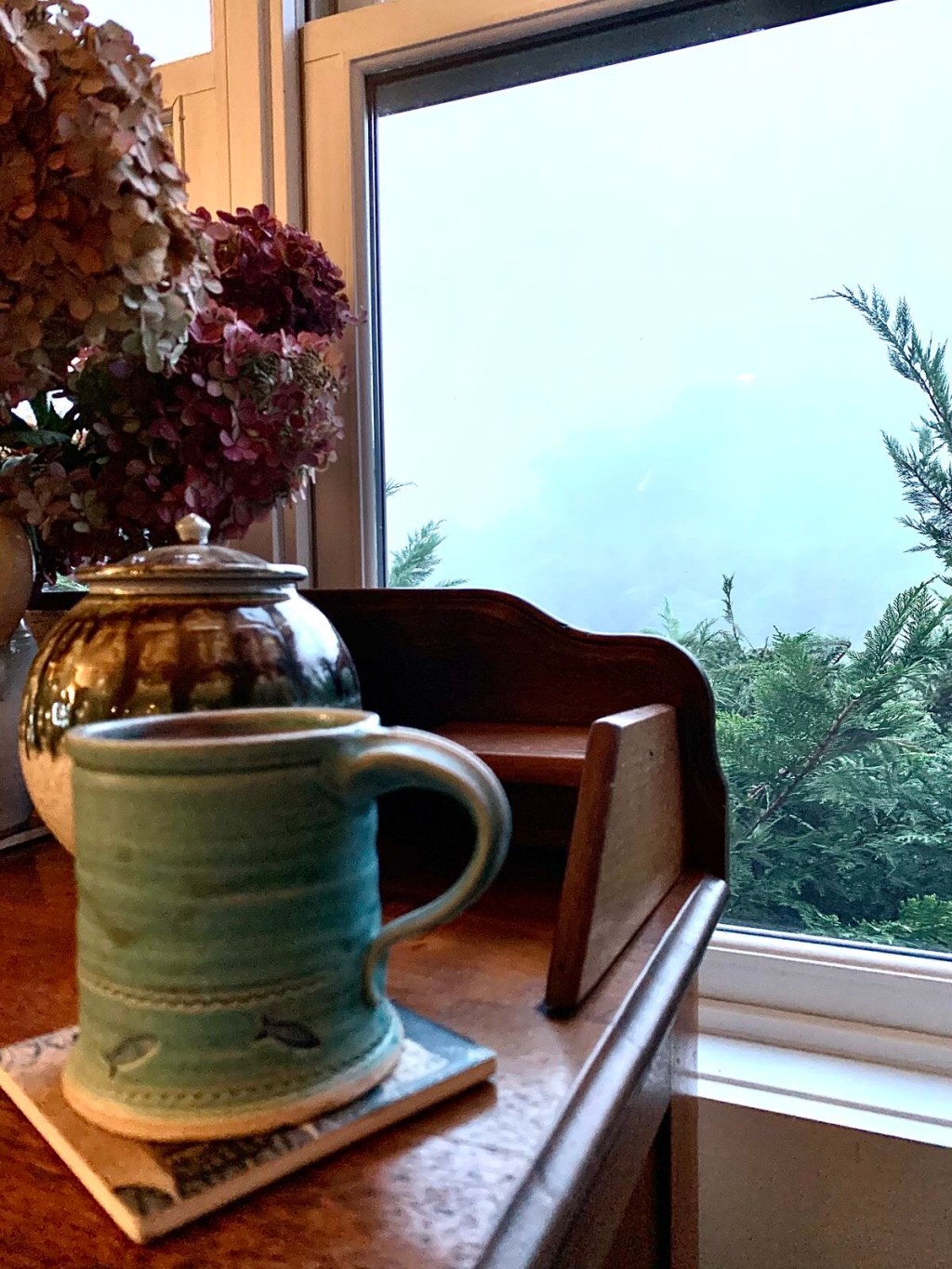
These dried hydrangeas, a gift from North Carolina, traveled home with me from my vacation back east to see my youngest nephew marry the love of his life. My childhood friend cut them from the bushes in front of her beautiful retirement home in the Blue Ridge Mountains near Lake Junaluska, the famed Methodist Retreat Center. Her home is about an hour away from the Biltmore Estate, America’s largest home. I’ve now been to both historic places, known for their hospitality, and enjoyed the hospitality of two friends’ homes, who live not an hour apart. I knew both of these gals growing up back home, and now they know each other through me.

Hydrangeas and Coffee on a Cloudy Carolina Morning

Hydrangeas are native to America. Two well-known hydrangea species, among others, grow wild in North America — the H. aborescens (smooth leaf) and H. quercifolia (oak leaf). Their actual cultivation began in the 1700s. An historic trifecta of our forefathers’ estates is proof: Mount Vernon, Monticello, and Montpelier all cultivated these hydrangeas.

Bartram’s Garden, possibly drawn by a young William Bartram

William Bartram, of Bartram’s Nursery in Philadelphia, provided the seeds and plants for these historic homes. James Madison’s home, Montpelier, in Vermont, still has the creamy white heads of H. arborescens as a border for his garden wall. The Bartram Gardens were a natural history project begun by his father John Bartram and continued through the generations, with William’s love of travel and exploration leading to a four-year collecting trip to the American Southeast and the publishing of an account of his travels in 1791. It became a classic text in the history of American science and literature.

Documents from Mount Vernon record how in 1792, George Washington planted a native hydrangea, H. arborescens, on the bowling green at his home. Nearby, when Thomas Jefferson was designing his gardens and walkways at Monticello, he also included these new shrubs. Today, gardeners can purchase heirloom H. quercifolia seeds from the Thomas Jefferson Center for Historic Plants in Monticello.

The notion everyone is connected by just six stages of separation gained popularity in the early 2000’s based on scientific studies done in the 1960’s. The game Six Stages of Kevin Bacon was based on this idea. Today, due to social media and the internet, some people have only 3 or 4 stages of separation. Our founding fathers ran in the same circles, so their stages of separation were small.

Hydrangeas also come from Japan, where they’re the subject of many brush and ink paintings. The flowers hold a solid role in Japanese culture. The Japanese celebrate the hugely popular Ajisai (hydrangea) festivals in the blooming seasons of late spring and summer. Pink hydrangeas are given on the fourth wedding anniversary. Hydrangea gardens often grace the grounds of sacred Buddhist temples. People enjoy amacha, or tea from heaven, on April 8, Buddha’s birthday. Amacha is brewed from leaves of the Hydrangea serrata.

Steps ascending to Meigetsu-in Temple

While western churches are sited in lawns, as if they were sheepfolds to shelter the sheep within and protect them from the outer world, eastern Buddhist temples incorporate nature into their design and sites. This reminds us everything is one. As Father Richard Rohr reminds us in his book, The Universal Christ, the author of Colossians 1:19-20, puts this idea plainly:

“For in him all the fullness of God was pleased to dwell, and through him God was pleased to reconcile to himself all things, whether on earth or in heaven, by making peace through the blood of his cross.”

A classic example is the Buddhist Meigetsu-in Temple, which was founded in 1160 as a Rinzai Zen temple of the Buddhist Kenchō-ji school. Located in Kamakura, Japan, its nickname is the hydrangea temple, for from the end of May through July, thousands of hydrangeas bloom during the rainy season. The temple is a Japanese national historic site.

When I first brought in the dried flowers to class, the first reactions I heard were, “Wow! You brought those all the way from North Carolina intact?” and “This is gonna be hard!” I’ll let you figure out who said what!

My answer was, “Sure, I’m an old art teacher, and I’m prepared for anything. I had a travel box in my SUV trunk, so they nestled quietly there on the journey home. As for hard to paint, remember what I always tell you, don’t paint the eyelashes before you get the shape of the face. The KISS principle always applies.”

“You mean keep it simple, stupid?”

“Mike, the one who wants to learn and stretch their mind is never stupid. KISS stands for KEEP IT SIMPLE, STUDENTS.”

They all laughed. Most of us can’t see the big forest because we’re looking at all the individual trees. If we step back and get a sense of the whole first, we can see how the parts relate to one another. This helps us put the basic sketch onto the surface of our work. It also gives us a moment to observe the subject before us and catch that moment of interest, which we can then emphasize.

Image Ball in Shadow and Light

As I reminded folks, “This looks difficult, but the basic shape here is a big ball. We’ve already done geometric balls. You thought those were boring, but they had a purpose. You needed that skill to be able to see the same shape in nature and recognize the same pattern of light and dark shadows.”

They nodded their heads. Teaching often is just reminding people what they already know or reinforcing previous skills from a different viewpoint. We went on to the slide show. It helps to see how other artists have handled the subject of the day. I’ve always enjoyed show and tell time, for it gives us inspiration and education both. Every time we learn something new, we have a new wrinkle in our brains. At a certain age, this is the only place we want to get wrinkles!

Inuzuka Taisui: Butterfly and Hydrangea, 1930, Woodblock print

This lovely Japanese woodblock print is from the era when Japan moved from its historic monarchy into the beginning of its new democratic government. The old emperor was confined to the palace due to illness, so the western educated prince regent Hirohito was the default leader. During this time, the people favored western art styles, such as this romanticized Shin-hanga print, instead of the older artists’ works of the floating world, or Ukiyo-e. The Japanese continued to prefer the works of the floating worlds, with the dancers, actors, musicians, and tea houses.

Of course, Taisui and the other artists of the Shin-hanga movement were producing for a distant audience, who may never have set foot upon the island of Japan. What we think we know of a place is one thing, but until we experience it first hand, we won’t know its truth and its power, except by word of mouth. Taisui was active for only a decade, as far as we know, from 1920 to 1930, but he made numerous prints of plants, insects, and birds, which still bring joy to us today.

T. Adams: Hydrangeas and Lilacs, palette knife technique

I found this painting on Pinterest. I pointed out how the artist didn’t paint every single flower petal, but still got the message of “hydrangeas” across. This is a palette knife work, so it builds up the shapes from back to front. An artist can’t just throw paint on the canvas like some piece of spaghetti against the wall and hope it sticks. We always have to put our thinking cap on and build up the shapes from back to front and from dark to light. We also have to pay attention to the direction of the light if we’re doing a realistic image.

Allison Chambers: Yesterday (Hydrangeas), oil on canvas, c. 2017-21

This second rough image by Allison Chambers is another example of not painting all the minute details, but getting the main idea across (KISS). This is why billboards don’t use small print and politicians use sound bites. We’re moving too fast on the highway to read the fine print and our attention spans now are less than a goldfish! Sad but true, a goldfish can focus for nine seconds, but the average human only for eight seconds.

We can blame phones, social media, and our desire to be connected all the time. Once we were content to call once a day, but now we have to check in twice a day or more. Some of us find that much contact interferes with getting things done, but then self starters don’t need anyone checking up on them. These folks tend to think frequent callers need to find another hobby to fill their time. Everyone needs a purpose in life, so those who’re trying to micromanage others might need to spend that energy helping the poor with food distribution or expending that excess energy doing good elsewhere. Then again, maybe those frequent callers are just lonely. They might need to use those dialing fingers for good as part of a community prayer chain. Then they can connect in prayer and feel useful too.

Doris Joa: Hydrangea with Ivy, watercolor on paper, 2015

This last image does have many details. It’s a watercolor built up in thin layers of washes to get the desired result. When working with washes, we have to have time and patience, and channel our inner goldfish, so we can manage our attention spans. Our first inclination is to work wet in wet, over and over, but that just muddies up our colors in that space. We need to let that spot dry, move to a new spot, paint it, and keep painting and moving, until we get the whole first layer done. Then we can come back and lay in darker tones in certain areas, once again moving about the canvas, for if we repaint too soon, we’ll just lift up the underpainting.

This takes focus and intent, as well as the ability to reserve judgement on our work, since it takes time for it to come into being. This isn’t a simple skill, for delayed gratification isn’t practiced often today. Even when we work our plan and execute our technique to the best of our ability, the end result may seem lacking. Yet, we’ve grown, or else we wouldn’t realize our struggle didn’t meet our expectations. When we want more, we can see how far short our efforts fall. This should encourage us to continue the challenge.

As Philippians 3:12-14 reminds us about the spiritual life:

“Not that I have already obtained this or have already reached the goal; but I press on to make it my own, because Christ Jesus has made me his own. Beloved, I do not consider that I have made it my own; but this one thing I do: forgetting what lies behind and straining forward to what lies ahead, I press on toward the goal for the prize of the heavenly call of God in Christ Jesus.”

After show and tell, we sat down to paint. We’d done enough talking and presenting of models. We had enough to chew on for the short time our class meets. If we have two hours, we use the first 15 minutes on presentation and the last 15 minutes on cleanup. This gives us about 90 minutes to paint. We don’t make large works, but sometimes we take an extra day to finish what we started. I’d call most of our work “studies,” since they’re quickly done.

Gail’s Hydrangeas

Gail chose to do color exploration and deeper, more saturated applications of paint, rather than her usual washes. This was a bold experiment for her. Art is a risky business. We can’t always control what the brush will do. Most of us have been trained since childhood to “color within the lines.” Once the paint gets loose, we’re in uncharted waters, sailing out into the deep ocean and out of sight of familiar landmarks. We can either turn back and hug the safe shore, or sail out to discover the unknown land. Taking risks is how we grow.

Mike’s Hydrangeas

Mike’s love of texture is apparent in his painting, as well as a variety of color. While the colors aren’t natural to the subject, he chose the colors which made him feel good. His is an emotional response to the beauty of the flowers. He wasn’t happy with the opening of the vase, but he got so carried away with the flowers, he forgot his perspective principles.

We might need to reteach that lesson once again. Some lessons need reteaching multiple times. This is why Jesus spoke in the gospels about God 264 times and love 44 times. Money rated 24 mentions, riches 2, the neighbor 10, and the poor 25. If we ever wondered what Jesus was focused on, we might look at what he emphasized in his ministry.

Cornelia’s Hydrangeas

I noticed we each gave our flower pots a different look when we painted our canvases. None of us are dedicated copyists. My color scheme tilts toward the red-orange, yellow-green, and blue-violet. This is a secondary triad, rather than a primary triad of red, yellow, and blue. The mixed colors give the flowers their muted look.

Secondary Triad on Cornelia’s Hydrangeas

By adding white to some of the brush strokes, and darker tones to others, I was able to suggest individual flowers as well as shapes. It’s just a quick sketch, a work I would do in preparation for a larger painting. Doing this would help me get some ideas down and help me solve some problems in advance, as if I were training for a competition. I would know if my color scheme was working, or if I needed to change the values or tints. I might want to choose a deeper color, or certainly a larger canvas.

So we come back for another day and another try. We can “see the promised land,” but like Moses, we don’t know if we’ll ever reach it. Artists have to be incurable optimists, for they keep trying again and again, even though we know human perfection in art will always be out of reach. Yet as Paul reminds us in Romans 3:21-24, if perfection in art eludes us, we can still have “Righteousness through Faith:”

“But now, apart from law, the righteousness of God has been disclosed, and is attested by the law and the prophets, the righteousness of God through faith in Jesus Christ for all who believe. For there is no distinction, since all have sinned and fall short of the glory of God; they are now justified by his grace as a gift, through the redemption that is in Christ Jesus.”

May we all go onto perfection, with God’s help—
Joy and Peace,

Cornelia

Hydrangeas: A History
http://thehouseandhomemagazine.com/culture/hyndrangeas-a-history/

Taisho Democracy in Japan: 1912-1926
https://www.facinghistory.org/nanjing-atrocities/nation-building/taisho-democracy-japan-1912-1926

William Bartram – History of Early American Landscape Design
https://heald.nga.gov/mediawiki/index.php/William_Bartram

Kamakura’s Famous Hydrangea Temple: Walk Among Flowers in Japan’s Ancient Capital
https://livejapan.com/en/in-tokyo/in-pref-kanagawa/in-kamakura/article-a0001996/

Science: You Now Have a Shorter Attention Span Than a Goldfish
https://time.com/3858309/attention-spans-goldfish/

The Science Behind Six Degrees
https://hbr.org/2003/02/the-science-behind-six-degrees

Golden Leaves on a Silver Breeze

arkansas, art, autumnal equinox, beauty, cognitive maps, Creativity, Dreamscape, Faith, flowers, Holy Spirit, hope, Imagination, inspiration, ministry, mystery, nature, Painting, Retirement, Spirituality, Travel

Autumn is just around the corner: I know this in my heart of hearts. My friends, who have lost hope in this endless pandemic, tell me, “It’s heat stress, nothing more.” I persist in my belief the bright yellow leaves scattered among the green canopies and the orange and red tinged foliage are the harbingers of the cool breezes of fall.

When the thermometer kisses 100 F and the heat factors have blown past that number like a NASCAR driver taking a hot lap for the pole position, my body only wants to swill decaf iced tea and stay close to the air conditioning. When I taught art back in Louisiana, my art rooms were in an old wooden shotgun shack. It wasn’t air conditioned because “it’s tradition, so it won’t be air conditioned, no matter how much you ask for it.” Private schools have their “traditions,” some of which aren’t healthy for either the teachers or the students.

Two days into the school year, I fainted from the heat. A visit to the nurse’s station got me glasses of sugary iced tea and cold compresses, plus it was air conditioned. I thought I’d died and gone to heaven. Someone drove me to my dad’s office in the Medical Arts building across from the hospital. I got the once over and was sent home to rest, drink plenty of fluids, and not go outside. My couch never looked so good to me. Mom and dad even kept my little girl so I could rest.

I learned later I had a brush with death. Passing out with other people there allowed me to be helped. People who are alone in the heat aren’t so fortunate. Heat can kill a person. The hurricane Ida is already taking out the utilities in south Louisiana, which means they might not be back for weeks. The hospitals full of Covid patients hope to have ten days of power and food, but that’s just to get them through until relief supplies can roll in.

Dreamscape: Airport

I actually repainted this canvas a second time, since I wasn’t thoroughly pleased with it on the first go round. The Airport image above is the first incarnation of this painting. While I don’t mind the colors in the ground, the overall texture of the work didn’t appeal to my senses and the runway with its numeral stuck out like a sore thumb. It was either going into the trash bin of my work, or I’d leave it alone long enough to find the inspiration to cure it.

Painting is a journey in itself, as the white canvas disappears under the brushstrokes of color. We can think of a pristine sand beach in the early morning, and its well marked surface erased by the high tide under the moonlight, only to be marked again when the sun rises. As Benjamin Disraeli, the British Prime Minister in the 19th century once said:

“Like all great travellers, I have seen more than I remember, and remember more than I have seen.”

Sometimes we can better solve a problem by ignoring it, for the the problem will find its own solution. Trying to impose our solution upon it just leads to more death, but not to life. Letting the painting come into being in its own time is a better choice, for it can’t be born before its time. In the spiritual life, kairos time is God’s time, while chronos is human time. When we work on deadlines or punch a clock, we operate on chronological, human time, but if we wait for the inspiration from the divine energy, we’re operating in the God moment, or the propitious moment for decision or action.

Golden Leaves on a Silver Breeze

Along my life journey, I’ve made some unique handmade preaching stoles. When I decided I no longer had use for them in retirement, I decided to cut them up. This is why some of the pieces are the same rectangular size, such as the gold and silver diamonds pattern with the blue and white diagonal stripe in the upper left corner. Some of the pieces are the backings, and others are deconstructed sections. I incorporated several types of gold: acrylic paint, embroidery thread, and a metallic candy wrapper. I also used multiple textures of lace and fabric, some of which I overpainted. All of these come from recycled fabrics. In life, nothing is wasted.

Perhaps this no longer looks like a map of an airport, but more like a place remembered in a dream, when one wants to travel on the whiff of a breeze, which has brought a half remembered smell of a time in the past or a love long lost. Autumn can bring those memories to mind, as well as our hopes for a more beautiful future, for just as a leaf flutters free from its tree, our thoughts can fly away: golden leaves on silver breezes.

Look for the golden leaves, my friends, and let them call to mind those of fond memory and the dreams of journeys yet to come.

Joy and Peace,

Cornelia

No One is an Island

art, cognitive maps, Creativity, Faith, flowers, Healing, inspiration, Ministry, nature, Painting, Spirituality, vision

If we watch the evening news on television, read a newspaper, or check our Twitter feed, bad news seems to fill the whole of it. Sometimes it gets to be too much, and we turn it all off, for we can’t cope with the next straw; it will break our camel’s back and we won’t be able to go on. Or we may already be broken by all the grief and pain, wounded by the wounds we can’t heal or by those wounded ones who wound others, rather than seek healing. I often thought I spent 50% of my pastoral care on 10% of my congregation, the “broken” ones.

After a while, we can feel like Elijah, who was worn out from doing great things for the LORD, and felt “I alone am left.” God comes to remind him he’s not alone. John Donne was very ill when he wrote this famous meditation. The artists all are from the margins, or made their art during a time of suffering. Yet, what beauty they found in this time. Artists often find their way back into the unity of all things by joining in the creating spirit of God.

Sam Doyle: Untitled (Rambling Rose), paint on metal, Smithsonian Institute.

Sam Doyle, who was on born and died St. Helena Island, SC (1906-1985), was a self taught Gullah artist, who painted the local stories of his community on anything he could find. He covered the walls of his home, as well as scraps of metal and wood with iconic figures of his people. You can read about this richly talented primitive artist at https://www.soulsgrowndeep.org/artist/sam-doyle

Hilda Wilkinson Brown: Third and Rhode Island, Washington DC, oil on canvas, 1930-40, Smithsonian Institute

Hilda Wilkinson Brown was born in Washington, DC 1894 and died there in 1981. She was an African American artist and art educator who brought her love of education and creativity to everything she did. Her work was mostly “under the radar,” except for in her own community. Yet she persisted. As a teacher, she’s best remembered for introducing individual creativity as a goal, rather than having students mimic the teacher’s model. Unfortunately, art education classes are still teaching mimicry.

Myrna Báez: Platanal, acrylic on canvas, 1974, Smithsonian Institute.

Myrna Báez of Puerto Rico (1931-2018), painted this lush field of plantain trees, a crop long wedded to concepts of Puerto Rican identity and sovereignty. She depicted the crop’s large leaves as they reflect the tropical sun and delighted in her manipulation of paint on unprimed canvas. Báez’s belief in Puerto Rican independence manifests in her impulse to look, depict, and therefore possess the island’s landscape on her own terms. Puerto Rico is currently an unincorporated territory of the United, in which the people are American citizens, but have no vote, unless they move to the mainland.

Georgia O’Keeffe: Hibiscus with Plumeria, oil on canvas, 1939, Smithsonian Institute

Georgia O’Keeffe, who was born in Sun Prairie, WI in 1887 and died in Santa Fe, NM in 1986, painted this exquisite “Hibiscus with Plumeria,” (oil on canvas, 1939, Smithsonian Institute). Intrigued by the opportunity to paint tropical flora, O’Keeffe accepted an offer from the Dole Pineapple Company for an all-expenses paid trip to the state of Hawaii to create a painting for the company’s 1939 advertising campaign. It was a perfect escape from the stress of her husband, Alfred Stieglitz’s ongoing affair with Dorothy Norman, the beautiful young wife of an heir to the Sears, Roebuck & Co fortune.

She visited Maui, O’ahu, Hawai’i, and Kaua’i, painting the islands’ dramatic gorges, waterfalls, and tropical flowers, among them Hibiscus with Plumeria. Pink and yellow petals towering against a clear blue sky transform the delicate blossoms into a joyous monumentality. But of the twenty canvases of Hawaii she completed, none showed a pineapple. Only after Dole had one flown to New York did she finally, if reluctantly, paint the desired fruit.

George Bellows: Vine Clad Shore–Monhegan Island, oil on canvas, 1913, Smithsonian Institute

George Bellows was born in Columbus, OH in 1882 and died when his appendix ruptured at the age of 42 in New York City in 1925. He’s best known for his “outsider” subject matter: tenement life, New York street scenes, and boxing subjects. While Bellows was famous for his fight scenes, he recovered his soul in the landscape, such as this Vine Clad Shore on Monhegan Island, Maine.

Frank Wilbert Stokes: The Eighth of March–Island Ice, Greenland, 1894, Peary and Party near 6 p.m., oil on canvas, 1893, Smithsonian Institute.

Frank Wilbert Stokes (born Nashville, TN 1858-died New York City 1955) was the artist member of Robert Edwin Peary’s Greenland Expeditions. He did small works such as this one on site as a record of the journey. Stokes spent eight weeks in the Arctic, the first painter to work on the ice fields, where he had to learn a method as he went, mixing kerosene into his pigments to stop them freezing and sketching outdoors through indistinguishable Arctic days and nights. Based in his studio at Bowdoin Bay, Stokes would spend fourteen months in all working in this extraordinary Arctic environment:

The outside winter temperature was frequently forty degrees below zero Fahrenheit. The lowest temperature experienced was frequently sixty-five degrees below zero. In order to prevent his colours from freezing, [Stokes] mixed them with petrol and poppy oil and kept his colour box in a deerskin bag. Lieutenant Peary’s general orders forbade any member of the party to go more than a quarter of a mile from the main camp. This restriction was relaxed in the case of Mr. Stokes, who frequently went four or five miles in moonlight or starlight, during the polar night, to study effects which he had declared to be indescribable in words, but which are shown by his pictures.

Thomas James Delbridge: Lower Manhattan, oil on canvas, 1934, Smithsonian Institute

Thomas James Delbridge (born Atlanta, GA 1894-died Long Island, NY 1968) painted this view of Lower Manhattan, an oil on canvas, in 1934, which is now in the Smithsonian Institute. It was part of the Federal Work Projects Administration, which gave support to “starving artists” during the Great Depression. Lower Manhattan’s glorious skyscrapers inspired all New Yorkers, including the city’s artists, through the worst hardships of the Great Depression.

Looking from the dock of a harbor island, Thomas Delbridge showed the dark mouths of Manhattan’s ferry terminals; above them ever taller buildings climb out of red shadows into gold and white sunshine. The crisply outlined forms evoke such famous structures as the Woolworth Building to the left and the Singer Building to the right without placing the buildings precisely or describing specific details. The skyscraper at the center suggests the mighty Empire State Building as it had stood incomplete before its triumphant opening on May 1, 1931. Even as the stock market foundered and thousands were thrown out of work, New Yorkers had gathered in excited throngs to watch their tallest tower rise. The Manhattan skyscrapers in the painting appear to be pushing back dark clouds, creating an oasis of brilliant blue around the island. (1934: A New Deal for Artists exhibition label)

DeLee: How Many Times Must Paradise Burn?

Does art come only from the mind, or does it come from the greater depths of our souls and our hearts or guts? If we reduce art to only its analytical forms and colors, we may rob ourselves of the deeper experiences of the art itself. Likewise, if we put on our false face of “I’m fine,” but in fact we’re falling apart inside, pretty soon our facade will crack open too. Then folks will say, “What happened there?” And perhaps we’ll be too ashamed by then to speak of it, for we lied about our truth too long.

My recent canvas is another cognitive map, for it deals with the changing landscape and our changing climate. It uses paper scraps, lace trims, the button row of an old outfit, and old blue jean seams all glued on the canvas in the proximate place of the main roads of the Dixie Fire out in California. I painted flame colors over the surface, but left some greens for where the fire hadn’t yet spread. Then I took out my handy Bic torch lighter to sear some of the cloth additions. Even acrylic paints, if overheated, will combust, as I soon discovered, for I burned two holes in the painting. They look like the black holes of outer space or the dark night of the soul in our spiritual lives.

When I think of all the needless deaths from the coronavirus since we’ve have the introduction of our current safe and effective vaccines, I feel very sad for every life lost. Even with nearly 4.4 million deaths worldwide and almost 639,000 deaths in the USA alone, I’m not so inured to the loss of my brothers and sisters that I can just shrug it off. I know very few of those Covid has taken from us, but the world is a lesser place without those millions.

And so I leave you with this famous meditation. Donne didn’t know if he was on his deathbed or not when he wrote it. I’m pretty sure I won’t leave behind such immortal words when I think my end is near.

No man is an island,
entire of itself;
every man is a piece of the continent,
a part of the main.
If a clod be washed away by the sea,
Europe is the less,
as well as if a promontory were.
as well as if a manor of thy friend’s
or of thine own were.
Any man’s death diminishes me,
because I am involved in mankind;
and therefore never send to know for whom the bell tolls;
it tolls for thee.

~~ John Donne, “Meditation 17,” (1623, transcribed into modern English)

“It was fitting that God, for whom and through whom all things exist, in bringing many children to glory, should make the pioneer of their salvation perfect through sufferings. For the one who sanctifies and those who are sanctified all have one Father. For this reason Jesus is not ashamed to call them brothers and sisters.” —Hebrews 2:10-11 NRSV

About Hilda Rue Wilkinson Brown: African American artist and teacher who lived in Washington, D.C. (1894 – 1981) | Biography, Facts, Career, Wiki, Life
https://peoplepill.com/people/hilda-rue-wilkinson-brown

George Bellows | The Metropolitan Museum of Art
https://www.metmuseum.org/exhibitions/listings/2012/bellows

The Project Gutenberg eBook of My Arctic Journal, by Josephine Diebitsch-peary. https://www.gutenberg.org/files/64549/64549-h/64549-h.htm

Springtime Is A Golden Age

adult learning, arkansas, art, beauty, brain plasticity, change, cosmology, Creativity, Evangelism, Faith, flowers, Health, Ministry, nature, Painting, pandemic, photography, quilting, renewal, shadows, Travel, trees, vision

Every nation has its Golden Age. Usually, it’s a bye gone time, located in the dim past, and remembered faintly only by the oldest of the old. My Golden Age is my childhood, for I spent much unfettered time out in nature, whether it was in the backyard, the neighborhood, or at camp. I was so excited about camp, I would lay out my clothes for day camp, and pack my dad’s old army duffle bag a whole month in advance for week long camp. Mother would see this overstuffed cylinder, and laugh, “What are you planning on wearing between now and then?” My excitement and my planning didn’t always get all the facts together.

Going out into nature has always revived my soul, even as a child. Walking under trees, beside a lake, and sleeping with the sounds of the wild places instead of civilization has always appealed to me. If I have a choice between traveling on a major highway or on a back road, I often choose the back road. Today with GPS, we know how far the next gasoline station or rest stop will be. The back roads often have the most interesting sites and sights. The main highways are efficient, but the little roads retain their charm.

The Great Goat Encounter in Efland, NC

Whenever I longed for the gentler days and the healing powers of nature, I would seek out the back roads of Arkansas. Sometimes I would get into my car and drive until I found the solace of the natural world. If I got lost, it didn’t matter, for I had no particular place to go. I would find the place I was meant to discover, as Aldous Huxley, the English writer said, “The goal in life is to discover that you’ve always been where you were supposed to be.”

 I’ve always trusted the word of the prophet Isaiah (58:11):

The LORD will guide you continually,

and satisfy your needs in parched places,

and make your bones strong;

and you shall be like a watered garden,

like a spring of water,

whose waters never fail.

Of course, those who know my navigating skills might question how I ever found my way anywhere. The secret is all small roads lead to a larger road. Also, if I ever grew concerned, I’d stop and ask for directions back to the big highway. I’ve met some interesting folks by getting lost, just as I’ve found some beautiful landscapes. I’ve never been in such a hurry I can’t stop and take a photo. These images I use for inspiration for future paintings. I took this photo by the roadside off interstate 30 west, near Texas 44 west, near Simms, Texas, in 2014.

DeLee: Wildflowers near Simms, Texas

While the flowers by the side of this road were only yellow, I decided to add in notable reds and blues, since those are well known colors from Texas also. These primary colors represent lazy Susans, Indian paintbrush, and bluebells. The wind and light in the trees were beginning to freshen up, a true sign of spring on the plains. The whole is full of light and has the promise of the new life and hope, which every spring brings to those who find renewal in nature. William Allingham, an English Poet of the 19th century, wrote a poem called “Wayside Flowers.”

DeLee: Texas Wildflowers

Pluck not the wayside flower,

It is the traveller’s dower;

A thousand passers-by

Its beauties may espy,

May win a touch of blessing

From Nature’s mild caressing.

The sad of heart perceives

A violet under leaves

Like sonic fresh-budding hope;

The primrose on the slope

A spot of sunshine dwells,

And cheerful message tells

Of kind renewing power;

The nodding bluebell’s dye

Is drawn from happy sky.

Then spare the wayside flower!

It is the traveller’s dower.

When we speak of a dower, this is a treasure or endowment gifted to a future visitor who passes by. Because of this, all travelers should respect the wildflowers and leave them in situ. All living organisms need to reproduce. Digging up wildflowers, picking wildflowers, or collecting their seed will reduce a plant’s ability to reproduce and will adversely affect its long-term survival in that location. Removing wildflowers from the wild can have a detrimental affect on pollinators and other animals that depend on that species for food and cover. Removing wildflowers from our national forests and grasslands prevents other visitors from enjoying our natural heritage. Most wildflowers when dug from their natural habitat do not survive being transplanted.

Every nation has its Golden Age, an idyllic past in which all her citizens were supremely confident, filled with energy and enthusiasm and utterly convinced that their country provided the heights of artistic, scientific, and civic achievement for all. The Greeks had their Golden Age after the Persian Wars with the building of the great architectural monuments on the Acropolis, the morality and philosophy of Socrates, Plato, and their followers, as well as the physician Hippocrates, who’s considered the father of western medicine. “Future ages will wonder at us, as the present age wonders at us now,” remarked Pericles, the Greek statesman, orator and general of Athens during the Golden Age.

The Parthenon on the Acropolis of Athens

America had her Golden Age also, that period time we know as the post-World War II economic boom when manufacturing and employment were at their peak. Many people my age wonder why these present times don’t continue the past prosperity, but most forget our world economy has changed, especially since the 1980’s. To give an example, I had friends in the oil business back in Louisiana. They let the roughnecks go and they went out into the fields to take their place. At the same time, when oil prices were so low, the private school where I taught art let me go, since they considered my subject an elective. The art classroom was the only place some students could achieve and find positive affirmation during the school day, but the school would oversee the increased discipline needs. Even during this decade, employers were cutting jobs and asking employees to do the work of two people. Labor has taken a beating in the decades since.

In the forty years since, our whole life has changed. When I was young, a high school education was sufficient for many entry level jobs. Back in 1941, less than half the U.S. population age 25 and older had a high school diploma, while today, 90 percent has that achievement. When my dad was a young man, an 8th grade education was more than sufficient for blue collar jobs. Today at least two years at a community college is the new  “Union Card” for employment. Why is this, you ask? Our young people need to know more than we did! Our adults also need to keep learning! This is why I keep teaching myself new things, going to seminars, and writing blogs that require research.

I’m very proud of our class members who attend the Friday Art Experience at Oaklawn UMC. Work can sometimes take a priority over this enrichment experiment, and we went on hiatus for part of the pandemic. One of the goals I gave the group was to find their own voice and not to copy mine or someone else’s. We can learn from each other, for we all have a unique perspective on life and how we interact with the world. When we stretch ourselves, we create new pathways in our brains, a process called brain plasticity. A new activity that forces you to think and learn, plus require ongoing practice can be one of the best ways to keep the brain healthy, since eventually our cognitive skills will wane.  Thinking and memory will be more challenging, so we need to build up our reserves.

Much research has found that creative outlets like painting and other art forms, learning an instrument, doing expressive or autobiographical writing, and learning a language also can improve cognitive function. A 2014 study in Gerontologist reviewed 31 studies that focused on how these specific endeavors affected older adults’ mental skills and found that all of them improved several aspects of memory like recalling instructions and processing speed.

I don’t know about you, but I was born with only two brain cells and one of them seems to travel regularly to the planet Pluto. I need to be in the studio as often as possible if I’m to call that wandering cell back from its journey elsewhere. Art for me is life, just as a walk among the trees or beside a creek renews my soul. As the Psalmist writes in Psalm 19:1, The heavens are telling the glory of God; and the firmament proclaims his handiwork.

Artist’s logarithmic scale conception of the observable universe.

Gail was the only one attending this week. Graduations, which  were happening in various academic settings, kept others away. She brought a photo of a field of yellow flowers, with a house up on a hill. In the middle ground was a pond and on the crest of the hill were a windrow of cedars. We discussed the formal elements for a bit. I showed a series of wildflower ideas as a slideshow to give a sense of the varied way artists across history have approached this subject.

Then we got down to work. Note the sense of light and air in Gail’s painting. The windrow of trees shows the direction of the sun and we can sense the breeze coming from the same side. This is an unfinished painting, so we can’t tell if the yellow meadow will have more varied colors, but the first layers of the wildflowers in the foreground give us the sense it might.

Gail’s unfinished wildflower painting

Sometimes we can finish a painting in one sitting, but other times, even a small work takes another session. Life is a work in progress. We can’t hurry it. When we finish a work, we often find flaws in it. This is because we’ve learned new skills, and we judge our work by our new abilities, rather than by those skills we had when we began. Artists aren’t like those who look to the past for a Golden Age. Instead, they look to the future.

Benjamin Franklin said, “The Golden Age was never the present age.” Usually the Golden Age is a fondly remembered past, but only the best parts of it are treasured by those who benefited most by it. We need to remember, as William James, the American philosopher reminds us, “There are two lives, the natural and the spiritual, and we must lose the one before we can participate in the other.”

Or as 2 Corinthians 5:17-20, so aptly puts it:

So if anyone is in Christ, there is a new creation: everything old has passed away; see, everything has become new! All this is from God, who reconciled us to himself through Christ, and has given us the ministry of reconciliation; that is, in Christ God was reconciling the world to himself, not counting their trespasses against them, and entrusting the message of reconciliation to us. So we are ambassadors for Christ, since God is making his appeal through us; we entreat you on behalf of Christ, be reconciled to God.

If we do this, we can bring the Golden Age into the present for all people.


Ethics and Native Plants

https://www.fs.fed.us/wildflowers/ethics/index.shtml

The Golden Age of Greece

https://www.historymuseum.ca/cmc/exhibitions/civil/greece/gr1050e.html

Train your brain – Harvard Health

https://www.health.harvard.edu/mind-and-mood/train-your-brain


Rabbit! Rabbit! Welcome to May!

Altars, apples, art, Civil War, coronavirus, exercise, Family, flowers, Food, greek myths, grief, Healing, Health, holidays, Holy Spirit, Love, Memorial Day, Ministry, ministry, pandemic, purpose, rabbits, renewal, Retirement, righteousness, shadows, sleep, Strength, Stress

We’ve made it to May, the official door to summer, picnics, swimming pools, backyard cookouts, and slower paced lives. Or so we hope, as the temperatures warm and the pandemic wanes. Of course, this last is dependent not just on our individual responses, or even on our citizens’ cooperative actions, but it also depends on the developed nations of our world sharing our expertise and resources with the larger world’s need. If we ever thought we could build a wall and isolate our people and economy from the outside, our need for imported goods and our desire to travel on cruise ships seems to trump our need for isolation. India’s ongoing coronavirus catastrophe results from an inadequate health care system and a lack of vaccines, oxygen, and PPE. Less than 10 percent of Indians have gotten even one dose, despite India being the world’s leading vaccine manufacturer.

Matisse: Swimming Pool, paper cutouts, 1952, MOMA

As we come out of our enforced hibernation, like bears we shed our winter coats and start foraging for foods in an ever widening territory. We’re looking for reasons to celebrate and tantalizing foods to taste. The yum factor and new environments suddenly become sirens singing irresistible songs, which have the opportunity to dash our small bark against the rocks if we’re not careful. Like Ulysses, the ancient Greek hero, we travel between Scylla and Charybdis, hoping not to wreck.

J. M. W. Turner: Ulysses Deriding Polyphemus, 1829, Tate Gallery, London.

Fictional heroes make a big splash in May. On May 1, 1939, Batman, the caped crusader, made his first appearance in Detective Comics Issue #27. Star Wars Day is “May the 4th be with you.” On May 5, 1895, Richard F. Outcault published the first ever cartoon, The Yellow Kid. Since all those years ago, cartoons have seeped into our lives through every media outlet possible. If it weren’t for The Yellow Kid all those years ago, we probably wouldn’t be watching Iron Man and Captain America slugging it out on the big-screen. May 25 is a tribute to author Douglas Adams, who wrote the famed novel, The Hitchhiker’s Guide to the Galaxy.

Quote from The Hitchhiker’s Guide to the Galaxy

It’s a rather easy day to celebrate and it’s done by taking a towel with you wherever you go: to work, school, or just to the shops. This way you can celebrate such gems of wisdom as, “Nothing travels faster than the speed of light with the possible exception of bad news, which obeys its own special laws.” The only thing that’s truly important on this day is you don’t forget to bring a towel!

Don’t Panic: Carry a Towel

Oh, and the answer to the “Great Question of Life, the Universe and Everything” is “forty-two.” In the 1979 novel, the supercomputer Deep Thought takes 7.5 million years to calculate the answer to this ultimate question. The characters tasked with getting that answer are disappointed because it isn’t very useful. Yet, as the computer points out, the question itself was vaguely formulated. To find the correct statement of the query whose answer is 42, the computer will have to build a new version of itself. That, too, will take time. The new version of the computer is Earth. To find out what happens next, you’ll just have to read Adams’s books. For a math geek discussion of the significance of 42, read the link “For Math Fans” below.

Salad of spring greens and edible flowers

Having dispensed with heroes, we can move onto the significant May Days that truly appeal to me. “April showers bring May flowers” is a saying I’ve heard since my childhood ever so long ago. Historians believe this phrase may date back to a 1610 poem, which contained the lines, “Sweet April showers, do spring May flowers.” A longer phrase, “March winds and April showers bring forth May flowers,” has also been traced back to 1886. Of course, this tidbit of wisdom depends upon your geographic location, for folks inland and north may wait until what we southern folks call “early summer” before they get their “springtime.”

Rabbit and animals dancing around a Maypole

“The month of May was come, when every lust heart beginneth to blossom, and to bring forth fruit,” wrote Sir Thomas Malory in Le Morte d’Arthur. The early Greeks called this month Maia, after the goddess of fertility, many of the early May festivals relate to agriculture and renewal. May Day, celebrated on the first with the Maypole, is one such festive event that was more debauched in earlier times, but now survives as a chaste minuet of colorful ribbons woven around a tall pole by children dancing in an interweaving circle below it.

Maypole dance patterns

Other modern May festivities include No Pants Day on 5/1, originally an end of the college year prank at the University of Texas, Austin, which spread to other realms needing release, and World Laughter Day, celebrated on the first Sunday of May. This holiday helps raise awareness about the benefits of laughing and promotes world peace through laughter. Laughing can instantly help reduce stress and brings us closer to other people, as we share our happiness with them. Those who take part in World Laughter Day can help spread positivity and cheerfulness to help change the world for the better. As Ralph Waldo Emerson said, “What potent blood hath modest May.”

No Diet Day is May 6, a good day to remember our good health isn’t based on a scale number or a pant size. Instead, our health is dependent on nutritious foods, adequate exercise, and sufficient sleep. Extreme weight loss, except under a doctor’s supervision, usually leads to yo-yo weight gain, with the body gaining back the lost weight and more after severe deprivation. Slow, long term, weight loss is more likely to be permanent loss, since we aren’t “dieting,” but changing our habits. May 11th is Eat What You Want Day. I suggest we don’t follow Oscar Wilde’s habit: “My doctor told me to stop having intimate dinners for four, unless there are three other people.”

Speaking of breaking a fast, May 12th ends the month of Ramadan, the holy month of observance for Muslims. It was during Ramadan Muhammad, the prophet of Islam, received the revelations from angel Gabriel that allowed him to compile the holy book of Quran. Upon arriving in Medina, Muhammad announced Allah had established two days of celebrations for Muslims, Eid Al Fitr and Eid Al Adha. The purpose of Eid Al Fitr was to commemorate the end of the fasting of Ramadan, and mark the start of the Shawwal month, as well as to thank Allah for giving Muslims the perseverance to fast during Ramadan. The customary feast day greeting is “Eid Mubarak,” which translates to “blessed celebration” or “Happy Eid.”

Wayne Thiebaud: Bakery Counter, Oil on canvas, 1962, Private Collection,
© 2019 Wayne Thiebaud / Licensed by VAGA at Artists Rights Society (ARS), NY

The dessert of May is apple pie. Originally invented in England, the earliest apple pie recipe dates all the way back to 1381. The original recipe is very similar to the one we currently know, but it also included figs, raisins, pears, and saffron. The Dutch also created their own version of the apple pie, and the first recipe was published in a 1514 cookbook. This recipe is very similar to the apple pie we know and love today. Apple Pie Day is May 13th.

English and Dutch settlers brought the apple pie recipes into the colonies of what would become the United States, during the 17th and 18th centuries. They had to wait until the apple trees they planted grew and bore fruit, so at first apples were mainly used to make cider. It was only in the 18th century, when the first apple pie recipes were printed in America, that the dessert quickly grew in popularity. Following this came the 19th century Legend of Johnny Appleseed, whose real name was John Chapman. He crisscrossed the expanding American frontier to bring seeds for apple orchards for homesteaders. He also brought news and the gospel for fifty years.

Apple Pie 5 cents a slice and Homemade

Chapman, or Appleseed, lives on as a barometer of the ever-shifting American ideal. Some see him as a pacifist, others as an example of the White Noble Savage (so remembered long after the settlers drove indigenous peoples from the land), and others see a mere children’s book simpleton. Some see him as a frontier bootlegger, since he helped expand the hard cider industry. Others see Johnny Appleseed as the patron saint of everything from cannabis to evangelical environmentalism and creation care—everything, that is, but the flesh-and-blood man he really was.

Our heroes are too often cardboard cutouts, and we don’t spend much time reflecting on their shadow sides. Of course, much like a Flat Stanley, a two dimensional character doesn’t have enough density to cast much of a shadow, unless the light is just right. This is why continuing Bible study is so important: most of us stop in grammar school and never get an adult insight into the scriptures. When we meet grownup problems, we have to wrestle the questions of faith that we once easily accepted trustingly. Or we walk out the door and never come back.

A Single Rose in Memory

One of the most difficult sermons I ever preached was on the first Mother’s Day after my mother died. One of my best clergy pals, who was a mentor in my ministry, had arranged for a single rose to be on the pulpit beside me on that morning. It was a gift of grace and an empowering symbol, for roses were my mom’s favorite flower. Every time I thought I might cry, I held on tight to the polished oak wood and inhaled the fragrance of the rose. Even now, nearly two decades later, I can clearly see this rose and pulpit, and while I remember where I was, I recall the congregation’s faces were a blur on that day. It’s always the second Sunday in May.

I talk about my fresh grief from years ago, for during this current Pandemic too many of us have had present grief and stress, but either have no words for it, or perhaps have no safe place to express it. Then again, we may be “managing the grief of others,” and don’t have time for caring for our own needs. I call this Deferred Maintenance Grief. If you have an old, leaky faucet, you can keep turning the handle tighter for only so long. You can keep the leak stopped for a while, but soon you’ll strip out the insides of the faucet. Once it’s stripped down, it both streams steadily and needs a completely new fixture to replace it, instead of a minor repair.

I experienced this DMG once after a spate of ten deaths in a week, or maybe it was seven in ten days, followed by the death of one of the old, beloved black clergymen in my community. As I lay on the parsonage couch watching a rerun of Babylon 5, I was crying as if old E.D. were my own daddy. I then realized I’d been too busy caring for others and doing the “work I was called for,” to do the grief work I needed to do for myself. I needed to honor my loss and give myself dedicated spaces to deal with my feelings, so I could be present for others. That’s Deferred Maintenance Grief in a nutshell. If I were eating Cheetos by the bucketful, I’d be in a deep hole of DMG and digging it deeper!

Most of the churches I served had a “Don’t fix it unless it’s broke” policy. I grew up in a Depression Era family, so I was familiar with this attitude. However, these same people didn’t live this way in their own homes. We usually had a long list of deferred maintenance projects in the church property to finish in my time there. Then I’d go to the next place and do it all over again. “Always leave a place better than you found it, both structurally and theologically. Teach people the law of love. As we learn in Romans 13:8, “Owe no one anything, except to love one another; for the one who loves another has fulfilled the law.”

Most of us human beings have “deferred maintenance projects” also: days off, doctor visits, exercise, healthy meals, quiet times, and family times. Taking time for ourselves means we’re refreshed and eager to serve from the quickening power of the Spirit. Without this resting or love for our own embodied image of God, we end up working from the dying embers of our body’s frail resources—burnout calls our name.

When we get this broken, our families and our ministries both suffer along with us. We know better than to drive our vehicles with the gas gauge on empty past every filling station on the road of life. We aren’t called to die on the cross to prove our worth to Christ or to anyone else. He’s our savior and we claim his work on the cross. Anything else is workaholism or salvation by works. We need to name and claim this.

For clergy moving to a new appointment, this is an opportunity for a reset. For those who remain in place, I suggest a planning book. Mark off in advance quiet times, office hours, and visitation times. Take educational events, even if zoom is the only offering. Read for pleasure. Take a day off out of town. Don’t answer the phone after 9 pm unless it’s an emergency. Boundaries are blessings. I always told people up front, “I take my brain out of my head and put it inside a brain box at 9 pm. I put it back in at 9 am. If you call me between those hours, somebody better have died, be on the way to the ER, or the church is burning down.” They laugh, but I’ve had friends who wanted their pastor to be their bedtime Bible expositor. Boundaries keep us from burning out.

Speaking of burning, the official door to summer begins with Memorial Day Weekend. This holiday celebrates those who gave their lives in the great wars of our nation. It began after the Civil War in 1865 as a way to deal with the shared grief of a nation, which lost 750,000 people, or 2.5% of the population, in the struggle. If we were to translate this to today’s world, the number would equal 7,000,000 deaths. War is a pandemic all its own.

An engraving of The Dying Soldier – The last letter from home during the US civil war, circa 1864. (Photo by Kean Collection/Archive Photos/Getty Images)

As a parting commentary on Memorial Day, the Pandemic, and Extreme Care Giving, I leave you with a portion of the 1865 Walt Whitman poem, “The Wound Dresser,” which he wrote after serving as a hospital volunteer in the Civil War.

But in silence, in dreams’ projections,
While the world of gain and appearance and mirth goes on,
So soon what is over forgotten, and waves wash the imprints off the sand,
With hinged knees returning I enter the doors, (while for you up there,
Whoever you are, follow without noise and be of strong heart.)

Bearing the bandages, water and sponge,
Straight and swift to my wounded I go,
Where they lie on the ground after the battle brought in,
Where their priceless blood reddens the grass the ground,
Or to the rows of the hospital tent, or under the roof’d hospital,
To the long rows of cots up and down each side I return,
To each and all one after another I draw near, not one do I miss,
An attendant follows holding a tray, he carries a refuse pail,
Soon to be fill’d with clotted rags and blood, emptied, and fill’d again.

I onward go, I stop,
With hinged knees and steady hand to dress wounds,
I am firm with each, the pangs are sharp yet unavoidable,
One turns to me his appealing eyes—poor boy! I never knew you,
Yet I think I could not refuse this moment to die for you, if that would save you.

Remember to wear sunscreen to protect your skin if you plan outdoor activities on the first three day weekend of the summer and watch the temperature of the grill. We don’t want anything to burn if we can help it. Charred meat and burned skin are both indicated for cancer risks. Be safe and continue to mask up in public. Get vaccinated as an act of love for your family, your neighbors, and the world community. Since we’re all wound dressers, as well as the wounded also, we want to give as much care to healing our own wounds as we do to the wounds of others.

Joy and Peace,

Cornie

The Project Gutenberg eBook of The Wound Dresser, by Walt Whitman.
https://www.gutenberg.org/files/35725/35725-h/35725-h.htm
This contains first source material from Whitman’s era as well as his works from the Civil War period.

Do April Showers Really Bring May Flowers? | Wonderopolis
https://wonderopolis.org/wonder/do-april-showers-really-bring-may-flowers

As Covid-19 Devastates India, Deaths Go Undercounted
https://www.nytimes.com/2021/04/24/world/asia/india-coronavirus-deaths.html?referringSource=articleShare

For Math Fans: A Hitchhiker’s Guide to the Number 42 – Scientific American
https://www.scientificamerican.com/article/for-math-fans-a-hitchhikers-guide-to-the-number-42/

42 Of The Best Hitchhiker’s Guide to the Galaxy Quotes | Book Riot
https://bookriot.com/the-42-best-lines-from-douglas-adams-the-hitchhikers-guide-to-the-galaxy-series/

No Diet Day (6th May) | Days Of The Year
https://www.daysoftheyear.com/days/no-diet-day/

World Laughter Day | May 2
https://www.calendarr.com/united-states/world-laughter-day/

National Apple Pie Day | May 13 – Calendarr
https://www.calendarr.com/united-states/national-apple-pie-day/

Johnny Appleseed Planted Stories Of Myth, Adventure : NPR
https://www.npr.org/2011/04/17/135409598/johnny-appleseed-planted-stories-of-myth-adventure

Statistics From the Civil War | Facing History and Ourselves
https://www.facinghistory.org/resource-library/statistics-civil-war

Chemicals in Meat Cooked at High Temperatures and Cancer Risk – National Cancer Institute
https://www.cancer.gov/about-cancer/causes-prevention/risk/diet/cooked-meats-fact-sheet