Pillars of Creation

art, cosmology, Creativity, Holy Spirit, Israel, Israel, Painting, Silence, Spirituality

The Bible has many creation narratives. We’re familiar with Genesis 1 and 2, but our scriptures also include creation stories in Job 38-41, Psalm 104, Proverbs 8:22-31, Ecclesiastes 1:2-11 and 12:1-7, and excerpts from Isaiah 40-55. Some believe God created the world and all of creation in seven 24-hour periods. Others believe God had nothing to do with creation, but nature alone birthed itself in a great explosion. Some believe God created the world and left it to its own purposes. For these deists, God isn’t involved in human affairs in this current world.

 We don’t have to pick a side in this argument, or throw in our lot with “God alone” or “no god at all.” We can read the scriptures with modern science in our minds and faith in our hearts. In this, I’d say “we’re better off together” than we are separated into different groups. The love of God shed abroad into our hearts can bind us in this unity. Our human, fallen condition is the anvil on which we break apart into our separate sections and groups.

God is the creator of original unity and the recreator of the coming unity of the new heaven and the new earth, which will restore the unity of our fallen and broken world. In Psalms 104:5-9, the writer speaks of God’s process of creation:

“You set the earth on its foundations,

so that it shall never be shaken.

You cover it with the deep as with a garment;

the waters stood above the mountains.

At your rebuke they flee;

at the sound of your thunder they take to flight.

They rose up to the mountains, ran down to the valleys

to the place that you appointed for them.

You set a boundary that they may not pass,

so that they might not again cover the earth.”

Later, the same author notes God is always at work in the world: “When you send forth your spirit, they are created; and you renew the face of the ground.” (Psalms 104:30)

This renewing Spirit, which proceeds from the heart of God, allows us to live in hope, even when we see brutal wars decimating innocent civilians. When nations deprive their marginalized populations of equal rights, we trust that God’s spirit will move to bring a renewing justice for those who are denied their legal rights. When famine and destruction strike, the ones who suffer have hope that those who hear God’s voice will have compassion for them and will come to relieve them.

Of course, if we believe “the voice of God is rarely heard in our land anymore,” or “God helps those who helps themselves,” we are admitting our disbelief in a living and involved deity who is willing to interfere in the affairs of human life.


HERCULES AND THE WAGGONER. A Waggoner was once driving a heavy load along a very muddy way. At last he came to a part of the road where the wheels sank half-way into the mire, and the more the horses pulled, the deeper sank the wheels. So the Waggoner threw down his whip, and knelt down and prayed to Hercules the Strong. “O Hercules, help me in this my hour of distress,” quoth he. But Hercules appeared to him, and said: “Tut, man, don’t sprawl there. Get up and put your shoulder to the wheel.”
The gods help them that help themselves

The God we see revealed in the Old and New Testament helps those who can’t help themselves. This God has done this very thing throughout all of human history! Otherwise, God would have chosen the strongest instead of the least to carry out God’s mighty purposes. Instead, God always chooses the least, the last, the lost, the lonely, and the “losers” of our world to lift up. This is why you will not find anything like “God helps those who help themselves” in the Bible. It is found in Aesop’s fable, “Hercules and the Waggoner,” where the moral of the story is “the gods help them that help themselves.” The modern variant, “God helps those who help themselves,” was purportedly coined by the English political theorist Algernon Sidney (17th CE) and later popularized by Benjamin Franklin (18th CE) in Poor Richard’s Almanac.

Pillars of Creation, strings and under painting

In the studio, the artist is always listening for the creative spirit to speak. If I’m sitting before a blank canvas and have no idea whatsoever what to do, I make a mark. I make another mark in relation to the first, for now the two need to speak and relate to one another. As I pick up some more paint to make the third mark, this one must relate to the other two, and so on I go, adding marks and colors.

Once I get some shapes defined, I begin blocking in some colors. Here too, these must speak to one another. One mark can’t shout or be overbearing, while the others fade into the background. I think of warm and cool, opaque and transparent, as well as flat and shaded. Once I get a base layer on the canvas, I remove the strings which I tied to make the shapes. I give it a rest and let my mind rest also. I can come back with fresh eyes tomorrow.

The “Pillars of Creation,” an area of intense star formation, was photographed by the Near-Infrared Camera of NASA’s James Webb Space Telescope.

Inspiration, or listening for the spirit of creation, is especially important to move a work past “coloring in the lines” into a work of art. The “Pillars of Creation,” an area of intense star formation, was photographed by the Near-Infrared Camera of NASA’s James Webb Space Telescope. In the Old Testament, the pillars of creation held up the earth itself, while the dome of the firmament (the sky) was above. The ancient, unscientific age was a limited world, with an unlimited divine being. Today we live in an unlimited universe, but too many people have a god too small to do mighty things beyond our poor capabilities.

DeLee: Pillars of Creation

When I add the silver and gold paints, the number of layers and the directions of my brush strokes determine how much of the under painting will show through. I don’t do this haphazardly, but once again I listen to that still, sheer sound of silence that once called Elijah from his cave. Elijah knew God wasn’t in the wind, earthquake, or fire, but in the sound of sheer silence (1 Kings 19). I may have music playing in the background, but I don’t hear it at all. I’m in another realm entirely. I only hear the silence.

I’m enjoying this current theme and exploration. It combines my love of space and nature. I’m a firm believer in the providence of God: if God cared enough to create all there is, God will not forsake God’s creation. God will provide, and as God’s faithful people, we’ve been entrusted with the care for God’s world. Therefore, we must join God to keep the foundations of creation stable and the resources of our world available for future generations.

Joy and Peace,

Cornelia


William P. Brown: The Seven Pillars of Creation: The Bible, Science, and the Ecology of Wonder, 1st Edition, Oxford University Press, 2010.

Does the Bible say, “God helps those who help themselves?”
https://aaronarmstrong.co/everyday-theology-god-helps-those-who-help-themselves/

The “Pillars of Creation,” an area of intense star formation, has been captured by the Near-Infrared Camera of NASA’s James Webb Space Telescope.

NASA/ESA/CSA/STScI


Cosmic Rainbow

Apocalypse, art, beauty, cosmology, Creativity, Faith, hope, inspiration, John Ruskin, Leonardo da Vinci, nature, Painting, purpose, sleep, Spirituality, Van Gogh, vision, William Blake

In times of cultural change and uncertainty, some faith-based communities turn to apocalyptic literature to find meaning, if not solace, for their suffering. Other communities of faith look forward to a future of hope and joy, even though they live in the same circumstances.

Apocalyptic literature is a genre of writing that appeared during times of crisis or persecution. It often presents a vision of the end times and the ultimate triumph of good over evil. Apocalyptic literature has several major characteristics:

“The supreme manifestation of Satan in this world is war.” By William Blake, 1805, apocalyptic painting with
tempera, gum, glue, and chalks, Tate Galleries, London.
  1. Dualism: Apocalyptic literature often portrays a cosmic battle between good and evil forces, highlighting the struggle between light and darkness.
  2. Symbolism: Deeper meanings and abstract concepts are represented by symbolic language and imagery.
  3. Eschatology: Apocalyptic literature focuses on the end times (Greek eschatos last, farthest) and the ultimate judgment of humanity, exploring themes of divine justice and the afterlife.
  4. Pseudonymity: Many apocalyptic texts attribute their authorship to famous figures from the past, using pseudonyms or false names.
  5. Visions and Dreams: Apocalyptic literature often includes visionary experiences and dreams as a means of conveying divine messages and revelations.
  6. The future is fixed and decided in apocalyptic literature, whereas with prophecy, people can change their future by repentance and restoring their relationship with God.

Since John was already in exile, “The Revelation to John” doesn’t bother to hide his authorship for his safety. He does claim it’s a vision of Christ mediated by an angel. It also checks the boxes of good vs evil, symbolism, the end times, and a fixed future. The actual date of this future isn’t revealed, however.

An interpretive mistake many make is to take this letter written to encourage the persecuted churches of the first century and project its message into our modern-day society. The symbols which were meaningful to John’s audience are for that historical context alone. Reinterpretations of these signs to make them relevant to our current geopolitical situation is bad scriptural interpretation.

Plate 12, First book of Urizen, by William Blake

What we can do is ask, “What can persecuted communities or suffering societies of the past teach us about resilience, hope, and faith?” Some will focus on God’s destructive forces to eradicate evil and harm. Belief in God’s power to overcome evil is a source of deep comfort for people without power. These are often the ones who feel excluded from the halls of power, but also those who believe their privilege and place is slipping away.

God’s fridge would be covered with photos!

Both these groups forget they are beloved of God, just as God loves all God’s children. Sometimes we forget God’s refrigerator is large enough to have the photographs of all the people of the world on its door, along with all our latest art works also. If that’s a humongous refrigerator, then that gives us an idea of the expansive reach of God’s love, mercy, and grace for all creation.

The First Day of Creation, by Francisco de Holanda (1545), with caption, “Let there be light.”

A negative outcome of this dualist, apocalyptic belief is extremist beliefs about the end times. Unfortunately, some extremist pastors have convinced their followers to end their lives to meet their predicted apocalyptic end of the world. The leader creates the fiction of an evil out-group to bind the members more closely to their cult and proclaims apocalyptic themes to brainwash their members. Numerous mass suicides worldwide have occurred as a result, including 914 people of Jim Jones’ People’s Temple. In 1997, 39 members of the Heaven’s Gate cult in San Diego, California, committed mass suicide by poisoning to coincide with the arrival of the Hale-Bopp comet, considering this a signal for their exit from Earth. Others have given away their entire nest eggs to apocalyptic cults because “no one will need money in the new creation.”

Paul Klee: Clarification, 1932, Oil on canvas, 27 3/4” × 37 7/8” (70.5 × 96.2 cm), The Berggruen Klee Collection, 1984 Accession Number: 1984.315.54

Some of us prefer to focus on The New Heaven and the New Earth instead, as found in Revelation 21:1-4—

Then I saw a new heaven and a new earth; for the first heaven and the first earth had passed away, and the sea was no more. And I saw the holy city, the new Jerusalem, coming down out of heaven from God, prepared as a bride adorned for her husband.

And I heard a loud voice from the throne saying,

“See, the home of God is among mortals. He will dwell with them; they will be his peoples, and God himself will be with them; he will wipe every tear from their eyes. Death will be no more; mourning and crying and pain will be no more, for the first things have passed away.”

Stage 1—strings and base colors

What a day that will be! The last time God destroyed the earth with a great flood, God placed a rainbow in the sky as a promise the earth would never be destroyed again by water.

Leonardo da Vinci said, “Where the spirit does not work with the hand there is no art.” For some people, the only “good art” is representational art, or art which faithfully describes a landscape, portrait, or still life. With abstract art, colors carry emotions and shapes to form pleasing patterns for the viewer. What will the new heaven and the new earth look like? Revelation 21:11 says “It has the glory of God and a radiance like a very rare jewel, like jasper, clear as crystal.”

Stage 2—addition of gold and silver washes

While many today think of heaven as an earthly paradise, this concept is a Persian idea of an enclosed garden, much like the original garden of Eden. We tend to imagine a heaven as being a better place than the world we know, but imagining an altogether different world is next to impossible! Luke 20:27-38 is Jesus’ answer to the law-abiding Sadducees about how relationships work in heaven, and a reminder to us heaven isn’t just a perfect earth.

When I think of the providence of God, which is grounded in creation and is always recreating the face of the earth, I remember God’s promise to Noah in Genesis 9:11-13—

“I establish my covenant with you, that never again shall all flesh be cut off by the waters of a flood, and never again shall there be a flood to destroy the earth….This is the sign of the covenant that I make between me and you and every living creature that is with you, for all future generations: I have set my bow in the clouds, and it shall be a sign of the covenant between me and the earth.”

Stage 3—Added circles and more gold and silver washes

It is this cosmic rainbow of colors, the spiritual energies which most of us cannot see for the overwhelming ordinariness of daily life. We race from chore to chore, dash from task to task, and drop exhausted at the end of our days. We long for a better life, but we’re stuck on a galloping treadmill trying to keep our feet under us. I long to walk rather than run through my days. When I was younger, older people told me to slow down. As I hit middle age, I heard I would soon start slowing down. Now that I’m inching closer to 80, slowing down is finally becoming a reality!

Vincent Van Gogh said, “Paintings have a life of their own that originate in the soul of the artist.” We cannot see the new heaven and new earth unless we stop our busywork and allow God to attend to the business of our spiritual life. When we see the first glimmers of the new heaven and the new earth, we’ll realize how imperfect our world is and begin to help change it for the better, one small act of kindness at a time. This is soul work.

Sometimes that kindness first means being kind to ourselves, when we admit we can’t say YES to everything and everyone. When we admit we actually need eight hours of sleep for our health and a daily quiet time, and we can stop to study the flowers in the cultivated gardens of our neighborhoods and in our parks.

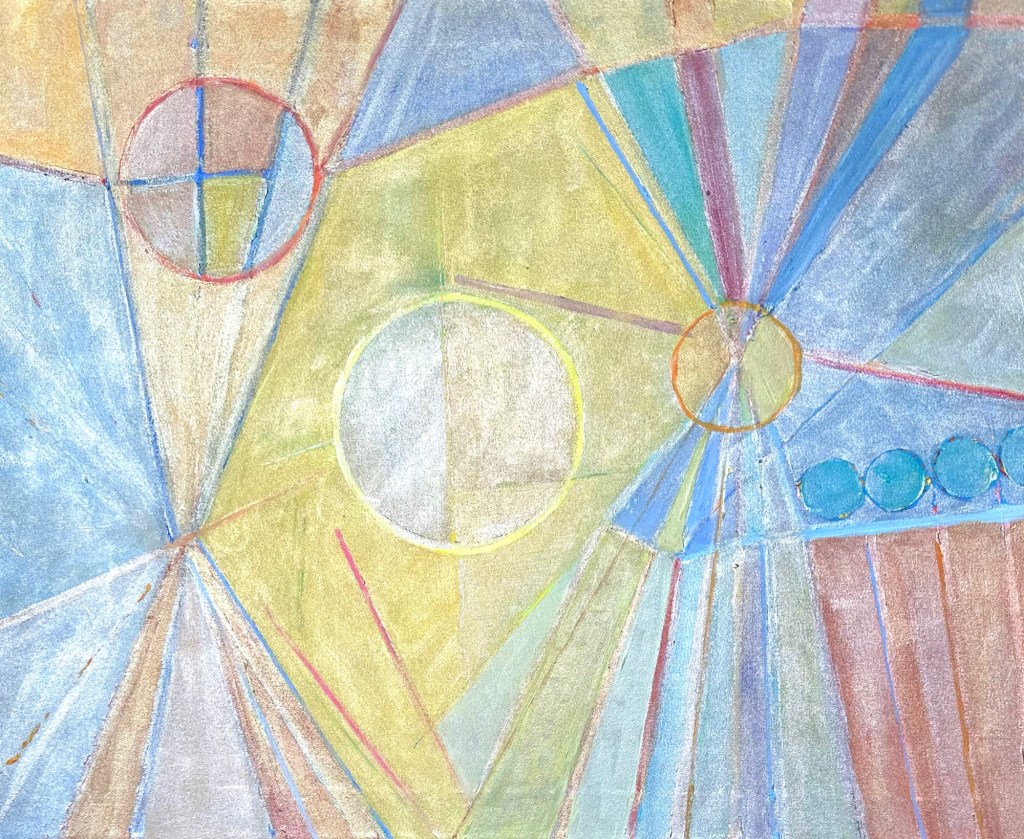
Cosmic Rainbow—acrylic on canvas, 24” x 30”, 2024.

Then we can be a beautiful rainbow, God’s light in this world for good, and bring the hope and joy of the end times to these times. We then will bring the radiance of the new heaven and the new earth to this present age and to these yearning people.

Joy, peace, and rainbows,

Cornelia


 what are the five major characteristics of apocalyptic literature – brainly.com

https://brainly.com/question/35289093

World’s most chilling cults

https://www.france24.com/en/live-news/20230424-world-s-most-chilling-cults

Paradise Definition & Meaning – Merriam-Webster

https://www.merriam-webster.com/dictionary/paradise

 Middle English paradis, paradise “the Garden of Eden, heaven,” borrowed from Anglo-French paradis, borrowed from Late Latin paradīsus, borrowed from Greek parádeisos “enclosed park or pleasure ground” (Xenophon), “the Garden of Eden” (Septuagint), “the abode of the blessed, heaven” (New Testament), borrowed from an Iranian word (perhaps Median *paridaiza-) cognate with Avestan pairidaēza- “enclosure,” nominal derivative of pairidaēz- “build a barrier around,” from pairi- “before, around” (going back to Indo-European *per-i, whence also Sanskrit pári “around, about,” Greek péri “around, in excess”) + -daēza- “heap up, build” (occurring only with prefixes), going back to Indo-European *dhoi̯ǵh-éi̯e-, iterative derivative of *dhei̯ǵh- “knead, shape” — more at PERI-, FEIGN

NOTE: As an independent derivative of the verb, Avestan daēza- “heap, pile (of earth, stones)” has been compared with Greek teîchos (neuter s-stem) “wall, fortification,” toîchos (masculine) “wall of a house or enclosure,” Sanskrit dehaḥ “body,” dehī́ “wall, embankment,” Oscan feíhúss (accusative plural) “walls.” For a Germanic derivative from the same verbal base with a different sense, see DOUGH.

Music of the Spheres

adult learning, Aristotle, art, color Wheel, Creativity, Faith, Holy Spirit, Horeb, Icarus, Imagination, nature, Painting, Prayer, Pythagorean Cosmology, Silence, Spirituality, vision

One of my favorite hymns growing up in the church was “This Is My Father’s World,” by Maltbie D. Babcock, a Presbyterian minister. Written in 1901, to the tune Terra Beata, or Blessed Earth, the song was originally a traditional English folk tune, but composer Franklin L. Sheppard arranged a variation specifically for this text. This hymn and “The Church in the Valley in the Wildwood” were my mother’s and my grandmother’s two favorites to sing. I loved them both also because of their location in nature.

This is my Father’s world,
And to my listening ears
All nature sings, and round me rings
The music of the spheres.
This is my Father’s world:
I rest me in the thought
Of rocks and trees, of skies and seas–
His hand the wonders wrought.

As Paul wrote in Romans 1:20—

“Ever since the creation of the world (God’s) eternal power and divine nature, invisible though they are, have been understood and seen through the things (God) has made.”

Tracing history backwards from the 1st CE, the Pythagoreans (active from the late 6th to the mid 5th century BCE) thought the music of the spheres was an ethereal harmony produced by the vibration of the celestial spheres.

Aristotle said the Pythagoreans believed things are numbers or they are made out of numbers by noticing more similarities between things and numbers than between things and the elements, such as fire and water, as adopted by earlier thinkers. The Pythagoreans thus concluded things were numbers or were made of numbers. Therefore, the principles of numbers, the odd and the even, are the principles of all things. The odd was limited and the even was unlimited.

Aristotle criticized the Pythagoreans for being so enamored of numerical order that they imposed it on the world even where it wasn’t suggested by the phenomena. Thus, appearances suggested there were nine heavenly bodies orbiting in the heavens but, since they regarded ten as the perfect number, they supposed there must be a tenth heavenly body, the counter-earth, which we cannot see.

Pythagoreans presented the principles of reality as consisting of ten pairs of opposites:

1. limited—unlimited

2. odd—even

3. unity—plurality

4. right—left

5. male—female

6. rest—motion

7. straight—crooked

8. light—darkness

9. good—bad

10. square—oblong

In art we have similar categories which we use to create dynamic images. If our painting is all of one value—all white, all black, or all middle value—it lacks visual interest. We are drawn to images which have contrasting values covering multiple values. As with everything, too much of a good thing can become a bad thing! In medicine, a small dose of Botox can make wrinkles disappear, but a large dose could poison a person. As I tell folks, some things require experts, not DIY practitioners.

The Middle Path is safest and best—
Unknown Artist: The fall of Icarus., Fresco of the Third style from Pompeii, 50—75 CE. (H. 35.5, W. 34.5 cm.),
London, British Museum.

I’ve probably mentioned before my encounter with the Hostess chocolate cupcakes. When I realized I could buy a whole box for slightly more money than a package of two tiny cakes, of course my starving art school student budget sprung for the box. That’s when I ate chocolate cupcakes for breakfast, lunch and dinner. By the end of that box, I was cured of my chocolate cupcake desire for a very long time. This is a classic case of “too much of a good thing,” or “knowing when to stop.” The Greeks recognized the need to curb human behavior of our “all or nothing” thinking by prescribing the idea of the Golden Mean, or “nothing to excess.” I definitely went to excess on my cupcake journey.


Mies van der Rohe’s Tugendhat Armchair was designed for the Tugendhat House in Brno, the Czech Republic in 1929 and is one of several different furniture pieces designed for the home of Greta Weiss and Fritz Tugendhat.   In the design of the home, Mies designed nearly every detail down to the furniture used.  He also prescribed the placement of each furniture piece in the home to maintain spatial composition.

Mies van der Rohe, whose architecture and furniture design exemplified his style, “less is more,” never reduced his work to nothing. His work was faithful to the new industrial materials of steel and glass being used in skyscrapers. Our excess in art is never to nothingness, but we don’t over elaborate or over decorate, just for the sake of filling the space.

So, what do we do and how we proceed? When faced with the challenge of all we see before us, what do we select to make our images? I believe this is where the creating Spirit comes into play, for we can walk past a tree all day long, but on a certain day, the tree comes alive for us. When Moses was herding his father-in-law’s sheep out in the wilderness, his mind was on the sheep, his current family, and his past life and deeds. Scripture doesn’t tell us how long the bush burned on that mountain before Moses noticed it and said, “I must turn aside and look at this great sight, and see why the bush is not burned up.” (Exodus 3:3)

Likewise, we walk past inspiring images daily when we’re preoccupied with our day-to-day concerns. We also have difficulty finding time to create because others want our attention first. One of my seminary professors lectured us in class about taking time to keep our spiritual lives front and center as we moved through school and our church appointments. She said our spouses and children would want to be first, plus our congregations also would want to be first. We’d most likely want to put our careers first to get a bigger steeple or to please our supervisors. However, if we put anything or anyone before God, our spiritual lives would suffer, and like dominos, everything else would fall also. “Many are called, but few are chosen,” as Jesus says in Matthew 22:14.

In art as in life, we need to be deeply rooted in the life of the Spirit. I can tell when I’m going through the motions, but I keep on painting, for I figure I’ll at least learn something from my adequate work, so I’ll be found ready when the creative Spirit strikes. Sometimes I’m more present to the cares and concerns of this world and my work suffers for it. Other times, I’m under the creating power of a Greater Power and my work is altogether more inspired because of that energy. We’d all be more vigorous and creative in our everyday lives if we spent more time in prayer, contemplation, and searching the scriptures to hear God’s voice speak in the silent corners of our hearts and minds.

Mike: Sun and Moon, quick painting

Last week, only Mike and I showed up for art class. Everyone else was either tied up with doctor appointments or at home with rehab or otherwise occupied. Mike and I explored making different colors with the 8 Color Prang Watercolor Set. We can make interesting colors by combining the complementary colors or the tertiary colors. Mike’s first landscape painting got the energies of his competing needs out of the way.

Mike’s Second start—just beginning

As in journaling, we often need to make a habit of writing our thoughts so our deepest feelings can get expressed. He began a second painting with more focus on the goal of mixing new colors.

Music of the Spheres: watercolor

I started my painting with the circles by using yellow watercolor to outline intersecting circles of the same size on my paper. Then I mixed some primary colors together, some secondary colors together and some tertiary colors together. I painted different sections of the overlapping circles. Some of the paint I thinned to a wash, and others I laid on fully. When I got home, I painted in the background, allowing some areas to be a wash and other parts to be thicker.

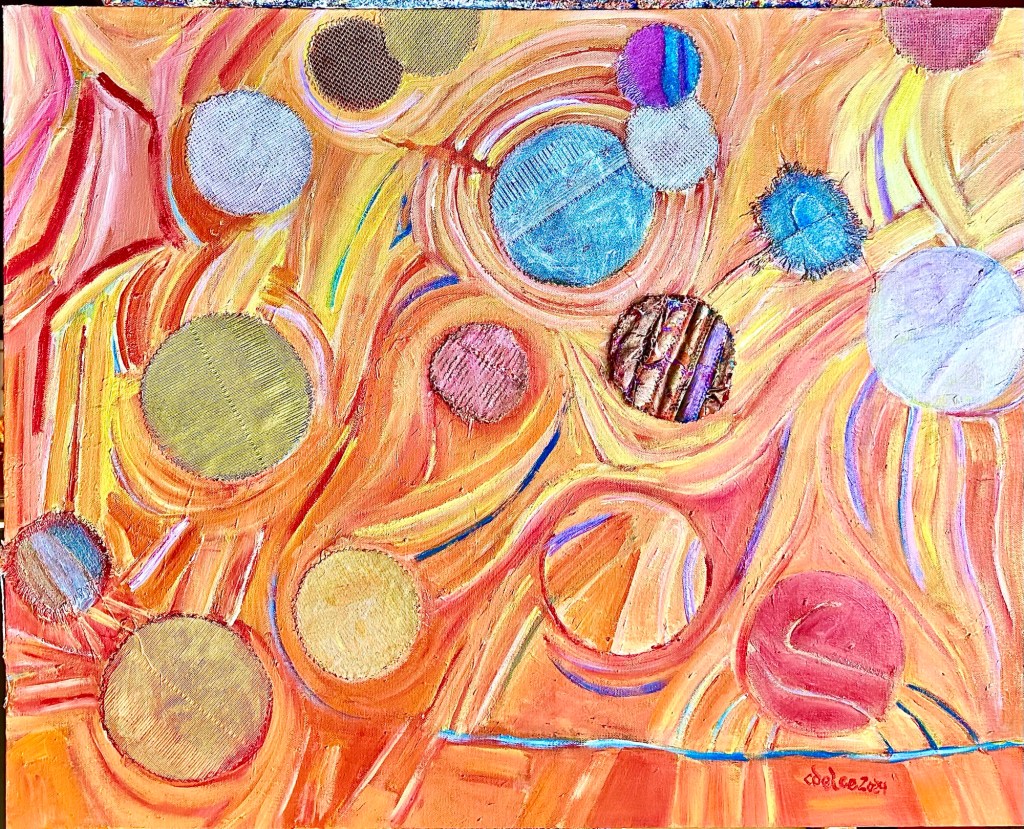
Music of the Spheres: Creation Energy, acrylic

I finished at home an acrylic painting, which explores some of the same themes as the watercolors we’ve worked on in class. In this I used various material with different textures for my spheres. One of the circles is more three dimensional because it’s from a handmade cloth mask left over from the pandemic. I painted parts of it, also. The background has lines of “energy” all about.

While the Pythagoreans attempted to see unity and harmony in the creation in numbers, our Judeo-Christian faith recognizes God as creator of nature and nature revealing the Creator. One of the best texts to understand this distinction is 1 Kings 19: 11-13, in which Elijah meets the LORD on the mountain at Horeb:

(God) said, “Go out and stand on the mountain before the LORD, for the LORD is about to pass by.” Now there was a great wind, so strong that it was splitting mountains and breaking rocks in pieces before the LORD, but the LORD was not in the wind; and after the wind an earthquake, but the LORD was not in the earthquake; and after the earthquake a fire, but the LORD was not in the fire; and after the fire a sound of sheer silence.

When Elijah heard it, he wrapped his face in his mantle and went out and stood at the entrance of the cave. Then there came a voice to him that said, “What are you doing here, Elijah?”

No one has ever heard the music of the spheres, and the voice of God arrives in the sound of sheer silence. Perhaps that “polar opposite” of the Pythagorean’s world view was on to something after all. If we’re very quiet and still, we may hear both the music of the spheres and the voice of God in the great silence.

Joy and peace,

Cornelia


This Is My Father’s World | Hymnary.org

https://hymnary.org/text/this_is_my_fathers_world_and_to_my

Counterfeit Version of Botox Found in Multiple States | FDA

https://www.fda.gov/drugs/drug-safety-and-availability/counterfeit-version-botox-found-multiple-states

Pythagoreanism (Stanford Encyclopedia of Philosophy)

https://plato.stanford.edu/entries/pythagoreanism/

Total Eclipse of the Heart

adult learning, arkansas, art, Astrology, cosmology, Creativity, Faith, Great American Eclipse, Imagination, inspiration, Light of the World, Love, mystery, nature, Painting, photography, shadows, Spirituality, Travel, Uncategorized, vision

In the Bonnie Tyler song, “Total Eclipse of the Heart,” her rock and roll soul pines for a young man as she sings:

“Every now and then

I know there’s no one in the universe

As magical and wondrous as you.”

Love struck teen heart ballads tend to elevate the beloved to a high pedestal, while hymns lift the praises of God to the highest heavens. If we look at John Wesley’s Notes on the New Testament, one of the doctrinal standards of the United Methodist Church, his commentary on 2 Corinthians 4:6 (KJV) is instructive:

“For God, who commanded the light to shine out of darkness, hath shined in our hearts, to give the light of the knowledge of the glory of God in the face of Jesus Christ.”

We might be more familiar with this verse in the NRSV, a more modern translation, which wasn’t available in the middle of the 18th century:

For it is the God who said, “Let light shine out of darkness,” who has shone in our hearts to give the light of the knowledge of the glory of God in the face of Jesus Christ.

Bailey’s Ring, from an earlier total eclipse over the South Pacific Ocean

Wesley’s commentary in his Notes on this text is succinct:

  1. For God hath shined in our hearts—The hearts of all those whom the God of this world no longer blinds.
  2. God who is himself our light; not only the author of light, but also the fountain of it.
  3. To enlighten us with the knowledge of the glory of God—Of his glorious love, and of his glorious image.
  4. In the face of Jesus Christ—Which reflects his glory in another manner than the face of Moses did.

What do the Total Eclipse of the Heart and Paul’s words to the Corinthian community have to do with art and faith? We’ve just experienced, what was for most of us, was a once in a lifetime experience. The last time a total solar eclipse was visible across the entire continent was in June 1918, when a total solar eclipse was visible from Washington to Florida, according to the US parks service. Nearly 100 years passed until this present Great American Eclipse.

At the 1878 total eclipse, Maria Mitchell led the Vassar College eclipse party, an all-female expedition from that pioneering women’s institution, which came to Denver in an era when science was a male bastion. Even higher education was deemed risky for the “fairer sex.” In 1873, the prominent Boston physician Edward H. Clarke had warned in an incendiary book titled “Sex in Education,” that the recent push for female colleges and coeducation could undermine women’s health by taxing their brains and causing their reproductive organs to atrophy — leading to “a dropping out of maternal instincts, and an appearance of Amazonian coarseness and force.” Nearly 150 years later some men still concern themselves with outmoded and 19th century views on women’s health concerns.

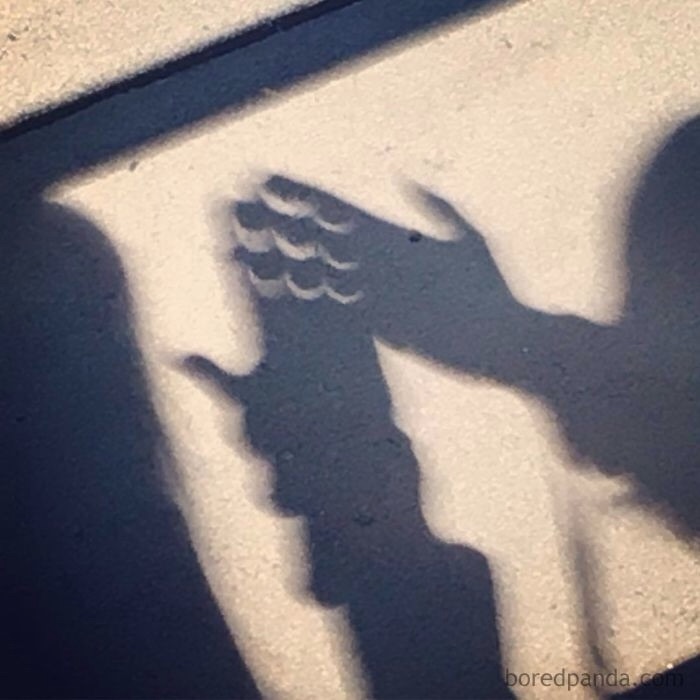
Eclipse as seen through the hands

I drove over four hundred miles to Kentucky in 2017 for the prior Great American Eclipse and got to stay home to see this second Great American Eclipse in my own front yard. Some folks couldn’t have been bothered about this current grand event, while others were convinced God was informing America of her impending doom. Moreover, multiple conspiracy theories abounded, none of which came true, of course. For instance, the world didn’t come to an end and our cell phones still work. Even the electric grid held up, even though the sun didn’t shine for all of a few minutes as the shadow traveled at over 1,600 miles per hour as it raced along the path of totality. This wasn’t even Y2K, which we all remember was a nonstarter at least and a dud at best.

Eclipse over Niagara Falls, 2024

In art class Friday Tim and I talked about the experience of this celestial event. We humans often elevate our own importance when we measure ourselves against one another and the works of our hands. When we go out into nature, we’re faced with the grandeur of God’s creation, especially when we visit the Grand Canyon or Niagara Falls. In Psalms 19:1, we read:

The heavens are telling the glory of God; and the firmament proclaims his handiwork.”

We see the beauty of nature and feel a warmth in our hearts. Our spirits soar. This intimacy with nature is one of the reasons we send our children to our United Methodist Church Camps, not just because they’ll have a great Christian experience, but because they’ll have that faith experience in nature with trusted leaders. I still remember my adventures and experiences in nature at those camps as part of my spiritual journey.

Towering Cumulus Clouds

Even in seminary, when I was having difficulty with some of my courses, I could go for a walk on the campus under the tree lined walks and search the skies for hopeful signs. Sometimes I saw the towering cumulus clouds in the Texas sky as a sign God was with me “in the cloud by day.” In those times of difficulty, even the cloistered realm of preparation seemed like a wilderness journey, but I was glad for a guide.

Bill Maxey, from Nebraska, taken at Hot Springs, AR.

When I was actively serving as a pastor, sometimes I just had to get away. I’d drive until I found some nature, a national park, national forest, or some fields outside of town. If it was a hot summer, I looked for some deep woods and cool shade to shelter me. In the cool spring, I drove until I found flowers. Maybe this is why I retired to a lake in a national park. I don’t need a big house, since I’d rather go out into nature instead.

Totality on Lake Hamilton, with sunset in the west, outside the path of totality

It was the heat of summer in 2017, so you’d think I’d remember the temperature drop right before the eclipse was halfway through. This year I was on Lake Hamilton, and the breeze off the lake combined with the cooler air was decidedly noticeable. When we entered totality, the lights on the Highway 70 bridge and at Bubba Brews automatically came on. The distant sky in the southwest, outside the path of totality, looked like a summer sunset. My neighbors and our visitors from afar were cheering.

Bill Maxey: multiple exposure of the Great American Eclipse, 2024

Not everyone can make an artwork that expresses their emotions as well as the shapes of the image. We can learn the rules of perspective and color, but then we have to learn to let our heart rule our head. This is what I call an “artistic leap of faith.” When we were young, we accepted the basic ideas of Christianity. As we got older, life happened, and we might have begun to struggle with our childhood beliefs not being equal to our adult needs. If we keep our childlike faith, we risk losing our faith. If we are able to wrestle with our faith and find a new and more mature faith, we can handle the major challenges of later life. As Paul says in 1 Corinthians 13:11-12—

“When I was a child, I spoke like a child, I thought like a child, I reasoned like a child; when I became an adult, I put an end to childish ways. For now we see in a mirror, dimly, but then we will see face to face. Now I know only in part; then I will know fully, even as I have been fully known.”

Tim’s Partial Eclipse painting using red, blue and brown to build the sky

Tim experimented with mixing colors to get richer depth. Using the Prang watercolor palette, he mixed the red, blue, and brown to get the black sky of the eclipse event. The red orange of the sun has some brown in it too. He layered the colors with multiple strokes, with a nod to Van Gogh. He worked from a photograph I brought. I pulled many of them off the internet, and many of my friends sent me some too.

Cornelia: Total Eclipse of the Sun

I worked on an image I’d taken from my iPhone. I had placed one of my eclipse glasses over the lens and was wearing another pair. It wasn’t that easy to get the sun lined up with all that blocking! My image looked a lot like a fried egg or an eyeball. I used several jar lids to get the circles painted cleanly. My dark sky is red, blue, and violet. The shape of the corona was not distinct, due to the quality of my camera. NASA has a very high-resolution image, which breath taking. Our tax dollars at work are bringing great scientific research and development to benefit us in everyday life, such as solar panels and heart implants.

NASA: High Resolution Image of the Total Eclipse

Thomas Merton, in No Man is an Island, in a chapter called “Being and Doing,” wrote—

“We cannot be happy if we expect to live all the time at the highest peak of intensity. Happiness is not a matter of intensity but of balance and order and rhythm and harmony. Music is pleasing not only because of the sound but because of the silence that is in it: without the alternation of sound and silence there would be no rhythm.”

I was a bit exhausted after all the excitement of this big event. I’d met new people from three different states, visited around our patio, and been gifted crystals that had been dug from Mt. Ida and “energized by the eclipse.” I’m not a crystal person, but I understand from those that are these crystals are “special.” I was feeling every bit of my new age as the calendar flipped over for another year.

Bourbon Codex: Aztec priestly document recording astronomical observations: eclipse

But today is another day, I had a night to sleep, and we had fun in art class. As long as we find joy in life, we know we’re alive. Our joys aren’t just collections of peak experiences, but some are the joy of the assurance of God’s enduring presence in our later lives when our youthful vigor has left us. We need to remember just as the moon eclipses the sun, once it passes, it also reveals the sun’s glory. One day this Bible verse from Philippians 3:21 will be true for each one of us, who has a heart full of love for God and neighbor:

“He will transform our humble bodies that they may be conformed to his glorious body, by the power that also enables him to make all things subject to himself.”

Joy and peace,

Cornelia


Bonnie Tyler – Total Eclipse Of The Heart Lyrics | AZLyrics.com

https://www.azlyrics.com/lyrics/bonnietyler/totaleclipseoftheheart.html

John Wesley: Explanatory Notes on the New Testament (With Active Table of Contents) [Kindle Edition], first published 1757

John Wesley: Wesley’s Notes on the Bible – Christian Classics Ethereal Library—online free edition of this book

https://ccel.org/ccel/wesley/notes/notes.toc.html

The Solar Eclipse Is the Super Bowl for Conspiracists | WIRED

https://www.wired.com/story/solar-eclipse-conspiracies/

Solar Eclipse 2017: Sun and moon put on celestial performance – CBS News

https://www.cbsnews.com/news/2017-eclipse-dazzles-million-watch-celestial-performance-sun-moon/

Thomas Merton—“No Man is an Island” in a chapter called “Being and Doing” [TMHI]: 1955

 A Woman in Eclipse: Maria Mitchell and the Great Solar Expedition of 1878

https://undark.org/2017/08/17/wilo-maria-mitchell-astronomer-eclipse/

NASA: Benefits Stemming from Space Exploration

https://www.nasa.gov/wp-content/uploads/2015/01/benefits-stemming-from-space-exploration-2013-tagged.pdf?emrc=ca90d1#:~:text=Overcoming%20the%20challenges%20of%20working,information%20technology%2C%20and%20industrial%20productivity


Eclipse T-Shirts

adult learning, art, Children, cosmology, Creativity, Faith, Good Friday, Great American Eclipse, Habits, Icons, Imagination, incarnation, inspiration, mystery, nature, Painting, Philosophy, Spirituality, vision

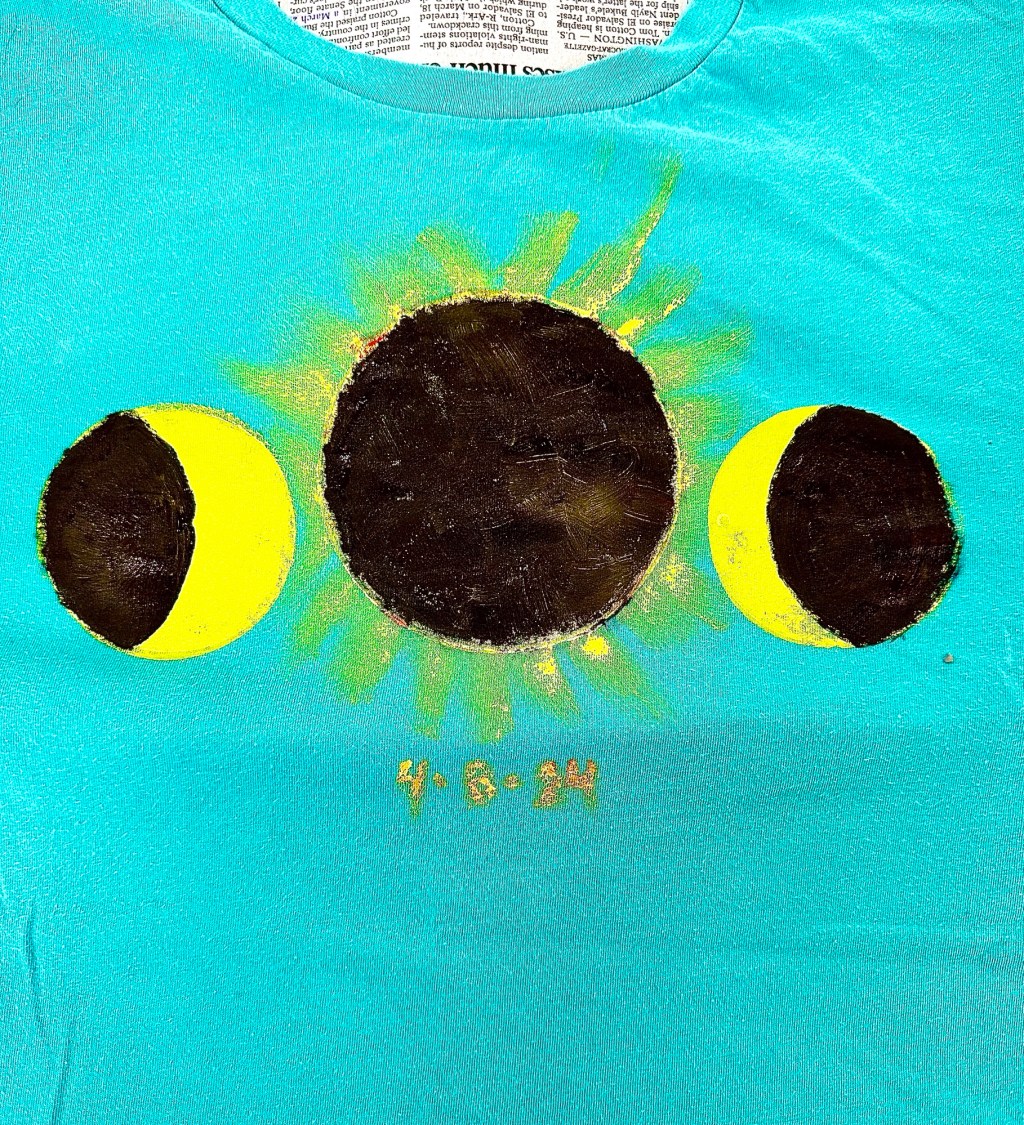
Friday in art class we painted our own unique designs on t-shirts for Monday’s Total Eclipse of the Sun. Anticipation of an event is characteristic of young children, while adults often feel over saturated with the early build up of attention given to an important event. By the time it gets here, we go, “Wow, what a letdown.” Children, who have fewer years of experience and anticipation comparison, can still marvel at the alternate reality of the total eclipse.

In the sixth century BCE, Anaximandros believed “the moon has a false light and is illuminated by the sun, and the sun isn’t smaller than the earth and it is pure fire.” The Greeks in 290 BCE knew the moon was unlike the sun. Anaximenes wrote it “didn’t shine with its own light, but with the reflected light of the sun,” as Eudimos wrote in his book History of Astronomy.  The Chinese also studied the skies and stars. They used bones heated in fires to divine messages from their deceased ancestors as early as the 12th century BCE.

Chinese oracle bone depicting lunar eclipse of 12/27-28/1192 BCS.

The Death of Jesus in the Synoptic Gospels has the record of an eclipse occurring during the time of the crucifixion. John’s Gospel, which comes from a different source, doesn’t mention this time of darkness.

Egon Schiele, Crucifixion with Darkened Sun, Oil on Canvas, 1907.

When it was noon, darkness came over the whole land until three in the afternoon. ~~ Mark 15:33

From noon on, darkness came over the whole land until three in the afternoon. ~~ Matthew 27:45

It was now about noon, and darkness came over the whole land until three in the afternoon, while the sun’s light failed; and the curtain of the temple was torn in two. ~~ Luke 23:44-45

When Jesus had received the wine, he said, “It is finished.” Then he bowed his head and gave up his spirit. ~~ John 19:30

Yet the Gospel of John tells us more about the miracles of Christ and his dual nature (both human and divine), so that we might believe and have everlasting life through him. New Testament scholar Ernst Käsemann is correct when he says of the Fourth Gospel: “Judged by the modern concept of reality, our Gospel is more fantastic than any other writing of the New Testament.”

Bruce Metzger, noted New Testament scholar and lead translator of the NRSV said, “The more often you have copies (of biblical texts) that agree with each other, especially if they emerge from different geographical areas, the more you can cross-check them to figure out what the original document was like. The only way they’d agree would be where they went back genealogically in a family tree that represents the descent of the manuscripts.[104]

Tim’s Eclipse T-shirt: very simple due to his rehab from arm surgery. He uses his arm until it hurts and then he rests. We do what we can, not what we can’t.

We modern folks are used to looking at the world through the eyes of science and education. We look for repeatable patterns and consistent evidence. We have “grown up minds” with calendars, schedules, to do lists, and multiple people who make demands on our time. Often, we are thinking about our next meeting or chore before we even finish the one we’re currently working on at the moment.

We aren’t practicing Brother Lawrence’s admonition to “Practice the present moment.” Our constantly chiming cell phones don’t help us be present, even though we could set our notifications to silent. Indeed, we’re never present or still enough to know the peace of the God whose name means “I AM.”

Lauralei’s Eclipse T-shirt: experimenting with fabric paint

What is “reality?” How can we know the present moment and come closer to God? With the advent of photography people began to think super realism in painting was preferred to some degree of emotional expression. Today, with the introduction of Artificial Intelligence, we can make computer generated photos and paintings that go beyond our wildest dreams! This means our new generations may likely begin using tactile materials and hand-built techniques to create future art works. Instead of fantastic other worlds, they might find their inspiration in the environment or in social justice concerns.

Gail W’s Eclipse T-shirt: first stage in class. She came with a design in mind and brought her sewing chalk also.
Gail W’s Eclipse T-shirt: the finished product.
Some of our inspirations are too grand to be completed in a few hours. We need to have the desire to carry the effort forward to meet our goal.

As with the icon, the artwork is only a reflection of the image which is painted. The icon isn’t holy, but the person depicted is holy. As the writer of Hebrews 1:3-4 says:

“He is the reflection of God’s glory and the exact imprint of God’s very being, and he sustains all things by his powerful word. When he had made purification for sins, he sat down at the right hand of the Majesty on high, having become as much superior to angels as the name he has inherited is more excellent than theirs.”

I didn’t get a photo of Mike’s “Crawford Law Eclipse T-shirt.” Work called and he had cats to herd. He was generous as usual to bring fabric paints for the group to share. We used old newspapers inside our T-shirts to keep the paint from bleeding through to the backside. We had an opportunity to share stories and eat my birthday doughnuts which Tim blessed me with.

Cornelia’s Eclipse T-shirt: I collapsed all the moments of occlusion into three, so I could finish in one sitting.

If we take time to practice our art, we may realize our own works may be only a reflection of the glory of what we saw, but we we can continue to practice our skills in prayer, for God will bring us ever closer to perfection if we commit our work to God’s glory.

Leonardo da Vinci: Study of the technique for observing solar eclipse, Codex Trivulzianus, 1487–1490

Also, Marilyn, who was working with some other ladies of the church on the potato bar posters, had brought the warm-gooecrescent roll-cream cheese-vanilla-cinnamon-sugar dessert. If you ever have a chance to put this into your mouth, you will be transported into an alternate reality. This is the stuff from which dreams and visions arise! If you eat it, and you merely remark, “Good,” my thought is you’re dead to this world or you’ve lost your sense of taste. The child in me screamed for MORE!! The adult in me will see if I can reduce the calories with no depreciation in taste.

Paul Nash: Eclipse of the Sunflower, 1945

I hope we get a break from the clouds on the Great American Eclipse Day. The last one I traveled to in 2017 was very impressive and worth the journey. Watch it on television if you can’t be outside. Only look at the sun with certified eclipse glasses. Some experiences are such that we can only say “Awe!” And we may want to stop time forever, but time will march on, for we can’t move the sun either forward or backwards. No matter how important we are, we aren’t gods, and we aren’t even Time Lords. If we manage to grasp only a portion of the holiness and beauty of God’s creation in this one event, we will better experience the joy of the passing glory of our God:

“When I look at your heavens, the work of your fingers, the moon and the stars, that you have established, what are human beings that you are mindful of them, mortals that you care for them?” ~~ Psalm 8:3,4 (NRSV)

View of the Great American Eclipse 2017 at
Lake Barkley through a pinhole

Joy and peace,

Cornelia


Eclipses and the Ancient Greek Philosophers

By H. Rovithis-Livaniou and P. Rovithis

https://articles.adsabs.harvard.edu/cgi-bin/nph-iarticle_query?bibcode=2007ASPC..370..115R&db_key=AST&page_ind=0&data_type=GIF&type=SCREEN_VIEW&classic=YES

How Ancient Humans Studied—And Predicted—Solar Eclipses | Scientific American

https://www.scientificamerican.com/article/how-ancient-humans-studied-and-predicted-solar-eclipses/

Historical Reliability of the Gospels, Encyclopedia MDPI

https://encyclopedia.pub/entry/29465

https://handwiki.org/wiki/Religion:Historical_reliability_of_the_Gospels

104. Strobel, Lee. “The Case for Christ”. 1998. Chapter three, when quoting biblical scholar Bruce Metzger

In Memoriam: Bruce M. Metzger (1914-2007) | Bible.org

https://bible.org/article/memoriam-bruce-m-metzger-1914-2007

Bruce Metzger was the master of several ancient and modern languages and ended up teaching at Princeton for 46 years after he received his PhD there. As one of the editors of the standard Greek New Testament used today and the senior editor of the NRSV, his scholarship has proved to be almost impeccable. His specialty was New Testament textual criticism, the field whose primary goal is to ascertain the wording of the original text. Many considered him the finest NT textual critic of the 20th century. His death in 2007 left giant footprints for the next generation to come. 

Paul Nash, British Military artist, died in 1946 of complications from asthma. He didn’t see the total eclipse, but knew of it and was very connected to nature.

Read about him in A landscape of mortality | Tate

https://www.tate.org.uk/art/artists/paul-nash-1690/landscape-mortality

Map of the 1945 eclipse: SE1945Jul09T.gif 1,121×1,452 pixels


Season of Light

art, Astrology, Christmas, Civil War, Faith, Family, Hanukkah, holidays, hope, Israel, Light of the World, Love, Saturnalia, Spirituality, Ukraine

The damaged Drobytsky Yar memorial near Kharkiv, Ukraine after reportedly being hit by Russian artillery fire, on March 26, 2022

As the days grow shorter and the nights lengthen, the chill air adds to the darkness of our world. We can give into this dour outlook, especially this year with devastating wars in Ukraine and Gaza, or we can light a candle against the gathering gloom. Cultures across history have seen the time before year end as an opportunity for reflection, concern, or fear. Others have found reasons to rejoice.

Rainbow Menorah

Hanukkah (inauguration) is the eight-day Festival of Lights, which occurs in 2023 from sunset December 7 to December 15. It’s a moveable festival, for in 2024 the holiday will occur from December 25 to January 2. The Jewish calendar is a lunar calendar, not a solar calendar. This holiday celebrates the rededication of the Second Temple after the victory of the Maccabees over the Seleucid Greeks in 164 BCE. On discovering in the temple a vial of unpolluted oil, with only enough to light the candle for one day, this oil kept the candle burning for eight days. To commemorate this miracle, faithful Jews now light a special menorah with nine candles. The ninth candle is called the “helper” or “shammash” candle. The root word is from the Hebrew for “servant.”

Helping Hand Menorah

While not everyone is Jewish, all persons can learn from the menorah and the shammash candle. We may have only a little to give, but with God’s help it can be multiplied many times over. We can all be a helper candle, and bring a light to the candles who need a light. Many in this season experience a loss of some kind. Some are mourning a loved one, others have broken relationships, or have lost jobs or status. We are not our jobs and we aren’t our paychecks, but we are the beloved children of God. God will love us when everyone else turns aside. God will remember us when others forget we are alive.

Perhaps these darkening days at the end of the year are why people in all parts of the world have brought fire and light to this time of the year. The Yule Festival in German and Scandinavian countries was part of the pagan festival incorporated into Christianity’s Christmas celebrations. It likely began as a winter solstice or year-end celebration. “Yule” became a name for Christmas about the 9th century, and in many languages yule and its cognates are still used to describe that holiday.

Father Christmas and the Yule Log

The burning in a giant fireplace of a large Yule log until it’s reduced to cinders is one of my favorite mythic memories of the season. Alas, growing up in the Deep South, gas logs were the closest fireplace equivalent, and these were the same yesterday, today, and tomorrow. We rarely turned on the flickering colors of these blue flames because cold nights were few and far between.

By 336 CE, the Christian church in Rome celebrated Christmas on December 25, which coincided with the Roman winter equinox festival of Saturnalia. In medieval England, Christmas was a 12-day festival involving all kinds of revelry, from plays to wild feasts to pageants celebrating Jesus’ birth. Music, gift giving, and decorations all became the norm. Anyone who’s been in a choir singing “The Twelve Days of Christmas” with its repetitive “and a partridge in a pear tree” has those ancestors of ours to thank. Some traditions never die!

Our family stitched and sequined one exactly like this.

Christmas is better known for decorated trees, however. The use of evergreen trees and wreaths in religious ceremonies dates from ancient Roman times, if not earlier. However, the first documented use of a tree in a winter Christmas celebration wasn’t until 1510. In that year, members of a merchant’s guild in Riga, Latvia, placed a tree in the town square. They decorated it with flowers, ribbons, and dried fruit. After the festivities—which included the singing of songs and dancing—were concluded, they burned the tree as a great bonfire to close out the celebrations.

The Grinch Torches Whoville’s Christmas Tree into a Bonfire

Christmas trees gained popularity in Germany and other parts of northern Europe by the 1700s, but the practice of decorating a pine or fir tree during the holiday season remained virtually unknown in the English-speaking world prior to the 19th century. When Queen Victoria married her German cousin Prince Albert in 1840, the Christmas tree became widely accepted and practiced throughout the British Isles.

1836 edition of The Stranger’s Gift: A Christmas and New Year’s Present

In the United States, the practice of placing a decorated tree inside the family home was most likely introduced by German immigrants who arrived soon after the Revolution. The otherwise unassuming volume seen above, the 1836 edition of The Stranger’s Gift: A Christmas and New Year’s Present, is significant for it’s the first book printed in the Americas containing an image of a Christmas tree. Franklin Pierce in 1856 was the first president to erect a tree in the White House. In the United States, Christmas wasn’t celebrated with much gusto until after the Civil War, which reinforced for many the importance of home and family. In 1870, after the war’s end, Congress made Christmas one of nation’s first federal holidays.

Franklin Pierce in 1856 was the first president to erect a tree in the White House.

Light has always been a part of winter festivals, with their signature long, dark nights. Electric Christmas lights are a modern spin-off of the old-fashioned candles that Germans and Scandinavians placed on their trees. Thomas Edison, inventor of the lightbulb, also invented the first strand of lights and hung them outside his Menlo Park, New Jersey laboratory in 1880. In 1882 his business partner, Edward H. Johnson, created the first Christmas tree illuminated with colored lights. In 1895, President Grover Cleveland placed multi-colored electric lights on the White House tree. Since electricity wasn’t available except to the wealthy, most people didn’t have electric lights on their trees at home. Not until the end of the 1920s were electric lights affordable for the average family.

Fast forward to the 1950’s and the postwar period of rural electrification and large family gatherings, colored electric lights of every kind were readily available to the middle classes, not just the wealthy. This was the era of big bulbs and bubble lights, but in a few years, inexpensive miniature colored and white lights imported from China would become popular. Now even single parent households could decorate both the house and tree to their hearts’ content.

Untitled (Lux in tenebris inest—Light in the darkness)
Elisa Sighicelli 2003/2003

The lights bring out our hope of what’s good and wonderful in this world. Christmas and Hanukkah are times when the light burns bright, even when the days are dark. If these holidays didn’t exist, we would need to invent them, for we need the reminders of what is light and good in the world. As Baruch prophesied (5:9):

“For God will lead Israel with joy, in the light of his glory, with the mercy and righteousness that come from him.”

While we don’t know exactly what the Christmas star was, one theory is it was a conjunction of Jupiter, Regulus and Venus. Another possibility includes a set of conjunctions of the planets Jupiter and Venus, and the bright star Regulus. In this case, the mythologies associated with the objects become important. Jupiter in Hebrew is known as ‘Sedeq’, which is often translated as meaning righteousness. Jupiter is also often viewed as being the ‘king’ of the planets. Regulus is Latin for ‘prince’ or ‘little king’, and Venus is often viewed as a symbol of love, fertility and birth. Therefore, the combination of these objects close in the sky could have led to the interpretation of the birth of the ‘King of Kings.’ We do know Matthew records the visit to King Herod:

“After Jesus was born in Bethlehem in Judea, during the time of King Herod, Magi from the east came to Jerusalem and asked, “Where is the one who has been born king of the Jews? We saw his star when it rose and have come to worship him.”
(2:1-2 NIV)

Gerrit Dou: Astronomer by Candlelight, oil, late 1650s, J. Paul Getty Museum

The magi were astrologers, those who studied the heavens for the star signs of rising and falling influences in the ancient world. Herod died soon after their visit, but not before he tried to consolidate his power. He meant his dire deeds to benefit himself, but God spared his son by sending a message to Joseph in a dream to flee to Egypt with Mary and Jesus. The magi were warned not to return to Herod also.
This one who John wrote about in the opening chapter of his gospel (1:5):

“The light shines in the darkness, and the darkness has not overcome it.”

Gerardo Dottori: Nativity, 1930/1930, Museum of modern art

As we celebrate the holidays of light this year, remember to be a “shammash”, or a servant of light, and don’t let this present darkness overwhelm you. Your one light shining may be the brightness that brings someone safely home. Today I wore my bright pink exercise pants, even though I’m sinusy and achy all over. I made at least one person’s day when I said, “They’re stretchy, so I can eat more Christmas cookies!” We spread the joy even when the Grinch has stolen ours. This is a way of taking the darkness back, by making others feel better.

God bless and shine 🕯️on,

Joy and peace,

Cornelia

Jewish Festivals |Britannica
https://www.britannica.com/topic/Jewish-festivals

Shammash | Judaism | Britannica
https://www.britannica.com/topic/shammash

Yule Festival | Britannica
https://www.britannica.com/topic/Yule-festival

O Tannenbaum: Or, a Brief History of the Christmas Tree | The New York Public Library
https://www.nypl.org/blog/2016/12/12/christmas-trees-arrival

Who Invented Electric Christmas Lights |
https://www.eei.org/en/delivering-the-future/articles/who-invented-electric-christmas-lights

A Look Back: 100 Years of Christmas Tree Trends

https://www.bhg.com/100-years-christmas-trees-6751023

Megiddo at the Crossroads of History

911, Academy for Spiritual Formation, Apocalypse, art, Astrology, Faith, Healing, hope, Imagination, inspiration, Israel, Megiddo, Painting, pandemic, purpose, Spirituality, vision

Archeological Remains of Tell Megiddo

On a visit to the Holy Land, I walked in the ruins of Tell Megiddo and also climbed the hills above the Jezerell valley. From this vantage point, I could imagine the great battles of nations warring to conquer land and control trading routes. Megiddo lies at the crossroads and therefore in the crosshairs of international politics, both in ancient and current times.


Valley of Megiddo

The plains of Megiddo, the breadbasket of Israel, also were known as a great battleground in ancient times. Egypt came more than once to fight the kings of Israel and Judah. The world’s earliest recorded battle occurred here between Syrian princes and Pharaoh Thutmosis III (ca. 1469 BC). Judah’s king Josiah was fatally wounded when he confronted another pharaoh, Neco II, near Megiddo ca. 609 BC (2 Kings 23:29-30). Although Megiddo is only mentioned in the Old Testament, the New Testament refers to it once in Revelation 16:16 as Harmagedon (mountain of Megiddo), the final site of the battle between the forces of good and evil at the end times of the age. Of course, scholars have different interpretations of when these “end times” are at hand.


Map of First Recorded Battle

The final book of the Greek New Testament is ΑΠΟΚΑΛΥΨΙΣ ΙΩΑΝΝΟΥ, or the Apocalypse of John. The word apocalypse means “disclosure of truth, instruction, or reveal, disclose, uncover.” It especially refers to Jewish and Christian writings of 200 BCE to 150 CE, which are marked by pseudonymity, symbolic imagery, and the expectation of an imminent cosmic cataclysm in which God destroys the ruling powers of evil and raises the righteous to life in a messianic kingdom.

Chariot Sculpture at Megiddo Battlefield

I remember a presenter on an Academy for Spiritual Formation retreat saying she had difficulty saying the prayers in the psalter, for the psalms of lament meant nothing to her, since she had no griefs to bear. Her spiritual adviser reminded her, “We pray these prayers for others, not just for ourselves alone.” As an artist of faith, I sense the needs of the world: it’s longings, fears, hopes, and dreams. I don’t always paint “art for art’s sake.” Certainly the conflict our beloved United Methodist Church has been experiencing lately factored into this “end times vision,” for too many on both sides of this dispute have resorted to calling the other “evil.”

Megiddo: Bronze Version

I felt called to paint the landscape of Megiddo in these recent weeks. Beginning in mid August, I was working on several paintings using Google map views of the landscape around the ancient site, with inspiration from my personal photos from my visit several years ago. I struggled over it, with the colors changing from bright to earthen tones. I left it alone for a time, to look at it and take time to live with it. Doing this allows me to see if I got too interested in noodling about making different colors, rather than considering the whole area as one unit. It didn’t take long before I came to the conclusion I didn’t have unity in my work. I had no overarching focus. My life has been like this for a while, with multiple distractions.

Megiddo: Blue Version

In our broken and fallen world, I find people today are in a rush to run to the extremes. Cooler heads don’t always prevail. The moment disorder rears its ugly head, folks run around like Chicken Little screaming, “The sky is falling! The sky is falling!” They might as well scream, “The end times are here!” I’m reminded of the Y2K hysteria with everyone panicking about filling up their cars for fear the gas pumps wouldn’t work, getting cash in case the credit cards wouldn’t swipe, and buying generators for fear the grid would crash (computers not able to recognize all those zeros). As I recall, my antique VCR kept recording on schedule, and the local Walmart took back loads of panic purchases in January.

The latest outbreak of hostilities in Israel and the Gaza Strip have added to the apocalyptic atmosphere and thinking of those who are given to extremes of thought. America has sent two of its eleven aircraft carriers into the Mediterranean Sea as a deterrent to all the other nations to rethink their plans to join the fighting now going on. For the apocalyptic thinkers, this is a sign of “It’s going down!” For those of us who have calmer heads, we realize the United States is the only one of six countries with more than two of these floating armed cities. Every other country has a single one only.

General Eisenhower (R) confers with French generals French 1st Army Corps Headquarters November 25, 1944 Ranking allied leaders look over a situation map outside of French 1st Army Corps Headquarters.

It’s been the habit of American presidents and their advisers in the gamut of crises since World War II to move aircraft carriers around as a “Geopolitical Chess Piece” to demonstrate American concern, resolve, or outright anger. Because carriers are operate on the high seas where permission to move is not needed from other countries, and because they carry their own fuel, weapons, and maintenance, they’re ready on arrival at the scene of a crisis to deliver power. Moreover, since modern U.S. carriers are large and imposing, and have been unchallenged on the seas, they “show the flag” to great effect. They provide excellent “visuals.” In fact, if one carrier doesn’t do the job, sending a second with several attendant ships along is a sign of “we mean business.”

Since this is a habit, and not a novel occurrence, it’s not the sign of the end times. As the gospel of Mark records in 13:7-8:

“When you hear of wars and rumors of wars, do not be alarmed; this must take place, but the end is still to come. For nation will rise against nation, and kingdom against kingdom; there will be earthquakes in various places; there will be famines. This is but the beginning of the birth pangs.”

Benjamin West: Death on a Pale Horse, oil on canvas, 1817, Pennsylvania Academy of the Fine Arts

Will these carriers be used for their traditional purpose—a floating airfield—and will our military aircraft and service personnel actually join in the actual combat operations in the MidEast? That seems unlikely, given the Just War principle taught in American War Colleges. The moral concept of Just War begins with a good reason to go to war. A reasonable cause is to right a wrong, recover stolen property, or self defense. Not liking someone isn’t a good reason to go to war.

The just war must be fought proportionately to the harm that was done to the aggrieved. Today, if someone were to insult you or cut you off in traffic, honking your horn is acceptable, but shooting a pistol isn’t. That’s a disproportionate reaction to the harm, or an unjustified assault. Responding in anger usually leads to regret, but our emotions often get the best of us.

I remember my first year in the classroom. I was making a grand total of $8,250 a year—the extra $250 was for my master’s degree—and the school wanted to know if I wanted this pittance in 10 or 12 checks. “Oh, make it ten! I’ll figure out summer some how.” The first day of class in 1982, I had well over fifty students in the high school sign up for art because the former teacher had taught elementary lessons to the older students: she had fifty ways to draw turkeys. I brought the principal in: “This isn’t going to work. Let’s get half of them in another class.” He was good with that.

This was a country school. Most of the kids would marry right after graduation. Many of the seniors already had jobs, so young art teachers weren’t high on their respect list. I was fortunate to have taught in an inner city school back in the Northeast where the boys play ice hockey. Like an aircraft carrier sent to the Mediterranean Sea, sometimes I’d have to throw my short body into the middle of two factions who were about to throw punches. These boys were usually over six feet tall, so there was no likelihood I’d ever get hit, but just my presence would cause them to reconsider and pull their punches.

Just because we send war ships to the Mediterranean doesn’t mean we want to wage war. We Americans have a track record of showing up to keep wars from breaking out all over. World leaders know how our military is trained and the rules by which we engage in conflicts. This is why as a person of faith, each of us has to search our hearts to discern how we respond in times of conflict, whether that’s a war or just a disagreement with our neighbors.

In addition to a just cause, we must have the right intentions, the possibility of success, and enter a conflict only as a last resort. Those who follow the Just War Principles aren’t “trigger happy,” but are inclined to gather community support, decide their limits ahead of time, seek to resolve the conflict in other ways first, and if that fails, then enter the fray. The USA didn’t enter WWII until the 1941 surprise attack on Pearl Harbor, even though the war in Europe had been going on since September 1, 1939, when Germany invaded Poland. Up to that time we were supporting Great Britain with armaments.

A plan for after the fighting is done

Theologically speaking, scholars are of two minds: the end times are already here or the end times have yet to come.

1. The end times are already here—Scholars who believe this understand Matthew 24:6-8 as an ongoing event, which began with the ascension of Christ:

“And you will hear of wars and rumors of wars; see that you are not alarmed; for this must take place, but the end is not yet. For nation will rise against nation, and kingdom against kingdom, and there will be famines and earthquakes in various places: all this is but the beginning of the birth pangs.”

For some, the tribulation will happen beforehand (pretribulation), while others believe this suffering will occur after the return of Jesus (post tribulation). I remember as the year 2000 approached, many of the faithful were excited about the camera facing the Mount of Olives in Jerusalem, since this was the place from which he ascended, therefore it would be the place from which he would return. Daystar Ministries setup the camera so “everyone could see it firsthand.”

We humans tend to think our Gods are small, even if we ascribe to them “infinite powers.” We don’t realize the power of an almighty who can interrupt and reveal all of the past to be nothing but dust and introduce a new age with his appearance. No one will need a computer or video screen to view the in-breaking return of the messiah. Everyone around the world will hear the thunderclap at one moment in time, and the flash of lightning accompanying his appearance will brighten even the darkest night. This day will be overwhelmingly bright. Most of us will hide our eyes so we won’t be blinded by the brilliance of a thousand suns.

The Jesus Cam will most likely melt when Christ does return, but his return wasn’t on the first day of 2000. That wasn’t the millennium anyway, but a year early for the math challenged hopeful. It was also the year 1420 for the Muslims and 5760 for the Jews, so who’s counting matters anyway, since numbers aren’t what God depends on, nor the stars (astrology).

Durer: The Four Horsemen

2. The end times are yet to come—While pandemics, stock market crashes, and rumors of war may all sound apocalyptic, the Temple at Jerusalem has yet to be rebuilt. Complicating this task is the Dome of the Rock, a major Islamic holy site built on the same location. A Pew Research Center study in 2010 found most Americans believed war, terrorism and environmental catastrophes were at least probable by the year 2050. Nearly six-in-ten (58%) saw another world war as definite or probable; 53% said the same about the prospect for a major terrorist attack on the United States involving nuclear weapons. An even higher percentage (72%) anticipated the world would face a major energy crisis in the next 40 years. This fits with the theme of “apocalypse as the collapse of environment or society.”

Other characteristics of the apocalypse include:

1. Literal battle between physical armies under supernatural leadership—These are battles of extremists, who are convinced they have a holy calling to fight. The Crusades were fought as “Christ’s army against the infidel.” Their purpose was to restore the Christian holy sites in the Middle East and resanctify them for holy Christian worship. This mentality doesn’t respect the humanity of the enemy. The war may have a just purpose, but not be fought with just means: eradication of the enemy is unjust.

2. Holy wars against non-believers—This is an unjust war, fought with unjust purposes, with excessive force, and seeks to exterminate the enemy, who are reduced to non-persons because they don’t share the same belief system. When opposing sides can’t recognize the common humanity of one another and rage rules decisions, the lust for blood feeds upon itself. Shakespeare said it best when Marc Anthony came upon the body of the just assassinated Julius Caesar in Act 3, scene 1:

And Caesar’s spirit, ranging for revenge,

With Ate by his side come hot from hell,

Shall in these confines with a monarch’s voice

Cry “Havoc!” and let slip the dogs of war,

That this foul deed shall smell above the earth

With carrion men, groaning for burial.

My final reworking of Megiddo includes streaks of rockets in the dark night sky and swirls of chaos which churn the world’s peoples, just as Ate, the Roman personification of recklessness and folly incites the passions of Caesar’s bereaved followers. We don’t know when Christ will return, no matter how many may prophesy or calculate the date. As Jesus said to his disciples in Matthew 24:36,

“But about that day and hour no one knows, neither the angels of heaven, nor the Son, but only the Father.”

This present darkness is only momentary, for if we’re in the end times, we also have a promise we can hold on to in Matthew 28:20—

“Remember, I am with you always, to the end of the age.”

Joy and Peace,

Cornelia


Armageddon / Harmagedon – CDAMM

https://www.cdamm.org/articles/armageddon


Aircraft Carriers by Country 2023 – Wisevoter


Public Sees a Future Full of Promise and Peril | Pew Research Center


Robert C Rubel: The Future of Air Carriers

https://digital-commons.usnwc.edu/cgi/viewcontent.cgi?article=1551&context=nwc-review


Rubel, Robert C. (2011) “The Future of The Future of Aircraft Carriers,” Naval War College Review: Vol. 64 : No. 4 , Article 4. Available at: https://digital-commons.usnwc.edu/nwc-review/vol64/iss4/4


Case Study: Just War Doctrine

https://www.scirp.org/journal/paperinformation.aspx?paperid=122406


Messiahcam at Y2K

https://www.theguardian.com/world/2000/jan/01/jamesmeek


‘Cry ‘Havoc!’ And Let Slip The Dogs Of War’: Speech & Analysis

https://nosweatshakespeare.com/quotes/famous/cry-havoc-let-slip-dogs-war/

Brookdale Community College Eisenhower Collection

https://www.brookdalecc.edu/center-for-world-war-ii-studies/the-meserlin-gallery/witnessing-history/

Left to right, French 5-star General De Lattre De Tassigny, commander 1st French Army; U.S. Lieutenant General Omar Bradley, commander, 12th Army Group; French 4-star General Marie Emile Bethouart, commander 1st French Army Corps; U.S. Lieutenant General Jacob L. Devers, commander, 6th Army Group; and General Dwight Eisenhower, Supreme Allied Commander.

Rabbit! Rabbit!

art, Astrology, autumnal equinox, brain plasticity, change, cognitive decline, coronavirus, cosmology, Creativity, Family, Great American Eclipse, greek myths, Helios, nature, Painting, pandemic, photography, rabbits, Reflection, The Lord of The Rings, trees, vision

Welcome to August!

In the long summer evenings, after an extended car trip, and way beyond the too many times I’d asked my mother and daddy rabbits, “Are we there yet?” I would get their firm reminders I wasn’t to bother them any more, for they too were hot, tired, and daddy had to pay attention to the road. In the gathering darkness, I’d rest my blonde curls on the door near the open window. We had God air conditioning back then. We rolled down the window glass of our old Pontiac and drove as fast as the road would allow.

Go Faster!

I’d watch the darkening shadows as the landscape passed by this opening, noticing how the kudzu vines changed the trees into strange and monstrous shapes in the growing gloom, but I couldn’t take my eyes off of these apparitions. I was certain if I did, they’d begin to make their way toward our family car. I think I was at the age of magical thinking, for I believed I could keep these haints at bay by my will alone.

The soft flup flup of rubber tires half melting on the overheated concrete road, combined with my brother rabbits’ body heat in the seat beside me, and the enforced silence of our parents who’d had a long day with their hyperactive bunny brood finally had an effect on my eyelids. Try as I might, I would fall asleep at my watch, only to be awakened by my daddy’s sing song voice as he tickled my toes:

“This little piggy went to market, this little piggy stayed home.
This little piggy ate roast beef, and this little piggy had none!
And this little piggy cried wee-wee-wee all the way home!”

I’d rub my eyes as he picked me up to carry me into the house and into my bedroom. On the way, I’d always say,

“I see the moon, and the moon sees me,
God bless the moon, and God bless me!”

Perhaps this is a generational gift in my family, for when my own dear bunny child was small, we repeated these same scenes until she was too heavy for me to carry. The moon blessing dates from 1784 and the little piggy rhyme is even older: 1728.

That latter date is when horses and carriages were banned from Boston Common. Since I went to school in Boston, I can attest no horses, carriages, or cows are now on the grounds of the Common, which is now a 50 acre public park. The Common dates from 1634, when William Blaxton sold the remainder of his land to the Puritans, receiving six shillings or more from each shareholder to purchase the land for this public land. This was the site of the Boston Massacre, in which five people died. One good thing about going to school in an historic community, everywhere you went, you weren’t far from history.

When I think of history, I think not only of the stories we pass down to the next generation, but also of the stories we weave for ourselves. How do we remember our childhood or our families of origin? This is a generational gift of privilege, for those who lost their families when they were young may not have memories to weave together. Refugees from wars and violence might not want to recall traumatic experiences. Yet Abraham, the father of the Jewish nation, is remembered as “My ancestor was a wandering Arameam” (Deut 26:5).

Some of us choose to write about our better days, for they outnumber our bad days. Everyone has imperfections, but each of us rabbits are still going on to perfection with the help of the good God above. Perhaps when we see the beauty of the full bright moon against a dark, clear night, our heart leaps inside and says,

“I see the moon, and the moon sees me,
God bless the moon, and God bless me!”

For some of us rabbits, nature brings us closer to God than anything else. The majesty of the summer thunderclouds rising in the heated air, and giving way to either refreshing rain or flashing floods, reminds us once again of the powers of God unleashed in God’s creation. The rainbow after the storm is the promise once again of that covenant made so long ago: the earth will never be destroyed by floods again. In the rainbow, in the light of all the colors, we hear God’s promise of love and care for God’s creation and God’s creatures.

DeLee: Blue Moon

I’m looking at a full super moon tonight, July 3, but August will have TWO super moons. Looking ahead to September 29, we’ll have our FOURTH super moon in a row. The moon on the 31st of August will be a blue moon. This is the second full moon in the same month. We won’t have another blue moon until May, 2026. This is why things that don’t happen often are called “once in a blue moon” events.

Once upon a time, we were agrarian people who eked out a subsistence living on the land. The persistence of The Old Farmer’s Almanac and other ancient weather wisdom lore is proof you can take the bunny out of the country, but you can’t take the country out of the bunny. Yet as our alphabetical generations accumulate beyond the boomers, like Lucy on the Honeymooners, we often “got some explaining to do” to make ourselves understood.

Sirius in the Night Sky

We can count the “Dog Days of Summer” among the sayings folks don’t understand today. The term has nothing to do with the four legged creatures known as our best friends, but instead, it’s an astronomical term. The name comes from Sirius, the Dog Star, which rises before dawn. We find it on a vertical line below the three stars of Orion’s Belt. Sirius was named from the Greek Seirios, which means ‘glowing’ or ‘scorcher.’ This is an apt description of the warmest days from mid July to mid August.

Crepe Myrtle Bark Peeling in the Heat

Aratus, a Greek 3rd BCE poet wrote in his astronomical poem Phaenomena, (p. 328 ff, trans. Mair):

“A star that keenest of all blazes with a searing flame and him men call Seirios (Sirius). When he rises with Helios (the Sun), no longer do the trees deceive him by the feeble freshness of their leaves. For easily with his keen glance he pierces their ranks, and to some he gives strength but of others he blights the bark utterly. Of him too at his setting are we aware.”

These Dog Days of Summer in the ancient Mediterranean were marked not only by heat, but also by drought and pistelence. This year, with an El Niño weather pattern, wild fires, floods, and extreme heat have settled on the area due to a heat dome, which the European meteorologists have named Cerebus, after the three-headed dog guardian to Hades. The ruins on the Acropolis now close from noon to late afternoon to prevent heat illness.

Porch of the Maidens, Acropolis, Athens

Although the ancient Greeks and Romans believed Sirius was the reason for summer’s intense heat, we know now that star is too far away to affect our weather. What does affect our weather today is the result of human activities. Back in the Eemian period, around 116,000 to 129,000 years ago, the earth’s axis was tilted more towards the sun than now. This caused our northern polar region to be warmer and grow trees, which kept snow from accumulating. As a result, the earth’s temperature was 2 degrees C hotter than preindustrial levels, while today’s temperatures average 1 degree C warmer.

Today, we have evidence of geographic drift caused by climate change in our crops. Areas once known for coffee or wheat are shrinking, moving further north or to higher altitudes. We also see shrinking polar ice sheets, which cause ocean levels to rise. More water, combined with more heat leads to more intense storms. We also have rivers of wind, aka the jet stream, which lock in the heat domes. These can persist for days, while the rest of the earth gets flooding and storms.

Not a Watermelon Chart: Similar to the National Weather Service’s heat index chart, this chart translates combinations of air temperature and relative humidity into critical environmental limits, above which core body temperature rises. The border between the yellow and red areas represents the average critical environmental limit for young men and women at minimal activity.

Extreme heat is the number-one weather-related cause of death in the U.S., and it kills more people most years than hurricanes, floods and tornadoes combined. Despite the fact that extreme heat has been the number one cause of weather-related deaths in the United States over the last three decades, the federal government has repeatedly declined to declare extreme heat a federal disaster. The US government has never issued a federal disaster declaration for an extreme heat event in the three times it’s been requested, even as heat domes and long, uninterrupted stretches of 100-plus degree days have claimed lives in cities and states across the country in recent years.

The 10 hottest years on record have occurred since 2010 and the month of June alone in the USA has broken over 1,000 high temperature records. The combination of El Niño, a warming ocean current, and climate change is the cause. The excessive heat in the oceans are causing coral diebacks, which have negative implications for future hurricane shore losses, since coral reefs break the incoming waves.

We bunnies can blame the Stafford Act for this. Natural disasters in the USA are handled by FEMA—Federal Emergency Management Agency. The Robert T. Stafford Disaster Relief and Emergency Assistance Act, PL 100-707, was signed into law November 23, 1988 when Congress amended the Disaster Relief Act of 1974, PL 93-288. Named for the Vermont senator who was instrumental in its passage, this is one of the 100 laws a President can use to declare a national emergency or disaster. Former President Trump used it to declare the COVID pandemic an emergency. It’s this Stafford Act that defines “Emergency.”

According to Congressional laws, a disaster emergency is “any occasion or instance for which, in the determination of the President, Federal assistance is needed to supplement state and local efforts and capabilities to save lives and to protect property and public health and safety, or to lessen or avert the threat of a catastrophe in any part of the United States in a Major Disaster.

The act defines “major disaster” as any natural catastrophe (including any hurricane, tornado, storm, high water, winddriven water, tidal wave, tsunami, earthquake, volcanic eruption, landslide, mudslide, snowstorm, or drought), or, regardless of cause, any fire, flood, or explosion, in any part of the USA, which in the determination of the President, causes damage of sufficient severity and magnitude to warrant major disaster assistance under this chapter to supplement the efforts and available resources of states, local governments, and disaster relief organizations in alleviating the damage, loss, hardship, or suffering caused thereby.

Fires of Mordor have nothing on Phoenix Heat

To get heat relief, it will require an Act of Congress. In plain speak, we’ll see snowfall before heat relief legislation becomes law in today’s divided and polarized congressional body. In the last century, we bunnies weren’t thinking about climate change, extreme weather events, or even naming our winter storms. Perhaps next summer we’ll begin naming our extended heat waves and treat them with the same seriousness as we give to hurricanes and blizzards.

In the meantime, this bunny has set her AC to cool and is keeping the ice bin filled and the tea jar full. I’m feeling the siren call of the school supply aisle, so I’ll find a cool morning in mid August to go buy ink pens, notebooks, and some postynotes. A bunny who keeps learning will always stay young. Building new pathways for the neurons is like cleaning out the clutter in our brain box.

Write now, Edit later. The stories are more important than the form.

I always recommend picking up a new skill or renewing an old one, for not only do creative activities give us an opportunity to focus on something other than how hot it is, but also we can enjoy our progress as we continue to work. If you’ve ever wanted to write about your family history, begin now, for the day will come for all of us when we won’t remember the ones we love. This bunny hopes you have bunnies who love you and honor you for who you’ve always been, even if you become the “one who comes to kiss me every afternoon at 4 o’clock.”

Pluto: Now a Dwarf Planet

I’ll probably go buy my journal supplies on August 24th, and sit in my favorite coffee shop for a bit to drink in memory of Pluto, who was worthy enough to be a planet for my generation,but has been demoted to a dwarf planet because it hasn’t cleared its neighborhood of other objects.

I look forward to cooler breezes, falling leaves, and Pumpkin Spice lattes. See you in September!

Joy, peace, and iced tea,

Cornelia

The Project Gutenberg eBook of Gammer Gurton’s Garland, or, The Nursery Parnassus, by Joseph Ritson.
https://www.gutenberg.org/files/34601/34601-h/34601-h.htm

Teaching Early Math to Children—This Little Piggy
https://www-tc.pbs.org/parents/earlymath/pdf/LittlePiggy.pdf

Origin of This Little Piggy
https://www.rhymes.org.uk/this_little_piggy.htm

Boston Common Master Plan
https://www.bostoncommonmasterplan.com/history

Super Moons, Blue Moons
https://www.fullmoonphase.com/

What is a blue moon and when will the next one occur? | Royal Observatory Greenwich https://www.rmg.co.uk/stories/topics/what-blue-moon-how-often-does-it-occur

SIRIUS (Seirios) – Greek God of Dog-Star https://www.theoi.com/Titan/AsterSeirios.html

THE DOG DAYS OF SUMMER: European heat wave takes toll on tourists – Travel Industry Today
https://travelindustrytoday.com/the-dog-days-of-summer-european-heat-wave-takes-toll-on-tourists/

42 U.S. Code § 5122 – Definitions | U.S. Code | US Law | LII / Legal Information Institute FEMA STAFFORD ACT
https://www.law.cornell.edu/uscode/text/42/5122
https://www.fema.gov/disaster/stafford-act

Extreme Heat Is Deadlier Than Hurricanes, Floods and Tornadoes Combined – Scientific American
https://www.scientificamerican.com/article/extreme-heat-is-deadlier-than-hurricanes-floods-and-tornadoes-combined/

From Japan to Louisiana to Rome, Here Are Ten Heat Records Earth Has Broken Since June | Smart News| Smithsonian Magazine https://www.smithsonianmag.com/smart-news/ten-heat-records-earth-has-broken-since-june-180982562/

Rabbit! Rabbit!

arkansas, art, Astrology, Civil War, cosmology, elections, Faith, Forgiveness, haiku, inspiration, Lost Cause, Painting, Pi Day, rabbits, renewal, sleep, Spirituality, Spring Equinox, St. Patrick’s Day

Welcome to March 2023

This rabbit was shivering during the last week of February.

March is here and the wild hares of the rabbit clan have come to visit. I’m shivering on a cold, dreary, and rainy day, but I’m about to have a cup of steaming hot tea and put dinner on the stove. While I waited for the water to boil, I visited the open AI project out of curiosity. My old daddy used to say, “curiosity killed the cat,” but I think he was trying to keep me safe by not poking my nose into some dangerous places. Without curiosity, we never learn anything new or stretch our horizons. We’d live a sad, constricted life if we always stayed inside the lines and never pushed the boundaries.

The chat bot took my name and combined it with that of Cornelia Adele Strong Fassett, who painted the Florida Case Before the Electoral Commission, to describe the importance of “Cornelia DeLee, artist.” Also according to the chatbot, I am long dead, so I must be communicating from “yonder.” Fassett’s painting was about the contested presidential election of 1876.

The Florida Case before the Electoral Commission
Oil on canvas, by Cornelia Adele Fassett
This painting now hangs on the third floor of the Capitol.

In January, 1877, when the Electoral College met, 20 votes were contested, but neither side would concede the election. Congress passed a law empowering the Electoral Commission at the end of January. Ten days of deliberations passed before the 20 votes passed to the Republican candidate, an act which the Democrats protested until they received assurances federal soldiers would leave the Southern states. With Reconstruction at an end, Congress declared Rutherford B. Hayes the new President of the United States on March 2, only two days before his term began.

The Civil War and the Reconstruction years have marked our nation with an ongoing trauma, which has passed from generation to generation. At some point in time, we’ll have to heal, for continually pouring salt into that old wound will keep it festering and it won’t ever heal. Then we’ll pass it down to another generation once more. However, if scripture has any truth to teach us, humankind continues to reenact the sins of our ancestors, even when we know their stories and have the God given gifts of redemption from these shackles of death and shame. But now this rabbit is preaching, and some would say, “meddling once again.”

Update: Heather Cox Richardson, a noted writer of American history, reminds us once again how Southerners rewrite our history to make us more heroic and powerful. The Federal Army didn’t leave the south right away, but stayed in some states for awhile. See the note below.

I’ll change the subject. I’m not much on poetry, but I thought I’d ask ChatGPT to write a “Poem in Praise of March.” After all, World Poetry Day is March 21, so I thought I’d give the ChatAI a run for its money (it’s free right now, while in training stage). The Artificial Intelligence project was delighted to instantly produce the following example:

March, the month of windswept skies,
A time when winter softly dies.
The earth awakens from her sleep,
As days grow long and nights grow deep.

The snows of winter start to thaw,
And nature’s beauty starts to draw
A tapestry of green and gold,
As springtime’s treasures now unfold.

The birds return with joyful sound,
Their melodies now all around.
The trees bud out, the flowers bloom,
And life returns to end the gloom.

March, the month of change and hope,
A time to cast off winter’s scope.
The promise of new life and growth,
As nature’s beauty takes its oath.

So let us praise this month of light,
For all the wonders it brings to sight.
And may we cherish every day,
As we welcome spring in every way.

I was so amazed the Artificial Intelligence ChatBot could spit this out so quickly, I typed in, “Thank you.”

AI Enhanced Image by Jos Avery: Erik’s Escape

It immediately answered, “You’re welcome! I’m glad you enjoyed the poem. If you have any other questions or requests, feel free to ask!” I quickly closed the application before it became sentient and asked for my hand in marriage or social security number and tried to enroll me in a monthly cryptocurrency investment program. Yikes!

Speaking of poetry, even the folks at Bloomberg News are writing haikus about global food shortages:

Onion shortage looms.
Prices rise, nutrition wanes,
Governments take aim.

When I was a child, my brothers and I amused ourselves by lining up dominoes in artful patterns all morning long. After lunch and before our required afternoon nap, we’d touch the first domino in line, and have a wicked joy of watching our entire morning’s work fall one after another. A food shortage (or a toilet paper shortage) happens much the same way in our global economy. Onion prices are still soaring across the globe and fuelling inflation, so countries like Morocco, Turkey and Kazakhstan have taken action and secured supplies.

Close to 40kg of smuggled produce was discovered in the luggage of Philippine Airlines crew members on Friday.
(photo credit: PHILIPPINE CUSTOMS OFFICE VIA WALLA NEWS)

Because onion prices are going up due to scarce supply, the price of other fruits and vegetables (such as carrots, tomatoes, potatoes, and apples) also are rising and hampering their availability across the globe, according to the United Nations and the World Bank. In fact, prices have increased so much that onions briefly cost more than meat in the Philippines, and some flight attendants were caught smuggling them out of the Middle East.

This didn’t end well for either the attendants or the produce, since the food was sent out for destruction (it’s illegal to import food, except through proper customs) and the personnel got reprimands and retraining. Word to the wise: hoarding onions isn’t a good idea, since whole, raw onions will last two to three months when stored in a cool, dry place (between 45 and 55 degrees F). Places that provide these conditions may include your cellar, pantry, unheated basement, or garage. Usually, at room temperature, onions last only 2 to 3 weeks. Over the long term, the frugal shopper will buy some scarce items at a higher prices and other items at lower cost when the product is in season and at a surplus. The average price over a year will even out.

Former President Carter signing First Women’s History Week Proclamation

March is Women’s History Month. In February 1980, President Jimmy Carter issued the first Presidential Proclamation declaring the Week of March 8th, 1980 as National Women’s History Week. In 1987, Congress passed Public Law 100-9, designating March as “Women’s History Month.” Every president since then has recognized the gifts, graces, and achievements of America’s women by presidential proclamation. Other important women’s days in March we recognize are International Women’s Day (March 8), Harriet Tubman Day and National Women and Girls HIV/AIDS Awareness Day (March 10).


The Jewish celebration of Purim begins on March 6 at sundown and ends on the 7th at sundown. The festival recalls Queen Esther’s faithfulness to God and God’s saving providence for God’s marginalized people. We should always remember God’s grace is wider than ours, even if the faithful seemed to be “assimilating to the current culture.”

Sleep/wake/cycle

Daylight Savings Time begins March 12, with all of us rabbits settling our clocks forward one hour before we go to bed the night before. If you have difficulty remembering which direction, there’s a motto for this event: “Spring forward, and Fall back.” No one falls forward and springs back—silly rabbits maybe, but not the smart rabbits, who have the good sense to “Spring forward, and Fall back.”

National Pi Day March 14— Not all pies are square

The Ides of March 15 were bad luck for Julius Caesar, but originally the Ides of March once signified the new year, which meant celebrations and rejoicing. Two years before his death at an assassin’s hand, Caesar himself had changed the Roman calendar so the Romans celebrated the new year in January. Some people really don’t like change at all. Plus they don’t like military dictatorships.

People celebrate St. Patrick’s Day on March 17 all over the world, whether they’re Irish or not. While the San Antonio River runs green downtown, Hot Springs National Park will have its First Ever 20th Annual World’s Shortest St. Patrick’s Day Parade on the 98 foot long Bridge Street, which is the world’s shortest street in everyday operational use.

Map of Hot Springs St. Patrick’s Day Festivities

Spring Equinox on March 20 can’t come soon enough for this rabbit. Just knowing the light will become stronger with each passing day is a medicine for my spirits. So what if the pollen follows soon after? Eventually, that too will be history and we bunnies will find something else to fuss about. After all, nothing is certain except for change. None of us can stop the circuit of the stars in the heavens above or cease the changing seasons.

The Three Graces of Spring

We can adjust to these great cycles of change, just as we can grow in love for one another and learn to forgive both ourselves (for our falling short of perfection) and others for harming ourselves. If we rabbits wait till the last moment for our death bed reconciliations, we may not have the time or opportunity to make amends with the ones from whom we’ve estranged ourselves.

If you think you’ll be foolish doing this, I suggest you desensitize yourself and celebrate International Talk Like William Shatner Day on March 22. I asked ChatGPT for a haiku in the voice of William Shatner. On the third try, I got something I thought resembled his breathless cadence and broken phrase delivery. I could almost hear him emphatically delivering the words GO and MUST!

Breathless stars above,
Silent darkness, vast and deep,
Boldly go, we must.

Ramadan starts during the evening of March 23 and lasts until sundown on Thursday, April 20. Muslims commemorate the gift of the Koran to Muhammad by fasting if physically able, declaring their faith, prayers, charity, and pilgrimage..

BRITON RIVIÈRE, UNA AND LION, NINETEENTH CENTURY

Remember, if March comes in as a lamb, it will go out as a lion, or so the ancient weather proverb goes. The saying may have its origin in the stars, for at this time of year, Leo is the rising sign; by April, it’s Aries. (“Kid” or “ram” doesn’t have quite the same ring as “lamb,” though.) Also, this is the season Jesus arrives as the sacrificial lamb, but will return as the Lion of Judah. Both mean, weather-wise, a false spring.

The Beast with Two Horns like a Lamb by Albrecht Dürer We don’t want March to enter or exit in this Apocalyptic vision.

To sum up, as I finish up this note on the last day of February, the high today will be near 80F and I’ll most likely turn my air conditioner back on before March comes to visit. Looking ahead to March, the Weather Channel outlook has only three days in the 70’s for my location, so Mr. Air Conditioner won’t get much of a work out. I only see one night in the 30’s, so even Mr. Heater will get light workouts in March. As one wag put it on their restaurant sign:

That was February; I don’t think think we’ll see 80’s in March

Until next month, I hope you have onions and potatoes in abundance, and you enjoy green eggs and ham, or green beer, or green tea.

Joy, Peace, and welcome to Springtime,

Cornelia

NOTE from Heather Cox Richardson, Letters from an American, March 2, 2023—this corrects my research.

What did not happen in 1877, either before or after the inauguration, was the removal of troops from the South.

That legend came from a rewriting of the history of Reconstruction in 1890 by fourteen southern congressmen. In their book Why the Solid South? Or Reconstruction and Its Results, they argued that Black voting after the Civil War had allowed Black people to “dominate” white southerners and virtually bankrupt the region and that virtuous white southerners had pushed them from the ballot box and “redeemed” the South. Contemporaries had identified the end of Reconstruction as 1870, with the readmission of Georgia to the United States. But Why the Solid South identified the end of Reconstruction as the end of Republican rule in each state.

In 1906, former steel baron James Ford Rhodes gave a date to that process. In his famous seven-volume history of the United States, he said that in April 1877, Hayes had ended Reconstruction by returning all the southern states to “home rule.” In his era, that was a political term referring to the return of power in the southern states to Democrats, but over time that phrase got tangled up with what did happen in April 1877.

During the chaos after the election, President U.S. Grant had ordered troops to protect the Republican governors in the Louisiana and South Carolina statehouses. When he took office, Hayes told Republican governors in South Carolina and Louisiana that he could no longer let federal troops protect their possession of their statehouses when their Democratic rivals had won the popular vote.

Under orders from Hayes, the troops guarding those statehouses marched away from their posts around the statehouses and back to their home stations in April 1877. They did not leave the states, although a number of troops would be deployed from southern bases later that year both to fight wars against Indigenous Americans in the West and to put down the 1877 Great Railroad Strike. That mobilization cut even further the few troops in the region: in 1876, the Department of the South had only about 1,586 men including officers. Nonetheless, southerners fought bitter congressional battles to get the few remaining troops out of the South in 1878–1879, and they lost.

The troops did not leave the U.S. South in 1877 as part of a deal to end Reconstruction.

It matters that we misremember that history. Generations of Americans have accepted the racist southern lawmakers’ version of our past by honoring the date they claimed to have “redeemed” the South. The reality of Reconstruction was not one in which Black voters bankrupted the region by taking tax dollars from white taxpayers to fund roads and schools and white voters stepped in to save things; it was the story of an attempt to establish racial equality and the undermining of that attempt with the establishment of a one-party state that benefited a few white men at the expense of everyone else.

Clarence C. Clendenen, “President Hayes’ ‘Withdrawal’ of the Troops: An Enduring Myth,” The South Carolina Historical Magazine 70 (October 1969): 240-250.

Cornelia Adele Fassett | History of American Women
https://www.womenhistoryblog.com/2015/08/cornelia-adele-fassett.html

ChatGPT: Optimizing Language Models for Dialogue
https://openai.com/blog/chatgpt/

“Shortage of Onions Threatens a New Chapter in Global Food Crisis” by Bloomberg News

Onion shortage could trigger a global food crisis. Here’s what’s happening – India Today
https://www.indiatoday.in/business/story/onion-shortage-global-food-crisis-whats-happening-across-the-world-2339214-2023-02-24

Gnomologia: adagies and proverbs; wise sentences and witty sayings, ancient and modern, foreign and British : Fuller, Thomas, 1654-1734, comp :
Free Download, Borrow, and Streaming : Internet Archive
https://archive.org/details/gnomologiaadagi00conggoog

Here’s How Long Onions Last if You Store Them Properly
https://www.allrecipes.com/article/how-to-store-onions/

March Holidays and Observances 2023: Full Calendar
https://www.today.com/life/holidays/march-holidays-and-observances-rcna64226

Viral “Photographer” Reveals His Images Were AI-Generated
https://hyperallergic.com/803915/viral-photographer-reveals-his-images-were-ai-generated/

Chaos and the Order of the Day

911, adult learning, Altars, art, Astrology, Creativity, Faith, Imagination, Israel, Leonardo da Vinci, Ministry, Painting, Spirituality, vision

Morse Peckham, author of Man’s Rage for Chaos, believed “Order is humanity’s freedom; but the rage for order creates its own limits on that freedom.” Art, he maintained, enabled the artist to fight that rage, which destroys what it would create. Only the rage for chaos can balance the rage for order.

Stellar Bones: Aries zodiac sign. Horoscope. Illustration for souvenirs and social networks.

As one who was born under the Aries sun, with an Aries moon, and a Virgo rising sign, I fully understand this rage for chaos and order within my own body. I somehow always have fifty-eleven projects and and even more ideas I’d like to accomplish, but I too have the same limits as all other people: we all have only 24 hours on any given day. Some of these moments must be given to the life giving nurture of the body, which carries our great mind and imagination and the hands which do our good works. Some days the balance scales of Virgo call my chaos into order, while on others my Aries excitement causes the balance to quaver. This tension shows up in my work.

Venus and Saturn at Early Sunset: follow the line of the building

I mention my astrological signs, for once in ages past, people believed the stars ruled their lives. The heroes ascended into the stars—Sagittarius, the archer, while other constellations were named for animals or the humans who were turned into animals, such as bears and swans. Some got their names for resembling objects—the dippers, while others were named for legendary persons—Cassiopeia’s chair and Orion’s Belt come to mind. In the time of dark skies, our ancestors could pick out these sky patterns with ease. Light pollution in our cities makes these shapes harder to discern every year. Our national parks may be the only places our city dwelling future generations will be able to see the night sky in all its glory.

The Ancient Greeks believed the gods ruled their fates. The writer Pausanius listed the many shrines to the deities in Athens, including “in the Athenian market-place among the objects not generally known is an altar to Mercy, of all divinities the most useful in the life of mortals and in the vicissitudes of fortune, but honored by the Athenians alone among the Greeks. And they are conspicuous not only for their humanity but also for their devotion to religion. They have an altar to Shamefastness, one to Rumour and one to Effort. It is quite obvious that those who excel in piety are correspondingly rewarded by good fortune.”

Altar to an Unknown God, Athens, Greece

The apostle Paul even noted the Athenians had a temple to an “unknown god,” just in case they didn’t cover their bases with offerings to all the other deities (Acts 17:23). Yet, you already know him, he said, for

“The God who made the world and everything in it, he who is Lord of heaven and earth, does not live in shrines made by human hands, nor is he served by human hands, as though he needed anything, since he himself gives to all mortals life and breath and all things.” — Acts 17:24-25

Our creation story in Genesis 1:1-2 begins with familiar words:

“In the beginning when God created the heavens and the earth, the earth was a formless void and darkness covered the face of the deep, while a wind from God swept over the face of the waters.”

Milton addressed the same Spirit of God, which was at creation, in his epic poem, Paradise Lost:

“And chiefly Thou O Spirit, that dost prefer Before all Temples th’ upright heart and pure, Instruct me, for Thou know’st; Thou from the first Wast present, and with mighty wings outspread. and with mighty wings outspread. Dove-like satst brooding on the vast Abyss And mad’st it pregnant.”

William Blake: Temptation of Adam and Eve, Pittsburgh Univ.

God is always creating order out of nothingness, but human beings have a tendency to create disorder wherever they go. We aren’t God, or even “as gods,” as the first humans hoped to be in the garden when they ate that fateful fruit. Even knowing “good from evil” doesn’t seem to keep us from our propensity to engage in chaos. I don’t live in a messy home, but because I put away some of my projects when I lose interest, I can forget where I “hid them.” I know what they look like, I can find others like them, but I might need several days to find the intended object of my desire. I’ll put all of these in ONE PLACE when I’m done with them. This will guarantee I’ll lose them all at once the next time I go looking for them!

Frank Hinder: Bomber Crash, 1941

In art class, we began our projects by thinking about the contrast of order and chaos. The emotional experience of the disruption chaos brings to our sense of order can change our perception of our position in the world. When Frank Hinder was serving in World War II, his bomber was shot down. As part of his therapy, he painted his memory of that occasion. That chaos in his life got channeled into a painting, for art allows us a safe haven in which we can experience cognitive dissonance.

Most of us wouldn’t willingly chose to experience such an event first hand, but we can imagine it in art, poetry, music, or fiction. This is why we exercise our creative freedom. Dealing with raw emotions in paint or other media is better than stuffing them inside, from where they can fester and harm us, or worse, break out and inflict terrible wounds upon others. We seek to center our emotions and focus our energies in a more balanced, positive manner, much like the renaissance genius, Leonardo da Vinci.

Leonardo: Virtuvian Man

Lauralei is finishing up a drawing and is going to work the famous Leonardo Virtuvian Man into it somehow. I can hardly wait to see this. Virtuvian Man is a classic Renaissance image of order: Leonardo saw the great picture chart of the human body he had produced through his anatomical drawings and his Vitruvian Man drawing as a cosmografia del minor mondo (cosmography of the microcosm). He believed the workings of the human body were an analogy for the workings of the universe. That’s seeing order in the many details.

Mike has been called away from class the past two weeks to take care of courthouse business. He has a 9/11 work in mind, if the judge ever lets him go. He has many images in his mind, so simplifying the many into a few might help him get his ideas out of his head and onto the canvas. He’s got business to attend to, however, so all things will come about in God’s good time.

Gail’s Painting of Creation

Gail chose the first day of creation as her inspiration. The tiny words are photocopies from a child’s Bible, which are plucked from the first chapter of Genesis. They read more as white directional or linear strokes than actual words, but I have a major cataract in my right eye, and my judgment on readability is suspect at the moment. Others may be able to see the words better than I. She used a sponge on this canvas, a new technique for her. She also wants to use gold leaf flakes to finish it out, so she may yet have another step to it.

First Work: Overhead View of Ancient Jerusalem

This small square painting began from an image of an old Jerusalem map with the surrounding walls of the city. This site was destroyed numerous times over the centuries, notably in 587 BCE by the Babylonians, in 70 CE by the Romans, while the walls were destroyed by the Muslim Calif in 1250 CE, but Suliman the Magnificent rebuilt them in 1538-1541 CE. In addition to the sacks of war, earthwakes and other disasters have rendered the era of Christ to the deep basements, which are only accessed today by descending narrow, spiral staircases. The era of the prophets of the Babylonian Exile are deeper yet. The famous Western Wall of the Herodian Temple, rebuilt after Solomon’s Temple was destroyed by the Babylonians, is only the upper third of the structure.

The people of Israel believed God’s favor rested upon them because of their proximity to God’s Temple. The prophets were quick to remind them, “They were to be holy, as God is holy,” for the Temple wasn’t a magic token like a rabbit’s foot. The book of Joel probably was written in the post exile period, around 350 BCE, but could be as early as 650 BCE, due to its description of an eclipse. The prophet reminds the people:

“So you shall know that I, the LORD your God, dwell in Zion, my holy mountain. And Jerusalem shall be holy, and strangers shall never again pass through it.” (Joel 3:17)

When the king and his court, the learned priests, all the educated tradespeople, and anyone who had any skill or knowledge was taken into slavery far distant from the sacred land where they worshipped their tribal god, the people had to wonder if God was still their god in this foreign land. Would God hear their prayers? If they could no longer offer sacrifices or make the required pilgrimages to God’s altar, were they faithful to their god anymore? In their grief, they wrote Psalms 137:4-5:

“How could we sing the LORD’s song in a foreign land? If I forget you, O Jerusalem, let my right hand wither!”

During the Exile, the Hebrew people developed the synagogue as the focus of their worship of God and the study of scripture, as well as a place of prayer and fellowship, and the site of life’s transitional rituals. In 538 BCE, Babylon fell and the Jewish exiles eturned to their homeland to rebuild the walls and the temple. For the people, the earlier promise of God from the prophet was finally being fulfilled:

“Return to the LORD, your God, for he is gracious and merciful, slow to anger, and abounding in steadfast love, and relents from punishing.” —Joel 3:13

Back home, both the synagogue and the Temple prospered, but when the Romans sacked Jerusalem and destroyed the Temple in 70 CE, all of the pious acts transferred to the synagogues and the homes of the faithful. Never again were sacrifices made for Passover, but the thought of the Holy City remained. The closer one came to the Mount where the Temple once stood, because the area was more holy, so the person coming near had to be more ritually pure. They may have chanted from Psalms 125:1 in unison as they made their ascent:

“Those who trust in the LORD are like Mount Zion, which cannot be moved, but abides forever.”

God’s Love Flows Beyond The City Walls

Today, Mount Zion is holy to the Muslim faith, for there Mohammad is said to have received the words of the Quran and also to have been lifted into heaven from here. This is also the traditional site of the Binding of Issac (Genesis 22), and it’s holy also to Christians because this is the temple where the boy Jesus was found in “his father’s house” (Luke 2:41).

The three great monotheistic faiths have fought for generations within their families of origin over who has rights to be included in the family, beginning with Abraham and Sarah’s attempt to fulfill God’s promise of an heir by using the slave woman Hagar. When God showed up to announce the birth of Isaac, it was unbelievable. When Sarah had her promised child, Hagar and Ishmael were sent out to die in the desert. God saved them, however, but the two blood relatives haven’t gotten along since.

Christians accept the promised messiah, but those years of crusading and crushing the “Muslim infidels” have left a bad taste in their mouths for us, and for some of us too. We all keep fighting, even though we’re all branches off the same tree. We all claim the same holy sites and we’ll fight over them “till the last dog dies.”

As Jesus reminded the Samaritan Woman in John 4:21 & 23:

“Woman, believe me, the hour is coming when you will worship the Father neither on this mountain nor in Jerusalem…But the hour is coming, and is now here, when the true worshipers will worship the Father in spirit and truth, for the Father seeks such as these to worship him.”

Remember the lesson of the exile: God is everywhere and not fixed to one altar or site. The same God who led us through the wilderness also leads us through the ups and downs of our daily lives, wherever we find ourselves. No disruption or chaos can move the steadfast God of love and mercy from our side.

Joy and peace,

CORNELIA

The Project Gutenberg eBook of Astronomical Myths, by John F. Blake, 1877.

https://www.gutenberg.org/files/36495/36495-h/36495-h.htm#Page_269

PAUSANIAS, DESCRIPTION OF GREECE 1.17-29 – Theoi Classical Texts Library

https://www.theoi.com/Text/Pausanias1B.html

Milton: Paradise Lost, DjVu Editions E-books, © 2001, Global Language Resources, Inc.

http://triggs.djvu.org/djvu-editions.com/MILTON/LOST/Download.pdf#page5

The Vitruvian Man – by Leonardo da Vinci

https://www.leonardodavinci.net/the-vitruvian-man.jsp