Four Pears Still Life

art, Cezanne, Creativity, failure, nature, Painting, Pompeii, Transfiguration

We painted a still life of four pears and a handmade blue bowl in our recent Friday art class. After looking at some art prompts and reminding the class, “Pears are just variations on spheres piled on top of each other,” we got down to business. In art class this means spending some time looking. Unless we’re designing an abstract creation, we usually have a desire to make our images reflect what we see. Yet each of us sees from a unique perspective and we each have a special creative use of color and line. This is our creative genius which lives within each of us. My goal as a teacher is to lead this genius out of each person and set it free to feel confident to exercise its own voice.

Pompeii Genius mural, House of Lares

The genius is a Greco Roman idea like our guardian angel, in that each person has a guardian spirit. The Romans put the father at the head of the family, so the genius was the spirit of the male head of the household. In the family altar areas lares, (guardians of the family, who protect the household from external threats) stand on either side of the genius, who wears a toga and makes a sacrifice. Beneath them all is a serpent. The murals often depict snakes in the lararia because the Romans believed they were also guardian spirits of the family and as well as messengers to the underworld.

The poet Horace half-seriously said only the genius knows what makes one person so different from another, adding the genius is a god who is born and dies with each one of us. Individuals worshipped their own individual genii, especially on their own birthdays. Today we use the term genius to mean “gifted or special,” but each of us has special abilities of our own genius, just by the grace of God at birth. As Romans 12:6 reminds us,

“We have gifts that differ according to the grace given to us: prophecy, in proportion to faith; ministry, in ministering; the teacher, in teaching; the exhorter, in exhortation; the giver, in generosity; the leader, in diligence; the compassionate, in cheerfulness.”

Some of us may be rich in gifts, and some of us may be letting our gifts lie fallow, but we can all work at increasing the gift we have. Some of us may discover a hitherto unknown gift! None of us would ever want to be like the third servant who received the one talent and promptly buried it out in the back yard in a coffee can, only to return it to the master without even added interest. He was so afraid of failure and loss, and worried about future punishment, that he did not even loan the money out at interest. (Matthew 25:24ff)

Samuel Beckett in in Westward Ho (1983), said:

“Ever tried. Ever failed. No matter. Try Again.

Fail again. Fail better.”

This quote was written on the back of a envelope in my grandmother’s art studio up on the second floor of the big wooden Victorian home my granddaddy built for them when he was promoted to conductor on the railroad. He had an eighth grade education, but made sure his boys had more. My grandmother was not going to let anything stop them.

Failure is how we learn what we don’t know. Then we learn some more things and discover we still don’t know everything! We become lifetime learners because the world is always changing, whether we want it to or not. We too will transform, because this is the truth of the Christian life.

Test of Vanguard launch vehicle for U.S. International Geophysical Year (IGY) program

Most of life in the art studio is a process of failing upward. Most people think failing is always a negative activity, but children always fall before they can consistently walk. We give them joy, cookies, and hugs. I am old enough to remember rocket ships blowing up on the launchpad more often than streaking into the great beyond. NASA had a few kinks to work out before we sent chimpanzees or humans into space. Even then, space has claimed its heroes. We don’t call NASA a failed organization. These sacrifices taught us much. We are infinitely more careful and do not want to move so fast that we break humanity. Break the technology but care for the humanity.

In my own work, I can learn so much on one painting, I will look at it a month later and want to “fix it.” I realized long ago I needed to let that feeling go. If I were to work with new insights on the old work, I would have to totally repaint it. I would be better off beginning all over. I’m now in a new place and have new skills. My individual genius is ready for a new challenge. I will learn so much on the new work, I will be eager to start on the next one.

Transfiguration Icon

Art is like life. We get a new day to do better and another opportunity to do better. There are cynics among us who believe people cannot do better, or they will never change. Those of us, who afflicted with incurable optimism, believe change is possible and a better life awaits. We would have no teachers, healers, or community leaders, much less no clergy of any faith, if we didn’t believe in transformation or think we have no part in bringing it to fruition. I am not one to settle for chaos and despair. I keep saying this world has enough negativity, and I will not contribute to that excess.

Henri Rousseau: Pears, Apples, and Teapot, c.1910, oil on canvas, private collection

Simplifying what we see before us is a first step in drawing from life. The KISS Principle works in art class too: “Keep It Simple Silly.” Most of us try to eat the elephant all at once. We look at a houseful of boxes and collapse: where to start? After years of itinerating, I can say with certainty, “The one nearest to you at the moment.” If it took three weeks to pack, expect the same amount of time to unpack. Hooray, you get to eat out until you find the kitchen gear. Likewise with a painting, we make a mark with a light-colored wash. If it is in the wrong place or the wrong size, we can overpaint it. No one will ever know.

Our Four Pears: One View

Mike kept his pear painting simple. He made a study of the one pear which called his name. Just because I brought four pears and a blue bowl didn’t mean he felt the need to paint the whole still life. This is his unique genius. In his work life he can find the primary truths and key facts to support his clients’ cases. Those same attributes will show up in his artwork. At the end of the class, he was unhappy, however.

“Use your words,” I always say, “or at least point to where you are unhappy with your work.”

Pointing to the waistline of the pear, he said, “This section here looks wrong.”

“That’s where you quit looking at the pear and were just putting paint on the canvas.”

“OK, I thought that was what was bothering me about this, but I didn’t know why.”

Mike: Four Pears are The One Pear

“We have to keep looking at the objects while painting. Our memories aren’t that good to keep the image in mind for long.” We can train our memories by the technique of blind drawing, which is the technique of only looking at the objects, but never at our drawing. This trains our hand to connect to our eye. Our first drawings are very lopsided because the right side usually won’t match up to the left side. Yet with practice, these blind drawings will look somewhat realistic.

Gail S: Four Pears

Gail S has a more reflective and introspective approach, so she will dissect the major elements of the still life before she makes a mark on the canvas. Some people can imagine three dimensional objects as two dimensional patterns without making marks visible. I consider this a particular form of genius, for they also can usually access their thoughts without having to write them down, which is what extroverted thinkers need to do. This is another example of how different people approach art from their own specific genius: if we all were all alike, we would produce indistinguishable results as if from a factory. Art class isn’t a factory production line, but an experience and opportunity to get in touch with our creative selves.

Cornelia: Four Pears

I managed to catch the personality of the different pear species. I was painting on a raw, unprimed canvas, so my first layers of paint soaked into the weave. The successive layers built up the colors. I ignored the drapery and the busy background of the actual setting, but I added the rainbow clouds of my own. The violet grey of the tablecloth might read to some eyes as a mountain. Then the size context of the pears and the bowl becomes questionable. Are they normal sized pears on a table or giant-sized pears on a mountain? The tension is part of the painting.

Rembrandt: The Night Watch, 1642

Once the artist makes their work, they give it a title for what it is meant to say to others. That is its “birth name.” Much like a sermon, once the word or image gets out into the public, people interpret it according to their own lived experiences and prejudices. As an example, historians have misinterpreted Rembrandt’s Night Watch, which wasn’t its original title.

Contrary to popular myth, the commissioners did not reject painting, but it has suffered many indignities in its almost 400 year history. In 1715, the townspeople pared it down to fit between two doors in Amsterdam’s Town Hall, and its current name arrived at the end of the 18th century on account of varnish and dirt that had darkened it into a nighttime scene. The action takes place at dawn’s first light, a fact revealed after a recent 2013 cleaning.

Paul Cézanne: Still Life with Apples and Pears, ca. 1891–92, Oil on canvas, 17 5/8 x 23 1/8 in. (44.8 x 58.7 cm), Metropolitan Museum of Art, New York, NY.

The same goes with any spoken word or sermon. If we wonder how so many people can get so many different meanings from a preacher’s sermon, or how people can read the same Bible, but produce wildly different interpretations of the claim Christ has on their lives from the same holy word, it might be because we all come from differing perspectives, environments, cultures, and therefore have unique “geniuses.”

In the seminary we try our best to strip all our preconceived notions away from our hearts and minds and hear the texts as the authors originally spoke to those who wrote them down. Then we ask, “What meaning do they have for us today? What is Christ calling us to be? What are we to do to bring God’s kingdom one step closer?” If the scripture cannot touch us, transform us, and call us to action, we will be as John Wesley once feared, only “almost Christians.” To be fully Christian we need to have not only the outward appearance of the Christian life but also have “the love of God and neighbor shed abroad in our hearts.” That is the mark of the “altogether Christian,” rather than the one who is only just as good as the “honest heathen.”

Wesley never minced his words, as you can read in his sermon, “The Almost Christian.” When our toes tingle, we might want to give some thought to our strongly held beliefs. If scripture contradicts them, then we might want to look deeper into the background of that text and see if the rest of the Bible speaks with the same voice. We also might want to consider if this word has meaning for today (for instance, we no longer make animal sacrifices to God, since Christ made that need irrelevant by his gift on the cross).

Cezanne: Still life with three pears, Pencil and watercolor on paper, 1880-82, 12.6 x 20.8 cm, Museum Boijmans Van Beuningen, Rotterdam, Koenigs Collection

When we struggle in learning a new art technique, we are also undergoing a transformation. We sometimes must unlearn an old comfortable habit to learn a better one. Anyone who has played a sport knows the difficulty of making a swing change or adjusting their throwing motion. We are creatures of habit and want to take the well traveled path. We fear any disruption from the ordinary. Yet it’s in the challenge of the new where we learn. Iron sharpens iron. We never hear the metaphor, “Wool sharpens steel.”

We will do Day of the Dead T shirts next and turban pumpkins after that. It is always an interesting time in Friday Art Class. You can join us and begin at your level. Bring your own acrylic paints, brushes, and a small canvas or canvas panel.

Joy and peace,

Cornelia


Genius | Ancient Beliefs & Practices

https://www.britannica.com/topic/genius-Roman-religion

Revealing the Secret History of Rembrandt’s ‘The Night Watch’

https://news.artnet.com/art-world/secrets-of-rembrandt-the-night-watch-2627404

BBC – History – Ancient History in depth: Pompeii Art and Architecture Gallery

https://www.bbc.co.uk/history/ancient/romans/pompeii_art_gallery_08.shtml

Wesley’s Sermon Reprints: The Almost Christian | Christian History Magazine

https://christianhistoryinstitute.org/magazine/article/wesleys-sermon-reprints-almost-christian

Test of Vanguard launch vehicle for U.S. International Geophysical Year (IGY) program to place satellite in Earth orbit to determine atmospheric density and conduct geodetic measurements. Malfunction in first stage caused vehicle to lose thrust after two seconds and Mission Control destroyed the vehicle.


Two Types of Color Wheels

adult learning, art, color Wheel, Creativity, flowers, Painting, picasso, Rumi

Rumi, the 13th CE Persian poet and theologian, once said, “Inside you there’s an artist you don’t know about…say yes quickly, if you know, if you’ve known it from before the beginning of the universe.” Most of us live unawakened to this talent. When we were children, we had no thoughts of “trying to be an artist.” We picked up colors or clay and made our shapes and designs without a care in the world. Our loved ones praised our projects, and we felt good.

Johannes Itten: In the beginning

Somewhere along the 4th or 5th grade, many of us lost touch with that artist within. As Picasso said, “It took me my whole life to learn to draw like a child.” What Picasso meant is he learned all the adult rules for a good painting first and then unlearned them so he could create something completely new. When children are between 9 to 13 years old, they try to draw more naturalistic figures and landscapes by using shadows and perspective. They also start comparing their work with others, but this discourages those who are not discovering the new visual language of realism.

Picasso: Great Still Life on Pedestal, 1931, oil on canvas

As a result, by the time many children reach middle school, they are no longer in touch with their inner artist. Young children do not worry about whether they are wrong. They will forge bravely into unfamiliar territory, even knowing they may make a wrong decision. However, as we mature, we quickly learn that being wrong often has negative consequences. We learn quickly in school that making mistakes brings negative consequences. Not studying for the test brings a bad grade. Talking too much might get a time out in the dark cloak room (traumatic 3rd grade experiences).

Jeannie: Color Wheel Flower

Teaching art to middle school students who say, “I can’t draw a straight line without a ruler” always got my retort, “We don’t have straight lines in nature, so you won’t have that problem in this class!” They learned working would bring improvement. This is a lesson learned well by the folks who have been with me for the last five years since Pastor Russ Brashears invited me to teach classes here. While we are saved by faith, not by works, in art class we need to have faith that our work will bring us closer to perfection. (Of course, there’s always an exception …)

Frank Stella: Harran II, 1967, Polymer and fluorescent polymer paint on canvas

At work, the boss penalizes us for being wrong. According to Sir Ken Robinson, an expert in creativity, “If you are not prepared to be wrong, you will never produce anything original. Since creativity inherently requires a willingness to be wrong, we begin to avoid it. For many of us, we become so good at avoiding it that we convince ourselves we are “not creative.” Another destroyer of creativity is current need to teach to the test standards. The one right answer for this important test leads children to think many questions have one answer, when in truth, multiple answers might be worthy.

Gail: Color Wheel Designs

In addition, many factors that seem related to the self-controlled aspect of ourselves—like research, facts, or being grounded in reality—feel like they are helping us mitigate the risk of being wrong. Therefore, we rely more on our executive function skills and behaviors, and less on our imaginative behaviors. Psychologists at Cornell University conducted a study that showed that we have an implicit bias against less conventional, practical-seeming ideas. We tend to like what everyone else likes, rather than original or creative ideas.

Johannes Itten: Bau Haus Color Star with Shades, 1921

This tendency runs deep since studies going back to the 1950’s have shown people are prone to conforming to popular opinions and perspectives. Research suggests that the rote learning and direct instruction used in schools often drives out whatever nonconformist tendencies we may have as children. This type of instruction may counteract our more exploratory and creative modes of thinking and learning. The Fauves, or “wild beasts,” were a group of French artists who scandalized the Academic standards by painting in wild and unnatural colors to evoke emotion, rather than observable reality. Of course, we love their works today.

Mike: Age of Aquarius: moon in 7th house

Half our class has been doing the color wheel multiple times, while the other half is getting their first exposure to it. Gail and Mike have made enough color wheels that I would not ask them to make another unless we changed our medium. Then it is always worthwhile to see how a new set of colors behaves when mixed. I gave them the guide, “Choose any design you want, and mix up the colors to make an interesting design.” Of course, they are two different personalities, so they produced two different paintings.

Basic Color Wheel

The basic premise for the beginner’s color wheel exercise is to take the 3 primary colors of red, yellow, and blue, and mix them to form the 3 secondary colors of orange, green, and violet. The tertiary colors are the “in between color” of each primary and secondary color. I was pleased that both Jeannie and Tonya mixed the colors well and kept their brushes clean in between the varied colors. This showed concentration and care, which are attributes of good craftsmanship. This will pay off in the future when we paint more complicated three-dimensional objects.

They also took time to add backgrounds. Jeannie made her color wheel into a giant flower on a green stem, with a softly sun kissed leaf. Tonya set hers against a night sky, as if it were a cosmic wheel of time. I enjoyed the burst of enthusiasm from their hearts when they added these parts of their own imaginations.

DeLee: Doves returning with green leaves after the flood

One of my goals as a teacher is to release the artist within each person. Some people keep a tight rein on that creative genius living within them. Society has acculturated us adults to conform to the common denominator, so most of us have lost our spark of creativity. This is not an individual problem, but a societal fact. Creativity scores among adults have been declining since the 1990’s, even though intelligence scores are rising worldwide due to better health care and nutrition.

If I can have a second opportunity to help create minds which are more flexible, more imaginative, and more productive over the long term, I will have fulfilled my call to teach another generation the joys of the creative life. My own example is from the Genesis story (8:10-11):

“He waited another seven days, and again he sent out the dove from the ark; and the dove came back to him in the evening, and there in its beak was a freshly plucked olive leaf; so Noah knew that the waters had subsided from the earth.”

The square is a symbol from the language of the icons for the earth, so I painted it primarily in earth colors. The surrounding is in various shades of blue or blue blacks. The abstract doves hold an edge of green in their beaks. Is it too abstract to understand? This is a creative solution to “color wheel,” not a travel book. It is a painting, not a map. If you need to find Mount Ararat, ask your GPS for directions. Not everything has to be functional. Some things can be “art for art’s sake.”

Leaving you with thoughts and the hope you dream more,

Joy and peace,

Cornelia


Why Art — Give Kids Art

https://www.givekidsart.org/why-art

 7 Surprising Facts About Creativity, According to Science – Fast Company

https://www.fastcompany.com/3063626/7-surprising-facts-about-creativity-according-to-science

Kyung Hee Kim (2011): The Creativity Crisis: The Decrease in Creative Thinking Scores on the Torrance

Tests of Creative Thinking, Creativity Research Journal, 23:4, 285-295

http://dx.doi.org/10.1080/10400419.2011.627805

Frank Stella, Harran II, 1967. Polymer and fluorescent polymer paint on canvas, 10 x 20 feet (304.8 x 609.6 cm), Solomon R. Guggenheim Museum, New York Gift, Mr. Irving Blum, 1982. © 2023 Frank Stella / Artists Rights Society (ARS), New York

Picasso: Great Still Life on Pedestal, 1931, oil on canvas, Picasso Museum, Paris France. 195 x 135 cm


The Two Domes of Creation

art, Creativity, Faith, Holy Spirit, Holy Trinity, Icons, Imagination, Love, nature, Painting, Prayer, purpose, Spirituality

I had Anterior Cervical Discectomy and Fusion (ACDF) neck surgery at the end of March to correct a damaged disk. A very fine surgeon removed it, replaced it with a new one, and fused it for strength. Two days in the hospital and I went home to recover. I was tired for several weeks, but I soon felt well enough to start painting again. Each week thereafter I could see improvements in my hand steadiness and mental focus as the pain left my body and my healing progressed. I had been through physical therapy and shots in the neck for a year since my original injury.

The old saying about boiling a frog by raising the temperature of the water gradually also applies to pain: if it rises incrementally, you don’t realize how much you’re tolerating. I feel like a new creation, for I have a new lease on life. Most importantly, I have my sense of humor back. I know this is true, for one morning a friend sent me a funny meme. I laughed so loudly, my Apple Watch gave me a High Decibel Warning alert! Silly watch, you’ve never heard my joy.

As part of my ongoing creation series in the studio, I’ve been working with the imagery from the beginning of Genesis (1:6-8)—

And God said, “Let there be a dome in the midst of the waters, and let it separate the waters from the waters.” So God made the dome and separated the waters that were under the dome from the waters that were above the dome. And it was so. God called the dome Sky. And there was evening and there was morning, the second day.

I also had in mind the creation imagery of The Gospel According to John (1:1-5)—

“In the beginning was the Word, and the Word was with God, and the Word was God. He was in the beginning with God. All things came into being through him, and without him not one thing came into being. What has come into being in him was life, and the life was the light of all people. The light shines in the darkness, and the darkness did not overcome it.”

Hildegard of Bingen: Scivias III.1;
The One upon the throne, Rupertsberg MS,
fol. 122v, manuscript
illumination,
12th CE.

These two texts, one from the Old and one from the New Testament, remind us the Triune God has always been creating our universe and our earth. From this we understand what the Trinity has created, it will be by the same love, desire, and compassion the Trinity will sustain creation and renew creation in the proper time. Humanity is a cocreator of beauty alongside the Holy Trinity. While our works aren’t infinite or perfect, we humans hold the desire to create and surpass our best works, even as the Creator of all things saw all the work before the creation of the first human beings as “good,” but the creation of humans in God’s image as “very good.”

Too often our Christian theology hinges on some form of “sinners in the hands of an angry God,” rather than the doctrine of “God so loved the world.” This dualist contrast of sin/redemption versus love/renewal is a difference of viewpoint between those who focus on judgment and those who focus on grace. The old story of “God loves me in spite of my fallen and wicked ways” doesn’t make sense to a new generation who has gotten affirmations for all their efforts. As part of the old generation, that traditional story barely made sense even to me and my generation. Between 2000 and 2020, Gallup reported church attendance for people born before 1946 declined 11%, attendance for Baby Boomers declined 9%, attendance for Gen X declined 12%, and the facts aren’t in yet for the Millennials or Gen Z. Moreover, speaking only to “personal salvation” is not on most younger people’s minds. They are more interested in the great causes of justice for the weak and the oppressed, and in liberation for the unjustly imprisoned, just as Jesus read from the scroll of Isaiah (4:8-9):

“The Spirit of the Lord is upon me,

because he has anointed me

to bring good news to the poor.

He has sent me to proclaim release to the captives

and recovery of sight to the blind,

to let the oppressed go free,

to proclaim the year of the Lord’s favor.”

Hildegard of Bingen is a good person to help straddle this dilemma. After all, Hildegard is one of the only four women whom the Catholic Church has recognized as a Doctor of the Church. Only thirty-six other figures in the history of the church have earned his great honor, which Hildegard belatedly received rom Pope Benedict XVI in 2012. This title recognizes the outstanding contribution a person has made to the understanding and interpretation of the sacred Scriptures and the development of Christian doctrine. Only four on the list are women (Catherine of Siena, Teresa of Avila, Therese of Lisieux, and Hildegard of Bingen). The definition of the term “Doctor of the Church” is based on the three requirements a person must fulfill to merit inclusion in the ranks of the “Doctors of the Catholic Church”:

1) holiness that is truly outstanding, even among saints;

2) depth of doctrinal insight; and

3) an extensive body of writings which the church can recommend as an expression of the authentic and life-giving Catholic Tradition.

Born the tenth child in an era where a family practiced tithing or giving a tenth of everything to God in every aspect of their life, Hildegard was ‘given to God’ and taken to live in an abbey, as a nun. There she learned faith and healing, and studied medicine, natural science, music, and writing. She wrote ten books, two volumes of which are well known: Physica, a book on natural science, and Causae et Curae, a book of medicine and remedies. These two works hold most of Hildegard’s musings on the relationship between science and faith, along with her scientific observations and medicinal remedies. Scivias, Hildegard’s main theological work, stands for “Scito vias Domini,” meaning “know the ways of the Lord.”

Her knowledge came from visions of light, what today some have called debilitating migraines, which confined her to her bed for days. Hildegard spoke of her visions of light, just as migraine sufferers often report an extreme sensitivity to light, or seeing strange light patterns, in the middle of an episode. Her science was advanced for the 12th CE, but we don’t study Hildegard for her scientific truths. She is more important for her theology and spirituality about creation and God’s love for all life.

When God created the world, God pronounced God’s creation “good.” The world in which we now live is obviously corrupt and fallen, so many people have given up on it. The same was also true back in Hildegard’s time. The secular and religious empires of the West were at war. The Crusades tried to wrest the Holy Land from the Arabs in great battles resulting in mass carnage. The growth of cities’ merchant classes also threatened the established order of the powerful.

It was an uneasy time for all the people, just as it is today when the cultures of the east and the west are wrestling for dominance, great powers still try to expand their territories, and technocrats challenge governments worldwide for power. Once again it is “the times, they (were) are a changing,” as Bob Dylan, the prophet of our age sings for every age.

Hildegard speaks of God not only creating, but also being in the world. This is what we call Panentheism, which comes from the Greek words pan/all + en/in +theos/God. Panentheism considers God and the world to be inter-related with the world being in God and God being in the world. Panentheism affirms both divine transcendence and immanence. We can both experience God through the natural world, while God is also beyond our normal experience. Hildegard experienced God in both the world around her, even though she lived a secluded life, and she also experienced God through her visions. (This is not pantheism, which makes creation into the god or accepts the equality of many gods.)

Hildegard von Bingen: The universe (or the Cosmic Egg), from Scivias, an illustrated work by Hildegard von Bingen, completed in 1151 or 1152, describing 26 religious visions she experienced. Liber Scivias (Sci vias Domini = Know the ways of the Lord). The book, Codex Rupertsberg, disappeared during WW II. Transparencies are from a faksimile, copied by hand by some nuns from 1927 to 1933.
(Plate 4 fol-14r—The universe (or the Cosmic Egg)

“I, the fiery life of divine wisdom,

I ignite the beauty of the plains, I sparkle the waters,

I burn in the sun and the moon, and the stars.

With wisdom I order all rightly.

Above all I determine truth.

I am the one whose praise echoes on high.

I adorn all the earth.

I am the breeze that nurtures all things green.

I encourage blossoms to flourish with ripening fruits.

I am led by the Spirit to feed the purest streams.

I am the rain coming from the dew

that causes the grasses to laugh with the joy of life.

I call forth tears, the aroma of holy work.

I am the yearning for good.

Invisible life that sustains all,

I awaken to life everything In every waft of air.

The air is life, greening and blossoming.

The waters flow with life. The sun is lit with life.

All creation is gifted with the ecstasy of God’s light.

In doing good, the illumination of a good conscience

is like the light of the earthly sun.

If they do not see me in that light,

how can they see me in the dark of their hearts?

I am for all eternity the vigor of the Godhead.

I do not have my source in time.

I am the divine power

through which God decided and sanctioned

the creation of all things.

With my mouth I kiss my own chosen creation.

I uniquely, lovingly, embrace every image

I have made out of the earth’s clay.”

I resonate with Hildegard not only because her theology speaks of God’s love for everything God created, but also because God desires for all creation and humanity alike to come to a state of perfection. Even when I was a nonbeliever, creation always called my name. I’ve always felt a peace and wholeness when I looked upon nature. The beauty of the sky, the changing colors of the seasons, and cloud patterns fascinate me to this day. Now I can read Psalm 19:1 with a heart of faith:

 “The heavens are telling the glory of God; and the firmament (dome) proclaims his handiwork.”

Hildegard of Bingen’s final and greatest visionary work was the Liber Divinorum Operum, the “Book of Divine Works.” Each of her recorded visions elaborates the dynamic Word of God, present before and within Creation. The Word first became a human being to bring the Work of God—humanity and by extension all creation—to perfection. This grand vision is the culmination of Hildegard’s entire theological project and represents her most mature formulation of the themes central to her thought.

Hildegard believed the fundamental human vocation was to understand both ourselves and all creation as the work of God, and our place as cooperative agents of that work. Also in this  “Book of Divine Works,” Hildegard considers rational understanding as the means to know our Creator and properly fulfill the work for which we were created; the relationship between humanity and the rest of creation as microcosm and macrocosm; and the eternal predestination of the incarnate Word of God irrupting into and unfolding through time, as revealed in both Scripture and the life of the Church. Our Library of Congress has a fully digitized copy of Hildegard’s final tome of 353 magnificently illustrated pages, which is accessible at the link at the bottom of this post.

DeLee: Christ Offers the Word, acrylic on canvas,
8” x 10”, 2025

Nature has always revealed the presence of God to me, not just the in the act of creation and the beauty of nature, which I see presented daily from sunrise to sunset, but also in the transits of the stars in the night skies. From the myths of our ancestors trying to make sense of their world to our current search for the mysterious ninth planet (sorry, Pluto, I still love you, even if you’ve been demoted to a dwarf planet), and to the great nebulas and galaxies beyond our Milky Way, we humans have experienced God among these other mysteries.

While we believe one day we can know all the unknowns, we nevertheless awake to discover we stand on the precipice of yet more mysteries and the need to refine our former truths. The more we know, the more we discover we’ve barely scratched the surface of the depths of what can be known. This search for knowledge is what keeps the curious alive and ever on the quest for the outer boundaries.

Hildegard: Scivias III.1: The One upon the throne.
Rupertsberg MS, fol. 122v.

The creative mind believes a heart touched by God’s creative spirit has unique insights to give to the world, which needs beauty to confront the mess we can see outside our doorsteps and on our nightly newscasts. Creating an icon is one way to pray and enter a holy space. The circle stands for the halo, but also to identify the image portrayed as a holy or important figure. When I need to recenter myself, I always paint an icon. I pray twice—once in the act of painting and again in observing and meditating upon the image of the icon. This icon has not only the halo of Christ, but the cruciform halo, which serves to differentiate the Trinity from the non-divine saints, dignitaries, and angels. It appears on images of God the Father and the Hand of God, Christ and the Lamb of God, and the Dove of the Holy Spirit.

Rebecca Boyle describes the science of creation in “The Universe’s First Light Could Reveal Secrets of the Cosmic Dawn:”

Everything started in the tremendous burst of energy known as the big bang. Within a few seconds the universe cooled enough for the first protons, neutrons, electrons, and photons to spark into existence, and within a few minutes those building blocks came together to form the first nuclei of hydrogen and helium. After about 380,000 years, the universe was sufficiently cool for those protons and neutrons to grab free-flying electrons and form the first electrically neutral atoms. For the first time, photons stopped colliding with free electrons and were able to flow through the universe. This process, confusingly called recombination—it was actually the first true combination of atomic components—released the cosmic microwave background (CMB) light that pervades all of space. The most detailed map of this background is from the Planck satellite, a European space observatory that launched in 2009 to study this light.

DeLee: “All things came into being through him, and without him not one thing came into being.” —John 1:3

I made this second creation painting during this healing time by intuitively wrapping strings around the stretched canvas. Then I took assorted sizes of plastic lids which I couldn’t recycle, but I was “needing to find a use for them” before I relocated them to the trash heap. I belong to the generation of “waste not, want not.” (Yes, my nannie had the famed ball of string and one of tinfoil also.)

As I placed the various sized circles around the canvas, I thought of the many hours my childhood friends and I would pass the leisure of our hot summertime days with scribble challenges. One of us would make random marks on a paper for the other to decorate or to discover a magical creature of our imagination. As we grew older, these became more developed into different textures and patterns. As I painted the circles and straight lines, I saw the bright cross amid the heat of the great power of creation, with all the elements created in that first burst of light.

Hildegard: Liber Divinorum Operum II.1: The Parts of the Earth: Living, Dying, and Purgatory. Biblioteca Statale di Lucca, MS 1942, fol. 88v (early 13th CE.).

As Hildegard reminds us, “Humankind, full of all creative possibilities, is God’s work. God calls humankind alone to assist God. Humankind are co-creators. With nature’s help, humankind can set into creation all that is necessary and life-sustaining.”

One of our last days in the art class I teach at a local church to adults who are willing to pursue the challenge of treading beyond their comfort zones, I was fooling around with a compass and a straight edge. It wasn’t a ruler, but I found the center of the canvas with the compass intersections instead. I used a piece of cardboard as my straight edge. I ended up with multiple intersecting lines, all of which I left on the surface.

When I got home, I found them interesting. These I pursued, but not all of them. The art is in deciding which ones to ignore! While painting, I reflected on God’s creation. The Holy Trinity has always existed and has always shared the work of creation. Also, there is no such entity as a “Holy Binity” or just the Father and Spirit only. The Son has always existed and has always shared the work of the entire Godhead, which we often refer in a shorthand as “God.”

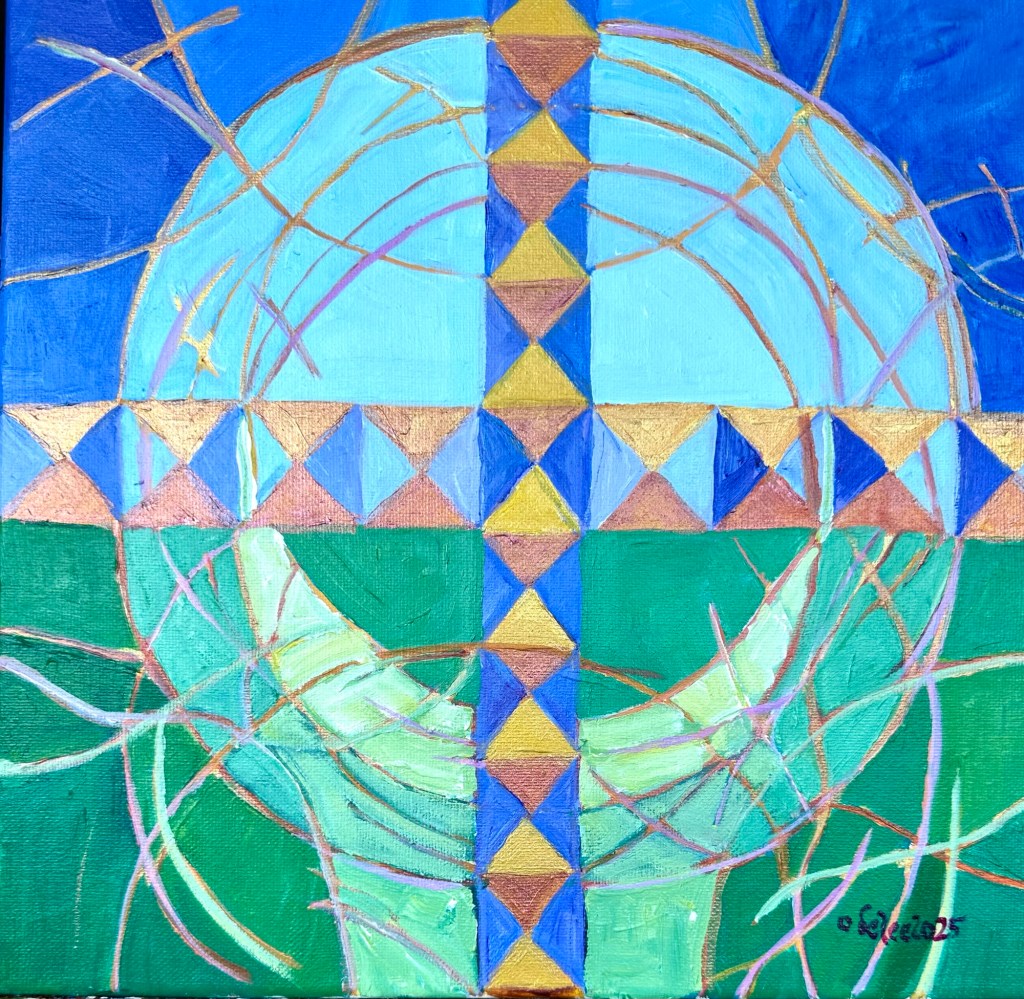
DeLee: The Dome of the Waters, acrylic on canvas, 10” x 10”, 2025

And God said, “Let there be a dome in the midst of the waters, and let it separate the waters from the waters.” So God made the dome and separated the waters that were under the dome from the waters that were above the dome. And it was so. God called the dome Sky. And there was evening and there was morning, the second day.  —Genesis 1:6-8

As I painted more, the dark blues above the light blue represented the waters above the “firmament” of the pale cerulean sky. When it rains, the holes in the dome of the sky let the water leak out, or so I’ve heard the old folks say. I never heard their explanation for why it doesn’t rain all the time, but perhaps “angels are involved.” They might be busy plugging the holes in the dome with their fingers, but God must have many angels working hard on our behalf.

The area below is in greens for all the growing and thriving things. There is an upside-down dome, or a Cheshire Cat smile pale green eighth moon shape for the underground water sources. All the intersecting compass marks are the energy signatures, which God’s power unleashes when God makes a new thing or renews an old thing. If we are sensitive to God’s creative spirit, we cannot help but be in awe of the magic and mystery of not only the minutiae of nature, but also the grandeur of the cosmos.

Ansel Adams: Wilderness, California. Afternoon Thunderstorm, Garnet Lake.

The great landscape photographer Ansel Adams was one of the voices of those who found inspiration in nature, especially our national parks. He spoke the same sensible words for our age: “As the fisherman depends upon the rivers, lakes and seas, and the farmer upon the land for his existence, so does mankind in general depend upon the beauty of the world about him for his spiritual and emotional existence.” (From a speech to the Wilderness Society, May 9, 1980).

The natural world is meant for humankind to care for, tend, and enjoy with respect, just as we would care for a beloved partner. Not everyone sees the world with the eyes of God, who so loved the world—both the humans, the creatures, and the earth itself—God gave God’s only Begotten son to save the world, “For God did not send his Son into the world (kosmon|κόσμον) to condemn the world (kosmon|κόσμον), but so that the world (kosmos|κόσμος) might be saved through him.” (John 3:17) What God created, God loves and will sustain. Can we do anything less and still be faithful to God’s calling on our hearts?

Joy and peace,

Cornelia


U.S. Church Membership Falls Below Majority for First Time

https://news.gallup.com/poll/341963/church-membership-falls-below-majority-first-time.aspx

Trans. by Nathaniel Campbell, from the Latin text of Hildegard of Bingen, Liber Divinorum Operum, ed. A. Derolez and P. Dronke, in CCCM 92 (Turnhout: Brepols, 1996), pp. 47-9. (Musical Score)

International Society of Hildegard von Bingen Studies: Karitas habundat

http://www.hildegard-society.org/2014/11/karitas-habundat-antiphon.html

Panentheism (Stanford Encyclopedia of Philosophy)

https://plato.stanford.edu/entries/panentheism/

The Universe’s First Light Could Reveal Secrets of the Cosmic Dawn | Scientific American by Rebecca Boyle

https://www.scientificamerican.com/article/the-universes-first-light-could-reveal-secrets-of-the-cosmic-dawn/

Neumes | Music Appreciation 1

International Society of Hildegard von Bingen Studies: February 2015

http://www.hildegard-society.org/2015/02/

The Book of Divine Works. | Library of Congress: Fully digitized copy of Hildegard’s final tome of 353 magnificently illustrated pages, late 12th century CE.

https://www.loc.gov/resource/gdcwdl.wdl_21658/?st=gallery

Neil DeGrasse Tyson and Star Talk: Could One Electron Explain the Universe?

https://www.facebook.com/reel/1859416304571349?fs=e&fs=e

Is a River Alive? By Macfarlane, Robert. Available as audiobook, kindle, and paperback


Pillars of Creation

art, cosmology, Creativity, Holy Spirit, Israel, Israel, Painting, Silence, Spirituality

The Bible has many creation narratives. We’re familiar with Genesis 1 and 2, but our scriptures also include creation stories in Job 38-41, Psalm 104, Proverbs 8:22-31, Ecclesiastes 1:2-11 and 12:1-7, and excerpts from Isaiah 40-55. Some believe God created the world and all of creation in seven 24-hour periods. Others believe God had nothing to do with creation, but nature alone birthed itself in a great explosion. Some believe God created the world and left it to its own purposes. For these deists, God isn’t involved in human affairs in this current world.

 We don’t have to pick a side in this argument, or throw in our lot with “God alone” or “no god at all.” We can read the scriptures with modern science in our minds and faith in our hearts. In this, I’d say “we’re better off together” than we are separated into different groups. The love of God shed abroad into our hearts can bind us in this unity. Our human, fallen condition is the anvil on which we break apart into our separate sections and groups.

God is the creator of original unity and the recreator of the coming unity of the new heaven and the new earth, which will restore the unity of our fallen and broken world. In Psalms 104:5-9, the writer speaks of God’s process of creation:

“You set the earth on its foundations,

so that it shall never be shaken.

You cover it with the deep as with a garment;

the waters stood above the mountains.

At your rebuke they flee;

at the sound of your thunder they take to flight.

They rose up to the mountains, ran down to the valleys

to the place that you appointed for them.

You set a boundary that they may not pass,

so that they might not again cover the earth.”

Later, the same author notes God is always at work in the world: “When you send forth your spirit, they are created; and you renew the face of the ground.” (Psalms 104:30)

This renewing Spirit, which proceeds from the heart of God, allows us to live in hope, even when we see brutal wars decimating innocent civilians. When nations deprive their marginalized populations of equal rights, we trust that God’s spirit will move to bring a renewing justice for those who are denied their legal rights. When famine and destruction strike, the ones who suffer have hope that those who hear God’s voice will have compassion for them and will come to relieve them.

Of course, if we believe “the voice of God is rarely heard in our land anymore,” or “God helps those who helps themselves,” we are admitting our disbelief in a living and involved deity who is willing to interfere in the affairs of human life.


HERCULES AND THE WAGGONER. A Waggoner was once driving a heavy load along a very muddy way. At last he came to a part of the road where the wheels sank half-way into the mire, and the more the horses pulled, the deeper sank the wheels. So the Waggoner threw down his whip, and knelt down and prayed to Hercules the Strong. “O Hercules, help me in this my hour of distress,” quoth he. But Hercules appeared to him, and said: “Tut, man, don’t sprawl there. Get up and put your shoulder to the wheel.”
The gods help them that help themselves

The God we see revealed in the Old and New Testament helps those who can’t help themselves. This God has done this very thing throughout all of human history! Otherwise, God would have chosen the strongest instead of the least to carry out God’s mighty purposes. Instead, God always chooses the least, the last, the lost, the lonely, and the “losers” of our world to lift up. This is why you will not find anything like “God helps those who help themselves” in the Bible. It is found in Aesop’s fable, “Hercules and the Waggoner,” where the moral of the story is “the gods help them that help themselves.” The modern variant, “God helps those who help themselves,” was purportedly coined by the English political theorist Algernon Sidney (17th CE) and later popularized by Benjamin Franklin (18th CE) in Poor Richard’s Almanac.

Pillars of Creation, strings and under painting

In the studio, the artist is always listening for the creative spirit to speak. If I’m sitting before a blank canvas and have no idea whatsoever what to do, I make a mark. I make another mark in relation to the first, for now the two need to speak and relate to one another. As I pick up some more paint to make the third mark, this one must relate to the other two, and so on I go, adding marks and colors.

Once I get some shapes defined, I begin blocking in some colors. Here too, these must speak to one another. One mark can’t shout or be overbearing, while the others fade into the background. I think of warm and cool, opaque and transparent, as well as flat and shaded. Once I get a base layer on the canvas, I remove the strings which I tied to make the shapes. I give it a rest and let my mind rest also. I can come back with fresh eyes tomorrow.

The “Pillars of Creation,” an area of intense star formation, was photographed by the Near-Infrared Camera of NASA’s James Webb Space Telescope.

Inspiration, or listening for the spirit of creation, is especially important to move a work past “coloring in the lines” into a work of art. The “Pillars of Creation,” an area of intense star formation, was photographed by the Near-Infrared Camera of NASA’s James Webb Space Telescope. In the Old Testament, the pillars of creation held up the earth itself, while the dome of the firmament (the sky) was above. The ancient, unscientific age was a limited world, with an unlimited divine being. Today we live in an unlimited universe, but too many people have a god too small to do mighty things beyond our poor capabilities.

DeLee: Pillars of Creation

When I add the silver and gold paints, the number of layers and the directions of my brush strokes determine how much of the under painting will show through. I don’t do this haphazardly, but once again I listen to that still, sheer sound of silence that once called Elijah from his cave. Elijah knew God wasn’t in the wind, earthquake, or fire, but in the sound of sheer silence (1 Kings 19). I may have music playing in the background, but I don’t hear it at all. I’m in another realm entirely. I only hear the silence.

I’m enjoying this current theme and exploration. It combines my love of space and nature. I’m a firm believer in the providence of God: if God cared enough to create all there is, God will not forsake God’s creation. God will provide, and as God’s faithful people, we’ve been entrusted with the care for God’s world. Therefore, we must join God to keep the foundations of creation stable and the resources of our world available for future generations.

Joy and Peace,

Cornelia


William P. Brown: The Seven Pillars of Creation: The Bible, Science, and the Ecology of Wonder, 1st Edition, Oxford University Press, 2010.

Does the Bible say, “God helps those who help themselves?”
https://aaronarmstrong.co/everyday-theology-god-helps-those-who-help-themselves/

The “Pillars of Creation,” an area of intense star formation, has been captured by the Near-Infrared Camera of NASA’s James Webb Space Telescope.

NASA/ESA/CSA/STScI


Learning, Growing and Thriving

adult learning, art, Athanasius, brain plasticity, Christmas, Civil War, cognitive decline, Creativity, crucifixion, Faith, Imagination, incarnation, john wesley, Love, mystery, nature, renewal, Spirituality, St. Athanasius, United Methodist Church, Valentine’s Day, Valentine’s Day

In most adults, learning and thinking plateaus and then begins to decline after age 30 or 40. The old adage, “Don’t trust anyone over thirty” takes on new meaning in regards  to creativity. People after this age start to perform worse in tests of cognitive abilities such as processing speed, the rate at which someone does a mental task. The slide becomes even steeper after 60 years of age. We also notice a similar learning decline in children after summer vacation, which results in the fall semester becoming a “reteaching opportunity.”

As one who is also “growing long in tooth,” I have passed this yardstick by a mile. I notice I have a “slower processing speed” in my creative writing. I don’t consider it a reason to quit, but a reason to better organize my other time-wasting behaviors (social media, newsletters, newspapers, etc.). I can always ignore cleaning the condominium! Creativity before housework, is my motto.

Housecleaning Meme

We often think older adults are on a downward slope with unrecoverable loss. “Use it or lose it,” the saying goes. Recent research suggests we need to apply a more hopeful mindset and vocabulary when discussing older people—much like that used for childhood or early adulthood. Decline, as we so often see it, may not be inevitable. In fact, learning a new skill and practicing it for three months has shown benefits beyond the the practice time.

Adults often have limited time or resources, so if we encourage learning a new skill, this may help them step out of their comfort zones. In people’s later years, many personal and societal changes—such as moving out of state to be closer to family members, switching jobs or coping with physical distance from loved ones—make learning new skills necessary to adapt and succeed.

For example, taking a class to improve technological skills could aid seniors’ success in an increasingly digital world, such as helping them use Telehealth or online banking platforms. Learning new skills in an art class allows a person to express their feelings and solve problems in creative ways. Each person can find their own path to success in artistic practice.

Potholder Loom, just like the one I had back in the day.

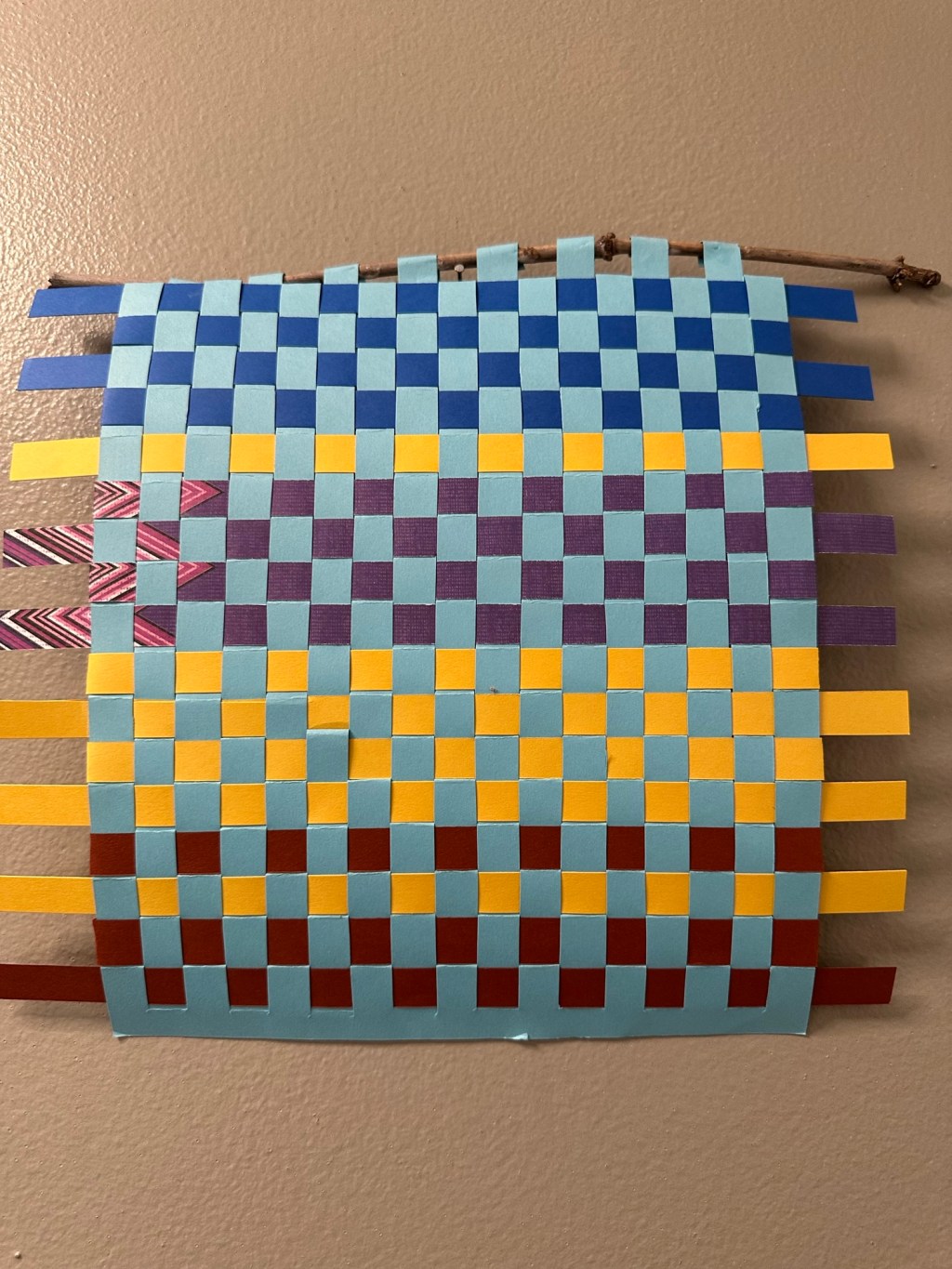
Our art class is trying a new thing: weaving. We have been painting for quite a while, so this is really a hands-on project. Some of us had the benefit of making woven potholders as children, or weaving newspaper “sit-upons” at summer camp. The technique isn’t unknown, but making a creative design interpretation is how we take our basic skill forward into a stimulating and creative brain challenge.

DeLee: Woven Paper on a Stick (Earth and Sky)

We could just repeat what we already know, but this doesn’t build us new neurons in our brains. If we keep the same old paths and don’t create new ones, we aren’t flexible when we meet new situations. Since we live in a rapidly changing world, building a brain capable of rapidly adapting is important to live independently and vibrantly for as long as possible.

I remember how my Daddy could only use the old tv remote to change the channel for the original non cable stations. When “Murder, She Wrote” came on the cable channel, my Mother had to use the cable remote to change the station for him. His Alzheimer’s disease prevented him from learning new skills, but he remembered all of his previous medical training and could diagnose his condition and boss the emergency room doctors when he was admitted to the hospital for a fall. Our brains are a mystery indeed.

Mike jumped the gun on Valentine’s Day and created a woven heart. These were big in the Danish and German communities and very popular in the 19th century in America. During the Civil War, soldiers made many of these in elaborate forms to send to their loved ones back home.

Unknown Artist: Affirmation Weaving

The brain is a fantastic and mysterious organ. If we make a habit of learning something new every day, of whatever interests us, we have the opportunity to keep our lucidity for a longer time. We also we meet the quickening changes of modern life with a steadfast heart and mind. We stress less when we know we can adapt and change in our own lives. We don’t have to be the people who say, “You can’t teach an old dog new tricks.” We can teach and we can learn, but we might need to be more patient with the old dog. In some corners, we call that “grace.”

I watched my Granddaughter’s Daddy Daughter Dance

Our group was in and out during the several weeks devoted to this project. One of us was sick, one was grieving the death of a beloved pet, another had pressing work issues, and the teacher went to Florida to see her granddaughter get married. Amazingly, life goes on. People dropped in for spiritual support, which is a side benefit of the community of art class. I managed to get mine mostly done, and Gail S. finished hers completely. Sometimes life interrupts our best intentions and we move on. We will learn new lessons on the next project.

Gail S’s “Eye of God” weaving

 Gail S’s “Eye of God” weaving incorporates yarns from two different mop heads, some sticks, and a bird feather. Gail almost always keeps a realist focus in her works, so her eye of God has a bird feather to mark the pupil. The upper field of grey and white mop yarns represent the cloudy sky, while the blue yarn stands for the water and the brown for the land. God watches over all of God’s creation. Gail S’s love of the outdoors and all of nature is evident in all her work.

Cornelia’s Cross on a Hill (unfinished)

I also recycled some old paintings and cords which I’d used in the preparatory work of other paintings. In addition, I used some recycled strips of Amazon shipping parcels as well as a wire shape which once belonged to a butterfly wing. In repurposing these items into the weaving along with two old brushes bound together with a God’s eye, I invoke the renewal of life after death.

We people of faith have two opportunities for a renewal of life after death. The first is by our profession of faith in Christ and his life, death, and resurrection on our behalf for our salvation. This gives us a living faith in this world. The second renewal is for the resurrection from death itself. This gives us a life beyond this world. Our faith is worthless if it doesn’t change us for our walk upon this world. If we don’t have the heart and mind of Christ within us, and if we aren’t earnestly seeking to be made perfect in the love of Christ daily, our United Methodist heritage tells us we’ve not yet been converted.

Yet Christ desires to save all, as John records in 12:32,  Jesus tells the crowd,

“And I, when I am lifted up from the earth, will draw all people to myself.”

Not just some people, or only the best, or even just us United Methodists, but ALL people. Most of us aren’t able to understand such a wide ranging love, for we live in a world of tribal loyalties. If we look at creation, which is God’s first work, God loves that which God created. God loves everything God created. We humans are the ones who choose sides and introduce boundaries and hate into God’s singular creation. The world or Kosmos is the creation first and then the people in it.

Today we tend to ascribe “world” to the “culture,” or secular society in general, but its plain meaning is creation and the human presence, for good or ill. The ancient Greeks and Romans divided the world into the material (bad) and the spiritual or mind (good), but the Jewish theology conceived the unity of both as part of God’s gift to humankind.

In the fifty-fourth chapter of On the Incarnation, St. Athanasius of Alexandria wrote a sentence that has echoed down through the centuries even into our own time as a brilliant summary of the Gospel. He wrote this: “God became man so that man might become god” (54:3).

This doctrine is called theosis or acquiring the whole nature of God. We United Methodists call this state Christian Perfection, or “a heart so full of love of God and neighbor that nothing else exists.” Our Wesleyan heritage was influenced by the Wesley brothers’ deep love for the Greek Orthodox fathers of the early church. To focus only on fallen nature is to deny the power of God to redeem us and all creation and to make all things new. We humans and nature aren’t more powerful than God!

If we cut off part of our God given self, we deny the incarnation of Christ, who became human for us that we might become divine. We need to remember what John 3:16 so succinctly states:

“For God so loved the world that he gave his only Son, so that everyone who believes in him may not perish but may have eternal life.”

Art is a way to open our eyes and hearts to a new way of seeing spiritual truths. Art is also reflective of the artist’s soul and spirit. A sensitive viewer can read the tale of trauma or the struggle for survival in an artist’s body of work. More than this, we can listen for their voices straining to be heard. Most people have been silenced and conformed to the “cause no trouble, don’t get out of step” mantra of the public school system training our youth for the workplace.

In art class, we can lose our fear of being different because being different gets rewarded! Being original gets an attaboy or attagirl.  I find such joy helping people find new courage and creativity they didn’t know existed within themselves. My students keep me young too. I feel blessed beyond measure.

Joy and peace,

Cornelia


To Stay Sharp as You Age, Learn New Skills | Scientific American

https://www.scientificamerican.com/article/to-stay-sharp-as-you-age-learn-new-skills/

That Man Might Become God — Fr. Andrew Stephen Damick
https://blogs.ancientfaith.com/asd/2015/01/22/man-might-become-god/

Pumpkins and Gourds

adult learning, art, Creativity, Faith, generosity, inspiration, Ministry, nature, Painting, picasso, pumpkins, shadows, Spirituality, suffering, Winston Churchill

Sometimes I can work for hours and end up with nothing to show for it. In grammar school, I could use the excuse, “The dog ate my diorama.” Today my primary reason is “The latest iOS upgrade sent my file into the far realms of the cloud and smashed it to smithereens while it was traveling to some unknown destination.” I can be thankful at least my mind only goes on occasional jaunts to Pluto, but it returns after those excursions after a time. And no worse for wear, not that anyone would ever notice.

Selfie as Bat Girl

Today will be different. I am determined. I am convinced. I am also wearing my Bat Girl costume, so I will not let the powers and principalities of evil defeat me. I will fight against the darkness of the night and bring the light to the hidden places. When we start a new venture, the only way we can gain experience is by failing. In fact, failure is how we learn. The best teachers set up the learning process in structured practices which build upon each prior experience. We also observe our students to note if we need to reteach a lesson from a different point of view to cement their understanding before we move onto the next phase.


Mr. Rogers was still breaking world records in running for his age group at age 100. He died on November 14, 2019, while in hospice care at the age of 101.

No one learns to lift a huge weight in their first exercise class. They begin to lift progressively heavier weights until they can lift the heaviest weights possible. No one becomes a world class artist in kindergarten, but sensitive teachers guide them from an early age to focus and hone their skills. Later, once they absorb what their masters can teach them, artists begin to find their own personal expressions and style. Art also provides an emotional outlet for people who have no aspirations to become a professional artist. Some people only want to explore their creativity, enjoy playing with the colors, get out of the house, and interact with others. Socialization and challenging our minds are important activities for a healthy life.

Sir Winston Churchill
Still Life, Fruit, ca. 1930’s
Heather James Fine Art

“Happy are the painters for they shall not be lonely. Light and color, peace, and hope, will keep them company to the end, or almost to the end, of the day.”

Winston Churchill wrote this in Hobbies in 1925. reflecting on the solace painting had provided him since the death of his daughter Marigold.

Hans Hoffman, The Pumpkin, oil on canvas, 1950, 36” x 48”.

One of the great teaching artists, Hans Hoffman, was known for his quote:

“The ability to simplify means to eliminate the unnecessary so that the necessary may speak.”

When we see a landscape, a still life, or a face, most of us get overwhelmed with the myriad details. We want to focus first on the details, instead of the bigger shapes. This gets us in trouble every time. What do the time management gurus tell us over and over? Write down your list. Number your biggest priority. Do it first. Always do the biggest, hardest, and nearest in time deadline things first.

The Eisenhower Matrix Decision Chart

This is how we make our basic sketches on our canvas. Get the big shapes on the canvas first. They do not have to be a great outline, but a general gesture that takes up the space of the object, proportionately to the other objects. Often, we treat our marks as if we are chiseling in stone. With paint, we can let it dry and go over it and no one will know the difference.

As we paint big to small, we can paint the darks, the lights, and the middle tones. This allows us to blend the colors together if that is our desire. Sometimes the blank white canvas fills us with trepidation. We may think our first sketch might be somehow “wrong.” There are no wrong marks in art class, but we may make many marks on the way to fulfilling our mind’s ideas in life. Winston Churchill has a remarkable story of his personal experience learning to meet the open maw of the great white canvas. It once terrified him as much as “Jaws” does the modern movie goer.

Picasso Cubist Still Life with Watermelon

This week we approached our seasonal gourd and pumpkins from several different directions. We looked at zen tangle designs, realism, and pumpkin patch photos. We also looked at paintings that focused on the stems and vines. We also looked at Picasso’s still lifes. He was a master of the Cubist patterns and simplification of forms. He did not try to make the objects look real, but made shapes, which were pleasing to the eye.


Michael’s Pumpkin

Michael painted an exuberant pumpkin with a giant green stem and his usual textured background. He enjoys his time in art class and his work shows it.


Gail S.’s pumpkin

Gail S. painted a multicolored group of pumpkins attached to a sinuous vine. She brings her knowledge and background in nature as a park ranger to her artwork. She always has an interesting design element to her work.


Gail W.’s Zen Tangle Pumpkin

Gail W. Started with a realist rendering, but ended up with thin layers of paint overlapping at the edges of the pumpkin creases. When she asked what was going on in her painting technique to cause this, I noticed she was using water to thin her paints. “When you thin your paint so it is transparent, then when it overlaps, you get a solid line. Use your paint straight out of the tube next time.” She took her painting home, added another layer of paint straight from the tubes, and decorated the whole with zen tangle designs, using a fine point marker.

Cornelia’s Gourds

I put my gourds in an interior setting, as if they were on a tabletop near a window, which looked out onto a blue sky. I added a tree branch bereft of autumn leaves, as if a cold and rainy day had preceded the day of this painting. The barren landscape outside contrasts with the luscious treatment given the gourds inside. Each gourd has its own personality and spirit. They are more than mere natural objects.

They brim with the reproductive power of nature, as a testimony to the promise of tomorrow’s abundance, even in the face of today’s barrenness. One gourd casts a shadow, while the other does not. A viewer might feel some psychic dissonance because a realistic rendering would have both objects cast a similar shadow. The space is not “real,” but “spiritual” instead.

This is the promise of a faithful God for those who believe in God’s steadfast love and providence. As we hear in Habakkuk 3:17-18, we can have trust and joy during trouble:

“Though the fig tree does not blossom,

and no fruit is on the vines;

though the produce of the olive fails,

and the fields yield no food;

though the flock is cut off from the fold,

and there is no herd in the stalls,

yet I will rejoice in the LORD;

I will exult in the God of my salvation.”

 In a world in which the good often suffer and evil seems to prosper, we always remember God is still at work to fulfill our daily needs, if not all our infinite desires. We will not want. Those who have the heart of God will always share with those who have less. Those who are greedy and don’t share God’s generous nature will stay stingy. This is how we know who is doing the work of God—the people who are loving God and neighbor both. .

Joy, peace, and providence,

Cornelia


SCHEDULE FOR 2024:

November 8—Painting

November 15—No Class—Vacation

November 22—No Class —Vacation

November 29—No Class—Thanksgiving

December 6—Painting

December 13— Painting

December 20— Painting

December 27—TBD —holiday season and school vacation calendar


Painting as a Pastime – International Churchill Society

When He Wasn’t Making History, Winston Churchill Made Paintings | Artsy
https://www.artsy.net/article/artsy-editorial-making-history-winston-churchill-made-paintings

Hans Hofmann: Quotes

https://www.hanshofmann.net/quotes.html

The Eisenhower Matrix: How to Prioritize Your To-Do List [2024] • Asana
https://asana.com/resources/eisenhower-matrix


art, Attitudes, Creativity, Faith, Fear, generosity, hope, Icons, Imagination, inspiration, Israel, Light of the World, Ministry, Painting, poverty, renewal, Spirituality, suffering, Sun, United Methodist Church, vision

The first bright light of creation must have been an awesome sight. Of course, only God was there to see it or hear it. The earth was a formless void, and darkness covered the face of the deep. Genesis 1:3 tells us, “Then God said, “Let there be light;” and there was light.”

John Martin: The Creation of Light, Mezzotint, 1825, Royal Collection of the Arts, London.

I have often wondered if God’s creation of light was accomplished with sound. If at one time only darkness existed, then suddenly light appeared, would this sudden change happen like an atomic bomb flash? Not with the bomb’s destructive evil and force, but with the creative and life-giving energy of God’s power and love. While scripture tells us we hear God’s voice in the sheer silence (1 Kings 19:11-12), this is after God has created everything which we humans might worship instead of God. When God first created light, what was the power behind God’s words?

George Richmond: The Creation of Light, Tempera, gold, and silver on mahogany, 1826, support: 480 × 417 mm, frame: 602 × 539 × 66 mm, Tate Gallery, London.

Maybe no one cares, for if no one is in a forest to hear a mighty oak fall, can we say it ever made a sound? Just because human beings weren’t created yet does not mean the light did not come into existence or make a noise. We might as well say bombs are not leveling towns in Ukraine and Gaza merely because we are not running from the falling bricks and dust. Yet, we can see the pictures on television and know these facts as true.

We are in a trickier situation when we try to find information to prove the existence of the creation of the first light and the facts of its origin. We are certain light was created, for light now exists. Tracking light’s history to its birth story is the challenge!

The Creation of Day and Night, by Francisco de Holanda, De Aetatibus Mundi Imagines, 1543.

When the Old Testament says God created light, the ancient readers understood this word to mean a special light, not the light of the sun, moon, or the stars. God created these lesser lights on a later day, so they possess a different form of light from the first light. The early Hebrew philosophers distinguished between chomer, matter, and tzurah, the form or function of an object. A raw material has chomer, matter, but once it’s made into an object, it acquires the form or tzurah.

Michelangelo’s The Separation of Light from Darkness, (c. 1512), the first of nine central panels that run along the centre of the Sistine Chapel ceiling.

At the beginning of creation, nothing had form. It was all matter. Then God created the Ohr Ha-Ganuz, or the Hidden Light. This special light played a critical role in Creation. Just as regular light allows us to see and relate to our surroundings, the Hidden Light enabled the different elements of creation to interact with one another. It dispelled the initial state of darkness when all objects were isolated and disconnected from one another. Through this special light, the universe’s myriad objects acquired purpose and function and were able to work together towards a common goal.

About 13.8 billion years ago, our universe ballooned outward at an incredible speed. Everything we see today, which was once packed tightly together, expanded in a roiling mass of light and particles. It took 380,000 years for this hot, dense soup to thin and cool enough to allow light to travel through it. This first light, dating back to the formation of early atoms, we call the cosmic microwave background and we can still detect it today.

Creation: Bright Beam, stage 1

The Advanced Simons Observatory in the Atacama Desert in Chile is on the forefront of research for detecting cosmic microwave background radiation to give us a better picture of the early universe, its evolution, and the many phenomena within it. Beyond the cosmic microwave background, they will hunt for and study the birthplaces of distant stars, the contents of interstellar dust, exo-Oort clouds—spherical shells of ice and dust at the edges of solar systems—and several other phenomena. But, given the unique capabilities of this observatory, they are also open to finding some unexpected and unexplained puzzle pieces in the universe that we did not know we were missing.

Creation: Bright Beam, stage 2

Before there were any stars or galaxies, 13.8 billion years ago, our universe was just a ball of hot plasma—a mixture of electrons, protons, and light. Sound waves shook this infant universe, triggered by minute, or “quantum,” fluctuations happening just moments after the big bang that created our universe. The question we first asked, “Did the creation of light make an audible sound?” is related to the “cosmic wave background radiation” that the observatory in the Chilean desert is seeking.

Although scientists call this moment the Big Bang, it was not a loud explosion. Instead, it was more like an imperceptible humming because this first moment happened when the universe was denser than the air on Earth and sound waves could travel through it. This covered the first 100,000 to 700,000 years. As the universe cooled and expanded, the sound waves grew longer and and the sounds lower. As the universe continued to expand, the wavelengths became so long the sounds became inaudible to the human ear.

NASA Sound File Magnified of Big Bang Microwave Radiation

For this sound file, the patterns in the sky the Planck Observatory observed were translated to audible frequencies. This sound mapping represents a 50-octave compression, going from the actual wavelengths of the primordial sound waves (around 450,000 light-years, or around 47 octaves below the lowest note on the piano), to wavelengths we can hear.

Creation: Bright Beam, stage 3 in the studio

Maybe as you read this, you wonder, why do artists have an interest in science? This is an attribute of artists from Leonardo in the Renaissance down through the Impressionists who studied the play of light and atmospheres on surfaces in the 19th century. Today we know the speed of light means we are always seeing a “late arriving sunbeam.” The speed of light gives us an amazing tool for studying the universe. Because light only travels a mere 300,000 kilometers per second, when we see distant objects, we’re always looking back in time. If we the universe clock backwards, right to the beginning, and you get to a place that was hotter and denser than it is today. So dense that the entire universe shortly after the Big Bang was just a soup of protons, neutrons, and electrons, with nothing holding them together.

Lentil and ancient grains pasta soup, held together by melted cheese—metaphor for the early universe

The moment of first light in the universe, between 240,000 and 300,000 years after the Big Bang, is known as the Era of Recombination. The first time that photons could rest for a second, attached as electrons to atoms. It was at this point that the universe went from being opaque, to transparent. The earliest possible light astronomers can see is the cosmic microwave background radiation. Because the universe has been expanding over the 13.8 billion years from then until now, those earliest photons were stretched out, or red-shifted, from ultraviolet and visible light into the microwave end of the spectrum.

Today we have tools unavailable to the 15th or 19th centuries, but what we have in common is the human mind. Because we are created in the image of God, we have the same desire to create and shape our world and to understand our place in it. For some people, they find placing their trust in God’s absolute power over all creation and events as a way of understanding the problem of good and evil in the world. This justifies suffering and allows them to ignore the plight of the poor. Prosperity religion, which preaches the good prosper and the bad suffer, is a classic example of this theological belief. We United Methodists believe in doing good to all people, as often as possible, with all the means we can. As the gospel says in Matthew 25:37-40—

Then the righteous will answer him, ‘Lord, when was it that we saw you hungry and gave you food, or thirsty and gave you something to drink? And when was it that we saw you a stranger and welcomed you, or naked and gave you clothing? And when was it that we saw you sick or in prison and visited you?’ And the king will answer them, ‘Truly I tell you, just as you did it to one of the least of these who are members of my family, you did it to me.’

We know Jesus as the Light of the World (John 8:12)—

Jesus spoke to them, saying, “I am the light of the world. Whoever follows me will never walk in darkness but will have the light of life.”

Perhaps this ancient light of creation has not yet reached everyone who reads these words. I can only guess they ignore even the voice of the Old Testament prophet Isaiah (58:10):

“If you offer your food to the hungry and satisfy the needs of the afflicted, then your light shall rise in the darkness and your gloom be like the noonday.”

The sun will always shine when we help others. The light of Christ will burn bright in us to burn away our gloom and despair when we give a hand to others who are in need. Their lives will be brighter in turn. We often turn away from people in hard circumstances because we do not want to face the prospect that we one day might need a hand up. This strikes at our self image of invincibility and self sufficiency. We keep remembering “God loves a cheerful giver.” If we think only of this part of the verse outside of its context, we might think God only loves the giver. God also must love the one in need to provide the blessing for the giver. As we read in 2 Corinthians 9:7-8—

Cornelia DeLee: Creation: Bright Beam, acrylic on canvas, 16” x 20”, 2024.

“Each of you must give as you have made up your mind, not reluctantly or under compulsion, for God loves a cheerful giver. And God is able to provide you with every blessing in abundance, so that by always having enough of everything, you may share abundantly in every good work.”

As an old mentor of mine taught me, “Don’t do all the work for your people. You’ll rob them of the blessing of serving the Lord.” None of us can replace the eternal light of Christ, which has been traveling to us since the dawn of time, although the Light has been with God since before time began. This Light is even now permeating the universe, in a prevenient journey to the furthest distances of creation. There is no place the Light will not go before us. Even as we attempt a return to the moon and hope to go to Mars in the future, the light of Christ has already gone before us.

If this does not give you hope in what many think is a dark and despairing world, refocusing on the Light with us instead of the darkness that always seems so near might help to change your attitude.

Joy, peace, and light,

Cornelia


What Did the Big Bang Sound Like? | HowStuffWorks

https://science.howstuffworks.com/what-did-big-bang-sound-like.htm

Breishit: The Hidden Light of Creation

https://www.ravkooktorah.org/BREISHIT_67.htm

The science illuminated by the first light in the universe | Stanford Report

https://news.stanford.edu/stories/2023/07/science-illuminated-first-light-universe

When was the first light in the universe?

https://phys.org/news/2016-11-universe.html

The Creation of Light: William Blake and Francisco de Holanda/thehumandivinedotorg

https://thehumandivine.org/2022/02/27/the-creation-of-light-william-blake-and- francisco-de-holanda/


Cosmic Rainbow

Apocalypse, art, beauty, cosmology, Creativity, Faith, hope, inspiration, John Ruskin, Leonardo da Vinci, nature, Painting, purpose, sleep, Spirituality, Van Gogh, vision, William Blake

In times of cultural change and uncertainty, some faith-based communities turn to apocalyptic literature to find meaning, if not solace, for their suffering. Other communities of faith look forward to a future of hope and joy, even though they live in the same circumstances.

Apocalyptic literature is a genre of writing that appeared during times of crisis or persecution. It often presents a vision of the end times and the ultimate triumph of good over evil. Apocalyptic literature has several major characteristics:

“The supreme manifestation of Satan in this world is war.” By William Blake, 1805, apocalyptic painting with
tempera, gum, glue, and chalks, Tate Galleries, London.
  1. Dualism: Apocalyptic literature often portrays a cosmic battle between good and evil forces, highlighting the struggle between light and darkness.
  2. Symbolism: Deeper meanings and abstract concepts are represented by symbolic language and imagery.
  3. Eschatology: Apocalyptic literature focuses on the end times (Greek eschatos last, farthest) and the ultimate judgment of humanity, exploring themes of divine justice and the afterlife.
  4. Pseudonymity: Many apocalyptic texts attribute their authorship to famous figures from the past, using pseudonyms or false names.
  5. Visions and Dreams: Apocalyptic literature often includes visionary experiences and dreams as a means of conveying divine messages and revelations.
  6. The future is fixed and decided in apocalyptic literature, whereas with prophecy, people can change their future by repentance and restoring their relationship with God.

Since John was already in exile, “The Revelation to John” doesn’t bother to hide his authorship for his safety. He does claim it’s a vision of Christ mediated by an angel. It also checks the boxes of good vs evil, symbolism, the end times, and a fixed future. The actual date of this future isn’t revealed, however.

An interpretive mistake many make is to take this letter written to encourage the persecuted churches of the first century and project its message into our modern-day society. The symbols which were meaningful to John’s audience are for that historical context alone. Reinterpretations of these signs to make them relevant to our current geopolitical situation is bad scriptural interpretation.

Plate 12, First book of Urizen, by William Blake

What we can do is ask, “What can persecuted communities or suffering societies of the past teach us about resilience, hope, and faith?” Some will focus on God’s destructive forces to eradicate evil and harm. Belief in God’s power to overcome evil is a source of deep comfort for people without power. These are often the ones who feel excluded from the halls of power, but also those who believe their privilege and place is slipping away.

God’s fridge would be covered with photos!

Both these groups forget they are beloved of God, just as God loves all God’s children. Sometimes we forget God’s refrigerator is large enough to have the photographs of all the people of the world on its door, along with all our latest art works also. If that’s a humongous refrigerator, then that gives us an idea of the expansive reach of God’s love, mercy, and grace for all creation.

The First Day of Creation, by Francisco de Holanda (1545), with caption, “Let there be light.”

A negative outcome of this dualist, apocalyptic belief is extremist beliefs about the end times. Unfortunately, some extremist pastors have convinced their followers to end their lives to meet their predicted apocalyptic end of the world. The leader creates the fiction of an evil out-group to bind the members more closely to their cult and proclaims apocalyptic themes to brainwash their members. Numerous mass suicides worldwide have occurred as a result, including 914 people of Jim Jones’ People’s Temple. In 1997, 39 members of the Heaven’s Gate cult in San Diego, California, committed mass suicide by poisoning to coincide with the arrival of the Hale-Bopp comet, considering this a signal for their exit from Earth. Others have given away their entire nest eggs to apocalyptic cults because “no one will need money in the new creation.”

Paul Klee: Clarification, 1932, Oil on canvas, 27 3/4” × 37 7/8” (70.5 × 96.2 cm), The Berggruen Klee Collection, 1984 Accession Number: 1984.315.54

Some of us prefer to focus on The New Heaven and the New Earth instead, as found in Revelation 21:1-4—

Then I saw a new heaven and a new earth; for the first heaven and the first earth had passed away, and the sea was no more. And I saw the holy city, the new Jerusalem, coming down out of heaven from God, prepared as a bride adorned for her husband.

And I heard a loud voice from the throne saying,

“See, the home of God is among mortals. He will dwell with them; they will be his peoples, and God himself will be with them; he will wipe every tear from their eyes. Death will be no more; mourning and crying and pain will be no more, for the first things have passed away.”

Stage 1—strings and base colors

What a day that will be! The last time God destroyed the earth with a great flood, God placed a rainbow in the sky as a promise the earth would never be destroyed again by water.

Leonardo da Vinci said, “Where the spirit does not work with the hand there is no art.” For some people, the only “good art” is representational art, or art which faithfully describes a landscape, portrait, or still life. With abstract art, colors carry emotions and shapes to form pleasing patterns for the viewer. What will the new heaven and the new earth look like? Revelation 21:11 says “It has the glory of God and a radiance like a very rare jewel, like jasper, clear as crystal.”

Stage 2—addition of gold and silver washes

While many today think of heaven as an earthly paradise, this concept is a Persian idea of an enclosed garden, much like the original garden of Eden. We tend to imagine a heaven as being a better place than the world we know, but imagining an altogether different world is next to impossible! Luke 20:27-38 is Jesus’ answer to the law-abiding Sadducees about how relationships work in heaven, and a reminder to us heaven isn’t just a perfect earth.

When I think of the providence of God, which is grounded in creation and is always recreating the face of the earth, I remember God’s promise to Noah in Genesis 9:11-13—

“I establish my covenant with you, that never again shall all flesh be cut off by the waters of a flood, and never again shall there be a flood to destroy the earth….This is the sign of the covenant that I make between me and you and every living creature that is with you, for all future generations: I have set my bow in the clouds, and it shall be a sign of the covenant between me and the earth.”

Stage 3—Added circles and more gold and silver washes

It is this cosmic rainbow of colors, the spiritual energies which most of us cannot see for the overwhelming ordinariness of daily life. We race from chore to chore, dash from task to task, and drop exhausted at the end of our days. We long for a better life, but we’re stuck on a galloping treadmill trying to keep our feet under us. I long to walk rather than run through my days. When I was younger, older people told me to slow down. As I hit middle age, I heard I would soon start slowing down. Now that I’m inching closer to 80, slowing down is finally becoming a reality!

Vincent Van Gogh said, “Paintings have a life of their own that originate in the soul of the artist.” We cannot see the new heaven and new earth unless we stop our busywork and allow God to attend to the business of our spiritual life. When we see the first glimmers of the new heaven and the new earth, we’ll realize how imperfect our world is and begin to help change it for the better, one small act of kindness at a time. This is soul work.

Sometimes that kindness first means being kind to ourselves, when we admit we can’t say YES to everything and everyone. When we admit we actually need eight hours of sleep for our health and a daily quiet time, and we can stop to study the flowers in the cultivated gardens of our neighborhoods and in our parks.

Cosmic Rainbow—acrylic on canvas, 24” x 30”, 2024.

Then we can be a beautiful rainbow, God’s light in this world for good, and bring the hope and joy of the end times to these times. We then will bring the radiance of the new heaven and the new earth to this present age and to these yearning people.

Joy, peace, and rainbows,

Cornelia


 what are the five major characteristics of apocalyptic literature – brainly.com

https://brainly.com/question/35289093

World’s most chilling cults

https://www.france24.com/en/live-news/20230424-world-s-most-chilling-cults

Paradise Definition & Meaning – Merriam-Webster

https://www.merriam-webster.com/dictionary/paradise

 Middle English paradis, paradise “the Garden of Eden, heaven,” borrowed from Anglo-French paradis, borrowed from Late Latin paradīsus, borrowed from Greek parádeisos “enclosed park or pleasure ground” (Xenophon), “the Garden of Eden” (Septuagint), “the abode of the blessed, heaven” (New Testament), borrowed from an Iranian word (perhaps Median *paridaiza-) cognate with Avestan pairidaēza- “enclosure,” nominal derivative of pairidaēz- “build a barrier around,” from pairi- “before, around” (going back to Indo-European *per-i, whence also Sanskrit pári “around, about,” Greek péri “around, in excess”) + -daēza- “heap up, build” (occurring only with prefixes), going back to Indo-European *dhoi̯ǵh-éi̯e-, iterative derivative of *dhei̯ǵh- “knead, shape” — more at PERI-, FEIGN

NOTE: As an independent derivative of the verb, Avestan daēza- “heap, pile (of earth, stones)” has been compared with Greek teîchos (neuter s-stem) “wall, fortification,” toîchos (masculine) “wall of a house or enclosure,” Sanskrit dehaḥ “body,” dehī́ “wall, embankment,” Oscan feíhúss (accusative plural) “walls.” For a Germanic derivative from the same verbal base with a different sense, see DOUGH.

The Witness of the Cross

art, Creativity, crucifixion, Faith, Holy Spirit, Holy Spirit, Imagination, inspiration, john wesley, Love, mandala, nature, Painting, perfection, Rumi, Spirituality, suffering, Sun, United Methodist Church, vision

Mosaic Crucifixion, with Mary and John.

We are a people who follow Jesus, “the pioneer and perfecter of our faith, who for the sake of the joy that was set before him endured the cross, disregarding its shame, and (who) has taken his seat at the right hand of the throne of God,” as the writer of Hebrews 12:2 reminds us. The suffering servant motif of Christ was once a model all early Christians expected to inherit and emulate.  

The Suffering Servant

Paul spoke to this suffering model in his letter to the Romans:

“…How can we who died to sin go on living in it? Do you not know that all of us who have been baptized into Christ Jesus were baptized into his death? Therefore, we have been buried with him by baptism into death, so that, just as Christ was raised from the dead by the glory of the Father, so we too might walk in newness of life. For if we have been united with him in a death like his, we will certainly be united with him in a resurrection like his.” (6:2-5)

Paul’s first sentence is perceptive because he recognizes many who call on the name of Christ nevertheless go on living an unchristlike life. In the early Christian centuries, many didn’t get baptized until they were near death because they weren’t ready to change their wicked ways. The early Christian habit of hyper-delayed baptism is well attested by the later fourth century. Apparently, the reasoning behind waiting until fairly late in life was the belief baptism cleansed sin once and only once. Consequently, any meaningful sin after baptism could leave one in a serious lurch in the economy of salvation. We have the well-known example of the early 4th CE Emperor Constantine who delayed baptism until his deathbed.

Of course, this is a misunderstanding of the Holy Spirit’s work of perfecting our human nature, but it took many centuries to work this out. We can thank John Wesley for our understanding the works of grace in the ongoing process of Christian Perfection. Baptism washes us from the stain of original sin, which is common to all humanity. Baptism also anoints us with the Holy Spirit to be continually with us and bring us to know God’s saving love in Jesus Christ.

As we grow in faith and the Spirit of God calls us to give our lives to Christ, we are justified from past sins. Some faith communities stop here, so they need over and over justification. They have no ongoing theology of sanctifying grace. We United Methodists do have this great gift, which we can give to the world. When we aren’t going on to perfection in love quite as fast as our neighbors wish we were, it’s because we’re being stubborn and resisting God’s grace.

W. H. Auden says it best:

“We would rather be ruined than changed, 

We would rather die in our dread 

Than climb the cross of the moment 

And let our illusions die.” 

The Cross and Self-Denial

The cross is ever a witness to our willingness or unwillingness to bear the cross of Christ. As Jesus told his disciples:

“If any want to become my followers, let them deny themselves and take up their cross and follow me. For those who want to save their life will lose it, and those who lose their life for my sake will find it. For what will it profit them if they gain the whole world but forfeit their life? Or what will they give in return for their life? (Matthew 16:24-26)

Often we interpret this verse in terms of giving up material possessions, but we can never give up outward things unless we’re first willing to give up our false images of ourselves. We might want to be large and in charge, or soft and sweet. Perhaps our self image is invested in being holy and serious. We may even be the class clown. These are only masks behind which we hide our truths and vulnerabilities.

Jesus spoke a parable in John 12:24-25—

“Very truly, I tell you, unless a grain of wheat falls into the earth and dies, it remains just a single grain; but if it dies, it bears much fruit. Those who love their life lose it, and those who hate their life in this world will keep it for eternal life.”

If we want to be changed, we must die to our ordinary selves, and then rise as a new creation. If we remain the same, we won’t be much, but if we’re willing to take on the image of Christ, we can be a new creation of the first order.

How The Witness was made

Ukrainian children’s hospital bombed by Russia

This is how art gets made. I saw an image of a bombed-out children’s hospital in Ukraine. Because the photographer had cropped it in a certain way, I saw an image of a cross on the brickwork. Those rectangular bricks contrasted with the diamond shaped wire work in the darkened areas in the four outer quadrants. I usually weave the whole painting surface, but this time I wove only the cross area. That was a challenge. I had to invent a new way to secure the woven canvas strips on the wooden stretcher strips.

Weaving two paintings together

As I painted the first layer, I made all the contrast of bright colors in the cross and dark blues and reds in the outer quadrants. The next day, I added a gold wash over the cross squares and painted diamond line patterns over the dark quadrants. I came back to add silver into the diamond shapes and to touch up the diagonal lines. I also painted the sides of the canvas to unify it.

Adding blocks of color to the cross of witness

I began with a gritty black and white image, but ended up with bright colors, silver and gold. This too is a metaphor for for the change which we undergo when we die to old selves and begin our transformation into the wholeness of the new creation in Christ. As Paul wrote to the Corinthians:

Gold cross and diamond shapes in the dark quadrants

“So if anyone is in Christ, there is a new creation: everything old has passed away; see, everything has become new! All this is from God, who reconciled us to himself through Christ, and has given us the ministry of reconciliation; that is, in Christ God was reconciling the world to himself, not counting their trespasses against them, and entrusting the message of reconciliation to us.” (2 Corinthians 5:17-19)

Finished painting: Cross of Witness

The cross isn’t a means to divide us from one another, just because we hold varying views on baptism, holy communion, pastoral authority, and scriptural authority or interpretation. The cross stands as a witness to all who are willing to give up their identities to their old egos and claim the only one uniting all persons every day.

Unity through the Cross

This is the Christ, whose love was so great for all creation, he was willing to be lifted up on the cross to draw all humankind unto himself. As Jesus said in John 12:32-33—

“And I, when I am lifted up from the earth, will draw all people to myself.” (He said this to indicate the kind of death he was to die.)

We want to have our Big Mac and Eat it too.

Delusional Mathematics

As we self interested people today have difficulty with many of the words of Christ, we resort to our cafeteria style of choosing which bites we want to enjoy. If a dish in the line is too expensive or not on our diet plan, we can ignore it. The problem with Christ is how we can ignore one claim upon our faith, reject another, and keep another. As a dieter from way back days, I splurged on many a Big Mac or Whopper and large fries, which I washed down with a giant Diet Coke. Unfortunately, my body didn’t follow the same mathematical logic of my mind. I was practicing delusional math.

“Cheeseburger and fries, with a side of Diet Coke.”

“This is my commandment, that you love one another as I have loved you. No one has greater love than this, to lay down one’s life for one’s friends. You are my friends if you do what I command you” (John 15:12-14). John Wesley, in his sermon, The Almost Christian, talks about those who have the outward form of Christianity, but not the inward being. They can be recognized by their attendance at Sunday services, their good deeds, and their attention to the outward shows of ritual. Inside, however, their hearts aren’t filled with love, but with anger, spite, or mere duty instead. They lack sincerity, which is a classic characteristic of one who wears a false mask.

The Last Presidential Assassination

When Ronald Regan was shot by a would-be assassin, his diary recorded his thoughts on his excruciating experience.

“Getting shot hurts. Still my fear was growing because no matter how hard I tried to breathe it seemed I was getting less & less air. I focused on that tiled ceiling and prayed. But I realized I couldn’t ask for God’s help while at the same time I felt hatred for the mixed-up young man who had shot me. Isn’t that the meaning of the lost sheep? We are all God’s children & therefore equally beloved by him. I began to pray for his soul and that he would find his way back to the fold.”

 The Altogether Christian

To be a Christian in the true sense, Wesley says the “Altogether Christian” requires us both to “love God and neighbor in our hearts until nothing else exists.” This means even our enemies. I personally find this the most difficult part. I can hold a grudge with the best of the nonbelievers. Yet I don’t find myself calling those people evil or deranged, like so many others who seek to find a reason for their scapegoating.

I can still see people, even myself, as part of flawed and fallen humanity. 

Christian Perfection

Wesley defines the pure faith: “Now, whatsoever has this faith, which purifies the heart, (by the power of God, who dwelleth therein,) from pride, anger, desire, from all unrighteousness, from all filthiness of flesh or spirit; which fills it with love stronger than death, both to God and to all mankind; love that doth the works of God, glorying to spend and be spent for all men, and that endureth with joy, not only the reproach of Christ, the being mocked, despised, and hated of all men, but whatsoever the wisdom of God permits the malice of men or devils to inflict: whosoever has this faith, thus working by love is not almost only, but altogether a Christian.”

Under John Wesley’s exacting standards, we may all be “almost Christians,” but the good news is we can always hope in the one who gave his life to begin a new life in us and others. If we pray for our enemies’ faults, which we spot so easily because they are our own, God will help to heal both them and us.

Mending Broken Hearts

The Cross Supplants Division

An ancient wisdom story told among the rabbis says the students were questioned on the difference between night and day. All their answers marked divisions: some prayers are said only at certain hours, or there isn’t enough light to distinguish one field or a house from another. The rabbi grew frustrated and cut them off. “You only know how to divide! Daylight begins when you can look on your neighbor’s face and see a friend, not an enemy.”

In this time of division, the witness of the cross reminds us Christ died for all humanity, so no one is outside the love of Christ. If we’re to love our neighbor as ourselves, caring for the poor and marginalized should be a priority for the people of faith. Our neighbors don’t stop at our borders, for our world is interconnected.

Migrations were a fact back in Abraham’s day, when Egypt was the land of opportunity. We ought to treat immigrants better than the Pharaohs treated the Hebrew people. Moreover, in our current political landscape, we might want to quit name calling and playing to the lowest denominator of our bases. Policy statements won’t get sound bites on television, but that’s a good thing. Sound bites play to our false selves and not to our true selves in Christ Jesus.

DeLee: Sun Mandala, 2022, private collection

 I can close with a poem from the Persian poet Rumi:

I only speak of the Sun
because the Sun is my Beloved 
I worship even the dust at His feet.

I am not a night-lover and do not praise sleep
I am the messenger of the Sun !
Secretly I will ask Him and pass the answers to you.

Like the Sun I shine on those who are forsaken
I may look drunk and disheveled but I speak the Truth.

Tear off the mask, your face is glorious,
your heart may be cold as stone but
I will warm it with my raging fire.

No longer will I speak of sunsets or rising Moons,
I will bring you love’s wine
for I am born of the Sun
I am a King !

Joy, peace, and sacrificial love,


Cornelia


—W. H. Auden, The Age of Anxiety: A Baroque Eclogue (Princeton, NJ: Princeton University Press, 2011), 105.


Baptismal Trajectories in Early Christianity, Part III: Toward an Explanation – Ad Fontes
https://adfontesjournal.com/church-history/baptismal-trajectories-in-early-christianity-


Wesley’s Sermon Reprints: The Almost Christian | Christian History Magazine
https://christianhistoryinstitute.org/magazine/article/wesleys-sermon-reprints-almost-


The Regan Diaries—

 https://www.amazon.com/Reagan-Diaries-Ronald/dp/006087600X?_encoding=UTF8&qid=&sr=&linkCode=sl1&tag=jeffjaccom-20&linkId=472649155c0e042b8192d46f0dbbfcb8&language=en_US&ref_=as_li_ss_tl

 Rumi: Ghazal (Ode) 1621
Translated by Azima Melita Kolin and Maryam Mafi
Rumi: Hidden Music, HarperCollins Publishers Ltd, 2001

Music of the Spheres

adult learning, Aristotle, art, color Wheel, Creativity, Faith, Holy Spirit, Horeb, Icarus, Imagination, nature, Painting, Prayer, Pythagorean Cosmology, Silence, Spirituality, vision

One of my favorite hymns growing up in the church was “This Is My Father’s World,” by Maltbie D. Babcock, a Presbyterian minister. Written in 1901, to the tune Terra Beata, or Blessed Earth, the song was originally a traditional English folk tune, but composer Franklin L. Sheppard arranged a variation specifically for this text. This hymn and “The Church in the Valley in the Wildwood” were my mother’s and my grandmother’s two favorites to sing. I loved them both also because of their location in nature.

This is my Father’s world,
And to my listening ears
All nature sings, and round me rings
The music of the spheres.
This is my Father’s world:
I rest me in the thought
Of rocks and trees, of skies and seas–
His hand the wonders wrought.

As Paul wrote in Romans 1:20—

“Ever since the creation of the world (God’s) eternal power and divine nature, invisible though they are, have been understood and seen through the things (God) has made.”

Tracing history backwards from the 1st CE, the Pythagoreans (active from the late 6th to the mid 5th century BCE) thought the music of the spheres was an ethereal harmony produced by the vibration of the celestial spheres.

Aristotle said the Pythagoreans believed things are numbers or they are made out of numbers by noticing more similarities between things and numbers than between things and the elements, such as fire and water, as adopted by earlier thinkers. The Pythagoreans thus concluded things were numbers or were made of numbers. Therefore, the principles of numbers, the odd and the even, are the principles of all things. The odd was limited and the even was unlimited.

Aristotle criticized the Pythagoreans for being so enamored of numerical order that they imposed it on the world even where it wasn’t suggested by the phenomena. Thus, appearances suggested there were nine heavenly bodies orbiting in the heavens but, since they regarded ten as the perfect number, they supposed there must be a tenth heavenly body, the counter-earth, which we cannot see.

Pythagoreans presented the principles of reality as consisting of ten pairs of opposites:

1. limited—unlimited

2. odd—even

3. unity—plurality

4. right—left

5. male—female

6. rest—motion

7. straight—crooked

8. light—darkness

9. good—bad

10. square—oblong

In art we have similar categories which we use to create dynamic images. If our painting is all of one value—all white, all black, or all middle value—it lacks visual interest. We are drawn to images which have contrasting values covering multiple values. As with everything, too much of a good thing can become a bad thing! In medicine, a small dose of Botox can make wrinkles disappear, but a large dose could poison a person. As I tell folks, some things require experts, not DIY practitioners.

The Middle Path is safest and best—
Unknown Artist: The fall of Icarus., Fresco of the Third style from Pompeii, 50—75 CE. (H. 35.5, W. 34.5 cm.),
London, British Museum.

I’ve probably mentioned before my encounter with the Hostess chocolate cupcakes. When I realized I could buy a whole box for slightly more money than a package of two tiny cakes, of course my starving art school student budget sprung for the box. That’s when I ate chocolate cupcakes for breakfast, lunch and dinner. By the end of that box, I was cured of my chocolate cupcake desire for a very long time. This is a classic case of “too much of a good thing,” or “knowing when to stop.” The Greeks recognized the need to curb human behavior of our “all or nothing” thinking by prescribing the idea of the Golden Mean, or “nothing to excess.” I definitely went to excess on my cupcake journey.


Mies van der Rohe’s Tugendhat Armchair was designed for the Tugendhat House in Brno, the Czech Republic in 1929 and is one of several different furniture pieces designed for the home of Greta Weiss and Fritz Tugendhat.   In the design of the home, Mies designed nearly every detail down to the furniture used.  He also prescribed the placement of each furniture piece in the home to maintain spatial composition.

Mies van der Rohe, whose architecture and furniture design exemplified his style, “less is more,” never reduced his work to nothing. His work was faithful to the new industrial materials of steel and glass being used in skyscrapers. Our excess in art is never to nothingness, but we don’t over elaborate or over decorate, just for the sake of filling the space.

So, what do we do and how we proceed? When faced with the challenge of all we see before us, what do we select to make our images? I believe this is where the creating Spirit comes into play, for we can walk past a tree all day long, but on a certain day, the tree comes alive for us. When Moses was herding his father-in-law’s sheep out in the wilderness, his mind was on the sheep, his current family, and his past life and deeds. Scripture doesn’t tell us how long the bush burned on that mountain before Moses noticed it and said, “I must turn aside and look at this great sight, and see why the bush is not burned up.” (Exodus 3:3)

Likewise, we walk past inspiring images daily when we’re preoccupied with our day-to-day concerns. We also have difficulty finding time to create because others want our attention first. One of my seminary professors lectured us in class about taking time to keep our spiritual lives front and center as we moved through school and our church appointments. She said our spouses and children would want to be first, plus our congregations also would want to be first. We’d most likely want to put our careers first to get a bigger steeple or to please our supervisors. However, if we put anything or anyone before God, our spiritual lives would suffer, and like dominos, everything else would fall also. “Many are called, but few are chosen,” as Jesus says in Matthew 22:14.

In art as in life, we need to be deeply rooted in the life of the Spirit. I can tell when I’m going through the motions, but I keep on painting, for I figure I’ll at least learn something from my adequate work, so I’ll be found ready when the creative Spirit strikes. Sometimes I’m more present to the cares and concerns of this world and my work suffers for it. Other times, I’m under the creating power of a Greater Power and my work is altogether more inspired because of that energy. We’d all be more vigorous and creative in our everyday lives if we spent more time in prayer, contemplation, and searching the scriptures to hear God’s voice speak in the silent corners of our hearts and minds.

Mike: Sun and Moon, quick painting

Last week, only Mike and I showed up for art class. Everyone else was either tied up with doctor appointments or at home with rehab or otherwise occupied. Mike and I explored making different colors with the 8 Color Prang Watercolor Set. We can make interesting colors by combining the complementary colors or the tertiary colors. Mike’s first landscape painting got the energies of his competing needs out of the way.

Mike’s Second start—just beginning

As in journaling, we often need to make a habit of writing our thoughts so our deepest feelings can get expressed. He began a second painting with more focus on the goal of mixing new colors.

Music of the Spheres: watercolor

I started my painting with the circles by using yellow watercolor to outline intersecting circles of the same size on my paper. Then I mixed some primary colors together, some secondary colors together and some tertiary colors together. I painted different sections of the overlapping circles. Some of the paint I thinned to a wash, and others I laid on fully. When I got home, I painted in the background, allowing some areas to be a wash and other parts to be thicker.

Music of the Spheres: Creation Energy, acrylic

I finished at home an acrylic painting, which explores some of the same themes as the watercolors we’ve worked on in class. In this I used various material with different textures for my spheres. One of the circles is more three dimensional because it’s from a handmade cloth mask left over from the pandemic. I painted parts of it, also. The background has lines of “energy” all about.

While the Pythagoreans attempted to see unity and harmony in the creation in numbers, our Judeo-Christian faith recognizes God as creator of nature and nature revealing the Creator. One of the best texts to understand this distinction is 1 Kings 19: 11-13, in which Elijah meets the LORD on the mountain at Horeb:

(God) said, “Go out and stand on the mountain before the LORD, for the LORD is about to pass by.” Now there was a great wind, so strong that it was splitting mountains and breaking rocks in pieces before the LORD, but the LORD was not in the wind; and after the wind an earthquake, but the LORD was not in the earthquake; and after the earthquake a fire, but the LORD was not in the fire; and after the fire a sound of sheer silence.

When Elijah heard it, he wrapped his face in his mantle and went out and stood at the entrance of the cave. Then there came a voice to him that said, “What are you doing here, Elijah?”

No one has ever heard the music of the spheres, and the voice of God arrives in the sound of sheer silence. Perhaps that “polar opposite” of the Pythagorean’s world view was on to something after all. If we’re very quiet and still, we may hear both the music of the spheres and the voice of God in the great silence.

Joy and peace,

Cornelia


This Is My Father’s World | Hymnary.org

https://hymnary.org/text/this_is_my_fathers_world_and_to_my

Counterfeit Version of Botox Found in Multiple States | FDA

https://www.fda.gov/drugs/drug-safety-and-availability/counterfeit-version-botox-found-multiple-states

Pythagoreanism (Stanford Encyclopedia of Philosophy)

https://plato.stanford.edu/entries/pythagoreanism/