The Two Domes of Creation

art, Creativity, Faith, Holy Spirit, Holy Trinity, Icons, Imagination, Love, nature, Painting, Prayer, purpose, Spirituality

I had Anterior Cervical Discectomy and Fusion (ACDF) neck surgery at the end of March to correct a damaged disk. A very fine surgeon removed it, replaced it with a new one, and fused it for strength. Two days in the hospital and I went home to recover. I was tired for several weeks, but I soon felt well enough to start painting again. Each week thereafter I could see improvements in my hand steadiness and mental focus as the pain left my body and my healing progressed. I had been through physical therapy and shots in the neck for a year since my original injury.

The old saying about boiling a frog by raising the temperature of the water gradually also applies to pain: if it rises incrementally, you don’t realize how much you’re tolerating. I feel like a new creation, for I have a new lease on life. Most importantly, I have my sense of humor back. I know this is true, for one morning a friend sent me a funny meme. I laughed so loudly, my Apple Watch gave me a High Decibel Warning alert! Silly watch, you’ve never heard my joy.

As part of my ongoing creation series in the studio, I’ve been working with the imagery from the beginning of Genesis (1:6-8)—

And God said, “Let there be a dome in the midst of the waters, and let it separate the waters from the waters.” So God made the dome and separated the waters that were under the dome from the waters that were above the dome. And it was so. God called the dome Sky. And there was evening and there was morning, the second day.

I also had in mind the creation imagery of The Gospel According to John (1:1-5)—

“In the beginning was the Word, and the Word was with God, and the Word was God. He was in the beginning with God. All things came into being through him, and without him not one thing came into being. What has come into being in him was life, and the life was the light of all people. The light shines in the darkness, and the darkness did not overcome it.”

Hildegard of Bingen: Scivias III.1;
The One upon the throne, Rupertsberg MS,
fol. 122v, manuscript
illumination,
12th CE.

These two texts, one from the Old and one from the New Testament, remind us the Triune God has always been creating our universe and our earth. From this we understand what the Trinity has created, it will be by the same love, desire, and compassion the Trinity will sustain creation and renew creation in the proper time. Humanity is a cocreator of beauty alongside the Holy Trinity. While our works aren’t infinite or perfect, we humans hold the desire to create and surpass our best works, even as the Creator of all things saw all the work before the creation of the first human beings as “good,” but the creation of humans in God’s image as “very good.”

Too often our Christian theology hinges on some form of “sinners in the hands of an angry God,” rather than the doctrine of “God so loved the world.” This dualist contrast of sin/redemption versus love/renewal is a difference of viewpoint between those who focus on judgment and those who focus on grace. The old story of “God loves me in spite of my fallen and wicked ways” doesn’t make sense to a new generation who has gotten affirmations for all their efforts. As part of the old generation, that traditional story barely made sense even to me and my generation. Between 2000 and 2020, Gallup reported church attendance for people born before 1946 declined 11%, attendance for Baby Boomers declined 9%, attendance for Gen X declined 12%, and the facts aren’t in yet for the Millennials or Gen Z. Moreover, speaking only to “personal salvation” is not on most younger people’s minds. They are more interested in the great causes of justice for the weak and the oppressed, and in liberation for the unjustly imprisoned, just as Jesus read from the scroll of Isaiah (4:8-9):

“The Spirit of the Lord is upon me,

because he has anointed me

to bring good news to the poor.

He has sent me to proclaim release to the captives

and recovery of sight to the blind,

to let the oppressed go free,

to proclaim the year of the Lord’s favor.”

Hildegard of Bingen is a good person to help straddle this dilemma. After all, Hildegard is one of the only four women whom the Catholic Church has recognized as a Doctor of the Church. Only thirty-six other figures in the history of the church have earned his great honor, which Hildegard belatedly received rom Pope Benedict XVI in 2012. This title recognizes the outstanding contribution a person has made to the understanding and interpretation of the sacred Scriptures and the development of Christian doctrine. Only four on the list are women (Catherine of Siena, Teresa of Avila, Therese of Lisieux, and Hildegard of Bingen). The definition of the term “Doctor of the Church” is based on the three requirements a person must fulfill to merit inclusion in the ranks of the “Doctors of the Catholic Church”:

1) holiness that is truly outstanding, even among saints;

2) depth of doctrinal insight; and

3) an extensive body of writings which the church can recommend as an expression of the authentic and life-giving Catholic Tradition.

Born the tenth child in an era where a family practiced tithing or giving a tenth of everything to God in every aspect of their life, Hildegard was ‘given to God’ and taken to live in an abbey, as a nun. There she learned faith and healing, and studied medicine, natural science, music, and writing. She wrote ten books, two volumes of which are well known: Physica, a book on natural science, and Causae et Curae, a book of medicine and remedies. These two works hold most of Hildegard’s musings on the relationship between science and faith, along with her scientific observations and medicinal remedies. Scivias, Hildegard’s main theological work, stands for “Scito vias Domini,” meaning “know the ways of the Lord.”

Her knowledge came from visions of light, what today some have called debilitating migraines, which confined her to her bed for days. Hildegard spoke of her visions of light, just as migraine sufferers often report an extreme sensitivity to light, or seeing strange light patterns, in the middle of an episode. Her science was advanced for the 12th CE, but we don’t study Hildegard for her scientific truths. She is more important for her theology and spirituality about creation and God’s love for all life.

When God created the world, God pronounced God’s creation “good.” The world in which we now live is obviously corrupt and fallen, so many people have given up on it. The same was also true back in Hildegard’s time. The secular and religious empires of the West were at war. The Crusades tried to wrest the Holy Land from the Arabs in great battles resulting in mass carnage. The growth of cities’ merchant classes also threatened the established order of the powerful.

It was an uneasy time for all the people, just as it is today when the cultures of the east and the west are wrestling for dominance, great powers still try to expand their territories, and technocrats challenge governments worldwide for power. Once again it is “the times, they (were) are a changing,” as Bob Dylan, the prophet of our age sings for every age.

Hildegard speaks of God not only creating, but also being in the world. This is what we call Panentheism, which comes from the Greek words pan/all + en/in +theos/God. Panentheism considers God and the world to be inter-related with the world being in God and God being in the world. Panentheism affirms both divine transcendence and immanence. We can both experience God through the natural world, while God is also beyond our normal experience. Hildegard experienced God in both the world around her, even though she lived a secluded life, and she also experienced God through her visions. (This is not pantheism, which makes creation into the god or accepts the equality of many gods.)

Hildegard von Bingen: The universe (or the Cosmic Egg), from Scivias, an illustrated work by Hildegard von Bingen, completed in 1151 or 1152, describing 26 religious visions she experienced. Liber Scivias (Sci vias Domini = Know the ways of the Lord). The book, Codex Rupertsberg, disappeared during WW II. Transparencies are from a faksimile, copied by hand by some nuns from 1927 to 1933.
(Plate 4 fol-14r—The universe (or the Cosmic Egg)

“I, the fiery life of divine wisdom,

I ignite the beauty of the plains, I sparkle the waters,

I burn in the sun and the moon, and the stars.

With wisdom I order all rightly.

Above all I determine truth.

I am the one whose praise echoes on high.

I adorn all the earth.

I am the breeze that nurtures all things green.

I encourage blossoms to flourish with ripening fruits.

I am led by the Spirit to feed the purest streams.

I am the rain coming from the dew

that causes the grasses to laugh with the joy of life.

I call forth tears, the aroma of holy work.

I am the yearning for good.

Invisible life that sustains all,

I awaken to life everything In every waft of air.

The air is life, greening and blossoming.

The waters flow with life. The sun is lit with life.

All creation is gifted with the ecstasy of God’s light.

In doing good, the illumination of a good conscience

is like the light of the earthly sun.

If they do not see me in that light,

how can they see me in the dark of their hearts?

I am for all eternity the vigor of the Godhead.

I do not have my source in time.

I am the divine power

through which God decided and sanctioned

the creation of all things.

With my mouth I kiss my own chosen creation.

I uniquely, lovingly, embrace every image

I have made out of the earth’s clay.”

I resonate with Hildegard not only because her theology speaks of God’s love for everything God created, but also because God desires for all creation and humanity alike to come to a state of perfection. Even when I was a nonbeliever, creation always called my name. I’ve always felt a peace and wholeness when I looked upon nature. The beauty of the sky, the changing colors of the seasons, and cloud patterns fascinate me to this day. Now I can read Psalm 19:1 with a heart of faith:

 “The heavens are telling the glory of God; and the firmament (dome) proclaims his handiwork.”

Hildegard of Bingen’s final and greatest visionary work was the Liber Divinorum Operum, the “Book of Divine Works.” Each of her recorded visions elaborates the dynamic Word of God, present before and within Creation. The Word first became a human being to bring the Work of God—humanity and by extension all creation—to perfection. This grand vision is the culmination of Hildegard’s entire theological project and represents her most mature formulation of the themes central to her thought.

Hildegard believed the fundamental human vocation was to understand both ourselves and all creation as the work of God, and our place as cooperative agents of that work. Also in this  “Book of Divine Works,” Hildegard considers rational understanding as the means to know our Creator and properly fulfill the work for which we were created; the relationship between humanity and the rest of creation as microcosm and macrocosm; and the eternal predestination of the incarnate Word of God irrupting into and unfolding through time, as revealed in both Scripture and the life of the Church. Our Library of Congress has a fully digitized copy of Hildegard’s final tome of 353 magnificently illustrated pages, which is accessible at the link at the bottom of this post.

DeLee: Christ Offers the Word, acrylic on canvas,
8” x 10”, 2025

Nature has always revealed the presence of God to me, not just the in the act of creation and the beauty of nature, which I see presented daily from sunrise to sunset, but also in the transits of the stars in the night skies. From the myths of our ancestors trying to make sense of their world to our current search for the mysterious ninth planet (sorry, Pluto, I still love you, even if you’ve been demoted to a dwarf planet), and to the great nebulas and galaxies beyond our Milky Way, we humans have experienced God among these other mysteries.

While we believe one day we can know all the unknowns, we nevertheless awake to discover we stand on the precipice of yet more mysteries and the need to refine our former truths. The more we know, the more we discover we’ve barely scratched the surface of the depths of what can be known. This search for knowledge is what keeps the curious alive and ever on the quest for the outer boundaries.

Hildegard: Scivias III.1: The One upon the throne.
Rupertsberg MS, fol. 122v.

The creative mind believes a heart touched by God’s creative spirit has unique insights to give to the world, which needs beauty to confront the mess we can see outside our doorsteps and on our nightly newscasts. Creating an icon is one way to pray and enter a holy space. The circle stands for the halo, but also to identify the image portrayed as a holy or important figure. When I need to recenter myself, I always paint an icon. I pray twice—once in the act of painting and again in observing and meditating upon the image of the icon. This icon has not only the halo of Christ, but the cruciform halo, which serves to differentiate the Trinity from the non-divine saints, dignitaries, and angels. It appears on images of God the Father and the Hand of God, Christ and the Lamb of God, and the Dove of the Holy Spirit.

Rebecca Boyle describes the science of creation in “The Universe’s First Light Could Reveal Secrets of the Cosmic Dawn:”

Everything started in the tremendous burst of energy known as the big bang. Within a few seconds the universe cooled enough for the first protons, neutrons, electrons, and photons to spark into existence, and within a few minutes those building blocks came together to form the first nuclei of hydrogen and helium. After about 380,000 years, the universe was sufficiently cool for those protons and neutrons to grab free-flying electrons and form the first electrically neutral atoms. For the first time, photons stopped colliding with free electrons and were able to flow through the universe. This process, confusingly called recombination—it was actually the first true combination of atomic components—released the cosmic microwave background (CMB) light that pervades all of space. The most detailed map of this background is from the Planck satellite, a European space observatory that launched in 2009 to study this light.

DeLee: “All things came into being through him, and without him not one thing came into being.” —John 1:3

I made this second creation painting during this healing time by intuitively wrapping strings around the stretched canvas. Then I took assorted sizes of plastic lids which I couldn’t recycle, but I was “needing to find a use for them” before I relocated them to the trash heap. I belong to the generation of “waste not, want not.” (Yes, my nannie had the famed ball of string and one of tinfoil also.)

As I placed the various sized circles around the canvas, I thought of the many hours my childhood friends and I would pass the leisure of our hot summertime days with scribble challenges. One of us would make random marks on a paper for the other to decorate or to discover a magical creature of our imagination. As we grew older, these became more developed into different textures and patterns. As I painted the circles and straight lines, I saw the bright cross amid the heat of the great power of creation, with all the elements created in that first burst of light.

Hildegard: Liber Divinorum Operum II.1: The Parts of the Earth: Living, Dying, and Purgatory. Biblioteca Statale di Lucca, MS 1942, fol. 88v (early 13th CE.).

As Hildegard reminds us, “Humankind, full of all creative possibilities, is God’s work. God calls humankind alone to assist God. Humankind are co-creators. With nature’s help, humankind can set into creation all that is necessary and life-sustaining.”

One of our last days in the art class I teach at a local church to adults who are willing to pursue the challenge of treading beyond their comfort zones, I was fooling around with a compass and a straight edge. It wasn’t a ruler, but I found the center of the canvas with the compass intersections instead. I used a piece of cardboard as my straight edge. I ended up with multiple intersecting lines, all of which I left on the surface.

When I got home, I found them interesting. These I pursued, but not all of them. The art is in deciding which ones to ignore! While painting, I reflected on God’s creation. The Holy Trinity has always existed and has always shared the work of creation. Also, there is no such entity as a “Holy Binity” or just the Father and Spirit only. The Son has always existed and has always shared the work of the entire Godhead, which we often refer in a shorthand as “God.”

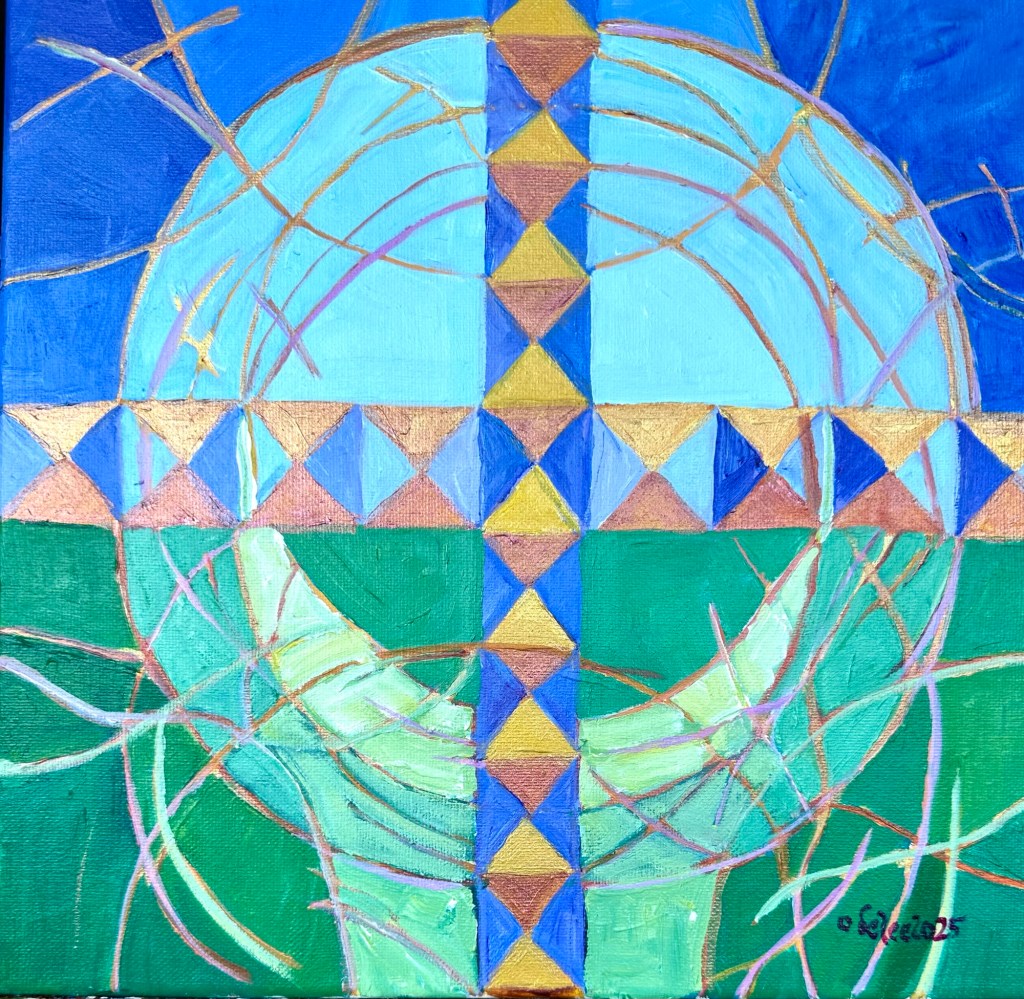
DeLee: The Dome of the Waters, acrylic on canvas, 10” x 10”, 2025

And God said, “Let there be a dome in the midst of the waters, and let it separate the waters from the waters.” So God made the dome and separated the waters that were under the dome from the waters that were above the dome. And it was so. God called the dome Sky. And there was evening and there was morning, the second day.  —Genesis 1:6-8

As I painted more, the dark blues above the light blue represented the waters above the “firmament” of the pale cerulean sky. When it rains, the holes in the dome of the sky let the water leak out, or so I’ve heard the old folks say. I never heard their explanation for why it doesn’t rain all the time, but perhaps “angels are involved.” They might be busy plugging the holes in the dome with their fingers, but God must have many angels working hard on our behalf.

The area below is in greens for all the growing and thriving things. There is an upside-down dome, or a Cheshire Cat smile pale green eighth moon shape for the underground water sources. All the intersecting compass marks are the energy signatures, which God’s power unleashes when God makes a new thing or renews an old thing. If we are sensitive to God’s creative spirit, we cannot help but be in awe of the magic and mystery of not only the minutiae of nature, but also the grandeur of the cosmos.

Ansel Adams: Wilderness, California. Afternoon Thunderstorm, Garnet Lake.

The great landscape photographer Ansel Adams was one of the voices of those who found inspiration in nature, especially our national parks. He spoke the same sensible words for our age: “As the fisherman depends upon the rivers, lakes and seas, and the farmer upon the land for his existence, so does mankind in general depend upon the beauty of the world about him for his spiritual and emotional existence.” (From a speech to the Wilderness Society, May 9, 1980).

The natural world is meant for humankind to care for, tend, and enjoy with respect, just as we would care for a beloved partner. Not everyone sees the world with the eyes of God, who so loved the world—both the humans, the creatures, and the earth itself—God gave God’s only Begotten son to save the world, “For God did not send his Son into the world (kosmon|κόσμον) to condemn the world (kosmon|κόσμον), but so that the world (kosmos|κόσμος) might be saved through him.” (John 3:17) What God created, God loves and will sustain. Can we do anything less and still be faithful to God’s calling on our hearts?

Joy and peace,

Cornelia


U.S. Church Membership Falls Below Majority for First Time

https://news.gallup.com/poll/341963/church-membership-falls-below-majority-first-time.aspx

Trans. by Nathaniel Campbell, from the Latin text of Hildegard of Bingen, Liber Divinorum Operum, ed. A. Derolez and P. Dronke, in CCCM 92 (Turnhout: Brepols, 1996), pp. 47-9. (Musical Score)

International Society of Hildegard von Bingen Studies: Karitas habundat

http://www.hildegard-society.org/2014/11/karitas-habundat-antiphon.html

Panentheism (Stanford Encyclopedia of Philosophy)

https://plato.stanford.edu/entries/panentheism/

The Universe’s First Light Could Reveal Secrets of the Cosmic Dawn | Scientific American by Rebecca Boyle

https://www.scientificamerican.com/article/the-universes-first-light-could-reveal-secrets-of-the-cosmic-dawn/

Neumes | Music Appreciation 1

International Society of Hildegard von Bingen Studies: February 2015

http://www.hildegard-society.org/2015/02/

The Book of Divine Works. | Library of Congress: Fully digitized copy of Hildegard’s final tome of 353 magnificently illustrated pages, late 12th century CE.

https://www.loc.gov/resource/gdcwdl.wdl_21658/?st=gallery

Neil DeGrasse Tyson and Star Talk: Could One Electron Explain the Universe?

https://www.facebook.com/reel/1859416304571349?fs=e&fs=e

Is a River Alive? By Macfarlane, Robert. Available as audiobook, kindle, and paperback


Creating a Picasso Still Life

art, brain plasticity, Cezanne, change, Creativity, Habits, Healing, Imagination, inspiration, Painting, perspective, picasso, purpose, renewal, Spirituality, vision, war

Einstein never said, “If we do the same thing every time, but expect a different result, this is the definition of insanity.” So why do artists return over and over to the still life? For that matter, why do preachers repeatedly use the same scripture texts for their sermons? Some of my former congregation members might have said I was overly fond of certain verses. The scalawags among them might have thought I did not get my point across the first five times I preached a version of the sermon text. As Jesus was wont to say in Luke 14:34-35 about Salt:

Picasso: Self Portrait, 1907, oil on canvas, National Gallery of Prague

“Salt is good; but if salt has lost its taste,

how can its saltiness be restored?

It is fit neither for the soil nor for the manure pile;

they throw it away.

Let anyone with ears to hear listen!”

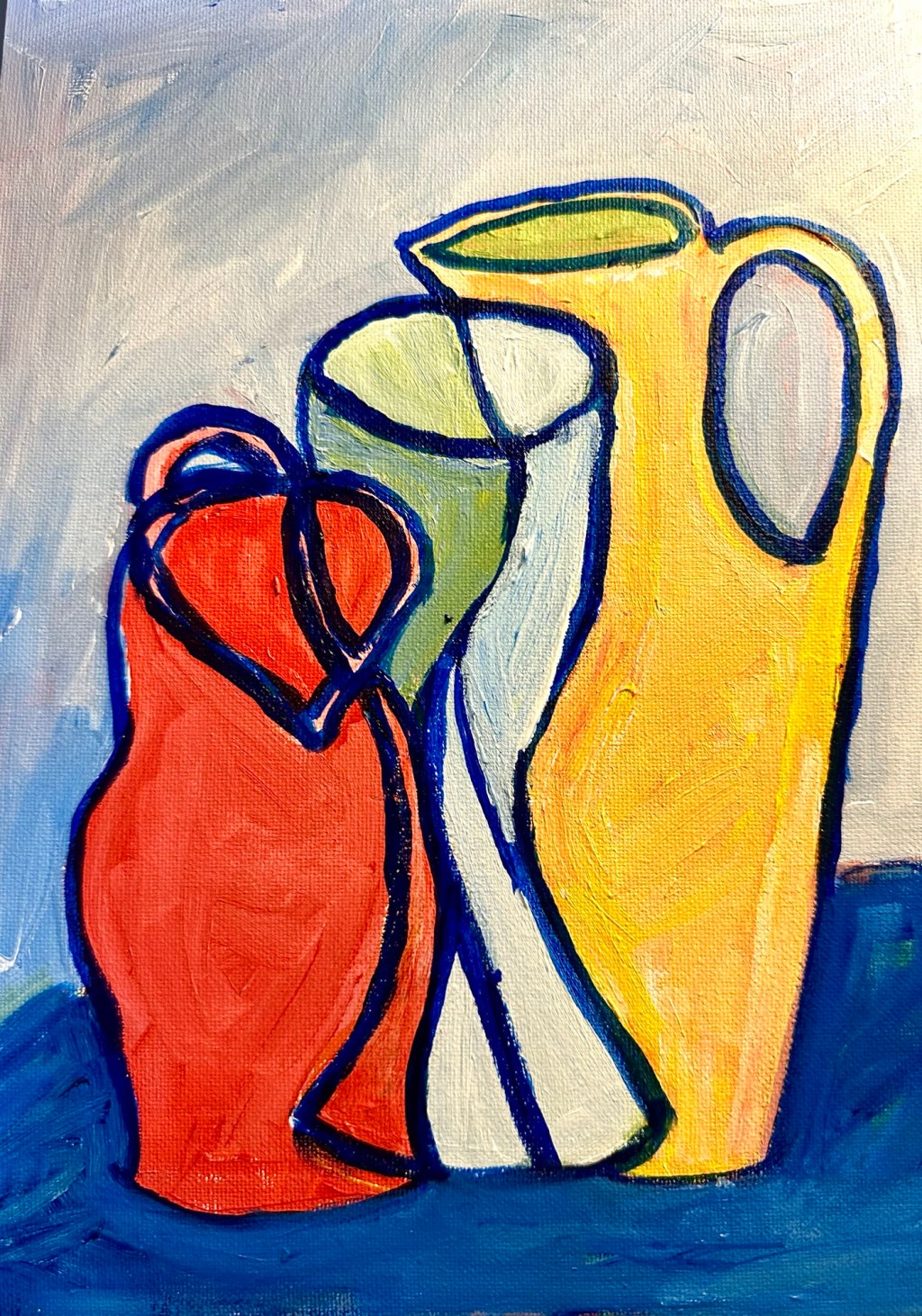
Three Sacramental Vessels

I always kept my sermon notes just in case I had a difficult week and might need a backup sermon, but I never used these notes. I wrote each of those sermons for a time and a place, but they were never useful for the current time or the present location. Likewise, an artist brings their emotions and experiences of the present time to each working session in the studio. Sometimes an artist is chock full of energy and power, full of joy and life. Their paintings or works exude these same emotions. At other times, the cares and chaos of the world intrude into the otherwise peaceful precincts of the artist’s workplace. These emotions and troubles will also be visible in their work, for artists are in tune with their times.

Picasso: Still Life with Dead Pigeon, oil on canvas, 1941, Nagasaki Prefectural Art Museum

This year in the adult art class I’m teaching at Oaklawn UMC, the students are getting lessons not only on how to paint, but on awakening their individual creative voice. These lessons are part art history and part “thinking like an artist” by painting in another artist’s style. The week before, we worked on a typical still life painting. For this session, we worked on what we saw in front of us, but tried to make an emotional connection with the objects. When most of our energy is going to getting proportions in proper order, shadows cast in the right direction, following the shape of the objects, and the colors correct, putting our emotions into the work comes in a distant fifth or last.

Morandi still life: he painted the same vessels so often, they became as friends who shared their innermost secret thoughts with him.

To be sure, our class is still analyzing the containers as physical objects more than feeling or experiencing the vessels as objects with personality. We have not yet become friends with the objects, or really gotten to know them on a deep and intimate level. This is also a problem in our society today. We are not willing to know others too deeply, and we aren’t likely to let many others know us too deeply either.

Gail S in the first week: realism

This isn’t a problem confined to older people. For my own demographic, meeting new people seems a mite risky these days in the online world because we never know who is behind that chatbot or Facebook account who seems so charming. For younger people, who sometimes never seem to come up for air from the online world, this online reality can seem more real than the three-dimensional world in which we live. (I was today old years when I learned the latest online AI fad is personalizing your own chatbot companion. I wonder if these chatbots have Asimov’s 3 Laws of Robotics ingrained in their program guardrails.)

Gail W in the first week: realism

Having empathy with inanimate objects is difficult. Artists bring into their own studio the objects which interest them. A teacher brings in objects her students can approach, given their skill level. I will blow that concept out of the water this Friday with some crazy Halloween pumpkins but, if the subject matter is consistently too difficult, many students will give up if the challenge is too far out of reach.

Picasso Still Life, oil on canvas, 1937, private collection.

In the second session when our class saw these same liturgical vessels, we chatted about Picasso and cubism. Cubism had several different forms of expression, but we focused on synthetic cubism, a later phase of the cubist style dating from about 1912 to 1914. It had simpler shapes and brighter colors. Synthetic cubist works also often include collaged real elements such as newspapers and cardboard. These works have interesting designs, such as multiple points of view (perspective), overlapping shapes which make their own patterns, and linear outlines. This style is an outgrowth of the work of Cézanne, who said: “A work of art which did not begin in emotion is not art.”

Gail S. took a cubist vision to our same three pots

If you’ve ever tried to put on your socks in the morning beginning with a different foot than normal, you can begin to appreciate how difficult it is to imagine how to create an artwork in a fresh style. If we were to ever have a stroke or a traumatic brain injury, relearning how to do simple tasks is much the same.

Tim’s first effort. He was one week out from surgery. His body was devoted to recovery, not to thinking about cubism.

Our brains can handle the rebuilding project, but we will feel strange doing it! This is because we are building new neural circuits and pathways in our brains. Going to work or the grocery store by taking a different route also feels strange, as does a golfer trying to reconstruct their swing pattern.

Tim took a second week to elaborate on his still life. It’s a better solution! Amazing what happens when our bodies have extra energy to give to creative projects.

As a comparison, we can look at the great hurricane which came through North Carolina recently and took out the big interstate highway that runs through the mountains and valleys. The sooner the highway construction engineers can come inspect the ground, the better. They must decide if the land is safe for rebuilding and then check the infrastructure also. They may need to redesign the road to current standards and also the underlying roadbed. When the great 1900 hurricane hit Galveston, rebuilding the city took twelve years. People were still living there, and life was going on, but the city began a process of raising the land levels and building a sea wall that took that extensive time.

Cornelia’s overlapping shapes and shifting perspectives

Change doesn’t happen overnight. Every sales or leadership training session I’ve been in has emphasized the idea “Three weeks are necessary to build a habit.” The origin of this myth has nothing to do with habit formation. Instead it comes from a 1960 self-help book Psycho-Cybernetics, in which plastic surgeon Maxwell Maltz wrote how his patients took about 21 days to become used to their new appearance after surgery.

He did no double blind, peer reviewed study to verify this, but his book applied this 21-day timeline to many other wide-ranging aspects of self-transformation in life. He also believed three weeks was the time people needed to adapt to a new house or change their mind about their beliefs. (He also didn’t live with a preteen girl child who enjoyed rearranging the living room every night just to see how her mom negotiated a new obstacle pattern in the dark when she came home from a sales call.)

If artists want to make paintings which are technically proficient and resemble the objects they see, they are only halfway to creating a good painting. They must also bring who they are and allow the voice of God to speak through their hand to make a masterpiece. In this way we separate artists into the good and the great, the ordinary and the masters. Not all of us will be prophets who listen to God’s word, but all of us can and should silence our hearts and minds of the world’s chatter and claims so the word of God can pierce our hearts.

Picasso: Guernica, 1937, 11’ x 25.5’,
Museo Nacional Centro de Arte Reina Sofía (MNCARS), Madrid, Spain

Rabbi Nahum Ward-Lev describes how the ancient prophets listened for God’s liberating word: 

“At its heart, the prophetic witness was a way of listening, listening beyond the social norms of the day, listening to the word of the liberating God. The prophets urged the people to listen to God’s word because the discourse of the king, princes, and wealthy landowners was too narrow and was limited to the interests of these elites. This conversation did not include the voices of suffering people. The prophets, in God’s name, offered a much broader discourse, a conversation that listened to and addressed the needs of the poor and the disadvantaged….

The prophetic listening tradition is alive today to inspire people to listen beyond the established conversation. The prophetic tradition challenges us to listen especially to the cries of those who suffer and to listen to the voice of alternative possibility, to the voice of God.”

Picasso: Still Life—fruits and pitcher, oil and enamel on canvas, 10 3/4 x 16 1/8 inches, Guggenheim Art Museum, NYC.

Making a painting is quite different from making a work of art. This is why house painters aren’t called artists. They may cover a surface with color and not make a mess, but their heart and soul isn’t in their work. Learning to risk our vulnerability and emotional expression is also part of art class, just as much as learning what colors to mix to make orange or green. Picasso, quoted in Alfred H. Barr Jr.’s Picasso: Fifty Years of his Art (1946), understood this:

“The artist is a receptacle for emotions that come from all over the place: from the sky, from the earth, from a scrap of paper, from a passing shape, from a spider’s web.”

We have these same experiences also, but we don’t realize these are part of the artist’s toolbox. These ordinary moments of life are also the extraordinary means of God speaking to us, if only we have ears to hear and a heart and hands ready to be used by God for God’s good purposes.

Joy, peace, and prophecy,

Cornelia


Quote Origin: Insanity Is Doing the Same Thing Over and Over Again and Expecting Different Results—Quote Investigator®. The origin of the quote is misattributed to Albert Einstein, but it originated in the 12-Step Anonymous groups in the 1980’s.

https://quoteinvestigator.com/2017/03/23/same/

Isaac Asimov’s “Three Laws of Robotics”:

  1. A robot may not injure a human being or, through inaction, allow a human being to come to harm.
  2. A robot must obey orders given it by human beings except where such orders would conflict with the First Law.
  3. A robot must protect its own existence as long as such protection does not conflict with the First or Second Law.

https://webhome.auburn.edu/~vestmon/robotics.html#:~:text=A%20robot%20may%20not

How Long Does It Really Take to Form a Habit? | Scientific American

https://www.scientificamerican.com/article/how-long-does-it-really-take-to-form-a-habit/

Nahum Ward-Lev, The Liberating Path of the Hebrew Prophets: Then and Now (Maryknoll, NY: Orbis Books, 2019), 133, 134, 135–136.                         

https://cac.org/daily-meditations/living-presence-liberating-journey/

 Meet My AI Friends, by Kevin Roose, NYTimes gift article

https://www.nytimes.com/2024/05/09/technology/meet-my-ai-friends.html?unlocked_article_code=1.Uk4.9sLW.VYS9bW4dc3ib&smid=nytcore-ios-share&referringSource=articleShare

Pablo Picasso – Oxford Reference
https://www.oxfordreference.com/display/10.1093/acref/9780191826719.001.0001/q-oro-


Megiddo at the Crossroads of History

911, Academy for Spiritual Formation, Apocalypse, art, Astrology, Faith, Healing, hope, Imagination, inspiration, Israel, Megiddo, Painting, pandemic, purpose, Spirituality, vision

Archeological Remains of Tell Megiddo

On a visit to the Holy Land, I walked in the ruins of Tell Megiddo and also climbed the hills above the Jezerell valley. From this vantage point, I could imagine the great battles of nations warring to conquer land and control trading routes. Megiddo lies at the crossroads and therefore in the crosshairs of international politics, both in ancient and current times.


Valley of Megiddo

The plains of Megiddo, the breadbasket of Israel, also were known as a great battleground in ancient times. Egypt came more than once to fight the kings of Israel and Judah. The world’s earliest recorded battle occurred here between Syrian princes and Pharaoh Thutmosis III (ca. 1469 BC). Judah’s king Josiah was fatally wounded when he confronted another pharaoh, Neco II, near Megiddo ca. 609 BC (2 Kings 23:29-30). Although Megiddo is only mentioned in the Old Testament, the New Testament refers to it once in Revelation 16:16 as Harmagedon (mountain of Megiddo), the final site of the battle between the forces of good and evil at the end times of the age. Of course, scholars have different interpretations of when these “end times” are at hand.


Map of First Recorded Battle

The final book of the Greek New Testament is ΑΠΟΚΑΛΥΨΙΣ ΙΩΑΝΝΟΥ, or the Apocalypse of John. The word apocalypse means “disclosure of truth, instruction, or reveal, disclose, uncover.” It especially refers to Jewish and Christian writings of 200 BCE to 150 CE, which are marked by pseudonymity, symbolic imagery, and the expectation of an imminent cosmic cataclysm in which God destroys the ruling powers of evil and raises the righteous to life in a messianic kingdom.

Chariot Sculpture at Megiddo Battlefield

I remember a presenter on an Academy for Spiritual Formation retreat saying she had difficulty saying the prayers in the psalter, for the psalms of lament meant nothing to her, since she had no griefs to bear. Her spiritual adviser reminded her, “We pray these prayers for others, not just for ourselves alone.” As an artist of faith, I sense the needs of the world: it’s longings, fears, hopes, and dreams. I don’t always paint “art for art’s sake.” Certainly the conflict our beloved United Methodist Church has been experiencing lately factored into this “end times vision,” for too many on both sides of this dispute have resorted to calling the other “evil.”

Megiddo: Bronze Version

I felt called to paint the landscape of Megiddo in these recent weeks. Beginning in mid August, I was working on several paintings using Google map views of the landscape around the ancient site, with inspiration from my personal photos from my visit several years ago. I struggled over it, with the colors changing from bright to earthen tones. I left it alone for a time, to look at it and take time to live with it. Doing this allows me to see if I got too interested in noodling about making different colors, rather than considering the whole area as one unit. It didn’t take long before I came to the conclusion I didn’t have unity in my work. I had no overarching focus. My life has been like this for a while, with multiple distractions.

Megiddo: Blue Version

In our broken and fallen world, I find people today are in a rush to run to the extremes. Cooler heads don’t always prevail. The moment disorder rears its ugly head, folks run around like Chicken Little screaming, “The sky is falling! The sky is falling!” They might as well scream, “The end times are here!” I’m reminded of the Y2K hysteria with everyone panicking about filling up their cars for fear the gas pumps wouldn’t work, getting cash in case the credit cards wouldn’t swipe, and buying generators for fear the grid would crash (computers not able to recognize all those zeros). As I recall, my antique VCR kept recording on schedule, and the local Walmart took back loads of panic purchases in January.

The latest outbreak of hostilities in Israel and the Gaza Strip have added to the apocalyptic atmosphere and thinking of those who are given to extremes of thought. America has sent two of its eleven aircraft carriers into the Mediterranean Sea as a deterrent to all the other nations to rethink their plans to join the fighting now going on. For the apocalyptic thinkers, this is a sign of “It’s going down!” For those of us who have calmer heads, we realize the United States is the only one of six countries with more than two of these floating armed cities. Every other country has a single one only.

General Eisenhower (R) confers with French generals French 1st Army Corps Headquarters November 25, 1944 Ranking allied leaders look over a situation map outside of French 1st Army Corps Headquarters.

It’s been the habit of American presidents and their advisers in the gamut of crises since World War II to move aircraft carriers around as a “Geopolitical Chess Piece” to demonstrate American concern, resolve, or outright anger. Because carriers are operate on the high seas where permission to move is not needed from other countries, and because they carry their own fuel, weapons, and maintenance, they’re ready on arrival at the scene of a crisis to deliver power. Moreover, since modern U.S. carriers are large and imposing, and have been unchallenged on the seas, they “show the flag” to great effect. They provide excellent “visuals.” In fact, if one carrier doesn’t do the job, sending a second with several attendant ships along is a sign of “we mean business.”

Since this is a habit, and not a novel occurrence, it’s not the sign of the end times. As the gospel of Mark records in 13:7-8:

“When you hear of wars and rumors of wars, do not be alarmed; this must take place, but the end is still to come. For nation will rise against nation, and kingdom against kingdom; there will be earthquakes in various places; there will be famines. This is but the beginning of the birth pangs.”

Benjamin West: Death on a Pale Horse, oil on canvas, 1817, Pennsylvania Academy of the Fine Arts

Will these carriers be used for their traditional purpose—a floating airfield—and will our military aircraft and service personnel actually join in the actual combat operations in the MidEast? That seems unlikely, given the Just War principle taught in American War Colleges. The moral concept of Just War begins with a good reason to go to war. A reasonable cause is to right a wrong, recover stolen property, or self defense. Not liking someone isn’t a good reason to go to war.

The just war must be fought proportionately to the harm that was done to the aggrieved. Today, if someone were to insult you or cut you off in traffic, honking your horn is acceptable, but shooting a pistol isn’t. That’s a disproportionate reaction to the harm, or an unjustified assault. Responding in anger usually leads to regret, but our emotions often get the best of us.

I remember my first year in the classroom. I was making a grand total of $8,250 a year—the extra $250 was for my master’s degree—and the school wanted to know if I wanted this pittance in 10 or 12 checks. “Oh, make it ten! I’ll figure out summer some how.” The first day of class in 1982, I had well over fifty students in the high school sign up for art because the former teacher had taught elementary lessons to the older students: she had fifty ways to draw turkeys. I brought the principal in: “This isn’t going to work. Let’s get half of them in another class.” He was good with that.

This was a country school. Most of the kids would marry right after graduation. Many of the seniors already had jobs, so young art teachers weren’t high on their respect list. I was fortunate to have taught in an inner city school back in the Northeast where the boys play ice hockey. Like an aircraft carrier sent to the Mediterranean Sea, sometimes I’d have to throw my short body into the middle of two factions who were about to throw punches. These boys were usually over six feet tall, so there was no likelihood I’d ever get hit, but just my presence would cause them to reconsider and pull their punches.

Just because we send war ships to the Mediterranean doesn’t mean we want to wage war. We Americans have a track record of showing up to keep wars from breaking out all over. World leaders know how our military is trained and the rules by which we engage in conflicts. This is why as a person of faith, each of us has to search our hearts to discern how we respond in times of conflict, whether that’s a war or just a disagreement with our neighbors.

In addition to a just cause, we must have the right intentions, the possibility of success, and enter a conflict only as a last resort. Those who follow the Just War Principles aren’t “trigger happy,” but are inclined to gather community support, decide their limits ahead of time, seek to resolve the conflict in other ways first, and if that fails, then enter the fray. The USA didn’t enter WWII until the 1941 surprise attack on Pearl Harbor, even though the war in Europe had been going on since September 1, 1939, when Germany invaded Poland. Up to that time we were supporting Great Britain with armaments.

A plan for after the fighting is done

Theologically speaking, scholars are of two minds: the end times are already here or the end times have yet to come.

1. The end times are already here—Scholars who believe this understand Matthew 24:6-8 as an ongoing event, which began with the ascension of Christ:

“And you will hear of wars and rumors of wars; see that you are not alarmed; for this must take place, but the end is not yet. For nation will rise against nation, and kingdom against kingdom, and there will be famines and earthquakes in various places: all this is but the beginning of the birth pangs.”

For some, the tribulation will happen beforehand (pretribulation), while others believe this suffering will occur after the return of Jesus (post tribulation). I remember as the year 2000 approached, many of the faithful were excited about the camera facing the Mount of Olives in Jerusalem, since this was the place from which he ascended, therefore it would be the place from which he would return. Daystar Ministries setup the camera so “everyone could see it firsthand.”

We humans tend to think our Gods are small, even if we ascribe to them “infinite powers.” We don’t realize the power of an almighty who can interrupt and reveal all of the past to be nothing but dust and introduce a new age with his appearance. No one will need a computer or video screen to view the in-breaking return of the messiah. Everyone around the world will hear the thunderclap at one moment in time, and the flash of lightning accompanying his appearance will brighten even the darkest night. This day will be overwhelmingly bright. Most of us will hide our eyes so we won’t be blinded by the brilliance of a thousand suns.

The Jesus Cam will most likely melt when Christ does return, but his return wasn’t on the first day of 2000. That wasn’t the millennium anyway, but a year early for the math challenged hopeful. It was also the year 1420 for the Muslims and 5760 for the Jews, so who’s counting matters anyway, since numbers aren’t what God depends on, nor the stars (astrology).

Durer: The Four Horsemen

2. The end times are yet to come—While pandemics, stock market crashes, and rumors of war may all sound apocalyptic, the Temple at Jerusalem has yet to be rebuilt. Complicating this task is the Dome of the Rock, a major Islamic holy site built on the same location. A Pew Research Center study in 2010 found most Americans believed war, terrorism and environmental catastrophes were at least probable by the year 2050. Nearly six-in-ten (58%) saw another world war as definite or probable; 53% said the same about the prospect for a major terrorist attack on the United States involving nuclear weapons. An even higher percentage (72%) anticipated the world would face a major energy crisis in the next 40 years. This fits with the theme of “apocalypse as the collapse of environment or society.”

Other characteristics of the apocalypse include:

1. Literal battle between physical armies under supernatural leadership—These are battles of extremists, who are convinced they have a holy calling to fight. The Crusades were fought as “Christ’s army against the infidel.” Their purpose was to restore the Christian holy sites in the Middle East and resanctify them for holy Christian worship. This mentality doesn’t respect the humanity of the enemy. The war may have a just purpose, but not be fought with just means: eradication of the enemy is unjust.

2. Holy wars against non-believers—This is an unjust war, fought with unjust purposes, with excessive force, and seeks to exterminate the enemy, who are reduced to non-persons because they don’t share the same belief system. When opposing sides can’t recognize the common humanity of one another and rage rules decisions, the lust for blood feeds upon itself. Shakespeare said it best when Marc Anthony came upon the body of the just assassinated Julius Caesar in Act 3, scene 1:

And Caesar’s spirit, ranging for revenge,

With Ate by his side come hot from hell,

Shall in these confines with a monarch’s voice

Cry “Havoc!” and let slip the dogs of war,

That this foul deed shall smell above the earth

With carrion men, groaning for burial.

My final reworking of Megiddo includes streaks of rockets in the dark night sky and swirls of chaos which churn the world’s peoples, just as Ate, the Roman personification of recklessness and folly incites the passions of Caesar’s bereaved followers. We don’t know when Christ will return, no matter how many may prophesy or calculate the date. As Jesus said to his disciples in Matthew 24:36,

“But about that day and hour no one knows, neither the angels of heaven, nor the Son, but only the Father.”

This present darkness is only momentary, for if we’re in the end times, we also have a promise we can hold on to in Matthew 28:20—

“Remember, I am with you always, to the end of the age.”

Joy and Peace,

Cornelia


Armageddon / Harmagedon – CDAMM

https://www.cdamm.org/articles/armageddon


Aircraft Carriers by Country 2023 – Wisevoter


Public Sees a Future Full of Promise and Peril | Pew Research Center


Robert C Rubel: The Future of Air Carriers

https://digital-commons.usnwc.edu/cgi/viewcontent.cgi?article=1551&context=nwc-review


Rubel, Robert C. (2011) “The Future of The Future of Aircraft Carriers,” Naval War College Review: Vol. 64 : No. 4 , Article 4. Available at: https://digital-commons.usnwc.edu/nwc-review/vol64/iss4/4


Case Study: Just War Doctrine

https://www.scirp.org/journal/paperinformation.aspx?paperid=122406


Messiahcam at Y2K

https://www.theguardian.com/world/2000/jan/01/jamesmeek


‘Cry ‘Havoc!’ And Let Slip The Dogs Of War’: Speech & Analysis

https://nosweatshakespeare.com/quotes/famous/cry-havoc-let-slip-dogs-war/

Brookdale Community College Eisenhower Collection

https://www.brookdalecc.edu/center-for-world-war-ii-studies/the-meserlin-gallery/witnessing-history/

Left to right, French 5-star General De Lattre De Tassigny, commander 1st French Army; U.S. Lieutenant General Omar Bradley, commander, 12th Army Group; French 4-star General Marie Emile Bethouart, commander 1st French Army Corps; U.S. Lieutenant General Jacob L. Devers, commander, 6th Army Group; and General Dwight Eisenhower, Supreme Allied Commander.

OAKLAWN FRIDAY ART CLASS

adult learning, art, Creativity, Faith, Holy Spirit, Imagination, inspiration, Ministry, Painting, perfection, purpose, renewal, vision

WE’RE BACK!!!

Ready or not, the creative juices must be stirred. If the brain has lain fallow all summer, or it’s been overworked keeping the youngsters occupied, now you can find your own groove again.

Our first meeting will be Friday, September 8, at 10 am in the old fellowship hall. Bring your own acrylic paints, brushes, and a canvas or canvas panel to paint on. We begin with a short visual inspiration from some great art works, I give some direction on the skill we’ll work on in the session, and then everyone is free to bring their own unique expression to their paintings. We don’t copy my work and judge how well a person can match it. Instead, we learn from others and stretch our own skills to create something new.

Paul Klee: Houses

Making great art isn’t our first purpose. As we age, we will lose our ability to learn new skills until we lose our memory of what we just ate for breakfast. Challenging our brains is one of the best ways to keep our brain cells firing and “chatting with one another.” Socialization and encouragement also helps to keep our brains young.

Frank Lloyd Wright: Stained Glass Design

Making art means we also will have to give up our desire to be perfect. Artists quickly learn perfection comes from practice, or working at it. Every baby stumbles and falls as they learn to walk, but dotting adults encourage every trembling step. This is what art teachers also do. I’ve always had a rule in my classes, especially when I taught in middle school:

No Negative Talking about People or Art.

This includes a student’s own art works. They always had to give at least three positive comments about their work before they spoke about the negative. “My work needs improvement” is a better way to say “My work stinks!”

Of course, we’ve all grown up and worked in environments where negativity is the rule. Art class is a place of grace because this is how life should be. If we can transform a blank canvas into a field of color, why can’t we transform our communities and our world into fields of hope, joy, and love?

Blue Monochromatic Study of the City

Perhaps because we often try to make everyone copy/fit into our idea of the proper end product, rather than allow everyone discover their own creative response to the given subject of the day. Finding our own voice and our own expression is important. Even beginners will have their own unique voice and vision, if they only allow the creating spirit of God work through them. The museums of our world are richer and more vibrant because artists have listened to the Spirit of the Creating God. We might do well to realize God’s creative energies are varied and vibrant also, just as Isaiah wrote about his vision of God’s Glorious New Creation:

“For I am about to create new heavens and a new earth;

the former things shall not be remembered or come to mind.

But be glad and rejoice forever in what I am creating;

for I am about to create Jerusalem as a joy, and its people as a delight.” (65:17-18)

James Wyper: City of Dreams

I hope to see you in art class. I don’t charge for the class sessions, since this is one of my ministries as a retired elder in the United Methodist Church. As John Wesley once said, “The World is my Parish.”

Joy and Peace,

Pastor Cornelia

Seeds of Dissent and a Harvest of Distrust

Ancestry, arkansas, art, Faith, Family, Forgiveness, greek myths, Holy Spirit, hope, incarnation, inspiration, john wesley, Love, Ministry, Painting, perfection, poverty, purpose, Ravenna Italy, renewal, Retirement, stewardship, Stress, United Methodist Church, vision

Christ Enthroned with the Angels
6th century Mosaic
Church of Sant’Apollinare Nuovo, Ravenna, Italy

Nothing springs full grown to life in an instant. Everything begins in a seed, which is planted, watered, and nourished into full growth. Only in myths or fantasies can an idea come into being instantly. Zeus had a very bad headache, a “splitting headache,” that birthed his daughter Athena, the goddess of wisdom. She leapt out in fully grown from his brow. We don’t take this myth to be scientifically true, but as a metaphor for the difficulty and struggles we undergo to obtain wisdom. As my daddy used to tell me after I’d learned some hard life lesson, “The school of experience is a rough master, and we all earn a costly degree in gaining its wisdom.”

Little Master Lip Painter Attributed to the Phrynos Painter: Birth of Athena, Attic Black Figure Ware, Kylix, Date ca. 555 – 550 B.C., Early Archaic Period,

Some of us will repeat the same lessons over and over, as if we expect to get a different result. The purpose of an education isn’t to regurgitate a right answer to pass a test, but to understand why the answer is right. That’s why math classes require showing the steps to the solution, rather than the “full blown adult answer” only. In matters of faith or ethics, many of us haven’t had the training to “set out the proof” for our final answer or deed. In fact, in one situation we may think or act one way, and quite differently in another.

The name for this behavior is “situational ethics.” Less kindly, it’s also known as spinelessness, shiftiness, being two faced, or dishonesty. Mostly it means people don’t have a true center or a plumb line by which they measure themselves. If we’re measuring our lives against other people, we’re measuring against other fallible human beings. Even our heroes have feet of clay, for none of us are gods. When I used to call my parents out on this character trait, they always told me, “Do as I say, not as I do.” This sets up a moral conflict for most people, even those raised in the church or in religious homes.

We need to have a moral center based on a higher authority than our individual or cultural conventions, one that includes or exceeds the ethics of the group to which we belong, and not just our individual beliefs and actions. Professional groups—physicians, lawyers, clergy, educators, and others—all have ethical standards for caring for those they serve, even if they morally disagree with the behaviors that bring them into their care. Who decides the ethics of the group? At the risk of making my favorite seminary professor, Billy Abraham, roll about in his still fresh grave, we United Methodists do have the so-called Wesleyan Quadrilateral of Scripture, Tradition, Reason, and Experience to guide us. Often we assign our personal life experience to this latter quadrilateral edge, but Wesley meant our Experience of the Assurance of God’s All Embracing and Adopting Love. As Wesley once said, “God is able to save all to the uttermost.”

The Good Samaritan by English School, (19th century)

Ethics and morals are often used as synonyms, but ethics refer to rules provided by an external source, e.g., codes of conduct in workplaces or principles in religions. Morals refer to an individual’s own principles regarding right and wrong. Ethics is a a late 17th century word derived from the Greek ēthos (disposition, character), in contrast to pathos (suffering). In Latin it means ‘character, depiction of character’, or (plural) ‘customs’.

Then we have the words moral and morals. The first is concerned with the principles of right and wrong behavior. The goodness or badness of human character is another concern. From these, people decide what behavior is considered right or acceptable in a particular society. We often say a person has morals if they conform to standards of behavior or beliefs concerning what is and is not acceptable for them to do. We can speak of “the corruption of public morals, “ or you can hear people talking as if “they believe addicts have no morals and can’t be trusted,” rather than understanding the disease and abuse bases which often underlie addictions.

These distinctions don’t change the negative consequences of the addict’s behaviors, yet the addicted person still has the same image of God and the same potential for wholeness each of us have, but perhaps with more suffering, or pathos. If we judge the morality of a person’s choices, and then refer that moral state to the individual’s worthiness, we can end up losing compassion for the person as well as losing the will to help them better their lives. This leads to hard heartedness and a lack of love. We reject our neighbors and make them strangers, unwelcome to our world. We forget our spiritual ancestors were once strangers in a strange land, wanderers without a home. How easily we forget our savior, who had no place to be born even in his ancestral home, and whose family fled religious persecution and certain death to live in Egypt, far from home. Strange how some Christians have no sympathy for others in the same fix today.

Moral is a word from the late Middle English by way of the Latin moralis, from mos, mor- ‘custom’, with the plural mores or ‘morals’. It refers to one having the property of being right or wrong, good or evil, or voluntary or deliberate, and therefore open to ethical appraisal. When we apply moral attributes to a person, it means “capable of moral action; able to choose between right and wrong, or good and evil.” Not until 1803 did moral come to mean “virtuous with regard to sexual conduct,” according to the Oxford English Dictionary.

As a noun, we meet the word in the Latin Moralia, the title of St Gregory the Great’s moral exposition of the Book of Job. Later it was applied to the works of various classical writers. All Methodists and the holiness denominations birthed from the seed of the great Methodist revival recognize the genius of John Wesley. We all quote him, but we also apply his wisdom through our own individual preconceived notions of what is “good, true, and noble.”

When John Wesley was asked, “What is that faith whereby we are sanctified?” he answered:

“First believe that God has promised to save you from all sin, and to fill you with all holiness; secondly, believe that He is able thus to save to the uttermost all that come unto God through him; thirdly, believe that He is willing, as well as able, to save you to the uttermost; to purify you from all sin, and fill up all your heart with love. Believe fourthly, that He is not only able, but willing to do it now! Not when you come to die; not at any distant time; not tomorrow, but today. He will then enable you to believe, it is done, according to His Word.”

In the old days, we said we were “going on to perfection,” not that we were so bold as to claim that we’d already arrived there or been perfected. Oh no, we allowed God could complete this for us and had the power to do it, as well as the will, but our human nature was still fallible. If a word comes up more than once in a text, writers go to the thesaurus for an alternative, but in reading scripture, we learned repetition was a sign of importance, a marker especially meant for those of us who are slow learners in the school of life.

Oliver O’Donovan in “Scripture and Christian Ethics” writes, “Moral theologians have a secret knowledge, apparently concealed from other kinds of theologians, especially those devoted to hermeneutics. They know that the most mysterious and most difficult question we ever have to answer is not, what does Scripture mean?, but, what does the situation we are facing mean?, where do we find ourselves existentially?”

We tend to speak as if our selves and our situations were known quantities, so that it only remains to choose out of Scripture whatever seems to fit our circumstances as we conceive them. Scripture has an uncanny way of shedding light on our self and our situation, to overcome our preconceptions about them. We don’t read about our situation directly in the Scriptures, yet it’s from the Scriptures we gain categories of understanding, which re-frame our view of our situation and ourselves. We can’t look for individual texts to guide our actions, but need to consider the whole of the revealed Scripture and God’s nature as we discern our path forward.

Carl Bloch: Monk Looking in a Mirror, 1875, oil on canvas, Nivaagaard Museum, Denmark.

In this sense, the Bible is a mirror which reflects our inner nature to us, convicting us of our failings and giving us grace and comfort in our times of need. We can learn much about ourselves from the verses we lean on, just as much as we can by the verses we ignore. There’s a reason we interpret texts by the whole of scripture, and not piecemeal. This is one way we understand the authority of scripture.

As an interesting aside, SWTX, my original conference, which approved my candidacy for the ministry, didn’t think I should attend seminary because I scored so low on the abstract reasoning tests I took. They didn’t think I would make 65, seminary’s passing grade, in my class work. It’s true I learn and process differently, but knowing this, I crammed a three year program into four years. If I’m slow to grasp the whole until I first understand the parts, this doesn’t reflect on my fitness for ministry or my intellectual ability. It merely reflects a different way of processing information. There’s more way to skin a cat, and many ways people learn.

When I taught art classes, I had to make sure I covered all the learning methods for all my students to have success. I talked about the project, I demonstrated the techniques, I had the steps written out, and for some few children, I had to place their hands in the optimum position to get them started. This covered ear and eye learning, visual reminders, and haptic or touch learning. Some students needed multiple types of learning throughout their working time on a project. Some needed reteaching every class period. Some just needed encouragement when they got stuck at a rough patch. Most all had to learn to talk in positive terms about themselves and their work, as well as about others and their creative process also.

I talk about this teaching method, for this is how we consciously or unconsciously teach those around us ethics and morals. As one youth asked me at a church I once served, “Why are you wearing your cross today? It’s not Sunday.”

“Because Jesus is important to me every day, not just on the day I lead church services.”

I realized even though her family was very active and faithful in our congregation, when they were out in the world of day to day folks, they didn’t stand out from the crowd. Maybe one day day this child will come to a time when wearing a cross becomes bearing a cross. Then again, how many people willingly choose suffering for the sake of the body of Christ? This suffering is often difficult for those of us who’ve committed our lives to Christ’s call, but we realize most laity won’t voluntarily submit to that kind of stress. Yet experience is a great teacher. We learn from others, even those who have differing opinions and choose different actions.

Wesley’s Sermon, “The Nature of Enthusiasm,” has some advice for us: “Beware you are not a fiery, persecuting enthusiast. Do not imagine that God has called you (just contrary to the spirit of Him you style your Master) to destroy men’s lives, and not to save them. Never dream of forcing men into the ways of God. Think yourself, and let think. Use no constraint in matters of religion. Even those who are farthest out of the way never compel to come in by any other means than reason, truth, and love.”

Jean Bondel: The fall of man—Adam and Eve eat from the Tree of Knowledge of Good and Evil, 1372, illustrated manuscript, National Library of the Netherlands.

As a further reminder from his all time classic Sermon, On Working Out Our Own Salvation, 1785: “By justification we are saved from the guilt of sin…by sanctification we are saved from the power and root of sin…”In modern terms, when we profess our faith, Christ saves us from the guilt of that first sin. Some say Adam and Eve were disobedient. They then emphasize rule keeping as their moral choice. There’s always a reason behind every behavior, however. Why were they disobedient? We hear the answer in the parable of the Tree of Wisdom:

“But the serpent said to the woman, “You will not die; for God knows that when you eat of it your eyes will be opened, and you will be like God, knowing good and evil.” (Genesis 3:4-5)

The man and the woman both heard the half truth, saw the shiny fruit, believed the promises of a creature rather than their creator, and ate the fruit they hoped would make them like gods. Instead they only gained knowledge of their nakedness and vulnerability. This first lesson of the school of life came with cost: fig leaves ooze irritating sap. They won’t choose this solution again. God’s providence replaced their poor choice with animal skin clothing even as God sent them out into the world. We might say the attitude of pride or greed drove their bad behavior and was the cause of their negative consequences.

As we grow in holiness and love of God and neighbor, the Holy Spirit destroys any remaining root of sin. One of the important sins, Wesley noted, was pride. Pride is that feeling of deep pleasure or satisfaction we get from our own achievements, or those of our family, tribe, nation, or other associated group. In matters of faith, we always have to remember Paul’s admonition to the Romans (10:9-13):

“because if you confess with your lips that Jesus is Lord and believe in your heart that God raised him from the dead, you will be saved. For one believes with the heart and so is justified, and one confesses with the mouth and so is saved. The scripture says, “No one who believes in him will be put to shame.” For there is no distinction between Jew and Greek; the same Lord is Lord of all and is generous to all who call on him. For, “Everyone who calls on the name of the Lord shall be saved.”

Paul reminds us of the unity of the Jews and the Gentiles, the clean and the unclean, the former masters and slaves, with the gulf now bridged between the former God worshippers and the idol worshiping strangers. Now there’s “no Jew nor Greek, no slave or free, no male or female, but all are one in Christ Jesus” (Galatians 3:28).

When we joined together into one annual conference in 2003, almost twenty years ago, we had good reasons to make one combined administrative body for our faith community. We had underfunded pension obligations, we were over heavy with administrators, and clergy didn’t have equity in retirement accumulation. Likewise, the conferences weren’t equally treated, since one didn’t fully fund pension needs, an act which caused clergy to seek appointments in the other conference, thus robbing the first of talents and gifts. These were the logical consequences of attitudes and behaviors, however.

Historic Souvenir—Can you drink this cup?

The logical person thought, “Let’s make Arkansas One Faith, One Focus, One Fellowship,” and this will solve all our problems. It may have looked good on paper, but our congregations had been used to a personal touch to remind them at least once a year they belonged to a greater whole. Their pride in showing off their home church and being a good host for the Superintendent was taken from them if they were just attendees at another group meeting. The moral choice of what’s better for me, a relaxing Sunday afternoon with my family or a meeting elsewhere, gets weighed and measured.

So now here we are, nearly twenty years into this optimistic marriage of the two annual conferences. The seeds for dissent and discontent were planted long ago, even before this joining. When I inventoried the historic memorabilia of the dead bishops at the SMU Bridwell Library, I saw how the chaos of the Vietnam War era and the sea changes our society were experiencing then affected our church in many ways. Some wanted to hold onto tradition more tightly, while others were ready to experiment with new wine in fresh wine skins. These were just “outer trappings,” however, for the message of “saved by faith, sanctified by faith, and made perfect in love by faith” never changes. This is Christ’s work, enabled by the Holy Spirit.

The past sixty years, as the last two decades, haven’t always been smooth sailing. We often have had trials, storms, and tribulations on our shared journeys. Sometimes we’re so far out to sea, we don’t see the land, and the skies are occluded, so we can’t take a bearing off the stars. Yet God’s spirit will blow us along, for even detours are within God’s providence. As James reminds us:

“Consider it pure joy, my brothers and sisters, whenever you face trials of many kinds, because you know that the testing of your faith produces perseverance. Let perseverance finish its work so that you may be mature and complete, not lacking anything.” (1:2-4)

Van Gogh: The Good Samaritan, after Delaquoix, 1890, oil on canvas, Kroller-Muller Museum, Netherlands

Today we also have powerful economic and political forces that are like wolves in sheep’s clothing. They purport to work for religion and democracy, but actually work against the stewardship of our earth ‘s resources and environment, fail to care for the poor and dispossessed, and support military interventions around the world. Moreover, some of them actively work to destabilize religious denominations with social justice callings, such as the UMC, the Presbyterian Church USA, and others. Some today think “things fall apart; the center will not hold.”

Two final words in summary: one is from the ancient wisdom tradition and the other from Paul’s paean of joy in the midst of suffering. Proverbs 22:1 reminds us, “A good name is to be chosen rather than great riches, and favor is better than silver or gold.” My dying grandfather spoke these words to me in his last hours. Ive always considered them a plumb line for my life.

Byzantine Mosaic, Ravenna, Italy

“Finally, brothers and sisters, whatever is true, whatever is noble, whatever is right, whatever is pure, whatever is lovely, whatever is admirable—if anything is excellent or praiseworthy—think about such things. Whatever you have learned or received or heard from me, or seen in me—put it into practice. And the God of peace will be with you.” — Philippians 4:8-9

Joy and Peace,

Cornelia

Oliver O’Donovan: Scripture and Christian Ethics
(This is a great read!)
https://biblicalstudies.org.uk/pdf/anvil/24-1_021.pdf

John Wesley: Repentance in Believers (Sermon 14), “Repent ye, and believe the gospel.” Mark 1:15. The Complete Works of John Wesley, vol. 1 of 3, Kindle ereader. Read on line here:
http://www.godonthe.net/wesley/jws_014.html

John Wesley’s Quotes – Seedbed
https://seedbed.com/on-john-wesley-quotes/

InterChurch Holiness Convention: a community project of various Wesleyan holiness denominations, with all male leadership
https://ihconvention.com/devotional/may-9-2/

On Patience: James 1:4–But let patience have her perfect work, that you may be perfect and entire, wanting nothing.
https://biblehub.com/sermons/auth/collyer/patience.htm

The Grammarphobia Blog: Ethics vs. morals
https://www.grammarphobia.com/blog/2012/02/ethics-vs-morals.html

The Second Coming by William Butler Yeats | Poetry Foundation https://www.poetryfoundation.org/poems/43290/the-second-coming

Rabbit! Rabbit! Welcome to May!

Altars, apples, art, Civil War, coronavirus, exercise, Family, flowers, Food, greek myths, grief, Healing, Health, holidays, Holy Spirit, Love, Memorial Day, Ministry, ministry, pandemic, purpose, rabbits, renewal, Retirement, righteousness, shadows, sleep, Strength, Stress

We’ve made it to May, the official door to summer, picnics, swimming pools, backyard cookouts, and slower paced lives. Or so we hope, as the temperatures warm and the pandemic wanes. Of course, this last is dependent not just on our individual responses, or even on our citizens’ cooperative actions, but it also depends on the developed nations of our world sharing our expertise and resources with the larger world’s need. If we ever thought we could build a wall and isolate our people and economy from the outside, our need for imported goods and our desire to travel on cruise ships seems to trump our need for isolation. India’s ongoing coronavirus catastrophe results from an inadequate health care system and a lack of vaccines, oxygen, and PPE. Less than 10 percent of Indians have gotten even one dose, despite India being the world’s leading vaccine manufacturer.

Matisse: Swimming Pool, paper cutouts, 1952, MOMA

As we come out of our enforced hibernation, like bears we shed our winter coats and start foraging for foods in an ever widening territory. We’re looking for reasons to celebrate and tantalizing foods to taste. The yum factor and new environments suddenly become sirens singing irresistible songs, which have the opportunity to dash our small bark against the rocks if we’re not careful. Like Ulysses, the ancient Greek hero, we travel between Scylla and Charybdis, hoping not to wreck.

J. M. W. Turner: Ulysses Deriding Polyphemus, 1829, Tate Gallery, London.

Fictional heroes make a big splash in May. On May 1, 1939, Batman, the caped crusader, made his first appearance in Detective Comics Issue #27. Star Wars Day is “May the 4th be with you.” On May 5, 1895, Richard F. Outcault published the first ever cartoon, The Yellow Kid. Since all those years ago, cartoons have seeped into our lives through every media outlet possible. If it weren’t for The Yellow Kid all those years ago, we probably wouldn’t be watching Iron Man and Captain America slugging it out on the big-screen. May 25 is a tribute to author Douglas Adams, who wrote the famed novel, The Hitchhiker’s Guide to the Galaxy.

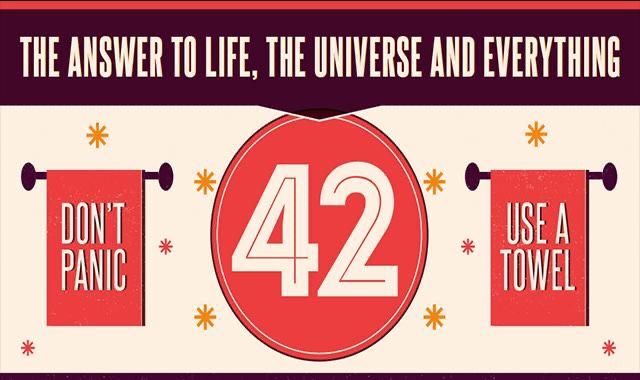
Quote from The Hitchhiker’s Guide to the Galaxy

It’s a rather easy day to celebrate and it’s done by taking a towel with you wherever you go: to work, school, or just to the shops. This way you can celebrate such gems of wisdom as, “Nothing travels faster than the speed of light with the possible exception of bad news, which obeys its own special laws.” The only thing that’s truly important on this day is you don’t forget to bring a towel!

Don’t Panic: Carry a Towel

Oh, and the answer to the “Great Question of Life, the Universe and Everything” is “forty-two.” In the 1979 novel, the supercomputer Deep Thought takes 7.5 million years to calculate the answer to this ultimate question. The characters tasked with getting that answer are disappointed because it isn’t very useful. Yet, as the computer points out, the question itself was vaguely formulated. To find the correct statement of the query whose answer is 42, the computer will have to build a new version of itself. That, too, will take time. The new version of the computer is Earth. To find out what happens next, you’ll just have to read Adams’s books. For a math geek discussion of the significance of 42, read the link “For Math Fans” below.

Salad of spring greens and edible flowers

Having dispensed with heroes, we can move onto the significant May Days that truly appeal to me. “April showers bring May flowers” is a saying I’ve heard since my childhood ever so long ago. Historians believe this phrase may date back to a 1610 poem, which contained the lines, “Sweet April showers, do spring May flowers.” A longer phrase, “March winds and April showers bring forth May flowers,” has also been traced back to 1886. Of course, this tidbit of wisdom depends upon your geographic location, for folks inland and north may wait until what we southern folks call “early summer” before they get their “springtime.”

Rabbit and animals dancing around a Maypole

“The month of May was come, when every lust heart beginneth to blossom, and to bring forth fruit,” wrote Sir Thomas Malory in Le Morte d’Arthur. The early Greeks called this month Maia, after the goddess of fertility, many of the early May festivals relate to agriculture and renewal. May Day, celebrated on the first with the Maypole, is one such festive event that was more debauched in earlier times, but now survives as a chaste minuet of colorful ribbons woven around a tall pole by children dancing in an interweaving circle below it.

Maypole dance patterns

Other modern May festivities include No Pants Day on 5/1, originally an end of the college year prank at the University of Texas, Austin, which spread to other realms needing release, and World Laughter Day, celebrated on the first Sunday of May. This holiday helps raise awareness about the benefits of laughing and promotes world peace through laughter. Laughing can instantly help reduce stress and brings us closer to other people, as we share our happiness with them. Those who take part in World Laughter Day can help spread positivity and cheerfulness to help change the world for the better. As Ralph Waldo Emerson said, “What potent blood hath modest May.”

No Diet Day is May 6, a good day to remember our good health isn’t based on a scale number or a pant size. Instead, our health is dependent on nutritious foods, adequate exercise, and sufficient sleep. Extreme weight loss, except under a doctor’s supervision, usually leads to yo-yo weight gain, with the body gaining back the lost weight and more after severe deprivation. Slow, long term, weight loss is more likely to be permanent loss, since we aren’t “dieting,” but changing our habits. May 11th is Eat What You Want Day. I suggest we don’t follow Oscar Wilde’s habit: “My doctor told me to stop having intimate dinners for four, unless there are three other people.”

Speaking of breaking a fast, May 12th ends the month of Ramadan, the holy month of observance for Muslims. It was during Ramadan Muhammad, the prophet of Islam, received the revelations from angel Gabriel that allowed him to compile the holy book of Quran. Upon arriving in Medina, Muhammad announced Allah had established two days of celebrations for Muslims, Eid Al Fitr and Eid Al Adha. The purpose of Eid Al Fitr was to commemorate the end of the fasting of Ramadan, and mark the start of the Shawwal month, as well as to thank Allah for giving Muslims the perseverance to fast during Ramadan. The customary feast day greeting is “Eid Mubarak,” which translates to “blessed celebration” or “Happy Eid.”

Wayne Thiebaud: Bakery Counter, Oil on canvas, 1962, Private Collection,
© 2019 Wayne Thiebaud / Licensed by VAGA at Artists Rights Society (ARS), NY

The dessert of May is apple pie. Originally invented in England, the earliest apple pie recipe dates all the way back to 1381. The original recipe is very similar to the one we currently know, but it also included figs, raisins, pears, and saffron. The Dutch also created their own version of the apple pie, and the first recipe was published in a 1514 cookbook. This recipe is very similar to the apple pie we know and love today. Apple Pie Day is May 13th.

English and Dutch settlers brought the apple pie recipes into the colonies of what would become the United States, during the 17th and 18th centuries. They had to wait until the apple trees they planted grew and bore fruit, so at first apples were mainly used to make cider. It was only in the 18th century, when the first apple pie recipes were printed in America, that the dessert quickly grew in popularity. Following this came the 19th century Legend of Johnny Appleseed, whose real name was John Chapman. He crisscrossed the expanding American frontier to bring seeds for apple orchards for homesteaders. He also brought news and the gospel for fifty years.

Apple Pie 5 cents a slice and Homemade

Chapman, or Appleseed, lives on as a barometer of the ever-shifting American ideal. Some see him as a pacifist, others as an example of the White Noble Savage (so remembered long after the settlers drove indigenous peoples from the land), and others see a mere children’s book simpleton. Some see him as a frontier bootlegger, since he helped expand the hard cider industry. Others see Johnny Appleseed as the patron saint of everything from cannabis to evangelical environmentalism and creation care—everything, that is, but the flesh-and-blood man he really was.

Our heroes are too often cardboard cutouts, and we don’t spend much time reflecting on their shadow sides. Of course, much like a Flat Stanley, a two dimensional character doesn’t have enough density to cast much of a shadow, unless the light is just right. This is why continuing Bible study is so important: most of us stop in grammar school and never get an adult insight into the scriptures. When we meet grownup problems, we have to wrestle the questions of faith that we once easily accepted trustingly. Or we walk out the door and never come back.

A Single Rose in Memory

One of the most difficult sermons I ever preached was on the first Mother’s Day after my mother died. One of my best clergy pals, who was a mentor in my ministry, had arranged for a single rose to be on the pulpit beside me on that morning. It was a gift of grace and an empowering symbol, for roses were my mom’s favorite flower. Every time I thought I might cry, I held on tight to the polished oak wood and inhaled the fragrance of the rose. Even now, nearly two decades later, I can clearly see this rose and pulpit, and while I remember where I was, I recall the congregation’s faces were a blur on that day. It’s always the second Sunday in May.

I talk about my fresh grief from years ago, for during this current Pandemic too many of us have had present grief and stress, but either have no words for it, or perhaps have no safe place to express it. Then again, we may be “managing the grief of others,” and don’t have time for caring for our own needs. I call this Deferred Maintenance Grief. If you have an old, leaky faucet, you can keep turning the handle tighter for only so long. You can keep the leak stopped for a while, but soon you’ll strip out the insides of the faucet. Once it’s stripped down, it both streams steadily and needs a completely new fixture to replace it, instead of a minor repair.

I experienced this DMG once after a spate of ten deaths in a week, or maybe it was seven in ten days, followed by the death of one of the old, beloved black clergymen in my community. As I lay on the parsonage couch watching a rerun of Babylon 5, I was crying as if old E.D. were my own daddy. I then realized I’d been too busy caring for others and doing the “work I was called for,” to do the grief work I needed to do for myself. I needed to honor my loss and give myself dedicated spaces to deal with my feelings, so I could be present for others. That’s Deferred Maintenance Grief in a nutshell. If I were eating Cheetos by the bucketful, I’d be in a deep hole of DMG and digging it deeper!

Most of the churches I served had a “Don’t fix it unless it’s broke” policy. I grew up in a Depression Era family, so I was familiar with this attitude. However, these same people didn’t live this way in their own homes. We usually had a long list of deferred maintenance projects in the church property to finish in my time there. Then I’d go to the next place and do it all over again. “Always leave a place better than you found it, both structurally and theologically. Teach people the law of love. As we learn in Romans 13:8, “Owe no one anything, except to love one another; for the one who loves another has fulfilled the law.”

Most of us human beings have “deferred maintenance projects” also: days off, doctor visits, exercise, healthy meals, quiet times, and family times. Taking time for ourselves means we’re refreshed and eager to serve from the quickening power of the Spirit. Without this resting or love for our own embodied image of God, we end up working from the dying embers of our body’s frail resources—burnout calls our name.

When we get this broken, our families and our ministries both suffer along with us. We know better than to drive our vehicles with the gas gauge on empty past every filling station on the road of life. We aren’t called to die on the cross to prove our worth to Christ or to anyone else. He’s our savior and we claim his work on the cross. Anything else is workaholism or salvation by works. We need to name and claim this.

For clergy moving to a new appointment, this is an opportunity for a reset. For those who remain in place, I suggest a planning book. Mark off in advance quiet times, office hours, and visitation times. Take educational events, even if zoom is the only offering. Read for pleasure. Take a day off out of town. Don’t answer the phone after 9 pm unless it’s an emergency. Boundaries are blessings. I always told people up front, “I take my brain out of my head and put it inside a brain box at 9 pm. I put it back in at 9 am. If you call me between those hours, somebody better have died, be on the way to the ER, or the church is burning down.” They laugh, but I’ve had friends who wanted their pastor to be their bedtime Bible expositor. Boundaries keep us from burning out.

Speaking of burning, the official door to summer begins with Memorial Day Weekend. This holiday celebrates those who gave their lives in the great wars of our nation. It began after the Civil War in 1865 as a way to deal with the shared grief of a nation, which lost 750,000 people, or 2.5% of the population, in the struggle. If we were to translate this to today’s world, the number would equal 7,000,000 deaths. War is a pandemic all its own.

An engraving of The Dying Soldier – The last letter from home during the US civil war, circa 1864. (Photo by Kean Collection/Archive Photos/Getty Images)

As a parting commentary on Memorial Day, the Pandemic, and Extreme Care Giving, I leave you with a portion of the 1865 Walt Whitman poem, “The Wound Dresser,” which he wrote after serving as a hospital volunteer in the Civil War.

But in silence, in dreams’ projections,
While the world of gain and appearance and mirth goes on,
So soon what is over forgotten, and waves wash the imprints off the sand,
With hinged knees returning I enter the doors, (while for you up there,
Whoever you are, follow without noise and be of strong heart.)

Bearing the bandages, water and sponge,
Straight and swift to my wounded I go,
Where they lie on the ground after the battle brought in,
Where their priceless blood reddens the grass the ground,
Or to the rows of the hospital tent, or under the roof’d hospital,
To the long rows of cots up and down each side I return,
To each and all one after another I draw near, not one do I miss,
An attendant follows holding a tray, he carries a refuse pail,
Soon to be fill’d with clotted rags and blood, emptied, and fill’d again.

I onward go, I stop,
With hinged knees and steady hand to dress wounds,
I am firm with each, the pangs are sharp yet unavoidable,
One turns to me his appealing eyes—poor boy! I never knew you,
Yet I think I could not refuse this moment to die for you, if that would save you.

Remember to wear sunscreen to protect your skin if you plan outdoor activities on the first three day weekend of the summer and watch the temperature of the grill. We don’t want anything to burn if we can help it. Charred meat and burned skin are both indicated for cancer risks. Be safe and continue to mask up in public. Get vaccinated as an act of love for your family, your neighbors, and the world community. Since we’re all wound dressers, as well as the wounded also, we want to give as much care to healing our own wounds as we do to the wounds of others.

Joy and Peace,

Cornie

The Project Gutenberg eBook of The Wound Dresser, by Walt Whitman.
https://www.gutenberg.org/files/35725/35725-h/35725-h.htm
This contains first source material from Whitman’s era as well as his works from the Civil War period.

Do April Showers Really Bring May Flowers? | Wonderopolis
https://wonderopolis.org/wonder/do-april-showers-really-bring-may-flowers

As Covid-19 Devastates India, Deaths Go Undercounted
https://www.nytimes.com/2021/04/24/world/asia/india-coronavirus-deaths.html?referringSource=articleShare

For Math Fans: A Hitchhiker’s Guide to the Number 42 – Scientific American
https://www.scientificamerican.com/article/for-math-fans-a-hitchhikers-guide-to-the-number-42/

42 Of The Best Hitchhiker’s Guide to the Galaxy Quotes | Book Riot
https://bookriot.com/the-42-best-lines-from-douglas-adams-the-hitchhikers-guide-to-the-galaxy-series/

No Diet Day (6th May) | Days Of The Year
https://www.daysoftheyear.com/days/no-diet-day/

World Laughter Day | May 2
https://www.calendarr.com/united-states/world-laughter-day/

National Apple Pie Day | May 13 – Calendarr
https://www.calendarr.com/united-states/national-apple-pie-day/

Johnny Appleseed Planted Stories Of Myth, Adventure : NPR
https://www.npr.org/2011/04/17/135409598/johnny-appleseed-planted-stories-of-myth-adventure

Statistics From the Civil War | Facing History and Ourselves
https://www.facinghistory.org/resource-library/statistics-civil-war

Chemicals in Meat Cooked at High Temperatures and Cancer Risk – National Cancer Institute
https://www.cancer.gov/about-cancer/causes-prevention/risk/diet/cooked-meats-fact-sheet

Rabbit! Rabbit! Welcome to April

art, chocolate, coronavirus, Creativity, Easter, Faith, garden, Garvan Woodlands Garden, Good Friday, greek myths, Healing, holidays, Holy Spirit, hope, Imagination, Love, Ministry, mystery, nature, Painting, pandemic, poverty, purpose, rabbits, Racism, renewal, Spirituality, trees, vision

April Bunny

I love the springtime, for all the colors of green are in abundance. I live on the lake on a property originally developed to be a high rise hotel and casino, until the city derailed that plan. Then it became vacation condos and retirement homes. Since it’s located on a large plot of timbered land, I even see my rabbit neighbors on occasion. My bunny friends usually move about at dawn and dusk. I’m not an early bird, and since Covid, my “out and abouts” have been seriously curtailed, so I’ve yet to see my four legged furry neighbors this year. Maybe I’ll have a better chance to see the Easter Bunny. I did purchase his dark chocolate cousin from Dove, who’s been reduced to a single ounce and will be gone by Easter Sunday. The ears went first, of course.

Dove Bunnies

Our parents found ways in the old days to keep us active and entertained in the weeks leading up to Easter. One of my favorite experiences was egg dying and decorating. Back in Mom’s kitchen, boiling water, vinegar and colored pellets went into the coffee cups before we wrangled the wire holder and lowered the hard boiled egg into the dye. If we dipped the egg all the way in or held it for a longer time, we could get deeper colors. One year I even attempted to use only natural dyes, such as beets, cabbage, and onions. My “science-anthropology” experiment didn’t turn out as pretty as the PAAS collection, but I learned a lot. Crayon resist worked with both dye types, however. Perhaps I never appreciated how fortunate I was my mom taught school and my dad encouraged us kids to learn everything about our world. Almost anything was a science project in his mind.

Crayon Box

As a child, I knew I’d arrived when I graduated to the big crayola box with  sixty four colors in it. Suddenly I had a year round wealth of shades and hues at my command, plus I could combine them for even more variety: Here are the colors that ended up being in the 64 count box in 1958: orchid, lavender, carnation pink, thistle, red violet, violet red, brick red, magenta, maroon, mulberry, Indian red, red, melon, salmon, orange red, red orange, orange, flesh, maize, goldenrod, yellow orange, apricot, orange yellow, yellow, lemon yellow, green yellow, spring green, yellow green, sea green, olive green, green, pine green, aquamarine, forest green, turquoise blue, green blue, sky blue, blue green, periwinkle, blue, navy blue, midnight blue, cornflower, blue gray, cadet blue, violet, blue, blue violet, violet, plum, tan, burnt orange, mahogany, burnt sienna, brown, raw sienna, bittersweet, raw umber, sepia, black, silver, gray, gold, copper, white. I could make any landscape sing with whatever color my young imagination called forth. My birthday month always calls forth all the colors nature has on her palette.

Spring Trees, Old Farmland

Of course, not every tree sports a shade of green as its primary dress in the springtime. Some bud out all in white, others in dark red violet, while still others bloom out in light pinks. If I squint my aging eyes today, I can see a haphazard lace design across the landscape before me in multicolored threads, with a few embroidered trunks to give it a semblance of stability. Those trunks might be Indian red (an iron red) mixed with the old Prussian blue (now known as midnight blue) to make a warm black. Using the straight carbon black crayon made the black too stark, or so my portrait painting grandmother told me. The old “flesh color” has been renamed “peach,” in recognition of the diversity of skin color in our world today. Many other colors in the box can be combined to get the perfect shade of a person’s facial tone, no matter how light, dark, yellow, white, red, or brown. The 64 box has enough colors to capture any facial tone, for sure.

When I see the ever changing beauty of the natural world about me, I can’t help but have hope. I look back not only to simpler times, but also forward in hope to a time when once again I will feel the joy of breaking the seal of a brand new box of crayons and when I can revel in the fresh, unsullied scent of pure wax and touch with reverence the clean paper wrappers. Easter dresses always show up in the pastel colors, even if we have to toss our dark winter coats over them when the weather turns cool, as it often does.

Maybe you don’t have such a strong attachment to art supplies as I do, but surely this April is a holy season for many people, and not just for the rabbits who live among us. Some how we people of faith across the centuries and around the world respond to the annual renewal of life and the promise of hope when life seems most precarious. While my faith experience is deeply rooted in Christianity, the worldwide communities of faith respond to springtime with some common traditions.

It’s no wonder one of the great myths of the ancient Greeks and Romans dealt with the changing seasons, but also with the hope of eternal life. Demeter was the goddess of agriculture and crops, whose daughter Persephone was taken into the underworld. Hades kept her there against her will, so while Demeter grieved, the crops failed, people starved, and the gods weren’t honored. Zeus, the king of the gods, forced Hades to release Persephone, but since she had eaten a few pomegranate seeds, she had to spend part of the year underground. This set up the seasons and was the impetus for the famed Elysian Mysteries.

The week long rituals were based on a symbolic reading of the story of Demeter and Persephone.  It provided initiates with a vision of the afterlife so powerful, it forever changed the way they saw their world and their place in it. They no longer feared death, for they  recognized they were immortal souls temporarily in mortal bodies. In the same way Persephone went down to the land of the dead and returned to that of the living each year, so would every human being die only to live again on another plane of existence or in another body.

Cave Entrance: The Plutonium, Eleusinia, Greece

The spring rite was the lesser mysteries, without which one couldn’t enter the greater mysteries of autumn. Anyone who was present in the city and spoke Greek could attend, unlike some of the closed gnostic mysteries, which were available only to a chosen few. The whole community participated, for the life of the family, as well as the earth, depended on the abundance of the earth. In fact, the only paved road in Greece in ancient times was from Athens to Eleusius, and a modern road now follows the same path.

The White Road to Eleusis (The Sacred Way)

Aristotle wrote about the contrast of the cathartic experience of watching a tragic drama whereby the spectator is purged of the negative emotions of fear and pity, while an initiate of the Mysteries would undergo physical, emotional, and spiritual cleansing in preparation for the main part of the ritual— a spiritual identification with the Mother and Daughter in their separation and suffering and then joyful reunion, a transformation from death to rebirth. Through her or his own inner spiritual desires and participation in the rites, the initiate then was prepared to receive a “seeing” into the deepest mysteries of life.

This communal ritual wasn’t just for the individual, but for the family, the city state, and even the world itself. Let’s keep that idea in mind as we consider the other rituals of faith, renewal, and restoration of this spring season.

Our Vice President’s husband Doug Emhoff, 56, is the first Jewish spouse of a vice president or president. “After a year of social distancing and mask wearing, it’s impossible not to feel isolated at times. So it’s events like this one, events that creatively bring family and friends and communities together, that keep us connected and remind us that we’re not alone,” Emhoff said at the Seder ceremony before noting he got to do one of his “favorite things” and introduce the vice president.

“Our family, like so many families in the United States, the state of Israel and around the world, will begin to celebrate the sacred holiday of Passover this weekend,” Vice President Kamala Harris said. “And the Passover story is powerful. It reminds us of the resilience of the human spirit in the face of injustice. It urges us to keep the faith in the face of uncertainty.”

Bitter Greens

“This year, as we dip our greens in salt water and pour out our ceremonial wine and eat our bitter herbs, let us commit, once again, to repairing the world,” she said.

This is the great witness of the Passover story, for it’s a story of hope and liberation. It’s a story of God keeping God’s promises and God’s faithfulness for those who suffer. If anyone needs to hear words of liberation, faithfulness, hope, and promises kept, it’s our whole world, which is suffering with covid, hate, nationalism, racism, and extremism.

Leonardo Da Vinci: The Last Supper was a Passover Seder

Passover, like many holidays, combines the celebration of an event from Jewish memory with a recognition of the cycles of nature. As the Jewish people remember their ancestors’ liberation, they also recognize the stirrings of spring and rebirth happening in the world. The symbols on the table bring together elements of both kinds of celebration. In the ritual, families take a vegetable, representing joy at the dawning of spring after a long, cold winter. Most will use a green vegetable, such as parsley or celery, but some families from Eastern Europe have a tradition of using a boiled potato, since greens were hard to come by at Passover time. Whatever symbol of spring and sustenance used, it’s dipped it into salt water, a symbol of the tears the  ancestors shed as slaves. Before eating it, a short blessing is said:

Baruch Atah Adonai, Eloheinu Melech ha-olam, borei p’ree ha-adama.

We praise God, Ruler of Everything, who creates the fruits of the earth.

At the end of the meal, celebrants bless the final cup of wine according to Jewish tradition and law. As the faithful have had the pleasure to gather (virtually) for a seder this year, they hope to once again have the opportunity of gather in person in the years to come. The prayer is God brings health and healing to Israel and all the people of the world, especially those impacted by natural tragedy and war. As folks say every year, “Next year in Jerusalem!”

Yet another spring festival is the Hindu celebration of Holi, which has been observed all over India since ancient times. Holi’s precise form and purpose displays great variety. Originally, Holi was an agricultural festival celebrating the arrival of spring. This aspect still plays a significant part in the festival in the form of the colored powders: Holi is a time when man and nature alike throw off the gloom of winter and rejoice in the colors and liveliness of spring.

Holi Festival Celebration

Holi also commemorates various events in Hindu mythology, but for most Hindus it provides a temporary opportunity for Hindus to disregard social norms, indulge in merrymaking and generally “let loose.” The central ritual of Holi is the throwing and applying of colored water and powders on friends and family, which gives the holiday its common name “Festival of Colors.” Holi is spread out over two days (it used to be five, and in some places it is longer). A large communal bonfire burns in the town center to light the evening festivities.

The entire holiday is associated with a loosening of social restrictions normally associated with caste, sex, status and age. Holi thus bridges social gaps and brings people together: employees and employers, men and women, rich and poor, young and old. Holi is also characterized by the loosening of social norms governing polite behavior and the resulting general atmosphere of licentious merrymaking and ribald language and behavior. A common saying heard during Holi is bura na mano, Holi hai (“don’t feel offended, it’s Holi”).

This festival has transferred into western culture as part of the celebrations at the end of races and other communal bonding events, a fact which leads some to charge the west with cultural appropriation, but the followers of Holi aren’t offended if the intention is good.

While Easter in the western world has become a cultural celebration of cleaning house, redecorating, wearing new and brighter clothes, and doing brunch with lighter foods, in the Christian church, Easter still retains its central place of honor. As Henri Nouwen writes, “When Jesus was anticipating his own death he kept repeating the same theme to his disciples: “My death is good for you, because my death will bear many fruits beyond my death. When I die I will not leave you alone, but I will send you my Spirit, the Paraclete, the Counselor. And my Spirit will reveal to you who I am, what I am teaching you. My Spirit will lead you into the truth and will allow you to have a relationship with me that was not possible before my death. My Spirit will help you to form community and grow in strength.” Jesus sees that the real fruits of his life will mature after his death. That is why he adds, “It is good for you that I go.”

Prayer to the Holy Spirit

While Jesus did reach out to those ignored by the traditional faith community of his day, he was also concerned for the whole community over and above the individual alone. While the church, who are the “ones called out,” is composed of individuals, we’re called to gather together for worship, prayer, instruction, and to be sent out to do ministries in the name of Jesus. Some today put their personal relationship with Jesus above their relationship with the beloved community or with the suffering body of Christ, which is found in the marginalized people beyond the church door.

So along with Nouwen, we have to ask, “If that is true, then the real question for me as I consider my own death is not: how much can I still accomplish before I die, or will I be a burden to others? No, the real question is: how can I live so that my death will be fruitful for others? In other words, how can my death be a gift for my loved ones so that they can reap the fruits of my life after I have died? This question can be answered only if I am first willing to admit Jesus’ vision of death, as a valid possibility for me.”

Grunewald: Resurrection

Since Easter is the celebration of the great resurrection story, it’s the story of the  renewal, not only of life, but the renewal of hope and faith. When our world looks its most bleak, we can still hope for a better future. When our God seems to have abandoned us, we can still trust in God’s unfailing promise to fulfill God’s commitments to God’s well loved people. When Mary Magdalene runs to meet the risen Christ in the garden, he tells her, “Do not hold on to me, because I have not yet ascended to the Father. But go to my brothers and say to them, ‘I am ascending to my Father and your Father, to my God and your God.’ ”

We don’t keep good news for ourselves, but spread it to others. This is the best argument for the communal nature of resurrection faith. It should change us, so we should want to change God’s world and God’s people for the better. If we’re transformed by love, we also should transform the world with love. If we’ve been justified by the grace of God’s mercy, we should want to bring justice to marginalized communities who’ve experienced systemic injustice.

In summary, what ties all these spring festivals together is a hope for a new creation and a better life, either in this world or in the world beyond. Sometimes we need to have assurances of the life to come to live well in this life, while other times we need a hope for this world in order to live for tomorrow. Likely our faith practices speak to our deep human need for freedom and also to the need for our suffering to have meaning. Only if we change our suffering into a catalyst for relieving the suffering of others can we being these faith promises of spring renewal into reality. Then the ancient hopes of slaves, who were liberated, can come true today also. When the fears of death and life of everyday people are healed, their hopes and dreams are made possible by the power of god working through them. Then we too can sing the songs of freedom, put our energy into freeing others who are in bondage, and bring about God’s new creation, even as God’s spirit is renewing the face of the earth.

Springtime in Garvan Woodland Gardens

True Colors: Creating Natural Food Dyes at Home — Edible LA

https://www.ediblela.com/news/natural-food-dyes

Original Boxes of 64 Crayola Crayons | Jenny’s Crayon Collection

http://www.jennyscrayoncollection.com/2020/10/original-boxes-of-64-crayola-crayons.html

Doug Emhoff and Kamala Harris Celebrate First Passover at the White House

https://people.com/politics/doug-emhoff-and-kamala-harris-celebrate-first-passover-at-the-white-house/

The Ritual Path of Initiation into the Eleusinian Mysteries

(c) 2009, Mara Lynn Keller, Ph.D., California Institute of Integral Studies

https://www.ciis.edu/WSE/WSE%20Documents/WSE%20PDFs/07_keller.pdf

The Eleusinian Mysteries: The Rites of Demeter – World History Encyclopedia

https://www.ancient.eu/article/32/the-eleusinian-mysteries-the-rites-of-demeter/

A Seder for Everyone

http://www.jfcsboston.org/Portals/0/Uploads/Documents/The%20Wandering%20Is%20Over%20Haggadah%202015.pdf

Holi Religion Facts

https://religionfacts.com/holi

Text excerpts taken from “You are the Beloved”

by Henri J.M. Nouwen

© 2017 by The Henri Nouwen Legacy Trust.

Published by Convergent Books.

Rabbit! Rabbit!

arkansas, art, change, Faith, flowers, holidays, Love, Ministry, nature, purpose, rabbits, renewal, righteousness, Spring Equinox, St. Patrick’s Day, Uncategorized, United Methodist Church, vision

Beware the Ides of March

Change is the theme of March. We can count on the weather to vary, for old proverbs tell us, “In like a lion, out like a lamb.” The reverse holds true too. March is the boundary line between winter and spring, with the Vernal Equinox occurring March 19, 2020, at 10:50 pm Central Time.

Folklore tell us that you can balance a raw egg on its end on the equinox, something attributed to the Earth’s “balance” on that day. While this sounds like a fun activity, there’s no basis in fact that egg balancing is any easier on the equinox, according to NASA. The U.S. space agency conducted an unscientific experiment and found it was no easier to balance an egg on the equinox than on any other day. What did make it easier was finding an egg with small bumps on its shell, something that NASA said made the “seemingly impossible task achievable.”

Super Tuesday on March 3rd is the first coast to coast opportunity to select a presidential candidate to oppose the one currently in office. As I write this, every single TV commercial is a political one. We should be glad for this, for some countries don’t have this luxury. I hear a big rain event is forecast for Arkansas, so I recommend early voting, but not often voting. Remember we practice “one rabbit, one vote.” If you want to stuff a box, don’t let it be the ballot box, but fill a food drive box. While some rabbits do prosper in our economy, other rabbits still struggle due to health problems, job losses, or other difficulties in life.

Purim, beginning at sunset on March 10, marks the leadership of Queen Esther, who advocated to the king for her Jewish people, to protect them from a royal death decree back in the fourth century BCE, as told in the Book of Esther. The mark of a leader is to risk their own position to benefit those who are subject to injustice.

“For if you keep quiet at such a time as this, help and protection will come to the Jews from another quarter, but you and your father’s family will perish. Yet, who knows whether it was not for such a time as this that you were made queen?” (Additions to Esther 4:14)

On March 15th we celebrate the Ides of March. The Ides are nothing more than the name the Romans gave to the middle of the month, just as we get excited about Hump Day or the Weekend. Life moved slower back in BCE, but they didn’t have the internet and were still using ink and parchment. We first find the expression ‘Beware the Ides of March’ in Shakespeare’s Julius Caesar in 1601, when the soothsayer whispers to Julius Caesar a warning of his impending death. Shakespeare also added the famous retort to Caesar’s assassins, ‘Et tu, Brute?’ History records no words from Caesar when the dictator, who was launching a series of political and social reforms, was assassinated by a group of nobles in the Senate House on the Ides of March.

Tom Brady and the Future

Free Agency is another way to change leaders, and it’s far better plan than assassination, a practice only used in pirate and authoritarian organizations. March 18, at 4 pm ET begins the fruit basket turnover we know as Free Agency. Drew Brees and Tom Brady, quarterbacks who rank first and second on the all-time NFL passing touchdowns list, will both have the last two years of their current deals void on the eve of the new league year. While they’re the two oldest position players in pro football, new contracts in New Orleans and New England are likely. Even if those deals don’t come together, it’s possible either (or both) could retire.

In the United Methodist Church, springtime is appointment season. Clergy who’ve grown long in the tooth decide to retire, others change relationships to the annual conference due to health or geography, and then there’s the pulpits that need a pastor. While our church tends to move on a regular calendar nationwide, those denominations and congregations who call their own pastor need to seek one whenever they have a need and take the best of what’s available.

We can’t micromanage God.

Having been born a cradle Methodist, I prefer our way of sending new leadership. As my mother used to say, in one of her many unfiltered moments, “If you don’t like the preachers in the Methodist Church, think of them like the weather. They’ll change pretty soon, but don’t get your heart attached, for they’ll have to move on elsewhere. It’s their nature.” Of course, I’m not sure my mother ever had any filtered moments, but the rabbits always knew where they stood with her.

The Ides of March may be the sifting or winnowing date for the Democrats in their presidential primaries. The magic number to win the Democratic Party’s nomination for president is 1,991 delegates. It could take months to officially get there, but a total of 1,344 delegates will be allotted on Super Tuesday alone — about 33 percent of the total. Then 11 more state contests are up for grabs on March 10 and 17. By the time March 17 rolls around, 61 percent of the pledged delegates will be allotted.

We could either have a pretty good sense of who the Democratic nominee will be by the Ides of March, or the primary could still be contested, as it was in 2016. If the latter, the contests to decide the winner will happen from March 18 to June 6. Those three months will be when the remaining 39 percent of delegates will be allotted; the most important day in this stretch is April 28, when New York and Pennsylvania vote, among others.

Presidential candidates are all competing for a majority of 3,979 pledged delegates. Separately, there are also 771 automatic delegates, otherwise known as “superdelegates.” Again, it’s worth noting the biggest DNC rules changes were around superdelegates. The change stems from the tumultuous 2016 primary campaign, in which Sanders’ supporters accused the superdelegates of having too much influence over the outcome, since the overwhelming majority of them supported Clinton. That means these 771 superdelegates will not vote on the first ballot, unless there’s already a candidate with a supermajority of pledged delegates. While some hope for a contested convention, this rabbit thinks the end of the race will find fewer taking the checkered flag than after the Big One at Daytona International Speedway.

Not every hill is worth climbing or dying on.

Rabbits can help us find a better leadership style. The typical Rabbit Leader has the following characteristics:

  1. Typically chaotic
  2. Overwhelmed and running around
  3. Trying to do to many things at once, micromanaging
  4. Neglecting to delegate
  5. Always “busy” when people asked how it’s going.
  6. Definitely “late, for a very important date.”

Work expands to fill the time available, but working harder doesn’t always mean greater rewards. Working smarter, not harder, is the better choice. If we don’t take time to reflect, plan, dream, and vision for the future, we won’t give our best efforts to endeavors. I used to tell my team I didn’t need to have all the decisions run past me, such as flowers for Sunday, the acolytes, or the ushers’ names. They had responsibilities for these and didn’t need my second guessing their choices. I have only one brain, and it’s a very small funnel. It has a tendency to get clogged if too many details get crammed into it. I kept my eye on the big picture and the team helped me keep the day to day details filled in.

The Velveteen Rabbit reminds us to be the most effective leader, we need to be our real self and allow others to love us until we’re worn from use. It isn’t easy to be vulnerable, but this is the mark of a leader.

You are worthy of love. Allow others to love you.

‘Real isn’t how you are made,’ said the Skin Horse. ‘It’s a thing that happens to you. When a child loves you for a long, long time, not just to play with, but REALLY loves you, then you become Real.’
‘Does it hurt?’ asked the Rabbit.
‘Sometimes,’ said the Skin Horse, for he was always truthful. ‘When you are Real you don’t mind being hurt.’
‘Does it happen all at once, like being wound up,’ he asked, ‘or bit by bit?’
‘It doesn’t happen all at once,’ said the Skin Horse. ‘You become. It takes a long time. That is why it doesn’t often happen to people who break easily, or have sharp edges, or who have to be carefully kept. Generally, by the time you are Real, most of your hair has been loved off, and your eyes drop out and you get loose in the joints and very shabby. But these things don’t matter at all, because once you are Real you can’t be ugly, except to people who don’t understand.’

Spring is popping out all over, a bit earlier than normal.

We rabbits shouldn’t fear change, and certainly not in the month of March. We have the Romans to thank for the months of January and February. The God Janus was two faced, looking both forward and backward. February was a month of purification. March was the original first month of the Roman year. If the spring flowers and new leaves bursting forth from the frozen earth cause you to revision your goals for turning over a new leaf, now is the time for a change!

Plutarch wrote in the 1st CE, “It was also natural that Martius, dedicated to Mars, should be Romulus’s first (month) and Aprilis, named from Venus, or Aphrodite, his second month; in it they sacrifice to Venus, and the women bathe on the calends, or first day of it, with myrtle garlands on their heads. But others, because of its being p and not ph, will not allow of the derivation of this word from Aphrodite, but say it is called Aprilis from aperio, Latin for to open, because that this month is high spring, and opens and discloses the buds and flowers.”

Perhaps the greatest change in March all the rabbit denizens undergo in the neighborhood is on Saint Patrick’s Day. Suddenly everyone has kissed the Blarney Stone, or perhaps that’s the Guinness speaking. All wear a touch of green to avoid the pinch that turns them red. Every bunny is Irish for one day.

Enjoy Craft Beer in Hot Springs Brew Shops

If you visit Hot Springs, Arkansas, you can attend The First Ever 17th Annual World’s Shortest St. Patrick’s Day Parade, all 98 feet of Bridge Street! Foghat, the legendary rock band that created “Slow Ride” and other hits, will play a free public concert on Tuesday, March 17, 2020, immediately following the First Ever 17th Annual World’s Shortest St. Patrick’s Day Parade in downtown Hot Springs.

The day prior, Blues Traveler, the legendary rock band with 13 hit albums to its credit, will play a free concert on Monday, March 16, 2020, on the eve of the First Ever 17th Annual World’s Shortest St. Patrick’s Day Parade in downtown Hot Springs. And…the Dallas Cowboy Cheerleaders, plus local floats and marching groups. The Ides of March should beware the St. Patty Party at Hot Springs National Park, which was once known as Hot Springs Reservation. It was set aside in 1832 to protect the Park’s primary resource, the hot springs. This type of Reservation was an early version of the National Park idea. Hot Springs was actually the first area in the United States to be set aside for its natural features.

Until next time, every bunny stay well, get plenty of sleep, keep washing your hands, and remember March 8th begins DAYLIGHT SAVING TIME: Spring Forward and enjoy the extra hour of daylight in the late afternoon.

Joy and Peace,
Cornelia

Balance an egg on the Equinox. https://www.al.com/news/2019/03/spring-equinox-2019-official-first-day-of-spring-can-you-stand-an-egg-on-its-end-today.html

Ides of March Presidential Predictions and Delegate Tracker
https://www.vox.com/2020/2/5/21113779/2020-presidential-delegate-tracker

Democratic Superdelegates
https://www.cnn.com/2018/08/25/politics/democrats-superdelegates-voting-changes/index.html

Plutarch, “Nuna Pompilius,” C.E. 75
Sanctum Library: 8th-7th Century B.C.E.
Translated by John Dryden.
http://www.webexhibits.org/calendars/year-text-Plutarch.html

Hot Springs National Park
https://www.nps.gov/hosp/planyourvisit/basicinfo.htm

Spring Flowers

adult learning, art, Creativity, Easter, Faith, flowers, garden, Garden of Gethsemane, Good Friday, Holy Spirit, Imagination, incarnation, Israel, Ministry, nature, Painting, picasso, Prayer, purpose, salvation, Spirituality, Stations of the Cross, Travel

How many colors exist in creation? Many more than we can buy in a tube at the art supply store and even more than the number of paint chips at our local building supply store. Recently I gave my adult art class an assignment to use their primary colors and white only to mix new colors, since I noticed they were not getting middle values in their paintings. I too enjoy the brightness of the primary colors, so this was also a challenge for me.

Power of the Cross

The following week I needed to do less geometry and more nature, but I came back to the cross theme once again, for these flowers are from a photo of the Easter “Living Cross” at my church. While we can’t see the arms of the cross, anymore than we can see Jesus today, we know the cross is there, just as we know Jesus is present for us in the power of the Holy Spirit.

This makes Christ alive, not only in our hearts, but also in the lives of all who suffer: the poor, the immigrant or stranger in our land, and the oppressed. Even the land itself, which suffers from human caused climate change, can be a place where we meet the living Christ.

Spring Flowers

The Garden of Gethsemane in Jerusalem is a powerful place, for it was where Christ was handed over to his captors by a former friend. From there he went to death on the cross and resurrection for our salvation. This garden retains this energy of struggle: Jesus prayed to get his will in line with God’s will.

If the story ended here, we’d have no living crosses full of beautiful flowers on Easter Sunday. Out of pain and struggle comes great beauty. Most of us will avoid any challenge in our lives, thinking the easy way is the best way. Intentionally causing others to suffer pain isn’t acceptable for moral reasons: “do no harm” is a good adage, as is “do unto others as you would have them do unto you.” Setting achievable goals and challenges are different. These cause us to grow. They may also cause us discomfort, but this isn’t pain.

On this canvas, Spring Flowers, I had to overpaint and scumble to create the textured grays of the background. I even had to repaint the wispy border flowers several times to get their petals colored and straight, plus to get the ground varied enough to make them stand out.

One of the artists I most admire is Picasso, for he was always reinventing his style. Today artists pick a style and stick with it. Perhaps this is lucrative and makes economic sense. Still, I wonder what happens to the creative spirit when it’s not nurtured, challenged, and expressed. Of course, this may be the difference between a great artist and a good artist, and only the centuries will tell which among us now will be great.

Reflections of God

arkansas, art, Creativity, Faith, Forgiveness, generosity, grief, Holy Spirit, Imagination, incarnation, instagram, Love, Meditation, ministry, nature, Painting, photography, purpose, Reflection, renewal, righteousness, Spirituality, trees, vision, vision

I carry my phone when I walk, so I always have a camera for the scenes of beauty which catch my eye. Since light is ephemeral and these moments are fleeting, catching them as they occur is important. When I come home, I often photoshop the image on my computer or in Instagram to get the emotions, which I experienced when I took the photo.

Winter Lake Reflections

Several winters ago, I took this photo. By the time I painted it this year, I was feeling more optimistic. Back then, I didn’t know if my daughter was alive or dead. I lived in hope, but I also was holding onto some fear, for I knew her drug addiction was going to be difficult to overcome.

The Cloud Rising

This is my most recent landscape. The cloud always reminds me of God’s appearance! Then I think of this verse in Job 38:34, when God asks Job, who’s been questioning God’s intentions and reasons—

“Can you lift up your voice to the clouds,

so that a flood of waters may cover you?”

Poor Job, he’s not God. And neither are any of us. We’d like to make sense of the senseless, right all the wrongs, put order to all the chaos, and make things the way they should be. Of course, if we were in charge, the world would have gone to hell in a hand basket much sooner than it has already.

Maybe we should reread Job 42:3—

‘Who is this that hides counsel without knowledge?’

Therefore I have uttered what I did not understand,

things too wonderful for me, which I did not know.

In our world today, many changes are happening. Some of us want things to be “the way they used to be.” This would make us feel better and be more comfortable with a known world, but God is always recreating God’s new world–

“For I am about to create new heavens

and a new earth;

the former things shall not be remembered

or come to mind” (Isaiah 65:17).

If we are people of faith, we can trust in our God, whose Son Jesus Christ is the same yesterday and today and forever (Hebrews 13:8). If Christ is the same, then God is the same, and so is the Holy Spirit. Does this mean our understanding of the Holy Trinity never changes? No, this means God’s love and mercy for us never changes! We think we can fall outside the bounds of God’s love, but this is only because we have short arms and can’t include all others within our embrace. Just as the water reflects the sky and earth above it, so we’re to reflect the attributes of the holy image in which we’re created and demonstrate the qualities of the heart and the same mind that was in Christ Jesus (Philippians 2:5).

Job, who was well respected and honored in his community, was enamored of his ability to assist others with their needs. He was a big man who used the blessings from God for good purposes. When he lost this status, he was upset. Once he met God face to face, he realized he’d been giving lip service to God, but didn’t actually know God. Many of us today know about God, but haven’t had an encounter or experience with the living God. We can’t reflect a love which we’ve never received, and we can’t share a forgiveness we’ve not known. Perhaps our first work is to seek God’s generosity for our own lives, so we can reflect it outward in the world toward others.