Steps in drawing a Geometric Still Life: sketch, refined sketch, shadows, intense shadows and cast shadows
We are back in art class again on Friday mornings at Oakland United Methodist Church. Our first lesson is in solid geometry, but it’s not a math class. Art is more like learning a visual two-dimensional language to be able to render three dimensional objects on a flat plane. This isn’t as easy as you might think, but once you learn to see in perspective, you never can unsee it again. Art class is like an old fashioned one room schoolhouse, in which a teacher has students of varying ages and experience levels to instruct. I provide one lesson and modify it for each student according to their needs.
Gail S.—Pencil Drawing of Solid Geometry
The first day of class, I had three brand new students and one who has done this exercise at least three times before. Two others were out doing family obligations, just as I was missing in action last week due to attending my niece’s graduation ceremony for her MBA in Business Administration. Life and family watershed events are always important to make our presence known. The life of the artist is as important as the art itself. We aren’t just people who make beautiful objects for others, but people who make life beautiful by being present at their most important moments.
Vermeer: The Art of Painting, 1666-1668.
When we look at the painted floor in the Vermeer painting above, we know in our minds these stand for black and white square tiles. If we take a moment to closely observe them, we realize these are more like diamond shapes. This optical illusion is the result of perspective. Perspective comes in multiple forms. Linear perspective has one-point, two-point, three-point, and multi-point vanishing points. Aerial or atmospheric perspective uses color, clarity, and value as objects overlap each other and recede into the background. There’s also reverse perspective in which objects are larger as they grow more distant and foreshortening, in which nearby objects are emphasized.
Pop Tarts from the Pop Tarts Bowl Toaster Trophy in 2024
Can we teach all of this knowledge in a single two-hour lesson? Absolutely not. Michangelos aren’t turned out like pop tarts from a toaster. In the Renaissance era, a family would place a youth between the age of 7 to 14 with a master artist to learn the trade. This child would do the chores of the studio and learn to grind the pigments and mix paint. Then they would progress to drawing and composition. After a training time, they might get to do the backgrounds of the paintings or the landscape. After eight years, if they were any good, they would be entrusted with an entire commission. Then they would venture out on their own or take over from their master’s studio.
Cornelia—Purple Geometric Forms
I started taking art lessons when I was eight years old from the city parks and recreation art teacher on Saturday mornings, and then after school from a former art teacher in town. My grandmother was a portrait and still life painter. I have been taking or teaching classes for over seven decades. Art is not a skill or a product a person can ever perfect. It is more like a journey of faith, one in which we are always going on to perfection, but by the grace of God, will only be completed at our last day. Even at my age, I have more than a few “needs improvement works” left to create.
Tonya—Black and white Geometric Forms
The more you know, the more room for improvement you can find. I always ask students to first find three positive critiques of their work to praise before they begin to talk about their “improvement areas.” In this lesson, if they drew all three shapes, used two distinct colors for light and dark, and used up the space on the canvas, rather than drawing an inch tall image, those are positive points. Then they can point out their troubles.There’s enough negativity in this world. We need to overcome that in our own lives. What we learn on this canvas will carry over to the next one. Then we will find new opportunities for improvement yet again!
Marilyn—Geometric Forms in Aqua
No one who gets a significant health condition finds making a wholesale change overnight easy or achievable. This is why people who try extreme diets like Whole 30 that restrict too many foods discover they can’t stick with it or must continually start over. People looking to make lasting, healthy changes must start small and focus on progress over perfection, according to nutrition coach Brady von Niessen. “You start feeling so good about them that you can’t even imagine not doing them.” The same principle applies in art. Over time, a student’s skills will improve if they trust the process. Rome wasn’t built in a day!
Jeanne—Geometric Forms
Another important aspect of art class is relationships. Pierre Teilhard de Chardin said, “The most empowering relationships are those in which each partner lifts the other to a higher possession of their own being.” As a teacher, I try to help each person find their own creative voice, rather than trying to copy an idea of what “good art should look like.” Beginners in tennis don’t get to play on the same courts as Wimbledon or the US Open, or at least not at the same time as those who claimed the trophies! As Picasso once said, “It took me my whole life to learn to draw like a child.”
I consider this first class a success for each student. First, I got to hear some of their stories, which helps to build relationships. I got to hear their fears about not being perfect—none of us are perfect, but as United Methodists we are all going on to perfection in love by God’s grace and that’s the only perfection we concern ourselves with in art class. Can we love ourselves and give ourselves the grace to come up short? As the great Leonardo da Vinci said, “Art is never finished, only abandoned.”
I look forward to next week when we mix colors for the color wheel for the first time students. The returning students will get a lesson that uses geometry and mixed colors also. The more seasoned students project is a step up because they have more experience, so they have a greater challenge.
The one room art schoolhouse meets at 10 am on Friday mornings. It’s never to late to join.
I had Anterior Cervical Discectomy and Fusion (ACDF) neck surgery at the end of March to correct a damaged disk. A very fine surgeon removed it, replaced it with a new one, and fused it for strength. Two days in the hospital and I went home to recover. I was tired for several weeks, but I soon felt well enough to start painting again. Each week thereafter I could see improvements in my hand steadiness and mental focus as the pain left my body and my healing progressed. I had been through physical therapy and shots in the neck for a year since my original injury.
The old saying about boiling a frog by raising the temperature of the water gradually also applies to pain: if it rises incrementally, you don’t realize how much you’re tolerating. I feel like a new creation, for I have a new lease on life. Most importantly, I have my sense of humor back. I know this is true, for one morning a friend sent me a funny meme. I laughed so loudly, my Apple Watch gave me a High Decibel Warning alert! Silly watch, you’ve never heard my joy.
As part of my ongoing creation series in the studio, I’ve been working with the imagery from the beginning of Genesis (1:6-8)—
And God said, “Let there be a dome in the midst of the waters, and let it separate the waters from the waters.” So God made the dome and separated the waters that were under the dome from the waters that were above the dome. And it was so. God called the dome Sky. And there was evening and there was morning, the second day.
I also had in mind the creation imagery of The Gospel According to John (1:1-5)—
“In the beginning was the Word, and the Word was with God, and the Word was God. He was in the beginning with God. All things came into being through him, and without him not one thing came into being. What has come into being in him was life, and the life was the light of all people. The light shines in the darkness, and the darkness did not overcome it.”
Hildegard of Bingen: Scivias III.1; The One upon the throne, Rupertsberg MS, fol. 122v, manuscript illumination, 12th CE.
These two texts, one from the Old and one from the New Testament, remind us the Triune God has always been creating our universe and our earth. From this we understand what the Trinity has created, it will be by the same love, desire, and compassion the Trinity will sustain creation and renew creation in the proper time. Humanity is a cocreator of beauty alongside the Holy Trinity. While our works aren’t infinite or perfect, we humans hold the desire to create and surpass our best works, even as the Creator of all things saw all the work before the creation of the first human beings as “good,” but the creation of humans in God’s image as “very good.”
Too often our Christian theology hinges on some form of “sinners in the hands of an angry God,” rather than the doctrine of “God so loved the world.” This dualist contrast of sin/redemption versus love/renewal is a difference of viewpoint between those who focus on judgment and those who focus on grace. The old story of “God loves me in spite of my fallen and wicked ways” doesn’t make sense to a new generation who has gotten affirmations for all their efforts. As part of the old generation, that traditional story barely made sense even to me and my generation. Between 2000 and 2020, Gallup reported church attendance for people born before 1946 declined 11%, attendance for Baby Boomers declined 9%, attendance for Gen X declined 12%, and the facts aren’t in yet for the Millennials or Gen Z. Moreover, speaking only to “personal salvation” is not on most younger people’s minds. They are more interested in the great causes of justice for the weak and the oppressed, and in liberation for the unjustly imprisoned, just as Jesus read from the scroll of Isaiah (4:8-9):
“The Spirit of the Lord is upon me,
because he has anointed me
to bring good news to the poor.
He has sent me to proclaim release to the captives
and recovery of sight to the blind,
to let the oppressed go free,
to proclaim the year of the Lord’s favor.”
Hildegard of Bingen is a good person to help straddle this dilemma. After all, Hildegard is one of the only four women whom the Catholic Church has recognized as a Doctor of the Church. Only thirty-six other figures in the history of the church have earned his great honor, which Hildegard belatedly received rom Pope Benedict XVI in 2012. This title recognizes the outstanding contribution a person has made to the understanding and interpretation of the sacred Scriptures and the development of Christian doctrine. Only four on the list are women (Catherine of Siena, Teresa of Avila, Therese of Lisieux, and Hildegard of Bingen). The definition of the term “Doctor of the Church” is based on the three requirements a person must fulfill to merit inclusion in the ranks of the “Doctors of the Catholic Church”:
1) holiness that is truly outstanding, even among saints;
2) depth of doctrinal insight; and
3) an extensive body of writings which the church can recommend as an expression of the authentic and life-giving Catholic Tradition.
Born the tenth child in an era where a family practiced tithing or giving a tenth of everything to God in every aspect of their life, Hildegard was ‘given to God’ and taken to live in an abbey, as a nun. There she learned faith and healing, and studied medicine, natural science, music, and writing. She wrote ten books, two volumes of which are well known: Physica, a book on natural science, and Causae et Curae, a book of medicine and remedies. These two works hold most of Hildegard’s musings on the relationship between science and faith, along with her scientific observations and medicinal remedies. Scivias, Hildegard’s main theological work, stands for “Scito vias Domini,” meaning “know the ways of the Lord.”
Her knowledge came from visions of light, what today some have called debilitating migraines, which confined her to her bed for days. Hildegard spoke of her visions of light, just as migraine sufferers often report an extreme sensitivity to light, or seeing strange light patterns, in the middle of an episode. Her science was advanced for the 12th CE, but we don’t study Hildegard for her scientific truths. She is more important for her theology and spirituality about creation and God’s love for all life.
When God created the world, God pronounced God’s creation “good.” The world in which we now live is obviously corrupt and fallen, so many people have given up on it. The same was also true back in Hildegard’s time. The secular and religious empires of the West were at war. The Crusades tried to wrest the Holy Land from the Arabs in great battles resulting in mass carnage. The growth of cities’ merchant classes also threatened the established order of the powerful.
It was an uneasy time for all the people, just as it is today when the cultures of the east and the west are wrestling for dominance, great powers still try to expand their territories, and technocrats challenge governments worldwide for power. Once again it is “the times, they (were) are a changing,” as Bob Dylan, the prophet of our age sings for every age.
Hildegard speaks of God not only creating, but also being in the world. This is what we call Panentheism, which comes from the Greek words pan/all + en/in +theos/God. Panentheism considers God and the world to be inter-related with the world being in God and God being in the world. Panentheism affirms both divine transcendence and immanence. We can both experience God through the natural world, while God is also beyond our normal experience. Hildegard experienced God in both the world around her, even though she lived a secluded life, and she also experienced God through her visions. (This is not pantheism, which makes creation into the god or accepts the equality of many gods.)
Hildegard von Bingen: The universe (or the Cosmic Egg), from Scivias, an illustrated work by Hildegard von Bingen, completed in 1151 or 1152, describing 26 religious visions she experienced. Liber Scivias (Sci vias Domini = Know the ways of the Lord). The book, Codex Rupertsberg, disappeared during WW II. Transparencies are from a faksimile, copied by hand by some nuns from 1927 to 1933. (Plate 4 fol-14r—The universe (or the Cosmic Egg)
“I, the fiery life of divine wisdom,
I ignite the beauty of the plains, I sparkle the waters,
I burn in the sun and the moon, and the stars.
With wisdom I order all rightly.
Above all I determine truth.
I am the one whose praise echoes on high.
I adorn all the earth.
I am the breeze that nurtures all things green.
I encourage blossoms to flourish with ripening fruits.
I am led by the Spirit to feed the purest streams.
I am the rain coming from the dew
that causes the grasses to laugh with the joy of life.
I call forth tears, the aroma of holy work.
I am the yearning for good.
Invisible life that sustains all,
I awaken to life everything In every waft of air.
The air is life, greening and blossoming.
The waters flow with life. The sun is lit with life.
All creation is gifted with the ecstasy of God’s light.
In doing good, the illumination of a good conscience
is like the light of the earthly sun.
If they do not see me in that light,
how can they see me in the dark of their hearts?
I am for all eternity the vigor of the Godhead.
I do not have my source in time.
I am the divine power
through which God decided and sanctioned
the creation of all things.
With my mouth I kiss my own chosen creation.
I uniquely, lovingly, embrace every image
I have made out of the earth’s clay.”
I resonate with Hildegard not only because her theology speaks of God’s love for everything God created, but also because God desires for all creation and humanity alike to come to a state of perfection. Even when I was a nonbeliever, creation always called my name. I’ve always felt a peace and wholeness when I looked upon nature. The beauty of the sky, the changing colors of the seasons, and cloud patterns fascinate me to this day. Now I can read Psalm 19:1 with a heart of faith:
“The heavens are telling the glory of God; and the firmament (dome) proclaims his handiwork.”
Hildegard of Bingen’s final and greatest visionary work was the Liber Divinorum Operum, the “Book of Divine Works.” Each of her recorded visions elaborates the dynamic Word of God, present before and within Creation. The Word first became a human being to bring the Work of God—humanity and by extension all creation—to perfection. This grand vision is the culmination of Hildegard’s entire theological project and represents her most mature formulation of the themes central to her thought.
Hildegard believed the fundamental human vocation was to understand both ourselves and all creation as the work of God, and our place as cooperative agents of that work. Also in this “Book of Divine Works,” Hildegard considers rational understanding as the means to know our Creator and properly fulfill the work for which we were created; the relationship between humanity and the rest of creation as microcosm and macrocosm; and the eternal predestination of the incarnate Word of God irrupting into and unfolding through time, as revealed in both Scripture and the life of the Church. Our Library of Congress has a fully digitized copy of Hildegard’s final tome of 353 magnificently illustrated pages, which is accessible at the link at the bottom of this post.
DeLee: Christ Offers the Word, acrylic on canvas, 8” x 10”, 2025
Nature has always revealed the presence of God to me, not just the in the act of creation and the beauty of nature, which I see presented daily from sunrise to sunset, but also in the transits of the stars in the night skies. From the myths of our ancestors trying to make sense of their world to our current search for the mysterious ninth planet (sorry, Pluto, I still love you, even if you’ve been demoted to a dwarf planet), and to the great nebulas and galaxies beyond our Milky Way, we humans have experienced God among these other mysteries.
While we believe one day we can know all the unknowns, we nevertheless awake to discover we stand on the precipice of yet more mysteries and the need to refine our former truths. The more we know, the more we discover we’ve barely scratched the surface of the depths of what can be known. This search for knowledge is what keeps the curious alive and ever on the quest for the outer boundaries.
Hildegard: Scivias III.1: The One upon the throne. Rupertsberg MS, fol. 122v.
The creative mind believes a heart touched by God’s creative spirit has unique insights to give to the world, which needs beauty to confront the mess we can see outside our doorsteps and on our nightly newscasts. Creating an icon is one way to pray and enter a holy space. The circle stands for the halo, but also to identify the image portrayed as a holy or important figure. When I need to recenter myself, I always paint an icon. I pray twice—once in the act of painting and again in observing and meditating upon the image of the icon. This icon has not only the halo of Christ, but the cruciform halo, which serves to differentiate the Trinity from the non-divine saints, dignitaries, and angels. It appears on images of God the Father and the Hand of God, Christ and the Lamb of God, and the Dove of the Holy Spirit.
Rebecca Boyle describes the science of creation in “The Universe’s First Light Could Reveal Secrets of the Cosmic Dawn:”
Everything started in the tremendous burst of energy known as the big bang. Within a few seconds the universe cooled enough for the first protons, neutrons, electrons, and photons to spark into existence, and within a few minutes those building blocks came together to form the first nuclei of hydrogen and helium. After about 380,000 years, the universe was sufficiently cool for those protons and neutrons to grab free-flying electrons and form the first electrically neutral atoms. For the first time, photons stopped colliding with free electrons and were able to flow through the universe. This process, confusingly called recombination—it was actually the first true combination of atomic components—released the cosmic microwave background (CMB) light that pervades all of space. The most detailed map of this background is from the Planck satellite, a European space observatory that launched in 2009 to study this light.
DeLee: “All things came into being through him, and without him not one thing came into being.” —John 1:3
I made this second creation painting during this healing time by intuitively wrapping strings around the stretched canvas. Then I took assorted sizes of plastic lids which I couldn’t recycle, but I was “needing to find a use for them” before I relocated them to the trash heap. I belong to the generation of “waste not, want not.” (Yes, my nannie had the famed ball of string and one of tinfoil also.)
As I placed the various sized circles around the canvas, I thought of the many hours my childhood friends and I would pass the leisure of our hot summertime days with scribble challenges. One of us would make random marks on a paper for the other to decorate or to discover a magical creature of our imagination. As we grew older, these became more developed into different textures and patterns. As I painted the circles and straight lines, I saw the bright cross amid the heat of the great power of creation, with all the elements created in that first burst of light.
Hildegard: Liber Divinorum Operum II.1: The Parts of the Earth: Living, Dying, and Purgatory. Biblioteca Statale di Lucca, MS 1942, fol. 88v (early 13th CE.).
As Hildegard reminds us, “Humankind, full of all creative possibilities, is God’s work. God calls humankind alone to assist God. Humankind are co-creators. With nature’s help, humankind can set into creation all that is necessary and life-sustaining.”
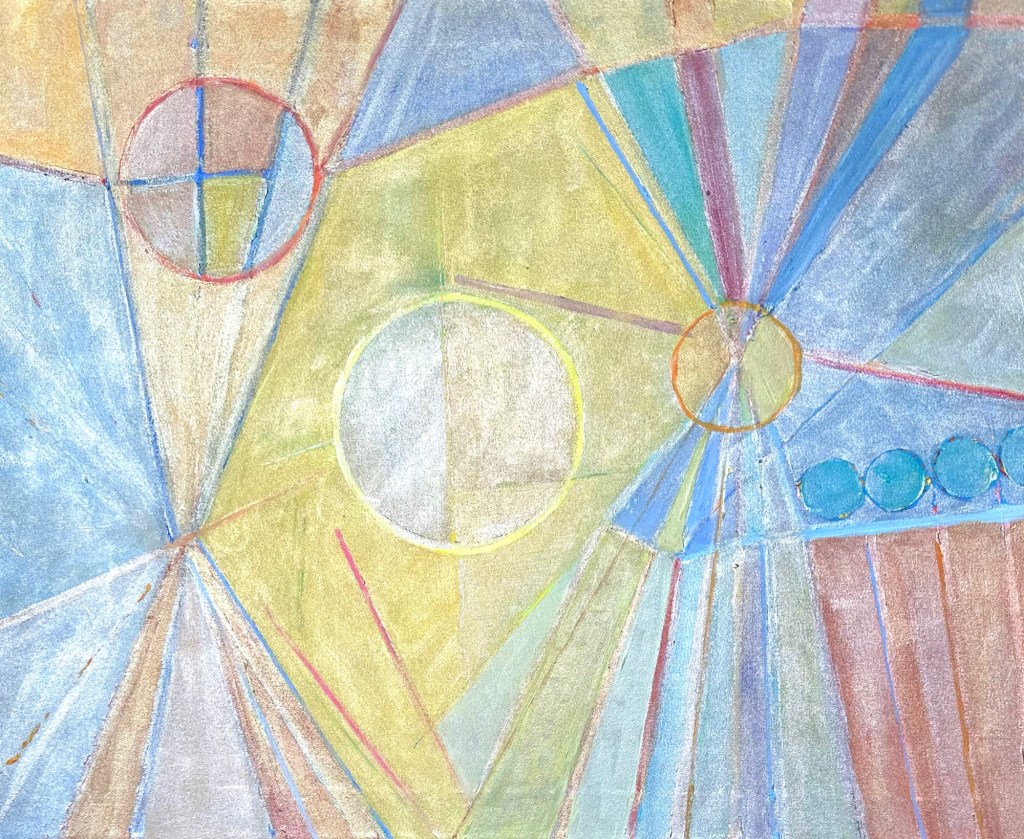
One of our last days in the art class I teach at a local church to adults who are willing to pursue the challenge of treading beyond their comfort zones, I was fooling around with a compass and a straight edge. It wasn’t a ruler, but I found the center of the canvas with the compass intersections instead. I used a piece of cardboard as my straight edge. I ended up with multiple intersecting lines, all of which I left on the surface.
When I got home, I found them interesting. These I pursued, but not all of them. The art is in deciding which ones to ignore! While painting, I reflected on God’s creation. The Holy Trinity has always existed and has always shared the work of creation. Also, there is no such entity as a “Holy Binity” or just the Father and Spirit only. The Son has always existed and has always shared the work of the entire Godhead, which we often refer in a shorthand as “God.”
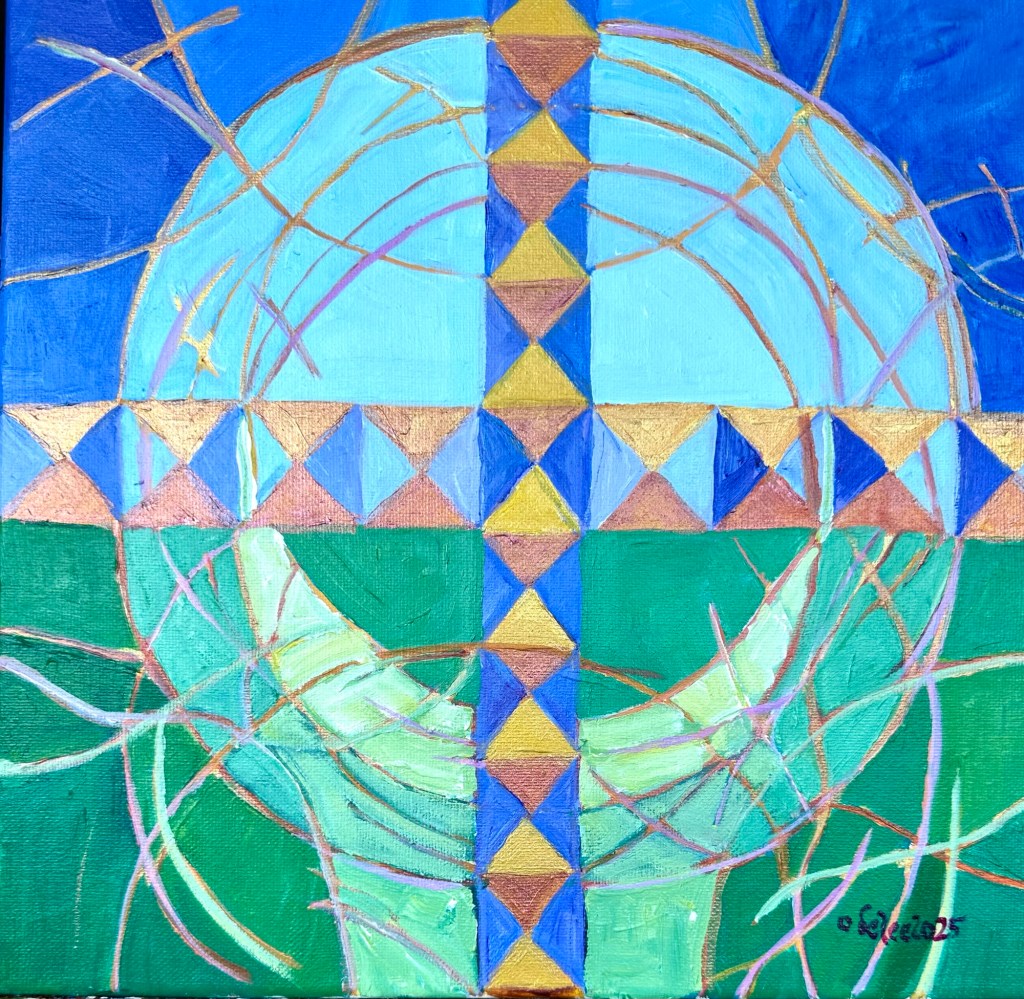
DeLee: The Dome of the Waters, acrylic on canvas, 10” x 10”, 2025
And God said, “Let there be a dome in the midst of the waters, and let it separate the waters from the waters.” So God made the dome and separated the waters that were under the dome from the waters that were above the dome. And it was so. God called the dome Sky. And there was evening and there was morning, the second day. —Genesis 1:6-8
As I painted more, the dark blues above the light blue represented the waters above the “firmament” of the pale cerulean sky. When it rains, the holes in the dome of the sky let the water leak out, or so I’ve heard the old folks say. I never heard their explanation for why it doesn’t rain all the time, but perhaps “angels are involved.” They might be busy plugging the holes in the dome with their fingers, but God must have many angels working hard on our behalf.
The area below is in greens for all the growing and thriving things. There is an upside-down dome, or a Cheshire Cat smile pale green eighth moon shape for the underground water sources. All the intersecting compass marks are the energy signatures, which God’s power unleashes when God makes a new thing or renews an old thing. If we are sensitive to God’s creative spirit, we cannot help but be in awe of the magic and mystery of not only the minutiae of nature, but also the grandeur of the cosmos.
The great landscape photographer Ansel Adams was one of the voices of those who found inspiration in nature, especially our national parks. He spoke the same sensible words for our age: “As the fisherman depends upon the rivers, lakes and seas, and the farmer upon the land for his existence, so does mankind in general depend upon the beauty of the world about him for his spiritual and emotional existence.” (From a speech to the Wilderness Society, May 9, 1980).
The natural world is meant for humankind to care for, tend, and enjoy with respect, just as we would care for a beloved partner. Not everyone sees the world with the eyes of God, who so loved the world—both the humans, the creatures, and the earth itself—God gave God’s only Begotten son to save the world, “For God did not send his Son into the world (kosmon|κόσμον) to condemn the world (kosmon|κόσμον), but so that the world (kosmos|κόσμος) might be saved through him.” (John 3:17) What God created, God loves and will sustain. Can we do anything less and still be faithful to God’s calling on our hearts?
Joy and peace,
Cornelia
U.S. Church Membership Falls Below Majority for First Time
Trans. by Nathaniel Campbell, from the Latin text of Hildegard of Bingen, Liber Divinorum Operum, ed. A. Derolez and P. Dronke, in CCCM 92 (Turnhout: Brepols, 1996), pp. 47-9. (Musical Score)
International Society of Hildegard von Bingen Studies: Karitas habundat
The Book of Divine Works. | Library of Congress: Fully digitized copy of Hildegard’s final tome of 353 magnificently illustrated pages, late 12th century CE.
The Bible has many creation narratives. We’re familiar with Genesis 1 and 2, but our scriptures also include creation stories in Job 38-41, Psalm 104, Proverbs 8:22-31, Ecclesiastes 1:2-11 and 12:1-7, and excerpts from Isaiah 40-55. Some believe God created the world and all of creation in seven 24-hour periods. Others believe God had nothing to do with creation, but nature alone birthed itself in a great explosion. Some believe God created the world and left it to its own purposes. For these deists, God isn’t involved in human affairs in this current world.
We don’t have to pick a side in this argument, or throw in our lot with “God alone” or “no god at all.” We can read the scriptures with modern science in our minds and faith in our hearts. In this, I’d say “we’re better off together” than we are separated into different groups. The love of God shed abroad into our hearts can bind us in this unity. Our human, fallen condition is the anvil on which we break apart into our separate sections and groups.
God is the creator of original unity and the recreator of the coming unity of the new heaven and the new earth, which will restore the unity of our fallen and broken world. In Psalms 104:5-9, the writer speaks of God’s process of creation:
They rose up to the mountains, ran down to the valleys
to the place that you appointed for them.
You set a boundary that they may not pass,
so that they might not again cover the earth.”
Later, the same author notes God is always at work in the world: “When you send forth your spirit, they are created; and you renew the face of the ground.” (Psalms 104:30)
This renewing Spirit, which proceeds from the heart of God, allows us to live in hope, even when we see brutal wars decimating innocent civilians. When nations deprive their marginalized populations of equal rights, we trust that God’s spirit will move to bring a renewing justice for those who are denied their legal rights. When famine and destruction strike, the ones who suffer have hope that those who hear God’s voice will have compassion for them and will come to relieve them.
Of course, if we believe “the voice of God is rarely heard in our land anymore,” or “God helps those who helps themselves,” we are admitting our disbelief in a living and involved deity who is willing to interfere in the affairs of human life.
HERCULES AND THE WAGGONER. A Waggoner was once driving a heavy load along a very muddy way. At last he came to a part of the road where the wheels sank half-way into the mire, and the more the horses pulled, the deeper sank the wheels. So the Waggoner threw down his whip, and knelt down and prayed to Hercules the Strong. “O Hercules, help me in this my hour of distress,” quoth he. But Hercules appeared to him, and said: “Tut, man, don’t sprawl there. Get up and put your shoulder to the wheel.” The gods help them that help themselves
The God we see revealed in the Old and New Testament helps those who can’t help themselves. This God has done this very thing throughout all of human history! Otherwise, God would have chosen the strongest instead of the least to carry out God’s mighty purposes. Instead, God always chooses the least, the last, the lost, the lonely, and the “losers” of our world to lift up. This is why you will not find anything like “God helps those who help themselves” in the Bible. It is found in Aesop’s fable, “Hercules and the Waggoner,” where the moral of the story is “the gods help them that help themselves.” The modern variant, “God helps those who help themselves,” was purportedly coined by the English political theorist Algernon Sidney (17th CE) and later popularized by Benjamin Franklin (18th CE) in Poor Richard’s Almanac.
Pillars of Creation, strings and under painting
In the studio, the artist is always listening for the creative spirit to speak. If I’m sitting before a blank canvas and have no idea whatsoever what to do, I make a mark. I make another mark in relation to the first, for now the two need to speak and relate to one another. As I pick up some more paint to make the third mark, this one must relate to the other two, and so on I go, adding marks and colors.
Once I get some shapes defined, I begin blocking in some colors. Here too, these must speak to one another. One mark can’t shout or be overbearing, while the others fade into the background. I think of warm and cool, opaque and transparent, as well as flat and shaded. Once I get a base layer on the canvas, I remove the strings which I tied to make the shapes. I give it a rest and let my mind rest also. I can come back with fresh eyes tomorrow.
The “Pillars of Creation,” an area of intense star formation, was photographed by the Near-Infrared Camera of NASA’s James Webb Space Telescope.
Inspiration, or listening for the spirit of creation, is especially important to move a work past “coloring in the lines” into a work of art. The “Pillars of Creation,” an area of intense star formation, was photographed by the Near-Infrared Camera of NASA’s James Webb Space Telescope. In the Old Testament, the pillars of creation held up the earth itself, while the dome of the firmament (the sky) was above. The ancient, unscientific age was a limited world, with an unlimited divine being. Today we live in an unlimited universe, but too many people have a god too small to do mighty things beyond our poor capabilities.
DeLee: Pillars of Creation
When I add the silver and gold paints, the number of layers and the directions of my brush strokes determine how much of the under painting will show through. I don’t do this haphazardly, but once again I listen to that still, sheer sound of silence that once called Elijah from his cave. Elijah knew God wasn’t in the wind, earthquake, or fire, but in the sound of sheer silence (1 Kings 19). I may have music playing in the background, but I don’t hear it at all. I’m in another realm entirely. I only hear the silence.
I’m enjoying this current theme and exploration. It combines my love of space and nature. I’m a firm believer in the providence of God: if God cared enough to create all there is, God will not forsake God’s creation. God will provide, and as God’s faithful people, we’ve been entrusted with the care for God’s world. Therefore, we must join God to keep the foundations of creation stable and the resources of our world available for future generations.
Joy and Peace,
Cornelia
William P. Brown: The Seven Pillars of Creation: The Bible, Science, and the Ecology of Wonder, 1st Edition, Oxford University Press, 2010.
We are a people who follow Jesus, “the pioneer and perfecter of our faith, who for the sake of the joy that was set before him endured the cross, disregarding its shame, and (who) has taken his seat at the right hand of the throne of God,” as the writer of Hebrews 12:2 reminds us. The suffering servant motif of Christ was once a model all early Christians expected to inherit and emulate.
The Suffering Servant
Paul spoke to this suffering model in his letter to the Romans:
“…How can we who died to sin go on living in it? Do you not know that all of us who have been baptized into Christ Jesus were baptized into his death? Therefore, we have been buried with him by baptism into death, so that, just as Christ was raised from the dead by the glory of the Father, so we too might walk in newness of life. For if we have been united with him in a death like his, we will certainly be united with him in a resurrection like his.” (6:2-5)
Paul’s first sentence is perceptive because he recognizes many who call on the name of Christ nevertheless go on living an unchristlike life. In the early Christian centuries, many didn’t get baptized until they were near death because they weren’t ready to change their wicked ways. The early Christian habit of hyper-delayed baptism is well attested by the later fourth century. Apparently, the reasoning behind waiting until fairly late in life was the belief baptism cleansed sin once and only once. Consequently, any meaningful sin after baptism could leave one in a serious lurch in the economy of salvation. We have the well-known example of the early 4th CE Emperor Constantine who delayed baptism until his deathbed.
Of course, this is a misunderstanding of the Holy Spirit’s work of perfecting our human nature, but it took many centuries to work this out. We can thank John Wesley for our understanding the works of grace in the ongoing process of Christian Perfection. Baptism washes us from the stain of original sin, which is common to all humanity. Baptism also anoints us with the Holy Spirit to be continually with us and bring us to know God’s saving love in Jesus Christ.
As we grow in faith and the Spirit of God calls us to give our lives to Christ, we are justified from past sins. Some faith communities stop here, so they need over and over justification. They have no ongoing theology of sanctifying grace. We United Methodists do have this great gift, which we can give to the world. When we aren’t going on to perfection in love quite as fast as our neighbors wish we were, it’s because we’re being stubborn and resisting God’s grace.
W. H. Auden says it best:
“We would rather be ruined than changed,
We would rather die in our dread
Than climb the cross of the moment
And let our illusions die.”
The Cross and Self-Denial
The cross is ever a witness to our willingness or unwillingness to bear the cross of Christ. As Jesus told his disciples:
“If any want to become my followers, let them deny themselves and take up their cross and follow me. For those who want to save their life will lose it, and those who lose their life for my sake will find it. For what will it profit them if they gain the whole world but forfeit their life? Or what will they give in return for their life? (Matthew 16:24-26)
Often we interpret this verse in terms of giving up material possessions, but we can never give up outward things unless we’re first willing to give up our false images of ourselves. We might want to be large and in charge, or soft and sweet. Perhaps our self image is invested in being holy and serious. We may even be the class clown. These are only masks behind which we hide our truths and vulnerabilities.
Jesus spoke a parable in John 12:24-25—
“Very truly, I tell you, unless a grain of wheat falls into the earth and dies, it remains just a single grain; but if it dies, it bears much fruit. Those who love their life lose it, and those who hate their life in this world will keep it for eternal life.”
If we want to be changed, we must die to our ordinary selves, and then rise as a new creation. If we remain the same, we won’t be much, but if we’re willing to take on the image of Christ, we can be a new creation of the first order.
How The Witness was made
Ukrainian children’s hospital bombed by Russia
This is how art gets made. I saw an image of a bombed-out children’s hospital in Ukraine. Because the photographer had cropped it in a certain way, I saw an image of a cross on the brickwork. Those rectangular bricks contrasted with the diamond shaped wire work in the darkened areas in the four outer quadrants. I usually weave the whole painting surface, but this time I wove only the cross area. That was a challenge. I had to invent a new way to secure the woven canvas strips on the wooden stretcher strips.
Weaving two paintings together
As I painted the first layer, I made all the contrast of bright colors in the cross and dark blues and reds in the outer quadrants. The next day, I added a gold wash over the cross squares and painted diamond line patterns over the dark quadrants. I came back to add silver into the diamond shapes and to touch up the diagonal lines. I also painted the sides of the canvas to unify it.
Adding blocks of color to the cross of witness
I began with a gritty black and white image, but ended up with bright colors, silver and gold. This too is a metaphor for for the change which we undergo when we die to old selves and begin our transformation into the wholeness of the new creation in Christ. As Paul wrote to the Corinthians:
Gold cross and diamond shapes in the dark quadrants
“So if anyone is in Christ, there is a new creation: everything old has passed away; see, everything has become new! All this is from God, who reconciled us to himself through Christ, and has given us the ministry of reconciliation; that is, in Christ God was reconciling the world to himself, not counting their trespasses against them, and entrusting the message of reconciliation to us.” (2 Corinthians 5:17-19)
Finished painting: Cross of Witness
The cross isn’t a means to divide us from one another, just because we hold varying views on baptism, holy communion, pastoral authority, and scriptural authority or interpretation. The cross stands as a witness to all who are willing to give up their identities to their old egos and claim the only one uniting all persons every day.
Unity through the Cross
This is the Christ, whose love was so great for all creation, he was willing to be lifted up on the cross to draw all humankind unto himself. As Jesus said in John 12:32-33—
“And I, when I am lifted up from the earth, will draw all people to myself.” (He said this to indicate the kind of death he was to die.)
We want to have our Big Mac and Eat it too.
Delusional Mathematics
As we self interested people today have difficulty with many of the words of Christ, we resort to our cafeteria style of choosing which bites we want to enjoy. If a dish in the line is too expensive or not on our diet plan, we can ignore it. The problem with Christ is how we can ignore one claim upon our faith, reject another, and keep another. As a dieter from way back days, I splurged on many a Big Mac or Whopper and large fries, which I washed down with a giant Diet Coke. Unfortunately, my body didn’t follow the same mathematical logic of my mind. I was practicing delusional math.
“Cheeseburger and fries, with a side of Diet Coke.”
“This is my commandment, that you love one another as I have loved you. No one has greater love than this, to lay down one’s life for one’s friends. You are my friends if you do what I command you” (John 15:12-14). John Wesley, in his sermon, The Almost Christian, talks about those who have the outward form of Christianity, but not the inward being. They can be recognized by their attendance at Sunday services, their good deeds, and their attention to the outward shows of ritual. Inside, however, their hearts aren’t filled with love, but with anger, spite, or mere duty instead. They lack sincerity, which is a classic characteristic of one who wears a false mask.
The Last Presidential Assassination
When Ronald Regan was shot by a would-be assassin, his diary recorded his thoughts on his excruciating experience.
“Getting shot hurts. Still my fear was growing because no matter how hard I tried to breathe it seemed I was getting less & less air. I focused on that tiled ceiling and prayed. But I realized I couldn’t ask for God’s help while at the same time I felt hatred for the mixed-up young man who had shot me. Isn’t that the meaning of the lost sheep? We are all God’s children & therefore equally beloved by him. I began to pray for his soul and that he would find his way back to the fold.”
The Altogether Christian
To be a Christian in the true sense, Wesley says the “Altogether Christian” requires us both to “love God and neighbor in our hearts until nothing else exists.” This means even our enemies. I personally find this the most difficult part. I can hold a grudge with the best of the nonbelievers. Yet I don’t find myself calling those people evil or deranged, like so many others who seek to find a reason for their scapegoating.
I can still see people, even myself, as part of flawed and fallen humanity.
Christian Perfection
Wesley defines the pure faith: “Now, whatsoever has this faith, which purifies the heart, (by the power of God, who dwelleth therein,) from pride, anger, desire, from all unrighteousness, from all filthiness of flesh or spirit; which fills it with love stronger than death, both to God and to all mankind; love that doth the works of God, glorying to spend and be spent for all men, and that endureth with joy, not only the reproach of Christ, the being mocked, despised, and hated of all men, but whatsoever the wisdom of God permits the malice of men or devils to inflict: whosoever has this faith, thus working by love is not almost only, but altogether a Christian.”
Under John Wesley’s exacting standards, we may all be “almost Christians,” but the good news is we can always hope in the one who gave his life to begin a new life in us and others. If we pray for our enemies’ faults, which we spot so easily because they are our own, God will help to heal both them and us.
Mending Broken Hearts
The Cross Supplants Division
An ancient wisdom story told among the rabbis says the students were questioned on the difference between night and day. All their answers marked divisions: some prayers are said only at certain hours, or there isn’t enough light to distinguish one field or a house from another. The rabbi grew frustrated and cut them off. “You only know how to divide! Daylight begins when you can look on your neighbor’s face and see a friend, not an enemy.”
In this time of division, the witness of the cross reminds us Christ died for all humanity, so no one is outside the love of Christ. If we’re to love our neighbor as ourselves, caring for the poor and marginalized should be a priority for the people of faith. Our neighbors don’t stop at our borders, for our world is interconnected.
Migrations were a fact back in Abraham’s day, when Egypt was the land of opportunity. We ought to treat immigrants better than the Pharaohs treated the Hebrew people. Moreover, in our current political landscape, we might want to quit name calling and playing to the lowest denominator of our bases. Policy statements won’t get sound bites on television, but that’s a good thing. Sound bites play to our false selves and not to our true selves in Christ Jesus.
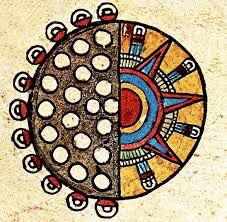
DeLee: Sun Mandala, 2022, private collection
I can close with a poem from the Persian poet Rumi:
I only speak of the Sun because the Sun is my Beloved I worship even the dust at His feet.
I am not a night-lover and do not praise sleep I am the messenger of the Sun ! Secretly I will ask Him and pass the answers to you.
Like the Sun I shine on those who are forsaken I may look drunk and disheveled but I speak the Truth.
Tear off the mask, your face is glorious, your heart may be cold as stone but I will warm it with my raging fire.
No longer will I speak of sunsets or rising Moons, I will bring you love’s wine for I am born of the Sun I am a King !
Joy, peace, and sacrificial love,
Cornelia
—W. H. Auden, The Age of Anxiety: A Baroque Eclogue (Princeton, NJ: Princeton University Press, 2011), 105.
Ready or not, the creative juices must be stirred. If the brain has lain fallow all summer, or it’s been overworked keeping the youngsters occupied, now you can find your own groove again.
Our first meeting will be Friday, September 8, at 10 am in the old fellowship hall. Bring your own acrylic paints, brushes, and a canvas or canvas panel to paint on. We begin with a short visual inspiration from some great art works, I give some direction on the skill we’ll work on in the session, and then everyone is free to bring their own unique expression to their paintings. We don’t copy my work and judge how well a person can match it. Instead, we learn from others and stretch our own skills to create something new.
Paul Klee: Houses
Making great art isn’t our first purpose. As we age, we will lose our ability to learn new skills until we lose our memory of what we just ate for breakfast. Challenging our brains is one of the best ways to keep our brain cells firing and “chatting with one another.” Socialization and encouragement also helps to keep our brains young.
Frank Lloyd Wright: Stained Glass Design
Making art means we also will have to give up our desire to be perfect. Artists quickly learn perfection comes from practice, or working at it. Every baby stumbles and falls as they learn to walk, but dotting adults encourage every trembling step. This is what art teachers also do. I’ve always had a rule in my classes, especially when I taught in middle school:
No Negative Talking about People or Art.
This includes a student’s own art works. They always had to give at least three positive comments about their work before they spoke about the negative. “My work needs improvement” is a better way to say “My work stinks!”
Of course, we’ve all grown up and worked in environments where negativity is the rule. Art class is a place of grace because this is how life should be. If we can transform a blank canvas into a field of color, why can’t we transform our communities and our world into fields of hope, joy, and love?
Blue Monochromatic Study of the City
Perhaps because we often try to make everyone copy/fit into our idea of the proper end product, rather than allow everyone discover their own creative response to the given subject of the day. Finding our own voice and our own expression is important. Even beginners will have their own unique voice and vision, if they only allow the creating spirit of God work through them. The museums of our world are richer and more vibrant because artists have listened to the Spirit of the Creating God. We might do well to realize God’s creative energies are varied and vibrant also, just as Isaiah wrote about his vision of God’s Glorious New Creation:
“For I am about to create new heavens and a new earth;
the former things shall not be remembered or come to mind.
But be glad and rejoice forever in what I am creating;
for I am about to create Jerusalem as a joy, and its people as a delight.” (65:17-18)
James Wyper: City of Dreams
I hope to see you in art class. I don’t charge for the class sessions, since this is one of my ministries as a retired elder in the United Methodist Church. As John Wesley once said, “The World is my Parish.”
Valentine’s Day is all about love. Television advertisements push candies, dipped gold “eternal” roses, gaudy jewelry—a price for every pocketbook—and the dating apps have been in full swing since the new year.
“Everybody needs somebody to love,” the old song goes. The Blues Brothers sing this oldie before their mad escape from the Illinois Law Enforcement Community. Solomon Burkes treats it with his indigenous soul blues from his lived experience and The Rolling Stones give it their percussive upbeat treatment. Wilson Picket has a good cover, but I don’t recommend the explicit version of Rod Wave’s Sneaky Links. Fitz and the Tantrums was interesting. My “old person “ is probably showing about the edges here.
Martin Luther King, Jr. Quote
We all can love our friends or sweethearts, especially in mid February. After all, February is “for lovers.” The bigger question is, How do we love our enemies? Dr. Martin Luther King, Jr., in his book, A Gift of Love, writes:
“First, we must develop and maintain the capacity to forgive. (The one) who is devoid of the power to forgive is devoid of the power to love. It is impossible even to begin the act of loving one’s enemies without the prior acceptance of the necessity, over and over again, of forgiving those who inflict evil and injury upon us.”
Well, how can I forgive the person who hurt me, my child, my family, my tribe, or my community? We all want that person to come crawling to us and ask for forgiveness, but that’s not how radical love works. We want the wrong doer to show remorse and ask us for mercy and forgiveness. This puts them in a subordinate position and us in a position of power. But that’s not how radical love works. Radical love initiates forgiveness, even if the wrongdoer never shows contrition.
Dr. King goes on to say:
“It is also necessary to realize that the forgiving act must always be initiated by the person who has been wronged, the victim of some great hurt, the recipient of some tortuous injustice, the absorber of some terrible act of oppression.”
Sir Terry Frost: Sun Tree, 2003, Silkscreen on Paper with 9 collage elements. Frost was a prisoner of war in WWII with Adrian Heath, who taught him to paint. They were both imprisoned in Stalag 383, in Germany.
Why must the wronged take on the indignity of offering forgiveness to unrepentant wrongdoers? In this act, we become most like Christ on the cross, who in his final moments, forgave not only the thief who asked for forgiveness, but also all those who crucified him, who had no intention of repenting. Our problem is we enjoy being like the risen Christ, the one with the “name above all names,” but most of us don’t want to “pick up our cross and follow” Jesus, especially if it leads to an ignominious death on that very cross.
Sir Terry Frost: Blue Love Tree, 2003, Silkscreen on Paper
As Dr. King wrote,
“The wrongdoer may request forgiveness. He may come to himself, and, like the prodigal son, move up some dusty road, his heart palpitating with the desire for forgiveness. But only the injured neighbor, the loving father back home, can really pour out the warm waters of forgiveness.”
The injured one, whose heart has been broken and wounded by someone else’s words or deeds, is the only one who can heal the broken rift between them. This is why the deepest lovers of Christ are most often the wounded ones who’ve been healed by God’s mercy, grace, and forgiveness. The woman with the alabaster jar of ointment anointed Jesus’ feet in the house of the Pharisee, but the host had failed at the minimum hospitality for his guest, so Jesus reminded him (Luke 7:47):
“Therefore, I tell you, her sins, which were many, have been forgiven; hence she has shown great love. But the one to whom little is forgiven, loves little.”
Mending Broken Hearts, silkscreen, artist unknown
If we would be healers in our broken and fragmented world, we need to first address our own woundedness. Each of us has a hidden pain or suffering, for this is the human condition. If we give this to God, our healing makes us into vessels where our cracks are filled with precious gold. We can offer more love, more forgiveness, and more hope to people who have been sitting in darkness and despair. People are waiting for joy and love to flow out in abundance from God’s heart into our hearts and into their world. Then we can be the light in the darkness for them, the holy fire that lights the embers of hope in their hearts, not just on St. Valentine’s Day, but every day.
Joy, Peace, and Love,
Cornelia
Kintsugi: Mending cracks with gold
Excerpt from A Gift of Love | Penguin Random House Canada By Dr. Martin Luther King, Jr. Chapter 5, Loving Your Enemies
Hamlet’s famous soliloquy begins with these very words,”To be, or not to be: that is the question.” In seminary I learned one of those big fifty cent words I often had to check my dictionary for its meaning. Ontological is a word we don’t throw around in ordinary conversations. I never used it in a sermon, for its strangeness would have been a stumbling block to folks without similar training. Who am I kidding? It was often a stumbling block when I tripped over it in my reading. I finally understood it after my first year of Greek. I needed to know its meaning fully and completely to comprehend it.
Current events, however, make an auspicious teaching moment for this weird word. Ontology is a branch of metaphysics concerned with the nature and relations of being. Ontology is the the branch of philosophy which deals with abstract entities. It’s concerned with the nature of being or the kinds of things that have existence, but are outside objective experience. It deals with the first principles of things, including abstract concepts such as being, knowing, substance, cause, identity, time, and space. Our word essence carries the meaning well, for it means “the permanent as contrasted with the accidental elements of being.”
An example of an ontological statement in scripture is the discussion Jesus has in John 8:56-58 with some of the Jews who opposed him:
“Your ancestor Abraham rejoiced that he would see my day; he saw it and was glad.”
Then the Jews said to him, “You are not yet fifty years old, and have you seen Abraham?”
Jesus said to them, “Very truly, I tell you, before Abraham was, I am.”
In Shakespeare’s play of the same name, Hamlet’s whole soliloquy is about his existence, and whether he should live or die:
Whether ’tis nobler in the mind to suffer The slings and arrows of outrageous fortune, Or to take arms against a sea of troubles, And by opposing end them? To die: to sleep; No more; and by a sleep to say we end The heart-ache and the thousand natural shocks That flesh is heir to, ’tis a consummation Devoutly to be wish’d. To die, to sleep;
Ontology comes from the Greek root ontos, ōn, which is the present participle of einai, of the verb to be. As I’ve watched the unfolding horror of this “Russian special exercise” on Ukrainian soil, I’m struck by the sense of Hamlet’s description of the struggles of life:
To sleep: perchance to dream: ay, there’s the rub; For in that sleep of death what dreams may come When we have shuffled off this mortal coil, Must give us pause: there’s the respect That makes calamity of so long life; For who would bear the whips and scorns of time, The oppressor’s wrong, the proud man’s contumely, The pangs of despised love, the law’s delay, The insolence of office and the spurns That patient merit of the unworthy takes, When he himself might his quietus make With a bare bodkin?
“To be” is the ontological insistence for the Ukrainians, for they desire to exist as a free people in a free nation. They resist occupation and occupiers. Dictatorship isn’t in their five year plan, or in their distant future, if they can help it. The surrounding nations have suddenly come alive in their recognition of Russia’s unfortunate foray into this breadbasket of Europe.
Yet even as the Ukrainian people are being killed in their streets, for no reason other than their citizenship; and their homes, hospitals, museums, and public buildings are reduced to smithereens by cluster bombs and artillery fire; they fight for their land and their freedom. I watch for one hour on the evening news, for I believe our world must stand witness to this horror.
Yes, some will turn away, for they have too much trauma in their own lives to bear the pain of others. Others will watch and say this isn’t our problem. If we remember our scripture, the chosen disciples abandoned Jesus in his hour of pain and need, but the women stayed by his side until his last breath. Then they came to dress his dead body’s wounds, but found an empty grave, while the men were holed up in a locked room for fear of the Jews (John 20:19).
Humanity is always our concern and when inhumane acts or conditions prevail, the human responsibility is to bear witness and to share the burden. As Paul writes in Galatians 6:2—
“Bear one another’s burdens, and in this way you will fulfill the law of Christ.”
Hamlet muses on, dithering as contemplates taking his own life, but he takes no action for fear of what awaits him in the world beyond.
who would fardels (burdens) bear, To grunt and sweat under a weary life, But that the dread of something after death, The undiscover’d country from whose bourn (boundary) No traveller returns, puzzles the will And makes us rather bear those ills we have Than fly to others that we know not of? Thus conscience does make cowards of us all; And thus the native hue of resolution Is sicklied o’er with the pale cast of thought, And enterprises of great pith and moment With this regard their currents turn awry, And lose the name of action.
While none of us know with certainty what lies beyond this world, for no one has ever returned with souvenirs, people of faith have trusted God to be always with them, even in the worst of times. As Paul writes in Romans 8:35, 37-39—
“Who will separate us from the love of Christ? Will hardship, or distress, or persecution, or famine, or nakedness, or peril, or sword?…No, in all these things we are more than conquerors through him who loved us. For I am convinced that neither death, nor life, nor angels, nor rulers, nor things present, nor things to come, nor powers, nor height, nor depth, nor anything else in all creation, will be able to separate us from the love of God in Christ Jesus our Lord.”
Battle of Issus Mosaic, Detail: Portrait of Alexander the Great
Artists across the centuries have responded to the horrors of war, if they aren’t held in thrall to the purveyors of such deeds. Those who exist to magnify the glories of battle are there as servants of powerful leaders, not as representatives of the fragility of the human condition. Think of Alexander the Great and his route to deification, first as a glorious leader, then as a god.
The Alexander Mosaic depicts a moment of victory in Battle of Issus in which Alexander has broken through to Darius of Persia, whom he defeated and shocked, before Darius was at the verge of fleeing. The mosaic is as great as Alexander himself, for it’s about 9 feet by 17 feet in size and contains over 1.5 million individual blocks of color, or tesserae. This Roman copy of an original Greek fourth century BCE painting dates from the second century BCE and is in the Museo Nazionale, Naples, Italy.
Goya: The 3rd of May 1808 in Madrid, or “The Executions”, oil on canvas, 1814, Prado Museum, Spain.
Here we see Goya painting the horrors of war and its impact on humanity. His inspiration comes from the French army’s assassination of a group of Spanish patriots during the 1808 rebellion. The Spanish heroes are illuminated by the intense light, but their faceless enemies aren’t easily visible in the darkness from which they operate. Not only does the design make plain Goya’s feelings, but his psychological understanding of the scene as well.
As Matthew writes in Jesus’ teaching kernel known as “The Sound Eye,”
“The eye is the lamp of the body. So, if your eye is healthy, your whole body will be full of light; but if your eye is unhealthy, your whole body will be full of darkness. If then the light in you is darkness, how great is the darkness!” (6:22-23)
Picasso: Guernica
Probably the best known war painting of our modern era is Picasso’s Guernica. He painted it in response to the Nazi bombing of Guernica, a Spanish town in the Basque region during the Spanish Civil War. At about 16:30 on Monday, 26 April 1937, warplanes of the German Condor Legion, commanded by Colonel Wolfram von Richthofen, bombed Guernica for about two hours. Germany, at this time led by Hitler, had lent material support to the Nationalists and were using the war as an opportunity to test out new weapons and tactics. Later, intense aerial bombardment became a crucial preliminary step in the Blitzkrieg tactic.
Guernica, Picasso’s most important political painting, has remained relevant as a work of art and as a symbol of protest. It has kept the memory of the Basque town’s nightmare alive. While Picasso was living in Nazi-occupied Paris during World War II, one German officer allegedly asked him, upon seeing a photo of Guernica in his apartment, “Did you do that?” Picasso responded, “No, you did.”
Lest we forget, while wars are often started by those in power, it’s the mothers who suffer when young soldiers are killed in action. Some are fortunate enough to have the body of their loved one to hold, but it’s a sad consolation prize. How heart rending it must be for the families whose children were left behind as casualties of war. As the old Cold War era 1985 Sting song about nuclear war reminds us—
There’s no such thing as a winnable war It’s a lie we don’t believe anymore… We share the same biology, regardless of ideology But what might save us, me and you Is if the Russians love their children too.
The great sadness of this brutal war foisted on the Ukrainian people is while we’re free to see and own the pain inflicted on others, too many of us will turn away. Then again, we often have difficulty acknowledging our own pain and weakness, for we prefer to see ourselves as whole, strong, and unconquerable. All of us have a weak place and we all have an emptiness that needs to be filled. Some of us fill this emptiness by seeking power and control, while others choose various substances or activities to overuse. A few will let God’s Spirit fill us, as Paul writes in 2 Corinthians 4:7—
“But we have this treasure in clay jars, so that it may be made clear that this extraordinary power belongs to God and does not come from us.”
When I see the satellite imagery of the obliterated Ukrainian towns, I recall my childhood memories of the old ones in my family repeating their ancestors’ stories of the troubled times during the Civil War. I can easily imagine in Ukraine, for several generations to come, all the stories of pain, survival, and resilience that will be told as they rebuild their nation from the ground up. In the midst of this ongoing disaster, they’re already thinking “How can we build back better?”
This is a great lesson for all of us. If our life hits a major roadblock, we can either give up, scale the wall, or find a way around the wall. Another option is to make peace with the wall and find a way to be happy there. Since Putin is tearing down all the walls for the Ukrainian people, they’ve decided to double down on being Ukrainian. “To be me” is “to be free” and that means “to be Ukrainian.” As their land lies in ashes about them, those who once also spoke Russian, a similar language to Ukrainian, now find that language dead as ashes in their mouths.
Cornelia DeLee: Ukrainian Town Reduced to Ashes, acrylic on canvas, 2022.
To win friends and influence people requires a gentle hand, not the ham-fist of a dictator. I only wonder if the Russian people will ever understand this. But they may have been slaves of their state for so long, they don’t know the sweet taste of freedom. Perhaps only those who believe in a forgiving God, who allows God’s people the freedom to make mistakes and gives them through the reconciling grace of renewed fellowship, are able to come through such disasters. Those who are “sinners in the hands of an angry god” must think their fate is destiny and accept it.
So the questions remain:
What IS the nature of YOUR God?
How does God’s nature affect your understanding of human nature?
Does your view of humanity reflect your image of God or do you see humanity through “God’s eyes?”
Read the Prodigal Son in Luke 15:11-30 and answer the questions again
Are we our works? Are we valued by our works? Is work a noun or a verb? The child in me asks these questions until the parent in me wants to answer, “I don’t know. Go ask Alexa!”
Alexa Meme
We’ve all been there with the rug rats of our families and kinfolks. Children are curious and for this we’re grateful. This incessant questioning is their way of learning about the world. It’s altogether better than a puppy’s chewing on every new object it comes across. If families are to encourage their child’s interest, they get them a library card so they can have internet access and books to read, and they answer as many questions as possible. If they don’t know the answer, “Go look it up in Google or the encyclopedia.”
In ancient Greece, Socrates taught by asking his students questions, a technique we call the Socratic Method. Some of us teach art in this way also. When we see the student at a stopping point, we teachers ask, “Are you having a problem and not figuring out a solution?”
Raphael: School of Athens , Vatican City, 1509-11.
The student can usually point out what they want to change on their work, but they don’t have the experience or prior learning to drawn upon to solve it. For instance, if the flower petals all look flat because they’re painted in one color, the beginning student knows this doesn’t look right, but they need a trained eye to point out the variety of values in the petals. Once they see the gradation of light to dark, it’s never again unseen. We know it’s there.
Teachers can point out the range of values from dark to light that make up the visual vocabulary of shading a two dimensional image so it looks like a three dimensional shape. Students can learn this technique and master it over time. Mastery then becomes a matter of hand and eye coordination. In a sense, we have to lose ourselves in the subject matter so we can let its energies enter into our hearts and minds, and quicken our hands. The rest is a matter of practice and learning how our egos can quit controlling the outcome.
Old Farmland off Higdon Ferry Road
The spiritual writer and Jesuit priest Richard Rohr speaks of the three eyes in his book, The Naked Now. The first eye grasps what the senses can understand, the second eye understands the science and poetry, while the third eye is aware of all of the above, but especially how all things connect as part of God’s great mystery. When we enter into this “now,” we’re present not only to God, but to all creation, as well as our own selves. This is the contemplative spirit for which the artist strives, and not just for the mastery of the materials or for the rendering of the subject matter.
If we allow this energy to move our hands, does that mean our work also becomes part of us? If we baked a simple yellow cake out of a box, we might not ask that question. When we start decorating a cake made from scratch and adding frillies of frosting, then we start identifying with the cake. Should someone smash the cake enroute to the soirée, there’ll be hockey sticks to pay.
I remember almost fainting in Italy when I saw a glue blob on one of my delicate watercolor paintings, which had just been framed for an exhibition there. A stiff shot of some unknown alcohol brought me back to life. The framer made it good, for the glue was water soluble, so we could gently lift it up. I was more of a drama Queen in my 20’s also. I take things as they come these days. I also was more immature, for I didn’t separate my work from my identity.
Some say we are what we eat, so then are we what we create? Jesus had an answer in Mark 7:18-19 for those who thought certain foods were unclean, or forbidden to eat:
“He said to them, “Then do you also fail to understand? Do you not see that whatever goes into a person from outside cannot defile, since it enters, not the heart but the stomach, and goes out into the sewer?” (Thus he declared all foods clean.)”
That fancy dinner we ate two nights ago leaves us after a few cups of coffee in the morning. We don’t recognize it and most of us don’t even inspect it as we flush it down the toilet on its way out the sewage pipes to the sanitation station. Of course, only parents can get excited about their two year olds who manage to do their “business” in the toilet instead of in their diapers. I know I was one of those. If Facebook had been invented back in the day, I’m sure I’d have posted an update.
As we grow older, we enjoy making and crafting for the experience of the textures and the command of the materials. Children have fun pushing the paints, papers, and glue all around the surface of their artwork. Parents often look askance at the grey, scribbled messes their children excitedly present to them for the honored place on the refrigerator display, but these muddy creations are the result of a dramatic story of their child’s imagination. “Interesting, why don’t you tell me what’s going on here?” Is an adult’s best response in this situation.
Art Lesson: Cut a Snowman on the Fold
I’ve had kindergarten children meltdown because they had difficulty cutting a snowman on the fold. It’s hard to be five years old and live in a home in which the parents don’t want their children to make a mess. These children, as a result, have poor fine motor skills, have difficulty writing, and handling scissors. Even folding a piece of paper is tough. Then they miss the important information: hold the fold, and cut on the flaps. If they hold the flaps instead, they end up with two halves of a snowman. And a meltdown into tears.
“I’ll never be able to make a snowman! My snowman is cut in two pieces. Why can you make a perfect snowman and I can’t?”
Therapy Hat
This lesson always called for me to wear my therapy hat, and remind my five year old students I’d been making folded snowmen for a very long time and my first ones looked just like theirs did. There was hope for them. We just needed to go over the directions again and make one together. Sometimes we miss a step, and that’s ok. It’s just a piece of paper. It’s not like we took away recess from everyone forever.
Usually when we went over the directions again, I could remind them of the way to hold the fold and cut the flaps. Then they’d all be amazed at how easy the project was. “Everything is easier when you follow the directions.” They’d laugh and start decorating their snowman, all their meltdowns forgotten.
Most of us aren’t successful the first time we attempt a new experience. If we were all extraordinary artists right off the mark, none of us ever would get excited about Michelangelo, Rembrandt, or Picasso. If we could all pick up a musical instrument and play it well right off the bat, who’d have the need for civic symphonies or even bar bands? We’d all be happy making our own music. The truth is some of us not only have the interest and inclination, but also the will to spend not just hours, but years, honing our craft, until we sing our notes purely or paint with a master’s hand.
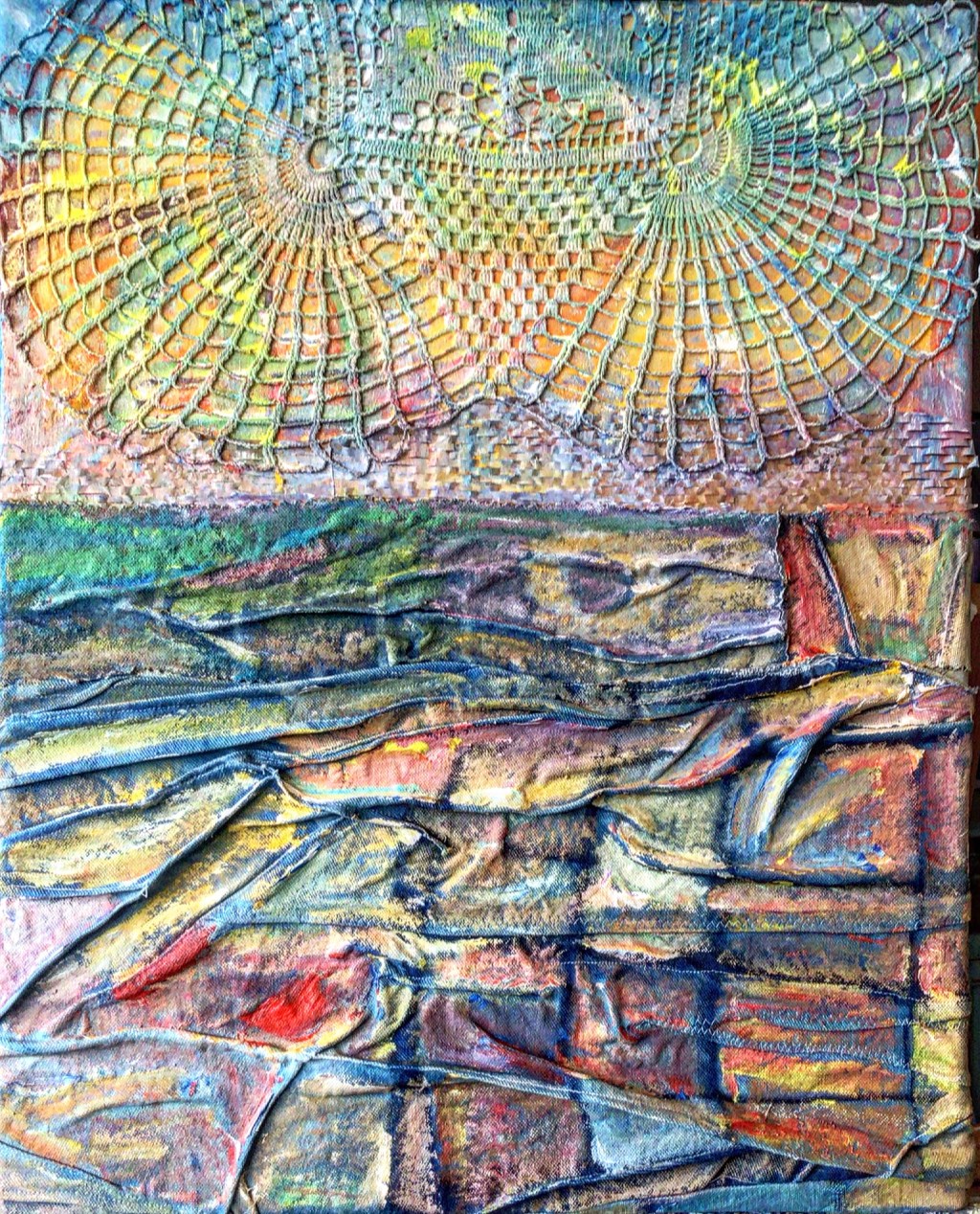
Woven Canvas: Greenway Park
If we all aren’t masters, we all can enjoy the journey if we learn to detach our egos from our products. When I wrote papers in seminary, before I opened up my graded work, I’d repeat the mantra, “I am not my grade. I am a daughter of the living God, chosen for God’s work.” Then I’d look at the markings on the inside. This helped me to remember who I was, whose I was, and what my purpose was. I was also two decades older than that fainting child in Italy.
As I would tell visitors to Perkins, “If your well-being is wrapped up in your grade average, you might want to rethink either that notion or choose another school.” “Oh, really?”
“Yes, if you’re going on for a PhD, you’ll get over a 90 in your classes. The top grade for the Mdiv is 89. If you get any grade higher than that, the professor thinks you could do PhD level work.” “That doesn’t seem right,” they said.
“It’s a curve. If you go elsewhere for a DMin, those schools know Perkins’ grading system. Think of it as an A at 89 and don’t worry about it.”
Some people can’t restructure their world so their 89 is an A, but if that’s the system they’re in, that’s how it is. If they have in their mind nothing less than a 95 will validate their worthiness, then if they do their degree work at Perkins, they’ll always be up against the immovable wall. When they go out into ministry, they’ll discover everyone they meet has a grading system. That can drive a person crazy, unless he or she decides the ultimate approval they seek comes from the one who says, “Well done, good and faithful servant.”
Likewise, if we’re beginners in art, we have to suspend our criticism of our imperfections in our work. Instead, we reframe our critiques into “areas which need improvement.” Even now, after decades of working in my studio, I’ll let a canvas rest near me in my living room. I’ll eye it in different lights, until I hear it call my name. I’ve totally repainted some of these, and others I’ve destroyed. A few I leave alone. All of us will keep learning something new, both from our “good paintings “ and our “need improvement works.” Most likely, artists quit painting when they they think they have nothing left to learn, or when they lose the courage to risk moving into the unknown mystery, as it’s written in 1 Corinthians 2:9—
“What no eye has seen, nor ear heard, nor the human heart conceived, what God has prepared for those who love him.”
Paul also writes in Romans 8:27-28,
“And God, who searches the heart, knows what is the mind of the Spirit, because the Spirit intercedes for the saints according to the will of God. We know that all things work together for good for those who love God, who are called according to his purpose.”
Poverty Point World Heritage Site, Louisiana
So we too ask the Spirit to work more in us and free us from attachment to our need to be loved and affirmed by our works, since God is already working for good for those who love God and who are called according to God’s purpose. As we drop our old ideas and preconceived notions of the good, we become open to God’s good and God’s purposes. Releasing control to God is an act of humbleness and faithfulness, both of which are contrary to our modern belief in self-actualization and autonomy. This is the way of the mystic, or the contemplative, and the inspired artist.
I’ve always been a weather watcher, even as a small child. One of my first memories of the weather was my Dad putting the finishing touches on cutting the front lawn just as the first raindrops would fall from the sky. When I grew up and had my own home, the scent of an impending thunderstorm would send me outside frantically to mow my own lawn. I finally asked Daddy why he always mowed just before the storm.
He replied, “It’s too hard to mow when the grass is wet and the ground is soggy.” I thought to myself, “Why don’t we just pick a sunny day, but that might be too easy, or we’re off doing fun things on that time.”
Snow Covered Landscape
In Arkansas, our farm communities pay close attention to the weather, for the crops which are their livelihoods depend on it. In ancient times, keeping track of the seasons and knowing weather lore was important. Today we depend on weather forecasters for this arcane knowledge, but if we follow basic science, we learn about global patterns which affect our weather: El Niño, La Niña, the Polar Vortex, as well as the extremes brought on by climate change, such as more active hurricane seasons and intense temperatures, both hot and cold.
My parents grew up during the Great Depression. Their grandparents were the first generation off the farm, working either in town or on the railroad. When mom and dad first started out in a one room garage apartment, they practiced frugality. Later on, they always bought an extra can of whatever was on sale at the grocery store. They were always prepared for the emergency of another mouth at the table or a sudden ice storm, not that one often happened. Since I was following the national news, I had stocked up ahead of time on rice, beans, mixed veggies, chicken, and coffee. If snowmageddon were to arrive, I would meet it on a full stomach. It was only after the streets thawed several days later and I ventured out that I saw the stark emptiness of the grocery store shelves. Starbucks was out of many products also, since their suppliers are based in Texas.
Gary Joiner of the Texas Farm Bureau estimated damages to the agriculture sector alone could exceed $500,000,000 statewide. “The bulk of that will be in the Rio Grande Valley where the fruits and vegetables grown there really took a hit. Consumers will see an absence of some Texas products for a period of time because of the freeze.”
Winter Storm Uri causes $600,000,000 damages to Texas agriculture. This is a frozen citrus tree.
Texas cattle ranchers were in the midst of calving season, so to protect the newborns, they built hot boxes with heat lamps or brought the animals into their homes. Extreme weather calls for extreme acts of compassion.
Let’s contrast our modern views of Nature with the views presented in the Wisdom book of Job. In the book of Job, we hear one of his friends tell him, “God thunders wondrously with his voice; he does great things that we cannot comprehend. For to the snow he says, ‘Fall on the earth’; and the shower of rain, his heavy shower of rain, serves as a sign on everyone’s hand, so that all whom he has made may know it” (37:5-7). This friend wants Job to understand God’s ways are inscrutable to mere human beings and neither Job, nor any of us, should question why bad things happen to good people.
Snow Covered Woods and Lakeside
Of course, Job won’t have any truck with this argument, and must have given his pals the look that says, “You boys take me for some kind of fool?” This sends his friends into a tizzy, so they keep piling on:
“From its chamber comes the whirlwind,
and cold from the scattering winds.
By the breath of God ice is given,
and the broad waters are frozen fast.
He loads the thick cloud with moisture;
the clouds scatter his lightning.
They turn round and round by his guidance,
to accomplish all that he commands them
on the face of the habitable world.
Whether for correction, or for his land,
or for love, he causes it to happen.” (Job 37:9-13)
Clouds over Bridge
His friends remind Job how God uses even natural events for God’s purposes. God can cause a snow storm to humble us (correction), to refresh the water supply (for the land), or to bring a community together (for love). We saw evidence of this during our recent snowstorm, which impacted not only Texas, but also the Lower 48 states, where by the morning of February 16, 73% of the continental USA was blanketed by snow. This was the most widespread snow cover in the contiguous U.S. since 2011. If we say “Mother Nature hit us with a whammy,” I wonder why we weren’t also blaming Old Man Winter. This is International Women’s Month after all, and we ought not to blame only the women for bad things!
Lots of bad things did happen, just from the back to back winter storms named Uri and Viola. In Texas alone, estimated losses from the extended freeze and power outages in Texas could reach $90 billion, with around $20 billion of those losses covered by insurance. Compare that to the entire 2020 Atlantic hurricane season. According to a new report from AccuWeather, the 2020 hurricane season was responsible for $60-65 billion in economic damages. This figure includes property damage as well as wage losses, business losses and bankruptcies, contamination of drinking water, municipal and state costs, federal assistance, cleanup costs and health costs.
One of the local electric providers, Just Energy, has sought bankruptcy protection due to unexpected costs. “The weather event caused the ERCOT wholesale market to incur charges of $55 billion over a seven day period, an amount they ordinarily incur over four years.” Brazos Electric Power Company has filed for Chapter 11 and Griddy is out of business, since its 10,000 customers have been given to other companies due to its violating the Texas Deceptive Trade Practices Act. The Texas Attorney General is seeking refunds for customers. Other utility companies are considering bankruptcy, or perhaps amortizing the high bill across ten years and letting their customers pay for it on time. Since these same companies failed to make the suggested winterizing changes to their physical plants a decade ago, I wonder why their problem is now their customers’ problem?
In this instance, everyone points a finger at everyone else. People died due to the cold weather and the utilities failure to prepare for it. Insurance rates are going up, not just in Texas, given that some of these companies have a national portfolio. Food costs are going up, due to scarce supplies and longer distances for delivery. Citrus will cost more for years until the orchards recover. So it’s an object lesson for the rest of us. As my old nannie used to say, “A stitching time saves nine,” while my daddy took the Texas plan of “Don’t fix what ain’t broke.” Unfortunately, his plan could leave me stranded on the side of the highway in a broke down car. I tend to take better care of my vehicle. He also never realized my brothers were fixing his car on the sly because he had that ornery streak.
Of course, current temperatures are now in the mid 70’s and low 80’s, so everyone is using the air conditioning. They went from the dead of winter into springtime. For parts of California and Arizona, this spring leaf out was the earliest in the 39-year record. Every one to four years, Texas has an early spring, whereas central Arkansas has a late spring every five to ten years. The further south you go toward the equator, the more pronounced the seasonal extremes become.
Of course back in biblical times, folks had weather lore, but no satellites to observe the land from on high. They could keep oral and written accounts of the past weather events, so the memories of the elders were treasured. Job’s friends try to make the events of nature the result of God’s actions, but then God answers Job out of the whirlwind:
“Have you entered the storehouses of the snow, or have you seen the storehouses of the hail, which I have reserved for the time of trouble, for the day of battle and war?” (38:22-23)
Multimedia snowscape with Crochet
I’d never accuse God of mansplaining to his creatures, but maybe “Godsplaining” is a better term: “Are you competent to answer this question? How do you know for certain? What experience have you had that allows you to speak of things you can’t possibly know?” We human beings haven’t been privileged to walk among the clouds or to know the hidden halls where the frozen treasures are stored. Yet we persist in talking about the hidden wisdom of God as if we were initiates to privileged information. We can’t know God fully as yet, for God is fully spirit and we are both body and spirit. As Paul reminds us, “For now we see in a mirror, dimly, but then we will see face to face. Now I know only in part; then I will know fully, even as I have been fully known” (1 Corinthians 13:12).
The amazing climax of this book is God’s appearance to Job and his affirmation of Job’s understanding of God’s nature. Job tells God:
“I had heard of you by the hearing of the ear, but now my eye sees you; therefore I despise myself, and repent in dust and ashes” (Job 42:5-6).
Job might have said today: My bad. I’m just saying words. Many words. The best words. Now I know it’s all just a word salad. Don’t listen to my friends. They mean well. Just trying to help. What do they know? Like me—not much.
Gail’s Snow Covered Forest
Since we in Arkansas didn’t get the brunt of this storm, our emotional reaction to it wasn’t strong or deep. This might have been different if we had gone through an extended period of time without power. Many of us noted only the closings of local businesses or the lack of certain products on the shelves. My utility bill wasn’t much higher than last month. Our paintings of the recent snowstorm reflected this experience. I asked our group to bring a photograph of the snow from their home life. Mike brought his backyard deck and Gail brought her tree filled landscape. I worked on a traditional landscape as seen from my window high above the lake, looking out over the bridge. Our snowscapes were calm, quiet, and serene. There wasn’t a sign of trauma anywhere, unlike the ongoing mass trauma event still affecting the state of Texas.
Mike’s Back Deck, a work in progress
However, the extreme weather changes aren’t just limited to Texas, for currently about 1% of the world’s population lives in a hot zone that scientists expect to expand to affect about 19% of the world’s people. Already people in Guatemala are leaving land that is getting too hot and too unpredictable for rainfall to grow enough to feed their families. Climate change is bringing them northwards. We can expect our crop plantings to move northward as the temperatures warm, even though this may take decades. We can prepare to welcome climate migrants or we can help restore and renew the face of the earth so they can live in their homelands and be able to raise and feed their families in peace.
Temperature Increases Around the World per Decade
In the map above, we can see the temperature difference between summer and winter months (per decade) from 1979-2016. Red shows a large temperature difference between the seasons, while blue shows a small temperature difference.
God’s promise in Genesis 8:22 after the destructive flood still holds true: “As long as the earth endures, seedtime and harvest, cold and heat, summer and winter, day and night, shall not cease.” God doesn’t promise us the world will always stay the same, for we have the freedom to change our world for good or ill. We can work in cooperation with God, or against God’s desires. As the Psalmist reminds us:
“When you send forth your spirit, they are created; and you renew the face of the ground.” (104:30)
July celebrations kickoff with the Independence Day holiday. In this Age of Coronavirus and social distancing, we rabbits might not be at a company or church sponsored picnic, and we might not seek out a crowded beach for a vacation since Florida and Texas are currently experiencing peaks from this new disease. I’m still hanging close to home, choosing to enjoy a variety of foods, and starting some sewing projects in addition to my art and writing interests. Due to a past brush with heat exhaustion, I don’t tempt these hot temperatures with my presence. “Stay cool and stay hydrated” is my motto for the next few months. Rabbits and humans both have the same need for water, fresh fruits and veggies, plus lots of shade in this heat. An ice bottle might be a treat for them on a hot day too. I find myself craving frozen fruit for a snack.
While I staycation, which is what I actually do all year long, except for my occasional road trips to visit museums or the grandchildren, I’ve had time to reflect on my past life and the events of today. I began writing this in June, near Fathers Day and after the weeks of protests over the deaths of black men at the hands of the police. One of my family members mentioned, “Your daddy would be rolling over in his grave at all of this mess.” I answered, “If he’s with God, God has cleansed him of all his old prejudices and now he’s rejoicing people are asking for justice and equality.” We got into it after a bit, so we had to take a break for a while. Arguing might not change people’s minds, but I don’t have to affirm antebellum thinking. There’s a reason it’s called a “Lost Cause.” Denying the equality of human beings in the sight of God is to deny God’s love for all God’s people. Not being able to walk in another’s shoes is to deny injustice persists for many people.
African American girl and flag
The life in God is based in change. If we aren’t able to change our attitudes, we can’t change our behaviors. If we can’t see we were wrong, we can’t turn toward the right. If we turn from God, we also have to be able to return to God. Our love may fail, but God’s love never fails. Some folks think people never change, perhaps because they have no intention of changing. Change is difficult, but necessary. We’re changing from the moment we’re conceived to the moment we leave this world.
We call change in the spiritual life sanctification, or holiness. It’s a process, which is led by the spirit and made evident by good works. We can’t do good works to earn sanctification, but our faith is deepened both by the spirit and by our experience in doing the works. If we’re still imperfect when we pass from this world, God’s mercy completes the work of sanctification to make us fit for life in God’s presence. If God is abounding in love for all and we love because God first loved us, God will refine us into the same love for all to fit us for the eternal life with God.
In my state, some folks called the Black Lives Matter events a riot, while others called them a demonstration. I imagine the British of 1773 had an alternative view of the events of the Boston Tea Party from those who tossed the imported monopoly tea into the harbor. Two hundred and fifty years later, the Encyclopedia Britannica’s entry reads about the same as the History Channel’s entry on the internet. I call this event to mind so we Americans don’t forget our country was born in demonstrations, riots, and rebellion, not in picnics and parades.
The years of dusty history tend to cloud our memories and we weave a narrative to suit our own modern purposes. Pull up a glass of iced tea and find some shade. We have a whole pandemic ahead of us to get reacquainted with the moldering moments of our nation’s nascence.
Even before the Boston Tea Party, a violent incident escalated out of hand on March 5, 1770. Private Hugh White, a British soldier, heightened a verbal altercation to a physical one. White used his bayonet against a patriot at the Custom House on King Street. Then the angry mob countered with a volley of snowballs, rocks, oyster shells, and ice. Bells rang signaling a disturbance, and loyalists and patriots entered the street to see the commotion. As the riot ensued, the British fired their muskets, killing five colonists in what is today known as the Boston Massacre. Today we’d call this “police brutality.” The representatives of the Crown claimed a right to defend the King’s treasury.
The British soldiers, brought to trial and defended by Samuel Adams, had been in jail for seven months. The captain of the guard was found not guilty, six soldiers were also not guilty, and two were guilty of manslaughter. These last individuals escaped punishment by claiming “benefit of the clergy,” a holdover from early English law. This provision held secular courts had no jurisdiction over clergymen and had become a loop-hole for first-time offenders. After “praying the clergy,” the soldiers were branded on the right hand where the thumb meets the palm with the letter “M” for manslaughter. This insured they could only receive the commutation once, and the mark would be clearly visible during a handshake or while raising their palm on any future oath. This was the 18th century’s “get out of jail free card.”
Undue force is always unjust. Escalating a verbal situation into a brawl and then to a massacre is the worst sort of police brutality. Unfortunately, bringing bayonets and rifles to the location was their first mistake. But “hind sight is always 20/20,” as my daddy used to say. “I hope you learn from this experience, young lady.” I’ve always found the school of hard knocks to be an expensive degree.
When the Tea Act was passed in 1773, it required the colonists to purchase only British East India Tea Company products, whereas they preferred to buy from Holland, since it wouldn’t profit the King. When their smuggling routes shut down, the Americans produced their own herbal teas, rather than purchase the Crown Tea. By December, the colonists were fed up with paying taxes without representation in parliament. They gathered in costume, armed with hatchets, and boarded the boats loaded with British Tea. Tossing it all into the sea, with a whoop and a holler, they had to jump down into the water to hack up the bales so they would sink. Our forefathers forgot to check the tides. At low tide they could waded out to the ships.
Most likely the British of the era thought the colonists engaged in a destructive riot, whereas the patriotic participants were hailed as heroes at home. Things bubbled and simmered along for three more years until the writing of the Declaration of Independence. The top portion of the original draft document was written by Thomas Jefferson, with additions and deletions by John Adams and Benjamin Franklin. Jefferson presented the finished Declaration of Independence in Philadelphia, July 4, 1776, at which time the Declaration was signed. Then copies of the text were transported to key cities, such as New York and Boston, to be read aloud. The initial sentence speaks to the heart of every freedom loving person:
We the People flag image
“We hold these truths to be self-evident, that all men are created equal, that they are endowed by their Creator with certain unalienable Rights, that among these are Life, Liberty, and the pursuit of Happiness.” The Declaration of Independence contains noble and aspirational thoughts. Yet these words were written by a group of men, all white, all free, and all educated as far as their privilege and status had brought them to that day. Women weren’t included in this equality and neither were the slaves the signers owned, since they were mere “property.” In this case “All” didn’t mean ALL PERSONS.
Thomas Jefferson included a passage attacking slavery in his draft of the Declaration of Independence. The delegates gathered at Philadelphia in the spring and early summer of 1776 debated its inclusion with fervor. Jefferson’s passage on slavery was the most important section removed from the final document. It was replaced with a more ambiguous passage about King George’s incitement of “domestic insurrections among us.” His original language is below:
Jefferson’s Rough Draft of the Declaration of Independence
“He has waged cruel war against human nature itself, violating its most sacred rights of life and liberty in the persons of a distant people who never offended him, captivating & carrying them into slavery in another hemisphere or to incur miserable death in their transportation thither. This piratical warfare, the opprobrium of infidel powers, is the warfare of the Christian King of Great Britain. Determined to keep open a market where Men should be bought & sold, he has prostituted his negative for suppressing every legislative attempt to prohibit or restrain this execrable commerce.”
Not until 1870 and the passage of the 15th Amendment did African Americans get the right to vote. Women got the right to vote in 1920, Asian Americans got citizenship and voting rights in 1952, and even though Native Americans have had citizenship and voting rights since 1924, many states still disenfranchise them. Congress passed the Voting Rights Act in 1965 to remove the barriers keeping persons of color from exercising their tight to vote, yet disenfranchisement still happens in subtle and not so subtle ways.
Buzz Aldrin salutes the flag on the moon, July 20, 1969.
The Voting Rights Act came 189 years after the grand words of “We hold these truths to be self-evident, that all men are created equal, that they are endowed by their Creator with certain unalienable Rights, that among these are Life, Liberty, and the pursuit of Happiness.” On July 20, 1969, Neil Armstrong and Buzz Aldrin were the first two people to walk on the surface of the moon They set an American flag on the surface in recognition of our country’s achievement. While we might be amazed we as a nation could come together in this great challenge, nevertheless we might wonder why the majority population has yet to fully appreciate the minority as an equal partner in this land.
Perhaps it’s as Frederick Douglas once said, “There is no negro problem. The problem is whether the American people have loyalty enough, honor enough, patriotism enough, to live up to their own constitution.” (From the speech, “The Race Problem In America, 1890.”)
When we search for images of Patriotism or Independence Day, almost all of these are white, for America has been to date a majority white nation. After 2045, however, non-Hispanic whites will likely make up less than half of all Americans. Already whites under age 18 are in the minority. Among all the young people now in the U.S., there are more minority young people than there are white young people. This is a sea change. The attitudes of our youth are different from our older generations.
“Lift Up Thy Voice and Sing” by William H. Johnson
Among old people age 65 and over, whites are still in the majority. Indeed white old people, compared to minority old people, will continue to be in the majority until some years after 2060. What does this mean for our country, for our world, and for our future? How can we as a people live up to the aspirations of “We hold these truths to be self-evident, that all men are created equal, that they are endowed by their Creator with certain unalienable Rights, that among these are Life, Liberty, and the pursuit of Happiness?”
First we need to agree “Truths can be self-evident.” Not just my truth is true, and your opposite truth is also true for you, so whatever works is cool, as some would say, but certain known absolute true facts are real and sure. For the 18th century mind, truth could be known, and a new and better truth could be discovered in time to replace it through wisdom and knowledge, but “alternative facts” or “fantasy figments of our delusions” aren’t truth, but lies we tell ourselves. (As an aside, if the love of your life ever asks, “Honey, does this outfit make me look fat?” your answer should be “No.” and kiss her before she can ask anymore questions. Life will be happier for you.)
Back in the stone ages, “all men” was read as an all inclusive group, but I questioned that understanding back in the 1960’s in high school.
“Why don’t we just say ALL or EVERYONE instead?” “That’s not how people wrote back then,” my teacher would reply.
“Maybe because they thought it meant ALL MEN and not EVERYBODY?”
Then I would get the LOOK from my teacher, by which I knew I’d pushed the limit and it was time to ask no more questions, even though I had more.
After the Civil War, Northern Reconstructionists attempted to educate whites and blacks equally, but ran into resistance from the Lost Cause proponents. When school institutes were formed to continue teacher education, the summer school term was twenty days long until 1906 when one of the Baton Rouge schools started a thirty-six-day summer school program. In 1909, the length of the summer school program was lengthened to fifty-four days for white teachers and thirty-six days for Negro teachers. Someone with two years at the State Normal teacher’s school could teach in the black schools, but to teach in a white school required a four year degree. This is an example of systemic injustice in the educational community.
What does it mean to be created EQUAL, but not be given equal access to an equal education, housing, food, or medical care? Where I grew up, the white schools got new textbooks. When these were worn out, they were passed down to the black schools. It wasn’t right, but this was the way it was. My state had a practice of historic and systemic racism.
My high school was integrated in 1965 with one young black person. He ate his lunch alone the entire year. He struggled because his schools weren’t on the same level as ours, but he persisted. Equal access is all he wanted. Arthur Burton is a hero in my hometown and my high school now has a scholarship named in his honor.
This lack of equal access was far reaching. Restaurants back in the day wouldn’t serve nonwhite diners, but required them to pick up food at a to go window out back. There were two water fountains, two waiting rooms, and two of everything, just so the races never mixed. I never saw the sense of it, but it was a strict rule my parents carried forth from the past generation. As they often reminded me, “As long as you live under our roof, you abide by our rules.”
Marchers in Selma, Alabama, 1960’s civil rights demonstrations.
This was probably why they wanted me to live at home and go to college in town, but I wanted to go up north. They weren’t having that, so we compromised on a fine girls’ school in Georgia. At least it was below the Mason-Dixon Line. There I participated in marches for peace and justice, or as my parents called it, “Mixing with a bad crowd that was up to no good, just a bunch of hippies and commies, every last one of them.”
One thing about our family, we say what’s on our mind. At least my education was doing me some good, for my friends and I chose not to be on the front lines in case the police or the marchers began to get angry. The middle of the crowd was safer, especially after the 1968 assassination of Dr. King and angry demonstrations which broke out in some cities. Curfews and the termination of liquor sales finally dampened everyone’s energy, but the same cause for equal access still remains today.
Dr. King has been dead over fifty years, but his dream hasn’t yet died. He spoke in Washington D.C. of the Declaration of Independence as the “signing a promissory note to which every American was to fall heir. This note was a promise that all men, yes, black men as well as white men, would be guaranteed the “unalienable Rights” of “Life, Liberty and the pursuit of Happiness.”
Unfortunately, as Dr. King went on to say, the founders wrote a check they couldn’t cash for all people, and certainly not for persons of color.
Charly Palmer: Good American, giclee print on paper, 38×28 inches, 2016.
King then offered hope, for God is the author of hope to the hopeless, the lifeline to the drowning, food for the hungry, and the defender of the weak:
“But we refuse to believe that the bank of justice is bankrupt. We refuse to believe that there are insufficient funds in the great vaults of opportunity of this nation. And so, we’ve come to cash this check, a check that will give us upon demand the riches of freedom and the security of justice.”
While this document is yet imperfectly fulfilled today, we are called to work toward perfecting it, so we also may truly say with Dr. King:
“And so even though we face the difficulties of today and tomorrow, I still have a dream. It is a dream deeply rooted in the American dream.
I have a dream that one day this nation will rise up and live out the true meaning of its creed: “We hold these truths to be self-evident, that all men are created equal…(and)
With this faith, we will be able to hew out of the mountain of despair a stone of hope. With this faith, we will be able to transform the jangling discords of our nation into a beautiful symphony of brotherhood. With this faith, we will be able to work together, to pray together, to struggle together, to go to jail together, to stand up for freedom together, knowing that we will be free one day.
And this will be the day — this will be the day when all of God’s children will be able to sing with new meaning:
My country ’tis of thee, sweet land of liberty, of thee I sing. Land where my fathers died, land of the Pilgrim’s pride, From every mountainside, let freedom ring!
And if America is to be a great nation, this must become true.”
So with St. Francis of Assisi I offer this prayer for each of us at this half way point of 2020:
Lord, make me an instrument of your peace. Where there is hatred, let me sow love; Where there is error, truth; Where there is injury, pardon; Where there is doubt, faith; Where there is despair, hope; Where there is darkness, light; And where there is sadness, joy.
O Divine Master, grant that I may not so much seek To be consoled as to console; To be understood as to understand; To be loved as to love. For it is in giving that we receive; It is in pardoning that we are pardoned; It is in self-forgetting that we find; And it is in dying to ourselves that we are born to eternal life. Amen.
The Miriam and Ira D. Wallach Division of Art, Prints and Photographs: Picture Collection, The New York Public Library. “Boston Massacre” The New York Public Library Digital Collections. 1870. Boston Tea Party https://coffeeordie.com/boston-tea-party-history/
Charly Palmer: “Good American,” giclee print on paper, 38×28 inches, 2016. A limited edition work of art depicting a an African American solider walking with his wife as the celebrate the United States of American on July 4th. The print is meant to convey the message that African Americans have helped build this country, are a part of this country and celebrate this country like any other Good American citizen . We are America!