As the days grow shorter, the pile of leaves grows larger. This is Einstein’s equation for autumn. I know “Energy equals Mass times the speed of Light squared” isn’t really congruent with all those bags of leaves accumulating on the edge of the streets of the front yards in your neighborhood. It just seems that way. When I bought my first little stucco, flat roofed house back in my hometown, the former owners reminded me at closing, “Be sure and rake the roof every autumn.”
Of course I forgot about this, until the twenty something major trees around my little flat roofed house dumped all their leaves on my roof. How did I know? When it rained, those leaves blocked the drainage holes, so water came inside the ceiling light fixtures of my kitchen in the back of the house. As soon as the rain quit, I had the ladder out and was filling the big, black garbage bags with soggy leaves. If you only fill them half way, they’ll stay intact when tossing them over the parapet. I was younger then, and trainable. I didn’t forget when autumn came the next year.
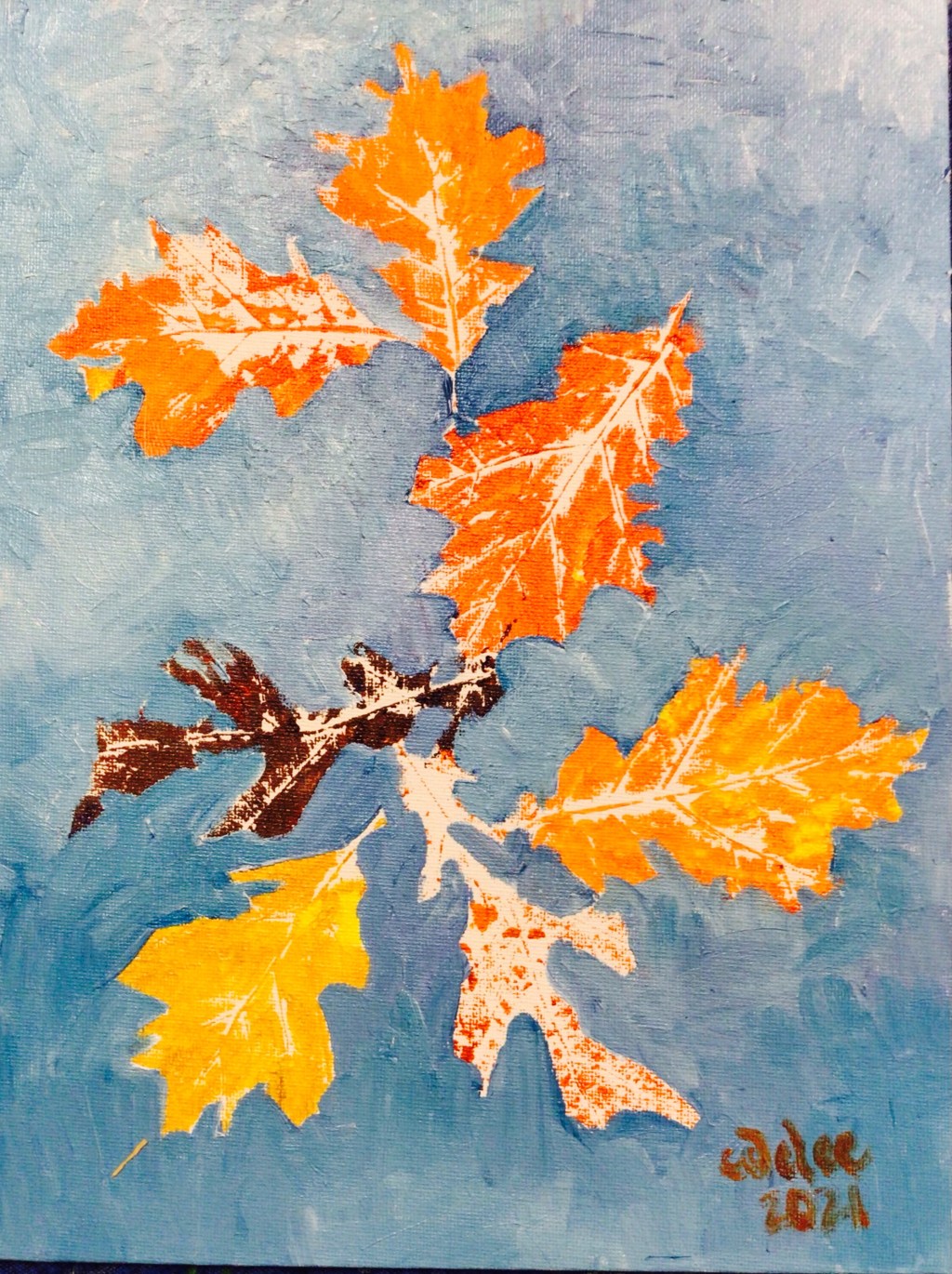
Gail’s Leaves floating on Water
I’ve always thought leaves “fell” off the trees or the wind blew them off, but I asked Mr. Google, “Why do leaves fall?” Turns out, the trees cut them off with scissor cells. The leaves are only useful for making food for the tree. They are the seasonal kitchen staff, so the tree lets them go for the winter and brings in a new crew in the spring. The changing light and cooler temperatures triggers a hormone that makes this happen.
The scissor cells are stained red and mark the boundary between the branch (left) and the leaf stalk. University of Wisconsin Plant Image Teaching Collection
If the leaves stayed on the tree, they’d wake up during a winter warm spell, start their food production work, and then get frozen when the cold inevitably returns. The tree knows the lifespan of the leaf, and this is the natural course of the life cycle. New growth will come in the spring, after a period of rest and recovery.
Lauralei’s Memories of The Leaves that Were
Our holiday season coincides with darkening days and marketing excess. Most of the commercials show happy families with lots of presents in heavily decorated holiday environments. Statistics show 25% of people are estranged from their families, and one out of every 463 Americans alive at the beginning of 2020 has since died of covid-19, the disease caused by the novel coronavirus. About 1 in 8 Americans say that a member of their family died of the virus; another fifth say that they lost a close friend, according to YouGov polling. These are staggering numbers, for in the US alone, 779,293 people have lost their lives as of November 30, 2021. One too many Thanksgiving tables had an empty place setting for a loved one no longer among us, and this will be a blue Christmas for many families.
If this were a war, maybe folks would get all excited and consider good health practices such as mask wearing , hand washing, and vaccinations their patriotic duty. Instead, they throw themselves into the breach of a thousand tiny viruses as if they were seeking the congressional gold medal for valor, and end up leaving their families with nothing but medical bills, grief, and the loss of their presence. Into this weary season comes Omicron, yet another variant, but an expected event due to the lack of worldwide access to vaccines and the virus’s ability to mutate in immunocompromised individuals. The enemy keeps evolving and the battles continue, whether we’re weary of the struggle or not.
“The Falling Leaves,” by Margaret Postgate Cole of England, is one of the first anti-war poems from a woman’s perspective. It was written in November 1915, during the First World War, when from 1914 to 1918, Flanders Fields was a major battle theatre on the Western Front. A million soldiers from more than 50 different countries were wounded, missing or killed in action there. Entire cities and villages were destroyed, their population scattered across Europe and beyond. The tradition of poppies on Veterans Day came from the red flowers given life from the blood spilled on this battlefield. COVID today is exacting it’s own cruel battle toll, with children left orphaned and spouses left without their mates. The adverse affects on this generation may be equal to those who went through the great flu pandemic of 1918 or the Great Depression.
War may be necessary in some instances, but it’s never to be glorified. There’s always a sadness related to the loss of life, regret over the great expense poured out that might have been used to build rather than destroy, and the cruelties that attend actions when we make others into evil enemies and refuse to see them as human as we are. Her poem speaks poignantly to this human loss:
Today, as I rode by, I saw the brown leaves dropping from their tree In a still afternoon, When no wind whirled them whistling to the sky, But thickly, silently, They fell, like snowflakes wiping out the noon; And wandered slowly thence For thinking of a gallant multitude Which now all withering lay, Slain by no wind of age or pestilence, But in their beauty strewed Like snowflakes falling on the Flemish clay.
Source: Margaret Postgate’s Poems (1918)
If we want to treat these end of year days as “days of denial” of all that’s grim in the world to focus only on the good and the light, we’s be like people who claim we have no shadow. Carl Jung believed the shadow included everything in the unconscious mind, good or bad. Also, the shadow might include only the part of the personality that you don’t want to identify as self, but still is a part of your unconscious mind. This dark side of your personality contains everything your conscious mind can’t admit about itself.
When we read the birth story of Jesus, we often focus on the angels and the gifts of the magi. We forget these heavenly hosts are God’s armies and the magi came to meet the new king. These were revolutionary acts that caused King Herod to feel insecure and threatened, so he slaughtered the innocent babies born at this time. The Bible never forgets this shadow side of life, for this is why Christ came into our world:
“to give light to those who sit in darkness and in the shadow of death, to guide our feet into the way of peace.” ~ Luke 1:79
“The more things change, the more they stay the same,” my daddy was fond of saying. We often long for the “way things used to be,” as if the Golden Age of the past was the best of all times. Yet, that past often exists only in our memories, but not in the lived reality of all persons. This is the classic story of the young prince, who while sheltered within the confines of his sumptuous palace never knew want, but once he walked among his people, he saw suffering and need everywhere. Today we know him as the Buddha, or Siddhartha Gautama. Many over the centuries have wondered why suffering exists in the world, or why they themselves must suffer. The Buddha saw all life as suffering, or rather our inability to accept the impermanence, change, and dissatisfaction with the present moment.
Rabbit Buddha
The Golden Age is a myth and poetic concept, as well as a political and philosophical construct. It began in Greece and was fixed in people’s minds by the time of the Roman Emperor Augustus. The Golden Age is a dream of an “earlier time when people lived peaceful, untroubled lives, and the earth supplied all their wants.” Those who read the Bible can easily find a parallel story in the first humans, who lived in the Garden of Eden. Of all the high and holy days in our cultural calendar, Christmas rates number one for nostalgia, both the personal kind and the universal type.
Nostalgia is the state of being homesick, or a wistful or excessively sentimental yearning, either for the return to or of some past period or irrecoverable condition. It can be a salve for those who suffer, or it can be more salt poured into an open wound. It just depends on how one frames the experience. We feel “homesick “ in the worst possible way, for we yearn for the security of the familiar and the safe. Mostly we yearn for the people we love and are kin to us.
Happy Rabbit Family
I remember the year I divorced my husband. It was necessary, for I couldn’t trust him to care for our daughter due to his alcoholism. The first Christmas was hard, for his family chose him and shut me out, as did all his friends. Decorating the Christmas tree was always a family affair in the Golden Age of my memories of Christmas. If this year I had no family, I would bring friends to decorate my tree. Just because I’d always celebrated one way before, I wouldn’t let my circumstances keep me from finding joy this Christmas. I called my young mother friends, invited their families to my home, and we decorated my tree within an inch of its life. It was my best tree ever! And then we ate and drank a toast to our creation. My friends were salve for my suffering, and helped me create a good memory, which still gives me pleasure to this day, four decades later.
Big Holiday Family Dinners
Christmas brings families together, but this is a double edged sword. While we all want to be with our families, we also know oil and water don’t mix. After both my parents died, I often ate with some of my clergy pals’ families. I was glad to know they had relatives who also wore their crazy pants to dinner. If I ate with congregation members, they were often on their best behavior, as if I were some sort of god on earth. You’d think after six months at a charge, I’d already have disabused them of that notion, but some people never see your true nature, but only the image of every pastor they’ve ever known before. More often, I’d get pastoral calls of family crises during holiday seasons, so after years of this recurrence, I finally learned to plan for it. I eventually realized we all have a Golden Age of Christmas in our minds, but in real life, we live in the Age of Iron. When reality hits our delusions, the disconnect is palpable. We feel it in our very bones.
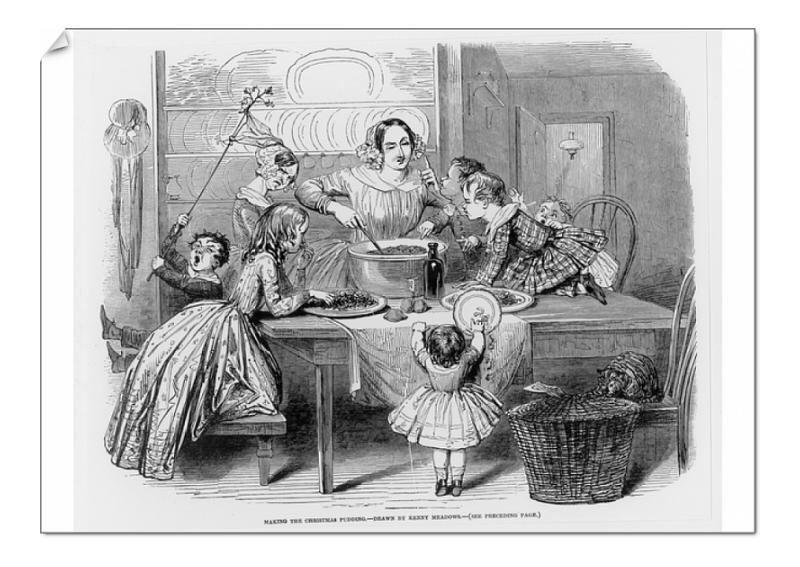
1896 Thomas Nast illustration in Clement Clark Moore’s ‘Twas the Night Before Christmas
For many Americans, images of Victorian Christmases include memories of “children all snug in their beds with their visions of sugar plums dancing in their heads,” which we recognize as one of the opening lines of Clement Clark Moore’s “A Visit from St. Nicholas,” a.k.a. “Twas the Night Before Christmas.” These sugar plums aren’t sugared fruits, but are more like candy covered peanuts or almonds. Jelly beans also are made by this same process. Whatever these treats were, the children dreamed of a world of happiness, sweetness, and delight.
As my Depression Era mother would say, “If wishes were horses, beggars would be kings.” That outlook never stopped me or my brothers from wanting everything in the Sears Christmas catalog, even though we knew these were just suggestions for Santa. Yet we never felt deprived, for whatever we received was a gift, plus it was more than we had before. On Thanksgiving day this year, consumers spent at a pace of at least $3.5 million per minute on line due to stores being closed for the holiday. This year, the average household is pegged to spend $924 for online shopping, more than double the $440 expected for in-store.
December 15 is Wear Your Pearls Day
The National Retail Federation (NRF) projects November/December retail sales of $843.4 billion to $859 billion, up 8.5% to 10.5% from 2020 results. NRF said its forecast — excluding automobile dealers, gas stations, and restaurants, and covering Nov. 1 to Dec. 31— tops the previous high of $777.3 billion. This total is up 8.2% over 2020, as well as the average gain of 4.4% over the past five years. This increase is in spite of supply chain hiccups, rising gas prices, and the pockets of as yet unvaccinated individuals, who continue to be the greatest number of COVID admissions to our hospitals. It’s as if we’re trying to replace the suffering of our present with presents for those we love. This also accounts for our desire to donate to charities at this season.
Scrooge of Christmas
Yet the Scrooge of Christmas continues to be COVID, for as an Augusta University Medical analysis released in May of 2021 revealed, which looked at COVID-19 related deaths in vaccinated versus unvaccinated individuals—only .8% (150) of vaccinated people accounted for the 18,000 COVID-19 deaths in May. If you want to give someone the gift of life this Christmas, take them to the local pharmacy and get them started on their vaccinations.
The Centers for Disease Control and Prevention has found both infection-induced and vaccine-induced immunity are durable for at least six months — but vaccines are more consistent in their protection and offer a huge boost in antibodies for people previously infected. Unfortunately, unvaccinated persons are also the prime hosts in which the virus can mutate, so the Grinch has already brought us the latest variant of concern, Omicron.
This variant was first identified in the South African peninsula, due to their excellent testing facilities. Of course, now the nations of the world have isolated the countries there, so they now feel punished by these bans. Travelers arriving in major world airports already have tested positive for for this variant, so we can expect disruptions and quarantines worldwide to follow. During this holiday season of restoring relationships, COVID keeps breaking our ties instead of rebuilding them.
DeLee: Found Objects find a home in the No Room Inn
We can long for the Golden Age of light from our younger days, when our parents took on the big worries so we could have the pleasant memories of an untroubled childhood, or we can fix our sight on the lights of our faith. The great star of the east which announced the birth of Jesus was a pale light compared to “The true light, which enlightens everyone, (which) was coming into the world.” (John 1:9) His was “The light (which) shines in the darkness, and the darkness did not overcome it.” (John 1:5).
Colorful Menorah
Our Jewish friends meet the darkness of this Hanukkah season with prayers and menorahs, nightly lighting candles to disperse the darkness of hopelessness against great foes. They remember doing battle against spiritual powers, with God empowering their weakness. God never comes for the strong, but has a special kindness for the poor and weak. This is why we should feel blessed, no matter our personal experience, but especially during the holidays. The ceremony begins on November 28 and ends December 6, since it’s set by the lunar calendar.
So also are these December celebrations light filled: Burning the Yule Log on the 4th, St. Lucia on the 13th, the Winter Solstice on the 21st, Kwanzaa on the 26th, and finally, New Year’s Eve. Our good earth will bring its tilt back towards the sun gradually in the days following the winter solstice. This darkness too shall pass, whether it’s our personal grief or our universal suffering.
Winter Solstice brings back the Light
We’ll keep walking until we meet the better land beyond the horizon. If this isn’t yet the Golden Age of our memories or the Golden Age of our sugar plumb dreams, let’s work together as we walk to build a better world for all people, “for we are what he has made us, created in Christ Jesus for good works, which God prepared beforehand to be our way of life.” (Ephesians 2:10)
Merry Christmas and Happy Holidays to all my Bunny Friends!
May you have a mindful holiday, full of joy and peace,
Reckford, Kenneth J. “Some Appearances of the Golden Age.” The Classical Journal, vol. 54, no. 2, The Classical Association of the Middle West and South, 1958, pp. 79–87, http://www.jstor.org/stable/3294223.
The saying is true: “If nothing ever changed, there’d be no butterflies.” Yet how hard do we humans hold to the past, even if we need to move on into the future? As an artist, I’ve always been caught between my desire to honor the traditions of the past, but also to move into the the unknown realms of the future. Artists already have a vocabulary and boundaries to describe the works of the past, so we can tell if our current works “meet the criteria for excellence.”
Found Object Butterfly: roadside debris, wire, scrap cloth, and metallic beads
When we go beyond this known world into the uncharted territories, we’re like Columbus, who landed in the Caribbean islands, but thought he was on the continent of North America. I wonder if the monarch butterfly, just emerging from the cocoon, has any idea it soon will begin a 3,000 mile migration to its ancestral winter home in Mexico. The butterfly has the innate ability to navigate this path, whereas we humans are like Abram, for we’re going to a land our God will show us. We have no idea where we’ll end up, but we do know we’ll travel by stages and God’s guiding inspiration will always be with us.
During this current protracted COVID pandemic, with cases beginning in mid December 2019, we’ve now lost over 766,206 persons in the US alone and over 47,390,239 individuals have had COVID. Worldwide, the numbers are far greater: over 5 million have died and nearly 255 million have contracted COVID, mostly because vaccines and health care services aren’t available to the extent they are in America and the European Community. Not only has our world as a whole suffered a great grief, but each of us individually have lost friends, neighbors, or loved ones. This adds to our collective grief.
Airport Road at MLK Hwy Intersection, empty lots
When we see the rest of our world changing around us, we feel another loss, and this becomes the grief leading to the death of a thousand tiny cuts. Just as in our workplaces, when the ideas of the young, the female, and the ethnic individuals aren’t valued, their dismissal leads to devaluation of their perspectives as well as their personhood. When we devalue nature and treat creation as an arena for humanity to restructure for our purposes alone, we can fall into the trap of thinking only for our immediate future, but not for the generations to follow. This is why building lots inside the city get cleaned off and offered as a blank slate, since this makes them valuable to the greatest number of buyers.
Death by a thousand cuts was supposedly a form of torture in ancient China. It was reserved for the most heinous crimes, such as matricide, patricide, treason, and the like. From all the tiny slices, the accused finally bled to death. It was a cruel and unusual punishment, rather like flogging the back of a law breaker until the flesh was raw, but this punishment was intended to cause death because the executioner kept at it until he succeeded.
Most of us are blissfully unaware of the loss of a few trees here and there in our neighborhoods. Sometimes we even want to cut down the trees on our own property because we’re tired of raking leaves every fall, or if we have a magnolia tree, we’re tired of our year round duty of leap reaping. Of course, if you want a high strung, classy tree to show off in your front yard, you also need to sign onto the high maintenance these trees require. “Those that wears the fancy pants has to take care of those fancy pants,” my mother always reminded me.
Yard work is a type of infrastructure most of us can understand. With Thanksgiving just around the corner, those of us hosting the feast are also getting the house and yard ready for family and friends to visit. Infrastructure has been in the news lately also, with politicians debating whether soft or hard infrastructure deserves the most funding.
In Hot Springs, we have “Green Infrastructure,” which includes all the natural assets that make the city livable and healthy: trees, parks, streams, springs, lakes and other open spaces. These assets are ‘infrastructure’ because they support peoples’ existence. For example, tree canopy keeps the city cooler while also absorbing air pollutants and mitigating flooding. The Hot Springs National Park forest area is also an important resource for a variety of reasons. The mountain area is in the recharge zone for the hot springs and the forest provides other important ecosystem services.
Hot Springs is Very Green
In urban areas, we can evaluate the landscape on a smaller scale, so even small patches of green space become important, since together they can make a greater large cumulative impact. Smaller urban spaces, such as linear stream valleys, or even pocket parks, can add up to a connected green landscape. When evaluating the ecological health of an urban area, urban tree canopy is a key green asset. For instance, Hot Springs has 57% tree canopy coverage and an additional 12% green space coverage. This adds to our quality of life, for this isn’t only pleasing to the eye, but the trees and grass convert carbon dioxide to oxygen, thus improving the air we breathe.
Cities are beginning to recognize the importance of their urban trees because they provide tremendous dividends. For example, city trees are a strategic way to reduce excess stormwater runoff and flooding. Even one tree can play an important role in stormwater management. For example, estimates for the amount of water a typical street tree can intercept in its crown range from 760 gallons to 4000 gallons per tree per year, depending on the species and age. Taken city-wide, the trees within the city provide an annual stormwater interception of 1.2 to 1.5 million gallons which equates to 7 to 9 million dollars in benefits. The loss of one tree is worth so much money, replanting our tree cover is an investment in our future wellbeing.
I often heard an old proverbial poem growing up, which may not be repeated much today:
For want of a nail the shoe was lost. For want of a shoe the horse was lost. For want of a horse the rider was lost. For want of a rider the battle was lost. For want of a battle the kingdom was lost. And all for the want of a horseshoe nail.
My nanny would remind me of the same principle in other words, “A stitch in time saves nine.” My daddy was from the school of “If it ain’t broke, don’t fix it.” While those two schools of thought still persist today, I think making a small, inexpensive repair, rather than a costly replacement, is a better choice, but too many of us live in a throwaway society.
Wisterias among the Trees
When we lose one small thing, we brush it off as no matter, but after a thousand small losses, we just can’t take it any longer. We look around and wonder what happened to our world, why didn’t we take action sooner, and now we might be in a hole so deep we can’t see the top. When I first painted the trees on this vacant lot, the little coffee kiosk had closed shop and moved on. It was springtime and the violet wisteria vines were bright against a sunlit cerulean sky.
As I was taking a few photos with my iPhone last spring, the local policeman pulled into the circular drive to check on me. We chatted a bit, but he wanted to make sure I was OK. I’m at that age when silver alerts go out for others, but I’m not there yet. I guess “old gal taking photographs of trees” still looks suspicious in my small town. I’m thankful my town is this quiet.
When I told the officer, “These trees called to me,” he might have had second thoughts about my state of mind. Then he realized he was talking to an artist. I was rescued when his radio called him off to take care of some real trouble. I find I do my best work when I feel called to a subject, for I have a spiritual connection with it.
That was this past April, and here at year’s end, this lot is up for auction, with a commercial use zoning. It has easy access to the bypass and would be good for a food place or a fuel stop. Things change and we can’t hold back progress. I know people who buy a vacation home to visit while they still work, but as soon as they retire to this same place, they grouse about all the weekenders who come and spoil their solitude. They put up with it a year or so, griping daily, and then sell and move on. Life changed for them and they didn’t adjust to their new normal. I wonder why they never realized Hot Springs was a vacation destination. We think we need an infrastructure just for the 38,500 people who live here year round, but we actually need an infrastructure to support the over two million visitors to whom we offer the hospitality of our hot springs, our hotels, our fine dining, our attractions, and our natural beauty.
When I saw the trees were gone and the lots had been plowed level, I wondered if the trees had a swift death, or if they had brief dreams and fantasies while the saws pierced their outer skins. I thought of the butterflies encased in their cocoons, and the deep sleep of their transformation. Do butterflies dream in this stage, or do they even dream like we do? I wondered if next April I would see wisteria growing near the ground, for as a weed, it’s hard to kill. I always hope, for I’ve learned over time, if I’m a prisoner of hope, this is better than seeing only the loss.
Stage One
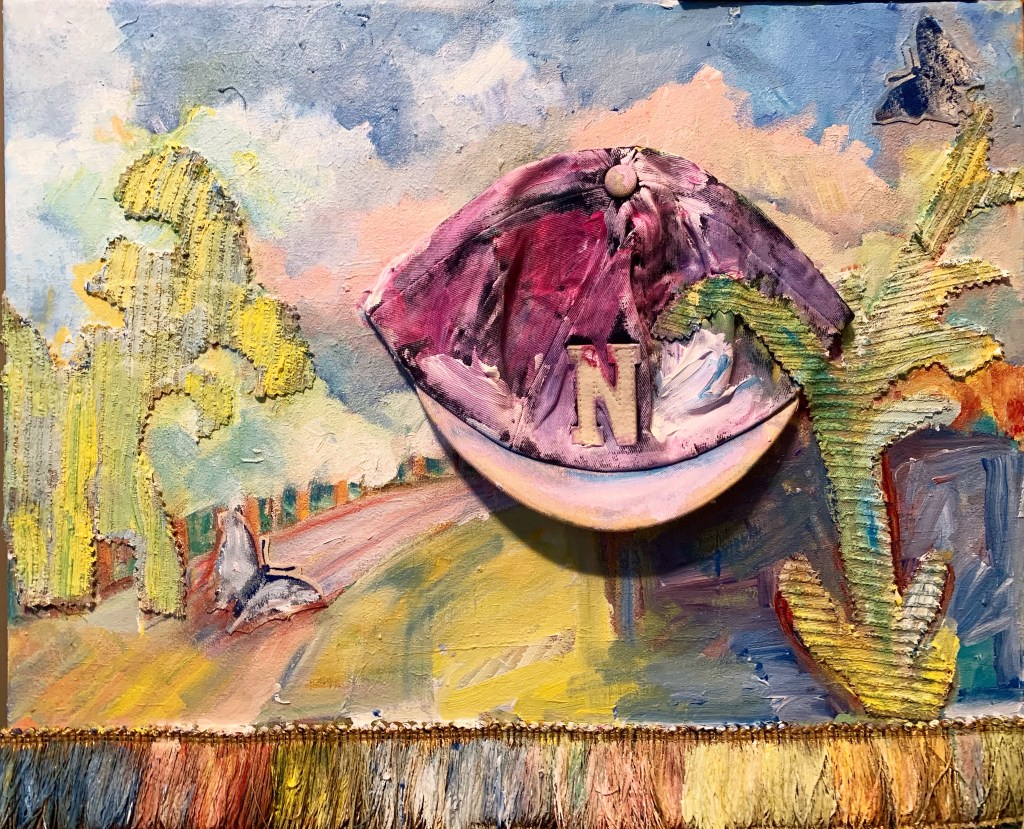
After traveling and recovering from an autumn sinus infection, I decided to destroy an old mobile sculpture of a butterfly made from found materials and attach it to a canvas. I took some scraps of cloth from some mask projects, and glued the whole to the canvas. Maybe I crammed more than I should have onto the small surface, but I was going with it. This work might be more catharsis than art, or more process and possibility than success. It doesn’t matter, for sometimes art is more therapeutic than anything else.
The first layer held all the colors and shapes of the original Google map. The second layer began to make sense of the shapes and textures, for I started to pull together the small areas into larger spaces. By the third layer, I’d lost most of the color areas and turned them instead into linear shapes. The primary colors of the background I subdued beneath an overall gold tone. The lines now are like an automatic writing or glyphic writing, which might be the language spoken either by the trees or the butterflies, or by all natural living beings.
Stage Two
When we confront suffering in nature, in our lives, or in the world, we often ask, “Where is God in all of this?” In the days past when I suffered, I held on to the words of the Apostle Paul to the Romans:
“I consider that the sufferings of this present time are not worth comparing with the glory about to be revealed to us. For the creation waits with eager longing for the revealing of the children of God; for the creation was subjected to futility, not of its own will but by the will of the one who subjected it, in hope that the creation itself will be set free from its bondage to decay and will obtain the freedom of the glory of the children of God.” (8:18-21)
Dreams of Trees and Butterflies
Often we suffer because we can’t change our past, or we think we can’t affect our future. At some point in our lives, we come to accept our suffering. We don’t have to continue to suffer, of course, but we need to accept that what happened to us is over. We can forgive ourselves for not leaving a bad relationship earlier, or being too young to know we were being harmed. Some of us may have survivor guilt from our nation’s wars, and suffer moral injuries from acts of war. Only good and decent human beings would feel this guilt, and they can heal with Christ’s forgiveness. We can be changed and then begin to change the world, even if we begin only with our own selves.
After all, the Psalms promise us God is faithful both to us and to the creation also: “When you send forth your spirit, they are created; and you renew the face of the ground.” (104:30)
Welcome to September, my rabbit friends! For most all of the bunny world, this means books, pens, pencils, and papers are now our daily tools of the trade instead of our preferred recreational plaything. Even the bunny parents are on the education time table. As I was exiting a lane in the store, I almost crashed my grocery cart into a lady who was racing to finish so she could pick up her darlings when school closed for the day.
Indeed, except for a brief break for Labor Day on Monday, September 6, we’re now living in what we working bunnies call “normal time.” The chronologists may have standard and daylight savings time, the meteorologists their seasonal times, but old school teacher rabbits know the only true time which counts is classroom time. Of course, the best teachers recognize teaching happens all the time, for the best classrooms have no walls and no fixed time for learning. Once rabbits quit learning, they begin to die.
I’ve always pitied the poor rabbit students who thought they could learn everything they needed to know to get them through the rest of their lives after they left the classroom. “Do you think the world is going to stand still just for your benefit?” Often they’d try to argue they didn’t need to know more because they could get a job right of school. They never think about the possibility their jobs might be phased out due to automation or irrelevance.
All we rabbits need are pencils
Then again, perhaps I value education more than the average rabbit. My grandfather worked for fifty years on the railroad, beginning at the tender age of fifteen. Why did he begin so early? His father had abandoned the family, so he worked to help his mother raise the baby rabbits left at home. When his own bunny sons were growing up, he made sure they got an excellent education. They both became doctors. My mother was a teacher and one of my several careers was art teacher.
We live in a time when history is being made daily, but no one seems to remember yesterday because the news media obsess over the latest hot button story. The next day they might have a new focus to fill the hours of coverage and keep our rabbit eyes fixated on the glowing screen. We don’t have to do this, for every tv has a remote to switch the channel and an off button. As a back to school exercise, I thought we might travel back in time when we colonists were in rebellion against the King of England in our War for Independence. So buckle your seatbelts, bunnies, we’re throwing the wayback machine into full reverse. Next stop, 1776 and the War for American Independence.
Most people know our Declaration of Independence was signed on July 4, 1776, but after that, our historical memories are iffy. In fact, the British had been fighting the colonists since 1775 in various skirmishes, and continued with greater frequency in 1776-1777, with neither side gaining much headway.
In our first war, our fledgling army had lost 6,800 men in battles and another 17,000 to disease. It wasn’t a good time for health care or sanitation. The British captured our young nation’s capital of Philadelphia in September, 1776, but the army and the state militias kept on fighting. The British moved their war efforts to the southern half of their colonies, thinking they’d find loyal supporters there, but none were found.
Washington crossed the Delaware River, December, 1776
By December 19, 1777, Washington had decamped to Valley Forge with what was left of his ragtag army. From there, he wrote letters to every state except Georgia to plead for supplies and reinforcements, for without these, he was certain the war would be lost.
General Washington and the Army winter over at Valley Forge
This was the first large, prolonged winter encampment the Continental Army endured—nine thousand men were quartered at Valley Forge for a six-month period. During that time, some two thousand American soldiers died from cold, hunger, and disease. About 22% didn’t survive that terrible winter. Perhaps we’re fortunate we didn’t have a 24 hour news cycle to keep a body count, or we’d remember this event as a catastrophe, instead of a “heroic perseverance and endurance under harsh conditions, which only made the survivors stronger.”
It was during this hard time of close confinement, the future president of our country had all the Continental Regular Troops inoculated against the smallpox virus. At the time, 90% of the war casualties were due to disease, so Washington took the bold move to vaccinate the troops. The British troops were already safe from this contagion, and this leveled the playing field.
In 1781, Lord Cornwallis surrendered at Yorktown after a siege of three weeks, during which the town took heavy bombardment from American and French troops. After six years, both sides were tired of fighting, plus the British had another war back on the continent to deal with. Two years of negotiations later, the United States of America had its recognition among the governments of the world.
“Jungkook As Bunnies” Is the only Easy Winner of the Internet any day.
If any rabbit tells you winning is easy, and anyone can do it, they aren’t paying attention to history. Yet, we overcame many obstacles, adjusted our courses of action, somehow survived, and became a nation. It’s significant that our nation was founded by people with the historical tradition of a parliamentary form of government. In 1215, King John agreed to Magna Carta, which stated the right of the barons to consult with and advise the king in his Great Council. That’s a full 500 years of shared representation, from which our government takes its form of checks and balances.
The World Trade Center Memorial seen from space
Our heroic image was bruised and bloodied over two centuries after the War for Independence when the twin towers fell on 9/11, and the Pentagon was hit by a falling airplane. The only reason we didn’t also lose the White House is because the ordinary passengers of an everyday airline flight suddenly reached down deep and found the hero who lives inside each and every one of us. Some say rabbits are meek and weak, but they don’t know the true heart of the one who will give up his or her life for the sake of another.
We rabbits like our chaos neatly packaged and tied up neatly with a bow. The beginning of every school year has its own chaos, for suddenly rabbit families have to once again be on time, have all their paperwork together, and make sure they don’t leave their brains at home as they rush out the door. After a long lazy summer, we rabbits aren’t in the mood to be reminded of how fragile life can be.
Afghan child safely sleeping under American Air Force jacket during Evacuation efforts.
When we watch the scenes unfolding in Afghanistan as people try to emigrate to the United States, we share the collective trauma along with the ones who actually experience it. Add that to our own stress about the unknowns of our current pandemic, our griefs for the losses of those who died, the fears we have for our loved ones, and the extra burdens of cleaning, masking, washing, and scheduling this Covid world now requires, and well, (breathe) it gets a bit much.
But we rabbits have risen to the occasion from time immemorial: we pull together as one, for the good of all. If we live in families, and live in neighborhoods, and live in communities, we find we need to lend a helping hand to others from time to time. Likewise, we band together to protect the vulnerable, whether those are our children, our elderly, or our less abled friends. This is what we call our civic duty, or our moral obligation to do unto others as we’d have them to do for us, or the “golden rule.”
Sometimes we don’t want to work for the common good, but work for our own interests only. We like to win, because it suits our belief about our invincible self. Most of us have been taught a “heroic myth” about our founding fathers, so we aren’t aware of the struggles they endured to wrest our independence from the British. They didn’t do it alone, but together. If the French had not entered the war for independence on our behalf, we might still be singing “Hail to the Queen.” If we’re going through a rough patch now, we have to get our act together and work to make life better for all.
Positive thinking brings about positive results.
In my bunny life, when I taught art, I soon learned the beginning of school was the time I would lose my car keys, and I wouldn’t be organized enough to cook dinner. Once I raced out of the house without putting underpants on my little girl. Young mother bunnies don’t have access to their entire brain in the first week of school, but at least the kindergarten had a change of clothes for her. By the second week, I usually found the other half of my brain, and life went much smoother. Life is always a roller coaster, so when ever we make a big change, we need to give ourselves some grace until we get adjusted to that ride.
“This too shall pass,” an apocryphal phrase from the mid 1800’s, seems applicable to this era also, for we’re now on the cusp of autumn. That heat stress driving us to crank up our air conditioning has turned some leaves on our lakefront trees to yellow, so they gleam like lemons against the bright green canopy. The Autumn Equinox will occur on Wednesday, September 22, 2021, at 2:21 pm CDT. Of course, my late rabbit mother would have me retire all my light colored summer clothes by Labor Day, for “no self respecting child of mine should wear white in the fall.” Autumn in the South is just another word for summer. My fall clothes were still light weight cotton, but in darker shades.
No time like the present to wipe the slate clean and begin a new year.
Rosh Hashanah on September 6, beginning at sunset, is the celebration of the Jewish New Year, and the creation of the world. It’s one of the holiest days of the Jewish year. Ten days later is “Yom Kippur” or the “Day of Atonement.” This is a day set aside to atone for sins, with prayer, fasting, and attending the synagogue. No work is done on this day, which is one of the most important days in the Jewish calendar. During Yom Kippur, people seek forgiveness from God, and seek to give and receive forgiveness and reconciliation with others.
Mid Autumn Festival
September 21 is the Chinese Moon Festival, a harvest celebration which dates from about 1000 BCE. The early emperors offered sacrifices to the moon, believing this would result in good harvests the following year. During the Tang Dynasty four centuries later, the noble classes and wealthy merchants imitated the emperor, while the citizens prayed to the moon. Beginning around 1000 CE, the festival took on general acceptance.
Rabbit Moon Cake
Moon cakes arrived in the 14th C, and have retained their popularity. This is not only a family celebration, but a community ritual for connection of relationships. While the cakes themselves aren’t costly, the packaging makes the gift impressive. People can say more by the wrapping’s elegance than by the contents. Moon cakes aren’t for individual consumption, but are meant to be shared, much like life’s joys and sorrows.
The fourth Saturday in this month is International Rabbit Day. Rabbits are the third most popular family pets, after dogs and cats. The care and feeding of a small animal requires attention, patience, and affection, not to mention consistency. How we treat our pets tells the world how we treat humanity. As Mother Teresa once said:
“The hunger for love is much more difficult to remove than the hunger for bread.”
The deep love of God overflows through our hearts into the world.
I recommend for your September reading homework The Universal Christ, by the Franciscan priest Richard Rohr. Drawing on scripture, history, and spiritual practice, Rohr articulates a transformative view of Jesus Christ as a portrait of God’s constant, unfolding work in the world. “God loves things by becoming them,” he writes, and Jesus’s life was meant to declare that humanity has never been separate from God—except by its own negative choice.
When we recover this fundamental truth, faith becomes less about proving Jesus was God, and more about learning to recognize the Creator’s presence all around us, and in everyone we meet. Until October, my bunny friends, I wish each of you may find in the present moment God’s
George Washington and the First Mass Military Inoculation (John W. Kluge Center, Library of Congress) Amy Lynn Filsinger, Georgetown University & Raymond Dwek, FRS, Kluge Chair of Technology and Society. Dr. Dwek is Professor of Glycobiology on leave from Oxford University. https://www.loc.gov/rr/scitech/GW&smallpoxinoculation.html
9/11/2001—Attack on The World Trade Towers and The Pentagon
10/7/2001—“Operation Enduring Freedom”—Beginning of Afghan War with attacks against terrorist groups in Afghanistan
5/2003—Donald Rumsfeld announces the end of major military operations. The USA and NATO begin nation building and restoration of the poor country, which had gone through two wars and a foreign occupation.
Although there were early successes, such as women’s access to education and entry to politics and jobs, corruption was a way of life, so the money never flowed through the government out into the cities and countryside to help the people.
5/2011—Osama Ben Laden killed in Pakistan by Navy SEAL team
12/31/2014—President Obama decides to end major military action in favor of training the local Afghan army
2/2020—Trump administration negotiates a deal with the Taliban in which they promised to cut ties with terrorist groups, reduce violence, and negotiate with the current government. Unfortunately, there were no sanctions to enforce it.
9/2021—Today—The best laid plans of Mice and Rabbits usually end up in chaos
Autumn is just around the corner: I know this in my heart of hearts. My friends, who have lost hope in this endless pandemic, tell me, “It’s heat stress, nothing more.” I persist in my belief the bright yellow leaves scattered among the green canopies and the orange and red tinged foliage are the harbingers of the cool breezes of fall.
When the thermometer kisses 100 F and the heat factors have blown past that number like a NASCAR driver taking a hot lap for the pole position, my body only wants to swill decaf iced tea and stay close to the air conditioning. When I taught art back in Louisiana, my art rooms were in an old wooden shotgun shack. It wasn’t air conditioned because “it’s tradition, so it won’t be air conditioned, no matter how much you ask for it.” Private schools have their “traditions,” some of which aren’t healthy for either the teachers or the students.
Two days into the school year, I fainted from the heat. A visit to the nurse’s station got me glasses of sugary iced tea and cold compresses, plus it was air conditioned. I thought I’d died and gone to heaven. Someone drove me to my dad’s office in the Medical Arts building across from the hospital. I got the once over and was sent home to rest, drink plenty of fluids, and not go outside. My couch never looked so good to me. Mom and dad even kept my little girl so I could rest.
I learned later I had a brush with death. Passing out with other people there allowed me to be helped. People who are alone in the heat aren’t so fortunate. Heat can kill a person. The hurricane Ida is already taking out the utilities in south Louisiana, which means they might not be back for weeks. The hospitals full of Covid patients hope to have ten days of power and food, but that’s just to get them through until relief supplies can roll in.
Dreamscape: Airport
I actually repainted this canvas a second time, since I wasn’t thoroughly pleased with it on the first go round. The Airport image above is the first incarnation of this painting. While I don’t mind the colors in the ground, the overall texture of the work didn’t appeal to my senses and the runway with its numeral stuck out like a sore thumb. It was either going into the trash bin of my work, or I’d leave it alone long enough to find the inspiration to cure it.
Painting is a journey in itself, as the white canvas disappears under the brushstrokes of color. We can think of a pristine sand beach in the early morning, and its well marked surface erased by the high tide under the moonlight, only to be marked again when the sun rises. As Benjamin Disraeli, the British Prime Minister in the 19th century once said:
“Like all great travellers, I have seen more than I remember, and remember more than I have seen.”
Sometimes we can better solve a problem by ignoring it, for the the problem will find its own solution. Trying to impose our solution upon it just leads to more death, but not to life. Letting the painting come into being in its own time is a better choice, for it can’t be born before its time. In the spiritual life, kairos time is God’s time, while chronos is human time. When we work on deadlines or punch a clock, we operate on chronological, human time, but if we wait for the inspiration from the divine energy, we’re operating in the God moment, or the propitious moment for decision or action.
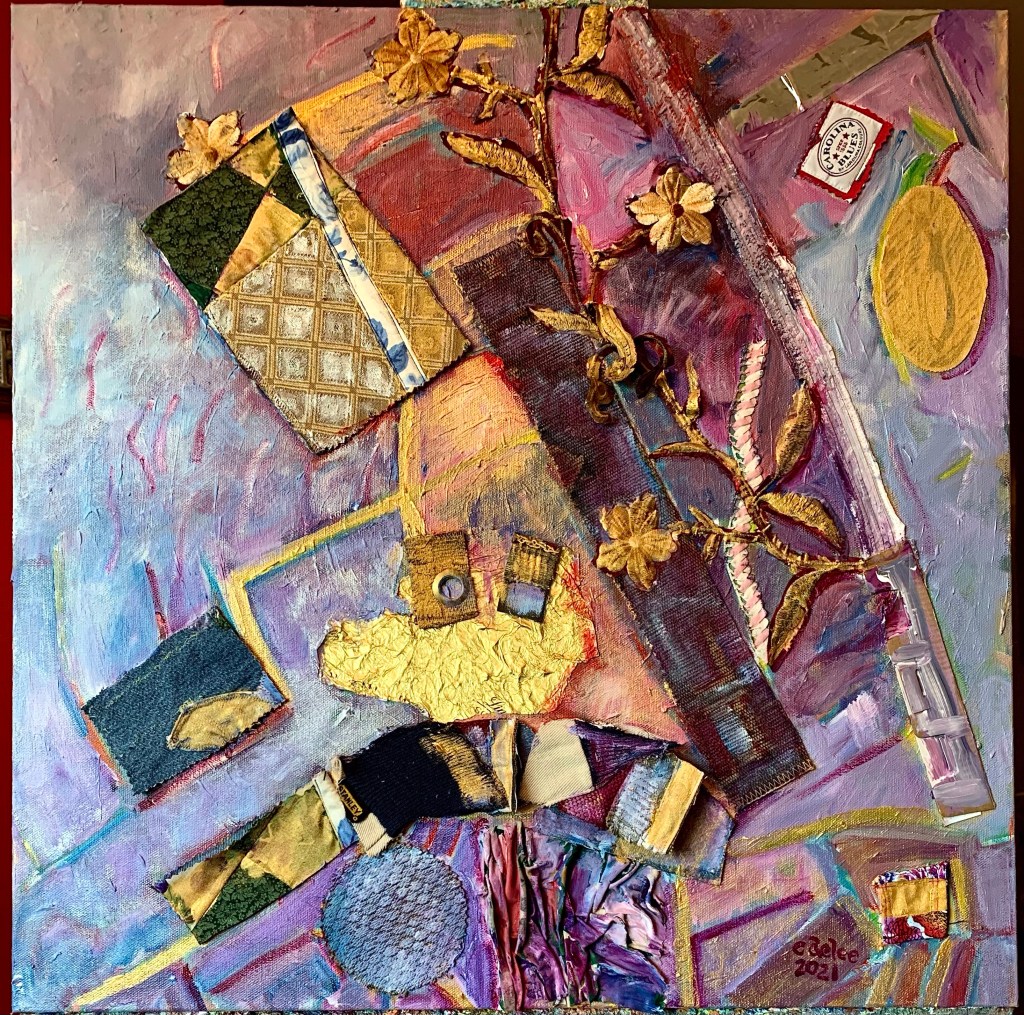
Golden Leaves on a Silver Breeze
Along my life journey, I’ve made some unique handmade preaching stoles. When I decided I no longer had use for them in retirement, I decided to cut them up. This is why some of the pieces are the same rectangular size, such as the gold and silver diamonds pattern with the blue and white diagonal stripe in the upper left corner. Some of the pieces are the backings, and others are deconstructed sections. I incorporated several types of gold: acrylic paint, embroidery thread, and a metallic candy wrapper. I also used multiple textures of lace and fabric, some of which I overpainted. All of these come from recycled fabrics. In life, nothing is wasted.
Perhaps this no longer looks like a map of an airport, but more like a place remembered in a dream, when one wants to travel on the whiff of a breeze, which has brought a half remembered smell of a time in the past or a love long lost. Autumn can bring those memories to mind, as well as our hopes for a more beautiful future, for just as a leaf flutters free from its tree, our thoughts can fly away: golden leaves on silver breezes.
Look for the golden leaves, my friends, and let them call to mind those of fond memory and the dreams of journeys yet to come.
Here in this Common Era of 2021, we Americans are now 245 years into this project we call democracy, having declared our independence from the British crown on July 4, 1776. We didn’t effectively become an organized, constitutional nation until June 21, 1788, when nine out of the thirteen existing states ratified the United States Constitution, thus officially establishing the country’s independence and a new form of government. Based on the date of our constitution, which is still in place, the United States is the oldest continuous democracy in the world.
I realize some of y’all rabbits might disagree with my description of the USA as “organized,” but I may have a higher tolerance for disorder than some of you. Then again, I taught art in kindergarten, so that probably explains a lot. When we make a mess in art class, we always clean it up. That’s just part of the lesson plan. Art, as in life, isn’t always neat, but the end product is worthwhile. In art we learn from our failures as often as from our successes. This takes courage and resilience, two life skills any rabbit can use in this fast changing world.
Antique German Rabbit Candy Container with Uncle Sam Rider, c. 1910
The preamble of the Declaration boldly states:
“We hold these truths to be self-evident, that all men are created equal, that they are endowed by their Creator with certain unalienable rights, that among these are Life, Liberty and the Pursuit of happiness.”
In our modern era, this is the section of the Declaration of Independence which we rabbits so dearly cherish, for it suits our individualism to a T. The next statement which follows complicates life, as King George discovered in 1776:
“That to secure these rights, Governments are instituted among Men, deriving their just powers from the consent of the governed, —That whenever any Form of Government becomes destructive of these ends, it is the Right of the People to alter or to abolish it, and to institute new Government, laying its foundation on such principles and organizing its powers in such form, as to them shall seem most likely to effect their Safety and Happiness.”
Way back in the 18th century, the practice of slavery still allowed others to profit off the the lives of human beings as if they were livestock, women couldn’t vote or own property, and states often excluded from the voting rolls certain classes of men for religious reasons or lack of property. The American Revolution changed the landscape of voting rights to some degree. Once the constitution was enacted on September 17, 1787, it created a new, federal layer of government, in which there was absolute freedom of religion—and no religious test that might prevent a Jew from serving in Congress or even as president—without removing the religious tests that existed in many individual states.
Rabbit Power of the Vote recognized by Uncle Sam
The Freedom to Vote came by Stages
Most of the states wrote new state constitutions in the 1770s, and some softened or removed their existing religious tests, but some did not. The real work of abolishing religious tests for suffrage was done at the state level, largely in the half-century after the American Revolution. Not until 1870, when Congress passed the the 15th and last of the three of the so-called Reconstruction Amendments, which stated that voting rights could not be “denied or abridged by the United States or by any state on account of race, color, or previous condition of servitude,” did African Americans get the right to vote, if their local communities did not make it impossible due to Jim Crow laws.
John Lewis: Civil Rights Icon
Doctrine of Original Meaning
Today, voting rights are under attack once again, not against religious minorities, but against racial and economic minorities. It makes this old rabbit wonder why the “doctrine of original meaning” by the founders has any worth when our 21st century world of today is so drastically different from the 18th century times of yore. Also, if “original meaning” is seen only through the eyes of our white founders, how can we be a nation for all people “created equal(ly)… endowed by their Creator with certain unalienable rights, that among these are Life, Liberty and the Pursuit of happiness?”
Scholars agree the original framers actually were more intent on the Declaration’s first paragraph, for only the Declaration of Independence officially proclaims the new American nation’s assumption of a “separate and equal station “among the “powers of the earth:”
“The unanimous Declaration of the thirteen united States of America, When in the Course of human events, it becomes necessary for one people to dissolve the political bands which have connected them with another, and to assume among the powers of the earth, the separate and equal station to which the Laws of Nature and of Nature’s God entitle them, a decent respect to the opinions of mankind requires that they should declare the causes which impel them to the separation.”
Medieval Manuscript: Rabbits Rebelling Against Humanity
As we rabbits know, if we plan to start a tussle, good manners suggest we tell why we’re fixing to throw the first punch. If there’s no honor among thieves, at least we rebellious rabbits have the good form to stand up in the pure light of day and list our grievances before we overthrow a bad king. Only the uncouth sucker punch the unwitting. The reason this American Democratic experiment has persisted for nearly two and a half centuries is the vast majority of us have freely chosen to change our leaders through the ballot box, rather than revolution.
Only the past unpleasantness of the Civil War in the 1860’s has marked this unbroken transfer of power by the vote, until the assault on the US Capitol and the Houses of Congress on January 6, 2021, by a motley crew of domestic terrorists, QAnon supporters, and admirers of the former President. Because they violently assaulted the police guarding the building and public servants inside, and interfered with the duties of duly elected government officials attempting to exercise their public duty to certify the electoral college vote, the Department of Justice has charged them and they’ll have their day in court. You can read all their names and cases at the link below. Maybe you’ll find a friend or neighbor there. As Mother rabbit always warned Peter Rabbit, “Don’t go into the garden; Farmer McGregor will get you!”
Farmer McGregor Chases Peter Rabbit
What exactly did the signers of the Declaration of Independence mean when when they wrote “all men are free and equal?” Abraham Lincoln said, “The men who signed the Declaration did not mean to say that men were “equal in all respects. They did not mean to say,” he said, that “all were equal in color, size, intellect, moral developments, or social capacity. They defined with tolerable distinctness, in what respects they did consider all men created equal.”‘ Men were equal in having “‘certain inalienable rights, among which are life, liberty and the pursuit of happiness.’ This they said, and this [they] meant.”
Lincoln Monument, Washington D. C.
This quote comes from Lincoln’s 1857 argument on the Dred Scott case before the Supreme Court, which decided against him, with Head Justice Roger Taney, who became best known for writing the final majority opinion in Dred Scott v. Sandford, which said “all people of African descent, free or enslaved, were not United States citizens” and therefore “had no right to sue in federal court.” In addition he wrote, “the Fifth Amendment protected slave owner rights because enslaved workers were their legal property.” Taney’s reputation was vilified for this decision during his lifetime, for it contributed to the growing divisions between the north and the south. The U. S. House of Representatives voted in 2021, to remove Taney’s statue and replace it with a statue in honor of the first African American Supreme Court justice, Thurgood Marshall.
Dred Scott Newspaper Announcement
The big holiday in July is Independence Day. While we rabbits lounge about the waterside or in our backyards, eating our favored picnic and cookout foods at the nation’s birthday party, not many of us will be thinking on a biblical text. Instead, we’ll be eyeing our paper plates and hoping they’re substantial enough to make it to the table before they collapse from the excess helpings of foods we’ve piled on them. A special bunny secret: you can go back for seconds, and laugh at everyone when you say, “I just want to make sure all you little piggies get your fill—oink, oink!” Don’t let them bother you, since you made sure everyone who came late would have something to eat by not taking it all at once.
In 2 Corinthians 3:17-18, Paul writes: Now the Lord is the Spirit, and where the Spirit of the Lord is, there is freedom. And all of us, with unveiled faces, seeing the glory of the Lord as though reflected in a mirror, are being transformed into the same image from one degree of glory to another; for this comes from the Lord, the Spirit.
In Essentials, Unity; In Non-Essentials, Liberty; In All Things, Love
Have you ever wondered why some groups are so strictly homogeneous, while others are a kaleidoscope of differences? Some rabbits feel safer when everyone is more like them and differences are kept to a minimum. Other rabbits seem to thrive in the creative intermixing of unusual and unique personalities. I know when I entered the ministry, my parents’ friends were amazed I went into the faith I’d been birthed into, rather than some new age, air fluff religion. Oddly enough, I related more to the historic beliefs of Wesleyan Methodism better than my contemporary generation. In that sense, I had faith in a “different religion” than my friends. Yet we all saw ourselves as “being transformed into the same image from one degree of glory to another; for this comes from the Lord, the Spirit.”
This marked a freedom of thought, but it required an understanding we were all on the same journey and were progressing toward the same end. I admit I have the type of mind that wants the idea to lead to the behavior and then the consequences. In art class I called it Attitude, Behavior, and Consequences. If the first attitude was positive, the rest followed suit, but if a student had a bad attitude, they weren’t going to work, and then they had the negative outcomes of poor efforts, sad projects, and little improvement. While in life we’re saved by faith, in art we’re saved by works, for work will bring rewards.
It’s as Easy as ABC
One way for all good rabbits to be free is to have no regrets, or worries about what might have been. As my mother often said, “That’s water under the bridge.” The River of life has moved on and the choices we’ve made have gone downstream also. She believed in living in the now. The third Saturday in July recognizes Toss Away the “Could Haves” and “Should Haves” Day. In short, don’t go through life with regrets.
Created by author and motivational speaker Martha J. Ross-Rodgers, this day is intended for us rabbits to let go of our past and live for the present. The first step to participating in this day is to find a pen and paper. Then write down our “could haves” and “should haves” on the paper.
Finally, throw away the list and make the following resolution: “From this day forward, I choose not to live in the past. The past is history that I can not change. I can do something about the present; therefore, I choose to live in the present.”
As I’m going through boxes in my storage unit, I’m coming across souvenirs from my high school and college years. Some of us are sentimentally attached to the memories imbued within these objects, but they’re merely memories, not the actual people. My parents and grandparents saved things, for they experienced hard times. I make new art every week, so if a painting doesn’t hold up to my critique after six months, it goes into a pile to get destroyed and remade.
DeLee: The Springtimes of My Life: Memories of Yesterday and Today
Now, take care of yourself and your health by living for now. Do your best and make the best of each and every day! Strike a power pose and smile when you do this. You’d be surprised how much energy flows through your body, I kid you not.
A final word for all rabbits who want to live in truth and freedom: we have only one God given life, so let’s live with joy and peace. We aren’t promised tomorrow, but only today. Now is the time to care for the broken, to right the wrongs of the world, and to make a difference, no matter how small.
Charles Derber, in Welcome to the Revolution: Universalizing Resistance for Social Justice and Democracy in Perilous Time, says: “Resistance can be symbolic, but at its core it must also be empowering and even shocking, in the sense of awakening the people to the evils of the system and the terrifying end-result if we allow business as usual to continue. Resistance is rage at injustice and at the insanity of institutions that kill and exploit for money and power. Melding that rage with love is the art of activism.”
Now that I walk more slowly in this world, this old rabbit has found I notice people whom everyone else hurries past, even if these folks are standing in the middle of a store entryway and are obviously lost. I stopped today at Sam’s to ask if this older woman needed help. Right away I realized she had trouble processing words, so she might have memory problems. I asked where her people were, but she didn’t know. We went over to customer service, since I knew they could use the announcement system to call for them to come get her. At least she knew her name. I was sad they had hurried off without her, especially in her condition, but I prayed with her before I left. The service staff got her a chair and made sure she was safely seated.
Lady Liberty
I hope as the holiday approaches, you don’t find yourselves so busy getting your celebration together that you overlook the ones in need who are right in front of you. Once we cared for one another in communities, but now we look after only ourselves. We wouldn’t have become a nation 245 years ago if every man had tried to take on the king’s men alone.
Be the spark that starts the fire of love and joy,
Maier quotes The Dred Scott Decision: Speech at Springfield, Illinois (June 26, 1857), in ABRAHAM Lincoln: His SPEECHES AND writings 352,360 (Roy P. Basler ed., 1946). 68. Id. at360-61.
Can you believe we’re almost halfway through 2021? My how time flies when you’re having fun! And to think only a year or so ago, we thought our lives were going to be locked up behind closed doors forever and a day! Amazing how following good hand washing practices, not congregating in large groups, and wearing masks managed to stem the larger transmission of this deadly pandemic in most areas, until we could begin getting shots in people’s arms. Now that about half of Americans are vaccinated, the summer months are looking “like the good ole summertime” of memory.
Folks are going en masse on vacation and indulging their pent up travel bug by plane, car, and train, as well as bus and cruise ship. I live in a tourist town, so a goodly number of the 34 million people who kicked off the summer vacation season by traveling in a car are jamming our city streets. We’re thankful for them, however, for they spend money at the local hotels and restaurants, and that means the folks who work there can support their families. The City of Hot Springs has 38,468 people, while Garland County has 96,371. We have year round visitors, with more enjoying our hospitality in the spring and summer. Annually over 2.1 million people visit us to hold conventions, reunions, weddings, and vacations in our fair, historic town. Some days you can’t stir them with a stick. You’d think this was Times Square in New York City, or a rabbit farm.
But I digress. Those who visit us here in the Ozarks seem to be better mannered than those who travel elsewhere. Perhaps because they drive here, they refrain from alcohol until they arrive, unlike the airline passengers who’ve gained their fifteen minutes of infamy on social media and a lifetime ban from traveling on the friendly skies of the major airlines. No one will miss these bad actors on airplanes in these early days of recovering from the pandemic. Instead, we might want to recover some “good old summertime events and activities” in their place.
Vacation Bible School
One of my fondest memories from childhood was Vacation Bible School. I looked forward to it each year for the arts and crafts projects, the singing, and the snacks. I might have remembered the teachings, but I liked being with my friends from across town, who went to other schools. We could see more of each other during VBS. Children who attended my home church always created a traditional craft, the plaster hand cast. I made one in the 1950’s when I put my right hand into a pie plate full of quickset plaster. After it dried, I was allowed to pick one color to paint it. In the 1980’s, my daughter made the same craft, but she could paint it any way she wanted; she always fancied rainbows.
The Helping Hand
Rainbows and Joy
If I learned anything in Bible School, it’s we’re called to give our hands to God’s service for good for all, especially for the weak and defenseless. Also, no hand is too small to serve God. The good news is even if VBS isn’t able to be held inside at one place with the usual songs, skits, and crafts, it could always be held in a park, in a parking lot, or by traveling from backyard to backyard in carpools, or “car pods” as we call them today.
Sidewalk Entrepreneurs
Another fond memory is the neighborhood lemonade or Kool-Aid stand. As I recall, this endeavor was never profitable, but it kept us out of trouble for at least an entire afternoon. If we kids managed to keep our noses clean that long, it was likely a world record. Our parents were glad for the peace and quiet, and the opportunity for adult conversation. We kids worked together to solve our own problems and overcome any obstacles to our sales project. Of course, my brothers usually retorted to my suggestions, “You’re not the boss of me!” To which I’d reply, “But I’m older and I know better!” We’d hash it out and find a middle way.
Sometime in the middle of summer I’d get a break from those ornery brothers and get to go to camp. At first it was YWCA Day Camp, then Church Camp at an old Works Project Administration lake, and on to tent camping with the Girl Scouts. While the water might taste like iron in places, if I were thirsty, I’d drink it gladly. Some places we built our own tables with tree limbs and ropes. I learned knot tying and cooperation out in the woods. I also learned how to cook an entire meal in the coals of a fire by wrapping it in tinfoil. As my daddy would say, “There’s more than one way to skin a cat.”
Father Rabbit
Speaking of Fathers, a major holiday for all rabbits is Father’s Day on June 20th. We all have a father who has guided us in the good paths of life, even if this person wasn’t our birth or adoptive father. Often it’s another outside the family unit, such as a teacher, a coach, a pastor or lay leader in our faith tradition. For those rabbits among us who had distressing experiences with their fathers, this is a fraught day, for our past memories can color current events and relationships. If we cannot change our past, we can change how the past affects our present and our future. This is part of the healing process by which we face the pains of the past and gain power over the memories so we can have a better future not only for ourselves, but also for the next generation. Otherwise, our pain can become an unwelcome generational inheritance.
D-Day Invasion of Europe, World War II, June 6 US troops of the 4th Infantry Division “Famous Fourth” land on ‘Utah Beach’ as Allied forces storm the Normandy beaches on D-Day.
Just as soldiers returning from wars have to put aside the mental and physical wounds of wartime with medical and psychological help, anyone who has suffered abuse at the hands of a father figure also needs healing. PTSD help available through the VA for everyone. They have apps available at the link below anyone can access, but nothing takes the place of a human professional. Your health care provider or clergy person can refer you.
Of course, for fathers, the meaning of “manhood” is always in question, as American historian Timothy Marr wrote in American Masculinities: A Historical Encyclopedia (Sage Reference Publication 1st edition) that in the holiday’s early decades, men ‘scoffed at the holiday’s sentimental attempts to domesticate manliness with flowers and gift giving, or they derided the proliferation of such holidays as a commercial gimmick to sell more products — often paid for by the father himself.'” We usually gave Dad a necktie, or handkerchiefs. These are gifts going the way of the dodo bird, so my guess today’s equivalent is sports equipment or tech wearables.
National Iced Tea Day
The 1904 World’s Fair
We have the hot summer of the 1904 St. Louis World’s Fair to thanks for the popularity of iced tea. In fact, if you believe the tales, more new American foods were invented at the 1904 World’s Fair in St. Louis, Missouri, than during any other single event in history. The list includes the hamburger, the hot dog, peanut butter, iced tea, the club sandwich, cotton candy, and the ice cream cone, to name just a few.
Art Nouveau Gilt Glasses from Austria, mouth blown, 1910
By the First World War, Americans were buying tall glasses, which became commonly known as iced-tea glasses, long spoons suitable for stirring sugar into taller glasses and lemon forks. Prohibition, which ran from 1920 to 1933, helped boost the popularity of iced tea as Americans looked at alternatives to drinking beer, wine and hard liquor, which were made illegal during this period. Cold tea first appeared in the early nineteenth century when cold green tea punches spiked with booze gained in popularity. Recipes for “punches” began appearing in English and American cookbooks, and called for green tea, rather than the black tea consumed by most Americans today.
Early Iced Tea Recipe
In 2003, Georgia State Representative John Noel introduced a House Bill proposing that all Georgia restaurants that serve tea be required to serve sweet tea. It was done apparently as an April Fool’s Day joke. Noel is said to have acknowledged that the bill was an attempt to bring humor to the Legislature, but wouldn’t mind if it became law. This is certainly better legislation than some of the recent laws Georgia and other southern states have passed recently to combat the imaginary boogeyman of a stolen election and voter fraud, although there were zero instances of voter fraud in Georgia in 2020, and only 20 total instances in the conservative Heritage Center Voter Fraud Data Base. The ancient, well worn wisdom is “Don’t fix what ain’t broke.”
Summer Solstice
Stonehenge under Snow, 1947, Bill Brandt. Credit: the Museum of Modern Art – MoMa, New York.
We meet the middle of our astrological year on the summer solstice, which will occur on June 20, at 10:32 pm CDT in the USA. The most famous solstice site is certainly Stonehenge, in England. The stone settings at Stonehenge were built at a time of “great change in prehistory,” says English Heritage, “just as new styles of ‘Beaker’ pottery and the knowledge of metalworking, together with a transition to the burial of individuals with grave goods, were arriving from Europe. From about 2400 BC, well furnished Beaker graves such as that of the Amesbury Arche are found nearby”.
The Cyclone, Coney Island: Roller Coaster Thrills, Nat Norman, 1962
Perhaps in American society we’re at a turning point, just as the days are approaching the summer solstice. It’s as if we’ve been on a roller coaster carnival ride on the ups and downs, and now we’ve chugged our way up to the very heights. We’re ready to throw our hands up over our heads and scream all the way home and get off the ride ready to go again. We can’t forget the rest of the world beyond our shores, for if we don’t defeat the virus abroad, it will come back to carry us on the roller coaster ride again. Besides, the generosity of the American spirit calls us to heal the nations of the world, for the good of all.
Sons who are Fathers and Grandfathers now.
The summer solstice is the longest day of the year of the year, so all good bunnies should remember to reapply sunscreen every few hours if you’re playing in pools or running through sprinklers or enjoying the waves on a sandy beach. A hat is also good. Don’t forget to drink lots of water, for the warm breezes can dry you out, the activity can tire you out, and then you get cranky in the afternoon. Take a nap in the afternoon, or just rest inside in a cool place and read a book. Don’t wait till August to do your whole summer reading program. You’ll thank your old teacher rabbit for this suggestion, as the days begin to dwindle down again and routines require relearning.
Summer Solstice
I’m in the middle of a condo renovation, so I’ve got very busy rabbits coming and going, with hammering and banging noises all day long. We’re down to the bathroom now, so sometimes I have water and sometimes I don’t, but at least I live near others who can open their homes to me. We’ve all been isolated for the past year, so some of us may take time to lower the walls and learn to once again to trust one another. Not everyone should get the welcome mat, especially unvaccinated persons. Yet hope is on the horizon, for two of the main vaccines have sought full approval from the FDA, and children 12 and above can get the vaccine now.
De Gray Lake Resort: a sunset so magnificent I had to stop and photograph it.
As we rabbits always say, “Sing praises to the LORD, O you his faithful ones, and give thanks to his holy name. For his anger is but for a moment; his favor is for a lifetime. Weeping may linger for the night, but joy comes with the morning.” ~~ Psalms 30:4-5
We’ve made it to May, the official door to summer, picnics, swimming pools, backyard cookouts, and slower paced lives. Or so we hope, as the temperatures warm and the pandemic wanes. Of course, this last is dependent not just on our individual responses, or even on our citizens’ cooperative actions, but it also depends on the developed nations of our world sharing our expertise and resources with the larger world’s need. If we ever thought we could build a wall and isolate our people and economy from the outside, our need for imported goods and our desire to travel on cruise ships seems to trump our need for isolation. India’s ongoing coronavirus catastrophe results from an inadequate health care system and a lack of vaccines, oxygen, and PPE. Less than 10 percent of Indians have gotten even one dose, despite India being the world’s leading vaccine manufacturer.
Matisse: Swimming Pool, paper cutouts, 1952, MOMA
As we come out of our enforced hibernation, like bears we shed our winter coats and start foraging for foods in an ever widening territory. We’re looking for reasons to celebrate and tantalizing foods to taste. The yum factor and new environments suddenly become sirens singing irresistible songs, which have the opportunity to dash our small bark against the rocks if we’re not careful. Like Ulysses, the ancient Greek hero, we travel between Scylla and Charybdis, hoping not to wreck.
J. M. W. Turner: Ulysses Deriding Polyphemus, 1829, Tate Gallery, London.
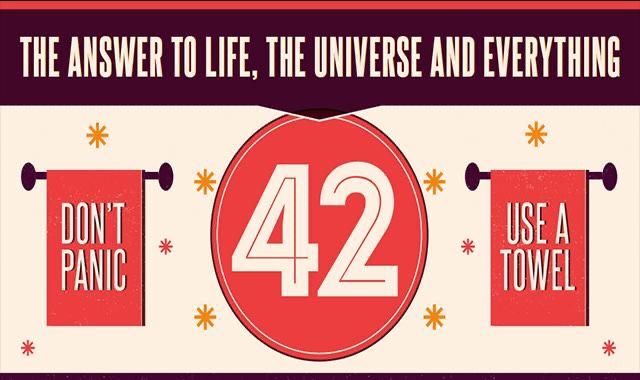
Fictional heroes make a big splash in May. On May 1, 1939, Batman, the caped crusader, made his first appearance in Detective Comics Issue #27. Star Wars Day is “May the 4th be with you.” On May 5, 1895, Richard F. Outcault published the first ever cartoon, The Yellow Kid. Since all those years ago, cartoons have seeped into our lives through every media outlet possible. If it weren’t for The Yellow Kid all those years ago, we probably wouldn’t be watching Iron Man and Captain America slugging it out on the big-screen. May 25 is a tribute to author Douglas Adams, who wrote the famed novel, The Hitchhiker’s Guide to the Galaxy.
Quote from The Hitchhiker’s Guide to the Galaxy
It’s a rather easy day to celebrate and it’s done by taking a towel with you wherever you go: to work, school, or just to the shops. This way you can celebrate such gems of wisdom as, “Nothing travels faster than the speed of light with the possible exception of bad news, which obeys its own special laws.” The only thing that’s truly important on this day is you don’t forget to bring a towel!
Don’t Panic: Carry a Towel
Oh, and the answer to the “Great Question of Life, the Universe and Everything” is “forty-two.” In the 1979 novel, the supercomputer Deep Thought takes 7.5 million years to calculate the answer to this ultimate question. The characters tasked with getting that answer are disappointed because it isn’t very useful. Yet, as the computer points out, the question itself was vaguely formulated. To find the correct statement of the query whose answer is 42, the computer will have to build a new version of itself. That, too, will take time. The new version of the computer is Earth. To find out what happens next, you’ll just have to read Adams’s books. For a math geek discussion of the significance of 42, read the link “For Math Fans” below.
Salad of spring greens and edible flowers
Having dispensed with heroes, we can move onto the significant May Days that truly appeal to me. “April showers bring May flowers” is a saying I’ve heard since my childhood ever so long ago. Historians believe this phrase may date back to a 1610 poem, which contained the lines, “Sweet April showers, do spring May flowers.” A longer phrase, “March winds and April showers bring forth May flowers,” has also been traced back to 1886. Of course, this tidbit of wisdom depends upon your geographic location, for folks inland and north may wait until what we southern folks call “early summer” before they get their “springtime.”
Rabbit and animals dancing around a Maypole
“The month of May was come, when every lust heart beginneth to blossom, and to bring forth fruit,” wrote Sir Thomas Malory in Le Morte d’Arthur. The early Greeks called this month Maia, after the goddess of fertility, many of the early May festivals relate to agriculture and renewal. May Day, celebrated on the first with the Maypole, is one such festive event that was more debauched in earlier times, but now survives as a chaste minuet of colorful ribbons woven around a tall pole by children dancing in an interweaving circle below it.
Maypole dance patterns
Other modern May festivities include No Pants Day on 5/1, originally an end of the college year prank at the University of Texas, Austin, which spread to other realms needing release, and World Laughter Day, celebrated on the first Sunday of May. This holiday helps raise awareness about the benefits of laughing and promotes world peace through laughter. Laughing can instantly help reduce stress and brings us closer to other people, as we share our happiness with them. Those who take part in World Laughter Day can help spread positivity and cheerfulness to help change the world for the better. As Ralph Waldo Emerson said, “What potent blood hath modest May.”
No Diet Day is May 6, a good day to remember our good health isn’t based on a scale number or a pant size. Instead, our health is dependent on nutritious foods, adequate exercise, and sufficient sleep. Extreme weight loss, except under a doctor’s supervision, usually leads to yo-yo weight gain, with the body gaining back the lost weight and more after severe deprivation. Slow, long term, weight loss is more likely to be permanent loss, since we aren’t “dieting,” but changing our habits. May 11th is Eat What You Want Day. I suggest we don’t follow Oscar Wilde’s habit: “My doctor told me to stop having intimate dinners for four, unless there are three other people.”
Speaking of breaking a fast, May 12th ends the month of Ramadan, the holy month of observance for Muslims. It was during Ramadan Muhammad, the prophet of Islam, received the revelations from angel Gabriel that allowed him to compile the holy book of Quran. Upon arriving in Medina, Muhammad announced Allah had established two days of celebrations for Muslims, Eid Al Fitr and Eid Al Adha. The purpose of Eid Al Fitr was to commemorate the end of the fasting of Ramadan, and mark the start of the Shawwal month, as well as to thank Allah for giving Muslims the perseverance to fast during Ramadan. The customary feast day greeting is “Eid Mubarak,” which translates to “blessed celebration” or “Happy Eid.”
The dessert of May is apple pie. Originally invented in England, the earliest apple pie recipe dates all the way back to 1381. The original recipe is very similar to the one we currently know, but it also included figs, raisins, pears, and saffron. The Dutch also created their own version of the apple pie, and the first recipe was published in a 1514 cookbook. This recipe is very similar to the apple pie we know and love today. Apple Pie Day is May 13th.
English and Dutch settlers brought the apple pie recipes into the colonies of what would become the United States, during the 17th and 18th centuries. They had to wait until the apple trees they planted grew and bore fruit, so at first apples were mainly used to make cider. It was only in the 18th century, when the first apple pie recipes were printed in America, that the dessert quickly grew in popularity. Following this came the 19th century Legend of Johnny Appleseed, whose real name was John Chapman. He crisscrossed the expanding American frontier to bring seeds for apple orchards for homesteaders. He also brought news and the gospel for fifty years.
Apple Pie 5 cents a slice and Homemade
Chapman, or Appleseed, lives on as a barometer of the ever-shifting American ideal. Some see him as a pacifist, others as an example of the White Noble Savage (so remembered long after the settlers drove indigenous peoples from the land), and others see a mere children’s book simpleton. Some see him as a frontier bootlegger, since he helped expand the hard cider industry. Others see Johnny Appleseed as the patron saint of everything from cannabis to evangelical environmentalism and creation care—everything, that is, but the flesh-and-blood man he really was.
Our heroes are too often cardboard cutouts, and we don’t spend much time reflecting on their shadow sides. Of course, much like a Flat Stanley, a two dimensional character doesn’t have enough density to cast much of a shadow, unless the light is just right. This is why continuing Bible study is so important: most of us stop in grammar school and never get an adult insight into the scriptures. When we meet grownup problems, we have to wrestle the questions of faith that we once easily accepted trustingly. Or we walk out the door and never come back.
A Single Rose in Memory
One of the most difficult sermons I ever preached was on the first Mother’s Day after my mother died. One of my best clergy pals, who was a mentor in my ministry, had arranged for a single rose to be on the pulpit beside me on that morning. It was a gift of grace and an empowering symbol, for roses were my mom’s favorite flower. Every time I thought I might cry, I held on tight to the polished oak wood and inhaled the fragrance of the rose. Even now, nearly two decades later, I can clearly see this rose and pulpit, and while I remember where I was, I recall the congregation’s faces were a blur on that day. It’s always the second Sunday in May.
I talk about my fresh grief from years ago, for during this current Pandemic too many of us have had present grief and stress, but either have no words for it, or perhaps have no safe place to express it. Then again, we may be “managing the grief of others,” and don’t have time for caring for our own needs. I call this Deferred Maintenance Grief. If you have an old, leaky faucet, you can keep turning the handle tighter for only so long. You can keep the leak stopped for a while, but soon you’ll strip out the insides of the faucet. Once it’s stripped down, it both streams steadily and needs a completely new fixture to replace it, instead of a minor repair.
I experienced this DMG once after a spate of ten deaths in a week, or maybe it was seven in ten days, followed by the death of one of the old, beloved black clergymen in my community. As I lay on the parsonage couch watching a rerun of Babylon 5, I was crying as if old E.D. were my own daddy. I then realized I’d been too busy caring for others and doing the “work I was called for,” to do the grief work I needed to do for myself. I needed to honor my loss and give myself dedicated spaces to deal with my feelings, so I could be present for others. That’s Deferred Maintenance Grief in a nutshell. If I were eating Cheetos by the bucketful, I’d be in a deep hole of DMG and digging it deeper!
Most of the churches I served had a “Don’t fix it unless it’s broke” policy. I grew up in a Depression Era family, so I was familiar with this attitude. However, these same people didn’t live this way in their own homes. We usually had a long list of deferred maintenance projects in the church property to finish in my time there. Then I’d go to the next place and do it all over again. “Always leave a place better than you found it, both structurally and theologically. Teach people the law of love. As we learn in Romans 13:8, “Owe no one anything, except to love one another; for the one who loves another has fulfilled the law.”
Most of us human beings have “deferred maintenance projects” also: days off, doctor visits, exercise, healthy meals, quiet times, and family times. Taking time for ourselves means we’re refreshed and eager to serve from the quickening power of the Spirit. Without this resting or love for our own embodied image of God, we end up working from the dying embers of our body’s frail resources—burnout calls our name.
When we get this broken, our families and our ministries both suffer along with us. We know better than to drive our vehicles with the gas gauge on empty past every filling station on the road of life. We aren’t called to die on the cross to prove our worth to Christ or to anyone else. He’s our savior and we claim his work on the cross. Anything else is workaholism or salvation by works. We need to name and claim this.
For clergy moving to a new appointment, this is an opportunity for a reset. For those who remain in place, I suggest a planning book. Mark off in advance quiet times, office hours, and visitation times. Take educational events, even if zoom is the only offering. Read for pleasure. Take a day off out of town. Don’t answer the phone after 9 pm unless it’s an emergency. Boundaries are blessings. I always told people up front, “I take my brain out of my head and put it inside a brain box at 9 pm. I put it back in at 9 am. If you call me between those hours, somebody better have died, be on the way to the ER, or the church is burning down.” They laugh, but I’ve had friends who wanted their pastor to be their bedtime Bible expositor. Boundaries keep us from burning out.
Speaking of burning, the official door to summer begins with Memorial Day Weekend. This holiday celebrates those who gave their lives in the great wars of our nation. It began after the Civil War in 1865 as a way to deal with the shared grief of a nation, which lost 750,000 people, or 2.5% of the population, in the struggle. If we were to translate this to today’s world, the number would equal 7,000,000 deaths. War is a pandemic all its own.
An engraving of The Dying Soldier – The last letter from home during the US civil war, circa 1864. (Photo by Kean Collection/Archive Photos/Getty Images)
As a parting commentary on Memorial Day, the Pandemic, and Extreme Care Giving, I leave you with a portion of the 1865 Walt Whitman poem, “The Wound Dresser,” which he wrote after serving as a hospital volunteer in the Civil War.
But in silence, in dreams’ projections, While the world of gain and appearance and mirth goes on, So soon what is over forgotten, and waves wash the imprints off the sand, With hinged knees returning I enter the doors, (while for you up there, Whoever you are, follow without noise and be of strong heart.)
Bearing the bandages, water and sponge, Straight and swift to my wounded I go, Where they lie on the ground after the battle brought in, Where their priceless blood reddens the grass the ground, Or to the rows of the hospital tent, or under the roof’d hospital, To the long rows of cots up and down each side I return, To each and all one after another I draw near, not one do I miss, An attendant follows holding a tray, he carries a refuse pail, Soon to be fill’d with clotted rags and blood, emptied, and fill’d again.
I onward go, I stop, With hinged knees and steady hand to dress wounds, I am firm with each, the pangs are sharp yet unavoidable, One turns to me his appealing eyes—poor boy! I never knew you, Yet I think I could not refuse this moment to die for you, if that would save you.
Remember to wear sunscreen to protect your skin if you plan outdoor activities on the first three day weekend of the summer and watch the temperature of the grill. We don’t want anything to burn if we can help it. Charred meat and burned skin are both indicated for cancer risks. Be safe and continue to mask up in public. Get vaccinated as an act of love for your family, your neighbors, and the world community. Since we’re all wound dressers, as well as the wounded also, we want to give as much care to healing our own wounds as we do to the wounds of others.
The point of view determines the perspective of a work of art. One’s point of view, or preconceived bias, can determine how one sees the world and the decisions they make about the information that comes to them. If we think the world is a scary place, resources are few and won’t be enough for everyone, then, we’ll operate from fear and hoarding. If we believe God’s promises are faithful and God will indeed provide for our needs, then we’ll live in trust and hope, even as we order our lives to want less and enjoy simpler pleasures.
I always find it strange how the people in the Bible who have the greatest riches also have the most difficulty following Jesus. Matthew in 16:24-26 speaks to this topic in the section on “The Cross and Self-Denial:”
Then Jesus told his disciples, “If any want to become my followers, let them deny themselves and take up their cross and follow me. For those who want to save their life will lose it, and those who lose their life for my sake will find it. For what will it profit them if they gain the whole world but forfeit their life? Or what will they give in return for their life?
“Here is your Son“
Of course, even in the 1st century AD, people wanted to have material possessions, a good income, and wealth stored up for the future. When Jesus said, “whoever does not take up the cross and follow me is not worthy of me,” (Matthew 10:38), he invited his followers to enter a despicable journey.
The Via Dolorosa isn’t named the Way of Grief for nothing. People walked it, bearing a heavy cross beam, on the way to an undignified death, a punishment reserved for criminals.
Crucified On Crosses
Yet Jesus transformed this ancient punishment into a means of redemption. He took a symbol of death and made it into a hope for new life. Because of this , the author of Hebrews 12:2 could write, “Looking to Jesus the pioneer and perfecter of our faith, who for the sake of the joy that was set before him endured the cross, disregarding its shame, and has taken his seat at the right hand of the throne of God.”
Cross Icon by Gail
Now we can live the Easter promise written in Ephesians 2:12-18:
“Remember that you were at that time without Christ, being aliens from the commonwealth of Israel, and strangers to the covenants of promise, having no hope and without God in the world. But now in Christ Jesus you who once were far off have been brought near by the blood of Christ. For he is our peace; in his flesh he has made both groups into one and has broken down the dividing wall, that is, the hostility between us. He has abolished the law with its commandments and ordinances, that he might create in himself one new humanity in place of the two, thus making peace, and might reconcile both groups to God in one body through the cross, thus putting to death that hostility through it. So he came and proclaimed peace to you who were far off and peace to those who were near; for through him both of us have access in one Spirit to the Father.”
Multimedia icon by Lorilee
So we who live on this side of the resurrection have a joy to celebrate every day. For us the cross is a sign of victory over sin and death, and the evidence of new life and love God has for God’s world and God’s peoples. As we read in Colossians 1:19-20—
“For in him all the fullness of God was pleased to dwell, and through him God was pleased to reconcile to himself all things, whether on earth or in heaven, by making peace through the blood of his cross.”
I love the springtime, for all the colors of green are in abundance. I live on the lake on a property originally developed to be a high rise hotel and casino, until the city derailed that plan. Then it became vacation condos and retirement homes. Since it’s located on a large plot of timbered land, I even see my rabbit neighbors on occasion. My bunny friends usually move about at dawn and dusk. I’m not an early bird, and since Covid, my “out and abouts” have been seriously curtailed, so I’ve yet to see my four legged furry neighbors this year. Maybe I’ll have a better chance to see the Easter Bunny. I did purchase his dark chocolate cousin from Dove, who’s been reduced to a single ounce and will be gone by Easter Sunday. The ears went first, of course.
Dove Bunnies
Our parents found ways in the old days to keep us active and entertained in the weeks leading up to Easter. One of my favorite experiences was egg dying and decorating. Back in Mom’s kitchen, boiling water, vinegar and colored pellets went into the coffee cups before we wrangled the wire holder and lowered the hard boiled egg into the dye. If we dipped the egg all the way in or held it for a longer time, we could get deeper colors. One year I even attempted to use only natural dyes, such as beets, cabbage, and onions. My “science-anthropology” experiment didn’t turn out as pretty as the PAAS collection, but I learned a lot. Crayon resist worked with both dye types, however. Perhaps I never appreciated how fortunate I was my mom taught school and my dad encouraged us kids to learn everything about our world. Almost anything was a science project in his mind.
Crayon Box
As a child, I knew I’d arrived when I graduated to the big crayola box with sixty four colors in it. Suddenly I had a year round wealth of shades and hues at my command, plus I could combine them for even more variety: Here are the colors that ended up being in the 64 count box in 1958: orchid, lavender, carnation pink, thistle, red violet, violet red, brick red, magenta, maroon, mulberry, Indian red, red, melon, salmon, orange red, red orange, orange, flesh, maize, goldenrod, yellow orange, apricot, orange yellow, yellow, lemon yellow, green yellow, spring green, yellow green, sea green, olive green, green, pine green, aquamarine, forest green, turquoise blue, green blue, sky blue, blue green, periwinkle, blue, navy blue, midnight blue, cornflower, blue gray, cadet blue, violet, blue, blue violet, violet, plum, tan, burnt orange, mahogany, burnt sienna, brown, raw sienna, bittersweet, raw umber, sepia, black, silver, gray, gold, copper, white. I could make any landscape sing with whatever color my young imagination called forth. My birthday month always calls forth all the colors nature has on her palette.
Spring Trees, Old Farmland
Of course, not every tree sports a shade of green as its primary dress in the springtime. Some bud out all in white, others in dark red violet, while still others bloom out in light pinks. If I squint my aging eyes today, I can see a haphazard lace design across the landscape before me in multicolored threads, with a few embroidered trunks to give it a semblance of stability. Those trunks might be Indian red (an iron red) mixed with the old Prussian blue (now known as midnight blue) to make a warm black. Using the straight carbon black crayon made the black too stark, or so my portrait painting grandmother told me. The old “flesh color” has been renamed “peach,” in recognition of the diversity of skin color in our world today. Many other colors in the box can be combined to get the perfect shade of a person’s facial tone, no matter how light, dark, yellow, white, red, or brown. The 64 box has enough colors to capture any facial tone, for sure.
When I see the ever changing beauty of the natural world about me, I can’t help but have hope. I look back not only to simpler times, but also forward in hope to a time when once again I will feel the joy of breaking the seal of a brand new box of crayons and when I can revel in the fresh, unsullied scent of pure wax and touch with reverence the clean paper wrappers. Easter dresses always show up in the pastel colors, even if we have to toss our dark winter coats over them when the weather turns cool, as it often does.
Maybe you don’t have such a strong attachment to art supplies as I do, but surely this April is a holy season for many people, and not just for the rabbits who live among us. Some how we people of faith across the centuries and around the world respond to the annual renewal of life and the promise of hope when life seems most precarious. While my faith experience is deeply rooted in Christianity, the worldwide communities of faith respond to springtime with some common traditions.
It’s no wonder one of the great myths of the ancient Greeks and Romans dealt with the changing seasons, but also with the hope of eternal life. Demeter was the goddess of agriculture and crops, whose daughter Persephone was taken into the underworld. Hades kept her there against her will, so while Demeter grieved, the crops failed, people starved, and the gods weren’t honored. Zeus, the king of the gods, forced Hades to release Persephone, but since she had eaten a few pomegranate seeds, she had to spend part of the year underground. This set up the seasons and was the impetus for the famed Elysian Mysteries.
The week long rituals were based on a symbolic reading of the story of Demeter and Persephone. It provided initiates with a vision of the afterlife so powerful, it forever changed the way they saw their world and their place in it. They no longer feared death, for they recognized they were immortal souls temporarily in mortal bodies. In the same way Persephone went down to the land of the dead and returned to that of the living each year, so would every human being die only to live again on another plane of existence or in another body.
Cave Entrance: The Plutonium, Eleusinia, Greece
The spring rite was the lesser mysteries, without which one couldn’t enter the greater mysteries of autumn. Anyone who was present in the city and spoke Greek could attend, unlike some of the closed gnostic mysteries, which were available only to a chosen few. The whole community participated, for the life of the family, as well as the earth, depended on the abundance of the earth. In fact, the only paved road in Greece in ancient times was from Athens to Eleusius, and a modern road now follows the same path.
The White Road to Eleusis (The Sacred Way)
Aristotle wrote about the contrast of the cathartic experience of watching a tragic drama whereby the spectator is purged of the negative emotions of fear and pity, while an initiate of the Mysteries would undergo physical, emotional, and spiritual cleansing in preparation for the main part of the ritual— a spiritual identification with the Mother and Daughter in their separation and suffering and then joyful reunion, a transformation from death to rebirth. Through her or his own inner spiritual desires and participation in the rites, the initiate then was prepared to receive a “seeing” into the deepest mysteries of life.
This communal ritual wasn’t just for the individual, but for the family, the city state, and even the world itself. Let’s keep that idea in mind as we consider the other rituals of faith, renewal, and restoration of this spring season.
Our Vice President’s husband Doug Emhoff, 56, is the first Jewish spouse of a vice president or president. “After a year of social distancing and mask wearing, it’s impossible not to feel isolated at times. So it’s events like this one, events that creatively bring family and friends and communities together, that keep us connected and remind us that we’re not alone,” Emhoff said at the Seder ceremony before noting he got to do one of his “favorite things” and introduce the vice president.
“Our family, like so many families in the United States, the state of Israel and around the world, will begin to celebrate the sacred holiday of Passover this weekend,” Vice President Kamala Harris said. “And the Passover story is powerful. It reminds us of the resilience of the human spirit in the face of injustice. It urges us to keep the faith in the face of uncertainty.”
Bitter Greens
“This year, as we dip our greens in salt water and pour out our ceremonial wine and eat our bitter herbs, let us commit, once again, to repairing the world,” she said.
This is the great witness of the Passover story, for it’s a story of hope and liberation. It’s a story of God keeping God’s promises and God’s faithfulness for those who suffer. If anyone needs to hear words of liberation, faithfulness, hope, and promises kept, it’s our whole world, which is suffering with covid, hate, nationalism, racism, and extremism.
Leonardo Da Vinci: The Last Supper was a Passover Seder
Passover, like many holidays, combines the celebration of an event from Jewish memory with a recognition of the cycles of nature. As the Jewish people remember their ancestors’ liberation, they also recognize the stirrings of spring and rebirth happening in the world. The symbols on the table bring together elements of both kinds of celebration. In the ritual, families take a vegetable, representing joy at the dawning of spring after a long, cold winter. Most will use a green vegetable, such as parsley or celery, but some families from Eastern Europe have a tradition of using a boiled potato, since greens were hard to come by at Passover time. Whatever symbol of spring and sustenance used, it’s dipped it into salt water, a symbol of the tears the ancestors shed as slaves. Before eating it, a short blessing is said:
We praise God, Ruler of Everything, who creates the fruits of the earth.
At the end of the meal, celebrants bless the final cup of wine according to Jewish tradition and law. As the faithful have had the pleasure to gather (virtually) for a seder this year, they hope to once again have the opportunity of gather in person in the years to come. The prayer is God brings health and healing to Israel and all the people of the world, especially those impacted by natural tragedy and war. As folks say every year, “Next year in Jerusalem!”
Yet another spring festival is the Hindu celebration of Holi, which has been observed all over India since ancient times. Holi’s precise form and purpose displays great variety. Originally, Holi was an agricultural festival celebrating the arrival of spring. This aspect still plays a significant part in the festival in the form of the colored powders: Holi is a time when man and nature alike throw off the gloom of winter and rejoice in the colors and liveliness of spring.
Holi Festival Celebration
Holi also commemorates various events in Hindu mythology, but for most Hindus it provides a temporary opportunity for Hindus to disregard social norms, indulge in merrymaking and generally “let loose.” The central ritual of Holi is the throwing and applying of colored water and powders on friends and family, which gives the holiday its common name “Festival of Colors.” Holi is spread out over two days (it used to be five, and in some places it is longer). A large communal bonfire burns in the town center to light the evening festivities.
The entire holiday is associated with a loosening of social restrictions normally associated with caste, sex, status and age. Holi thus bridges social gaps and brings people together: employees and employers, men and women, rich and poor, young and old. Holi is also characterized by the loosening of social norms governing polite behavior and the resulting general atmosphere of licentious merrymaking and ribald language and behavior. A common saying heard during Holi is bura na mano, Holi hai (“don’t feel offended, it’s Holi”).
This festival has transferred into western culture as part of the celebrations at the end of races and other communal bonding events, a fact which leads some to charge the west with cultural appropriation, but the followers of Holi aren’t offended if the intention is good.
While Easter in the western world has become a cultural celebration of cleaning house, redecorating, wearing new and brighter clothes, and doing brunch with lighter foods, in the Christian church, Easter still retains its central place of honor. As Henri Nouwen writes, “When Jesus was anticipating his own death he kept repeating the same theme to his disciples: “My death is good for you, because my death will bear many fruits beyond my death. When I die I will not leave you alone, but I will send you my Spirit, the Paraclete, the Counselor. And my Spirit will reveal to you who I am, what I am teaching you. My Spirit will lead you into the truth and will allow you to have a relationship with me that was not possible before my death. My Spirit will help you to form community and grow in strength.” Jesus sees that the real fruits of his life will mature after his death. That is why he adds, “It is good for you that I go.”
Prayer to the Holy Spirit
While Jesus did reach out to those ignored by the traditional faith community of his day, he was also concerned for the whole community over and above the individual alone. While the church, who are the “ones called out,” is composed of individuals, we’re called to gather together for worship, prayer, instruction, and to be sent out to do ministries in the name of Jesus. Some today put their personal relationship with Jesus above their relationship with the beloved community or with the suffering body of Christ, which is found in the marginalized people beyond the church door.
So along with Nouwen, we have to ask, “If that is true, then the real question for me as I consider my own death is not: how much can I still accomplish before I die, or will I be a burden to others? No, the real question is: how can I live so that my death will be fruitful for others? In other words, how can my death be a gift for my loved ones so that they can reap the fruits of my life after I have died? This question can be answered only if I am first willing to admit Jesus’ vision of death, as a valid possibility for me.”
Grunewald: Resurrection
Since Easter is the celebration of the great resurrection story, it’s the story of the renewal, not only of life, but the renewal of hope and faith. When our world looks its most bleak, we can still hope for a better future. When our God seems to have abandoned us, we can still trust in God’s unfailing promise to fulfill God’s commitments to God’s well loved people. When Mary Magdalene runs to meet the risen Christ in the garden, he tells her, “Do not hold on to me, because I have not yet ascended to the Father. But go to my brothers and say to them, ‘I am ascending to my Father and your Father, to my God and your God.’ ”
We don’t keep good news for ourselves, but spread it to others. This is the best argument for the communal nature of resurrection faith. It should change us, so we should want to change God’s world and God’s people for the better. If we’re transformed by love, we also should transform the world with love. If we’ve been justified by the grace of God’s mercy, we should want to bring justice to marginalized communities who’ve experienced systemic injustice.
In summary, what ties all these spring festivals together is a hope for a new creation and a better life, either in this world or in the world beyond. Sometimes we need to have assurances of the life to come to live well in this life, while other times we need a hope for this world in order to live for tomorrow. Likely our faith practices speak to our deep human need for freedom and also to the need for our suffering to have meaning. Only if we change our suffering into a catalyst for relieving the suffering of others can we being these faith promises of spring renewal into reality. Then the ancient hopes of slaves, who were liberated, can come true today also. When the fears of death and life of everyday people are healed, their hopes and dreams are made possible by the power of god working through them. Then we too can sing the songs of freedom, put our energy into freeing others who are in bondage, and bring about God’s new creation, even as God’s spirit is renewing the face of the earth.
Springtime in Garvan Woodland Gardens
True Colors: Creating Natural Food Dyes at Home — Edible LA