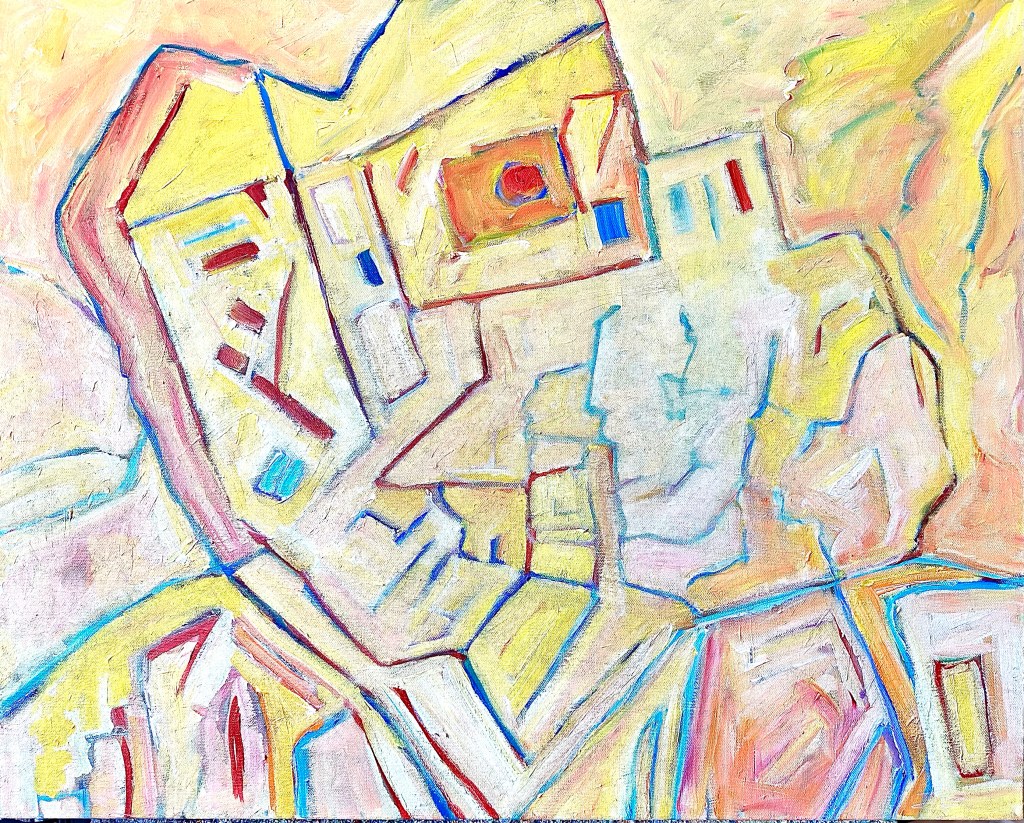
Megiddo at the Crossroads of History

911, Academy for Spiritual Formation, Apocalypse, art, Astrology, Faith, Healing, hope, Imagination, inspiration, Israel, Megiddo, Painting, pandemic, purpose, Spirituality, vision

Archeological Remains of Tell Megiddo

On a visit to the Holy Land, I walked in the ruins of Tell Megiddo and also climbed the hills above the Jezerell valley. From this vantage point, I could imagine the great battles of nations warring to conquer land and control trading routes. Megiddo lies at the crossroads and therefore in the crosshairs of international politics, both in ancient and current times.


Valley of Megiddo

The plains of Megiddo, the breadbasket of Israel, also were known as a great battleground in ancient times. Egypt came more than once to fight the kings of Israel and Judah. The world’s earliest recorded battle occurred here between Syrian princes and Pharaoh Thutmosis III (ca. 1469 BC). Judah’s king Josiah was fatally wounded when he confronted another pharaoh, Neco II, near Megiddo ca. 609 BC (2 Kings 23:29-30). Although Megiddo is only mentioned in the Old Testament, the New Testament refers to it once in Revelation 16:16 as Harmagedon (mountain of Megiddo), the final site of the battle between the forces of good and evil at the end times of the age. Of course, scholars have different interpretations of when these “end times” are at hand.


Map of First Recorded Battle

The final book of the Greek New Testament is ΑΠΟΚΑΛΥΨΙΣ ΙΩΑΝΝΟΥ, or the Apocalypse of John. The word apocalypse means “disclosure of truth, instruction, or reveal, disclose, uncover.” It especially refers to Jewish and Christian writings of 200 BCE to 150 CE, which are marked by pseudonymity, symbolic imagery, and the expectation of an imminent cosmic cataclysm in which God destroys the ruling powers of evil and raises the righteous to life in a messianic kingdom.

Chariot Sculpture at Megiddo Battlefield

I remember a presenter on an Academy for Spiritual Formation retreat saying she had difficulty saying the prayers in the psalter, for the psalms of lament meant nothing to her, since she had no griefs to bear. Her spiritual adviser reminded her, “We pray these prayers for others, not just for ourselves alone.” As an artist of faith, I sense the needs of the world: it’s longings, fears, hopes, and dreams. I don’t always paint “art for art’s sake.” Certainly the conflict our beloved United Methodist Church has been experiencing lately factored into this “end times vision,” for too many on both sides of this dispute have resorted to calling the other “evil.”

Megiddo: Bronze Version

I felt called to paint the landscape of Megiddo in these recent weeks. Beginning in mid August, I was working on several paintings using Google map views of the landscape around the ancient site, with inspiration from my personal photos from my visit several years ago. I struggled over it, with the colors changing from bright to earthen tones. I left it alone for a time, to look at it and take time to live with it. Doing this allows me to see if I got too interested in noodling about making different colors, rather than considering the whole area as one unit. It didn’t take long before I came to the conclusion I didn’t have unity in my work. I had no overarching focus. My life has been like this for a while, with multiple distractions.

Megiddo: Blue Version

In our broken and fallen world, I find people today are in a rush to run to the extremes. Cooler heads don’t always prevail. The moment disorder rears its ugly head, folks run around like Chicken Little screaming, “The sky is falling! The sky is falling!” They might as well scream, “The end times are here!” I’m reminded of the Y2K hysteria with everyone panicking about filling up their cars for fear the gas pumps wouldn’t work, getting cash in case the credit cards wouldn’t swipe, and buying generators for fear the grid would crash (computers not able to recognize all those zeros). As I recall, my antique VCR kept recording on schedule, and the local Walmart took back loads of panic purchases in January.

The latest outbreak of hostilities in Israel and the Gaza Strip have added to the apocalyptic atmosphere and thinking of those who are given to extremes of thought. America has sent two of its eleven aircraft carriers into the Mediterranean Sea as a deterrent to all the other nations to rethink their plans to join the fighting now going on. For the apocalyptic thinkers, this is a sign of “It’s going down!” For those of us who have calmer heads, we realize the United States is the only one of six countries with more than two of these floating armed cities. Every other country has a single one only.

General Eisenhower (R) confers with French generals French 1st Army Corps Headquarters November 25, 1944 Ranking allied leaders look over a situation map outside of French 1st Army Corps Headquarters.

It’s been the habit of American presidents and their advisers in the gamut of crises since World War II to move aircraft carriers around as a “Geopolitical Chess Piece” to demonstrate American concern, resolve, or outright anger. Because carriers are operate on the high seas where permission to move is not needed from other countries, and because they carry their own fuel, weapons, and maintenance, they’re ready on arrival at the scene of a crisis to deliver power. Moreover, since modern U.S. carriers are large and imposing, and have been unchallenged on the seas, they “show the flag” to great effect. They provide excellent “visuals.” In fact, if one carrier doesn’t do the job, sending a second with several attendant ships along is a sign of “we mean business.”

Since this is a habit, and not a novel occurrence, it’s not the sign of the end times. As the gospel of Mark records in 13:7-8:

“When you hear of wars and rumors of wars, do not be alarmed; this must take place, but the end is still to come. For nation will rise against nation, and kingdom against kingdom; there will be earthquakes in various places; there will be famines. This is but the beginning of the birth pangs.”

Benjamin West: Death on a Pale Horse, oil on canvas, 1817, Pennsylvania Academy of the Fine Arts

Will these carriers be used for their traditional purpose—a floating airfield—and will our military aircraft and service personnel actually join in the actual combat operations in the MidEast? That seems unlikely, given the Just War principle taught in American War Colleges. The moral concept of Just War begins with a good reason to go to war. A reasonable cause is to right a wrong, recover stolen property, or self defense. Not liking someone isn’t a good reason to go to war.

The just war must be fought proportionately to the harm that was done to the aggrieved. Today, if someone were to insult you or cut you off in traffic, honking your horn is acceptable, but shooting a pistol isn’t. That’s a disproportionate reaction to the harm, or an unjustified assault. Responding in anger usually leads to regret, but our emotions often get the best of us.

I remember my first year in the classroom. I was making a grand total of $8,250 a year—the extra $250 was for my master’s degree—and the school wanted to know if I wanted this pittance in 10 or 12 checks. “Oh, make it ten! I’ll figure out summer some how.” The first day of class in 1982, I had well over fifty students in the high school sign up for art because the former teacher had taught elementary lessons to the older students: she had fifty ways to draw turkeys. I brought the principal in: “This isn’t going to work. Let’s get half of them in another class.” He was good with that.

This was a country school. Most of the kids would marry right after graduation. Many of the seniors already had jobs, so young art teachers weren’t high on their respect list. I was fortunate to have taught in an inner city school back in the Northeast where the boys play ice hockey. Like an aircraft carrier sent to the Mediterranean Sea, sometimes I’d have to throw my short body into the middle of two factions who were about to throw punches. These boys were usually over six feet tall, so there was no likelihood I’d ever get hit, but just my presence would cause them to reconsider and pull their punches.

Just because we send war ships to the Mediterranean doesn’t mean we want to wage war. We Americans have a track record of showing up to keep wars from breaking out all over. World leaders know how our military is trained and the rules by which we engage in conflicts. This is why as a person of faith, each of us has to search our hearts to discern how we respond in times of conflict, whether that’s a war or just a disagreement with our neighbors.

In addition to a just cause, we must have the right intentions, the possibility of success, and enter a conflict only as a last resort. Those who follow the Just War Principles aren’t “trigger happy,” but are inclined to gather community support, decide their limits ahead of time, seek to resolve the conflict in other ways first, and if that fails, then enter the fray. The USA didn’t enter WWII until the 1941 surprise attack on Pearl Harbor, even though the war in Europe had been going on since September 1, 1939, when Germany invaded Poland. Up to that time we were supporting Great Britain with armaments.

A plan for after the fighting is done

Theologically speaking, scholars are of two minds: the end times are already here or the end times have yet to come.

1. The end times are already here—Scholars who believe this understand Matthew 24:6-8 as an ongoing event, which began with the ascension of Christ:

“And you will hear of wars and rumors of wars; see that you are not alarmed; for this must take place, but the end is not yet. For nation will rise against nation, and kingdom against kingdom, and there will be famines and earthquakes in various places: all this is but the beginning of the birth pangs.”

For some, the tribulation will happen beforehand (pretribulation), while others believe this suffering will occur after the return of Jesus (post tribulation). I remember as the year 2000 approached, many of the faithful were excited about the camera facing the Mount of Olives in Jerusalem, since this was the place from which he ascended, therefore it would be the place from which he would return. Daystar Ministries setup the camera so “everyone could see it firsthand.”

We humans tend to think our Gods are small, even if we ascribe to them “infinite powers.” We don’t realize the power of an almighty who can interrupt and reveal all of the past to be nothing but dust and introduce a new age with his appearance. No one will need a computer or video screen to view the in-breaking return of the messiah. Everyone around the world will hear the thunderclap at one moment in time, and the flash of lightning accompanying his appearance will brighten even the darkest night. This day will be overwhelmingly bright. Most of us will hide our eyes so we won’t be blinded by the brilliance of a thousand suns.

The Jesus Cam will most likely melt when Christ does return, but his return wasn’t on the first day of 2000. That wasn’t the millennium anyway, but a year early for the math challenged hopeful. It was also the year 1420 for the Muslims and 5760 for the Jews, so who’s counting matters anyway, since numbers aren’t what God depends on, nor the stars (astrology).

Durer: The Four Horsemen

2. The end times are yet to come—While pandemics, stock market crashes, and rumors of war may all sound apocalyptic, the Temple at Jerusalem has yet to be rebuilt. Complicating this task is the Dome of the Rock, a major Islamic holy site built on the same location. A Pew Research Center study in 2010 found most Americans believed war, terrorism and environmental catastrophes were at least probable by the year 2050. Nearly six-in-ten (58%) saw another world war as definite or probable; 53% said the same about the prospect for a major terrorist attack on the United States involving nuclear weapons. An even higher percentage (72%) anticipated the world would face a major energy crisis in the next 40 years. This fits with the theme of “apocalypse as the collapse of environment or society.”

Other characteristics of the apocalypse include:

1. Literal battle between physical armies under supernatural leadership—These are battles of extremists, who are convinced they have a holy calling to fight. The Crusades were fought as “Christ’s army against the infidel.” Their purpose was to restore the Christian holy sites in the Middle East and resanctify them for holy Christian worship. This mentality doesn’t respect the humanity of the enemy. The war may have a just purpose, but not be fought with just means: eradication of the enemy is unjust.

2. Holy wars against non-believers—This is an unjust war, fought with unjust purposes, with excessive force, and seeks to exterminate the enemy, who are reduced to non-persons because they don’t share the same belief system. When opposing sides can’t recognize the common humanity of one another and rage rules decisions, the lust for blood feeds upon itself. Shakespeare said it best when Marc Anthony came upon the body of the just assassinated Julius Caesar in Act 3, scene 1:

And Caesar’s spirit, ranging for revenge,

With Ate by his side come hot from hell,

Shall in these confines with a monarch’s voice

Cry “Havoc!” and let slip the dogs of war,

That this foul deed shall smell above the earth

With carrion men, groaning for burial.

My final reworking of Megiddo includes streaks of rockets in the dark night sky and swirls of chaos which churn the world’s peoples, just as Ate, the Roman personification of recklessness and folly incites the passions of Caesar’s bereaved followers. We don’t know when Christ will return, no matter how many may prophesy or calculate the date. As Jesus said to his disciples in Matthew 24:36,

“But about that day and hour no one knows, neither the angels of heaven, nor the Son, but only the Father.”

This present darkness is only momentary, for if we’re in the end times, we also have a promise we can hold on to in Matthew 28:20—

“Remember, I am with you always, to the end of the age.”

Joy and Peace,

Cornelia


Armageddon / Harmagedon – CDAMM

https://www.cdamm.org/articles/armageddon


Aircraft Carriers by Country 2023 – Wisevoter


Public Sees a Future Full of Promise and Peril | Pew Research Center


Robert C Rubel: The Future of Air Carriers

https://digital-commons.usnwc.edu/cgi/viewcontent.cgi?article=1551&context=nwc-review


Rubel, Robert C. (2011) “The Future of The Future of Aircraft Carriers,” Naval War College Review: Vol. 64 : No. 4 , Article 4. Available at: https://digital-commons.usnwc.edu/nwc-review/vol64/iss4/4


Case Study: Just War Doctrine

https://www.scirp.org/journal/paperinformation.aspx?paperid=122406


Messiahcam at Y2K

https://www.theguardian.com/world/2000/jan/01/jamesmeek


‘Cry ‘Havoc!’ And Let Slip The Dogs Of War’: Speech & Analysis

https://nosweatshakespeare.com/quotes/famous/cry-havoc-let-slip-dogs-war/

Brookdale Community College Eisenhower Collection

https://www.brookdalecc.edu/center-for-world-war-ii-studies/the-meserlin-gallery/witnessing-history/

Left to right, French 5-star General De Lattre De Tassigny, commander 1st French Army; U.S. Lieutenant General Omar Bradley, commander, 12th Army Group; French 4-star General Marie Emile Bethouart, commander 1st French Army Corps; U.S. Lieutenant General Jacob L. Devers, commander, 6th Army Group; and General Dwight Eisenhower, Supreme Allied Commander.

REMEMBERING SEPTEMBER 11th

9/1/11, 911, Altars, art, Attitudes, Christmas, Easter, Faith, Forgiveness, grief, Healing, hope, Icons, inspiration, Ministry, Painting, renewal, Spirituality

Looking up at the night sky, I think of the Eskimo Proverb which says, “ Perhaps they are not stars, but rather openings in Heaven where the love of our lost ones pours through and shines down upon us to let us know they are happy.” The fatal September 2001 event at 7:14 am CDT impressed its significance on the nation to such a great extent that 93% of American adults 30 years old or greater can tell you exactly where they were when they first heard about the attacks. Only 42% of those 25 and younger can do the same.

NGC 3603: From Beginning To End
Credit: Wolfgang Brandner (JPL/IPAC), Eva K. Grebel (U. Wash.), You-Hua Chu (UIUC), NASA

I remember my church was fuller than for Easter or Christmas on the Sunday after the devastation of the Twin Towers, the collapse of the Pentagon, and the crash of the airplane in which the terrorists had hoped to hit the White House. Only those brave passengers of Flight 93 stood between the terrorists achieving a psychological victory and their ultimate ignoble demise. As I recall, people were eager to hear “What is the Christian Response to Violence?” If they hoped to hear the one and only response, as the THE implies in the sermon title, the air was let out of their balloons.

A photo taken on September 11, 2001 by the New York City Police Department as the North Tower collapses, engulfing lower Manhattan in smoke and ash.

Of course, Christians across the centuries have had three major responses to violence. The first is “turning the other cheek” or nonviolence. We see this in the Biblical witness, for Jesus admonishes his followers in Matthew 5:38-42—

“You have heard that it was said, ‘An eye for an eye and a tooth for a tooth.’ But I say to you, Do not resist an evildoer. But if anyone strikes you on the right cheek, turn the other also; and if anyone wants to sue you and take your coat, give your cloak as well; and if anyone forces you to go one mile, go also the second mile. Give to everyone who begs from you, and do not refuse anyone who wants to borrow from you.”

Il Tintoretto: Christ before Pilate, Museum Scuola di San Rocco, Venice

Jesus himself practiced a non-violence response to violence when he appeared before Pilate after his arrest. Pilate questioned Jesus in Matthew 27:11-14—

Now Jesus stood before the governor; and the governor asked him, “Are you the King of the Jews?” Jesus said, “You say so.” But when he was accused by the chief priests and elders, he did not answer. Then Pilate said to him, “Do you not hear how many accusations they make against you?” But he gave him no answer, not even to a single charge, so that the governor was greatly amazed.

Unknown German artist: Aquamanile in the Form of a Mounted Knight, Copper alloy, ca. 1250, used to pour water over hands at the altar or at dinner table, Metropolitan Museum of Art, New York City.

The opposite of non-violence is the Crusade mindset. In this response, the infidel is “othered” to the point of inhumanity. Because the unbelievers don’t share the same god, purging them from the living is a good deed, worthy of merit for salvation or for forgiveness of past sins. As you can imagine, this makes people who believe in other gods “less than human,” so what we modern people would consider war crimes would be easy to commit for a person in Crusade mentality. We still hear vestiges of this dualist mindset in the vocabulary of people who talk about “weaponizing government” or those who feel the need to “hit the ground running.” If we’re always in “attack mode” at work, we need to question how we think about others if we believe we’re in a hostile environment or in enemy territory.

If the Christian has both a head and a heart, both of which are being conformed to the love, mercy, and justice of God, then we must have a middle way between passive nonviolence and crusade extremism. This golden mean is the Just War Theory. It’s taught in all our military academies and has its beginnings in Christian theology. The saints Augustine of Hippo and Thomas Aquinas developed the primary ideas:

  • Make war only for a just cause
  • Be sure your intentions are right
  • Only legitimate authority can make war
  • Use just proportionally in the war, nothing to excess
  • Go to war as a last resort 
  • During war only attack military targets, not civilians 
  • Following unjust orders isn’t a legal defense for unjust actions 
  • Punish war crimes, compensate victims
  • Peace treaties must be fair and just to all, even the warmongers
Psalter Saint Louis et Blanche de Castile, MS 1186, BnF, folio 11b

Those of us who struggle with conflict—if we have a family, we have conflict or if we live in a community, we have conflict—yes, I’m starting to meddle now. You knew I’d get around to it. After all, God the Father had Adam and Eve, and God tossed those two kids out of the House. They had everything, and still wouldn’t follow the one rule (Don’t eat from that one tree). Just one rule. How hard could that be? It was downhill from there.

I always take comfort, knowing God had troublesome children. It means perfect parents can still have conflict at home. This gives hope to us less than perfect folks. The Bible reminds us always how God still loves the human race and hasn’t give up on us, so we don’t give up on those we have fusses with. We don’t roll over and play dead, yet we don’t set out on a crusade against unruly kids or others with whom we have conflicts. As Micah 7:18 reminds us about God’s Compassion and Steadfast Love:

Who is a God like you, pardoning iniquity and passing over the transgression of the remnant of your possession? He does not retain his anger forever, because he delights in showing clemency.

Remnant of the Twin Towers

Maybe we should look at the just war thoughts and modify our attitudes and behaviors. We can come to a peace, even if others cannot. As Jesus says in Matthew 5:9—

“Blessed are the peacemakers,

for they will be called children of God.”


Joy and Peace,

Cornelia


Two Decades Later, the Enduring Legacy of 9/11 | Pew Research Center


Just War Theory – The Ethics Centre Ethics Explainer
https://ethics.org.au/ethics-explainer-just-war/


Chaos and the Order of the Day

911, adult learning, Altars, art, Astrology, Creativity, Faith, Imagination, Israel, Leonardo da Vinci, Ministry, Painting, Spirituality, vision

Morse Peckham, author of Man’s Rage for Chaos, believed “Order is humanity’s freedom; but the rage for order creates its own limits on that freedom.” Art, he maintained, enabled the artist to fight that rage, which destroys what it would create. Only the rage for chaos can balance the rage for order.

Stellar Bones: Aries zodiac sign. Horoscope. Illustration for souvenirs and social networks.

As one who was born under the Aries sun, with an Aries moon, and a Virgo rising sign, I fully understand this rage for chaos and order within my own body. I somehow always have fifty-eleven projects and and even more ideas I’d like to accomplish, but I too have the same limits as all other people: we all have only 24 hours on any given day. Some of these moments must be given to the life giving nurture of the body, which carries our great mind and imagination and the hands which do our good works. Some days the balance scales of Virgo call my chaos into order, while on others my Aries excitement causes the balance to quaver. This tension shows up in my work.

Venus and Saturn at Early Sunset: follow the line of the building

I mention my astrological signs, for once in ages past, people believed the stars ruled their lives. The heroes ascended into the stars—Sagittarius, the archer, while other constellations were named for animals or the humans who were turned into animals, such as bears and swans. Some got their names for resembling objects—the dippers, while others were named for legendary persons—Cassiopeia’s chair and Orion’s Belt come to mind. In the time of dark skies, our ancestors could pick out these sky patterns with ease. Light pollution in our cities makes these shapes harder to discern every year. Our national parks may be the only places our city dwelling future generations will be able to see the night sky in all its glory.

The Ancient Greeks believed the gods ruled their fates. The writer Pausanius listed the many shrines to the deities in Athens, including “in the Athenian market-place among the objects not generally known is an altar to Mercy, of all divinities the most useful in the life of mortals and in the vicissitudes of fortune, but honored by the Athenians alone among the Greeks. And they are conspicuous not only for their humanity but also for their devotion to religion. They have an altar to Shamefastness, one to Rumour and one to Effort. It is quite obvious that those who excel in piety are correspondingly rewarded by good fortune.”

Altar to an Unknown God, Athens, Greece

The apostle Paul even noted the Athenians had a temple to an “unknown god,” just in case they didn’t cover their bases with offerings to all the other deities (Acts 17:23). Yet, you already know him, he said, for

“The God who made the world and everything in it, he who is Lord of heaven and earth, does not live in shrines made by human hands, nor is he served by human hands, as though he needed anything, since he himself gives to all mortals life and breath and all things.” — Acts 17:24-25

Our creation story in Genesis 1:1-2 begins with familiar words:

“In the beginning when God created the heavens and the earth, the earth was a formless void and darkness covered the face of the deep, while a wind from God swept over the face of the waters.”

Milton addressed the same Spirit of God, which was at creation, in his epic poem, Paradise Lost:

“And chiefly Thou O Spirit, that dost prefer Before all Temples th’ upright heart and pure, Instruct me, for Thou know’st; Thou from the first Wast present, and with mighty wings outspread. and with mighty wings outspread. Dove-like satst brooding on the vast Abyss And mad’st it pregnant.”

William Blake: Temptation of Adam and Eve, Pittsburgh Univ.

God is always creating order out of nothingness, but human beings have a tendency to create disorder wherever they go. We aren’t God, or even “as gods,” as the first humans hoped to be in the garden when they ate that fateful fruit. Even knowing “good from evil” doesn’t seem to keep us from our propensity to engage in chaos. I don’t live in a messy home, but because I put away some of my projects when I lose interest, I can forget where I “hid them.” I know what they look like, I can find others like them, but I might need several days to find the intended object of my desire. I’ll put all of these in ONE PLACE when I’m done with them. This will guarantee I’ll lose them all at once the next time I go looking for them!

Frank Hinder: Bomber Crash, 1941

In art class, we began our projects by thinking about the contrast of order and chaos. The emotional experience of the disruption chaos brings to our sense of order can change our perception of our position in the world. When Frank Hinder was serving in World War II, his bomber was shot down. As part of his therapy, he painted his memory of that occasion. That chaos in his life got channeled into a painting, for art allows us a safe haven in which we can experience cognitive dissonance.

Most of us wouldn’t willingly chose to experience such an event first hand, but we can imagine it in art, poetry, music, or fiction. This is why we exercise our creative freedom. Dealing with raw emotions in paint or other media is better than stuffing them inside, from where they can fester and harm us, or worse, break out and inflict terrible wounds upon others. We seek to center our emotions and focus our energies in a more balanced, positive manner, much like the renaissance genius, Leonardo da Vinci.

Leonardo: Virtuvian Man

Lauralei is finishing up a drawing and is going to work the famous Leonardo Virtuvian Man into it somehow. I can hardly wait to see this. Virtuvian Man is a classic Renaissance image of order: Leonardo saw the great picture chart of the human body he had produced through his anatomical drawings and his Vitruvian Man drawing as a cosmografia del minor mondo (cosmography of the microcosm). He believed the workings of the human body were an analogy for the workings of the universe. That’s seeing order in the many details.

Mike has been called away from class the past two weeks to take care of courthouse business. He has a 9/11 work in mind, if the judge ever lets him go. He has many images in his mind, so simplifying the many into a few might help him get his ideas out of his head and onto the canvas. He’s got business to attend to, however, so all things will come about in God’s good time.

Gail’s Painting of Creation

Gail chose the first day of creation as her inspiration. The tiny words are photocopies from a child’s Bible, which are plucked from the first chapter of Genesis. They read more as white directional or linear strokes than actual words, but I have a major cataract in my right eye, and my judgment on readability is suspect at the moment. Others may be able to see the words better than I. She used a sponge on this canvas, a new technique for her. She also wants to use gold leaf flakes to finish it out, so she may yet have another step to it.

First Work: Overhead View of Ancient Jerusalem

This small square painting began from an image of an old Jerusalem map with the surrounding walls of the city. This site was destroyed numerous times over the centuries, notably in 587 BCE by the Babylonians, in 70 CE by the Romans, while the walls were destroyed by the Muslim Calif in 1250 CE, but Suliman the Magnificent rebuilt them in 1538-1541 CE. In addition to the sacks of war, earthwakes and other disasters have rendered the era of Christ to the deep basements, which are only accessed today by descending narrow, spiral staircases. The era of the prophets of the Babylonian Exile are deeper yet. The famous Western Wall of the Herodian Temple, rebuilt after Solomon’s Temple was destroyed by the Babylonians, is only the upper third of the structure.

The people of Israel believed God’s favor rested upon them because of their proximity to God’s Temple. The prophets were quick to remind them, “They were to be holy, as God is holy,” for the Temple wasn’t a magic token like a rabbit’s foot. The book of Joel probably was written in the post exile period, around 350 BCE, but could be as early as 650 BCE, due to its description of an eclipse. The prophet reminds the people:

“So you shall know that I, the LORD your God, dwell in Zion, my holy mountain. And Jerusalem shall be holy, and strangers shall never again pass through it.” (Joel 3:17)

When the king and his court, the learned priests, all the educated tradespeople, and anyone who had any skill or knowledge was taken into slavery far distant from the sacred land where they worshipped their tribal god, the people had to wonder if God was still their god in this foreign land. Would God hear their prayers? If they could no longer offer sacrifices or make the required pilgrimages to God’s altar, were they faithful to their god anymore? In their grief, they wrote Psalms 137:4-5:

“How could we sing the LORD’s song in a foreign land? If I forget you, O Jerusalem, let my right hand wither!”

During the Exile, the Hebrew people developed the synagogue as the focus of their worship of God and the study of scripture, as well as a place of prayer and fellowship, and the site of life’s transitional rituals. In 538 BCE, Babylon fell and the Jewish exiles eturned to their homeland to rebuild the walls and the temple. For the people, the earlier promise of God from the prophet was finally being fulfilled:

“Return to the LORD, your God, for he is gracious and merciful, slow to anger, and abounding in steadfast love, and relents from punishing.” —Joel 3:13

Back home, both the synagogue and the Temple prospered, but when the Romans sacked Jerusalem and destroyed the Temple in 70 CE, all of the pious acts transferred to the synagogues and the homes of the faithful. Never again were sacrifices made for Passover, but the thought of the Holy City remained. The closer one came to the Mount where the Temple once stood, because the area was more holy, so the person coming near had to be more ritually pure. They may have chanted from Psalms 125:1 in unison as they made their ascent:

“Those who trust in the LORD are like Mount Zion, which cannot be moved, but abides forever.”

God’s Love Flows Beyond The City Walls

Today, Mount Zion is holy to the Muslim faith, for there Mohammad is said to have received the words of the Quran and also to have been lifted into heaven from here. This is also the traditional site of the Binding of Issac (Genesis 22), and it’s holy also to Christians because this is the temple where the boy Jesus was found in “his father’s house” (Luke 2:41).

The three great monotheistic faiths have fought for generations within their families of origin over who has rights to be included in the family, beginning with Abraham and Sarah’s attempt to fulfill God’s promise of an heir by using the slave woman Hagar. When God showed up to announce the birth of Isaac, it was unbelievable. When Sarah had her promised child, Hagar and Ishmael were sent out to die in the desert. God saved them, however, but the two blood relatives haven’t gotten along since.

Christians accept the promised messiah, but those years of crusading and crushing the “Muslim infidels” have left a bad taste in their mouths for us, and for some of us too. We all keep fighting, even though we’re all branches off the same tree. We all claim the same holy sites and we’ll fight over them “till the last dog dies.”

As Jesus reminded the Samaritan Woman in John 4:21 & 23:

“Woman, believe me, the hour is coming when you will worship the Father neither on this mountain nor in Jerusalem…But the hour is coming, and is now here, when the true worshipers will worship the Father in spirit and truth, for the Father seeks such as these to worship him.”

Remember the lesson of the exile: God is everywhere and not fixed to one altar or site. The same God who led us through the wilderness also leads us through the ups and downs of our daily lives, wherever we find ourselves. No disruption or chaos can move the steadfast God of love and mercy from our side.

Joy and peace,

CORNELIA

The Project Gutenberg eBook of Astronomical Myths, by John F. Blake, 1877.

https://www.gutenberg.org/files/36495/36495-h/36495-h.htm#Page_269

PAUSANIAS, DESCRIPTION OF GREECE 1.17-29 – Theoi Classical Texts Library

https://www.theoi.com/Text/Pausanias1B.html

Milton: Paradise Lost, DjVu Editions E-books, © 2001, Global Language Resources, Inc.

http://triggs.djvu.org/djvu-editions.com/MILTON/LOST/Download.pdf#page5

The Vitruvian Man – by Leonardo da Vinci

https://www.leonardodavinci.net/the-vitruvian-man.jsp

Rabbit! Rabbit! Welcome to September

911, adult learning, art, autumnal equinox, Faith, Forgiveness, Healing, Imagination, Independence Day, Love, New Year, vaccinations

Back to School

Welcome to September, my rabbit friends! For most all of the bunny world, this means books, pens, pencils, and papers are now our daily tools of the trade instead of our preferred recreational plaything. Even the bunny parents are on the education time table. As I was exiting a lane in the store, I almost crashed my grocery cart into a lady who was racing to finish so she could pick up her darlings when school closed for the day.

Indeed, except for a brief break for Labor Day on Monday, September 6, we’re now living in what we working bunnies call “normal time.” The chronologists may have standard and daylight savings time, the meteorologists their seasonal times, but old school teacher rabbits know the only true time which counts is classroom time. Of course, the best teachers recognize teaching happens all the time, for the best classrooms have no walls and no fixed time for learning. Once rabbits quit learning, they begin to die.

I’ve always pitied the poor rabbit students who thought they could learn everything they needed to know to get them through the rest of their lives after they left the classroom. “Do you think the world is going to stand still just for your benefit?” Often they’d try to argue they didn’t need to know more because they could get a job right of school. They never think about the possibility their jobs might be phased out due to automation or irrelevance.

All we rabbits need are pencils

Then again, perhaps I value education more than the average rabbit. My grandfather worked for fifty years on the railroad, beginning at the tender age of fifteen. Why did he begin so early? His father had abandoned the family, so he worked to help his mother raise the baby rabbits left at home. When his own bunny sons were growing up, he made sure they got an excellent education. They both became doctors. My mother was a teacher and one of my several careers was art teacher.

We live in a time when history is being made daily, but no one seems to remember yesterday because the news media obsess over the latest hot button story. The next day they might have a new focus to fill the hours of coverage and keep our rabbit eyes fixated on the glowing screen. We don’t have to do this, for every tv has a remote to switch the channel and an off button. As a back to school exercise, I thought we might travel back in time when we colonists were in rebellion against the King of England in our War for Independence. So buckle your seatbelts, bunnies, we’re throwing the wayback machine into full reverse. Next stop, 1776 and the War for American Independence.

Most people know our Declaration of Independence was signed on July 4, 1776, but after that, our historical memories are iffy. In fact, the British had been fighting the colonists since 1775 in various skirmishes, and continued with greater frequency in 1776-1777, with neither side gaining much headway.

In our first war, our fledgling army had lost 6,800 men in battles and another 17,000 to disease. It wasn’t a good time for health care or sanitation. The British captured our young nation’s capital of Philadelphia in September, 1776, but the army and the state militias kept on fighting. The British moved their war efforts to the southern half of their colonies, thinking they’d find loyal supporters there, but none were found.

Washington crossed the Delaware River, December, 1776

By December 19, 1777, Washington had decamped to Valley Forge with what was left of his ragtag army. From there, he wrote letters to every state except Georgia to plead for supplies and reinforcements, for without these, he was certain the war would be lost.

General Washington and the Army winter over at Valley Forge

This was the first large, prolonged winter encampment the Continental Army endured—nine thousand men were quartered at Valley Forge for a six-month period. During that time, some two thousand American soldiers died from cold, hunger, and disease. About 22% didn’t survive that terrible winter. Perhaps we’re fortunate we didn’t have a 24 hour news cycle to keep a body count, or we’d remember this event as a catastrophe, instead of a “heroic perseverance and endurance under harsh conditions, which only made the survivors stronger.”

It was during this hard time of close confinement, the future president of our country had all the Continental Regular Troops inoculated against the smallpox virus. At the time, 90% of the war casualties were due to disease, so Washington took the bold move to vaccinate the troops. The British troops were already safe from this contagion, and this leveled the playing field.

In 1781, Lord Cornwallis surrendered at Yorktown after a siege of three weeks, during which the town took heavy bombardment from American and French troops. After six years, both sides were tired of fighting, plus the British had another war back on the continent to deal with. Two years of negotiations later, the United States of America had its recognition among the governments of the world.

“Jungkook As Bunnies” Is the only Easy Winner of the Internet any day.

If any rabbit tells you winning is easy, and anyone can do it, they aren’t paying attention to history. Yet, we overcame many obstacles, adjusted our courses of action, somehow survived, and became a nation. It’s significant that our nation was founded by people with the historical tradition of a parliamentary form of government. In 1215, King John agreed to Magna Carta, which stated the right of the barons to consult with and advise the king in his Great Council. That’s a full 500 years of shared representation, from which our government takes its form of checks and balances.

The World Trade Center Memorial seen from space

Our heroic image was bruised and bloodied over two centuries after the War for Independence when the twin towers fell on 9/11, and the Pentagon was hit by a falling airplane. The only reason we didn’t also lose the White House is because the ordinary passengers of an everyday airline flight suddenly reached down deep and found the hero who lives inside each and every one of us. Some say rabbits are meek and weak, but they don’t know the true heart of the one who will give up his or her life for the sake of another.

We rabbits like our chaos neatly packaged and tied up neatly with a bow. The beginning of every school year has its own chaos, for suddenly rabbit families have to once again be on time, have all their paperwork together, and make sure they don’t leave their brains at home as they rush out the door. After a long lazy summer, we rabbits aren’t in the mood to be reminded of how fragile life can be.

Afghan child safely sleeping under American Air Force jacket during Evacuation efforts.

When we watch the scenes unfolding in Afghanistan as people try to emigrate to the United States, we share the collective trauma along with the ones who actually experience it. Add that to our own stress about the unknowns of our current pandemic, our griefs for the losses of those who died, the fears we have for our loved ones, and the extra burdens of cleaning, masking, washing, and scheduling this Covid world now requires, and well, (breathe) it gets a bit much.

But we rabbits have risen to the occasion from time immemorial: we pull together as one, for the good of all. If we live in families, and live in neighborhoods, and live in communities, we find we need to lend a helping hand to others from time to time. Likewise, we band together to protect the vulnerable, whether those are our children, our elderly, or our less abled friends. This is what we call our civic duty, or our moral obligation to do unto others as we’d have them to do for us, or the “golden rule.”

Sometimes we don’t want to work for the common good, but work for our own interests only. We like to win, because it suits our belief about our invincible self. Most of us have been taught a “heroic myth” about our founding fathers, so we aren’t aware of the struggles they endured to wrest our independence from the British. They didn’t do it alone, but together. If the French had not entered the war for independence on our behalf, we might still be singing “Hail to the Queen.” If we’re going through a rough patch now, we have to get our act together and work to make life better for all.

Positive thinking brings about positive results.

In my bunny life, when I taught art, I soon learned the beginning of school was the time I would lose my car keys, and I wouldn’t be organized enough to cook dinner. Once I raced out of the house without putting underpants on my little girl. Young mother bunnies don’t have access to their entire brain in the first week of school, but at least the kindergarten had a change of clothes for her. By the second week, I usually found the other half of my brain, and life went much smoother. Life is always a roller coaster, so when ever we make a big change, we need to give ourselves some grace until we get adjusted to that ride.

“This too shall pass,” an apocryphal phrase from the mid 1800’s, seems applicable to this era also, for we’re now on the cusp of autumn. That heat stress driving us to crank up our air conditioning has turned some leaves on our lakefront trees to yellow, so they gleam like lemons against the bright green canopy. The Autumn Equinox will occur on Wednesday, September 22, 2021, at 2:21 pm CDT. Of course, my late rabbit mother would have me retire all my light colored summer clothes by Labor Day, for “no self respecting child of mine should wear white in the fall.” Autumn in the South is just another word for summer. My fall clothes were still light weight cotton, but in darker shades.

No time like the present to wipe the slate clean and begin a new year.

Rosh Hashanah on September 6, beginning at sunset, is the celebration of the Jewish New Year, and the creation of the world. It’s one of the holiest days of the Jewish year. Ten days later is “Yom Kippur” or the “Day of Atonement.” This is a day set aside to atone for sins, with prayer, fasting, and attending the synagogue. No work is done on this day, which is one of the most important days in the Jewish calendar. During Yom Kippur, people seek forgiveness from God, and seek to give and receive forgiveness and reconciliation with others.

Mid Autumn Festival

September 21 is the Chinese Moon Festival, a harvest celebration which dates from about 1000 BCE. The early emperors offered sacrifices to the moon, believing this would result in good harvests the following year. During the Tang Dynasty four centuries later, the noble classes and wealthy merchants imitated the emperor, while the citizens prayed to the moon. Beginning around 1000 CE, the festival took on general acceptance.

Rabbit Moon Cake

Moon cakes arrived in the 14th C, and have retained their popularity. This is not only a family celebration, but a community ritual for connection of relationships. While the cakes themselves aren’t costly, the packaging makes the gift impressive. People can say more by the wrapping’s elegance than by the contents. Moon cakes aren’t for individual consumption, but are meant to be shared, much like life’s joys and sorrows.

The fourth Saturday in this month is International Rabbit Day. Rabbits are the third most popular family pets, after dogs and cats. The care and feeding of a small animal requires attention, patience, and affection, not to mention consistency. How we treat our pets tells the world how we treat humanity. As Mother Teresa once said:

“The hunger for love is much more difficult to remove
than the hunger for bread.”

The deep love of God overflows through our hearts into the world.

I recommend for your September reading homework The Universal Christ, by the Franciscan priest Richard Rohr. Drawing on scripture, history, and spiritual practice, Rohr articulates a transformative view of Jesus Christ as a portrait of God’s constant, unfolding work in the world. “God loves things by becoming them,” he writes, and Jesus’s life was meant to declare that humanity has never been separate from God—except by its own negative choice.

When we recover this fundamental truth, faith becomes less about proving Jesus was God, and more about learning to recognize the Creator’s presence all around us, and in everyone we meet. Until October, my bunny friends, I wish each of you may find in the present moment God’s

Joy and Peace,

Cornelia

September, 2021 – 2022 Daily Holidays Calendar, Month and Day. Bizarre, World, National, Special Days.
By Holiday Insights.
http://www.holidayinsights.com/moreholidays/september.htm

Timeline of the American Revolutionary War
https://www.ushistory.org/declaration/revwartimeline.html

Read and see George Washington’s original letter at the link below:
George Washington from Valley Forge on the urgent need for men and supplies, 1777
Gilder Lehrman Institute of American History
https://www.gilderlehrman.org/history-resources/spotlight-primary-source/george-washington-valley-forge-urgent-need-men-and

George Washington and the First Mass Military Inoculation (John W. Kluge Center, Library of Congress)
Amy Lynn Filsinger, Georgetown University &
Raymond Dwek, FRS, Kluge Chair of Technology and Society.
Dr. Dwek is Professor of Glycobiology on leave from Oxford University.
https://www.loc.gov/rr/scitech/GW&smallpoxinoculation.html

American Revolution Facts: Deaths in War for Independence
American Battlefield Trust
https://www.battlefields.org/learn/articles/american-revolution-faqs

TIMELINE OF AFGHAN WAR

9/11/2001—Attack on The World Trade Towers and The Pentagon

10/7/2001—“Operation Enduring Freedom”—Beginning of Afghan War with attacks against terrorist groups in Afghanistan

5/2003—Donald Rumsfeld announces the end of major military operations. The USA and NATO begin nation building and restoration of the poor country, which had gone through two wars and a foreign occupation.

Although there were early successes, such as women’s access to education and entry to politics and jobs, corruption was a way of life, so the money never flowed through the government out into the cities and countryside to help the people.

5/2011—Osama Ben Laden killed in Pakistan by Navy SEAL team

12/31/2014—President Obama decides to end major military action in favor of training the local Afghan army

2/2020—Trump administration negotiates a deal with the Taliban in which they promised to cut ties with terrorist groups, reduce violence, and negotiate with the current government. Unfortunately, there were no sanctions to enforce it.

9/2021—Today—The best laid plans of Mice and Rabbits usually end up in chaos