Rabbit! Rabbit! Welcome to May!

Altars, apples, art, Civil War, coronavirus, exercise, Family, flowers, Food, greek myths, grief, Healing, Health, holidays, Holy Spirit, Love, Memorial Day, Ministry, ministry, pandemic, purpose, rabbits, renewal, Retirement, righteousness, shadows, sleep, Strength, Stress

We’ve made it to May, the official door to summer, picnics, swimming pools, backyard cookouts, and slower paced lives. Or so we hope, as the temperatures warm and the pandemic wanes. Of course, this last is dependent not just on our individual responses, or even on our citizens’ cooperative actions, but it also depends on the developed nations of our world sharing our expertise and resources with the larger world’s need. If we ever thought we could build a wall and isolate our people and economy from the outside, our need for imported goods and our desire to travel on cruise ships seems to trump our need for isolation. India’s ongoing coronavirus catastrophe results from an inadequate health care system and a lack of vaccines, oxygen, and PPE. Less than 10 percent of Indians have gotten even one dose, despite India being the world’s leading vaccine manufacturer.

Matisse: Swimming Pool, paper cutouts, 1952, MOMA

As we come out of our enforced hibernation, like bears we shed our winter coats and start foraging for foods in an ever widening territory. We’re looking for reasons to celebrate and tantalizing foods to taste. The yum factor and new environments suddenly become sirens singing irresistible songs, which have the opportunity to dash our small bark against the rocks if we’re not careful. Like Ulysses, the ancient Greek hero, we travel between Scylla and Charybdis, hoping not to wreck.

J. M. W. Turner: Ulysses Deriding Polyphemus, 1829, Tate Gallery, London.

Fictional heroes make a big splash in May. On May 1, 1939, Batman, the caped crusader, made his first appearance in Detective Comics Issue #27. Star Wars Day is “May the 4th be with you.” On May 5, 1895, Richard F. Outcault published the first ever cartoon, The Yellow Kid. Since all those years ago, cartoons have seeped into our lives through every media outlet possible. If it weren’t for The Yellow Kid all those years ago, we probably wouldn’t be watching Iron Man and Captain America slugging it out on the big-screen. May 25 is a tribute to author Douglas Adams, who wrote the famed novel, The Hitchhiker’s Guide to the Galaxy.

Quote from The Hitchhiker’s Guide to the Galaxy

It’s a rather easy day to celebrate and it’s done by taking a towel with you wherever you go: to work, school, or just to the shops. This way you can celebrate such gems of wisdom as, “Nothing travels faster than the speed of light with the possible exception of bad news, which obeys its own special laws.” The only thing that’s truly important on this day is you don’t forget to bring a towel!

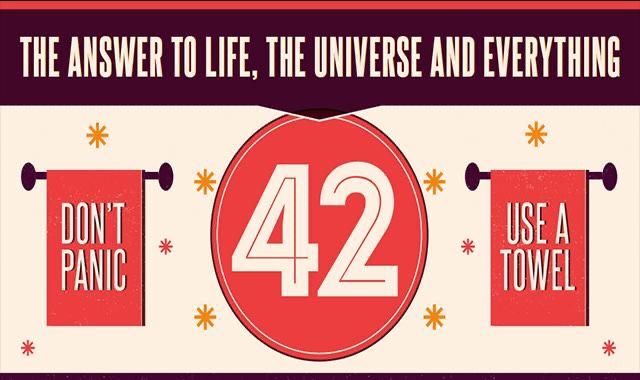
Don’t Panic: Carry a Towel

Oh, and the answer to the “Great Question of Life, the Universe and Everything” is “forty-two.” In the 1979 novel, the supercomputer Deep Thought takes 7.5 million years to calculate the answer to this ultimate question. The characters tasked with getting that answer are disappointed because it isn’t very useful. Yet, as the computer points out, the question itself was vaguely formulated. To find the correct statement of the query whose answer is 42, the computer will have to build a new version of itself. That, too, will take time. The new version of the computer is Earth. To find out what happens next, you’ll just have to read Adams’s books. For a math geek discussion of the significance of 42, read the link “For Math Fans” below.

Salad of spring greens and edible flowers

Having dispensed with heroes, we can move onto the significant May Days that truly appeal to me. “April showers bring May flowers” is a saying I’ve heard since my childhood ever so long ago. Historians believe this phrase may date back to a 1610 poem, which contained the lines, “Sweet April showers, do spring May flowers.” A longer phrase, “March winds and April showers bring forth May flowers,” has also been traced back to 1886. Of course, this tidbit of wisdom depends upon your geographic location, for folks inland and north may wait until what we southern folks call “early summer” before they get their “springtime.”

Rabbit and animals dancing around a Maypole

“The month of May was come, when every lust heart beginneth to blossom, and to bring forth fruit,” wrote Sir Thomas Malory in Le Morte d’Arthur. The early Greeks called this month Maia, after the goddess of fertility, many of the early May festivals relate to agriculture and renewal. May Day, celebrated on the first with the Maypole, is one such festive event that was more debauched in earlier times, but now survives as a chaste minuet of colorful ribbons woven around a tall pole by children dancing in an interweaving circle below it.

Maypole dance patterns

Other modern May festivities include No Pants Day on 5/1, originally an end of the college year prank at the University of Texas, Austin, which spread to other realms needing release, and World Laughter Day, celebrated on the first Sunday of May. This holiday helps raise awareness about the benefits of laughing and promotes world peace through laughter. Laughing can instantly help reduce stress and brings us closer to other people, as we share our happiness with them. Those who take part in World Laughter Day can help spread positivity and cheerfulness to help change the world for the better. As Ralph Waldo Emerson said, “What potent blood hath modest May.”

No Diet Day is May 6, a good day to remember our good health isn’t based on a scale number or a pant size. Instead, our health is dependent on nutritious foods, adequate exercise, and sufficient sleep. Extreme weight loss, except under a doctor’s supervision, usually leads to yo-yo weight gain, with the body gaining back the lost weight and more after severe deprivation. Slow, long term, weight loss is more likely to be permanent loss, since we aren’t “dieting,” but changing our habits. May 11th is Eat What You Want Day. I suggest we don’t follow Oscar Wilde’s habit: “My doctor told me to stop having intimate dinners for four, unless there are three other people.”

Speaking of breaking a fast, May 12th ends the month of Ramadan, the holy month of observance for Muslims. It was during Ramadan Muhammad, the prophet of Islam, received the revelations from angel Gabriel that allowed him to compile the holy book of Quran. Upon arriving in Medina, Muhammad announced Allah had established two days of celebrations for Muslims, Eid Al Fitr and Eid Al Adha. The purpose of Eid Al Fitr was to commemorate the end of the fasting of Ramadan, and mark the start of the Shawwal month, as well as to thank Allah for giving Muslims the perseverance to fast during Ramadan. The customary feast day greeting is “Eid Mubarak,” which translates to “blessed celebration” or “Happy Eid.”

Wayne Thiebaud: Bakery Counter, Oil on canvas, 1962, Private Collection,
© 2019 Wayne Thiebaud / Licensed by VAGA at Artists Rights Society (ARS), NY

The dessert of May is apple pie. Originally invented in England, the earliest apple pie recipe dates all the way back to 1381. The original recipe is very similar to the one we currently know, but it also included figs, raisins, pears, and saffron. The Dutch also created their own version of the apple pie, and the first recipe was published in a 1514 cookbook. This recipe is very similar to the apple pie we know and love today. Apple Pie Day is May 13th.

English and Dutch settlers brought the apple pie recipes into the colonies of what would become the United States, during the 17th and 18th centuries. They had to wait until the apple trees they planted grew and bore fruit, so at first apples were mainly used to make cider. It was only in the 18th century, when the first apple pie recipes were printed in America, that the dessert quickly grew in popularity. Following this came the 19th century Legend of Johnny Appleseed, whose real name was John Chapman. He crisscrossed the expanding American frontier to bring seeds for apple orchards for homesteaders. He also brought news and the gospel for fifty years.

Apple Pie 5 cents a slice and Homemade

Chapman, or Appleseed, lives on as a barometer of the ever-shifting American ideal. Some see him as a pacifist, others as an example of the White Noble Savage (so remembered long after the settlers drove indigenous peoples from the land), and others see a mere children’s book simpleton. Some see him as a frontier bootlegger, since he helped expand the hard cider industry. Others see Johnny Appleseed as the patron saint of everything from cannabis to evangelical environmentalism and creation care—everything, that is, but the flesh-and-blood man he really was.

Our heroes are too often cardboard cutouts, and we don’t spend much time reflecting on their shadow sides. Of course, much like a Flat Stanley, a two dimensional character doesn’t have enough density to cast much of a shadow, unless the light is just right. This is why continuing Bible study is so important: most of us stop in grammar school and never get an adult insight into the scriptures. When we meet grownup problems, we have to wrestle the questions of faith that we once easily accepted trustingly. Or we walk out the door and never come back.

A Single Rose in Memory

One of the most difficult sermons I ever preached was on the first Mother’s Day after my mother died. One of my best clergy pals, who was a mentor in my ministry, had arranged for a single rose to be on the pulpit beside me on that morning. It was a gift of grace and an empowering symbol, for roses were my mom’s favorite flower. Every time I thought I might cry, I held on tight to the polished oak wood and inhaled the fragrance of the rose. Even now, nearly two decades later, I can clearly see this rose and pulpit, and while I remember where I was, I recall the congregation’s faces were a blur on that day. It’s always the second Sunday in May.

I talk about my fresh grief from years ago, for during this current Pandemic too many of us have had present grief and stress, but either have no words for it, or perhaps have no safe place to express it. Then again, we may be “managing the grief of others,” and don’t have time for caring for our own needs. I call this Deferred Maintenance Grief. If you have an old, leaky faucet, you can keep turning the handle tighter for only so long. You can keep the leak stopped for a while, but soon you’ll strip out the insides of the faucet. Once it’s stripped down, it both streams steadily and needs a completely new fixture to replace it, instead of a minor repair.

I experienced this DMG once after a spate of ten deaths in a week, or maybe it was seven in ten days, followed by the death of one of the old, beloved black clergymen in my community. As I lay on the parsonage couch watching a rerun of Babylon 5, I was crying as if old E.D. were my own daddy. I then realized I’d been too busy caring for others and doing the “work I was called for,” to do the grief work I needed to do for myself. I needed to honor my loss and give myself dedicated spaces to deal with my feelings, so I could be present for others. That’s Deferred Maintenance Grief in a nutshell. If I were eating Cheetos by the bucketful, I’d be in a deep hole of DMG and digging it deeper!

Most of the churches I served had a “Don’t fix it unless it’s broke” policy. I grew up in a Depression Era family, so I was familiar with this attitude. However, these same people didn’t live this way in their own homes. We usually had a long list of deferred maintenance projects in the church property to finish in my time there. Then I’d go to the next place and do it all over again. “Always leave a place better than you found it, both structurally and theologically. Teach people the law of love. As we learn in Romans 13:8, “Owe no one anything, except to love one another; for the one who loves another has fulfilled the law.”

Most of us human beings have “deferred maintenance projects” also: days off, doctor visits, exercise, healthy meals, quiet times, and family times. Taking time for ourselves means we’re refreshed and eager to serve from the quickening power of the Spirit. Without this resting or love for our own embodied image of God, we end up working from the dying embers of our body’s frail resources—burnout calls our name.

When we get this broken, our families and our ministries both suffer along with us. We know better than to drive our vehicles with the gas gauge on empty past every filling station on the road of life. We aren’t called to die on the cross to prove our worth to Christ or to anyone else. He’s our savior and we claim his work on the cross. Anything else is workaholism or salvation by works. We need to name and claim this.

For clergy moving to a new appointment, this is an opportunity for a reset. For those who remain in place, I suggest a planning book. Mark off in advance quiet times, office hours, and visitation times. Take educational events, even if zoom is the only offering. Read for pleasure. Take a day off out of town. Don’t answer the phone after 9 pm unless it’s an emergency. Boundaries are blessings. I always told people up front, “I take my brain out of my head and put it inside a brain box at 9 pm. I put it back in at 9 am. If you call me between those hours, somebody better have died, be on the way to the ER, or the church is burning down.” They laugh, but I’ve had friends who wanted their pastor to be their bedtime Bible expositor. Boundaries keep us from burning out.

Speaking of burning, the official door to summer begins with Memorial Day Weekend. This holiday celebrates those who gave their lives in the great wars of our nation. It began after the Civil War in 1865 as a way to deal with the shared grief of a nation, which lost 750,000 people, or 2.5% of the population, in the struggle. If we were to translate this to today’s world, the number would equal 7,000,000 deaths. War is a pandemic all its own.

An engraving of The Dying Soldier – The last letter from home during the US civil war, circa 1864. (Photo by Kean Collection/Archive Photos/Getty Images)

As a parting commentary on Memorial Day, the Pandemic, and Extreme Care Giving, I leave you with a portion of the 1865 Walt Whitman poem, “The Wound Dresser,” which he wrote after serving as a hospital volunteer in the Civil War.

But in silence, in dreams’ projections,
While the world of gain and appearance and mirth goes on,
So soon what is over forgotten, and waves wash the imprints off the sand,
With hinged knees returning I enter the doors, (while for you up there,
Whoever you are, follow without noise and be of strong heart.)

Bearing the bandages, water and sponge,
Straight and swift to my wounded I go,
Where they lie on the ground after the battle brought in,
Where their priceless blood reddens the grass the ground,
Or to the rows of the hospital tent, or under the roof’d hospital,
To the long rows of cots up and down each side I return,
To each and all one after another I draw near, not one do I miss,
An attendant follows holding a tray, he carries a refuse pail,
Soon to be fill’d with clotted rags and blood, emptied, and fill’d again.

I onward go, I stop,
With hinged knees and steady hand to dress wounds,
I am firm with each, the pangs are sharp yet unavoidable,
One turns to me his appealing eyes—poor boy! I never knew you,
Yet I think I could not refuse this moment to die for you, if that would save you.

Remember to wear sunscreen to protect your skin if you plan outdoor activities on the first three day weekend of the summer and watch the temperature of the grill. We don’t want anything to burn if we can help it. Charred meat and burned skin are both indicated for cancer risks. Be safe and continue to mask up in public. Get vaccinated as an act of love for your family, your neighbors, and the world community. Since we’re all wound dressers, as well as the wounded also, we want to give as much care to healing our own wounds as we do to the wounds of others.

Joy and Peace,

Cornie

The Project Gutenberg eBook of The Wound Dresser, by Walt Whitman.
https://www.gutenberg.org/files/35725/35725-h/35725-h.htm
This contains first source material from Whitman’s era as well as his works from the Civil War period.

Do April Showers Really Bring May Flowers? | Wonderopolis
https://wonderopolis.org/wonder/do-april-showers-really-bring-may-flowers

As Covid-19 Devastates India, Deaths Go Undercounted
https://www.nytimes.com/2021/04/24/world/asia/india-coronavirus-deaths.html?referringSource=articleShare

For Math Fans: A Hitchhiker’s Guide to the Number 42 – Scientific American
https://www.scientificamerican.com/article/for-math-fans-a-hitchhikers-guide-to-the-number-42/

42 Of The Best Hitchhiker’s Guide to the Galaxy Quotes | Book Riot
https://bookriot.com/the-42-best-lines-from-douglas-adams-the-hitchhikers-guide-to-the-galaxy-series/

No Diet Day (6th May) | Days Of The Year
https://www.daysoftheyear.com/days/no-diet-day/

World Laughter Day | May 2
https://www.calendarr.com/united-states/world-laughter-day/

National Apple Pie Day | May 13 – Calendarr
https://www.calendarr.com/united-states/national-apple-pie-day/

Johnny Appleseed Planted Stories Of Myth, Adventure : NPR
https://www.npr.org/2011/04/17/135409598/johnny-appleseed-planted-stories-of-myth-adventure

Statistics From the Civil War | Facing History and Ourselves
https://www.facinghistory.org/resource-library/statistics-civil-war

Chemicals in Meat Cooked at High Temperatures and Cancer Risk – National Cancer Institute
https://www.cancer.gov/about-cancer/causes-prevention/risk/diet/cooked-meats-fact-sheet

Spring Trees Renew Our Hope

adult learning, arkansas, art, butterflies, coronavirus, Creativity, Faith, Forgiveness, hope, Imagination, Love, nature, Painting, pandemic, picasso, Spirituality, trees, vision

Greenway Trail, Hot Springs

Picasso is often thought to have said, “Art washes away from the soul the dust of everyday life.” However, just as we tend to view anything on the internet as true, along comes a meme from Abraham Lincoln reminding us of the exact opposite proposition. As one of my old debate team mentors in high school used to say, “Consider the source. Use a verified source. Use a trusted source. Use a legitimate source. Facts, not opinions, count in the argument.” This is the flag we raised, put a light on it, and saluted every day in speech class. This also limited my library quest, for my search engine of choice in those low technology days was the card catalog at my neighborhood library and rummaging through whatever national news magazines came on subscription there.

Abraham Lincoln said it, so it must be True!

As much as I love this quote, “Art washes away from the soul the dust of everyday life,” and resonate with it, it doesn’t sound like Picasso. He’s also purported to be the source of “Others have seen what is and asked why. I have seen what could be and asked why not.” It’s not too different from “Some men see things as they are and say why? I dream things that never were and say why not?” This latter is a famous line paraphrasing George Bernard Shaw’s play Back To Methuselah, and was spoken at Robert F. Kennedy, Jr’s funeral elegy.

Perhaps it doesn’t matter we aren’t original thinkers, but only that we stretch our thinking beyond what we already know. In 1982, futurist and inventor R. Buckminster Fuller estimated that up until 1900, human knowledge doubled approximately every century, but by 1945 it was doubling every 25 years. By 1982, knowledge doubled every 12-13 months. Today, knowledge doubles about every 12 hours! For some people, this is absolutely too much to bear, and for others, it’s a reason to yearn for simpler times. However, I’m not willing to give up the GPS and maps in my vehicle, for I have a tendency to be chronically lost. I do find some interesting backroads along the detours I take in error. I just get lost less often than I once did.

Art and other creative ventures are the means by which we deal with our anxieties of this world, for if we have pain and troubles there, we can either create a world of beauty to balance our struggles or we can let all that pent up energy out so it doesn’t eat us up from the inside out. If we’re making landscapes, we might have butterflies or forest fires, depending on how we process our soul journeys.

Margaret’s Butterfly Landscape

Margaret’s landscape has the breeze blowing through the trees and flowers. The clouds are also carried along by these same winds. She was wanting to paint a flittering butterfly, and wondered out loud “How does a butterfly fly?”

I didn’t know exactly, and wasn’t into acting out my inner butterfly, but Apple Music has a wonderful tune by Ludovico Einaudi called “Day 1: Golden Butterflies.”

I found it on my phone and played it for her. Art class calls upon all the senses, just as reading a biblical text does. How can we get into a mood or intention of a writer or an artist if we don’t use every one of the senses the good Lord gifted us with? Art isn’t just for the eyes, but we should appreciate the textures even if we don’t actually touch them.

In our Friday art class, I always show examples of how other artists have approached our theme for the day. I collect them in my Pinterest account. For Spring Trees, the goal is to use the cool side of the palette, with a variety of greens, and add spring colored flowers of white, pink, or yellows. Blues and violets also show up with wisteria and bluebells. As I showed the group about a dozen different artists’ works, I reminded them: “You can’t go wrong! Every one of these artists solved spring trees in a different way. Some painted only the tree, some painted just the reflection in the water, others painted the whole landscape. Some focused on the people more than the trees. If your colors stay cool, if we can tell these shapes are trees, and if you use your own ideas to elaborate on this basic format, you’ll do a great job! We can always improve on the next one.”

People are so worried about pleasing others, or not measuring up to some standard. What standard are we setting for ourselves anyway? If we want to shoot baskets like LeBron James or Stephen Curry, we’d better be prepared to work. Curry shoots around 2,000 shots a week: He takes a minimum of 250 a day, plus another 100 before every game. It’s a counterintuitive fact that a player with the supplest shot in the NBA, whose overarching quality is feel, has the hands and work habits of a woodchopper. Likewise, LeBron works out even on his “off day,” with only Sunday as a day of rest. Check out this workout. This is why he’s called the “King.”

LeBron’s Workout

If we were writing poetry, would we fail to start because we couldn’t produce from our heart and hand the words which move us, as do the passionate lines of Shakespeare’s pen? He had to start somewhere, for sure. “While salvation is by faith,” I always tell folks, “proficiency in arts and crafts usually comes from works.” The more we practice, the better we become. Some of excellence results from acquiring good eye hand coordination, or fine motor control, but also we begin to learn what our media can do and what it won’t do. We enter into a friendship and then into a love affair with it. We begin to anticipate where it will go, just as we often can finish our best friend’s sentences for them. Take a break and read Shakespeare’s 18th sonnet out loud for a moment:

Shall I compare thee to a summer’s day? Thou art more lovely and more temperate: Rough winds do shake the darling buds of May, And summer’s lease hath all too short a date;

Sometime too hot the eye of heaven shines, And often is his gold complexion dimm’d; And every fair from fair sometime declines, By chance or nature’s changing course untrimm’d;

But thy eternal summer shall not fade, Nor lose possession of that fair thou ow’st; Nor shall death brag thou wander’st in his shade, When in eternal lines to time thou grow’st:

So long as men can breathe or eyes can see, So long lives this, and this gives life to thee.

“The artist is a receptacle for emotions that come from all over the place: from the sky, from the earth, from a scrap of paper, from a passing shape, from a spider’s web,” Picasso told Alfred H. Barr, Jr. Just as everything is grist for the poet’s mill, so we bring all that we are to our art experiences. If we’re glad, sad, angry, or any other emotion, this gets poured out into our work through the colors we choose, the subject matter, or the way we use the media. This pandemic will be remembered not only for its cruel loss of life, but also for its neurological complications for the post COVID survivors, since a high percentage have mood and anxiety trouble diagnoses for the first time within six months of their infection. This is how we know COVID isn’t just a bad flu.

I omit the state of depression, for if one feels blue, one can work, but true depression takes away the will to work, to get out of bed, get dressed, or have the energy to brush one’s teeth. No one gets out of that state alone. Help and intervention are needed. I’ve been a chronic depressive for over half a century, and “snapping out of it” isn’t possible for people with this health condition. If I have a sunny and positive outlook on life, it’s because I’ve learned to think optimistically and I’m medicated properly. Plus I attend counseling sessions so I can keep a good perspective on life. If life is getting you down now, please seek help from a trusted medical provider or a pastor. Jesus meant it when he said, “I came that they may have life, and have it abundantly” (John 10:10). Faith healing also comes from ordinary means.

Jesus Icon

Our art class gives our group a safe place to stretch their minds, to take self care time, and to try a new skill that won’t kill anyone. It’s not like chainsaw juggling , where if you miss, you get a free ride to the ER or the funeral home. We don’t do that sort of thing. That’s more excitement than I can stand. I used to teach middle school art classes, so I had days, when the moon was full, that I sometimes thought I was juggling chain saws. Juggling plastic spoons is more my style today.

Gail is supervising home schooling during the pandemic. I don’t know how all the other parents and grandparents are doing in this particular time, but I remember the chaos which ensued one spring break as the pink eye ran amuck through the elementary school at which I taught. The headmaster gave everyone an extra week for spring break, an act which caused my students’ parents to call me in a panic, “What am I going to DO with my child for a WHOLE WEEK?!”

I laughed and said, “Keep them away from children who have pink eye.” I suppose I didn’t commiserate with them, as they thought I should. These people are now grandparents and I hope that one week back then showed them they could manage a whole pandemic today.

Gail’s Recycled Trees

Gail’s trips to fuel her caffeine need causes her to visit different coffee shops. The cup sleeves come in different patterns of corrugated cardboard. Of course, this paper product originally came from a tree, so she brought them in to be recycled and repurposed into an art piece about spring trees. Since she worked for the forest service, this is right in line with her love of nature and concern for stewardship of our natural resources. Gail also likes to plan and think her way through a theme.

Mike’s Trees and Stream

Mike gets his idea in a big, global whole. Then he seems to boil it down to a manageable size in a few moments, as he mentally discards the least workable parts. In a few minutes, he’s ready to paint a scene from memory or from his imagination. He applies lessons learned from other classes. For instance, painting in the background first is easier than trying to paint up to foreground details. This painting began with the stream, the green trees, the white trees, and then the popping pink trees for an accent.

Cornelia’s Start

I was painting trees with wisteria vines from a photograph I took near my home. The coffee spot at the Airport and MLK Freeway had moved, so when I turned in that driveway, I came to the notice of one of Hot Springs Finest. As he rolled down his window, I turned around and smiled.

“Hello, I’m just taking photographs of the wisteria in the trees.”

“I saw your car and thought you might be in trouble.”

“Not this time, but thanks for checking on me. I often stop to take pictures of our beautiful city.”

Wisteria in the Urban Forest

While we were talking, his radio went off and he had to go help someone else. Life interrupts our time together, and we don’t know how much time we have on this side of heaven. Many of the things we fight over will be meaningless in the great arc of history. When we meet each other on the other side, we won’t care about these things, for our whole attention will be God and the Lamb who sits upon the throne. If on this side of heaven, we learn to love more and forgive better, we’ll all be going on to perfection, whether we are in life or art.

RFK Jr Funeral Elegy

https://politicaldog101.com/2018/03/robert-kennedy-did-george-bernand-shaw/

Art Thoughts: Trees

https://pin.it/2IejRzm

The hidden price Steph Curry pays for making the impossible seem effortless

https://www.washingtonpost.com/sports/wizards/steph-curry-can-he-handle-the-full-court-pressure-of-super-stardom/2016/04/08/3dc96ca8-f6ab-11e5-a3ce-f06b5ba21f33_story.html?tid=a_classic-iphone&no_nav=true

Thriving in a World of “Knowledge Half-Life”

https://www.cio.com/article/3387637/thriving-in-a-world-of-knowledge-half-life.html

Elizabeth Cowling, Pablo Picasso (2002). “Picasso: style and meaning”, Phaidon Press. Also quoted in Alfred H. Barr Jr., Picasso: Fifty Years of his Art (1946).

https://www.oxfordreference.com/view/10.1093/acref/9780191826719.001.0001/q-oro-ed4-00008311

Shakespeare: Sonnet 18

https://www.poetryfoundation.org/poems/45087/sonnet-18-shall-i-compare-thee-to-a-summers-day

Ludovico Einaudi: Day 1: Golden Butterflies

https://music.apple.com/us/album/day-1-golden-butterflies/1451626902?i=1451627427

Also available on Amazon music streaming services

6-month neurological and psychiatric outcomes in 236 379 survivors of COVID-19: a retrospective cohort study using electronic health records – The Lancet Psychiatry

https://www.thelancet.com/journals/lanpsy/article/PIIS2215-0366(21)00084-5/fulltext

Rabbit! Rabbit! Welcome to April

art, chocolate, coronavirus, Creativity, Easter, Faith, garden, Garvan Woodlands Garden, Good Friday, greek myths, Healing, holidays, Holy Spirit, hope, Imagination, Love, Ministry, mystery, nature, Painting, pandemic, poverty, purpose, rabbits, Racism, renewal, Spirituality, trees, vision

April Bunny

I love the springtime, for all the colors of green are in abundance. I live on the lake on a property originally developed to be a high rise hotel and casino, until the city derailed that plan. Then it became vacation condos and retirement homes. Since it’s located on a large plot of timbered land, I even see my rabbit neighbors on occasion. My bunny friends usually move about at dawn and dusk. I’m not an early bird, and since Covid, my “out and abouts” have been seriously curtailed, so I’ve yet to see my four legged furry neighbors this year. Maybe I’ll have a better chance to see the Easter Bunny. I did purchase his dark chocolate cousin from Dove, who’s been reduced to a single ounce and will be gone by Easter Sunday. The ears went first, of course.

Dove Bunnies

Our parents found ways in the old days to keep us active and entertained in the weeks leading up to Easter. One of my favorite experiences was egg dying and decorating. Back in Mom’s kitchen, boiling water, vinegar and colored pellets went into the coffee cups before we wrangled the wire holder and lowered the hard boiled egg into the dye. If we dipped the egg all the way in or held it for a longer time, we could get deeper colors. One year I even attempted to use only natural dyes, such as beets, cabbage, and onions. My “science-anthropology” experiment didn’t turn out as pretty as the PAAS collection, but I learned a lot. Crayon resist worked with both dye types, however. Perhaps I never appreciated how fortunate I was my mom taught school and my dad encouraged us kids to learn everything about our world. Almost anything was a science project in his mind.

Crayon Box

As a child, I knew I’d arrived when I graduated to the big crayola box with  sixty four colors in it. Suddenly I had a year round wealth of shades and hues at my command, plus I could combine them for even more variety: Here are the colors that ended up being in the 64 count box in 1958: orchid, lavender, carnation pink, thistle, red violet, violet red, brick red, magenta, maroon, mulberry, Indian red, red, melon, salmon, orange red, red orange, orange, flesh, maize, goldenrod, yellow orange, apricot, orange yellow, yellow, lemon yellow, green yellow, spring green, yellow green, sea green, olive green, green, pine green, aquamarine, forest green, turquoise blue, green blue, sky blue, blue green, periwinkle, blue, navy blue, midnight blue, cornflower, blue gray, cadet blue, violet, blue, blue violet, violet, plum, tan, burnt orange, mahogany, burnt sienna, brown, raw sienna, bittersweet, raw umber, sepia, black, silver, gray, gold, copper, white. I could make any landscape sing with whatever color my young imagination called forth. My birthday month always calls forth all the colors nature has on her palette.

Spring Trees, Old Farmland

Of course, not every tree sports a shade of green as its primary dress in the springtime. Some bud out all in white, others in dark red violet, while still others bloom out in light pinks. If I squint my aging eyes today, I can see a haphazard lace design across the landscape before me in multicolored threads, with a few embroidered trunks to give it a semblance of stability. Those trunks might be Indian red (an iron red) mixed with the old Prussian blue (now known as midnight blue) to make a warm black. Using the straight carbon black crayon made the black too stark, or so my portrait painting grandmother told me. The old “flesh color” has been renamed “peach,” in recognition of the diversity of skin color in our world today. Many other colors in the box can be combined to get the perfect shade of a person’s facial tone, no matter how light, dark, yellow, white, red, or brown. The 64 box has enough colors to capture any facial tone, for sure.

When I see the ever changing beauty of the natural world about me, I can’t help but have hope. I look back not only to simpler times, but also forward in hope to a time when once again I will feel the joy of breaking the seal of a brand new box of crayons and when I can revel in the fresh, unsullied scent of pure wax and touch with reverence the clean paper wrappers. Easter dresses always show up in the pastel colors, even if we have to toss our dark winter coats over them when the weather turns cool, as it often does.

Maybe you don’t have such a strong attachment to art supplies as I do, but surely this April is a holy season for many people, and not just for the rabbits who live among us. Some how we people of faith across the centuries and around the world respond to the annual renewal of life and the promise of hope when life seems most precarious. While my faith experience is deeply rooted in Christianity, the worldwide communities of faith respond to springtime with some common traditions.

It’s no wonder one of the great myths of the ancient Greeks and Romans dealt with the changing seasons, but also with the hope of eternal life. Demeter was the goddess of agriculture and crops, whose daughter Persephone was taken into the underworld. Hades kept her there against her will, so while Demeter grieved, the crops failed, people starved, and the gods weren’t honored. Zeus, the king of the gods, forced Hades to release Persephone, but since she had eaten a few pomegranate seeds, she had to spend part of the year underground. This set up the seasons and was the impetus for the famed Elysian Mysteries.

The week long rituals were based on a symbolic reading of the story of Demeter and Persephone.  It provided initiates with a vision of the afterlife so powerful, it forever changed the way they saw their world and their place in it. They no longer feared death, for they  recognized they were immortal souls temporarily in mortal bodies. In the same way Persephone went down to the land of the dead and returned to that of the living each year, so would every human being die only to live again on another plane of existence or in another body.

Cave Entrance: The Plutonium, Eleusinia, Greece

The spring rite was the lesser mysteries, without which one couldn’t enter the greater mysteries of autumn. Anyone who was present in the city and spoke Greek could attend, unlike some of the closed gnostic mysteries, which were available only to a chosen few. The whole community participated, for the life of the family, as well as the earth, depended on the abundance of the earth. In fact, the only paved road in Greece in ancient times was from Athens to Eleusius, and a modern road now follows the same path.

The White Road to Eleusis (The Sacred Way)

Aristotle wrote about the contrast of the cathartic experience of watching a tragic drama whereby the spectator is purged of the negative emotions of fear and pity, while an initiate of the Mysteries would undergo physical, emotional, and spiritual cleansing in preparation for the main part of the ritual— a spiritual identification with the Mother and Daughter in their separation and suffering and then joyful reunion, a transformation from death to rebirth. Through her or his own inner spiritual desires and participation in the rites, the initiate then was prepared to receive a “seeing” into the deepest mysteries of life.

This communal ritual wasn’t just for the individual, but for the family, the city state, and even the world itself. Let’s keep that idea in mind as we consider the other rituals of faith, renewal, and restoration of this spring season.

Our Vice President’s husband Doug Emhoff, 56, is the first Jewish spouse of a vice president or president. “After a year of social distancing and mask wearing, it’s impossible not to feel isolated at times. So it’s events like this one, events that creatively bring family and friends and communities together, that keep us connected and remind us that we’re not alone,” Emhoff said at the Seder ceremony before noting he got to do one of his “favorite things” and introduce the vice president.

“Our family, like so many families in the United States, the state of Israel and around the world, will begin to celebrate the sacred holiday of Passover this weekend,” Vice President Kamala Harris said. “And the Passover story is powerful. It reminds us of the resilience of the human spirit in the face of injustice. It urges us to keep the faith in the face of uncertainty.”

Bitter Greens

“This year, as we dip our greens in salt water and pour out our ceremonial wine and eat our bitter herbs, let us commit, once again, to repairing the world,” she said.

This is the great witness of the Passover story, for it’s a story of hope and liberation. It’s a story of God keeping God’s promises and God’s faithfulness for those who suffer. If anyone needs to hear words of liberation, faithfulness, hope, and promises kept, it’s our whole world, which is suffering with covid, hate, nationalism, racism, and extremism.

Leonardo Da Vinci: The Last Supper was a Passover Seder

Passover, like many holidays, combines the celebration of an event from Jewish memory with a recognition of the cycles of nature. As the Jewish people remember their ancestors’ liberation, they also recognize the stirrings of spring and rebirth happening in the world. The symbols on the table bring together elements of both kinds of celebration. In the ritual, families take a vegetable, representing joy at the dawning of spring after a long, cold winter. Most will use a green vegetable, such as parsley or celery, but some families from Eastern Europe have a tradition of using a boiled potato, since greens were hard to come by at Passover time. Whatever symbol of spring and sustenance used, it’s dipped it into salt water, a symbol of the tears the  ancestors shed as slaves. Before eating it, a short blessing is said:

Baruch Atah Adonai, Eloheinu Melech ha-olam, borei p’ree ha-adama.

We praise God, Ruler of Everything, who creates the fruits of the earth.

At the end of the meal, celebrants bless the final cup of wine according to Jewish tradition and law. As the faithful have had the pleasure to gather (virtually) for a seder this year, they hope to once again have the opportunity of gather in person in the years to come. The prayer is God brings health and healing to Israel and all the people of the world, especially those impacted by natural tragedy and war. As folks say every year, “Next year in Jerusalem!”

Yet another spring festival is the Hindu celebration of Holi, which has been observed all over India since ancient times. Holi’s precise form and purpose displays great variety. Originally, Holi was an agricultural festival celebrating the arrival of spring. This aspect still plays a significant part in the festival in the form of the colored powders: Holi is a time when man and nature alike throw off the gloom of winter and rejoice in the colors and liveliness of spring.

Holi Festival Celebration

Holi also commemorates various events in Hindu mythology, but for most Hindus it provides a temporary opportunity for Hindus to disregard social norms, indulge in merrymaking and generally “let loose.” The central ritual of Holi is the throwing and applying of colored water and powders on friends and family, which gives the holiday its common name “Festival of Colors.” Holi is spread out over two days (it used to be five, and in some places it is longer). A large communal bonfire burns in the town center to light the evening festivities.

The entire holiday is associated with a loosening of social restrictions normally associated with caste, sex, status and age. Holi thus bridges social gaps and brings people together: employees and employers, men and women, rich and poor, young and old. Holi is also characterized by the loosening of social norms governing polite behavior and the resulting general atmosphere of licentious merrymaking and ribald language and behavior. A common saying heard during Holi is bura na mano, Holi hai (“don’t feel offended, it’s Holi”).

This festival has transferred into western culture as part of the celebrations at the end of races and other communal bonding events, a fact which leads some to charge the west with cultural appropriation, but the followers of Holi aren’t offended if the intention is good.

While Easter in the western world has become a cultural celebration of cleaning house, redecorating, wearing new and brighter clothes, and doing brunch with lighter foods, in the Christian church, Easter still retains its central place of honor. As Henri Nouwen writes, “When Jesus was anticipating his own death he kept repeating the same theme to his disciples: “My death is good for you, because my death will bear many fruits beyond my death. When I die I will not leave you alone, but I will send you my Spirit, the Paraclete, the Counselor. And my Spirit will reveal to you who I am, what I am teaching you. My Spirit will lead you into the truth and will allow you to have a relationship with me that was not possible before my death. My Spirit will help you to form community and grow in strength.” Jesus sees that the real fruits of his life will mature after his death. That is why he adds, “It is good for you that I go.”

Prayer to the Holy Spirit

While Jesus did reach out to those ignored by the traditional faith community of his day, he was also concerned for the whole community over and above the individual alone. While the church, who are the “ones called out,” is composed of individuals, we’re called to gather together for worship, prayer, instruction, and to be sent out to do ministries in the name of Jesus. Some today put their personal relationship with Jesus above their relationship with the beloved community or with the suffering body of Christ, which is found in the marginalized people beyond the church door.

So along with Nouwen, we have to ask, “If that is true, then the real question for me as I consider my own death is not: how much can I still accomplish before I die, or will I be a burden to others? No, the real question is: how can I live so that my death will be fruitful for others? In other words, how can my death be a gift for my loved ones so that they can reap the fruits of my life after I have died? This question can be answered only if I am first willing to admit Jesus’ vision of death, as a valid possibility for me.”

Grunewald: Resurrection

Since Easter is the celebration of the great resurrection story, it’s the story of the  renewal, not only of life, but the renewal of hope and faith. When our world looks its most bleak, we can still hope for a better future. When our God seems to have abandoned us, we can still trust in God’s unfailing promise to fulfill God’s commitments to God’s well loved people. When Mary Magdalene runs to meet the risen Christ in the garden, he tells her, “Do not hold on to me, because I have not yet ascended to the Father. But go to my brothers and say to them, ‘I am ascending to my Father and your Father, to my God and your God.’ ”

We don’t keep good news for ourselves, but spread it to others. This is the best argument for the communal nature of resurrection faith. It should change us, so we should want to change God’s world and God’s people for the better. If we’re transformed by love, we also should transform the world with love. If we’ve been justified by the grace of God’s mercy, we should want to bring justice to marginalized communities who’ve experienced systemic injustice.

In summary, what ties all these spring festivals together is a hope for a new creation and a better life, either in this world or in the world beyond. Sometimes we need to have assurances of the life to come to live well in this life, while other times we need a hope for this world in order to live for tomorrow. Likely our faith practices speak to our deep human need for freedom and also to the need for our suffering to have meaning. Only if we change our suffering into a catalyst for relieving the suffering of others can we being these faith promises of spring renewal into reality. Then the ancient hopes of slaves, who were liberated, can come true today also. When the fears of death and life of everyday people are healed, their hopes and dreams are made possible by the power of god working through them. Then we too can sing the songs of freedom, put our energy into freeing others who are in bondage, and bring about God’s new creation, even as God’s spirit is renewing the face of the earth.

Springtime in Garvan Woodland Gardens

True Colors: Creating Natural Food Dyes at Home — Edible LA

https://www.ediblela.com/news/natural-food-dyes

Original Boxes of 64 Crayola Crayons | Jenny’s Crayon Collection

http://www.jennyscrayoncollection.com/2020/10/original-boxes-of-64-crayola-crayons.html

Doug Emhoff and Kamala Harris Celebrate First Passover at the White House

https://people.com/politics/doug-emhoff-and-kamala-harris-celebrate-first-passover-at-the-white-house/

The Ritual Path of Initiation into the Eleusinian Mysteries

(c) 2009, Mara Lynn Keller, Ph.D., California Institute of Integral Studies

https://www.ciis.edu/WSE/WSE%20Documents/WSE%20PDFs/07_keller.pdf

The Eleusinian Mysteries: The Rites of Demeter – World History Encyclopedia

https://www.ancient.eu/article/32/the-eleusinian-mysteries-the-rites-of-demeter/

A Seder for Everyone

http://www.jfcsboston.org/Portals/0/Uploads/Documents/The%20Wandering%20Is%20Over%20Haggadah%202015.pdf

Holi Religion Facts

https://religionfacts.com/holi

Text excerpts taken from “You are the Beloved”

by Henri J.M. Nouwen

© 2017 by The Henri Nouwen Legacy Trust.

Published by Convergent Books.

Rabbit! Rabbit!

brain plasticity, change, Children, chocolate, Civil War, coronavirus, Easter, Faith, Fear, Food, generosity, grief, Holy Spirit, Lent, Love, nature, pandemic, purpose, rabbits, Racism, renewal, salvation, sleep, Spirituality, Spring Equinox, Stress, Uncategorized, Valentine’s Day, Valentine’s Day, vision

Welcome to a Pandemic February—

1908 Vintage Nature Print

“Heraclitus, I believe, says that all things pass and nothing stays, and comparing existing things to the flow of a river, he says you could not step twice into the same river.” Plato quoted an older Greek thinker about life’s being constantly in a state of flux or change. We can’t dive into our rabbit holes at every quivering leaf or shadow of every cloud passing over the sun. We rabbits know the world is changing all the time, even if we don’t like it, but we still have to venture outside of our den and hutches to find tasty carrots and spinach leaves.

Fear of Change—

Yet some rabbits have a fear of change or fear of changing the order of things. This goes by another Greek word, Metathesiophobia. This is a new word for this old rabbit, so I guess I’ve modified a few brain cells in learning this. In fact, when we learn new words, we actually get happier! There’s even science behind this. In a study, “increased subjective pleasantness ratings were also related to new-words remembered after seven days. These results suggest that intrinsic—potentially reward-related—signals, triggered by self-monitoring of correct performance, can promote the storage of new information into long-term memory through the activation of the SN/VTA-Hippocampal loop, possibly via dopaminergic modulation of the midbrain.”

Even if we don’t understand the scientific jargon of that sentence, we know learning new things gives us a feeling of pride and accomplishment. We feel good about ourselves when we accomplish a new trick or master a new skill. Repeating the same experiences over and over leads to dullness,even if we find safety in the predictably.

If we were small bunnies, we’d never find the refrigerators in our homes, since they’d be covered up in our latest glorious art project. Every rabbit parent raves about their genius offspring, if they’re raising them right. We always want to catch our small ones doing something right and praise them for it. We’ll get more cooperation than if we’re always telling them NO, and GO TO YOUR ROOM.

I ask you, which rabbit among us doesn’t want to be happier in this world? Currently we’re in the midst of the worst crisis most of us have ever experienced. We rabbits need to name it and face it, rather than deny it, for this pandemic isn’t not going away anytime soon. This causes some of our bunny friends to find a “boogeyman lurking in every dark corner.” When I was young, my parents scared me, or scarred my memories, over my messy closet.

Fancy Dress Up Clothes

“You’d better clean up that pile of clothes in there, young lady! If you don’t, a rat might come crawling out of those clothes piled up on the floor!”

EEEK! I was so frightened, I untwisted an old metal coat hanger and stood outside my closet while I fished out my dress up play clothes, one article at a time. If a rat were to come out with them, I wanted a running head start. I was on my own in art school over a decade later before I could sleep with the bedroom closet open. This was a long standing fear to shake. Not everyone can put aside their fears and coping mechanisms, however.

I’ve had rabbit friends who get up in the middle of the night to make sure their closets are neatly arranged, with all the shoes in the right boxes and all the clothes facing the same direction on the hangers. I have no such anxiety, for I hang my clothes up and don’t worry once I’ve done it. I have other tasks to tackle. Uninterrupted sleep is a worthy goal for rabbit health. Plus I have other creative tasks to engage me, and I’m learning new things every day. In any event, I know my salvation won’t be impaired by this failure to act on my part, just as it won’t be earned if I keep a perfect closet.

Change is moving swifter than the atmospheric river that’s currently dumping rain and mudslides on the Pacific coast and ice and snow on the Atlantic coast. Atmospheric rivers are long, narrow regions in the atmosphere—like rivers in the sky—that transport water vapor, according to the National Oceanic and Atmospheric Administration. Drastic swings from extremely wet to extremely dry and vice versa will be nearly twice as likely, occuring on average once every 25 years, by 2100. Dramatic swings are becoming more common and will continue to do so in the coming decades thanks to man-made climate change.

Presidents’ Day—

Of course climate change isn’t the only change we’re dealing with in February.

Today we have one holiday to celebrate Abraham Lincoln and George Washington. Back in this rabbit’s kitten days, we had two holidays for these two presidents, but the times change and the holiday became popularly known as Presidents’ Day after it was moved as part of 1971’s Uniform Monday Holiday Act, which was an attempt to create more three-day weekends for the nation’s workers.

At the time, Congress thought setting three day weekends would end employee absenteeism. Today the coronavirus pandemic has put most white collar workers out of the office and many blue collar workers out of a job. Until we get this pandemic behind us by vaccinating as many of our people as possible and continuing safe practices, we won’t get back to any semblance of normal any time soon. This virus hunts a host, and it’s sure to find a rabbit to use as its own personal Petri dish.

Super Bowl LV—Next Super Spreader Event?

On the first Sunday in February, the big game goes down. While the 7,500 health care workers who’ll be the stadium attendees will be following COVID protocols, the fans at home remain susceptible to infection. A recent Seton Hall Sports Poll collected answers from 1,522 adults spread all over the country from Jan. 22-25. That data shows 25% of respondents said they would gather with people outside of their home (defined as those who aren’t roommates or cohabitants) to watch the game. Sixty-four percent of respondents said they would not attend a gathering and 11% said they weren’t sure.

Among avid fans however, 40% of that group said they would indeed gather with members outside of their household. The CDC doesn’t recommend holding these types of gatherings, especially if they are inside and last for the duration of the game. The Super Bowl will be played in Raymond James Stadium in Tampa and is scheduled for Sunday, February 7, with a 6:30 p.m. ET kickoff, with an estimated game length of four hours, not counting the additional four hours of preliminary extravaganza programming.

Chocolate Strawberry Footballs

I’ve always gathered the various rabbits who live in my condo building for the game festivities. It’s a good opportunity for us to socialize and since everyone always waits for “someone to take charge,” I just step up. We won’t do it in person this year, however, for we rabbits can best observe safely the whole shebang from the comfort of our couches and Zoom or find other other media connections with our loved ones and friends so we can have a real party next year.

Super Bowl LV Firsts—

There are new changes to the Super Bowl this year. Amanda Gorman, the inaugural poet, will recite an original poem before Super Bowl LV, as part of both the in-stadium pregame ceremony and the TV broadcast. The poem will honor three everyday heroes who have been chosen as honorary game captains by the NFL. These people include Trimaine Davis, a Los Angeles teacher who fought to secure internet access and laptops for his students amid the pandemic; Suzie Dorner, a Tampa nurse who managed the COVID ICU at Tampa General Hospital; and James Martin, a Marine veteran who has helped veterans and their families connect virtually through the Wounded Warrior Project.

Gorman isn’t the only pregame excitement. Miley Cyrus will perform as part of the TikTok Tailgate event for the Health Care Heroes. This will also be televised. Then there’s the The Pepsi Super Bowl Halftime Show, which is the most-watched musical performance of the year, with more than 104 million viewers tuning in to last year’s show. The rhythm and blues artist known as The Weekend (Abel Makkonen Tesfaye) will be the featured performer.

The Weekend

 “The Weeknd has introduced a sound all his own. His soulful uniqueness has defined a new generation of greatness in music and artistry,” said Shawn JAY-Z Carter. “This is an extraordinary moment in time and the Pepsi Super Bowl LV Halftime Show is going to be an extraordinary experience with an extraordinary performer.” This rabbit has been listening to his oeuvre on Apple Music, and I’m quite excited to hear the show. It ought to be a bang up program with no wardrobe malfunctions.

JAY-Z and his company, Roc Nation, have worked over the past year on the selection of artists playing the Super Bowl Halftime Show as the league’s official Live Music Entertainment Strategists. The partnership aims to “nurture and strengthen community” through music and support the NFL’s Inspire Change social justice initiative, and also has Roc Nation serving as a co-producer of the Super Bowl Halftime Show. 

GRAMMY-nominated artists Eric Church and Jazmine Sullivan are set to pair up for the first time to sing the National Anthem as part of Super Bowl LV pregame festivities. Grammy-award winning artist, H.E.R., will join the pregame lineup with her rendition of America the Beautiful. In addition, on behalf of the National Association of the Deaf (NAD), Warren “Wawa” Snipe, acclaimed Deaf rapper and recording artist, will perform the National Anthem and America the Beautiful in American Sign Language. For Super Bowl LV, the National Anthem will be arranged and produced by Adam Blackstone.

Sarah Thomas

“Sarah Thomas will made history again as the first female Super Bowl official,” NFL EVP of football operations Troy Vincent said. “Her elite performance and commitment to excellence has earned her the right to officiate the Super Bowl. Congratulations to Sarah on this well-deserved honor.” She will be a down judge on a seven-person crew of distinguished game officials. You go girl!

This is just one more change for a world that spins 360 degrees daily and moves around the sun on its invisible circular river which it completes every 365 1/4 days. Our planet never stays in in one place as it courses through the unseen river of time in the heavens, but we see ourselves think we have a fixed place in the universe. If we observe nature, the rising and setting of the sun moves along the horizon line as the seasons change and it rises higher into the sky during the summer than the winter. These changes are part of our ordinary life, and give a structure and rhythm to our days and time upon this world.

Champions in a Championship Game

Speaking of firsts, the Chiefs are trying to become the first team in 16 years to win back-to-back Super Bowls. The last team to do it was Tom Brady’s 2003-04 New England Patriots. Tom Brady is set to become one of four quarterbacks to start a Super Bowl for multiple teams and he could join Peyton Manning, who is currently the only quarterback in NFL history to win a Super Bowl start with multiple teams. So while the seasoned champion with a brand new team goes against a young champion trying to make the magic happen two years in a row, we should have a good game, rather than watching it for the commercials.

In other firsts, the Super Bowl is almost always the top rated TV show for audience numbers. Only the final episodes of M.A.S.H. and Cheers have ever pushed it to number two. The commercials are first class also. CBS’s asking price of $5.5 million per 30-second spot is merely the cost of reserving the requisite airtime; after production expenses, ancillary social-media investments and agency fees are accounted for, the actual outlay for a single Super Bowl ad can swell to $20 million. That’s a lot of rabbit feed.

We won’t see the Budweiser Clydesdales for the first time in 37 years, for the company will be focusing on supporting Covid vaccine awareness education spots instead. Other companies related to restaurants may be missing due to lower sales and profits, but this gives other companies an opportunity to take their place. The pandemic has changed our economy in many ways. Avocados are in demand because we rabbits eat our salads at home, not in a restaurant. This is good for grocers, but bad for cooks, wait staff, and restaurant owners.

While parts of our economy are currently staggering along, the middle class and poor are lagging behind, as if they had chains and a huge millstone binding their bodies. Nearly 12 million renters will owe an average of $5,850 in back rent and utilities by January, Moody’s Analytics warns. People would go to work, but the businesses are either closed or the parent needs to stay home to school the child. Unpaid rents affect landlords, and roll on to the bankers who hold those notes.

The Census Bureau’s Household Pulse Survey, launched in April 2020, has provided nearly real-time weekly data on how the unprecedented health and economic crisis is affecting the nation. Nearly 24 million adults—11 percent of all adults in the country— reported that their household sometimes or often didn’t have enough to eat in the last seven days. Adults in households with children were likelier to report that the household didn’t get enough to eat: 15 percent, compared to 9 percent for households without children. Hunger in America or food insecurity is linked to a greater chance of cardiovascular mortality in counties throughout the U.S. Researchers believe if the pandemic goes on long enough, more people will begin to die of hunger or famine related circumstances than the disease itself.

Some want to spend a little and let it “trickle down,” but my grandmother rabbit always said that was “penny wise and pound foolish.” After WWII, American generosity rebuilt Germany, the home of the Nazi enemies. If we rebuilt the country of our enemies, I wonder what keeps us from rebuilding our own land? We need a Marshal Plan for America.

St. Valentine’s Day—

Be my valentine! XXOOXX

As a small bunny, I fondly remember classroom Valentines Day Parties, mostly because I got to decorate a shoebox as my “Valentine Mailbox” and enjoyed all the dime store paper valentines from my bunny friends. Mostly I really enjoyed the pink icing on the chocolate cupcakes and those Necco candy hearts with their pithy, saucy, love quotes. In this pandemic world of Zoom classrooms, gone are class parties, valentines for everyone, and a special gift for the teacher. As a former teacher, my hope is we can get our school teams vaccinated and get our little bunnykins back in a communal setting, so they can learn socialization skills as well as educational materials.

Ash Wednesday—

Some grieve about this year as if it’s lost year, and it’ll never be gotten back. This is true, however, there’re other great crises our little bunnies went through in our history, through no fault of their own. The Civil War was one, for it disrupted some youth we wouldn’t let have keys to a car today. One of my grandfather bunnies dropped out of school in the eighth grade to work on the railroad when his own father left home. He made sure his own little bunnies got their education, even if he didn’t get his.

Just because we have a twelve year program for public school doesn’t mean we have to finish it in that length of time. If we have a large monkey wrench thrown into our best laid plans, we might need to cram those twelve years into thirteen years. If we live to seventy-nine years, the average life span in America, this extra year is only 1/79 or 1% of our lives. We spend more time than this sleeping, since we spend about 33% of our lives asleep. No one seems to grieve about this broad swath of time in bed in fact, more of us rabbits are trying their best to get either more or better sleep! Perhaps we need to reframe then way we look at some of these problems to reduce our anxiety about them. Then we’d have more strength to cope with the day to day struggles, which are real and difficult.

Ash Wednesday is moveable feast day, so its date varies. It depends on when Easter is celebrated, and that too is dependent on the lunar calendar. My old daddy rabbit had this ancient piece of lore memorized: “Easter is always the first Sunday after the first full moon after the spring equinox.” While we may be able to move certain holidays around the calendar, Easter and its connected rituals of faith, Ash Wednesday and the forty days of Lent, move every year.

Because of coronavirus protocols, the hands on imposition of ashes by pastors, priests, or worship leaders will change in this pandemic year. Some churches will sprinkle ashes upon people’s heads, while others will give out packets of ashes for self imposition. The ashes are a traditional sign of humility. We may ask, if the ritual changes, is it as effective as it once was? The better question to ask is, “Does the ritual save us or does the power of God’s Holy Spirit flowing through the moment change us for the better?” Sometimes we put too much emphasis on the outward and visible elements, rather than the inward and invisible experience of God at work in us.

The Constant in the Midst of Change—

In the midst of a world intent on stoking our fears to a fever pitch, some of us rabbits find ourselves pulled down the proverbial rabbit hole into vast conspiracy theories, which purport to connect unlikely coincidences, but actually push anti-Semitic, far-right or white-supremacist ideology. Some of these ideas are as old as the Middle Ages, while others came from Russia and got passed into the American milieu during the first Red Scare in the 1920’s.

One of the worst examples is “The Protocols of the Learned Elders of Zion,” a classic of paranoid, racist literature. Taken by the gullible as the confidential minutes of a Jewish conclave convened in the last years of the nineteenth century, it has been heralded by anti-Semites as proof that Jews are plotting to take over the world. Since its contrivance around the turn of the century by the Russian Okhrana, or Czarist secret police, “The Protocols of the Learned Elders of Zion” has taken root in bigoted, frightened minds around the world.

When the world is in chaos, fearful rabbits look for a demonic figure to blame, when they should look instead to a positive source of power and strength. Fear paralyzes us, but the power of God sets us free to change our world for the better.

Bierstadt: Merced River, Yellowstone Valley

God is our refuge and strength,

a very present help in trouble.

Therefore we will not fear, though the earth should change,

though the mountains shake in the heart of the sea;

though its waters roar and foam,

though the mountains tremble with its tumult.

~~ Psalms 46:1-3

May you make enough small changes every day to get new wrinkles in your brain, rather than on your brow.

Joy and Peace,

Cornie

Intrinsic monitoring of learning success facilitates memory encoding via the activation of the SN/VTA-Hippocampal loop | eLife

https://elifesciences.org/articles/17441

HISTORY: Presidents’ Day—History, Date & Holiday

https://www.history.com/topics/holidays/presidents-day

Poll: Despite pandemic, 25% will attend gatherings to watch Super Bowl 55 between Chiefs, Buccaneers

https://www.usatoday.com/story/sports/nfl/super-bowl/2021/01/27/super-bowl-55-poll-attend-gatherings-coronavirus-pandemic/4281143001/

2021 Super Bowl Halftime Show: The Weeknd to Perform | Entertainment Tonight

https://www.etonline.com/the-weeknd-to-perform-2021-super-bowl-halftime-show-156259

Eric Church, Jazmine Sullivan to sing national anthem at Super Bowl LV; H.E.R. to sing America the Beautiful

https://www.nfl.com/news/eric-church-jazmine-sullivan-to-sing-national-anthem-at-super-bowl-lv-h-e-r-to-s

Increasing precipitation volatility in twenty-first-century California | Nature Climate Change

https://www.nature.com/articles/s41558-018-0140-y

A Hoax of Hate: The Protocols of the Learned Elders of Zion

https://www.adl.org/resources/backgrounders/a-hoax-of-hate-the-protocols-of-the-learned-elders-of-zion

Super Bowl 2021 numbers to know: Patrick Mahomes and Tom Brady both have NFL records on the line – CBSSports.com
https://www.cbssports.com/nfl/news/super-bowl-2021-numbers-to-know-patrick-mahomes-and-tom-brady-both-have-nfl-records-on-the-line/

Millions of Americans are heading into the holidays unemployed and over $5,000 behind on rent. Hefty bills will come due in early 2021 for rent and utilities. Economists warn many unemployed families won’t be able to pay without more stimulus aid from Congress. By Heather Long

https://www.washingtonpost.com/business/2020/12/07/unemployed-debt-rent-utilities/

Tracking the COVID-19 Recession’s Effects on Food, Housing, and Employment Hardships

https://www.cbpp.org/research/poverty-and-inequality/tracking-the-covid-19-recessions-effects-on-food-housing-and

Link between food insecurity and cardiovascular death found

https://www.medicalnewstoday.com/articles/link-between-food-insecurity-and-cardiovascular-death-found

Energies of the Labyrinth

art, change, Chartres Cathredral, coronavirus, Creativity, Faith, garden, greek myths, Imagination, labryinth, Meditation, pandemic, Reflection, Spirituality, Travel, vision

The word labyrinth comes from the Greek labyrinthos and describes any maze-like structure with a single path through it. It’s different from an actual maze, which may have multiple paths intricately linked. Etymologically the word is linked to the Minoan labrys or ‘double axe’, which is the symbol of the Minoan mother goddess of Crete. The actual word is Lydian in origin and most likely came to Crete from Anatolia (Asia Minor) through trade. Labyrinths and labyrinthine symbols have been dated to the Neolithic Age in regions as diverse as modern-day Turkey, Ireland, Greece, and India among others.

Labyrinths or mazes may have served to help the ones who walked them to find their spiritual path by purposefully removing them from their common understanding of linear time and direction between two points. As one traveled through the labyrinth, one would become increasingly lost in reference to the world outside and, in doing so, might unexpectedly discover one’s true path in life.

On New Year’s Day, I was reading my Twitter feed and came across this image of a seaside labyrinth. The comment was, “My #oneword for 2021 is downwind. After walking the labyrinth today with turns both against & with strong wind, I realized how limitless 2021 can be with the help of those who push me forward and not the wind pushing against me. This year, I’ll ride the momentum downwind.”

Twitter photo—My #oneword for 2021 is downwind

The theme of the labyrinth leading to one’s destiny is intricately linked to the Greek myth of Theseus and the Minotaur. The Minotaur lived at the heart of the labyrinth on the island of Crete, whose king required the people of Athens to send a tribute of fourteen youths annually. Once they entered the Minotaur ‘s labyrinth, they never returned. Theseus defeats the beast and saves his people, but loses his father to suicide because he fails to remember to change the color of his sails on his return trip as a sign of his victory. There’s even more dysfunctional family relationships, but that’s a story for another day. Suffice it to say, the ancient gods were wont to interfere with the lives of arrogant humans who failed to defer to the gods and instead acted as if they were masters of their own destiny.

Theseus and the Minotaur: Attributed to the Tleson Painter, ca 550 B.C., Attic Black Figure Kylix, Toledo Museum of Art, Toledo

Greek tragedy deals with the sweeping themes of love, loss, pride, the abuse of power and the fraught relationships between humanity and the gods. Typically the main protagonist of a tragedy committed some terrible crime without realizing how foolish and arrogant she or he had been. After slowly realizing the error, the world crumbles around the hero. The tragic hero must be essentially admirable and good. The fall of a scoundrel or villain evokes applause rather than pity. Audiences cheer when the bad guy goes down. We feel compassion for someone we admire when that character is in a difficult situation. The nobler and more admirable the person is, the greater our anxiety or grief at his or her downfall.

This idea survives to this day in the proverb, “The bigger they come, the harder they fall.” In the 5th C BCE, in the founding work of history known as the Histories of Herodotus, we find the statement: “It is the gods’ custom to bring low all things of surpassing greatness.” An earlier expression, “Pride goes before destruction, and a haughty spirit before a fall,” is found in the Proverbs (16:18). These date from 700 BCE to the fourth century BCE (1:1-9:18).

In a true tragedy, the hero’s demise must come as a result of some personal error or decision. The tragic or fatal error, or fatal flaw of the protagonist that eventually leads to the final catastrophe is known as hamartia, or missing the mark. It’s a metaphor from archery, and literally refers to a shot that misses the bullseye. There’s no such thing as an innocent victim in a tragedy, nor can a genuinely tragic downfall ever be purely a matter of blind accident or bad luck. The tragic hero must always bear at least some responsibility for his or her own doom. In Greek tragedy, the gods may interfere, but they don’t determine our destiny. Likewise, human events and actors may put detours across our path, but though the gods may intervene on our behalf, we can still snatch defeat from the jaws of victory in a true Greek tragedy.

Theseus killing the Minotaur of the Cretan labyrinth. Ariadne, possibly, looks on from the right. Attic black figure vase, Late 6th, early 5th century BCE. (Archaeological Museum, Milan).

The labyrinth is a symbol for change, for it’s the place of transformation. In the myth, Theseus must enter a maze no one knows how to navigate, slay a flesh eating monster, and return to the world above. Theseus accomplishes this, but still retains his youthful flaws until he is changed by his father’s death and he’s forced to grow up and assume adult responsibility. His experience in the labyrinth offered him an opportunity to change and grow but, like many people, Theseus resisted until change was forced upon him.

The medieval labyrinth is a unicursal labyrinth, with a single, circuitous but clearly delineated path. It’s an image encompassing both shared and individual experience, for we don’t walk the path alone, but we share it with fellow travelers. The unicursal labyrinth is distinguished from a multicursal labyrinth (or maze) by having only a single (though winding) path to its center. While a maze may have little or no symmetry and may not even have a center, a medieval labyrinth usually has both. The great medieval labyrinth on the floor of France’s Chartres Cathedral is one of the most famous unicursal labyrinths.

Chartres Cathedral Labyrinth from Above

Carl Jung, the famous Swiss psychologist, saw the similarity between medieval, Christ-centered mandalas in manuscripts and rose windows, the mandalas of his patients, and the mandalas he created. Jung believed his own mandalas “helped him maintain his psychic equilibrium” and believed “everything points toward the center,”so that he found “stability” and “inner peace” even during the war era.

Jung: Mandela

Medieval labyrinths, and all their variations, including the classical design of which the medieval style is an outgrowth, now appear across the United States in settings ranging from churches and parks to hospitals and museums; they may be painted, tiled, paved, woven into a carpet, constructed of canvas, or cut into a lawn. They’re usually designed to be walked on. Over the last quarter century, the medieval labyrinth has entered public consciousness as a “blueprint for transformation” rather than “an oddity,” as it was at one time. I can remember at least one of my fellow clergy asking if “this wasn’t so kind of new age hooey I was getting into.” Moreover, labyrinths aren’t limited to meditative and ritual use; they also appear in secular and recreational settings and are often noteworthy for their ornamental or artistic value.

Lavender Garden Labyrinth

While each one of us walks the same path, no one has the same experience on the labyrinth. We’re all on the same journey, but we’re traveling on a different part of the path. We entered at a different time, or we came to the labyrinthine journey at a different period of our spiritual journey. Some of us will move slowly, while others will hustle along the way. If we came with troubles and worries, we may have been looking for THE ANSWER. The labyrinth isn’t a one armed bandit. We don’t put our money in, pull the handle, and get a payout. The walking is instead an opportunity for reflection, a time to give our selves to the service of God, and set aside our pride.

We enter into the community of faith on the path

I’ve walked on the labyrinth on different occasions and had different experiences, since I’ve been “residing in different inns along my spiritual journey” during the years as I make my rounds about the sun while I live on this planet earth. I’ve been to the holy land twice, and been to Greece and Turkey to walk in the footsteps of Paul to see the churches he planted across the Mediterranean. I spent a summer in Italy during art school, while living in a small town and taking field trips to see the historic sites nearby. I took an interterm during graduate school to visit London and visit all the museums I could devour in that short time, along with some excursions to the seaside. Still, I’ve yet to see Stonehenge, and I’ve not seen Paris.

The question is, do we walk the labyrinth as a tourist going to a destination, expecting to stamp our passports, bring back photos, and buy souvenirs, or do we go expecting to meet Christ along the way? On the tour groups, folks sort themselves fairly soon into subgroups. The ones who want to go quickly to the site, give it a once over, take a few photos, and hit the souvenir shops before they have a coffee or a drink, will find each other and share their daily haul as they relax and wait for the stragglers to roll in. The stragglers come in two groups: the ones who took their time, and the ones who took the wrong turn and got lost. Thankfully, I didn’t get lost as I often do here at home! My notorious ability to take the wrong turn and my poor map reading skills are legend. The virtue of group travel is we leave no one behind.

While each person enters the labyrinth alone, others may also be on the path also. When we meet another, we perform a silent dance of giving way, first one to another, then the other to the one. Two can’t be in the same lane at the same time, but we can “dosie do” to let one another pass on by. This is life in community, where we share the spaces and the journey. When we walk the path of the Labyrinth, we enter a space/time/continuum. This is where up/down, left/right, and forward/backward all exist in one time dimension. Time passes differently inside the Labyrinth, for the twisting path appears to take us first directly toward the center, but just as we approach it, we are forced to follow the path directly away from the center instead. Then we wander around the outer edges of the labyrinth until suddenly, we arrive at the center. If we think we’ll never reach the promised land, we’ll find ourselves suddenly cast upon its shores as a Jonah spewed from the belly of a big fish. What seems like three days of darkness in a labyrinth may only be thirty minutes. Clock time gives way to God time on the journey.

Energies of the Labyrinth

Thus we enter into the timeless paths of all the pilgrims walking before us, those who never made their way to the holy land, but found the holy in the land in which they lived. The labyrinth has a way of uniting all the time of the past, the future, and the now into one dimension. In this way, when we walk the labyrinth, we enter into the kairos time of God, as opposed to the chronos time of humanity. No longer are “on the clock,” but we walk in the appointed and opportune time for us to experience the holy.

If we’re surprised, and emotionally disconcerted as we walk these twisting paths, it’s because we discovered we had no control over how soon we could get to our destination. We can stay in the center and be humbled by this awareness, but often we act like tourists instead. We get our passports stamped after an appropriate rest, and head back home. As heroes who’ve been to the center, we journey back to the outer world as changed people, ready to bring new truths and understanding back to the world. If we are like the Greek heroes of old, however, our tragic flaw will be living for ourselves only and forgetting to do good to all.

The energies of the labyrinth aren’t self-contained to the paths or to those who walk it. It is a holy space, so like the energies of space time, in which space and time are relative, observations depend on the viewer’s speed. If we rush through the labyrinth, we don’t have the same opportunity to meet Christ on the road to Damascus, as Paul did, and have an opportunity to change our lives. We need to drag our feet a bit, as the grieving disciples did on the road to Emmaus, so we might have the privilege of recognizing Christ in the central act of blessing the bread when they invited him to stay with them at the end of the journey.

The hurried life isn’t for the contemplative person, so even those whose lives are given over to getting many things done can benefit from a quiet time now and then. Otherwise, we can become the heroic Theseus who depends upon his own power, rather than giving credit to the powers of the gods, for all his great deeds. This is why his arrogance and pride is his undoing, even though he had a transformative experience in the labyrinth. Not until much later did he process this experience and grow from it.

When I began my painting, I started out with the actual forms, in homage to the many walks I’d participated in over the years. Soon I thought of burying the image, and uncovering parts of it, as if it were an archeological dig in process, but I only buried the outer edges. Then the idea of energies of the innumerable pilgrim walks percolated up into my consciousness and I began to paint the intersecting colored arcs. While I lost the paths, I was painting my emotional experience of the walking. I’ve been on quite a journey this past year, even though I’ve gone nowhere, due to the covid pandemic. Confined to home, I’ve longed to journey elsewhere, but the labyrinth is a journey anyone can take safely without fear of a monster who devours human tributes. I’m looking forward to the new year and new works, and perhaps some actual journeys. God bless everyone. Thanks for reading this.

Joy and Peace,

Cornelia

Labyrinth – Ancient History Encyclopedia by Joshua J. Mark
https://www.ancient.eu/Labyrinth/

Elements of greek tragedy and the tragic hero
https://www.slideshare.net/cafeharmon/elements-of-greek-tragedy-and-the-tragic-hero

Mary Hackworth—“The One and the Many: The Significance of the Labyrinth in Contemporary America,” Journal of Jungian Scholarly Studies Vol. 9, No. 3, 2014
https://jungianjournal.ca/index.php/jjss/article/download/44/37/74

The Labyrinth Society: The Labyrinth Society: Directions to Make a Labyrinth
https://labyrinthsociety.org/make-a-labyrinth

How to Make a Canvas Labyrinth for $200
https://pinkpaganpriestess.wordpress.com/2012/11/30/how-to-make-a-canvas-labyrinth-for-200/

Histories of Herodotus
https://www.gutenberg.org/files/2707/2707-h/2707-h.htm

What is Space Time?
https://www.livescience.com/space-time.html

What Makes a Real Christmas?

art, Children, Christmas, coronavirus, Creativity, Faith, Family, Food, grief, holidays, Icons, Imagination, Love, mystery, pandemic, poverty, Spirituality

I was cleaning up my condo Sunday afternoon because the Pandemic restrictions have caused my housekeeping to need some intensive care. Between all the various projects I’ve done and my new paintings, plus the seasonal change requiring my closet revamp, I realized I haven’t seen the top of my table in months. Since I’m not receiving visitors, I really don’t have to worry about this, but even I can only live with so much disorder and clutter.

When I was in seminary, my roommate and I would make a pact: no cleaning during exam week and ice cream runs every night. Amazingly, some compacts are easily kept, and studying for finals was less stressful because of our sweet rewards. A little chaos for a short period of time isn’t a problem, but months or years of confusion and neglect can bring about disaster.

I realize chaos is the norm for many people during the holidays, even if we’re not attending parties at work, or visiting with relatives or friends. We still have other rituals to indulge, especially if we have children. One year I stopped to list out all the experiences I remember which make up an ideal Christmas. I never imagined the list would be so long, or that my parents worked so hard to make the season wonderful for us children. As you read this list, feel free to add your own traditions to the list.

Natchitoches Christmas Lights
  1. Writing Santa a letter
  2. Traveling to Natchitoches to see the Christmas lights
  3. Pizza and Car trip to see the Christmas lights in town
  4. Hanging Christmas lights on the house
  5. Finding the perfect Christmas tree
  6. Decorating the Christmas tree
  7. Making Christmas decorations
  8. Making popcorn and cranberry strings for the tree
  9. Family ornaments
  10. Watching the bubble lights
  11. Hanging the Christmas stockings
  12. The brass Angel chimes
  13. Finding a thorn bush for a gumdrop tree
  14. Eating ribbon candy from the jar at my nanny’s home
  15. Candy lifesavers in a book
  16. Special foods, such as Ham and yam, and the green bean thing
  17. Christmas breakfast of biscuits and strawberry jam
  18. Drinking from the Santa mug
  19. Christmas plates and mugs
  20. Making fruitcake cookies and cakes
  21. Wrapping and hiding presents
  22. Dreaming while reading the Sears catalog
  23. Holiday visits
  24. Visit to Santa Claus
  25. Gifts from Santa, rather than from the parents
  26. Christmas candlelight service at church
  27. Children’s Christmas pageant and choir concert
  28. Special music
  29. Nativity scenes
  30. Staying up late to assemble toys
  31. Never enough batteries
  32. Stocking stuffers
  33. New red robe or pajamas
  34. Christmas letters from all our friends
  35. A vain hope for snow
  36. Wreath on the door
  37. Wrapping paper everywhere
  38. Handing out presents
  39. Opening presents
  40. Teacher gifts
  41. Making a Christmas list
  42. Dropping hints
  43. Candles in the window to guide the wise men
  44. Advent wreath candles
  45. Advent calendars
  46. Pine cones
  47. Caroling from house to house, mostly off key
  48. Parties
  49. Christmas clothes and Sox
  50. Garish Christmas sweaters

At this rate, I’d have to accomplish 1.7 per day to get all 50 done in between Thanksgiving and Christmas Eve. Like any big project, no one does it all at once. We always divided it up into smaller, achievable experiences, some of which extended over the whole season, and others we did once a week. How we managed to cram a dozen of these into each one of the four weeks before Christmas is beyond me. These days my work ethic is on furlough and if it ever returns, I’ll probably send it on vacation rather than let it clock back into work. I do lead a simpler life now.

My Christmas Tree Today

Any month of 30 days can be converted to one of these units:

  • 2,592,000 seconds
  • 43,200 minutes
  • 720 hours
  • 4 weeks and 2 days or
  • 8.20% of a standard year

These past nine months of COVID, with its quarantines, terrible toilet paper, and bad haircuts have been exacerbated by the illnesses and deaths of friends and family we’ve known and loved. With over 3,000 Americans dying from this disease daily, celebrating a real Christmas as we once did, seems unconscionable. Those of us who’ve lost a loved one look for any light in these dark days. Like Frodo, we might say, “I wish it need not have happened in my time.”

“So do I,” said Gandalf, “and so do all who live to see such times. But that is not for them to decide. All we have to decide is what to do with the time that is given us.” (J.R.R. Tolkien, The Fellowship of the Ring).

When I think of my life of seven decades plus, I remember when I was a child, every one of those two and a half million seconds before Christmas seemed to stretch out to eternity. Just as the three months of summer flew by like an icicle on a hot stovetop, the one month between Thanksgiving and Christmas moved slowly, as if I were watching a stalactite grow imperceptibly across the centuries. Maybe this is why my parents organized this magnificent list of projects to keep us children from whining over and over, “Is it Christmas yet?”

Christmas tree skirt from the 1950’s

I’ve never understood how they managed to teach us deferred gratification. After all, every single day in the month prior to Christmas had some sort of activity, and some of those projects extended over the whole season. One year mother decided to bead a skirt for the tree. She bought a “Twelve Days of Christmas” kit, which contained the white felt skirt, a green fringe, and multi colored felt squares imprinted with the patterns. As we worked each night, we filled each design with brightly colored sequins. Some of these early days were so heavy they had no fabric showing. As Christmas came closer and our project was as yet unfinished, we began to limit our decorating. We also were running out of colored beads and sequins by this time.

Handmade Stockings on an Antique Sideboard

Another year mother made new stockings for us kids, with our names on them. She also sewed a small bell on these so our early arising would wake her up. For the first grandchild, she had more time on her hands. That stocking was fully embroidered and had no warning bell. Of course, it hung at my home, so mother and daddy didn’t have to worry about any early bird interrupting their beauty sleep.

My parents did have a rule that we kids needed to wait until the crack of dawn before we entered the room where the tree was. If we got up earlier, and we almost always did, we took our pillows and covers into the dining room. Our old house had French doors separating the dining room from the living room. We’d pile our bedding down close to these doors and look through the bottom window into the magic darkness of the corner where the Christmas tree stood guard over mysterious packages wrapped in seasonal colors.

“What do you think that big one is?” My brother would whisper.
“It’s probably clothes,” I’d reply, “you know those rectangular packages are usually pajamas or pants.”
“Gross!”
I’d giggle and he’d elbow me in the ribs.

All three of us would strain and crain to see the indistinct shapes back under the lower branches of the fir tree. Until the first light came into the window beside the tree, we could only imagine the treasure hidden there. In our eager efforts and earnest desire to meet the rising sun, we often fell back asleep dreaming of Christmas morning. We’d awaken when our parents began their morning coffee ritual, which usually happened in bed, but on Christmas, they drank their caffeine on the couch and watched our joy, as we unwrapped the presents from Santa Claus.

None of us children were ever hungry on Christmas morning, at least not until we’d discovered the answer to all the questions we’d asked in the dark of night. Once those were revealed and our curiosity satisfied, we could turn our appetites to breakfast. Someone always gave daddy a good jam and biscuit gift in a wooden tub, so it was our go to meal for breakfast. We didn’t eat biscuits often, so they were a treat with huge dripping globs of melting butter. We’d go to one of the grandparents’ homes for lunch soon afterwards, so we didn’t need a big meal.

As I think back on these 1950’s Christmas memories, I was too young to know about the hunger and poverty of others. I do remember the poliovirus and the vaccine in my arm. There was the nuclear threat of the Cold War era and I lived in the time of the McCarthy Hearings and the John Birch Society. This is also the time of Brown vs. Board of Education and the Civil Rights Movement. My parents may have instituted all these seasonal home grown activities not only for us children, but also for themselves. If they were busy with “Christmas,” then they were focused on a spiritual journey and not on the chaos of the world.

Icon of The Creation of the Stars

When my daughter was small, I began buying her Christmas in August, because that’s when I got my first paycheck as a schoolteacher. I bought one little thing at a time, and put aside a little more money on a couple of larger gifts in layaway. I wasn’t going to buy anything for myself, but the choir at my church gave me a ham and a little love offering so I could have a bright red blouse for Christmas. I recalled the year after my marriage, my husband gave away some of our wedding gifts as Christmas presents “to keep up appearances.” We shouldn’t have to lie to the ones we love, especially at Christmas, but not everyone can live with the truth. Christmas isn’t about the gifts we give to one another, but about the gift God gave to humankind.

Creation of Light

Sometimes it seems like our world has gone mad, and folks can’t tell a truth from a lie. My daddy used to say there were folks who’d say the sun was shining even when it was pitch black outside. I’d shake my head in disbelief, but I hadn’t been out in the world as much as he had. Even if we now live in a world gone crazy, we can take comfort in these true words from the gospel of John (1:1-5)—

In the beginning was the Word, and the Word was with God, and the Word was God. He was in the beginning with God. All things came into being through him, and without him not one thing came into being. What has come into being in him was life, and the life was the light of all people. The light shines in the darkness, and the darkness did not overcome it.

Icon of the Nativity with Visit of the Magi

Charlie Brown Clay Stars

adult learning, arkansas, art, Astrology, CharlieBrown, coronavirus, cosmology, Creativity, Faith, Family, grief, Healing, holidays, Imagination, Israel, Ministry, ministry, nature, pandemic, Spirituality

“Close Encounters of the Third Kind” might best describe my and Gail’s latest adventure at the Oaklawn art class. Pinterest Fail is another synonym for our latest escapade. If my daddy were to describe the result, he’d say, “Close, but no cigar.” That’s a quintessential American expression, which is little used elsewhere in the English-speaking world. The first recorded use of “close, but no cigar” in print was in Sayre and Twist’s publishing of the script of the 1935 film version of Annie Oakley: “Close, Colonel, but no cigar!” I’m very fond of these ancient phrases, which are daily passing from the common parlance, even as new words are invented. These were our first attempts at this craft, so our learning curve resembled the same disastrous, steep ascent of the daily Covid infection chart.

The 1977 movie title “Close Encounters “ was derived from a classification of close encounters with aliens as set forth by the American UFO researcher J. Allen Hynek. Close Encounters of the First Kind refer to the sighting of a UFO. Physical evidence of a UFO are classed as Close Encounters of the Second Kind. Actual contact with an alien is a Close Encounter of the Third Kind. Therefore, our air dried cornstarch, salt, and baking soda clay objects, which should have looked neat, crisp, and clean, instead came out more like visitors from another planet, whose embodied boundaries were disintegrating in an inhospitable atmosphere.

Yes, I blame the recipes, which said “warm water,” rather than naming an actual temperature. Just as science projects and recipes for bread need accurate measurements and temperatures for success, so does cornstarch clay. Gail mentioned her clay began to heat up under her hands as she worked it. Mine never did, but I had to add rock salt to my mix because I ran out of table salt. Don’t do this! The salt crystals won’t melt and I had chunks in my finished pieces. The proportions of the recipe I used are equal amounts of each ingredient, so if you have just a limited amount of one, measure it and give the others to the main bowl in the same amount.

Bowl with Ingredients

Once the dough looks like mashed potatoes, don’t eat it. Instead, turn it out on parchment or waxed paper and knead it a bit. Then use a rolling pin to get the dough about ¼ inch thick. Use cookie cutters to get your shapes. Put them on a clean, flat surface, such as the back of a sheet pan. Take a plastic straw to put a hole in the upper part of the cutout. This works best if the shape is a touch dry, since the damp dough will close up. The hole is for the string hanger. The rolling pin might need flouring with corn starch if it sticks to the clay.

I also took some leaves and twigs from the bushes on the church property to use as embossing. I put these down on the cutouts, gave them a rolling pin once over or twice, maybe three, and made sure not to over flatten the shape. You could also use a decorative rolling pin as the last roll to make an all over pattern if you like that idea. A patterned doily or a scrap of lace would make a good pattern also.

Natural Decorations

When class was over, we cleaned our mess up with hot water and paper towels. I let the water run in the sink to make sure any small remains were washed far down the pipes. All the big scraps should be thrown in the trash. When I got home, I wasn’t in the mood to let these air dry for days and days. They already looked like they belonged on Charlie Brown’s Christmas tree, so I put them in the oven at 200F.

Water boils at 212F, so at 200F these shapes would be slowly drying out. I baked them on a cookie sheet for 30 minutes on each side. I did notice a bit of toasting in places, but I planned on painting these, so I don’t think it matters. I did lose the points off a few stars, but in this year of the Pandemic, perhaps some of us may be able to identify with the brokenness and vulnerability of these imperfect objects. We may want everything and everyone to be perfectly normal, but standard operating procedure isn’t on the menu for this year’s Thanksgiving or Christmas. We’re all suffering in one way or another, just like these ornaments.

Broken Stars

I didn’t preheat the oven, for the clay objects don’t need to be shocked into a different temperature. We don’t preheat a kiln before we fire clay pottery, but raise the whole to the same temperature at one time. Of course, if you’re making a recipe with flour, yeast, or eggs, and you need your concoction to rise, you do need a preheated oven. Otherwise, just put the food into a cold oven and let your nose tell you when it’s done. Preheating is a waste of energy if you don’t need it for the recipe. These clay pieces will be hot when you remove them from the oven. Let them cool until you can pick them up without dropping them like a hot potato (a metaphor from the 1800’s).

Painted Star and Bells

I did take a sharp paring knife to the edges to smooth them out. Yes, I didn’t like the raggedy look. You can’t do this cleanup roughly or with big whacks. This is the fine tuning of your shape. I used to help a porcelain doll maker back in my home town. I would sand the final shape of the doll baby’s faces, hands, and feet for her to paint. She appreciated my work because I would keep the anatomical details correct and give the little faces individual personalities. Portraits in porcelain aren’t that easy, but I wouldn’t rush to finish. If we’re always on to the next task, we might miss the opportunity to meet God in the work we’re doing in the moment.

Right now in this current crisis, most of us are limiting our time out and about. If we go to the grocery store, we find our goods and get out. I do the self check out or scan and go wherever I am so I don’t have to stand in lines. I do miss the interaction and chats I used to have with folks. I decided recently even if I were masked, I would begin to speak to others. So far on each outing, at least one person has shared their feelings of grief or loss, which are a result of this pandemic. Because we are forced to limit our contacts, we’ve also lost our opportunities to share our daily joys and our challenges. If we don’t use our words, we’ll lose them. We need time to share our lives and be a community for one another, since we’re all in this together. These are God moments in which we can be a blessing to others, as well as to receive a blessing from them.

This loss of conversation will be even grimmer if our loved ones pass on during this pandemic, for their memories will cease to be available to the younger generation, and their stories will no longer be shared. As these old ones age, and their frailties become like the imperfect points on my Charlie Brown stars, we realize we won’t have them much longer. Even more so, we’ve come to realize this pandemic spares neither the young nor the full of life, as more and more of our friends are struck by this disease. Any one of us could become a Charlie Brown Christmas star at any moment. I have family members who’ve had it, friends who’ve died from it, and my heart goes out to all who suffer with it, especially those who have lost their incomes because of it.

Those who now deal with the persisting side effects of this disease don’t get near the encouragement or assistance they need in their recovery, since the rest of us are too worn down from self care and from caring for those who’re newly ill. Even the health care workers, first responders, and essential workers who have to keep the rest of us safe, well fed, and secure are struggling under the long term stressors of this pandemic. We have a responsibility to care for them so they can keep going under duress. All these folks need a sign from us that they aren’t forgotten.

Christmas Tree Star

Unique stars have always been a herald or sign of unusual events to follow. The gospel of Matthew (2:1-2) records the visit of the magi, astrologers from the east, to King Herod:

In the time of King Herod, after Jesus was born in Bethlehem of Judea, wise men from the East came to Jerusalem, asking, “Where is the child who has been born king of the Jews? For we observed his star at its rising, and have come to pay him homage.”

These foreigners recognized the sea change about to happen in the world, for soon earthly kingdoms would recede in importance, and the powerful would lose their sway. If they could see this sign in the sky, we have to wonder why no one in Israel was considering what the star’s arrival signified. Perhaps the learned priests knew, but didn’t want to tell King Herod the bad news:

Thus says the LORD,
who gives the sun for light by day
and the fixed order of the moon and the stars for light by night,
who stirs up the sea so that its waves roar—
the LORD of hosts is his name:
If this fixed order were ever to cease
from my presence, says the LORD,
then also the offspring of Israel would cease
to be a nation before me forever.
(Jeremiah 31:35-36)

Of course, today most of us no longer believe the stars and planets affect our daily lives, nor are we “born under a bad sign,” as the blues players sing. Once we clean up the Thanksgiving meal, many of us will turn our thoughts to the holiday season. I’ll remove the last of the autumnal gourds and bring out a few winter seasonal objects every week until New Year’s. As the seasons change, we note the changes in our world. If the days are growing shorter and darker, we ourselves can still be lights in the world, as Paul wrote to the Philippians (2:14-15):

Do all things without murmuring and arguing, so that you may be blameless and innocent, children of God without blemish in the midst of a crooked. and perverse generation, in which you shine like stars in the world.

Multiple Layers of Gold and Silver Acrylic Paint on the Ornaments

Even if we’re Charlie Brown stars, our lights will be a beacon of hope for all the world to see.

Joy and Peace,
Cornelia

Air Dry Clay Recipe Using More Baking Soda (better recipe)
https://mamapapabubba.com/2016/02/16/homemade-air-dry-modelling-clay-aka-baking-soda-clay/

Reasons to Preheat the Oven
https://www.epicurious.com/expert-advice/do-i-really-need-to-preheat-the-oven-article

Changing Seasons

adult learning, Altars, art, Creativity, Faith, Israel, nature, Painting, pandemic, Prayer, pumpkins, Spirituality, sukkot, vision

When the seasons change, I have days when I drag. My get up and go has done got up and went. Perhaps my increasing age has something to do with this feeling, or the pandemic’s lack of social interaction has dulled my senses. Some days I think I’m moving through molasses, and then the next I wake up on a brighter side of the bed.

Occasionally, I wonder where my mind is. I recently had to get the attendant at the Kroger gas station to help me pump the gas. When I used my loyalty card, the pump didn’t reduce my price. I forgot this pump had a screen prompt, which I’d ignored. Once I was retrained, I got the good discount and filled my car up. I really need to get out more. I’m not driving as much as I once did because of this pandemic. I used to say, “My brain has gone to Pluto,” but now it seems to have gone to the pandemic instead. I could always count on the old grey matter making the circuit back to earth, eve if it took 248 years, but until this Pandemic passes, I may be slightly silly. Some of you will say, “No one can tell the difference,” but I know better.

Enforced Solitude

One of the benefits of this enforced solitude, which we’ve all endured, is we’ve had the opportunity to consider everything tried and true, and decide if we need to keep it or do something different instead. Some of us have redecorated our homes, take up a new hobby or occupation, or even become teachers or caregivers. Many of us cleaned out our closets and clutter because looking at it daily was too much. We’ve done what we had to do. Others of us have held on to the old traditions, as if they were security blankets. We won’t change them until our world feels safe again.

To make progress in art or any creative endeavor, sometimes we have to “burn the security blanket” before we can go forward. This is hard to do, for we get comfortable with whatever small success we first make. Basketball great Kobe Bryant would practice by himself for hours before his teammates showed up and would make four hundred shots every single practice. Notice that’s MAKE, not TAKE. Work ethic is a hallmark of greatness. Kobe was never satisfied with only the good, but sought to be his best.

Building a Community of Encouragement

Yet we are also people who need encouragement, and this means we need community. In community we can build each other up by “catching the good each one does.” We can reward and praise this, even though we usually find ourselves pointing out the spot a person missed, or how they could do it better next time. There’s a difference between criticism and critiquing someone’s work. Criticism usually only has negative statements, but a good critique begins with at least three positive comments before it notes what needs improvement and how to accomplish that task.

Artists and creative persons learn over the years to separate their identities from their work. Who we are as God’s beloved children never changes, no matter how badly our work gets panned. Most of us artists think we’re misunderstood anyway, so we go back to our studios and work some more. Words won’t kill us, and plenty of artists were never commercially successful. Most artists or creative people work at their craft because they have an inner need to express their experiences or ideas about the world in which they live.

Finding Our Own Voice

We work to discover who we are and what our voice would say to the world. In most art classes, the teacher makes a model and the students attempt to copy it as faithfully as possible. This process may use the elements of art, the media of art, and the end product may look like art, but the students are imitating someone else’s creative process. Thinking through the problems of shape, shadow, color, composition, and texture are part of the creative process. I’m very proud of our group, for each person is finding an individual voice. You would be able to identify their work, even if it were unsigned.

Season of Harvest

Hoshana Raba (Heb. הוֹשַׁעְנָא רַבָּא; “the great hoshana”) is a name for the seventh and last day of the Sukkot festival, or the Festival of Booths or Tabernacles. Sukkot has a dual significance: historical and agricultural. The holiday commemorates the forty-year period during which the children of Israel were wandering in the desert, living in temporary shelters. Sukkot is also a harvest festival, and is sometimes referred to as Chag Ha-Asif, the Festival of Ingathering.

In the medieval poem “Om ani homah” attributed to Eleazar Kalir, the Israel nation declares ‘I am a wall’. The poem is recited during Hoshana Raba (Great Supplication) which begins this evening.

The image is from the British Library Manuscripts collection.

Ingathering or Harvest Festivals are part of the seasonal experiences of our lives. Last week I brought a bunch of gourds and pumpkins in for class. I gave each person the opportunity to choose the ones that spoke to them to use for their still life. We had quite the variety of solutions.

Gail’s pumpkins were bold and bright, filling the canvas.

Gail’s Pumpkins

Mike’s were exuberant and about to come alive with energy.

Mike’s Gourds

Margaret was new in class, and made a highly textured still life, complete with cast shadows.

Margaret’s Textured Gourds

Mine were socially distant, a commentary on this pandemic life.

Socially Distant Gourds

I brought the pumpkins and gourds home to grace my altar. It changes with the seasons, so come advent, it takes a more exuberant and celebratory vibe. For autumn, it’s full of natural bounty. When Nehemiah was celebrating the festival of booths and purifying the temple, this was the prayer of the people:

“O Lord, Lord God, Creator of all things, you are awe-inspiring and strong and just and merciful, you alone are king and are kind, you alone are bountiful, you alone are just and almighty and eternal. You rescue Israel from every evil; you chose the ancestors and consecrated them. Accept this sacrifice on behalf of all your people Israel and preserve your portion and make it holy. Gather together our scattered people, set free those who are slaves among the Gentiles, look on those who are rejected and despised, and let the Gentiles know that you are our God. Punish those who oppress and are insolent with pride. Plant your people in your holy place, as Moses promised.” (2 Maccabees 1:24-29)

October Harvest Altar

All good things come from God, and we owe our lives and our living to the Holy God. Help us to care for the least among us, especially those who hunger and thirst at this time of harvest and during this season of change.

Upcoming events:

Friday classes—through October

October 23—Autumn Wreathes

October 30—Day of the Dead Skull Cookies

November 6—Painting

November 13—No Class

TBA—holiday season and school vacation calendar

Pluto’s Unusual Orbit: https://airandspace.si.edu/exhibitions/exploring-the-planets/online/solar-system/pluto/orbit.cfm

Rabbit! Rabbit! Welcome to October

All Saints Day, art, Children, coronavirus, Creativity, Faith, Family, Fear, grief, Halloween, Healing, holidays, Imagination, Israel, pandemic, rabbits

The Pandemic killed Halloween Then and Now

Nearly a century ago, no one had “Pandemic Shuts Down Halloween “ on their bingo card. The Great Influenza Pandemic griped the nation back in 1918, so most Halloween celebrations were cancelled due to quarantines. At least 195,000 people had died of this novel disease in America by October, 1918. The CDC estimates about 500 million people—or a third of the world’s population—had come down with this killer virus. By the1920’s, at the end of the Pandemic, at least 50 million people died, with 675,000 victims in the United States alone.

USA Red Cross volunteers in 1918 flu epidemic
APIC / Getty Images

At the time, we had no vaccines to protect against influenza and no antibiotics to treat secondary bacterial infections. Many doctors and nurses were serving in World War I, so the civilian medical professionals around the world tried to control infections with nonpharmaceutical interventions such as isolation, quarantine, good personal hygiene, masks, use of disinfectants and limitations of public gatherings. An interesting side note is all the flu pandemics which have happened since — 1957, 1968, 2009 — are derivatives of the 1918 flu, according to scientists at the National Institutes of Health.

The world back then was falling apart on two fronts from the first world war and disease. People at home were dropping like flies. Bodies were stacking up like cordwood and were placed in mass graves. Then, as now, we rabbits, like people, can only take so much stress before we need to release it. Many of us are pots with tight fitting lids: as soon as we reach the boiling point, our lid begins to rattle and clatter. If the cook doesn’t remove the lid and stir down the goo inside, we’ll be an over flowing volcanic mess, much like my morning oatmeal I’ve neglected when I’ve had too little coffee. Then Halloween, with its ghouls, goblins, witches, and other demons of the dark, arrives like Washington Irving’s ghost of the Headless Horseman, which we meet in The Legend of Sleepy Hollow, written in 1820.

The Headless Horseman Pursuing Ichabod Crane (1858) by John Quidor

Flu Pandemic Inspired Fiction

H. P. Lovecraft was one of the great horror writers, famous for his zombies, which may have been inspired by the grisly experiences of the influenza pandemic. Providence, Rhode Island, Lovecraft’s hometown, wasn’t spared the pandemic’s ghastly atmosphere.

As one local witness remembered, “all around me people were dying… [and] funeral directors worked with fear… . Many graves were fashioned by long trenches, bodies were placed side by side.” The pandemic, the witness laments, was “leaving in its wake countless dead, and the living stunned at their loss” (letter by Russell Booth; Collier Archives, Imperial War Museum, London).

White Zombie: First Zombie Movie, 1932

Lovecraft channeled this existential horror into his stories of the period, producing corpse-filled tales with infectious atmospheres from which sprang lurching, flesh-eating invaders who left bloody corpses in their wake.

In his 1922 story “Herbert West: Reanimator,” Lovecraft created a ghoulish doctor intent on reanimating newly dead corpses. A pandemic arrives that offers him fresh specimens. This echoes the flu scenes of mass graves, overworked doctors and piles of bodies. When the head doctor of the hospital dies in the outbreak, Dr. West reanimates him, producing a proto-zombie figure that escapes to wreak havoc on the town. The living dead doctor lurches from house to house, ravaging bodies and spreading destruction, a monstrous, visible version of what the flu virus had done worldwide. Lovecraft wrote about a zombie super-spreader even before we knew such a thing existed. Who says “life sometimes doesn’t imitate art?”

Thriller: Zombie Dancers backing up Michael Jackson, 1983

Infection, Prejudice and the Viral Zombies

In other episodes and stories, Lovecraft’s proto-zombies suggest an additional thread of prejudice that runs through the zombie tradition, one fueled by widespread fears of contagion during the pandemic. Even before the outbreak, Lovecraft believed that foreign hordes were infecting the Aryan race generally, weakening the bloodlines. These xenophobic anxieties weave their way into his stories, as contagion and pandemic-soaked atmospheres blend into racist fears of immigrants and nonwhite invaders. We hear these same themes repeated today in our pandemic times by white supremacists and far right groups who want a sovereign nation within the land of the free.

Indeed, many of Lovecraft’s stories are unwitting templates for how prejudicial fears may be problematically amplified at moments of crisis. Such fears are evoked and often critiqued in later depictions of viral zombie hordes, such as the infectious monsters of Romero’s 1968 movie, “Night of the Living Dead” and the film’s subtle commentary on race, as when the white police force mistakes the main African American character for a viral zombie. Amazing how systemic racism persists in making “walking while black equate to viral zombie” even today.

Small Rabbits Fear Large Monsters

Lovecraft’s proto-zombies also provided a strange compensation for some of the pandemic’s worst memories. Like the covid-19 virus of today and the flu of the last century, these monsters consumed the flesh of the living, spread blood and violence, and acted without cause or explanation. Lovecraft assures his readers that these monsters are far worse than anything they saw in World War I or in the pandemic, the twin defining tragedies of his era. Unlike the virus, though, these literary monsters could be seen, stopped, killed, and reburied. Every decade seems to need its own monster or zombie, and Lovecraft offered his readers a version that spoke deeply to the anxieties of his moment.

Modern Fears Birth Modern Monsters

Our modern monsters are more in tune with the unimaginable horrors of our present world. In the 1950’s we had nuclear terrors, so our monsters were Godzilla and the Creature From The Black Lagoon. In the 1990’s, cloning was a scientific advance we knew could go amiss, so we had dinosaurs run amuck in Jurassic Park. Aliens have always been the most foreign of foreigners, so whether it’s the Thing from Outer Space or Invasion of the Body Snatchers, we can scream into our popcorn all afternoon long. If we don’t scream, everyone will know we’re one of the “pod people.” Even before cinema took over entertainment, Orson Welles’s radio broadcast of the H.G. Wells novel War of the Worlds caused mass panic among listeners who believed Earth really had been invaded by Martians on October 30, 1938.

Image Invasion of the Body Snatchers, 1956

Dangers of Dualistic Thinking

Maybe this is why we rabbits need structured experiences which bring us up to the edge of fear, but in a safe environment. We need to learn to deal with our feelings and emotions as they threaten to overwhelm us. We need reassurance we can handle the frightening experience. We don’t need to be thrown off a cliff, but tested appropriately. If we don’t deal with our inner fears, we’ll see a ghoul in every dark shadow. This is why movies today have ratings for age groups.

When I was young, I was certain monsters lived under my bed and in my closet. I couldn’t sleep unless my closet door was shut. I was in art school before I could leave that door open. Something clicked in my mind, or I realized I was now at the age of responsibility. If this were so, I needed to give up this childish fear of invisible monsters. It was time for me to be the monster slayer in real life.

My daddy had a fear of monsters all his life—he called them communists. As a member of the now discredited John Birch Society, he claimed there was a “commie in every breadbox.” We’re no different today, for we rabbits seem to need our own monsters in the world beyond us. If we can’t deal with the brokenness or fears within us, we’ll project it outward onto an outside “other” group. Just as we too often put certain rabbits on a pedestal and are shocked when they fall, we also put some rabbits in a pit and wonder why they can’t get out of it. We tell ourselves “they don’t try hard enough” or “they aren’t worthy enough,” but neither of these statements are true. People are individuals, so we can’t make conclusions about them as a group.

Mischief Abounds All Night

By the 1920s, Halloween in America had become synonymous with mischief, which young people used as an excuse to break windows or damage property. Mischief comes from the Middle English word meschief, or “misfortune,” which itself derives from the Old French meschever, “to end up badly.” In the U.S., mischief has a legal definition: “Criminal mischief” includes true vandalism, such as the defacement or destruction of property, but also includes fully reversible pranks, like toilet-papering a house. In some states, it covers even vanishingly minor annoyances, like ding-dong-ditch, or ringing the doorbell and running off before the homeowner can answer the door. In 1923, the police chief commissioner in Omaha, Nebraska, went so far as to designate the “city’s worst boys” as junior police officers on October 31 and relied on them to report criminal behavior in an attempt to curb vandalism.

The first known printed reference to “trick-or-treat” appeared in the Alberta Canada Herald on Nov. 4, 1927, according to the Smithsonian.

Modern Mischief Makers

I met two of my young students dressed in black garbage bags as my daughter and I returned from trick or treating one Halloween night. Their too guilty grins as they said hello and hid their hands underneath their costumes was a dead giveaway they were the likely culprits for the artistically draped toilet paper on my giant live oak tree. I let them pass on by and got my car keys to go visit their home, which was just up the street. After a drink and a chat with the parents, we agreed the boys would clean up my tree. My parents also were visited with this “sign of endearment” more than they liked when I was young. I imagine it’s still going on today.

Image of Other Outstanding Mischievous Vandals and Toilet Paper Trees

Reflections on a Non Traditional Halloween

While we grownup rabbits think our little bunnies are going to miss Halloween traditions, the smallest ones don’t know what is tradition yet and the older ones can understand why this year will be different. Trick or treating began in the USA after WWII, as a way to discourage mischief, for if the kids get candy, they’ll be less likely to wreck havoc. As far as long term memories go, I’ve stretched mine, and can remember only one neighborhood walk about. I was slowed by my Carmine Miranda costume, while my brothers ran two houses ahead. I was delayed by holding my fruited headdress on my head.

Another Halloween we had a party at home with apple bobbing, snack making, and games. This was probably due to a fear of poison or pins in candy bars. This fear comes around every year, but it seems to be an urban legend. I also remember attending a school haunted house and walking through the dark and spooky cloakroom. There I touched all sorts of icky, gooey substances purporting to be “brains, eyeballs, and assorted body parts.” I do remember I did everything I could to not be banished to that same cloakroom for bad behavior the rest of year. No sense tempting fate, for sure, my eight year old mind reasoned.

If this holiday is for four year olds to twelve year olds, I can only remember one third of the years. In the short run it seems important, but in the long life of a person, only a few extraordinary moments will rise to peak memory. If this isn’t a year for house to house galavanting, or trunk to trunk acquisitions of treasure, then we’ll use our creativity to make it special, for that’s what we do.

Carmen Miranda Fruit Hat

This Is Not the Apocalypse

We rabbits live in a world of apocalyptic scenarios, yet we have safer, healthier, and longer lives than people in any other point in history. Still we constantly imagine our whole world could all fall apart in a heartbeat. We take our worries and translate a lot of our anxiety into fears about our children. If we listen to the new or hang out on social media, we might get caught up in “doom scrolling.” This is the internet version of rubbernecking at a gory traffic accident. Halloween began as the dark and terrifying compliment to the following bright and glorious All Saints Day celebration of November 1st, when the faithful remembered the saints, martyrs, and ordinary believers who have touched the lives of all the living.

The World of the Living and the Dead Meet

In both these festivals, the world of the living and the dead is permeable and fluid. These two days help us meet our fears about death, the uncertainty of our world, and our inability to control the seeming chaos of a world spinning out of control. We look to fallible individuals today for the change we seek, forgetting that we ourselves need to become the change we want to happen. Moreover, we forget the power of faith and the purpose of our combined faith communities called to work for a just and better world, which reflects the heavenly world to come.

The prophet Isaiah (65:17-18) speaks of God’s glorious new creation:

For I am about to create new heavens
and a new earth;
the former things shall not be remembered
or come to mind.
But be glad and rejoice forever
in what I am creating;
for I am about to create Jerusalem as a joy,
and its people as a delight.

The promises for the Hebrew people in exile belong also to us today, for we find ourselves living in “exile from the life we once knew.” If we live in the past, we’ll always live in exile from the present. Perhaps we should choose to live in hope for a better future and spend our time in this now making that promise come true.

Carve a Bunny Pumpkin for Halloween

Pumpkin Dance
https://www.youtube.com/watch?v=v4IC7qaNr7I&app=desktop

Herbert West: Reanimator
https://www.hplovecraft.com/writings/texts/fiction/hwr.aspx

Vintage Halloween – What Halloween Was Like the Year You Were Born
https://www.countryliving.com/entertaining/g460/vintage-halloween/

The Sinister History of Halloween Pranks
https://www.theatlantic.com/national/archive/2012/10/a-sinister-history-of-halloween-pranks/264127/

American College of Emergency Physicians// 1918 Influenza Pandemic: A United States Timeline
https://www.acep.org/how-we-serve/sections/disaster-medicine/news/april-2018/1918-influenza-pandemic-a-united-states-timeline/

The Myth of Poisoned Halloween Candy
https://www.vox.com/science-and-health/2018/10/31/18047794/halloween-candy-poisoned-needles-pins-razors

‘The 1918 flu is still with us’: The deadliest pandemic ever is still causing problems today
The pandemic ended in the early 1920s, but the virus left its mark for the next 100 years.
By Teddy Amenabar
https://www.washingtonpost.com/history/2020/09/01/1918-flu-pandemic-end/

Your Halloween zombie costume may have its roots in the 1918 flu that killed 20,000 Philadelphians
https://www.inquirer.com/health/zombies-1918-flu-pandemic-philadelphia-20191030.html

The American Influenza Epidemic of 1918: A Digital Encyclopedia – Browse newspaper clippings
https://quod.lib.umich.edu/f/flu/browse/titles/h.html

Open Air Police Court, San Francisco, California, 1918 Flu Pandemic
https://www.cdc.gov/flu/pandemic-resources/1918-commemoration/historical-images.htm

adult learning, arkansas, art, beauty, coronavirus, Creativity, Faith, Habits, Healing, Meditation, Ministry, nature, Painting, pandemic, poverty, Prayer, renewal, Spirituality, stewardship, trees, vision

Who had hurricanes named with the Greek alphabet on their 2020 Bingo card? In a season when catastrophic west coast fires cause Pumpkin Spice skies, we shouldn’t be surprised. Heat lightning striking drought parched national forests and a gender reveal party blunder set off the blazes. Over the years, all of the top 10 costliest wild land fires in the country have been in California. The costliest of all was Camp Fire in 2018, which set insurers back over $8.5 billion, according to numbers tallied by the Insurance Information Institute. But the Camp Fire was just one fire. Reinsurer Munich Re estimates the costs for all the wildfires that year to be over $20 billion. So far this year’s fires should bring in a similar calculation.

Hurricane Sally knocked out power to 320,000 people along the Gulf Coast and caused initial damages of over $29 million just to roads and public buildings. Homes and personal property damages have yet to be counted. Folks are waiting for flood waters to recede for that estimate to accrue. Over thirty inches of rain fell at the coast, with lesser amounts inland. A major section of a three mile long bridge collapsed, with no date for repair.

None of the dollar costs account for the loss of precious lives, the impact on businesses, or the quality of live in these hard hit areas. Is New Orleans the same post Katrina? Are Miami and Puerto Rico thriving yet? Most of Houston has recovered from the $127 billion loss due to the 2017 hurricane and flooding of the lowlands in the city, and now a large portion of its residents believe climate change is a clear and present threat to future flooding.

The climatological peak of the Atlantic hurricane season is around the second weak of September, which means that August is normally when we start to see a major ramp up of tropical cyclone activity. The year 2020 being, well, a crazy pants year, 2020 is writing a new script. Records are dropping like flies this season as we’ve come to realize those 21 names aren’t going to be enough. Already Tropical Storm Beta, the second letter in the Greek alphabet, is threatening the Bahamas

According to the National Hurricane Center website, “In the event that more than twenty-one named tropical cyclones occur in the Atlantic basin in a season, additional storms will take names from the Greek alphabet.” In 2005, six storms were named with the Greek letter alphabet. During the Great Depression in 1933, hurricane season was also great, with twenty-seven named storms, which beat the former record of 21 storms, according to NASA. Zeta formed December 30, 1933, after the official end to the season.

The number and cost of disasters are increasing over time due to several causes. These include increased exposure or values at risk of possible loss, and vulnerability or how much damage does the intensity of wind speed or flood depth at a location cause. We also consider how climate change is increasing the frequency of some types of weather extremes that lead to billion-dollar disasters. There were four billion-dollar weather disasters in the United States in August 2020, according to scientists from the National Oceanic and Atmospheric Administration: the derecho storm that hit the Midwest, Hurricanes Isaias and Laura, and California’s wildfires.

Curry: The Line Storm

A wonderful 1934 oil painting, “The Line Storm,” by John Steuart Curry, 1897-1946, possibly inspired by the approach of a derecho-producing storm in Curry’s home state of Kansas, shows the dramatic approach of the shelf cloud driven by the straight line winds.

These storms and their costs weren’t a record, but warming temperatures do account for more frequent and intense weather events. This is important because a report commissioned by President Trump’s Commodity Futures Trading Commission issued dire warnings about climate change’s impact on financial markets, as the costs of wildfires, storms, droughts, and floods spread through insurance and mortgage markets, pension funds and other financial institutions. In calling for climate-driven policy changes, the report’s authors likened the financial risk of global warming to the threat posed by the coronavirus today and by mortgage-backed securities that precipitated the financial crash in 2008. The wildfires in California this year alone have burned 5 million acres of forested lands. To grasp the size, compare Arkansas’s forests, which cover 19 million acres or 56 percent of the State and contain 11.9 billion trees.

Sometimes we’re like Egyptians who live along De-Nile. If we can ignore the problem today, someone else can take care of it tomorrow. Unfortunately, this isn’t the order of God’s world. In the beginning, “God made the two great lights—the greater light to rule the day and the lesser light to rule the night—and the stars.”
(Genesis 1:16)

Moreover, “…God created humankind in his image, in the image of God he created them; male and female he created them. God blessed them, and God said to them, “Be fruitful and multiply, and fill the earth and subdue it; and have dominion over the fish of the sea and over the birds of the air and over every living thing that moves upon the earth.” (Genesis 1:27-28)

To rule and to have dominion are both terms related to sovereignty, just as Christ is Lord. We don’t talk much about kings in a Democratic society, but we humans have authority over nature. Unfortunately, we don’t always use our power well. We waste resources, fill oceans with plastic, or buy single use items destined for landfills that won’t decompose. As we approach autumn stewardship season, we might want to reconsider our attitudes and relationships towards nature.

Bisecting America along the Meridian

In the central Great Plains, the 100th meridian roughly marks the western boundary of the normal reach of moist air from the Gulf of Mexico, and the approximate boundary between the semi-arid climate to the west and the humid continental (north of about 37°N) and humid subtropical (south of about 37°N) climates to the east. The type of agriculture west of the meridian typically relies heavily on irrigation. Historically the meridian has often been taken as a rough boundary between the eastern and western United States. This area around the 100th meridian, was settled after the American Civil War, beginning in the 1870s .

In the United States the meridian 100° west of Greenwich forms the eastern border of the Texas panhandle with Oklahoma, which traces its origin to the Adams-Onís Treaty in 1819 which settled the border between New Spain and the United States between the Red River and Arkansas River. Dodge City, Kansas lies exactly at the intersection of the Arkansas River and the 100th meridian. The latitude of Hot Springs, AR, USA is 34.496212, and the longitude is -93.057220. This means we’re east of the 100th meridian and in the “humid, subtropical south” section of the USA. Of course, spending a single summer here in the Spa City would convince any skeptic of the truth of this. We should have no “weather deniers,” even if we have “climate change deniers.”

Yet we here in Arkansas are far removed from the coastlines of our nation. We have our tornadoes and occasional floods, but we think of these as facts of life. If these disasters don’t impact us, or someone we know, too often we can shrug them off as just another sad occasion. We might collect flood buckets or give a few dollars to disaster relief, but the emotional impact of the life and death circumstances of other human beings doesn’t often register in our households. I’ve often wondered about this, but perhaps we grew numb during the Vietnam war to the nightly body counts and the images of war gore on television. About 62,000 service people died in the Vietnam War, a number which pales in comparison to the number of deaths during this pandemic, which now number 204,202 souls.

Goya: Executions on the Third of May

Since art carries with it the notion it should be “beautiful,” subjects about social commentary or politics often run against this grain. “Executions on the Third of May,” by Francisco Goya is an example. On 3 May 1808, Marshal-Prince Joachim Murat wrote to the Infante Don Antonio Pascual that he had executed about one hundred Spaniards, ‘Peasants . . . our common enemy’. Later police reports recorded that the French executed mainly artisans, laborers, one or two policemen and beggars during the street protests in Madrid.

J. L. David: The Death of Marat

The Death of Marat, by Jacques Louis David, is another social commentary painting. Marat was a popular radical French politician, political theorist and journalist, who advocated for basic human rights for the poor during the French Revolution. Marie Anne Charlotte Corday, a royalist from Caen, purchased a knife in a nearby store, walked into his home, and stabbed him dead while he was soaking in his bathtub. David, his friend, painted this memorial to the man who was working up to the last moment of his life for the common good of all the people.

In our faith life, we first learn to pray for our families, then for our friends. With spiritual growth, we can pray for strangers who are like us, and finally we learn to pray for our enemies. When we grow ever closer to God’s presence, we discover we also grow closer to our neighbors. The lawyer who tested Jesus with the question, “But who is my neighbor?” went on to discover the neighbor is the one who shows mercy to the stranger. If we want to be true neighbors, we must be the first to show mercy to the strangers in our midst, and not wait for them to “deserve it” or “give mercy to us first.”

How can we make emotional connections so we can do this? In art, as in other endeavors, we can stick with analysis and order. This is our problem solving brain. “What’s the quickest route from point A to B?” We look for one and done. That’s how we operate in most of our lives. Creative solutions, however, seek multiple options: “How many uses can I find for a brick? How many ways can I use a stick?” When we paint a still life, often we stick with the problem solving skills of our brains, and under use our emotional skills. Sometimes this has to do with our timidity regarding our technical skills, so eventually we’ll gain more confidence in our handling of the media. The expression will come through once we are comfortable with the media. It’s a matter of practice and time.

Putting emotions into our art work is also difficult because we’ve been trained since childhood to repress our feelings. Many of us can’t own our feelings. Perhaps we grew up in families with substance abuse and saw our parents out of control. If the other parent told us, “You don’t really see this,” or “We’re just fine, so go to your room,” we might be confused about how we actually feel. Learning to sort the truth from the lie is hard, but we can learn it at any age. Others of us have been taught to “get along with others by smiling a lot.” Another way of saying this is “don’t speak about anything that will upset anyone.” It’s also known as Peace at Any Price, or Prilosec for Everyone.

Marsden Hartley: Ghosts in the Forest

Marsden Hartley painted Ghosts of the Forest in 1938, in the woods of his home state of Maine. He saw the giant logs, felled by the forest industry, as if they were bones leeched white on a desert. He had returned from New York to find his own individual voice in the landscape he knew best, in the place in which he was born. (Hartley also wrote Adventures in the Arts, which you can read as a free ebook through the Gutenberg ebook project).

In art class, we talked about how 2020 has been a snowball rolling down from an avalanche high up in the mountains. It’s been one catastrophe after another. I know some young folks who’ve quit watching the news altogether, since they can’t handle one more piece of fuel thrown onto the conflagration of the chaos of their lives. Older people, who’ve survived other chaotic times, tend to breathe in, exhale, and say to themselves, “Be still, and know that I am God.” We know once this pandemic passes, some other excitement will take its place. We’ve learned to focus our energy on things that matter to us, rather than on the chaos which the world throws at us. Practicing spiritual disciplines helps us to meet the world calmly.

In art, we call this principle imposing order on disorder. Every work of art, no matter how abstract, has an internal order. Sometimes the order is a limited color scheme, such as a cool or warm palette. The balance may be evenly distributed on both sides, as opposed to a large central shape. Each of us has our own personality, of course, so we show our creative streaks differently.

Gail: Forest on Fire

Gail’s energetic painting of the flames eating the trees came from her heart. With her long experience in the park service, nature is a close companion. The fires in California have made a big impact on her, for she can imagine such a fire in the Ozark’s of Arkansas. This is empathy, which is a characteristic of a good neighbor.

Mike: First stage, Plan for a City

Mike’s painting recognizes the need for city planning. Out west, people want to live next to nature, just as we do, but having homes near drought stricken forests is a prescription for calamity and combustion. The beginning of his design reminds me of his last year’s Day of the Dead altarpiece, which was quite the elaborate project. When we learn from other people’s mistakes, folks call us intelligent. If we repeat the same mistakes others have made before us, folks don’t have kind words for us. That’s when we wish they would practice smiling more, and speaking less.

DeLee: Oaklawn Racetrack

I often do traditional landscapes, with a foreground, middle ground, and background. I’ve always wanted to do some paintings based on maps, or aerial views, so I looked up Oaklawn UMC and the racetrack. I brought some scraps of clothing, canvas, glue, and scissors to add some dimension to my work. While it doesn’t have my usual palette colors of yellows and reds, maybe the grays are like the smoke filled skies overhead. This California smoke has traveled on the jet stream as far as Northern Europe, or about 5,000 miles.

The whole purpose of art is to stretch our minds and push our boundaries. The more we encounter the world around us, the more likely we come close to the edge. That’s scary for some folks, but it’s just paint, canvas, or other materials. We aren’t jumping off a tall building. That would be an irreversible harm to life. If our end product looks sad at the end of the class, we can work it over later on. We get second chances, and another opportunity to improve. We learn from our mistakes. As my grandmother, a portrait painter, used to say, “Fail again, but fail better each time.”

We can also redeem our world, for we still have time. This is how we can live out our image of God, co-creating and recreating a better world.

“When you send forth your spirit, they are created;
and you renew the face of the ground.”
~~ Psalms 104:30

Hurricane Sally updates: Damage in Pensacola, Escambia; More deaths
https://www.usatoday.com/story/news/nation/2020/09/18/hurricane-sally-updates-damage-pensacola-escambia-power-outages/3491206001/

What Happens If The Atlantic Hurricane Season Runs Out Of Names?
https://www.forbes.com/sites/marshallshepherd/2020/08/01/what-happens-if-the-atlantic-hurricane-season-runs-out-of-names/

Billion-Dollar Weather and Climate Disasters: Time Series | National Centers for Environmental Information (NCEI)
https://www.ncdc.noaa.gov/billions/time-series

Federal Report Warns of Financial Havoc From Climate Change
https://www.nytimes.com/2020/09/08/climate/climate-change-financial-markets.html?referringSource=articleShare

West Coast fires will cost US economy dearly | Business| Economy and finance news from a German perspective | DW | 17.09.2020
https://www.dw.com/en/economic-impact-california-wildfires-us-west-coast/a-54956210

Forest Facts of Arkansas
https://www.agriculture.arkansas.gov/wp-content/uploads/2020/05/2017_Forest_Facts_of_Arkansas.pdf

The 100th Meridian West
https://en.wikipedia.org/wiki/100th_meridian_west

The Project Gutenberg eBook of Adventures in the Arts, by Marsden Hartley
https://www.gutenberg.org/files/20921/20921-h/20921-h.htm