Rabbit! Rabbit! Welcome to February!

art, Civil War, epilepsy, Evangelism, exercise, Faith, Food, Forgiveness, generosity, Healing, Health, holidays, Love, Ministry, rabbits, Reflection, Spirituality, Valentine’s Day

Mother Theresa

February is a cold month here in the northern hemisphere. Maybe that’s why we rabbits yearn for the warmth of love, since those emotions kindle a fire in our hearts. It’s a cold, dead heart of a bunny that can’t quicken with love. I find those who have difficulty loving others often are struggling with an inner pain or grief, which often expresses itself in depression. Depression closes a person off from others. As we used to say when we were young, “Been down so long, it looks like up to me.” That phrase was originally used by bluesman Furry Lewis in his 1928 song “I Will Turn Your Money Green.” Both Jim Morrison of the Doors in 1966 and Bob Dylan in 1978 incorporated a lyric from the old bluesman’s song.

Reliquary Arm of St. Valentine, now in the Metropolitan Museum of Fine Art, New York City

Yet February is also known as a month for love. In the middle of the month, for this one has only 28 days, we celebrate Valentine’s Day. Of course, history gives us not one, but three men by the name of Valentinus, Latin for strong or powerful. It was a common name in the Roman Empire back in the early years of the Christian church. One Valentinus was a general stationed in North Africa, who died on February 14th with his men in battle. The other two, who also died on the same date, have a better claim to the sainthood. One was the bishop of Terni, who healed a crippled boy and converted his whole family to Christianity.

The Roman senate heard of this heresy, arrested Valentinus, and decapitated him. The boy’s family arranged to take his body back to Terni, but all of the funeral procession was killed by the Romans. Chopping up bodies doesn’t just belong to Zombie movies. This is how pieces of the saints’ bones were distributed to various churches. Of course, sometimes this results in multiple skulls, but the saints didn’t have double heads.

Roman emperors didn’t like contending with other gods

The third Valentinus had a similar story about healing and conversion. He came to the attention of the emperor because he was preaching Christianity.  Then he was sent to house arrest, where the owner was promised a bounty if he could dissuade Valentinus from his faith. Instead, the faithful man healed his jailer’s daughter. Then he baptized the householder and all who lived there, more than forty in all. Of course, everyone went to jail and did not pass go. No one collected $200. There was no get out of jail free card. This is how one becomes a red martyr, which is why our Valentine hearts are red, not white or blue.

Vintage Valentine

What’s interesting is none of the historic Valentines were ever connected to love and affection. They were known instead for healing and faith, especially epilepsy. There are almost 40 saints associated with epilepsy, a number only surpassed by those related to the black plague. In France they were called “saints convulsionnaires” (convulsion saints). During the middle ages the difference between epilepsy and chorea (neurodegenerative diseases affecting movements) wasn’t well known yet. This is how St. Vitus became one of the saints to which patients with epilepsy prayed more often for help. Epileptic people also sought the help of St. Willibrord, St. John the Baptist and St. Matthew.

19th CE German card: St. Valentine Healing an Epileptic Youth

Undoubtedly, the most renowned was Valentine. The cult began in several European countries, up to the point that this condition became linked with the saint’s name. In France epilepsy was called “maladie de Saint Valentin,” in Germany the “plague of Saint Valentine” and in Dutch the word sintvelten was a synonym of the type of epilepsy with falling seizures. In German, Valentine is pronounced “fallentin” and is connected with one of the symptoms of epilepsy, the falling sickness or the falling-down disease.

Every birdie needs some birdie to love

How did we get to cute cupids with tiny bows and heart shaped arrows aimed at our sweetie pie’s love center? We can thank Chaucer, who wrote The Parliament of Fowls in 1380, and mentioned “seynt Volantynys day/ Whan euery bryd comyth there to chese his make. [Saint Valentine’s day, when every bird comes there to choose his mate.]” Bird love apparently occurred on Valentine’s feast day at the start of the English spring. If birds can do it, maybe we rabbits and humans should take the hint. After all, it’s been a long cold winter.

Bad bun puns abound

February 2nd is Ground Hog Day, and if Punxsutawney Phil sees his shadow on Groundhog Day, then that means there are six more weeks of winter. If not, then we’ll have an early spring. Or so the legend goes. Of course, any time Phil’s prediction has turned out to be wrong, it’s always been a result of a “mistranslation” by his handlers. Of course, we’ll have what we have. We rabbits take the good with the bad. An early spring means fresh greens in Mr. McGregor’s garden, while more winter means more warm soup and cuddling by the fireplace.

Music score illustration in heart shaped book

Everybody needs somebody to love. We can love another person, we can love our country, we can love our neighbors, we can love god, and we can’t forget to love ourselves. Love is one of the most popular themes in music, as the lion’s share of pop music lyrics in every decade contained references to relationships and love (67.3%) and/or sex and sexual desire (29.9%). In my own music library, I found 117 songs for 8 hours and 43 minutes worth of “love” playlist.

When I think of love, I remember the many texts I’ve preached to various congregations over my time in ministry. The most important is 1 John 4:19-20—

“We love because he first loved us. Those who say, “I love God,” and hate their brothers or sisters, are liars; for those who do not love a brother or sister whom they have seen, cannot love God whom they have not seen.”

With Love

Gods love for God’s creation is the source of all other love, for if we’ve known God’s unconditional love for us, then we can share that same love for others. Our lack of forgiveness for others and our need to control them “so they deserve our love,” only shows how little most of the rabbit population understands the steadfast love of God, which persists, even when our love fails and turns away.

Popular music reminds us over and over, “Everybody needs somebody to love.” Jerry Wexler signed Solomon Burke to Atlantic Records in the early ’60s. Together, with producer Bert Berns, they turned that song for the offering into Burke’s most famous 1964 song: “Everybody Needs Somebody to Love.” You can hear him preach and sing it here:

The original Everybody Needs Somebody to Love

We probably know this same song better from The Blues Brothers movie. The Blues Brothers’ version of “Everybody Needs Somebody to Love” not only included Burke’s introductory spoken words, it modified those words to adapt to the plot. It was the climactic performance of the movie, and as such, it became one of the more memorable renditions of the song. In 1989, The Blues Brothers’ “Everybody Needs Somebody to Love” was released as a single in the UK, peaking at Number 12. Here’s the movie clip:

The Blues Brothers at their Best

“Everybody Needs Somebody to Love” has been covered by groups as famous as The Rolling Stones, the Grateful Dead, as well as Wilson Pickett, not to mention psychedelic garage rock bands. Those rabbits are still having flashbacks, and there’s no accounting for taste if they’re still listening to that in garages today.

If bunnies could talk…

February 20th is Love your Pet day. I know you want to give your pet the love and attention it deserves as one of God’s creatures, for it didn’t ask to be born into this world and it depends on us, just as a child does. Pets give us unconditional love and appreciation, something we can learn from them. Too often we love only if someone reciprocates tit for tat for us. This is called conditional love. It’s transactional, a give and get, or a mutual backscratching. This is the lowest form of rabbit love: “I’ll give you a carrot if you don’t interrupt me for fifteen minutes.” I confess I’ve stooped to this in my life with my own small daughter bun.

The third Monday is always Presidents’ Day, which is a three day holiday for many people. This is a day to love your country. It celebrates George Washington, our first President, who led our ragtag armies, but was a man of deep thought: “The foundations of our national policy will be laid in the pure and immutable principles of private morality, and the preeminence of free government be exemplified by all the attributes which can win the affections of its citizens, and command the respect of the world.”

The other President we honor is Abraham Lincoln, who steered our nation through its most divisive period, the Civil War. In his first Inaugural Address to Congress on March 4, 1861, he closed with these fateful words, only to have the Confederate States fire on Fort Sumpter in the early morning hours of April 12, 1861.

“In your hands, my dissatisfied fellow countrymen, and not in mine, is the momentous issue of civil war. The government will not assail you. You can have no conflict, without being yourselves the aggressors. You have no oath registered in Heaven to destroy the government, while I shall have the most solemn one to “preserve, protect and defend” it.

I am loth to close. We are not enemies, but friends. We must not be enemies. Though passion may have strained, it must not break our bonds of affection. The mystic chords of memory, stretching from every battle-field, and patriot grave, to every living heart and hearthstone, all over this broad land, will yet swell the chorus of the Union, when again touched, as surely they will be, by the better angels of our nature.”

In 1862, Confederate soldier Robert King made this basket weave folded card for his wife from scrounged paper. Opened up, it showed two crying lovers, a particularly sad foretelling of his death.

So much for the “war of northern aggression,” for some rabbits have been dispensing “alternative facts” for over a century and a half. But, we yearn always to make the broken whole, for like the Saints Valentinus of old, love is a healing balm. The love of God flows through these miracle workers and it’s God’s power, not the human beings, that heals the afflicted. Indeed, even today, when we have modern medicine, we faithful rabbits say, God called people into healing ministries, God provided the resources of intelligence and inspiration, and also the generosity of funding.

Visiting the Rabbit Doctor

Some rabbits want to restrict God’s miracles to those which happen without medical assistance (extraordinary means), but some of us recognize God most often works in and through ordinary means. This isn’t an alternative fact, but healing miracles happen all the time. At the time of the Civil War, life expectancy in the USA was only 40 years. Today, it’s almost twice that! We have 40 more years to live, love, and laugh. We now have 40 years to be “over the hill,” so I think for every rabbit’s sake, we need to banish this ridiculous rite of passage, or at least move it to age 50.

If today’s rabbits would take better care of their bodies than my generation, they might extend the life expectancy and enjoyment by some years. Love your body and care for it with nutritious food, adequate sleep each night, and appropriate exercise at least three to five days a week. Also think of activity minutes, and move about a bit every hour, rather than just sitting all day.

Love is a divine energy

There’s many a holiday in February, but Fat Tuesday will be March 1 with Ash Wednesday on the following day. So let’s practice LOVE all month long to prepare our hearts for the greatest gift of love of all (John 3:16-17):

“For God so loved the world that he gave his only Son, so that everyone who believes in him may not perish but may have eternal life. Indeed, God did not send the Son into the world to condemn the world, but in order that the world might be saved through him.”

Remember, Every bunny needs some bunny to love!

Joy, peace, and love,

Cornelia

Percentage of top-40 songs referring to 19 content categories by decade. | Download Table

https://www.researchgate.net/figure/Percentage-of-top-40-songs-referring-to-19-content-categories-by-decade_tbl1_322664390

Been Down So Long by The Doors – Songfacts

https://www.songfacts.com/facts/the-doors/been-down-so-long

Who Was Saint Valentine? A History of The Figure’s Origins – HistoryExtra

https://www.historyextra.com/period/roman/valentine-day-history-saint-who-real-story-cured/

Saint Valentine: Patron of lovers and epilepsy – ScienceDirect

https://www.sciencedirect.com/science/article/pii/S0121737217300833

George Washington, The First Inaugural Address

Cover Songs Uncovered: “Everybody Needs Somebody to Love” – The Pop Culture Experiment

Abraham Lincoln, First Inaugural Address (March 4, 1861)

United States: life expectancy 1860-2020 | Statista

https://www.statista.com/statistics/1040079/life-expectancy-united-states-all-time/

The City

adult learning, art, city, cognitive maps, Creativity, hope, Imagination, inspiration, Painting, pandemic

As an itinerant Methodist pastor I, along with my sisters and brothers, have had the privilege of answering God’s call to minister in different cities and towns. Sometimes I questioned the wisdom of the Holy Spirit working through my district superintendents and bishop, but I wasn’t alone in this. Other clergy have wondered why they were sent to “exile cities, ” just as our congregations often wondered why the bishop sent them the very last person at the bottom of the clergy bucket.

The prophet Jeremiah spoke to the people taken from their homeland into exile in Babylon after the fall of Jerusalem in 587 BCE:

“But seek the welfare of the city where I have sent you into exile, and pray to the LORD on its behalf, for in its welfare you will find your welfare.” (29:7)

God has a way of putting us where we need to be, just as God has a way of providing the leaders we need. Maybe not the leader we want, but the leader we need. Also maybe not the location we’d put at the top of our bucket list, but the place where God needs us to be in this present moment.

Making a painting has some of this same expectation and disappointment. In class we had the inspiration of “The City.” We don’t paint just the shapes, but also the emotions we feel about the subject matter. If we like the city, we’ll respond well, but if the idea of the city is distressing to us, we might not even be able to work at all. If I don’t have sufficient caffeine by 10 am, my creative juices don’t flow swiftly.

City in the Dark of Night

This was one of the inspiration images. It may be best understood as, “Who knows what evil lurks in the hearts of men? The Shadow knows!” Also a poem, “The Cities Inside Us,” by Alberto Ríos, says “what the Shadow knows:”

We live in secret cities
And we travel unmapped roads.

We speak words between us that we recognize
But which cannot be looked up.

They are our words.
They come from very far inside our mouths.

You and I, we are the secret citizens of the city
Inside us, and inside us

There go all the cars we have driven
And seen, there are all the people

We know and have known, there
Are all the places that are

But which used to be as well. This is where
They went. They did not disappear.

We each take a piece
Through the eye and through the ear.

It’s loud inside us, in there, and when we speak
In the outside world

We have to hope that some of that sound
Does not come out, that an arm

Not reach out
In place of the tongue.

Overpainted Houses

These brightly colored houses are the last layer of a heavily overpainted canvas. Underneath the house shapes with their gabled roofs, we can still see the faint images of rectangular buildings. The artist also scratched through the paint in places for texture and stumbled colors on top of other colors. This technique takes more time than two hours, since the bottom layers need to dry before the upper layers are added. The quality of paint is different also, since thin paint isn’t able to handle this type of work. It yields a much livelier and more optimistic image than the dark one above.

Seaside Houses

This image has not only the brightly colored houses of a seaside city, but also their reflections in the water below. The sky is broken up into planes of various tints of blue. There’s three distinct sections: foreground, middle ground, and background. It’s located in a real space, even though it’s rendered in flat and decorative colors.

Dusty’s Buildings on the Lawn

Dusty painted his buildings on a green lawn for a nice landscape setting. While he didn’t have time to render any details in our short class time, I could tell he was thoughtful about the placement of his colors and shapes.

Mike’s Atmospheric Sky and Cityscape

I asked Mike what his Myers Briggs Type was, since he has no trouble making a plan and executing it. My guess his first and last letters are E and J, and most likely S and T in the middle. Not everyone can make a plan right away, but some have to work on the canvas and let the painting begin to call itself into being. It becomes more of a conversation between the artist and the artwork.

Mike enjoyed bringing to life the night sky with its clouds and full moon. The mystery of a city and its buildings’ windows blazing with light in the night must be a memory he holds dear.

Lauralei’s City Under the Clouds

Lauralei’s city had some moody, overhanging clouds. The buildings underneath were transparent and fragile. It was as if they were a glass city, and a threatening storm cloud hung over the city. Worry and stress can wear a person down. I know anxiety is something I’ve had to deal with my whole life. “You can’t cross the bridge until you get to it,” my mother always said. My Nannie would chime in, “Today’s trouble is enough. Don’t go borrowing trouble from tomorrow!” It’s best sometimes to put the work down and try again after giving our concerns over to God:

“The prayer of the humble pierces the clouds,
and it will not rest until it reaches its goal;
it will not desist until the Most High responds.”
~~ Sirach 35:21

Sally’s City

Sally would have liked to work some more on last week’s painting, but tried this project instead. She’s still learning the limits of her paints, so this is why the building on the left has one green dot darker than the others. It was painted into the wet ground, so it picked up that color and dulled it. I saw that move out of the corner of my eye and suggested she let the building dry first. If we work all over the surface, or “do the big before the small,” we have a good chance our colors will stay clean and fresh. If we want grayed colors, we go ahead and paint into wet areas. The orange and blue complementary colors contrast nicely with the grays and violets.

Gail’s Copenhagen Painting

Gail used a photo to do her painting at home while under quarantine. She made a good rendering. I’d suggested to the group the week before we would do a city scene, so if they had a photo on their phone, or a postcard from a vacation, they were welcome to bring it. I guess the dog ate everyone’s homework! Except for Gail.

Gail’s inspiration image and painting
Cornelia’s Cognitive Map—1

My work went through several stages, rather like our continuing COVID pandemic. The map covers the area between our two city hospitals, National Park Medical Center and CHI St. Vincent. The former is at 100% occupancy in its ICU beds and the latter is at half capacity. National Park’s regular beds are almost 80% full, while CHI’s are about 55% full. In class time, I laid down some base colors according to a pattern from Google maps. Then it was time to pick up, clean our tools, and go home.

Cognitive Map—2

At home, after I recovered from a weekend of four exciting football games, I took several of my oldest fabric face masks, which are inadequate for our latest highly transmissible omicron variant. Abandoned masks are a common sight, joining the rest of the urban detritus that sully our city sidewalks now. I also added some of my grandmother’s crocheted rickrack for one of the main streets. I overpainted the bright colors with dark blue colors. Somehow rolling into the third year of this pandemic has sucked some of the energy out of me.

Cognitive Map—3

The dark night of COVID couldn’t last long for me, for I always have hope. I picked up my iridescent colors: silver, gold, and bronze. Mixing these, as I scumbled them over the base colors, I thought of the Psalmist (104:30):

“When you send forth your spirit, they are created;
and you renew the face of the ground.”

Cognitive Map—4

I wasn’t truly satisfied until I pulled the gold, silver, and bronze mix over all the whole surface. Only a few of the bright colors from the original under painting remained as key notes to bring the eye around the canvas. I think I might have to make more three dimensional areas in another work. This one doesn’t have quite enough.

When I taught young children, I used to remind their parents children have a different purpose in art than adults do. Children are excited about the process, while adults want a finished image. Kids will push a work beyond its “boundary” just to experience the activity of making art, while adults often hold themselves back for fear they might go over the edge. We grownups need to have more of that childlike abandon, since going over the edge in art isn’t going to threaten life or limb.

This week we’ll paint from wildflowers. Drawing from our imagination is difficult if we haven’t practiced this skill. Drawing from an object we can see is much easier. We can look at it and sort out the basic shapes and lines. We can check the proportions to see if they relate to one another correctly. Sometimes we discover drawing from real life is actually just as hard as making something up out of our own creative ideas. Actually, everything about art is equally easy and difficult at one and the same time. We just have to relax and make the colors and shapes appear on the surface.

Remember the words of hope from Jeremiah to the captives in Babylon:

“For surely I know the plans I have for you, says the LORD, plans for your welfare and not for harm, to give you a future with hope. Then when you call upon me and come and pray to me, I will hear you. When you search for me, you will find me; if you seek me with all your heart, I will let you find me, says the LORD, and I will restore your fortunes and gather you from all the nations and all the places where I have driven you, says the LORD, and I will bring you back to the place from which I sent you into exile (29:11-14).”

Joy and peace,

Cornelia

The Cities Inside Us by Alberto Ríos – Poems | Academy of American Poets
https://poets.org/poem/cities-inside-us

COVID-19 (Coronavirus) Hospital Capacity in Garland County, Arkansas
https://data.progress-index.com/covid-19-hospital-capacity/arkansas/05/garland-county/05051/

A Map of a Changing World View

art, change, cognitive maps, cosmology, Creativity, Faith, Healing, Icons, mappa mundi, nature, Painting, Pantocrator, renewal, Spirituality, vision

Jesus and The Cosmos

When our world is changing “faster than we can say Jack Rabbit,” sometimes life can get overwhelming. My dad often used this quaint phrase when he wanted something in a hot minute, like a bowl of ice cream just before bedtime. Or when he wanted us kids to get a move on and not dilly dally. Usually we were messing around and goofing off when our parents had time constraints, so the tone of his voice sometimes sharpened with the promise of consequences if we weren’t front and center right now. My parents were usually in hurry mode, while we kids never quick unless the destination was the local Dairy Queen. We all screamed for ice cream in my family.

This clock knows which way the wind blows

Grownups have a different sense of time than children do. Adults know from experience how short lived is the human existence, for they’ve lived long enough to have loved and lost. Children, who’re generally protected from such harsh realities, live in worlds in which time both stretches into eternity and seems to stand still. I call this variable sense “rubber band” time, since it can both stretch to the moment of breaking, but also snap back to inertia or non movement. For children, especially at year end, Christmas comes on lumbering feet, but for parents, the season is far too brief. The day blows through on a wind from the north, like a polar front charging into the Deep South on a mission to freeze every fragile magnolia blossom before the new year can make an appearance.

Treasure at the end of the rainbow

Children’s worlds are different from adults, for they still have a sense of wonder and all things are new to them. I remember seeing my first rainbow high up in the sky. I put up such a clamor on the front porch as I called for my mother, she was sure I’d seen a snake or some dangerous animal. She was put out I’d called her away from her household tasks “just to see a rainbow.” To this day, I still think rainbows are wondrous writings in the sky and meant to give us joy for our mundane lives. Seven decades later, the child in me still celebrates rainbows.

Our sense of time changes as we age, for everything a child sees is a first and a best. This is why we can have such deeply imprinted memories from our childhoods. Later on, we’re doing the same things over and over, so unless these events stand out for some different reason, they all tend to blend together. We also tend to think of these as “this is the way life is,” or they become the “model” for our world. This is also known as our cognitive map.

Some people can give good directions to their home, while others wouldn’t be able to get someone to their place even if they lived in a teacup. Those “others” lack good cognitive maps, for they don’t have a good mental image of the landmarks on the way to their home. Today, our cognitive maps are undergoing rapid change. The world we used to know doesn’t exist, mostly because of COVID. Once we had a service economy, but now we don’t do face to face experiences because of the pandemic, so we buy goods. We’re buying so many goods (can we ever buy bads?), we have supply chain problems trying to provide them all. We’re so used to same day or next day delivery from our pre-pandemic lives, we think our world is coming to an end if it’s going to take a week to get our cherished gifts delivered.

That old world existed back in 2005, when Amazon Prime partnered with the US Postal Service for its packages’ last leg of delivery. Today we have on demand groceries ordered through the app for immediate pick up or delivery, as well as restaurant foods for the same. This was unimaginable just a decade ago. It’s still so new, some folks won’t use it, even if they were on their death bed. Their cognitive map won’t let them try a new thing, for these new places and experiences aren’t encoded on their mind maps.

British Library: Mappa Mundi

The ancient world maps, dating from the peak of the Middle Ages, take their cartography from both faith and geography. One of the earliest is the Map Psalter, which takes its name from its full-page illustration of a map of the world. It’s design shares close parallels with the famous Mappa Mundi, now housed at Hereford Cathedral. The manuscript was made in London during the latter half of the 13th century but after 1262, as the Psalter’s calendar commemorates on 3rd April the feast day of St Richard of Chichester (d. 1253) who was canonized in 1262.

The image shows Christ holding the orb of the world, flanked by two angels. The map itself is highly detailed. Jerusalem is marked in the center, with Rome appearing slightly below it. Major rivers, such as the Ganges and the Danube, are drawn in blue, and the Red Sea is also included. Representations of the so-called ‘Marvels of the East’ line the right-hand side of the painting. The British Isles are found to the lower left.

Hereford Mappa Mundi

The Hereford Mappa Mundi is unique in Britain’s heritage. An outstanding treasure of the medieval world, it records how 13th-century scholars interpreted the world in spiritual as well as geographical terms. The map bears the name of its author, ‘Richard of Haldingham or Lafford’ (Holdingham and Sleaford in Lincolnshire). Recent research suggests a date of about 1300 for the creation of the map. An unknown artist drew the Hereford Mappa Mundi on a single sheet of vellum (calf skin), measuring 64 × 52 inches (1.58 × 1.33 meters), tapering towards the top with a rounded apex.

The geographical material of the map is contained within a circle 52 inches in diameter and reflects the thinking of the medieval Church, which places Jerusalem at the center of the world. Drawings of the history of humankind and the marvels of the natural world are superimposed onto the continents of the world. These 500 or so drawings include around 420 cities and towns; 15 Biblical events; 33 plants, animals, birds, and strange creatures; 32 images of the peoples of the world; and 8 pictures from classical mythology.

We all make maps in our minds, otherwise we’d get lost going from our easy chair to the kitchen to get a snack on a commercial break. This is because our hippocampus is working well. Some of us have a talent for getting lost in a proverbial tea cup, especially when landmarks aren’t visible. When I lived in Colorado, I always knew which way I was headed as long as I could see the mountains. At night, I had no idea, so I could get lost easily.

T shape map, East at top

The ancient western world oriented their maps with east at the top and Jerusalem at the center because the sun rose in the east and faith was primary in their world view. The Chinese, who were the first to invent the compass, often drew maps with South on top because they always thought the compass pointed to South. South was their sacred direction, for in any religious or royal ceremonies the kings faced south. This perception may have come because the northern parts of China were cold and dark.

The Islamic maps of the era also drew the south on top, since the initial Islamic habitations were north of Mecca. Therefore, South-oriented maps would show the followers looking up towards it. Yet, our maps today orient north instead, due to Mercator, the noted mapmaker of the 16th century. By this time, sailors were navigating not only by the North Star, but also with the compass. Their sailing records were complete and detailed. Mercator used these to create the first Mercator Projection map, which was more correct than any map beforehand. After this map, all western maps set North as the top of the map.

Columbus managed to find the Americas in 1492 with the map he had at the time, but he was convinced he’d found islands outlying Japan or Asia because he’d traveled the distance the map had indicated was necessary to find the Asian continent. This is a classic case of cognitive dissonance, for the map Columbus had in his mind and in his hand didn’t correlate with reality. This disconnect can cause us discomfort or cause us to make decisions or conclusions based on a reality that no longer exists or doesn’t fit the facts in hand.

All of us have this problem, to one degree or another. As we grow up, we discover our childhood myths are just stories, and the Tooth Fairy, the Easter Rabbit, and Santa Claus aren’t real, but just our parents acting in secret to bring magic into our childish world. As the oldest child in my family, I recall the Christmas I realized Santa Claus wrote in the same distinctive script for which my father was known. Unlike many doctors, my dad had elegant and legible handwriting. At the tender age of five, I made the choice to keep the secret of Santa Claus safe for my younger brother’s sake. Besides, as long as I believed, I would get presents from both my parents and Santa. Keeping the Santa secret safe had its advantages.

These old maps also remind us how our point of view determines our world view. If we see the world with the eyes of faith, we’ll observe the world through a different lens than the person who looks through a microscope or telescope. A person of faith can look through these tools and see the wonders of God in the smallest or most distant bits of creation, but without faith, these views will be unique, but not inspiring.

In ancient times, while sailors navigated with their eyes fixed on the Northern Star, they also depended on the written records of previous sailors. They depended on the capricious sea gods to protect them and their cargo from harm. Sailing was a dangerous occupation and goods were often lost at sea. The apostle Paul was caught in a storm on the Mediterranean for two weeks, when the crew finally threw the cargo of wheat overboard to lighten the load. Even in the first century, there were supply chain issues in the grocery business (Acts 27). Afterwards, Paul met and healed people on shore and the ship finally got under way with new supplies to replace the old ones.

Today, our settled lives have been upended by a tiny virus that seems to mutate and persist. What we used to know as normal now feels strange. I grew up hand washing dishes at the kitchen sink, but since COVID and the demise of my garbage disposal, I’m back to hand washing them until the plumber can rotorouter my drain and I can put Mr. Dishwasher back to work. I’m not sure my dishes are clean or sanitary. Of course, I obviously made it to a ripe old age without a dishwasher, but the pandemic has changed my worldview. I see germs everywhere now.

“‘Adjusting our expectations to account for unpredictability, uncontrollability, and the fact that our lives may be disrupted on and off, and building that into our expectations, would be good for our mental health,’ said Karestan Koenen, a professor of psychiatric epidemiology at the Harvard T.H. Chan School of Public Health. “As humans, we don’t have as much control as we think we do. The virus has just made it very clear.” Many of us have a world view that puts us in charge of all things, when in truth we aren’t the captains of our fate.

First Stage, Map Icon

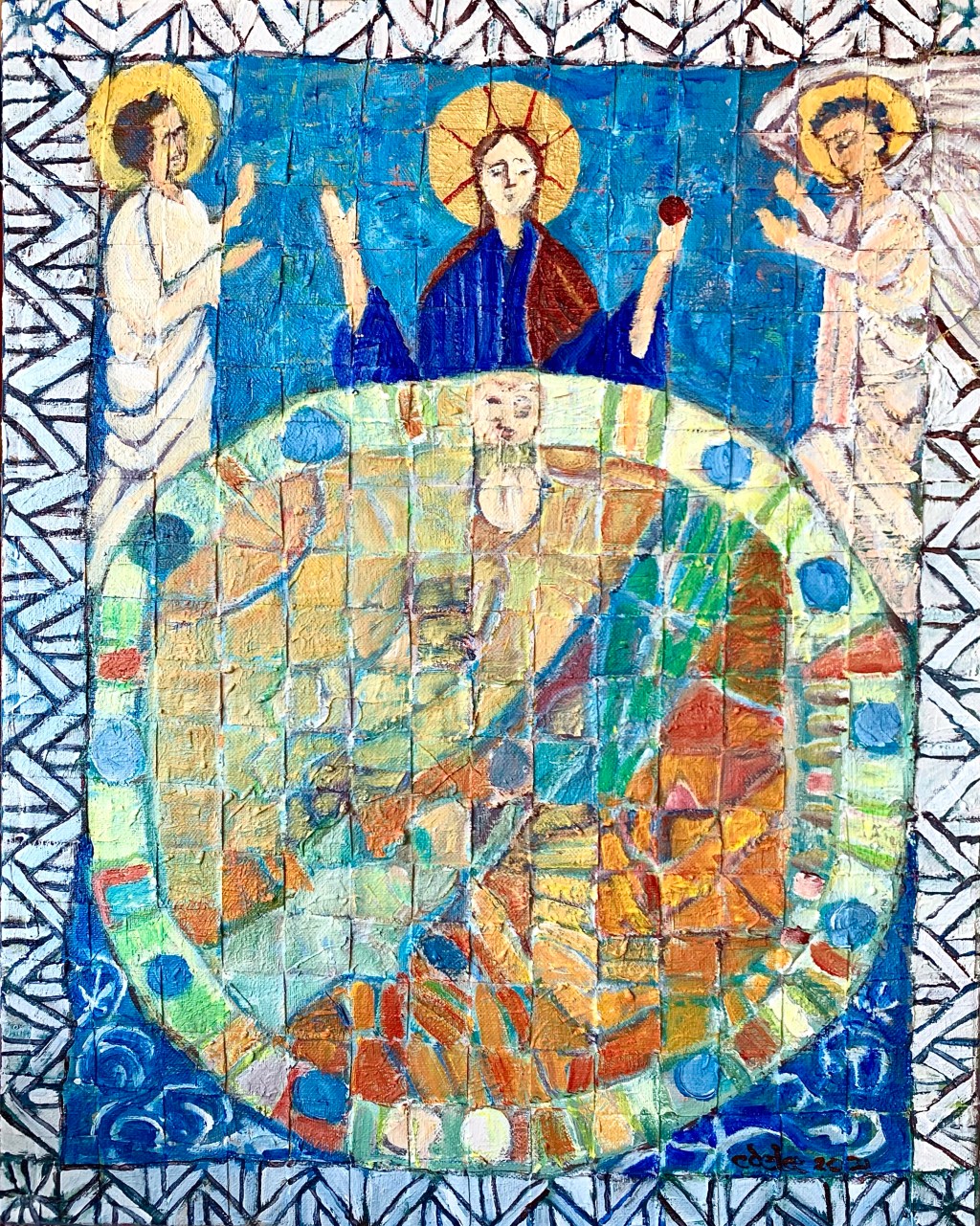
The first stage of my icon map followed the original map fairly well, but I let it rest next to my easel for a long time. This was a sure sign I wasn’t happy with it. The old map was a world view which belonged to a different age, but not to me. When I thought of my own world view, Jesus still had priority as Lord and Ruler of creation, but the world over which he reigned wasn’t merely the earth, but all of the known universe.

After a vacation, I decided to repaint it. The central swath of color represents the Milky Way in the night sky, as seen from earth. The warm golds and reds are the energies of all the planets and the stars in our universe, as well as the heat of all the life on earth. If we are all one, and Christ is lord of all, we humans have a particular responsibility to care for life in all its forms. As John 10:10 reminds us, Jesus said:


“I came that they may have life, and have it abundantly.”

Joy and Peace,

Cornelia

Cognitive Map – an overview | ScienceDirect Topics
https://www.sciencedirect.com/topics/neuroscience/cognitive-map

Map Psalter, British Library
https://www.bl.uk/british-library-treasures/articles/maps-and-views

Mappa Mundi | Hereford Cathedral
https://www.herefordcathedral.org/mappa-mundi

No, It’s Not Just You: Why time “speeds up” as we get older – Science in the News
https://sitn.hms.harvard.edu/flash/2019/no-not-just-time-speeds-get-older/

Why maps point North on top? – Geospatial World
https://www.geospatialworld.net/blogs/why-maps-point-north-on-top/

The Washington Post Analysis | This is how America is responding to Omicron
By Olivier Knox and Caroline Anders
https://www.washingtonpost.com/politics/2021/12/03/this-is-how-american-is-responding-omicron/

Autumn Leaf Prints

adult learning, art, autumn leaves, Carl Jung, Christmas, coronavirus, Creativity, Faith, grief, holidays, inspiration, nature, Painting, renewal, shadows, Spirituality, trees, vaccinations, vision

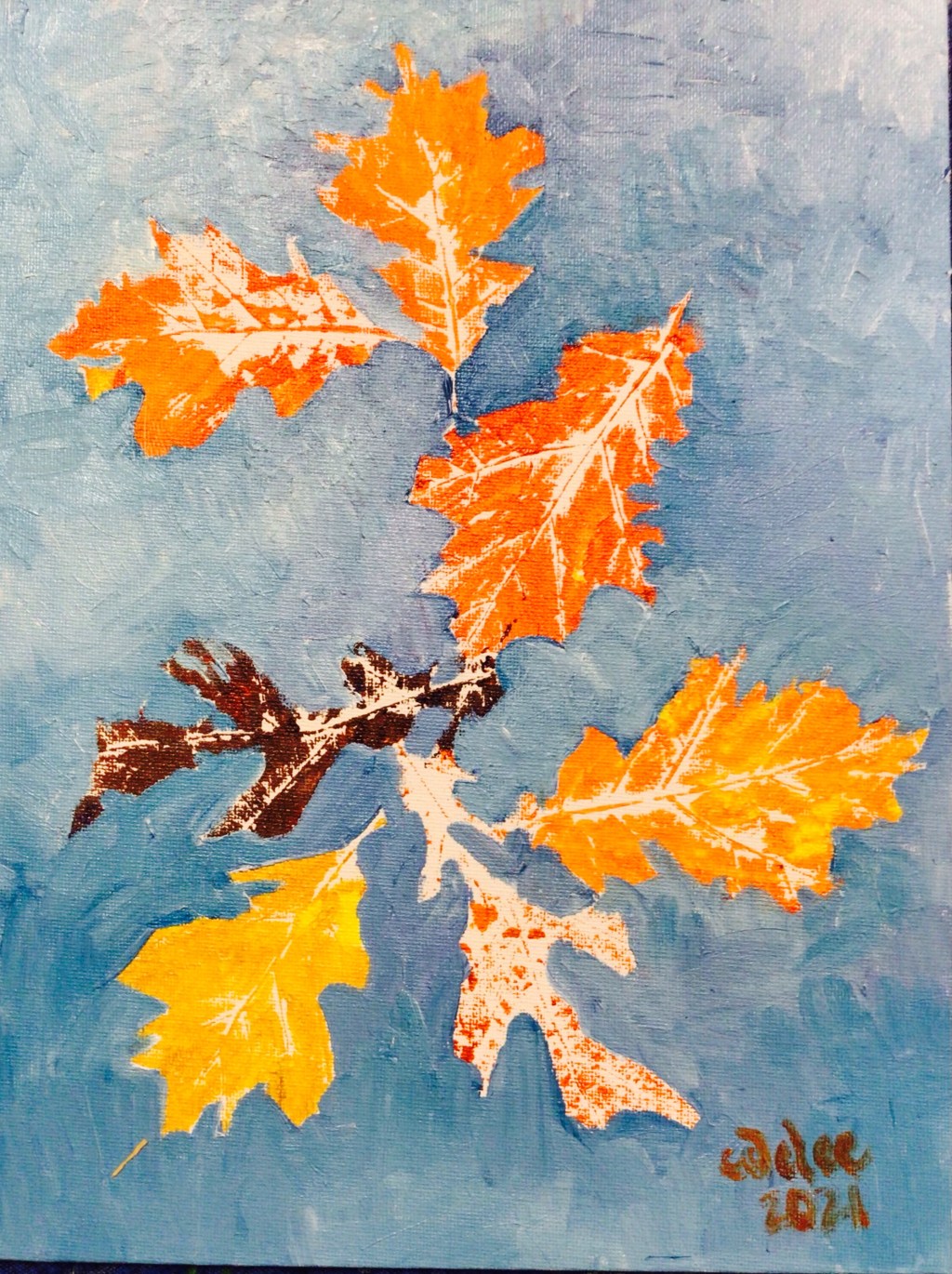
As the days grow shorter, the pile of leaves grows larger. This is Einstein’s equation for autumn. I know “Energy equals Mass times the speed of Light squared” isn’t really congruent with all those bags of leaves accumulating on the edge of the streets of the front yards in your neighborhood. It just seems that way. When I bought my first little stucco, flat roofed house back in my hometown, the former owners reminded me at closing, “Be sure and rake the roof every autumn.”

Of course I forgot about this, until the twenty something major trees around my little flat roofed house dumped all their leaves on my roof. How did I know? When it rained, those leaves blocked the drainage holes, so water came inside the ceiling light fixtures of my kitchen in the back of the house. As soon as the rain quit, I had the ladder out and was filling the big, black garbage bags with soggy leaves. If you only fill them half way, they’ll stay intact when tossing them over the parapet. I was younger then, and trainable. I didn’t forget when autumn came the next year.

Gail’s Leaves floating on Water

I’ve always thought leaves “fell” off the trees or the wind blew them off, but I asked Mr. Google, “Why do leaves fall?” Turns out, the trees cut them off with scissor cells. The leaves are only useful for making food for the tree. They are the seasonal kitchen staff, so the tree lets them go for the winter and brings in a new crew in the spring. The changing light and cooler temperatures triggers a hormone that makes this happen.

The scissor cells are stained red and mark the boundary between the branch (left) and the leaf stalk.
University of Wisconsin Plant Image Teaching Collection

If the leaves stayed on the tree, they’d wake up during a winter warm spell, start their food production work, and then get frozen when the cold inevitably returns. The tree knows the lifespan of the leaf, and this is the natural course of the life cycle. New growth will come in the spring, after a period of rest and recovery.

Lauralei’s Memories of The Leaves that Were

Our holiday season coincides with darkening days and marketing excess. Most of the commercials show happy families with lots of presents in heavily decorated holiday environments. Statistics show 25% of people are estranged from their families, and one out of every 463 Americans alive at the beginning of 2020 has since died of covid-19, the disease caused by the novel coronavirus. About 1 in 8 Americans say that a member of their family died of the virus; another fifth say that they lost a close friend, according to YouGov polling. These are staggering numbers, for in the US alone, 779,293 people have lost their lives as of November 30, 2021. One too many Thanksgiving tables had an empty place setting for a loved one no longer among us, and this will be a blue Christmas for many families.

If this were a war, maybe folks would get all excited and consider good health practices such as mask wearing , hand washing, and vaccinations their patriotic duty. Instead, they throw themselves into the breach of a thousand tiny viruses as if they were seeking the congressional gold medal for valor, and end up leaving their families with nothing but medical bills, grief, and the loss of their presence. Into this weary season comes Omicron, yet another variant, but an expected event due to the lack of worldwide access to vaccines and the virus’s ability to mutate in immunocompromised individuals. The enemy keeps evolving and the battles continue, whether we’re weary of the struggle or not.

“The Falling Leaves,” by Margaret Postgate Cole of England, is one of the first anti-war poems from a woman’s perspective. It was written in November 1915, during the First World War, when from 1914 to 1918, Flanders Fields was a major battle theatre on the Western Front. A million soldiers from more than 50 different countries were wounded, missing or killed in action there. Entire cities and villages were destroyed, their population scattered across Europe and beyond. The tradition of poppies on Veterans Day came from the red flowers given life from the blood spilled on this battlefield. COVID today is exacting it’s own cruel battle toll, with children left orphaned and spouses left without their mates. The adverse affects on this generation may be equal to those who went through the great flu pandemic of 1918 or the Great Depression.

War may be necessary in some instances, but it’s never to be glorified. There’s always a sadness related to the loss of life, regret over the great expense poured out that might have been used to build rather than destroy, and the cruelties that attend actions when we make others into evil enemies and refuse to see them as human as we are. Her poem speaks poignantly to this human loss:

Today, as I rode by,
I saw the brown leaves dropping from their tree
In a still afternoon,
When no wind whirled them whistling to the sky,
But thickly, silently,
They fell, like snowflakes wiping out the noon;
And wandered slowly thence
For thinking of a gallant multitude
Which now all withering lay,
Slain by no wind of age or pestilence,
But in their beauty strewed
Like snowflakes falling on the Flemish clay.

Source: Margaret Postgate’s Poems (1918)

If we want to treat these end of year days as “days of denial” of all that’s grim in the world to focus only on the good and the light, we’s be like people who claim we have no shadow. Carl Jung believed the shadow included everything in the unconscious mind, good or bad. Also, the shadow might include only the part of the personality that you don’t want to identify as self, but still is a part of your unconscious mind. This dark side of your personality contains everything your conscious mind can’t admit about itself.

When we read the birth story of Jesus, we often focus on the angels and the gifts of the magi. We forget these heavenly hosts are God’s armies and the magi came to meet the new king. These were revolutionary acts that caused King Herod to feel insecure and threatened, so he slaughtered the innocent babies born at this time. The Bible never forgets this shadow side of life, for this is why Christ came into our world:

“to give light to those who sit in darkness and in the shadow of death, to guide our feet into the way of peace.” ~ Luke 1:79

Joy and Peace,

Cornelia

Why Leaves Really Fall Off Trees : Krulwich Wonders… : NPR
https://www.npr.org/templates/story/story.php?storyId=114288700

The Depths Of Estrangement: Why Family Rifts Happen And How To Heal
https://www.wbur.org/hereandnow/2020/12/24/family-estrangement-holidays

[The Washington Post] Analysis | A third of Americans say close friends or family have died of covid-19
https://www.washingtonpost.com/politics/2021/10/13/third-americans-say-close-friends-or-family-have-died-covid-19/

Visit Flanders Fields | VISITFLANDERS
https://www.visitflanders.com/en/themes/flanders_fields/

Rabbit! Rabbit! Welcome to December!

art, Christmas, coronavirus, Faith, Family, Food, grief, Hanukkah, holidays, Imagination, Ministry, nature, pandemic, purpose, vaccinations, winter solstice

“The more things change, the more they stay the same,” my daddy was fond of saying. We often long for the “way things used to be,” as if the Golden Age of the past was the best of all times. Yet, that past often exists only in our memories, but not in the lived reality of all persons. This is the classic story of the young prince, who while sheltered within the confines of his sumptuous palace never knew want, but once he walked among his people, he saw suffering and need everywhere. Today we know him as the Buddha, or Siddhartha Gautama. Many over the centuries have wondered why suffering exists in the world, or why they themselves must suffer. The Buddha saw all life as suffering, or rather our inability to accept the impermanence, change, and dissatisfaction with the present moment.

Rabbit Buddha

The Golden Age is a myth and poetic concept, as well as a political and philosophical construct. It began in Greece and was fixed in people’s minds by the time of the Roman Emperor Augustus. The Golden Age is a dream of an “earlier time when people lived peaceful, untroubled lives, and the earth supplied all their wants.” Those who read the Bible can easily find a parallel story in the first humans, who lived in the Garden of Eden. Of all the high and holy days in our cultural calendar, Christmas rates number one for nostalgia, both the personal kind and the universal type.

Nostalgia is the state of being homesick, or a wistful or excessively sentimental yearning, either for the return to or of some past period or irrecoverable condition. It can be a salve for those who suffer, or it can be more salt poured into an open wound. It just depends on how one frames the experience. We feel “homesick “ in the worst possible way, for we yearn for the security of the familiar and the safe. Mostly we yearn for the people we love and are kin to us.

Happy Rabbit Family

I remember the year I divorced my husband. It was necessary, for I couldn’t trust him to care for our daughter due to his alcoholism. The first Christmas was hard, for his family chose him and shut me out, as did all his friends. Decorating the Christmas tree was always a family affair in the Golden Age of my memories of Christmas. If this year I had no family, I would bring friends to decorate my tree. Just because I’d always celebrated one way before, I wouldn’t let my circumstances keep me from finding joy this Christmas. I called my young mother friends, invited their families to my home, and we decorated my tree within an inch of its life. It was my best tree ever! And then we ate and drank a toast to our creation. My friends were salve for my suffering, and helped me create a good memory, which still gives me pleasure to this day, four decades later.

Big Holiday Family Dinners

Christmas brings families together, but this is a double edged sword. While we all want to be with our families, we also know oil and water don’t mix. After both my parents died, I often ate with some of my clergy pals’ families. I was glad to know they had relatives who also wore their crazy pants to dinner. If I ate with congregation members, they were often on their best behavior, as if I were some sort of god on earth. You’d think after six months at a charge, I’d already have disabused them of that notion, but some people never see your true nature, but only the image of every pastor they’ve ever known before. More often, I’d get pastoral calls of family crises during holiday seasons, so after years of this recurrence, I finally learned to plan for it. I eventually realized we all have a Golden Age of Christmas in our minds, but in real life, we live in the Age of Iron. When reality hits our delusions, the disconnect is palpable. We feel it in our very bones.

1896 Thomas Nast illustration in Clement Clark Moore’s ‘Twas the Night Before Christmas

For many Americans, images of Victorian Christmases include memories of “children all snug in their beds with their visions of sugar plums dancing in their heads,” which we recognize as one of the opening lines of Clement Clark Moore’s “A Visit from St. Nicholas,” a.k.a. “Twas the Night Before Christmas.” These sugar plums aren’t sugared fruits, but are more like candy covered peanuts or almonds. Jelly beans also are made by this same process. Whatever these treats were, the children dreamed of a world of happiness, sweetness, and delight.

As my Depression Era mother would say, “If wishes were horses, beggars would be kings.” That outlook never stopped me or my brothers from wanting everything in the Sears Christmas catalog, even though we knew these were just suggestions for Santa. Yet we never felt deprived, for whatever we received was a gift, plus it was more than we had before. On Thanksgiving day this year, consumers spent at a pace of at least $3.5 million per minute on line due to stores being closed for the holiday. This year, the average household is pegged to spend $924 for online shopping, more than double the $440 expected for in-store.

December 15 is Wear Your Pearls Day

The National Retail Federation (NRF) projects November/December retail sales of $843.4 billion to $859 billion, up 8.5% to 10.5% from 2020 results. NRF said its forecast — excluding automobile dealers, gas stations, and restaurants, and covering Nov. 1 to Dec. 31— tops the previous high of $777.3 billion. This total is up 8.2% over 2020, as well as the average gain of 4.4% over the past five years. This increase is in spite of supply chain hiccups, rising gas prices, and the pockets of as yet unvaccinated individuals, who continue to be the greatest number of COVID admissions to our hospitals. It’s as if we’re trying to replace the suffering of our present with presents for those we love. This also accounts for our desire to donate to charities at this season.

Scrooge of Christmas

Yet the Scrooge of Christmas continues to be COVID, for as an Augusta University Medical analysis released in May of 2021 revealed, which looked at COVID-19 related deaths in vaccinated versus unvaccinated individuals—only .8% (150) of vaccinated people accounted for the 18,000 COVID-19 deaths in May. If you want to give someone the gift of life this Christmas, take them to the local pharmacy and get them started on their vaccinations.

The Centers for Disease Control and Prevention has found both infection-induced and vaccine-induced immunity are durable for at least six months — but vaccines are more consistent in their protection and offer a huge boost in antibodies for people previously infected. Unfortunately, unvaccinated persons are also the prime hosts in which the virus can mutate, so the Grinch has already brought us the latest variant of concern, Omicron.

This variant was first identified in the South African peninsula, due to their excellent testing facilities. Of course, now the nations of the world have isolated the countries there, so they now feel punished by these bans. Travelers arriving in major world airports already have tested positive for for this variant, so we can expect disruptions and quarantines worldwide to follow. During this holiday season of restoring relationships, COVID keeps breaking our ties instead of rebuilding them.

DeLee: Found Objects find a home in the No Room Inn

We can long for the Golden Age of light from our younger days, when our parents took on the big worries so we could have the pleasant memories of an untroubled childhood, or we can fix our sight on the lights of our faith. The great star of the east which announced the birth of Jesus was a pale light compared to “The true light, which enlightens everyone, (which) was coming into the world.” (John 1:9) His was “The light (which) shines in the darkness, and the darkness did not overcome it.” (John 1:5).

Colorful Menorah

Our Jewish friends meet the darkness of this Hanukkah season with prayers and menorahs, nightly lighting candles to disperse the darkness of hopelessness against great foes. They remember doing battle against spiritual powers, with God empowering their weakness. God never comes for the strong, but has a special kindness for the poor and weak. This is why we should feel blessed, no matter our personal experience, but especially during the holidays. The ceremony begins on November 28 and ends December 6, since it’s set by the lunar calendar.

So also are these December celebrations light filled: Burning the Yule Log on the 4th, St. Lucia on the 13th, the Winter Solstice on the 21st, Kwanzaa on the 26th, and finally, New Year’s Eve. Our good earth will bring its tilt back towards the sun gradually in the days following the winter solstice. This darkness too shall pass, whether it’s our personal grief or our universal suffering.

Winter Solstice brings back the Light

We’ll keep walking until we meet the better land beyond the horizon. If this isn’t yet the Golden Age of our memories or the Golden Age of our sugar plumb dreams, let’s work together as we walk to build a better world for all people, “for we are what he has made us, created in Christ Jesus for good works, which God prepared beforehand to be our way of life.” (Ephesians 2:10)

Merry Christmas and Happy Holidays to all my Bunny Friends!

May you have a mindful holiday, full of joy and peace,

Cornelia

Dukkha: What the Buddha Meant by ‘Life Is Suffering’
https://www.learnreligions.com/life-is-suffering-what-does-that-mean-450094

Reckford, Kenneth J. “Some Appearances of the Golden Age.” The Classical Journal, vol. 54, no. 2, The Classical Association of the Middle West and South, 1958, pp. 79–87, http://www.jstor.org/stable/3294223.

Wynne Parry: Why We Feel Nostalgic During the Holidays
https://www.livescience.com/17571-nostalgia-holidays-memories.html

Sugar Plums: They’re Not What You Think They Are – The Atlantic
https://www.theatlantic.com/health/archive/2010/12/sugar-plums-theyre-not-what-you-think-they-are/68385/

U.S. Thanksgiving Online Shopping Spending to Set Record
https://www.bloomberg.com/news/articles/2021-11-26/u-s-thanksgiving-spending-to-set-record-as-shoppers-move-online

U.S. holiday retail sales outlook brings good tidings
https://www.supermarketnews.com/consumer-trends/us-holiday-retail-sales-outlook-brings-good-tidings

The Washington Post: CDC finds immunity from vaccines is more consistent than from infection, but both last at least six months
https://www.washingtonpost.com/health/2021/11/01/what-works-better-vaccines-or-natural-immunity/

Staggering COVID-19 Statistic: 98% to 99% of Americans Dying are Unvaccinated – AU/UGA Medical Partnership
https://medicalpartnership.usg.edu/covid-19-staggering-statistic-98-to-99-of-americans-dying-are-unvaccinated/

Night before Christmas, Creator: Moore, Clement Clarke, 1779-1863 ( Author, Primary ), date: c1896, The University of Florida, George A. Smathers Libraries, Donor: Egolf, Robert
McLoughlin Bros., inc ( Publisher )
Nast, Thomas 1840-1902 ( Illustrator ) https://ufdc.ufl.edu/UF00085407/00001

All of the versions of Clements’ work can be found at the UF Library site. The illustrations are telling of the age in which they drawn.

Dreams of Trees and Butterflies

arkansas, art, butterflies, coronavirus, Creativity, Faith, Forgiveness, grief, Healing, Historic neighborhood, holidays, hope, Imagination, inspiration, nature, pandemic, renewal, vision

The saying is true: “If nothing ever changed, there’d be no butterflies.” Yet how hard do we humans hold to the past, even if we need to move on into the future? As an artist, I’ve always been caught between my desire to honor the traditions of the past, but also to move into the the unknown realms of the future. Artists already have a vocabulary and boundaries to describe the works of the past, so we can tell if our current works “meet the criteria for excellence.”

Found Object Butterfly: roadside debris, wire, scrap cloth, and metallic beads

When we go beyond this known world into the uncharted territories, we’re like Columbus, who landed in the Caribbean islands, but thought he was on the continent of North America. I wonder if the monarch butterfly, just emerging from the cocoon, has any idea it soon will begin a 3,000 mile migration to its ancestral winter home in Mexico. The butterfly has the innate ability to navigate this path, whereas we humans are like Abram, for we’re going to a land our God will show us. We have no idea where we’ll end up, but we do know we’ll travel by stages and God’s guiding inspiration will always be with us.

During this current protracted COVID pandemic, with cases beginning in mid December 2019, we’ve now lost over 766,206 persons in the US alone and over 47,390,239 individuals have had COVID. Worldwide, the numbers are far greater: over 5 million have died and nearly 255 million have contracted COVID, mostly because vaccines and health care services aren’t available to the extent they are in America and the European Community. Not only has our world as a whole suffered a great grief, but each of us individually have lost friends, neighbors, or loved ones. This adds to our collective grief.

Airport Road at MLK Hwy Intersection, empty lots

When we see the rest of our world changing around us, we feel another loss, and this becomes the grief leading to the death of a thousand tiny cuts. Just as in our workplaces, when the ideas of the young, the female, and the ethnic individuals aren’t valued, their dismissal leads to devaluation of their perspectives as well as their personhood. When we devalue nature and treat creation as an arena for humanity to restructure for our purposes alone, we can fall into the trap of thinking only for our immediate future, but not for the generations to follow. This is why building lots inside the city get cleaned off and offered as a blank slate, since this makes them valuable to the greatest number of buyers.

Death by a thousand cuts was supposedly a form of torture in ancient China. It was reserved for the most heinous crimes, such as matricide, patricide, treason, and the like. From all the tiny slices, the accused finally bled to death. It was a cruel and unusual punishment, rather like flogging the back of a law breaker until the flesh was raw, but this punishment was intended to cause death because the executioner kept at it until he succeeded.

Most of us are blissfully unaware of the loss of a few trees here and there in our neighborhoods. Sometimes we even want to cut down the trees on our own property because we’re tired of raking leaves every fall, or if we have a magnolia tree, we’re tired of our year round duty of leap reaping. Of course, if you want a high strung, classy tree to show off in your front yard, you also need to sign onto the high maintenance these trees require. “Those that wears the fancy pants has to take care of those fancy pants,” my mother always reminded me.

Yard work is a type of infrastructure most of us can understand. With Thanksgiving just around the corner, those of us hosting the feast are also getting the house and yard ready for family and friends to visit. Infrastructure has been in the news lately also, with politicians debating whether soft or hard infrastructure deserves the most funding.

In Hot Springs, we have “Green Infrastructure,” which includes all the natural assets that make the city livable and healthy: trees, parks, streams, springs, lakes and other open spaces. These assets are ‘infrastructure’ because they support peoples’ existence. For example, tree canopy keeps the city cooler while also absorbing air pollutants and mitigating flooding. The Hot Springs National Park forest area is also an important resource for a variety of reasons. The mountain area is in the recharge zone for the hot springs and the forest provides other important ecosystem services.

Hot Springs is Very Green

In urban areas, we can evaluate the landscape on a smaller scale, so even small patches of green space become important, since together they can make a greater large cumulative impact. Smaller urban spaces, such as linear stream valleys, or even pocket parks, can add up to a connected green landscape. When evaluating the ecological health of an urban area, urban tree canopy is a key green asset. For instance, Hot Springs has 57% tree canopy coverage and an additional 12% green space coverage. This adds to our quality of life, for this isn’t only pleasing to the eye, but the trees and grass convert carbon dioxide to oxygen, thus improving the air we breathe.

Cities are beginning to recognize the importance of their urban trees because they provide tremendous dividends. For example, city trees are a strategic way to reduce excess stormwater runoff and flooding. Even one tree can play an important role in stormwater management. For example, estimates for the amount of water a typical street tree can intercept in its crown range from 760 gallons to 4000 gallons per tree per year, depending on the species and age. Taken city-wide, the trees within the city provide an annual stormwater interception of 1.2 to 1.5 million gallons which equates to 7 to 9 million dollars in benefits. The loss of one tree is worth so much money, replanting our tree cover is an investment in our future wellbeing.

I often heard an old proverbial poem growing up, which may not be repeated much today:

For want of a nail the shoe was lost.
For want of a shoe the horse was lost.
For want of a horse the rider was lost.
For want of a rider the battle was lost.
For want of a battle the kingdom was lost.
And all for the want of a horseshoe nail.

My nanny would remind me of the same principle in other words, “A stitch in time saves nine.” My daddy was from the school of “If it ain’t broke, don’t fix it.” While those two schools of thought still persist today, I think making a small, inexpensive repair, rather than a costly replacement, is a better choice, but too many of us live in a throwaway society.

Wisterias among the Trees

When we lose one small thing, we brush it off as no matter, but after a thousand small losses, we just can’t take it any longer. We look around and wonder what happened to our world, why didn’t we take action sooner, and now we might be in a hole so deep we can’t see the top. When I first painted the trees on this vacant lot, the little coffee kiosk had closed shop and moved on. It was springtime and the violet wisteria vines were bright against a sunlit cerulean sky.

As I was taking a few photos with my iPhone last spring, the local policeman pulled into the circular drive to check on me. We chatted a bit, but he wanted to make sure I was OK. I’m at that age when silver alerts go out for others, but I’m not there yet. I guess “old gal taking photographs of trees” still looks suspicious in my small town. I’m thankful my town is this quiet.

When I told the officer, “These trees called to me,” he might have had second thoughts about my state of mind. Then he realized he was talking to an artist. I was rescued when his radio called him off to take care of some real trouble. I find I do my best work when I feel called to a subject, for I have a spiritual connection with it.

That was this past April, and here at year’s end, this lot is up for auction, with a commercial use zoning. It has easy access to the bypass and would be good for a food place or a fuel stop. Things change and we can’t hold back progress. I know people who buy a vacation home to visit while they still work, but as soon as they retire to this same place, they grouse about all the weekenders who come and spoil their solitude. They put up with it a year or so, griping daily, and then sell and move on. Life changed for them and they didn’t adjust to their new normal. I wonder why they never realized Hot Springs was a vacation destination. We think we need an infrastructure just for the 38,500 people who live here year round, but we actually need an infrastructure to support the over two million visitors to whom we offer the hospitality of our hot springs, our hotels, our fine dining, our attractions, and our natural beauty.

When I saw the trees were gone and the lots had been plowed level, I wondered if the trees had a swift death, or if they had brief dreams and fantasies while the saws pierced their outer skins. I thought of the butterflies encased in their cocoons, and the deep sleep of their transformation. Do butterflies dream in this stage, or do they even dream like we do? I wondered if next April I would see wisteria growing near the ground, for as a weed, it’s hard to kill. I always hope, for I’ve learned over time, if I’m a prisoner of hope, this is better than seeing only the loss.

Stage One

After traveling and recovering from an autumn sinus infection, I decided to destroy an old mobile sculpture of a butterfly made from found materials and attach it to a canvas. I took some scraps of cloth from some mask projects, and glued the whole to the canvas. Maybe I crammed more than I should have onto the small surface, but I was going with it. This work might be more catharsis than art, or more process and possibility than success. It doesn’t matter, for sometimes art is more therapeutic than anything else.

The first layer held all the colors and shapes of the original Google map. The second layer began to make sense of the shapes and textures, for I started to pull together the small areas into larger spaces. By the third layer, I’d lost most of the color areas and turned them instead into linear shapes. The primary colors of the background I subdued beneath an overall gold tone. The lines now are like an automatic writing or glyphic writing, which might be the language spoken either by the trees or the butterflies, or by all natural living beings.

Stage Two

When we confront suffering in nature, in our lives, or in the world, we often ask, “Where is God in all of this?” In the days past when I suffered, I held on to the words of the Apostle Paul to the Romans:

“I consider that the sufferings of this present time are not worth comparing with the glory about to be revealed to us. For the creation waits with eager longing for the revealing of the children of God; for the creation was subjected to futility, not of its own will but by the will of the one who subjected it, in hope that the creation itself will be set free from its bondage to decay and will obtain the freedom of the glory of the children of God.” (8:18-21)

Dreams of Trees and Butterflies

Often we suffer because we can’t change our past, or we think we can’t affect our future. At some point in our lives, we come to accept our suffering. We don’t have to continue to suffer, of course, but we need to accept that what happened to us is over. We can forgive ourselves for not leaving a bad relationship earlier, or being too young to know we were being harmed. Some of us may have survivor guilt from our nation’s wars, and suffer moral injuries from acts of war. Only good and decent human beings would feel this guilt, and they can heal with Christ’s forgiveness. We can be changed and then begin to change the world, even if we begin only with our own selves.

After all, the Psalms promise us God is faithful both to us and to the creation also: “When you send forth your spirit, they are created; and you renew the face of the ground.” (104:30)

Joy and peace,

Cornelia

Vegetation Community Monitoring at Hot Springs National Park, Arkansas, 2007–2014
Natural Resource Data Series NPS/HTLN/NRDS—2017/1104
https://www.nps.gov/articles/upload/HOSP_VegCommunity2007_2014r-508.pdf

GREEN INFRASTRUCTURE LANDSCAPE STUDY AND PLAN
City of Hot Springs, AR
Green Infrastructure Committee
https://www.cityhs.net/DocumentCenter/View/6245/Hot-Springs-AR-GI-Study-and-Plan-Final?bidId=

Hot Springs General Information: Hot Springs National Park Arkansas
https://www.hotsprings.org/pages/general-information/

Creativity Challenge

adult learning, art, beauty, coronavirus, Creativity, Faith, Icons, inspiration, Ministry, Painting, Pantocrator, Philosophy, photography, Plato, purpose, Reflection, Spirituality, vision

I was an art major before I attended seminary at Perkins, where I had the great privilege to take Philosophy from Dr. Billy Abraham. Of course this privilege was extended to me because I failed my one and only philosophy class in undergraduate school. I had taken it pass fail, but hit a terrible depression after my art teacher died. I had no energy to even hand in a paper with my name on it, even though the professor offered this as an act of grace to pass me.

“I’ve not done the work, I’m in over my head, and I haven’t understood any of these concepts in this class,” I said. “I don’t deserve to pass.”

“It’s a pass fail class. It doesn’t count toward a grade average, but it can count against you. Just turn in the paper,” he pleaded.

It didn’t seem appropriate to me, or honorable to take this option, but that could have been my depression coloring my decision making process. Still, I wasn’t raised to take credit for haphazard efforts, and providence ensured my F didn’t count against me when I transferred to art school the next semester, so that F didn’t affect my ultimate grade average after all.

Raphael: School of Athens, Vatican City

I speak about this because in seminary, Billy Abraham daily stretched the brains of every one of us first year students. First we heard one Greek philosopher say this was “true and real.” Then the philosopher who was his student came along and directly contradicted his old master, saying, “No, instead, something else is true and real.”

We all were in hair pulling mode, not to mention Dr. Abraham’s favorite description, “getting our underwear tied into knots.” I’ve always heard there’s a Rosetta Stone, which can unlock the meaning of an unknown language for those who have the eyes to see it. Perhaps only the creative ones, those who can see the patterns and the similarities, or what the mathematicians call the “sets” and the biologists call the “modules,” can suddenly see the key in plain sight.

Rosetta Stone

I admit I too was floundering until I had the eye opening realization I already held the key in my hand. I’d met this same question before in my art studio and history classes: “What is beautiful and what is truly art?” This definition had changed over the centuries, so why should the ideas of what is “reality and truth” remain fixed? This is a great example of “transfer of learning,” a well known educational concept, which resulted in my “lightbulb moment.”

Leonardo: Mona Lisa

As I explained to a fellow student, “Think of these as distinct historical ideas, not as your individual truth. It’s like looking at a fashion show from the ancient times to the present: no one expects those clothes to look like what we wear today. Just memorize what each of these styles look like. You don’t have to wear a toga to know what these Greeks thought. We just have to know how these old ideas influence later trends of thought fashions.” This is teaching by analogy, which is familiar to Bible readers as “parables.”

Coffee Bean Madonna

Most people can get over that intellectual hump. Seminary is designed so persons who aren’t agile thinkers will reconsider their educational choices. Philosophy and theology will winnow those who need to be told what to think, rather that learning how to think and understand deeply. Biblical studies will sort out those who aren’t able to interact with more than one voice of biblical interpretation. Then the internships and clinical pastoral settings will further sort those who don’t play well in groups. Finally the supervisory process we all go through toward our ordination into one of the orders of the annual conference is a long period of discernment, for all concerned.

The good news we can all do ministry, for we’re ordained by our baptism into the priesthood of all believers, not only reflect the Christ who lives in us, but to be the Christ in service to our neighbors. As we read 1 Peter 2:9—

But you are a chosen race, a royal priesthood, a holy nation, God’s own people, in order that you may proclaim the mighty acts of him who called you out of darkness into his marvelous light.

Minion Madonna

This is why it’s important we consider such concepts as truth, beauty, and the good. The Greek adjective kalon only approximates English for “beautiful.” Kalon has more of an ethical tone, but doesn’t mean the same thing as agathon or the “good, ” but rather is a special complement to goodness. At times kalon narrowly means “noble,” or “admirable.”

What was true for Plato were the forms, and everything here on earth were mere reflections or imitations of these ultimate truths. The true beauty and the good existed beyond this world, but everything and everyone could aspire to that ideal. Plato thought art and poetry were the arenas of greatest beauty, as Simonides, the Greek poet, drew an explicit analogy: “Painting is silent poetry and poetry is painting that speaks.”

While some say, “Imitation is the sincerest form of flattery,” for Plato imitation is found in the appearance of things, rather than in reality (the forms, which exist in an ideal world elsewhere), so judged on its own terms, the product of imitation has an ignoble pedigree (Republic 603b). Therefore, the imitative arts direct a soul toward appearances and away from proper objects of inquiry, which are the forms. While a mirror reflection might prompt you to turn around and look at the thing being reflected, an imitation keeps your eyes on the copy alone. Imitation has a base cause and baser effects.

Festival Madonna

Plato also believed poets created their works under irrational conditions, with inspiration arriving sometimes spontaneously, as if it were from the gods, a “divine madness,” as it were. Even today, people think creative types are more likely to be mentally ill, but science doesn’t bear out this romantic notion. Illness isn’t a prerequisite for creativity, even though many artists have suffering in their life histories.

Another Coffee Madonna

Creativity of any kind—making a collage, taking photographs, or publishing in a literary magazine—tends to make individuals more open-minded, curious, persistent, positive, energetic, and intrinsically motivated by their activity. Those who score high in everyday creativity also reported feeling a greater sense of well-being and personal growth compared to those who engage less in everyday creative behaviors. Creating can also be therapeutic for those who are already suffering. For instance, research shows that expressive writing increases our immune system functioning, and the emerging field of post traumatic growth is evidence we can turn adversity into growth.

Realism was the primary purpose of painting until the 19th century, when the invention of photography took over this task. This freed painters to engage in the higher search for what is beautiful and what is true, rather than to limit a painting to reproducing a likenesses or the mere imitation of nature. Yet many people still judge a work of art by how close it resembles the natural world. Of course, we also say the say the same about the embalmer’s art as we view the deceased in the casket: “My, doesn’t so and so look natural! So lifelike, as if they were asleep.”

Source

For our first lesson back in art class, we worked on seeing the familiar in a fresh way. This isn’t as easy as it sounds. We’re so used to recognizing faces in the ordinary way, to see them in a different way is a struggle. Take the Mona Lisa, by Leonardo Da Vinci. It’s an icon or representative image of the renaissance portrait. No matter what an artist does to it, we still recognize it as the Mona Lisa. Our goal was to take a photo of of someone we know, and push the limits of the facial expression and shapes so it wasn’t like the image we worked from originally.

Mike’s Painting

Mike copied the cover of the Bad Girls of The Bible, and made a good likeness. In between calls from work, he focused on replicating an image he could see. After several years of sincere efforts to paint what he sees, it’s hard to break this habit and paint something beyond his vision.

We’ll take a shot at this again. I a similar lesson early in the group’s existence and I remember it was distressing to them to draw without seeing. We were feeling the objects inside bags, and they didn’t like not looking. Bring out of control was disconcerting.

Gail’s grandchild isn’t really a zombie

Gail took her grandchild’s photo and stretched it into another dimension by treating the image as if it were a Night of the Living Dead character or the Scream from the German artist Munch. She had the most success of any of us in terms of breaking the norms of “portrait.”

Sally’s painting

Sally, new to our group, began a lyrical study of a woman’s head. I confess I never saw the image from which she drew her inspiration. It’s her first try, and we’re glad she got paint on the canvas. We’ll keep working on it together. All art, as is life, a work in progress.

Russian Icon of the Pantocrator

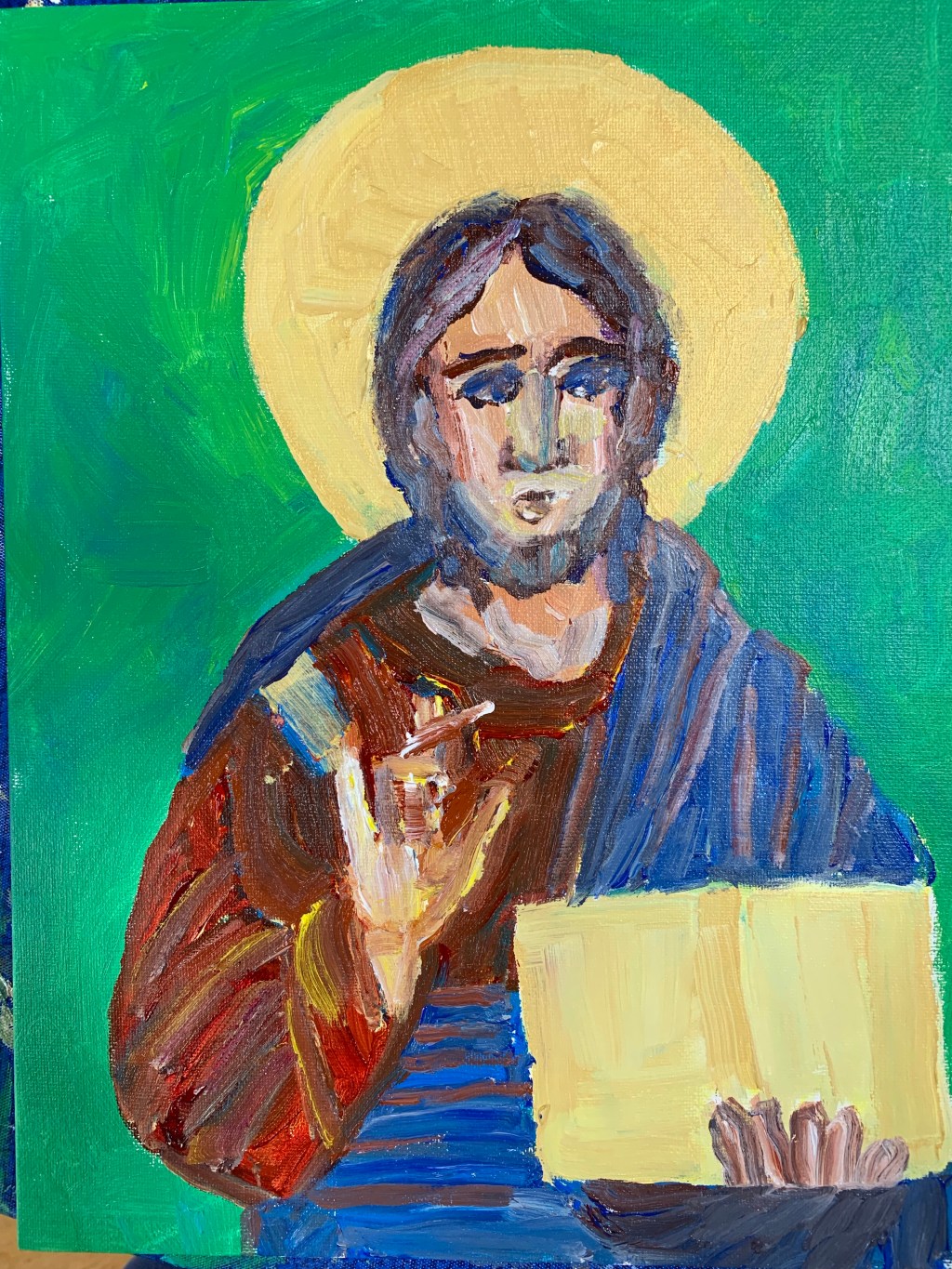
I worked from an icon of Jesus, which I knew would test me to break the form I saw before me. As it turned out, I too couldn’t break it on this first day. When the Platonic Ideal Form exerts its pull on the mind and hand, the artist keeps making the reflection of that form as a work, which exists as an imitation or a window into the true reality where the Holy is found.

Low Blood Sugar Painting

After a long summer break with all the Covid isolation a person could stand, I quite forgot how much energy teachers expend in explaining new concepts and in the excitement of the first day back. I noticed about 11 am I was struggling for words and not making good choices with my brush, but I ignored it in the thrill of being back with people. After cleaning up, I always check my blood sugar before I drive home. It was 45. I’d never seen it that low, but I was paying attention to other people, not to my body. I ate the crackers I always carry for just such an emergency.

The Wisdom of Solomon (7:26) speaks about God’s Wisdom personified:
“For she is a reflection of eternal light, a spotless mirror of the working of God, and an image of his goodness.”

In Hebrews (1:3), the writer describes The Christ:
“He is the reflection of God’s glory and the exact imprint of God’s very being, and he sustains all things by his powerful word.”

This long discussion on Plato, the true forms elsewhere and the imitations and reflections here help us to realize how much debt Christian spiritually and art history have to Greek thought. Art isn’t just “I know what I like and that’s all that counts.” We can all experience making art and enjoy it on any level. Having the depth of understanding to see how art connects us across the human community will give us a greater appreciation for our common spirit.

I promise I’ll bring a healthy snack to eat during class next Friday! I’ve learned my lesson on this, if nothing else! We’ll work on faces for two more weeks, then we’ll take a short break and come back in October and decorate cookies one week for Day of the Dead and paint an autumn themed subject for the other week.

Joy and Peace,

Cornelia

Simonides on poetry and painting—Plutarch: The Glory of the Athenians 3.1, 346f-347a.

Plato’s Aesthetics (Stanford Encyclopedia of Philosophy)
https://plato.stanford.edu/entries/plato-aesthetics/

Creativity and Rationality on JSTOR
The Journal of Aesthetics and Art Criticism
Vol. 70, No. 3 (SUMMER 2012), pp. 259-270 (12 pages)
https://www.jstor.org/stable/43496511

Mathematical Biology Modules Based on Modern Molecular Biology and Modern Discrete Mathematics
https://www.ncbi.nlm.nih.gov/pmc/articles/PMC2931670/

The Real Link Between Creativity and Mental Illness – Scientific American Blog Network
https://blogs.scientificamerican.com/beautiful-minds/the-real-link-between-creativity-and-mental-illness/

Rabbit! Rabbit! Welcome to September

911, adult learning, art, autumnal equinox, Faith, Forgiveness, Healing, Imagination, Independence Day, Love, New Year, vaccinations

Back to School

Welcome to September, my rabbit friends! For most all of the bunny world, this means books, pens, pencils, and papers are now our daily tools of the trade instead of our preferred recreational plaything. Even the bunny parents are on the education time table. As I was exiting a lane in the store, I almost crashed my grocery cart into a lady who was racing to finish so she could pick up her darlings when school closed for the day.

Indeed, except for a brief break for Labor Day on Monday, September 6, we’re now living in what we working bunnies call “normal time.” The chronologists may have standard and daylight savings time, the meteorologists their seasonal times, but old school teacher rabbits know the only true time which counts is classroom time. Of course, the best teachers recognize teaching happens all the time, for the best classrooms have no walls and no fixed time for learning. Once rabbits quit learning, they begin to die.

I’ve always pitied the poor rabbit students who thought they could learn everything they needed to know to get them through the rest of their lives after they left the classroom. “Do you think the world is going to stand still just for your benefit?” Often they’d try to argue they didn’t need to know more because they could get a job right of school. They never think about the possibility their jobs might be phased out due to automation or irrelevance.

All we rabbits need are pencils

Then again, perhaps I value education more than the average rabbit. My grandfather worked for fifty years on the railroad, beginning at the tender age of fifteen. Why did he begin so early? His father had abandoned the family, so he worked to help his mother raise the baby rabbits left at home. When his own bunny sons were growing up, he made sure they got an excellent education. They both became doctors. My mother was a teacher and one of my several careers was art teacher.

We live in a time when history is being made daily, but no one seems to remember yesterday because the news media obsess over the latest hot button story. The next day they might have a new focus to fill the hours of coverage and keep our rabbit eyes fixated on the glowing screen. We don’t have to do this, for every tv has a remote to switch the channel and an off button. As a back to school exercise, I thought we might travel back in time when we colonists were in rebellion against the King of England in our War for Independence. So buckle your seatbelts, bunnies, we’re throwing the wayback machine into full reverse. Next stop, 1776 and the War for American Independence.

Most people know our Declaration of Independence was signed on July 4, 1776, but after that, our historical memories are iffy. In fact, the British had been fighting the colonists since 1775 in various skirmishes, and continued with greater frequency in 1776-1777, with neither side gaining much headway.

In our first war, our fledgling army had lost 6,800 men in battles and another 17,000 to disease. It wasn’t a good time for health care or sanitation. The British captured our young nation’s capital of Philadelphia in September, 1776, but the army and the state militias kept on fighting. The British moved their war efforts to the southern half of their colonies, thinking they’d find loyal supporters there, but none were found.

Washington crossed the Delaware River, December, 1776

By December 19, 1777, Washington had decamped to Valley Forge with what was left of his ragtag army. From there, he wrote letters to every state except Georgia to plead for supplies and reinforcements, for without these, he was certain the war would be lost.

General Washington and the Army winter over at Valley Forge

This was the first large, prolonged winter encampment the Continental Army endured—nine thousand men were quartered at Valley Forge for a six-month period. During that time, some two thousand American soldiers died from cold, hunger, and disease. About 22% didn’t survive that terrible winter. Perhaps we’re fortunate we didn’t have a 24 hour news cycle to keep a body count, or we’d remember this event as a catastrophe, instead of a “heroic perseverance and endurance under harsh conditions, which only made the survivors stronger.”

It was during this hard time of close confinement, the future president of our country had all the Continental Regular Troops inoculated against the smallpox virus. At the time, 90% of the war casualties were due to disease, so Washington took the bold move to vaccinate the troops. The British troops were already safe from this contagion, and this leveled the playing field.

In 1781, Lord Cornwallis surrendered at Yorktown after a siege of three weeks, during which the town took heavy bombardment from American and French troops. After six years, both sides were tired of fighting, plus the British had another war back on the continent to deal with. Two years of negotiations later, the United States of America had its recognition among the governments of the world.

“Jungkook As Bunnies” Is the only Easy Winner of the Internet any day.

If any rabbit tells you winning is easy, and anyone can do it, they aren’t paying attention to history. Yet, we overcame many obstacles, adjusted our courses of action, somehow survived, and became a nation. It’s significant that our nation was founded by people with the historical tradition of a parliamentary form of government. In 1215, King John agreed to Magna Carta, which stated the right of the barons to consult with and advise the king in his Great Council. That’s a full 500 years of shared representation, from which our government takes its form of checks and balances.

The World Trade Center Memorial seen from space

Our heroic image was bruised and bloodied over two centuries after the War for Independence when the twin towers fell on 9/11, and the Pentagon was hit by a falling airplane. The only reason we didn’t also lose the White House is because the ordinary passengers of an everyday airline flight suddenly reached down deep and found the hero who lives inside each and every one of us. Some say rabbits are meek and weak, but they don’t know the true heart of the one who will give up his or her life for the sake of another.

We rabbits like our chaos neatly packaged and tied up neatly with a bow. The beginning of every school year has its own chaos, for suddenly rabbit families have to once again be on time, have all their paperwork together, and make sure they don’t leave their brains at home as they rush out the door. After a long lazy summer, we rabbits aren’t in the mood to be reminded of how fragile life can be.

Afghan child safely sleeping under American Air Force jacket during Evacuation efforts.

When we watch the scenes unfolding in Afghanistan as people try to emigrate to the United States, we share the collective trauma along with the ones who actually experience it. Add that to our own stress about the unknowns of our current pandemic, our griefs for the losses of those who died, the fears we have for our loved ones, and the extra burdens of cleaning, masking, washing, and scheduling this Covid world now requires, and well, (breathe) it gets a bit much.

But we rabbits have risen to the occasion from time immemorial: we pull together as one, for the good of all. If we live in families, and live in neighborhoods, and live in communities, we find we need to lend a helping hand to others from time to time. Likewise, we band together to protect the vulnerable, whether those are our children, our elderly, or our less abled friends. This is what we call our civic duty, or our moral obligation to do unto others as we’d have them to do for us, or the “golden rule.”

Sometimes we don’t want to work for the common good, but work for our own interests only. We like to win, because it suits our belief about our invincible self. Most of us have been taught a “heroic myth” about our founding fathers, so we aren’t aware of the struggles they endured to wrest our independence from the British. They didn’t do it alone, but together. If the French had not entered the war for independence on our behalf, we might still be singing “Hail to the Queen.” If we’re going through a rough patch now, we have to get our act together and work to make life better for all.

Positive thinking brings about positive results.

In my bunny life, when I taught art, I soon learned the beginning of school was the time I would lose my car keys, and I wouldn’t be organized enough to cook dinner. Once I raced out of the house without putting underpants on my little girl. Young mother bunnies don’t have access to their entire brain in the first week of school, but at least the kindergarten had a change of clothes for her. By the second week, I usually found the other half of my brain, and life went much smoother. Life is always a roller coaster, so when ever we make a big change, we need to give ourselves some grace until we get adjusted to that ride.

“This too shall pass,” an apocryphal phrase from the mid 1800’s, seems applicable to this era also, for we’re now on the cusp of autumn. That heat stress driving us to crank up our air conditioning has turned some leaves on our lakefront trees to yellow, so they gleam like lemons against the bright green canopy. The Autumn Equinox will occur on Wednesday, September 22, 2021, at 2:21 pm CDT. Of course, my late rabbit mother would have me retire all my light colored summer clothes by Labor Day, for “no self respecting child of mine should wear white in the fall.” Autumn in the South is just another word for summer. My fall clothes were still light weight cotton, but in darker shades.

No time like the present to wipe the slate clean and begin a new year.

Rosh Hashanah on September 6, beginning at sunset, is the celebration of the Jewish New Year, and the creation of the world. It’s one of the holiest days of the Jewish year. Ten days later is “Yom Kippur” or the “Day of Atonement.” This is a day set aside to atone for sins, with prayer, fasting, and attending the synagogue. No work is done on this day, which is one of the most important days in the Jewish calendar. During Yom Kippur, people seek forgiveness from God, and seek to give and receive forgiveness and reconciliation with others.

Mid Autumn Festival

September 21 is the Chinese Moon Festival, a harvest celebration which dates from about 1000 BCE. The early emperors offered sacrifices to the moon, believing this would result in good harvests the following year. During the Tang Dynasty four centuries later, the noble classes and wealthy merchants imitated the emperor, while the citizens prayed to the moon. Beginning around 1000 CE, the festival took on general acceptance.

Rabbit Moon Cake

Moon cakes arrived in the 14th C, and have retained their popularity. This is not only a family celebration, but a community ritual for connection of relationships. While the cakes themselves aren’t costly, the packaging makes the gift impressive. People can say more by the wrapping’s elegance than by the contents. Moon cakes aren’t for individual consumption, but are meant to be shared, much like life’s joys and sorrows.

The fourth Saturday in this month is International Rabbit Day. Rabbits are the third most popular family pets, after dogs and cats. The care and feeding of a small animal requires attention, patience, and affection, not to mention consistency. How we treat our pets tells the world how we treat humanity. As Mother Teresa once said:

“The hunger for love is much more difficult to remove
than the hunger for bread.”

The deep love of God overflows through our hearts into the world.

I recommend for your September reading homework The Universal Christ, by the Franciscan priest Richard Rohr. Drawing on scripture, history, and spiritual practice, Rohr articulates a transformative view of Jesus Christ as a portrait of God’s constant, unfolding work in the world. “God loves things by becoming them,” he writes, and Jesus’s life was meant to declare that humanity has never been separate from God—except by its own negative choice.

When we recover this fundamental truth, faith becomes less about proving Jesus was God, and more about learning to recognize the Creator’s presence all around us, and in everyone we meet. Until October, my bunny friends, I wish each of you may find in the present moment God’s

Joy and Peace,

Cornelia

September, 2021 – 2022 Daily Holidays Calendar, Month and Day. Bizarre, World, National, Special Days.
By Holiday Insights.
http://www.holidayinsights.com/moreholidays/september.htm

Timeline of the American Revolutionary War
https://www.ushistory.org/declaration/revwartimeline.html

Read and see George Washington’s original letter at the link below:
George Washington from Valley Forge on the urgent need for men and supplies, 1777
Gilder Lehrman Institute of American History
https://www.gilderlehrman.org/history-resources/spotlight-primary-source/george-washington-valley-forge-urgent-need-men-and

George Washington and the First Mass Military Inoculation (John W. Kluge Center, Library of Congress)
Amy Lynn Filsinger, Georgetown University &
Raymond Dwek, FRS, Kluge Chair of Technology and Society.
Dr. Dwek is Professor of Glycobiology on leave from Oxford University.
https://www.loc.gov/rr/scitech/GW&smallpoxinoculation.html

American Revolution Facts: Deaths in War for Independence
American Battlefield Trust
https://www.battlefields.org/learn/articles/american-revolution-faqs

TIMELINE OF AFGHAN WAR

9/11/2001—Attack on The World Trade Towers and The Pentagon

10/7/2001—“Operation Enduring Freedom”—Beginning of Afghan War with attacks against terrorist groups in Afghanistan

5/2003—Donald Rumsfeld announces the end of major military operations. The USA and NATO begin nation building and restoration of the poor country, which had gone through two wars and a foreign occupation.

Although there were early successes, such as women’s access to education and entry to politics and jobs, corruption was a way of life, so the money never flowed through the government out into the cities and countryside to help the people.

5/2011—Osama Ben Laden killed in Pakistan by Navy SEAL team

12/31/2014—President Obama decides to end major military action in favor of training the local Afghan army

2/2020—Trump administration negotiates a deal with the Taliban in which they promised to cut ties with terrorist groups, reduce violence, and negotiate with the current government. Unfortunately, there were no sanctions to enforce it.

9/2021—Today—The best laid plans of Mice and Rabbits usually end up in chaos

No One is an Island

art, cognitive maps, Creativity, Faith, flowers, Healing, inspiration, Ministry, nature, Painting, Spirituality, vision

If we watch the evening news on television, read a newspaper, or check our Twitter feed, bad news seems to fill the whole of it. Sometimes it gets to be too much, and we turn it all off, for we can’t cope with the next straw; it will break our camel’s back and we won’t be able to go on. Or we may already be broken by all the grief and pain, wounded by the wounds we can’t heal or by those wounded ones who wound others, rather than seek healing. I often thought I spent 50% of my pastoral care on 10% of my congregation, the “broken” ones.

After a while, we can feel like Elijah, who was worn out from doing great things for the LORD, and felt “I alone am left.” God comes to remind him he’s not alone. John Donne was very ill when he wrote this famous meditation. The artists all are from the margins, or made their art during a time of suffering. Yet, what beauty they found in this time. Artists often find their way back into the unity of all things by joining in the creating spirit of God.

Sam Doyle: Untitled (Rambling Rose), paint on metal, Smithsonian Institute.

Sam Doyle, who was on born and died St. Helena Island, SC (1906-1985), was a self taught Gullah artist, who painted the local stories of his community on anything he could find. He covered the walls of his home, as well as scraps of metal and wood with iconic figures of his people. You can read about this richly talented primitive artist at https://www.soulsgrowndeep.org/artist/sam-doyle

Hilda Wilkinson Brown: Third and Rhode Island, Washington DC, oil on canvas, 1930-40, Smithsonian Institute

Hilda Wilkinson Brown was born in Washington, DC 1894 and died there in 1981. She was an African American artist and art educator who brought her love of education and creativity to everything she did. Her work was mostly “under the radar,” except for in her own community. Yet she persisted. As a teacher, she’s best remembered for introducing individual creativity as a goal, rather than having students mimic the teacher’s model. Unfortunately, art education classes are still teaching mimicry.

Myrna Báez: Platanal, acrylic on canvas, 1974, Smithsonian Institute.

Myrna Báez of Puerto Rico (1931-2018), painted this lush field of plantain trees, a crop long wedded to concepts of Puerto Rican identity and sovereignty. She depicted the crop’s large leaves as they reflect the tropical sun and delighted in her manipulation of paint on unprimed canvas. Báez’s belief in Puerto Rican independence manifests in her impulse to look, depict, and therefore possess the island’s landscape on her own terms. Puerto Rico is currently an unincorporated territory of the United, in which the people are American citizens, but have no vote, unless they move to the mainland.

Georgia O’Keeffe: Hibiscus with Plumeria, oil on canvas, 1939, Smithsonian Institute

Georgia O’Keeffe, who was born in Sun Prairie, WI in 1887 and died in Santa Fe, NM in 1986, painted this exquisite “Hibiscus with Plumeria,” (oil on canvas, 1939, Smithsonian Institute). Intrigued by the opportunity to paint tropical flora, O’Keeffe accepted an offer from the Dole Pineapple Company for an all-expenses paid trip to the state of Hawaii to create a painting for the company’s 1939 advertising campaign. It was a perfect escape from the stress of her husband, Alfred Stieglitz’s ongoing affair with Dorothy Norman, the beautiful young wife of an heir to the Sears, Roebuck & Co fortune.

She visited Maui, O’ahu, Hawai’i, and Kaua’i, painting the islands’ dramatic gorges, waterfalls, and tropical flowers, among them Hibiscus with Plumeria. Pink and yellow petals towering against a clear blue sky transform the delicate blossoms into a joyous monumentality. But of the twenty canvases of Hawaii she completed, none showed a pineapple. Only after Dole had one flown to New York did she finally, if reluctantly, paint the desired fruit.

George Bellows: Vine Clad Shore–Monhegan Island, oil on canvas, 1913, Smithsonian Institute

George Bellows was born in Columbus, OH in 1882 and died when his appendix ruptured at the age of 42 in New York City in 1925. He’s best known for his “outsider” subject matter: tenement life, New York street scenes, and boxing subjects. While Bellows was famous for his fight scenes, he recovered his soul in the landscape, such as this Vine Clad Shore on Monhegan Island, Maine.

Frank Wilbert Stokes: The Eighth of March–Island Ice, Greenland, 1894, Peary and Party near 6 p.m., oil on canvas, 1893, Smithsonian Institute.

Frank Wilbert Stokes (born Nashville, TN 1858-died New York City 1955) was the artist member of Robert Edwin Peary’s Greenland Expeditions. He did small works such as this one on site as a record of the journey. Stokes spent eight weeks in the Arctic, the first painter to work on the ice fields, where he had to learn a method as he went, mixing kerosene into his pigments to stop them freezing and sketching outdoors through indistinguishable Arctic days and nights. Based in his studio at Bowdoin Bay, Stokes would spend fourteen months in all working in this extraordinary Arctic environment:

The outside winter temperature was frequently forty degrees below zero Fahrenheit. The lowest temperature experienced was frequently sixty-five degrees below zero. In order to prevent his colours from freezing, [Stokes] mixed them with petrol and poppy oil and kept his colour box in a deerskin bag. Lieutenant Peary’s general orders forbade any member of the party to go more than a quarter of a mile from the main camp. This restriction was relaxed in the case of Mr. Stokes, who frequently went four or five miles in moonlight or starlight, during the polar night, to study effects which he had declared to be indescribable in words, but which are shown by his pictures.

Thomas James Delbridge: Lower Manhattan, oil on canvas, 1934, Smithsonian Institute

Thomas James Delbridge (born Atlanta, GA 1894-died Long Island, NY 1968) painted this view of Lower Manhattan, an oil on canvas, in 1934, which is now in the Smithsonian Institute. It was part of the Federal Work Projects Administration, which gave support to “starving artists” during the Great Depression. Lower Manhattan’s glorious skyscrapers inspired all New Yorkers, including the city’s artists, through the worst hardships of the Great Depression.

Looking from the dock of a harbor island, Thomas Delbridge showed the dark mouths of Manhattan’s ferry terminals; above them ever taller buildings climb out of red shadows into gold and white sunshine. The crisply outlined forms evoke such famous structures as the Woolworth Building to the left and the Singer Building to the right without placing the buildings precisely or describing specific details. The skyscraper at the center suggests the mighty Empire State Building as it had stood incomplete before its triumphant opening on May 1, 1931. Even as the stock market foundered and thousands were thrown out of work, New Yorkers had gathered in excited throngs to watch their tallest tower rise. The Manhattan skyscrapers in the painting appear to be pushing back dark clouds, creating an oasis of brilliant blue around the island. (1934: A New Deal for Artists exhibition label)

DeLee: How Many Times Must Paradise Burn?

Does art come only from the mind, or does it come from the greater depths of our souls and our hearts or guts? If we reduce art to only its analytical forms and colors, we may rob ourselves of the deeper experiences of the art itself. Likewise, if we put on our false face of “I’m fine,” but in fact we’re falling apart inside, pretty soon our facade will crack open too. Then folks will say, “What happened there?” And perhaps we’ll be too ashamed by then to speak of it, for we lied about our truth too long.

My recent canvas is another cognitive map, for it deals with the changing landscape and our changing climate. It uses paper scraps, lace trims, the button row of an old outfit, and old blue jean seams all glued on the canvas in the proximate place of the main roads of the Dixie Fire out in California. I painted flame colors over the surface, but left some greens for where the fire hadn’t yet spread. Then I took out my handy Bic torch lighter to sear some of the cloth additions. Even acrylic paints, if overheated, will combust, as I soon discovered, for I burned two holes in the painting. They look like the black holes of outer space or the dark night of the soul in our spiritual lives.

When I think of all the needless deaths from the coronavirus since we’ve have the introduction of our current safe and effective vaccines, I feel very sad for every life lost. Even with nearly 4.4 million deaths worldwide and almost 639,000 deaths in the USA alone, I’m not so inured to the loss of my brothers and sisters that I can just shrug it off. I know very few of those Covid has taken from us, but the world is a lesser place without those millions.

And so I leave you with this famous meditation. Donne didn’t know if he was on his deathbed or not when he wrote it. I’m pretty sure I won’t leave behind such immortal words when I think my end is near.

No man is an island,
entire of itself;
every man is a piece of the continent,
a part of the main.
If a clod be washed away by the sea,
Europe is the less,
as well as if a promontory were.
as well as if a manor of thy friend’s
or of thine own were.
Any man’s death diminishes me,
because I am involved in mankind;
and therefore never send to know for whom the bell tolls;
it tolls for thee.

~~ John Donne, “Meditation 17,” (1623, transcribed into modern English)

“It was fitting that God, for whom and through whom all things exist, in bringing many children to glory, should make the pioneer of their salvation perfect through sufferings. For the one who sanctifies and those who are sanctified all have one Father. For this reason Jesus is not ashamed to call them brothers and sisters.” —Hebrews 2:10-11 NRSV

About Hilda Rue Wilkinson Brown: African American artist and teacher who lived in Washington, D.C. (1894 – 1981) | Biography, Facts, Career, Wiki, Life
https://peoplepill.com/people/hilda-rue-wilkinson-brown

George Bellows | The Metropolitan Museum of Art
https://www.metmuseum.org/exhibitions/listings/2012/bellows

The Project Gutenberg eBook of My Arctic Journal, by Josephine Diebitsch-peary. https://www.gutenberg.org/files/64549/64549-h/64549-h.htm

Art Inspired by the Covid Blues

art, at risk kids, beauty, cognitive maps, coronavirus, Creativity, Faith, Family, generosity, greek myths, Healing, Holy Spirit, Imagination, Painting, pandemic, picasso, renewal, The Odyssey, vision

After the initial burst of summer excitement, my community is not only sweltering in a heat wave, but we’re also smack dab in the midst of the third wave of this Covid-19 pandemic. We might be more than halfway through 2021, but at the rate my home state of Arkansas is pursuing vaccinations, it’ll be years before we reach the holy grail of herd immunity, estimated to be at 80% immunity. Only 37% of our people are fully immunized, with Alabama and Mississippi pulling up the rear nationally with 35% and the states of Louisiana and Wyoming tied with us at 37%.

@rdaily—Arkansas hospital bed availability. Getting nearly impossible to find an ICU bed again. Many really sick patients being held in ER beds all over the state.

Like the old gal who’s always worn a certain size shoe or dress, my state now tries to fit an increasing number of Covid patients into a fixed set of ICU beds in our state. My days of a size seven shoe or skirt are a dim memory, as are the days of empty medical facilities.

“We have nowhere to send COVID-19 patients within the State of Arkansas. There is limited bed capacity at trauma centers increasing pressure on the time-sensitive healthcare system,” said Jeff Tabor, program director for the COVIDComm system, which helps match covid-19 patients with hospitals.

Tabor said the one COVID ICU bed which is available is located in southern Arkansas. There are five hospitals, also in southern Arkansas, showing limited COVID bed space. Tabor said some COVID-19 patients are so critical at rural Arkansas hospitals that they cannot be transferred to other hospitals because the patient is too critical and because of bed space.

Recently our state legislature adjourned a special session without amending their misguided law mandating no masks ever in public schools or government agencies. Act 1002, by Sen. Trent Garner, R-El Dorado, prohibits state and local governments, including public schools, from requiring people to wear masks. Act 1002 became effective on July 28.

The state’s largest school district, joined by a small district already suffering from Covid quarantine attendance problems in its early opening days, filed suit in court to stop this law from going into effect. The judge issued a temporary restraining order. The reasons for this aren’t political, but are found in the Arkansas constitution.

LRSD and MSD are likely to succeed on the merits. Act 1002 violates the Education Article of the Arkansas Constitution, Article 14, § 1, which requires that “the State shall ever maintain a general, suitable and efficient system of free public schools and shall adopt all suitable means to secure to the people the advantages and opportunities of education.” A suitable and efficient system of public education would not require students to risk their health and their lives to get the education promised to them in the Arkansas Constitution, especially when the State is required to “adopt all suitable means” to provide them “the advantages and opportunities of education”.

An affidavit provided by Dr. Glen Fenter, the superintendent of the Marion School District, said that incentives, including gift certificates, groceries, and even big-screen televisions, didn’t entice many local citizens to take the vaccine. Only one out of every three students in the district has acceptable home internet service, making remote learning difficult; even then, “very few” students who did “participate in the virtual education option last year achieved an acceptable level of academic progress,” the affidavit said.

The Marion superintendent said that his district was forced to “quarantine over 500 students and employees” based on CDC and state health department guidance after the second week of school. The school year in Marion began July 27, 2021. This rural system has only 3,325 students enrolled for the 2021-22 school year. Their math proficiency score averages 22% and reading averages 31%, compared to the statewide averages of 47% and 45%.

The broader lawsuit argues that the Act violates an education clause of the state constitution, the equal protection clause of the state constitution, and that certain federal laws preempt the state from enforcing the Act. It also argues that the Act violates separation of powers principles, conflicts with a subsequent state law, and violates the premise of Jacobson v. Commonwealth of Mass., the 1905 U.S. Supreme court case during the smallpox scourge, which allowed mandatory vaccination policies — and penalties for those who refused to comply — to stand.

On another front, the mayor of Little Rock, Frank Scott, Jr., said the capitol city’s covid-19 task force had recommended to him that “masks be worn again in public spaces for which the city is responsible.” He strongly exhorted businesses to follow suit. Scott made note of the many children who visit city parks and community centers and who will be returning to school later this month, adding that “right now, they don’t have the ability to mask up.”

“The Lotus Eaters” by James Dromgole Linton

In the middle of all this stress, I ponder these questions: “What inspires a work of art? In our search for beauty in this world, do we have to forget our pain and become as the lotus eaters of the ancient myths?”

Edward Marle: The Lotus Eaters, 1970, Glasgow Museum

Worn out from the years of the Trojan war fought in a foreign land and tired from an unending journey full of trials and tribulations on the way home, Odysseus found his men succumbing to the hypnotic lure of the magic flower. When eaten, it caused people to forget both their troubles and also their future plans. In the words of the hippies of yore, they were content to “get high and get by.”

Alfred Lord Tennyson’s poem, The Lotus Eaters, inspired Robert S. Duncanson, an African American landscape painter, prior to the Civil War:

Hateful is the dark-blue sky,

Vaulted o’er the dark-blue sea.

Death is the end of life; ah, why

Should life all labour be?

Let us alone. Time driveth onward fast,

And in a little while our lips are dumb.

Let us alone. What is it that will last?

All things are taken from us, and become

Portions and parcels of the dreadful past.

Let us alone. What pleasure can we have

To war with evil? Is there any peace

In ever climbing up the climbing wave?

All things have rest, and ripen toward the grave

In silence; ripen, fall and cease:

Give us long rest or death, dark death, or dreamful ease.

Robert S. Duncanson, Land of The Lotus Eaters, 1861

Odysseus had to bodily carry his men back to the ship and tie them to their seats to keep them rowing on a straight course for home. Today we’re treated to videos of airline passengers taped to their seats because of their unruly behaviors. Rage flying has taken the place of rage driving. Neither the roads, the post offices, nor the skies are friendly anymore. “Going postal” has almost lost its meaning when no workplace is safe these days.

In the midst of the record deaths of despair, come now the increasing deaths of our most precious inheritance—our children. The number of children contracting Covid-19 has increased fivefold since the end of June, with a “substantial” 84% jump in the last week alone, according to a new report from the American Academy of Pediatrics. This number comes as numerous states report upticks in child hospitalizations amid the ongoing delta surge. In Arkansas, we’ve had three children die from Covid.

Picasso: The Weeping Woman, 1937 (Portrait of Dora Maar)

Some would say this is an “acceptable loss or trade off to allow others to have freedom.” I find this line of reasoning heartless at best and cruel in reality. I wonder what these folks would say if their child had lost their life instead. It seems not too long ago some of these same persons were advocating for the elderly to accept a shortened lifespan, since their productive lifetimes were expended. They seem to value people only for their economic ability, rather than for their humanness or for their lived experience. Allowing the “weak” to die in this part of the pandemic also devalues those who aren’t yet ready to produce economic gain for the big machine. (Yet, they fail to recognize the loss of future gain of these young “production units.”)

I would rage blog at the inhumanity of our legislators, who couldn’t find an giant acorn in the midst of an empty football field, even if they had the scales removed from their eyes, but then there’s always the hope they might learn the lesson of Job, for whom suffering brought new understanding of God. Then they’d call themselves back into session and amend their own misbegotten law so it’s flexible enough to meet our current, extreme circumstances. Who knows, they might even rescind this unconscionable law, for persons who truly have the capacity to lead with courage also have the ability to change their minds. Some say it’ll never happen, but I’ve always been afflicted with incurable optimism.

Google Map of National Park Medical Centet

In the meantime, I paint and pray. Even this dire event can inspire a work of art. One of our local hospitals has already canceled elective surgeries in order to concentrate on Covid care. The other hospital has very limited intensive care unit availability. Right now, no one in our tourist town needs to get sick and we certainly don’t need a mass casualty incident. Of course, I could live in a rural county and my nearest medical facility with a trauma unit could be hours away. I remember my early years of ministry when I reminded people, “If I’m ever unconscious, please just have them stabilize me and send me off to the big hospital in Little Rock or Memphis.”

Photo Sketch on Google Map

Today I blog about another painting based on a Google map of my adopted city, so it’s another “cognitive map.” I used scraps of an old preaching stole. I made the stole from odd pieces of fabric, plus an old pair of overalls, and a garden glove. I deconstructed the stole, since I’m no longer preaching in my retirement years, and added a few worn out face masks, in which I sewed small pleats. I took some of my grandmother’s old crochet and rickrack trim to mark some of the roads, but let the three dimensional shapes mark the other directional lines. My mother made Belgian lace collars for my young daughter’s dresses, so I’d used these for masks.

Layout on Raw Canvas of Primary Fabric Elements

I too wore these masks until I was tired of them. I was hopeful when those who know more than I do believed the virus had subsided and we were safe to shed our face coverings. One day in early July at Kroger I had an hour long conversation with a young man who was also glad to be shed of the mask, just to see people’s smiles. We talked for a while and I learned he was just a few weeks past a suicide attempt. This pandemic has been hard on him. We talked some more, for I’ve been in the dark place before too.

Cognitive Map: Search for Healing

I don’t need a preaching stole anymore, for preaching isn’t what I do best in this season of my life. God sets people in my path who need an encouraging or healing word. The world, in its beauty or its sadness, inspires me to paint a new vision of the world as it could be, for I don’t think I’ve ever painted what was ever “real.”

People ask, “Why don’t you make a painting that looks like real life?”

I answer, “We have cameras today for this. In any event, how do we know this ordinary world we see today is what God intended? This could be the fallen world, and not the original world of colors and joy, which God originally created.”

Perhaps we need to rethink our cognitive maps or how we view our world. If we consider all persons to be made in the image of God, then caring for them becomes important also. We can’t separate the Spirit of God from the body in which it resides. We also have to recognize God works through extraordinary events as well as through ordinary events. If we are to reject the inspiration and special providence of God in the matter of scientific discovery, then we’re going to go back to living in caves for a long time.

Posted on Homes to Warm of Highly Transmissible Disease

I remember when my daddy came home from his medical office with a small vial and a special double pronged needle. The windows were open, so it wasn’t yet the heat of summer. He stood next to the light, as he always did in his office when he worked, and gave us children the smallpox vaccine.

“Let’s put a little light on the subject, shall we?” I laughed as I proffered my left arm. He washed it with a cotton swab and alcohol, in his usual calm way. I went first because I was the oldest. Also, I was a role model for my brothers, but I was used to this because of my birth order. I knew to trust my daddy and to show my brothers the way forward. A few tiny pin pricks later, a bandaid, and I was good to go. My brothers followed suit, and we were all told, “Hands off.” We were restricted from playing with our friends because of our parents’ fear we’d end up with a limp or in an iron lung. Polio was eradicated in the USA in 1979, but it still occurs in war torn and poverty areas worldwide.

Finally, while some will write off as heartless idiots the ones using the tired canard of freedom of choice (the ones who fail to protect our vulnerable children), I remind them we require measles, mumps and rubella vaccines to enter schools because medical professionals deem it important for the children’s health and welfare. Of course this same group throws back to us the name “liberal whackdoodles” in return. Maybe we’d all be better off if we thought less of our own egos and territory, and cared more about the welfare of our future generations.

We could then fulfill the promise of God in Isaiah 57:19—

“Peace, peace, to the far and the near, says the LORD;

and I will heal them.”

God is full of grace and love, given to offering gifts of healing to those who are both close to us—our neighbors—and those who are far from us—the strangers. If only we humans could love one another as God loves us all.

Changing the way we see our world, one map at a time, brings

Joy and Peace,

Cornelia

More Poetry By W. H. Auden: Funeral Blues

https://allpoetry.com/funeral-blues

Stop all the clocks, cut off the telephone,
Prevent the dog from barking with a juicy bone,
Silence the pianos and with muffled drum
Bring out the coffin, let the mourners come.

Let aeroplanes circle moaning overhead
Scribbling on the sky the message ‘He is Dead’.
Put crepe bows round the white necks of the public doves,
Let the traffic policemen wear black cotton gloves.

He was my North, my South, my East and West,
My working week and my Sunday rest,
My noon, my midnight, my talk, my song;
I thought that love would last forever: I was wrong.

The stars are not wanted now; put out every one,
Pack up the moon and dismantle the sun,
Pour away the ocean and sweep up the wood;
For nothing now can ever come to any good.

What Percentage of Arkansas is Vaccinated? | Arkansas Vaccine Tracker | USAFacts

https://usafacts.org/visualizations/covid-vaccine-tracker-states/state/arkansas

UPDATE: ADH announces additional COVID ICU beds after hospitals reached limited availability | KARK
https://www.kark.com/news/health/coronavirus/the-perfect-storm-rural-hospitals-facing-critical-situation-as-covid-icu-beds-fall-to-only-one-available-in-arkansas/

Legislators Who Voted for Act 1002 — Arkansas Citizens First Congress

http://www.citizensfirst.org/act-1002

Little Rock mayor reinstates city mask mandate in defiance of state law

https://www.arkansasonline.com/news/2021/aug/06/little-rock-mayor-reinstates-city-mask-mandate-in/

LINK TO COURT DOCUMENTS HERE:

Arkansas Judge Blocks Statewide Ban on Mask Mandates

https://lawandcrime.com/covid-19-pandemic/arkansas-judge-blocks-statewide-ban-on-mask-mandates-the-law-cannot-be-enforced-in-any-shape-fashion-or-form/

Jacobson v. Massachusetts :: 197 U.S. 11 (1905) :: Justia US Supreme Court Center

https://supreme.justia.com/cases/federal/us/197/11/

Are Vaccine Mandates Constitutional? | The National Constitution Center

https://constitutioncenter.org/interactive-constitution/podcast/are-vaccine-mandates-constitutional

Covid Cases Among Children Jumped 84% Last Week—Here Are The States Where Kid Hospitalizations Are Increasing

https://www.forbes.com/sites/jemimamcevoy/2021/08/04/covid-cases-among-children-jumped-84-last-week-here-are-the-states-where-hospitalizations-are-increasing/

Marion School District 2021 Review

https://www.publicschoolreview.com/arkansas/marion-school-district/509390-school-district