Time Travel and Iconography Experiments

adult learning, art, Creativity, Faith, Hagia Sophia, Holy Spirit, hope, Icons, Imagination, inspiration, Leonardo da Vinci, Medical care, Painting, Pantocrator, renewal, Spirituality, Turkey, vision

Every once in a while, I like to go on journeys. Sometimes they’re actual trips, such as my recent vacation over spring break to visit family down in Texas, but other times I like to “time travel.” The best way to time travel today, since I don’t have access to a DeLorean, is to study history. Buckle your seatbelts, we’re in for a ride through Christian and art history.

Right before spring break, our art class tried some experimental techniques with chalk, watercolor pencils, and pan watercolor with brushes. I also brought some images from the beautiful church of Hagia Sophia of the ancient capital of Constantinople, which I brought home from a pilgrimage I made several years ago.

The church was sponsored by the first Christian emperor Constantine, so it has exceptional mosaics and frescoes decorating all its surfaces. We each chose an image to use as a starting off place and went from there. Inspiration comes not only from what we see, but from the materials we use. Combining new images with new materials can bring new directions.

Desis Icon, Hagia Sophia, Constantinople, Turkey

Our primary images were the archangel Michael, the enthroned Christ, the decorative jewel designs, and the cross. All of these designs figure in prominence in Hagia Sophia or the Basilica of Holy Wisdom, the primary seat of Christianity in the Eastern Church during the Byzantine era.

Unknown Artist: Moschophoros, The Calf Bearer, 165 cm high, Limestone, 570-560 BCE, Acropolis Museum, Athens, Greece.

Early Christian art took its themes from contemporary Greco-Roman subject matter, but repurposed it for its own religious significance.


The Good Shepherd, the Catacomb of Priscilla, Rome, Italy, 250–300 CE, adopts the standard form of Apollo statues.

The archangel Michael was connected in the 4th CE with Constantine as a divine messenger and intermediary between heaven and earth. Michael was not only the guardian angel of the nation of Israel, but other nations have adopted his protection also. In this same century one of the doctors of the early church, St. Basil of Caesarea, known as “the Great,” said:

“Beside each believer stands an angel as protector and shepherd, leading him to life.”

Constantine felt the presence of the mediating angelic hand in his vision of the cross in the sky at the Milvian Bridge, at his baptism, and in his role as Emperor of the Eastern Christian Empire. Constantine was actually baptized twice: once to cure him from leprosy and again on his death bed. In the early days of Christianity, various sects prevailed and the doctrine of one baptism as sufficient for all times hadn’t yet taken hold. After all, it’s not the water, the place, the church, the location, or the priest that makes a baptism effective, but the work of God through the Holy Spirit. As Ephesians 4:4-6 says,

“There is one body and one Spirit, just as you were called to the one hope of your calling, one Lord, one faith, one baptism, one God and Father of all, who is above all and through all and in all.”

Constantine’s Vision of the Cross: Bibliothèque nationale de France, Illustrated painted parchment Greek manuscript (879-883 AD) of the homilies of Gregory of Nazianzus in the Bibliothèque nationale de France.
(BnF MS grec 510) folio 440r.
https://gallica.bnf.fr/ark:/12148/btv1b84522082/f891

Constantine’s first cross apparition took place at the beginning of his military campaign in Italy. The young emperor realized that the tyrant Maxentius, who controlled Rome at that time, had set a trap at the Milvian Bridge over the Tiber. Fearing his rival’s machinations, Constantine had sought the aid of the God worshiped by his father, Constantius Chlorus (r. 305–6). While he marched on to a field together with his troops, he saw the sign of the cross revealed in the afternoon sky, shinning brighter that the sun, alongside an exhortation inscribed “by means of a starry form: By this you shall conquer, Constantine!”

Mike’s Cross Painting

Note the use of common materials in Mike’s work. The circle is the same size as a foam plate, the cross from the table decorations fits just inside it, and he embellished the outer and inner spaces with a bilateral and balanced design. He’s getting more skilled to “eyeball those proportions” from across the room. Plus, he enjoys making these designs.

The ancient writers Eusebius and Euthymios both mention the emperor’s troops also witnessed this miracle. The significance of the vision was subsequently clarified by Christ, who appeared to Constantine in a dream advising him to carry a cross-shaped banner before his armies in order to defeat Maxentius.

Byzantine hagiographical works, or the writings about the lives of saints, name this apparition of the cross as a decisive step toward Constantine’s conversion to Christianity. This first episode is part of a faith narrative, which runs through the tale of Constantine’s leprosy and his miraculous healing through his first baptism, which was officiated by Pope Silvester.

The depiction of Pope Sylvester in the church decoration, a leading figure in the iconography of Roman popes in Byzantine art, deserves special comment. Sylvester was born in Rome and was pope between 314 and 335, succeeding pope Miltiades. Both the Latin and Orthodox rites honor Silvester as a saint and the patriarchate of Constantinople commemorates him on 2 January. The fictional account of his life, Actus Silvestri, written in the 4th-5th century, records the story of his curing Constantine of leprosy and then baptizing him.

Baptism of Constantine

It was during this first baptism Constantine had another vision which converted him to Christ. Constantine’s baptism is narrated in the Greek Life of Silvester in a verbatim translation of the story by Zonaras. Having recovered his health by means of the sacramental bath, the now Christian basileus (king) donned a bright garment and “said to the bystanders that he had felt a hand: It had stretched out from above and touched me while I was descending into the font.”

Baptism of Constantine

The visualization of St. Michael’s involvement in Constantine’s baptism has no direct precedent in Byzantine and Balkan iconography. Similar descriptions appear in the shorter ninth-century vita of the hierarch and in the lives of Constantine. In the “Guidi” legend, the emperor’s confession is specifically addressed to the pope: “Servant of God, as I was standing in [the water] of the holy baptism, I felt a hand touching me and cleaning the sickness of the flesh.”

Unlike the hagiographical account by Zonaras, this fragment from the “Guidi” vita is not attested in the manuscript culture of the East-Carpathian environment. Even if it doesn’t include this passage in the section on Constantine’s baptism, the encomium (eulogy) by Patriarch Euthymios contains an allusion to the motif of God’s hand:

Upon waking up from the dream in which SS Peter and Paul offered him the cure of baptism, the emperor dismissed the pagan healer ( ) who attended him and said that: “(…) from now on, I need no human help, for the hand of God Almighty ( ) helped me.” Although it anticipates the king’s baptism, this statement is merely a symbolic reference to the divine power which came to Constantine’s aid, not a description of a miracle occurring during the ceremony.

The Slavonic translation of the Life of Silvester by Zonaras remains the only account that constitutes a plausible narrative background for St. Michael’s involvement in the scenes at the Romanian churches of Rădăuți and Bălinești. We don’t know if these fresco designers used a specific copy somehow related to the manuscript at the Neamț monastery. Yet once it had been integrated into the liturgy, the legend of Pope Silvester might have developed an independent circulation through storytelling. Perhaps the local audience interpreted Constantine’s confession about the divine hand that touched him in the water as a sign of the ethereal presence of the Archangel as pictured in the compositions of Constantine’s baptism.

Creation: The Nuremberg Chronicles (1493), written by Hartmann Schedel and illustrated with woodcuts by Michael Wolgemut

Perhaps these tales seem strange to our modern scientific minds, colored as we are by notions of “pictures, or it didn’t happen!” We want proof, repeatable and documented evidence, not just some such nonsensical woo-woo about visions and dreams. After all, we are more likely to think these voices could be drug induced or anxiety provoked, but we aren’t so familiar with God speaking to mortals, as it was back in the days when the boy Samuel was ministering to the LORD under Eli:

“The word of the LORD was rare in those days;
visions were not widespread.” (1 Samuel 3:1)

We aren’t big on either voices or angels, but God does still work in supernatural ways. While some may see prayer as supernatural healing, others may see God’s healing hand at work in guiding doctors, nurses, and caregivers to bring people to get the medical attention that brings them to better health. God gives us the heart for healing and compassion for the suffering, which then sets us out to discover new medicines and treatments for dread diseases. These wonderful advances would appear as magic to those from a century ago, or even a few decades before.

Take the miracle of cystic fibrosis advances. In the 1980’s, the life expectancy for a CF patient in the United States was only 12 years and 20 years in Canada. By 2017, with new medications and therapies, the median life expectancy for CF patients was 47. Because new medications and improved treatment of respiratory infections and other complications have extended the predicted life expectancy of CF patients to almost 50 years, some are now living well into their sixth and seventh decades. I call this a miracle, even if others call it mere “science.” It means I have a grand nephew who likely will have a full lifetime and even enjoy his own children.

Humanists will give all the glory to the human creature. They are self-made men and women in love with their own creation. People of faith will give all the glory to God for the gifts of their hearts, minds, bodies, and spirits. We have been given much, so we give much to others.

Nike of Samothrace

Just as the earliest Christian art works repurposed secular and mythological Roman themes, so later Christian art used Greco-Roman mythological imagery. The angels are based on the female winged victories, such as the famous Nike of Samothrace. In the early fourth century, angels suddenly appeared as figures in Christian iconography, usually without feet and dressed in garments of a white pallium over a tunic. This was a large rectangular cloak worn over a tunic, as worn by Greek philosophers and religious teachers. In the earliest Christian art works, angels were depicted as wingless, but wings became normative by the fifth century. By the High Middle Ages, angels were more elegantly garbed (depending on their station in the hierarchies) and appeared to be androgynous.

The first known Christian depiction of winged angels does not appear until this splendid 4th century marble ‘Prince’s Sarcophagus’. It was discovered after a fire in Sariguzel, near Istanbul in the 1930s

The word for Angel, mal’akh in Hebrew and angelos in Greek, simply means messenger, which is the job description of the Angel, who acts as an intermediary between humans and God. The Bible never says angels have wings, but we all imagine angels with wings. Perhaps we assign them wings because angels can travel from the “heavens above to the earth below.”

Egypt’s Red Monastery, The church of Anba Bishay and Anba Bigol

The church of Anba Bishai and Anba Bigol, known as the Red Monastery, is the most important extant early Christian monument in Egypt’s Nile Valley. It’s one of the most significant historical sites of the period in the Mediterranean region. Created in the 4th and 5th CE, this fine painted Coptic Christian image of Christ surrounded by angels has survived multiple restorations of the church building.

Leonardo da Vinci: Annunciation, 1472, oil on canvas, Uffizi Gallery, Florence, Italy.

Although the principle of angels being sexless continued, later renaissance artists presented them as male figures with fashionably delicate facial features and long hair, dressed in contemporary garments (making them more approachable to the common era). As the lines between the angelic spheres became blurred, along with the renaissance adaptation of classical Greco-Roman art, plump little children with wings began showing up in Christian art. We know these as cherubs.

Cornelia’s Watercolor Angel from Hagia Sophia

I used a mix of pastels and watercolor on this painting, working from a 1.5-inch square image of the Archangel Michael. The contrast of light and dark shows up in the naturalist wings and hair, with the glowing and reflective gold mosaic pieces.

Angel from Hagia Sophia

Regarding his rank in the celestial hierarchy, opinions vary. St. Basil in his homily Angels, as well as other fathers, place St. Michael over all the angels. They say he is called “Archangel” because he is the prince of the other angels. Christian tradition gives St. Michael four offices:

  1. To fight against Satan.
  2. To rescue the souls of the faithful, from the power of the enemy, especially at the hour of death.
  3. To be the champion of God’s people, the Jews in the Old Law, the Christians in the New Testament.
  4. Therefore, he was the patron Saint of the Church; he is considered to be the protector of Christians against the devil.
Christ between St. Peter and St. Paul, Catacomb of Sts. Marcellinus and Peter on the Via Labicana, Rome, 4th CE.

This image of Christ on the Throne, dating to the 4th century, shows Michael between St. Peter and St. Paul. It was painted in the Catacomb of Sts. Marcellinus and Peter on the Via Labicana in Rome, located near a villa that used to belong to Emperor Constantine. Below the main figures of the painting—Jesus, Peter and Paul—we find Gorgonius, Peter, Marcellinus, and Tiburtius, four martyrs who had been buried in that catacomb, and are depicted as they point to the Lamb of God on his heavenly altar.

Zeus: Archaeological Park of Campi Flegrei at the Castle of Baiae on the Gulf of Naples, Italy


The enthroned Christ follows the thematic form of Zeus, king of the gods, seated on his throne. A good example is statue from the Archaeological Park of Campi Flegrei at the Castle of Baiae on the Gulf of Naples. This statue of Zeus Enthroned is a 29-inch-high marble statue dating to the 1st century B.C. and is likely of Greek manufacture.

It was inspired by the colossal gold and ivory statue of the god at the temple of Zeus at Olympia made by sculptor Pheidias in 430 B.C. It was one of the Seven Wonders of the ancient world. Just as the angels were repurposed from the Nike victory statues, so the Christ Enthroned statues were re-envisioned from the ruler of the gods and humans statues. Art and artists can be put to work for whoever is in power at the moment. We need to eat and pay bills in every age.

Zeus: fresco, 62-79 CE, Casa dei Dioscuri, Pompeii (VI, 9, 6-7, atrio corinzio 37), Museo Archeologico Nationial, Italy.

A lovely fresco from Pompeii, found in the House of the twins, has a glowing red background and shows Jupiter or Zeus, the king of the gods, seated on his throne. A sphere lies beside him, an eagle at his feet, and a rectangular base is at his feet. In the same manner, the icon of the enthroned Christ places his feet on a rectangular base, representing his lordship over the four corners of the world.Gail W used the pastels in the clothing and background.

Gail W’s Enthroned Christ watercolor


From one of the royal figures, Gail S chose one of the jeweled embellishments for her focus. Gail enjoys ordered designs, so finding an image with a regular pattern was right up her alley. The outer circle with an inner square is divided along the diagonals by red lines, as if the cross were tilted on its side. The circle and square give unity to the design, as does the monochrome cross. The triangles are balanced by colors. The outer blue rim holds it all together. Gail tried the watercolor pencils out along with the pan watercolor washes.

Gail S inspiration and creation

While nothing is ever new in art, we artists keep reimagining the old patterns in new ways. After all, the basic elements of design never change, but we see the world with fresh eyes in every generation. Using our hands to create restores us and recreates us by reducing our anxieties and giving us a sense of accomplishment. We each serve the God of beauty and joy as God reveals God’s self to each of us. Doing any creative work with our hands is good for the mind, spirit and soul.

As our hand grows in competency with the media and our eye is better able to discern shape and patterns, we come under the Holy Spirit’s inspiration of creating power and we make art! We may start from the ancient wisdom, but then we go onto find the wisdom for today. After all, God is always in a rebuilding mode, for that which God created, God will preserve:


“When you send forth your spirit, they are created;
and you renew the face of the ground.” ~~ Psalms 104:30

Joy and Peace,

Cornelia

Diane Apostolos-Cappadocia : Why Ukraine Calls Upon Michael the Archangel, Christianity Today, April 12, 2022, https://www.christianitytoday.com/ct/2022/april-web-only/michael-archangel-ukraine-kyiv-patron-saint.html

Saint Mamas at Exeles: An Unusual Case of Ritual Piety on Karpathos
Katsioti, Angeliki; Mastrochristos, Nikolaos.  Arts; Basel Vol. 12, Iss. 4, (2023): 176. DOI:10.3390/arts12040176
Saint Mamas at Exeles: An Unusual Case of Ritual – ProQuest https://www.proquest.com/docview/2856776246?sourcetype=Scholarly%20Journals

The Historical Evolution of CF Treatments and Understanding
https://cysticfibrosisnewstoday.com/news/cf-treatments/

Life Expectancy with Cystic Fibrosis (CF)
https://www.nationaljewish.org/conditions/cystic-fibrosis-cf/life-expectancy

ARCHANGELS MICHAEL AND GABRIEL
https://www.stjohnarmenianchurch.org/archangels-michael-and-gabriel/

Archangel Michael
https://www.etd.ceu.edu/2023/dumitrescu_andrei.pdf

THE FLAGS OF MEMORIAL DAY

Abraham Lincoln, adult learning, Amanda Gorman, art, Civil War, Creativity, elections, Gettysburg Address, Imagination, Medical care, Memorial Day, Painting, pandemic

Our next to last art class before summer break was right before Memorial Day. I had my last cataract surgery on the Tuesday before, so Mike gave me a lift into class. I wasn’t quite ready to drive yet. I thought we’d be finishing the work we began last week, but that wasn’t on the program for the class. Time for an audible.

John Wesley wanted his clergy to be always ready at a moment’s notice to “pray, preach, move, or die.” We art teachers have always been able to think on our feet and pull a project out of thin air. High school debate team extemporaneous speaking events are excellent trading grounds for this life skill.

Childe Hassam (1859-1935): Flags on the Waldorf, oil on canvas, Amon Carter Museum, Ft. Worth, Texas.

Memorial Day is one of the official days for displaying the American flag. Arkansas Flag & Banner has an informative paragraph (6d) at the link below on the days to display the flag if you aren’t flying it daily. The origins of Memorial Day are shrouded in mystery, since at least 25 sites claim to be the first to decorate the graves of fallen soldiers. From Columbus, MS, on April 25, 1866, to Boalsburg, PA, in 1864, cities north and south claim the fame of being first to decorate soldiers’ graves.

On May 5, 1866, Waterloo, NY, held a ceremony to honor local veterans who fought in the Great War. Businesses closed and citizens flew their flags at half staff. Other sites were not citywide or were one time events. As a result, in 1966, Congress declared Waterlo, NY, the “birthplace of Memorial Day.”

Frederic Edwin Church: Our Banner in the Sky, ca. 1861,
Fine Arts Museums of San Francisco

The Civil War took the lives of 750,000 men, not counting those who lost limbs or minds as casualties of the war, according to J. David Hacker, a demographic historian at Binghamton University, who has raised the estimate of how many deaths there were in the American Civil War from just under 620,000. One of every four soldiers failed to return home. If this devastating war took place today, 7.5 million people would have died in the fighting. As a reminder, the scourge of COVID-19 has killed 1,123,836 people in the United States alone since 2019.

Of course, as our ability to preserve life improves, our reverence for life increases. We just disagree at which point in time life should be honored and respected, and which lives are worth honoring and respecting. Perhaps we’re just a people given to disagreement and division by nature, or our old wounds from this ancient conflict continue to fester and boil, so we pick new battles to fight with words, rather than blows.

1908 Decoration Day Card

America lost 1,190,085 total service members’ lives from 1775 to 1991. The ongoing Global War on Terror has yet to be accounted because it isn’t finished. Although they underestimated the number of Civil War casualties, this one home grown conflict was responsible for about half of the war deaths of all American service members. It was a cruel war, in a brutal age. Things we take for granted today—dog tags for identification, mobile army surgery hospitals, anesthesia, sanitary camp conditions, humane treatment of prisoners, nutrious rations, and other civilized practices—weren’t part of the Civil War experience. In the American Civil War, twice as many soldiers died of disease as from hostile action.

Jasper Johns: Flags, lithograph, 1967-68, MOMA, NY.

World War II was the first war to have more deaths caused from the battlefield than from other causes. Greatly improved public health in armies has lowered the toll of disease to a fraction of what it was in earlier centuries. Modern military medicine has now allowed larger and larger armies. In short, military medicine, while greatly improving the care of the individual soldier, has enabled nations to have bigger armies and greater wars. We see the unfortunate consequences of these improvements in the current aggressive Russian attempt to takeover an independent Ukrainian democratic state against its people’s will.

After several years together in our art class, Gail and Mike are both now open to making an artwork that presents an idea or an emotion, more than a representation of a form. Not everything has to be a photorealistic rendering of an object before us. We do this often enough to build our skills of seeing and drawing, but we also need to build our expressive skills also. As an example in the spiritual life, we can spend our days in intercessory prayer, but we also participate in contemplative prayer or meditation to exercise the less analytical ways we can meet God in prayer.

Mike: Freedom Flag

Mike went on vacation recently and had the opportunity to take an art class with a different instructor. He suggested Mike give up his dedication to the small brush, a comment I often make. Now he’s excited about the freedom of the large brush and is exploring this new tool and technique.

Gail’s Flag

Gail mixed the reds and blues to make violet, as if the colors of the flag were washing into to one another. Many artists have changed the colors of the flag, but kept the design, or they kept the colors and destroyed the design. This is artistic license or creative interpretation. We make our statements with our images. She also changed the stars into circles by using a sponge to put down the paint. It was a good day for experimenting.

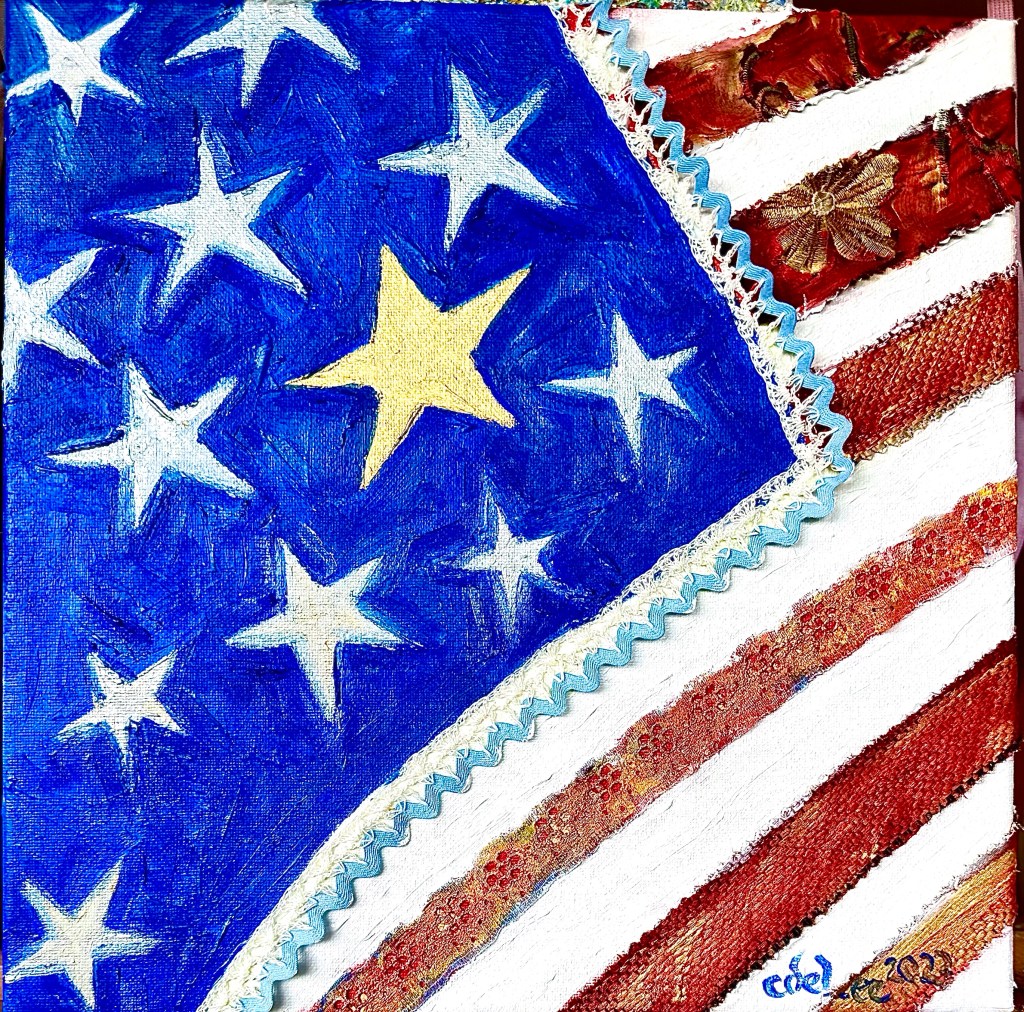
Cornelia DeLee: Gold Star Family Flag, acrylic with mixed media on canvas, 2023

I came home to finish up my painting with memories of visiting Civil War battlefields on my mind. I thought of those ancient days when families were able to identify their loved ones only by the special knit patterns of the socks on the bodies, or by the last letters to relatives pinned into their shirts. The Gold Star Mothers began during World War I when the mothers of fallen servicemen united to share their grief. By 1928, it was an official organization and the bereaved families were recognized with a pin.

Jasper Johns: Two Flags, lithograph, 1981, Phillips.

When I lived in San Antonio, I ocassionally visited the various military hospitals in town. There I saw the photos of the Medal of Honor recipients and read the summaries of their noble deeds. I always renewed my dedication to my less dangerous occupation afterward. Those who serve are a different breed from an ordinary person such as I. Perhaps Abraham Lincoln said it best in his 1863 Gettysburg Address:

“It is rather for us to be here dedicated to the great task remaining before us, that from these honored dead we take increased devotion to that cause for which they gave the last full measure of devotion, that we here highly resolve that these dead shall not have died in vain, that this nation, under God, shall have a new birth of freedom, and that government of the people, by the people, for the people, shall not perish from the earth.”

Gordon Parks, American Gothic, Washington, D.C., 1942.
Photo : Courtesy Gordon Parks Foundation

Amanda Gorman’s excellent 2021 inaugural poem, “The Hill We Climb,” has a section which echoes the sentiments of the post Civil War era, when Memorial Day celebrations first began:

We are striving to forge a union with purpose
To compose a country committed to all cultures, colors, characters and conditions of man
And so we lift our gazes not to what stands between us
but what stands before us
We close the divide because we know, to put our future first,
we must first put our differences aside
We lay down our arms
so we can reach out our arms
to one another
We seek harm to none and harmony for all
Let the globe, if nothing else, say this is true:
That even as we grieved, we grew
That even as we hurt, we hoped
That even as we tired, we tried
That we’ll forever be tied together, victorious
Not because we will never again know defeat
but because we will never again sow division
Scripture tells us to envision
that everyone shall sit under their own vine and fig tree
And no one shall make them afraid
If we’re to live up to our own time
Then victory won’t lie in the blade
But in all the bridges we’ve made
That is the promised glade
The hill we climb
If only we dare.

Howard Finster: Not Just A Piece Of Cloth, 1990

On this Memorial Day, over 150 years later, the wheels of justice are setting the sentences for the insurrectionists who attempted to impede the peaceful transfer of power to the newly elected government of the United States. We do well to remember the prescient words of Frederick Douglass, who said at Arlington National Cemetery on Memorial Day in 1871:

“We must never forget that victory to the rebellion meant death to the republic. We must never forget that the loyal soldiers who rest beneath this sod flung themselves between the nation and the nation’s destroyers.”

At 3:00 pm on Memorial Day, let’s pause for a moment and remember those who sacrificed body, mind, or life to keep our nation free, or to bring freedom to a nation that so desperately yearns for it.

Joy and Peace, and thanks to those who keep it for us,

Cornelia

United States, US Flag Code | FlagandBanner.com
https://www.flagandbanner.com/flags/united_states_flag_code.asp

The Origins of Memorial Day—US Department of Veterans Affairs
https://www.va.gov/opa/publications/celebrate/memday.pdf

Professor: Civil War Death Toll May Be Really Off : NPR
https://www.npr.org/2012/05/29/153937334/professor-civil-war-death-toll-may-be-really-off

United States – COVID-19 Overview – Johns Hopkins
https://coronavirus.jhu.edu/region/united-states

Veterans Affairs Fact Sheet America’s Wars 2019
https://www.va.gov/opa/publications/factsheets/fs_americas_wars.pdf

War, Medicine & Death – PMC
https://www.ncbi.nlm.nih.gov/pmc/articles/PMC9762220/

Gettysburg address delivered at Gettysburg Pa. Nov. 19th, 1863.| Library of Congress
https://www.loc.gov/resource/rbpe.24404500/?st=text

New Eyes, New Visions

art, Attitudes, cataracts, Faith, Healing, Health, Holy Spirit, Imagination, inspiration, Medical care, nature, Painting, renewal, Spirituality, trees, vision

This week as I recovered from cataract surgery, a memory from my childhood finally surfaced. In the late 1950’s in my hometown, I had met an artist who could barely see to paint anymore because of her vision loss due to cataracts. Doctors hadn’t yet invented the modern replacement lenses and use of small incisions for implantation. Complications back then were common, rather than rare. I can still remember my dad’s response to my desire for contact lens, “What? Put a foreign object in your eye? You’re asking for an infection!” Perhaps this was why I worried myself to exhaustion while waiting for my first surgery.

Unknown Artist: Inlay in the Form of an Eye, Glass and gypsum, Egypt

As it turns out, I can now see my television set without my glasses and I read my iPad with my untreated eye. I’ve always had my glasses within arm’s reach of my bed or my chair for over sixty years. It feels strange not to put them on first thing in the morning.

If there were things I could not see before, I could always feel them if I were still enough to notice their subtle movements. Most of the time I, as many others do, stress over what “might happen,” instead of being present to the moment in which the important stuff is actually happening.

Luke Howard: Graph of wind, rain, and temperatures from 1815-1832

After I worried myself into an exhausted heap on my couch, I woke up in a different mood. I realized I’d been going “from house to house” to borrow a cup of trouble for a cake I didn’t need to bake or eat. It was going to be a decadent cake with multiple layers and a. rich icing. If it were autumn, I’d probably get first prize in the cake competition at the state fair.

Wayne Thiebaud, Cakes, 1963

But no one needs a Trouble Cake. I saw all my ingredients were as nothing, for I had a great doctor, people who would care for me, and this was a new age in medicine. Moreover, the Spirit of God would sustain me in my recovery and remind me my wellbeing depends on following my doctor’s instructions. As we read in John 3:5-8 NRSV—

Jesus answered, “Very truly, I tell you, no one can enter the kingdom of God without being born of water and Spirit. What is born of the flesh is flesh, and what is born of the Spirit is spirit. Do not be astonished that I said to you, ‘You must be born from above.’ The wind blows where it chooses, and you hear the sound of it, but you do not know where it comes from or where it goes. So it is with everyone who is born of the Spirit.”

Sometimes we need to feel the wind and not try to know from whence it comes or why it goes, but merely thank it for arriving to be with us in this present moment.

Utagawa Hiroshige: Yokkaichi: Mie River, 1833-34

Who Has Seen the Wind? by Christina Rossetti

Who has seen the wind? Neither I nor you: But when the leaves hang trembling, The wind is passing through.

Who has seen the wind? Neither you nor I: But when the trees bow down their heads, The wind is passing by.

Sometimes we need a fresh wind blowing through our hearts and minds to get a new outlook on life. We can’t be wedded to the past like the old farmer who said of the new fangled plow he saw at the farm supply store, “My daddy plowed with a two pronged plow, so a two pronged plow is good enough for me.” He never bought the new and improved three pronged plow.

Bernard Evans: Cannock Chase – ‘When the sweet wind did gently kiss the trees, and they did make no noise’, circa 1885

Much like the church that can’t recognize the fresh movement of the Spirit moving through the world today, if we can’t feel that wind, maybe cataract surgery would help us see the movement in the leaves.

Joy and Peace,

Cornelia

NOTE: The Greek word for Spirit and wind are the same: πνεῦμά. Strong’s Greek Concordance 4151 pneúma – properly, spirit (Spirit), wind, or breath. The most frequent meaning (translation) of 4151 (pneúma) in the NT is “spirit” (“Spirit”). Only the context determines which sense(s) is meant. When used with Holy, the word is Holy Spirit, not holy breath!

Christina Rossetti: Who Has Seen The Wind? Source: The Golden Book of Poetry (1947). https://www.poetryfoundation.org/poems/43197/who-has-seen-the-wind

Utagawa Hiroshige: Yokkaichi: Mie River (Yokkaichi, Miegawa), from the series “Fifty-three Stations of the Tokaido (Tokaido gojusan tsugi no uchi),” also known as the Hoeido Tokaido, wood block print, 1833-34, Art Institute of Chicago.

Luke Howard: Graph detailing prevailing wind directions, rain depth, and mean temperature over a period of eighteen years, 1815-1832, in London. The Royal Society.

Bernard Evans: Cannock Chase – ‘When the sweet wind did gently kiss the trees, and they did make no noise’, circa 1885, watercolor. Art Gallery of New South Wales, Sidney, Australia.

Unknown Artist: Inlay in the Form of an Eye, Glass and gypsum, Egypt, (9/16 × 1 13/16 × 3/8 in.), 1540–1070 BCE, J. Paul Getty Museum, Los Angeles, CA.

Wayne Thiebaud, Cakes, 1963, National Gallery of Art, Washington D. C.

More Sunsets

art, Christmas, coronavirus, Creativity, Easter, Easter, Faith, grief, Healing, Health, Holy Spirit, incarnation, Medical care, Ministry, nature, Painting, poverty, Racism, renewal, risk, Stress, trees, vision, vision


How many of us get to admire the great creative exuberance of the divine palette strewn across the sky twice a day in our ordinary days? Most of us are too busy breakfast grabbing, caffeine swilling, clothes donning, and storming the door in a mad dash for the morning rush to work. Then we join the misnomered evening rush hour, which actually moves at a snail’s pace. We’re too busy watching the bumper in front of us on a highway to pay attention to the sky above us. If we’re guarding our goods on a subway, we can’t even see the light of day until we exit the bowels of the earth, but then we’ve got our eyes set on home, not on the sky above us.

Autumn Sunset

I wonder if this Age of Coronavirus has changed us in any way, since January 30, when the World Health Organization declared a public health emergency due to the novel coronavirus originating in Wuhan, China. It’s been about one hundred days since the World Health Organization and our everyday world has known about this pandemic plague, but cancelled sporting events and music festivals, working from home, and closed schools are now part of our daily life. The opening day for Major League Baseball heard no crack of bat against the ball and no hawkers in the stands shouting, “Peanuts, popcorn, crackerjack!” Even though the 2020 Olympic flame burns brightly in japan, the games won’t be held this summer due to the virulent virus and athletes won’t earn shining metals.

If today we haven’t these rituals of community as celebrations of our common humanity, we might feel a sense of loss, even grief. Yet we can find a daily reminder of hope, for the sun continues to rise in the morning and set in the evening. When the moon rises and the stars come out at night, we can see the rotation of the constellations according to the seasons of the year. Of course, we have to look up, and not down. We also have to look out beyond ourselves, and not just inside always. When we’re cooped up inside, doing #StayHomeStaySafe for our own good as well as for others, sometimes it’s difficult to look outward.

The Cup

When I was a child, my family didn’t have many art works in our home, but we always had a colorful nature calendar. My parents were always willing to hang my art in their home, an act I found encouraging. We also made weekend trips to hike in nature, ostensibly to “search for arrowheads,” but more often just to be outside. When I was in active ministry, I would go to nature when I was drained and needed to find the quiet place to restore my soul. There were times when I felt the demands of my superiors for more productivity and the nagging from my congregation about why I couldn’t be available all the time in the office as well as out visiting the home bound were more than I could handle, so I would close up shop and take a drive. I thought I might kill the next person who came in my office, but that’s not evidence of “going on to perfection,” so leaving was a better choice on my part.

I very often served in county seat towns, so I was never far from nature, but even in the city, I knew the location of the best parks. In art school, I even lived next to a park and in seminary I lived next to a creek. Now I live in a national park. I feel like I’ve achieved a life goal. My neighbor at the condo has cultivated quite an interior and patio garden in this Age of Coronavirus. I bought an orchid plant for my birthday, rather than cut flowers, since nursing a living plant seems more hopeful in this time of loss for so many people. My Christmas cactus even bloomed again for Holy Week, another sign of optimism amidst the panic shopping and empty shelves. If there’s enough life in my little plant to bloom out of season, then I trust God’s gift of providence to feed the hungry and care for us all, if we share with one another.

My Easter Blooming Christmas Cactus

Some people only see the sunsets on their vacations, but never any other time of the year. The sunset lasts less than five minutes, and the best colors are only momentarily part of this time. If we’re addicted to busyness, or filling every available moment of our time with productive activity, then we’ll be checking off our to do list and miss the magic of this moment. We could reframe our attitudes, however, and see our pause for the sunset as a time of blessing for the day. We can break for beauty, awe, and magnificence, and thank God for the whole of our day, the good, the bad, and the indifferent. After all, we’ve made it through another day, and the cycle will begin again, so we can entrust our night to God’s Care also. This is the meaning of providence.

Lake Sunset

I sometimes wonder if some are closed to creation and therefore closed to God’s love and grace. When I see the damage humanity has done to the earth and the creatures which live upon it, I wonder how much hate or ignorance can exist in people. This virus has exposed structural inequities and inequalities both in the victims and in their previous care. Two groups which are dying from covid-19 in greater proportions than normal are African Americans and men. For the first group, persons of color more often live in neighborhoods with higher pollution and less access to healthy food, plus they have more disease burden with less medical access. Men of all races and economic status have higher incidence of heart disease and smoking, plus they don’t fight inflammation as well due to their gene structure.

Perhaps this disease will take the blinders from our eyes, so we’ll begin to provide better medical care for our whole population, rather than think the coronavirus is just a means of “culling the herd.” That’s a hard hearted way to view a child of God’s creation, made from the dust of the earth, and breathed into life with the very Spirit of God. When I look at creation, the landscape or a sunset, I see the creating hand shaping me and you, and even these hard hearted yahoos, who have the survival of the fittest and wealthiest as their goal. I think somewhere within them is the image of God, even if they’re doing a great job of hiding it. Maybe they need to go in search of more sunsets or a forest. I know I was always a better person after a quiet time in the shade of a forest.

In N.Y.C., the Coronavirus Is Killing Men at Twice the Rate of Women
https://www.nytimes.com/2020/04/07/health/coronavirus-new-york-men.html?referringSource=articleShare

C.D.C. Releases Early Demographic Snapshot of Worst Coronavirus Cases
https://www.nytimes.com/2020/04/08/health/coronavirus-cdc-demographic-study-hospitalizations.html?referringSource=articleShare

Strawberry Mindfulness

art, garden, Healing, Medical care, Meditation, Mental Illness, Ministry, Painting, Prayer, renewal, Stress, Work

I read a wonderful journal, Psychiatric Times, which has a free subscription online. I began reading it because it helped me to understand the diseases of the mind, which cause people to be at dis-ease in their lives and to cause dis-ease in whatever community in which they belonged. In today’s modern world, our first choice to treat dis-ease is medication. However, the ancient practice of meditation is another choice, either as an adjunct treatment or as a stand alone, depending on the person’s need.

I recently read of some tech entrepreneurs who decided to shut off their phones, computers, and all other electronic devices for one day in every seven because they were over stimulated and never rested. Their creativity and original thinking were diminishing, and this was “hurting their brand.” Those of us in the spiritual world would say they needed to practice sabbath rest, and also to take time away on a daily basis also. If you feel “always on, 24/7/365,” you’ll wear down or burn down sooner or later. Even the Lord Jesus was given to finding secluded places to withdraw and restore his physical body and his spiritual energy. We often overlook these texts, in our rush to read the miracles and action of the salvation story.

Dr. John J. Miller, editor in chief of Psychiatric Times and founder of Brain Health, wrote this wonderful piece, which follows:

In our western culture, which values intellectual knowledge and material rewards, the concept of mindfulness is often initially difficult to grasp. Busy schedules, lengthy “to do” lists, commuting, work, family time, and group activities leave little time for self-reflection and inquiry into the nature of our minds.

In fact, all of these activities serve to keep us running on automatic pilot, and strengthen behavioral patterns previously learned that create efficiency when automatically enacted. An analogy I often use to explore the question of the potential benefits of practicing mindfulness is to ask which of the following two individuals is truly an expert on the experience of what a strawberry tastes like:

An individual who has studied the science of strawberries to the degree that he or she is considered to be the world’s expert—agriculture, botany, genetics, human taste receptors that send gustatory information that is decoded in the brain, digestion, visual responses to seeing a strawberry, and the author of over 100 books on all aspects of strawberries—but, has NEVER eaten a strawberry?

OR

An individual who is uneducated but has just paid close attention to all of the sensations and experiences of taking a fresh strawberry, looking at it, smelling it, placing it in his or her mouth, observing the taste and texture as he or she bites into it, and mindful of the plethora of the “here and now” strawberry experiences?

Bosch: The Garden of Earthly Delights

The answer is usually self-evident and conjures an image or feeling of the warm juice of a strawberry sloshing around in your mouth. Mindfulness is the practice of experiencing each moment like the strawberry.

Common mindfulness adventure
Broadly speaking, there are two subtypes of meditation: concentration and mindfulness. As a general principle, it is important to become proficient in concentration meditation before expanding into mindfulness. Concentration practice involves choosing an object, like the breath, a phrase, or a word that becomes an anchor for the mind’s attention.

The instructions are simple: watch the breath as it moves in and out of the body, choosing a spot to watch it that feels natural (the nose, mouth, lungs or movement of the abdomen). Inevitably, the mind’s attention will be distracted by some thought, feeling, sound, or emotion, and the mind starts to drift down an endless path of mind content. As soon as you are aware of having left the breath, without judging yourself, the task is simply to return to the breath. The same basic steps are followed if you are using a phrase or a word.

Here’s a common example:
awareness of the inbreath and the outbreath . . . inbreath and outbreath . . . inbreath and outbreath . . . you hear a car driving down your street, and your mind drifts to the thought of the car . . . my car . . . my car payment . . . bills to pay . . . do I have enough money saved to buy that new iPhone . . . images of the cool new camera on the iPhone 11 pro . . . wait a minute, I left my breath . . . inbreath and outbreath . . . inbreath and outbreath . . . inbreath and outbreath . . . the muscle in my left calf is starting to cramp up . . . I need to start stretching my muscles again . . . why did I stop stretching regularly . . . I should rejoin the gym . . . the last time I was at the gym I saw Tom . . . Tom was a great college roommate . . . college was such a great experience . . . maybe I’ll drive out there and take a walk on campus . . . college is so expensive these days . . . how will I pay for my child’s college tuition in a few years? . . . oh yeah, my breath . . . inbreath and outbreath . . . inbreath and outbreath . . . inbreath and outbreath . . . .

This is how much of the time practicing meditation is initially spent, and usually is so frustrating that most people stop meditating long before their attention is strengthened. With perseverance and practice the mind slowly develops the capacity to stay with the breath for extended periods of time. This commonly results in calmness, relaxation, mental clarity as well as an anti-fight or flight physiology.

Once the mind’s concentration has stability, that focused awareness can be intentionally refocused on the mind’s activity itself, and this is the beginning of mindfulness. A holding environment of sorts is created whereby impersonal and non-judgmental attention is watching the many mind states that come and go, the only task being to stay present and learn from what is observed with open acceptance. As mindfulness strengthens, the underlying themes and patterns that fill our mind automatically are seen clearer, and it becomes easier to disengage from them, remaining in the present moment with pure mindfulness. Like exercise, continued practice sustains the ability to be mindful, while lack of practice allows a regression to automatic patterns.

The practice of mindfulness
In our roles as clergy and clinicians, we recognize we always have more to learn, and more experience to be gained. Such is the case with mindfulness—it’s always patiently waiting for us to resume that selfless non-judgmental awareness of the present moment—with more to learn about the patterns and themes of our own mind, and continued opportunity to choose a different thought or behavior. As 2019 draws to an end, the practice of mindfulness is but a breath away, and is a worthy companion.

The Light of the Body: meditate on this verse

First century oil lamp

“No one after lighting a lamp puts it in a cellar, but on the lampstand so that those who enter may see the light. Your eye is the lamp of your body. If your eye is healthy, your whole body is full of light; but if it is not healthy, your body is full of darkness. Therefore consider whether the light in you is not darkness. If then your whole body is full of light, with no part of it in darkness, it will be as full of light as when a lamp gives you light with its rays.” ~~ Luke 11:33-36

https://www.psychiatrictimes.com/depression/mindfulness/page/0/1?rememberme=1&elq_mid=10101&elq_cid=1656322&GUID=95C4A97A-F3DF-48E9-82F6-955AEEB9B62B

Crossroads and Callings

art, Attitudes, Creativity, epilepsy, Faith, Food, grief, Habits, Healing, Health, Icons, Medical care, Mental Illness, ministry, purpose, purpose, renewal, salvation, Spirituality, stewardship, Stress, Uncategorized, vision, vision

img_9852

Road to Damascus

Nine years ago…how time flies when you’re having fun! I was at a crossroads in my life, however, with a preexisting health condition I’d managed to live with successfully through three high stress careers since 1977. Accumulated stress isn’t good for the body, so my seizure disorder began to make itself visible.

When my neurologist told me I’d never be able to do the work of a full time church pastor again, I had to revision and rehear my calling from God. If we define a role so strictly it’s a one way highway, it can become “my way or the highway.” This extreme dividing drives clergy and laity into producers and consumers, instead of encouraging shared ministry experiences.

If being a “source of all blessings for everyone” is a short term good for a pastor’s ego, it can also lead to a long term harm in health costs or emotional burnout. For the laity, losing the opportunity to live out their shared witness to the mighty acts of God in Jesus Christ means they don’t fulfill their roles as the priesthood of all believers.

ARTANDICON in 2009: Bravely Smiling

The basic teaching of “make disciples of all nations” doesn’t have much effectiveness if we first are not disciples ourselves. So the old saw is true, we may be saved by the grace of God, and not by our good works, but if we want to become learners or disciples, our spiritual life takes some work, just as doing good for others is a hands on job.

I count myself fortunate to have a creative and curious mind, for I’ve always been the child who asked, “Why,” or went, ”Oh, I need to look that up and learn more about it!” Learning for the test, only to forget it later, has never been my strong suit.

The system as a whole also interests me more than the individual parts (I confess this is my shortcoming in relationships, since I have a few deep friendships, many good friends, and lots of friendly folks I like, and many people I know. Not enough people to count on one hand to say I totally dislike, although some I’ve set boundaries for their presence in my life because of their addiction issues).

When I set my preconceived notions of my ordination aside, I listened for a new calling from God. If I couldn’t serve IN the church BUILDING , perhaps I could still serve in the church as the BODY OF CHRIST. The body of Christ exists everywhere, both within and without the edifice we call the sanctuary, for we come and go.

In fact, we have people without churches, people who believe in god, or who are merely spiritual, all around us. Most of us are too busy dealing with our own congregations to reach out to these people. They don’t need traditional stories or sermons. I started a science fiction journal on faith.

Why not? Who else is doing it? Will it make money? Who cares? Do I get feedback? Not often. If we’re in this for the affirmation from human beings, we’re worshiping a false god. Idolatry. I can say things like this and not worry about ruffling the big givers. The taste of freedom is sweet.

Of course, I said this type of thing anyhow my entire ministry career, so I moved a lot, but the churches had good stewardship while I was there and repaired all their unmet facility needs. I left it better than I found it because the people came together to make it happen.

In the solitude of your own studio, writing room, or hangout, there’s no people to gather together to make it happen. A person only has the thoughts of what once was, what has been lost, and what will never be again. It’s the first stage of grief, a shock. It can turn into despair or depression, for everything is overwhelming.

Medication, or “better living through chemistry” can help lift the brain fog so a person can get their ducks in a row. This is no easy task, if you’ve ever tried to herd ducks. Worse than herding cats. Ducks will turn around and peck you. Trust me on this. Childhood memory.

Some people think a prescription is a faith cop out, since they should trust God’s grace alone to sustain them in a difficult time. I think God’s providing grace gave us the knowledge to create the medicine to help us heal our bodies. God can heal by ordinary means, such as health providers or medicines; or extraordinary means, such as miracles. More often God’s working in the ordinary, or we wouldn’t use the exclamation point after miracle!

I also returned to my art, for I find painting the holy icons and natural landscapes both bring me closer to God. As I got more used to being on the computer, I taught myself how to set up WordPress blogs and Facebook Pages for my special interests in health, spirituality, and art. Actually all of these get combined together, because of “systems thinking,” since we can’t lop off art from spirituality, or health from cooking, or any other combination thereabouts.

img_4942.jpg

Antique Aluminum Jello Mold

Now nine years later, I’m in a good place, enjoying my new callings, and in much better health. I will always have my condition, but my condition does not have me. Of course, I have to maintain a disciplined lifestyle, unlike the rest of the world, which runs at pellmell pace until it runs out of gas and crashes. But of course, you wouldn’t do that—you have too much good sense for that, I’m sure.

Joy and Peace, Cornelia

A FATAL DISEASE 

at risk kids, Children, Faith, Family, generosity, Healing, Health, incarnation, Love, Medical care, Ministry, poverty, purpose, Reflection, renewal, Spirituality, stewardship, vision, vision

“The biggest disease today is not leprosy or tuberculosis, but rather the feeling of being unwanted, uncared for, and deserted by everybody. The greatest evil is the lack of love and charity, the terrible indifference towards one’s neighbor…” 
~~ St. Theresa (Mother Theresa)

The biggest disease today isn’t covered by any medical plan–it is the lack of concern for the weak and vulnerable among us. The only medicine for this is a change of heart, so we begin to consider the needs of the poor, the disabled, and the ill as equal to the healthy, the rich, and those who can work. 

This medicine is a living faith, not a dead assent to beliefs! Can we look on the face of our brothers and sisters and see the face of God!?! Can we see the wounds of Christ needing to be healed!?! If we see only the money and the tax ramifications of the plans currently proposed by congress, we have a dead faith, for we aren’t working to care for the “least of these, my brothers and sisters, who are the Christ” we meet daily as we go about our journey. 

If our Sunday words are only for ourselves and not for the world also, if our Sunday words are only for our lives and not for the lives of others, and if our Sunday words are only for our lives, but don’t translate to our politics, we cannot say that we are living a fully Christian life. 

What is the medicine for this? Repentance and restitution. We must make a change in the way we live, the way we think, and in all the ways we act: our uses of money, our treatment of people, and our lifestyle choices. All must be governed by God’s all encompassing love. If God’s love flows into our hearts, let this same generous love flow out unimpeded. 

“Love one another, as I have loved you.” –John 15:12