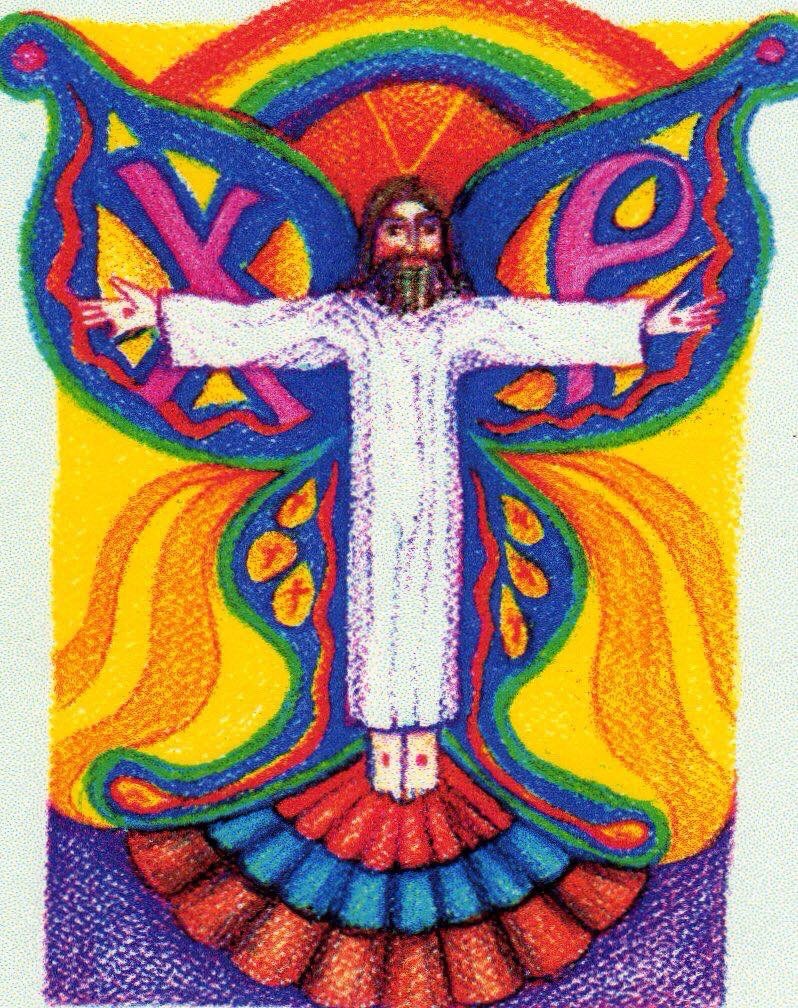
Never surrender!

Altars, art, Carl Jung, Creativity, crucifixion, Easter, Easter, Faith, Garden of Gethsemane, Good Friday, Healing, Holy Spirit, Holy Thursday, incarnation, inspiration, Ministry, Painting, suffering

“Never give up! Never surrender!”

This is my favorite quote from the 1999 sci-fi parody film Galaxy Quest. As a fan of Star Trek, I love the heroics of the storylines and the movie’s devoted fans. What sets this spoof story apart is how an alien culture has modeled its entire identity on the “historical documents,” or the weekly tv series videos. The aliens arrive on earth and spirit away the crew to fight against their enemies. The actors protest, but discover their true selves through this challenging situation. They not only play heroes, but they become heroes. They have to surrender to their former false selves to become the best and the truest of who others have known them to be.

We are not a people who believe in surrender. If our back is against the wall, our inclination is to fight all the more. Most of us believe in climbing upwards, not in moving downward. Taking a lateral move is just as bad as a demotion for most people’s egos. If you talk to any clergy person during appointment season, many are hoping for a church with a bigger steeple. While if you talk to their congregations, they’re hoping for preachers who wants to stay for a while. Obviously between moving and staying, someone is going to be disappointed. Someone will need to surrender to a greater plan.

I remember in my early days I got my nose bent out of shape because my church asked for a new pastor. My bishop at the time was frank with me: “I don’t have anyone to send here. You need to suck up your feelings and make sure this church is ready for next year!” Elders vow to be ready to pray, preach, move, or die at a moment’s notice in the United Methodist Church. We also vow to stay if necessary. I didn’t want to surrender to my bishop’s authority, but I decided to make sure when appointment season rolled around again, she could send any average pastor in my place.

I also knew other experienced clergy had thought I’d been “over appointed” straight out of seminary. They had told my superintendent they “deserved that appointment” where I was. My answer was often on some days, “I’ll trade you straight across, no question.” Those were the suffering days, but then would come the days of joy and grace, and I’d forget my rash willingness to hand over my charge to another sight unseen. I was truly glad for the nearby presence of an older, more experienced clergy person who would buy me a coffee and doughnut. He helped me keep the perspective of the long view, rather than the immediate moment.

DeLee: The Cross Upsets Earthly Powers

In this Holy Week—the time between joys of Palm Sunday and Easter Sunday—we find the events of Holy Thursday’s foot washing, Good Friday’s Crucifixion, Holy Saturday’s Vigil, and Easter Sunday’s Resurrection. In between Thursday and Friday, we find the stories of Jesus praying in the Garden of Gethsemane, Peter’s denials, and other tales of suffering.

Modern folks don’t usually like suffering. We want to treat a slight cold virus with an antibiotic, even though antibiotics only work against bacterial infections. All we end up doing is causing more suffering by creating antibiotic resistance. In worship services, “to save time,” we omit the third verse of the old hymns, which most often contain the sacrifice and blood of Jesus on the cross. People who visit churches on the Sundays during Holy Week go from the Palms proclamation of Jesus as messiah to the risen Christ on Easter. They avoid all the turmoil, suffering and drama of the week in between.

Tim: three crosses at sunset

In real life, because we avoid dealing with our dark sides and personal brokenness, we often project those same bad qualities onto others, which we then “other and marginalize.” All the “isms” of the world have scapegoats that represent their own dark side. The work of “identifying and accepting one’s shadow” is the process of assimilating “the thing a person has no wish to be” [Collected Works of Carl Jung: CW16, para 470].

Jung saw quite clearly that failure to recognize, acknowledge and deal with shadow elements is often the root of problems between individuals and within groups and organizations. It is also what fuels prejudice between minority groups or countries and can spark off anything between an interpersonal row and a major war. This certainly speaks to the time in which we now live.

Post surgery photo: still groggy

I recently had anterior cervical fusion surgery on my neck due to a herniated disc that was causing numbness in my arm and fingers. It also was causing pain, but I wasn’t aware of how much pain I was experiencing. The story of boiling a frog by gradually turning up the water it’s in is true. If your pain gradually increases by fractions, you think it’s just a 3 on the 10-point scale. However, I was having difficulty doing my ordinary work, exercising, and making decisions. Writing, which was once easy, became a chore. A concrete brain full of pain signals effectively blocked my ability to think creatively. I was trying to think through a sludge of cold molasses.

My scar is healing nicely 25 days post surgery.

The good news is after surgery I have my former brain back, such as it was. I also have a set of plates and screws in my neck, so I hope I don’t set off the TSA scanners in the airport the next time I fly somewhere. I also have a scar on my neck, so I guess I’ll trade in my Wonder Woman costume for a pirate costume for Halloween. At least I’ll have an authentic scar for the day.

Mike: suffering heart pierced by cross

The prophet Isaiah reminds us Jesus is the suffering servant,

“He was despised and rejected by others; a man of suffering and acquainted with infirmity; and as one from whom others hide their faces he was despised, and we held him of no account. Surely he has borne our infirmities and carried our diseases; yet we accounted him stricken, struck down by God, and afflicted. But he was wounded for our transgressions, crushed for our iniquities; upon him was the punishment that made us whole, and by his bruises we are healed.” (53:3-5)

The Jewish people hoped for a messiah king, who would be a warrior hero in the style of King David. They hoped to restore the independence of Israel as a nation faithful to God and free from outside rule. Jesus was an unlikely messiah, as Paul tells us in 1 Corinthians 21:22-24–

“For Jews demand signs and Greeks desire wisdom, but we proclaim Christ crucified, a stumbling block to Jews and foolishness to Gentiles, but to those who are the called, both Jews and Greeks, Christ the power of God and the wisdom of God.”

Even today this apparent weakness in the face of power is a message popular society doesn’t grasp. Even the people closest to Jesus, the early disciples first sought power and status in the coming kingdom, until Jesus disabused them of that notion and said,

“Truly I tell you, unless you change and become like children, you will never enter the kingdom of heaven. Whoever becomes humble like this child is the greatest in the kingdom of heaven.” (Matthew 18:3-4)

Olive Tree from Gethsemane

The best example of suffering in Holy Week is Jesus praying in the Garden of Gethsemane. There under the twisted trunks of olive trees, Jesus wrestled with his will and his mission. Being fully human, he would not choose to die on the cross. Being fully divine, he could only fulfill his Father’s purpose. Perhaps in this struggle he thought back to his wilderness experience before he set off to preach good news to the poor and release to the captives:

“Again, the devil took him to a very high mountain and showed him all the kingdoms of the world and their splendor; and he said to him, “All these I will give you, if you will fall down and worship me.” Jesus said to him, “Away with you, Satan! for it is written, ‘Worship the Lord your God, and serve only him.’” Then the devil left him, and suddenly angels came and waited on him.” (Matthew 4:8-11)

Gail W: watercolor of Palm Sunday

Our temptations come in many forms, but mostly we can sort them into three general categories: money, sex, and power. I personally think power is the overriding category and the others are mere subsets. Anything that knocks us off kilter or disrupts our sense of security is a threat to our feeling of power and control. This is likely why Palm Sunday and Easter Sunday are popular attendance days, while Good Friday doesn’t seem very “good” to the average person’s mind.

Matthias Grünewald, Isenheim Altarpiece (closed), c. 1512–16, oil and tempera on limewood panels, 376 x 668 cm (Unterlinden Museum, Colmar, France; formerly in a monastery hospital treating skin diseases).

As the apostle Paul wrote to the Philippians (2:5-11):

“Let the same mind be in you that was in Christ Jesus, who, though he was in the form of God, did not regard equality with God as something to be exploited, but emptied himself, taking the form of a slave, being born in human likeness. And being found in human form, he humbled himself and became obedient to the point of death—even death on a cross. Therefore God also highly exalted him and gave him the name that is above every name, so that at the name of Jesus every knee should bend, in heaven and on earth and under the earth, and every tongue should confess that Jesus Christ is Lord, to the glory of God the Father.”

Grunewald: Isenheim Altarpiece, 1512-1515, Resurrection of Christ—part of the same altar.

May your Easter season be blessed and you find ways to meet Christ in the poor among us,

Cornelia


Can Antibiotics Treat My Cold

https://www.webmd.com/cold-and-flu/antibiotics-colds

The Jungian Shadow – Society of Analytical Psychology


Creating a Picasso Still Life

art, brain plasticity, Cezanne, change, Creativity, Habits, Healing, Imagination, inspiration, Painting, perspective, picasso, purpose, renewal, Spirituality, vision, war

Einstein never said, “If we do the same thing every time, but expect a different result, this is the definition of insanity.” So why do artists return over and over to the still life? For that matter, why do preachers repeatedly use the same scripture texts for their sermons? Some of my former congregation members might have said I was overly fond of certain verses. The scalawags among them might have thought I did not get my point across the first five times I preached a version of the sermon text. As Jesus was wont to say in Luke 14:34-35 about Salt:

Picasso: Self Portrait, 1907, oil on canvas, National Gallery of Prague

“Salt is good; but if salt has lost its taste,

how can its saltiness be restored?

It is fit neither for the soil nor for the manure pile;

they throw it away.

Let anyone with ears to hear listen!”

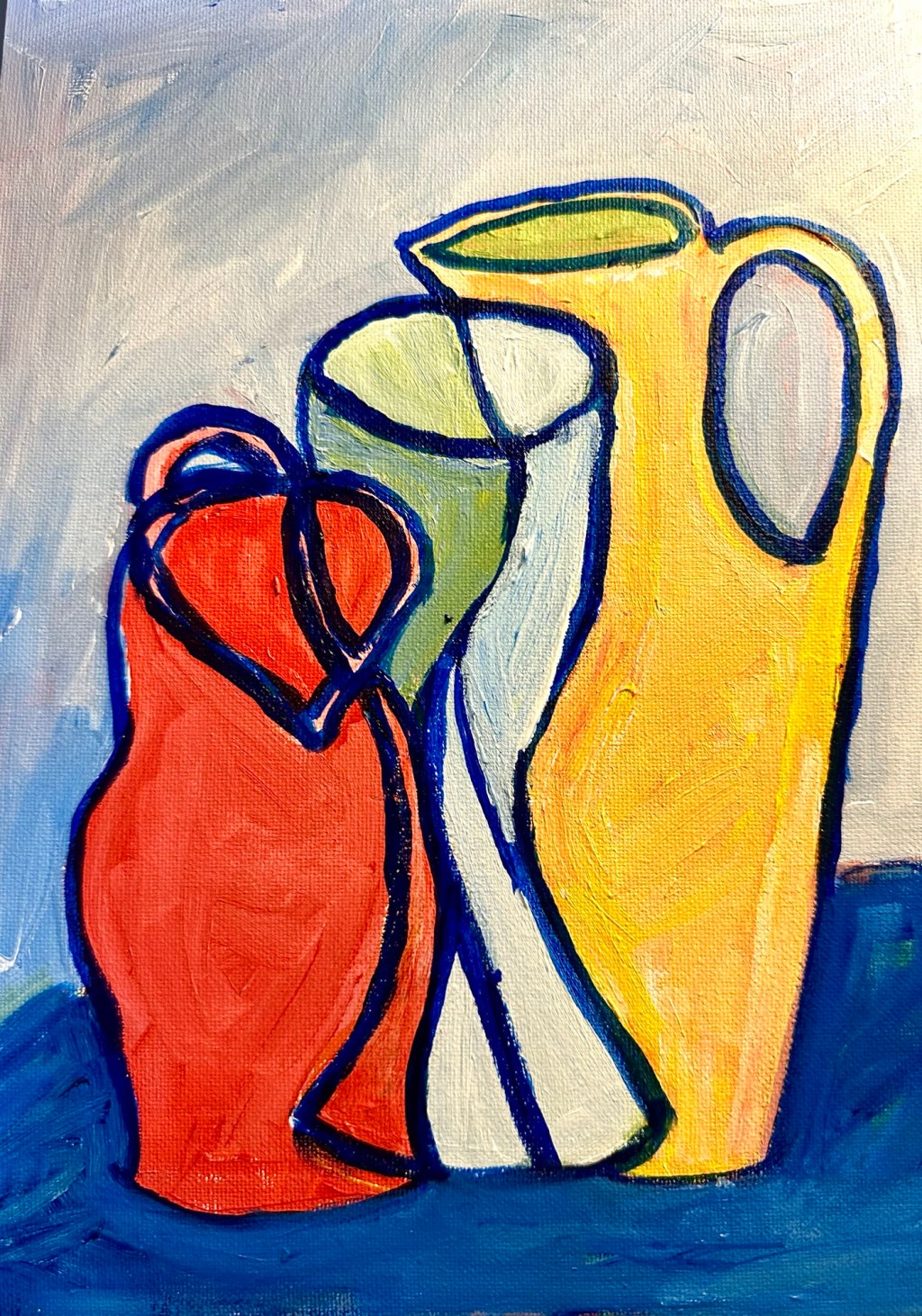
Three Sacramental Vessels

I always kept my sermon notes just in case I had a difficult week and might need a backup sermon, but I never used these notes. I wrote each of those sermons for a time and a place, but they were never useful for the current time or the present location. Likewise, an artist brings their emotions and experiences of the present time to each working session in the studio. Sometimes an artist is chock full of energy and power, full of joy and life. Their paintings or works exude these same emotions. At other times, the cares and chaos of the world intrude into the otherwise peaceful precincts of the artist’s workplace. These emotions and troubles will also be visible in their work, for artists are in tune with their times.

Picasso: Still Life with Dead Pigeon, oil on canvas, 1941, Nagasaki Prefectural Art Museum

This year in the adult art class I’m teaching at Oaklawn UMC, the students are getting lessons not only on how to paint, but on awakening their individual creative voice. These lessons are part art history and part “thinking like an artist” by painting in another artist’s style. The week before, we worked on a typical still life painting. For this session, we worked on what we saw in front of us, but tried to make an emotional connection with the objects. When most of our energy is going to getting proportions in proper order, shadows cast in the right direction, following the shape of the objects, and the colors correct, putting our emotions into the work comes in a distant fifth or last.

Morandi still life: he painted the same vessels so often, they became as friends who shared their innermost secret thoughts with him.

To be sure, our class is still analyzing the containers as physical objects more than feeling or experiencing the vessels as objects with personality. We have not yet become friends with the objects, or really gotten to know them on a deep and intimate level. This is also a problem in our society today. We are not willing to know others too deeply, and we aren’t likely to let many others know us too deeply either.

Gail S in the first week: realism

This isn’t a problem confined to older people. For my own demographic, meeting new people seems a mite risky these days in the online world because we never know who is behind that chatbot or Facebook account who seems so charming. For younger people, who sometimes never seem to come up for air from the online world, this online reality can seem more real than the three-dimensional world in which we live. (I was today old years when I learned the latest online AI fad is personalizing your own chatbot companion. I wonder if these chatbots have Asimov’s 3 Laws of Robotics ingrained in their program guardrails.)

Gail W in the first week: realism

Having empathy with inanimate objects is difficult. Artists bring into their own studio the objects which interest them. A teacher brings in objects her students can approach, given their skill level. I will blow that concept out of the water this Friday with some crazy Halloween pumpkins but, if the subject matter is consistently too difficult, many students will give up if the challenge is too far out of reach.

Picasso Still Life, oil on canvas, 1937, private collection.

In the second session when our class saw these same liturgical vessels, we chatted about Picasso and cubism. Cubism had several different forms of expression, but we focused on synthetic cubism, a later phase of the cubist style dating from about 1912 to 1914. It had simpler shapes and brighter colors. Synthetic cubist works also often include collaged real elements such as newspapers and cardboard. These works have interesting designs, such as multiple points of view (perspective), overlapping shapes which make their own patterns, and linear outlines. This style is an outgrowth of the work of Cézanne, who said: “A work of art which did not begin in emotion is not art.”

Gail S. took a cubist vision to our same three pots

If you’ve ever tried to put on your socks in the morning beginning with a different foot than normal, you can begin to appreciate how difficult it is to imagine how to create an artwork in a fresh style. If we were to ever have a stroke or a traumatic brain injury, relearning how to do simple tasks is much the same.

Tim’s first effort. He was one week out from surgery. His body was devoted to recovery, not to thinking about cubism.

Our brains can handle the rebuilding project, but we will feel strange doing it! This is because we are building new neural circuits and pathways in our brains. Going to work or the grocery store by taking a different route also feels strange, as does a golfer trying to reconstruct their swing pattern.

Tim took a second week to elaborate on his still life. It’s a better solution! Amazing what happens when our bodies have extra energy to give to creative projects.

As a comparison, we can look at the great hurricane which came through North Carolina recently and took out the big interstate highway that runs through the mountains and valleys. The sooner the highway construction engineers can come inspect the ground, the better. They must decide if the land is safe for rebuilding and then check the infrastructure also. They may need to redesign the road to current standards and also the underlying roadbed. When the great 1900 hurricane hit Galveston, rebuilding the city took twelve years. People were still living there, and life was going on, but the city began a process of raising the land levels and building a sea wall that took that extensive time.

Cornelia’s overlapping shapes and shifting perspectives

Change doesn’t happen overnight. Every sales or leadership training session I’ve been in has emphasized the idea “Three weeks are necessary to build a habit.” The origin of this myth has nothing to do with habit formation. Instead it comes from a 1960 self-help book Psycho-Cybernetics, in which plastic surgeon Maxwell Maltz wrote how his patients took about 21 days to become used to their new appearance after surgery.

He did no double blind, peer reviewed study to verify this, but his book applied this 21-day timeline to many other wide-ranging aspects of self-transformation in life. He also believed three weeks was the time people needed to adapt to a new house or change their mind about their beliefs. (He also didn’t live with a preteen girl child who enjoyed rearranging the living room every night just to see how her mom negotiated a new obstacle pattern in the dark when she came home from a sales call.)

If artists want to make paintings which are technically proficient and resemble the objects they see, they are only halfway to creating a good painting. They must also bring who they are and allow the voice of God to speak through their hand to make a masterpiece. In this way we separate artists into the good and the great, the ordinary and the masters. Not all of us will be prophets who listen to God’s word, but all of us can and should silence our hearts and minds of the world’s chatter and claims so the word of God can pierce our hearts.

Picasso: Guernica, 1937, 11’ x 25.5’,
Museo Nacional Centro de Arte Reina Sofía (MNCARS), Madrid, Spain

Rabbi Nahum Ward-Lev describes how the ancient prophets listened for God’s liberating word: 

“At its heart, the prophetic witness was a way of listening, listening beyond the social norms of the day, listening to the word of the liberating God. The prophets urged the people to listen to God’s word because the discourse of the king, princes, and wealthy landowners was too narrow and was limited to the interests of these elites. This conversation did not include the voices of suffering people. The prophets, in God’s name, offered a much broader discourse, a conversation that listened to and addressed the needs of the poor and the disadvantaged….

The prophetic listening tradition is alive today to inspire people to listen beyond the established conversation. The prophetic tradition challenges us to listen especially to the cries of those who suffer and to listen to the voice of alternative possibility, to the voice of God.”

Picasso: Still Life—fruits and pitcher, oil and enamel on canvas, 10 3/4 x 16 1/8 inches, Guggenheim Art Museum, NYC.

Making a painting is quite different from making a work of art. This is why house painters aren’t called artists. They may cover a surface with color and not make a mess, but their heart and soul isn’t in their work. Learning to risk our vulnerability and emotional expression is also part of art class, just as much as learning what colors to mix to make orange or green. Picasso, quoted in Alfred H. Barr Jr.’s Picasso: Fifty Years of his Art (1946), understood this:

“The artist is a receptacle for emotions that come from all over the place: from the sky, from the earth, from a scrap of paper, from a passing shape, from a spider’s web.”

We have these same experiences also, but we don’t realize these are part of the artist’s toolbox. These ordinary moments of life are also the extraordinary means of God speaking to us, if only we have ears to hear and a heart and hands ready to be used by God for God’s good purposes.

Joy, peace, and prophecy,

Cornelia


Quote Origin: Insanity Is Doing the Same Thing Over and Over Again and Expecting Different Results—Quote Investigator®. The origin of the quote is misattributed to Albert Einstein, but it originated in the 12-Step Anonymous groups in the 1980’s.

https://quoteinvestigator.com/2017/03/23/same/

Isaac Asimov’s “Three Laws of Robotics”:

  1. A robot may not injure a human being or, through inaction, allow a human being to come to harm.
  2. A robot must obey orders given it by human beings except where such orders would conflict with the First Law.
  3. A robot must protect its own existence as long as such protection does not conflict with the First or Second Law.

https://webhome.auburn.edu/~vestmon/robotics.html#:~:text=A%20robot%20may%20not

How Long Does It Really Take to Form a Habit? | Scientific American

https://www.scientificamerican.com/article/how-long-does-it-really-take-to-form-a-habit/

Nahum Ward-Lev, The Liberating Path of the Hebrew Prophets: Then and Now (Maryknoll, NY: Orbis Books, 2019), 133, 134, 135–136.                         

https://cac.org/daily-meditations/living-presence-liberating-journey/

 Meet My AI Friends, by Kevin Roose, NYTimes gift article

https://www.nytimes.com/2024/05/09/technology/meet-my-ai-friends.html?unlocked_article_code=1.Uk4.9sLW.VYS9bW4dc3ib&smid=nytcore-ios-share&referringSource=articleShare

Pablo Picasso – Oxford Reference
https://www.oxfordreference.com/display/10.1093/acref/9780191826719.001.0001/q-oro-


The Creating God

art, Attitudes, change, Creativity, Evangelism, Faith, garden, Healing, Holy Spirit, hope, Imagination, incarnation, inspiration, john wesley, Light of the World, Ministry, Painting, purpose, Reflection, renewal, shadows, Spirituality, vision, Work

In the dead heat of summer, our gardens aren’t putting forth the fruit of our planting. Maybe the animals of our neighborhood have made their too frequent nightly visitations, so our harvest is skimpy. We can forget God is a both a creating god and a recreating god as well. The first words of the alternate NRSV translation of the Bible’s first book Genesis (a word meaning “origin”) are—

First stage: string, fabric scraps, and under painting

 “When God began to create…”

In the old KJV, Genesis 1:1 readsIn the beginning, God created the heaven and the earth.”

I appreciate even more the next verse from Genesis 1:2—

“The earth was a formless void and darkness covered the face of the deep, while a wind from God swept over the face of the waters.”

Alternate translations read— “while the spirit of God or while a mighty wind” swept over the face of the waters. This reminds us nothingness and darkness aren’t problems for God, who is able to bring glorious light to any situation.

Psalms 139:12 speaks of the nature of God:

“Even the darkness is not dark to you; the night is as bright as the day, for darkness is as light to you.”

I’ve lived for over half a century with chronic depression, so I can recognize darkness, not only in my own life, but also in the lives of others. Most of my ministry and even my secular work was done with a calling to bring others to the light of hope and confidence that anything was possible.

In art classes, I asked my students to trust in ABC—Attitude, Behavior, and Consequences. If they had a Positive Attitude, they would have Positive Behavior and work on their assignments. If they worked, they would see Positive Consequences or Improvement over time. Asking people who’ve been told they can’t do art to believe they can learn even if they aren’t “talented” is a big ask, but if they have faith in this promise, they discover it’s true.

When I sold insurance, I asked people to trust in the idea of making a small sacrifice now to prevent a greater loss later. Also, if they had no loss, they shared in a community to underwrite the group losses and keep the cost of protecting their own property low. Not everyone has the light to see this benefit of community, but for those who do, I could help keep their consequences from being a disaster.

Second stage: overpainting, printed circles, and added ruler lines

When I entered the ministry, I discovered congregations who had lost their faith in the God who could make something out of nothing This began with the creation story, the choosing of the nation of Israel to be God’s people (even though they were once no one’s people), and feeding them in the extended wilderness wandering before they arrived at the promised land. The Bible is full of examples of God’s providing more when people have too little to sustain them: Elijah and the widow of Zarephath, the feeding of the crowds with a few fish and loaves, and the water turned into wine. These modern people didn’t have a “recreating faith” that God could work in their lives today, just as God had once worked in the lives of others in the days of Christ.

That is what we call a “dead faith,” or as John Wesley put it in his notes on the New Testament at 2 Timothy 3:5— “An appearance of godliness, but not regarding, nay, even denying and blaspheming, the inward power and reality of it.”

It’s dead, because the Spirit isn’t at work in it. I used to tell my beloved evangelism professor, the late Dr. Billy Abraham, the first place we needed to do evangelism was in the local church, because folks hadn’t heard the good news. If they weren’t excited enough to have a living faith, they wouldn’t go out and spread the good news to others.

I’ve never been a cheerleader, although I did have some time in my high school pep squad. I was more often involved in making the football banners and pep posters for the other sports activities. Also debate team took up much of my time. One of the best practices I learned in debate was positive points sell better than negative ones. Also, it’s better to make the same point over and over with different facts and examples.

When I say our God is a creating and recreating God, I can point to the beautiful verses of John 1:1-5—

“In the beginning was the Word, and the Word was with God, and the Word was God. He was in the beginning with God. All things came into being through him, and without him not one thing came into being. What has come into being in him was life, and the life was the light of all people. The light shines in the darkness, and the darkness did not overcome it.”

In the beginning was the Word

 As believers in the Holy Trinity, the Word made flesh is Christ, so he was co-creating with God the Father and God the Holy Spirit from the beginning. By virtue of the incarnation, Christ takes on our flesh to redeem us and make us whole again. This comes to completion through the cross. When we place our faith in Christ’s act of love for all creation, we are made one with Christ, and one with God. The Holy Spirit brings us ever closer to the true nature of Christ, until we’re perfected in love of God and neighbor.

I painted on unprimed canvas, just to see what would happen. Also, because I knew the paint surface would be different than the usual texture on the primed canvas. After I painted several different colors in blocks with the scrap pieces of cut canvas used as “masking tape,” I decided to use a mix of iridescent gold and silver acrylic paints to glaze over the under painting. I also added some circles and straight lines. I’ve collected a few jar tops recently, I used some string elements, and I had a school ruler left from my last teaching job back in the 1980’s. (Yes, I keep things. They are tools of the trade. My Sears Craftsman staple gun from art school finally died after half a century of use.)

I’ll be working some more of these experiments for a while. Creating and recreating our lives is what keeps us new every morning. As someone who has been renewed and recreated more than one time can attest, along with the prophet Jeremiah,

“For surely I know the plans I have for you, says the LORD, plans for your welfare and not for harm, to give you a future with hope.” (29:11)

Joy and peace,

Cornelia


John Wesley’s Notes on The New Testament, 1755:

2 Timothy 3:5—“holding to the outward form of godliness but denying its power. Avoid them!”

Time Travel and Iconography Experiments

adult learning, art, Creativity, Faith, Hagia Sophia, Holy Spirit, hope, Icons, Imagination, inspiration, Leonardo da Vinci, Medical care, Painting, Pantocrator, renewal, Spirituality, Turkey, vision

Every once in a while, I like to go on journeys. Sometimes they’re actual trips, such as my recent vacation over spring break to visit family down in Texas, but other times I like to “time travel.” The best way to time travel today, since I don’t have access to a DeLorean, is to study history. Buckle your seatbelts, we’re in for a ride through Christian and art history.

Right before spring break, our art class tried some experimental techniques with chalk, watercolor pencils, and pan watercolor with brushes. I also brought some images from the beautiful church of Hagia Sophia of the ancient capital of Constantinople, which I brought home from a pilgrimage I made several years ago.

The church was sponsored by the first Christian emperor Constantine, so it has exceptional mosaics and frescoes decorating all its surfaces. We each chose an image to use as a starting off place and went from there. Inspiration comes not only from what we see, but from the materials we use. Combining new images with new materials can bring new directions.

Desis Icon, Hagia Sophia, Constantinople, Turkey

Our primary images were the archangel Michael, the enthroned Christ, the decorative jewel designs, and the cross. All of these designs figure in prominence in Hagia Sophia or the Basilica of Holy Wisdom, the primary seat of Christianity in the Eastern Church during the Byzantine era.

Unknown Artist: Moschophoros, The Calf Bearer, 165 cm high, Limestone, 570-560 BCE, Acropolis Museum, Athens, Greece.

Early Christian art took its themes from contemporary Greco-Roman subject matter, but repurposed it for its own religious significance.


The Good Shepherd, the Catacomb of Priscilla, Rome, Italy, 250–300 CE, adopts the standard form of Apollo statues.

The archangel Michael was connected in the 4th CE with Constantine as a divine messenger and intermediary between heaven and earth. Michael was not only the guardian angel of the nation of Israel, but other nations have adopted his protection also. In this same century one of the doctors of the early church, St. Basil of Caesarea, known as “the Great,” said:

“Beside each believer stands an angel as protector and shepherd, leading him to life.”

Constantine felt the presence of the mediating angelic hand in his vision of the cross in the sky at the Milvian Bridge, at his baptism, and in his role as Emperor of the Eastern Christian Empire. Constantine was actually baptized twice: once to cure him from leprosy and again on his death bed. In the early days of Christianity, various sects prevailed and the doctrine of one baptism as sufficient for all times hadn’t yet taken hold. After all, it’s not the water, the place, the church, the location, or the priest that makes a baptism effective, but the work of God through the Holy Spirit. As Ephesians 4:4-6 says,

“There is one body and one Spirit, just as you were called to the one hope of your calling, one Lord, one faith, one baptism, one God and Father of all, who is above all and through all and in all.”

Constantine’s Vision of the Cross: Bibliothèque nationale de France, Illustrated painted parchment Greek manuscript (879-883 AD) of the homilies of Gregory of Nazianzus in the Bibliothèque nationale de France.
(BnF MS grec 510) folio 440r.
https://gallica.bnf.fr/ark:/12148/btv1b84522082/f891

Constantine’s first cross apparition took place at the beginning of his military campaign in Italy. The young emperor realized that the tyrant Maxentius, who controlled Rome at that time, had set a trap at the Milvian Bridge over the Tiber. Fearing his rival’s machinations, Constantine had sought the aid of the God worshiped by his father, Constantius Chlorus (r. 305–6). While he marched on to a field together with his troops, he saw the sign of the cross revealed in the afternoon sky, shinning brighter that the sun, alongside an exhortation inscribed “by means of a starry form: By this you shall conquer, Constantine!”

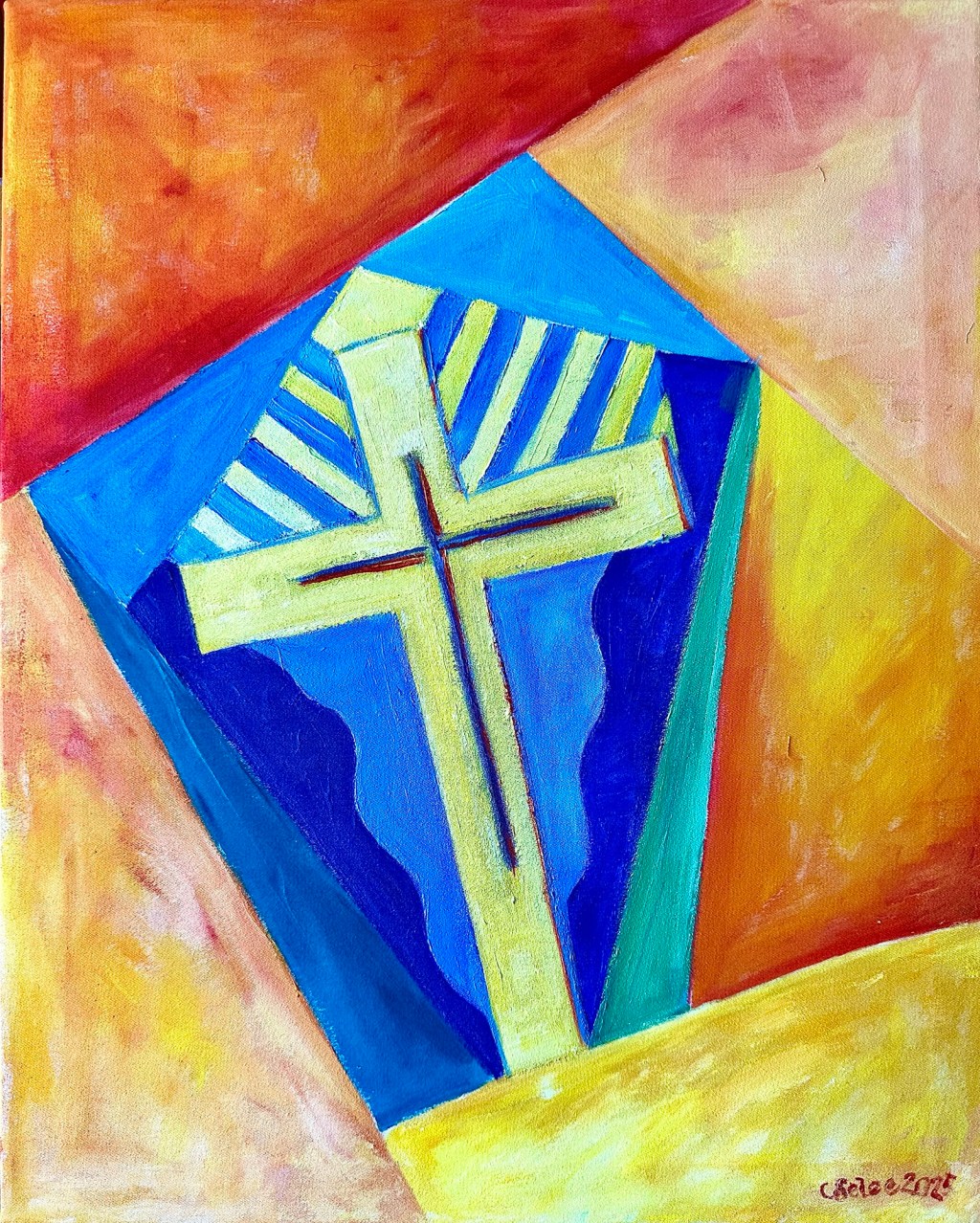
Mike’s Cross Painting

Note the use of common materials in Mike’s work. The circle is the same size as a foam plate, the cross from the table decorations fits just inside it, and he embellished the outer and inner spaces with a bilateral and balanced design. He’s getting more skilled to “eyeball those proportions” from across the room. Plus, he enjoys making these designs.

The ancient writers Eusebius and Euthymios both mention the emperor’s troops also witnessed this miracle. The significance of the vision was subsequently clarified by Christ, who appeared to Constantine in a dream advising him to carry a cross-shaped banner before his armies in order to defeat Maxentius.

Byzantine hagiographical works, or the writings about the lives of saints, name this apparition of the cross as a decisive step toward Constantine’s conversion to Christianity. This first episode is part of a faith narrative, which runs through the tale of Constantine’s leprosy and his miraculous healing through his first baptism, which was officiated by Pope Silvester.

The depiction of Pope Sylvester in the church decoration, a leading figure in the iconography of Roman popes in Byzantine art, deserves special comment. Sylvester was born in Rome and was pope between 314 and 335, succeeding pope Miltiades. Both the Latin and Orthodox rites honor Silvester as a saint and the patriarchate of Constantinople commemorates him on 2 January. The fictional account of his life, Actus Silvestri, written in the 4th-5th century, records the story of his curing Constantine of leprosy and then baptizing him.

Baptism of Constantine

It was during this first baptism Constantine had another vision which converted him to Christ. Constantine’s baptism is narrated in the Greek Life of Silvester in a verbatim translation of the story by Zonaras. Having recovered his health by means of the sacramental bath, the now Christian basileus (king) donned a bright garment and “said to the bystanders that he had felt a hand: It had stretched out from above and touched me while I was descending into the font.”

Baptism of Constantine

The visualization of St. Michael’s involvement in Constantine’s baptism has no direct precedent in Byzantine and Balkan iconography. Similar descriptions appear in the shorter ninth-century vita of the hierarch and in the lives of Constantine. In the “Guidi” legend, the emperor’s confession is specifically addressed to the pope: “Servant of God, as I was standing in [the water] of the holy baptism, I felt a hand touching me and cleaning the sickness of the flesh.”

Unlike the hagiographical account by Zonaras, this fragment from the “Guidi” vita is not attested in the manuscript culture of the East-Carpathian environment. Even if it doesn’t include this passage in the section on Constantine’s baptism, the encomium (eulogy) by Patriarch Euthymios contains an allusion to the motif of God’s hand:

Upon waking up from the dream in which SS Peter and Paul offered him the cure of baptism, the emperor dismissed the pagan healer ( ) who attended him and said that: “(…) from now on, I need no human help, for the hand of God Almighty ( ) helped me.” Although it anticipates the king’s baptism, this statement is merely a symbolic reference to the divine power which came to Constantine’s aid, not a description of a miracle occurring during the ceremony.

The Slavonic translation of the Life of Silvester by Zonaras remains the only account that constitutes a plausible narrative background for St. Michael’s involvement in the scenes at the Romanian churches of Rădăuți and Bălinești. We don’t know if these fresco designers used a specific copy somehow related to the manuscript at the Neamț monastery. Yet once it had been integrated into the liturgy, the legend of Pope Silvester might have developed an independent circulation through storytelling. Perhaps the local audience interpreted Constantine’s confession about the divine hand that touched him in the water as a sign of the ethereal presence of the Archangel as pictured in the compositions of Constantine’s baptism.

Creation: The Nuremberg Chronicles (1493), written by Hartmann Schedel and illustrated with woodcuts by Michael Wolgemut

Perhaps these tales seem strange to our modern scientific minds, colored as we are by notions of “pictures, or it didn’t happen!” We want proof, repeatable and documented evidence, not just some such nonsensical woo-woo about visions and dreams. After all, we are more likely to think these voices could be drug induced or anxiety provoked, but we aren’t so familiar with God speaking to mortals, as it was back in the days when the boy Samuel was ministering to the LORD under Eli:

“The word of the LORD was rare in those days;
visions were not widespread.” (1 Samuel 3:1)

We aren’t big on either voices or angels, but God does still work in supernatural ways. While some may see prayer as supernatural healing, others may see God’s healing hand at work in guiding doctors, nurses, and caregivers to bring people to get the medical attention that brings them to better health. God gives us the heart for healing and compassion for the suffering, which then sets us out to discover new medicines and treatments for dread diseases. These wonderful advances would appear as magic to those from a century ago, or even a few decades before.

Take the miracle of cystic fibrosis advances. In the 1980’s, the life expectancy for a CF patient in the United States was only 12 years and 20 years in Canada. By 2017, with new medications and therapies, the median life expectancy for CF patients was 47. Because new medications and improved treatment of respiratory infections and other complications have extended the predicted life expectancy of CF patients to almost 50 years, some are now living well into their sixth and seventh decades. I call this a miracle, even if others call it mere “science.” It means I have a grand nephew who likely will have a full lifetime and even enjoy his own children.

Humanists will give all the glory to the human creature. They are self-made men and women in love with their own creation. People of faith will give all the glory to God for the gifts of their hearts, minds, bodies, and spirits. We have been given much, so we give much to others.

Nike of Samothrace

Just as the earliest Christian art works repurposed secular and mythological Roman themes, so later Christian art used Greco-Roman mythological imagery. The angels are based on the female winged victories, such as the famous Nike of Samothrace. In the early fourth century, angels suddenly appeared as figures in Christian iconography, usually without feet and dressed in garments of a white pallium over a tunic. This was a large rectangular cloak worn over a tunic, as worn by Greek philosophers and religious teachers. In the earliest Christian art works, angels were depicted as wingless, but wings became normative by the fifth century. By the High Middle Ages, angels were more elegantly garbed (depending on their station in the hierarchies) and appeared to be androgynous.

The first known Christian depiction of winged angels does not appear until this splendid 4th century marble ‘Prince’s Sarcophagus’. It was discovered after a fire in Sariguzel, near Istanbul in the 1930s

The word for Angel, mal’akh in Hebrew and angelos in Greek, simply means messenger, which is the job description of the Angel, who acts as an intermediary between humans and God. The Bible never says angels have wings, but we all imagine angels with wings. Perhaps we assign them wings because angels can travel from the “heavens above to the earth below.”

Egypt’s Red Monastery, The church of Anba Bishay and Anba Bigol

The church of Anba Bishai and Anba Bigol, known as the Red Monastery, is the most important extant early Christian monument in Egypt’s Nile Valley. It’s one of the most significant historical sites of the period in the Mediterranean region. Created in the 4th and 5th CE, this fine painted Coptic Christian image of Christ surrounded by angels has survived multiple restorations of the church building.

Leonardo da Vinci: Annunciation, 1472, oil on canvas, Uffizi Gallery, Florence, Italy.

Although the principle of angels being sexless continued, later renaissance artists presented them as male figures with fashionably delicate facial features and long hair, dressed in contemporary garments (making them more approachable to the common era). As the lines between the angelic spheres became blurred, along with the renaissance adaptation of classical Greco-Roman art, plump little children with wings began showing up in Christian art. We know these as cherubs.

Cornelia’s Watercolor Angel from Hagia Sophia

I used a mix of pastels and watercolor on this painting, working from a 1.5-inch square image of the Archangel Michael. The contrast of light and dark shows up in the naturalist wings and hair, with the glowing and reflective gold mosaic pieces.

Angel from Hagia Sophia

Regarding his rank in the celestial hierarchy, opinions vary. St. Basil in his homily Angels, as well as other fathers, place St. Michael over all the angels. They say he is called “Archangel” because he is the prince of the other angels. Christian tradition gives St. Michael four offices:

  1. To fight against Satan.
  2. To rescue the souls of the faithful, from the power of the enemy, especially at the hour of death.
  3. To be the champion of God’s people, the Jews in the Old Law, the Christians in the New Testament.
  4. Therefore, he was the patron Saint of the Church; he is considered to be the protector of Christians against the devil.
Christ between St. Peter and St. Paul, Catacomb of Sts. Marcellinus and Peter on the Via Labicana, Rome, 4th CE.

This image of Christ on the Throne, dating to the 4th century, shows Michael between St. Peter and St. Paul. It was painted in the Catacomb of Sts. Marcellinus and Peter on the Via Labicana in Rome, located near a villa that used to belong to Emperor Constantine. Below the main figures of the painting—Jesus, Peter and Paul—we find Gorgonius, Peter, Marcellinus, and Tiburtius, four martyrs who had been buried in that catacomb, and are depicted as they point to the Lamb of God on his heavenly altar.

Zeus: Archaeological Park of Campi Flegrei at the Castle of Baiae on the Gulf of Naples, Italy


The enthroned Christ follows the thematic form of Zeus, king of the gods, seated on his throne. A good example is statue from the Archaeological Park of Campi Flegrei at the Castle of Baiae on the Gulf of Naples. This statue of Zeus Enthroned is a 29-inch-high marble statue dating to the 1st century B.C. and is likely of Greek manufacture.

It was inspired by the colossal gold and ivory statue of the god at the temple of Zeus at Olympia made by sculptor Pheidias in 430 B.C. It was one of the Seven Wonders of the ancient world. Just as the angels were repurposed from the Nike victory statues, so the Christ Enthroned statues were re-envisioned from the ruler of the gods and humans statues. Art and artists can be put to work for whoever is in power at the moment. We need to eat and pay bills in every age.

Zeus: fresco, 62-79 CE, Casa dei Dioscuri, Pompeii (VI, 9, 6-7, atrio corinzio 37), Museo Archeologico Nationial, Italy.

A lovely fresco from Pompeii, found in the House of the twins, has a glowing red background and shows Jupiter or Zeus, the king of the gods, seated on his throne. A sphere lies beside him, an eagle at his feet, and a rectangular base is at his feet. In the same manner, the icon of the enthroned Christ places his feet on a rectangular base, representing his lordship over the four corners of the world.Gail W used the pastels in the clothing and background.

Gail W’s Enthroned Christ watercolor


From one of the royal figures, Gail S chose one of the jeweled embellishments for her focus. Gail enjoys ordered designs, so finding an image with a regular pattern was right up her alley. The outer circle with an inner square is divided along the diagonals by red lines, as if the cross were tilted on its side. The circle and square give unity to the design, as does the monochrome cross. The triangles are balanced by colors. The outer blue rim holds it all together. Gail tried the watercolor pencils out along with the pan watercolor washes.

Gail S inspiration and creation

While nothing is ever new in art, we artists keep reimagining the old patterns in new ways. After all, the basic elements of design never change, but we see the world with fresh eyes in every generation. Using our hands to create restores us and recreates us by reducing our anxieties and giving us a sense of accomplishment. We each serve the God of beauty and joy as God reveals God’s self to each of us. Doing any creative work with our hands is good for the mind, spirit and soul.

As our hand grows in competency with the media and our eye is better able to discern shape and patterns, we come under the Holy Spirit’s inspiration of creating power and we make art! We may start from the ancient wisdom, but then we go onto find the wisdom for today. After all, God is always in a rebuilding mode, for that which God created, God will preserve:


“When you send forth your spirit, they are created;
and you renew the face of the ground.” ~~ Psalms 104:30

Joy and Peace,

Cornelia

Diane Apostolos-Cappadocia : Why Ukraine Calls Upon Michael the Archangel, Christianity Today, April 12, 2022, https://www.christianitytoday.com/ct/2022/april-web-only/michael-archangel-ukraine-kyiv-patron-saint.html

Saint Mamas at Exeles: An Unusual Case of Ritual Piety on Karpathos
Katsioti, Angeliki; Mastrochristos, Nikolaos.  Arts; Basel Vol. 12, Iss. 4, (2023): 176. DOI:10.3390/arts12040176
Saint Mamas at Exeles: An Unusual Case of Ritual – ProQuest https://www.proquest.com/docview/2856776246?sourcetype=Scholarly%20Journals

The Historical Evolution of CF Treatments and Understanding
https://cysticfibrosisnewstoday.com/news/cf-treatments/

Life Expectancy with Cystic Fibrosis (CF)
https://www.nationaljewish.org/conditions/cystic-fibrosis-cf/life-expectancy

ARCHANGELS MICHAEL AND GABRIEL
https://www.stjohnarmenianchurch.org/archangels-michael-and-gabriel/

Archangel Michael
https://www.etd.ceu.edu/2023/dumitrescu_andrei.pdf

A Prayer to End All Suffering

art, crucifixion, Deesis Icon, Easter, Faith, Good Friday, grief, Healing, hope, Icons, incarnation, inspiration, Lent, Painting, Prayer, renewal, Spirituality, Strength, suffering, vision


I don’t don’t know about you, but I don’t willingly sign up for pain or suffering. Pollen season isn’t my friend. I could do without all this yellow and green stuff clogging my brain cells and my lungs. As I cough and die, swill decongestant tonics, and huff my asthma inhaler, I wonder if this particular cross bearing has to be on my things to do list every Lenten season.

Mid 10th CE ivory Deesis Icon, Metropolitan Museum of Art, NYC

As Jesus turned his face towards Jerusalem, he knew his fate was certain. His message began to change, as he told his followers in Luke 14:27, “Whoever does not carry the cross and follow me cannot be my disciple.” Of course, not all were ready to hear or to follow, for some had obligations at home, and others weren’t yet ready to live the itinerant life. Many today don’t answer the call to ministry because they can’t see the long unknown road ahead. Only those willing to walk by faith and not by sight will journey off, trusting in God’s providence, mercy and grace.

Earliest sculpture panel of the Crucifixion, Maskell Passion Ivories, 420-430 CE, one of four carved panels of a sarcophagus, British Museum, London.

I used to say, “Give me a few months and I can whittle any group down to size. I can prune with the best of gardeners—all I have to do is read actual scripture!” I figure if folks want to get mad, they should take it out on the original writers. Blaming the messenger is useless. As the apostle Paul says:

“For the message about the cross is foolishness to those who are perishing, but to us who are being saved it is the power of God.” (1 Corinthians 1:18)

The oldest icon of the Crucifixion of Christ, Greek Orthodox Holy Monastery of St. Catherine, Mount Sinai, 8th CE

The ancient crucifixion icons glorify the triumph of the Incarnate God and his victory over death, which is the consequence of our fall; that fatal moment in the garden of Eden when Adam and Eve chose to desire to be like God, even though they had only the image, but not the ability to be gods themselves. Icons of the crucifixion represent Christ who, fully human and fully divine, takes on death so humanity no longer has to die. Christ conquers death by being a suffering servant, he becomes a victorious king.

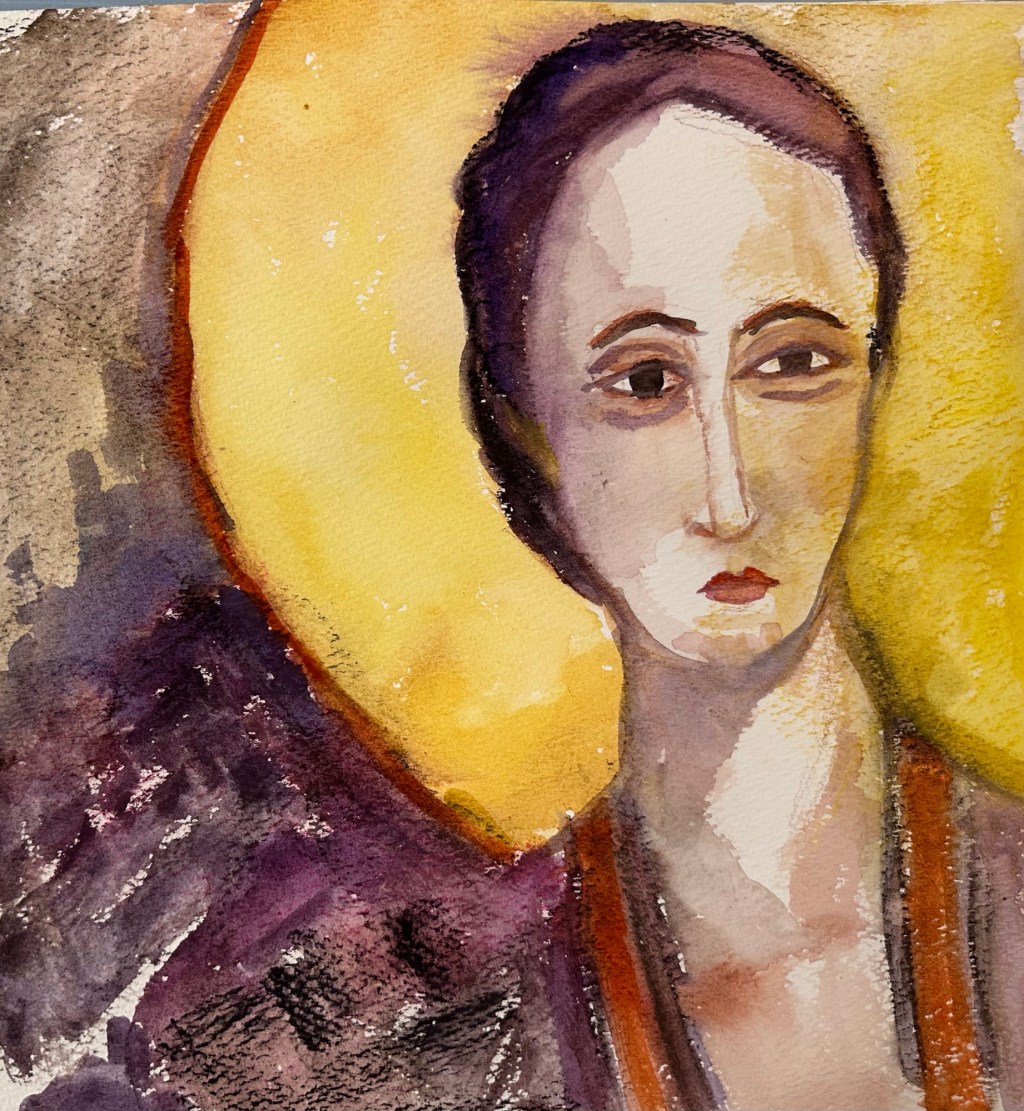
Mary from the Hagia Sophia Deesis mosaic

Most of us would rather jump to the Bible’s Victory story and skip its Victim sections because we live in an age which validates the strong and successful, while denying the worth of the weak and wounded. Easter and Palm Sunday are more triumphant celebrations than the sonorous and somber Foot-washing Maundy Thursday and Good Friday Vigils. Yet without suffering, would we have cause for rejoicing? Would we even know the meaning of joy without some pain in our lives? Everyone has some pain in their life, whether it’s the pain of an unrequited love, the loss of a child stillborn, a divorce, a war wound, a frenemy wound, or some other brokenness.

Stage one

Mary knew early on her child of destiny would bring her both joy and pain, as all mothers discover soon enough. Luke records in 2:34-35,

“Then Simeon blessed them and said to his mother Mary, “This child is destined for the falling and the rising of many in Israel, and to be a sign that will be opposed so that the inner thoughts of many will be revealed—and a sword will pierce your own soul too.”

Deesis. Top center front panel of the Harbaville Triptych. Ivory. Ca. 940-960 CE. Musée du Louvre, Paris.

Many today only want to show the happy times in their hyper-curated lives on social media. As a result, “Keeping up with the Joneses” gets harder all the time. With Facebook’s constant encouragement of “you may know algorithms,” we’re encouraged to add more friends to our circle. We’re exposed to too many families of that surname, when once we only knew a few who lived in our own neighborhoods. If all these Jones folks are always smiling widely for the camera, we might be tempted to ask, “Why don’t I feel like smiling also?”

I know people who don’t read newspapers, watch the news on television, or even listen to the snippets on the radio. “Too much bad news!” They too don’t want to hear of the suffering, the plight of the weak, or face their seeming impotence to do anything about it. We are weak people. We are not strong, no matter how often we quote passages like Philippians 4:13—

I can do all things through him who strengthens me.”

Richard Rohr, in The Enneagram, A Christian Perspective, says, “It is the things that you cannot do anything about and the things that you cannot do anything with that do something with you.” Suffering and prayer are what truly transform us, if only we don’t waste time looking for someone to blame.

13th CE Hagia Sophia Mosaic, Istanbul, Turkey

So far, no one person has been able to stop the Russian invasion of the democratic nation of Ukraine, but plenty of people are holding up an aid package that would help this small country fight this battle at great cost to life and limb. The Ukrainians suffer and America dithers. We seem to think our leaders have infinite powers, as if they were gods, but we forget all people are only human and have only the image of god, but no huma has either the power or the glory of the true God.

Unknown Ukrainian Artist: The Deesis, Icon, Tempera, silvering on gesso-grounded two-piece fir-wood panel, engraving, carving; 1735, h 114, w 84, d 9, National Art Museum of Ukraine.

So far, no one person has been able to keep either Hamas or Israel from wreaking havoc on each other. My daddy used to say, “you can’t make a silk purse out of a sow’s ear.” After years of teaching and pastoring, I’d throw my two cents in: “we can lead a horse to water, but we can’t make it drink.” As long as people are invested in retribution, they will return suffering for suffering. The sad truth is people who have never processed their own suffering will cause suffering for others as well as for themselves. The children will cry. And the women will cry. But now the men are crying too.

Late Roman Magical gem; intaglio; green-brown jasper; oval; bevelled edge on side B, 2nd-3rd CE, British Museum, London.

No one has a magic wand to eliminate suffering or harm. In ancient times, the image of the crucified Christ was used as a magic charm to keep the wearer from harm. Some people today wear a cross for the same reason; it’s a fashion statement, a good luck charm, and a symbol of their faith. Instead of a charm, we offer acts of prayer and mercy.

Hagia Sophia Deesis Mary icon 2024, finished

We don’t just cry for the fact of the sufferings we endure, or for the sufferings of others, but we cry out in our suffering to the only one who can hear us, heal us and make whole our broken hearts and homes. We cry out to the God, who created all of us in God’s own image out of the dust of an obliterated and bombed out land. We cry out to the God who brings rains in their seasons to a land parched by climate change and ruined by reckless use of natural resources. We cry out to the God who raised God’s son from the dead, even as people everywhere bury their own dead sons and daughters from the wars fought by nations and non-state actors who wrestle for power in tiny slivers of contested territories.

Christ and the Apostles in the Heavenly Jerusalem, apse mosaic, early fifth century, Rome, Santa Pudenziana.

We can see in this image a dramatic transformation in the conception of Christ from the pre-Constantinian period. In the Santa Pudenziana mosaic, Christ is shown in the center seated on a jewel encrusted throne. He is surrounded by apostles, biblical women, and symbolic images of the four gospel writers. The ideal landscape is the New Jerusalem, or the Heavenly Kingdom. This image was created after Constantine’s victory and conversion to Christianity. Prior to this, Christian art repurposed Greco-Roman themes of the Good Shepherd and the Apollo Sun god.

Unknown Artist: Plaque with Christ flanked by the Virgin and Saint John, late 19th–early 20th century (Byzantine style), Cloisonné enamel, gold; 6 9/16 x 5 9/16 x 1/16 in. (16.6 x 14.1 x 0.1 cm); Metropolitan Museum of Art, NYC, Gift of the Estate of Mrs. Otto H. Kahn, 1952, Accession Number: 52.54.1

The Byzantine Empire was fond of the Deesis Icon, which has Christ in the center bounded by the Virgin Mary and the Precursor, John the Baptist, on either side. They both entreat the Lord in prayer. This was one of the most widespread middle Byzantine icon types. The name comes from the Greek δέησις or “supplication,” which in Byzantine art, describes a representation of Christ enthroned and flanked by supplicants, such as the Virgin Mary, St. John the Baptist, or other saints and/or angels. Images of the deesis often appear on an iconostasis, or the screen separating the altar from the people. The subject matter traditionally represents the first witnesses to Christ’s divinity, the Virgin and Saint John, who came to be seen as holy figures who would act as intercessors with him on behalf of humanity.

The Deesis. End of the 17th century. Northern Russia. Wood, gesso, tempera. Found from the village Nizhnyaya (Dolgovitsi), Tarnoga Raion, Vologda Oblast. Collection of Nikolai Kormashov.

Nikolai Kormashov, an Estonian artist and collector, who collected and restored a great collection of 15th-20th century Russian icons during his lifetime said, “That which is not destined to perish, announces itself again and again, to attest to elusive spiritual beauty and the light of truth.”

The truth is all people of every country and culture in every age will suffer, but God isn’t removed and distant from our pain. God, through the incarnation of the Son, has experienced our human suffering from the birth pangs of Christ’s birth to the hunger, thirst, and weariness of his itinerant earthly preaching. Not only this, but God through God’s Son knows the heartbreak of betrayal and insult, the sting of the whip, and the pain of death on a cross.

The light of truth for the Easter season is this: in the midst of darkness and death, God raised his Son to light and life, so we too might lose the chains of sin and death and live to light and love. As the people of prayer, we ask for the gift of hope to give light to those in darkness and a helping hand to those in need.

Joy and peace,

Cornelia

Relief plaque icon, depicting the Deesis Crucifixion with full-length figures of the Virgin on the left and St John on the right, Late Byzantine (13 thc). Materials: Steatite – Gold

Greek déēsis entreaty, equivalent to deē-, variant stem of déesthai to beg + -sis-sis

Leonid Ouspensky: The Meaning of Icons, revised edition, St. Vladimir’s Seminary Press, Crestwood, NY, 1999, p. 180.

DEESIS Definition & Usage Examples | Dictionary.com
https://www.dictionary.com/browse/deesis

Saved Sanctity: Icons from the Collection of Nikolai Kormashov – Art Museums
https://www.lnmm.lv/en/art-museum-riga-bourse/exhibitions/saved-sanctity-icons-from-the-collection-of-nikolai-kormashov-437

Image— The oldest icon of the Crucifixion of Christ at the Greek Orthodox Holy Monastery of St. Catherine on Mount Sinai is an extraordinary testament to the intricate relationship between the Greco-Roman art heritage and early Christian iconography. This invaluable artifact offers a unique glimpse into the artistic and cultural milieu of the time, highlighting the exchange of ideas and the shared history that shaped the development of Christian art in 8th CE. See following link for comparison of early Roman and Christian art.

http://employees.oneonta.edu/farberas/arth/arth212/post_constant_conc_christ.html

Nick Haslam: The Body Keeps the Score: how a bestselling book helps us understand trauma – but inflates the definition of it

https://theconversation.com/the-body-keeps-the-score-how-a-bestselling-book-helps-us-understand-trauma-but-inflates-the-definition-of-it-184735

It’s Not Under Control!

adult learning, art, Attitudes, bottles, brain plasticity, Cezanne, Creativity, failure, Family, Fear, Healing, Lent, Marcus Aurelius, Painting, perspective, Ralph Waldo Emerson, renewal, risk, samuel Beckett, shadows, Stress, Super Bowl

All things will renew themselves in good season, yet we have only the present moment before us. We can’t live in the past, nor can we control the future. We have to recognize even our present moments aren’t always in our control, as we witnessed in the big Super Bowl game last Sunday.

Random Actions Often Determine the Outcomes of Sporting Events

Who would ever believe a punt would hit a receiving teammate’s foot, and suddenly become a live ball? Then get recovered by the Chiefs for a quick touchdown? If you think you can control your circumstances or the actions of others, just watch the NASCAR races at Daytona this weekend. The wonder is they don’t wreck in every turn, but only occasionally during the 500 mile race on Sunday.

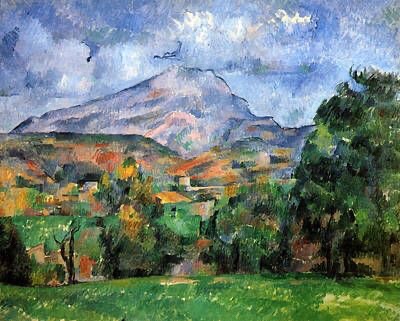
Cezanne Watercolor “Mont Sainte-Victoire (La Montagne Sainte-Victoire vue des Lauves)”( 1902–06) by Paul Cézanne. (The Museum of Modern Art, New York/Photo © 2021 MoMA, NY)

Watercolor is more difficult medium to manage than acrylic paints because it’s wetter and refuses to dry as quickly as we want to paint in that same area. It’s not being obnoxious; it’s just being its own true self. Cezanne used watercolors to think out his ideas beforehand, and then worked in oils. Often, he tossed aside the watercolor work, sometimes even leaving it out in the landscape which he’d just painted. He’d learned all he could from it and now was ready to paint his new image, but not a copy of the original painting. This mountain shows up in sixty of Cezanne’s artworks.

Paul Cézanne: La Montagne Sainte-Victoire, 1888, oil, The Stedelijk Museum, Amsterdam.

The stoic philosopher and Roman Emperor Marcus Aurelius wrote a series of meditations on life. In one he speaks of all life experiences as being the same. This attitude keeps him from getting too high or too low about what happens in his life. He takes it as it comes. Even death, which some fear as a loss, doesn’t bother him, for if he isn’t bothered about the present, he can’t be bothered about losing that too. Marcus Aurelius wasn’t a Christian, but his quest for equanimity is admirable. Take life as it comes and worry not:

“First, that all things in the world from all eternity, by a perpetual revolution of the same times and things ever continued and renewed, are of one kind and nature; so that whether for a hundred or two hundred years only, or for an infinite space of time, a man see those things which are still the same, it can be no matter of great moment. And secondly, that that life which any the longest liver, or the shortest liver parts with, is for length and duration the very same, for that only which is present, is that, which either of them can lose, as being that only which they have; for that which he hath not, no man can truly be said to lose.”

The Still Life in Our Classroom

When we work in watercolor, we have to take what the watercolor gives us. While we can plan, design, and control the outcomes to a certain extent, watercolor often goes its own way. If we work over the whole surface, rather than noodling around in one little space like a puppy sniffing a single spot while out on its morning constitutional walk, we get more done, just as the puppy is more likely to get its “business” done.

One of the reasons we work in a new medium is for the challenge. In school, when I was bored, I’d take notes in class by writing upside down. When that got too easy, I began using my left hand to write upside down. This was a true challenge! I didn’t have any ingrained pathways in my brain for left-handedness, much less the upside-down images. I was truly bored, however, so I struggled on until I got serviceable images. This was the year in which I went to art school as a midyear junior and was taking a freshman level history course.

Tim’s Painting

Tim has voluntarily switched to his left hand because he will have surgery on his right side, which will knock out his ability to use that arm for several months as he recovers. This is a good effort for his non dominant hand. You can tell he focused on the scoop, for it has the most detail. Training our alternate hand to do the work of our dominant hand requires resetting the brain to prefer the new hand. If you try brushing your teeth with your other hand, you’ll see exactly how strange it feels to use a different hand. This is because you have no well-worn pathways in your brain circuitry that makes this routine effort possible.

The fancy pants word for this is neuroplasticicy. We meet this concept with stroke survivors who do physical therapy to rewire their brain connections to make new pathways so they can speak, write, or walk. Everyone who tries a new game, learns a new language, or tries a new hobby also builds new pathways in their brains. Be learners for life, if you want to keep your mind healthy.

Gail’s Painting

Our still life was challenging today. It had solid shapes, a clear bottle, and a metal scoop. Not only were there multiple colors, but textures and transparency also. Gail has had several years of drawing under her belt, so she was able to render the perspective of the still life well. Note the clear blue bottle, which has a wonderful oval bottom. The lemons and limes are distinct also. The grey shape is an antique scoop, sans the handle.

In 2008, J.K. Rowling spoke at the Harvard commencement exercises, telling the graduates, “Talent and intelligence never yet inoculated anyone against the caprice of the Fates.” Because we don’t know what tomorrow will bring, taking care for today is the best preparation for the future. Rowling studied the Classics at Harvard, a subject most people would consider useless for this modern era. Yet after a divorce, as a single parent working for Amnesty International, she began writing her wizard novels. Harry Potter is now part of our cultural heritage.

As Jesus said in Luke 12:25-26–

“And can any of you by worrying add a single hour to your span of life? If then you are not able to do so small a thing as that, why do you worry about the rest?”

Worry is stressful, for sure, and it’s an example of “bad stress,” along with traumatic events, such as adverse childhood experiences (ACE), disease, divorce, and death of a loved one. We also endure “good stress,” as when we challenge ourselves to lift heavier weights, cook a new recipe, or learn a new language. As Ralph Waldo Emerson wrote in his 1841 essay Heroics, paragraph 14:

“The characteristic of a genuine heroism is its persistency. All men have wandering impulses, fits and starts of generosity. But when you have chosen your part, abide by it, and do not weakly try to reconcile yourself with the world. The heroic cannot be the common, nor the common the heroic. Yet we have the weakness to expect the sympathy of people in those actions whose excellence is that they outrun sympathy, and appeal to a tardy justice. If you would serve your brother, because it is fit for you to serve him, do not take back your words when you find that prudent people do not commend you.

“Adhere to your own act and congratulate yourself if you have done something strange and extravagant, and broken the monotony of a decorous age. It was a high counsel that I once heard given to a young person, —”Always do what you are afraid to do.”

When I was in high school, the ancient Latin teacher, who had taught my daddy when he went to school, tossed out the challenge, “No one has ever made 100% on my final Latin exam.”

I bit on that challenge like a starving dog bites on a bone, even if it has no scrap of flesh remaining on it. I made flash cards and studied for an hour every night before bed, I was so determined to be the exception to the rule. On the test, I got all the Latin correct, but lost ½ point for misspelling an English word. I never followed up on her retirement, but I fully expect her record remained unblemished. Also, I’m still spelling challenged. I’m thankful for SpellCheck in our writing apps.

Gail W.’s Painting

Gail W. paid attention to the still life and took care to lay down a close image in a pale wash before she began to add darker washes of color. Her left lime is most successful, with at least six shades of green and yellow in the shape. I also like the highlight on the central lemon. These two images capture the essence of the watercolor medium. Her perspective on the bottle bottom indicates it sits well on the cloth.

Failure teaches us what we don’t know, so we can improve the next time. This is what we call resilience. When I taught art, my students had to find three things they did well in their work before they named anything they needed help on. This was to build up their confidence. For some of them, just making a mark on the page was a start. If we fear making a mistake, we can sketch in a pale-yellow wash. This is very forgiving, like a whisper in the wind. If it’s not quite right, the next few marks may be nearer our desired outcome.

This Is Fine—Leave Me Alone, I’m Having a Crisis

Our mindset is what controls how we react to events in our lives. As one of my friends would remind me, “Not everything is a hair on fire moment.” Of course, when I was a young teen, the least slight or distress caused me to fling myself over my bed in a paroxysm of sobs, wailing loudly, “I’m going to die!” My parents would look at each other and shrug, “What boy is it now?” Fifteen minutes later I’d be in the kitchen looking for a snack, having cried my eyes out, and now I was on to the next thing. As I had more experiences, I learned to roll with the moment. Sometimes you need to wait for the next wave to rise before you take your ride. God’s timing is always right, for our experiences, both the failures and successes, prepare us for what comes next in our lives.

Cornelia’s Watercolor

I had some of the same perspective problems as everyone else, especially with the base of the bottle. Actually, it’s a challenge to get a “transparent three-dimensional object on a flat surface” to appear as if it’s actually sitting on a flat surface in two dimensions. Learning some shading techniques and remembering a round bottle bottom becomes an ellipse helps to bring off this sleight of hand. I got my paint too dark on the front of the bottle base and had to let it dry so I could come back in with some clear water and an almost dry brush to pick up the color. This gave me the highlight I needed.

Cornelia’s Drawing over the Watercolor

When I got home, I noticed my eyesight seems to be going amiss with my increased age. Lately I’ve not been careful to paint my verticals straight. Either I’m being lazy, or I’m tilting my head as I look at the subject. Maybe my neck injury has something to do with it. I duplicated the photo and used the Apple Pencil to straighten up the bottle and even up its symmetry. I also touched up a few of the lemons and limes. Maybe I’m still the puppy that likes to noodle around and sniff about until I can wrest all I can get from a work. This way I learn all I can from it. Like a kindergartner, if my work ends up a huge grey blob, I can say, “That was a great learning experience!”

My grandmother, who painted portraits and still lifes, kept a saying written on the back of an envelope, near her easel:  “Ever tried. Ever failed. No matter. Try again.” She passed in 1970. Years later, Samuel Beckett, in his 1983 story, Worstword, Ho wrote:

“Ever tried. Ever failed. No matter. Try again. Fail again. Fail better.”

We need to be like great artists and athletes, or the Michelin chefs who just keep trying, falling short, until they get close enough to qualify for their stars. Persistence makes all things possible, and if we “fail,” we’re only getting closer to perfection.

I hope for you a blessed Lent,

Joy and peace,

Cornelia


Emperor of Rome Marcus Aurelius: Meditations, XII   https://books.apple.com/us/book/meditations/id396136148

Neuroplasticity: re-wiring the brain | Stroke Association

https://www.stroke.org.uk/effects-of-stroke/neuroplasticity-rewiring-the-brain

10 Brain Exercises to Help Boost Memory

https://www.everydayhealth.com/longevity/mental-fitness/brain-exercises-for-memory.aspx

Neurobiological and Systemic Effects of Chronic Stress – PMC

https://www.ncbi.nlm.nih.gov/pmc/articles/PMC5573220/

​“Try Again. Fail Again. Fail Better”: Beckett’s unlikely Mantra – Goethe-Institut Los Angeles – USA

https://www.goethe.de/ins/us/en/sta/los/bib/feh/21891928.html


The Project Gutenberg eBook of Essays, by Ralph Waldo Emerson

https://www.gutenberg.org/files/16643/16643-h/16643-h.htm#HEROISM


Rabbit! Rabbit! Welcome to December 2023

Apocalypse, architecture, art, Bethlehem, Christmas, Civil War, Faith, Family, Healing, holidays, Holy Spirit, hope, inspiration, Israel, Light of the World, Love, Ministry, poverty, rabbits, shame, Spirituality, Stress, trees

Bunny in Bed

“Gloom begets gloom,” my daddy always said, “so if you wake up on the wrong side of the bed, it’s best to go back and get out on the other side.” Some folks today don’t have much of the Christmas or holiday spirit, for they’re only looking at the dark side of world events or at the shrinking purchasing power of their dollar.

Unemployed people sold apples on the street corner in the Great Depression

Since the Civil War, the United States has endured thirteen depressions or recessions large enough to get noticed by those who study such things (see list below). This is an average of one about every dozen years. Of course, those of us who experience these events don’t have to study them, for we directly participate in the event. As the old saying goes, “If my neighbor loses his job, it’s a recession, but if I lose my job, we’re in a depression.” Instead, we plan for them and expect the good times won’t last forever.

Because we human beings are wont to think “our situation is unique,” we’re also great at forgetting the lessons of history. The first lesson is life is cyclical and what goes up will come down. The second lesson is what goes down will eventually go back up. My long experience suggests when folks are in the “down cycle,” they forget upward progress is possible. In college we used to joke, “been down so long, it looks like up to me!”

It’s always darkest before the dawn.

Some say recessions are “necessary” in economic cycles to remove excess, reprice assets, and tame risky behavior. None of these negative factors would exist except for human greed. When Mary and Joseph went to Bethlehem to register for the census, they were also enrolling for the purpose of taxation. The Romans practiced tax farming in their provinces. Whoever had the account had to raise a certain amount for the empire, but could keep whatever excess they raised for themselves. Excessive taxation on the conquered land and people stoked their hopes for a messiah to rid them of this evil. No wonder the signs and wonders attending the birth of Jesus were fulfilling the ancient prophecies, as Matthew wrote (2:6):

‘And you, Bethlehem, in the land of Judah,
are by no means least among the rulers of Judah;
for from you shall come a ruler
who is to shepherd my people Israel.’

Church of the Nativity, Bethlehem. Star over the Grotto

In the times of darkness, we always look to the light as a reason to hope. As the magi saw a star rising in the east and believed an important person would arise in the land of Israel, we today look for glimmers of light to give us hope for the day to come. Some people see the wars, earthquakes, and crookedness of people and think we’re entering the end times. Churches and radio preachers are making hay with the Book of Revelation, forgetting it was a specific book written for a unique audience and time. We have been in the “end times” since Christ arose from the dead. As Matthew (28:20) records his words to the disciples in Galilee:

“And remember, I am with you always, to the end of the age.”

Since we’re always with Christ, we will always have his light, as Zechariah prophesied in Luke 1:78-79–

“By the tender mercy of our God,
the dawn from on high will break upon us,
to give light to those who sit in darkness and in the shadow of death,
to guide our feet into the way of peace.”

The famous Banksy’s Armored Dove of Peace, the painting of a peace dove wearing a flak jacket. The dove is painted on a wall near the separation wall between Bethlehem (Palestinian Territories) and Israel. Nov. 18, 2023.

In the midst of wars in the Ukraine and in Gaza, where people are suffering and dying, we can lose sight of the vision of light and peace, while we focus on darkness and death. The Christian community in Palestine, which usually hosts hordes of Christmas pilgrims in Bethlehem Square, won’t be celebrating this holy season this year in solidarity with Palestinians in Gaza. Instead, they’ll set up a small nativity scene covered with rubble. It’s a reminder when the Christ child came into a suffering world over two thousand years ago, his birth was a hope for the oppressed and the poor. Every Christmas we have the opportunity to care for those who struggle to make ends meet.

Great Depression family at mealtime

In the Great Depression, families lost homes, farms, and lived in shantytowns called Hoovervilles. President Hoover spoke of a childhood Christmas memory:

“I do vividly recollect a Christmas upon that farm when the sole resources of joy were popcorn balls, sorghum, and hickory nuts; when for a flock of disappointed children there were no store toys, no store clothes; when it was carefully explained that because of the hard times everything must be saved for the mortgage. The word ‘mortgage’ became for me a dreaded and haunting fear from that day to this.”

1950’s Christmas Tree: we kids were Team Tinsel, but the folks were Team Ornaments. Our tree never looked like this!

I have some ancient memories of the cyclic hard times experienced by my family. I recall the late 50’s Eisenhower influenza recession dimly because it was the only time I ever saw my daddy cry. We had a brand-new Ford station wagon, but couldn’t afford to drive it except on Sundays. My dad brought money home daily from his office, so mother and we kids would walk to the local grocery to buy food the next day. He cried because he kept his office full of patients, but half of them couldn’t pay for his services. Mother was very practical and reminded him, “This too would pass. Trouble is only temporary.” In the fall, she took a schoolteacher position to help out. That Christmas we hand decorated sequins on felt shapes the “Twelve Days of Christmas” for a tree skirt. I passed this extravagance on to a nephew when I downsized my home.

We decorated the early days more than the later days. Time management wasn’t our best gift, but we had a great time doing this together.

I also remember the 1970’s economic slowdown very well. I got married during this time. After my husband and I bought our silver wedding rings, we had $16 left in our pocket. I was certain we had jumped off a height with no parachute, but we somehow managed day to day. To keep up “appearances,” we gave away some of our wedding gifts as Christmas gifts to other family members. I thought it was wrong, but now I realize I don’t care about those items today. I was more concerned about “saving face,” since someone might recognize we were regifting. We managed with food from our organic garden and meat from a deer my husband harvested in the autumn. But I no longer eat tuna casserole, having lost my taste for this staple of my poverty years. Gifts aren’t important, but people are.

The 1980’s had a slump related to the oil embargo. When oil money dries up, art teachers lose their jobs, as do all the other “frivolous employees” elsewhere. I got an insurance sales position, with a guaranteed six-week paycheck. I was amazed I had a talent for sales, but I was good at discovering needs and matching products to people’s ability to pay. My best sales close was, “If you’re not here to provide for your family, how will they be able to keep their current lifestyle?”

Having a simpler Christmas this year? Consider an alternative tree…

I lost my house to foreclosure during the 1990’s subprime mortgage crisis. I lost my credit cards and almost lost my daughter to suicide. I learned some things are more important than achievements or possessions. In the depths of the worst of times, gifts aren’t necessary. Being a light for others, helping others, giving yourself to those who need hope in these seemingly hopeless times is important. During this time, I drew hope from God’s words to Nathan in 2 Samuel 7:5-6—

“Go and tell my servant David: Thus says the LORD: Are you the one to build me a house to live in? I have not lived in a house since the day I brought up the people of Israel from Egypt to this day, but I have been moving about in a tent and a tabernacle.” I drew hope, for if God didn’t need a permanent home, but stayed with God’s people, then if I had no home title, God would still go with me wherever I laid my head.

Christmas Lights on Church Street

As a people, we always want to tie God to a place or to locate the Spirit to a site, but God is always bigger than our imagination and our attempts to circumscribe God’s existence. We want to restrict God’s love to a few, but God insists on loving those from whom we look away and exclude. In the midst of the chaos of my losses and suffering, I discovered God was calling me to the ministry.

Gislebertus: Flight into Egypt, 1120-1130, Stone Capitals at St Lazare, Autun, France.

Why does God call the least, the last, or the losers to God’s work? God wants to be glorified, not the person who does the work. God needs people who understand suffering and have been seasoned by it, rather than hardened by it. The wounded know the wounds of others, but they also know the path to healing. This is why we find the Christ child in a stable, not in a palace; and have shepherds and foreigners come to visit, but not his family or friends. It’s also why the Holy Family flees to Egypt as refugees to avoid Herod’s death sentence for the Jewish newborns. If we’re having a less than “perfect” holiday this year, perhaps we’re only having a bad hair day in comparison to the suffering of that first Christmas.

When I get to struggling, for the aches and pains of age are catching up to me, I can get in a low mood thinking, “I used to pop out of bed and do 12 things before lunch.” Now I need six cups of coffee to get my lunch going! Of course, I’m past my platinum anniversary and my hair color matches my age. On days like this, I look to Paul’s admonition in 1 Thessalonians 5:16-18, which rings across the ages as a clarion call:

Rejoice always, pray without ceasing, give thanks in all circumstances;
for this is the will of God in Christ Jesus for you.

I wish each and every one of you a Merry Christmas and a Wonderful New Year. I plan to take a sabbatical from my Rabbit-Rabbit series in 2024, since I’ve neglected my sci-fi blog and my pandemic project quilt needs stitching together. I’m going to work on my art more and write about the spiritual intersections of the creative life.

Merry Christmas and Happy New Year

Joy and Peace,
Cornelia

You can keep up with my other writing and thoughts:

SOULJOURNIES: sci-fi spiritual formation blog
https://souljournieswordpress.wordpress.com/author/artandicon/

ARTANDICON: blog on the intersection of art and faith
Www.Artandicon.com

CORNIE’S KITCHEN: blog on healthy eating and spirituality
http://www.cornieskitchen.wordpress.com

List of depressions and recessions since the Civil War:

  1. the Panic of 1873,
  2. the Great Depression when 13 million people were out of work,
  3. a recession after WWII,
  4. another after the Korean War,
  5. the Eisenhower influenza recession in 1957-58,
  6. a recession in the auto industry in 1960-61,
  7. and another year long recession in 1970-71 under Nixon.
  8. In 1973, OPEC quadrupled oil prices, and that shock along with the stock market crash sent the world economy into recession.
  9. In 1980, energy prices continued to rise, so when the Federal Reserve raised interest rates to curb rising prices, the economy contracted. Once again, unemployment rose to 11% and business output suffered.
  10. We had a recession in the Gulf War from 1990-91, and then maintained the longest period of economic growth in American history up until
  11. the Dot Com Bubble in 2001. The tech-heavy NASDAQ ended up losing nearly 77% of its value and took over 15 years to recover its losses. September 11, 2001 wasn’t a sunny day for the stock market or for America. Many people have had a pessimistic outlook on life from this date forward. It changed how we see ourselves.
  12. In 2008-2009 another recession hit hard, making it the longest economic downturn since World War II and the deepest prior to
  13. the following COVID-19 Recession of 2020. The former was triggered by the subprime mortgage market collapse, while the latter was the quickest and steepest of them all. While more than 24 million people lost their jobs in the US the first three weeks of April 2020, this shock was quickly ameliorated by government interventions, such as zero interest, income payments and other supplements.

Christmas During the First “Great Depression” – Hoover Heads
https://hoover.blogs.archives.gov/2020/12/16/christmas-during-the-first-great-depression/

Milestones: 1921–1936 – Office of the Historian
https://history.state.gov/milestones/1921-1936/great-depression#:~:text=The%20U.S.%20stock%20market%20crash,cause%20a%20global%20financial%20crisis.

Understanding America’s Labor Shortage | U.S. Chamber of Commerce
https://www.uschamber.com/workforce/understanding-americas-labor-shortage

Major Financial Crisis History
https://nationalarchives.nic.in/sites/default/files/new/Final_Major_Financial_Crisis-i_0.pdf

A Brief History of U.S. Recessions – Weatherly Asset Management
https://www.weatherlyassetmgt.com/a-brief-history-of-u-s-recessions/

How One of the World’s Biggest Ships Jammed the Suez Canal – The New York Times
https://www.nytimes.com/2021/07/17/world/middleeast/suez-canal-stuck-ship-ever-given.html

Megiddo at the Crossroads of History

911, Academy for Spiritual Formation, Apocalypse, art, Astrology, Faith, Healing, hope, Imagination, inspiration, Israel, Megiddo, Painting, pandemic, purpose, Spirituality, vision

Archeological Remains of Tell Megiddo

On a visit to the Holy Land, I walked in the ruins of Tell Megiddo and also climbed the hills above the Jezerell valley. From this vantage point, I could imagine the great battles of nations warring to conquer land and control trading routes. Megiddo lies at the crossroads and therefore in the crosshairs of international politics, both in ancient and current times.


Valley of Megiddo

The plains of Megiddo, the breadbasket of Israel, also were known as a great battleground in ancient times. Egypt came more than once to fight the kings of Israel and Judah. The world’s earliest recorded battle occurred here between Syrian princes and Pharaoh Thutmosis III (ca. 1469 BC). Judah’s king Josiah was fatally wounded when he confronted another pharaoh, Neco II, near Megiddo ca. 609 BC (2 Kings 23:29-30). Although Megiddo is only mentioned in the Old Testament, the New Testament refers to it once in Revelation 16:16 as Harmagedon (mountain of Megiddo), the final site of the battle between the forces of good and evil at the end times of the age. Of course, scholars have different interpretations of when these “end times” are at hand.


Map of First Recorded Battle

The final book of the Greek New Testament is ΑΠΟΚΑΛΥΨΙΣ ΙΩΑΝΝΟΥ, or the Apocalypse of John. The word apocalypse means “disclosure of truth, instruction, or reveal, disclose, uncover.” It especially refers to Jewish and Christian writings of 200 BCE to 150 CE, which are marked by pseudonymity, symbolic imagery, and the expectation of an imminent cosmic cataclysm in which God destroys the ruling powers of evil and raises the righteous to life in a messianic kingdom.

Chariot Sculpture at Megiddo Battlefield

I remember a presenter on an Academy for Spiritual Formation retreat saying she had difficulty saying the prayers in the psalter, for the psalms of lament meant nothing to her, since she had no griefs to bear. Her spiritual adviser reminded her, “We pray these prayers for others, not just for ourselves alone.” As an artist of faith, I sense the needs of the world: it’s longings, fears, hopes, and dreams. I don’t always paint “art for art’s sake.” Certainly the conflict our beloved United Methodist Church has been experiencing lately factored into this “end times vision,” for too many on both sides of this dispute have resorted to calling the other “evil.”

Megiddo: Bronze Version

I felt called to paint the landscape of Megiddo in these recent weeks. Beginning in mid August, I was working on several paintings using Google map views of the landscape around the ancient site, with inspiration from my personal photos from my visit several years ago. I struggled over it, with the colors changing from bright to earthen tones. I left it alone for a time, to look at it and take time to live with it. Doing this allows me to see if I got too interested in noodling about making different colors, rather than considering the whole area as one unit. It didn’t take long before I came to the conclusion I didn’t have unity in my work. I had no overarching focus. My life has been like this for a while, with multiple distractions.

Megiddo: Blue Version

In our broken and fallen world, I find people today are in a rush to run to the extremes. Cooler heads don’t always prevail. The moment disorder rears its ugly head, folks run around like Chicken Little screaming, “The sky is falling! The sky is falling!” They might as well scream, “The end times are here!” I’m reminded of the Y2K hysteria with everyone panicking about filling up their cars for fear the gas pumps wouldn’t work, getting cash in case the credit cards wouldn’t swipe, and buying generators for fear the grid would crash (computers not able to recognize all those zeros). As I recall, my antique VCR kept recording on schedule, and the local Walmart took back loads of panic purchases in January.

The latest outbreak of hostilities in Israel and the Gaza Strip have added to the apocalyptic atmosphere and thinking of those who are given to extremes of thought. America has sent two of its eleven aircraft carriers into the Mediterranean Sea as a deterrent to all the other nations to rethink their plans to join the fighting now going on. For the apocalyptic thinkers, this is a sign of “It’s going down!” For those of us who have calmer heads, we realize the United States is the only one of six countries with more than two of these floating armed cities. Every other country has a single one only.

General Eisenhower (R) confers with French generals French 1st Army Corps Headquarters November 25, 1944 Ranking allied leaders look over a situation map outside of French 1st Army Corps Headquarters.

It’s been the habit of American presidents and their advisers in the gamut of crises since World War II to move aircraft carriers around as a “Geopolitical Chess Piece” to demonstrate American concern, resolve, or outright anger. Because carriers are operate on the high seas where permission to move is not needed from other countries, and because they carry their own fuel, weapons, and maintenance, they’re ready on arrival at the scene of a crisis to deliver power. Moreover, since modern U.S. carriers are large and imposing, and have been unchallenged on the seas, they “show the flag” to great effect. They provide excellent “visuals.” In fact, if one carrier doesn’t do the job, sending a second with several attendant ships along is a sign of “we mean business.”

Since this is a habit, and not a novel occurrence, it’s not the sign of the end times. As the gospel of Mark records in 13:7-8:

“When you hear of wars and rumors of wars, do not be alarmed; this must take place, but the end is still to come. For nation will rise against nation, and kingdom against kingdom; there will be earthquakes in various places; there will be famines. This is but the beginning of the birth pangs.”

Benjamin West: Death on a Pale Horse, oil on canvas, 1817, Pennsylvania Academy of the Fine Arts

Will these carriers be used for their traditional purpose—a floating airfield—and will our military aircraft and service personnel actually join in the actual combat operations in the MidEast? That seems unlikely, given the Just War principle taught in American War Colleges. The moral concept of Just War begins with a good reason to go to war. A reasonable cause is to right a wrong, recover stolen property, or self defense. Not liking someone isn’t a good reason to go to war.

The just war must be fought proportionately to the harm that was done to the aggrieved. Today, if someone were to insult you or cut you off in traffic, honking your horn is acceptable, but shooting a pistol isn’t. That’s a disproportionate reaction to the harm, or an unjustified assault. Responding in anger usually leads to regret, but our emotions often get the best of us.

I remember my first year in the classroom. I was making a grand total of $8,250 a year—the extra $250 was for my master’s degree—and the school wanted to know if I wanted this pittance in 10 or 12 checks. “Oh, make it ten! I’ll figure out summer some how.” The first day of class in 1982, I had well over fifty students in the high school sign up for art because the former teacher had taught elementary lessons to the older students: she had fifty ways to draw turkeys. I brought the principal in: “This isn’t going to work. Let’s get half of them in another class.” He was good with that.

This was a country school. Most of the kids would marry right after graduation. Many of the seniors already had jobs, so young art teachers weren’t high on their respect list. I was fortunate to have taught in an inner city school back in the Northeast where the boys play ice hockey. Like an aircraft carrier sent to the Mediterranean Sea, sometimes I’d have to throw my short body into the middle of two factions who were about to throw punches. These boys were usually over six feet tall, so there was no likelihood I’d ever get hit, but just my presence would cause them to reconsider and pull their punches.

Just because we send war ships to the Mediterranean doesn’t mean we want to wage war. We Americans have a track record of showing up to keep wars from breaking out all over. World leaders know how our military is trained and the rules by which we engage in conflicts. This is why as a person of faith, each of us has to search our hearts to discern how we respond in times of conflict, whether that’s a war or just a disagreement with our neighbors.

In addition to a just cause, we must have the right intentions, the possibility of success, and enter a conflict only as a last resort. Those who follow the Just War Principles aren’t “trigger happy,” but are inclined to gather community support, decide their limits ahead of time, seek to resolve the conflict in other ways first, and if that fails, then enter the fray. The USA didn’t enter WWII until the 1941 surprise attack on Pearl Harbor, even though the war in Europe had been going on since September 1, 1939, when Germany invaded Poland. Up to that time we were supporting Great Britain with armaments.

A plan for after the fighting is done

Theologically speaking, scholars are of two minds: the end times are already here or the end times have yet to come.

1. The end times are already here—Scholars who believe this understand Matthew 24:6-8 as an ongoing event, which began with the ascension of Christ:

“And you will hear of wars and rumors of wars; see that you are not alarmed; for this must take place, but the end is not yet. For nation will rise against nation, and kingdom against kingdom, and there will be famines and earthquakes in various places: all this is but the beginning of the birth pangs.”

For some, the tribulation will happen beforehand (pretribulation), while others believe this suffering will occur after the return of Jesus (post tribulation). I remember as the year 2000 approached, many of the faithful were excited about the camera facing the Mount of Olives in Jerusalem, since this was the place from which he ascended, therefore it would be the place from which he would return. Daystar Ministries setup the camera so “everyone could see it firsthand.”

We humans tend to think our Gods are small, even if we ascribe to them “infinite powers.” We don’t realize the power of an almighty who can interrupt and reveal all of the past to be nothing but dust and introduce a new age with his appearance. No one will need a computer or video screen to view the in-breaking return of the messiah. Everyone around the world will hear the thunderclap at one moment in time, and the flash of lightning accompanying his appearance will brighten even the darkest night. This day will be overwhelmingly bright. Most of us will hide our eyes so we won’t be blinded by the brilliance of a thousand suns.

The Jesus Cam will most likely melt when Christ does return, but his return wasn’t on the first day of 2000. That wasn’t the millennium anyway, but a year early for the math challenged hopeful. It was also the year 1420 for the Muslims and 5760 for the Jews, so who’s counting matters anyway, since numbers aren’t what God depends on, nor the stars (astrology).

Durer: The Four Horsemen

2. The end times are yet to come—While pandemics, stock market crashes, and rumors of war may all sound apocalyptic, the Temple at Jerusalem has yet to be rebuilt. Complicating this task is the Dome of the Rock, a major Islamic holy site built on the same location. A Pew Research Center study in 2010 found most Americans believed war, terrorism and environmental catastrophes were at least probable by the year 2050. Nearly six-in-ten (58%) saw another world war as definite or probable; 53% said the same about the prospect for a major terrorist attack on the United States involving nuclear weapons. An even higher percentage (72%) anticipated the world would face a major energy crisis in the next 40 years. This fits with the theme of “apocalypse as the collapse of environment or society.”

Other characteristics of the apocalypse include:

1. Literal battle between physical armies under supernatural leadership—These are battles of extremists, who are convinced they have a holy calling to fight. The Crusades were fought as “Christ’s army against the infidel.” Their purpose was to restore the Christian holy sites in the Middle East and resanctify them for holy Christian worship. This mentality doesn’t respect the humanity of the enemy. The war may have a just purpose, but not be fought with just means: eradication of the enemy is unjust.

2. Holy wars against non-believers—This is an unjust war, fought with unjust purposes, with excessive force, and seeks to exterminate the enemy, who are reduced to non-persons because they don’t share the same belief system. When opposing sides can’t recognize the common humanity of one another and rage rules decisions, the lust for blood feeds upon itself. Shakespeare said it best when Marc Anthony came upon the body of the just assassinated Julius Caesar in Act 3, scene 1:

And Caesar’s spirit, ranging for revenge,

With Ate by his side come hot from hell,

Shall in these confines with a monarch’s voice

Cry “Havoc!” and let slip the dogs of war,

That this foul deed shall smell above the earth

With carrion men, groaning for burial.

My final reworking of Megiddo includes streaks of rockets in the dark night sky and swirls of chaos which churn the world’s peoples, just as Ate, the Roman personification of recklessness and folly incites the passions of Caesar’s bereaved followers. We don’t know when Christ will return, no matter how many may prophesy or calculate the date. As Jesus said to his disciples in Matthew 24:36,

“But about that day and hour no one knows, neither the angels of heaven, nor the Son, but only the Father.”

This present darkness is only momentary, for if we’re in the end times, we also have a promise we can hold on to in Matthew 28:20—

“Remember, I am with you always, to the end of the age.”

Joy and Peace,

Cornelia


Armageddon / Harmagedon – CDAMM

https://www.cdamm.org/articles/armageddon


Aircraft Carriers by Country 2023 – Wisevoter


Public Sees a Future Full of Promise and Peril | Pew Research Center


Robert C Rubel: The Future of Air Carriers

https://digital-commons.usnwc.edu/cgi/viewcontent.cgi?article=1551&context=nwc-review


Rubel, Robert C. (2011) “The Future of The Future of Aircraft Carriers,” Naval War College Review: Vol. 64 : No. 4 , Article 4. Available at: https://digital-commons.usnwc.edu/nwc-review/vol64/iss4/4


Case Study: Just War Doctrine

https://www.scirp.org/journal/paperinformation.aspx?paperid=122406


Messiahcam at Y2K

https://www.theguardian.com/world/2000/jan/01/jamesmeek


‘Cry ‘Havoc!’ And Let Slip The Dogs Of War’: Speech & Analysis

https://nosweatshakespeare.com/quotes/famous/cry-havoc-let-slip-dogs-war/

Brookdale Community College Eisenhower Collection

https://www.brookdalecc.edu/center-for-world-war-ii-studies/the-meserlin-gallery/witnessing-history/

Left to right, French 5-star General De Lattre De Tassigny, commander 1st French Army; U.S. Lieutenant General Omar Bradley, commander, 12th Army Group; French 4-star General Marie Emile Bethouart, commander 1st French Army Corps; U.S. Lieutenant General Jacob L. Devers, commander, 6th Army Group; and General Dwight Eisenhower, Supreme Allied Commander.

Megiddo: Marks and Memories

Altars, art, city, Creativity, Degas, Faith, Forgiveness, Healing, Holy Spirit, Israel, Megiddo, Monet, Painting, perfection, Prayer, risk, salvation, Spirituality, Travel, United Methodist Church, vision

Study for Megiddo Memories

My most recent studio work explores my memories of my pilgrimage to the ancient ruins of Tel Megiddo. Why am I interested enough to make an entire series of drawings and paintings of this site, which I visited over two decades ago? First, the city was continuously occupied from the 7th or 6th millennium BCE, with the ancient tel generally left untouched and intact since its decline and subsequent abandonment around the 4th century BCE. The tels at Megiddo, Hazor, and Beer Sheba all have retained their authenticity and each have acquired the characteristic conical shape with a flattish top, protruding above the surrounding countryside. These three tels are now UNESCO Heritage Sites.

Megiddo: Marks and Memories

Excavations at Tel Meggido have uncovered about 26 layers of settlements dating back to the Chalcolithic period, or the early Bronze Age, about 5,000 years ago. Other sources say 30 layers exist at Tel Megiddo. The first four layers have been identified. This site was a Canaanite city, an Egyptian fortress, a Chariot City during Biblical times, and a prominent Assyrian and Persian city. King Solomon ruled the city in its prime in the 10th century BCE.

Megiddo: First Recorded Battle in History

The city has seen more battles than any other location in the world because of its location at the crossroads of the ancient world. The first written reference to Megiddo also happens to be the first recorded battle in history: a detailed account of the 1479 B.C.E. invasion of the Egyptian Pharaoh Thutmose III. When King Thutmose III of Egypt conquered Megiddo 3,500 years ago, the pharaoh left with, among other things: 1,929 head of cattle, 2,000 goats, 20,500 sheep, 204 horses, 200 army uniforms, and 502 bows. Megiddo is also the first recorded use of the composite bow and the first body count. All details of the battle come from Egyptian sources — primarily the hieroglyphic writings on the Hall of Annals in the Temple of Amun-Re at Karnak, Thebes (now Luxor), by the military scribe Tjaneni. Megiddo is also the site of a large chariot stable complex, called Solomon’s Stables, even though we now know they were built by Solomon’s successor King Ahab during the 9th century B.C.E.

Megiddo: Blue Version, Motions and Moods

Fortress cities sit on the 10 acre summit of Megiddo Hill or Tel Megiddo, rising 21.33 meters (about 70 feet) above the valley. Megiddo is located in the Lower Galilee region of northern Israel. Its critical location dominated the Aruna Pass (Wadi Ara or Megiddo Pass), which was the entrance to one of the few passes through the Carmel Mountains. Megiddo controlled the Via Maris, the main route between Egypt and Mesopotamia, also known as the Egyptian Way of the Sea. Christians regard this area as “Armageddon,” where the final Biblical battle between good and evil will occur.

Circular altar-like shrine from the Early Bronze Age at Megiddo. (Credit: Hanay)

The early Bronze Age temple compound at Megiddo is unparalleled for its number of temples, the continuity of cult activity and the record of ritual activity. The late Bronze Age palace is the most elaborate in Israel, and one of the best in the Levant. For the Iron Age remains, the elaborate orthogonal town plan of Megiddo has few parallels in the Levant. All three tels have impressive remains of their underground water catchments systems, which demonstrate sophisticated and geographically responsive engineering solutions to water storage. Megiddo is significant because the entire sequence of the Bronze Age and Iron Age is not only represented and excavated, but radiocarbon dated.

Megiddo: Moonlight Cityscape

Those are the travelogue statements. When on pilgrimage, one place full of stones begins to look like another after many days on the bus. Even though I was keeping notes of my journey in my paper journal, by the second week, I was hitting information overload. Each and every place was of the utmost importance, but my body was feeling the stress of constant traveling on a bus as well as the lack of good sleep from a different bed in a new hotel every single night.

Only strong coffee, lots of water, and eating three good meals a day were keeping me going. I was so excited during my pilgrimage, I was in an altered state of mind for weeks after my return home. Time slowed down and I could see more clearly for a long time. I would swear I could see individual oxygen molecules in the air, even though in my rational mind I knew this wasn’t possible. Pilgrimage is a spiritual journey, not a tourist trip of checking off various sites to say “I’ve been there and done that.” Even when surrounded by a “great cloud of witnesses” both physical and immaterial, I always knew I was walking on holy ground.

Megiddo: Motions and Moods, number 2

What does it mean to walk in the places where people have lived and died? Especially where they have clashed violently in war? The last time Americans fought a war on our home front was the Civil War. That internecine conflict was a horrific wound on our nation, an injury that hasn’t yet healed for some. I know my own daddy still carried the scars of his ancestors who fought on the battlefield to preserve slavery. He never understood why I thought that was a bad choice and why I worked to undo the damage of the war’s legacy on all Americans.

Cannon at Shiloh National Military Park

While traveling back home from viewing the Great American Eclipse, I met a man at Shiloh National Military Park, a Civil War memorial battle field. He visits these historic sites to pray for the deceased. He was from New Orleans, Louisiana, and believed those who died a violent death still wandered about, since their souls weren’t at peace. I don’t know if I believe this, but it gave him comfort to pray for the release of the hate and violence people can store up in their bodies and spirits and cause them to war upon one another.

I can say on that autumn day while I walked those killing fields, I felt the somber mystery of death and life, dignity and indignity as I walked about the silent hills and valleys. No longer do we hear the crack of the rifle or the thunder of the cannons. Rain has washed away the blood from the grassy knolls and pastures. Sunlight has dressed the wildflowers in beauty. If not for the explanatory signage, I’d never know about the extraordinary happenings at Shiloh National Military Park.

Perhaps I’m painting these historic sites of conflict because we are in a time of strife, not only abroad but at home. The actual shooting wars are going on beyond our shores, but conflicts at home are no less serious. I’m heartbroken by the devastation of the Ukrainian homeland by the Russian aggressors, and remember the ongoing tussle over the Temple Mount by the various faiths of the world. If there’s conflict beyond us, likely there’s conflict within our our own groups. The outer world usually reflects our inner world.

The stress of our United Methodist Church becoming the “Untied Methodist Church” has been rough on me. I’m carrying my stress in my neck and shoulders so much I’ve pinched the nerve to my pinky and ring fingers. They are now numb. I’m now in physical therapy for this. Medication and relaxation exercises will certainly help. One of my condo residents prayed for a “miracle cure” for me. My theology typically considers “miracles” to be reserved for situations beyond the usual care of physicians, but I know lay people use “miracles” more loosely than we clergy. Nevertheless, I appreciated their well meaning prayer for my healing. After all, God cares for both small and large problems, as Jesus reminds us in Luke 12:24,

“Consider the ravens: they neither sow nor reap, they have neither storehouse nor barn, and yet God feeds them. Of how much more value are you than the birds!”

Moonlight over Megiddo, number 1

I look at that second painting and compare it to the first painting I completed. While I attempted to keep the surface flat, I got involved in the recreation of the old city in my imagination. I connected the moonlight outside with the lamplight inside. I also added an abstract figure in the foreground. The red marks don’t work for me anymore,so I’m likely to destroy this art work. The second one I may keep, only because I learned some new colors and was brave enough to experiment with colors I don’t normally use.

Megiddo #3

In this final work, I chose only a portion of the satellite image. This allowed me to eliminate the areas which were causing me problems in the earlier works, especially the large, repeating curves. Although I’m back to my favorite yellow—I confess to being a Van Gogh fan—I used a greater variety of tints, rather than painting straight from the tubes.

Pablo Picasso once said, “Painting is just another way of keeping a diary.” If our outer world is in conflict, this drama will wash over into our inner world. It will show up in our dreams, our health, our relationships, and in other parts of our lives. If we think the late pandemic and current politics have broken relationships or distressed families, imagine what this has done to our churches. Most people go to church as an escape from this drama, hoping to find a sacred place where everyone is Imitating Christ’s Humility:

“If then there is any encouragement in Christ, any consolation from love, any sharing in the Spirit, any compassion and sympathy, make my joy complete: be of the same mind, having the same love, being in full accord and of one mind. Do nothing from selfish ambition or conceit, but in humility regard others as better than yourselves” (Philippians 2:1-3).

Unfortunately, all people bring their imperfect selves to Christ. Although Christ forgives our old sins, our sin habits remain. Most of us forget this. As an artist, I understand better than anyone the process of “going on to perfection” is both a gift of the Holy Spirit and our own work. While God could gift perfection completely, most often it’s a cooperative endeavor. This is why the studio product is sometimes a thrill, but other times a disappointment. Yet even in the disappointments, we can learn from our mistakes. We might need to “mistake a bunch of times” until we get focused on a new direction. We have to trust the process. Canvas is cheap. It can be reused or recycled. Plus, our salvation isn’t impaired by our detours in the studio.

Yet too often we’re hung up on the product as a reflection of our personal value or worth. If we are hurt, damaged, ill, broken,or harmed in any way, art is a therapeutic exercise for us. Monet tied the brushes to his hands when his arthritis made holding the brush too difficult. His later paintings also had freer brushwork. He could have quit, but he adjusted his expectations and his style to keep creating. As Monet once said, “I’m never finished with my paintings; the further I get, the more I seek the impossible and the more powerless I feel.” Degas was fond of saying, “Only when he no longer knows what he is doing does the painter do good things.”

If we’re in the safe, but shallow waters of certainty, we’re unlikely to grow to the deeper depths of either the spiritual or artistic realms. Most of us are afraid to cast off the anchors that keep us bound close to well known shores. We want to hear the praise of the crowd, and if we sail off for the unknown horizon, we will leave those familiar voices of the crowd’s approval behind. We can only discover the new world by leaving the old one behind, by risking a journey in faith others are not willing to undertake. Sometimes we may need to get out of the boat and risk walking across the water to meet Jesus who calls us to meet us in the midst of the strong winds and high waves.

I don’t worry about these feelings anymore, for I know they will come up, I’ll meet them, and then I’ll let them go. Our feelings of the moment are not the feelings of forever. Only one is the same yesterday, today and forever—the Lord Jesus Christ. The rest of us are still a work in progress.

Joy and peace,

Cornelia

Chalcolithic Period – an overview | ScienceDirect Topics. https://www.sciencedirect.com/topics/social-sciences/chalcolithic-period

The Battle of Megiddo – Ancient Egyptian culture https://www.donsmaps.com/egypt2cb.html

Megiddo https://www.jewishvirtuallibrary.org/vie-megiddo

Armageddon Time: How Discoveries at Megiddo Retell the Story of Ancient Israel – Archaeology – Haaretz.com https://www.haaretz.com/archaeology/2023-01-22/ty-article-magazine/armageddon-time-how-discoveries-at-megiddo-retell-the-story-of-ancient-israel/00000185-d960-d2d9-ab95-ffe0729e0000

Kingdoms of the Levant—Megiddo (Canaan)—date contested. https://www.historyfiles.co.uk/KingListsMiddEast/CanaanMegiddo.htm

Megiddo – Tourist Israel https://www.touristisrael.com/megiddo/9448/

Biblical Tels – Megiddo, Hazor, Beer Sheba – UNESCO World Heritage Centre https://whc.unesco.org/en/list/1108/

20 Quotes from Claude Monet | Denver Art Museum

20 Quotes from Edgar Degas | Denver Art Museum

REMEMBERING SEPTEMBER 11th

9/1/11, 911, Altars, art, Attitudes, Christmas, Easter, Faith, Forgiveness, grief, Healing, hope, Icons, inspiration, Ministry, Painting, renewal, Spirituality

Looking up at the night sky, I think of the Eskimo Proverb which says, “ Perhaps they are not stars, but rather openings in Heaven where the love of our lost ones pours through and shines down upon us to let us know they are happy.” The fatal September 2001 event at 7:14 am CDT impressed its significance on the nation to such a great extent that 93% of American adults 30 years old or greater can tell you exactly where they were when they first heard about the attacks. Only 42% of those 25 and younger can do the same.

NGC 3603: From Beginning To End
Credit: Wolfgang Brandner (JPL/IPAC), Eva K. Grebel (U. Wash.), You-Hua Chu (UIUC), NASA

I remember my church was fuller than for Easter or Christmas on the Sunday after the devastation of the Twin Towers, the collapse of the Pentagon, and the crash of the airplane in which the terrorists had hoped to hit the White House. Only those brave passengers of Flight 93 stood between the terrorists achieving a psychological victory and their ultimate ignoble demise. As I recall, people were eager to hear “What is the Christian Response to Violence?” If they hoped to hear the one and only response, as the THE implies in the sermon title, the air was let out of their balloons.

A photo taken on September 11, 2001 by the New York City Police Department as the North Tower collapses, engulfing lower Manhattan in smoke and ash.

Of course, Christians across the centuries have had three major responses to violence. The first is “turning the other cheek” or nonviolence. We see this in the Biblical witness, for Jesus admonishes his followers in Matthew 5:38-42—

“You have heard that it was said, ‘An eye for an eye and a tooth for a tooth.’ But I say to you, Do not resist an evildoer. But if anyone strikes you on the right cheek, turn the other also; and if anyone wants to sue you and take your coat, give your cloak as well; and if anyone forces you to go one mile, go also the second mile. Give to everyone who begs from you, and do not refuse anyone who wants to borrow from you.”

Il Tintoretto: Christ before Pilate, Museum Scuola di San Rocco, Venice

Jesus himself practiced a non-violence response to violence when he appeared before Pilate after his arrest. Pilate questioned Jesus in Matthew 27:11-14—

Now Jesus stood before the governor; and the governor asked him, “Are you the King of the Jews?” Jesus said, “You say so.” But when he was accused by the chief priests and elders, he did not answer. Then Pilate said to him, “Do you not hear how many accusations they make against you?” But he gave him no answer, not even to a single charge, so that the governor was greatly amazed.

Unknown German artist: Aquamanile in the Form of a Mounted Knight, Copper alloy, ca. 1250, used to pour water over hands at the altar or at dinner table, Metropolitan Museum of Art, New York City.

The opposite of non-violence is the Crusade mindset. In this response, the infidel is “othered” to the point of inhumanity. Because the unbelievers don’t share the same god, purging them from the living is a good deed, worthy of merit for salvation or for forgiveness of past sins. As you can imagine, this makes people who believe in other gods “less than human,” so what we modern people would consider war crimes would be easy to commit for a person in Crusade mentality. We still hear vestiges of this dualist mindset in the vocabulary of people who talk about “weaponizing government” or those who feel the need to “hit the ground running.” If we’re always in “attack mode” at work, we need to question how we think about others if we believe we’re in a hostile environment or in enemy territory.

If the Christian has both a head and a heart, both of which are being conformed to the love, mercy, and justice of God, then we must have a middle way between passive nonviolence and crusade extremism. This golden mean is the Just War Theory. It’s taught in all our military academies and has its beginnings in Christian theology. The saints Augustine of Hippo and Thomas Aquinas developed the primary ideas:

  • Make war only for a just cause
  • Be sure your intentions are right
  • Only legitimate authority can make war
  • Use just proportionally in the war, nothing to excess
  • Go to war as a last resort 
  • During war only attack military targets, not civilians 
  • Following unjust orders isn’t a legal defense for unjust actions 
  • Punish war crimes, compensate victims
  • Peace treaties must be fair and just to all, even the warmongers
Psalter Saint Louis et Blanche de Castile, MS 1186, BnF, folio 11b

Those of us who struggle with conflict—if we have a family, we have conflict or if we live in a community, we have conflict—yes, I’m starting to meddle now. You knew I’d get around to it. After all, God the Father had Adam and Eve, and God tossed those two kids out of the House. They had everything, and still wouldn’t follow the one rule (Don’t eat from that one tree). Just one rule. How hard could that be? It was downhill from there.

I always take comfort, knowing God had troublesome children. It means perfect parents can still have conflict at home. This gives hope to us less than perfect folks. The Bible reminds us always how God still loves the human race and hasn’t give up on us, so we don’t give up on those we have fusses with. We don’t roll over and play dead, yet we don’t set out on a crusade against unruly kids or others with whom we have conflicts. As Micah 7:18 reminds us about God’s Compassion and Steadfast Love:

Who is a God like you, pardoning iniquity and passing over the transgression of the remnant of your possession? He does not retain his anger forever, because he delights in showing clemency.

Remnant of the Twin Towers

Maybe we should look at the just war thoughts and modify our attitudes and behaviors. We can come to a peace, even if others cannot. As Jesus says in Matthew 5:9—

“Blessed are the peacemakers,

for they will be called children of God.”


Joy and Peace,

Cornelia


Two Decades Later, the Enduring Legacy of 9/11 | Pew Research Center


Just War Theory – The Ethics Centre Ethics Explainer
https://ethics.org.au/ethics-explainer-just-war/