A Prayer to End All Suffering

art, crucifixion, Deesis Icon, Easter, Faith, Good Friday, grief, Healing, hope, Icons, incarnation, inspiration, Lent, Painting, Prayer, renewal, Spirituality, Strength, suffering, vision


I don’t don’t know about you, but I don’t willingly sign up for pain or suffering. Pollen season isn’t my friend. I could do without all this yellow and green stuff clogging my brain cells and my lungs. As I cough and die, swill decongestant tonics, and huff my asthma inhaler, I wonder if this particular cross bearing has to be on my things to do list every Lenten season.

Mid 10th CE ivory Deesis Icon, Metropolitan Museum of Art, NYC

As Jesus turned his face towards Jerusalem, he knew his fate was certain. His message began to change, as he told his followers in Luke 14:27, “Whoever does not carry the cross and follow me cannot be my disciple.” Of course, not all were ready to hear or to follow, for some had obligations at home, and others weren’t yet ready to live the itinerant life. Many today don’t answer the call to ministry because they can’t see the long unknown road ahead. Only those willing to walk by faith and not by sight will journey off, trusting in God’s providence, mercy and grace.

Earliest sculpture panel of the Crucifixion, Maskell Passion Ivories, 420-430 CE, one of four carved panels of a sarcophagus, British Museum, London.

I used to say, “Give me a few months and I can whittle any group down to size. I can prune with the best of gardeners—all I have to do is read actual scripture!” I figure if folks want to get mad, they should take it out on the original writers. Blaming the messenger is useless. As the apostle Paul says:

“For the message about the cross is foolishness to those who are perishing, but to us who are being saved it is the power of God.” (1 Corinthians 1:18)

The oldest icon of the Crucifixion of Christ, Greek Orthodox Holy Monastery of St. Catherine, Mount Sinai, 8th CE

The ancient crucifixion icons glorify the triumph of the Incarnate God and his victory over death, which is the consequence of our fall; that fatal moment in the garden of Eden when Adam and Eve chose to desire to be like God, even though they had only the image, but not the ability to be gods themselves. Icons of the crucifixion represent Christ who, fully human and fully divine, takes on death so humanity no longer has to die. Christ conquers death by being a suffering servant, he becomes a victorious king.

Mary from the Hagia Sophia Deesis mosaic

Most of us would rather jump to the Bible’s Victory story and skip its Victim sections because we live in an age which validates the strong and successful, while denying the worth of the weak and wounded. Easter and Palm Sunday are more triumphant celebrations than the sonorous and somber Foot-washing Maundy Thursday and Good Friday Vigils. Yet without suffering, would we have cause for rejoicing? Would we even know the meaning of joy without some pain in our lives? Everyone has some pain in their life, whether it’s the pain of an unrequited love, the loss of a child stillborn, a divorce, a war wound, a frenemy wound, or some other brokenness.

Stage one

Mary knew early on her child of destiny would bring her both joy and pain, as all mothers discover soon enough. Luke records in 2:34-35,

“Then Simeon blessed them and said to his mother Mary, “This child is destined for the falling and the rising of many in Israel, and to be a sign that will be opposed so that the inner thoughts of many will be revealed—and a sword will pierce your own soul too.”

Deesis. Top center front panel of the Harbaville Triptych. Ivory. Ca. 940-960 CE. Musée du Louvre, Paris.

Many today only want to show the happy times in their hyper-curated lives on social media. As a result, “Keeping up with the Joneses” gets harder all the time. With Facebook’s constant encouragement of “you may know algorithms,” we’re encouraged to add more friends to our circle. We’re exposed to too many families of that surname, when once we only knew a few who lived in our own neighborhoods. If all these Jones folks are always smiling widely for the camera, we might be tempted to ask, “Why don’t I feel like smiling also?”

I know people who don’t read newspapers, watch the news on television, or even listen to the snippets on the radio. “Too much bad news!” They too don’t want to hear of the suffering, the plight of the weak, or face their seeming impotence to do anything about it. We are weak people. We are not strong, no matter how often we quote passages like Philippians 4:13—

I can do all things through him who strengthens me.”

Richard Rohr, in The Enneagram, A Christian Perspective, says, “It is the things that you cannot do anything about and the things that you cannot do anything with that do something with you.” Suffering and prayer are what truly transform us, if only we don’t waste time looking for someone to blame.

13th CE Hagia Sophia Mosaic, Istanbul, Turkey

So far, no one person has been able to stop the Russian invasion of the democratic nation of Ukraine, but plenty of people are holding up an aid package that would help this small country fight this battle at great cost to life and limb. The Ukrainians suffer and America dithers. We seem to think our leaders have infinite powers, as if they were gods, but we forget all people are only human and have only the image of god, but no huma has either the power or the glory of the true God.

Unknown Ukrainian Artist: The Deesis, Icon, Tempera, silvering on gesso-grounded two-piece fir-wood panel, engraving, carving; 1735, h 114, w 84, d 9, National Art Museum of Ukraine.

So far, no one person has been able to keep either Hamas or Israel from wreaking havoc on each other. My daddy used to say, “you can’t make a silk purse out of a sow’s ear.” After years of teaching and pastoring, I’d throw my two cents in: “we can lead a horse to water, but we can’t make it drink.” As long as people are invested in retribution, they will return suffering for suffering. The sad truth is people who have never processed their own suffering will cause suffering for others as well as for themselves. The children will cry. And the women will cry. But now the men are crying too.

Late Roman Magical gem; intaglio; green-brown jasper; oval; bevelled edge on side B, 2nd-3rd CE, British Museum, London.

No one has a magic wand to eliminate suffering or harm. In ancient times, the image of the crucified Christ was used as a magic charm to keep the wearer from harm. Some people today wear a cross for the same reason; it’s a fashion statement, a good luck charm, and a symbol of their faith. Instead of a charm, we offer acts of prayer and mercy.

Hagia Sophia Deesis Mary icon 2024, finished

We don’t just cry for the fact of the sufferings we endure, or for the sufferings of others, but we cry out in our suffering to the only one who can hear us, heal us and make whole our broken hearts and homes. We cry out to the God, who created all of us in God’s own image out of the dust of an obliterated and bombed out land. We cry out to the God who brings rains in their seasons to a land parched by climate change and ruined by reckless use of natural resources. We cry out to the God who raised God’s son from the dead, even as people everywhere bury their own dead sons and daughters from the wars fought by nations and non-state actors who wrestle for power in tiny slivers of contested territories.

Christ and the Apostles in the Heavenly Jerusalem, apse mosaic, early fifth century, Rome, Santa Pudenziana.

We can see in this image a dramatic transformation in the conception of Christ from the pre-Constantinian period. In the Santa Pudenziana mosaic, Christ is shown in the center seated on a jewel encrusted throne. He is surrounded by apostles, biblical women, and symbolic images of the four gospel writers. The ideal landscape is the New Jerusalem, or the Heavenly Kingdom. This image was created after Constantine’s victory and conversion to Christianity. Prior to this, Christian art repurposed Greco-Roman themes of the Good Shepherd and the Apollo Sun god.

Unknown Artist: Plaque with Christ flanked by the Virgin and Saint John, late 19th–early 20th century (Byzantine style), Cloisonné enamel, gold; 6 9/16 x 5 9/16 x 1/16 in. (16.6 x 14.1 x 0.1 cm); Metropolitan Museum of Art, NYC, Gift of the Estate of Mrs. Otto H. Kahn, 1952, Accession Number: 52.54.1

The Byzantine Empire was fond of the Deesis Icon, which has Christ in the center bounded by the Virgin Mary and the Precursor, John the Baptist, on either side. They both entreat the Lord in prayer. This was one of the most widespread middle Byzantine icon types. The name comes from the Greek δέησις or “supplication,” which in Byzantine art, describes a representation of Christ enthroned and flanked by supplicants, such as the Virgin Mary, St. John the Baptist, or other saints and/or angels. Images of the deesis often appear on an iconostasis, or the screen separating the altar from the people. The subject matter traditionally represents the first witnesses to Christ’s divinity, the Virgin and Saint John, who came to be seen as holy figures who would act as intercessors with him on behalf of humanity.

The Deesis. End of the 17th century. Northern Russia. Wood, gesso, tempera. Found from the village Nizhnyaya (Dolgovitsi), Tarnoga Raion, Vologda Oblast. Collection of Nikolai Kormashov.

Nikolai Kormashov, an Estonian artist and collector, who collected and restored a great collection of 15th-20th century Russian icons during his lifetime said, “That which is not destined to perish, announces itself again and again, to attest to elusive spiritual beauty and the light of truth.”

The truth is all people of every country and culture in every age will suffer, but God isn’t removed and distant from our pain. God, through the incarnation of the Son, has experienced our human suffering from the birth pangs of Christ’s birth to the hunger, thirst, and weariness of his itinerant earthly preaching. Not only this, but God through God’s Son knows the heartbreak of betrayal and insult, the sting of the whip, and the pain of death on a cross.

The light of truth for the Easter season is this: in the midst of darkness and death, God raised his Son to light and life, so we too might lose the chains of sin and death and live to light and love. As the people of prayer, we ask for the gift of hope to give light to those in darkness and a helping hand to those in need.

Joy and peace,

Cornelia

Relief plaque icon, depicting the Deesis Crucifixion with full-length figures of the Virgin on the left and St John on the right, Late Byzantine (13 thc). Materials: Steatite – Gold

Greek déēsis entreaty, equivalent to deē-, variant stem of déesthai to beg + -sis-sis

Leonid Ouspensky: The Meaning of Icons, revised edition, St. Vladimir’s Seminary Press, Crestwood, NY, 1999, p. 180.

DEESIS Definition & Usage Examples | Dictionary.com
https://www.dictionary.com/browse/deesis

Saved Sanctity: Icons from the Collection of Nikolai Kormashov – Art Museums
https://www.lnmm.lv/en/art-museum-riga-bourse/exhibitions/saved-sanctity-icons-from-the-collection-of-nikolai-kormashov-437

Image— The oldest icon of the Crucifixion of Christ at the Greek Orthodox Holy Monastery of St. Catherine on Mount Sinai is an extraordinary testament to the intricate relationship between the Greco-Roman art heritage and early Christian iconography. This invaluable artifact offers a unique glimpse into the artistic and cultural milieu of the time, highlighting the exchange of ideas and the shared history that shaped the development of Christian art in 8th CE. See following link for comparison of early Roman and Christian art.

http://employees.oneonta.edu/farberas/arth/arth212/post_constant_conc_christ.html

Nick Haslam: The Body Keeps the Score: how a bestselling book helps us understand trauma – but inflates the definition of it

https://theconversation.com/the-body-keeps-the-score-how-a-bestselling-book-helps-us-understand-trauma-but-inflates-the-definition-of-it-184735

REMEMBERING SEPTEMBER 11th

9/1/11, 911, Altars, art, Attitudes, Christmas, Easter, Faith, Forgiveness, grief, Healing, hope, Icons, inspiration, Ministry, Painting, renewal, Spirituality

Looking up at the night sky, I think of the Eskimo Proverb which says, “ Perhaps they are not stars, but rather openings in Heaven where the love of our lost ones pours through and shines down upon us to let us know they are happy.” The fatal September 2001 event at 7:14 am CDT impressed its significance on the nation to such a great extent that 93% of American adults 30 years old or greater can tell you exactly where they were when they first heard about the attacks. Only 42% of those 25 and younger can do the same.

NGC 3603: From Beginning To End
Credit: Wolfgang Brandner (JPL/IPAC), Eva K. Grebel (U. Wash.), You-Hua Chu (UIUC), NASA

I remember my church was fuller than for Easter or Christmas on the Sunday after the devastation of the Twin Towers, the collapse of the Pentagon, and the crash of the airplane in which the terrorists had hoped to hit the White House. Only those brave passengers of Flight 93 stood between the terrorists achieving a psychological victory and their ultimate ignoble demise. As I recall, people were eager to hear “What is the Christian Response to Violence?” If they hoped to hear the one and only response, as the THE implies in the sermon title, the air was let out of their balloons.

A photo taken on September 11, 2001 by the New York City Police Department as the North Tower collapses, engulfing lower Manhattan in smoke and ash.

Of course, Christians across the centuries have had three major responses to violence. The first is “turning the other cheek” or nonviolence. We see this in the Biblical witness, for Jesus admonishes his followers in Matthew 5:38-42—

“You have heard that it was said, ‘An eye for an eye and a tooth for a tooth.’ But I say to you, Do not resist an evildoer. But if anyone strikes you on the right cheek, turn the other also; and if anyone wants to sue you and take your coat, give your cloak as well; and if anyone forces you to go one mile, go also the second mile. Give to everyone who begs from you, and do not refuse anyone who wants to borrow from you.”

Il Tintoretto: Christ before Pilate, Museum Scuola di San Rocco, Venice

Jesus himself practiced a non-violence response to violence when he appeared before Pilate after his arrest. Pilate questioned Jesus in Matthew 27:11-14—

Now Jesus stood before the governor; and the governor asked him, “Are you the King of the Jews?” Jesus said, “You say so.” But when he was accused by the chief priests and elders, he did not answer. Then Pilate said to him, “Do you not hear how many accusations they make against you?” But he gave him no answer, not even to a single charge, so that the governor was greatly amazed.

Unknown German artist: Aquamanile in the Form of a Mounted Knight, Copper alloy, ca. 1250, used to pour water over hands at the altar or at dinner table, Metropolitan Museum of Art, New York City.

The opposite of non-violence is the Crusade mindset. In this response, the infidel is “othered” to the point of inhumanity. Because the unbelievers don’t share the same god, purging them from the living is a good deed, worthy of merit for salvation or for forgiveness of past sins. As you can imagine, this makes people who believe in other gods “less than human,” so what we modern people would consider war crimes would be easy to commit for a person in Crusade mentality. We still hear vestiges of this dualist mindset in the vocabulary of people who talk about “weaponizing government” or those who feel the need to “hit the ground running.” If we’re always in “attack mode” at work, we need to question how we think about others if we believe we’re in a hostile environment or in enemy territory.

If the Christian has both a head and a heart, both of which are being conformed to the love, mercy, and justice of God, then we must have a middle way between passive nonviolence and crusade extremism. This golden mean is the Just War Theory. It’s taught in all our military academies and has its beginnings in Christian theology. The saints Augustine of Hippo and Thomas Aquinas developed the primary ideas:

  • Make war only for a just cause
  • Be sure your intentions are right
  • Only legitimate authority can make war
  • Use just proportionally in the war, nothing to excess
  • Go to war as a last resort 
  • During war only attack military targets, not civilians 
  • Following unjust orders isn’t a legal defense for unjust actions 
  • Punish war crimes, compensate victims
  • Peace treaties must be fair and just to all, even the warmongers
Psalter Saint Louis et Blanche de Castile, MS 1186, BnF, folio 11b

Those of us who struggle with conflict—if we have a family, we have conflict or if we live in a community, we have conflict—yes, I’m starting to meddle now. You knew I’d get around to it. After all, God the Father had Adam and Eve, and God tossed those two kids out of the House. They had everything, and still wouldn’t follow the one rule (Don’t eat from that one tree). Just one rule. How hard could that be? It was downhill from there.

I always take comfort, knowing God had troublesome children. It means perfect parents can still have conflict at home. This gives hope to us less than perfect folks. The Bible reminds us always how God still loves the human race and hasn’t give up on us, so we don’t give up on those we have fusses with. We don’t roll over and play dead, yet we don’t set out on a crusade against unruly kids or others with whom we have conflicts. As Micah 7:18 reminds us about God’s Compassion and Steadfast Love:

Who is a God like you, pardoning iniquity and passing over the transgression of the remnant of your possession? He does not retain his anger forever, because he delights in showing clemency.

Remnant of the Twin Towers

Maybe we should look at the just war thoughts and modify our attitudes and behaviors. We can come to a peace, even if others cannot. As Jesus says in Matthew 5:9—

“Blessed are the peacemakers,

for they will be called children of God.”


Joy and Peace,

Cornelia


Two Decades Later, the Enduring Legacy of 9/11 | Pew Research Center


Just War Theory – The Ethics Centre Ethics Explainer
https://ethics.org.au/ethics-explainer-just-war/


Sunflowers and Shadows

adult learning, Alexander the Great, art, Carl Jung, Creativity, Faith, grief, Holy Spirit, Imagination, inspiration, Ministry, Painting, perfection, Plato, Prayer, Socrates, Stress, Ukraine

DeLee 2019, Drying Sunflowers

A sunflower follows the sun. Actually, only young sunflowers track the sun across the sky, while mature sunflowers face east. Why is this? Why do we care? As sunflowers fill our Facebook feeds and social media posts, most of us are looking at flowers so we can ignore the awful consequences of this unprovoked war. Right now, many of us are heartbroken because of the humanitarian crisis unfolding in Ukraine. I had only a passing knowledge of this country because of its well known naïve artist, Maria Primachenko and her paintings of fantastic imaginative animals in gardens. They have always been a delight to my soul and a joy to my spirit. Many of her works include the sunflower, Ukraine’s national flower. Sunflowers have been grown in Ukraine since the mid 1800’s, and are not only an important export crop, but also a symbol of peace. When Ukraine gave up its nuclear weapons in 1994, people planted sunflowers as a symbol of the peace they hoped would follow.

Maria Primachenko
A Dove Has Spread Her Wings And Asks For Peace (1982)

Sunflowers, when young, follow the sun on a 24 hour circadian cycle, just as our bodies have a similar cycle keyed to the light and dark. When the flowers are growing, they maximize their time facing the sun, but once they’re mature, they set their face toward the east, since this gives the head maximum warmth. Bees love warmth, so keeping the buzzing crowds near is in the sunflowers’ best interest for pollination and reproduction.

Heat map of sunflowers at different times of the day

Most of us prefer the sunny days. Clouds, storms, and distress aren’t our first choices. After the last few years of pandemic stresses, we’re unprepared for yet another crisis, even if it seems to be on a distant continent. Our own supply chain for reserves of caring and concern have been stretched thin by the nearly million deaths from COVID in our nation alone, not to mention the worldwide death toll of over 6 million. On Friday in Sam’s Club, I met a lady who complimented me on my flowered pants, which I was wearing in honor of the Ukrainian folk painter, whose museum had been bombed by the Russian army.

“I can’t bear to even listen to the news any more. It’s all so awful,” she said.

I should wear this shirt on Friday at Sam’s Club.

“I know. It reminds me too much of domestic violence cases, where the man decides he’ll punish the ex by killing all the children and taking himself out also.”

My blood sugar usually drops low on Friday after art class, before I eat lunch, so I don’t have my usual, civilized filter on my mouth. The look of awareness on her face was the sudden recognition of a truth she had refused to see before. Sometimes we need to face our fears and deal with them. This is the hero journey. None of us can travel it alone, but far too many fail to ever set out on it at all, even with a spiritual companion or guide. My failure to snack at art class upset her comfortable apple cart and caused her distress. She ran out of Sam’s in a heartbeat. I was able to chat with a baby and her mom later on, who was amazed her child wasn’t at all afraid of this stranger. Food is a medicine for my mood and a bridle for my mouth.

Morandi: Still Life of Bottles with Strange Shadow

On a sunny day, we can see our shadow. Most of us are afraid of our own flickering shadows. We don’t want to see the darkness within us, even though we’re ever ready to see the sinister images of others. Like a sunflower, we’ll turn instead to the light and only see the good, the beautiful, and the true.

A story I remember from my classical art studies regards Alexander the Great and the shadows. His father Phillip II, the ancient king of Macedon, had a difficult, high strung horse, which no one had been able to ride. In fact, it was downright vicious and unmanageable, which made it less of a “gift” to the ruler. Alexander, even though a youth, noticed the handsome horse was disturbed by his own shadow, so he turned the animal’s head into the sun, attached the bridle, and was able to mount him. Alexander rode Bucephalus until the horse’s death at the Battle of the Hydaspes in 326 B.C.E. In his honor, Alexander named a local city, Bucephala (sometimes identified with the modern Jhelum, in the Punjab province of Pakistan), after him.

Mosaic of Alexander the Great and Darius in Battle from the House of The Faun, Pompeii, 3rd century BCE

“Who looks outside, dreams; who looks inside, awakes,” Carl Jung wrote to one Fanny Bowditch, on the eve of his entry into military service during the First World War. Jung believed as long as you looked at other people and projected your own psychology into them, you could never reach harmony with yourself. Jung taught all persons had a shadow side to their personality, or those aspects of ourselves which we’ve repressed. These may be both bad or good aspects, for some of us have yet to realize our own brutal natures, as well as the heroic figures which we’ve also buried inside.

DeLee: Endless Nights of Pain, Ireland, 1973

My old granddaddy was fond of saying, “When you point out another’s failings, you have three fingers pointing back at yourself.” I came to learn I couldn’t recognize the fault in others unless I could claim it also in my own self. This keeps one humble for sure, but it also keeps a person from thinking he or she has any godlike or dictator qualities.

This brings me to another famous shadow story involving Alexander the Great. After his father’s death, he visited Corinth, where Diogenes the Cynic lived in 326 BCE. Diogenes was famous for carrying a lamp in the middle of the day in his “search for an honest man.” In the most famous exchange of this meeting, Alexander asked Diogenes whether there was anything he could do for him. Diogenes, who was enjoying the warmth of the autumn sun, answered, “Stand aside to stop blocking the sun.”

Statue of Diogenes and Alexander

This abrupt response, showing Diogenes’ utter contempt for the power and prestige craved by Alexander, inspired many artists over the years. Although Alexander’s attendants took offense at Diogenes’ rudeness to their king, Alexander himself wasn’t displeased. Leaving, Alexander was said to reply, “If I were not Alexander, I would want to be Diogenes.”

When I brought these delightful images from Maria Primachenko to class, Gail and Mike were amazed at how bright, flat, and clean her designs were. Partly this is due to her use of gouache, an opaque water based color paint. She also uses repeated motifs, symmetry, and clean lines with sharp color contrasts to make her images “pop,” as the decorators say. Mike, who favors textures, was thrilled to see another artist who paints like he does. Gail was glad to process the distressing news through flowers and the yellow and blue of the national flag of Ukraine.

Gail’s Unfinished Painting

Often we don’t feel “safe” speaking about dark or upsetting experiences, preferring instead to bury them deep inside. This is maybe the worst decision we can make, for like a poison or an infection, what we refuse to bring to the light will fester and grow. Then it further sickens the body or the mind until it becomes unrecognizable and unhealthy. Perhaps this is when we move from being rational to irrational. As I always tell folks, “Just because you think the world operates on reason and order, doesn’t make it so.” By this I mean, we live in a world with accidents, change, disease, sociopaths, and greed. In biblical terms, we live in a broken and fallen world, one in which even those of us who are “saved by the blood of Christ” from the wages of sin are “not yet perfected in the love of God and neighbor.”

This is what it means as a Christian to carry the Jungian shadow within us. If we believe keeping a law is the best evidence of our faithfulness, we can overlook the moral quality of the law itself and find ourselves carrying out harm, rather than doing good. As the writer of Hebrews explains in the platonic argument of Christ’s Sacrifice Once for All:

“Since the law has only a shadow of the good things to come and not the true form of these realities, it can never, by the same sacrifices that are continually offered year after year, make perfect those who approach.” (10:1)

Mike’s unfinished painting

If we want to be law keepers, we can’t be picking and choosing which laws we want to keep, as if the law were a cafeteria or buffet table. Jesus certainly knew what potholes lay ahead of him after his baptism in the Jordan River. A forty day fast in the wilderness is great for getting your head together and dealing with our human nature’s dark side of desire for security, power, and equality with god.

Maria Primachenko
Don’t Feast Your Eye’s On Other People’s Bread (1983)

I post my Artandicon blog on LinkedIn as well as on my various spiritual formation Facebook pages which I manage. I sometimes get a message from folks there. One was from a friend, who mentioned she really wanted to get back into her art, “for it brings her peace.” I tell people, “the process of making art brings satisfaction, but we’re not ever satisfied with the work itself.” If we were ever to be satisfied with the work, if we thought we could reach no higher, or if we thought so highly of ourselves that we’d made the last best artwork for all times, then we’d have to quit and make pancakes, until we’d perfected those. And then we’d find a new obsession.

Cornelia’s Painting with Nuclear Monster Destroying a Church

My favorite monsters are those from the Japanese nuclear monster movies of the 1950’s. They are both kitschy and scary. The sunflowers destroyed by these monsters of war will fall to earth and be reborn once again in ever increasing numbers. If hope is the last to die, it’s also the first to rise again. As long as one has breath, one can hope. As Paul wrote to the believers in Rome long ago,

“May the God of hope fill you with all joy and peace in believing, so that you may abound in hope by the power of the Holy Spirit.” (15:13)

Making art is a metaphor for the hero’s journey. Jung believed art was important because often the hands will solve a mystery that the intellect has struggled with in vain. We don’t know what battle or monster awaits, but we also don’t know what divine spirit will come to our aid. Along the fantastic inward journey, we’ll meet the very same creatures who are outside of us. They arise in our dreams, but they were planted in our awakening moments. We may have been turning our faces towards the sun, like the baby sunflowers or the horse Bucephalus, but soon enough we’ll trust the one who guides us and we’ll go wherever it’s necessary.

The journey toward Christian perfection in love is a heroic journey, one which we can only undertake with the help of the Holy Spirit. Along the way, we also travel with others on same road: mystics, saints, and holy persons from yesterday and today. As the old camp song refrain goes,

“And they’ll know we’re Christians by our love, by our love,
They’ll know we’re Christians by our love.”

Maria Primachenko:
May I Give This Ukrainian Bread To All People In This Big Wide World (1982)

The following prayer, Psalm 23, has comforted people for thousands of years in times of trouble and grief. Here in the English Standard Version, if you have fears, trepidations, or trembles, it might help you to calm your spirit. As you speak it aloud to the rhythm of your inhalation and exhalation of breath, remember those who have given up their lives rather than reject their faith: Christian martyrs in the Roman coliseum, Jewish martyrs in the holocaust, and democratic freedom fighters around the world. Let your voice be heard, even as their voice is being silenced:

The LORD is my shepherd; I shall not want.
He makes me lie down in green pastures.
He leads me beside still waters.
He restores my soul.
He leads me in paths of righteousness
for his name’s sake.
Even though I walk through the valley of the shadow of death,
I will fear no evil,
for you are with me;
your rod and your staff,
they comfort me.
You prepare a table before me
in the presence of my enemies;
you anoint my head with oil;
my cup overflows.
Surely goodness and mercy shall follow me
all the days of my life,
and I shall dwell in the house of the LORD
forever.

Joy, peace, and sunflowers,

Cornelia

The Mystery Of Why Sunflowers Turn To Follow The Sun — Solved : The Two-Way : NPR
https://www.npr.org/sections/thetwo-way/2016/08/05/488891151/the-mystery-of-why-sunflowers-turn-to-follow-the-sun-solved

Alexander and Bucephalus | Department of Classics | University of Colorado Boulder
https://www.colorado.edu/classics/2018/06/19/alexander-and-bucephalus

Putin’s Invasion of Ukraine Is a Sin All Russians Will Bear
https://www.bloomberg.com/opinion/articles/2022-02-24/putin-s-invasion-of-ukraine-is-a-terrible-sin-that-all-russians-will-bear

Carl Jung: “Who looks outside dreams; who looks inside awakes.” – Carl Jung Depth Psychology
https://carljungdepthpsychologysite.blog/2020/02/08/carl-jung-i-am-afraid-that-the-mere-fact-of-my-presence-takes-you-away-from-yourself/

Carl Jung – Archetypes – Shadow
https://www.carl-jung.net/shadow.html

Carl Jung: “Often the hands will solve a mystery that the intellect has struggled with in vain.” – Jung Currents
https://jungcurrents.com/jung-hands-intellect-mystery

They’ll Know Are Christians by Our Love
https://www.hymnlyrics.org/newlyrics_t/theyll_know_we_are_christians_by_our_love.php

STARS AND THE WINTER SOLSTICE

adult learning, art, Astrology, chocolate, Christmas, cosmology, Creativity, Faith, Family, greek myths, grief, holidays, hope, Icons, Imagination, incarnation, Marcus Aurelius, Ministry, nature, Painting, Philosophy, poverty, Spirituality, Stonehenge, trees, winter solstice

Stonehenge at Winter Solstice

This is a time of year when we look to the night sky for a sign. It’s not for nothing the depths of darkness are the beginnings of hope and our desire for the return of the healing light. People around the world and over the generations of time have celebrations of feasting, family reunions, and honoring their culture’s gods on the darkest day, or the Winter Solstice. The term solstice derives from the Latin word “sōlstitium”, meaning “the Sun stands still”. On the Winter Solstice, the sun reaches its southern-most position, shines directly on the Tropic of Capricorn, and seems to stand still there.

We’re all familiar with Stonehenge, a Neolithic stone monument in England built about 4,500 years ago to track important moments in the solar year. A later custom is the blazing Yule Log, a Norse tradition. The family would drag a huge piece of wood into their house, set it into the main fireplace, and let it burn for several days. It was a type of sympathetic magic to encourage the distant and faint sun to return, reinvigorated. The family often wrote down their desires for the new year as an offering to the gods. These were then burned in the fire. Afterwards, the family scattered ashes from the fire in the corners of every room in the house for good luck.

Hiroshige: The Sixty-nine Stations of the Kiso Kaidō

The Chinese also have a Winter Solstice festival, which once was a new year’s festival. The family gathers to eat traditional foods, and they honor their ancestors, as well as the old ones still living among them. This poem by Ruan Yue, in the late Northern Song Dynasty speaks of this:

罗袜新成,更有何人继后尘。
The socks for elders are newly woven;
the custom should be handed down.

A later poet of the Song Dynasty, Fan Chengda, had a more optimistic outlook on the dreary and dark days before the Winter Solstice, or perhaps he was using “positive pep talk to reframe his grumpy mind.”

休把心情关药裹,但逢节序添诗轴。
Don’t be thinking about medicines all the time;
write a new poem at the solar term.

I can relate to Fan Chengda, for I find I have difficulty waking up without the sun streaming into my bedroom windows. I’m also more irritable and mopey on these dark days. It’s probably Seasonal Affective Disorder, which is a form of depression related to the lack of light in this season. I tend to think dark thoughts, feel more pain, and lose my appetite, except for medicinal chocolate, which I consume under the Tim Allen mantra, “If some is good, more should be better!”

For Medicinal Purposes Only

When I get this type of mood on, the commercial Christmas we see on television and in the movies strikes a discordant note in my soul. I think about the ancient text, which reminds us when the parents of Jesus went to Bethlehem to be counted in the census: “And she gave birth to her firstborn son and wrapped him in bands of cloth, and laid him in a manger, because there was no place for them in the inn.” (Luke 2:7)

What most of us glide right over is Joseph had kinfolks galore in this town, but none of them opened their home to Mary, for she was pregnant before he married her. The innkeepers in town weren’t going to risk their reputations for these two either. Only one innkeeper took pity on them and let them stay with the animals in the stable. This marks the birth of the Christ child as an outsider to his whole extended family, the House of David.

Botticelli: Nativity, 1475

The Magi, or Wise Men, came from the East to visit King Herod, asking, “Where is the child who has been born king of the Jews? For we observed his star at its rising, and have come to pay him homage.”( Matthew 2:2)

Herod was worried he would be deposed, so he sent the Magi to find this child, then return and report to him. The Magi followed the star until it stopped over the place where the family was staying. They offered their gifts and returned home, without telling Herod where the baby was. Jesus was an outsider to the Roman occupation which propped up the local kings. He was a threat to the way governments rule the world.

Shepherds are the epitome of outsiders in the Bible, for they live outdoors among sheep and goats, neither of which are clean. In fact, anyone who’s gone camping knows how hard staying clean is. Glamping isn’t camping, and neither is RVing. My youthful experiences in Girl Scout camps of pitching tents and digging rain gutters is the closest I’ve ever been to living on the land. Even then, we had outhouses and cold water showers. The biblical city folk who could keep the ritual rules of cleanliness looked down on the shepherds as a lower class group, or outside of society.

Imagine a group of shepherds sitting around a nighttime fire, eating a simple meal, and chatting about their day or their families at home. Then an angel of the Lord stood before them, and the glory of the Lord shone around them, and they were terrified (Luke 2:9). I’d be terrified also, as I imagine you would be too! There’s a good reason the first words out of angels’ mouths are “Do not be afraid!”

But the angel said to them, “Do not be afraid; for see—I am bringing you good news of great joy for all the people: to you is born this day in the city of David a Savior, who is the Messiah, the Lord. This will be a sign for you: you will find a child wrapped in bands of cloth and lying in a manger.” (Luke 2:10-12)

Giotto: Nativity at Padua

If ever the outcasts of the world needed good news, if ever the hopeless needed a savior, if ever the least of all needed one just like them, it was these lowly shepherds, who went to find a newborn child lying in an animal’s feeding stall. No fancy crib for the newborn king, no royal robes or golden crown, just ordinary swaddling clothes. He looked just like any other child, except his birth was proclaimed by angels, honored by Magi from afar, and given a place through the grace of a kind innkeeper.

Those of us who will celebrate Christmas with our families, our extended friends, and our relations in a wild, chaotic buzz of coming and going, feasting and drinking, and perhaps exchanging of gifts, don’t know the quiet and holy night when the light of the world entered “to give light to those who sit in darkness and in the shadow of death, to guide our feet into the way of peace.” (Luke 1:79)

We keep our homes lit inside and out with megawatts of electric lights, both colored and white. Some of us even cue our lights to blink to seasonal music. Those of us who live beyond the great urban areas, can better see the stars at night, since there’s no light pollution. This is one reason we need to keep our national parks as close to nature as possible, for one day, these may be the only places people can marvel at the bright stars against the dark canopy of the sky above.

Gail: Stars across the Sky

Gail brings her love of the outdoors and her experience as a park ranger to her work. Over the trees, a floating band of stars become a pathway across the night sky.

Mike: Sun, Moon, and Stars

Even if our assignment was stars, that never means “only stars.” After all, the sun is a star, which is very close to us, astronomically speaking. If you’re going to have the sun and stars, you might as well have the moon also. I always say, “Why not?” The Tim Allen rule sometimes applies in art class: “More power!” When you go too far on the Tim Allen scale, that’s when his sidekick Al reminds him, “Sometimes less is more.” Mike certainly captures the energy and joy of the celestial bodies in this painting through the bold colors and strong brush strokes.

Sally: The Cosmos

Sally had an idea in her mind, but no image to look at. She wanted to show the cosmos in motion, as if God were looking down upon it. In her mind’s eye, she imagined this from memory. As she worked on the small canvas, she’d add more paint into the areas which weren’t quite dry and got somewhat frustrated at the paint not bending to her will. As a matter of technique, painting into a dry area is better than continuing to add color to a wet area, since the wet brush picks up the wet layers below that. Mike and Gail, having many sessions under their belts, have already crossed this particular bridge. She also learned something significant. It’s easier to paint something when you can look at it. I think it’s a good start and it holds promise: “There is one glory of the sun, and another glory of the moon, and another glory of the stars; indeed, star differs from star in glory” (1 Corinthians 15:41).

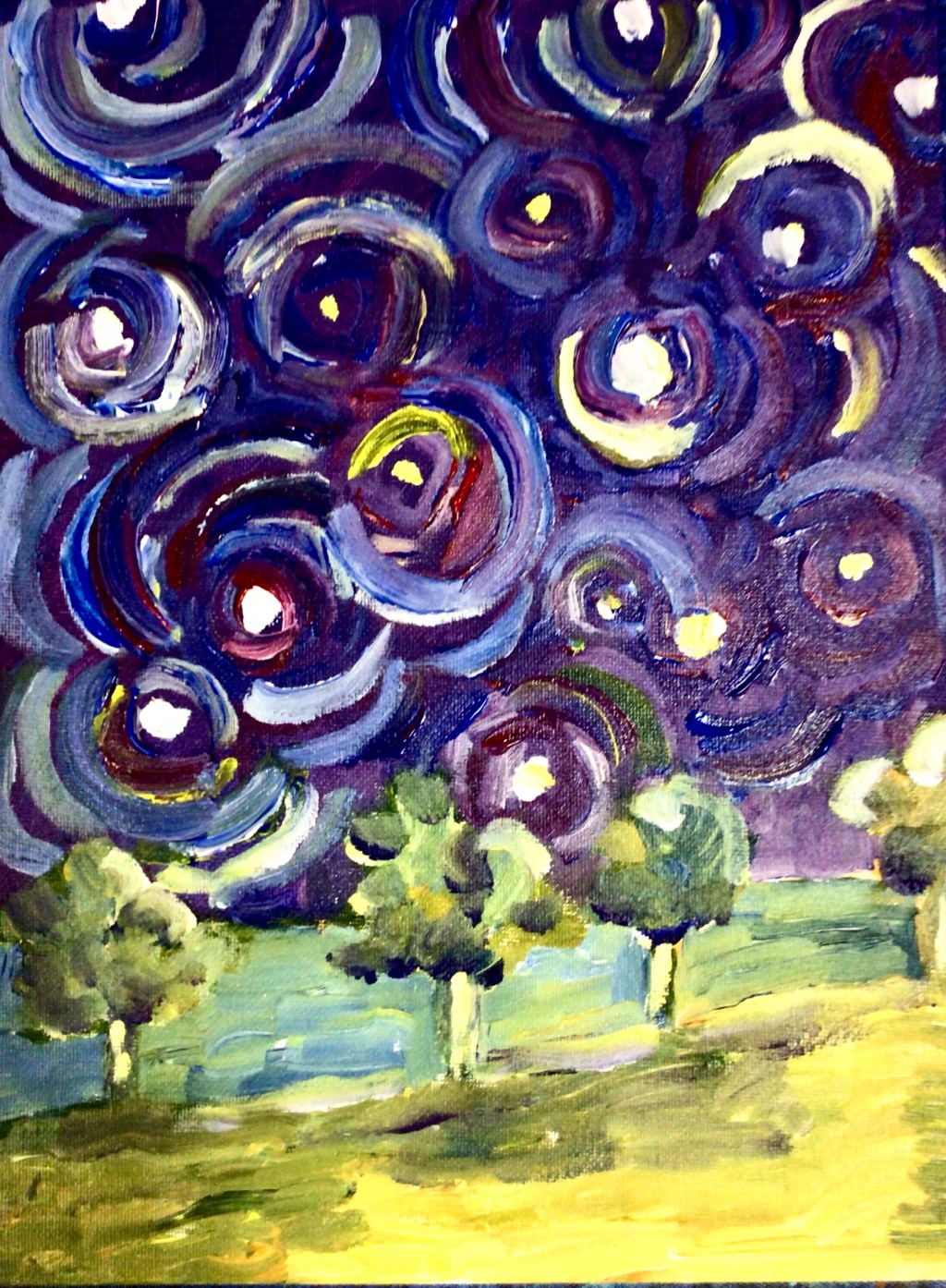
Cornelia: Starry Night

I’m not a fast walker, nor do I get down the road quickly. I’m too busy noting the color of the sky, thinking what colors to mix to get the grey trees of a late December day, or how to paint the towering cumulus clouds of summer. I file these thoughts away in the treasure house of my mind, for one day I’ll need them. I look at the shadows of the leaf clumps on trees, but not at each leaf alone. The tree leaves are communities, not individuals. They exist as groups, so the artist treats them as such.

I’m not sure about others, but many walkers are fixed on their personal best speed, or going a half mile longer. Some people drive to the grocery store and make their list in their head as they go. In the store, they make a new to do list for the home, and once that’s done, they make another list for the next day. The cycle starts all over again. They never once raise their eyes to greet the stars, to note the cycles of the moon, to enjoy the sunset colors, or the sunrise either. They’re probably more productive than I am, but I take time to reflect deeply on the “why of things” rather than repeating the same rhythms over and over. Most people like the familiar rhythms, however, while I question if they still have meaning in today’s world.

Today I saw the Winter Solstice Dawn

In ancient times, the Greeks and Romans thought the stars had a power and energy to determine the fates of human beings. Marcus Aurelius, a Roman emperor and stoic philosopher of the 2nd century, wrote in his Meditations: “Dwell on the beauty of life. Watch the stars, and see yourself running with them.” From his privileged location, he could identify with the heroic persons in the astrological figures of mythology.

Some people are “born under a bad sign,” or are unlucky in life. Of course, some say we make our own luck, but people born into harsh circumstances lack the same resources to make choices for good. The deck is stacked against them, from living in trauma filled neighborhoods to a lack of quality foods due to a paucity of grocery stores. As Albert King, the great blues artist once sang, “If it weren’t for bad luck, I wouldn’t have no luck at all.”

The good news is the bright light of the Christmas star points to the new light, which has come into the world. We hear, amidst the cacophony of commercials and piped in musical carols, the words of the prophet Isaiah: “Arise, shine; for your light has come, and the glory of the LORD has risen upon you” (60:1).

As a gift, you can listen to the great Albert King sing “Born Under a Bad Sign,” by copying the link below to your browser.
https://music.youtube.com/watch?v=F2IqJtBL6yk&list=OLAK5uy_kRTT9VaZ7Ht_pjIoBhtqhS_99sMi_D5a4

Our art class returns Friday, January 4, 2022, at 10 am. I hope to bring pomegranates, if I can still find them in the store. We’ll make a fresh start in the New Year, so if you want to join, you’ll start where you are. We are a “one room schoolhouse,” so there’s no grade levels with us. We’re all learning and improving from where we are at the moment.

Joy and peace,

Cornelia

How to Make a Yule Log
https://www.learnreligions.com/make-a-yule-log-2563006

5 Most Beautiful Chinese Winter Solstice Poems to Appreciate
https://www.travelchinaguide.com/essential/holidays/winter-solstice-poems.htm

The New World Atlas of Artificial Sky Brightness | CIRES
https://cires.colorado.edu/Artificial-light

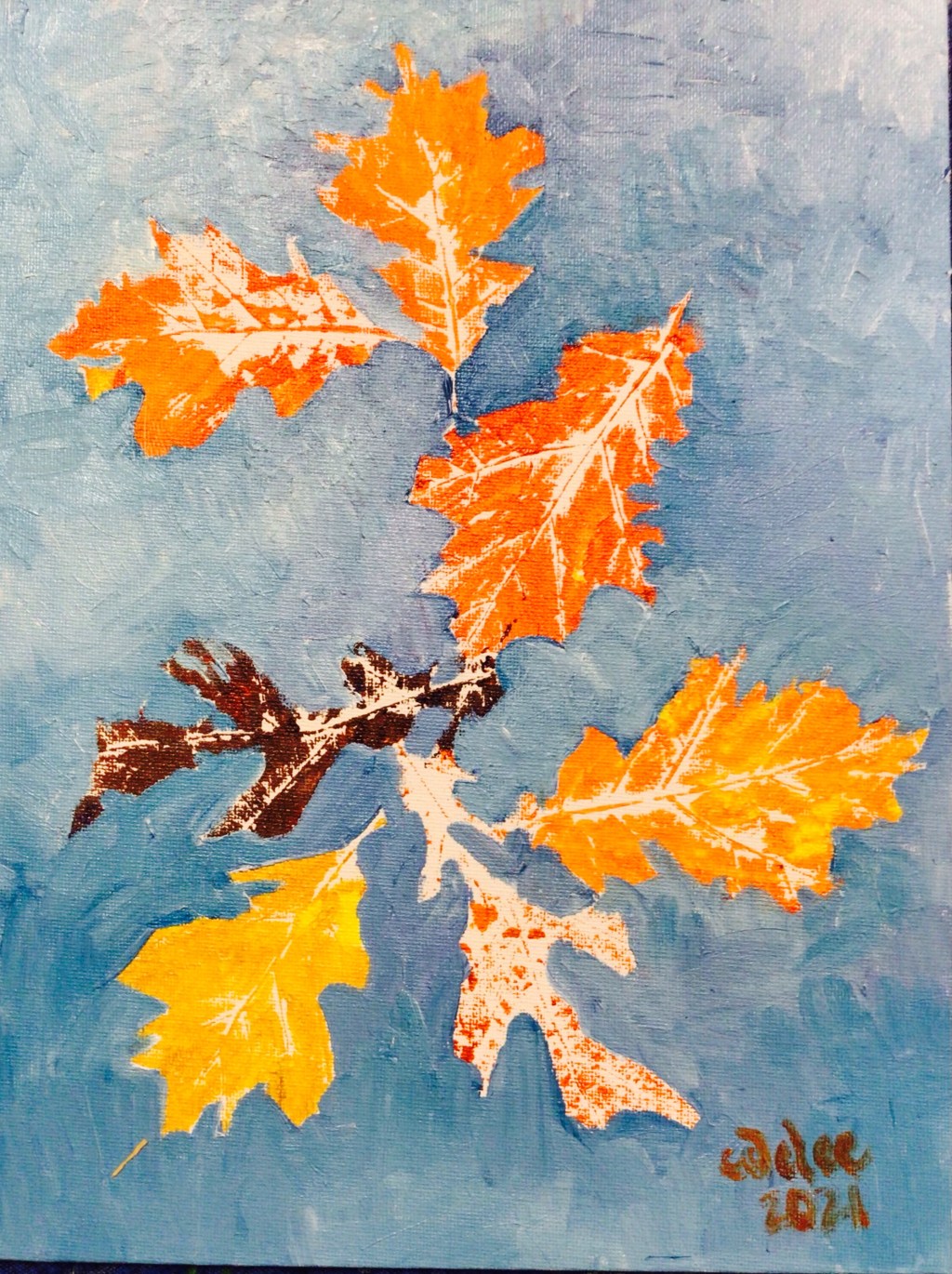
Autumn Leaf Prints

adult learning, art, autumn leaves, Carl Jung, Christmas, coronavirus, Creativity, Faith, grief, holidays, inspiration, nature, Painting, renewal, shadows, Spirituality, trees, vaccinations, vision

As the days grow shorter, the pile of leaves grows larger. This is Einstein’s equation for autumn. I know “Energy equals Mass times the speed of Light squared” isn’t really congruent with all those bags of leaves accumulating on the edge of the streets of the front yards in your neighborhood. It just seems that way. When I bought my first little stucco, flat roofed house back in my hometown, the former owners reminded me at closing, “Be sure and rake the roof every autumn.”

Of course I forgot about this, until the twenty something major trees around my little flat roofed house dumped all their leaves on my roof. How did I know? When it rained, those leaves blocked the drainage holes, so water came inside the ceiling light fixtures of my kitchen in the back of the house. As soon as the rain quit, I had the ladder out and was filling the big, black garbage bags with soggy leaves. If you only fill them half way, they’ll stay intact when tossing them over the parapet. I was younger then, and trainable. I didn’t forget when autumn came the next year.

Gail’s Leaves floating on Water

I’ve always thought leaves “fell” off the trees or the wind blew them off, but I asked Mr. Google, “Why do leaves fall?” Turns out, the trees cut them off with scissor cells. The leaves are only useful for making food for the tree. They are the seasonal kitchen staff, so the tree lets them go for the winter and brings in a new crew in the spring. The changing light and cooler temperatures triggers a hormone that makes this happen.

The scissor cells are stained red and mark the boundary between the branch (left) and the leaf stalk.
University of Wisconsin Plant Image Teaching Collection

If the leaves stayed on the tree, they’d wake up during a winter warm spell, start their food production work, and then get frozen when the cold inevitably returns. The tree knows the lifespan of the leaf, and this is the natural course of the life cycle. New growth will come in the spring, after a period of rest and recovery.

Lauralei’s Memories of The Leaves that Were

Our holiday season coincides with darkening days and marketing excess. Most of the commercials show happy families with lots of presents in heavily decorated holiday environments. Statistics show 25% of people are estranged from their families, and one out of every 463 Americans alive at the beginning of 2020 has since died of covid-19, the disease caused by the novel coronavirus. About 1 in 8 Americans say that a member of their family died of the virus; another fifth say that they lost a close friend, according to YouGov polling. These are staggering numbers, for in the US alone, 779,293 people have lost their lives as of November 30, 2021. One too many Thanksgiving tables had an empty place setting for a loved one no longer among us, and this will be a blue Christmas for many families.

If this were a war, maybe folks would get all excited and consider good health practices such as mask wearing , hand washing, and vaccinations their patriotic duty. Instead, they throw themselves into the breach of a thousand tiny viruses as if they were seeking the congressional gold medal for valor, and end up leaving their families with nothing but medical bills, grief, and the loss of their presence. Into this weary season comes Omicron, yet another variant, but an expected event due to the lack of worldwide access to vaccines and the virus’s ability to mutate in immunocompromised individuals. The enemy keeps evolving and the battles continue, whether we’re weary of the struggle or not.

“The Falling Leaves,” by Margaret Postgate Cole of England, is one of the first anti-war poems from a woman’s perspective. It was written in November 1915, during the First World War, when from 1914 to 1918, Flanders Fields was a major battle theatre on the Western Front. A million soldiers from more than 50 different countries were wounded, missing or killed in action there. Entire cities and villages were destroyed, their population scattered across Europe and beyond. The tradition of poppies on Veterans Day came from the red flowers given life from the blood spilled on this battlefield. COVID today is exacting it’s own cruel battle toll, with children left orphaned and spouses left without their mates. The adverse affects on this generation may be equal to those who went through the great flu pandemic of 1918 or the Great Depression.

War may be necessary in some instances, but it’s never to be glorified. There’s always a sadness related to the loss of life, regret over the great expense poured out that might have been used to build rather than destroy, and the cruelties that attend actions when we make others into evil enemies and refuse to see them as human as we are. Her poem speaks poignantly to this human loss:

Today, as I rode by,
I saw the brown leaves dropping from their tree
In a still afternoon,
When no wind whirled them whistling to the sky,
But thickly, silently,
They fell, like snowflakes wiping out the noon;
And wandered slowly thence
For thinking of a gallant multitude
Which now all withering lay,
Slain by no wind of age or pestilence,
But in their beauty strewed
Like snowflakes falling on the Flemish clay.

Source: Margaret Postgate’s Poems (1918)

If we want to treat these end of year days as “days of denial” of all that’s grim in the world to focus only on the good and the light, we’s be like people who claim we have no shadow. Carl Jung believed the shadow included everything in the unconscious mind, good or bad. Also, the shadow might include only the part of the personality that you don’t want to identify as self, but still is a part of your unconscious mind. This dark side of your personality contains everything your conscious mind can’t admit about itself.

When we read the birth story of Jesus, we often focus on the angels and the gifts of the magi. We forget these heavenly hosts are God’s armies and the magi came to meet the new king. These were revolutionary acts that caused King Herod to feel insecure and threatened, so he slaughtered the innocent babies born at this time. The Bible never forgets this shadow side of life, for this is why Christ came into our world:

“to give light to those who sit in darkness and in the shadow of death, to guide our feet into the way of peace.” ~ Luke 1:79

Joy and Peace,

Cornelia

Why Leaves Really Fall Off Trees : Krulwich Wonders… : NPR
https://www.npr.org/templates/story/story.php?storyId=114288700

The Depths Of Estrangement: Why Family Rifts Happen And How To Heal
https://www.wbur.org/hereandnow/2020/12/24/family-estrangement-holidays

[The Washington Post] Analysis | A third of Americans say close friends or family have died of covid-19
https://www.washingtonpost.com/politics/2021/10/13/third-americans-say-close-friends-or-family-have-died-covid-19/

Visit Flanders Fields | VISITFLANDERS
https://www.visitflanders.com/en/themes/flanders_fields/

Rabbit! Rabbit! Welcome to December!

art, Christmas, coronavirus, Faith, Family, Food, grief, Hanukkah, holidays, Imagination, Ministry, nature, pandemic, purpose, vaccinations, winter solstice

“The more things change, the more they stay the same,” my daddy was fond of saying. We often long for the “way things used to be,” as if the Golden Age of the past was the best of all times. Yet, that past often exists only in our memories, but not in the lived reality of all persons. This is the classic story of the young prince, who while sheltered within the confines of his sumptuous palace never knew want, but once he walked among his people, he saw suffering and need everywhere. Today we know him as the Buddha, or Siddhartha Gautama. Many over the centuries have wondered why suffering exists in the world, or why they themselves must suffer. The Buddha saw all life as suffering, or rather our inability to accept the impermanence, change, and dissatisfaction with the present moment.

Rabbit Buddha

The Golden Age is a myth and poetic concept, as well as a political and philosophical construct. It began in Greece and was fixed in people’s minds by the time of the Roman Emperor Augustus. The Golden Age is a dream of an “earlier time when people lived peaceful, untroubled lives, and the earth supplied all their wants.” Those who read the Bible can easily find a parallel story in the first humans, who lived in the Garden of Eden. Of all the high and holy days in our cultural calendar, Christmas rates number one for nostalgia, both the personal kind and the universal type.

Nostalgia is the state of being homesick, or a wistful or excessively sentimental yearning, either for the return to or of some past period or irrecoverable condition. It can be a salve for those who suffer, or it can be more salt poured into an open wound. It just depends on how one frames the experience. We feel “homesick “ in the worst possible way, for we yearn for the security of the familiar and the safe. Mostly we yearn for the people we love and are kin to us.

Happy Rabbit Family

I remember the year I divorced my husband. It was necessary, for I couldn’t trust him to care for our daughter due to his alcoholism. The first Christmas was hard, for his family chose him and shut me out, as did all his friends. Decorating the Christmas tree was always a family affair in the Golden Age of my memories of Christmas. If this year I had no family, I would bring friends to decorate my tree. Just because I’d always celebrated one way before, I wouldn’t let my circumstances keep me from finding joy this Christmas. I called my young mother friends, invited their families to my home, and we decorated my tree within an inch of its life. It was my best tree ever! And then we ate and drank a toast to our creation. My friends were salve for my suffering, and helped me create a good memory, which still gives me pleasure to this day, four decades later.

Big Holiday Family Dinners

Christmas brings families together, but this is a double edged sword. While we all want to be with our families, we also know oil and water don’t mix. After both my parents died, I often ate with some of my clergy pals’ families. I was glad to know they had relatives who also wore their crazy pants to dinner. If I ate with congregation members, they were often on their best behavior, as if I were some sort of god on earth. You’d think after six months at a charge, I’d already have disabused them of that notion, but some people never see your true nature, but only the image of every pastor they’ve ever known before. More often, I’d get pastoral calls of family crises during holiday seasons, so after years of this recurrence, I finally learned to plan for it. I eventually realized we all have a Golden Age of Christmas in our minds, but in real life, we live in the Age of Iron. When reality hits our delusions, the disconnect is palpable. We feel it in our very bones.

1896 Thomas Nast illustration in Clement Clark Moore’s ‘Twas the Night Before Christmas

For many Americans, images of Victorian Christmases include memories of “children all snug in their beds with their visions of sugar plums dancing in their heads,” which we recognize as one of the opening lines of Clement Clark Moore’s “A Visit from St. Nicholas,” a.k.a. “Twas the Night Before Christmas.” These sugar plums aren’t sugared fruits, but are more like candy covered peanuts or almonds. Jelly beans also are made by this same process. Whatever these treats were, the children dreamed of a world of happiness, sweetness, and delight.

As my Depression Era mother would say, “If wishes were horses, beggars would be kings.” That outlook never stopped me or my brothers from wanting everything in the Sears Christmas catalog, even though we knew these were just suggestions for Santa. Yet we never felt deprived, for whatever we received was a gift, plus it was more than we had before. On Thanksgiving day this year, consumers spent at a pace of at least $3.5 million per minute on line due to stores being closed for the holiday. This year, the average household is pegged to spend $924 for online shopping, more than double the $440 expected for in-store.

December 15 is Wear Your Pearls Day

The National Retail Federation (NRF) projects November/December retail sales of $843.4 billion to $859 billion, up 8.5% to 10.5% from 2020 results. NRF said its forecast — excluding automobile dealers, gas stations, and restaurants, and covering Nov. 1 to Dec. 31— tops the previous high of $777.3 billion. This total is up 8.2% over 2020, as well as the average gain of 4.4% over the past five years. This increase is in spite of supply chain hiccups, rising gas prices, and the pockets of as yet unvaccinated individuals, who continue to be the greatest number of COVID admissions to our hospitals. It’s as if we’re trying to replace the suffering of our present with presents for those we love. This also accounts for our desire to donate to charities at this season.

Scrooge of Christmas

Yet the Scrooge of Christmas continues to be COVID, for as an Augusta University Medical analysis released in May of 2021 revealed, which looked at COVID-19 related deaths in vaccinated versus unvaccinated individuals—only .8% (150) of vaccinated people accounted for the 18,000 COVID-19 deaths in May. If you want to give someone the gift of life this Christmas, take them to the local pharmacy and get them started on their vaccinations.

The Centers for Disease Control and Prevention has found both infection-induced and vaccine-induced immunity are durable for at least six months — but vaccines are more consistent in their protection and offer a huge boost in antibodies for people previously infected. Unfortunately, unvaccinated persons are also the prime hosts in which the virus can mutate, so the Grinch has already brought us the latest variant of concern, Omicron.

This variant was first identified in the South African peninsula, due to their excellent testing facilities. Of course, now the nations of the world have isolated the countries there, so they now feel punished by these bans. Travelers arriving in major world airports already have tested positive for for this variant, so we can expect disruptions and quarantines worldwide to follow. During this holiday season of restoring relationships, COVID keeps breaking our ties instead of rebuilding them.

DeLee: Found Objects find a home in the No Room Inn

We can long for the Golden Age of light from our younger days, when our parents took on the big worries so we could have the pleasant memories of an untroubled childhood, or we can fix our sight on the lights of our faith. The great star of the east which announced the birth of Jesus was a pale light compared to “The true light, which enlightens everyone, (which) was coming into the world.” (John 1:9) His was “The light (which) shines in the darkness, and the darkness did not overcome it.” (John 1:5).

Colorful Menorah

Our Jewish friends meet the darkness of this Hanukkah season with prayers and menorahs, nightly lighting candles to disperse the darkness of hopelessness against great foes. They remember doing battle against spiritual powers, with God empowering their weakness. God never comes for the strong, but has a special kindness for the poor and weak. This is why we should feel blessed, no matter our personal experience, but especially during the holidays. The ceremony begins on November 28 and ends December 6, since it’s set by the lunar calendar.

So also are these December celebrations light filled: Burning the Yule Log on the 4th, St. Lucia on the 13th, the Winter Solstice on the 21st, Kwanzaa on the 26th, and finally, New Year’s Eve. Our good earth will bring its tilt back towards the sun gradually in the days following the winter solstice. This darkness too shall pass, whether it’s our personal grief or our universal suffering.

Winter Solstice brings back the Light

We’ll keep walking until we meet the better land beyond the horizon. If this isn’t yet the Golden Age of our memories or the Golden Age of our sugar plumb dreams, let’s work together as we walk to build a better world for all people, “for we are what he has made us, created in Christ Jesus for good works, which God prepared beforehand to be our way of life.” (Ephesians 2:10)

Merry Christmas and Happy Holidays to all my Bunny Friends!

May you have a mindful holiday, full of joy and peace,

Cornelia

Dukkha: What the Buddha Meant by ‘Life Is Suffering’
https://www.learnreligions.com/life-is-suffering-what-does-that-mean-450094

Reckford, Kenneth J. “Some Appearances of the Golden Age.” The Classical Journal, vol. 54, no. 2, The Classical Association of the Middle West and South, 1958, pp. 79–87, http://www.jstor.org/stable/3294223.

Wynne Parry: Why We Feel Nostalgic During the Holidays
https://www.livescience.com/17571-nostalgia-holidays-memories.html

Sugar Plums: They’re Not What You Think They Are – The Atlantic
https://www.theatlantic.com/health/archive/2010/12/sugar-plums-theyre-not-what-you-think-they-are/68385/

U.S. Thanksgiving Online Shopping Spending to Set Record
https://www.bloomberg.com/news/articles/2021-11-26/u-s-thanksgiving-spending-to-set-record-as-shoppers-move-online

U.S. holiday retail sales outlook brings good tidings
https://www.supermarketnews.com/consumer-trends/us-holiday-retail-sales-outlook-brings-good-tidings

The Washington Post: CDC finds immunity from vaccines is more consistent than from infection, but both last at least six months
https://www.washingtonpost.com/health/2021/11/01/what-works-better-vaccines-or-natural-immunity/

Staggering COVID-19 Statistic: 98% to 99% of Americans Dying are Unvaccinated – AU/UGA Medical Partnership
https://medicalpartnership.usg.edu/covid-19-staggering-statistic-98-to-99-of-americans-dying-are-unvaccinated/

Night before Christmas, Creator: Moore, Clement Clarke, 1779-1863 ( Author, Primary ), date: c1896, The University of Florida, George A. Smathers Libraries, Donor: Egolf, Robert
McLoughlin Bros., inc ( Publisher )
Nast, Thomas 1840-1902 ( Illustrator ) https://ufdc.ufl.edu/UF00085407/00001

All of the versions of Clements’ work can be found at the UF Library site. The illustrations are telling of the age in which they drawn.

Dreams of Trees and Butterflies

arkansas, art, butterflies, coronavirus, Creativity, Faith, Forgiveness, grief, Healing, Historic neighborhood, holidays, hope, Imagination, inspiration, nature, pandemic, renewal, vision

The saying is true: “If nothing ever changed, there’d be no butterflies.” Yet how hard do we humans hold to the past, even if we need to move on into the future? As an artist, I’ve always been caught between my desire to honor the traditions of the past, but also to move into the the unknown realms of the future. Artists already have a vocabulary and boundaries to describe the works of the past, so we can tell if our current works “meet the criteria for excellence.”

Found Object Butterfly: roadside debris, wire, scrap cloth, and metallic beads

When we go beyond this known world into the uncharted territories, we’re like Columbus, who landed in the Caribbean islands, but thought he was on the continent of North America. I wonder if the monarch butterfly, just emerging from the cocoon, has any idea it soon will begin a 3,000 mile migration to its ancestral winter home in Mexico. The butterfly has the innate ability to navigate this path, whereas we humans are like Abram, for we’re going to a land our God will show us. We have no idea where we’ll end up, but we do know we’ll travel by stages and God’s guiding inspiration will always be with us.

During this current protracted COVID pandemic, with cases beginning in mid December 2019, we’ve now lost over 766,206 persons in the US alone and over 47,390,239 individuals have had COVID. Worldwide, the numbers are far greater: over 5 million have died and nearly 255 million have contracted COVID, mostly because vaccines and health care services aren’t available to the extent they are in America and the European Community. Not only has our world as a whole suffered a great grief, but each of us individually have lost friends, neighbors, or loved ones. This adds to our collective grief.

Airport Road at MLK Hwy Intersection, empty lots

When we see the rest of our world changing around us, we feel another loss, and this becomes the grief leading to the death of a thousand tiny cuts. Just as in our workplaces, when the ideas of the young, the female, and the ethnic individuals aren’t valued, their dismissal leads to devaluation of their perspectives as well as their personhood. When we devalue nature and treat creation as an arena for humanity to restructure for our purposes alone, we can fall into the trap of thinking only for our immediate future, but not for the generations to follow. This is why building lots inside the city get cleaned off and offered as a blank slate, since this makes them valuable to the greatest number of buyers.

Death by a thousand cuts was supposedly a form of torture in ancient China. It was reserved for the most heinous crimes, such as matricide, patricide, treason, and the like. From all the tiny slices, the accused finally bled to death. It was a cruel and unusual punishment, rather like flogging the back of a law breaker until the flesh was raw, but this punishment was intended to cause death because the executioner kept at it until he succeeded.

Most of us are blissfully unaware of the loss of a few trees here and there in our neighborhoods. Sometimes we even want to cut down the trees on our own property because we’re tired of raking leaves every fall, or if we have a magnolia tree, we’re tired of our year round duty of leap reaping. Of course, if you want a high strung, classy tree to show off in your front yard, you also need to sign onto the high maintenance these trees require. “Those that wears the fancy pants has to take care of those fancy pants,” my mother always reminded me.

Yard work is a type of infrastructure most of us can understand. With Thanksgiving just around the corner, those of us hosting the feast are also getting the house and yard ready for family and friends to visit. Infrastructure has been in the news lately also, with politicians debating whether soft or hard infrastructure deserves the most funding.

In Hot Springs, we have “Green Infrastructure,” which includes all the natural assets that make the city livable and healthy: trees, parks, streams, springs, lakes and other open spaces. These assets are ‘infrastructure’ because they support peoples’ existence. For example, tree canopy keeps the city cooler while also absorbing air pollutants and mitigating flooding. The Hot Springs National Park forest area is also an important resource for a variety of reasons. The mountain area is in the recharge zone for the hot springs and the forest provides other important ecosystem services.

Hot Springs is Very Green

In urban areas, we can evaluate the landscape on a smaller scale, so even small patches of green space become important, since together they can make a greater large cumulative impact. Smaller urban spaces, such as linear stream valleys, or even pocket parks, can add up to a connected green landscape. When evaluating the ecological health of an urban area, urban tree canopy is a key green asset. For instance, Hot Springs has 57% tree canopy coverage and an additional 12% green space coverage. This adds to our quality of life, for this isn’t only pleasing to the eye, but the trees and grass convert carbon dioxide to oxygen, thus improving the air we breathe.

Cities are beginning to recognize the importance of their urban trees because they provide tremendous dividends. For example, city trees are a strategic way to reduce excess stormwater runoff and flooding. Even one tree can play an important role in stormwater management. For example, estimates for the amount of water a typical street tree can intercept in its crown range from 760 gallons to 4000 gallons per tree per year, depending on the species and age. Taken city-wide, the trees within the city provide an annual stormwater interception of 1.2 to 1.5 million gallons which equates to 7 to 9 million dollars in benefits. The loss of one tree is worth so much money, replanting our tree cover is an investment in our future wellbeing.

I often heard an old proverbial poem growing up, which may not be repeated much today:

For want of a nail the shoe was lost.
For want of a shoe the horse was lost.
For want of a horse the rider was lost.
For want of a rider the battle was lost.
For want of a battle the kingdom was lost.
And all for the want of a horseshoe nail.

My nanny would remind me of the same principle in other words, “A stitch in time saves nine.” My daddy was from the school of “If it ain’t broke, don’t fix it.” While those two schools of thought still persist today, I think making a small, inexpensive repair, rather than a costly replacement, is a better choice, but too many of us live in a throwaway society.

Wisterias among the Trees

When we lose one small thing, we brush it off as no matter, but after a thousand small losses, we just can’t take it any longer. We look around and wonder what happened to our world, why didn’t we take action sooner, and now we might be in a hole so deep we can’t see the top. When I first painted the trees on this vacant lot, the little coffee kiosk had closed shop and moved on. It was springtime and the violet wisteria vines were bright against a sunlit cerulean sky.

As I was taking a few photos with my iPhone last spring, the local policeman pulled into the circular drive to check on me. We chatted a bit, but he wanted to make sure I was OK. I’m at that age when silver alerts go out for others, but I’m not there yet. I guess “old gal taking photographs of trees” still looks suspicious in my small town. I’m thankful my town is this quiet.

When I told the officer, “These trees called to me,” he might have had second thoughts about my state of mind. Then he realized he was talking to an artist. I was rescued when his radio called him off to take care of some real trouble. I find I do my best work when I feel called to a subject, for I have a spiritual connection with it.

That was this past April, and here at year’s end, this lot is up for auction, with a commercial use zoning. It has easy access to the bypass and would be good for a food place or a fuel stop. Things change and we can’t hold back progress. I know people who buy a vacation home to visit while they still work, but as soon as they retire to this same place, they grouse about all the weekenders who come and spoil their solitude. They put up with it a year or so, griping daily, and then sell and move on. Life changed for them and they didn’t adjust to their new normal. I wonder why they never realized Hot Springs was a vacation destination. We think we need an infrastructure just for the 38,500 people who live here year round, but we actually need an infrastructure to support the over two million visitors to whom we offer the hospitality of our hot springs, our hotels, our fine dining, our attractions, and our natural beauty.

When I saw the trees were gone and the lots had been plowed level, I wondered if the trees had a swift death, or if they had brief dreams and fantasies while the saws pierced their outer skins. I thought of the butterflies encased in their cocoons, and the deep sleep of their transformation. Do butterflies dream in this stage, or do they even dream like we do? I wondered if next April I would see wisteria growing near the ground, for as a weed, it’s hard to kill. I always hope, for I’ve learned over time, if I’m a prisoner of hope, this is better than seeing only the loss.

Stage One

After traveling and recovering from an autumn sinus infection, I decided to destroy an old mobile sculpture of a butterfly made from found materials and attach it to a canvas. I took some scraps of cloth from some mask projects, and glued the whole to the canvas. Maybe I crammed more than I should have onto the small surface, but I was going with it. This work might be more catharsis than art, or more process and possibility than success. It doesn’t matter, for sometimes art is more therapeutic than anything else.

The first layer held all the colors and shapes of the original Google map. The second layer began to make sense of the shapes and textures, for I started to pull together the small areas into larger spaces. By the third layer, I’d lost most of the color areas and turned them instead into linear shapes. The primary colors of the background I subdued beneath an overall gold tone. The lines now are like an automatic writing or glyphic writing, which might be the language spoken either by the trees or the butterflies, or by all natural living beings.

Stage Two

When we confront suffering in nature, in our lives, or in the world, we often ask, “Where is God in all of this?” In the days past when I suffered, I held on to the words of the Apostle Paul to the Romans:

“I consider that the sufferings of this present time are not worth comparing with the glory about to be revealed to us. For the creation waits with eager longing for the revealing of the children of God; for the creation was subjected to futility, not of its own will but by the will of the one who subjected it, in hope that the creation itself will be set free from its bondage to decay and will obtain the freedom of the glory of the children of God.” (8:18-21)

Dreams of Trees and Butterflies

Often we suffer because we can’t change our past, or we think we can’t affect our future. At some point in our lives, we come to accept our suffering. We don’t have to continue to suffer, of course, but we need to accept that what happened to us is over. We can forgive ourselves for not leaving a bad relationship earlier, or being too young to know we were being harmed. Some of us may have survivor guilt from our nation’s wars, and suffer moral injuries from acts of war. Only good and decent human beings would feel this guilt, and they can heal with Christ’s forgiveness. We can be changed and then begin to change the world, even if we begin only with our own selves.

After all, the Psalms promise us God is faithful both to us and to the creation also: “When you send forth your spirit, they are created; and you renew the face of the ground.” (104:30)

Joy and peace,

Cornelia

Vegetation Community Monitoring at Hot Springs National Park, Arkansas, 2007–2014
Natural Resource Data Series NPS/HTLN/NRDS—2017/1104
https://www.nps.gov/articles/upload/HOSP_VegCommunity2007_2014r-508.pdf

GREEN INFRASTRUCTURE LANDSCAPE STUDY AND PLAN
City of Hot Springs, AR
Green Infrastructure Committee
https://www.cityhs.net/DocumentCenter/View/6245/Hot-Springs-AR-GI-Study-and-Plan-Final?bidId=

Hot Springs General Information: Hot Springs National Park Arkansas
https://www.hotsprings.org/pages/general-information/

Rabbit! Rabbit! Welcome to May!

Altars, apples, art, Civil War, coronavirus, exercise, Family, flowers, Food, greek myths, grief, Healing, Health, holidays, Holy Spirit, Love, Memorial Day, Ministry, ministry, pandemic, purpose, rabbits, renewal, Retirement, righteousness, shadows, sleep, Strength, Stress

We’ve made it to May, the official door to summer, picnics, swimming pools, backyard cookouts, and slower paced lives. Or so we hope, as the temperatures warm and the pandemic wanes. Of course, this last is dependent not just on our individual responses, or even on our citizens’ cooperative actions, but it also depends on the developed nations of our world sharing our expertise and resources with the larger world’s need. If we ever thought we could build a wall and isolate our people and economy from the outside, our need for imported goods and our desire to travel on cruise ships seems to trump our need for isolation. India’s ongoing coronavirus catastrophe results from an inadequate health care system and a lack of vaccines, oxygen, and PPE. Less than 10 percent of Indians have gotten even one dose, despite India being the world’s leading vaccine manufacturer.

Matisse: Swimming Pool, paper cutouts, 1952, MOMA

As we come out of our enforced hibernation, like bears we shed our winter coats and start foraging for foods in an ever widening territory. We’re looking for reasons to celebrate and tantalizing foods to taste. The yum factor and new environments suddenly become sirens singing irresistible songs, which have the opportunity to dash our small bark against the rocks if we’re not careful. Like Ulysses, the ancient Greek hero, we travel between Scylla and Charybdis, hoping not to wreck.

J. M. W. Turner: Ulysses Deriding Polyphemus, 1829, Tate Gallery, London.

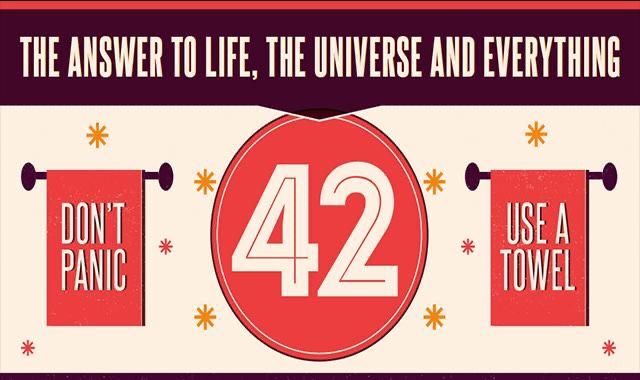
Fictional heroes make a big splash in May. On May 1, 1939, Batman, the caped crusader, made his first appearance in Detective Comics Issue #27. Star Wars Day is “May the 4th be with you.” On May 5, 1895, Richard F. Outcault published the first ever cartoon, The Yellow Kid. Since all those years ago, cartoons have seeped into our lives through every media outlet possible. If it weren’t for The Yellow Kid all those years ago, we probably wouldn’t be watching Iron Man and Captain America slugging it out on the big-screen. May 25 is a tribute to author Douglas Adams, who wrote the famed novel, The Hitchhiker’s Guide to the Galaxy.

Quote from The Hitchhiker’s Guide to the Galaxy

It’s a rather easy day to celebrate and it’s done by taking a towel with you wherever you go: to work, school, or just to the shops. This way you can celebrate such gems of wisdom as, “Nothing travels faster than the speed of light with the possible exception of bad news, which obeys its own special laws.” The only thing that’s truly important on this day is you don’t forget to bring a towel!

Don’t Panic: Carry a Towel

Oh, and the answer to the “Great Question of Life, the Universe and Everything” is “forty-two.” In the 1979 novel, the supercomputer Deep Thought takes 7.5 million years to calculate the answer to this ultimate question. The characters tasked with getting that answer are disappointed because it isn’t very useful. Yet, as the computer points out, the question itself was vaguely formulated. To find the correct statement of the query whose answer is 42, the computer will have to build a new version of itself. That, too, will take time. The new version of the computer is Earth. To find out what happens next, you’ll just have to read Adams’s books. For a math geek discussion of the significance of 42, read the link “For Math Fans” below.

Salad of spring greens and edible flowers

Having dispensed with heroes, we can move onto the significant May Days that truly appeal to me. “April showers bring May flowers” is a saying I’ve heard since my childhood ever so long ago. Historians believe this phrase may date back to a 1610 poem, which contained the lines, “Sweet April showers, do spring May flowers.” A longer phrase, “March winds and April showers bring forth May flowers,” has also been traced back to 1886. Of course, this tidbit of wisdom depends upon your geographic location, for folks inland and north may wait until what we southern folks call “early summer” before they get their “springtime.”

Rabbit and animals dancing around a Maypole

“The month of May was come, when every lust heart beginneth to blossom, and to bring forth fruit,” wrote Sir Thomas Malory in Le Morte d’Arthur. The early Greeks called this month Maia, after the goddess of fertility, many of the early May festivals relate to agriculture and renewal. May Day, celebrated on the first with the Maypole, is one such festive event that was more debauched in earlier times, but now survives as a chaste minuet of colorful ribbons woven around a tall pole by children dancing in an interweaving circle below it.

Maypole dance patterns

Other modern May festivities include No Pants Day on 5/1, originally an end of the college year prank at the University of Texas, Austin, which spread to other realms needing release, and World Laughter Day, celebrated on the first Sunday of May. This holiday helps raise awareness about the benefits of laughing and promotes world peace through laughter. Laughing can instantly help reduce stress and brings us closer to other people, as we share our happiness with them. Those who take part in World Laughter Day can help spread positivity and cheerfulness to help change the world for the better. As Ralph Waldo Emerson said, “What potent blood hath modest May.”

No Diet Day is May 6, a good day to remember our good health isn’t based on a scale number or a pant size. Instead, our health is dependent on nutritious foods, adequate exercise, and sufficient sleep. Extreme weight loss, except under a doctor’s supervision, usually leads to yo-yo weight gain, with the body gaining back the lost weight and more after severe deprivation. Slow, long term, weight loss is more likely to be permanent loss, since we aren’t “dieting,” but changing our habits. May 11th is Eat What You Want Day. I suggest we don’t follow Oscar Wilde’s habit: “My doctor told me to stop having intimate dinners for four, unless there are three other people.”

Speaking of breaking a fast, May 12th ends the month of Ramadan, the holy month of observance for Muslims. It was during Ramadan Muhammad, the prophet of Islam, received the revelations from angel Gabriel that allowed him to compile the holy book of Quran. Upon arriving in Medina, Muhammad announced Allah had established two days of celebrations for Muslims, Eid Al Fitr and Eid Al Adha. The purpose of Eid Al Fitr was to commemorate the end of the fasting of Ramadan, and mark the start of the Shawwal month, as well as to thank Allah for giving Muslims the perseverance to fast during Ramadan. The customary feast day greeting is “Eid Mubarak,” which translates to “blessed celebration” or “Happy Eid.”

Wayne Thiebaud: Bakery Counter, Oil on canvas, 1962, Private Collection,
© 2019 Wayne Thiebaud / Licensed by VAGA at Artists Rights Society (ARS), NY

The dessert of May is apple pie. Originally invented in England, the earliest apple pie recipe dates all the way back to 1381. The original recipe is very similar to the one we currently know, but it also included figs, raisins, pears, and saffron. The Dutch also created their own version of the apple pie, and the first recipe was published in a 1514 cookbook. This recipe is very similar to the apple pie we know and love today. Apple Pie Day is May 13th.

English and Dutch settlers brought the apple pie recipes into the colonies of what would become the United States, during the 17th and 18th centuries. They had to wait until the apple trees they planted grew and bore fruit, so at first apples were mainly used to make cider. It was only in the 18th century, when the first apple pie recipes were printed in America, that the dessert quickly grew in popularity. Following this came the 19th century Legend of Johnny Appleseed, whose real name was John Chapman. He crisscrossed the expanding American frontier to bring seeds for apple orchards for homesteaders. He also brought news and the gospel for fifty years.

Apple Pie 5 cents a slice and Homemade

Chapman, or Appleseed, lives on as a barometer of the ever-shifting American ideal. Some see him as a pacifist, others as an example of the White Noble Savage (so remembered long after the settlers drove indigenous peoples from the land), and others see a mere children’s book simpleton. Some see him as a frontier bootlegger, since he helped expand the hard cider industry. Others see Johnny Appleseed as the patron saint of everything from cannabis to evangelical environmentalism and creation care—everything, that is, but the flesh-and-blood man he really was.

Our heroes are too often cardboard cutouts, and we don’t spend much time reflecting on their shadow sides. Of course, much like a Flat Stanley, a two dimensional character doesn’t have enough density to cast much of a shadow, unless the light is just right. This is why continuing Bible study is so important: most of us stop in grammar school and never get an adult insight into the scriptures. When we meet grownup problems, we have to wrestle the questions of faith that we once easily accepted trustingly. Or we walk out the door and never come back.

A Single Rose in Memory

One of the most difficult sermons I ever preached was on the first Mother’s Day after my mother died. One of my best clergy pals, who was a mentor in my ministry, had arranged for a single rose to be on the pulpit beside me on that morning. It was a gift of grace and an empowering symbol, for roses were my mom’s favorite flower. Every time I thought I might cry, I held on tight to the polished oak wood and inhaled the fragrance of the rose. Even now, nearly two decades later, I can clearly see this rose and pulpit, and while I remember where I was, I recall the congregation’s faces were a blur on that day. It’s always the second Sunday in May.

I talk about my fresh grief from years ago, for during this current Pandemic too many of us have had present grief and stress, but either have no words for it, or perhaps have no safe place to express it. Then again, we may be “managing the grief of others,” and don’t have time for caring for our own needs. I call this Deferred Maintenance Grief. If you have an old, leaky faucet, you can keep turning the handle tighter for only so long. You can keep the leak stopped for a while, but soon you’ll strip out the insides of the faucet. Once it’s stripped down, it both streams steadily and needs a completely new fixture to replace it, instead of a minor repair.

I experienced this DMG once after a spate of ten deaths in a week, or maybe it was seven in ten days, followed by the death of one of the old, beloved black clergymen in my community. As I lay on the parsonage couch watching a rerun of Babylon 5, I was crying as if old E.D. were my own daddy. I then realized I’d been too busy caring for others and doing the “work I was called for,” to do the grief work I needed to do for myself. I needed to honor my loss and give myself dedicated spaces to deal with my feelings, so I could be present for others. That’s Deferred Maintenance Grief in a nutshell. If I were eating Cheetos by the bucketful, I’d be in a deep hole of DMG and digging it deeper!

Most of the churches I served had a “Don’t fix it unless it’s broke” policy. I grew up in a Depression Era family, so I was familiar with this attitude. However, these same people didn’t live this way in their own homes. We usually had a long list of deferred maintenance projects in the church property to finish in my time there. Then I’d go to the next place and do it all over again. “Always leave a place better than you found it, both structurally and theologically. Teach people the law of love. As we learn in Romans 13:8, “Owe no one anything, except to love one another; for the one who loves another has fulfilled the law.”

Most of us human beings have “deferred maintenance projects” also: days off, doctor visits, exercise, healthy meals, quiet times, and family times. Taking time for ourselves means we’re refreshed and eager to serve from the quickening power of the Spirit. Without this resting or love for our own embodied image of God, we end up working from the dying embers of our body’s frail resources—burnout calls our name.

When we get this broken, our families and our ministries both suffer along with us. We know better than to drive our vehicles with the gas gauge on empty past every filling station on the road of life. We aren’t called to die on the cross to prove our worth to Christ or to anyone else. He’s our savior and we claim his work on the cross. Anything else is workaholism or salvation by works. We need to name and claim this.

For clergy moving to a new appointment, this is an opportunity for a reset. For those who remain in place, I suggest a planning book. Mark off in advance quiet times, office hours, and visitation times. Take educational events, even if zoom is the only offering. Read for pleasure. Take a day off out of town. Don’t answer the phone after 9 pm unless it’s an emergency. Boundaries are blessings. I always told people up front, “I take my brain out of my head and put it inside a brain box at 9 pm. I put it back in at 9 am. If you call me between those hours, somebody better have died, be on the way to the ER, or the church is burning down.” They laugh, but I’ve had friends who wanted their pastor to be their bedtime Bible expositor. Boundaries keep us from burning out.

Speaking of burning, the official door to summer begins with Memorial Day Weekend. This holiday celebrates those who gave their lives in the great wars of our nation. It began after the Civil War in 1865 as a way to deal with the shared grief of a nation, which lost 750,000 people, or 2.5% of the population, in the struggle. If we were to translate this to today’s world, the number would equal 7,000,000 deaths. War is a pandemic all its own.

An engraving of The Dying Soldier – The last letter from home during the US civil war, circa 1864. (Photo by Kean Collection/Archive Photos/Getty Images)

As a parting commentary on Memorial Day, the Pandemic, and Extreme Care Giving, I leave you with a portion of the 1865 Walt Whitman poem, “The Wound Dresser,” which he wrote after serving as a hospital volunteer in the Civil War.

But in silence, in dreams’ projections,
While the world of gain and appearance and mirth goes on,
So soon what is over forgotten, and waves wash the imprints off the sand,
With hinged knees returning I enter the doors, (while for you up there,
Whoever you are, follow without noise and be of strong heart.)

Bearing the bandages, water and sponge,
Straight and swift to my wounded I go,
Where they lie on the ground after the battle brought in,
Where their priceless blood reddens the grass the ground,
Or to the rows of the hospital tent, or under the roof’d hospital,
To the long rows of cots up and down each side I return,
To each and all one after another I draw near, not one do I miss,
An attendant follows holding a tray, he carries a refuse pail,
Soon to be fill’d with clotted rags and blood, emptied, and fill’d again.

I onward go, I stop,
With hinged knees and steady hand to dress wounds,
I am firm with each, the pangs are sharp yet unavoidable,
One turns to me his appealing eyes—poor boy! I never knew you,
Yet I think I could not refuse this moment to die for you, if that would save you.

Remember to wear sunscreen to protect your skin if you plan outdoor activities on the first three day weekend of the summer and watch the temperature of the grill. We don’t want anything to burn if we can help it. Charred meat and burned skin are both indicated for cancer risks. Be safe and continue to mask up in public. Get vaccinated as an act of love for your family, your neighbors, and the world community. Since we’re all wound dressers, as well as the wounded also, we want to give as much care to healing our own wounds as we do to the wounds of others.

Joy and Peace,

Cornie

The Project Gutenberg eBook of The Wound Dresser, by Walt Whitman.
https://www.gutenberg.org/files/35725/35725-h/35725-h.htm
This contains first source material from Whitman’s era as well as his works from the Civil War period.

Do April Showers Really Bring May Flowers? | Wonderopolis
https://wonderopolis.org/wonder/do-april-showers-really-bring-may-flowers

As Covid-19 Devastates India, Deaths Go Undercounted
https://www.nytimes.com/2021/04/24/world/asia/india-coronavirus-deaths.html?referringSource=articleShare

For Math Fans: A Hitchhiker’s Guide to the Number 42 – Scientific American
https://www.scientificamerican.com/article/for-math-fans-a-hitchhikers-guide-to-the-number-42/

42 Of The Best Hitchhiker’s Guide to the Galaxy Quotes | Book Riot
https://bookriot.com/the-42-best-lines-from-douglas-adams-the-hitchhikers-guide-to-the-galaxy-series/

No Diet Day (6th May) | Days Of The Year
https://www.daysoftheyear.com/days/no-diet-day/

World Laughter Day | May 2
https://www.calendarr.com/united-states/world-laughter-day/

National Apple Pie Day | May 13 – Calendarr
https://www.calendarr.com/united-states/national-apple-pie-day/

Johnny Appleseed Planted Stories Of Myth, Adventure : NPR
https://www.npr.org/2011/04/17/135409598/johnny-appleseed-planted-stories-of-myth-adventure

Statistics From the Civil War | Facing History and Ourselves
https://www.facinghistory.org/resource-library/statistics-civil-war

Chemicals in Meat Cooked at High Temperatures and Cancer Risk – National Cancer Institute
https://www.cancer.gov/about-cancer/causes-prevention/risk/diet/cooked-meats-fact-sheet

Rabbit! Rabbit!

brain plasticity, change, Children, chocolate, Civil War, coronavirus, Easter, Faith, Fear, Food, generosity, grief, Holy Spirit, Lent, Love, nature, pandemic, purpose, rabbits, Racism, renewal, salvation, sleep, Spirituality, Spring Equinox, Stress, Uncategorized, Valentine’s Day, Valentine’s Day, vision

Welcome to a Pandemic February—

1908 Vintage Nature Print

“Heraclitus, I believe, says that all things pass and nothing stays, and comparing existing things to the flow of a river, he says you could not step twice into the same river.” Plato quoted an older Greek thinker about life’s being constantly in a state of flux or change. We can’t dive into our rabbit holes at every quivering leaf or shadow of every cloud passing over the sun. We rabbits know the world is changing all the time, even if we don’t like it, but we still have to venture outside of our den and hutches to find tasty carrots and spinach leaves.

Fear of Change—

Yet some rabbits have a fear of change or fear of changing the order of things. This goes by another Greek word, Metathesiophobia. This is a new word for this old rabbit, so I guess I’ve modified a few brain cells in learning this. In fact, when we learn new words, we actually get happier! There’s even science behind this. In a study, “increased subjective pleasantness ratings were also related to new-words remembered after seven days. These results suggest that intrinsic—potentially reward-related—signals, triggered by self-monitoring of correct performance, can promote the storage of new information into long-term memory through the activation of the SN/VTA-Hippocampal loop, possibly via dopaminergic modulation of the midbrain.”

Even if we don’t understand the scientific jargon of that sentence, we know learning new things gives us a feeling of pride and accomplishment. We feel good about ourselves when we accomplish a new trick or master a new skill. Repeating the same experiences over and over leads to dullness,even if we find safety in the predictably.

If we were small bunnies, we’d never find the refrigerators in our homes, since they’d be covered up in our latest glorious art project. Every rabbit parent raves about their genius offspring, if they’re raising them right. We always want to catch our small ones doing something right and praise them for it. We’ll get more cooperation than if we’re always telling them NO, and GO TO YOUR ROOM.

I ask you, which rabbit among us doesn’t want to be happier in this world? Currently we’re in the midst of the worst crisis most of us have ever experienced. We rabbits need to name it and face it, rather than deny it, for this pandemic isn’t not going away anytime soon. This causes some of our bunny friends to find a “boogeyman lurking in every dark corner.” When I was young, my parents scared me, or scarred my memories, over my messy closet.

Fancy Dress Up Clothes

“You’d better clean up that pile of clothes in there, young lady! If you don’t, a rat might come crawling out of those clothes piled up on the floor!”

EEEK! I was so frightened, I untwisted an old metal coat hanger and stood outside my closet while I fished out my dress up play clothes, one article at a time. If a rat were to come out with them, I wanted a running head start. I was on my own in art school over a decade later before I could sleep with the bedroom closet open. This was a long standing fear to shake. Not everyone can put aside their fears and coping mechanisms, however.

I’ve had rabbit friends who get up in the middle of the night to make sure their closets are neatly arranged, with all the shoes in the right boxes and all the clothes facing the same direction on the hangers. I have no such anxiety, for I hang my clothes up and don’t worry once I’ve done it. I have other tasks to tackle. Uninterrupted sleep is a worthy goal for rabbit health. Plus I have other creative tasks to engage me, and I’m learning new things every day. In any event, I know my salvation won’t be impaired by this failure to act on my part, just as it won’t be earned if I keep a perfect closet.

Change is moving swifter than the atmospheric river that’s currently dumping rain and mudslides on the Pacific coast and ice and snow on the Atlantic coast. Atmospheric rivers are long, narrow regions in the atmosphere—like rivers in the sky—that transport water vapor, according to the National Oceanic and Atmospheric Administration. Drastic swings from extremely wet to extremely dry and vice versa will be nearly twice as likely, occuring on average once every 25 years, by 2100. Dramatic swings are becoming more common and will continue to do so in the coming decades thanks to man-made climate change.

Presidents’ Day—

Of course climate change isn’t the only change we’re dealing with in February.

Today we have one holiday to celebrate Abraham Lincoln and George Washington. Back in this rabbit’s kitten days, we had two holidays for these two presidents, but the times change and the holiday became popularly known as Presidents’ Day after it was moved as part of 1971’s Uniform Monday Holiday Act, which was an attempt to create more three-day weekends for the nation’s workers.

At the time, Congress thought setting three day weekends would end employee absenteeism. Today the coronavirus pandemic has put most white collar workers out of the office and many blue collar workers out of a job. Until we get this pandemic behind us by vaccinating as many of our people as possible and continuing safe practices, we won’t get back to any semblance of normal any time soon. This virus hunts a host, and it’s sure to find a rabbit to use as its own personal Petri dish.

Super Bowl LV—Next Super Spreader Event?

On the first Sunday in February, the big game goes down. While the 7,500 health care workers who’ll be the stadium attendees will be following COVID protocols, the fans at home remain susceptible to infection. A recent Seton Hall Sports Poll collected answers from 1,522 adults spread all over the country from Jan. 22-25. That data shows 25% of respondents said they would gather with people outside of their home (defined as those who aren’t roommates or cohabitants) to watch the game. Sixty-four percent of respondents said they would not attend a gathering and 11% said they weren’t sure.

Among avid fans however, 40% of that group said they would indeed gather with members outside of their household. The CDC doesn’t recommend holding these types of gatherings, especially if they are inside and last for the duration of the game. The Super Bowl will be played in Raymond James Stadium in Tampa and is scheduled for Sunday, February 7, with a 6:30 p.m. ET kickoff, with an estimated game length of four hours, not counting the additional four hours of preliminary extravaganza programming.

Chocolate Strawberry Footballs

I’ve always gathered the various rabbits who live in my condo building for the game festivities. It’s a good opportunity for us to socialize and since everyone always waits for “someone to take charge,” I just step up. We won’t do it in person this year, however, for we rabbits can best observe safely the whole shebang from the comfort of our couches and Zoom or find other other media connections with our loved ones and friends so we can have a real party next year.

Super Bowl LV Firsts—

There are new changes to the Super Bowl this year. Amanda Gorman, the inaugural poet, will recite an original poem before Super Bowl LV, as part of both the in-stadium pregame ceremony and the TV broadcast. The poem will honor three everyday heroes who have been chosen as honorary game captains by the NFL. These people include Trimaine Davis, a Los Angeles teacher who fought to secure internet access and laptops for his students amid the pandemic; Suzie Dorner, a Tampa nurse who managed the COVID ICU at Tampa General Hospital; and James Martin, a Marine veteran who has helped veterans and their families connect virtually through the Wounded Warrior Project.

Gorman isn’t the only pregame excitement. Miley Cyrus will perform as part of the TikTok Tailgate event for the Health Care Heroes. This will also be televised. Then there’s the The Pepsi Super Bowl Halftime Show, which is the most-watched musical performance of the year, with more than 104 million viewers tuning in to last year’s show. The rhythm and blues artist known as The Weekend (Abel Makkonen Tesfaye) will be the featured performer.

The Weekend

 “The Weeknd has introduced a sound all his own. His soulful uniqueness has defined a new generation of greatness in music and artistry,” said Shawn JAY-Z Carter. “This is an extraordinary moment in time and the Pepsi Super Bowl LV Halftime Show is going to be an extraordinary experience with an extraordinary performer.” This rabbit has been listening to his oeuvre on Apple Music, and I’m quite excited to hear the show. It ought to be a bang up program with no wardrobe malfunctions.

JAY-Z and his company, Roc Nation, have worked over the past year on the selection of artists playing the Super Bowl Halftime Show as the league’s official Live Music Entertainment Strategists. The partnership aims to “nurture and strengthen community” through music and support the NFL’s Inspire Change social justice initiative, and also has Roc Nation serving as a co-producer of the Super Bowl Halftime Show. 

GRAMMY-nominated artists Eric Church and Jazmine Sullivan are set to pair up for the first time to sing the National Anthem as part of Super Bowl LV pregame festivities. Grammy-award winning artist, H.E.R., will join the pregame lineup with her rendition of America the Beautiful. In addition, on behalf of the National Association of the Deaf (NAD), Warren “Wawa” Snipe, acclaimed Deaf rapper and recording artist, will perform the National Anthem and America the Beautiful in American Sign Language. For Super Bowl LV, the National Anthem will be arranged and produced by Adam Blackstone.

Sarah Thomas

“Sarah Thomas will made history again as the first female Super Bowl official,” NFL EVP of football operations Troy Vincent said. “Her elite performance and commitment to excellence has earned her the right to officiate the Super Bowl. Congratulations to Sarah on this well-deserved honor.” She will be a down judge on a seven-person crew of distinguished game officials. You go girl!

This is just one more change for a world that spins 360 degrees daily and moves around the sun on its invisible circular river which it completes every 365 1/4 days. Our planet never stays in in one place as it courses through the unseen river of time in the heavens, but we see ourselves think we have a fixed place in the universe. If we observe nature, the rising and setting of the sun moves along the horizon line as the seasons change and it rises higher into the sky during the summer than the winter. These changes are part of our ordinary life, and give a structure and rhythm to our days and time upon this world.

Champions in a Championship Game

Speaking of firsts, the Chiefs are trying to become the first team in 16 years to win back-to-back Super Bowls. The last team to do it was Tom Brady’s 2003-04 New England Patriots. Tom Brady is set to become one of four quarterbacks to start a Super Bowl for multiple teams and he could join Peyton Manning, who is currently the only quarterback in NFL history to win a Super Bowl start with multiple teams. So while the seasoned champion with a brand new team goes against a young champion trying to make the magic happen two years in a row, we should have a good game, rather than watching it for the commercials.

In other firsts, the Super Bowl is almost always the top rated TV show for audience numbers. Only the final episodes of M.A.S.H. and Cheers have ever pushed it to number two. The commercials are first class also. CBS’s asking price of $5.5 million per 30-second spot is merely the cost of reserving the requisite airtime; after production expenses, ancillary social-media investments and agency fees are accounted for, the actual outlay for a single Super Bowl ad can swell to $20 million. That’s a lot of rabbit feed.

We won’t see the Budweiser Clydesdales for the first time in 37 years, for the company will be focusing on supporting Covid vaccine awareness education spots instead. Other companies related to restaurants may be missing due to lower sales and profits, but this gives other companies an opportunity to take their place. The pandemic has changed our economy in many ways. Avocados are in demand because we rabbits eat our salads at home, not in a restaurant. This is good for grocers, but bad for cooks, wait staff, and restaurant owners.

While parts of our economy are currently staggering along, the middle class and poor are lagging behind, as if they had chains and a huge millstone binding their bodies. Nearly 12 million renters will owe an average of $5,850 in back rent and utilities by January, Moody’s Analytics warns. People would go to work, but the businesses are either closed or the parent needs to stay home to school the child. Unpaid rents affect landlords, and roll on to the bankers who hold those notes.

The Census Bureau’s Household Pulse Survey, launched in April 2020, has provided nearly real-time weekly data on how the unprecedented health and economic crisis is affecting the nation. Nearly 24 million adults—11 percent of all adults in the country— reported that their household sometimes or often didn’t have enough to eat in the last seven days. Adults in households with children were likelier to report that the household didn’t get enough to eat: 15 percent, compared to 9 percent for households without children. Hunger in America or food insecurity is linked to a greater chance of cardiovascular mortality in counties throughout the U.S. Researchers believe if the pandemic goes on long enough, more people will begin to die of hunger or famine related circumstances than the disease itself.

Some want to spend a little and let it “trickle down,” but my grandmother rabbit always said that was “penny wise and pound foolish.” After WWII, American generosity rebuilt Germany, the home of the Nazi enemies. If we rebuilt the country of our enemies, I wonder what keeps us from rebuilding our own land? We need a Marshal Plan for America.

St. Valentine’s Day—

Be my valentine! XXOOXX

As a small bunny, I fondly remember classroom Valentines Day Parties, mostly because I got to decorate a shoebox as my “Valentine Mailbox” and enjoyed all the dime store paper valentines from my bunny friends. Mostly I really enjoyed the pink icing on the chocolate cupcakes and those Necco candy hearts with their pithy, saucy, love quotes. In this pandemic world of Zoom classrooms, gone are class parties, valentines for everyone, and a special gift for the teacher. As a former teacher, my hope is we can get our school teams vaccinated and get our little bunnykins back in a communal setting, so they can learn socialization skills as well as educational materials.

Ash Wednesday—

Some grieve about this year as if it’s lost year, and it’ll never be gotten back. This is true, however, there’re other great crises our little bunnies went through in our history, through no fault of their own. The Civil War was one, for it disrupted some youth we wouldn’t let have keys to a car today. One of my grandfather bunnies dropped out of school in the eighth grade to work on the railroad when his own father left home. He made sure his own little bunnies got their education, even if he didn’t get his.

Just because we have a twelve year program for public school doesn’t mean we have to finish it in that length of time. If we have a large monkey wrench thrown into our best laid plans, we might need to cram those twelve years into thirteen years. If we live to seventy-nine years, the average life span in America, this extra year is only 1/79 or 1% of our lives. We spend more time than this sleeping, since we spend about 33% of our lives asleep. No one seems to grieve about this broad swath of time in bed in fact, more of us rabbits are trying their best to get either more or better sleep! Perhaps we need to reframe then way we look at some of these problems to reduce our anxiety about them. Then we’d have more strength to cope with the day to day struggles, which are real and difficult.

Ash Wednesday is moveable feast day, so its date varies. It depends on when Easter is celebrated, and that too is dependent on the lunar calendar. My old daddy rabbit had this ancient piece of lore memorized: “Easter is always the first Sunday after the first full moon after the spring equinox.” While we may be able to move certain holidays around the calendar, Easter and its connected rituals of faith, Ash Wednesday and the forty days of Lent, move every year.

Because of coronavirus protocols, the hands on imposition of ashes by pastors, priests, or worship leaders will change in this pandemic year. Some churches will sprinkle ashes upon people’s heads, while others will give out packets of ashes for self imposition. The ashes are a traditional sign of humility. We may ask, if the ritual changes, is it as effective as it once was? The better question to ask is, “Does the ritual save us or does the power of God’s Holy Spirit flowing through the moment change us for the better?” Sometimes we put too much emphasis on the outward and visible elements, rather than the inward and invisible experience of God at work in us.

The Constant in the Midst of Change—

In the midst of a world intent on stoking our fears to a fever pitch, some of us rabbits find ourselves pulled down the proverbial rabbit hole into vast conspiracy theories, which purport to connect unlikely coincidences, but actually push anti-Semitic, far-right or white-supremacist ideology. Some of these ideas are as old as the Middle Ages, while others came from Russia and got passed into the American milieu during the first Red Scare in the 1920’s.

One of the worst examples is “The Protocols of the Learned Elders of Zion,” a classic of paranoid, racist literature. Taken by the gullible as the confidential minutes of a Jewish conclave convened in the last years of the nineteenth century, it has been heralded by anti-Semites as proof that Jews are plotting to take over the world. Since its contrivance around the turn of the century by the Russian Okhrana, or Czarist secret police, “The Protocols of the Learned Elders of Zion” has taken root in bigoted, frightened minds around the world.

When the world is in chaos, fearful rabbits look for a demonic figure to blame, when they should look instead to a positive source of power and strength. Fear paralyzes us, but the power of God sets us free to change our world for the better.

Bierstadt: Merced River, Yellowstone Valley

God is our refuge and strength,

a very present help in trouble.

Therefore we will not fear, though the earth should change,

though the mountains shake in the heart of the sea;

though its waters roar and foam,

though the mountains tremble with its tumult.

~~ Psalms 46:1-3

May you make enough small changes every day to get new wrinkles in your brain, rather than on your brow.

Joy and Peace,

Cornie

Intrinsic monitoring of learning success facilitates memory encoding via the activation of the SN/VTA-Hippocampal loop | eLife

https://elifesciences.org/articles/17441

HISTORY: Presidents’ Day—History, Date & Holiday

https://www.history.com/topics/holidays/presidents-day

Poll: Despite pandemic, 25% will attend gatherings to watch Super Bowl 55 between Chiefs, Buccaneers

https://www.usatoday.com/story/sports/nfl/super-bowl/2021/01/27/super-bowl-55-poll-attend-gatherings-coronavirus-pandemic/4281143001/

2021 Super Bowl Halftime Show: The Weeknd to Perform | Entertainment Tonight

https://www.etonline.com/the-weeknd-to-perform-2021-super-bowl-halftime-show-156259

Eric Church, Jazmine Sullivan to sing national anthem at Super Bowl LV; H.E.R. to sing America the Beautiful

https://www.nfl.com/news/eric-church-jazmine-sullivan-to-sing-national-anthem-at-super-bowl-lv-h-e-r-to-s

Increasing precipitation volatility in twenty-first-century California | Nature Climate Change

https://www.nature.com/articles/s41558-018-0140-y

A Hoax of Hate: The Protocols of the Learned Elders of Zion

https://www.adl.org/resources/backgrounders/a-hoax-of-hate-the-protocols-of-the-learned-elders-of-zion

Super Bowl 2021 numbers to know: Patrick Mahomes and Tom Brady both have NFL records on the line – CBSSports.com
https://www.cbssports.com/nfl/news/super-bowl-2021-numbers-to-know-patrick-mahomes-and-tom-brady-both-have-nfl-records-on-the-line/

Millions of Americans are heading into the holidays unemployed and over $5,000 behind on rent. Hefty bills will come due in early 2021 for rent and utilities. Economists warn many unemployed families won’t be able to pay without more stimulus aid from Congress. By Heather Long

https://www.washingtonpost.com/business/2020/12/07/unemployed-debt-rent-utilities/

Tracking the COVID-19 Recession’s Effects on Food, Housing, and Employment Hardships

https://www.cbpp.org/research/poverty-and-inequality/tracking-the-covid-19-recessions-effects-on-food-housing-and

Link between food insecurity and cardiovascular death found

https://www.medicalnewstoday.com/articles/link-between-food-insecurity-and-cardiovascular-death-found

What Makes a Real Christmas?

art, Children, Christmas, coronavirus, Creativity, Faith, Family, Food, grief, holidays, Icons, Imagination, Love, mystery, pandemic, poverty, Spirituality

I was cleaning up my condo Sunday afternoon because the Pandemic restrictions have caused my housekeeping to need some intensive care. Between all the various projects I’ve done and my new paintings, plus the seasonal change requiring my closet revamp, I realized I haven’t seen the top of my table in months. Since I’m not receiving visitors, I really don’t have to worry about this, but even I can only live with so much disorder and clutter.

When I was in seminary, my roommate and I would make a pact: no cleaning during exam week and ice cream runs every night. Amazingly, some compacts are easily kept, and studying for finals was less stressful because of our sweet rewards. A little chaos for a short period of time isn’t a problem, but months or years of confusion and neglect can bring about disaster.

I realize chaos is the norm for many people during the holidays, even if we’re not attending parties at work, or visiting with relatives or friends. We still have other rituals to indulge, especially if we have children. One year I stopped to list out all the experiences I remember which make up an ideal Christmas. I never imagined the list would be so long, or that my parents worked so hard to make the season wonderful for us children. As you read this list, feel free to add your own traditions to the list.

Natchitoches Christmas Lights
  1. Writing Santa a letter
  2. Traveling to Natchitoches to see the Christmas lights
  3. Pizza and Car trip to see the Christmas lights in town
  4. Hanging Christmas lights on the house
  5. Finding the perfect Christmas tree
  6. Decorating the Christmas tree
  7. Making Christmas decorations
  8. Making popcorn and cranberry strings for the tree
  9. Family ornaments
  10. Watching the bubble lights
  11. Hanging the Christmas stockings
  12. The brass Angel chimes
  13. Finding a thorn bush for a gumdrop tree
  14. Eating ribbon candy from the jar at my nanny’s home
  15. Candy lifesavers in a book
  16. Special foods, such as Ham and yam, and the green bean thing
  17. Christmas breakfast of biscuits and strawberry jam
  18. Drinking from the Santa mug
  19. Christmas plates and mugs
  20. Making fruitcake cookies and cakes
  21. Wrapping and hiding presents
  22. Dreaming while reading the Sears catalog
  23. Holiday visits
  24. Visit to Santa Claus
  25. Gifts from Santa, rather than from the parents
  26. Christmas candlelight service at church
  27. Children’s Christmas pageant and choir concert
  28. Special music
  29. Nativity scenes
  30. Staying up late to assemble toys
  31. Never enough batteries
  32. Stocking stuffers
  33. New red robe or pajamas
  34. Christmas letters from all our friends
  35. A vain hope for snow
  36. Wreath on the door
  37. Wrapping paper everywhere
  38. Handing out presents
  39. Opening presents
  40. Teacher gifts
  41. Making a Christmas list
  42. Dropping hints
  43. Candles in the window to guide the wise men
  44. Advent wreath candles
  45. Advent calendars
  46. Pine cones
  47. Caroling from house to house, mostly off key
  48. Parties
  49. Christmas clothes and Sox
  50. Garish Christmas sweaters

At this rate, I’d have to accomplish 1.7 per day to get all 50 done in between Thanksgiving and Christmas Eve. Like any big project, no one does it all at once. We always divided it up into smaller, achievable experiences, some of which extended over the whole season, and others we did once a week. How we managed to cram a dozen of these into each one of the four weeks before Christmas is beyond me. These days my work ethic is on furlough and if it ever returns, I’ll probably send it on vacation rather than let it clock back into work. I do lead a simpler life now.

My Christmas Tree Today

Any month of 30 days can be converted to one of these units:

  • 2,592,000 seconds
  • 43,200 minutes
  • 720 hours
  • 4 weeks and 2 days or
  • 8.20% of a standard year

These past nine months of COVID, with its quarantines, terrible toilet paper, and bad haircuts have been exacerbated by the illnesses and deaths of friends and family we’ve known and loved. With over 3,000 Americans dying from this disease daily, celebrating a real Christmas as we once did, seems unconscionable. Those of us who’ve lost a loved one look for any light in these dark days. Like Frodo, we might say, “I wish it need not have happened in my time.”

“So do I,” said Gandalf, “and so do all who live to see such times. But that is not for them to decide. All we have to decide is what to do with the time that is given us.” (J.R.R. Tolkien, The Fellowship of the Ring).

When I think of my life of seven decades plus, I remember when I was a child, every one of those two and a half million seconds before Christmas seemed to stretch out to eternity. Just as the three months of summer flew by like an icicle on a hot stovetop, the one month between Thanksgiving and Christmas moved slowly, as if I were watching a stalactite grow imperceptibly across the centuries. Maybe this is why my parents organized this magnificent list of projects to keep us children from whining over and over, “Is it Christmas yet?”

Christmas tree skirt from the 1950’s

I’ve never understood how they managed to teach us deferred gratification. After all, every single day in the month prior to Christmas had some sort of activity, and some of those projects extended over the whole season. One year mother decided to bead a skirt for the tree. She bought a “Twelve Days of Christmas” kit, which contained the white felt skirt, a green fringe, and multi colored felt squares imprinted with the patterns. As we worked each night, we filled each design with brightly colored sequins. Some of these early days were so heavy they had no fabric showing. As Christmas came closer and our project was as yet unfinished, we began to limit our decorating. We also were running out of colored beads and sequins by this time.

Handmade Stockings on an Antique Sideboard

Another year mother made new stockings for us kids, with our names on them. She also sewed a small bell on these so our early arising would wake her up. For the first grandchild, she had more time on her hands. That stocking was fully embroidered and had no warning bell. Of course, it hung at my home, so mother and daddy didn’t have to worry about any early bird interrupting their beauty sleep.

My parents did have a rule that we kids needed to wait until the crack of dawn before we entered the room where the tree was. If we got up earlier, and we almost always did, we took our pillows and covers into the dining room. Our old house had French doors separating the dining room from the living room. We’d pile our bedding down close to these doors and look through the bottom window into the magic darkness of the corner where the Christmas tree stood guard over mysterious packages wrapped in seasonal colors.

“What do you think that big one is?” My brother would whisper.
“It’s probably clothes,” I’d reply, “you know those rectangular packages are usually pajamas or pants.”
“Gross!”
I’d giggle and he’d elbow me in the ribs.

All three of us would strain and crain to see the indistinct shapes back under the lower branches of the fir tree. Until the first light came into the window beside the tree, we could only imagine the treasure hidden there. In our eager efforts and earnest desire to meet the rising sun, we often fell back asleep dreaming of Christmas morning. We’d awaken when our parents began their morning coffee ritual, which usually happened in bed, but on Christmas, they drank their caffeine on the couch and watched our joy, as we unwrapped the presents from Santa Claus.

None of us children were ever hungry on Christmas morning, at least not until we’d discovered the answer to all the questions we’d asked in the dark of night. Once those were revealed and our curiosity satisfied, we could turn our appetites to breakfast. Someone always gave daddy a good jam and biscuit gift in a wooden tub, so it was our go to meal for breakfast. We didn’t eat biscuits often, so they were a treat with huge dripping globs of melting butter. We’d go to one of the grandparents’ homes for lunch soon afterwards, so we didn’t need a big meal.

As I think back on these 1950’s Christmas memories, I was too young to know about the hunger and poverty of others. I do remember the poliovirus and the vaccine in my arm. There was the nuclear threat of the Cold War era and I lived in the time of the McCarthy Hearings and the John Birch Society. This is also the time of Brown vs. Board of Education and the Civil Rights Movement. My parents may have instituted all these seasonal home grown activities not only for us children, but also for themselves. If they were busy with “Christmas,” then they were focused on a spiritual journey and not on the chaos of the world.

Icon of The Creation of the Stars

When my daughter was small, I began buying her Christmas in August, because that’s when I got my first paycheck as a schoolteacher. I bought one little thing at a time, and put aside a little more money on a couple of larger gifts in layaway. I wasn’t going to buy anything for myself, but the choir at my church gave me a ham and a little love offering so I could have a bright red blouse for Christmas. I recalled the year after my marriage, my husband gave away some of our wedding gifts as Christmas presents “to keep up appearances.” We shouldn’t have to lie to the ones we love, especially at Christmas, but not everyone can live with the truth. Christmas isn’t about the gifts we give to one another, but about the gift God gave to humankind.

Creation of Light

Sometimes it seems like our world has gone mad, and folks can’t tell a truth from a lie. My daddy used to say there were folks who’d say the sun was shining even when it was pitch black outside. I’d shake my head in disbelief, but I hadn’t been out in the world as much as he had. Even if we now live in a world gone crazy, we can take comfort in these true words from the gospel of John (1:1-5)—

In the beginning was the Word, and the Word was with God, and the Word was God. He was in the beginning with God. All things came into being through him, and without him not one thing came into being. What has come into being in him was life, and the life was the light of all people. The light shines in the darkness, and the darkness did not overcome it.

Icon of the Nativity with Visit of the Magi