Art for the Inner Child

adult learning, Apocalypse, art, Christmas, Creativity, Enneagram, Faith, Holy Spirit, hope, Imagination, inspiration, Light of the World, Ministry, Painting, perfection, purpose, salvation, Spirituality, vision

Discovery is exciting

What is the purpose of an art class? Why does anyone learn to speak a foreign language or take up a craft or sport they’ve never attempted before? We must want to explore some unknown universe or get out of our comfort zone, or as my old favorite television series would announce weekly, “to boldly go where no one has gone before.”

Light of the World Icon: Stencil effect

There are art classes and then there are Art Classes. Just as we shouldn’t make up our minds about a subject or a food until we experience it directly, we can have an open mind about a novel event, rather than rejecting it out of hand. Many of us have lived our lives under judgmental circumstances, dealing with rejection and disappointment at not being the best. “Talladega Nights: The Ballad of Ricky Bobby,” the NASCAR themed film of redemption and finding one’s purpose in life, stars Will Ferrell, whose father crippled him with this tragic life message:

“If you ain’t first, you’re last. You know, you know what I’m talking about?”

Near the end of the movie, Ricky Bobby learns this all was just crazy talk:

Ricky Bobby: Wait, Dad. Don’t you remember the time you told me “If you ain’t first, you’re last”?
Reese Bobby: Huh? What are you talking about, Son?
Ricky Bobby: That day at school.
Reese Bobby: Oh hell, Son, I was high that day. That doesn’t make any sense at all, you can be second, third, fourth… hell you can even be fifth.
Ricky Bobby: What? I’ve lived my whole life by that!

According to Baseball Reference, Ruth’s 183.1 career WAR — combining his value as a hitter and pitcher — is the highest all time, well ahead of Walter Johnson’s 164.8. For reference, the highest mark among active players is Albert Pujols’ 99.6 WAR.

We call this living out a “bad script” our ancestors have written for us. We see it all the time in the movies and on television. We read about it in novels and in comic books. For the most part, people don’t change their wicked ways, but get the consequences they’re due. The bad suffer and the good prosper. Or we read fairy tales in which the good little children get rewarded, or the unjustly treated ones are raised up, like Cinderella. These are the popular stories, but not the biblical tales. The book of Job calls this “retribution theology” into question, as does Jesus in the New Testament.

Annie French (1872 – 1965) Scottish: Cinderella and the Ugly Sisters, About 1900 – 1910, Pen and ink, watercolour and gold paint on vellum paper, 23.50 x 21.50 cm, Scottish National Gallery of Art.

In the Bible, God sends prophets, not only to call the people to account (critique their actions or behavior), but to offer the hope of a better future if they return to God and God’s ways (positive changes in behavior). In this way, a good art teacher is like a biblical prophet, who offers both positive and negative critique on the artwork. The teacher also offers “hope” or suggestions on how to improve the work. Teachers aren’t telling the person they don’t measure up, only that they need more time invested in making art to be able to bring their own artistic vision into reality.

Mike on Being the Light in the World

If we expected babies to chew steak from the moment of birth, the world would be a lonely place. If we expected these same babies to get up right away and “bring home the bacon” to buy their own steak and potatoes, they’d starve. Babies aren’t meant to walk before they crawl, nor or they chewing meat before they drink milk or pablum for a year or two.

Bacon Cake: Oh, Baby! I hope that’s REAL BACON!!

Someone who comes to art class should always come to learn something more, no matter how much they already know. I’m always learning new ideas and techniques. The act of making art is always an act of exploring new territories. We also grow by sharpening one another. Folks in the class are always excited to see how each other approaches the subject each week.

Mike’s May 2022 class work shows he’s been learning some things.

Only the apocalyptic writers in Scripture had a fixed view of the future. For them, God had given up on humanity. We humans were too far gone, too broken, and had destroyed God’s world beyond our weak means to repair it. Their only hope was for God to create “a new heaven and a new earth, for the first heaven and the first earth had passed away, and the sea was no more.” (Revelation 21:1)

Gail went the extra mile with Cri-Cut lettering

Of course, this isn’t a prediction of a certain time, but it’s a future hope for all times. It’s the hope all we creative people have every time we face a blank canvas, a pile of found objects, or a bag of scrap cloths. We also do this when we pull together a dinner before we go to the grocery store, and we take some of this and that which we have in our cupboards and refrigerators. We’re going to make something new! We do hope the Spirit of God descends to make this an inspired concoction! And if it doesn’t work out, we always know our salvation isn’t at stake over a single random supper creation. If I’m hungry enough, I’ll eat anything. Or there’s always peanut butter and jelly sandwiches.

Leftover Doughnuts and Sausage Bread Pudding Bunt Cakes

I was reading Richard Rohr’s Enneagram commentary on the American people. He says America is a nation of Threes: competitive, striving, always looking for success and improvement. When we hit a down cycle, and economics tells us we always have ups and downs in our economy, Americans act like we’ve been insulted. This doesn’t happen to us—to others maybe—but not to us! We’ll look both for a scapegoat and a savior, but never realize these conditions are a natural part of life.

Always be the best YOU. There’s never going to be another one just like YOU.

Likewise in groups, we’re always judging who got more, who has the most status, who’s preferred, and who’s on the out. We’re even liable to self-select to be on the outer group if we believe we won’t measure up, just to spare ourselves the shame of being found wanting. Joyce Rupp has a great poem about this very topic:

WE CAN LOVE THE IMPERFECT SELF
If I wait to be perfect
before I love myself
I will always be
unsatisfied
and ungrateful.

if I wait until
all the flaws, chips,
and cracks disappear
I will be the cup
that stands on the shelf
and is never used.

Magic Teacup Cake from Alice in Wonderland

If we’re faithful scripture readers, we know God never chooses the best persons to do God’s work. When we were children, we saw these characters as heroic figures, just as we saw our parents as great and invincible. The Old Testament records how Moses was a murderer, Joshua was afraid, Amos was a lowly shepherd, and David was an adulterer. Not exactly Perfect Role Models, but transformed people can do God’s mighty deeds if they let God work God’s purpose through their lives.

This word doesn’t mean what the headline writer thinks it does.

In Art Class, we don’t reject “poor work.” We aren’t a factory producing widgets. We have other goals: art appreciation, learning about colors, learning to see more clearly, developing a creative mind, and developing drawing skills. Art is a unique visual language, so learning how to render a three-dimensional form onto a two-dimensional surface takes some time and practice. Developing our own voice is the step beyond mastering the basics of artistic vocabulary. As I used to tell my parents at back-to-school night, just enjoy whatever your child brings to you! If you leave your “critical parent” at home, and bring your “inner child” to Art Class, life is way more fun!

Mike’s Christmas Card Collage

We’re currently on holiday sabbatical at Oaklawn UMC, but classes will return in the new year. We meet in the old Fellowship Hall at 10 am to noon. We always have coffee, and on occasional days, a tasty treat. Our class will begin working in watercolor beginning on January 5, 2024. I don’t charge for the class instruction, but each person should bring their own supplies. Supplies needed are:

Prang Oval 8 watercolor paint set with brush
  1. Prang Oval 8 watercolor paint set (containing brush)—on line at Walmart and Amazon. This has best color and pigments. I found a prime deal on Amazon for $3 each if you buy 3, free shipping.
  2. Watercolor paper pad 9” x 12” or larger (90 lb or heavier)
  3. Tall plastic container for water (iced tea glass size plus)
  4. Your inner child

Joy and peace,

Cornelia

MERRY CHRISTMAS, PEACE ON EARTH, GOOD WILL TO ALL

Talladega Nights: The Ballad of Ricky Bobby https://www.imdb.com/title/tt0415306/quotes/?item=qt0425224

Babe Ruth’s Top 10 career statistics— Shohei Ohtani produced 9.1 total WAR during his spectacular two-way campaign in 2021. Even he maintained that level of performance for 20 consecutive seasons, he would still be 1.1 WAR short of matching Ruth. https://www.mlb.com/news/babe-ruth-s-top-10-career-statistics-c163792958

Prints, Pumpkins, and Possibilities

adult learning, art, Attitudes, beauty, Creativity, Faith, Family, Food, holidays, Imagination, Ministry, Painting, purpose, Spirituality, Stress, Thanksgiving

Go Fish: Recycled Print and Collage

Here we are shortly before Thanksgiving, at the time I call the “high holy days of family gatherings.” We’ll be in this space-time continuum until the last whistle of the last Bowl Game—the grandaddy of them all: Sunday, February 11, 2024. That would be Super Bowl LVIII, or three days before Valentine’s Day, as a reminder to those who forget these things. As far as big games go, this tradition is almost old enough to take an early retirement. Thanksgiving is a much older tradition, however, for folks have been celebrating harvests as long as autumn has been a season. It’s always good to get a few pounds on before the winter gets here for good.

Leftover Blueberry Donut Bread Pudding

Our final class for November had a celebratory snack. Both Tim and Gail brought gifts of food: a delicious pumpkin spiced cream cheese roll and yummy blueberry and cake doughnuts. Tim let me bring the remaining doughnuts home, so I made a leftover blueberry doughnut bread pudding from them. Very good!! The recipe is on my Cornie’s Kitchen blog now (link below).

Gail’s Turban Pumpkins

Gail painted a still life of turban pumpkins and Tim finished up his leaf drawing. I worked to complete my print project. I added some bible verses cut from an almost century old Bible. The pages fall apart when I try to read it, but fixing it to the canvas will keep keep it from decaying further. As Isaiah 40:8 says—


“The grass withers, the flower fades; but the word of our God will stand forever.”

Tim’s Textured Leaf Study

Sometimes the best part of art class isn’t learning how to create a more beautiful painting, but discerning how to live a more beautiful life. We’re constantly surrounded by the woes and suffering of our world, and this experience can cause us to cast a jaundiced eye on life. We can end up with negative attitudes and emotions that affect our own equanimity and wellbeing.

This is a time when my life experiences in ministry and personal suffering help others see God’s transformational grace at work in human suffering. God doesn’t cause suffering, but God can use this time for good. As Paul reminds us in Romans 8:28—“We know that all things work together for good for those who love God, who are called according to his purpose.”

Even Jesus suffered and those of us who bear his name and image aren’t spared this fate. How we handle suffering is the mark of a redeemed person. No one is called to submit to abuse, but we’ll all suffer from illness, indignity, lack of respect, or the ravages of old age. Some of us suffer needlessly because we don’t measure up to an unrealistic ideal image, so we tear ourselves down and say, “we’re no good.” We’re just fine; our expectations are excessive.

Greetings from a Distant Time: It was a hope even then, not a reality.

The high holy days, which we enter into now, are fraught with expectations for many people. Families, who have estranged relationships, may feel a sense of loss if someone doesn’t appear at the family table. Likewise, those who’ve experienced a death will feel the pain of the empty chair. We can’t bring back what was, but we can honor their memories and tell their stories. We can live in the present and build new joys for the family we have now.

In the Bible, inviting someone to eat with you is equivalent to making them part of your family. Therefore, family is the people you choose, not just your blood relatives. We can have many families, but we are to love, care, and protect them all. I consider my art students as part of my chosen family.

In the new year we plan to experiment with watercolors, so if that’s an interest, a Prang 8 color watercolor box, brush, and watercolor paper should be on your Christmas list. Our December schedule is light:


• December 1–class—
• December 8–no class—I’m going to Raney Lectures at PHUMC
• December 15–class—
• December 22 to January 3—vacation—no classes
• January 5—Watercolor class

Joy and peace,

Cornelia

Post Prandial Poses

Recipe for Leftover Blueberry Donut Bread Pudding:
https://cornieskitchen.wordpress.com/2023/11/22/leftover-blueberry-donut-bread-pudding/

Inspired by Autumn Leaves

adult learning, art, Attitudes, autumn leaves, cognitive decline, Creativity, Enneagram, Imagination, inspiration, Matisse, Ministry, Painting, Spirituality, trees, Van Gogh

I returned from a spiritual retreat at Mount Eagle, at which we studied the Enneagram. This is our United Methodist camp site dedicated to holy listening. Of the nine spiritual personality types, I happen to be a Four: The Creative. I’m “The Sensitive, Introspective Type: Expressive, Dramatic, Self-Absorbed, and Temperamental.” Fours are self-aware, sensitive, and reserved. They’re emotionally honest, creative, and personal, but also can be moody and self-conscious. Fours sometimes feel vulnerable and defective, so they’ll withdraw from others, and they can also feel disdainful and exempt from ordinary ways of living. A Four typically has problems with melancholy, self-indulgence, and self-pity; but at their best, they’re inspired and highly creative, and they’re able to renew themselves and transform their experiences.

One of the things I’ve learned over my years of teaching art is every student is unique. They all aren’t Creative Fours, even if they have an interest in art. When I taught in schools, some of the students didn’t even have an interest in art at all. It was a requirement, and they were unwilling prisoners, who were set on rebellion because they knew they wouldn’t succeed. In most education classes, this would be true. Art education classes teach young teachers how to make lesson plans with distinct outcomes and a list of steps. This makes grading easy: did the student follow the steps and how close did their product match the model?

I don’t teach art this way. Children learn to walk by crawling, but they have to roll over and pull up first. Each step is an improvement over the first one. As long as a student keeps working and learning, their work will improve. We adults have to silence the judgmental voices in our heads that tells us, “You aren’t any good.” Instead, let’s listen to that inner voice of joy which says, “Wow, we’re having fun playing with the colors and making shapes appear—it’s like magic!”

We first looked at a few images of leaf paintings to get some ideas. Often by Friday morning, my brain needs some extra caffeine as well as extra jolts of creative input to get an inspired thought to percolate through the fog. We don’t all learn just by listening, but by seeing also. Sometimes students need a demonstration or hands-on experience to figure out the best way to use the materials. I always try to let them manipulate the materials themselves, since the best way to learn is by doing. This isn’t brain surgery, so we won’t harm anyone. We also won’t lose our salvation if the paint gets out of hand. We can always save our old works and say, “Look where I started from!”

Yayoi Kusama: Leaf painting (1990)

Tim was entranced by the Yayoi Kusama Leaf painting (1990), so he began to work on drawing a leaf in this manner. He’s recovering from carpal tunnel surgery, so smaller movements are better therapy for his hand.

Tim: Leaf drawing in progress

Not everyone is focused on details. Milton Avery is a modern colorist who simplifies the landscape into its essential elements. His trees often look like large leaves.

Milton Avery: Landscape with Trees

The bright colors of the autumn leaves in the landscape provided Mike’s color scheme for his one brilliant tree. Mike has exuberance in all he does.

Mike: Tree Aflame

Henri Rousseau was famed for his jungle scenes. These were green in every shade possible. He visited the botanical gardens in Paris for his inspiration.

Van Gogh favored yellow and orange, especially in his later years. The Mulberry Tree from 1889 is a lovely example.

Norton Simon Art Foundation, Pasadena, CA

Gail went outside to grab an actual leaf, rather than work from her imagination. She has a direct connection with nature, maybe because of her years with the national parks.

A leaf against our painting cloth

Repeating this leaf shape, she covered the canvas with it, allowing it to overlap in some areas and run off the edges in others. Using a monochromatic color scheme, she gave the illusion of shadows and light.

Gail’s Golden Leaves

Matisse sought to reunify humans with each other and with nature. As the great painter said, “What I dream of is a balanced, pure and quiet art which can avoid the trouble of frustrating subjects. This kind of art gives everyone’s mind peace and comfort, like a comfortable chair where they can have a rest when tired.”

Matisse: The Dance, 1909-1910

Viewers in Matisse’s day thought his brightly colored painting of dancers was quite daring, but today we can appreciate his work as an ode to life, joy and nature.

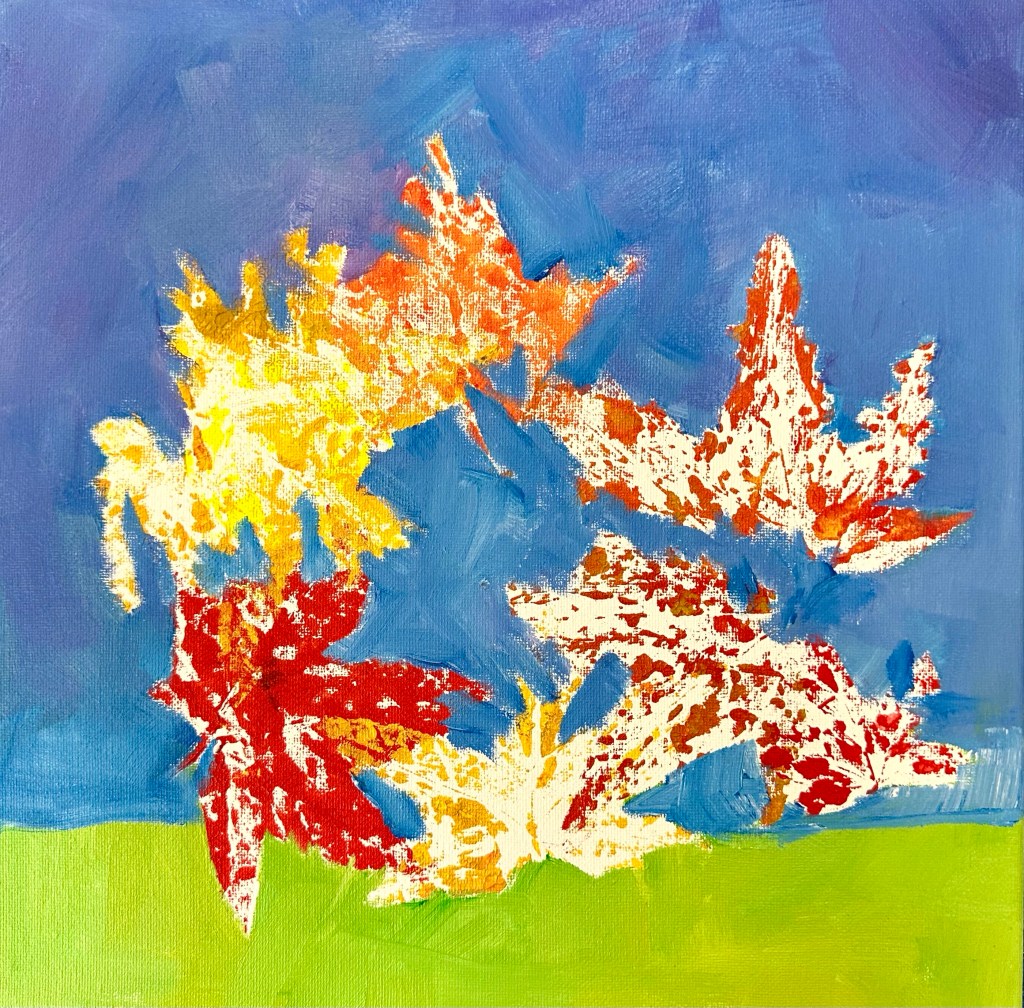
Cornelia: Dancing Leaves

As I’ve been watching the brisk winds blow the gold and red leaves from the trees this fall, I’ve also watched them dance against the bright cerulean sky. When the sun shines on these dancers, they glow even brighter than before. They don’t have a care for tomorrow, much less for today. Now and this moment is enough for them. They remind me of the Lord’s advice to us on the Sermon on the Mount in Matthew 6:34—

“So do not worry about tomorrow, for tomorrow will bring worries of its own. Today’s trouble is enough for today.”

I painted the back side of the leaves with a thin coat of acrylic paint and laid them one by one down on the white surface of the canvas. Then I gently hand rubbed the top of each leaf until I thought I’d transferred the paint. The hansa yellow was least successful as a print color, so I over printed it at the end. I mixed the green ground with the cerulean blue and two yellows. The sky has cerulean, violet, Ultramarine, and white. These I mixed as I painted, so the sky wasn’t an even color. (All skies change color due to atmosphere and distance: they get lighter toward the horizon).

Next Friday we’re going to make stamp prints. You may have cut your own design in a potato once upon a time in scouts or used vegetables to make prints. We can also use leaves, natural materials, metal objects, or found objects to create prints. Art is a time to explore and experiment. We’ll find out what works and what doesn’t!! Curiosity and the willingness to experiment and explore are all aspects of creativity. We can all learn to stretch our boundaries and learn resilience, which are experiences that help us address the stresses and challenges of daily life.

I learn something new every day. Today I learned a starfish has a brain that covers its entire body. Its whole body is made up of brain nodes! There are days I wish I were a starfish: I would have loads of brain cells!

Joy, peace, and happiness to everyone!

Cornelia


Type Four: The Individualist — The Enneagram Institute

https://www.enneagraminstitute.com/type-4

The 9 Enneagram Types — The Enneagram Institute

https://www.enneagraminstitute.com/type-descriptions

Art Analysis: Dance by Henri Matisse – Artsper Magazine

Texture Paintings

adult learning, Aristotle, art, autumn leaves, beauty, brain plasticity, cognitive decline, Creativity, flowers, Holy Spirit, Imagination, Leonardo da Vinci, Painting, renewal, Uncategorized, vision

Leaf Textures

I don’t do wine painting classes. Since I teach in a United Methodist Church, our Wesleyan temperance tradition holds sway: we serve no alcohol. However, out in the world beyond there are classes where everyone drinks wine and paints the same image. They’re out for fellowship purposes more than for art, but these classes serve to get people started in the basic techniques of the media. Students copy the teacher’s model painting, often working along as the teacher instructs the class. This is the “show and tell” style of teaching, which usually results in most students’ works approximating the teacher’s example.

Wine painting classes: One Lion to Rule Them All

College art education classes often are taught this way, but art classes in art schools are never taught like this. Why you might ask? Because art schools exist to help students find their own voice, for they know copying another’s style only diminishes a student’s true voice. The creative spirit within each of us is unique,
breathed into us by a holy God. Ecclesiastes 12:7 reminds us at our end, “the breath (Spirit) returns to God who gave it.” If art students are copying any art works, their teachers are humble enough to send their students to the masters first, or to life itself.

Laguna College of Art and Design art class

Art, like golf, is a humbling experience. In both we’re always playing against our handicap: we want to be “Perfect,” but we weren’t given the means to accomplish this goal without God’s grace. We go on to perfection by degrees, with the help of God, if we don’t get lazy and take the shortcuts, as the Adam and Eve, Prodigal Son, and many other great stories tell. As Jesus reminds his followers in Matthew 23:11-12—

“The greatest among you will be your servant. All who exalt themselves will be humbled, and all who humble themselves will be exalted.”

Why is it difficult to draw from life? Or for that matter, to really look hard at a painting to copy it? From an early age, most of us are taught it’s impolite to stare. In some cultures, even looking directly into the eyes of another person as you speak is unacceptable behavior. I know my parents taught me to look at them when I was in trouble, even when I wanted to look down in shame. I had to face their anger. While I didn’t enjoy it as a child, it prepared me as a teen for hateful comments from my peers, and as an adult for discrimination in the workplace. I could look people in the eye and call them out. This is likely why our early teenage children roll and flutter their eyes at us when we call them to account. They “look at us” without “looking.” And why we say, “Look me in the eye!”

19th century humorous postcard: The Artist’s Studio

We also have thoughts running through our heads: our to do lists, our concerns about our friends and loved ones, as well as the woes of the world stage. The more we learn to focus on the present moment in which we find ourselves, the better off we are. I find when I can pay attention to my colors, patterns, and how they come together on the canvas, I forget everything else.

I have some artist friends who always have a glass of wine in the studio, since it helps them relax. I think they just like wine. I’m a coffee lover, but too much caffeine makes my hand jittery, and too much wine would make my hand sloppy. I personally believe in moderation in all things, but then I’m sold on Aristotle’s “golden mean,” or the “Goldilocks zone,” where

“at the right times, about the right things, towards the right people, for the right end, and in the right way, is the intermediate and best condition, and this is proper to virtue.”

We barely avoided the 15th government shutdown since 1981, but we now have a House majority without a Leader due to a few extremist members. These Republican Party members who are “pirates who take no prisoners and make no compromises” might want to catch up on their ancient philosophical reading before chaos ensues. Sometimes life imitates art: if you have MAX, you can watch Michael Cain in “Our Flag Means Death.”

Little Vase of Flowers

All creativity improves with either time or wine. Both allow you to loosen up and not control what happens but go with the flow of what happens on the canvas, instead of forcing the paint to go where you want it to be. I have canvases which began in one direction and ended up in quite another. I can only say my original idea was rejected by the painting in progress, for I had to “listen to what the painting wanted to become.” As Psalms 104:30 says:

“When you send forth your spirit, they are created;
and you renew the face of the ground.”

In case you’re wondering, the “ground” of a canvas is the white primer, so it’s not a stretch to say, God’s Spirit works through us to renew the face of the “ground.” Some texts translate this as the “earth,” and God’s Spirit also works through us to restore and renew our planet to health after all the damage from industrial pollution and man made climate changes.

Leonardo da Vinci, the Renaissance genius, claimed, “There are three classes of people: Those who see. Those who see when they are shown. Those who do not see.” We can all learn to see. How we learn to see takes time and effort. This is why I always talk about some examples of good art before we begin our work. I know most people haven’t seen the masters, so getting images in mind is important. A little art history lesson never hurt anyone. Then I explain the project and we get to work. Stephen King, the noted author, says this about the creative experience: “Amateurs sit and wait for inspiration, the rest of us just get up and go to work.”

Tim’s Flower

In class we were using the flower arrangement which had been residing in the kitchen fridge for the past several weeks. I don’t know who to thank for it, but we put it back where we found it. Our group was given the key to use patterns and textures in the work.
Tim wants to learn to draw from life better, but he was struggling to get his proportions to scale. I showed him the trade skill of using a pencil or part of his hand to measure part of the object and compare its size to another part.

We give away our secret sauce recipe all the time! Everyone knows how to multiply with a ruler for a scale drawing, but that idea often doesn’t occur to them if they aren’t using it on a flat plane. If they have no real ruler, the idea of using an ordinary object as a measuring device also doesn’t enter our brains. This is normal, but once upon a time, we used our bodies to measure the work in progress: a cubit was the distance from the elbow to the middle fingertip and a hand-width was just that: the width of the four fingers. Over the years these were standardized to 18 inches and 4 inches. Horses are still measured in hands today, but we moderns measure in feet and meters rather than cubits.

Gail’s Texture Painting

Gail lined out some lovely patterns on her canvas and made good progress on her painting. She always gets a good plan and executes it.

Mike was glad to be back after doing renewal work/manual labor. This creative exercise of moving bold colors and strong patterns around his canvas was a welcome respite after all that physical activity. A mental challenge seemed welcome to him.

Mike’s Flowers

I had done a pattern piece in the week before, so I enjoyed painting the still life, and may use it as a study for something larger later.

Late 1800’s Levi Strauss advertisement

We finished up our works on the second session. Tim reworked the pumpkin drawing from an earlier time and Gail finished up her texture painting of the flowers. Mike dropped in with Van Gogh books before going out on an errand of mercy to rescue a young client. He was impressed with the amount of blue clothing the people wore in Van Gogh’s paintings. I reminded him the very denim jeans we wear first came from Nimes, France. We call these “jeans,” because the weavers in France were trying to imitate the techniques of Genoa, Italy, but failed, and made instead the sturdy fabric that’s blue outside and white inside. Hence, “jeane de Nimes.”

“I did not know that!” He exclaimed.

Art is for wondering, for seeing new things, for opening up our minds to new realities and new possibilities. Whenever we go beyond what we already know, we open a new brain pathway and create new connections between the neurons. This keeps our minds agile and staves off the worst aspect of aging: the pessimistic belief that nothing is new under the sun. If we keep the optimism of a child, for whom everything is the newest and best, we’ll keep a youthful heart and spread joy wherever we go.

Joy and Peace,

Cornelia

The ‘Golden Mean’: Aristotle’s Guide to Living Excellently —Philosophy Break
https://philosophybreak.com/articles/the-golden-mean-aristotle-guide-to-living-excellently/

Weights & Measures
https://www.jewishvirtuallibrary.org/weights-measures

History of Denim & the Origin of Jeans
https://www.hawthornintl.com/history-of-denim

The Persistence of Effort

adult learning, Altars, art, Attitudes, beauty, brain plasticity, Children, cognitive decline, Creativity, exercise, Food, Habits, Health, Holy Spirit, inspiration, knitting, Love, Ministry, mystery, nature, Painting, Prayer, pumpkins, purpose, rabbits, renewal, Right Brain, sleep, Van Gogh, vision

These shoes are made for walking

I was reading an article in the New York Times the other day. In “How I Learned to Love Finishing Last,” the author wrote about her slow pace as a runner. As one who regularly finishes last in my age group in the annual Spa 5K Walk each November, I’m optimistic one day I might get old enough to be in a nonagenarian age group all on my own. Perhaps if I’m 90 and still doing a 5K, they’ll give me a ribbon just for participating! “The last will be first and the first will be last,” especially if there’s only one of us in the race!

“When we compare ourselves to others,” said Dr. Justin Ross, a clinical psychologist in Denver who specializes in athlete mental health and performance, “we set ourselves up to suffer. Instead, the real psychological benefits come from enjoying what your body can do.”

Portrait of Yayoi Kusama in costume in front of pumpkin painting, photo: Noriko Takasugi

Suffering physically isn’t what art class is about, although we may suffer indignities to our egos, but this shouldn’t hold us back from doing our art works. The case of the Japanese artist Yayoi Kusama is evidence even hallucinations of voices and images can’t keep an artist from creating. If our daily efforts don’t measure up to what we imagined in our mind, it’s merely because our inner eye sees better than our hands can execute our vision. Sometimes our eye forgets what it once learned, for we haven’t used our skill of looking in a while. A runner doesn’t leap off the couch and immediately run a marathon or even a 5K. The smart athlete takes the time to train progressively for the distance beforehand. Also, they get new shoes.

Kroger Run: Two ghost pumpkins and a small pie pumpkin

Sometimes the coach has slept over the summer also. Just as students in school need a time to relearn last year’s lessons, as a coach in art class I sometimes forget the lessons, which are second nature to me because they’ve been inculcated by multiple teachers since I was eight years old, aren’t as ingrained to my own students. I also forget I’m always observing everything around me: cloud patterns, changing colors on trees, sunlight dappling on tree branches, shadows on the ground, and reflections in windows. I think about these patterns rather than about what I need to do next or next week. My calendar will remind me of these things in due time. I’ll be wrapping this up soon so I can work on my monthly Rabbit blog.

Rabbit playing “Hide the Pumpkin.”

A National Institute on Aging study found five healthy lifestyle factors — physical activity, not smoking, not drinking heavily, following the Mediterranean-style diet, and engaging in mentally stimulating activities — can have important benefits. People who engaged in four or five of these behaviors had a 60% lower risk of developing Alzheimer’s compared to those who only followed one or none. People who followed two or three of the activities had a 37% lower risk. This is your free wellness plan from Dr. Cornie, who has no medical degree, but did stay in a Holiday Inn once.

Debunking the Myth of the Split Brain Theory

Although we commonly think art is a “right brained” activity, in 2013 a group of researchers at the University of Utah discovered people actually use both sides of their brains equally. Back in the 1970’s when I was seeking employment after graduate school, the “Art is a right brain myth” ruled the creative work world. I once suggested I’d be a good candidate for a museum position because I understood both the artistic and the logical mind. I was not hired. Intuitive understanding of the brain a half century ahead of time doesn’t exactly open the doors to a fancy job.

As I recall, I got a checker’s job in a grocery store and ended up counting the teller trays and preparing the bank deposits for that store. The good news is creating works of art is a multi-process activity, one that depends on several brain regions and on redundancy of art-related functional representation rather than on a single cerebral hemisphere, region or pathway. This means even when we lose our ability to form words (typically a left hemisphere activity) our ability to create art still exists. We can still express our inner feelings and thoughts. This is good news for the aging and those who love them.

Yayoi Kusama – Pumpkin, 2014, installation view, Donum Estate, California, photo: Robert Berg

One one the great sadnesses in my ministry is being with young people who desperately want to have their old one’s memories recorded, but waited too late to ask them or were too busy with their own lives to sit and listen to these stories of the olden days. Once their old person has a stroke and loses the ability to form words, the opportunity has passed. Those stories will be locked in their minds due to aphasia, and no one or no amount of time will pull them out. We always tell young parents their babies need to be enjoyed while they’re still young, but we should also tell families to get the stories of their elders while they still can. “Strike while the iron is still hot” will take on a new meaning one day.

We needed bigger pumpkins

Gail and I were the only ones in class today. Lauralei showed up to gift us chocolate cake and keep us company. Tim and Mike were out of town. Gail and I both repainted old canvases. I showed some of the unusual ways pumpkins have been decorated by various artists, but none of them sparked any interest. We got down to work by covering our old canvas with a base of titanium white paint. Then I located all three of the pumpkins with circles and drew a baseline for the object on which they sat. I didn’t look over at Gail’s work for a while, but then I noticed she’d almost completely finished one pumpkin without roughing in the shapes of the others.

Gail had a big canvas today.

“Did you plan on finishing that one pumpkin before drawing the other two?” I asked.

Gail gave me a “needs more caffeine” stare.

“That’s what I thought. Maybe next time draw in the rough shapes so you get everything located in space relevant to each other.”

Pumpkin Spice Latte Time

We kept on painting until clean up time. I often say “I’ve slept since then.” It’s my all purpose excuse for forgetfulness or just plain airheadedness. Sometimes I have my mind on other things and I’m not focused on what’s in front of me. I forget about the wisdom of Brother Lawrence, who said “many do not advance in the Christian progress because they stick in penances and particular exercises while they neglect the love of God which is the end. This appeared plainly by their works and was the reason why we see so little solid virtue.” He also said, “there needed neither art nor science for going to God, but only a heart resolutely determined to apply itself to nothing but Him and to love Him only.”

Cornelia’s small painting of pumpkins

We know Brother Lawrence from the classic text, The Practice of the Presence of God. Although it dates from the late 17th century, his lessons on living life in joy in the present moment, all for the love of God are invaluable for us modern folks who tend to live for our 15 minutes of personal fame, social media clicks, or self interest. We aren’t used to the monastic life today, or to the discipline of that lifestyle. We live in a Burger King world, in which each individual gets his or her own way to every extent possible. Unfortunately, the Christian lifestyle is one of discipline, but not harsh punishment:

“Now, discipline always seems painful rather than pleasant at the time, but later it yields the peaceful fruit of righteousness to those who have been trained by it.” ~~ Hebrews 12:11

In art class we focus on the disciplines, just as the guild artists taught the apprentices back in the day. These disciplines are not only for safety, for some of our art tools are dangerous, but also some of our techniques are proven to yield better results than others. This is why carpenters measure twice and cut once. They also cut on the outside of the line, rather than the inside. They can shave down a piece easier than adding to it. Murphy’s Law recognizes this: “A wire cut to length will be too short.”

Zen Tangle drawing of pumpkins: exercise in texture

Art class has no mysteries, but we can forget the “secret gnostic knowledge passed down by word of mouth” from our previous classes. I often use the excuse “I’ve slept since then.” Another good excuse is “My mind has gone to Pluto.” I share these with you all, for they’ve always worked for me. Of course it helps to be a natural blonde. Then again, I’m very organized, but I’m also very active, so sometimes my calendar gets overwhelmed, and I pull out the “OOPS! Card.” Even in retirement I’m still creating and sharing my faith through art and writing. It’s my way of exercising those brain cells to keep them from dying off. We old folks can still learn new things, even if it takes longer. This is what we call the persistence of effort. Those who keep using their skills won’t be losing those skills.

The same goes for learning a new skill. It’s all a matter of repetition. We can’t get frustrated if we don’t get it on the first try. We won’t be a good role model for the young if we have that attitude. We need to lower our expectations. I used to think I couldn’t knit, but only crochet. After my mom, who was a stellar knitter passed on, a friend taught me to knit in an afternoon! Where this sudden bilateral coordination came from I have no idea, but it was so welcome. Perhaps I needed to be in the right frame of mind, or I wanted to be able to carry on my mom’s memory, but I was definitely receptive to her teaching.

Letter to Theo Van Gogh, September 18, 1888

It’s never too late to learn and we’re never too old to start learning. Art isn’t just good for the brain, but it’s good for the soul. Art is our attempt to represent truth, beauty, and nature in media that can be accessible to others. By doing this, we bear witness to the creation and the Creator. We only need give our best efforts, and let God’s Spirit guide our growth.

Joy, peace, and perseverance,

Cornelia

We have pumpkins galore on the autumn altar.

How I Learned to Love Finishing Last


How the Aging Brain Affects Thinking | National Institute on Aging

https://www.nia.nih.gov/health/how-aging-brain-affects-thinking

The creative-right vs analytical-left brain myth: debunked! – Dr Sarah McKay https://drsarahmckay.com/left-brain-right-brain-myth/

Art and brain: insights from neuropsychology, biology and evolution – PMC

https://www.ncbi.nlm.nih.gov/pmc/articles/PMC2815940/

The Project Gutenberg eBook of The Practice of the Presence of God, by Brother of the Resurrection Lawrence (free ebook)

https://www.gutenberg.org/cache/epub/5657/pg5657.html

Perspective: How We See

adult learning, art, Attitudes, Creativity, inspiration, Leonardo da Vinci, Ministry, mystery, Painting, perfection, perspective, Philosophy, risk, salvation

Perspective is both a mental outlook on life and our ability to view things in their true relations or relative importance. In art class, we use the tools of perspective to make a two dimensional surface appear three dimensional. One of the techniques is drawing parallel lines as converging in order to give the illusion of depth and distance. An untrained eye doesn’t see this at first, but once the illusion is pointed out to them, they never can unsee it. We worked last year with one vanishing point—railway tracks—and two vanishing points—buildings seen on the corners.

Two Point Perspective

There are mysteries in this world which we don’t understand, but those of us who have been taught by others with this “secret hidden wisdom” can share it with others. The Ancient Greek mystery religions kept their knowledge for only the select few, who learned it by word of mouth in secret ceremonies. The early Gospel, however, was proclaimed openly to all who would receive it. Yet even in Corinth, some believers wanted to be more special or spiritual than others. Paul wrote them, saying they needed  to know “Nothing beyond what is written,” for the scriptures contained within enough for their salvation (1 Corinthians 4:6). As an apostle, he was a steward of the “Mysteries of God,” and even if he were to understand “all mysteries and all knowledge, and…have all faith, so as to remove mountains, but… not have love…(he’d be) nothing.” (1 Cor 13:2)

Cornelia: Art Room Door

As a teacher, I can provide students with learning opportunities for every skill in art. Thanks to  Oaklawn UMC, and the generosity of my clergy pals over the years, I have a space in which to teach. I don’t charge for the lessons, since I consider this my ministry in retirement. I’ve taught every age from kindergarten through adulthood. There’s no age I don’t relate to. As Dale Chihuly says about art: “Most of art is the work. Not every piece is a success. We learn from our mistakes more than from our successes. If we don’t show up to work, we never have a chance to do well.” (It’s not an exact quote—I watched the film last night).

Gail: stage 1

As I tell folks, we may be saved by grace, but progress in art is by works. We can’t have our egos invested in the product. Right now Tim is in recovery from carpal tunnel surgery. Doing light exercises with pencil is good for his wrist muscles. Art class is a form of physical therapy. He wanted to draw a pumpkin because it had some shapes he’s struggled with over time. He noticed if he moved forward or backward by mere inches, the image he saw was different. This too is a matter of perspective. What is our view point: is it fixed or variable?

Gail: stage 2

Gail and I worked on painting an interior scene. I freehanded my painting, while Gail used her ruler and pencil to draw in the door shapes. I still wasn’t totally recovered from my colonoscopy—my age is catching up on me. My brain felt foggy, but I was trying. We came back for a second week to work on this project.

Gail: stage 3—extended floors

When we leave our work, we have an opportunity to clear our minds and reflect on other things. On returning to our canvas, we then look at our image with fresh eyes. My engineer friends call this the “saturation principle.” Just as the land can only absorb so much water before it runs off, our minds will get clogged up and we just can’t seem to make progress. Getting up for a drink or a walk about is a good thing. Sometimes the paint won’t dry fast enough for us either! That’s an indication to work in another area, even if we don’t want to. We must listen to what our work is telling us.

I often let my paintings rest overnight while I get a good night’s sleep also. In the morning, I’ll see if it still holds up, or if I need to keep painting. Sometimes I’ll take a “finished” painting down after a few months and repaint it. If it won’t last three months under my eye, it doesn’t leave the house. But I’ve learned from the experience. If we ever quit learning, we are dead. I don’t plan on being dead any time soon.

ABC—Positive and Negative Choices

Learning how to see in art is the most important lesson in art. Most of us won’t be Michaelangelo or Leonardo, but we can be the best of who we are. Our outlook on life in art means accepting our imperfections and our weaknesses. Some people can’t accept the learning curve necessary to make acceptable looking products. The point of art class isn’t the product. It’s the process of doing. With the doing, the “product” will come around eventually. We just need to have a positive attitude. Besides, our salvation isn’t dependent upon our accomplishments in art, but our faith in Christ and our love for Christ spread abroad into God’s world.

A Gift from my Mom

Perspective is also our attitude towards life. As Bob Ross, the great philosopher of happy trees and the joy of painting once said,

“If you have light on light, you have nothing. If you have dark on dark, you have nothing. It’s like in life. You gotta have a little sadness once in a while, so you know when the good times are coming. I’m waiting on the good times now.”

He said this in a PBS episode filmed shortly after his wife had passed away. Art class is also therapy for the soul, for we paint our emotions on the canvas, whether we realize it or not. We don’t have to talk about our feelings, but art helps us express them.

When I taught art back in the dark ages, I told my students if they learned only one thing from me, they would never forget it. A positive attitude leads to positive behavior and positive behavior leads to positive consequences. A negative attitude leads to negative behavior and negative behavior leads to negative consequences. That’s the simple ABC’s of life in the art room. Try it. You’ll like it. This is how we teach “Perspective.”


Joy and peace,


Cornelia

Master of Glass: The Art of Dale Chihuly

https://www.imdb.com/title/tt24862190/?ref_=ext_shr_lnk


Feeling Down? Here Are the Best Bob Ross Pep Talks


OAKLAWN FRIDAY ART CLASS

adult learning, art, Creativity, Faith, Holy Spirit, Imagination, inspiration, Ministry, Painting, perfection, purpose, renewal, vision

WE’RE BACK!!!

Ready or not, the creative juices must be stirred. If the brain has lain fallow all summer, or it’s been overworked keeping the youngsters occupied, now you can find your own groove again.

Our first meeting will be Friday, September 8, at 10 am in the old fellowship hall. Bring your own acrylic paints, brushes, and a canvas or canvas panel to paint on. We begin with a short visual inspiration from some great art works, I give some direction on the skill we’ll work on in the session, and then everyone is free to bring their own unique expression to their paintings. We don’t copy my work and judge how well a person can match it. Instead, we learn from others and stretch our own skills to create something new.

Paul Klee: Houses

Making great art isn’t our first purpose. As we age, we will lose our ability to learn new skills until we lose our memory of what we just ate for breakfast. Challenging our brains is one of the best ways to keep our brain cells firing and “chatting with one another.” Socialization and encouragement also helps to keep our brains young.

Frank Lloyd Wright: Stained Glass Design

Making art means we also will have to give up our desire to be perfect. Artists quickly learn perfection comes from practice, or working at it. Every baby stumbles and falls as they learn to walk, but dotting adults encourage every trembling step. This is what art teachers also do. I’ve always had a rule in my classes, especially when I taught in middle school:

No Negative Talking about People or Art.

This includes a student’s own art works. They always had to give at least three positive comments about their work before they spoke about the negative. “My work needs improvement” is a better way to say “My work stinks!”

Of course, we’ve all grown up and worked in environments where negativity is the rule. Art class is a place of grace because this is how life should be. If we can transform a blank canvas into a field of color, why can’t we transform our communities and our world into fields of hope, joy, and love?

Blue Monochromatic Study of the City

Perhaps because we often try to make everyone copy/fit into our idea of the proper end product, rather than allow everyone discover their own creative response to the given subject of the day. Finding our own voice and our own expression is important. Even beginners will have their own unique voice and vision, if they only allow the creating spirit of God work through them. The museums of our world are richer and more vibrant because artists have listened to the Spirit of the Creating God. We might do well to realize God’s creative energies are varied and vibrant also, just as Isaiah wrote about his vision of God’s Glorious New Creation:

“For I am about to create new heavens and a new earth;

the former things shall not be remembered or come to mind.

But be glad and rejoice forever in what I am creating;

for I am about to create Jerusalem as a joy, and its people as a delight.” (65:17-18)

James Wyper: City of Dreams

I hope to see you in art class. I don’t charge for the class sessions, since this is one of my ministries as a retired elder in the United Methodist Church. As John Wesley once said, “The World is my Parish.”

Joy and Peace,

Pastor Cornelia

THE FLAGS OF MEMORIAL DAY

Abraham Lincoln, adult learning, Amanda Gorman, art, Civil War, Creativity, elections, Gettysburg Address, Imagination, Medical care, Memorial Day, Painting, pandemic

Our next to last art class before summer break was right before Memorial Day. I had my last cataract surgery on the Tuesday before, so Mike gave me a lift into class. I wasn’t quite ready to drive yet. I thought we’d be finishing the work we began last week, but that wasn’t on the program for the class. Time for an audible.

John Wesley wanted his clergy to be always ready at a moment’s notice to “pray, preach, move, or die.” We art teachers have always been able to think on our feet and pull a project out of thin air. High school debate team extemporaneous speaking events are excellent trading grounds for this life skill.

Childe Hassam (1859-1935): Flags on the Waldorf, oil on canvas, Amon Carter Museum, Ft. Worth, Texas.

Memorial Day is one of the official days for displaying the American flag. Arkansas Flag & Banner has an informative paragraph (6d) at the link below on the days to display the flag if you aren’t flying it daily. The origins of Memorial Day are shrouded in mystery, since at least 25 sites claim to be the first to decorate the graves of fallen soldiers. From Columbus, MS, on April 25, 1866, to Boalsburg, PA, in 1864, cities north and south claim the fame of being first to decorate soldiers’ graves.

On May 5, 1866, Waterloo, NY, held a ceremony to honor local veterans who fought in the Great War. Businesses closed and citizens flew their flags at half staff. Other sites were not citywide or were one time events. As a result, in 1966, Congress declared Waterlo, NY, the “birthplace of Memorial Day.”

Frederic Edwin Church: Our Banner in the Sky, ca. 1861,
Fine Arts Museums of San Francisco

The Civil War took the lives of 750,000 men, not counting those who lost limbs or minds as casualties of the war, according to J. David Hacker, a demographic historian at Binghamton University, who has raised the estimate of how many deaths there were in the American Civil War from just under 620,000. One of every four soldiers failed to return home. If this devastating war took place today, 7.5 million people would have died in the fighting. As a reminder, the scourge of COVID-19 has killed 1,123,836 people in the United States alone since 2019.

Of course, as our ability to preserve life improves, our reverence for life increases. We just disagree at which point in time life should be honored and respected, and which lives are worth honoring and respecting. Perhaps we’re just a people given to disagreement and division by nature, or our old wounds from this ancient conflict continue to fester and boil, so we pick new battles to fight with words, rather than blows.

1908 Decoration Day Card

America lost 1,190,085 total service members’ lives from 1775 to 1991. The ongoing Global War on Terror has yet to be accounted because it isn’t finished. Although they underestimated the number of Civil War casualties, this one home grown conflict was responsible for about half of the war deaths of all American service members. It was a cruel war, in a brutal age. Things we take for granted today—dog tags for identification, mobile army surgery hospitals, anesthesia, sanitary camp conditions, humane treatment of prisoners, nutrious rations, and other civilized practices—weren’t part of the Civil War experience. In the American Civil War, twice as many soldiers died of disease as from hostile action.

Jasper Johns: Flags, lithograph, 1967-68, MOMA, NY.

World War II was the first war to have more deaths caused from the battlefield than from other causes. Greatly improved public health in armies has lowered the toll of disease to a fraction of what it was in earlier centuries. Modern military medicine has now allowed larger and larger armies. In short, military medicine, while greatly improving the care of the individual soldier, has enabled nations to have bigger armies and greater wars. We see the unfortunate consequences of these improvements in the current aggressive Russian attempt to takeover an independent Ukrainian democratic state against its people’s will.

After several years together in our art class, Gail and Mike are both now open to making an artwork that presents an idea or an emotion, more than a representation of a form. Not everything has to be a photorealistic rendering of an object before us. We do this often enough to build our skills of seeing and drawing, but we also need to build our expressive skills also. As an example in the spiritual life, we can spend our days in intercessory prayer, but we also participate in contemplative prayer or meditation to exercise the less analytical ways we can meet God in prayer.

Mike: Freedom Flag

Mike went on vacation recently and had the opportunity to take an art class with a different instructor. He suggested Mike give up his dedication to the small brush, a comment I often make. Now he’s excited about the freedom of the large brush and is exploring this new tool and technique.

Gail’s Flag

Gail mixed the reds and blues to make violet, as if the colors of the flag were washing into to one another. Many artists have changed the colors of the flag, but kept the design, or they kept the colors and destroyed the design. This is artistic license or creative interpretation. We make our statements with our images. She also changed the stars into circles by using a sponge to put down the paint. It was a good day for experimenting.

Cornelia DeLee: Gold Star Family Flag, acrylic with mixed media on canvas, 2023

I came home to finish up my painting with memories of visiting Civil War battlefields on my mind. I thought of those ancient days when families were able to identify their loved ones only by the special knit patterns of the socks on the bodies, or by the last letters to relatives pinned into their shirts. The Gold Star Mothers began during World War I when the mothers of fallen servicemen united to share their grief. By 1928, it was an official organization and the bereaved families were recognized with a pin.

Jasper Johns: Two Flags, lithograph, 1981, Phillips.

When I lived in San Antonio, I ocassionally visited the various military hospitals in town. There I saw the photos of the Medal of Honor recipients and read the summaries of their noble deeds. I always renewed my dedication to my less dangerous occupation afterward. Those who serve are a different breed from an ordinary person such as I. Perhaps Abraham Lincoln said it best in his 1863 Gettysburg Address:

“It is rather for us to be here dedicated to the great task remaining before us, that from these honored dead we take increased devotion to that cause for which they gave the last full measure of devotion, that we here highly resolve that these dead shall not have died in vain, that this nation, under God, shall have a new birth of freedom, and that government of the people, by the people, for the people, shall not perish from the earth.”

Gordon Parks, American Gothic, Washington, D.C., 1942.
Photo : Courtesy Gordon Parks Foundation

Amanda Gorman’s excellent 2021 inaugural poem, “The Hill We Climb,” has a section which echoes the sentiments of the post Civil War era, when Memorial Day celebrations first began:

We are striving to forge a union with purpose
To compose a country committed to all cultures, colors, characters and conditions of man
And so we lift our gazes not to what stands between us
but what stands before us
We close the divide because we know, to put our future first,
we must first put our differences aside
We lay down our arms
so we can reach out our arms
to one another
We seek harm to none and harmony for all
Let the globe, if nothing else, say this is true:
That even as we grieved, we grew
That even as we hurt, we hoped
That even as we tired, we tried
That we’ll forever be tied together, victorious
Not because we will never again know defeat
but because we will never again sow division
Scripture tells us to envision
that everyone shall sit under their own vine and fig tree
And no one shall make them afraid
If we’re to live up to our own time
Then victory won’t lie in the blade
But in all the bridges we’ve made
That is the promised glade
The hill we climb
If only we dare.

Howard Finster: Not Just A Piece Of Cloth, 1990

On this Memorial Day, over 150 years later, the wheels of justice are setting the sentences for the insurrectionists who attempted to impede the peaceful transfer of power to the newly elected government of the United States. We do well to remember the prescient words of Frederick Douglass, who said at Arlington National Cemetery on Memorial Day in 1871:

“We must never forget that victory to the rebellion meant death to the republic. We must never forget that the loyal soldiers who rest beneath this sod flung themselves between the nation and the nation’s destroyers.”

At 3:00 pm on Memorial Day, let’s pause for a moment and remember those who sacrificed body, mind, or life to keep our nation free, or to bring freedom to a nation that so desperately yearns for it.

Joy and Peace, and thanks to those who keep it for us,

Cornelia

United States, US Flag Code | FlagandBanner.com
https://www.flagandbanner.com/flags/united_states_flag_code.asp

The Origins of Memorial Day—US Department of Veterans Affairs
https://www.va.gov/opa/publications/celebrate/memday.pdf

Professor: Civil War Death Toll May Be Really Off : NPR
https://www.npr.org/2012/05/29/153937334/professor-civil-war-death-toll-may-be-really-off

United States – COVID-19 Overview – Johns Hopkins
https://coronavirus.jhu.edu/region/united-states

Veterans Affairs Fact Sheet America’s Wars 2019
https://www.va.gov/opa/publications/factsheets/fs_americas_wars.pdf

War, Medicine & Death – PMC
https://www.ncbi.nlm.nih.gov/pmc/articles/PMC9762220/

Gettysburg address delivered at Gettysburg Pa. Nov. 19th, 1863.| Library of Congress
https://www.loc.gov/resource/rbpe.24404500/?st=text

Pears and Apples

adult learning, Altars, apples, Aristotle, art, brain plasticity, change, cognitive decline, color Wheel, Creativity, exercise, Fear, Habits, Holy Spirit, inspiration, Lent, Leonardo da Vinci, Painting, perfection, Physical Training, purpose, risk, Thomas Merton, Van Gogh

Still Life with canvas, pallet, and brushes

Aristotle said in his Poetics, “The aim of art is to represent not the outward appearance of things, but their inward significance, and this, and not the external manner and detail, is true reality.”

He spoke mainly about poetry, which was the highest art of his age, but his words also apply to the fine arts. Today, many people are still mesmerized by artists who practice various styles of realism, but they overlook the artists who show us the realities of emotion and inner vision.

The good news about art.

“Art enables us to find ourselves and lose ourselves at the same time,” said the spiritual writer, Thomas Merton. Some people use art as a cathartic exercise, and pour out their inner emotions on the canvas or their chosen media. Jackson Pollock’s drip paintings and Van Gogh’s late works are good examples of emotional expression. We all know folks who have a project going in their garage. They go work on “that worthless piece of junk” to focus their attention and energy on fixing something on which they can make a difference, instead of getting tied up in knots about things they can’t change and must accept. Gardening and knitting are also good hobbies for focusing this energy.

We know our nervous system grows to the modes in which it has been exercised. This is what we call building a habit over time. Just as a child doesn’t walk straight out of the womb, they have preparatory skills that must be acquired by stages as they grow. Exercising their muscles by rolling over also helps to strengthen their necks to hold their heads up. Crawling leads to pulling up, and that leads to letting go to learn balance.

Each time a child repeats these movements, he or she will simplify the movements required to achieve the needed result, make them more accurate, and diminish fatigue. In this, they’re building habits that bring them closer to walking. Rushing them to achieve “early” walking actually puts them behind cognitively.

Not only are there twenty five body parts in a baby’s body that are used in the crawl movement, but crawling also strengthens the hip sockets, so the baby will have a strong platform on which to stand. Crawling helps the corpus callosum, which is a band of nerve fibers between the hemispheres of the brain. Criss-cross crawling on the knees and hands stimulates the corpus callosum to develop in a balanced way, facilitating the hemispheres of the brain to communicate. These cross lateral movements work both sides of the body evenly and involve coordinated movements of the eyes, ears, hands, feet, and core muscles. This helps support cognitive function, problem solving, and ease of learning. Exploring the floor in a baby proofed home allows your baby to achieve his or her optimal potential.

Gail’s Painting

“Practice makes perfect” is only as true as the practice is directed in a true direction. This is where a teacher, a parent, a coach, or a spiritual guide comes into play. Only one who’s been led well can lead others with grace. We don’t tear down the learner, but ask questions, give guidance, help them see alternative paths, and allow them a safe place to explore their choices.

Art class isn’t brain surgery. No one will die if the painting isn’t successful, and no one’s salvation is at risk if the painting doesn’t come out the way we hoped it might. Art class is a safe place to take risks, unlike jumping from a tall tower without a parachute. Learning to accept failure on our canvases and coming back next time to try again is a mark of resilience and courage. Every time we fail closer to our target, we realize we’re gaining on it! We never say I CAN’T in art class.

Crawl before you Walk or Run

The sad reality is we can teach and expand the horizons of young people up til the age of 25 or 30. After that, they seem to lose energy and desire to learn more or to change. They “habitually” repeat their previous acts, for good or for ill. We’ve all heard the old saying, “You can’t teach an old dog new tricks.” Those of us who are no longer young have sometimes been accused of being set in our ways. Some of us are afraid we won’t excel at a new challenge, for we’ve always been held to a high standard of achievement. Since none of us will be the next Georgia O’Keefe or Leonardo da Vinci, we can set that worry aside. They both had more years to practice than we have left in front of us. Instead, we should give our remaining time our most focused attention, so we can get the most from our experience.

My high school chemistry book had the same information in it which my daddy’s college chemistry book covered. He was amazed I was learning “advanced” ideas at my young age. In 1982 R. Buckminister Fuller introduced the idea of the “knowledge doubling curve.” Up until 1900, knowledge doubled every century. By 1945, knowledge doubled every 25 years and by 1982, it doubled every year. Some say it’s now doubling twice a day! The newest computer we buy off the shelf today is already obsolete.

We can’t train our students for the jobs of today because these jobs likely won’t exist tomorrow. We need to train people to be lifetime learners instead. Luckily, we don’t have to know all things, but we do need the skills to find the knowledge and sort through the best sources for the best possible information.

1930-2006

Today, knowledge we acquire in high school, college, graduate school, and our last job may already be obsolete. (I’m one who still grieves the loss of Pluto as a planet; it exists but is a dwarf planet in the Kuiper Belt). This is especially true in fast moving fields like technology. As futurist Alvin Toffler wrote, “the illiterate of the 21st century will not be those who cannot read and write, but those who cannot learn, unlearn, and relearn.”

This means all of us will need to become lifelong learners or we’ll risk losing touch with an ever evolving world. Maybe we think our brains can’t handle something new, for we’ve heard about the effect of aging. Cognitive process studies with older brains show learning, memory, and problem-solving in humans are often less efficient in these areas.

However, it has recently been established that dogs show many of the same kind of age related changes that humans do. A study in Vienna showed that older dogs learned new tasks just as well as younger dogs, although they took longer to do so and required more repetitive corrections. This aptitude is also known as “resilience training.”

I think it’s also important to know why we want to keep our brains agile as we move into our later years. John Wesley was fond of repeating William Law’s summary from the Practical Treatise on Christian Perfection,

“Do all the good you can, to all you can,
by any means you can, as long as you can.”

Because Wesley was better known than William Law, this quote is now attributed to Wesley alone. We Methodists have made it our own, however, and have carried its banner around the globe in our world wide mission efforts made possible by our Connectional ministries. Wesley thought enough of Law’s writing to reprint 19 editions of his work.

My late mother, at the age of eighty, learned how to use a laptop computer. She was motivated because she wanted to see emailed photos of her grandchildren, but then she realized she also could find recipes. When a child in her hometown needed a Mercy Flight, she used her new skills to get him transportation to an out of state hospital for treatment. I occasionally had to reteach her on how to double click quickly on her icons, rather than slowly, but she finally caught on.

iPad drawing of pear and apple

If we want to keep our brains agile throughout our middle, silver, and golden years, we always need to try new things. Doing art challenges makes our brain build new neural pathways. Every time we look at a still life or a landscape, we have to make multiple decisions: what shapes do I see—circles, squares, triangles, or rectangles; how do these shapes relate to one another on the plane of our canvas; what is most important; what colors will I use; what emotions do I want to express; and where will I begin?

Eventually, we will find our “style.” We don’t find a style by copying another’s work, but we create enough works until our hand becomes one with our spirit. Since God has placed a special spark of God’s own creative Spirit within each of us, eventually we’ll experience the joy of being one with God when we are in our painting moments. As Paul said to the Romans (8:16):

“The Spirit Himself bears witness with our spirit
that we are children of God.”

Last Friday we had a simple still life as our inspiration. Half our class was out sick with spring pollen troubles, but it was good to see those who could come after a two week hiatus. After a brief show and tell to get us inspired by other artists’ takes on the subject for the day, we got started. I reminded everyone not to make the fruit too tiny, so it wouldn’t get lost on the canvas. I believe everyone succeeded with this goal!

Mike’s painting

Mike painted his whole canvas with one brush. This gave the fruit a certain texture with contrasting colors, and the background, which was in a close value, didn’t show much brush strokes or texture. I like the perspective he chose, which brings the viewer in close to these fruit.

Gail tried a larger canvas with bolder colors than she normally uses. It was more dramatic and stronger in contrast than usual, while she kept her smooth strokes of paint as usual. She also took a view from above.

Cornelia’s Fruits

I stuck to a traditional rendering of the still life, since I do many abstract paintings in my own studio. I’d call these two Day and Night, for the Apple is quite awake and the Pear seems to need a little nap. It’s a study in contrasts: red and green, blue violet and yellow orange—a color wheel study masquerading as a still life.

Next week we’re in the season of Lent. As Christ turns his face towards Jerusalem, we’ll begin a study on the icons. This will be accessible and interesting. You’ll end up with your own icon for your personal worship center also.

Joy and Peace,

Cornelia

Classics in the History of Psychology — James (1890) Chapter 4
https://psychclassics.yorku.ca/James/Principles/prin4.htm

Crawling is important for childhood brain development
https://thefnc.com/research/crawling-is-important-for-childhood-brain-development/

You Can Teach an Old Dog New Tricks | Psychology Today
https://www.psychologytoday.com/us/blog/canine-corner/201602/you-can-teach-old-dog-new-tricks

Letters of John Wesley – John Wesley, Augustine Birrell – Google Books, p.423
https://books.google.com/books/about/Letters_of_John_Wesley.html?id=zgYu6NpqWDEC

What It Takes To Change Your Brain’s Patterns After Age 25 https://www.fastcompany.com/3045424/what-it-takes-to-change-your-brains-patterns-after-age-25

Chaos and the Order of the Day

911, adult learning, Altars, art, Astrology, Creativity, Faith, Imagination, Israel, Leonardo da Vinci, Ministry, Painting, Spirituality, vision

Morse Peckham, author of Man’s Rage for Chaos, believed “Order is humanity’s freedom; but the rage for order creates its own limits on that freedom.” Art, he maintained, enabled the artist to fight that rage, which destroys what it would create. Only the rage for chaos can balance the rage for order.

Stellar Bones: Aries zodiac sign. Horoscope. Illustration for souvenirs and social networks.

As one who was born under the Aries sun, with an Aries moon, and a Virgo rising sign, I fully understand this rage for chaos and order within my own body. I somehow always have fifty-eleven projects and and even more ideas I’d like to accomplish, but I too have the same limits as all other people: we all have only 24 hours on any given day. Some of these moments must be given to the life giving nurture of the body, which carries our great mind and imagination and the hands which do our good works. Some days the balance scales of Virgo call my chaos into order, while on others my Aries excitement causes the balance to quaver. This tension shows up in my work.

Venus and Saturn at Early Sunset: follow the line of the building

I mention my astrological signs, for once in ages past, people believed the stars ruled their lives. The heroes ascended into the stars—Sagittarius, the archer, while other constellations were named for animals or the humans who were turned into animals, such as bears and swans. Some got their names for resembling objects—the dippers, while others were named for legendary persons—Cassiopeia’s chair and Orion’s Belt come to mind. In the time of dark skies, our ancestors could pick out these sky patterns with ease. Light pollution in our cities makes these shapes harder to discern every year. Our national parks may be the only places our city dwelling future generations will be able to see the night sky in all its glory.

The Ancient Greeks believed the gods ruled their fates. The writer Pausanius listed the many shrines to the deities in Athens, including “in the Athenian market-place among the objects not generally known is an altar to Mercy, of all divinities the most useful in the life of mortals and in the vicissitudes of fortune, but honored by the Athenians alone among the Greeks. And they are conspicuous not only for their humanity but also for their devotion to religion. They have an altar to Shamefastness, one to Rumour and one to Effort. It is quite obvious that those who excel in piety are correspondingly rewarded by good fortune.”

Altar to an Unknown God, Athens, Greece

The apostle Paul even noted the Athenians had a temple to an “unknown god,” just in case they didn’t cover their bases with offerings to all the other deities (Acts 17:23). Yet, you already know him, he said, for

“The God who made the world and everything in it, he who is Lord of heaven and earth, does not live in shrines made by human hands, nor is he served by human hands, as though he needed anything, since he himself gives to all mortals life and breath and all things.” — Acts 17:24-25

Our creation story in Genesis 1:1-2 begins with familiar words:

“In the beginning when God created the heavens and the earth, the earth was a formless void and darkness covered the face of the deep, while a wind from God swept over the face of the waters.”

Milton addressed the same Spirit of God, which was at creation, in his epic poem, Paradise Lost:

“And chiefly Thou O Spirit, that dost prefer Before all Temples th’ upright heart and pure, Instruct me, for Thou know’st; Thou from the first Wast present, and with mighty wings outspread. and with mighty wings outspread. Dove-like satst brooding on the vast Abyss And mad’st it pregnant.”

William Blake: Temptation of Adam and Eve, Pittsburgh Univ.

God is always creating order out of nothingness, but human beings have a tendency to create disorder wherever they go. We aren’t God, or even “as gods,” as the first humans hoped to be in the garden when they ate that fateful fruit. Even knowing “good from evil” doesn’t seem to keep us from our propensity to engage in chaos. I don’t live in a messy home, but because I put away some of my projects when I lose interest, I can forget where I “hid them.” I know what they look like, I can find others like them, but I might need several days to find the intended object of my desire. I’ll put all of these in ONE PLACE when I’m done with them. This will guarantee I’ll lose them all at once the next time I go looking for them!

Frank Hinder: Bomber Crash, 1941

In art class, we began our projects by thinking about the contrast of order and chaos. The emotional experience of the disruption chaos brings to our sense of order can change our perception of our position in the world. When Frank Hinder was serving in World War II, his bomber was shot down. As part of his therapy, he painted his memory of that occasion. That chaos in his life got channeled into a painting, for art allows us a safe haven in which we can experience cognitive dissonance.

Most of us wouldn’t willingly chose to experience such an event first hand, but we can imagine it in art, poetry, music, or fiction. This is why we exercise our creative freedom. Dealing with raw emotions in paint or other media is better than stuffing them inside, from where they can fester and harm us, or worse, break out and inflict terrible wounds upon others. We seek to center our emotions and focus our energies in a more balanced, positive manner, much like the renaissance genius, Leonardo da Vinci.

Leonardo: Virtuvian Man

Lauralei is finishing up a drawing and is going to work the famous Leonardo Virtuvian Man into it somehow. I can hardly wait to see this. Virtuvian Man is a classic Renaissance image of order: Leonardo saw the great picture chart of the human body he had produced through his anatomical drawings and his Vitruvian Man drawing as a cosmografia del minor mondo (cosmography of the microcosm). He believed the workings of the human body were an analogy for the workings of the universe. That’s seeing order in the many details.

Mike has been called away from class the past two weeks to take care of courthouse business. He has a 9/11 work in mind, if the judge ever lets him go. He has many images in his mind, so simplifying the many into a few might help him get his ideas out of his head and onto the canvas. He’s got business to attend to, however, so all things will come about in God’s good time.

Gail’s Painting of Creation

Gail chose the first day of creation as her inspiration. The tiny words are photocopies from a child’s Bible, which are plucked from the first chapter of Genesis. They read more as white directional or linear strokes than actual words, but I have a major cataract in my right eye, and my judgment on readability is suspect at the moment. Others may be able to see the words better than I. She used a sponge on this canvas, a new technique for her. She also wants to use gold leaf flakes to finish it out, so she may yet have another step to it.

First Work: Overhead View of Ancient Jerusalem

This small square painting began from an image of an old Jerusalem map with the surrounding walls of the city. This site was destroyed numerous times over the centuries, notably in 587 BCE by the Babylonians, in 70 CE by the Romans, while the walls were destroyed by the Muslim Calif in 1250 CE, but Suliman the Magnificent rebuilt them in 1538-1541 CE. In addition to the sacks of war, earthwakes and other disasters have rendered the era of Christ to the deep basements, which are only accessed today by descending narrow, spiral staircases. The era of the prophets of the Babylonian Exile are deeper yet. The famous Western Wall of the Herodian Temple, rebuilt after Solomon’s Temple was destroyed by the Babylonians, is only the upper third of the structure.

The people of Israel believed God’s favor rested upon them because of their proximity to God’s Temple. The prophets were quick to remind them, “They were to be holy, as God is holy,” for the Temple wasn’t a magic token like a rabbit’s foot. The book of Joel probably was written in the post exile period, around 350 BCE, but could be as early as 650 BCE, due to its description of an eclipse. The prophet reminds the people:

“So you shall know that I, the LORD your God, dwell in Zion, my holy mountain. And Jerusalem shall be holy, and strangers shall never again pass through it.” (Joel 3:17)

When the king and his court, the learned priests, all the educated tradespeople, and anyone who had any skill or knowledge was taken into slavery far distant from the sacred land where they worshipped their tribal god, the people had to wonder if God was still their god in this foreign land. Would God hear their prayers? If they could no longer offer sacrifices or make the required pilgrimages to God’s altar, were they faithful to their god anymore? In their grief, they wrote Psalms 137:4-5:

“How could we sing the LORD’s song in a foreign land? If I forget you, O Jerusalem, let my right hand wither!”

During the Exile, the Hebrew people developed the synagogue as the focus of their worship of God and the study of scripture, as well as a place of prayer and fellowship, and the site of life’s transitional rituals. In 538 BCE, Babylon fell and the Jewish exiles eturned to their homeland to rebuild the walls and the temple. For the people, the earlier promise of God from the prophet was finally being fulfilled:

“Return to the LORD, your God, for he is gracious and merciful, slow to anger, and abounding in steadfast love, and relents from punishing.” —Joel 3:13

Back home, both the synagogue and the Temple prospered, but when the Romans sacked Jerusalem and destroyed the Temple in 70 CE, all of the pious acts transferred to the synagogues and the homes of the faithful. Never again were sacrifices made for Passover, but the thought of the Holy City remained. The closer one came to the Mount where the Temple once stood, because the area was more holy, so the person coming near had to be more ritually pure. They may have chanted from Psalms 125:1 in unison as they made their ascent:

“Those who trust in the LORD are like Mount Zion, which cannot be moved, but abides forever.”

God’s Love Flows Beyond The City Walls

Today, Mount Zion is holy to the Muslim faith, for there Mohammad is said to have received the words of the Quran and also to have been lifted into heaven from here. This is also the traditional site of the Binding of Issac (Genesis 22), and it’s holy also to Christians because this is the temple where the boy Jesus was found in “his father’s house” (Luke 2:41).

The three great monotheistic faiths have fought for generations within their families of origin over who has rights to be included in the family, beginning with Abraham and Sarah’s attempt to fulfill God’s promise of an heir by using the slave woman Hagar. When God showed up to announce the birth of Isaac, it was unbelievable. When Sarah had her promised child, Hagar and Ishmael were sent out to die in the desert. God saved them, however, but the two blood relatives haven’t gotten along since.

Christians accept the promised messiah, but those years of crusading and crushing the “Muslim infidels” have left a bad taste in their mouths for us, and for some of us too. We all keep fighting, even though we’re all branches off the same tree. We all claim the same holy sites and we’ll fight over them “till the last dog dies.”

As Jesus reminded the Samaritan Woman in John 4:21 & 23:

“Woman, believe me, the hour is coming when you will worship the Father neither on this mountain nor in Jerusalem…But the hour is coming, and is now here, when the true worshipers will worship the Father in spirit and truth, for the Father seeks such as these to worship him.”

Remember the lesson of the exile: God is everywhere and not fixed to one altar or site. The same God who led us through the wilderness also leads us through the ups and downs of our daily lives, wherever we find ourselves. No disruption or chaos can move the steadfast God of love and mercy from our side.

Joy and peace,

CORNELIA

The Project Gutenberg eBook of Astronomical Myths, by John F. Blake, 1877.

https://www.gutenberg.org/files/36495/36495-h/36495-h.htm#Page_269

PAUSANIAS, DESCRIPTION OF GREECE 1.17-29 – Theoi Classical Texts Library

https://www.theoi.com/Text/Pausanias1B.html

Milton: Paradise Lost, DjVu Editions E-books, © 2001, Global Language Resources, Inc.

http://triggs.djvu.org/djvu-editions.com/MILTON/LOST/Download.pdf#page5

The Vitruvian Man – by Leonardo da Vinci

https://www.leonardodavinci.net/the-vitruvian-man.jsp