The older I get, the faster time flies! When I was a child, summers were long and lazy times. I actually got so bored, by the first of August I’d start to play school. I’d line up my brothers and the neighborhood children and pretend to teach them. It was our way of “playing ourselves into a new reality.”
Art has many right answers!
Children practice life lessons during their play experiences. We can also play our way into learning a new skill in art class. All we need is a “beginner’s mind.” The Japanese Zen term shoshin translates as ‘beginner’s mind’ and refers to a paradox: the more you know about a subject, the more likely you are to close your mind to further learning. As the Zen monk Shunryu Suzuki put it in his book Zen Mind, Beginner’s Mind (1970): “In the beginner’s mind there are many possibilities, but in the expert’s there are few.”
Jerzy Nowosielski: Landscape with a vision of the Sun, oil on canvas, 1965, National Museum of Krakow, Poland.
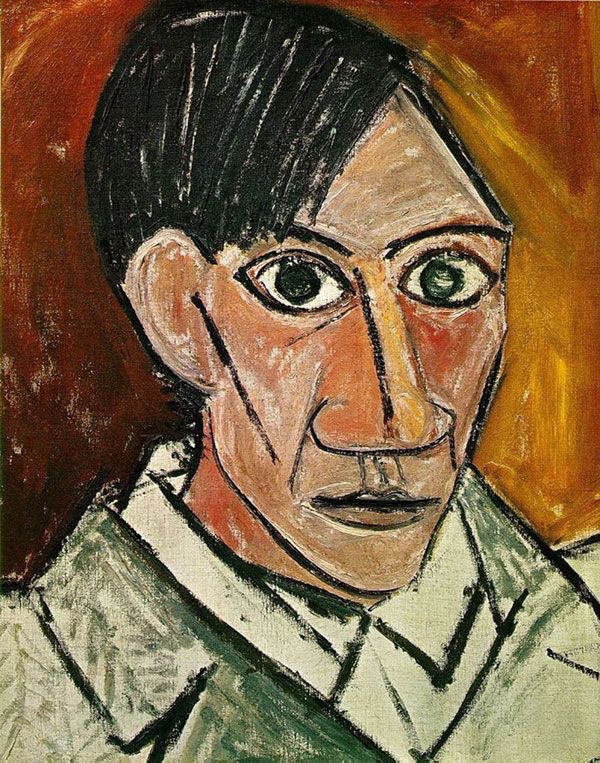
In a similar vein, Picasso once said, “When I was young, I could paint like Raphael, but it took me my whole life to learn to draw like a child.” Part of our art class experience is to learn to suspend our adult ego’s need to constantly be ranking, besting, and giving into our competitive natures. We learn more when we give up our egos and our needs to protect our false selves, and allow our true selves to learn. This story in Luke 9:46-48 on “True Greatness” speaks to this:
“An argument arose among them as to which one of them was the greatest. But Jesus, aware of their inner thoughts, took a little child and put it by his side, and said to them, “Whoever welcomes this child in my name welcomes me, and whoever welcomes me welcomes the one who sent me; for the least among all of you is the greatest.”
Our first meeting will be Friday, September 6, at 10 am in the old Oaklawn UMC fellowship hall. Bring your own acrylic paints, brushes, and a canvas or canvas panel to paint on. We begin with a short visual inspiration from some great art works, so that we can wonder and be filled with awe at some great artists’ works.
Basic 2 point perspective
I’ll give some direction on the skill we’ll work on in the session, and then everyone is free to bring their own unique expression to their paintings. We don’t copy my work and judge how well a person can match it. Instead, we learn from the masters or from real life. We can learn to stretch our own skills to create something new.
That’s US!
Of course, making great art isn’t our first purpose. As we age, the harsh truth is we will lose our ability to learn new skills until we lose our memory of what we just ate for breakfast or how to work the tv remote. Challenging our brains is one of the best ways to keep our brain cells firing and “chatting with one another.” We can actually grow new neurons as we grow older. Our brains don’t have to shrink like a cotton shirt washed in hot water. Socialization and encouragement also helps to keep our brains young. Teaching this class helps me stay young! We help each other in this matter.
That goes for children of any age!
Of course, making art means we have to give up our desire to be perfect. Children always have a “beginner’s mind,” so they are free to explore and experiment. Artists quickly learn perfection comes from practice, or working at it. Every baby stumbles and falls as they learn to walk, but we dotting adults still encourage every trembling step. This is what art teachers also do. I’ve always had a rule in my classes, especially when I taught in middle school:
“No Negative Talking about People or Art.”
This includes a student’s own art works. My students always had to give at least three positive comments about their work before they spoke about the negative. “My work needs improvement” is better than saying, “My work stinks!” After all, this way of thinking is more positive than negative and helps to build confidence in a person.
God would post your art on Heaven’s Refrigerator
Of course, we’ve all grown up and worked in environments where negativity is the rule. Art class is a place of grace because this is how life should be. If we can transform a blank canvas into a field of color, why can’t we transform our communities and our world into fields of hope, joy, and love?
The Light overcomes the Darkness
Perhaps because we try to make everyone copy/fit into our idea of the proper end product, rather than allow everyone discover their own creative response to the given subject of the day. The museums of our world are richer and more vibrant because artists have listened to the Spirit of the Creating God. We might do well to realize God’s creative energies are varied and vibrant also, just as Isaiah wrote about his vision of God’s Glorious New Creation:
“For I am about to create new heavens and a new earth;
the former things shall not be remembered or come to mind.
But be glad and rejoice forever in what I am creating;
for I am about to create Jerusalem as a joy, and its people as a delight.” (65:17-18)
I hope to see you there. I don’t charge for the class sessions, since this is one of my ministries as a retired elder in the United Methodist Church. As John Wesley once said, “The World is my Parish.” When we grow in confidence in the joys of creating, we find more beauty in the created world. Optimism is one of the side benefits of the creative life, not fame or riches, and sometimes not even accomplishment. Just the act of being a co-creator with the creating God helps us to find more peace in life.
Aristotle once said, “The hand is the tool of tools.” Our hands with their opposable thumbs are an evolutionary miracle. Our opposable thumbs evolved around two million years ago, even before humans began to make tools. Our hands helped us to develop language and procure nourishment, as well as create mysterious images on cave walls which united the physical and spiritual worlds of our distant ancestors.
Hands at the Cuevas de las Manos (Cave of Hands) upon Río Pinturas, near the town of Perito Moreno in Santa Cruz Province, Argentina (2005) (image by Mariano via Wikimedia Commons)
Richard Rohr, the Catholic priest and spiritual writer, notes “only the contemplative mind can help bring forward the new consciousness needed to awaken a more loving, just, and sustainable world. We need a practice that touches our unconscious conditioning where all our wounds and defense mechanisms lie. That’s the only way we can be changed at any significant or lasting level.”
We have many spiritual practices to change our hearts and minds, such as prayer, meditation, contemplation, reading Scripture, and hearing the word preached. Attending holy communion and practicing the presence of God are other ways to be transformed. In art or faith, we don’t take anything at face value, but we seek the deeper meanings in the experiences we have with life.
Image I took while walking downtown. I paid attention to the composition when I took the photograph.
As one who slacked off my weight training over the pandemic, the gym rat saying holds true: “Use it or lose it.” We can lose muscle tone and aerobic capacity in just a few days if we’re older or recovering from injuries. Even if we’re young and healthy, we may lose capacity in a week or so. Likewise, some of us get our diplomas and never read a book again. For instance, 42% of college graduates never read another book after college and only 32% of the US population over the age of 16 reads books for pleasure.
One of the problems even in the USA is 52% of adults read at a 7th grade level or below, and 48% read at an 8th grade level and above. Yet reading has many benefits for keeping the brain healthy:
Reading for just six minutes daily can reduce stress levels by 68%.
Reading can increase empathy and emotional intelligence.
Reading can improve sleep quality.
Reading can increase vocabulary and improve writing skills.
Reading can improve mental focus and concentration.
Reading can reduce the risk of developing Alzheimer’s disease.
When we connect the brain and the hand, this results in increased activation of the nerve cells in the sensory and motor hand representational areas. As a consequence, the hand expands its representational area in the cortical hand map because it requires more brain resources, more ‘brain space’. Thus, the hand can ‘shape’ the brain; in other words, the brain is functionally shaped based on the hand’s experiences.
If the hand, in contrast, is passive and immobile for a long time, its representation in the brain decreases and may totally disappear. Quite simply, the hand has to be active to maintain its representation in the brain: “use it or lose it.” On the other hand, we know the hand representation in the brain can be re-established by training and manual activities.
What sort of activity rebuilds the brain? The brain cortex contains more than 100 billion nerve cells and innumerable synaptic connections. The cortical body map is not fixed or hardwired, but can rapidly become reorganized as a result of a strengthening or weakening of the synaptic connections. Moreover, repetitive movements can overwhelm the hand and cause trauma, such as writer’s cramp. We need to find ways to exercise our hand, so we cause no harm, but build the brain pathways.
The hand has been called the “outer brain.”
In aging samples, for instance, there’s evidence to indicate that age‐related cognitive decline may be partly driven by a process of atrophy. Some studies have shown that adopting a less engaging lifestyle across the lifespan may accelerate loss of cognitive function11, due to lower “cognitive reserve” (the ability of the brain to withstand insult from age and/or pathology)12. Some emerging evidence indicates that disengaging from the “real world” in favor of virtual settings may similarly induce adverse neurocognitive changes.
Extensive media multi‐tasking during childhood and adolescence could also negatively impact cognitive development through indirect means, by reducing engagement with academic and social activities, as well as by interfering with sleep35, or reducing the opportunity to engage in creative thinking36, 37. I remember telling my schoolteacher mother, “Listening to the radio helps me concentrate on my homework.” She wasn’t buying that argument at all, and radio silence prevailed.
An important aspect of instant access to the internet is our ability to get information online, which has caused us to become more likely to remember where these facts could be retrieved, rather than to remember the facts themselves. This results in our becoming reliant on the Internet for information retrieval. For instance, most people no longer memorize telephone numbers anymore, but depend upon their phones to maintain their contact lists through the cloud, just as we once stored them on the internal SIM card. I personally don’t know anyone’s phone number anymore because I depend on my phone’s contact list. If it ever died on me, I’d be out of luck! The cloud better recognize me if I ever need to replace my phone.
Asklepion, Pergamum, Turkey: site of healing waters, temples, and cultural events, for pilgrims who would often stay for weeks. The ancients believed healing was a sacred art and people’s souls needed to be mended as well as their bodies.
Art and healing are intimately connected. The new Alice Walton School of Medicine in Bentonville, Arkansas, will integrate the arts in an intentional way. The students will be classically trained medical doctors who also will be equipped with knowledge to address all areas of wellness, whether it’s spiritual, emotional or social.
The science of neuroaesthetics is detailed in Susan Magsamen’s book, Your Brain on Art. She said the field can be described as the study of how art measurably influences the brain, body and behavior. The study of neuroaesthetics is “neuroarts.” Magsamen said the pursuit of creative expression is as important to humans as nutrition, sleep and exercise.
There are four parts of neuroaesthetics and “the aesthetic mindset:”
■ Being open to curiosity.
■ Playful exploration.
■ Sensory experiences.
■ Becoming a maker and beholder.
We discover this in art class when we want to draw or paint a picture beyond our skill level or the time limits of the work period. In seminary, we’d have three-hour final exams. Some of our fellow students would prepare six-hour answers to the advance sample questions our professors gave us to study. I always practiced the “triage method” of reducing everything we learned to the essentials. If we pick out the most important facts, we can best make our points in the time limits given. In the emergency room, doctors treat the most important issues first to save the patient’s life and tend to the details once the patient is out of the woods. No one can give a 6 hour answer in a 3 hour time limit. Ask yourself, “What’s the most important question here?”
Mike’s Mushroom
The same idea works in drawing or painting. We need to find the main forms and sketch them in before we get carried away with the tiny details. Mike showed me a great photo he took of the corvettes in Memphis. I suggested if he wanted to do this painting in a single class meeting, he needed to simplify it by enlarging it, so it had much less detail or plan on taking two classes to finish it. He chose to paint a mushroom in the wild instead. Even then he noticed his mushroom cap lacked the perspective to look realistic on a two-dimensional surface. We’ll have to pick up some perspective lessons in the fall again.
Cornelia’s Corvettes
This is a drawing from memory I made on my iPad. I stripped Mike’s photo down to the barest essentials. The vehicles may not even be recognized as sports cars, but they are convertibles. I do remember the great steel triangles of a bridge or other structure where the cars were parked. I did this in about 15 minutes, but I have over half a century of experience of seeing and drawing practice.
Internet image of corvettes on Beale Street
I sometimes forget my hand and brain have been trained to see the basic shapes “instantly.” Not because of some DNA of pure sight, but because I’ve practiced looking, dissecting, and memorizing what I see. Some of my experiences are blind drawing, which means I only look at the object, but never the drawing itself. This trains the hand to only go as far as the eye can “see.”
Gail S’s Landscape
Gail had the class over to her home and we were glad to see her in recovery mode. Since she’s still homebound, we took advantage of the good weather and her front porch to exercise our brains and hands.
Ansel Adams: Old Faithful Geyser, Yellowstone National Park, 1933-1942
Gail had a mountain landscape image from a screenshot she wanted to work with. The focus of our class was taking our camera photographs and using the editing software to heighten our images. Once we’d done that, we would see more clearly what was important in our image. The current theme in social media is “no filter,” but the great photographers of history always gone to the dark room to develop their photos and dodge the whites lighter or burn more black. Ansel Adams was a master at this.
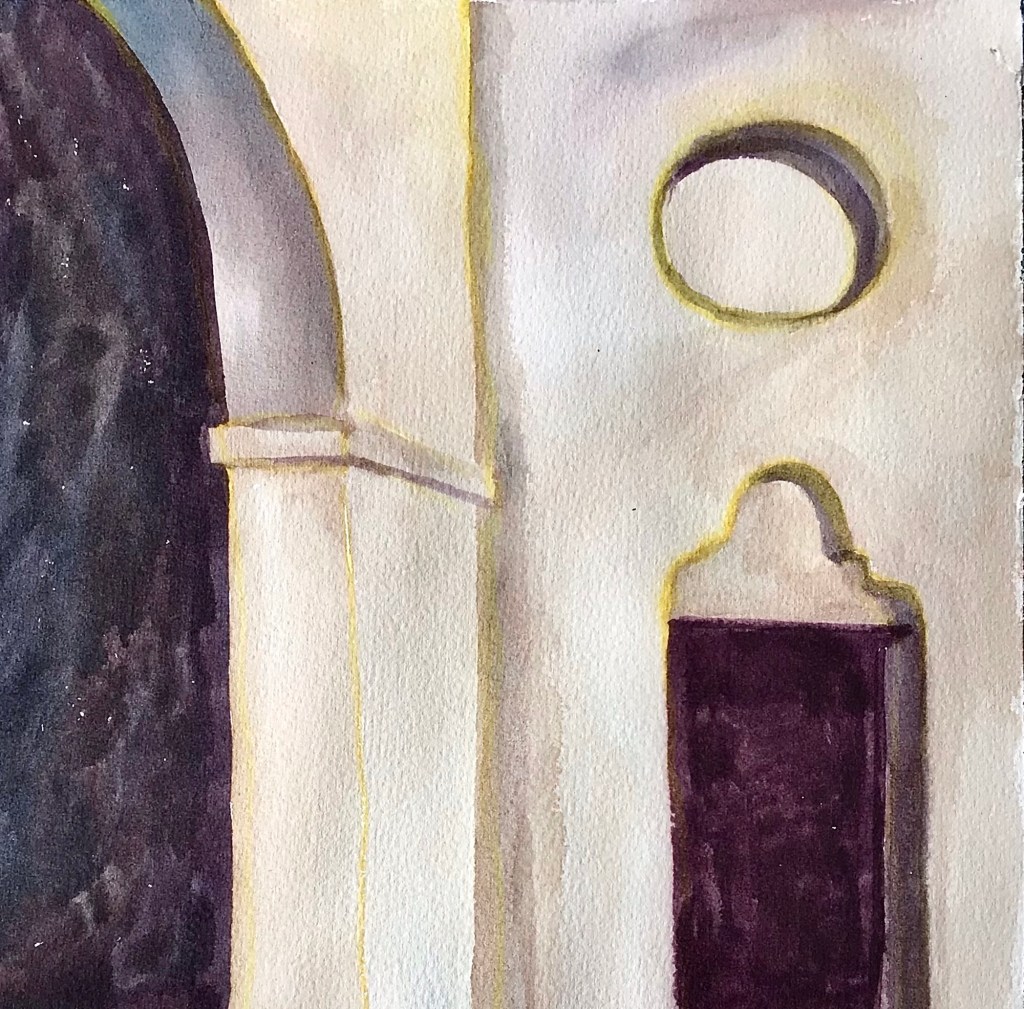
Cornelia: Prang 8 color box on Arches paper, from original photograph
Notice on my short watercolor study, I didn’t bother to include the whole photograph image. I “triaged” the details I couldn’t complete in our short class time. I mixed my own blacks, rather than using the pan color available. This gave me much richer colors and more variation in my shadows. I had outlined my basic shapes in yellow, but got to talking about the others’ directions and let the paint dry too much, or I would have picked it up better. It would have been less noticeable. I see now some of my lights could have been lighter. I can go back with a clean brush full of water and pick up some of that front face of the archway.
Of course, my eye sees more than most people can see, and it’s both a curse and a blessing. I’m always graceful with my students and try to give at least half as much grace to myself. We mustn’t get discouraged, but keep pressing upward! We don’t have to be a master at something to be a maker; we just have to do it. Having no fixed expectations of an outcome is the best way to exhibit creative expression. Following the less traveled path can lead to new destinations and new discoveries.
Art has the capacity to heal, to cross-fertilize, and to challenge fixed ideas. Art can’t be confined to gallery spaces or the walls of our homes. Art can not only renew our brains, but also the practice of art can renew how we see the world because we learn to see it afresh. Sometimes for the first time, we see it as we’ve never seen it before, and then we bring our own experience and expression to what we have seen. That’s when we become artists, creators, and cocreators guided by the hand of God. As we are made in the image of the creating God, God heals us as he cares for the creation:
“I have seen their ways, but I will heal them; I will lead them and repay them with comfort, creating for their mourners the fruit of the lips. Peace, peace, to the far and the near, says the LORD; and I will heal them.” ~~ Isaiah 57:18-19
Joy and peace,
Cornelia
The Tool of Tools and the Form of Forms – 3 Wisdoms | Scott Randall Paine
11. Hultsch DF, Hertzog C, Small BJ et al. Use it or lose it: engaged lifestyle as a buffer of cognitive decline in aging? Psychol Aging 1999;14:245‐63. [PubMed] [Google Scholar]
12. Small BJ, Dixon RA, McArdle JJ et al. Do changes in lifestyle engagement moderate cognitive decline in normal aging? Evidence from the Victoria Longitudinal Study. Neuropsychology 2012;26:144‐55. [PMC free article] [PubMed] [Google Scholar]
25–Uncapher MR, Wagner AD. Minds and brains of media multitaskers: current findings and future directions. Proc Natl Acad Sci 2018;115:9889‐96. [PMC free article] [PubMed] [Google Scholar]
35. van Der Schuur WA, Baumgartner SE, Sumter SR et al. The consequences of media multitasking for youth: a review. Comput Human Behav 2015;53:204‐15. [Google Scholar]
36. Altmann EM, Trafton JG, Hambrick DZ. Momentary interruptions can derail the train of thought. J Exp Psychol Gen 2014;143:215‐26. [PubMed] [Google Scholar]
37. Baird B, Smallwood J, Mrazek MD et al. Inspired by distraction: mind wandering facilitates creative incubation. Psychol Sci 2012;23:1117‐22. [PubMed] [Google Scholar]
One of my favorite hymns growing up in the church was “This Is My Father’s World,” by Maltbie D. Babcock, a Presbyterian minister. Written in 1901, to the tune Terra Beata, or Blessed Earth, the song was originally a traditional English folk tune, but composer Franklin L. Sheppard arranged a variation specifically for this text. This hymn and “The Church in the Valley in the Wildwood” were my mother’s and my grandmother’s two favorites to sing. I loved them both also because of their location in nature.
This is my Father’s world, And to my listening ears All nature sings, and round me rings The music of the spheres. This is my Father’s world: I rest me in the thought Of rocks and trees, of skies and seas– His hand the wonders wrought.
As Paul wrote in Romans 1:20—
“Ever since the creation of the world (God’s) eternal power and divine nature, invisible though they are, have been understood and seen through the things (God) has made.”
Tracing history backwards from the 1st CE, the Pythagoreans (active from the late 6th to the mid 5th century BCE) thought the music of the spheres was an ethereal harmony produced by the vibration of the celestial spheres.
Aristotle said the Pythagoreans believed things are numbers or they are made out of numbers by noticing more similarities between things and numbers than between things and the elements, such as fire and water, as adopted by earlier thinkers. The Pythagoreans thus concluded things were numbers or were made of numbers. Therefore, the principles of numbers, the odd and the even, are the principles of all things. The odd was limited and the even was unlimited.
Aristotle criticized the Pythagoreans for being so enamored of numerical order that they imposed it on the world even where it wasn’t suggested by the phenomena. Thus, appearances suggested there were nine heavenly bodies orbiting in the heavens but, since they regarded ten as the perfect number, they supposed there must be a tenth heavenly body, the counter-earth, which we cannot see.
Pythagoreans presented the principles of reality as consisting of ten pairs of opposites:
1. limited—unlimited
2. odd—even
3. unity—plurality
4. right—left
5. male—female
6. rest—motion
7. straight—crooked
8. light—darkness
9. good—bad
10. square—oblong
In art we have similar categories which we use to create dynamic images. If our painting is all of one value—all white, all black, or all middle value—it lacks visual interest. We are drawn to images which have contrasting values covering multiple values. As with everything, too much of a good thing can become a bad thing! In medicine, a small dose of Botox can make wrinkles disappear, but a large dose could poison a person. As I tell folks, some things require experts, not DIY practitioners.
The Middle Path is safest and best— Unknown Artist: The fall of Icarus., Fresco of the Third style from Pompeii, 50—75 CE. (H. 35.5, W. 34.5 cm.), London, British Museum.
I’ve probably mentioned before my encounter with the Hostess chocolate cupcakes. When I realized I could buy a whole box for slightly more money than a package of two tiny cakes, of course my starving art school student budget sprung for the box. That’s when I ate chocolate cupcakes for breakfast, lunch and dinner. By the end of that box, I was cured of my chocolate cupcake desire for a very long time. This is a classic case of “too much of a good thing,” or “knowing when to stop.” The Greeks recognized the need to curb human behavior of our “all or nothing” thinking by prescribing the idea of the Golden Mean, or “nothing to excess.” I definitely went to excess on my cupcake journey.
Mies van der Rohe’s Tugendhat Armchair was designed for the Tugendhat House in Brno, the Czech Republic in 1929 and is one of several different furniture pieces designed for the home of Greta Weiss and Fritz Tugendhat. In the design of the home, Mies designed nearly every detail down to the furniture used. He also prescribed the placement of each furniture piece in the home to maintain spatial composition.
Mies van der Rohe, whose architecture and furniture design exemplified his style, “less is more,” never reduced his work to nothing. His work was faithful to the new industrial materials of steel and glass being used in skyscrapers. Our excess in art is never to nothingness, but we don’t over elaborate or over decorate, just for the sake of filling the space.
So, what do we do and how we proceed? When faced with the challenge of all we see before us, what do we select to make our images? I believe this is where the creating Spirit comes into play, for we can walk past a tree all day long, but on a certain day, the tree comes alive for us. When Moses was herding his father-in-law’s sheep out in the wilderness, his mind was on the sheep, his current family, and his past life and deeds. Scripture doesn’t tell us how long the bush burned on that mountain before Moses noticed it and said, “I must turn aside and look at this great sight, and see why the bush is not burned up.” (Exodus 3:3)
Likewise, we walk past inspiring images daily when we’re preoccupied with our day-to-day concerns. We also have difficulty finding time to create because others want our attention first. One of my seminary professors lectured us in class about taking time to keep our spiritual lives front and center as we moved through school and our church appointments. She said our spouses and children would want to be first, plus our congregations also would want to be first. We’d most likely want to put our careers first to get a bigger steeple or to please our supervisors. However, if we put anything or anyone before God, our spiritual lives would suffer, and like dominos, everything else would fall also. “Many are called, but few are chosen,” as Jesus says in Matthew 22:14.
In art as in life, we need to be deeply rooted in the life of the Spirit. I can tell when I’m going through the motions, but I keep on painting, for I figure I’ll at least learn something from my adequate work, so I’ll be found ready when the creative Spirit strikes. Sometimes I’m more present to the cares and concerns of this world and my work suffers for it. Other times, I’m under the creating power of a Greater Power and my work is altogether more inspired because of that energy. We’d all be more vigorous and creative in our everyday lives if we spent more time in prayer, contemplation, and searching the scriptures to hear God’s voice speak in the silent corners of our hearts and minds.
Mike: Sun and Moon, quick painting
Last week, only Mike and I showed up for art class. Everyone else was either tied up with doctor appointments or at home with rehab or otherwise occupied. Mike and I explored making different colors with the 8 Color Prang Watercolor Set. We can make interesting colors by combining the complementary colors or the tertiary colors. Mike’s first landscape painting got the energies of his competing needs out of the way.
Mike’s Second start—just beginning
As in journaling, we often need to make a habit of writing our thoughts so our deepest feelings can get expressed. He began a second painting with more focus on the goal of mixing new colors.
Music of the Spheres: watercolor
I started my painting with the circles by using yellow watercolor to outline intersecting circles of the same size on my paper. Then I mixed some primary colors together, some secondary colors together and some tertiary colors together. I painted different sections of the overlapping circles. Some of the paint I thinned to a wash, and others I laid on fully. When I got home, I painted in the background, allowing some areas to be a wash and other parts to be thicker.
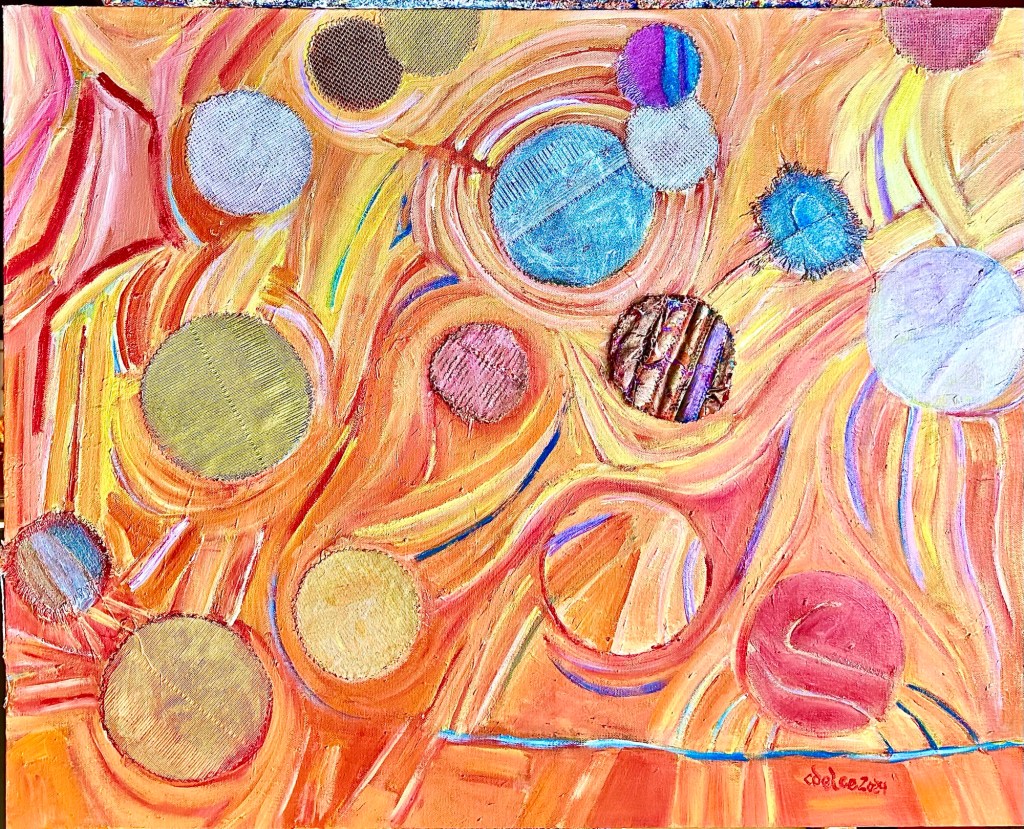
Music of the Spheres: Creation Energy, acrylic
I finished at home an acrylic painting, which explores some of the same themes as the watercolors we’ve worked on in class. In this I used various material with different textures for my spheres. One of the circles is more three dimensional because it’s from a handmade cloth mask left over from the pandemic. I painted parts of it, also. The background has lines of “energy” all about.
While the Pythagoreans attempted to see unity and harmony in the creation in numbers, our Judeo-Christian faith recognizes God as creator of nature and nature revealing the Creator. One of the best texts to understand this distinction is 1 Kings 19: 11-13, in which Elijah meets the LORD on the mountain at Horeb:
(God) said, “Go out and stand on the mountain before the LORD, for the LORD is about to pass by.” Now there was a great wind, so strong that it was splitting mountains and breaking rocks in pieces before the LORD, but the LORD was not in the wind; and after the wind an earthquake, but the LORD was not in the earthquake; and after the earthquake a fire, but the LORD was not in the fire; and after the fire a sound of sheer silence.
When Elijah heard it, he wrapped his face in his mantle and went out and stood at the entrance of the cave. Then there came a voice to him that said, “What are you doing here, Elijah?”
No one has ever heard the music of the spheres, and the voice of God arrives in the sound of sheer silence. Perhaps that “polar opposite” of the Pythagorean’s world view was on to something after all. If we’re very quiet and still, we may hear both the music of the spheres and the voice of God in the great silence.
After the Great American Eclipse, I’m reminded once again how great and wide is the love of our God. We say, “Our God,” as if we could own or possess the one who holds us, since God is beyond our knowing or possession. We can own a boat, a house, or a work of art. In the bad old days before the Civil War in America, people once owned other human beings. We fought a mighty conflict so our nation could be made up of free people, all of whom have equal rights. Unfortunately, not all have equal opportunity.
Patriotic Sunglasses
In America, we are so privileged, we often look at most everything through red, white, and blue lenses. We don’t take off our “American eyes” to see as God sees. To make this point, the Great American Eclipse actually began over the Pacific Ocean, so perhaps whales and sea birds would have been the first to experience it. When the eclipse reached land in Mexico, those in Mazatlán saw it before anyone in Texas did. I have lived in Texas, so I know they like to be the “first, best, and biggest” in everything, so they’ll ignore the fact this eclipse actually was seen by others first.
Eclipse Path: you are here
We don’t need to be first or best to deserve God’s love and providence. God proves God’s love for us every day the sun rises and sets. God gives us the rain in its season and grass for the herds to feed upon. We don’t have to exclude others to get God’s love, for God’s love is wide enough to include all. A God, who can call an entire universe into being with just a word, has the infinite resources to love all fully and completely. We are the finite ones, having limited resources and understanding, who find the need to limit God’s love to a few.
We tend to think in human terms of competition, in which one person gets a blue ribbon or a trophy and everyone else is a “loser.” That’s the Rickey Bobby of Talladega Nights school of theology. God made the entire universe, even tiny Pluto, which our astronomers demoted from planet status to a dwarf planet in the Kuiper Belt. Just because we relegated Pluto to a minor status doesn’t mean God diminishes God’s love, care, and concern for God’s creation.
Bill Maxey: Total Eclipse at Hot Springs AR
When we have the opportunity to view an awesome event of creation, such as a total eclipse of the sun, we have to consider ourselves privileged to be alive and part of God’s care. When the moon fully covers the sun and darkness falls upon the face of the earth where you stand, the cool air touches your skin, and your heart burns within. The excitement and rush of energy is so great I had to shout! I’ve heard some people cry. I guess I’m an exuberant sort.
Nana’s Poem: typed from memory
On 20 August 1892, “The Times” published an article by Kipling, “Half-a-Dozen Pictures”: it was one of a series of travel articles called From Tideway to Tideway. The article described a visit to an art gallery and Kipling’s reflections on the failure of most painters to match the beauty and vitality of the world around them. He offered some attractive verbal sketches of his own, though it wasn’t part of his purpose to contrast the approaches to nature of writers and painters. His main concern was to urge artists of all kinds to get out and see the world for themselves: (Letters of Travel 1892-1913 p. 40):
Now, disregarding these things and others – wonders and miracles all – men are content to sit in studios and, by light that is not light, to fake subjects from pots and pans and rags and bricks that are called “pieces of color”. Their collection of rubbish costs in the end quite as much as a ticket, a first-class one, to new worlds where the “props” are given away with the sunshine. (Letters of Travel 1892-1913 p.77).
Eight days later, the same article was published in the New York Sun. This time it closed with the untitled poem ‘When Earth’s Last Picture is Painted…’ which changed the article’s emphasis from an exhortation to artists to become travelers and pioneers, to what sounds very much like a manifesto for realism in art:
“And only Rembrandt shall teach us, and only Van Dyck shall blame:
And no one shall work for money, and no one shall work for fame,
But each for the joy of working, and each, in his separate star,
Shall draw the Thing as he sees It for the God of Things as They are!”
Four years later, Kipling changed the first line of that stanza to:
“And only the Master shall praise us, and only the Master shall blame,”
Kipling, the son of an artist, knew the true joy in life comes from one’s dedication to whatever work is in hand, and the task of the Artist is to convey to others the excitement and wonder of an expanding world. By changing the last line from artists’ names to the Master, Kipling heightened the spirituality of his poem. The artist’s task isn’t merely to render a faithful image of the landscape or person before them, but to bring forth all the inner energies and personality they see and feel.
Cornelia DeLee: Memory of the Last Great Eclipse, acrylic on canvas, 12” x 24”
This is why we don’t copy nature, since it’s three dimensional and we have a two-dimensional surface on which we make our marks to represent what we see. Perspective is our visual language to fool the eye into believing our flat surface has depth. Often we paint abstract shapes and colors because these are the best means to convey our emotions about an experience. Photography captures one way of seeing, but painting can render emotions with brush strokes and colors.
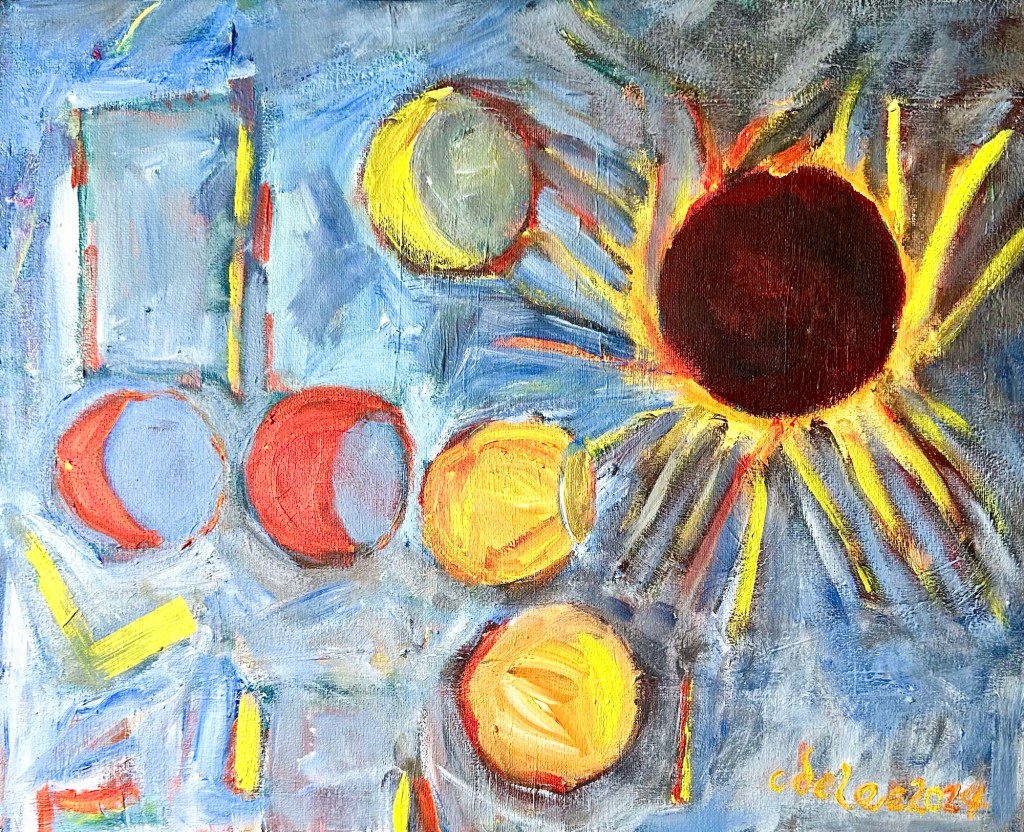
Cornelia DeLee: Door to Another Reality in the Eclipse, acrylic on canvas, 18” x 24”
I subscribe to a wonderful poetry series by Steve Garnaas-Holmes, which I receive daily. This poem’s theme of universal love spoke to me as I felt the in-flooding joy of God’s creating power during the Great American Eclipse:
I have other sheep that do not belong to this fold. I must bring them also, and they will listen to my voice. —John 10.16
We think we’re being open-minded when we include “all of us,” Protestant and Catholic, Orthodox and Coptic, as if we see the whole landscape. But the pasture and the Shepherd are far greater than that. Believer, unbeliever and other-believer alike are all shepherded, each in their own language. And still there are more, and more other, sheep. Like, well, sheep. Do not the deer and otter, whale and fungus follow the Shepherd faithfully? Is not the bird migrating its continents shepherded as well? Christ is not the partisan figurehead of a religion, Christ is the infinite embodied grace of God, the Shepherd of all Creation, who leads rivers to the sea and winter into spring and each of us into life. So there are still other, and more “other,” sheep. For Copernicus isn’t done with us yet: we admit the sun doesn’t revolve around the earth, but we still think God does. No, little one: we are in a small corner. Yet even the far galaxies, the trillion trillions of stars and their planets, and yes, their doubtless forms of life, are also under the calm eye of the Shepherd, and follow the Shepherd’s voice. All of us, Baptist and Sufi, fish, bug and bird, earthling and alien, village and nebula, all are one flock. One. And, behold, even on the remotest planet in the farthest flung galaxy—like ours— or the most desolate spot in a life like yours, under the loving gaze of the Shepherd who seeks out the one, there is no one who is not at the center.
May you each find joy in your working, each in your separate stars, and draw the Thing as you see It, for the God of Things as They are!
Not only can God watch the sparrow, but also all the many suns and planets of creation.
Joy and peace,
Cornelia
When Earth’s last picture is painted – The Kipling Society
In the Bonnie Tyler song, “Total Eclipse of the Heart,” her rock and roll soul pines for a young man as she sings:
“Every now and then
I know there’s no one in the universe
As magical and wondrous as you.”
Love struck teen heart ballads tend to elevate the beloved to a high pedestal, while hymns lift the praises of God to the highest heavens. If we look at John Wesley’s Notes on the New Testament, one of the doctrinal standards of the United Methodist Church, his commentary on 2 Corinthians 4:6 (KJV) is instructive:
“For God, who commanded the light to shine out of darkness, hath shined in our hearts, to give the light of the knowledge of the glory of God in the face of Jesus Christ.”
We might be more familiar with this verse in the NRSV, a more modern translation, which wasn’t available in the middle of the 18th century:
For it is the God who said, “Let light shine out of darkness,” who has shone in our hearts to give the light of the knowledge of the glory of God in the face of Jesus Christ.
Bailey’s Ring, from an earlier total eclipse over the South Pacific Ocean
Wesley’s commentary in his Notes on this text is succinct:
For God hath shined in our hearts—The hearts of all those whom the God of this world no longer blinds.
God who is himself our light; not only the author of light, but also the fountain of it.
To enlighten us with the knowledge of the glory of God—Of his glorious love, and of his glorious image.
In the face of Jesus Christ—Which reflects his glory in another manner than the face of Moses did.
What do the Total Eclipse of the Heart and Paul’s words to the Corinthian community have to do with art and faith? We’ve just experienced, what was for most of us, was a once in a lifetime experience. The last time a total solar eclipse was visible across the entire continent was in June 1918, when a total solar eclipse was visible from Washington to Florida, according to the US parks service. Nearly 100 years passed until this present Great American Eclipse.
At the 1878 total eclipse, Maria Mitchell led the Vassar College eclipse party, an all-female expedition from that pioneering women’s institution, which came to Denver in an era when science was a male bastion. Even higher education was deemed risky for the “fairer sex.” In 1873, the prominent Boston physician Edward H. Clarke had warned in an incendiary book titled “Sex in Education,” that the recent push for female colleges and coeducation could undermine women’s health by taxing their brains and causing their reproductive organs to atrophy — leading to “a dropping out of maternal instincts, and an appearance of Amazonian coarseness and force.” Nearly 150 years later some men still concern themselves with outmoded and 19th century views on women’s health concerns.
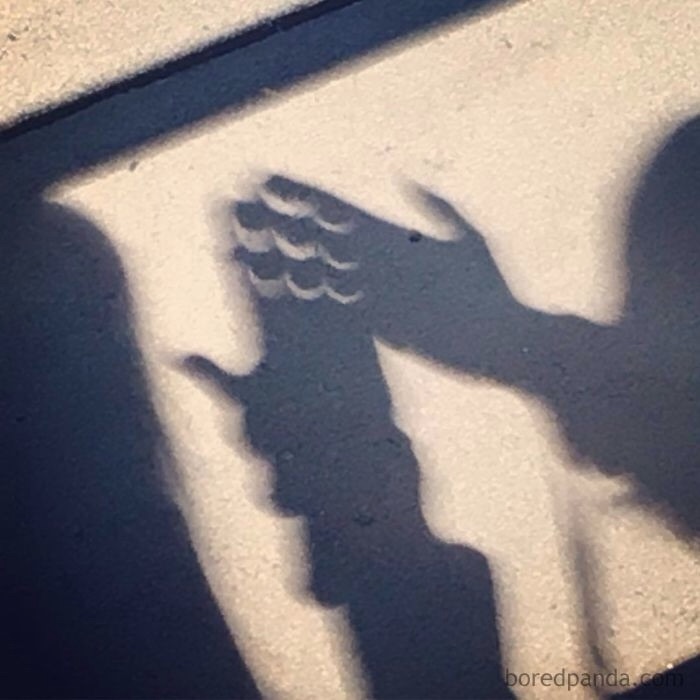
Eclipse as seen through the hands
I drove over four hundred miles to Kentucky in 2017 for the prior Great American Eclipse and got to stay home to see this second Great American Eclipse in my own front yard. Some folks couldn’t have been bothered about this current grand event, while others were convinced God was informing America of her impending doom. Moreover, multiple conspiracy theories abounded, none of which came true, of course. For instance, the world didn’t come to an end and our cell phones still work. Even the electric grid held up, even though the sun didn’t shine for all of a few minutes as the shadow traveled at over 1,600 miles per hour as it raced along the path of totality. This wasn’t even Y2K, which we all remember was a nonstarter at least and a dud at best.
Eclipse over Niagara Falls, 2024
In art class Friday Tim and I talked about the experience of this celestial event. We humans often elevate our own importance when we measure ourselves against one another and the works of our hands. When we go out into nature, we’re faced with the grandeur of God’s creation, especially when we visit the Grand Canyon or Niagara Falls. In Psalms 19:1, we read:
“The heavens are telling the glory of God; and the firmament proclaims his handiwork.”
We see the beauty of nature and feel a warmth in our hearts. Our spirits soar. This intimacy with nature is one of the reasons we send our children to our United Methodist Church Camps, not just because they’ll have a great Christian experience, but because they’ll have that faith experience in nature with trusted leaders. I still remember my adventures and experiences in nature at those camps as part of my spiritual journey.
Towering Cumulus Clouds
Even in seminary, when I was having difficulty with some of my courses, I could go for a walk on the campus under the tree lined walks and search the skies for hopeful signs. Sometimes I saw the towering cumulus clouds in the Texas sky as a sign God was with me “in the cloud by day.” In those times of difficulty, even the cloistered realm of preparation seemed like a wilderness journey, but I was glad for a guide.
Bill Maxey, from Nebraska, taken at Hot Springs, AR.
When I was actively serving as a pastor, sometimes I just had to get away. I’d drive until I found some nature, a national park, national forest, or some fields outside of town. If it was a hot summer, I looked for some deep woods and cool shade to shelter me. In the cool spring, I drove until I found flowers. Maybe this is why I retired to a lake in a national park. I don’t need a big house, since I’d rather go out into nature instead.
Totality on Lake Hamilton, with sunset in the west, outside the path of totality
It was the heat of summer in 2017, so you’d think I’d remember the temperature drop right before the eclipse was halfway through. This year I was on Lake Hamilton, and the breeze off the lake combined with the cooler air was decidedly noticeable. When we entered totality, the lights on the Highway 70 bridge and at Bubba Brews automatically came on. The distant sky in the southwest, outside the path of totality, looked like a summer sunset. My neighbors and our visitors from afar were cheering.
Bill Maxey: multiple exposure of the Great American Eclipse, 2024
Not everyone can make an artwork that expresses their emotions as well as the shapes of the image. We can learn the rules of perspective and color, but then we have to learn to let our heart rule our head. This is what I call an “artistic leap of faith.” When we were young, we accepted the basic ideas of Christianity. As we got older, life happened, and we might have begun to struggle with our childhood beliefs not being equal to our adult needs. If we keep our childlike faith, we risk losing our faith. If we are able to wrestle with our faith and find a new and more mature faith, we can handle the major challenges of later life. As Paul says in 1 Corinthians 13:11-12—
“When I was a child, I spoke like a child, I thought like a child, I reasoned like a child; when I became an adult, I put an end to childish ways. For now we see in a mirror, dimly, but then we will see face to face. Now I know only in part; then I will know fully, even as I have been fully known.”
Tim’s Partial Eclipse painting using red, blue and brown to build the sky
Tim experimented with mixing colors to get richer depth. Using the Prang watercolor palette, he mixed the red, blue, and brown to get the black sky of the eclipse event. The red orange of the sun has some brown in it too. He layered the colors with multiple strokes, with a nod to Van Gogh. He worked from a photograph I brought. I pulled many of them off the internet, and many of my friends sent me some too.
Cornelia: Total Eclipse of the Sun
I worked on an image I’d taken from my iPhone. I had placed one of my eclipse glasses over the lens and was wearing another pair. It wasn’t that easy to get the sun lined up with all that blocking! My image looked a lot like a fried egg or an eyeball. I used several jar lids to get the circles painted cleanly. My dark sky is red, blue, and violet. The shape of the corona was not distinct, due to the quality of my camera. NASA has a very high-resolution image, which breath taking. Our tax dollars at work are bringing great scientific research and development to benefit us in everyday life, such as solar panels and heart implants.
NASA: High Resolution Image of the Total Eclipse
Thomas Merton, in No Man is an Island, in a chapter called “Being and Doing,” wrote—
“We cannot be happy if we expect to live all the time at the highest peak of intensity. Happiness is not a matter of intensity but of balance and order and rhythm and harmony. Music is pleasing not only because of the sound but because of the silence that is in it: without the alternation of sound and silence there would be no rhythm.”
I was a bit exhausted after all the excitement of this big event. I’d met new people from three different states, visited around our patio, and been gifted crystals that had been dug from Mt. Ida and “energized by the eclipse.” I’m not a crystal person, but I understand from those that are these crystals are “special.” I was feeling every bit of my new age as the calendar flipped over for another year.
But today is another day, I had a night to sleep, and we had fun in art class. As long as we find joy in life, we know we’re alive. Our joys aren’t just collections of peak experiences, but some are the joy of the assurance of God’s enduring presence in our later lives when our youthful vigor has left us. We need to remember just as the moon eclipses the sun, once it passes, it also reveals the sun’s glory. One day this Bible verse from Philippians 3:21 will be true for each one of us, who has a heart full of love for God and neighbor:
“He will transform our humble bodies that they may be conformed to his glorious body, by the power that also enables him to make all things subject to himself.”
Joy and peace,
Cornelia
Bonnie Tyler – Total Eclipse Of The Heart Lyrics | AZLyrics.com
Friday in art class we painted our own unique designs on t-shirts for Monday’s Total Eclipse of the Sun. Anticipation of an event is characteristic of young children, while adults often feel over saturated with the early build up of attention given to an important event. By the time it gets here, we go, “Wow, what a letdown.” Children, who have fewer years of experience and anticipation comparison, can still marvel at the alternate reality of the total eclipse.
In the sixth century BCE, Anaximandros believed “the moon has a false light and is illuminated by the sun, and the sun isn’t smaller than the earth and it is pure fire.” The Greeks in 290 BCE knew the moon was unlike the sun. Anaximenes wrote it “didn’t shine with its own light, but with the reflected light of the sun,” as Eudimos wrote in his book History of Astronomy. The Chinese also studied the skies and stars. They used bones heated in fires to divine messages from their deceased ancestors as early as the 12th century BCE.
Chinese oracle bone depicting lunar eclipse of 12/27-28/1192 BCS.
The Death of Jesus in the Synoptic Gospels has the record of an eclipse occurring during the time of the crucifixion. John’s Gospel, which comes from a different source, doesn’t mention this time of darkness.
Egon Schiele, Crucifixion with Darkened Sun, Oil on Canvas, 1907.
When it was noon, darkness came over the whole land until three in the afternoon. ~~ Mark 15:33
From noon on, darkness came over the whole land until three in the afternoon. ~~ Matthew 27:45
It was now about noon, and darkness came over the whole land until three in the afternoon, while the sun’s light failed; and the curtain of the temple was torn in two. ~~ Luke 23:44-45
When Jesus had received the wine, he said, “It is finished.” Then he bowed his head and gave up his spirit. ~~ John 19:30
Yet the Gospel of John tells us more about the miracles of Christ and his dual nature (both human and divine), so that we might believe and have everlasting life through him. New Testament scholar Ernst Käsemann is correct when he says of the Fourth Gospel: “Judged by the modern concept of reality, our Gospel is more fantastic than any other writing of the New Testament.”
Bruce Metzger, noted New Testament scholar and lead translator of the NRSV said, “The more often you have copies (of biblical texts) that agree with each other, especially if they emerge from different geographical areas, the more you can cross-check them to figure out what the original document was like. The only way they’d agree would be where they went back genealogically in a family tree that represents the descent of the manuscripts.[104]
Tim’s Eclipse T-shirt: very simple due to his rehab from arm surgery. He uses his arm until it hurts and then he rests. We do what we can, not what we can’t.
We modern folks are used to looking at the world through the eyes of science and education. We look for repeatable patterns and consistent evidence. We have “grown up minds” with calendars, schedules, to do lists, and multiple people who make demands on our time. Often, we are thinking about our next meeting or chore before we even finish the one we’re currently working on at the moment.
We aren’t practicing Brother Lawrence’s admonition to “Practice the present moment.” Our constantly chiming cell phones don’t help us be present, even though we could set our notifications to silent. Indeed, we’re never present or still enough to know the peace of the God whose name means “I AM.”
Lauralei’s Eclipse T-shirt: experimenting with fabric paint
What is “reality?” How can we know the present moment and come closer to God? With the advent of photography people began to think super realism in painting was preferred to some degree of emotional expression. Today, with the introduction of Artificial Intelligence, we can make computer generated photos and paintings that go beyond our wildest dreams! This means our new generations may likely begin using tactile materials and hand-built techniques to create future art works. Instead of fantastic other worlds, they might find their inspiration in the environment or in social justice concerns.
Gail W’s Eclipse T-shirt: first stage in class. She came with a design in mind and brought her sewing chalk also.Gail W’s Eclipse T-shirt: the finished product. Some of our inspirations are too grand to be completed in a few hours. We need to have the desire to carry the effort forward to meet our goal.
As with the icon, the artwork is only a reflection of the image which is painted. The icon isn’t holy, but the person depicted is holy. As the writer of Hebrews 1:3-4 says:
“He is the reflection of God’s glory and the exact imprint of God’s very being, and he sustains all things by his powerful word. When he had made purification for sins, he sat down at the right hand of the Majesty on high, having become as much superior to angels as the name he has inherited is more excellent than theirs.”
I didn’t get a photo of Mike’s “Crawford Law Eclipse T-shirt.” Work called and he had cats to herd. He was generous as usual to bring fabric paints for the group to share. We used old newspapers inside our T-shirts to keep the paint from bleeding through to the backside. We had an opportunity to share stories and eat my birthday doughnuts which Tim blessed me with.
Cornelia’s Eclipse T-shirt: I collapsed all the moments of occlusion into three, so I could finish in one sitting.
If we take time to practice our art, we may realize our own works may be only a reflection of the glory of what we saw, but we we can continue to practice our skills in prayer, for God will bring us ever closer to perfection if we commit our work to God’s glory.
Leonardo da Vinci: Study of the technique for observing solar eclipse, Codex Trivulzianus, 1487–1490
Also, Marilyn, who was working with some other ladies of the church on the potato bar posters, had brought the warm-gooecrescent roll-cream cheese-vanilla-cinnamon-sugar dessert. If you ever have a chance to put this into your mouth, you will be transported into an alternate reality. This is the stuff from which dreams and visions arise! If you eat it, and you merely remark, “Good,” my thought is you’re dead to this world or you’ve lost your sense of taste. The child in me screamed for MORE!! The adult in me will see if I can reduce the calories with no depreciation in taste.
Paul Nash: Eclipse of the Sunflower, 1945
I hope we get a break from the clouds on the Great American Eclipse Day. The last one I traveled to in 2017 was very impressive and worth the journey. Watch it on television if you can’t be outside. Only look at the sun with certified eclipse glasses. Some experiences are such that we can only say “Awe!” And we may want to stop time forever, but time will march on, for we can’t move the sun either forward or backwards. No matter how important we are, we aren’t gods, and we aren’t even Time Lords. If we manage to grasp only a portion of the holiness and beauty of God’s creation in this one event, we will better experience the joy of the passing glory of our God:
“When I look at your heavens, the work of your fingers, the moon and the stars, that you have established, what are human beings that you are mindful of them, mortals that you care for them?” ~~ Psalm 8:3,4 (NRSV)
View of the Great American Eclipse 2017 at Lake Barkley through a pinhole
Bruce Metzger was the master of several ancient and modern languages and ended up teaching at Princeton for 46 years after he received his PhD there. As one of the editors of the standard Greek New Testament used today and the senior editor of the NRSV, his scholarship has proved to be almost impeccable. His specialty was New Testament textual criticism, the field whose primary goal is to ascertain the wording of the original text. Many considered him the finest NT textual critic of the 20th century. His death in 2007 left giant footprints for the next generation to come.
Paul Nash, British Military artist, died in 1946 of complications from asthma. He didn’t see the total eclipse, but knew of it and was very connected to nature.
Every once in a while, I like to go on journeys. Sometimes they’re actual trips, such as my recent vacation over spring break to visit family down in Texas, but other times I like to “time travel.” The best way to time travel today, since I don’t have access to a DeLorean, is to study history. Buckle your seatbelts, we’re in for a ride through Christian and art history.
Right before spring break, our art class tried some experimental techniques with chalk, watercolor pencils, and pan watercolor with brushes. I also brought some images from the beautiful church of Hagia Sophia of the ancient capital of Constantinople, which I brought home from a pilgrimage I made several years ago.
The church was sponsored by the first Christian emperor Constantine, so it has exceptional mosaics and frescoes decorating all its surfaces. We each chose an image to use as a starting off place and went from there. Inspiration comes not only from what we see, but from the materials we use. Combining new images with new materials can bring new directions.
Desis Icon, Hagia Sophia, Constantinople, Turkey
Our primary images were the archangel Michael, the enthroned Christ, the decorative jewel designs, and the cross. All of these designs figure in prominence in Hagia Sophia or the Basilica of Holy Wisdom, the primary seat of Christianity in the Eastern Church during the Byzantine era.
Unknown Artist: Moschophoros, The Calf Bearer, 165 cm high, Limestone, 570-560 BCE, Acropolis Museum, Athens, Greece.
Early Christian art took its themes from contemporary Greco-Roman subject matter, but repurposed it for its own religious significance.
The Good Shepherd, the Catacomb of Priscilla, Rome, Italy, 250–300 CE, adopts the standard form of Apollo statues.
The archangel Michael was connected in the 4th CE with Constantine as a divine messenger and intermediary between heaven and earth. Michael was not only the guardian angel of the nation of Israel, but other nations have adopted his protection also. In this same century one of the doctors of the early church, St. Basil of Caesarea, known as “the Great,” said:
“Beside each believer stands an angel as protector and shepherd, leading him to life.”
Constantine felt the presence of the mediating angelic hand in his vision of the cross in the sky at the Milvian Bridge, at his baptism, and in his role as Emperor of the Eastern Christian Empire. Constantine was actually baptized twice: once to cure him from leprosy and again on his death bed. In the early days of Christianity, various sects prevailed and the doctrine of one baptism as sufficient for all times hadn’t yet taken hold. After all, it’s not the water, the place, the church, the location, or the priest that makes a baptism effective, but the work of God through the Holy Spirit. As Ephesians 4:4-6 says,
“There is one body and one Spirit, just as you were called to the one hope of your calling, one Lord, one faith, one baptism, one God and Father of all, who is above all and through all and in all.”
Constantine’s Vision of the Cross: Bibliothèque nationale de France, Illustrated painted parchment Greek manuscript (879-883 AD) of the homilies of Gregory of Nazianzus in the Bibliothèque nationale de France. (BnF MS grec 510) folio 440r. https://gallica.bnf.fr/ark:/12148/btv1b84522082/f891
Constantine’s first cross apparition took place at the beginning of his military campaign in Italy. The young emperor realized that the tyrant Maxentius, who controlled Rome at that time, had set a trap at the Milvian Bridge over the Tiber. Fearing his rival’s machinations, Constantine had sought the aid of the God worshiped by his father, Constantius Chlorus (r. 305–6). While he marched on to a field together with his troops, he saw the sign of the cross revealed in the afternoon sky, shinning brighter that the sun, alongside an exhortation inscribed “by means of a starry form: By this you shall conquer, Constantine!”
Mike’s Cross Painting
Note the use of common materials in Mike’s work. The circle is the same size as a foam plate, the cross from the table decorations fits just inside it, and he embellished the outer and inner spaces with a bilateral and balanced design. He’s getting more skilled to “eyeball those proportions” from across the room. Plus, he enjoys making these designs.
The ancient writers Eusebius and Euthymios both mention the emperor’s troops also witnessed this miracle. The significance of the vision was subsequently clarified by Christ, who appeared to Constantine in a dream advising him to carry a cross-shaped banner before his armies in order to defeat Maxentius.
Byzantine hagiographical works, or the writings about the lives of saints, name this apparition of the cross as a decisive step toward Constantine’s conversion to Christianity. This first episode is part of a faith narrative, which runs through the tale of Constantine’s leprosy and his miraculous healing through his first baptism, which was officiated by Pope Silvester.
The depiction of Pope Sylvester in the church decoration, a leading figure in the iconography of Roman popes in Byzantine art, deserves special comment. Sylvester was born in Rome and was pope between 314 and 335, succeeding pope Miltiades. Both the Latin and Orthodox rites honor Silvester as a saint and the patriarchate of Constantinople commemorates him on 2 January. The fictional account of his life, Actus Silvestri, written in the 4th-5th century, records the story of his curing Constantine of leprosy and then baptizing him.
Baptism of Constantine
It was during this first baptism Constantine had another vision which converted him to Christ. Constantine’s baptism is narrated in the Greek Life of Silvester in a verbatim translation of the story by Zonaras. Having recovered his health by means of the sacramental bath, the now Christian basileus (king) donned a bright garment and “said to the bystanders that he had felt a hand: It had stretched out from above and touched me while I was descending into the font.”
Baptism of Constantine
The visualization of St. Michael’s involvement in Constantine’s baptism has no direct precedent in Byzantine and Balkan iconography. Similar descriptions appear in the shorter ninth-century vita of the hierarch and in the lives of Constantine. In the “Guidi” legend, the emperor’s confession is specifically addressed to the pope: “Servant of God, as I was standing in [the water] of the holy baptism, I felt a hand touching me and cleaning the sickness of the flesh.”
Unlike the hagiographical account by Zonaras, this fragment from the “Guidi” vita is not attested in the manuscript culture of the East-Carpathian environment. Even if it doesn’t include this passage in the section on Constantine’s baptism, the encomium (eulogy) by Patriarch Euthymios contains an allusion to the motif of God’s hand:
Upon waking up from the dream in which SS Peter and Paul offered him the cure of baptism, the emperor dismissed the pagan healer ( ) who attended him and said that: “(…) from now on, I need no human help, for the hand of God Almighty ( ) helped me.” Although it anticipates the king’s baptism, this statement is merely a symbolic reference to the divine power which came to Constantine’s aid, not a description of a miracle occurring during the ceremony.
The Slavonic translation of the Life of Silvester by Zonaras remains the only account that constitutes a plausible narrative background for St. Michael’s involvement in the scenes at the Romanian churches of Rădăuți and Bălinești. We don’t know if these fresco designers used a specific copy somehow related to the manuscript at the Neamț monastery. Yet once it had been integrated into the liturgy, the legend of Pope Silvester might have developed an independent circulation through storytelling. Perhaps the local audience interpreted Constantine’s confession about the divine hand that touched him in the water as a sign of the ethereal presence of the Archangel as pictured in the compositions of Constantine’s baptism.
Creation: The Nuremberg Chronicles (1493), written by Hartmann Schedel and illustrated with woodcuts by Michael Wolgemut
Perhaps these tales seem strange to our modern scientific minds, colored as we are by notions of “pictures, or it didn’t happen!” We want proof, repeatable and documented evidence, not just some such nonsensical woo-woo about visions and dreams. After all, we are more likely to think these voices could be drug induced or anxiety provoked, but we aren’t so familiar with God speaking to mortals, as it was back in the days when the boy Samuel was ministering to the LORD under Eli:
“The word of the LORD was rare in those days; visions were not widespread.” (1 Samuel 3:1)
We aren’t big on either voices or angels, but God does still work in supernatural ways. While some may see prayer as supernatural healing, others may see God’s healing hand at work in guiding doctors, nurses, and caregivers to bring people to get the medical attention that brings them to better health. God gives us the heart for healing and compassion for the suffering, which then sets us out to discover new medicines and treatments for dread diseases. These wonderful advances would appear as magic to those from a century ago, or even a few decades before.
Take the miracle of cystic fibrosis advances. In the 1980’s, the life expectancy for a CF patient in the United States was only 12 years and 20 years in Canada. By 2017, with new medications and therapies, the median life expectancy for CF patients was 47. Because new medications and improved treatment of respiratory infections and other complications have extended the predicted life expectancy of CF patients to almost 50 years, some are now living well into their sixth and seventh decades. I call this a miracle, even if others call it mere “science.” It means I have a grand nephew who likely will have a full lifetime and even enjoy his own children.
Humanists will give all the glory to the human creature. They are self-made men and women in love with their own creation. People of faith will give all the glory to God for the gifts of their hearts, minds, bodies, and spirits. We have been given much, so we give much to others.
Nike of Samothrace
Just as the earliest Christian art works repurposed secular and mythological Roman themes, so later Christian art used Greco-Roman mythological imagery. The angels are based on the female winged victories, such as the famous Nike of Samothrace. In the early fourth century, angels suddenly appeared as figures in Christian iconography, usually without feet and dressed in garments of a white pallium over a tunic. This was a large rectangular cloak worn over a tunic, as worn by Greek philosophers and religious teachers. In the earliest Christian art works, angels were depicted as wingless, but wings became normative by the fifth century. By the High Middle Ages, angels were more elegantly garbed (depending on their station in the hierarchies) and appeared to be androgynous.
The first known Christian depiction of winged angels does not appear until this splendid 4th century marble ‘Prince’s Sarcophagus’. It was discovered after a fire in Sariguzel, near Istanbul in the 1930s
The word for Angel, mal’akh in Hebrew and angelos in Greek, simply means messenger, which is the job description of the Angel, who acts as an intermediary between humans and God. The Bible never says angels have wings, but we all imagine angels with wings. Perhaps we assign them wings because angels can travel from the “heavens above to the earth below.”
Egypt’s Red Monastery, The church of Anba Bishay and Anba Bigol
The church of Anba Bishai and Anba Bigol, known as the Red Monastery, is the most important extant early Christian monument in Egypt’s Nile Valley. It’s one of the most significant historical sites of the period in the Mediterranean region. Created in the 4th and 5th CE, this fine painted Coptic Christian image of Christ surrounded by angels has survived multiple restorations of the church building.
Leonardo da Vinci: Annunciation, 1472, oil on canvas, Uffizi Gallery, Florence, Italy.
Although the principle of angels being sexless continued, later renaissance artists presented them as male figures with fashionably delicate facial features and long hair, dressed in contemporary garments (making them more approachable to the common era). As the lines between the angelic spheres became blurred, along with the renaissance adaptation of classical Greco-Roman art, plump little children with wings began showing up in Christian art. We know these as cherubs.
Cornelia’s Watercolor Angel from Hagia Sophia
I used a mix of pastels and watercolor on this painting, working from a 1.5-inch square image of the Archangel Michael. The contrast of light and dark shows up in the naturalist wings and hair, with the glowing and reflective gold mosaic pieces.
Angel from Hagia Sophia
Regarding his rank in the celestial hierarchy, opinions vary. St. Basil in his homily Angels, as well as other fathers, place St. Michael over all the angels. They say he is called “Archangel” because he is the prince of the other angels. Christian tradition gives St. Michael four offices:
To fight against Satan.
To rescue the souls of the faithful, from the power of the enemy, especially at the hour of death.
To be the champion of God’s people, the Jews in the Old Law, the Christians in the New Testament.
Therefore, he was the patron Saint of the Church; he is considered to be the protector of Christians against the devil.
Christ between St. Peter and St. Paul, Catacomb of Sts. Marcellinus and Peter on the Via Labicana, Rome, 4th CE.
This image of Christ on the Throne, dating to the 4th century, shows Michael between St. Peter and St. Paul. It was painted in the Catacomb of Sts. Marcellinus and Peter on the Via Labicana in Rome, located near a villa that used to belong to Emperor Constantine. Below the main figures of the painting—Jesus, Peter and Paul—we find Gorgonius, Peter, Marcellinus, and Tiburtius, four martyrs who had been buried in that catacomb, and are depicted as they point to the Lamb of God on his heavenly altar.
Zeus: Archaeological Park of Campi Flegrei at the Castle of Baiae on the Gulf of Naples, Italy
The enthroned Christ follows the thematic form of Zeus, king of the gods, seated on his throne. A good example is statue from the Archaeological Park of Campi Flegrei at the Castle of Baiae on the Gulf of Naples. This statue of Zeus Enthroned is a 29-inch-high marble statue dating to the 1st century B.C. and is likely of Greek manufacture.
It was inspired by the colossal gold and ivory statue of the god at the temple of Zeus at Olympia made by sculptor Pheidias in 430 B.C. It was one of the Seven Wonders of the ancient world. Just as the angels were repurposed from the Nike victory statues, so the Christ Enthroned statues were re-envisioned from the ruler of the gods and humans statues. Art and artists can be put to work for whoever is in power at the moment. We need to eat and pay bills in every age.
Zeus: fresco, 62-79 CE, Casa dei Dioscuri, Pompeii (VI, 9, 6-7, atrio corinzio 37), Museo Archeologico Nationial, Italy.
A lovely fresco from Pompeii, found in the House of the twins, has a glowing red background and shows Jupiter or Zeus, the king of the gods, seated on his throne. A sphere lies beside him, an eagle at his feet, and a rectangular base is at his feet. In the same manner, the icon of the enthroned Christ places his feet on a rectangular base, representing his lordship over the four corners of the world.Gail W used the pastels in the clothing and background.
Gail W’s Enthroned Christ watercolor
From one of the royal figures, Gail S chose one of the jeweled embellishments for her focus. Gail enjoys ordered designs, so finding an image with a regular pattern was right up her alley. The outer circle with an inner square is divided along the diagonals by red lines, as if the cross were tilted on its side. The circle and square give unity to the design, as does the monochrome cross. The triangles are balanced by colors. The outer blue rim holds it all together. Gail tried the watercolor pencils out along with the pan watercolor washes.
Gail S inspiration and creation
While nothing is ever new in art, we artists keep reimagining the old patterns in new ways. After all, the basic elements of design never change, but we see the world with fresh eyes in every generation. Using our hands to create restores us and recreates us by reducing our anxieties and giving us a sense of accomplishment. We each serve the God of beauty and joy as God reveals God’s self to each of us. Doing any creative work with our hands is good for the mind, spirit and soul.
As our hand grows in competency with the media and our eye is better able to discern shape and patterns, we come under the Holy Spirit’s inspiration of creating power and we make art! We may start from the ancient wisdom, but then we go onto find the wisdom for today. After all, God is always in a rebuilding mode, for that which God created, God will preserve:
“When you send forth your spirit, they are created; and you renew the face of the ground.” ~~ Psalms 104:30
Saint Mamas at Exeles: An Unusual Case of Ritual Piety on Karpathos Katsioti, Angeliki; Mastrochristos, Nikolaos. Arts; Basel Vol. 12, Iss. 4, (2023): 176. DOI:10.3390/arts12040176 Saint Mamas at Exeles: An Unusual Case of Ritual – ProQuest https://www.proquest.com/docview/2856776246?sourcetype=Scholarly%20Journals
All things will renew themselves in good season, yet we have only the present moment before us. We can’t live in the past, nor can we control the future. We have to recognize even our present moments aren’t always in our control, as we witnessed in the big Super Bowl game last Sunday.
Random Actions Often Determine the Outcomes of Sporting Events
Who would ever believe a punt would hit a receiving teammate’s foot, and suddenly become a live ball? Then get recovered by the Chiefs for a quick touchdown? If you think you can control your circumstances or the actions of others, just watch the NASCAR races at Daytona this weekend. The wonder is they don’t wreck in every turn, but only occasionally during the 500 mile race on Sunday.
Watercolor is more difficult medium to manage than acrylic paints because it’s wetter and refuses to dry as quickly as we want to paint in that same area. It’s not being obnoxious; it’s just being its own true self. Cezanne used watercolors to think out his ideas beforehand, and then worked in oils. Often, he tossed aside the watercolor work, sometimes even leaving it out in the landscape which he’d just painted. He’d learned all he could from it and now was ready to paint his new image, but not a copy of the original painting. This mountain shows up in sixty of Cezanne’s artworks.
Paul Cézanne: La Montagne Sainte-Victoire, 1888, oil, The Stedelijk Museum, Amsterdam.
The stoic philosopher and Roman Emperor Marcus Aurelius wrote a series of meditations on life. In one he speaks of all life experiences as being the same. This attitude keeps him from getting too high or too low about what happens in his life. He takes it as it comes. Even death, which some fear as a loss, doesn’t bother him, for if he isn’t bothered about the present, he can’t be bothered about losing that too. Marcus Aurelius wasn’t a Christian, but his quest for equanimity is admirable. Take life as it comes and worry not:
“First, that all things in the world from all eternity, by a perpetual revolution of the same times and things ever continued and renewed, are of one kind and nature; so that whether for a hundred or two hundred years only, or for an infinite space of time, a man see those things which are still the same, it can be no matter of great moment. And secondly, that that life which any the longest liver, or the shortest liver parts with, is for length and duration the very same, for that only which is present, is that, which either of them can lose, as being that only which they have; for that which he hath not, no man can truly be said to lose.”
The Still Life in Our Classroom
When we work in watercolor, we have to take what the watercolor gives us. While we can plan, design, and control the outcomes to a certain extent, watercolor often goes its own way. If we work over the whole surface, rather than noodling around in one little space like a puppy sniffing a single spot while out on its morning constitutional walk, we get more done, just as the puppy is more likely to get its “business” done.
One of the reasons we work in a new medium is for the challenge. In school, when I was bored, I’d take notes in class by writing upside down. When that got too easy, I began using my left hand to write upside down. This was a true challenge! I didn’t have any ingrained pathways in my brain for left-handedness, much less the upside-down images. I was truly bored, however, so I struggled on until I got serviceable images. This was the year in which I went to art school as a midyear junior and was taking a freshman level history course.
Tim’s Painting
Tim has voluntarily switched to his left hand because he will have surgery on his right side, which will knock out his ability to use that arm for several months as he recovers. This is a good effort for his non dominant hand. You can tell he focused on the scoop, for it has the most detail. Training our alternate hand to do the work of our dominant hand requires resetting the brain to prefer the new hand. If you try brushing your teeth with your other hand, you’ll see exactly how strange it feels to use a different hand. This is because you have no well-worn pathways in your brain circuitry that makes this routine effort possible.
The fancy pants word for this is neuroplasticicy. We meet this concept with stroke survivors who do physical therapy to rewire their brain connections to make new pathways so they can speak, write, or walk. Everyone who tries a new game, learns a new language, or tries a new hobby also builds new pathways in their brains. Be learners for life, if you want to keep your mind healthy.
Gail’s Painting
Our still life was challenging today. It had solid shapes, a clear bottle, and a metal scoop. Not only were there multiple colors, but textures and transparency also. Gail has had several years of drawing under her belt, so she was able to render the perspective of the still life well. Note the clear blue bottle, which has a wonderful oval bottom. The lemons and limes are distinct also. The grey shape is an antique scoop, sans the handle.
In 2008, J.K. Rowling spoke at the Harvard commencement exercises, telling the graduates, “Talent and intelligence never yet inoculated anyone against the caprice of the Fates.” Because we don’t know what tomorrow will bring, taking care for today is the best preparation for the future. Rowling studied the Classics at Harvard, a subject most people would consider useless for this modern era. Yet after a divorce, as a single parent working for Amnesty International, she began writing her wizard novels. Harry Potter is now part of our cultural heritage.
As Jesus said in Luke 12:25-26–
“And can any of you by worrying add a single hour to your span of life? If then you are not able to do so small a thing as that, why do you worry about the rest?”
Worry is stressful, for sure, and it’s an example of “bad stress,” along with traumatic events, such as adverse childhood experiences (ACE), disease, divorce, and death of a loved one. We also endure “good stress,” as when we challenge ourselves to lift heavier weights, cook a new recipe, or learn a new language. As Ralph Waldo Emerson wrote in his 1841 essay Heroics, paragraph 14:
“The characteristic of a genuine heroism is its persistency. All men have wandering impulses, fits and starts of generosity. But when you have chosen your part, abide by it, and do not weakly try to reconcile yourself with the world. The heroic cannot be the common, nor the common the heroic. Yet we have the weakness to expect the sympathy of people in those actions whose excellence is that they outrun sympathy, and appeal to a tardy justice. If you would serve your brother, because it is fit for you to serve him, do not take back your words when you find that prudent people do not commend you.
“Adhere to your own act and congratulate yourself if you have done something strange and extravagant, and broken the monotony of a decorous age. It was a high counsel that I once heard given to a young person, —”Always do what you are afraid to do.”
When I was in high school, the ancient Latin teacher, who had taught my daddy when he went to school, tossed out the challenge, “No one has ever made 100% on my final Latin exam.”
I bit on that challenge like a starving dog bites on a bone, even if it has no scrap of flesh remaining on it. I made flash cards and studied for an hour every night before bed, I was so determined to be the exception to the rule. On the test, I got all the Latin correct, but lost ½ point for misspelling an English word. I never followed up on her retirement, but I fully expect her record remained unblemished. Also, I’m still spelling challenged. I’m thankful for SpellCheck in our writing apps.
Gail W.’s Painting
Gail W. paid attention to the still life and took care to lay down a close image in a pale wash before she began to add darker washes of color. Her left lime is most successful, with at least six shades of green and yellow in the shape. I also like the highlight on the central lemon. These two images capture the essence of the watercolor medium. Her perspective on the bottle bottom indicates it sits well on the cloth.
Failure teaches us what we don’t know, so we can improve the next time. This is what we call resilience. When I taught art, my students had to find three things they did well in their work before they named anything they needed help on. This was to build up their confidence. For some of them, just making a mark on the page was a start. If we fear making a mistake, we can sketch in a pale-yellow wash. This is very forgiving, like a whisper in the wind. If it’s not quite right, the next few marks may be nearer our desired outcome.
This Is Fine—Leave Me Alone, I’m Having a Crisis
Our mindset is what controls how we react to events in our lives. As one of my friends would remind me, “Not everything is a hair on fire moment.” Of course, when I was a young teen, the least slight or distress caused me to fling myself over my bed in a paroxysm of sobs, wailing loudly, “I’m going to die!” My parents would look at each other and shrug, “What boy is it now?” Fifteen minutes later I’d be in the kitchen looking for a snack, having cried my eyes out, and now I was on to the next thing. As I had more experiences, I learned to roll with the moment. Sometimes you need to wait for the next wave to rise before you take your ride. God’s timing is always right, for our experiences, both the failures and successes, prepare us for what comes next in our lives.
Cornelia’s Watercolor
I had some of the same perspective problems as everyone else, especially with the base of the bottle. Actually, it’s a challenge to get a “transparent three-dimensional object on a flat surface” to appear as if it’s actually sitting on a flat surface in two dimensions. Learning some shading techniques and remembering a round bottle bottom becomes an ellipse helps to bring off this sleight of hand. I got my paint too dark on the front of the bottle base and had to let it dry so I could come back in with some clear water and an almost dry brush to pick up the color. This gave me the highlight I needed.
Cornelia’s Drawing over the Watercolor
When I got home, I noticed my eyesight seems to be going amiss with my increased age. Lately I’ve not been careful to paint my verticals straight. Either I’m being lazy, or I’m tilting my head as I look at the subject. Maybe my neck injury has something to do with it. I duplicated the photo and used the Apple Pencil to straighten up the bottle and even up its symmetry. I also touched up a few of the lemons and limes. Maybe I’m still the puppy that likes to noodle around and sniff about until I can wrest all I can get from a work. This way I learn all I can from it. Like a kindergartner, if my work ends up a huge grey blob, I can say, “That was a great learning experience!”
My grandmother, who painted portraits and still lifes, kept a saying written on the back of an envelope, near her easel: “Ever tried. Ever failed. No matter. Try again.” She passed in 1970. Years later, Samuel Beckett, in his 1983 story, Worstword, Ho wrote:
We need to be like great artists and athletes, or the Michelin chefs who just keep trying, falling short, until they get close enough to qualify for their stars. Persistence makes all things possible, and if we “fail,” we’re only getting closer to perfection.
“Transfer of Learning” is a concept in which anything learned in one situation or environment can be applied in another. When I taught art, I would have my students use mathematics and fractions when they cut mats to present their work for exhibition. “Why do we have to use math in art?” they whined, “We’re never going to use it in our lives again.”
“Are you going to buy a house, a car, or shop for clothes or groceries? How will you know you’re getting a good deal?” They got out their pencils and rulers, even though they hated fractions.
Step 1: draw a light under painting
This was decades ago, before “Train for Today’s Workplaces” became a mantra among some politicians. The only problem with training for today is the ever-changing nature of the modern workplace, which can make skills obsolete in a mere two years. Executives believe nearly half of the skills that exist in today’s workforce won’t be relevant just two years from now, thanks to artificial intelligence. However, human creativity will always be needed to guide AI. Folks who want white collar jobs today will need to buy into continuous learning, since the current job market will require ever changing skills.
Step 2: add some thin washes to build up the solid surfaces
We’ve all heard the saying, “Jack of All Trades vs Master of None,” but this might be the best possible scenario for our modern world. In our highly professionalized society, we all want the best physician and the top-notch lawyer on our case. Not everyone has the goods to acquire their services. We get the best we can afford. This is the capitalist society in which we live. In a utopian society, the poorest among us would get the same high quality medical care as the President of the United States.
Step 3: add details once surface is dry enough the paint won’t bleed. Doing background while waiting for objects to dry allows you to tighten up the edges of the objects.
“Those who can’t, teach” is a misconception, similar to the Jack of All Trades. Art Teachers can’t stick only totheirspecialty, but also must offer the gamut of skills from drawing to painting, paper cutting to plaster sculpture, clay pottery to cloth dyeing, and even more multimedia experiences. They have to be able to reach students with a wide range of talents, interests, and expertise, as well as encourage those who are ashamed of their work. Plus, they need to convince the talented to work and improve so they fulfill their promise.
This background discussion brings me to our class’s second experience in watercolor. I noted some instances of Transfer of Learning I can point out when we meet again.
Gail’s Still Life
When we paint a house, we dip our brush in a bucket of paint, apply it to the wall in one stroke, and then go back to the bucket for another dip. We don’t keep wiping the same spot on the wall over and over trying to make this one spot look better. In fact, the damp brush is just picking up the paint off the wall! Move along and cover the wall.
Tim’s Still Life
Don’t take your eye off the ball. If you want to catch a ball in any sport, you have to track it into your hands or the mitt. I noticed the ones who looked up, drew, looked, drew, checked, drew again, adjusted, and drew some more, had closer proportions in their drawings.
Measure twice, cut once. This is similar to the above sports metaphor. I learned it in the art school wood shop when I was cutting wood for my stretcher strips. Using the thumb or a brush to note the proportions of the still life objects and comparing them to the proportions of your own work helps get an accurate drawing. Check once, measure, check again, measure, and then cut. Air drawing or visualization helps to imagine the proportions before drawing the lines. Drawing lightly so you can draw over the less appropriate shape is an example of measuring twice, and cutting once.
Gail W’s Still Life
Sheep will eat the grass down to the roots, but goats will move on. Actually, I have zero experience with sheep and goats. My shepherd experience is limited to leading a congregation, none of whom could be accused of being either sheep or goats. I only know this fact from Bible Study lessons, and no one rents out sheep to clear a pasture of weeds, but they use goats because goats are smart enough to move on. In art, we need to take a lesson from the goats and move on to another section of our painting to let our colors dry, so we can avoid our colors running into each other.
Cornelia’s Still Life
Our group isn’t training for a new occupation, but keeping a challenge on our plates is a good idea for anyone of any age. Whether you’re trying new recipes or learning to play an instrument or taking up an exercise routine, whatever change you make in your life is important. Doing creative writing or crafts or arts is especially crucial for keeping our brains healthy, for these activities build new pathways in our brains. As we age, having redundant brain pathways is important to keep our minds healthy.
Participation in arts interventions have been linked with improving cognitive function and memory, general self-esteem and well-being, as well as reducing stress and other common symptoms of dementia, such as aggression, agitation, and apathy. According to the National Endowment for the Arts, the interventions which promote social interaction, have multiple psychosocial benefits. While none of our group are experiencing these effects, participation also staves off the same symptoms. Researchers found visual arts programs reduced depression, improved socializing, and increased self-esteem among participants.
Expressive arts activities also help individuals relax, provide a sense of control, reduce depression and anxiety, encourage playfulness and a sense of humor, as well as improve cognition and self-esteem. Making art also nurtures spirituality and reduces boredom. Art also can reflect the emotional and cognitive condition of the artist.
Watercolor with Prang Oval 8 Student Palettes
In the classes I teach, I encourage each person finding their own voice, rather than copying my style. In the art education classes I took in college, the goals of teaching were for students to recreate the closest replica of the teacher’s model, as they followed the instructional steps to the letter.
I’m thankful I never had those teachers growing up, but by the 1980’s, regimented lesson plans were all the vogue. When I began to teach, I gave certain boundaries or requirements for each lesson, such as the use of certain color schemes or coiling verses slab built in clay sculpture, but the rest was left up to each student’s creative interpretation.
My principals were always surprised by the lack of discipline problems in my class, but when young people are given an opportunity to develop their imagination in a positive direction, rather than use it in negative behaviors, life is good. They especially liked the “hand-mouth pop quizzes” I would occasionally make them take, especially when they discovered cookies or chewing gum were involved.
Years later when I went to seminary, I constantly heard the refrain, “Will I be able to put this in my toolbox and use it in the local church?”
As a person who was preparing to be a fifth career pastor, I could only roll my eyes in silence. Every job I’d ever had prepared me for the ministry: renovating old apartments, teaching, preparing lesson plans, selling insurance, studying art history and painting, and learning how to renew and retrain my old skills for a new career. The idea of having a single toolbox that would never need new tools never crossed my mind. Seminary was where my skills to be a lifelong learner were reinforced.
I was writing this on My Daddy’s birthday. He would have been 105 if he’d lived so long. He always maintained an interest in archaeology until Parkinson’s and dementia robbed him in his late 70’s of his memories and his brilliance. He would take us on arrowhead hunting field trips on Saturdays when we were children. Armed with a cooler of lemonade and sandwiches from home, we’d go out to the countryside to walk in a farmer’s newly plowed field, with his permission of course.
In his early retirement, he enjoyed giving tours to school children at the LSUS campus Pioneer Heritage Center and driving the church bus to the food pantry to pick up the monthly food rations for distribution to the neighborhood. Staying active, engaged, and eating a healthy diet are other ways we can keep our minds building new neurons.
One of the interesting research opportunities in art and the brain is the question of whether neurodegenerative brain disorders will show up in an artist’s body of work. The progressive loss of neurons causes changes in the brain, which leads to a number of symptoms, from altered multi-sensory processing to difficulty moving and using one’s body, to subtle changes in mood, emotions, personality, social interactions; to major, disabling cognitive and behavioral impairments. Although we currently only offer art therapy for the elderly, perhaps we ought to be emphasizing the arts from earlier ages and integrate it into all of our studies to help everyone develop limber learning skills to last for our lifetimes.
Joy and peace,
Cornelia
Half Of All Skills Will Be Outdated Within Two Years, Study Suggests
National Endowment for the Arts Study: “Research Gaps and Opportunities for Exploring the relationship of the Arts to Health and Well-Being in Older Adults,” Published by the national endowment for the Arts Office of Research & Analysis
Can we really ‘read’ art to see the changing brain? A review and empirical assessment of clinical case reports and published artworks for systematic evidence of quality and style changes linked to damage or neurodegenerative disease
Our art class has worked in acrylic paint for several years, but toward the end of last year, they expressed an interest in learning about watercolors. I said, “Sure, we’ll do that. It’ll build on the color theory you already know, but you’re going to have to learn to plan ahead and learn not to rush to overwork one area. Transparencies are the mark of watercolor, so leaving your painting underworked is better than overdoing it.”
Transparent Watercolor Model
I was met with silence. Then laughter. “What the heck! We’re up for it! Bring it on!”
I love this group. They’re always up for a challenge. I think they’ve bought into my philosophy we aren’t going to be perfect, but we’re always going to learn from everything we do. As a teacher, I reminded parents their children wanted to engage with the medium to learn how far they can mix the colors before the image becomes a dark gray smudge. Then they might even push it even further until it’s solidly black. If you ask a child about their story, they might say, “The family took shelter in the house, but the storm came and blew it all away.” The story would evolve as they pushed the medium to the maximum. They learned the limitations on that day and wouldn’t go as far the next day. The process, not the product, is important.
Young children aren’t ready to draw subject matter from life but prefer illustrating stories from their imagination. They use symbols, rather than attempt to construct two dimensional designs to represent three dimensional objects. Somewhere around age 11 to 14, children begin to try to construct a realistic world in their art. While their drawings at this stage display the use of value, perspective, and light, children are extremely critical of their own success. They consider their drawing only as good as the level of realism they achieve, and they’re easily frustrated. Most people quit making art works about this age, so even as adults, their “functional artistic age” is somewhere between 11 and 14.
When my mother was teaching ceramic classes at her church, she once complained to me how her students, all senior citizens, were like “spoiled children, who each needed to have their own fresh jar of glaze to paint from.”
I asked if she was putting all the new paint jars out in the workroom, or if she kept them hidden in the supply closet. You might have thought I’d just pulled the clouds back from the sun from the way her face lit up.
“Of course! I should have thought of that! I’ll just pour out the colors they need and tell them that’s how it’s going to be. They can share.”
Paul Cézanne: The Park of the Chateau Noir with Well, 1904, graphite and watercolour, Private Collection
The old masters didn’t teach their students light, dark, shading, values, perspective, color mixing, temperature, or any other aspect of the art trade until the apprentice reached around age 10 or so. The rule when I was growing up was a child had to be able to write in cursive. That rule won’t work today, but another hand-eye coordination achievement will take its place.
It takes a while for me to know a new student’s nature, so I can give them the appropriate nurture. Some of my students will go ahead and do exactly what they want to do anyway because they have to see for themselves. They have a high tolerance for “learning,” and “experimentation.” Other students need to be kept from these excesses, because they can’t stand “failures.” Some students need to creep up to the edges of failure in order to progress, since they are so fond of being in control. Gaining the confidence to let go and let the medium have its way will be a growth opportunity which watercolor offers. Other students I can leave well enough alone, and come over when I sense they’re at a struggle point. I can recognize this when they quit working or begin to sigh loudly as they push back from their work area.
Cutting on the Fold
I’ve actually had some grownups in art classes cry because they couldn’t master a technique on the first go around. I always expected at least one child in my kindergarten class to shed a few tears when they were first learning to cut on the fold, but didn’t “hold the fold” when it was time to cut. I can repeat this rhyme, ask them to check, and then cut, but at least one will hold the open edges, which leads to two half pieces. I always have to remind them I’ve been practicing this skill longer than they’ve been alive. One day they’ll get good at it also. Effort will pay off. The same encouragement goes for adults, though most of them are too proud to shed tears.
For our first class, belated as it was due to the recent weather and my brief hospitalization for a small blood clot at the turn of the year, we chatted about the difference between acrylic and watercolor painting. Acrylic painting is more forgiving, since we can paint over our less precise marks. We saw some Cezanne watercolor landscapes to see how a real master draws and paints.
Paul Cezanne: Le cruchon vert, watercolor, 1885/1887, Louvre, Paris.
Watercolor’s luminosity depends on the sheet on which it is painted, for its brilliance is a balance between transparent washes of pigment and the light bouncing off the bright paper back to the viewer’s eyes. At first, Cézanne worked much as he did in his oil painting, applying the watercolor densely, filling in underlying pencil outlines, covering the paper completely, and highlighting with white gouache. Later he thinned his watercolor and laid down veils of color, incorporating blank paper for highlights. He often applied watercolor to dry, semi-absorbent paper, creating layers of crisply defined brushstrokes with ridges of pigment at their edges.
Our class, because they are used to the dense pigments of the acrylic paints, painted much like the early Cezanne gouache works. It takes a while to learn a new medium, especially one so radically different from their prior experiences. But just as it takes time to learn, it also takes time to unlearn! Ask my golf coach about changing my swing sometime. We’ll get the hang of it eventually.
After checking out the master, we then worked on mixing the secondary and tertiary colors from the primary colors from our Prang 8 Color palettes on our 140-pound watercolor paper (not sketchbook paper, which is thinner and will buckle under the slightest bit of water).
Cornelia’s psychedelic mushroom rainbow
I was still on painkillers for my shingles, so my painted circle never quite closed itself. Instead, it was more of a rainbow, an image of hope after all this rain and my health troubles. My secondary colors looked like rainbow mushrooms popping up from the rainbow. The wetness of some areas bled into some of the colors, giving me the tertiary colors. I had a bit more success working the wet in wet in the blue grey cloudy sky.
Gail W’s Flower
One of our new students, Gail W., imagined her color wheel as a flower in a field. Tim W. focused on the colors as patterns. I had the sense I was looking at a portion of a quilt in progress. While we had the color wheel as an image, we weren’t bound to recreate a wheel.
Tim W’s quilt patterns
Tim B. Always has a unique viewpoint, so his color wheel is moving through space. Mike used some pastel colors in addition to the Prang colors to experiment with the difference between them. He’s used to thick paint with his acrylics, so allowing more water to flood the surface and allow the light to bounce back through the paint will allow his painting to glow more brightly.
Tim B’s flying color wheel
Gail S. finished out her wheel in good form. She has good transparency of paint and mixing of colors of the three sets of colors on the wheel. Gail typically paints with thinner washes in acrylics, so her technique in that medium passes over easily to watercolors.
Gail S’s transparent color wheel
As a first start, we’re on the way. Next week we’ll try a small still life. I hope to be in less pain, so I’ll have more of my brain cells available, or at least they’ll be within hailing distance. I have some great Cezanne still life watercolors to share. A still life will test our drawing skills and our painting skills both. The Victorian art critic John Ruskin said, “No good work whatever can be perfect; and the demand for perfection is always a sign of a misunderstanding of the ends of art.”
Mike’s color wheel with Prang and opaque watercolors
We aren’t being graded, so when I say “test,” no one ever fails. We only find out what we’ve learned and what we need to improve upon. Trust me, “we’re all going on to perfection, by the grace of God.” After all, this is a United Methodist art class. If I may quote Ruskin again, “The highest reward for a person’s toil is not what they get for it, but what they become by it.” By this he means, art changes us. Art also opens new horizons, allows us to overcome challenges, imagine new solutions, eases our stress, finds companionship, learn resilience, appreciate culture, and develop new skills. At every age, art builds confidence, teaches us compassion for ourselves and others who try new things, and helps us keep an optimistic attitude. I personally believe art keeps our inner child alive and well. May God renew you daily in joy.