A Life of Mystery and Hope

adult learning, arkansas, art, brain plasticity, Creativity, Faith, hope, Icons, Israel, mystery, Painting, Spirituality, suffering, vision

Our weather is changeable. Last week I had the heat turned on, but this weekend I have gone back to ceiling fans and my air conditioner. I was so ready for cooler temperatures, but I am not in charge of the thermostat outside, only the one inside. Of course, while the calendar may say it is autumn and the northern states may get their first snows, we southern folks should know better than to put away all our lightweight clothing just because we have had a first frost. That first frost freeze is just a tease, since an eighty-degree day or two will soon follow.

I talk about the mysteries of our weather because when we try a new art medium for the first time, we sometimes think, “Oh, this has some similarities to a prior experience.” Then we get into it and come to the “unknown land”—the place where we realize we are lost and have no idea which way to turn. We cannot go back, we do not know how to go forward, and we think if we stay in this place, we might starve to death.

We are like Abraham, who heard God’s call to “go to a land I will show you” (Genesis 12:1), but we have no idea how long that journey will take or where we will end up. We go from our safe place as an act of faith, travel in faith, and meet every obstacle and detour with the faith God will bring us through. Every artist is an Abraham in their heart, for they are always on a spiritual journey. Even when we reach the promised land, we always are moving spiritually “from Dan to Beersheba” as we hone our craft, just as Abraham and his family followed their flocks to the seasonal pastures. Like the ancient Jews, we too can confess:

“A wandering Aramean was my ancestor…” (Deuteronomy 26:5).

If we wander, we need a guide. Beginning artists have always sought more experienced artists as their guides and teachers. For the basics, we more experienced persons act as teachers by giving instruction and directions. Some teachers give their students works to copy so each person produces an approximation of the teacher’s image. Since this method does not encourage creativity or intense attention, I have always taught people to use their own eyes to see the image, rather than have me prescribe and define it for them. That would take the greater part of the “seeing and imagining” work away from the students. This would build my neurons but not do all that much for theirs. The more difficult task challenges us and keeps our brains from becoming numb from disuse. Art is one of the best exercises for stimulating the brain.

Marie Woods: Seeking Serendipity II, Mixed media on birch panel, 12″ x 12″, 13″ x 13″ overall, Framed in a tray frame

To start the class, I showed some multi-media art works using words and found objects. Because everyone has a different learning style, I find showing images for visual learners helps those who learn through sight, while talking about these examples helps those who are auditory or hearing learners. I sometimes need to take the tools in hand to show the haptic or hands on learners. No style is “better” or more “advanced” than another, but our unique style of learning has to do with the design of our brains. We can train our brains to work in a different fashion, but our preference will always be easier.

I had begun working on a piece the week before when Mike and Gail were in class. Mike had to go away to handle a work emergency and Gail wanted to finish a pumpkin painting. Since they had known what we would work on, and we had a week off, they were ready with a fleshed-out idea. These two also have experimented with other media in the past also. Gail’s granddaughter brought a variety of materials to work with and already had an idea. Marilyn had a promising idea, but needed technical help to bring it to life.

This is where we become those who say, “we walk by faith, not by sight” (2 Corinthians 5:7). We might look at our canvas, the paint we have put on it, the gauze we tied to it, and say to ourselves: “Well, this is a fine mess I’ve gotten myself into!” This is when a call for help, the lack of activity, or the smoking of a brain working overtime makes me look up from my own work and ask, “You need some help?”

I do not read minds, but my old schoolteacher skills never really die. If the room gets too quiet, someone is either in trouble or fixing to cause trouble. In our Friday art class, we do not have the latter. When I went to help Marilyn, she was at a decision point over what to do with her image without the netting. To begin with, she had tied it on tightly and did not have scissors on hand. In our class, we are willing to share, so no one has any need. As the writer of Hebrews 13:16 reminds us,

“Do not neglect to do good and to share what you have, for such sacrifices are pleasing to God.”

My scissors broke when one of our group tried to cut a cork, so I borrowed Gail’s X-acto knife. Plan A was not available so we moved to Plan B. First the blade fell out, but I put it back in. Marilyn may have been wondering if we ever were going to find a working tool to cut away her netting. She had tied it very securely on the canvas board. Once we got it off, we could look at the paint texture on her board. There was always plan C—arm wrestle the netting off the canvas by sheer force of will, but Plan D would have been better: use the shears in the kitchen. Nothing stops us when we are going to make art. We will find a way.

Marilyn: Continental Drift

“Talk to me about your goals here,” I said.

“I was trying to get some green here, like a green ground.”

“You have plenty of green colors on your palette. Do you want solid greens or washes, like transparent greens?”

“More like transparent greens.”

“So, use your big brush and water.”

“I did not bring my big brushes. Just my small ones.”

“You can borrow mine.”

This is how the art studio life goes. We chat things out for a bit until we get over a hump, and then we let a person explore on their own some more. Some things they will discover for themselves. The more water you put into a color, the thinner it is on the canvas. The more paint put on your brush, the more opaque it is. If you want transparency, you thin your paint with a medium or water, but if you want to cover an area, you paint straight out of the tube. Keeping your brushes clean by changing the water often is also important. Otherwise, you are dragging colored water into your other colors. None of your other colors will be true colors, but will take on the color of your water.


Jimmie Durham: “Still Life with Spirit and Xitle”, car being crushed by a volcanic boulder with a comical smiley face painted on it.

When we journey, we sometimes need to take a detour along our well-planned route because a boulder has rolled down into the middle of the road or a recent flood has washed out the bridge. My map reading skills before GPS were so suspect, my daughter was frightened whenever I announced, “I’ve found a shortcut to save us some time.”

“Oh, no! Not the long cut!” She would wail. Unfortunately, she was usually correct. The shortcut might have been true, but my map reading skills always turned these short trips into long journeys. I do get to see the “unknown lands” off the beaten path of the scenic tours of whatever place I visit. “Oh, the places I have been!”

Dr. Seuss is a prophet

Learning how to paint, create art, make pottery, play a musical instrument, or any other creative activity does require attention, practice, critiquing, and patience. We must be pilgrims on a journey, knowing the long walk is part of the spiritual process of becoming the person we want to be. Our works will reflect our inner journey as we get closer to our destination. An artist never quits learning, so the artist’s journey never ends until they can no longer create physical works here on earth. As Anselm Kiefer, a modern German multimedia artist says,

“Art is longing. You never arrive, but you keep going in the hope that you will.”

Anselm Kiefer: Feld (Field), 2019-20, Emulsion, oil, and acrylic on canvas, 110¼x149% inches (280 x 380 cm)

Gail tried laying her paint on with a painter’s spackling knife. Normally she thins her paint out with water and treats it like a watercolor painting. She will build up layers to add depth and color. She also has a good clean edge to these works. She brought none of that vision to this painting, but laid on the three primary colors so thickly, they glistened. She tried printing the words with a rubbery shelf paper, but they did not stand out enough. I asked, “Do you think those words would read better in a different color?”

Gail: Elusive Peace

Her reply, “Peace is elusive these days. It is hard to find.”

“Form follows function” is a design principle, so Gail must be on to the metaphor of her theme word.

My Heart is on the Sea

Harper came to visit and made an ocean with sea foam bubble wrap and a heart floating on the water. She also brought her latest fancy bead bracelets.

Michael’s Cross and Crown

Mike was making up for missing art. He sat down with all his materials and worked his background in paint. After listening to my intro, he returned to cut up his purple cloth, arrange it on the canvas, and set the two pieces of scrap wood into a cross shape. Then he used spray fixative to hold the lot together. I saw him trying to get the wood to stick, so I suggested putting spray on both surfaces. This way the two would bond together. That piece of information was a technical revelation.

“I just need it to stick together long enough to get it home,” he said, “and then I can glue it for real.”

Aurora Across Arkansas 11/11/25

I noted his background colors reflected the unusual auroras which graced our evening skies this past week.

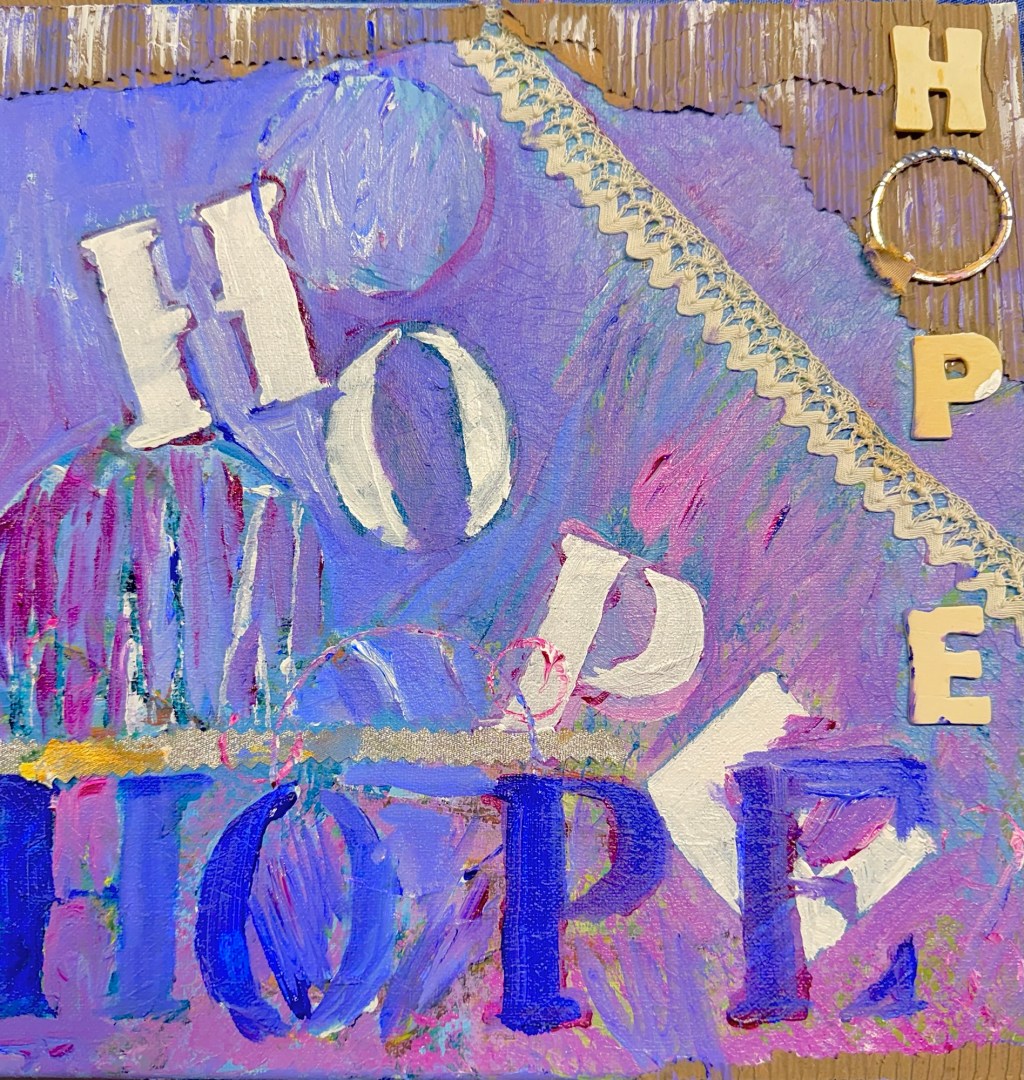
Eternal Hope

I had started my small canvas the week before when I was half sick. My hand, heart, and mind never feel quite connected when I feel bad, but I still work anyway. The beauty of acrylics is I can paint over them later. In fact, this is a repurposed canvas. If a work does not “speak to me” after a few months, I either cut it up to reweave it or paint it over entirely. I always think I will find hope for it in another form, but it may need to take its own journey to find its best self.

Jeremiah once said to the Jewish exiles in Babylon,

“For surely I know the plans I have for you, says the LORD, plans for your welfare and not for harm, to give you a future with hope.” (29:11)

When we have forgotten what our home looks like, God still remembers where we once lived. When we have lost our memories of the ancient Temple practices, God still knows the rituals. God will remind God’s faithful of our service. If we have lost our knowledge of how to walk with God, God will send us teachers once more. God always provides us with what we need.

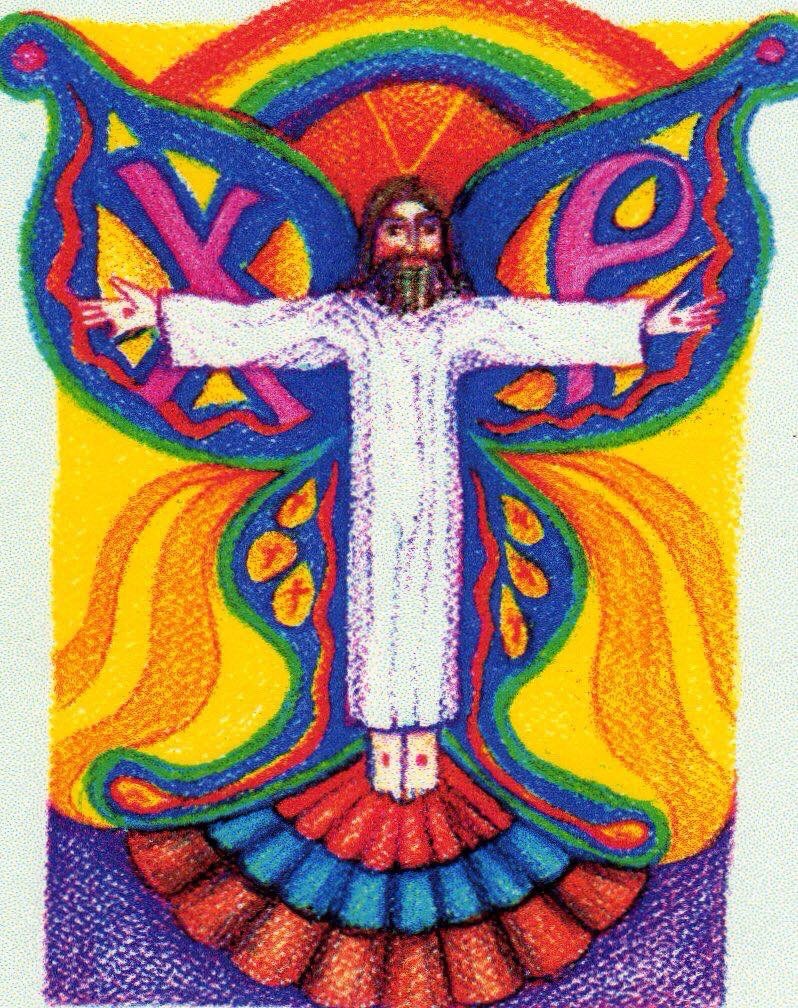
Christ the Redeemer, 16th CE, Gallery of Art, Skopje.

Hope is part of our GrecoRoman heritage also. “Dum spiro spero” is Latin for “While I breathe, I hope.” Some form of this saying has been around since the 3rd century BCE. My grandmother sewed her antique crochet trim onto pillowcases for wedding gifts. This is a scrap I found in her sewing kit. I stenciled the letters HOPE and glued down the wooden letters H, P, and E. I used an old metal circle for the O. Torn corrugated paper added a touch of texture, as did a few string prints. Sometimes hope appears to slide away or seems raw and unvarnished. The colors are blue and violet because Advent is the great season of Hope. Matthew quotes the Servant Song from Isaiah in 12:18-21—

“Here is my servant, whom I have chosen,

my beloved, with whom my soul is well pleased.

I will put my Spirit upon him,

and he will proclaim justice to the Gentiles.

He will not wrangle or cry aloud,

nor will anyone hear his voice in the streets.

He will not break a bruised reed

or quench a smoldering wick

until he brings justice to victory.

And in his name the Gentiles will hope.”

This is the Messiah of Hope of Israel and the Anointed Christ in whom we hope today. We can best share the hope of this Christ to our suffering world by serving the suffering, the grieving, the hungry, and the overlooked.

Joy, peace, and hope,

Cornelia


HALLOWEEN HAPPENINGS

adult learning, art, CharlieBrown, Halloween, holidays, Imagination, Ministry, Painting, picasso, pumpkins

Michael Jackson: Thriller Video still, 1982

Let’s party like it’s 2025! Nothing takes our minds off the stresses of the real world’s ghouls and goblins like pretending to be a ghost, zombie, pirate, princess or superhero in the All Hallows’ Eve hijinks of the holiday we know as Halloween. Especially if we have the license to eat candy or drink purple fluid to slake our thirst after our door to door “threats of trick or treat.” With all that masked mayhem in the cities, towns, and county seats of the country, the forces of ICE and Homeland Security won’t know which to turn. The INSURRECTION they conjured out of thin air will suddenly become real, only to disappear shortly after sunset. And before troops can surge to all points involved. 

Portland ICE protest—October 11, 2025—gives people an opportunity to wear costumes early

How many people in America will celebrate Halloween? Across the country 132.6 million households purchase about 745.8 million pounds of candy during the Halloween season every year. This works out to the weight of 33.9 billion bats or 62.16 million jack-o’-lanterns. Also only about 20% of people don’t celebrate Halloween at all. While I don’t eat loads of candy, I also don’t expect to micromanage other parents. My folks put a limit on our consumption back in the dark ages, plus we only went to a single neighborhood. Once we made the circuit of our city block and arrived home, we were done. The concept of “haul” was nonexistent in the days when dinosaurs lurked in the shadows, along with actual ghosts and other scary creatures. 

Vintage Card, reminds me of the Headless Horseman

Most Halloween shoppers (79%) anticipate prices will be higher this year, specifically because of tariffs. Despite these reservations, nearly three-quarters of consumers (73%) plan to celebrate the holiday, in line with last year’s 72%. Top holiday activities include handing out candy (66%), dressing up in costume (51%) and decorating their home or yard (51%). 

Economist’s Pumpkin, noting the scary prices of everything

Also, chocolate costs more because of cocoa prices, which have soared in recent years, have hit record highs amid adverse weather conditions, pest outbreaks and supply tightness in West Africa, which produces around three-fourths of the global supply. Cocoa futures have remained choppy but overall eased this year, falling from $8,177 per metric ton at the start of January to around $7,855 in August. That compares with $2,374 three years ago. Your basic Hershey Kiss is up 12% in price. If your favorite chocolate seems a tad lean on the chocolate, remember a warming climate means pests, droughts or floods, and fungi, all of which impact growing food. 

Medium Pumpkins are the Best Buy

Even if candy costs more, it continues to be the most popular purchase, with total spending expected to reach $3.9 billion. Across other categories, 71% plan to purchase costumes and spending is expected to reach $4.3 billion. Another 78% plan to purchase decorations, up from 75% last year, and will spend an estimated $4.2 billion in total. And 38% plan to purchase greeting cards, an increase from 2024’s 33%, with total spending estimated at $0.7 billion.

Picasso: Blue period, The Family of the Blind Man, 1903

Compared with last year, more people also plan to carve a pumpkin (46%), throw or attend a party (32%), visit a haunted house (24%) or dress up their pets (23%). October also means our art class works on a pumpkin still life. This year instead of making a realistic rendering, we looked at Picasso’s different styles. He began as a classically trained artist, and then broke all the rules of realism with cubism by fragmenting his subjects into multiple surfaces or flat geometric patterns. Later he did return to a “balloon” neoclassicism, but reverted once more to flat patterns of color. Picasso was always reinventing and responding to the creative genius within him. He didn’t feel constrained to continue to produce art to please others. 

Pablo Picasso, Mother and Child, 1921, Art Institute of Chicago, IL, USA. © Estate of Pablo Picasso.

Our pumpkin paintings reflect this creative energy. Gail S chose various red hues and deconstructed the pumpkin, as well as imagining it from above. She added some gourd shapes to the mix. 

Gail S’s Deconstructed Pumpkins

If Picasso had an orange period in addition to his blue and rose periods, my pumpkins would fit right in. They certainly look like his balloon neoclassical period! I confess I spent more time visiting with a stranger who graced the church door and who seemed to need to talk, but could not find her words. 

Cornelia’s Orange Period Pumpkins and Leaves

She didn’t want a pumpkin muffin either, so we let her sit. After a bit, I began to talk about how some of my well meaning friends give me advice that doesn’t make any sense. Like if I make one small mistake, they think I’m ready for assisted living!

“What are they thinking?” was Gail’s response. 

“Exactly, this comment says more about them than me. I ignore it and go on. Some folks are perfectionists.” 

We painted for a while and then I spoke up again, “You can’t please everyone. If you make A happy, B gets upset, or if you make B happy, then A is upset. Group C is just contrary and nothing ever pleases them. I try to make God happy and let people know that is my only goal. I’m not here to choose sides in their puny fights.”

I must have said something that helped her out, for she said she now felt strong enough to deal with her day and its problems. We thanked her for stopping by and wished her well. We didn’t have much attendance in art class, but if there had been more people, this lady might not have felt free to be with us. God must have provided this quiet space for this woman who had an unvoiced need that day. We aren’t always open to the human needs of those on the margins, but we should recognize they struggle with the same need for autonomy and authenticity as everyone else does. 

Another vintage Halloween card

Speaking of pumpkins, the Wôpanâak are a Native American tribe from the eastern coastal region. Their language gives us the loan word for the ubiquitous fruit that “grows forth round,” also known as a Pôhpukun or pumpkin. Marion Webster posits the derivation of this word as follows: “alteration of earlier pumpion, modification of French popon, pompon melon, pumpkin, from Latin pepon-, pepo, from Greek pepōn, from pepōn ripened; akin to Greek pesseinto cook, ripen — more at COOK.”

Of course, this pedigree prefers the Eurocentric derivatives because Native Americans were once considered savages, and therefore unworthy of their historic contributions to our language. We know better today and celebrate the gifts and graces of all persons who contribute to the vast melting pot of the great stew we call America. 

What a dull soup we would be if we were just the pale watered down broth with no pumpkins or spinach, no tomatoes or onions, no garlic (to ward off werewolves), and no corn, beans, chicken or beef to provide substance to our stew. We need a variety of spices to make a good soup, just as we need a variety of people’s to build a great community. 

Some people go all out for Halloween

One night a year, we can dress up in the costume of our shadow fears or our innermost desires. We get to act like our inner child. We carve our pumpkins with scary faces and put them on porches decorated with all sorts of ghoulish things. The Halloween holiday is cathartic, for it allows us to share with others our innermost selves, an act many of us have difficulty doing.

Worst Halloween Candies

If we eat a bit of candy here and there, it’s ok. It’s one night, and we can plan for this. The goblins do not win, for they are not real. They are here today, and gone tomorrow. I usually set my candy haul into the freezer where I can’t see it. Out of sight, out of mind. I have a piece now and then, “for medicinal purposes,” as my nanny would say, when she took a nip of the bottle stashed in the linen closet. Always with a table spoon, a measured dose, of course, because she “didn’t drink.”

Always go for the Chocolate!

If it helps to keep your cravings in check, you do what you have to do. I just ask, remember our life is short upon this round ball, so don’t rob yourself of the joy of this time. Find something to celebrate daily. On Halloween, we can celebrate our inner child. Even better, we can give the gift of magic to a small child by entering into the fantasy of the night. 

Joy, peace, pumpkin spice, and magic, 

Cornelia

USDA List of Retail Prices for Fruits and Vegetables, page 11, pumpkins.

https://www.ams.usda.gov/mnreports/fvwretail.pdf

NRF | NRF Consumer Survey Finds Halloween Spending to Reach Record $13.1 Billion

https://nrf.com/media-center/press-releases/nrf-consumer-survey-finds-halloween-spending-to-reach-record-13-1-billion

The states most mad for Halloween — and candy — revealed in new survey

https://www.scrippsnews.com/life/holidays-and-celebrations/the-states-most-mad-for-halloween-and-candy-revealed-in-new-survey

Chocolate lovers, brace yourselves: Prices are rising, but not forever

https://www.cnbc.com/2025/08/22/chocolate-set-to-get-more-expensive-but-2026-outlook-looks-sweeter.html

How Americans Are Celebrating Halloween Despite Rising Prices

Fun with Words | WLRP Home

https://www.wlrp.org/fun-with-words

Two Types of Color Wheels

adult learning, art, color Wheel, Creativity, flowers, Painting, picasso, Rumi

Rumi, the 13th CE Persian poet and theologian, once said, “Inside you there’s an artist you don’t know about…say yes quickly, if you know, if you’ve known it from before the beginning of the universe.” Most of us live unawakened to this talent. When we were children, we had no thoughts of “trying to be an artist.” We picked up colors or clay and made our shapes and designs without a care in the world. Our loved ones praised our projects, and we felt good.

Johannes Itten: In the beginning

Somewhere along the 4th or 5th grade, many of us lost touch with that artist within. As Picasso said, “It took me my whole life to learn to draw like a child.” What Picasso meant is he learned all the adult rules for a good painting first and then unlearned them so he could create something completely new. When children are between 9 to 13 years old, they try to draw more naturalistic figures and landscapes by using shadows and perspective. They also start comparing their work with others, but this discourages those who are not discovering the new visual language of realism.

Picasso: Great Still Life on Pedestal, 1931, oil on canvas

As a result, by the time many children reach middle school, they are no longer in touch with their inner artist. Young children do not worry about whether they are wrong. They will forge bravely into unfamiliar territory, even knowing they may make a wrong decision. However, as we mature, we quickly learn that being wrong often has negative consequences. We learn quickly in school that making mistakes brings negative consequences. Not studying for the test brings a bad grade. Talking too much might get a time out in the dark cloak room (traumatic 3rd grade experiences).

Jeannie: Color Wheel Flower

Teaching art to middle school students who say, “I can’t draw a straight line without a ruler” always got my retort, “We don’t have straight lines in nature, so you won’t have that problem in this class!” They learned working would bring improvement. This is a lesson learned well by the folks who have been with me for the last five years since Pastor Russ Brashears invited me to teach classes here. While we are saved by faith, not by works, in art class we need to have faith that our work will bring us closer to perfection. (Of course, there’s always an exception …)

Frank Stella: Harran II, 1967, Polymer and fluorescent polymer paint on canvas

At work, the boss penalizes us for being wrong. According to Sir Ken Robinson, an expert in creativity, “If you are not prepared to be wrong, you will never produce anything original. Since creativity inherently requires a willingness to be wrong, we begin to avoid it. For many of us, we become so good at avoiding it that we convince ourselves we are “not creative.” Another destroyer of creativity is current need to teach to the test standards. The one right answer for this important test leads children to think many questions have one answer, when in truth, multiple answers might be worthy.

Gail: Color Wheel Designs

In addition, many factors that seem related to the self-controlled aspect of ourselves—like research, facts, or being grounded in reality—feel like they are helping us mitigate the risk of being wrong. Therefore, we rely more on our executive function skills and behaviors, and less on our imaginative behaviors. Psychologists at Cornell University conducted a study that showed that we have an implicit bias against less conventional, practical-seeming ideas. We tend to like what everyone else likes, rather than original or creative ideas.

Johannes Itten: Bau Haus Color Star with Shades, 1921

This tendency runs deep since studies going back to the 1950’s have shown people are prone to conforming to popular opinions and perspectives. Research suggests that the rote learning and direct instruction used in schools often drives out whatever nonconformist tendencies we may have as children. This type of instruction may counteract our more exploratory and creative modes of thinking and learning. The Fauves, or “wild beasts,” were a group of French artists who scandalized the Academic standards by painting in wild and unnatural colors to evoke emotion, rather than observable reality. Of course, we love their works today.

Mike: Age of Aquarius: moon in 7th house

Half our class has been doing the color wheel multiple times, while the other half is getting their first exposure to it. Gail and Mike have made enough color wheels that I would not ask them to make another unless we changed our medium. Then it is always worthwhile to see how a new set of colors behaves when mixed. I gave them the guide, “Choose any design you want, and mix up the colors to make an interesting design.” Of course, they are two different personalities, so they produced two different paintings.

Basic Color Wheel

The basic premise for the beginner’s color wheel exercise is to take the 3 primary colors of red, yellow, and blue, and mix them to form the 3 secondary colors of orange, green, and violet. The tertiary colors are the “in between color” of each primary and secondary color. I was pleased that both Jeannie and Tonya mixed the colors well and kept their brushes clean in between the varied colors. This showed concentration and care, which are attributes of good craftsmanship. This will pay off in the future when we paint more complicated three-dimensional objects.

They also took time to add backgrounds. Jeannie made her color wheel into a giant flower on a green stem, with a softly sun kissed leaf. Tonya set hers against a night sky, as if it were a cosmic wheel of time. I enjoyed the burst of enthusiasm from their hearts when they added these parts of their own imaginations.

DeLee: Doves returning with green leaves after the flood

One of my goals as a teacher is to release the artist within each person. Some people keep a tight rein on that creative genius living within them. Society has acculturated us adults to conform to the common denominator, so most of us have lost our spark of creativity. This is not an individual problem, but a societal fact. Creativity scores among adults have been declining since the 1990’s, even though intelligence scores are rising worldwide due to better health care and nutrition.

If I can have a second opportunity to help create minds which are more flexible, more imaginative, and more productive over the long term, I will have fulfilled my call to teach another generation the joys of the creative life. My own example is from the Genesis story (8:10-11):

“He waited another seven days, and again he sent out the dove from the ark; and the dove came back to him in the evening, and there in its beak was a freshly plucked olive leaf; so Noah knew that the waters had subsided from the earth.”

The square is a symbol from the language of the icons for the earth, so I painted it primarily in earth colors. The surrounding is in various shades of blue or blue blacks. The abstract doves hold an edge of green in their beaks. Is it too abstract to understand? This is a creative solution to “color wheel,” not a travel book. It is a painting, not a map. If you need to find Mount Ararat, ask your GPS for directions. Not everything has to be functional. Some things can be “art for art’s sake.”

Leaving you with thoughts and the hope you dream more,

Joy and peace,

Cornelia


Why Art — Give Kids Art

https://www.givekidsart.org/why-art

 7 Surprising Facts About Creativity, According to Science – Fast Company

https://www.fastcompany.com/3063626/7-surprising-facts-about-creativity-according-to-science

Kyung Hee Kim (2011): The Creativity Crisis: The Decrease in Creative Thinking Scores on the Torrance

Tests of Creative Thinking, Creativity Research Journal, 23:4, 285-295

http://dx.doi.org/10.1080/10400419.2011.627805

Frank Stella, Harran II, 1967. Polymer and fluorescent polymer paint on canvas, 10 x 20 feet (304.8 x 609.6 cm), Solomon R. Guggenheim Museum, New York Gift, Mr. Irving Blum, 1982. © 2023 Frank Stella / Artists Rights Society (ARS), New York

Picasso: Great Still Life on Pedestal, 1931, oil on canvas, Picasso Museum, Paris France. 195 x 135 cm


Solid Geometric Perspective

adult learning, art, Attitudes, Creativity, Faith, Holy Spirit, Leonardo da Vinci, Love, Ministry, Painting, perfection, perspective, picasso, shadows

Steps in drawing a Geometric Still Life: sketch, refined sketch, shadows, intense shadows and cast shadows

We are back in art class again on Friday mornings at Oakland United Methodist Church. Our first lesson is in solid geometry, but it’s not a math class. Art is more like learning a visual two-dimensional language to be able to render three dimensional objects on a flat plane. This isn’t as easy as you might think, but once you learn to see in perspective, you never can unsee it again. Art class is like an old fashioned one room schoolhouse, in which a teacher has students of varying ages and experience levels to instruct. I provide one lesson and modify it for each student according to their needs.

Gail S.—Pencil Drawing of Solid Geometry

The first day of class, I had three brand new students and one who has done this exercise at least three times before. Two others were out doing family obligations, just as I was missing in action last week due to attending my niece’s graduation ceremony for her MBA in Business Administration. Life and family watershed events are always important to make our presence known. The life of the artist is as important as the art itself. We aren’t just people who make beautiful objects for others, but people who make life beautiful by being present at their most important moments.

Vermeer: The Art of Painting, 1666-1668.

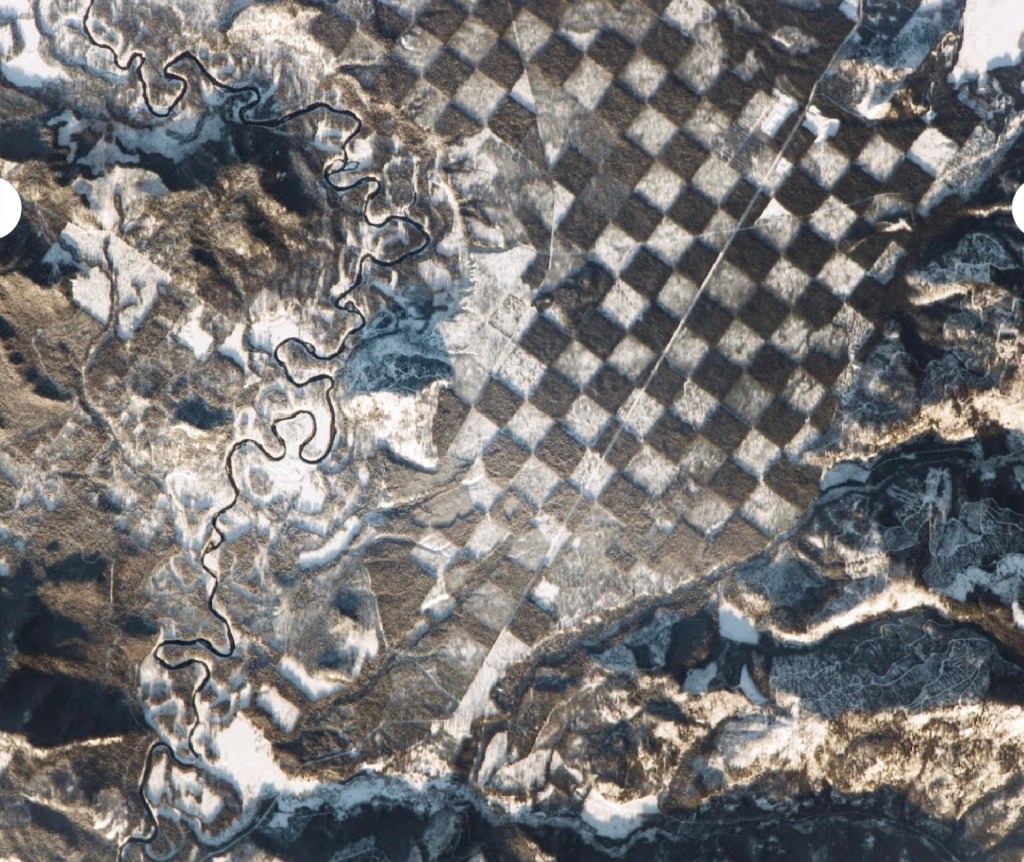
When we look at the painted floor in the Vermeer painting above, we know in our minds these stand for black and white square tiles. If we take a moment to closely observe them, we realize these are more like diamond shapes. This optical illusion is the result of perspective. Perspective comes in multiple forms. Linear perspective has one-point, two-point, three-point, and multi-point vanishing points. Aerial or atmospheric perspective uses color, clarity, and value as objects overlap each other and recede into the background. There’s also reverse perspective in which objects are larger as they grow more distant and foreshortening, in which nearby objects are emphasized.

Pop Tarts from the Pop Tarts Bowl Toaster Trophy in 2024

 Can we teach all of this knowledge in a single two-hour lesson? Absolutely not. Michangelos aren’t turned out like pop tarts from a toaster. In the Renaissance era, a family would place a youth between the age of 7 to 14 with a master artist to learn the trade. This child would do the chores of the studio and learn to grind the pigments and mix paint. Then they would progress to drawing and composition. After a training time, they might get to do the backgrounds of the paintings or the landscape. After eight years, if they were any good, they would be entrusted with an entire commission. Then they would venture out on their own or take over from their master’s studio.

Cornelia—Purple Geometric Forms

I started taking art lessons when I was eight years old from the city parks and recreation art teacher on Saturday mornings, and then after school from a former art teacher in town. My grandmother was a portrait and still life painter. I have been taking or teaching classes for over seven decades. Art is not a skill or a product a person can ever perfect. It is more like a journey of faith, one in which we are always going on to perfection, but by the grace of God, will only be completed at our last day. Even at my age, I have more than a few “needs improvement works” left to create.

Tonya—Black and white Geometric Forms

The more you know, the more room for improvement you can find. I always ask students to first find three positive critiques of their work to praise before they begin to talk about their “improvement areas.” In this lesson, if they drew all three shapes, used two distinct colors for light and dark, and used up the space on the canvas, rather than drawing an inch tall image, those are positive points. Then they can point out their troubles.There’s enough negativity in this world. We need to overcome that in our own lives. What we learn on this canvas will carry over to the next one. Then we will find new opportunities for improvement yet again!

Marilyn—Geometric Forms in Aqua

No one who gets a significant health condition finds making a wholesale change overnight easy or achievable. This is why people who try extreme diets like Whole 30 that restrict too many foods discover they can’t stick with it or must continually start over. People looking to make lasting, healthy changes must start small and focus on progress over perfection, according to nutrition coach Brady von Niessen. “You start feeling so good about them that you can’t even imagine not doing them.” The same principle applies in art. Over time, a student’s skills will improve if they trust the process. Rome wasn’t built in a day!

Jeanne—Geometric Forms

Another important aspect of art class is relationships. Pierre Teilhard de Chardin said, “The most empowering relationships are those in which each partner lifts the other to a higher possession of their own being.” As a teacher, I try to help each person find their own creative voice, rather than trying to copy an idea of what “good art should look like.” Beginners in tennis don’t get to play on the same courts as Wimbledon or the US Open, or at least not at the same time as those who claimed the trophies! As Picasso once said, “It took me my whole life to learn to draw like a child.”

I consider this first class a success for each student. First, I got to hear some of their stories, which helps to build relationships. I got to hear their fears about not being perfect—none of us are perfect, but as United Methodists we are all going on to perfection in love by God’s grace and that’s the only perfection we concern ourselves with in art class. Can we love ourselves and give ourselves the grace to come up short? As the great Leonardo da Vinci said, “Art is never finished, only abandoned.”

I look forward to next week when we mix colors for the color wheel for the first time students. The returning students will get a lesson that uses geometry and mixed colors also. The more seasoned students project is a step up because they have more experience, so they have a greater challenge.

The one room art schoolhouse meets at 10 am on Friday mornings. It’s never to late to join.

Joy and peace,

Cornelia


Weaving a Life Story

Academy for Spiritual Formation, adult learning, art, Creativity, Faith, Holy Spirit, Icons, inspiration, Ministry, Nativity, renewal, righteousness, Silence, suffering, vision

Weaving is a metaphor for our life’s story and journey. We envision the weaver in charge of the colors, designs, and textures of the finished fabric. The weaver’s goal is to produce a beautiful product. We often think we are in charge of our own destiny, as “The Weaving Song” by Carolyn Hester, in which an old 1960’s era folk singer would sing:

Choose the right color And push the right tread

Throw through the shuttle And peg down the thread

Work is all laid Before your start

To make your own pallet Of bright hue or dark

The loom of life is moving The weaving is all your own

Choose the right color And push the right tread

Throw through the shuttle And peg down the thread

Rainbow of colors Is at your command

Choose all the right shades Offered in the stand

The loom of life is moving The weaving is all your own

Life’s but a grey And heavy with care

May blooms scarlet With couragе rare

The loom of life is moving Thе weaving is all your own.

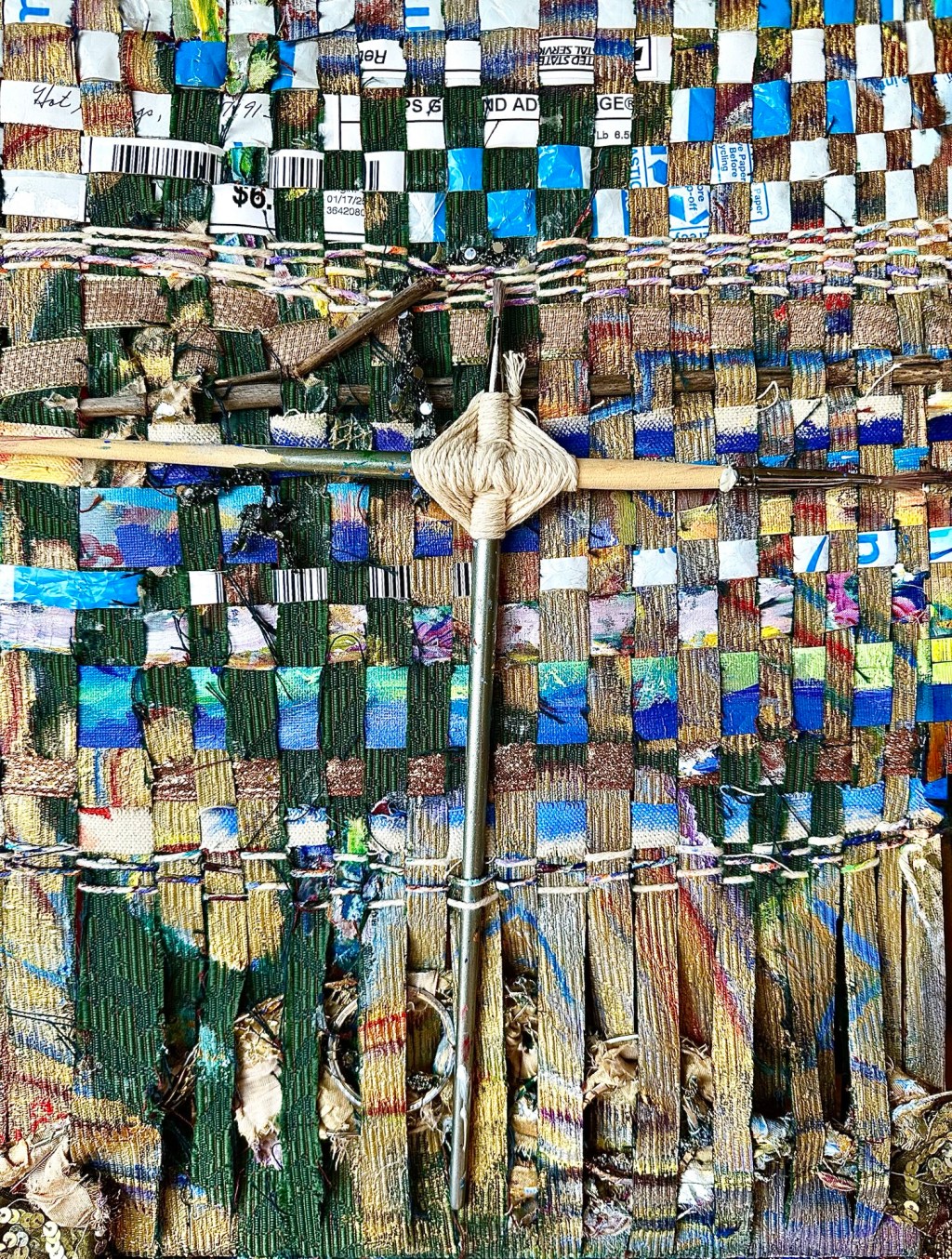
DeLee: God’s Eye and Cross, woven canvas, branch, string, paint brushes, fabric scraps, wire, packing materials, 16” x 20”, 2025.

Yet life doesn’t always work out the way we thought it would. The Bible says Job was the most righteous person of his era, and Job complains after losing everything and everyone:

  “My days are swifter than a weaver’s shuttle and come to their end without hope.” (7:6)

This wisdom text reminds us sometimes the righteous suffer, even while the wicked prosper, but God is still God, and we will understand this mystery of God when we see God face to face. We call this “theodicy,” (from Greek theos, “god”; dikē, “justice”), or our explanation of why a perfectly good, almighty, and all-knowing God still permits evil to exist.

God gives human beings free will. We make our own choices in life, just as everyone else does. Since we don’t live in a universe of one, other people’s choices impact our choices. Imagine a pingpong ball tossed into a room filled with mousetraps all loaded with other pingpong balls. If one ball hits a loaded trap, it sets that ball off into motion and those balls set more balls into motion until chaos ensues! If more than one person is involved, some sort of disagreement is sure to follow. Some of us are even at odds with our own selves!

As the old joke goes, a solitary man was rescued from a desert island. On this island were several structures. When asked, he said, “That one was my house and that one was my church.” And the other building? “That was the church I used to go to!”

Louise Bourgeois: Spider, metal, National Gallery of Canada, in Ottawa, Ontario. Her mother mended tapestries, like a spider spins a web.

When life is chaotic, creative people find solace in the quiet of their chosen deserts: the studio, the workshop, or their favorite writing chair. While we artists have the illusion we can control the images we produce or the songs which bubble up from our hearts, in truth, what we create is a shared product with our heart, mind, and the creating spirit. If we begin to lose our humility about this shared process, we lose the creative energy underwriting our works.

Louise Bourgeois: Metal Spider wrapped in yarn, Japan

We know this emotion as “pride,” and the ancient cultures warned against it. Throughout history, legendary and mythological figures have been used as examples of either virtue or a moral failing. The story of Arachne and Minerva is no different.

Attributed to Amasis Painter, 6th BCE, Greece, clay, Metropolitan Museum of Art, New York.

A 6th BCE Attic Black Figure Lekythos storage vessel attributed to the Amasis Painter shows the type of standing loom and the various shuttles of different threads a weaver would use for a fabric. Today we think of weavers sitting at their looms, but the ancients stood at their work.

Arachne was a mortal who excelled in the weaving arts: spinning her own yarn and selecting the correct colors to produce the beautiful images for the finished fabric. Minerva, the goddess of handicrafts and the Roman correlate to the Greek goddess Athena, had heard of Arachne’s prowess and her pride. Disguised as an old woman, Minerva visited Arachne to warn her not to disparage the gift of the gods. Arachne rebuffed her, and held her ground, even when Minerva revealed her true identity.

Minerva (Athena) and Arachne by René-Antoine Houasse (1706), Versailles

When the weaving contest began, both were even in technique and design. Minerva’s image was of the pantheon of the gods, but Arachne told the stories of the god’s mishaps with humanity. This angered Minerva, who struck Arachne with a weaver’s shuttle. Embarrassed, Arachne took a rope to hang herself, but Minerva had pity on her and changed her into a spider instead. We call spiders, ever weaving their gossamer webs, “arachnids” in her memory.

Spider Web

In Christian art, the theme of listening beside a well or spring is connected both to the angel’s annunciation to the Virgin Mary and to her weaving curtains for the Temple. The third-century Dura-Europos church baptistery has a fresco of a woman drawing water from a well, which Yale theologian Michael Peppard believes represents the Annunciation to Mary at a well, from a scene from the gnostic writing, Protevangelium-18.

Woman drawing water at the well. Possibly the Virgin hearing the Angel’s voice. Dura Europa.

Others think it represents the Samaritan woman at the well or Rebecca from the Old Testament. Because the fresco doesn’t include Jesus, the empty space instead represents “the bodiless voice” that Mary hears in the Protevangelium. Also, a five-pointed star appears on the woman’s torso, which could symbolize the new child in her womb. The star in later iconography was repositioned to the shoulder of her mantle, and the water vessel survives all the way into the Renaissance art as a vase with flowers.

Icon of Virgin at Well with Angel

From The Protoevangelium of James, section 11: And she took the pitcher, and went out to fill it with water. And, behold, a voice saying:

“Hail, you who hast received grace; the Lord is with you; blessed are you among women!” (Luke 1:28) And she looked round, on the right hand and on the left, to see whence this voice came. And she went away, trembling, to her house, and put down the pitcher; and taking the purple, she sat down on her seat, and drew it out. And, behold, an angel of the Lord stood before her, saying: “Fear not, Mary; for you have found grace before the Lord of all, and you shall conceive, according to His word.” And she hearing, reasoned with herself, saying: “Shall I conceive by the Lord, the living God? And shall I bring forth as every woman brings forth?” And the angel of the Lord said: “Not so, Mary; for the power of the Lord shall overshadow you: wherefore also that holy thing which shall be born of you shall be called the Son of the Most High. And you shall call His name Jesus, for He shall save His people from their sins.” And Mary said: “Behold, the servant of the Lord before His face: let it be unto me according to your word.”

This apocryphal Greek text, which was first written in the 2nd CE, with Syrian revisions into the 5th CE, is important because it increases our insights into women’s history, the childhood history of Jesus, Jewish-Christian relations, and the impact of Christian apocrypha on Islamic origins. This text, which contains the infancy narratives of the Virgin Mary, John (the Baptist), and Jesus is the source many of the Western Catholic and Eastern Orthodox religious feast days. Moreover, it’s also the origin for the icons representing the birth of Jesus in a cave.

Duccio: The Nativity with the Prophets Isaiah and Ezekiel, tempera and gold on panel, 1308-1311, National Gallery of Art, Washington D. C. Part of a series of the Life of Christ, the rest of which are in Sienna, Italy. 

A similar Marian birth narrative, The Gospel of Pseudo-Matthew, gives more details on the life of the Virgin, the miracles surrounding her marriage and the birth of Christ. It also tells the story of the Annunciation in two visits rather than one. The angel’s first greeting is beside a fountain and the second is inside while Mary is weaving the curtains for the Temple.

DeLee: Freeform Weaving while Listening

When I was on a recent Five-Day Academy for Spiritual Formation retreat, one of our hands on projects was a small weaving. Our package had a small loom, some yarn to weave with, and beads to attach. Of course I had to use a second packet to finish out my weaving because I tightened the horizontal rows more tightly than the organizers thought the regular attendees would do with their yarns and ribbons.

I also had my eye on a nice lichen covered branch to use as a hanging support. When I picked it up, it had red ants on it. I had to do some mad shaking to get them off! Anything for art! During one of our quiet reflection sessions, I sat beside a small lake under a pavilion to let my hands work. I’ve always needed a quiet space to process the flood of ideas and the rush of emotions when meeting new people and hearing new ideas. I operate as an extrovert, but when I get full to overflowing, I need quiet to recreate and recharge. I find new power in the admonition of Psalm 46:1-6—

God is our refuge and strength,
a very present help in trouble.
Therefore we will not fear, though the earth should change,
though the mountains shake in the heart of the sea;
though its waters roar and foam,
though the mountains tremble with its tumult.
Selah
There is a river whose streams make glad the city of God,
the holy habitation of the Most High.
God is in the midst of the city; it shall not be moved;
God will help it when the morning dawns.
The nations are in an uproar, the kingdoms totter;
he utters his voice, the earth melts.
The LORD of hosts is with us;
the God of Jacob is our refuge.

Diedrick Brackens, “prodigal” (2023), cotton and acrylic yarn

When my hands touch the different textures of the threads, and I let my spirit work with the creating Spirit of the word and world, I can shed all the strain and stress of being on a different schedule from traveling, having nerve pain in my neck from a bulging disk, and more interaction than I’m used to since I no longer work.

I always fought to carve out quiet times when I was in active ministry, for listening to God is the first calling of any leader worth their salt. I knew I wouldn’t hear God’s voice in the pell mell rush and cacophony of our world. The disembodied voice is more likely to come to us when we’re alone or in a receptive moment. It’s important to note Mary was one of the virgins of the House of David chosen to weave the curtains for the Temple in Jerusalem, according to The Protoevangelium of James, section 10. She was busy, but working for her God. It was when she took a break to draw water from a life giving well that she heard the messenger from God.

Bruce Conner, Arachne, 1959, mixed media: nylon stockings, collage, cardboard, 65 3⁄4 x 48 3⁄4 x 4 1⁄4 in. (167.0 x 123.8 x 10.7 cm), Smithsonian American Art Museum, Bequest of Edith S. and Arthur J. Levin, 2005.5.12

When I was appointed to a church, I always had a list of tasks to do, but I often never completed them because God would send “interruptions” to my well laid plans for the day. After several years, I began to understand these interruptions were my real tasks of ministry for the day. We have plans, but God has a better plan.

The prayer in my weaving supplies was appropriate for me on this retreat:

Teach us to listen, O Lord. 

Quiet the noise of our lives

so we can hear your voice. Amen.

After several weeks, I’ve come back to finish this blog. In the meantime I’ve had anterior cervical discectomy and fusion for my neck pain and numb fingers. It’s for the bulging neck disk that causes pressure on the spinal cord. If this happens in the lower back, a person gets sciatica and numbness in the legs. In the neck,the same condition affects the arm and hands. I feel better than I did before, so I’m thankful for all healing mercies. I have to be careful not to overdo my activities. The instructions “Don’t do housework!” were gladly received.

I hope you seek out your quiet spaces and quiet moments to hear the sheer, still sounds of silence, the inaudible voice of our God.

Joy and peace,

Cornelia


 NOTES:

Carolyn Hester: The Weaving Song, Track 10 on At Town Hall, One, Produced by Norman Petty, 1965.

Troubadour: Weaving Song: similar words to Hester coffee house ballad above. https://music.apple.com/us/album/weaving-song/400303687?i=400303767

Myth of Arachne https://www.worldhistory.org/Arachne/

Ally Kateusz: Mary and Early Christian Women: Hidden Leadership,1st ed., 2019, Kindle Edition 


Annunciation or Samaritan Woman, Dura-Europos Baptistery
https://www.christianiconography.info/Wikimedia%20Commons/annunciationDura.html

Charles Bertram Lewis:”The Origin of the Weaving Songs and the Theme of the Girl at the Fountain,” PMLA, Jun., 1922, Vol. 37, No. 2 (Jun., 1922), pp. 141-18, Modern Language Association. http://www.jstor.com/stable/457

Susan B. Matthews: Dura Europos—The Ancient City and The Yale Collection, Yale University Art Gallery, 1982, Yale University Printing Service. https://artgallery.yale.edu/sites/default/files/publication/pdfs/ag-doc-2378-0002-doc.pdf

Camille Leon Angelo and Joshua Silver: “Debating the domus ecclesiae at Dura-Europos: the Christian Building in context,” Journal of Roman Archaeology 37 (2024), 264–303, doi:10.1017/S1047759424000126. https://www.cambridge.org/core/services/aop-cambridge-core/content/view/E76ED3AD86D09A74893368840DEDFA6A/S1047759424000126a.pdf/debating-the-domus-ecclesiae-at-dura-europos-the-christian-building-in-context.pdf

The Protoevangelium of James, section 11. https://www.newadvent.org/fathers/0847.htm

The Gospel of Pseudo-Matthew, section 9.  https://www.newadvent.org/fathers/0848.htm

Horn, C. (2018). The Protoevangelium of James and Its Reception in the Caucasus: Status Quaestionis. Scrinium, 14(1), 223-238. https://doi.org/10.1163/18177565-00141P15

Learning, Growing and Thriving

adult learning, art, Athanasius, brain plasticity, Christmas, Civil War, cognitive decline, Creativity, crucifixion, Faith, Imagination, incarnation, john wesley, Love, mystery, nature, renewal, Spirituality, St. Athanasius, United Methodist Church, Valentine’s Day, Valentine’s Day

In most adults, learning and thinking plateaus and then begins to decline after age 30 or 40. The old adage, “Don’t trust anyone over thirty” takes on new meaning in regards  to creativity. People after this age start to perform worse in tests of cognitive abilities such as processing speed, the rate at which someone does a mental task. The slide becomes even steeper after 60 years of age. We also notice a similar learning decline in children after summer vacation, which results in the fall semester becoming a “reteaching opportunity.”

As one who is also “growing long in tooth,” I have passed this yardstick by a mile. I notice I have a “slower processing speed” in my creative writing. I don’t consider it a reason to quit, but a reason to better organize my other time-wasting behaviors (social media, newsletters, newspapers, etc.). I can always ignore cleaning the condominium! Creativity before housework, is my motto.

Housecleaning Meme

We often think older adults are on a downward slope with unrecoverable loss. “Use it or lose it,” the saying goes. Recent research suggests we need to apply a more hopeful mindset and vocabulary when discussing older people—much like that used for childhood or early adulthood. Decline, as we so often see it, may not be inevitable. In fact, learning a new skill and practicing it for three months has shown benefits beyond the the practice time.

Adults often have limited time or resources, so if we encourage learning a new skill, this may help them step out of their comfort zones. In people’s later years, many personal and societal changes—such as moving out of state to be closer to family members, switching jobs or coping with physical distance from loved ones—make learning new skills necessary to adapt and succeed.

For example, taking a class to improve technological skills could aid seniors’ success in an increasingly digital world, such as helping them use Telehealth or online banking platforms. Learning new skills in an art class allows a person to express their feelings and solve problems in creative ways. Each person can find their own path to success in artistic practice.

Potholder Loom, just like the one I had back in the day.

Our art class is trying a new thing: weaving. We have been painting for quite a while, so this is really a hands-on project. Some of us had the benefit of making woven potholders as children, or weaving newspaper “sit-upons” at summer camp. The technique isn’t unknown, but making a creative design interpretation is how we take our basic skill forward into a stimulating and creative brain challenge.

DeLee: Woven Paper on a Stick (Earth and Sky)

We could just repeat what we already know, but this doesn’t build us new neurons in our brains. If we keep the same old paths and don’t create new ones, we aren’t flexible when we meet new situations. Since we live in a rapidly changing world, building a brain capable of rapidly adapting is important to live independently and vibrantly for as long as possible.

I remember how my Daddy could only use the old tv remote to change the channel for the original non cable stations. When “Murder, She Wrote” came on the cable channel, my Mother had to use the cable remote to change the station for him. His Alzheimer’s disease prevented him from learning new skills, but he remembered all of his previous medical training and could diagnose his condition and boss the emergency room doctors when he was admitted to the hospital for a fall. Our brains are a mystery indeed.

Mike jumped the gun on Valentine’s Day and created a woven heart. These were big in the Danish and German communities and very popular in the 19th century in America. During the Civil War, soldiers made many of these in elaborate forms to send to their loved ones back home.

Unknown Artist: Affirmation Weaving

The brain is a fantastic and mysterious organ. If we make a habit of learning something new every day, of whatever interests us, we have the opportunity to keep our lucidity for a longer time. We also we meet the quickening changes of modern life with a steadfast heart and mind. We stress less when we know we can adapt and change in our own lives. We don’t have to be the people who say, “You can’t teach an old dog new tricks.” We can teach and we can learn, but we might need to be more patient with the old dog. In some corners, we call that “grace.”

I watched my Granddaughter’s Daddy Daughter Dance

Our group was in and out during the several weeks devoted to this project. One of us was sick, one was grieving the death of a beloved pet, another had pressing work issues, and the teacher went to Florida to see her granddaughter get married. Amazingly, life goes on. People dropped in for spiritual support, which is a side benefit of the community of art class. I managed to get mine mostly done, and Gail S. finished hers completely. Sometimes life interrupts our best intentions and we move on. We will learn new lessons on the next project.

Gail S’s “Eye of God” weaving

 Gail S’s “Eye of God” weaving incorporates yarns from two different mop heads, some sticks, and a bird feather. Gail almost always keeps a realist focus in her works, so her eye of God has a bird feather to mark the pupil. The upper field of grey and white mop yarns represent the cloudy sky, while the blue yarn stands for the water and the brown for the land. God watches over all of God’s creation. Gail S’s love of the outdoors and all of nature is evident in all her work.

Cornelia’s Cross on a Hill (unfinished)

I also recycled some old paintings and cords which I’d used in the preparatory work of other paintings. In addition, I used some recycled strips of Amazon shipping parcels as well as a wire shape which once belonged to a butterfly wing. In repurposing these items into the weaving along with two old brushes bound together with a God’s eye, I invoke the renewal of life after death.

We people of faith have two opportunities for a renewal of life after death. The first is by our profession of faith in Christ and his life, death, and resurrection on our behalf for our salvation. This gives us a living faith in this world. The second renewal is for the resurrection from death itself. This gives us a life beyond this world. Our faith is worthless if it doesn’t change us for our walk upon this world. If we don’t have the heart and mind of Christ within us, and if we aren’t earnestly seeking to be made perfect in the love of Christ daily, our United Methodist heritage tells us we’ve not yet been converted.

Yet Christ desires to save all, as John records in 12:32,  Jesus tells the crowd,

“And I, when I am lifted up from the earth, will draw all people to myself.”

Not just some people, or only the best, or even just us United Methodists, but ALL people. Most of us aren’t able to understand such a wide ranging love, for we live in a world of tribal loyalties. If we look at creation, which is God’s first work, God loves that which God created. God loves everything God created. We humans are the ones who choose sides and introduce boundaries and hate into God’s singular creation. The world or Kosmos is the creation first and then the people in it.

Today we tend to ascribe “world” to the “culture,” or secular society in general, but its plain meaning is creation and the human presence, for good or ill. The ancient Greeks and Romans divided the world into the material (bad) and the spiritual or mind (good), but the Jewish theology conceived the unity of both as part of God’s gift to humankind.

In the fifty-fourth chapter of On the Incarnation, St. Athanasius of Alexandria wrote a sentence that has echoed down through the centuries even into our own time as a brilliant summary of the Gospel. He wrote this: “God became man so that man might become god” (54:3).

This doctrine is called theosis or acquiring the whole nature of God. We United Methodists call this state Christian Perfection, or “a heart so full of love of God and neighbor that nothing else exists.” Our Wesleyan heritage was influenced by the Wesley brothers’ deep love for the Greek Orthodox fathers of the early church. To focus only on fallen nature is to deny the power of God to redeem us and all creation and to make all things new. We humans and nature aren’t more powerful than God!

If we cut off part of our God given self, we deny the incarnation of Christ, who became human for us that we might become divine. We need to remember what John 3:16 so succinctly states:

“For God so loved the world that he gave his only Son, so that everyone who believes in him may not perish but may have eternal life.”

Art is a way to open our eyes and hearts to a new way of seeing spiritual truths. Art is also reflective of the artist’s soul and spirit. A sensitive viewer can read the tale of trauma or the struggle for survival in an artist’s body of work. More than this, we can listen for their voices straining to be heard. Most people have been silenced and conformed to the “cause no trouble, don’t get out of step” mantra of the public school system training our youth for the workplace.

In art class, we can lose our fear of being different because being different gets rewarded! Being original gets an attaboy or attagirl.  I find such joy helping people find new courage and creativity they didn’t know existed within themselves. My students keep me young too. I feel blessed beyond measure.

Joy and peace,

Cornelia


To Stay Sharp as You Age, Learn New Skills | Scientific American

https://www.scientificamerican.com/article/to-stay-sharp-as-you-age-learn-new-skills/

That Man Might Become God — Fr. Andrew Stephen Damick
https://blogs.ancientfaith.com/asd/2015/01/22/man-might-become-god/

Picasso’s African Masks and Inner Mysteries

adult learning, art, Creativity, cubism, elections, Imagination, inspiration, Painting, picasso, renewal, The Lord of The Rings, Thomas Merton, vision

What is the key to open the door to the hidden mysteries? For Frodo and his fellow travelers in The Lord of the Rings trilogy, they needed to know the elvish answer to the riddle, “Speak friend and enter.” Gandalf knows this language, so they enter with ease. For years, the Egyptian hieroglyphics were unintelligible because we had no living person who knew the ancient language. After the discovery of the Rosetta Stone in Egypt with its three languages depicting the same text, the race was on to translate the pictographic writing.

Rosetta Stone, British Museum

In art school my fellow students and I worked in our shared studio classes daily, but sometimes we never made any progress. Then the day would come when the light bulb clicked on in one of our brains. When we took a break, instead of giving everyone’s work a cursory glance before going out for a snack, we would linger and take in the special magic of a unique vision. Where does this special insight come from? Is it a visitation from above? Or a piercing of the soul by divine artistic insight? Sometimes I think the rare and the strange shock us out of our ease and complacency.

Picasso: Self Portrait, oil on canvas, 1907.

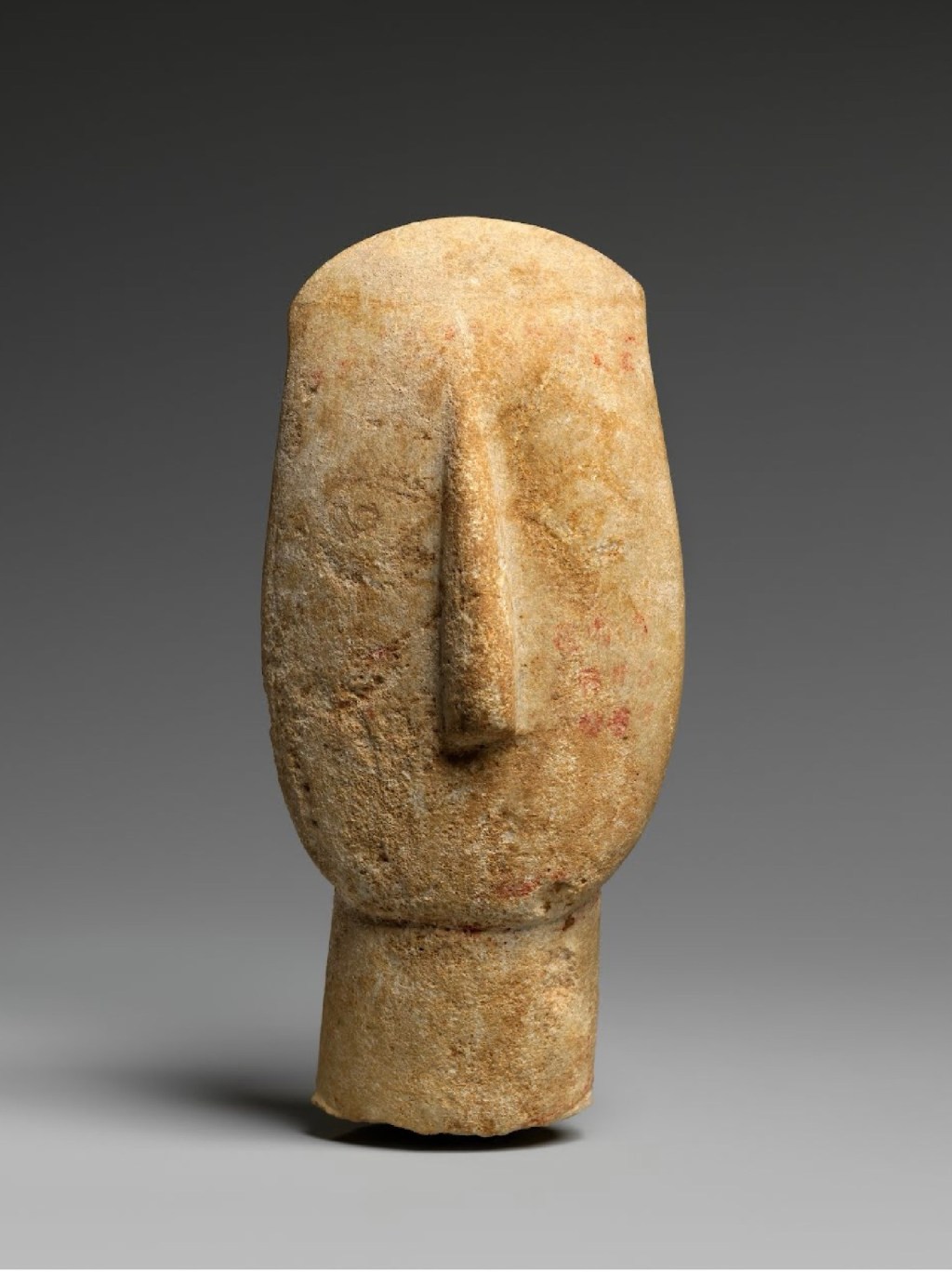
Art historians divide Picasso’s early periods into his Blue Period (1901-1904), the Rose Period (1905-1907), the African-influenced Period (1908-1909), and Cubism (1909-1919). Some art historians call Picasso’s African Period his “Proto-Cubist” or primitive period. It lasted from 1907 to 1909. Picasso was 24 years old when he saw an exhibit of African art at the ethnographic museum at Palais du Trocadéro. He experienced a “revelation” and began to explore African art further. African masks and sculptures strongly influenced Picasso’s art for several years, when he began to paint in sculptural forms, earth tones, and in flattened sharpened shapes.


Pablo Picasso in his Montmartre Studio,1908, via The Guardian

Picasso had first seen an African mask at Gertrude Stein’s home. Recalling his visit to the Trocadéro Museum of Ethnology (now the Musée de l’Homme), Picasso said of the museum:

“A smell of mould and neglect caught me by the throat. I was so depressed that I would have chosen to leave immediately. But I forced myself to stay, to examine these masks, all these objects that people had created with a sacred, magical purpose, to serve as intermediaries between them and the unknown, hostile forces surrounding them, trying in that way to overcome their fears by giving them color and form. And then I understood what painting really meant. It’s not an aesthetic process; it’s a form of magic that interposes itself between us and the hostile universe, a means of seizing power by imposing a form on our terrors as well as on our desires. The day I understood this, I had found my path.”

That path led Picasso to what he called his “periode nègre” (black period) or African period. It lasted only a few years, to 1909, but it turned Picasso into an avid collector of African art, masks, and sculptures that inspired him for the rest of his career.

Picasso: Woman with joined hands, 1907, Paris.

In our art class we chatted about how these masks inspired Picasso. Picasso used a palette of earthy tones, overlapping browns, and yellows with dark reds. By using Cubism, he explored a simplified geometry and the redefinition of perspectives. He tried to reveal objects from a different vantage point—from the mind, not only how the eyes perceive them. His Les Demoiselles d’Avignon signified a radical break from the naturalism that had defined Western art since the Renaissance, derailing former notions of what art was supposed to look like.

Picasso: Les Demoiselles d’Avignon (1907), oil on canvas.

People criticized Picasso’s two-dimensional women as unfeminine, for their confrontational demeanor was a complete departure from the traditional depiction of female beauty. Artists and critics alike received the work negatively and saw its menacing sex workers as promiscuous and unfit for Paris salons. Picasso rolled up the canvas, considered scandalous even amongst his innermost circle, and stored it in his studio for years to come. Yet this groundbreaking painting influenced his future works.

As Thomas Merton wrote in No Man Is an Island:

“In an aesthetic experience, in the creation or the contemplation of a work of art, the psychological conscience is able to attain some of its highest and most perfect fulfillments. Art enables us to find ourselves and lose ourselves at the same time.”

Picasso broke through the accepted boundaries of Western culture and discovered his true spirit in through the voices of the ancestors speaking from the African past. He met the other and found himself. By bringing the African masks into his studio, Picasso lived out the message of Hebrews 13:2—

“Do not neglect to show hospitality to strangers, for by doing that some have entertained angels without knowing it.”

As artists today, who seek to find their own true self and unique voice, we must both find ourselves and lose ourselves. We must lose our preconceived notions of who we should be and discover our true selves. Some artists use this as license to be caricatures of an artist, but actual artists have work ethics because they have obligations to galleries and clients. Looking like an artist and being an artist are two different things. Finding our true selves is not only a task for creatives, but also a lifetime journey for all people engaged in spiritual growth. We all can recover the image of God, which is our true self, by both God’s grace and our cooperation in doing good to all.

We artists are not here to make pretty pictures, but to break down the boundaries between our walls that keep us estranged from God and neighbor. We are not as bold as Picasso! Most of us are not risk takers. Willingness to leap out in faith is what marks a famous artist. That same riskiness is what marks the prophets of the Bible. Prophets never praise the status quo, but remind the people of the nature of their God:

“For the LORD your God is God of gods and Lord of lords, the great God, mighty and awesome, who is not partial and takes no bribe, who executes justice for the orphan and the widow, and who loves the strangers, providing them food and clothing.” (Deuteronomy 10:17-18)

Isaiah 1:17 reminded the people of his day, “learn to do good; seek justice, rescue the oppressed, defend the orphan, and plead for the widow.” Jesus will pick up this same voice in Matthew 25:40, “And the king will answer them, ‘Truly I tell you, just as you did it to one of the least of these who are members of my family, you did it to me.’”

So how will we find our unique voice and creative expression today? The more we steep our heart and mind in the great spiritual writings of the ages, particularly those of whom have come through great suffering or difficulties, the closer we will come to understanding our own challenges in life. These hardships are not hurdles or barriers to our progress, but refiners of any weakness that needed to be strengthened.

As my teachers always said, “We test you, not to see how ignorant you are, but to see what we failed to teach well.”

I always liked their attitude better! I did not feel so dumb when I missed the right answer on their tests. I always liked art better, for more than one answer could be correct. If we work within the parameters of the assignment, we can interpret the art with our own vision and style.

Our recent class with the African masks was a big diversion from our usual method of working. First, the masks are from a different culture. They are as much of a culture shock to us as they were to Picasso. He had the privilege of buying them in the Parisian curio shops, so they sat around in his environment. We only had images. The mystery of these objects might not connect to us as they did to him.

Mike’s Mask

Mike brought several masks from his home collection. He decided to paint one that spoke to him. Like Picasso, he had an emotional connection to this mask. He made a successful rendering of the object before him. Unfinished, he would bring it back to the next class.

Tim’s First Layers

Tim worked on a mask representing his wife. He first painted his background with a dark wash, then began drawing a lighter design on top of it. The contrast of the dark and light without the middle tone was difficult for me to look at, but he seemed to be enjoying getting the big shapes down. I often let people work without jumping into change their activity. I figure they will learn more from going down a dead-end road by themselves than if I stop them before they go there. They will ask about this, and we will talk about it. They will not do it again. A little suffering leads to learning if we do no harm to the body.

Gail’s First Layets

Gail S. understood the concept of simplifying the faces into a mask. She chose a photo of herself and her granddaughter. With two mask shapes, she had multiple decisions to make. As with the others, her work was unfinished at the end of class.

This was a difficult and challenging lesson for everyone. Asking students to make an emotional connection and render the object also was aspirational. It also gave me an opportunity to see where they were on this learning journey. I will not issue this sort of challenge again for a while. I was afraid I had been boring them, but maybe not. I may need to bring brownies next Friday to make up to them. For some, they may be “grief snacks,” while for others, they will be “encouragement food.” If my bunged-up shoulder permits, I will indulge in grief baking. Otherwise, I will just eat the chocolate ice cream in my freezer, and ask for understanding.

Cornelia’s Trump Portrait

I painted a Trump mask to get my emotions out and not have them bottled up inside. If we dislike an attribute in another person, it is because we have that attribute in our own life. I can get incredibly angry, but I bottle it up and it hurts me. I do not often let anyone else see it, so it can make me sick from holding it in. Whenever someone calls you a name, I remember the old song my parents taught me when I was a child:

“Sticks and stones may break my bones, but words will never hurt me.”

Anger is a difficult emotion for many people, especially for women. It is a “culturally unacceptable behavior,” for we have always expected strong emotions from men, but this expectation is changing over the generations. Proverbs 14:29 reminds all of us,

“Whoever is slow to anger has great understanding, but one who has a hasty temper exalts folly.”

The Old Testament often speaks of God’s anger, but this is because God’s people keep finding other gods to worship instead of the one true God. Psalms 145:8-9 reminds us of God’s true nature:

“The LORD is gracious and merciful, slow to anger and abounding in steadfast love.

The LORD is good to all, and his compassion is over all that he has made.”

The hidden mystery is in plain sight. It is the word of hope we hear:  We are not sinners in the hand of an angry God. We are all beloved and God’s everlasting grace is redeeming us always. When things fall apart, God works to reframe and renew, even if we have difficulty recognizing God’s new creation or wanting to take part in God’s plans for the new heaven and the new earth.

Joy, peace, and recovery,

Cornelia


Historical Influence of African Art in the Modern Art Movement – ARTDEX

Pablo Picasso – Artists – Mnuchin Gallery

https://www.mnuchingallery.com/artists/pablo-picasso#:~:text=Picasso’s%20early%20work%20can%20be,Cubism%20(1909%2D1919)

Stealing beauty | Art | The Guardian

https://www.theguardian.com/artanddesign/2006/mar/15/art

Historical Influence of African Art in the Modern Art Movement – ARTDEX

Sticks And Stones May Break My Bones – Meaning & Origin of The Phrase

https://www.phrases.org.uk/meanings/sticks-and-stones-may-break-my-bones.html


Pumpkins and Gourds

adult learning, art, Creativity, Faith, generosity, inspiration, Ministry, nature, Painting, picasso, pumpkins, shadows, Spirituality, suffering, Winston Churchill

Sometimes I can work for hours and end up with nothing to show for it. In grammar school, I could use the excuse, “The dog ate my diorama.” Today my primary reason is “The latest iOS upgrade sent my file into the far realms of the cloud and smashed it to smithereens while it was traveling to some unknown destination.” I can be thankful at least my mind only goes on occasional jaunts to Pluto, but it returns after those excursions after a time. And no worse for wear, not that anyone would ever notice.

Selfie as Bat Girl

Today will be different. I am determined. I am convinced. I am also wearing my Bat Girl costume, so I will not let the powers and principalities of evil defeat me. I will fight against the darkness of the night and bring the light to the hidden places. When we start a new venture, the only way we can gain experience is by failing. In fact, failure is how we learn. The best teachers set up the learning process in structured practices which build upon each prior experience. We also observe our students to note if we need to reteach a lesson from a different point of view to cement their understanding before we move onto the next phase.


Mr. Rogers was still breaking world records in running for his age group at age 100. He died on November 14, 2019, while in hospice care at the age of 101.

No one learns to lift a huge weight in their first exercise class. They begin to lift progressively heavier weights until they can lift the heaviest weights possible. No one becomes a world class artist in kindergarten, but sensitive teachers guide them from an early age to focus and hone their skills. Later, once they absorb what their masters can teach them, artists begin to find their own personal expressions and style. Art also provides an emotional outlet for people who have no aspirations to become a professional artist. Some people only want to explore their creativity, enjoy playing with the colors, get out of the house, and interact with others. Socialization and challenging our minds are important activities for a healthy life.

Sir Winston Churchill
Still Life, Fruit, ca. 1930’s
Heather James Fine Art

“Happy are the painters for they shall not be lonely. Light and color, peace, and hope, will keep them company to the end, or almost to the end, of the day.”

Winston Churchill wrote this in Hobbies in 1925. reflecting on the solace painting had provided him since the death of his daughter Marigold.

Hans Hoffman, The Pumpkin, oil on canvas, 1950, 36” x 48”.

One of the great teaching artists, Hans Hoffman, was known for his quote:

“The ability to simplify means to eliminate the unnecessary so that the necessary may speak.”

When we see a landscape, a still life, or a face, most of us get overwhelmed with the myriad details. We want to focus first on the details, instead of the bigger shapes. This gets us in trouble every time. What do the time management gurus tell us over and over? Write down your list. Number your biggest priority. Do it first. Always do the biggest, hardest, and nearest in time deadline things first.

The Eisenhower Matrix Decision Chart

This is how we make our basic sketches on our canvas. Get the big shapes on the canvas first. They do not have to be a great outline, but a general gesture that takes up the space of the object, proportionately to the other objects. Often, we treat our marks as if we are chiseling in stone. With paint, we can let it dry and go over it and no one will know the difference.

As we paint big to small, we can paint the darks, the lights, and the middle tones. This allows us to blend the colors together if that is our desire. Sometimes the blank white canvas fills us with trepidation. We may think our first sketch might be somehow “wrong.” There are no wrong marks in art class, but we may make many marks on the way to fulfilling our mind’s ideas in life. Winston Churchill has a remarkable story of his personal experience learning to meet the open maw of the great white canvas. It once terrified him as much as “Jaws” does the modern movie goer.

Picasso Cubist Still Life with Watermelon

This week we approached our seasonal gourd and pumpkins from several different directions. We looked at zen tangle designs, realism, and pumpkin patch photos. We also looked at paintings that focused on the stems and vines. We also looked at Picasso’s still lifes. He was a master of the Cubist patterns and simplification of forms. He did not try to make the objects look real, but made shapes, which were pleasing to the eye.


Michael’s Pumpkin

Michael painted an exuberant pumpkin with a giant green stem and his usual textured background. He enjoys his time in art class and his work shows it.


Gail S.’s pumpkin

Gail S. painted a multicolored group of pumpkins attached to a sinuous vine. She brings her knowledge and background in nature as a park ranger to her artwork. She always has an interesting design element to her work.


Gail W.’s Zen Tangle Pumpkin

Gail W. Started with a realist rendering, but ended up with thin layers of paint overlapping at the edges of the pumpkin creases. When she asked what was going on in her painting technique to cause this, I noticed she was using water to thin her paints. “When you thin your paint so it is transparent, then when it overlaps, you get a solid line. Use your paint straight out of the tube next time.” She took her painting home, added another layer of paint straight from the tubes, and decorated the whole with zen tangle designs, using a fine point marker.

Cornelia’s Gourds

I put my gourds in an interior setting, as if they were on a tabletop near a window, which looked out onto a blue sky. I added a tree branch bereft of autumn leaves, as if a cold and rainy day had preceded the day of this painting. The barren landscape outside contrasts with the luscious treatment given the gourds inside. Each gourd has its own personality and spirit. They are more than mere natural objects.

They brim with the reproductive power of nature, as a testimony to the promise of tomorrow’s abundance, even in the face of today’s barrenness. One gourd casts a shadow, while the other does not. A viewer might feel some psychic dissonance because a realistic rendering would have both objects cast a similar shadow. The space is not “real,” but “spiritual” instead.

This is the promise of a faithful God for those who believe in God’s steadfast love and providence. As we hear in Habakkuk 3:17-18, we can have trust and joy during trouble:

“Though the fig tree does not blossom,

and no fruit is on the vines;

though the produce of the olive fails,

and the fields yield no food;

though the flock is cut off from the fold,

and there is no herd in the stalls,

yet I will rejoice in the LORD;

I will exult in the God of my salvation.”

 In a world in which the good often suffer and evil seems to prosper, we always remember God is still at work to fulfill our daily needs, if not all our infinite desires. We will not want. Those who have the heart of God will always share with those who have less. Those who are greedy and don’t share God’s generous nature will stay stingy. This is how we know who is doing the work of God—the people who are loving God and neighbor both. .

Joy, peace, and providence,

Cornelia


SCHEDULE FOR 2024:

November 8—Painting

November 15—No Class—Vacation

November 22—No Class —Vacation

November 29—No Class—Thanksgiving

December 6—Painting

December 13— Painting

December 20— Painting

December 27—TBD —holiday season and school vacation calendar


Painting as a Pastime – International Churchill Society

When He Wasn’t Making History, Winston Churchill Made Paintings | Artsy
https://www.artsy.net/article/artsy-editorial-making-history-winston-churchill-made-paintings

Hans Hofmann: Quotes

https://www.hanshofmann.net/quotes.html

The Eisenhower Matrix: How to Prioritize Your To-Do List [2024] • Asana
https://asana.com/resources/eisenhower-matrix


Learning Creativity

adult learning, art, brain plasticity, Children, Creativity, Painting, photography, renewal

Is creativity innate or can we learn creativity? From my experience, children are creative up until about age eight, at which time peer pressure begins to suppress their imagination and willingness to experiment and exercise their own inner truths. About this age, children acquire an understanding of the “real world,” as opposed to the worlds of their imagination. This is when they want to draw “realistic images.” Their skies begin to meet the earth, rather than being a single ribbon of blue across the top of the page. They often attempt textures of clothing and realistic renderings of hair and facial details in their artwork.

This is part of their artistic growth, but not every child grows at the same pace. Because adults often praise these early achievements, those children whose brains haven’t matured often begin to give up on their creative endeavors. We can’t rush brain development. Therefore, we shouldn’t disparage children who don’t progress as quickly. Children all go through predictable stages, but the environment and their innate nature determines how quickly they progress through these levels, or if they quit at some point.

This nature and nurture process is part of what we call “neuroplasticity.” This is a fancy $2 word meaning the brain has the “ability to reorganize pathways, create new connections, and, in some cases, even create new neurons.” At birth, every neuron in the cerebral cortex has an estimated 2,500 synapses. By the age of three, this number has grown to a whopping 15,000 synapses per neuron! Yet the adult brain has only about half that number of synapses. This is because as we gain new experiences, synaptic pruning strengthens some connections in our brains, while others are eliminated. Those we don’t use, we lose.

This is why as we age, we should learn something new everyday. As Mary Oliver, the Pulitzer Prize winning poet said: “Instructions for living a life. Pay attention. Be astonished. Tell about it.”

We are building new brain synapses. Getting out to socialize is also important. While people used to believe the brain became fixed after a certain age, newer research has revealed our brains never stop changing in response to learning. In this sense we are always able to learn, even if we’re a little slower than younger people. As I age, I realize I don’t move as fast, but I’ve never quit waking up and looking forward to the challenge of the day.

The day might come when we have a stroke, or damage to the brain. At that time, a belief in the ability of our brain to rebuild itself will be important, for recovery of speech or the ability to walk or feed ourselves will be our goal. Art class helps us face small challenges in non-consequential situations and prepares us to have courage and confidence to meet with optimism the greater challenges of life. Art, like life, is a growth process. Because art is a creative experience, we always are working with God’s help, and not by our own power:

“So neither the one who plants nor the one who waters is anything, but only God who gives the growth.” —1 Corinthians 3:7

SCRIBBLE STAGE

The scribble stage is a critical part of early childhood because it helps children develop their hand-eye coordination and fine motor skills. This age is from the child’s ability to hold a crayon to around 4 years old. Characteristics of this initial stage are:

  1. Random scribbling
  2. Purposeful scribbling
  3. Naming scribbles

The best way to encourage these young artists is to ask, “Can you tell me more about this?” This allows children to share all the things they enjoy about their work. Make sure the supplies you use are easy to control, like thick tempera paint, unwrapped crayons, washable markers, and chalk. Children use their imagination, rather than looking at things to copy. Copying is frustrating and confusing for children.

Tadpole People of the Pre Schematic Stage

PRE-SCHEMATIC STAGE

This a stage beginning from 3 1/2 years old to 7 years old. Children begin to make patterns in their drawings and label it as a representation of the things they know in their world. They begin to draw human figures by merging the circle with lines. Initially, these figures look like “tadpoles” or “head feet” symbols. Often children’s first figures are unrealistic or lack body parts. Yet this is an important stage in which helps children develop their own sense of identity by allowing them to explore different self-images before they arrive at a satisfactory one. Art plays an important part in defining who we are at this stage. We can encourage our children by asking them to tell us about the stories behind their artworks and not requiring them to match the reality we see.

Schematic Stage, age 7-9

SCHEMATIC STAGE

Between age 7 to 9, children develop their own symbols for each object they’re trying to create. Their drawings follow a specific pattern: the sky is a strip across the top of the page, just as the ground is a strip across the bottom. Objects no longer float in the middle space, but are attached to the ground. The most important objects are larger than the less important ones. Perspective doesn’t follow any one rule. We can encourage children to look at their environment more closely, but without correcting their artwork. Any corrective actions we make to get our child to progress more quickly than they are capable will just set them back.

Pre Realism drawing by young girl

PRE-REALISM STAGE

The child’s inner critic awakens between age 8 to 12 years old. They still create images according to their own symbols , but begin to overlap them. They still use flat coloring, but add more details. They begin to care what others think about their work. We can encourage them best by showing them how to do things and not trying to push them into skills beyond their ability.

Young artist, pseudo realism: note everything is a pattern or symbolic representation of reality, but the overall image is flat, rather than three dimensional.

PSEUDO REALISM STAGE

Between 11 to 14 years old, children begin to add shadows and try realistic perspective in their artwork. They look more intentionally at their environment and at individuals, while they attempt to record these details in their art projects. They’re also more critical of their product. Therefore, they need more positive feedback. My rule in middle school art class was, “Say three positive statements about your work before you tell me three negative criticisms.” This helped my students know they had succeeded on some levels before they looked at the areas that needed improvement.

Learning and exploring new art methods are a wonderful way to keep these youths engaged. Not all these youths are ready for perspective, but they can learn to see simple stacked boxes and draw them.


Period of Decision (Ages 14-17)

DECISION MAKING STAGE

Beyond the age of 14 is a critical time, for young people will make the decision to continue with art or drop it altogether. Their inner critic combined with the judgement of outsiders (parents, teachers, other influencers) confirms their belief art is a pointless exercise. A few others, who have been rewarded with positive reinforcement, will decide to continue with their art experience by mastering skills, learning perspective, and developing their own personal style. We can encourage all students at this age by reminding them art is important in their everyday lives. When we expose students to art history, we expand not only their cultural awareness, but also show them the possibilities of artistic expression and creativity. We also have to offer opportunities for both visual and haptic (hands on) learners.

As a result, many adults come to art classes at the Pseudo Realism Stage. This isn’t an insult to them, as if saying they’re at “arrested development,” but if they haven’t had training beyond this age, this is a realistic assessment of their skill level. This is why we go through lessons on color mixing, perspective and drawing skills. Each person looks at the image from their own viewpoint and tries to translate their best impression of the three-dimensional world on to a two-dimensional canvas. This skill is the equivalent of translating German into Italian by an English speaker. It’s a learned skill, but one can practice it and develop it over time with repetitive exercises.

The brain actively uses its thinking processes to create a work of art. We always need to remember, this art work isn’t a representation of a thing, but of our experiences with the thing. Our choices of color, line, size, weight, and value all speak volumes of our emotions as we relate to the subject matter. When we look at an artwork that seems dead, but is technically proficient, we know the artist had no emotional connection to the subject matter. Likewise, we can see a more primitive painter who put their heart and soul into their artwork and judge this work to be “fine.” What we artists try to do is keep an open and tender heart and stay emotionally invested in our subject matter so we can allow our work to come alive.

As a teacher, I always hope to discern where each adult student is in their artistic development. The old saying, “Rome wasn’t built in a day,” also applies to building our art skills. The more we work and get positive critiques on how to improve our work (this criticism involves what we did well also), the faster we usually progress. In fact, when we critique our own work, we see what we did well and what we could improve. Our next experience builds on that learning.

One thing I always underestimate is the length of time students take to do a project. Children fly through projects, but many adults have an inner critic who second guesses their decisions. I often say, “Just dab some colors on the tip of your brush and dab them on those trees for leaves. Pretend like you’re the god of your painting, and “let there be leaves!” They laugh at me, but I’m just trying to keep them from painting every single leaf individually. We see trees as a mass of leaves, not as individuals, especially if we look from a distance.

Sometimes I look over at someone working and suggest, “Maybe you might want to work in a different area. Your wet brush is just picking up the paint on your canvas now. Let that area dry and come back later.” Some of my students have been around long enough to have this lesson ingrained in them. If we hit this wall often enough, we learn how futile this behavior is. My old daddy always said, “Experience is the best teacher.” In truth, if we make a mistake often enough, we’ll learn that’s not the right fork in the road to take. Thankfully, we’re not working with electricity.

Our paintings from these two weeks were from photographs which we edited in our phones using the available digital tools. We weren’t trying to work towards a good photograph, but toward an image we could use as a photographic sketch for our painting. Gail S. took two images and blended them together. This is a challenge because each image had a different light and perspective. She solved it by placing the wall behind the tree, rather than using the actual photo image of the wall itself. We also used the color wheel to find a good grey color for the wall. Gail got some good details in the leaf mass. She is more used to creating her images from life.


Gail W. had a spring forest image with a footpath through it. She changed that footpath to a stream. She spent the second session putting shadows and highlights on the trees, as well getting the leaf masses to cover the timber stand. She even used a thin marker to get some dark shadows when she didn’t have a thin enough brush to make those details. Our two Gail’s are putting these lessons to effective use.

Black and white photo of retreat area

I used a photo I took on a recent retreat at Mount Eagle. A photo records everything before it. An artist can use the tools of the camera and the developing room to bring out the best qualities of the scene. My iPhone editing software did its best.

Then I made my painting from it. The great benefit of art is the maker’s decision to include only those parts of the image which stand out. We don’t have to draw every tree in the forest. We only have to paint those who call out to us to be remembered. This decision making action is part of making new neural pathways. Each new experience is a challenge and every challenge is a fresh opportunity for new growth.

The most important achievement we can make at any age is rewriting our brains. Neuroplasticity is the brain’s ability to reorganize itself by forming new neural pathways throughout life and in response to experiences. While the brain usually does this itself in response to injury or disease, when humans focus their attention enough, they can slowly rewire these pathways themselves. We can also do this intentionally by engaging in learning a new language, writing in a journal, doing creative art projects, quilting, woodworking, dancing, or creating new recipes. Anything we do to try a new experience helps to rewire our brains.

After all, we want to be around for many days to say with the writer of Psalms 90:14—

“Satisfy us in the morning with your steadfast love,

so that we may rejoice and be glad all our days.”

Joy and peace,

Cornelia


Neuroplasticity: How Experience Changes the Brain

https://www.verywellmind.com/what-is-brain-plasticity-2794886


Victor Lowenfeld: Creative and Mental Growth, 3rd edition, copyright 1957, The Macmillan Company, New York.


Intuitive Color Wheels

adult learning, art, at risk kids, cognitive decline, color Wheel, Creativity, Imagination, inspiration, Lost Cause, Ministry, Painting, renewal, vision

The great and wonderful part of art is exercising imagination and discovering new ways to solve problems. One of my favorite memories in art school was the day our professor came to class with a single red clay brick. Our first thought was this is going to be the most boring drawing class ever, but then he asked us, “How many uses can you find for a brick?”

Thick as a Brick

After we quickly named multiple uses for a single brick—doorstop, paperweight, weapon, counterweight, and bookend—we were at a loss to name much more. As we scratched our heads, our teacher prompted us, “Did I restrict you to a single brick?” And we were off to the races! Wall, fireplace, house, road, sidewalk, planter, sculpture, picnic table, bookshelf, and more. I can’t remember if this was an early morning class or we were just dense, but I’ve come to believe we can teach creativity. At the very least, we need to give people permission to accept “multiple art answers can be true” and give them the opportunity to consider “other possibilities.”

Canvas bound in strings

When I taught art years ago, children who were troublemakers in regular classrooms were usually well behaved in art class. I attribute this outcome to their ability to express their own individuality in solving the weekly art assignments. Math always has a right answer; there is no “alternative fact” to 2 + 2 = 4. History is the same: the Confederacy seceded from the Union to keep their economic system of enslavement. There was no “states rights movement,” no matter what the Lost Cause proponents pushed in our state approved textbooks. All we had to do was look at the original source documents from the 1860’s.

Simple Color Wheel

Adults usually conform to socially acceptable norms. Helping adults with creative thinking is important because the creative process is more important than the tangible result. Most adults give up the idea they will ever paint the Sistine Chapel ceiling, while children are humble enough to realize they need many more years of practice before they get that kind of opportunity. Also, what we know about creativity can’t be applied in the same way to all creative endeavors because they involve different subjective decisions and processes.


Gino Severini: Expansion of Light. (Centrifugal and Centripetal), ca. 1913 – 1914, Oil on Canvas. 65 x 43.3 cm
Museo Nacional Thyssen-Bornemisza, Madrid

Creative insight depends in part on new combinations of existing ideas, concepts, and perceptions that the brain has stored over time. This is why we begin each class looking at famous art works. We need good art influences and inspiration to “prime our creative pumps” so we can draw up from the pure wellsprings of our own creativity. Just as we need spiritual food for our soul, we need beauty for our creative ideas.

First stage

Last year we worked on copying the color wheel and matching it. That is an intellectual skill. To make this into a creative, intuitive activity, we took strings and wrapped our canvases. This made multiple shapes for our colors. Using the primary colors—red, yellow, and blue, plus white—we mixed various combinations and surprised ourselves with the results.

Gail W’s first stage

Our first class was lightly attended, due to doctor appointments and vacations, so we still have room for anyone else who wants to come. All skill levels are welcome, for I’ve taught from K-5 to adults. Everyone progresses from their own level, so the longer you sit and think you wish you were good enough for lessons is merely time wasted when you could be working with a practiced teacher! Anyway, the lessons are free; you bring your materials and discover your unknown abilities and gifts. We journey with fellow travelers. Plus it keeps your brain young.

We will continue to work on this project next Friday at 10 am.

 Joy and peace,

Cornelia

National Endowment for the Arts: Creativity and the Brain

https://www.arts.gov/sites/default/files/how-creativity-works-in-the-brain-report.pdf