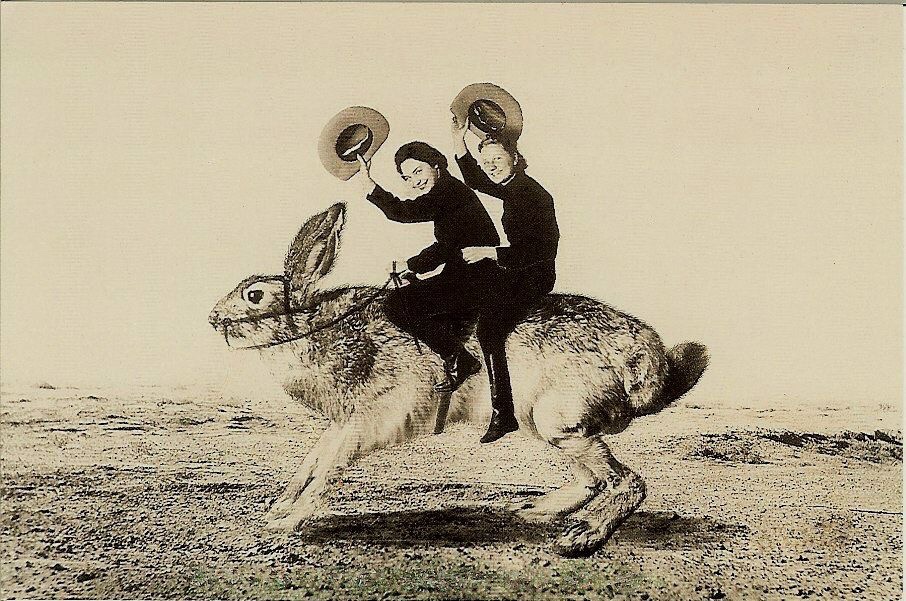
Rabbit! Rabbit! Welcome to November

Abraham Lincoln, All Saints Day, Altars, art, change, chocolate, Civil War, Constitution, Day of the Dead, exercise, Faith, Family, Food, generosity, Habits, Health, holidays, inspiration, Love, nature, poverty, pre-diabetes, pumpkins, rabbits, Thanksgiving, trees, Ukraine, Uncategorized, US Constitution, Van Gogh

My parents would often say, “Time flies when you’re having fun.” If this is so, I’ve had a one whale of a time in 2023. I don’t know where the time has gone, for I’d swear I just woke up in the bright new year of 2023, and now this year has grown a beard of some length. Indeed, the ground was bare, awaiting the warm breath of spring, and now it has experienced its first freeze.

Autumn is a time of transitions. Not only do the trees change colors, and then lose their wardrobe altogether, but we rabbits go from Halloween’s sugar high on October 31st to overstuffing ourselves and the roast beast at the Thanksgiving feast on the Fourth Thursday of this new month. Then we segue into Christmas somnolence with yet more cookies and egg nog (spiked and plain). On occasion we tramp out to decorate the house or scour the woods for greenery, but those days are long gone for most urban dwellers. We’re going to buy from local providers or have it delivered online.

Some of us on the first day of November will still have some of the 35 million pounds of candy corn which are still produced each year. That’s about 9 billion pieces — over a billion more than there are people on Earth. As far as this bunny is concerned, this is 8,999,999,999 pieces of candy corn too many. I’m not a lover of this form of sugar; give me dark chocolate any day. Fortune reported the “dangerous” amount of sugar consumed by kids on Halloween — three cups of sugar in 7,000 calories of candy. For context: That’s 675 grams of sugar, or the same as chomping down almost 169 standard sugar cubes, according to a Fortune article published in 2017.

A Young Bunny

When I was a young bunny, sugar was so restricted in our home, my friends and I would escape our parents’ notice during fellowship time at church to go to the empty adult Sunday school classrooms. We knew where they kept the wonderful Domino Pure Cane sugar cubes for the coffee the grownups drank. We didn’t care for coffee, which was already gone, but the sugar we fell upon like pirates on buried treasure. We didn’t ever consume 169 cubes at once, since that would’ve destroyed the entire stash.

If these had been the 35 million pounds of candy corn, which are still produced each year for Halloween, neither I nor my bunny friend would have ever touched them. The idea about 9 billion pieces — over a billion more than there are people on Earth—are still produced today is incomprehensible to my bunny brain. I think the texture of corn syrup and gelatin isn’t my first choice.

Of course, when the weather turns colder, our bunny bodies sense the need to stoke our internal fires. We do this by consuming more calories, especially the quick acting carbohydrates we find in the sugars and starches that provide the instant “heat” boost our bodies crave. Actually, any food will heat us up, but fruits and vegetables don’t have the same appeal as warm, savory, and fatty foods do in colder weather. The shorter days and the decrease of light in the winter cause problems with our body’s biological clock and lower the levels of the brain chemical serotonin. Plus, many of us reduce our physical activity, so our exercise induced levels of serotonins drop.

Healthy Eating includes More Fiber

We can overcome this loss by planning to be outside during the daytime and making sure to exercise at least 30 minutes daily. Having protein rich snacks and fiber rich soups with complex carbohydrates will help control our hunger spikes. Perhaps this transition time into longer nights and shorter days is why the First Wednesday in November is always National Eating Healthy Day (November 1). If we do only one new healthy choice per week, and add a new healthy option each week thereafter, we can transition our lifestyle into “Eating Healthy.” As a bunny, I remind my friends, it’s also National Vinegar Day—have compassion on yourself and on others. We can love ourselves and others into a better life with kindness rather than harshness. As my grandfather Bunny always said, “You catch more flies with honey than vinegar.”

Day of the Dead Skull

All Saints Day and Dia de los Muertos both are celebrated on November 1. Both recognize the departed loved ones. All Saints recognizes both those who have worked miracles as well as those ordinary saints who have lived among us and given quiet witness to their faith. Dia de los Muertos, the Day of the Dead, is a three-day festival to remember the ancestors and friends who predeceased us. People decorate altars with marigold flowers, photos, and skulls in memory of the dead. They make special food offerings in their honor also.

All Soul’s Day on November 2 is a Catholic holiday to pray for the souls which aren’t yet in heaven, but are in purgatory. Protestants don’t believe in purgatory, so we don’t attend upon this day as holy.

Cookie Monster: “Me want COOKIES!”

Many of us do celebrate Cookie Monster Day on November 2, because who doesn’t like cookies?! The same goes for National Sandwich Day on November 3, for hot or cold, almost anything can be slapped between two slices of bread and get slathered with avocado or mayonnaise, and it’s good to go.

Sandwiches first appeared in American cookbooks in 1816. The fillings were no longer limited to cold meat, but the recipes called for a variety of things: cheese, fruit, shellfish, nuts and mushrooms. After the Civil War sandwich consumption increased and were sold both in high-class lunch rooms and in working-class taverns. A typical turkey sandwich in the 1980s contained about 320 calories, according to a report from the National Heart, Lung and Blood Institute. Twenty years later, a turkey sandwich contained about 820 calories. Choose whole grain bread if possible.

We seniors have more than time on our hand

“Fall Back” on Sunday, November 5, when Daylight Savings Time Ends. We get another hour of sleep on this day when the clocks go back 1 hour at 2 am. I won’t be awake to notice it, but I suggest those of you who aren’t good sleepers begin to look at your evening routines. Set a wind down time on your clock, watch, or mobile device. Let it remind you to turn on quiet music, read inspirational books, or begin your bedtime routine. Sometimes taking off our outside clothes and wearing our “at home” clothes is a signal to our mind to let go of the cares of the world.

Fighting over Van Gogh Pokémon Gifts at the Museum

Go to an Art Museum Today Day and National Chaos Never Dies Day are both celebrated on November 9 this year. I don’t normally consider chaos and art museums as being in the same category, but Disney has made several Night at the Museum movies that revolve around the trope of ancient Egyptian gods awakening to cause havoc. Actual chaos recently erupted at the Van Gogh Museum in Amsterdam when visitors realized the gift shop had already sold out of the Pikachu with Grey Felt Hat promo card, which was modeled on the Vincent self-portrait. Evidently a small group of fans descended on the gift shop, causing a ruckus, and buying out the merchandise. It’s now for sale on eBay.

2023 Veterans Day Poster

Armistice Day marks the November 11,1918 anniversary of World War I, a war which began in August 1914, that few expected to last beyond Christmas. In 1921, an unknown soldier was buried in Arlington National Cemetery. This First World War was “the war to end all wars,” but we’re an overly optimistic nation. We’ve had a Second World War since then, plus many a regional conflict. Every time our battle ships show the flag somewhere, people think it’s going to be WWIII. Fear mongering doesn’t help the nation. We’re better and stronger than that. Plus, we have the moral duty of leadership: our country needs to show the world there’s a better way.

As I recall, both the North and the South expected the great Civil War to last just a short while, just as Putin entered Ukraine believing his army would roll into Kiev in mere weeks. Yet WWI lasted four years, WWII was six years (the US was involved only the four years from 1941-1945), and our Civil War was another 4-year slog. Wars aren’t so much “won” as lost by attrition: one side loses more men, materiel, and willpower so they surrender to the other. War is the most brutal way to settle our differences.

Armistice Day now is Veterans’ Day, November 11, but observed a day earlier (10th) this year. We celebrate our veterans who do the difficult and challenging work of using judicious force against enemy combatants, rather than civilian populations. All of our enlisted personnel take the same oath to protect and to defend our Constitution against all enemies, foreign and domestic:

I, (state name of enlistee), do solemnly swear (or affirm) that I will support and defend the Constitution of the United States against all enemies, foreign and domestic; that I will bear true faith and allegiance to the same; and that I will obey the orders of the President of the United States and the orders of the officers appointed over me, according to regulations and the Uniform Code of Military Justice. (So help me God).”

The US Constitution, 1787

We are an unusual people, we Americans, for our loyalty isn’t to a party, a president, or a person. We are loyal to the constitution, which protects our democratic institutions, values, and freedoms. We can be thankful for those who were inspired to write it, heard the prophetic call to amend it, and have the wisdom to keep us on the straight and narrow.

National Hunger and Homeless Awareness Week is November 11-19 this year. While the economy is recovering, the loss of pandemic assistance funds Is hurting lower income households. They are making hard choices: food or rent, medicine or food. The number of homeless veterans has decreased, but so has the overall population of veterans. The bad news is veterans are still overrepresented in the homeless population. As you prepare for your own feast this year, I hope you remember the hungry in your community. The best way to help is with a financial donation to the local food bank. The bank can purchase food from the warehouse food bank at greatly reduced prices, thereby providing more food per dollar than individuals can purchase on their own.

World Diabetes Day is November 14. Diabetes is a disease on the increase in the world today. In the US alone, over 37 million people have this disease and over 8.5 million have it but are undiagnosed. Over 96 million US adults have prediabetes, a condition in which their insulin doesn’t take the sugar out of the bloodstream well. Switching to whole grains, less processed foods, and adding more fiber to the diet usually helps lower the blood sugar. So does daily moderate exercise.

National Clean Out Your Refrigerator Day is November 15. This is a good day to practice this task, since you’ll be filling it up with excess foods if you’re hosting the feast, or you’ll be traveling away from home. If the latter, you don’t want to return home to spoiled food if the power goes off for any length of time. Ugh: I won’t regale you with the story of stench of the refrigerator in the garage which didn’t power back on after a power outage. Those outlets need to be reset manually because they’re in a “might get wet” zone. The refrigerator inside will come back on automatically. (This turned out to be a get rid of the refrigerator day.)

National Stuffing Day is November 21. If you bake your bread mixture outside of the great bird, it’s called dressing, but if you cram it into the bird, it’s stuffing. It’s safer to cook the bird without stuffing, also quicker. When baking stuffing inside a turkey, it can get get wet and mushy. If you make a flavorful stock from the turkey neck and giblets, you can make your stuffing moist and flavorful without turning it into mush.

If you live in a giant pumpkin, buy a smaller pumpkin for your pie

Pumpkin Pie Day is also November 21, so you can prepare this ahead of time if you wish. You can make a handmade crust or use a store-bought crust from the grocery. Pre bake it and fill it with the pumpkin mixture.

National Cranberry Relish Day is November 22. You can easily make your own with the juice of an orange, some sugar to taste, and cinnamon combined with a package of rinsed cranberries. Heat over medium in a saucepan, stirring frequently to keep from sticking. When the berries burst, reduce heat to simmer and reduce the liquid. Taste and adjust the seasoning. Take off the heat and put into container for icebox. Chill overnight to let seasonings combine. Serve cold as side dish.

Thanksgiving Day is Thursday, November 23. You’ve baked the turkey, and it smells amazing! Let me introduce you to pan gravy from the drippings. You need a little flour, about 2 Tbs; some pepper, about ½ cup of drippings, and 1 cup of hot water. Put the drippings in a heavy saucepan or skillet, add the flour, stirring constantly over medium high heat until flour turns caramel color. This is a medium roux. Slowly add hot water, stirring so no lumps form. Keep stirring till smooth, reducing heat. Add more water slowly if gravy thickens too much. Pepper and salt if necessary.

The idea of “thanksgiving” for the harvest is as old as time, with records from the Egyptians, Greeks, and Romans. Native Americans in North America celebrated harvest festivals for centuries long before Europeans appeared on their soil and before Thanksgiving was formally established in the United States.

In the 1600s, settlers in Massachusetts and Virginia had feasts to thank for surviving, fertile fields, and their faith. The Pilgrims in Plymouth, Massachusetts, had their infamous Thanksgiving feast in 1621 with the Wampanoag Native Americans. The three-day feast consisted mainly of meat: wild fowl procured by the colonists and five deer brought to the feast by the Wampanoag. A a stew called sobaheg was most likely served as a side dish to the main course. It was an easy way to make use of seasonal ingredients, for the stew often included a mixture of beans, corn, poultry, squash, nuts and clam juice. All are used in the traditional dish today, and all would have been available in 1621.

Potatoes weren’t around in 17th-century New England, but corn was plentiful. Natalija Sahraj

Corn and cornmeal were the main carbohydrates on the first thanksgiving meal. The first New England crop of potatoes was grown in Derry, New Hampshire in 1722, so no mashed potatoes were on the menu. Corn bread, corn mush, and corn puddings abounded, since the Native Tribes had shown the colonists how to plant beans, squash, and corn together to maximize growth of all three. The harvest of 1621 likely included beans, squash, onions, turnips and greens such as spinach and chard. All could have been cooked at length to create a green, pulpy sauce that later became a staple in early New England homes. Sweet dishes concocted from sugar or maple syrup weren’t on the menu, nor were honey sweetened deserts. At least, the Pilgrims didn’t have to save room for pie.

After the Pilgrims, for more than two centuries, individual colonies and states celebrated days of thanksgiving. The first national celebration of Thanksgiving was observed for a slightly different reason than a celebration of the harvest—it was in honor of the creation of the new United States Constitution! In 1789, President George Washington issued a proclamation designating November 26 of that year as a ”Day of Publick Thanksgivin” to recognize the role of providence in creating the new United States and the new federal Constitution. During the Civil War, President Lincoln called for a national Thanksgiving Day on the last Thursday of November after the Battle of Gettysburg. In the Great Depression President Franklin Roosevelt moved Thanksgiving Day to the next to last Thursday in November. After two years of public unhappiness, Congress passed a law in 1941 setting Thanksgiving on the fourth Thursday of November.

Thanksgiving, 1858, by Winslow Homer, Boston Public Library

During the week of Thanksgiving, from November 19-25 or 26, we have the holidays of Church/State Separation Week and National Bible Week. If you haven’t been giving thanks for your blessings up to this time, take a break, breathe, and rejoice that you are alive. Give thanks for your hands, your food, your breath, and your heart of love. Share this thanksgiving with someone else. If each of us gives a bit of hope to someone else, we can help others have something to be thankful about.

Chocolate answers all questions.

After the rush of Thanksgiving, some of us bunnies may need medicinal chocolate. November 29 is Chocolate Day. Depending on your personality, you can buy fancy chocolate to share, or you can enjoy it by yourself along with a good book and some lavender tea. If Thanksgiving Day was really overwhelming, National Personal Space Day on November 30 might be calling your name. We all have times in our lives when we don’t need hugs, either because of physical or emotional distress. Besides, we bunnies need to catch our breath before we dash into the Christmas season.

I’m thankful for each of you who read and share my stories.

Joy and peace,

Cornelia


2023 November Holidays Information from Holidays and Observances

http://www.holidays-and-observances.com/november-holidays.html

15 Mind-Blowing Facts About Halloween Candy Consumption in the US

https://www.businessinsider.com/halloween-candy-consumption-usa-facts-statistics-2019-10

Control Your Winter Appetite

https://www.webmd.com/diet/features/control-your-winter-appetite


History of Thanksgiving in America | The Old Farmer’s Almanac

https://www.almanac.com/www.almanac.com/content/when-thanksgiving-day

What the first Thanksgiving dinner actually looked like

https://theconversation.com/what-the-first-thanksgiving-dinner-actually-looked-like-85714


Is Stuffing Your Turkey Safe?

https://www.marthastewart.com/8163046/is-it-safe-stuff-turkey


Wall Street Journal: The American Diet Has a Sandwich Problem – Center for Health Incentives and Behavioral Economics (CHIBE)

https://chibe.upenn.edu/news/wall-street-journal-the-american-diet-has-a-sandwich-problem/


History of the Sandwich | The History Kitchen Blog | PBS Food

https://www.pbs.org/food/the-history-kitchen/history-sandwich/

Van Gogh Museum pulls its Pokémon promo card after opening day chaos

https://www.engadget.com/van-gogh-museum-pulls-its-pokemon-promo-card-after-opening-day-chaos-083349757.html


THE FLAGS OF MEMORIAL DAY

Abraham Lincoln, adult learning, Amanda Gorman, art, Civil War, Creativity, elections, Gettysburg Address, Imagination, Medical care, Memorial Day, Painting, pandemic

Our next to last art class before summer break was right before Memorial Day. I had my last cataract surgery on the Tuesday before, so Mike gave me a lift into class. I wasn’t quite ready to drive yet. I thought we’d be finishing the work we began last week, but that wasn’t on the program for the class. Time for an audible.

John Wesley wanted his clergy to be always ready at a moment’s notice to “pray, preach, move, or die.” We art teachers have always been able to think on our feet and pull a project out of thin air. High school debate team extemporaneous speaking events are excellent trading grounds for this life skill.

Childe Hassam (1859-1935): Flags on the Waldorf, oil on canvas, Amon Carter Museum, Ft. Worth, Texas.

Memorial Day is one of the official days for displaying the American flag. Arkansas Flag & Banner has an informative paragraph (6d) at the link below on the days to display the flag if you aren’t flying it daily. The origins of Memorial Day are shrouded in mystery, since at least 25 sites claim to be the first to decorate the graves of fallen soldiers. From Columbus, MS, on April 25, 1866, to Boalsburg, PA, in 1864, cities north and south claim the fame of being first to decorate soldiers’ graves.

On May 5, 1866, Waterloo, NY, held a ceremony to honor local veterans who fought in the Great War. Businesses closed and citizens flew their flags at half staff. Other sites were not citywide or were one time events. As a result, in 1966, Congress declared Waterlo, NY, the “birthplace of Memorial Day.”

Frederic Edwin Church: Our Banner in the Sky, ca. 1861,
Fine Arts Museums of San Francisco

The Civil War took the lives of 750,000 men, not counting those who lost limbs or minds as casualties of the war, according to J. David Hacker, a demographic historian at Binghamton University, who has raised the estimate of how many deaths there were in the American Civil War from just under 620,000. One of every four soldiers failed to return home. If this devastating war took place today, 7.5 million people would have died in the fighting. As a reminder, the scourge of COVID-19 has killed 1,123,836 people in the United States alone since 2019.

Of course, as our ability to preserve life improves, our reverence for life increases. We just disagree at which point in time life should be honored and respected, and which lives are worth honoring and respecting. Perhaps we’re just a people given to disagreement and division by nature, or our old wounds from this ancient conflict continue to fester and boil, so we pick new battles to fight with words, rather than blows.

1908 Decoration Day Card

America lost 1,190,085 total service members’ lives from 1775 to 1991. The ongoing Global War on Terror has yet to be accounted because it isn’t finished. Although they underestimated the number of Civil War casualties, this one home grown conflict was responsible for about half of the war deaths of all American service members. It was a cruel war, in a brutal age. Things we take for granted today—dog tags for identification, mobile army surgery hospitals, anesthesia, sanitary camp conditions, humane treatment of prisoners, nutrious rations, and other civilized practices—weren’t part of the Civil War experience. In the American Civil War, twice as many soldiers died of disease as from hostile action.

Jasper Johns: Flags, lithograph, 1967-68, MOMA, NY.

World War II was the first war to have more deaths caused from the battlefield than from other causes. Greatly improved public health in armies has lowered the toll of disease to a fraction of what it was in earlier centuries. Modern military medicine has now allowed larger and larger armies. In short, military medicine, while greatly improving the care of the individual soldier, has enabled nations to have bigger armies and greater wars. We see the unfortunate consequences of these improvements in the current aggressive Russian attempt to takeover an independent Ukrainian democratic state against its people’s will.

After several years together in our art class, Gail and Mike are both now open to making an artwork that presents an idea or an emotion, more than a representation of a form. Not everything has to be a photorealistic rendering of an object before us. We do this often enough to build our skills of seeing and drawing, but we also need to build our expressive skills also. As an example in the spiritual life, we can spend our days in intercessory prayer, but we also participate in contemplative prayer or meditation to exercise the less analytical ways we can meet God in prayer.

Mike: Freedom Flag

Mike went on vacation recently and had the opportunity to take an art class with a different instructor. He suggested Mike give up his dedication to the small brush, a comment I often make. Now he’s excited about the freedom of the large brush and is exploring this new tool and technique.

Gail’s Flag

Gail mixed the reds and blues to make violet, as if the colors of the flag were washing into to one another. Many artists have changed the colors of the flag, but kept the design, or they kept the colors and destroyed the design. This is artistic license or creative interpretation. We make our statements with our images. She also changed the stars into circles by using a sponge to put down the paint. It was a good day for experimenting.

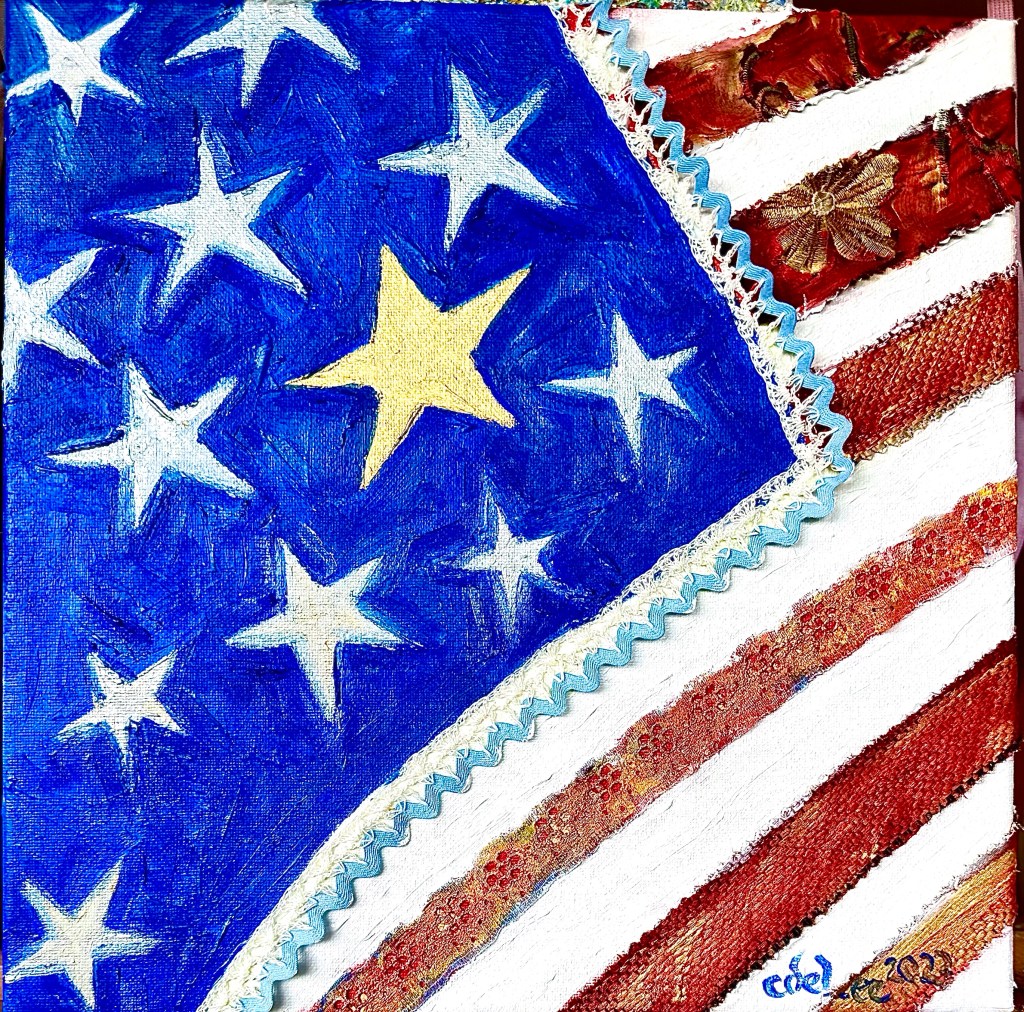
Cornelia DeLee: Gold Star Family Flag, acrylic with mixed media on canvas, 2023

I came home to finish up my painting with memories of visiting Civil War battlefields on my mind. I thought of those ancient days when families were able to identify their loved ones only by the special knit patterns of the socks on the bodies, or by the last letters to relatives pinned into their shirts. The Gold Star Mothers began during World War I when the mothers of fallen servicemen united to share their grief. By 1928, it was an official organization and the bereaved families were recognized with a pin.

Jasper Johns: Two Flags, lithograph, 1981, Phillips.

When I lived in San Antonio, I ocassionally visited the various military hospitals in town. There I saw the photos of the Medal of Honor recipients and read the summaries of their noble deeds. I always renewed my dedication to my less dangerous occupation afterward. Those who serve are a different breed from an ordinary person such as I. Perhaps Abraham Lincoln said it best in his 1863 Gettysburg Address:

“It is rather for us to be here dedicated to the great task remaining before us, that from these honored dead we take increased devotion to that cause for which they gave the last full measure of devotion, that we here highly resolve that these dead shall not have died in vain, that this nation, under God, shall have a new birth of freedom, and that government of the people, by the people, for the people, shall not perish from the earth.”

Gordon Parks, American Gothic, Washington, D.C., 1942.
Photo : Courtesy Gordon Parks Foundation

Amanda Gorman’s excellent 2021 inaugural poem, “The Hill We Climb,” has a section which echoes the sentiments of the post Civil War era, when Memorial Day celebrations first began:

We are striving to forge a union with purpose
To compose a country committed to all cultures, colors, characters and conditions of man
And so we lift our gazes not to what stands between us
but what stands before us
We close the divide because we know, to put our future first,
we must first put our differences aside
We lay down our arms
so we can reach out our arms
to one another
We seek harm to none and harmony for all
Let the globe, if nothing else, say this is true:
That even as we grieved, we grew
That even as we hurt, we hoped
That even as we tired, we tried
That we’ll forever be tied together, victorious
Not because we will never again know defeat
but because we will never again sow division
Scripture tells us to envision
that everyone shall sit under their own vine and fig tree
And no one shall make them afraid
If we’re to live up to our own time
Then victory won’t lie in the blade
But in all the bridges we’ve made
That is the promised glade
The hill we climb
If only we dare.

Howard Finster: Not Just A Piece Of Cloth, 1990

On this Memorial Day, over 150 years later, the wheels of justice are setting the sentences for the insurrectionists who attempted to impede the peaceful transfer of power to the newly elected government of the United States. We do well to remember the prescient words of Frederick Douglass, who said at Arlington National Cemetery on Memorial Day in 1871:

“We must never forget that victory to the rebellion meant death to the republic. We must never forget that the loyal soldiers who rest beneath this sod flung themselves between the nation and the nation’s destroyers.”

At 3:00 pm on Memorial Day, let’s pause for a moment and remember those who sacrificed body, mind, or life to keep our nation free, or to bring freedom to a nation that so desperately yearns for it.

Joy and Peace, and thanks to those who keep it for us,

Cornelia

United States, US Flag Code | FlagandBanner.com
https://www.flagandbanner.com/flags/united_states_flag_code.asp

The Origins of Memorial Day—US Department of Veterans Affairs
https://www.va.gov/opa/publications/celebrate/memday.pdf

Professor: Civil War Death Toll May Be Really Off : NPR
https://www.npr.org/2012/05/29/153937334/professor-civil-war-death-toll-may-be-really-off

United States – COVID-19 Overview – Johns Hopkins
https://coronavirus.jhu.edu/region/united-states

Veterans Affairs Fact Sheet America’s Wars 2019
https://www.va.gov/opa/publications/factsheets/fs_americas_wars.pdf

War, Medicine & Death – PMC
https://www.ncbi.nlm.nih.gov/pmc/articles/PMC9762220/

Gettysburg address delivered at Gettysburg Pa. Nov. 19th, 1863.| Library of Congress
https://www.loc.gov/resource/rbpe.24404500/?st=text

Paper Valentines

Abraham Lincoln, adult learning, art, brain plasticity, butterflies, Civil War, Creativity, Faith, Gettysburg Address, holidays, Love, Super Bowl, Valentine’s Day

Does anyone else find it unusual that Lincoln’s Birthday, the Super Bowl, and Valentine’s Day all fall within a single three day period? When I was young, we celebrated every holiday possible in public school, since these were teaching opportunities. I always loved them for the art periods and the story telling events. Not that I was deeply invested in the facts of history, but I cared about the personalities and the principles of their lives’ work.

This meant February focused on Lincoln and Washington both. Of the two, I always preferred Lincoln, perhaps because my teacher had our class memorize the Gettysburg Address. I was entranced by the thought Lincoln wrote this speech on the back of an envelope on the train ride out to that fateful battle field. It wasn’t true, but that’s just one of the hallowed myths of history we’ve spun about the giants of the past.

Of course, we always celebrated Valentine’s Day in the classroom with decorated boxes or bags for exchanging cards. The rule in class was to bring a card for everyone and leave no one out. No one meant no one. The cards didn’t have to be fancy, but everyone needed to get a card, handmade or bought. Of course, we always had some parental snack provided. I think we overdosed on sugar back in those days.

When we’re young, we don’t really have a sense of history, so we don’t see the connections from one act to the later consequence of another. It takes time for young people to mature, process, and grasp the connections between past, present, and future in order to navigate their place in time. When someone says the past is meaningless to them, they’ve built their house on a foundation of sand. The first lesson I always taught in art class was “Attitude, Behavior, and Consequences.” The second lesson was “Clean up after yourself and leave the art room good for the next group.” That first lesson was about how individual actions affected their own work and grades. The second was about community responsibility. And some folks thought I was just letting the kiddos have fun with colors, scissors, and glue.

But back to this Trifecta weekend. The very first Super Bowl was January 15, 1967. I’ve slept several decades since then, so I don’t remember if I watched it. Super Bowl XXXVI, was the first one held in February, but all of the prior February games have been held in the first week until this LVI event. That’s 56, for the non Romans among us. This is quite a streak, but all streaks are meant to be broken. This is how we get the great Trifecta of Lincoln, Super Bowl, and Valentine’s all in a row.

Scrap Paper Valentine: Civil War Era

Back during the Civil War, supplies were scarce. The supply chain nightmare isn’t a recent issue, for during the war, the South lacked supplies due to the Union embargo for imports and their crops were confiscated by both armies as they marched through the areas near the battlefields. One of the touching homemade valentines of the era was made in 1862 from scrounged paper by the Confederate soldier Robert King for his wife. The basket weave folded card, when opened up, showed two crying lovers, a particularly sad foretelling of his death.

Our class brought scrapbook papers, doilies, craft store items, and leftover crafting materials from past projects. All crafters seem to be packrats, but we also share our largess with others. None of us can say NO to the offer of free stuff. Our materials filled one whole table, so settling on a few items was our first choice. Sometimes we get overwhelmed with too many choices, but our group has learned to go with what strikes their fancy first. Digging through everything to look for a better option often is just a waste of time in a short class. Go with what calls your name. As my daddy would say, “Decide to fish or cut bait, honey. The day’s not getting any longer.”

Lauralei’s Valentine

As Lauralei was working on her Valentine, Jerry came into the room. Immediately she called out, “Don’t look—go away!” He laughed, and took a wide berth around our work tables. If you want to surprise someone, it’s hard if they’re also working at the church. I like the energy of the patterns on her Valentine. Love is never a static thing, even if it is steadfast and forever, but it’s constantly reaching out and pulling us toward one another.

Gail’s Valentine

Gail added another dimension to her work by bending the central heart image so it would stand up. This gave it depth and made the heart into a basket from which the butterflies could exit into the open space around it. That took an extra level of thought.

Outside of Gail’s Valentine

The birds and butterflies on the outer cover of Gail’s card are another variation on the theme.

Mike’s Valentine

I can always count on Mike to fill the surface with texture and color. He has no fear whatsoever. Exuberance is his middle name. He claims sarcasm is his love language, but that’s just his outward personality speaking. The inner messages on his card to his lovely wife tell her how wonderful she is and how glad he is to be with her.

Cornelia’s Valentine

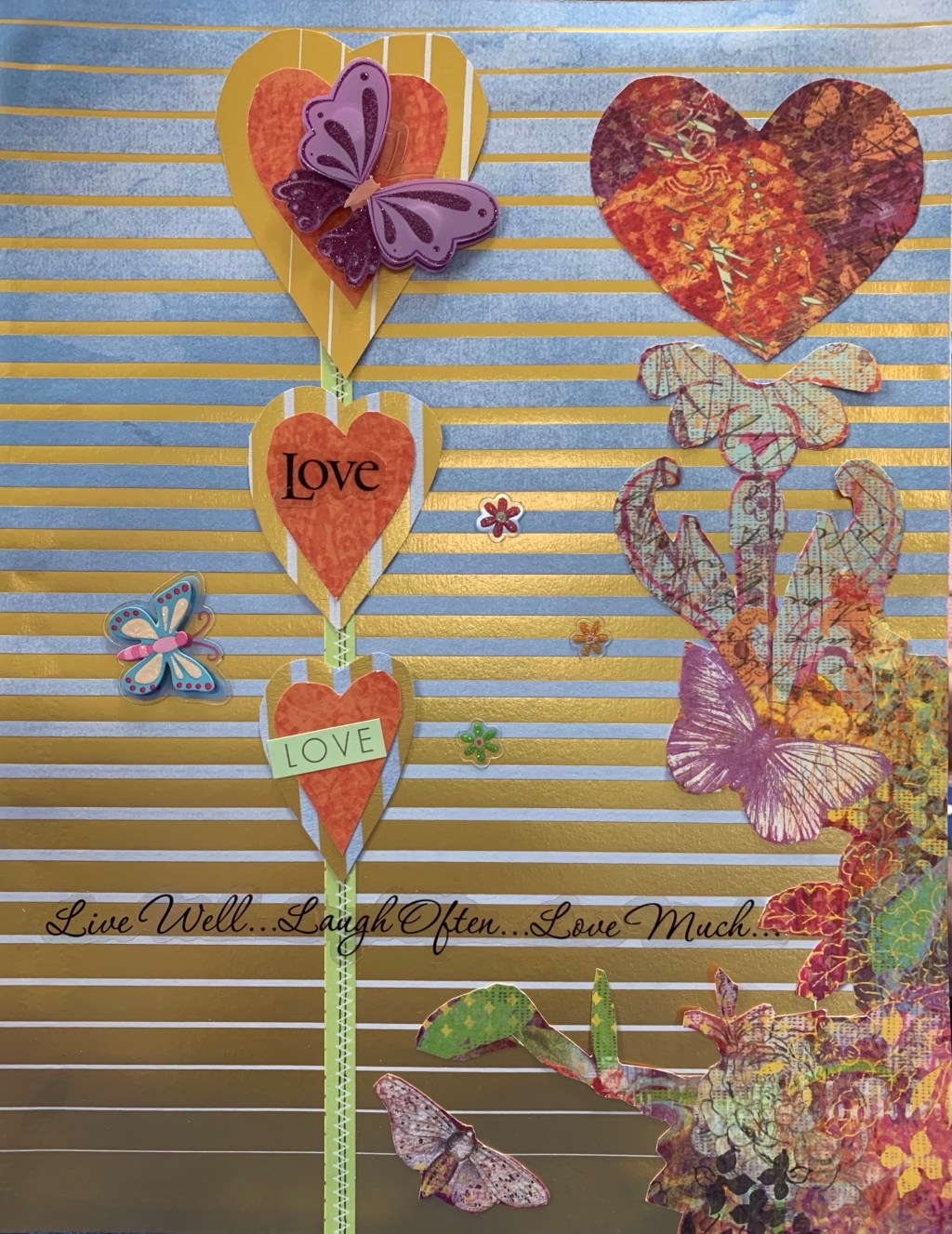
I made mine as a landscape, rather than a card. The message, “Live, Laugh, Love” is a variation on a message my grandmother often wrote. I’ve always liked both butterflies and flowers, for they remind me both of the beauty and the transient nature of life. My Valentine is for those of blessed memory, as well as for those I love today, and maybe even for those I’ll love in the days to come.

“Love never fails, But where there are prophecies, they will cease; where there are tongues, they will be stilled; where there is knowledge, it will pass away. For we know in part and we prophesy in part, but when perfection comes, the imperfect disappears…. And now these three remain: faith, hope and love. But the greatest of these is love.”

The verse above is an example of historical consciousness in the arena of faith. All religions “take up the past by telling stories and making visible the arches that span over all times and join them together into a unified whole,” just as writers observe the facts of history and draw conclusions about the streams of history and the direction in which they flow. Yet we humans are also capable of forgetting, sometimes because we don’t want to remember and other times because we can’t recall events due to illness, lack of sleep, or inattention. We depend on trusted others to build the narrative for us, so we need to take care from whom we receive our instruction.

On this Super Bowl weekend, much will be made of the heroic efforts of the athletes on the field. There’ll be hype galore, costly commercials, illustrious and notorious folks in attendance for sure, and excessive eating and drinking across America. It may be a different game day than what we’ve been accustomed to, but then as Bob Dylan sings, “The times, they are a-changing.” If the NFL is writing a different narrative, it’s only because they’re finally including voices once suppressed. We can know the facts of history, yet fail to have an historical consciousness, just as we can identify the different styles of art and put them in historical order, but fail to have an aesthetic appreciation of the art itself.

President Lincoln delivered the 272 word Gettysburg Address on November 19, 1863 on the battlefield near Gettysburg, Pennsylvania on the occasion of the dedication of the national cemetery for the war dead. Overall, casualties in that three day battle were enormous. At least 25,000 Confederates fell, representing nearly one-third of its army. One-third (12 out of 53) of Robert E. Lee’s generals were killed, wounded, or captured. More than 20,000 Union soldiers fell; General Meade’s subordinate command also suffered heavy losses. Lincoln helped to reframe citizens’ thinking about the cost and nature of this war.

The Super Bowl extravaganza will last nearly four hours and play $500 million in advertisements (about 70 in all),not to mention a preface of more than three hours of entertainment. Compare that to Lincoln’s speech, which lasted three minutes at most:

“Fourscore and seven years ago our fathers brought forth, on this continent, a new nation, conceived in liberty, and dedicated to the proposition that all men are created equal. Now we are engaged in a great civil war, testing whether that nation, or any nation so conceived, and so dedicated, can long endure. We are met on a great battle-field of that war. We have come to dedicate a portion of that field, as a final resting-place for those who here gave their lives, that that nation might live. It is altogether fitting and proper that we should do this. But, in a larger sense, we cannot dedicate, we cannot consecrate—we cannot hallow—this ground. The brave men, living and dead, who struggled here, have consecrated it far above our poor power to add or detract. The world will little note, nor long remember what we say here, but it can never forget what they did here. It is for us the living, rather, to be dedicated here to the unfinished work which they who fought here have thus far so nobly advanced. It is rather for us to be here dedicated to the great task remaining before us—that from these honored dead we take increased devotion to that cause for which they here gave the last full measure of devotion—that we here highly resolve that these dead shall not have died in vain—that this nation, under God, shall have a new birth of freedom, and that government of the people, by the people, for the people, shall not perish from the earth.”

Go Bengals!

Joy, love, peace, and Go Bengals!

Cornelia

Super Bowl Winners and Results – Super Bowl History – National Football League – ESPN
http://www.espn.com/nfl/superbowl/history/winners

The Gettysburg Address
https://www.lincolncollection.org/discover/ask-an-expert/qa-archive/did-lincoln-write-the-gettysburg-address-on-the-back-of-an-envelope/

https://rmc.library.cornell.edu/gettysburg/good_cause/transcript.htm

View of Historical Consciousness in Youth. Theoretical and Exemplary Empirical Analyses | Forum Qualitative Sozialforschung / Forum: Qualitative Social Research
https://www.qualitative-research.net/index.php/fqs/article/download/904/1974?inline=1