Learning, Growing and Thriving

adult learning, art, Athanasius, brain plasticity, Christmas, Civil War, cognitive decline, Creativity, crucifixion, Faith, Imagination, incarnation, john wesley, Love, mystery, nature, renewal, Spirituality, St. Athanasius, United Methodist Church, Valentine’s Day, Valentine’s Day

In most adults, learning and thinking plateaus and then begins to decline after age 30 or 40. The old adage, “Don’t trust anyone over thirty” takes on new meaning in regards  to creativity. People after this age start to perform worse in tests of cognitive abilities such as processing speed, the rate at which someone does a mental task. The slide becomes even steeper after 60 years of age. We also notice a similar learning decline in children after summer vacation, which results in the fall semester becoming a “reteaching opportunity.”

As one who is also “growing long in tooth,” I have passed this yardstick by a mile. I notice I have a “slower processing speed” in my creative writing. I don’t consider it a reason to quit, but a reason to better organize my other time-wasting behaviors (social media, newsletters, newspapers, etc.). I can always ignore cleaning the condominium! Creativity before housework, is my motto.

Housecleaning Meme

We often think older adults are on a downward slope with unrecoverable loss. “Use it or lose it,” the saying goes. Recent research suggests we need to apply a more hopeful mindset and vocabulary when discussing older people—much like that used for childhood or early adulthood. Decline, as we so often see it, may not be inevitable. In fact, learning a new skill and practicing it for three months has shown benefits beyond the the practice time.

Adults often have limited time or resources, so if we encourage learning a new skill, this may help them step out of their comfort zones. In people’s later years, many personal and societal changes—such as moving out of state to be closer to family members, switching jobs or coping with physical distance from loved ones—make learning new skills necessary to adapt and succeed.

For example, taking a class to improve technological skills could aid seniors’ success in an increasingly digital world, such as helping them use Telehealth or online banking platforms. Learning new skills in an art class allows a person to express their feelings and solve problems in creative ways. Each person can find their own path to success in artistic practice.

Potholder Loom, just like the one I had back in the day.

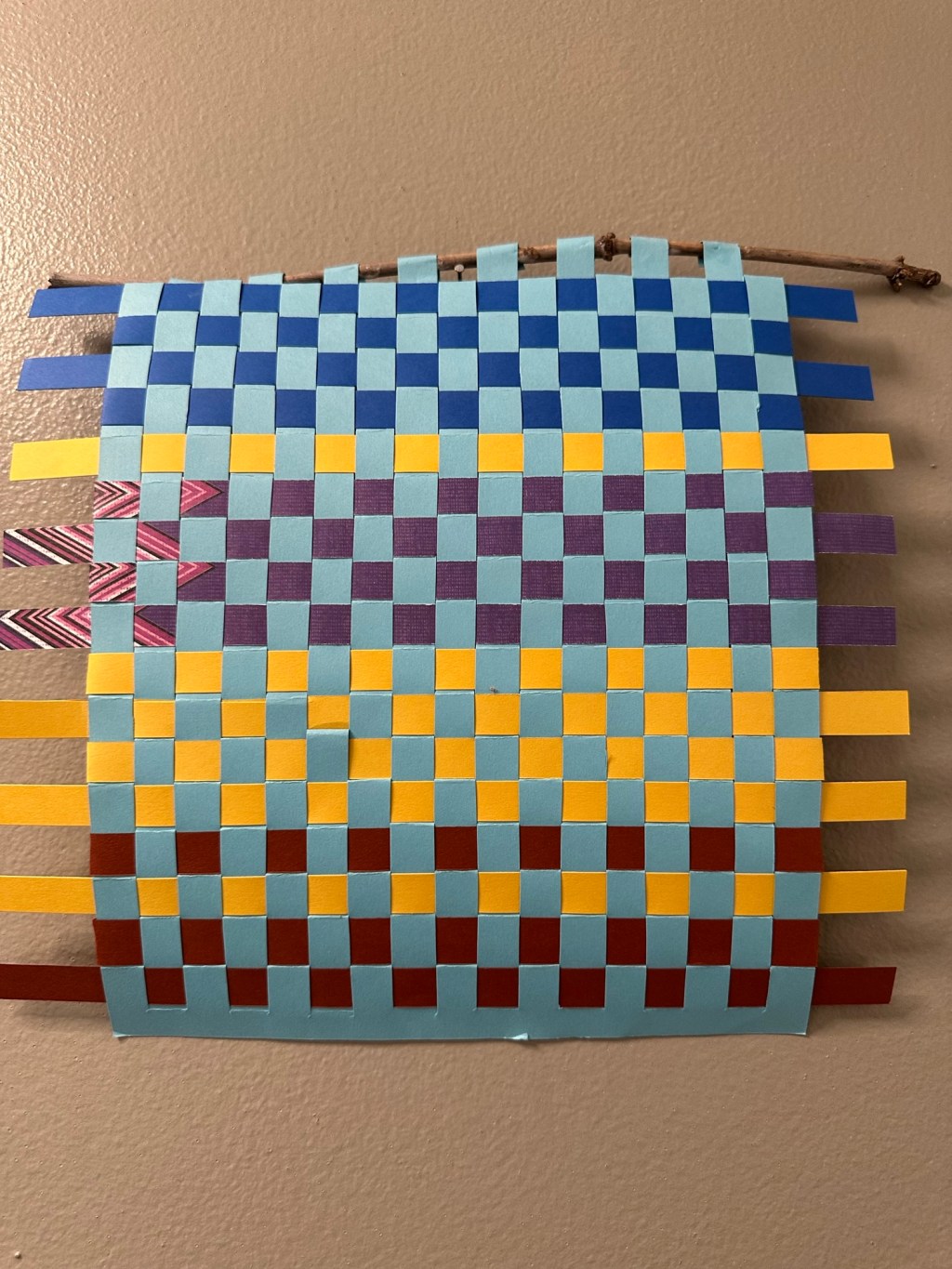
Our art class is trying a new thing: weaving. We have been painting for quite a while, so this is really a hands-on project. Some of us had the benefit of making woven potholders as children, or weaving newspaper “sit-upons” at summer camp. The technique isn’t unknown, but making a creative design interpretation is how we take our basic skill forward into a stimulating and creative brain challenge.

DeLee: Woven Paper on a Stick (Earth and Sky)

We could just repeat what we already know, but this doesn’t build us new neurons in our brains. If we keep the same old paths and don’t create new ones, we aren’t flexible when we meet new situations. Since we live in a rapidly changing world, building a brain capable of rapidly adapting is important to live independently and vibrantly for as long as possible.

I remember how my Daddy could only use the old tv remote to change the channel for the original non cable stations. When “Murder, She Wrote” came on the cable channel, my Mother had to use the cable remote to change the station for him. His Alzheimer’s disease prevented him from learning new skills, but he remembered all of his previous medical training and could diagnose his condition and boss the emergency room doctors when he was admitted to the hospital for a fall. Our brains are a mystery indeed.

Mike jumped the gun on Valentine’s Day and created a woven heart. These were big in the Danish and German communities and very popular in the 19th century in America. During the Civil War, soldiers made many of these in elaborate forms to send to their loved ones back home.

Unknown Artist: Affirmation Weaving

The brain is a fantastic and mysterious organ. If we make a habit of learning something new every day, of whatever interests us, we have the opportunity to keep our lucidity for a longer time. We also we meet the quickening changes of modern life with a steadfast heart and mind. We stress less when we know we can adapt and change in our own lives. We don’t have to be the people who say, “You can’t teach an old dog new tricks.” We can teach and we can learn, but we might need to be more patient with the old dog. In some corners, we call that “grace.”

I watched my Granddaughter’s Daddy Daughter Dance

Our group was in and out during the several weeks devoted to this project. One of us was sick, one was grieving the death of a beloved pet, another had pressing work issues, and the teacher went to Florida to see her granddaughter get married. Amazingly, life goes on. People dropped in for spiritual support, which is a side benefit of the community of art class. I managed to get mine mostly done, and Gail S. finished hers completely. Sometimes life interrupts our best intentions and we move on. We will learn new lessons on the next project.

Gail S’s “Eye of God” weaving

 Gail S’s “Eye of God” weaving incorporates yarns from two different mop heads, some sticks, and a bird feather. Gail almost always keeps a realist focus in her works, so her eye of God has a bird feather to mark the pupil. The upper field of grey and white mop yarns represent the cloudy sky, while the blue yarn stands for the water and the brown for the land. God watches over all of God’s creation. Gail S’s love of the outdoors and all of nature is evident in all her work.

Cornelia’s Cross on a Hill (unfinished)

I also recycled some old paintings and cords which I’d used in the preparatory work of other paintings. In addition, I used some recycled strips of Amazon shipping parcels as well as a wire shape which once belonged to a butterfly wing. In repurposing these items into the weaving along with two old brushes bound together with a God’s eye, I invoke the renewal of life after death.

We people of faith have two opportunities for a renewal of life after death. The first is by our profession of faith in Christ and his life, death, and resurrection on our behalf for our salvation. This gives us a living faith in this world. The second renewal is for the resurrection from death itself. This gives us a life beyond this world. Our faith is worthless if it doesn’t change us for our walk upon this world. If we don’t have the heart and mind of Christ within us, and if we aren’t earnestly seeking to be made perfect in the love of Christ daily, our United Methodist heritage tells us we’ve not yet been converted.

Yet Christ desires to save all, as John records in 12:32,  Jesus tells the crowd,

“And I, when I am lifted up from the earth, will draw all people to myself.”

Not just some people, or only the best, or even just us United Methodists, but ALL people. Most of us aren’t able to understand such a wide ranging love, for we live in a world of tribal loyalties. If we look at creation, which is God’s first work, God loves that which God created. God loves everything God created. We humans are the ones who choose sides and introduce boundaries and hate into God’s singular creation. The world or Kosmos is the creation first and then the people in it.

Today we tend to ascribe “world” to the “culture,” or secular society in general, but its plain meaning is creation and the human presence, for good or ill. The ancient Greeks and Romans divided the world into the material (bad) and the spiritual or mind (good), but the Jewish theology conceived the unity of both as part of God’s gift to humankind.

In the fifty-fourth chapter of On the Incarnation, St. Athanasius of Alexandria wrote a sentence that has echoed down through the centuries even into our own time as a brilliant summary of the Gospel. He wrote this: “God became man so that man might become god” (54:3).

This doctrine is called theosis or acquiring the whole nature of God. We United Methodists call this state Christian Perfection, or “a heart so full of love of God and neighbor that nothing else exists.” Our Wesleyan heritage was influenced by the Wesley brothers’ deep love for the Greek Orthodox fathers of the early church. To focus only on fallen nature is to deny the power of God to redeem us and all creation and to make all things new. We humans and nature aren’t more powerful than God!

If we cut off part of our God given self, we deny the incarnation of Christ, who became human for us that we might become divine. We need to remember what John 3:16 so succinctly states:

“For God so loved the world that he gave his only Son, so that everyone who believes in him may not perish but may have eternal life.”

Art is a way to open our eyes and hearts to a new way of seeing spiritual truths. Art is also reflective of the artist’s soul and spirit. A sensitive viewer can read the tale of trauma or the struggle for survival in an artist’s body of work. More than this, we can listen for their voices straining to be heard. Most people have been silenced and conformed to the “cause no trouble, don’t get out of step” mantra of the public school system training our youth for the workplace.

In art class, we can lose our fear of being different because being different gets rewarded! Being original gets an attaboy or attagirl.  I find such joy helping people find new courage and creativity they didn’t know existed within themselves. My students keep me young too. I feel blessed beyond measure.

Joy and peace,

Cornelia


To Stay Sharp as You Age, Learn New Skills | Scientific American

https://www.scientificamerican.com/article/to-stay-sharp-as-you-age-learn-new-skills/

That Man Might Become God — Fr. Andrew Stephen Damick
https://blogs.ancientfaith.com/asd/2015/01/22/man-might-become-god/

Season of Light

art, Astrology, Christmas, Civil War, Faith, Family, Hanukkah, holidays, hope, Israel, Light of the World, Love, Saturnalia, Spirituality, Ukraine

The damaged Drobytsky Yar memorial near Kharkiv, Ukraine after reportedly being hit by Russian artillery fire, on March 26, 2022

As the days grow shorter and the nights lengthen, the chill air adds to the darkness of our world. We can give into this dour outlook, especially this year with devastating wars in Ukraine and Gaza, or we can light a candle against the gathering gloom. Cultures across history have seen the time before year end as an opportunity for reflection, concern, or fear. Others have found reasons to rejoice.

Rainbow Menorah

Hanukkah (inauguration) is the eight-day Festival of Lights, which occurs in 2023 from sunset December 7 to December 15. It’s a moveable festival, for in 2024 the holiday will occur from December 25 to January 2. The Jewish calendar is a lunar calendar, not a solar calendar. This holiday celebrates the rededication of the Second Temple after the victory of the Maccabees over the Seleucid Greeks in 164 BCE. On discovering in the temple a vial of unpolluted oil, with only enough to light the candle for one day, this oil kept the candle burning for eight days. To commemorate this miracle, faithful Jews now light a special menorah with nine candles. The ninth candle is called the “helper” or “shammash” candle. The root word is from the Hebrew for “servant.”

Helping Hand Menorah

While not everyone is Jewish, all persons can learn from the menorah and the shammash candle. We may have only a little to give, but with God’s help it can be multiplied many times over. We can all be a helper candle, and bring a light to the candles who need a light. Many in this season experience a loss of some kind. Some are mourning a loved one, others have broken relationships, or have lost jobs or status. We are not our jobs and we aren’t our paychecks, but we are the beloved children of God. God will love us when everyone else turns aside. God will remember us when others forget we are alive.

Perhaps these darkening days at the end of the year are why people in all parts of the world have brought fire and light to this time of the year. The Yule Festival in German and Scandinavian countries was part of the pagan festival incorporated into Christianity’s Christmas celebrations. It likely began as a winter solstice or year-end celebration. “Yule” became a name for Christmas about the 9th century, and in many languages yule and its cognates are still used to describe that holiday.

Father Christmas and the Yule Log

The burning in a giant fireplace of a large Yule log until it’s reduced to cinders is one of my favorite mythic memories of the season. Alas, growing up in the Deep South, gas logs were the closest fireplace equivalent, and these were the same yesterday, today, and tomorrow. We rarely turned on the flickering colors of these blue flames because cold nights were few and far between.

By 336 CE, the Christian church in Rome celebrated Christmas on December 25, which coincided with the Roman winter equinox festival of Saturnalia. In medieval England, Christmas was a 12-day festival involving all kinds of revelry, from plays to wild feasts to pageants celebrating Jesus’ birth. Music, gift giving, and decorations all became the norm. Anyone who’s been in a choir singing “The Twelve Days of Christmas” with its repetitive “and a partridge in a pear tree” has those ancestors of ours to thank. Some traditions never die!

Our family stitched and sequined one exactly like this.

Christmas is better known for decorated trees, however. The use of evergreen trees and wreaths in religious ceremonies dates from ancient Roman times, if not earlier. However, the first documented use of a tree in a winter Christmas celebration wasn’t until 1510. In that year, members of a merchant’s guild in Riga, Latvia, placed a tree in the town square. They decorated it with flowers, ribbons, and dried fruit. After the festivities—which included the singing of songs and dancing—were concluded, they burned the tree as a great bonfire to close out the celebrations.

The Grinch Torches Whoville’s Christmas Tree into a Bonfire

Christmas trees gained popularity in Germany and other parts of northern Europe by the 1700s, but the practice of decorating a pine or fir tree during the holiday season remained virtually unknown in the English-speaking world prior to the 19th century. When Queen Victoria married her German cousin Prince Albert in 1840, the Christmas tree became widely accepted and practiced throughout the British Isles.

1836 edition of The Stranger’s Gift: A Christmas and New Year’s Present

In the United States, the practice of placing a decorated tree inside the family home was most likely introduced by German immigrants who arrived soon after the Revolution. The otherwise unassuming volume seen above, the 1836 edition of The Stranger’s Gift: A Christmas and New Year’s Present, is significant for it’s the first book printed in the Americas containing an image of a Christmas tree. Franklin Pierce in 1856 was the first president to erect a tree in the White House. In the United States, Christmas wasn’t celebrated with much gusto until after the Civil War, which reinforced for many the importance of home and family. In 1870, after the war’s end, Congress made Christmas one of nation’s first federal holidays.

Franklin Pierce in 1856 was the first president to erect a tree in the White House.

Light has always been a part of winter festivals, with their signature long, dark nights. Electric Christmas lights are a modern spin-off of the old-fashioned candles that Germans and Scandinavians placed on their trees. Thomas Edison, inventor of the lightbulb, also invented the first strand of lights and hung them outside his Menlo Park, New Jersey laboratory in 1880. In 1882 his business partner, Edward H. Johnson, created the first Christmas tree illuminated with colored lights. In 1895, President Grover Cleveland placed multi-colored electric lights on the White House tree. Since electricity wasn’t available except to the wealthy, most people didn’t have electric lights on their trees at home. Not until the end of the 1920s were electric lights affordable for the average family.

Fast forward to the 1950’s and the postwar period of rural electrification and large family gatherings, colored electric lights of every kind were readily available to the middle classes, not just the wealthy. This was the era of big bulbs and bubble lights, but in a few years, inexpensive miniature colored and white lights imported from China would become popular. Now even single parent households could decorate both the house and tree to their hearts’ content.

Untitled (Lux in tenebris inest—Light in the darkness)
Elisa Sighicelli 2003/2003

The lights bring out our hope of what’s good and wonderful in this world. Christmas and Hanukkah are times when the light burns bright, even when the days are dark. If these holidays didn’t exist, we would need to invent them, for we need the reminders of what is light and good in the world. As Baruch prophesied (5:9):

“For God will lead Israel with joy, in the light of his glory, with the mercy and righteousness that come from him.”

While we don’t know exactly what the Christmas star was, one theory is it was a conjunction of Jupiter, Regulus and Venus. Another possibility includes a set of conjunctions of the planets Jupiter and Venus, and the bright star Regulus. In this case, the mythologies associated with the objects become important. Jupiter in Hebrew is known as ‘Sedeq’, which is often translated as meaning righteousness. Jupiter is also often viewed as being the ‘king’ of the planets. Regulus is Latin for ‘prince’ or ‘little king’, and Venus is often viewed as a symbol of love, fertility and birth. Therefore, the combination of these objects close in the sky could have led to the interpretation of the birth of the ‘King of Kings.’ We do know Matthew records the visit to King Herod:

“After Jesus was born in Bethlehem in Judea, during the time of King Herod, Magi from the east came to Jerusalem and asked, “Where is the one who has been born king of the Jews? We saw his star when it rose and have come to worship him.”
(2:1-2 NIV)

Gerrit Dou: Astronomer by Candlelight, oil, late 1650s, J. Paul Getty Museum

The magi were astrologers, those who studied the heavens for the star signs of rising and falling influences in the ancient world. Herod died soon after their visit, but not before he tried to consolidate his power. He meant his dire deeds to benefit himself, but God spared his son by sending a message to Joseph in a dream to flee to Egypt with Mary and Jesus. The magi were warned not to return to Herod also.
This one who John wrote about in the opening chapter of his gospel (1:5):

“The light shines in the darkness, and the darkness has not overcome it.”

Gerardo Dottori: Nativity, 1930/1930, Museum of modern art

As we celebrate the holidays of light this year, remember to be a “shammash”, or a servant of light, and don’t let this present darkness overwhelm you. Your one light shining may be the brightness that brings someone safely home. Today I wore my bright pink exercise pants, even though I’m sinusy and achy all over. I made at least one person’s day when I said, “They’re stretchy, so I can eat more Christmas cookies!” We spread the joy even when the Grinch has stolen ours. This is a way of taking the darkness back, by making others feel better.

God bless and shine 🕯️on,

Joy and peace,

Cornelia

Jewish Festivals |Britannica
https://www.britannica.com/topic/Jewish-festivals

Shammash | Judaism | Britannica
https://www.britannica.com/topic/shammash

Yule Festival | Britannica
https://www.britannica.com/topic/Yule-festival

O Tannenbaum: Or, a Brief History of the Christmas Tree | The New York Public Library
https://www.nypl.org/blog/2016/12/12/christmas-trees-arrival

Who Invented Electric Christmas Lights |
https://www.eei.org/en/delivering-the-future/articles/who-invented-electric-christmas-lights

A Look Back: 100 Years of Christmas Tree Trends

https://www.bhg.com/100-years-christmas-trees-6751023

Rabbit! Rabbit! Welcome to December 2023

Apocalypse, architecture, art, Bethlehem, Christmas, Civil War, Faith, Family, Healing, holidays, Holy Spirit, hope, inspiration, Israel, Light of the World, Love, Ministry, poverty, rabbits, shame, Spirituality, Stress, trees

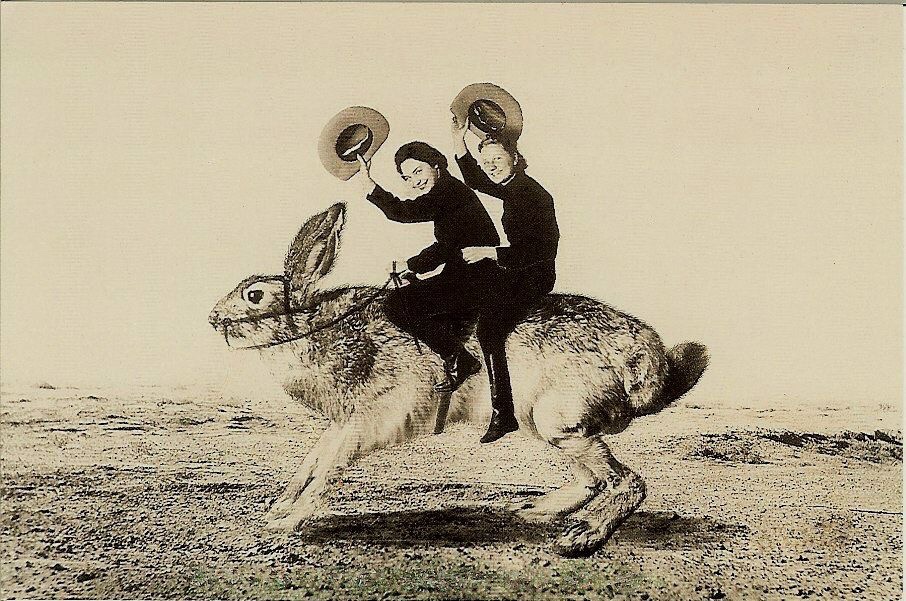
Bunny in Bed

“Gloom begets gloom,” my daddy always said, “so if you wake up on the wrong side of the bed, it’s best to go back and get out on the other side.” Some folks today don’t have much of the Christmas or holiday spirit, for they’re only looking at the dark side of world events or at the shrinking purchasing power of their dollar.

Unemployed people sold apples on the street corner in the Great Depression

Since the Civil War, the United States has endured thirteen depressions or recessions large enough to get noticed by those who study such things (see list below). This is an average of one about every dozen years. Of course, those of us who experience these events don’t have to study them, for we directly participate in the event. As the old saying goes, “If my neighbor loses his job, it’s a recession, but if I lose my job, we’re in a depression.” Instead, we plan for them and expect the good times won’t last forever.

Because we human beings are wont to think “our situation is unique,” we’re also great at forgetting the lessons of history. The first lesson is life is cyclical and what goes up will come down. The second lesson is what goes down will eventually go back up. My long experience suggests when folks are in the “down cycle,” they forget upward progress is possible. In college we used to joke, “been down so long, it looks like up to me!”

It’s always darkest before the dawn.

Some say recessions are “necessary” in economic cycles to remove excess, reprice assets, and tame risky behavior. None of these negative factors would exist except for human greed. When Mary and Joseph went to Bethlehem to register for the census, they were also enrolling for the purpose of taxation. The Romans practiced tax farming in their provinces. Whoever had the account had to raise a certain amount for the empire, but could keep whatever excess they raised for themselves. Excessive taxation on the conquered land and people stoked their hopes for a messiah to rid them of this evil. No wonder the signs and wonders attending the birth of Jesus were fulfilling the ancient prophecies, as Matthew wrote (2:6):

‘And you, Bethlehem, in the land of Judah,
are by no means least among the rulers of Judah;
for from you shall come a ruler
who is to shepherd my people Israel.’

Church of the Nativity, Bethlehem. Star over the Grotto

In the times of darkness, we always look to the light as a reason to hope. As the magi saw a star rising in the east and believed an important person would arise in the land of Israel, we today look for glimmers of light to give us hope for the day to come. Some people see the wars, earthquakes, and crookedness of people and think we’re entering the end times. Churches and radio preachers are making hay with the Book of Revelation, forgetting it was a specific book written for a unique audience and time. We have been in the “end times” since Christ arose from the dead. As Matthew (28:20) records his words to the disciples in Galilee:

“And remember, I am with you always, to the end of the age.”

Since we’re always with Christ, we will always have his light, as Zechariah prophesied in Luke 1:78-79–

“By the tender mercy of our God,
the dawn from on high will break upon us,
to give light to those who sit in darkness and in the shadow of death,
to guide our feet into the way of peace.”

The famous Banksy’s Armored Dove of Peace, the painting of a peace dove wearing a flak jacket. The dove is painted on a wall near the separation wall between Bethlehem (Palestinian Territories) and Israel. Nov. 18, 2023.

In the midst of wars in the Ukraine and in Gaza, where people are suffering and dying, we can lose sight of the vision of light and peace, while we focus on darkness and death. The Christian community in Palestine, which usually hosts hordes of Christmas pilgrims in Bethlehem Square, won’t be celebrating this holy season this year in solidarity with Palestinians in Gaza. Instead, they’ll set up a small nativity scene covered with rubble. It’s a reminder when the Christ child came into a suffering world over two thousand years ago, his birth was a hope for the oppressed and the poor. Every Christmas we have the opportunity to care for those who struggle to make ends meet.

Great Depression family at mealtime

In the Great Depression, families lost homes, farms, and lived in shantytowns called Hoovervilles. President Hoover spoke of a childhood Christmas memory:

“I do vividly recollect a Christmas upon that farm when the sole resources of joy were popcorn balls, sorghum, and hickory nuts; when for a flock of disappointed children there were no store toys, no store clothes; when it was carefully explained that because of the hard times everything must be saved for the mortgage. The word ‘mortgage’ became for me a dreaded and haunting fear from that day to this.”

1950’s Christmas Tree: we kids were Team Tinsel, but the folks were Team Ornaments. Our tree never looked like this!

I have some ancient memories of the cyclic hard times experienced by my family. I recall the late 50’s Eisenhower influenza recession dimly because it was the only time I ever saw my daddy cry. We had a brand-new Ford station wagon, but couldn’t afford to drive it except on Sundays. My dad brought money home daily from his office, so mother and we kids would walk to the local grocery to buy food the next day. He cried because he kept his office full of patients, but half of them couldn’t pay for his services. Mother was very practical and reminded him, “This too would pass. Trouble is only temporary.” In the fall, she took a schoolteacher position to help out. That Christmas we hand decorated sequins on felt shapes the “Twelve Days of Christmas” for a tree skirt. I passed this extravagance on to a nephew when I downsized my home.

We decorated the early days more than the later days. Time management wasn’t our best gift, but we had a great time doing this together.

I also remember the 1970’s economic slowdown very well. I got married during this time. After my husband and I bought our silver wedding rings, we had $16 left in our pocket. I was certain we had jumped off a height with no parachute, but we somehow managed day to day. To keep up “appearances,” we gave away some of our wedding gifts as Christmas gifts to other family members. I thought it was wrong, but now I realize I don’t care about those items today. I was more concerned about “saving face,” since someone might recognize we were regifting. We managed with food from our organic garden and meat from a deer my husband harvested in the autumn. But I no longer eat tuna casserole, having lost my taste for this staple of my poverty years. Gifts aren’t important, but people are.

The 1980’s had a slump related to the oil embargo. When oil money dries up, art teachers lose their jobs, as do all the other “frivolous employees” elsewhere. I got an insurance sales position, with a guaranteed six-week paycheck. I was amazed I had a talent for sales, but I was good at discovering needs and matching products to people’s ability to pay. My best sales close was, “If you’re not here to provide for your family, how will they be able to keep their current lifestyle?”

Having a simpler Christmas this year? Consider an alternative tree…

I lost my house to foreclosure during the 1990’s subprime mortgage crisis. I lost my credit cards and almost lost my daughter to suicide. I learned some things are more important than achievements or possessions. In the depths of the worst of times, gifts aren’t necessary. Being a light for others, helping others, giving yourself to those who need hope in these seemingly hopeless times is important. During this time, I drew hope from God’s words to Nathan in 2 Samuel 7:5-6—

“Go and tell my servant David: Thus says the LORD: Are you the one to build me a house to live in? I have not lived in a house since the day I brought up the people of Israel from Egypt to this day, but I have been moving about in a tent and a tabernacle.” I drew hope, for if God didn’t need a permanent home, but stayed with God’s people, then if I had no home title, God would still go with me wherever I laid my head.

Christmas Lights on Church Street

As a people, we always want to tie God to a place or to locate the Spirit to a site, but God is always bigger than our imagination and our attempts to circumscribe God’s existence. We want to restrict God’s love to a few, but God insists on loving those from whom we look away and exclude. In the midst of the chaos of my losses and suffering, I discovered God was calling me to the ministry.

Gislebertus: Flight into Egypt, 1120-1130, Stone Capitals at St Lazare, Autun, France.

Why does God call the least, the last, or the losers to God’s work? God wants to be glorified, not the person who does the work. God needs people who understand suffering and have been seasoned by it, rather than hardened by it. The wounded know the wounds of others, but they also know the path to healing. This is why we find the Christ child in a stable, not in a palace; and have shepherds and foreigners come to visit, but not his family or friends. It’s also why the Holy Family flees to Egypt as refugees to avoid Herod’s death sentence for the Jewish newborns. If we’re having a less than “perfect” holiday this year, perhaps we’re only having a bad hair day in comparison to the suffering of that first Christmas.

When I get to struggling, for the aches and pains of age are catching up to me, I can get in a low mood thinking, “I used to pop out of bed and do 12 things before lunch.” Now I need six cups of coffee to get my lunch going! Of course, I’m past my platinum anniversary and my hair color matches my age. On days like this, I look to Paul’s admonition in 1 Thessalonians 5:16-18, which rings across the ages as a clarion call:

Rejoice always, pray without ceasing, give thanks in all circumstances;
for this is the will of God in Christ Jesus for you.

I wish each and every one of you a Merry Christmas and a Wonderful New Year. I plan to take a sabbatical from my Rabbit-Rabbit series in 2024, since I’ve neglected my sci-fi blog and my pandemic project quilt needs stitching together. I’m going to work on my art more and write about the spiritual intersections of the creative life.

Merry Christmas and Happy New Year

Joy and Peace,
Cornelia

You can keep up with my other writing and thoughts:

SOULJOURNIES: sci-fi spiritual formation blog
https://souljournieswordpress.wordpress.com/author/artandicon/

ARTANDICON: blog on the intersection of art and faith
Www.Artandicon.com

CORNIE’S KITCHEN: blog on healthy eating and spirituality
http://www.cornieskitchen.wordpress.com

List of depressions and recessions since the Civil War:

  1. the Panic of 1873,
  2. the Great Depression when 13 million people were out of work,
  3. a recession after WWII,
  4. another after the Korean War,
  5. the Eisenhower influenza recession in 1957-58,
  6. a recession in the auto industry in 1960-61,
  7. and another year long recession in 1970-71 under Nixon.
  8. In 1973, OPEC quadrupled oil prices, and that shock along with the stock market crash sent the world economy into recession.
  9. In 1980, energy prices continued to rise, so when the Federal Reserve raised interest rates to curb rising prices, the economy contracted. Once again, unemployment rose to 11% and business output suffered.
  10. We had a recession in the Gulf War from 1990-91, and then maintained the longest period of economic growth in American history up until
  11. the Dot Com Bubble in 2001. The tech-heavy NASDAQ ended up losing nearly 77% of its value and took over 15 years to recover its losses. September 11, 2001 wasn’t a sunny day for the stock market or for America. Many people have had a pessimistic outlook on life from this date forward. It changed how we see ourselves.
  12. In 2008-2009 another recession hit hard, making it the longest economic downturn since World War II and the deepest prior to
  13. the following COVID-19 Recession of 2020. The former was triggered by the subprime mortgage market collapse, while the latter was the quickest and steepest of them all. While more than 24 million people lost their jobs in the US the first three weeks of April 2020, this shock was quickly ameliorated by government interventions, such as zero interest, income payments and other supplements.

Christmas During the First “Great Depression” – Hoover Heads
https://hoover.blogs.archives.gov/2020/12/16/christmas-during-the-first-great-depression/

Milestones: 1921–1936 – Office of the Historian
https://history.state.gov/milestones/1921-1936/great-depression#:~:text=The%20U.S.%20stock%20market%20crash,cause%20a%20global%20financial%20crisis.

Understanding America’s Labor Shortage | U.S. Chamber of Commerce
https://www.uschamber.com/workforce/understanding-americas-labor-shortage

Major Financial Crisis History
https://nationalarchives.nic.in/sites/default/files/new/Final_Major_Financial_Crisis-i_0.pdf

A Brief History of U.S. Recessions – Weatherly Asset Management
https://www.weatherlyassetmgt.com/a-brief-history-of-u-s-recessions/

How One of the World’s Biggest Ships Jammed the Suez Canal – The New York Times
https://www.nytimes.com/2021/07/17/world/middleeast/suez-canal-stuck-ship-ever-given.html

Rabbit! Rabbit! Welcome to November

Abraham Lincoln, All Saints Day, Altars, art, change, chocolate, Civil War, Constitution, Day of the Dead, exercise, Faith, Family, Food, generosity, Habits, Health, holidays, inspiration, Love, nature, poverty, pre-diabetes, pumpkins, rabbits, Thanksgiving, trees, Ukraine, Uncategorized, US Constitution, Van Gogh

My parents would often say, “Time flies when you’re having fun.” If this is so, I’ve had a one whale of a time in 2023. I don’t know where the time has gone, for I’d swear I just woke up in the bright new year of 2023, and now this year has grown a beard of some length. Indeed, the ground was bare, awaiting the warm breath of spring, and now it has experienced its first freeze.

Autumn is a time of transitions. Not only do the trees change colors, and then lose their wardrobe altogether, but we rabbits go from Halloween’s sugar high on October 31st to overstuffing ourselves and the roast beast at the Thanksgiving feast on the Fourth Thursday of this new month. Then we segue into Christmas somnolence with yet more cookies and egg nog (spiked and plain). On occasion we tramp out to decorate the house or scour the woods for greenery, but those days are long gone for most urban dwellers. We’re going to buy from local providers or have it delivered online.

Some of us on the first day of November will still have some of the 35 million pounds of candy corn which are still produced each year. That’s about 9 billion pieces — over a billion more than there are people on Earth. As far as this bunny is concerned, this is 8,999,999,999 pieces of candy corn too many. I’m not a lover of this form of sugar; give me dark chocolate any day. Fortune reported the “dangerous” amount of sugar consumed by kids on Halloween — three cups of sugar in 7,000 calories of candy. For context: That’s 675 grams of sugar, or the same as chomping down almost 169 standard sugar cubes, according to a Fortune article published in 2017.

A Young Bunny

When I was a young bunny, sugar was so restricted in our home, my friends and I would escape our parents’ notice during fellowship time at church to go to the empty adult Sunday school classrooms. We knew where they kept the wonderful Domino Pure Cane sugar cubes for the coffee the grownups drank. We didn’t care for coffee, which was already gone, but the sugar we fell upon like pirates on buried treasure. We didn’t ever consume 169 cubes at once, since that would’ve destroyed the entire stash.

If these had been the 35 million pounds of candy corn, which are still produced each year for Halloween, neither I nor my bunny friend would have ever touched them. The idea about 9 billion pieces — over a billion more than there are people on Earth—are still produced today is incomprehensible to my bunny brain. I think the texture of corn syrup and gelatin isn’t my first choice.

Of course, when the weather turns colder, our bunny bodies sense the need to stoke our internal fires. We do this by consuming more calories, especially the quick acting carbohydrates we find in the sugars and starches that provide the instant “heat” boost our bodies crave. Actually, any food will heat us up, but fruits and vegetables don’t have the same appeal as warm, savory, and fatty foods do in colder weather. The shorter days and the decrease of light in the winter cause problems with our body’s biological clock and lower the levels of the brain chemical serotonin. Plus, many of us reduce our physical activity, so our exercise induced levels of serotonins drop.

Healthy Eating includes More Fiber

We can overcome this loss by planning to be outside during the daytime and making sure to exercise at least 30 minutes daily. Having protein rich snacks and fiber rich soups with complex carbohydrates will help control our hunger spikes. Perhaps this transition time into longer nights and shorter days is why the First Wednesday in November is always National Eating Healthy Day (November 1). If we do only one new healthy choice per week, and add a new healthy option each week thereafter, we can transition our lifestyle into “Eating Healthy.” As a bunny, I remind my friends, it’s also National Vinegar Day—have compassion on yourself and on others. We can love ourselves and others into a better life with kindness rather than harshness. As my grandfather Bunny always said, “You catch more flies with honey than vinegar.”

Day of the Dead Skull

All Saints Day and Dia de los Muertos both are celebrated on November 1. Both recognize the departed loved ones. All Saints recognizes both those who have worked miracles as well as those ordinary saints who have lived among us and given quiet witness to their faith. Dia de los Muertos, the Day of the Dead, is a three-day festival to remember the ancestors and friends who predeceased us. People decorate altars with marigold flowers, photos, and skulls in memory of the dead. They make special food offerings in their honor also.

All Soul’s Day on November 2 is a Catholic holiday to pray for the souls which aren’t yet in heaven, but are in purgatory. Protestants don’t believe in purgatory, so we don’t attend upon this day as holy.

Cookie Monster: “Me want COOKIES!”

Many of us do celebrate Cookie Monster Day on November 2, because who doesn’t like cookies?! The same goes for National Sandwich Day on November 3, for hot or cold, almost anything can be slapped between two slices of bread and get slathered with avocado or mayonnaise, and it’s good to go.

Sandwiches first appeared in American cookbooks in 1816. The fillings were no longer limited to cold meat, but the recipes called for a variety of things: cheese, fruit, shellfish, nuts and mushrooms. After the Civil War sandwich consumption increased and were sold both in high-class lunch rooms and in working-class taverns. A typical turkey sandwich in the 1980s contained about 320 calories, according to a report from the National Heart, Lung and Blood Institute. Twenty years later, a turkey sandwich contained about 820 calories. Choose whole grain bread if possible.

We seniors have more than time on our hand

“Fall Back” on Sunday, November 5, when Daylight Savings Time Ends. We get another hour of sleep on this day when the clocks go back 1 hour at 2 am. I won’t be awake to notice it, but I suggest those of you who aren’t good sleepers begin to look at your evening routines. Set a wind down time on your clock, watch, or mobile device. Let it remind you to turn on quiet music, read inspirational books, or begin your bedtime routine. Sometimes taking off our outside clothes and wearing our “at home” clothes is a signal to our mind to let go of the cares of the world.

Fighting over Van Gogh Pokémon Gifts at the Museum

Go to an Art Museum Today Day and National Chaos Never Dies Day are both celebrated on November 9 this year. I don’t normally consider chaos and art museums as being in the same category, but Disney has made several Night at the Museum movies that revolve around the trope of ancient Egyptian gods awakening to cause havoc. Actual chaos recently erupted at the Van Gogh Museum in Amsterdam when visitors realized the gift shop had already sold out of the Pikachu with Grey Felt Hat promo card, which was modeled on the Vincent self-portrait. Evidently a small group of fans descended on the gift shop, causing a ruckus, and buying out the merchandise. It’s now for sale on eBay.

2023 Veterans Day Poster

Armistice Day marks the November 11,1918 anniversary of World War I, a war which began in August 1914, that few expected to last beyond Christmas. In 1921, an unknown soldier was buried in Arlington National Cemetery. This First World War was “the war to end all wars,” but we’re an overly optimistic nation. We’ve had a Second World War since then, plus many a regional conflict. Every time our battle ships show the flag somewhere, people think it’s going to be WWIII. Fear mongering doesn’t help the nation. We’re better and stronger than that. Plus, we have the moral duty of leadership: our country needs to show the world there’s a better way.

As I recall, both the North and the South expected the great Civil War to last just a short while, just as Putin entered Ukraine believing his army would roll into Kiev in mere weeks. Yet WWI lasted four years, WWII was six years (the US was involved only the four years from 1941-1945), and our Civil War was another 4-year slog. Wars aren’t so much “won” as lost by attrition: one side loses more men, materiel, and willpower so they surrender to the other. War is the most brutal way to settle our differences.

Armistice Day now is Veterans’ Day, November 11, but observed a day earlier (10th) this year. We celebrate our veterans who do the difficult and challenging work of using judicious force against enemy combatants, rather than civilian populations. All of our enlisted personnel take the same oath to protect and to defend our Constitution against all enemies, foreign and domestic:

I, (state name of enlistee), do solemnly swear (or affirm) that I will support and defend the Constitution of the United States against all enemies, foreign and domestic; that I will bear true faith and allegiance to the same; and that I will obey the orders of the President of the United States and the orders of the officers appointed over me, according to regulations and the Uniform Code of Military Justice. (So help me God).”

The US Constitution, 1787

We are an unusual people, we Americans, for our loyalty isn’t to a party, a president, or a person. We are loyal to the constitution, which protects our democratic institutions, values, and freedoms. We can be thankful for those who were inspired to write it, heard the prophetic call to amend it, and have the wisdom to keep us on the straight and narrow.

National Hunger and Homeless Awareness Week is November 11-19 this year. While the economy is recovering, the loss of pandemic assistance funds Is hurting lower income households. They are making hard choices: food or rent, medicine or food. The number of homeless veterans has decreased, but so has the overall population of veterans. The bad news is veterans are still overrepresented in the homeless population. As you prepare for your own feast this year, I hope you remember the hungry in your community. The best way to help is with a financial donation to the local food bank. The bank can purchase food from the warehouse food bank at greatly reduced prices, thereby providing more food per dollar than individuals can purchase on their own.

World Diabetes Day is November 14. Diabetes is a disease on the increase in the world today. In the US alone, over 37 million people have this disease and over 8.5 million have it but are undiagnosed. Over 96 million US adults have prediabetes, a condition in which their insulin doesn’t take the sugar out of the bloodstream well. Switching to whole grains, less processed foods, and adding more fiber to the diet usually helps lower the blood sugar. So does daily moderate exercise.

National Clean Out Your Refrigerator Day is November 15. This is a good day to practice this task, since you’ll be filling it up with excess foods if you’re hosting the feast, or you’ll be traveling away from home. If the latter, you don’t want to return home to spoiled food if the power goes off for any length of time. Ugh: I won’t regale you with the story of stench of the refrigerator in the garage which didn’t power back on after a power outage. Those outlets need to be reset manually because they’re in a “might get wet” zone. The refrigerator inside will come back on automatically. (This turned out to be a get rid of the refrigerator day.)

National Stuffing Day is November 21. If you bake your bread mixture outside of the great bird, it’s called dressing, but if you cram it into the bird, it’s stuffing. It’s safer to cook the bird without stuffing, also quicker. When baking stuffing inside a turkey, it can get get wet and mushy. If you make a flavorful stock from the turkey neck and giblets, you can make your stuffing moist and flavorful without turning it into mush.

If you live in a giant pumpkin, buy a smaller pumpkin for your pie

Pumpkin Pie Day is also November 21, so you can prepare this ahead of time if you wish. You can make a handmade crust or use a store-bought crust from the grocery. Pre bake it and fill it with the pumpkin mixture.

National Cranberry Relish Day is November 22. You can easily make your own with the juice of an orange, some sugar to taste, and cinnamon combined with a package of rinsed cranberries. Heat over medium in a saucepan, stirring frequently to keep from sticking. When the berries burst, reduce heat to simmer and reduce the liquid. Taste and adjust the seasoning. Take off the heat and put into container for icebox. Chill overnight to let seasonings combine. Serve cold as side dish.

Thanksgiving Day is Thursday, November 23. You’ve baked the turkey, and it smells amazing! Let me introduce you to pan gravy from the drippings. You need a little flour, about 2 Tbs; some pepper, about ½ cup of drippings, and 1 cup of hot water. Put the drippings in a heavy saucepan or skillet, add the flour, stirring constantly over medium high heat until flour turns caramel color. This is a medium roux. Slowly add hot water, stirring so no lumps form. Keep stirring till smooth, reducing heat. Add more water slowly if gravy thickens too much. Pepper and salt if necessary.

The idea of “thanksgiving” for the harvest is as old as time, with records from the Egyptians, Greeks, and Romans. Native Americans in North America celebrated harvest festivals for centuries long before Europeans appeared on their soil and before Thanksgiving was formally established in the United States.

In the 1600s, settlers in Massachusetts and Virginia had feasts to thank for surviving, fertile fields, and their faith. The Pilgrims in Plymouth, Massachusetts, had their infamous Thanksgiving feast in 1621 with the Wampanoag Native Americans. The three-day feast consisted mainly of meat: wild fowl procured by the colonists and five deer brought to the feast by the Wampanoag. A a stew called sobaheg was most likely served as a side dish to the main course. It was an easy way to make use of seasonal ingredients, for the stew often included a mixture of beans, corn, poultry, squash, nuts and clam juice. All are used in the traditional dish today, and all would have been available in 1621.

Potatoes weren’t around in 17th-century New England, but corn was plentiful. Natalija Sahraj

Corn and cornmeal were the main carbohydrates on the first thanksgiving meal. The first New England crop of potatoes was grown in Derry, New Hampshire in 1722, so no mashed potatoes were on the menu. Corn bread, corn mush, and corn puddings abounded, since the Native Tribes had shown the colonists how to plant beans, squash, and corn together to maximize growth of all three. The harvest of 1621 likely included beans, squash, onions, turnips and greens such as spinach and chard. All could have been cooked at length to create a green, pulpy sauce that later became a staple in early New England homes. Sweet dishes concocted from sugar or maple syrup weren’t on the menu, nor were honey sweetened deserts. At least, the Pilgrims didn’t have to save room for pie.

After the Pilgrims, for more than two centuries, individual colonies and states celebrated days of thanksgiving. The first national celebration of Thanksgiving was observed for a slightly different reason than a celebration of the harvest—it was in honor of the creation of the new United States Constitution! In 1789, President George Washington issued a proclamation designating November 26 of that year as a ”Day of Publick Thanksgivin” to recognize the role of providence in creating the new United States and the new federal Constitution. During the Civil War, President Lincoln called for a national Thanksgiving Day on the last Thursday of November after the Battle of Gettysburg. In the Great Depression President Franklin Roosevelt moved Thanksgiving Day to the next to last Thursday in November. After two years of public unhappiness, Congress passed a law in 1941 setting Thanksgiving on the fourth Thursday of November.

Thanksgiving, 1858, by Winslow Homer, Boston Public Library

During the week of Thanksgiving, from November 19-25 or 26, we have the holidays of Church/State Separation Week and National Bible Week. If you haven’t been giving thanks for your blessings up to this time, take a break, breathe, and rejoice that you are alive. Give thanks for your hands, your food, your breath, and your heart of love. Share this thanksgiving with someone else. If each of us gives a bit of hope to someone else, we can help others have something to be thankful about.

Chocolate answers all questions.

After the rush of Thanksgiving, some of us bunnies may need medicinal chocolate. November 29 is Chocolate Day. Depending on your personality, you can buy fancy chocolate to share, or you can enjoy it by yourself along with a good book and some lavender tea. If Thanksgiving Day was really overwhelming, National Personal Space Day on November 30 might be calling your name. We all have times in our lives when we don’t need hugs, either because of physical or emotional distress. Besides, we bunnies need to catch our breath before we dash into the Christmas season.

I’m thankful for each of you who read and share my stories.

Joy and peace,

Cornelia


2023 November Holidays Information from Holidays and Observances

http://www.holidays-and-observances.com/november-holidays.html

15 Mind-Blowing Facts About Halloween Candy Consumption in the US

https://www.businessinsider.com/halloween-candy-consumption-usa-facts-statistics-2019-10

Control Your Winter Appetite

https://www.webmd.com/diet/features/control-your-winter-appetite


History of Thanksgiving in America | The Old Farmer’s Almanac

https://www.almanac.com/www.almanac.com/content/when-thanksgiving-day

What the first Thanksgiving dinner actually looked like

https://theconversation.com/what-the-first-thanksgiving-dinner-actually-looked-like-85714


Is Stuffing Your Turkey Safe?

https://www.marthastewart.com/8163046/is-it-safe-stuff-turkey


Wall Street Journal: The American Diet Has a Sandwich Problem – Center for Health Incentives and Behavioral Economics (CHIBE)

https://chibe.upenn.edu/news/wall-street-journal-the-american-diet-has-a-sandwich-problem/


History of the Sandwich | The History Kitchen Blog | PBS Food

https://www.pbs.org/food/the-history-kitchen/history-sandwich/

Van Gogh Museum pulls its Pokémon promo card after opening day chaos

https://www.engadget.com/van-gogh-museum-pulls-its-pokemon-promo-card-after-opening-day-chaos-083349757.html


Rabbit! Rabbit!

arkansas, art, autumnal equinox, Children, Christmas, Civil War, Constitution, Declaration of Independence, elections, Fall Equinox, Family, holidays, Imagination, inspiration, Labor Day, perfection, photography, rabbits, St. Patrick’s Day, summer vacation, texas, US Constitution

Rabbits under a Harvest Moon

September marks the return to order and organization, since the summer for most of us meant a relaxation of rules and schedules. “Vacay mode” of late mornings, pajama days, and snack meals are now a fading figment of our fevered frenzies. I remember these days all too well. My little girl threw a conniption fit one morning as I hurriedly dressed her so we wouldn’t be late for her pre-k class and my teaching assignment at the same school. We dashed out of the house, I locked her in the car seat, and flew to my workplace. I delivered her to the precare room and made a beeline for my art shack.

Two Types of Teachers

Later on at lunch, her teacher informed me I’d brought my fussy child to school without panties. Oops! Luckily, all the children were required to have a spare change of clothes “just in case of emergency.” Saved by those who are more organized than most. My art classroom always had the paint organized by rainbow colors, the scissors numbered, and shelves labeled. The moral of this annecdote is, “Innanimate objects are easy to organize; people not so much.” Murphy’s Law also comes to mind: “Anything that can go wrong will go wrong,” and Murphy’s First Corrollary: “It will cause the most damage possible.”

For Bunnies, maybe…

In the “No Pants Scandal,” of four decades ago, only my pride was injured. I’m not as organized or as perfect as I thought I was. This brings me to a little chat on appearances vs. our true selves. Our “false self” wants to appear organized, on top of things, spiritual, magnanimous, and virtuous. We’d like to be “perfect” in thought and deed. Yet the more we try to attain perfection or to act perfectly, the more likely dark, hateful, or mean thoughts arise from the depths of our hearts. We see this is our dualist world view, which divides our world into pure evil or pure good. The book of Proverbs reminds us, “Pride goes before destruction, and a haughty spirit before a fall” (16:18). It’s always better to admit, as I did, “I didn’t have a great morning and she wasn’t cooperative. I’m surprised we got here at all.”

Welcome to September 2023

Speaking about regular and organized, our earth is about to have another equinox on September 23, 2023, at 1:50 am CDT. The Fall Equinox happens yearly on or around September 22nd. The date of the fall equinox is variable because the 365 day Gregorian calendar doesn’t match up perfectly with the position of Earth in its orbit around the sun. When we add the leap year, the equinox date also changes. While the September equinox usually occurs on September 22 or 23, it can very rarely fall on September 21 or September 24. A September 21 equinox has not happened for several millennia. However, in the 21st century, it will happen twice—in 2092 and 2096. The last September 24 equinox occurred in 1931, the next one will take place in 2303. This rabbit won’t be around for any of these rare events, so don’t send me an invite.

Rabbits on the Playground

The September 29 full moon occurs at 4:57 AM CDT. It’s called the Harvest Moon in some years, or the Hunter’s Moon in other years. Technically, the Harvest Moon, which is the Anglo-Saxon name, is the Full Moon closest to the September equinox on September 22/23. The Harvest Moon is the only Full Moon name determined by the equinox rather than a month. Most years, it’s in September, but around every three years, it falls in October. We also know this September full moon as the Corn Moon from the Native American tribes harvesting their corn in this time. Other names for this month’s full moon are Celtic and Old English names: Wine Moon, Song Moon, and Barley Moon.

E. Irving Couse: Harvest Moon

Just as summer’s laissez-faire moments will give away to school and work routines, so the onset of autumn and the fall equinox herald another change. You might not yet recognize it over the insistent hum of your air conditioning system or feel it due to the heat waves rising from the black asphalt of your company’s parking lot, but autumn is just around the corner.

ERCOT Service Zones cover most of Texas

Don’t look at your utility bill just yet, and don’t pack your bags for Texas. I talked to my brother down there who has his AC set to “stun”—he said when the bill comes, “It will stun him a second time.” Texas doesn’t belong to the national energy grid, but to ERCOT, the Electric Reliability Council of Texas. It’s not connected to the two major electrical systems of the lower 48 states, but has its own grid to avoid federal regulation. When Thomas Edison started the first electric power plant in Manhattan in 1882, he set off a gold rush of independent power companies. During WWI, they began to unite and even more joined after WWII.

Don’t Mess With Texas

Texas takes seriously its “Don’t mess with Texas” rhetoric. Only on rare, catastrophic instances has it briefly joined either the American or Mexican utility grids. While Texas is a large state with rich energy resources, the USA is larger. When extreme weather events happen, energy costs rise. Rates can vary wildly as a result. The economic lesson is ERCOT is Dollar Store trying to outbid the Walmart of the national grids who can share energy with those in need.

Thomas Nast: The Lightening Speed of Honesty, 1877

Speaking of nations, on September 7, 1813, the United States got its nickname: Uncle Sam. Samuel Wilson from New York, a meat supplier to the US Army, stamped his barrels with US for United States. The soldiers began calling their rations “Uncle Sam’s,” a name the local newspaper noted, which began to spread and soon became the personification of the federal government. Thomas Nast (1840-1902) popularized the image of Uncle Sam. In Nast’s evolving works, Uncle Sam acquired the white beard and the stars-and-stripes suit we associate with the character today. The satirical cartoon of yesteryear’s dithering Congress is apropos of our modern chambers, which can’t seem to come a reasonable compromise to get the people’s business done by funding our country’s basic needs.

Columbia, The Gem of the Ocean

Over a century before Uncle Sam, Columbia was an idealized feminine figure that personified the new nation of America. She was created in 1697 when Chief Justice Samuel Sewall of the Massachusetts Bay Colony wrote a poem that suggested the American colonies be called Columbina, a feminized version of Christopher Columbus’ last name. Over 70 years later, the name evolved further when former slave, Phillis Wheatley, wrote an ode to George Washington invoking Columbia in 1775. Born around 1753, Phillis Wheatley was the first black poet in America to publish a book. She was listed among the enslaved persons at Mount Vernon. You can read her amazing poem here:

His Excellency General Washington by Phillis Wheatley— https://poets.org/poem/his-excellency-general-washington

Over time, the image of Columbia became a symbol for American ideals during wars, such as the American Revolution, the War of 1812, and World War I, as well as the subject of political cartoons and literary works. With her liberty cap and patriotic shield, Columbia stood as the spirit of the country. We even see her name, image, and likeness in modern industry in the Columbia Broadcasting System or CBS, as well as in the seat of our national government, the District of Columbia.

Well Done Labor Poster

Uncle Sam also has honored workers on Labor Day, which we celebrate on September 4th. Many rabbit families treat this three day weekend as the last hurrah of summer. Let’s remember those essential workers who serve and protect the rest of us while we barbecue in our backyards and national parks. The first Labor Day “parade” in 1882 was a strike. Workers marched en masse from New York City Hall to Union Square to protest terrible working conditions during the Industrial Revolution. Workers, including children as young as five years old, labored in unsafe factories, farms, mills and mines for 12 hours or more per day, seven days a week, often without breaks, fresh air or even clean water.

Credits: NASA’s Goddard Institute for Space Studies

This map shows global temperature anomalies for July 2023 according to the GISTEMP analysis by scientists at NASA’s Goddard Institute for Space Studies. Temperature anomalies reflect how July 2023 compared to the average July temperature from 1951-1980.

Only 5 States Provide Heat Relief Laws for Workers. Arkansas doesn’t protect workers from dangerous heat inside or outside.

Today, 141 years later, during the hottest July since 1880, some states are passing laws to prevent workers from getting “special treatment due to the heat” such as extra breaks for cooling or water. Currently only five states have protections for workers in these extreme conditions. According to the U.S. Bureau of Labor Statistics, between 1992 and 2019, extreme heat killed more than 900 workers and sickened tens of thousands more. Those numbers, however, are likely an undercount due to the lack of reporting by negligent employers or by workers who are worried about retaliation or deportation. In addition to the physical implications, time off from a job due to illness can lead to missed wages or the loss of a job altogether.

Bain photograph: LC-USZ62-49516: Four women strikers from Ladies Tailors union on picket line during the “Uprising of the 20,000,” garment workers strike, New York City, 1910 February, glass negative photo, Library of Congress.

As a rabbit who once endured a few days in an unairconditioned art shack at the beginning of school and then fainted from heat exposure, I have a heart for all workers in extreme circumstances. I made sure to take care of my people, since my bosses didn’t care about me. It’s never right to treat others poorly just because you were wronged.

Reading The Constitution Online is also an Option

In late September, we celebrate Constitution Week (Sept. 17-23). The Declaration of Independence, written in 1776, was a list of grievances against the king of England and intended to justify separation from British rule. The Constitution was written and signed in 1787. It was a charter of government ratified by the states, and continues to be the supreme law of the land. All members of the armed services and Congress take a vow to defend the constitution, as do the President and Vice President of our country.

We rabbits will all need to brush up on our civics lessons in the days to come, for the upcoming presidential candidates may be affected by their lack of appreciation for the constitution and the consequences as a result. As I always told my students, “Attitudes drive Behavior and Behavior leads to Consequences. You can choose the good or the negative. It’s all up to you. Try for a good attitude every day.”

Tales of a Bunny Who Went to School

The 14th Amendment, section 3, passed after the Civil War, or the last great insurrection by the southern secessionist states, forbids holding office in the US government by former office holders who then participate in insurrection or rebellion. This constitutional provision is currently being tested in the courts. September is back to school for all us rabbits. The last time I remember a civics lesson was the seventh grade in Mrs. Tampke’s class, but “ex post facto” might have been “non sequitur,” as I was passing notes rather than paying attention.

Mr. Flopsy’s Rabid Rabbit Pirate won’t be Messed with.

We rabbits can only take so much seriousnes in our short lives until we need a break. Thank you September 19th: International Talk Like a Pirate Day! Everyone can ARRGG their way MATIES through a Tuesday, and if Monday is a pain, who says we rabbits can’t Pirate on that day too? After all, pirates rob and steal, lawless vagabonds that they are. Let’s just take over the good ship Monday and drink our strong Pirate Coffee with vigor and daring.

The Bluebird of Happiness

National Bluebird of Happiness Day is September 24th. I love these little blue glass figurines. Dorothy in the Wizard of Oz sings, “If happy little bluebirds fly beyond the rainbow, why, oh, why can’t I?” Bluebirds uplift the heart into joy when we see them in nature. The blue glass iconic sculptures, made in Arkansas by the Ward family, have sold over 9 million birds, large and small. They’re no longer made due to concerns about climate change because the glass production process requires large amounts of natural gas and electricity. I treasure the blue bird in my possession and greet it daily. You might find one in a secondhand store.

God Please Keep My Children Safe, by Grayson Perry, 2005

Love Note Day is September 26, so I suggest you write a sweet letter to your beloved. This might be a spouse, significant other, parent, mentor, or even your own self. Share some affirmations to those who mean something to you. Don’t stop at one note of love, but make a whole symphony of blessings. In our world today, folks don’t hear many positive messages. You can help balance the scales for your recipients.

If the Sears Catalog were still a thing, we bunnies would be wishing

September 30, the last day of this month marks 92 days left in 2023. Where has this year gone?! Don’t ask this rabbit. I’ve already bought a couple of little Christmas gifts for my bunny friends. I’m never this organized. This means I’ll likely lose or misplace these items in the 86 days before Christmas Day. Then again, this is also enough time for this rabbit to find these packages once again! Live with optimism! Expect the best and work for it.


May the Blue Bird of Happiness bring you

Joy and Peace,


Cornelia


The September Equinox

https://www.timeanddate.com/calendar/september-equinox.html


Traditional Full Moon Names

https://www.timeanddate.com/astronomy/moon/full-moon-names.html


Why does Texas have its own power grid? | The Texas Tribune
https://www.texastribune.org/2011/02/08/texplainer-why-does-texas-have-its-own-power-grid/


How The United States Got its Nickname

https://www.history.com/this-day-in-history/united-states-nicknamed-uncle-sam


The lightning speed of honesty [Uncle Sam seated on snail “45th Congress” carrying Army and Navy payroll and money, with Resumption Act (of honesty) in his pocket] / Th Nast.
https://loc.getarchive.net/media/the-lightning-speed-of-honesty-uncle-sam-seated-on-snail-45th-congress-carrying


Database of Mount Vernon’s Enslaved Community · George Washington’s Mount Vernon
https://www.mountvernon.org/george-washington/slavery/slavery-database/


Heat Stress Is Killing Workers. States Can Protect Them.

https://www.nrdc.org/stories/heat-stress-killing-workers-states-can-protect-them


Short Summary—The Character to Lead: Republicans’ Fork in the Road Between Trump and the Constitution’s Eligibility Requirements for President

https://www.justsecurity.org/87750/the-character-to-lead-republicans-fork-in-the-road-between-trump-and-the-constitutions-eligibility-requirements-for-president/


Deep Dive— The Sweep and Force of Section Three. 172 U. PA. L. REV. (forthcoming 2024). William Baude & Michael Stokes Paulsen. https://deliverypdf.ssrn.com/delivery.php?ID=791101027092090122082025003064104018105084007031052035109090080088105005086003018089043050055106031007050097096000078089031112025019027055033023110008092018116067055086024100075002015088106075126126082029114024094102088002003074126075030067104090009&EXT=pdf&INDEX=TRUE

U.S. Senate: The Senate’s First Act—the Oath Act and 1862 Ironclad Oath
https://www.senate.gov/legislative/landmark-legislation/oath-act.htm

Arkansas Bluebird of Happiness – Encyclopedia of Arkansas. https://encyclopediaofarkansas.net/entries/arkansas-bluebird-of-happiness-3822/


Rabbit! Rabbit!

art, butterflies, Family, Fathers Day, greek myths, Helios, holidays, inspiration, Memorial Day, Ovid, Phaeton, rabbits, renewal, summer solstice, summer vacation

Welcome to June 2023

Since we’re now past Memorial Day, the unofficial beginning of summer has arrived. Yet the summer solstice, which is astronomical summer won’t be here until Wednesday, June 21, 2023 at 9:57 AM CDT. Weathercasters use this alternative meteorological definition: “seasons begin on the first day of the months that include the equinoxes and solstice.” Since June 1 is National Go Barefoot Day, we rabbits, who never wear shoes on either our lucky foot or our three other feet, can rejoice and celebrate with our human friends as we share the delights of bare-footing across the park lawn.

Barefoot Weather

Summer is the season of picnics, patios, porches, and other alfresco dining activities. I remember mayonnaise sandwiches, butter and sugar sandwiches, plus the always delicious peanut butter and jelly sandwiches. Mama stirred the jelly into the peanut butter so it didn’t dribble out as it melted in our hot Southern summers.

June is Picnic Weather

June has International Picnic Day on June 18, but we rabbits don’t need a special day to have a feast in a field. In fact, we eat outside every single day. We are picnic aficionados. I’m not sure if June has an exceptional amount of national food days, for I haven’t paid attention lately due to my loss of vision from cataracts. Now that I’ve had surgery on both eyes, I’m just amazed at what all I’ve been missing!

June has 46—boy howdy—special days celebrating foods. We rabbits would have to eat at least 1.5+ of the following daily, all the while remembering the admonition of Eat Flexitarian Day: eat more fruit, whole grains, and vegetables, but eat less meat and fish. The Flexitarian Diet is second only to the Mediterranean Diet for overall ranking because it’s simple, healthy, and a straight forward way of eating. Some foods to incorporate and celebrate are Fresh Fruit and Vegetables, Cucumber, Lemon, and Mango.

Okazaki Shrine, Kyoto dedicated to Rabbits

I like to organize, a trait that used to drive my dear old rabbit mother crazy. I’d put all the drinking glasses of the same size together on the same shelf, while she’d put them up willy nilly, even though they wouldn’t all fit on one shelf if all of them were clean. This is just another example of mother rabbits being realistic, since they know their thirsty rabbit kits will dirty up another glass before the dishwashing is done. I also like to arrange my paint palette in rainbow order, but don’t talk to me about my desk. It’s a mess. At least my spices are in alphabetical order.

Milk and Doughnuts

June’s menu celebrates World Milk Day. An ice cold glass of milk will go well with any of these National Day Foods: Donuts, Hazelnut Cake, Chocolate Macaroons, Applesauce Cake, German Chocolate Cake, Peanut Butter Cookies, Apple Strudel, Chocolate Eclairs, Fudge, and Cherry Tarts.

Or maybe you’d rather have your sweet treat with some form of ice cream. June celebrates the National Days of Rocky Road and Chocolate Ice Cream, not to mention Ice Cream Cake Day. You can swill your ice cream in a soft drink on Ice Cream Soda Day or enjoy a Black Cow Day: root beer and vanilla ice cream float. Of course if you’re a rabbit who wants your ice cream straight up, but sipped, National Vanilla Milkshake Day was meant for you.

National Iced Tea Day is June 10, but down south, every day is Iced Tea Day. June also covers the menu with national days for eggs, cheese, and veggie burgers. You can make a whole meal out of the national days of corn on the cob, catfish, and onion rings. Please make sure to observe Eat Your Vegetables Day, with Herbs and Spices, and try a Meal Prep Day while you’re at it.

The Original Night Food Truck

Since America is a great melting pot of many peoples, we have many food cultures. June celebrates several culinary traditions:
Egg Roll Day, Falafel Day, Tapas Day, Sushi Day, Smoothie Day, and Food Truck Day. Get your passport stamped as you leave the cafeteria and please don’t remove your shoes on the way to the dessert counter.

For dessert there’s nothing like seasonal foods. Enjoy National Strawberry Shortcake and Strawberry Parfait Days, or my all time, any time, National Chocolate Pudding Day, or try a new Candy during June or Frozen Yogurt. For a milder taste, go with National Tapioca Day. You also can try the famous Japanese Bubble Tea drink, which has sweet tapioca bubbles as an ingredient. This isn’t like regular iced tea, for the resistant starch of the tapioca bubbles needs time to digest. You don’t want to be famous for “X-ray of stomach shows mass of 100 undigested boba balls.” (Google it!)

How To Make Tapioca Pearls At Home – Experiences

Listen to this rabbit so you don’t have to double up on National Prune Day for a reason, but enjoy then for their sweetness, fiber, antioxidants and minerals. Mostly they keep you “regular as clockwork,” with no straining or efforts. This is a good thing if you’ve overindulged on Detroit-Style Pizza Day or under hydrated on National Martini and Olive Days.

But enough of foods! This rabbit hasn’t eaten this much since well, Memorial Day weekend! My family always took any and every gathering as an excuse to feast. I don’t know if it was because my rabbit mom and dad survived the Great Depression or because the generations of my extended family were all Methodists, but if food was available, we were there. And we brought a covered dish if we were traveling to somewhere else. Folks brought food to us when we hosted, but that was how life was when I was a young rabbit. Sharing was our caring.

The Master Chef

My dad was a master chef, as long as he stood over the back yard grill. He had charcoal briquettes and lighter fluid down to a science. Never ever did he squirt fluid onto the hot coals—that was asking for his own burnt flesh. Mr. Safety was his other name. He wielded the fork in his right hand and an empty ketchup bottle filled with water in his left hand. If the grease drippings flared up, the repurposed water bottle went into action with a well focused stream to knock it down. He never hit it so hard the fire went out.

Dad even cooked on Father’s Day, because he was The Grill Master. Even when the family bought a gas grill for my birthday, I kid you not, daddy was thrilled because he’d be able to cook for his favorite girl rabbit when I came home from college. Fathers show their love in many different ways. We children can’t design how our fathers show love or order their behaviors. Dads aren’t Burger King hamburgers with cheese, no salt, and no tomatoes. We can’t have them our way.

My dad certainly had a way of cheering me up when I was sure my world was falling apart when I was young. “Cheer up, it could be worse,” he’d say.

“Yeah? How much worse?” I was given to catastrophic thinking as a young rabbit. Everything was a “hair on fire” moment. (In hindsight, most of these weren’t even singed eyebrow moments.)

“Put a bit of this in your mouth,” he said, handing me a bite of his chewing tobacco.

I put it in my mouth and began to chew. As my saliva mixed with the cut tobacco, a bitter taste flooded my mouth. My face twisted every which way possible without leaving my skull.

“Oh, whatever you do, don’t swallow the juice!” He admonished.
“You do this for fun?” I asked.
He laughed, “There are always worse things in life you’ve yet to experience. You can spit it out in the cup now if you want.”

Oh, and spit now I did want. I’m certain nothing is worse than a mouthful of acrid tobacco juice. If I can take that, I can take anything. But I don’t have to endure punishment willingly. I can choose not to suffer. I share this gnostic wisdom, known only to a few, and passed down by word and mouth, literally. I don’t recommend you try it for yourself.

The school of hard knocks is an expensive degree. My daddy had many words of wisdom, not all of which I heeded. “Always have a job before you leave the job you’re in,” is the one I never paid attention to until I became an itinerant minister. Then sometimes I was sent away before I was ready to leave, and sometimes I stayed when people were ready to see me go. Such is life in the Methodist appointment system.

One of my “fathers in the faith” reminded me and others, “You will meet the same people on your way up in ministry as you will on your way down. Consider this as you take your leave of one place and go to another. Don’t forget from where you came. You’ll go back there one day.”

I thought about this one day when one of my church members told me the two largest attendance days were the first and last Sundays of every pastor their church had. When I asked why, he replied, “Because folks first come to see if the preaching is any good and then come to hear how terrible they’ve been.”

Perhaps others continued that pattern after me, but I saw no reason to continue it. Every rabbit, even the most wayward or recalcitrant, will grow gradually in three years. If I couldn’t see evidence of spiritual growth and changes of heart in their lives, I wasn’t worth my salt. I left them in tears, reminding them of who they were and what they had become. I also spoke of the power that would be with them always as they continued their upward path to greater things yet to come.

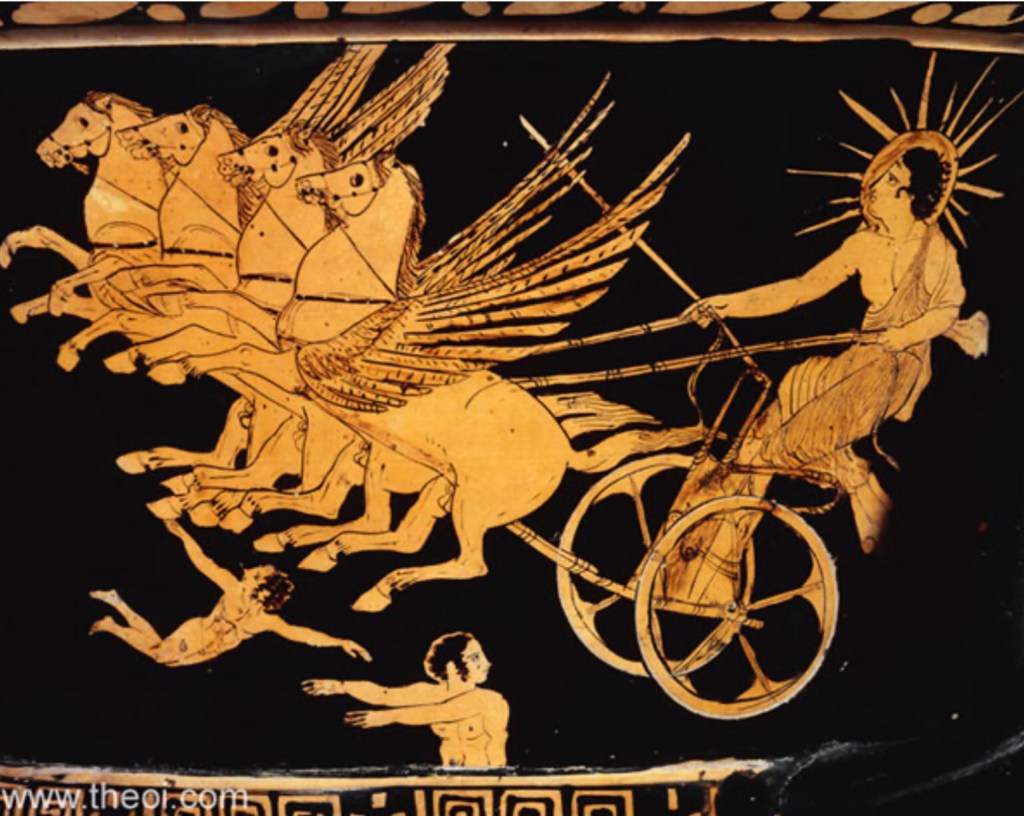
Attic Black Figure Ware Attributed to the Phrynos Painter:
Kylix, Little Master Lip, Early Archaic Period, ca. 555 – 550 B.C., British Museum, London.

Since ancient times, fathers have always given their children sage advice. Even the Greek gods of myth and time, before the age of philosophers and kings, believed in fathers as the source of wisdom. Athena, the goddess of wisdom, sprang full grown from the head of Zeus, the King of all the gods on Mount Olympus. Perhaps the Greeks were onto something, for wisdom is acquired by those who survive their rash youthful learning experiences.

Some father figures would keep their children from all harm by never allowing a child take appropriate, age level risks and not preparing them gradually for these rites of passage. We don’t throw a new born child into the deep end of a pool and expect them to swim. Instead, we bathe them, wade them, let them kick as we pull them around the shallow end of the pool, and finally we get their faces underwater to blow bubbles so they can learn to breathe correctly. Finally we’ll teach them how to use their arms in coordination with their feet and breathing so they can travel across the pool.

If we let them on a motorized vehicle, a child is safer on a sanctioned go cart track than on a neighborhood street. This is because he or she would be racing in smaller horse powered carts, with age similar racers. As a wise parent, you’d have to decide if your child has the maturity, focus, and discipline to handle not only her own car, but to be aware of his position relative to other carts on the track. Also, does your child have his emotions under control and is she willing to learn from her mistakes?

Greek mythology has an instructive story of Helios, the sun god, who couldn’t say no to his son Phaeton’s request to drive the sun carriage drawn by the fiery steeds. In Ovid, Metamorphoses 1. 750 ff, Helios instructs his son:

Chariot of Helios, the Sun God

“Keep to this route; my wheeltracks there show plain. Press not too low nor strain your course to high; too high, you’ll burn heaven’s palaces; too low, the earth; the safest course lies in between. And neither rightwards towards the twisting Anguis (Snake) nor leftwards swerve to where the Ara (Altar) lies. Hold in the midst! To fortune I resign the rest to guide with wiser wit than yours. See, dewy Nox (Night) [Nyx] upon the Hesperian shore even while I speak has reached her goal. No more may we delay; our duty calls; the day dawns bright, all shadows fled. Come take the reins!

Or take, if yet your stubborn heart will change, my counsel, not my chariot, while you may, while still on firm foundations here you stand before you mount between my chariot wheels, so ignorant, so foolish!–and let me give the world light that you may safely see.”

Fall of Phaeton Sarcophagus

As in all Greek myths, this didn’t end well for Phaeton, for he couldn’t control the high spirited steeds. As the chariot ricocheted too near the earth, scorching it, and too high in the sky, burning the stars, Zeus blasted the boy with a thunderbolt to save the earth from harm and placed him among the stars in the constellation The Charioteer. His body fell to earth into the river Po. Once again it’s a reminder the middle path is safest and best.

Canadian soldiers on D-Day read message on their plane

As we polish off the last of the leftovers from Memorial Day, we celebrate D-Day, which commemorates June 6, 1944, the day the Allies invaded Normandy from England during World War II. Every military order has had a day and hour designation since 1918, but this battle on the five French beaches was so large and so difficult to organize, it’s the one we know as “D-Day.” Not only was there a need for a long day, a day near a full moon to guide ships/airborne troops, and strong tides for an amphibious assault, but the Allies had to coordinate politically and militarily to get everyone on board. Eisenhower’s personal notes give us an inkling of the troubles of this endeavor (link below). To date it remains the largest amphibious invasion in history and marked the beginning of the end of World War II. It also marked the end of the Nazi regime led by Hitler, which was responsible for the death of over 6 million Jews.

Two roses and two U.S. flags on Omaha Beach in Saint-Laurent-sur-Mer, Normandy, on June 5, 2019.

As a small rabbit, who’s startled at any sharp noise and frightened by even the shadows of passing clouds, since it might be a hungry predator, the thoughts of wars set me to trembling, trembling, trembling, like the lyrics of the old slave spiritual, “Steal Away:”

“Green trees are bending, poor sinners stand trembling; The trumpet sounds it in my soul, I ain’t got long to stay here.”

Yet appeasing tyrants never ends well, as Winston Churchill noted: “Each one hopes that if he feeds the crocodile enough, the crocodile will eat him last. All of them hope that the storm will pass before their turn comes to be devoured. But I fear greatly that the storm will not pass. It will rage and it will roar ever more loudly, ever more widely.”

Speaking of storms, the Atlantic hurricane season runs from June 1 to November 30, and we can expect the first named storm to form in mid to late June. We rabbits who enjoy a beach vacation always need to keep a weather eye out. Not only do we need to be aware of the intense sun, especially for our baby rabbits, but if the city officials issue evacuation orders for extreme weather, we ought to leave, even if we give up vacation days. While we’re at the beach, or the lake or poolside this summer, we can read or listen to books. June is audiobook appreciation month, but books with pages are more likely better suited to beaches, since high heat and small grains of sands can adversely affect expensive cellphones, tablets, and readers.

Alzheimer’s disease is the most common form of dementia

Another way we can pass our summer and stretch our minds is to try new experiences. June is Alzheimer’s and Brain Awareness Month. If we only exercise the same brain paths, but fail to build new ones, our brains become “clogged up.” This is rabbit speak for what doctors call Tau protein tangles. Dementia seldom only causes Alzheimer’s-related changes in the brain. Any number of vascular issues—problems that affect blood vessels, such as beta-amyloid deposits in brain arteries, atherosclerosis (hardening of the arteries), and mini-strokes—may also be at play. Vascular problems may lead to reduced blood flow and oxygen to the brain, as well as a breakdown of the blood-brain barrier, which usually protects the brain from harmful agents while allowing in glucose and other necessary factors.

My dad, a brilliant doctor, had Alzheimer’s disease in his later life. While he remembered all of his medical training, he knew none of his family in his later years. He also confused my large poster of Captain Picard I had taped on the parsonage back door with an actual person. I kept “Picard” there as a reminder to MAKE IT SO, but daddy thought I had a strange balding man standing in my laundry room.

Make it so—said the strange man in my laundry room

In someone with Alzheimer’s, a faulty blood-brain barrier prevents glucose (energy) from reaching the brain and prevents the clearing away of toxic beta-amyloid and tau proteins. This results in inflammation, which adds to vascular problems in the brain. Because it appears that Alzheimer’s is both a cause and consequence of vascular problems in the brain, researchers are seeking interventions to disrupt this complicated and destructive cycle. All the more reason for us to eat more plants, less fried foods, more complex carbohydrates, and fewer animal fats.

Baked chicken, roasted veggies and corn on the cob

June is also Professional Wellness Month and National Men’s Health Month. America workers tend to get about 11 days of paid vacation and 6 paid holidays per year, but more than half of these reported not using all their days off. Even those energizer bunnies who have unlimited paid time off tend to take only 10 days of vacation, and nearly half of them work at some point in time during their vacation.

When I went on vacation, I told my church secretary to call me if the church burned down or someone died. They should be able to handle most anything else. Most of what I was going to do from some distant location was encourage them and help arrange a substitute if I couldn’t get back in time. God may be available all the time, but small rabbits and vulnerable humans must rest and restore their energies to be ready for the next excitement that’s sure to come.

Rabbit and Butterfly

If you haven’t yet planned your summer vacation, you’re in luck. June is Great Outdoors Month and National Camping Month. You can take your rabbit family to the Oceans or to the Rivers, or you can visit a Zoo and an Aquarium. It’s also Women’s Golf Month, but you can take the rest of the rabbit family with you and have a good time on the links. If you want to stick closer to home, remember June is a fine time to enjoy the exercise in the dirt. It’s Perennial Gardening Month and National Rose Month. Do a service for your garden during National Pollinators Month. Plant basil and dill alongside your tomato plants to discourage hornworms. The scents also attract pollinators like butterflies and other beneficial insects.

On a personal note, I’m looking forward to a summer full of crisp lettuce and tomato sandwiches on toasted whole wheat bread with avocado slices. In fact, that sounds so good, I may have to have one now, since I don’t have time to make a hazelnut cake. Here’s to books, beaches, and the bronzed bodies of summer.

Joy and peace,

CORNELIA

June Holidays and Observances 2023: Full Calender
https://www.today.com/life/holidays/june-holidays-and-observances-rcna76138

2023 NCAHM Official Book List – CaribbeanReads
https://www.caribbeanreads.com/2023-ncahm-book-list/

When is the first day of summer? Summer solstice dates explained.
https://www.usatoday.com/story/news/2023/04/07/when-is-first-day-summer/11556538002/

Season Definition: When Do They Start?
https://www.timeanddate.com/calendar/aboutseasons.html

What Is the Flexitarian Diet? – Cleveland Clinic
https://health.clevelandclinic.org/what-is-the-flexitarian-diet/

NATIONAL BLACK COW DAY – June 10, 2023 – National Today
https://nationaltoday.com/national-black-cow-day/

How To Make Tapioca Pearls At Home – Experiences
https://experiences.japancrate.com/blogs/news/how-to-make-tapioca-pearls-at-home

Creamy Coleslaw with Prunes (Ready in 5 Minutes!) – Ignite Nutrition
https://ignitenutrition.ca/blog/unlock-the-power-of-prunes/

Should I Let My Kid Drive a Go-Kart? – Our Definitive Guide | Utah Motorsports Campus
https://www.utahmotorsportscampus.com/should-i-let-my-kid-drive-a-go-kart-our-definitive-guide/

PHAETHON – Son of the Sun-God of Greek Mythology
https://www.theoi.com/Titan/Phaethon.html

Unknown Artist: Fall of Phaeton, Greek marble Roman sarcophagus, Ca. 150-170 AD., Height: 62 cm; length 220 cm.,
Florence, Galleria degli Uffizi.

Eisenhower Library: Conditions in Normandy
https://www.eisenhowerlibrary.gov/sites/default/files/research/online-documents/d-day/1944-06-03-conditions-in-normandy.pdf

Steal Away Lyrics
https://www.cusd80.com/cms/lib6/AZ01001175/Centricity/Domain/1509/Steal%20Away%20Steal%20Away%20song%20lyrics.pdf

An Appeaser Is One Who Feeds a Crocodile, Hoping It Will Eat Him Last – Quote Investigator®
https://quoteinvestigator.com/2016/04/18/crocodile/

Tropical Cyclone Climatology
https://www.nhc.noaa.gov/climo/

What Happens to the Brain in Alzheimer’s Disease? | National Institute on Aging
https://www.nia.nih.gov/health/what-happens-brain-alzheimers-disease

Average PTO In USA & Other PTO Statistics (2023) – Forbes Advisor
https://www.forbes.com/advisor/business/pto-statistics/

10 Tips for Building a Pollinator Garden | The Old Farmer’s Almanac
https://www.almanac.com/building-pollinator-garden

THE FLAGS OF MEMORIAL DAY

Abraham Lincoln, adult learning, Amanda Gorman, art, Civil War, Creativity, elections, Gettysburg Address, Imagination, Medical care, Memorial Day, Painting, pandemic

Our next to last art class before summer break was right before Memorial Day. I had my last cataract surgery on the Tuesday before, so Mike gave me a lift into class. I wasn’t quite ready to drive yet. I thought we’d be finishing the work we began last week, but that wasn’t on the program for the class. Time for an audible.

John Wesley wanted his clergy to be always ready at a moment’s notice to “pray, preach, move, or die.” We art teachers have always been able to think on our feet and pull a project out of thin air. High school debate team extemporaneous speaking events are excellent trading grounds for this life skill.

Childe Hassam (1859-1935): Flags on the Waldorf, oil on canvas, Amon Carter Museum, Ft. Worth, Texas.

Memorial Day is one of the official days for displaying the American flag. Arkansas Flag & Banner has an informative paragraph (6d) at the link below on the days to display the flag if you aren’t flying it daily. The origins of Memorial Day are shrouded in mystery, since at least 25 sites claim to be the first to decorate the graves of fallen soldiers. From Columbus, MS, on April 25, 1866, to Boalsburg, PA, in 1864, cities north and south claim the fame of being first to decorate soldiers’ graves.

On May 5, 1866, Waterloo, NY, held a ceremony to honor local veterans who fought in the Great War. Businesses closed and citizens flew their flags at half staff. Other sites were not citywide or were one time events. As a result, in 1966, Congress declared Waterlo, NY, the “birthplace of Memorial Day.”

Frederic Edwin Church: Our Banner in the Sky, ca. 1861,
Fine Arts Museums of San Francisco

The Civil War took the lives of 750,000 men, not counting those who lost limbs or minds as casualties of the war, according to J. David Hacker, a demographic historian at Binghamton University, who has raised the estimate of how many deaths there were in the American Civil War from just under 620,000. One of every four soldiers failed to return home. If this devastating war took place today, 7.5 million people would have died in the fighting. As a reminder, the scourge of COVID-19 has killed 1,123,836 people in the United States alone since 2019.

Of course, as our ability to preserve life improves, our reverence for life increases. We just disagree at which point in time life should be honored and respected, and which lives are worth honoring and respecting. Perhaps we’re just a people given to disagreement and division by nature, or our old wounds from this ancient conflict continue to fester and boil, so we pick new battles to fight with words, rather than blows.

1908 Decoration Day Card

America lost 1,190,085 total service members’ lives from 1775 to 1991. The ongoing Global War on Terror has yet to be accounted because it isn’t finished. Although they underestimated the number of Civil War casualties, this one home grown conflict was responsible for about half of the war deaths of all American service members. It was a cruel war, in a brutal age. Things we take for granted today—dog tags for identification, mobile army surgery hospitals, anesthesia, sanitary camp conditions, humane treatment of prisoners, nutrious rations, and other civilized practices—weren’t part of the Civil War experience. In the American Civil War, twice as many soldiers died of disease as from hostile action.

Jasper Johns: Flags, lithograph, 1967-68, MOMA, NY.

World War II was the first war to have more deaths caused from the battlefield than from other causes. Greatly improved public health in armies has lowered the toll of disease to a fraction of what it was in earlier centuries. Modern military medicine has now allowed larger and larger armies. In short, military medicine, while greatly improving the care of the individual soldier, has enabled nations to have bigger armies and greater wars. We see the unfortunate consequences of these improvements in the current aggressive Russian attempt to takeover an independent Ukrainian democratic state against its people’s will.

After several years together in our art class, Gail and Mike are both now open to making an artwork that presents an idea or an emotion, more than a representation of a form. Not everything has to be a photorealistic rendering of an object before us. We do this often enough to build our skills of seeing and drawing, but we also need to build our expressive skills also. As an example in the spiritual life, we can spend our days in intercessory prayer, but we also participate in contemplative prayer or meditation to exercise the less analytical ways we can meet God in prayer.

Mike: Freedom Flag

Mike went on vacation recently and had the opportunity to take an art class with a different instructor. He suggested Mike give up his dedication to the small brush, a comment I often make. Now he’s excited about the freedom of the large brush and is exploring this new tool and technique.

Gail’s Flag

Gail mixed the reds and blues to make violet, as if the colors of the flag were washing into to one another. Many artists have changed the colors of the flag, but kept the design, or they kept the colors and destroyed the design. This is artistic license or creative interpretation. We make our statements with our images. She also changed the stars into circles by using a sponge to put down the paint. It was a good day for experimenting.

Cornelia DeLee: Gold Star Family Flag, acrylic with mixed media on canvas, 2023

I came home to finish up my painting with memories of visiting Civil War battlefields on my mind. I thought of those ancient days when families were able to identify their loved ones only by the special knit patterns of the socks on the bodies, or by the last letters to relatives pinned into their shirts. The Gold Star Mothers began during World War I when the mothers of fallen servicemen united to share their grief. By 1928, it was an official organization and the bereaved families were recognized with a pin.

Jasper Johns: Two Flags, lithograph, 1981, Phillips.

When I lived in San Antonio, I ocassionally visited the various military hospitals in town. There I saw the photos of the Medal of Honor recipients and read the summaries of their noble deeds. I always renewed my dedication to my less dangerous occupation afterward. Those who serve are a different breed from an ordinary person such as I. Perhaps Abraham Lincoln said it best in his 1863 Gettysburg Address:

“It is rather for us to be here dedicated to the great task remaining before us, that from these honored dead we take increased devotion to that cause for which they gave the last full measure of devotion, that we here highly resolve that these dead shall not have died in vain, that this nation, under God, shall have a new birth of freedom, and that government of the people, by the people, for the people, shall not perish from the earth.”

Gordon Parks, American Gothic, Washington, D.C., 1942.
Photo : Courtesy Gordon Parks Foundation

Amanda Gorman’s excellent 2021 inaugural poem, “The Hill We Climb,” has a section which echoes the sentiments of the post Civil War era, when Memorial Day celebrations first began:

We are striving to forge a union with purpose
To compose a country committed to all cultures, colors, characters and conditions of man
And so we lift our gazes not to what stands between us
but what stands before us
We close the divide because we know, to put our future first,
we must first put our differences aside
We lay down our arms
so we can reach out our arms
to one another
We seek harm to none and harmony for all
Let the globe, if nothing else, say this is true:
That even as we grieved, we grew
That even as we hurt, we hoped
That even as we tired, we tried
That we’ll forever be tied together, victorious
Not because we will never again know defeat
but because we will never again sow division
Scripture tells us to envision
that everyone shall sit under their own vine and fig tree
And no one shall make them afraid
If we’re to live up to our own time
Then victory won’t lie in the blade
But in all the bridges we’ve made
That is the promised glade
The hill we climb
If only we dare.

Howard Finster: Not Just A Piece Of Cloth, 1990

On this Memorial Day, over 150 years later, the wheels of justice are setting the sentences for the insurrectionists who attempted to impede the peaceful transfer of power to the newly elected government of the United States. We do well to remember the prescient words of Frederick Douglass, who said at Arlington National Cemetery on Memorial Day in 1871:

“We must never forget that victory to the rebellion meant death to the republic. We must never forget that the loyal soldiers who rest beneath this sod flung themselves between the nation and the nation’s destroyers.”

At 3:00 pm on Memorial Day, let’s pause for a moment and remember those who sacrificed body, mind, or life to keep our nation free, or to bring freedom to a nation that so desperately yearns for it.

Joy and Peace, and thanks to those who keep it for us,

Cornelia

United States, US Flag Code | FlagandBanner.com
https://www.flagandbanner.com/flags/united_states_flag_code.asp

The Origins of Memorial Day—US Department of Veterans Affairs
https://www.va.gov/opa/publications/celebrate/memday.pdf

Professor: Civil War Death Toll May Be Really Off : NPR
https://www.npr.org/2012/05/29/153937334/professor-civil-war-death-toll-may-be-really-off

United States – COVID-19 Overview – Johns Hopkins
https://coronavirus.jhu.edu/region/united-states

Veterans Affairs Fact Sheet America’s Wars 2019
https://www.va.gov/opa/publications/factsheets/fs_americas_wars.pdf

War, Medicine & Death – PMC
https://www.ncbi.nlm.nih.gov/pmc/articles/PMC9762220/

Gettysburg address delivered at Gettysburg Pa. Nov. 19th, 1863.| Library of Congress
https://www.loc.gov/resource/rbpe.24404500/?st=text

Rabbit! Rabbit! Welcome to May!

art, beauty, Civil War, inspiration, King Charles of England Coronation, Lassen Volcanic National Park, Memorial Day, Mother’s Day, Painting


If April showers bring May flowers, your bunny buddy now lives in a blooming greenhouse. Yes, record rainfall and stupendous snowfall are causing even the deserts to bloom. For years, the long-term drought in California has caused a lack of wildflowers. With the recent floods and deep snow in the mountains, the full extent of this year’s super bloom in California won’t be clear until peak bloom hits places like Lassen Volcanic National Park in the northern part of the state. Peak bloom is expected there in June or July, after all the snow there has thawed.

Lassen National Park Wildflowers

However, the second week of May is National Wildflower Week. The wildflowers growing by the side of public roads and in national parks are protected. Don’t pick wildflowers or their seed heads there. On private property, ask permission before picking them. Obtain seeds from reliable sources that cultivated the flowers for their seeds. When choosing flowering plants that aren’t wild or naturalized in your area, mimic their growing conditions. You may have to supplement rainfall with occasional watering and/or fertilizing. While we’ve had a good rain this year, xeriscaping or planting your lawn with wildflowers or local plants is a great way to save on water. It won’t look like a manicured carpet, however. Maybe your flowerbeds can get wider each year until the carpet is gone.

Lassen Volcano Cone

I visited the Lassen Volcanic National Park last October when I journeyed out west to visit the grand rabbits. While I could have flown over all this great land we call America, I decided to travel by car. We have too many beautiful natural treasures which we protect and conserve in our national parks. Also, after several years of confinement due to the pandemic, I had some pent up travelling in my blood. The park is 166 square miles large and contains the world’s largest plug volcano, which was first active 27,000 years ago. It last erupted in 1917 when the park was set aside.

DeLee: Great Dixie Fire, mixed media and acrylic paint

This is also the site of the great 2021 Dixie Fire, which started on July 13, and burned for 104 days. Five California counties and 963,276 acres burned. Why would anyone outside of the immediate area care about this? The forests in Lassen Volcanic National Park can store almost as much carbon as 600,000 Americans emit in one year. Unfortunately, park forests are dying from a combination of threats: increased drought, wildfire, and pathogens like beetles and blister rust. Lassen Volcanic Park rangers are working to protect vulnerable tree species through monitoring, research, and management actions whenever necessary and appropriate.

As a rabbit of faith, I live on this earth, and as long as I live here, I’m called to care for it, to do no harm to it, and to heal it where it’s hurting. This is the same calling I have for our fellow creatures, for the same God created us all and cares for us all equally. I love the wildflowers so much, I even stop on the roadside to take a selfie among them. The Highway Patrol in Liberty, North Carolina doesn’t take kindly to strangers taking selfies among their precious poppies. I was “checked out” and asked to “move along.” Perhaps they’re not used to rabbits with cameras? I do seem to attract the attention of the local law whenever I’m out photographing.

Selfie in Field of Poppies: May 8, 2014

Other weekly celebrations we rabbits can enjoy in May are:

Week One—Be Kind to Animals Week and Nurse’s Week
Week Three—National Bike Week and National Police Week
Week Four—Emergency Medical Services Week

Some celebrations get the entire month of May. Among them are:

Asian American and Pacific Islander Heritage Month
Older Americans and Foster Care Month
Gifts from the Garden and National Salad Month
Lupus Awareness and National Blood Pressure Month
National Barbecue and National Hamburger Month
Date Your Mate and National Photograph Month
National Bike Month

May 3–World Press Freedom Day Rabbit Writer

In 1993, the UN General Assembly proclaimed May 3rd each year to be World Press Freedom Day. This is a UN Sponsored annual event. A free press is a bedrock necessity for democracy to thrive. When ruling powers control the messages which the rabbit population gets to hear, we rabbits only hear one side of the story. This discourages freedoms of thought and expression of opinion. While democracy sometimes seems messy, the voices of the majority will ultimately prevail. Yet the voices of the marginalized must be recognized and respected, for their rights can’t be curtailed to please the majority. A free press brings both voices to light.

AI Image: Rabbit with Light Saber

May 4–The National Day of Prayer always happens on the first Thursday of May. This year it coincides with “May the Fourth Be with You” day. Each of these celebrations speaks to the deep need within the rabbit heart for a connection to a power greater than ourselves. At some point in time, each one of us will realize our ego self is really a false self or mask of bravado and competence. When we cast off this mask, we might feel naked toward the world, but God or the Force can finally fill our emptiness. Most rabbits will never take off this false mask, however, for being naked in God’s or the Force’s presence is unimaginable to us.

“Rabbit Handstand” wood sculpture by Teresita Gonzalez

May 5–Cinco de Mayo is always on May 5th. I was playing cards with some rabbit friends the other night. One has a grand baby born on Cinco de Mayo. “What day is Cinco de Mayo?” he asked. “It’s always May 5th, silly.”

“Why is that?” All the card players answered, “Because Cinco de Mayo is a date, like Christmas is a date, when something important happened.”

This is a group of white rabbits, as you may have gathered, but some of us have spent time in Hispanic communities. The Mexican army defeated the French army at the Battle of Puebla on May 5, 1862. This single military battle signified the defeat of a European colonial power, a victory for the Mexican people, and is the root of Cinco de Mayo. Mexican Independence Day is September 15th. We can celebrate along with our brother and sister rabbits by sharing Mexican food and drink, enjoying music, and dancing. And what rabbit doesn’t love the excuse for a party?

St. Edward crown for May 6–Coronation of King Charles of England has over $4.5B worth of jewels in it.

While we American rabbits cast off our colonial bonds back in the 18th century, some of us have never lost our fascination with the royal family and their sagas. Plus we’re always up for a celebration if it means drink and cake. After the death of Queen Elizabeth, her son Charles became King of England. His official coronation ceremony will be smaller in many respects than Elizabeth’s: only 2,000 guests rather than 8,000 and business or military attire will be worn, but no tiaras or ermines allowed.

Since 1066, Westminster Abbey has been the site for regal coronations , beginning with William the Conqueror on Christmas Day. The St. Edwards Crown weighs in at 5 pounds, so the new monarch will live out the saying, “Uneasy lies the head that wears a crown,” (Shakespeare, Henry IV. Part II, 1597). While the Crown Jewels are considered priceless, a 2019 study found in total, the coronation crown would cost $4, 519, 719. That would buy a bunch of carrots and then some!

Coronation chair with the Stone of Scone

The Stone of Destiny (also known as the Stone of Scone) is an ancient sandstone block weighing 336 pounds, which was used for centuries in the coronation of Scottish kings before being seized in 1296 by King Edward I, who had it built into a throne at Westminster Abbey. There it lay until Christmas Day 1950, when, in an audacious caper, four Scottish nationalist students tried to steal it and take it back north of the border. Eventually, in 1996, the stone was returned to Scotland. Now, top-secret and high-security preparations are being made to take it back down to Westminster Abbey for the coronation.

King Bugs Bunny wears Ermine and a Crown

If the rabbit ears on your Telly are angled just right, and your alarm clock goes off in time, you can watch special coverage from Saturday, May 6, from 5 to 10 a.m. ET on your local ABC station. If you have a BBC streaming service, they’ll definitely carry the public events, including the concert on the day after. This will be a public holiday in Great Britain, of course. Both Apple and Spotify have official playlists (link below).

Secretariat Wins Triple Crown, Jockey Ron Turcotte Looks Back at 31 Length Victory in 1973 Belmont Stakes

After the early morning British crowd, if you’ve swilled enough caffeine and nibbled enough scones (the pastry kind, not the stones) you can chill with a mint julep and the Kentucky Horse Royalty congregating at the Derby’s 149th Run for the Roses. This year, of the twenty horses lined up for the opening bell, eight have a pedigree traced to the Triple Crown winner of 50 years ago, Secretariat. No horse has ever matched his magnificence or personality. To watch him pull away from the pack and leave them in his dust was a wonder to behold. He’d be waiting for those stragglers in the winner’s circle when they finally crossed the finish line, and be looking at their sweating, huffing hulks, as if he were thinking, “What took you guys so long?” One of a kind, Secretariat won the 1973 Derby, coming from last to first, and five decades later, he’s still the Derby record holder at 1:59 2/5.

Kentucky Derby Hats are Extraordinary

If you attend in person, the dress code is “Business Casual:” Jackets and blazers, vests, shirts with collars, sweaters, dresses, pantsuits, slacks and capri pants are appropriate. Hats are expected. If watching from your rabbit den, anything goes. Coverage is on NBC from 12 noon to 7:30 pm ET. The race itself goes off at 6:57 pm ET. That’s a lot of mint juleps, so pace your imbibing or you’ll miss the actual race itself.

May 14–Mother’s Day

On May 8, 1908 the US Senate voted against Mother’s Day! WHAT WERE THEY THINKING? Afterall, at that time, only men could vote and all the holidays honored men. Maybe those senators realized what side their bread was buttered on. A day to honor the Grandpaws might have passed with votes to spare. The women behind this cause weren’t to be denied. Even before the ratification of the 19th ammendment giving them the right to vote in August of 1920, President Woodrow Wilson proclaimed the second Sunday in May as a perpetual memorial day of honor to mothers everywhere.

We rabbits today can’t even imagine any of our elected officials treating us as less than our brothers before the law, disrespecting the 14th Amendment of our Constitution:

“No State shall make or enforce any law which shall abridge the privileges or immunities of citizens of the United States; nor shall any State deprive any person of life, liberty, or property, without due process of law; nor deny to any person within its jurisdiction the equal protection of the laws.”

Mr. Peabody’s WABAC Machine

Today some of our legislators seem to live in a distant century, having traveled there with the cartoon Sherman in Mr. Peabody’s WABAC (way-back) machine. I sometimes wish this way-back machine had enough power to transport its passengers back to the earliest days of creation. Maybe having a front row seat and hearing God’s voice in God’s act of creating the first human beings would work a mighty change in their hearts and minds:

So God created humankind in his image,
in the image of God he created them;
male and female he created them.

~~ Genesis 1:27

May 25—Carry a Towel Day

May 25–Carry a Towel Day. If you are at loss to understand this holiday, please read The Hitchhiker’s Guide to Understanding The Galaxy. When the earth is moments away from demolition by aliens so they can construct an intergalactic highway, Ford Perfect saves young Arthur Dent. Together they travel across space and time to find the meaning of the universe and return to save earth. If you aren’t into this holiday, the good news is it’s also National Wine Day. Splurge on a fine vintage, invite a friend or two over to share the conversation and discuss the meaning of life.

Memorial Day Celebration rooted in memories of our Civil War

Memorial Day will be celebrated on Monday, May 29, for the 3 day federal and state holiday. The banks will also close. Some of my Southern rabbit cousins still refuse to recognize Monday as Memorial, because “It ought to be on the 31st, like it was in granddaddy’s day.” I note they still attend the family picnics and shoot off firecrackers over the weekend. They are old bunnies and have gotten somewhat crotchety as the years have put a kink in their hop. I find myself getting older also, but I keep reminding myself each new day is a blessing and an opportunity for growth. I try to keep learning new things so my brain will keep adjusting to new challenges.

As the calendar passes from May to June, the weather will beckon us to spend more time outdoors, so let’s remember these words written in 1848 from the Rev. Charles Kingsley, also known as Parson Lott:

Attributed to Henry Peacham: Tinted drawing of Book 2, Emblem X: Cum severitate lenitas (Severity with Mercy), British Library, London.

“Never lose an opportunity of seeing anything beautiful. Beauty is God’s hand-writing—a way-side sacrament; welcome it in every fair face, every fair sky, every fair flower, and thank for it Him, the fountain of all loveliness, and drink it in, simply and earnestly, with all your eyes; it is a charmed draught, a cup of blessing.”

Or as the ancient manuscript illuminator wrote, Cum severitate lenitas (Even in harshness, there is mercy.).

Until June, I leave you with joy, peace, and rainbows,

Cornelia

King Charles Coronation Playlist https://www.townandcountrymag.com/society/tradition/a43399168/king-charles-coronation-playlist-spotify/

More May Holidays
https://www.holidayinsights.com/moreholidays/may.htm

Dixie Fire Statistics
https://www.fire.ca.gov/incidents/2021/7/13/dixie-fire/

Lassen Volcano National Park
https://www.nps.gov/lavo/learn/nature/climate-change.htm

Westminster Abbey Stone of Scone
https://www.westminster-abbey.org/about-the-abbey/history/the-coronation-chair

A Coronation F.A.Q.
https://www.nytimes.com/interactive/2023/style/king-charles-coronation.html?smid=nytcore-ios-share&referringSource=articleShare

2023 Kentucky Derby
https://www.courier-journal.com/story/sports/horses/kentucky-derby/2023/04/27/secretariat-descendants-2023-kentucky-derby-field-at-churchill-downs/69992169007/

Beauty is God’s Handwriting
https://quoteinvestigator.com/2014/05/21/beauty/

How Much is the British Coronation Crown Worth? https://britishheritage.com/history/edwards-coronation-crown-worth

Rabbit! Rabbit!

arkansas, art, Astrology, Civil War, cosmology, elections, Faith, Forgiveness, haiku, inspiration, Lost Cause, Painting, Pi Day, rabbits, renewal, sleep, Spirituality, Spring Equinox, St. Patrick’s Day

Welcome to March 2023

This rabbit was shivering during the last week of February.

March is here and the wild hares of the rabbit clan have come to visit. I’m shivering on a cold, dreary, and rainy day, but I’m about to have a cup of steaming hot tea and put dinner on the stove. While I waited for the water to boil, I visited the open AI project out of curiosity. My old daddy used to say, “curiosity killed the cat,” but I think he was trying to keep me safe by not poking my nose into some dangerous places. Without curiosity, we never learn anything new or stretch our horizons. We’d live a sad, constricted life if we always stayed inside the lines and never pushed the boundaries.

The chat bot took my name and combined it with that of Cornelia Adele Strong Fassett, who painted the Florida Case Before the Electoral Commission, to describe the importance of “Cornelia DeLee, artist.” Also according to the chatbot, I am long dead, so I must be communicating from “yonder.” Fassett’s painting was about the contested presidential election of 1876.

The Florida Case before the Electoral Commission
Oil on canvas, by Cornelia Adele Fassett
This painting now hangs on the third floor of the Capitol.

In January, 1877, when the Electoral College met, 20 votes were contested, but neither side would concede the election. Congress passed a law empowering the Electoral Commission at the end of January. Ten days of deliberations passed before the 20 votes passed to the Republican candidate, an act which the Democrats protested until they received assurances federal soldiers would leave the Southern states. With Reconstruction at an end, Congress declared Rutherford B. Hayes the new President of the United States on March 2, only two days before his term began.

The Civil War and the Reconstruction years have marked our nation with an ongoing trauma, which has passed from generation to generation. At some point in time, we’ll have to heal, for continually pouring salt into that old wound will keep it festering and it won’t ever heal. Then we’ll pass it down to another generation once more. However, if scripture has any truth to teach us, humankind continues to reenact the sins of our ancestors, even when we know their stories and have the God given gifts of redemption from these shackles of death and shame. But now this rabbit is preaching, and some would say, “meddling once again.”

Update: Heather Cox Richardson, a noted writer of American history, reminds us once again how Southerners rewrite our history to make us more heroic and powerful. The Federal Army didn’t leave the south right away, but stayed in some states for awhile. See the note below.

I’ll change the subject. I’m not much on poetry, but I thought I’d ask ChatGPT to write a “Poem in Praise of March.” After all, World Poetry Day is March 21, so I thought I’d give the ChatAI a run for its money (it’s free right now, while in training stage). The Artificial Intelligence project was delighted to instantly produce the following example:

March, the month of windswept skies,
A time when winter softly dies.
The earth awakens from her sleep,
As days grow long and nights grow deep.

The snows of winter start to thaw,
And nature’s beauty starts to draw
A tapestry of green and gold,
As springtime’s treasures now unfold.

The birds return with joyful sound,
Their melodies now all around.
The trees bud out, the flowers bloom,
And life returns to end the gloom.

March, the month of change and hope,
A time to cast off winter’s scope.
The promise of new life and growth,
As nature’s beauty takes its oath.

So let us praise this month of light,
For all the wonders it brings to sight.
And may we cherish every day,
As we welcome spring in every way.

I was so amazed the Artificial Intelligence ChatBot could spit this out so quickly, I typed in, “Thank you.”

AI Enhanced Image by Jos Avery: Erik’s Escape

It immediately answered, “You’re welcome! I’m glad you enjoyed the poem. If you have any other questions or requests, feel free to ask!” I quickly closed the application before it became sentient and asked for my hand in marriage or social security number and tried to enroll me in a monthly cryptocurrency investment program. Yikes!

Speaking of poetry, even the folks at Bloomberg News are writing haikus about global food shortages:

Onion shortage looms.
Prices rise, nutrition wanes,
Governments take aim.

When I was a child, my brothers and I amused ourselves by lining up dominoes in artful patterns all morning long. After lunch and before our required afternoon nap, we’d touch the first domino in line, and have a wicked joy of watching our entire morning’s work fall one after another. A food shortage (or a toilet paper shortage) happens much the same way in our global economy. Onion prices are still soaring across the globe and fuelling inflation, so countries like Morocco, Turkey and Kazakhstan have taken action and secured supplies.

Close to 40kg of smuggled produce was discovered in the luggage of Philippine Airlines crew members on Friday.
(photo credit: PHILIPPINE CUSTOMS OFFICE VIA WALLA NEWS)

Because onion prices are going up due to scarce supply, the price of other fruits and vegetables (such as carrots, tomatoes, potatoes, and apples) also are rising and hampering their availability across the globe, according to the United Nations and the World Bank. In fact, prices have increased so much that onions briefly cost more than meat in the Philippines, and some flight attendants were caught smuggling them out of the Middle East.

This didn’t end well for either the attendants or the produce, since the food was sent out for destruction (it’s illegal to import food, except through proper customs) and the personnel got reprimands and retraining. Word to the wise: hoarding onions isn’t a good idea, since whole, raw onions will last two to three months when stored in a cool, dry place (between 45 and 55 degrees F). Places that provide these conditions may include your cellar, pantry, unheated basement, or garage. Usually, at room temperature, onions last only 2 to 3 weeks. Over the long term, the frugal shopper will buy some scarce items at a higher prices and other items at lower cost when the product is in season and at a surplus. The average price over a year will even out.

Former President Carter signing First Women’s History Week Proclamation

March is Women’s History Month. In February 1980, President Jimmy Carter issued the first Presidential Proclamation declaring the Week of March 8th, 1980 as National Women’s History Week. In 1987, Congress passed Public Law 100-9, designating March as “Women’s History Month.” Every president since then has recognized the gifts, graces, and achievements of America’s women by presidential proclamation. Other important women’s days in March we recognize are International Women’s Day (March 8), Harriet Tubman Day and National Women and Girls HIV/AIDS Awareness Day (March 10).


The Jewish celebration of Purim begins on March 6 at sundown and ends on the 7th at sundown. The festival recalls Queen Esther’s faithfulness to God and God’s saving providence for God’s marginalized people. We should always remember God’s grace is wider than ours, even if the faithful seemed to be “assimilating to the current culture.”

Sleep/wake/cycle

Daylight Savings Time begins March 12, with all of us rabbits settling our clocks forward one hour before we go to bed the night before. If you have difficulty remembering which direction, there’s a motto for this event: “Spring forward, and Fall back.” No one falls forward and springs back—silly rabbits maybe, but not the smart rabbits, who have the good sense to “Spring forward, and Fall back.”

National Pi Day March 14— Not all pies are square

The Ides of March 15 were bad luck for Julius Caesar, but originally the Ides of March once signified the new year, which meant celebrations and rejoicing. Two years before his death at an assassin’s hand, Caesar himself had changed the Roman calendar so the Romans celebrated the new year in January. Some people really don’t like change at all. Plus they don’t like military dictatorships.

People celebrate St. Patrick’s Day on March 17 all over the world, whether they’re Irish or not. While the San Antonio River runs green downtown, Hot Springs National Park will have its First Ever 20th Annual World’s Shortest St. Patrick’s Day Parade on the 98 foot long Bridge Street, which is the world’s shortest street in everyday operational use.

Map of Hot Springs St. Patrick’s Day Festivities

Spring Equinox on March 20 can’t come soon enough for this rabbit. Just knowing the light will become stronger with each passing day is a medicine for my spirits. So what if the pollen follows soon after? Eventually, that too will be history and we bunnies will find something else to fuss about. After all, nothing is certain except for change. None of us can stop the circuit of the stars in the heavens above or cease the changing seasons.

The Three Graces of Spring

We can adjust to these great cycles of change, just as we can grow in love for one another and learn to forgive both ourselves (for our falling short of perfection) and others for harming ourselves. If we rabbits wait till the last moment for our death bed reconciliations, we may not have the time or opportunity to make amends with the ones from whom we’ve estranged ourselves.

If you think you’ll be foolish doing this, I suggest you desensitize yourself and celebrate International Talk Like William Shatner Day on March 22. I asked ChatGPT for a haiku in the voice of William Shatner. On the third try, I got something I thought resembled his breathless cadence and broken phrase delivery. I could almost hear him emphatically delivering the words GO and MUST!

Breathless stars above,
Silent darkness, vast and deep,
Boldly go, we must.

Ramadan starts during the evening of March 23 and lasts until sundown on Thursday, April 20. Muslims commemorate the gift of the Koran to Muhammad by fasting if physically able, declaring their faith, prayers, charity, and pilgrimage..

BRITON RIVIÈRE, UNA AND LION, NINETEENTH CENTURY

Remember, if March comes in as a lamb, it will go out as a lion, or so the ancient weather proverb goes. The saying may have its origin in the stars, for at this time of year, Leo is the rising sign; by April, it’s Aries. (“Kid” or “ram” doesn’t have quite the same ring as “lamb,” though.) Also, this is the season Jesus arrives as the sacrificial lamb, but will return as the Lion of Judah. Both mean, weather-wise, a false spring.

The Beast with Two Horns like a Lamb by Albrecht Dürer We don’t want March to enter or exit in this Apocalyptic vision.

To sum up, as I finish up this note on the last day of February, the high today will be near 80F and I’ll most likely turn my air conditioner back on before March comes to visit. Looking ahead to March, the Weather Channel outlook has only three days in the 70’s for my location, so Mr. Air Conditioner won’t get much of a work out. I only see one night in the 30’s, so even Mr. Heater will get light workouts in March. As one wag put it on their restaurant sign:

That was February; I don’t think think we’ll see 80’s in March

Until next month, I hope you have onions and potatoes in abundance, and you enjoy green eggs and ham, or green beer, or green tea.

Joy, Peace, and welcome to Springtime,

Cornelia

NOTE from Heather Cox Richardson, Letters from an American, March 2, 2023—this corrects my research.

What did not happen in 1877, either before or after the inauguration, was the removal of troops from the South.

That legend came from a rewriting of the history of Reconstruction in 1890 by fourteen southern congressmen. In their book Why the Solid South? Or Reconstruction and Its Results, they argued that Black voting after the Civil War had allowed Black people to “dominate” white southerners and virtually bankrupt the region and that virtuous white southerners had pushed them from the ballot box and “redeemed” the South. Contemporaries had identified the end of Reconstruction as 1870, with the readmission of Georgia to the United States. But Why the Solid South identified the end of Reconstruction as the end of Republican rule in each state.

In 1906, former steel baron James Ford Rhodes gave a date to that process. In his famous seven-volume history of the United States, he said that in April 1877, Hayes had ended Reconstruction by returning all the southern states to “home rule.” In his era, that was a political term referring to the return of power in the southern states to Democrats, but over time that phrase got tangled up with what did happen in April 1877.

During the chaos after the election, President U.S. Grant had ordered troops to protect the Republican governors in the Louisiana and South Carolina statehouses. When he took office, Hayes told Republican governors in South Carolina and Louisiana that he could no longer let federal troops protect their possession of their statehouses when their Democratic rivals had won the popular vote.

Under orders from Hayes, the troops guarding those statehouses marched away from their posts around the statehouses and back to their home stations in April 1877. They did not leave the states, although a number of troops would be deployed from southern bases later that year both to fight wars against Indigenous Americans in the West and to put down the 1877 Great Railroad Strike. That mobilization cut even further the few troops in the region: in 1876, the Department of the South had only about 1,586 men including officers. Nonetheless, southerners fought bitter congressional battles to get the few remaining troops out of the South in 1878–1879, and they lost.

The troops did not leave the U.S. South in 1877 as part of a deal to end Reconstruction.

It matters that we misremember that history. Generations of Americans have accepted the racist southern lawmakers’ version of our past by honoring the date they claimed to have “redeemed” the South. The reality of Reconstruction was not one in which Black voters bankrupted the region by taking tax dollars from white taxpayers to fund roads and schools and white voters stepped in to save things; it was the story of an attempt to establish racial equality and the undermining of that attempt with the establishment of a one-party state that benefited a few white men at the expense of everyone else.

Clarence C. Clendenen, “President Hayes’ ‘Withdrawal’ of the Troops: An Enduring Myth,” The South Carolina Historical Magazine 70 (October 1969): 240-250.

Cornelia Adele Fassett | History of American Women
https://www.womenhistoryblog.com/2015/08/cornelia-adele-fassett.html

ChatGPT: Optimizing Language Models for Dialogue
https://openai.com/blog/chatgpt/

“Shortage of Onions Threatens a New Chapter in Global Food Crisis” by Bloomberg News

Onion shortage could trigger a global food crisis. Here’s what’s happening – India Today
https://www.indiatoday.in/business/story/onion-shortage-global-food-crisis-whats-happening-across-the-world-2339214-2023-02-24

Gnomologia: adagies and proverbs; wise sentences and witty sayings, ancient and modern, foreign and British : Fuller, Thomas, 1654-1734, comp :
Free Download, Borrow, and Streaming : Internet Archive
https://archive.org/details/gnomologiaadagi00conggoog

Here’s How Long Onions Last if You Store Them Properly
https://www.allrecipes.com/article/how-to-store-onions/

March Holidays and Observances 2023: Full Calendar
https://www.today.com/life/holidays/march-holidays-and-observances-rcna64226

Viral “Photographer” Reveals His Images Were AI-Generated
https://hyperallergic.com/803915/viral-photographer-reveals-his-images-were-ai-generated/

To Be or Not To Be

Alexander the Great, art, city, Civil War, cognitive maps, Creativity, Faith, Forgiveness, Healing, Holy Spirit, hope, inspiration, Painting, picasso, Reflection, renewal, Spirituality, vision

Hamlet’s famous soliloquy begins with these very words,”To be, or not to be: that is the question.” In seminary I learned one of those big fifty cent words I often had to check my dictionary for its meaning. Ontological is a word we don’t throw around in ordinary conversations. I never used it in a sermon, for its strangeness would have been a stumbling block to folks without similar training. Who am I kidding? It was often a stumbling block when I tripped over it in my reading. I finally understood it after my first year of Greek. I needed to know its meaning fully and completely to comprehend it.

Current events, however, make an auspicious teaching moment for this weird word. Ontology is a branch of metaphysics concerned with the nature and relations of being. Ontology is the the branch of philosophy which deals with abstract entities. It’s concerned with the nature of being or the kinds of things that have existence, but are outside objective experience. It deals with the first principles of things, including abstract concepts such as being, knowing, substance, cause, identity, time, and space. Our word essence carries the meaning well, for it means “the permanent as contrasted with the accidental elements of being.”

An example of an ontological statement in scripture is the discussion Jesus has in John 8:56-58 with some of the Jews who opposed him:

“Your ancestor Abraham rejoiced that he would see my day; he saw it and was glad.”

Then the Jews said to him, “You are not yet fifty years old, and have you seen Abraham?”

Jesus said to them, “Very truly, I tell you, before Abraham was, I am.”

In Shakespeare’s play of the same name, Hamlet’s whole soliloquy is about his existence, and whether he should live or die:

Whether ’tis nobler in the mind to suffer
The slings and arrows of outrageous fortune,
Or to take arms against a sea of troubles,
And by opposing end them? To die: to sleep;
No more; and by a sleep to say we end
The heart-ache and the thousand natural shocks
That flesh is heir to, ’tis a consummation
Devoutly to be wish’d. To die, to sleep;

Ontology comes from the Greek root ontos, ōn, which is the present participle of einai, of the verb to be. As I’ve watched the unfolding horror of this “Russian special exercise” on Ukrainian soil, I’m struck by the sense of Hamlet’s description of the struggles of life:

To sleep: perchance to dream: ay, there’s the rub;
For in that sleep of death what dreams may come
When we have shuffled off this mortal coil,
Must give us pause: there’s the respect
That makes calamity of so long life;
For who would bear the whips and scorns of time,
The oppressor’s wrong, the proud man’s contumely,
The pangs of despised love, the law’s delay,
The insolence of office and the spurns
That patient merit of the unworthy takes,
When he himself might his quietus make
With a bare bodkin?

“To be” is the ontological insistence for the Ukrainians, for they desire to exist as a free people in a free nation. They resist occupation and occupiers. Dictatorship isn’t in their five year plan, or in their distant future, if they can help it. The surrounding nations have suddenly come alive in their recognition of Russia’s unfortunate foray into this breadbasket of Europe.

Yet even as the Ukrainian people are being killed in their streets, for no reason other than their citizenship; and their homes, hospitals, museums, and public buildings are reduced to smithereens by cluster bombs and artillery fire; they fight for their land and their freedom. I watch for one hour on the evening news, for I believe our world must stand witness to this horror.

Yes, some will turn away, for they have too much trauma in their own lives to bear the pain of others. Others will watch and say this isn’t our problem. If we remember our scripture, the chosen disciples abandoned Jesus in his hour of pain and need, but the women stayed by his side until his last breath. Then they came to dress his dead body’s wounds, but found an empty grave, while the men were holed up in a locked room for fear of the Jews (John 20:19).

Humanity is always our concern and when inhumane acts or conditions prevail, the human responsibility is to bear witness and to share the burden. As Paul writes in Galatians 6:2—

“Bear one another’s burdens, and in this way you will fulfill the law of Christ.”

Hamlet muses on, dithering as contemplates taking his own life, but he takes no action for fear of what awaits him in the world beyond.

who would fardels (burdens) bear,
To grunt and sweat under a weary life,
But that the dread of something after death,
The undiscover’d country from whose bourn (boundary)
No traveller returns, puzzles the will
And makes us rather bear those ills we have
Than fly to others that we know not of?
Thus conscience does make cowards of us all;
And thus the native hue of resolution
Is sicklied o’er with the pale cast of thought,
And enterprises of great pith and moment
With this regard their currents turn awry,
And lose the name of action.

While none of us know with certainty what lies beyond this world, for no one has ever returned with souvenirs, people of faith have trusted God to be always with them, even in the worst of times. As Paul writes in Romans 8:35, 37-39—

“Who will separate us from the love of Christ? Will hardship, or distress, or persecution, or famine, or nakedness, or peril, or sword?…No, in all these things we are more than conquerors through him who loved us. For I am convinced that neither death, nor life, nor angels, nor rulers, nor things present, nor things to come, nor powers, nor height, nor depth, nor anything else in all creation, will be able to separate us from the love of God in Christ Jesus our Lord.”

Battle of Issus Mosaic, Detail: Portrait of Alexander the Great

Artists across the centuries have responded to the horrors of war, if they aren’t held in thrall to the purveyors of such deeds. Those who exist to magnify the glories of battle are there as servants of powerful leaders, not as representatives of the fragility of the human condition. Think of Alexander the Great and his route to deification, first as a glorious leader, then as a god.

The Alexander Mosaic depicts a moment of victory in Battle of Issus in which Alexander has broken through to Darius of Persia, whom he defeated and shocked, before Darius was at the verge of fleeing. The mosaic is as great as Alexander himself, for it’s about 9 feet by 17 feet in size and contains over 1.5 million individual blocks of color, or tesserae. This Roman copy of an original Greek fourth century BCE painting dates from the second century BCE and is in the Museo Nazionale, Naples, Italy.

Goya: The 3rd of May 1808 in Madrid, or “The Executions”, oil on canvas, 1814, Prado Museum, Spain.

Here we see Goya painting the horrors of war and its impact on humanity. His inspiration comes from the French army’s assassination of a group of Spanish patriots during the 1808 rebellion. The Spanish heroes are illuminated by the intense light, but their faceless enemies aren’t easily visible in the darkness from which they operate. Not only does the design make plain Goya’s feelings, but his psychological understanding of the scene as well.

As Matthew writes in Jesus’ teaching kernel known as “The Sound Eye,”

“The eye is the lamp of the body. So, if your eye is healthy, your whole body will be full of light; but if your eye is unhealthy, your whole body will be full of darkness. If then the light in you is darkness, how great is the darkness!” (6:22-23)

Picasso: Guernica

Probably the best known war painting of our modern era is Picasso’s Guernica. He painted it in response to the Nazi bombing of Guernica, a Spanish town in the Basque region during the Spanish Civil War. At about 16:30 on Monday, 26 April 1937, warplanes of the German Condor Legion, commanded by Colonel Wolfram von Richthofen, bombed Guernica for about two hours. Germany, at this time led by Hitler, had lent material support to the Nationalists and were using the war as an opportunity to test out new weapons and tactics. Later, intense aerial bombardment became a crucial preliminary step in the Blitzkrieg tactic.

Guernica, Picasso’s most important political painting, has remained relevant as a work of art and as a symbol of protest. It has kept the memory of the Basque town’s nightmare alive. While Picasso was living in Nazi-occupied Paris during World War II, one German officer allegedly asked him, upon seeing a photo of Guernica in his apartment, “Did you do that?” Picasso responded, “No, you did.”

Käthe Kollwitz, Woman with Dead Child, 1903, etching on paper. Courtesy: © Getty Research Institute, Los Angeles and Artists Rights Society (ARS), New York

Lest we forget, while wars are often started by those in power, it’s the mothers who suffer when young soldiers are killed in action. Some are fortunate enough to have the body of their loved one to hold, but it’s a sad consolation prize. How heart rending it must be for the families whose children were left behind as casualties of war. As the old Cold War era 1985 Sting song about nuclear war reminds us—

There’s no such thing as a winnable war
It’s a lie we don’t believe anymore…
We share the same biology, regardless of ideology
But what might save us, me and you
Is if the Russians love their children too.

The great sadness of this brutal war foisted on the Ukrainian people is while we’re free to see and own the pain inflicted on others, too many of us will turn away. Then again, we often have difficulty acknowledging our own pain and weakness, for we prefer to see ourselves as whole, strong, and unconquerable. All of us have a weak place and we all have an emptiness that needs to be filled. Some of us fill this emptiness by seeking power and control, while others choose various substances or activities to overuse. A few will let God’s Spirit fill us, as Paul writes in 2 Corinthians 4:7—

“But we have this treasure in clay jars, so that it may be made clear that this extraordinary power belongs to God and does not come from us.”

Cornelia DeLee: Obliterated Ukrainian Landscape, Maxar Satellite Image, Apple Pencil, 2022.

When I see the satellite imagery of the obliterated Ukrainian towns, I recall my childhood memories of the old ones in my family repeating their ancestors’ stories of the troubled times during the Civil War. I can easily imagine in Ukraine, for several generations to come, all the stories of pain, survival, and resilience that will be told as they rebuild their nation from the ground up. In the midst of this ongoing disaster, they’re already thinking “How can we build back better?”

This is a great lesson for all of us. If our life hits a major roadblock, we can either give up, scale the wall, or find a way around the wall. Another option is to make peace with the wall and find a way to be happy there. Since Putin is tearing down all the walls for the Ukrainian people, they’ve decided to double down on being Ukrainian. “To be me” is “to be free” and that means “to be Ukrainian.” As their land lies in ashes about them, those who once also spoke Russian, a similar language to Ukrainian, now find that language dead as ashes in their mouths.

Cornelia DeLee: Ukrainian Town Reduced to Ashes, acrylic on canvas, 2022.

To win friends and influence people requires a gentle hand, not the ham-fist of a dictator. I only wonder if the Russian people will ever understand this. But they may have been slaves of their state for so long, they don’t know the sweet taste of freedom. Perhaps only those who believe in a forgiving God, who allows God’s people the freedom to make mistakes and gives them through the reconciling grace of renewed fellowship, are able to come through such disasters. Those who are “sinners in the hands of an angry god” must think their fate is destiny and accept it.

So the questions remain:

  1. What IS the nature of YOUR God?
  2. How does God’s nature affect your understanding of human nature?
  3. Does your view of humanity reflect your image of God or do you see humanity through “God’s eyes?”
  4. Read the Prodigal Son in Luke 15:11-30 and answer the questions again

Some days I AM Joy and Peace,
Cornelia

Hamlet, Act III, Scene I [To be, or not to be] by William Shakespeare
https://poets.org/poem/hamlet-act-iii-scene-i-be-or-not-be

Why is the Alexander mosaic significant?
https://www.rampfesthudson.com/why-is-the-alexander-mosaic-significant/

The 3rd of May 1808 in Madrid, or “The Executions” – The Collection – Museo Nacional del Prado
https://www.museodelprado.es/en/the-collection/art-work/the-3rd-of-may-1808-in-madrid-or-the-executions/5e177409-2993-4240-97fb-847a02c6496c

Pablo Picasso: Guernica
https://www.pablopicasso.org/guernica.jsp