NOTE: This extraordinary story comes from Arguable by Jeff Jacoby, an opinion writer for the Boston Globe, on December 12, 2023. I’m sharing it with all of you because even in the worst of times, even with the least of resources, if we have faith in God, we can be a light unto the world.
In his transcendent prison memoir, “Fear No Evil,” Natan Sharansky tells the story of his nine years in the Soviet gulag, a fate to which he was sentenced for the crime of wanting to emigrate to Israel. Even now, 35 years after it was published, it is an amazing read, a great narrative by a great man who refused to be intimidated by his captors. The more the KGB tried to berate or punish him for his Jewish pride and Zionist yearning, the more joyfully and fearlessly Sharansky embraced them.
To mark this week of Hanukkah, consider this extraordinary incident recounted in “Fear No Evil.”
Davis Stark Design, Architectural Digest 2017
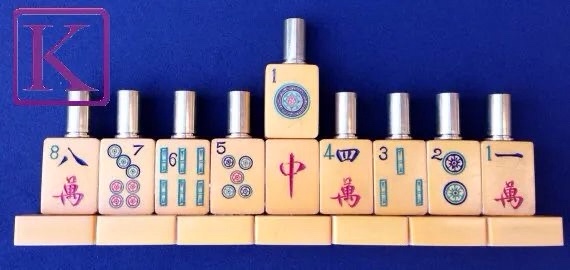
Sharansky was in the Siberian prison camp of Perm 35 and Hanukkah was drawing near. Intent on observing the holiday as best he could, Sharansky had a menorah constructed from some wooden scraps. A few candles were found, and each evening Sharansky lit his menorah, reciting the blessing, and describing to his fellow prisoners — none of them Jewish — the story of the Maccabee rebellion long ago. On the sixth night of Hanukkah, the authorities confiscated his menorah and candles. When he demanded to know why, a prison guard claimed that the menorah was made from “state materials” and therefore illegal.
Sharansky declared a hunger strike. “In a statement to the procurator general,” he recounts, “I protested against the violation of my national and religious rights, and against KGB interference in my personal life.”
Two days later, Sharansky was summoned by Major Osin, the prison camp warden. Osin wanted the refusenik to call off his protest before the expected arrival of an inspection committee. In that case, Sharansky said, “Give me back the menorah, as tonight is the last evening of Hanukkah.” He promised to end his hunger strike if he was allowed to light the candles.
Davis Stark Design, Architectural Digest 2017
But a protocol for its confiscation had already been drawn up, and Osin couldn’t back down in front of the entire camp. . . . I was seized by an amusing idea.
“Listen,” I said, “I’m sure you have the menorah somewhere. It’s very important to me to celebrate the last night of Hanukkah. Why not let me do it here and now, together with you. You’ll give me the menorah, I’ll light the candles and say the prayer, and if all goes well I’ll end the hunger strike.”
Osin thought it over and promptly the confiscated menorah appeared from his desk.
When Sharansky said he needed eight candles, Osin took a knife and cut the candle into eight stubs. Then, with amazing audacity, Sharansky said that the ceremony required everyone present to stand with head covered, listen to the blessing, and answer “Amen.”
Osin complied. He stood behind his desk, donned his major’s cap, watched as Sharansky kindled his eight candle stubs, and then waited for his prisoner to recite the blessing. Speaking in Hebrew — which Osin, of course, did not understand — Sharansky recited a blessing he had composed himself: “Blessed are you, O God, for allowing me to light these candles. May you allow me to light the Hanukkah candles many times in your city, Jerusalem, with my wife, Avital, and my family and friends.”
Then he had a brainstorm.
Inspired by the sight of Osin standing meekly at attention, I added: “And may the day come when all our enemies, who today are planning our destruction, will stand before us and hear our prayers and say ‘Amen.’ ”
“Amen,” Osin echoed back. He sighed with relief, sat down, and removed his hat.
Sharansky writes that he returned to his barracks “in a state of elation.” Who can doubt it? What magnificent chutzpah! What a triumph of the spirit! And what an uplifting reminder that even in the depths of the gulag — even in a time and place filled with the enemies of Jewish faith and freedom — those who refuse to fear can turn the table on their oppressors and dispel the darkness with a candle’s light.
From Book Blurb: For anyone with an interest in human rights—and anyone with an appreciation for the resilience of the human spirit— he illuminates the weapons with which the powerless can humble the powerful: physical courage, an untiring sense of humor, a bountiful imagination, and the conviction that “Nothing they do can humiliate me. I alone can humiliate myself.”
Hachette Books: Use HOLIDAY23 for 20% off site wide until 12/31. (Order by 12/13 to get your gift under the tree!)
This link also has links to other retailers. Price is set by publisher.
Nativity at Night by Geertgen tot Sint Jans, c. 1490, after a composition by Hugo van der Goes of c. 1470; sources of light are the infant Jesus, the shepherds’ fire on the hill behind, and the angel who appears to them
The damaged Drobytsky Yar memorial near Kharkiv, Ukraine after reportedly being hit by Russian artillery fire, on March 26, 2022
As the days grow shorter and the nights lengthen, the chill air adds to the darkness of our world. We can give into this dour outlook, especially this year with devastating wars in Ukraine and Gaza, or we can light a candle against the gathering gloom. Cultures across history have seen the time before year end as an opportunity for reflection, concern, or fear. Others have found reasons to rejoice.
Rainbow Menorah
Hanukkah (inauguration) is the eight-day Festival of Lights, which occurs in 2023 from sunset December 7 to December 15. It’s a moveable festival, for in 2024 the holiday will occur from December 25 to January 2. The Jewish calendar is a lunar calendar, not a solar calendar. This holiday celebrates the rededication of the Second Temple after the victory of the Maccabees over the Seleucid Greeks in 164 BCE. On discovering in the temple a vial of unpolluted oil, with only enough to light the candle for one day, this oil kept the candle burning for eight days. To commemorate this miracle, faithful Jews now light a special menorah with nine candles. The ninth candle is called the “helper” or “shammash” candle. The root word is from the Hebrew for “servant.”
Helping Hand Menorah
While not everyone is Jewish, all persons can learn from the menorah and the shammash candle. We may have only a little to give, but with God’s help it can be multiplied many times over. We can all be a helper candle, and bring a light to the candles who need a light. Many in this season experience a loss of some kind. Some are mourning a loved one, others have broken relationships, or have lost jobs or status. We are not our jobs and we aren’t our paychecks, but we are the beloved children of God. God will love us when everyone else turns aside. God will remember us when others forget we are alive.
Perhaps these darkening days at the end of the year are why people in all parts of the world have brought fire and light to this time of the year. The Yule Festival in German and Scandinavian countries was part of the pagan festival incorporated into Christianity’s Christmas celebrations. It likely began as a winter solstice or year-end celebration. “Yule” became a name for Christmas about the 9th century, and in many languages yule and its cognates are still used to describe that holiday.
Father Christmas and the Yule Log
The burning in a giant fireplace of a large Yule log until it’s reduced to cinders is one of my favorite mythic memories of the season. Alas, growing up in the Deep South, gas logs were the closest fireplace equivalent, and these were the same yesterday, today, and tomorrow. We rarely turned on the flickering colors of these blue flames because cold nights were few and far between.
By 336 CE, the Christian church in Rome celebrated Christmas on December 25, which coincided with the Roman winter equinox festival of Saturnalia. In medieval England, Christmas was a 12-day festival involving all kinds of revelry, from plays to wild feasts to pageants celebrating Jesus’ birth. Music, gift giving, and decorations all became the norm. Anyone who’s been in a choir singing “The Twelve Days of Christmas” with its repetitive “and a partridge in a pear tree” has those ancestors of ours to thank. Some traditions never die!
Our family stitched and sequined one exactly like this.
Christmas is better known for decorated trees, however. The use of evergreen trees and wreaths in religious ceremonies dates from ancient Roman times, if not earlier. However, the first documented use of a tree in a winter Christmas celebration wasn’t until 1510. In that year, members of a merchant’s guild in Riga, Latvia, placed a tree in the town square. They decorated it with flowers, ribbons, and dried fruit. After the festivities—which included the singing of songs and dancing—were concluded, they burned the tree as a great bonfire to close out the celebrations.
The Grinch Torches Whoville’s Christmas Tree into a Bonfire
Christmas trees gained popularity in Germany and other parts of northern Europe by the 1700s, but the practice of decorating a pine or fir tree during the holiday season remained virtually unknown in the English-speaking world prior to the 19th century. When Queen Victoria married her German cousin Prince Albert in 1840, the Christmas tree became widely accepted and practiced throughout the British Isles.
1836 edition of The Stranger’s Gift: A Christmas and New Year’s Present
In the United States, the practice of placing a decorated tree inside the family home was most likely introduced by German immigrants who arrived soon after the Revolution. The otherwise unassuming volume seen above, the 1836 edition of The Stranger’s Gift: A Christmas and New Year’s Present, is significant for it’s the first book printed in the Americas containing an image of a Christmas tree. Franklin Pierce in 1856 was the first president to erect a tree in the White House. In the United States, Christmas wasn’t celebrated with much gusto until after the Civil War, which reinforced for many the importance of home and family. In 1870, after the war’s end, Congress made Christmas one of nation’s first federal holidays.
Franklin Pierce in 1856 was the first president to erect a tree in the White House.
Light has always been a part of winter festivals, with their signature long, dark nights. Electric Christmas lights are a modern spin-off of the old-fashioned candles that Germans and Scandinavians placed on their trees. Thomas Edison, inventor of the lightbulb, also invented the first strand of lights and hung them outside his Menlo Park, New Jersey laboratory in 1880. In 1882 his business partner, Edward H. Johnson, created the first Christmas tree illuminated with colored lights. In 1895, President Grover Cleveland placed multi-colored electric lights on the White House tree. Since electricity wasn’t available except to the wealthy, most people didn’t have electric lights on their trees at home. Not until the end of the 1920s were electric lights affordable for the average family.
Fast forward to the 1950’s and the postwar period of rural electrification and large family gatherings, colored electric lights of every kind were readily available to the middle classes, not just the wealthy. This was the era of big bulbs and bubble lights, but in a few years, inexpensive miniature colored and white lights imported from China would become popular. Now even single parent households could decorate both the house and tree to their hearts’ content.
Untitled (Lux in tenebris inest—Light in the darkness) Elisa Sighicelli 2003/2003
The lights bring out our hope of what’s good and wonderful in this world. Christmas and Hanukkah are times when the light burns bright, even when the days are dark. If these holidays didn’t exist, we would need to invent them, for we need the reminders of what is light and good in the world. As Baruch prophesied (5:9):
“For God will lead Israel with joy, in the light of his glory, with the mercy and righteousness that come from him.”
While we don’t know exactly what the Christmas star was, one theory is it was a conjunction of Jupiter, Regulus and Venus. Another possibility includes a set of conjunctions of the planets Jupiter and Venus, and the bright star Regulus. In this case, the mythologies associated with the objects become important. Jupiter in Hebrew is known as ‘Sedeq’, which is often translated as meaning righteousness. Jupiter is also often viewed as being the ‘king’ of the planets. Regulus is Latin for ‘prince’ or ‘little king’, and Venus is often viewed as a symbol of love, fertility and birth. Therefore, the combination of these objects close in the sky could have led to the interpretation of the birth of the ‘King of Kings.’ We do know Matthew records the visit to King Herod:
“After Jesus was born in Bethlehem in Judea, during the time of King Herod, Magi from the east came to Jerusalem and asked, “Where is the one who has been born king of the Jews? We saw his star when it rose and have come to worship him.” (2:1-2 NIV)
Gerrit Dou: Astronomer by Candlelight, oil, late 1650s, J. Paul Getty Museum
The magi were astrologers, those who studied the heavens for the star signs of rising and falling influences in the ancient world. Herod died soon after their visit, but not before he tried to consolidate his power. He meant his dire deeds to benefit himself, but God spared his son by sending a message to Joseph in a dream to flee to Egypt with Mary and Jesus. The magi were warned not to return to Herod also. This one who John wrote about in the opening chapter of his gospel (1:5):
“The light shines in the darkness, and the darkness has not overcome it.”
Gerardo Dottori: Nativity, 1930/1930, Museum of modern art
As we celebrate the holidays of light this year, remember to be a “shammash”, or a servant of light, and don’t let this present darkness overwhelm you. Your one light shining may be the brightness that brings someone safely home. Today I wore my bright pink exercise pants, even though I’m sinusy and achy all over. I made at least one person’s day when I said, “They’re stretchy, so I can eat more Christmas cookies!” We spread the joy even when the Grinch has stolen ours. This is a way of taking the darkness back, by making others feel better.
“Gloom begets gloom,” my daddy always said, “so if you wake up on the wrong side of the bed, it’s best to go back and get out on the other side.” Some folks today don’t have much of the Christmas or holiday spirit, for they’re only looking at the dark side of world events or at the shrinking purchasing power of their dollar.
Unemployed people sold apples on the street corner in the Great Depression
Since the Civil War, the United States has endured thirteen depressions or recessions large enough to get noticed by those who study such things (see list below). This is an average of one about every dozen years. Of course, those of us who experience these events don’t have to study them, for we directly participate in the event. As the old saying goes, “If my neighbor loses his job, it’s a recession, but if I lose my job, we’re in a depression.” Instead, we plan for them and expect the good times won’t last forever.
Because we human beings are wont to think “our situation is unique,” we’re also great at forgetting the lessons of history. The first lesson is life is cyclical and what goes up will come down. The second lesson is what goes down will eventually go back up. My long experience suggests when folks are in the “down cycle,” they forget upward progress is possible. In college we used to joke, “been down so long, it looks like up to me!”
It’s always darkest before the dawn.
Some say recessions are “necessary” in economic cycles to remove excess, reprice assets, and tame risky behavior. None of these negative factors would exist except for human greed. When Mary and Joseph went to Bethlehem to register for the census, they were also enrolling for the purpose of taxation. The Romans practiced tax farming in their provinces. Whoever had the account had to raise a certain amount for the empire, but could keep whatever excess they raised for themselves. Excessive taxation on the conquered land and people stoked their hopes for a messiah to rid them of this evil. No wonder the signs and wonders attending the birth of Jesus were fulfilling the ancient prophecies, as Matthew wrote (2:6):
‘And you, Bethlehem, in the land of Judah, are by no means least among the rulers of Judah; for from you shall come a ruler who is to shepherd my people Israel.’
Church of the Nativity, Bethlehem. Star over the Grotto
In the times of darkness, we always look to the light as a reason to hope. As the magi saw a star rising in the east and believed an important person would arise in the land of Israel, we today look for glimmers of light to give us hope for the day to come. Some people see the wars, earthquakes, and crookedness of people and think we’re entering the end times. Churches and radio preachers are making hay with the Book of Revelation, forgetting it was a specific book written for a unique audience and time. We have been in the “end times” since Christ arose from the dead. As Matthew (28:20) records his words to the disciples in Galilee:
“And remember, I am with you always, to the end of the age.”
Since we’re always with Christ, we will always have his light, as Zechariah prophesied in Luke 1:78-79–
“By the tender mercy of our God, the dawn from on high will break upon us, to give light to those who sit in darkness and in the shadow of death, to guide our feet into the way of peace.”
The famous Banksy’s Armored Dove of Peace, the painting of a peace dove wearing a flak jacket. The dove is painted on a wall near the separation wall between Bethlehem (Palestinian Territories) and Israel. Nov. 18, 2023.
In the midst of wars in the Ukraine and in Gaza, where people are suffering and dying, we can lose sight of the vision of light and peace, while we focus on darkness and death. The Christian community in Palestine, which usually hosts hordes of Christmas pilgrims in Bethlehem Square, won’t be celebrating this holy season this year in solidarity with Palestinians in Gaza. Instead, they’ll set up a small nativity scene covered with rubble. It’s a reminder when the Christ child came into a suffering world over two thousand years ago, his birth was a hope for the oppressed and the poor. Every Christmas we have the opportunity to care for those who struggle to make ends meet.
Great Depression family at mealtime
In the Great Depression, families lost homes, farms, and lived in shantytowns called Hoovervilles. President Hoover spoke of a childhood Christmas memory:
“I do vividly recollect a Christmas upon that farm when the sole resources of joy were popcorn balls, sorghum, and hickory nuts; when for a flock of disappointed children there were no store toys, no store clothes; when it was carefully explained that because of the hard times everything must be saved for the mortgage. The word ‘mortgage’ became for me a dreaded and haunting fear from that day to this.”
1950’s Christmas Tree: we kids were Team Tinsel, but the folks were Team Ornaments. Our tree never looked like this!
I have some ancient memories of the cyclic hard times experienced by my family. I recall the late 50’s Eisenhower influenza recession dimly because it was the only time I ever saw my daddy cry. We had a brand-new Ford station wagon, but couldn’t afford to drive it except on Sundays. My dad brought money home daily from his office, so mother and we kids would walk to the local grocery to buy food the next day. He cried because he kept his office full of patients, but half of them couldn’t pay for his services. Mother was very practical and reminded him, “This too would pass. Trouble is only temporary.” In the fall, she took a schoolteacher position to help out. That Christmas we hand decorated sequins on felt shapes the “Twelve Days of Christmas” for a tree skirt. I passed this extravagance on to a nephew when I downsized my home.
We decorated the early days more than the later days. Time management wasn’t our best gift, but we had a great time doing this together.
I also remember the 1970’s economic slowdown very well. I got married during this time. After my husband and I bought our silver wedding rings, we had $16 left in our pocket. I was certain we had jumped off a height with no parachute, but we somehow managed day to day. To keep up “appearances,” we gave away some of our wedding gifts as Christmas gifts to other family members. I thought it was wrong, but now I realize I don’t care about those items today. I was more concerned about “saving face,” since someone might recognize we were regifting. We managed with food from our organic garden and meat from a deer my husband harvested in the autumn. But I no longer eat tuna casserole, having lost my taste for this staple of my poverty years. Gifts aren’t important, but people are.
The 1980’s had a slump related to the oil embargo. When oil money dries up, art teachers lose their jobs, as do all the other “frivolous employees” elsewhere. I got an insurance sales position, with a guaranteed six-week paycheck. I was amazed I had a talent for sales, but I was good at discovering needs and matching products to people’s ability to pay. My best sales close was, “If you’re not here to provide for your family, how will they be able to keep their current lifestyle?”
Having a simpler Christmas this year? Consider an alternative tree…
I lost my house to foreclosure during the 1990’s subprime mortgage crisis. I lost my credit cards and almost lost my daughter to suicide. I learned some things are more important than achievements or possessions. In the depths of the worst of times, gifts aren’t necessary. Being a light for others, helping others, giving yourself to those who need hope in these seemingly hopeless times is important. During this time, I drew hope from God’s words to Nathan in 2 Samuel 7:5-6—
“Go and tell my servant David: Thus says the LORD: Are you the one to build me a house to live in? I have not lived in a house since the day I brought up the people of Israel from Egypt to this day, but I have been moving about in a tent and a tabernacle.” I drew hope, for if God didn’t need a permanent home, but stayed with God’s people, then if I had no home title, God would still go with me wherever I laid my head.
Christmas Lights on Church Street
As a people, we always want to tie God to a place or to locate the Spirit to a site, but God is always bigger than our imagination and our attempts to circumscribe God’s existence. We want to restrict God’s love to a few, but God insists on loving those from whom we look away and exclude. In the midst of the chaos of my losses and suffering, I discovered God was calling me to the ministry.
Gislebertus: Flight into Egypt, 1120-1130, Stone Capitals at St Lazare, Autun, France.
Why does God call the least, the last, or the losers to God’s work? God wants to be glorified, not the person who does the work. God needs people who understand suffering and have been seasoned by it, rather than hardened by it. The wounded know the wounds of others, but they also know the path to healing. This is why we find the Christ child in a stable, not in a palace; and have shepherds and foreigners come to visit, but not his family or friends. It’s also why the Holy Family flees to Egypt as refugees to avoid Herod’s death sentence for the Jewish newborns. If we’re having a less than “perfect” holiday this year, perhaps we’re only having a bad hair day in comparison to the suffering of that first Christmas.
When I get to struggling, for the aches and pains of age are catching up to me, I can get in a low mood thinking, “I used to pop out of bed and do 12 things before lunch.” Now I need six cups of coffee to get my lunch going! Of course, I’m past my platinum anniversary and my hair color matches my age. On days like this, I look to Paul’s admonition in 1 Thessalonians 5:16-18, which rings across the ages as a clarion call:
Rejoice always, pray without ceasing, give thanks in all circumstances; for this is the will of God in Christ Jesus for you.
I wish each and every one of you a Merry Christmas and a Wonderful New Year. I plan to take a sabbatical from my Rabbit-Rabbit series in 2024, since I’ve neglected my sci-fi blog and my pandemic project quilt needs stitching together. I’m going to work on my art more and write about the spiritual intersections of the creative life.
Merry Christmas and Happy New Year
Joy and Peace, Cornelia
You can keep up with my other writing and thoughts:
List of depressions and recessions since the Civil War:
the Panic of 1873,
the Great Depression when 13 million people were out of work,
a recession after WWII,
another after the Korean War,
the Eisenhower influenza recession in 1957-58,
a recession in the auto industry in 1960-61,
and another year long recession in 1970-71 under Nixon.
In 1973, OPEC quadrupled oil prices, and that shock along with the stock market crash sent the world economy into recession.
In 1980, energy prices continued to rise, so when the Federal Reserve raised interest rates to curb rising prices, the economy contracted. Once again, unemployment rose to 11% and business output suffered.
We had a recession in the Gulf War from 1990-91, and then maintained the longest period of economic growth in American history up until
the Dot Com Bubble in 2001. The tech-heavy NASDAQ ended up losing nearly 77% of its value and took over 15 years to recover its losses. September 11, 2001 wasn’t a sunny day for the stock market or for America. Many people have had a pessimistic outlook on life from this date forward. It changed how we see ourselves.
In 2008-2009 another recession hit hard, making it the longest economic downturn since World War II and the deepest prior to
the following COVID-19 Recession of 2020. The former was triggered by the subprime mortgage market collapse, while the latter was the quickest and steepest of them all. While more than 24 million people lost their jobs in the US the first three weeks of April 2020, this shock was quickly ameliorated by government interventions, such as zero interest, income payments and other supplements.
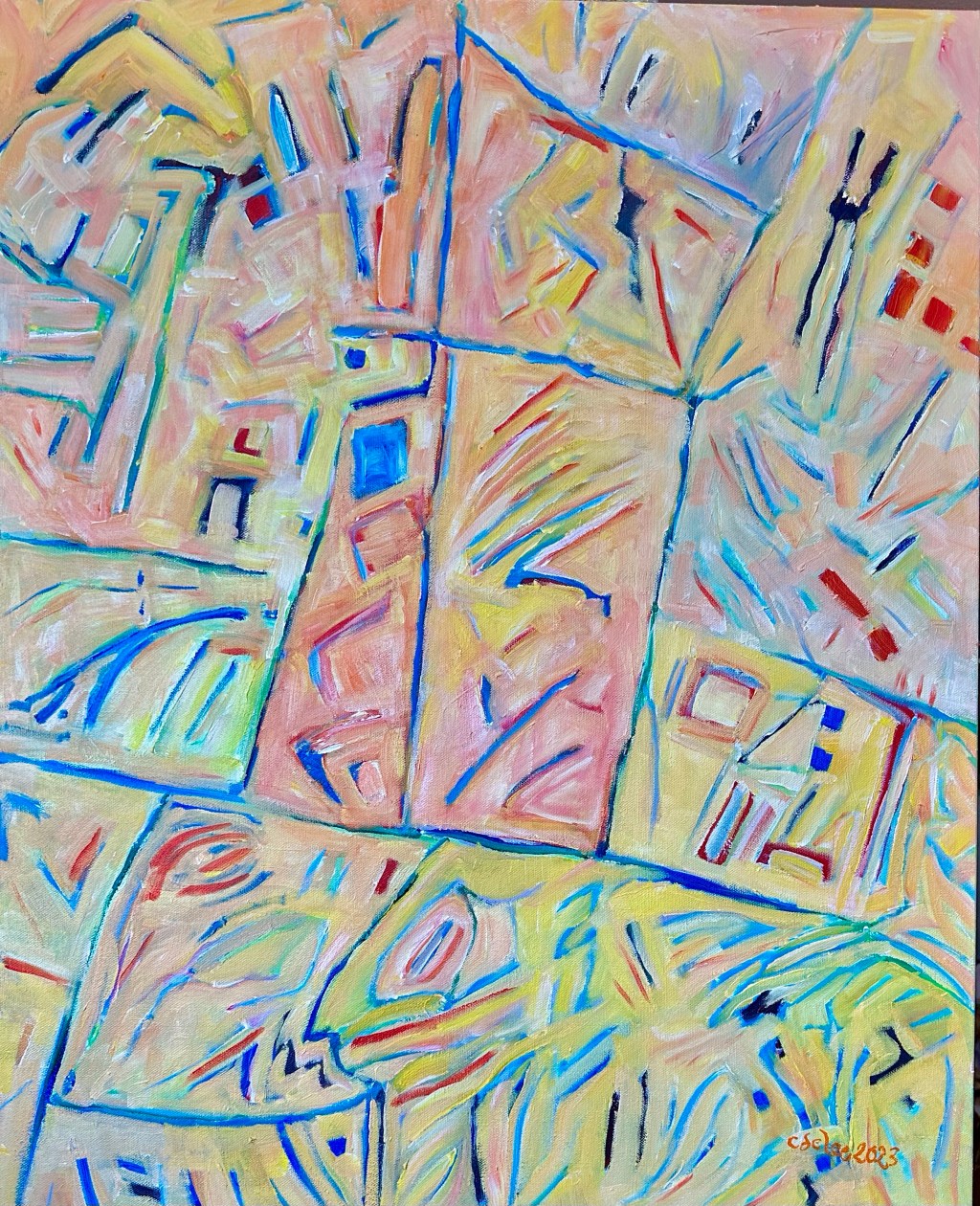
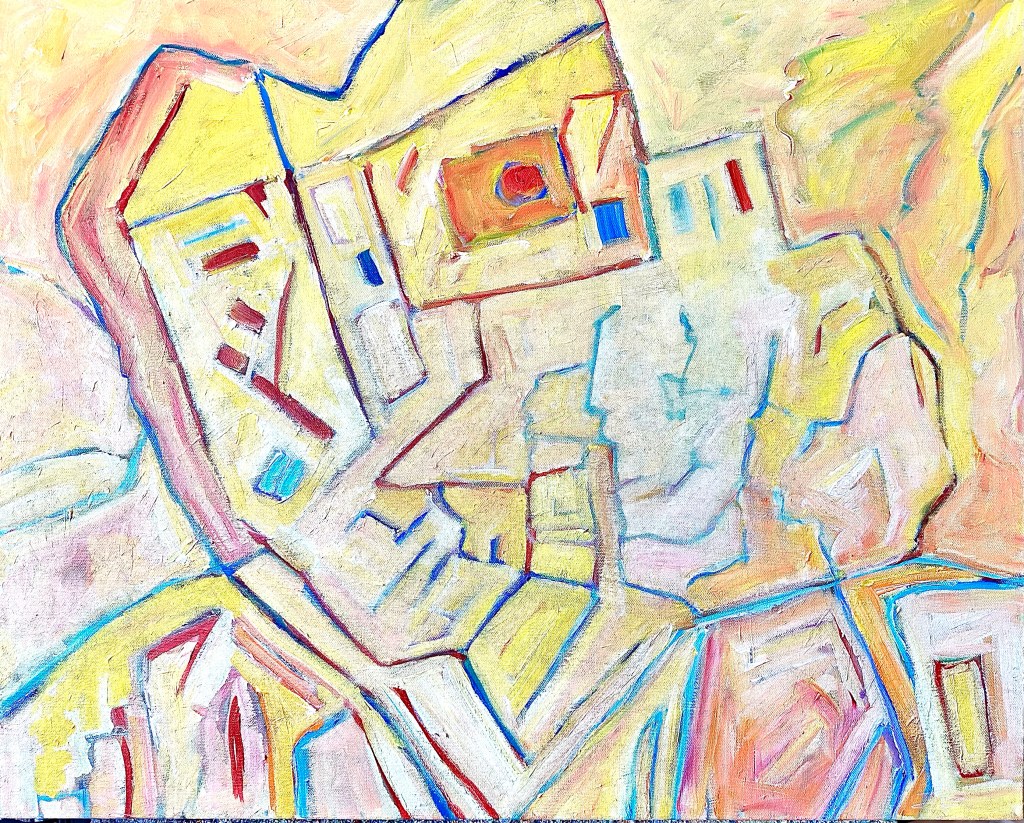
My most recent studio work explores my memories of my pilgrimage to the ancient ruins of Tel Megiddo. Why am I interested enough to make an entire series of drawings and paintings of this site, which I visited over two decades ago? First, the city was continuously occupied from the 7th or 6th millennium BCE, with the ancient tel generally left untouched and intact since its decline and subsequent abandonment around the 4th century BCE. The tels at Megiddo, Hazor, and Beer Sheba all have retained their authenticity and each have acquired the characteristic conical shape with a flattish top, protruding above the surrounding countryside. These three tels are now UNESCO Heritage Sites.
Megiddo: Marks and Memories
Excavations at Tel Meggido have uncovered about 26 layers of settlements dating back to the Chalcolithic period, or the early Bronze Age, about 5,000 years ago. Other sources say 30 layers exist at Tel Megiddo. The first four layers have been identified. This site was a Canaanite city, an Egyptian fortress, a Chariot City during Biblical times, and a prominent Assyrian and Persian city. King Solomon ruled the city in its prime in the 10th century BCE.
Megiddo: First Recorded Battle in History
The city has seen more battles than any other location in the world because of its location at the crossroads of the ancient world. The first written reference to Megiddo also happens to be the first recorded battle in history: a detailed account of the 1479 B.C.E. invasion of the Egyptian Pharaoh Thutmose III. When King Thutmose III of Egypt conquered Megiddo 3,500 years ago, the pharaoh left with, among other things: 1,929 head of cattle, 2,000 goats, 20,500 sheep, 204 horses, 200 army uniforms, and 502 bows. Megiddo is also the first recorded use of the composite bow and the first body count. All details of the battle come from Egyptian sources — primarily the hieroglyphic writings on the Hall of Annals in the Temple of Amun-Re at Karnak, Thebes (now Luxor), by the military scribe Tjaneni. Megiddo is also the site of a large chariot stable complex, called Solomon’s Stables, even though we now know they were built by Solomon’s successor King Ahab during the 9th century B.C.E.
Megiddo: Blue Version, Motions and Moods
Fortress cities sit on the 10 acre summit of Megiddo Hill or Tel Megiddo, rising 21.33 meters (about 70 feet) above the valley. Megiddo is located in the Lower Galilee region of northern Israel. Its critical location dominated the Aruna Pass (Wadi Ara or Megiddo Pass), which was the entrance to one of the few passes through the Carmel Mountains. Megiddo controlled the Via Maris, the main route between Egypt and Mesopotamia, also known as the Egyptian Way of the Sea. Christians regard this area as “Armageddon,” where the final Biblical battle between good and evil will occur.
Circular altar-like shrine from the Early Bronze Age at Megiddo. (Credit: Hanay)
The early Bronze Age temple compound at Megiddo is unparalleled for its number of temples, the continuity of cult activity and the record of ritual activity. The late Bronze Age palace is the most elaborate in Israel, and one of the best in the Levant. For the Iron Age remains, the elaborate orthogonal town plan of Megiddo has few parallels in the Levant. All three tels have impressive remains of their underground water catchments systems, which demonstrate sophisticated and geographically responsive engineering solutions to water storage. Megiddo is significant because the entire sequence of the Bronze Age and Iron Age is not only represented and excavated, but radiocarbon dated.
Megiddo: Moonlight Cityscape
Those are the travelogue statements. When on pilgrimage, one place full of stones begins to look like another after many days on the bus. Even though I was keeping notes of my journey in my paper journal, by the second week, I was hitting information overload. Each and every place was of the utmost importance, but my body was feeling the stress of constant traveling on a bus as well as the lack of good sleep from a different bed in a new hotel every single night.
Only strong coffee, lots of water, and eating three good meals a day were keeping me going. I was so excited during my pilgrimage, I was in an altered state of mind for weeks after my return home. Time slowed down and I could see more clearly for a long time. I would swear I could see individual oxygen molecules in the air, even though in my rational mind I knew this wasn’t possible. Pilgrimage is a spiritual journey, not a tourist trip of checking off various sites to say “I’ve been there and done that.” Even when surrounded by a “great cloud of witnesses” both physical and immaterial, I always knew I was walking on holy ground.
Megiddo: Motions and Moods, number 2
What does it mean to walk in the places where people have lived and died? Especially where they have clashed violently in war? The last time Americans fought a war on our home front was the Civil War. That internecine conflict was a horrific wound on our nation, an injury that hasn’t yet healed for some. I know my own daddy still carried the scars of his ancestors who fought on the battlefield to preserve slavery. He never understood why I thought that was a bad choice and why I worked to undo the damage of the war’s legacy on all Americans.
Cannon at Shiloh National Military Park
While traveling back home from viewing the Great American Eclipse, I met a man at Shiloh National Military Park, a Civil War memorial battle field. He visits these historic sites to pray for the deceased. He was from New Orleans, Louisiana, and believed those who died a violent death still wandered about, since their souls weren’t at peace. I don’t know if I believe this, but it gave him comfort to pray for the release of the hate and violence people can store up in their bodies and spirits and cause them to war upon one another.
I can say on that autumn day while I walked those killing fields, I felt the somber mystery of death and life, dignity and indignity as I walked about the silent hills and valleys. No longer do we hear the crack of the rifle or the thunder of the cannons. Rain has washed away the blood from the grassy knolls and pastures. Sunlight has dressed the wildflowers in beauty. If not for the explanatory signage, I’d never know about the extraordinary happenings at Shiloh National Military Park.
Perhaps I’m painting these historic sites of conflict because we are in a time of strife, not only abroad but at home. The actual shooting wars are going on beyond our shores, but conflicts at home are no less serious. I’m heartbroken by the devastation of the Ukrainian homeland by the Russian aggressors, and remember the ongoing tussle over the Temple Mount by the various faiths of the world. If there’s conflict beyond us, likely there’s conflict within our our own groups. The outer world usually reflects our inner world.
The stress of our United Methodist Church becoming the “Untied Methodist Church” has been rough on me. I’m carrying my stress in my neck and shoulders so much I’ve pinched the nerve to my pinky and ring fingers. They are now numb. I’m now in physical therapy for this. Medication and relaxation exercises will certainly help. One of my condo residents prayed for a “miracle cure” for me. My theology typically considers “miracles” to be reserved for situations beyond the usual care of physicians, but I know lay people use “miracles” more loosely than we clergy. Nevertheless, I appreciated their well meaning prayer for my healing. After all, God cares for both small and large problems, as Jesus reminds us in Luke 12:24,
“Consider the ravens: they neither sow nor reap, they have neither storehouse nor barn, and yet God feeds them. Of how much more value are you than the birds!”
Moonlight over Megiddo, number 1
I look at that second painting and compare it to the first painting I completed. While I attempted to keep the surface flat, I got involved in the recreation of the old city in my imagination. I connected the moonlight outside with the lamplight inside. I also added an abstract figure in the foreground. The red marks don’t work for me anymore,so I’m likely to destroy this art work. The second one I may keep, only because I learned some new colors and was brave enough to experiment with colors I don’t normally use.
Megiddo #3
In this final work, I chose only a portion of the satellite image. This allowed me to eliminate the areas which were causing me problems in the earlier works, especially the large, repeating curves. Although I’m back to my favorite yellow—I confess to being a Van Gogh fan—I used a greater variety of tints, rather than painting straight from the tubes.
Pablo Picasso once said, “Painting is just another way of keeping a diary.” If our outer world is in conflict, this drama will wash over into our inner world. It will show up in our dreams, our health, our relationships, and in other parts of our lives. If we think the late pandemic and current politics have broken relationships or distressed families, imagine what this has done to our churches. Most people go to church as an escape from this drama, hoping to find a sacred place where everyone is Imitating Christ’s Humility:
“If then there is any encouragement in Christ, any consolation from love, any sharing in the Spirit, any compassion and sympathy, make my joy complete: be of the same mind, having the same love, being in full accord and of one mind. Do nothing from selfish ambition or conceit, but in humility regard others as better than yourselves”(Philippians 2:1-3).
Unfortunately, all people bring their imperfect selves to Christ. Although Christ forgives our old sins, our sin habits remain. Most of us forget this. As an artist, I understand better than anyone the process of “going on to perfection” is both a gift of the Holy Spirit and our own work. While God could gift perfection completely, most often it’s a cooperative endeavor. This is why the studio product is sometimes a thrill, but other times a disappointment. Yet even in the disappointments, we can learn from our mistakes. We might need to “mistake a bunch of times” until we get focused on a new direction. We have to trust the process. Canvas is cheap. It can be reused or recycled. Plus, our salvation isn’t impaired by our detours in the studio.
Yet too often we’re hung up on the product as a reflection of our personal value or worth. If we are hurt, damaged, ill, broken,or harmed in any way, art is a therapeutic exercise for us. Monet tied the brushes to his hands when his arthritis made holding the brush too difficult. His later paintings also had freer brushwork. He could have quit, but he adjusted his expectations and his style to keep creating. As Monet once said, “I’m never finished with my paintings; the further I get, the more I seek the impossible and the more powerless I feel.” Degas was fond of saying, “Only when he no longer knows what he is doing does the painter do good things.”
If we’re in the safe, but shallow waters of certainty, we’re unlikely to grow to the deeper depths of either the spiritual or artistic realms. Most of us are afraid to cast off the anchors that keep us bound close to well known shores. We want to hear the praise of the crowd, and if we sail off for the unknown horizon, we will leave those familiar voices of the crowd’s approval behind. We can only discover the new world by leaving the old one behind, by risking a journey in faith others are not willing to undertake. Sometimes we may need to get out of the boat and risk walking across the water to meet Jesus who calls us to meet us in the midst of the strong winds and high waves.
I don’t worry about these feelings anymore, for I know they will come up, I’ll meet them, and then I’ll let them go. Our feelings of the moment are not the feelings of forever. Only one is the same yesterday, today and forever—the Lord Jesus Christ. The rest of us are still a work in progress.
April Fool! Caught you! Were you the prankster or the pranked? Even an institution as stuffy as the British Broadcasting Corporation isn’t above pranking the public on the first day of April. If a fool and his money are soon parted, then whatever the BBC was selling, they were having a jolly good time in their advertising department. You can watch their mini documentary on Flying Penguins below:
When I was at Perkins Seminary, we editors of the weekly newsletter had a tradition of an April Surprise. This followed the practice of the former Babylonian Schismatic, which was an alternative, satirical student newsletter published occasionally between 1981 and 1988.
One year, when I was coeditor, it was more of an April Debacle. My partner in crime and I were sure the beach ball bouncing off the usual chapel steeple logo would be enough to clue our community into the prank. However, we failed to realize how little sleep our fellow students actually got during school weeks, how seriously they took the printed word, and worst of all, that our newsletter also went to bishops’ widows in faraway places. This last was what got us into the real trouble.
Our faux reports of Perkins losing its accreditation due to shenanigans of prior graduates, who were in the news at the time, had graduate students storming the dean’s office. Even worse, the bishop’s widows were calling him to inquire what kind of school he was overseeing. The fact schools can only lose accreditation for their own failures (and not the trespasses of former students or faculty) never crossed anyone’s mind in the ensuing uproar. So of course, we criminals wrote handwritten letters of apology to the widows and printed retractions in the next newsletter for the students. I now understand why my mother said I sometimes take things too seriously. Still, I’ve have found others who make me look like a giggle queen.
The Giggle Queen and her Pet Rabbit
Speaking of giggles, although the historical roots of April Fool’s Day are shrouded in mystery, the British, who are mostly known for their dry wit and stiff upper lip, seem to enjoy this holiday to excess. Especially at the BBC, which back in 1957, produced a fascinating prank documentary on the Swiss Artisanal Spaghetti Industry. They showed a Swiss family harvesting ripe spaghetti strands from their spaghetti bushes. At the time because of rationing, spaghetti wasn’t widely available. After 1956 in the British Isles, Italian companies opened spaghetti factories and Italian immigrants opened restaurants. The British developed a taste for this food. As a result, some British families were so enthusiastic, they wanted to purchase their own spaghetti bushes for a home garden. Others were unhappy to be pranked. This may be one of the first times the medium of television was used to stage an April Fool’s Day hoax.
Moveable Feasts: Passover and Easter
Israel was an ancient agricultural culture and followed a lunar calendar, so sighting the full moon was important. Passover is always pegged to the Hebrew calendar, which is based on the lunar cycle. It starts in the middle of the month of Nisan, when the moon is full, typically falling in March or April of the modern Gregorian calendar. As a result, Passover typically begins very close to Easter. Easter Sunday is always the first Sunday after the first full moon after the Spring Equinox. However, due to the shorter Hebrew calendar, sometimes it gets a leap month to keep it in tune with the seasons. In 2024, when the leap month plays a part, we’ll have an early Easter on March 21st, but Passover won’t start until April 22nd.
Rabbit Last Supper
These religious holidays are forever entertwined because of the historical events of the Last Supper, which we assume was a ritual meal or Seder, and the crucifixion on a Friday, which required Christ’s body to be taken down from the cross due to the beginning of Passover at sunset.The Last Supper took place on a Thursday night, even though the actual Passover didn’t begin until Friday night.
Dali: The Sacrament of the Last Supper, 1955, oil on canvas, National Gallery of Art, Washington D. C.
As Wesley’s Notes on The New Testament observe, “Jesus took the bread—the bread or cake, which the master of the family used to divide among them, after they had eaten the passover. The custom our Lord now transferred to a nobler use. This bread is, that is, signifies or represents my body, according to the style of the sacred writers.”
We know this because Jesus was arrested in Gesthemane after this meal and then taken to the Roman Governor Pilate on Friday morning, the day of Preparation for the Passover. John 18:28 reminds us how the temple priests “…took Jesus from Caiaphas to Pilate’s headquarters. It was early in the morning. They themselves did not enter the headquarters, so as to avoid ritual defilement and to be able to eat the Passover.”
Early Handdrawn Valentine, 1814, writing in an unending circle
The Jews in the first century kept faithfulness according to laws of separation and purity, so they kept away from unbelievers on holy days. This was the biblical practice of the time. Early Christians continued this practice until Paul began his outreach to the Greek and Roman citizens of the world. When in the later gospel of John (14:15) Christ says, “if ye love me, keep my commandments, Wesley’s commentary understands this to mean: “Immediately after faith he exhorts to love and good works.” This is why we United Methodists practice an open table at Holy Communion, or the Lord’s Supper, for all who love the Lord and desire to be in love and fellowship with their neighbors are welcome at his table. We don’t exclude anyone, for God includes all people into the circle of God’s love.
Love never ends and love never dies
Since Easter Sunday is always the first Sunday after the first full moon after the spring equinox, this makes Easter a “moveable feast.” Unlike a picnic, for which we tote our fixings from our kitchen to a park or to the countryside, or unlike a house to house “progressive dinner,” Easter is called “moveable” because it’s not on a fixed date like Christmas or New Year’s Day.
Baked Ham with Canned Pineapple Rings and Cloves
My family’s Easter feast always centered about a baked ham, often covered with canned pineapple rings and studded with cloves. We were a modern American 1950-60’s family and Betty Crocker reigned in my mother’s kitchen. Just this week I saw a tv advertisement of a family feast with this very same baked ham. I suppose when the economy gets dicey, people pull out old familiar recipes from the great-great-grandmother’s kitchen. Since I have a new great-grandchild on the way, and a knitting project started, I can safely say, this isn’t an April Fool’s joke. I’ve seen the sonogram images!
2012-2022 Top Ten Cities for Extreme Weather Warnings issued by National Weather Service
“April showers bring May flowers” is an ancient rhyme. Unfortunately, these showers also bring pollens of every kind, since trees and flowers both acquire crowns of glory. The Old Farmer’s’ Almanac notes while November has a bit more rain in store for Arkansas than April usually brings, this month’s warmer weather favors conditions for flowers to bloom and trees to bud. While we might tire of the storms and the havoc they wrack upon the populace, we’re always thankful if they only cause damage to property and don’t take human lives.
Sick Bunny
Across North America, the pollen season has lengthened by 20 days since 1990. Pollen concentrations have also increased by 21 percent over the past three decades. This means some of us have been doctoring ourselves or visiting the RD—real doctor—since February. The stubbornest of us waited until almost April because we were convinced we could heal ourselves. If you still have no energy and are grumpy to boot after a month, you too need a RD. Better living through chemistry with put a perk back into your bunny hop.
Stylish Bunnies
Speaking of the weather, I have seen many years now of Easter sunrise services, and even more later noontime Easter feasts. One thing ties them all together: no matter how cute my spring outfit is, no one ever sees it because I’m always wearing a raincoat or a winter coat over it. My guess is rain and cool weather will come and our egg hunts will likely be inside. As long as there’s a dark chocolate Easter rabbit for my personal gratification, I’ll be happy. I discovered last year’s version stored in the cabinet, so I’d better make some chocolate chip cookies soon.
Only hugging can save us
There’s plenty of silly or merchandising holidays in April, but you can read about them at the link below my name. Until May, I remain your April Fool…
Morse Peckham, author of Man’s Rage for Chaos, believed “Order is humanity’s freedom; but the rage for order creates its own limits on that freedom.” Art, he maintained, enabled the artist to fight that rage, which destroys what it would create. Only the rage for chaos can balance the rage for order.
Stellar Bones: Aries zodiac sign. Horoscope. Illustration for souvenirs and social networks.
As one who was born under the Aries sun, with an Aries moon, and a Virgo rising sign, I fully understand this rage for chaos and order within my own body. I somehow always have fifty-eleven projects and and even more ideas I’d like to accomplish, but I too have the same limits as all other people: we all have only 24 hours on any given day. Some of these moments must be given to the life giving nurture of the body, which carries our great mind and imagination and the hands which do our good works. Some days the balance scales of Virgo call my chaos into order, while on others my Aries excitement causes the balance to quaver. This tension shows up in my work.
Venus and Saturn at Early Sunset: follow the line of the building
I mention my astrological signs, for once in ages past, people believed the stars ruled their lives. The heroes ascended into the stars—Sagittarius, the archer, while other constellations were named for animals or the humans who were turned into animals, such as bears and swans. Some got their names for resembling objects—the dippers, while others were named for legendary persons—Cassiopeia’s chair and Orion’s Belt come to mind. In the time of dark skies, our ancestors could pick out these sky patterns with ease. Light pollution in our cities makes these shapes harder to discern every year. Our national parks may be the only places our city dwelling future generations will be able to see the night sky in all its glory.
The Ancient Greeks believed the gods ruled their fates. The writer Pausanius listed the many shrines to the deities in Athens, including “in the Athenian market-place among the objects not generally known is an altar to Mercy, of all divinities the most useful in the life of mortals and in the vicissitudes of fortune, but honored by the Athenians alone among the Greeks. And they are conspicuous not only for their humanity but also for their devotion to religion. They have an altar to Shamefastness, one to Rumour and one to Effort. It is quite obvious that those who excel in piety are correspondingly rewarded by good fortune.”
Altar to an Unknown God, Athens, Greece
The apostle Paul even noted the Athenians had a temple to an “unknown god,” just in case they didn’t cover their bases with offerings to all the other deities (Acts 17:23). Yet, you already know him, he said, for
“The God who made the world and everything in it, he who is Lord of heaven and earth, does not live in shrines made by human hands, nor is he served by human hands, as though he needed anything, since he himself gives to all mortals life and breath and all things.” — Acts 17:24-25
Our creation story in Genesis 1:1-2 begins with familiar words:
“In the beginning when God created the heavens and the earth, the earth was a formless void and darkness covered the face of the deep, while a wind from God swept over the face of the waters.”
Milton addressed the same Spirit of God, which was at creation, in his epic poem, Paradise Lost:
“And chiefly Thou O Spirit, that dost prefer Before all Temples th’ upright heart and pure, Instruct me, for Thou know’st; Thou from the first Wast present, and with mighty wings outspread. and with mighty wings outspread. Dove-like satst brooding on the vast Abyss And mad’st it pregnant.”
William Blake: Temptation of Adam and Eve, Pittsburgh Univ.
God is always creating order out of nothingness, but human beings have a tendency to create disorder wherever they go. We aren’t God, or even “as gods,” as the first humans hoped to be in the garden when they ate that fateful fruit. Even knowing “good from evil” doesn’t seem to keep us from our propensity to engage in chaos. I don’t live in a messy home, but because I put away some of my projects when I lose interest, I can forget where I “hid them.” I know what they look like, I can find others like them, but I might need several days to find the intended object of my desire. I’ll put all of these in ONE PLACE when I’m done with them. This will guarantee I’ll lose them all at once the next time I go looking for them!
Frank Hinder: Bomber Crash, 1941
In art class, we began our projects by thinking about the contrast of order and chaos. The emotional experience of the disruption chaos brings to our sense of order can change our perception of our position in the world. When Frank Hinder was serving in World War II, his bomber was shot down. As part of his therapy, he painted his memory of that occasion. That chaos in his life got channeled into a painting, for art allows us a safe haven in which we can experience cognitive dissonance.
Most of us wouldn’t willingly chose to experience such an event first hand, but we can imagine it in art, poetry, music, or fiction. This is why we exercise our creative freedom. Dealing with raw emotions in paint or other media is better than stuffing them inside, from where they can fester and harm us, or worse, break out and inflict terrible wounds upon others. We seek to center our emotions and focus our energies in a more balanced, positive manner, much like the renaissance genius, Leonardo da Vinci.
Leonardo: Virtuvian Man
Lauralei is finishing up a drawing and is going to work the famous Leonardo Virtuvian Man into it somehow. I can hardly wait to see this. Virtuvian Man is a classic Renaissance image of order: Leonardo saw the great picture chart of the human body he had produced through his anatomical drawings and his Vitruvian Man drawing as a cosmografia del minor mondo (cosmography of the microcosm). He believed the workings of the human body were an analogy for the workings of the universe. That’s seeing order in the many details.
Mike has been called away from class the past two weeks to take care of courthouse business. He has a 9/11 work in mind, if the judge ever lets him go. He has many images in his mind, so simplifying the many into a few might help him get his ideas out of his head and onto the canvas. He’s got business to attend to, however, so all things will come about in God’s good time.
Gail’s Painting of Creation
Gail chose the first day of creation as her inspiration. The tiny words are photocopies from a child’s Bible, which are plucked from the first chapter of Genesis. They read more as white directional or linear strokes than actual words, but I have a major cataract in my right eye, and my judgment on readability is suspect at the moment. Others may be able to see the words better than I. She used a sponge on this canvas, a new technique for her. She also wants to use gold leaf flakes to finish it out, so she may yet have another step to it.
First Work: Overhead View of Ancient Jerusalem
This small square painting began from an image of an old Jerusalem map with the surrounding walls of the city. This site was destroyed numerous times over the centuries, notably in 587 BCE by the Babylonians, in 70 CE by the Romans, while the walls were destroyed by the Muslim Calif in 1250 CE, but Suliman the Magnificent rebuilt them in 1538-1541 CE. In addition to the sacks of war, earthwakes and other disasters have rendered the era of Christ to the deep basements, which are only accessed today by descending narrow, spiral staircases. The era of the prophets of the Babylonian Exile are deeper yet. The famous Western Wall of the Herodian Temple, rebuilt after Solomon’s Temple was destroyed by the Babylonians, is only the upper third of the structure.
The people of Israel believed God’s favor rested upon them because of their proximity to God’s Temple. The prophets were quick to remind them, “They were to be holy, as God is holy,” for the Temple wasn’t a magic token like a rabbit’s foot. The book of Joel probably was written in the post exile period, around 350 BCE, but could be as early as 650 BCE, due to its description of an eclipse. The prophet reminds the people:
“So you shall know that I, the LORD your God, dwell in Zion, my holy mountain. And Jerusalem shall be holy, and strangers shall never again pass through it.” (Joel 3:17)
When the king and his court, the learned priests, all the educated tradespeople, and anyone who had any skill or knowledge was taken into slavery far distant from the sacred land where they worshipped their tribal god, the people had to wonder if God was still their god in this foreign land. Would God hear their prayers? If they could no longer offer sacrifices or make the required pilgrimages to God’s altar, were they faithful to their god anymore? In their grief, they wrote Psalms 137:4-5:
“How could we sing the LORD’s song in a foreign land? If I forget you, O Jerusalem, let my right hand wither!”
During the Exile, the Hebrew people developed the synagogue as the focus of their worship of God and the study of scripture, as well as a place of prayer and fellowship, and the site of life’s transitional rituals. In 538 BCE, Babylon fell and the Jewish exiles eturned to their homeland to rebuild the walls and the temple. For the people, the earlier promise of God from the prophet was finally being fulfilled:
“Return to the LORD, your God, for he is gracious and merciful, slow to anger, and abounding in steadfast love, and relents from punishing.” —Joel 3:13
Back home, both the synagogue and the Temple prospered, but when the Romans sacked Jerusalem and destroyed the Temple in 70 CE, all of the pious acts transferred to the synagogues and the homes of the faithful. Never again were sacrifices made for Passover, but the thought of the Holy City remained. The closer one came to the Mount where the Temple once stood, because the area was more holy, so the person coming near had to be more ritually pure. They may have chanted from Psalms 125:1 in unison as they made their ascent:
“Those who trust in the LORD are like Mount Zion, which cannot be moved, but abides forever.”
God’s Love Flows Beyond The City Walls
Today, Mount Zion is holy to the Muslim faith, for there Mohammad is said to have received the words of the Quran and also to have been lifted into heaven from here. This is also the traditional site of the Binding of Issac (Genesis 22), and it’s holy also to Christians because this is the temple where the boy Jesus was found in “his father’s house” (Luke 2:41).
The three great monotheistic faiths have fought for generations within their families of origin over who has rights to be included in the family, beginning with Abraham and Sarah’s attempt to fulfill God’s promise of an heir by using the slave woman Hagar. When God showed up to announce the birth of Isaac, it was unbelievable. When Sarah had her promised child, Hagar and Ishmael were sent out to die in the desert. God saved them, however, but the two blood relatives haven’t gotten along since.
Christians accept the promised messiah, but those years of crusading and crushing the “Muslim infidels” have left a bad taste in their mouths for us, and for some of us too. We all keep fighting, even though we’re all branches off the same tree. We all claim the same holy sites and we’ll fight over them “till the last dog dies.”
As Jesus reminded the Samaritan Woman in John 4:21 & 23:
“Woman, believe me, the hour is coming when you will worship the Father neither on this mountain nor in Jerusalem…But the hour is coming, and is now here, when the true worshipers will worship the Father in spirit and truth, for the Father seeks such as these to worship him.”
Remember the lesson of the exile: God is everywhere and not fixed to one altar or site. The same God who led us through the wilderness also leads us through the ups and downs of our daily lives, wherever we find ourselves. No disruption or chaos can move the steadfast God of love and mercy from our side.
Joy and peace,
CORNELIA
The Project Gutenberg eBook of Astronomical Myths, by John F. Blake, 1877.
Pomegranates are one of those seasonal fruits which show up at my grocery store along with tangerines and other Florida citrus fruits. When I was young, these were rare and extraordinary foods, unlike today, when we have fresh fruits from all corners of the world all year long. The only difference is the cost: if they come from nearby, they cost less than if they come from afar. When my daddy was a boy, fresh citrus at Christmas were a treat indeed.
Those that want to go back to the “good old days” often forget food was sometimes hard to get, for earlier generations also had supply chain disruptions as well as economic collapses. In the Depression Era, food became a gift, for it was often hard to come by. Oranges had a secondary meaning, for since they had segments, they could be shared. The lesson was all gifts were meant to be shared with others.
Dante Gabriel Rossetti: Proserpina, 1874
In art, the paintings of the saints follow a certain iconography, or visual images and symbols used in a work of art. Once we learn this language, we can “read the icon” and understand its meaning. The pomegranate typically stands for the Christian church, for it has many seeds within one fruit. In earlier Greek and Roman mythology, the fruit stands for Persephone/Proserpina, the daughter of Demeter/Ceres, the goddess of harvest and agriculture. Pluto, the god of the underworld, abducted Persephone for his wife. Ceres became despondent and nothing above ground would grow. The Olympian gods arranged Persephone’s release, but she eaten a few seeds of a pomegranate. Therefore, she could spend only part of the year above ground. This is how the ancients explained the seasons.
Pomegranate from Torlonia Catacomb
This story illustrates how Persephone became connected to the idea of dying and rebirth, so her symbol, the pomegranate, also transferred over into Christian art as a symbol of immortality and resurrection. The term for appropriation of another culture’s symbol is syncretism. In a similar manner, in mythology, the dove was an attribute of Aphrodite/Venus; but in the Old Testament, Noah’s dove signified God’s covenant with mankind; and in the New testament, John the Baptist likened the dove to the Holy Spirit, which descended upon Jesus at his baptism. Painted pomegranates can be found on the frescoes of the Roman catacombs of Torlonia.
5th century CE church mosaic with pomegranates and fish, Israel
The imagery continued into the 5th century in a floor mosaic with a cross, stylized fish, pomegranates, and three chevrons representing Golgotha. Death on the cross is connected with the resurrection appearance of Christ and the disciples’ meal on the beach at Galilee.
Fra Angelico: Virgin and Child with Pomegranate, c. 1426
Fra Angelico’s Virgin and Child with Pomegranate is a beautiful example of a late icon. The Virgin of the Pomegranate takes its name from the pomegranate held by the Virgin and which attracts the attention of the Christ Child, who touches it. In this context the fruit has a double meaning: in the Virgin’s hands it refers to her chastity, while by touching it the Christ Child prefigures his own death and resurrection. It reminds us of Ephesians 5:25-26–
“Husbands, love your wives, just as Christ loved the church and gave himself up for her, in order to make her holy by cleansing her with the washing of water by the word.”
This iconography of chastity, cleanliness, and sacrifice was widely used in 15th-century Florence, where it interested artists such as Sandro Botticelli and Leonardo da Vinci.
Unknown Artists: Unicorn In Captivity, 1495–1505
The unicorn, a mythical animal to all but eight year old girls (and those of us who retain our eight year old hearts inside our full grown bodies), is a creature of fantasy, both then and now. From the same era as the Virgin of the Pomegranate is the beautiful tapestry of “The Unicorn in Captivity,” now at the Metropolitan, which may have been created as a single image rather than part of a series. In this instance, the unicorn probably represents the beloved tamed. Tethered to a tree and constrained by a fence, we see he could escape, for the chain isn’t secure and the fence is low enough to step over.
Clearly, however, his confinement is a happy one, to which the ripe, seed-laden pomegranates in the tree—a medieval symbol of fertility and marriage—testify. The red stains on his flank don’t appear to be blood, for we see no visible wounds. Instead, they represent juice dripping from bursting pomegranates in the tree above. Many of the other plants represented here, such as wild orchid, bistort, and thistle, echo this theme of marriage and procreation; they were acclaimed in the Middle Ages as fertility aids for both men and women. Even the little frog, nestled among the violets at the lower right, was cited by medieval writers for its noisy mating.
Botticelli: Madonna and the Pomegranate, c. 1487, Uffizi, Florence.
Botticelli also painted his version of the Madonna and the Pomegranate about 1487. This painting now hangs in the Uffizi, in Florence, Italy. The Virgin seems aloof, reserved, or far away, as does the Christ child. The angels in attendance also seem not connected to one another or engaged with the viewer. They carry roses and lilies, flowers connected with purity. One angel has the Latin words of the beginning of the rosary on his clothing, which is notable since this prayer became popular in devotions in the 15th century. The baby holds a pomegranate, cut open to reveal the multiple seeds of suffering.
Botticelli was influenced by the loss of his patrons, the Medici family, and the rise of Savonarola, a Dominican monk, who wanted to not only reform a corrupt church, but also redeem a materialistic and humanistic society. He was the very opposite of the trade oriented and culturally progressive Medici family. Moreover, as the year 1500 approached, Savonarola preached an apocalyptic message of the end of the world. Botticelli’s delightful Birth of Venus would give way to the 1497 Mystical Crucifixion. Things didn’t end well for Savonarola, who was tried, convicted of heresy, hanged, and burned in 1498. Florence then returned to the city’s prior communal ideals, led by the next generation of the Medici family.
Lorenzo di Credi: Madonna and Child with Pomegranate
Often attributed to Da Vinci or Verrocchio, this Madonna and Child with a Pomegranate by Lorenzo di Credi, now in the National Gallery of Art, was painted in 1475-1480. He and da Vinci apprenticed under the same master, so their styles show some similarities. He’s better known for his portraits.
Lucy’s Italian Movie, 1951
I brought the pomegranates to art class because the new year deserves a new start and a new way of thinking about our lives. In the sacrament of holy communion, we recognize “many are made one,” for how many individual grains are ground for the bread and how many grapes must be crushed to fill a cup? I keep thinking of that Lucy and Ethel skit from I Love Lucy—you just knew walking in a circle in a grape vat would not end well, but you held your breath waiting to burst out laughing. Lucy’s comedic genius never failed us.
Mike’s Pomegranate
The joy of abundance jumps out in the bold brush strokes and colors of Mike’s painting. He loves coming to class, for it’s a time when he’s free. No one’s life depends on him in this time. He can give expression to this sense of freedom.
When we elevate the elements over the altar, we remind ourselves, “the one loaf is broken for all, just as the one cup is offered for all.” The pomegranates have many seeds, but they’re one fruit. The pomegranate reminds us of the mystical body of Christ, which we call the church. When we take communion, we receive the symbolic body of Christ, but we also receive the mystical body. We often limit ourselves to thinking the body of Christ is his actual body or perhaps only our church fellowship. We often forget there’s a greater body of Christ beyond our doors, and it’s not just formed of all the believers. The greater body of Christ is all of humanity, for we all share the same incarnation of his spirit.
In several ways we can open our eyes to the “many within the one.” We can trace the history of the symbols we use to communicate our hopes and dreams with one another. Some of these are positive and worth keeping, but others might need retirement, under the “it’s good not to eat meat or drink wine or do anything that makes your brother or sister stumble” (Romans 14:21). We get attached to the visible symbol, failing to realize others see the same symbol as harmful. For instance, some are so attached to their “authorized version” of a scripture translation, they idolize it above all other translations. In doing so, they make the vehicle more important than the content. No one would ever make an Amazon Prime delivery truck more important than its content, but we sure get distressed when our package gets mangled in shipping. I personally use an ebook for my Bible now, since it has more recent and multiple translations plus a Greek New Testament. Nevertheless, the God revealed is more important than the object itself, as we’re reminded twice in Exodus 20:2-3 and Deuteronomy 5:6-7:
“I am the LORD your God, who brought you out of the land of Egypt, out of the house of slavery; you shall have no other gods before me.”
Gail’s Pomegranate
Gail is always careful to look closely for the details in everything she paints. Naturalism is her calling. In our brief time together, she might not finish her work, but finishing isn’t the goal. Learning to see is our goal and the secondary goal is making a likeness. The detail on the crown of the pomegranate is superb.
Sally’s Pomegranate
Sally has a good rendering of the pomegranate, yet she was unhappy with the background. We solved part of that together by identifying how the horizontal line dipped down at the intersection with the outer edges of the fruit. It’s a straight line now, because she fixed the places where the Hulk had hit the table behind the pomegranate. (If only we could do this in real life, disaster recovery would be a piece of cake). She has a circular pattern working, since she’s working on another piece with this same idea. It’s another example of how art is a continuity, not an isolated moment in time.
Cornelia’s Pomegranate
I went home to finish my painting. I took a photo to have a reference, rather than just painting from memory. As soon as I was in my quiet place, I realized my perspective was off—I could tell because the plate on which the fruit was resting didn’t break at the right height of the fruit. White overpainting fixed that problem. Our blue table cover, which has paint stains on it, became my background. As I told the class, my painting is brighter because it’s a primary color scheme: red, yellow, and blue. I also painted the juices, the secondary shadows, and the highlights of the nibs. Adding earth colors or black to a painting darkens its tone considerably.
Can we break old habits right away? If those who start a diet in the New Year have anything to teach us, restricting our eating lasts for about 10 days at best before we begin to cheat on it. Strava, a fitness brand, named January 19th “Quitter’s Day,” since most people ditch their fitness resolutions then. Our question then becomes, how do we learn something new? How do we make progress? Perhaps, are we teachable, or willing to grow beyond what we know? The last question calls us to step out of our safe places, as Peter did when he stepped out of the boat onto the storming waves. When he was frightened, he called out, “Lord, save me!”
The good news about art class is no one will drown if we struggle to make what’s in our mind come out on our canvas. Sometimes our ideas are ahead of our technical abilities. Some days we’re tired or distracted. If I’m coming down sick, but not “sick sick” enough to be home, my work looks dead. It’s a sure sign I need to visit the doctor soon!
Next week we’re going to do color theory. We need to revisit the color wheel and make some of the interesting colors that don’t come straight from the tube. We’ll paint in squares, so this is a “entry level” class. Actually, all classes are entry level. Like a one room schoolhouse, you enter at your own level and progress from there. Your only competition is you. There’s no grades, no pass or fail. We come to give our best self a chance to grow and shine.
We’ll also be wearing masks again, due to that pesky omicron variant.
Joy and peace,
Cornelia
Signs & Symbols in Christian Art – George Ferguson, George Wells Ferguson – Google Books
A Study of 800 Million Activities Predicts Most New Year’s Resolutions Will Be Abandoned on January 19: How to Create New Habits That Actually Stick | Inc.com
Guido di Pietro, known as Fra Angelico: Virgin and Child with Pomegranate, or The Virgin and Child with two Angels, or The Virgin of the Pomegranate, c.1426. Tempera on panel, 83 x 59 cm, Prado, Madrid.
Unknown Artists: The Unicorn Rests in a Garden (from the Unicorn Tapestries), weaving, Made in Paris, France (cartoon); Made in Southern Netherlands (woven), Wool warp with wool, silk, silver, and gilt wefts, 1495–1505, Metropolitan Museum of Art, Gift of John D. Rockefeller Jr., 1937, Accession Number: 37.80.6.
A cognitive map is a representative expression of an individual’s knowledge about the spatial and environmental relations of geographic space. Everyone has a unique relationship to his or her own environment, so each person’s cognitive map is different. I learned this the hard way back before the advent of GPS. Folks would give me directions to their homes in the days when I would make sales calls or later on when I’d make a pastoral visit. It didn’t help that some gave me landmarks like “go past the barn that used to be green,” or “turn left where the old trailer used to be.” I’d clear my throat and reply, “What color is that barn now and what took the place of the old trailer?” Often they couldn’t say, for their internal map was based on old programming and not the latest update. Some people still use their old flip phones, like Mark Harmon on NCIS, but that’s his quirk. They can get around, but it’s hard to get others to come on board with these old ideas.
DeLee: Hot Springs Downtown Historic District
Everyone’s map is different, for sure, but for some of us, the landmarks can change, but our memories aren’t replaced. Some people are like me, who get lost in a tea cup, so I’m unsure of where I am at any given time. This may be why I give some the impression I’m a tad “spacey.” Others can steer a sure and certain course at any time of the day or night to make their way home, like a carrier pigeon with an important message for those who await their arrival. Once I was riding with the men from the West Helena Church to the Methodist Camp for a meeting. I always liked the Methodist Men’s meetings, for they had steaks and other real food, not dainty salads like the women’s groups. Night was coming on and rural roads in the Arkansas Delta look much like one another in the gloom. Our driver could tell I was uncomfortable.
“What’s the matter, preacher?” “I’ve only been to the camp in the daytime. This doesn’t feel right to me, somehow.”
“You know we all grew up hunting in these woods and rice fields. We know these places like the back of our hands.” “I know. I also know I always get lost every time I go somewhere by myself.”
“Well, you don’t have to worry about getting lost tonight! We’ll get you there and back.” “It’s probably better you’re driving, since we don’t want to miss supper.”
They laughed. They all had a much better cognitive map of their home county than I did, since they had spent their whole lives there and I’d only spent three years. Of course I grew up in my home town and even there I still managed to get confused about places, so I’m not sure my living anywhere longer would have filled out my cognitive map with more details.
Characteristics of Cognitive Maps:
Diverse in nature and purpose. Cognitive mapping is used in a broad range of disciplines for a variety of purposes. Cognitive maps are the most general type of mental-model visualization.
No restrictions on structure or form. Cognitive maps don’t have to adhere to a specific format. Thus, they’re often abstract and have no consistent hierarchy. They’re flexible and can accommodate a wide set of concepts or situations that need to be represented.
I usually get lost in a teacup, and my typical travel technique is to drive in the general direction of my goal and then circle it until I have it surrounded. I once drove to Springfield, Missouri to find the hospital there. Once I saw the blue H sign, I took the highway exit, and drove until I began to see a multitude of fast food shops along with drug stores and medical uniform shops. Once I saw physicians’ offices, I knew I was close. Then the height of the hospital building was unmistakable. I knew it would be located in this area, for my cognitive map of every city told me “this is how a hospital district is arranged.”
Google Satellite Map of Springfield, Missouri
I’m not a direct point to point person, a fact which drives most of my friends crazy. They also insist on driving when we go places, so I guess they don’t like my usual scenic route. I’m well aware most people’s minds aren’t like mine, so I design my sermons so they can be understood by the greatest number, most of whom are logical or literal thinkers, who like one point to build upon another. This has always been a growth area for me, much like navigating directly to a destination. Yet I’ve always arrived (to everyone’s amazement) and somehow I’ve also found a sermon that didn’t put everyone to sleep. (Those who stayed out all night at the drag races sometimes gave me a challenge to preach in between their intermittent snores, but I digress.)
Clippy’s Sermon Prep Service never made it past Beta
For instance, when I used to prepare my sermons, I often put notes on a legal pad throughout the week. Other ideas would percolate up to my consciousness and I would jot those down too. I would write some clarifying remarks out to the side and connect them to an idea already on the page. Sometimes I’d draw a circle around an idea, or enclose it in a box to make sure I’d emphasize it. Later in the week I’d number those ideas as to their prominence or order of presentation. This would go on throughout the week as I blindly drew the cognitive map of my sermon for Sunday from the depths of my heart and mind.
I couldn’t bring it in this form for my congregation, however, so I’d have to sit down to make sense of it. In other words, I needed to produce a map or outline of such clarity, a blind person could find their way to the main point of the sermon with ease. Once I got it in this form, it was a strong enough armament to hang a sermon upon. I could elaborate these points with Bible verses and illustrations from life. Then I’d sometimes chop a few limbs off, just to keep from driving in circles, but this is how I mapped out my sermons every week to get people from point A to point B without getting lost along the way. I never learned this direct method to travel in a car, however.
T and O World Map
One of the earliest extant maps is the T and O map, first created by Isidore of Seville in 600 AD. It was an early attempt to envision the world on paper. The T in the circle represents the Mediterranean Sea, which partitioned the 3 continents Asia, Africa and Europe.
Most of us are more familiar with maps of city streets, state highways and byways, as well as world maps. If we visit the museums, or do a Google search, we can find interesting antique maps of how our ancestors viewed the world. The British Library has some of the oldest maps in its collection These images are surrounded by water, since people hadn’t sailed across the ocean yet. This world map comes from a beautifully illuminated copy of Beatus of Liébana’s ‘Commentary on the Apocalypse of St John’, a religious text from the 8th century held in high esteem by medieval Christians. This copy was made at the Spanish Monastery of San Domingo de Silos in 1106, a time when the monastery’s scriptorium was producing some of its finest work.
Copy of Beatus of Liébana’s ‘Commentary on the Apocalypse of St John’ (1106)
In this old map, Adam and Eve are shown with the serpent against a dark green background representing the verdant Garden of Eden. It’s a picture of a world centered round the Mediterranean Sea virtually unchanged since the 8th century and reflects an even older world-view inherited from Roman times. Beyond the Red Sea is a hint of an undiscovered fourth continent that some ancient thinkers, such as Pliny, the 1st-century Roman author, had suggested must exist in order to balance the known land masses of Europe, Asia and Africa.
DeLee: Sunrise Over Lake Hamilton
In my mixed media cognitive maps, I’ve kept the primary city streets, but selected only the geographic and architectural details which had meaning for me. I’ve used left over fabrics from the Covid masks I’ve made, old needlepoint seat covers from my parent’s garage, and antique crochet my grandmother made that she never sewed onto a pillowcase. I’ve often said, I’m going to “get around to it” and do something with these souvenirs from my ancestors, but this pandemic might not last that long. Also, I have other more pressing and exciting projects to pursue.
Kathryn Clark: Foreclosure Quilt, Washington DC
The pandemic has tossed my well conceived notions of how I live my life right out the window. Confined to my home, I longed to travel and to wander the city streets as I did in the days before Covid. While I had the grounds of my condominium property to explore, it wasn’t enough. When I began to look at the Google maps of the sites I’d painted before, I noticed I liked the patterns of the satellite views. Sketching out colors and shapes on the images saved from my iPad, I started making some preliminary works. Then I found some old paintings that no longer pleased me and began to rework them with maps of places which have meaning for me.
DeLee: Condominium and Boat Docks at Lake Hamilton
Now we’re a year and a half into the Covid emergency, but for some of us, our cognitive maps haven’t yet changed. Goldman Sacs estimates the United States would save $1 trillion in healthcare costs with a nationwide mask mandate, whereas hospitalizations nationwide cost $24 billion. We could save many lives, especially those of our vulnerable, youngest children. We also will need to vaccinate the whole world, for this plague knows no boundaries. Until all are safe, no one is safe.
DeLee: Hot Springs Airport
I don’t have the type of mind that can conceive of a worldview in which I abdicate my responsibilities toward my neighbor. I’m too steeped in the biblical worldview, in which God calls Cain to account for killing his brother Abel, but Cain answers, “Am I my brother’s keeper?” God’s answer is “Absolutely!” The Hebrew ancestors once trusted in their Temple to protect them, rather than God. When the Babylonians took them into exile, they had to get a new vision, or a new cognitive map, of who they were as God’s people, for they had once tied God to the land of Israel only.
Ezekiel had a vision in which God spoke to him in a desert valley of dried bones:
“Prophesy to these bones, and say to them: O dry bones, hear the word of the LORD. Thus says the Lord GOD to these bones: I will cause breath to enter you, and you shall live. I will lay sinews on you, and will cause flesh to come upon you, and cover you with skin, and put breath in you, and you shall live; and you shall know that I am the LORD.” (37:4-6)
DeLee: Old Fairgrounds, Now a Shopping Center
When our world changes, we either have to live in exile and despair or we can live in the power and presence of God. If we have a hope to return to our ancestral home, in our case, “the precovid era,” we have to survive this uncertain time. When this crisis passes, we’ll discover on our return the Temple needs rebuilding, the infrastructure of the city needs repairs, and the houses need care to become homes again. We’ll need communities to care for one another, especially for the weakest and the least of our brothers and sisters who live on the margins of society. Perhaps we shouldn’t go back to how “things used to be,” but use this crisis as an opportunity to create new visions for new maps, the maps which represent a better world for all humanity.
December has snuck up on me like a racoon stalking a rabbit. Perhaps I ate too much of the Thanksgiving Feast, or maybe it was the homemade Italian Cheesecake dressed with cranberry sauce and maple pecans that did me in. It thankfully wasn’t the covid, for I had an appropriately socially distanced meal via Zoom, thanks to my niece in New Orleans and her mother in Texarkana. I’ve driven to New Orleans before, and it’s a hard eight hour trip, so I’ve always done it in two legs and made it into an easy jaunt instead. I spent the night in Vicksburg, Mississippi, to see the great Civil War battlefield there, and pay homage to those who fought to preserve the unity of the nation, even if my ancestors fought to keep other human beings enslaved. I also saw some of the grand plantation homes, which were built by slave labor. We don’t think of this history much, and I wasn’t taught it growing up, but it’s time for all of us to acknowledge all the hands who built this nation we call home.
My Decembers as a child growing up in the South were a time of waiting. I couldn’t make the clock hurry up no matter how hard I stared at it. My mother would remind me, “A watched pot never boils.” I’d grind my teeth. Hurry used to be my middle name. Now I seem to putter all day and never worry about it. I may be an aging rabbit, or maybe just a great-grandmother rabbit. Or I may have learned the wisdom of waiting, which is the lesson of the Advent season.
All small children endure the waiting at the end of the year, for the end of the year is full of holidays for many faiths. Today we’re all waiting for more normal times to return, so we can hug one another, kiss each other on the lips, and drink from the same cup without worrying about a dread disease. Waiting was so difficult for me and my brothers, we’d beg and cajole our parents to “Please, pretty please, just let us open one gift before Christmas!” We were the fortunate ones, for when our parents were children in the era of the Great Depression, they knew better than to ask for much. My daddy asked Santa Clause for an orange, boxing gloves, and a book for his older brother. Most of us today think we’d be bad parents if we gave our children only two items, but in the era of covid, when nearly 30 million people are out of work, we might need to readjust our priorities. Keeping a roof over our heads and food on the table could take priority, unless angels bring the gifts instead.
Christmas Crepes and Coffee
Today, I’m listening to Mannheim Steamroller play Christmas music. Tomorrow is the first day of meteorological winter and the Winter Solstice will be December 21. It’s a quiet time in the condo, for I’m alone with my decaf coffee and the furnace is keeping me cozy. One small joy I always look forward to is the opportunity to use my Christmas themed mugs for a whole month. I’ve put up the ordinary dishware and pulled down my collection of red, green, gold, and white cups. When I was young, I looked forward to the gumdrop tree and the Christmas cookies. Decorating and baking every weekend kept mother busy in the kitchen and me helping or getting my fingers in the icing bowl. I learned to share by helping my mom. I never liked her candied fruitcake recipe, however, or the fruitcake cookies. You can keep that to yourself. I think some traditions may need to die, and fruitcake is one of them, but my tastebuds don’t cater to sugared fruit anymore. Her pecan sandies were to die for, however.
If we approach the coming holiday season with anticipation for the small joys it brings, rather than thinking of the losses we’ve suffered, this December will be better for us by far. By this I mean, the tree isn’t the most important thing, for if it were, we’d worship the tree. We don’t worship the lights shining brightly, but the light which shines in the darkness. The presents aren’t the most important part of Christmas, for we don’t worship the gifts, but the gift from God.
Christmas Lights, Hot Springs, Arkansas
While light has been central to many religions across the centuries, it becomes very important toward the end of the year when the days grow short. The Romans originally celebrated Saturnalia as a harvest festival, but then moved it to the middle of December, and changed its focus to a celebration of light, knowledge, and truth. They would gift dolls and treats of fruit, and light bonfires. It began as a home holiday, but became a public feast holiday in 217 BCE.
Another religious festival is the Jewish festival of Hanukkah, which celebrates the miracle of the oil and its burning for eight days, when only enough for one day was found. Jewish people celebrate their faith by lighting a menorah with nine candles: one is the helper or attendant, and the others represent the days of the ancient miracle of rededication of the Temple after the Maccabean Revolt. Families always place the menorah in a window, so everyone will see it. As a special treat, families eat foods fried in oil, such as potato pancakes and doughnuts.
Menorah
The tradition is one should spend time in close proximity to the Chanukah lights for, “We must listen carefully to what the candles are saying.” The flickering flames may be telling us the following:
1. Never be afraid to stand up for what’s right. Judah Maccabee and his band faced daunting odds, but that didn’t stop them. With a prayer on their lips and faith in their heart, they entered the battle of their lives—and won. We can do the same.
2. Always increase in matters of goodness and Torah-observance. Sure, a single flame was good enough for yesterday, but today needs to be even better.
3. A little light goes a long way. The Chanukah candles are lit when dusk is falling. Perched in the doorway, they serve as a beacon for the darkening streets. No matter how dark it is outside, a candle of G‑dly goodness can transform the darkness itself into light.
4. Take it to the streets. Chanukah is unique in that its primary mitzvah is observed in public. It’s not enough to be a Jew at heart, or even at home. Chanukah teaches us to shine outwards into our surroundings with the G‑dly glow of mitzvahs.
5. Don’t be ashamed to perform mitzvahs (individual act of human kindness), even if you will feel different. Rather, be like a menorah, proudly proclaiming its radiant uniqueness for all to see.
My daddy died one year and my mother died the next. I didn’t much feel like Christmas in my heart. When the Salvation Army representative came calling to the church office, I really didn’t have the energy to help reorganize another messed up program. Then the words of my mother entered my mind: “If you want to feel better about your situation, you should do something for someone in more need than you are.” I can’t say I grieved any less, but I felt better about that Christmas, for I knew I was called to share my blessings with others. I could talk to all the service clubs in town and get them to ring the bells, including the high school service clubs. We made many people in that community able to pay their utilities and rent in hard times.
December 6 is Saint Nicholas’ feast day, the saint who most people know as Santa Clause. Saint Nicholas was the Bishop of Myra and endured the persecution of Emperor of Diocletian, who put so many priests, bishops, and deacons into prison, there wasn’t room for actual criminals. After his release, Nicholas attended the Council of Nicaea in 325 CE, before his death in 343. His generosity was legend, as was his concern for children, the poor, and anyone in need. Europeans celebrated the saint’s day and reserved the day of Christ’s birth for more sober, religious experiences.
Saint Nicholas the Gift Giver
Many people consider Christmas to be quintessential American holiday. When my daughter and I hosted a French exchange student chaperone, she raved about the American Christmas. “The English do the season well, but the Americans are the very best of all. I only wish I could be here in December!”
I laughed. I had too many memories of being up all night assembling Strawberry Shortcake Doll Houses or putting together my daughter’s new bicycle. I’ve always been directionally challenged when it comes to maps, but also when it comes to reading set up plans. I’ve never understood it, since I seem to be able to follow a recipe just fine, but mechanical things are a stumbling block to me. My memories of Christmas are from participation, not from observation.
The first Colonists, who were primarily Puritans and other Protestant reformers, didn’t bring the Nicholas traditions to the New World. As we celebrate the Christmas of today, we have a hard time thinking of the Puritan tradition which ignored Christmas altogether. Back in the 18th and 19th centuries, once the work was done, people would drink and become rowdy. Drunken mobs would roam the streets and scare the genteel classes afterwards. Even in the mid 19th century, Christmas was a regular workday. Christmas didn’t become a federal holiday until June 26, 1870, under President Ulysses S. Grant.
After the American Revolution, New Yorkers remembered with pride their colony’s nearly-forgotten Dutch roots. In 1773, New York non-Dutch patriots formed the Sons of St. Nicholas 1, primarily as a non-British symbol to counter the English St. George societies, rather than to honor St. Nicholas. John Pintard, the influential patriot and antiquarian, who founded the New York Historical Society in 1804, was the first to promote St. Nicholas as patron saint of both society and the city.
In January 1809, Washington Irving joined the society and on St. Nicholas Day that same year, he published the satirical fiction, Knickerbocker’s History of New York, with numerous references to a jolly St. Nicholas character. This was not the saintly bishop, but rather an elfin Dutch burgher with a clay pipe. These delightful flights of imagination are the source of the New Amsterdam St. Nicholas legends: the first Dutch emigrant ship had a figurehead of St. Nicholas; St. Nicholas Day was observed in the colony; the first church was dedicated to him; and St. Nicholas comes down chimneys to bring gifts. Irving’s work was regarded as the “first notable work of imagination in the New World.”
Another work of the American imagination is the “Visit from Saint Nicholas,” or “The Night Before Christmas,” a poem which still holds our interest. This poem centers around the family and the safe toys for the good little girls and boys, which Santa and his reindeer will bring to each snug and cozy house. This poem is in the public domain, so it’s available on the internet.
Christmas for many of us in years past has been like the Bunny 500: racing about the countryside as fast as we can to get as many of our to-do lists done. This covid Christmas, we might exchange our tradition of mass consumption for hot chocolate and communication. I’ve always enjoyed reading Dylan Thomas’ A Child’s Christmas in Wales. After two decades of ministry and multiple Christmas Eve candlelight services, I’ve always appreciated the quiet of the parsonage afterwards and the descriptive words rolling off this poet’s tongue. If the poem harkens back to a simpler time, it also reminds us of our lives before we were isolated from one another. As one who rarely saw snow on Christmas, I always enjoyed reading about the snowball fight against Mr. Prothero’s fire, and the Uncles and the Aunts at the meal. After a big day, Thomas said some words to the close and holy darkness and then he slept.
The light will come into the darkness and the darkness won’t overcome it. Two thousand years ago, even the parents of the holy child could find no place to spend the night but in a cave with animals. They had no crib for their child, but placed him instead in the manger. Their families in town didn’t come to visit, but angels announced his birth to shepherds in a field nearby. Strangers brought gifts from far away, but no one from his family was around to celebrate.
Banksy: Manger, Bethlehem’s Walled Off Hotel
Maybe this is Christmas at its best, when we recognize the one who lives on the margin and isn’t included in the center of the social experiences. If your Christmas today isn’t what it’s always been, perhaps the gift of this Christmas present is the one you need.
May you and your bunnies celebrate this season of light and be a light in the darkness for those who think the dawn can’t come soon enough.
“Close Encounters of the Third Kind” might best describe my and Gail’s latest adventure at the Oaklawn art class. Pinterest Fail is another synonym for our latest escapade. If my daddy were to describe the result, he’d say, “Close, but no cigar.” That’s a quintessential American expression, which is little used elsewhere in the English-speaking world. The first recorded use of “close, but no cigar” in print was in Sayre and Twist’s publishing of the script of the 1935 film version of Annie Oakley: “Close, Colonel, but no cigar!” I’m very fond of these ancient phrases, which are daily passing from the common parlance, even as new words are invented. These were our first attempts at this craft, so our learning curve resembled the same disastrous, steep ascent of the daily Covid infection chart.
The 1977 movie title “Close Encounters “ was derived from a classification of close encounters with aliens as set forth by the American UFO researcher J. Allen Hynek. Close Encounters of the First Kind refer to the sighting of a UFO. Physical evidence of a UFO are classed as Close Encounters of the Second Kind. Actual contact with an alien is a Close Encounter of the Third Kind. Therefore, our air dried cornstarch, salt, and baking soda clay objects, which should have looked neat, crisp, and clean, instead came out more like visitors from another planet, whose embodied boundaries were disintegrating in an inhospitable atmosphere.
Yes, I blame the recipes, which said “warm water,” rather than naming an actual temperature. Just as science projects and recipes for bread need accurate measurements and temperatures for success, so does cornstarch clay. Gail mentioned her clay began to heat up under her hands as she worked it. Mine never did, but I had to add rock salt to my mix because I ran out of table salt. Don’t do this! The salt crystals won’t melt and I had chunks in my finished pieces. The proportions of the recipe I used are equal amounts of each ingredient, so if you have just a limited amount of one, measure it and give the others to the main bowl in the same amount.
Bowl with Ingredients
Once the dough looks like mashed potatoes, don’t eat it. Instead, turn it out on parchment or waxed paper and knead it a bit. Then use a rolling pin to get the dough about ¼ inch thick. Use cookie cutters to get your shapes. Put them on a clean, flat surface, such as the back of a sheet pan. Take a plastic straw to put a hole in the upper part of the cutout. This works best if the shape is a touch dry, since the damp dough will close up. The hole is for the string hanger. The rolling pin might need flouring with corn starch if it sticks to the clay.
I also took some leaves and twigs from the bushes on the church property to use as embossing. I put these down on the cutouts, gave them a rolling pin once over or twice, maybe three, and made sure not to over flatten the shape. You could also use a decorative rolling pin as the last roll to make an all over pattern if you like that idea. A patterned doily or a scrap of lace would make a good pattern also.
Natural Decorations
When class was over, we cleaned our mess up with hot water and paper towels. I let the water run in the sink to make sure any small remains were washed far down the pipes. All the big scraps should be thrown in the trash. When I got home, I wasn’t in the mood to let these air dry for days and days. They already looked like they belonged on Charlie Brown’s Christmas tree, so I put them in the oven at 200F.
Water boils at 212F, so at 200F these shapes would be slowly drying out. I baked them on a cookie sheet for 30 minutes on each side. I did notice a bit of toasting in places, but I planned on painting these, so I don’t think it matters. I did lose the points off a few stars, but in this year of the Pandemic, perhaps some of us may be able to identify with the brokenness and vulnerability of these imperfect objects. We may want everything and everyone to be perfectly normal, but standard operating procedure isn’t on the menu for this year’s Thanksgiving or Christmas. We’re all suffering in one way or another, just like these ornaments.
Broken Stars
I didn’t preheat the oven, for the clay objects don’t need to be shocked into a different temperature. We don’t preheat a kiln before we fire clay pottery, but raise the whole to the same temperature at one time. Of course, if you’re making a recipe with flour, yeast, or eggs, and you need your concoction to rise, you do need a preheated oven. Otherwise, just put the food into a cold oven and let your nose tell you when it’s done. Preheating is a waste of energy if you don’t need it for the recipe. These clay pieces will be hot when you remove them from the oven. Let them cool until you can pick them up without dropping them like a hot potato (a metaphor from the 1800’s).
Painted Star and Bells
I did take a sharp paring knife to the edges to smooth them out. Yes, I didn’t like the raggedy look. You can’t do this cleanup roughly or with big whacks. This is the fine tuning of your shape. I used to help a porcelain doll maker back in my home town. I would sand the final shape of the doll baby’s faces, hands, and feet for her to paint. She appreciated my work because I would keep the anatomical details correct and give the little faces individual personalities. Portraits in porcelain aren’t that easy, but I wouldn’t rush to finish. If we’re always on to the next task, we might miss the opportunity to meet God in the work we’re doing in the moment.
Right now in this current crisis, most of us are limiting our time out and about. If we go to the grocery store, we find our goods and get out. I do the self check out or scan and go wherever I am so I don’t have to stand in lines. I do miss the interaction and chats I used to have with folks. I decided recently even if I were masked, I would begin to speak to others. So far on each outing, at least one person has shared their feelings of grief or loss, which are a result of this pandemic. Because we are forced to limit our contacts, we’ve also lost our opportunities to share our daily joys and our challenges. If we don’t use our words, we’ll lose them. We need time to share our lives and be a community for one another, since we’re all in this together. These are God moments in which we can be a blessing to others, as well as to receive a blessing from them.
This loss of conversation will be even grimmer if our loved ones pass on during this pandemic, for their memories will cease to be available to the younger generation, and their stories will no longer be shared. As these old ones age, and their frailties become like the imperfect points on my Charlie Brown stars, we realize we won’t have them much longer. Even more so, we’ve come to realize this pandemic spares neither the young nor the full of life, as more and more of our friends are struck by this disease. Any one of us could become a Charlie Brown Christmas star at any moment. I have family members who’ve had it, friends who’ve died from it, and my heart goes out to all who suffer with it, especially those who have lost their incomes because of it.
Those who now deal with the persisting side effects of this disease don’t get near the encouragement or assistance they need in their recovery, since the rest of us are too worn down from self care and from caring for those who’re newly ill. Even the health care workers, first responders, and essential workers who have to keep the rest of us safe, well fed, and secure are struggling under the long term stressors of this pandemic. We have a responsibility to care for them so they can keep going under duress. All these folks need a sign from us that they aren’t forgotten.
Christmas Tree Star
Unique stars have always been a herald or sign of unusual events to follow. The gospel of Matthew (2:1-2) records the visit of the magi, astrologers from the east, to King Herod:
In the time of King Herod, after Jesus was born in Bethlehem of Judea, wise men from the East came to Jerusalem, asking, “Where is the child who has been born king of the Jews? For we observed his star at its rising, and have come to pay him homage.”
These foreigners recognized the sea change about to happen in the world, for soon earthly kingdoms would recede in importance, and the powerful would lose their sway. If they could see this sign in the sky, we have to wonder why no one in Israel was considering what the star’s arrival signified. Perhaps the learned priests knew, but didn’t want to tell King Herod the bad news:
Thus says the LORD, who gives the sun for light by day and the fixed order of the moon and the stars for light by night, who stirs up the sea so that its waves roar— the LORD of hosts is his name: If this fixed order were ever to cease from my presence, says the LORD, then also the offspring of Israel would cease to be a nation before me forever. (Jeremiah 31:35-36)
Of course, today most of us no longer believe the stars and planets affect our daily lives, nor are we “born under a bad sign,” as the blues players sing. Once we clean up the Thanksgiving meal, many of us will turn our thoughts to the holiday season. I’ll remove the last of the autumnal gourds and bring out a few winter seasonal objects every week until New Year’s. As the seasons change, we note the changes in our world. If the days are growing shorter and darker, we ourselves can still be lights in the world, as Paul wrote to the Philippians (2:14-15):
Do all things without murmuring and arguing, so that you may be blameless and innocent, children of God without blemish in the midst of a crooked. and perverse generation, in which you shine like stars in the world.
Multiple Layers of Gold and Silver Acrylic Paint on the Ornaments
Even if we’re Charlie Brown stars, our lights will be a beacon of hope for all the world to see.