The Iconography of the Nativity

Alexander the Great, Apocalypse, art, Bethlehem, Faith, Icons, Imagination, incarnation, inspiration, Nativity, Painting, Ravenna Italy, Savonarola, vision

What Makes a Nativity Scene?

The gospels remind us the story of Christ’s birth isn’t necessary for our salvation. Only our faith in Christ’s saving work for us on the cross is necessary “to transform our humble body that it may be conformed to the body of his glory, by the power that also enables him to make all things subject to himself.” (Philippians 3:21, alternate translation). Mark has no infancy narrative at all, while John’s gospel speaks of the Greek Logos (Word), who is present with God at creation and as co-creator.

Luke and Matthew both have birth stories. Matthew gives us the ancestry of Jesus, the Wise Men or Magi from the East, and the massacre of the innocents. John the Baptist also figures large in Matthew’s text. Luke brings in the shepherds, the host of angels, and the angel’s annunciation to Mary of her impending birth of a savior.

Luke 2:6-7 notes this point about the birth of the Christ child: “While they were there, the time came for her to deliver her child. And she gave birth to her firstborn son and wrapped him in bands of cloth, and laid him in a manger, because there was no place for them in the inn.”

Gail W. painted a simple nativity in one class session.

This bit of text sets the scene for all the artists of every era to exercise their imagination. What does a first century CE manger look like? What animals would be there? Would the visitors come by day or night? Who would visit a woman who got pregnant while she was still “betrothed?” In every age, gossip travels fast, even without the internet. Traveling traders and business people carried news from town to town.

After all, word had spread how Joseph, “being a righteous man and unwilling to expose her to public disgrace, planned to dismiss her quietly.” (Matthew 1:19). No wonder there was no room for them at the inn. No respectable place would have them. Or we could be generous to the local folk and say Mary and Joseph travelled slowly because her imminent due date was the cause of frequent stops. A donkey ride might not be the most comfortable ride in one’s late trimester. Either way, if they were late arriving, the rooms may have been booked full already.

The Church of the Nativity, which dates to the 4th CE, was built over the cave in Bethlehem where early Christians believed Christ was born. From Apocryphal sources we learn the traditions of the cave and the stable. The Infancy Gospel of James (chapter 18) also places the Nativity in a cave, but the Gospel of Pseudo-Matthew combines the two locations, explaining that on the third day after the birth “Mary went out of the cave and, entering a stable, placed the child in the manger” (chapter 14).

Roman Sarcophagus of Stilicho. It’s found today beneath the pulpit of Sant’Ambrogio basilica in Milan, Italy.

The earliest images of the nativity which currently exist are from 3rd CE sarcophagus panels. The earliest Nativity scene in art was carved into a sarcophagus lid once thought to be for a Roman general, Stilicho, who died in 408 CE. The ox and the ass and two birds are the only figures that appear in addition to Jesus, swaddled in his manger. Our typical cast of characters, including Mary and Joseph, do not appear may be because this sculpture illustrates a prophecy from the Old Testament. Isaiah 1:3 reads, “The ox knows its master, the donkey its owner’s manger…” This Nativity also has relevance to the Eucharist because believers are nourished by the “fodder” of Christ’s flesh, just as the animals receive their sustenance from the manger’s hay. The animals aren’t mentioned in the New Testament, but from the Apocryphal sources mentioned above.

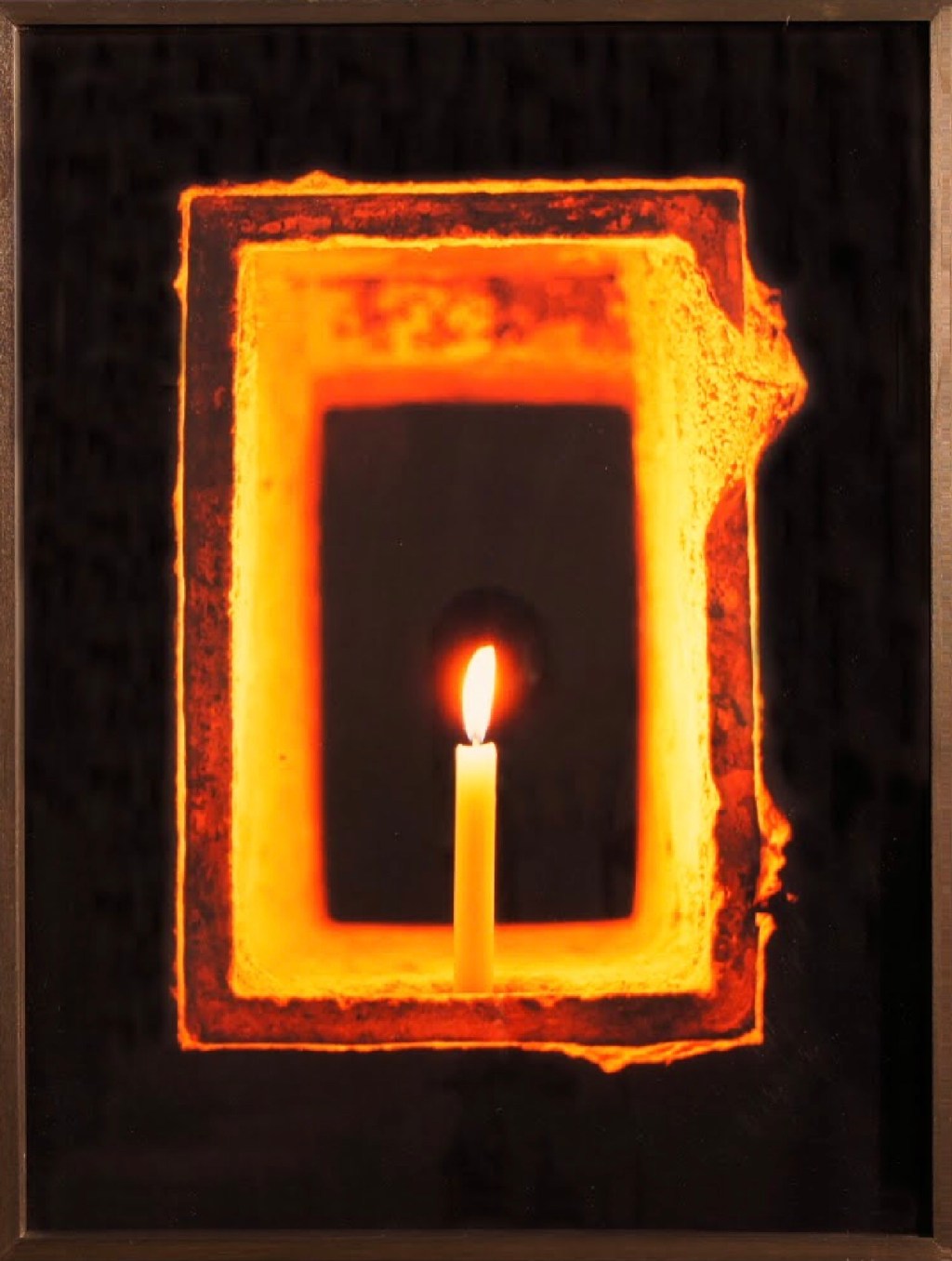
Tim’s Nativity: simplicity rules here—only the lights of the great star, the light of the Christ child, and the minor lights of the heavens.

Nativity with Flight to Egypt in the upper part—from the 4th and 5th centuries, Athens, from before the Middle Ages, and technically “Roman” art. (often referred to as “Early Christian”).

Next added were the shepherds, during the 4th and 5th CE, such as this example from the Palazzo Massimo. We find it on the sarcophagus Marcus Claudianus, on the upper tier, on the left. This dates from around 350 CE, found today in the Museo Nazionale Romano, Palazzo Massimo alle Terme, Rome.

Sarcophagus of Marcus Claudianus (Rome, Italy), Palazzo Massimo: Early Christian art is interesting because it can be hard to spot the stories as you know them. Except it seems, the Nativity, in the upper left corner, 330-335CE.

The sculptor carved the sarcophagus in the style called “continuous frieze” because all the figures line up and their heads are of equal height. The appearance of grape harvest imagery on the lid is ambiguous; it appears on both pagan/secular and Christian sarcophagi with identical elements. From left to right on the lid: nativity scene of Jesus, sacrifice of Isaac, an inscription naming the deceased, an image of the deceased as scholar, and a grape harvest scene.

Carvings on the front of the Marcus Claudianus sarcophagus include: Arrest of Peter, miracle of water and wine (with a possible baptism reference), an orant or praying figure, miracle of loaves, healing a man born blind, prediction of Peter’s denial, resurrection of Lazarus and supplication of Lazarus’ sister.

This stone relief carving depicts the detail of the Nativity from the 4th and 5th centuries from the Palazzo Massimo, on the Sarcophagus of Marcus Claudianus (Rome, Italy).

A Carolingian Era (751-887) Nativity scene from the British Museum

Eastern Orthodox icons retain the cave imagery while the Western art traditions use a stable or ruins of a classical structure in the nativity scenes. The first is according to tradition and the western imagery reminds the viewer the ancient past with its many gods is no longer ascendant.

The one change we see in the 6th century is the inclusion of Mary lying on a mattress type bed. It may have appeared earlier in art, but we have no surviving example to date an earlier occurrence. Later, we see more actors in the drama appearing, but often they don’t arrive all at once. The wise men visit, or the shepherds visit, but not in the same artwork.

Wise Men Visiting the Birth of Christ, 6th CE
A 10th century ivory panel from Trier, still very much following the now 700+ year old Roman models;
things changed much more slowly in the Middle Ages than they do now.

By the time of the 11th CE, the nativity scene was becoming more elaborate , but was not yet in full flower. By the 13th CE, the magnificent portal of the St. Lawrence cathedral, in Trogir, Croatia, by the Master Radovan and his associates has a strong narrative of the many parts of the nativity story. The city of Trogir, a World Heritage Site since 1997, is known as one of the best-preserved Romanesque-Gothic cities, the core of which consists of forts, religious and secular buildings, with the Rector’s Palace and the City Loggia standing out. Its Romanesque churches are supplemented with Renaissance and Baroque edifices.

Romanesque style portal of the St. Lawrence cathedral, in Trogir, Croatia, by the Master Radovan and his associates

The detail of the portal is worth a closer look. In the center, in between the curtained “bunkbeds,” the Virgin and Child rest on the upper tier. The animals also look on in this section. Below the manger scene is a ritual bath. In my Christian world view, I called this the “baptism of Jesus.” In his Hebrew life, he would have undergone a ritual cleansing immersion bath before going to the temple for his circumcision. This ritual would mark him as a covenant member of the nation and people of God. The two elderly people on the left of this scene are most likely Simeon and Anna, prophets who speak to the child’s fulfillment of scripture.

Details of Romanesque style Portal of St Lawrence cathedral in Trogir, Croatia.

Above all this at the center top are the star, with the angels on the left and on the right. Filling the space on the left side of the portal are the shepherds and their herds, while the Magi and their steeds occupy the right side. The Magi ride horses, unlike our modern nativities which have camels.

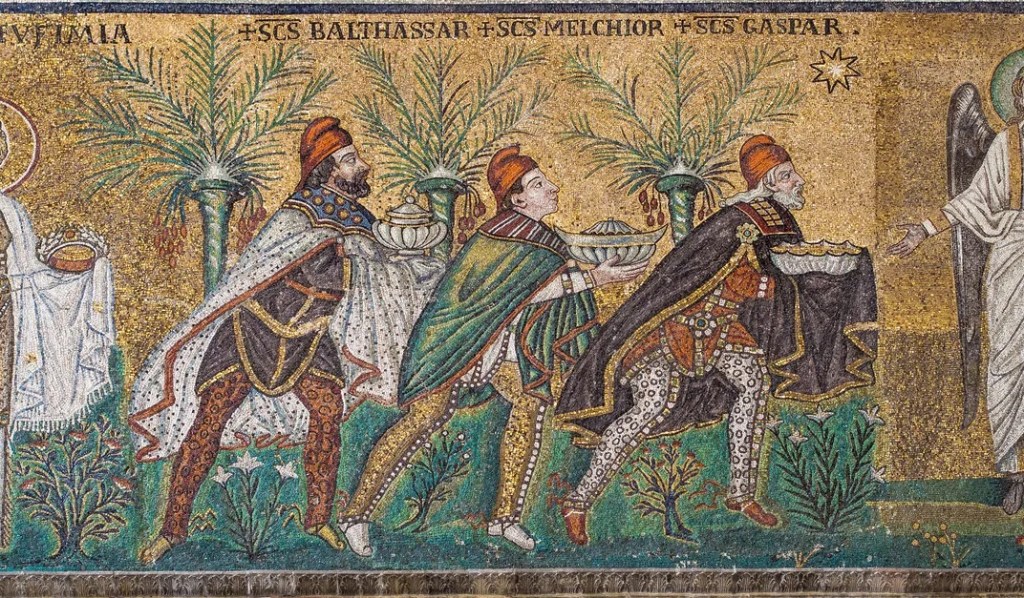
Sixth-century CE mosaic at the Basilica of Sant’Apollinare Nuovo in Ravenna, Italy

In England, the Venerable Bede (d. 735) wrote the Magi were symbols of the three parts of the world—Asia, Africa, and Europe. They signified the three sons of Noah, who fathered the races of these three continents (Genesis, chapter 10). By the late Middle Ages, this idea found expression in art, and artists began to depict one of the kings as a black African. The kings sometimes have their retinues, which include animals from their presumed places of origin: camels, horses, and elephants are the most common. As with the shepherds, the artists often represented the three kings in the various stages of life: young, middle aged, and old age.

Gentile da Fabriano’s Adoration of the Magi, 1423

Artists added more exotic animals to the nativity scenes in the 15th CE when trade and travel were expanding beyond the continent. Gentile da Fabriano’s Adoration of the Magi (painted in 1423) presents a remarkable range of animals. Alongside the traditional ox, donkey, sheep (and a couple of dogs thrown in for good measure), the chaotic scene includes a camel, cheetah (or leopard), hawks and monkeys.

“Cabinet of Curiosities”
Engraving from Ferrante Imperato, Dell’Historia Naturale (Naples 1599)

The inclusion of animals which were not native to Europe helped Gentile da Fabriano to emphasize the three wise men’s journey from the Far East, but also to impress viewers with its exoticism and visual richness. This would have reflected very well on the painting’s patron, the rich Florentine banker Palla Strozzi, as it reinforced his connections to foreign lands. In this era, many rich citizens had a collection of exotic animals and imported wares, just as wealthy people today have collections of art, yachts, or sports cars to showcase their riches.

Sandro Botticelli, “Mystic Nativity” (1500), oil on canvas, 42.7 × 29.5 inches (108.5 × 74.9 cm) (image via Wikimedia Commons), now in National Gallery of London.

An even more elaborate nativity comes from the hand of Botticelli, who worked in the wealthy merchant city of Florence, Italy, in 1500. Savonarola was a fanatical preacher who aimed to morally reform the city of Florence, which had a global reputation for artistic output and lavish lifestyles. Savonarola condemned secular art and literature, decried the city as a corrupt and vice-ridden place bloated with material wealth, and, after warning of a great scourge approaching, saved the Florentines by convincing the French king and military to deoccupy and recede during the Italian War of 1494–98.

The people thought of him as a prophet and came from miles around just to hear him preach his apocalyptic message. He preached a sermon telling the people of Florence they could become the new Jerusalem “if only its civilians would part with and burn their luxuries, opulent fineries, and give up their pagan or secular iconographies.”

Botticelli fell under Savonarola’s influence during this time, for his art changed from decorative to religious. The 12 angels at the base of the composition each hold a ribbon that the artist inscribed with the 12 privileges or virtues of the Virgin Mary, which came from a sermon Savonarola delivered about a vision he once experienced. Another unusual aspect is that the three kings welcome Jesus empty-handed, rather than with gold, frankincense, and myrrh — influenced by Savonarola’s sermon, though it could be their ultimate gifts are their prayers and devotion.

Mike brought his good humor to class with a Grinch portrait

Sometimes it’s impossible to know whether the artist was inspired by a non-biblical element or by an apocryphal text in a Nativity scene or if the artistic depiction came first. In their book, Art and the Christian Apocrypha, David R. Cartlidge and J. Keith Elliott contend in the making of early Christian art, written and visual sources are interdependent. “The developing consensus is that oral traditions, texts (rhetorical arts) and the pictorial arts all interact so that all the arts demonstrate the church’s ‘thinking out loud’ in both rhetorical and pictorial images” (2001, xv).

Gail W.’s open perspective nativity inspired by the renaissance artists

When we artists imagine the nativity today, we add to the basic scripture text all of the Hollywood movies we’ve seen, the stories we’ve heard around the fireplaces and altars of our instruction, and every Christmas card and artwork we’ve ever seen. Our memories of Christmas are often more important than Christmas itself. This is because we have an idea of how Christmas is supposed to BE, but the birth of Christ wasn’t what either Mary or Joseph thought it was going to be. Just as most of us, they hoped to be at home and near family, not “away in a manger, no crib for a bed.”

Cornelia worked in the geometry of the scene. I might rework the sky.

God brought the Savior of all into our world into a humble setting, not to a royal palace. God brought to the birthplace of Christ strangers from distant lands and marginalized people from their homeland to have the first opportunity to worship the newborn king. God excluded the political rulers because they were out to destroy this unusual king.

We are part of the Christian community now, so we sometimes miss the disruptive nature of Christ’s birth. As part of the in/dominant group today, we might have a tough time reading the Bible’s challenges to self-satisfaction and complacency.

Birth of Alexander the Great, mosaic, Roman villa near Baalbek, Lebanon, 4th CE

We often forget while these depictions of the Nativity were evolving, the segment of the Roman Empire that was still pagan were also representing famous births, that predate the standard depictions of the Nativity of Christ. For example, in a Roman villa near Baalbek, Lebanon a fourth century mosaic of the Birth of Alexander the Great at first sight almost exactly resembles what later became a standard depiction of the Nativity of Christ. This mosaic, today in the National Museum of Beirut, shows the newborn Alexander the Great being bathed in a circular fluted basin by a female figure labelled ‘Nymphe’, while his mother Olympias reclines on a bed watched by an attendant.

Compare this with the icon of the Wise Men Visiting the Birth of Christ, from the 6th CE pictured above. In the lower right corner of this nativity scene, we see a small depiction of the Christ child being bathed, with water being poured over his head. (Obviously a United Methodist, but a precursor since John Wesley wasn’t born yet!) Our Christian iconography is derived from pagan sources. By this I mean we reimagined the pagan iconography and repurposed it for our own spiritual practices and purposes.

One of our other challenges is the calendar. We in the West use the Gregorian calendar, from the 16th CE, while the Orthodox Church still follows the Julian calendar, which was in use during the time of Christ. This is why the Orthodox community still celebrates Christmas and Easter on different dates than the Western churches. In the Orthodox Church, they celebrate Epiphany as the baptism of Jesus rather than the arrival of the Magi (Three wise men), which the Western Church celebrates on 6 January. On the Gregorian calendar, this Orthodox Epiphany celebration is January 19th. They celebrate this date as the Baptism of Jesus, rather than the arrival of the wise men. Their Epiphany is located in the baptism rather than the nativity. That’s a whole other theological discussion beyond the iconography of the nativity!

DeLee: The No Room Inn, mixed media, private collection

I mention this fact of the two calendars because I’m always “calendar challenged.” It’s not a senior citizen thing, because this was my problem even when I was in my twenties also. Sometimes I put too many commitments on my calendar, and other times I underestimate the time to complete my tasks. Then again, there’s always the unexpected interruptions. Always the interruptions. I came to understand in my ministry my list of tasks to do were not my actual work, but instead these interruptions were the opportunities which God would bring to me to do God’s chosen ministry.

So, I’m a few days late on the Western calendar for the visit of the Three Kings, having missed January 6th, and I’m a few days early for the Orthodox calendar. As Goldilocks said, “Not too hot, not too cold, but just right!”

Mike’s impression of the Nativity

The last art pieces our class made in 2024 before the holidays and the snowstorms were our nativity paintings. I asked each person to use their imagination and to bring the essence of the nativity to their creative process. Some of us quickly realized our images and used our second meeting to do a personal project or another version of the nativity scene. Others of us took both sessions to perfect our one image. I blame the Christmas cookies and our lack of hand and mouth coordination. Sometimes it’s hard to chew and paint at the same time!

Our first class of 2025 was an instance of “calendar challenge”—I thought we were having it, but the group didn’t. The next week, a major snow storm canceled class every where for everyone. Friday, January 17, should be a good day to begin a new project! We’re going to do some mixed media, along with weaving projects in the days and weeks to come. You don’t need skills, but a willingness to try.

Joy, peace, and a hope for better weather!

Cornelia


The Magi and the Manger: Imaging Christmas in Ancient Art and Ritual – The Yale ISM Review

The Nativity Tympanum on the Sarcophagus of Stilicho

https://www.christianiconography.info/Wikimedia%20Commons/nativitySarcophagusStilicho.html

UNESCO monuments in the Croatian Academy of Sciences and Arts Glyptotheque

https://gliptoteka.hazu.hr/unesco/en/trogir.html

The Apocryphal Gospels—PseudoMatthew—has Latin text and translation
https://www.google.com/books/edition/The_Apocryphal_Gospels/Cmbtm4ZZXF0C?hl=en&gbpv=1&dq=M.+Berthold+has+argued+that+Pseudo-Matthew&pg=PA75&printsec=frontcover

The Infancy Gospel of James (2nd century) |http://www.ccel.org/ccel/schaff/anf08.vii.iv.html

The Arabic Infancy Gospel (5th-6th century) http://www.ccel.org/ccel/schaff/anf08.vii.xi.html

The Gospel of Pseudo-Matthew (8th or 9th century) http://www.ccel.org/ccel/schaff/anf08.vii.v.i.html

Web Gallery of Art, searchable fine arts image database

https://www.wga.hu/frames-e.html?/support/zearly/1/1sculptu/sarcopha/1/9claudi2.html

Nativity – Visual Elements in the Nativity — Glencairn Museum

https://www.glencairnmuseum.org/nativity-visualelements

Johann International: Search results for Nativity  http://johanninternational.blogspot.com/search?q=Nativity

Revisiting Botticelli’s Evocative “Mystic Nativity”  https://hyperallergic.com/978201/revisiting-botticelli-evocative-mystic-nativity/

ORTHODOX CHRISTIANITY THEN AND NOW: Origins of the Icon of the Nativity of Christ
https://www.johnsanidopoulos.com/2018/12/origins-of-icon-of-nativity-of-christ.html


Light Overcomes the Darkness

art, Bethlehem, Christmas, Faith, Hanukkah, hope, Israel, Light of the World, mystery, Nativity, suffering, Ten Commandments

“The light shines in the darkness, and the darkness did not overcome it.” —John 1:5.

Work in progress: Light Shines in the Darkness

Some of us can hear these words with hope, two thousand years after John’s gospel was first written. These words come as a ray of hope, like a flashlight’s beam bursting into a collapsed mine to let imprisoned workers know help and life-giving oxygen is on the way. For the people in the first century who lived under the Pax Romana—the peace of Rome—not everyone had the same rights and privileges as the citizens of Rome. The conquered lands, including the nation of Israel, were under military occupation and suffered brutal taxation and unfair application of the laws.

More importantly, obedience to the emperor and the empire was required, which for the Jewish people meant making a sacrifice in honor of the emperor. Because this act would acknowledge a human being as a god, the Jews were between a rock and a hard place. If they denied the emperor, they were unpatriotic. If they sacrificed to him, they committed blasphemy against their God. After all, we find one of the great commandments in Exodus 20:2-3:

“I am the LORD your God, who brought you out of the land of Egypt, out of the house of slavery; you shall have no other gods before me.”

We take religious freedom and expression as a given here in the United States, since the first European settlers to these shores came here with the express purpose of worshipping God in their own way. Unfortunately, they also persecuted the next groups who arrived and who worshipped differently. After gaining independence from England, America has been one of the few nations of the world in that one of its core values is to honor every faith tradition and allow each person to worship freely (or not) God as they want.

Insisting on the priority or preference for one religion isn’t historical or grounded in our constitution. We find this in both Article VI of our Constitution, which prohibited religious tests for federal office holders, and in Article I of the Bill of Rights:

“Congress shall make no law respecting an establishment of religion, or prohibiting the free exercise thereof; or abridging the freedom of speech, or of the press; or the right of the people peaceably to assemble, and to petition the Government for a redress of grievances.”

In this present time, when certain groups of Christians (Christian Nationalists) want to claim an alternative history of our national origin and our national destiny, they also are trying to rewrite our history to make it fit their purposes. This elevates their religious group above others and gives them preference over other Christian denominations as well as other faiths and nonbelievers. When these other groups become persecuted or marginalized, the whole suffers, while a few prosper.

The situation was much the same back in the first century CE, when tax farming was a corrupt practice in the Roman provinces. A family bought the rights to a tax area, collected whatever they wanted, and gave the due to Rome. The rest they kept as profit. No wonder folks hated the local tax collectors: they were not only greedy, but they colluded with the occupation. The priests in the temple made sure they never rocked the boat, so they could keep up their rituals and practices of the law, both scriptural and secular.

Therefore the people yearned for a savior, a messiah. In every age, in the stillness of the night, in the darkness of despair, when hope was flickering to an ember, a voice of a prophet would arise. These prophetic voices weren’t often heard, but occasionally one voice would pierce the gloom like a bright light in a dark cave. When a prophet speaks a true word from God, people recognize it as true because it speaks the truth of God, reminds people they belong to God, calls the people back to God, and tells them the consequences of their resulting behavior. Prophecy isn’t just about fortune telling.

Poets are often the prophets of their age. The first stanza of William Butter Yeats’ Ode speaks both toward that first century past and to the second coming:

“Turning and turning in the widening gyre
The falcon cannot hear the falconer;
Things fall apart; the centre cannot hold;
Mere anarchy is loosed upon the world,
The blood-dimmed tide is loosed, and everywhere
The ceremony of innocence is drowned;
The best lack all conviction, while the worst
Are full of passionate intensity.”


Final State: The Light Shines in the Darkness

If we lose hope, if we give up on the hope of redeeming our world and ourselves, we will fall into despair and nihilism. These emotions are not good. We won’t listen for the still small voice of God in the dark and quiet spaces anymore. We won’t hear the voice of God in the weed growing in the crack in the pavement of the sidewalk as we go about our daily tasks. We will fail to hear the promises of new hope and new strength when the crocuses pop through the snow next spring.

Art and poetry keep us connected to the magic and mystery of the Spirit of God. A steady diet of news and television is a soul killer. If you find your attitude going south, I recommend you limit your news consumption to two hours or less per day. Replace those other hours with sunlight, exercise, cooking, a new hobby, fiction reading, journaling, or whatever. If you keep getting drawn back into the distressing activity, remember to let go, and return to a better activity. Optimism and a sense of hope will carry us further than negativity will. As Isaiah 6:13 says,

“Even if a tenth part remain in it, it will be burned again, like a terebinth or an oak whose stump remains standing when it is felled. The holy seed is its stump.”

Or as my daddy always said, “Don’t let the bad guys grind you down.” Of course, this sentiment had some bad medical school Latin he and his friends translated when the going got tough and the sleep got short in his younger days. “While I breathe, I hope,” is “Dum spiro spero,” in Latin. It’s been one of my favorite sayings. Night doesn’t last forever, and morning will come. Dawn will break! There will be a new day and a fresh opportunity to do at least one thing better. To make a difference in one person’s life, to make a difference for the good for someone, somewhere. I may be just baking cookies to bring to overworked volunteers somewhere, who are doing good for others, but I can bring a bright light to someone’s day today. I don’t have to save the entire world.

If I can be a ray of light for someone today, I might give them hope. Hope is a gift. We should share it freely. Then hope would grow and “The people who walked in darkness have seen a great light; those who lived in a land of deep darkness—on them light has shined.” (Isaiah 9:2).


Joy, peace, and light,

Cornelia

Faith of Our Forefathers (May 1998) – Library of Congress Information Bulletin

https://www.loc.gov/loc/lcib/9805/religion.html

The Second Coming | The Poetry Foundation

https://www.poetryfoundation.org/poems/43290/the-second-coming


Nativities Then and Now

Altars, Apocalypse, beauty, Bethlehem, Christmas, Creativity, Faith, Holy Spirit, Icons, Imagination, incarnation, inspiration, Israel, mystery, Nativity, righteousness, Savonarola, vision

Every Christmas, my family would put up a beautiful tree and decorate it to the nines. My dad would always tie this living sculpture to the nearest window frame so the tree wouldn’t topple over. He was well aware at least one of his three curious and rambunctious children would no doubt be crawling under the lowest branches to reach the brightly wrapped presents hidden far back in the corner under the tree.

We kids most desired and sought after these hidden gifts, while those near the front always got a cursory glance and shake. If it were hidden, it had to be desired! Package shaking in the hidden, tight quarters could cause a tree to collapse and that would be more drama than our frazzled mother wanted at this time of year. My dad was wise enough, or trained by experience, to know messing with “Mother Nature” wasn’t a great idea.

Mother’s Nativity with other additions from family and friends

Under this tinsel draped tree, with its 1950’s glowing bubble lights, we always had a nativity scene. In our early childhood, it was solid and childproof, but as we aged, and got too large to crawl under the tree, a better quality nativity came to live under the tree. By my college years, my brothers were also grown enough for mom to exercise her creative genius. She hand-painted her own ceramic nativity group. This masterpiece also got its own special display site. Up until this time, we children had no idea our mother had any artistic talent, for she’d spent her days transporting us to our multiple after school activities. Between my brothers’ sports teams and my hobbies, it’s a wonder she found time to do anything else in the afternoon hours.

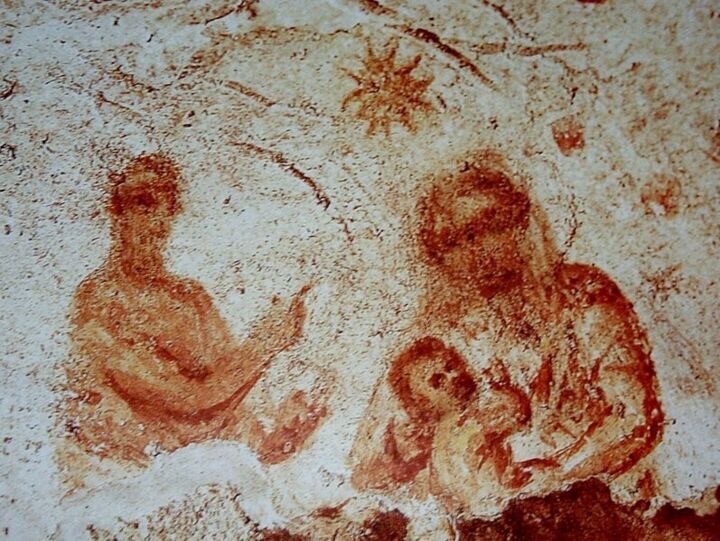
Nativity, Adoration of the Magi, 3rd century. Fresco, Rome: catacombs of Priscilla, 3rd Century CE

The 3rd century fresco shows the scene of Adoration of the Magi on the the arch dividing the room in the Greek Chapel in the Catacombs of Priscilla, Rome. In depictions of ancient Greek and Roman gift-giving practices, the act and choice of gift were important. They furnish information about both giver and recipient. The wise men adopt the same postures used in Roman imperial ceremony for the worship of an Emperor or other ruler. Roman art has always provided a pictorial model for the representation of the Magi. By identifying with or recognizing such an outward act of homage, the viewer could enter into the Nativity story through the wise visitors, worshipping the God manifest on earth in the Child.

This is why the earliest Christian art is found in the catacombs of Rome, in the hidden places, since worshipping Jesus wasn’t an approved religious practice in the Empire. Only the Divine Emperor alone was worthy of reverence and worship, not some dying and rising god of a far-off province. Today in America we sometimes forget we’re a nation founded on the principle of freedom to practice our religion as we see fit, or not to practice a religion at all, as the case may be. No government can compel the privilege of one religion above another or set one as the official religion.

Tympanum of the right side of the cast of so-called Sarcophagus of Stilicho, sculpted around 385 AD (the original piece of art is in Sant’Ambrogio basilica in Milan, Italy), Detail Nativity scene, Museo della civiltà romana a Roma (Eur), Room 15 (Christianity).

Another early depiction of the nativity isn’t in a Christmas context, but is found on a late 4th C Roman sarcophagus for a high ranking military official and his wife. The unknown artisan rendered the Christ child, wrapped in binding clothes, and lying in a manger, between the ox and the ass, to fulfill the prophecy of Isaiah 1:3—

“The ox knows its owner, and the donkey its master’s crib;
but Israel does not know, my people do not understand.”

As accustomed as we are today to manger scenes with all kinds of animals present, the scriptures don’t name them. These are left up to our imaginations. Even the elements derived directly from the gospel narratives of Matthew and Luke were slow to appear in visual renderings. Between those early scriptural accounts and the formation of even a basic manger scene lie some centuries during which Christian devotion and depiction developed. Likewise, the celebration of Christmas was slow to develop, but by the 4th century it was well along.

Nativity Fresco in Santa Maria Foris Portas, Castelseprio, Italy, 9th CE

In the ninth century, after the iconoclastic period, when the images of holy persons were forbidden and destroyed, a fresh wave of religious activity began in the arts. In Italy. In the church dedicated to Mary Outside the Gates in Castelprio, Italy, an entire series of paintings covered the interior walls. The church was located on an important trade route and the site was once a Roman fort. The theme honored Mary as the Bride of Christ, thus making her the spiritual equivalent of the Church, which is the Bride of Christ in scripture. In every tableau, Mary is the largest or most significant figure. Over the centuries, the area lost its importance, these paintings were whitewashed over, but after many years and much restoration, they’re now protected as a UNESCO World Heritage Site.

Today Protestant believers have a Christo-centric faith, often ignoring the other persons of the Holy Trinity. When we focus on the nativity, we forget God’s plan was to use humanity to save the fallen creation. This includes Mary and Joseph both, as well as God’s own Son, as Paul so well reminds us in Philippians 2:5-8—

Let the same mind be in you that was in Christ Jesus,
who, though he was in the form of God,
did not regard equality with God
as something to be exploited,
but emptied himself,
taking the form of a slave,
being born in human likeness.
And being found in human form,
he humbled himself
and became obedient to the point of death—
even death on a cross.

Giotto di Bodone, Nativity of Jesus, 1303-1305. Fresco, 200 x 185 cm. Padua: Scrovegni Chapel

Giotto’s frescos in the Padua Chapel are some of the most important works of art because he brought the Holy Family into ordinary human life. The blue skies replace the gold of the traditional icons, which stood for the infinite and eternal spiritual world. In Giotto’s painting, people hunger and thirst, while in the world of the icons, all suffering is transformed and any passion is disciplined.

Duccio di Buoninsegna, Nativity between the prophets Isaiah and Ezekiel, 1308-1311. Tempera on panel, 43.8 × 111 cm. Washington: National Gallery of Art

Duccio painted in his studio all the individual sections of the great altarpiece of the church in Sienna, Italy. On completion in 1311, the townspeople held a grand parade as they carried the paintings to the cathedral. They were installed in a magnificent framework with some of the works facing the congregation and the rest facing the church officials. The altarpiece remained intact until until 1506 when it was partially dismantled, relegated to side chapels and replaced by a 15th-century bronze tabernacle.

In 1771, the church fathers hired a carpenter to saw up the old wooden altarpiece into seven vertical pieces, and then saw each of those pieces in half laterally to separate the front scenes from the back. He then reassembled the different pieces to form new scenes. Most of the individual paintings stayed together, but others were sold to private collectors or museums. This Nativity between the prophets Isaiah and Ezekiel was purchased by the Museum Kaiser Wilhelm Friedrich in Berlin and remained on display there until 1938. At that time, a Nazi-appointed Museum director purged most non-Teutonic art from the collection. Through a trade, this Nativity came to our National Gallery of Art in Washington, D. C.

Duccio: Maesta Reconstructed Altarpiece. Front (L) and Back (R)

When we think about hidden meanings in art works, sometimes the journey a work takes to its exhibition home is part of its meaning. The Nazi purge of non-Teutonic art from the collection was based on their idea of a pure race for their homeland, with which they shared a special mystical bond. It meant they would purge or purify all who didn’t meet this white supremacist ideal. I personally am glad America is an open society, which welcomes all kinds of art and artists. When we think of the journey of the Holy Family, they made an arduous trip to Bethlehem while Mary was about to give birth and then had to head out on the lam because king Herod was out to kill all the boy babies. When we look at beautiful nativity scenes, we forget Jesus was born into a troubled world. Indeed, these beautiful works make us forget our own troubles.

Sandro Botticelli, Mystical Nativity, 1501. Tempera on canvas, 108.5 × 75 cm. London: National Gallery.

One of the most unusual nativity paintings is the Mystical Nativity by Botticelli. Painted with egg tempera on canvas, the artist writes in the upper section how he painted this “at the end of the year 1500, in the troubles of Italy…in the half after the time, during the fulfillment of the eleventh chapter of St. John in the second woe of the apocalypse…”

The monk Savonarola was actively preaching at this time, and scholars believe he influenced Botticelli. During the time of the Medici rule, Florence prospered with trade and the city’s alliance with France made for a time of peace. Lorenzo d’Medici died in 1492, relations with France broke off, and the French army ran amuck in the Italian countryside. Florence lost her former glory, trade dried up, and a political vacuum allowed for new voices to rise. Savonarola preached repentance and austerity, even going so far to burn luxurious items and artworks. He burned all kinds of vanities: cosmetics, mirrors, veils, and books.

People followed him because he was charismatic, and his words seemed to match their circumstances. Florence under his rule was an example of theocracy, the government of a state by immediate divine guidance or by officials who are regarded as divinely guided. Under this system, the people prosper if they care for one another and live godly lives, but they fail to thrive if they cheat the poor so the rich can live in luxury.

Prosperity religion teaches the good thrive and the sinners suffer. It’s not a new idea: retribution and reward appeal to people, but sometimes the good suffer and the evil prosper. The book of Job is a counter argument to this worldview. The life of Christ also shows the best of us will be sacrificed on a cross by those who don’t know what they’re doing. From birth to death, Jesus and his family were under duress from the powers of state and religion. He was a new voice of love and acceptance, of grace and forgiveness, of a righteousness by faith, not works. This new voice would upend the world as people knew it then.

Douce Apocalypse – Bodleian Ms180 – p.042 Woman Clothed in the Sun, Oxford University, London, c. 1265-70

The Mystic Nativity is a combination of the Nativity and the Last Judgment. On top, the angels hold hands in a circle, the center is the birth of Christ on earth, and the lower third is the vanquishing devils due to the Christian’s reunification with God. The number twelve represents the twelve gates of the new Jerusalem, the City of God. Twelve are also the number of stars in the crown of the woman in the apocalypse linked to the Virgin Mary. Other symbols also occur, but the overall meaning is Botticelli painted to deal with his fears about the end of the world.

Sometimes we make a cursory glance or reading of a painting, only to see its surface meaning. If we were to take this path with Botticelli’s Mystical Nativity, we might only see pretty angels and lovely ribbons. It looks like a homecoming at a sorority weekend with all the hugging and kissing. But Botticelli was painting during a time when the theological ideas of the monk Savonarola were in ascendance. He believed, “The more creatures approach and participate in the beauty of God, the more are they themselves beautiful, just as the beauty of the body is in proportion to the beauty of the soul.”

Virtuvian Man by Leonardo da Vinci, 1490, pen, brown ink, and watercolor on paper, Gallerie dell’Accademia, Venice, Italy.

As an interesting aside, about contemporary with Botticelli’s work in Florence, while Leonardo da Vinci was in Milan in 1490, he drew his Virtuvian Man, considered one of the greatest scientific and humanist works of the early Renaissance. Da Vinci used Vitruvius’ classical treatise on architecture as the source for his drawing. Notes from his translation are written in his famed mirror script below the image. This artwork is now so fragile, it never travels and only copies are shown.

While his outer world may be falling apart, and prosperity has left his vicinity, Botticelli still had hope for a better world. His faith was grounded in the birth of the savior, the son of God, who came in flesh to make all flesh divine. We forget this crucial message of the nativity, which is to make holy all flesh. More often we focus on the magi’s gifts brought to the child: riches fit for a king, or the gifts of presence, from the poor shepherds. The true gift is the one in the manger, for Christ is God’s gift to us. He came to make us all At-One with God, the very best atonement possible. At the Last Judgment, all who are at one with God’s purposes will be separated from the rest.

Banksy, “The Scar of Bethlehem” (2019) (courtesy Bisher Qassis), located in The Walled in Hotel in Bethlehem, closed since 12/12/23, due to fighting against Hamas

How can we practice seeing past the surface of everyday life? Sometimes we have to be shocked. Modern nativities bring us again and again to confront the same world of challenges and discord into which the young Christ child was born. If we wrap ourselves in warm swaddling clothes so we too won’t cry over the lack of a Christmas in Bethlehem this year, we lose sight of the common humanity of all God’s people. The extremists will take retribution on everyone, but those who take the middle path punish only those who did wrongs. Is there hope for those who take the “my way or the highway?” Or do we need to join the Holy Family and become refugees to avoid King Herod’s slaughter of the innocents?

Vatican City public nativity

This 2020 nativity was created as a public art project by ceramics students in Castelli, Abruzzo, Italy, a region known for its ceramics. It had nineteen figures including an astronaut and a Darth Vader figure, whose creation predated the Star-Wars series and represented a generic “sinner” figure. In modern nativity scenes, artists often integrate characters not mentioned in the gospel accounts, in order to bring the interests of contemporary audiences into the biblical story. As you can imagine, it created quite a buzz. Some said it lacked “beauty,” while others thought it was a joke. Some thought it disrespectful to the honor of the Holy See, the Church, and to the good Lord himself. It’s a truism “beauty is in the eye of the beholder.” Also, “we’ve never done it that way” still has a strong hold on people’s hearts and minds.

Sinner and Astronaut: Large Ceramic Nativity at the Vatican, 2020

Seeing deeper meanings in art or scripture is no more complicated than seeing a deeper understanding of a literary experience, such as a book or poem. In art, we do have the hurdle of acquiring some visual background and “visual language.” Just as we can’t understand a foreign language without learning some phrases, we need to know some art history and styles. We can only understand in part at first, but later we’ll understand as if we were old friends. No one is a savant right away. If we pause as we read a scripture, let the words sink into our deeper minds, and let the Holy Spirit open up new insights into God’s word, we can do the same with art works.

Bread Nativity

After all, bread is just bread: ordinary flour, yeast, oil, and water. Once we bless the bread and invite the Holy Spirit to transform it, we understand these same ordinary materials to be signs of the extraordinary presence of the Body of Christ, as recorded in Luke 22:19 at the Last Supper—

Then he took a loaf of bread, and when he had given thanks, he broke it and gave it to them, saying, “This is my body, which is given for you. Do this in remembrance of me.”

Baby Jesus Bread Rolls

We’re always surrounded by the mysteries of hidden meanings, if only we have eyes to see and ears to hear. May you know God more deeply in the days and years to come.

The Christ Child in the Rubble, Nativity in Bethlehem, Palestine, West Bank, 2023

Joy and peace,

Cornelia.

Featured image—Nativity, 3rd century. Stucco, Rome: catacombs of Priscilla.

Category: Sarcophagus of Stilicho in Sant’Ambrogio (Milan) – Wikimedia Commons
https://commons.wikimedia.org/wiki/Category:Sarcophagus_of_Stilicho_in_Sant%27Ambrogio_(Milan)

Duccio, The Nativity with the Prophets Isaiah and Ezekiel, 1308-1311
https://www.nga.gov/collection/highlights/duccio-the-nativity-with-the-prophets-isaiah-and-ezekiel.html

Botticelli’s’ Mystic Nativity: Symbolism, Savonarola and a Reflection of an Era | Renee Farina – Academia.edu
https://www.academia.edu/1262474/Botticellis_Mystic_Nativity_Symbolism_Savonarola_and_a_Reflection_of_an_Era

Leveto, Paula D. “The Marian Theme of the Frescoes in S. Maria at Castelseprio.” The Art Bulletin, vol. 72, no. 3, 1990, pp. 393–413. JSTOR. Free account to access. https://doi.org/10.2307/3045748. Accessed 24 Dec. 2023.

Katarína Šimová: The Fresco Cycle of Santa Maria foris portas, MASARYK UNIVERSITY! FACULTY OF ARTS, DEPARTMENT OF ART HISTORY, 2021. Open source
https://is.muni.cz/th/ufv2u/castelseprio_frescoes.pdf

Significance of Leonardo da Vinci’s Famous ‘Vitruvian Man’ Drawing
https://mymodernmet.com/leonardo-da-vinci-vitruvian-man/

Baby Jesus Bread Buns · How To Bake A Roll Or Bun · Baking on Cut Out + Keep
https://www.cutoutandkeep.net/projects/baby-jesus-bread-buns

The Adoration of the Magi: Mosaic in S. Maria Maggiore https://www.christianiconography.info/staMariaMaggiore/epiphanyArch.html

The Magi and the Manger: Imaging Christmas in Ancient Art and Ritual – The Yale ISM Review https://www.ismreview.yale.edu/volume-3-1-fall-2016/the-magi-and-the-manger-imaging-christmas-in-ancient-art-and-ritual

Rabbit! Rabbit! Welcome to December 2023

Apocalypse, architecture, art, Bethlehem, Christmas, Civil War, Faith, Family, Healing, holidays, Holy Spirit, hope, inspiration, Israel, Light of the World, Love, Ministry, poverty, rabbits, shame, Spirituality, Stress, trees

Bunny in Bed

“Gloom begets gloom,” my daddy always said, “so if you wake up on the wrong side of the bed, it’s best to go back and get out on the other side.” Some folks today don’t have much of the Christmas or holiday spirit, for they’re only looking at the dark side of world events or at the shrinking purchasing power of their dollar.

Unemployed people sold apples on the street corner in the Great Depression

Since the Civil War, the United States has endured thirteen depressions or recessions large enough to get noticed by those who study such things (see list below). This is an average of one about every dozen years. Of course, those of us who experience these events don’t have to study them, for we directly participate in the event. As the old saying goes, “If my neighbor loses his job, it’s a recession, but if I lose my job, we’re in a depression.” Instead, we plan for them and expect the good times won’t last forever.

Because we human beings are wont to think “our situation is unique,” we’re also great at forgetting the lessons of history. The first lesson is life is cyclical and what goes up will come down. The second lesson is what goes down will eventually go back up. My long experience suggests when folks are in the “down cycle,” they forget upward progress is possible. In college we used to joke, “been down so long, it looks like up to me!”

It’s always darkest before the dawn.

Some say recessions are “necessary” in economic cycles to remove excess, reprice assets, and tame risky behavior. None of these negative factors would exist except for human greed. When Mary and Joseph went to Bethlehem to register for the census, they were also enrolling for the purpose of taxation. The Romans practiced tax farming in their provinces. Whoever had the account had to raise a certain amount for the empire, but could keep whatever excess they raised for themselves. Excessive taxation on the conquered land and people stoked their hopes for a messiah to rid them of this evil. No wonder the signs and wonders attending the birth of Jesus were fulfilling the ancient prophecies, as Matthew wrote (2:6):

‘And you, Bethlehem, in the land of Judah,
are by no means least among the rulers of Judah;
for from you shall come a ruler
who is to shepherd my people Israel.’

Church of the Nativity, Bethlehem. Star over the Grotto

In the times of darkness, we always look to the light as a reason to hope. As the magi saw a star rising in the east and believed an important person would arise in the land of Israel, we today look for glimmers of light to give us hope for the day to come. Some people see the wars, earthquakes, and crookedness of people and think we’re entering the end times. Churches and radio preachers are making hay with the Book of Revelation, forgetting it was a specific book written for a unique audience and time. We have been in the “end times” since Christ arose from the dead. As Matthew (28:20) records his words to the disciples in Galilee:

“And remember, I am with you always, to the end of the age.”

Since we’re always with Christ, we will always have his light, as Zechariah prophesied in Luke 1:78-79–

“By the tender mercy of our God,
the dawn from on high will break upon us,
to give light to those who sit in darkness and in the shadow of death,
to guide our feet into the way of peace.”

The famous Banksy’s Armored Dove of Peace, the painting of a peace dove wearing a flak jacket. The dove is painted on a wall near the separation wall between Bethlehem (Palestinian Territories) and Israel. Nov. 18, 2023.

In the midst of wars in the Ukraine and in Gaza, where people are suffering and dying, we can lose sight of the vision of light and peace, while we focus on darkness and death. The Christian community in Palestine, which usually hosts hordes of Christmas pilgrims in Bethlehem Square, won’t be celebrating this holy season this year in solidarity with Palestinians in Gaza. Instead, they’ll set up a small nativity scene covered with rubble. It’s a reminder when the Christ child came into a suffering world over two thousand years ago, his birth was a hope for the oppressed and the poor. Every Christmas we have the opportunity to care for those who struggle to make ends meet.

Great Depression family at mealtime

In the Great Depression, families lost homes, farms, and lived in shantytowns called Hoovervilles. President Hoover spoke of a childhood Christmas memory:

“I do vividly recollect a Christmas upon that farm when the sole resources of joy were popcorn balls, sorghum, and hickory nuts; when for a flock of disappointed children there were no store toys, no store clothes; when it was carefully explained that because of the hard times everything must be saved for the mortgage. The word ‘mortgage’ became for me a dreaded and haunting fear from that day to this.”

1950’s Christmas Tree: we kids were Team Tinsel, but the folks were Team Ornaments. Our tree never looked like this!

I have some ancient memories of the cyclic hard times experienced by my family. I recall the late 50’s Eisenhower influenza recession dimly because it was the only time I ever saw my daddy cry. We had a brand-new Ford station wagon, but couldn’t afford to drive it except on Sundays. My dad brought money home daily from his office, so mother and we kids would walk to the local grocery to buy food the next day. He cried because he kept his office full of patients, but half of them couldn’t pay for his services. Mother was very practical and reminded him, “This too would pass. Trouble is only temporary.” In the fall, she took a schoolteacher position to help out. That Christmas we hand decorated sequins on felt shapes the “Twelve Days of Christmas” for a tree skirt. I passed this extravagance on to a nephew when I downsized my home.

We decorated the early days more than the later days. Time management wasn’t our best gift, but we had a great time doing this together.

I also remember the 1970’s economic slowdown very well. I got married during this time. After my husband and I bought our silver wedding rings, we had $16 left in our pocket. I was certain we had jumped off a height with no parachute, but we somehow managed day to day. To keep up “appearances,” we gave away some of our wedding gifts as Christmas gifts to other family members. I thought it was wrong, but now I realize I don’t care about those items today. I was more concerned about “saving face,” since someone might recognize we were regifting. We managed with food from our organic garden and meat from a deer my husband harvested in the autumn. But I no longer eat tuna casserole, having lost my taste for this staple of my poverty years. Gifts aren’t important, but people are.

The 1980’s had a slump related to the oil embargo. When oil money dries up, art teachers lose their jobs, as do all the other “frivolous employees” elsewhere. I got an insurance sales position, with a guaranteed six-week paycheck. I was amazed I had a talent for sales, but I was good at discovering needs and matching products to people’s ability to pay. My best sales close was, “If you’re not here to provide for your family, how will they be able to keep their current lifestyle?”

Having a simpler Christmas this year? Consider an alternative tree…

I lost my house to foreclosure during the 1990’s subprime mortgage crisis. I lost my credit cards and almost lost my daughter to suicide. I learned some things are more important than achievements or possessions. In the depths of the worst of times, gifts aren’t necessary. Being a light for others, helping others, giving yourself to those who need hope in these seemingly hopeless times is important. During this time, I drew hope from God’s words to Nathan in 2 Samuel 7:5-6—

“Go and tell my servant David: Thus says the LORD: Are you the one to build me a house to live in? I have not lived in a house since the day I brought up the people of Israel from Egypt to this day, but I have been moving about in a tent and a tabernacle.” I drew hope, for if God didn’t need a permanent home, but stayed with God’s people, then if I had no home title, God would still go with me wherever I laid my head.

Christmas Lights on Church Street

As a people, we always want to tie God to a place or to locate the Spirit to a site, but God is always bigger than our imagination and our attempts to circumscribe God’s existence. We want to restrict God’s love to a few, but God insists on loving those from whom we look away and exclude. In the midst of the chaos of my losses and suffering, I discovered God was calling me to the ministry.

Gislebertus: Flight into Egypt, 1120-1130, Stone Capitals at St Lazare, Autun, France.

Why does God call the least, the last, or the losers to God’s work? God wants to be glorified, not the person who does the work. God needs people who understand suffering and have been seasoned by it, rather than hardened by it. The wounded know the wounds of others, but they also know the path to healing. This is why we find the Christ child in a stable, not in a palace; and have shepherds and foreigners come to visit, but not his family or friends. It’s also why the Holy Family flees to Egypt as refugees to avoid Herod’s death sentence for the Jewish newborns. If we’re having a less than “perfect” holiday this year, perhaps we’re only having a bad hair day in comparison to the suffering of that first Christmas.

When I get to struggling, for the aches and pains of age are catching up to me, I can get in a low mood thinking, “I used to pop out of bed and do 12 things before lunch.” Now I need six cups of coffee to get my lunch going! Of course, I’m past my platinum anniversary and my hair color matches my age. On days like this, I look to Paul’s admonition in 1 Thessalonians 5:16-18, which rings across the ages as a clarion call:

Rejoice always, pray without ceasing, give thanks in all circumstances;
for this is the will of God in Christ Jesus for you.

I wish each and every one of you a Merry Christmas and a Wonderful New Year. I plan to take a sabbatical from my Rabbit-Rabbit series in 2024, since I’ve neglected my sci-fi blog and my pandemic project quilt needs stitching together. I’m going to work on my art more and write about the spiritual intersections of the creative life.

Merry Christmas and Happy New Year

Joy and Peace,
Cornelia

You can keep up with my other writing and thoughts:

SOULJOURNIES: sci-fi spiritual formation blog
https://souljournieswordpress.wordpress.com/author/artandicon/

ARTANDICON: blog on the intersection of art and faith
Www.Artandicon.com

CORNIE’S KITCHEN: blog on healthy eating and spirituality
http://www.cornieskitchen.wordpress.com

List of depressions and recessions since the Civil War:

  1. the Panic of 1873,
  2. the Great Depression when 13 million people were out of work,
  3. a recession after WWII,
  4. another after the Korean War,
  5. the Eisenhower influenza recession in 1957-58,
  6. a recession in the auto industry in 1960-61,
  7. and another year long recession in 1970-71 under Nixon.
  8. In 1973, OPEC quadrupled oil prices, and that shock along with the stock market crash sent the world economy into recession.
  9. In 1980, energy prices continued to rise, so when the Federal Reserve raised interest rates to curb rising prices, the economy contracted. Once again, unemployment rose to 11% and business output suffered.
  10. We had a recession in the Gulf War from 1990-91, and then maintained the longest period of economic growth in American history up until
  11. the Dot Com Bubble in 2001. The tech-heavy NASDAQ ended up losing nearly 77% of its value and took over 15 years to recover its losses. September 11, 2001 wasn’t a sunny day for the stock market or for America. Many people have had a pessimistic outlook on life from this date forward. It changed how we see ourselves.
  12. In 2008-2009 another recession hit hard, making it the longest economic downturn since World War II and the deepest prior to
  13. the following COVID-19 Recession of 2020. The former was triggered by the subprime mortgage market collapse, while the latter was the quickest and steepest of them all. While more than 24 million people lost their jobs in the US the first three weeks of April 2020, this shock was quickly ameliorated by government interventions, such as zero interest, income payments and other supplements.

Christmas During the First “Great Depression” – Hoover Heads
https://hoover.blogs.archives.gov/2020/12/16/christmas-during-the-first-great-depression/

Milestones: 1921–1936 – Office of the Historian
https://history.state.gov/milestones/1921-1936/great-depression#:~:text=The%20U.S.%20stock%20market%20crash,cause%20a%20global%20financial%20crisis.

Understanding America’s Labor Shortage | U.S. Chamber of Commerce
https://www.uschamber.com/workforce/understanding-americas-labor-shortage

Major Financial Crisis History
https://nationalarchives.nic.in/sites/default/files/new/Final_Major_Financial_Crisis-i_0.pdf

A Brief History of U.S. Recessions – Weatherly Asset Management
https://www.weatherlyassetmgt.com/a-brief-history-of-u-s-recessions/

How One of the World’s Biggest Ships Jammed the Suez Canal – The New York Times
https://www.nytimes.com/2021/07/17/world/middleeast/suez-canal-stuck-ship-ever-given.html