Our weather is changeable. Last week I had the heat turned on, but this weekend I have gone back to ceiling fans and my air conditioner. I was so ready for cooler temperatures, but I am not in charge of the thermostat outside, only the one inside. Of course, while the calendar may say it is autumn and the northern states may get their first snows, we southern folks should know better than to put away all our lightweight clothing just because we have had a first frost. That first frost freeze is just a tease, since an eighty-degree day or two will soon follow.
I talk about the mysteries of our weather because when we try a new art medium for the first time, we sometimes think, “Oh, this has some similarities to a prior experience.” Then we get into it and come to the “unknown land”—the place where we realize we are lost and have no idea which way to turn. We cannot go back, we do not know how to go forward, and we think if we stay in this place, we might starve to death.
We are like Abraham, who heard God’s call to “go to a land I will show you” (Genesis 12:1), but we have no idea how long that journey will take or where we will end up. We go from our safe place as an act of faith, travel in faith, and meet every obstacle and detour with the faith God will bring us through. Every artist is an Abraham in their heart, for they are always on a spiritual journey. Even when we reach the promised land, we always are moving spiritually “from Dan to Beersheba” as we hone our craft, just as Abraham and his family followed their flocks to the seasonal pastures. Like the ancient Jews, we too can confess:
“A wandering Aramean was my ancestor…” (Deuteronomy 26:5).
If we wander, we need a guide. Beginning artists have always sought more experienced artists as their guides and teachers. For the basics, we more experienced persons act as teachers by giving instruction and directions. Some teachers give their students works to copy so each person produces an approximation of the teacher’s image. Since this method does not encourage creativity or intense attention, I have always taught people to use their own eyes to see the image, rather than have me prescribe and define it for them. That would take the greater part of the “seeing and imagining” work away from the students. This would build my neurons but not do all that much for theirs. The more difficult task challenges us and keeps our brains from becoming numb from disuse. Art is one of the best exercises for stimulating the brain.

To start the class, I showed some multi-media art works using words and found objects. Because everyone has a different learning style, I find showing images for visual learners helps those who learn through sight, while talking about these examples helps those who are auditory or hearing learners. I sometimes need to take the tools in hand to show the haptic or hands on learners. No style is “better” or more “advanced” than another, but our unique style of learning has to do with the design of our brains. We can train our brains to work in a different fashion, but our preference will always be easier.
I had begun working on a piece the week before when Mike and Gail were in class. Mike had to go away to handle a work emergency and Gail wanted to finish a pumpkin painting. Since they had known what we would work on, and we had a week off, they were ready with a fleshed-out idea. These two also have experimented with other media in the past also. Gail’s granddaughter brought a variety of materials to work with and already had an idea. Marilyn had a promising idea, but needed technical help to bring it to life.
This is where we become those who say, “we walk by faith, not by sight” (2 Corinthians 5:7). We might look at our canvas, the paint we have put on it, the gauze we tied to it, and say to ourselves: “Well, this is a fine mess I’ve gotten myself into!” This is when a call for help, the lack of activity, or the smoking of a brain working overtime makes me look up from my own work and ask, “You need some help?”
I do not read minds, but my old schoolteacher skills never really die. If the room gets too quiet, someone is either in trouble or fixing to cause trouble. In our Friday art class, we do not have the latter. When I went to help Marilyn, she was at a decision point over what to do with her image without the netting. To begin with, she had tied it on tightly and did not have scissors on hand. In our class, we are willing to share, so no one has any need. As the writer of Hebrews 13:16 reminds us,
“Do not neglect to do good and to share what you have, for such sacrifices are pleasing to God.”
My scissors broke when one of our group tried to cut a cork, so I borrowed Gail’s X-acto knife. Plan A was not available so we moved to Plan B. First the blade fell out, but I put it back in. Marilyn may have been wondering if we ever were going to find a working tool to cut away her netting. She had tied it very securely on the canvas board. Once we got it off, we could look at the paint texture on her board. There was always plan C—arm wrestle the netting off the canvas by sheer force of will, but Plan D would have been better: use the shears in the kitchen. Nothing stops us when we are going to make art. We will find a way.

“Talk to me about your goals here,” I said.
“I was trying to get some green here, like a green ground.”
“You have plenty of green colors on your palette. Do you want solid greens or washes, like transparent greens?”
“More like transparent greens.”
“So, use your big brush and water.”
“I did not bring my big brushes. Just my small ones.”
“You can borrow mine.”
This is how the art studio life goes. We chat things out for a bit until we get over a hump, and then we let a person explore on their own some more. Some things they will discover for themselves. The more water you put into a color, the thinner it is on the canvas. The more paint put on your brush, the more opaque it is. If you want transparency, you thin your paint with a medium or water, but if you want to cover an area, you paint straight out of the tube. Keeping your brushes clean by changing the water often is also important. Otherwise, you are dragging colored water into your other colors. None of your other colors will be true colors, but will take on the color of your water.

Jimmie Durham: “Still Life with Spirit and Xitle”, car being crushed by a volcanic boulder with a comical smiley face painted on it.
When we journey, we sometimes need to take a detour along our well-planned route because a boulder has rolled down into the middle of the road or a recent flood has washed out the bridge. My map reading skills before GPS were so suspect, my daughter was frightened whenever I announced, “I’ve found a shortcut to save us some time.”
“Oh, no! Not the long cut!” She would wail. Unfortunately, she was usually correct. The shortcut might have been true, but my map reading skills always turned these short trips into long journeys. I do get to see the “unknown lands” off the beaten path of the scenic tours of whatever place I visit. “Oh, the places I have been!”

Learning how to paint, create art, make pottery, play a musical instrument, or any other creative activity does require attention, practice, critiquing, and patience. We must be pilgrims on a journey, knowing the long walk is part of the spiritual process of becoming the person we want to be. Our works will reflect our inner journey as we get closer to our destination. An artist never quits learning, so the artist’s journey never ends until they can no longer create physical works here on earth. As Anselm Kiefer, a modern German multimedia artist says,
“Art is longing. You never arrive, but you keep going in the hope that you will.”

Anselm Kiefer: Feld (Field), 2019-20, Emulsion, oil, and acrylic on canvas, 110¼x149% inches (280 x 380 cm)
Gail tried laying her paint on with a painter’s spackling knife. Normally she thins her paint out with water and treats it like a watercolor painting. She will build up layers to add depth and color. She also has a good clean edge to these works. She brought none of that vision to this painting, but laid on the three primary colors so thickly, they glistened. She tried printing the words with a rubbery shelf paper, but they did not stand out enough. I asked, “Do you think those words would read better in a different color?”

Her reply, “Peace is elusive these days. It is hard to find.”
“Form follows function” is a design principle, so Gail must be on to the metaphor of her theme word.

Harper came to visit and made an ocean with sea foam bubble wrap and a heart floating on the water. She also brought her latest fancy bead bracelets.

Mike was making up for missing art. He sat down with all his materials and worked his background in paint. After listening to my intro, he returned to cut up his purple cloth, arrange it on the canvas, and set the two pieces of scrap wood into a cross shape. Then he used spray fixative to hold the lot together. I saw him trying to get the wood to stick, so I suggested putting spray on both surfaces. This way the two would bond together. That piece of information was a technical revelation.
“I just need it to stick together long enough to get it home,” he said, “and then I can glue it for real.”

I noted his background colors reflected the unusual auroras which graced our evening skies this past week.

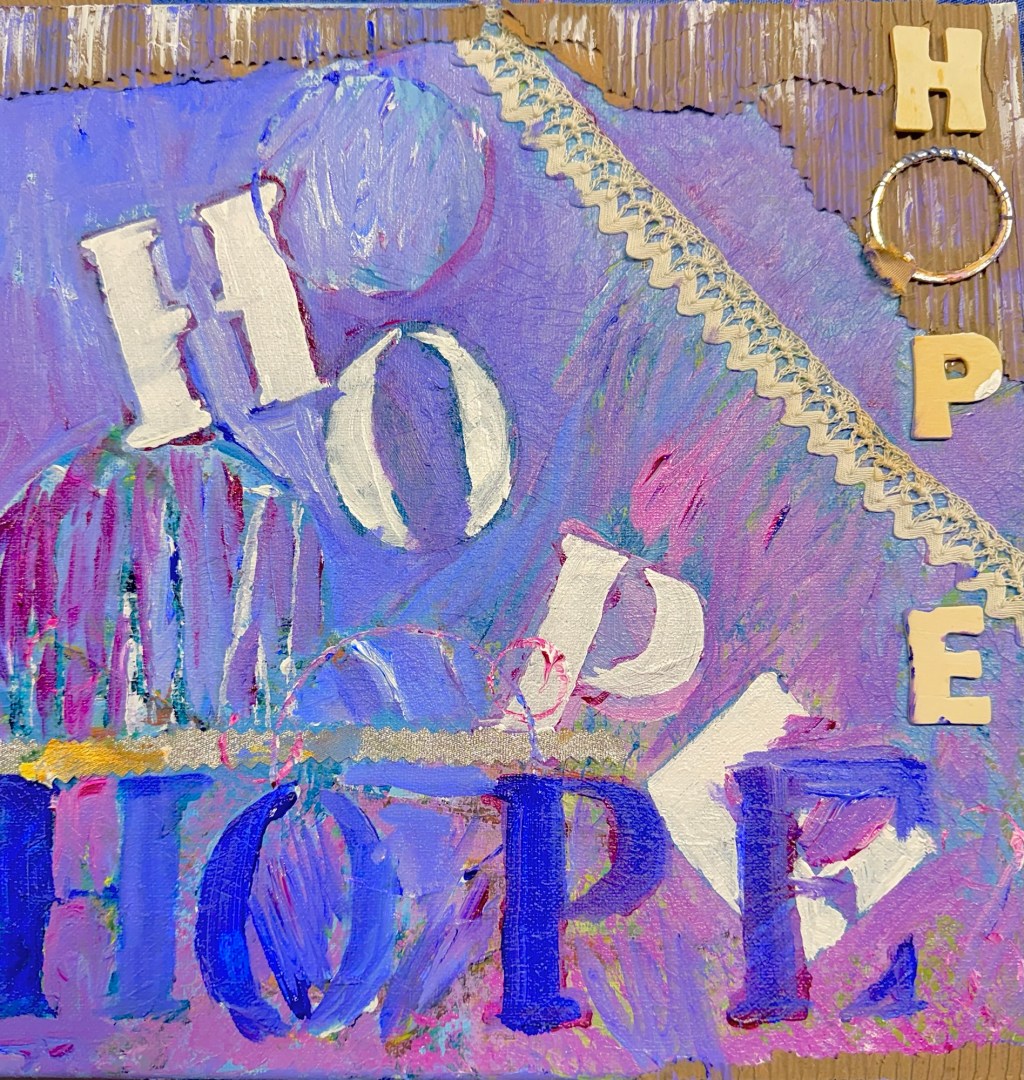
I had started my small canvas the week before when I was half sick. My hand, heart, and mind never feel quite connected when I feel bad, but I still work anyway. The beauty of acrylics is I can paint over them later. In fact, this is a repurposed canvas. If a work does not “speak to me” after a few months, I either cut it up to reweave it or paint it over entirely. I always think I will find hope for it in another form, but it may need to take its own journey to find its best self.
Jeremiah once said to the Jewish exiles in Babylon,
“For surely I know the plans I have for you, says the LORD, plans for your welfare and not for harm, to give you a future with hope.” (29:11)
When we have forgotten what our home looks like, God still remembers where we once lived. When we have lost our memories of the ancient Temple practices, God still knows the rituals. God will remind God’s faithful of our service. If we have lost our knowledge of how to walk with God, God will send us teachers once more. God always provides us with what we need.

Hope is part of our GrecoRoman heritage also. “Dum spiro spero” is Latin for “While I breathe, I hope.” Some form of this saying has been around since the 3rd century BCE. My grandmother sewed her antique crochet trim onto pillowcases for wedding gifts. This is a scrap I found in her sewing kit. I stenciled the letters HOPE and glued down the wooden letters H, P, and E. I used an old metal circle for the O. Torn corrugated paper added a touch of texture, as did a few string prints. Sometimes hope appears to slide away or seems raw and unvarnished. The colors are blue and violet because Advent is the great season of Hope. Matthew quotes the Servant Song from Isaiah in 12:18-21—
“Here is my servant, whom I have chosen,
my beloved, with whom my soul is well pleased.
I will put my Spirit upon him,
and he will proclaim justice to the Gentiles.
He will not wrangle or cry aloud,
nor will anyone hear his voice in the streets.
He will not break a bruised reed
or quench a smoldering wick
until he brings justice to victory.
And in his name the Gentiles will hope.”
This is the Messiah of Hope of Israel and the Anointed Christ in whom we hope today. We can best share the hope of this Christ to our suffering world by serving the suffering, the grieving, the hungry, and the overlooked.
Joy, peace, and hope,
Cornelia