The Iconography of the Nativity

Alexander the Great, Apocalypse, art, Bethlehem, Faith, Icons, Imagination, incarnation, inspiration, Nativity, Painting, Ravenna Italy, Savonarola, vision

What Makes a Nativity Scene?

The gospels remind us the story of Christ’s birth isn’t necessary for our salvation. Only our faith in Christ’s saving work for us on the cross is necessary “to transform our humble body that it may be conformed to the body of his glory, by the power that also enables him to make all things subject to himself.” (Philippians 3:21, alternate translation). Mark has no infancy narrative at all, while John’s gospel speaks of the Greek Logos (Word), who is present with God at creation and as co-creator.

Luke and Matthew both have birth stories. Matthew gives us the ancestry of Jesus, the Wise Men or Magi from the East, and the massacre of the innocents. John the Baptist also figures large in Matthew’s text. Luke brings in the shepherds, the host of angels, and the angel’s annunciation to Mary of her impending birth of a savior.

Luke 2:6-7 notes this point about the birth of the Christ child: “While they were there, the time came for her to deliver her child. And she gave birth to her firstborn son and wrapped him in bands of cloth, and laid him in a manger, because there was no place for them in the inn.”

Gail W. painted a simple nativity in one class session.

This bit of text sets the scene for all the artists of every era to exercise their imagination. What does a first century CE manger look like? What animals would be there? Would the visitors come by day or night? Who would visit a woman who got pregnant while she was still “betrothed?” In every age, gossip travels fast, even without the internet. Traveling traders and business people carried news from town to town.

After all, word had spread how Joseph, “being a righteous man and unwilling to expose her to public disgrace, planned to dismiss her quietly.” (Matthew 1:19). No wonder there was no room for them at the inn. No respectable place would have them. Or we could be generous to the local folk and say Mary and Joseph travelled slowly because her imminent due date was the cause of frequent stops. A donkey ride might not be the most comfortable ride in one’s late trimester. Either way, if they were late arriving, the rooms may have been booked full already.

The Church of the Nativity, which dates to the 4th CE, was built over the cave in Bethlehem where early Christians believed Christ was born. From Apocryphal sources we learn the traditions of the cave and the stable. The Infancy Gospel of James (chapter 18) also places the Nativity in a cave, but the Gospel of Pseudo-Matthew combines the two locations, explaining that on the third day after the birth “Mary went out of the cave and, entering a stable, placed the child in the manger” (chapter 14).

Roman Sarcophagus of Stilicho. It’s found today beneath the pulpit of Sant’Ambrogio basilica in Milan, Italy.

The earliest images of the nativity which currently exist are from 3rd CE sarcophagus panels. The earliest Nativity scene in art was carved into a sarcophagus lid once thought to be for a Roman general, Stilicho, who died in 408 CE. The ox and the ass and two birds are the only figures that appear in addition to Jesus, swaddled in his manger. Our typical cast of characters, including Mary and Joseph, do not appear may be because this sculpture illustrates a prophecy from the Old Testament. Isaiah 1:3 reads, “The ox knows its master, the donkey its owner’s manger…” This Nativity also has relevance to the Eucharist because believers are nourished by the “fodder” of Christ’s flesh, just as the animals receive their sustenance from the manger’s hay. The animals aren’t mentioned in the New Testament, but from the Apocryphal sources mentioned above.

Tim’s Nativity: simplicity rules here—only the lights of the great star, the light of the Christ child, and the minor lights of the heavens.

Nativity with Flight to Egypt in the upper part—from the 4th and 5th centuries, Athens, from before the Middle Ages, and technically “Roman” art. (often referred to as “Early Christian”).

Next added were the shepherds, during the 4th and 5th CE, such as this example from the Palazzo Massimo. We find it on the sarcophagus Marcus Claudianus, on the upper tier, on the left. This dates from around 350 CE, found today in the Museo Nazionale Romano, Palazzo Massimo alle Terme, Rome.

Sarcophagus of Marcus Claudianus (Rome, Italy), Palazzo Massimo: Early Christian art is interesting because it can be hard to spot the stories as you know them. Except it seems, the Nativity, in the upper left corner, 330-335CE.

The sculptor carved the sarcophagus in the style called “continuous frieze” because all the figures line up and their heads are of equal height. The appearance of grape harvest imagery on the lid is ambiguous; it appears on both pagan/secular and Christian sarcophagi with identical elements. From left to right on the lid: nativity scene of Jesus, sacrifice of Isaac, an inscription naming the deceased, an image of the deceased as scholar, and a grape harvest scene.

Carvings on the front of the Marcus Claudianus sarcophagus include: Arrest of Peter, miracle of water and wine (with a possible baptism reference), an orant or praying figure, miracle of loaves, healing a man born blind, prediction of Peter’s denial, resurrection of Lazarus and supplication of Lazarus’ sister.

This stone relief carving depicts the detail of the Nativity from the 4th and 5th centuries from the Palazzo Massimo, on the Sarcophagus of Marcus Claudianus (Rome, Italy).

A Carolingian Era (751-887) Nativity scene from the British Museum

Eastern Orthodox icons retain the cave imagery while the Western art traditions use a stable or ruins of a classical structure in the nativity scenes. The first is according to tradition and the western imagery reminds the viewer the ancient past with its many gods is no longer ascendant.

The one change we see in the 6th century is the inclusion of Mary lying on a mattress type bed. It may have appeared earlier in art, but we have no surviving example to date an earlier occurrence. Later, we see more actors in the drama appearing, but often they don’t arrive all at once. The wise men visit, or the shepherds visit, but not in the same artwork.

Wise Men Visiting the Birth of Christ, 6th CE
A 10th century ivory panel from Trier, still very much following the now 700+ year old Roman models;
things changed much more slowly in the Middle Ages than they do now.

By the time of the 11th CE, the nativity scene was becoming more elaborate , but was not yet in full flower. By the 13th CE, the magnificent portal of the St. Lawrence cathedral, in Trogir, Croatia, by the Master Radovan and his associates has a strong narrative of the many parts of the nativity story. The city of Trogir, a World Heritage Site since 1997, is known as one of the best-preserved Romanesque-Gothic cities, the core of which consists of forts, religious and secular buildings, with the Rector’s Palace and the City Loggia standing out. Its Romanesque churches are supplemented with Renaissance and Baroque edifices.

Romanesque style portal of the St. Lawrence cathedral, in Trogir, Croatia, by the Master Radovan and his associates

The detail of the portal is worth a closer look. In the center, in between the curtained “bunkbeds,” the Virgin and Child rest on the upper tier. The animals also look on in this section. Below the manger scene is a ritual bath. In my Christian world view, I called this the “baptism of Jesus.” In his Hebrew life, he would have undergone a ritual cleansing immersion bath before going to the temple for his circumcision. This ritual would mark him as a covenant member of the nation and people of God. The two elderly people on the left of this scene are most likely Simeon and Anna, prophets who speak to the child’s fulfillment of scripture.

Details of Romanesque style Portal of St Lawrence cathedral in Trogir, Croatia.

Above all this at the center top are the star, with the angels on the left and on the right. Filling the space on the left side of the portal are the shepherds and their herds, while the Magi and their steeds occupy the right side. The Magi ride horses, unlike our modern nativities which have camels.

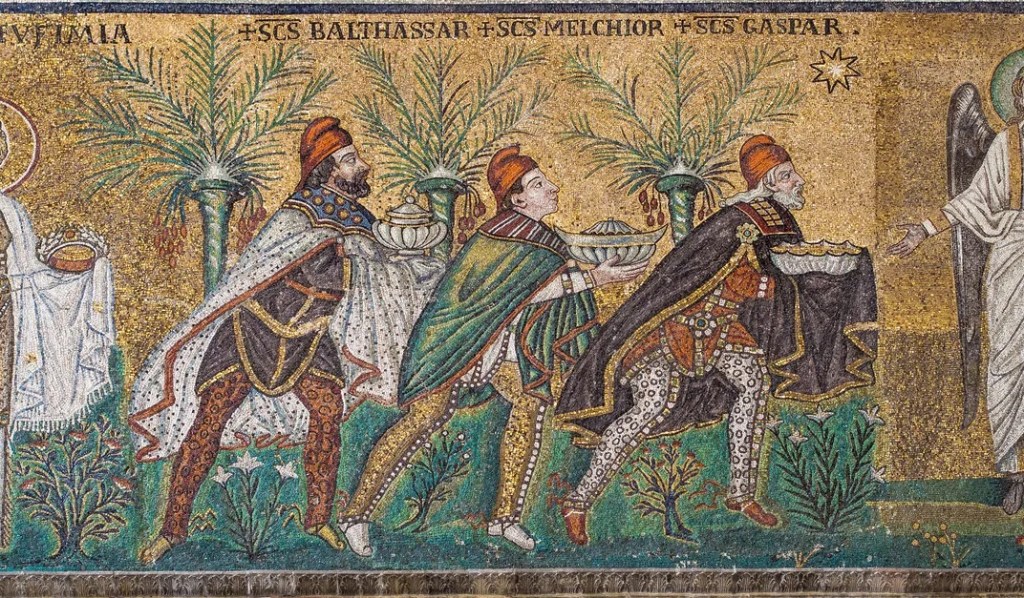
Sixth-century CE mosaic at the Basilica of Sant’Apollinare Nuovo in Ravenna, Italy

In England, the Venerable Bede (d. 735) wrote the Magi were symbols of the three parts of the world—Asia, Africa, and Europe. They signified the three sons of Noah, who fathered the races of these three continents (Genesis, chapter 10). By the late Middle Ages, this idea found expression in art, and artists began to depict one of the kings as a black African. The kings sometimes have their retinues, which include animals from their presumed places of origin: camels, horses, and elephants are the most common. As with the shepherds, the artists often represented the three kings in the various stages of life: young, middle aged, and old age.

Gentile da Fabriano’s Adoration of the Magi, 1423

Artists added more exotic animals to the nativity scenes in the 15th CE when trade and travel were expanding beyond the continent. Gentile da Fabriano’s Adoration of the Magi (painted in 1423) presents a remarkable range of animals. Alongside the traditional ox, donkey, sheep (and a couple of dogs thrown in for good measure), the chaotic scene includes a camel, cheetah (or leopard), hawks and monkeys.

“Cabinet of Curiosities”
Engraving from Ferrante Imperato, Dell’Historia Naturale (Naples 1599)

The inclusion of animals which were not native to Europe helped Gentile da Fabriano to emphasize the three wise men’s journey from the Far East, but also to impress viewers with its exoticism and visual richness. This would have reflected very well on the painting’s patron, the rich Florentine banker Palla Strozzi, as it reinforced his connections to foreign lands. In this era, many rich citizens had a collection of exotic animals and imported wares, just as wealthy people today have collections of art, yachts, or sports cars to showcase their riches.

Sandro Botticelli, “Mystic Nativity” (1500), oil on canvas, 42.7 × 29.5 inches (108.5 × 74.9 cm) (image via Wikimedia Commons), now in National Gallery of London.

An even more elaborate nativity comes from the hand of Botticelli, who worked in the wealthy merchant city of Florence, Italy, in 1500. Savonarola was a fanatical preacher who aimed to morally reform the city of Florence, which had a global reputation for artistic output and lavish lifestyles. Savonarola condemned secular art and literature, decried the city as a corrupt and vice-ridden place bloated with material wealth, and, after warning of a great scourge approaching, saved the Florentines by convincing the French king and military to deoccupy and recede during the Italian War of 1494–98.

The people thought of him as a prophet and came from miles around just to hear him preach his apocalyptic message. He preached a sermon telling the people of Florence they could become the new Jerusalem “if only its civilians would part with and burn their luxuries, opulent fineries, and give up their pagan or secular iconographies.”

Botticelli fell under Savonarola’s influence during this time, for his art changed from decorative to religious. The 12 angels at the base of the composition each hold a ribbon that the artist inscribed with the 12 privileges or virtues of the Virgin Mary, which came from a sermon Savonarola delivered about a vision he once experienced. Another unusual aspect is that the three kings welcome Jesus empty-handed, rather than with gold, frankincense, and myrrh — influenced by Savonarola’s sermon, though it could be their ultimate gifts are their prayers and devotion.

Mike brought his good humor to class with a Grinch portrait

Sometimes it’s impossible to know whether the artist was inspired by a non-biblical element or by an apocryphal text in a Nativity scene or if the artistic depiction came first. In their book, Art and the Christian Apocrypha, David R. Cartlidge and J. Keith Elliott contend in the making of early Christian art, written and visual sources are interdependent. “The developing consensus is that oral traditions, texts (rhetorical arts) and the pictorial arts all interact so that all the arts demonstrate the church’s ‘thinking out loud’ in both rhetorical and pictorial images” (2001, xv).

Gail W.’s open perspective nativity inspired by the renaissance artists

When we artists imagine the nativity today, we add to the basic scripture text all of the Hollywood movies we’ve seen, the stories we’ve heard around the fireplaces and altars of our instruction, and every Christmas card and artwork we’ve ever seen. Our memories of Christmas are often more important than Christmas itself. This is because we have an idea of how Christmas is supposed to BE, but the birth of Christ wasn’t what either Mary or Joseph thought it was going to be. Just as most of us, they hoped to be at home and near family, not “away in a manger, no crib for a bed.”

Cornelia worked in the geometry of the scene. I might rework the sky.

God brought the Savior of all into our world into a humble setting, not to a royal palace. God brought to the birthplace of Christ strangers from distant lands and marginalized people from their homeland to have the first opportunity to worship the newborn king. God excluded the political rulers because they were out to destroy this unusual king.

We are part of the Christian community now, so we sometimes miss the disruptive nature of Christ’s birth. As part of the in/dominant group today, we might have a tough time reading the Bible’s challenges to self-satisfaction and complacency.

Birth of Alexander the Great, mosaic, Roman villa near Baalbek, Lebanon, 4th CE

We often forget while these depictions of the Nativity were evolving, the segment of the Roman Empire that was still pagan were also representing famous births, that predate the standard depictions of the Nativity of Christ. For example, in a Roman villa near Baalbek, Lebanon a fourth century mosaic of the Birth of Alexander the Great at first sight almost exactly resembles what later became a standard depiction of the Nativity of Christ. This mosaic, today in the National Museum of Beirut, shows the newborn Alexander the Great being bathed in a circular fluted basin by a female figure labelled ‘Nymphe’, while his mother Olympias reclines on a bed watched by an attendant.

Compare this with the icon of the Wise Men Visiting the Birth of Christ, from the 6th CE pictured above. In the lower right corner of this nativity scene, we see a small depiction of the Christ child being bathed, with water being poured over his head. (Obviously a United Methodist, but a precursor since John Wesley wasn’t born yet!) Our Christian iconography is derived from pagan sources. By this I mean we reimagined the pagan iconography and repurposed it for our own spiritual practices and purposes.

One of our other challenges is the calendar. We in the West use the Gregorian calendar, from the 16th CE, while the Orthodox Church still follows the Julian calendar, which was in use during the time of Christ. This is why the Orthodox community still celebrates Christmas and Easter on different dates than the Western churches. In the Orthodox Church, they celebrate Epiphany as the baptism of Jesus rather than the arrival of the Magi (Three wise men), which the Western Church celebrates on 6 January. On the Gregorian calendar, this Orthodox Epiphany celebration is January 19th. They celebrate this date as the Baptism of Jesus, rather than the arrival of the wise men. Their Epiphany is located in the baptism rather than the nativity. That’s a whole other theological discussion beyond the iconography of the nativity!

DeLee: The No Room Inn, mixed media, private collection

I mention this fact of the two calendars because I’m always “calendar challenged.” It’s not a senior citizen thing, because this was my problem even when I was in my twenties also. Sometimes I put too many commitments on my calendar, and other times I underestimate the time to complete my tasks. Then again, there’s always the unexpected interruptions. Always the interruptions. I came to understand in my ministry my list of tasks to do were not my actual work, but instead these interruptions were the opportunities which God would bring to me to do God’s chosen ministry.

So, I’m a few days late on the Western calendar for the visit of the Three Kings, having missed January 6th, and I’m a few days early for the Orthodox calendar. As Goldilocks said, “Not too hot, not too cold, but just right!”

Mike’s impression of the Nativity

The last art pieces our class made in 2024 before the holidays and the snowstorms were our nativity paintings. I asked each person to use their imagination and to bring the essence of the nativity to their creative process. Some of us quickly realized our images and used our second meeting to do a personal project or another version of the nativity scene. Others of us took both sessions to perfect our one image. I blame the Christmas cookies and our lack of hand and mouth coordination. Sometimes it’s hard to chew and paint at the same time!

Our first class of 2025 was an instance of “calendar challenge”—I thought we were having it, but the group didn’t. The next week, a major snow storm canceled class every where for everyone. Friday, January 17, should be a good day to begin a new project! We’re going to do some mixed media, along with weaving projects in the days and weeks to come. You don’t need skills, but a willingness to try.

Joy, peace, and a hope for better weather!

Cornelia


The Magi and the Manger: Imaging Christmas in Ancient Art and Ritual – The Yale ISM Review

The Nativity Tympanum on the Sarcophagus of Stilicho

https://www.christianiconography.info/Wikimedia%20Commons/nativitySarcophagusStilicho.html

UNESCO monuments in the Croatian Academy of Sciences and Arts Glyptotheque

https://gliptoteka.hazu.hr/unesco/en/trogir.html

The Apocryphal Gospels—PseudoMatthew—has Latin text and translation
https://www.google.com/books/edition/The_Apocryphal_Gospels/Cmbtm4ZZXF0C?hl=en&gbpv=1&dq=M.+Berthold+has+argued+that+Pseudo-Matthew&pg=PA75&printsec=frontcover

The Infancy Gospel of James (2nd century) |http://www.ccel.org/ccel/schaff/anf08.vii.iv.html

The Arabic Infancy Gospel (5th-6th century) http://www.ccel.org/ccel/schaff/anf08.vii.xi.html

The Gospel of Pseudo-Matthew (8th or 9th century) http://www.ccel.org/ccel/schaff/anf08.vii.v.i.html

Web Gallery of Art, searchable fine arts image database

https://www.wga.hu/frames-e.html?/support/zearly/1/1sculptu/sarcopha/1/9claudi2.html

Nativity – Visual Elements in the Nativity — Glencairn Museum

https://www.glencairnmuseum.org/nativity-visualelements

Johann International: Search results for Nativity  http://johanninternational.blogspot.com/search?q=Nativity

Revisiting Botticelli’s Evocative “Mystic Nativity”  https://hyperallergic.com/978201/revisiting-botticelli-evocative-mystic-nativity/

ORTHODOX CHRISTIANITY THEN AND NOW: Origins of the Icon of the Nativity of Christ
https://www.johnsanidopoulos.com/2018/12/origins-of-icon-of-nativity-of-christ.html


Seeds of Dissent and a Harvest of Distrust

Ancestry, arkansas, art, Faith, Family, Forgiveness, greek myths, Holy Spirit, hope, incarnation, inspiration, john wesley, Love, Ministry, Painting, perfection, poverty, purpose, Ravenna Italy, renewal, Retirement, stewardship, Stress, United Methodist Church, vision

Christ Enthroned with the Angels
6th century Mosaic
Church of Sant’Apollinare Nuovo, Ravenna, Italy

Nothing springs full grown to life in an instant. Everything begins in a seed, which is planted, watered, and nourished into full growth. Only in myths or fantasies can an idea come into being instantly. Zeus had a very bad headache, a “splitting headache,” that birthed his daughter Athena, the goddess of wisdom. She leapt out in fully grown from his brow. We don’t take this myth to be scientifically true, but as a metaphor for the difficulty and struggles we undergo to obtain wisdom. As my daddy used to tell me after I’d learned some hard life lesson, “The school of experience is a rough master, and we all earn a costly degree in gaining its wisdom.”

Little Master Lip Painter Attributed to the Phrynos Painter: Birth of Athena, Attic Black Figure Ware, Kylix, Date ca. 555 – 550 B.C., Early Archaic Period,

Some of us will repeat the same lessons over and over, as if we expect to get a different result. The purpose of an education isn’t to regurgitate a right answer to pass a test, but to understand why the answer is right. That’s why math classes require showing the steps to the solution, rather than the “full blown adult answer” only. In matters of faith or ethics, many of us haven’t had the training to “set out the proof” for our final answer or deed. In fact, in one situation we may think or act one way, and quite differently in another.

The name for this behavior is “situational ethics.” Less kindly, it’s also known as spinelessness, shiftiness, being two faced, or dishonesty. Mostly it means people don’t have a true center or a plumb line by which they measure themselves. If we’re measuring our lives against other people, we’re measuring against other fallible human beings. Even our heroes have feet of clay, for none of us are gods. When I used to call my parents out on this character trait, they always told me, “Do as I say, not as I do.” This sets up a moral conflict for most people, even those raised in the church or in religious homes.

We need to have a moral center based on a higher authority than our individual or cultural conventions, one that includes or exceeds the ethics of the group to which we belong, and not just our individual beliefs and actions. Professional groups—physicians, lawyers, clergy, educators, and others—all have ethical standards for caring for those they serve, even if they morally disagree with the behaviors that bring them into their care. Who decides the ethics of the group? At the risk of making my favorite seminary professor, Billy Abraham, roll about in his still fresh grave, we United Methodists do have the so-called Wesleyan Quadrilateral of Scripture, Tradition, Reason, and Experience to guide us. Often we assign our personal life experience to this latter quadrilateral edge, but Wesley meant our Experience of the Assurance of God’s All Embracing and Adopting Love. As Wesley once said, “God is able to save all to the uttermost.”

The Good Samaritan by English School, (19th century)

Ethics and morals are often used as synonyms, but ethics refer to rules provided by an external source, e.g., codes of conduct in workplaces or principles in religions. Morals refer to an individual’s own principles regarding right and wrong. Ethics is a a late 17th century word derived from the Greek ēthos (disposition, character), in contrast to pathos (suffering). In Latin it means ‘character, depiction of character’, or (plural) ‘customs’.

Then we have the words moral and morals. The first is concerned with the principles of right and wrong behavior. The goodness or badness of human character is another concern. From these, people decide what behavior is considered right or acceptable in a particular society. We often say a person has morals if they conform to standards of behavior or beliefs concerning what is and is not acceptable for them to do. We can speak of “the corruption of public morals, “ or you can hear people talking as if “they believe addicts have no morals and can’t be trusted,” rather than understanding the disease and abuse bases which often underlie addictions.

These distinctions don’t change the negative consequences of the addict’s behaviors, yet the addicted person still has the same image of God and the same potential for wholeness each of us have, but perhaps with more suffering, or pathos. If we judge the morality of a person’s choices, and then refer that moral state to the individual’s worthiness, we can end up losing compassion for the person as well as losing the will to help them better their lives. This leads to hard heartedness and a lack of love. We reject our neighbors and make them strangers, unwelcome to our world. We forget our spiritual ancestors were once strangers in a strange land, wanderers without a home. How easily we forget our savior, who had no place to be born even in his ancestral home, and whose family fled religious persecution and certain death to live in Egypt, far from home. Strange how some Christians have no sympathy for others in the same fix today.

Moral is a word from the late Middle English by way of the Latin moralis, from mos, mor- ‘custom’, with the plural mores or ‘morals’. It refers to one having the property of being right or wrong, good or evil, or voluntary or deliberate, and therefore open to ethical appraisal. When we apply moral attributes to a person, it means “capable of moral action; able to choose between right and wrong, or good and evil.” Not until 1803 did moral come to mean “virtuous with regard to sexual conduct,” according to the Oxford English Dictionary.

As a noun, we meet the word in the Latin Moralia, the title of St Gregory the Great’s moral exposition of the Book of Job. Later it was applied to the works of various classical writers. All Methodists and the holiness denominations birthed from the seed of the great Methodist revival recognize the genius of John Wesley. We all quote him, but we also apply his wisdom through our own individual preconceived notions of what is “good, true, and noble.”

When John Wesley was asked, “What is that faith whereby we are sanctified?” he answered:

“First believe that God has promised to save you from all sin, and to fill you with all holiness; secondly, believe that He is able thus to save to the uttermost all that come unto God through him; thirdly, believe that He is willing, as well as able, to save you to the uttermost; to purify you from all sin, and fill up all your heart with love. Believe fourthly, that He is not only able, but willing to do it now! Not when you come to die; not at any distant time; not tomorrow, but today. He will then enable you to believe, it is done, according to His Word.”

In the old days, we said we were “going on to perfection,” not that we were so bold as to claim that we’d already arrived there or been perfected. Oh no, we allowed God could complete this for us and had the power to do it, as well as the will, but our human nature was still fallible. If a word comes up more than once in a text, writers go to the thesaurus for an alternative, but in reading scripture, we learned repetition was a sign of importance, a marker especially meant for those of us who are slow learners in the school of life.

Oliver O’Donovan in “Scripture and Christian Ethics” writes, “Moral theologians have a secret knowledge, apparently concealed from other kinds of theologians, especially those devoted to hermeneutics. They know that the most mysterious and most difficult question we ever have to answer is not, what does Scripture mean?, but, what does the situation we are facing mean?, where do we find ourselves existentially?”

We tend to speak as if our selves and our situations were known quantities, so that it only remains to choose out of Scripture whatever seems to fit our circumstances as we conceive them. Scripture has an uncanny way of shedding light on our self and our situation, to overcome our preconceptions about them. We don’t read about our situation directly in the Scriptures, yet it’s from the Scriptures we gain categories of understanding, which re-frame our view of our situation and ourselves. We can’t look for individual texts to guide our actions, but need to consider the whole of the revealed Scripture and God’s nature as we discern our path forward.

Carl Bloch: Monk Looking in a Mirror, 1875, oil on canvas, Nivaagaard Museum, Denmark.

In this sense, the Bible is a mirror which reflects our inner nature to us, convicting us of our failings and giving us grace and comfort in our times of need. We can learn much about ourselves from the verses we lean on, just as much as we can by the verses we ignore. There’s a reason we interpret texts by the whole of scripture, and not piecemeal. This is one way we understand the authority of scripture.

As an interesting aside, SWTX, my original conference, which approved my candidacy for the ministry, didn’t think I should attend seminary because I scored so low on the abstract reasoning tests I took. They didn’t think I would make 65, seminary’s passing grade, in my class work. It’s true I learn and process differently, but knowing this, I crammed a three year program into four years. If I’m slow to grasp the whole until I first understand the parts, this doesn’t reflect on my fitness for ministry or my intellectual ability. It merely reflects a different way of processing information. There’s more way to skin a cat, and many ways people learn.

When I taught art classes, I had to make sure I covered all the learning methods for all my students to have success. I talked about the project, I demonstrated the techniques, I had the steps written out, and for some few children, I had to place their hands in the optimum position to get them started. This covered ear and eye learning, visual reminders, and haptic or touch learning. Some students needed multiple types of learning throughout their working time on a project. Some needed reteaching every class period. Some just needed encouragement when they got stuck at a rough patch. Most all had to learn to talk in positive terms about themselves and their work, as well as about others and their creative process also.

I talk about this teaching method, for this is how we consciously or unconsciously teach those around us ethics and morals. As one youth asked me at a church I once served, “Why are you wearing your cross today? It’s not Sunday.”

“Because Jesus is important to me every day, not just on the day I lead church services.”

I realized even though her family was very active and faithful in our congregation, when they were out in the world of day to day folks, they didn’t stand out from the crowd. Maybe one day day this child will come to a time when wearing a cross becomes bearing a cross. Then again, how many people willingly choose suffering for the sake of the body of Christ? This suffering is often difficult for those of us who’ve committed our lives to Christ’s call, but we realize most laity won’t voluntarily submit to that kind of stress. Yet experience is a great teacher. We learn from others, even those who have differing opinions and choose different actions.

Wesley’s Sermon, “The Nature of Enthusiasm,” has some advice for us: “Beware you are not a fiery, persecuting enthusiast. Do not imagine that God has called you (just contrary to the spirit of Him you style your Master) to destroy men’s lives, and not to save them. Never dream of forcing men into the ways of God. Think yourself, and let think. Use no constraint in matters of religion. Even those who are farthest out of the way never compel to come in by any other means than reason, truth, and love.”

Jean Bondel: The fall of man—Adam and Eve eat from the Tree of Knowledge of Good and Evil, 1372, illustrated manuscript, National Library of the Netherlands.

As a further reminder from his all time classic Sermon, On Working Out Our Own Salvation, 1785: “By justification we are saved from the guilt of sin…by sanctification we are saved from the power and root of sin…”In modern terms, when we profess our faith, Christ saves us from the guilt of that first sin. Some say Adam and Eve were disobedient. They then emphasize rule keeping as their moral choice. There’s always a reason behind every behavior, however. Why were they disobedient? We hear the answer in the parable of the Tree of Wisdom:

“But the serpent said to the woman, “You will not die; for God knows that when you eat of it your eyes will be opened, and you will be like God, knowing good and evil.” (Genesis 3:4-5)

The man and the woman both heard the half truth, saw the shiny fruit, believed the promises of a creature rather than their creator, and ate the fruit they hoped would make them like gods. Instead they only gained knowledge of their nakedness and vulnerability. This first lesson of the school of life came with cost: fig leaves ooze irritating sap. They won’t choose this solution again. God’s providence replaced their poor choice with animal skin clothing even as God sent them out into the world. We might say the attitude of pride or greed drove their bad behavior and was the cause of their negative consequences.

As we grow in holiness and love of God and neighbor, the Holy Spirit destroys any remaining root of sin. One of the important sins, Wesley noted, was pride. Pride is that feeling of deep pleasure or satisfaction we get from our own achievements, or those of our family, tribe, nation, or other associated group. In matters of faith, we always have to remember Paul’s admonition to the Romans (10:9-13):

“because if you confess with your lips that Jesus is Lord and believe in your heart that God raised him from the dead, you will be saved. For one believes with the heart and so is justified, and one confesses with the mouth and so is saved. The scripture says, “No one who believes in him will be put to shame.” For there is no distinction between Jew and Greek; the same Lord is Lord of all and is generous to all who call on him. For, “Everyone who calls on the name of the Lord shall be saved.”

Paul reminds us of the unity of the Jews and the Gentiles, the clean and the unclean, the former masters and slaves, with the gulf now bridged between the former God worshippers and the idol worshiping strangers. Now there’s “no Jew nor Greek, no slave or free, no male or female, but all are one in Christ Jesus” (Galatians 3:28).

When we joined together into one annual conference in 2003, almost twenty years ago, we had good reasons to make one combined administrative body for our faith community. We had underfunded pension obligations, we were over heavy with administrators, and clergy didn’t have equity in retirement accumulation. Likewise, the conferences weren’t equally treated, since one didn’t fully fund pension needs, an act which caused clergy to seek appointments in the other conference, thus robbing the first of talents and gifts. These were the logical consequences of attitudes and behaviors, however.

Historic Souvenir—Can you drink this cup?

The logical person thought, “Let’s make Arkansas One Faith, One Focus, One Fellowship,” and this will solve all our problems. It may have looked good on paper, but our congregations had been used to a personal touch to remind them at least once a year they belonged to a greater whole. Their pride in showing off their home church and being a good host for the Superintendent was taken from them if they were just attendees at another group meeting. The moral choice of what’s better for me, a relaxing Sunday afternoon with my family or a meeting elsewhere, gets weighed and measured.

So now here we are, nearly twenty years into this optimistic marriage of the two annual conferences. The seeds for dissent and discontent were planted long ago, even before this joining. When I inventoried the historic memorabilia of the dead bishops at the SMU Bridwell Library, I saw how the chaos of the Vietnam War era and the sea changes our society were experiencing then affected our church in many ways. Some wanted to hold onto tradition more tightly, while others were ready to experiment with new wine in fresh wine skins. These were just “outer trappings,” however, for the message of “saved by faith, sanctified by faith, and made perfect in love by faith” never changes. This is Christ’s work, enabled by the Holy Spirit.

The past sixty years, as the last two decades, haven’t always been smooth sailing. We often have had trials, storms, and tribulations on our shared journeys. Sometimes we’re so far out to sea, we don’t see the land, and the skies are occluded, so we can’t take a bearing off the stars. Yet God’s spirit will blow us along, for even detours are within God’s providence. As James reminds us:

“Consider it pure joy, my brothers and sisters, whenever you face trials of many kinds, because you know that the testing of your faith produces perseverance. Let perseverance finish its work so that you may be mature and complete, not lacking anything.” (1:2-4)

Van Gogh: The Good Samaritan, after Delaquoix, 1890, oil on canvas, Kroller-Muller Museum, Netherlands

Today we also have powerful economic and political forces that are like wolves in sheep’s clothing. They purport to work for religion and democracy, but actually work against the stewardship of our earth ‘s resources and environment, fail to care for the poor and dispossessed, and support military interventions around the world. Moreover, some of them actively work to destabilize religious denominations with social justice callings, such as the UMC, the Presbyterian Church USA, and others. Some today think “things fall apart; the center will not hold.”

Two final words in summary: one is from the ancient wisdom tradition and the other from Paul’s paean of joy in the midst of suffering. Proverbs 22:1 reminds us, “A good name is to be chosen rather than great riches, and favor is better than silver or gold.” My dying grandfather spoke these words to me in his last hours. Ive always considered them a plumb line for my life.

Byzantine Mosaic, Ravenna, Italy

“Finally, brothers and sisters, whatever is true, whatever is noble, whatever is right, whatever is pure, whatever is lovely, whatever is admirable—if anything is excellent or praiseworthy—think about such things. Whatever you have learned or received or heard from me, or seen in me—put it into practice. And the God of peace will be with you.” — Philippians 4:8-9

Joy and Peace,

Cornelia

Oliver O’Donovan: Scripture and Christian Ethics
(This is a great read!)
https://biblicalstudies.org.uk/pdf/anvil/24-1_021.pdf

John Wesley: Repentance in Believers (Sermon 14), “Repent ye, and believe the gospel.” Mark 1:15. The Complete Works of John Wesley, vol. 1 of 3, Kindle ereader. Read on line here:
http://www.godonthe.net/wesley/jws_014.html

John Wesley’s Quotes – Seedbed
https://seedbed.com/on-john-wesley-quotes/

InterChurch Holiness Convention: a community project of various Wesleyan holiness denominations, with all male leadership
https://ihconvention.com/devotional/may-9-2/

On Patience: James 1:4–But let patience have her perfect work, that you may be perfect and entire, wanting nothing.
https://biblehub.com/sermons/auth/collyer/patience.htm

The Grammarphobia Blog: Ethics vs. morals
https://www.grammarphobia.com/blog/2012/02/ethics-vs-morals.html

The Second Coming by William Butler Yeats | Poetry Foundation https://www.poetryfoundation.org/poems/43290/the-second-coming

The Mosaic Christ

art, Creativity, Faith, Historic neighborhood, Holy Spirit, hope, Icons, incarnation, inspiration, Italy, mystery, Painting, perfection, Ravenna Italy, Reflection, renewal, Spirituality, Travel, vision

The Body of Christ is All of Us

The Body of Christ represents the perfection of all humanity as the image of God. The body of Christ we know as the church is made of many individuals, just as a mosaic design is constructed of many pieces to make a whole. I think of these as the “two bodies of Christ,” even though the literalists among us might think Jesus has only one body. The mysterious body of Christ is what Paul speaks about in his letter to the Romans:

“For as in one body we have many members, and not all the members have the same function, so we, who are many, are one body in Christ, and individually we are members one of another” (12:4-5).

I Am the Bread of Life: Macaroni Christ Icon

Since each one of us is made in the image of God, but of ordinary materials, together we become a mosaic of the whole Body of Christ, going onto his perfection as we encounter and encourage one another within and without the church. After all, the body of Christ isn’t limited to the walls of our buildings, for Christ said in Matthew 25:40—

“And the king will answer them, ‘Truly I tell you, just as you did it to one of the least of these who are members of my family, you did it to me.’”

I have a penchant for recycling canvases and paintings which no longer please me. I’m willing to destroy them and make something new. They die and are reborn into a new life. I learned something from that former experience, but now it’s time to move on. When I read my Bible, I’m always getting new inspiration and ideas from the same verses. I have texts I’ve preached on at least a dozen times, but I always came at it from a different angle. This is how we know the Bible is a living document and the Holy Spirit is always at work in us to reveal what we need to hear for our time and place.

Basilica of Sant’ Apollinaire: The Good Shepherd

We Christians in the Western world have tended to limit God’s self revelation to the spoken word and, to a lesser degree, to the Eucharistic elements in the Institution of the Lord’s Supper:

“While they were eating, he took a loaf of bread, and after blessing it he broke it, gave it to them, and said, “Take; this is my body.” (Mark 14:22).

Unfortunately, when we emptied the world of images of God, we also emptied the created world of God. This is why art is so important and necessary to bring us back to appreciate not only creativity, but also the creating God.

Likewise, images in art are beautiful and inspiring. Some which I’ve had the privilege to see in person over the years have made a difference in my artistic and spiritual journeys. These are a few which have inspired me: Byzantine mosaics in Ravenna, Pompeiian artifacts buried by Vesuvius, and the sacred treasures of the Vatican.

Emperor Justinian

I’ll focus only on the mosaics in Ravenna, which is the site of the Mausoleum of Theoderic (c.520) and the Basilica of Sant’ Apollinaire Nuovo (500-514), both built by Theodoric the Great (454-526). Here too is the Basilica of San Vitale (c.527-546), begun by Queen Amalasuntha (495-535), Theodoric’s daughter; and the Basilica of Sant’ Apollinare in Classe (c.535-549), built by the Greek banker Julianus Argentarius, who also financed the church of San Vitale. These were all very important people of their time.

San Vitale, Ravenna

Although many of Ravenna’s surviving structures have been heavily restored, the city remains the most important site of Byzantine art outside Constantinople, notably for its exquisite decorative art, including mosaics, relief sculpture, mural pictures, ceramic art, maiolica, ivory carving, marble inlays, goldsmithing, ornamented sarcophagi and much more. This treasure house of art objects made Ravenna a must see on our itinerary during my summer in Italy.

My parents gave me the choice of a car or a trip to Italy with the University Systems of Georgia for my college graduation present. Of course, I took the trip. Cars are everywhere and I could get my own one day or ride the bus if I needed to get somewhere. Italy was a trip of a lifetime, for we’d spend a whole summer in the studios in Cortona, and travel about the countryside on day trips during the session. I even got good enough with my Italian to hold small conversations with native speakers. People even invited into their homes for lunch, where I got my first taste of rabbit. These animals were sold live in the farmer’s market in Cortona’s town square on Saturdays.

At every site we visited, I stood amazed in the presence of some ancient and inspiring work of art. In the historic churches, the best artists and craftspeople of the era had the opportunity to put their skills to good use, for they were not only working for notable patrons, but also for God. Money wasn’t an object either, for extravagance for God was considered a good work worthy of a heavenly reward.

Of course, seeing the art works and experiencing the spiritual impact of the works in their setting are two entirely different things. On a tour, when huge groups of people are tramping in and out of the sanctuary, tour leaders raise their flags, signs, or ubiquitous water bottles to quiet their group before they give a lecture, and then they turn en mass like a flock of ducks, everyone exiting together to clamber onto the bus or to walk to the next place to view some sacred site.

Golden Mosaics in San Vitale

As a person on a spiritual pilgrimage, this experience can be quite jarring unless you prepare yourself in advance. Even though in that period of my life I wasn’t a believer in a personal god, nevertheless I was still seeking the mysterious experience of the presence of God. I found if I took a few moments of personal quiet to put my spirit in a receptive mode before I entered the holy spaces, I was able to ignore the chaos around me. No longer did I focus on the comings and goings of the people around me, but I looked up instead at the beautiful artworks and the glory the ancient artists wanted to give to God as they rendered the images on the walls or sculpted the images.

These mosaics are fantastic works of art, with each image made of thousands of tiny pieces of stone and glass. In the early morning light, the golden tesserae shimmer and reflect the sunlight streaming inside. When viewed in this light, the figures would see to float in a heavenly light.

6th-century apse mosaic of Sant’Apollinare in Classe.

The icons of Christ always have an other worldly look about them, as Jesus said,

“My kingdom is not from this world.” (John 18:36).

We always see in the icon the resurrected body of Christ, the heavenly body of Christ, not merely the physical body of Christ. As Paul reminds us in 1 Corinthians 15:44—

“It is sown a physical body, it is raised a spiritual body. If there is a physical body, there is also a spiritual body.”

This is why the icons have elongated faces, small mouths, and large eyes. Their facial proportions are not “realistic “according to “actual proportions.” In western art, representation of physical reality with perspective, foreshortening, and shading gives us a sense of earthly realism. Icon “writers” reject perspective, and other cues of reality to give their works a sense of “other worldliness.”

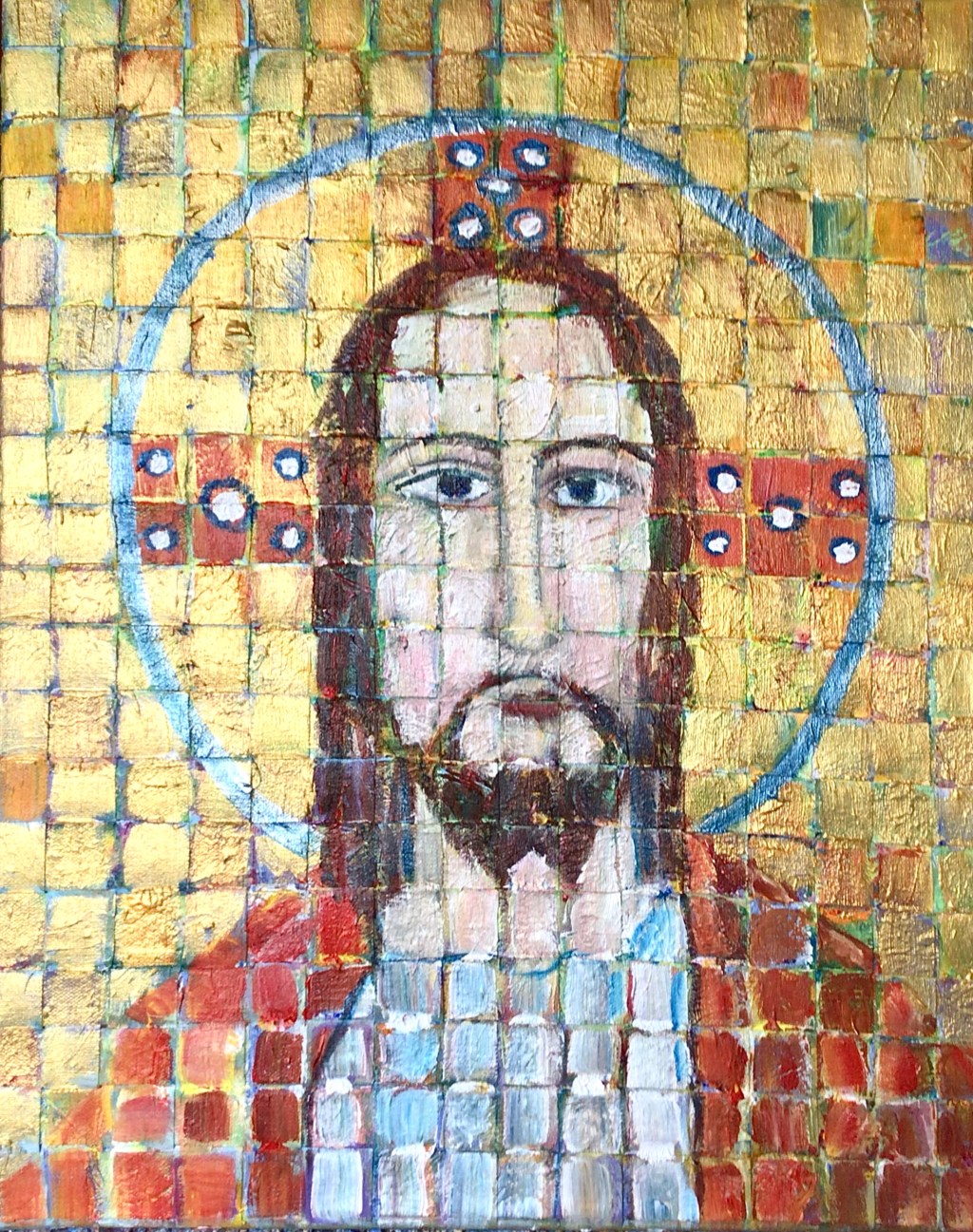
Mosaic Christ Painting

In other words, we see what we are going on to be, rather than what we are now. The icons are a window into the spiritual or heavenly world. If we have an icon in our home, it is a conduit to that heavenly world, much like a wormhole is a conduit to another point in space. Christ’s eyes have a far away look, as if he sees beyond this moment of now, in which we so firmly fix ourselves, to see the future hope of which the prophet Jeremiah speaks in 29:11—

“For surely I know the plans I have for you, says the LORD, plans for your welfare and not for harm, to give you a future with hope.”

This Mosaic Christ woven canvas art work has a light coat of gold acrylic paint over the multi colored background, so the colors show through. Because the brushstrokes don’t cover the whole square, the grid colors show up as colored mortar. The shape of the face and the hair aren’t treated subtly as in a painting, but take on the look of a mosaic.

When I paint an icon, I lose all sense of time. I enter into that holy time in which God IS, and where Jesus is when he says, “Very truly, I tell you, before Abraham was, I AM.” (John 8:58) In other words, I lose all concept of chronological time and enter into the kairos time of God: the right and opportune time, which is known only to God. I stop painting when I sense I’m taking back control of the brush, for then I’ve left kairos time and reentered chronological time.

I look at the clock and think, “Snack time.” It’s time to stop, take care of my physical body, until I’m once again able to renter that spiritual space where time has no meaning, for I’m at home with God. Painting a holy icon is a truly spiritual experience, for those who make their hearts open to the opportunity to experience the holy encroaching into this world. I hope your eyes now are more opened to seeing the holy image of God in-breaking into this earthly realm.

Joy, peace, and sugar cookies,

Cornelia