A Life of Mystery and Hope

adult learning, arkansas, art, brain plasticity, Creativity, Faith, hope, Icons, Israel, mystery, Painting, Spirituality, suffering, vision

Our weather is changeable. Last week I had the heat turned on, but this weekend I have gone back to ceiling fans and my air conditioner. I was so ready for cooler temperatures, but I am not in charge of the thermostat outside, only the one inside. Of course, while the calendar may say it is autumn and the northern states may get their first snows, we southern folks should know better than to put away all our lightweight clothing just because we have had a first frost. That first frost freeze is just a tease, since an eighty-degree day or two will soon follow.

I talk about the mysteries of our weather because when we try a new art medium for the first time, we sometimes think, “Oh, this has some similarities to a prior experience.” Then we get into it and come to the “unknown land”—the place where we realize we are lost and have no idea which way to turn. We cannot go back, we do not know how to go forward, and we think if we stay in this place, we might starve to death.

We are like Abraham, who heard God’s call to “go to a land I will show you” (Genesis 12:1), but we have no idea how long that journey will take or where we will end up. We go from our safe place as an act of faith, travel in faith, and meet every obstacle and detour with the faith God will bring us through. Every artist is an Abraham in their heart, for they are always on a spiritual journey. Even when we reach the promised land, we always are moving spiritually “from Dan to Beersheba” as we hone our craft, just as Abraham and his family followed their flocks to the seasonal pastures. Like the ancient Jews, we too can confess:

“A wandering Aramean was my ancestor…” (Deuteronomy 26:5).

If we wander, we need a guide. Beginning artists have always sought more experienced artists as their guides and teachers. For the basics, we more experienced persons act as teachers by giving instruction and directions. Some teachers give their students works to copy so each person produces an approximation of the teacher’s image. Since this method does not encourage creativity or intense attention, I have always taught people to use their own eyes to see the image, rather than have me prescribe and define it for them. That would take the greater part of the “seeing and imagining” work away from the students. This would build my neurons but not do all that much for theirs. The more difficult task challenges us and keeps our brains from becoming numb from disuse. Art is one of the best exercises for stimulating the brain.

Marie Woods: Seeking Serendipity II, Mixed media on birch panel, 12″ x 12″, 13″ x 13″ overall, Framed in a tray frame

To start the class, I showed some multi-media art works using words and found objects. Because everyone has a different learning style, I find showing images for visual learners helps those who learn through sight, while talking about these examples helps those who are auditory or hearing learners. I sometimes need to take the tools in hand to show the haptic or hands on learners. No style is “better” or more “advanced” than another, but our unique style of learning has to do with the design of our brains. We can train our brains to work in a different fashion, but our preference will always be easier.

I had begun working on a piece the week before when Mike and Gail were in class. Mike had to go away to handle a work emergency and Gail wanted to finish a pumpkin painting. Since they had known what we would work on, and we had a week off, they were ready with a fleshed-out idea. These two also have experimented with other media in the past also. Gail’s granddaughter brought a variety of materials to work with and already had an idea. Marilyn had a promising idea, but needed technical help to bring it to life.

This is where we become those who say, “we walk by faith, not by sight” (2 Corinthians 5:7). We might look at our canvas, the paint we have put on it, the gauze we tied to it, and say to ourselves: “Well, this is a fine mess I’ve gotten myself into!” This is when a call for help, the lack of activity, or the smoking of a brain working overtime makes me look up from my own work and ask, “You need some help?”

I do not read minds, but my old schoolteacher skills never really die. If the room gets too quiet, someone is either in trouble or fixing to cause trouble. In our Friday art class, we do not have the latter. When I went to help Marilyn, she was at a decision point over what to do with her image without the netting. To begin with, she had tied it on tightly and did not have scissors on hand. In our class, we are willing to share, so no one has any need. As the writer of Hebrews 13:16 reminds us,

“Do not neglect to do good and to share what you have, for such sacrifices are pleasing to God.”

My scissors broke when one of our group tried to cut a cork, so I borrowed Gail’s X-acto knife. Plan A was not available so we moved to Plan B. First the blade fell out, but I put it back in. Marilyn may have been wondering if we ever were going to find a working tool to cut away her netting. She had tied it very securely on the canvas board. Once we got it off, we could look at the paint texture on her board. There was always plan C—arm wrestle the netting off the canvas by sheer force of will, but Plan D would have been better: use the shears in the kitchen. Nothing stops us when we are going to make art. We will find a way.

Marilyn: Continental Drift

“Talk to me about your goals here,” I said.

“I was trying to get some green here, like a green ground.”

“You have plenty of green colors on your palette. Do you want solid greens or washes, like transparent greens?”

“More like transparent greens.”

“So, use your big brush and water.”

“I did not bring my big brushes. Just my small ones.”

“You can borrow mine.”

This is how the art studio life goes. We chat things out for a bit until we get over a hump, and then we let a person explore on their own some more. Some things they will discover for themselves. The more water you put into a color, the thinner it is on the canvas. The more paint put on your brush, the more opaque it is. If you want transparency, you thin your paint with a medium or water, but if you want to cover an area, you paint straight out of the tube. Keeping your brushes clean by changing the water often is also important. Otherwise, you are dragging colored water into your other colors. None of your other colors will be true colors, but will take on the color of your water.


Jimmie Durham: “Still Life with Spirit and Xitle”, car being crushed by a volcanic boulder with a comical smiley face painted on it.

When we journey, we sometimes need to take a detour along our well-planned route because a boulder has rolled down into the middle of the road or a recent flood has washed out the bridge. My map reading skills before GPS were so suspect, my daughter was frightened whenever I announced, “I’ve found a shortcut to save us some time.”

“Oh, no! Not the long cut!” She would wail. Unfortunately, she was usually correct. The shortcut might have been true, but my map reading skills always turned these short trips into long journeys. I do get to see the “unknown lands” off the beaten path of the scenic tours of whatever place I visit. “Oh, the places I have been!”

Dr. Seuss is a prophet

Learning how to paint, create art, make pottery, play a musical instrument, or any other creative activity does require attention, practice, critiquing, and patience. We must be pilgrims on a journey, knowing the long walk is part of the spiritual process of becoming the person we want to be. Our works will reflect our inner journey as we get closer to our destination. An artist never quits learning, so the artist’s journey never ends until they can no longer create physical works here on earth. As Anselm Kiefer, a modern German multimedia artist says,

“Art is longing. You never arrive, but you keep going in the hope that you will.”

Anselm Kiefer: Feld (Field), 2019-20, Emulsion, oil, and acrylic on canvas, 110¼x149% inches (280 x 380 cm)

Gail tried laying her paint on with a painter’s spackling knife. Normally she thins her paint out with water and treats it like a watercolor painting. She will build up layers to add depth and color. She also has a good clean edge to these works. She brought none of that vision to this painting, but laid on the three primary colors so thickly, they glistened. She tried printing the words with a rubbery shelf paper, but they did not stand out enough. I asked, “Do you think those words would read better in a different color?”

Gail: Elusive Peace

Her reply, “Peace is elusive these days. It is hard to find.”

“Form follows function” is a design principle, so Gail must be on to the metaphor of her theme word.

My Heart is on the Sea

Harper came to visit and made an ocean with sea foam bubble wrap and a heart floating on the water. She also brought her latest fancy bead bracelets.

Michael’s Cross and Crown

Mike was making up for missing art. He sat down with all his materials and worked his background in paint. After listening to my intro, he returned to cut up his purple cloth, arrange it on the canvas, and set the two pieces of scrap wood into a cross shape. Then he used spray fixative to hold the lot together. I saw him trying to get the wood to stick, so I suggested putting spray on both surfaces. This way the two would bond together. That piece of information was a technical revelation.

“I just need it to stick together long enough to get it home,” he said, “and then I can glue it for real.”

Aurora Across Arkansas 11/11/25

I noted his background colors reflected the unusual auroras which graced our evening skies this past week.

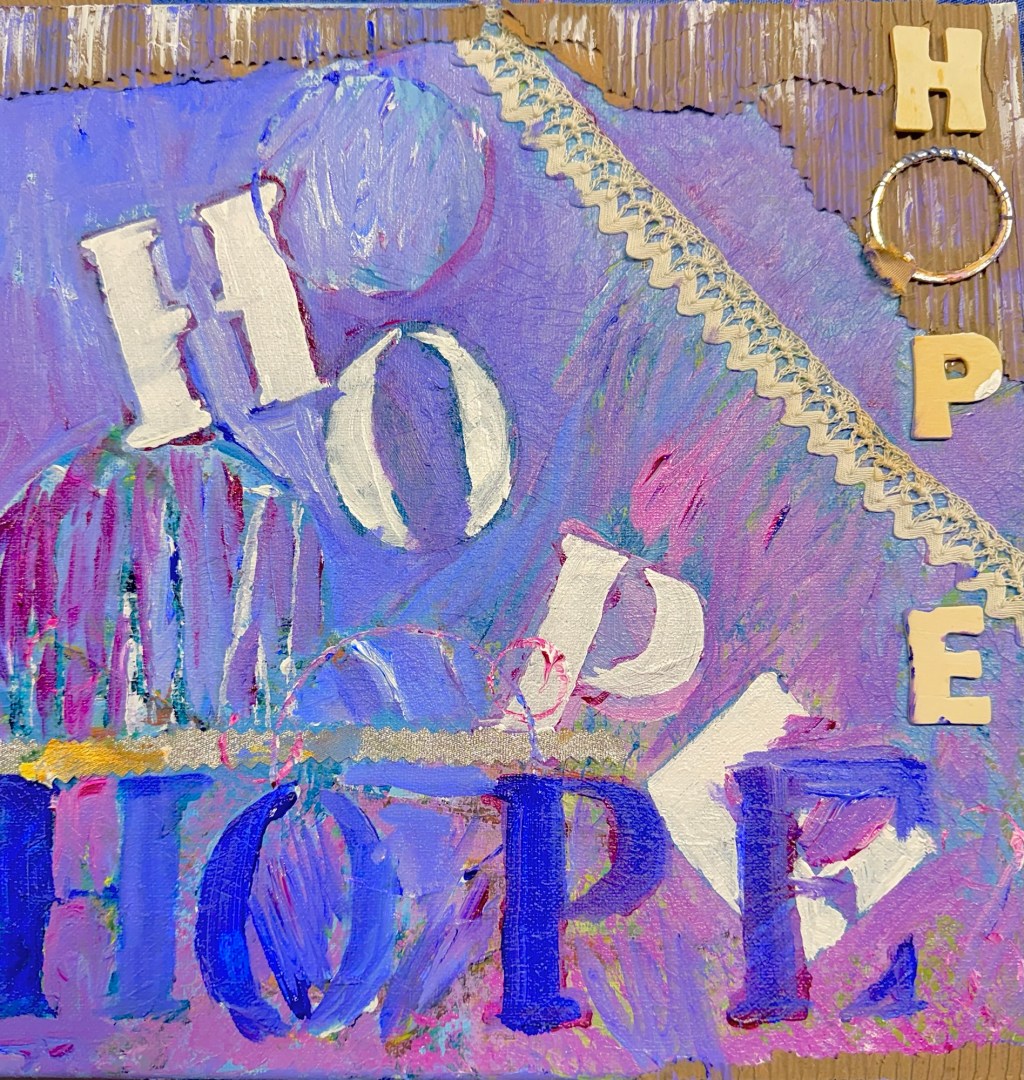
Eternal Hope

I had started my small canvas the week before when I was half sick. My hand, heart, and mind never feel quite connected when I feel bad, but I still work anyway. The beauty of acrylics is I can paint over them later. In fact, this is a repurposed canvas. If a work does not “speak to me” after a few months, I either cut it up to reweave it or paint it over entirely. I always think I will find hope for it in another form, but it may need to take its own journey to find its best self.

Jeremiah once said to the Jewish exiles in Babylon,

“For surely I know the plans I have for you, says the LORD, plans for your welfare and not for harm, to give you a future with hope.” (29:11)

When we have forgotten what our home looks like, God still remembers where we once lived. When we have lost our memories of the ancient Temple practices, God still knows the rituals. God will remind God’s faithful of our service. If we have lost our knowledge of how to walk with God, God will send us teachers once more. God always provides us with what we need.

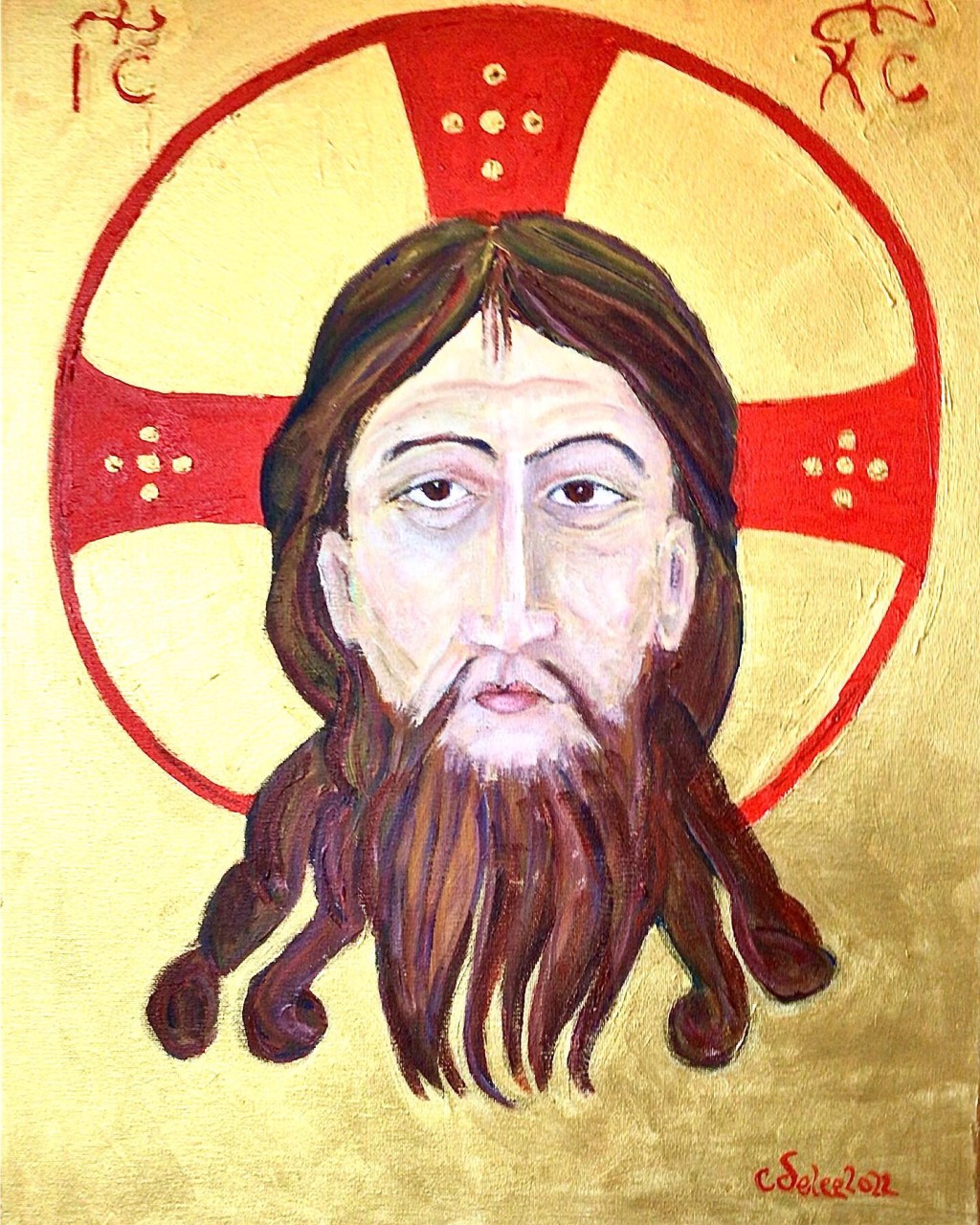
Christ the Redeemer, 16th CE, Gallery of Art, Skopje.

Hope is part of our GrecoRoman heritage also. “Dum spiro spero” is Latin for “While I breathe, I hope.” Some form of this saying has been around since the 3rd century BCE. My grandmother sewed her antique crochet trim onto pillowcases for wedding gifts. This is a scrap I found in her sewing kit. I stenciled the letters HOPE and glued down the wooden letters H, P, and E. I used an old metal circle for the O. Torn corrugated paper added a touch of texture, as did a few string prints. Sometimes hope appears to slide away or seems raw and unvarnished. The colors are blue and violet because Advent is the great season of Hope. Matthew quotes the Servant Song from Isaiah in 12:18-21—

“Here is my servant, whom I have chosen,

my beloved, with whom my soul is well pleased.

I will put my Spirit upon him,

and he will proclaim justice to the Gentiles.

He will not wrangle or cry aloud,

nor will anyone hear his voice in the streets.

He will not break a bruised reed

or quench a smoldering wick

until he brings justice to victory.

And in his name the Gentiles will hope.”

This is the Messiah of Hope of Israel and the Anointed Christ in whom we hope today. We can best share the hope of this Christ to our suffering world by serving the suffering, the grieving, the hungry, and the overlooked.

Joy, peace, and hope,

Cornelia


The Iconography of the Nativity

Alexander the Great, Apocalypse, art, Bethlehem, Faith, Icons, Imagination, incarnation, inspiration, Nativity, Painting, Ravenna Italy, Savonarola, vision

What Makes a Nativity Scene?

The gospels remind us the story of Christ’s birth isn’t necessary for our salvation. Only our faith in Christ’s saving work for us on the cross is necessary “to transform our humble body that it may be conformed to the body of his glory, by the power that also enables him to make all things subject to himself.” (Philippians 3:21, alternate translation). Mark has no infancy narrative at all, while John’s gospel speaks of the Greek Logos (Word), who is present with God at creation and as co-creator.

Luke and Matthew both have birth stories. Matthew gives us the ancestry of Jesus, the Wise Men or Magi from the East, and the massacre of the innocents. John the Baptist also figures large in Matthew’s text. Luke brings in the shepherds, the host of angels, and the angel’s annunciation to Mary of her impending birth of a savior.

Luke 2:6-7 notes this point about the birth of the Christ child: “While they were there, the time came for her to deliver her child. And she gave birth to her firstborn son and wrapped him in bands of cloth, and laid him in a manger, because there was no place for them in the inn.”

Gail W. painted a simple nativity in one class session.

This bit of text sets the scene for all the artists of every era to exercise their imagination. What does a first century CE manger look like? What animals would be there? Would the visitors come by day or night? Who would visit a woman who got pregnant while she was still “betrothed?” In every age, gossip travels fast, even without the internet. Traveling traders and business people carried news from town to town.

After all, word had spread how Joseph, “being a righteous man and unwilling to expose her to public disgrace, planned to dismiss her quietly.” (Matthew 1:19). No wonder there was no room for them at the inn. No respectable place would have them. Or we could be generous to the local folk and say Mary and Joseph travelled slowly because her imminent due date was the cause of frequent stops. A donkey ride might not be the most comfortable ride in one’s late trimester. Either way, if they were late arriving, the rooms may have been booked full already.

The Church of the Nativity, which dates to the 4th CE, was built over the cave in Bethlehem where early Christians believed Christ was born. From Apocryphal sources we learn the traditions of the cave and the stable. The Infancy Gospel of James (chapter 18) also places the Nativity in a cave, but the Gospel of Pseudo-Matthew combines the two locations, explaining that on the third day after the birth “Mary went out of the cave and, entering a stable, placed the child in the manger” (chapter 14).

Roman Sarcophagus of Stilicho. It’s found today beneath the pulpit of Sant’Ambrogio basilica in Milan, Italy.

The earliest images of the nativity which currently exist are from 3rd CE sarcophagus panels. The earliest Nativity scene in art was carved into a sarcophagus lid once thought to be for a Roman general, Stilicho, who died in 408 CE. The ox and the ass and two birds are the only figures that appear in addition to Jesus, swaddled in his manger. Our typical cast of characters, including Mary and Joseph, do not appear may be because this sculpture illustrates a prophecy from the Old Testament. Isaiah 1:3 reads, “The ox knows its master, the donkey its owner’s manger…” This Nativity also has relevance to the Eucharist because believers are nourished by the “fodder” of Christ’s flesh, just as the animals receive their sustenance from the manger’s hay. The animals aren’t mentioned in the New Testament, but from the Apocryphal sources mentioned above.

Tim’s Nativity: simplicity rules here—only the lights of the great star, the light of the Christ child, and the minor lights of the heavens.

Nativity with Flight to Egypt in the upper part—from the 4th and 5th centuries, Athens, from before the Middle Ages, and technically “Roman” art. (often referred to as “Early Christian”).

Next added were the shepherds, during the 4th and 5th CE, such as this example from the Palazzo Massimo. We find it on the sarcophagus Marcus Claudianus, on the upper tier, on the left. This dates from around 350 CE, found today in the Museo Nazionale Romano, Palazzo Massimo alle Terme, Rome.

Sarcophagus of Marcus Claudianus (Rome, Italy), Palazzo Massimo: Early Christian art is interesting because it can be hard to spot the stories as you know them. Except it seems, the Nativity, in the upper left corner, 330-335CE.

The sculptor carved the sarcophagus in the style called “continuous frieze” because all the figures line up and their heads are of equal height. The appearance of grape harvest imagery on the lid is ambiguous; it appears on both pagan/secular and Christian sarcophagi with identical elements. From left to right on the lid: nativity scene of Jesus, sacrifice of Isaac, an inscription naming the deceased, an image of the deceased as scholar, and a grape harvest scene.

Carvings on the front of the Marcus Claudianus sarcophagus include: Arrest of Peter, miracle of water and wine (with a possible baptism reference), an orant or praying figure, miracle of loaves, healing a man born blind, prediction of Peter’s denial, resurrection of Lazarus and supplication of Lazarus’ sister.

This stone relief carving depicts the detail of the Nativity from the 4th and 5th centuries from the Palazzo Massimo, on the Sarcophagus of Marcus Claudianus (Rome, Italy).

A Carolingian Era (751-887) Nativity scene from the British Museum

Eastern Orthodox icons retain the cave imagery while the Western art traditions use a stable or ruins of a classical structure in the nativity scenes. The first is according to tradition and the western imagery reminds the viewer the ancient past with its many gods is no longer ascendant.

The one change we see in the 6th century is the inclusion of Mary lying on a mattress type bed. It may have appeared earlier in art, but we have no surviving example to date an earlier occurrence. Later, we see more actors in the drama appearing, but often they don’t arrive all at once. The wise men visit, or the shepherds visit, but not in the same artwork.

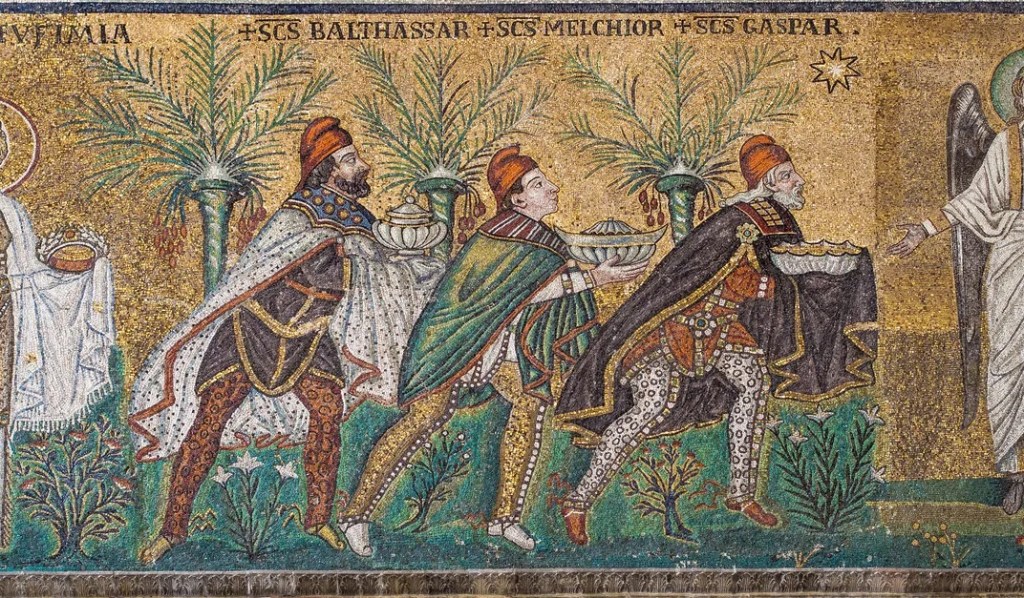
Wise Men Visiting the Birth of Christ, 6th CE
A 10th century ivory panel from Trier, still very much following the now 700+ year old Roman models;
things changed much more slowly in the Middle Ages than they do now.

By the time of the 11th CE, the nativity scene was becoming more elaborate , but was not yet in full flower. By the 13th CE, the magnificent portal of the St. Lawrence cathedral, in Trogir, Croatia, by the Master Radovan and his associates has a strong narrative of the many parts of the nativity story. The city of Trogir, a World Heritage Site since 1997, is known as one of the best-preserved Romanesque-Gothic cities, the core of which consists of forts, religious and secular buildings, with the Rector’s Palace and the City Loggia standing out. Its Romanesque churches are supplemented with Renaissance and Baroque edifices.

Romanesque style portal of the St. Lawrence cathedral, in Trogir, Croatia, by the Master Radovan and his associates

The detail of the portal is worth a closer look. In the center, in between the curtained “bunkbeds,” the Virgin and Child rest on the upper tier. The animals also look on in this section. Below the manger scene is a ritual bath. In my Christian world view, I called this the “baptism of Jesus.” In his Hebrew life, he would have undergone a ritual cleansing immersion bath before going to the temple for his circumcision. This ritual would mark him as a covenant member of the nation and people of God. The two elderly people on the left of this scene are most likely Simeon and Anna, prophets who speak to the child’s fulfillment of scripture.

Details of Romanesque style Portal of St Lawrence cathedral in Trogir, Croatia.

Above all this at the center top are the star, with the angels on the left and on the right. Filling the space on the left side of the portal are the shepherds and their herds, while the Magi and their steeds occupy the right side. The Magi ride horses, unlike our modern nativities which have camels.

Sixth-century CE mosaic at the Basilica of Sant’Apollinare Nuovo in Ravenna, Italy

In England, the Venerable Bede (d. 735) wrote the Magi were symbols of the three parts of the world—Asia, Africa, and Europe. They signified the three sons of Noah, who fathered the races of these three continents (Genesis, chapter 10). By the late Middle Ages, this idea found expression in art, and artists began to depict one of the kings as a black African. The kings sometimes have their retinues, which include animals from their presumed places of origin: camels, horses, and elephants are the most common. As with the shepherds, the artists often represented the three kings in the various stages of life: young, middle aged, and old age.

Gentile da Fabriano’s Adoration of the Magi, 1423

Artists added more exotic animals to the nativity scenes in the 15th CE when trade and travel were expanding beyond the continent. Gentile da Fabriano’s Adoration of the Magi (painted in 1423) presents a remarkable range of animals. Alongside the traditional ox, donkey, sheep (and a couple of dogs thrown in for good measure), the chaotic scene includes a camel, cheetah (or leopard), hawks and monkeys.

“Cabinet of Curiosities”
Engraving from Ferrante Imperato, Dell’Historia Naturale (Naples 1599)

The inclusion of animals which were not native to Europe helped Gentile da Fabriano to emphasize the three wise men’s journey from the Far East, but also to impress viewers with its exoticism and visual richness. This would have reflected very well on the painting’s patron, the rich Florentine banker Palla Strozzi, as it reinforced his connections to foreign lands. In this era, many rich citizens had a collection of exotic animals and imported wares, just as wealthy people today have collections of art, yachts, or sports cars to showcase their riches.

Sandro Botticelli, “Mystic Nativity” (1500), oil on canvas, 42.7 × 29.5 inches (108.5 × 74.9 cm) (image via Wikimedia Commons), now in National Gallery of London.

An even more elaborate nativity comes from the hand of Botticelli, who worked in the wealthy merchant city of Florence, Italy, in 1500. Savonarola was a fanatical preacher who aimed to morally reform the city of Florence, which had a global reputation for artistic output and lavish lifestyles. Savonarola condemned secular art and literature, decried the city as a corrupt and vice-ridden place bloated with material wealth, and, after warning of a great scourge approaching, saved the Florentines by convincing the French king and military to deoccupy and recede during the Italian War of 1494–98.

The people thought of him as a prophet and came from miles around just to hear him preach his apocalyptic message. He preached a sermon telling the people of Florence they could become the new Jerusalem “if only its civilians would part with and burn their luxuries, opulent fineries, and give up their pagan or secular iconographies.”

Botticelli fell under Savonarola’s influence during this time, for his art changed from decorative to religious. The 12 angels at the base of the composition each hold a ribbon that the artist inscribed with the 12 privileges or virtues of the Virgin Mary, which came from a sermon Savonarola delivered about a vision he once experienced. Another unusual aspect is that the three kings welcome Jesus empty-handed, rather than with gold, frankincense, and myrrh — influenced by Savonarola’s sermon, though it could be their ultimate gifts are their prayers and devotion.

Mike brought his good humor to class with a Grinch portrait

Sometimes it’s impossible to know whether the artist was inspired by a non-biblical element or by an apocryphal text in a Nativity scene or if the artistic depiction came first. In their book, Art and the Christian Apocrypha, David R. Cartlidge and J. Keith Elliott contend in the making of early Christian art, written and visual sources are interdependent. “The developing consensus is that oral traditions, texts (rhetorical arts) and the pictorial arts all interact so that all the arts demonstrate the church’s ‘thinking out loud’ in both rhetorical and pictorial images” (2001, xv).

Gail W.’s open perspective nativity inspired by the renaissance artists

When we artists imagine the nativity today, we add to the basic scripture text all of the Hollywood movies we’ve seen, the stories we’ve heard around the fireplaces and altars of our instruction, and every Christmas card and artwork we’ve ever seen. Our memories of Christmas are often more important than Christmas itself. This is because we have an idea of how Christmas is supposed to BE, but the birth of Christ wasn’t what either Mary or Joseph thought it was going to be. Just as most of us, they hoped to be at home and near family, not “away in a manger, no crib for a bed.”

Cornelia worked in the geometry of the scene. I might rework the sky.

God brought the Savior of all into our world into a humble setting, not to a royal palace. God brought to the birthplace of Christ strangers from distant lands and marginalized people from their homeland to have the first opportunity to worship the newborn king. God excluded the political rulers because they were out to destroy this unusual king.

We are part of the Christian community now, so we sometimes miss the disruptive nature of Christ’s birth. As part of the in/dominant group today, we might have a tough time reading the Bible’s challenges to self-satisfaction and complacency.

Birth of Alexander the Great, mosaic, Roman villa near Baalbek, Lebanon, 4th CE

We often forget while these depictions of the Nativity were evolving, the segment of the Roman Empire that was still pagan were also representing famous births, that predate the standard depictions of the Nativity of Christ. For example, in a Roman villa near Baalbek, Lebanon a fourth century mosaic of the Birth of Alexander the Great at first sight almost exactly resembles what later became a standard depiction of the Nativity of Christ. This mosaic, today in the National Museum of Beirut, shows the newborn Alexander the Great being bathed in a circular fluted basin by a female figure labelled ‘Nymphe’, while his mother Olympias reclines on a bed watched by an attendant.

Compare this with the icon of the Wise Men Visiting the Birth of Christ, from the 6th CE pictured above. In the lower right corner of this nativity scene, we see a small depiction of the Christ child being bathed, with water being poured over his head. (Obviously a United Methodist, but a precursor since John Wesley wasn’t born yet!) Our Christian iconography is derived from pagan sources. By this I mean we reimagined the pagan iconography and repurposed it for our own spiritual practices and purposes.

One of our other challenges is the calendar. We in the West use the Gregorian calendar, from the 16th CE, while the Orthodox Church still follows the Julian calendar, which was in use during the time of Christ. This is why the Orthodox community still celebrates Christmas and Easter on different dates than the Western churches. In the Orthodox Church, they celebrate Epiphany as the baptism of Jesus rather than the arrival of the Magi (Three wise men), which the Western Church celebrates on 6 January. On the Gregorian calendar, this Orthodox Epiphany celebration is January 19th. They celebrate this date as the Baptism of Jesus, rather than the arrival of the wise men. Their Epiphany is located in the baptism rather than the nativity. That’s a whole other theological discussion beyond the iconography of the nativity!

DeLee: The No Room Inn, mixed media, private collection

I mention this fact of the two calendars because I’m always “calendar challenged.” It’s not a senior citizen thing, because this was my problem even when I was in my twenties also. Sometimes I put too many commitments on my calendar, and other times I underestimate the time to complete my tasks. Then again, there’s always the unexpected interruptions. Always the interruptions. I came to understand in my ministry my list of tasks to do were not my actual work, but instead these interruptions were the opportunities which God would bring to me to do God’s chosen ministry.

So, I’m a few days late on the Western calendar for the visit of the Three Kings, having missed January 6th, and I’m a few days early for the Orthodox calendar. As Goldilocks said, “Not too hot, not too cold, but just right!”

Mike’s impression of the Nativity

The last art pieces our class made in 2024 before the holidays and the snowstorms were our nativity paintings. I asked each person to use their imagination and to bring the essence of the nativity to their creative process. Some of us quickly realized our images and used our second meeting to do a personal project or another version of the nativity scene. Others of us took both sessions to perfect our one image. I blame the Christmas cookies and our lack of hand and mouth coordination. Sometimes it’s hard to chew and paint at the same time!

Our first class of 2025 was an instance of “calendar challenge”—I thought we were having it, but the group didn’t. The next week, a major snow storm canceled class every where for everyone. Friday, January 17, should be a good day to begin a new project! We’re going to do some mixed media, along with weaving projects in the days and weeks to come. You don’t need skills, but a willingness to try.

Joy, peace, and a hope for better weather!

Cornelia


The Magi and the Manger: Imaging Christmas in Ancient Art and Ritual – The Yale ISM Review

The Nativity Tympanum on the Sarcophagus of Stilicho

https://www.christianiconography.info/Wikimedia%20Commons/nativitySarcophagusStilicho.html

UNESCO monuments in the Croatian Academy of Sciences and Arts Glyptotheque

https://gliptoteka.hazu.hr/unesco/en/trogir.html

The Apocryphal Gospels—PseudoMatthew—has Latin text and translation
https://www.google.com/books/edition/The_Apocryphal_Gospels/Cmbtm4ZZXF0C?hl=en&gbpv=1&dq=M.+Berthold+has+argued+that+Pseudo-Matthew&pg=PA75&printsec=frontcover

The Infancy Gospel of James (2nd century) |http://www.ccel.org/ccel/schaff/anf08.vii.iv.html

The Arabic Infancy Gospel (5th-6th century) http://www.ccel.org/ccel/schaff/anf08.vii.xi.html

The Gospel of Pseudo-Matthew (8th or 9th century) http://www.ccel.org/ccel/schaff/anf08.vii.v.i.html

Web Gallery of Art, searchable fine arts image database

https://www.wga.hu/frames-e.html?/support/zearly/1/1sculptu/sarcopha/1/9claudi2.html

Nativity – Visual Elements in the Nativity — Glencairn Museum

https://www.glencairnmuseum.org/nativity-visualelements

Johann International: Search results for Nativity  http://johanninternational.blogspot.com/search?q=Nativity

Revisiting Botticelli’s Evocative “Mystic Nativity”  https://hyperallergic.com/978201/revisiting-botticelli-evocative-mystic-nativity/

ORTHODOX CHRISTIANITY THEN AND NOW: Origins of the Icon of the Nativity of Christ
https://www.johnsanidopoulos.com/2018/12/origins-of-icon-of-nativity-of-christ.html


Total Eclipse of the Heart

adult learning, arkansas, art, Astrology, cosmology, Creativity, Faith, Great American Eclipse, Imagination, inspiration, Light of the World, Love, mystery, nature, Painting, photography, shadows, Spirituality, Travel, Uncategorized, vision

In the Bonnie Tyler song, “Total Eclipse of the Heart,” her rock and roll soul pines for a young man as she sings:

“Every now and then

I know there’s no one in the universe

As magical and wondrous as you.”

Love struck teen heart ballads tend to elevate the beloved to a high pedestal, while hymns lift the praises of God to the highest heavens. If we look at John Wesley’s Notes on the New Testament, one of the doctrinal standards of the United Methodist Church, his commentary on 2 Corinthians 4:6 (KJV) is instructive:

“For God, who commanded the light to shine out of darkness, hath shined in our hearts, to give the light of the knowledge of the glory of God in the face of Jesus Christ.”

We might be more familiar with this verse in the NRSV, a more modern translation, which wasn’t available in the middle of the 18th century:

For it is the God who said, “Let light shine out of darkness,” who has shone in our hearts to give the light of the knowledge of the glory of God in the face of Jesus Christ.

Bailey’s Ring, from an earlier total eclipse over the South Pacific Ocean

Wesley’s commentary in his Notes on this text is succinct:

  1. For God hath shined in our hearts—The hearts of all those whom the God of this world no longer blinds.
  2. God who is himself our light; not only the author of light, but also the fountain of it.
  3. To enlighten us with the knowledge of the glory of God—Of his glorious love, and of his glorious image.
  4. In the face of Jesus Christ—Which reflects his glory in another manner than the face of Moses did.

What do the Total Eclipse of the Heart and Paul’s words to the Corinthian community have to do with art and faith? We’ve just experienced, what was for most of us, was a once in a lifetime experience. The last time a total solar eclipse was visible across the entire continent was in June 1918, when a total solar eclipse was visible from Washington to Florida, according to the US parks service. Nearly 100 years passed until this present Great American Eclipse.

At the 1878 total eclipse, Maria Mitchell led the Vassar College eclipse party, an all-female expedition from that pioneering women’s institution, which came to Denver in an era when science was a male bastion. Even higher education was deemed risky for the “fairer sex.” In 1873, the prominent Boston physician Edward H. Clarke had warned in an incendiary book titled “Sex in Education,” that the recent push for female colleges and coeducation could undermine women’s health by taxing their brains and causing their reproductive organs to atrophy — leading to “a dropping out of maternal instincts, and an appearance of Amazonian coarseness and force.” Nearly 150 years later some men still concern themselves with outmoded and 19th century views on women’s health concerns.

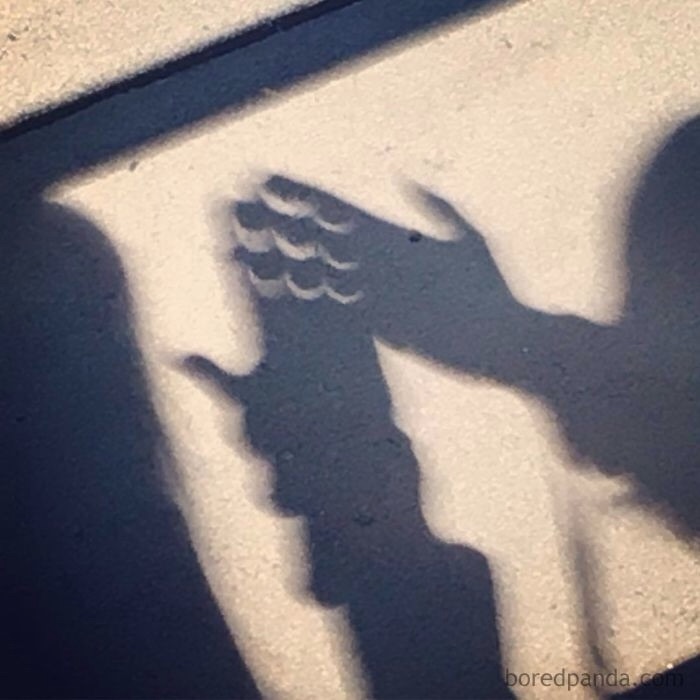
Eclipse as seen through the hands

I drove over four hundred miles to Kentucky in 2017 for the prior Great American Eclipse and got to stay home to see this second Great American Eclipse in my own front yard. Some folks couldn’t have been bothered about this current grand event, while others were convinced God was informing America of her impending doom. Moreover, multiple conspiracy theories abounded, none of which came true, of course. For instance, the world didn’t come to an end and our cell phones still work. Even the electric grid held up, even though the sun didn’t shine for all of a few minutes as the shadow traveled at over 1,600 miles per hour as it raced along the path of totality. This wasn’t even Y2K, which we all remember was a nonstarter at least and a dud at best.

Eclipse over Niagara Falls, 2024

In art class Friday Tim and I talked about the experience of this celestial event. We humans often elevate our own importance when we measure ourselves against one another and the works of our hands. When we go out into nature, we’re faced with the grandeur of God’s creation, especially when we visit the Grand Canyon or Niagara Falls. In Psalms 19:1, we read:

The heavens are telling the glory of God; and the firmament proclaims his handiwork.”

We see the beauty of nature and feel a warmth in our hearts. Our spirits soar. This intimacy with nature is one of the reasons we send our children to our United Methodist Church Camps, not just because they’ll have a great Christian experience, but because they’ll have that faith experience in nature with trusted leaders. I still remember my adventures and experiences in nature at those camps as part of my spiritual journey.

Towering Cumulus Clouds

Even in seminary, when I was having difficulty with some of my courses, I could go for a walk on the campus under the tree lined walks and search the skies for hopeful signs. Sometimes I saw the towering cumulus clouds in the Texas sky as a sign God was with me “in the cloud by day.” In those times of difficulty, even the cloistered realm of preparation seemed like a wilderness journey, but I was glad for a guide.

Bill Maxey, from Nebraska, taken at Hot Springs, AR.

When I was actively serving as a pastor, sometimes I just had to get away. I’d drive until I found some nature, a national park, national forest, or some fields outside of town. If it was a hot summer, I looked for some deep woods and cool shade to shelter me. In the cool spring, I drove until I found flowers. Maybe this is why I retired to a lake in a national park. I don’t need a big house, since I’d rather go out into nature instead.

Totality on Lake Hamilton, with sunset in the west, outside the path of totality

It was the heat of summer in 2017, so you’d think I’d remember the temperature drop right before the eclipse was halfway through. This year I was on Lake Hamilton, and the breeze off the lake combined with the cooler air was decidedly noticeable. When we entered totality, the lights on the Highway 70 bridge and at Bubba Brews automatically came on. The distant sky in the southwest, outside the path of totality, looked like a summer sunset. My neighbors and our visitors from afar were cheering.

Bill Maxey: multiple exposure of the Great American Eclipse, 2024

Not everyone can make an artwork that expresses their emotions as well as the shapes of the image. We can learn the rules of perspective and color, but then we have to learn to let our heart rule our head. This is what I call an “artistic leap of faith.” When we were young, we accepted the basic ideas of Christianity. As we got older, life happened, and we might have begun to struggle with our childhood beliefs not being equal to our adult needs. If we keep our childlike faith, we risk losing our faith. If we are able to wrestle with our faith and find a new and more mature faith, we can handle the major challenges of later life. As Paul says in 1 Corinthians 13:11-12—

“When I was a child, I spoke like a child, I thought like a child, I reasoned like a child; when I became an adult, I put an end to childish ways. For now we see in a mirror, dimly, but then we will see face to face. Now I know only in part; then I will know fully, even as I have been fully known.”

Tim’s Partial Eclipse painting using red, blue and brown to build the sky

Tim experimented with mixing colors to get richer depth. Using the Prang watercolor palette, he mixed the red, blue, and brown to get the black sky of the eclipse event. The red orange of the sun has some brown in it too. He layered the colors with multiple strokes, with a nod to Van Gogh. He worked from a photograph I brought. I pulled many of them off the internet, and many of my friends sent me some too.

Cornelia: Total Eclipse of the Sun

I worked on an image I’d taken from my iPhone. I had placed one of my eclipse glasses over the lens and was wearing another pair. It wasn’t that easy to get the sun lined up with all that blocking! My image looked a lot like a fried egg or an eyeball. I used several jar lids to get the circles painted cleanly. My dark sky is red, blue, and violet. The shape of the corona was not distinct, due to the quality of my camera. NASA has a very high-resolution image, which breath taking. Our tax dollars at work are bringing great scientific research and development to benefit us in everyday life, such as solar panels and heart implants.

NASA: High Resolution Image of the Total Eclipse

Thomas Merton, in No Man is an Island, in a chapter called “Being and Doing,” wrote—

“We cannot be happy if we expect to live all the time at the highest peak of intensity. Happiness is not a matter of intensity but of balance and order and rhythm and harmony. Music is pleasing not only because of the sound but because of the silence that is in it: without the alternation of sound and silence there would be no rhythm.”

I was a bit exhausted after all the excitement of this big event. I’d met new people from three different states, visited around our patio, and been gifted crystals that had been dug from Mt. Ida and “energized by the eclipse.” I’m not a crystal person, but I understand from those that are these crystals are “special.” I was feeling every bit of my new age as the calendar flipped over for another year.

Bourbon Codex: Aztec priestly document recording astronomical observations: eclipse

But today is another day, I had a night to sleep, and we had fun in art class. As long as we find joy in life, we know we’re alive. Our joys aren’t just collections of peak experiences, but some are the joy of the assurance of God’s enduring presence in our later lives when our youthful vigor has left us. We need to remember just as the moon eclipses the sun, once it passes, it also reveals the sun’s glory. One day this Bible verse from Philippians 3:21 will be true for each one of us, who has a heart full of love for God and neighbor:

“He will transform our humble bodies that they may be conformed to his glorious body, by the power that also enables him to make all things subject to himself.”

Joy and peace,

Cornelia


Bonnie Tyler – Total Eclipse Of The Heart Lyrics | AZLyrics.com

https://www.azlyrics.com/lyrics/bonnietyler/totaleclipseoftheheart.html

John Wesley: Explanatory Notes on the New Testament (With Active Table of Contents) [Kindle Edition], first published 1757

John Wesley: Wesley’s Notes on the Bible – Christian Classics Ethereal Library—online free edition of this book

https://ccel.org/ccel/wesley/notes/notes.toc.html

The Solar Eclipse Is the Super Bowl for Conspiracists | WIRED

https://www.wired.com/story/solar-eclipse-conspiracies/

Solar Eclipse 2017: Sun and moon put on celestial performance – CBS News

https://www.cbsnews.com/news/2017-eclipse-dazzles-million-watch-celestial-performance-sun-moon/

Thomas Merton—“No Man is an Island” in a chapter called “Being and Doing” [TMHI]: 1955

 A Woman in Eclipse: Maria Mitchell and the Great Solar Expedition of 1878

https://undark.org/2017/08/17/wilo-maria-mitchell-astronomer-eclipse/

NASA: Benefits Stemming from Space Exploration

https://www.nasa.gov/wp-content/uploads/2015/01/benefits-stemming-from-space-exploration-2013-tagged.pdf?emrc=ca90d1#:~:text=Overcoming%20the%20challenges%20of%20working,information%20technology%2C%20and%20industrial%20productivity


Rabbit! Rabbit!

arkansas, art, autumnal equinox, Children, Christmas, Civil War, Constitution, Declaration of Independence, elections, Fall Equinox, Family, holidays, Imagination, inspiration, Labor Day, perfection, photography, rabbits, St. Patrick’s Day, summer vacation, texas, US Constitution

Rabbits under a Harvest Moon

September marks the return to order and organization, since the summer for most of us meant a relaxation of rules and schedules. “Vacay mode” of late mornings, pajama days, and snack meals are now a fading figment of our fevered frenzies. I remember these days all too well. My little girl threw a conniption fit one morning as I hurriedly dressed her so we wouldn’t be late for her pre-k class and my teaching assignment at the same school. We dashed out of the house, I locked her in the car seat, and flew to my workplace. I delivered her to the precare room and made a beeline for my art shack.

Two Types of Teachers

Later on at lunch, her teacher informed me I’d brought my fussy child to school without panties. Oops! Luckily, all the children were required to have a spare change of clothes “just in case of emergency.” Saved by those who are more organized than most. My art classroom always had the paint organized by rainbow colors, the scissors numbered, and shelves labeled. The moral of this annecdote is, “Innanimate objects are easy to organize; people not so much.” Murphy’s Law also comes to mind: “Anything that can go wrong will go wrong,” and Murphy’s First Corrollary: “It will cause the most damage possible.”

For Bunnies, maybe…

In the “No Pants Scandal,” of four decades ago, only my pride was injured. I’m not as organized or as perfect as I thought I was. This brings me to a little chat on appearances vs. our true selves. Our “false self” wants to appear organized, on top of things, spiritual, magnanimous, and virtuous. We’d like to be “perfect” in thought and deed. Yet the more we try to attain perfection or to act perfectly, the more likely dark, hateful, or mean thoughts arise from the depths of our hearts. We see this is our dualist world view, which divides our world into pure evil or pure good. The book of Proverbs reminds us, “Pride goes before destruction, and a haughty spirit before a fall” (16:18). It’s always better to admit, as I did, “I didn’t have a great morning and she wasn’t cooperative. I’m surprised we got here at all.”

Welcome to September 2023

Speaking about regular and organized, our earth is about to have another equinox on September 23, 2023, at 1:50 am CDT. The Fall Equinox happens yearly on or around September 22nd. The date of the fall equinox is variable because the 365 day Gregorian calendar doesn’t match up perfectly with the position of Earth in its orbit around the sun. When we add the leap year, the equinox date also changes. While the September equinox usually occurs on September 22 or 23, it can very rarely fall on September 21 or September 24. A September 21 equinox has not happened for several millennia. However, in the 21st century, it will happen twice—in 2092 and 2096. The last September 24 equinox occurred in 1931, the next one will take place in 2303. This rabbit won’t be around for any of these rare events, so don’t send me an invite.

Rabbits on the Playground

The September 29 full moon occurs at 4:57 AM CDT. It’s called the Harvest Moon in some years, or the Hunter’s Moon in other years. Technically, the Harvest Moon, which is the Anglo-Saxon name, is the Full Moon closest to the September equinox on September 22/23. The Harvest Moon is the only Full Moon name determined by the equinox rather than a month. Most years, it’s in September, but around every three years, it falls in October. We also know this September full moon as the Corn Moon from the Native American tribes harvesting their corn in this time. Other names for this month’s full moon are Celtic and Old English names: Wine Moon, Song Moon, and Barley Moon.

E. Irving Couse: Harvest Moon

Just as summer’s laissez-faire moments will give away to school and work routines, so the onset of autumn and the fall equinox herald another change. You might not yet recognize it over the insistent hum of your air conditioning system or feel it due to the heat waves rising from the black asphalt of your company’s parking lot, but autumn is just around the corner.

ERCOT Service Zones cover most of Texas

Don’t look at your utility bill just yet, and don’t pack your bags for Texas. I talked to my brother down there who has his AC set to “stun”—he said when the bill comes, “It will stun him a second time.” Texas doesn’t belong to the national energy grid, but to ERCOT, the Electric Reliability Council of Texas. It’s not connected to the two major electrical systems of the lower 48 states, but has its own grid to avoid federal regulation. When Thomas Edison started the first electric power plant in Manhattan in 1882, he set off a gold rush of independent power companies. During WWI, they began to unite and even more joined after WWII.

Don’t Mess With Texas

Texas takes seriously its “Don’t mess with Texas” rhetoric. Only on rare, catastrophic instances has it briefly joined either the American or Mexican utility grids. While Texas is a large state with rich energy resources, the USA is larger. When extreme weather events happen, energy costs rise. Rates can vary wildly as a result. The economic lesson is ERCOT is Dollar Store trying to outbid the Walmart of the national grids who can share energy with those in need.

Thomas Nast: The Lightening Speed of Honesty, 1877

Speaking of nations, on September 7, 1813, the United States got its nickname: Uncle Sam. Samuel Wilson from New York, a meat supplier to the US Army, stamped his barrels with US for United States. The soldiers began calling their rations “Uncle Sam’s,” a name the local newspaper noted, which began to spread and soon became the personification of the federal government. Thomas Nast (1840-1902) popularized the image of Uncle Sam. In Nast’s evolving works, Uncle Sam acquired the white beard and the stars-and-stripes suit we associate with the character today. The satirical cartoon of yesteryear’s dithering Congress is apropos of our modern chambers, which can’t seem to come a reasonable compromise to get the people’s business done by funding our country’s basic needs.

Columbia, The Gem of the Ocean

Over a century before Uncle Sam, Columbia was an idealized feminine figure that personified the new nation of America. She was created in 1697 when Chief Justice Samuel Sewall of the Massachusetts Bay Colony wrote a poem that suggested the American colonies be called Columbina, a feminized version of Christopher Columbus’ last name. Over 70 years later, the name evolved further when former slave, Phillis Wheatley, wrote an ode to George Washington invoking Columbia in 1775. Born around 1753, Phillis Wheatley was the first black poet in America to publish a book. She was listed among the enslaved persons at Mount Vernon. You can read her amazing poem here:

His Excellency General Washington by Phillis Wheatley— https://poets.org/poem/his-excellency-general-washington

Over time, the image of Columbia became a symbol for American ideals during wars, such as the American Revolution, the War of 1812, and World War I, as well as the subject of political cartoons and literary works. With her liberty cap and patriotic shield, Columbia stood as the spirit of the country. We even see her name, image, and likeness in modern industry in the Columbia Broadcasting System or CBS, as well as in the seat of our national government, the District of Columbia.

Well Done Labor Poster

Uncle Sam also has honored workers on Labor Day, which we celebrate on September 4th. Many rabbit families treat this three day weekend as the last hurrah of summer. Let’s remember those essential workers who serve and protect the rest of us while we barbecue in our backyards and national parks. The first Labor Day “parade” in 1882 was a strike. Workers marched en masse from New York City Hall to Union Square to protest terrible working conditions during the Industrial Revolution. Workers, including children as young as five years old, labored in unsafe factories, farms, mills and mines for 12 hours or more per day, seven days a week, often without breaks, fresh air or even clean water.

Credits: NASA’s Goddard Institute for Space Studies

This map shows global temperature anomalies for July 2023 according to the GISTEMP analysis by scientists at NASA’s Goddard Institute for Space Studies. Temperature anomalies reflect how July 2023 compared to the average July temperature from 1951-1980.

Only 5 States Provide Heat Relief Laws for Workers. Arkansas doesn’t protect workers from dangerous heat inside or outside.

Today, 141 years later, during the hottest July since 1880, some states are passing laws to prevent workers from getting “special treatment due to the heat” such as extra breaks for cooling or water. Currently only five states have protections for workers in these extreme conditions. According to the U.S. Bureau of Labor Statistics, between 1992 and 2019, extreme heat killed more than 900 workers and sickened tens of thousands more. Those numbers, however, are likely an undercount due to the lack of reporting by negligent employers or by workers who are worried about retaliation or deportation. In addition to the physical implications, time off from a job due to illness can lead to missed wages or the loss of a job altogether.

Bain photograph: LC-USZ62-49516: Four women strikers from Ladies Tailors union on picket line during the “Uprising of the 20,000,” garment workers strike, New York City, 1910 February, glass negative photo, Library of Congress.

As a rabbit who once endured a few days in an unairconditioned art shack at the beginning of school and then fainted from heat exposure, I have a heart for all workers in extreme circumstances. I made sure to take care of my people, since my bosses didn’t care about me. It’s never right to treat others poorly just because you were wronged.

Reading The Constitution Online is also an Option

In late September, we celebrate Constitution Week (Sept. 17-23). The Declaration of Independence, written in 1776, was a list of grievances against the king of England and intended to justify separation from British rule. The Constitution was written and signed in 1787. It was a charter of government ratified by the states, and continues to be the supreme law of the land. All members of the armed services and Congress take a vow to defend the constitution, as do the President and Vice President of our country.

We rabbits will all need to brush up on our civics lessons in the days to come, for the upcoming presidential candidates may be affected by their lack of appreciation for the constitution and the consequences as a result. As I always told my students, “Attitudes drive Behavior and Behavior leads to Consequences. You can choose the good or the negative. It’s all up to you. Try for a good attitude every day.”

Tales of a Bunny Who Went to School

The 14th Amendment, section 3, passed after the Civil War, or the last great insurrection by the southern secessionist states, forbids holding office in the US government by former office holders who then participate in insurrection or rebellion. This constitutional provision is currently being tested in the courts. September is back to school for all us rabbits. The last time I remember a civics lesson was the seventh grade in Mrs. Tampke’s class, but “ex post facto” might have been “non sequitur,” as I was passing notes rather than paying attention.

Mr. Flopsy’s Rabid Rabbit Pirate won’t be Messed with.

We rabbits can only take so much seriousnes in our short lives until we need a break. Thank you September 19th: International Talk Like a Pirate Day! Everyone can ARRGG their way MATIES through a Tuesday, and if Monday is a pain, who says we rabbits can’t Pirate on that day too? After all, pirates rob and steal, lawless vagabonds that they are. Let’s just take over the good ship Monday and drink our strong Pirate Coffee with vigor and daring.

The Bluebird of Happiness

National Bluebird of Happiness Day is September 24th. I love these little blue glass figurines. Dorothy in the Wizard of Oz sings, “If happy little bluebirds fly beyond the rainbow, why, oh, why can’t I?” Bluebirds uplift the heart into joy when we see them in nature. The blue glass iconic sculptures, made in Arkansas by the Ward family, have sold over 9 million birds, large and small. They’re no longer made due to concerns about climate change because the glass production process requires large amounts of natural gas and electricity. I treasure the blue bird in my possession and greet it daily. You might find one in a secondhand store.

God Please Keep My Children Safe, by Grayson Perry, 2005

Love Note Day is September 26, so I suggest you write a sweet letter to your beloved. This might be a spouse, significant other, parent, mentor, or even your own self. Share some affirmations to those who mean something to you. Don’t stop at one note of love, but make a whole symphony of blessings. In our world today, folks don’t hear many positive messages. You can help balance the scales for your recipients.

If the Sears Catalog were still a thing, we bunnies would be wishing

September 30, the last day of this month marks 92 days left in 2023. Where has this year gone?! Don’t ask this rabbit. I’ve already bought a couple of little Christmas gifts for my bunny friends. I’m never this organized. This means I’ll likely lose or misplace these items in the 86 days before Christmas Day. Then again, this is also enough time for this rabbit to find these packages once again! Live with optimism! Expect the best and work for it.


May the Blue Bird of Happiness bring you

Joy and Peace,


Cornelia


The September Equinox

https://www.timeanddate.com/calendar/september-equinox.html


Traditional Full Moon Names

https://www.timeanddate.com/astronomy/moon/full-moon-names.html


Why does Texas have its own power grid? | The Texas Tribune
https://www.texastribune.org/2011/02/08/texplainer-why-does-texas-have-its-own-power-grid/


How The United States Got its Nickname

https://www.history.com/this-day-in-history/united-states-nicknamed-uncle-sam


The lightning speed of honesty [Uncle Sam seated on snail “45th Congress” carrying Army and Navy payroll and money, with Resumption Act (of honesty) in his pocket] / Th Nast.
https://loc.getarchive.net/media/the-lightning-speed-of-honesty-uncle-sam-seated-on-snail-45th-congress-carrying


Database of Mount Vernon’s Enslaved Community · George Washington’s Mount Vernon
https://www.mountvernon.org/george-washington/slavery/slavery-database/


Heat Stress Is Killing Workers. States Can Protect Them.

https://www.nrdc.org/stories/heat-stress-killing-workers-states-can-protect-them


Short Summary—The Character to Lead: Republicans’ Fork in the Road Between Trump and the Constitution’s Eligibility Requirements for President

https://www.justsecurity.org/87750/the-character-to-lead-republicans-fork-in-the-road-between-trump-and-the-constitutions-eligibility-requirements-for-president/


Deep Dive— The Sweep and Force of Section Three. 172 U. PA. L. REV. (forthcoming 2024). William Baude & Michael Stokes Paulsen. https://deliverypdf.ssrn.com/delivery.php?ID=791101027092090122082025003064104018105084007031052035109090080088105005086003018089043050055106031007050097096000078089031112025019027055033023110008092018116067055086024100075002015088106075126126082029114024094102088002003074126075030067104090009&EXT=pdf&INDEX=TRUE

U.S. Senate: The Senate’s First Act—the Oath Act and 1862 Ironclad Oath
https://www.senate.gov/legislative/landmark-legislation/oath-act.htm

Arkansas Bluebird of Happiness – Encyclopedia of Arkansas. https://encyclopediaofarkansas.net/entries/arkansas-bluebird-of-happiness-3822/


Rabbit! Rabbit!

arkansas, art, chocolate, Easter, Faith, Food, Garden of Gethsemane, Good Friday, holidays, Holy Thursday, john wesley, Love, Painting, photography, rabbits, Salvador Dali, Spirituality, Spring Equinox, United Methodist Church


Welcome to April 2023

April Fool! Caught you! Were you the prankster or the pranked? Even an institution as stuffy as the British Broadcasting Corporation isn’t above pranking the public on the first day of April. If a fool and his money are soon parted, then whatever the BBC was selling, they were having a jolly good time in their advertising department. You can watch their mini documentary on Flying Penguins below:

When I was at Perkins Seminary, we editors of the weekly newsletter had a tradition of an April Surprise. This followed the practice of the former Babylonian Schismatic, which was an alternative, satirical student newsletter published occasionally between 1981 and 1988.

One year, when I was coeditor, it was more of an April Debacle. My partner in crime and I were sure the beach ball bouncing off the usual chapel steeple logo would be enough to clue our community into the prank. However, we failed to realize how little sleep our fellow students actually got during school weeks, how seriously they took the printed word, and worst of all, that our newsletter also went to bishops’ widows in faraway places. This last was what got us into the real trouble.

Our faux reports of Perkins losing its accreditation due to shenanigans of prior graduates, who were in the news at the time, had graduate students storming the dean’s office. Even worse, the bishop’s widows were calling him to inquire what kind of school he was overseeing. The fact schools can only lose accreditation for their own failures (and not the trespasses of former students or faculty) never crossed anyone’s mind in the ensuing uproar. So of course, we criminals wrote handwritten letters of apology to the widows and printed retractions in the next newsletter for the students. I now understand why my mother said I sometimes take things too seriously. Still, I’ve have found others who make me look like a giggle queen.

The Giggle Queen and her Pet Rabbit

Speaking of giggles, although the historical roots of April Fool’s Day are shrouded in mystery, the British, who are mostly known for their dry wit and stiff upper lip, seem to enjoy this holiday to excess. Especially at the BBC, which back in 1957, produced a fascinating prank documentary on the Swiss Artisanal Spaghetti Industry. They showed a Swiss family harvesting ripe spaghetti strands from their spaghetti bushes. At the time because of rationing, spaghetti wasn’t widely available. After 1956 in the British Isles, Italian companies opened spaghetti factories and Italian immigrants opened restaurants. The British developed a taste for this food. As a result, some British families were so enthusiastic, they wanted to purchase their own spaghetti bushes for a home garden. Others were unhappy to be pranked. This may be one of the first times the medium of television was used to stage an April Fool’s Day hoax.

Moveable Feasts: Passover and Easter

Israel was an ancient agricultural culture and followed a lunar calendar, so sighting the full moon was important. Passover is always pegged to the Hebrew calendar, which is based on the lunar cycle. It starts in the middle of the month of Nisan, when the moon is full, typically falling in March or April of the modern Gregorian calendar. As a result, Passover typically begins very close to Easter. Easter Sunday is always the first Sunday after the first full moon after the Spring Equinox. However, due to the shorter Hebrew calendar, sometimes it gets a leap month to keep it in tune with the seasons. In 2024, when the leap month plays a part, we’ll have an early Easter on March 21st, but Passover won’t start until April 22nd.

Rabbit Last Supper

These religious holidays are forever entertwined because of the historical events of the Last Supper, which we assume was a ritual meal or Seder, and the crucifixion on a Friday, which required Christ’s body to be taken down from the cross due to the beginning of Passover at sunset.The Last Supper took place on a Thursday night, even though the actual Passover didn’t begin until Friday night.

Dali: The Sacrament of the Last Supper, 1955, oil on canvas, National Gallery of Art, Washington D. C.

As Wesley’s Notes on The New Testament observe, “Jesus took the bread—the bread or cake, which the master of the family used to divide among them, after they had eaten the passover. The custom our Lord now transferred to a nobler use. This bread is, that is, signifies or represents my body, according to the style of the sacred writers.”

We know this because Jesus was arrested in Gesthemane after this meal and then taken to the Roman Governor Pilate on Friday morning, the day of Preparation for the Passover. John 18:28 reminds us how the temple priests “…took Jesus from Caiaphas to Pilate’s headquarters. It was early in the morning. They themselves did not enter the headquarters, so as to avoid ritual defilement and to be able to eat the Passover.”

Early Handdrawn Valentine, 1814, writing in an unending circle

The Jews in the first century kept faithfulness according to laws of separation and purity, so they kept away from unbelievers on holy days. This was the biblical practice of the time. Early Christians continued this practice until Paul began his outreach to the Greek and Roman citizens of the world. When in the later gospel of John (14:15) Christ says, “if ye love me, keep my commandments, Wesley’s commentary understands this to mean: “Immediately after faith he exhorts to love and good works.” This is why we United Methodists practice an open table at Holy Communion, or the Lord’s Supper, for all who love the Lord and desire to be in love and fellowship with their neighbors are welcome at his table. We don’t exclude anyone, for God includes all people into the circle of God’s love.

Love never ends and love never dies

Since Easter Sunday is always the first Sunday after the first full moon after the spring equinox, this makes Easter a “moveable feast.” Unlike a picnic, for which we tote our fixings from our kitchen to a park or to the countryside, or unlike a house to house “progressive dinner,” Easter is called “moveable” because it’s not on a fixed date like Christmas or New Year’s Day.

Baked Ham with Canned Pineapple Rings and Cloves

My family’s Easter feast always centered about a baked ham, often covered with canned pineapple rings and studded with cloves. We were a modern American 1950-60’s family and Betty Crocker reigned in my mother’s kitchen. Just this week I saw a tv advertisement of a family feast with this very same baked ham. I suppose when the economy gets dicey, people pull out old familiar recipes from the great-great-grandmother’s kitchen. Since I have a new great-grandchild on the way, and a knitting project started, I can safely say, this isn’t an April Fool’s joke. I’ve seen the sonogram images!

2012-2022 Top Ten Cities for Extreme Weather Warnings issued by National Weather Service

“April showers bring May flowers” is an ancient rhyme. Unfortunately, these showers also bring pollens of every kind, since trees and flowers both acquire crowns of glory. The Old Farmer’s’ Almanac notes while November has a bit more rain in store for Arkansas than April usually brings, this month’s warmer weather favors conditions for flowers to bloom and trees to bud. While we might tire of the storms and the havoc they wrack upon the populace, we’re always thankful if they only cause damage to property and don’t take human lives.

Sick Bunny

Across North America, the pollen season has lengthened by 20 days since 1990. Pollen concentrations have also increased by 21 percent over the past three decades. This means some of us have been doctoring ourselves or visiting the RD—real doctor—since February. The stubbornest of us waited until almost April because we were convinced we could heal ourselves. If you still have no energy and are grumpy to boot after a month, you too need a RD. Better living through chemistry with put a perk back into your bunny hop.

Stylish Bunnies

Speaking of the weather, I have seen many years now of Easter sunrise services, and even more later noontime Easter feasts. One thing ties them all together: no matter how cute my spring outfit is, no one ever sees it because I’m always wearing a raincoat or a winter coat over it. My guess is rain and cool weather will come and our egg hunts will likely be inside. As long as there’s a dark chocolate Easter rabbit for my personal gratification, I’ll be happy. I discovered last year’s version stored in the cabinet, so I’d better make some chocolate chip cookies soon.

Only hugging can save us

There’s plenty of silly or merchandising holidays in April, but you can read about them at the link below my name. Until May, I remain your April Fool…

Joy, peace, and chocolate rabbits for everyone,

Cornelia

April Daily Holidays, National, International. Holiday Insights.
https://www.holidayinsights.com/moreholidays/april.htm

Why Easter and Passover are observed on different dates each year
https://www.azcentral.com/story/travel/arizona/2018/03/28/why-easter-and-passover-have-different-dates-each-year/466341002/

The worst cities in the U.S. for allergies
https://www.washingtonpost.com/climate-environment/2023/03/16/allergy-season-pollen-count-climate/

BBC Flying Penguin Documentary April Fool Prank
https://youtu.be/9dfWzp7rYR4

BBC 1957 Spaghetti Documentary April Fool Prank
https://youtu.be/8scpGwbvxvI

BBC ON THIS DAY | 1 | 1957: BBC fools the nation
http://news.bbc.co.uk/onthisday/hi/dates/stories/april/1/newsid_2819000/2819261.stm

No spuds please, we’re British
https://www.theguardian.com/g2/story/0,3604,371547,00.html

Is April Really The Month of Showers? – Farmers’ Almanac
https://www.farmersalmanac.com/april-showers-bring-may-flowers-34814

Where the Most Weather Warnings Are Issued in the U.S. | Weather Underground
https://www.wunderground.com/article/safety/thunderstorms/news/2022-03-18-most-national-weather-service-warnings-us

Rabbit! Rabbit!

arkansas, art, Astrology, Civil War, cosmology, elections, Faith, Forgiveness, haiku, inspiration, Lost Cause, Painting, Pi Day, rabbits, renewal, sleep, Spirituality, Spring Equinox, St. Patrick’s Day

Welcome to March 2023

This rabbit was shivering during the last week of February.

March is here and the wild hares of the rabbit clan have come to visit. I’m shivering on a cold, dreary, and rainy day, but I’m about to have a cup of steaming hot tea and put dinner on the stove. While I waited for the water to boil, I visited the open AI project out of curiosity. My old daddy used to say, “curiosity killed the cat,” but I think he was trying to keep me safe by not poking my nose into some dangerous places. Without curiosity, we never learn anything new or stretch our horizons. We’d live a sad, constricted life if we always stayed inside the lines and never pushed the boundaries.

The chat bot took my name and combined it with that of Cornelia Adele Strong Fassett, who painted the Florida Case Before the Electoral Commission, to describe the importance of “Cornelia DeLee, artist.” Also according to the chatbot, I am long dead, so I must be communicating from “yonder.” Fassett’s painting was about the contested presidential election of 1876.

The Florida Case before the Electoral Commission
Oil on canvas, by Cornelia Adele Fassett
This painting now hangs on the third floor of the Capitol.

In January, 1877, when the Electoral College met, 20 votes were contested, but neither side would concede the election. Congress passed a law empowering the Electoral Commission at the end of January. Ten days of deliberations passed before the 20 votes passed to the Republican candidate, an act which the Democrats protested until they received assurances federal soldiers would leave the Southern states. With Reconstruction at an end, Congress declared Rutherford B. Hayes the new President of the United States on March 2, only two days before his term began.

The Civil War and the Reconstruction years have marked our nation with an ongoing trauma, which has passed from generation to generation. At some point in time, we’ll have to heal, for continually pouring salt into that old wound will keep it festering and it won’t ever heal. Then we’ll pass it down to another generation once more. However, if scripture has any truth to teach us, humankind continues to reenact the sins of our ancestors, even when we know their stories and have the God given gifts of redemption from these shackles of death and shame. But now this rabbit is preaching, and some would say, “meddling once again.”

Update: Heather Cox Richardson, a noted writer of American history, reminds us once again how Southerners rewrite our history to make us more heroic and powerful. The Federal Army didn’t leave the south right away, but stayed in some states for awhile. See the note below.

I’ll change the subject. I’m not much on poetry, but I thought I’d ask ChatGPT to write a “Poem in Praise of March.” After all, World Poetry Day is March 21, so I thought I’d give the ChatAI a run for its money (it’s free right now, while in training stage). The Artificial Intelligence project was delighted to instantly produce the following example:

March, the month of windswept skies,
A time when winter softly dies.
The earth awakens from her sleep,
As days grow long and nights grow deep.

The snows of winter start to thaw,
And nature’s beauty starts to draw
A tapestry of green and gold,
As springtime’s treasures now unfold.

The birds return with joyful sound,
Their melodies now all around.
The trees bud out, the flowers bloom,
And life returns to end the gloom.

March, the month of change and hope,
A time to cast off winter’s scope.
The promise of new life and growth,
As nature’s beauty takes its oath.

So let us praise this month of light,
For all the wonders it brings to sight.
And may we cherish every day,
As we welcome spring in every way.

I was so amazed the Artificial Intelligence ChatBot could spit this out so quickly, I typed in, “Thank you.”

AI Enhanced Image by Jos Avery: Erik’s Escape

It immediately answered, “You’re welcome! I’m glad you enjoyed the poem. If you have any other questions or requests, feel free to ask!” I quickly closed the application before it became sentient and asked for my hand in marriage or social security number and tried to enroll me in a monthly cryptocurrency investment program. Yikes!

Speaking of poetry, even the folks at Bloomberg News are writing haikus about global food shortages:

Onion shortage looms.
Prices rise, nutrition wanes,
Governments take aim.

When I was a child, my brothers and I amused ourselves by lining up dominoes in artful patterns all morning long. After lunch and before our required afternoon nap, we’d touch the first domino in line, and have a wicked joy of watching our entire morning’s work fall one after another. A food shortage (or a toilet paper shortage) happens much the same way in our global economy. Onion prices are still soaring across the globe and fuelling inflation, so countries like Morocco, Turkey and Kazakhstan have taken action and secured supplies.

Close to 40kg of smuggled produce was discovered in the luggage of Philippine Airlines crew members on Friday.
(photo credit: PHILIPPINE CUSTOMS OFFICE VIA WALLA NEWS)

Because onion prices are going up due to scarce supply, the price of other fruits and vegetables (such as carrots, tomatoes, potatoes, and apples) also are rising and hampering their availability across the globe, according to the United Nations and the World Bank. In fact, prices have increased so much that onions briefly cost more than meat in the Philippines, and some flight attendants were caught smuggling them out of the Middle East.

This didn’t end well for either the attendants or the produce, since the food was sent out for destruction (it’s illegal to import food, except through proper customs) and the personnel got reprimands and retraining. Word to the wise: hoarding onions isn’t a good idea, since whole, raw onions will last two to three months when stored in a cool, dry place (between 45 and 55 degrees F). Places that provide these conditions may include your cellar, pantry, unheated basement, or garage. Usually, at room temperature, onions last only 2 to 3 weeks. Over the long term, the frugal shopper will buy some scarce items at a higher prices and other items at lower cost when the product is in season and at a surplus. The average price over a year will even out.

Former President Carter signing First Women’s History Week Proclamation

March is Women’s History Month. In February 1980, President Jimmy Carter issued the first Presidential Proclamation declaring the Week of March 8th, 1980 as National Women’s History Week. In 1987, Congress passed Public Law 100-9, designating March as “Women’s History Month.” Every president since then has recognized the gifts, graces, and achievements of America’s women by presidential proclamation. Other important women’s days in March we recognize are International Women’s Day (March 8), Harriet Tubman Day and National Women and Girls HIV/AIDS Awareness Day (March 10).


The Jewish celebration of Purim begins on March 6 at sundown and ends on the 7th at sundown. The festival recalls Queen Esther’s faithfulness to God and God’s saving providence for God’s marginalized people. We should always remember God’s grace is wider than ours, even if the faithful seemed to be “assimilating to the current culture.”

Sleep/wake/cycle

Daylight Savings Time begins March 12, with all of us rabbits settling our clocks forward one hour before we go to bed the night before. If you have difficulty remembering which direction, there’s a motto for this event: “Spring forward, and Fall back.” No one falls forward and springs back—silly rabbits maybe, but not the smart rabbits, who have the good sense to “Spring forward, and Fall back.”

National Pi Day March 14— Not all pies are square

The Ides of March 15 were bad luck for Julius Caesar, but originally the Ides of March once signified the new year, which meant celebrations and rejoicing. Two years before his death at an assassin’s hand, Caesar himself had changed the Roman calendar so the Romans celebrated the new year in January. Some people really don’t like change at all. Plus they don’t like military dictatorships.

People celebrate St. Patrick’s Day on March 17 all over the world, whether they’re Irish or not. While the San Antonio River runs green downtown, Hot Springs National Park will have its First Ever 20th Annual World’s Shortest St. Patrick’s Day Parade on the 98 foot long Bridge Street, which is the world’s shortest street in everyday operational use.

Map of Hot Springs St. Patrick’s Day Festivities

Spring Equinox on March 20 can’t come soon enough for this rabbit. Just knowing the light will become stronger with each passing day is a medicine for my spirits. So what if the pollen follows soon after? Eventually, that too will be history and we bunnies will find something else to fuss about. After all, nothing is certain except for change. None of us can stop the circuit of the stars in the heavens above or cease the changing seasons.

The Three Graces of Spring

We can adjust to these great cycles of change, just as we can grow in love for one another and learn to forgive both ourselves (for our falling short of perfection) and others for harming ourselves. If we rabbits wait till the last moment for our death bed reconciliations, we may not have the time or opportunity to make amends with the ones from whom we’ve estranged ourselves.

If you think you’ll be foolish doing this, I suggest you desensitize yourself and celebrate International Talk Like William Shatner Day on March 22. I asked ChatGPT for a haiku in the voice of William Shatner. On the third try, I got something I thought resembled his breathless cadence and broken phrase delivery. I could almost hear him emphatically delivering the words GO and MUST!

Breathless stars above,
Silent darkness, vast and deep,
Boldly go, we must.

Ramadan starts during the evening of March 23 and lasts until sundown on Thursday, April 20. Muslims commemorate the gift of the Koran to Muhammad by fasting if physically able, declaring their faith, prayers, charity, and pilgrimage..

BRITON RIVIÈRE, UNA AND LION, NINETEENTH CENTURY

Remember, if March comes in as a lamb, it will go out as a lion, or so the ancient weather proverb goes. The saying may have its origin in the stars, for at this time of year, Leo is the rising sign; by April, it’s Aries. (“Kid” or “ram” doesn’t have quite the same ring as “lamb,” though.) Also, this is the season Jesus arrives as the sacrificial lamb, but will return as the Lion of Judah. Both mean, weather-wise, a false spring.

The Beast with Two Horns like a Lamb by Albrecht Dürer We don’t want March to enter or exit in this Apocalyptic vision.

To sum up, as I finish up this note on the last day of February, the high today will be near 80F and I’ll most likely turn my air conditioner back on before March comes to visit. Looking ahead to March, the Weather Channel outlook has only three days in the 70’s for my location, so Mr. Air Conditioner won’t get much of a work out. I only see one night in the 30’s, so even Mr. Heater will get light workouts in March. As one wag put it on their restaurant sign:

That was February; I don’t think think we’ll see 80’s in March

Until next month, I hope you have onions and potatoes in abundance, and you enjoy green eggs and ham, or green beer, or green tea.

Joy, Peace, and welcome to Springtime,

Cornelia

NOTE from Heather Cox Richardson, Letters from an American, March 2, 2023—this corrects my research.

What did not happen in 1877, either before or after the inauguration, was the removal of troops from the South.

That legend came from a rewriting of the history of Reconstruction in 1890 by fourteen southern congressmen. In their book Why the Solid South? Or Reconstruction and Its Results, they argued that Black voting after the Civil War had allowed Black people to “dominate” white southerners and virtually bankrupt the region and that virtuous white southerners had pushed them from the ballot box and “redeemed” the South. Contemporaries had identified the end of Reconstruction as 1870, with the readmission of Georgia to the United States. But Why the Solid South identified the end of Reconstruction as the end of Republican rule in each state.

In 1906, former steel baron James Ford Rhodes gave a date to that process. In his famous seven-volume history of the United States, he said that in April 1877, Hayes had ended Reconstruction by returning all the southern states to “home rule.” In his era, that was a political term referring to the return of power in the southern states to Democrats, but over time that phrase got tangled up with what did happen in April 1877.

During the chaos after the election, President U.S. Grant had ordered troops to protect the Republican governors in the Louisiana and South Carolina statehouses. When he took office, Hayes told Republican governors in South Carolina and Louisiana that he could no longer let federal troops protect their possession of their statehouses when their Democratic rivals had won the popular vote.

Under orders from Hayes, the troops guarding those statehouses marched away from their posts around the statehouses and back to their home stations in April 1877. They did not leave the states, although a number of troops would be deployed from southern bases later that year both to fight wars against Indigenous Americans in the West and to put down the 1877 Great Railroad Strike. That mobilization cut even further the few troops in the region: in 1876, the Department of the South had only about 1,586 men including officers. Nonetheless, southerners fought bitter congressional battles to get the few remaining troops out of the South in 1878–1879, and they lost.

The troops did not leave the U.S. South in 1877 as part of a deal to end Reconstruction.

It matters that we misremember that history. Generations of Americans have accepted the racist southern lawmakers’ version of our past by honoring the date they claimed to have “redeemed” the South. The reality of Reconstruction was not one in which Black voters bankrupted the region by taking tax dollars from white taxpayers to fund roads and schools and white voters stepped in to save things; it was the story of an attempt to establish racial equality and the undermining of that attempt with the establishment of a one-party state that benefited a few white men at the expense of everyone else.

Clarence C. Clendenen, “President Hayes’ ‘Withdrawal’ of the Troops: An Enduring Myth,” The South Carolina Historical Magazine 70 (October 1969): 240-250.

Cornelia Adele Fassett | History of American Women
https://www.womenhistoryblog.com/2015/08/cornelia-adele-fassett.html

ChatGPT: Optimizing Language Models for Dialogue
https://openai.com/blog/chatgpt/

“Shortage of Onions Threatens a New Chapter in Global Food Crisis” by Bloomberg News

Onion shortage could trigger a global food crisis. Here’s what’s happening – India Today
https://www.indiatoday.in/business/story/onion-shortage-global-food-crisis-whats-happening-across-the-world-2339214-2023-02-24

Gnomologia: adagies and proverbs; wise sentences and witty sayings, ancient and modern, foreign and British : Fuller, Thomas, 1654-1734, comp :
Free Download, Borrow, and Streaming : Internet Archive
https://archive.org/details/gnomologiaadagi00conggoog

Here’s How Long Onions Last if You Store Them Properly
https://www.allrecipes.com/article/how-to-store-onions/

March Holidays and Observances 2023: Full Calendar
https://www.today.com/life/holidays/march-holidays-and-observances-rcna64226

Viral “Photographer” Reveals His Images Were AI-Generated
https://hyperallergic.com/803915/viral-photographer-reveals-his-images-were-ai-generated/

Growth in Faith and Art is a Risky Business

adult learning, arkansas, art, brain plasticity, change, Children, Creativity, Faith, Holy Spirit, hope, Icons, Imagination, inspiration, john wesley, Ministry, New Year, Painting, Pantocrator, perfection, photography, purpose, risk, Spirituality, vision

Oscar Wilde famously said, “Life imitates art far more than art imitates life.” This is because the self-conscious aim of life is to find expression and art offers it certain beautiful forms, through which it may realize that energy. Yet most people who look at artworks judge them for the degree to which they represent “three dimensional reality,” in either two or three dimensions (painting, draw,or sculpture and assemblage).

Often I’ve been asked about my colorful landscapes, “Don’t you ever paint these in normal colors?”

My answer is usually, “How do we know the colors we see today are the original colors of Creation? After all, we now live in a fallen and broken world. Perhaps these bright colors were God’s original palette.” I’m not painting just what I see, but what was and what is yet to come. These are visions of a better world, where the leaves clap their hands for joy.

In art class, we not only struggle to master drawing shapes “as they are,” but also to challenge our minds to break free of our need to exactly reproduce the shapes before us. We always have the tension to make only a “copy of the image before us,” rather than to meet the image on a spiritual plane and portray an intimate portrait of its inner truth.

When we meet a stranger, we can hide behind our masks and keep our distance. Likewise, we can fail to become intimate with our painting’s subject matter. The resulting work is cold and dead, like a limp handshake. It’s a risky business to bare your heart to the canvas and paint. The brush will tell if your heart and soul is in it or not.

We get more comfortable with this risky business by practicing risk taking. It’s not like we’re facing tigers in a circus cage or jumping out of an airplane without a parachute. We can’t lose our salvation in Christ if we make a bad painting. We only have a new level from which to start afresh. All growth requires risk and failure. We discover what works, keep that, and eliminate the unuseful.

Willingness to learn is related to the “growth mind-set.” This is the belief your abilities aren’t fixed but can improve. This willingness is a belief not primarily about the self, but about the world. It’s a belief every class or learning experience offers something worthwhile, even if we don’t know in advance what that something is. Every teacher or parent worth their salt has to believe their students or children can learn and grow, or they need to give up their profession so another can grow. The first lesson even the most recalcitrant student needs to learn is to believe growth and progress is possible.

Christ on Tree of Life, San Clemente Basilica, 12th Century mosaic, Rome, Italy.

The Christian life has a parallel to the growth mindset. The whole of the Christian life is wrapped up in this faith: with God’s help, we can go on to perfection. This is a basic Methodist belief known as sanctification. We also call it going on to perfection in love of God and neighbor. Some of us think because we’re not able to change on our own, we don’t need to grow in our love. God has done all the work for us in Christ. The Holy Spirit was sent to be a truthful guide:

“When the Spirit of truth comes, he will guide you into all the truth;
for he will not speak on his own, but will speak whatever he hears,
and he will declare to you the things that are to come.” (John 16:13)

Christ in Majesty, Book-Cover Plaque, French, Limoges, enamel, ca. 1200 CE, Metropolitan Museum of Art, NYC.

Paul speaks of this truth in Philippians 3:20-21, when he reminds the people of their present state as sojourners in this world, while their citizenship is elsewhere:

“But our citizenship is in heaven, and it is from there that
we are expecting a Savior, the Lord Jesus Christ.
He will transform our humble bodies that they may be conformed
to his glorious body, by the power that also enables him
to make all things subject to himself.”

Mother About to Wash Her Sleepy Child Mary Cassatt, 1880

If life is a journey, the Christian life is even more of a pilgrimage. We all go through stages of faith if we seriously reflect and consider our beliefs when our life experiences intersect with our faith. Our earliest stage of faith begins with our parents or caregivers. Here we learn to trust or distrust, as we experience an embodied faith. The next stage is early childhood (age 3-7). Faith at this stage is experiential and develops through encounters with stories, images, the influence of others, a deeper intuitive sense of what is right and wrong, and innocent perceptions of how God causes the universe to function.

Michaelangelo: Creation of Adam, Sistine Chapel Ceiling

The next stage has been labeled “Mythic-Literal Faith” (Ages 7-12). Children at this stage have a belief in justice and fairness in religious matters, a sense of reciprocity in the workings of the universe (e.g. doing good will result in a good result, doing bad will cause a bad thing to happen) and an anthropomorphic image of God (e.g. a man with a long white beard who lives in the clouds). Religious metaphors are often taken literally, thus leading to misunderstandings. If God’s rewards or punishments don’t apply in proper retribution, in the believer’s mind, their faith in God’s system becomes fragile.

Théodore Géricault, Raft of the Medusa, 1818–19, oil on canvas, Louvre, Paris.

“The Conventional Faith” stage (12-adult) arises when individuals join a religious institution, belief system, or authority, and begin the growth of a personal religious or spiritual identity. Conflicts occur when one’s beliefs are challenged are often ignored because they represent too much of a threat to one’s faith-based identity.

Théodore Géricault’s “Raft of the Medusa,”painted in 1818–19, is nearly 17 by 23 feet large. It commands its space as any proper historic painting of the past ever did. Rather than present a moral lesson from the past, the artist instead chose to paint an event from his present time: the rescue of the abandoned sailors and slaves from a wrecked ship. The French nation had sent the new governor of the Senegal colony, his family, and some other government officials and others on the Medusa. The government officials went to secure French possession of the colony and to assure the continuation of the covert slave trade, even though France had officially abolished the practice. Another group aboard the Medusa was composed of reformers and abolitionists who hoped to eliminate the practice of slavery in Senegal by engaging the local Senegalese and the French colonists in the development of an agricultural cooperative that would make the colony self-sustaining.

On the way, the ship ran aground and broke up. The officials and their families were put in lifeboats, but the 150 others on board got a makeshift raft, which was tied to the lifeboats. When the raft impeded the lifeboats, the officials cut the raft loose and all the lives with it. Only 15 were rescued after days at sea, and only ten lived to tell their tales. It was a scandal of the times. Géricault read all the newspapers, interviewed survivors, and made studies from ancient sculptures to inform his design. When younger artists saw his inspirational work in the Paris Salon, they knew a sea change had happened. Conservative critics and writers were appalled and accused Géricault of creating a disgusting, repulsive mistake. They were not yet ready to leave the past behind.

William Faulkner once said, “You cannot swim for new horizons until you have courage to lose sight of the shore” (The Mansion , 1959). When we meet that initial storm, our first thought is to bring our fragile bark into port. In life, we batten down the hatches and book it for a safe harbor. In art class, we want to fall back on what we’ve always done before, what we know we can do, and what we’ve been successful with in the past. This is our “safe harbor.”

“Individuative-Reflective Faith” (Mid-Twenties to Late Thirties). The individual takes personal responsibility for her beliefs or feelings, often by angst and struggle. Religious or spiritual beliefs can take on greater complexity and shades of nuance, and a greater sense of open-mindedness. These can also open up the individual to potential conflicts as the different beliefs or traditions collide.

To progress and grow in our art skills, or to move through the “dark night of the soul” when we question our formerly held spiritual truths, is a crucial time. Crucial is a word sharing the same root as crucifix. The crux of both of these situations results in a life and death situation. Not that the person quits breathing or their heart stops beating, but will their old life die and their faith be reborn anew? Also, will they trust a power greater than themselves to bring them back from the depths? Many of us aren’t willing to give up control to anyone, and certainly not to a God we can’t see. We’re two year olds in our spiritual lives too often, for “I can do it myself!” Is our answer to everything and everyone. (Test it out—how many of you read the directions after you start putting a project together?)

The Cross that Spoke to St. Francis, San Damiano Chapel, Italy, 1205 CE

“Conjunctive” Faith (Mid-Life Crisis). A person at this stage acknowledges paradoxes and the mysteries attendant on transcendent values. This causes the person to move beyond the conventional religious traditions or beliefs he may have inherited from previous stages of development. A resolution of the conflicts of this stage occurs when the person is able to hold a multi-dimensional perspective that acknowledges ”truth’ as something that cannot be articulated through any particular statement of faith. This is where the Holy Awe begins to fill all the nooks and crannies from which it was once forbidden.

Face of Christ (All People of the World), photo montage

“Universalizing” Faith (or ”Enlightenment”). (Later Adulthood). This stage is only rarely achieved by individuals. A person at this stage is not hemmed in by differences in religious or spiritual beliefs among people in the world, but regards all beings as worthy of compassion and deep understanding. Here, individuals ”walk the talk” of the great religious traditions (e.g. ”the kingdom of God is within you”).

“Jesus of the People” by Janet McKenzie.

In 1999 Janet McKenzie’s painting “Jesus of the People” was selected winner of the National Catholic Reporter’s competition for a new image of Jesus by judge Sister Wendy Beckett, host of the PBS show “Sister Wendy’s Story of Painting.” In the words of Sister Wendy, “This is a haunting image of a peasant Jesus—dark, thick-lipped, looking out on us with ineffable dignity, with sadness but with confidence. Over His white robe He draws the darkness of our lack of love, holding it to Himself, prepared to transform all sorrows if we will let Him.” The model was an African-American woman and the painting includes a yin-yang symbol of Eastern traditions and feather of Native American traditions. (Photo courtesy of Paul Smith)

Next week, we’ll still be working on order and chaos. We got started on this at our first meeting, and the concept is a challenge. I’ll write about our class work then. We’re always open to anyone joining us, for you come as you are and begin where you are. Our art group is a “one room schoolhouse” with all levels of students mixed together. We may all be doing the “same project,” but everyone does it at their own skill level. I give you special attention according to your needs.

Remember, “The only way you can be behind is if you never start.”

Joy and peace,

Cornelia

Life Imitates Life | Lapham’s Quarterly
https://www.laphamsquarterly.org/swindle-fraud/life-imitates-life

The Stages of Faith According to James W. Fowler | Thomas Armstrong, Ph.D.
https://www.institute4learning.com/2020/06/12/the-stages-of-faith-according-to-james-w-fowler/

Théodore Géricault, Raft of the Medusa – Smarthistory
https://smarthistory.org/theodore-gericault-raft-of-the-medusa/

Video and photo slideshow: The many faces of Jesus
https://religionnews.com/2014/01/28/video-photo-slideshow-many-faces-jesus/

Winter Solstice 2022

arkansas, art, Faith, Food, hope, inspiration, Light of the World, Ministry, New Year, shadows, Spirituality, Stonehenge, trees, winter solstice

This shortest day of the year is the Winter Solstice, which is on Wednesday, December 21, at 4:48 P.M. EST, in the Northern Hemisphere. Some think of this as the Longest Night, but I’m a person of the light, not the darkness. I always prefer to look to the light, no matter how dim or feeble it may seem.

Be the Light

Yet darkness is a necessary experience in our lives. We do not yet live in the land of the “unclouded sky” or the heavenly realm:

“And the city has no need of sun or moon to shine on it, for the glory of God is its light, and its lamp is the Lamb.” —Revelation 21:23

Kindness is a warm fire

In the darkness, growth often happens: germination and rooting are two types of unseen activity that help produce the plant we see above ground. Without adequate light, the visible plant won’t thrive. So both darkness and light are at work to produce fruit in our lives.

“We know that all things work together for good for those who love God, who are called according to his purpose.” —Romans 8:28

Rejoice! The days will get brighter soon!

The Winter Solstice in Hot Springs is at 3:48 pm CST on Wednesday, December 21, 2022. In terms of daylight, this day is 4 hours, 37 minutes shorter than the June solstice. In most locations north of the equator, the shortest day of the year is around this date. The good news about the Winter Solstice is the days will begin to lengthen, although imperceptibly at first: one minute, four minutes, seven minutes, ten minutes, thirteen minutes, sixteen minutes, and so on.

In Scandinavia, the Norse celebrated Yule from December 21, the winter solstice, through January. In recognition of the sun’s return, fathers and sons would bring home large logs, which they would set on fire. The people would feast until the log burned out, which could take as many as 12 days. Today we recognize the source of the “Twelve Days of Christmas” song in this festival. The Norse believed that each spark from the fire represented a new pig or calf that would be born during the coming year. Prosperity for all in the New Year!

In this present darkness, a small light still shines brightly

In this time of stress and strain, grief and gripes, let’s look to the in-breaking light, and the renewal of life and love. Here’s a “Winter Solstice Chant” by Annie Finch, for your pleasure:

Vines, leaves, roots of darkness, growing, now you are uncurled and cover our eyes with the edge of winter sky leaning over us in icy stars Vines, leaves, roots of darkness, growing, come with your seasons, your fullness, your end.

Rice Krispy Stonehenge

Of course, if you can’t get your travel plans together at the last minute to visit Stonehenge, England for the winter solstice celebration, you can always make Rice Krispies Bars in the shape of the ancient monument. The recipe link is at the bottom of the page. Hint: don’t turn the heat up high or your treats will be hard. Due to high carbohydrate count, one “pillar” of Stonehenge Krispies is actually two servings.

Modern Yule Log

Joy and peace and a Good Yule log,

CORNELIA

Annie Finch, “Winter Solstice Chant” from Calendars, published by Tupelo Press. Copyright © 2003 by Annie Finch. Reprinted by permission of the author.

Sunrise and sunset times in Hot Springs https://www.timeanddate.com/sun/@4115412

The Original Rice Krispies Treats™ Recipe https://www.ricekrispies.com/en_US/recipes/the-original-treats-recipe.html

Year End Art Class Notes

adult learning, Arches National Park, arkansas, art, Christmas, color Wheel, Creativity, Faith, holidays, Imagination, inspiration, Ministry, nature, Painting, photography, shadows

While some are counting the days until Christmas, some of us are are counting the remaining days left in the old year of 2022. Somehow I always get a cleaning burst of energy around the end of the year. Maybe I hear my mother’s voice urging me, “Let’s get the house straightened up, so Santa will find it neat and clean. There’s no way the jolly old man can find the tree when the house is in this much mess!”

My mother’s idea of a mess was a line not perpendicular to its base, or a fragment of paper left on the table. She mostly cleaned to the grooves while my grandmother was alive, for she slacked off after Nannie passed on. The Christmas tree was ensconced in the NONO ROOM, also known as the living room. It acquired the NONO nickname because our parents never let us into it, for we weren’t allowed to touch anything inside it. We lived in the den, like the pack of wild animals we were. We weren’t raised by wolves, but our parents were never able to wring the wolf out of their brood.

I confess I still organize my large spices by size on one shelf and the smaller ones alphabetically on another shelf. I can’t understand anyone who sets their spices on the shelf willy nilly, so they have to search for them every time. Then again, I sort my paints by color and temperature. Organization is one thing I did learn from my folks, even if I didn’t inherit an obsession for daily cleaning.

However, with less than two weeks before Santa comes to visit and Christmas Eve services will bring the birth of Christ to mind once more., my inner mother began to notice strange flecks of dust on the high cabinet doors, as well as dust bunnies rolling out from behind the sofa. Some people have visits from the Ghosts of Christmas Past. My mother comes to visit me. At least I can still climb ladders.

While I’m cleaning up the house, I should catch up on some art works our Oakland UMC art class has been doing. I took off for a month to visit California, came down with a couch bug that made me so congested I couldn’t think, paint, or do doodly. For some reason, Mike moved faster than I could get my camera out, so I don’t have all his photos. Also, sometimes he was tied up in court doing good for others. I promise to do better in the New Year.

Delaunay: View of Paris, Eiffel Tower

The following three paintings began with the idea of circles and lines. As usual, I showed a few different examples from well known artists whose work hangs in museums. This quality inspiration helps students come up with better ideas.

Gail’s Circles

Gail combined her lines with her change of colors. Those boundary lines set up a line which carried through the subtle colors of the background. Limiting her color scheme helps to define these lines. She likes to plan her ideas out in her head first, imagine how they will look, and then paint.

Mike’s circles and lines in the image below reflect his more exuberant personality. Using both the compass and the ruler, he came up with a variety of circles and lines. Mike paints as the spirit moves him. Whatever feels good, that’s where he goes next. He’ll adjust as he goes.

Mike’s Circles

Either of these methods are fine. If one doesn’t get you down the road to the place you want to go, then maybe it’s time try a different route. I never force anyone down a particular fork in the road. I let them explore in one direction until they learn all they can or hit a dead end. Then they can follow the “road not taken.” Everyone gets to try both roads eventually, and learn the ancient wisdom, “All roads lead to Rome.”

This Road May Lead To Rome Eventually

In the art world, “Rome is the fullest experience of both order and emotion.” Some of us prefer one over the other, just as I prefer order in my spice rack, but I’m willing to throw the spices into the soup by sight and not by measuring spoons. We can get too organized or too exuberant, as the Greeks were fond of saying, “The middle path is safest and best.”

Klee: In the Beginning

During this time, the Russian attack on the largest nuclear power plant in Europe was ongoing. Not only was the electricity at the plant cut, an act which blacked out Ukraine and much of Eastern Europe, but it also threatened the stability of the nuclear reactors there. The Ukrainian engineers at the plant were prisoners of foreign soldiers, who knew nothing about the dangers of their stronghold. The world held its breath as fighting broke out around this sensitive target.

Cornelia’s Ukrainian Power-plant Under Attack

Thanks to satellite imagery, today we can see via the internet, what we waited to see in newsreels at the theater, the last time we fought on European soil. We had to wait until the evening news to see film from Vietnam. Now cable news breaks every half hour with the same old news and we might get an update if we’re lucky. Not all can afford to send reporters to distant lands anymore.

By the grace of God, that power plant still stands. However, Europe and Ukraine will have a cold and costly winter. We should not complain if our prices rise, for it’s a small price to pay for democracy and freedom. There are still nations who would oppress smaller countries, just as the Roman Empire did back in the time of Christ’s birth. As we remember in Matthew’s story of The Visit of the Wise Men (2:1-2):

In the time of King Herod, after Jesus was born in Bethlehem of Judea, wise men from the East came to Jerusalem, asking, “Where is the child who has been born king of the Jews? For we observed his star at its rising, and have come to pay him homage.”

This information led Herod to kill all the innocents, the children under two years old in and around the town of Bethlehem (Matthew 2:16-18). Brutality and mass executions aren’t a recent invention of despots desperate to retain power at any cost. The ethical term is utilitarianism, where one uses others as means to gain their own ends. The test question for this type of ethics is “Does the end justify the means?” At what point can you excuse bad or corrupt behavior to get good results?” A moral person answers, “I prefer good means for good ends and will use those unless I’m in a life or death situation.”

I returned, no worse for wear, from my vacation and texted the group to bring a vacation landscape photo to work from. Of course, Gail brought her latest vacation dream destination and Mike brought several island maps to combine into one image. It was the same island where he and his wife had vacationed, but one had tourist attractions, another was history, and the other natural beauty. He has a flair for combining things. Unfortunately, his busy life gets in the way of keeping all his art supplies in one place, so between his work chaos and organizing chaos, plus my slow phone draw, I failed to get his interesting map. It was a good idea.

Gail’s Mars Elevation

The new Mars rover has been sending back some awesome images. The folks at NASA must be over the moon, without a rocket. Gail worked on this elevation image for two weeks, with colors representing different heights in the landscape. It’s a good copy of the image. In the new year we need to go back to three dimensional work again, but we have had fun with color mixing and texture.

Cornelia’s Western Landscape

While out west, I visited as many national parks as I could manage. I did see many volcanoes and convened in a cave, plus I visited Roswell, NM, but wasn’t abducted by aliens. I was impressed with Arches National Park, and hiked about it most of a day. It’s a stark place, with strong rock formations jutting into a brilliant blue sky. The bright sunshine makes strong patterns of light and dark across the landscape. Most of what grows out in the desert is short grasses or a scrub brush, but on occasion, I would find a gnarled tree in dark shade.

Gail’s Christmas Tree

At Mike’s request, we made Christmas cards, but he had to work that day. Probably helping someone with legal matters, because that’s his calling. Gail and I had fun working on the cut paper cards. I was thankful she brought me a coffee. Whatever bug I had took a while to clear my system. Caffeine helped. She rearranged these triangles several different ways on a horizontal plane and never felt satisfied with the way they looked. Because she was wise enough not to glue them down first, she could see her ideas weren’t hitting her happy place.

Then she turned everything straight up, and organized the design on a perpendicular. Now her tree has its happy red birds, a sequin star, and little trees in the background.

Cornelia’s Card

I brought one of my many boxes of colored paper from my scrapbook stash. I know the Christmas colors are red and green, but I made an Advent Tree. This is why it’s violet and pink and blue. Anyway, we don’t have to follow the rules for Christmas trees. If we want a pale purple tree, we can have one. It’s our tree. Santa will still put a present under it, and the color of our tree doesn’t impair our salvation. A nativity set looks just fine under any color tree.

I know we have at least one more class in December on the 16th. Depending on if my plumber is coming over on the 23rd, we might not meet that day. He said he’s behind, so I don’t know. I’ll be on vacation on the 30th, so we’ll see each other in the New Year of 2023!

I always say, “if I ever get totally organized, the world is coming to an end.” Maybe it’s the providence of God that I always bite off more than I can chew, because I’m never totally organized! But I am going on to organization.

Joy, peace, and a better filing system,

Cornelia

Change and Tradition

arkansas, art, at risk kids, butterflies, change, disaffiliation, Faith, holidays, Holy Spirit, Homosexuality, inspiration, john wesley, Love, Ministry, Prayer, renewal, Spirituality, United Methodist Church, vision

WABAC Machine

One of my favorite Saturday morning cartoons was Rocky and Bullwinkle. I loved Mr. Peabody and Sherman, who would climb into the WABAC machine after setting the controls to a time and place of historical importance. That a bow tie wearing dog had adopted a human boy never crossed my mind as being strange. It was a cartoon, after all. In the 1960’s we didn’t take cartoons as real life. We knew they were fantasy.

Votive relief. Pentelic marble. Found in the sanctuary of Eleusis.

In times of change we always want to hold on to traditions: our rituals, our places of worship, our routines. I think the newly minted Christians in the first century, who had friendships and business relationships tied up in the pagan temple sacrificial banquets, most likely had this problem too. The temples were where they ate food sacrificed to the pagan gods, drank to celebrate new deals or cement old relationships, and soon one thing would lead to another. It was the “another” that Paul had words about, for In sharing these meals, Christians were also indulging in the sexual activities that resulted from the feast. (1 Corinthians 8)

Monarch Metamorphosis

If Christians were to live a new life and their lifestyles were to reflect this newness, they needed to make an outward change to reflect the inward transformation of their hearts. We don’t keep the old but take on a newness of heart that transforms our outer life. Consider the caterpillar. It only knows how to be a caterpillar, but it has an inner drive to spin a cocoon. Once inside, it rests, reflects, and directs its energy to becoming a new creation. Then it breaks free to become what its new and true self is meant to be. If it remains bound in a cocoon, it won’t fulfill the wonderful design of God’s best hopes and dreams for its life.

We too have to reimagine and revision our spiritual lives. I’ve always based my vision for ministry on John Wesley’s doctrine of Christian Perfection: “A heart so full of love for God and neighbor that nothing else can exist.” Like the lawyer in the parable, many of us ask, “Who is my neighbor?” Jesus and Wesley say “Everybody is our neighbor.” I’d add, even those we’re most upset with, even if they’ve part of our family and we have disagreements with them.

Most of us have a Bible, but we don’t all read the same translation and we also have major disagreements on how to interpret this holy book. A particularly fraught scripture is 1 Corinthians 6:9-11:

“Do you not know that wrongdoers will not inherit the kingdom of God? Do not be deceived! Fornicators, idolaters, adulterers, male prostitutes, sodomites, thieves, the greedy, drunkards, revilers, robbers—none of these will inherit the kingdom of God. And this is what some of you used to be. But you were washed, you were sanctified, you were justified in the name of the Lord Jesus Christ and in the Spirit of our God.” (NRSV)

Wesley wrote in his Notes on the New Testament on 1 Corinthians 6:9—

“Idolatry is here placed between fornication and adultery, because they generally accompanied it. Nor the effeminate—Who live in an easy, indolent way; taking up no cross, enduring no hardship. But how is this? These good-natured, harmless people are ranked with idolaters and sodomites! We may learn hence, that we are never secure from the greatest sins, till we guard against those which are thought the least; nor, indeed, till we think no sin is little, since every one is a step toward hell.”

In Wesley’s Notes on The Entire Bible, of which his Notes on the New Testament is part of our United Methodist Doctrinal standards, he also reminds us, “ Fornication—The original word implies criminal conversation of any kind whatever.” (1 Corinthians 6:9)

That was Wesley in 1754, or the mid 18th century, but most modern Wesleyans today would be shocked at that interpretation of this text. Interestingly, Wesley departed from the KJV in over 12,000 instances in his Notes on the NT. Wesley valued the Authorised Version of the Bible (KJV), but he always preferred to study the Scriptures in their original languages over any and all translations. If we’re traditionalists, we need to remember Wesley was a radical in his time. As Albert Outler was always keen to remind Methodists, Wesley looked better without his halo.

A later day hero was my dear friend and mentor, Dr. Billy Abraham. As his research assistant at Perkins, I had the wonderful opportunity to learn from his thought and appreciate the early church fathers and mothers. Through him I was privileged to meet and learn from Dr. Roberta Bondi, a noted expert on early church history. I learned from Billy about differing views of scriptural authority and from Roberta how a heart of love and mercy helps us live in community.

I decided I’d go with Wesley’s view: “The Bible contains everything necessary for salvation.” This meant I didn’t have to get into creationist arguments because that’s not going to interfere with anyone’s salvation. Of course, that was the big issue a quarter century ago. Even our disagreements change over time. I learned to pray from Dr. Bondi, “Help us to love one another as God loves us.”

When we read scripture in translation, we read from the vantage point of our times and our context. We don’t have a 1960’s Rocky and Bullwinkle WABAC machine to visit the historical people who wrote the Bible. (If only we could time travel!) Only by studying the life and times of that era can we read with a clearer mind what the original authors meant. Even then, we’re caught up in the translation, for we don’t have many full copies of the holy books from the earliest times. Our earliest complete New Testament dates from the 4th century, long after Christ and the first apostles walked these rocks and clods we call earth.

Sundial at Mt. Sequoyah

Then too, we have concepts today which ancient people hadn’t yet conceived. In Roman times, which is the time of the earliest New Testament writings, the day was divided into watches or hours. We think of those hours as having 60 minutes each, but they had no mechanical clocks for precision time keeping. The sundial kept the hour count, so a summer day had long watch hours, while a winter day had shorter ones. Since everyone was on the same system, everyone was on time, or they were late if they were my ancestors.

We all read the same Bible, but we have different translations in our hands. I choose the NRSV because it’s a modern translation that’s as literal as possible and as free as necessary, unlike the NIV, which is a dynamic translation or one that seeks to make the best readable sense of the text. Those translators have to make decisions on how to render rare words in the text. For instance, the word “arsenokoitai,” which shows up in two different verses in the bible, wasn’t translated to mean “homosexual” until 1946. It appears in the RSV, whereas in the KJV, the word gets translated as “nor abusers of themselves with mankind” (or to put it less delicately—trigger warning—masturbation).

Douris: Drinking cup (kylix) depicting an erotic scene of Eros and a youth

How was the word translated previously? It referred to the common Greek practice of pederasty: adult male love for younger boys, which everyone today would be opposed to and disgusted by this cultural practice once common in Greek society. Abuse of youths by adults is something all of us can dislike because that experience isn’t a relationship of equals. One has too much power, authority, and dominance over the other. For the same reason we object to other unequal sexual relationships: clergy and laity, counselors and campers, teachers and students, bosses and employees, and so on.

Circle of Euthymides: Two-handled storage jar (pelike) depicting young athletes jumping

This particular word shows up exactly two times in the whole Bible. It’s now translated as “sodomites.” This too is an unfortunate translation, since the sin of Sodom wasn’t homosexuality, but the townspeople’s failure to respect the laws of hospitality. When the visitors came under Lot’s protection in his home, the townies gathered outside his door and begged to have their sport with his guests. We’re horrified Lot would offer up his own daughters, but in that day and time, protecting the honor of the patriarch’s offer of hospitality to strangers was more important than anything that happened to the women of the household. We don’t have to like the culture as it was back then to get the lesson of “entertaining angels unawares.” This is an instance we’re glad fathers today have respect both for their guests and their daughters. Cultures change and we’re very glad for that.

The word “μαλακός” or Malakos refers to something soft and effeminate. It could refer to silk clothing or to an adult man who shaved his beard or grew long hair. In the Ancient Greek society, once a boy grew a beard, he was no longer subjected to pederastic abuse. Instead, he passed “the gift on” to the next generation. We’re well aware today how child abuse is generational. This is what Paul railed about in this text.

When the holidays crank up, the greedy, drunkards, and maybe a few adulterers and fornicators will go to town. The angry criticizers will probably be driving the bus and the swindlers (robbers: ἅρπαγες) will be grifting the unsuspecting flock as they barrel along. We don’t have any temples with male prostitutes as the ancient Greek cities once had. There were also women prostitutes serving at these temples, so everyone had their pick when visiting with a celebrant for an intercession with the gods. I’m really glad our current clergy orders don’t include this ritual as part of “pastoral care.” Culture changes. Maybe today’s clergy body is glad this duty isn’t added to their holiday activities.

It’s good the culture has changed from that of Rome and Athens of the first century. In fact, culture keeps on changing all the time. This is why Jesus spoke of “new wine in new wine skins.” We’re no longer a first century church, but some principles still apply. We can’t pour the new wine into an old skin, or the fermentation will burst open the weak old skin. This is why we are a new and changing church, for just as butterflies break out of their cocoons, we too have to break free from what has bound us in a past time. The Holy Spirit keeps refreshing and invigorating a living community, whether it worships in a tent, a rented room, or in a set place.

Now we look forward, to a new land, a new existence, and new possibilities. If we hear the voice of God, we hear the calling: “Go to the land I will show you.” God has always led God’s people in every place and in every time. God has brought God’s people through good times and bad, through war and peace, and in exile to the promised land. We can trust God to be faithful once again.

Joy, peace, and hope,

Cornelia

Drinking cup (kylix) depicting an erotic scene of Eros and a youth
Signed by: Douris: clay, Greek, made in Attica, Athens, Late Archaic Period, about 490–485 B.C., Museum of Fine Arts, Boston, MA.

Two-handled storage jar (pelike) depicting young athletes jumping
Circle of Euthymides (Greek), Archaic Period, about 520–515 B.C., Museum of Fine Arts, Boston, MA.

Drinking cup (kylix) depicting pentathletes
Onesimos: Greek, Late Archaic Period, about 500–490 B.C., Museum of Fine Arts, Boston, MA.

NOTES:
(PDF) Canon, criterion and circularity: An analysis of the epistemology of canonical theism of Billy Abraham
https://www.researchgate.net/publication/328641188_Canon_criterion_and_circularity_An_analysis_of_the_epistemology_of_canonical_theism

Crossing the Threshold of Divine Revelation: Abraham, William J.
Here Abraham argues for divine revelation as another leg of understanding and interpretation of church traditions and scripture.

Canon and Criterion in Christian Theology: From the Fathers to Feminism
by William J. Abraham
This is a seminary textbook and historical overview.

“John Wesley’s Notes On The Entire Bible” by John Wesley (1754)
Start reading it for free: https://a.co/3UKifSG

Has ‘Homosexual’ Always Been in the Bible? – United Methodist Insight
https://um-insight.net/perspectives/has-“homosexual”-always-been-in-the-bible/

The Use and Misuse of John Wesley on the Authority of Scripture |
Glen O’Brien – Academia.edu
https://www.academia.edu/5946863/The_Use_and_Misuse_of_John_Wesley_on_the_Authority_of_Scripture

Michael Roberts: Connected in Christ—great discussion on this topic
https://connectedinchrist.net/2022/07/14/wesley-on-human-sexuality-and-his-commentary-on-often-cited-verses/

Strong’s NT 3120: https://biblehub.com/greek/3120.htm

Strong’s 733: https://biblehub.com/greek/733.htm

Strong’s 727: https://biblehub.com/greek/727.htm

NOTES ON μοιχοὶ οὔτε μαλακοὶ οὔτε ἀρσενοκοῖται—

STRONGS NT 3120: μαλακός
μαλακός, μαλακή, μαλακον, soft; soft to the touch: ἱμάτια, Matthew 11:8 R G L brackets; Luke 7:25 (ἱματίων πολυτελῶν καί μαλακων, Artemidorus Daldianus, oneir. 1, 78; ἐσθής, Homer, Odyssey 23, 290; Artemidorus Daldianus, oneir. 2, 3; χιτών, Homer, Iliad 2, 42); and simply τά μαλακά, soft raiment (see λευκός, 1): Matthew 11:8 T Tr WH.

Like the Latin mollis, metaphorically, and in a bad sense: effeminate, of a catamite, a male who submits his body to unnatural lewdness, 1 Corinthians 6:9 (Dionysius Halicarnassus, Antiquities 7, 2 under the end; ((Diogenes Laërtius 7, 173 at the end)).

Strong’s Exhaustive Concordance: effeminate, soft. Of uncertain affinity; soft, i.e. Fine (clothing); figuratively, a catamite — effeminate, soft.

Thayer’s Greek Lexicon, STRONGS NT 733: ἀρσενοκοίτης
733 arsenokoítēs (from 730 /árrhēn, “a male” and 2845 /koítē, “a mat, bed”) – properly, a man in bed with another man; a homosexual.
ἀρσενοκοίτης, ἀρσενοκοιτου, ὁ (ἄρσην a male; κοίτη a bed), one who lies with a male as with a female, a sodomite: 1 Corinthians 6:9; 1 Timothy 1:10. (Anthol. 9, 686, 5; ecclesiastical writings.)