Weaving a Life Story

Academy for Spiritual Formation, adult learning, art, Creativity, Faith, Holy Spirit, Icons, inspiration, Ministry, Nativity, renewal, righteousness, Silence, suffering, vision

Weaving is a metaphor for our life’s story and journey. We envision the weaver in charge of the colors, designs, and textures of the finished fabric. The weaver’s goal is to produce a beautiful product. We often think we are in charge of our own destiny, as “The Weaving Song” by Carolyn Hester, in which an old 1960’s era folk singer would sing:

Choose the right color And push the right tread

Throw through the shuttle And peg down the thread

Work is all laid Before your start

To make your own pallet Of bright hue or dark

The loom of life is moving The weaving is all your own

Choose the right color And push the right tread

Throw through the shuttle And peg down the thread

Rainbow of colors Is at your command

Choose all the right shades Offered in the stand

The loom of life is moving The weaving is all your own

Life’s but a grey And heavy with care

May blooms scarlet With couragе rare

The loom of life is moving Thе weaving is all your own.

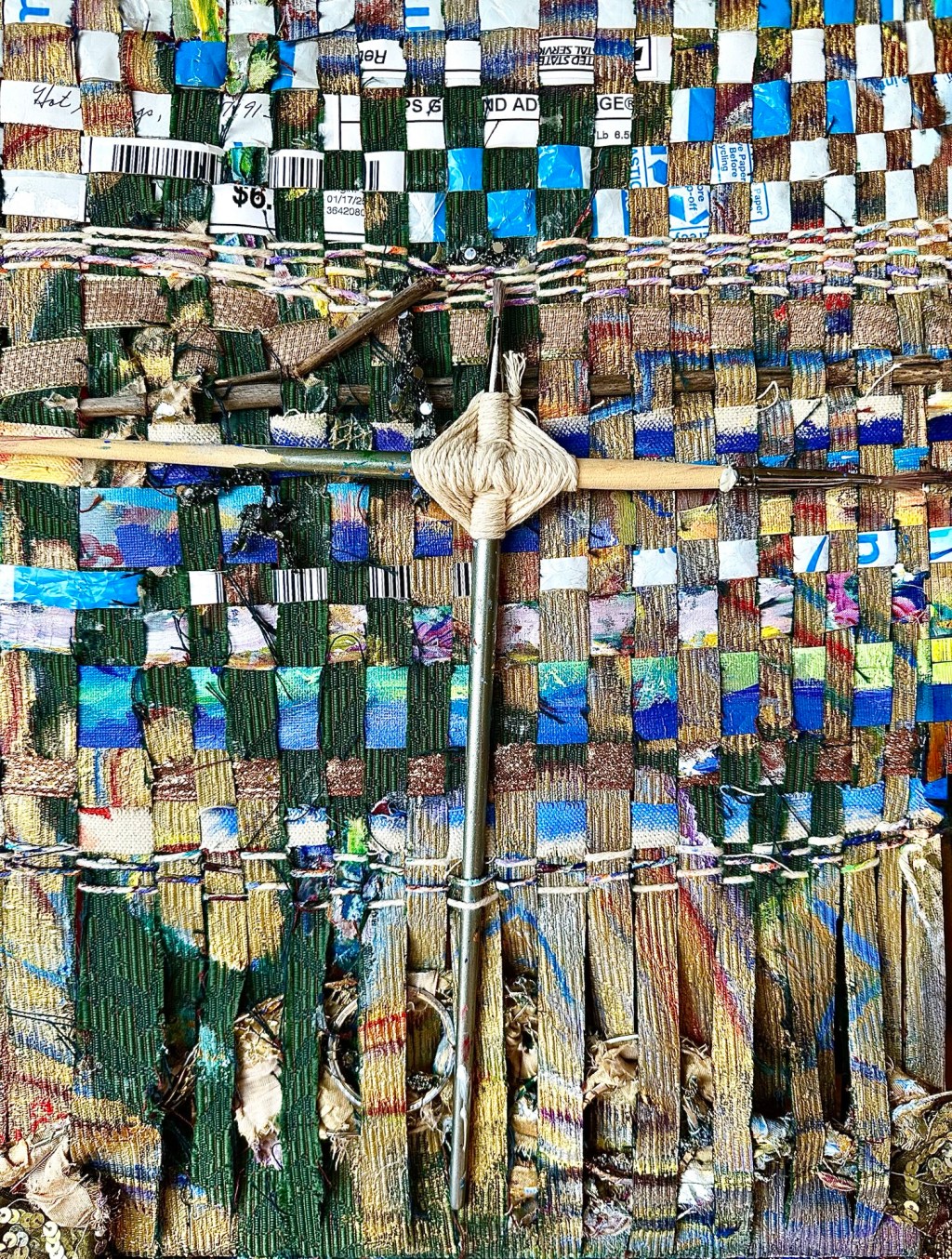
DeLee: God’s Eye and Cross, woven canvas, branch, string, paint brushes, fabric scraps, wire, packing materials, 16” x 20”, 2025.

Yet life doesn’t always work out the way we thought it would. The Bible says Job was the most righteous person of his era, and Job complains after losing everything and everyone:

  “My days are swifter than a weaver’s shuttle and come to their end without hope.” (7:6)

This wisdom text reminds us sometimes the righteous suffer, even while the wicked prosper, but God is still God, and we will understand this mystery of God when we see God face to face. We call this “theodicy,” (from Greek theos, “god”; dikē, “justice”), or our explanation of why a perfectly good, almighty, and all-knowing God still permits evil to exist.

God gives human beings free will. We make our own choices in life, just as everyone else does. Since we don’t live in a universe of one, other people’s choices impact our choices. Imagine a pingpong ball tossed into a room filled with mousetraps all loaded with other pingpong balls. If one ball hits a loaded trap, it sets that ball off into motion and those balls set more balls into motion until chaos ensues! If more than one person is involved, some sort of disagreement is sure to follow. Some of us are even at odds with our own selves!

As the old joke goes, a solitary man was rescued from a desert island. On this island were several structures. When asked, he said, “That one was my house and that one was my church.” And the other building? “That was the church I used to go to!”

Louise Bourgeois: Spider, metal, National Gallery of Canada, in Ottawa, Ontario. Her mother mended tapestries, like a spider spins a web.

When life is chaotic, creative people find solace in the quiet of their chosen deserts: the studio, the workshop, or their favorite writing chair. While we artists have the illusion we can control the images we produce or the songs which bubble up from our hearts, in truth, what we create is a shared product with our heart, mind, and the creating spirit. If we begin to lose our humility about this shared process, we lose the creative energy underwriting our works.

Louise Bourgeois: Metal Spider wrapped in yarn, Japan

We know this emotion as “pride,” and the ancient cultures warned against it. Throughout history, legendary and mythological figures have been used as examples of either virtue or a moral failing. The story of Arachne and Minerva is no different.

Attributed to Amasis Painter, 6th BCE, Greece, clay, Metropolitan Museum of Art, New York.

A 6th BCE Attic Black Figure Lekythos storage vessel attributed to the Amasis Painter shows the type of standing loom and the various shuttles of different threads a weaver would use for a fabric. Today we think of weavers sitting at their looms, but the ancients stood at their work.

Arachne was a mortal who excelled in the weaving arts: spinning her own yarn and selecting the correct colors to produce the beautiful images for the finished fabric. Minerva, the goddess of handicrafts and the Roman correlate to the Greek goddess Athena, had heard of Arachne’s prowess and her pride. Disguised as an old woman, Minerva visited Arachne to warn her not to disparage the gift of the gods. Arachne rebuffed her, and held her ground, even when Minerva revealed her true identity.

Minerva (Athena) and Arachne by René-Antoine Houasse (1706), Versailles

When the weaving contest began, both were even in technique and design. Minerva’s image was of the pantheon of the gods, but Arachne told the stories of the god’s mishaps with humanity. This angered Minerva, who struck Arachne with a weaver’s shuttle. Embarrassed, Arachne took a rope to hang herself, but Minerva had pity on her and changed her into a spider instead. We call spiders, ever weaving their gossamer webs, “arachnids” in her memory.

Spider Web

In Christian art, the theme of listening beside a well or spring is connected both to the angel’s annunciation to the Virgin Mary and to her weaving curtains for the Temple. The third-century Dura-Europos church baptistery has a fresco of a woman drawing water from a well, which Yale theologian Michael Peppard believes represents the Annunciation to Mary at a well, from a scene from the gnostic writing, Protevangelium-18.

Woman drawing water at the well. Possibly the Virgin hearing the Angel’s voice. Dura Europa.

Others think it represents the Samaritan woman at the well or Rebecca from the Old Testament. Because the fresco doesn’t include Jesus, the empty space instead represents “the bodiless voice” that Mary hears in the Protevangelium. Also, a five-pointed star appears on the woman’s torso, which could symbolize the new child in her womb. The star in later iconography was repositioned to the shoulder of her mantle, and the water vessel survives all the way into the Renaissance art as a vase with flowers.

Icon of Virgin at Well with Angel

From The Protoevangelium of James, section 11: And she took the pitcher, and went out to fill it with water. And, behold, a voice saying:

“Hail, you who hast received grace; the Lord is with you; blessed are you among women!” (Luke 1:28) And she looked round, on the right hand and on the left, to see whence this voice came. And she went away, trembling, to her house, and put down the pitcher; and taking the purple, she sat down on her seat, and drew it out. And, behold, an angel of the Lord stood before her, saying: “Fear not, Mary; for you have found grace before the Lord of all, and you shall conceive, according to His word.” And she hearing, reasoned with herself, saying: “Shall I conceive by the Lord, the living God? And shall I bring forth as every woman brings forth?” And the angel of the Lord said: “Not so, Mary; for the power of the Lord shall overshadow you: wherefore also that holy thing which shall be born of you shall be called the Son of the Most High. And you shall call His name Jesus, for He shall save His people from their sins.” And Mary said: “Behold, the servant of the Lord before His face: let it be unto me according to your word.”

This apocryphal Greek text, which was first written in the 2nd CE, with Syrian revisions into the 5th CE, is important because it increases our insights into women’s history, the childhood history of Jesus, Jewish-Christian relations, and the impact of Christian apocrypha on Islamic origins. This text, which contains the infancy narratives of the Virgin Mary, John (the Baptist), and Jesus is the source many of the Western Catholic and Eastern Orthodox religious feast days. Moreover, it’s also the origin for the icons representing the birth of Jesus in a cave.

Duccio: The Nativity with the Prophets Isaiah and Ezekiel, tempera and gold on panel, 1308-1311, National Gallery of Art, Washington D. C. Part of a series of the Life of Christ, the rest of which are in Sienna, Italy. 

A similar Marian birth narrative, The Gospel of Pseudo-Matthew, gives more details on the life of the Virgin, the miracles surrounding her marriage and the birth of Christ. It also tells the story of the Annunciation in two visits rather than one. The angel’s first greeting is beside a fountain and the second is inside while Mary is weaving the curtains for the Temple.

DeLee: Freeform Weaving while Listening

When I was on a recent Five-Day Academy for Spiritual Formation retreat, one of our hands on projects was a small weaving. Our package had a small loom, some yarn to weave with, and beads to attach. Of course I had to use a second packet to finish out my weaving because I tightened the horizontal rows more tightly than the organizers thought the regular attendees would do with their yarns and ribbons.

I also had my eye on a nice lichen covered branch to use as a hanging support. When I picked it up, it had red ants on it. I had to do some mad shaking to get them off! Anything for art! During one of our quiet reflection sessions, I sat beside a small lake under a pavilion to let my hands work. I’ve always needed a quiet space to process the flood of ideas and the rush of emotions when meeting new people and hearing new ideas. I operate as an extrovert, but when I get full to overflowing, I need quiet to recreate and recharge. I find new power in the admonition of Psalm 46:1-6—

God is our refuge and strength,
a very present help in trouble.
Therefore we will not fear, though the earth should change,
though the mountains shake in the heart of the sea;
though its waters roar and foam,
though the mountains tremble with its tumult.
Selah
There is a river whose streams make glad the city of God,
the holy habitation of the Most High.
God is in the midst of the city; it shall not be moved;
God will help it when the morning dawns.
The nations are in an uproar, the kingdoms totter;
he utters his voice, the earth melts.
The LORD of hosts is with us;
the God of Jacob is our refuge.

Diedrick Brackens, “prodigal” (2023), cotton and acrylic yarn

When my hands touch the different textures of the threads, and I let my spirit work with the creating Spirit of the word and world, I can shed all the strain and stress of being on a different schedule from traveling, having nerve pain in my neck from a bulging disk, and more interaction than I’m used to since I no longer work.

I always fought to carve out quiet times when I was in active ministry, for listening to God is the first calling of any leader worth their salt. I knew I wouldn’t hear God’s voice in the pell mell rush and cacophony of our world. The disembodied voice is more likely to come to us when we’re alone or in a receptive moment. It’s important to note Mary was one of the virgins of the House of David chosen to weave the curtains for the Temple in Jerusalem, according to The Protoevangelium of James, section 10. She was busy, but working for her God. It was when she took a break to draw water from a life giving well that she heard the messenger from God.

Bruce Conner, Arachne, 1959, mixed media: nylon stockings, collage, cardboard, 65 3⁄4 x 48 3⁄4 x 4 1⁄4 in. (167.0 x 123.8 x 10.7 cm), Smithsonian American Art Museum, Bequest of Edith S. and Arthur J. Levin, 2005.5.12

When I was appointed to a church, I always had a list of tasks to do, but I often never completed them because God would send “interruptions” to my well laid plans for the day. After several years, I began to understand these interruptions were my real tasks of ministry for the day. We have plans, but God has a better plan.

The prayer in my weaving supplies was appropriate for me on this retreat:

Teach us to listen, O Lord. 

Quiet the noise of our lives

so we can hear your voice. Amen.

After several weeks, I’ve come back to finish this blog. In the meantime I’ve had anterior cervical discectomy and fusion for my neck pain and numb fingers. It’s for the bulging neck disk that causes pressure on the spinal cord. If this happens in the lower back, a person gets sciatica and numbness in the legs. In the neck,the same condition affects the arm and hands. I feel better than I did before, so I’m thankful for all healing mercies. I have to be careful not to overdo my activities. The instructions “Don’t do housework!” were gladly received.

I hope you seek out your quiet spaces and quiet moments to hear the sheer, still sounds of silence, the inaudible voice of our God.

Joy and peace,

Cornelia


 NOTES:

Carolyn Hester: The Weaving Song, Track 10 on At Town Hall, One, Produced by Norman Petty, 1965.

Troubadour: Weaving Song: similar words to Hester coffee house ballad above. https://music.apple.com/us/album/weaving-song/400303687?i=400303767

Myth of Arachne https://www.worldhistory.org/Arachne/

Ally Kateusz: Mary and Early Christian Women: Hidden Leadership,1st ed., 2019, Kindle Edition 


Annunciation or Samaritan Woman, Dura-Europos Baptistery
https://www.christianiconography.info/Wikimedia%20Commons/annunciationDura.html

Charles Bertram Lewis:”The Origin of the Weaving Songs and the Theme of the Girl at the Fountain,” PMLA, Jun., 1922, Vol. 37, No. 2 (Jun., 1922), pp. 141-18, Modern Language Association. http://www.jstor.com/stable/457

Susan B. Matthews: Dura Europos—The Ancient City and The Yale Collection, Yale University Art Gallery, 1982, Yale University Printing Service. https://artgallery.yale.edu/sites/default/files/publication/pdfs/ag-doc-2378-0002-doc.pdf

Camille Leon Angelo and Joshua Silver: “Debating the domus ecclesiae at Dura-Europos: the Christian Building in context,” Journal of Roman Archaeology 37 (2024), 264–303, doi:10.1017/S1047759424000126. https://www.cambridge.org/core/services/aop-cambridge-core/content/view/E76ED3AD86D09A74893368840DEDFA6A/S1047759424000126a.pdf/debating-the-domus-ecclesiae-at-dura-europos-the-christian-building-in-context.pdf

The Protoevangelium of James, section 11. https://www.newadvent.org/fathers/0847.htm

The Gospel of Pseudo-Matthew, section 9.  https://www.newadvent.org/fathers/0848.htm

Horn, C. (2018). The Protoevangelium of James and Its Reception in the Caucasus: Status Quaestionis. Scrinium, 14(1), 223-238. https://doi.org/10.1163/18177565-00141P15

THE TEN COMMANDMENTS IN THE SCHOOLS

art, Children, elections, Faith, Forgiveness, holidays, Icons, incarnation, inspiration, Marcus Aurelius, Ministry, Painting, righteousness, Ten Commandments, vision

When does an image become a meme? Or an icon, an idol, or a shibboleth? I ask those questions, and then have go about defining them. We all know what an image is—a representation of something which actually exists. An icon is the Greek word for image, but to become a venerable image, it must bring the viewer into the spiritual realm, rather than leave the viewer only in this earthly world.

An idol is an inert representation of a god, but isn’t a god at all, for the god is invisible and spiritual. Praying to a golden calf or a carved wooden statue will get no response since it has no power or animation. The same can be said for shibboleth, which is a word or saying used by adherents of a party, sect, or belief and usually regarded by others as empty of real meaning. If the Ten Commandments are held up as mere words, idolized, but not kept in their hearts and lives, then they are as empty of power as golden calves. They also aren’t to be worshipped, but the God who gave them is.

Are the Ten Commandments now a meme? Memes are an amusing or interesting item (such as a captioned picture or video) or genre of items that are spread widely online especially through social media. Because this version of the Ten Commandments had its origin in the Charlton Heston movie, “The Ten Commandments,” which we see every single Easter and Passover season, it’s definitely in the public sphere. I’m of the opinion it’s fast becoming a meme—devoid of actual meaning and held up to ridicule.

DeLee: Icon of Christ, acrylic on woven canvas , 2022.

The version in the Louisiana law matches the wording on the Ten Commandments monolith that stands outside of the Texas State Capitol in Austin. It was given to the state in 1961 by the Fraternal Order of Eagles, a more than 125-year-old, Ohio-based service organization with thousands of members. In 2005, a divided U.S. Supreme Court ruled it did not violate the constitution and could stay.

The Eagles organization notes on its website that it distributed about 10,000 Ten Commandments plaques in 1954. The organization also partnered with the creators of “The Ten Commandments” to market the film, spreading public displays of the list around the country.

“It’s significant that the Louisiana law uses the same text created for ‘The Ten Commandments’ movie promotions by the Fraternal Order of Eagles and Paramount Pictures because it reminds us that this text isn’t one found in any Bible and isn’t one used by any religious faith,” Kruse said via email. “Instead, it’s a text that was crafted by secular political actors in the 1950s for their own ends.” Kevin M. Kruse is the author of “One Nation Under God: How Corporate America Invented Christian America” and a history professor at Princeton University.

Unknown Flemish Artist: God speaks to Moses while the people worship the golden calf, colored ink and gold leaf on parchment, 1372, National Library of the Netherlands.

The actual biblical Ten Commandments are spiritual and can bring us closer to understanding God’s relationship with God’s chosen people during their wilderness journey. We can learn about boundaries, justice and mercy. Also we learn God wants us to be imitators of God’s nature, something that’s missing in the movie version of the Ten Commandments. The movie commandments are a Reader’s Digest version of the Biblical commandments and miss the grace of God entirely.

For Benjamin Marsh, a North Carolina pastor watching the Louisiana law, his primary concern is people’s spiritual formation, so altering the Ten Commandments is worrisome to him. “The problem with changing the text of the Ten Commandments is you rob the spiritual implications of the actual biblical text. So you’re giving some vague likeness to the Ten Commandments that isn’t the real thing,” said Marsh. He leads First Alliance Church Winston-Salem, which is part of a conservative evangelical denomination.

So I offer these two versions below for you to read. I believe the placing of the Ten Commandments in the schools in these states has less to do with “religion” than with culture wars, which these politicians hope to use to their advantage. If we see these in our communities, we should ask for comparative religions to be taught, or none at all. I find the misuse of scripture abusive. This isn’t what we should be doing to vulnerable children. We should give them a God who loves, cares for, and provides for their needs. The Ten Commandments in the school houses is like having a cop in the classrooms.

FROM THE MOVIE, “The Ten Commandments:”

The Ten Commandments I AM the LORD thy God. Thou shalt have no other gods before me. Thou shalt not make to thyself any graven images. Thou shalt not take the Name of the Lord thy God in vain. Remember the Sabbath day, to keep it holy. Honor thy father and thy mother, that thy days may be long upon the land which the Lord thy God giveth thee. Thou shalt not kill. Thou shalt not commit adultery. Thou shalt not steal. Thou shalt not bear false witness against thy neighbor. Thou shalt not covet thy neighbor’s house. Thou shalt not covet thy neighbor’s wife, nor his manservant, nor his maidservant, nor his cattle, nor anything that is thy neighbor’s.

FROM KJV: Exodus 20:2-17

I am the LORD thy God, which have brought thee out of the land of Egypt, out of the house of bondage. Thou shalt have no other gods before me. Thou shalt not make unto thee any graven image, or any likeness of any thing that is in heaven above, or that is in the earth beneath, or that is in the water under the earth: Thou shalt not bow down thyself to them, nor serve them: for I the LORD thy God am a jealous God, visiting the iniquity of the fathers upon the children unto the third and fourth generation of them that hate me; And shewing mercy unto thousands of them that love me, and keep my commandments. Thou shalt not take the name of the LORD thy God in vain; for the LORD will not hold him guiltless that taketh his name in vain. Remember the sabbath day, to keep it holy. Six days shalt thou labour, and do all thy work: But the seventh day is the sabbath of the LORD thy God: in it thou shalt not do any work, thou, nor thy son, nor thy daughter, thy manservant, nor thy maidservant, nor thy cattle, nor thy stranger that is within thy gates: For in six days the LORD made heaven and earth, the sea, and all that in them is, and rested the seventh day: wherefore the LORD blessed the sabbath day, and hallowed it.

Honour thy father and thy mother: that thy days may be long upon the land which the LORD thy God giveth thee. Thou shalt not kill. Thou shalt not commit adultery. Thou shalt not steal. Thou shalt not bear false witness against thy neighbour. Thou shalt not covet thy neighbour’s house, thou shalt not covet thy neighbour’s wife, nor his manservant, nor his maidservant, nor his ox, nor his ass, nor any thing that is thy neighbour’s.

Joy, peace, and time to read your Bible,

Cornelia

Louisiana Ten Commandments law raises preferential treatment concerns | AP News

https://apnews.com/article/ten-commandments-louisiana-public-schools-religious-views-7c4af860da21df52c304346fab76c4ae

Fraternal Order of the Eagles

https://www.foe.com/About-The-Eagles/History

Entertaining Angels Unawares

art, Creativity, Faith, Holy Spirit, Homosexuality, Icons, inspiration, Israel, Painting, righteousness, Rublev, Spirituality, United Methodist Church

One of my favorite icons is the Rublev Trinity of 1411, which represents the three angelic visitors who came to Abraham and Sarah’s tent in the wilderness. They stopped there on the way to Sodom and Gomorrah, two cities known for their lack of hospitality to strangers, so the largess Abraham showed by preparing a feast for them in the wilderness was notable in contrast. Of course, while Abraham couldn’t see these strangers’ wings and halos, nevertheless we should “not neglect to show hospitality to strangers, for by doing that some have entertained angels without knowing it” (Hebrews 13:2).

Rublev’s Trinity: Original egg tempera on wood panel, Tretyakov Museum, Moscow, 1411-1425 CE

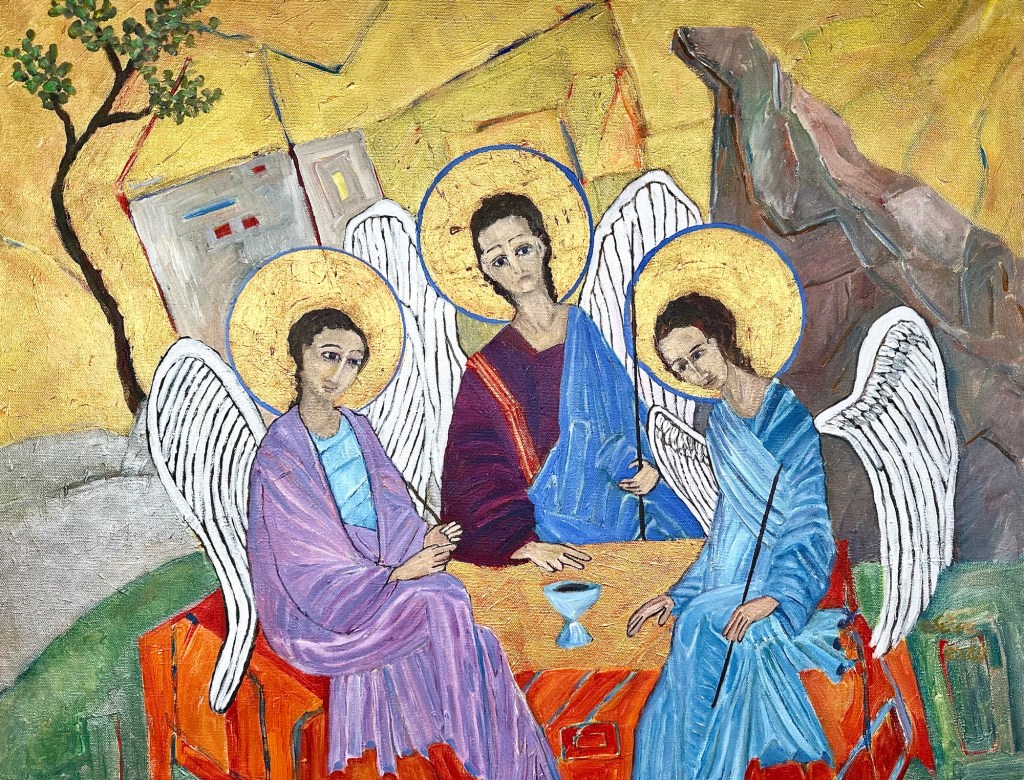
Rublev’s Trinity is a classic icon. It’s the prototype for all the Holy Trinity icons. Three figures are seated at table, under an oak tree and in the vicinity of a large house, the home of Abraham and Sarah, at Mamre in the wilderness. These figures represent the Three Persons in One God, or The Holy Trinity. The icon underlines the sameness of the three figures by using a single identical image, repeated three times but robed differently to suggest three different qualities of the three Angels—the Three Aspects of God.

The central figure represents the Son, who blesses the cup on the table. The right figure in blue is the Holy Spirit, while the rose-colored robed figure represents the Father. The Oak of Mamre stands for the cross of Christ. Even the symbolic wilderness mountain dips its peak in reverence to the holy visitors. Rublev imagined the patriarchs living in a house, but they were tent dwellers who followed herds and pastures.

Jerusalem Temple Mount, from an antique map, acrylic on canvas, 2023

I actually repainted this icon over a map of the ancient city of Jerusalem. Wars have been much in the news lately, not just in the last few months, but the last few years. Russia’s invasion into Ukraine has devastated their land and people, not to mention making a negative impact on hunger worldwide and even the price of food here at home. The Sacred Mount in Jerusalem has always been contested, so much so that the three monotheistic religions fight over that territory. Even the holiest Christian sites are often guarded by Islamic families to keep them open for everyone.

Holy Trinity, stage One

Once I chose this base, the mountain, tree, and the house wrote themselves. I found the table easily in the underlying shapes and the three visitors also. This isn’t a faithful copy of the Holy Trinity Icon, but a spiritual copy of the icon. I kept the colors and the ideas, but I wrote something new. As I painted, I had these thoughts about our faith and our life.

Holy Trinity, stage two

Not In My Backyard, Not In My Neighborhood, Not in My Church—how often do we hear these words? Sometimes we even hear them spoken in our own estranged families of origins. This isn’t a recent phenomenon. Our scripture is full of broken families: Cain and Able were the first; plus, Abraham’s children, Isaac and Ishmael and their descendants, have had sibling rivalry and struggles from the beginning. The house of David certainly had its problems even if David was a “man after God’s own heart.” In the New Testament, the Jews wanted the gentile believers to convert to their religion first, and then to keep the law, the food rules, and celebrate the festivals in order to be a “good Christian.” The leaders had to compromise on their beliefs before everyone could fully share Christian hospitality at the table together.

Holy Trinity, stage three

Paul has a dire warning for the congregations about The Works of the Flesh in Galatians 5:16-21—

Live by the Spirit, I say, and do not gratify the desires of the flesh. For what the flesh desires is opposed to the Spirit, and what the Spirit desires is opposed to the flesh; for these are opposed to each other, to prevent you from doing what you want. But if you are led by the Spirit, you are not subject to the law.

Now the works of the flesh are obvious: fornication, impurity, licentiousness, idolatry, sorcery, enmities, strife, jealousy, anger, quarrels, dissensions, factions, envy, drunkenness, carousing, and things like these. I am warning you, as I warned you before: those who do such things will not inherit the kingdom of God.

Our modern world has a problem with idolatry. We often put our work, our family, our possessions, or our politics above God. We often choose our church because of our political beliefs, when we should let the overwhelming love and grace of God for all God’s creation imbue our political choices. We forget as Christians we are grafted into the nation of Israel, as the writer of Ephesians 2:12 reminds us:

“Remember that you were at that time without Christ, being aliens from the commonwealth of Israel, and strangers to the covenants of promise, having no hope and without God in the world.”

Christ came to those who were near and to those who were far, broke down the dividing wall between the two and brought them together to eat at one table. Before they were enemies, but with Christ, they became one people. Divisions should not exist in the body of Christ, just as no one should be excluded from fellowship. The near in those days were the Israelites and the far were the Greeks, Romans and other pagan communities. In Christ, however, they were one.

DeLee: Holy Trinity after Rublev, acrylic on canvas,

Abraham knew the reputation of Sodom and Gomorrah, since Lot was his kinsman. When Abraham negotiated with God to spare those twin cities of iniquity, he managed to bargain God down to the hope of finding at least ten honest people, righteous in their ways with God. That was as low as God would go. Lot, with his two daughters, his wife, and the two would be husbands made six, but the men didn’t want to flee. That left only four and so the two cities were doomed for their lack of hospitality to strangers.

People today often think that sexual behavior doomed these cities, but lack of care for the stranger was a higher priority in a dangerous and unforgiving landscape. Offering food, water, and shelter meant life to travelers. Four thousand years ago, our spiritual ancestors remembered the stories of Abraham. In Deuteronomy 26:5, when the people brought their offerings to God, they were instructed to make this response before the LORD your God:

 “A wandering Aramean was my ancestor; he went down into Egypt and lived there as an alien, few in number, and there he became a great nation, mighty and populous.”

No longer are we a wandering people. Instead, we are mostly a nation of settlers, people who have been in one place for awhile. We no longer are a nation of immigrants who are wresting a new nation out of the raw materials of the land and becoming a melting pot of different cultures which have settled it. We look with suspicion upon someone who moves into our neighborhood, especially if they don’t look or act like us. If they don’t speak our language or eat our food, we tend to shun them. We don’t show hospitality. We don’t add their flavor into our soup, and try to keep them from melting into our pot.

No one likes change. I think of the old joke about “how many United Methodists does it take to change a lightbulb?” The answer is “none—that lightbulb was given as a memorial to my Aunt Harriet’s dead husband, and it cannot be changed!”

Hospitality requires us to change the lightbulb, however, for bringing light to a dark stairway will make it safer for people of all ages to traverse. Hospitality asks us to open our pews to people who don’t think like us, so we can wrestle with the theology of God and the calling of our faith for this present age, not just our yesterdays. Hospitality calls us to serve as a respite and refuge for the aliens, the immigrants, the homeless, and the newcomers who arrive in our communities.

Unfortunately, too many of us have bought into tribal thinking, which is a form of all or nothing thinking. Gang behavior is tribal thinking, for if you don’t kowtow to the group think, you will likely be dead. Excommunication from the church is a form of punishment for wrong thinking or wrong acts, and secession or rebellion is action against authority you no longer respect or recognize. Our church has just gone through a sad time of people cutting ties because they no longer share the understanding of Abraham, who offered sustenance and protection to strangers in the midst of the barren wilderness. In ancient times, those who received this gift were bound to mutual respect and protection. Food and water in the wilderness saves a life. Our hospitality to strangers in an uncertain world can save their lives and souls. Maybe we once again need to see afresh with ancient eyes our sacred texts, instead of with our current political and cultural blinders on our eyes. Then we could truly entertain angels unawares. And we would be blessed for this.

As the writer of the letter to the Ephesians closed out his third chapter (Ephesians 3:20-21):

“Now to him who by the power at work within us is able to accomplish abundantly far more than all we can ask or imagine, to him be glory in the church and in Christ Jesus to all generations, forever and ever. Amen.”

Joy, peace, and hospitality,

Cornelia

What’s the Point of Suffering?

art, city, Creativity, inspiration, Israel, Megiddo, Painting, righteousness, Solomon’s Temple, suffering

I’ve visited the Holy Land twice, and I’m always surprised how small this country is. So much history and events of our faith happened here, yet the land isn’t much bigger than Vermont. This land is a place of great suffering, marked by the historic sites of Masada, Megiddo, and Golgotha. It’s also the place of great joy, as evidenced in the Church of the Nativity in Bethlehem, the Church of the Holy Sepulcher in Jerusalem, and the Western Wall of the Temple in Jerusalem.

Map Painting: Temple Mount of Jerusalem

When we speak of the Holy Land, we include the ancient kingdoms of Judea and Israel, as well as modern day Palestine. The modern state of Israel was formed in 1948, as a homeland for diaspora Jews, who are the ones whom conquering foreign nations had exiled from their homeland over the centuries.

The history of the Hebrew people has been marked by suffering. As Deuteronomy relates, they are a “people holy to the LORD your God; the LORD your God has chosen you out of all the peoples on earth to be his people, his treasured possession. It was not because you were more numerous than any other people that the LORD set his heart on you and chose you—for you were the fewest of all peoples” (7:6-7).

They endured slavery in Egypt, wandering in the wilderness until they entered the promised land, and then were at the mercy of stronger nations who wanted to control the trade routes, which intersected inside the borders of Israel.

The earliest diaspora was the Babylonian exile in 586 BCE, plus a later exile to Alexandria, Egypt, in the 1st century BCE. That first exile was marked by the trauma of the Jews’ loss of Solomon’s Temple and their residency in the holy city. They’d always depended on these two as permanent and a source of God’s special protection. However, their failure to honor God completely negated this protection. In the exile, the people learned how to live as God’s chosen people by studying God’s word, keeping the law, and separating themselves from the Gentiles.

About five million Jews lived outside of Palestine during the Roman era, but most of them lived within the confines of the Roman Empire. Even before the destruction of the Jerusalem Temple in 70 CE, diaspora Jews outnumbered those who lived within the bounds of the territory of the Holy Land.

Western Wall of Temple, Men’s prayer area nearby and Women’s area in distance, 2019

After World War II, with the Nazi massacre of over 6,000,000 Jewish individuals of all ages and sexes, this Holocaust ignited the desire within those others who shared with Jews the same values they represented in the world. Social justice and compassionate assistance to the weak stood in the way of Hitler’s regime, for he believed Jews opposed the Nazi natural order, which was the powerful exercise unrestrained power on behalf of the superior white race. In Hitler’s view, any restraint on the exercise of white power would inevitably lead to the weakening, even the defeat, of this master race. (We hear echoes of this heretical view in the current replacement conspiracy, which claims migrants are poisoning the blood of our nation.)

Harvard Center for Geographic Analysis: Comparative Size of Israel and Occupied Territories to State of Vermont (11,200 square miles to 9,200 square miles)

An entire book in the Old Testament is dedicated to the question of suffering, especially the question of do the righteous suffer. Under the retribution theory of justice, a good person should not suffer, and a sinful person deserves suffering. However, all of us know infants born with dread physical conditions, who obviously haven’t had a chance to sin. In the Old Testament view, his parents’ sin would have caused his suffering, but Jesus reminds us in John 9:3–

“Neither this man nor his parents sinned; he was born blind so that God’s works might be revealed in him.”

Ossip Zadkine’s The Destroyed City (1951) is a man without a heart and is dedicated to the city of Rotterdam, destroyed by the Nazi Luftwaffe.

The book of Job reminds us suffering happens to all of us, and how we react to it is evidence of our transformation into the image of God. Do we seek mere retribution, or will we let suffering transform us? This is a moral question for us today, especially in our suffering adverse society. Yet, we’ll let those on the margins suffer, while we avoid suffering ourselves. The 31st chapter of Job lists the acts of a righteous man who cares for the widows, orphans, and strangers in his land, yet he suffers. But Job is no quitter, even if he is a complainer. He asks God, “Why do the righteous suffer?”

The Gaza Strip, where all the fighting between the Israeli army and the Hamas militants is currently ongoing, is slightly more than twice the size of Washington, DC., our nation’s Capitol. The Capitol is 68.35 square miles, while the Gaza Strip is just shy of 139 square miles. As a comparison, Little Rock, Arkansas, is 123 square miles in area. Little Rock has a 2024 population of 200,546. Compare this with the two million people live in the Gaza Strip. After living in rural Arkansas most of my ministry, I find Little Rock crowded. The Gaza Strip is 10 times more crowded than our state capital.

September Megiddo Painting 2023

Why do I mention this? When a tornado rips through a town or a city in Arkansas, it causes damage on a large scale to those people in that area. Because we don’t have densely populated areas, our suffering is limited to a few. This doesn’t discount their particular suffering, but it does mean suffering is limited, for which we can be thankful. When 2,000 pound bombs drop on high rise dwellings, numerous people are made homeless, and the possibility of injuries is high. Perhaps we don’t see this suffering because it’s in a distant land, or because some of the injured call god by another name. If we can’t recognize human suffering as the suffering of another child of God, we’re losing our ability to see the world as God sees God’s world.

The famous Banksy’s Armored Dove of Peace, the painting of a peace dove wearing a flak jacket. The dove is painted on a wall near the separation wall between Bethlehem (Palestinian Territories) and Israel. Nov. 18, 2023

Rebuilding Gaza will be a massive undertaking because Israel’s bombardment has caused mass destruction. Current estimates are at least a half million Palestinians in the enclave won’t have a home to return to when the war ends, according to the UN aid office. By the end of 2023, about 1.9 million people had been displaced, or nearly the entire population, some more than once, as people moved in search of safety. Because of bombing, by the end of 2023, about 65,000 housing units across Gaza Strip have been destroyed or rendered uninhabitable. In addition, over 290,000 housing units had been damaged, according to the Government Media Office in Gaza. Officials estimate many more will be unable to return immediately due to the level of damage to surrounding infrastructure, as well as the risk posed by of Explosive Remnants of War.

The Greek Orthodox Church of Saint Porphyrius in Gaza, believed to be the third oldest church in the world, was hit by missiles as hundreds of Palestinians sought shelter there during a Israeli missile strike in its war against Hamas.

Currently residents in Gaza are facing famine, for the existing World Food Program ready-to-eat food options are falling short of meeting people’s crucial caloric needs. Bread, made from fortified flour, holds the potential to address some of the unmet requirements for essential vitamins and minerals, which the current ready-to-eat baskets fail to provide. Moreover, providing bread as a no-cook food option is crucial when households lack the means to cook meals. Thus, incorporating bread into aid provisions is not only as a practical solution, but also is a key strategy to fulfill immediate nutritional needs.

Children try to get food relief in the southern Gaza Strip city of Rafah, on December 31, 2023.

I first visited the Holy Land in 2000, just before the intifada of 2001. At the time, the Gaza Strip was under Israeli control. Following the 1948 Arab-Israeli War, Egypt administered the newly formed Gaza Strip; Israel captured it in the Six-Day War in 1967. Under a series of agreements known as the Oslo Accords signed between 1993 and 1999, Israel transferred to the newly created Palestinian Authority (PA) security and civilian responsibility for many Palestinian-populated areas of the Gaza Strip as well as the West Bank.

After June 2007, when HAMAS took over the Gaza Strip, Israel and Egypt have enforced tight restrictions on movement and access of goods and individuals into and out of Gaza. Fatah, another political movement, and HAMAS have since reached a series of agreements aimed at restoring political unity between the Gaza Strip and the West Bank but have struggled to enact them. Therefore, Egypt and Israel have maintained border control over the Gaza Strip, determining who and what enters or leaves.

Since Hamas’ surprise attack on the music festival and the settlement nearby, not only have the Jewish people suffered harm due to 1,200 immediate deaths but also the continued terror of those held captive by the Hamas terrorists. Some say Christ suffers only for those who go on to have faith in his saving work on the cross. I was asked once on an Emmaus walk, “Are we saved when we profess our faith in Christ, or when Christ died on the cross for us?”

Byzantine Mosaic apsidal, San Clemente, Rome

They were surprised when I answered, “Yes.” It’s not an either-or question. After all, Christ died once, for all, as an act of saving grace. God raised him from the dead to make him the first of many to cast off the chains of sin and death. When we, centuries later, profess our faith in Christ, we accept his suffering on our behalf and his resurrection as our promise of a life to come. As Christians, we often base our world view on our claim to the promises of God, but we forget Christ’s death and resurrection is a promise to all people, even to those who haven’t professed faith in Christ. As the writer of Hebrews (1:8-9) once said:

“Now in subjecting all things to them, God left nothing outside their control. As it is, we do not yet see everything in subjection to them, but we do see Jesus, who for a little while was made lower than the angels, now crowned with glory and honor because of the suffering of death, so that by the grace of God he might taste death for everyone.”

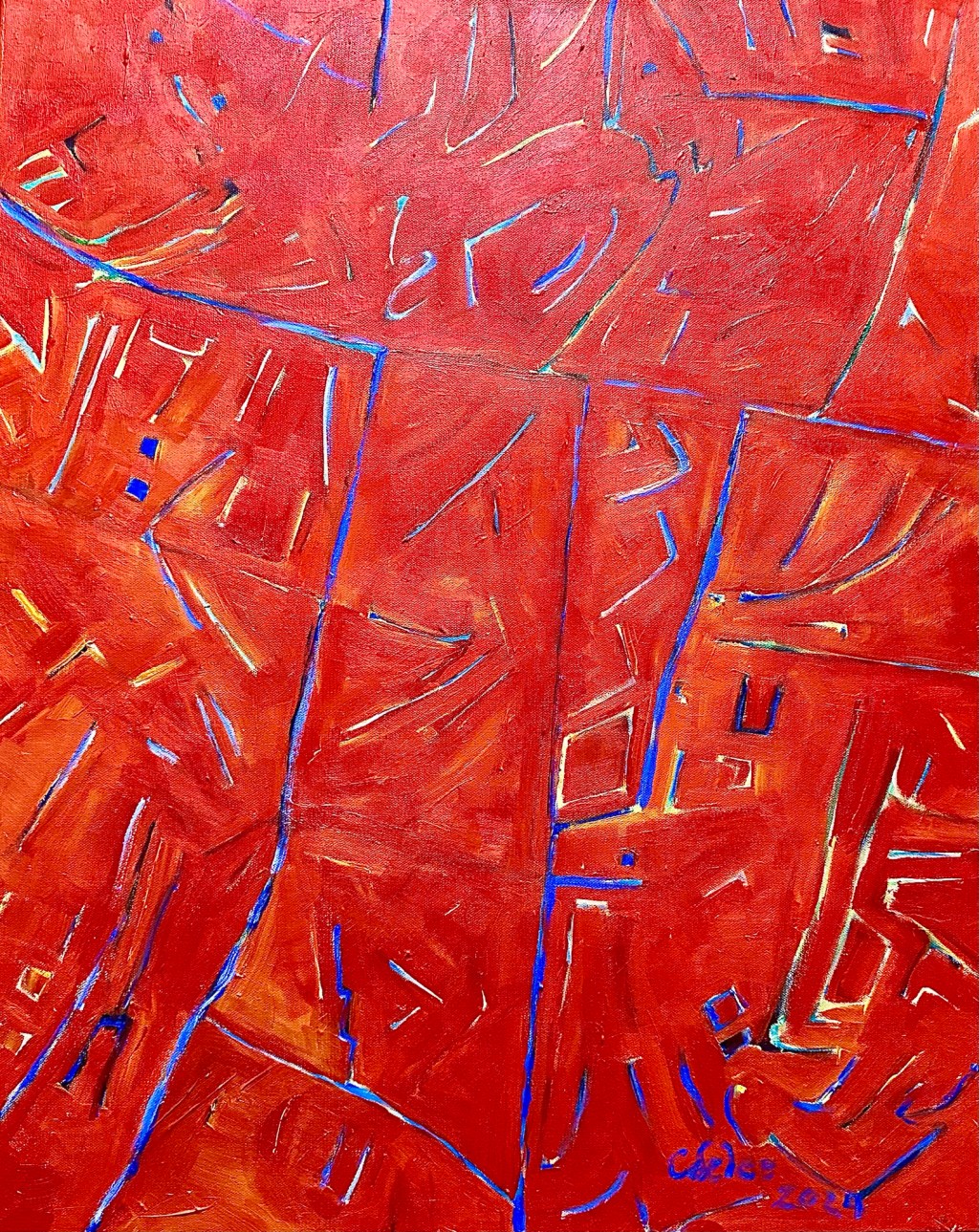
Red Megiddo Cross

As I worked on my painting, it went through several iterations. First it stayed close to the map of the ruins of Megiddo, which I painted in yellows. Megiddo is the site of the battle to end all battles, and the place where the forces of good meet the forces of evil. Because Israel is on the crossroads of many trade routes, nations have always met there to contest for dominance. I left many scar scribbles on the canvas to represent the destroyed walls of the ancient city. As is my usual practice, I hung up my canvas to live with it awhile, but the longer my painting hung on my wall, the more unsatisfied I was. I can always tell when my inner vision isn’t meshing with finished work. When I took the work down, I flipped it 180 degrees and repainted it in red, for the bloodshed of this most recent war. As I painted out most of the scribbles, I saw the cross appear out of the image. By destroying the remnants of destruction, I had simplified the image down to its essence.

In all things, the cross is crucial. We moderns don’t understand suffering or pain. We deny it, reject it or medicate it with something that keeps us from feeling it. My personal medicinal choices are ice cream and chocolate. If I can combine them in one substance, so much the better! A recent bout with the shingles this past December had me consuming both foods for medicinal relief. Other people use wine, TikTok, or another medication of choice to escape from emotional or physical pain.

The winter of my discontent, brought by Mayhem

Revenge is is a dish best served cold because if we take revenge in the heat of the moment, we’ll over do our response and won’t know when to stop. If we wait, cooler heads will prevail, and a more limited response will likely be our action. Less damage, and less mayhem, but we humans don’t seem to be built this way. Those who have suffered will often return suffering in kind as a “hair of the dog cure.” This is why abuse and family violence is generational. The ancient Hebrews practiced the BAN, or a primitive religious practice of dedicating for destruction an entire group of people and their possessions to the LORD. This was done to cleanse the land and keep the Hebrew people pure from idolatry. Paul had Deuteronomy in mind when he wrote in Romans 12:19—

“Beloved, never avenge yourselves, but leave room for the wrath of God; for it is written, “Vengeance is mine, I will repay, says the Lord.”

While the western world has the crusade mentality, which is similar to the extreme ban, we also have the just war theory. Modern wars are fought by democracies mostly with this mindset, for the international community is in agreement the ends should justify the means. Unfortunately, terrorists don’t agree and fight according to their own extremist beliefs. We have to ask ourselves what happens to us when we adopt their policies and inflict extreme suffering on civilians to the point of causing starvation and homelessness by destroying their homeland. If we act the same as those whom as we despise, have we become them instead? We lose the moral high ground when this happens. It’s time to draw back and reconsider our motives and our methods: how can we be just, compassionate, and holy, as God is holy? Otherwise, we’re suffering for nothing or causing others to suffer meaninglessly.

When we read scripture, God’s Holy Spirit should work in our hearts and minds to make a change in us to confront and conform us into God’s holy nature. If no change happens, we need to ask God to open our hearts and minds to be conformed to God’s Holy Spirit. If it’s painful to read scripture, remember Christ suffered for us. Many of us can’t read the scriptures to be transformed, for change is difficult and painful. However, staying the same is also difficult and painful. (Maybe this is why only 10% of Americans read their Bible daily.) I find God has compassion on those who suffer, especially those who do so while “working out their own salvation in fear and trembling.”

Remember God has compassion and is near to the broken hearted,

Joy and Peace,

Cornelia

Gaza Strip – The World Factbook
https://www.cia.gov/the-world-factbook/countries/gaza-strip/

Hostilities in the Gaza Strip and Israel | Flash Update #85 | United Nations Office for the Coordination of Humanitarian Affairs – occupied Palestinian territory
https://www.ochaopt.org/content/hostilities-gaza-strip-and-israel-flash-update-85

Holocaust | Definition, Concentration Camps, History, & Facts | Britannica
https://www.britannica.com/event/Holocaust

Little Rock, Arkansas Population 2024
https://worldpopulationreview.com/us-cities/little-rock-ar-population

Ban – Encyclopedia of The Bible – Bible Gateway
https://www.biblegateway.com/resources/encyclopedia-of-the-bible/Ban

Report: 26 Million Americans Stopped Reading the Bible Reg…… | News & Reporting | Christianity Today https://www.christianitytoday.com/news/2022/april/state-of-bible-reading-decline-report-26-million.html

Nativities Then and Now

Altars, Apocalypse, beauty, Bethlehem, Christmas, Creativity, Faith, Holy Spirit, Icons, Imagination, incarnation, inspiration, Israel, mystery, Nativity, righteousness, Savonarola, vision

Every Christmas, my family would put up a beautiful tree and decorate it to the nines. My dad would always tie this living sculpture to the nearest window frame so the tree wouldn’t topple over. He was well aware at least one of his three curious and rambunctious children would no doubt be crawling under the lowest branches to reach the brightly wrapped presents hidden far back in the corner under the tree.

We kids most desired and sought after these hidden gifts, while those near the front always got a cursory glance and shake. If it were hidden, it had to be desired! Package shaking in the hidden, tight quarters could cause a tree to collapse and that would be more drama than our frazzled mother wanted at this time of year. My dad was wise enough, or trained by experience, to know messing with “Mother Nature” wasn’t a great idea.

Mother’s Nativity with other additions from family and friends

Under this tinsel draped tree, with its 1950’s glowing bubble lights, we always had a nativity scene. In our early childhood, it was solid and childproof, but as we aged, and got too large to crawl under the tree, a better quality nativity came to live under the tree. By my college years, my brothers were also grown enough for mom to exercise her creative genius. She hand-painted her own ceramic nativity group. This masterpiece also got its own special display site. Up until this time, we children had no idea our mother had any artistic talent, for she’d spent her days transporting us to our multiple after school activities. Between my brothers’ sports teams and my hobbies, it’s a wonder she found time to do anything else in the afternoon hours.

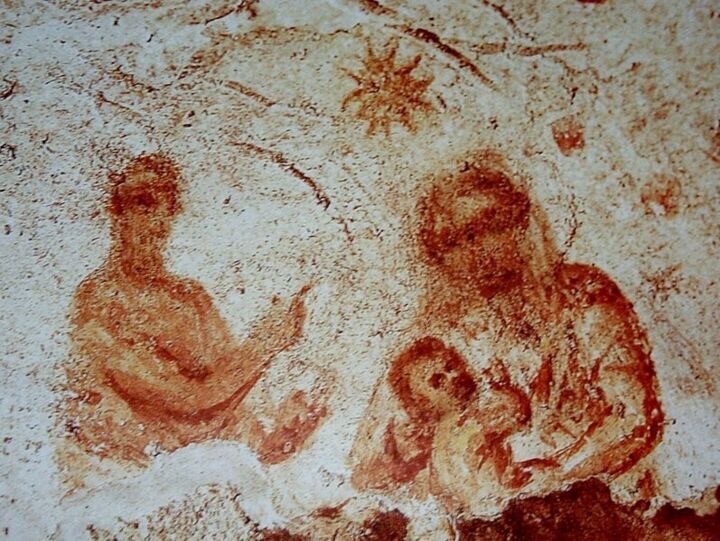
Nativity, Adoration of the Magi, 3rd century. Fresco, Rome: catacombs of Priscilla, 3rd Century CE

The 3rd century fresco shows the scene of Adoration of the Magi on the the arch dividing the room in the Greek Chapel in the Catacombs of Priscilla, Rome. In depictions of ancient Greek and Roman gift-giving practices, the act and choice of gift were important. They furnish information about both giver and recipient. The wise men adopt the same postures used in Roman imperial ceremony for the worship of an Emperor or other ruler. Roman art has always provided a pictorial model for the representation of the Magi. By identifying with or recognizing such an outward act of homage, the viewer could enter into the Nativity story through the wise visitors, worshipping the God manifest on earth in the Child.

This is why the earliest Christian art is found in the catacombs of Rome, in the hidden places, since worshipping Jesus wasn’t an approved religious practice in the Empire. Only the Divine Emperor alone was worthy of reverence and worship, not some dying and rising god of a far-off province. Today in America we sometimes forget we’re a nation founded on the principle of freedom to practice our religion as we see fit, or not to practice a religion at all, as the case may be. No government can compel the privilege of one religion above another or set one as the official religion.

Tympanum of the right side of the cast of so-called Sarcophagus of Stilicho, sculpted around 385 AD (the original piece of art is in Sant’Ambrogio basilica in Milan, Italy), Detail Nativity scene, Museo della civiltà romana a Roma (Eur), Room 15 (Christianity).

Another early depiction of the nativity isn’t in a Christmas context, but is found on a late 4th C Roman sarcophagus for a high ranking military official and his wife. The unknown artisan rendered the Christ child, wrapped in binding clothes, and lying in a manger, between the ox and the ass, to fulfill the prophecy of Isaiah 1:3—

“The ox knows its owner, and the donkey its master’s crib;
but Israel does not know, my people do not understand.”

As accustomed as we are today to manger scenes with all kinds of animals present, the scriptures don’t name them. These are left up to our imaginations. Even the elements derived directly from the gospel narratives of Matthew and Luke were slow to appear in visual renderings. Between those early scriptural accounts and the formation of even a basic manger scene lie some centuries during which Christian devotion and depiction developed. Likewise, the celebration of Christmas was slow to develop, but by the 4th century it was well along.

Nativity Fresco in Santa Maria Foris Portas, Castelseprio, Italy, 9th CE

In the ninth century, after the iconoclastic period, when the images of holy persons were forbidden and destroyed, a fresh wave of religious activity began in the arts. In Italy. In the church dedicated to Mary Outside the Gates in Castelprio, Italy, an entire series of paintings covered the interior walls. The church was located on an important trade route and the site was once a Roman fort. The theme honored Mary as the Bride of Christ, thus making her the spiritual equivalent of the Church, which is the Bride of Christ in scripture. In every tableau, Mary is the largest or most significant figure. Over the centuries, the area lost its importance, these paintings were whitewashed over, but after many years and much restoration, they’re now protected as a UNESCO World Heritage Site.

Today Protestant believers have a Christo-centric faith, often ignoring the other persons of the Holy Trinity. When we focus on the nativity, we forget God’s plan was to use humanity to save the fallen creation. This includes Mary and Joseph both, as well as God’s own Son, as Paul so well reminds us in Philippians 2:5-8—

Let the same mind be in you that was in Christ Jesus,
who, though he was in the form of God,
did not regard equality with God
as something to be exploited,
but emptied himself,
taking the form of a slave,
being born in human likeness.
And being found in human form,
he humbled himself
and became obedient to the point of death—
even death on a cross.

Giotto di Bodone, Nativity of Jesus, 1303-1305. Fresco, 200 x 185 cm. Padua: Scrovegni Chapel

Giotto’s frescos in the Padua Chapel are some of the most important works of art because he brought the Holy Family into ordinary human life. The blue skies replace the gold of the traditional icons, which stood for the infinite and eternal spiritual world. In Giotto’s painting, people hunger and thirst, while in the world of the icons, all suffering is transformed and any passion is disciplined.

Duccio di Buoninsegna, Nativity between the prophets Isaiah and Ezekiel, 1308-1311. Tempera on panel, 43.8 × 111 cm. Washington: National Gallery of Art

Duccio painted in his studio all the individual sections of the great altarpiece of the church in Sienna, Italy. On completion in 1311, the townspeople held a grand parade as they carried the paintings to the cathedral. They were installed in a magnificent framework with some of the works facing the congregation and the rest facing the church officials. The altarpiece remained intact until until 1506 when it was partially dismantled, relegated to side chapels and replaced by a 15th-century bronze tabernacle.

In 1771, the church fathers hired a carpenter to saw up the old wooden altarpiece into seven vertical pieces, and then saw each of those pieces in half laterally to separate the front scenes from the back. He then reassembled the different pieces to form new scenes. Most of the individual paintings stayed together, but others were sold to private collectors or museums. This Nativity between the prophets Isaiah and Ezekiel was purchased by the Museum Kaiser Wilhelm Friedrich in Berlin and remained on display there until 1938. At that time, a Nazi-appointed Museum director purged most non-Teutonic art from the collection. Through a trade, this Nativity came to our National Gallery of Art in Washington, D. C.

Duccio: Maesta Reconstructed Altarpiece. Front (L) and Back (R)

When we think about hidden meanings in art works, sometimes the journey a work takes to its exhibition home is part of its meaning. The Nazi purge of non-Teutonic art from the collection was based on their idea of a pure race for their homeland, with which they shared a special mystical bond. It meant they would purge or purify all who didn’t meet this white supremacist ideal. I personally am glad America is an open society, which welcomes all kinds of art and artists. When we think of the journey of the Holy Family, they made an arduous trip to Bethlehem while Mary was about to give birth and then had to head out on the lam because king Herod was out to kill all the boy babies. When we look at beautiful nativity scenes, we forget Jesus was born into a troubled world. Indeed, these beautiful works make us forget our own troubles.

Sandro Botticelli, Mystical Nativity, 1501. Tempera on canvas, 108.5 × 75 cm. London: National Gallery.

One of the most unusual nativity paintings is the Mystical Nativity by Botticelli. Painted with egg tempera on canvas, the artist writes in the upper section how he painted this “at the end of the year 1500, in the troubles of Italy…in the half after the time, during the fulfillment of the eleventh chapter of St. John in the second woe of the apocalypse…”

The monk Savonarola was actively preaching at this time, and scholars believe he influenced Botticelli. During the time of the Medici rule, Florence prospered with trade and the city’s alliance with France made for a time of peace. Lorenzo d’Medici died in 1492, relations with France broke off, and the French army ran amuck in the Italian countryside. Florence lost her former glory, trade dried up, and a political vacuum allowed for new voices to rise. Savonarola preached repentance and austerity, even going so far to burn luxurious items and artworks. He burned all kinds of vanities: cosmetics, mirrors, veils, and books.

People followed him because he was charismatic, and his words seemed to match their circumstances. Florence under his rule was an example of theocracy, the government of a state by immediate divine guidance or by officials who are regarded as divinely guided. Under this system, the people prosper if they care for one another and live godly lives, but they fail to thrive if they cheat the poor so the rich can live in luxury.

Prosperity religion teaches the good thrive and the sinners suffer. It’s not a new idea: retribution and reward appeal to people, but sometimes the good suffer and the evil prosper. The book of Job is a counter argument to this worldview. The life of Christ also shows the best of us will be sacrificed on a cross by those who don’t know what they’re doing. From birth to death, Jesus and his family were under duress from the powers of state and religion. He was a new voice of love and acceptance, of grace and forgiveness, of a righteousness by faith, not works. This new voice would upend the world as people knew it then.

Douce Apocalypse – Bodleian Ms180 – p.042 Woman Clothed in the Sun, Oxford University, London, c. 1265-70

The Mystic Nativity is a combination of the Nativity and the Last Judgment. On top, the angels hold hands in a circle, the center is the birth of Christ on earth, and the lower third is the vanquishing devils due to the Christian’s reunification with God. The number twelve represents the twelve gates of the new Jerusalem, the City of God. Twelve are also the number of stars in the crown of the woman in the apocalypse linked to the Virgin Mary. Other symbols also occur, but the overall meaning is Botticelli painted to deal with his fears about the end of the world.

Sometimes we make a cursory glance or reading of a painting, only to see its surface meaning. If we were to take this path with Botticelli’s Mystical Nativity, we might only see pretty angels and lovely ribbons. It looks like a homecoming at a sorority weekend with all the hugging and kissing. But Botticelli was painting during a time when the theological ideas of the monk Savonarola were in ascendance. He believed, “The more creatures approach and participate in the beauty of God, the more are they themselves beautiful, just as the beauty of the body is in proportion to the beauty of the soul.”

Virtuvian Man by Leonardo da Vinci, 1490, pen, brown ink, and watercolor on paper, Gallerie dell’Accademia, Venice, Italy.

As an interesting aside, about contemporary with Botticelli’s work in Florence, while Leonardo da Vinci was in Milan in 1490, he drew his Virtuvian Man, considered one of the greatest scientific and humanist works of the early Renaissance. Da Vinci used Vitruvius’ classical treatise on architecture as the source for his drawing. Notes from his translation are written in his famed mirror script below the image. This artwork is now so fragile, it never travels and only copies are shown.

While his outer world may be falling apart, and prosperity has left his vicinity, Botticelli still had hope for a better world. His faith was grounded in the birth of the savior, the son of God, who came in flesh to make all flesh divine. We forget this crucial message of the nativity, which is to make holy all flesh. More often we focus on the magi’s gifts brought to the child: riches fit for a king, or the gifts of presence, from the poor shepherds. The true gift is the one in the manger, for Christ is God’s gift to us. He came to make us all At-One with God, the very best atonement possible. At the Last Judgment, all who are at one with God’s purposes will be separated from the rest.

Banksy, “The Scar of Bethlehem” (2019) (courtesy Bisher Qassis), located in The Walled in Hotel in Bethlehem, closed since 12/12/23, due to fighting against Hamas

How can we practice seeing past the surface of everyday life? Sometimes we have to be shocked. Modern nativities bring us again and again to confront the same world of challenges and discord into which the young Christ child was born. If we wrap ourselves in warm swaddling clothes so we too won’t cry over the lack of a Christmas in Bethlehem this year, we lose sight of the common humanity of all God’s people. The extremists will take retribution on everyone, but those who take the middle path punish only those who did wrongs. Is there hope for those who take the “my way or the highway?” Or do we need to join the Holy Family and become refugees to avoid King Herod’s slaughter of the innocents?

Vatican City public nativity

This 2020 nativity was created as a public art project by ceramics students in Castelli, Abruzzo, Italy, a region known for its ceramics. It had nineteen figures including an astronaut and a Darth Vader figure, whose creation predated the Star-Wars series and represented a generic “sinner” figure. In modern nativity scenes, artists often integrate characters not mentioned in the gospel accounts, in order to bring the interests of contemporary audiences into the biblical story. As you can imagine, it created quite a buzz. Some said it lacked “beauty,” while others thought it was a joke. Some thought it disrespectful to the honor of the Holy See, the Church, and to the good Lord himself. It’s a truism “beauty is in the eye of the beholder.” Also, “we’ve never done it that way” still has a strong hold on people’s hearts and minds.

Sinner and Astronaut: Large Ceramic Nativity at the Vatican, 2020

Seeing deeper meanings in art or scripture is no more complicated than seeing a deeper understanding of a literary experience, such as a book or poem. In art, we do have the hurdle of acquiring some visual background and “visual language.” Just as we can’t understand a foreign language without learning some phrases, we need to know some art history and styles. We can only understand in part at first, but later we’ll understand as if we were old friends. No one is a savant right away. If we pause as we read a scripture, let the words sink into our deeper minds, and let the Holy Spirit open up new insights into God’s word, we can do the same with art works.

Bread Nativity

After all, bread is just bread: ordinary flour, yeast, oil, and water. Once we bless the bread and invite the Holy Spirit to transform it, we understand these same ordinary materials to be signs of the extraordinary presence of the Body of Christ, as recorded in Luke 22:19 at the Last Supper—

Then he took a loaf of bread, and when he had given thanks, he broke it and gave it to them, saying, “This is my body, which is given for you. Do this in remembrance of me.”

Baby Jesus Bread Rolls

We’re always surrounded by the mysteries of hidden meanings, if only we have eyes to see and ears to hear. May you know God more deeply in the days and years to come.

The Christ Child in the Rubble, Nativity in Bethlehem, Palestine, West Bank, 2023

Joy and peace,

Cornelia.

Featured image—Nativity, 3rd century. Stucco, Rome: catacombs of Priscilla.

Category: Sarcophagus of Stilicho in Sant’Ambrogio (Milan) – Wikimedia Commons
https://commons.wikimedia.org/wiki/Category:Sarcophagus_of_Stilicho_in_Sant%27Ambrogio_(Milan)

Duccio, The Nativity with the Prophets Isaiah and Ezekiel, 1308-1311
https://www.nga.gov/collection/highlights/duccio-the-nativity-with-the-prophets-isaiah-and-ezekiel.html

Botticelli’s’ Mystic Nativity: Symbolism, Savonarola and a Reflection of an Era | Renee Farina – Academia.edu
https://www.academia.edu/1262474/Botticellis_Mystic_Nativity_Symbolism_Savonarola_and_a_Reflection_of_an_Era

Leveto, Paula D. “The Marian Theme of the Frescoes in S. Maria at Castelseprio.” The Art Bulletin, vol. 72, no. 3, 1990, pp. 393–413. JSTOR. Free account to access. https://doi.org/10.2307/3045748. Accessed 24 Dec. 2023.

Katarína Šimová: The Fresco Cycle of Santa Maria foris portas, MASARYK UNIVERSITY! FACULTY OF ARTS, DEPARTMENT OF ART HISTORY, 2021. Open source
https://is.muni.cz/th/ufv2u/castelseprio_frescoes.pdf

Significance of Leonardo da Vinci’s Famous ‘Vitruvian Man’ Drawing
https://mymodernmet.com/leonardo-da-vinci-vitruvian-man/

Baby Jesus Bread Buns · How To Bake A Roll Or Bun · Baking on Cut Out + Keep
https://www.cutoutandkeep.net/projects/baby-jesus-bread-buns

The Adoration of the Magi: Mosaic in S. Maria Maggiore https://www.christianiconography.info/staMariaMaggiore/epiphanyArch.html

The Magi and the Manger: Imaging Christmas in Ancient Art and Ritual – The Yale ISM Review https://www.ismreview.yale.edu/volume-3-1-fall-2016/the-magi-and-the-manger-imaging-christmas-in-ancient-art-and-ritual

Sharansky’s Hanukkah

art, Creativity, Faith, Hanukkah, holidays, hope, Imagination, inspiration, Israel, Light of the World, Painting, righteousness, risk, shadows, Spirituality

NOTE: This extraordinary story comes from Arguable by Jeff Jacoby, an opinion writer for the Boston Globe, on December 12, 2023. I’m sharing it with all of you because even in the worst of times, even with the least of resources, if we have faith in God, we can be a light unto the world.

In his transcendent prison memoir, “Fear No Evil,” Natan Sharansky tells the story of his nine years in the Soviet gulag, a fate to which he was sentenced for the crime of wanting to emigrate to Israel. Even now, 35 years after it was published, it is an amazing read, a great narrative by a great man who refused to be intimidated by his captors. The more the KGB tried to berate or punish him for his Jewish pride and Zionist yearning, the more joyfully and fearlessly Sharansky embraced them.

To mark this week of Hanukkah, consider this extraordinary incident recounted in “Fear No Evil.”

Davis Stark Design, Architectural Digest 2017

Sharansky was in the Siberian prison camp of Perm 35 and Hanukkah was drawing near. Intent on observing the holiday as best he could, Sharansky had a menorah constructed from some wooden scraps. A few candles were found, and each evening Sharansky lit his menorah, reciting the blessing, and describing to his fellow prisoners — none of them Jewish — the story of the Maccabee rebellion long ago. On the sixth night of Hanukkah, the authorities confiscated his menorah and candles. When he demanded to know why, a prison guard claimed that the menorah was made from “state materials” and therefore illegal.

Sharansky declared a hunger strike. “In a statement to the procurator general,” he recounts, “I protested against the violation of my national and religious rights, and against KGB interference in my personal life.”

Two days later, Sharansky was summoned by Major Osin, the prison camp warden. Osin wanted the refusenik to call off his protest before the expected arrival of an inspection committee. In that case, Sharansky said, “Give me back the menorah, as tonight is the last evening of Hanukkah.” He promised to end his hunger strike if he was allowed to light the candles.

Davis Stark Design, Architectural Digest 2017

But a protocol for its confiscation had already been drawn up, and Osin couldn’t back down in front of the entire camp. . . . I was seized by an amusing idea.

“Listen,” I said, “I’m sure you have the menorah somewhere. It’s very important to me to celebrate the last night of Hanukkah. Why not let me do it here and now, together with you. You’ll give me the menorah, I’ll light the candles and say the prayer, and if all goes well I’ll end the hunger strike.”

Osin thought it over and promptly the confiscated menorah appeared from his desk.

When Sharansky said he needed eight candles, Osin took a knife and cut the candle into eight stubs. Then, with amazing audacity, Sharansky said that the ceremony required everyone present to stand with head covered, listen to the blessing, and answer “Amen.”

Osin complied. He stood behind his desk, donned his major’s cap, watched as Sharansky kindled his eight candle stubs, and then waited for his prisoner to recite the blessing. Speaking in Hebrew — which Osin, of course, did not understand — Sharansky recited a blessing he had composed himself: “Blessed are you, O God, for allowing me to light these candles. May you allow me to light the Hanukkah candles many times in your city, Jerusalem, with my wife, Avital, and my family and friends.”

Then he had a brainstorm.

Inspired by the sight of Osin standing meekly at attention, I added: “And may the day come when all our enemies, who today are planning our destruction, will stand before us and hear our prayers and say ‘Amen.’ ”

“Amen,” Osin echoed back. He sighed with relief, sat down, and removed his hat.

Sharansky writes that he returned to his barracks “in a state of elation.” Who can doubt it? What magnificent chutzpah! What a triumph of the spirit! And what an uplifting reminder that even in the depths of the gulag — even in a time and place filled with the enemies of Jewish faith and freedom — those who refuse to fear can turn the table on their oppressors and dispel the darkness with a candle’s light.

From Book Blurb: For anyone with an interest in human rights—and anyone with an appreciation for the resilience of the human spirit—
he illuminates the weapons with which the powerless can humble the powerful: physical courage, an untiring sense of humor, a bountiful imagination, and the conviction that “Nothing they do can humiliate me. I alone can humiliate myself.”

Hachette Books: Use HOLIDAY23 for 20% off site wide until 12/31. (Order by 12/13 to get your gift under the tree!)

This link also has links to other retailers. Price is set by publisher.

https://www.publicaffairsbooks.com/titles/natan-sharansky/fear-no-evil/9780786723249/

Nativity at Night by Geertgen tot Sint Jans, c. 1490, after a composition by Hugo van der Goes of c. 1470; sources of light are the infant Jesus, the shepherds’ fire on the hill behind, and the angel who appears to them

Joy, peace, and light,

Cornelia

KISS Principle and The Six Degrees of Hydrangeas

adult learning, art, Bartram’s Nursery, brain plasticity, butterflies, Creativity, Faith, flowers, garden, inspiration, Ministry, nature, Painting, purpose, renewal, righteousness, risk, Spirituality, Travel

These dried hydrangeas, a gift from North Carolina, traveled home with me from my vacation back east to see my youngest nephew marry the love of his life. My childhood friend cut them from the bushes in front of her beautiful retirement home in the Blue Ridge Mountains near Lake Junaluska, the famed Methodist Retreat Center. Her home is about an hour away from the Biltmore Estate, America’s largest home. I’ve now been to both historic places, known for their hospitality, and enjoyed the hospitality of two friends’ homes, who live not an hour apart. I knew both of these gals growing up back home, and now they know each other through me.

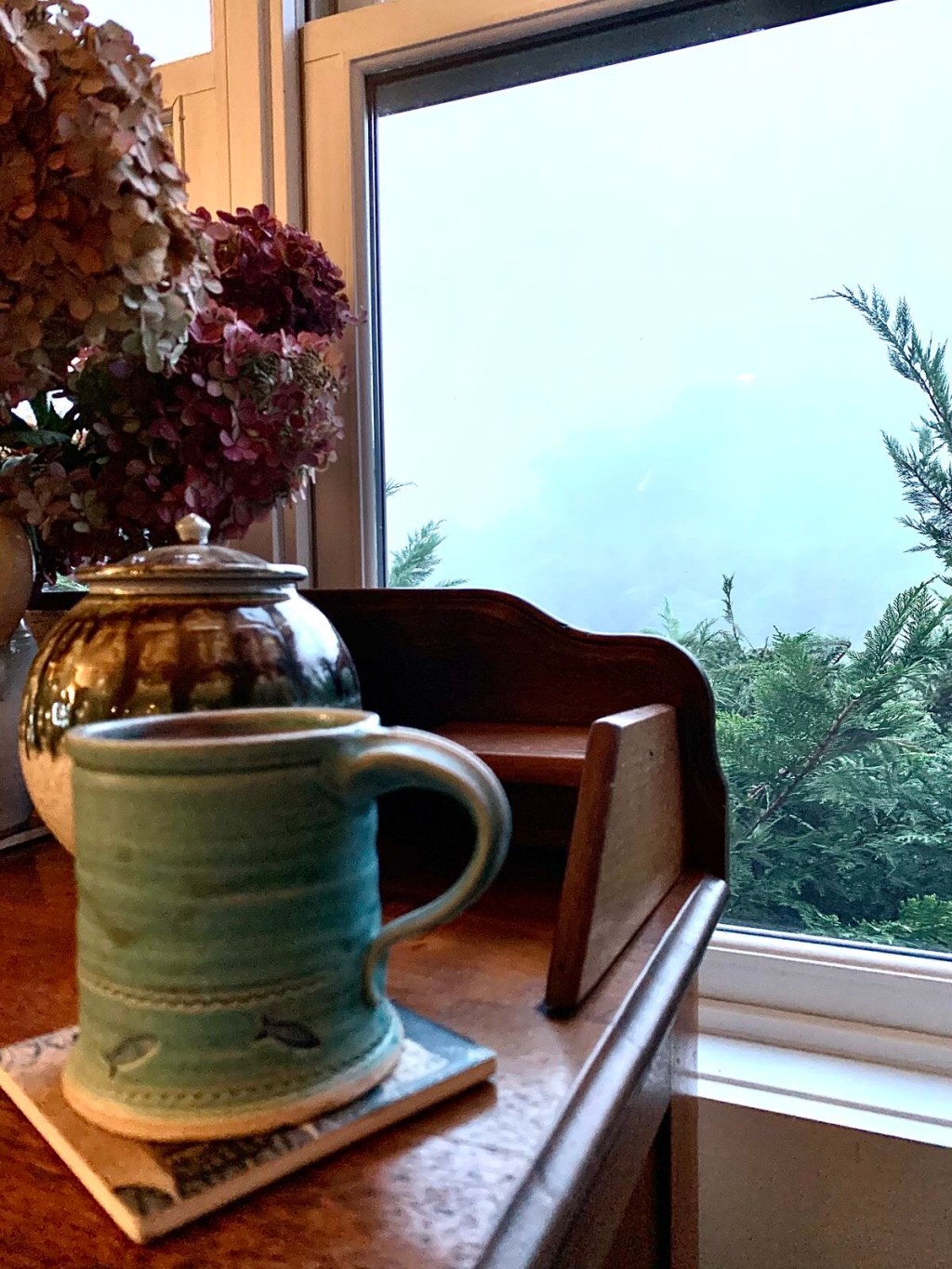
Hydrangeas and Coffee on a Cloudy Carolina Morning

Hydrangeas are native to America. Two well-known hydrangea species, among others, grow wild in North America — the H. aborescens (smooth leaf) and H. quercifolia (oak leaf). Their actual cultivation began in the 1700s. An historic trifecta of our forefathers’ estates is proof: Mount Vernon, Monticello, and Montpelier all cultivated these hydrangeas.

Bartram’s Garden, possibly drawn by a young William Bartram

William Bartram, of Bartram’s Nursery in Philadelphia, provided the seeds and plants for these historic homes. James Madison’s home, Montpelier, in Vermont, still has the creamy white heads of H. arborescens as a border for his garden wall. The Bartram Gardens were a natural history project begun by his father John Bartram and continued through the generations, with William’s love of travel and exploration leading to a four-year collecting trip to the American Southeast and the publishing of an account of his travels in 1791. It became a classic text in the history of American science and literature.

Documents from Mount Vernon record how in 1792, George Washington planted a native hydrangea, H. arborescens, on the bowling green at his home. Nearby, when Thomas Jefferson was designing his gardens and walkways at Monticello, he also included these new shrubs. Today, gardeners can purchase heirloom H. quercifolia seeds from the Thomas Jefferson Center for Historic Plants in Monticello.

The notion everyone is connected by just six stages of separation gained popularity in the early 2000’s based on scientific studies done in the 1960’s. The game Six Stages of Kevin Bacon was based on this idea. Today, due to social media and the internet, some people have only 3 or 4 stages of separation. Our founding fathers ran in the same circles, so their stages of separation were small.

Hydrangeas also come from Japan, where they’re the subject of many brush and ink paintings. The flowers hold a solid role in Japanese culture. The Japanese celebrate the hugely popular Ajisai (hydrangea) festivals in the blooming seasons of late spring and summer. Pink hydrangeas are given on the fourth wedding anniversary. Hydrangea gardens often grace the grounds of sacred Buddhist temples. People enjoy amacha, or tea from heaven, on April 8, Buddha’s birthday. Amacha is brewed from leaves of the Hydrangea serrata.

Steps ascending to Meigetsu-in Temple

While western churches are sited in lawns, as if they were sheepfolds to shelter the sheep within and protect them from the outer world, eastern Buddhist temples incorporate nature into their design and sites. This reminds us everything is one. As Father Richard Rohr reminds us in his book, The Universal Christ, the author of Colossians 1:19-20, puts this idea plainly:

“For in him all the fullness of God was pleased to dwell, and through him God was pleased to reconcile to himself all things, whether on earth or in heaven, by making peace through the blood of his cross.”

A classic example is the Buddhist Meigetsu-in Temple, which was founded in 1160 as a Rinzai Zen temple of the Buddhist Kenchō-ji school. Located in Kamakura, Japan, its nickname is the hydrangea temple, for from the end of May through July, thousands of hydrangeas bloom during the rainy season. The temple is a Japanese national historic site.

When I first brought in the dried flowers to class, the first reactions I heard were, “Wow! You brought those all the way from North Carolina intact?” and “This is gonna be hard!” I’ll let you figure out who said what!

My answer was, “Sure, I’m an old art teacher, and I’m prepared for anything. I had a travel box in my SUV trunk, so they nestled quietly there on the journey home. As for hard to paint, remember what I always tell you, don’t paint the eyelashes before you get the shape of the face. The KISS principle always applies.”

“You mean keep it simple, stupid?”

“Mike, the one who wants to learn and stretch their mind is never stupid. KISS stands for KEEP IT SIMPLE, STUDENTS.”

They all laughed. Most of us can’t see the big forest because we’re looking at all the individual trees. If we step back and get a sense of the whole first, we can see how the parts relate to one another. This helps us put the basic sketch onto the surface of our work. It also gives us a moment to observe the subject before us and catch that moment of interest, which we can then emphasize.

Image Ball in Shadow and Light

As I reminded folks, “This looks difficult, but the basic shape here is a big ball. We’ve already done geometric balls. You thought those were boring, but they had a purpose. You needed that skill to be able to see the same shape in nature and recognize the same pattern of light and dark shadows.”

They nodded their heads. Teaching often is just reminding people what they already know or reinforcing previous skills from a different viewpoint. We went on to the slide show. It helps to see how other artists have handled the subject of the day. I’ve always enjoyed show and tell time, for it gives us inspiration and education both. Every time we learn something new, we have a new wrinkle in our brains. At a certain age, this is the only place we want to get wrinkles!

Inuzuka Taisui: Butterfly and Hydrangea, 1930, Woodblock print

This lovely Japanese woodblock print is from the era when Japan moved from its historic monarchy into the beginning of its new democratic government. The old emperor was confined to the palace due to illness, so the western educated prince regent Hirohito was the default leader. During this time, the people favored western art styles, such as this romanticized Shin-hanga print, instead of the older artists’ works of the floating world, or Ukiyo-e. The Japanese continued to prefer the works of the floating worlds, with the dancers, actors, musicians, and tea houses.

Of course, Taisui and the other artists of the Shin-hanga movement were producing for a distant audience, who may never have set foot upon the island of Japan. What we think we know of a place is one thing, but until we experience it first hand, we won’t know its truth and its power, except by word of mouth. Taisui was active for only a decade, as far as we know, from 1920 to 1930, but he made numerous prints of plants, insects, and birds, which still bring joy to us today.

T. Adams: Hydrangeas and Lilacs, palette knife technique

I found this painting on Pinterest. I pointed out how the artist didn’t paint every single flower petal, but still got the message of “hydrangeas” across. This is a palette knife work, so it builds up the shapes from back to front. An artist can’t just throw paint on the canvas like some piece of spaghetti against the wall and hope it sticks. We always have to put our thinking cap on and build up the shapes from back to front and from dark to light. We also have to pay attention to the direction of the light if we’re doing a realistic image.

Allison Chambers: Yesterday (Hydrangeas), oil on canvas, c. 2017-21

This second rough image by Allison Chambers is another example of not painting all the minute details, but getting the main idea across (KISS). This is why billboards don’t use small print and politicians use sound bites. We’re moving too fast on the highway to read the fine print and our attention spans now are less than a goldfish! Sad but true, a goldfish can focus for nine seconds, but the average human only for eight seconds.

We can blame phones, social media, and our desire to be connected all the time. Once we were content to call once a day, but now we have to check in twice a day or more. Some of us find that much contact interferes with getting things done, but then self starters don’t need anyone checking up on them. These folks tend to think frequent callers need to find another hobby to fill their time. Everyone needs a purpose in life, so those who’re trying to micromanage others might need to spend that energy helping the poor with food distribution or expending that excess energy doing good elsewhere. Then again, maybe those frequent callers are just lonely. They might need to use those dialing fingers for good as part of a community prayer chain. Then they can connect in prayer and feel useful too.

Doris Joa: Hydrangea with Ivy, watercolor on paper, 2015

This last image does have many details. It’s a watercolor built up in thin layers of washes to get the desired result. When working with washes, we have to have time and patience, and channel our inner goldfish, so we can manage our attention spans. Our first inclination is to work wet in wet, over and over, but that just muddies up our colors in that space. We need to let that spot dry, move to a new spot, paint it, and keep painting and moving, until we get the whole first layer done. Then we can come back and lay in darker tones in certain areas, once again moving about the canvas, for if we repaint too soon, we’ll just lift up the underpainting.

This takes focus and intent, as well as the ability to reserve judgement on our work, since it takes time for it to come into being. This isn’t a simple skill, for delayed gratification isn’t practiced often today. Even when we work our plan and execute our technique to the best of our ability, the end result may seem lacking. Yet, we’ve grown, or else we wouldn’t realize our struggle didn’t meet our expectations. When we want more, we can see how far short our efforts fall. This should encourage us to continue the challenge.

As Philippians 3:12-14 reminds us about the spiritual life:

“Not that I have already obtained this or have already reached the goal; but I press on to make it my own, because Christ Jesus has made me his own. Beloved, I do not consider that I have made it my own; but this one thing I do: forgetting what lies behind and straining forward to what lies ahead, I press on toward the goal for the prize of the heavenly call of God in Christ Jesus.”

After show and tell, we sat down to paint. We’d done enough talking and presenting of models. We had enough to chew on for the short time our class meets. If we have two hours, we use the first 15 minutes on presentation and the last 15 minutes on cleanup. This gives us about 90 minutes to paint. We don’t make large works, but sometimes we take an extra day to finish what we started. I’d call most of our work “studies,” since they’re quickly done.

Gail’s Hydrangeas

Gail chose to do color exploration and deeper, more saturated applications of paint, rather than her usual washes. This was a bold experiment for her. Art is a risky business. We can’t always control what the brush will do. Most of us have been trained since childhood to “color within the lines.” Once the paint gets loose, we’re in uncharted waters, sailing out into the deep ocean and out of sight of familiar landmarks. We can either turn back and hug the safe shore, or sail out to discover the unknown land. Taking risks is how we grow.

Mike’s Hydrangeas

Mike’s love of texture is apparent in his painting, as well as a variety of color. While the colors aren’t natural to the subject, he chose the colors which made him feel good. His is an emotional response to the beauty of the flowers. He wasn’t happy with the opening of the vase, but he got so carried away with the flowers, he forgot his perspective principles.

We might need to reteach that lesson once again. Some lessons need reteaching multiple times. This is why Jesus spoke in the gospels about God 264 times and love 44 times. Money rated 24 mentions, riches 2, the neighbor 10, and the poor 25. If we ever wondered what Jesus was focused on, we might look at what he emphasized in his ministry.

Cornelia’s Hydrangeas

I noticed we each gave our flower pots a different look when we painted our canvases. None of us are dedicated copyists. My color scheme tilts toward the red-orange, yellow-green, and blue-violet. This is a secondary triad, rather than a primary triad of red, yellow, and blue. The mixed colors give the flowers their muted look.

Secondary Triad on Cornelia’s Hydrangeas

By adding white to some of the brush strokes, and darker tones to others, I was able to suggest individual flowers as well as shapes. It’s just a quick sketch, a work I would do in preparation for a larger painting. Doing this would help me get some ideas down and help me solve some problems in advance, as if I were training for a competition. I would know if my color scheme was working, or if I needed to change the values or tints. I might want to choose a deeper color, or certainly a larger canvas.

So we come back for another day and another try. We can “see the promised land,” but like Moses, we don’t know if we’ll ever reach it. Artists have to be incurable optimists, for they keep trying again and again, even though we know human perfection in art will always be out of reach. Yet as Paul reminds us in Romans 3:21-24, if perfection in art eludes us, we can still have “Righteousness through Faith:”

“But now, apart from law, the righteousness of God has been disclosed, and is attested by the law and the prophets, the righteousness of God through faith in Jesus Christ for all who believe. For there is no distinction, since all have sinned and fall short of the glory of God; they are now justified by his grace as a gift, through the redemption that is in Christ Jesus.”

May we all go onto perfection, with God’s help—
Joy and Peace,

Cornelia

Hydrangeas: A History
http://thehouseandhomemagazine.com/culture/hyndrangeas-a-history/

Taisho Democracy in Japan: 1912-1926
https://www.facinghistory.org/nanjing-atrocities/nation-building/taisho-democracy-japan-1912-1926

William Bartram – History of Early American Landscape Design
https://heald.nga.gov/mediawiki/index.php/William_Bartram

Kamakura’s Famous Hydrangea Temple: Walk Among Flowers in Japan’s Ancient Capital
https://livejapan.com/en/in-tokyo/in-pref-kanagawa/in-kamakura/article-a0001996/

Science: You Now Have a Shorter Attention Span Than a Goldfish
https://time.com/3858309/attention-spans-goldfish/

The Science Behind Six Degrees
https://hbr.org/2003/02/the-science-behind-six-degrees

Rabbit! Rabbit! Welcome to May!

Altars, apples, art, Civil War, coronavirus, exercise, Family, flowers, Food, greek myths, grief, Healing, Health, holidays, Holy Spirit, Love, Memorial Day, Ministry, ministry, pandemic, purpose, rabbits, renewal, Retirement, righteousness, shadows, sleep, Strength, Stress

We’ve made it to May, the official door to summer, picnics, swimming pools, backyard cookouts, and slower paced lives. Or so we hope, as the temperatures warm and the pandemic wanes. Of course, this last is dependent not just on our individual responses, or even on our citizens’ cooperative actions, but it also depends on the developed nations of our world sharing our expertise and resources with the larger world’s need. If we ever thought we could build a wall and isolate our people and economy from the outside, our need for imported goods and our desire to travel on cruise ships seems to trump our need for isolation. India’s ongoing coronavirus catastrophe results from an inadequate health care system and a lack of vaccines, oxygen, and PPE. Less than 10 percent of Indians have gotten even one dose, despite India being the world’s leading vaccine manufacturer.

Matisse: Swimming Pool, paper cutouts, 1952, MOMA

As we come out of our enforced hibernation, like bears we shed our winter coats and start foraging for foods in an ever widening territory. We’re looking for reasons to celebrate and tantalizing foods to taste. The yum factor and new environments suddenly become sirens singing irresistible songs, which have the opportunity to dash our small bark against the rocks if we’re not careful. Like Ulysses, the ancient Greek hero, we travel between Scylla and Charybdis, hoping not to wreck.

J. M. W. Turner: Ulysses Deriding Polyphemus, 1829, Tate Gallery, London.

Fictional heroes make a big splash in May. On May 1, 1939, Batman, the caped crusader, made his first appearance in Detective Comics Issue #27. Star Wars Day is “May the 4th be with you.” On May 5, 1895, Richard F. Outcault published the first ever cartoon, The Yellow Kid. Since all those years ago, cartoons have seeped into our lives through every media outlet possible. If it weren’t for The Yellow Kid all those years ago, we probably wouldn’t be watching Iron Man and Captain America slugging it out on the big-screen. May 25 is a tribute to author Douglas Adams, who wrote the famed novel, The Hitchhiker’s Guide to the Galaxy.

Quote from The Hitchhiker’s Guide to the Galaxy

It’s a rather easy day to celebrate and it’s done by taking a towel with you wherever you go: to work, school, or just to the shops. This way you can celebrate such gems of wisdom as, “Nothing travels faster than the speed of light with the possible exception of bad news, which obeys its own special laws.” The only thing that’s truly important on this day is you don’t forget to bring a towel!

Don’t Panic: Carry a Towel

Oh, and the answer to the “Great Question of Life, the Universe and Everything” is “forty-two.” In the 1979 novel, the supercomputer Deep Thought takes 7.5 million years to calculate the answer to this ultimate question. The characters tasked with getting that answer are disappointed because it isn’t very useful. Yet, as the computer points out, the question itself was vaguely formulated. To find the correct statement of the query whose answer is 42, the computer will have to build a new version of itself. That, too, will take time. The new version of the computer is Earth. To find out what happens next, you’ll just have to read Adams’s books. For a math geek discussion of the significance of 42, read the link “For Math Fans” below.

Salad of spring greens and edible flowers

Having dispensed with heroes, we can move onto the significant May Days that truly appeal to me. “April showers bring May flowers” is a saying I’ve heard since my childhood ever so long ago. Historians believe this phrase may date back to a 1610 poem, which contained the lines, “Sweet April showers, do spring May flowers.” A longer phrase, “March winds and April showers bring forth May flowers,” has also been traced back to 1886. Of course, this tidbit of wisdom depends upon your geographic location, for folks inland and north may wait until what we southern folks call “early summer” before they get their “springtime.”

Rabbit and animals dancing around a Maypole

“The month of May was come, when every lust heart beginneth to blossom, and to bring forth fruit,” wrote Sir Thomas Malory in Le Morte d’Arthur. The early Greeks called this month Maia, after the goddess of fertility, many of the early May festivals relate to agriculture and renewal. May Day, celebrated on the first with the Maypole, is one such festive event that was more debauched in earlier times, but now survives as a chaste minuet of colorful ribbons woven around a tall pole by children dancing in an interweaving circle below it.

Maypole dance patterns

Other modern May festivities include No Pants Day on 5/1, originally an end of the college year prank at the University of Texas, Austin, which spread to other realms needing release, and World Laughter Day, celebrated on the first Sunday of May. This holiday helps raise awareness about the benefits of laughing and promotes world peace through laughter. Laughing can instantly help reduce stress and brings us closer to other people, as we share our happiness with them. Those who take part in World Laughter Day can help spread positivity and cheerfulness to help change the world for the better. As Ralph Waldo Emerson said, “What potent blood hath modest May.”

No Diet Day is May 6, a good day to remember our good health isn’t based on a scale number or a pant size. Instead, our health is dependent on nutritious foods, adequate exercise, and sufficient sleep. Extreme weight loss, except under a doctor’s supervision, usually leads to yo-yo weight gain, with the body gaining back the lost weight and more after severe deprivation. Slow, long term, weight loss is more likely to be permanent loss, since we aren’t “dieting,” but changing our habits. May 11th is Eat What You Want Day. I suggest we don’t follow Oscar Wilde’s habit: “My doctor told me to stop having intimate dinners for four, unless there are three other people.”

Speaking of breaking a fast, May 12th ends the month of Ramadan, the holy month of observance for Muslims. It was during Ramadan Muhammad, the prophet of Islam, received the revelations from angel Gabriel that allowed him to compile the holy book of Quran. Upon arriving in Medina, Muhammad announced Allah had established two days of celebrations for Muslims, Eid Al Fitr and Eid Al Adha. The purpose of Eid Al Fitr was to commemorate the end of the fasting of Ramadan, and mark the start of the Shawwal month, as well as to thank Allah for giving Muslims the perseverance to fast during Ramadan. The customary feast day greeting is “Eid Mubarak,” which translates to “blessed celebration” or “Happy Eid.”

Wayne Thiebaud: Bakery Counter, Oil on canvas, 1962, Private Collection,
© 2019 Wayne Thiebaud / Licensed by VAGA at Artists Rights Society (ARS), NY

The dessert of May is apple pie. Originally invented in England, the earliest apple pie recipe dates all the way back to 1381. The original recipe is very similar to the one we currently know, but it also included figs, raisins, pears, and saffron. The Dutch also created their own version of the apple pie, and the first recipe was published in a 1514 cookbook. This recipe is very similar to the apple pie we know and love today. Apple Pie Day is May 13th.

English and Dutch settlers brought the apple pie recipes into the colonies of what would become the United States, during the 17th and 18th centuries. They had to wait until the apple trees they planted grew and bore fruit, so at first apples were mainly used to make cider. It was only in the 18th century, when the first apple pie recipes were printed in America, that the dessert quickly grew in popularity. Following this came the 19th century Legend of Johnny Appleseed, whose real name was John Chapman. He crisscrossed the expanding American frontier to bring seeds for apple orchards for homesteaders. He also brought news and the gospel for fifty years.

Apple Pie 5 cents a slice and Homemade

Chapman, or Appleseed, lives on as a barometer of the ever-shifting American ideal. Some see him as a pacifist, others as an example of the White Noble Savage (so remembered long after the settlers drove indigenous peoples from the land), and others see a mere children’s book simpleton. Some see him as a frontier bootlegger, since he helped expand the hard cider industry. Others see Johnny Appleseed as the patron saint of everything from cannabis to evangelical environmentalism and creation care—everything, that is, but the flesh-and-blood man he really was.

Our heroes are too often cardboard cutouts, and we don’t spend much time reflecting on their shadow sides. Of course, much like a Flat Stanley, a two dimensional character doesn’t have enough density to cast much of a shadow, unless the light is just right. This is why continuing Bible study is so important: most of us stop in grammar school and never get an adult insight into the scriptures. When we meet grownup problems, we have to wrestle the questions of faith that we once easily accepted trustingly. Or we walk out the door and never come back.

A Single Rose in Memory

One of the most difficult sermons I ever preached was on the first Mother’s Day after my mother died. One of my best clergy pals, who was a mentor in my ministry, had arranged for a single rose to be on the pulpit beside me on that morning. It was a gift of grace and an empowering symbol, for roses were my mom’s favorite flower. Every time I thought I might cry, I held on tight to the polished oak wood and inhaled the fragrance of the rose. Even now, nearly two decades later, I can clearly see this rose and pulpit, and while I remember where I was, I recall the congregation’s faces were a blur on that day. It’s always the second Sunday in May.

I talk about my fresh grief from years ago, for during this current Pandemic too many of us have had present grief and stress, but either have no words for it, or perhaps have no safe place to express it. Then again, we may be “managing the grief of others,” and don’t have time for caring for our own needs. I call this Deferred Maintenance Grief. If you have an old, leaky faucet, you can keep turning the handle tighter for only so long. You can keep the leak stopped for a while, but soon you’ll strip out the insides of the faucet. Once it’s stripped down, it both streams steadily and needs a completely new fixture to replace it, instead of a minor repair.

I experienced this DMG once after a spate of ten deaths in a week, or maybe it was seven in ten days, followed by the death of one of the old, beloved black clergymen in my community. As I lay on the parsonage couch watching a rerun of Babylon 5, I was crying as if old E.D. were my own daddy. I then realized I’d been too busy caring for others and doing the “work I was called for,” to do the grief work I needed to do for myself. I needed to honor my loss and give myself dedicated spaces to deal with my feelings, so I could be present for others. That’s Deferred Maintenance Grief in a nutshell. If I were eating Cheetos by the bucketful, I’d be in a deep hole of DMG and digging it deeper!

Most of the churches I served had a “Don’t fix it unless it’s broke” policy. I grew up in a Depression Era family, so I was familiar with this attitude. However, these same people didn’t live this way in their own homes. We usually had a long list of deferred maintenance projects in the church property to finish in my time there. Then I’d go to the next place and do it all over again. “Always leave a place better than you found it, both structurally and theologically. Teach people the law of love. As we learn in Romans 13:8, “Owe no one anything, except to love one another; for the one who loves another has fulfilled the law.”

Most of us human beings have “deferred maintenance projects” also: days off, doctor visits, exercise, healthy meals, quiet times, and family times. Taking time for ourselves means we’re refreshed and eager to serve from the quickening power of the Spirit. Without this resting or love for our own embodied image of God, we end up working from the dying embers of our body’s frail resources—burnout calls our name.

When we get this broken, our families and our ministries both suffer along with us. We know better than to drive our vehicles with the gas gauge on empty past every filling station on the road of life. We aren’t called to die on the cross to prove our worth to Christ or to anyone else. He’s our savior and we claim his work on the cross. Anything else is workaholism or salvation by works. We need to name and claim this.

For clergy moving to a new appointment, this is an opportunity for a reset. For those who remain in place, I suggest a planning book. Mark off in advance quiet times, office hours, and visitation times. Take educational events, even if zoom is the only offering. Read for pleasure. Take a day off out of town. Don’t answer the phone after 9 pm unless it’s an emergency. Boundaries are blessings. I always told people up front, “I take my brain out of my head and put it inside a brain box at 9 pm. I put it back in at 9 am. If you call me between those hours, somebody better have died, be on the way to the ER, or the church is burning down.” They laugh, but I’ve had friends who wanted their pastor to be their bedtime Bible expositor. Boundaries keep us from burning out.

Speaking of burning, the official door to summer begins with Memorial Day Weekend. This holiday celebrates those who gave their lives in the great wars of our nation. It began after the Civil War in 1865 as a way to deal with the shared grief of a nation, which lost 750,000 people, or 2.5% of the population, in the struggle. If we were to translate this to today’s world, the number would equal 7,000,000 deaths. War is a pandemic all its own.

An engraving of The Dying Soldier – The last letter from home during the US civil war, circa 1864. (Photo by Kean Collection/Archive Photos/Getty Images)

As a parting commentary on Memorial Day, the Pandemic, and Extreme Care Giving, I leave you with a portion of the 1865 Walt Whitman poem, “The Wound Dresser,” which he wrote after serving as a hospital volunteer in the Civil War.

But in silence, in dreams’ projections,
While the world of gain and appearance and mirth goes on,
So soon what is over forgotten, and waves wash the imprints off the sand,
With hinged knees returning I enter the doors, (while for you up there,
Whoever you are, follow without noise and be of strong heart.)

Bearing the bandages, water and sponge,
Straight and swift to my wounded I go,
Where they lie on the ground after the battle brought in,
Where their priceless blood reddens the grass the ground,
Or to the rows of the hospital tent, or under the roof’d hospital,
To the long rows of cots up and down each side I return,
To each and all one after another I draw near, not one do I miss,
An attendant follows holding a tray, he carries a refuse pail,
Soon to be fill’d with clotted rags and blood, emptied, and fill’d again.

I onward go, I stop,
With hinged knees and steady hand to dress wounds,
I am firm with each, the pangs are sharp yet unavoidable,
One turns to me his appealing eyes—poor boy! I never knew you,
Yet I think I could not refuse this moment to die for you, if that would save you.

Remember to wear sunscreen to protect your skin if you plan outdoor activities on the first three day weekend of the summer and watch the temperature of the grill. We don’t want anything to burn if we can help it. Charred meat and burned skin are both indicated for cancer risks. Be safe and continue to mask up in public. Get vaccinated as an act of love for your family, your neighbors, and the world community. Since we’re all wound dressers, as well as the wounded also, we want to give as much care to healing our own wounds as we do to the wounds of others.

Joy and Peace,

Cornie

The Project Gutenberg eBook of The Wound Dresser, by Walt Whitman.
https://www.gutenberg.org/files/35725/35725-h/35725-h.htm
This contains first source material from Whitman’s era as well as his works from the Civil War period.

Do April Showers Really Bring May Flowers? | Wonderopolis
https://wonderopolis.org/wonder/do-april-showers-really-bring-may-flowers

As Covid-19 Devastates India, Deaths Go Undercounted
https://www.nytimes.com/2021/04/24/world/asia/india-coronavirus-deaths.html?referringSource=articleShare

For Math Fans: A Hitchhiker’s Guide to the Number 42 – Scientific American
https://www.scientificamerican.com/article/for-math-fans-a-hitchhikers-guide-to-the-number-42/

42 Of The Best Hitchhiker’s Guide to the Galaxy Quotes | Book Riot
https://bookriot.com/the-42-best-lines-from-douglas-adams-the-hitchhikers-guide-to-the-galaxy-series/

No Diet Day (6th May) | Days Of The Year
https://www.daysoftheyear.com/days/no-diet-day/

World Laughter Day | May 2
https://www.calendarr.com/united-states/world-laughter-day/

National Apple Pie Day | May 13 – Calendarr
https://www.calendarr.com/united-states/national-apple-pie-day/

Johnny Appleseed Planted Stories Of Myth, Adventure : NPR
https://www.npr.org/2011/04/17/135409598/johnny-appleseed-planted-stories-of-myth-adventure

Statistics From the Civil War | Facing History and Ourselves
https://www.facinghistory.org/resource-library/statistics-civil-war

Chemicals in Meat Cooked at High Temperatures and Cancer Risk – National Cancer Institute
https://www.cancer.gov/about-cancer/causes-prevention/risk/diet/cooked-meats-fact-sheet

Palette Knife Flowers

adult learning, art, beauty, brain plasticity, Children, Creativity, Easter, Faith, flowers, Imagination, mystery, nature, Painting, purpose, renewal, righteousness, risk, Spirituality, Valentine’s Day, vision

The Very Last Leaf

Every blade of grass outside is a uniform tan, for winter’s pale light has sucked the life and green from its living cells. Each colder breeze separates yet another straggling leaf from a sleeping stick attached to the limbs of a hibernating tree. The sap won’t rise until mid February, when the days are warmer and the nights are still freezing. The ornamental pear trees lining the entry to my condo are beginning to bud, so I’m sure they’ll be covered with snow before Easter. I’m almost wishing for a good snow to change up the colors outside, to cause some excitement of a bread aisle clearing stampede, and the joy of eating pancakes at every meal “just because it’s a snow day.”

Instead, I’ve brightened my interior spaces with fresh flowers. This is an early reminder to all you lovers out there: Sunday, February 14 is Valentine’s Day. Be sweet to the special person in your life by bringing something beautiful or joyful into their life. Our art class has been working with the palette knife instead of the brush lately. This is a different tool to get the paint on the canvas. With the brush, we can make lines and broad strokes, as well as dots or blobs. With the knife, we have to pick up colors on the metal end, push and press with varied strength and wrist twists to get the paint to go where we want it and to mix at the same time.

Mike’s Flower Study

How does this happen? It’s magic! Or luck, or practice until you figure out how the paint feels under your hands. I can best describe it as being willing to do finger painting, but with a palette knife. We also have to let our adult mind go sit in the corner, while we let our five year old come out and play. Another way to think of this is to compare religion and faith. Religion has rules and boundaries for how to “do it right.” We spend most of our lives in this mode, trying to measure up to a severe standard, rather like the older brother to the prodigal son. In faith, we trust we’re enough and God’s mercy and grace are sufficient for us, so we yearn to please God even more. What we can do in love, for love’s sake, will bring the world into the love of God.

Gail’s Flower Study

This is why no one copies my art work, but goes on their own journey to find their own way of seeing. This is one of the hardest parts of making a painting, to isolate the primary forms and shapes, and then to set them in a space. As we look at a three dimensional world, we have to come up with our own visual language to write on a two dimensional surface. As we invent our own language, we’re creating a new vocabulary, grammar, and conjugations, which take some time for us and the world to understand. We don’t worry if we’re “good,” for we are painting these to grow our minds, stretch our boundaries, and by learning new skills, building new brain connections and endorphins. We get joy from our work, so it gets us through the doldrums of winter.

Cornelia’s first layer

There’s a wonderful poem by Robert Frost, of a bouquet of flowers, and two birds in winter:

Wind and Window Flower

Lovers, forget your love,

And list to the love of these,

She a window flower,

And he a winter breeze.

When the frosty window veil

Was melted down at noon,

And the cagèd yellow bird

Hung over her in tune,

He marked her through the pane,

He could not help but mark,

And only passed her by,

To come again at dark.

He was a winter wind,

Concerned with ice and snow,

Dead weeds and unmated birds,

And little of love could know.

But he sighed upon the sill,

He gave the sash a shake,

As witness all within

Who lay that night awake.

Perchance he half prevailed

To win her for the flight

From the firelit looking-glass

And warm stove-window light.

But the flower leaned aside

And thought of naught to say,

And morning found the breeze

A hundred miles away.

Cornelia’s Final Flowers

“Wind and Window Flower,” a poem written by Robert Frost, speaks of how we can sometimes love someone who can’t leave either the safety of their window sill or the prison of their cage. With this in mind, it’s best for the bird to fly on by in order to find true love or purpose somewhere else. Some of us will watch the cold world from a safe distance as it goes by, while others will leave our cozy homes and go out into the cold, sharp winds to seek another path. We may regret leaving the caged bird behind, but we have to go and find our highest purpose in life. I often wonder about the bird left behind, if the cage ever got too small or if security was more important. The fresh flowers won’t ever know the outcome of this story, for they’ll be gone before the week is out.

Even these small and insignificant works of the creator are not outside the care and concern of a loving God. As Jesus says in Matthew 6:26-33—

“Look at the birds of the air; they neither sow nor reap nor gather into barns, and yet your heavenly Father feeds them. Are you not of more value than they? And can any of you by worrying add a single hour to your span of life?

And why do you worry about clothing? Consider the lilies of the field, how they grow; they neither toil nor spin, yet I tell you, even Solomon in all his glory was not clothed like one of these. But if God so clothes the grass of the field, which is alive today and tomorrow is thrown into the oven, will he not much more clothe you—you of little faith?

Therefore do not worry, saying, ‘What will we eat?’ or ‘What will we drink?’ or ‘What will we wear?’ For it is the Gentiles who strive for all these things; and indeed your heavenly Father knows that you need all these things. But strive first for the kingdom of God and his righteousness, and all these things will be given to you as well.”

Rabbit! Rabbit! Welcome to December!

arkansas, art, Children, Christmas, Civil War, coronavirus, Faith, Food, generosity, grief, Hanukkah, holidays, Israel, ministry, poverty, rabbits, righteousness, Travel

Bunnykins Christmas Plate

December has snuck up on me like a racoon stalking a rabbit. Perhaps I ate too much of the Thanksgiving Feast, or maybe it was the homemade Italian Cheesecake dressed with cranberry sauce and maple pecans that did me in. It thankfully wasn’t the covid, for I had an appropriately socially distanced meal via Zoom, thanks to my niece in New Orleans and her mother in Texarkana. I’ve driven to New Orleans before, and it’s a hard eight hour trip, so I’ve always done it in two legs and made it into an easy jaunt instead. I spent the night in Vicksburg, Mississippi, to see the great Civil War battlefield there, and pay homage to those who fought to preserve the unity of the nation, even if my ancestors fought to keep other human beings enslaved. I also saw some of the grand plantation homes, which were built by slave labor. We don’t think of this history much, and I wasn’t taught it growing up, but it’s time for all of us to acknowledge all the hands who built this nation we call home.

My Decembers as a child growing up in the South were a time of waiting. I couldn’t make the clock hurry up no matter how hard I stared at it. My mother would remind me, “A watched pot never boils.” I’d grind my teeth. Hurry used to be my middle name. Now I seem to putter all day and never worry about it. I may be an aging rabbit, or maybe just a great-grandmother rabbit. Or I may have learned the wisdom of waiting, which is the lesson of the Advent season.

All small children endure the waiting at the end of the year, for the end of the year is full of holidays for many faiths. Today we’re all waiting for more normal times to return, so we can hug one another, kiss each other on the lips, and drink from the same cup without worrying about a dread disease. Waiting was so difficult for me and my brothers, we’d beg and cajole our parents to “Please, pretty please, just let us open one gift before Christmas!” We were the fortunate ones, for when our parents were children in the era of the Great Depression, they knew better than to ask for much. My daddy asked Santa Clause for an orange, boxing gloves, and a book for his older brother. Most of us today think we’d be bad parents if we gave our children only two items, but in the era of covid, when nearly 30 million people are out of work, we might need to readjust our priorities. Keeping a roof over our heads and food on the table could take priority, unless angels bring the gifts instead.

Christmas Crepes and Coffee

Today, I’m listening to Mannheim Steamroller play Christmas music. Tomorrow is the first day of meteorological winter and the Winter Solstice will be December 21. It’s a quiet time in the condo, for I’m alone with my decaf coffee and the furnace is keeping me cozy. One small joy I always look forward to is the opportunity to use my Christmas themed mugs for a whole month. I’ve put up the ordinary dishware and pulled down my collection of red, green, gold, and white cups. When I was young, I looked forward to the gumdrop tree and the Christmas cookies. Decorating and baking every weekend kept mother busy in the kitchen and me helping or getting my fingers in the icing bowl. I learned to share by helping my mom. I never liked her candied fruitcake recipe, however, or the fruitcake cookies. You can keep that to yourself. I think some traditions may need to die, and fruitcake is one of them, but my tastebuds don’t cater to sugared fruit anymore. Her pecan sandies were to die for, however.

If we approach the coming holiday season with anticipation for the small joys it brings, rather than thinking of the losses we’ve suffered, this December will be better for us by far. By this I mean, the tree isn’t the most important thing, for if it were, we’d worship the tree. We don’t worship the lights shining brightly, but the light which shines in the darkness. The presents aren’t the most important part of Christmas, for we don’t worship the gifts, but the gift from God.

Christmas Lights, Hot Springs, Arkansas

While light has been central to many religions across the centuries, it becomes very important toward the end of the year when the days grow short. The Romans originally celebrated Saturnalia as a harvest festival, but then moved it to the middle of December, and changed its focus to a celebration of light, knowledge, and truth. They would gift dolls and treats of fruit, and light bonfires. It began as a home holiday, but became a public feast holiday in 217 BCE.

Another religious festival is the Jewish festival of Hanukkah, which celebrates the miracle of the oil and its burning for eight days, when only enough for one day was found. Jewish people celebrate their faith by lighting a menorah with nine candles: one is the helper or attendant, and the others represent the days of the ancient miracle of rededication of the Temple after the Maccabean Revolt. Families always place the menorah in a window, so everyone will see it. As a special treat, families eat foods fried in oil, such as potato pancakes and doughnuts.

Menorah

The tradition is one should spend time in close proximity to the Chanukah lights for, “We must listen carefully to what the candles are saying.” The flickering flames may be telling us the following:

1. Never be afraid to stand up for what’s right. Judah Maccabee and his band faced daunting odds, but that didn’t stop them. With a prayer on their lips and faith in their heart, they entered the battle of their lives—and won. We can do the same.

2. Always increase in matters of goodness and Torah-observance. Sure, a single flame was good enough for yesterday, but today needs to be even better.

3. A little light goes a long way. The Chanukah candles are lit when dusk is falling. Perched in the doorway, they serve as a beacon for the darkening streets. No matter how dark it is outside, a candle of G‑dly goodness can transform the darkness itself into light.

4. Take it to the streets. Chanukah is unique in that its primary mitzvah is observed in public. It’s not enough to be a Jew at heart, or even at home. Chanukah teaches us to shine outwards into our surroundings with the G‑dly glow of mitzvahs.

5. Don’t be ashamed to perform mitzvahs (individual act of human kindness), even if you will feel different. Rather, be like a menorah, proudly proclaiming its radiant uniqueness for all to see.

My daddy died one year and my mother died the next. I didn’t much feel like Christmas in my heart. When the Salvation Army representative came calling to the church office, I really didn’t have the energy to help reorganize another messed up program. Then the words of my mother entered my mind: “If you want to feel better about your situation, you should do something for someone in more need than you are.” I can’t say I grieved any less, but I felt better about that Christmas, for I knew I was called to share my blessings with others. I could talk to all the service clubs in town and get them to ring the bells, including the high school service clubs. We made many people in that community able to pay their utilities and rent in hard times.

December 6 is Saint Nicholas’ feast day, the saint who most people know as Santa Clause. Saint Nicholas was the Bishop of Myra and endured the persecution of Emperor of Diocletian, who put so many priests, bishops, and deacons into prison, there wasn’t room for actual criminals. After his release, Nicholas attended the Council of Nicaea in 325 CE, before his death in 343. His generosity was legend, as was his concern for children, the poor, and anyone in need. Europeans celebrated the saint’s day and reserved the day of Christ’s birth for more sober, religious experiences.

Saint Nicholas the Gift Giver

Many people consider Christmas to be quintessential American holiday. When my daughter and I hosted a French exchange student chaperone, she raved about the American Christmas. “The English do the season well, but the Americans are the very best of all. I only wish I could be here in December!”

I laughed. I had too many memories of being up all night assembling Strawberry Shortcake Doll Houses or putting together my daughter’s new bicycle. I’ve always been directionally challenged when it comes to maps, but also when it comes to reading set up plans. I’ve never understood it, since I seem to be able to follow a recipe just fine, but mechanical things are a stumbling block to me. My memories of Christmas are from participation, not from observation.

The first Colonists, who were primarily Puritans and other Protestant reformers, didn’t bring the Nicholas traditions to the New World. As we celebrate the Christmas of today, we have a hard time thinking of the Puritan tradition which ignored Christmas altogether. Back in the 18th and 19th centuries, once the work was done, people would drink and become rowdy. Drunken mobs would roam the streets and scare the genteel classes afterwards. Even in the mid 19th century, Christmas was a regular workday. Christmas didn’t become a federal holiday until June 26, 1870, under President Ulysses S. Grant.

After the American Revolution, New Yorkers remembered with pride their colony’s nearly-forgotten Dutch roots. In 1773, New York non-Dutch patriots formed the Sons of St. Nicholas 1, primarily as a non-British symbol to counter the English St. George societies, rather than to honor St. Nicholas. John Pintard, the influential patriot and antiquarian, who founded the New York Historical Society in 1804, was the first to promote St. Nicholas as patron saint of both society and the city. 

In January 1809, Washington Irving joined the society and on St. Nicholas Day that same year, he published the satirical fiction, Knickerbocker’s History of New York, with numerous references to a jolly St. Nicholas character. This was not the saintly bishop, but rather an elfin Dutch burgher with a clay pipe. These delightful flights of imagination are the source of the New Amsterdam St. Nicholas legends: the first Dutch emigrant ship had a figurehead of St. Nicholas; St. Nicholas Day was observed in the colony; the first church was dedicated to him; and St. Nicholas comes down chimneys to bring gifts. Irving’s work was regarded as the “first notable work of imagination in the New World.”

Another work of the American imagination is the “Visit from Saint Nicholas,” or “The Night Before Christmas,” a poem which still holds our interest. This poem centers around the family and the safe toys for the good little girls and boys, which Santa and his reindeer will bring to each snug and cozy house. This poem is in the public domain, so it’s available on the internet. 

Christmas for many of us in years past has been like the Bunny 500: racing about the countryside as fast as we can to get as many of our to-do lists done. This covid Christmas, we might exchange our tradition of mass consumption for hot chocolate and communication. I’ve always enjoyed reading Dylan Thomas’ A Child’s Christmas in Wales. After two decades of ministry and multiple Christmas Eve candlelight services, I’ve always appreciated the quiet of the parsonage afterwards and the descriptive words rolling off this poet’s tongue. If the poem harkens back to a simpler time, it also reminds us of our lives before we were isolated from one another. As one who rarely saw snow on Christmas, I always enjoyed reading about the snowball fight against Mr. Prothero’s fire, and the Uncles and the Aunts at the meal. After a big day, Thomas said some words to the close and holy darkness and then he slept. 

The light will come into the darkness and the darkness won’t overcome it. Two thousand years ago, even the parents of the holy child could find no place to spend the night but in a cave with animals. They had no crib for their child, but placed him instead in the manger. Their families in town didn’t come to visit, but angels announced his birth to shepherds in a field nearby. Strangers brought gifts from far away, but no one from his family was around to celebrate.

Banksy: Manger, Bethlehem’s Walled Off Hotel

Maybe this is Christmas at its best, when we recognize the one who lives on the margin and isn’t included in the center of the social experiences. If your Christmas today isn’t what it’s always been, perhaps the gift of this Christmas present is the one you need.

May you and your bunnies celebrate this season of light and be a light in the darkness for those who think the dawn can’t come soon enough.

Joy and Peace,

Cornelia

Audio Blessings and Latkes Recipe Link

https://www.chabad.org/holidays/chanukah/article_cdo/aid/103874/jewish/Blessings-on-the-Menorah.htm

How the Pandemic is Affecting Supply Chains

https://www.wbur.org/hereandnow/2020/11/24/coronavirus-supply-chains

Dylan Thomas: A Child’s Christmas in Wales

http://gutenberg.net.au/ebooks07/0701261h.html