Rublev’s Holy Trinity

art, epilepsy, Faith, generosity, Holy Spirit, Holy Trinity, Icons, inspiration, Painting, Rublev, salvation, vision

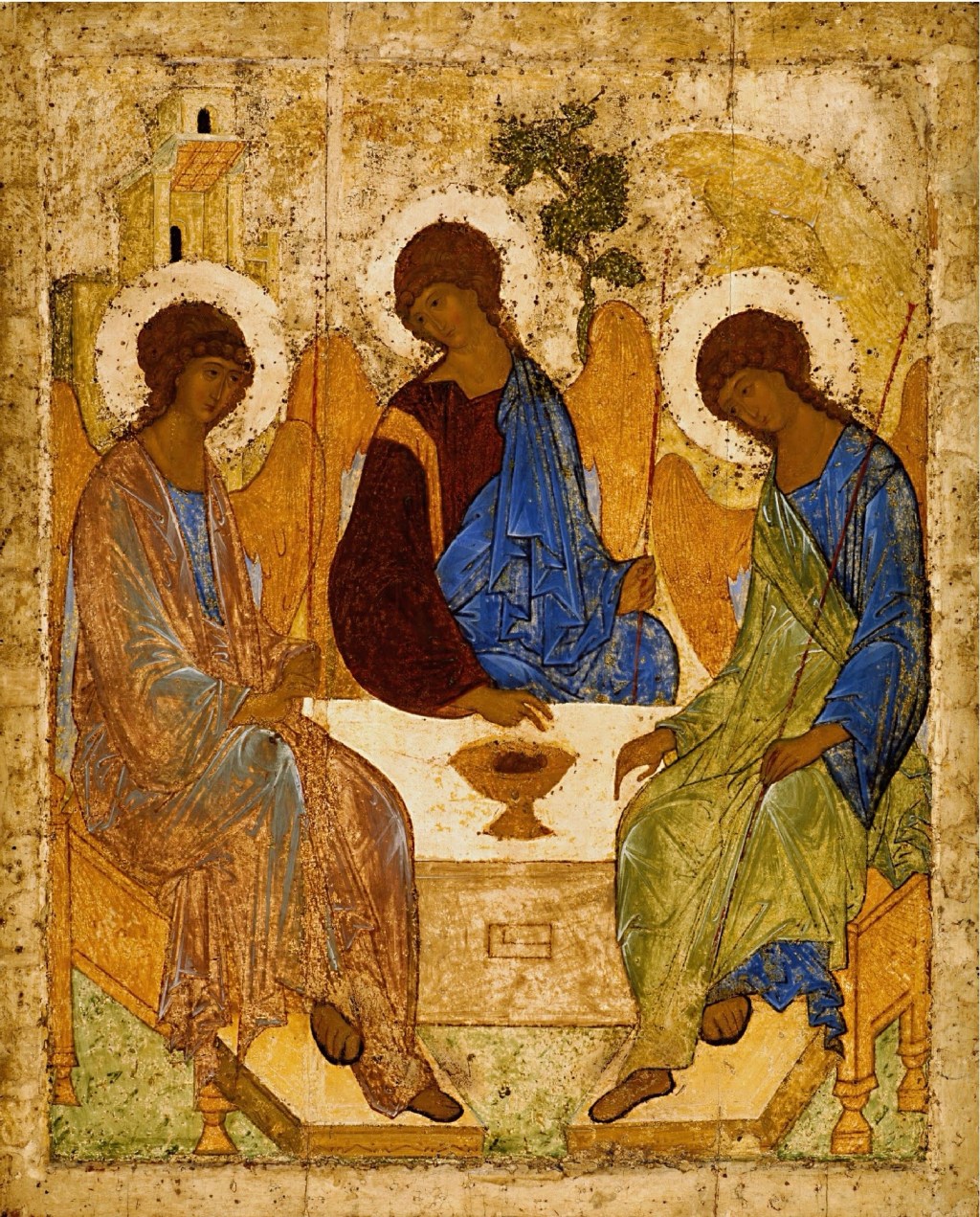
Rublev: The Holy Trinity, 1411 or 1425-27, Russia

One of my favorite icons is Andrei Rublev’s Holy Trinity because it not only has the theological theme of the Trinity, but also the message of hospitality to strangers. As Hebrews 13:2 reminds us,

“Do not neglect to show hospitality to strangers, for by doing that some have entertained angels without knowing it.”

This subject of this icon is the three angels for whom Abraham spread a feast in the wilderness where he and his barren wife Sarah lived while they tended their flocks. The angels appear with their walking staffs and sit at Abraham’s table set with a dish of food. In the background is a mountain, representing the wilderness and a tree, locating the scene at the oaks of Mamre.

Koulouris Iconography House: Saint George Greek Orthodox Church, West Bank Territory, Holy Land

Rublev’s palette is full of light with a predominance of gold, shining ochre, delicate shades of green, pink, and violet, and his inimitable sky-blue, too, in combination with the fine rhythm of lines and perfect composition. Altogether this produces an image of unearthly beauty and a heavenly harmony. This isn’t just a banquet in the desert wilderness, but a meal in the inbreaking moment in which we experience the timeless realm of heaven.

On earth, we count the minutes, days, and years, but in the company of God, we enter into the eternal and timeless experience in which God lives. Yesterday, today, and tomorrow are the same for the God who is known as I AM, for I AM lives always in the present and I AM is always becoming. There never was a time when the I AM was not. God always IS, even if we think God is not.

We may forget God, and our love may fail, but the steadfast love of the great I AM never fails because God’s love is, as the prophet Isaiah describes it (43:25):

“I, I am He who blots out your transgressions for my own sake, and I will not remember your sins.”

Copy of Rublev’s Holy Trinity, iconostasis at the monastery, 16th CE, St. Sergio’s Lavra, Russia.

Andrei Rublev painted the original icon in the Trinity-St. Sergius Monastery in either 1411 or 1425-1427. An artist made a copy of the Holy Trinity icon in the 16th CE. The Orthodox Church certified the Rublev Trinity as miraculous in 1626 and gave it a place of honor in the church, as well as metallic and jeweled embellishments. Over the next 500 years, artists restored the original Rublev icon several times. The early 1900’s saw two professional restorations: each one removed more layers of paint and lacquer until they revealed the original. The restorers decided hiding with a frame what was an “exclusive, in its worldwide importance, work of art” from the palette of Andrei Rublev was unacceptable.

Dating this important icon is more difficult than deciding its painter. Some think the icon was originally meant for the wooden Trinity Cathedral erected in 1411 and believe after the stone church was built, the congregation moved the icon there. Other art historians believe Rublev painted the “Holy Trinity” at the same time as his workshop painted the iconostasis in the new cathedral in 1425-27.

Rublev received a commission to paint this icon for the image of the Holy Trinity from St. Nikon of Radonezh: “an image for the Holy Trinity to be painted in his time, to venerate His Holy Father, St. Sergius the Wonderworker,” the monk who founded the monastery at Radonezh.

Since a cathedral dedicated to the Holy Trinity should have an icon of the Holy Trinity in it as its primary icon, the obvious choice was to select the best image that would convey the spiritual essence of the cathedral. This icon would embody the name of the Holy Trinity in color.

Icons have a purpose in worship, beyond mere mere beauty or illustration or teaching of doctrine. St. John of Damascus spoke in his “Apologies against Those who Decry Holy Images”, with which he addressed the Seventh Ecumenical Council calling on renowned painters for brave deeds, to set forth in their art the images of the Old and New Testaments, so that those who were not learned and could not read the Holy Scripture, would be able—by examining those stories—to enjoy the lives of holy men and their good deeds, for

“What the book does for those who understand letters, the image does for the illiterate; the word appeals to hearing, the image appeals to sight; it conveys understanding.” (Treatise 1.17)”’

Betsy Porter: Holy Trinity icon with Holy Communion

In other arguments against those iconoclastic believers, those who advocated instead for the use of images in worship reminded people the icon represents the truth of a spiritual reality. Some have compared the icon to a “window into heaven.” No one then or now worships the icon itself, but they do venerate the holiness of the person represented in the image. They hope to recognize the presence of God with them when they come to the quiet and stillness before the icon at their home altar and when they share in the presence of God in public worship in the sanctuary among the holy icons.

Abraham and the Three Angels, Mosaics in Santa Maria Maggiore, Rome (432-40 CE)

Theologically, the Western church has treated all three members of the Holy Trinity as coequal members, as seen in the mosaics of the 5th CE basilica of Santa Maria Maggiore. By placing all the heads on one level, or the use of isocephaly, the artist tells us the figures are equal in stature. Abraham is therefore lower than the heavenly visitors. Isocephaly is the art term which originates from the Greek words “isos” meaning “equal” and “kephalos” meaning “head”. We already know this word from our common knowledge: isosceles triangles have two equal sides and encephalitis is an inflammation of the brain, which is within our heads. (Sorry, old schoolteachers never die, but keep on explaining our 50 cent words; it must be that “back to school” time of year!)

Commercial Paper icon appliqué on wood panel “after Rublev,” but lacks the background architecture and has a substantial table without a cloth covering.

The Rublev icon has the heads of the three angels arranged in a triangle. They represent the Triune God. The center figure is slightly higher than the other two figures’ heads. This is because the Eastern Orthodox Church holds a slightly different view of the Holy Trinity. The incomprehensible God has indeed revealed God’s self in a manner that is incomprehensible.

All errors in trying to explain the Trinity come down to the following issue: we try to explain the living God, using a method of human thought—rational, natural, or philosophical—instead of witnessing to the reality and the truth of an encounter with the living God. To ask what God is, is the wrong question. Rather, who God is, is the primary question.

Prepratory stage

The answer is—God is Triune. We know God by God’s activity in the world, or energies, which we can see and can understand. In fact, all our understanding of God or what we say about God, comes from what God has done in the world, from God’s energies. The essence of God is still beyond our understanding, inaccessible to our understanding. If we could understand it, it would not be God, for God is beyond our understanding, as Isaiah 55:8-9 reminds us:

“For my thoughts are not your thoughts,

nor are your ways my ways, says the LORD.

For as the heavens are higher than the earth,

so are my ways higher than your ways

and my thoughts than your thoughts.”

Second day, making some corrections

Both the Western and the Orthodox Churches are in agreement as regards the unity of the Trinity as to the persons and their shared being. They also agree the Trinity isn’t three separate gods or three different revelations of one singular god. The Eastern Church and the Western Church did split over whether the Holy Spirit proceeded from the Son alone (East) or from the Father AND the Son (West).

Gaining on it, another studio day

The earliest creeds from the 4th CE didn’t even mention the Holy Spirit, mostly because the early church was combatting heresies about the nature of the Son (such as he was actually human, only appeared to be human, only parts were human, and other variations other than he was a full member of the Trinity and in Christ being fully human and fully divine).

By 381 CE in Constantinople, the creed included the words:

“And in the Spirit, the holy, the lordly and life-giving one, proceeding forth from the Father, co-worshipped and co-glorified with Father and Son, the one who spoke through the prophets; in one, holy, catholic and apostolic church.”

The first Latin council to add the phrase “and the Son” (filioque) to its creed was the 447 CE Synod of Toledo, Spain. The filioque formula was also used in a letter from the Catholic Pope Leo I to the members of that synod regarding opposition to a form of the fifth century manifestations of the Arian heresy which was prevalent among the Germanic tribes of Europe.

Stage 4, the draperies are taking the shape of the bodies

As football season heats up in the USA, we fight our culture wars on social media, not in the streets. The latest heresy for some is professional football teams now have male cheerleaders on the sidelines. The conservative rabble rousers destroyed their coffeemakers and burned their team jerseys in the past. Wearing paper sacks to maintain anonymity at the games is too yesterday. The recent announcement of the heroic and rugged Minnesota Vikings football team’s addition of two talented and athletic young male dancers is more than they can take. The keys of their favorite social media platform have been clicking and clacking. Radio waves are sizzling and heating up our already too sweaty summer.

Trinity, stage 5: two steps forward and one step back

The bishops at Toledo affirmed the Holy Spirit’s procession from both the Father and the Son to exclude the Arian notion of the Son being something less than a co-eternal and equal partner with the Father from the very beginning of existence. Street protests were common during this time over theological beliefs: the Catholics chanted, “There never was a time the Father was not a Father, the Son not a Son, and the Spirit didn’t proceed from both!” Against them, the Arians marched, “The Son was born, not begotten!” Exciting times, the late 5th CE.

Stage 6, details showing up

Several of our past GOP presidents were college cheerleaders, including Ronald Regan and George Bush. On a personal note, six decades ago, my big city high school in the Deep South had a tradition of boy and girl cheerleaders on a team of equal numbers to do exciting and complicated stunts. We were not aware of being “woke.” We were, however, always seeking to bring out the best of each person to reflect well upon our school and our city, which we represented.

Unfortunately, accusing the present NFL teams of being “woke” ignores American history, since the USA FEDERATION FOR SPORT CHEERING recognizes the first cheer in America as occurring on November 2, 1898 at the University of Minnesota, when student Johnny Campbell got up from the seats and took the field to lead the student body in a chant. If 127 years is too far back for people’s minds, we can turn to more recent history.

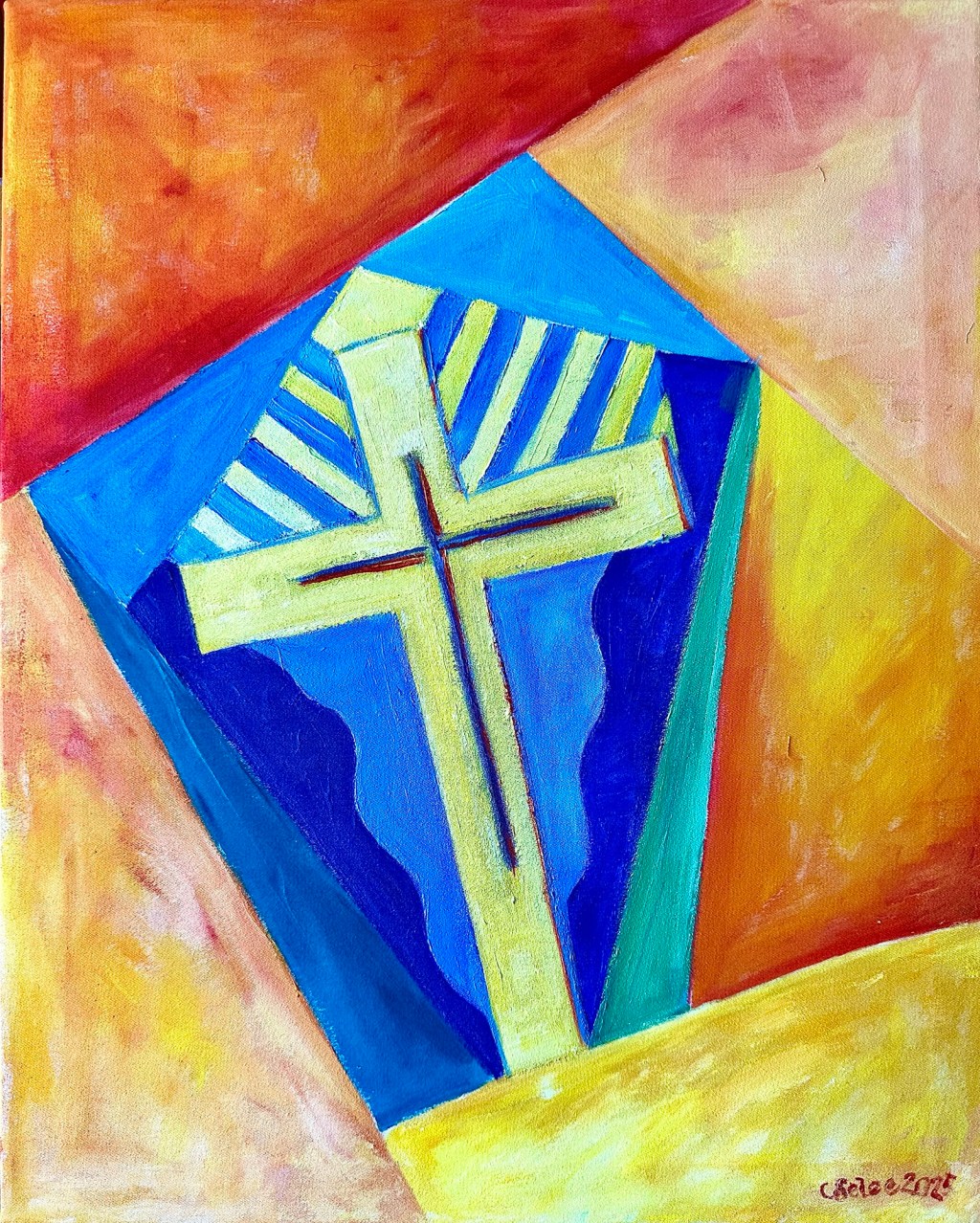
DeLee: Holy Trinity after Rublev, acrylic on canvas, 16” x 20”

Cheerleading is a metaphor for hospitality, which is one of the great attributes of the Holy Trinity. Hospitality is only possible where love resides and where community is experienced and practiced. Los Angeles led the way in 2018 by including two male dancers on their NFL Ram’s team. They were part of the Super Bowl LIII in 2019. Tryouts have always been “open,” but only women had shown up before. Like the strangers who showed up at Abraham’s tent, the cheer squad welcomed the men into the family and brought them under the protection of their group. When we practice hospitality, the “other” is no longer a “them.” The “stranger” becomes one of “us” because we reflect God’s loving nature to the vulnerable and we offer the bounty of our table to nourish their body and spirit.

I began working on this icon during social and personal distress. The social distress is obvious to anyone who reads a newspaper or watches a television newscast. Never have I seen so many professing Christians refuse to “love their neighbor as themselves,” or “do unto others as you would have others do unto you.” I don’t know how they sleep at night, for my own heart hurts for the pain inflicted upon the strangers who walk among us, who very well may be the Holy Trinity in earthly disguise. If we treat them like their next stop on their journey, only a few of us will walk away unscathed.

My personal distress comes from the blessing of living long enough, thanks to excellent medical care and the ability to live a structured, carefree life. As we age, medication affects us differently. My neurologist dropped the amount of my seizure medication, and my cardiologist upped my blood pressure medication. I was taking too much magnesium, so that was making me lethargic as well as lowering my blood pressure. Now that I’ve gotten stabilized, I feel a lot peppier.

Unfortunately, I began painting and drawing this icon while all this unwellness was going on. I can see “room for improvement,” as I always remind folks to say when critiquing their own art works. I have learned much from this time and have seen the icon in a new and closer light. I will come back to it again when I feel I’m more competent to give it my best.

A masterpiece always deserves the best we can offer, yet I rest secure knowing God has grace for those of us who are wounded, weak, or broken in any way. Whatever we bring in this time and place right now is the best we can offer upon God’s altar. God refuses no honest gift. If we spread peanut butter sandwiches on the table for the visitors as the offered feast because this is what we have, God will bless this gift.

The Holy Trinity of God lives in a loving community of self-giving hospitality and generosity within its unity of being. All three persons love, support, and care for one another in equal measure. As we humans would understand this: no one in the Trinity carries a heavier burden than another. In like manner, each person shares all the energies and work of the others.

The work of salvation may be through our faith in Christ’s work on the cross, yet it was the Father who sent the Son to redeem all creation and the Holy Spirit who brings us to the understanding of this saving grace. The whole work of God in Three Persons saves us if we have Trinitarian faith. And it is by the power of all the Holy Three we can stand against the hatreds and evils of this age.

Indeed, if we can offer any service well-pleasing to God, following the admonitions of Hebrews 13:1-2 would help all:

“Let mutual love continue. Do not neglect to show hospitality to strangers, for by doing that some have entertained angels without knowing it.”

Rublev: The Holy Trinity icon

Abraham’s angelic visitors blessed him and his wife Sarah with the promise of a longed-for son. We might learn to love our neighbors more if we shared our hospitality and opened our hearts to the people we meet. May you meet angels in your daily life and share whatever feast is in your pantry.

Joy and peace,

Cornelia

Andrei Rublev: Image of the “Holy Trinity,” The Tretyakov Gallery Magazine. Andrei Rublev painted the Holy Trinity icon, which is the central image in the cathedral’s iconostasis. One of the most famous Russian icons, he created it “in praise of St. Sergius.” The original is in the hall of Old Russian painting of the Tretyakov Gallery, in a special glass case with controlled humidity and temperature. In Trinity Cathedral you can see a copy of the icon to the right of the royal doors in the first (lowest) tier of the iconostasis.

https://www.tretyakovgallerymagazine.com/node/7196

Excerpts from Three Treatises on the Divine Images by St John of Damascus, translation and introduction by Fr. Andrew Louth, St Vladimir’s Seminary Press, 2003.

https://www.svots.edu/blog/st-john-damascus-divine-images

 A Miracle of Knowledge: St. Sergius of Radonezh / OrthoChristian.Com

https://orthochristian.com/41950.html

Venerable Nikon, Abbot of Radonezh, disciple of Venerable Sergius – Orthodox Church in America

https://www.oca.org/saints/lives/2016/11/17/103316-venerable-nikon-abbot-of-radonezh-disciple-of-venerable-sergius

Daily readings from the lives of the Orthodox Saints:

https://www.oca.org/saints/lives

Home – Icons: Windows Into Heaven – LibGuides at Duquesne University: This is a reputable source for orthodox icon information via the Duquesne Library. Links to outside sources are broken. Reference books are available elsewhere.

https://guides.library.duq.edu/icons

Mosaics in Santa Maria Maggiore, Rome (432-40): if you’ve never been to Italy, you can see the entire beautiful interior of this 5th CE basilica here.

https://www.wga.hu/html_m/zearly/1/4mosaics/1rome/3maggior/index.html

Introduction to Orthodoxy 4: The Holy Trinity – Orthodox Catechism Project

https://www.orthodoxcatechismproject.org/introduction-to-orthodoxy/-/asset_publisher/IXn2ObwXr9vq/content/introduction-to-orthodoxy-4-the-holy-trinity

First Council of Constantinople 381 – Papal Encyclicals

First Known Cheerleader was a Male Student

Vikings Respond to Male Cheerleader Backlash – Newsweek—12 NFL teams are reportedly set to have male cheerleaders on their squads this season. The teams as the Vikings, Ravens, Rams, Saints, Eagles, 49ers, Patriots, Titans, Colts, Chiefs, Buccaneers and Panthers.

https://www.newsweek.com/minnesota-vikings-respond-backlash-male-cheerleaders-2113864


Never surrender!

Altars, art, Carl Jung, Creativity, crucifixion, Easter, Easter, Faith, Garden of Gethsemane, Good Friday, Healing, Holy Spirit, Holy Thursday, incarnation, inspiration, Ministry, Painting, suffering

“Never give up! Never surrender!”

This is my favorite quote from the 1999 sci-fi parody film Galaxy Quest. As a fan of Star Trek, I love the heroics of the storylines and the movie’s devoted fans. What sets this spoof story apart is how an alien culture has modeled its entire identity on the “historical documents,” or the weekly tv series videos. The aliens arrive on earth and spirit away the crew to fight against their enemies. The actors protest, but discover their true selves through this challenging situation. They not only play heroes, but they become heroes. They have to surrender to their former false selves to become the best and the truest of who others have known them to be.

We are not a people who believe in surrender. If our back is against the wall, our inclination is to fight all the more. Most of us believe in climbing upwards, not in moving downward. Taking a lateral move is just as bad as a demotion for most people’s egos. If you talk to any clergy person during appointment season, many are hoping for a church with a bigger steeple. While if you talk to their congregations, they’re hoping for preachers who wants to stay for a while. Obviously between moving and staying, someone is going to be disappointed. Someone will need to surrender to a greater plan.

I remember in my early days I got my nose bent out of shape because my church asked for a new pastor. My bishop at the time was frank with me: “I don’t have anyone to send here. You need to suck up your feelings and make sure this church is ready for next year!” Elders vow to be ready to pray, preach, move, or die at a moment’s notice in the United Methodist Church. We also vow to stay if necessary. I didn’t want to surrender to my bishop’s authority, but I decided to make sure when appointment season rolled around again, she could send any average pastor in my place.

I also knew other experienced clergy had thought I’d been “over appointed” straight out of seminary. They had told my superintendent they “deserved that appointment” where I was. My answer was often on some days, “I’ll trade you straight across, no question.” Those were the suffering days, but then would come the days of joy and grace, and I’d forget my rash willingness to hand over my charge to another sight unseen. I was truly glad for the nearby presence of an older, more experienced clergy person who would buy me a coffee and doughnut. He helped me keep the perspective of the long view, rather than the immediate moment.

DeLee: The Cross Upsets Earthly Powers

In this Holy Week—the time between joys of Palm Sunday and Easter Sunday—we find the events of Holy Thursday’s foot washing, Good Friday’s Crucifixion, Holy Saturday’s Vigil, and Easter Sunday’s Resurrection. In between Thursday and Friday, we find the stories of Jesus praying in the Garden of Gethsemane, Peter’s denials, and other tales of suffering.

Modern folks don’t usually like suffering. We want to treat a slight cold virus with an antibiotic, even though antibiotics only work against bacterial infections. All we end up doing is causing more suffering by creating antibiotic resistance. In worship services, “to save time,” we omit the third verse of the old hymns, which most often contain the sacrifice and blood of Jesus on the cross. People who visit churches on the Sundays during Holy Week go from the Palms proclamation of Jesus as messiah to the risen Christ on Easter. They avoid all the turmoil, suffering and drama of the week in between.

Tim: three crosses at sunset

In real life, because we avoid dealing with our dark sides and personal brokenness, we often project those same bad qualities onto others, which we then “other and marginalize.” All the “isms” of the world have scapegoats that represent their own dark side. The work of “identifying and accepting one’s shadow” is the process of assimilating “the thing a person has no wish to be” [Collected Works of Carl Jung: CW16, para 470].

Jung saw quite clearly that failure to recognize, acknowledge and deal with shadow elements is often the root of problems between individuals and within groups and organizations. It is also what fuels prejudice between minority groups or countries and can spark off anything between an interpersonal row and a major war. This certainly speaks to the time in which we now live.

Post surgery photo: still groggy

I recently had anterior cervical fusion surgery on my neck due to a herniated disc that was causing numbness in my arm and fingers. It also was causing pain, but I wasn’t aware of how much pain I was experiencing. The story of boiling a frog by gradually turning up the water it’s in is true. If your pain gradually increases by fractions, you think it’s just a 3 on the 10-point scale. However, I was having difficulty doing my ordinary work, exercising, and making decisions. Writing, which was once easy, became a chore. A concrete brain full of pain signals effectively blocked my ability to think creatively. I was trying to think through a sludge of cold molasses.

My scar is healing nicely 25 days post surgery.

The good news is after surgery I have my former brain back, such as it was. I also have a set of plates and screws in my neck, so I hope I don’t set off the TSA scanners in the airport the next time I fly somewhere. I also have a scar on my neck, so I guess I’ll trade in my Wonder Woman costume for a pirate costume for Halloween. At least I’ll have an authentic scar for the day.

Mike: suffering heart pierced by cross

The prophet Isaiah reminds us Jesus is the suffering servant,

“He was despised and rejected by others; a man of suffering and acquainted with infirmity; and as one from whom others hide their faces he was despised, and we held him of no account. Surely he has borne our infirmities and carried our diseases; yet we accounted him stricken, struck down by God, and afflicted. But he was wounded for our transgressions, crushed for our iniquities; upon him was the punishment that made us whole, and by his bruises we are healed.” (53:3-5)

The Jewish people hoped for a messiah king, who would be a warrior hero in the style of King David. They hoped to restore the independence of Israel as a nation faithful to God and free from outside rule. Jesus was an unlikely messiah, as Paul tells us in 1 Corinthians 21:22-24–

“For Jews demand signs and Greeks desire wisdom, but we proclaim Christ crucified, a stumbling block to Jews and foolishness to Gentiles, but to those who are the called, both Jews and Greeks, Christ the power of God and the wisdom of God.”

Even today this apparent weakness in the face of power is a message popular society doesn’t grasp. Even the people closest to Jesus, the early disciples first sought power and status in the coming kingdom, until Jesus disabused them of that notion and said,

“Truly I tell you, unless you change and become like children, you will never enter the kingdom of heaven. Whoever becomes humble like this child is the greatest in the kingdom of heaven.” (Matthew 18:3-4)

Olive Tree from Gethsemane

The best example of suffering in Holy Week is Jesus praying in the Garden of Gethsemane. There under the twisted trunks of olive trees, Jesus wrestled with his will and his mission. Being fully human, he would not choose to die on the cross. Being fully divine, he could only fulfill his Father’s purpose. Perhaps in this struggle he thought back to his wilderness experience before he set off to preach good news to the poor and release to the captives:

“Again, the devil took him to a very high mountain and showed him all the kingdoms of the world and their splendor; and he said to him, “All these I will give you, if you will fall down and worship me.” Jesus said to him, “Away with you, Satan! for it is written, ‘Worship the Lord your God, and serve only him.’” Then the devil left him, and suddenly angels came and waited on him.” (Matthew 4:8-11)

Gail W: watercolor of Palm Sunday

Our temptations come in many forms, but mostly we can sort them into three general categories: money, sex, and power. I personally think power is the overriding category and the others are mere subsets. Anything that knocks us off kilter or disrupts our sense of security is a threat to our feeling of power and control. This is likely why Palm Sunday and Easter Sunday are popular attendance days, while Good Friday doesn’t seem very “good” to the average person’s mind.

Matthias Grünewald, Isenheim Altarpiece (closed), c. 1512–16, oil and tempera on limewood panels, 376 x 668 cm (Unterlinden Museum, Colmar, France; formerly in a monastery hospital treating skin diseases).

As the apostle Paul wrote to the Philippians (2:5-11):

“Let the same mind be in you that was in Christ Jesus, who, though he was in the form of God, did not regard equality with God as something to be exploited, but emptied himself, taking the form of a slave, being born in human likeness. And being found in human form, he humbled himself and became obedient to the point of death—even death on a cross. Therefore God also highly exalted him and gave him the name that is above every name, so that at the name of Jesus every knee should bend, in heaven and on earth and under the earth, and every tongue should confess that Jesus Christ is Lord, to the glory of God the Father.”

Grunewald: Isenheim Altarpiece, 1512-1515, Resurrection of Christ—part of the same altar.

May your Easter season be blessed and you find ways to meet Christ in the poor among us,

Cornelia


Can Antibiotics Treat My Cold

https://www.webmd.com/cold-and-flu/antibiotics-colds

The Jungian Shadow – Society of Analytical Psychology


Weaving a Life Story

Academy for Spiritual Formation, adult learning, art, Creativity, Faith, Holy Spirit, Icons, inspiration, Ministry, Nativity, renewal, righteousness, Silence, suffering, vision

Weaving is a metaphor for our life’s story and journey. We envision the weaver in charge of the colors, designs, and textures of the finished fabric. The weaver’s goal is to produce a beautiful product. We often think we are in charge of our own destiny, as “The Weaving Song” by Carolyn Hester, in which an old 1960’s era folk singer would sing:

Choose the right color And push the right tread

Throw through the shuttle And peg down the thread

Work is all laid Before your start

To make your own pallet Of bright hue or dark

The loom of life is moving The weaving is all your own

Choose the right color And push the right tread

Throw through the shuttle And peg down the thread

Rainbow of colors Is at your command

Choose all the right shades Offered in the stand

The loom of life is moving The weaving is all your own

Life’s but a grey And heavy with care

May blooms scarlet With couragе rare

The loom of life is moving Thе weaving is all your own.

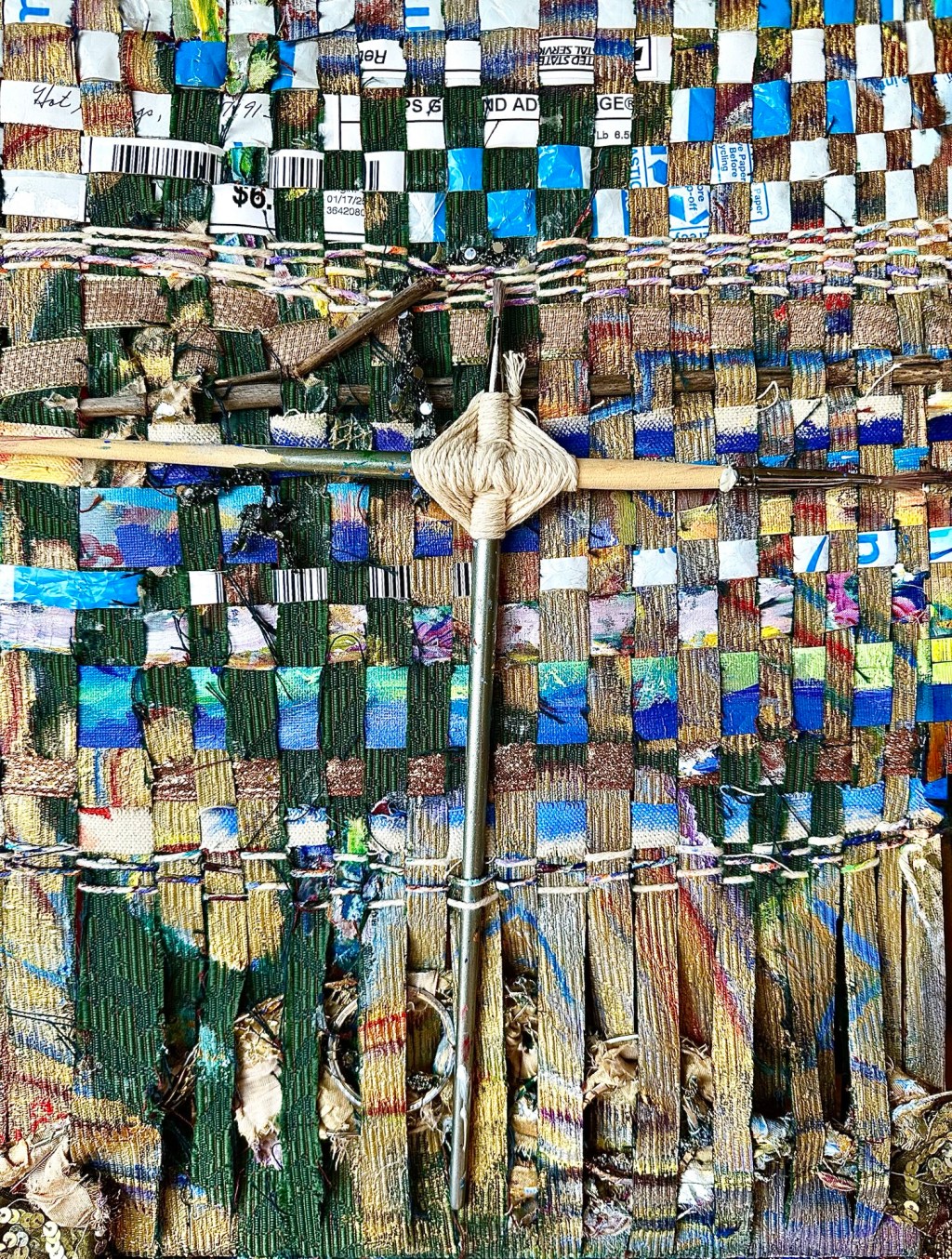
DeLee: God’s Eye and Cross, woven canvas, branch, string, paint brushes, fabric scraps, wire, packing materials, 16” x 20”, 2025.

Yet life doesn’t always work out the way we thought it would. The Bible says Job was the most righteous person of his era, and Job complains after losing everything and everyone:

  “My days are swifter than a weaver’s shuttle and come to their end without hope.” (7:6)

This wisdom text reminds us sometimes the righteous suffer, even while the wicked prosper, but God is still God, and we will understand this mystery of God when we see God face to face. We call this “theodicy,” (from Greek theos, “god”; dikē, “justice”), or our explanation of why a perfectly good, almighty, and all-knowing God still permits evil to exist.

God gives human beings free will. We make our own choices in life, just as everyone else does. Since we don’t live in a universe of one, other people’s choices impact our choices. Imagine a pingpong ball tossed into a room filled with mousetraps all loaded with other pingpong balls. If one ball hits a loaded trap, it sets that ball off into motion and those balls set more balls into motion until chaos ensues! If more than one person is involved, some sort of disagreement is sure to follow. Some of us are even at odds with our own selves!

As the old joke goes, a solitary man was rescued from a desert island. On this island were several structures. When asked, he said, “That one was my house and that one was my church.” And the other building? “That was the church I used to go to!”

Louise Bourgeois: Spider, metal, National Gallery of Canada, in Ottawa, Ontario. Her mother mended tapestries, like a spider spins a web.

When life is chaotic, creative people find solace in the quiet of their chosen deserts: the studio, the workshop, or their favorite writing chair. While we artists have the illusion we can control the images we produce or the songs which bubble up from our hearts, in truth, what we create is a shared product with our heart, mind, and the creating spirit. If we begin to lose our humility about this shared process, we lose the creative energy underwriting our works.

Louise Bourgeois: Metal Spider wrapped in yarn, Japan

We know this emotion as “pride,” and the ancient cultures warned against it. Throughout history, legendary and mythological figures have been used as examples of either virtue or a moral failing. The story of Arachne and Minerva is no different.

Attributed to Amasis Painter, 6th BCE, Greece, clay, Metropolitan Museum of Art, New York.

A 6th BCE Attic Black Figure Lekythos storage vessel attributed to the Amasis Painter shows the type of standing loom and the various shuttles of different threads a weaver would use for a fabric. Today we think of weavers sitting at their looms, but the ancients stood at their work.

Arachne was a mortal who excelled in the weaving arts: spinning her own yarn and selecting the correct colors to produce the beautiful images for the finished fabric. Minerva, the goddess of handicrafts and the Roman correlate to the Greek goddess Athena, had heard of Arachne’s prowess and her pride. Disguised as an old woman, Minerva visited Arachne to warn her not to disparage the gift of the gods. Arachne rebuffed her, and held her ground, even when Minerva revealed her true identity.

Minerva (Athena) and Arachne by René-Antoine Houasse (1706), Versailles

When the weaving contest began, both were even in technique and design. Minerva’s image was of the pantheon of the gods, but Arachne told the stories of the god’s mishaps with humanity. This angered Minerva, who struck Arachne with a weaver’s shuttle. Embarrassed, Arachne took a rope to hang herself, but Minerva had pity on her and changed her into a spider instead. We call spiders, ever weaving their gossamer webs, “arachnids” in her memory.

Spider Web

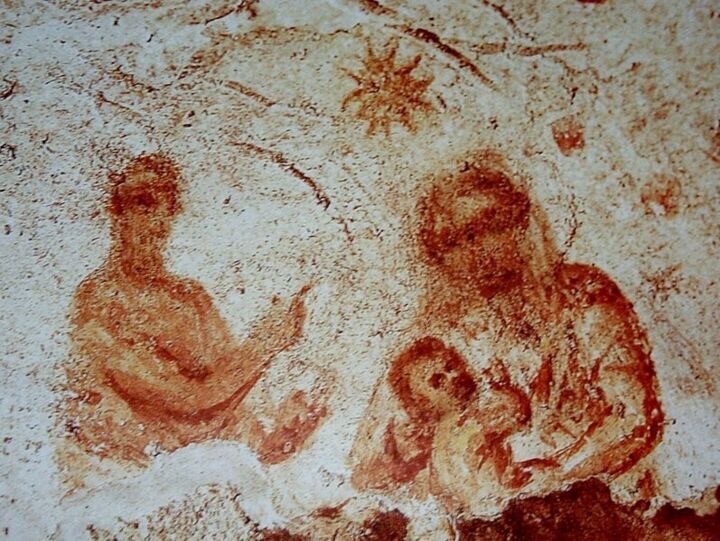
In Christian art, the theme of listening beside a well or spring is connected both to the angel’s annunciation to the Virgin Mary and to her weaving curtains for the Temple. The third-century Dura-Europos church baptistery has a fresco of a woman drawing water from a well, which Yale theologian Michael Peppard believes represents the Annunciation to Mary at a well, from a scene from the gnostic writing, Protevangelium-18.

Woman drawing water at the well. Possibly the Virgin hearing the Angel’s voice. Dura Europa.

Others think it represents the Samaritan woman at the well or Rebecca from the Old Testament. Because the fresco doesn’t include Jesus, the empty space instead represents “the bodiless voice” that Mary hears in the Protevangelium. Also, a five-pointed star appears on the woman’s torso, which could symbolize the new child in her womb. The star in later iconography was repositioned to the shoulder of her mantle, and the water vessel survives all the way into the Renaissance art as a vase with flowers.

Icon of Virgin at Well with Angel

From The Protoevangelium of James, section 11: And she took the pitcher, and went out to fill it with water. And, behold, a voice saying:

“Hail, you who hast received grace; the Lord is with you; blessed are you among women!” (Luke 1:28) And she looked round, on the right hand and on the left, to see whence this voice came. And she went away, trembling, to her house, and put down the pitcher; and taking the purple, she sat down on her seat, and drew it out. And, behold, an angel of the Lord stood before her, saying: “Fear not, Mary; for you have found grace before the Lord of all, and you shall conceive, according to His word.” And she hearing, reasoned with herself, saying: “Shall I conceive by the Lord, the living God? And shall I bring forth as every woman brings forth?” And the angel of the Lord said: “Not so, Mary; for the power of the Lord shall overshadow you: wherefore also that holy thing which shall be born of you shall be called the Son of the Most High. And you shall call His name Jesus, for He shall save His people from their sins.” And Mary said: “Behold, the servant of the Lord before His face: let it be unto me according to your word.”

This apocryphal Greek text, which was first written in the 2nd CE, with Syrian revisions into the 5th CE, is important because it increases our insights into women’s history, the childhood history of Jesus, Jewish-Christian relations, and the impact of Christian apocrypha on Islamic origins. This text, which contains the infancy narratives of the Virgin Mary, John (the Baptist), and Jesus is the source many of the Western Catholic and Eastern Orthodox religious feast days. Moreover, it’s also the origin for the icons representing the birth of Jesus in a cave.

Duccio: The Nativity with the Prophets Isaiah and Ezekiel, tempera and gold on panel, 1308-1311, National Gallery of Art, Washington D. C. Part of a series of the Life of Christ, the rest of which are in Sienna, Italy. 

A similar Marian birth narrative, The Gospel of Pseudo-Matthew, gives more details on the life of the Virgin, the miracles surrounding her marriage and the birth of Christ. It also tells the story of the Annunciation in two visits rather than one. The angel’s first greeting is beside a fountain and the second is inside while Mary is weaving the curtains for the Temple.

DeLee: Freeform Weaving while Listening

When I was on a recent Five-Day Academy for Spiritual Formation retreat, one of our hands on projects was a small weaving. Our package had a small loom, some yarn to weave with, and beads to attach. Of course I had to use a second packet to finish out my weaving because I tightened the horizontal rows more tightly than the organizers thought the regular attendees would do with their yarns and ribbons.

I also had my eye on a nice lichen covered branch to use as a hanging support. When I picked it up, it had red ants on it. I had to do some mad shaking to get them off! Anything for art! During one of our quiet reflection sessions, I sat beside a small lake under a pavilion to let my hands work. I’ve always needed a quiet space to process the flood of ideas and the rush of emotions when meeting new people and hearing new ideas. I operate as an extrovert, but when I get full to overflowing, I need quiet to recreate and recharge. I find new power in the admonition of Psalm 46:1-6—

God is our refuge and strength,
a very present help in trouble.
Therefore we will not fear, though the earth should change,
though the mountains shake in the heart of the sea;
though its waters roar and foam,
though the mountains tremble with its tumult.
Selah
There is a river whose streams make glad the city of God,
the holy habitation of the Most High.
God is in the midst of the city; it shall not be moved;
God will help it when the morning dawns.
The nations are in an uproar, the kingdoms totter;
he utters his voice, the earth melts.
The LORD of hosts is with us;
the God of Jacob is our refuge.

Diedrick Brackens, “prodigal” (2023), cotton and acrylic yarn

When my hands touch the different textures of the threads, and I let my spirit work with the creating Spirit of the word and world, I can shed all the strain and stress of being on a different schedule from traveling, having nerve pain in my neck from a bulging disk, and more interaction than I’m used to since I no longer work.

I always fought to carve out quiet times when I was in active ministry, for listening to God is the first calling of any leader worth their salt. I knew I wouldn’t hear God’s voice in the pell mell rush and cacophony of our world. The disembodied voice is more likely to come to us when we’re alone or in a receptive moment. It’s important to note Mary was one of the virgins of the House of David chosen to weave the curtains for the Temple in Jerusalem, according to The Protoevangelium of James, section 10. She was busy, but working for her God. It was when she took a break to draw water from a life giving well that she heard the messenger from God.

Bruce Conner, Arachne, 1959, mixed media: nylon stockings, collage, cardboard, 65 3⁄4 x 48 3⁄4 x 4 1⁄4 in. (167.0 x 123.8 x 10.7 cm), Smithsonian American Art Museum, Bequest of Edith S. and Arthur J. Levin, 2005.5.12

When I was appointed to a church, I always had a list of tasks to do, but I often never completed them because God would send “interruptions” to my well laid plans for the day. After several years, I began to understand these interruptions were my real tasks of ministry for the day. We have plans, but God has a better plan.

The prayer in my weaving supplies was appropriate for me on this retreat:

Teach us to listen, O Lord. 

Quiet the noise of our lives

so we can hear your voice. Amen.

After several weeks, I’ve come back to finish this blog. In the meantime I’ve had anterior cervical discectomy and fusion for my neck pain and numb fingers. It’s for the bulging neck disk that causes pressure on the spinal cord. If this happens in the lower back, a person gets sciatica and numbness in the legs. In the neck,the same condition affects the arm and hands. I feel better than I did before, so I’m thankful for all healing mercies. I have to be careful not to overdo my activities. The instructions “Don’t do housework!” were gladly received.

I hope you seek out your quiet spaces and quiet moments to hear the sheer, still sounds of silence, the inaudible voice of our God.

Joy and peace,

Cornelia


 NOTES:

Carolyn Hester: The Weaving Song, Track 10 on At Town Hall, One, Produced by Norman Petty, 1965.

Troubadour: Weaving Song: similar words to Hester coffee house ballad above. https://music.apple.com/us/album/weaving-song/400303687?i=400303767

Myth of Arachne https://www.worldhistory.org/Arachne/

Ally Kateusz: Mary and Early Christian Women: Hidden Leadership,1st ed., 2019, Kindle Edition 


Annunciation or Samaritan Woman, Dura-Europos Baptistery
https://www.christianiconography.info/Wikimedia%20Commons/annunciationDura.html

Charles Bertram Lewis:”The Origin of the Weaving Songs and the Theme of the Girl at the Fountain,” PMLA, Jun., 1922, Vol. 37, No. 2 (Jun., 1922), pp. 141-18, Modern Language Association. http://www.jstor.com/stable/457

Susan B. Matthews: Dura Europos—The Ancient City and The Yale Collection, Yale University Art Gallery, 1982, Yale University Printing Service. https://artgallery.yale.edu/sites/default/files/publication/pdfs/ag-doc-2378-0002-doc.pdf

Camille Leon Angelo and Joshua Silver: “Debating the domus ecclesiae at Dura-Europos: the Christian Building in context,” Journal of Roman Archaeology 37 (2024), 264–303, doi:10.1017/S1047759424000126. https://www.cambridge.org/core/services/aop-cambridge-core/content/view/E76ED3AD86D09A74893368840DEDFA6A/S1047759424000126a.pdf/debating-the-domus-ecclesiae-at-dura-europos-the-christian-building-in-context.pdf

The Protoevangelium of James, section 11. https://www.newadvent.org/fathers/0847.htm

The Gospel of Pseudo-Matthew, section 9.  https://www.newadvent.org/fathers/0848.htm

Horn, C. (2018). The Protoevangelium of James and Its Reception in the Caucasus: Status Quaestionis. Scrinium, 14(1), 223-238. https://doi.org/10.1163/18177565-00141P15

The Creating God

art, Attitudes, change, Creativity, Evangelism, Faith, garden, Healing, Holy Spirit, hope, Imagination, incarnation, inspiration, john wesley, Light of the World, Ministry, Painting, purpose, Reflection, renewal, shadows, Spirituality, vision, Work

In the dead heat of summer, our gardens aren’t putting forth the fruit of our planting. Maybe the animals of our neighborhood have made their too frequent nightly visitations, so our harvest is skimpy. We can forget God is a both a creating god and a recreating god as well. The first words of the alternate NRSV translation of the Bible’s first book Genesis (a word meaning “origin”) are—

First stage: string, fabric scraps, and under painting

 “When God began to create…”

In the old KJV, Genesis 1:1 readsIn the beginning, God created the heaven and the earth.”

I appreciate even more the next verse from Genesis 1:2—

“The earth was a formless void and darkness covered the face of the deep, while a wind from God swept over the face of the waters.”

Alternate translations read— “while the spirit of God or while a mighty wind” swept over the face of the waters. This reminds us nothingness and darkness aren’t problems for God, who is able to bring glorious light to any situation.

Psalms 139:12 speaks of the nature of God:

“Even the darkness is not dark to you; the night is as bright as the day, for darkness is as light to you.”

I’ve lived for over half a century with chronic depression, so I can recognize darkness, not only in my own life, but also in the lives of others. Most of my ministry and even my secular work was done with a calling to bring others to the light of hope and confidence that anything was possible.

In art classes, I asked my students to trust in ABC—Attitude, Behavior, and Consequences. If they had a Positive Attitude, they would have Positive Behavior and work on their assignments. If they worked, they would see Positive Consequences or Improvement over time. Asking people who’ve been told they can’t do art to believe they can learn even if they aren’t “talented” is a big ask, but if they have faith in this promise, they discover it’s true.

When I sold insurance, I asked people to trust in the idea of making a small sacrifice now to prevent a greater loss later. Also, if they had no loss, they shared in a community to underwrite the group losses and keep the cost of protecting their own property low. Not everyone has the light to see this benefit of community, but for those who do, I could help keep their consequences from being a disaster.

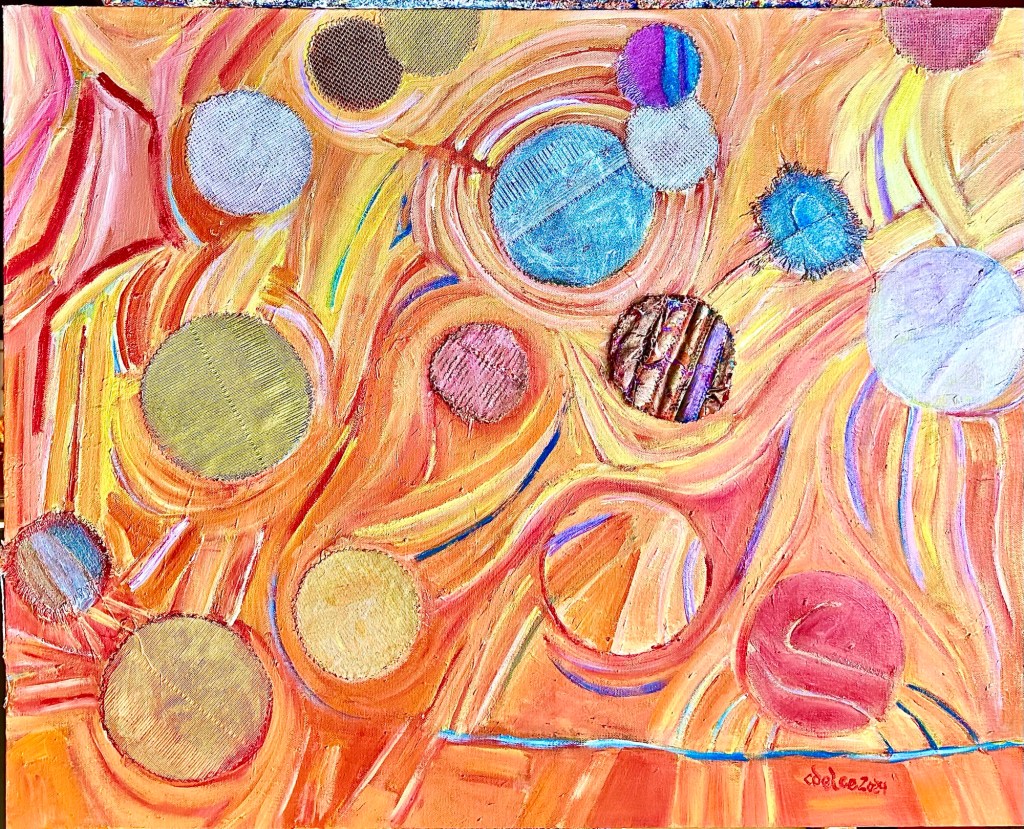
Second stage: overpainting, printed circles, and added ruler lines

When I entered the ministry, I discovered congregations who had lost their faith in the God who could make something out of nothing This began with the creation story, the choosing of the nation of Israel to be God’s people (even though they were once no one’s people), and feeding them in the extended wilderness wandering before they arrived at the promised land. The Bible is full of examples of God’s providing more when people have too little to sustain them: Elijah and the widow of Zarephath, the feeding of the crowds with a few fish and loaves, and the water turned into wine. These modern people didn’t have a “recreating faith” that God could work in their lives today, just as God had once worked in the lives of others in the days of Christ.

That is what we call a “dead faith,” or as John Wesley put it in his notes on the New Testament at 2 Timothy 3:5— “An appearance of godliness, but not regarding, nay, even denying and blaspheming, the inward power and reality of it.”

It’s dead, because the Spirit isn’t at work in it. I used to tell my beloved evangelism professor, the late Dr. Billy Abraham, the first place we needed to do evangelism was in the local church, because folks hadn’t heard the good news. If they weren’t excited enough to have a living faith, they wouldn’t go out and spread the good news to others.

I’ve never been a cheerleader, although I did have some time in my high school pep squad. I was more often involved in making the football banners and pep posters for the other sports activities. Also debate team took up much of my time. One of the best practices I learned in debate was positive points sell better than negative ones. Also, it’s better to make the same point over and over with different facts and examples.

When I say our God is a creating and recreating God, I can point to the beautiful verses of John 1:1-5—

“In the beginning was the Word, and the Word was with God, and the Word was God. He was in the beginning with God. All things came into being through him, and without him not one thing came into being. What has come into being in him was life, and the life was the light of all people. The light shines in the darkness, and the darkness did not overcome it.”

In the beginning was the Word

 As believers in the Holy Trinity, the Word made flesh is Christ, so he was co-creating with God the Father and God the Holy Spirit from the beginning. By virtue of the incarnation, Christ takes on our flesh to redeem us and make us whole again. This comes to completion through the cross. When we place our faith in Christ’s act of love for all creation, we are made one with Christ, and one with God. The Holy Spirit brings us ever closer to the true nature of Christ, until we’re perfected in love of God and neighbor.

I painted on unprimed canvas, just to see what would happen. Also, because I knew the paint surface would be different than the usual texture on the primed canvas. After I painted several different colors in blocks with the scrap pieces of cut canvas used as “masking tape,” I decided to use a mix of iridescent gold and silver acrylic paints to glaze over the under painting. I also added some circles and straight lines. I’ve collected a few jar tops recently, I used some string elements, and I had a school ruler left from my last teaching job back in the 1980’s. (Yes, I keep things. They are tools of the trade. My Sears Craftsman staple gun from art school finally died after half a century of use.)

I’ll be working some more of these experiments for a while. Creating and recreating our lives is what keeps us new every morning. As someone who has been renewed and recreated more than one time can attest, along with the prophet Jeremiah,

“For surely I know the plans I have for you, says the LORD, plans for your welfare and not for harm, to give you a future with hope.” (29:11)

Joy and peace,

Cornelia


John Wesley’s Notes on The New Testament, 1755:

2 Timothy 3:5—“holding to the outward form of godliness but denying its power. Avoid them!”

The Witness of the Cross

art, Creativity, crucifixion, Faith, Holy Spirit, Holy Spirit, Imagination, inspiration, john wesley, Love, mandala, nature, Painting, perfection, Rumi, Spirituality, suffering, Sun, United Methodist Church, vision

Mosaic Crucifixion, with Mary and John.

We are a people who follow Jesus, “the pioneer and perfecter of our faith, who for the sake of the joy that was set before him endured the cross, disregarding its shame, and (who) has taken his seat at the right hand of the throne of God,” as the writer of Hebrews 12:2 reminds us. The suffering servant motif of Christ was once a model all early Christians expected to inherit and emulate.  

The Suffering Servant

Paul spoke to this suffering model in his letter to the Romans:

“…How can we who died to sin go on living in it? Do you not know that all of us who have been baptized into Christ Jesus were baptized into his death? Therefore, we have been buried with him by baptism into death, so that, just as Christ was raised from the dead by the glory of the Father, so we too might walk in newness of life. For if we have been united with him in a death like his, we will certainly be united with him in a resurrection like his.” (6:2-5)

Paul’s first sentence is perceptive because he recognizes many who call on the name of Christ nevertheless go on living an unchristlike life. In the early Christian centuries, many didn’t get baptized until they were near death because they weren’t ready to change their wicked ways. The early Christian habit of hyper-delayed baptism is well attested by the later fourth century. Apparently, the reasoning behind waiting until fairly late in life was the belief baptism cleansed sin once and only once. Consequently, any meaningful sin after baptism could leave one in a serious lurch in the economy of salvation. We have the well-known example of the early 4th CE Emperor Constantine who delayed baptism until his deathbed.

Of course, this is a misunderstanding of the Holy Spirit’s work of perfecting our human nature, but it took many centuries to work this out. We can thank John Wesley for our understanding the works of grace in the ongoing process of Christian Perfection. Baptism washes us from the stain of original sin, which is common to all humanity. Baptism also anoints us with the Holy Spirit to be continually with us and bring us to know God’s saving love in Jesus Christ.

As we grow in faith and the Spirit of God calls us to give our lives to Christ, we are justified from past sins. Some faith communities stop here, so they need over and over justification. They have no ongoing theology of sanctifying grace. We United Methodists do have this great gift, which we can give to the world. When we aren’t going on to perfection in love quite as fast as our neighbors wish we were, it’s because we’re being stubborn and resisting God’s grace.

W. H. Auden says it best:

“We would rather be ruined than changed, 

We would rather die in our dread 

Than climb the cross of the moment 

And let our illusions die.” 

The Cross and Self-Denial

The cross is ever a witness to our willingness or unwillingness to bear the cross of Christ. As Jesus told his disciples:

“If any want to become my followers, let them deny themselves and take up their cross and follow me. For those who want to save their life will lose it, and those who lose their life for my sake will find it. For what will it profit them if they gain the whole world but forfeit their life? Or what will they give in return for their life? (Matthew 16:24-26)

Often we interpret this verse in terms of giving up material possessions, but we can never give up outward things unless we’re first willing to give up our false images of ourselves. We might want to be large and in charge, or soft and sweet. Perhaps our self image is invested in being holy and serious. We may even be the class clown. These are only masks behind which we hide our truths and vulnerabilities.

Jesus spoke a parable in John 12:24-25—

“Very truly, I tell you, unless a grain of wheat falls into the earth and dies, it remains just a single grain; but if it dies, it bears much fruit. Those who love their life lose it, and those who hate their life in this world will keep it for eternal life.”

If we want to be changed, we must die to our ordinary selves, and then rise as a new creation. If we remain the same, we won’t be much, but if we’re willing to take on the image of Christ, we can be a new creation of the first order.

How The Witness was made

Ukrainian children’s hospital bombed by Russia

This is how art gets made. I saw an image of a bombed-out children’s hospital in Ukraine. Because the photographer had cropped it in a certain way, I saw an image of a cross on the brickwork. Those rectangular bricks contrasted with the diamond shaped wire work in the darkened areas in the four outer quadrants. I usually weave the whole painting surface, but this time I wove only the cross area. That was a challenge. I had to invent a new way to secure the woven canvas strips on the wooden stretcher strips.

Weaving two paintings together

As I painted the first layer, I made all the contrast of bright colors in the cross and dark blues and reds in the outer quadrants. The next day, I added a gold wash over the cross squares and painted diamond line patterns over the dark quadrants. I came back to add silver into the diamond shapes and to touch up the diagonal lines. I also painted the sides of the canvas to unify it.

Adding blocks of color to the cross of witness

I began with a gritty black and white image, but ended up with bright colors, silver and gold. This too is a metaphor for for the change which we undergo when we die to old selves and begin our transformation into the wholeness of the new creation in Christ. As Paul wrote to the Corinthians:

Gold cross and diamond shapes in the dark quadrants

“So if anyone is in Christ, there is a new creation: everything old has passed away; see, everything has become new! All this is from God, who reconciled us to himself through Christ, and has given us the ministry of reconciliation; that is, in Christ God was reconciling the world to himself, not counting their trespasses against them, and entrusting the message of reconciliation to us.” (2 Corinthians 5:17-19)

Finished painting: Cross of Witness

The cross isn’t a means to divide us from one another, just because we hold varying views on baptism, holy communion, pastoral authority, and scriptural authority or interpretation. The cross stands as a witness to all who are willing to give up their identities to their old egos and claim the only one uniting all persons every day.

Unity through the Cross

This is the Christ, whose love was so great for all creation, he was willing to be lifted up on the cross to draw all humankind unto himself. As Jesus said in John 12:32-33—

“And I, when I am lifted up from the earth, will draw all people to myself.” (He said this to indicate the kind of death he was to die.)

We want to have our Big Mac and Eat it too.

Delusional Mathematics

As we self interested people today have difficulty with many of the words of Christ, we resort to our cafeteria style of choosing which bites we want to enjoy. If a dish in the line is too expensive or not on our diet plan, we can ignore it. The problem with Christ is how we can ignore one claim upon our faith, reject another, and keep another. As a dieter from way back days, I splurged on many a Big Mac or Whopper and large fries, which I washed down with a giant Diet Coke. Unfortunately, my body didn’t follow the same mathematical logic of my mind. I was practicing delusional math.

“Cheeseburger and fries, with a side of Diet Coke.”

“This is my commandment, that you love one another as I have loved you. No one has greater love than this, to lay down one’s life for one’s friends. You are my friends if you do what I command you” (John 15:12-14). John Wesley, in his sermon, The Almost Christian, talks about those who have the outward form of Christianity, but not the inward being. They can be recognized by their attendance at Sunday services, their good deeds, and their attention to the outward shows of ritual. Inside, however, their hearts aren’t filled with love, but with anger, spite, or mere duty instead. They lack sincerity, which is a classic characteristic of one who wears a false mask.

The Last Presidential Assassination

When Ronald Regan was shot by a would-be assassin, his diary recorded his thoughts on his excruciating experience.

“Getting shot hurts. Still my fear was growing because no matter how hard I tried to breathe it seemed I was getting less & less air. I focused on that tiled ceiling and prayed. But I realized I couldn’t ask for God’s help while at the same time I felt hatred for the mixed-up young man who had shot me. Isn’t that the meaning of the lost sheep? We are all God’s children & therefore equally beloved by him. I began to pray for his soul and that he would find his way back to the fold.”

 The Altogether Christian

To be a Christian in the true sense, Wesley says the “Altogether Christian” requires us both to “love God and neighbor in our hearts until nothing else exists.” This means even our enemies. I personally find this the most difficult part. I can hold a grudge with the best of the nonbelievers. Yet I don’t find myself calling those people evil or deranged, like so many others who seek to find a reason for their scapegoating.

I can still see people, even myself, as part of flawed and fallen humanity. 

Christian Perfection

Wesley defines the pure faith: “Now, whatsoever has this faith, which purifies the heart, (by the power of God, who dwelleth therein,) from pride, anger, desire, from all unrighteousness, from all filthiness of flesh or spirit; which fills it with love stronger than death, both to God and to all mankind; love that doth the works of God, glorying to spend and be spent for all men, and that endureth with joy, not only the reproach of Christ, the being mocked, despised, and hated of all men, but whatsoever the wisdom of God permits the malice of men or devils to inflict: whosoever has this faith, thus working by love is not almost only, but altogether a Christian.”

Under John Wesley’s exacting standards, we may all be “almost Christians,” but the good news is we can always hope in the one who gave his life to begin a new life in us and others. If we pray for our enemies’ faults, which we spot so easily because they are our own, God will help to heal both them and us.

Mending Broken Hearts

The Cross Supplants Division

An ancient wisdom story told among the rabbis says the students were questioned on the difference between night and day. All their answers marked divisions: some prayers are said only at certain hours, or there isn’t enough light to distinguish one field or a house from another. The rabbi grew frustrated and cut them off. “You only know how to divide! Daylight begins when you can look on your neighbor’s face and see a friend, not an enemy.”

In this time of division, the witness of the cross reminds us Christ died for all humanity, so no one is outside the love of Christ. If we’re to love our neighbor as ourselves, caring for the poor and marginalized should be a priority for the people of faith. Our neighbors don’t stop at our borders, for our world is interconnected.

Migrations were a fact back in Abraham’s day, when Egypt was the land of opportunity. We ought to treat immigrants better than the Pharaohs treated the Hebrew people. Moreover, in our current political landscape, we might want to quit name calling and playing to the lowest denominator of our bases. Policy statements won’t get sound bites on television, but that’s a good thing. Sound bites play to our false selves and not to our true selves in Christ Jesus.

DeLee: Sun Mandala, 2022, private collection

 I can close with a poem from the Persian poet Rumi:

I only speak of the Sun
because the Sun is my Beloved 
I worship even the dust at His feet.

I am not a night-lover and do not praise sleep
I am the messenger of the Sun !
Secretly I will ask Him and pass the answers to you.

Like the Sun I shine on those who are forsaken
I may look drunk and disheveled but I speak the Truth.

Tear off the mask, your face is glorious,
your heart may be cold as stone but
I will warm it with my raging fire.

No longer will I speak of sunsets or rising Moons,
I will bring you love’s wine
for I am born of the Sun
I am a King !

Joy, peace, and sacrificial love,


Cornelia


—W. H. Auden, The Age of Anxiety: A Baroque Eclogue (Princeton, NJ: Princeton University Press, 2011), 105.


Baptismal Trajectories in Early Christianity, Part III: Toward an Explanation – Ad Fontes
https://adfontesjournal.com/church-history/baptismal-trajectories-in-early-christianity-


Wesley’s Sermon Reprints: The Almost Christian | Christian History Magazine
https://christianhistoryinstitute.org/magazine/article/wesleys-sermon-reprints-almost-


The Regan Diaries—

 https://www.amazon.com/Reagan-Diaries-Ronald/dp/006087600X?_encoding=UTF8&qid=&sr=&linkCode=sl1&tag=jeffjaccom-20&linkId=472649155c0e042b8192d46f0dbbfcb8&language=en_US&ref_=as_li_ss_tl

 Rumi: Ghazal (Ode) 1621
Translated by Azima Melita Kolin and Maryam Mafi
Rumi: Hidden Music, HarperCollins Publishers Ltd, 2001

Entertaining Angels Unawares

art, Creativity, Faith, Holy Spirit, Homosexuality, Icons, inspiration, Israel, Painting, righteousness, Rublev, Spirituality, United Methodist Church

One of my favorite icons is the Rublev Trinity of 1411, which represents the three angelic visitors who came to Abraham and Sarah’s tent in the wilderness. They stopped there on the way to Sodom and Gomorrah, two cities known for their lack of hospitality to strangers, so the largess Abraham showed by preparing a feast for them in the wilderness was notable in contrast. Of course, while Abraham couldn’t see these strangers’ wings and halos, nevertheless we should “not neglect to show hospitality to strangers, for by doing that some have entertained angels without knowing it” (Hebrews 13:2).

Rublev’s Trinity: Original egg tempera on wood panel, Tretyakov Museum, Moscow, 1411-1425 CE

Rublev’s Trinity is a classic icon. It’s the prototype for all the Holy Trinity icons. Three figures are seated at table, under an oak tree and in the vicinity of a large house, the home of Abraham and Sarah, at Mamre in the wilderness. These figures represent the Three Persons in One God, or The Holy Trinity. The icon underlines the sameness of the three figures by using a single identical image, repeated three times but robed differently to suggest three different qualities of the three Angels—the Three Aspects of God.

The central figure represents the Son, who blesses the cup on the table. The right figure in blue is the Holy Spirit, while the rose-colored robed figure represents the Father. The Oak of Mamre stands for the cross of Christ. Even the symbolic wilderness mountain dips its peak in reverence to the holy visitors. Rublev imagined the patriarchs living in a house, but they were tent dwellers who followed herds and pastures.

Jerusalem Temple Mount, from an antique map, acrylic on canvas, 2023

I actually repainted this icon over a map of the ancient city of Jerusalem. Wars have been much in the news lately, not just in the last few months, but the last few years. Russia’s invasion into Ukraine has devastated their land and people, not to mention making a negative impact on hunger worldwide and even the price of food here at home. The Sacred Mount in Jerusalem has always been contested, so much so that the three monotheistic religions fight over that territory. Even the holiest Christian sites are often guarded by Islamic families to keep them open for everyone.

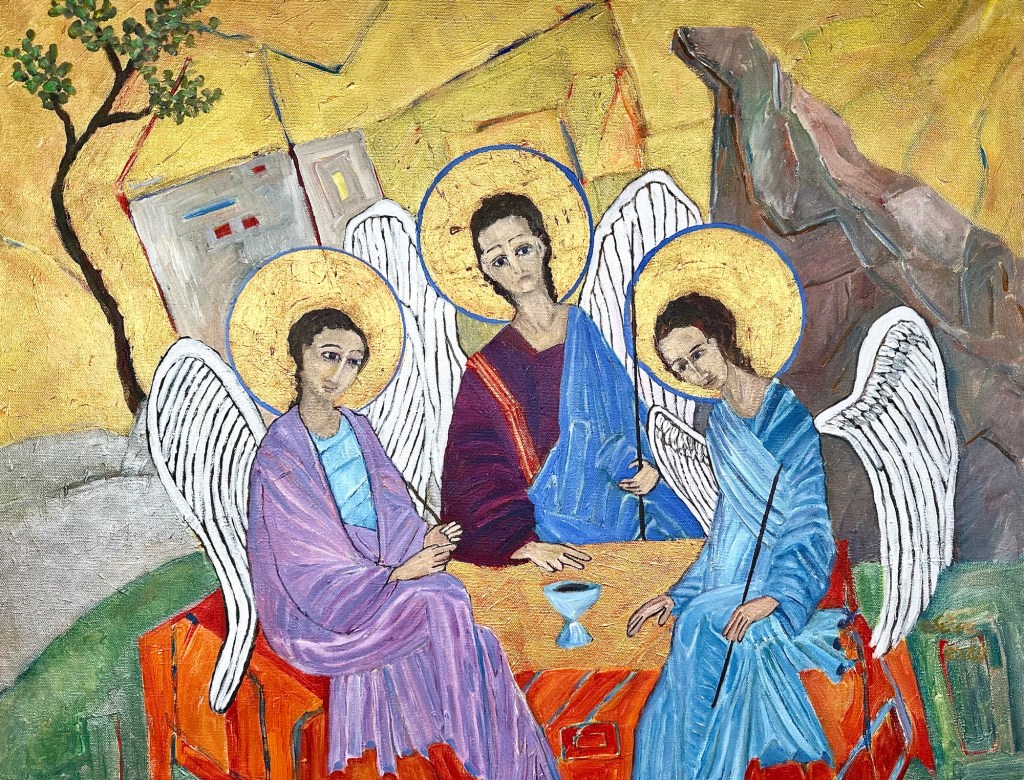
Holy Trinity, stage One

Once I chose this base, the mountain, tree, and the house wrote themselves. I found the table easily in the underlying shapes and the three visitors also. This isn’t a faithful copy of the Holy Trinity Icon, but a spiritual copy of the icon. I kept the colors and the ideas, but I wrote something new. As I painted, I had these thoughts about our faith and our life.

Holy Trinity, stage two

Not In My Backyard, Not In My Neighborhood, Not in My Church—how often do we hear these words? Sometimes we even hear them spoken in our own estranged families of origins. This isn’t a recent phenomenon. Our scripture is full of broken families: Cain and Able were the first; plus, Abraham’s children, Isaac and Ishmael and their descendants, have had sibling rivalry and struggles from the beginning. The house of David certainly had its problems even if David was a “man after God’s own heart.” In the New Testament, the Jews wanted the gentile believers to convert to their religion first, and then to keep the law, the food rules, and celebrate the festivals in order to be a “good Christian.” The leaders had to compromise on their beliefs before everyone could fully share Christian hospitality at the table together.

Holy Trinity, stage three

Paul has a dire warning for the congregations about The Works of the Flesh in Galatians 5:16-21—

Live by the Spirit, I say, and do not gratify the desires of the flesh. For what the flesh desires is opposed to the Spirit, and what the Spirit desires is opposed to the flesh; for these are opposed to each other, to prevent you from doing what you want. But if you are led by the Spirit, you are not subject to the law.

Now the works of the flesh are obvious: fornication, impurity, licentiousness, idolatry, sorcery, enmities, strife, jealousy, anger, quarrels, dissensions, factions, envy, drunkenness, carousing, and things like these. I am warning you, as I warned you before: those who do such things will not inherit the kingdom of God.

Our modern world has a problem with idolatry. We often put our work, our family, our possessions, or our politics above God. We often choose our church because of our political beliefs, when we should let the overwhelming love and grace of God for all God’s creation imbue our political choices. We forget as Christians we are grafted into the nation of Israel, as the writer of Ephesians 2:12 reminds us:

“Remember that you were at that time without Christ, being aliens from the commonwealth of Israel, and strangers to the covenants of promise, having no hope and without God in the world.”

Christ came to those who were near and to those who were far, broke down the dividing wall between the two and brought them together to eat at one table. Before they were enemies, but with Christ, they became one people. Divisions should not exist in the body of Christ, just as no one should be excluded from fellowship. The near in those days were the Israelites and the far were the Greeks, Romans and other pagan communities. In Christ, however, they were one.

DeLee: Holy Trinity after Rublev, acrylic on canvas,

Abraham knew the reputation of Sodom and Gomorrah, since Lot was his kinsman. When Abraham negotiated with God to spare those twin cities of iniquity, he managed to bargain God down to the hope of finding at least ten honest people, righteous in their ways with God. That was as low as God would go. Lot, with his two daughters, his wife, and the two would be husbands made six, but the men didn’t want to flee. That left only four and so the two cities were doomed for their lack of hospitality to strangers.

People today often think that sexual behavior doomed these cities, but lack of care for the stranger was a higher priority in a dangerous and unforgiving landscape. Offering food, water, and shelter meant life to travelers. Four thousand years ago, our spiritual ancestors remembered the stories of Abraham. In Deuteronomy 26:5, when the people brought their offerings to God, they were instructed to make this response before the LORD your God:

 “A wandering Aramean was my ancestor; he went down into Egypt and lived there as an alien, few in number, and there he became a great nation, mighty and populous.”

No longer are we a wandering people. Instead, we are mostly a nation of settlers, people who have been in one place for awhile. We no longer are a nation of immigrants who are wresting a new nation out of the raw materials of the land and becoming a melting pot of different cultures which have settled it. We look with suspicion upon someone who moves into our neighborhood, especially if they don’t look or act like us. If they don’t speak our language or eat our food, we tend to shun them. We don’t show hospitality. We don’t add their flavor into our soup, and try to keep them from melting into our pot.

No one likes change. I think of the old joke about “how many United Methodists does it take to change a lightbulb?” The answer is “none—that lightbulb was given as a memorial to my Aunt Harriet’s dead husband, and it cannot be changed!”

Hospitality requires us to change the lightbulb, however, for bringing light to a dark stairway will make it safer for people of all ages to traverse. Hospitality asks us to open our pews to people who don’t think like us, so we can wrestle with the theology of God and the calling of our faith for this present age, not just our yesterdays. Hospitality calls us to serve as a respite and refuge for the aliens, the immigrants, the homeless, and the newcomers who arrive in our communities.

Unfortunately, too many of us have bought into tribal thinking, which is a form of all or nothing thinking. Gang behavior is tribal thinking, for if you don’t kowtow to the group think, you will likely be dead. Excommunication from the church is a form of punishment for wrong thinking or wrong acts, and secession or rebellion is action against authority you no longer respect or recognize. Our church has just gone through a sad time of people cutting ties because they no longer share the understanding of Abraham, who offered sustenance and protection to strangers in the midst of the barren wilderness. In ancient times, those who received this gift were bound to mutual respect and protection. Food and water in the wilderness saves a life. Our hospitality to strangers in an uncertain world can save their lives and souls. Maybe we once again need to see afresh with ancient eyes our sacred texts, instead of with our current political and cultural blinders on our eyes. Then we could truly entertain angels unawares. And we would be blessed for this.

As the writer of the letter to the Ephesians closed out his third chapter (Ephesians 3:20-21):

“Now to him who by the power at work within us is able to accomplish abundantly far more than all we can ask or imagine, to him be glory in the church and in Christ Jesus to all generations, forever and ever. Amen.”

Joy, peace, and hospitality,

Cornelia

Music of the Spheres

adult learning, Aristotle, art, color Wheel, Creativity, Faith, Holy Spirit, Horeb, Icarus, Imagination, nature, Painting, Prayer, Pythagorean Cosmology, Silence, Spirituality, vision

One of my favorite hymns growing up in the church was “This Is My Father’s World,” by Maltbie D. Babcock, a Presbyterian minister. Written in 1901, to the tune Terra Beata, or Blessed Earth, the song was originally a traditional English folk tune, but composer Franklin L. Sheppard arranged a variation specifically for this text. This hymn and “The Church in the Valley in the Wildwood” were my mother’s and my grandmother’s two favorites to sing. I loved them both also because of their location in nature.

This is my Father’s world,
And to my listening ears
All nature sings, and round me rings
The music of the spheres.
This is my Father’s world:
I rest me in the thought
Of rocks and trees, of skies and seas–
His hand the wonders wrought.

As Paul wrote in Romans 1:20—

“Ever since the creation of the world (God’s) eternal power and divine nature, invisible though they are, have been understood and seen through the things (God) has made.”

Tracing history backwards from the 1st CE, the Pythagoreans (active from the late 6th to the mid 5th century BCE) thought the music of the spheres was an ethereal harmony produced by the vibration of the celestial spheres.

Aristotle said the Pythagoreans believed things are numbers or they are made out of numbers by noticing more similarities between things and numbers than between things and the elements, such as fire and water, as adopted by earlier thinkers. The Pythagoreans thus concluded things were numbers or were made of numbers. Therefore, the principles of numbers, the odd and the even, are the principles of all things. The odd was limited and the even was unlimited.

Aristotle criticized the Pythagoreans for being so enamored of numerical order that they imposed it on the world even where it wasn’t suggested by the phenomena. Thus, appearances suggested there were nine heavenly bodies orbiting in the heavens but, since they regarded ten as the perfect number, they supposed there must be a tenth heavenly body, the counter-earth, which we cannot see.

Pythagoreans presented the principles of reality as consisting of ten pairs of opposites:

1. limited—unlimited

2. odd—even

3. unity—plurality

4. right—left

5. male—female

6. rest—motion

7. straight—crooked

8. light—darkness

9. good—bad

10. square—oblong

In art we have similar categories which we use to create dynamic images. If our painting is all of one value—all white, all black, or all middle value—it lacks visual interest. We are drawn to images which have contrasting values covering multiple values. As with everything, too much of a good thing can become a bad thing! In medicine, a small dose of Botox can make wrinkles disappear, but a large dose could poison a person. As I tell folks, some things require experts, not DIY practitioners.

The Middle Path is safest and best—
Unknown Artist: The fall of Icarus., Fresco of the Third style from Pompeii, 50—75 CE. (H. 35.5, W. 34.5 cm.),
London, British Museum.

I’ve probably mentioned before my encounter with the Hostess chocolate cupcakes. When I realized I could buy a whole box for slightly more money than a package of two tiny cakes, of course my starving art school student budget sprung for the box. That’s when I ate chocolate cupcakes for breakfast, lunch and dinner. By the end of that box, I was cured of my chocolate cupcake desire for a very long time. This is a classic case of “too much of a good thing,” or “knowing when to stop.” The Greeks recognized the need to curb human behavior of our “all or nothing” thinking by prescribing the idea of the Golden Mean, or “nothing to excess.” I definitely went to excess on my cupcake journey.


Mies van der Rohe’s Tugendhat Armchair was designed for the Tugendhat House in Brno, the Czech Republic in 1929 and is one of several different furniture pieces designed for the home of Greta Weiss and Fritz Tugendhat.   In the design of the home, Mies designed nearly every detail down to the furniture used.  He also prescribed the placement of each furniture piece in the home to maintain spatial composition.

Mies van der Rohe, whose architecture and furniture design exemplified his style, “less is more,” never reduced his work to nothing. His work was faithful to the new industrial materials of steel and glass being used in skyscrapers. Our excess in art is never to nothingness, but we don’t over elaborate or over decorate, just for the sake of filling the space.

So, what do we do and how we proceed? When faced with the challenge of all we see before us, what do we select to make our images? I believe this is where the creating Spirit comes into play, for we can walk past a tree all day long, but on a certain day, the tree comes alive for us. When Moses was herding his father-in-law’s sheep out in the wilderness, his mind was on the sheep, his current family, and his past life and deeds. Scripture doesn’t tell us how long the bush burned on that mountain before Moses noticed it and said, “I must turn aside and look at this great sight, and see why the bush is not burned up.” (Exodus 3:3)

Likewise, we walk past inspiring images daily when we’re preoccupied with our day-to-day concerns. We also have difficulty finding time to create because others want our attention first. One of my seminary professors lectured us in class about taking time to keep our spiritual lives front and center as we moved through school and our church appointments. She said our spouses and children would want to be first, plus our congregations also would want to be first. We’d most likely want to put our careers first to get a bigger steeple or to please our supervisors. However, if we put anything or anyone before God, our spiritual lives would suffer, and like dominos, everything else would fall also. “Many are called, but few are chosen,” as Jesus says in Matthew 22:14.

In art as in life, we need to be deeply rooted in the life of the Spirit. I can tell when I’m going through the motions, but I keep on painting, for I figure I’ll at least learn something from my adequate work, so I’ll be found ready when the creative Spirit strikes. Sometimes I’m more present to the cares and concerns of this world and my work suffers for it. Other times, I’m under the creating power of a Greater Power and my work is altogether more inspired because of that energy. We’d all be more vigorous and creative in our everyday lives if we spent more time in prayer, contemplation, and searching the scriptures to hear God’s voice speak in the silent corners of our hearts and minds.

Mike: Sun and Moon, quick painting

Last week, only Mike and I showed up for art class. Everyone else was either tied up with doctor appointments or at home with rehab or otherwise occupied. Mike and I explored making different colors with the 8 Color Prang Watercolor Set. We can make interesting colors by combining the complementary colors or the tertiary colors. Mike’s first landscape painting got the energies of his competing needs out of the way.

Mike’s Second start—just beginning

As in journaling, we often need to make a habit of writing our thoughts so our deepest feelings can get expressed. He began a second painting with more focus on the goal of mixing new colors.

Music of the Spheres: watercolor

I started my painting with the circles by using yellow watercolor to outline intersecting circles of the same size on my paper. Then I mixed some primary colors together, some secondary colors together and some tertiary colors together. I painted different sections of the overlapping circles. Some of the paint I thinned to a wash, and others I laid on fully. When I got home, I painted in the background, allowing some areas to be a wash and other parts to be thicker.

Music of the Spheres: Creation Energy, acrylic

I finished at home an acrylic painting, which explores some of the same themes as the watercolors we’ve worked on in class. In this I used various material with different textures for my spheres. One of the circles is more three dimensional because it’s from a handmade cloth mask left over from the pandemic. I painted parts of it, also. The background has lines of “energy” all about.

While the Pythagoreans attempted to see unity and harmony in the creation in numbers, our Judeo-Christian faith recognizes God as creator of nature and nature revealing the Creator. One of the best texts to understand this distinction is 1 Kings 19: 11-13, in which Elijah meets the LORD on the mountain at Horeb:

(God) said, “Go out and stand on the mountain before the LORD, for the LORD is about to pass by.” Now there was a great wind, so strong that it was splitting mountains and breaking rocks in pieces before the LORD, but the LORD was not in the wind; and after the wind an earthquake, but the LORD was not in the earthquake; and after the earthquake a fire, but the LORD was not in the fire; and after the fire a sound of sheer silence.

When Elijah heard it, he wrapped his face in his mantle and went out and stood at the entrance of the cave. Then there came a voice to him that said, “What are you doing here, Elijah?”

No one has ever heard the music of the spheres, and the voice of God arrives in the sound of sheer silence. Perhaps that “polar opposite” of the Pythagorean’s world view was on to something after all. If we’re very quiet and still, we may hear both the music of the spheres and the voice of God in the great silence.

Joy and peace,

Cornelia


This Is My Father’s World | Hymnary.org

https://hymnary.org/text/this_is_my_fathers_world_and_to_my

Counterfeit Version of Botox Found in Multiple States | FDA

https://www.fda.gov/drugs/drug-safety-and-availability/counterfeit-version-botox-found-multiple-states

Pythagoreanism (Stanford Encyclopedia of Philosophy)

https://plato.stanford.edu/entries/pythagoreanism/

Time Travel and Iconography Experiments

adult learning, art, Creativity, Faith, Hagia Sophia, Holy Spirit, hope, Icons, Imagination, inspiration, Leonardo da Vinci, Medical care, Painting, Pantocrator, renewal, Spirituality, Turkey, vision

Every once in a while, I like to go on journeys. Sometimes they’re actual trips, such as my recent vacation over spring break to visit family down in Texas, but other times I like to “time travel.” The best way to time travel today, since I don’t have access to a DeLorean, is to study history. Buckle your seatbelts, we’re in for a ride through Christian and art history.

Right before spring break, our art class tried some experimental techniques with chalk, watercolor pencils, and pan watercolor with brushes. I also brought some images from the beautiful church of Hagia Sophia of the ancient capital of Constantinople, which I brought home from a pilgrimage I made several years ago.

The church was sponsored by the first Christian emperor Constantine, so it has exceptional mosaics and frescoes decorating all its surfaces. We each chose an image to use as a starting off place and went from there. Inspiration comes not only from what we see, but from the materials we use. Combining new images with new materials can bring new directions.

Desis Icon, Hagia Sophia, Constantinople, Turkey

Our primary images were the archangel Michael, the enthroned Christ, the decorative jewel designs, and the cross. All of these designs figure in prominence in Hagia Sophia or the Basilica of Holy Wisdom, the primary seat of Christianity in the Eastern Church during the Byzantine era.

Unknown Artist: Moschophoros, The Calf Bearer, 165 cm high, Limestone, 570-560 BCE, Acropolis Museum, Athens, Greece.

Early Christian art took its themes from contemporary Greco-Roman subject matter, but repurposed it for its own religious significance.


The Good Shepherd, the Catacomb of Priscilla, Rome, Italy, 250–300 CE, adopts the standard form of Apollo statues.

The archangel Michael was connected in the 4th CE with Constantine as a divine messenger and intermediary between heaven and earth. Michael was not only the guardian angel of the nation of Israel, but other nations have adopted his protection also. In this same century one of the doctors of the early church, St. Basil of Caesarea, known as “the Great,” said:

“Beside each believer stands an angel as protector and shepherd, leading him to life.”

Constantine felt the presence of the mediating angelic hand in his vision of the cross in the sky at the Milvian Bridge, at his baptism, and in his role as Emperor of the Eastern Christian Empire. Constantine was actually baptized twice: once to cure him from leprosy and again on his death bed. In the early days of Christianity, various sects prevailed and the doctrine of one baptism as sufficient for all times hadn’t yet taken hold. After all, it’s not the water, the place, the church, the location, or the priest that makes a baptism effective, but the work of God through the Holy Spirit. As Ephesians 4:4-6 says,

“There is one body and one Spirit, just as you were called to the one hope of your calling, one Lord, one faith, one baptism, one God and Father of all, who is above all and through all and in all.”

Constantine’s Vision of the Cross: Bibliothèque nationale de France, Illustrated painted parchment Greek manuscript (879-883 AD) of the homilies of Gregory of Nazianzus in the Bibliothèque nationale de France.
(BnF MS grec 510) folio 440r.
https://gallica.bnf.fr/ark:/12148/btv1b84522082/f891

Constantine’s first cross apparition took place at the beginning of his military campaign in Italy. The young emperor realized that the tyrant Maxentius, who controlled Rome at that time, had set a trap at the Milvian Bridge over the Tiber. Fearing his rival’s machinations, Constantine had sought the aid of the God worshiped by his father, Constantius Chlorus (r. 305–6). While he marched on to a field together with his troops, he saw the sign of the cross revealed in the afternoon sky, shinning brighter that the sun, alongside an exhortation inscribed “by means of a starry form: By this you shall conquer, Constantine!”

Mike’s Cross Painting

Note the use of common materials in Mike’s work. The circle is the same size as a foam plate, the cross from the table decorations fits just inside it, and he embellished the outer and inner spaces with a bilateral and balanced design. He’s getting more skilled to “eyeball those proportions” from across the room. Plus, he enjoys making these designs.

The ancient writers Eusebius and Euthymios both mention the emperor’s troops also witnessed this miracle. The significance of the vision was subsequently clarified by Christ, who appeared to Constantine in a dream advising him to carry a cross-shaped banner before his armies in order to defeat Maxentius.

Byzantine hagiographical works, or the writings about the lives of saints, name this apparition of the cross as a decisive step toward Constantine’s conversion to Christianity. This first episode is part of a faith narrative, which runs through the tale of Constantine’s leprosy and his miraculous healing through his first baptism, which was officiated by Pope Silvester.

The depiction of Pope Sylvester in the church decoration, a leading figure in the iconography of Roman popes in Byzantine art, deserves special comment. Sylvester was born in Rome and was pope between 314 and 335, succeeding pope Miltiades. Both the Latin and Orthodox rites honor Silvester as a saint and the patriarchate of Constantinople commemorates him on 2 January. The fictional account of his life, Actus Silvestri, written in the 4th-5th century, records the story of his curing Constantine of leprosy and then baptizing him.

Baptism of Constantine

It was during this first baptism Constantine had another vision which converted him to Christ. Constantine’s baptism is narrated in the Greek Life of Silvester in a verbatim translation of the story by Zonaras. Having recovered his health by means of the sacramental bath, the now Christian basileus (king) donned a bright garment and “said to the bystanders that he had felt a hand: It had stretched out from above and touched me while I was descending into the font.”

Baptism of Constantine

The visualization of St. Michael’s involvement in Constantine’s baptism has no direct precedent in Byzantine and Balkan iconography. Similar descriptions appear in the shorter ninth-century vita of the hierarch and in the lives of Constantine. In the “Guidi” legend, the emperor’s confession is specifically addressed to the pope: “Servant of God, as I was standing in [the water] of the holy baptism, I felt a hand touching me and cleaning the sickness of the flesh.”

Unlike the hagiographical account by Zonaras, this fragment from the “Guidi” vita is not attested in the manuscript culture of the East-Carpathian environment. Even if it doesn’t include this passage in the section on Constantine’s baptism, the encomium (eulogy) by Patriarch Euthymios contains an allusion to the motif of God’s hand:

Upon waking up from the dream in which SS Peter and Paul offered him the cure of baptism, the emperor dismissed the pagan healer ( ) who attended him and said that: “(…) from now on, I need no human help, for the hand of God Almighty ( ) helped me.” Although it anticipates the king’s baptism, this statement is merely a symbolic reference to the divine power which came to Constantine’s aid, not a description of a miracle occurring during the ceremony.

The Slavonic translation of the Life of Silvester by Zonaras remains the only account that constitutes a plausible narrative background for St. Michael’s involvement in the scenes at the Romanian churches of Rădăuți and Bălinești. We don’t know if these fresco designers used a specific copy somehow related to the manuscript at the Neamț monastery. Yet once it had been integrated into the liturgy, the legend of Pope Silvester might have developed an independent circulation through storytelling. Perhaps the local audience interpreted Constantine’s confession about the divine hand that touched him in the water as a sign of the ethereal presence of the Archangel as pictured in the compositions of Constantine’s baptism.

Creation: The Nuremberg Chronicles (1493), written by Hartmann Schedel and illustrated with woodcuts by Michael Wolgemut

Perhaps these tales seem strange to our modern scientific minds, colored as we are by notions of “pictures, or it didn’t happen!” We want proof, repeatable and documented evidence, not just some such nonsensical woo-woo about visions and dreams. After all, we are more likely to think these voices could be drug induced or anxiety provoked, but we aren’t so familiar with God speaking to mortals, as it was back in the days when the boy Samuel was ministering to the LORD under Eli:

“The word of the LORD was rare in those days;
visions were not widespread.” (1 Samuel 3:1)

We aren’t big on either voices or angels, but God does still work in supernatural ways. While some may see prayer as supernatural healing, others may see God’s healing hand at work in guiding doctors, nurses, and caregivers to bring people to get the medical attention that brings them to better health. God gives us the heart for healing and compassion for the suffering, which then sets us out to discover new medicines and treatments for dread diseases. These wonderful advances would appear as magic to those from a century ago, or even a few decades before.

Take the miracle of cystic fibrosis advances. In the 1980’s, the life expectancy for a CF patient in the United States was only 12 years and 20 years in Canada. By 2017, with new medications and therapies, the median life expectancy for CF patients was 47. Because new medications and improved treatment of respiratory infections and other complications have extended the predicted life expectancy of CF patients to almost 50 years, some are now living well into their sixth and seventh decades. I call this a miracle, even if others call it mere “science.” It means I have a grand nephew who likely will have a full lifetime and even enjoy his own children.

Humanists will give all the glory to the human creature. They are self-made men and women in love with their own creation. People of faith will give all the glory to God for the gifts of their hearts, minds, bodies, and spirits. We have been given much, so we give much to others.

Nike of Samothrace

Just as the earliest Christian art works repurposed secular and mythological Roman themes, so later Christian art used Greco-Roman mythological imagery. The angels are based on the female winged victories, such as the famous Nike of Samothrace. In the early fourth century, angels suddenly appeared as figures in Christian iconography, usually without feet and dressed in garments of a white pallium over a tunic. This was a large rectangular cloak worn over a tunic, as worn by Greek philosophers and religious teachers. In the earliest Christian art works, angels were depicted as wingless, but wings became normative by the fifth century. By the High Middle Ages, angels were more elegantly garbed (depending on their station in the hierarchies) and appeared to be androgynous.

The first known Christian depiction of winged angels does not appear until this splendid 4th century marble ‘Prince’s Sarcophagus’. It was discovered after a fire in Sariguzel, near Istanbul in the 1930s

The word for Angel, mal’akh in Hebrew and angelos in Greek, simply means messenger, which is the job description of the Angel, who acts as an intermediary between humans and God. The Bible never says angels have wings, but we all imagine angels with wings. Perhaps we assign them wings because angels can travel from the “heavens above to the earth below.”

Egypt’s Red Monastery, The church of Anba Bishay and Anba Bigol

The church of Anba Bishai and Anba Bigol, known as the Red Monastery, is the most important extant early Christian monument in Egypt’s Nile Valley. It’s one of the most significant historical sites of the period in the Mediterranean region. Created in the 4th and 5th CE, this fine painted Coptic Christian image of Christ surrounded by angels has survived multiple restorations of the church building.

Leonardo da Vinci: Annunciation, 1472, oil on canvas, Uffizi Gallery, Florence, Italy.

Although the principle of angels being sexless continued, later renaissance artists presented them as male figures with fashionably delicate facial features and long hair, dressed in contemporary garments (making them more approachable to the common era). As the lines between the angelic spheres became blurred, along with the renaissance adaptation of classical Greco-Roman art, plump little children with wings began showing up in Christian art. We know these as cherubs.

Cornelia’s Watercolor Angel from Hagia Sophia

I used a mix of pastels and watercolor on this painting, working from a 1.5-inch square image of the Archangel Michael. The contrast of light and dark shows up in the naturalist wings and hair, with the glowing and reflective gold mosaic pieces.

Angel from Hagia Sophia

Regarding his rank in the celestial hierarchy, opinions vary. St. Basil in his homily Angels, as well as other fathers, place St. Michael over all the angels. They say he is called “Archangel” because he is the prince of the other angels. Christian tradition gives St. Michael four offices:

  1. To fight against Satan.
  2. To rescue the souls of the faithful, from the power of the enemy, especially at the hour of death.
  3. To be the champion of God’s people, the Jews in the Old Law, the Christians in the New Testament.
  4. Therefore, he was the patron Saint of the Church; he is considered to be the protector of Christians against the devil.
Christ between St. Peter and St. Paul, Catacomb of Sts. Marcellinus and Peter on the Via Labicana, Rome, 4th CE.

This image of Christ on the Throne, dating to the 4th century, shows Michael between St. Peter and St. Paul. It was painted in the Catacomb of Sts. Marcellinus and Peter on the Via Labicana in Rome, located near a villa that used to belong to Emperor Constantine. Below the main figures of the painting—Jesus, Peter and Paul—we find Gorgonius, Peter, Marcellinus, and Tiburtius, four martyrs who had been buried in that catacomb, and are depicted as they point to the Lamb of God on his heavenly altar.

Zeus: Archaeological Park of Campi Flegrei at the Castle of Baiae on the Gulf of Naples, Italy


The enthroned Christ follows the thematic form of Zeus, king of the gods, seated on his throne. A good example is statue from the Archaeological Park of Campi Flegrei at the Castle of Baiae on the Gulf of Naples. This statue of Zeus Enthroned is a 29-inch-high marble statue dating to the 1st century B.C. and is likely of Greek manufacture.

It was inspired by the colossal gold and ivory statue of the god at the temple of Zeus at Olympia made by sculptor Pheidias in 430 B.C. It was one of the Seven Wonders of the ancient world. Just as the angels were repurposed from the Nike victory statues, so the Christ Enthroned statues were re-envisioned from the ruler of the gods and humans statues. Art and artists can be put to work for whoever is in power at the moment. We need to eat and pay bills in every age.

Zeus: fresco, 62-79 CE, Casa dei Dioscuri, Pompeii (VI, 9, 6-7, atrio corinzio 37), Museo Archeologico Nationial, Italy.

A lovely fresco from Pompeii, found in the House of the twins, has a glowing red background and shows Jupiter or Zeus, the king of the gods, seated on his throne. A sphere lies beside him, an eagle at his feet, and a rectangular base is at his feet. In the same manner, the icon of the enthroned Christ places his feet on a rectangular base, representing his lordship over the four corners of the world.Gail W used the pastels in the clothing and background.

Gail W’s Enthroned Christ watercolor


From one of the royal figures, Gail S chose one of the jeweled embellishments for her focus. Gail enjoys ordered designs, so finding an image with a regular pattern was right up her alley. The outer circle with an inner square is divided along the diagonals by red lines, as if the cross were tilted on its side. The circle and square give unity to the design, as does the monochrome cross. The triangles are balanced by colors. The outer blue rim holds it all together. Gail tried the watercolor pencils out along with the pan watercolor washes.

Gail S inspiration and creation

While nothing is ever new in art, we artists keep reimagining the old patterns in new ways. After all, the basic elements of design never change, but we see the world with fresh eyes in every generation. Using our hands to create restores us and recreates us by reducing our anxieties and giving us a sense of accomplishment. We each serve the God of beauty and joy as God reveals God’s self to each of us. Doing any creative work with our hands is good for the mind, spirit and soul.

As our hand grows in competency with the media and our eye is better able to discern shape and patterns, we come under the Holy Spirit’s inspiration of creating power and we make art! We may start from the ancient wisdom, but then we go onto find the wisdom for today. After all, God is always in a rebuilding mode, for that which God created, God will preserve:


“When you send forth your spirit, they are created;
and you renew the face of the ground.” ~~ Psalms 104:30

Joy and Peace,

Cornelia

Diane Apostolos-Cappadocia : Why Ukraine Calls Upon Michael the Archangel, Christianity Today, April 12, 2022, https://www.christianitytoday.com/ct/2022/april-web-only/michael-archangel-ukraine-kyiv-patron-saint.html

Saint Mamas at Exeles: An Unusual Case of Ritual Piety on Karpathos
Katsioti, Angeliki; Mastrochristos, Nikolaos.  Arts; Basel Vol. 12, Iss. 4, (2023): 176. DOI:10.3390/arts12040176
Saint Mamas at Exeles: An Unusual Case of Ritual – ProQuest https://www.proquest.com/docview/2856776246?sourcetype=Scholarly%20Journals

The Historical Evolution of CF Treatments and Understanding
https://cysticfibrosisnewstoday.com/news/cf-treatments/

Life Expectancy with Cystic Fibrosis (CF)
https://www.nationaljewish.org/conditions/cystic-fibrosis-cf/life-expectancy

ARCHANGELS MICHAEL AND GABRIEL
https://www.stjohnarmenianchurch.org/archangels-michael-and-gabriel/

Archangel Michael
https://www.etd.ceu.edu/2023/dumitrescu_andrei.pdf

Nativities Then and Now

Altars, Apocalypse, beauty, Bethlehem, Christmas, Creativity, Faith, Holy Spirit, Icons, Imagination, incarnation, inspiration, Israel, mystery, Nativity, righteousness, Savonarola, vision

Every Christmas, my family would put up a beautiful tree and decorate it to the nines. My dad would always tie this living sculpture to the nearest window frame so the tree wouldn’t topple over. He was well aware at least one of his three curious and rambunctious children would no doubt be crawling under the lowest branches to reach the brightly wrapped presents hidden far back in the corner under the tree.

We kids most desired and sought after these hidden gifts, while those near the front always got a cursory glance and shake. If it were hidden, it had to be desired! Package shaking in the hidden, tight quarters could cause a tree to collapse and that would be more drama than our frazzled mother wanted at this time of year. My dad was wise enough, or trained by experience, to know messing with “Mother Nature” wasn’t a great idea.

Mother’s Nativity with other additions from family and friends

Under this tinsel draped tree, with its 1950’s glowing bubble lights, we always had a nativity scene. In our early childhood, it was solid and childproof, but as we aged, and got too large to crawl under the tree, a better quality nativity came to live under the tree. By my college years, my brothers were also grown enough for mom to exercise her creative genius. She hand-painted her own ceramic nativity group. This masterpiece also got its own special display site. Up until this time, we children had no idea our mother had any artistic talent, for she’d spent her days transporting us to our multiple after school activities. Between my brothers’ sports teams and my hobbies, it’s a wonder she found time to do anything else in the afternoon hours.

Nativity, Adoration of the Magi, 3rd century. Fresco, Rome: catacombs of Priscilla, 3rd Century CE

The 3rd century fresco shows the scene of Adoration of the Magi on the the arch dividing the room in the Greek Chapel in the Catacombs of Priscilla, Rome. In depictions of ancient Greek and Roman gift-giving practices, the act and choice of gift were important. They furnish information about both giver and recipient. The wise men adopt the same postures used in Roman imperial ceremony for the worship of an Emperor or other ruler. Roman art has always provided a pictorial model for the representation of the Magi. By identifying with or recognizing such an outward act of homage, the viewer could enter into the Nativity story through the wise visitors, worshipping the God manifest on earth in the Child.

This is why the earliest Christian art is found in the catacombs of Rome, in the hidden places, since worshipping Jesus wasn’t an approved religious practice in the Empire. Only the Divine Emperor alone was worthy of reverence and worship, not some dying and rising god of a far-off province. Today in America we sometimes forget we’re a nation founded on the principle of freedom to practice our religion as we see fit, or not to practice a religion at all, as the case may be. No government can compel the privilege of one religion above another or set one as the official religion.

Tympanum of the right side of the cast of so-called Sarcophagus of Stilicho, sculpted around 385 AD (the original piece of art is in Sant’Ambrogio basilica in Milan, Italy), Detail Nativity scene, Museo della civiltà romana a Roma (Eur), Room 15 (Christianity).

Another early depiction of the nativity isn’t in a Christmas context, but is found on a late 4th C Roman sarcophagus for a high ranking military official and his wife. The unknown artisan rendered the Christ child, wrapped in binding clothes, and lying in a manger, between the ox and the ass, to fulfill the prophecy of Isaiah 1:3—

“The ox knows its owner, and the donkey its master’s crib;
but Israel does not know, my people do not understand.”

As accustomed as we are today to manger scenes with all kinds of animals present, the scriptures don’t name them. These are left up to our imaginations. Even the elements derived directly from the gospel narratives of Matthew and Luke were slow to appear in visual renderings. Between those early scriptural accounts and the formation of even a basic manger scene lie some centuries during which Christian devotion and depiction developed. Likewise, the celebration of Christmas was slow to develop, but by the 4th century it was well along.

Nativity Fresco in Santa Maria Foris Portas, Castelseprio, Italy, 9th CE

In the ninth century, after the iconoclastic period, when the images of holy persons were forbidden and destroyed, a fresh wave of religious activity began in the arts. In Italy. In the church dedicated to Mary Outside the Gates in Castelprio, Italy, an entire series of paintings covered the interior walls. The church was located on an important trade route and the site was once a Roman fort. The theme honored Mary as the Bride of Christ, thus making her the spiritual equivalent of the Church, which is the Bride of Christ in scripture. In every tableau, Mary is the largest or most significant figure. Over the centuries, the area lost its importance, these paintings were whitewashed over, but after many years and much restoration, they’re now protected as a UNESCO World Heritage Site.

Today Protestant believers have a Christo-centric faith, often ignoring the other persons of the Holy Trinity. When we focus on the nativity, we forget God’s plan was to use humanity to save the fallen creation. This includes Mary and Joseph both, as well as God’s own Son, as Paul so well reminds us in Philippians 2:5-8—

Let the same mind be in you that was in Christ Jesus,
who, though he was in the form of God,
did not regard equality with God
as something to be exploited,
but emptied himself,
taking the form of a slave,
being born in human likeness.
And being found in human form,
he humbled himself
and became obedient to the point of death—
even death on a cross.

Giotto di Bodone, Nativity of Jesus, 1303-1305. Fresco, 200 x 185 cm. Padua: Scrovegni Chapel

Giotto’s frescos in the Padua Chapel are some of the most important works of art because he brought the Holy Family into ordinary human life. The blue skies replace the gold of the traditional icons, which stood for the infinite and eternal spiritual world. In Giotto’s painting, people hunger and thirst, while in the world of the icons, all suffering is transformed and any passion is disciplined.

Duccio di Buoninsegna, Nativity between the prophets Isaiah and Ezekiel, 1308-1311. Tempera on panel, 43.8 × 111 cm. Washington: National Gallery of Art

Duccio painted in his studio all the individual sections of the great altarpiece of the church in Sienna, Italy. On completion in 1311, the townspeople held a grand parade as they carried the paintings to the cathedral. They were installed in a magnificent framework with some of the works facing the congregation and the rest facing the church officials. The altarpiece remained intact until until 1506 when it was partially dismantled, relegated to side chapels and replaced by a 15th-century bronze tabernacle.

In 1771, the church fathers hired a carpenter to saw up the old wooden altarpiece into seven vertical pieces, and then saw each of those pieces in half laterally to separate the front scenes from the back. He then reassembled the different pieces to form new scenes. Most of the individual paintings stayed together, but others were sold to private collectors or museums. This Nativity between the prophets Isaiah and Ezekiel was purchased by the Museum Kaiser Wilhelm Friedrich in Berlin and remained on display there until 1938. At that time, a Nazi-appointed Museum director purged most non-Teutonic art from the collection. Through a trade, this Nativity came to our National Gallery of Art in Washington, D. C.

Duccio: Maesta Reconstructed Altarpiece. Front (L) and Back (R)

When we think about hidden meanings in art works, sometimes the journey a work takes to its exhibition home is part of its meaning. The Nazi purge of non-Teutonic art from the collection was based on their idea of a pure race for their homeland, with which they shared a special mystical bond. It meant they would purge or purify all who didn’t meet this white supremacist ideal. I personally am glad America is an open society, which welcomes all kinds of art and artists. When we think of the journey of the Holy Family, they made an arduous trip to Bethlehem while Mary was about to give birth and then had to head out on the lam because king Herod was out to kill all the boy babies. When we look at beautiful nativity scenes, we forget Jesus was born into a troubled world. Indeed, these beautiful works make us forget our own troubles.

Sandro Botticelli, Mystical Nativity, 1501. Tempera on canvas, 108.5 × 75 cm. London: National Gallery.

One of the most unusual nativity paintings is the Mystical Nativity by Botticelli. Painted with egg tempera on canvas, the artist writes in the upper section how he painted this “at the end of the year 1500, in the troubles of Italy…in the half after the time, during the fulfillment of the eleventh chapter of St. John in the second woe of the apocalypse…”

The monk Savonarola was actively preaching at this time, and scholars believe he influenced Botticelli. During the time of the Medici rule, Florence prospered with trade and the city’s alliance with France made for a time of peace. Lorenzo d’Medici died in 1492, relations with France broke off, and the French army ran amuck in the Italian countryside. Florence lost her former glory, trade dried up, and a political vacuum allowed for new voices to rise. Savonarola preached repentance and austerity, even going so far to burn luxurious items and artworks. He burned all kinds of vanities: cosmetics, mirrors, veils, and books.

People followed him because he was charismatic, and his words seemed to match their circumstances. Florence under his rule was an example of theocracy, the government of a state by immediate divine guidance or by officials who are regarded as divinely guided. Under this system, the people prosper if they care for one another and live godly lives, but they fail to thrive if they cheat the poor so the rich can live in luxury.

Prosperity religion teaches the good thrive and the sinners suffer. It’s not a new idea: retribution and reward appeal to people, but sometimes the good suffer and the evil prosper. The book of Job is a counter argument to this worldview. The life of Christ also shows the best of us will be sacrificed on a cross by those who don’t know what they’re doing. From birth to death, Jesus and his family were under duress from the powers of state and religion. He was a new voice of love and acceptance, of grace and forgiveness, of a righteousness by faith, not works. This new voice would upend the world as people knew it then.

Douce Apocalypse – Bodleian Ms180 – p.042 Woman Clothed in the Sun, Oxford University, London, c. 1265-70

The Mystic Nativity is a combination of the Nativity and the Last Judgment. On top, the angels hold hands in a circle, the center is the birth of Christ on earth, and the lower third is the vanquishing devils due to the Christian’s reunification with God. The number twelve represents the twelve gates of the new Jerusalem, the City of God. Twelve are also the number of stars in the crown of the woman in the apocalypse linked to the Virgin Mary. Other symbols also occur, but the overall meaning is Botticelli painted to deal with his fears about the end of the world.

Sometimes we make a cursory glance or reading of a painting, only to see its surface meaning. If we were to take this path with Botticelli’s Mystical Nativity, we might only see pretty angels and lovely ribbons. It looks like a homecoming at a sorority weekend with all the hugging and kissing. But Botticelli was painting during a time when the theological ideas of the monk Savonarola were in ascendance. He believed, “The more creatures approach and participate in the beauty of God, the more are they themselves beautiful, just as the beauty of the body is in proportion to the beauty of the soul.”

Virtuvian Man by Leonardo da Vinci, 1490, pen, brown ink, and watercolor on paper, Gallerie dell’Accademia, Venice, Italy.

As an interesting aside, about contemporary with Botticelli’s work in Florence, while Leonardo da Vinci was in Milan in 1490, he drew his Virtuvian Man, considered one of the greatest scientific and humanist works of the early Renaissance. Da Vinci used Vitruvius’ classical treatise on architecture as the source for his drawing. Notes from his translation are written in his famed mirror script below the image. This artwork is now so fragile, it never travels and only copies are shown.

While his outer world may be falling apart, and prosperity has left his vicinity, Botticelli still had hope for a better world. His faith was grounded in the birth of the savior, the son of God, who came in flesh to make all flesh divine. We forget this crucial message of the nativity, which is to make holy all flesh. More often we focus on the magi’s gifts brought to the child: riches fit for a king, or the gifts of presence, from the poor shepherds. The true gift is the one in the manger, for Christ is God’s gift to us. He came to make us all At-One with God, the very best atonement possible. At the Last Judgment, all who are at one with God’s purposes will be separated from the rest.

Banksy, “The Scar of Bethlehem” (2019) (courtesy Bisher Qassis), located in The Walled in Hotel in Bethlehem, closed since 12/12/23, due to fighting against Hamas

How can we practice seeing past the surface of everyday life? Sometimes we have to be shocked. Modern nativities bring us again and again to confront the same world of challenges and discord into which the young Christ child was born. If we wrap ourselves in warm swaddling clothes so we too won’t cry over the lack of a Christmas in Bethlehem this year, we lose sight of the common humanity of all God’s people. The extremists will take retribution on everyone, but those who take the middle path punish only those who did wrongs. Is there hope for those who take the “my way or the highway?” Or do we need to join the Holy Family and become refugees to avoid King Herod’s slaughter of the innocents?

Vatican City public nativity

This 2020 nativity was created as a public art project by ceramics students in Castelli, Abruzzo, Italy, a region known for its ceramics. It had nineteen figures including an astronaut and a Darth Vader figure, whose creation predated the Star-Wars series and represented a generic “sinner” figure. In modern nativity scenes, artists often integrate characters not mentioned in the gospel accounts, in order to bring the interests of contemporary audiences into the biblical story. As you can imagine, it created quite a buzz. Some said it lacked “beauty,” while others thought it was a joke. Some thought it disrespectful to the honor of the Holy See, the Church, and to the good Lord himself. It’s a truism “beauty is in the eye of the beholder.” Also, “we’ve never done it that way” still has a strong hold on people’s hearts and minds.

Sinner and Astronaut: Large Ceramic Nativity at the Vatican, 2020

Seeing deeper meanings in art or scripture is no more complicated than seeing a deeper understanding of a literary experience, such as a book or poem. In art, we do have the hurdle of acquiring some visual background and “visual language.” Just as we can’t understand a foreign language without learning some phrases, we need to know some art history and styles. We can only understand in part at first, but later we’ll understand as if we were old friends. No one is a savant right away. If we pause as we read a scripture, let the words sink into our deeper minds, and let the Holy Spirit open up new insights into God’s word, we can do the same with art works.

Bread Nativity

After all, bread is just bread: ordinary flour, yeast, oil, and water. Once we bless the bread and invite the Holy Spirit to transform it, we understand these same ordinary materials to be signs of the extraordinary presence of the Body of Christ, as recorded in Luke 22:19 at the Last Supper—

Then he took a loaf of bread, and when he had given thanks, he broke it and gave it to them, saying, “This is my body, which is given for you. Do this in remembrance of me.”

Baby Jesus Bread Rolls

We’re always surrounded by the mysteries of hidden meanings, if only we have eyes to see and ears to hear. May you know God more deeply in the days and years to come.

The Christ Child in the Rubble, Nativity in Bethlehem, Palestine, West Bank, 2023

Joy and peace,

Cornelia.

Featured image—Nativity, 3rd century. Stucco, Rome: catacombs of Priscilla.

Category: Sarcophagus of Stilicho in Sant’Ambrogio (Milan) – Wikimedia Commons
https://commons.wikimedia.org/wiki/Category:Sarcophagus_of_Stilicho_in_Sant%27Ambrogio_(Milan)

Duccio, The Nativity with the Prophets Isaiah and Ezekiel, 1308-1311
https://www.nga.gov/collection/highlights/duccio-the-nativity-with-the-prophets-isaiah-and-ezekiel.html

Botticelli’s’ Mystic Nativity: Symbolism, Savonarola and a Reflection of an Era | Renee Farina – Academia.edu
https://www.academia.edu/1262474/Botticellis_Mystic_Nativity_Symbolism_Savonarola_and_a_Reflection_of_an_Era

Leveto, Paula D. “The Marian Theme of the Frescoes in S. Maria at Castelseprio.” The Art Bulletin, vol. 72, no. 3, 1990, pp. 393–413. JSTOR. Free account to access. https://doi.org/10.2307/3045748. Accessed 24 Dec. 2023.

Katarína Šimová: The Fresco Cycle of Santa Maria foris portas, MASARYK UNIVERSITY! FACULTY OF ARTS, DEPARTMENT OF ART HISTORY, 2021. Open source
https://is.muni.cz/th/ufv2u/castelseprio_frescoes.pdf

Significance of Leonardo da Vinci’s Famous ‘Vitruvian Man’ Drawing
https://mymodernmet.com/leonardo-da-vinci-vitruvian-man/

Baby Jesus Bread Buns · How To Bake A Roll Or Bun · Baking on Cut Out + Keep
https://www.cutoutandkeep.net/projects/baby-jesus-bread-buns

The Adoration of the Magi: Mosaic in S. Maria Maggiore https://www.christianiconography.info/staMariaMaggiore/epiphanyArch.html

The Magi and the Manger: Imaging Christmas in Ancient Art and Ritual – The Yale ISM Review https://www.ismreview.yale.edu/volume-3-1-fall-2016/the-magi-and-the-manger-imaging-christmas-in-ancient-art-and-ritual

Art for the Inner Child

adult learning, Apocalypse, art, Christmas, Creativity, Enneagram, Faith, Holy Spirit, hope, Imagination, inspiration, Light of the World, Ministry, Painting, perfection, purpose, salvation, Spirituality, vision

Discovery is exciting

What is the purpose of an art class? Why does anyone learn to speak a foreign language or take up a craft or sport they’ve never attempted before? We must want to explore some unknown universe or get out of our comfort zone, or as my old favorite television series would announce weekly, “to boldly go where no one has gone before.”

Light of the World Icon: Stencil effect

There are art classes and then there are Art Classes. Just as we shouldn’t make up our minds about a subject or a food until we experience it directly, we can have an open mind about a novel event, rather than rejecting it out of hand. Many of us have lived our lives under judgmental circumstances, dealing with rejection and disappointment at not being the best. “Talladega Nights: The Ballad of Ricky Bobby,” the NASCAR themed film of redemption and finding one’s purpose in life, stars Will Ferrell, whose father crippled him with this tragic life message:

“If you ain’t first, you’re last. You know, you know what I’m talking about?”

Near the end of the movie, Ricky Bobby learns this all was just crazy talk:

Ricky Bobby: Wait, Dad. Don’t you remember the time you told me “If you ain’t first, you’re last”?
Reese Bobby: Huh? What are you talking about, Son?
Ricky Bobby: That day at school.
Reese Bobby: Oh hell, Son, I was high that day. That doesn’t make any sense at all, you can be second, third, fourth… hell you can even be fifth.
Ricky Bobby: What? I’ve lived my whole life by that!

According to Baseball Reference, Ruth’s 183.1 career WAR — combining his value as a hitter and pitcher — is the highest all time, well ahead of Walter Johnson’s 164.8. For reference, the highest mark among active players is Albert Pujols’ 99.6 WAR.

We call this living out a “bad script” our ancestors have written for us. We see it all the time in the movies and on television. We read about it in novels and in comic books. For the most part, people don’t change their wicked ways, but get the consequences they’re due. The bad suffer and the good prosper. Or we read fairy tales in which the good little children get rewarded, or the unjustly treated ones are raised up, like Cinderella. These are the popular stories, but not the biblical tales. The book of Job calls this “retribution theology” into question, as does Jesus in the New Testament.

Annie French (1872 – 1965) Scottish: Cinderella and the Ugly Sisters, About 1900 – 1910, Pen and ink, watercolour and gold paint on vellum paper, 23.50 x 21.50 cm, Scottish National Gallery of Art.

In the Bible, God sends prophets, not only to call the people to account (critique their actions or behavior), but to offer the hope of a better future if they return to God and God’s ways (positive changes in behavior). In this way, a good art teacher is like a biblical prophet, who offers both positive and negative critique on the artwork. The teacher also offers “hope” or suggestions on how to improve the work. Teachers aren’t telling the person they don’t measure up, only that they need more time invested in making art to be able to bring their own artistic vision into reality.

Mike on Being the Light in the World

If we expected babies to chew steak from the moment of birth, the world would be a lonely place. If we expected these same babies to get up right away and “bring home the bacon” to buy their own steak and potatoes, they’d starve. Babies aren’t meant to walk before they crawl, nor or they chewing meat before they drink milk or pablum for a year or two.

Bacon Cake: Oh, Baby! I hope that’s REAL BACON!!

Someone who comes to art class should always come to learn something more, no matter how much they already know. I’m always learning new ideas and techniques. The act of making art is always an act of exploring new territories. We also grow by sharpening one another. Folks in the class are always excited to see how each other approaches the subject each week.

Mike’s May 2022 class work shows he’s been learning some things.

Only the apocalyptic writers in Scripture had a fixed view of the future. For them, God had given up on humanity. We humans were too far gone, too broken, and had destroyed God’s world beyond our weak means to repair it. Their only hope was for God to create “a new heaven and a new earth, for the first heaven and the first earth had passed away, and the sea was no more.” (Revelation 21:1)

Gail went the extra mile with Cri-Cut lettering

Of course, this isn’t a prediction of a certain time, but it’s a future hope for all times. It’s the hope all we creative people have every time we face a blank canvas, a pile of found objects, or a bag of scrap cloths. We also do this when we pull together a dinner before we go to the grocery store, and we take some of this and that which we have in our cupboards and refrigerators. We’re going to make something new! We do hope the Spirit of God descends to make this an inspired concoction! And if it doesn’t work out, we always know our salvation isn’t at stake over a single random supper creation. If I’m hungry enough, I’ll eat anything. Or there’s always peanut butter and jelly sandwiches.

Leftover Doughnuts and Sausage Bread Pudding Bunt Cakes

I was reading Richard Rohr’s Enneagram commentary on the American people. He says America is a nation of Threes: competitive, striving, always looking for success and improvement. When we hit a down cycle, and economics tells us we always have ups and downs in our economy, Americans act like we’ve been insulted. This doesn’t happen to us—to others maybe—but not to us! We’ll look both for a scapegoat and a savior, but never realize these conditions are a natural part of life.

Always be the best YOU. There’s never going to be another one just like YOU.

Likewise in groups, we’re always judging who got more, who has the most status, who’s preferred, and who’s on the out. We’re even liable to self-select to be on the outer group if we believe we won’t measure up, just to spare ourselves the shame of being found wanting. Joyce Rupp has a great poem about this very topic:

WE CAN LOVE THE IMPERFECT SELF
If I wait to be perfect
before I love myself
I will always be
unsatisfied
and ungrateful.

if I wait until
all the flaws, chips,
and cracks disappear
I will be the cup
that stands on the shelf
and is never used.

Magic Teacup Cake from Alice in Wonderland

If we’re faithful scripture readers, we know God never chooses the best persons to do God’s work. When we were children, we saw these characters as heroic figures, just as we saw our parents as great and invincible. The Old Testament records how Moses was a murderer, Joshua was afraid, Amos was a lowly shepherd, and David was an adulterer. Not exactly Perfect Role Models, but transformed people can do God’s mighty deeds if they let God work God’s purpose through their lives.

This word doesn’t mean what the headline writer thinks it does.

In Art Class, we don’t reject “poor work.” We aren’t a factory producing widgets. We have other goals: art appreciation, learning about colors, learning to see more clearly, developing a creative mind, and developing drawing skills. Art is a unique visual language, so learning how to render a three-dimensional form onto a two-dimensional surface takes some time and practice. Developing our own voice is the step beyond mastering the basics of artistic vocabulary. As I used to tell my parents at back-to-school night, just enjoy whatever your child brings to you! If you leave your “critical parent” at home, and bring your “inner child” to Art Class, life is way more fun!

Mike’s Christmas Card Collage

We’re currently on holiday sabbatical at Oaklawn UMC, but classes will return in the new year. We meet in the old Fellowship Hall at 10 am to noon. We always have coffee, and on occasional days, a tasty treat. Our class will begin working in watercolor beginning on January 5, 2024. I don’t charge for the class instruction, but each person should bring their own supplies. Supplies needed are:

Prang Oval 8 watercolor paint set with brush
  1. Prang Oval 8 watercolor paint set (containing brush)—on line at Walmart and Amazon. This has best color and pigments. I found a prime deal on Amazon for $3 each if you buy 3, free shipping.
  2. Watercolor paper pad 9” x 12” or larger (90 lb or heavier)
  3. Tall plastic container for water (iced tea glass size plus)
  4. Your inner child

Joy and peace,

Cornelia

MERRY CHRISTMAS, PEACE ON EARTH, GOOD WILL TO ALL

Talladega Nights: The Ballad of Ricky Bobby https://www.imdb.com/title/tt0415306/quotes/?item=qt0425224

Babe Ruth’s Top 10 career statistics— Shohei Ohtani produced 9.1 total WAR during his spectacular two-way campaign in 2021. Even he maintained that level of performance for 20 consecutive seasons, he would still be 1.1 WAR short of matching Ruth. https://www.mlb.com/news/babe-ruth-s-top-10-career-statistics-c163792958