Picasso’s African Masks and Inner Mysteries

adult learning, art, Creativity, cubism, elections, Imagination, inspiration, Painting, picasso, renewal, The Lord of The Rings, Thomas Merton, vision

What is the key to open the door to the hidden mysteries? For Frodo and his fellow travelers in The Lord of the Rings trilogy, they needed to know the elvish answer to the riddle, “Speak friend and enter.” Gandalf knows this language, so they enter with ease. For years, the Egyptian hieroglyphics were unintelligible because we had no living person who knew the ancient language. After the discovery of the Rosetta Stone in Egypt with its three languages depicting the same text, the race was on to translate the pictographic writing.

Rosetta Stone, British Museum

In art school my fellow students and I worked in our shared studio classes daily, but sometimes we never made any progress. Then the day would come when the light bulb clicked on in one of our brains. When we took a break, instead of giving everyone’s work a cursory glance before going out for a snack, we would linger and take in the special magic of a unique vision. Where does this special insight come from? Is it a visitation from above? Or a piercing of the soul by divine artistic insight? Sometimes I think the rare and the strange shock us out of our ease and complacency.

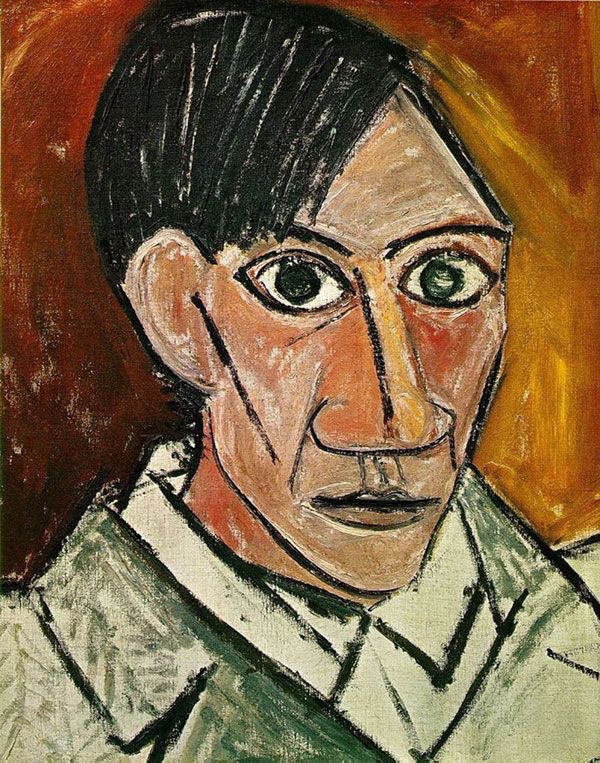
Picasso: Self Portrait, oil on canvas, 1907.

Art historians divide Picasso’s early periods into his Blue Period (1901-1904), the Rose Period (1905-1907), the African-influenced Period (1908-1909), and Cubism (1909-1919). Some art historians call Picasso’s African Period his “Proto-Cubist” or primitive period. It lasted from 1907 to 1909. Picasso was 24 years old when he saw an exhibit of African art at the ethnographic museum at Palais du Trocadéro. He experienced a “revelation” and began to explore African art further. African masks and sculptures strongly influenced Picasso’s art for several years, when he began to paint in sculptural forms, earth tones, and in flattened sharpened shapes.


Pablo Picasso in his Montmartre Studio,1908, via The Guardian

Picasso had first seen an African mask at Gertrude Stein’s home. Recalling his visit to the Trocadéro Museum of Ethnology (now the Musée de l’Homme), Picasso said of the museum:

“A smell of mould and neglect caught me by the throat. I was so depressed that I would have chosen to leave immediately. But I forced myself to stay, to examine these masks, all these objects that people had created with a sacred, magical purpose, to serve as intermediaries between them and the unknown, hostile forces surrounding them, trying in that way to overcome their fears by giving them color and form. And then I understood what painting really meant. It’s not an aesthetic process; it’s a form of magic that interposes itself between us and the hostile universe, a means of seizing power by imposing a form on our terrors as well as on our desires. The day I understood this, I had found my path.”

That path led Picasso to what he called his “periode nègre” (black period) or African period. It lasted only a few years, to 1909, but it turned Picasso into an avid collector of African art, masks, and sculptures that inspired him for the rest of his career.

Picasso: Woman with joined hands, 1907, Paris.

In our art class we chatted about how these masks inspired Picasso. Picasso used a palette of earthy tones, overlapping browns, and yellows with dark reds. By using Cubism, he explored a simplified geometry and the redefinition of perspectives. He tried to reveal objects from a different vantage point—from the mind, not only how the eyes perceive them. His Les Demoiselles d’Avignon signified a radical break from the naturalism that had defined Western art since the Renaissance, derailing former notions of what art was supposed to look like.

Picasso: Les Demoiselles d’Avignon (1907), oil on canvas.

People criticized Picasso’s two-dimensional women as unfeminine, for their confrontational demeanor was a complete departure from the traditional depiction of female beauty. Artists and critics alike received the work negatively and saw its menacing sex workers as promiscuous and unfit for Paris salons. Picasso rolled up the canvas, considered scandalous even amongst his innermost circle, and stored it in his studio for years to come. Yet this groundbreaking painting influenced his future works.

As Thomas Merton wrote in No Man Is an Island:

“In an aesthetic experience, in the creation or the contemplation of a work of art, the psychological conscience is able to attain some of its highest and most perfect fulfillments. Art enables us to find ourselves and lose ourselves at the same time.”

Picasso broke through the accepted boundaries of Western culture and discovered his true spirit in through the voices of the ancestors speaking from the African past. He met the other and found himself. By bringing the African masks into his studio, Picasso lived out the message of Hebrews 13:2—

“Do not neglect to show hospitality to strangers, for by doing that some have entertained angels without knowing it.”

As artists today, who seek to find their own true self and unique voice, we must both find ourselves and lose ourselves. We must lose our preconceived notions of who we should be and discover our true selves. Some artists use this as license to be caricatures of an artist, but actual artists have work ethics because they have obligations to galleries and clients. Looking like an artist and being an artist are two different things. Finding our true selves is not only a task for creatives, but also a lifetime journey for all people engaged in spiritual growth. We all can recover the image of God, which is our true self, by both God’s grace and our cooperation in doing good to all.

We artists are not here to make pretty pictures, but to break down the boundaries between our walls that keep us estranged from God and neighbor. We are not as bold as Picasso! Most of us are not risk takers. Willingness to leap out in faith is what marks a famous artist. That same riskiness is what marks the prophets of the Bible. Prophets never praise the status quo, but remind the people of the nature of their God:

“For the LORD your God is God of gods and Lord of lords, the great God, mighty and awesome, who is not partial and takes no bribe, who executes justice for the orphan and the widow, and who loves the strangers, providing them food and clothing.” (Deuteronomy 10:17-18)

Isaiah 1:17 reminded the people of his day, “learn to do good; seek justice, rescue the oppressed, defend the orphan, and plead for the widow.” Jesus will pick up this same voice in Matthew 25:40, “And the king will answer them, ‘Truly I tell you, just as you did it to one of the least of these who are members of my family, you did it to me.’”

So how will we find our unique voice and creative expression today? The more we steep our heart and mind in the great spiritual writings of the ages, particularly those of whom have come through great suffering or difficulties, the closer we will come to understanding our own challenges in life. These hardships are not hurdles or barriers to our progress, but refiners of any weakness that needed to be strengthened.

As my teachers always said, “We test you, not to see how ignorant you are, but to see what we failed to teach well.”

I always liked their attitude better! I did not feel so dumb when I missed the right answer on their tests. I always liked art better, for more than one answer could be correct. If we work within the parameters of the assignment, we can interpret the art with our own vision and style.

Our recent class with the African masks was a big diversion from our usual method of working. First, the masks are from a different culture. They are as much of a culture shock to us as they were to Picasso. He had the privilege of buying them in the Parisian curio shops, so they sat around in his environment. We only had images. The mystery of these objects might not connect to us as they did to him.

Mike’s Mask

Mike brought several masks from his home collection. He decided to paint one that spoke to him. Like Picasso, he had an emotional connection to this mask. He made a successful rendering of the object before him. Unfinished, he would bring it back to the next class.

Tim’s First Layers

Tim worked on a mask representing his wife. He first painted his background with a dark wash, then began drawing a lighter design on top of it. The contrast of the dark and light without the middle tone was difficult for me to look at, but he seemed to be enjoying getting the big shapes down. I often let people work without jumping into change their activity. I figure they will learn more from going down a dead-end road by themselves than if I stop them before they go there. They will ask about this, and we will talk about it. They will not do it again. A little suffering leads to learning if we do no harm to the body.

Gail’s First Layets

Gail S. understood the concept of simplifying the faces into a mask. She chose a photo of herself and her granddaughter. With two mask shapes, she had multiple decisions to make. As with the others, her work was unfinished at the end of class.

This was a difficult and challenging lesson for everyone. Asking students to make an emotional connection and render the object also was aspirational. It also gave me an opportunity to see where they were on this learning journey. I will not issue this sort of challenge again for a while. I was afraid I had been boring them, but maybe not. I may need to bring brownies next Friday to make up to them. For some, they may be “grief snacks,” while for others, they will be “encouragement food.” If my bunged-up shoulder permits, I will indulge in grief baking. Otherwise, I will just eat the chocolate ice cream in my freezer, and ask for understanding.

Cornelia’s Trump Portrait

I painted a Trump mask to get my emotions out and not have them bottled up inside. If we dislike an attribute in another person, it is because we have that attribute in our own life. I can get incredibly angry, but I bottle it up and it hurts me. I do not often let anyone else see it, so it can make me sick from holding it in. Whenever someone calls you a name, I remember the old song my parents taught me when I was a child:

“Sticks and stones may break my bones, but words will never hurt me.”

Anger is a difficult emotion for many people, especially for women. It is a “culturally unacceptable behavior,” for we have always expected strong emotions from men, but this expectation is changing over the generations. Proverbs 14:29 reminds all of us,

“Whoever is slow to anger has great understanding, but one who has a hasty temper exalts folly.”

The Old Testament often speaks of God’s anger, but this is because God’s people keep finding other gods to worship instead of the one true God. Psalms 145:8-9 reminds us of God’s true nature:

“The LORD is gracious and merciful, slow to anger and abounding in steadfast love.

The LORD is good to all, and his compassion is over all that he has made.”

The hidden mystery is in plain sight. It is the word of hope we hear:  We are not sinners in the hand of an angry God. We are all beloved and God’s everlasting grace is redeeming us always. When things fall apart, God works to reframe and renew, even if we have difficulty recognizing God’s new creation or wanting to take part in God’s plans for the new heaven and the new earth.

Joy, peace, and recovery,

Cornelia


Historical Influence of African Art in the Modern Art Movement – ARTDEX

Pablo Picasso – Artists – Mnuchin Gallery

https://www.mnuchingallery.com/artists/pablo-picasso#:~:text=Picasso’s%20early%20work%20can%20be,Cubism%20(1909%2D1919)

Stealing beauty | Art | The Guardian

https://www.theguardian.com/artanddesign/2006/mar/15/art

Historical Influence of African Art in the Modern Art Movement – ARTDEX

Sticks And Stones May Break My Bones – Meaning & Origin of The Phrase

https://www.phrases.org.uk/meanings/sticks-and-stones-may-break-my-bones.html


THE TEN COMMANDMENTS IN THE SCHOOLS

art, Children, elections, Faith, Forgiveness, holidays, Icons, incarnation, inspiration, Marcus Aurelius, Ministry, Painting, righteousness, Ten Commandments, vision

When does an image become a meme? Or an icon, an idol, or a shibboleth? I ask those questions, and then have go about defining them. We all know what an image is—a representation of something which actually exists. An icon is the Greek word for image, but to become a venerable image, it must bring the viewer into the spiritual realm, rather than leave the viewer only in this earthly world.

An idol is an inert representation of a god, but isn’t a god at all, for the god is invisible and spiritual. Praying to a golden calf or a carved wooden statue will get no response since it has no power or animation. The same can be said for shibboleth, which is a word or saying used by adherents of a party, sect, or belief and usually regarded by others as empty of real meaning. If the Ten Commandments are held up as mere words, idolized, but not kept in their hearts and lives, then they are as empty of power as golden calves. They also aren’t to be worshipped, but the God who gave them is.

Are the Ten Commandments now a meme? Memes are an amusing or interesting item (such as a captioned picture or video) or genre of items that are spread widely online especially through social media. Because this version of the Ten Commandments had its origin in the Charlton Heston movie, “The Ten Commandments,” which we see every single Easter and Passover season, it’s definitely in the public sphere. I’m of the opinion it’s fast becoming a meme—devoid of actual meaning and held up to ridicule.

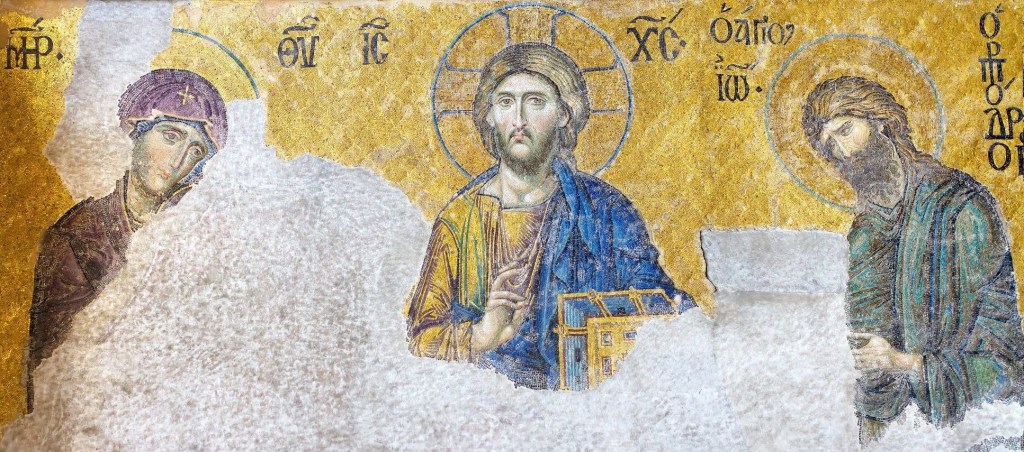
DeLee: Icon of Christ, acrylic on woven canvas , 2022.

The version in the Louisiana law matches the wording on the Ten Commandments monolith that stands outside of the Texas State Capitol in Austin. It was given to the state in 1961 by the Fraternal Order of Eagles, a more than 125-year-old, Ohio-based service organization with thousands of members. In 2005, a divided U.S. Supreme Court ruled it did not violate the constitution and could stay.

The Eagles organization notes on its website that it distributed about 10,000 Ten Commandments plaques in 1954. The organization also partnered with the creators of “The Ten Commandments” to market the film, spreading public displays of the list around the country.

“It’s significant that the Louisiana law uses the same text created for ‘The Ten Commandments’ movie promotions by the Fraternal Order of Eagles and Paramount Pictures because it reminds us that this text isn’t one found in any Bible and isn’t one used by any religious faith,” Kruse said via email. “Instead, it’s a text that was crafted by secular political actors in the 1950s for their own ends.” Kevin M. Kruse is the author of “One Nation Under God: How Corporate America Invented Christian America” and a history professor at Princeton University.

Unknown Flemish Artist: God speaks to Moses while the people worship the golden calf, colored ink and gold leaf on parchment, 1372, National Library of the Netherlands.

The actual biblical Ten Commandments are spiritual and can bring us closer to understanding God’s relationship with God’s chosen people during their wilderness journey. We can learn about boundaries, justice and mercy. Also we learn God wants us to be imitators of God’s nature, something that’s missing in the movie version of the Ten Commandments. The movie commandments are a Reader’s Digest version of the Biblical commandments and miss the grace of God entirely.

For Benjamin Marsh, a North Carolina pastor watching the Louisiana law, his primary concern is people’s spiritual formation, so altering the Ten Commandments is worrisome to him. “The problem with changing the text of the Ten Commandments is you rob the spiritual implications of the actual biblical text. So you’re giving some vague likeness to the Ten Commandments that isn’t the real thing,” said Marsh. He leads First Alliance Church Winston-Salem, which is part of a conservative evangelical denomination.

So I offer these two versions below for you to read. I believe the placing of the Ten Commandments in the schools in these states has less to do with “religion” than with culture wars, which these politicians hope to use to their advantage. If we see these in our communities, we should ask for comparative religions to be taught, or none at all. I find the misuse of scripture abusive. This isn’t what we should be doing to vulnerable children. We should give them a God who loves, cares for, and provides for their needs. The Ten Commandments in the school houses is like having a cop in the classrooms.

FROM THE MOVIE, “The Ten Commandments:”

The Ten Commandments I AM the LORD thy God. Thou shalt have no other gods before me. Thou shalt not make to thyself any graven images. Thou shalt not take the Name of the Lord thy God in vain. Remember the Sabbath day, to keep it holy. Honor thy father and thy mother, that thy days may be long upon the land which the Lord thy God giveth thee. Thou shalt not kill. Thou shalt not commit adultery. Thou shalt not steal. Thou shalt not bear false witness against thy neighbor. Thou shalt not covet thy neighbor’s house. Thou shalt not covet thy neighbor’s wife, nor his manservant, nor his maidservant, nor his cattle, nor anything that is thy neighbor’s.

FROM KJV: Exodus 20:2-17

I am the LORD thy God, which have brought thee out of the land of Egypt, out of the house of bondage. Thou shalt have no other gods before me. Thou shalt not make unto thee any graven image, or any likeness of any thing that is in heaven above, or that is in the earth beneath, or that is in the water under the earth: Thou shalt not bow down thyself to them, nor serve them: for I the LORD thy God am a jealous God, visiting the iniquity of the fathers upon the children unto the third and fourth generation of them that hate me; And shewing mercy unto thousands of them that love me, and keep my commandments. Thou shalt not take the name of the LORD thy God in vain; for the LORD will not hold him guiltless that taketh his name in vain. Remember the sabbath day, to keep it holy. Six days shalt thou labour, and do all thy work: But the seventh day is the sabbath of the LORD thy God: in it thou shalt not do any work, thou, nor thy son, nor thy daughter, thy manservant, nor thy maidservant, nor thy cattle, nor thy stranger that is within thy gates: For in six days the LORD made heaven and earth, the sea, and all that in them is, and rested the seventh day: wherefore the LORD blessed the sabbath day, and hallowed it.

Honour thy father and thy mother: that thy days may be long upon the land which the LORD thy God giveth thee. Thou shalt not kill. Thou shalt not commit adultery. Thou shalt not steal. Thou shalt not bear false witness against thy neighbour. Thou shalt not covet thy neighbour’s house, thou shalt not covet thy neighbour’s wife, nor his manservant, nor his maidservant, nor his ox, nor his ass, nor any thing that is thy neighbour’s.

Joy, peace, and time to read your Bible,

Cornelia

Louisiana Ten Commandments law raises preferential treatment concerns | AP News

https://apnews.com/article/ten-commandments-louisiana-public-schools-religious-views-7c4af860da21df52c304346fab76c4ae

Fraternal Order of the Eagles

https://www.foe.com/About-The-Eagles/History

Rabbit! Rabbit!

arkansas, art, autumnal equinox, Children, Christmas, Civil War, Constitution, Declaration of Independence, elections, Fall Equinox, Family, holidays, Imagination, inspiration, Labor Day, perfection, photography, rabbits, St. Patrick’s Day, summer vacation, texas, US Constitution

Rabbits under a Harvest Moon

September marks the return to order and organization, since the summer for most of us meant a relaxation of rules and schedules. “Vacay mode” of late mornings, pajama days, and snack meals are now a fading figment of our fevered frenzies. I remember these days all too well. My little girl threw a conniption fit one morning as I hurriedly dressed her so we wouldn’t be late for her pre-k class and my teaching assignment at the same school. We dashed out of the house, I locked her in the car seat, and flew to my workplace. I delivered her to the precare room and made a beeline for my art shack.

Two Types of Teachers

Later on at lunch, her teacher informed me I’d brought my fussy child to school without panties. Oops! Luckily, all the children were required to have a spare change of clothes “just in case of emergency.” Saved by those who are more organized than most. My art classroom always had the paint organized by rainbow colors, the scissors numbered, and shelves labeled. The moral of this annecdote is, “Innanimate objects are easy to organize; people not so much.” Murphy’s Law also comes to mind: “Anything that can go wrong will go wrong,” and Murphy’s First Corrollary: “It will cause the most damage possible.”

For Bunnies, maybe…

In the “No Pants Scandal,” of four decades ago, only my pride was injured. I’m not as organized or as perfect as I thought I was. This brings me to a little chat on appearances vs. our true selves. Our “false self” wants to appear organized, on top of things, spiritual, magnanimous, and virtuous. We’d like to be “perfect” in thought and deed. Yet the more we try to attain perfection or to act perfectly, the more likely dark, hateful, or mean thoughts arise from the depths of our hearts. We see this is our dualist world view, which divides our world into pure evil or pure good. The book of Proverbs reminds us, “Pride goes before destruction, and a haughty spirit before a fall” (16:18). It’s always better to admit, as I did, “I didn’t have a great morning and she wasn’t cooperative. I’m surprised we got here at all.”

Welcome to September 2023

Speaking about regular and organized, our earth is about to have another equinox on September 23, 2023, at 1:50 am CDT. The Fall Equinox happens yearly on or around September 22nd. The date of the fall equinox is variable because the 365 day Gregorian calendar doesn’t match up perfectly with the position of Earth in its orbit around the sun. When we add the leap year, the equinox date also changes. While the September equinox usually occurs on September 22 or 23, it can very rarely fall on September 21 or September 24. A September 21 equinox has not happened for several millennia. However, in the 21st century, it will happen twice—in 2092 and 2096. The last September 24 equinox occurred in 1931, the next one will take place in 2303. This rabbit won’t be around for any of these rare events, so don’t send me an invite.

Rabbits on the Playground

The September 29 full moon occurs at 4:57 AM CDT. It’s called the Harvest Moon in some years, or the Hunter’s Moon in other years. Technically, the Harvest Moon, which is the Anglo-Saxon name, is the Full Moon closest to the September equinox on September 22/23. The Harvest Moon is the only Full Moon name determined by the equinox rather than a month. Most years, it’s in September, but around every three years, it falls in October. We also know this September full moon as the Corn Moon from the Native American tribes harvesting their corn in this time. Other names for this month’s full moon are Celtic and Old English names: Wine Moon, Song Moon, and Barley Moon.

E. Irving Couse: Harvest Moon

Just as summer’s laissez-faire moments will give away to school and work routines, so the onset of autumn and the fall equinox herald another change. You might not yet recognize it over the insistent hum of your air conditioning system or feel it due to the heat waves rising from the black asphalt of your company’s parking lot, but autumn is just around the corner.

ERCOT Service Zones cover most of Texas

Don’t look at your utility bill just yet, and don’t pack your bags for Texas. I talked to my brother down there who has his AC set to “stun”—he said when the bill comes, “It will stun him a second time.” Texas doesn’t belong to the national energy grid, but to ERCOT, the Electric Reliability Council of Texas. It’s not connected to the two major electrical systems of the lower 48 states, but has its own grid to avoid federal regulation. When Thomas Edison started the first electric power plant in Manhattan in 1882, he set off a gold rush of independent power companies. During WWI, they began to unite and even more joined after WWII.

Don’t Mess With Texas

Texas takes seriously its “Don’t mess with Texas” rhetoric. Only on rare, catastrophic instances has it briefly joined either the American or Mexican utility grids. While Texas is a large state with rich energy resources, the USA is larger. When extreme weather events happen, energy costs rise. Rates can vary wildly as a result. The economic lesson is ERCOT is Dollar Store trying to outbid the Walmart of the national grids who can share energy with those in need.

Thomas Nast: The Lightening Speed of Honesty, 1877

Speaking of nations, on September 7, 1813, the United States got its nickname: Uncle Sam. Samuel Wilson from New York, a meat supplier to the US Army, stamped his barrels with US for United States. The soldiers began calling their rations “Uncle Sam’s,” a name the local newspaper noted, which began to spread and soon became the personification of the federal government. Thomas Nast (1840-1902) popularized the image of Uncle Sam. In Nast’s evolving works, Uncle Sam acquired the white beard and the stars-and-stripes suit we associate with the character today. The satirical cartoon of yesteryear’s dithering Congress is apropos of our modern chambers, which can’t seem to come a reasonable compromise to get the people’s business done by funding our country’s basic needs.

Columbia, The Gem of the Ocean

Over a century before Uncle Sam, Columbia was an idealized feminine figure that personified the new nation of America. She was created in 1697 when Chief Justice Samuel Sewall of the Massachusetts Bay Colony wrote a poem that suggested the American colonies be called Columbina, a feminized version of Christopher Columbus’ last name. Over 70 years later, the name evolved further when former slave, Phillis Wheatley, wrote an ode to George Washington invoking Columbia in 1775. Born around 1753, Phillis Wheatley was the first black poet in America to publish a book. She was listed among the enslaved persons at Mount Vernon. You can read her amazing poem here:

His Excellency General Washington by Phillis Wheatley— https://poets.org/poem/his-excellency-general-washington

Over time, the image of Columbia became a symbol for American ideals during wars, such as the American Revolution, the War of 1812, and World War I, as well as the subject of political cartoons and literary works. With her liberty cap and patriotic shield, Columbia stood as the spirit of the country. We even see her name, image, and likeness in modern industry in the Columbia Broadcasting System or CBS, as well as in the seat of our national government, the District of Columbia.

Well Done Labor Poster

Uncle Sam also has honored workers on Labor Day, which we celebrate on September 4th. Many rabbit families treat this three day weekend as the last hurrah of summer. Let’s remember those essential workers who serve and protect the rest of us while we barbecue in our backyards and national parks. The first Labor Day “parade” in 1882 was a strike. Workers marched en masse from New York City Hall to Union Square to protest terrible working conditions during the Industrial Revolution. Workers, including children as young as five years old, labored in unsafe factories, farms, mills and mines for 12 hours or more per day, seven days a week, often without breaks, fresh air or even clean water.

Credits: NASA’s Goddard Institute for Space Studies

This map shows global temperature anomalies for July 2023 according to the GISTEMP analysis by scientists at NASA’s Goddard Institute for Space Studies. Temperature anomalies reflect how July 2023 compared to the average July temperature from 1951-1980.

Only 5 States Provide Heat Relief Laws for Workers. Arkansas doesn’t protect workers from dangerous heat inside or outside.

Today, 141 years later, during the hottest July since 1880, some states are passing laws to prevent workers from getting “special treatment due to the heat” such as extra breaks for cooling or water. Currently only five states have protections for workers in these extreme conditions. According to the U.S. Bureau of Labor Statistics, between 1992 and 2019, extreme heat killed more than 900 workers and sickened tens of thousands more. Those numbers, however, are likely an undercount due to the lack of reporting by negligent employers or by workers who are worried about retaliation or deportation. In addition to the physical implications, time off from a job due to illness can lead to missed wages or the loss of a job altogether.

Bain photograph: LC-USZ62-49516: Four women strikers from Ladies Tailors union on picket line during the “Uprising of the 20,000,” garment workers strike, New York City, 1910 February, glass negative photo, Library of Congress.

As a rabbit who once endured a few days in an unairconditioned art shack at the beginning of school and then fainted from heat exposure, I have a heart for all workers in extreme circumstances. I made sure to take care of my people, since my bosses didn’t care about me. It’s never right to treat others poorly just because you were wronged.

Reading The Constitution Online is also an Option

In late September, we celebrate Constitution Week (Sept. 17-23). The Declaration of Independence, written in 1776, was a list of grievances against the king of England and intended to justify separation from British rule. The Constitution was written and signed in 1787. It was a charter of government ratified by the states, and continues to be the supreme law of the land. All members of the armed services and Congress take a vow to defend the constitution, as do the President and Vice President of our country.

We rabbits will all need to brush up on our civics lessons in the days to come, for the upcoming presidential candidates may be affected by their lack of appreciation for the constitution and the consequences as a result. As I always told my students, “Attitudes drive Behavior and Behavior leads to Consequences. You can choose the good or the negative. It’s all up to you. Try for a good attitude every day.”

Tales of a Bunny Who Went to School

The 14th Amendment, section 3, passed after the Civil War, or the last great insurrection by the southern secessionist states, forbids holding office in the US government by former office holders who then participate in insurrection or rebellion. This constitutional provision is currently being tested in the courts. September is back to school for all us rabbits. The last time I remember a civics lesson was the seventh grade in Mrs. Tampke’s class, but “ex post facto” might have been “non sequitur,” as I was passing notes rather than paying attention.

Mr. Flopsy’s Rabid Rabbit Pirate won’t be Messed with.

We rabbits can only take so much seriousnes in our short lives until we need a break. Thank you September 19th: International Talk Like a Pirate Day! Everyone can ARRGG their way MATIES through a Tuesday, and if Monday is a pain, who says we rabbits can’t Pirate on that day too? After all, pirates rob and steal, lawless vagabonds that they are. Let’s just take over the good ship Monday and drink our strong Pirate Coffee with vigor and daring.

The Bluebird of Happiness

National Bluebird of Happiness Day is September 24th. I love these little blue glass figurines. Dorothy in the Wizard of Oz sings, “If happy little bluebirds fly beyond the rainbow, why, oh, why can’t I?” Bluebirds uplift the heart into joy when we see them in nature. The blue glass iconic sculptures, made in Arkansas by the Ward family, have sold over 9 million birds, large and small. They’re no longer made due to concerns about climate change because the glass production process requires large amounts of natural gas and electricity. I treasure the blue bird in my possession and greet it daily. You might find one in a secondhand store.

God Please Keep My Children Safe, by Grayson Perry, 2005

Love Note Day is September 26, so I suggest you write a sweet letter to your beloved. This might be a spouse, significant other, parent, mentor, or even your own self. Share some affirmations to those who mean something to you. Don’t stop at one note of love, but make a whole symphony of blessings. In our world today, folks don’t hear many positive messages. You can help balance the scales for your recipients.

If the Sears Catalog were still a thing, we bunnies would be wishing

September 30, the last day of this month marks 92 days left in 2023. Where has this year gone?! Don’t ask this rabbit. I’ve already bought a couple of little Christmas gifts for my bunny friends. I’m never this organized. This means I’ll likely lose or misplace these items in the 86 days before Christmas Day. Then again, this is also enough time for this rabbit to find these packages once again! Live with optimism! Expect the best and work for it.


May the Blue Bird of Happiness bring you

Joy and Peace,


Cornelia


The September Equinox

https://www.timeanddate.com/calendar/september-equinox.html


Traditional Full Moon Names

https://www.timeanddate.com/astronomy/moon/full-moon-names.html


Why does Texas have its own power grid? | The Texas Tribune
https://www.texastribune.org/2011/02/08/texplainer-why-does-texas-have-its-own-power-grid/


How The United States Got its Nickname

https://www.history.com/this-day-in-history/united-states-nicknamed-uncle-sam


The lightning speed of honesty [Uncle Sam seated on snail “45th Congress” carrying Army and Navy payroll and money, with Resumption Act (of honesty) in his pocket] / Th Nast.
https://loc.getarchive.net/media/the-lightning-speed-of-honesty-uncle-sam-seated-on-snail-45th-congress-carrying


Database of Mount Vernon’s Enslaved Community · George Washington’s Mount Vernon
https://www.mountvernon.org/george-washington/slavery/slavery-database/


Heat Stress Is Killing Workers. States Can Protect Them.

https://www.nrdc.org/stories/heat-stress-killing-workers-states-can-protect-them


Short Summary—The Character to Lead: Republicans’ Fork in the Road Between Trump and the Constitution’s Eligibility Requirements for President

https://www.justsecurity.org/87750/the-character-to-lead-republicans-fork-in-the-road-between-trump-and-the-constitutions-eligibility-requirements-for-president/


Deep Dive— The Sweep and Force of Section Three. 172 U. PA. L. REV. (forthcoming 2024). William Baude & Michael Stokes Paulsen. https://deliverypdf.ssrn.com/delivery.php?ID=791101027092090122082025003064104018105084007031052035109090080088105005086003018089043050055106031007050097096000078089031112025019027055033023110008092018116067055086024100075002015088106075126126082029114024094102088002003074126075030067104090009&EXT=pdf&INDEX=TRUE

U.S. Senate: The Senate’s First Act—the Oath Act and 1862 Ironclad Oath
https://www.senate.gov/legislative/landmark-legislation/oath-act.htm

Arkansas Bluebird of Happiness – Encyclopedia of Arkansas. https://encyclopediaofarkansas.net/entries/arkansas-bluebird-of-happiness-3822/


THE FLAGS OF MEMORIAL DAY

Abraham Lincoln, adult learning, Amanda Gorman, art, Civil War, Creativity, elections, Gettysburg Address, Imagination, Medical care, Memorial Day, Painting, pandemic

Our next to last art class before summer break was right before Memorial Day. I had my last cataract surgery on the Tuesday before, so Mike gave me a lift into class. I wasn’t quite ready to drive yet. I thought we’d be finishing the work we began last week, but that wasn’t on the program for the class. Time for an audible.

John Wesley wanted his clergy to be always ready at a moment’s notice to “pray, preach, move, or die.” We art teachers have always been able to think on our feet and pull a project out of thin air. High school debate team extemporaneous speaking events are excellent trading grounds for this life skill.

Childe Hassam (1859-1935): Flags on the Waldorf, oil on canvas, Amon Carter Museum, Ft. Worth, Texas.

Memorial Day is one of the official days for displaying the American flag. Arkansas Flag & Banner has an informative paragraph (6d) at the link below on the days to display the flag if you aren’t flying it daily. The origins of Memorial Day are shrouded in mystery, since at least 25 sites claim to be the first to decorate the graves of fallen soldiers. From Columbus, MS, on April 25, 1866, to Boalsburg, PA, in 1864, cities north and south claim the fame of being first to decorate soldiers’ graves.

On May 5, 1866, Waterloo, NY, held a ceremony to honor local veterans who fought in the Great War. Businesses closed and citizens flew their flags at half staff. Other sites were not citywide or were one time events. As a result, in 1966, Congress declared Waterlo, NY, the “birthplace of Memorial Day.”

Frederic Edwin Church: Our Banner in the Sky, ca. 1861,
Fine Arts Museums of San Francisco

The Civil War took the lives of 750,000 men, not counting those who lost limbs or minds as casualties of the war, according to J. David Hacker, a demographic historian at Binghamton University, who has raised the estimate of how many deaths there were in the American Civil War from just under 620,000. One of every four soldiers failed to return home. If this devastating war took place today, 7.5 million people would have died in the fighting. As a reminder, the scourge of COVID-19 has killed 1,123,836 people in the United States alone since 2019.

Of course, as our ability to preserve life improves, our reverence for life increases. We just disagree at which point in time life should be honored and respected, and which lives are worth honoring and respecting. Perhaps we’re just a people given to disagreement and division by nature, or our old wounds from this ancient conflict continue to fester and boil, so we pick new battles to fight with words, rather than blows.

1908 Decoration Day Card

America lost 1,190,085 total service members’ lives from 1775 to 1991. The ongoing Global War on Terror has yet to be accounted because it isn’t finished. Although they underestimated the number of Civil War casualties, this one home grown conflict was responsible for about half of the war deaths of all American service members. It was a cruel war, in a brutal age. Things we take for granted today—dog tags for identification, mobile army surgery hospitals, anesthesia, sanitary camp conditions, humane treatment of prisoners, nutrious rations, and other civilized practices—weren’t part of the Civil War experience. In the American Civil War, twice as many soldiers died of disease as from hostile action.

Jasper Johns: Flags, lithograph, 1967-68, MOMA, NY.

World War II was the first war to have more deaths caused from the battlefield than from other causes. Greatly improved public health in armies has lowered the toll of disease to a fraction of what it was in earlier centuries. Modern military medicine has now allowed larger and larger armies. In short, military medicine, while greatly improving the care of the individual soldier, has enabled nations to have bigger armies and greater wars. We see the unfortunate consequences of these improvements in the current aggressive Russian attempt to takeover an independent Ukrainian democratic state against its people’s will.

After several years together in our art class, Gail and Mike are both now open to making an artwork that presents an idea or an emotion, more than a representation of a form. Not everything has to be a photorealistic rendering of an object before us. We do this often enough to build our skills of seeing and drawing, but we also need to build our expressive skills also. As an example in the spiritual life, we can spend our days in intercessory prayer, but we also participate in contemplative prayer or meditation to exercise the less analytical ways we can meet God in prayer.

Mike: Freedom Flag

Mike went on vacation recently and had the opportunity to take an art class with a different instructor. He suggested Mike give up his dedication to the small brush, a comment I often make. Now he’s excited about the freedom of the large brush and is exploring this new tool and technique.

Gail’s Flag

Gail mixed the reds and blues to make violet, as if the colors of the flag were washing into to one another. Many artists have changed the colors of the flag, but kept the design, or they kept the colors and destroyed the design. This is artistic license or creative interpretation. We make our statements with our images. She also changed the stars into circles by using a sponge to put down the paint. It was a good day for experimenting.

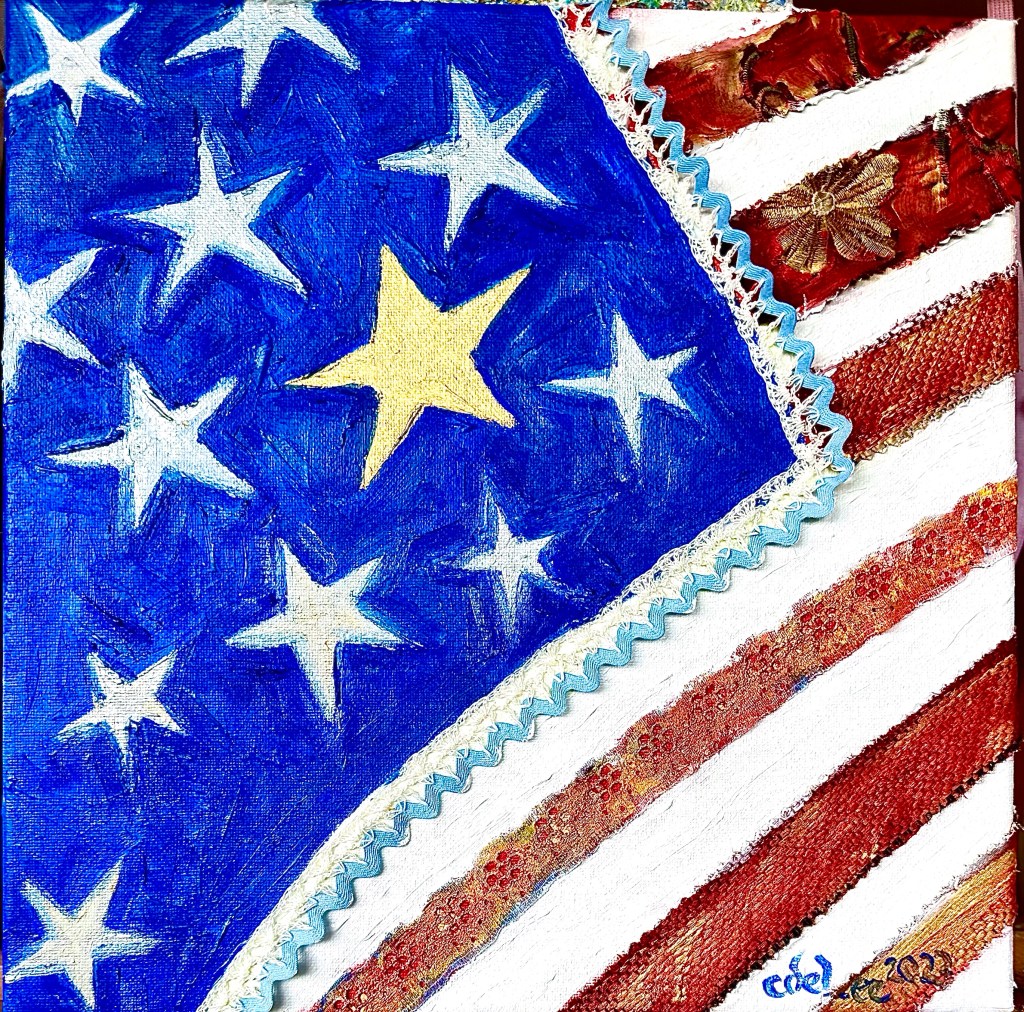
Cornelia DeLee: Gold Star Family Flag, acrylic with mixed media on canvas, 2023

I came home to finish up my painting with memories of visiting Civil War battlefields on my mind. I thought of those ancient days when families were able to identify their loved ones only by the special knit patterns of the socks on the bodies, or by the last letters to relatives pinned into their shirts. The Gold Star Mothers began during World War I when the mothers of fallen servicemen united to share their grief. By 1928, it was an official organization and the bereaved families were recognized with a pin.

Jasper Johns: Two Flags, lithograph, 1981, Phillips.

When I lived in San Antonio, I ocassionally visited the various military hospitals in town. There I saw the photos of the Medal of Honor recipients and read the summaries of their noble deeds. I always renewed my dedication to my less dangerous occupation afterward. Those who serve are a different breed from an ordinary person such as I. Perhaps Abraham Lincoln said it best in his 1863 Gettysburg Address:

“It is rather for us to be here dedicated to the great task remaining before us, that from these honored dead we take increased devotion to that cause for which they gave the last full measure of devotion, that we here highly resolve that these dead shall not have died in vain, that this nation, under God, shall have a new birth of freedom, and that government of the people, by the people, for the people, shall not perish from the earth.”

Gordon Parks, American Gothic, Washington, D.C., 1942.
Photo : Courtesy Gordon Parks Foundation

Amanda Gorman’s excellent 2021 inaugural poem, “The Hill We Climb,” has a section which echoes the sentiments of the post Civil War era, when Memorial Day celebrations first began:

We are striving to forge a union with purpose
To compose a country committed to all cultures, colors, characters and conditions of man
And so we lift our gazes not to what stands between us
but what stands before us
We close the divide because we know, to put our future first,
we must first put our differences aside
We lay down our arms
so we can reach out our arms
to one another
We seek harm to none and harmony for all
Let the globe, if nothing else, say this is true:
That even as we grieved, we grew
That even as we hurt, we hoped
That even as we tired, we tried
That we’ll forever be tied together, victorious
Not because we will never again know defeat
but because we will never again sow division
Scripture tells us to envision
that everyone shall sit under their own vine and fig tree
And no one shall make them afraid
If we’re to live up to our own time
Then victory won’t lie in the blade
But in all the bridges we’ve made
That is the promised glade
The hill we climb
If only we dare.

Howard Finster: Not Just A Piece Of Cloth, 1990

On this Memorial Day, over 150 years later, the wheels of justice are setting the sentences for the insurrectionists who attempted to impede the peaceful transfer of power to the newly elected government of the United States. We do well to remember the prescient words of Frederick Douglass, who said at Arlington National Cemetery on Memorial Day in 1871:

“We must never forget that victory to the rebellion meant death to the republic. We must never forget that the loyal soldiers who rest beneath this sod flung themselves between the nation and the nation’s destroyers.”

At 3:00 pm on Memorial Day, let’s pause for a moment and remember those who sacrificed body, mind, or life to keep our nation free, or to bring freedom to a nation that so desperately yearns for it.

Joy and Peace, and thanks to those who keep it for us,

Cornelia

United States, US Flag Code | FlagandBanner.com
https://www.flagandbanner.com/flags/united_states_flag_code.asp

The Origins of Memorial Day—US Department of Veterans Affairs
https://www.va.gov/opa/publications/celebrate/memday.pdf

Professor: Civil War Death Toll May Be Really Off : NPR
https://www.npr.org/2012/05/29/153937334/professor-civil-war-death-toll-may-be-really-off

United States – COVID-19 Overview – Johns Hopkins
https://coronavirus.jhu.edu/region/united-states

Veterans Affairs Fact Sheet America’s Wars 2019
https://www.va.gov/opa/publications/factsheets/fs_americas_wars.pdf

War, Medicine & Death – PMC
https://www.ncbi.nlm.nih.gov/pmc/articles/PMC9762220/

Gettysburg address delivered at Gettysburg Pa. Nov. 19th, 1863.| Library of Congress
https://www.loc.gov/resource/rbpe.24404500/?st=text

Rabbit! Rabbit!

arkansas, art, Astrology, Civil War, cosmology, elections, Faith, Forgiveness, haiku, inspiration, Lost Cause, Painting, Pi Day, rabbits, renewal, sleep, Spirituality, Spring Equinox, St. Patrick’s Day

Welcome to March 2023

This rabbit was shivering during the last week of February.

March is here and the wild hares of the rabbit clan have come to visit. I’m shivering on a cold, dreary, and rainy day, but I’m about to have a cup of steaming hot tea and put dinner on the stove. While I waited for the water to boil, I visited the open AI project out of curiosity. My old daddy used to say, “curiosity killed the cat,” but I think he was trying to keep me safe by not poking my nose into some dangerous places. Without curiosity, we never learn anything new or stretch our horizons. We’d live a sad, constricted life if we always stayed inside the lines and never pushed the boundaries.

The chat bot took my name and combined it with that of Cornelia Adele Strong Fassett, who painted the Florida Case Before the Electoral Commission, to describe the importance of “Cornelia DeLee, artist.” Also according to the chatbot, I am long dead, so I must be communicating from “yonder.” Fassett’s painting was about the contested presidential election of 1876.

The Florida Case before the Electoral Commission
Oil on canvas, by Cornelia Adele Fassett
This painting now hangs on the third floor of the Capitol.

In January, 1877, when the Electoral College met, 20 votes were contested, but neither side would concede the election. Congress passed a law empowering the Electoral Commission at the end of January. Ten days of deliberations passed before the 20 votes passed to the Republican candidate, an act which the Democrats protested until they received assurances federal soldiers would leave the Southern states. With Reconstruction at an end, Congress declared Rutherford B. Hayes the new President of the United States on March 2, only two days before his term began.

The Civil War and the Reconstruction years have marked our nation with an ongoing trauma, which has passed from generation to generation. At some point in time, we’ll have to heal, for continually pouring salt into that old wound will keep it festering and it won’t ever heal. Then we’ll pass it down to another generation once more. However, if scripture has any truth to teach us, humankind continues to reenact the sins of our ancestors, even when we know their stories and have the God given gifts of redemption from these shackles of death and shame. But now this rabbit is preaching, and some would say, “meddling once again.”

Update: Heather Cox Richardson, a noted writer of American history, reminds us once again how Southerners rewrite our history to make us more heroic and powerful. The Federal Army didn’t leave the south right away, but stayed in some states for awhile. See the note below.

I’ll change the subject. I’m not much on poetry, but I thought I’d ask ChatGPT to write a “Poem in Praise of March.” After all, World Poetry Day is March 21, so I thought I’d give the ChatAI a run for its money (it’s free right now, while in training stage). The Artificial Intelligence project was delighted to instantly produce the following example:

March, the month of windswept skies,
A time when winter softly dies.
The earth awakens from her sleep,
As days grow long and nights grow deep.

The snows of winter start to thaw,
And nature’s beauty starts to draw
A tapestry of green and gold,
As springtime’s treasures now unfold.

The birds return with joyful sound,
Their melodies now all around.
The trees bud out, the flowers bloom,
And life returns to end the gloom.

March, the month of change and hope,
A time to cast off winter’s scope.
The promise of new life and growth,
As nature’s beauty takes its oath.

So let us praise this month of light,
For all the wonders it brings to sight.
And may we cherish every day,
As we welcome spring in every way.

I was so amazed the Artificial Intelligence ChatBot could spit this out so quickly, I typed in, “Thank you.”

AI Enhanced Image by Jos Avery: Erik’s Escape

It immediately answered, “You’re welcome! I’m glad you enjoyed the poem. If you have any other questions or requests, feel free to ask!” I quickly closed the application before it became sentient and asked for my hand in marriage or social security number and tried to enroll me in a monthly cryptocurrency investment program. Yikes!

Speaking of poetry, even the folks at Bloomberg News are writing haikus about global food shortages:

Onion shortage looms.
Prices rise, nutrition wanes,
Governments take aim.

When I was a child, my brothers and I amused ourselves by lining up dominoes in artful patterns all morning long. After lunch and before our required afternoon nap, we’d touch the first domino in line, and have a wicked joy of watching our entire morning’s work fall one after another. A food shortage (or a toilet paper shortage) happens much the same way in our global economy. Onion prices are still soaring across the globe and fuelling inflation, so countries like Morocco, Turkey and Kazakhstan have taken action and secured supplies.

Close to 40kg of smuggled produce was discovered in the luggage of Philippine Airlines crew members on Friday.
(photo credit: PHILIPPINE CUSTOMS OFFICE VIA WALLA NEWS)

Because onion prices are going up due to scarce supply, the price of other fruits and vegetables (such as carrots, tomatoes, potatoes, and apples) also are rising and hampering their availability across the globe, according to the United Nations and the World Bank. In fact, prices have increased so much that onions briefly cost more than meat in the Philippines, and some flight attendants were caught smuggling them out of the Middle East.

This didn’t end well for either the attendants or the produce, since the food was sent out for destruction (it’s illegal to import food, except through proper customs) and the personnel got reprimands and retraining. Word to the wise: hoarding onions isn’t a good idea, since whole, raw onions will last two to three months when stored in a cool, dry place (between 45 and 55 degrees F). Places that provide these conditions may include your cellar, pantry, unheated basement, or garage. Usually, at room temperature, onions last only 2 to 3 weeks. Over the long term, the frugal shopper will buy some scarce items at a higher prices and other items at lower cost when the product is in season and at a surplus. The average price over a year will even out.

Former President Carter signing First Women’s History Week Proclamation

March is Women’s History Month. In February 1980, President Jimmy Carter issued the first Presidential Proclamation declaring the Week of March 8th, 1980 as National Women’s History Week. In 1987, Congress passed Public Law 100-9, designating March as “Women’s History Month.” Every president since then has recognized the gifts, graces, and achievements of America’s women by presidential proclamation. Other important women’s days in March we recognize are International Women’s Day (March 8), Harriet Tubman Day and National Women and Girls HIV/AIDS Awareness Day (March 10).


The Jewish celebration of Purim begins on March 6 at sundown and ends on the 7th at sundown. The festival recalls Queen Esther’s faithfulness to God and God’s saving providence for God’s marginalized people. We should always remember God’s grace is wider than ours, even if the faithful seemed to be “assimilating to the current culture.”

Sleep/wake/cycle

Daylight Savings Time begins March 12, with all of us rabbits settling our clocks forward one hour before we go to bed the night before. If you have difficulty remembering which direction, there’s a motto for this event: “Spring forward, and Fall back.” No one falls forward and springs back—silly rabbits maybe, but not the smart rabbits, who have the good sense to “Spring forward, and Fall back.”

National Pi Day March 14— Not all pies are square

The Ides of March 15 were bad luck for Julius Caesar, but originally the Ides of March once signified the new year, which meant celebrations and rejoicing. Two years before his death at an assassin’s hand, Caesar himself had changed the Roman calendar so the Romans celebrated the new year in January. Some people really don’t like change at all. Plus they don’t like military dictatorships.

People celebrate St. Patrick’s Day on March 17 all over the world, whether they’re Irish or not. While the San Antonio River runs green downtown, Hot Springs National Park will have its First Ever 20th Annual World’s Shortest St. Patrick’s Day Parade on the 98 foot long Bridge Street, which is the world’s shortest street in everyday operational use.

Map of Hot Springs St. Patrick’s Day Festivities

Spring Equinox on March 20 can’t come soon enough for this rabbit. Just knowing the light will become stronger with each passing day is a medicine for my spirits. So what if the pollen follows soon after? Eventually, that too will be history and we bunnies will find something else to fuss about. After all, nothing is certain except for change. None of us can stop the circuit of the stars in the heavens above or cease the changing seasons.

The Three Graces of Spring

We can adjust to these great cycles of change, just as we can grow in love for one another and learn to forgive both ourselves (for our falling short of perfection) and others for harming ourselves. If we rabbits wait till the last moment for our death bed reconciliations, we may not have the time or opportunity to make amends with the ones from whom we’ve estranged ourselves.

If you think you’ll be foolish doing this, I suggest you desensitize yourself and celebrate International Talk Like William Shatner Day on March 22. I asked ChatGPT for a haiku in the voice of William Shatner. On the third try, I got something I thought resembled his breathless cadence and broken phrase delivery. I could almost hear him emphatically delivering the words GO and MUST!

Breathless stars above,
Silent darkness, vast and deep,
Boldly go, we must.

Ramadan starts during the evening of March 23 and lasts until sundown on Thursday, April 20. Muslims commemorate the gift of the Koran to Muhammad by fasting if physically able, declaring their faith, prayers, charity, and pilgrimage..

BRITON RIVIÈRE, UNA AND LION, NINETEENTH CENTURY

Remember, if March comes in as a lamb, it will go out as a lion, or so the ancient weather proverb goes. The saying may have its origin in the stars, for at this time of year, Leo is the rising sign; by April, it’s Aries. (“Kid” or “ram” doesn’t have quite the same ring as “lamb,” though.) Also, this is the season Jesus arrives as the sacrificial lamb, but will return as the Lion of Judah. Both mean, weather-wise, a false spring.

The Beast with Two Horns like a Lamb by Albrecht Dürer We don’t want March to enter or exit in this Apocalyptic vision.

To sum up, as I finish up this note on the last day of February, the high today will be near 80F and I’ll most likely turn my air conditioner back on before March comes to visit. Looking ahead to March, the Weather Channel outlook has only three days in the 70’s for my location, so Mr. Air Conditioner won’t get much of a work out. I only see one night in the 30’s, so even Mr. Heater will get light workouts in March. As one wag put it on their restaurant sign:

That was February; I don’t think think we’ll see 80’s in March

Until next month, I hope you have onions and potatoes in abundance, and you enjoy green eggs and ham, or green beer, or green tea.

Joy, Peace, and welcome to Springtime,

Cornelia

NOTE from Heather Cox Richardson, Letters from an American, March 2, 2023—this corrects my research.

What did not happen in 1877, either before or after the inauguration, was the removal of troops from the South.

That legend came from a rewriting of the history of Reconstruction in 1890 by fourteen southern congressmen. In their book Why the Solid South? Or Reconstruction and Its Results, they argued that Black voting after the Civil War had allowed Black people to “dominate” white southerners and virtually bankrupt the region and that virtuous white southerners had pushed them from the ballot box and “redeemed” the South. Contemporaries had identified the end of Reconstruction as 1870, with the readmission of Georgia to the United States. But Why the Solid South identified the end of Reconstruction as the end of Republican rule in each state.

In 1906, former steel baron James Ford Rhodes gave a date to that process. In his famous seven-volume history of the United States, he said that in April 1877, Hayes had ended Reconstruction by returning all the southern states to “home rule.” In his era, that was a political term referring to the return of power in the southern states to Democrats, but over time that phrase got tangled up with what did happen in April 1877.

During the chaos after the election, President U.S. Grant had ordered troops to protect the Republican governors in the Louisiana and South Carolina statehouses. When he took office, Hayes told Republican governors in South Carolina and Louisiana that he could no longer let federal troops protect their possession of their statehouses when their Democratic rivals had won the popular vote.

Under orders from Hayes, the troops guarding those statehouses marched away from their posts around the statehouses and back to their home stations in April 1877. They did not leave the states, although a number of troops would be deployed from southern bases later that year both to fight wars against Indigenous Americans in the West and to put down the 1877 Great Railroad Strike. That mobilization cut even further the few troops in the region: in 1876, the Department of the South had only about 1,586 men including officers. Nonetheless, southerners fought bitter congressional battles to get the few remaining troops out of the South in 1878–1879, and they lost.

The troops did not leave the U.S. South in 1877 as part of a deal to end Reconstruction.

It matters that we misremember that history. Generations of Americans have accepted the racist southern lawmakers’ version of our past by honoring the date they claimed to have “redeemed” the South. The reality of Reconstruction was not one in which Black voters bankrupted the region by taking tax dollars from white taxpayers to fund roads and schools and white voters stepped in to save things; it was the story of an attempt to establish racial equality and the undermining of that attempt with the establishment of a one-party state that benefited a few white men at the expense of everyone else.

Clarence C. Clendenen, “President Hayes’ ‘Withdrawal’ of the Troops: An Enduring Myth,” The South Carolina Historical Magazine 70 (October 1969): 240-250.

Cornelia Adele Fassett | History of American Women
https://www.womenhistoryblog.com/2015/08/cornelia-adele-fassett.html

ChatGPT: Optimizing Language Models for Dialogue
https://openai.com/blog/chatgpt/

“Shortage of Onions Threatens a New Chapter in Global Food Crisis” by Bloomberg News

Onion shortage could trigger a global food crisis. Here’s what’s happening – India Today
https://www.indiatoday.in/business/story/onion-shortage-global-food-crisis-whats-happening-across-the-world-2339214-2023-02-24

Gnomologia: adagies and proverbs; wise sentences and witty sayings, ancient and modern, foreign and British : Fuller, Thomas, 1654-1734, comp :
Free Download, Borrow, and Streaming : Internet Archive
https://archive.org/details/gnomologiaadagi00conggoog

Here’s How Long Onions Last if You Store Them Properly
https://www.allrecipes.com/article/how-to-store-onions/

March Holidays and Observances 2023: Full Calendar
https://www.today.com/life/holidays/march-holidays-and-observances-rcna64226

Viral “Photographer” Reveals His Images Were AI-Generated
https://hyperallergic.com/803915/viral-photographer-reveals-his-images-were-ai-generated/

Reflections on America

Arches National Park, art, beauty, elections, Grand Canyon, Imagination, inspiration, nature, photography, renewal, Travel, US Constitution, vision, Walt Whitman

Today marks one week since our most recent election. Many races have been decided, while some are due for an automatic recount due to the close vote. At least one senate race will have a runoff between the top two candidates (Georgia), as some races haven’t been decided at all, since the vote counters took Veteran’s Day and Sunday off. Then we have all the legal, but late arriving mail-in ballots from the military and overseas residents. These too need counting. We’ll know the final, final results sometime after December 6th, when Georgia results are in.

Grand Canyon

Pundits on the left and right can give you commentary ad nauseam for the duration with breaking news alerts or standing up for what’s right(wing). They’ll talk demographics, policies, and statistics, but you won’t get that commentary here. I’m more interested in the deep derivations of the arcana of the day. Arcana is that mysterious or specialized knowledge, language, or information accessible or possessed only by the initiate —usually used in plural. The singular arcanus, is from the Latin, arca, chest. It was first used in the 15th century.

El Capitan, Yosemite National Park

Of course, the conspiracy mongers among us are busy weaving tales of hanky panky. As an aside, my spell check wants to make this phrase “hanky pancakes.” I’ll check in with Cornie’s Kitchen to see if there’s any special ingredient for making hanky panky pancakes. Hanky pank once referred to any of the various carnival games in which contestants might win small prizes for the exercise of simple skills (such as dart throwing). State Fair enthusiasts who succumbed to the barkers of carnival games might, if they were lucky, grab a few of these prizes, but as in casino betting, the wise player remembers the house usually wins. It’s an old word, dating from the 1840’s, maybe related to Hokey Pokey. Both these words referred to trouble making bordering on the illegal, if not out right against the law.

This is why your parents warned you not to run away and join a traveling circus or side show, as “There’s hanky panky going on there, child, and you’ll come to no good!” Not that I ever tied a peanut butter sandwich up in a bandana and walked away from home, or at least I got as far as that sandwich took me, which was to the end of the city block. Hot summer days can change a child’s mind about running away from home.

Big Oak Road, Yosemite National Park

Those trading in false tales were known as mongers, from which we get the word “costermongers,” or apple sellers. In the 1510s, “itinerant apple-seller” was formed from coster (a type of apple ) + monger (“to traffic in, deal in,” often implying a petty or disagreeable traffic, by 1897). The sense extended from “apple-seller” to “hawker of fruits and vegetables,” to any salesman who plied his wares from a street-cart. Contemptuous use is as old as Shakespeare: “Virtue is of so little regard in these coster-monger times, that true valour is turn’d bear-herd” (2 Henry IV), but the reason for it is unclear.

Arches National Park

But I come not to bury America, but to praise her, especially the American democratic project, which so far has earned the distinction of having the world’s longest surviving written charter of government. It was written in 1787, ratified in 1788, and has been in operation since 1789. We’ve celebrated 233 years of our unique brand of representational democracy. We aren’t ruled by mobs/anarchy, nor by a wealthy few/oligarchy, or even by one/autocracy, but by all who vote/democracy. As Whitman writes, we must be careful to distinguish between the “chosen” and the “act of choosing.” It’s not the winning candidate which represents the “heart”of our democratic achievement, but rather the “quadriennial choosing” itself.

Arches National Park

If you follow my musings, you’ve probably guessed Whitman is a favorite poet, and the varied landscape is a renewing and inspiring source of reconnecting with a creator God. I recently took a vacation to California and photographed some of our great national parks in the month I took off to see America. On my journey, I met generous, kind, and decent people everywhere I went. May God bless America and use her bounty and her people to bring peace and prosperity to the nations of the world. I hope my images do justice to Whitman’s words.

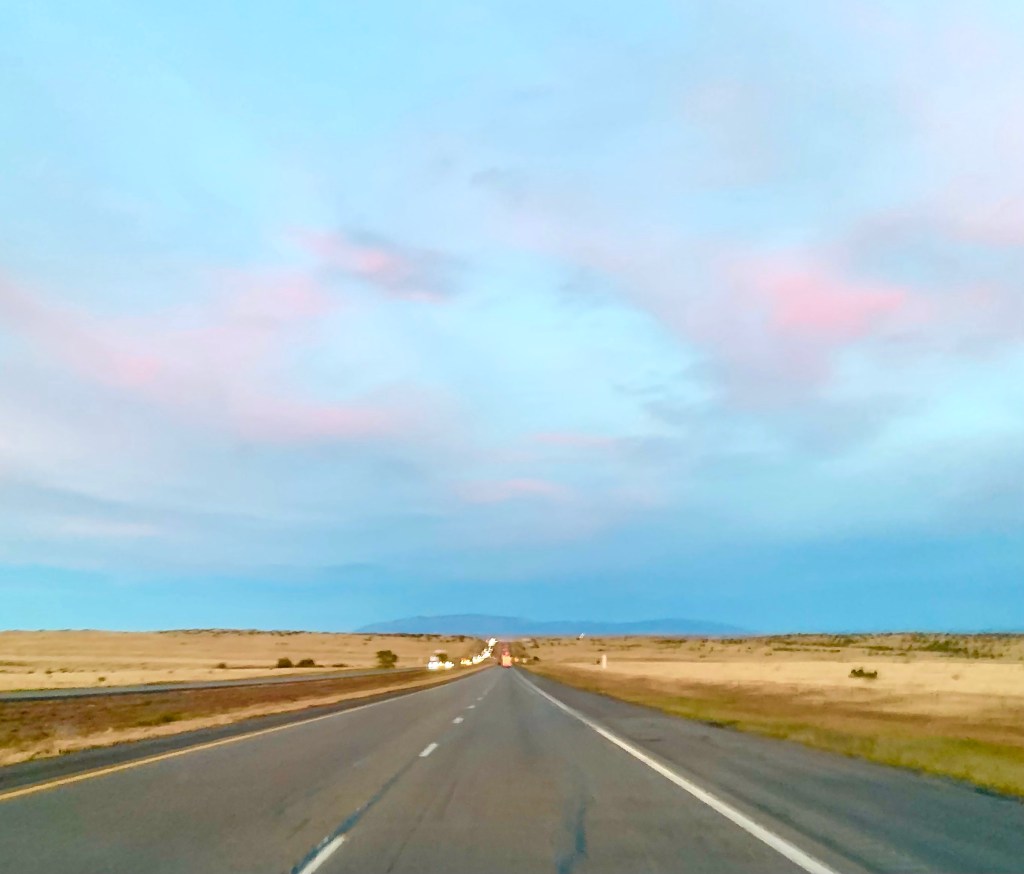
Headed to Albuquerque

Election Day, November, 1884
By Walt Whitman

If I should need to name, O Western World, your powerfulest scene and show,
‘Twould not be you, Niagara—nor you, ye limitless prairies—nor your huge rifts of canyons, Colorado,
Nor you, Yosemite—nor Yellowstone, with all its spasmic geyser-loops ascending to the skies, appearing and disappearing,
Nor Oregon’s white cones—nor Huron’s belt of mighty lakes—nor Mississippi’s stream:
—This seething hemisphere’s humanity, as now, I’d name—the still small voice vibrating—America’s choosing day,
(The heart of it not in the chosen—the act itself the main, the quadriennial choosing,)
The stretch of North and South arous’d—sea-board and inland—Texas to Maine—the Prairie States—Vermont, Virginia, California,
The final ballot-shower from East to West—the paradox and conflict,
The countless snow-flakes falling—(a swordless conflict,
Yet more than all Rome’s wars of old, or modern Napoleon’s:) the peaceful choice of all,
Or good or ill humanity—welcoming the darker odds, the dross:
—Foams and ferments the wine? it serves to purify—. while the heart pants, life glows:
These stormy gusts and winds waft precious ships,
Swell’d Washington’s, Jefferson’s, Lincoln’s sails.

Joy and Peace,

Cornelia

Walt Whitman: Election Day November 1884
https://poets.org/poem/election-day-november-1884

What does Hanky Panky mean?
https://writingexplained.org/idiom-dictionary/hanky-panky

Words related to monger
https://www.etymonline.com/word/monger/related

Shakespeare: Julius Caesar Speech, spoken by Marc Antony
https://www.poetryfoundation.org/poems/56968/speech-friends-romans-countrymen-lend-me-your-ears

NOTES: Whitman’s Election Day, 1884 https://pubs.lib.uiowa.edu/wwqr/article/26076/galley/134444/view/