Weaving is a metaphor for our life’s story and journey. We envision the weaver in charge of the colors, designs, and textures of the finished fabric. The weaver’s goal is to produce a beautiful product. We often think we are in charge of our own destiny, as “The Weaving Song” by Carolyn Hester, in which an old 1960’s era folk singer would sing:
Choose the right color And push the right tread
Throw through the shuttle And peg down the thread
Work is all laid Before your start
To make your own pallet Of bright hue or dark
The loom of life is moving The weaving is all your own
Choose the right color And push the right tread
Throw through the shuttle And peg down the thread
Rainbow of colors Is at your command
Choose all the right shades Offered in the stand
The loom of life is moving The weaving is all your own
Life’s but a grey And heavy with care
May blooms scarlet With couragе rare
The loom of life is moving Thе weaving is all your own.

Yet life doesn’t always work out the way we thought it would. The Bible says Job was the most righteous person of his era, and Job complains after losing everything and everyone:
“My days are swifter than a weaver’s shuttle and come to their end without hope.” (7:6)
This wisdom text reminds us sometimes the righteous suffer, even while the wicked prosper, but God is still God, and we will understand this mystery of God when we see God face to face. We call this “theodicy,” (from Greek theos, “god”; dikē, “justice”), or our explanation of why a perfectly good, almighty, and all-knowing God still permits evil to exist.
God gives human beings free will. We make our own choices in life, just as everyone else does. Since we don’t live in a universe of one, other people’s choices impact our choices. Imagine a pingpong ball tossed into a room filled with mousetraps all loaded with other pingpong balls. If one ball hits a loaded trap, it sets that ball off into motion and those balls set more balls into motion until chaos ensues! If more than one person is involved, some sort of disagreement is sure to follow. Some of us are even at odds with our own selves!
As the old joke goes, a solitary man was rescued from a desert island. On this island were several structures. When asked, he said, “That one was my house and that one was my church.” And the other building? “That was the church I used to go to!”

When life is chaotic, creative people find solace in the quiet of their chosen deserts: the studio, the workshop, or their favorite writing chair. While we artists have the illusion we can control the images we produce or the songs which bubble up from our hearts, in truth, what we create is a shared product with our heart, mind, and the creating spirit. If we begin to lose our humility about this shared process, we lose the creative energy underwriting our works.

We know this emotion as “pride,” and the ancient cultures warned against it. Throughout history, legendary and mythological figures have been used as examples of either virtue or a moral failing. The story of Arachne and Minerva is no different.

Attributed to Amasis Painter, 6th BCE, Greece, clay, Metropolitan Museum of Art, New York.
A 6th BCE Attic Black Figure Lekythos storage vessel attributed to the Amasis Painter shows the type of standing loom and the various shuttles of different threads a weaver would use for a fabric. Today we think of weavers sitting at their looms, but the ancients stood at their work.
Arachne was a mortal who excelled in the weaving arts: spinning her own yarn and selecting the correct colors to produce the beautiful images for the finished fabric. Minerva, the goddess of handicrafts and the Roman correlate to the Greek goddess Athena, had heard of Arachne’s prowess and her pride. Disguised as an old woman, Minerva visited Arachne to warn her not to disparage the gift of the gods. Arachne rebuffed her, and held her ground, even when Minerva revealed her true identity.

When the weaving contest began, both were even in technique and design. Minerva’s image was of the pantheon of the gods, but Arachne told the stories of the god’s mishaps with humanity. This angered Minerva, who struck Arachne with a weaver’s shuttle. Embarrassed, Arachne took a rope to hang herself, but Minerva had pity on her and changed her into a spider instead. We call spiders, ever weaving their gossamer webs, “arachnids” in her memory.

In Christian art, the theme of listening beside a well or spring is connected both to the angel’s annunciation to the Virgin Mary and to her weaving curtains for the Temple. The third-century Dura-Europos church baptistery has a fresco of a woman drawing water from a well, which Yale theologian Michael Peppard believes represents the Annunciation to Mary at a well, from a scene from the gnostic writing, Protevangelium-18.

Others think it represents the Samaritan woman at the well or Rebecca from the Old Testament. Because the fresco doesn’t include Jesus, the empty space instead represents “the bodiless voice” that Mary hears in the Protevangelium. Also, a five-pointed star appears on the woman’s torso, which could symbolize the new child in her womb. The star in later iconography was repositioned to the shoulder of her mantle, and the water vessel survives all the way into the Renaissance art as a vase with flowers.

From The Protoevangelium of James, section 11: And she took the pitcher, and went out to fill it with water. And, behold, a voice saying:
“Hail, you who hast received grace; the Lord is with you; blessed are you among women!” (Luke 1:28) And she looked round, on the right hand and on the left, to see whence this voice came. And she went away, trembling, to her house, and put down the pitcher; and taking the purple, she sat down on her seat, and drew it out. And, behold, an angel of the Lord stood before her, saying: “Fear not, Mary; for you have found grace before the Lord of all, and you shall conceive, according to His word.” And she hearing, reasoned with herself, saying: “Shall I conceive by the Lord, the living God? And shall I bring forth as every woman brings forth?” And the angel of the Lord said: “Not so, Mary; for the power of the Lord shall overshadow you: wherefore also that holy thing which shall be born of you shall be called the Son of the Most High. And you shall call His name Jesus, for He shall save His people from their sins.” And Mary said: “Behold, the servant of the Lord before His face: let it be unto me according to your word.”
This apocryphal Greek text, which was first written in the 2nd CE, with Syrian revisions into the 5th CE, is important because it increases our insights into women’s history, the childhood history of Jesus, Jewish-Christian relations, and the impact of Christian apocrypha on Islamic origins. This text, which contains the infancy narratives of the Virgin Mary, John (the Baptist), and Jesus is the source many of the Western Catholic and Eastern Orthodox religious feast days. Moreover, it’s also the origin for the icons representing the birth of Jesus in a cave.

A similar Marian birth narrative, The Gospel of Pseudo-Matthew, gives more details on the life of the Virgin, the miracles surrounding her marriage and the birth of Christ. It also tells the story of the Annunciation in two visits rather than one. The angel’s first greeting is beside a fountain and the second is inside while Mary is weaving the curtains for the Temple.

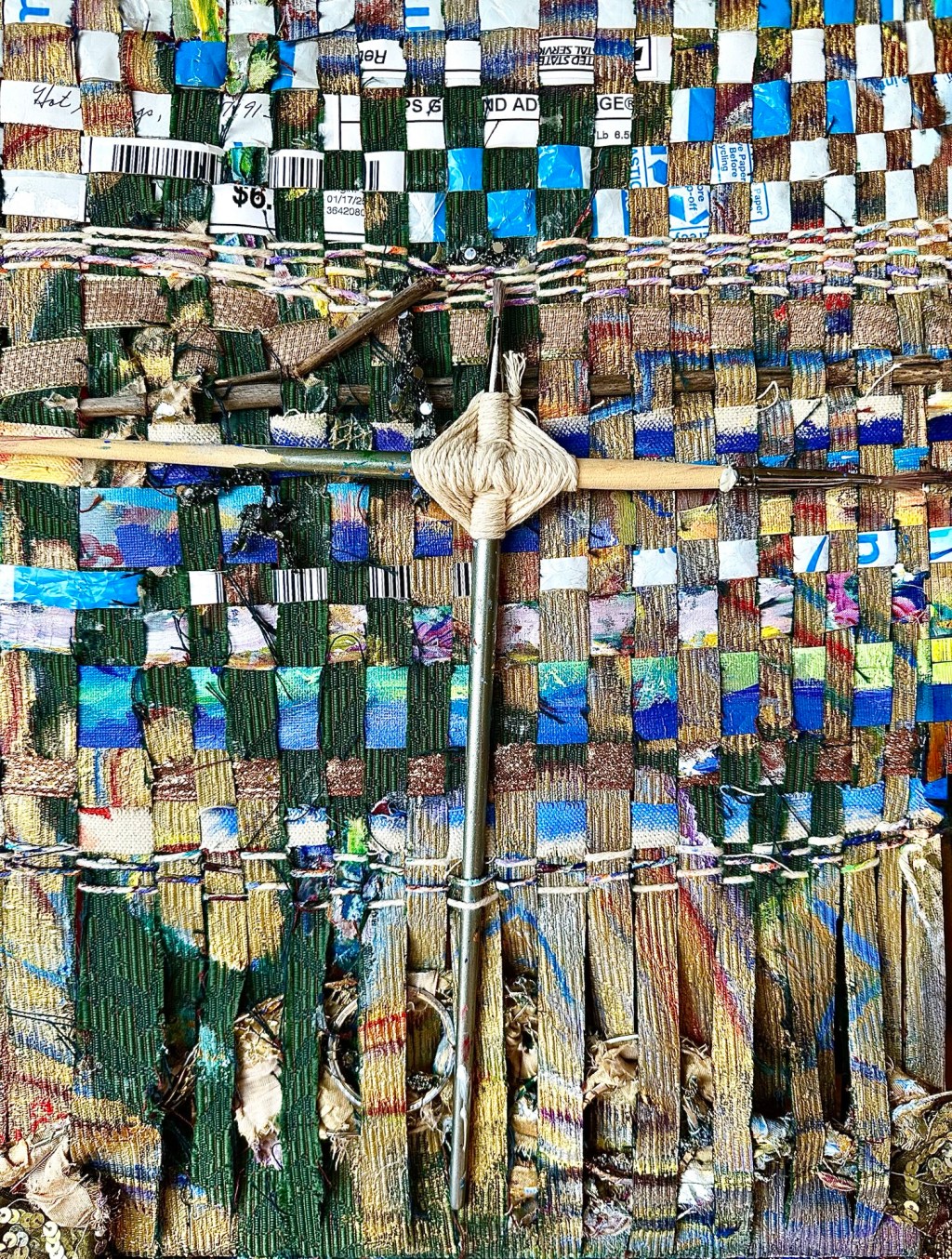
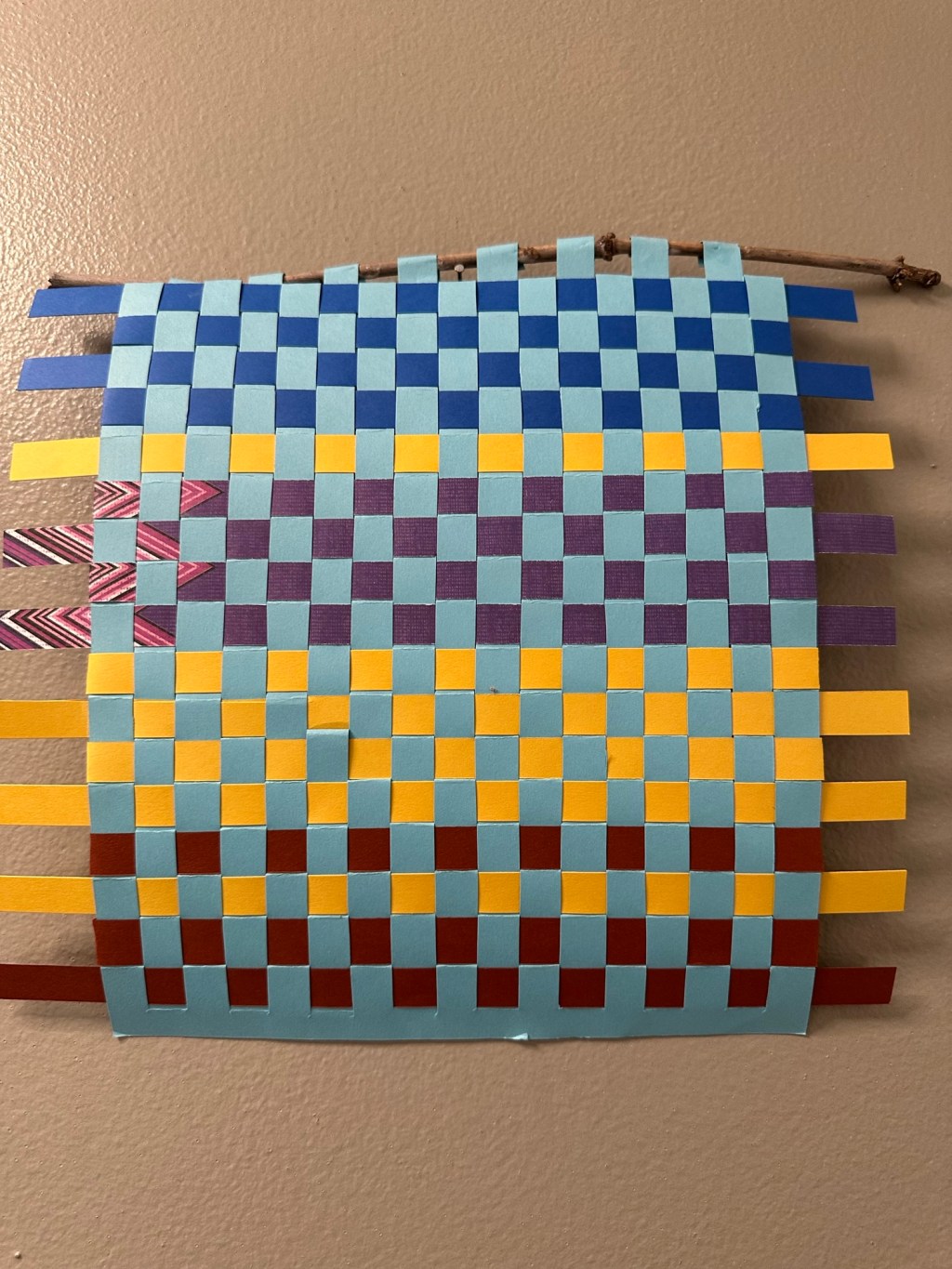
When I was on a recent Five-Day Academy for Spiritual Formation retreat, one of our hands on projects was a small weaving. Our package had a small loom, some yarn to weave with, and beads to attach. Of course I had to use a second packet to finish out my weaving because I tightened the horizontal rows more tightly than the organizers thought the regular attendees would do with their yarns and ribbons.
I also had my eye on a nice lichen covered branch to use as a hanging support. When I picked it up, it had red ants on it. I had to do some mad shaking to get them off! Anything for art! During one of our quiet reflection sessions, I sat beside a small lake under a pavilion to let my hands work. I’ve always needed a quiet space to process the flood of ideas and the rush of emotions when meeting new people and hearing new ideas. I operate as an extrovert, but when I get full to overflowing, I need quiet to recreate and recharge. I find new power in the admonition of Psalm 46:1-6—
God is our refuge and strength,
a very present help in trouble.
Therefore we will not fear, though the earth should change,
though the mountains shake in the heart of the sea;
though its waters roar and foam,
though the mountains tremble with its tumult.
Selah
There is a river whose streams make glad the city of God,
the holy habitation of the Most High.
God is in the midst of the city; it shall not be moved;
God will help it when the morning dawns.
The nations are in an uproar, the kingdoms totter;
he utters his voice, the earth melts.
The LORD of hosts is with us;
the God of Jacob is our refuge.

Diedrick Brackens, “prodigal” (2023), cotton and acrylic yarn
When my hands touch the different textures of the threads, and I let my spirit work with the creating Spirit of the word and world, I can shed all the strain and stress of being on a different schedule from traveling, having nerve pain in my neck from a bulging disk, and more interaction than I’m used to since I no longer work.
I always fought to carve out quiet times when I was in active ministry, for listening to God is the first calling of any leader worth their salt. I knew I wouldn’t hear God’s voice in the pell mell rush and cacophony of our world. The disembodied voice is more likely to come to us when we’re alone or in a receptive moment. It’s important to note Mary was one of the virgins of the House of David chosen to weave the curtains for the Temple in Jerusalem, according to The Protoevangelium of James, section 10. She was busy, but working for her God. It was when she took a break to draw water from a life giving well that she heard the messenger from God.

When I was appointed to a church, I always had a list of tasks to do, but I often never completed them because God would send “interruptions” to my well laid plans for the day. After several years, I began to understand these interruptions were my real tasks of ministry for the day. We have plans, but God has a better plan.
The prayer in my weaving supplies was appropriate for me on this retreat:
Teach us to listen, O Lord.
Quiet the noise of our lives
so we can hear your voice. Amen.
After several weeks, I’ve come back to finish this blog. In the meantime I’ve had anterior cervical discectomy and fusion for my neck pain and numb fingers. It’s for the bulging neck disk that causes pressure on the spinal cord. If this happens in the lower back, a person gets sciatica and numbness in the legs. In the neck,the same condition affects the arm and hands. I feel better than I did before, so I’m thankful for all healing mercies. I have to be careful not to overdo my activities. The instructions “Don’t do housework!” were gladly received.
I hope you seek out your quiet spaces and quiet moments to hear the sheer, still sounds of silence, the inaudible voice of our God.
Joy and peace,
Cornelia
NOTES:
Carolyn Hester: The Weaving Song, Track 10 on At Town Hall, One, Produced by Norman Petty, 1965.
Troubadour: Weaving Song: similar words to Hester coffee house ballad above. https://music.apple.com/us/album/weaving-song/400303687?i=400303767
Myth of Arachne https://www.worldhistory.org/Arachne/
Ally Kateusz: Mary and Early Christian Women: Hidden Leadership,1st ed., 2019, Kindle Edition
Annunciation or Samaritan Woman, Dura-Europos Baptistery
https://www.christianiconography.info/Wikimedia%20Commons/annunciationDura.html
Charles Bertram Lewis:”The Origin of the Weaving Songs and the Theme of the Girl at the Fountain,” PMLA, Jun., 1922, Vol. 37, No. 2 (Jun., 1922), pp. 141-18, Modern Language Association. http://www.jstor.com/stable/457
Susan B. Matthews: Dura Europos—The Ancient City and The Yale Collection, Yale University Art Gallery, 1982, Yale University Printing Service. https://artgallery.yale.edu/sites/default/files/publication/pdfs/ag-doc-2378-0002-doc.pdf
Camille Leon Angelo and Joshua Silver: “Debating the domus ecclesiae at Dura-Europos: the Christian Building in context,” Journal of Roman Archaeology 37 (2024), 264–303, doi:10.1017/S1047759424000126. https://www.cambridge.org/core/services/aop-cambridge-core/content/view/E76ED3AD86D09A74893368840DEDFA6A/S1047759424000126a.pdf/debating-the-domus-ecclesiae-at-dura-europos-the-christian-building-in-context.pdf
The Protoevangelium of James, section 11. https://www.newadvent.org/fathers/0847.htm
The Gospel of Pseudo-Matthew, section 9. https://www.newadvent.org/fathers/0848.htm
Horn, C. (2018). The Protoevangelium of James and Its Reception in the Caucasus: Status Quaestionis. Scrinium, 14(1), 223-238. https://doi.org/10.1163/18177565-00141P15