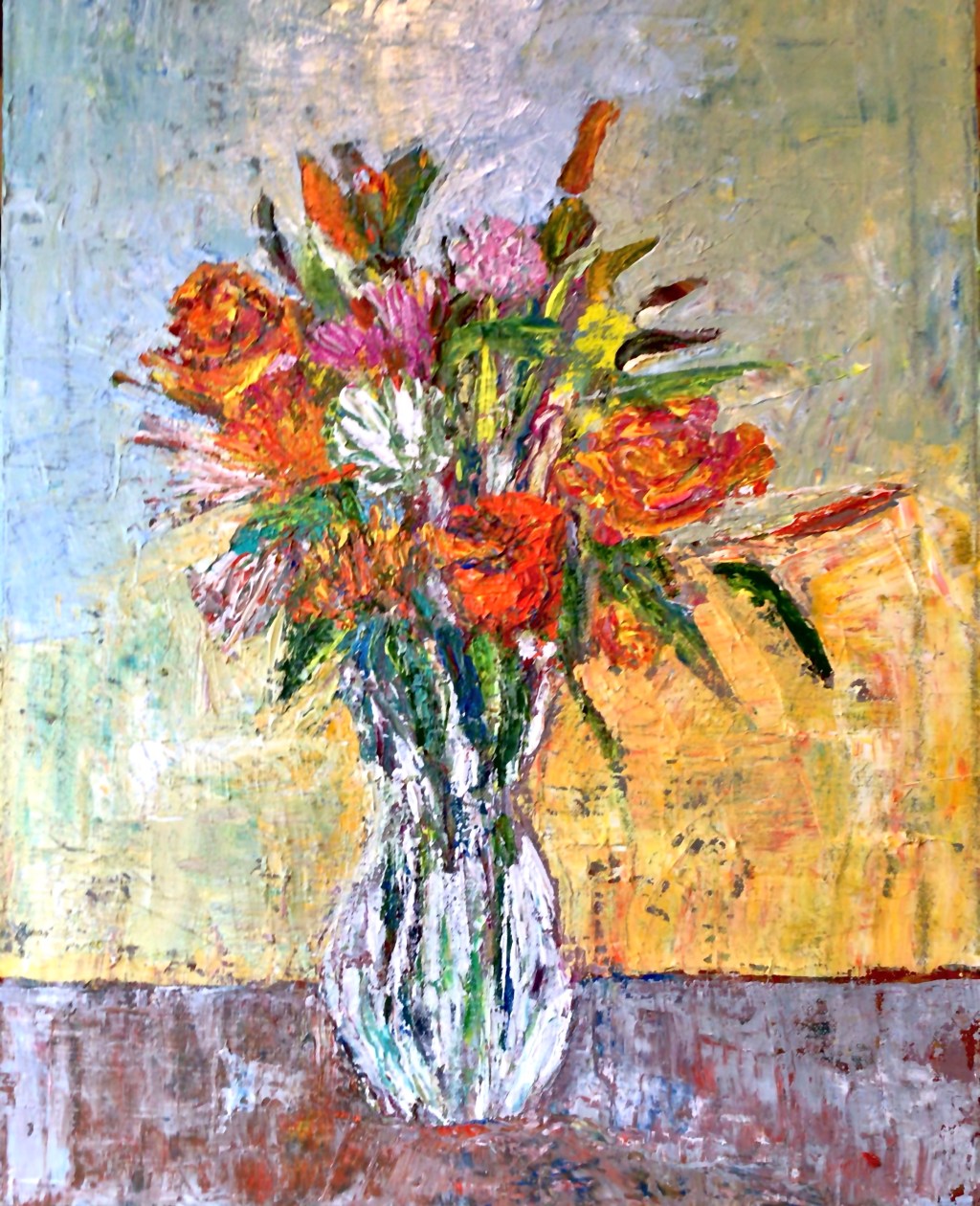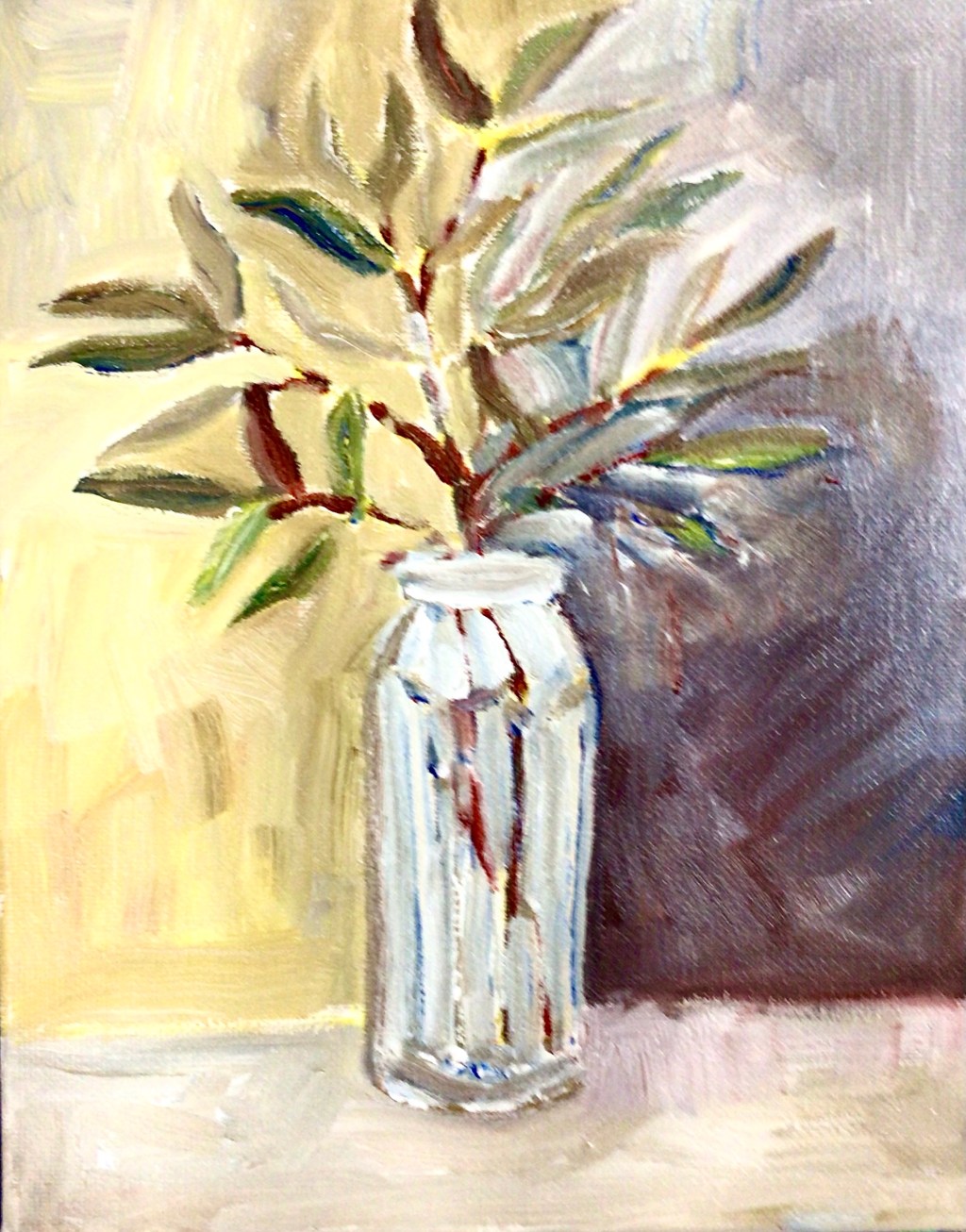
Simplify, Simplify, Simplify

adult learning, art, bottles, butterflies, Creativity, Faith, flowers, Icons, Imagination, nature, Painting, pre-diabetes, purpose, risk, Stress

When faced with a complicated task, what’s the first thing we need to do? I usually vote to have a cup of coffee and sit down to think about it. Some may call this procrastination, but I call it contemplation. I need to settle my mind, focus my senses, and discern the most important parts of my task. This is necessary, for if I were cutting off a limb from a tree, I’d sure want to get my body placed on the part of the tree that wasn’t going to fall. Keep the most important thing the first thing in mind is always the best practice.

Manet: Chrysanthemums and Clematis

Once our youth group from church went to the Appalachian Mountains for a mission work project. Most of our kids came from poor homes and we arrived in a single church bus, which for some reason the license plate hadn’t got renewed. The group even let me be the navigator. Only by the grace of God did we arrive, for I’m known to be directionally challenged among all my friends.

The other group who attended this session with us came with another truck, complete with all their own tools. Our children were despondent at first, for they felt they couldn’t “compete.” Our adult team leaders reminded them, “We’re here to do the work God has called us to do. This isn’t a contest. Everyone has value and all our work counts toward the greater good.”

Cross Stitch Motto from my Mother

That big, well provisioned group got the job of replacing a front porch and a roof. They divided up into a porch and roof team. The porch team finished first, but then they got mad when the roof team had to destroy their work to put the roof on right. They had failed to talk out an overall plan first. If the roofers had started on the porch end, then the porch team could come behind them and work would progress along properly.

This is called team work in groups. Our small group was experienced in talking out the process before we began working, so we knew the consequences of our actions. “If…then” is always an important consideration, especially in our artistic endeavors.

If we’re familiar with the work of Dr. Stephen R. Covey, he talks about putting first things first by organizing and executing around our most important priorities. We live and are driven by the principles we value most, not by the agendas and forces which surround us. Pleasing others isn’t God’s purpose for us, but to do God’s work of loving all and serving the least of God’s people.

Spider Plants in the Classroom

When we look at a landscape, we have to select the primary image to emphasize, and relate the other forms around this important image. In the still life, we might drive ourselves crazy trying to paint every single petal, pistil, and leaf of some flowers in a vase, or we could find the most important shapes, which give us enough visual cues to let the viewer say, “Yes, this is a flower painting.” Not every leaf needs to be given the same attention, since our goal is to make a painting, not a rendering of the subject before us.

Cornelia’s Spider Plant Painting, 2020

Some might ask, “Why do we return to this well worn theme from time to time?” The best answer is we continue to learn from our repeated exposure to this theme. For another, our drawing skills improve over time, so we can see our progress. Also, our ability to handle the paint gets better, so we are more comfortable with mixing our colors and planning our composition. Besides, the great artists over the centuries have found this discipline fruitful, so if it benefited them, most likely we’ll get some good from it also. My nanny’s wisdom comes clear here: “What’s sauce for the goose is sauce for the gander.”

Beauty Berry Plant

When faced with so many shapes of leaves, a central stem, and a glass vase with ridges and reflections, our untrained brain wants to explode. We have to catch our breath, inhale, and exhale to cleanse our nerves. This is the point we begin our first simplification. If we note the proportions, the leaves are about the same height as the vase, and we can set the vase on a plane (the table) so it has depth. We can mark these off on the bare canvas with light pencil or a light wash of yellow paint. We’ll paint over it later.

Cornelia’s Beauty Berry Painting, 2020

The next step of simplification is to get the basic lines and shapes down. These don’t have to be perfect, but give you an idea of where you’re going to paint. If you do this in a pale wash, you can paint over it with the heavier colors in the more exact form. In sculpture, Michelangelo was known for chipping away from the stone everything that didn’t look like his subject. In painting, we add color, tint, and shade until it looks like our subject.

Cornelia’s False Wild Indigo

The final stage of simplification is to get the background in. Here you can paint up close to the individual shapes and “clean up the edges.” You can add highlights in places to bring out the foreground shapes, and add a shadow in the background for variety. By this time, the vase ought to be dry enough to put highlights on it also. Notice the leaves aren’t all the same color and they don’t bend the exact same way. Nothing in nature is perfect, for each part grows according to the amount of sun, shade, and nutrients it receives. As one of my old teachers reminded me, “Nature has no straight lines, so you never have to worry about that.”

Daffodils from 2019

To show you how sustained effort and intentional looking over time can helps student’s work improve, I offer the following examples from February, 2019, and September, 2020. One was the spider plants and the other the daffodils. I’m not sure who did these, so I won’t identify them.

Daffodils from 2019

I merely throw these in here because Gail and Mike have been working with me for several years. If practice hasn’t yet made perfect, it certainly has made improvements, and that’s all anyone can ask for. After all, we’re not asked to be perfect, but to go on to perfection (in love of God and neighbor).

Spider Plants from 2020

For history buffs a side note. Wild indigo is in the genus Baptisia, which derives from the Greek word, βάπτω, which means “to dip” or “immerse,” just as our baptism (βαπτίζω) does. North American indigenous peoples and early settlers would extract yellow, brown, and green dyes from the leaves and stems of wild indigo, notably blue false indigo (Baptisia australis) and other species. Indigo dye was extracted from yellow wild indigo (Baptisia tinctoria), but it proved to be an inferior source compared to the treasured true indigo (Indigofera species).

For years, wild indigo remained an obscure historical relic, its ornamental and ecological contributions undiscovered and under appreciated. Yet, in the springtime, wild indigo produces tall spikes of pea-like flowers that rise above the gray- to blue-green three-lobed leaves to provide nearly a month long display of color. The flowers sustain bumblebees and other winged pollinators, while the leaves feed the larvae of a variety of butterflies that include the wild indigo duskywing, frosted elfin, eastern tailed-blue, silver-spotted skipper, and various sulphurs. If you want to encourage butterflies in your garden, this is a hardy, drought tolerant, and deer resistant plant.

Gail’s Wild Indigo

Gail found the plants with their unique seed heads on a hike last week. This subject matter was received with more joy than my suggestion of apples. Evidently, what was good enough for the great master Cezanne is an acquired taste for my students. I might need to bring apple pie to soften them up. I’m not above bribery for a good cause. Besides, pie would be a great still life. Gail got a very detailed drawing of the leaves, the vase, and the grouping’s placement on the table. She sketched in the counterbalanced stick with its mossy growth. This was the quickest I’ve seen her work, for she’s usually very deliberate in her choices.

Mike’s Vase of Leaves

We had a full house last Friday, so Mike sat at a different table. He had to paint with the added burden of looking over his shoulder periodically to check his work. He began to paint more from emotions than from sight, which isn’t a bad choice. As long as his work carries enough of the vocabulary of the image to speak its message, he’s good with it. It’s the energy, the experience of painting, and using his mind to solve a problem in his own creative way that engages his interest. So if his painting looks “less real” than Gail’s, it doesn’t mean it’s less successful. He began from a different place, so his destination is also different.

Sally’s Vase of Leaves

A new member of our group, Sally is experimenting with techniques and tools, as well as the paint itself. This week she came with heavy body Liquitex paints, the professional quality paint, which has more pigment than binder. She was so used to the thin bodied paints, however, she watered down these excellent colors. When she asked why they weren’t working like she thought, I pointed out, “You’re supposed to use them straight out of the tube, thick.” This is why we have a group session, so we can learn together. Sally also had a new fan brush, which she used to make brown decorative marks all over her canvas. “I just wanted to try it!” Now that she knows, maybe she’ll plan ahead. I really like the swaying energies of her leaves. They’re happy and full of life. If this were in bright colors, Matisse would be proud.

Lauralei’s Vase

Lauralei brought an interesting solution to our subject this past week. The clear vase was a little intimidating, so she, like several others, colored it solid. When we first learn to swim, we want the security of water wings or the proximity of the edge of the pool. We all take small steps before we take bigger steps. She got the stick and fringed moss down and the many leaves of the plant.

Making all these decisions takes a lot of energy. Our brains use about 20% of our calories, so if we’re engaged in a new challenge, our blood sugar can dip if we’re not careful. If we aren’t aware of this, we can run out of energy or make careless choices. As someone who has prediabetes, I get low blood sugar easily. Stress and excitement can cause my blood sugar to dip. I always bring a small snack as well as eat a good breakfast with whole grain complex carbohydrates, like old fashioned oats. That snack is important, since I test my blood sugar before I drive home.

I’ve learned the hard way if my blood glucose reading is under 80, it’s falling and my driving skills will be going south too. I usually know I’m having trouble, for I can’t string two thoughts together and I begin to overwork my painting. I can’t make the good decision to stop while I’m ahead. Not everyone has this problem, but learning to recognize when you’re tired or just painting with no purpose in mind, is also an acquired skill. Taking care of our bodies so we can fully enjoy exploring a new adventure is a gift we can give ourselves. We only have one body in which to live out God’s purpose for our lives.

Dusty’s Icon of Vase and Leaves

Dusty concentrates well and gets a good shape on his canvas before he sets out to paint. I can’t read his mind, but it seems as he draws, the steps he needs to paint his image come into his mind. This is contemplating at a deep level. It’s not surface thinking, but an inner, deep knowledge that percolates up from within. I mention it’s an icon, for the tablecloth is tipped upward as if it were a background, not a flat plane on which the vase sits. This isn’t something he did by choice, since we haven’t done a lesson on perspective together. In the language of icons, the four cornered shape represents the world and its cardinal directions, or all creation. So we have one plant and all creation, as Paul said to the Romans (8:19-21):

“For the creation waits with eager longing for the revealing of the children of God; for the creation was subjected to futility, not of its own will but by the will of the one who subjected it, in hope that the creation itself will be set free from its bondage to decay and will obtain the freedom of the glory of the children of God.”

We’ll take Friday, February 4, off due to the frozen roads. On February 11, we’ll do paper Valentine collages. Y’all stay warm and safe. Eat hearty soups and enjoy the beauty of the snow.

Joy and peace,

Cornelia

Manet: Chrysanthemums and Clematis in a Crystal Vase, 1882, oil on canvas, Musée d’Orsay, Paris, France.

The 7 Habits of Highly Effective People®: Habit 3 – FranklinCovey
https://www.franklincovey.com/habit-3/

Wild or False Indigo | Home & Garden Information Center
https://hgic.clemson.edu/wild-or-false-indigo/

Rabbit! Rabbit! Welcome to December!

art, Christmas, coronavirus, Faith, Family, Food, grief, Hanukkah, holidays, Imagination, Ministry, nature, pandemic, purpose, vaccinations, winter solstice

“The more things change, the more they stay the same,” my daddy was fond of saying. We often long for the “way things used to be,” as if the Golden Age of the past was the best of all times. Yet, that past often exists only in our memories, but not in the lived reality of all persons. This is the classic story of the young prince, who while sheltered within the confines of his sumptuous palace never knew want, but once he walked among his people, he saw suffering and need everywhere. Today we know him as the Buddha, or Siddhartha Gautama. Many over the centuries have wondered why suffering exists in the world, or why they themselves must suffer. The Buddha saw all life as suffering, or rather our inability to accept the impermanence, change, and dissatisfaction with the present moment.

Rabbit Buddha

The Golden Age is a myth and poetic concept, as well as a political and philosophical construct. It began in Greece and was fixed in people’s minds by the time of the Roman Emperor Augustus. The Golden Age is a dream of an “earlier time when people lived peaceful, untroubled lives, and the earth supplied all their wants.” Those who read the Bible can easily find a parallel story in the first humans, who lived in the Garden of Eden. Of all the high and holy days in our cultural calendar, Christmas rates number one for nostalgia, both the personal kind and the universal type.

Nostalgia is the state of being homesick, or a wistful or excessively sentimental yearning, either for the return to or of some past period or irrecoverable condition. It can be a salve for those who suffer, or it can be more salt poured into an open wound. It just depends on how one frames the experience. We feel “homesick “ in the worst possible way, for we yearn for the security of the familiar and the safe. Mostly we yearn for the people we love and are kin to us.

Happy Rabbit Family

I remember the year I divorced my husband. It was necessary, for I couldn’t trust him to care for our daughter due to his alcoholism. The first Christmas was hard, for his family chose him and shut me out, as did all his friends. Decorating the Christmas tree was always a family affair in the Golden Age of my memories of Christmas. If this year I had no family, I would bring friends to decorate my tree. Just because I’d always celebrated one way before, I wouldn’t let my circumstances keep me from finding joy this Christmas. I called my young mother friends, invited their families to my home, and we decorated my tree within an inch of its life. It was my best tree ever! And then we ate and drank a toast to our creation. My friends were salve for my suffering, and helped me create a good memory, which still gives me pleasure to this day, four decades later.

Big Holiday Family Dinners

Christmas brings families together, but this is a double edged sword. While we all want to be with our families, we also know oil and water don’t mix. After both my parents died, I often ate with some of my clergy pals’ families. I was glad to know they had relatives who also wore their crazy pants to dinner. If I ate with congregation members, they were often on their best behavior, as if I were some sort of god on earth. You’d think after six months at a charge, I’d already have disabused them of that notion, but some people never see your true nature, but only the image of every pastor they’ve ever known before. More often, I’d get pastoral calls of family crises during holiday seasons, so after years of this recurrence, I finally learned to plan for it. I eventually realized we all have a Golden Age of Christmas in our minds, but in real life, we live in the Age of Iron. When reality hits our delusions, the disconnect is palpable. We feel it in our very bones.

1896 Thomas Nast illustration in Clement Clark Moore’s ‘Twas the Night Before Christmas

For many Americans, images of Victorian Christmases include memories of “children all snug in their beds with their visions of sugar plums dancing in their heads,” which we recognize as one of the opening lines of Clement Clark Moore’s “A Visit from St. Nicholas,” a.k.a. “Twas the Night Before Christmas.” These sugar plums aren’t sugared fruits, but are more like candy covered peanuts or almonds. Jelly beans also are made by this same process. Whatever these treats were, the children dreamed of a world of happiness, sweetness, and delight.

As my Depression Era mother would say, “If wishes were horses, beggars would be kings.” That outlook never stopped me or my brothers from wanting everything in the Sears Christmas catalog, even though we knew these were just suggestions for Santa. Yet we never felt deprived, for whatever we received was a gift, plus it was more than we had before. On Thanksgiving day this year, consumers spent at a pace of at least $3.5 million per minute on line due to stores being closed for the holiday. This year, the average household is pegged to spend $924 for online shopping, more than double the $440 expected for in-store.

December 15 is Wear Your Pearls Day

The National Retail Federation (NRF) projects November/December retail sales of $843.4 billion to $859 billion, up 8.5% to 10.5% from 2020 results. NRF said its forecast — excluding automobile dealers, gas stations, and restaurants, and covering Nov. 1 to Dec. 31— tops the previous high of $777.3 billion. This total is up 8.2% over 2020, as well as the average gain of 4.4% over the past five years. This increase is in spite of supply chain hiccups, rising gas prices, and the pockets of as yet unvaccinated individuals, who continue to be the greatest number of COVID admissions to our hospitals. It’s as if we’re trying to replace the suffering of our present with presents for those we love. This also accounts for our desire to donate to charities at this season.

Scrooge of Christmas

Yet the Scrooge of Christmas continues to be COVID, for as an Augusta University Medical analysis released in May of 2021 revealed, which looked at COVID-19 related deaths in vaccinated versus unvaccinated individuals—only .8% (150) of vaccinated people accounted for the 18,000 COVID-19 deaths in May. If you want to give someone the gift of life this Christmas, take them to the local pharmacy and get them started on their vaccinations.

The Centers for Disease Control and Prevention has found both infection-induced and vaccine-induced immunity are durable for at least six months — but vaccines are more consistent in their protection and offer a huge boost in antibodies for people previously infected. Unfortunately, unvaccinated persons are also the prime hosts in which the virus can mutate, so the Grinch has already brought us the latest variant of concern, Omicron.

This variant was first identified in the South African peninsula, due to their excellent testing facilities. Of course, now the nations of the world have isolated the countries there, so they now feel punished by these bans. Travelers arriving in major world airports already have tested positive for for this variant, so we can expect disruptions and quarantines worldwide to follow. During this holiday season of restoring relationships, COVID keeps breaking our ties instead of rebuilding them.

DeLee: Found Objects find a home in the No Room Inn

We can long for the Golden Age of light from our younger days, when our parents took on the big worries so we could have the pleasant memories of an untroubled childhood, or we can fix our sight on the lights of our faith. The great star of the east which announced the birth of Jesus was a pale light compared to “The true light, which enlightens everyone, (which) was coming into the world.” (John 1:9) His was “The light (which) shines in the darkness, and the darkness did not overcome it.” (John 1:5).

Colorful Menorah

Our Jewish friends meet the darkness of this Hanukkah season with prayers and menorahs, nightly lighting candles to disperse the darkness of hopelessness against great foes. They remember doing battle against spiritual powers, with God empowering their weakness. God never comes for the strong, but has a special kindness for the poor and weak. This is why we should feel blessed, no matter our personal experience, but especially during the holidays. The ceremony begins on November 28 and ends December 6, since it’s set by the lunar calendar.

So also are these December celebrations light filled: Burning the Yule Log on the 4th, St. Lucia on the 13th, the Winter Solstice on the 21st, Kwanzaa on the 26th, and finally, New Year’s Eve. Our good earth will bring its tilt back towards the sun gradually in the days following the winter solstice. This darkness too shall pass, whether it’s our personal grief or our universal suffering.

Winter Solstice brings back the Light

We’ll keep walking until we meet the better land beyond the horizon. If this isn’t yet the Golden Age of our memories or the Golden Age of our sugar plumb dreams, let’s work together as we walk to build a better world for all people, “for we are what he has made us, created in Christ Jesus for good works, which God prepared beforehand to be our way of life.” (Ephesians 2:10)

Merry Christmas and Happy Holidays to all my Bunny Friends!

May you have a mindful holiday, full of joy and peace,

Cornelia

Dukkha: What the Buddha Meant by ‘Life Is Suffering’
https://www.learnreligions.com/life-is-suffering-what-does-that-mean-450094

Reckford, Kenneth J. “Some Appearances of the Golden Age.” The Classical Journal, vol. 54, no. 2, The Classical Association of the Middle West and South, 1958, pp. 79–87, http://www.jstor.org/stable/3294223.

Wynne Parry: Why We Feel Nostalgic During the Holidays
https://www.livescience.com/17571-nostalgia-holidays-memories.html

Sugar Plums: They’re Not What You Think They Are – The Atlantic
https://www.theatlantic.com/health/archive/2010/12/sugar-plums-theyre-not-what-you-think-they-are/68385/

U.S. Thanksgiving Online Shopping Spending to Set Record
https://www.bloomberg.com/news/articles/2021-11-26/u-s-thanksgiving-spending-to-set-record-as-shoppers-move-online

U.S. holiday retail sales outlook brings good tidings
https://www.supermarketnews.com/consumer-trends/us-holiday-retail-sales-outlook-brings-good-tidings

The Washington Post: CDC finds immunity from vaccines is more consistent than from infection, but both last at least six months
https://www.washingtonpost.com/health/2021/11/01/what-works-better-vaccines-or-natural-immunity/

Staggering COVID-19 Statistic: 98% to 99% of Americans Dying are Unvaccinated – AU/UGA Medical Partnership
https://medicalpartnership.usg.edu/covid-19-staggering-statistic-98-to-99-of-americans-dying-are-unvaccinated/

Night before Christmas, Creator: Moore, Clement Clarke, 1779-1863 ( Author, Primary ), date: c1896, The University of Florida, George A. Smathers Libraries, Donor: Egolf, Robert
McLoughlin Bros., inc ( Publisher )
Nast, Thomas 1840-1902 ( Illustrator ) https://ufdc.ufl.edu/UF00085407/00001

All of the versions of Clements’ work can be found at the UF Library site. The illustrations are telling of the age in which they drawn.

KISS Principle and The Six Degrees of Hydrangeas

adult learning, art, Bartram’s Nursery, brain plasticity, butterflies, Creativity, Faith, flowers, garden, inspiration, Ministry, nature, Painting, purpose, renewal, righteousness, risk, Spirituality, Travel

These dried hydrangeas, a gift from North Carolina, traveled home with me from my vacation back east to see my youngest nephew marry the love of his life. My childhood friend cut them from the bushes in front of her beautiful retirement home in the Blue Ridge Mountains near Lake Junaluska, the famed Methodist Retreat Center. Her home is about an hour away from the Biltmore Estate, America’s largest home. I’ve now been to both historic places, known for their hospitality, and enjoyed the hospitality of two friends’ homes, who live not an hour apart. I knew both of these gals growing up back home, and now they know each other through me.

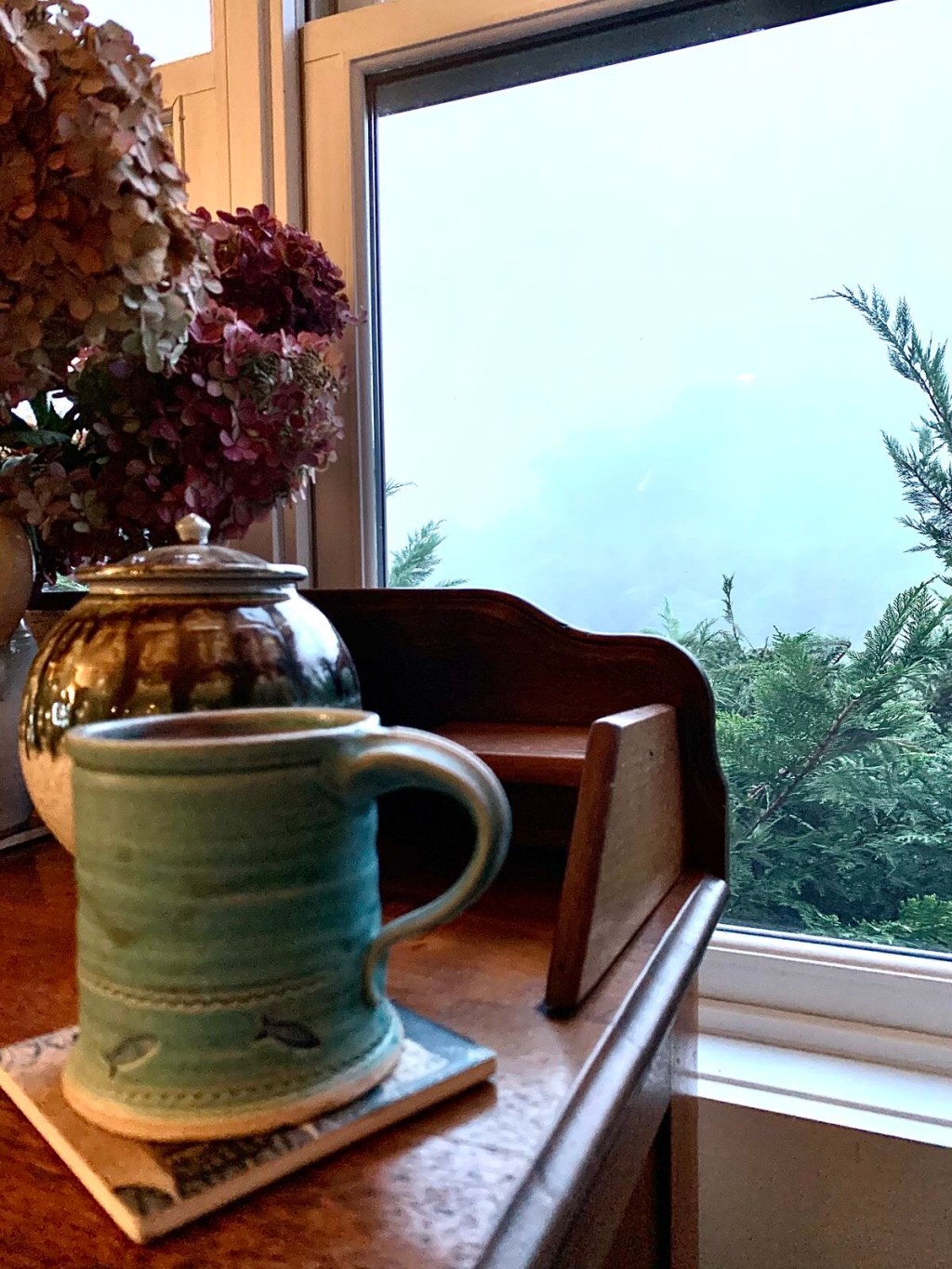
Hydrangeas and Coffee on a Cloudy Carolina Morning

Hydrangeas are native to America. Two well-known hydrangea species, among others, grow wild in North America — the H. aborescens (smooth leaf) and H. quercifolia (oak leaf). Their actual cultivation began in the 1700s. An historic trifecta of our forefathers’ estates is proof: Mount Vernon, Monticello, and Montpelier all cultivated these hydrangeas.

Bartram’s Garden, possibly drawn by a young William Bartram

William Bartram, of Bartram’s Nursery in Philadelphia, provided the seeds and plants for these historic homes. James Madison’s home, Montpelier, in Vermont, still has the creamy white heads of H. arborescens as a border for his garden wall. The Bartram Gardens were a natural history project begun by his father John Bartram and continued through the generations, with William’s love of travel and exploration leading to a four-year collecting trip to the American Southeast and the publishing of an account of his travels in 1791. It became a classic text in the history of American science and literature.

Documents from Mount Vernon record how in 1792, George Washington planted a native hydrangea, H. arborescens, on the bowling green at his home. Nearby, when Thomas Jefferson was designing his gardens and walkways at Monticello, he also included these new shrubs. Today, gardeners can purchase heirloom H. quercifolia seeds from the Thomas Jefferson Center for Historic Plants in Monticello.

The notion everyone is connected by just six stages of separation gained popularity in the early 2000’s based on scientific studies done in the 1960’s. The game Six Stages of Kevin Bacon was based on this idea. Today, due to social media and the internet, some people have only 3 or 4 stages of separation. Our founding fathers ran in the same circles, so their stages of separation were small.

Hydrangeas also come from Japan, where they’re the subject of many brush and ink paintings. The flowers hold a solid role in Japanese culture. The Japanese celebrate the hugely popular Ajisai (hydrangea) festivals in the blooming seasons of late spring and summer. Pink hydrangeas are given on the fourth wedding anniversary. Hydrangea gardens often grace the grounds of sacred Buddhist temples. People enjoy amacha, or tea from heaven, on April 8, Buddha’s birthday. Amacha is brewed from leaves of the Hydrangea serrata.

Steps ascending to Meigetsu-in Temple

While western churches are sited in lawns, as if they were sheepfolds to shelter the sheep within and protect them from the outer world, eastern Buddhist temples incorporate nature into their design and sites. This reminds us everything is one. As Father Richard Rohr reminds us in his book, The Universal Christ, the author of Colossians 1:19-20, puts this idea plainly:

“For in him all the fullness of God was pleased to dwell, and through him God was pleased to reconcile to himself all things, whether on earth or in heaven, by making peace through the blood of his cross.”

A classic example is the Buddhist Meigetsu-in Temple, which was founded in 1160 as a Rinzai Zen temple of the Buddhist Kenchō-ji school. Located in Kamakura, Japan, its nickname is the hydrangea temple, for from the end of May through July, thousands of hydrangeas bloom during the rainy season. The temple is a Japanese national historic site.

When I first brought in the dried flowers to class, the first reactions I heard were, “Wow! You brought those all the way from North Carolina intact?” and “This is gonna be hard!” I’ll let you figure out who said what!

My answer was, “Sure, I’m an old art teacher, and I’m prepared for anything. I had a travel box in my SUV trunk, so they nestled quietly there on the journey home. As for hard to paint, remember what I always tell you, don’t paint the eyelashes before you get the shape of the face. The KISS principle always applies.”

“You mean keep it simple, stupid?”

“Mike, the one who wants to learn and stretch their mind is never stupid. KISS stands for KEEP IT SIMPLE, STUDENTS.”

They all laughed. Most of us can’t see the big forest because we’re looking at all the individual trees. If we step back and get a sense of the whole first, we can see how the parts relate to one another. This helps us put the basic sketch onto the surface of our work. It also gives us a moment to observe the subject before us and catch that moment of interest, which we can then emphasize.

Image Ball in Shadow and Light

As I reminded folks, “This looks difficult, but the basic shape here is a big ball. We’ve already done geometric balls. You thought those were boring, but they had a purpose. You needed that skill to be able to see the same shape in nature and recognize the same pattern of light and dark shadows.”

They nodded their heads. Teaching often is just reminding people what they already know or reinforcing previous skills from a different viewpoint. We went on to the slide show. It helps to see how other artists have handled the subject of the day. I’ve always enjoyed show and tell time, for it gives us inspiration and education both. Every time we learn something new, we have a new wrinkle in our brains. At a certain age, this is the only place we want to get wrinkles!

Inuzuka Taisui: Butterfly and Hydrangea, 1930, Woodblock print

This lovely Japanese woodblock print is from the era when Japan moved from its historic monarchy into the beginning of its new democratic government. The old emperor was confined to the palace due to illness, so the western educated prince regent Hirohito was the default leader. During this time, the people favored western art styles, such as this romanticized Shin-hanga print, instead of the older artists’ works of the floating world, or Ukiyo-e. The Japanese continued to prefer the works of the floating worlds, with the dancers, actors, musicians, and tea houses.

Of course, Taisui and the other artists of the Shin-hanga movement were producing for a distant audience, who may never have set foot upon the island of Japan. What we think we know of a place is one thing, but until we experience it first hand, we won’t know its truth and its power, except by word of mouth. Taisui was active for only a decade, as far as we know, from 1920 to 1930, but he made numerous prints of plants, insects, and birds, which still bring joy to us today.

T. Adams: Hydrangeas and Lilacs, palette knife technique

I found this painting on Pinterest. I pointed out how the artist didn’t paint every single flower petal, but still got the message of “hydrangeas” across. This is a palette knife work, so it builds up the shapes from back to front. An artist can’t just throw paint on the canvas like some piece of spaghetti against the wall and hope it sticks. We always have to put our thinking cap on and build up the shapes from back to front and from dark to light. We also have to pay attention to the direction of the light if we’re doing a realistic image.

Allison Chambers: Yesterday (Hydrangeas), oil on canvas, c. 2017-21

This second rough image by Allison Chambers is another example of not painting all the minute details, but getting the main idea across (KISS). This is why billboards don’t use small print and politicians use sound bites. We’re moving too fast on the highway to read the fine print and our attention spans now are less than a goldfish! Sad but true, a goldfish can focus for nine seconds, but the average human only for eight seconds.

We can blame phones, social media, and our desire to be connected all the time. Once we were content to call once a day, but now we have to check in twice a day or more. Some of us find that much contact interferes with getting things done, but then self starters don’t need anyone checking up on them. These folks tend to think frequent callers need to find another hobby to fill their time. Everyone needs a purpose in life, so those who’re trying to micromanage others might need to spend that energy helping the poor with food distribution or expending that excess energy doing good elsewhere. Then again, maybe those frequent callers are just lonely. They might need to use those dialing fingers for good as part of a community prayer chain. Then they can connect in prayer and feel useful too.

Doris Joa: Hydrangea with Ivy, watercolor on paper, 2015

This last image does have many details. It’s a watercolor built up in thin layers of washes to get the desired result. When working with washes, we have to have time and patience, and channel our inner goldfish, so we can manage our attention spans. Our first inclination is to work wet in wet, over and over, but that just muddies up our colors in that space. We need to let that spot dry, move to a new spot, paint it, and keep painting and moving, until we get the whole first layer done. Then we can come back and lay in darker tones in certain areas, once again moving about the canvas, for if we repaint too soon, we’ll just lift up the underpainting.

This takes focus and intent, as well as the ability to reserve judgement on our work, since it takes time for it to come into being. This isn’t a simple skill, for delayed gratification isn’t practiced often today. Even when we work our plan and execute our technique to the best of our ability, the end result may seem lacking. Yet, we’ve grown, or else we wouldn’t realize our struggle didn’t meet our expectations. When we want more, we can see how far short our efforts fall. This should encourage us to continue the challenge.

As Philippians 3:12-14 reminds us about the spiritual life:

“Not that I have already obtained this or have already reached the goal; but I press on to make it my own, because Christ Jesus has made me his own. Beloved, I do not consider that I have made it my own; but this one thing I do: forgetting what lies behind and straining forward to what lies ahead, I press on toward the goal for the prize of the heavenly call of God in Christ Jesus.”

After show and tell, we sat down to paint. We’d done enough talking and presenting of models. We had enough to chew on for the short time our class meets. If we have two hours, we use the first 15 minutes on presentation and the last 15 minutes on cleanup. This gives us about 90 minutes to paint. We don’t make large works, but sometimes we take an extra day to finish what we started. I’d call most of our work “studies,” since they’re quickly done.

Gail’s Hydrangeas

Gail chose to do color exploration and deeper, more saturated applications of paint, rather than her usual washes. This was a bold experiment for her. Art is a risky business. We can’t always control what the brush will do. Most of us have been trained since childhood to “color within the lines.” Once the paint gets loose, we’re in uncharted waters, sailing out into the deep ocean and out of sight of familiar landmarks. We can either turn back and hug the safe shore, or sail out to discover the unknown land. Taking risks is how we grow.

Mike’s Hydrangeas

Mike’s love of texture is apparent in his painting, as well as a variety of color. While the colors aren’t natural to the subject, he chose the colors which made him feel good. His is an emotional response to the beauty of the flowers. He wasn’t happy with the opening of the vase, but he got so carried away with the flowers, he forgot his perspective principles.

We might need to reteach that lesson once again. Some lessons need reteaching multiple times. This is why Jesus spoke in the gospels about God 264 times and love 44 times. Money rated 24 mentions, riches 2, the neighbor 10, and the poor 25. If we ever wondered what Jesus was focused on, we might look at what he emphasized in his ministry.

Cornelia’s Hydrangeas

I noticed we each gave our flower pots a different look when we painted our canvases. None of us are dedicated copyists. My color scheme tilts toward the red-orange, yellow-green, and blue-violet. This is a secondary triad, rather than a primary triad of red, yellow, and blue. The mixed colors give the flowers their muted look.

Secondary Triad on Cornelia’s Hydrangeas

By adding white to some of the brush strokes, and darker tones to others, I was able to suggest individual flowers as well as shapes. It’s just a quick sketch, a work I would do in preparation for a larger painting. Doing this would help me get some ideas down and help me solve some problems in advance, as if I were training for a competition. I would know if my color scheme was working, or if I needed to change the values or tints. I might want to choose a deeper color, or certainly a larger canvas.

So we come back for another day and another try. We can “see the promised land,” but like Moses, we don’t know if we’ll ever reach it. Artists have to be incurable optimists, for they keep trying again and again, even though we know human perfection in art will always be out of reach. Yet as Paul reminds us in Romans 3:21-24, if perfection in art eludes us, we can still have “Righteousness through Faith:”

“But now, apart from law, the righteousness of God has been disclosed, and is attested by the law and the prophets, the righteousness of God through faith in Jesus Christ for all who believe. For there is no distinction, since all have sinned and fall short of the glory of God; they are now justified by his grace as a gift, through the redemption that is in Christ Jesus.”

May we all go onto perfection, with God’s help—
Joy and Peace,

Cornelia

Hydrangeas: A History
http://thehouseandhomemagazine.com/culture/hyndrangeas-a-history/

Taisho Democracy in Japan: 1912-1926
https://www.facinghistory.org/nanjing-atrocities/nation-building/taisho-democracy-japan-1912-1926

William Bartram – History of Early American Landscape Design
https://heald.nga.gov/mediawiki/index.php/William_Bartram

Kamakura’s Famous Hydrangea Temple: Walk Among Flowers in Japan’s Ancient Capital
https://livejapan.com/en/in-tokyo/in-pref-kanagawa/in-kamakura/article-a0001996/

Science: You Now Have a Shorter Attention Span Than a Goldfish
https://time.com/3858309/attention-spans-goldfish/

The Science Behind Six Degrees
https://hbr.org/2003/02/the-science-behind-six-degrees

Creativity Challenge

adult learning, art, beauty, coronavirus, Creativity, Faith, Icons, inspiration, Ministry, Painting, Pantocrator, Philosophy, photography, Plato, purpose, Reflection, Spirituality, vision

I was an art major before I attended seminary at Perkins, where I had the great privilege to take Philosophy from Dr. Billy Abraham. Of course this privilege was extended to me because I failed my one and only philosophy class in undergraduate school. I had taken it pass fail, but hit a terrible depression after my art teacher died. I had no energy to even hand in a paper with my name on it, even though the professor offered this as an act of grace to pass me.

“I’ve not done the work, I’m in over my head, and I haven’t understood any of these concepts in this class,” I said. “I don’t deserve to pass.”

“It’s a pass fail class. It doesn’t count toward a grade average, but it can count against you. Just turn in the paper,” he pleaded.

It didn’t seem appropriate to me, or honorable to take this option, but that could have been my depression coloring my decision making process. Still, I wasn’t raised to take credit for haphazard efforts, and providence ensured my F didn’t count against me when I transferred to art school the next semester, so that F didn’t affect my ultimate grade average after all.

Raphael: School of Athens, Vatican City

I speak about this because in seminary, Billy Abraham daily stretched the brains of every one of us first year students. First we heard one Greek philosopher say this was “true and real.” Then the philosopher who was his student came along and directly contradicted his old master, saying, “No, instead, something else is true and real.”

We all were in hair pulling mode, not to mention Dr. Abraham’s favorite description, “getting our underwear tied into knots.” I’ve always heard there’s a Rosetta Stone, which can unlock the meaning of an unknown language for those who have the eyes to see it. Perhaps only the creative ones, those who can see the patterns and the similarities, or what the mathematicians call the “sets” and the biologists call the “modules,” can suddenly see the key in plain sight.

Rosetta Stone

I admit I too was floundering until I had the eye opening realization I already held the key in my hand. I’d met this same question before in my art studio and history classes: “What is beautiful and what is truly art?” This definition had changed over the centuries, so why should the ideas of what is “reality and truth” remain fixed? This is a great example of “transfer of learning,” a well known educational concept, which resulted in my “lightbulb moment.”

Leonardo: Mona Lisa

As I explained to a fellow student, “Think of these as distinct historical ideas, not as your individual truth. It’s like looking at a fashion show from the ancient times to the present: no one expects those clothes to look like what we wear today. Just memorize what each of these styles look like. You don’t have to wear a toga to know what these Greeks thought. We just have to know how these old ideas influence later trends of thought fashions.” This is teaching by analogy, which is familiar to Bible readers as “parables.”

Coffee Bean Madonna

Most people can get over that intellectual hump. Seminary is designed so persons who aren’t agile thinkers will reconsider their educational choices. Philosophy and theology will winnow those who need to be told what to think, rather that learning how to think and understand deeply. Biblical studies will sort out those who aren’t able to interact with more than one voice of biblical interpretation. Then the internships and clinical pastoral settings will further sort those who don’t play well in groups. Finally the supervisory process we all go through toward our ordination into one of the orders of the annual conference is a long period of discernment, for all concerned.

The good news we can all do ministry, for we’re ordained by our baptism into the priesthood of all believers, not only reflect the Christ who lives in us, but to be the Christ in service to our neighbors. As we read 1 Peter 2:9—

But you are a chosen race, a royal priesthood, a holy nation, God’s own people, in order that you may proclaim the mighty acts of him who called you out of darkness into his marvelous light.

Minion Madonna

This is why it’s important we consider such concepts as truth, beauty, and the good. The Greek adjective kalon only approximates English for “beautiful.” Kalon has more of an ethical tone, but doesn’t mean the same thing as agathon or the “good, ” but rather is a special complement to goodness. At times kalon narrowly means “noble,” or “admirable.”

What was true for Plato were the forms, and everything here on earth were mere reflections or imitations of these ultimate truths. The true beauty and the good existed beyond this world, but everything and everyone could aspire to that ideal. Plato thought art and poetry were the arenas of greatest beauty, as Simonides, the Greek poet, drew an explicit analogy: “Painting is silent poetry and poetry is painting that speaks.”

While some say, “Imitation is the sincerest form of flattery,” for Plato imitation is found in the appearance of things, rather than in reality (the forms, which exist in an ideal world elsewhere), so judged on its own terms, the product of imitation has an ignoble pedigree (Republic 603b). Therefore, the imitative arts direct a soul toward appearances and away from proper objects of inquiry, which are the forms. While a mirror reflection might prompt you to turn around and look at the thing being reflected, an imitation keeps your eyes on the copy alone. Imitation has a base cause and baser effects.

Festival Madonna

Plato also believed poets created their works under irrational conditions, with inspiration arriving sometimes spontaneously, as if it were from the gods, a “divine madness,” as it were. Even today, people think creative types are more likely to be mentally ill, but science doesn’t bear out this romantic notion. Illness isn’t a prerequisite for creativity, even though many artists have suffering in their life histories.

Another Coffee Madonna

Creativity of any kind—making a collage, taking photographs, or publishing in a literary magazine—tends to make individuals more open-minded, curious, persistent, positive, energetic, and intrinsically motivated by their activity. Those who score high in everyday creativity also reported feeling a greater sense of well-being and personal growth compared to those who engage less in everyday creative behaviors. Creating can also be therapeutic for those who are already suffering. For instance, research shows that expressive writing increases our immune system functioning, and the emerging field of post traumatic growth is evidence we can turn adversity into growth.

Realism was the primary purpose of painting until the 19th century, when the invention of photography took over this task. This freed painters to engage in the higher search for what is beautiful and what is true, rather than to limit a painting to reproducing a likenesses or the mere imitation of nature. Yet many people still judge a work of art by how close it resembles the natural world. Of course, we also say the say the same about the embalmer’s art as we view the deceased in the casket: “My, doesn’t so and so look natural! So lifelike, as if they were asleep.”

Source

For our first lesson back in art class, we worked on seeing the familiar in a fresh way. This isn’t as easy as it sounds. We’re so used to recognizing faces in the ordinary way, to see them in a different way is a struggle. Take the Mona Lisa, by Leonardo Da Vinci. It’s an icon or representative image of the renaissance portrait. No matter what an artist does to it, we still recognize it as the Mona Lisa. Our goal was to take a photo of of someone we know, and push the limits of the facial expression and shapes so it wasn’t like the image we worked from originally.

Mike’s Painting

Mike copied the cover of the Bad Girls of The Bible, and made a good likeness. In between calls from work, he focused on replicating an image he could see. After several years of sincere efforts to paint what he sees, it’s hard to break this habit and paint something beyond his vision.

We’ll take a shot at this again. I a similar lesson early in the group’s existence and I remember it was distressing to them to draw without seeing. We were feeling the objects inside bags, and they didn’t like not looking. Bring out of control was disconcerting.

Gail’s grandchild isn’t really a zombie

Gail took her grandchild’s photo and stretched it into another dimension by treating the image as if it were a Night of the Living Dead character or the Scream from the German artist Munch. She had the most success of any of us in terms of breaking the norms of “portrait.”

Sally’s painting

Sally, new to our group, began a lyrical study of a woman’s head. I confess I never saw the image from which she drew her inspiration. It’s her first try, and we’re glad she got paint on the canvas. We’ll keep working on it together. All art, as is life, a work in progress.

Russian Icon of the Pantocrator

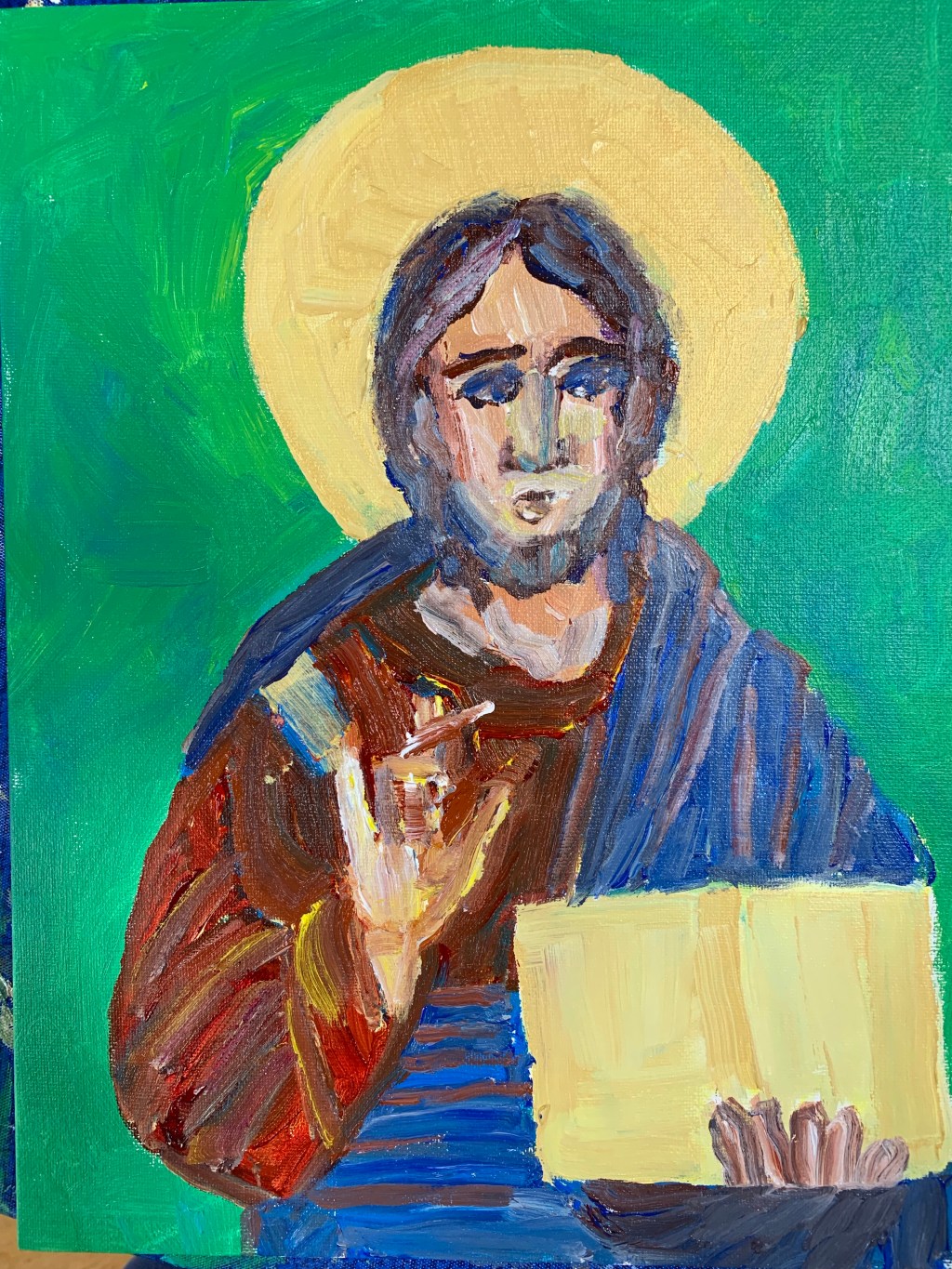
I worked from an icon of Jesus, which I knew would test me to break the form I saw before me. As it turned out, I too couldn’t break it on this first day. When the Platonic Ideal Form exerts its pull on the mind and hand, the artist keeps making the reflection of that form as a work, which exists as an imitation or a window into the true reality where the Holy is found.

Low Blood Sugar Painting

After a long summer break with all the Covid isolation a person could stand, I quite forgot how much energy teachers expend in explaining new concepts and in the excitement of the first day back. I noticed about 11 am I was struggling for words and not making good choices with my brush, but I ignored it in the thrill of being back with people. After cleaning up, I always check my blood sugar before I drive home. It was 45. I’d never seen it that low, but I was paying attention to other people, not to my body. I ate the crackers I always carry for just such an emergency.

The Wisdom of Solomon (7:26) speaks about God’s Wisdom personified:
“For she is a reflection of eternal light, a spotless mirror of the working of God, and an image of his goodness.”

In Hebrews (1:3), the writer describes The Christ:
“He is the reflection of God’s glory and the exact imprint of God’s very being, and he sustains all things by his powerful word.”

This long discussion on Plato, the true forms elsewhere and the imitations and reflections here help us to realize how much debt Christian spiritually and art history have to Greek thought. Art isn’t just “I know what I like and that’s all that counts.” We can all experience making art and enjoy it on any level. Having the depth of understanding to see how art connects us across the human community will give us a greater appreciation for our common spirit.

I promise I’ll bring a healthy snack to eat during class next Friday! I’ve learned my lesson on this, if nothing else! We’ll work on faces for two more weeks, then we’ll take a short break and come back in October and decorate cookies one week for Day of the Dead and paint an autumn themed subject for the other week.

Joy and Peace,

Cornelia

Simonides on poetry and painting—Plutarch: The Glory of the Athenians 3.1, 346f-347a.

Plato’s Aesthetics (Stanford Encyclopedia of Philosophy)
https://plato.stanford.edu/entries/plato-aesthetics/

Creativity and Rationality on JSTOR
The Journal of Aesthetics and Art Criticism
Vol. 70, No. 3 (SUMMER 2012), pp. 259-270 (12 pages)
https://www.jstor.org/stable/43496511

Mathematical Biology Modules Based on Modern Molecular Biology and Modern Discrete Mathematics
https://www.ncbi.nlm.nih.gov/pmc/articles/PMC2931670/

The Real Link Between Creativity and Mental Illness – Scientific American Blog Network
https://blogs.scientificamerican.com/beautiful-minds/the-real-link-between-creativity-and-mental-illness/

Rabbit! Rabbit! Welcome to July!

art, cognitive decline, Creativity, Faith, holidays, Holy Spirit, Independence Day, john wesley, Love, Ministry, Painting, poverty, purpose, rabbits, Racism, Spirituality, trees, vision, Work

Here in this Common Era of 2021, we Americans are now 245 years into this project we call democracy, having declared our independence from the British crown on July 4, 1776. We didn’t effectively become an organized, constitutional nation until June 21, 1788, when nine out of the thirteen existing states ratified the United States Constitution, thus officially establishing the country’s independence and a new form of government. Based on the date of our constitution, which is still in place, the United States is the oldest continuous democracy in the world.

I realize some of y’all rabbits might disagree with my description of the USA as “organized,” but I may have a higher tolerance for disorder than some of you. Then again, I taught art in kindergarten, so that probably explains a lot. When we make a mess in art class, we always clean it up. That’s just part of the lesson plan. Art, as in life, isn’t always neat, but the end product is worthwhile. In art we learn from our failures as often as from our successes. This takes courage and resilience, two life skills any rabbit can use in this fast changing world.

Antique German Rabbit Candy Container with Uncle Sam Rider, c. 1910

The preamble of the Declaration boldly states:

“We hold these truths to be self-evident, that all men are created equal,
that they are endowed by their Creator with certain unalienable rights,
that among these are Life, Liberty and the Pursuit of happiness.”

In our modern era, this is the section of the Declaration of Independence which we rabbits so dearly cherish, for it suits our individualism to a T. The next statement which follows complicates life, as King George discovered in 1776:

“That to secure these rights, Governments are instituted among Men, deriving their just powers from the consent of the governed,
—That whenever any Form of Government becomes destructive of these ends, it is the Right of the People to alter or to abolish it,
and to institute new Government, laying its foundation
on such principles and organizing its powers in such form,
as to them shall seem most likely to effect their Safety and Happiness.”

Way back in the 18th century, the practice of slavery still allowed others to profit off the the lives of human beings as if they were livestock, women couldn’t vote or own property, and states often excluded from the voting rolls certain classes of men for religious reasons or lack of property. The American Revolution changed the landscape of voting rights to some degree. Once the constitution was enacted on September 17, 1787, it created a new, federal layer of government, in which there was absolute freedom of religion—and no religious test that might prevent a Jew from serving in Congress or even as president—without removing the religious tests that existed in many individual states.

Rabbit Power of the Vote recognized by Uncle Sam

The Freedom to Vote came by Stages

Most of the states wrote new state constitutions in the 1770s, and some softened or removed their existing religious tests, but some did not. The real work of abolishing religious tests for suffrage was done at the state level, largely in the half-century after the American Revolution. Not until 1870, when Congress passed the the 15th and last of the three of the so-called Reconstruction Amendments, which stated that voting rights could not be “denied or abridged by the United States or by any state on account of race, color, or previous condition of servitude,” did African Americans get the right to vote, if their local communities did not make it impossible due to Jim Crow laws.

John Lewis: Civil Rights Icon

Doctrine of Original Meaning

Today, voting rights are under attack once again, not against religious minorities, but against racial and economic minorities. It makes this old rabbit wonder why the “doctrine of original meaning” by the founders has any worth when our 21st century world of today is so drastically different from the 18th century times of yore. Also, if “original meaning” is seen only through the eyes of our white founders, how can we be a nation for all people “created equal(ly)… endowed by their Creator with certain unalienable rights, that among these are Life, Liberty and the Pursuit of happiness?”

Scholars agree the original framers actually were more intent on the Declaration’s first paragraph, for only the Declaration of Independence officially proclaims the new American nation’s assumption of a “separate and equal station “among the “powers of the earth:”

“The unanimous Declaration of the thirteen united States of America, When in the Course of human events, it becomes necessary
for one people to dissolve the political bands which have connected them with another, and to assume among the powers of the earth,
the separate and equal station to which the Laws of Nature
and of Nature’s God entitle them, a decent respect
to the opinions of mankind requires that they should declare
the causes which impel them to the separation.”

Medieval Manuscript: Rabbits Rebelling Against Humanity

As we rabbits know, if we plan to start a tussle, good manners suggest we tell why we’re fixing to throw the first punch. If there’s no honor among thieves, at least we rebellious rabbits have the good form to stand up in the pure light of day and list our grievances before we overthrow a bad king. Only the uncouth sucker punch the unwitting. The reason this American Democratic experiment has persisted for nearly two and a half centuries is the vast majority of us have freely chosen to change our leaders through the ballot box, rather than revolution.

Only the past unpleasantness of the Civil War in the 1860’s has marked this unbroken transfer of power by the vote, until the assault on the US Capitol and the Houses of Congress on January 6, 2021, by a motley crew of domestic terrorists, QAnon supporters, and admirers of the former President. Because they violently assaulted the police guarding the building and public servants inside, and interfered with the duties of duly elected government officials attempting to exercise their public duty to certify the electoral college vote, the Department of Justice has charged them and they’ll have their day in court. You can read all their names and cases at the link below. Maybe you’ll find a friend or neighbor there. As Mother rabbit always warned Peter Rabbit, “Don’t go into the garden; Farmer McGregor will get you!”

Farmer McGregor Chases Peter Rabbit

What exactly did the signers of the Declaration of Independence mean when when they wrote “all men are free and equal?” Abraham Lincoln said, “The men who signed the Declaration did not mean to say that men were “equal in all respects. They did not mean to say,” he said, that “all were equal in color, size, intellect, moral developments, or social capacity. They defined with tolerable distinctness, in what respects they did consider all men created equal.”‘ Men were equal in having “‘certain inalienable rights, among which are life, liberty and the pursuit of happiness.’ This they said, and this [they] meant.”

Lincoln Monument, Washington D. C.

This quote comes from Lincoln’s 1857 argument on the Dred Scott case before the Supreme Court, which decided against him, with Head Justice Roger Taney, who became best known for writing the final majority opinion in Dred Scott v. Sandford, which said “all people of African descent, free or enslaved, were not United States citizens” and therefore “had no right to sue in federal court.” In addition he wrote, “the Fifth Amendment protected slave owner rights because enslaved workers were their legal property.” Taney’s reputation was vilified for this decision during his lifetime, for it contributed to the growing divisions between the north and the south. The U. S. House of Representatives voted in 2021, to remove Taney’s statue and replace it with a statue in honor of the first African American Supreme Court justice, Thurgood Marshall.

Dred Scott Newspaper Announcement

The big holiday in July is Independence Day. While we rabbits lounge about the waterside or in our backyards, eating our favored picnic and cookout foods at the nation’s birthday party, not many of us will be thinking on a biblical text. Instead, we’ll be eyeing our paper plates and hoping they’re substantial enough to make it to the table before they collapse from the excess helpings of foods we’ve piled on them. A special bunny secret: you can go back for seconds, and laugh at everyone when you say, “I just want to make sure all you little piggies get your fill—oink, oink!” Don’t let them bother you, since you made sure everyone who came late would have something to eat by not taking it all at once.

In 2 Corinthians 3:17-18, Paul writes:
Now the Lord is the Spirit, and where the Spirit of the Lord is, there is freedom. And all of us, with unveiled faces,
seeing the glory of the Lord as though reflected in a mirror,
are being transformed into the same image
from one degree of glory to another;
for this comes from the Lord, the Spirit.

In Essentials, Unity; In Non-Essentials, Liberty; In All Things, Love

Have you ever wondered why some groups are so strictly homogeneous, while others are a kaleidoscope of differences? Some rabbits feel safer when everyone is more like them and differences are kept to a minimum. Other rabbits seem to thrive in the creative intermixing of unusual and unique personalities. I know when I entered the ministry, my parents’ friends were amazed I went into the faith I’d been birthed into, rather than some new age, air fluff religion. Oddly enough, I related more to the historic beliefs of Wesleyan Methodism better than my contemporary generation. In that sense, I had faith in a “different religion” than my friends. Yet we all saw ourselves as “being transformed into the same image from one degree of glory to another; for this comes from the Lord, the Spirit.”

This marked a freedom of thought, but it required an understanding we were all on the same journey and were progressing toward the same end. I admit I have the type of mind that wants the idea to lead to the behavior and then the consequences. In art class I called it Attitude, Behavior, and Consequences. If the first attitude was positive, the rest followed suit, but if a student had a bad attitude, they weren’t going to work, and then they had the negative outcomes of poor efforts, sad projects, and little improvement. While in life we’re saved by faith, in art we’re saved by works, for work will bring rewards.

It’s as Easy as ABC

One way for all good rabbits to be free is to have no regrets, or worries about what might have been. As my mother often said, “That’s water under the bridge.” The River of life has moved on and the choices we’ve made have gone downstream also. She believed in living in the now. The third Saturday in July recognizes Toss Away the “Could Haves” and “Should Haves” Day. In short, don’t go through life with regrets.

Created by author and motivational speaker Martha J. Ross-Rodgers, this day is intended for us rabbits to let go of our past and live for the present. The first step to participating in this day is to find a pen and paper. Then write down our “could haves” and “should haves” on the paper.

Finally, throw away the list and make the following resolution:
“From this day forward, I choose not to live in the past. The past is history that I can not change. I can do something about the present; therefore, I choose to live in the present.”

As I’m going through boxes in my storage unit, I’m coming across souvenirs from my high school and college years. Some of us are sentimentally attached to the memories imbued within these objects, but they’re merely memories, not the actual people. My parents and grandparents saved things, for they experienced hard times. I make new art every week, so if a painting doesn’t hold up to my critique after six months, it goes into a pile to get destroyed and remade.

DeLee: The Springtimes of My Life: Memories of Yesterday and Today

Now, take care of yourself and your health by living for now. Do your best and make the best of each and every day! Strike a power pose and smile when you do this. You’d be surprised how much energy flows through your body, I kid you not.

A final word for all rabbits who want to live in truth and freedom: we have only one God given life, so let’s live with joy and peace. We aren’t promised tomorrow, but only today. Now is the time to care for the broken, to right the wrongs of the world, and to make a difference, no matter how small.

Charles Derber, in Welcome to the Revolution: Universalizing Resistance for Social Justice and Democracy in Perilous Time, says: “Resistance can be symbolic, but at its core it must also be empowering and even shocking, in the sense of awakening the people to the evils of the system and the terrifying end-result if we allow business as usual to continue. Resistance is rage at injustice and at the insanity of institutions that kill and exploit for money and power. Melding that rage with love is the art of activism.”

Now that I walk more slowly in this world, this old rabbit has found I notice people whom everyone else hurries past, even if these folks are standing in the middle of a store entryway and are obviously lost. I stopped today at Sam’s to ask if this older woman needed help. Right away I realized she had trouble processing words, so she might have memory problems. I asked where her people were, but she didn’t know. We went over to customer service, since I knew they could use the announcement system to call for them to come get her. At least she knew her name. I was sad they had hurried off without her, especially in her condition, but I prayed with her before I left. The service staff got her a chair and made sure she was safely seated.

Lady Liberty

I hope as the holiday approaches, you don’t find yourselves so busy getting your celebration together that you overlook the ones in need who are right in front of you. Once we cared for one another in communities, but now we look after only ourselves. We wouldn’t have become a nation 245 years ago if every man had tried to take on the king’s men alone.

Be the spark that starts the fire of love and joy,

Cornie

10 Oldest Democracies in The World (Updated 2021) | Oldest.org
https://www.oldest.org/politics/democracies/

Could Jews Vote in Early America?
https://momentmag.com/could-jews-vote-in-early-america/

French Declaration of the Rights of Man—1789
http://www.columbia.edu/~iw6/docs/decright.html

Capitol Breach Cases | USAO-DC | Department of Justice
https://www.justice.gov/usao-dc/capitol-breach-cases

Pauline Maier, The Strange History of “All Men Are Created Equal”, 56 Wash. & Lee L. Rev. 873 (1999), https://scholarlycommons.law.wlu.edu/wlulr/vol56/iss3/8

https://scholarlycommons.law.wlu.edu/cgi/viewcontent.cgi?article=1547&context=wlulr

Maier quotes The Dred Scott Decision: Speech at Springfield, Illinois (June 26, 1857), in ABRAHAM Lincoln: His SPEECHES AND writings 352,360 (Roy P. Basler ed., 1946). 68. Id. at360-61.

Dred Scott Case – Decision, Definition & Impact – HISTORY
https://www.history.com/topics/black-history/dred-scott-case

Palette Knife Flowers

adult learning, art, beauty, brain plasticity, Children, Creativity, Easter, Faith, flowers, Imagination, mystery, nature, Painting, purpose, renewal, righteousness, risk, Spirituality, Valentine’s Day, vision

The Very Last Leaf

Every blade of grass outside is a uniform tan, for winter’s pale light has sucked the life and green from its living cells. Each colder breeze separates yet another straggling leaf from a sleeping stick attached to the limbs of a hibernating tree. The sap won’t rise until mid February, when the days are warmer and the nights are still freezing. The ornamental pear trees lining the entry to my condo are beginning to bud, so I’m sure they’ll be covered with snow before Easter. I’m almost wishing for a good snow to change up the colors outside, to cause some excitement of a bread aisle clearing stampede, and the joy of eating pancakes at every meal “just because it’s a snow day.”

Instead, I’ve brightened my interior spaces with fresh flowers. This is an early reminder to all you lovers out there: Sunday, February 14 is Valentine’s Day. Be sweet to the special person in your life by bringing something beautiful or joyful into their life. Our art class has been working with the palette knife instead of the brush lately. This is a different tool to get the paint on the canvas. With the brush, we can make lines and broad strokes, as well as dots or blobs. With the knife, we have to pick up colors on the metal end, push and press with varied strength and wrist twists to get the paint to go where we want it and to mix at the same time.

Mike’s Flower Study

How does this happen? It’s magic! Or luck, or practice until you figure out how the paint feels under your hands. I can best describe it as being willing to do finger painting, but with a palette knife. We also have to let our adult mind go sit in the corner, while we let our five year old come out and play. Another way to think of this is to compare religion and faith. Religion has rules and boundaries for how to “do it right.” We spend most of our lives in this mode, trying to measure up to a severe standard, rather like the older brother to the prodigal son. In faith, we trust we’re enough and God’s mercy and grace are sufficient for us, so we yearn to please God even more. What we can do in love, for love’s sake, will bring the world into the love of God.

Gail’s Flower Study

This is why no one copies my art work, but goes on their own journey to find their own way of seeing. This is one of the hardest parts of making a painting, to isolate the primary forms and shapes, and then to set them in a space. As we look at a three dimensional world, we have to come up with our own visual language to write on a two dimensional surface. As we invent our own language, we’re creating a new vocabulary, grammar, and conjugations, which take some time for us and the world to understand. We don’t worry if we’re “good,” for we are painting these to grow our minds, stretch our boundaries, and by learning new skills, building new brain connections and endorphins. We get joy from our work, so it gets us through the doldrums of winter.

Cornelia’s first layer

There’s a wonderful poem by Robert Frost, of a bouquet of flowers, and two birds in winter:

Wind and Window Flower

Lovers, forget your love,

And list to the love of these,

She a window flower,

And he a winter breeze.

When the frosty window veil

Was melted down at noon,

And the cagèd yellow bird

Hung over her in tune,

He marked her through the pane,

He could not help but mark,

And only passed her by,

To come again at dark.

He was a winter wind,

Concerned with ice and snow,

Dead weeds and unmated birds,

And little of love could know.

But he sighed upon the sill,

He gave the sash a shake,

As witness all within

Who lay that night awake.

Perchance he half prevailed

To win her for the flight

From the firelit looking-glass

And warm stove-window light.

But the flower leaned aside

And thought of naught to say,

And morning found the breeze

A hundred miles away.

Cornelia’s Final Flowers

“Wind and Window Flower,” a poem written by Robert Frost, speaks of how we can sometimes love someone who can’t leave either the safety of their window sill or the prison of their cage. With this in mind, it’s best for the bird to fly on by in order to find true love or purpose somewhere else. Some of us will watch the cold world from a safe distance as it goes by, while others will leave our cozy homes and go out into the cold, sharp winds to seek another path. We may regret leaving the caged bird behind, but we have to go and find our highest purpose in life. I often wonder about the bird left behind, if the cage ever got too small or if security was more important. The fresh flowers won’t ever know the outcome of this story, for they’ll be gone before the week is out.

Even these small and insignificant works of the creator are not outside the care and concern of a loving God. As Jesus says in Matthew 6:26-33—

“Look at the birds of the air; they neither sow nor reap nor gather into barns, and yet your heavenly Father feeds them. Are you not of more value than they? And can any of you by worrying add a single hour to your span of life?

And why do you worry about clothing? Consider the lilies of the field, how they grow; they neither toil nor spin, yet I tell you, even Solomon in all his glory was not clothed like one of these. But if God so clothes the grass of the field, which is alive today and tomorrow is thrown into the oven, will he not much more clothe you—you of little faith?

Therefore do not worry, saying, ‘What will we eat?’ or ‘What will we drink?’ or ‘What will we wear?’ For it is the Gentiles who strive for all these things; and indeed your heavenly Father knows that you need all these things. But strive first for the kingdom of God and his righteousness, and all these things will be given to you as well.”

Rabbit! Rabbit!

brain plasticity, change, Children, chocolate, Civil War, coronavirus, Easter, Faith, Fear, Food, generosity, grief, Holy Spirit, Lent, Love, nature, pandemic, purpose, rabbits, Racism, renewal, salvation, sleep, Spirituality, Spring Equinox, Stress, Uncategorized, Valentine’s Day, Valentine’s Day, vision

Welcome to a Pandemic February—

1908 Vintage Nature Print

“Heraclitus, I believe, says that all things pass and nothing stays, and comparing existing things to the flow of a river, he says you could not step twice into the same river.” Plato quoted an older Greek thinker about life’s being constantly in a state of flux or change. We can’t dive into our rabbit holes at every quivering leaf or shadow of every cloud passing over the sun. We rabbits know the world is changing all the time, even if we don’t like it, but we still have to venture outside of our den and hutches to find tasty carrots and spinach leaves.

Fear of Change—

Yet some rabbits have a fear of change or fear of changing the order of things. This goes by another Greek word, Metathesiophobia. This is a new word for this old rabbit, so I guess I’ve modified a few brain cells in learning this. In fact, when we learn new words, we actually get happier! There’s even science behind this. In a study, “increased subjective pleasantness ratings were also related to new-words remembered after seven days. These results suggest that intrinsic—potentially reward-related—signals, triggered by self-monitoring of correct performance, can promote the storage of new information into long-term memory through the activation of the SN/VTA-Hippocampal loop, possibly via dopaminergic modulation of the midbrain.”

Even if we don’t understand the scientific jargon of that sentence, we know learning new things gives us a feeling of pride and accomplishment. We feel good about ourselves when we accomplish a new trick or master a new skill. Repeating the same experiences over and over leads to dullness,even if we find safety in the predictably.

If we were small bunnies, we’d never find the refrigerators in our homes, since they’d be covered up in our latest glorious art project. Every rabbit parent raves about their genius offspring, if they’re raising them right. We always want to catch our small ones doing something right and praise them for it. We’ll get more cooperation than if we’re always telling them NO, and GO TO YOUR ROOM.

I ask you, which rabbit among us doesn’t want to be happier in this world? Currently we’re in the midst of the worst crisis most of us have ever experienced. We rabbits need to name it and face it, rather than deny it, for this pandemic isn’t not going away anytime soon. This causes some of our bunny friends to find a “boogeyman lurking in every dark corner.” When I was young, my parents scared me, or scarred my memories, over my messy closet.

Fancy Dress Up Clothes

“You’d better clean up that pile of clothes in there, young lady! If you don’t, a rat might come crawling out of those clothes piled up on the floor!”

EEEK! I was so frightened, I untwisted an old metal coat hanger and stood outside my closet while I fished out my dress up play clothes, one article at a time. If a rat were to come out with them, I wanted a running head start. I was on my own in art school over a decade later before I could sleep with the bedroom closet open. This was a long standing fear to shake. Not everyone can put aside their fears and coping mechanisms, however.

I’ve had rabbit friends who get up in the middle of the night to make sure their closets are neatly arranged, with all the shoes in the right boxes and all the clothes facing the same direction on the hangers. I have no such anxiety, for I hang my clothes up and don’t worry once I’ve done it. I have other tasks to tackle. Uninterrupted sleep is a worthy goal for rabbit health. Plus I have other creative tasks to engage me, and I’m learning new things every day. In any event, I know my salvation won’t be impaired by this failure to act on my part, just as it won’t be earned if I keep a perfect closet.

Change is moving swifter than the atmospheric river that’s currently dumping rain and mudslides on the Pacific coast and ice and snow on the Atlantic coast. Atmospheric rivers are long, narrow regions in the atmosphere—like rivers in the sky—that transport water vapor, according to the National Oceanic and Atmospheric Administration. Drastic swings from extremely wet to extremely dry and vice versa will be nearly twice as likely, occuring on average once every 25 years, by 2100. Dramatic swings are becoming more common and will continue to do so in the coming decades thanks to man-made climate change.

Presidents’ Day—

Of course climate change isn’t the only change we’re dealing with in February.

Today we have one holiday to celebrate Abraham Lincoln and George Washington. Back in this rabbit’s kitten days, we had two holidays for these two presidents, but the times change and the holiday became popularly known as Presidents’ Day after it was moved as part of 1971’s Uniform Monday Holiday Act, which was an attempt to create more three-day weekends for the nation’s workers.

At the time, Congress thought setting three day weekends would end employee absenteeism. Today the coronavirus pandemic has put most white collar workers out of the office and many blue collar workers out of a job. Until we get this pandemic behind us by vaccinating as many of our people as possible and continuing safe practices, we won’t get back to any semblance of normal any time soon. This virus hunts a host, and it’s sure to find a rabbit to use as its own personal Petri dish.

Super Bowl LV—Next Super Spreader Event?

On the first Sunday in February, the big game goes down. While the 7,500 health care workers who’ll be the stadium attendees will be following COVID protocols, the fans at home remain susceptible to infection. A recent Seton Hall Sports Poll collected answers from 1,522 adults spread all over the country from Jan. 22-25. That data shows 25% of respondents said they would gather with people outside of their home (defined as those who aren’t roommates or cohabitants) to watch the game. Sixty-four percent of respondents said they would not attend a gathering and 11% said they weren’t sure.

Among avid fans however, 40% of that group said they would indeed gather with members outside of their household. The CDC doesn’t recommend holding these types of gatherings, especially if they are inside and last for the duration of the game. The Super Bowl will be played in Raymond James Stadium in Tampa and is scheduled for Sunday, February 7, with a 6:30 p.m. ET kickoff, with an estimated game length of four hours, not counting the additional four hours of preliminary extravaganza programming.

Chocolate Strawberry Footballs

I’ve always gathered the various rabbits who live in my condo building for the game festivities. It’s a good opportunity for us to socialize and since everyone always waits for “someone to take charge,” I just step up. We won’t do it in person this year, however, for we rabbits can best observe safely the whole shebang from the comfort of our couches and Zoom or find other other media connections with our loved ones and friends so we can have a real party next year.

Super Bowl LV Firsts—

There are new changes to the Super Bowl this year. Amanda Gorman, the inaugural poet, will recite an original poem before Super Bowl LV, as part of both the in-stadium pregame ceremony and the TV broadcast. The poem will honor three everyday heroes who have been chosen as honorary game captains by the NFL. These people include Trimaine Davis, a Los Angeles teacher who fought to secure internet access and laptops for his students amid the pandemic; Suzie Dorner, a Tampa nurse who managed the COVID ICU at Tampa General Hospital; and James Martin, a Marine veteran who has helped veterans and their families connect virtually through the Wounded Warrior Project.

Gorman isn’t the only pregame excitement. Miley Cyrus will perform as part of the TikTok Tailgate event for the Health Care Heroes. This will also be televised. Then there’s the The Pepsi Super Bowl Halftime Show, which is the most-watched musical performance of the year, with more than 104 million viewers tuning in to last year’s show. The rhythm and blues artist known as The Weekend (Abel Makkonen Tesfaye) will be the featured performer.

The Weekend

 “The Weeknd has introduced a sound all his own. His soulful uniqueness has defined a new generation of greatness in music and artistry,” said Shawn JAY-Z Carter. “This is an extraordinary moment in time and the Pepsi Super Bowl LV Halftime Show is going to be an extraordinary experience with an extraordinary performer.” This rabbit has been listening to his oeuvre on Apple Music, and I’m quite excited to hear the show. It ought to be a bang up program with no wardrobe malfunctions.

JAY-Z and his company, Roc Nation, have worked over the past year on the selection of artists playing the Super Bowl Halftime Show as the league’s official Live Music Entertainment Strategists. The partnership aims to “nurture and strengthen community” through music and support the NFL’s Inspire Change social justice initiative, and also has Roc Nation serving as a co-producer of the Super Bowl Halftime Show. 

GRAMMY-nominated artists Eric Church and Jazmine Sullivan are set to pair up for the first time to sing the National Anthem as part of Super Bowl LV pregame festivities. Grammy-award winning artist, H.E.R., will join the pregame lineup with her rendition of America the Beautiful. In addition, on behalf of the National Association of the Deaf (NAD), Warren “Wawa” Snipe, acclaimed Deaf rapper and recording artist, will perform the National Anthem and America the Beautiful in American Sign Language. For Super Bowl LV, the National Anthem will be arranged and produced by Adam Blackstone.

Sarah Thomas

“Sarah Thomas will made history again as the first female Super Bowl official,” NFL EVP of football operations Troy Vincent said. “Her elite performance and commitment to excellence has earned her the right to officiate the Super Bowl. Congratulations to Sarah on this well-deserved honor.” She will be a down judge on a seven-person crew of distinguished game officials. You go girl!

This is just one more change for a world that spins 360 degrees daily and moves around the sun on its invisible circular river which it completes every 365 1/4 days. Our planet never stays in in one place as it courses through the unseen river of time in the heavens, but we see ourselves think we have a fixed place in the universe. If we observe nature, the rising and setting of the sun moves along the horizon line as the seasons change and it rises higher into the sky during the summer than the winter. These changes are part of our ordinary life, and give a structure and rhythm to our days and time upon this world.

Champions in a Championship Game

Speaking of firsts, the Chiefs are trying to become the first team in 16 years to win back-to-back Super Bowls. The last team to do it was Tom Brady’s 2003-04 New England Patriots. Tom Brady is set to become one of four quarterbacks to start a Super Bowl for multiple teams and he could join Peyton Manning, who is currently the only quarterback in NFL history to win a Super Bowl start with multiple teams. So while the seasoned champion with a brand new team goes against a young champion trying to make the magic happen two years in a row, we should have a good game, rather than watching it for the commercials.

In other firsts, the Super Bowl is almost always the top rated TV show for audience numbers. Only the final episodes of M.A.S.H. and Cheers have ever pushed it to number two. The commercials are first class also. CBS’s asking price of $5.5 million per 30-second spot is merely the cost of reserving the requisite airtime; after production expenses, ancillary social-media investments and agency fees are accounted for, the actual outlay for a single Super Bowl ad can swell to $20 million. That’s a lot of rabbit feed.

We won’t see the Budweiser Clydesdales for the first time in 37 years, for the company will be focusing on supporting Covid vaccine awareness education spots instead. Other companies related to restaurants may be missing due to lower sales and profits, but this gives other companies an opportunity to take their place. The pandemic has changed our economy in many ways. Avocados are in demand because we rabbits eat our salads at home, not in a restaurant. This is good for grocers, but bad for cooks, wait staff, and restaurant owners.

While parts of our economy are currently staggering along, the middle class and poor are lagging behind, as if they had chains and a huge millstone binding their bodies. Nearly 12 million renters will owe an average of $5,850 in back rent and utilities by January, Moody’s Analytics warns. People would go to work, but the businesses are either closed or the parent needs to stay home to school the child. Unpaid rents affect landlords, and roll on to the bankers who hold those notes.

The Census Bureau’s Household Pulse Survey, launched in April 2020, has provided nearly real-time weekly data on how the unprecedented health and economic crisis is affecting the nation. Nearly 24 million adults—11 percent of all adults in the country— reported that their household sometimes or often didn’t have enough to eat in the last seven days. Adults in households with children were likelier to report that the household didn’t get enough to eat: 15 percent, compared to 9 percent for households without children. Hunger in America or food insecurity is linked to a greater chance of cardiovascular mortality in counties throughout the U.S. Researchers believe if the pandemic goes on long enough, more people will begin to die of hunger or famine related circumstances than the disease itself.

Some want to spend a little and let it “trickle down,” but my grandmother rabbit always said that was “penny wise and pound foolish.” After WWII, American generosity rebuilt Germany, the home of the Nazi enemies. If we rebuilt the country of our enemies, I wonder what keeps us from rebuilding our own land? We need a Marshal Plan for America.

St. Valentine’s Day—

Be my valentine! XXOOXX

As a small bunny, I fondly remember classroom Valentines Day Parties, mostly because I got to decorate a shoebox as my “Valentine Mailbox” and enjoyed all the dime store paper valentines from my bunny friends. Mostly I really enjoyed the pink icing on the chocolate cupcakes and those Necco candy hearts with their pithy, saucy, love quotes. In this pandemic world of Zoom classrooms, gone are class parties, valentines for everyone, and a special gift for the teacher. As a former teacher, my hope is we can get our school teams vaccinated and get our little bunnykins back in a communal setting, so they can learn socialization skills as well as educational materials.

Ash Wednesday—

Some grieve about this year as if it’s lost year, and it’ll never be gotten back. This is true, however, there’re other great crises our little bunnies went through in our history, through no fault of their own. The Civil War was one, for it disrupted some youth we wouldn’t let have keys to a car today. One of my grandfather bunnies dropped out of school in the eighth grade to work on the railroad when his own father left home. He made sure his own little bunnies got their education, even if he didn’t get his.

Just because we have a twelve year program for public school doesn’t mean we have to finish it in that length of time. If we have a large monkey wrench thrown into our best laid plans, we might need to cram those twelve years into thirteen years. If we live to seventy-nine years, the average life span in America, this extra year is only 1/79 or 1% of our lives. We spend more time than this sleeping, since we spend about 33% of our lives asleep. No one seems to grieve about this broad swath of time in bed in fact, more of us rabbits are trying their best to get either more or better sleep! Perhaps we need to reframe then way we look at some of these problems to reduce our anxiety about them. Then we’d have more strength to cope with the day to day struggles, which are real and difficult.

Ash Wednesday is moveable feast day, so its date varies. It depends on when Easter is celebrated, and that too is dependent on the lunar calendar. My old daddy rabbit had this ancient piece of lore memorized: “Easter is always the first Sunday after the first full moon after the spring equinox.” While we may be able to move certain holidays around the calendar, Easter and its connected rituals of faith, Ash Wednesday and the forty days of Lent, move every year.

Because of coronavirus protocols, the hands on imposition of ashes by pastors, priests, or worship leaders will change in this pandemic year. Some churches will sprinkle ashes upon people’s heads, while others will give out packets of ashes for self imposition. The ashes are a traditional sign of humility. We may ask, if the ritual changes, is it as effective as it once was? The better question to ask is, “Does the ritual save us or does the power of God’s Holy Spirit flowing through the moment change us for the better?” Sometimes we put too much emphasis on the outward and visible elements, rather than the inward and invisible experience of God at work in us.

The Constant in the Midst of Change—

In the midst of a world intent on stoking our fears to a fever pitch, some of us rabbits find ourselves pulled down the proverbial rabbit hole into vast conspiracy theories, which purport to connect unlikely coincidences, but actually push anti-Semitic, far-right or white-supremacist ideology. Some of these ideas are as old as the Middle Ages, while others came from Russia and got passed into the American milieu during the first Red Scare in the 1920’s.

One of the worst examples is “The Protocols of the Learned Elders of Zion,” a classic of paranoid, racist literature. Taken by the gullible as the confidential minutes of a Jewish conclave convened in the last years of the nineteenth century, it has been heralded by anti-Semites as proof that Jews are plotting to take over the world. Since its contrivance around the turn of the century by the Russian Okhrana, or Czarist secret police, “The Protocols of the Learned Elders of Zion” has taken root in bigoted, frightened minds around the world.

When the world is in chaos, fearful rabbits look for a demonic figure to blame, when they should look instead to a positive source of power and strength. Fear paralyzes us, but the power of God sets us free to change our world for the better.

Bierstadt: Merced River, Yellowstone Valley

God is our refuge and strength,

a very present help in trouble.

Therefore we will not fear, though the earth should change,

though the mountains shake in the heart of the sea;

though its waters roar and foam,

though the mountains tremble with its tumult.

~~ Psalms 46:1-3

May you make enough small changes every day to get new wrinkles in your brain, rather than on your brow.

Joy and Peace,

Cornie

Intrinsic monitoring of learning success facilitates memory encoding via the activation of the SN/VTA-Hippocampal loop | eLife

https://elifesciences.org/articles/17441

HISTORY: Presidents’ Day—History, Date & Holiday

https://www.history.com/topics/holidays/presidents-day

Poll: Despite pandemic, 25% will attend gatherings to watch Super Bowl 55 between Chiefs, Buccaneers

https://www.usatoday.com/story/sports/nfl/super-bowl/2021/01/27/super-bowl-55-poll-attend-gatherings-coronavirus-pandemic/4281143001/

2021 Super Bowl Halftime Show: The Weeknd to Perform | Entertainment Tonight

https://www.etonline.com/the-weeknd-to-perform-2021-super-bowl-halftime-show-156259

Eric Church, Jazmine Sullivan to sing national anthem at Super Bowl LV; H.E.R. to sing America the Beautiful

https://www.nfl.com/news/eric-church-jazmine-sullivan-to-sing-national-anthem-at-super-bowl-lv-h-e-r-to-s

Increasing precipitation volatility in twenty-first-century California | Nature Climate Change

https://www.nature.com/articles/s41558-018-0140-y

A Hoax of Hate: The Protocols of the Learned Elders of Zion

https://www.adl.org/resources/backgrounders/a-hoax-of-hate-the-protocols-of-the-learned-elders-of-zion

Super Bowl 2021 numbers to know: Patrick Mahomes and Tom Brady both have NFL records on the line – CBSSports.com
https://www.cbssports.com/nfl/news/super-bowl-2021-numbers-to-know-patrick-mahomes-and-tom-brady-both-have-nfl-records-on-the-line/

Millions of Americans are heading into the holidays unemployed and over $5,000 behind on rent. Hefty bills will come due in early 2021 for rent and utilities. Economists warn many unemployed families won’t be able to pay without more stimulus aid from Congress. By Heather Long

https://www.washingtonpost.com/business/2020/12/07/unemployed-debt-rent-utilities/

Tracking the COVID-19 Recession’s Effects on Food, Housing, and Employment Hardships

https://www.cbpp.org/research/poverty-and-inequality/tracking-the-covid-19-recessions-effects-on-food-housing-and

Link between food insecurity and cardiovascular death found

https://www.medicalnewstoday.com/articles/link-between-food-insecurity-and-cardiovascular-death-found

In the Darkness, I can still see America the Beautiful

9/1/11, art, coronavirus, Faith, Fear, Forgiveness, grief, Healing, Holy Spirit, instagram, Ministry, nature, pandemic, photography, purpose, Racism, renewal, Spirituality, vision

On a long ago Monday morning, I had no other pressing issues on my mind other than “More coffee and swing by the local garage for a new battery for the church van.” That’s what happens when a simple van doesn’t come with automatic headlights. When I arrived inside the church, I was greeted by the shocked looks of folks gathered around the radio. “Preacher, the Pentagon has fallen and the Twin Towers in New York have collapsed.”

I was aghast and speechless. I went to the garage, where I knew the TV and the coffee would be on, plus the old boys gathered there would be in the know. I’d kill two birds with one stone. “I’ll be back soon. If folks want to pray, tell them I’ll be here by noon.”

Some Mondays require more coffee than others.

Some churches are family centered, so they want to gather at home and hug their loved ones tight at times of crisis. Other groups don’t have family nearby, so they gather together to offer one another comfort in times of grief. I stayed at the church that afternoon and was there for the strangers who noticed our light and stoped on their sojourn along the highway of life. God meets us where we are.

Right Wing Violence Growing in America
Timothy McVeigh’s Oklahoma City Federal Center Bombing in 1995, which killed 165 people and injured 500 others, and was first blamed on Middle Eastern terrorists, was the second-most deadly terrorist attack in U.S. history, except for September 11, 2001.

I mention it because although Americans have always found the “bad guys/others/scapegoats” as worthy of our nationalistic scorn, but homegrown far-right terrorism has significantly outpaced terrorism from other types of perpetrators, including from far-left networks and individuals inspired by the Islamic State and al-Qaeda. Still, right-wing attacks and plots have accounted for the majority of all terrorist incidents in the United States since 1994, and the total number of right-wing attacks and plots has grown significantly during the past six years.

When we remember our friends and fellow citizens who lost their lives in the 2001 attacks, we also must take a moment of silence for the citizens of our world who also lost their lives. 9/11 was by far the worst terrorist attack in American history with 2,977 victims (excluding the 19 perpetrators). While the attacks were aimed at the United States, 372 foreign nationals from 61 countries were also victims. Why is this important? Nearly two decades ago, America saw herself as a leader among nations, rather than as a nation behind a wall, alone. We went to war, not only to avenge our “honor” and take “retribution for our loss,” but also to “make the world a safer place in which to live.”

Citizens Lost at 911 from Nations in Blue

War Against Terror and the Axis of Evil
Before a joint session of Congress on September 20, 2001, President George W. Bush declared a new approach to foreign policy in response to 9/11: “Our war on terror begins with al Qaeda, but it does not end there. It will not end until every terrorist group of global reach has been found, stopped, and defeated.” Bush declared that the United States considered any nation that supported terrorist groups a hostile regime. In his State of the Union speech in January 2002, President Bush called out an “Axis of Evil” consisting of North Korea, Iran, and Iraq, and he declared all a threat to American security.

I remember how full our church was the Sunday after September 11, 2001. Each person there wanted to know what their pastor would say about the one, true, Christian response to the attack, and where a person of faith should stand on war that was surely coming. I’m sure my people were surprised I didn’t tell them there was only one true way, but several paths Christians across the centuries have faithfully chosen. Thinking for yourself by using the Scripture, the traditions of the church, and the guidance of the Holy Spirit is the struggle we people of faith are called to make.

Why are we building walls?
Since that fateful day, we’ve thrown up a wall of sorts on our southern border. While it was supposed to be a “big beautiful wall, like you’ve never seen before, from coast to coast,” the truth of it is Trump has promised to build at least 500 miles of new fencing by early next year, but his administration has completed only about 110 miles so far.

Cactus felled to make way for the wall

Nearly all of the new fencing the Trump administration has built so far is considered “replacement” fencing, swapping out smaller, older vehicle barriers for a more elaborate — and costly — “border wall system.” The administration has been slowed because building new barriers where none currently exist requires the acquisition of private land, and many owners don’t want to sell. They would lose access to all of their land by selling a portion. Even with the slated construction goals, most of the southern border will not have a man-made barrier, since the terrain is considered too tough to traverse.

Big Walls Make Bad Neighbors
Where building has occurred, the neighbors haven’t been happy. Bulldozers and other heavy machinery were brought up to the edge of the Oregon Pipe National Monument outside Tucson. There the crews also detonated bedrock to lay the barrier’s foundation. Crews removed cactus and other plant life near the international wildlife preserve to make way for access roads, which Border Patrol say are needed to enhance security. The Army Corps of Engineers in February conducted a series of controlled blasts along a sacred Native American heritage site known as Monument Hill.

These are just a few of the indignities to our natural resources, our environment, and our Native American peoples in the mad dash to protect the country from “marauding caravans.” Remember the caravans? So 2019—they were last year’s scapegoats. The people to fear this year are “people of color who are coming for your suburbs, led by Corey Gardner and the Democrats!”

Good Walls Make Good Neighbors
Of course, if artists and architects from both Mexico and America had collaborated to design the wall it might have been more welcoming as cultural destination. In fact it might have been a money maker for tourism on both sides of the border, but who cares about money in these days?

Architects’ rendering of Border Cultural Destination

Truth and Lies
I grew up in the Deep South back in the awful days when governors stood in school house doors to prevent black children from attending classes with white kids. I thought America today was better than this. While Black Lives Matter protests have been peaceful and the vast majority of demonstration events associated with the BLM movement are non-violent, unfortunately disinformation campaigns have convinced some that the opposite is true.

However, in more than 93% of all demonstrations connected to the BLM movement, demonstrators have not engaged in violence or destructive activity. Peaceful protests have been reported in over 2,400 distinct locations around the country. Violent demonstrations, meanwhile, have been limited to fewer than 220 locations — under 10% of the areas that experienced peaceful protests.

Right-wing Extremism
Right-wing extremists perpetrated two thirds of the attacks and plots in the United States in 2019. In addition, right-wing extremism accounted for over 90 percent between January 1 and May 8, 2020. Second, terrorism in the United States will likely increase over the next year in response to several factors. One of the most concerning is the 2020 U.S. presidential election, before and after which extremists may resort to violence, depending on the outcome of the election. Far-right and far-left networks have used violence against each other at protests, raising the possibility of escalating violence during the election period.

Between 1994 and 2020, there were 893 terrorist attacks and plots in the United States. Overall, right-wing terrorists perpetrated the majority—57 percent—of all attacks and plots during this period, compared to 25 percent committed by left-wing terrorists, 15 percent by religious terrorists, 3 percent by ethnonationalists, and 0.7 percent by terrorists with other motives.

The Truth Will Set You Free
All terrorism feeds off lies, conspiracies, disinformation, and hatred. Indian leader Mahatma Gandhi urged individuals to practice what he called “satyagraha,” or truth force. “Satyagraha is a weapon of the strong; it admits of no violence under any circumstance whatever; and it always insists upon truth,” he explained. That advice is just as important as it has ever been in the United States.

Mahatma Gandhi practiced Satyagraha or “holding onto truth, ” to designate an attitude of determined but nonviolent resistance to evil. Gandhi’s satyagraha became a major tool in the Indian struggle against British imperialism and has since been adopted by protest groups in other countries. Jesus was fond of saying, “The truth will set you free.”

Tribute to the Victims of Foreign Terrorism
In this 19th anniversary of the Tribute to the Victims of Foreign Terrorism, I wonder if it’s not time to rethink this memorial. The loved ones deserve to be remembered, the brave responders need to be honored, but we need to come to grips with the pain and agonies within our own greater community. The Pandemic has revealed structural inequalities that have been built over generations. Just as our interstate highway system was a great infrastructure project of the 1950’s, but we’ve driven on orange barrel roadways ever since because no one in congress has the will to spend the money on the concrete the people use. Instead they give giant tax breaks to corporations with the thought the money will “trickle down” to those below. When it doesn’t, they try again, thinking “It’ll work THIS TIME.” Now we need to address the cracks in our country and mend our brokenness.

One image depicts a magnificent wall of musical organ pipes, 30 feet tall, punctuated with openings every 20 feet allowing people to pass through. Photo: JM Design Studio

Revisioning and Reimagining Due to the Pandemic
For the first time since 2002, the annual Tribute in Light—the dual beams of light that commemorates the victims of the September 11th terror attacks—will go dark. The organizers, the National September 11 Memorial & Museum, which manages the installation at the Battery Parking Garage in Lower Manhattan, made the difficult decision, citing the health risks of the pandemic. After consultations, the museum concluded, “the health risks during the pandemic were far too great for the large crew—30 technicians, electricians, and stagehands—required over ten days to produce the annual Tribute in Light.” The twin pillars of light, which can be seen up to 60 miles away, became a fixture following the second anniversary of the attacks.

Birds and Moths caught in the 911 lights

The lights, featuring eight-eight 7,000-watt xenon light bulbs are placed in two 48-foot squares, but they are directly in the path of migrating birds. The convergence creates a spectacle that is eerily beautiful, yet according to one study, endangers some 160,000 birds a year, starkly illustrating the perils of humans and animals sharing an urban ecosystem. The tiring detour through the beams of light can put birds at risk of starvation or injury to populations already threatened by light pollution, collisions with buildings, habitat destruction and climate change. To solve the problem, the lights are switched on and off at twenty minute intervals. This allows the birds to reorient themselves and safely travel on. Otherwise, the light lures them in, and the glass windows of the buildings finish them off.

The pandemic and social distancing has also forced the museum to scale back the commemorative ceremony on September 11th, including a live reading of all 9/11 and 1993 bombing victims that has traditionally been conducted by victims’ family members. A recording from the museum’s “In Memoriam” exhibition will be used instead to minimize the risk of exposure to families visiting that day.

September 11 Victim Compensation Fund
From 2001 to 2004, over $7 billion dollars in compensation was given to families of the 9/11 victims and the 2,680 people injured in the attacks. Funding was renewed on January 2, 2011, when President Barack Obama signed The James Zadroga 9/11 Health and Compensation Act into law, which was named for James Zadroga, a New York City Police officer who died rescuing survivors. In 2015, funding for the treatment of 9/11-related illness, was renewed for five more years at a total of $7.4 billion.

The Victim Compensation Fund was set to stop accepting claims in December 2020. On July 29, 2019, President Trump signed a law authorizing support for the September 11 Victim Compensation Fund through 2092. Previously, administrators had cut benefits by up to 70 percent as the $7.4 billion fund depleted. Vocal lobbyists for the fund included Jon Stewart, 9/11 first responder John Feal and retired New York Police Department detective and 9/11 responder Luis Alvarez, who died of cancer 18 days after testifying before Congress.

Out of Sight, Out of Mind
Americans have a notoriously short attention span. We’re given to the latest fads. Once upon a time goldfish swallowing was all the rage, as was stuffing telephone booths (we don’t even have those anymore), and planking. Oh my. I remember piling into VW bugs in the early 60’s with the school chum who had a convertible. She got bonus points because we could stack the most petite of our friends on our shoulders in a tower. Photo op for yearbook. With social media and 24 hour news channels, a story can be here today and gone tomorrow. If we were upset at the Tide challenge one day, the cinnamon challenge follow hot on its heels. The next challenge will be how tidy your sock drawer is, and you’ll experience excruciating pandemic pain that you’ve lost the last six months of your life with an untidy dresser.

Final Thoughts
If we are to fight wars, let them be for just causes, with proportional responses against armed aggressors, but not against civilians. Let’s not stand alone against the world, but link arms with allies who share our values of democracy, self-government, and freedom. Let’s also care for the most vulnerable among us and unite with the nations of the world to protect the environment, for all of us are endangered by climate change and pollution.

If the “lights are out” on 9/11, perhaps we can use the darkness to look inside our hearts for the future path forward. If we take a healing path, we can dedicate it to everyone who has lost their life in the America that was before, and then we can build for their descendants the America they have always dreamed of and hoped for: America the Beautiful.

ANSEL ADAMS: Ruins of Old Church, ca 1929, printed 1977

September 11 Tribute Light Goes Dark in 2020
https://gothamist.com/news/911-tribute-in-light-wont-shine-in-2020-a-first-in-18-years

Oklahoma City Bombing
https://www.publicradiotulsa.org/post/ap-was-there-oklahoma-city-bombing-story

George W. Bush: Foreign Affairs | Miller Center
https://millercenter.org/president/gwbush/foreign-affairs

The Escalating Terrorism Problem in the United States | Center for Strategic and International Studies
https://www.csis.org/analysis/escalating-terrorism-problem-united-states

Timeline of September 11 events
https://www.govtech.com/em/safety/Timeline-of-How-the-Tragic-Events-Unfolded-on-Sept-11-2001.html

Brilliant Maps
https://brilliantmaps.com/9-11-victims/

Border wall construction plows through southwestern US undeterred by COVID-19 – ABC News
https://abcnews.go.com/Politics/border-wall-construction-plows-southwestern-us-undeterred-covid/story?id=70649546

Washington Post Deep Dive on Government Wall Documents
https://www.washingtonpost.com/graphics/2020/national/immigration/border-wall-progress/

The Armed Conflict Location & Event Data Project
https://acleddata.com/special-projects/us-crisis-monitor/

ACLED collects real-time data on the locations, dates, actors, fatalities, and types of all reported political violence and protest events across Africa, East Asia, South Asia, Southeast Asia, the Middle East, Central Asia & the Caucasus, Latin America & the Caribbean, and Southeastern & Eastern Europe & the Balkans.

The US Crisis Monitor is a joint project of ACLED and BDI, the Bridging Divides Initiative of Princeton University. Through this project, ACLED is able to extend its global methodology to conduct data collection for the US, making real-time data available for public use, while BDI is able to use these data to identify emerging risks and to inform and motivate policy and programming discussions within its civil society network.

Designs for Trump’s Border Wall. https://www.scmp.com/news/world/united-states-canada/article/2086420/designs-trumps-powerful-mexico-border-wall-include

The 9/11 Tribute Lights Are Endangering 160,000 Birds a Year
https://www.nytimes.com/2019/09/09/nyregion/911-tribute-birds.html?referringSource=articleShare

September 11 Victim Compensation Fund
https://www.vcf.gov/

Coronavirus Quilt

Ancestry, art, Children, Christmas, coronavirus, Creativity, Faith, Family, Fear, grief, Healing, Holy Spirit, Imagination, Ministry, purpose, quilting, renewal, Spirituality, vision

My family has a tradition of handcrafts and needle working skills, passed down from generation to generation, as do many Southern families. I admit I didn’t care much for the sitting still part when I was young, but I really liked the bright sequins and beads of the tree skirts we embellished with the symbols of the Twelve Days of Christmas. The first six days were overloaded, while the last few had only a sprinkle of sparkle stitched to the colored felt, but then we were coming in under the wire by Christmas eve and Santa wouldn’t visit our house if we didn’t get into bed as soon as possible. We just barely made it.

Antique Child’s Sewing Machine

Most of our projects didn’t have such a time limit, however. I remember learning to make doll clothes on a toy sewing machine before my mother trusted me on the electric machine. I made tiny tucks across the bodice of these outfits from the scraps of the materials my mother used to make my school clothes. My Nannie had an old foot powered sewing machine on her back porch. It was often hidden under piles of newspapers or canning jars resting on their journey to the garage out back. From her I learned to sew straight seams, unbeknownst to my mom. My small foot wasn’t able to power the treadle of the old machine very fast and I’d been warned within an inch of my life to keep my fingers a good distance from the needle. I was doing this sub rosa, and that added to my excitement, but my mother probably knew. I only thought I was doing something forbidden.

First Lesson

Soon after this, my mother decided I needed to learn to make simple clothes from a pattern. Not that I would do it unsupervised, but she did have a degree in home economics and a lifetime teaching certificate. I made one of those easy patterns with only a front, a back and a neck binding. Of course, I was too young to need to worry about darts yet, so this wasn’t the most difficult project in the sewing room. I did learn how to pin, cut, and sew with the right sides together so the seam would be on the inside.

Later I’d learn to hem my clothes. My mom always thought I sewed backwards. I suppose since she sewed in the opposite direction, I was backwards. I’ll blame this on my being a breech birth, for if I came into the world backwards, I can do things in an opposite manner if I want to. Sometimes it takes a person who sees the world from a different viewpoint than everyone else to help others make sense of the world, especially when the world isn’t in the order we’ve come to expect it to be.

July is the season of the year when active Methodist clergy move to new churches. I’d hear my friends say, “I’m going to hit the ground running and show them I’m ready!”

I’d nod my head, and reply, “I’m going to take my time, get to know folks, find out where they are, and what they need. Then we’ll figure out where we need to go together.” I was past the age of running anywhere, since ministry was my fifth career.

This pandemic has changed many of our rituals and routines. Gone are our potlucks and coffees, our get togethers and small group sessions. We now meet from afar and we’ve learned to like it, or else we live in isolation, and we’ve learned to endure it. I told a friend, “I’m blessed to be single, because if I get on my nerves, I’ve got no one to blame but me! If I get that upset with myself, I go down to the exercise room for a walk.”

As this pandemic has stretched out, I’ve come to realize treating it like a new appointment might be the best practice. Ministry is more of a marathon than a sprint, for we need to keep a steady pace for a long distance, rather than run fast for a short initial spurt. Throwing all our energies at it in the first few months, especially now when everyone is socially distanced, isn’t going to be the most effective use of our potency.

Antique Wedding Ring Quilt
Made by My Grandmother

This is where quilt making comes into play. Quilts can have a structured pattern or they can be various strips of cloth sewn together until they make a square or an entire top. Right now, we’re in crazy quilt land, while we wish we were in structured pattern quilt land. We have to make do with the materials we have at hand and make the most beautiful work with what we have. This is the creative work of the Holy Spirit, which binds the people together, no mater how separated and isolated the community is.

I pulled out some fabric from one of my boxes to make a patchwork pillow. I had no plan, for mostly I was distressed at the brokenness and sickness of our world. I thought if I stitched some strips of fabric together, I would find some order, and perhaps some beauty. Of course, I kept stitching and realized I had more than enough for a pillow, but not enough for another project. I looked at my plain jean jacket and thought it could be improved. I kept stitching, so soon I had enough for the jacket and yet another pillow! This is enough. I’m going to put up my machine and go back to my easel for a while.

Patchwork Pillow with Hand Stitching

I know I miss my friends and family, for they’re like the strips of cloth I’ve sewn together. I try to connect with them by writing my blogs and sharing my spiritual pages, so I can give a voice to the emotions others perhaps are feeling. I write because I’ve never been accused of saying too little, but more often of not knowing when to quit. That’s ok, for someone needs to put into words the feelings this pandemic is putting many of us through.

I hope you’re finding some creative project to do during this pandemic time. I suggest a journal, to write out your memories of your life before this strange time. We don’t know what our future will bring us, and the generations who follow us will wonder what an ordinary life was like back in the day. If we write about the pandemic itself, we may fail to touch the grief of what we’ve lost, and only write about our grievances of today. If we can find an opportunity to note the small blessings of each day, perhaps we can access our memories of our past lives also.

My granddaddy hung his dress jacket in the old wood chifforobe on that back porch where the antique sewing machine resided. The cabinet retained the aroma of his favorite chewing gum, even when he was gone from the house. I can still smell today the juicy fruit chewing gum my granddaddy always carried in his coat pocket.

I hope you’re finding moments of joy and peace amidst this time of pandemic and uncertainty. I’ve attached a poem at the end I think you might enjoy.

Cornelia

Patchwork Jean Jacket with Button and Antique Crochet Embezzlements

Memories are worthy treasures, as this poem reminds us. This is a true story, for the author finished the quilt in 2017. Her husband’s mother had started it and was about a third done with the quilting when she passed away in 1986.

Thirty Years
By Ruth Poteet

My closet’s free of a strange parolee,
coldly imprisoned for thirty long years;
gone with the rest of my walk-in’s debris,
I’d marked it “Goodwill” with cynical cheers.

Rescuing the box, my mind shifted gears.
And ready to face fair verdict instead,
a quilt, yet unquilted, moved me to tears.
At seventy-three I finished this spread.

It took just three weeks, while my fingers bled,
now “thirty years” rests proudly on my bed.

Ruth Poteet: Thirty Years

https://allpoetry.com/poem/12799690-Thirty-Years-by-Reason

Greenscapes from Downtown

arkansas, art, coronavirus, Creativity, Faith, Fear, Healing, Historic neighborhood, Meditation, nature, Painting, poverty, purpose, Reflection, renewal, Spirituality, trees, Work

Some say, “Art is never finished, but only abandoned.” I left my latest acrylic painting for a day, knowing I’d need to adjust some of the sky values, but I was beyond Monday’s melancholy mood. I remembered the sunset of my original experience, and wondered, “Is the end of one day merely the beginning of another? If so, sunrises and sunsets are just markers for us until we participate in eternity with god.” In age of coronavirus, I now think more about time and how we experience it. For me, the now and the present moment take on more importance than either the future or the past. As J. R. R. Tolkien, in The Fellowship of the Ring said:

“I wish it need not have happened in my time,” said Frodo.

“So do I,” said Gandalf, “and so do all who live to see such times. But that is not for them to decide. All we have to decide is what to do with the time that is given us.”

Not that my cloistered coronavirus days are slowly melting together like Easter Peeps in a microwave, or becoming desperate Survivor Island fare, as the young parents thought who once called me during the pink eye school closures.  These always seemed to follow directly on the heels of spring break, and parents would cry into the telephone, “How do you stand this All. Year. Long?” 

I’d laugh and remind them, “I always have a plan for the day, and a back up plan too.” Art classes depend on teaching basic skills at the start, so you can teach more difficult skills later. Hand and eye coordination is one skill, but the other more important achievement is the ability to trust one’s self. As an artist pushes forward, he or she can get comfortable and begin to repeat only what they know and what is safe. Of course, this is common to all of life, for we frequently eat the same foods at the same restaurants, take the same routes to work, and drink our favored brews. 

Finding a way to break through the wall of the routine is challenging. If we’re always progressing, we may move more quickly than our audience can appreciate us. Then we need to ask ourselves, what is the purpose of art and by extension, what is the purpose of our life? This is why having a pattern of work balanced with reflection is helpful, not only in the art life, but also in the spiritual life. When I speak of the art life, I mean any life engaged in production, industry, sales, or the economy. All could benefit from spending time in reflection, instead of hitting the ground running and always hustling. If we asked ourselves WHY more, and WHAT WILL THE CONSEQUENCES BE, we might be more socially responsible with our practices and care more for the earth which we’ll leave to our descendants.  It’s their inheritance and we shouldn’t exhaust it as if we were prodigal sons. 

These two paintings are the latest off my easel. The first is an empty lot across from the Transportation Depot in Hot Springs. From the depot side, all you can see is the line of trees on the horizon, but if you drive up Olive Street, you find the vacant lot parallel to the side of the historic 1914 Hot Springs High School. This building was renovated into lofts and apartments, both for government subsidized and market paying rentals. President Clinton attended this school and the property is currently for sale. The vacant lot once had a building of some sort on it, perhaps an elementary school, for I found concrete steps and the remnant of a flagpole. Today it’s gone to seed, and the wild grasses grow as they choose, until the city or some private party mows them down. 

Pandemic Landscape

I was there on a cool afternoon with a breeze blowing fair. The sun was over my back and I couldn’t see the depot for the tree barrier. Although I was “smack dab in the middle of the city,” I might as well have been out in the countryside. It may be a field of weeds to you or an eyesore awaiting development, but this city block serves a purpose in its ragged glory. These green places act as sinks to cleanse the air and regulate the water runoff. In more developed areas, neighborhood parks and people’s yards store very high amounts of carbon, which help reduce carbon emission levels in cities. This is a benefit of living in a smaller city, for the largest ones have sucked up all the green spaces and filled them in with concrete and steel.

Not only is keeping our yards green important, but instead of paving over an area, keeping green space and plants in a yard makes a difference because a property is part of a much bigger ecosystem and is part of that proven fabric of the city. By keeping your yard green, you provide your city with the ecosystem services that urban green spaces provide. Here are four little known ecosystem services that urban green spaces provide to cities:

  1. Urban Heat Island—the urban heat island effect has negative impacts on the health and efficiency of cities, including increased energy consumption, increased air pollutants and greenhouse gases, impaired water quality and compromised human health and comfort.
  2. Carbon Storage— backyard soils can capture even more harmful carbon emissions than soils in native forests or grasslands. Urban backyards and green spaces contribute to reducing carbon emission levels in cities, which makes air cleaner and healthier for its residents.
  3. Water Regulation—green spaces keep untreated water out of lakes and rivers, and let sewers work without backing up
  4. Economic Savings—green areas increase property values

The cluster of trees isolated in the ocean of grass are much like a family in the pandemic: tense, taught, tightly tucked together, and removed from all others to survive. We might all have days like this in our quarantine, and then we’ll have days when we want to reach out to others, in real life or virtually. Social distancing can quickly devolve into isolation and then into fear of going out of our homes. This has a name: agoraphobia or fear of open places. It’s a type of anxiety disorder in which you fear and avoid places or situations that might cause you to panic and make you feel trapped, helpless or embarrassed. You fear an actual or anticipated situation, such as using public transportation, being in open or enclosed spaces, standing in line, or being in a crowd. Just going on a Kroger run today can feel like a mission behind enemy lines. If our days take more energy from us than they used to, we need to adjust our expectations of how much we can get done, just as we slow down when it’s a 110 F in the shade during the summer. 

Sunrise or Sunset

This is possibly the reason after all these years, I’m still in the beginner class of the Pacer Clinics, but walking isn’t the skill I’m actually trying to improve. Becoming more aware of the present moment is an achievement level worth unlocking, so I’m practicing “opening myself to the holy.” We can find the holy in any moment of time, not just in those times set aside or designated as sacred. We all have different goals, and getting from one place to another in record time might not be the most important end result or best use of our time. 

Perhaps this pandemic has caused us to reassess our arbitrary borders between work, home, and worship, since many of us have been doing all three from one place. Can we say that only one time or one place or one day is more sacred than any other? Or should we look again and see all of our days and all of our ways are a sacred endeavor? If this is so, we have to check if our faith undergirds and empowers our daily acts, and not just once a week. Another way to express this is, “Do we live our Bible, or does it gather dust on the coffee table?”

And what of those essential workers who daily face the contagion? Can they still find any holy moments in these dread times?  Or are they so busy throwing themselves into the breach, they have no time to notice the still, small voice of god? When life is overwhelming, we often can’t hear God’s voice because the press of our problems pushes out all other inputs, even the hopeful spirit of god. We then have to trust if we take care of business, then god will take care of the outcomes. As the ancient voice of wisdom in Proverbs 21:31 says, “The horse is made ready for the day of battle, but the victory belongs to the LORD.” When our day is done, we can rest in god and restore our souls and health.

This pandemic has ripped the curtain off the hidden division in our culture. Those workers considered “essential” may be high or low wage earners, but the difference in resources they have to meet the difficulties of their new lives is eye opening. Nearly 60% of adult Americans live paycheck to paycheck, and what’s even more amazing is about 1 in 5 people earning over $100,000 annually also live paycheck to paycheck! If you owe your soul to Visa or MasterCard, you have an existential need to earn a living, and not just a calling to fulfill. It’s not because folks are squandering their resources, but the cost of living is high in many places, plus many have student debt, mortgages and car loans. In truth, some of us owe our soul to a plastic god because we have chosen to live too high, rather than to live a simple life. 

Now the pandemic has caused the greatest job dislocation since the Great Depression when 25% of the workforce lost their jobs. The latest unemployment rate is almost 15%, which is roughly double what the nation experienced during the entire financial crisis from 2007 to 2009. The most telling tale is 40% of the workers making less than $40,000 per year lost their jobs during this pandemic, according to the Federal Reserve. The lowest paid workers in the leisure and hospitality industry suffered the most. If we are looking at our lives and grumbling at our inconveniencies or loss of “freedoms to come and go at will,” perhaps we need to recover the simple joys of life: reverence in the silent moments when we’re in a cool and shady spot, joy for the sunlight dappling on autumn leaves, or the ever-changing reflections in a running brook. 

I was in a better frame of mind when I painted the sunset beyond the trees. The colors are lighter, and the spaces are more open. I can always tell when I’ve been sick, for even a sinus infection turns my energy and vision inward. In this work the trees bend toward one another and their leaf crowns unite in a yellow communal mass. They may be separate life forms, but they all are rooted in the same earth and nourished by the same water. As the prophet Jeremiah says in 17:8—

“He is like a tree planted by water, that sends out its roots by the stream,

and does not fear when heat comes, for its leaves remain green,

and is not anxious in the year of drought,

for it does not cease to bear fruit.”

May we all be like the trees planted by the refreshing streams of water, even during these drought times. 

Joy and Peace, 

Cornelia