Cosmic Rainbow

Apocalypse, art, beauty, cosmology, Creativity, Faith, hope, inspiration, John Ruskin, Leonardo da Vinci, nature, Painting, purpose, sleep, Spirituality, Van Gogh, vision, William Blake

In times of cultural change and uncertainty, some faith-based communities turn to apocalyptic literature to find meaning, if not solace, for their suffering. Other communities of faith look forward to a future of hope and joy, even though they live in the same circumstances.

Apocalyptic literature is a genre of writing that appeared during times of crisis or persecution. It often presents a vision of the end times and the ultimate triumph of good over evil. Apocalyptic literature has several major characteristics:

“The supreme manifestation of Satan in this world is war.” By William Blake, 1805, apocalyptic painting with
tempera, gum, glue, and chalks, Tate Galleries, London.
  1. Dualism: Apocalyptic literature often portrays a cosmic battle between good and evil forces, highlighting the struggle between light and darkness.
  2. Symbolism: Deeper meanings and abstract concepts are represented by symbolic language and imagery.
  3. Eschatology: Apocalyptic literature focuses on the end times (Greek eschatos last, farthest) and the ultimate judgment of humanity, exploring themes of divine justice and the afterlife.
  4. Pseudonymity: Many apocalyptic texts attribute their authorship to famous figures from the past, using pseudonyms or false names.
  5. Visions and Dreams: Apocalyptic literature often includes visionary experiences and dreams as a means of conveying divine messages and revelations.
  6. The future is fixed and decided in apocalyptic literature, whereas with prophecy, people can change their future by repentance and restoring their relationship with God.

Since John was already in exile, “The Revelation to John” doesn’t bother to hide his authorship for his safety. He does claim it’s a vision of Christ mediated by an angel. It also checks the boxes of good vs evil, symbolism, the end times, and a fixed future. The actual date of this future isn’t revealed, however.

An interpretive mistake many make is to take this letter written to encourage the persecuted churches of the first century and project its message into our modern-day society. The symbols which were meaningful to John’s audience are for that historical context alone. Reinterpretations of these signs to make them relevant to our current geopolitical situation is bad scriptural interpretation.

Plate 12, First book of Urizen, by William Blake

What we can do is ask, “What can persecuted communities or suffering societies of the past teach us about resilience, hope, and faith?” Some will focus on God’s destructive forces to eradicate evil and harm. Belief in God’s power to overcome evil is a source of deep comfort for people without power. These are often the ones who feel excluded from the halls of power, but also those who believe their privilege and place is slipping away.

God’s fridge would be covered with photos!

Both these groups forget they are beloved of God, just as God loves all God’s children. Sometimes we forget God’s refrigerator is large enough to have the photographs of all the people of the world on its door, along with all our latest art works also. If that’s a humongous refrigerator, then that gives us an idea of the expansive reach of God’s love, mercy, and grace for all creation.

The First Day of Creation, by Francisco de Holanda (1545), with caption, “Let there be light.”

A negative outcome of this dualist, apocalyptic belief is extremist beliefs about the end times. Unfortunately, some extremist pastors have convinced their followers to end their lives to meet their predicted apocalyptic end of the world. The leader creates the fiction of an evil out-group to bind the members more closely to their cult and proclaims apocalyptic themes to brainwash their members. Numerous mass suicides worldwide have occurred as a result, including 914 people of Jim Jones’ People’s Temple. In 1997, 39 members of the Heaven’s Gate cult in San Diego, California, committed mass suicide by poisoning to coincide with the arrival of the Hale-Bopp comet, considering this a signal for their exit from Earth. Others have given away their entire nest eggs to apocalyptic cults because “no one will need money in the new creation.”

Paul Klee: Clarification, 1932, Oil on canvas, 27 3/4” × 37 7/8” (70.5 × 96.2 cm), The Berggruen Klee Collection, 1984 Accession Number: 1984.315.54

Some of us prefer to focus on The New Heaven and the New Earth instead, as found in Revelation 21:1-4—

Then I saw a new heaven and a new earth; for the first heaven and the first earth had passed away, and the sea was no more. And I saw the holy city, the new Jerusalem, coming down out of heaven from God, prepared as a bride adorned for her husband.

And I heard a loud voice from the throne saying,

“See, the home of God is among mortals. He will dwell with them; they will be his peoples, and God himself will be with them; he will wipe every tear from their eyes. Death will be no more; mourning and crying and pain will be no more, for the first things have passed away.”

Stage 1—strings and base colors

What a day that will be! The last time God destroyed the earth with a great flood, God placed a rainbow in the sky as a promise the earth would never be destroyed again by water.

Leonardo da Vinci said, “Where the spirit does not work with the hand there is no art.” For some people, the only “good art” is representational art, or art which faithfully describes a landscape, portrait, or still life. With abstract art, colors carry emotions and shapes to form pleasing patterns for the viewer. What will the new heaven and the new earth look like? Revelation 21:11 says “It has the glory of God and a radiance like a very rare jewel, like jasper, clear as crystal.”

Stage 2—addition of gold and silver washes

While many today think of heaven as an earthly paradise, this concept is a Persian idea of an enclosed garden, much like the original garden of Eden. We tend to imagine a heaven as being a better place than the world we know, but imagining an altogether different world is next to impossible! Luke 20:27-38 is Jesus’ answer to the law-abiding Sadducees about how relationships work in heaven, and a reminder to us heaven isn’t just a perfect earth.

When I think of the providence of God, which is grounded in creation and is always recreating the face of the earth, I remember God’s promise to Noah in Genesis 9:11-13—

“I establish my covenant with you, that never again shall all flesh be cut off by the waters of a flood, and never again shall there be a flood to destroy the earth….This is the sign of the covenant that I make between me and you and every living creature that is with you, for all future generations: I have set my bow in the clouds, and it shall be a sign of the covenant between me and the earth.”

Stage 3—Added circles and more gold and silver washes

It is this cosmic rainbow of colors, the spiritual energies which most of us cannot see for the overwhelming ordinariness of daily life. We race from chore to chore, dash from task to task, and drop exhausted at the end of our days. We long for a better life, but we’re stuck on a galloping treadmill trying to keep our feet under us. I long to walk rather than run through my days. When I was younger, older people told me to slow down. As I hit middle age, I heard I would soon start slowing down. Now that I’m inching closer to 80, slowing down is finally becoming a reality!

Vincent Van Gogh said, “Paintings have a life of their own that originate in the soul of the artist.” We cannot see the new heaven and new earth unless we stop our busywork and allow God to attend to the business of our spiritual life. When we see the first glimmers of the new heaven and the new earth, we’ll realize how imperfect our world is and begin to help change it for the better, one small act of kindness at a time. This is soul work.

Sometimes that kindness first means being kind to ourselves, when we admit we can’t say YES to everything and everyone. When we admit we actually need eight hours of sleep for our health and a daily quiet time, and we can stop to study the flowers in the cultivated gardens of our neighborhoods and in our parks.

Cosmic Rainbow—acrylic on canvas, 24” x 30”, 2024.

Then we can be a beautiful rainbow, God’s light in this world for good, and bring the hope and joy of the end times to these times. We then will bring the radiance of the new heaven and the new earth to this present age and to these yearning people.

Joy, peace, and rainbows,

Cornelia


 what are the five major characteristics of apocalyptic literature – brainly.com

https://brainly.com/question/35289093

World’s most chilling cults

https://www.france24.com/en/live-news/20230424-world-s-most-chilling-cults

Paradise Definition & Meaning – Merriam-Webster

https://www.merriam-webster.com/dictionary/paradise

 Middle English paradis, paradise “the Garden of Eden, heaven,” borrowed from Anglo-French paradis, borrowed from Late Latin paradīsus, borrowed from Greek parádeisos “enclosed park or pleasure ground” (Xenophon), “the Garden of Eden” (Septuagint), “the abode of the blessed, heaven” (New Testament), borrowed from an Iranian word (perhaps Median *paridaiza-) cognate with Avestan pairidaēza- “enclosure,” nominal derivative of pairidaēz- “build a barrier around,” from pairi- “before, around” (going back to Indo-European *per-i, whence also Sanskrit pári “around, about,” Greek péri “around, in excess”) + -daēza- “heap up, build” (occurring only with prefixes), going back to Indo-European *dhoi̯ǵh-éi̯e-, iterative derivative of *dhei̯ǵh- “knead, shape” — more at PERI-, FEIGN

NOTE: As an independent derivative of the verb, Avestan daēza- “heap, pile (of earth, stones)” has been compared with Greek teîchos (neuter s-stem) “wall, fortification,” toîchos (masculine) “wall of a house or enclosure,” Sanskrit dehaḥ “body,” dehī́ “wall, embankment,” Oscan feíhúss (accusative plural) “walls.” For a Germanic derivative from the same verbal base with a different sense, see DOUGH.

The Creating God

art, Attitudes, change, Creativity, Evangelism, Faith, garden, Healing, Holy Spirit, hope, Imagination, incarnation, inspiration, john wesley, Light of the World, Ministry, Painting, purpose, Reflection, renewal, shadows, Spirituality, vision, Work

In the dead heat of summer, our gardens aren’t putting forth the fruit of our planting. Maybe the animals of our neighborhood have made their too frequent nightly visitations, so our harvest is skimpy. We can forget God is a both a creating god and a recreating god as well. The first words of the alternate NRSV translation of the Bible’s first book Genesis (a word meaning “origin”) are—

First stage: string, fabric scraps, and under painting

 “When God began to create…”

In the old KJV, Genesis 1:1 readsIn the beginning, God created the heaven and the earth.”

I appreciate even more the next verse from Genesis 1:2—

“The earth was a formless void and darkness covered the face of the deep, while a wind from God swept over the face of the waters.”

Alternate translations read— “while the spirit of God or while a mighty wind” swept over the face of the waters. This reminds us nothingness and darkness aren’t problems for God, who is able to bring glorious light to any situation.

Psalms 139:12 speaks of the nature of God:

“Even the darkness is not dark to you; the night is as bright as the day, for darkness is as light to you.”

I’ve lived for over half a century with chronic depression, so I can recognize darkness, not only in my own life, but also in the lives of others. Most of my ministry and even my secular work was done with a calling to bring others to the light of hope and confidence that anything was possible.

In art classes, I asked my students to trust in ABC—Attitude, Behavior, and Consequences. If they had a Positive Attitude, they would have Positive Behavior and work on their assignments. If they worked, they would see Positive Consequences or Improvement over time. Asking people who’ve been told they can’t do art to believe they can learn even if they aren’t “talented” is a big ask, but if they have faith in this promise, they discover it’s true.

When I sold insurance, I asked people to trust in the idea of making a small sacrifice now to prevent a greater loss later. Also, if they had no loss, they shared in a community to underwrite the group losses and keep the cost of protecting their own property low. Not everyone has the light to see this benefit of community, but for those who do, I could help keep their consequences from being a disaster.

Second stage: overpainting, printed circles, and added ruler lines

When I entered the ministry, I discovered congregations who had lost their faith in the God who could make something out of nothing This began with the creation story, the choosing of the nation of Israel to be God’s people (even though they were once no one’s people), and feeding them in the extended wilderness wandering before they arrived at the promised land. The Bible is full of examples of God’s providing more when people have too little to sustain them: Elijah and the widow of Zarephath, the feeding of the crowds with a few fish and loaves, and the water turned into wine. These modern people didn’t have a “recreating faith” that God could work in their lives today, just as God had once worked in the lives of others in the days of Christ.

That is what we call a “dead faith,” or as John Wesley put it in his notes on the New Testament at 2 Timothy 3:5— “An appearance of godliness, but not regarding, nay, even denying and blaspheming, the inward power and reality of it.”

It’s dead, because the Spirit isn’t at work in it. I used to tell my beloved evangelism professor, the late Dr. Billy Abraham, the first place we needed to do evangelism was in the local church, because folks hadn’t heard the good news. If they weren’t excited enough to have a living faith, they wouldn’t go out and spread the good news to others.

I’ve never been a cheerleader, although I did have some time in my high school pep squad. I was more often involved in making the football banners and pep posters for the other sports activities. Also debate team took up much of my time. One of the best practices I learned in debate was positive points sell better than negative ones. Also, it’s better to make the same point over and over with different facts and examples.

When I say our God is a creating and recreating God, I can point to the beautiful verses of John 1:1-5—

“In the beginning was the Word, and the Word was with God, and the Word was God. He was in the beginning with God. All things came into being through him, and without him not one thing came into being. What has come into being in him was life, and the life was the light of all people. The light shines in the darkness, and the darkness did not overcome it.”

In the beginning was the Word

 As believers in the Holy Trinity, the Word made flesh is Christ, so he was co-creating with God the Father and God the Holy Spirit from the beginning. By virtue of the incarnation, Christ takes on our flesh to redeem us and make us whole again. This comes to completion through the cross. When we place our faith in Christ’s act of love for all creation, we are made one with Christ, and one with God. The Holy Spirit brings us ever closer to the true nature of Christ, until we’re perfected in love of God and neighbor.

I painted on unprimed canvas, just to see what would happen. Also, because I knew the paint surface would be different than the usual texture on the primed canvas. After I painted several different colors in blocks with the scrap pieces of cut canvas used as “masking tape,” I decided to use a mix of iridescent gold and silver acrylic paints to glaze over the under painting. I also added some circles and straight lines. I’ve collected a few jar tops recently, I used some string elements, and I had a school ruler left from my last teaching job back in the 1980’s. (Yes, I keep things. They are tools of the trade. My Sears Craftsman staple gun from art school finally died after half a century of use.)

I’ll be working some more of these experiments for a while. Creating and recreating our lives is what keeps us new every morning. As someone who has been renewed and recreated more than one time can attest, along with the prophet Jeremiah,

“For surely I know the plans I have for you, says the LORD, plans for your welfare and not for harm, to give you a future with hope.” (29:11)

Joy and peace,

Cornelia


John Wesley’s Notes on The New Testament, 1755:

2 Timothy 3:5—“holding to the outward form of godliness but denying its power. Avoid them!”

Art for the Inner Child

adult learning, Apocalypse, art, Christmas, Creativity, Enneagram, Faith, Holy Spirit, hope, Imagination, inspiration, Light of the World, Ministry, Painting, perfection, purpose, salvation, Spirituality, vision

Discovery is exciting

What is the purpose of an art class? Why does anyone learn to speak a foreign language or take up a craft or sport they’ve never attempted before? We must want to explore some unknown universe or get out of our comfort zone, or as my old favorite television series would announce weekly, “to boldly go where no one has gone before.”

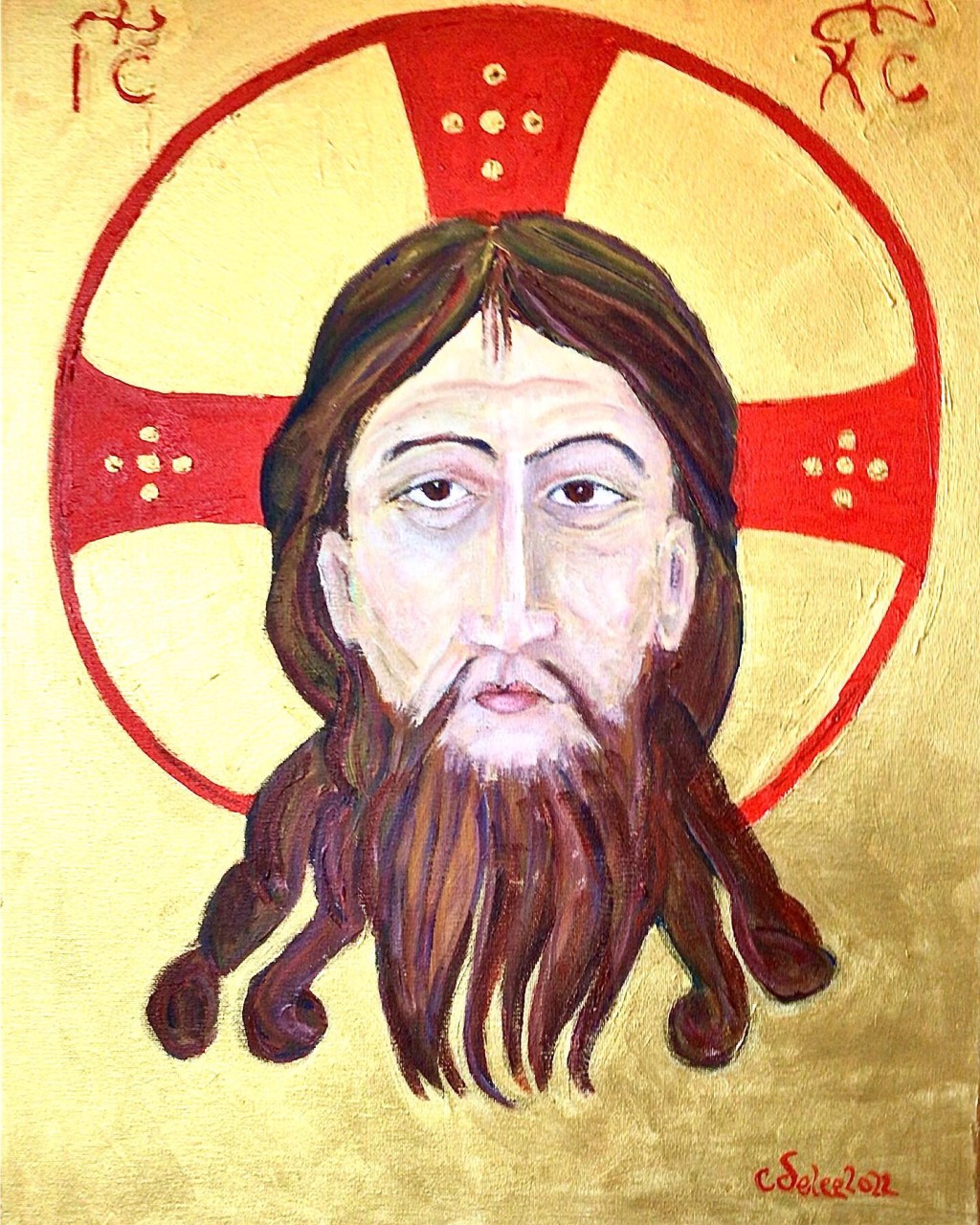
Light of the World Icon: Stencil effect

There are art classes and then there are Art Classes. Just as we shouldn’t make up our minds about a subject or a food until we experience it directly, we can have an open mind about a novel event, rather than rejecting it out of hand. Many of us have lived our lives under judgmental circumstances, dealing with rejection and disappointment at not being the best. “Talladega Nights: The Ballad of Ricky Bobby,” the NASCAR themed film of redemption and finding one’s purpose in life, stars Will Ferrell, whose father crippled him with this tragic life message:

“If you ain’t first, you’re last. You know, you know what I’m talking about?”

Near the end of the movie, Ricky Bobby learns this all was just crazy talk:

Ricky Bobby: Wait, Dad. Don’t you remember the time you told me “If you ain’t first, you’re last”?
Reese Bobby: Huh? What are you talking about, Son?
Ricky Bobby: That day at school.
Reese Bobby: Oh hell, Son, I was high that day. That doesn’t make any sense at all, you can be second, third, fourth… hell you can even be fifth.
Ricky Bobby: What? I’ve lived my whole life by that!

According to Baseball Reference, Ruth’s 183.1 career WAR — combining his value as a hitter and pitcher — is the highest all time, well ahead of Walter Johnson’s 164.8. For reference, the highest mark among active players is Albert Pujols’ 99.6 WAR.

We call this living out a “bad script” our ancestors have written for us. We see it all the time in the movies and on television. We read about it in novels and in comic books. For the most part, people don’t change their wicked ways, but get the consequences they’re due. The bad suffer and the good prosper. Or we read fairy tales in which the good little children get rewarded, or the unjustly treated ones are raised up, like Cinderella. These are the popular stories, but not the biblical tales. The book of Job calls this “retribution theology” into question, as does Jesus in the New Testament.

Annie French (1872 – 1965) Scottish: Cinderella and the Ugly Sisters, About 1900 – 1910, Pen and ink, watercolour and gold paint on vellum paper, 23.50 x 21.50 cm, Scottish National Gallery of Art.

In the Bible, God sends prophets, not only to call the people to account (critique their actions or behavior), but to offer the hope of a better future if they return to God and God’s ways (positive changes in behavior). In this way, a good art teacher is like a biblical prophet, who offers both positive and negative critique on the artwork. The teacher also offers “hope” or suggestions on how to improve the work. Teachers aren’t telling the person they don’t measure up, only that they need more time invested in making art to be able to bring their own artistic vision into reality.

Mike on Being the Light in the World

If we expected babies to chew steak from the moment of birth, the world would be a lonely place. If we expected these same babies to get up right away and “bring home the bacon” to buy their own steak and potatoes, they’d starve. Babies aren’t meant to walk before they crawl, nor or they chewing meat before they drink milk or pablum for a year or two.

Bacon Cake: Oh, Baby! I hope that’s REAL BACON!!

Someone who comes to art class should always come to learn something more, no matter how much they already know. I’m always learning new ideas and techniques. The act of making art is always an act of exploring new territories. We also grow by sharpening one another. Folks in the class are always excited to see how each other approaches the subject each week.

Mike’s May 2022 class work shows he’s been learning some things.

Only the apocalyptic writers in Scripture had a fixed view of the future. For them, God had given up on humanity. We humans were too far gone, too broken, and had destroyed God’s world beyond our weak means to repair it. Their only hope was for God to create “a new heaven and a new earth, for the first heaven and the first earth had passed away, and the sea was no more.” (Revelation 21:1)

Gail went the extra mile with Cri-Cut lettering

Of course, this isn’t a prediction of a certain time, but it’s a future hope for all times. It’s the hope all we creative people have every time we face a blank canvas, a pile of found objects, or a bag of scrap cloths. We also do this when we pull together a dinner before we go to the grocery store, and we take some of this and that which we have in our cupboards and refrigerators. We’re going to make something new! We do hope the Spirit of God descends to make this an inspired concoction! And if it doesn’t work out, we always know our salvation isn’t at stake over a single random supper creation. If I’m hungry enough, I’ll eat anything. Or there’s always peanut butter and jelly sandwiches.

Leftover Doughnuts and Sausage Bread Pudding Bunt Cakes

I was reading Richard Rohr’s Enneagram commentary on the American people. He says America is a nation of Threes: competitive, striving, always looking for success and improvement. When we hit a down cycle, and economics tells us we always have ups and downs in our economy, Americans act like we’ve been insulted. This doesn’t happen to us—to others maybe—but not to us! We’ll look both for a scapegoat and a savior, but never realize these conditions are a natural part of life.

Always be the best YOU. There’s never going to be another one just like YOU.

Likewise in groups, we’re always judging who got more, who has the most status, who’s preferred, and who’s on the out. We’re even liable to self-select to be on the outer group if we believe we won’t measure up, just to spare ourselves the shame of being found wanting. Joyce Rupp has a great poem about this very topic:

WE CAN LOVE THE IMPERFECT SELF
If I wait to be perfect
before I love myself
I will always be
unsatisfied
and ungrateful.

if I wait until
all the flaws, chips,
and cracks disappear
I will be the cup
that stands on the shelf
and is never used.

Magic Teacup Cake from Alice in Wonderland

If we’re faithful scripture readers, we know God never chooses the best persons to do God’s work. When we were children, we saw these characters as heroic figures, just as we saw our parents as great and invincible. The Old Testament records how Moses was a murderer, Joshua was afraid, Amos was a lowly shepherd, and David was an adulterer. Not exactly Perfect Role Models, but transformed people can do God’s mighty deeds if they let God work God’s purpose through their lives.

This word doesn’t mean what the headline writer thinks it does.

In Art Class, we don’t reject “poor work.” We aren’t a factory producing widgets. We have other goals: art appreciation, learning about colors, learning to see more clearly, developing a creative mind, and developing drawing skills. Art is a unique visual language, so learning how to render a three-dimensional form onto a two-dimensional surface takes some time and practice. Developing our own voice is the step beyond mastering the basics of artistic vocabulary. As I used to tell my parents at back-to-school night, just enjoy whatever your child brings to you! If you leave your “critical parent” at home, and bring your “inner child” to Art Class, life is way more fun!

Mike’s Christmas Card Collage

We’re currently on holiday sabbatical at Oaklawn UMC, but classes will return in the new year. We meet in the old Fellowship Hall at 10 am to noon. We always have coffee, and on occasional days, a tasty treat. Our class will begin working in watercolor beginning on January 5, 2024. I don’t charge for the class instruction, but each person should bring their own supplies. Supplies needed are:

Prang Oval 8 watercolor paint set with brush
  1. Prang Oval 8 watercolor paint set (containing brush)—on line at Walmart and Amazon. This has best color and pigments. I found a prime deal on Amazon for $3 each if you buy 3, free shipping.
  2. Watercolor paper pad 9” x 12” or larger (90 lb or heavier)
  3. Tall plastic container for water (iced tea glass size plus)
  4. Your inner child

Joy and peace,

Cornelia

MERRY CHRISTMAS, PEACE ON EARTH, GOOD WILL TO ALL

Talladega Nights: The Ballad of Ricky Bobby https://www.imdb.com/title/tt0415306/quotes/?item=qt0425224

Babe Ruth’s Top 10 career statistics— Shohei Ohtani produced 9.1 total WAR during his spectacular two-way campaign in 2021. Even he maintained that level of performance for 20 consecutive seasons, he would still be 1.1 WAR short of matching Ruth. https://www.mlb.com/news/babe-ruth-s-top-10-career-statistics-c163792958

Prints, Pumpkins, and Possibilities

adult learning, art, Attitudes, beauty, Creativity, Faith, Family, Food, holidays, Imagination, Ministry, Painting, purpose, Spirituality, Stress, Thanksgiving

Go Fish: Recycled Print and Collage

Here we are shortly before Thanksgiving, at the time I call the “high holy days of family gatherings.” We’ll be in this space-time continuum until the last whistle of the last Bowl Game—the grandaddy of them all: Sunday, February 11, 2024. That would be Super Bowl LVIII, or three days before Valentine’s Day, as a reminder to those who forget these things. As far as big games go, this tradition is almost old enough to take an early retirement. Thanksgiving is a much older tradition, however, for folks have been celebrating harvests as long as autumn has been a season. It’s always good to get a few pounds on before the winter gets here for good.

Leftover Blueberry Donut Bread Pudding

Our final class for November had a celebratory snack. Both Tim and Gail brought gifts of food: a delicious pumpkin spiced cream cheese roll and yummy blueberry and cake doughnuts. Tim let me bring the remaining doughnuts home, so I made a leftover blueberry doughnut bread pudding from them. Very good!! The recipe is on my Cornie’s Kitchen blog now (link below).

Gail’s Turban Pumpkins

Gail painted a still life of turban pumpkins and Tim finished up his leaf drawing. I worked to complete my print project. I added some bible verses cut from an almost century old Bible. The pages fall apart when I try to read it, but fixing it to the canvas will keep keep it from decaying further. As Isaiah 40:8 says—


“The grass withers, the flower fades; but the word of our God will stand forever.”

Tim’s Textured Leaf Study

Sometimes the best part of art class isn’t learning how to create a more beautiful painting, but discerning how to live a more beautiful life. We’re constantly surrounded by the woes and suffering of our world, and this experience can cause us to cast a jaundiced eye on life. We can end up with negative attitudes and emotions that affect our own equanimity and wellbeing.

This is a time when my life experiences in ministry and personal suffering help others see God’s transformational grace at work in human suffering. God doesn’t cause suffering, but God can use this time for good. As Paul reminds us in Romans 8:28—“We know that all things work together for good for those who love God, who are called according to his purpose.”

Even Jesus suffered and those of us who bear his name and image aren’t spared this fate. How we handle suffering is the mark of a redeemed person. No one is called to submit to abuse, but we’ll all suffer from illness, indignity, lack of respect, or the ravages of old age. Some of us suffer needlessly because we don’t measure up to an unrealistic ideal image, so we tear ourselves down and say, “we’re no good.” We’re just fine; our expectations are excessive.

Greetings from a Distant Time: It was a hope even then, not a reality.

The high holy days, which we enter into now, are fraught with expectations for many people. Families, who have estranged relationships, may feel a sense of loss if someone doesn’t appear at the family table. Likewise, those who’ve experienced a death will feel the pain of the empty chair. We can’t bring back what was, but we can honor their memories and tell their stories. We can live in the present and build new joys for the family we have now.

In the Bible, inviting someone to eat with you is equivalent to making them part of your family. Therefore, family is the people you choose, not just your blood relatives. We can have many families, but we are to love, care, and protect them all. I consider my art students as part of my chosen family.

In the new year we plan to experiment with watercolors, so if that’s an interest, a Prang 8 color watercolor box, brush, and watercolor paper should be on your Christmas list. Our December schedule is light:


• December 1–class—
• December 8–no class—I’m going to Raney Lectures at PHUMC
• December 15–class—
• December 22 to January 3—vacation—no classes
• January 5—Watercolor class

Joy and peace,

Cornelia

Post Prandial Poses

Recipe for Leftover Blueberry Donut Bread Pudding:
https://cornieskitchen.wordpress.com/2023/11/22/leftover-blueberry-donut-bread-pudding/

The Persistence of Effort

adult learning, Altars, art, Attitudes, beauty, brain plasticity, Children, cognitive decline, Creativity, exercise, Food, Habits, Health, Holy Spirit, inspiration, knitting, Love, Ministry, mystery, nature, Painting, Prayer, pumpkins, purpose, rabbits, renewal, Right Brain, sleep, Van Gogh, vision

These shoes are made for walking

I was reading an article in the New York Times the other day. In “How I Learned to Love Finishing Last,” the author wrote about her slow pace as a runner. As one who regularly finishes last in my age group in the annual Spa 5K Walk each November, I’m optimistic one day I might get old enough to be in a nonagenarian age group all on my own. Perhaps if I’m 90 and still doing a 5K, they’ll give me a ribbon just for participating! “The last will be first and the first will be last,” especially if there’s only one of us in the race!

“When we compare ourselves to others,” said Dr. Justin Ross, a clinical psychologist in Denver who specializes in athlete mental health and performance, “we set ourselves up to suffer. Instead, the real psychological benefits come from enjoying what your body can do.”

Portrait of Yayoi Kusama in costume in front of pumpkin painting, photo: Noriko Takasugi

Suffering physically isn’t what art class is about, although we may suffer indignities to our egos, but this shouldn’t hold us back from doing our art works. The case of the Japanese artist Yayoi Kusama is evidence even hallucinations of voices and images can’t keep an artist from creating. If our daily efforts don’t measure up to what we imagined in our mind, it’s merely because our inner eye sees better than our hands can execute our vision. Sometimes our eye forgets what it once learned, for we haven’t used our skill of looking in a while. A runner doesn’t leap off the couch and immediately run a marathon or even a 5K. The smart athlete takes the time to train progressively for the distance beforehand. Also, they get new shoes.

Kroger Run: Two ghost pumpkins and a small pie pumpkin

Sometimes the coach has slept over the summer also. Just as students in school need a time to relearn last year’s lessons, as a coach in art class I sometimes forget the lessons, which are second nature to me because they’ve been inculcated by multiple teachers since I was eight years old, aren’t as ingrained to my own students. I also forget I’m always observing everything around me: cloud patterns, changing colors on trees, sunlight dappling on tree branches, shadows on the ground, and reflections in windows. I think about these patterns rather than about what I need to do next or next week. My calendar will remind me of these things in due time. I’ll be wrapping this up soon so I can work on my monthly Rabbit blog.

Rabbit playing “Hide the Pumpkin.”

A National Institute on Aging study found five healthy lifestyle factors — physical activity, not smoking, not drinking heavily, following the Mediterranean-style diet, and engaging in mentally stimulating activities — can have important benefits. People who engaged in four or five of these behaviors had a 60% lower risk of developing Alzheimer’s compared to those who only followed one or none. People who followed two or three of the activities had a 37% lower risk. This is your free wellness plan from Dr. Cornie, who has no medical degree, but did stay in a Holiday Inn once.

Debunking the Myth of the Split Brain Theory

Although we commonly think art is a “right brained” activity, in 2013 a group of researchers at the University of Utah discovered people actually use both sides of their brains equally. Back in the 1970’s when I was seeking employment after graduate school, the “Art is a right brain myth” ruled the creative work world. I once suggested I’d be a good candidate for a museum position because I understood both the artistic and the logical mind. I was not hired. Intuitive understanding of the brain a half century ahead of time doesn’t exactly open the doors to a fancy job.

As I recall, I got a checker’s job in a grocery store and ended up counting the teller trays and preparing the bank deposits for that store. The good news is creating works of art is a multi-process activity, one that depends on several brain regions and on redundancy of art-related functional representation rather than on a single cerebral hemisphere, region or pathway. This means even when we lose our ability to form words (typically a left hemisphere activity) our ability to create art still exists. We can still express our inner feelings and thoughts. This is good news for the aging and those who love them.

Yayoi Kusama – Pumpkin, 2014, installation view, Donum Estate, California, photo: Robert Berg

One one the great sadnesses in my ministry is being with young people who desperately want to have their old one’s memories recorded, but waited too late to ask them or were too busy with their own lives to sit and listen to these stories of the olden days. Once their old person has a stroke and loses the ability to form words, the opportunity has passed. Those stories will be locked in their minds due to aphasia, and no one or no amount of time will pull them out. We always tell young parents their babies need to be enjoyed while they’re still young, but we should also tell families to get the stories of their elders while they still can. “Strike while the iron is still hot” will take on a new meaning one day.

We needed bigger pumpkins

Gail and I were the only ones in class today. Lauralei showed up to gift us chocolate cake and keep us company. Tim and Mike were out of town. Gail and I both repainted old canvases. I showed some of the unusual ways pumpkins have been decorated by various artists, but none of them sparked any interest. We got down to work by covering our old canvas with a base of titanium white paint. Then I located all three of the pumpkins with circles and drew a baseline for the object on which they sat. I didn’t look over at Gail’s work for a while, but then I noticed she’d almost completely finished one pumpkin without roughing in the shapes of the others.

Gail had a big canvas today.

“Did you plan on finishing that one pumpkin before drawing the other two?” I asked.

Gail gave me a “needs more caffeine” stare.

“That’s what I thought. Maybe next time draw in the rough shapes so you get everything located in space relevant to each other.”

Pumpkin Spice Latte Time

We kept on painting until clean up time. I often say “I’ve slept since then.” It’s my all purpose excuse for forgetfulness or just plain airheadedness. Sometimes I have my mind on other things and I’m not focused on what’s in front of me. I forget about the wisdom of Brother Lawrence, who said “many do not advance in the Christian progress because they stick in penances and particular exercises while they neglect the love of God which is the end. This appeared plainly by their works and was the reason why we see so little solid virtue.” He also said, “there needed neither art nor science for going to God, but only a heart resolutely determined to apply itself to nothing but Him and to love Him only.”

Cornelia’s small painting of pumpkins

We know Brother Lawrence from the classic text, The Practice of the Presence of God. Although it dates from the late 17th century, his lessons on living life in joy in the present moment, all for the love of God are invaluable for us modern folks who tend to live for our 15 minutes of personal fame, social media clicks, or self interest. We aren’t used to the monastic life today, or to the discipline of that lifestyle. We live in a Burger King world, in which each individual gets his or her own way to every extent possible. Unfortunately, the Christian lifestyle is one of discipline, but not harsh punishment:

“Now, discipline always seems painful rather than pleasant at the time, but later it yields the peaceful fruit of righteousness to those who have been trained by it.” ~~ Hebrews 12:11

In art class we focus on the disciplines, just as the guild artists taught the apprentices back in the day. These disciplines are not only for safety, for some of our art tools are dangerous, but also some of our techniques are proven to yield better results than others. This is why carpenters measure twice and cut once. They also cut on the outside of the line, rather than the inside. They can shave down a piece easier than adding to it. Murphy’s Law recognizes this: “A wire cut to length will be too short.”

Zen Tangle drawing of pumpkins: exercise in texture

Art class has no mysteries, but we can forget the “secret gnostic knowledge passed down by word of mouth” from our previous classes. I often use the excuse “I’ve slept since then.” Another good excuse is “My mind has gone to Pluto.” I share these with you all, for they’ve always worked for me. Of course it helps to be a natural blonde. Then again, I’m very organized, but I’m also very active, so sometimes my calendar gets overwhelmed, and I pull out the “OOPS! Card.” Even in retirement I’m still creating and sharing my faith through art and writing. It’s my way of exercising those brain cells to keep them from dying off. We old folks can still learn new things, even if it takes longer. This is what we call the persistence of effort. Those who keep using their skills won’t be losing those skills.

The same goes for learning a new skill. It’s all a matter of repetition. We can’t get frustrated if we don’t get it on the first try. We won’t be a good role model for the young if we have that attitude. We need to lower our expectations. I used to think I couldn’t knit, but only crochet. After my mom, who was a stellar knitter passed on, a friend taught me to knit in an afternoon! Where this sudden bilateral coordination came from I have no idea, but it was so welcome. Perhaps I needed to be in the right frame of mind, or I wanted to be able to carry on my mom’s memory, but I was definitely receptive to her teaching.

Letter to Theo Van Gogh, September 18, 1888

It’s never too late to learn and we’re never too old to start learning. Art isn’t just good for the brain, but it’s good for the soul. Art is our attempt to represent truth, beauty, and nature in media that can be accessible to others. By doing this, we bear witness to the creation and the Creator. We only need give our best efforts, and let God’s Spirit guide our growth.

Joy, peace, and perseverance,

Cornelia

We have pumpkins galore on the autumn altar.

How I Learned to Love Finishing Last


How the Aging Brain Affects Thinking | National Institute on Aging

https://www.nia.nih.gov/health/how-aging-brain-affects-thinking

The creative-right vs analytical-left brain myth: debunked! – Dr Sarah McKay https://drsarahmckay.com/left-brain-right-brain-myth/

Art and brain: insights from neuropsychology, biology and evolution – PMC

https://www.ncbi.nlm.nih.gov/pmc/articles/PMC2815940/

The Project Gutenberg eBook of The Practice of the Presence of God, by Brother of the Resurrection Lawrence (free ebook)

https://www.gutenberg.org/cache/epub/5657/pg5657.html

Pears and Apples

adult learning, Altars, apples, Aristotle, art, brain plasticity, change, cognitive decline, color Wheel, Creativity, exercise, Fear, Habits, Holy Spirit, inspiration, Lent, Leonardo da Vinci, Painting, perfection, Physical Training, purpose, risk, Thomas Merton, Van Gogh

Still Life with canvas, pallet, and brushes

Aristotle said in his Poetics, “The aim of art is to represent not the outward appearance of things, but their inward significance, and this, and not the external manner and detail, is true reality.”

He spoke mainly about poetry, which was the highest art of his age, but his words also apply to the fine arts. Today, many people are still mesmerized by artists who practice various styles of realism, but they overlook the artists who show us the realities of emotion and inner vision.

The good news about art.

“Art enables us to find ourselves and lose ourselves at the same time,” said the spiritual writer, Thomas Merton. Some people use art as a cathartic exercise, and pour out their inner emotions on the canvas or their chosen media. Jackson Pollock’s drip paintings and Van Gogh’s late works are good examples of emotional expression. We all know folks who have a project going in their garage. They go work on “that worthless piece of junk” to focus their attention and energy on fixing something on which they can make a difference, instead of getting tied up in knots about things they can’t change and must accept. Gardening and knitting are also good hobbies for focusing this energy.

We know our nervous system grows to the modes in which it has been exercised. This is what we call building a habit over time. Just as a child doesn’t walk straight out of the womb, they have preparatory skills that must be acquired by stages as they grow. Exercising their muscles by rolling over also helps to strengthen their necks to hold their heads up. Crawling leads to pulling up, and that leads to letting go to learn balance.

Each time a child repeats these movements, he or she will simplify the movements required to achieve the needed result, make them more accurate, and diminish fatigue. In this, they’re building habits that bring them closer to walking. Rushing them to achieve “early” walking actually puts them behind cognitively.

Not only are there twenty five body parts in a baby’s body that are used in the crawl movement, but crawling also strengthens the hip sockets, so the baby will have a strong platform on which to stand. Crawling helps the corpus callosum, which is a band of nerve fibers between the hemispheres of the brain. Criss-cross crawling on the knees and hands stimulates the corpus callosum to develop in a balanced way, facilitating the hemispheres of the brain to communicate. These cross lateral movements work both sides of the body evenly and involve coordinated movements of the eyes, ears, hands, feet, and core muscles. This helps support cognitive function, problem solving, and ease of learning. Exploring the floor in a baby proofed home allows your baby to achieve his or her optimal potential.

Gail’s Painting

“Practice makes perfect” is only as true as the practice is directed in a true direction. This is where a teacher, a parent, a coach, or a spiritual guide comes into play. Only one who’s been led well can lead others with grace. We don’t tear down the learner, but ask questions, give guidance, help them see alternative paths, and allow them a safe place to explore their choices.

Art class isn’t brain surgery. No one will die if the painting isn’t successful, and no one’s salvation is at risk if the painting doesn’t come out the way we hoped it might. Art class is a safe place to take risks, unlike jumping from a tall tower without a parachute. Learning to accept failure on our canvases and coming back next time to try again is a mark of resilience and courage. Every time we fail closer to our target, we realize we’re gaining on it! We never say I CAN’T in art class.

Crawl before you Walk or Run

The sad reality is we can teach and expand the horizons of young people up til the age of 25 or 30. After that, they seem to lose energy and desire to learn more or to change. They “habitually” repeat their previous acts, for good or for ill. We’ve all heard the old saying, “You can’t teach an old dog new tricks.” Those of us who are no longer young have sometimes been accused of being set in our ways. Some of us are afraid we won’t excel at a new challenge, for we’ve always been held to a high standard of achievement. Since none of us will be the next Georgia O’Keefe or Leonardo da Vinci, we can set that worry aside. They both had more years to practice than we have left in front of us. Instead, we should give our remaining time our most focused attention, so we can get the most from our experience.

My high school chemistry book had the same information in it which my daddy’s college chemistry book covered. He was amazed I was learning “advanced” ideas at my young age. In 1982 R. Buckminister Fuller introduced the idea of the “knowledge doubling curve.” Up until 1900, knowledge doubled every century. By 1945, knowledge doubled every 25 years and by 1982, it doubled every year. Some say it’s now doubling twice a day! The newest computer we buy off the shelf today is already obsolete.

We can’t train our students for the jobs of today because these jobs likely won’t exist tomorrow. We need to train people to be lifetime learners instead. Luckily, we don’t have to know all things, but we do need the skills to find the knowledge and sort through the best sources for the best possible information.

1930-2006

Today, knowledge we acquire in high school, college, graduate school, and our last job may already be obsolete. (I’m one who still grieves the loss of Pluto as a planet; it exists but is a dwarf planet in the Kuiper Belt). This is especially true in fast moving fields like technology. As futurist Alvin Toffler wrote, “the illiterate of the 21st century will not be those who cannot read and write, but those who cannot learn, unlearn, and relearn.”

This means all of us will need to become lifelong learners or we’ll risk losing touch with an ever evolving world. Maybe we think our brains can’t handle something new, for we’ve heard about the effect of aging. Cognitive process studies with older brains show learning, memory, and problem-solving in humans are often less efficient in these areas.

However, it has recently been established that dogs show many of the same kind of age related changes that humans do. A study in Vienna showed that older dogs learned new tasks just as well as younger dogs, although they took longer to do so and required more repetitive corrections. This aptitude is also known as “resilience training.”

I think it’s also important to know why we want to keep our brains agile as we move into our later years. John Wesley was fond of repeating William Law’s summary from the Practical Treatise on Christian Perfection,

“Do all the good you can, to all you can,
by any means you can, as long as you can.”

Because Wesley was better known than William Law, this quote is now attributed to Wesley alone. We Methodists have made it our own, however, and have carried its banner around the globe in our world wide mission efforts made possible by our Connectional ministries. Wesley thought enough of Law’s writing to reprint 19 editions of his work.

My late mother, at the age of eighty, learned how to use a laptop computer. She was motivated because she wanted to see emailed photos of her grandchildren, but then she realized she also could find recipes. When a child in her hometown needed a Mercy Flight, she used her new skills to get him transportation to an out of state hospital for treatment. I occasionally had to reteach her on how to double click quickly on her icons, rather than slowly, but she finally caught on.

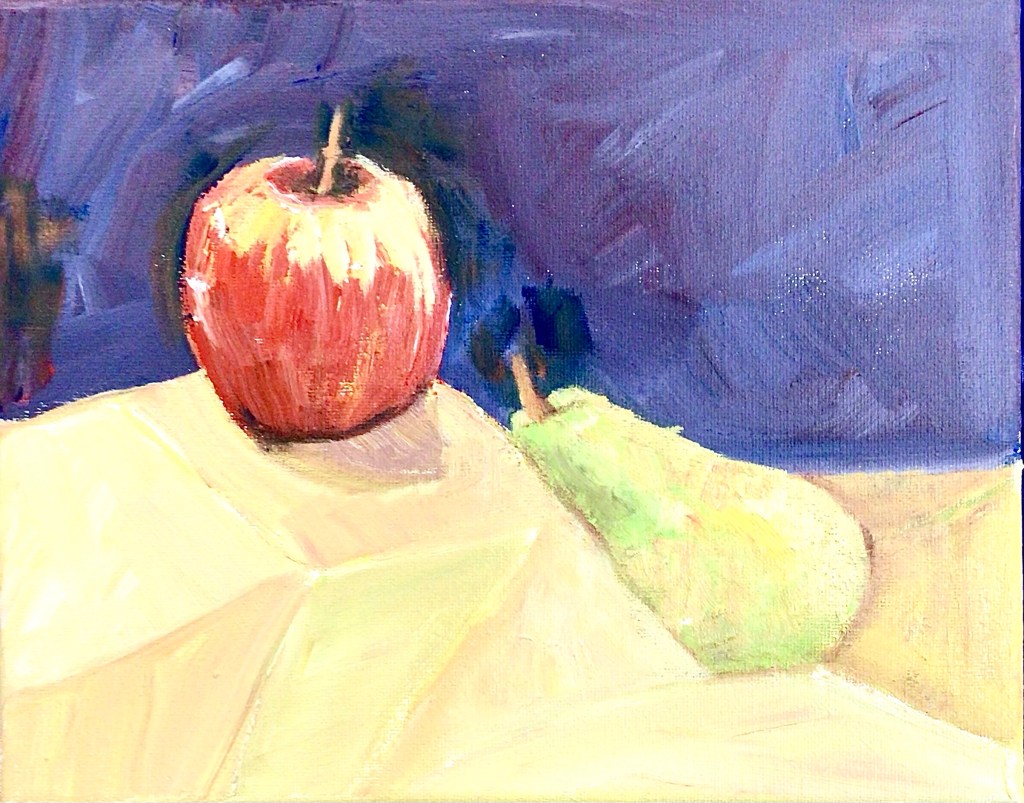
iPad drawing of pear and apple

If we want to keep our brains agile throughout our middle, silver, and golden years, we always need to try new things. Doing art challenges makes our brain build new neural pathways. Every time we look at a still life or a landscape, we have to make multiple decisions: what shapes do I see—circles, squares, triangles, or rectangles; how do these shapes relate to one another on the plane of our canvas; what is most important; what colors will I use; what emotions do I want to express; and where will I begin?

Eventually, we will find our “style.” We don’t find a style by copying another’s work, but we create enough works until our hand becomes one with our spirit. Since God has placed a special spark of God’s own creative Spirit within each of us, eventually we’ll experience the joy of being one with God when we are in our painting moments. As Paul said to the Romans (8:16):

“The Spirit Himself bears witness with our spirit
that we are children of God.”

Last Friday we had a simple still life as our inspiration. Half our class was out sick with spring pollen troubles, but it was good to see those who could come after a two week hiatus. After a brief show and tell to get us inspired by other artists’ takes on the subject for the day, we got started. I reminded everyone not to make the fruit too tiny, so it wouldn’t get lost on the canvas. I believe everyone succeeded with this goal!

Mike’s painting

Mike painted his whole canvas with one brush. This gave the fruit a certain texture with contrasting colors, and the background, which was in a close value, didn’t show much brush strokes or texture. I like the perspective he chose, which brings the viewer in close to these fruit.

Gail tried a larger canvas with bolder colors than she normally uses. It was more dramatic and stronger in contrast than usual, while she kept her smooth strokes of paint as usual. She also took a view from above.

Cornelia’s Fruits

I stuck to a traditional rendering of the still life, since I do many abstract paintings in my own studio. I’d call these two Day and Night, for the Apple is quite awake and the Pear seems to need a little nap. It’s a study in contrasts: red and green, blue violet and yellow orange—a color wheel study masquerading as a still life.

Next week we’re in the season of Lent. As Christ turns his face towards Jerusalem, we’ll begin a study on the icons. This will be accessible and interesting. You’ll end up with your own icon for your personal worship center also.

Joy and Peace,

Cornelia

Classics in the History of Psychology — James (1890) Chapter 4
https://psychclassics.yorku.ca/James/Principles/prin4.htm

Crawling is important for childhood brain development
https://thefnc.com/research/crawling-is-important-for-childhood-brain-development/

You Can Teach an Old Dog New Tricks | Psychology Today
https://www.psychologytoday.com/us/blog/canine-corner/201602/you-can-teach-old-dog-new-tricks

Letters of John Wesley – John Wesley, Augustine Birrell – Google Books, p.423
https://books.google.com/books/about/Letters_of_John_Wesley.html?id=zgYu6NpqWDEC

What It Takes To Change Your Brain’s Patterns After Age 25 https://www.fastcompany.com/3045424/what-it-takes-to-change-your-brains-patterns-after-age-25

Growth in Faith and Art is a Risky Business

adult learning, arkansas, art, brain plasticity, change, Children, Creativity, Faith, Holy Spirit, hope, Icons, Imagination, inspiration, john wesley, Ministry, New Year, Painting, Pantocrator, perfection, photography, purpose, risk, Spirituality, vision

Oscar Wilde famously said, “Life imitates art far more than art imitates life.” This is because the self-conscious aim of life is to find expression and art offers it certain beautiful forms, through which it may realize that energy. Yet most people who look at artworks judge them for the degree to which they represent “three dimensional reality,” in either two or three dimensions (painting, draw,or sculpture and assemblage).

Often I’ve been asked about my colorful landscapes, “Don’t you ever paint these in normal colors?”

My answer is usually, “How do we know the colors we see today are the original colors of Creation? After all, we now live in a fallen and broken world. Perhaps these bright colors were God’s original palette.” I’m not painting just what I see, but what was and what is yet to come. These are visions of a better world, where the leaves clap their hands for joy.

In art class, we not only struggle to master drawing shapes “as they are,” but also to challenge our minds to break free of our need to exactly reproduce the shapes before us. We always have the tension to make only a “copy of the image before us,” rather than to meet the image on a spiritual plane and portray an intimate portrait of its inner truth.

When we meet a stranger, we can hide behind our masks and keep our distance. Likewise, we can fail to become intimate with our painting’s subject matter. The resulting work is cold and dead, like a limp handshake. It’s a risky business to bare your heart to the canvas and paint. The brush will tell if your heart and soul is in it or not.

We get more comfortable with this risky business by practicing risk taking. It’s not like we’re facing tigers in a circus cage or jumping out of an airplane without a parachute. We can’t lose our salvation in Christ if we make a bad painting. We only have a new level from which to start afresh. All growth requires risk and failure. We discover what works, keep that, and eliminate the unuseful.

Willingness to learn is related to the “growth mind-set.” This is the belief your abilities aren’t fixed but can improve. This willingness is a belief not primarily about the self, but about the world. It’s a belief every class or learning experience offers something worthwhile, even if we don’t know in advance what that something is. Every teacher or parent worth their salt has to believe their students or children can learn and grow, or they need to give up their profession so another can grow. The first lesson even the most recalcitrant student needs to learn is to believe growth and progress is possible.

Christ on Tree of Life, San Clemente Basilica, 12th Century mosaic, Rome, Italy.

The Christian life has a parallel to the growth mindset. The whole of the Christian life is wrapped up in this faith: with God’s help, we can go on to perfection. This is a basic Methodist belief known as sanctification. We also call it going on to perfection in love of God and neighbor. Some of us think because we’re not able to change on our own, we don’t need to grow in our love. God has done all the work for us in Christ. The Holy Spirit was sent to be a truthful guide:

“When the Spirit of truth comes, he will guide you into all the truth;
for he will not speak on his own, but will speak whatever he hears,
and he will declare to you the things that are to come.” (John 16:13)

Christ in Majesty, Book-Cover Plaque, French, Limoges, enamel, ca. 1200 CE, Metropolitan Museum of Art, NYC.

Paul speaks of this truth in Philippians 3:20-21, when he reminds the people of their present state as sojourners in this world, while their citizenship is elsewhere:

“But our citizenship is in heaven, and it is from there that
we are expecting a Savior, the Lord Jesus Christ.
He will transform our humble bodies that they may be conformed
to his glorious body, by the power that also enables him
to make all things subject to himself.”

Mother About to Wash Her Sleepy Child Mary Cassatt, 1880

If life is a journey, the Christian life is even more of a pilgrimage. We all go through stages of faith if we seriously reflect and consider our beliefs when our life experiences intersect with our faith. Our earliest stage of faith begins with our parents or caregivers. Here we learn to trust or distrust, as we experience an embodied faith. The next stage is early childhood (age 3-7). Faith at this stage is experiential and develops through encounters with stories, images, the influence of others, a deeper intuitive sense of what is right and wrong, and innocent perceptions of how God causes the universe to function.

Michaelangelo: Creation of Adam, Sistine Chapel Ceiling

The next stage has been labeled “Mythic-Literal Faith” (Ages 7-12). Children at this stage have a belief in justice and fairness in religious matters, a sense of reciprocity in the workings of the universe (e.g. doing good will result in a good result, doing bad will cause a bad thing to happen) and an anthropomorphic image of God (e.g. a man with a long white beard who lives in the clouds). Religious metaphors are often taken literally, thus leading to misunderstandings. If God’s rewards or punishments don’t apply in proper retribution, in the believer’s mind, their faith in God’s system becomes fragile.

Théodore Géricault, Raft of the Medusa, 1818–19, oil on canvas, Louvre, Paris.

“The Conventional Faith” stage (12-adult) arises when individuals join a religious institution, belief system, or authority, and begin the growth of a personal religious or spiritual identity. Conflicts occur when one’s beliefs are challenged are often ignored because they represent too much of a threat to one’s faith-based identity.

Théodore Géricault’s “Raft of the Medusa,”painted in 1818–19, is nearly 17 by 23 feet large. It commands its space as any proper historic painting of the past ever did. Rather than present a moral lesson from the past, the artist instead chose to paint an event from his present time: the rescue of the abandoned sailors and slaves from a wrecked ship. The French nation had sent the new governor of the Senegal colony, his family, and some other government officials and others on the Medusa. The government officials went to secure French possession of the colony and to assure the continuation of the covert slave trade, even though France had officially abolished the practice. Another group aboard the Medusa was composed of reformers and abolitionists who hoped to eliminate the practice of slavery in Senegal by engaging the local Senegalese and the French colonists in the development of an agricultural cooperative that would make the colony self-sustaining.

On the way, the ship ran aground and broke up. The officials and their families were put in lifeboats, but the 150 others on board got a makeshift raft, which was tied to the lifeboats. When the raft impeded the lifeboats, the officials cut the raft loose and all the lives with it. Only 15 were rescued after days at sea, and only ten lived to tell their tales. It was a scandal of the times. Géricault read all the newspapers, interviewed survivors, and made studies from ancient sculptures to inform his design. When younger artists saw his inspirational work in the Paris Salon, they knew a sea change had happened. Conservative critics and writers were appalled and accused Géricault of creating a disgusting, repulsive mistake. They were not yet ready to leave the past behind.

William Faulkner once said, “You cannot swim for new horizons until you have courage to lose sight of the shore” (The Mansion , 1959). When we meet that initial storm, our first thought is to bring our fragile bark into port. In life, we batten down the hatches and book it for a safe harbor. In art class, we want to fall back on what we’ve always done before, what we know we can do, and what we’ve been successful with in the past. This is our “safe harbor.”

“Individuative-Reflective Faith” (Mid-Twenties to Late Thirties). The individual takes personal responsibility for her beliefs or feelings, often by angst and struggle. Religious or spiritual beliefs can take on greater complexity and shades of nuance, and a greater sense of open-mindedness. These can also open up the individual to potential conflicts as the different beliefs or traditions collide.

To progress and grow in our art skills, or to move through the “dark night of the soul” when we question our formerly held spiritual truths, is a crucial time. Crucial is a word sharing the same root as crucifix. The crux of both of these situations results in a life and death situation. Not that the person quits breathing or their heart stops beating, but will their old life die and their faith be reborn anew? Also, will they trust a power greater than themselves to bring them back from the depths? Many of us aren’t willing to give up control to anyone, and certainly not to a God we can’t see. We’re two year olds in our spiritual lives too often, for “I can do it myself!” Is our answer to everything and everyone. (Test it out—how many of you read the directions after you start putting a project together?)

The Cross that Spoke to St. Francis, San Damiano Chapel, Italy, 1205 CE

“Conjunctive” Faith (Mid-Life Crisis). A person at this stage acknowledges paradoxes and the mysteries attendant on transcendent values. This causes the person to move beyond the conventional religious traditions or beliefs he may have inherited from previous stages of development. A resolution of the conflicts of this stage occurs when the person is able to hold a multi-dimensional perspective that acknowledges ”truth’ as something that cannot be articulated through any particular statement of faith. This is where the Holy Awe begins to fill all the nooks and crannies from which it was once forbidden.

Face of Christ (All People of the World), photo montage

“Universalizing” Faith (or ”Enlightenment”). (Later Adulthood). This stage is only rarely achieved by individuals. A person at this stage is not hemmed in by differences in religious or spiritual beliefs among people in the world, but regards all beings as worthy of compassion and deep understanding. Here, individuals ”walk the talk” of the great religious traditions (e.g. ”the kingdom of God is within you”).

“Jesus of the People” by Janet McKenzie.

In 1999 Janet McKenzie’s painting “Jesus of the People” was selected winner of the National Catholic Reporter’s competition for a new image of Jesus by judge Sister Wendy Beckett, host of the PBS show “Sister Wendy’s Story of Painting.” In the words of Sister Wendy, “This is a haunting image of a peasant Jesus—dark, thick-lipped, looking out on us with ineffable dignity, with sadness but with confidence. Over His white robe He draws the darkness of our lack of love, holding it to Himself, prepared to transform all sorrows if we will let Him.” The model was an African-American woman and the painting includes a yin-yang symbol of Eastern traditions and feather of Native American traditions. (Photo courtesy of Paul Smith)

Next week, we’ll still be working on order and chaos. We got started on this at our first meeting, and the concept is a challenge. I’ll write about our class work then. We’re always open to anyone joining us, for you come as you are and begin where you are. Our art group is a “one room schoolhouse” with all levels of students mixed together. We may all be doing the “same project,” but everyone does it at their own skill level. I give you special attention according to your needs.

Remember, “The only way you can be behind is if you never start.”

Joy and peace,

Cornelia

Life Imitates Life | Lapham’s Quarterly
https://www.laphamsquarterly.org/swindle-fraud/life-imitates-life

The Stages of Faith According to James W. Fowler | Thomas Armstrong, Ph.D.
https://www.institute4learning.com/2020/06/12/the-stages-of-faith-according-to-james-w-fowler/

Théodore Géricault, Raft of the Medusa – Smarthistory
https://smarthistory.org/theodore-gericault-raft-of-the-medusa/

Video and photo slideshow: The many faces of Jesus
https://religionnews.com/2014/01/28/video-photo-slideshow-many-faces-jesus/

From the Shadows to the Light

architecture, art, Carl Jung, change, Faith, Family, Fear, Food, greek myths, hope, inspiration, mystery, nature, New Year, purpose, rabbits, renewal, Roman Forum, shadows, Spirituality, Temple of Janus, Zeitgeist

Rabbit! Rabbit! Welcome to 2023! This old bunny may not see the clock strike midnight, but I’m recovering from a bad cold. Rest is more important than ringing in the New Year. Every year has its own character.

Live with Optimism, even when the nights are long.

Zeitgeist is a word that comes straight from German — zeit means “time” and geist means spirit, so the “spirit of the time” is what’s going on culturally, religiously, or intellectually during a certain period. When it comes to the turn of the New Year, we bunnies wonder if our new broom will sweep clean or if the old broom will leave the same mess as always in our cozy rabbit dens.

Always use a New Broom on the New Year for Good Luck.

Are we filled with hope or with foreboding? Do these dark days and deep nights of winter fill us with a gloomy spirit? Or do the imperceptibly lengthening minutes of daytime give hope to the shadows the cold of winter has left in the depths of our souls? Or have the coastal grandmother bunnies among us learned to ignore all this stum and drang by blending their afternoon tea time into early evening wine tasting?

Everything a culture considers taboo, evil, or immoral typically ends up being proscribed or “consigned to the outer darkness.” From there it ends up inside us in what Carl Jung called “the Shadow,” or our inner “Satan,” as it were. Repressed and inhibited, it festers and rages in the darkness of our “unconscious.” Even in extreme cases, it takes on a quasi-autonomous existence of its own, occasionally intruding as the famous “voices in the head” or even as a multiple personality.

Dr. Jeckyll and Mr. Hyde is a famous light and dark shadow character from fiction, but too often in real life we rabbits point out our own dark shadows in the lives of those we so easily demonize. As my wise old granddaddy rabbit would reprimand me, “When you point out the faults of others, you have three fingers pointing back at you.”

Luke 6:41
“Why do you see the speck in your neighbor’s eye, but do not notice the log in your own eye?”

I always find life more refreshing on the first day of the year, perhaps because I don’t over indulge in strong drink as I once did in my wayward bunny youth. We bunnies all have a wayward youth, for how else would we know what the immature among us are getting into? My old daddy rabbit believed, “Experience was the greatest teacher of all time, as well as its most costly tutor.” Indeed, we remember the costliest lessons best of all. The young ones today say, “Go big or go home.” My grannie would say, “If you’re in for a penny, you might as well be in for a pound.” After all, everyone who participated, either in a small or large way, would be held accountable.

Janus: Bloodstone intaglio of Roman god of transition, passages, and new beginnings.

As I look back on old 2022, grizzled and worn out by conflicts both at home and abroad, I can understand why the ancients thought of Janus, for whom January’s named, as a two faced god. One face, which looked backwards, was lined, bearded, and craggy featured, while the forward looking face of the new year was youthful, smooth, and clean shaven. Every new year is fresh and clean as a beardless youth’s face, as well as untroubled by any recollection of pains or past memories. Most of us bunnies also have short memories, for we tend to repeat the same mistakes over and over. Rabbits have short term memories of around 4 minutes, but can remember bad experiences for longer periods, just as humans can.

Unknown Roman Artisan: Soldier’s Brooch in the Form of a Rabbit, 100–300 CE, Copper alloy with champlevé enamel, found in Britain, Metropolitan Museum of Art, NYC.

In Ancient Rome, as the poets Ovid and Horace recount, Janus was the god of war and peace. They differ as to whether the Temple of Janus was a prison for peace or war, but they both agree the prison was meant to maintain PAX ROMANA, or the great Roman Peace. If peace were impounded, peace would be guaranteed to the nation. If war were imprisoned, it wouldn’t rampage about to destroy the countryside. Just as Janus had two faces, Roman religion was open to multiple interpretations and meanings. Perhaps today, they’d be known as “freethinkers,” as opposed to “literalists” or “strict constructionists” in their interpretation of their ancient stories.

Seeing the Night Skies through Bunny Eyes

Maybe in 2023 we bunnies might want to look at different ways of thinking, instead of one fixed way. There’s a difference between a straight and narrow path and a rut. On the path we can still see other twists and turns, which might change the outcome of our experience and existence. In a rut we’re stuck for life, with no where out, until it becomes our grave. If the world is changing more quickly than is comfortable for us, I give the example of my old granddaddy again. He pushed a button to turn on one of the first electric lights in his home town and lived to see men walk on the moon. Be resilient, be adaptable, and embrace change. After all, we’re always changing, so the option of never changing is death.

Ancient Greek Black Figure Vase, Wasps Attacking Men Robbing Zeus’ Bee Hives for Honey, c. 540 BCE, British Museum, London.

Romans would celebrate January 1 by giving offerings to Janus in the hope of gaining good fortune for the new year. They believed their acts set the stage for the coming year, so it was a common practice to make a positive start to the year. Not only did they exchange well wishes and sweet gifts of figs and honey with one another, but according to the poet Ovid, most Romans also chose to work for at least part of New Year’s Day because they saw idleness as a bad omen for the rest of the year. If 1st century Romans were to drop into some of our 21st century celebrations by means of Dr. Who’s traveling blue Police Box, they would wonder how the barbarians, who sacked Rome in 455 CE, had managed to take over our modern New Year.

Some days I need to be in two places at once.

We toga wearing bunnies, who are long of tooth, know from experience the barbarians are always at the gate of our safe little gardens. Sometimes they’re even inside the gardens of delight, as Peter Rabbit and his Cottontail friends perpetually discover when Mr. McGregror chases them with a rake. If we cast a look back on 2022 with our rheumy eyes, we saw Russia attack Ukraine, an outrageous act which sent millions of people to emigrate from their the destroyed cities and ravaged countryside, with the hope of finding safe haven in another European country.

Mr. McGregor thinks Peter is a Barbarian, who has slipped through his impenetrable garden gate.

Across the pond, on our southern border, thousands of migrants have fled disaster and violence in their homelands, but even though the US economy is hurting for workers in our entry level jobs, they have difficulty getting in. Are these people actually “barbarians at the gate?” Or have we projected our Shadow Fears upon them because they are foreigners? We did this with the Japanese, who m we placed into Internment Camps in World War II, much to our disgrace. This bunny asks us to search our hearts in 2023 to see if our three fingers are pointing back at our own selves.

Think about how Woodstock symbolized the 1960s: Woodstock was part of the Zeitgeist of the 1960s. Whatever seems particular to or symbolic of a certain time is likely part of its Zeitgeist. I came home from college one Christmas wearing a necklace of tiny black and white seed beads, only to be greeted by my old fashioned daddy, “Are you a hippy now?” For him, any one thing represented the whole, for he grew up with the ancient bunny wisdom, “One bad apple spoils the bushel.” We were only reconciled when he realized I hadn’t lost my fondness for his beloved Cowboys football team.

If we can find one common interest in this strange and fraught world with those with whom we would be at war, then we might be able to come to peace with them. If we insist on all or nothing, no bunny will get anything. We all want to have endless days of peace and joy, but the life of a bunny also has days of struggle and sorrow.

Earth as seen from Space

Carl Jung, the great psychologist once said, “There are as many nights as days, and the one is just as long as the other in the year’s course. Even a happy life cannot be without a measure of darkness, and the word ‘happy’ would lose its meaning if it were not balanced by sadness.”

We also have this promise from 1 Corinthians 10:13—

“No testing has overtaken you that is not common to everyone. God is faithful, and he will not let you be tested beyond your strength, but with the testing he will also provide the way out so that you may be able to endure it.”

Many of my southern bunny kinfolks will eat a variety of this New Year’s Day meal: black eyed peas, ham, greens, and cornbread. We think every pea consumed equals another day of good luck. Of course, we’re not the only superstitious clan.

Our cousins in Japan, celebrating Ōmisoka, or New Year’s Eve, gather together to eat long noodles to cross over from one year to the next. At midnight, many visit shrines or temples for Hatsumōde. Shinto shrines prepare amazake, a sweet low alcohol drink, to pass out to crowds and most Buddhist temples have large cast bells that are struck once for each of the 108 earthly desires believed to cause human suffering.

Year of the Rabbit

I found some interesting New Year’s good luck traditions, which are practiced around the world. In Greece, folks hang onions outside on their front doors to ward off evil. On New Year’s Eve, Colombian households have a tradition, called agüero, of placing three potatoes under each family member’s bed—one peeled, one not, and the last one only partially. At midnight each person, with eyes closed, grabs for one. Depending on the potato they select, they can either expect a year of good fortune, financial struggle, or a mix of both.

Ruined House (suspected fruitcake damage)

In Ireland, people bang Christmas bread against the walls of their house for good luck. If any of you bunnies have a Christmas fruitcake still lying around, please choose another loaf to prevent damage to your walls. Good contractors are backed up and hard to find, especially around the holidays.

The Danes chunk plates at their friends’ doorsteps for good luck on New Year’s Eve. Perhaps all that darkness from the winter solstice makes my northern relatives harebrained, but we love them just the same. I suppose every bunny has some weird relatives.

New Year’s Eve Weather Predictions

Old bunny weather lore says, “The first 12 days of January foretell the weather for each month of the year.” Another way to forecast the weather for the coming year depends on the wind. The old bunnies are at odds as to when this poem should be recited, with some advocating for sunset on New Year’s Eve and others at the break of dawn on New Year’s Day. This bunny notes the poem mentions New Year’s Eve, and since none of our ancient bunnies had time traveling abilities, I’d think we are safe to practice this on the Eve at sunset, then go out to do our responsible reveling.

If New Year’s Eve the wind blows south
It betokens warmth and growth.
If west, much milk and fish in the sea.
If north, cold and storms there will be.
If east, the trees will bear much fruit.
If north east, then flee it, man and brute. Then throw your new year wishes to the wind!

GOOD HEALTH AND JOY FOR EVERY BUNNY

My New Year’s wish for 2023 is for each and every one of my bunny friends to have a better year than last year. And especially to know deep in your hearts, each of you are God’s own beloved children. Remember this good word from Romans 8:28—

“We know that all things work together for good for those who love God, who are called according to his purpose.”

Joy, peace, and love each and every day in 2023,

CORNELIA

Multiple Interpretation of the Opening and Closing of the Temple of Janus:
A Misunderstanding of Ovid “Fasti” by S.J. Green, 1.281 on JSTOR
https://www.jstor.org/stable/4433099

5 Ancient New Year’s Celebrations – HISTORY
https://www.history.com/news/5-ancient-new-years-celebrations

15 New Year’s Traditions From Around the World | Glamour
https://www.glamour.com/story/new-years-eve-day-traditions

New Year’s Weather Folklore: Predicting Weather in the New Year | The Old Farmer’s Almanac
https://www.almanac.com/new-years-day-weather-folklore

The Zeitgeist and the Shadow | The Chrysalis https://longsworde.wordpress.com/2018/07/20/the-zeitgeist-and-the-shadow/

Holiday Gifts and Traditions

art, Creativity, Family, Hanukkah, Imagination, inspiration, knitting, purpose, Thanksgiving, Travel


In my family, we didn’t break out the seasonal decorations or fashions until Thanksgiving Day. My mother put her knitting hobby to good use one year and made Christmas sweaters for all of us. She practiced on mine, so I got the baggy sleeves and an oversized middle. At least she got her stitch gauge down pat on my “ugly sweater.”

I wore it every Thanksgiving, while she still lived, just for her, for without my mother I wouldn’t be the person I am today. If there were a sweater made for her, it would be this one I found at my local Wally World: “Gonna Lay Under The Tree To Remind My Family I Am A Gift.”

I Am A Gift

We all have holiday traditions, whether these belong to Kwanzaa, Hanukkah, or Christmas. These bind us together, as a family and as a community. This year I decided to buy my holiday stamps with Kwanzaa illustrations on them. I admit, my cataracts are bad enough now I thought I was looking at a black Angel with lighted candles. I wondered why the postal clerk was questioning my choice. Why can’t I have Kwanzaa stamps? Maybe I need to go back in and buy the blue and silver stamps also.

Kwanzaa Forever Stamp

This might be a year to make some new traditions, especially if during the past few years some of us have lost someone near and dear to us. Also, the economy has had a big impact, so focusing on togetherness rather than on materialism is a good choice. In the Great Depression, my dad asked only for a book for himself and his brother, and a fresh orange, if possible.

My mother, crafty lady that she was, made me this cross stitch one year for my birthday. All of us are gifted, even if not all of us have the same gifts or in the same amount. What we do with our gifts is the more important matter. A very gifted person who wastes their gift will benefit the world less than an average gifted person who works hard and has good people skills. Sometimes these are called under achievers and over achievers. As a former teacher, I don’t believe in the concept of “over achieving.” I do believe most of us underperform because we are afraid to fail.

Menorah

Failing is how we discover what doesn’t work. Unless we’re playing with dynamite, failure won’t kill us. In sales, every time someone says NO to a presentation, the salesperson is another step closer to a YES. We think we’re too young, too old, or too something else to do what we really want to do in life. Sometimes the people around us tell us we can’t do the greater things we dream about. That was not my mother, or my dad. Daddy might have had reservations, but mother always said, “Honey, you should go for it.”

I drove alone to California last month without an advance plan for where I’d spend each night. I made reservations around lunchtime when I knew how far I’d journey that day. I have all the apps, just like the young people. I hiked in national parks, saw volcanoes, got caught in a snow storm, and paid through the nose for gasoline in the Nevada desert. I saw sea otters in the Pacific Ocean, hugged my grand kids, and learned I can do this. Yes, I wanted to go now, for driving nearly 7,000 miles is hard on the body. Full disclosure: I took a week to recuperate! Or maybe it was getting a month’s worth laundry done which finally did me in. I was glad to do it, and especially glad I didn’t let anyone talk me out of it.

The Gift

I hope you choose to be a gift to others. If you don’t have a parent who encourages you to be more than others think you are, I offer my mother as a gift to you. I can share her with the world, for I keep sharing her wisdom here and there. Whatever you choose, l hope you choose to be a gift that gives to others.

Joy and peace,

Cornelia

Eternal Youth and the Aged Superman

Alexander the Great, arkansas, art, change, Faith, Family, Healing, Health, inspiration, Meditation, Ministry, purpose, renewal, Retirement, Spirituality, Strength, Superman

DeLee, Memories of a Certain Springtime, mixed Media, 2021

Springtime is the season of youth, growth, and promise. It’s full of hope and anticipation for the future. It’s the season of our youth, for we identify with the vigor of nature’s growing and fertile surroundings. Winter isn’t the season for most of us, for it’s cold, dark, and the world is buried under ice, snow, or an interminable rain. It reminds us of our own mortality, our own aging and weakness, and our lack of power over our circumstances. No wonder people have searched for the fountain of eternal youth in many cultures across the ages.

As a pastor, I know people die in every season of the year, but somehow the deaths in winter seemed to strike me as more difficult to deal with than those of summer. In recent years, U.S. death rates in winter months have been 8 to 12 percent higher than in non-winter months. Much of this increase relates to seasonal changes in behavior and the human body, as well as our increased exposure to seasonal respiratory diseases. Cold temperatures exacerbate preexisting diseases, plus this weather brings on strenuous activities we don’t do at any other time of the year. Some people work outside all year round, so they’re always subjected to extreme weather conditions. I’m not sure which is worse: extreme heat or extreme cold. I’ve always used the premise, “We can always put on more clothes; taking them off is risky business.”

Drinking from the Water Hose

Of course, summer heat now is more extreme than it used to be. The dinosaurs among us keep saying, “When I was a kid, we played outside all day long and drank from the garden hose. We came inside for lunch, rested during the hottest part of the afternoon, and went back outside to play until it was almost sunset. Then we had a late, light supper, took our baths, and we were in bed by the time the stars came out.”

Weather records back from 1954 tell a different story. It was actually so hot, the extreme heat caused a Kansas City weather beacon to malfunction and forecast snow (St. Louis Post Dispatch, 12 July 1954). The Dinosaurs’ memories of their childhoods aren’t fossilized in stone. They remember what they want to remember. Most of us forget the difficult times and remember the times of joy instead. I remember this era as so hot and humid, my daddy would stand in the back yard with the water hose on full blast as he cooled down the west facing brick wall of our house. The overflow water nurtured the orange day lilies in the flowerbeds below.

I think some of our Dinosaur generation’s memories might have moderated over the years, just as the extremes of any pain—childbirth, war, or cultural changes—have been moderated by the joys of survival and bringing a new generation to adulthood. Also, we tend to remember the better parts of our lives if we have an optimistic outlook.

I wasn’t around for the “The Great Heat Wave of 1936,” which affected around 15 states during its three-week run that brought temperatures above 100 degrees. During the summer of 1936, The United States endured its worst heat wave on record. Ozark, Arkansas exceeded 100F every day from August 3 – 23 and reached a chart topping record 120 degrees Fahrenheit.

Also known as the “1936 North American Heat Wave,” it exacerbated the levels of human suffering during the ongoing Great Depression. During this time, the all-time highest temperature in Arkansas was 120° F (Ozark on Aug.10, 1936). For comparison, in 2010 Little Rock, Arkansas had to endure its hottest summer between June and August when the temperature went above 90 degrees for two months. The Western states, currently under a mega drought that’s the worst the area has seen since 800 AD, hope to see rain and cooler temperatures soon.

Once upon a springtime

It’s not just the weather I connect with the cycles of life, but also the changes in my body. Gone are the days when I could stay up all night talking or frolicking and then go to work without missing a beat. Of course, I was once an energizer bunny, or maybe I didn’t get all that much done when I was “working.” It was a mark of hubris for me that I could still work, no matter how foolish I was the night before. My friends and I thought of ourselves as heroic.

Arthur C. Clarke speaks of youthful infatuation with heroes, who in their minds should benefit from the eternal bloom of everlasting youth. Age and decrepitude shouldn’t affect heroes, for they’re either blessed by god or nature has given them have supernatural bodies. As Clarke describes the movie star walking on the low gravity space dock in his science fiction novel Islands in the Sky,

“Tex Duncan followed close behind. He was trying to manage without an escort and not succeeding very well. He was a good deal older than I’d guessed from his films, probably at least thirty-five. And you could see through his hair in any direction you cared to look. I glanced at Norman, wondering how he’d reacted to the appearance of his hero. He looked just a shade disappointed.”

George Blanda, the oldest football player and record holder

Young folks think 35 is ancient. They never met George Blanda, the oldest NFL quarterback. Blanda played for 26 NFL seasons, the most seasons played by a single player in NFL history. During that time, he broke numerous other records as well. He held the record of most pass attempts in a single game, 68, until Drew Bledsoe broke his record in 1994 with 70 attempts. Blanda also was the first player to score more than 2,000 points, and he’s one of only two players to play in four different decades before he retired at age 48, one month shy of his 49th birthday.

Tom Brady, age 45, is the oldest quarterback to ever start an NFL game, but to break George Blanda’s age record for playing, Brady would have to play for four more seasons to break the age record and play until age 50 to break Blanda’s record of 26 seasons. Brady also has yet to throw seven touchdown passes in one game, a record Blanda and seven other NFL quarterbacks hold.

My old daddy often watched in agony while many young quarterback desperately tried to move a team downfield until the coach sent in Blanda, who somehow snatched victory from the jaws of defeat.

“Finally!” he’d shout at the tv. “How ‘bout that old man?” he’d exclaim to the rest of us. Agonizing over a football game was a family affair.

Tired Superman

We humored my daddy, who was just past his mid century mark. As young and vigorous twenty something’s, we kids knew mortality’s chill breath was on his neck, while we were still able to outrun any shade creeping up on us in the night. As young people, we were still at the age when we began to see our parents less as heroes, and more as the flesh and blood realities of their true selves.

Not everyone survives this transition gracefully. Some need to see their parents as “forever heroes,” and are disappointed when the folks don’t measure up to this lofty standard. Likewise, we can transfer these same “forever hero” desires to God, and want God to be our superhero to rescue us from dangers and keep us from harm. We don’t take responsibility for our own lives, but wait for the external power to fix our lives in a dramatic way. We’re forever dependent on the superpower for every thing good.

Johann Baptist Hagenauer: Christ at the Column, ca. 1754–56 , Alabaster, polychromed and gilded

There came a time in my daddy’s life when Parkinson’s disease and dementia weakened both his body and his mind. This wasn’t all at once, but a slow progression. He once had a strong handwriting, firm and legible. As his fine motor skill diminished, this beautiful signature became cramped and small, but it had the same stroke pattern as his original. My mom would fuss when he could no longer open jar lids for her, but I reminded her, “He wants to do this for you, but his hands can’t manage it. It’s a case of the spirit is willing and the flesh is weak.”

She wasn’t used to hearing this verse quoted in this context. I did get her piercing look, like I’d stabbed her to the heart, but she stopped fussing at him for what he couldn’t do and began to enjoy what he could still do. She too had always thought of him as a Superman type because he’d always been there for her. She now understood she would have to be there for him as he began to lose his powers.

“Kryptonite“

We all have our own personal kryptonite, the mineral from our home planet that can drain our super powers the way it does for Superman. For some of us, it’s toxic substances, toxic environments, or toxic people. Some of us make poor choices about the people or places we hang about in, some of us think we need to please everyone, and some of us work too much to avoid emotional involvement.

The heart of Superman is forever young

At an advanced age, after multiple attacks from criminal types, and the burden of saving the planet over the years, even Superman gets tired. We Christians take the verse, “I can do all things through Christ who strengthens me” as a Superman quote, forgetting all the other verses which reflect the humanity of Jesus: he was tired and hungry, so he rested at a well in Samaria; he was moved by the death of a friend, and wept at the news. We might need to recover the superhuman courage of the disabled and the aged instead. These find their strength in their weakness, as Paul reminds us in 1 Corinthians 1:25—

“For the foolishness of God is wiser than human wisdom, and the weakness of God is stronger than human strength.”

The older people I know all believe, “If I get out of bed, I’m going to have a good day. It’s my choice and I’m going to make it a good one. At my age, I don’t have time to waste on bad days!”

If I roll out of bed singing and wondering where my coffee cup is, I know it’s a good day. Then again, I always have a daily plan to do something creative: paint, write, quilt, cook, and if I must, make the condo more beautiful by cleaning it. I share my spiritual thoughts over several media platforms. It’s good to do ministry this way, since I have to keep a low profile due to my seizure disorder.

When we get to a certain age, people begin to ask, “Can he or she still do the job?” We make several assumptions when we ask this question:

  1. The way we imagine the work of ministry requires lots of energy.
  2. We prefer a young person to do this work because of our preconceived ideas about the nature of the work.
  3. We want a fresh face to represent us in the community because a young person reflects well on us.
  4. We think like attracts like, so a young pastor will attract young families.
Alexander the Great, a model of the ever youthful hero

However, we sometimes get more than we bargained for when our Wonder Woman or Superman “young hero” pastor prayers are answered:

  1. We don’t want to move as fast as the energetic young leader.
  2. Young leaders have novel ideas, but we’ve never done it that way.
  3. Young leaders often believe everyone should be in ministry.
  4. Young leaders remind us the congregation is the best representative in the community because they continue, while clergy come and go.
  5. The leader doesn’t change us, for we can only change ourselves.
  6. While a leader may attract new people, those who are part of the ongoing system will keep them by integrating them into the faith community.
Michelangelo: David, the youth as hero

One of the interesting aspects of working with the differently abled is an employer’s willingness to restructure the workplace setting or requirements to mesh with the employee’s abilities. We still have a notion of ministry that hasn’t been seriously reimagined since the 1950’s, when married clergy men were the norm and non working clergy wives were taking care of the children, house, and volunteering in the church and community.

One thing never changes, however: clergy bear the existential burdens of ministry—they carry the weight of others’ emotional and spiritual burdens, they’re overwhelmed by others’ needs and the importance of ministerial issues, and they’re expected to solve unsolvable mysteries of life in relationships.

Wonder Woman, still a hero

This would age any Superman or Wonder Woman, but they persist in their callings to love and serve others. As Paul would say of his own people, “the gifts and calling of God are irrevocable” (Romans 11:29). We are all called to serve by virtue of our baptism into the life, death, resurrection, and ministry of Jesus Chris. Therefore we each have gifts, and these we must use for God’s glory as long as we have breath and strength.

Maybe we won’t be the starting quarterback anymore, but we’ll wait our turn on the bench to take on the last ditch two minute drill, or comfort the grieving when they come off the field in whatever loss they suffer. God will use us as long as we have breath, and God will put us in the right place, at the right time, to be the hands and heart of Christ for those who need us at that opportune moment.

Henri Nouwen, the great spiritual writer, wrote about aging in this way, basing his commentary on Job 12:12 (NIV), “Is not wisdom found among the aged? Does not long life bring understanding?“ He said,

“Much violence in our society is based on the illusion of immortality, which is the illusion that life is a property to be defended and not a gift to be shared. When the elderly no longer can bring us in contact with our own aging, we quickly start playing dangerous power games to uphold the illusion of being ageless and immortal. Then, not only will the wisdom of the elderly remain hidden from us, but the elderly themselves will lose their own deepest understanding of life. For who can remain a teacher when there are no students willing to learn?”

Joy, peace, and May you find your inner superhero,

Cornelia

Unknown Artist: Alexander the Great, from Alexandria, Egypt, 3rd cent. BCE, Ny Carlsberg Glyptotek, Copenhagen (5), CC BY 2.0,

Michelangelo: David, 1501-1504, marble, Academia Galleries, Florence, Italy.

Climate Change Indicators: Cold-Related Deaths | US EPA
https://www.epa.gov/climate-indicators/climate-change-indicators-cold-related-deaths

The Prolonged 1954 Midwestern U.S. Heat Wave: Impacts and Responses in: Weather, Climate, and Society Volume 3 Issue 3 (2011)
https://journals.ametsoc.org/view/journals/wcas/3/3/wcas-d-10-05002_1.xml

See the most extreme temperatures in Louisiana history
https://www.ksla.com/2022/04/11/see-most-extreme-temperatures-louisiana-history/

Arkansas annual temperatures and records
https://coolweather.net/statetemperature/arkansas_temperature.htm

Arthur C. Clarke: Islands in the Sky, 1952. An early novel of space travel, as seen through the eyes of a young contest winner.

Is George Blanda the Oldest NFL Player of All Time? | Stadium Talk
https://www.stadiumtalk.com/s/george-blanda-oldest-nfl-player-789d32390d914687

Nouwen Meditation: The Illusion of Immortality
September 7, 2022 at 4:02:09 AM CDT
Henri Nouwen Society email_lists@henrinouwen.org

Tom Brady Continues Chasing George Blanda’s Records – The Virginian Review
https://wvdn.mynews360.com/news/17796/tom-brady-continues-chasing-george-blandas-records/