Never surrender!

Altars, art, Carl Jung, Creativity, crucifixion, Easter, Easter, Faith, Garden of Gethsemane, Good Friday, Healing, Holy Spirit, Holy Thursday, incarnation, inspiration, Ministry, Painting, suffering

“Never give up! Never surrender!”

This is my favorite quote from the 1999 sci-fi parody film Galaxy Quest. As a fan of Star Trek, I love the heroics of the storylines and the movie’s devoted fans. What sets this spoof story apart is how an alien culture has modeled its entire identity on the “historical documents,” or the weekly tv series videos. The aliens arrive on earth and spirit away the crew to fight against their enemies. The actors protest, but discover their true selves through this challenging situation. They not only play heroes, but they become heroes. They have to surrender to their former false selves to become the best and the truest of who others have known them to be.

We are not a people who believe in surrender. If our back is against the wall, our inclination is to fight all the more. Most of us believe in climbing upwards, not in moving downward. Taking a lateral move is just as bad as a demotion for most people’s egos. If you talk to any clergy person during appointment season, many are hoping for a church with a bigger steeple. While if you talk to their congregations, they’re hoping for preachers who wants to stay for a while. Obviously between moving and staying, someone is going to be disappointed. Someone will need to surrender to a greater plan.

I remember in my early days I got my nose bent out of shape because my church asked for a new pastor. My bishop at the time was frank with me: “I don’t have anyone to send here. You need to suck up your feelings and make sure this church is ready for next year!” Elders vow to be ready to pray, preach, move, or die at a moment’s notice in the United Methodist Church. We also vow to stay if necessary. I didn’t want to surrender to my bishop’s authority, but I decided to make sure when appointment season rolled around again, she could send any average pastor in my place.

I also knew other experienced clergy had thought I’d been “over appointed” straight out of seminary. They had told my superintendent they “deserved that appointment” where I was. My answer was often on some days, “I’ll trade you straight across, no question.” Those were the suffering days, but then would come the days of joy and grace, and I’d forget my rash willingness to hand over my charge to another sight unseen. I was truly glad for the nearby presence of an older, more experienced clergy person who would buy me a coffee and doughnut. He helped me keep the perspective of the long view, rather than the immediate moment.

DeLee: The Cross Upsets Earthly Powers

In this Holy Week—the time between joys of Palm Sunday and Easter Sunday—we find the events of Holy Thursday’s foot washing, Good Friday’s Crucifixion, Holy Saturday’s Vigil, and Easter Sunday’s Resurrection. In between Thursday and Friday, we find the stories of Jesus praying in the Garden of Gethsemane, Peter’s denials, and other tales of suffering.

Modern folks don’t usually like suffering. We want to treat a slight cold virus with an antibiotic, even though antibiotics only work against bacterial infections. All we end up doing is causing more suffering by creating antibiotic resistance. In worship services, “to save time,” we omit the third verse of the old hymns, which most often contain the sacrifice and blood of Jesus on the cross. People who visit churches on the Sundays during Holy Week go from the Palms proclamation of Jesus as messiah to the risen Christ on Easter. They avoid all the turmoil, suffering and drama of the week in between.

Tim: three crosses at sunset

In real life, because we avoid dealing with our dark sides and personal brokenness, we often project those same bad qualities onto others, which we then “other and marginalize.” All the “isms” of the world have scapegoats that represent their own dark side. The work of “identifying and accepting one’s shadow” is the process of assimilating “the thing a person has no wish to be” [Collected Works of Carl Jung: CW16, para 470].

Jung saw quite clearly that failure to recognize, acknowledge and deal with shadow elements is often the root of problems between individuals and within groups and organizations. It is also what fuels prejudice between minority groups or countries and can spark off anything between an interpersonal row and a major war. This certainly speaks to the time in which we now live.

Post surgery photo: still groggy

I recently had anterior cervical fusion surgery on my neck due to a herniated disc that was causing numbness in my arm and fingers. It also was causing pain, but I wasn’t aware of how much pain I was experiencing. The story of boiling a frog by gradually turning up the water it’s in is true. If your pain gradually increases by fractions, you think it’s just a 3 on the 10-point scale. However, I was having difficulty doing my ordinary work, exercising, and making decisions. Writing, which was once easy, became a chore. A concrete brain full of pain signals effectively blocked my ability to think creatively. I was trying to think through a sludge of cold molasses.

My scar is healing nicely 25 days post surgery.

The good news is after surgery I have my former brain back, such as it was. I also have a set of plates and screws in my neck, so I hope I don’t set off the TSA scanners in the airport the next time I fly somewhere. I also have a scar on my neck, so I guess I’ll trade in my Wonder Woman costume for a pirate costume for Halloween. At least I’ll have an authentic scar for the day.

Mike: suffering heart pierced by cross

The prophet Isaiah reminds us Jesus is the suffering servant,

“He was despised and rejected by others; a man of suffering and acquainted with infirmity; and as one from whom others hide their faces he was despised, and we held him of no account. Surely he has borne our infirmities and carried our diseases; yet we accounted him stricken, struck down by God, and afflicted. But he was wounded for our transgressions, crushed for our iniquities; upon him was the punishment that made us whole, and by his bruises we are healed.” (53:3-5)

The Jewish people hoped for a messiah king, who would be a warrior hero in the style of King David. They hoped to restore the independence of Israel as a nation faithful to God and free from outside rule. Jesus was an unlikely messiah, as Paul tells us in 1 Corinthians 21:22-24–

“For Jews demand signs and Greeks desire wisdom, but we proclaim Christ crucified, a stumbling block to Jews and foolishness to Gentiles, but to those who are the called, both Jews and Greeks, Christ the power of God and the wisdom of God.”

Even today this apparent weakness in the face of power is a message popular society doesn’t grasp. Even the people closest to Jesus, the early disciples first sought power and status in the coming kingdom, until Jesus disabused them of that notion and said,

“Truly I tell you, unless you change and become like children, you will never enter the kingdom of heaven. Whoever becomes humble like this child is the greatest in the kingdom of heaven.” (Matthew 18:3-4)

Olive Tree from Gethsemane

The best example of suffering in Holy Week is Jesus praying in the Garden of Gethsemane. There under the twisted trunks of olive trees, Jesus wrestled with his will and his mission. Being fully human, he would not choose to die on the cross. Being fully divine, he could only fulfill his Father’s purpose. Perhaps in this struggle he thought back to his wilderness experience before he set off to preach good news to the poor and release to the captives:

“Again, the devil took him to a very high mountain and showed him all the kingdoms of the world and their splendor; and he said to him, “All these I will give you, if you will fall down and worship me.” Jesus said to him, “Away with you, Satan! for it is written, ‘Worship the Lord your God, and serve only him.’” Then the devil left him, and suddenly angels came and waited on him.” (Matthew 4:8-11)

Gail W: watercolor of Palm Sunday

Our temptations come in many forms, but mostly we can sort them into three general categories: money, sex, and power. I personally think power is the overriding category and the others are mere subsets. Anything that knocks us off kilter or disrupts our sense of security is a threat to our feeling of power and control. This is likely why Palm Sunday and Easter Sunday are popular attendance days, while Good Friday doesn’t seem very “good” to the average person’s mind.

Matthias Grünewald, Isenheim Altarpiece (closed), c. 1512–16, oil and tempera on limewood panels, 376 x 668 cm (Unterlinden Museum, Colmar, France; formerly in a monastery hospital treating skin diseases).

As the apostle Paul wrote to the Philippians (2:5-11):

“Let the same mind be in you that was in Christ Jesus, who, though he was in the form of God, did not regard equality with God as something to be exploited, but emptied himself, taking the form of a slave, being born in human likeness. And being found in human form, he humbled himself and became obedient to the point of death—even death on a cross. Therefore God also highly exalted him and gave him the name that is above every name, so that at the name of Jesus every knee should bend, in heaven and on earth and under the earth, and every tongue should confess that Jesus Christ is Lord, to the glory of God the Father.”

Grunewald: Isenheim Altarpiece, 1512-1515, Resurrection of Christ—part of the same altar.

May your Easter season be blessed and you find ways to meet Christ in the poor among us,

Cornelia


Can Antibiotics Treat My Cold

https://www.webmd.com/cold-and-flu/antibiotics-colds

The Jungian Shadow – Society of Analytical Psychology


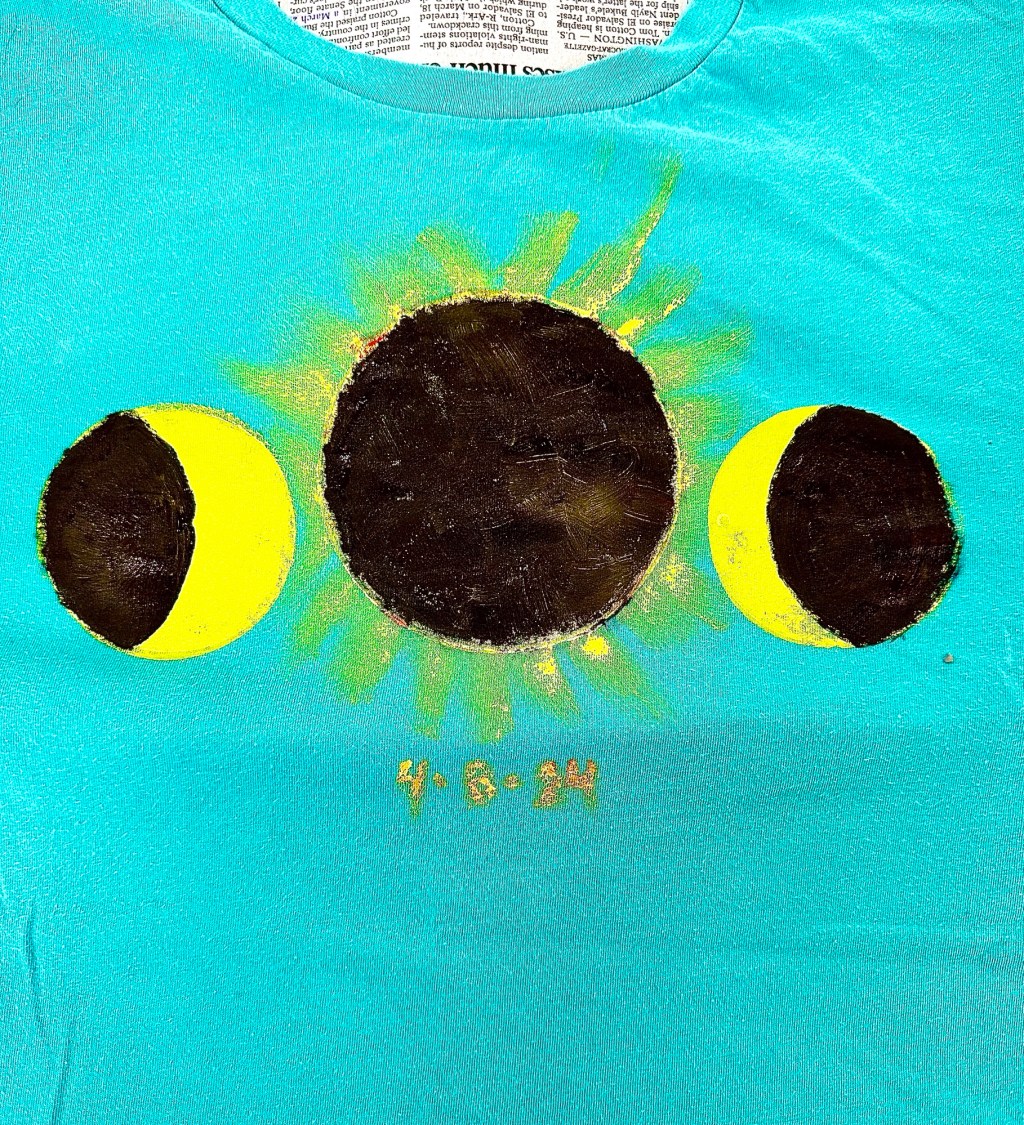
Eclipse T-Shirts

adult learning, art, Children, cosmology, Creativity, Faith, Good Friday, Great American Eclipse, Habits, Icons, Imagination, incarnation, inspiration, mystery, nature, Painting, Philosophy, Spirituality, vision

Friday in art class we painted our own unique designs on t-shirts for Monday’s Total Eclipse of the Sun. Anticipation of an event is characteristic of young children, while adults often feel over saturated with the early build up of attention given to an important event. By the time it gets here, we go, “Wow, what a letdown.” Children, who have fewer years of experience and anticipation comparison, can still marvel at the alternate reality of the total eclipse.

In the sixth century BCE, Anaximandros believed “the moon has a false light and is illuminated by the sun, and the sun isn’t smaller than the earth and it is pure fire.” The Greeks in 290 BCE knew the moon was unlike the sun. Anaximenes wrote it “didn’t shine with its own light, but with the reflected light of the sun,” as Eudimos wrote in his book History of Astronomy.  The Chinese also studied the skies and stars. They used bones heated in fires to divine messages from their deceased ancestors as early as the 12th century BCE.

Chinese oracle bone depicting lunar eclipse of 12/27-28/1192 BCS.

The Death of Jesus in the Synoptic Gospels has the record of an eclipse occurring during the time of the crucifixion. John’s Gospel, which comes from a different source, doesn’t mention this time of darkness.

Egon Schiele, Crucifixion with Darkened Sun, Oil on Canvas, 1907.

When it was noon, darkness came over the whole land until three in the afternoon. ~~ Mark 15:33

From noon on, darkness came over the whole land until three in the afternoon. ~~ Matthew 27:45

It was now about noon, and darkness came over the whole land until three in the afternoon, while the sun’s light failed; and the curtain of the temple was torn in two. ~~ Luke 23:44-45

When Jesus had received the wine, he said, “It is finished.” Then he bowed his head and gave up his spirit. ~~ John 19:30

Yet the Gospel of John tells us more about the miracles of Christ and his dual nature (both human and divine), so that we might believe and have everlasting life through him. New Testament scholar Ernst Käsemann is correct when he says of the Fourth Gospel: “Judged by the modern concept of reality, our Gospel is more fantastic than any other writing of the New Testament.”

Bruce Metzger, noted New Testament scholar and lead translator of the NRSV said, “The more often you have copies (of biblical texts) that agree with each other, especially if they emerge from different geographical areas, the more you can cross-check them to figure out what the original document was like. The only way they’d agree would be where they went back genealogically in a family tree that represents the descent of the manuscripts.[104]

Tim’s Eclipse T-shirt: very simple due to his rehab from arm surgery. He uses his arm until it hurts and then he rests. We do what we can, not what we can’t.

We modern folks are used to looking at the world through the eyes of science and education. We look for repeatable patterns and consistent evidence. We have “grown up minds” with calendars, schedules, to do lists, and multiple people who make demands on our time. Often, we are thinking about our next meeting or chore before we even finish the one we’re currently working on at the moment.

We aren’t practicing Brother Lawrence’s admonition to “Practice the present moment.” Our constantly chiming cell phones don’t help us be present, even though we could set our notifications to silent. Indeed, we’re never present or still enough to know the peace of the God whose name means “I AM.”

Lauralei’s Eclipse T-shirt: experimenting with fabric paint

What is “reality?” How can we know the present moment and come closer to God? With the advent of photography people began to think super realism in painting was preferred to some degree of emotional expression. Today, with the introduction of Artificial Intelligence, we can make computer generated photos and paintings that go beyond our wildest dreams! This means our new generations may likely begin using tactile materials and hand-built techniques to create future art works. Instead of fantastic other worlds, they might find their inspiration in the environment or in social justice concerns.

Gail W’s Eclipse T-shirt: first stage in class. She came with a design in mind and brought her sewing chalk also.
Gail W’s Eclipse T-shirt: the finished product.
Some of our inspirations are too grand to be completed in a few hours. We need to have the desire to carry the effort forward to meet our goal.

As with the icon, the artwork is only a reflection of the image which is painted. The icon isn’t holy, but the person depicted is holy. As the writer of Hebrews 1:3-4 says:

“He is the reflection of God’s glory and the exact imprint of God’s very being, and he sustains all things by his powerful word. When he had made purification for sins, he sat down at the right hand of the Majesty on high, having become as much superior to angels as the name he has inherited is more excellent than theirs.”

I didn’t get a photo of Mike’s “Crawford Law Eclipse T-shirt.” Work called and he had cats to herd. He was generous as usual to bring fabric paints for the group to share. We used old newspapers inside our T-shirts to keep the paint from bleeding through to the backside. We had an opportunity to share stories and eat my birthday doughnuts which Tim blessed me with.

Cornelia’s Eclipse T-shirt: I collapsed all the moments of occlusion into three, so I could finish in one sitting.

If we take time to practice our art, we may realize our own works may be only a reflection of the glory of what we saw, but we we can continue to practice our skills in prayer, for God will bring us ever closer to perfection if we commit our work to God’s glory.

Leonardo da Vinci: Study of the technique for observing solar eclipse, Codex Trivulzianus, 1487–1490

Also, Marilyn, who was working with some other ladies of the church on the potato bar posters, had brought the warm-gooecrescent roll-cream cheese-vanilla-cinnamon-sugar dessert. If you ever have a chance to put this into your mouth, you will be transported into an alternate reality. This is the stuff from which dreams and visions arise! If you eat it, and you merely remark, “Good,” my thought is you’re dead to this world or you’ve lost your sense of taste. The child in me screamed for MORE!! The adult in me will see if I can reduce the calories with no depreciation in taste.

Paul Nash: Eclipse of the Sunflower, 1945

I hope we get a break from the clouds on the Great American Eclipse Day. The last one I traveled to in 2017 was very impressive and worth the journey. Watch it on television if you can’t be outside. Only look at the sun with certified eclipse glasses. Some experiences are such that we can only say “Awe!” And we may want to stop time forever, but time will march on, for we can’t move the sun either forward or backwards. No matter how important we are, we aren’t gods, and we aren’t even Time Lords. If we manage to grasp only a portion of the holiness and beauty of God’s creation in this one event, we will better experience the joy of the passing glory of our God:

“When I look at your heavens, the work of your fingers, the moon and the stars, that you have established, what are human beings that you are mindful of them, mortals that you care for them?” ~~ Psalm 8:3,4 (NRSV)

View of the Great American Eclipse 2017 at
Lake Barkley through a pinhole

Joy and peace,

Cornelia


Eclipses and the Ancient Greek Philosophers

By H. Rovithis-Livaniou and P. Rovithis

https://articles.adsabs.harvard.edu/cgi-bin/nph-iarticle_query?bibcode=2007ASPC..370..115R&db_key=AST&page_ind=0&data_type=GIF&type=SCREEN_VIEW&classic=YES

How Ancient Humans Studied—And Predicted—Solar Eclipses | Scientific American

https://www.scientificamerican.com/article/how-ancient-humans-studied-and-predicted-solar-eclipses/

Historical Reliability of the Gospels, Encyclopedia MDPI

https://encyclopedia.pub/entry/29465

https://handwiki.org/wiki/Religion:Historical_reliability_of_the_Gospels

104. Strobel, Lee. “The Case for Christ”. 1998. Chapter three, when quoting biblical scholar Bruce Metzger

In Memoriam: Bruce M. Metzger (1914-2007) | Bible.org

https://bible.org/article/memoriam-bruce-m-metzger-1914-2007

Bruce Metzger was the master of several ancient and modern languages and ended up teaching at Princeton for 46 years after he received his PhD there. As one of the editors of the standard Greek New Testament used today and the senior editor of the NRSV, his scholarship has proved to be almost impeccable. His specialty was New Testament textual criticism, the field whose primary goal is to ascertain the wording of the original text. Many considered him the finest NT textual critic of the 20th century. His death in 2007 left giant footprints for the next generation to come. 

Paul Nash, British Military artist, died in 1946 of complications from asthma. He didn’t see the total eclipse, but knew of it and was very connected to nature.

Read about him in A landscape of mortality | Tate

https://www.tate.org.uk/art/artists/paul-nash-1690/landscape-mortality

Map of the 1945 eclipse: SE1945Jul09T.gif 1,121×1,452 pixels


A Prayer to End All Suffering

art, crucifixion, Deesis Icon, Easter, Faith, Good Friday, grief, Healing, hope, Icons, incarnation, inspiration, Lent, Painting, Prayer, renewal, Spirituality, Strength, suffering, vision


I don’t don’t know about you, but I don’t willingly sign up for pain or suffering. Pollen season isn’t my friend. I could do without all this yellow and green stuff clogging my brain cells and my lungs. As I cough and die, swill decongestant tonics, and huff my asthma inhaler, I wonder if this particular cross bearing has to be on my things to do list every Lenten season.

Mid 10th CE ivory Deesis Icon, Metropolitan Museum of Art, NYC

As Jesus turned his face towards Jerusalem, he knew his fate was certain. His message began to change, as he told his followers in Luke 14:27, “Whoever does not carry the cross and follow me cannot be my disciple.” Of course, not all were ready to hear or to follow, for some had obligations at home, and others weren’t yet ready to live the itinerant life. Many today don’t answer the call to ministry because they can’t see the long unknown road ahead. Only those willing to walk by faith and not by sight will journey off, trusting in God’s providence, mercy and grace.

Earliest sculpture panel of the Crucifixion, Maskell Passion Ivories, 420-430 CE, one of four carved panels of a sarcophagus, British Museum, London.

I used to say, “Give me a few months and I can whittle any group down to size. I can prune with the best of gardeners—all I have to do is read actual scripture!” I figure if folks want to get mad, they should take it out on the original writers. Blaming the messenger is useless. As the apostle Paul says:

“For the message about the cross is foolishness to those who are perishing, but to us who are being saved it is the power of God.” (1 Corinthians 1:18)

The oldest icon of the Crucifixion of Christ, Greek Orthodox Holy Monastery of St. Catherine, Mount Sinai, 8th CE

The ancient crucifixion icons glorify the triumph of the Incarnate God and his victory over death, which is the consequence of our fall; that fatal moment in the garden of Eden when Adam and Eve chose to desire to be like God, even though they had only the image, but not the ability to be gods themselves. Icons of the crucifixion represent Christ who, fully human and fully divine, takes on death so humanity no longer has to die. Christ conquers death by being a suffering servant, he becomes a victorious king.

Mary from the Hagia Sophia Deesis mosaic

Most of us would rather jump to the Bible’s Victory story and skip its Victim sections because we live in an age which validates the strong and successful, while denying the worth of the weak and wounded. Easter and Palm Sunday are more triumphant celebrations than the sonorous and somber Foot-washing Maundy Thursday and Good Friday Vigils. Yet without suffering, would we have cause for rejoicing? Would we even know the meaning of joy without some pain in our lives? Everyone has some pain in their life, whether it’s the pain of an unrequited love, the loss of a child stillborn, a divorce, a war wound, a frenemy wound, or some other brokenness.

Stage one

Mary knew early on her child of destiny would bring her both joy and pain, as all mothers discover soon enough. Luke records in 2:34-35,

“Then Simeon blessed them and said to his mother Mary, “This child is destined for the falling and the rising of many in Israel, and to be a sign that will be opposed so that the inner thoughts of many will be revealed—and a sword will pierce your own soul too.”

Deesis. Top center front panel of the Harbaville Triptych. Ivory. Ca. 940-960 CE. Musée du Louvre, Paris.

Many today only want to show the happy times in their hyper-curated lives on social media. As a result, “Keeping up with the Joneses” gets harder all the time. With Facebook’s constant encouragement of “you may know algorithms,” we’re encouraged to add more friends to our circle. We’re exposed to too many families of that surname, when once we only knew a few who lived in our own neighborhoods. If all these Jones folks are always smiling widely for the camera, we might be tempted to ask, “Why don’t I feel like smiling also?”

I know people who don’t read newspapers, watch the news on television, or even listen to the snippets on the radio. “Too much bad news!” They too don’t want to hear of the suffering, the plight of the weak, or face their seeming impotence to do anything about it. We are weak people. We are not strong, no matter how often we quote passages like Philippians 4:13—

I can do all things through him who strengthens me.”

Richard Rohr, in The Enneagram, A Christian Perspective, says, “It is the things that you cannot do anything about and the things that you cannot do anything with that do something with you.” Suffering and prayer are what truly transform us, if only we don’t waste time looking for someone to blame.

13th CE Hagia Sophia Mosaic, Istanbul, Turkey

So far, no one person has been able to stop the Russian invasion of the democratic nation of Ukraine, but plenty of people are holding up an aid package that would help this small country fight this battle at great cost to life and limb. The Ukrainians suffer and America dithers. We seem to think our leaders have infinite powers, as if they were gods, but we forget all people are only human and have only the image of god, but no huma has either the power or the glory of the true God.

Unknown Ukrainian Artist: The Deesis, Icon, Tempera, silvering on gesso-grounded two-piece fir-wood panel, engraving, carving; 1735, h 114, w 84, d 9, National Art Museum of Ukraine.

So far, no one person has been able to keep either Hamas or Israel from wreaking havoc on each other. My daddy used to say, “you can’t make a silk purse out of a sow’s ear.” After years of teaching and pastoring, I’d throw my two cents in: “we can lead a horse to water, but we can’t make it drink.” As long as people are invested in retribution, they will return suffering for suffering. The sad truth is people who have never processed their own suffering will cause suffering for others as well as for themselves. The children will cry. And the women will cry. But now the men are crying too.

Late Roman Magical gem; intaglio; green-brown jasper; oval; bevelled edge on side B, 2nd-3rd CE, British Museum, London.

No one has a magic wand to eliminate suffering or harm. In ancient times, the image of the crucified Christ was used as a magic charm to keep the wearer from harm. Some people today wear a cross for the same reason; it’s a fashion statement, a good luck charm, and a symbol of their faith. Instead of a charm, we offer acts of prayer and mercy.

Hagia Sophia Deesis Mary icon 2024, finished

We don’t just cry for the fact of the sufferings we endure, or for the sufferings of others, but we cry out in our suffering to the only one who can hear us, heal us and make whole our broken hearts and homes. We cry out to the God, who created all of us in God’s own image out of the dust of an obliterated and bombed out land. We cry out to the God who brings rains in their seasons to a land parched by climate change and ruined by reckless use of natural resources. We cry out to the God who raised God’s son from the dead, even as people everywhere bury their own dead sons and daughters from the wars fought by nations and non-state actors who wrestle for power in tiny slivers of contested territories.

Christ and the Apostles in the Heavenly Jerusalem, apse mosaic, early fifth century, Rome, Santa Pudenziana.

We can see in this image a dramatic transformation in the conception of Christ from the pre-Constantinian period. In the Santa Pudenziana mosaic, Christ is shown in the center seated on a jewel encrusted throne. He is surrounded by apostles, biblical women, and symbolic images of the four gospel writers. The ideal landscape is the New Jerusalem, or the Heavenly Kingdom. This image was created after Constantine’s victory and conversion to Christianity. Prior to this, Christian art repurposed Greco-Roman themes of the Good Shepherd and the Apollo Sun god.

Unknown Artist: Plaque with Christ flanked by the Virgin and Saint John, late 19th–early 20th century (Byzantine style), Cloisonné enamel, gold; 6 9/16 x 5 9/16 x 1/16 in. (16.6 x 14.1 x 0.1 cm); Metropolitan Museum of Art, NYC, Gift of the Estate of Mrs. Otto H. Kahn, 1952, Accession Number: 52.54.1

The Byzantine Empire was fond of the Deesis Icon, which has Christ in the center bounded by the Virgin Mary and the Precursor, John the Baptist, on either side. They both entreat the Lord in prayer. This was one of the most widespread middle Byzantine icon types. The name comes from the Greek δέησις or “supplication,” which in Byzantine art, describes a representation of Christ enthroned and flanked by supplicants, such as the Virgin Mary, St. John the Baptist, or other saints and/or angels. Images of the deesis often appear on an iconostasis, or the screen separating the altar from the people. The subject matter traditionally represents the first witnesses to Christ’s divinity, the Virgin and Saint John, who came to be seen as holy figures who would act as intercessors with him on behalf of humanity.

The Deesis. End of the 17th century. Northern Russia. Wood, gesso, tempera. Found from the village Nizhnyaya (Dolgovitsi), Tarnoga Raion, Vologda Oblast. Collection of Nikolai Kormashov.

Nikolai Kormashov, an Estonian artist and collector, who collected and restored a great collection of 15th-20th century Russian icons during his lifetime said, “That which is not destined to perish, announces itself again and again, to attest to elusive spiritual beauty and the light of truth.”

The truth is all people of every country and culture in every age will suffer, but God isn’t removed and distant from our pain. God, through the incarnation of the Son, has experienced our human suffering from the birth pangs of Christ’s birth to the hunger, thirst, and weariness of his itinerant earthly preaching. Not only this, but God through God’s Son knows the heartbreak of betrayal and insult, the sting of the whip, and the pain of death on a cross.

The light of truth for the Easter season is this: in the midst of darkness and death, God raised his Son to light and life, so we too might lose the chains of sin and death and live to light and love. As the people of prayer, we ask for the gift of hope to give light to those in darkness and a helping hand to those in need.

Joy and peace,

Cornelia

Relief plaque icon, depicting the Deesis Crucifixion with full-length figures of the Virgin on the left and St John on the right, Late Byzantine (13 thc). Materials: Steatite – Gold

Greek déēsis entreaty, equivalent to deē-, variant stem of déesthai to beg + -sis-sis

Leonid Ouspensky: The Meaning of Icons, revised edition, St. Vladimir’s Seminary Press, Crestwood, NY, 1999, p. 180.

DEESIS Definition & Usage Examples | Dictionary.com
https://www.dictionary.com/browse/deesis

Saved Sanctity: Icons from the Collection of Nikolai Kormashov – Art Museums
https://www.lnmm.lv/en/art-museum-riga-bourse/exhibitions/saved-sanctity-icons-from-the-collection-of-nikolai-kormashov-437

Image— The oldest icon of the Crucifixion of Christ at the Greek Orthodox Holy Monastery of St. Catherine on Mount Sinai is an extraordinary testament to the intricate relationship between the Greco-Roman art heritage and early Christian iconography. This invaluable artifact offers a unique glimpse into the artistic and cultural milieu of the time, highlighting the exchange of ideas and the shared history that shaped the development of Christian art in 8th CE. See following link for comparison of early Roman and Christian art.

http://employees.oneonta.edu/farberas/arth/arth212/post_constant_conc_christ.html

Nick Haslam: The Body Keeps the Score: how a bestselling book helps us understand trauma – but inflates the definition of it

https://theconversation.com/the-body-keeps-the-score-how-a-bestselling-book-helps-us-understand-trauma-but-inflates-the-definition-of-it-184735

REMEMBERING SEPTEMBER 11th

9/1/11, 911, Altars, art, Attitudes, Christmas, Easter, Faith, Forgiveness, grief, Healing, hope, Icons, inspiration, Ministry, Painting, renewal, Spirituality

Looking up at the night sky, I think of the Eskimo Proverb which says, “ Perhaps they are not stars, but rather openings in Heaven where the love of our lost ones pours through and shines down upon us to let us know they are happy.” The fatal September 2001 event at 7:14 am CDT impressed its significance on the nation to such a great extent that 93% of American adults 30 years old or greater can tell you exactly where they were when they first heard about the attacks. Only 42% of those 25 and younger can do the same.

NGC 3603: From Beginning To End
Credit: Wolfgang Brandner (JPL/IPAC), Eva K. Grebel (U. Wash.), You-Hua Chu (UIUC), NASA

I remember my church was fuller than for Easter or Christmas on the Sunday after the devastation of the Twin Towers, the collapse of the Pentagon, and the crash of the airplane in which the terrorists had hoped to hit the White House. Only those brave passengers of Flight 93 stood between the terrorists achieving a psychological victory and their ultimate ignoble demise. As I recall, people were eager to hear “What is the Christian Response to Violence?” If they hoped to hear the one and only response, as the THE implies in the sermon title, the air was let out of their balloons.

A photo taken on September 11, 2001 by the New York City Police Department as the North Tower collapses, engulfing lower Manhattan in smoke and ash.

Of course, Christians across the centuries have had three major responses to violence. The first is “turning the other cheek” or nonviolence. We see this in the Biblical witness, for Jesus admonishes his followers in Matthew 5:38-42—

“You have heard that it was said, ‘An eye for an eye and a tooth for a tooth.’ But I say to you, Do not resist an evildoer. But if anyone strikes you on the right cheek, turn the other also; and if anyone wants to sue you and take your coat, give your cloak as well; and if anyone forces you to go one mile, go also the second mile. Give to everyone who begs from you, and do not refuse anyone who wants to borrow from you.”

Il Tintoretto: Christ before Pilate, Museum Scuola di San Rocco, Venice

Jesus himself practiced a non-violence response to violence when he appeared before Pilate after his arrest. Pilate questioned Jesus in Matthew 27:11-14—

Now Jesus stood before the governor; and the governor asked him, “Are you the King of the Jews?” Jesus said, “You say so.” But when he was accused by the chief priests and elders, he did not answer. Then Pilate said to him, “Do you not hear how many accusations they make against you?” But he gave him no answer, not even to a single charge, so that the governor was greatly amazed.

Unknown German artist: Aquamanile in the Form of a Mounted Knight, Copper alloy, ca. 1250, used to pour water over hands at the altar or at dinner table, Metropolitan Museum of Art, New York City.

The opposite of non-violence is the Crusade mindset. In this response, the infidel is “othered” to the point of inhumanity. Because the unbelievers don’t share the same god, purging them from the living is a good deed, worthy of merit for salvation or for forgiveness of past sins. As you can imagine, this makes people who believe in other gods “less than human,” so what we modern people would consider war crimes would be easy to commit for a person in Crusade mentality. We still hear vestiges of this dualist mindset in the vocabulary of people who talk about “weaponizing government” or those who feel the need to “hit the ground running.” If we’re always in “attack mode” at work, we need to question how we think about others if we believe we’re in a hostile environment or in enemy territory.

If the Christian has both a head and a heart, both of which are being conformed to the love, mercy, and justice of God, then we must have a middle way between passive nonviolence and crusade extremism. This golden mean is the Just War Theory. It’s taught in all our military academies and has its beginnings in Christian theology. The saints Augustine of Hippo and Thomas Aquinas developed the primary ideas:

  • Make war only for a just cause
  • Be sure your intentions are right
  • Only legitimate authority can make war
  • Use just proportionally in the war, nothing to excess
  • Go to war as a last resort 
  • During war only attack military targets, not civilians 
  • Following unjust orders isn’t a legal defense for unjust actions 
  • Punish war crimes, compensate victims
  • Peace treaties must be fair and just to all, even the warmongers
Psalter Saint Louis et Blanche de Castile, MS 1186, BnF, folio 11b

Those of us who struggle with conflict—if we have a family, we have conflict or if we live in a community, we have conflict—yes, I’m starting to meddle now. You knew I’d get around to it. After all, God the Father had Adam and Eve, and God tossed those two kids out of the House. They had everything, and still wouldn’t follow the one rule (Don’t eat from that one tree). Just one rule. How hard could that be? It was downhill from there.

I always take comfort, knowing God had troublesome children. It means perfect parents can still have conflict at home. This gives hope to us less than perfect folks. The Bible reminds us always how God still loves the human race and hasn’t give up on us, so we don’t give up on those we have fusses with. We don’t roll over and play dead, yet we don’t set out on a crusade against unruly kids or others with whom we have conflicts. As Micah 7:18 reminds us about God’s Compassion and Steadfast Love:

Who is a God like you, pardoning iniquity and passing over the transgression of the remnant of your possession? He does not retain his anger forever, because he delights in showing clemency.

Remnant of the Twin Towers

Maybe we should look at the just war thoughts and modify our attitudes and behaviors. We can come to a peace, even if others cannot. As Jesus says in Matthew 5:9—

“Blessed are the peacemakers,

for they will be called children of God.”


Joy and Peace,

Cornelia


Two Decades Later, the Enduring Legacy of 9/11 | Pew Research Center


Just War Theory – The Ethics Centre Ethics Explainer
https://ethics.org.au/ethics-explainer-just-war/


Rabbit! Rabbit!

arkansas, art, chocolate, Easter, Faith, Food, Garden of Gethsemane, Good Friday, holidays, Holy Thursday, john wesley, Love, Painting, photography, rabbits, Salvador Dali, Spirituality, Spring Equinox, United Methodist Church


Welcome to April 2023

April Fool! Caught you! Were you the prankster or the pranked? Even an institution as stuffy as the British Broadcasting Corporation isn’t above pranking the public on the first day of April. If a fool and his money are soon parted, then whatever the BBC was selling, they were having a jolly good time in their advertising department. You can watch their mini documentary on Flying Penguins below:

When I was at Perkins Seminary, we editors of the weekly newsletter had a tradition of an April Surprise. This followed the practice of the former Babylonian Schismatic, which was an alternative, satirical student newsletter published occasionally between 1981 and 1988.

One year, when I was coeditor, it was more of an April Debacle. My partner in crime and I were sure the beach ball bouncing off the usual chapel steeple logo would be enough to clue our community into the prank. However, we failed to realize how little sleep our fellow students actually got during school weeks, how seriously they took the printed word, and worst of all, that our newsletter also went to bishops’ widows in faraway places. This last was what got us into the real trouble.

Our faux reports of Perkins losing its accreditation due to shenanigans of prior graduates, who were in the news at the time, had graduate students storming the dean’s office. Even worse, the bishop’s widows were calling him to inquire what kind of school he was overseeing. The fact schools can only lose accreditation for their own failures (and not the trespasses of former students or faculty) never crossed anyone’s mind in the ensuing uproar. So of course, we criminals wrote handwritten letters of apology to the widows and printed retractions in the next newsletter for the students. I now understand why my mother said I sometimes take things too seriously. Still, I’ve have found others who make me look like a giggle queen.

The Giggle Queen and her Pet Rabbit

Speaking of giggles, although the historical roots of April Fool’s Day are shrouded in mystery, the British, who are mostly known for their dry wit and stiff upper lip, seem to enjoy this holiday to excess. Especially at the BBC, which back in 1957, produced a fascinating prank documentary on the Swiss Artisanal Spaghetti Industry. They showed a Swiss family harvesting ripe spaghetti strands from their spaghetti bushes. At the time because of rationing, spaghetti wasn’t widely available. After 1956 in the British Isles, Italian companies opened spaghetti factories and Italian immigrants opened restaurants. The British developed a taste for this food. As a result, some British families were so enthusiastic, they wanted to purchase their own spaghetti bushes for a home garden. Others were unhappy to be pranked. This may be one of the first times the medium of television was used to stage an April Fool’s Day hoax.

Moveable Feasts: Passover and Easter

Israel was an ancient agricultural culture and followed a lunar calendar, so sighting the full moon was important. Passover is always pegged to the Hebrew calendar, which is based on the lunar cycle. It starts in the middle of the month of Nisan, when the moon is full, typically falling in March or April of the modern Gregorian calendar. As a result, Passover typically begins very close to Easter. Easter Sunday is always the first Sunday after the first full moon after the Spring Equinox. However, due to the shorter Hebrew calendar, sometimes it gets a leap month to keep it in tune with the seasons. In 2024, when the leap month plays a part, we’ll have an early Easter on March 21st, but Passover won’t start until April 22nd.

Rabbit Last Supper

These religious holidays are forever entertwined because of the historical events of the Last Supper, which we assume was a ritual meal or Seder, and the crucifixion on a Friday, which required Christ’s body to be taken down from the cross due to the beginning of Passover at sunset.The Last Supper took place on a Thursday night, even though the actual Passover didn’t begin until Friday night.

Dali: The Sacrament of the Last Supper, 1955, oil on canvas, National Gallery of Art, Washington D. C.

As Wesley’s Notes on The New Testament observe, “Jesus took the bread—the bread or cake, which the master of the family used to divide among them, after they had eaten the passover. The custom our Lord now transferred to a nobler use. This bread is, that is, signifies or represents my body, according to the style of the sacred writers.”

We know this because Jesus was arrested in Gesthemane after this meal and then taken to the Roman Governor Pilate on Friday morning, the day of Preparation for the Passover. John 18:28 reminds us how the temple priests “…took Jesus from Caiaphas to Pilate’s headquarters. It was early in the morning. They themselves did not enter the headquarters, so as to avoid ritual defilement and to be able to eat the Passover.”

Early Handdrawn Valentine, 1814, writing in an unending circle

The Jews in the first century kept faithfulness according to laws of separation and purity, so they kept away from unbelievers on holy days. This was the biblical practice of the time. Early Christians continued this practice until Paul began his outreach to the Greek and Roman citizens of the world. When in the later gospel of John (14:15) Christ says, “if ye love me, keep my commandments, Wesley’s commentary understands this to mean: “Immediately after faith he exhorts to love and good works.” This is why we United Methodists practice an open table at Holy Communion, or the Lord’s Supper, for all who love the Lord and desire to be in love and fellowship with their neighbors are welcome at his table. We don’t exclude anyone, for God includes all people into the circle of God’s love.

Love never ends and love never dies

Since Easter Sunday is always the first Sunday after the first full moon after the spring equinox, this makes Easter a “moveable feast.” Unlike a picnic, for which we tote our fixings from our kitchen to a park or to the countryside, or unlike a house to house “progressive dinner,” Easter is called “moveable” because it’s not on a fixed date like Christmas or New Year’s Day.

Baked Ham with Canned Pineapple Rings and Cloves

My family’s Easter feast always centered about a baked ham, often covered with canned pineapple rings and studded with cloves. We were a modern American 1950-60’s family and Betty Crocker reigned in my mother’s kitchen. Just this week I saw a tv advertisement of a family feast with this very same baked ham. I suppose when the economy gets dicey, people pull out old familiar recipes from the great-great-grandmother’s kitchen. Since I have a new great-grandchild on the way, and a knitting project started, I can safely say, this isn’t an April Fool’s joke. I’ve seen the sonogram images!

2012-2022 Top Ten Cities for Extreme Weather Warnings issued by National Weather Service

“April showers bring May flowers” is an ancient rhyme. Unfortunately, these showers also bring pollens of every kind, since trees and flowers both acquire crowns of glory. The Old Farmer’s’ Almanac notes while November has a bit more rain in store for Arkansas than April usually brings, this month’s warmer weather favors conditions for flowers to bloom and trees to bud. While we might tire of the storms and the havoc they wrack upon the populace, we’re always thankful if they only cause damage to property and don’t take human lives.

Sick Bunny

Across North America, the pollen season has lengthened by 20 days since 1990. Pollen concentrations have also increased by 21 percent over the past three decades. This means some of us have been doctoring ourselves or visiting the RD—real doctor—since February. The stubbornest of us waited until almost April because we were convinced we could heal ourselves. If you still have no energy and are grumpy to boot after a month, you too need a RD. Better living through chemistry with put a perk back into your bunny hop.

Stylish Bunnies

Speaking of the weather, I have seen many years now of Easter sunrise services, and even more later noontime Easter feasts. One thing ties them all together: no matter how cute my spring outfit is, no one ever sees it because I’m always wearing a raincoat or a winter coat over it. My guess is rain and cool weather will come and our egg hunts will likely be inside. As long as there’s a dark chocolate Easter rabbit for my personal gratification, I’ll be happy. I discovered last year’s version stored in the cabinet, so I’d better make some chocolate chip cookies soon.

Only hugging can save us

There’s plenty of silly or merchandising holidays in April, but you can read about them at the link below my name. Until May, I remain your April Fool…

Joy, peace, and chocolate rabbits for everyone,

Cornelia

April Daily Holidays, National, International. Holiday Insights.
https://www.holidayinsights.com/moreholidays/april.htm

Why Easter and Passover are observed on different dates each year
https://www.azcentral.com/story/travel/arizona/2018/03/28/why-easter-and-passover-have-different-dates-each-year/466341002/

The worst cities in the U.S. for allergies
https://www.washingtonpost.com/climate-environment/2023/03/16/allergy-season-pollen-count-climate/

BBC Flying Penguin Documentary April Fool Prank
https://youtu.be/9dfWzp7rYR4

BBC 1957 Spaghetti Documentary April Fool Prank
https://youtu.be/8scpGwbvxvI

BBC ON THIS DAY | 1 | 1957: BBC fools the nation
http://news.bbc.co.uk/onthisday/hi/dates/stories/april/1/newsid_2819000/2819261.stm

No spuds please, we’re British
https://www.theguardian.com/g2/story/0,3604,371547,00.html

Is April Really The Month of Showers? – Farmers’ Almanac
https://www.farmersalmanac.com/april-showers-bring-may-flowers-34814

Where the Most Weather Warnings Are Issued in the U.S. | Weather Underground
https://www.wunderground.com/article/safety/thunderstorms/news/2022-03-18-most-national-weather-service-warnings-us

Icons for Holy Week

art, butterflies, Creativity, Easter, Faith, holidays, Icons, Imagination, inspiration, Mandylion, Ministry, nature, Painting, renewal

As we approach the days of Holy Week, life can get busy for people of faith. For those in leadership roles, you likely don’t have time to read. That’s OK. This is a time for you to use your meditation and prayer time to rest in the presence of God’s Spirit. Palm Sunday, April 10, begins the mad dash of multiple planned worship experiences in most churches, and the week usually gets more complicated by the human conflicts that also arrive during the high holy days when more is expected than than can be accomplished by Easter Sunday.

Some of these disasters will be small, such as the child who goes out to make a violet ink from new irises growing by the back porch and messes up her pretty Easter dress. Others will be actual chaos, involving runaway ex-spouses with the non-custodial child. Yes, the holidays can get crazy for families, ordinary and church families both.

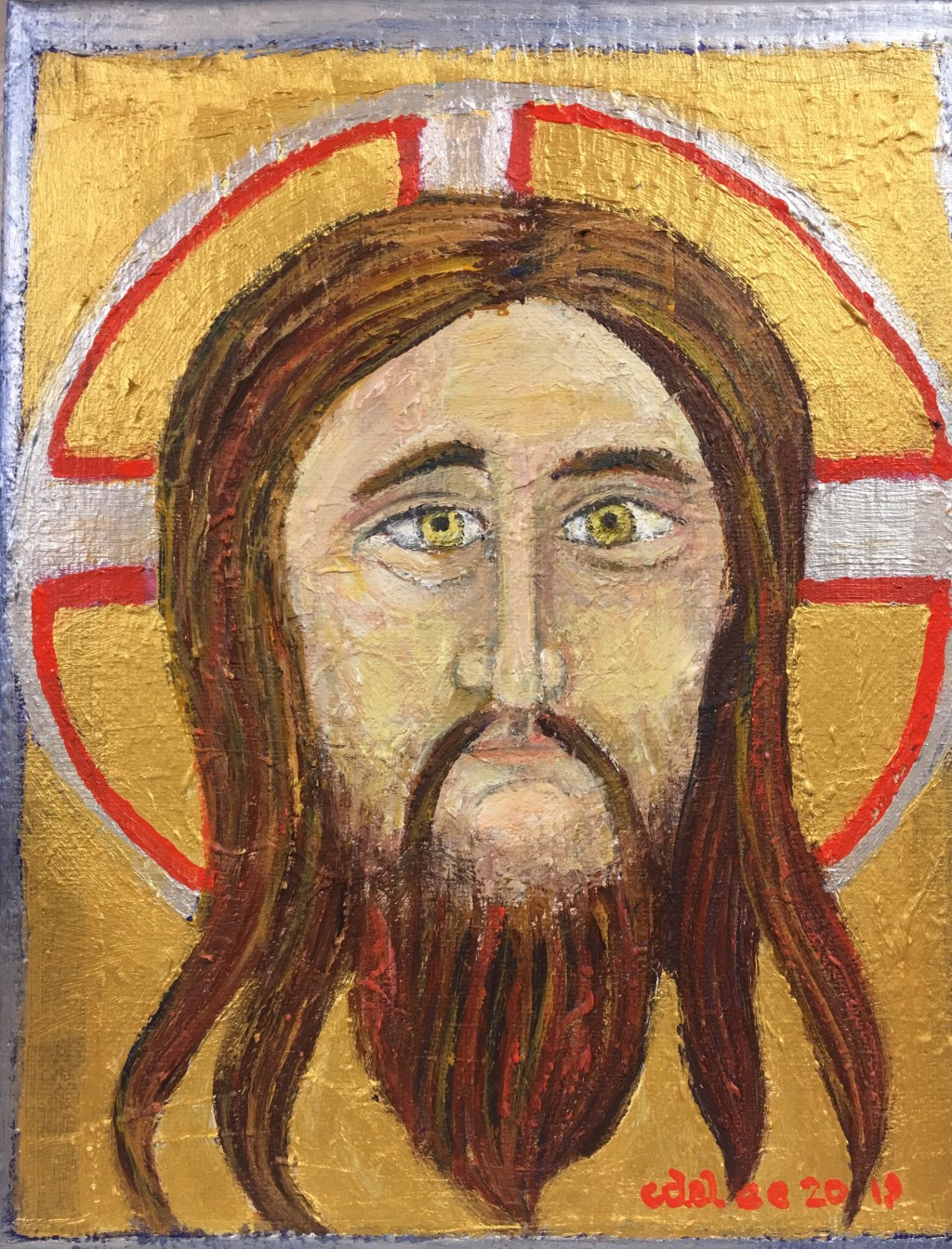
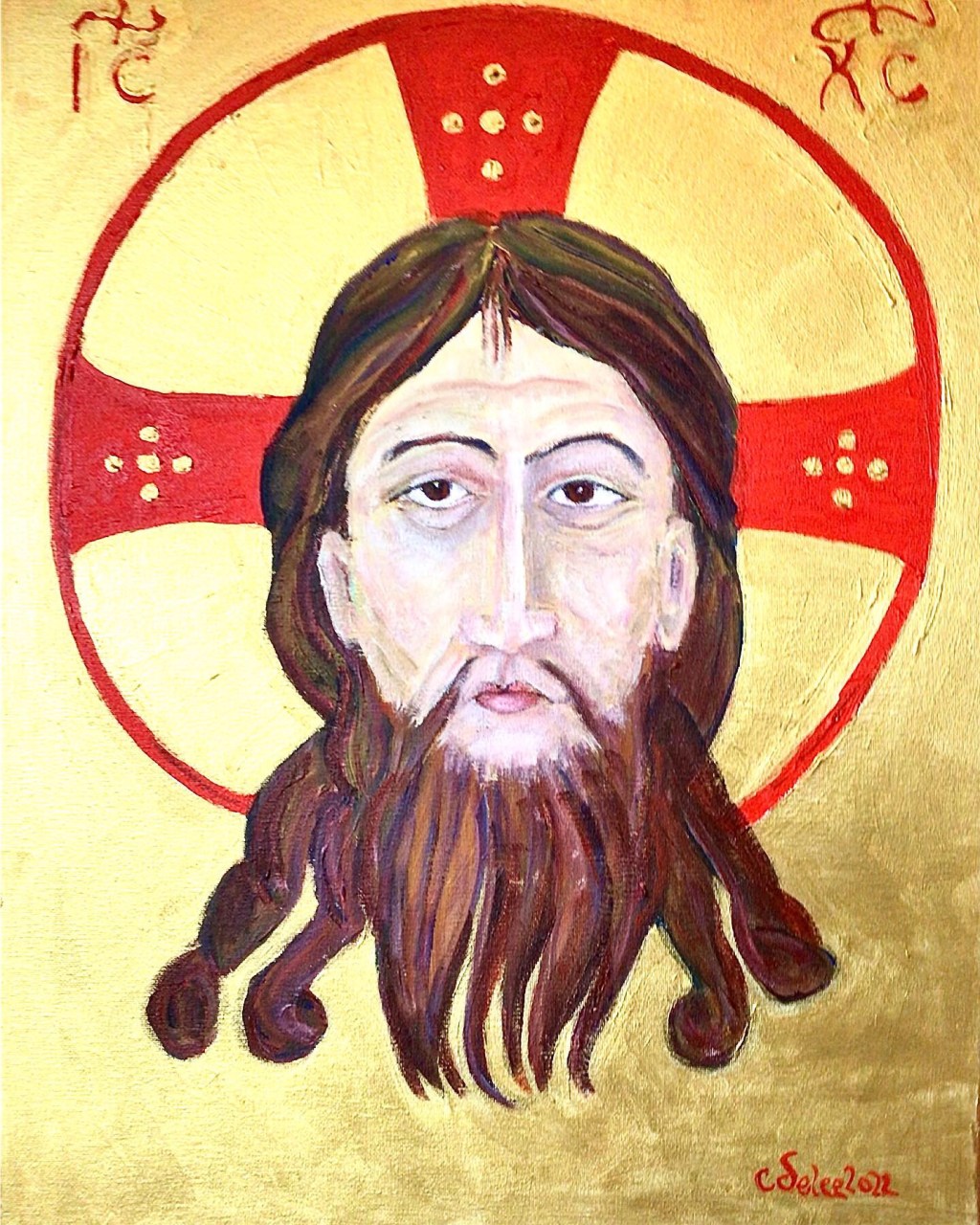
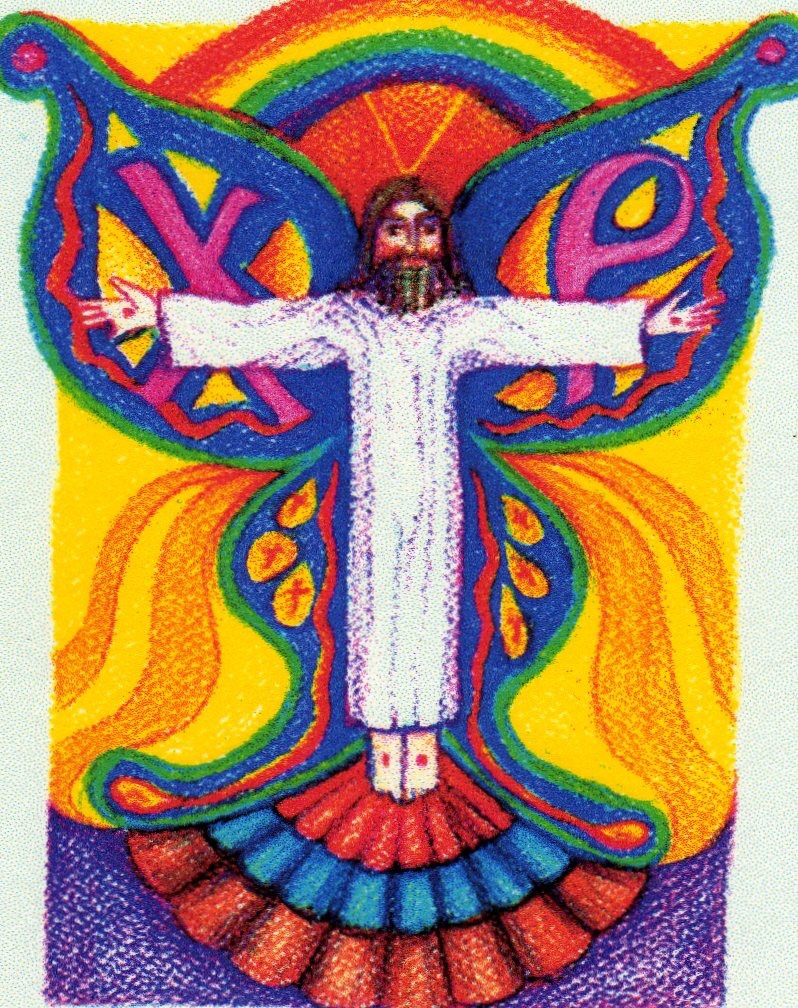
The tradition of the icon says these images are “windows into the heavenly spaces.” I offer seven of my interpretations of these windows: Mandylion, or the Image Not Made By Human Hands, Resurrection of Christ, Christ is Lord, The Good Shepherd, and the Mandylion of the Ecological Christ, who proclaims, “All creation shall be renewed.”

Mandylion Icon
Mandylion Icon
Mandylion Icon
Resurrection Icon
Resurrection and Baptism into New Life
The Good Shepherd
Ecology Mandylion: All Creation Shall Be Renewed

Joy, peace and be still in the presence of God,

Cornelia

Writing a Holy Icon

adult learning, Altars, art, crucifixion, Faith, Holy Spirit, Icons, inspiration, john wesley, Love, Mandylion, mystery, Painting, Pantocrator, salvation, Spirituality, St. Athanasius, Stations of the Cross, United Methodist Church

Cartoon for an Icon of the Resurrection

In art class, I taught our group the time honored technique of using a cartoon to transfer an image to another surface. Of course, their first reaction was, “Are we watching Saturday morning cartoons today?”

“No, it’s Friday. We’re going to make our own carbon paper,” I said, as I showed them how artists of old would rub graphite on the back of their drawings and then outline the major lines onto the wall or the canvas to transfer the image. The J. Paul Getty Museum has a great video on YouTube explaining this process.

“You mean we’re going to paint by number?”
“Not a chance. You still have to make your own color decisions and shading choices.” Really, by now you’d think they know my opinion on the easy way. As Jesus says in Matthew 7:13—

“Enter through the narrow gate; for the gate is wide and the road is easy that leads to destruction, and there are many who take it.”

Reverse of Crucifixion Icon with Graphite over Outlines

I didn’t bring any complicated images of the holy icons. I brought only ones with simple outlines. I knew this project wasn’t going to be as easy as people first thought. It’s not as simple as coloring within the lines.

An icon is an image of a holy person, but it isn’t a mere representation of the individual. When we make photographs or even painted portraits, we seek to make “likenesses” of the individual, and capture their outward details and idiosyncrasies. If we can also capture their inner spirit, we take the image to a master level. Icons, however, are more concerned with representing the inner, spiritual nature of the person, rather than their outward nature. After all, we don’t have any images of how the holy ones from the earliest days of faith actually looked. We only have their acts and the symbols connected with them, so in the iconography we can identify them by these qualities. The word iconography comes from the Greek: eikōn ‘likeness’ and -graphia ‘writing’, so when we paint, we’re actually “writing a likeness” of the holy image.

Dusty spent his day off on the Pantocrator Icon

In the iconographic tradition, all of the faces are broad across the brow, to represent the holy wisdom of God residing in the saints, just as their elongated figures and extremities accent this holiness. The eyes, windows into the soul, are large compared to a natural face, while the mouth is small. The small mouth indicates the saint has conquered bodily passions. There’s always an ear open on an icon, for the icon needs to “hear our prayers.” Not that the icon is alive, but it’s more like an open window into heaven. Therefore, the saint’s ear is the open window through which our prayers flow into the golden light of the mysterious world beyond this material one in which we dwell both in shadows and light.

Freehand drawing of Mandylion Icon

The color in icons also plays an important role. Red belongs to martyrs. Blue stands for wisdom. White symbolizes paradise and chastity. Green is the color of the Venerable Fathers. Gold symbolizes sanctity.

The icon painter and teacher of St. Tikhon’s Orthodox University, Svetlana Vasyutina once described an experience before the iconostasis or screen of images of the saints in the church. “A while ago, I was tortured by the question why it is golden. Once I was standing at a church, looking at the iconostasis. Suddenly, they turned off the electric lights, and only candles before the icons were burning. The golden traces were shining, giving back the light. It was as if, not the candles, but the halos, were radiating light. I was amazed; the light seemed not material, not as comes from a candle or a lamp. The golden color shows the person painted in the icon was granted a different kind of light.”

According to St. Paul, glory (doxa) appears where the form and the idea of God, which inhabits it, become one. This is especially true where form becomes a place of theophany (a visible manifestation to humankind of God or a god), where the body becomes the temple of the Holy Spirit. This glory is represented by the nimbus or halo of the saints. We hear Paul speak of this power in Philippians 3:21—

“He will transform our humble bodies that they may be conformed to the body of his glory, by the power that also enables him to make all things subject to himself.”

The disciples first saw this glory descending upon Christ on the Mount of the Transfiguration, as recorded in Matthew 17:2—

Icon of the Transfiguration

“And he was transfigured before them, and his face shone like the sun, and his clothes became dazzling white.”

To become completely transformed by the Holy Spirit wasn’t only a special gift given only to the saints alone, but it was meant for all believers. As Paul mentions in 2 Corinthians 4:7 (American Standard Version)—

“But we have this treasure in earthen vessels, that the exceeding greatness of the power may be of God, and not from ourselves.”

A famous story in the Eastern Orthodox Monastic tradition follows:

Abba Lot went to see Abba Joseph and said to him, “Abba, as far as I can I say my little office, I fast a little, I pray and meditate, I live in peace and as far as I can, I purify my thoughts. What else can I do?” Then the old man stood up and stretched his hands towards heaven. His fingers became like ten lamps of fire and he said to him, “If you will, you can become all flame.”

Mike’s Icon of the Via Dolorosa

Many of us are barely alight with the fire of Christ, and we wonder why the glory of God doesn’t shine through us. Others of us hide our light under a bushel so we don’t stand out from the crowd. If we wonder why we aren’t going onto Christian Perfection in love of God and neighbor, or being a witness to Jesus Christ for others to follow, then we might need to read Abba Joseph’s recommendation once again:
“If you will, you can become all flame.”

When we paint an icon, we participate in a spiritual endeavor in which we are coworkers with the Holy Spirit. We enter into a kairos time, or God’s creating time, and are no longer only working only in human, chronological time. This is a mystery, not to be understood in ordinary terms, even if we begin at 10:15 in the morning and stop to cleanup at 11:45. Like the golden background, time has no meaning while we paint the icon. Our cares and concerns of this world can be given to the icon, and thus to God.

Gail’s Icon of the Crucifixion

We make our prayer gifts in two ways: we hope to become more conformed to the image of God and we hope our images conform better to the icon before us. We’re going on to perfection, one bit at a time. In faith, we expect to be made perfect in love in this life, by the power of the Holy Spirit, or at the moment of our death, as the classic Wesleyan teaching states. The Orthodox doctrine of theosis, union with God, from which our Methodist teaching of sanctification derives, teaches we can have real union with God, just as Jesus had, being fully human and fully divine. We don’t become gods, but we participate in the full image of God, in which we were first created.

Sally’s Crucifixion Icon

We can contemplate these beautiful words of St. Athanasius of Alexandria (+373), in his treatise On The Incarnation, against the Arian heresy:

‘God became “sacrophore”—bearer of our flesh—so that mankind might become “pneumatophore—bearer of the Holy Spirit.’” (Michael Quenot, THE ICON, p 55)

When we keep our heart set on the image of Christ, we remember his undying love for all creation. Then we learn the meaning of the faith of a loving son or daughter, in comparison to that of an unwilling servant. This is how John Wesley saw his own conversion at Aldersgate:

“I felt my heart strangely warmed. I felt I did trust in Christ, Christ alone for salvation; and an assurance was given me that He had taken away my sins, even mine, and saved me from the law of sin and death.”

Mandylion Icon—Towel with Image of Christ

Once we realize the law of sin and death no longer holds us in chains, we can freely live in life and love, now and always, if we conform our image to Christ.

Joy, peace, and divine light,

Cornelia

Paul Evdokimon, translation by Fr. Steven Bigman, The Art of the Icon: A Theology of Beauty, Oakwood Publications, Pasadena, CA.
https://kyl.neocities.org/books/%5BSPI%20EVD%5D%20the%20art%20of%20the%20icon.pdf

Sharing in the tabor light | New Camaldoli Hermitage
https://www.contemplation.com/sharing-in-the-tabor-light/

The Icon: Window on the Kingdom Hardcover – Import, March 19, 1992
by Michael Quenot (Author), A Carthusian monk

John Wesley Quotes, Oxford Reference
https://www.oxfordreference.com/view/10.1093/acref/9780191843730.001.0001/q-oro-ed5-00011419

John Wesley’s Quotes – Seedbed
https://seedbed.com/on-john-wesley-quotes/

John Wesley: Journal of John Wesley – Christian Classics Ethereal Library
May 24, 1738– I Felt My Heart Strangely Warmed
https://ccel.org/ccel/wesley/journal/journal.vi.ii.xvi.html

Point of View

adult learning, arkansas, art, Attitudes, Creativity, Easter, Faith, Good Friday, Healing, holidays, hope, Imagination, Love, Ministry, ministry, Painting, renewal, Right Brain, Spirituality, vision

Christ Reigns

It’s a matter of perspective.

The point of view determines the perspective of a work of art. One’s point of view, or preconceived bias, can determine how one sees the world and the decisions they make about the information that comes to them. If we think the world is a scary place, resources are few and won’t be enough for everyone, then, we’ll operate from fear and hoarding. If we believe God’s promises are faithful and God will indeed provide for our needs, then we’ll live in trust and hope, even as we order our lives to want less and enjoy simpler pleasures.

I always find it strange how the people in the Bible who have the greatest riches also have the most difficulty following Jesus. Matthew in 16:24-26 speaks to this topic in the section on “The Cross and Self-Denial:”

Then Jesus told his disciples, “If any want to become my followers, let them deny themselves and take up their cross and follow me. For those who want to save their life will lose it, and those who lose their life for my sake will find it. For what will it profit them if they gain the whole world but forfeit their life? Or what will they give in return for their life?

“Here is your Son“

Of course, even in the 1st century AD, people wanted to have material possessions, a good income, and wealth stored up for the future. When Jesus said, “whoever does not take up the cross and follow me is not worthy of me,” (Matthew 10:38), he invited his followers to enter a despicable journey.

The Via Dolorosa isn’t named the Way of Grief for nothing. People walked it, bearing a heavy cross beam, on the way to an undignified death, a punishment reserved for criminals.

Crucified On Crosses

Yet Jesus transformed this ancient punishment into a means of redemption. He took a symbol of death and made it into a hope for new life. Because of this , the author of Hebrews 12:2 could write, “Looking to Jesus the pioneer and perfecter of our faith, who for the sake of the joy that was set before him endured the cross, disregarding its shame, and has taken his seat at the right hand of the throne of God.”

Cross Icon by Gail

Now we can live the Easter promise written in Ephesians 2:12-18:

“Remember that you were at that time without Christ, being aliens from the commonwealth of Israel, and strangers to the covenants of promise, having no hope and without God in the world. But now in Christ Jesus you who once were far off have been brought near by the blood of Christ. For he is our peace; in his flesh he has made both groups into one and has broken down the dividing wall, that is, the hostility between us. He has abolished the law with its commandments and ordinances, that he might create in himself one new humanity in place of the two, thus making peace, and might reconcile both groups to God in one body through the cross, thus putting to death that hostility through it. So he came and proclaimed peace to you who were far off and peace to those who were near; for through him both of us have access in one Spirit to the Father.”

Multimedia icon by Lorilee

So we who live on this side of the resurrection have a joy to celebrate every day. For us the cross is a sign of victory over sin and death, and the evidence of new life and love God has for God’s world and God’s peoples. As we read in Colossians 1:19-20—

“For in him all the fullness of God was pleased to dwell, and through him God was pleased to reconcile to himself all things, whether on earth or in heaven, by making peace through the blood of his cross.”

Work in progress by Mike: Stained Glass Design

Rabbit! Rabbit! Welcome to April

art, chocolate, coronavirus, Creativity, Easter, Faith, garden, Garvan Woodlands Garden, Good Friday, greek myths, Healing, holidays, Holy Spirit, hope, Imagination, Love, Ministry, mystery, nature, Painting, pandemic, poverty, purpose, rabbits, Racism, renewal, Spirituality, trees, vision

April Bunny

I love the springtime, for all the colors of green are in abundance. I live on the lake on a property originally developed to be a high rise hotel and casino, until the city derailed that plan. Then it became vacation condos and retirement homes. Since it’s located on a large plot of timbered land, I even see my rabbit neighbors on occasion. My bunny friends usually move about at dawn and dusk. I’m not an early bird, and since Covid, my “out and abouts” have been seriously curtailed, so I’ve yet to see my four legged furry neighbors this year. Maybe I’ll have a better chance to see the Easter Bunny. I did purchase his dark chocolate cousin from Dove, who’s been reduced to a single ounce and will be gone by Easter Sunday. The ears went first, of course.

Dove Bunnies

Our parents found ways in the old days to keep us active and entertained in the weeks leading up to Easter. One of my favorite experiences was egg dying and decorating. Back in Mom’s kitchen, boiling water, vinegar and colored pellets went into the coffee cups before we wrangled the wire holder and lowered the hard boiled egg into the dye. If we dipped the egg all the way in or held it for a longer time, we could get deeper colors. One year I even attempted to use only natural dyes, such as beets, cabbage, and onions. My “science-anthropology” experiment didn’t turn out as pretty as the PAAS collection, but I learned a lot. Crayon resist worked with both dye types, however. Perhaps I never appreciated how fortunate I was my mom taught school and my dad encouraged us kids to learn everything about our world. Almost anything was a science project in his mind.

Crayon Box

As a child, I knew I’d arrived when I graduated to the big crayola box with  sixty four colors in it. Suddenly I had a year round wealth of shades and hues at my command, plus I could combine them for even more variety: Here are the colors that ended up being in the 64 count box in 1958: orchid, lavender, carnation pink, thistle, red violet, violet red, brick red, magenta, maroon, mulberry, Indian red, red, melon, salmon, orange red, red orange, orange, flesh, maize, goldenrod, yellow orange, apricot, orange yellow, yellow, lemon yellow, green yellow, spring green, yellow green, sea green, olive green, green, pine green, aquamarine, forest green, turquoise blue, green blue, sky blue, blue green, periwinkle, blue, navy blue, midnight blue, cornflower, blue gray, cadet blue, violet, blue, blue violet, violet, plum, tan, burnt orange, mahogany, burnt sienna, brown, raw sienna, bittersweet, raw umber, sepia, black, silver, gray, gold, copper, white. I could make any landscape sing with whatever color my young imagination called forth. My birthday month always calls forth all the colors nature has on her palette.

Spring Trees, Old Farmland

Of course, not every tree sports a shade of green as its primary dress in the springtime. Some bud out all in white, others in dark red violet, while still others bloom out in light pinks. If I squint my aging eyes today, I can see a haphazard lace design across the landscape before me in multicolored threads, with a few embroidered trunks to give it a semblance of stability. Those trunks might be Indian red (an iron red) mixed with the old Prussian blue (now known as midnight blue) to make a warm black. Using the straight carbon black crayon made the black too stark, or so my portrait painting grandmother told me. The old “flesh color” has been renamed “peach,” in recognition of the diversity of skin color in our world today. Many other colors in the box can be combined to get the perfect shade of a person’s facial tone, no matter how light, dark, yellow, white, red, or brown. The 64 box has enough colors to capture any facial tone, for sure.

When I see the ever changing beauty of the natural world about me, I can’t help but have hope. I look back not only to simpler times, but also forward in hope to a time when once again I will feel the joy of breaking the seal of a brand new box of crayons and when I can revel in the fresh, unsullied scent of pure wax and touch with reverence the clean paper wrappers. Easter dresses always show up in the pastel colors, even if we have to toss our dark winter coats over them when the weather turns cool, as it often does.

Maybe you don’t have such a strong attachment to art supplies as I do, but surely this April is a holy season for many people, and not just for the rabbits who live among us. Some how we people of faith across the centuries and around the world respond to the annual renewal of life and the promise of hope when life seems most precarious. While my faith experience is deeply rooted in Christianity, the worldwide communities of faith respond to springtime with some common traditions.

It’s no wonder one of the great myths of the ancient Greeks and Romans dealt with the changing seasons, but also with the hope of eternal life. Demeter was the goddess of agriculture and crops, whose daughter Persephone was taken into the underworld. Hades kept her there against her will, so while Demeter grieved, the crops failed, people starved, and the gods weren’t honored. Zeus, the king of the gods, forced Hades to release Persephone, but since she had eaten a few pomegranate seeds, she had to spend part of the year underground. This set up the seasons and was the impetus for the famed Elysian Mysteries.

The week long rituals were based on a symbolic reading of the story of Demeter and Persephone.  It provided initiates with a vision of the afterlife so powerful, it forever changed the way they saw their world and their place in it. They no longer feared death, for they  recognized they were immortal souls temporarily in mortal bodies. In the same way Persephone went down to the land of the dead and returned to that of the living each year, so would every human being die only to live again on another plane of existence or in another body.

Cave Entrance: The Plutonium, Eleusinia, Greece

The spring rite was the lesser mysteries, without which one couldn’t enter the greater mysteries of autumn. Anyone who was present in the city and spoke Greek could attend, unlike some of the closed gnostic mysteries, which were available only to a chosen few. The whole community participated, for the life of the family, as well as the earth, depended on the abundance of the earth. In fact, the only paved road in Greece in ancient times was from Athens to Eleusius, and a modern road now follows the same path.

The White Road to Eleusis (The Sacred Way)

Aristotle wrote about the contrast of the cathartic experience of watching a tragic drama whereby the spectator is purged of the negative emotions of fear and pity, while an initiate of the Mysteries would undergo physical, emotional, and spiritual cleansing in preparation for the main part of the ritual— a spiritual identification with the Mother and Daughter in their separation and suffering and then joyful reunion, a transformation from death to rebirth. Through her or his own inner spiritual desires and participation in the rites, the initiate then was prepared to receive a “seeing” into the deepest mysteries of life.

This communal ritual wasn’t just for the individual, but for the family, the city state, and even the world itself. Let’s keep that idea in mind as we consider the other rituals of faith, renewal, and restoration of this spring season.

Our Vice President’s husband Doug Emhoff, 56, is the first Jewish spouse of a vice president or president. “After a year of social distancing and mask wearing, it’s impossible not to feel isolated at times. So it’s events like this one, events that creatively bring family and friends and communities together, that keep us connected and remind us that we’re not alone,” Emhoff said at the Seder ceremony before noting he got to do one of his “favorite things” and introduce the vice president.

“Our family, like so many families in the United States, the state of Israel and around the world, will begin to celebrate the sacred holiday of Passover this weekend,” Vice President Kamala Harris said. “And the Passover story is powerful. It reminds us of the resilience of the human spirit in the face of injustice. It urges us to keep the faith in the face of uncertainty.”

Bitter Greens

“This year, as we dip our greens in salt water and pour out our ceremonial wine and eat our bitter herbs, let us commit, once again, to repairing the world,” she said.

This is the great witness of the Passover story, for it’s a story of hope and liberation. It’s a story of God keeping God’s promises and God’s faithfulness for those who suffer. If anyone needs to hear words of liberation, faithfulness, hope, and promises kept, it’s our whole world, which is suffering with covid, hate, nationalism, racism, and extremism.

Leonardo Da Vinci: The Last Supper was a Passover Seder

Passover, like many holidays, combines the celebration of an event from Jewish memory with a recognition of the cycles of nature. As the Jewish people remember their ancestors’ liberation, they also recognize the stirrings of spring and rebirth happening in the world. The symbols on the table bring together elements of both kinds of celebration. In the ritual, families take a vegetable, representing joy at the dawning of spring after a long, cold winter. Most will use a green vegetable, such as parsley or celery, but some families from Eastern Europe have a tradition of using a boiled potato, since greens were hard to come by at Passover time. Whatever symbol of spring and sustenance used, it’s dipped it into salt water, a symbol of the tears the  ancestors shed as slaves. Before eating it, a short blessing is said:

Baruch Atah Adonai, Eloheinu Melech ha-olam, borei p’ree ha-adama.

We praise God, Ruler of Everything, who creates the fruits of the earth.

At the end of the meal, celebrants bless the final cup of wine according to Jewish tradition and law. As the faithful have had the pleasure to gather (virtually) for a seder this year, they hope to once again have the opportunity of gather in person in the years to come. The prayer is God brings health and healing to Israel and all the people of the world, especially those impacted by natural tragedy and war. As folks say every year, “Next year in Jerusalem!”

Yet another spring festival is the Hindu celebration of Holi, which has been observed all over India since ancient times. Holi’s precise form and purpose displays great variety. Originally, Holi was an agricultural festival celebrating the arrival of spring. This aspect still plays a significant part in the festival in the form of the colored powders: Holi is a time when man and nature alike throw off the gloom of winter and rejoice in the colors and liveliness of spring.

Holi Festival Celebration

Holi also commemorates various events in Hindu mythology, but for most Hindus it provides a temporary opportunity for Hindus to disregard social norms, indulge in merrymaking and generally “let loose.” The central ritual of Holi is the throwing and applying of colored water and powders on friends and family, which gives the holiday its common name “Festival of Colors.” Holi is spread out over two days (it used to be five, and in some places it is longer). A large communal bonfire burns in the town center to light the evening festivities.

The entire holiday is associated with a loosening of social restrictions normally associated with caste, sex, status and age. Holi thus bridges social gaps and brings people together: employees and employers, men and women, rich and poor, young and old. Holi is also characterized by the loosening of social norms governing polite behavior and the resulting general atmosphere of licentious merrymaking and ribald language and behavior. A common saying heard during Holi is bura na mano, Holi hai (“don’t feel offended, it’s Holi”).

This festival has transferred into western culture as part of the celebrations at the end of races and other communal bonding events, a fact which leads some to charge the west with cultural appropriation, but the followers of Holi aren’t offended if the intention is good.

While Easter in the western world has become a cultural celebration of cleaning house, redecorating, wearing new and brighter clothes, and doing brunch with lighter foods, in the Christian church, Easter still retains its central place of honor. As Henri Nouwen writes, “When Jesus was anticipating his own death he kept repeating the same theme to his disciples: “My death is good for you, because my death will bear many fruits beyond my death. When I die I will not leave you alone, but I will send you my Spirit, the Paraclete, the Counselor. And my Spirit will reveal to you who I am, what I am teaching you. My Spirit will lead you into the truth and will allow you to have a relationship with me that was not possible before my death. My Spirit will help you to form community and grow in strength.” Jesus sees that the real fruits of his life will mature after his death. That is why he adds, “It is good for you that I go.”

Prayer to the Holy Spirit

While Jesus did reach out to those ignored by the traditional faith community of his day, he was also concerned for the whole community over and above the individual alone. While the church, who are the “ones called out,” is composed of individuals, we’re called to gather together for worship, prayer, instruction, and to be sent out to do ministries in the name of Jesus. Some today put their personal relationship with Jesus above their relationship with the beloved community or with the suffering body of Christ, which is found in the marginalized people beyond the church door.

So along with Nouwen, we have to ask, “If that is true, then the real question for me as I consider my own death is not: how much can I still accomplish before I die, or will I be a burden to others? No, the real question is: how can I live so that my death will be fruitful for others? In other words, how can my death be a gift for my loved ones so that they can reap the fruits of my life after I have died? This question can be answered only if I am first willing to admit Jesus’ vision of death, as a valid possibility for me.”

Grunewald: Resurrection

Since Easter is the celebration of the great resurrection story, it’s the story of the  renewal, not only of life, but the renewal of hope and faith. When our world looks its most bleak, we can still hope for a better future. When our God seems to have abandoned us, we can still trust in God’s unfailing promise to fulfill God’s commitments to God’s well loved people. When Mary Magdalene runs to meet the risen Christ in the garden, he tells her, “Do not hold on to me, because I have not yet ascended to the Father. But go to my brothers and say to them, ‘I am ascending to my Father and your Father, to my God and your God.’ ”

We don’t keep good news for ourselves, but spread it to others. This is the best argument for the communal nature of resurrection faith. It should change us, so we should want to change God’s world and God’s people for the better. If we’re transformed by love, we also should transform the world with love. If we’ve been justified by the grace of God’s mercy, we should want to bring justice to marginalized communities who’ve experienced systemic injustice.

In summary, what ties all these spring festivals together is a hope for a new creation and a better life, either in this world or in the world beyond. Sometimes we need to have assurances of the life to come to live well in this life, while other times we need a hope for this world in order to live for tomorrow. Likely our faith practices speak to our deep human need for freedom and also to the need for our suffering to have meaning. Only if we change our suffering into a catalyst for relieving the suffering of others can we being these faith promises of spring renewal into reality. Then the ancient hopes of slaves, who were liberated, can come true today also. When the fears of death and life of everyday people are healed, their hopes and dreams are made possible by the power of god working through them. Then we too can sing the songs of freedom, put our energy into freeing others who are in bondage, and bring about God’s new creation, even as God’s spirit is renewing the face of the earth.

Springtime in Garvan Woodland Gardens

True Colors: Creating Natural Food Dyes at Home — Edible LA

https://www.ediblela.com/news/natural-food-dyes

Original Boxes of 64 Crayola Crayons | Jenny’s Crayon Collection

http://www.jennyscrayoncollection.com/2020/10/original-boxes-of-64-crayola-crayons.html

Doug Emhoff and Kamala Harris Celebrate First Passover at the White House

https://people.com/politics/doug-emhoff-and-kamala-harris-celebrate-first-passover-at-the-white-house/

The Ritual Path of Initiation into the Eleusinian Mysteries

(c) 2009, Mara Lynn Keller, Ph.D., California Institute of Integral Studies

https://www.ciis.edu/WSE/WSE%20Documents/WSE%20PDFs/07_keller.pdf

The Eleusinian Mysteries: The Rites of Demeter – World History Encyclopedia

https://www.ancient.eu/article/32/the-eleusinian-mysteries-the-rites-of-demeter/

A Seder for Everyone

http://www.jfcsboston.org/Portals/0/Uploads/Documents/The%20Wandering%20Is%20Over%20Haggadah%202015.pdf

Holi Religion Facts

https://religionfacts.com/holi

Text excerpts taken from “You are the Beloved”

by Henri J.M. Nouwen

© 2017 by The Henri Nouwen Legacy Trust.

Published by Convergent Books.

Palette Knife Flowers

adult learning, art, beauty, brain plasticity, Children, Creativity, Easter, Faith, flowers, Imagination, mystery, nature, Painting, purpose, renewal, righteousness, risk, Spirituality, Valentine’s Day, vision

The Very Last Leaf

Every blade of grass outside is a uniform tan, for winter’s pale light has sucked the life and green from its living cells. Each colder breeze separates yet another straggling leaf from a sleeping stick attached to the limbs of a hibernating tree. The sap won’t rise until mid February, when the days are warmer and the nights are still freezing. The ornamental pear trees lining the entry to my condo are beginning to bud, so I’m sure they’ll be covered with snow before Easter. I’m almost wishing for a good snow to change up the colors outside, to cause some excitement of a bread aisle clearing stampede, and the joy of eating pancakes at every meal “just because it’s a snow day.”

Instead, I’ve brightened my interior spaces with fresh flowers. This is an early reminder to all you lovers out there: Sunday, February 14 is Valentine’s Day. Be sweet to the special person in your life by bringing something beautiful or joyful into their life. Our art class has been working with the palette knife instead of the brush lately. This is a different tool to get the paint on the canvas. With the brush, we can make lines and broad strokes, as well as dots or blobs. With the knife, we have to pick up colors on the metal end, push and press with varied strength and wrist twists to get the paint to go where we want it and to mix at the same time.

Mike’s Flower Study

How does this happen? It’s magic! Or luck, or practice until you figure out how the paint feels under your hands. I can best describe it as being willing to do finger painting, but with a palette knife. We also have to let our adult mind go sit in the corner, while we let our five year old come out and play. Another way to think of this is to compare religion and faith. Religion has rules and boundaries for how to “do it right.” We spend most of our lives in this mode, trying to measure up to a severe standard, rather like the older brother to the prodigal son. In faith, we trust we’re enough and God’s mercy and grace are sufficient for us, so we yearn to please God even more. What we can do in love, for love’s sake, will bring the world into the love of God.

Gail’s Flower Study

This is why no one copies my art work, but goes on their own journey to find their own way of seeing. This is one of the hardest parts of making a painting, to isolate the primary forms and shapes, and then to set them in a space. As we look at a three dimensional world, we have to come up with our own visual language to write on a two dimensional surface. As we invent our own language, we’re creating a new vocabulary, grammar, and conjugations, which take some time for us and the world to understand. We don’t worry if we’re “good,” for we are painting these to grow our minds, stretch our boundaries, and by learning new skills, building new brain connections and endorphins. We get joy from our work, so it gets us through the doldrums of winter.

Cornelia’s first layer

There’s a wonderful poem by Robert Frost, of a bouquet of flowers, and two birds in winter:

Wind and Window Flower

Lovers, forget your love,

And list to the love of these,

She a window flower,

And he a winter breeze.

When the frosty window veil

Was melted down at noon,

And the cagèd yellow bird

Hung over her in tune,

He marked her through the pane,

He could not help but mark,

And only passed her by,

To come again at dark.

He was a winter wind,

Concerned with ice and snow,

Dead weeds and unmated birds,

And little of love could know.

But he sighed upon the sill,

He gave the sash a shake,

As witness all within

Who lay that night awake.

Perchance he half prevailed

To win her for the flight

From the firelit looking-glass

And warm stove-window light.

But the flower leaned aside

And thought of naught to say,

And morning found the breeze

A hundred miles away.

Cornelia’s Final Flowers

“Wind and Window Flower,” a poem written by Robert Frost, speaks of how we can sometimes love someone who can’t leave either the safety of their window sill or the prison of their cage. With this in mind, it’s best for the bird to fly on by in order to find true love or purpose somewhere else. Some of us will watch the cold world from a safe distance as it goes by, while others will leave our cozy homes and go out into the cold, sharp winds to seek another path. We may regret leaving the caged bird behind, but we have to go and find our highest purpose in life. I often wonder about the bird left behind, if the cage ever got too small or if security was more important. The fresh flowers won’t ever know the outcome of this story, for they’ll be gone before the week is out.

Even these small and insignificant works of the creator are not outside the care and concern of a loving God. As Jesus says in Matthew 6:26-33—

“Look at the birds of the air; they neither sow nor reap nor gather into barns, and yet your heavenly Father feeds them. Are you not of more value than they? And can any of you by worrying add a single hour to your span of life?

And why do you worry about clothing? Consider the lilies of the field, how they grow; they neither toil nor spin, yet I tell you, even Solomon in all his glory was not clothed like one of these. But if God so clothes the grass of the field, which is alive today and tomorrow is thrown into the oven, will he not much more clothe you—you of little faith?

Therefore do not worry, saying, ‘What will we eat?’ or ‘What will we drink?’ or ‘What will we wear?’ For it is the Gentiles who strive for all these things; and indeed your heavenly Father knows that you need all these things. But strive first for the kingdom of God and his righteousness, and all these things will be given to you as well.”